义 务 教 育 教 科 书
九年级
上册义 务 教 育 教 科 书
九年级
上册
人民教育出版社 课程教材研究所 编著
·北 京·致同学
亲爱的同学们,欢迎你们进入九年级的英语学习!相信在过去的
两年时间里, 你们和这套教科书已经成为了好朋友, 在学习中也有了
很多收获。
本套教科书各单元以主题为引领,以问题为线索,以活动为途
径,关联现实生活,体现时代特征,包含丰富的文化内容。学习这套
教科书可以帮助你们发展语言能力,培育文化意识,提升思维品质,
提高学习能力,树立国际视野,涵养家国情怀,坚定文化自信,形成
正确的世界观、人生观和价值观。
九年级上册共有八个单元。第一单元讲述我国在脱贫致富、乡
村振兴以及对外合作共建等方面的故事和成果。第二单元学习令人崇
敬的人物及其事迹,希望你们从中受到鼓舞,汲取奋斗的力量。第三
单元讨论多种学习方法和策略,希望你们乐学、善学。第四单元从有
关记忆的小故事入手,带你们了解记忆的原理和提高记忆的方法。第
五单元讨论古今中外的发明创造,引导你们思考创新的意义,鼓励你
们实践创新。第六单元聚焦太空探索的成就和意义,鼓励你们勇敢探
秘,追逐梦想。第七单元讨论音乐及音乐家的故事, 带你们感受音乐
的魅力,思考音乐的价值。第八单元介绍体育赛事活动以及其中的人
物事迹, 帮助你们理解体育精神和体育赛事的意义。
行百里者半九十。到了九年级,你们会更加忙碌,所以你们更加
需要做好时间管理,提高学习效率,坚持知行合一、学思结合。加油
吧,同学们!相信你们在这一年的时间里会取得更大的进步!CONTENTS
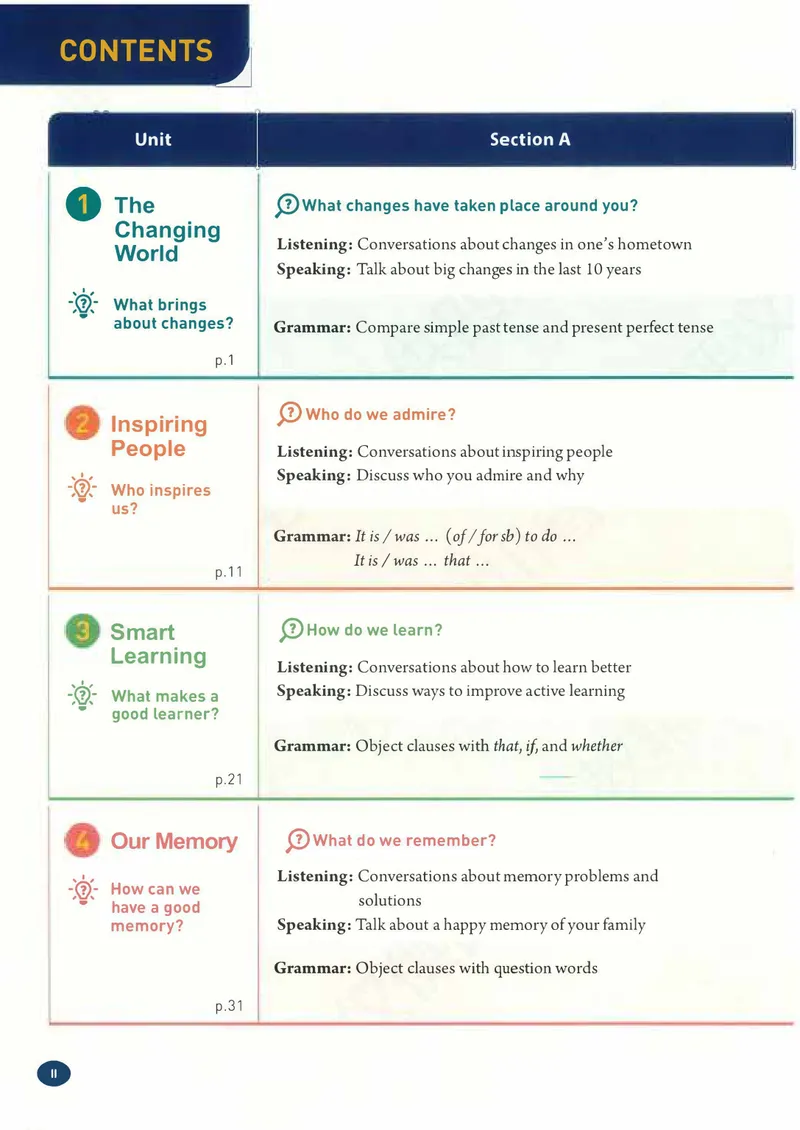
4
- -
。 Unit SectionA I
I
f})
The what changes have taken place around you?
Changing
__World Listening: Conversations about changes in one's hometown
Speaking: Talk about big changes in the last 10 years
、1,
,@
·
、 What brings
about changes? Grammar: Compare simple past tense and present perfect tense
p.1
fj)
Inspiring Who do we admire?
__
People
Listening: Conversations about inspiring people
、1, Speaking: Discuss who y ou admire and wh y
,@ · 、 Who inspires
us?
f If
Grammar: It is / was…(o or sb) to do…
It is/ was... that...
p.11
f})
Smart How do we learn?
__
Learn ng
' i
Listening: Conversations about how to learn better
、@,
, · 、 What makes a Speaking: Discuss ways to improve active learning
good learner?
Grammar: Object clauses with that, if, and whether
p.21
fJ)
__Our Memory What do we remember?
、1,
Listening: Conversations about memory problems and
,@、 How can we
� have a good solutions
memory? Speaking: Talk about a happy memory of your family
Grammar: Object clauses with q uestion words
p.31
。Section B *Project
I - -
$1)
How do changes i nfluence us? Com p are t hen and now
i p t t y i y
Read ng: A re or on changes brough b a ra lwa
iti it t i y i p i y
Wr ng: Wr e abou changes n our life s nce r mar school
y: p
Vocabular Com ound words
t t
Words relaed o changes
fl)
What makes people adm i rable?
Make a wall of
Read i n g: A b i o g ra p h y of a seed s ci en ti s t i ns pi ra ti on
iti it p t t i pi i p
Wr ng: Wr e a os abou an ns r ng erson
ffix i
Vocabulary: Su es(- an, -er, -or)
t t p i
Words relaed o rofessons
即
y t y
owcan we get better at learning? Carr ou a surve on
i
learn ng
i i ti t t t i p i
Read ng: An nforma ve ex on how o m rove learn ng
iti g: it t i g it
Wr n Wr e abou your readn hab s
ti t t i
Vocabulary: Colloca ons rela ed o learnng
$J)
How can we i mprove our memory? Deba t e: Do we need t o
i t i
memor ze hngs?
i i t t t i p
Read ng: An nformative ex on how o m rove memory
riti it i y t y t y y g
W ng: Wr e a dar en r abou our memor challen e
t t
Vocabulary: Words rela ed o memory
。- - -
Unit SectionA
I
Power of fJ) What chan g es can inventions brin g to our lives?
__
Ideas
g:
、1, Listenin Conversations about inventions at an exhibition
,@ · 、 What do Speakin g: Talk about important inventions
creative ideas
g
brin about?
Grammar: Passive voice with simple present and past tenses
p.41
9 fl) Why do we explore space?
Beyond
__ Earth Listenin g: News about space exploration
Q&A session of a live class in space
溆
. What does it Speakin g: Discuss reasons for space exploration
take to explore
p
s ace?
Grammar: Passive voice with simple future tense
p.51
8
f:f)
Feel the What do you like about music?
__
Rhythm
g:
Listenin Conversations about a school concert
、1,
,@ � 、 Wh y do we Speakin g: Talk about music you like on different occasions
need music?
Grammar: Relative clauses with that, which, and who
p.61
0 >D
Why do we like sports events?
More than a
Game Listening: Conversations about S p orts Day
睾 A live sports report
How do sports Speakin g: Talk about the Olympic sports events
inspire us?
Grammar: Subject-verb agreement
p.71
*ReadingPlus p.81 Grammar p.104
。 Listening Scripts p. 9 4 Vocabulary in Each Unit p.107I I
Section B *Project
即
owdo we turn ideas into reality?
Come up with your
Reading: An informative text about the invention of paper invention
Writing: Write about an invention
Vocabulary: Words related to inventions
[j)
How far can we go into space?
Make a poster
Reading: A popular science article on space exploration
about China's space
Writing: Describe your space dream
programme
Vocabulary: Compound words
Words related to space exploration
fl)
What is the power of music? Give a presentation on
a famous musician
Reading: A biography of Chopin
Writing: Write your music story
Vocabulary: Words related to music
即
owdo sports bring us together?
Introduce your
Reading: A speech about Beijing as the first city to host two favourite sports event
Olympic events
Writing: Write an introduction to an admirable athlete
Vocabulary: Words related to sports events
Vocabulary A-Z p.117 Irregular Verbs p. 12 7
.
Vocabulary from Primary School p.1 2 6What brings
about changes?
In this unit, you will Look and share
1. talk about how things are diffe entfrom the past. 1. How aethese two photos diffe ent?
「 「 「
2. discuss how changes have influenced ou「lives. 2. How has this place changed ove「time?
3. find out how changes happened. 3. Wh do ou thnk ths place changed so much?
4. explore what ou can do for our hometown. y y i i
y y
The Changing World.宜
What chan g es have taken p lace
y
around ou?
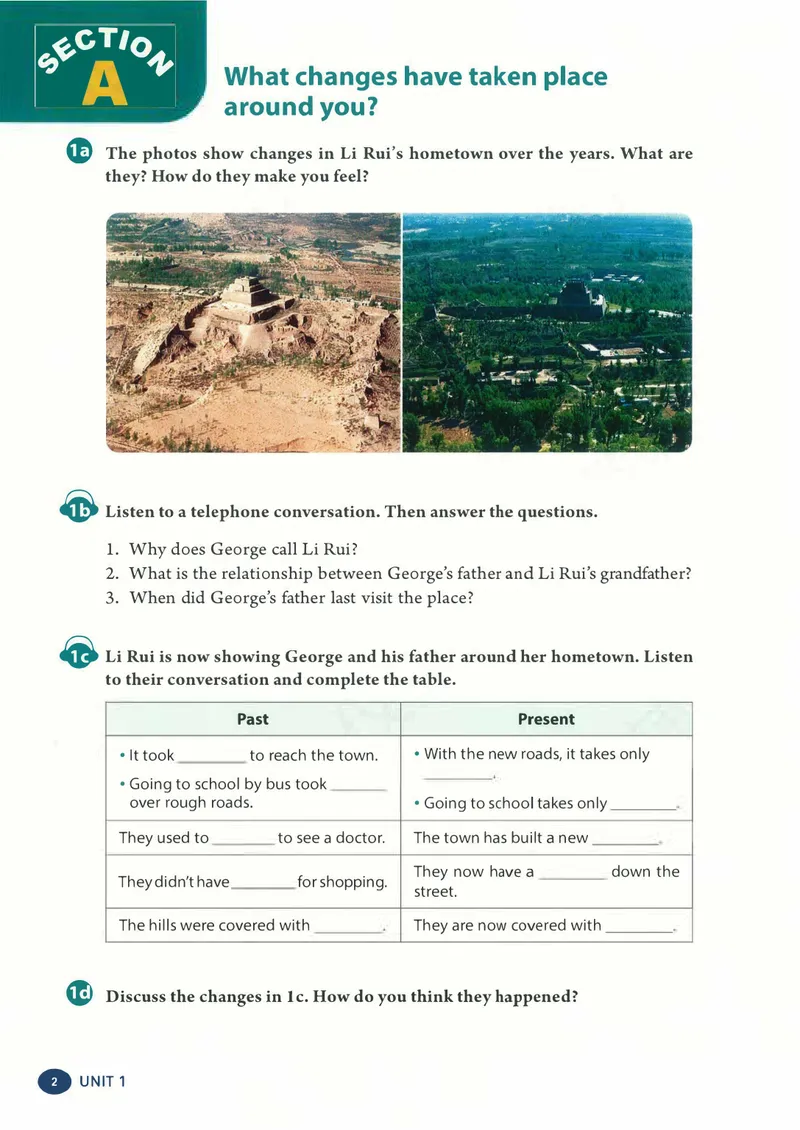
� The photos show changes in Li Rui's hometown over the years. What are
they? How do they make you feel?
令
Listento a telephone conversation. Then answer the questions.
1. Why does George call Li Rui?
2. What is the relationship between George's father and Li Rui's grandfather?
3. When did George's father last visit the place?
令
LiRui is now showing George and his father around her hometown. Listen
to their conversation and complete the table.
Past Present
• It took to reach the town. • With the new roads, it takes only
• Going to school by bus took
over rough roads. • Going to school takes only
They used to to see a doctor. The town has built a new
They now have a down the
They didn't have for shopping.
street.
The hills were covered with They are now covered with
� Discuss the changes in le. How do you think they happened?
• UNIT1`
� Rank the following problems from 1 to 4, with 1 being the worst. Give your
reasons. "
z
它
difficult farmland lack of
sandstorms
environment shortage technology
令
Listento the conversation between George's father and Li Rui's grandfather.
What problems in 2a did they mention?
令
Listen again and fill in the table. How has the environment affected local
lives?
• There used to be all the time, and the
Past
were getting smaller and smaller.
• Locals worked by
• Locals found a bush. It had roots that could
the soil together.
Action • They began planting it in sandy , with the
government's support.
• They had to help.
• The corn fields are
• They have planted many bushes and since then.
Present • There are sandstorms now and the environment is
getting
• It has improved local lives.
� Discuss how the problems in 2b were solved.
A:T he area used to be covered with sand.
B: What did they do to solve this problem?
A:They认础巳抄ushesand trees. The land has become…t i t i t p t t i g t
� Read he n erv ew be ween a re or er and wo v lla ers. In wha ways have
t i
he v llagers'lives changed?
t g i t t t
Reporer: How has life chan ed n your home own over he las 20 years?
it g it t! g p p t i
MrXan: Oh, has chan ed qu e a lo Many youn eo le used o work n
ig citi t t
b es. Now, more of hem have come back o live and work here.
p t t! t t g
Re orer: Grea Have here been any o her chan es?
g t t g g t
Ms Wu: Yes, we've chan ed he way we farm. I used o row a few ve e ables
t t t t. g ig
on a small farm o sell a he local marke Now, I have lar e, h h
t g g t it g t
ech reenhouses. There, I row ons of fru and ve e ables, and sell
t i g citi
hem n lar e es.
p t t ig t p t!
Re orer: Wow, he new h hway and railway mus have hel ed a lo
t i g t ri t tt ti
Mr Yan: Oh, hey have! Our v lla e has become a ou s a rac on. We can
p t t t i t p t t
now sell local roduc s o our s s. We also sell roduc s online o
i
people all over Ch na.
t t
Reporer: Have hese changes greatly improved
your lives?
Ms Wu: Yes! We now have new houses. And
i
our v llage has just built a new
pit
hos al and a library.
p t t
Re orer: Wonderful! Toge her you are
e i ci t i
build ng a new so alis v llage.
p t t t it t i f ti f
Com le e he able w h he n orma on rom 3a.
t t
Pas Presen
令
i t t t ti p it.
L s en o he conversa on. Then role- lay
t t i g t t g g i t t i
� Choose he h n s ha have reatly chan ed n he las 10 years n your
t t t g f t t
home own. Talk abou he chan es and how you eel abou hem.
pit t
hosppai l g stchool t e-pa i ymen t
.
shot n t ranspor envr i onmen
res auran Clnema housng
pi i t g t t
A: In your o n on, wha has chan ed he mos
i t i t t
n your home own n he las 10 years?
i t, t i
B: The env ronmen I h nk.
it
A: How has changed?
B:…
• UNIT1Grammar Focus
� Read the sentences and circle the verbs. Pay attention to the verb tenses.
He became a good friend of your
They haven't seen each other for ages!
grandfather about 20 years ago.
We used to have to travel far to see a
Our village has just built a new hospital.
doctor.
Now, more of them have come back to
Many people used to work in big cities.
live and work here.
� Complete the conversation with the correct forms of the verbs in brackets.
A: _ you_ (be) to the new library yet?
B: No, I_ (not know) there was a new library. When did it_ (open)?
A: It _ (open) last Friday. I _ (go) there with my grandpa on
Saturday night.
B: _you_ (like) it?
A: Of course! It's the most high-tech library I_ ever_ (visit).
B: Oh, what_ you_ (see) there?
A: There are sections with books about science and Chinese culture, as well as a
huge section with children's books. I also_ (read) some digital books
on the computer. My grandpa_ (listen) to some audio books because
he can't see well.
B: Cool! I _ (bring) my little brother there tomorrow.
C,
Complete the passage with the correct forms of the verbs in brackets. Why
are local people richer and happier than before?
In the past, it _ (be) difficult to
travel in Guizhou. In many places, there
used to _ (be) no bridges to cross
over mountains and rivers, and most
roads were just dirt tracks. This
(make) it difficult for locals to bring
products to the market or to develop
industry.
Now great changes _ (take) place.
The government_ (build) thousands of kilometres of highways,
railways, and wide roads. It has also built many high bridges over mountains
and rivers. A journey that used to _ (take) a day now takes only a few
hours. As a result, the lives of local people_ (improve). They are much
richer and happier than they once _ (be).
The Changing World.dCTIO
B
+
今 g i
How do chan es nfluence us?
e
e
Does your hometown have a train system? How does it benefit local lives?
Look at the title and the picture. What is the text probably about? Then read
it quickly to check your prediction.
二二, 毯
I Onthe FastTrack
In 2017, the new 480-kilometre Mombasa
Nairobi railway was opened. Before then, the Making predictions
only transport links between Mombasa, Kenya's The title and
pictures can help
main port, and Nairobi, Kenya's capital, were
you guess what the
rough roads and an old railway line built in text is about.
1901. The old trains were very slow. It took 10
hours to get to Nairobi from Mombasa by train.
However, the new railway, built with China's help, has already cut the
travel time between Mombasa and Nairobi to about four hours for
passengers. Now, more than two million people use it every year.
Local Kenyans have benefited a lot from the new railway. A government
worker said, "I'm very happy with the new railway built by our Chinese
friends. Many changes have taken place in the town over the last few
years, and the people who live here have become rich." A businessman
said, "My experience of using the train since 2017 has been good. It is very
convenient and doesn't cost much money. I am able to get to places on
time and make business deals with ease:'The railway has also made the
transport of food easier. "Food used to
. take hundreds of lorries to carry between
. •.-
. . . .•., ,· . ·, .. . . .. ._ 、. . . . i . . - · the two cities, but now it takes only
two or three trains," said a supermarket
` ·- , . `` 今 . manager. As a result, people now have
more fresh food to eat.
. Although China and Kenya are far away
from each other, the railway shows how
different countries can work together to
build a better world.
• UNIT14D
t t it t i f ti
Ma ch he numbers w h he n orma on.
( )
t4 10 480 1901 2017
abou over 2 million
1. : t t il
2.
: t
he
y
year
t
he new ra
il
wa
y
y was opene
i
d
lt
3. : t he ear he o f ld p ra p wa line was t bu t i y y
4. : t he num gt ber f o t eo le who use i he n i ew i l ra y n i ev k e i r ea t r
5 : th he len h it o he t M t om t basa-Narob i r a wa n lome y r tr e ain s
6 : t e hours it u t sed o t ake o reach Na i irob from Mombasa b y t i
he hours akes o reach Nairob from Mombasa now b ran
g i t ti
� Read a a n and answer he ques ons.
1. t typ f iti g i t t t?
Wha e o wr n s he ex
t t p it t il y?
2. Wha was he roblem w h he old ra wa
y fit t il y?
3. How have local l(en ans bene ed from he new ra wa
y i it i p t t t f t p t i
4. Wh s m or an o make ood rans or eas er?
t t f t t
e 5. Wha does "on he as rack" mean?
p t t t it t i f ti t t t.
Com le e he able w h he n orma on from he ex
i t ti t i i i 2017.
g p n roduc on The new ran lne was n
Para ra h 1 i y
old ralwa
g p 2 i y
Para ra h new ralwa
g t
overnmen worker:
t
g p i
commen s
Para ra h 3 busnessman:
from locals
p t g
su ermarke mana er:
g p i
Para ra h 4 concluson
i t ti
@
D scuss he ques ons.
1. y f y i il g i t t t
Have ou seen or heard o an s m ar chan es n he world over he las
y it t pp
several ears? Where was and wha ha ened?
t t y i t g t it t tri t il
2. In wha o her wa s can Ch na work o e her w h o her coun es o bu d
tt
a be er world?
gi g
The Chan n World.y i
Vocabular n Use
t ft t ig t t t p
� Use a word on he le and a word on he r h o crea e a com ound word.
t t
Wha o her compound words do you know?
y g
= …
green sand high,+ storm wa land reenhouse,
i
farm ra l house road
Q
p t t t it t i t
Com le(e he sen ences w h he words n he box. )
p t i g i
roduc corn brd e wde capital
t i ty. it i
1. The road used o be narrow and d r Now, s_ and clean.
it i t f t i g t t t ri
2. The _ made convenen or he v lla ers o ravel across he ver
t t city.
o he
iji g, i t t y pi t
3. Be n Ch na's , hos ed he 2008 Summer Ol m cs and he
i t y pi
2022 W n er Ol m cs.
f t f yi g y f g t
4. Our arm has a lo o la n hens. The eed on _, ve e ables,
i t
and nsec—s.
igit i thi n't
S. A d al s some ng you sell online and does have a
ic
phys al form.
tJ
p t t p g it t t f f t i t t
Com le e he assa e w h he correc orms o he words n he box. Wha
t t i y t i i t i t
o her s or es do ou know abou Ch na's env ronmen al ach evemen s?
g t y i
overnment bush sands orm result sand sol
g g i it i f ily
In 1962, Wan Shan ha moved w h h s am from
t i i g t t f
he r house n Chen de o he_ lands o
i f t t t
Sahanba. There were ew rees o hold he
t g t t p tur
o e her, and here were often _. Tem era es
i g ri g t i t if t
were below freez n du n he w n er. L e here
iffi
was very d cult.
it pp t t g g i g p f p p
W h su or from he _, Wan Shan ha led a rou o 369 eo le
t i t t i t f i tt
who were de erm ned o make he env ronmen o Sa hanba be er. Over
t t y p t t ti g t
he nex 60 ears, workers lan ed _ and rees, crea n he world's
igg t f t.
b es man-made ores
y, i i "t g i i i t f
Toda Sa hanba s known as he reen m racle': Th s s he _ o
p p ki g t g t t i it g
hard work and eo le wor n o e her. Now, he land s covered w h r�它en
t t t i
rees and he wa er s clean and fresh.t t t. t t y t i t t t' lif
� Read he ex Wha s a s he same n he s uden s e?
g y
Chan es in M Life
t t y lif i iff t i pri ry l.
Now ha pI am oldperi, n1 ry e s d eren fro1n when I was n ma schoo
For examit le, 1yn yp r nt1a schooyl jwasi nearig my homei, so tI used to walk to
stchool w h mry arye n ist. Noyw f r1in un or h h school s far her from home. I
ake a bus eve da w h n1 ends.
y g t y iy t i i t, t
M home has chatn ed oo. M gfan1 l usedy go l ve n lai s1nall itfla bu now
we have n1oved o a much lar er one. M ratn.d ma gves wt ht ugs nt otw as
well. Shrey hays .h er own room and her own TV se I am lad ha I e o see
her eve da
y t y i iff t. t i y
Tthei wa I s ud s alsog d pe rein I ihave becjoy1n et n1yoireg cointfideny frin n1
sItud es anidg o ften attend rou d scusis ons. I gen o r. s ud n w h m ends.
's an1az n how much we have ach eved to ethe
y lif g i y y t t i g t y t t fe i g
Mf e has chpapni ed n n1an yw a ys, bu iloyn. e h n s a s he sa1ne: he el n
o love and ha ness shared b m fam
p t t t it t i f ti t t t.
� Com le e he able w h he n orma on from he ex
p t t t
As ec Pas Presen
school
home
t y
s ud
i t y i p i y l. t y y lif
• Th ngk back o whetn iou wt ere lni rtmar sichoo In wha wa s has our e
chan ed? Make no es n a able ke he one n 3b.
home school study
ig p
ne hbourhood trans ort environment
t g it t p g t t it t i g
� tChot otsey htree chan es. Wr e a shor assa e abou hem. End w h one h n
ha s a s he same.
gi g
The Chan n World .. .
*。Project 扛 Compare then and now
。
In groups, think of IO things that are important in life. Here are some examples.
, technology 坐 environment 0克 transport
entertainment 邑] education 、匣 shopping
。
借
housing <:a, medical care
Design a survey for your parents or grandparents using the 10 things you
thought of.
卢
SURVEY
1. What were computers like when you were young?
2. How did you get to school? How long did it take?
3. What did you do for entertainment when you were my age?
4. ...
0
Interview your parents or grandparents about their lives when they were
your age. Note down their answers.
0
List the differences between their lives and your own.
Then Now
• Most people didn't have • Home computers are common and
computers in their homes.
.
many people use smart devices.
GD
Give a presentation to your class about the differences between then and now.
Reflecting #J·
1. What do you think brings about changes?
2. Which changes mentioned in this unit impressed you the most? Why?
3. Can you use the simple past and present perfect tenses to talk about changes?
4. What is one change you would like to see in the world?
5. What is one change you would like to see in yourself?
Change is the o pp ortunity to create a
、
--售 一~` 一· better future.
• UNIT 1Who inspires us?
膘蠲圃黯i
In this unit, you will Look and share
1. talk about inspiring people. 1. Who do you see in this picture?
2. d scuss who you adm re and why. 2. Do you know any of these people and
3. diescribe admirable peiople and their achievements. thei「sto「ies?
4. explore the spi「itof inspiring people. 3. What do these people have n common?
idCTIO
A
+
今
Who do we admire?
e
Match the people with their professions. More than one option is possible.
writer historian professor _ teacher
researcher scientist chemist physicist
「一! 丁
,
心了i
寸
、
, 1
«P
、
c
Sima Qian Yuan Longping Michael Faraday Marie Curie
令
Listento the conversations. Match the speakers with the people they admire.
1. Yarning_ 2. Peter_ 3. Fu Xing's father
4. Emma's grandma_ S. Ms Gao
令
Listenagain and complete the notes.
Yuan • Developed a new kind of rice and helped _ hunger
Longping
• Trained people to_ farming
• Did research in physics and chemistry even though he didn't
Michael
Faraday • Dropped out of school at an early age, but he
to study and became a great scientist
Sima • Was the_ of the book Shiji (Records of the Historian)
Qian •_in reviewing the Chinese calendar at that time
Marie • Made many important discoveries in_ and chemistry
Curie • Nobel Prizes
� What do you think about the people mentioned above? Talk about who you
admire and why.
• UNIT2t t p p it t i i t
� Ma ch he eo le w h he r ach evemen s.
t ig ti g g
Isaac New on lsambard Brunel Florence N h n ale Alan Turin
i p t t gi i t t t y.
1. _ was an m or an en neer n he 19 h cen ur
i p t t i i i p y i
2. _ made m or an d scover es n h s cs.
t t p t i
3. _ volun eered as a nurse o hel he wounded sold ers.
t t t t if p t y t i p
4. _ crea ed a es o see a com u er could reall h nk like a erson.
令
i t t t ti f ily i
L s en o he conversa on. Who does each am member adm re?
i t i
1. Dad adm res 2. Mum admires 3. S eve adm res
令
i t g i i t y t p t t t
L s ena a n and c rcle he coloured words ou hear o com le e he no es.
ilt t t riti il y i y y t
Brunel • bu he firs B sh ra wa s / a rwa s and man o her
i p t t t i g
m or an h n s
p t p i t p ti
• hel ed he UK develo n o a modern / develo ed na on
ig ti g t p i g
N h n ale • crea ed / develo ed modern nurs n
p t t f tt pit
• hel ed us unders and he need or cleaner / be er hos als
t t p t p f i
o s o he s read o d seases
t
New on • developed modern physics / science
i g • pi f p t t
Turn oneer o com u er science / echnology
t t p p it t i f i y t p p
� Ma ch he eo le w h he r fields o work. Then d scuss wh hese eo le
i pi i g.
are ns r n
il
ra way
• sea travel
i
• phys cs
• medicine
g
Tu Youyou Zhan Tianyou He Zehui, Zhen He
g
Qian Sanqian
t i i g t i i pi i g
I h nk... s I are rea I adm rable I ns rn because ...
i fo
It s I was... ofI r...
pi i g p
Ins r n Peo le .(D Read the conversation and complete the chart.
Adam: Hi, everyone. Who is the person you admire the most?
Yarning: My favourite person is I.M. Pei.
Adam: Did he design the glass pyramid at the Louvre Museum?
Yarning: Yes. It was very creative of him to design it. The Suzhou Museum
is also one of his amazing designs. He created a beautiful balance
between the East and the West.
Adam: Wow, you really know a lot about him!
Yarning: read books and reports about him. want to be a creative person
I I
like him.
Adam: What about you, ChenJie? Who inspires you?
Chen Jie: Wang Yaping, of course, China's first woman to walk in space. She is
full of courage and wisdom. She was also the first woman to teach a live
class from space. What about you, Adam? Who do you look up to?
Adam: Me? My biggest inspiration is not a famous person. It's my father.
t's really very nice of him to support and encourage my exchange
I
study here.
• the China's first woman • supported and
glass pyramid at the to and
Louvre Museum, to
and the full of
• between the
East and the West
令
Listento the conversation. Pay attention to the questions the speakers used.
Then role-play the conversation.
fJ
Work in groups. Discuss who you admire and why. Use the words and
expressions to help you.
creative brave amazing inspiring full of courage full of wisdom
great curiosity dream big never give up ...
• UNIT2Grammar Focus
4'
t t p t t it p y f.
Read he sen ences. Com le e each sen ence w h a erson ou know o
It g t f... t p i f i p g
was rea o o develo a new knd o rce and hel reduce hun er.
It i g t t... i i p y i t y t g
was amazn ha dd research n h sics and chems r even hou h ...
It iffi t f t t t i f i t y
was d cul or ... o do ha knd o work back n hose da s.
i f... pp g
It's really very nce o to su ort and encoura e ...
t i y i p t t (f t p g i g i lif
I s alwa s m or an or ...) o kee on n e.
a.b
it t i g t i t
Rewr e each sen ence us n he words n bracke s.
1. t t t i pf y/ i p t t)
We lis en Io our eachI er's adv ce. (hel ul / necessar m or an
t i pf y i p t t f t i t t i
I s hel ul necessar m or an or us o ls en to our eachers adv ce.
t g ti y i g / i t ti g / f
2. Tall rees can row from n seeds. (amaz n n eres n wonder ul)
i
➔今 It s
fuci i t t t t it p t. i
3. Con us sad ha we should rea our elders w h res ec (w se)
i f
It was w se o
f i f i g p ci ti t t
4. Pro essor Gu 's childhood dream o becom n a s ace s en s came rue
t g i t (i piri g)
hrou h h s effor s and hard work. ns n
i piri g t t
➔
It was ns n ha
ict g t p f t p p t.
S. V or Hu o s ood u or he common eo le he cared abou (brave)
f
It was brave o
$
➔ p t t p g it t t t p t t y y
Com le e he assa e w h he correc sen ence ar s. In wha wa s do ou
g i pi i g? i y
find Zhan �an ns r n G ve our reasons.
➔
i i f i
A. It s mportant or us B. It was really brave and adm rable
i y i piri g i p i f i
C. It s alwa s ns n D. It seemed m ossble or h m
t t g t p p t i t i tly,
o read abou rea eo le and learn he r s or es. Recen I
t g 心 t pi f t f t
read abou Zhan an, he oneer o he amous Silk Road. In order o
p f t i i p f t y ty t g 心
hel de ea h s enem es, Em eror Wu o he Han D nas sen Zhan an
t t i p p f t t y, g g t y t
o find he Yuezh eo le. Un or una el Zhan Qian was cau h b he
y. _ t i i t t t
enem o fin sh h s ask or o reurn home. However, around 10
y t g t t y, y i i g
ears la er, he o a chance o run awa and he finall succeeded n find n
t i p p t t f g t i t i t
he Yuezh eo le. _ ha he never or o h s ask, and h s ravel
g t i f ti t t t gi t
also brou h back valuable n orma on abou he Wes ern Re ons. La er, he
t t t p g i t ti ip t i t i gi
was sen o h、ese laces a a n o build rela onsh s. S or es like h s ve us
p i pi ti t t t p t y t
ower and ns ra on. _ o unders and he as and find wa s o
f tt f t .
do more or a be er u ure..
.
What makes people admirable?
e
.Look at the title of the text. What do you think a seed scientist does? Do you
think it is an interesting job?
e
Read the text quickly. Who was the seed scientist? What did he do?
The Inspiring Seed Scientist
On 25 September 2017, the scientific world was shaken by the news that
Chinese professor Zhong Yang had died in a car accident. The well-respected
biologist had spent his whole life researching plants and seeds. Over the years,
he collected many important seeds for China's seed banks. These special banks
protect all kinds of plant seeds, including the ones we need for food, and they
make sure that important plants do not disappear from the world forever.
Zhong Yang was born in 1964. When he was young, he showed a deep love
and curiosity for the things he studied. He was an excellent student, entering
university at the early age of 15. There, he studied radio engineering and
later became interested in plants. The research and study of plants, especially
the seeds, became the focus of his life after he became a professor at Fudan
University.
It is important for seed banks to include many different kinds of seeds. When
Zhong Yang discovered that there was not enough research of the seeds from
Xizang, he went there to collect seeds himself. In 2001, he began his travels
across Xizang. It was very difficult for him to brave the cold weather and great
heights. He sometimes fell sick, but he always continued with his work.
Zhong Yang knew it was better to include more people when doing important
work. He began a programme to find and train local students in field research
to become scientists. Together, he and his team collected more than 40 million
seeds from around 1,000 plants. Their hard work provided the world with lots
of new information about the plants in China.
Zhong Yang left behind more t�an just a huge
collection of seeds. His love for his job and research
lives on in his students. He once said, "My students
will continue on the road of scientific exploration and
the seeds we have collected may grow hundreds of
years from now:'(D
Read again and match each paragraph with its topic.
Paragraph 1 A. Training local students to do important work
Paragraph 2 B. Introduction to Zhong Yang and seed banks
Paragraph 3 C. What he left behind
Paragraph 4 D. Becoming interested in seeds
Paragraph 5 E. Starting to work and collect seeds in Xizang
� Fill in the blanks with the information from the text. Then put the events
into the timeline and tell the story of Zhong Yang in your own words.
A. Zhong Yang was born.
B. He_ at the age of 15.
C. He began_ to train local students.
D. He died in
E. He studied and later
F. He travelled around Xizang to
G. Zhong Yang_ plants.
o c o c
勹 勹 勹勹 厂勹
1964 2017
。
Explain the meanings of these sentences in your own words. Pay attention to
the underlined words.
@
1. It was very difficult for him to brave Using context
Using the sentence
the cold weather and great heights.
context may help you
2. His love for his job and research lives guess and learn the
。
on in his students. meanings of difficult
words and phrases.
Discuss the questions.
1. Why did Zhong Yang want more people to do seed collection and research?
2. What made Zhong Yang admirable? What can we learn from him?
Inspiring People .Vocabulary in Use
e
i t t t p t t t it
C rcle he icogr reict w-iotr, ds o co-mi le e he sen ences. Then wr e down more
words end n w h s -er, and an.
1. y i t g p, t t ci i ti t
When m slis er t rofiws u t she wt an s i o become a s ence / sc en s
becausiet shye /k eis tor i nd outhow he un vetr ste works. f p t f
2. Thcei hlis ori his o an wro e a book abou he success ul develo men o
soy af sm rnit Ch na. t i i t y / i t. i i g t i g
3. Mt g tavou e schoiolg s ubjye ct sy chemgs r chem s I love m x n h n s
o e heri andg yle /a rnin gwiht the chtant et. i ity t yi g lif
4. Some tb olo b olo s s uden s a he un vers are s ud n how e
on ega r hi blieganp. yi p yici t ry t t i tifi
5. Ten Fe kes h s cs i/ th sf ts ve much, and he wan s o be a sc en c
e
researcher / research n he u ure.
p t t t it t t f f t i t
Com le e( he sen ences w h he correc orms o he words n he b)ox.
spread wise elder calendar radio
t t t t i ri t t
1. I heiardi tayb ou he la es d scove tes abpou bltack holest onf the i
2. Cur os antd _ leaidt usy o ex lto re he sect re s o he uyn verse.
3. tI wouldif l ove o have lunch w h ou nex week. Le me check m
o see It tam free. t. i i
4. Ytou'd be er wf epar tai mtaski wghieng yopu. go ou The d sease s _, and
he niumbeir o a en s s ognt u ry i t t i ci
S. Mar e Cur e's _ri i dau h eirt, Ir亡ne, was also ve n eres ed n s ence
and won a Nobel P ze n Chem s ry.
p t t p g it t t f f t i t y t
9
iCotm le e he liassa e wt hi he correc orms o he words n he box. Tr o
n roduce Ame a Earhar n your own words.
p t pi g pi t t g
look u o oneer coura e lo come rue encoura e
li t
Apme ta Eaprhpartwas always a brave chitld, full of_f. Aft t. kiHegr
arefin st sfluig ot ried apnd _ hetr ot be herselt t er a n
her rs h n a t lane, syhte kinge w hai sthe wan ed o btecome
a _ mtorpe yh afn an h n efllysei gn he world. La er, she
wflorkeidg hardt o a y or her own n lefssons. In 19t2 i2, shet
ew h fher hiagn anfligwto _man had d onte befiorte . Earhart fls yb es
known or be nt a h ti ias he rs woman of on
her own tacross he Atlan c Ocean n 1932. She becamt e amfious
i pi iagro pund he world. Mf any peotplte _ Earhar anidli tyn td
her an ns r n erson because o her effor s o work hard and her ab o
make
• UNIT2e
Read an online post. Who does the writer admire? Why?
To me, one of the most inspiring people in Chinese history is Mozi (about
468-376 BCE). It is said that Mozi was a soldier, good at woodwork, and
was the inventor of the kite. But in fact, above all, he was a great thinker.
Mozi lived during the Warring States Period. Back then, many kingdoms were
fighting against each other. In these wars, the common people were always
hurt. To Mozi, this had to stop, so he spent his life trying to bring peace.
His idea of love was one reason that Mozi wanted peace. It was
important to him that everyone should show the same kindness
and care to everyone else, whether they were family, friends, or
strangers. He also believed states should avoid attacking one
another.
Though Mozi lived more than 2,000 years ago, his ideas live
on. I think he is still a great inspiration to many people. Now,
more than ever, people around the world need to hear the
message of peace and love, and work together to build a
community of a shared future for mankind.
等
e
Compl[ete t he chart using the information from the post.
Who? Mozi, a great
Where?/ When? Lived in China during the Period
An
inspiring \
person
厂
Tried to bring
What?/ How? ]
Believed
\
- --- -------- -------一 ~ -- - ~ _ _ _ _
(
His ideas
Why?
\ _ .P-`eo—pl—e ne-ed— to __ _ ___ _ _
_ .~.一 -一··~·` _
Research a person in this unit or any other person that you find inspiring.
G
Make notes in a chart like the one above.
-
� Use your notes to write a post about the person you find inspiring.
Inspiring People .. .
*Project [AA] Make a wall of inspiration
� Brainstorm inspiring people you know of. Then do some research on each
one and write down a simple introduction. Here are some examples.
He Zehui Mao Yisheng
A famous engineer known as
► A brilliant physicist known as "the father of modern bridges
China's Madame Curie in China"
Dedicated her life to science ► Shared his knowledge by
and teaching young researchers teaching at universities and
writing books
Galileo Huang Wenxiu
► A young village leader who
An Italian mathematician, worked to fight poverty in the
philosopher, and astronomer countryside
Discovered that Earth moves Believed that serving the
around the sun people was the most important
for a party member
� Discuss what these inspiring people have in common. List the qualities you
all agree on.
C,
Work in your groups to choose a person you admire and make a poster.
� Present your poster to the class. Put it on the wall of inspiration in your class
or school hallway.
Reflecting fi·
1. What inspiring people have you learnt about? Why are they inspiring?
2. What are some words and expressions to describe inspiring people?
3. Can you talk about who you admire and explain why?
4. In what ways have the stories in this unit inspired you? How can you
inspire people around you?
y
Inspiring people show us the wa forward.
• UNIT 2What makes a good
learner?
In this unit, you will Look and share
1. talk about learning school subjects. 1. What do you see in this photo?
2. discuss ways of learning actively. 2. What do you think is going on in this
3. express opinions on learning st「ategiesusing object photo?
clauses. 3. How is this like you「ownstudies?
4. explore how to become a better learner.
Smart Learning .dCTlo
A
+
今 How do we learn?
� Look at these learning tips. Tick the ones that you use. You can add more.
口 take notes
口 use flashcards
口 reviewkey ideas 口 do research projects
D test myself D watch learning videos
口 uselearning apps or websites D set learning goals
D create mind maps 口 workin groups or teams
令
Listento the conversations and match them with the pictures.
Conversation 1 Conversation 2 Conversation 3
。
令
Listenagain and complete the sentences.
1. Teng Fei says the best way to study maths is to _.
2. The learning app will find your weak points and_ to work on them.
3. Adam wonders if Fu Xing could help him with his
4. Fu Xing takes notes a lot and tests herself on _.
S. Ella wants to know Peter's secret to
6. By doing hands-on experiments, Peter finds that he can connect physics
with something
� Talk about how you study for the school subjects mentioned above.
A: How do you study for …?
B: I study by reviewing my notes. I think it helps. How do you …?
A: I use websites to help me with …
• UNIT 3� Think about how you learn English. Tick the ways that are true for you.
勹 lookup words in a dictionary
口 keep a learning diary
D speak English with friends / classmates
D take part in class discussions
口 read aloud to practise speaking
D repeat dialogues from English films
令
Listento the conversation in a school English club. Complete the chart.
二
I
I
I T 0d ay s quest. O n . .
I , 、、-- - -- I - -i-- ---~ - } - --l - - - l - -_ - _i- - i_ ---- _ - - - - - - -- 一..i一
i
I I I I I I I I I I
I
,, ' -
|e
-
a
- -
r n
-
n
-
e
-
W
-
WO
-
r
-
d
-
s
- i
b
-
y
- t _ l 、 、,
1 I II I I I I I I' I
,
' I I I II I I I I
, , -
e
- -
X P
-
r
-
e s
-
S
~ -
0
- -
n
l
S
- l
a
-
n
i _
d
- _-l- - i __
u
- -
S
-
e f
i
u
i - - - - - t f 、`
' I I II I I I I I ` I I I I I I I I I I I
,,
[
l
c
-
a s
-
S
i
a
-
o
i
t
- f 、`
` I I I I I I I I I
令
Listenagain. Choose the tips mentioned in the listening.
A. Flashcards are useful because you can take them anywhere.
B. It's good to put words in groups when you learn them.
C. It's important to speak English a lot outside class.
D. You should read books that suit your English level.
E. Reading is important for learning in general.
F. You will improve your reading speed if you read a lot.
� What do you find difficult about learning English? What are some ways to
overcome these problems? Share with a partner.
• I can't read quickly.
I'm afraid of making mistakes.
c.
C`·
• I can't remember new words.
• . I find it difficult to follow conversations.
• I can't use grammar rules correctly.
Smart Learning .t p t i t i y i i it i i t p t?
� Read he odcas n erv ew. Wh d d Ella nv e B nb n o her odcas
i, t i i p t. y g t i i i g i g t gi
Ella: H h s s Ella's odcas Toda 's ues s B nb n. He's o n o ve us
i f i g gli
some deas or learn n En sh.
Binbin: H i, Ella. Thanks f or hav i n g me! For learn i n g En gli sh, I t h i nk firs t y ou
t ti
need o become an ac ve learner.
t y y t t?
Ella: Wha do ou mean b ha
t t p gli p ti gli t tim
Binbin: Well, because I wan o s eak En sh well, I rac se En sh all he e.
y t p t f ti t yi g!
Ella: Oh, ou mus s end a lo o me s ud n
Binbin: Well, it doesn' t mean y ou have t o s t ud y all t he tim e. You need t o s p end
ti i g t g g p p gli it fri
me us n he lan ua e. For exam le, I s eak En sh w h ends. I
p t t i g fr t li gli
re ea he d alo ues om he films I ke. I read En sh books, and
ti it y i y i gli
some mes I wr e m d ar n En sh.
g y y y i g.
Ella: Wow! I uess ou reall enjo learn n
Binbin: Yes, it' s t rue! Bu t y ou see, I s t ar t ed ou t a t zero and came across
p y t t t t i g t p y t p. t t
roblems. I mean ou jus have o ake h n s s e b s e S ar
simple and build up.
t' t
Ella: Tha s so rue.
e
i f t ti i g tip i i f t t y
Wh ch o hese ac ve learn n s does B n b n ollow? Wha abou ou?
。 。
TOP TIPS FOR LEARNING ENGLISH. AC TIVELY
凸 冶
p ti t p p iti
口 S end me 口 Read a lo D Make D Develo D Be os ve
i g t i g y y
us n he learn n our own when ou
g y t t gi
lan ua enjo able s ra e es have
iffi lti
d cu es
t ipti t ti
• Read he descr ons and find ou who are ac ve learners.
伊
y p ti t t i t g i g ppi g.
A. Jenn rac ses wha she learn n ma hs class when o n sho n
t i g t p p f i i ti
B. Frank akes even n classes o re are or h s HSI{ exam na on.
y t p y i f it i t y
C. Ton wro e a la based on h s avour e h s or lesson.
t y ft p t ki g p t t t t y.
D. Ca h o en u s off wor n on her rojec o he las da
� L i s t en t o t he conversa ti on. Then role- p la y it.
i t y f y t t t ti y.
� D scuss he wa s or ou o learn o her school subjec s ac vel
• UNIT3Grammar Focus
� Read the sentences. Circle the connecting words and underline the object clauses.
I believe (that) reading is important for learning.
I think (that) the best way is to do maths problems.
Peter finds (that) he can connect physics with something in real life.
I wonder if/ whether you could help me.
I want to know if/ whether you read English books outside class.
� Complete the sentences with that or whether I if.
1. Jim doesn't know_ he can take part in the research project or not.
2. My parents think_ they need to be stricter about my studies.
3. Ms Gao understands_ some students need more time to improve.
4. Terry wonders _ it will be easy to study courses on AI.
S. Could you tell me _ this sentence is correct in English?
Look at your answers above. Circle the connecting words that can be left out.
G
� Complete the passage with the correct sentence parts. Then discuss whether
you would like to try the learning method suggested.
A. by studying maths books B. He suggested that
C. He wondered whether D. learning had many challenges
E. It is hard to believe
As a youth, Hua Luogeng left high school to support his
family. However, he loved maths and did not want to give
up. _ there was a way to continue learning.
Finally, he decided to teach himself_. Hua
Luogeng later introduced a reading and learning method
to young learners. _ learners should read
and take notes very carefully, then summarize the key
points. He once said, ''A book starts heavy and thick but
becomes thinner as you understand it better:' As an active
learner, Hua Luogeng stayed positive no matter what
difficulties he met in his life and studies.
that such a talent also failed exams in school, but that was true for him. He said
that and it was important to take things step by step.
Smart Learning .dCTIO
B +
今
How can we get better at learning?
。
。
Look at the title of the text. What advice do you think the writer will give?
Discuss your ideas.
Read the text quickly. Match each paragraph with its main idea.
Paragraph 1 A. Learn from other students.
Identifying text
Paragraph 2 B. Make learning a lifetime habit. . .
organization
Paragraph 3 C. Have a growth mindset to learning. Finding main ideas
Paragraph 4 D. Practice makes perfect. in paragraphs helps
understand text
Paragraph 5 E. Use learning materials wisely.
organization.
Paragraph 6 F. Everyone has the ability to learn.
How to Become a Successful Learner
Everyone has the ability to learn. Experts on the science of
learning will tell you that anyone can become a successful
learner. However, many students do not realize this, and
they have trouble learning.
Studies show that the first key to becoming a successful learner
is to have a growth mindset. This means, in part, believing
in yourself. It also means setting goals, taking action, and
meeting challenges. People with a growth mindset see mistakes as chances for
learning, as they teach us how to improve.
Research also shows that practice is important for learning. The more we
practise, the better we learn. We learn best by practising new and difficult
things. Sometimes it is also important to get guidance from a teacher or a
coach. They can show us the right way to practise and give us important
feedback and advice.
In addition, studies show that students learn more when they hang out with
other students who are serious about study. First, by being together, students
can easily learn from each other. Second, students are challenged to do better
by each other. This has been proven to encourage learner growth.
Successful learners also use the best learning materials they can find. In
the 21st century, this means using new technology and resources, not just
textbooks. Since there are so many learning materials on the internet, it isimportant to think carefully and choose wisely what and how you study. Take
advantage of the best tools and resources to learn wisely and efficiently.
Finally, successful learners see learning as part of daily life. It is something
they will do even after they leave school, even when they are old. As you
continue on your learning journey, you should try to walk at your own speed
and enjoy the trip. Never lose heart. The road ahead of you may be long and
may have many mountains and valleys, but it also has great treasure. You will
find more joy in living a life with learning!
Read again and answer the questions.
G
1. What do many students not realize about learning?
2. Why are mistakes good for learning?
3. What kind of practice is the most useful?
4. What is important to encourage learner growth?
S. Why do we need to think carefully about what and how we study?
� Find clues from the text to complete the mind map.
• believe in yourself
have a • set
. • see
a .....
How to • the more
b ecome a
successful
practise • practise
learner 一 • get ;
.........................................................................,
:'°.· •.. ....... .............. .. . f -r . om . . ea . c . .h . ot . her .. .. :
study with : :
•.. '•• • .. ...-..-..-.-...-..........--.-. .-.-.. .-.-....-.-..............................,• .. ;
......................................
y
.. ............................................. -.
use the ___,_ • think carefull
....................................................................................飞
,............................ ....
• walk
。 see learning
• enjoy
Whatdo you think of yourself as a learner? Discuss how you can do better.
I believe in myself. _ I practise new and difficult things.
I set learning goals. _ I get help from a teacher or coach.
I see mistakes as friends. _ I see learning as a part of daily life.
I think carefully about what and how to study.
Smart Learning .y i
Vocabular n Use
� Find the hidden words in the wordsearch. Then use them to complete the
expressions on the right.
Circle the correct words to complete the sentences.
�
1. This app proves / provides guidance on pronunciation for any words you
click on.
2. You can use talent to your advantage / advice, but without hard work,
talent is nothing.
3. There are a lot of learning methods / medicines, but you need to know
which suits you.
4. Before taking the experiment / examination, you need to understand why
you didn't do well last time.
S. We can improve spoken English by practising this play's story/ dialogue.
9
Complete the passage with the words in the box. Try to use this method in
your study.
as well as in part in addition
work on step by step connect …with
According to some experts, teaching others is,
a good method to learn actively. it is a way
____J
to get a deeper understanding of a subject or course. For
example, you might try to explain your understanding of
a topic to another learner, or you might
creating learning materials for them. Here are some tips:
First, teach the simple points clearly and
Second, try to _ your teaching _ the learner's
experience. Third, ask the learner to explain what they have learnt to you.
This helps to check their understanding _ your teaching.
• UNIT 3e
Read the online post. How did Chen Lei develop his love of reading?
`
七 今 X
My love of books comes from my mother. Books are
her classroom and teacher, and through books she
has become the w se and smart person I know.
i
Because of my mother's love of read ng, our home
i
is full of books on different subjects. When I was
a child, my mother sat me on her knee, told me
stories, and taught me how to read. Soon, I was
reading by myself, and I found children's books no
longer kept me interested. So I started reading my
books and magazines especially popular science books and books
about the lives of famous people. After dinner, I would 」ust pick out a
book from the shelf to read n my room. Read ng opened up new worlds
i i
and allowed me to discover new things for myself. I think that reading is
great fun —
Now that I am older, I can always find time to read in the school library.
I believe that reading has helped me a lot with my schoolwork and
made me more confident about my future.
•
Chen Lei, age 15
e
Find the information from the post to fill in the survey for Chen Lei.
~-勹.
-—. 1. How much do you enjoy reading?
一二玉
口Alot. 口Ilike it. □ It's OK. 口Notmuch. □ Not at all.
一__二_二.
2. Where do you read?
::::-=
二二二.
□
At home. 口Atschool. 口Atthe library.
.
口Onthe bus / subway. 口
二二二耋l
_::::::a_一. 3. What do you read?
二
D Websites. D Print books. D Newspapers.
二
□
Magazines. DE-books. 口Socialmedia.
二
4. What kinds of books do you read?
二
5. Why do you read?
Ask and answer the questions in the survey with a partner. You can add more
9
questions.
二
• How many hours do you spend reading each week?
二
• What was the most recent book you read? Did you enjoy it?
已 Write a post about your reading habits. Share it in class.
Smart Learning .. .
*Project 扛 Car ry out a survey on learning
� What are the important things to do in order to become a successful learner?
Rate each method from 1 to 10 (!=least important, IO=most important).
—being able to focus well —being well-organized
_ believing in yourself —taking notes
—having deep motivation _ studying with others
—not giving up —reflecting on learning
—reviewing lessons _ studying all the time
e
o
What are some other methods that you think are important.
Work in groups. Compare your results and work out an average score for
o
each method.
Create a chart to show your group's results. Display it and explain the results
to the class. Below is an example.
studying all the time
reflecting on learning
studying with others
taking notes
being well-organized
reviewing lessons
not giving up
having deep motivation
believing in yourself
being able to focus well
Average Score O 2 4 6 8 10
Reflecting #J·
1. What learning methods have you learnt about?
2. Which learning methods do you think are good for you?
3. Can you express your opinions on learning using object clauses?
4. Have you found ways to become a better learner?
5. Have you become more confident in learning? How so?
It is not just about what we need to learn,
一俨 but how we learn.
UNIT3
OO u r M e m o ry
/~一 心
匣,
How can we have a
g ood memory?
In this unit, you will Look and share
1. discuss memo「yproblems using object clauses. 1. What a ethe people looking at?
「
2. describe a happy memo「yof you「family. 2. What might be in their photos?
3. discove howmemory works. 3. What ways do you use to keep memories?
「
4. explore ways to improve your memory.dCTIO
A
+
今 What do we remember?
- _ _
i f t f i g y f y t i
� Wh ch o he ollow n are eas or ou o remember? Wh ch are hard?
ppi
g
ha ness sadness
numbers words names a es p i
p pp t
fear sur rse
rules s eeches a earances da es
p t i p iti t
sound smell
oems s ores os ons even s t t
ase
令
i t t t t ti i t t i g t t y.
L s en o he firs conversa on. C rcle he h n s Pe er needs o bu
=
胄
i t g i p t t t
• L s en a a n and com le e he sen ences.
1. i t t yi g y yi g, "It i g
Mum rem nds Pe er abou bu n b sa n 's runn n
t:'
ou
i g i g t t y i t t
2. Mum s o n o make a s rawberr cake. Th s makes Pe er remember o
buy
i t t t t ti
3. Mum adv ses Pe er o ake a nex me.
i t t t ti i t t i g i y f g t.
� L s en o he second conversa on. T ck he h n s B ll or o
D
口 Xi g i t y i gi g t
D Fu n 's b r hda br n n homework o school
tt i g t 口 t ti f t t
a end n a lec ure he me o he lec ure
i t g i t ti
• L s en a a n and answer he ques ons.
1. i i g t i y i y t
气
How d d Fu X n reac when B ll sa d sorr o her?
Xi g pi i y i i y f g tf tly?
2. In Fu n 's o n on, wh s B ll so or e ul recen
t ic i i g gi i
4D
3. Wha adv e d d Fu X n ve h m?
i t ti
D scuss he ques ons.
1. t y t i i y i t
Wha can ou do o avo d B ll 's m s akes?
y y y p f y t t y?
2. Do ou have an memor roblems? I es, wha are he
• UNIT4� Imagine you are attending Professor Green's lecture too. What questions do
you want to ask?
令
Listen to the conversation between the students and Professor Green. Tick
the questions students asked.
口 Whatdoes linking knowledge mean?
口 Whydo we get some words mixed up?
口 Whyis riding a bike not so easy to forget?
D How can we put our brains to good use?
令
Listenagain. Complete Professor Green's answers.
1. _ is like a chain, and new knowledge is best remembered by
it with old knowledge.
2. Pay attention to _. Study how they are _ from each other.
Create a for each word in mind.
3. Scientists are still working on this _. Such kind of memory is
probably_ in a more stable area of our brain.
� Work in groups. Discuss the questions.
1. How can you link new knowledge with old knowledge? Give an example.
2. When should you pay attention to details?
• to study how two words are different
• to note down the main points of a lecture
• to retell a story well
• to remember what someone looks ·like
• to memorize a rule exactly
3. Why should students put their brains to good use? What is your opinion?
4. Here are some tips to help develop your brain. Tick what works for you
and add more.
口 exerciseyour memory 口 dosomething creative
口 learnsomething new 口 getenough sleep
口 reduce stress 口 stay confident
Our Memory .e
t ti p t t t
Read he conversa on and com le e he able.
Ji ri Ri
Chen e: Why do you look wor ed, ck?
i t y i it y g
Rck: Yes erda I v s ed m randma,
t pt i g J y.
bu she ke call n me ohnn
Ji y?
Chen e: Who's Johnn
i
Rck: My dad!
Ji
Chen e: Oh, dear!
i t t t t t t
Rck: And hen she old me no o ea he
ki i t
coo es because she was sav ng hem
f
or her grandson.
Ji t t?
Chen e: Who's ha
i
Rck: Me!
Ji t t' t g ig
Chen e: Well, ha s no a ood s n.
i y p t t ki g t pit t
Rck: No. M aren s are a n her o hos al omorrow.
」i t t t y y p ci
Chen e: Good. Follow wha he doc or sa s. She ma need s e al care.
i t f t t t g i g t g
Rck: Yeah. I jus eel so sad. I don' unders and wha she's o n hrou h.
Ji y p p y g t t y g t
Chen e: Well, ou know how some eo le's memor e s worse as he e
It pp t y g p t
older. ha ened o m rand a oo.
i t pp
Rck: Oh, no. Wha ha ened?
Ji t fly kit i t p t f g t t t
Chen e: We used o es n he ark. Bu now he or e s how o reach he
i t
park. So, I walk h m here every weekend.
i t t!
Rck: Tha 's swee
Ji t f t f g t p i mi t
Chen e: Thanks. Ins ead o wha he or e s, I kee n nd wha he remembers.
y y g ti t t y ki
In our case, our randma s ll remembers ha ou love coo es!
i ig t! Ji
Rck: You're r h Thanks, Chen e!
t t
ily t t y f g t t t y
Wfhat o do
Fam member Wha he or e Wha he remember
or hem
Ri g
ck's randma
Ji g p
e Chen e's rand a
t Ji y p i i t y
Wha does Chen e mean b "kee n m nd wha he remembers"? In our
pi i y ppy i i p t t?
o n on, wh are ha memor es m or an
令 � i s t n t o t he '.I conversa ti �� and a y � tt e '.l ti on t o how mo ti ons are ex p ressed
y t� i _ g y 11 � p y �t t -�i
b s ress n ke words. Then role- la he conversa on.
i p i ppy y f y f ily.
� Work n a rs. Share a ha memor o our am
i it pp t t i t y y
• When d d ha en? • Who was here? • Wha d d he sa or do?
t ki f t i g y t t t
• Wha nds o hn s do ou remember? (smells, as es, sounds, wea her, …)
• UNIT4Grammar Focus
$
t t i t ti ti t
Read he sen ences. C rcle he connec ng words and no ce he word order
i t t
n he objec clauses.
t t t i t
I don' unders and wha she's gong hrough.
t i t i t
I can' remember whch hngs you asked me o buy.
t t iff t t
S udy how hey are d eren from each o her.
t it i t f t
Could you ell me why s easy o orge a word?
i t t i t i ct
� Comb ne wo sen ences n o one us ng obje clauses.
t i p t t p ti t?
1. She canno remember. Where d d she u he o era cke
t p t t p ti t.
She canno remember where she u he o era cke
t t i t?
2. Bob does no know. Who ook h s walle
i t t t t? t
➔
3. When s he nex es Can you ell me?
t t i t i it i t t pi i
➔
4. I do no unders and. Why d dn' you nv e h m o he cn c?
t t t ai p t? p
➔
S. Pardon me, where can I ge a bus o he r or Could you lease show me?
C, ➔
p t t t it t i t t
Com le e he s ory w h he words n he box. Some may be used more han
i ft t ti p
o➔n ce. Why d d Fox cry a er as ng a gra e?
t t t )
( where wha why ha
i t t i
One morn ng, Mo her Fox old Baby Fox_ she was go ng
t pi p f i t, it
o ck some gra es or h m. Then she ran ou and he wa ed.
ft ti f ili
A er a long me, Baby Fox heard a am ar cry nearby: "Danger!
It i t t
Run!" was h s mo her! He also heard gunsho s! Poor, scared Baby Fox
i pp t i t t
qu ckly ran away. He wondered _ ha ened o h s mo her, bu he
t i t
was oo afra d o look back.
t t p f t f t
Many years la er, he grown-u ox re urned home. He el sad
pp p i
when he recalled _ ha ened. Then he saw a gra ev ne
t' t i it
nearby. "Tha s s range," sa d Fox. "I wonder _ grows
t t p t!" It i i f i
here." He as ed a gra e, "So swee rem nded h m o h s
t t i t
mo her. Suddenly, ears filled h s eyes. He realized _ he
i
grapev ne came from. When Mother Fox was on her way home
it p i t t t t f
w h gra es n her mou h, she shou ed ou o warn her baby o
i pp t p
danger. Th s was _ she dro ed he gra es.
Our Memory .How can we improve our memory?
e
oWhat memory techniques do you use? Are they useful?
Read the text and answer the questions. @
Activating prior
knowledge
How to Boost Your Memor y You can often
improve reading
Would you like to improve your memory? To start comprehension
with, it is important to understand how memory
by using your own
knowledge of the
works.
topic.
There are two main kinds of memory: short-term
memory and long-term memory. Short-term memory helps you remember
things that you may only need for a short time, like phone numbers
when you need to make a phone call. Long-term memory is the ability to
remember things for days, years, or even a lifetime. So the real question is:
How do you make sure what you learn enters your long-term memory? By
using some clever memory techniques and leading a healthy life, you will see
some great results. Let's take a look.
First, pay attention. However, you might fail to remember all the details.
So, try taking notes and writing down key points. After all, it is easier to
remember a summary than every word in a passage.
Second, use it or lose it. The more you review what you learn, the more
likely you will remember it. However, you should not wear out your brain.
Try studying for 40 minutes, and then take a break. You can also review
information by discussing it with others or by teaching others.
A third way is to make use of senses. Create images by using tables, graphs,
and mind maps to organize information. You can also create a story with
information and view it in your mind like a film. In addition, make use of
your other senses. For example, listening to recorded information can be
very effective.
Last but not least, boost your memory by staying healthy.
• Sleep well. While you sleep, your brain organizes your memories. Bad
sleep makes it harder for new information to enter your long-term
memory.
• Eat well. Your brain needs food like an engine needs fuel. Healthy food
and drink will help your brain work much better.• Exercise. A healthy and active body boosts both your memory and
your mind.
Many more memory techniques can be found in books or online. Try
some different methods to see which ones work best for you. You are sure
to improve your memory!
1. What is the real question about improving one's memory?
2. What is the right way to take notes?
3. Why is taking a break necessary for your brain?
4. How can you use your senses to help you remember better?
S. Why is staying healthy important for a good memory?
4)
Match the kinds of memory with the tasks. Write S for short-term memory
or L for long-term memory.
1. You need to remember what you are going to say in a speech next
week.
2. You need to remember a new friend's name.
3. You need to remember an address until you find a piece of paper to
write it down.
4. You need to remember the password to your online bank account.
C,
Read again and complete the mind map.
Pay Review
attention
Ways to
lmprove
your
memory
Use Stay
senses healthy
e
Do you know how to use the following memory techniques? Add more as
you know.
• making up a song • making up a poem • using letters for words
.
• grouping information • picturing images
Our Memory .Vocabulary in Use
ffi t t i i ti
� Use a xes o crea e as many new words as poss ble. Use your d c onary.
re- -ion
e
t t t it t t f f t t
Comple e he sen ences w h he correc orms o he words from he word cloud.
t y t t pri
1. The cus omer _ badl o he ce
address
i \\啖寸react
ntcretiasge . i t t it i p osItIon
2. S ar n over s no easy, bu s
neicessary 1n mt y iq i i p t_. case
e
3. H s memory echt n ut e fs s m le bu i e ffectiv
4. Tt hei manf has los iaf lo t ot bltood.t He s
o d e ot wiouindsg not _rea ed a ontce. t l.
5. Our hto el s n ai rea t near the cen ral mal i
tJ 6. I can' recall wh ch no ebook I wro e your email_ n.
t t g it t t f f t i t i
Coimplei e he passa e wt h het c?o rrec orms o he phrases n he box. Wh ch
an mal mpressed you he mos
g t g t pp t p
o hrou h run ou ha en o kee in mind
t t y i
gResearchg -sthows ha mian an mals have
ood lofn erm mfemor es. They it i f
where oopd can be oqunid and where s sa fe .
fFor extam gle, wthiegn ts tutrrels _t o i
ootd, hey o stra h o heg place whtere hey h d
nuf kis. Everty au umtn,f wiltd eeiset fly housands
t f t_o lome rtes siou hi or hei wg nt er. Humans t
doil nog know or sugre tw hat. i il it htei r m nds dur n hep jouirney, bu
w d eegse iseldomic e flo st A s mpair s —ua on _t dol ht ns. Tt hey
catn refco n ze vgo ti es o o her dol h ns even when hey have no me each
o her or a lon me.e
i t t i g p t t t
Read Billy's d ary en ry abou h s memory challen e. Then com le e he able.
Friday, 20 November
t p t, f t t t gi p t p
In he as I always el s ressed when I had o ve a s eech. I used o s end
t f ti tryi g t i p t till f g t p t t
lo s o me n o memorze my s eech, bu I s or o some ar s. Las
ci t fi t t t ig t i t i p
week, I de ded o nd ou wha he r h way s o memorze a s eech. I looked
li fri f fu t
on ne and asked ends, and I ound many use l me hods.
t t t p tli t f tryi g t ry
I learn how o crea e a s eech ou ne. Ins ead o n o remember eve
f p t fi t. f i g f
word o my s eech, I remembered he key words rs Then I ormed ma es o
t i i li t i
hese key words n my mnd, and nked hem n order.
t t i t i i t p i t t cti p cti t t
Ano her me hod s o dvde he s eech n o shor se ons. I ra sed he· firs
cti til f it. t t t. i p
se on un I could ully recall Then I moved on o he nex Th s hel ed me
t fi t ic p t f t p t t t.
o nd ou wh h ar s o he s eech I needed o work on he mos
i fri t t t fi i
Fnally, a end old me ha I should have con dence n myself. Nobody
p pt f g t t p ic. t
knows my s eech exce me. If I do or e some words, I shouldn' an Jus
t ti
remember he key words and con nue!
f t g t t p t g t
I ollowed all hese rea me hods and my s eech oday was a rea success!
Challenge
Goal
1.
Me t hod 2.
3.
Conclusion
Qb
t i igg t g t t i t t p
Wha s your b es memory challen e? Use he able n 3a o crea e a lan
t t g tip
o overcome he challen e. Here are some s.
i i g i t if it i iffi t.
• D v de your oal n o smaller ones s d cul
i t t t t i p
• L s hree me hods o m rove your memory.
i i fit t ti t fi t t t
• There s no one-s ze- s-all me hod. Prac se o nd ou wha works bes
e f or you.
it i t t t t t i g p g lf f
Wr e a d ary en ry o s ar rack n your ro ress. Reward yourse or each
t p f t g t tt
small s e orward. You are sure o e be er!
Our Memory .• •
*Projec t 戊印 Debate: Do we need to memorize things?
e
Think about this question: ··1s it still necessary to memorize things when
e
they can be found online?'' What is your opinion?
Form your groups based on different opinions. Add at least three reasons to
support your opinion.
O
\
. .
Opinion I We need to memorize things. We don't need to memorize things.
\、
Memorizing things trains our I Everything we need is already
brain. I online.
If we memorize things, we can I Memorizing things takes up too
use them right away. I much time.
Reason
/ Sometimes on line information Thinking skills are much more
至
. , is lost. What will we do then? important than memory.
/
/ 1 \
Use examples and data to support your opinions.
@
� Have a debate on the question. Each student takes turns to speak.
Reflectin g
fl·
1. Can you talk about memories that are important to you?
2. What are some examples of short-term and long-term memories?
3. In what ways is memorizing things beneficial?
4. What methods have you learnt to improve your memory?
5. Can you use object clauses to express your opinions?
If y ou review what y ou have learnt, y ou will
q g y.
ac uire new knowled e more effectivel
• UNIT4Powe
What do creative
g
ideas brin about?
In this unit, you will Look and share
1. talk about inventions. 1. What can you see in the photo?
2. discuss how inventions change our lives. 2. How do you feel about the photo?
3. describe inventions using the passive voice. 3. What creative ideas can you find from it?
4. explore the sto「iesof inventors and inventions.印
t g i ti i g
Wha chan es can nven ons br n
t
li
o our ves?
� Match the names with the things. Find out when they were invented.
plane camera laptop mobile phone TV high-speed train
___
1. 2. 3.
s.
4.
6.
• Listen to the conversations. Choose the invention each conversation talks
about and find out where they are from.
Conversation 1: Conversation 2:
A. Super See, from B. Smart Cook, from
令
Listenagain and circle T for true or F for false.
1. Super See is a pair of sunglasses designed to protect people's eyes. T F
2. A mini-camera is connected to Super See to help with reading. T F
3. Food is added by Smart Cook itself. T F
4. A button on Smart Cook should be pressed before cooking. T F
S. Hundreds of kinds of dishes can be made by Smart Cook. T F
� What do the two inventions look like and what can they be used for?
Describe them to a partner.
• UNIT 5令
Listen to the conversation and answer the questions.
1. Where did Han Lin go last weekend?
2. What was Han Lin's favourite invention? Why?
令
Completethe sentences with the correct forms oft he words in the box. Then
listen again and check your answers.
)
。
( read design produce create send
The object is _ on the computer. 勹
A file is _ by the computer.
勹
The file is _ to the 3D printer.
The file is _ by the 3D printer.
The object is _ by building up plastic.
令
Listenagain and tick the things you hear that the 3D printer can make. What
else do you know that it can make?
D medicine D arms and legs D hearts 口 toys D chairs
口 tables D shoes D computers D houses D food
也
Listthe things you use every day and choose one that is the most useful for your
life. Then talk about what it looks like and what it is used for with a partner.
A: What invention do you like the most? Things I use every day
B: I like … the most.
1. laptop
A: Why?
2. pencil
8: ...
3. desk
4.
Power of Ideas .e
t ti t t t i i t t i ti
Read he conversa on. Wha does Pe er h nk s he mos useful nven on
ti
of all me?
Fu Xi t t i i t t i ti ti t
ng: Wha do you h nk s he mos useful nven on of all me, Pe er?
It t t i
Peter: has o be he rad o.
Fu i g i
Xn The rad o? Why?
t t i i t i ti t
Peer: Before he rad o was nven ed, nforma on ravelled very slowly. The
t i
world was made much smaller by he rad o. Suddenly, news could be
t i
spread around he world n seconds.
Fu i g: t. t i t
Xn Righ Who was he nven or?
It li i t gli i. t i
Peter: An a an nven or called Gu elmo Marcon He developed he dea
i t i t t
n he 1890s. In 1901, a rad o message was sen across he Atlantic
t t ti
Ocean for he firs me.
Fu i g: t it i t t t t ti
Xn Wow! Tha was qu e a d s ance a ha me.
t t i t i t t i ti
Peer: Yeah. And because of he rad o, some o her mpor an nven ons I
Fu Xi g:
w
i
ere
t
deve
t
lope
i
d
i
as well.
n L ke he elev s on?
t t. It
Peter: Tha 's righ also had a big
t i i
effec on mus c. The rad o made
it i t
much eas er for people o enjoy
ic ti t t
mus from ar s s around he
world.
i t t t.
� Read aga n and comple e he char
Who was the inventor?
一
宜
ti it i t
Inven on: When was nven ed?
i it t
How d d change he world?
令
i t t t ti tt ti t t i ti i
L s en o he conversa on and pay a en on o how he key nforma on s
t t ti
s ressed. Then role-play he conversa on.
t i ti t i i t t i t t i
� Choose ano her nven on you h nk s he mos mpor an and make a m nd
t it. i it t t
map abou Then descr be o a par ner.
• UNIT5Grammar Focus
� Read the sentences. Circle the verbs in the passive voice.
A mini-camera is connected to the front of the glasses.
The oil and salt are also added by the machine itself.
Toys, chairs, tables, and even houses can all be made by the 3D printer.
A radio message was sent across the Atlantic Ocean for the first time in 1901.
� Complete the sentences with the correct forms of the verbs in brackets.
1. The telephone (invent) by Alexander Bell in 1876.
2. People all over the world (connect) to each other through
the internet.
3. The word "robot" (introduce) for the first time in a play
in 1920.
4. It wasn't supposed to make such a loud noise when the button
(press) to start the machine.
S. It is believed that the world's oldest wheel (find) in Eastern
Europe.
() Complete the passage with the correct forms of the words in brackets. Make
a profile of the �nghai-Xizang Railway.
The Qjnghai-Xizang Railway was completed in 2006. It
(connect) Xining to Lhasa, a huge distance of 1,956 kilometres, and it is the highest
railway in the world, reaching 5,072 metres above sea level at Tanggula Pass.
The building of the railway was a great challenge. Creative ideas
(need) to solve different problems. In summer, the top layer of the frozen
ground would melt and become too soft to build on, so pipes
(use) to keep the ground hard. However, in some places, it was impossible to
build the railway over the frozen ground, so tunnels had to
(create) instead. In some other places, bridges_ (build) to keep
the railway up above the ground. These bridges are animal-friendly and
(allow) animals to pass under the tracks.
As an important and successful project, the railway has
(increase) tourism and economic development in the area. The lessons learnt
and experience gained from building this railway will helpdC
B
TIO
+
今
How do we turn ideas into reality?
� What material are these things made of? Find more things that are made of
this material.
,
”
,
,付t
e
Read the text and match each paragraph with its topic.
An Invention That Changed the World
Can you imagine a world without books, newspapers, or magazines? All of
these things depend on one invention—papermaking. It, more than any other
invention, was responsible for the rapid spread of information that shaped our
modern world.
In ancient China, many different materials were used to write on, such as
animal bones, bronze wares, stones, wood, bamboo, and even silk. In the
Western Han Dynasty, there was also a very early form of paper made from
jute—a fibre that comes from plants. However, all of these materials were
either difficult to use and store or very expensive.
As the head officer of the palace workshop for the emperor in the Eastern
Han Dynasty, Cai Lun became interested in trying to solve the problem.
Different methods for creating something to write on were tried, but none
were ideal. In his times, some kinds of bark—the outside part of trees
were used to make clothes. From past experiences, Cai Lun got the idea that
bark, certain plants, and old clothes could be used to make a special material
suitable to write on.
In the first step of Cai Lun's experiment, all the ingredients were mixed
and boiled in water. Then, this material was beaten,· cut up, and mixed with
water again. Next, the liquid was poured over a bamboo screen, leaving
just the fibre. Finally, this fibre was dried and pressed to form paper. To
everyone's surprise, this paper was soft, light, easy to make and use, and most
importantly, cheap. In 105 CE, Cai Lun showed his creation to the emperor.
The emperor was very pleased and praised Cai Lun for his great work.
Later on, the papermaking technique did not only speed up the development
• UNIT5of Chinese culture, but also changed civilizations around the world. It first spread
to China's neighbouring countries and finally reached Europe through Arabic
countries in the 12th century. When the use of paper and printing came together
in later centuries, it led to a rapid increase in the number of books. This resulted
in a new birth of knowledge, creating the world we have today.
Paragraph 1 A. Early materials to write on
Paragraph 2 B. Cai Lun's experiment was successful
Paragraph 3 C. Papermaking shaped the modern world
Paragraph 4 D. How paper changed the world
Paragraph S E. Cai Lun's creative idea
4)
Find out what these pronouns from the text refer to.
Understanding
• It in Paragraph 1: reference words
• his in Paragraph 3:
Noticing what
pronouns refer
• It in Paragraph S: to wi LL help you
• it in Paragraph S:
understand how
different parts of
• This in Paragraph S: the reading are
connected.
� Read again and complete the table.
Materia I to write on
Question Cai Lun's paper
before Cai Lun
What was it like?
What was used to make it?
e
Put the sentences in order. Then retell the process of making paper in your
own words.
A. The material was beaten, cut up, and mixed with water.
B. All the ingredients were mixed and boiled in water.
C. The fibre was dried and pressed to form paper.
D. The liquid was poured over a bamboo screen, leaving just the fibre.
CJ
Discuss the questions.
1. What other great inventions do you know that were made in ancient
China? How was the world changed by them?
2. What qualities do you think a great inventor has?
Power of Ideas .y i
Vocabular n Use
p t t t it iff t f f t
� Com le e he able w h d eren orms o he words. You can add more.
j ti
Noun Verb Ad ec ve
t
collec
ti
crea ve
i t
nven
p t
e roduc
t t t p t t
Choose he correc word o com le e each sen ence.
f ici t
1. The use o modern med ne has helped con rol / spread many dangerous
i
d seases.
t pi y/ y it i ti li t
2. News could ravel much more ra dl slowl w h nven ons ke he
i t t i i
rad o and he elev s on.
i il p i p / p i ti t t
3. Fbre made from o rov des a(n) chea ex ens ve solu on o he
p t t y p p t t y g t
roblem ha man eo le canno afford o bu enou h clo hes.
i t p y p y t t t t
4. A film was nven ed / roduced b a film com an o ell us abou wha
t f p p li i t f t
robo s could do or eo le's ves n he u ure.
y g t t / p li t t flig t i
S. In Januar 1911, Fen Ru carried ou a secre ub c es h n
ity. t t i p p i
Oakland C He showed he world wha Ch nese eo le could ach eve.
p t t p g it t t f f t p i t
9 Com le e he assa e w h he correc orms o he hrases n he box. Then
i i ti li ti t i t i t lity.
d scuss how an nven on ke s cky no es s urned n o rea
pi t p p i
ece of s and u result in to sb's sur rse
i y t t ci t t t i ti f ti t
D d ou know ha an ac den led o he nven on o s cky no es? In 1968,
ci ti t p il t yi g t t g g
a s en s named S encer S ver was r n o make a s ron lue. _,
p g t t y It tic t i g t it
he roduced a lue ha was reall weak. could s k h n s, bu could be
y ily. g i t ti g, t f it.
removed ver eas The lue was n eres n bu no one could find a use or
i t y t yi g t t p g i
Then, n 197 4, a man named Ar hur Fr was r n o mark he a es n a
i
song book us ng small _ paper. However,
t i g, t pi f t t
whenever he _ o s n he eces ell o he
r. il g it t
floo Then he remembered S ver's lue. W h he
g t p p t y i t g t it
lue, he a er s a ed n he son book, bu could
t y i t p ti
la er be removed. Fr 's dea _ he roduc on
f ti y t f y i y
o s ck no es o man s zes and colours. The
i
gradually became popular and now are w dely used all
t
over he world.
UNIT 5
Ot t t t t t.
� Read he ex and comple e he char
i ti f t g tly g t it
The ntvhetn itoinn o the plane has rirgeat chan ed hreig wto, rld. Howt evekri,n g
tseems ga t s ven orts , Olr. villte W thya jnd tW ilbutr Wt flhy lwi ere no loo
o chan e he world a al Ra her, he us wan ed o ke birds.
t f i t i flig t, t ig t t
Tog solve hei pgr obiltemg loi heav er- han-a r t h hie Wr h gbro hers
bfie ta n work nt wg ht t dgelris. Thietre wt ere i wo ma n challen es. Thte
rstwasi th ow oi t e hfel yi dge. r n o hte a r. The sectonyd fwas hotw io
contriol yo ncek i gw ats n Foflr boAfth prtohblye ms, hte ound he r
tsholuy on b loo gnin at htow gbliirds ew. iner e solved heset problems,
fi et addedfl aing etn e o he der. Then, December 1903, he world's
rs plane h s were made.
i ti f t t t
The nveni on of hte plane hays mt adt e our travels yaround he world
mucthh eas er and as er. Joinu rne s ha once ook da st,, weeks,uni or even
mon gs, can nowi be mifafde to nly a fet wi hoiurs. As a resul commi catiton
amon people n d eren coun r es s now much eas er, and he
world has become a much aller place.
SII].
- w ·
hatwas_nvented
paragraph1- w
howeretheinven?
。
trs?
- w
hywasitinvented?
t g t
+- Wha ch a|| en eswere me
g p it i t ?
Para ra h 2 f How was nven ed?
it i t
When was nven ed?
g p t it t
e
Para ra h 3- Wha was s effec
?
g t i ti y i t t i
.
Chtoose a rt eiat. nven on ou are n eres ed n. Do some research and make
no es abou
i t i
• It was nven ed by n
• It was inventefd /b frecause
wais madte o oimffi _ ti i
• The inventior had d cul eis nf t
• The nven on was respons ble or / led o
it t t i ti y i g t inf ti fr
9
Wr e abou he nven on ou have chosen us n he orma on om 3b.
Power of Ideas .. .
Come up with your invention
*Project 扛
Read the poster. Choose one area you want to make improvements in.
�
Inventions Needed
Do you have any ideas about what will make the world a
better place? Share it in the school's invention exhibition!
We are looking for inventions in the following areas:
• green technology • health • farming
• natural disasters • education
• taking care of elderly people
Your invention should meet the following requirements:
• inexpensive
• easy to operate
• benefit people and society
If you have an invention like this, apply today!
Work in groups. Discuss what inventions can help in your chosen area.
�
(D
Make a poster about your invention. The poster should include:
• the name of the invention • a picture of it
• what it is made of/ from • what it is used for
• what effect it has on people's lives
Reflecting
#J·
1. Which invention and inventor in this unit impressed you the most and why?
2. Can you use the passive voice to talk about inventions?
3. How can inventions change people's lives?
4. How do inventors make an idea come true?
Creativity is seeing what others see and
thinking what no one else has ever thought.
• UNIT5What does it take
to explore space?
In this unit, you will Look and share
1. talk about space achievements. 1. What does the photo show?
2. make predictions about space exploration using the 2. How does ths photo make you feel?
passive voice. 3. Would you liike to experence space t「avel
3. descrbe your space dream. one day? i
4. exploiethe mean ng of and easonsfor space exploration.
「 「
idCTIO
A
+
今 y p p
Wh do we ex lore s ace?
� What do you know about the objects or names in the pictures? Complete the
sentences.
1. _ is a space programme's name for a mission to the moon.
2. _ is China's first long-term space station.
3. _ is another name known for China Space Station Telescope (CSST).
4. _ is a rover sent to Mars to explore its surface.
• Listen to three news reports and circle the objects in la that you hear.
• Listen again and complete the notes.
News report 1
• Zhurong rover has successfully landed on Mars
• It is hoped that a manned mission to the moon will follow
News report 2
• The Tiangong Space Station was completed
• More will be sent there.
News report 3
• The Xuntian telescope weighs about
• It can be more easily maintained and
� Retell a news report from above or share a different one with a partner.
A: Do you know / Have you heard that … will be launched soon?
B: No. What's that about? / Oh, yes. I heard about that. It's …
• UNIT6令
Listento the conversation and answer the questions with one or two words.
1. Where is Ms Wang?
2. What is her job?
令
Listenagain and number these questions in the order you hear them.
A. How does it feel to be weightless?
B. Will you be visited by other astronauts?
C. What does Earth look like from space?
D. What's difficult about living in space?
E. How do you eat up there?
令
Listento the conversation again and take notes to complete the mind map.
• do some experiments
Work
fun
easily
• is beautiful
View
• can move by • looks like
• prepared Sleep • _ to fall asleep
over to • have to be tied down
choose from
Visitors
kept
will be visited by
仓
Answerthe questions in 2b. Use the mind map to help you.
e
Brainstorm more questions you would like to ask about life in space.
• If I want to become an astronaut, what would you suggest?
Do you ever get bored? What do you do for fun in space?
• What's the coolest thing you've done in space?
Be ond Ear h .
y tt i t i p t t i p.
� Read he n erv ew and com le e he m nd ma
t: ti t y i y p p t' t t
Hos Opur quceis otint oda sg: W. h do we ex loreg !s ace? Le s alk o
g: s ace syen s yD r Yan Welctome, Dr Ytan g t
Dr Yan Thpank opu ver imut,c th. Wi epll, here are hree good reastons o it
ex lorie st ace. Fi rs o m rove our knowled e of Ear h and s
t: place ny he upn vierste. t it
Hos g: Could ou etx yla nf hta a pb mtore? p t t
Dr Yan Sgure. gTyh, e is tudy, o o her tilane isp h elits ust bettper untders and Ear h's
t: eolorig th. s or and rela onsh w h o her lane s.
Hos g: Oh, h gy f
Dr Yan Secotnd, technolo developed or space can benefit us here on
t: Ear h. gi t
Hos g: Cof uld you ve ourt lisietnerfs an exampple? p it p
Dr Yan O course. Siomet sa ell es, or exam le, hel us deal w h roblems
t: causetd bty' cl my a e chla.n ge. t t i
Hos g: Yes, hat s verpuisetf ui At nd he th rd reasony?
Dr Yan Wi ell, ta sopme Iot n ign t he far fu urye,, wet ma findt new yr esourcets f
n ou er s acet. tm h sound craz fbu our Ear h mia runi ou o
resources. In ha case, a new home or us human be ngs w ll be
t: neededi . t ti g! y i i t i
Hos Wt ow, tn eres n Ma be Mars w ll be made n o our new home n
he fu ure.
.
..、
一 (I..�文 • Reasons for space exploration
、` 1
i句也
t y f t p t gy f p y
Thep s ud o o her lane s Technolo or s ace We ma
hel s can
令
i t t t i t i y ti t t t p t i t i
gL si egn iot he nteirv ew. Pa attenton o how hpe hyo ts kieet s ihe n erv ew
o n w h ques ons and commen s. Then role- la he n erv ew.
it p t t i y f p p ti
G
Work w h a ar ner o d scuss our reasons or s ace ex lora on.
• UNIT6Grammar Focus
e
t t li t i t p i i
Read he sen ences and under ne he verbs n he ass ve vo ce. Pay
tt ti t t i t i p f t t
a en on o how hey are used n he s m le u ure ense.
t gy p
New echnolo will soon be develo ed.
p ti f t p t i ti
Ex lora on o he lane Mars wll be con nued.
t ti t ti i it t
In erna onal research s a ons wll be bul on he moon and Mars.
t p t
Will life be found on ano her lane
?
i y i it y t t t
W ll ou be vs ed b o her as ronau s?
t t f t ti i t t p i i
� Change hese sen ences rom he ac ve vo ce o he ass ve vo ce.
1. i p t i i t t t p p ti
Th s rojec w ll requ re s uden s o do research on s ace ex lora on.
t t
S uden s
ci ti t i p iti t it i p
2. S en s s w ll os on more sa ell es n s ace.
t it
More sa ell es
f t t t i t t ip t t p
3. Because o he bad wea her, hey w ll cancel he r o he s ace museum.
t ip
The r
i i p li ti t f t p t t t
4. The magaz ne w ll ub sh an ar cle abou u ure s ace ravel nex mon h.
ti
An ar cle
i t p t i t t t
S. W
i
ll he s ace ce
t
n re w ll launch a new rocke nex mon h? ?·
W ll a new rocke
e
p t t p it t t f f t i t t
Com le e he assage w h he correc orms o he words n bracke s. Wha
p t t i fi i lif t p t?
are exo lane s? Wha are your v ews on nd ng e on ano her lane
ti ci ti t t t t i
For a long me, s en s s have known ha he un verse _ (fill)
it t t ti t f p t
w h s ars. In more recen mes, however, housands o "exo lane s" have also
i p t t t _
been _ (d scover). These are lane s ha (move)
t — t in sy t f th p
around s ars jus like our own solar sem. So ar, more an S,000 exo lanets
t t i
(know) o us, and as echnology mproves, many more
p t imil t t f imil
(find). Some exo lane s are s ar o Ear h. They are o a s ar
i t p t t t t ci ti t cit t thi
sze and em era ure, and hey migh have wa er. S en s s are ex ed abou s.
t_ (thi t t th i t t t li
I nk) ha if ere s wa er, here migh also be a en life!dCTIO
B
+
How far can we go into space?
今
。
fe t i f ti t ti
Where do you pre r o find n orma on abou space explora on? Choose
t t t t f
hose ha are rue or you.
e A. Po p ular s ci ence ma g az i nes. B. S ci ence fic ti on books. C. On li ne news.
t titl t t t i fi ti li t i
Read he e and he ex qu ckly. Where would you nd an ar cle ke h s?
tifyi g t t t
Iden n he ex type
To the Stars f y i t i
Be ore ou read, dec de wha k nd
f t t it i it i-fi t
o ex s. Is a sc s ory, popular
and Beyond sc i ence ar ti cle, news repor t, or
t i
some h ng else?
i t gi i g f i t p p p t t t
S nce he be nn n o human h s ory, eo le have looked u a he s ars
t t li i t t li t t
and wondered wha hey were ke. Many anc en cul ures be eved ha
t i t f lig t g t t
hese po n s o h were from ods or o her mys erious worlds. However, as
t ci t t t t t t
echnology and s ence developed, we learn he ru h abou s ars. They are
li t t t i gi
real places ke our own sun, and hey are fur her away han anyone ma ned.
hi i t ti i it t t
T s ra ses he ques on: Can we v s he s ars one da沪
t hi t t t
The man-made objec w ch has ravelled fur hes from
t i g i p ft i
Ear h s Voya er 1. Th s s acecra was launched n
g i i life, ci
1977. In case Voya er 1 s found by al en a spe al
ith pictu th i i
record w sounds and res from Ear s carr ed on
It
board. shows who we are and where we are from. Now,
g i i g i i ki t
Voya er 1 s an amaz n 23.5 b ll on lome res from
t t th t i ti g arth' t t
Ear h, bu a s s ll a lon way from E s neares s ar,
t uri. t t i lig t y — t
Proxima Cen a Tha s ar s 4.2 h ears away abou
trilli t
40 on kilome res!
g f i iti g t t g t igg f
The challen e o v s n he s ars e s even b er or
flig t it t t t t
space h s w h humans. The fur hes ha any human
g i i t ki t
has one n space s only abou 400,000 lome res,
t t i f t i i ig
around he o her s de o he moon. T me s a b
p t p t, t t p t i t ix t
roblem. A resen even a journey o he lane Mars wll ake around s o
i t t i t t t t g t i
n ne mon hs. Wha w ll he as ronau s ea and drink durin h s period? And
t t i t f g t t
how abou he r heal h and sa ety? These problems row when we alk abou
i iti g t t It ig t t f t f t g t t
v s n ano her s ar. m h ake hundreds o housands o years o e here!
ci ti t li th t vi iti g th t i t p t
S en s s, however, be eve a s n e s ars s no a com le ely wild dream.
i i t th tr t uring th
One dea s o have e as onau s sleep d eir journey like some animals do
in wint th i t p f t p Whil thi i t p i
er. Ano er s o develo much as er s acecraft. e s s no ossbleright now, with nations and scientists cooperating with one another, there is hope
that the necessary technology will be developed. Humans have set foot on the
moon, successfully landed rovers on Mars, and even photographed other galaxies.
In time, it seems likely that one day we may reach the stars as people once dreamt.
。
Read again and match each paragraph with its main idea.
Paragraph 1 A. Long distance space travel is difficult for humans.
Paragraph2 B. Humans have long been curious about the stars.
Paragraph3 C. In the future, it mayb e possible to visit another star.
Paragraph4 D. No spacecraft has travelled close to another star.
Complete the mind map with the information from the text. You can use
G
your own words.
`
磨
How will it be
Why do we
?
want to
?·
What has been done What are the
to ? of In the future,
exploring space?
it may be ...
Humans have .
.
.
.
.
.
.
.
Manned . . 、
.
space . .
.
travel 亨 今
才
分
Unmanned
space
travel
。
Discuss the questions. Find more information to support your answers.
1. What did some ancient cultures think about stars? Why?
2. What is carried on board by Voyager 1? Why?
3. What is the furthest trip that a human has travelled from Earth? Do you
know any details about it?
4. What do you think about the future of space exploration?
Beyond Earth .Vocabulary in Use
O
Match the word space with the words in the box and complete the sentences.
I
Then discuss the questions.
space 1. Do you hope to travel by 平� to other
planets one day?
walk
2. Who was the first Chinese astronaut to do a ?
suit
3. What is the name of China's first large survey __?
craft
4. How many kilograms does a _ that an astronaut
telescope
wears usually weig、h?
station
a
5. What is the longest time that an astronaut has lived on
ship
6. How fast do you think a_ can travel?
Q
Complete the conversation with the phrases in the box.
i t i i ti
on board fall asleep n space rocke launch n case n me
Ann: Are you going to watch the _ tomorrow morning?
Bob: Yes. I'm going there early_ there are too many people.
Ann: Yeah, it will be very crowded. I think I'll watch it online instead.
Bob: I'd prefer to see it with my own eyes. I want to be an astronaut in the future.
Ann: Cool! The job must require you to be strong both in mind and body.
Bob: Yes. I think it's fantastic to live and work
Ann: But it must be difficult to _ if you need to be tied down!
Bob: Not a problem for me. I believe that space travel will be made much easier
Ann: Well, I've only been_ a plane twice, and I was scared. I prefer
to have a job that keeps my feet on the ground.
tJ
Complete the text with the correct forms of the words in the box.
set foot on complete wild cooperate human being cancel launch
For thousands of years, _ dreamt of visiting the moon and other
planets. Though many missions failed or had to be _, space
exploration never stopped. In 1969, humans finally_ the moon's
surface. Since then, more missions to the moon have been
Right now, China's Yutu 2 rover is still exploring the moon, and Chang'e 8
soon. It is hoped that moon bases will be built in the near future
so that scientists can _ and do more research there. In time, it seems
possible that the � dream of visiting other planets will also come true.e
Read about one teenager's dream for space. Then complete the chart.
My Space Dream
My space dream is that one day a space station will be built on the moon. I
believe there are quite a few benefits.
First, it will be a good place for scientists to cooperate and do space research
together. New technologies can be developed, tested, and operated there. These
technologies can then be used to help build stations on Mars and other planets.
Second, more resources will be found. I think the moon may have some
special kind of energy resources that can be useful to Earth. It just takes time
for scientists to find it.
Third, people may live and work
there. Tourists will also be able
to visit. I want to be one of the
first visitors. I hope that one day
we humans can spend holidays in
space and explore the universe.
Humans have achieved many things
that were once only dreams. I hope
the space station on the moon will be
built in the near future, and I hope it
will happen during my lifetime.
尸 -
— What?
厂
My Space ______ _ _、
尸
Dream
Reason 1 : - I
L_ Why? Reason 2 :
Reason 3 :
_
e ___ _ -—-- _ _ _丿
-勹~-_
Discuss the ideas about space. Which interests you the most and why?
• build a space station on the moon
• send a spacecraft to the nearest star
•. search for life in the solar system
• build a satellite to collect the sun's energy and send it to Earth
Write your own space dream. You can include some pictures in your writing.
G
Beyond Earth .. .
Make a poster about China's space
*Projec t 吐
programme
� Put these names into different groups. You may add other space missions
you know.
• Shenzhou • Chang'e • Tian gong • Tianwen • Tianhe
Zhurong • Yutu • …
Manned space Mission to Mars Mission to the Space station
flight moon
� Work in groups. Choose one type of space mission to research. Share and
discuss the information you find.
G)
Make a poster about what you have found to showcase China's space programme.
You can include the following:
• important events or missions, such as
Chang'e 8 …
• pictures or drawings of the space flights,
spaceships, or satellites
• important people or working groups
� Present your poster to the class and give a group presentation.
Reflecting IJ·
1. Which part of space exploration interests you the most?
2. Why do you think human beings want to explore space?
3. Can you talk about future space exploration using the passive voice?
4. Can you talk about China's space programme?
5. Would you like to take part in space exploration?
To ex p lore and discover n.ew thin g s and p laces is
p art of what makes us human.
• UNIT 6In this unit, you will Look and share
1. alk abou d eren k nds o musc. 1. Wha do you see n he pho o?
2. tdescrbe mt uisffc ustn i ela vf eclaiuses. 2. How td o you h nki hte l etels?
3. wr e iyou
「
muiscsiogry「. ti 3. Would you ltikei o tplayg ia「nyf musical
4. expitlo e he powier to music and he in uence nstrument? t
「
o grea tmuscans. f t fl i
f t i i宜
t y t
Wha do ou like abou music?
4D
Match the kinds of music with the pictures. What other kinds of music do
you know?
Northern Shaanxi folk music Suzhou pingtan Beijing Opera
令
Listento the interview. Tick the kinds of music that are mentioned.
二l classical 二 folk 口 pop
D jazz 口 rock D rap
令
Listenagain and complete the table.
Favourite
Student
.
Comment
musc
Teng Fei • likes traditional music that
i • finds music a little old-fashioned
Clarice
• likes music that she can
• finds too loud
Jack rap
• needs music that has a strong
• doesn't get
Debbie
• prefers music that she can sing along to
� What kind of music do you like? Talk about it with a partner.
A: What kind of music do you like?
B:
I
like music that has beautiful lyrics. How about you?
A: Oh, I agree! / Well, I prefer …
• UNIT 7。
t t it t i i t t
Ma ch he names w h he mus cal ns rumen s.
t i uit trum et pipa v n
羊
elec rc g ar guqin keyboard p ioli
思
`
_
__
'
。 / e
~
。
e
令
i t t t ti t t t t t i t?
L s en o he conversa on. Wha are he s uden s alk ng abou
令
i t i t t i
L s enaga n and comple e he m nd map.
三嘿孵`
mlX ,
lead is
t iti , anid
Bob Wu
rad onal Ch nese
music to make a
new style
子
everyone
loves the piece
二
仓
t i ici i
Wha k nd of mus ans do you like? G ve examples.
ici iff t
A: I like mus iacnis who play d reirtent kiinds of music, such as …
8: I prefer mus ans who can w e he r own songs, like …
t yt
Feel he Rh hm .� Read the conversation. Then circle T for true or F for false for the statements
about the concert.
Clarice: That was a great concert! Which performance did you like the best,
Jack?
Jack: I thought Horse Racing was especially good. It really gave me the
feeling of a horse race.
Debbie: I love music which is energetic! Their use of the keyboard and erhu
made me imagine horses running down a track.
Clarice: Yes, but for me, I really like music which is full of joy and celebration,
f
such as Dance o the Golden Snake.
Teng Fei: The use of the erhu, pipa, and drums was exciting, but I prefer
y fly
music that touches me—that's wh I liked Butter Lovers more. The
music tells a sad and romantic story.
Jack: Yeah, and it's interesting that the performers used both Chinese and
Western instruments. I have never heard the erhu played together
with the violin.
f
Teng Fei: I also liked Voices o Spring. I never realized that you could dance to it!
l. Horse Racing was Jack's favourite performance. T F
y
2. Horse Racing used the ke board and the erhu. T F
3. Teng Fei prefers exciting music. T F
fly
4. Butter Lovers used the flute and the violin. T F
e
Read again and complete the notes .
.n
• energetic
Horse Racing
• you can imagine
.n
• full of
f
thei。它$nake t
• used he_, ___J and
5
• tells a_ story
Butterfly Lovers
• used
t
he and
.n
Voices of Spring you can
令
Listento the conversation. Then role-play it.
In pairs, talk about the music you like listening to on different occasions.
�
A: What kind of music do you like listening to while travelling / exercising /
relaxing / …?
B: I like music that … For example, …
• UNIT 7Grammar Focus
e
t t t ti t t i f ti
s es s s s
Read he en enc . Underline he rela ve clau e . Wha are he r unc on ?
I t iti i t t/ i t t y.
love rad onal musc ha whch ells a s or
I i t t/ i i ti
prefer musc ha whch s full of joy and celebra on.
t t fi t t i i (t t/ i
We wan o nd ou he knd of musc ha which) everyone lkes.
I i i i ti
lke muscans who are crea ve.
i t t i g t t, i
s s s
� Comb ne he en ence u n ha wh ch, or who.
1. i g i y f rit t t i t
Th s son s m avou e. I uses he v olin and he erhu.
g i t i i t i yj it
Theson wh ch uses he v ol n and he erhu s m avour e.
gi i p p i gift p t. t t i ity.
2. The rl n ur le s a ed oe I me her a un vers
➔
➔ p i p y i t i g t t
3. The olicewoman w ll hel ou. She s s and n near he concer hall.
y p yi g t血 pi f i t itt y af p
4. The are la n a beau I ece o musc. I was wr en b a de com oser.
g i t i g t t ic it t ig t.
厂
5. Geor e s lis en n o some elec ron music. He downloaded las n h
p t th t ry wit t t, i ic iff
s eess ss
() Com le e e
了
o
:
h二 h了a wh
y
ch
二
, or who. How do mmuu ic mmaak
k
ee aa d
d
erence?
二了二二 :; � : I : :
m ;� :
ar er
thi i i t.
has become some ng_ Chrs s good a
t ci t hi i it t ry
He hen de des o share s musc w h o hers. Eve
g t f t y t p t
weekend he oes o a home or he elderl o lay he
pi p th t p y t
ano. Peo le ere used o la chess or wa ch TV
ic _ t
after dinner. The mus Chris plays on he
pi t t p t t y t t
ano makes hem all s o o lis en. The love music_ ouches heir
t t Thi t t i t i y y
hear s and makes hem smile. s means a lo o Chrs oo. He s a sh bo
it iffic t t t t th t i till t ni t
finds d ul o alk o o ers, bu he s s able o commu ca e
thr g i p y th pi g fe y. t i ppy
ou h musc. When he la s e ano, he no lon er els sh Insead, he s ha
t p p y hi p yi g.
o be around eo le _ enjo s la n
y t t t t p p i f i i y
s s s ss
� Make a urve o find ou he mo o ular knd o mu c n our cla .
t it t Z. it. it!
0: I don' like a all. 1: It's OI 2: I like 3: I love
i f ti
K nd o music Your ra ng Reason
0 1 2 3 I i t i i t t ...
classical lke/ don' lke musc ha
0 1 2 3
t yt
Feel he Rh hm .冒
t i t p f i
Wha s he ower o mus c?
e
Have you ever heard the music of Chopin? What do you know about him?
9
Read the text and complete Chopin's profile.
Chopin: A Great Inspiration
When the great co1nposer Robert Schu1nann first heard a work
which was written by young Chopin, he said, "Hats off,
gentlemen! A genius!"
Frederic Chopin (1810—1849) was one of the greatest
musicians in history. During his short lifetime, he was
celebrated as one of the world's greatest pianists—even
though he only gave around 30 concerts! He was also a
gifted co1nposer who left behind 1nore than 200 musical
works.
Chopin was born in a village in Poland. He didn't attend music
school until he was 16, but soon outdid his teachers. His parents sent him
to Vienna in 1829 to widen his 1nusical experience. By 1832, he had made
his way to Paris, the city that he would call ho1ne for the rest of his life.
Chopin was not only a great pianist, but also a respected piano teacher. He
often told his students, "Put all your soul into it! Play the way you feel!"
This is advice that is still followed by musicians today.
Polish folk music was a kind of 1nusic that so1ne people looked down on
圭
at the tilne一it was seen as too simple and com1non. But it beca1ne an 产
__
_
i1nportant characteristic in Chopin's music. His use of Polish folk 1nusic
caused people to see it as a valuable art form.
His music also helped build a nation wllich was divided up by other countries.
By using Polish folk music, Chopin seemed to be saying to the world, "We are
our own country with our own culture! We are our own people!" Chopin's
music encouraged his people and helped the1n keep going tlu·ough years of
difficulty. Today, the Polish people proudly think of Poland as the country of
Chopin.
_____— /___ 午
,• 一 . 一 - __ _ .一 .- 一 -二 一 二 ·~ 二 - = 、- ::= - 一 - .一-—一一一二:::::::: ._ _
___ __ _ _ _ - _ - __/_-_ 7—IIIl 一 — 卢”“ 、 - --==::::::=:::: . · · - — - _- _-_ . _ _ 一 _ ___ -- __._ 一 ·-零.
h仁~ ~ 1 ,于缸上仁. 飞' __ · - • o--— _ _______·-..一一·-勹俨一 二三二
L __ ___
pi i fr i t t t f p p t fr
When Cho n d ed om ll heal h a 39, housands o eo le ravelled o1n
f araway coun t r i es t o a tt end h i s f unera l. Today, p eo p le around t he world s ti ll
li t t i i ft i It i tu i i i p
s en o h s mov ng and o en sad 1nus c. s s d ed n 1nus c schools, layed -七`
....
pi i t i fi i t
by an s s, heard n lms and on TV, and loved by l s eners young and old.
亡___
Name Freder i c Cho pi n
t
Coun ry Poland
i t
B r h year
t
Dea h year
Profess i on com p oser, pi an i s t,
t i ti
Con r bu on He left behind over musical works.
• H i s _ i s fo llowed b y mus i c i ans t oda y.
• H i s use of_ caused p eo p le t o see it s value.
i i p i
• H s mus c hel ed bu ld
G
i it t i i f p p
Read aga n and wr e down he ma n dea o each aragra h.
Paragraph 1: @
i i i i
F nd ng ma n deas
Paragraph 2:
in paragraphs
Paragraph 3: Ma i n i deas are often
f t t
ound in he firs
Paragraph 4: t t
or las sen ence
f p p
Paragraph S: o a aragra h.
ti
Some mes you
Paragraph 6: need t o summar i ze
t
hem based on key
Paragraph 7:
words.
G}
i f t f f
C rcle T or rue or F or alse.
t li pi
1. Rober Schumann really ked Cho n's work. T F
pi p f ft
2. Cho n gave er ormances o en. T F
pi t t i
3. Cho n was sen o V enna when he was a child. T F
pi f li f i p p it
4. Cho n's use o Po sh olk mus c made eo le value more. T F
f fri tt pi f l.
e S. Only a ew close ends a ended Cho n's unera T F
i t ti
D scuss he ques ons.
t i pi i i t i ti t
1. Wha d d Cho n's mus c br ng o h s na on and he world?
t ici li pi i t
2. Do you know any o her mus ans ke Cho n? Tell h s or her s ory.
Feel the Rhythm .y i
Vocabular n Use
il f i i
� Bu d your word_ bank or mus c. A d_d as many words as pos _s ble.
.
folk, … pia … ti … . .
no, energe c, pianist, …
e
p t t t it t p i t g t f
Com le e he sen ences w h he hrases n he box. Chan e he verb orms
if
necessary.
t i g g t y g t
dance o sn alon o look down on oun and old ha s off
t t i
1. The car oon charac er s loved by everyone, _.
t y t t f i q
2. _ o ou! You won he ma ch a r and s uare.
t f t
3. Emma knew all he per ormer's songs well and could _ hem
it t t y i
w h he correc l r cs.
t t p t t p yi g, g t t p f t t
4. When he a e s ar ed la n Ella be an o a her ee and _ he
yt
rh hm.
pi y y t t y it
5. The cham on never_ an one, and alwa s rea ed ever one w h
t.
respec
tJ
p t t t y it t i t t i p y t t
Com le e he s or w h he words n he box. Wha m ressed ou he mos
t t t y?
abou he s or
fri ip i t t t p f gift
valuable endsh ns rumen soul commen ed er ormed ed
y ici p y t g qi it i t it
Bo a was a _ mus an. He la ed he u n w h all h s _, bu
y f y t y i fri g iqi. y, y p y
was onl ull unders ood b h s end Zhon Z One da Bo a la ed a
pi f ic t t i iqi _, yt i p f It
ece o mus abou moun ans. Z "The rh hm s so ower ul!
i f ig t i y p y pi t ri
rem nds me o h h moun a ns!" Then Bo a la ed a ece abou vers, and
iqi i "It li i g t y t i t
Z sa d, sounds ke flow n wa er!" Bo a was ouched and sa d, "Wha
fri y t y i
a_ end! You alwa s unders and m mus c!"
Aft iqi p y, y t t
er Z assed awa Bo a was so sad ha he
i i i t pi
broke h s mus cal _ n o eces. He never
i
aga n.
t t i i
The s ory shows he Ch nese deal of_. The
t iyi t i g t ic) i t
erm zh n (unders and n he mus s now used o
ri fri y
desc be a end who knows ou well.e
Read the story from a teen magazine and put the events in order.
| MyMusicStory |
The present that changed my life was the guitar my father bought me for my
eighth birthday. I spent the next several months learning to play the guitar.
I often sat next to my father while he showed me how to play a song. Then
I went to my room and practised until my fingers hurt. I had a lot of trouble
at first. But gradually, I became good at playing the guitar.
Some of my schoolmates invited me to join their band. At first, I was too
shy to play in front of people. Then I realized that I enjoyed music more
when I shared it with others. We had great fun playing music and I made
good friends with those in the band. Nowadays, our band is getting more
and more popular. We often take part in performances both inside and
outside our school.
Although I have become busier this year, I still love playing the guitar and
manage to find time for it. Music makes me happy when I am feeling sad,
and relaxes me when I am stressed. It will always be part of my life.
Jack, age 15
鳎
A. Jack made friends in the band and had great fun.
B. Jack became good at playing the guitar.
C. Jack's father showed him how to play the guitar.
D. Jack joined a band formed by his schoolmates.
E. Jack's father bought him a guitar.
e
Discuss the questions and take notes.
1. What role does music play in your life?
to bring happiness to celebrate
to inspire imagination to communicate emotions
to make friends to find courage
2. Is there a song, a musician, or a musical instrument that has influenced you?
• The song makes me feel …
The musician's works mean a lot to me. For example, …
• I learnt to play …when …
G
Write your music story for the magazine.
Feel the Rhythm .. .
*Project 吐 Give a presentation on a famous musician
� In groups, write a list of famous musicians. Here are some exam p les.
Xian Xinghai Nie Er Lu Qiming Mozart Beethoven Tchaikovsky
� Choose one musician your group wants to introduce. Do some research and
complete his or her profile.
' Name
. Birth date and place
f
Famous work
各 Experience
' Contribution
各 Yourcomment
C)
Prepare your presentation. Add recordings and pictures if possible.
� Give your presentation to the class. Vote for the best presentation.
Reflectin g IJ·
1. What words and expressions have you learnt to describe music?
2. Can you talk about your favourite kind of music using relative clauses?
3. Can you tell the story of a famous musician?
4. What role do you think music plays in the world?
g g
Music is the universa l lan ua e of
humanity.
• UNIT 7How do sports
ns re us?
i pi
In this unit, you will Look and share
1. talk about S a「tsDa at school. 1. What do ou see in this photo?
2. discuss wo lpd-famouys sports events. 2. What eveynt s shown n ths hoto?
「
3. describe ou「favou甘teathlete. 3. How does hiis phoo mi akei opu eel?
4. ex lo e hye meanng o he Be ng Ol m c Games. t t y f
「
p t i f t iji y pidCTIO
A +
今 y p t t
Wh do we like s or s even s?
� Match the sports with the images. Which sports do you have on your school's
Sports
Day?
long jump pull-up high jump volleyball relay race football
table tennis tennis kung fu shot-put baseball boxing
I
牙 灶 1 攷 氏
l
k
宋 勹今 欢
及公
� Listen to three conversations and choose their topics.
Conversation 1 Conversation 2 Conversation 3
A. Sports Day is coming. B. Everyone can take part.
C. Who will join the relay team? D. We all like sports competitions.
令
Listenagain. Write short answers to the questions.
Conversa on 1
ti
When is the last day to sign up for the tryouts?
• What event will Fu Xing sign up for this time?
Conversa on 2
ti
• Who are Teng Pei's teammates in the 4X 100-metre
relay race?
Conversa on 3
ti
• What's Meimei's duty on Sports Day?
• What events are the speakers looking forward to?
� Discuss what you can do for your school's Sports Day.
A: I like running, so I'll try the 1,500 metres …
8: ...
UNIT 8
Op t t t it t i t
� Com le e he sen ences w h he words n he box.
fi i i t ti g i pi t g
nsh lne handoff s ar n lne cham on ba on jud e
i
1. The s where a race ends.
gi t t
2. Runners be n a race a he
i ti p t i
3. A_ s a s ck assed be ween runners n a relay.
p t t t t it i —
4. When runners ass he ba on o each o her, s called a
i p fin ci t i f p titi
S. A _ __ . s a erson who ally de des he w nner o a com e on.
i t t t t t t p
6. A s an a hle e or eam ha has won firs lace.
令
i t t t ti t i f t i it?
L s en o he conversa on. Wha k nd o alk s
p t ti t.
A. A s or s adver semen
p t t p t
B. A news re or abou s or s.
t t.
C. A live spor s repor
令
i t g i i f t f f
L s ena a n. C rcle T or rue or F or alse.
1. ing t t t.
Yarn ook he lead firs T F
t pt th t
2. Pe er ke e lead over o her runners. T F
t p f t t in.
3. Pe er er ormed a smoo h handoff o Han L T F
i i ki g p g i
4. L Le was ma n u round on Han Ln. T F
g i trying t t p it Xi
S. Ten Pe was o ca ch u w h e Tao. T F
g i t th pi
6. Ten Pe's eam were e cham ons. T F
i p i t t pp i g t
� Work n a rs. Re ell wha ha ened dur n he relay race.
y ...
t i g i t ti g pp i g t t
Some h n n eres n ha ened dur n he 4Xl 00-me re rela
More than a Game .e
Read the conversation. Tick the events that each person or family will watch
in the table.
Ella: The Winter Olympics start next month. What event would you like
i: to watch?
Teng Fe Ski jumping is at the top of my list.
Ella: i: Same here!
Teng Fe Really? I just love seeing the athletes fly through the air!
Ella: i: I agree. It's not easy to do what they do.
Teng Fe My parents and I also enjoy watching figure skating. I'm always
amazed by their strength and technique.
Ella: Like you, my family watch sports together, especially speed
skating. It's truly amazing. What about the summer games? Do
i: you have a favourite event?
Teng Fe Oh yes! I especially like the men's swimming.
Ella: i: You must be a good swimmer.
Teng Fe Not really, but I love watching it anyway. For me, the swimming
events are so exciting because swimmers often win by just 0.01
seconds. My family also watch team sports together, like women's
volleyball. That's my mum's favourite.
Ella: i: Cool! Oh, don't forget to watch the opening ceremony.
Teng Fe Yeah. That's always exciting!
Figure I Ski I Speed I Women's I Men's
Skating I Jumping I Skating I Volleyball I Swimming
Person
i
Teng Fe
i i
Teng Fe 's fam ly
Ella
i
Ella's fam ly
令
Listen to the conversation. Pay attention to how the speakers describe the
events they like. Then role-play the conversation.
9
Discuss what Olympic sports events you like to watch and why.
• UNIT 8Grammar Focus
t t i t t li t t y
� Retaid he sent ences.t C rcle he subjetc? s and under ne he verbs. Wha do ou
no ce abou subjec -verb agreemen
y y i i f t t t y.
Ever bod s look ng orward o he 4x 100-me re rela
it i i p i i
E her Wang Yarn ng or Adam s a oss ble cho ce.
t it fa t.
Bo h are qu e s
i t y pi t t t t
The Wn er Ol m cs s ar nex mon h.
it i y it f
Ne her s reall su able or me.
y fa iy t t p t t t
e
M m l also wa ch/ wa ches s or s oge her.
p t t t it t t f f t i t
Com le e he sen ences w h he correc orms o he verbs n bracke s.
1. i i t gt ki
Tentn s _f (requ re)i s ren h and s ll.p p p t y
2. Bo h kung u and box ng _ (be) o ular s or s among oung
peoitple. i i i yt i i t y pi t
3. Ne hte r wi nn ng nor tl.o s ng _ (be) ever h ng n he Ol m cs. I 's
abtoutdotnaig yfoury bes t try t f t pi
ym
4. A hle es rt rny . or ears o ou or he Ol cs, and each _ (have)
a uniyque s o (l f t t p i y. i y
S. Evert one _t. ook) orward o he o en ng ceremon It s alwa s a
grea even
p t t ti it t t f f t i t
() Com le e he conversa on w h he correc orms o he verbs n bracke s.
y, y t p t i i i t_ f t
Ann: He dto pout kniowt wha ys opri cl mb ng s? I (be) one o he
Ji neweys? s or s n he Ol mt ict . Games.
m: Reall Tell me more abou t iti lim i i i i
Ann: iSutret. It _iff t ty(cpome)p from imradi onal rockr ic b ng and ism dvi ded
Ji n o hree d eren es: s eed cl b ng, boulde ng, and lead cl b ng.
m: I see. Whattyp_ (be) thei ffrules?t . i t
Ann: Well, featcyh pe_t i (be) id eiren tIn btoulderng here_p (be)
npo sa e iro ies. Btu n ilead cl mb ng a hle es _t p(wtear) roi ets t. In
s eed cl mb ng, he cl mbers _ (have) o com e e aga ns he
」i clock. t_ iffi lt t
m: Oh It seey. Each even i (soutn df) td i ciu o me.
Ann: Yes, he all_ (requ re) a lo o ra n ng.
i t p t y li t t t y pic p t li t.
� D scuss wphat st otr s ou would ke o add o he Ol m s or s s Then
make a re or o he class.
t f g t i g p t i t i
• Bo hy/A ll o us a rye ei / th ngk ...p ... • Ouirt rou h nk/f h nks ...
• Ever one/ Nobod n he rou • Ne her/ None o us ...
t
More han a Game .dCTlo
B
+
今 p t i g t g t
How do s or s br n us o e her?
e
What do you know about the Beijing Olympics? Write I{ for the topics you
know about, and W for the topics you want to know about.
Olympic mascots _ the kinds of events held
the Olympic village _ famous champions
Olympic mottos _ dramatic victories
how Beijing prepared for and organized the games
important facts and figures about the Olympics
� Predict what topics will be included in a speech about the Beijing Olympic
Games. Then read the speech quickly to check your prediction.
@
Good morning, everyone!
Identifying the writer's
attitude
Today, I'd like to talk about my favourite sports
Recognize the writer's
event. Actually, when I used the word "event'� it
feelings through word
means two events: the 2008 Summer Olympics choice and sentence
structures. These can help
and the 2022 Winter Olympics. They were held
readers better understand
in Beijing—the first city ever to host both the
the context and the topic.
Summer and the Winter Olympics.
The most recent was the 2022 Winter Olympics. A total of nearly 2,900 athletes
attended and competed in 109 events in seven Olympic winter sports. There
were many exciting moments. Nearly the whole world watched the fantastic
figure skating and ski jumping competitions. I watched the freestyle skiing,
and like everyone else, I fell in love with those brave and talented athletes. I
also became a huge fan of the mascot, Bing Dwen Dwen.
And we shall not forget the amazing achievements in the 2008 Summer Ol pics.
ym
I watched in wonder as Usain Bolt smiled his way across the finish line in the 100
metres, setting a new world record. Then I watched the drama of the shooting
event. Du Li won her second Ol pic gold medal, after the first one in 2004. Both
ym
were dramatic come-from-behind victories.
庄
勺
勺心Hosting two Olympics brought challenges but also opportunities to Beijing. Both
Games showed China's success in its reform and opening-up on the world stage.
China's great achievements have gained worldwide attention. In both events, many
volunteers and citizens helped out. They worked with pride to make sure that
people from around the world had a pleasant stay.
ym
Events like the Ol pic Games build bridges between countries and form friendships
between people. The purpose of the Olympics is to build relationships between
people, to celebrate the Olympic spirit, and to bring people together for peace and
harmony. This is shown in both the motto of the 2008 Olympics, "One World,
One Dream'� and the motto of the 2022 Olympics, "Together for a Shared Future':
These mottos touch my heart quite deeply, as I'm sure they touch yours.
Thank you for listening!
4D
Read again and complete the mind map. You can add more information.
ti i t i t fig
• Dramina Bco lvc ores: • Importan ures:
Usa t nearly _ athletes
i
Du Li events n _ sports
• Mo o: • Mo o:
tt tt
• ... • .
..
� Discuss the questions.
1. What were the high points of the 2008 and the 2022 Beijing Olympics in your
opinion?
2. What did the two Olympic Games in Beijing have in common?
3. What feelings does the speaker express in the speech? How do you know?
e 4. What kind of city is a good choice to host the Olympic Games?
Read aloud and practise the speech. Then introduce Beijing's two Olympic
Games in your own words.
t
More han a Game .。 y i
Vocabular n Use
e
Match the pictures with the sentences.
o
Junior high students need to take shot-put classes as part
o of their physical education.
• Four runners make up a team for the relay race.
o
• Though he was defeated, he had competed to the best of
his ability in the boxing match.
o
• The master explained that kung fu, also known as wushu,
was a fighting skill.
。
li
• Peter learnt to ski on family ho days when he was a child.
Complete the sentences with the correct forms of the phrases in the box.
p s n u r
set a record hel out catch up ig p t y out
l.
A huge number of volunteers _ at the Olympics!
2.
Since he _ for the relay race, he has trained hard with his team.
3.
The coach helped the team to _ for the 4Xl00-metre relay.
4.
The figure skater _ some new moves, but they did not satisfy the
。 coach.
5. The losing team managed to _ in the last minute of the event.
Complete the passage with the correct forms of the words in the box. Find
more information about the development of the Olympic Games.
compe
t
e c
iti
zen prize
fi
nal pride
medal g
ain
The first Olympic Games began in ancient Greece in 776
BCE. There were neither team sports nor water sports.
• It only had one event: a race about 192 metres long.
The Olympics included more events over time. Greek
from different cities around the country came
together to _ in the events. They hoped to bring
and honour to their hometowns. The games
were held every four years until the Roman emperor stopped the games. The
ancient Olympic Games were held in 394 CE. In 1896, the first
modern Olympics were held in Greece. In 1904, gold_ were introduced
as _ for the winners. Today, the Olympic Games have _ the
love and interest of people worldwide.
UNlT 8
Oe
Read the text and answer the questions in the mind map below.
An Olympic Swimmer Who Nearly Drowned
You may have never heard of my
favourite athlete, Eric Moussambani, the
first Olympic swimmer from Equatorial
Guinea.
Eric swam in the 100-metre freestyle at
the 2000 Sydney Olympics. However,
• ~
he had just begun swimming only six
months before the games! The only
swimming pool for him was a hotel pool about 13 metres long, and even then
he could only use it for an hour every morning. In fact, the first time he ever
saw an Olympic-sized SO-metre swimming pool was at the Olympics.
During his race, he swam well for the first SO metres, but the last 15 metres
of the race were especially difficult for him. In fact, it looked like he was
going to drown! But he tried hard to finish the race and won loud cheers
from the crowd.
Though Eric Moussambani is not an Olympic medal winner, he is still my
favourite athlete. He never gave up no matter how hard it was. With hard work
and practice, Eric later became quite fast at the 100 metres. His time for the
100-metre event improved from 1 minute 52 seconds, his Olympic record, to
under S 7 seconds! He later bec e the coach of the national swimming te or
血
Equatorial Guinea, and he is a true ex血pleof the Ol pic spirit.
What sport did he 叩订
compete in? `
ym
山
What other
aspects about What was his greatest
him do you want Eric Moussambani achievement?
to share?
I
A What made him < , , , l
admirable?
� Who is the athlete you admire the most? Make a mind map about him or her.
----------------'
Write an introduction to the athlete. Explain why you admire him or her.
9
More than a Game .. .
*Projec t 宜i Introduce your favourite sports
event
� Work in groups. Choose a world-famous sports event that you all like.
cz,
• Volleyball Women's World
Championship
World Cup
• World Table Tennis
Championships
• FIFA World Cup
.`
• Wimbledon Championships
• ...
e
• Began n 1930
Research the questions.
• The old
i
est and most famous football event in
the world
1. When did the event start? • Held every four years in a different country
2. How often does it take place? ---• --------------------------•• --• ----• ----·一一一一一一手一爹一.__ _....一金·俨金一一------------
The most successful teams in history:
3. Who takes part in it? Brazil 5 wins Germany 4 wins Italy 4 wins
4. What is the prize?
Great players in history:
5. Who are the most famous
Pele, Maradona, etc.
champions?
----叠-----------------------------------一一
The host country automatically qualifies for
• Make a poster or a short video t --h--e-- - t -o---u--r-n--a---m---e--n-- t -- . -------------- I
二骂::r:二三三二,
with the information you find.
� Present your poster or video in class. Vote for the top three.
Reflecting #J·
1. Can you describe a sports event that you have taken part in?
2. What are some words and phrases you have learnt for talking about sports?
3. What have you learnt a�out the rules for subject-verb agreement?
4. What have you learnt about the two Beijing Olympic Games?
5. Can you talk about your favourite sports event or athlete and explain why?
式 i p t t t i g i p t i
The mo m or an h n n s or s
t i i g t t i g p t.
no w nn n bu ak n ar
UNIT8
OUnit 1
Love My Hometown, Bu ld My Hometown
i
With a deep love for their hometown, people of different ages and professions are
contributing to its development and growing along with it. Today, let us explore three
such stories.
The watermelon farmer
Liu Guanghui is an agricultural technology expert in watermelon farming. Although he
is more than 70 years old, he still spends most of his days working in the sun on the
farmland. He wears a wide hat, and his skin is brown from the sun. He loves farming
and has spent his life researching ways to improve it. On his days off, Guanghui provides
local farmers with technical training and guidance for free. With joint efforts of the
government, farmers, and experts like him, the farming economy in the province has
grown by more than one billion yuan over the years.
The flower live-streamer
Jiang Hui's friends and fellow villagers call her the "flower girl". When she was young, Hui
often visited her aunt's flower field after school, where she learnt how to grow flowers. She
also showed great talent in putting different flowers together beautifully. After graduating
from university, Hui decided to return to her hometown and start her own flower business.
To promote sales, she started to sell her flowers online. It was hard at first, but she didn't
give up. She always patiently explained and offered practical advice to customers. Gradually,
her online shop became more popular. She also helped and taught other villagers how to
sell agricultural products online. "Many people now know about the agricultural products
from our town;' Hui said with a big smile. "This makes all the hard work worthwhile!"
The village teacher
When Yuan Bailing was a little girl, it took her almost an hour to get to school each day, but she
loved school so much that she never missed it. As she grew up, she witnessed how her village
changed greatly over the years. Better roads and bridges have been built. Now it takes only
ten minutes for children to get to school. As the first person from her village to graduate from
university, Bailing decided to return to her hometown to become a teacher. She wants to help
more children get a good education and be part of her hometown's growth and development.
Though the area still needs further development, through the courage and hard work of its
如面俞Read the text and complete the table. How did each person in the text
0
contribute to the development and growth of their hometown?
Name Job Contribution
f)
What can you do for your hometown to make a difference in the future?
Discuss your ideas in groups.
Unit 2
Edward Jenner and the
Battle Against Smallpox
Smallpox used to be one of the worst global diseases. It killed millions of people
in history. However, we do not hear much about it anymore. Why? Because it is
no longer around in nature. This happened mainly because of the work of Edward
」enner (1749-1823), an English doctor and scientist.
Jenner did not have an easy childhood. His parents died when he was young, and his elder
brother raised him. It was difficult for him to do well in school, but he had a passion for
nature. At 13, he became an apprentice to a doctor for eight years. An apprentice is a
young person who learns a job by working for someone else. It was hard for doctors to be
well-respected at that time because modern medicine had not fully developed. When he
was 21, he studied at a hospital in London.
After he finished his studies, Jenner went back to his home in the countryside because
he liked it more. There, he became a family doctor and people started to hear about
his good work. In his free time, he continued to do research and study nature.
• *Reading PlusIt was while working as a doctor that Jenner discovered that milkmaids—women
who milk cows-rarely got smallpox. They often got cowpox, a disease like smallpox,
but these milkmaids did not get very sick and they did not die. He wondered: Do
milkmaids get protected from smallpox just because they often get cowpox?
To test this, Jenner came up with the idea of first giving some people cowpox, then giving
them smallpox. These people did not get the smallpox!
After many other tests, he realized that cowpox could
actually be used to protect people from getting smallpox.
」enner invented a new word to describe what he had
created: "vaccine11. The word comes from the Latin
word for "cow11. It was wonderful that, because of
」enner's work, smallpox is not around anymore and
people no longer die from it. His pioneering research
has been used to create vaccines for other diseases.
Read the text. What was Edward Jenner's major achievement?
0
A. He became one of the best doctors in the world.
B. He developed a new way to do science.
C. He found a way to protect people from a disease.
Number the events in Edward Jenner's life in the order they happened.
8
LA. born in England in 1749
B. became a family doctor
C. developed a vaccine for smallpox
D. became a doctor's apprentice
E. went to London to study there
F. moved back to the countryside
e
Write short answers to the questions.
1. What was Jenner interested in when he was young?
2. Why did Jenner go back to the countryside?
3. What did Jenner notice about milkmaids?
4. Where did the word "vaccine" come from?
*Reading Plus .Unit 3
The Problem of Procrastination
Cathy knows that she has an essay due on Monday. However, instead of beginning
work on it today, she waits until the last minute, and starts work on Sunday night. Of
course, it is impossible to do a good job writing an essay in one night, so she gets a
bad grade. She then kicks herself for not starting earlier and promises to do better
next time, but she doesn't.
Does Cathy's story sound familiar? Like Cathy, many of us procrastinate-we put off
doing something important until the last moment. But why do we do this? Some
research shows that we procrastinate because of negative feelings, such as fear or
worry. We are afraid of doing a poor job or getting bad grades. We think that we
might fail. We put off doing the work in order to avoid having these bad feelings.
Sadly, we are more likely to fail or do poorly when we procrastinate. This creates
even more negative feelings and makes it more likely that we will procrastinate the
next time.
The long-term solution to this problem is to deal with our negative feelings. We need
to forgive ourselves for failing. We need to accept that sometimes we will not meet
the mark. We also need to realize that difficult work isn't always a bad thing. It is
through difficulty that we learn and grow.
So what can we do? Here are some tips. First, realize that once we face our fears and
get started, our fears often go away, and we start to enjoy the work. Second, break
large projects into small parts, each with their own smaller deadline. Take each thing
step by step. Third, reward yourself for getting a step done. Relax or do something
fun, then get back to work. Finally,
remove temptation. This means if you
watch TV to put off work, then work at
the library. If you chat with friends to
put off work, then work alone and turn
off your phone. Find a place to work
that does not have such distractions.
In the end, it is up to you and the actions
you take to overcome procrastination.
So what are you waiting for?
• *Reading Plust t t. t i t p t t pti
0
Read he ex Wha s Ca hy's roblem? Choose he bes o on.
fi it iffi t t it
A. She fntds d culi o wi rpe gtootd t essays.
B. She o ten delays do ng m to r an asks.
C. She ge s very worried abou exams.
i t i ti i t t t.
0
T ck he adv ce men oned n he ex
p iti t iffi t
口 bte morei t osfrvie abou d cul work
口D s udyw h at enid t
break large asks n o a number of smaller ones
口 rewt ardtyoursielft regulpa rly t t
口D ltis etn o mius ic to hteil you concen ra e
—ry o avo d d s rac ons
i f i p t t t t t ti p t p
8 ,7
Th nk o an m or an ask you need o do. Crea e an ac on lan o hel you.
Action Plan
Study for end-of-year examinations
What:
B
y when:
Reward:
What:
B
y when:
g
Reward:
t:
W
B
ha
y when:
Reward:
。
o
` 荨 呾 c
` @ 巴 °雪 仓 。
*Reading Plus .Unit 4
Brain Sports
How good is your memory? How many words can
you memorize in 15 minutes? Well, some people can
memorize 335 words. Some people are even more
amazing. For example, someone once memorized the order of 2,530 playing cards
in just one hour!
」ust as there are sports competitions using our bodies, there are also sports
competitions using our minds, such as the World Memory Championships. These
were held in Wuhan, China, in 2019. There were many different events. For instance,
the "brain athletes" had to remember as many names and faces as they could or as
many words as possible in 15 minutes.
While you might think that these competitors were all born with a strong memory, this is
often not true. For example, one champion has an average memory, but he makes full use
of memory techniques. So, if he wants to remember the names of the Great Lakes in the
US, he thinks of HOMES, because each letter in HOMES stands for a different lake.
Many competitors use what is called a "memory palace" to remember things. While
most people are terrible at remembering lists, they are quite good at remembering
where things are. Think about your bedroom. You can probably picture in your mind
where everything in your bedroom is. Now, picture in your mind the things on the
list in different places in your bedroom. Later, if you want to remember the words, all
you need to do is to remember the picture.
Memory competitions are not for everyone, and not everyone is a brain athlete.
On the other hand, some of their memory techniques may be useful for you in your
studies. You should give them a try!
How many memory techniques can you use to remember the word list? Find
0
those mentioned in the text.
SeVlteVlce deaf bv-id9e uVlivev-sity spread 9v-ape 八 av-row fox
Shakespeav-e 9v-ass fov-k weak feed lAll\.iverse busi八ess
• *Reading PlusRead again and then choose the correct answers.
8
1. According to the text, "brain athletes" can
A. do difficult maths problems B. memorize a lot of things
2. In Wuhan, a competitor memorized 335 words
A. in one hour B. in 15 minutes
3. The memory of the champion mentioned in the third paragraph is
most people's memories.
A. better than B. the same as
4. Thinking of HOMES to remember the Great Lakes is an example of a
memory
A. technique B. competition
S. With a "memory palace", you create a picture of where
things are so you can remember them better.
A. in your mind B. on a piece of paper
Try to remember the words in activity 1. Which memory technique works
8
for you?
Unit 5
Young Inventors
You may think that all inventors are adults with rich experience and university
de
g
rees, but you would be wron
g.
In fact, many famous inventions have been created
b
y
teena
g
ers, just like
y
ou.
Helpin
g
the blind to read
At the a
g
e of three, Louis Braille became blind as a result
raised letters
of an accident. At a school for the blind, he was taught to
read usin
g
books with raised letters. Blind people would
raised dots
run their fin
g
ers over the letters and
g
uess their shapes.
However, sometimes it was confusin g because letters like 尸
"Q" and "O" were very similar, and they also took up too Braille code
much space on a pa
g
e. To solve these problems, a system
's
*Reading Plus .was invented where letters were replaced with a code of raised dots. However, this
new method was still too slow and difficult. At the age of 15, Braille made important
improvements to the raised dot system. He made the code simpler and reduced the
number of raised dots. Braille's system was incredibly successful and is still used
today around the world.
Bringing entertainment to our homes
In 1921, Philo Farnsworth was 14 years old when he read
about the problem of creating an electric television in a
science magazine and became interested in it. One day,
while he was working on a farm, he noticed the straight
rows of crops, and it gave him an idea. Perhaps an image
could be broken down into lines, changed into electronic
signals, and then sent through the airwaves. For years,
Farnsworth worked to develop his idea, but he faced many
challenges along the way. Many people did not believe his
idea would work, and he found it difficult to get money to
pay for his research. However, he never gave up. When he
was 21, he eventually succeeded in sending a simple image
using his invention. This breakthrough was an important step in creating the modern
televisions that we use for entertainment today.
These stories show that with a passion for solving problems, anyone can make a
difference in the world, no matter how old they are. So, if you have an idea that you
believe in, do not be afraid to go for it. Who knows? You may just be the next Louis
Braille or Philo Farnsworth.
Read the text and complete the table about the young inventors and their
0
inventions.
Who What Why When How
Louis Braille
Philo Farnsworth
f)
Discuss the questions.
1. What do the inventors mentioned in the text have in common?
2. How were they able to make their creative ideas come true?
• *Reading PlusUnit 6
All about Satellites
In October 1957, people listening to radios around the world heard something no
one had ever heard before. For three weeks, there was just "Beep, beep, beep."
About one beep a second. Millions of people sat round their radios just listening for
this beep. The beep itself was not all that amazing. The amazing thing was the place where
it came from-space. The beep came from the world's first man-made satellite, Sputnik 1.
Sputnik 1 was launched by the Soviet Union on 4 October 1957. It was round, made
of metal, and more than two times larger than a basketball. It weighed about 84
kilograms, travelled at 29,000 kilometres an hour, and took 96.2 minutes to circle
Earth. Sputnik 1 stopped beeping when its radio battery died on 26 October, and it
burnt up when it fell back to Earth on 4 January 1958.
The launch of Sputnik 1 also began the age of satellites. The first satellites were used
for research. Through them, we can better understand the world we live in. They also
send back photographs that help us to make better maps of our world.
Communication satellites were also soon developed. These allow TV and radio
signals to be sent across oceans or to places thousands of kilometres away. This is
how people can watch TV across continents and oceans. Weather satellites soon
followed. These can tell us when a
storm is coming or whether it will
snow next week. One new kind of
satellite that is now becoming more
useful to the public is the positioning
satellite. This satellite works with a
highly complicated system, like the
BOS (BeiDou Navigation Satellite
System), which can tell us where our
car or even our mobile phone is.
It seems that there is no end to the possible uses of satellites. The only real limit to
their use is our own imagination.
*Reading Plus .Read the text. Tick the uses of satellites that are mentioned.
0
口 ashomes for people
口 forresearch
D
to make maps
口 to grow plants
口 to help us communicate
D
to collect energy from the sun
D
to help us know the weather
D
to know the position of things on Earth
e
Answer the questions. Share your opinions in class.
1. How long was Sputnik 1 in space? What happened to it in the end? Why
was Sputnik 1 important?
2. What other types of satellites do you know? What are they used for?
3. Have you seen a photo of your city, town, or home from space? Does it
change how you think of your world? How so?
Unit 7
The Beauty of Chinese Music
Last night, one of my Chinese friends took me to a traditional Chinese music concert.
I have always wanted to see traditional Chinese music performed live. The most
common Chinese instruments that I recognized were the erhu, pipa, guzheng, and
dizi. The concert was a superb performance by Chinese artists, attended by both
the elderly and the young. As a foreign audience member, I felt the legacy and
continuation of traditional Chinese music in China, and deeply felt the charm of
traditional Chinese music.
The first song that was performed was a familiar tune, Molihua
(」asmineFlower). It is one of the first Chinese folk songs to become
popular outside of China. The romantic song, played in a simple
• *Reading Plusfive-note scale that is characteristic of Chinese music, expressed the love for natural
beauty. It was adapted into an Italian opera by Puccini. It was also played during the
2008 Beijing Olympic Games, the opening ceremony for the 2010 Shanghai Expo,
and the opening ceremony of the Youth Olympics in Nanjing in 2014. No wonder it
sounded so familiar!
My favourite performance was the erhu solo of Er Quan Ying Yue. The piece
has a poetic name, which means Moon Reflected on Second Spring.
The gifted performer was so expressive that I almost cried along □
�
with it as I listened. The piece is considered one of the masterpieces
of Chinese string music and most famous piece by Chinese musician
嘈攀'
Abing. Its sad beauty reminded me of the hardships in Abing's life,
but under the sadness, I sensed the musician's optimism and deep
love for life.
The concert ended with Chunjie Xuqu (the Spring Fes甘val Overture),
the first movement of the Spring Festival Suite by Li Huanzhi.
Composed in the 1950s, the piece was based on folk music of
northern Shaanxi. It depicts the Spring Festival celebrated in
northern Shaanxi Province in China during the Chinese People's
War of Resistance against Japanese Aggression. The piece had a
lively beginning, and then slowed down to a soothing tune. As the
melody played, I felt as though I was among the crowd celebrating the
Spring Festival in Shaanxi back then, sharing the people's uplifting spirit and their
hopes for a bright future.
0
Read the text and answer the questions.
1. Why did the writer attend a Chinese music concert?
2. Why did Molihua sound familiar to the writer?
3. Why do you think the writer liked Er Quan Ying Yue the most?
4. How did Chunjie Xuqu make the writer feel?
8
What's your favourite traditional Chinese music piece? How does it make
you feel? Share it with the class.
f)
Make a timeline of one of the composers mentioned in the text. How do you
think their life experience affected their music?
*Reading Plus .Unit 8
The Paralympics-Strength
and Spi『it
Every two years, millions of people from
around the world turn on their TVs to watch
the Summer or Winter Olympic Games.
However, did you know that a few weeks
later, the same city hosts another major
sports event—the Paralympic Games?
The Paralympics is an international sports
event for athletes with physical disabilities. The original idea came from a doctor
named Ludwig Guttmann in England shortly after World War II. Guttmann was
interested in improving the lives of soldiers dependent on wheelchairs. He therefore
decided to arrange a sports competition between a small group of patients on the
same day as the opening of the 1948 Olympic Games. This small event slowly grew,
and in 1960 it became known as the first Paralympic Games. It was decided that
from then on the Paralympics would be held in the same year and country as the
Olympic Games. Nowadays, the Paralympic Games take place in the same cities as
the Olympics and use the same venues a short time later.
At the beginning, the Paralympics were open only to people in wheelchairs. However,
in 1976, athletes with visual and other physical disabilities were included. Generally,
athletes at the Paralympics only compete against others with the same kind of
disability.
Like the Olympics, the Paralympics have also produced many great heroes and
champions, including Natalia Partyka, who was born without a right hand. She has
competed in table tennis in the Olympics, and also in the Paralympics, where she
has won gold medals. Some Paralympians are blind and need a guide to help them
in racing events. For example, Chinese Paralympian Liu Cuiqing has won three gold
• *Reading Plusmedals with her guide Xu Donglin. She won gold in the 400 metres and 4x100-metre
relay in 2016, and the 400 metres again in 2021.
The Paralympics' goal has always been to help those with disabilities to improve
their physical health and bring them joy and purpose. The motto for the Olympic
movement is "Faster, Higher, Stronger-Together". The Paralympic Games follow
this motto, showing the amazing strength and spirit of athletes with physical
disabilities.
0
Read the text quickly. Choose suitable headers for paragraphs 2 to 5.
A. The Paralympics' Goal
B. Famous Champions
C. Opening Up to New Athletes
D. Origins of the Paralympics
8
According to the text, why are the following dates important in the history
of the Paralympics? Write short answers.
1. 1948
2. 1960
3. 1976
e
Answer the questions.
1. Why is Ludwig Guttmann an important person in the history of the
Paralympics?
2. How did the Paralympic Games change after 1960?
3. Which famous Paralympians are mentioned in the text? What were their
achievements?
4. Can you find some information about the latest Paralympic Games and
share an impressive story?
*Reading Plus .Unit 1 The Changing World
SectionA, lb
Li Rui: Hello, George.
George: Hi, Li Rui. Guess what? My father, Bob, and I are going to visit your hometown.
y
Could ou be our guide?
Li Rui: Sure! I'd love to!
George: Wonderful! You know, my father's last visit was about 20 years ago. He became a
good friend of your grandfather.
Li Rui: Grandpa will be so happy. They haven't seen each other for ages!
George: Yes, and my father really wants to see how the place has changed since he last
visited.
SectionA, le
Li Rui: What do you think of your trip so far?
Bob: Amazing! When I first visited here, it took half a day to reach the town. Now,
with the new roads, it takes only an hour.
Li Rui: Yes. When I was a child, the bus took nearly 40 1ninutes over rough roads to get
to school. Now, it takes only 15 minutes.
George: Life is much easier!
Li Rui: Not only that. We used to have to travel far to see a doctor, but now our town has
built a new hospital.
Bob: Great! And didn't I see a supermarket down the street?
Li Rui: Yes. We didn't have any good places for shopping until 10 years ago.
Bob: But the biggest change is on the hills. They used to be covered with sand.
Li Rui: And now they have been covered with beautiful trees!
Section A, lb and le
y g y
Bob: I'm amazed b how reen our hometown has become!
Grandpa: Have you seen the corn fields outside of the town yet?
y
Bob: Yeah! The 're huge!
Grandpa: There used to be sandstonns all the tin飞�,and the fields were getting sn飞1llerand
smaller. Then, after one big sandstorm, we decided to do something.
• Listening ScriptsBob: What did you do?
Grandpa: We found a small bush. It had long roots that could hold the soil together. We
began planting it in sandy areas. The government provided support too.
Bob: Wasn't it difficult to plant so many bushes?
Grandpa: Yes, it was. At the beginning, we worked by hand. Later, we had machines
to help. We have planted many bushes and trees since then. There are fewer
sandstorms now and the environment is getting better. It has also improved our
lives. Everyone has become richer and happier.
Unit 2 Inspiring People
Section A, 1 b and 1 c
Conversation 1
Ms Gao: Class, who do you admire the most? Yes, Yarning?
Yarning: l really admire Yuan Longping. It was great of him to develop a new kind of rice
and help reduce hunger.
Ms Gao: That's great! Yuan Longping also trained many people to do research on farming
in China and other parts of the world. Who else inspires you? Yes, Peter?
Peter: l admire Michael Faraday very much. It was amazing that he did scientific research
in physics and chemistry even though he didn't receive a formal education.
Ms Gao: Yes, Michael Faraday dropped out of school at an early age, but he found every
chance to study and became a great scientist. Thanks!
Conversation 2
Ms Gao: Who do your parents or grandparents admire? Do you知ow, Fu Xing?
Fu Xing: Yes, Ms Gao. My father loves history. He admires Sima心an.
Ms Gao: Ah yes, the author of the book Shiji (Records of the Historian). He also played a
big part in reviewing the Chinese calendar at that time.
Fu Xing: Oh, I didn't know that. But I know he was the kind of person who never gave up.
Ms Gao: Right. It's always important to keep going in life. What about you, Emma?
Emma: My grandma told me about Marie Curie, a great scientist. She made many
important discoveries in physics and chemistry.
Ms Gao: Yes. I admire Madame Curie too! It was difficult for women to do that kind of
work back in those days. And she won two Nobel Prizes!
Section A, 2b and 2c
Gina: Dad, do you have a second? We need to do a survey of our family members
about their most admired people. Can you help me, please?
Listening Scripts GDad: Sure. Go ahead.
Gina: OK, Dad. Who do you admire the most?
Dad: For me, it has to be Isambard Brunel, a famous English engineer. He built the
first British railways and many other important things such as bridges, ships, and
tunnels. All these helped the UK develop into a modern nation.
Gina: Oh, I see. How about you, Mum?
Mum: Well, I am really inspired by Florence Nightingale. She created modern nursing.
It was wonderful of her to help us understand the need for cleaner hospitals to
stop the spread of diseases.
Gina: That's nice. What about you, Steve?
y
Steve: Isaac Newton, of course. It was so important that he developed modern ph sics!
I also admire Alan Turing. You know the famous Turing test? It's so cool!
Gina: Yes, I agree. He was a pioneer of computer science. Thanks, Steve.
Unit 3 Smart Learning
Section A, 1 b and 1 c
Conversation 1
Lisa: Teng Fei, you always do well in maths. How do you study for it?
y
Teng Pei: For me, I think the best wa is to do maths problems. I found a learning app for
y
that. Let me show ou.
Lisa: Cool! How does it work?
Teng Pei: You begin by ta如nga test. It will find your weak points. Then it gives exercises
to work on them.
g
Lisa: Oh, ood. That's smart.
g
Ten Pei: Exactly!
Conversation 2
Adam: Hi Fu沁ng. I wonder if you could help me with my history study. You always
)
g g y. y
et ood marks in histor How do ou do旧
Fu Xing: Sure, Adam. I study by ta如ngnotes a lot.
Adam: What do you mean by that?
Fu Xing: Well, for historical events, I usually make a timeline and test myself on the key
points. I like using mind maps. I think they can help me better understand
historical events.
Adam: Sounds interesting. Thanks!
• Listening ScriptsConversation 3
Ella: What is your secret to learning physics well, Peter?
Peter: Well, Ella, I like doing hands-on experiments.
Ella: How does that help?
Peter: You know, everything in physics connects with something in real life. By doing
hands-on experiments, I can see that connection.
Ella: Wow, I see! Many famous physicists also started doing experiments when they
were young.
Peter: Exactly!
Section A, 2b and 2c
Mr Smith: Welcome to the English club! Today's question is: What are some good ways to
learn English?
Fu Xing: I like to learn new words by using flashcards.
Mr Smith: Yes, flashcards are easy to carry around and let you review the words.
Teng Pei: It's also good to note down useful expressions and word groups.
Mr Smith: 凡ght. It's helpful to put words into meaningful groups. I also want to know
whether you read English books outside class.
Yarning: Yes. I like reading a lot, both in English and Chinese.
Mr Smith: Good. I believe reading is important for learning in general.
Meimei: I like reading too. But I can't read very fast.
Fu Xing: I guess maybe you need to read books that suit your English level.
Mr Smith: Yes, choose something interesting and easy to read. Read something every day
and read widely. The more you read, the faster and better you'll become. Any
other ideas?
Unit 4 Our Memory
Section A, 1 b and 1 c
Peter: Hi, Mum.
Mum: Hi, Peter. What's up?
Peter: I can't remember what things you asked me to buy.
Mum: OK, so tell me what you've got so far.
Peter: Let me see…butter, milk, eggs, flour, …
Mum: Flour? That's not what I asked you to buy.
Peter: Oh, OK. I'll put it back.
Mum: Did you buy any sugar? It's running out.
Peter: 沁ght! I wonder how I forgot about the sugar.
Listening Scripts .Mum: And don't forget to buy strawberries. I'm going to make a strawben-y cake, remember?
Peter: Oh, yeah! Anything else, Mum?
Mum: One more thing, darling. Next time, take a shopping list!
Section A, Id and I e
Billy: Morning, Fu Xing. Sorry I forgot your birthday yesterday.
Fu Xing: Oh, that's Ol 心Billy.But you're forgetting quite a lot recently. Is everything OK?
Billy: Yes, fine, thanks. I don't虹owwhy I am so forgetful.
Fu Xing: Maybe you're too busy. Can I help you with anything?
Billy: Thanks. You are a good friend … Oh no! I left my homework at home! I need to
go back!
FuXing: Go! I'll meet you at the school hall then.
Billy: Right, Professor Green's lecture on how to improve your memory.
FuXing: You'd better hurry up. It will begin at 9:00.
Billy: Oh, no. I thought it was 9:30!
Fu Xing: 0 h Billy, you really should go to that lecture on time!
Section A, 2b and 2c
Billy: Professor, I don't quite understand what you said about linking knowledge.
Professor: Well杠owledgeis like a chain, and new knowledge is best remembered by 1呻ing
it with old knowledge. The more 1呻syou create, the more you remember.
Fu Xing: Professor, I often get some words mixed up, like "kitchen" and "chicken".
Professor: Pay attention to details. Study how they are different from each other. You can
also create a picture for each word in your mind.
Peter: Hello, Professor, could you tell me why it is much easier to forget things to buy
than to forget how to ride a bike?
Professor: Scientists are still working on this mystery. For one thing, the memory of how
to ride a bike is probably stored in a more stable area of our brain.
Peter: There are so many mysteries about our brain!
Professor: Exactly! And at your age, your brain is developing fast, so put it to good use!
Unit 5 Power of Ideas
Section A, I b and I c
Conversation 1
Guide 1: Welcome to the International Exhibition of Inventions! Over here, we have
Super See from Germany.
Ella: They look like sunglasses. What are they used for?
• Listening ScriptsGuide 1: They're for people who can't see well. They don't find normal glasses helpful.
Ella: How do they help people to see?
Guide]: Well, a mini-camera is connected to the front of the glasses. It 1nakes everything
g
look lar er. Words can also be turned into sound.
Ella: Cool! So they can help people watch TV and read books.
Guide 1: Yes. They can also control the colour and picture.
Ella: Amazing!
Conversation 2
g
Ten Pei: What s1nells so delicious?
Guide 2: Come and have a try. Smart Cook from China is cooking some food.
Teng Pei: Really? How does it work?
Guide 2: It's simple! Put food like carrots and onions in the cup on the top of the machine.
Then press this button. All the food is cut and fried. The oil and salt are also
added by the machine itself.
Teng Pei: Fantastic! How many kinds of dishes can it make?
Guide 2: Hundreds! It has an app with many recipes.
Teng Pei: Great! With this robot, my mother can take a break from cooking.
Guide 2: How nice of you to think so. I'm sure your mother will love it.
Section A, la, lb, and le
Ella: Hi, Han Lin! Did you go to the International Exhibition of Inventions last weekend?
Han Lin: Yes, some amazing inventions were shown from all over the world.
Ella: What invention did you like the most?
Han Lin: Oh, the 3D printer was amazing.
Ella: Why?
Han Lin: Almost everything under the sun can be made by it.
Ella: Really? Like what?
Han Li n: Well, all kinds of everyday objects. Toys, chairs, tables, and even houses can all be
y
made b the 3D printer.
Ella: That's cool!
Han Lin: Yeah. And in medicine for example, arms and legs, even hearts can be created by
the 3D printer.
Ella: That's great! How does it work?
Han Lin: Well, first, the object is designed on a computer. Then, a file is created and sent
to the 3D printer. The 3D printer reads the file, and after that, the object is
produced by building up plastic.
Listening Scripts .Ella: Is only plastic used?
Han Lin: No, other materials can also be used to produce things. It can even make food.
Ella: Oh, really? I'd love to try 3D-printed food!
Unit 6 Beyond Earth
Section A, I b and I c
p
News re ort 1
China's new space programme was made public today. Exploration of the planet Mars
and the moon will be continued. China's Zhurong rover successfully landed on Mars in
2021, and it is hoped that a manned mission to the moon will follow around 2030.
p
News re ort 2
China has announced that more astronauts will be sent to the Tiangong Space Station.
Since the Space Station was completed in 2022, it has been used to do research on
biology, medicine, and materials. It will also continue its cooperation with Germany,
Italy, and Russia on scientific research.
p
News re ort 3
Hello! We have more news about space telescopes. The China Space Station Telescope
(CSST), also known as Xuntian, will be sent to space around 2026. This huge and
modern telescope weighs about 15,550如lograms. It is designed to move along with
Tiangong space station, so it can be more easily maintained and repaired. It is expected
to help people explore more areas in space.
Section A, 2a, 2b, and 2c
Ms Wang: All right. So, we've done some experiments. Now it's time for questions.
Anna: Hi, Ms Wang! I want to know how it feels to be weightless.
g:
Ms Wan Oh it's so much fun! I can turn around easily! You see I can move every
) )
where by just pushing against the wall!
Mike: Ms Wang ) what does Earth look like from the space station?
Ms Wang: It looks like a huge shining ball. It's really beautiful.
Julie: Ms Wang ) I want to know how you eat up there.
g:
Ms Wan Nice question. Well all our food is prepared on Earth and kept in bags. We
)
have over 120 dishes to choose from.
David: What's difficult about living in space?
Ms Wang: Well it's a little hard to fall asleep. We have to be tied down so we don't fly away!
)
Li Hua: Do you get bored? Will you be visited by other astronauts?
• Listening ScriptsMs Wang: It's never boring in space. Actually, two astronauts will arrive next month. It's
very exciting.
Unit 7 Feel the Rhythm
Section A, 1 b and 1 c
Han Lin: Hey, everyone! The New Year School Concert is around the corner. We want
to find out what kind of music everyone likes. How about you, Teng Pei?
Teng Pei: I love traditional music that tells a story, for example, folk music.
Clarice: Really? Folk music is a little old-fashioned to me.
Han Lin: So, what kind of music do you like, Clarice?
Clarice: Of course it's rock. I like music that I can dance to.
Han Lin: What about you, Jack?
Jack: Well, to me, rock is too loud. I need something that has a strong rhythm like
rap. Wouldn't you agree, Debbie?
Debbie: No, in fact, I wouldn't. I just don't get rap.
Han Lin: Then what kind of music do you like?
Debbie: I prefer music that I can sing along to, so it's pop for me.
Section A, lb and le
Teng Pei: Hey, guys! Have you heard the news?
Debbie: No. What?
Teng Pei: The Chinese Dragon band is going to perform at our New Year School
Concert!
Debbie: Oh, great!
Jack: I love their music!
Clarice: Me too! I like the fact that they mix rock, pop, and traditional Chinese music
to make a new style.
Debbie: Yes, it's amazing to hear the erhu and pipa being played together with the
keyboard and electric guitar.
Jack: Yeah, I like musicians who are creative.
Clarice: So do I! At讨thelead singer Bob Wu has a voice that I could listen to all day!
Teng Pei: Do you think they'll play Horse Racing?
Debbie: They should! It's a piece which everyone loves!
Jack: Oh, I just remembered!
Clarice: What?
Jack: I've got a T-shirt which has the band's name on the back!
Clarice: Cool! You should wear it to the concert!
CD
Listening ScriptsUnit 8 More than a Game
Section A, 1 b and I c
Conversation 1
Fu Xing: Hi, guys. Sports Day is coming soon. We need to sign up for the tryouts by
Friday. What do you think?
Peter: Well, the 100 metres is usually exciting and everybody is looking forward to
the 4xl00-metre relay. I could sign up for both. What about you, Binbin?
Binbin: I don't know. Neither is really suitable for me. I might not take part.
Fu Xing: But you like jogging. You could try the 1,500 metres.
Binbin: Well, maybe. How about you, Fu Xing?
Fu Xing: I like the high jump, so I will try that.
Peter: Good idea!
Conversation 2
Peter: Hi, Teng Fei. Have we found anybody who can join our 4x 100-metre relay?
Teng Pei: Hi, Peter. I was just about to tell you. Han Lin will join us. But for the fourth
member, either Wang Yarning or Adam is a possible choice.
Peter: So, who do you prefer?
Teng Pei: Both are quite fast. But Adam seems quite busy already … I'll go with Wang
Yaming. And we need to start training soon!
Peter: No problem. The team looks great!
Conversation 3
Peter: Everybody is so excited about Sports Day. What events are you taking part in,
Meimei?
Meimei: I'm really not much of an athlete.
Peter: Oh, that's OK.
Meimei: Yes, no problem at all. Ms Gao made me the school photographer and
reporter.
Peter: Cool! You can get a closer look at every event. What are you looking forward
to the most?
Meimei: Hmm, the 4xl00-metre relay and the team pull-up competition.
Peter: Me too. The team pull-up competition sounds like so much fun.
Meimei: Yes! I can't wait!
• Listening ScriptsSection A, lb and 2c
Meimei: Hello, everyone! Finally here comes the exciting 4xl00-metre relay! I'm Song
Meimei.
Adam: This is Adam. Welcome to the 4xl00-metre relay.
Meimei: Look. The runners are at the starting line. The race is about to start.
Adam: They're off! Wang Yaming for Class 1 takes the lead.
Meimei: He passes the baton to Peter. Peter keeps the lead. Now for the handoff to Han
Lin.
Adam: Oh, no! Peter drops the baton! Han Lin picks it up! But the other runners run
past him.
Meimei: Li Lei takes the lead now. Wait a minute! Han Lin is making up ground on Li
Lei.
Adam: Here comes the final handoff. Li Lei passes the baton to Xie Tao. Han Lin
passes the baton to Teng Pei.
Meimei: 扣1dhere's Teng Pei and Xie Tao side by side! They cross the line together!
Adam: But who won?
Meimei: The judges are looking at the video to decide who the winner is. Let's wait for
their final decision! Oh! The winner is Teng Pei!
Adam: Congratulations to Class 1 !
Listening Scripts .Grammar
一、 动词的语态 ( Voices of Verbs )
l. 主动语态和被动语态
英语动词有两种语态, 即主动语态 ( active voice ) 和被动语态 ( passive voice )。 当
主语为动作的执行者时, 谓语要用主动语态; 当主语为动作的承受者时, 谓语要用被动
语态。 例如:
Many people speak English. ( 主动语态, 旬子的主语many people是动作speak的
执行者 )
English is spoken by many people.( 被动语态, 旬子的主语English是动作speak的
承受者 )
Alexander Bell invented the telephone in 1876. ( 主动语态 )
The telephone was invented by Alexander Bell in 1876.( 被动语态 )
2. 被动语态的构成
被动语态由 “ 助动词be+及物动词的-ed形式 ” 构成。 助动词be有入称、 数和时态
的变化。 现以动词ask为例, 将一般现在时、 一般过去时和一般将来时被动语态的肯定
式、 否定式及疑问式列表如下。
表1 动词ask在被动语态中的变化
时态 肯定式 否定式 疑问式
I am asked… I am not asked… Aml asked…?
He / She is asked… He / She is not asked... Is he/ she asked…?
一般现在时
We / You / They are We I You / They are 虹ewe/ you / they
asked… not asked… asked... ?
I was not asked…
I was asked… Was I asked... ?
He / She was not asked
He / She was asked… Was he / she asked这
一般过去时 ...
We/ You/ They were Were we / you / they
We / You / They were
asked… asked…?
not asked…
I / He / She / We /
I / He / She / We / You / Will I / he / she / we /
一般将来时 You I They will not be
They will be asked… you / they be asked…?
asked…
• Grammar3. 袚动语态的用法
从语义方面来看, 当不知道或没有必要说明动作的执行者, 或需要特别强调动作的
承受者时, 常用被动语态。 例如:
g
A mini-camera is connected to the front of the lasses.
g y q
Some of the old buildin s were destro ed in the earth uake.
p
More astronauts will be sent to the s ace station.
y y.
The moon will be visited b tourists one da
从语篇方面来看, 有时出于上下文衔接连贯的需要, 也会使用被动语态; 从语体方
面来看, 被动语态在科技或新闻报道等正式文体中使用频率更高。
二、 宾语从旬 ( ObjectClauses )
在复合旬中, 用作宾语的旬子叫宾语从旬。 引导宾语从旬的常见关联词有that、 if、
whether、 what、 who、 where、 why和how等。
表2 常见关联词引导的宾语从旬
关联词 例句
Mary thinks (that) the teams were just fantastic.
that( 在口语或非正式
I believe (that) reading is important for learning.
文体中常省略 )
Grandma still remembers (that) you love cookies.
I wonder if/ whether there will be races again next year.
whether、 if( 在口语中
I want to know if/ whether you read English books outside class.
常用if)
I wonder if/ whether you could help me.
Can you tell me who she is?
He cannot remember what he ate for breakfast.
who、 what、 which、 I can't remember which book I borrowed last month.
when、 where、 how、 Excuse me1 do you know when the bookstore closes?
why Do you know where he lives?
I want to know how memory works.
I don't know why I am so forgetful.
三、 关系从句 ( RelativeClauses )
关系从旬是由关系词 ( 关系代词或关系副词 ) 引出 的修饰名词或代词的分旬结构。
“ ”
因为这种分旬的主要功能是作名词或代词的修饰语 ( 即 定语 ), 所以关系从旬亦称
"
“定语从旬 。 关系从旬通常置于它修饰的名词或代词之后, 被修饰的名词或代词叫作先
行词。 例如:
y.
I love traditional music which / that tells a stor
p y
I refer music which / that is full of jo and celebration.
Grammar .
1 于, m^ ^ ^ ^ ^ ^ ^ ^' `'I like musicians who are creative.
前面例旬中的music和musicians都是先行词, 关系从句放在先行词之后, 分别修饰
music和musicians。 引导关系从旬的词有关系代词that、 which、 who( 宾格whom, 所
有格whose ) 和关系副词where、 when、 why。 关系代词和关系副词在从旬中充当特定
的成分。 此处重点介绍由关系代词that、 which、 who引导的限定性的关系从旬。
表3 关系代词引导的限定性的关系从句
关系代词 指代 例句
指物 I prefer music that touches me. ( 作主语)
that在从旬中
或指 That's the only thing (that) I can do now. ( 作宾语 )
作主语或宾语
He is the singer (that) you are loo如ngfor.(作宾语 )
The song which uses the violin and the erhu is my favourite.
which在从句
( 作主语 )
中作主语或宾 指物
1、五 He is listening to the music (which) he downloaded just now.
口
( 作宾语 )
who 在从旬中 He is the kind of man who never gives up. ( 作主语 )
分别作主语和 指人 The man (who) we met at the library this morning is our new
宾语 teacher. ( 作宾语 )
注: 在非正式文体中, 关系代词在从句中作宾语时常可省略。
• Grammar尸
4
cabulary in Each Unit
( 注: 依据 《义务教育英语课程标准 (2022年版 ) 》 , 本词表中的重点词汇用粗体显不。 )
Unit 1
bring about带来; 引起
rough /r11.f/ adj.崎妪的
be covered with被...…覆盖
sandstorm/玩ndst:):111/n. 沙尘暴
farmland /'fu:mlrend/ n耕地
shortage /J:):t1d3/ n. 短缺
lack /1汜k/n. 缺乏
bush /b可/n.灌木
root /iu:t/ n. 根
soil /s:)1V n.土壤
sandy/玩ndi/a�)铺满沙子的;
含沙的
government/'911. vgmngnt/ n.政府
support /sg庐t/n. & V.支持
corn /k:):n/ n玉米; 谷物
high-tech I,h a1 • tek/ adj.高科技的
greenhouse /'gri咄aus/n. 温室
highway /'ha1we1/ n.公路
railway /'reilwe1/ n.铁路
attraction /g't氓kJ11in. 向往的地方;
吸引力
product /'p1 1J d11.kt/ n产品
greatly/'gre1tli/ adv.大大地; 非常
socialist /'sg可汕st/a�)社会主义的
n . 社 会 主 义 者
p
dirt /d3:t/ n.泥土; 尘土 .S
p. l track /tr汜k/n. 小路; 轨道 p .S
p.2 wide /wa1d/ adj.宽的; 宽阔的 p.S
p.2 link /lnJk/ n.交通路线; 联系
p .3 v.连接 p.6
p.3 port /pJ:t/ n.港口 p.6
p.3 capital /'虹p1tl/n.首都 p.6
p.3 Kenyan /'kenj如加肯尼亚人
p.3 a�)肯尼亚的; 肯尼亚入的 p .6
p.3 benefit /'bemf仆/v. 得益于; 使受益
p.3 n优势; 益处 p.6
be happy with对...…感到满意 p.6
p.3 convenient /k叩vi:nignt/adj.方便的 p.6
p.3 business/归zngs/n.生意; 商业 p.6
p.3 ease /i:z九容易; 自在 p.6
p.3 with ease轻而易举地 p.6
p.4 lorry /'luri/ n. 卡车 p.6
p.4 manager /'m 汜 111如(r)/n.经理 p.6
p.4 conclusion /k叩klu:311/n.总结 p.7
p.4 narrow /'n
年
rgu/adj.狭窄的 p.8
villager /'v1hd3g(r)/ n.村民 p.8
p.4 the Olympics /g'1Jmp1ks/
p.4 (=the Olympic Games)奥林匪克
p.4 运动会 p.8
lead /li:d/ v. (led /led/, led)带领; 过
p.4 ( 某种生活 )
e-payment /i:'pe1111gnt/ n. 电子支付 p.4 n. 领先地位; 主角 p.8
housing /'hauZitJ加 住房; 住宅 p.4 man-made /,111霾meId/
digital/心d3几11adj. 电子的 p .S adj.人造的; 非天然的 p.8
audio/':):digu/ adj.音频的 n.音频 p.S miracle /'n11rgkl/ n.奇迹 p.8
Vocabulary in Each Unit .junior/'d3u:nig(r)/ pioneer l,pa1g'nrn(r)/ n.先驱; 先锋 p.13
呻低年级的; 初级的 p.9 admirable/氐dmgrgbV
flat /fl�t/ n.公寓 p.9 adj.令人钦佩的 p.13
discussion /d飞心J11/n.讨论 p.9 pyramid /'pirgnud/ n.金字塔 p.14
aspect I芘spekt/n.方面 p.9 balance/'沺lgns/n.平衡 v保持平衡 p.14
courage/忆s1d3加勇气; 勇敢 p.14
Mombasa /i11:):m'b�s创 wisdom /'wrzdgn江智慧; 学问 p.14
蒙巴萨 ( 肯尼亚城市 ) p.6 look up to sb钦佩; 仰慕 p.14
inspiration/, mspg're加
Unit 2
n鼓舞人心的入 ( 或事物 ) p.14
inspiring /111'spa1gn1J/ brave/bre1v/ adj. 勇敢的; 无畏的 p
呻鼓舞人心的; 激励的 pp.11 V勇敢面对; 经受 ( 困难 ) .14
admire /gd'ma1g(r)/ v.钦佩; 赞赏 .12 necessary/'nesgsari/
historian /h飞tJ:rig11/n. 历史学家 p.12 呻 必要的; 必需的 p.15
researcher /n's3扣(r)/n.研究人员 p.12 seed /si:d/ n.种子 p.15
chemist /'kem1st/ n. 化学家 pp.12 childh
t
ood/伽ldhud/n童年 p.15
physgicist/'f1z1s1st/ n.物理学家 p.12 come rue实现; 成为现实 p.15
hun er /'hAIJgg(r)/ n.饥饿 .12 dynasty/'dmgsti; 'damgsti/
chepm ist t r y /'k t em1stri/ n.化学 pp.12 n朝代; 王朝 p.15
dro ou (of s h) 辍学; 不再参加 p.12 western /'westa1i/ adj.西方的; 西部的 p.15
calendar /'kcelmdg(r)/ n. 日 历 p.12 scientific /,saran'trfik/ pl6
discovery/ d飞心vgri/n. 发现 p.12 呻科学 ( 上 ) 的
p l
.6
century/'sentJgri/ n.世纪 .13 biologist/bar'ulgd31st/ n.生物学家 6
l
p
wounded /'wu:nd1d/ whole /hgul/ adj. 所有的; 完全的
/b年l
呻受伤的
沁
; 负
)/
伤的 pp.13 bank Jk/n.
::i
银行 p.16
soldier/'sguld n.士兵 .13 forever /f:忒ev (r)/adv.永远 p.16
British /'bnt1J/ a�)英国的; 英国人的 radio /'re1digu/ n.无线电; 收音机 p.16
n英国人 p.13 leave behind 留下; 遗留 p.16
airway/'egwe1/ collection /kg'lek;厮
n.( 飞机的 ) 航线; 航路 p.13 n 收集物; 收藏品 p.16
nation /'ne1Jn/ n. 国家; 民族 p.13 live on继续存在; 继续活1i着 p.16
spread /spred/ n.传播; 散布 exploration/, ekspl;:;, • re1J1 n.探索 p.16
v. (spread, spread)传播; 散布 pp.13 universe /'ju
g
:11
叩
1v3:s/ n.宇宙 p.18
disease / d1 • zi: z/ n.疾病 .13 socialism / • s lrz;:;,111/n.社会王义 p.18
y
• Vocabular in Each Unithole /h沁1/n. 洞; 孔 p.18 Irene /a1'ri ·n/艾琳 p.18
daughter/心t�(r)/n.女儿 p.18 Amelia闷mi·ljg/Earhart/的加ti
herself /h3. • self; h;:::, • self/ 阿梅莉亚 · 埃尔哈特 p.18
pron.她自己; 她本人 p.18 Atlantic/孔l 汜 nt1k/ Ocean大西洋 p.18
flight /fla1t/ n.飞行; 航虷 p.18 BCE /,bi: si: '1:/ (before the
woodwork /'wudw3:k/ n.木丁手艺 p.19 Common Era /'rgrg/)公元前 p.19
inventor /m'ventg(r)/ n. 发明家 p.19 the Warring States Period 战国时期 p.19
above all 最重要的是; 尤其是 p.19
thinker/'81�]脸(r)/n.思想家 p.19 Unit3
period /'prgrigd/ n.时期; 一段时间 p.19 learner/'13:ng(r)/ n.学习者 p.21
kingdom /'krIJ心n-iJn.王国 p.19 flashcard/·fl 叫jkQd/n. ( 用于学习的 )
kindness /'kamdn;:}s/ n.善良 p.19 卡片; 抽认卡 p.22
whether /'we的(r)/conj是否 p.19 project「pmd3ekt/n.计划; 项目 p.22
mankind/m霾kamd/n.人类 p.19 website /'websa1t/ n. 网站 p.22
hands-on /,hIBndz'un/
Michael /'ma1kl/ Faraday /'F rgde1/ adj.动手的; 实际操作的 p.22
汜
迈克尔 · 法拉第 p.12 experiment /ik'spernngnt/
Marie Curie /'kju ri/ n.实验; 试验 p.22
;;i
玛丽 · 居里 p.12 look up查阅; 检查 p.23
Nobel /ngu • bel/ Prize诺贝尔奖 p.12 dictionary/心kJgnri/n.词典; 字典 p.23
Isaac/'arz�k/ Newton /'njll'tn/ aloud /a'laud/ adv. 出声地; 大声地 p.23
艾萨克 · 牛顿 p.13 dialogue/'da1glug/ (=dialog)
Isambard /'1zmba:d/ Brunel /b111.'nel/ n.对话; 对白 p.23
伊桑巴德 · 布鲁内尔 p.13 suit /su-t/ v.适合; 有利于 n.套装 p.23
Alan/氐lg11/ Turing /'tju 如lJ/ general/'d
如
u·gl/adj.总的; 大体的 p.23
阿兰 · 图灵 p.13 in general 总的来说; 通常 p.23
I.M. Pei /pe1/贝聿铭 p.14 speed /spi:d/ n.速度
Louvre /'lu·vg/ Museum v. (sped; sped/ speeded; speeded)
卢浮宫博物馆 p.14 加速; 促进 p.23
Confucius /kgn • fju:Jgs/孔子 p.15 grammar /'gr 汜l1玲(r)In.语法 p.23
Victor/'v1ktg(r)/ Hugo/切u.ggu/ podcast「p叫ka:stln.播客 p.24
维克多 · 雨果 p.15 zero /'zrgrgu/ num. 零; 最低程度 p.24
Western Regions /'ri:d3gns/西域 p.15 come across ( 偶然 ) 遇见; 发现 p.24
the Silk Road丝绸之路 p.15 step by step逐步地; 循序渐进地 p.24
Vocabulary in Each Unit .p
build up增加; 加强; 创建 pp.24 schoolwork/'sku:lw3:k/ n.学校作业 .29
actively/汜kt1vli/adv.积极地 .24 print /prmt/ n. 印刷品 V.打印 p.29
enjoyable /m'd3::,1gbl/ adj有乐趣的; newspaper /'nju:zpe1pg(r)/ n.报纸 pp.29
使人快乐的 p.24 e-book /'i:, buk/ n..电子书 .29
strategy / • str汜tgd3i/n.策略 p.24 recent /'ri:snt/ a�].最近的; 最新的 p.29
put off 推迟; 拖延 p.24 p
l
correct /kg'rekt/ p Frank /:6沺如弗兰克 p.24
呻正确的; 恰当的 p.25 HSKy汉 语水平考试 p.24
suggest /sg屯est/v. 建议; 提议 .25 Cath /'k汜釭/凯茜 p.24
method/'me的din.方法 p.25 Terry/'teri/特里; 特丽 .25
的
summarize I'sAI ra1z/(=summarise) p
v.总结; 概括 .25 Unit4
growth /grgu0/ n. 成长; 增加 p.26 position Ip�'z1Jn/几位置; 地方 p
mindset /'1narndset/ n. 观念模式 pp.26 V.安置; 使处于 p.32
.laJ.心 1
matt=c ng't grigl/n.材料 p.26 sadness /'沺dngs/n. 悲伤 p.32
ign part 在某种程度上; 部分地 p.26 run out (of sth)用完; 耗尽 p.32
uidance/'gardns/ n.指导 .26 react /ri芘kt/V作出反应; 回应 p.32
諒ki
feedback/'fi:db n.反馈的意见 p.26 mixup 混淆; 弄乱 .33
addition /g'd1Jn/ n. 添加; 加法 p.26 put sth to good use p
in addition 另外; 此外 pp.26 有效使用 ( 或利用 ) 某物 p.33
resource /ri's::>:s/ n. 资源; 资料 .26 chain /tJem/ n.链条 p.33
textbook /'tekstbuk/ n. 教科书; 课本 p.26 stable/'ste1bl/ adj稳定的; 稳固的 p.33
advantage /ggd'va:nt1d3/ n.优势; 优点 pp.27 lecture /'lektJ::::i(r)/ n.讲座; 讲课 p.33
take advanta, e of利用 p.27 retell /, ri:'tel/ v.复述 .33
efficiently /J 可iltli/adv.效率高地 p.27 memorize /'memgra1z/ (=memorise) p
记住; 记忆
valley/欢汕/n. 山谷; 溪谷 .27 V .33
pronunciation /prg, nAnsi • e1厮 p tick /t1k/
V.给......打钩
p
n. 发音; 读音 .28 n.对号; 钩号 .33
邱 11.
click /khk/ v. ( 用鼠标或在触摸板上 ) ggrandsogn /'gr s 11/n.孙子; 外孙 pp.34
点击; ( 使 ) 发出昧咯声 p.28 o throu h经历; 仔细察看 .34
magazine/, m汜但zi:n/n.杂志; 期刊 p.29 happen to 发生于; 使遭遇 p.34
open up打开; 开放 p.29 keep (…) in mind记在心中; 记住 p.34
shelf /felf/ n. (pl. shelves)
( 墙壁、 书橱等的 ) 架子; 搁板 p.29
i it
• Vocabulary n Each Un
c a s e / k e rs / n . 情 况 ; 事 实
p
p.34
in sb's case就某人的清况而言 .34opera /'nprg/ n歌剧; 歌剧团 p.35 /m'hi:s/ v.增加 p.38
ticket /'trkrt/ n.入场券; 票 p.35 wild /waild/ a山野生的; 自然生长的 p.38
wallet /'w汕tin.钱包 p.35 blood/b趴din血
picnic/'p沁浊/n.野餐 p.35 wound /wu:nd/ n.伤口 ; 创伤
pardon/'pa如/v. 原谅
in t e rj . 请 再 说 一 遍 ; 抱 歉
p.38
v.使受伤 p.38
p.35 mall /111:,: 1/ n. 购物商场 p.38
airport/的p::,:t/n.机场 p.35 notebook/'ndutbuk/
gunshot/'g硒tin.枪声; ( 射出的 ) n. 笔记本; 笔记本电脑 p.38
炮弹 p.35 squirrel/'skwrr�V n.松鼠 p.38
grown-up /,grgun人pladj. 成年的 p.35 nut lnAtln.坚果 p.38
recall In灼1/v. 回忆起; 回想起 p.35 dolphin I'曲lfm/n. 海豚 p.38
grapevine /'gre1pvau1/ recognize /'rek�gnarz/ (=recognise)
n.葡萄藤; 葡萄树 p.35 V辨认出 ; 认可 p.38
boost/bu:stl v.促进; 使增长 outline /'autlani/ n. 纲要 v概述 p.39
n帮助; 增长 p.36 fully/'foli/ adv.完全地 p.39
to start with首先 p.36 divide /dr'va1d/ v. ( 把...... ) 分成 p.39
short-term /J:):t 't3:111i adj.短期的 p.36 divide sth into把某物分为 p.39
long-term /,lnJJ 't3:111i adj. 长期的 p.36 one-size-fits-all l,wAn sa1z介ts '::,:1/
technique /tek'ni:k/ n.技巧 p.36 ad)通用的 p.39
passage /'p汜s1d3/n.段落; 走廊 p.36
likely/'la1kli/ adj.可能的 p.36 Rick/nk/里克 p.34
wear out使疲乏; 磨损 p.36 Johnny/ , 如m/约翰尼 p.34
discuss /dr,如s/V.讨论; 谈论; 商量 p.36 Bob/b的I鲍勃 p.35
image/'rm1d3/ n. 图像; 形象 p.36
graph /gru:f/ n. 图; 图表 p.36 UnitS
view /vju卫看; 观看 invention /111'venJn/ n.发明; 创造 p.41
n.观点; 视野 p.36 camera/'尪rngrg/n.照相机; ( 电影 )
effective /r'fektrv/ adj.有效的 p.36 摄影机 p.42
engine/'end3111/ n. 发动机 p.36 laptop/'朊ptnp/ n.笔记本电脑 p.42
fuel/'fju:gl/ n.燃料 p.36 high-speed train高速列车 p.42
address /a'dres/ n.地址 p.37 super /'su:pg(r) / a�)超级的; 顶好的 p.42
password /'pa:sw3:d/ n. 密码; 口令 p.37 sunglasses /'sAnglu:s1z/n. 墨镜 p.42
account闷kaunt/n. 账户 ; 账目 p.37 mini-/'mmilprefix.微型的; 短的 p.42
increase /'r�]虹i:s/n.增长 itself ht'self/ pron.它自己 p.42
Vocabulary in Each Unit
0button /'bAtn / n.按钮; 扣子 p.42 jute /d3u:t/ n.黄麻纤维 p.46
hundreds (of…)许多; 大噩 p.42 fibre /'fa1bg(r) / (=fiber) n.乡千乡伴;
produce /p臣dju:s/v.生产; 繁育 p.43 纤维素
p.46
file /fail/ n. ( 计算机的 ) 文件; 文件夹p.43 expensive Irk'spens1v/
plastic /'pl汜st1k/n. & adj. 塑料 ( 的 ) p.43 adj. 昂贵的; 价格高的 p.46
printer/'prrntg(r)/
n. 打印机; 印刷公司
invent /m'vent凡 发明; 编造
all over the world全世界
suppose /sg'p沁z/v.认为; 推断
be supposed to do / be sth
应当做 ( 某事 ) 或是 ( 某物 )
w h e e l / w i :1/ n . 车 轮 ; 轮 子
officer /'uf1sg(r)/ n. 官员 ; 高级职员 p.46
p.43 workshop /'w3吵pin.作坊; 讲习班 p.46
p.44 none lnAn/ pron. 没有一个; 毫无 p.46
p.45 ideal /a1'di:gV adj最合适的; 理想的
p.45 n.理想; 完美的人 ( 或事物 ) p.46
certain/'s3:t11/ adj某些; 确定的
p.45 pron.( 不提及入或事物的
p.45 名称时用 ) 某些 p.46
frozen /'fr沁z1i!adj.冻硬的; 冰封的 p.45 suitable/'su:tgbV
complete /kgm'pli:t凡完成; 结束 ad)合适的; 适宜的
呻完全的; 彻底的
layer/'le1g(r)/ n层; 表层
melt /melt/ v. ( 使 ) 融化; 逐渐消失
pipe /pa1p/ n.管道; 管子; 烟斗
tunnel /'t.i\l让/n. 隧道; 地下通道
tourism /'t泗1zg1run旅游业
gain /gen江获得; 取得
r e a l i t y / n 芘 l;;i ti/ n . 现 实 ; 事 实
p.45 liquid/'hkwrd/ n. 液体
p.45 adj.液体的
p.45 cheap /tji:p/ a�)便宜的
p.45 adv.低廉地
p.45 creation /kr心1Jn/n.创造; 作品
p.45 later on 后来; 其后
p.45 speed up ( 使 ) 加速
p.46 Arabic/'汜rnbrk/adj. 阿拉伯语的
papermaking /'pe1pg, me1k11J/ n. 阿拉伯语
n.造纸工艺; 造纸业 p.46 result in造成; 导致
responsible/订spunsgbl/ lead to 导致; 造成
adj.作为原因的; 有责任的 p.46 birth/b3:8/n.起游; 诞生
responsible for sth引起某事 p.46 rapidly/证prdli/
rapid/'怎p1d/adj.迅速的; 瞬间的 p.46 a d v . 迅 速 地 ; 快 速 地
p.46
p.46
p.46
p.46
p.46
p.46
p.47
p.47
p.47
p.47
p.48
shape/胆p/v.塑造 n形状 p.46 afford /g'fo:d凡买得起; 能做 p.48
bronze /b1-onz/ n. & adj.青铜 ( 的 ); company/心mpgni/n.公司; 剧团 p.48
青铜色 ( 的 ) p.46 sticky/'strki/ a�)黏 ( 性 ) 的;
ware /weg(r)/ n.制品; 陶器 p.46 闷热的 p.48
stone /stgm-J n. 石头; 岩石 p.46 production /pr;:)心kJ11/n.生产; 制作 p.48
• Vocabulary in Each Unitgradually/'gr汜屯u�li/adv.逐渐地; launch /b:ntf/v. & n.发射; 发起 p.52
逐步地 p.48 weightless /'we心s/
widely/'wa1dli/ adv.广泛地; 普遍地 p.48 ad] . .失重的; 无重呈的 p.53
be loo如ngto do sth movement/'mu:vmgnt/ n.运动; 活动 p.53
试图找到做某事的方法 p.49 asleep /g'sli:p/ adj. 睡着 ( 的 ) p.53
glider /'gla心(r)/n.滑翔机 p.49 fall asleep入睡 p.53
tie /tar凡系上; 束紧 n. 领带 p.53
Guglielmo/'gujeln1gu/ Marconi geology /d3i'nlgd3i/ n.地质; 地质学 p.54
/'mu:kguni/古列尔莫 · 马科尼 p.44 satellite /'s汜tgla1t/n.人造卫星; 卫星 p.54
Alexander/氐lig'zu:1心(r)/Bell crazy /'kre1zi/ a�)疯狂的; 不理智的 p.54
亚历山大 · 贝尔 p.45 human being人; 人类 p.54
Europe /'jugrgp/欧洲 p.45 require/订kwa1g(r)压需要; 要求 p.55
Lhasa /'la:sg/拉萨 ( 中国城市 ) p.45 rocket /'1-ok1t/ n.火箭
p.55
Tanggula Pass 唐古拉山 口 p.45 cancel/如ensl/v.取消; 终止 p.55
CE /,si:'i:/ (Common Era) 公元 p.46 publish/'pA.blIJ/ v. 刊登; 出版 p.55
Oakland/' 如 klgnd/奥克兰 exoplanet / • eksgu, pl 汜 mt/n. 系外行星 p.55
( 美国城市 ) p.48 solar/'sgulg(r)/ adj. 太阳的; 太阳能的 p.55
Spencer/'spensg(r)/ Silver/'s1阳(r)/ god /gud/n.神 p.56
斯潘塞 · 西尔弗 p.48 mysterious /in,· st1g由s/
Arthur/ ,心(r)/Fry亚瑟 · 弗赖伊 p.48 adj神秘的; 奇怪的 p.56
Orville/'�:v11/Wright /ra1t/
spacecraft/'spe1s如ft/
奥维尔 · 赖特 p.49 n. (pl. spacecraft)宇宙飞船 p.56
Wilbur /'wilbg(r)/Wright in case 以防万一 p.56
威尔伯 · 赖特 p.49 board /b:-,:d/n板; 牌子 p.56
on board在船 ( 或火车、 飞机 ) 上 p.56
Unit 6 billion国lj;::in/num.十亿 p.56
beyond/b叩nd!prep超出 ; trillion /'tnljgn/ num.万亿; 兆 p.56
在...…较远的一边 completely /k;::im'pli:tli/
adv在 ( 或向 ) 更远处 p.51
mission /'mrJn/ n任务; 使命 p.52
telescope /'telrsk沁pin望远镜
rover /'r vg(r)/n.探测器; 漫游者
沁
manned/m汜nd/adj. 需人操作的
maintain /mem • tenlf v.维修; 保持
pr, 11 sr.r,
Tl ?O 1 NPw
a d v . 彻 底 地 ; 完 全 地 p.56
cooperate /kgu'upgre1t/ v合作; 协作 p.56
p.52 cooperate with合作; 协作; 配合 p.57
p.52 set foot on访问; 参观 ( 某地 ) p.57
p.52 galaxy/'g汜lgksi/n星系 p.57
p.52 unmanned/ 血m nd/ 汜
Vocabulary in Each Unit
0adj.无 ( 需 ) 人操作的 p.57 performance /pa'fom ans/
craft/虹af. t/n.技艺; 工艺 n.演出 ; 表演 p.64
(pl. craft) 飞行器; 船 p.58 golden/'gguldg1-J adj. 金色的 p.64
spaceship/'spe1sJ1p/ n. ( 航天 ) 飞船 p.58 lover/'lA vd(r)/ n.情人; 爱好者 p.64
survey/'s3v. e1/ n.测绘; 民意调查 p.58 romantic /rgu'm 汜 nt1k/
crowded/'虹aud1d/ 吨浪漫的; 爱情的 p.64
adj. 人 ( 太 ) 多的; 拥挤的 p.58 performer /pg'fo :ing(r)/
operate /'npgre1t/ v.操作; 运行 p.59 n.演奏者; 表演者 p.64
dance to 随着跳舞 p.64
Mars /111u: z/ n.火星 p.52 purple /'p3:pl/几紫色 ad)紫色的 p.65
Voyager /'v:) d赞(r)/ 1 poet /'p沁It/n.诗人 p.65
Ji
旅行者1号探测器 p.56 policewoman /pg· lis wum础
Proxima /'p1uks1111g/ Centauri /sen't:::,·1i/ n. (pl. policewomen)女警察 p.65
比邻星 p.56 deaf / def/ adj.聋的 p.65
Ann/四n/安 p.58 composer /kgm'p叩zg(r)/n.作曲家 p.65
electronic八lek'trnrnk/adj. 电子的 p.65
Unit7 download /, daun'lgud/ v.下载
rhythm /'nogn1/ n.节奏; 韵律 p.61 I'daunlgud/ n. 巳下载的数据资料 p.65
folk /fauk/ adj. 民间的 rating /'re1t11J/ n.评分; 等级 p.65
n. 民间音乐; (pl. folks)各位 p.62 hats off (to sb) ( 向某入 ) 表示敬佩 p.66
traditional /trg'd扣nl/ genius/'d3i:nigs/ n.天才人物; 天赋 p.66
adj.传统的; 习俗的 p.62 pianist /'p1grnst/
pop /pnp/n. 流行音乐 v.蹦出 p.62 n.钢琴家; 钢琴演奏者 p.66
.
jazz /d3 z/n. 爵士乐 p.62 gifted/'g1ft1d/ a�].有天赋的 p.66
汜
rap厄pin.说唱乐 v表演说唱乐 p.62 outdo I, aut'du:/ v. (outdid I, aut山d/;
comment/'knment/ n. & v.评论; 批评 p.62 outdone /,aCTt'dA11/)胜过 p.66
sing along to 随着唱 p.62 widen/'wa心江 拓宽; ( 使 ) 扩展 p.66
lyric /'hnk/n.歌词 adj.抒情的 p.62 soul /s�ul/ n.真挚情感; 灵魂 p.66
electric II'lektnk/ look down on轻视; 蔑视 p.66
,
adj. 电的; 令人激动的 p.63 Polish/ P3ulIJ/ad)波兰的
electric guitar 电吉他 p.63 n.波兰人; 波兰语 p.66
keyboard /'ki:b::,:d/ n. 电子琴; 键盘 p.63 characteristic /,k 汜 rgktg'nst1k/
trumpet /'trAmp1t/ n. 小号; 喇叭 p.63 n.特征; 品质
style /star/ n. 风格; 方式 p.63 ad)典型的; 独特的 p.66
• Vocabulary in Each Unitvaluable/欢的ugbl/
a d j . 宝 贵 的 ; 贵 重 的
Unit8
p.66 pull-up/严1 Ap/n. 引体向上 p.72
proudly /'praudli/ relay /'ri:le1/ n接力赛 p.72
adv. 自豪地; 壮观地 p.66 shot-put /Jut put/ n.推铅球 p.72
funeral /'fju:ngrgl/ n. 葬札 p.67 boxing/'阮ksn卢拳击 ( 运动 ) p.72
young and old老老少少 p.67 competition /,knmp江厮
profession /prg'feJ11/ n.职业; 行业 p.67 n. 比赛; 竞赛 p.72
contribution/ 灼ntn'bju厮 tryout /'trarnut/ n.预赛; 选拔赛 p.72
'
n.贡献; 捐款 p.67 handoff /, 血nd忒In接力棒交接 p.73
cartoon /ku:'tu:11/ n.动画片; 漫画 p.68 baton /'b汜tm江接力棒 p.73
fair /feg(r)/ adj. 公平的; 合理的 judge/, 知d3仇裁判员 ; 法官
n.露天游乐场; 集市 p.68 V. 判断; 认定 p.73
fair and square光明正大 p.68 runner /'rAng(r)/ n. 参加赛跑的人 p.73
tape /terp/ n.磁带; 录像带 p.68 advertisement /gd'v3:t1smgnt/
tap妞p/V. 用 ( 手指或脚 ) 打节拍; (=ad/忒di) n. 广告; 启事 p.73
轻敲 n. 水龙头; 轻拍 p.68 take the lead 带头 ( 做某事 ) p.73
tap one's feet 用脚打节拍 p.68 smooth /smu:o/ adj. 顺利的; 光滑的 p.73
champion/'tJIBmpig11f n.冠军 make up ground on sb/sth
v.捍卫 p.68 逼近正在向前的入或物 p.73
finger /'fnJ g g(r)/ n.手指 p.69 catch up with赶上; 追上 ( 某人 ) p.73
schoolmate/'sku:h11ert/ n. 同学 p.69 figure/肛Jg(r)/n.( 冰上动作的 ) 花样;
nowadays /'naugderz/ 数字; 入物 v.认为 p.74
adv.现在; 目前 p.69 figure skating 花样滑冰 p.74
imagination /J, n d引ne1J11i amaze闷n1e1z几使惊奇; 使惊诧
p.74
您
n.想象力 ; 想象 p.69 strength /stre1J8/ n.力量; 体力 p.74
truly/'trn:li/ adv.真正地; 诚恳地 p.74
Clarice I'kl ris/克拉丽斯 p.62 anyway/'eniwer/
汜
Debbie/'debi/黛比 p.62
Robert Schumann /Ju:mg11/
a d v . 无 论 如 何 ; 不 管 怎 样 p.74
ceremony/'sergmgni/ n.典礼; 仪式 p.74
罗伯特 · 舒曼 p.66 neither /'na心(r);'ni的(r)/
Fre啦ric/'fredgrrk/ Chopin /'f:沁p汜n/
弗雷德里克 · 肖邦 p.66
Poland/'p沁lgnd/波兰 p.66
Vienna /vi'eng/维也纳 ( 奥地利首都 ) p.66
c o n j . & p r o n . 两 者 皆 非 ; 两 者 都 不 p .7 5
nor /n�:(r)/ conj. & adv.也不 p.75
neither ... nor ... 既不.....也不...... p.75
try out参加选拔; 试用 p.75
Vocabulary in Each Unit .g p p
沁 如
boulderin /'b ld 1J/n.攀岩 .75 v掌握; 精通 .78
的
compete /kgm'pi:t凡参加比赛; 竞争 p.75 satisfy /'s sfaI几使 ( 某人 ) 满意 p.78
汜
mascot /'m skgt/n.吉祥物 p.76 round /raund/ n. 比赛阶段; 轮次 p.78
1notto /'mntgu/ n. 口号; 格言 p.76 Greek /gri:k/ adj希腊的; 希腊人的
dramatic /drg'1nret1k/ n. 古希腊人; 希腊人 p.78
;;i
呻激动入心的; 出乎意料的 p.76 Roman /'r um;}n/ adj.古罗马的; 罗马的
freestyle /'fri:sta11/ n. 自 由式体育比赛 p.76 n. 罗马人; 罗马字体 p.78
talented /'t汜lgnt1d/ drown / dramv
adj.有才能的; 天才的 p.76 v.( 使 ) 淹死; ( 使 ) 溺毙 p.79
in wonder惊奇地 p.76 crowd /kraud/ n.人群; 观众 p.79
set a record创造纪录 p.76 g
gold /gauld/ n.金; 金牌; 金色 Bin Dwen Dwen冰墩墩 p.76
吨金质的; 金色的 p.76 Usain /'ju:sen-J Bolt /bgult/ p
medal /'medl/ n. 奖章; 勋章 p.76 尤塞恩 搏尔特 .76
reform /n • fo ·111/ n. 改革; 变革 p.77 Greece /gri:s/希腊 p.78
reform and opening-up改革开放 p.77 Eric Moussambani /, musAm加ni/
worldwide /,w3:ld'wa1d/ adj.世界范围的 埃里克 · 穆桑巴尼 p.79
adv在全世界; 世界各地 p.77 Equatorial /, ekw�'t:-,印1/Guinea/'gmi/
citizen /'s1t1z11i n.市民; 公民 p.77 赤道几内亚 p.79
pride /pyra 1d/ n. 自豪 ( 感 ); 骄傲 pp.77
harmon /'ha:m;::ini/ n. 和谐; 和睦 .77
deeply/小pli!adv.非常; 极其 p.77
high point最好 ( 或最有意思 ) 的部分 p.77
master /'ma:st;::i(r)/ n.能手
i it
• Vocabulary n Each UnVocabulary A-Z
( 注: 依据 《义务教育英语课程标准 (2022年版) 》 , 本词表中的重点词汇用粗体显示。
A
bank/b四nk/n银行 p.16
t 的
above all 最重要的是; 尤其是 p.19 ba on/'b 1-Jn.接力棒 p.73
it
account闷kaunt/n. 账户 ; 账目 p.3 7 be covered w h被....覆盖 p.2
ti t it
ac vely/氐k 1vli/adv积极地 p.24 be happy w h对... …感到满意 p.6
ti t /g t g t/ ki t t
adver semen d'v3: 1sm n be loo ng o do s h
(=ad位di) n. 广告; 启事 p.73 试图找到做某事的方法 p.49
iti /g • t t
add on d1Jn/ n.添加; 加法 p.26 be supposed o do / be s h
address /g'dres/ n.地址 . p.37 应当做 ( 某事 ) 或是 ( 某物 ) p.45
i fit fit/
adm rable/氐妇rgb1/ad].令人钦佩的p.13 bene /'bem v.得益于; 使受益
admire /gd'ma1g(r)凡钦佩; 赞赏 p.12 n.优势; 益处 p.6
t j
advantage /gd'va:n 1d3/ n. 优势; 优点 p.27 beyond /b1' nnd/ prep. 超出 ;
afford /g'fo:d/v.买得起; 能做 p.48 在...…较远的一边
airport/的pJ:t/n.机场 p.35 a d v . 在 ( 或 向 ) 更 远 处 p.51
i i i j�n/
a rway/的we1/ b ll on围l num. 十亿 p.56
n.( 飞机的 ) 航线; 航路 p.13 biologist/ba,'nlgd31st/ n.生物学家 p.16
t
all over he world全世界 p.45 birth/b钮/n.起源; 诞生 p.47
aloud /a· laud/ adv. 出声地; 大声地 p.23 blood/blAd/n血 p.38
i
amaze闷me1z几使惊奇; 使惊诧 p.74 board/b:,:d n.板; 牌子 p.56
i
anyway/'en we1/ adv无论如何; boost /bu:st/ v. 促进; 使增长
不管怎样 p.74 n.帮 i 助; 增长 p.36
Arabic/氐rgb1k/adj. 阿拉伯语的 boulder ng/'bguldgrnJ/ n.攀岩 p.75
i
n. 阿拉伯语 p.47 box ng/沁ksnJ/n拳击 ( 运动 ) p.72
i:p/
asleep /g'sl adj. 睡着 ( 的 ) p.53 brave /bre1v/ adj. 勇敢的; 无畏的
t t/
aspec I妇spek n.方面 p.9 v.勇敢面对; 经受 ( 困难 ) p.14
tt ti /g't沺 fn/ i
a rac on k n. 向往的地方; br ng about带来; 引起 p.l
iti t,f/
吸引力 p.4 Br sh /'bn adj.英国的; 英国人的
i ig
aud o /'J:d u/ adj.音频的 n.音频 p.S n.英国人 p.13
bronze /b1unz/ n. & adj.青铜 ( 的 );
B 青铜色 ( 的 ) p.46
balance /'b吵ns/n平衡 v保持平衡 p.14 build up增加; 加强; 创建 p.24
y
Vocabular A-Z .bush/b可/n.灌木 p.3 come across (偶然 ) 遇见; 发现 p.24
business /'b1zngs兀生意; 商业 p.6 come true 实现; 成为现实 p.15
button/'队tnIn.按钮; 扣子 p.42 comment /'kmnent/
n. &v.评论; 批评 p.62
C company/'kAinpgni/ n公司; 剧团 p.48
汜
calendar /'k lmdg(r)/n. 日 历 p.12 compete /kgm'pi:t凡参加比赛; 竞争 p.75
汜
camera /'k mgrg/ competition /,knmpg ·t�厮
n. 照相机; ( 电影 ) 摄影机 p.42 n. 比赛; 竞赛 p.72
四 l/
cancel /'k ns v.取消; 终止 p.55 comple. te /kgm'pli:t/ v.完成; 结束
capital/'虹p1tVn.首都 p.6 a�).完全的; 彻底的 p.45
1/
cartoon /ku: • tu:1 n.动画片; 漫画 p.68 completely/kg1n'pli:tli/
case /ke1s/ n.情况; 事实
catch up with赶上; 追上 ( 某入 )
i/
century/'sentJgr n.世纪
p .3 4 a d v . 彻 底 地 ; 完 全 地 p.56
p.73 composer /kgm'p叩zg(r)/n.作曲家 p.65
p.13 conclusion /kgn'klu:311/ n.总结 p.7
i/
ceremony/'sergmgn n.典礼; 仪式 p.74 contribution /,kunt订bju:fn/
certain /'s3:t 11i adj某些; 确定的 n 贡献; 捐款 p.67
p r o n . ( 不 提 及 人 或 事 物
的名称时用 ) 某些 p.46
chain /1feu11 n链条 p.33
champion/'�际mpign/n. 冠军
v捍卫 p.68
汜
characteristic /, k rgktg'nst1k/
n.特征; 品质
呻典型的; 独特的 p.66
c h e a p / tf i p: /
convenient /k皿vi:nignt/ adj.方便的 p.6 t/
correct /kg'rek
a�)便宜的
adv低廉地 p.46
t/
chemist /'kem1s n.化学家 p.12
a d j . 正 确 的 ; 恰 当 的 p.25
cooperate /k沁可)grert/v.合作; 协作 p.56
cooperate with合作; 协作; 配合 p.57
corn /k�:n/ n.玉米; 谷物 p.3
courage /'kAnd3/
n 勇气; 勇敢 p.14 ft/
craft心a: n技艺; 工艺
(pl. craft) 飞行器; 船 p.58
crazy /'kre1zi/ adj.疯狂的; 不理智的 p.54
i/ I
chemistry /'kem1str n.化学 p.12 creation /la·心JlVn.创造; 作品 p.46
childhood/'t阳ldl1ud/n.童年 p. l S p.79
citizen /'srtrz11i n.市民; 公民
c r o w d / k r a u d / n . 人 群 ; 观 众
p. 77 crowded/'la·aud1d/
click /khk/ v. ( 用鼠标或在触摸板上 ) adj.人 ( 太 ) 多的; 拥挤的 p.58
点击; ( 使 ) 发出昧咯声 p.28
collection /kg'lekJn/ D
n. 收集物; 收藏品 p.16 dance to 随着跳舞 p.64
• Vocabulary A-Zdaughter/'d:):tg(r)/ n.女儿 p.18 engine /'end3n沪n. 发动机 p.36
deaf /def/ adj. 聋的 p.65 enjoyable /m'd赞mbVad)有乐趣的;
deeply/'di:pli/ adv.非常; 极其 p.77 使人快乐的 p.24
dialogue /'da1gl叩(=dialog) e-payment /i:'pe1111gnt/ n. 电子支付 p.4
的p
n.对话; 对白 p.23 exoplanet /'eks l汜rnt/n. 系外行星 p.55
dictionary/心kJgnri/n.词典; 字典 p.23 expensive hk'spens1v/
digital I'd砌tlladj. 电子的 p.S adj. 昂贵的; 价格高的 p.46
dirt /d3:t/ n.泥土; 尘土 p.S experiment hk'sper1111gnt/
discovery/ d飞灼vgri/n. 发现 p.12 pn.实验; 试验 p.22
discuss /d飞k.As/v.讨论; 谈论; 商量 p.36 ex loration /, eksplg'rerJ1-J n.探索 p.16
discussion /d飞厄fn/n.讨论 p.9 F
disease /dr'zi:z/ n.疾病 p.13
divide /d 1 • vard/ v. ( 把...... ) 分成 p.39 fair /feg(r)/ ad_)公平的; 合理的
divide sth into 把某物分为 p.39 n.露天q 游乐场; 集市 p.68
dolphin I如lfn-Jn.海豚 p.38 fair and s uare 光明正大 p.68
download /, daun • lgud/ v. 下载 fall asleep 入, 睡 p.53
/'daunlgud/ n. 巳下载的数据资料 p.65 farmland/ 位m佃nd/n.耕地 p.3
邮ki
dramatic /drg'rn汜t1k/adj.激动人心的; feedback/'fi:db n.反馈的意见 p.26
出乎意料的 p.76 fibre /'fa的(r) / (=fiber) n.纤维;
drop out (of sth) 辍学; 不再参加 p.12 纤维素 p.46
drown /draun/ v. ( 使 ) 淹死; figure/'fig的)/n.( 冰上动作的 )花样;
( 使 ) 溺毙 p.79 数字; 人物 v.认为 p .7 4
dynasty /'dmgsti; 'damgsti/ figure skating花样滑冰 p.74
n.朝代; 王朝 p.1 S fileg /farl/ n. ( 计算机的 ) 文件; 文件夹p.43
fin er/'甸gg(r)/n.手指 p.69
E
flashcard/'fl叫JkQd/n. ( 用于学习的 )
ease /i: z/ n.容易; 自在 p.6 卡片; 抽认卡 p.22
e-book /'i:,buk/ n. 电子书 p.29 flat /fl�t/ n.公寓 p.9
effective h'fekt1v/ adj.有效的
efficiently h'fIJntli/ adv.效率高地
electric II'lektnk/ adj. 电的;
令人激动的
electric guitar 电吉他
1J
electronic八lek• t1 mk/ adj. 电子的
p .3 6 fl i g h t / f la 1t / n . 飞 行 ; 航 班 p.18
p.27 folk /fouk/ adj. 民间的
n. 民间音乐; @l. folks)各位 p.62
p.63 forever /far'evg(r)/ adv. 永远 p.16
p.63 freestyle/和sta11/n. 自 由式体育比赛 p.76
p.65 frozen /'frguzn/ adj.冻硬的; 冰封的 p.45
0
Vocabulary A-ZH
fuel /'fju·gV n.燃料 p.36 ,
fully/'fuli/ adv.完全地 p.39 handoff / 血n如fin.接力棒交接 p.73
funeral/'fju:ngrgl/ n. 葬礼 p.67 hands-on /,h汜ndz'n11/
adj.动手的; 实际操作的 p.22
G
happen to 发生于; 使遭遇 p.34
gain /genii v.获得; 取得 p.45 harmony/'ha.mgni/ n. 和谐; 和睦 p.77
galaxy /'g汜lgksi/n. 星系 p.57 hats off (to sb) ( 向某人 ) 表示敬佩 p.66
general/'屯enr�vadj. 总的; 大体的 p.23 herself /h3· 'self; hg'self/
:11
genius /'d3i i;;}s/ n. 天才人物; 天赋 p.66 pron.她自己; 她本人 p.18
geology /d3i'如d3i/n.地质; 地质学 p.54 high point最好 (或最有意思 ) 的部分 p.77
gifted/叩ft1d/adj.有天赋的 p.66 high-speed train 高速列车 p.42
glider/'gla心(r)/n. 滑翔机 p.49 high-tech /,ha1 'tek/ a�)高科技的 p.4
go through经历; 仔细察看 p.34 highway /'ha1we1/ n.公路 p.4
god /gud/n. 神 p.57 historian /l订st:,:rig11/n.历史学家 p.12
gold /g.guld/ n.金; 金牌; 金色 hole /h的1/n.洞; 孔 p.18
ad].金质的; 金色的 p.76 housing/· hauznJ/ n.住房; 住宅 p.4
golden /'gguldgn/ a�)金色的 p.64 human being人; 人类 p.54
government /'gA vgrungnt/ n.政府 p.3 hundreds (of...) 许多; 大量 p.42
gradually/'gr汜屯ugli/adv.逐渐地; hunger /'l1A1Jg�(r)/ n.饥饿 p.12
逐步地 p.48 I
四
grammar /'gr m�(r)/n.语法 p.23
grandson /'gr汜nsA11fn.孙子; 外孙 p.34 ideal /a1'di:gl/ adj.最合适的; 理想的
grapevine /'gre1pvan1/ n.理想; 完美的人 ( 或事物 ) p.46
n.葡萄藤; 葡萄树 p.35 image /'nn1d3/ n. 图像i; 形w象 p.36
graph /gra:f/ n. 图; 图表 p.36 imagination八m邸屯I neIf
greatly/'gre1tli/ adv. 大大地; 非常 p.4 n.想象力; 想象 p.69
Greek /gri:k/ adj希腊 ( 人 ) 的 in addition 另外一; 此外 p.26
n.古希腊人; 希腊人 p.78 in case 以防万 p.56
greenhouse / • gri汕aus/n.温室 p.4 in general总的来说; 通常
grown-up l,grgun 人p!adj. 成年的 p.35 in part在某种程度上; 部分地 p.26
growth /grgu8/ n. 成长; 增加 p.26 in sb's case 就某人的情况而言 p.34
guidance/'ga1dns/ n.指导 p.26 in wonder惊奇地 p.76
AI
gunshot/'g 加tin枪声; increase/'1�]如.s/n.增长
( 射出的 ) 炮弹 p.35 Im虹i:s/V.增加 p.38
• Vocabulary A-Zinspiration /, mspg • re�厮
n鼓舞入心的入 ( 或事物 ) p
. 1 4
inspiring /m'spa1gn1J/ adj.鼓舞人心的;
.11
激励的 p
i
i
i
n
n
n
v
v
v
e
e
e
n
n
n
t
t
t
/ m
o i
o r
'v
n /
/ m
e n
11 1
'v
t/
'v
e
v
e
n
. 发
n J 1i
t g ( r
明 ;
/ n . 发
) / n . 发
编
明
造
明
;
家
创 造
p
p
.4
.4
4
1
p.19
itself /仆self/pron. 它自 己 p.42
J
汜
jazz /d3 z/n. 爵士乐
j
j
u
u
d
n
g
i
e
v .
o r
/
判
也
/
断
'd
心
3
;
u
/
认
:n i
n
g
裁
定
(r ) /
判
a �
员
)低
;
年
法
级
官
的 ;
初级的
j u t e / d 3 u :t/ n . 黄 麻 纤 维
k .34
keep (…)in mind记在心中; 记住 p
k e
y
b o a r d / 'k i :b ::, : d / n . 电 子 琴 ; 键 盘
p
.6 3
lead to导致; 造成
y
Ken an /'kenjg11/ n.肯尼亚人
adj.肯尼亚的; 肯尼亚的
kindness /'kamdngs/ n.善良
kingdom /'k1�]心nvn.王国
L
n.领先地位; 主角
p .4 7
p.21
learner/'13:ng(r)/ n.学习者 p
leave behind 留下; 遗留 .16
lecture /'lek扣(r)/n.讲座; 讲课 p
.3 3
y p
likel /'la1kli/ adj.可能的 .36
link /lnJ k/ n.交通路线; 联系 V连接 p.6
liquid /'l1kw1d/ n.液体
adj.液体的 p.46
live on继续存在; 继续活着 p.16
3:11
long-term /,lmJ 't 1i adj.长期的 p.36
p
.62 look down on轻视; 蔑视
p . 7 3
lo o k u p 查 阅 ; 检 查
look up to sb 钦佩; 仰慕
y
lorr /'luri/ n. 卡车 p
.9 lover/'lAv�(r)/n情人; 爱好者 y .
p.46 l ric /'lrnk/ n. 歌词 ad].抒情的
M
g
ma azine I, rn汜gg'zi:11/n.杂志; 期刊 p.29
p
maintain /rnem • tern/ v.维修; 保持 .52
p
make u ground on sb / sth
p.6 逼近正在向前的入或物 p
. 1 9 m a l l / m ::, :1/ n . 购 物 商 场
p.66
p g
.19 mana er/· mrem如(r)/n.经理
四
mankind/rn n'kamd/n.人类
111汜
man-made / n 'me1d/
p
p .2. 1 34
p.6 p
.6 4 p
.62
p
.7 3 p.38
p.6
p.19
.3
諒ki
lack /1 n.缺乏 p adj.人造的; 非天然的 p.8
laptop/脸ptnpIn.笔记本电脑 p.42 manned /mrend/ a d j . 需 人 操 作 的 p.52
la t e r o n 后 来 ; 其 后 p.46 mascot /'mceskgt/ n. 吉祥物 p.76
launch /b:ntf/ v. & n. 发射; 发起 p.52 master /'ma:stg(r)/ n. 能手
y
la er/'le1g(r)/ n.层; 表层 p.45 V掌握; 精通 p.78
lead /li:d/ v. (led /led/, led)带领; 过 material fi11g • t1忒igl/n.材料 p.26
( 某种生活 ) medal /'medl/ n. 奖章; 勋章 p.76
p.8 melt /melt/ v. ( 使 ) 融化; 逐渐消失 p.45
Vocabulary A-Z .memorize /'memgrarz/ (=memorise) adj.通用的 p.39
v.记住; 记忆 p.33 open up 打开; 开放 p.29
method/'me的din.方法 p.25 opera /'uprg/ n歌剧; 歌剧团 p.35
1nindset /'mamdset/ n.观念模式 p.26 operate /'upgr它It/V.操作; 运行 p.59
mini-/'mmi/ prefix.微型的; 短的 p.42 outdo /,aut'du:/ v. (outdid /,a忒d1cl,/
1niracle /'mrrgkl/ n.奇迹 p.8 outdone /,a忒dA11/)胜过 p.66
mission /'1111J11/ n. 任务; 使命 p.52 outline/'autla1n/ n.纲要 v.概述 p.39
p
mixup 混淆; 弄乱 .33
p
motto /'mutau/ n. 口号; 格言 p.76
p p g
movement /'mu:vmant/ n运动; 活动 p.53 a ermakin /'pe1p�,merknJI
y
m sterious /1111'st1arias/ n.造纸工艺; 造纸业 p.46
p
adj.神秘的; 奇怪的 p.56 ardon /'pa:dr江原谅
interj.请再说一遍; 抱歉 p.35
N
narrow/'n邱rgu/adj.狭窄的
nation /'ne1J11/ n. 国家; 民族
necessary/'nesgsgri/ adj. 必要的;
必需的
p a s s a g e / 'p 汜 s 1d 3 仇 段 落 ; 走 廊 p .36
p.8 password /'pa:sw3:d/ n.密码; 口令 p.37
p.13 performance /pg'fo :mgns/
p
n.演出 ; 表演 .64
p. p
l S erformer /p釭j:mg(r)/
neither /'na心(r);'ni的(r)/ n.演奏者; 表演者 p.64
conj.&pron.两者皆非; 两者都不 p.75 period /'p1grigd/ n.时期; 一段时间 p.19
neither … nor … 既不.....也不·· · · · · p. 7 5 physicist /'fizISist/ n.物理学家 p.12
newspaper /'nju:zpe1pg(r)/ n.报纸
n o n e /11 A 11 i p r o n . 没 有 一 个 ; 毫 无
p.29 pianist /'p1gmst/ n钢琴家;
p.46 钢琴演奏者 p.66
nor /n::,:(r)/ conj. & adv.也不 p.75 picnic /'p如11k/n.野餐 p.35
notebook/'ngutbuk/ pioneer /,par;;}'mg(r)/ n.先驱; 先锋 p.13
n.笔记本; 笔记本电脑 p.38 pipe /pa1p/ n.管道; 管子; 烟斗 p.45
nowadays /'na迈de1z/ plastic /'pl汜stlk/n.&ad)塑料 ( 的 ) p.43
adv.现在; 目前 p.69 podcast /'p沁ka:st/n.播客 p.24
p
nut !i1At/ n.坚果 p.38 oet /'pgmt/ n.诗人 p.65
。
policewoman /pg'li:s wum画
n. (pl. policewomen)女警察 p.65
,
officer /'ufisg(r)/ n.官员; 高级职员 p.46 Polish/ P3ullf/ad)波兰的
on board在船 ( 或火车、 飞机 ) 上 p.57 n波兰入; 波兰语 p.66
one-size-fits-all/, wAn saiz fits 'J:1/ pop /pup/n. 流行音乐 v.蹦出 p.62
• Vocabulary A-Zport /p:i :t/ n. 港口 p.6 recall/订k:::,:1/v. 回忆起; 回想起 p.35
position /pg'z1J11i n.位置; 地方 recent /'ri:snt/ adj最近的; 最新的 p.29
v.安置; 使处于 p.32 recognize/'rekggna1z/ (=recognise)
pride /pra1d/ n. 自豪 ( 感 ); 骄傲 p.77 V. 辨认出 ; 认可 p.38
print /prmt/ n. 印刷品 v. 打印 p.29 relay /'ri:le1/ n.接力赛 p.72
printer /'prmtg(r)/ require /n'kwa顷r)Iv.需要; 要求 p.55
n.打印机; 印刷公司 p.43 researcher /n'S3中(r)/n.研究人员 p.12
produce /prg句u:s/v.生产; 繁育 p.43 resource /n的sin. 资源; 资料 p.26
product /'p1-u小kt/n产品 p.4 responsible /订spunsgbl/
production /prg也kf1-Jn.生产; 制作 p.48 ad)作为原因的; 有责任的 p.46
profession Ip闷fefn/n.职业; 行业 p.67 responsible for sth 引起某事 p.46
project /'p1-ud3ekt/ n.计划; 项目 p.22 result in造成; 导致 p.47
pronunciation /prg, nAnsi'e1J11/ retell /, ri:'tel/ v. 复述 p.33
n.发音; 读音 p.28 reform /rr'fo :11 1/ n.改革; 变革 p.77
proudly /'praudli/ reform and opening-up改革开放 p.77
adv. 自豪地; 壮观地 p.66 rhythm /'n的nvn.节奏; 韵律 p.61
publish /'p心l1f/v. 刊登; 出版 p.SS rocket /'1-okrt/ n.火箭 p.55
pull-up /'pul Ap/ n.引体向上 p.72 Roman /'rgmn�11/ adj.古罗马的; 罗马的
purple/'p3:pl/ n. 紫色 adj. 紫色的 p.65 n. 罗马人; 罗马字体 p.78
put off 推迟; 拖延 p.24 romantic /r�u • 111 汜 nt1k/
put sth to good use adj.浪漫的; 爱情的 p.64
有效使用 ( 或利用 )某物 p.33 root /ru:t/ n.根 p.3
pyramid /'p1rgm1d/ n.金字塔 p.14 rough /rAf/ adj.崎妪的 p.2
round /raund/ n. 比赛阶段; 轮次 p.78
R rover /'r vg(r)/n探测器; 漫游者 p.52
的
radio /'re1digu/ n.无线电; 收音机 p.16 run out (of sth) 用完; 耗尽 p.32
railway /'rerlwer/ n.铁路 p.4 runner /'rAng(r)/ n.参加赛跑的人 p.73
rap虹pin.说唱乐 v表演说唱乐 p.62
.
rapid/'沺pld/ad].迅速的; 瞬间的 p.46 S
rapidly/'啦prdli/ sadness /'sredngs/ n.悲伤 p.32
adv.迅速地; 快速地 p.48 sandstorm /'srendst�:ni/ n.沙尘暴 p.3
rating /'re1tnJ/ n.评分; 等级 p.65 sandy/旺ndi/a山铺满沙子的;
react /ri氐kt/v.作出反应; 回应 p.32 含沙的 p.3
reality /n记lgti/n. 现实; 事实 p.46 satellite/泣tglart/n.人造卫星; 卫星 p.54
Vocabulary A-Z .的
satisfy /'s sfa1/v.使 ( 某人 ) 满意 p.78 stable/'ste1bl/ ad_)稳定的; 稳固的 p.33
t t/
schoolma e / • sku: lme1 n. 同学 p.69 step by step 逐步地; 循序渐进地 p.24
ti
schoolwork/'sku:lw3:k/ n.学校作业 p.29 s cky /'strki/ adj.黏 ( 性 ) 的; 闷热的 p.48
scientific I, sa1gn't1fik/ stone /st:::iunJ n.石头; 岩石 p.46
的
呻科学 ( 上 ) 的 p.16 strategy/'str d3i/n.策略 p.24
seed /si:d/几种子 p.15 strength /stre1J0/ n. 力量 ; 体力 p.74
set a record 创造纪录 p.76 style /star/ n.风格; 方式 p.63
set foot on访问; 参观 ( 某地 ) p.57 suggest /sg'屯est/v. 建议; 提议 p.25
shape/胆p/v.塑造 n形状 p.46 suit /su:t/ v.适合; 有利于 n套装 p.23
shelf /Jelf/ n. (pl. shelves) suitable/'su:t;:lbl; 'sju:tgbl/
( 墙壁、 书橱等的 ) 架子; 搁板 p.29 动合适的; 适宜的 p.46
shortage /J�:t1d3/ n.短缺 p.3 summarize /'sAn�;:lrarz/ (=summarise)
t-t
shor erm /J�:t 't3:111/ adj.短期的 p.36 v.总结; 概括 p.25
shot-put /Jut put/ n.推铅球 p.72 sunglasses /'sAng la: s1z/ n. 墨镜 p.42
sing along to 随着唱 p.62 super/'su:pg(r) I a�]超级的; 顶好的 p.42
smooth /s111u:o/ adj. 顺利的; 光滑的 p.73 support /sg'p::,:t/ n. & v.支持 p.3
socialism /'sg叩hzgn1/n.籵会主义 p.18 survey /'s3:ve1/n.测绘; 民意调查 p.58
socialist/'sguJghst/ adj.社会主义的
n社会主义者 p.4 T
soil /s:-,Il/ n.土壤 p.3 take advantage of利用 p.27
solar/'sg叩(r)/adj.太阳的; 太阳能的 p.55 take the lead带头 ( 做某事 ) p.73
沁 殴 J
soldier l's ld3g(r)/n.士兵 p.13 talented/' l ntrd/adj.有才能的;
suppose /sg • p沁Z几认为; 推断 p.45 天才的 p.76
沁
soul Is 1/n.真挚情感; 灵魂 p.66 tap/匼p/v. 用 ( 手指或脚 ) 打节拍;
spacecraft I'spe1s如ft/ 轻敲 n.水龙头, 轻拍 p.68
n. (pl. spacecraft)宇宙飞船 p.56 tap one's feet 用脚打节拍 p.68
spaceship/'spe1sJ1p/ n. ( 航天 ) 飞船 p.58
speed /spi:d/ n.速度
v. (spedj sped / speededj speeded)
加速; 促进 p.23
speed up( 使 ) 加速 p.46
spread /spred/ n.传播; 散布
v. (spread, spread)传播; 散布 p.13
t a p e / t e rp / n . 磁 带 ; 录 像 带 p.68
technique /tek'ni:k/ n技巧 p.36
telescope /'telrsk;::,up/ n.望远镜 p.52
textbook /'tekstbuk/ n教科书; 课本 p.26
the O(=lytmpics /g'lm1prks/
he Olympic Games)奥林匹克
运动会 p.8
squirrel/'skw1rnl/ n.松鼠 p.38 thinker/'81�如(r)/n.思想家 p.19
• Vocabulary A-Ztick /t1k/ v. 给.....打钩
t
t
i
i
c
e
k
/
n
e
t a
. 对 号
t / 't 1k
1/ v . 系
;
1t/
上
钩
n .
;
号
入
束
场
紧
券 ;
n .
票
领 带
to start with 首先
tourism /'tugnzg1n/ n旅游业
track /tr諒/n.小路; 轨道
traditional /trg'd心nl/
吨传统的; 习俗的
trillion /'tnljgn/ num.万亿; 兆
t r u l y / 'tr u :li/ a d v . 真 正 地 ; 诚 恳 地
trumpet /'trA111p1t/ n. 小号; 喇叭
tryout/'trarnut/ n.预赛; 选拔赛
try out参加选拔; 试用
tunnel/'趴nVn. 隧道; 地下通道
u
.
universe /'ju:rnv3:s/ n.宇宙
unmanned /,An'm 汜 nd/
adj.无 ( 需 ) 人操作的
V
valley/欢汕/n. 山谷; 溪谷
valuable /'v ljugbl/adj.宝贵的;
汜
贵重的
v i e w
n
/ v j
. 观
u 凡
点 ;
看
视
;
野
观 看
ware /we�(r)/ n. 制品; 陶器
p.33 wear out使疲乏; 磨损
p.35
villager /'v1hd3g(r)/ n.村民
w
wallet/'w汕tin.钱包
p .5 3
p.36
s
4
s
P
p
p.62
p.56
p
p
.7
.6
4
3
website /'websa1t/ n. 网站 p.22
weightless /'we心sladj.失重的;
无重量的 p.53
western/·w estgn/ adj西方的; 西部的 p.15
p.72
p.75
p.45
w h e e l / w i : 1/ n . 车 轮 ; 轮 子 p.45
whether/·w e的(r)/conj.是否 p . 1 9
.
whole /hgul/ a�].所有的; 完全的 p.16
w i d e / w a 1d / a d j 宽 的 ; 宽 阔 的 p.S
widely /'wa1dli/ adv.广泛地; 普遍地 p.48
widen /'wa1ch订拓宽; ( 使 ) 扩展 p.66
wild /warld/ a�)野生的; 自然生长的 p.38
wisdom/'wrzdgnl/ n.智慧; 学问 p . 1 4
with ease轻而易举地 p.6
woodwork /'wudw3:k5/ n.木工手艺 p.19
workshop /'w3:kJnp In.作坊; 讲习班 p.46
p.18 worldwide f.w3:ld'wa1d/ adj.世界范围的
adv在全世界; 世界各地 p .7 7
p.S 7 wound /wu:nd/ n.伤口 ; 创伤
v使受伤
wounded /'wu:nd1d/
p
p
.2
6.
7
6 Y
a d j . 受 伤 的 ; 负 伤 的
p.46
p.36
p.38
young and old老老少少
p
p
. 1
.6
3
7
p.36
p .8 Z
z e r o / 'z rg r g u / n u m 零 ; 最 低 程 度 p 2. 4
p.35
Vocabulary A-Z .尸一如
J
rom Pri mary School
Un I Un 4
it it
hill /h1l/ n. 山丘 p.2 paper /'pe1p:::i/ n. 纸 p.37
Un 3 Un 6
it it
internet/'mt;::-inet/ n.互联网 p.26 star /sta:(r)/ n.星; 恒星 p.56
ship小pin. ( 大 ) 船; 舰 p.58
• Vocabulary from Primary Schooll j
l rregular Verbs
(注: 本词表不含情态动词。 )
Verb Past tense Past participle
awake awoke awoken
i
be (am, s, are) was,were been
bear bore born/borne
t t t
bea bea bea en
become became become
gi g
be n be an begun
bleed bled bled
blow blew blown
break broke broken
i g g t g t
br n brou h brou h
il ilt ilt
bu d bu bu
t / t /
burn burn burned burn burned
y g t g t
bu bou h bou h
t g t g t
ca ch cau h cau h
choose chose chosen
come came come
t t t
cos cos cos
t t t
cu cu cu
lt lt
deal dea dea
ig g g
d du du
i
do d d done
draw drew drawn
t / t/
dream dream dreamed dream dreamed
i
dr nk drank drunk
i i
dr ve drove dr ven
g
Irre ular Verbs .Verb Past tense Past participle
eat ate eaten
fall fell fallen
feed fed fed
feel felt felt
fight fought fought
find found found
fly flew flown
forget forgot forgotten
freeze froze frozen
get got got/ gotten
give gave given
go went gone
grow grew grown
hang(悬挂) hung hung
have had had
hear heard heard
hide hid hidden
hit hit hit
hold held held
hurt hurt hurt
keep kept kept
know knew known
lay laid laid
lead led led
learn learnt / learned learnt / learned
leave left left
lend lent lent
let let let
lie (躺) lay lain
• Irregular VerbsVerb Pas ense Pas ar c le
t t t p ti ip
lig t lit / lig t lit / lig t
h h ed h ed
t t
lose los los
make made made
y ig t
ma m h
t t
mean mean mean
t t t
mee me me
i t i t i t
m s ake m s ook m s aken
p y p i p i
a a d a d
p t p t p t
u u u
i
read /r :d/ read /red/ read /red/
i i
r de rode r dden
i g g g
r n ran run
.
nse rose nsen
run ran run
y i i
sa sa d sa d
see saw seen
sell sold sold
t t
send sen sen
t t t
se se se
shake shook shaken
i
sh ne shone shone
t t t
shoo sho sho
show showed shown
t t t
shu shu shu
i g g g
sn san sun
it t t
s sa sa
p pt pt
slee sle sle
lt / t /
smell sme smelled smel smelled
p p p
s eak s oke s oken
g
Irre ular Verbs .Verb Pas ense Pas ar c le
t t t p ti ip
speed sped / speeded sped / speeded
spell spelt / spelled spelt / spelled
spend spent spent
spread spread spread
stand stood stood
steal stole stolen
stick stuck stuck
sweep swept swept
swim swam swum
take took taken
teach taught taught
tell told told
thi1业 thought thought
throw threw thrown
understand understood understood
wake woke woken
wear wore worn
win won won
write wrote written
• Irregular Verbs后 记
本套教科书 ( 七~九年级 ) 由人民教育出版社课程教材研究所英语课程教材研究
开发中心依据教育部 《义务教育英语课程标准 ( 2022年版 )》 编写。
本套教科书集中反映了基础教育课程改革的最新成果, 总结了上一版 《义务教育
教科书 英语》 的编写经验, 凝聚了教育专家、 学科专家、 教材编写人员 、 教研人员及
一线教师的集体智慧。 本套教科书封面设计由中央美术学院设计团队完成, 人民教育
出版社设计部制作。 本册教科书版式设计为胡白珂, 内文插图绘制为王平。 参加本书
编写和编辑工作的还有马小洁、 游晓霞、 辜翔宇、 张译峻、 张琳琳、 肖菲、 熊金霞、
王生军。 我们感谢为本册教科书提供部分内容素材和咨询的中国科技馆、 全国科学技
术名词审定委员会、 中国原子能科学研究院以及所有对教科书的编写、 审读、 试教、
出版等提供过帮助与支持的同仁和籵会各界朋友。
本册教科书出版之前, 我们通过多种渠道与教科书选用作品的作者进行了联系,
得到了他们的大力支持。 视觉中国等图库、 陕西省林业局、 四川师范大学附属中学锦
华分校、 北京市上地实验学校、 北京市陈经纶中学分校以及张朝平为本册教科书提供
了图片素材。 对此, 我们表示衷心的感谢!
我们真诚地希望广大教师、 学生及家长在使用本册教科书过程中提出宝贵的意见
和建议。 我们将本着精益求精的态度, 集思广益, 不断修订, 努力使教科书日趋完善。
联系方式
电 话: 010-58758086, 58758866
电子邮箱: jcfk@pep.com.cn
中小学教材意见反馈平台 : jcyjfk.pep.com.cn
入民教育出版社 课程教材研究所® 义 务 教 育 教 科 书
义
务
教
育
义 务 教 育 教 科 书
教
八年级
科
书
下册
九年级 上册
YIWU JIAOYU JIAOKESHU 英
YINGYU
语
八
年
级
下
册
绿色印刷产品
正正式式出出版版 初初中中英英语语 88年年级级下下册册 封封面面..iinndddd 11 22002255//1122//1100 0088::5588