基于课程标准的“教-学-评”一致性课堂教学设计
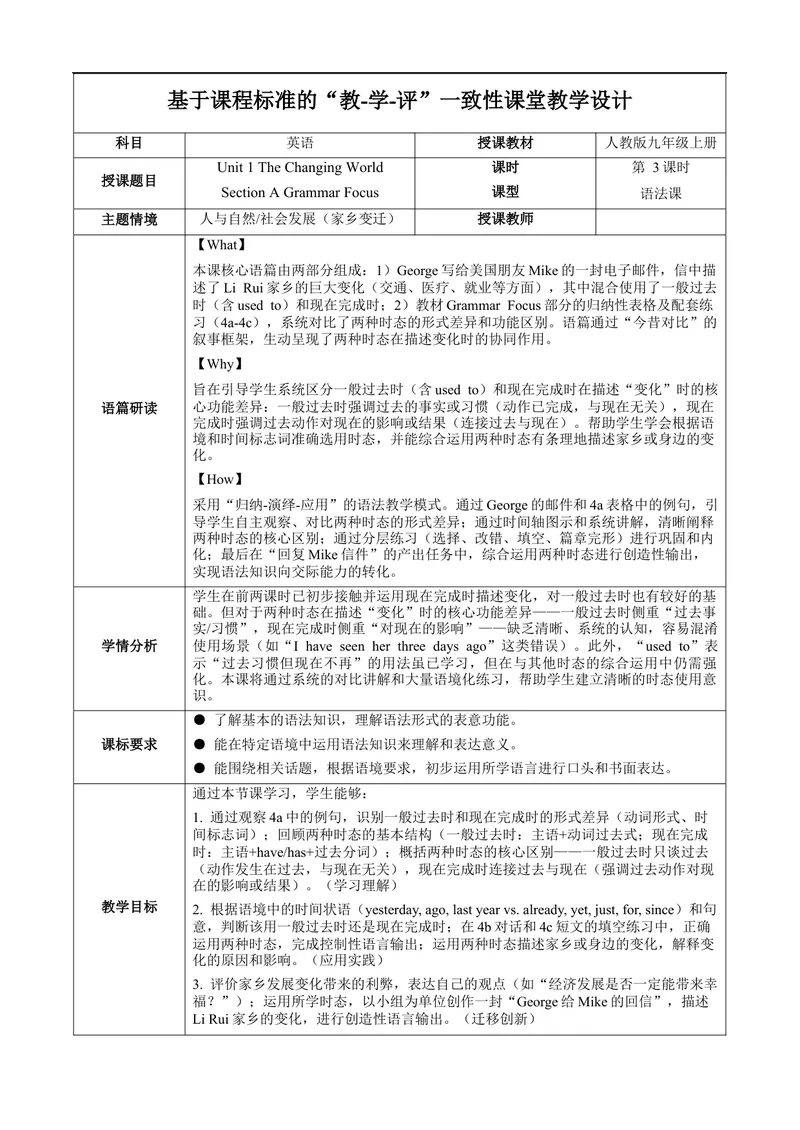
科目 英语 授课教材 人教版九年级上册
Unit 1 The Changing World 课时 第 3课时
授课题目
Section A Grammar Focus 课型 语法课
主题情境 人与自然/社会发展(家乡变迁) 授课教师
【What】
本课核心语篇由两部分组成:1)George写给美国朋友Mike的一封电子邮件,信中描
述了Li Rui家乡的巨大变化(交通、医疗、就业等方面),其中混合使用了一般过去
时(含used to)和现在完成时;2)教材Grammar Focus部分的归纳性表格及配套练
习(4a-4c),系统对比了两种时态的形式差异和功能区别。语篇通过“今昔对比”的
叙事框架,生动呈现了两种时态在描述变化时的协同作用。
【Why】
旨在引导学生系统区分一般过去时(含used to)和现在完成时在描述“变化”时的核
语篇研读 心功能差异:一般过去时强调过去的事实或习惯(动作已完成,与现在无关),现在
完成时强调过去动作对现在的影响或结果(连接过去与现在)。帮助学生学会根据语
境和时间标志词准确选用时态,并能综合运用两种时态有条理地描述家乡或身边的变
化。
【How】
采用“归纳-演绎-应用”的语法教学模式。通过George的邮件和4a表格中的例句,引
导学生自主观察、对比两种时态的形式差异;通过时间轴图示和系统讲解,清晰阐释
两种时态的核心区别;通过分层练习(选择、改错、填空、篇章完形)进行巩固和内
化;最后在“回复Mike信件”的产出任务中,综合运用两种时态进行创造性输出,
实现语法知识向交际能力的转化。
学生在前两课时已初步接触并运用现在完成时描述变化,对一般过去时也有较好的基
础。但对于两种时态在描述“变化”时的核心功能差异——一般过去时侧重“过去事
实/习惯”,现在完成时侧重“对现在的影响”——缺乏清晰、系统的认知,容易混淆
学情分析 使用场景(如“I have seen her three days ago”这类错误)。此外,“used to”表
示“过去习惯但现在不再”的用法虽已学习,但在与其他时态的综合运用中仍需强
化。本课将通过系统的对比讲解和大量语境化练习,帮助学生建立清晰的时态使用意
识。
● 了解基本的语法知识,理解语法形式的表意功能。
课标要求 ● 能在特定语境中运用语法知识来理解和表达意义。
● 能围绕相关话题,根据语境要求,初步运用所学语言进行口头和书面表达。
通过本节课学习,学生能够:
1. 通过观察4a中的例句,识别一般过去时和现在完成时的形式差异(动词形式、时
间标志词);回顾两种时态的基本结构(一般过去时:主语+动词过去式;现在完成
时:主语+have/has+过去分词);概括两种时态的核心区别——一般过去时只谈过去
(动作发生在过去,与现在无关),现在完成时连接过去与现在(强调过去动作对现
在的影响或结果)。(学习理解)
教学目标 2. 根据语境中的时间状语(yesterday, ago, last year vs. already, yet, just, for, since)和句
意,判断该用一般过去时还是现在完成时;在4b对话和4c短文的填空练习中,正确
运用两种时态,完成控制性语言输出;运用两种时态描述家乡或身边的变化,解释变
化的原因和影响。(应用实践)
3. 评价家乡发展变化带来的利弊,表达自己的观点(如“经济发展是否一定能带来幸
福?”);运用所学时态,以小组为单位创作一封“George给Mike的回信”,描述
Li Rui家乡的变化,进行创造性语言输出。(迁移创新)重点: 掌握一般过去时(含used to)和现在完成时的形式差异及核心功能区别;能
根据时间标志词和语境准确选用时态。
教学
难点: 在综合运用中,根据表达需要(强调“过去事实”还是“对现在的影响”)
重难点
灵活切换两种时态;在创造性输出任务中,准确、有条理地使用两种时态描述变化过
程。
[核心语法项目] 一般过去时:主语+动词过去式(含used to do sth.) 现在完成时:主
语+have/has+动词过去分词
[核心句型] 一般过去时:The hills used to be covered with sand. / There used to be rough
roads. / My father bought a new car yesterday. 现在完成时:The hills have been covered
核心语言 with trees. / People have built new wide roads. / She has lived here since 2015. 时态对比:
In the past, it was difficult to travel. Now great changes have taken place. / A journey that
used to take a day now takes only a few hours.
[时间标志词] 一般过去时:yesterday, ago, last..., in 2018, used to 现在完成时:already,
yet, just, ever, never, for, since, so far
教学工具 PPT课件、时间轴图示、小组合作任务单(回信模板)
教学策略 归纳法语法教学、情境教学法、任务型教学法、合作学习法
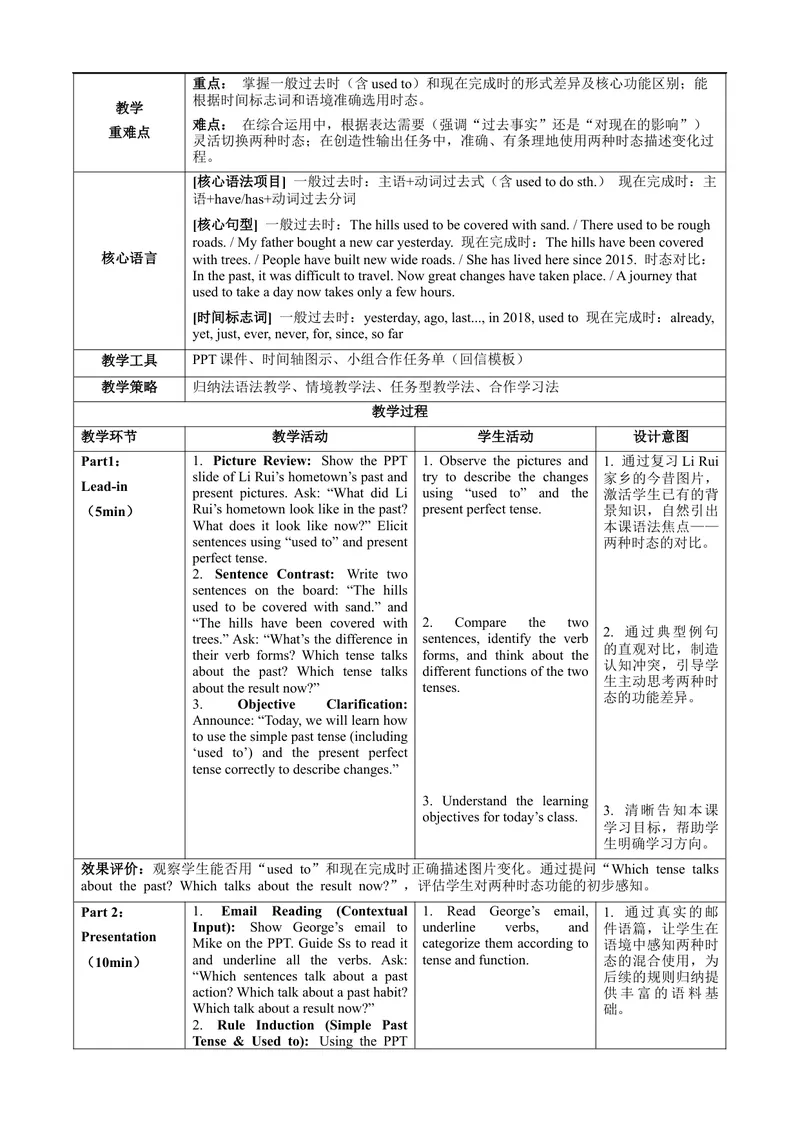
教学过程
教学环节 教学活动 学生活动 设计意图
Part1: 1. Picture Review: Show the PPT 1. Observe the pictures and 1. 通过复习Li Rui
slide of Li Rui’s hometown’s past and try to describe the changes 家乡的今昔图片,
Lead-in
present pictures. Ask: “What did Li using “used to” and the 激活学生已有的背
(5min) Rui’s hometown look like in the past? present perfect tense. 景知识,自然引出
What does it look like now?” Elicit 本课语法焦点——
sentences using “used to” and present 两种时态的对比。
perfect tense.
2. Sentence Contrast: Write two
sentences on the board: “The hills
used to be covered with sand.” and
“The hills have been covered with 2. Compare the two
2. 通过典型例句
trees.” Ask: “What’s the difference in sentences, identify the verb
的直观对比,制造
their verb forms? Which tense talks forms, and think about the
认知冲突,引导学
about the past? Which tense talks different functions of the two
生主动思考两种时
about the result now?” tenses.
态的功能差异。
3. Objective Clarification:
Announce: “Today, we will learn how
to use the simple past tense (including
‘used to’) and the present perfect
tense correctly to describe changes.”
3. Understand the learning
3. 清晰告知本课
objectives for today’s class.
学习目标,帮助学
生明确学习方向。
效果评价:观察学生能否用“used to”和现在完成时正确描述图片变化。通过提问“Which tense talks
about the past? Which talks about the result now?”,评估学生对两种时态功能的初步感知。
Part 2: 1. Email Reading (Contextual 1. Read George’s email, 1. 通过真实的邮
Input): Show George’s email to underline verbs, and 件语篇,让学生在
Presentation
Mike on the PPT. Guide Ss to read it categorize them according to 语境中感知两种时
(10min) and underline all the verbs. Ask: tense and function. 态的混合使用,为
“Which sentences talk about a past 后续的规则归纳提
action? Which talk about a past habit? 供丰富的语料基
Which talk about a result now?” 础。
2. Rule Induction (Simple Past
Tense & Used to): Using the PPTslides, systematically explain: a) 2. 系统讲解一般
Meaning and structure of simple past 2. Listen to the explanation, 过去时和“ used
tense (past event, completed action). take notes on the rules of to”的用法,帮助
b) Meaning and structure of “used to” simple past tense and “used 学生巩固已有知
(past habit, no longer true). c) to”, including its negative 识,并澄清易混点
Negative and question forms of “used and question forms. (三种“used to”
to”. d) Comparison of “used to do”, 结构的辨析)。
“be used to doing”, and “be used to
do”.
3. Rule Induction (Present Perfect
Tense): Using the PPT slides and
timeline, systematically explain: a)
Meaning of present perfect tense
(past action with present result; action
continuing from past to present). b)
Structure: have/has + past participle. 3. Listen to the explanation, 3. 系统讲解现在
c) Time markers: already, yet, just, take notes on the rules of 完成时的用法,重
ever, never, for, since. present perfect tense and its 点突出其“连接过
4. Timeline Comparison: Draw two common time markers. 去与现在”的核心
功能,并与一般过
timelines on the board to visually
去时形成对比。
compare the two tenses. Highlight:
Simple past = action completed in the
past; Present perfect = connection
between past and present.
4. 利用时间轴图
示,将抽象的时态
概念可视化,帮助
4. Observe the timeline
学生直观理解两种
diagrams and internalize the
时态的本质区别。
core functional difference
between the two tenses.
效果评价:检查学生在邮件中划线分类的准确性。通过提问(如“What’s the difference between
‘used to do’ and ‘be used to doing’?”),评估学生对规则的理解程度。观察学生对时间轴图示
的反应,判断其对两种时态核心区别的把握情况。
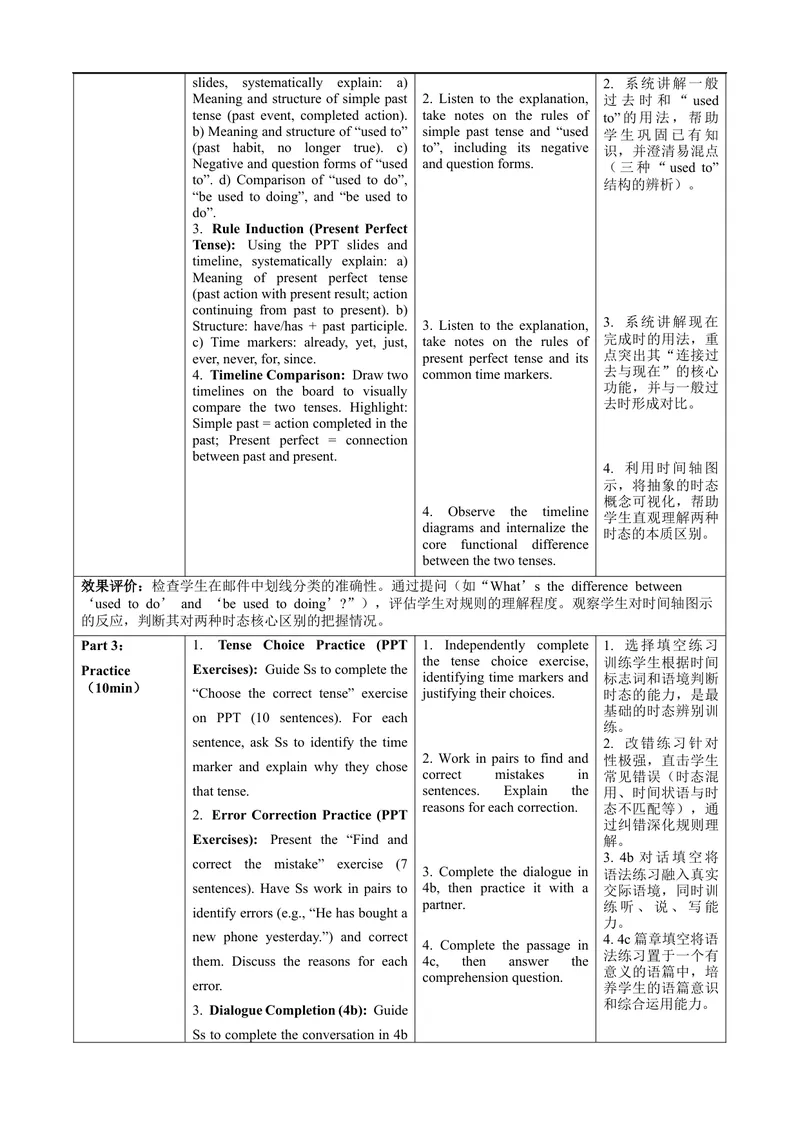
Part 3: 1. Tense Choice Practice (PPT 1. Independently complete 1. 选择填空练习
the tense choice exercise, 训练学生根据时间
Practice Exercises): Guide Ss to complete the
identifying time markers and 标志词和语境判断
(10min)
“Choose the correct tense” exercise justifying their choices. 时态的能力,是最
基础的时态辨别训
on PPT (10 sentences). For each
练。
sentence, ask Ss to identify the time 2. 改错练习针对
2. Work in pairs to find and 性极强,直击学生
marker and explain why they chose
correct mistakes in 常见错误(时态混
that tense. sentences. Explain the 用、时间状语与时
reasons for each correction. 态不匹配等),通
2. Error Correction Practice (PPT
过纠错深化规则理
Exercises): Present the “Find and 解。
3. 4b 对话填空将
correct the mistake” exercise (7
3. Complete the dialogue in 语法练习融入真实
sentences). Have Ss work in pairs to 4b, then practice it with a 交际语境,同时训
partner. 练听、说、写能
identify errors (e.g., “He has bought a
力。
new phone yesterday.”) and correct 4. 4c篇章填空将语
4. Complete the passage in
法练习置于一个有
them. Discuss the reasons for each 4c, then answer the
意义的语篇中,培
comprehension question.
error. 养学生的语篇意识
和综合运用能力。
3. Dialogue Completion (4b): Guide
Ss to complete the conversation in 4bwith the correct forms of the verbs in
brackets. Check answers and have Ss
practice the dialogue in pairs.
4. Passage Completion (4c): Guide
Ss to complete the passage in 4c with
the correct forms of the verbs. After
checking answers, ask: “Why are
local people richer and happier than
before?” to check comprehension.
效果评价:核对各项练习的答案,关注学生选择的正确率和错误类型。通过抽查学生讲解改错题的理
由,评估其对时态规则的掌握深度。观察学生在4b对话练习中的表现,评估其能否在口语中正确使用
时态。
Part 4: 1. Task Setup - “Reply to Mike’s 1. Understand the task 1. 延续本课的邮
Email”: Announce the production requirements and get into 件情境,使产出任
Production
task: “Mike has written back. He groups. 务自然、有意义,
(11min) wants to know more about the 激发学生的写作动
changes in Li Rui’s hometown. Let’s 机。
work in groups to help George reply
to Mike!”
2. Group Discussion & Planning:
Have Ss work in groups of four. Step
1 (1 min): Choose 3-4 aspects of
2. 小组合作写作
change (transportation, environment,
2. Follow the steps: discuss 降低了任务的难
healthcare, shopping, education, etc.).
aspects to cover → each 度,确保人人参
Step 2 (2 min): Each member writes
write 1-2 aspects → integrate 与。分步骤指导使
1-2 aspects using both tenses. Step 3
into a complete letter → 任务流程清晰,提
(1 min): Integrate individual parts
prepare for presentation. 高效率。
into a complete letter. Step 4 (1 min):
Prepare for presentation.
3. Critical Thinking Extension:
After the writing task, lead a brief
discussion: “Are all changes good?
Can you think of any disadvantages
of fast development?” Use the PPT
3. 批判性思维拓
slide to prompt discussion (new roads
展环节引导学生辩
may destroy forests, traditions may 3. Participate in the critical
证看待发展变化,
disappear, etc.). thinking discussion, sharing
培养高阶思维能
4. Class Presentation: Invite 2-3 ideas about potential
力,与本单元“变
groups to present their letters to the downsides of development.
化”主题形成深度
class. Provide feedback on tense
呼应。
accuracy, content richness, and
4. 班级展示为学
fluency.
生提供展示成果的
平台,增强成就
感,同时通过同伴
互评促进学习。
4. Selected groups present
their letters to the class.
Other students listen and
provide feedback.
效果评价:巡视小组讨论和写作过程,观察学生的参与度和时态使用的准确性。通过小组展示,评估学
生能否综合、准确地运用两种时态进行创造性输出。通过批判性讨论,评估学生能否有理有据地表达自
己的观点。
Part 5: Use the summary slide from the PPT Follow the teacher to review 总结本课所学内Summary to review. the core grammar knowledge 容,巩固加深印
and the key message about 象,同时升华主
(2min)
balanced development. 题,呼应单元主题
“变化的世界”。
Part 6: Explain five key words from the Listen, take notes on the 聚焦课文中的重点
lesson in detail, using the PPT slides usage, collocations, and 词汇进行精讲,帮
Language
and exercises. example sentences of each 助学生深入理解词
points
word. Participate in the 义和用法,提升语
(5min) related exercises (fill-in-the- 言使用的准确性,
blank, translation). 为后续的写作输出
积累词汇资源。
Part 7: Distribute and guide Ss to complete Complete the in-class 通过即时练习检测
the in-class exercises (e.g., word exercises independently. 课堂教学效果,帮
Exercise
selection, blank filling) based on the Check answers with the 助教师了解学情,
(3min) lesson content. teacher. 学生自查学习效
果。
Part 8: 基础作业: 完成课本第9页4b和 Record the homework tasks. 分层设计作业,满
4c的填空练习,并将两篇文本工整 足不同学生需求。
Homework
地抄写在作业本上。 基础作业巩固语法
进阶作业: 写一段话(60-80 知识;进阶作业锻
词),用一般过去时和现在完成时 炼语境中的应用能
描述你所在城市或家乡的三个变 力;拓展作业鼓励
化。 创造性输出和实际
拓展作业: 以“Changes in My 生活关联。
Hometown”为主题,做一个小型调
查(采访家人或邻居),了解他们
记忆中家乡的变化,然后制作一份
英文报告或 PPT,下节课进行展
示。
板书设计
教学反思 本课作为语法聚焦课,成功地将形式讲解与意义运用紧密结合。通过George的邮件这
一贯穿性情境,使两种时态的对比学习置于有意义的语篇中,避免了孤立讲解语法的
枯燥。教学环节从语境感知到规则归纳,再到分层练习和创造性产出,逻辑清晰,层
层递进。针对学生容易混淆两种时态功能的核心难点,通过时间轴图示和大量对比练
习进行了有效突破。批判性思维环节引导学生辩证看待发展变化,提升了思维的深
度。语言点讲解结合练习,实用性强。需注意的是,部分学生在自由写作时,对两种
时态的切换仍会出现犹豫,尤其是在同一段落中需要根据表达意图灵活切换时,还需
在后续单元的复习和写作练习中不断强化。总体而言,本节课系统、有效地完成了既
定的语法教学目标,并实现了语言学习与思维培养的有机结合。