Unit 2 Inspiring People
课时 1 Section A (1a-2d) 分层作业
核心知识速记 01 基础达标 02 能力提升 03 拓展培优 0 4 思维进阶
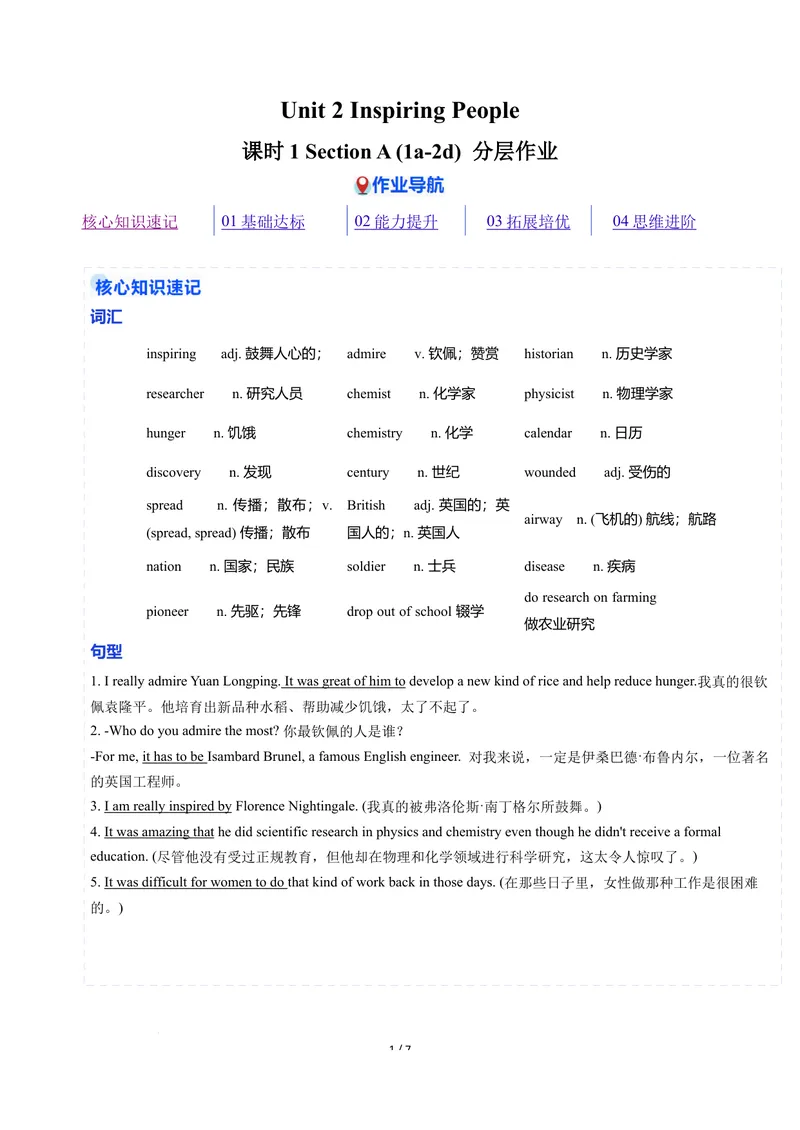
词汇
inspiring adj. 鼓舞人心的; admire v. 钦佩;赞赏 historian n. 历史学家
researcher n. 研究人员 chemist n. 化学家 physicist n. 物理学家
hunger n. 饥饿 chemistry n. 化学 calendar n. 日历
discovery n. 发现 century n. 世纪 wounded adj. 受伤的
spread n. 传播;散布;v. British adj. 英国的;英
airway n. (飞机的) 航线;航路
(spread, spread) 传播;散布 国人的;n. 英国人
nation n. 国家;民族 soldier n. 士兵 disease n. 疾病
do research on farming
pioneer n. 先驱;先锋 drop out of school 辍学
做农业研究
句型
1. I really admire Yuan Longping. It was great of him to develop a new kind of rice and help reduce hunger.我真的很钦
佩袁隆平。他培育出新品种水稻、帮助减少饥饿,太了不起了。
2. -Who do you admire the most? 你最钦佩的人是谁?
-For me, it has to be Isambard Brunel, a famous English engineer. 对我来说,一定是伊桑巴德·布鲁内尔,一位著名
的英国工程师。
3. I am really inspired by Florence Nightingale. (我真的被弗洛伦斯·南丁格尔所鼓舞。)
4. It was amazing that he did scientific research in physics and chemistry even though he didn't receive a formal
education. (尽管他没有受过正规教育,但他却在物理和化学领域进行科学研究,这太令人惊叹了。)
5. It was difficult for women to do that kind of work back in those days. (在那些日子里,女性做那种工作是很困难
的。)
1 / 7
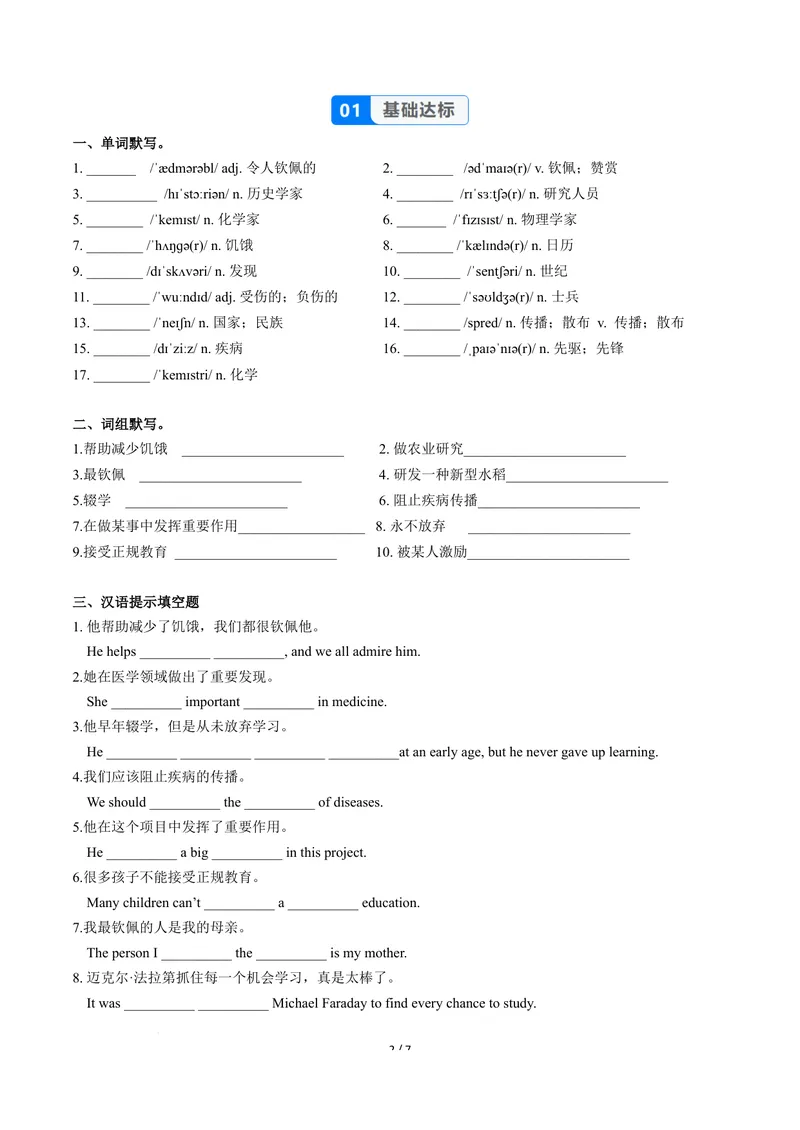
学科网(北京)股份有限公司一、单词默写。
1. _______ /ˈædmərəbl/ adj. 令人钦佩的 2. ________ /ədˈmaɪə(r)/ v. 钦佩;赞赏
3. __________ /hɪˈstɔːriən/ n. 历史学家 4. ________ /rɪˈsɜːtʃə(r)/ n. 研究人员
5. ________ /ˈkemɪst/ n. 化学家 6. _______ /ˈfɪzɪsɪst/ n. 物理学家
7. ________ /ˈhʌŋɡə(r)/ n. 饥饿 8. ________ /ˈkælɪndə(r)/ n. 日历
9. ________ /dɪˈskʌvəri/ n. 发现 10. ________ /ˈsentʃəri/ n. 世纪
11. ________ /ˈwuːndɪd/ adj. 受伤的;负伤的 12. ________ /ˈsəʊldʒə(r)/ n. 士兵
13. ________ /ˈneɪʃn/ n. 国家;民族 14. ________ /spred/ n. 传播;散布 v. 传播;散布
15. ________ /dɪˈziːz/ n. 疾病 16. ________ /ˌpaɪəˈnɪə(r)/ n. 先驱;先锋
17. ________ /ˈkemɪstri/ n. 化学
二、词组默写。
1.帮助减少饥饿 _______________________ 2. 做农业研究_______________________
3.最钦佩 _______________________ 4. 研发一种新型水稻_______________________
5.辍学 _______________________ 6. 阻止疾病传播_______________________
7.在做某事中发挥重要作用__________________ 8. 永不放弃 _______________________
9.接受正规教育 _______________________ 10. 被某人激励_______________________
三、汉语提示填空题
1. 他帮助减少了饥饿,我们都很钦佩他。
He helps __________ __________, and we all admire him.
2.她在医学领域做出了重要发现。
She __________ important __________ in medicine.
3.他早年辍学,但是从未放弃学习。
He __________ __________ __________ __________at an early age, but he never gave up learning.
4.我们应该阻止疾病的传播。
We should __________ the __________ of diseases.
5.他在这个项目中发挥了重要作用。
He __________ a big __________ in this project.
6.很多孩子不能接受正规教育。
Many children can’t __________ a __________ education.
7.我最钦佩的人是我的母亲。
The person I __________ the __________ is my mother.
8. 迈克尔·法拉第抓住每一个机会学习,真是太棒了。
It was __________ __________ Michael Faraday to find every chance to study.
2 / 7
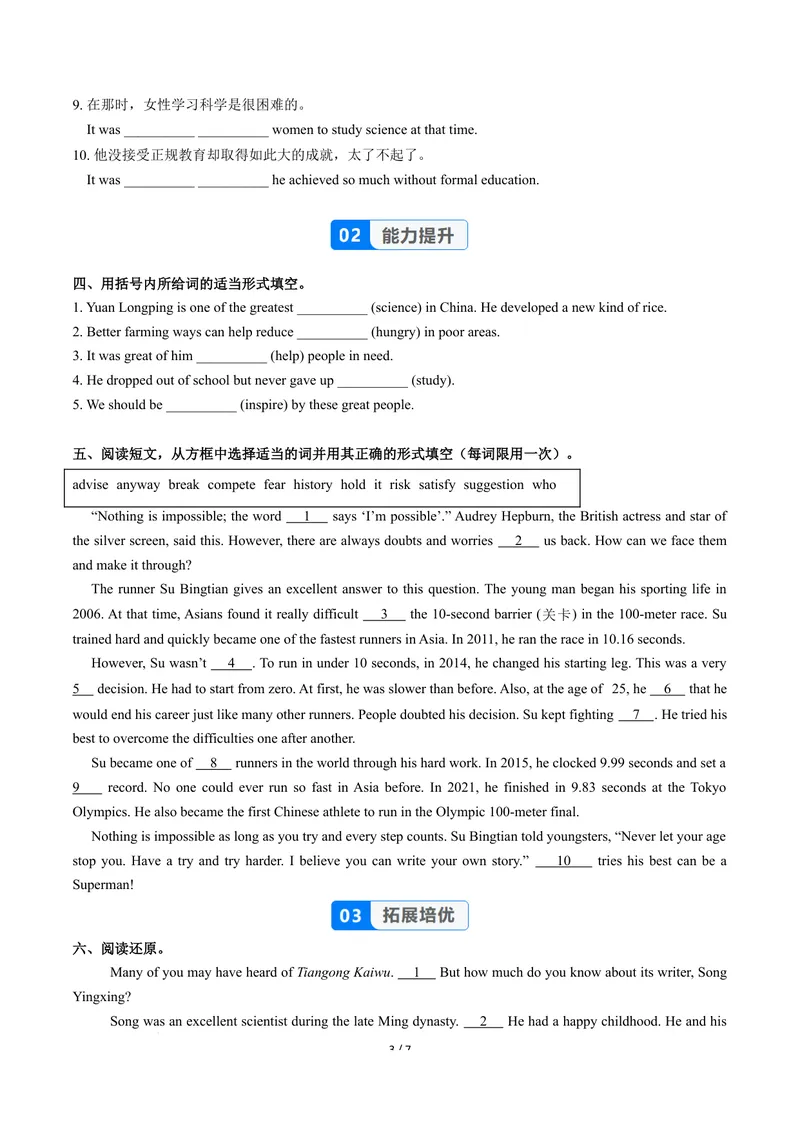
学科网(北京)股份有限公司9. 在那时,女性学习科学是很困难的。
It was __________ __________ women to study science at that time.
10. 他没接受正规教育却取得如此大的成就,太了不起了。
It was __________ __________ he achieved so much without formal education.
四、用括号内所给词的适当形式填空。
1. Yuan Longping is one of the greatest __________ (science) in China. He developed a new kind of rice.
2. Better farming ways can help reduce __________ (hungry) in poor areas.
3. It was great of him __________ (help) people in need.
4. He dropped out of school but never gave up __________ (study).
5. We should be __________ (inspire) by these great people.
五、阅读短文,从方框中选择适当的词并用其正确的形式填空(每词限用一次)。
advise anyway break compete fear history hold it risk satisfy suggestion who
“Nothing is impossible; the word 1 says ‘I’m possible’.” Audrey Hepburn, the British actress and star of
the silver screen, said this. However, there are always doubts and worries 2 us back. How can we face them
and make it through?
The runner Su Bingtian gives an excellent answer to this question. The young man began his sporting life in
2006. At that time, Asians found it really difficult 3 the 10-second barrier (关卡) in the 100-meter race. Su
trained hard and quickly became one of the fastest runners in Asia. In 2011, he ran the race in 10.16 seconds.
However, Su wasn’t 4 . To run in under 10 seconds, in 2014, he changed his starting leg. This was a very
5 decision. He had to start from zero. At first, he was slower than before. Also, at the age of 25, he 6 that he
would end his career just like many other runners. People doubted his decision. Su kept fighting 7 . He tried his
best to overcome the difficulties one after another.
Su became one of 8 runners in the world through his hard work. In 2015, he clocked 9.99 seconds and set a
9 record. No one could ever run so fast in Asia before. In 2021, he finished in 9.83 seconds at the Tokyo
Olympics. He also became the first Chinese athlete to run in the Olympic 100-meter final.
Nothing is impossible as long as you try and every step counts. Su Bingtian told youngsters, “Never let your age
stop you. Have a try and try harder. I believe you can write your own story.” 10 tries his best can be a
Superman!
六、阅读还原。
Many of you may have heard of Tiangong Kaiwu. 1 But how much do you know about its writer, Song
Yingxing?
Song was an excellent scientist during the late Ming dynasty. 2 He had a happy childhood. He and his
3 / 7
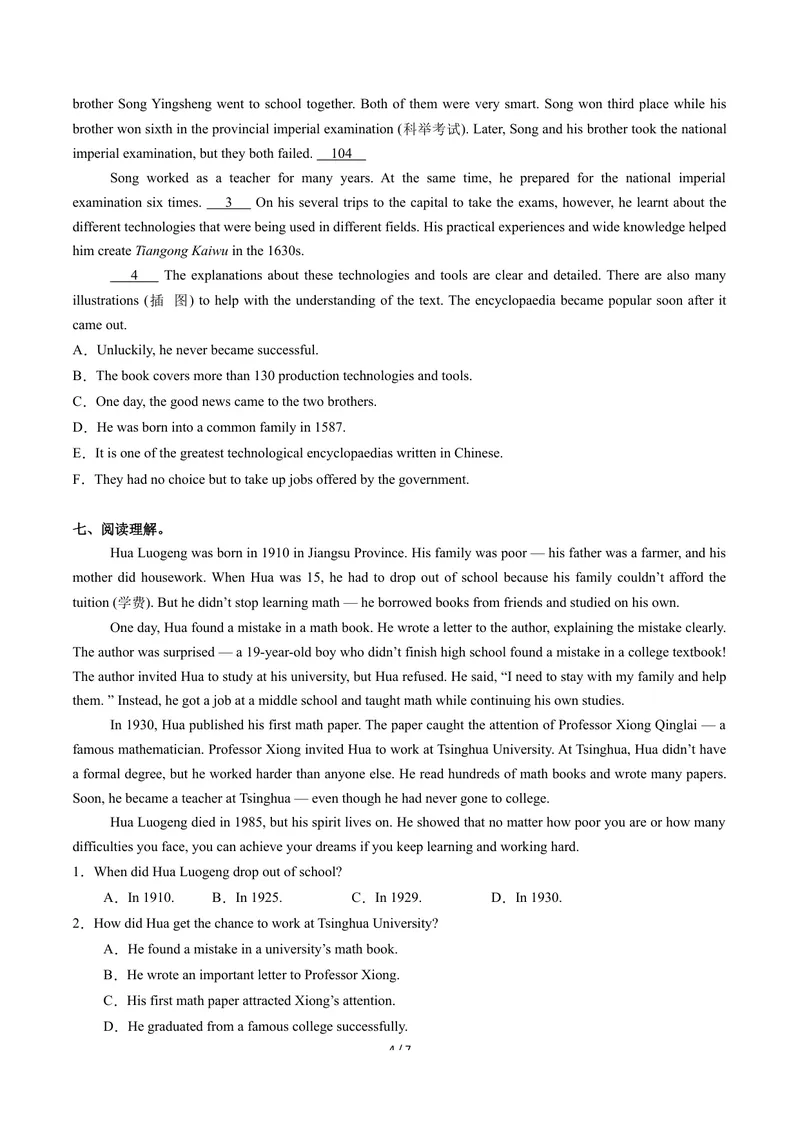
学科网(北京)股份有限公司brother Song Yingsheng went to school together. Both of them were very smart. Song won third place while his
brother won sixth in the provincial imperial examination (科举考试). Later, Song and his brother took the national
imperial examination, but they both failed. 104
Song worked as a teacher for many years. At the same time, he prepared for the national imperial
examination six times. 3 On his several trips to the capital to take the exams, however, he learnt about the
different technologies that were being used in different fields. His practical experiences and wide knowledge helped
him create Tiangong Kaiwu in the 1630s.
4 The explanations about these technologies and tools are clear and detailed. There are also many
illustrations (插 图) to help with the understanding of the text. The encyclopaedia became popular soon after it
came out.
A.Unluckily, he never became successful.
B.The book covers more than 130 production technologies and tools.
C.One day, the good news came to the two brothers.
D.He was born into a common family in 1587.
E.It is one of the greatest technological encyclopaedias written in Chinese.
F.They had no choice but to take up jobs offered by the government.
七、阅读理解。
Hua Luogeng was born in 1910 in Jiangsu Province. His family was poor — his father was a farmer, and his
mother did housework. When Hua was 15, he had to drop out of school because his family couldn’t afford the
tuition (学费). But he didn’t stop learning math — he borrowed books from friends and studied on his own.
One day, Hua found a mistake in a math book. He wrote a letter to the author, explaining the mistake clearly.
The author was surprised — a 19-year-old boy who didn’t finish high school found a mistake in a college textbook!
The author invited Hua to study at his university, but Hua refused. He said, “I need to stay with my family and help
them. ” Instead, he got a job at a middle school and taught math while continuing his own studies.
In 1930, Hua published his first math paper. The paper caught the attention of Professor Xiong Qinglai — a
famous mathematician. Professor Xiong invited Hua to work at Tsinghua University. At Tsinghua, Hua didn’t have
a formal degree, but he worked harder than anyone else. He read hundreds of math books and wrote many papers.
Soon, he became a teacher at Tsinghua — even though he had never gone to college.
Hua Luogeng died in 1985, but his spirit lives on. He showed that no matter how poor you are or how many
difficulties you face, you can achieve your dreams if you keep learning and working hard.
1.When did Hua Luogeng drop out of school?
A.In 1910. B.In 1925. C.In 1929. D.In 1930.
2.How did Hua get the chance to work at Tsinghua University?
A.He found a mistake in a university’s math book.
B.He wrote an important letter to Professor Xiong.
C.His first math paper attracted Xiong’s attention.
D.He graduated from a famous college successfully.
4 / 7
学科网(北京)股份有限公司3.Which one is NOT TRUE according to the passage?
A.Hua taught himself math after dropping out of school.
B.Hua found a mistake in a math book after he finished high school.
C.Hua published his first math paper when he was twenty.
D.Hua didn’t have a formal degree at Tsinghua.
4.What can we learn from Hua Luogeng’s story?
A.Poverty can stop a person from achieving dreams.
B.Formal education is the only way to success.
C.Hard work and love for knowledge can lead to success.
D.Math is too difficult for most people to learn.
5.Where is this passage most probably from?
A.A report on Tsinghua University.
B.A storybook about math.
C.A website about study.
D.A magazine about great people.
八、完形填空。
Many people enjoy dancing. Some of them, however, dance in 1 places. Yang Liu, an inheritor (继承人)
of bamboo drifting (独竹漂), calls a bamboo pole her stage.
Bamboo drifting has a 2 of 2,000 years. In ancient times, it was a means of transportation by which the
local people would 3 the rivers. Now, it has developed into a folk sport.
Yang 4 to learn drifting at the age of seven. The girl was born with a weak 5 . In order to keep her
fit, her grandmother introduced her to bamboo drifting. Learning this traditional skill, however, is not easy. The
bamboo pole is slim and slippery. And it is never still. Yang fell into the water and 6 again and again. But with
encouragement from her family and a love for this “cool skill”, the girl didn’t give up. She threw herself into
practicing bamboo drifting all year round, even in the winter cold and the 7 heat. After three years of hard
practice, she could 8 keep her balance (平衡) on the bamboo pole.
But Yang didn’t 9 there. To make single bamboo drifting more attractive to the public, she came up with
the idea of dancing on a bamboo pole. She went on to practice many difficult movements on her bamboo pole—and
suffered the physical pain that came along with it.
Now, Yang has made a name for herself 10 a dancer on a bamboo pole. “I hope that more people can
know about bamboo drifting and enjoy this form of art,” said Yang.
1.A.free B.quiet C.unusual D.crowded
2.A.history B.partner C.problem D.shape
3.A.watch B.cross C.pollute D.smoke
4.A.started B.failed C.hated D.know
5.A.smile B.voice C.body D.head
5 / 7
学科网(北京)股份有限公司6.A.got lost B.got drunk C.got injured D.got up
7.A.spring B.summer C.autumn D.winter
8.A.finally B.hardly C.probably D.nearly
9.A.stop B.remember C.reach D.encourage
10.A.on B.as C.by D.of
Part 1: Read and Explore
Ieoh Ming Pei was a world-famous Chinese-born American architect. He devoted his life to architecture and
created many great works that are loved by people all over the world. His story tells us that passion and hard work
can make great achievements. Ieoh Ming Pei, a Chinese-born American architect (建筑师), died at the age of 102
in May 2019. Pei was born in a rich family in 1917. His father was a banker and his mother was an artist. Although
he didn’t speak English, he chose to go to university in the United States in 1935. He studied architecture at MIT
and Harvard University. Pei set up his own architectural company (公司) in New York in 1955.
Although he worked mostly in the United States of America, Pei will always be remembered for a(n) European
project—the large glass pyramid (金字塔) in front of the Louvre (卢浮宫) Museum in Paris.
Pei was the first foreign architect to work on the Louvre pyramid. In the beginning the glass pyramid was
widely disliked. But in the end, the French were won over, and now it is considered one of the best pieces of
architecture in the world.
Actually Pei created great works in different cities all over the world. He made a lot of research for each
project—he studied its use and connected it to the environment. He was also interested in architecture as art, and
the effect (效果) he could create.
“Sometimes I simply want to give people pleasure in being in a space and walking around it,” the architect
said. “But sometimes I also think architecture can make people want to do something more with their lives.”
Part 2: Skills Challenge
Task 1: Critical Thinking(根据文章内容回答下列问题 )
1. Why is the glass pyramid in front of the Louvre Museum important to Pei? (用"because"完整回答)
_______________________________________________________________________________
_______________________________________________________________________________
2. 找出两个贝聿铭能成为伟大建筑师的原因:
Reason 1:_______________________________________________________________________
Reason 2:_______________________________________________________________________
3. 用 “It’s+adj+ of sb. to do sth.” 句型,赞美贝聿铭及其建筑成就:
_________________________________________.
6 / 7
学科网(北京)股份有限公司Task 2: Complete the chart below(根据文章内容完成表格)
Nationality (国籍) Job Famous Work His Attitude to Work
Person
Ieoh Ming Pei 1.__________ 2.__________ 3.__________ 4.__________
Task 3: Creative Project
假设你是一名建筑爱好者,为纪念贝聿铭,设计一个“贝聿铭建筑文化推广计划”(Ieoh Ming Pei
Architecture Promotion Plan),需包含:
2个具体行动(参考文中贝聿铭的工作态度)
1个创新点子(如:用短视频介绍他的建筑)
用英语简单说明。
We will ______________________________________ and ______________________________________. Also,
we plan to ______________________________________ .
7 / 7
学科网(北京)股份有限公司