Unit 3 Smart Learning
课时 1 Section A (1a-2d) 分层作业
核心知识速记 01 基础达标 02 能力提升 03 拓展培优 0 4 思维进阶
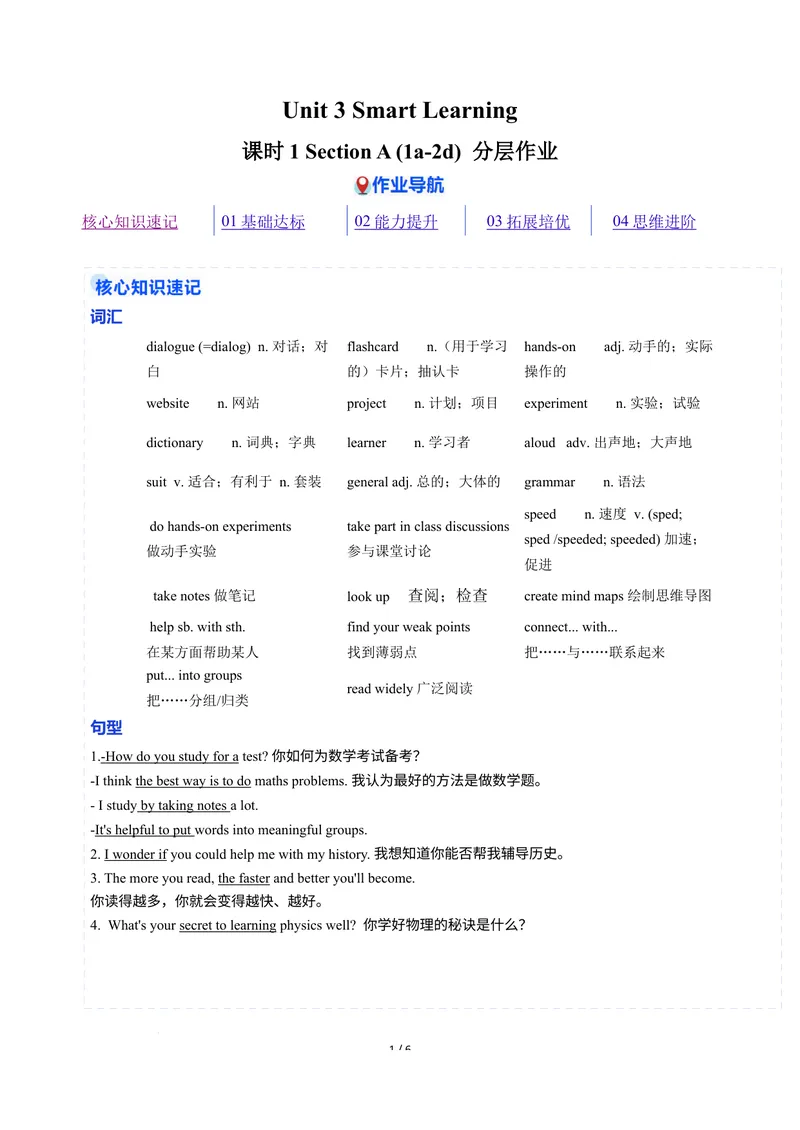
词汇
dialogue (=dialog) n. 对话;对 flashcard n.(用于学习 hands-on adj. 动手的;实际
白 的)卡片;抽认卡 操作的
website n. 网站 project n. 计划;项目 experiment n. 实验;试验
dictionary n. 词典;字典 learner n. 学习者 aloud adv. 出声地;大声地
suit v. 适合;有利于 n. 套装 general adj. 总的;大体的 grammar n. 语法
speed n. 速度 v. (sped;
do hands-on experiments take part in class discussions
sped /speeded; speeded) 加速;
做动手实验 参与课堂讨论
促进
take notes 做笔记 look up 查阅;检查 create mind maps 绘制思维导图
help sb. with sth. find your weak points connect... with...
在某方面帮助某人 找到薄弱点 把……与……联系起来
put... into groups
read widely 广泛阅读
把……分组/归类
句型
1. - How do you study for a test?
你如何为数学考试备考?
-I think the best way is to do maths problems.
我认为最好的方法是做数学题。
- I study by taking notes a lot.
-It's helpful to put words into meaningful groups.
2. I wonder if you could help me with my history.
我想知道你能否帮我辅导历史。
3. The more you read, the faster and better you'll become.
你读得越多,你就会变得越快、越好。
4. What's your secret to learning physics well?
你学好物理的秘诀是什么?
1 / 6
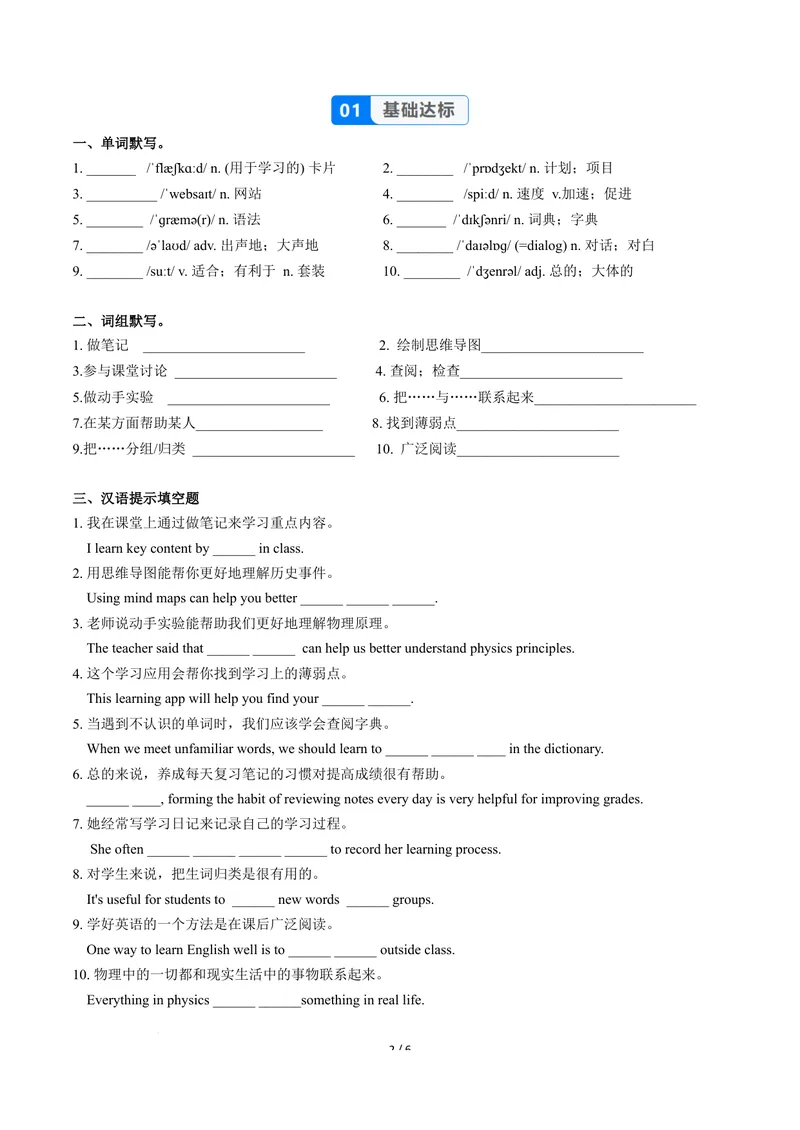
学科网(北京)股份有限公司一、单词默写。
1. _______ /ˈflæʃkɑːd/ n. (用于学习的) 卡片 2. ________ /ˈprɒdʒekt/ n. 计划;项目
3. __________ /ˈwebsaɪt/ n. 网站 4. ________ /spiːd/ n. 速度 v.加速;促进
5. ________ /ˈɡræmə(r)/ n. 语法 6. _______ /ˈdɪkʃənri/ n. 词典;字典
7. ________ /əˈlaʊd/ adv. 出声地;大声地 8. ________ /ˈdaɪəlɒɡ/ (=dialog) n. 对话;对白
9. ________ /suːt/ v. 适合;有利于 n. 套装 10. ________ /ˈdʒenrəl/ adj. 总的;大体的
二、词组默写。
1. 做笔记 _______________________ 2. 绘制思维导图_______________________
3.参与课堂讨论 _______________________ 4. 查阅;检查_______________________
5.做动手实验 _______________________ 6. 把……与……联系起来_______________________
7.在某方面帮助某人__________________ 8. 找到薄弱点_______________________
9.把……分组/归类 _______________________ 10. 广泛阅读_______________________
三、汉语提示填空题
1. 我在课堂上通过做笔记来学习重点内容。
I learn key content by ______ in class.
2. 用思维导图能帮你更好地理解历史事件。
Using mind maps can help you better ______ ______ ______.
3. 老师说动手实验能帮助我们更好地理解物理原理。
The teacher said that ______ ______ can help us better understand physics principles.
4. 这个学习应用会帮你找到学习上的薄弱点。
This learning app will help you find your ______ ______.
5. 当遇到不认识的单词时,我们应该学会查阅字典。
When we meet unfamiliar words, we should learn to ______ ______ ____ in the dictionary.
6. 总的来说,养成每天复习笔记的习惯对提高成绩很有帮助。
______ ____, forming the habit of reviewing notes every day is very helpful for improving grades.
7. 她经常写学习日记来记录自己的学习过程。
She often ______ ______ ______ ______ to record her learning process.
8. 对学生来说,把生词归类是很有用的。
It's useful for students to ______ new words ______ groups.
9. 学好英语的一个方法是在课后广泛阅读。
One way to learn English well is to ______ ______ outside class.
10. 物理中的一切都和现实生活中的事物联系起来。
Everything in physics ______ ______something in real life.
2 / 6
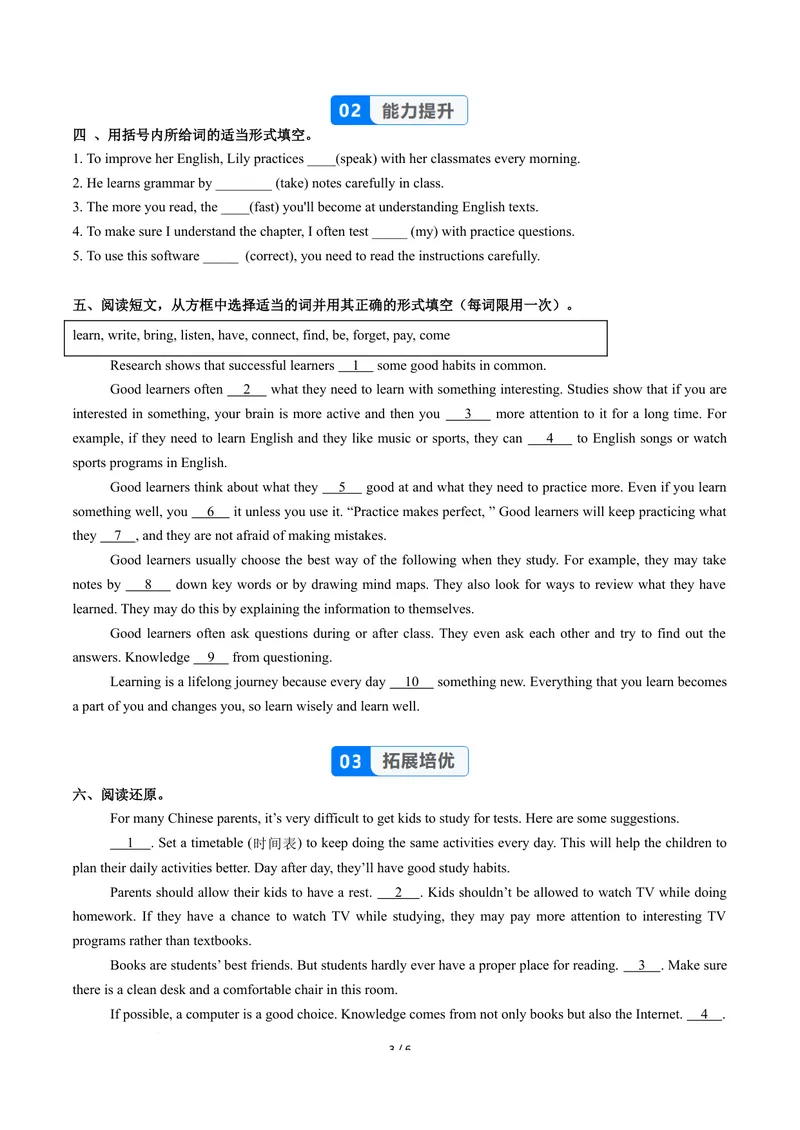
学科网(北京)股份有限公司四 、用括号内所给词的适当形式填空。
1. To improve her English, Lily practices ____(speak) with her classmates every morning.
2. He learns grammar by ________ (take) notes carefully in class.
3. The more you read, the ____(fast) you'll become at understanding English texts.
4. To make sure I understand the chapter, I often test _____ (my) with practice questions.
5. To use this software _____ (correct), you need to read the instructions carefully.
五、阅读短文,从方框中选择适当的词并用其正确的形式填空(每词限用一次)。
learn, write, bring, listen, have, connect, find, be, forget, pay, come
Research shows that successful learners 1 some good habits in common.
Good learners often 2 what they need to learn with something interesting. Studies show that if you are
interested in something, your brain is more active and then you 3 more attention to it for a long time. For
example, if they need to learn English and they like music or sports, they can 4 to English songs or watch
sports programs in English.
Good learners think about what they 5 good at and what they need to practice more. Even if you learn
something well, you 6 it unless you use it. “Practice makes perfect, ” Good learners will keep practicing what
they 7 , and they are not afraid of making mistakes.
Good learners usually choose the best way of the following when they study. For example, they may take
notes by 8 down key words or by drawing mind maps. They also look for ways to review what they have
learned. They may do this by explaining the information to themselves.
Good learners often ask questions during or after class. They even ask each other and try to find out the
answers. Knowledge 9 from questioning.
Learning is a lifelong journey because every day 10 something new. Everything that you learn becomes
a part of you and changes you, so learn wisely and learn well.
六、阅读还原。
For many Chinese parents, it’s very difficult to get kids to study for tests. Here are some suggestions.
1 . Set a timetable (时间表) to keep doing the same activities every day. This will help the children to
plan their daily activities better. Day after day, they’ll have good study habits.
Parents should allow their kids to have a rest. 2 . Kids shouldn’t be allowed to watch TV while doing
homework. If they have a chance to watch TV while studying, they may pay more attention to interesting TV
programs rather than textbooks.
Books are students’ best friends. But students hardly ever have a proper place for reading. 3 . Make sure
there is a clean desk and a comfortable chair in this room.
If possible, a computer is a good choice. Knowledge comes from not only books but also the Internet. 4 .
3 / 6
学科网(北京)股份有限公司5 . Parents cannot help their kids do homework all the time. They can help kids to understand why they
must do homework before the test. If kids can finish all the homework at home, they’ll do better in the test at
school!
A.After the rest, they can study better
B.All of the students like doing homework
C.So parents should provide a room for kids
D.First of all, learn to plan their time properly
E.Finally, it’s necessary for kids to finish homework on time
F.Kids should be allowed to surf the Internet to look up more useful information
七、阅读理解。
Li Ming, a 15-year-old student from Hangzhou, used to struggle with English. “I failed my first mid-term
exam in Grade 9,” he recalled. “My vocabulary was limited, and I was afraid to speak in class.” His teacher Ms.
Wang noticed his problem and suggested a daily routine: 20 minutes of vocabulary memorization using flashcards,
15 minutes of listening practice with BBC Learning English, and joining the school’s English corner every Friday.
At first, Li Ming found it challenging. “Remembering 10 new words daily felt impossible,” he said. But he
kept practicing. After three months, he could understand 80% of the dialogues in his textbook. In the final exam, he
scored 85 out of 100. “The key is not speed but consistency,” Ms. Wang told the class. Now Li Ming helps his
classmates with pronunciation, proving that hard work truly pays off.
根据语篇内容,选择最佳选项。
1.What was Li Ming’s main problem with English?
A.Poor listening skills. B.Weak writing ability. C.Limited vocabulary.
2.How long did Li Ming spend on daily English practice?
A.20 minutes B.35 minutes C.45 minutes
3.What can we infer about Li Ming now?
A.He is the top student in his class.
B.He teaches English in a training center.
C.He has become more confident in English.
4.The underlined word“consistency”probably means ________ in Chinese.
A.坚持不懈 B.反应敏捷 C.冰雪聪明
5.What is the main idea of the passage?
A.The importance of English exams.
B.A student’s journey to English success.
C.Effective teaching methods for English.
八、完形填空。
How can you improve your English? Different students have different 1 . Li Ming thinks that learning
4 / 6
学科网(北京)股份有限公司English 2 watching English movies is helpful. “At first, it was a little difficult to understand the 3 , but I
kept listening and now I can understand most of them,” he said.
Wang Fang has a different way. She enjoys 4 with her friends in English. “We try to use the new words
and sentences we’ve learned. 5 we make mistakes, we don’t worry. We just try to correct each other,” she
explained.
As for Zhang Hua, he thinks that reading English newspapers and magazines is the best way. “They are 6
of useful words and expressions. And I can learn about different cultures too,” he said.
All of them agree that practice is very 7 . “The more you practice, the 8 you will be,” they said.
They also think that it’s important to 9 a good learning habit. Don’t be afraid of making mistakes. Just be 10
and keep trying.
1.A.questions B.answers C.ways D.ideas
2.A.with B.by C.in D.on
3.A.conversations B.words C.sentences D.passages
4.A.speaking B.talking C.saying D.telling
5.A.When B.If C.Because D.Although
6.A.filled B.full C.made D.taken
7.A.interesting B.important C.difficult D.easy
8.A.good B.well C.better D.best
9.A.develop B.make C.have D.take
10.A.careful B.patient C.nervous D.worried
Part 1: Read and Explore
Good English Learning Habits
Preparing for an English test needs good habits. First, I make a study plan every week. I spend 30 minutes
each morning memorizing English words. I write them down in a notebook and review them before bed. This helps
me remember the words for a long time.
Second, I do grammar exercises every evening. If I meet a difficult problem, I ask my teacher for advice the
next day. She always explains things clearly and helps me understand.
On test days, I get up early and have a good breakfast. I don’t want to feel hungry during the test. Before
starting, I take a deep breath to relax. This helps me stay calm and do my best.
Part 2: Skills Challenge
Task 1: Critical Thinking(根据文章内容回答下列问题)
1.Why does the writer memorize English words every morning? (用 because 完整回答)
2.写出文中提到的两个好习惯:
Habit 1: ________________________________________________________________
5 / 6
学科网(北京)股份有限公司Habit 2: ________________________________________________________________
3.设计一句英文学习建议,鼓励同学坚持好习惯:"_________________________________________!"
Task 2: Complete the chart below(根据文章内容完成表格)
Time Things the writer does Purpose (目的)
Each morning Memorize English words 1._____________________
Every evening 2.______________________ Practice grammar
Before the test starts Take a deep breath to relax 3.______________________
Task 3: Creative Project
假设你是英语学习小老师,设计一份 My English Learning Plan,需包含:
2 个文中提到的学习方法
1 个你自己的创新方法
用英语简单说明
I will ______________________________ and ______________________________.Also, I plan to
______________________________.
6 / 6
学科网(北京)股份有限公司