[机密] 2025年
6月14日11:00 前
重庆市 2025 年初中学业水平暨高中招生考试
英 语 试 题
(全卷共九个大题 满分:150分 考试时间:120 分钟)
注意事项:
1.试题的答案书写在答题卡上,不得在试题卷上直接作答。
2.作答前认真阅读答题卡上的注意事项。
3.考试结束,由监考人员将试题卷和答题卡一并收回。
第Ⅰ卷(共 100 分)
Ⅰ.听力测试。(共35分)
第一节(每小题1分,共6分)
听一遍。根据你所听到的句子,从 A、B、C 三个选项中选出最恰当的答语,并把答
题卡上对应题目的答案标号涂黑。
1.A. Good morning. B. Good afternoon. C. Good luck.
2.A. Well done. B. I hope so. C. Sorry, I won’t.
3.A. With pleasure. B. Never mind. C. Enjoy yourself.
4.A. Here you are. B. Glad to hear that. C. It doesn’t matter.
5.A. Don’t mention it. B. Sounds great! C. Be careful!
6.A. Take it easy. B. Thank you. C. Have fun.
第二节(每小题1.5分,共9分)
听一遍。根据你所听到的对话和问题,从 A、B、C 三个选项中选出正确答案,并把答
题卡上对应题目的答案标号涂黑。
7.A. /ˈdʒɜːni/ B. /dʒeɪ / C. /dʒʌdʒ/
8.A. Blue. B. Red. C. Yellow.
9.A. To the park. B. To the bank. C. To the library.
10.A. Lucy. B. Lily. C. Mary.
11.A. Thin. B. Short. C. Tall.
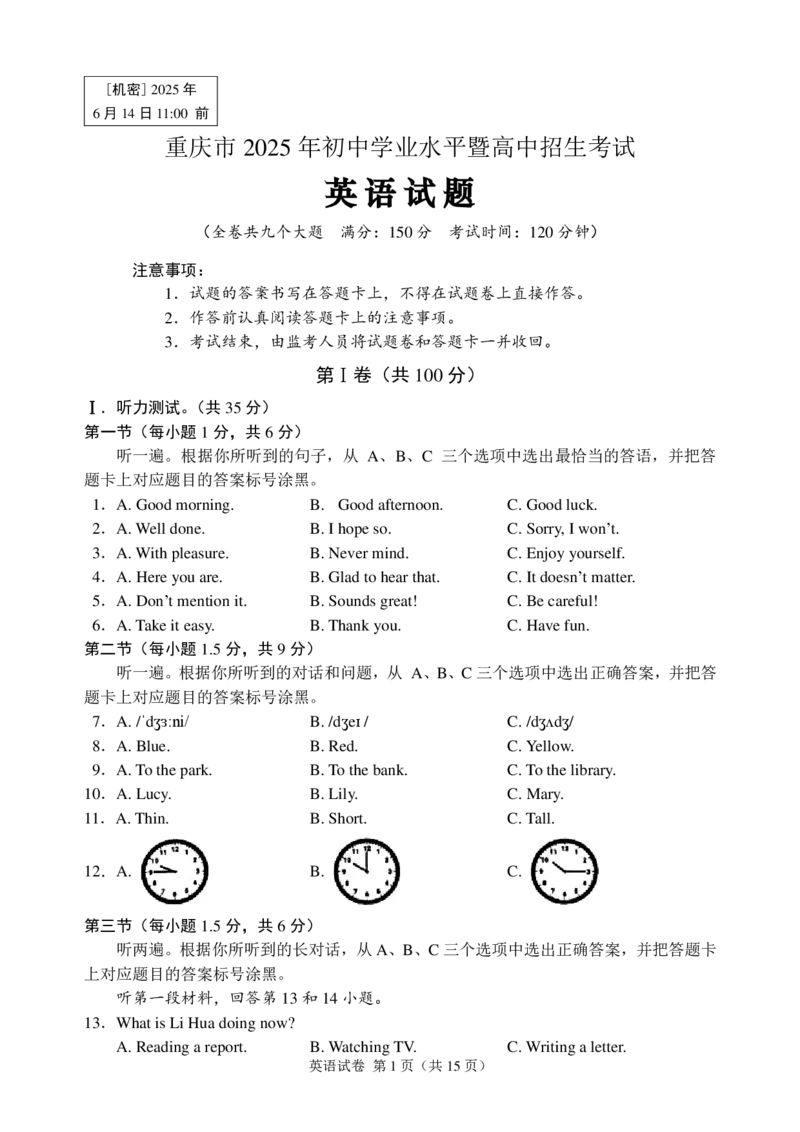
12.A. B. C.
第三节(每小题1.5分,共6分)
听两遍。根据你所听到的长对话,从 A、B、C 三个选项中选出正确答案,并把答题卡
上对应题目的答案标号涂黑。
听第一段材料,回答第 13和14小题。
13.What is Li Hua doing now?
A. Reading a report. B. Watching TV. C. Writing a letter.
英语试卷 第1页(共15页)14.How do they both feel?
A. Happy. B. Surprised. C. Proud.
听第二段材料,回答第 15 和 16 小题。
15.Where is Emma now?
A. In the restaurant. B. In the kitchen. C. In the dining hall.
16.Why is Mark laughing?
A. Because Emma got vegetable pieces on her face.
B. Because Emma told a funny story about cooking.
C. Because Emma forgot to bring her own wallet.
第四节(每小题1.5分,共6分)
听两遍。根据你所听到的短文内容,从 A、B、C 三个选项中选出正确答案,并把答题
卡上对应题目的答案标号涂黑。
17.How often will the students have a volleyball match?
A. Every day. B. Twice a week. C. Once a month.
18.How far does everyone need to swim in the test?
A. 50 meters. B. 100 meters. C. 200 meters.
19.What will the students have in June?
A. A sports meet. B. A parent meeting. C. A kung fu show.
20.What does the speaker expect the students to be like?
A. Safe and fit. B. Safe and fast. C. Fit and fast.
第五节(每小题2分,共 8分)
听两遍。根据你所听到的演讲内容,在横线处补全笔记。每空 1 词,并把答案填写在
答题卡上对应的位置。
24.The speaker thinks these suggestions can help us have better conversations, so we will have a
_______ _______ with people around us.
英语试卷 第2页(共15页)Ⅱ. 语法选择。(每小题 1分,共10分)
根据短文内容,从 A、B、C 三个选项中选出一个语法正确的答案,并把答题卡上对应
题目的答案标号涂黑。
Li Liang has always been interested in science since childhood. He’s good 25 solving
problems in daily life. It is 26 dream to make people’s lives better.
One night when he was 11, he 27 the news on TV with his parents. He heard that there
were harmful chemicals (化学物质) left in the vegetables people ate in a village nearby. Parents
and 28 were worried about their food safety. He couldn’t sleep that night 29 he kept
thinking about the kids of his age who didn’t have safe vegetables. He decided 30 something
to help. He spent over a year in researching and testing. Finally, a tool 31 by him. It could
show results fast, so people would know 32 the food was safe.
Now, as 33 college student, he gives public talks and holds science workshops (工作坊)
to share his research methods. Through his 34 work, more and more students are following
in his footsteps.
25.A. at B. to C. for
26.A. he B. his C. him
27.A. watch B. watches C. watched
28.A. kid B. kids C. kids’
29.A. or B. but C. because
30.A. to do B. doing C. do
31.A. invented B. is invented C. was invented
32.A. what B. whether C. which
33.A. a B. an C. the
34.A. hard B. harder C. hardly
Ⅲ. 完形填空。(每小题 1.5分,共15分)
根据知文内容,从 A、B、C、D 四个选项中选出一个能填入相应空格内的最佳答案,
并把答题卡上对应题目的答案标号涂黑。
The sunlight came through the windows, bringing in the hot summer air. I saw a long line of
people at the medicine pickup counter (取药处). I took a deep breath to cool 35 down.
I joined the line to 36 for my turn. The weight of my coming baby made it 37 for
me to stand straight, and my legs felt heavy. I raised my head and saw there were still quite a few
people ahead. Some were playing with their phones and some were talking quietly. The line moved
so 38 .
I began to feel weaker in my 39 . I couldn’t stand for long. “Should I ask the one at the
front for help? What if he 40 ? He’s been waiting for a long time, too. Will the other people
agree?” I thought to myself, “But I ...” My forehead was starting to sweat (冒汗).
I knew I couldn’t wait. I walked up to the 41 person in the line and asked in a low voice,
“Excuse me, could I go first? I am not feeling so well”
The young man looked at me in surprise 42 he saw my belly (肚子). He agreed. Almost
no one noticed what happened. I thought he would remain behind me. Instead, he moved straight
英语试卷 第3页(共15页)to the end.
The second person 43 her phone. She looked at me and looked back at the young man.
Then she moved to the back, too. Then the third one, then the fouth … until the young man came
right 44 me.
I felt a gentle wind blowing across my face, and the summer heat was gone with the wind.
35.A. myself B. yourself C. himself D. herself
36.A. fight B. wait C. call D. ask
37.A. easy B. possible C. difficult D. important
38.A. carefully B. successfully C. quickly D. slowly
39.A. stomach B. legs C. arms D. head
40.A. agrees B. smiles C. refuses D. cries
41.A. first B. second C. third D. fourth
42.A. if B. unless C. until D. though
43.A. looked out at B. looked up from C. looked down on D. looked around for
44.A. far from B. before C. across from D. behind
Ⅳ. 阅读理解。(每小题 2分,共30分)
阅读下列材料,从 A、B、C、D 四个选项中选出最佳答案, 并把答题卡上对应题目的
答案标号涂黑。
A
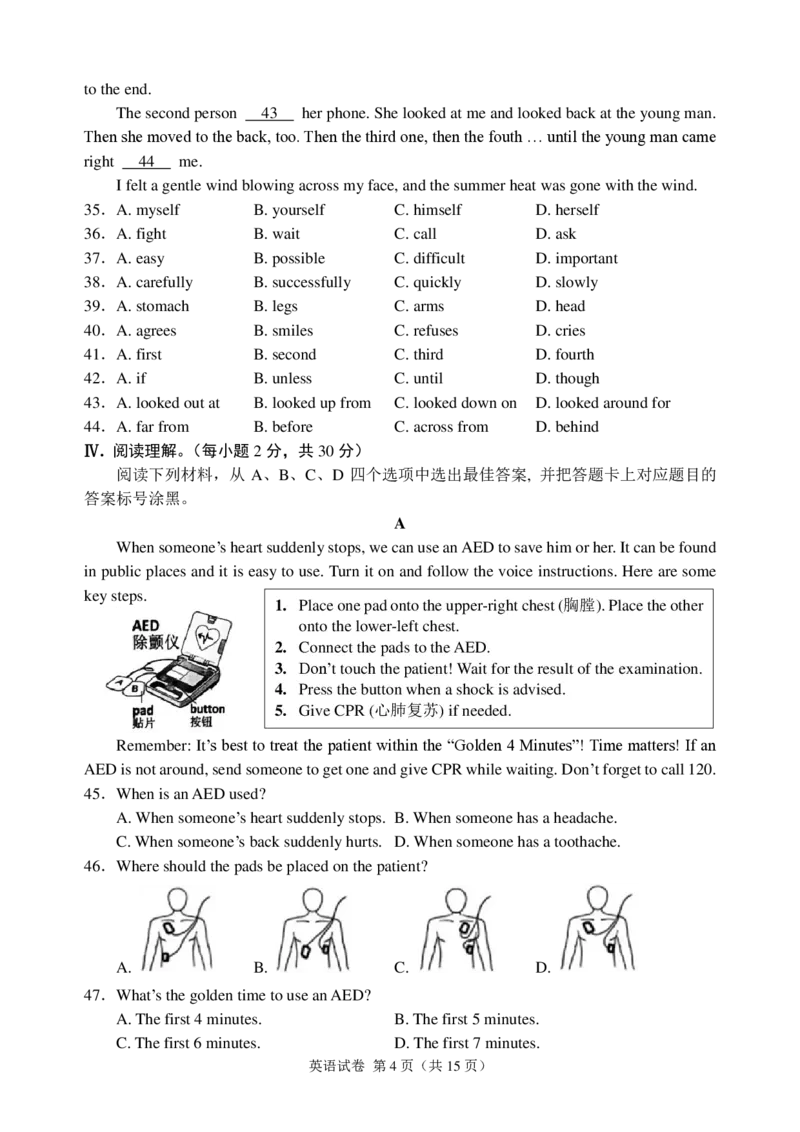
When someone’s heart suddenly stops, we can use an AED to save him or her. It can be found
in public places and it is easy to use. Turn it on and follow the voice instructions. Here are some
key steps.
1. Place one pad onto the upper-right chest (胸膛). Place the other
onto the lower-left chest.
2. Connect the pads to the AED.
3. Don’t touch the patient! Wait for the result of the examination.
4. Press the button when a shock is advised.
5. Give CPR (心肺复苏) if needed.
Remember: It’s best to treat the patient within the “Golden 4 Minutes”! Time matters! If an
AED is not around, send someone to get one and give CPR while waiting. Don’t forget to call 120.
45.When is an AED used?
A. When someone’s heart suddenly stops. B. When someone has a headache.
C. When someone’s back suddenly hurts. D. When someone has a toothache.
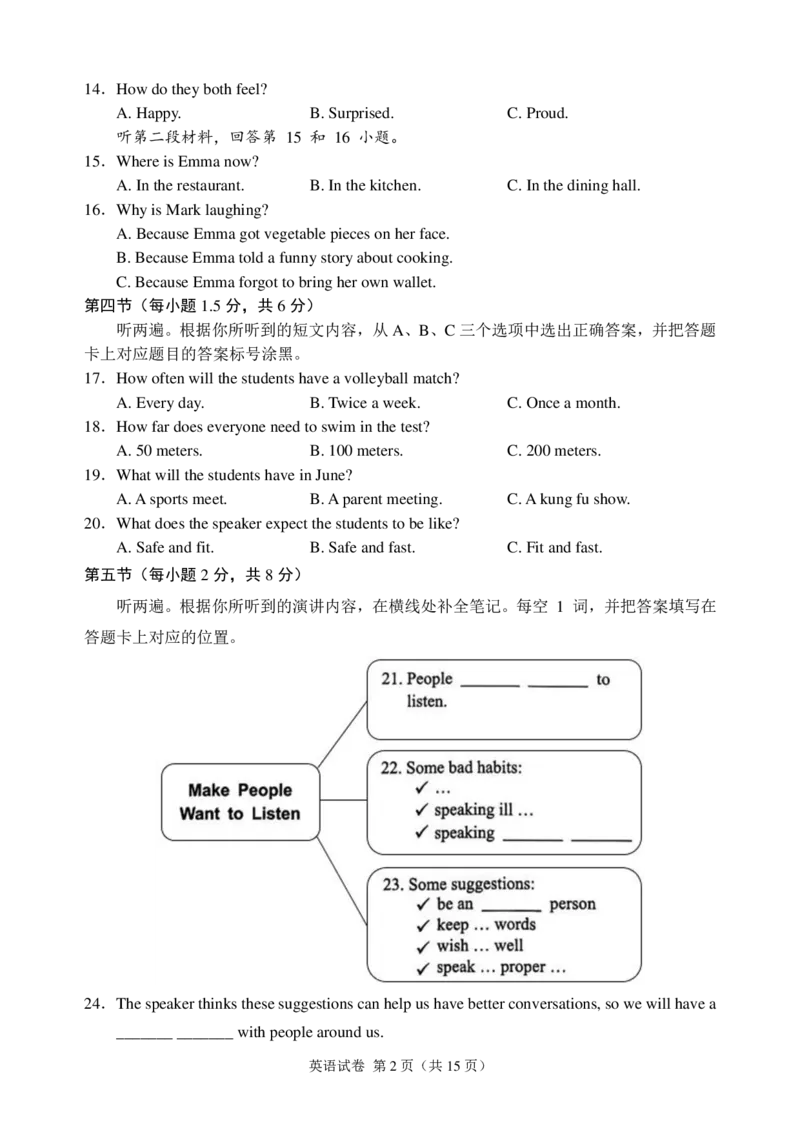
46.Where should the pads be placed on the patient?
A. B. C. D.
47.What’s the golden time to use an AED?
A. The first 4 minutes. B. The first 5 minutes.
C. The first 6 minutes. D. The first 7 minutes.
英语试卷 第4页(共15页)B
Tea has long been a popular drink in China. Chinese people love different kinds of tea. Among
them, black tea and white tea from Fujian, green tea from Zhejiang and Anhui, and dark tea from
Yunnan are some of the favorites.
In the Song Dynasty (960-1279), tea culture reached new heights. The beauty of the Song tea
came alive through “dian cha”. Powdered (粉状的) tea was whisked (搅打) with water into soft
“clouds”. White tea was often used to make the “clouds” as white as the moonlight. Tea artists used
clean water to draw pictures on them with a teaspoon. The way of serving dian cha became a living
art. It later influenced Japanese tea culture. Today, more young people are learning and passing it
on.
Yunnan’s dark tea, especially Pu’er, got famous because of the Ancient Tea Horse Road. And
it won popularity around the world. In 1976, Frenchman Fred Kempler found a new kind of Pu’er
from Yunnan in a Hong Kong shop. In the same year, he visited Yunnan, bought nearly two tons,
and began to sell “Yunnan Tuocha” in Europe. Since 1986, Yunnan’s Pu’er tuocha has got many
prizes at food expos (博览会) in France, America and other countries, Today you can see an old
Australian lady holding a cup of tea of sun-dried Pu’er, though she still enjoys her English-style
black tea with milk and sugar. Tea is a bridge of friendship among nations and peoples.
Tea is enjoyed timelessly from ancient to modem times. Each cup of dian cha, white as the
moonlight, turned tea into art, and art into eternity (永恒). Tea is also loved globally from the east
to the west. Each cup of Pu’er, with the 8mell of sunshine, turns tea into friendship, and friendship
into a shared future.
48.What kind of tea was often used for dian cha according to the passage?
A. Black tea. B. Green tea. C. Dark tea. D. White tea.
49.When did Fred Kempler begin to sell “Yunnan Tuocha” in Europe?
A. In 1986. B. In 1976. C. In 1279. D. In 960.
50.Which sentence uses “globally” with the same meaning as the underlined word?
globally /ˈɡləʊbəli/ adv. ①全球地 ②全面地 ③总体而言,整体地
A. ▶Globally, our class did well in the English test.
B. ▶The Olympic Games bring people together globally.
C. ▶The story is globally interesting though some parts are slow.
D. ▶This math question needs you to consider the numbers globally.
51.What is the best title for the passage?
A. More Than a Drink B. Tea Trade in China
C. Art in a Tea Cup D. Journey of Yunnan Tea
C
(Mr. Wormwood sells stolen cars and tries to get more money by cheating others. Matilda, a
book lover, hates that.)
Scene One
One morning, just when Mr. Wormwood was setting of to cheat others again, Matilda walked
into his room quietly to get the hat he wore each day to work. She was too short and had to get it
with a walking-stick.
Holding the hat in one hand and a bottle of superglue in the other, Matilda put some glue very
carefully all round the inside rim (边) of the hat. Then she carefully put the hat back.
Scene Two
That evening, when Mr. Wormwood got home, he cried, “I can’t take my hat off and I have to
英语试卷 第5页(共15页)keep it all day!”
“Don’t be silly,” his wife said. “Come here. I’ll take it off for you.”
“Ow-w-w! Don’t do that! Let go! You’ve nearly killed me!” he shouted.
“What’s the matter?” Matilda was standing at the door with a book in her hand.
Mr. Wormwood looked at her doubtfully, but said nothing.
“It must be superglue. Haven’t I told you not to touch the dirty thing?” Mrs. Wormwood said.
“I haven’t touched it!” Mr. Wormwood shouted. He turned and locked again at Matilda, who
looked back at him with large innocent (无辜的) brown eyes.
Scene Three
Mr. Wormwood had to keep his hat on all through dinner. Later, he discovered that the worst
thing about having the hat was not to take a shower in it, but to sleep in it. “I expect it will be loose
(松动) by the morning and then it’ll be taken of easily,” Mrs. Wormwood said.
Scene Four
But the hat wasn’t loose by the morning. So Mrs. Wormwood cut the thing off his head, bit by
bit, first the top and then the rim.
At breakfast Matilda said to Mr. Wormwood, “You must try to get those bits off your head.
They look like little brown insects. And people will think you’ve got lice (虱子).”
“Be quiet!” Mr. Wormwood shouted. “Just keep your mouth shut!”
All in all, it is a most satisfying exercise. But don’t get your hopes up that it has taught the
cheater a good lesson.
(Matilda borrows her friend’s parrot (鹦鹉) and …)
52.What did Matilda put inside Mr. Wormwood’s bat?
A. Some hair. B. Some superglue. C. A book. D. A stick.
53.According to Scene Two, which word best describes Matilda?
A. Creative. B. Friendly. C. Shy. D. Calm.
54.What can we infer from the text?
A. The couple loved each other very much.
B. Mrs. Wormwood rally enjoyed cutting hair.
C. Matilda would continue to punish the cheater.
D. Mr. Wormwood wouldn’t cheat others any more.
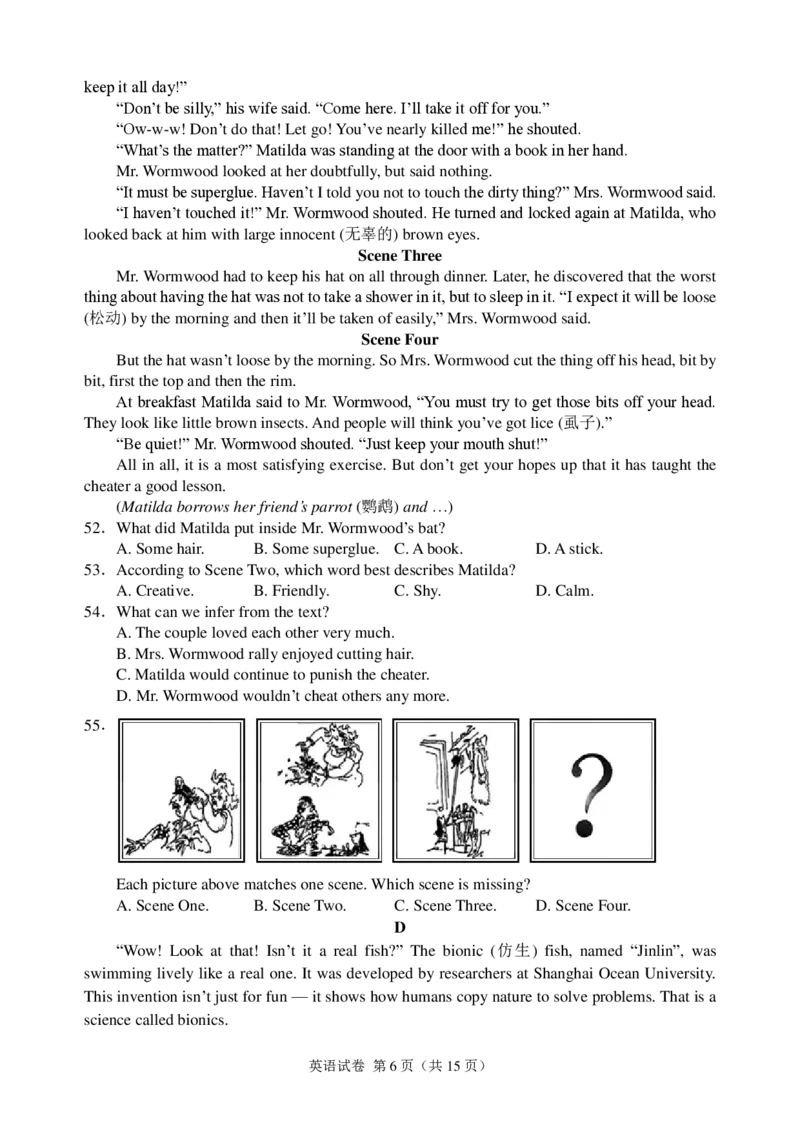
55.
Each picture above matches one scene. Which scene is missing?
A. Scene One. B. Scene Two. C. Scene Three. D. Scene Four.
D
“Wow! Look at that! Isn’t it a real fish?” The bionic (仿生) fish, named “Jinlin”, was
swimming lively like a real one. It was developed by researchers at Shanghai Ocean University.
This invention isn’t just for fun — it shows how humans copy nature to solve problems. That is a
science called bionics.
英语试卷 第6页(共15页)Over millions of years, animals and plants have developed smart ways to survive. For example,
kingfishers are experts at moving fast between air and water with very little noise. Through their
study, scientists discovered that the birds’ long beaks (喙) enabled this ability. Then they used the
knowledge to change the front of the high-speed train. This change cut down noise level, increased
speed by 10% and greatly saved energy. This combination (结合) of biology and engineering is the
key to success in bionics. And it has set the stage for the rise of other new technologies.
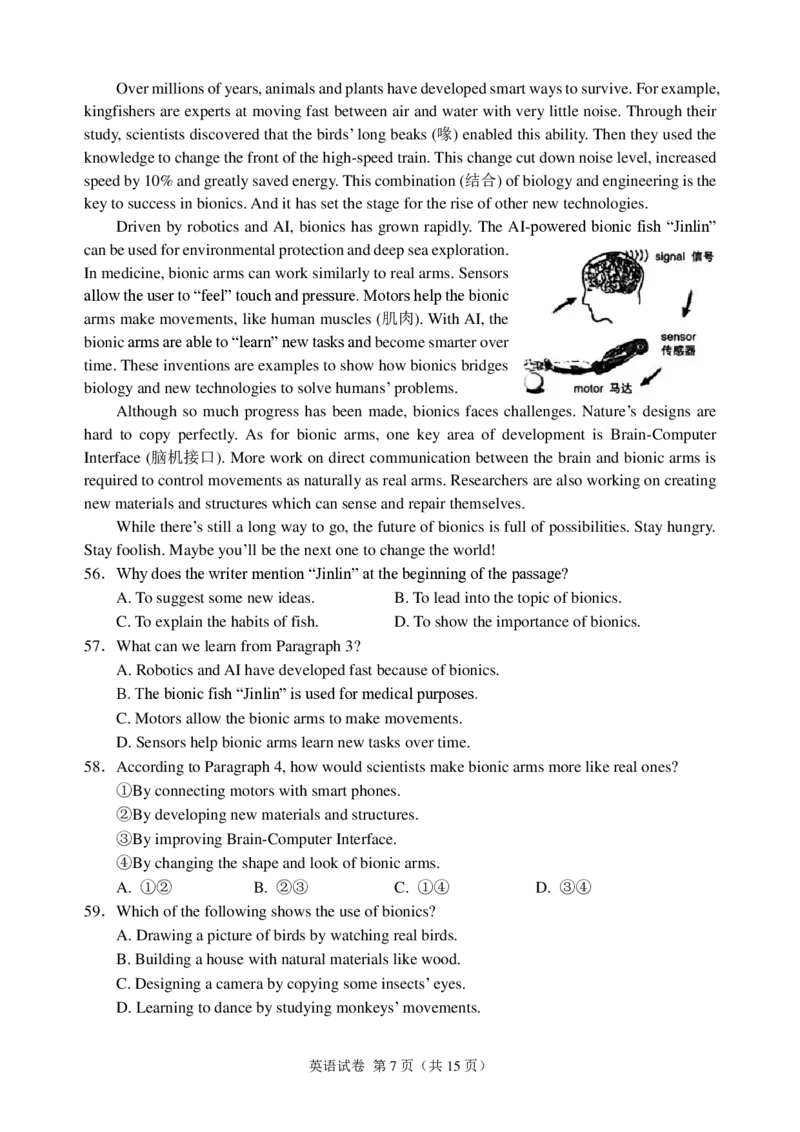
Driven by robotics and AI, bionics has grown rapidly. The AI-powered bionic fish “Jinlin”
can be used for environmental protection and deep sea exploration.
In medicine, bionic arms can work similarly to real arms. Sensors
allow the user to “feel” touch and pressure. Motors help the bionic
arms make movements, like human muscles (肌肉). With AI, the
bionic arms are able to “learn” new tasks and become smarter over
time. These inventions are examples to show how bionics bridges
biology and new technologies to solve humans’ problems.
Although so much progress has been made, bionics faces challenges. Nature’s designs are
hard to copy perfectly. As for bionic arms, one key area of development is Brain-Computer
Interface (脑机接口). More work on direct communication between the brain and bionic arms is
required to control movements as naturally as real arms. Researchers are also working on creating
new materials and structures which can sense and repair themselves.
While there’s still a long way to go, the future of bionics is full of possibilities. Stay hungry.
Stay foolish. Maybe you’ll be the next one to change the world!
56.Why does the writer mention “Jinlin” at the beginning of the passage?
A. To suggest some new ideas. B. To lead into the topic of bionics.
C. To explain the habits of fish. D. To show the importance of bionics.
57.What can we learn from Paragraph 3?
A. Robotics and AI have developed fast because of bionics.
B. The bionic fish “Jinlin” is used for medical purposes.
C. Motors allow the bionic arms to make movements.
D. Sensors help bionic arms learn new tasks over time.
58.According to Paragraph 4, how would scientists make bionic arms more like real ones?
①By connecting motors with smart phones.
②By developing new materials and structures.
③By improving Brain-Computer Interface.
④By changing the shape and look of bionic arms.
A. ①② B. ②③ C. ①④ D. ③④
59.Which of the following shows the use of bionics?
A. Drawing a picture of birds by watching real birds.
B. Building a house with natural materials like wood.
C. Designing a camera by copying some insects’ eyes.
D. Learning to dance by studying monkeys’ movements.
英语试卷 第7页(共15页)Ⅴ. 口语应用。(每小题 2分,共10分)
阅读下面对话,从方框内 7 个选项中选择 5 个恰当的句子完成此对话,并把答题卡上
对应题目的答案标号涂黑。
A: Hi, I’m Chris. Nice to meet you!
A. I’d love to.
B: Oh, hi, I’m Amy. 60 B. Let’s eat together.
A: So, Amy. Why are you interested in joining our group? C. It’s great to see you, too.
B: Well, I want to do something for our environment. D. We start with less shopping.
A: 61 We are all trying to live a low-carbon (低磯) E. Can you lend me a bike?
F. Anything else?
life.
G. This group is just right for you.
B: A low-carbon life? What is that?
A: It’s a green lifestyle. 62 We still buy daily things like food and drinks. But we try not to
buy new clothes or shoes.
B: Wow! 63
A: Well, we eat less meat and we prefer more local food.
B: I can do that. And I often take a bus to school.
A: That’s great. Then welcome to join us.
B: 64 Thanks.
第Ⅱ卷(共 50 分)
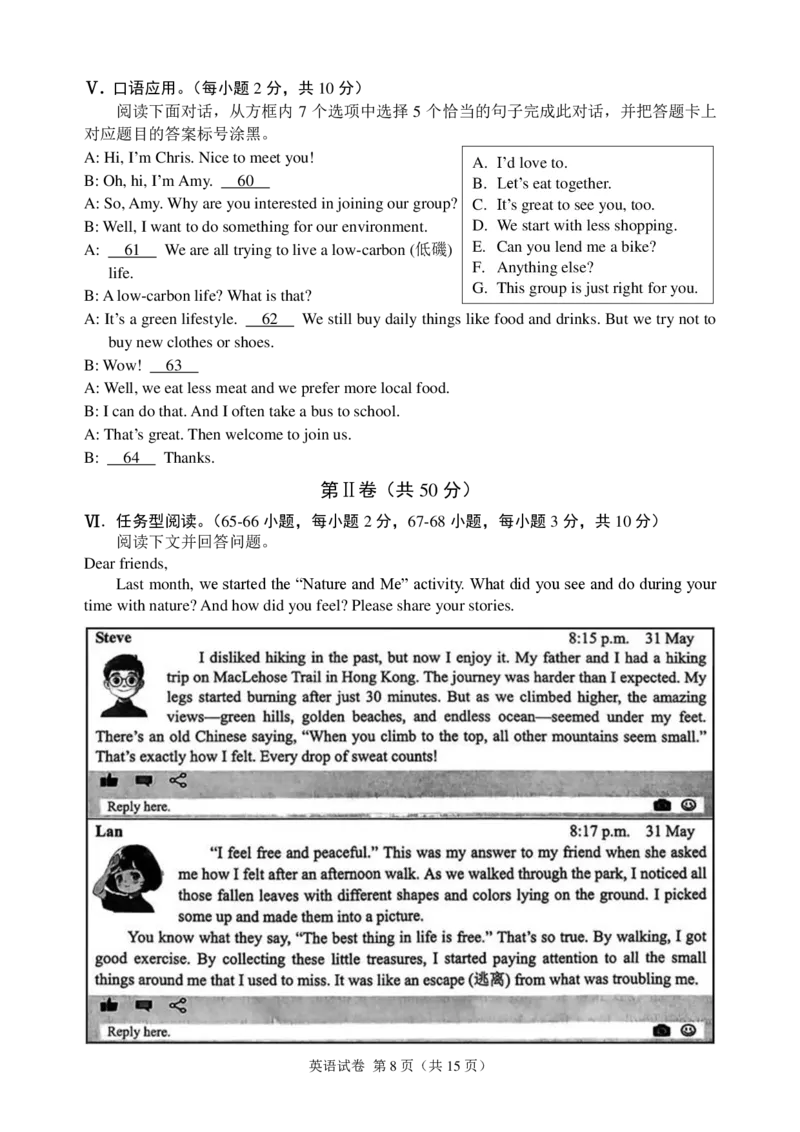
Ⅵ.任务型阅读。(65-66小题,每小题2分,67-68小题,每小题 3分,共10分)
阅读下文并回答问题。
Dear friends,
Last month, we started the “Nature and Me” activity. What did you see and do during your
time with nature? And how did you feel? Please share your stories.
英语试卷 第8页(共15页)65.Does Steve like hiking now?
__________________________________________________________________________
66.What did Lan pick up during the afternoon walk?
__________________________________________________________________________
67.What have the three people learned in common from their trips?
__________________________________________________________________________
68.What do you think of their experiences and why? Choose one to reply. (about 30 words)
__________________________________________________________________________
Ⅶ. 完成句子。(69-72 小题,每空1分,73 小题2分,共10分)
根据所给提示,完成句子。69-72小题,每空一词,含缩略词,73小题请将完整的句子
写在答题卡上对应的位置。
69.Gina is talking to her friend on the phone.(改为否定句)
Gina __________ __________ to her friend on the phone.
70.Andy paid 30 yuan for his new book.(对划线部分提问)
__________ __________ did Andy pay for his new book?
71.Sorry, you are not old enough to drive.(改为同义句)
Sorry, you are __________ young __________ drive.
72.面对困难,我们应该永不放弃。(完成译句)
We should never __________ __________ in the face of difficulties.
73.to be, want, a writer, I, in the future(连词成句)
_________________________________________________________________________.
Ⅷ. 概要补全。(75 和 77小题,每小题2分;74和76小题,每小题 3分;共10分)
阅读文章,用恰当的短语或句子补全概要。补全部分总词数不超过 30词,不能照抄原
文连续超过3个词。
When you make a mistake or say something wrong, it’s easy to be hard on yourself. Then
stress is caused. Feelings of anger, disappointment and sadness come along. That’s why such stress
needs to be dealt with.
Max, a 14-year-old boy, used to be very competitive and always felt stressed. Now he is
learning to give himself care and kindness. When he doesn’t win or get the top marks, he talks to
himself, “It’s OK not to be perfect.” He knows he always does his best and that is enough.
What Max does is called self-compassion (自我和解). With self-compassion, you treat
yourself kindly like a friend. It allows you to forgive (原谅) yourself when you mess up or fail.
After feelings of guilt (愧疚) go away, you get more relaxed and you can think more clearly. This
way self-compassion makes you move forward. Many studies have shown it is of great help.
英语试卷 第9页(共15页)However, some disagree. They argue that self-compassion leads people to be less active. But
Breines and Chen’s study had a different result. They gave students a difficult word test. The
students were given the chance to study for a second test. They found those who were
compassionate toward their failure spent more time preparing.
Experts suggest that you should write a letter to yourself, describing the situation that causes
your pain and accepting how you feel. Or you can do something you like to make yourself feel at
peace. Suzy Reading, a psychologist (心理学家), suggests using a “gentle touch” like placing one
or both hands on your heart, so you will feel safe and loved.
Being hard on yourself causes stress. However, 74 . Self-compassion means
being kind to yourself. With its help, you will have more relaxation and a clearer mind so that
75 . Some think differently, but a study shows that 76 . To practice
self-compassion, some 77 are suggested by experts.
Ⅸ. 书面表达。(满分 20分)
某权威英语阅读网站发布报告:从小学到高中毕业,如每天坚持阅读 15分钟,学生的
累积阅读量可达680 万词;不足15分钟,则只有约 150万词。你校英语社团在全校每天阅
读时间不足 15 分钟的学生中进行原因调查后(结果见下图),针对最突出的原因,以
“Everyone can have time to read”为主题发起征文。请你简述调查结果,提出行之有效的建
议(1-2 条)参与投稿。
要求:1.80-120 词,开头已给出,不计入总词数;
2.文中不能出现自己的姓名和所在学校的名称。
参考信息:
➢ spare moments (碎片化时间) (during lunch breaks, while waiting, before bed …)
➢ use / create an AI reading agent (智能体) (make plans, remind sb. to read, manage time
well ...)
➢ less screen time (less time on the phone …)
➢ be a better learner (focus well, learn better in less time …)
➢ …
According to the survey, 16% show little interest in reading. __________________________
英语试卷 第10页(共15页)[机密] 2025年
6月14日11:00 前
重庆市 2025 年初中学业水平暨高中招生考试
英语试题参考答案及评分意见
第Ⅰ卷(共 100 分)
Ⅰ.听力测试。(1-6 小题,每小题1分;7-20 小题,每小题 1.5 分;21-24小题,每小题 2
分;共35分)
1~6 ACACBB 7~12 ABBABC 13~16 ACBA 17~20 CACA
21. don’t want 22. too loudly 23. honest 24. better relationship
Ⅱ. 语法选择。(每小题 1分,共10分)
25~29 ABCBC 30~34 ACBAA
Ⅲ. 完形填空。(每小题 1.5分,共15分)
35~39 ABCDB 40~44 CACBD
Ⅳ. 阅读理解。(每小题 2分,共30分)
45~47 ADA 48~51 DBBA 52~55 BDCC 56~59 BCBC
Ⅴ. 口语应用。(每小题 1分,共10分)
60~64 CGDFA
第Ⅱ卷(共 50 分)
Ⅵ.任务型阅读。(65-66小题,每小题2分,67-68小题,每小题 3分,共10分)
65. Yes, he does. / Yes.
66. She picked up some fallen leaves.
67. Spending time in nature is good for everyone’s personal growth in body and mind.
68. Hi, Steve. I agree with you! Hiking is a great way to challenge ourselves while enjoying
the beauty of nature. Every step forward makes us stronger and more confident in life. /
Lan, I understand how you felt. When I feel bad, the beauty of nature helps me relax.
However, you should focus on the sunny side of life. Don’t think too much. /
Hey, Janet. Thanks for your sharing, but I don’t agree. Waterfalls are too noisy; and I think
the sound would make me uncomfortable. I prefer to relax in quiet places.
Ⅶ. 完成句子。(69-72 小题,每空1分,73 小题2分,共10分)
69. isn’t talking 70. How much 71. too; to 72. give up
73. I want to be a writer in the future.
(评分说明:形式、拼写错误不给分)
英语试卷 第11页(共15页)Ⅷ. 概要补全。(75 和 77小题,每小题2分;74和76小题,每小题 3分;共10分)
74. self-compassion helps you to get out of such stress
75. you can move on
76. it makes people more active
77. helpful ways
Ⅸ. 书面表达。(满分 20分)
One possible version:
According to the survey, 16% show lite interest in reading. 12% don’t know what to read. And
4% have other reasons. Most students, about 68%, think they have no time. However, I think if we
truly want to read, we can always find time.
First, we can use spare moments wisely. We can read during short moments while waiting for
the bus. Also, always carrying a book makes it convenient to read. Every minute counts.
Second, we can create an AI reading agent. It creates our own reading plans, records our
reading time and reminds us about our reading tasks. It can help us manage time well.
Dear friends, time is like sunshine — if you look for it, you’ll always find some. Let’s swim
together in the ocean of reading.
评分总则:
1.本题总分为20 分,按各档次打分。
2.评分时,先根据思想是否健康、文章的逻辑和内容初步确定所属档次,再根据语言
在档内准确打分。鼓励创新思维和视角新颖。
给分范围和要求:
☆思想健康、三观正确
第五档(优秀) 高水平完成了 ☆结构完整、条理清晰、逻辑严密、过渡自然
(19—20分) 试题规定的任务 ☆符合题意、中心突出、内容充实、富有创意
☆语言通畅、表达贴切、感情真挚
☆思想健康、三观正确
第四档(良好) 较好完成了 ☆结构完整、条理分明、逻辑清晰、过渡自然
(16—18分) 试题规定的任务 ☆符合题意、中心明确、内容充实
☆语言流畅、表达较贴切、感情真实
☆思想健康、三观正确
第三档(中等) 基本完成了 ☆结构较完整、条理较分明、有一定逻辑性
(13—15分) 试题规定的任务 ☆符合题意、中心明确、内容较充实
☆较准确地使用语言、能清楚表达意思
☆思想健康、三观正确
第二档(较差) 未恰当完成 ☆结构不完整、条理不分明、逻辑不严密
(8—12分) 试题规定的任务 ☆中心较明确、内容不充实、不能完全满足写作任务的要求
☆语言不够连贯,错误较多、影响对写作内容的理解
☆思想健康、但内容严重缺失
第一档(差) 未完成 ☆语言错漏太多,无法传达有效信息、不能满足写作任务的
(0—7分) 试题规定的任务 要求
(与规定内容无关的抄袭或思想不健康,均为0分。)
英语试卷 第12页(共15页)听力原文:
这里是重庆市2025 年初中学业水平暨高中招生考试英语听力测试部分,请考生们做好
听音和答题准备。
第一节 听一遍,根据你所听到的句子,从 A、B、C 三个选项中选出最恰当的答语,
并把答题卡上对应题目的答案标号涂黑。每小题你将有 7秒钟的时间读题和答题。
1. Good morning, boys and girls.
2. Don’t run in the hall please.
3. Can you help me with the box?
4. I’m sorry I broke your pencil.
5. What about going to a movie this afternoon?
6. You look so good in the dress.
第二节 听一遍。根据你所听到的对话和问题,从 A、B、C 三个选项中选出正确答案,
并把答题卡上对应题目的答案标号涂黑。每小题你将有 8秒钟的时间读题和答题。
7. W: Bob, the word on your back looks cool.
M: Its journey, every journey, begins with the 1st step.
Question: How is the word on Bob’s back pronounced?
8. M: Linda, what color do you like best?
W: Red, of course.
Question: What is Linda’s favorite color?
9. W: Excuse me, can you tell me the way to the bank?
M: Sure, go along and turn left at the crossing.
Question: Where is the woman going?
10. M: Look! Who is over there?
W: It must be Lucy. She always comes 1st.
Question: Who always comes 1st?
11. W: Mike, you have changed a lot.
M: That’s right. I used to be short. Now I’m much taller.
Question: What did Mike used to be like?
12. M: Mom, it’s 10:00. Shall we go now?
W: Just a moment, dear. Let’s leave 15 minutes later.
Question: When will they leave?
英语试卷 第13页(共15页)第三节 听两遍。根据你所听到的长对话,从 A、B、C 三个选项中选出正确答案,并
把答题卡上对应题目的答案标号涂黑。听长对话前,你将有 10 秒钟的时间阅读各个小题,
听完后你将有10秒钟的时间答题。
听第一段材料,回答第 13和14小题。
W: Hey, Li Hua. Anything interesting in the newspaper?
M: Yes, I’m reading a report.
W: What’s it about?
M: It tells how China helps other countries. We teach them to grow rice, help them build
railways and offer them free medicine.
W: Wow. So they can live better.
M: And we learned some countries soil from the moon for research.
W: We are doing a lot for the world. I feel so proud.
M: Me too.
听第二段材料,回答第 15和16小题。
M: Hi, Emma. Where are you?
W: Hey, Mark, I’m in the kitchen and preparing some food for the party.
M: Do you need any help?
W: That will be great.
M: What do you need?
W: Could you cut these potatoes into pieces?
M: No problem. Haha…
W: Why are you laughing?
M: I’m laughing at your face. You got some vegetable pieces on your face.
第四节 听两遍。根据你所听到的短文内容,从 A、B、C 三个选项中选出正确答案,
并把答题卡上对应题目的答案标号涂黑。听短文前你将有 20秒钟的时间阅读各个小题,听
完后你将有20秒钟的时间答题。
Hello, boys and girls. Glad to meet you here. I’m Sandy, your PE teacher. Here are some
important things you must know.
First, they are rules.
They are to make sure everyone is safe, especially when we are doing sports. I believe none
of you will break them.
英语试卷 第14页(共15页)Second, about the exercise plans.
This term we will focus on three sports: volleyball, swimming and kung fu. Volleyball is a
team sport. Once a month, we would choose some students to have a volleyball match with the
team from other schools.
In May, we will have a swimming test. Everyone needs to swing fifty meters. Speed is not a
problem.
And by the end of the term, in June, we will have a kung fu show. We may invite 100 parents
to watch. You know, this is the year of weight management. Let’s enjoy sports and keep fit.
第五节 听两遍。根据你所听到的演讲内容,在横线处补全笔记,每空一词,并把答案
填写在答题卡上对应的位置。听演讲前,你将有 30秒钟的时间阅读各个小题,听完后你将
有30秒钟的时间答题。
Good morning, everyone. We may have experienced that when we speak, people don’t want
to listen to us. The reason is that we probably have some bad habits, like lying to people, speaking
ill of others and speaking too loudly. As a result, we may have fewer friends and more worries.
Then what can we do to make people want to listen?
Firstly, be a person who doesn’t lie. Be true in what we say. Next, try to keep our words, do
what we say, and become someone people can trust. Also, when others make progress or achieve
something, we should congratulate them from the bottom of our heart. It means wishing people
well. Finally, we should speak in a proper way, try to make our voice sound warm and comfortable
like smooth hot chocolate, and pay attention to our speed of speaking. We can speak quickly to
show our excitement or slow down to help people notice something important. Of course, we can’t
please everyone, but try the suggestions above, and the world around will surely sound beautiful.
Thanks for listening.
听力测试完毕,请考生们继续完成其他试题。
英语试卷 第15页(共15页)