高一英语半期  2026-05  第1 页  共5 页
树德中学高2025 级高一下学期半期考试英语试题
命题人:宁夏英语备课组    审题人:王国民、肖洪林、杜春
本试卷满分150 分,考试时间120 分钟
第一部分:听力 (共两小节,满分30 分)
注意,回答听力部分时,请先将答案标在试卷上。听力部分结束前,你将有两分钟的时间
将你的答案转涂到答题卡上。
第一节(共5 小题;每小题1.5 分,满分7.5 分)
听下面5 段录音。每段录音后有一个小题,从题中所给的A、B、C 三个选项中选出最佳选
项。听完每段录音后,你都有10 秒钟的时间来回答有关小题和阅读下一小题。每段录音播
放两遍。
1. What does the woman want the man to do?
A. Put out his cigarette.

B. Pay for the coffee.

C. Get on the train.
2. What does the woman think of the new song?
A. Boring.                B. Confusing.


C. Appealing.
3. What was the price of the chocolate brownie last week?
A. £3.00.                  B. £3.60.


C. £4.50.
4. Why is the man complaining about the dish?
A. It is not fresh.
B. It is too hot.

C. It is not his order.
5. In which city will the man stay this weekend?
A. London.
B. Manchester.


C. Birmingham.
第二节(共15 小题; 每小题1.5 分, 满分22.5 分)
听下面5 段录音。每段录音后有几个小题,从题中所给的A、B、C 三个选项中选出最佳选
项。听每段录音前,你将有时间阅读各个小题,每小题5 秒钟;听完后,每小题都有5 秒
钟的作答时间,每段录音播放两遍。
听下面的录音,回答第6 和第7 小题。
6. What is the probable relationship between the speakers?
A. Doctor and patient.
B. Teacher and student.


C. Father and daughter.
7. Why is Emma unwilling to take the medicine?
A. It gives her headaches.
B. It makes her sleepy.


C. It affects her appetite.
听下面的录音,回答第8 至第10 小题。
8. What impressed the woman about the first lecturer?
A. His humor.

B. His speech title.

C. His pronunciation.
9. How did the third lecturer start her speech?
A. With a story.
B. With a saying.
C. With a gesture.
10. Which lecturer does the man like best?
A. The first one.
B. The second one.

C. The third one.
听下面的录音,回答第11 至第13 小题。
11. What does Ashley plan to do this Friday night?
A. Work overtime.

B. Watch a movie.

C. Go shopping.
12. What does Ashley think of Josh?
A. Creative.            B. Untrustworthy.            C. Generous.
13. When will the man pick up Ashley this Saturday?
A. At 3:00 p. m.
B. At 4:00 p. m.
C. At 5:00 p. m.
听下面的录音,回答第14 至第16 小题。
14. Why did the man leave his last job?
A. It was not promising.

B. He was not well-paid.

C. His boss was strict.
15. What position is the man probably applying for?
A. Engineer.
         B. Secretary.                C. Salesperson.
16. What does the woman value most about the man?
A. His university major.

B. His language skills.

C. His work experience.
听下面的录音,回答第17 至第20 小题。
17. How many people expressed their disagreement with the doctor?
A. Over 1/3.            B. Over 2/3.
               C. Over 4/5.
18. Why did those people refuse to be straightforward?
A. They hoped to avoid being criticized.
B. They didn’t want to waste the doctor’s time.
C. They feared it might affect their medical record.
19. What kind of people was the first group made up of?
A. Children.            B. Young adults.
           C. Old people.
20. How does the study’s first author feel about the results?
A. Angry.
            B. Unsurprised.
            C. Worried.

高一英语半期  2026-05  第2 页  共5 页
第二部分 阅读(共两节, 满分50 分)
第一节(共15 小题,每小题2.5 分, 满分37.5 分)
阅读下列短文, 从每题所给的A、B、C、D 四个选项中选出最佳选项。
A
WALK FOR GREEN
How often do you walk around the campus instead of getting straight onto the shuttle bus? The
beauties of our campus deserve to be better explored and can best be explored on foot. Walking is
also a greener and healthier alternative to using vehicles. To encourage more students and staff
members to walk around the campus, our school has launched a new “Walk for Green” initiative.
Programme
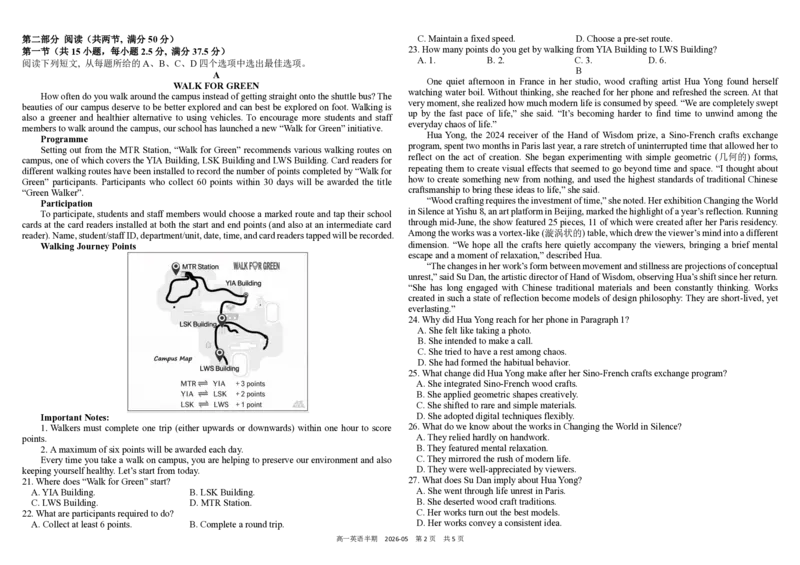
Setting out from the MTR Station, “Walk for Green” recommends various walking routes on
campus, one of which covers the YIA Building, LSK Building and LWS Building. Card readers for
different walking routes have been installed to record the number of points completed by “Walk for
Green” participants. Participants who collect 60 points within 30 days will be awarded the title
“Green Walker”.
Participation
To participate, students and staff members would choose a marked route and tap their school
cards at the card readers installed at both the start and end points (and also at an intermediate card
reader). Name, student/staff ID, department/unit, date, time, and card readers tapped will be recorded.
Walking Journey Points


Important Notes:
1. Walkers must complete one trip (either upwards or downwards) within one hour to score
points.
2. A maximum of six points will be awarded each day.
Every time you take a walk on campus, you are helping to preserve our environment and also
keeping yourself healthy. Let’s start from today.
21. Where does “Walk for Green” start?
A. YIA Building.
 B. LSK Building.
C. LWS Building.
 D. MTR Station.
22. What are participants required to do?
A. Collect at least 6 points.
 B. Complete a round trip.
C. Maintain a fixed speed.
 D. Choose a pre-set route.
23. How many points do you get by walking from YIA Building to LWS Building?
A. 1.           B. 2.               C. 3.            D. 6.
B
One quiet afternoon in France in her studio, wood crafting artist Hua Yong found herself
watching water boil. Without thinking, she reached for her phone and refreshed the screen. At that
very moment, she realized how much modern life is consumed by speed. “We are completely swept
up by the fast pace of life,” she said. “It’s becoming harder to find time to unwind among the
everyday chaos of life.”
Hua Yong, the 2024 receiver of the Hand of Wisdom prize, a Sino-French crafts exchange
program, spent two months in Paris last year, a rare stretch of uninterrupted time that allowed her to
reflect on the act of creation. She began experimenting with simple geometric (几何的) forms,
repeating them to create visual effects that seemed to go beyond time and space. “I thought about
how to create something new from nothing, and used the highest standards of traditional Chinese
craftsmanship to bring these ideas to life,” she said.
“Wood crafting requires the investment of time,” she noted. Her exhibition Changing the World
in Silence at Yishu 8, an art platform in Beijing, marked the highlight of a year’s reflection. Running
through mid-June, the show featured 25 pieces, 11 of which were created after her Paris residency.
Among the works was a vortex-like (漩涡状的) table, which drew the viewer’s mind into a different
dimension. “We hope all the crafts here quietly accompany the viewers, bringing a brief mental
escape and a moment of relaxation,” described Hua.
“The changes in her work’s form between movement and stillness are projections of conceptual
unrest,” said Su Dan, the artistic director of Hand of Wisdom, observing Hua’s shift since her return.
“She has long engaged with Chinese traditional materials and been constantly thinking. Works
created in such a state of reflection become models of design philosophy: They are short-lived, yet
everlasting.”
24. Why did Hua Yong reach for her phone in Paragraph 1?
A. She felt like taking a photo.
B. She intended to make a call.
C. She tried to have a rest among chaos.
D. She had formed the habitual behavior.
25. What change did Hua Yong make after her Sino-French crafts exchange program?
A. She integrated Sino-French wood crafts.
B. She applied geometric shapes creatively.
C. She shifted to rare and simple materials.
D. She adopted digital techniques flexibly.
26. What do we know about the works in Changing the World in Silence?
A. They relied hardly on handwork.
B. They featured mental relaxation.
C. They mirrored the rush of modern life.
D. They were well-appreciated by viewers.
27. What does Su Dan imply about Hua Yong?
A. She went through life unrest in Paris.
B. She deserted wood craft traditions.
C. Her works turn out the best models.
D. Her works convey a consistent idea.
高一英语半期  2026-05  第3 页  共5 页
C
In the pre-digital era, forgetting was the default. To preserve a memory, one had to take a
photograph, write in a diary, or consciously commit an event to mind. Today, the situation is reversed:
remembering is the default. Every digital footprint — from social media posts to location data — is
stored indefinitely in the vast “cloud.” While this total recall offers convenience, it also threatens a
fundamental human capacity: the ability to move on from our past.
Viktor Mayer-Schönberger, in his book Delete, argues that human forgetting serves a critical
biological and social purpose. It allows us to filter out irrelevant information and, more importantly,
to evolve beyond our past mistakes. When our every youthful error is preserved forever in a
searchable digital record, we risk being “frozen” in time, judged by who we were rather than who
we have become. This “digital permanence” can discourage individuals from taking risks or
expressing unconventional ideas for fear of future consequences.
Furthermore, the constant presence of our past can distort our present. Psychological research
suggests that the act of outsourcing our memory to devices — a phenomenon known as “cognitive
offloading” — may actually weaken our internal recall. When we know a piece of information is
saved online, our brains are less likely to process it deeply. We become masters of finding
information, but slaves to the tools that store it.
Restoring the balance requires a conscious effort to reintroduce “forgetting” into our digital
systems. This could mean “expiration dates” for certain types of data or privacy laws that grant
individuals the “right to be forgotten.” Technology should serve as a tool for human flourishing, not
a digital cage that keeps us trapped in an unchangeable past.
28. What does the author mean by “remembering is the default” in Paragraph 1?
A. People are now born with better memories.
B. Digital information is automatically saved.
C. Most people prefer to keep their diaries online.
D. Forgetting has become an impossible biological task.
29. According to Mayer-Schönberger, what is a negative effect of “digital permanence”?
A. It forces individuals to repeat their past mistakes.
B. It makes irrelevant information harder to process.
C. It may prevent people from growing and changing.
D. It helps people learn more quickly from their errors.
30. What does the “cognitive offloading” mentioned in Paragraph 3 result in?
A. A deeper understanding of digital tools.
B. An increase in our brain’s storage capacity.
C. A better balance between work and personal life.
D. A decline in our ability to remember things internally.
31. What is the author’s main message in the text?
A. Digital storage should be expanded for future generations.
B. Privacy laws are the only way to protect our digital footprints.
C. We should appreciate the convenience brought by the “cloud.”
D. Human development requires a healthy balance between remembering and forgetting.
                                  D
Despite decades of medical advances, detecting health-related molecule still relies on bodily
liquids like blood, requiring blood draws from most patients, especially people with diabetes who
need frequent finger blood tests. However, researchers from the University of Chicago have
developed a lightweight device named ABLE, which collects and detects molecules in the air. This
4×8-inch device is a potential game-changer for medicine and public health.
Detecting molecules in the air has long fallen behind liquid detection, mainly because target
particles (微粒) are extremely rare — there may be only one in a trillion. To solve this problem,
the team turned air into liquid. The device draws in air, adds water vapor with a humidifier, and cools
it to turn air into small drops. These drops trap particles and slide into a small container, making
detection easy with common tools used for liquid analysis.
Early tests proved its effectiveness. It caught easily evaporated (挥发的) coffee vapor, detected
glucose in breath, identified E. coli in the air, and found signs of inflammation (炎症) in mice with
unhealthy gut bacteria. Obviously, it solved the problem of collecting molecules that evaporate easily
— a major worry during the device’s development.
The device was first inspired by the need for painless tests for early-born babies in ICUs. These
fragile babies are likely to have health problems, and repeated blood tests may put them in danger.
Doctors hope the device can track health signs without taking blood, protecting these high-risk
patients. It also shows promise for diagnosing inflammatory bowel disease, though the related breath
signs first need to be recorded. The team plans to improve and make it smaller to create a wearable
device for daily use.
Besides medical uses, this achievement may open the door to new physics research on air
impurities and state changes of matter. As a new tool for detecting air chemistry, ABLE fills the
space between air and liquid molecule analysis, creating possibilities for various new developments
in healthcare and science.
32. Why did the researchers develop ABLE?
A. To change medicine and public health.
B. To identify health molecules without liquid.
C. To take the place of blood tests in hospitals.
D. To reduce finger blood checks for patients with diabetes.
33. What can we infer about ABLE?
A. It is small and wearable for daily use.
B. It has overcome a key technical challenge.
C. It has proved useful for newly born babies.
D. It diagnoses inflammatory bowel disease easily.
34. What does the underlined word “impurities” in the last paragraph properly mean?
A. Useful gases.     B. Harmful poisons.    C. Clean liquid drops.
D. Unclean substances.
35. Which of the following is the best title for the text?
A. A Tool for Bodily Liquid Analysis.
B. A Tool for Airborne Particle Counting.
C. A Device for Modern Physics Research.
D. A Device for Air Molecule Detection.
高一英语半期  2026-05  第4 页  共5 页
第二节 (共5 小题,每小题2.5 分,满分12.5)
阅读下面短文,从短文后的选项中选出可以填入空白处的最佳选项,选项中有两项为多余选
项。
In a world filled with constant rushes and screens, a typical walk might be accompanied by
distractions.     36     The idea is that you focus on a single color and follow it wherever it
appears, uncovering hidden beauty in everyday environments.
Walking has many physical benefits, but it’s the meditative (冥想的) aspect of a colour walk
that’s so impactful.     37     Yet, when we set an intention to focus on something specific, a
colour in this case, we automatically root ourselves in the present moment, coming away from the
inner chatter (唠叨).
    38     Before you decide to go out on your walk, select a colour that feels right for you
at the beginning of your walk. Then, as you take your first steps outside, start to notice it. That colour
may be striking and easy to spot, or, sometimes, it requires you to keep your eyes open for that
selected colour.
As you pay more attention to your environment, you may find yourself connecting to your
surroundings in a way you didn’t previously. A colour walk helps us focus on something other than
what’s going on inside our heads, allowing us to see the “same old” in a new light.     39
Even in more built-up areas, things are more colourful than you thought.
With the specific colour in mind, don’t hesitate to stretch your legs outdoors and embrace the
chance to connect with your surroundings. The colour walk is a simple yet powerful way to see the
world with new eyes. By choosing a colour and letting it guide you, you’ll break free from routine.
40
A. How do you get started?
B. What colours can impact your mood?
C. However, a colour walk is full of intention.
D. But the colour walk is distinct from these walking trends.
E. And what’s lovely about the practice is that you can carry it out anywhere.
F. It’s a delightful practice that can turn an ordinary day into an inspiring adventure.
G. Even while walking, we may still experience negative thoughts or worries about the day.
第三部分: 语言运用 (共两节,满分30 分)
第一节(共15 小题,每小题1 分,满分15 分)
阅读下面短文,从每题所给的A、B、C、D 四个选项中选出可以填入空白处的最佳选项。
In the era of fast-paced social interaction, many teenagers are afraid of being alone. They chase
group activities all day long, fearing that solitude will make them feel abandoned and     41    .
They regard loneliness as a negative state that must be avoided at all costs.     42    , I hold a
totally different opinion. Proper solitude is not a sign of social failure, but a precious chance to
43     ourselves inwardly.
When we stay alone without external noise and noisy chatter, we can truly calm down to
44     our inner thoughts. In crowds, we often cater to others’ opinions blindly, follow the trend
without independent judgment, and gradually lose our unique     45    . However, solitude
provides a quiet spiritual space, where we can clear up messy emotions, review daily gains and losses,
and     46     clear goals for our future study and life.
I used to be a person who     47     crowds and hated staying alone. I always needed
company to kill time and dared not face my inner weakness directly. Later, due to special
arrangements, I had to spend one hour alone every evening reading and thinking. At first, I felt
restless and even     48    , not knowing how to arrange the quiet spare time. But I forced myself
to     49     to this regular quiet schedule and put aside all electronic devices.
Day by day, I gradually     50     the beauty of solitude. I no longer feel lonely or bored.
51    , I can efficiently summarize learning weaknesses, polish my personal planning, and improve
my self-discipline ability in this quiet period. Solitude helps me cut off useless social distractions
and     52     all energy on self-improvement.
Solitude never equals isolation. It is a voluntary choice to     53     trivial chaos and focus
on self-growth. Those who cannot stand solitude are easily disturbed by external voices, while those
who     54     solitude can always keep a clear mind and firm pace on the road of growth. For
senior high school students, learning to embrace moderate solitude is an essential     55     on
the way to maturity and excellent self-development.
41. A. connected

B. isolated


C. satisfied

D. inspired
42. A. Therefore

B. Besides


C. However

D. Moreover
43. A. reflect


B. praise


C. ignore


D. deceive
44. A. take apart

B. sort out


C. give away

D. put off
45. A. identity


B. honor


C. pressure

D. freedom
46. A. abandon


B. postpone
    C. set


D. cancel
47. A. preferred


B. avoided


C. doubted


D. balanced
48. A. productive

B. uncomfortable
C. relaxed


D. focused
49. A. object


B. respond


C. stick


D. admit
50. A. discovered

B. remembered

C. forgot


D. refused
51. A. Otherwise

B. Instead


C. Meanwhile

D. Anyway
52. A. waste


B. gather


C. borrow


D. save
53. A. stay in


B. dive into

C. stay away from
D. take part in
54. A. embrace


B. fear


C. reject


D. resist
55. A. barrier


B. reward


C. loss


D. lesson
第二节 (共10 小题,每小题 1. 5 分,满分15 分)
阅读下面短文,在空白处填入1 个适当的单词或括号内单词的正确形式。
Chinese architect Liu Jiakun was announced as the 54th winner of the Pritzker Architecture
Prize on March 4, 2025, making him the second Chinese winner of this highest honor in architecture.
Based in Chengdu, his career     56    (stretch) across four decades and more than 30 projects.
Liu’s works often combine local elements     57      a “low-tech” approach to elegance.
This philosophy was powerfully demonstrated after the Wenchuan earthquake, when he created
“rebirth bricks”   58     (aid) in rebuilding efforts. Made from local wheat fiber, cement, and
rubble from collapsed buildings, these bricks were more than just recycled materials. They became
a poetic symbol of both physical     59     spiritual rebirth during a time of great sadness.
Similarly, Liu’s focus on ordinary people is reflected in his largest project, West Village.
60    (complete) in 2015, this five-story urban complex in Chengdu includes a football field, paths
for cyclists and pedestrians, and a market. Over the years, it has grown into a popular public space
where     61    (resident) enjoy their leisure time. Hearing the news that Liu won the Pritzker
Prize, many online users     62     had visited West Village and other works noted that his
architecture reflects a precious sense of relaxation — much like Chengdu,     63     city known
for its giant pandas, hotpot, and leisurely pace.
Beyond his architectural achievements, Liu has also been praised by the committee for     64
(integrate) traditional Chinese philosophy into his designs. He believes that rather than seeking to
conquer nature, Chinese philosophy emphasizes      65     (adapt) and coexistence with the
natural world.
高一英语半期  2026-05  第5 页  共5 页
第四部分:写作(共两节,满分40 分)
第一节:应用文写作(满分15 分)
假定你是国际学校英文报“Career planning”栏目主编李华。请给职业规划顾问Mr. Smith 写一
封约稿邮件,内容包括:
1. 说明约稿目的;
2. 介绍分享内容;
3. 致谢并表期待。
注意:
1. 词数80 左右;
2. 可适当增加细节以使行文连贯。
参考词汇:consultant n. 顾问
Dear Mr. Smith,
______________________________________________________________________________
______________________________________________________________________________
______________________________________________________________________________
______________________________________________________________________________
Yours sincerely,
Li Hua

第二节:读后续写(满分25 分)
阅读下面材料,根据其内容和所给段落开头语续写两段,使之构成一篇完整的短文。
Maria and Peter lived in a coastal city. The greatest pleasure for them in summer was swimming
at their local beach after school. But one day they started to lose their enthusiasm for swimming in
the waters. More often than not, they would find plastic bags thrown on the beach. Worse still, as
they swam in the water, some plastic bags would float around them and even stick to their legs when
they walked to the shore.
They were upset and decided something needed to be done to stop the beautiful sea becoming
consumed by waste. One weekend, Maria and Peter brought a big bag to the beach and were
determined to clean up the waste. Sweat streamed down from their forehead while they bent down
and picked up the plastic bags. To their disappointment, after a day’s hard work, there were still
many plastic bags lying on the beach or floating in the water. Going home with aching legs and arms,
Maria and Peter were almost defeated by a strong sense of failure.
That night over dinner with their parents, the pair ate silently. Noticing their low spirits, Mother
asked gently, “You two looked so down. What happened?” Exchanging glances with Peter, Maria
replied in a low voice, “It’s those annoying plastic bags. We tried to clean them up, but it was just
impossible.” Understanding the pair’s disappointment, their father patted them on the back and
comforted, “Well, it’s really hard for just two of you to fix such a big problem.” “Just two of us,”
complained Maria and Peter, looking at each other. Suddenly, an idea flashed through their minds,
their eyes shining with excitement. “Yes, that’s the point! We should make more people aware of the
problem and encourage them to take action!” the pair said in chorus.
注意:续写词数应为150 个左右。
Quickly finishing their dinner, the pair went upstairs and started planning.


Excited and nervous, they posted the video and the article on social media.


高一英语半期  2026-05  第1页共2 页
树德中学高2025 级高一下学期半期考试英语试题答案
第一部分:听力
1~5 ACBAC
6~10 CBABC

11~15 CBAAC

16~20 BAABC
第二部分 阅读
21-23 DDC       24-27 DBBD          28-31 BCDD         32-35 BBDD
36-40 CGAEF
第三部分: 语言运用
第一节 完形填空
41-45 BCABA    46-50 CABCA        51-55 BBCAD
第二节
56. stretches    57. with    58. to aid    59. and          60. Completed
61. residents    62. who    63. a        64. integrating    65. adaptation/adaption
第四部分:写作
第一节:应用文写作
Dear Mr. Smith,
I am Li Hua, editor-in-chief of career planning, an English column in our school newspaper.
To help students make scientific career plans and clarify their future directions, I’m writing to
invite you to contribute an article to our column.
Given your expertise, we hope you can offer guidance on how senior high school students
explore their interests and strengths, how to match personal advantages with future careers, and
how to avoid common mistakes in career planning. Simple and practical suggestions are
particularly welcome, as they can better help students apply them in real life. Your professional
insights will surely light up students’ career paths and make our column more valuable.
We’d greatly appreciate it if you could take our invitation into consideration. Looking
forward to your reply and valuable contribution.
Yours sincerely,
Li Hua

第二节:读后续写
Quickly finishing their dinner, the pair went upstairs and started planning. Maria and Peter
decided to take advantage of the Internet. “Maybe we can write an article to raise public
awareness of marine pollution,” Maria proposed. “Good idea! We can also make a video!” Peter
added. The next few hours witnessed their heated discussion and growing confidence in a clean
and beautiful coast. The next day, they went to the beach and filmed a short video showing plastic
bags lying on the beach and floating in the sea. Peter, who was good at writing, wrote an article
talking about the current condition of the beach and asking people to take part in the clean-up.
Excited and nervous, they posted the video and the article on social media. To their
amazement, their post went viral online immediately. Countless comments flooded in saying how
heartbroken they were when looking at the polluted beach and ocean. What amazed Maria and
Peter more was that numerous people in their community, encouraged by their efforts, offered to
join in their clean-up. More and more people came to the beach to collect plastic bags, and they
also appealed to others to avoid throwing or using plastic bags. A year later, with their joint and
continuous efforts, the coast regained its beauty and Maria and Peter regained their long-awaited
pleasure.

听力录音原文
Text 1
W: Excuse me, sir. We have a no-smoking policy here.
M: Oh, sorry. I just came in to grab a coffee.
Text 2
W: Rose’s new song is so catchy! I’ve been playing it on repeat!
M: I listened to it, but there’s nothing new or exciting about it. I was bored after one listen.
Text 3
W: The chocolate brownie is £4.50.
M: Hmm? Aren’t all your items supposed to be 20% off?
W: That was last week’s promotion, sir. Now everything is back to its original price.
Text 4
W: Sir, I heard you wanted to see me.
M: Yes. I ordered the spicy fish hotpot. Come and try it! The fish must have been sitting there
for
days.
Text 5
W: Sam, could you give me a ride to Manchester this weekend?
M: Sorry, Zoe — change of plans. My company is sending me to Birmingham on Friday, and I
won’t be back in London until next Monday.
Text 6
M: Have you finished your breakfast, Emma?
W: Yes.
M: Good. Grab your backpack, and I’ll drive you to school.
W: Okay.
M: You’ve had this cold for days. Why does it seem like you’re not getting any better?
W: Uh, I haven’t really taken much of the medicine. Whenever I take it, I start nodding off. It’s
exam week, so I need to stay alert. But don’t worry — aside from a runny nose, I don’t have any
other symptoms: no headache and no coughing.
M: That’s not good. Give me your prescription. I’ll talk to the doctor and see if he can suggest
something else.
Text 7
M: Did you go to the final of the English speech contest today?
W: Yes, I did. It was very good indeed.
M: Which one did you like best?
高一英语半期  2026-05  第2页共2 页
W: Well, the first lecturer told us an interesting story, and I remember there were always bursts
of laughter during his lecture. The second one was pretty good as well because his pronunciation
sounded perfect. But I liked the third one best — the one titled Tiny Start, Bumper Harvest. She
began her speech with an old saying.
M: Yeah, it was the old saying that really carried the audience.
W: What’s more, she accompanied her speech with gestures, which really caught our attention.
M: That’s true. So actually, same as you, I considered her lecture the best one.
Text 8
M: Are you free this Friday night, Ashley?
W: My colleague Susan and I are going to the downtown department store after work to buy
some
new clothes.
M: How about the weekend then? Do you want to see Zootopia with me at the Maple Theater?
Josh
said he’ll buy me two IMAX tickets.
W: Josh always speaks with a forked tongue, promising things he’ll never follow through on.
Don’t believe him.
M: I’m afraid he’ll have to keep his promise this time. He’s counting on me to help with his paper.
W: I see. Well, I don’t have much planned for Saturday afternoon.
M: Great! Let me check the movie schedule on my phone. Hmm…how about the 4:00 p.m.
showing?
W: Sounds good to me.
M: Nice. I’ll come to your place and pick you up an hour before that.
W: Okay.
Text 9
W: Tell me about the work you did at your last job, Mr. Black.
M: Sure. Long story short, I prepared documents and arranged schedules for my boss.
W: Why did you leave?
M: Well, my boss treated me well, and the salary was quite good, actually. However, I just
couldn’t see a future there.
W: You mean, like a chance of promotion?
M: Right.
W: Okay. You studied engineering back in university, right?
M: Yeah. I know it has nothing to do with the position I’m applying for, and I have no relevant
work experience, but I’m willing to learn. Gaining customers’ trust and convincing them to buy
cars can be challenging, but it’s also something I find very fulfilling.
W: Good. You speak fluent Chinese, right?
M: Yes. I was born in Beijing. And I also speak Korean well.
W: That’s very important since most of our clients are from East Asia. All right, Mr. Black —
can
you start next Monday?
M: No problem! Thanks.
Text 10
When your doctor asks how often you exercise or what you’ve been eating lately, do you
always give her an honest answer? According to a new study, three fifths to four fifths of the
people surveyed have not been completely honest with their doctors about information that could
be relevant to their health. What’s more, more than a third of them didn’t speak up when they
disagreed with their doctor’s recommendation. When those people explained why they weren’t
straightforward, they said that they didn’t want to be lectured about how bad certain behaviors
were. The study included two populations: the first group consisted of 2,011 participants who
averaged 24 years old, and the second group was made up of 2,499 participants who averaged 61
years old. Scientists from four American universities carried out the study, and their results have
been published online. In the study, the first author expressed her concern. “It’s surprising. If
patients are withholding information about what they’re eating, or whether they are taking their
medication, it can have significant results for their health — especially if they have an illness,”
she said.