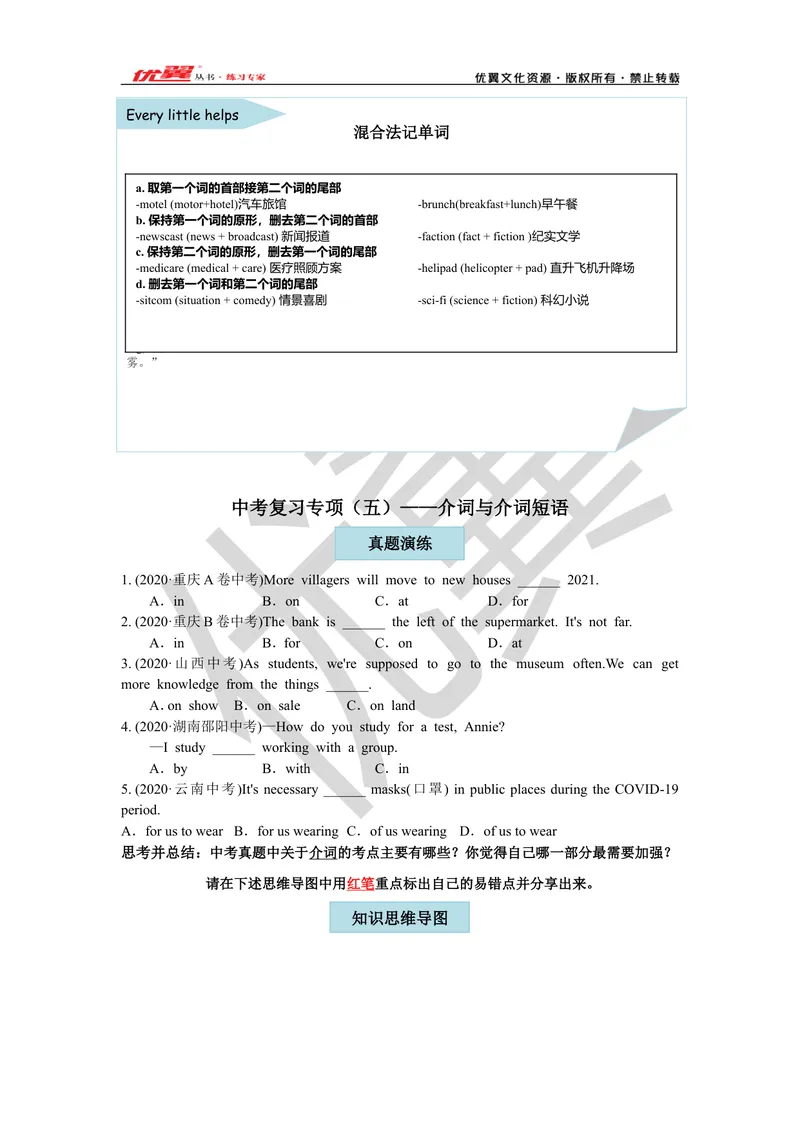
Every little helps
混合法记单词
a. 取第一个词的首部接第二个词的尾部
-motel (motor+hotel)汽车旅馆 -brunch(breakfast+lunch)早午餐
b. 保持第一个词的原形,删去第二个词的首部
-newscast (news + broadcast) 新闻报道 -faction (fact + fiction )纪实文学
c. 保持第二个词的原形,删去第一个词的尾部
-medicare (medical + care) 医疗照顾方案 -helipad (helicopter + pad) 直升飞机升降场
d. 删去第一个词和第二个词的尾部
-sitcom (situation + comedy) 情景喜剧 -sci-fi (science + fiction) 科幻小说
因此,在阅读时可使用此方法推测未知单词的含义(包括猜词题)。如在“The light is different right there It's
softer. It's called smog. ”一句中,可根据构词法猜出“smog”一词的构成及含义为“ -smog (smoke +
fog)烟雾 ”,这样,整个句子的意思理解起来就会更加准确,可译为“那边的光线很不一样很柔和,那是烟
雾。”
中考复习专项(五)——介词与介词短语
真题演练
1. (2020·重庆A卷中考)More villagers will move to new houses ______ 2021.
A.in B.on C.at D.for
2. (2020·重庆B卷中考)The bank is ______ the left of the supermarket. It's not far.
A.in B.for C.on D.at
3. (2020·山西中考)As students, we're supposed to go to the museum often.We can get
more knowledge from the things ______.
A.on show B.on sale C.on land
4. (2020·湖南邵阳中考)—How do you study for a test, Annie?
—I study ______ working with a group.
A.by B.with C.in
5. (2020·云南中考)It's necessary ______ masks(口罩) in public places during the COVID-19
period.
A.for us to wear B.for us wearing C.of us wearing D.of us to wear
思考并总结:中考真题中关于介词的考点主要有哪些?你觉得自己哪一部分最需要加强?
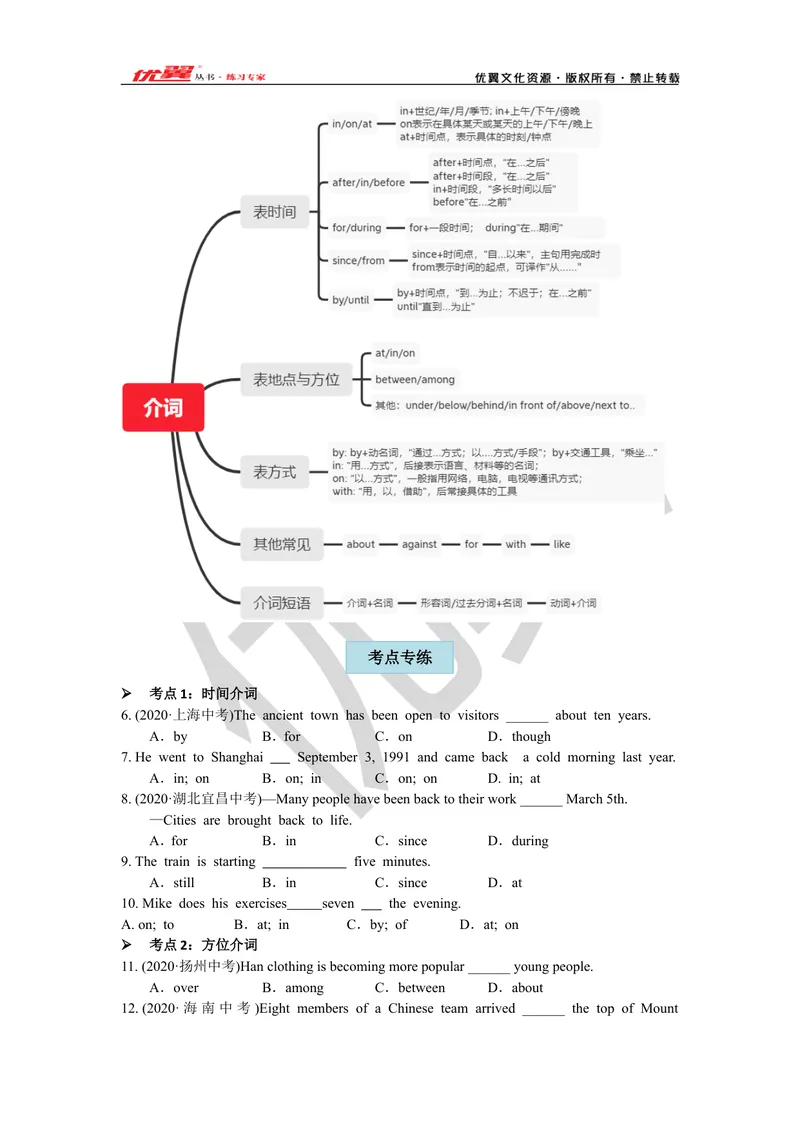
请在下述思维导图中用红笔重点标出自己的易错点并分享出来。
知识思维导图考点专练
考点1:时间介词
6. (2020·上海中考)The ancient town has been open to visitors ______ about ten years.
A.by B.for C.on D.though
7. He went to Shanghai September 3, 1991 and came back a cold morning last year.
A.in; on B.on; in C.on; on D. in; at
8. (2020·湖北宜昌中考)—Many people have been back to their work ______ March 5th.
—Cities are brought back to life.
A.for B.in C.since D.during
9. The train is starting five minutes.
A.still B.in C.since D.at
10. Mike does his exercises seven the evening.
A. on; to B.at; in C.by; of D.at; on
考点2:方位介词
11. (2020·扬州中考)Han clothing is becoming more popular ______ young people.
A.over B.among C.between D.about
12. (2020·海南中考)Eight members of a Chinese team arrived ______ the top of MountQomolangma successfully.
A.in B.at C.to
13. (2020·四川乐山中考)—Jack, can you swim ______ the river?
—I don't think I can. It's too wide for me.
A.over B.across C.through
14. (2020·辽宁营口中考)If success is a gate, the road ______ it must be made up of difficulties.
A.towards B.against C.opposite D.near
15. (2020·盐城中考)Yancheng is the only city ______ China to be named after salt.
A.at B.on C.in D.with
考点3:方式介词
16. (2020·山东青岛中考)You'd better not hang out after school ______ telling your parents.
They may worry about you.
A.by B.with C.without D.after
17. 从in/by/with中选正确的词
1) He makes a living selling newspapers.
2) He broke the window a stone.
3) The foreigner spoke to us English.
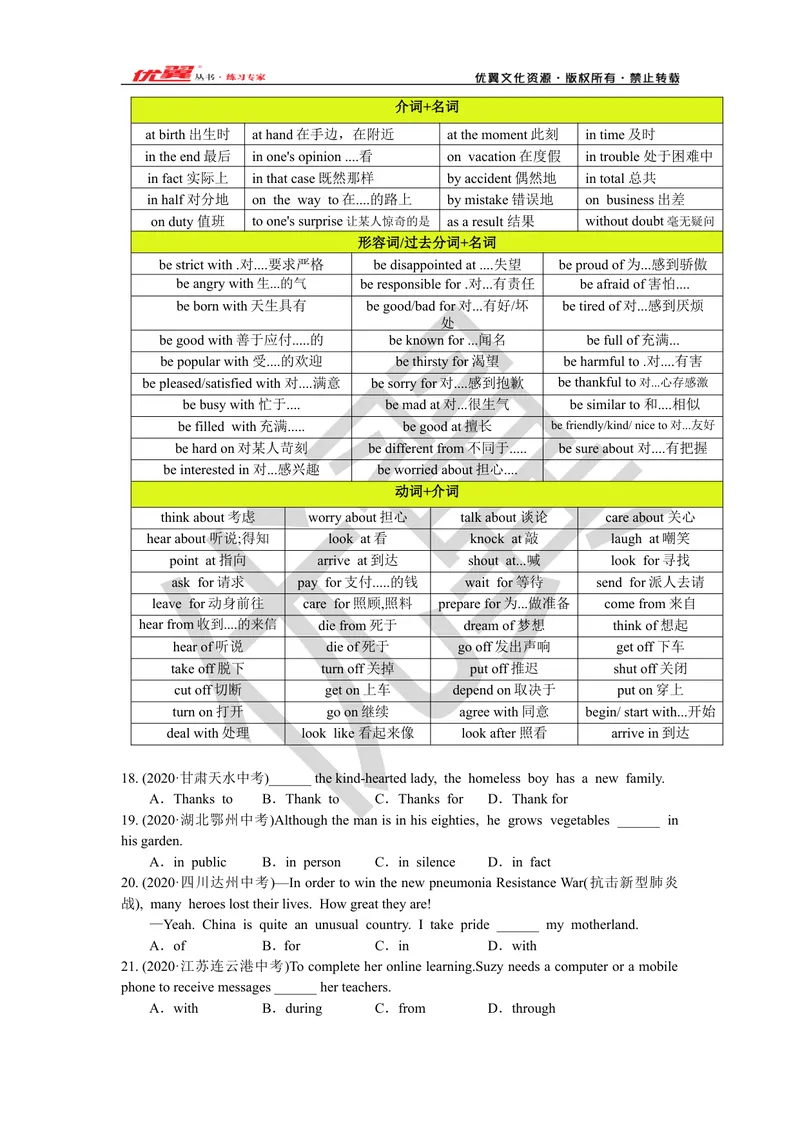
考点4:常见介词短语介词+名词
at birth出生时 at hand在手边,在附近 at the moment此刻 in time及时
in the end最后 in one's opinion ....看 on vacation在度假 in trouble 处于困难中
in fact 实际上 in that case既然那样 by accident偶然地 in total 总共
in half 对分地 on the way to在....的路上 by mistake错误地 on business出差
on duty 值班 to one's surprise让某人惊奇的是 as a result 结果 without doubt毫无疑问
形容词/过去分词+名词
be strict with .对....要求严格 be disappointed at ....失望 be proud of为...感到骄傲
be angry with生...的气 be responsible for .对...有责任 be afraid of害怕....
be born with天生具有 be good/bad for对...有好/坏 be tired of对...感到厌烦
处
be good with善于应付.....的 be known for ...闻名 be full of充满...
be popular with 受....的欢迎 be thirsty for渴望 be harmful to .对....有害
be pleased/satisfied with 对....满意 be sorry for对....感到抱歉 be thankful to对...心存感激
be busy with 忙于.... be mad at对...很生气 be similar to 和....相似
be filled with充满..... be good at擅长 be friendly/kind/ nice to对...友好
be hard on对某人苛刻 be different from不同于..... be sure about 对....有把握
be interested in 对...感兴趣 be worried about担心....
动词+介词
think about考虑 worry about担心 talk about 谈论 care about 关心
hear about 听说;得知 look at看 knock at敲 laugh at嘲笑
point at指向 arrive at到达 shout at...喊 look for寻找
ask for请求 pay for支付.....的钱 wait for等待 send for派人去请
leave for动身前往 care for照顾,照料 prepare for为...做准备 come from来自
hear from收到....的来信 die from死于 dream of梦想 think of想起
hear of听说 die of死于 go off发出声响 get off 下车
take off脱下 turn off关掉 put off推迟 shut off关闭
cut off切断 get on上车 depend on取决于 put on穿上
turn on打开 go on继续 agree with同意 begin/ start with...开始
deal with处理 look like 看起来像 look after 照看 arrive in到达
18. (2020·甘肃天水中考)______ the kind-hearted lady, the homeless boy has a new family.
A.Thanks to B.Thank to C.Thanks for D.Thank for
19. (2020·湖北鄂州中考)Although the man is in his eighties, he grows vegetables ______ in
his garden.
A.in public B.in person C.in silence D.in fact
20. (2020·四川达州中考)—In order to win the new pneumonia Resistance War(抗击新型肺炎
战), many heroes lost their lives. How great they are!
—Yeah. China is quite an unusual country. I take pride ______ my motherland.
A.of B.for C.in D.with
21. (2020·江苏连云港中考)To complete her online learning.Suzy needs a computer or a mobile
phone to receive messages ______ her teachers.
A.with B.during C.from D.through 易混易错
22. (2020·山东滨州中考)—I think washing hands every day is good ______ our health.
—Yes, I agree ______!
A.to;to B.with;to C.for;with D.at;with
23. —Cindy, it's very nice ______ you to lend me your car. It helps me a lot.
—It's my pleasure.
A. with B. of C. for D. to
24. (2020·武汉中考)—Which is your uncle?
—The big man, smartly dressed ______ a suit and tie.
A.on B.with C.for D.in
25. (2020·山西中考)—I am a little nervous every time I take exams.
—Don't worry. Just try your best.______,grades are not everything.
A.After all B.As a result C.In the same way
26. —There is nothing ____tomorrow afternoon, is there?
—No. We can have a game of table tennis.
A. on B. in C. out D. up
27. Great changes have taken place___.
A. in the last few year B. in the last few years
C. last year D. on the last year
28. Why did you get up so early ___ this morning?
A. on B. / C. at D. in
29. He arrived ___ Shanghai ___ 9: 30 ___ March 5.
A. at; in; at B. to; on; at C. in; on; at D. in; at; on
30. I worked on the problem ____ a long time and I worked it out____myself____ last.
A. for; by; at B. in; with; on C. on; by; in D. for; for; at the
31. She lived in the mountain village____ the years 1940-1950.
A. between B. during C. in D. since
32. There lived an old man, fishing at sea____.
A. long before B. before long C. long time ago D. soon
33. I remember we met each other___ last year.
A. sometime B. some times C. some time D. sometimes
34. I don’t like to sit ___ Tom’s right. I would like to sit ___ the back row.
A. on; in B. in; on C. on; at D. at; on
35. We held an interesting party___.
A. in the air B. in the sky C. in the open air D. in space
36. Jiangsu is___ the east of China, but Japan is ___ the east of China.
A. to; in B. in; to C. on; to D. to; on
37. —Can I look up a word____ your dictionary?
—I haven‘t got____me.
A. into; about B. in; with C. at; in D. on; on
38. There are some birds singing___ the trees.
A. in B. on C. at D. from
39. The boat is passing ___ the bridge.
A. through B. below C. under D. across40. Do you see the kite ___ the building?
A. over B. cross C. on D. above
41. A mother camel was walking ___ her son ___ the desert.
A. without; along B. with; through C. next to; pass D. beside; through
42. A woman fell ___ the boat ___ the water.
A. off; into B. at; below C. down; under D. away; in
43. The police station is ___ the clothing shop ___ the post office.
A. between; and B. among; and C. near; of D. on; right
44. The moon is the ___ to the earth.
A. closed B. near C. nearest D. close
45. We have classes every day ____ Sunday.
A. beside B. besides C. except D. except for
46. Do you know any other foreign language____ English?
A. without B. beside C. besides D. except
47. There is something wrong my bike.
A. at B. in C. on D. with
48. —His sudden death surprised his wife.
—It was so bad. His wife was surprised ____ his death.
A. by B. with C. at D. on
49. They were invited to an important ball ____ the first time ____ their lives.
A. for; in B. at; in C. on; for D. in; with
50. Mr Smith caught hold___ Bob and said, “This is a good lesson___ you.”
A. of; for B. for; of C. of; of D. for; for
综合提升
A black bear was in great danger when she fell off a 30-meter-high bridge. After a long day in
California’s Sierra Nevada mountains, the bear might think she was taking a shortcut home. She
was walking 1 the bridge when, suddenly, two cars entered 2 both sides. There was
nowhere to run, so the scared bear jumped onto the rail and began to 3 the side.
Luckily, the bear pulled herself onto an arch(桥拱) under the bridge, but she was trapped there. A
driver saw the unbelievable scene and called 911. Robert Brooks, an animal control officer from
the nearby town of Truckee, was sent to 4 . He then called Dave Baker of the BEAR League-a
group that helps bears 5 trouble. “He thought I was playing a joke on him.” Brooks said.
Unluckily, the sky was getting 6 , so the rescuers(营救员) had to wait. Early next
morning, the two men returned to the bridge with more volunteers. 7 , the bear was still there.
They needed to rescue her quickly. Baker told everyone his 8 —they should hang a net under
the bear, push her into it, and then lower her to the ground.
Firefighters volunteered to lower the 100-kilogram bear 9 she was in the net. Police
officers closed the road, and when the 10 arrived, it was hung under the bridge. Then, an
animal control officer shot a dart(飞镖) containing a sleeping drug into the bear’s 11 . Ann
Bryant, head of the BEAR League, stood under the bridge. When the bear was sleepy, Bryant
shouted, “OK, 1 2 !”A volunteer rock climber used his feet to push the bear off the arch, right
into the middle of the net.The bear was gently lowered to the ground. When she 13 the ground, everyone cheered. The
rescuers then cleared all the people from the area and left the bear alone 14 she could sleep. 1 5 ,
no one has seen her. “I don’t think she’s going near that bridge anymore.” Brooks said.
1. A. through B. under C. over D. across
2. A. on B. from C. in D. through
3. A. fall over B. look down C. come from D. look at
4. A. look out B. hand out C. find out D. keep out
5. A. in B. at C. with D. of
6. A. dark B. cold C. blue D. cloudy
7. A. Unluckily B. Amazingly C. Simply D. Generally
8. A. reason B. story C. experience D. idea
9. A. because B. once C. although D. before
10. A. driver B. officer C. net D. bear
11. A. foot B. hand C. shoulder D. head
12. A. push B. cheer C. hide D. drop
13. A. smelt B. kicked C. dug D. touched
14. A. because B. as C. though D. so
15. A. Once upon a time B. Once in a while C. Since then D. From time to time
阅读链接
In the 1950s, car culture exploded (火爆) across the US. With the rise of the country's economy,
nearly every family could afford a car. This led people to create new businesses that depended on
cars - gas stations, auto shops, and not least of all drive-in restaurants.
These restaurants didn't have any indoor seating. Rather, you would drive your car to an outdoor
“booth” - a parking spot with a menu displayed (展示) next to it. A waitress would come over
(usually on roller skates) and take your order. She would then bring you your food and you
would eat it in your car.
Eating in your car is seen as something to be done only when you're in a hurry these days. But
back then, it was a new experience. Sitting in your brand-new vehicle, drinking delicious
milkshakes and eating burgers became a trend. Like all trends, it died out eventually - most
drive-ins have been replaced by drive-thrus (驾车通过的快餐厅).
You already know two of the biggest drive-thru restaurant chains - McDonald's and KFC. They
became popular as the pace of modern life increased in the 1970s and 1980s. They’re not known
for the experience that drive-ins once offered. Rather, they offer up pure (纯粹的) speed and
convenience, especially for parents and other busy people.
I myself remember eating McDonald's for lunch in the back seat of my mom's car as we ran
errands(办事) on the weekend. While the convenience of drive-thrus is nice, I do wish I couldhave experienced the drive-in restaurants of years past.
1. What do we know about drive-in restaurants in the US?
A. They were popular during the first decade of the 20th century.
B. They were usually built next to large gas stations.
C. They encouraged people to start new businesses.
D. They appeared when cars became common.
2. What makes drive-in restaurants special?
A. You can choose to eat indoors or outdoors.
B. You can take your own order.
C. You can eat in your car.
D. They don't have menus.
3. According to Paragraph 4, why are drive-thrus popular?
A. Because they serve food very fast.
B. Because they offer indoor seating.
C. Because they serve healthier foods.
D. Because they offer a special experience.
4. What do we know about the author?
A. He used to drive his mother's car to drive ins.
B. He doesn't like the service in drive-thrus.
C. He has never eaten at a drive-in restaurant.
D. He worked in a drive-thru restaurant.