Unit 3 单元测试卷
(考试时间:90分钟 总分:90分)
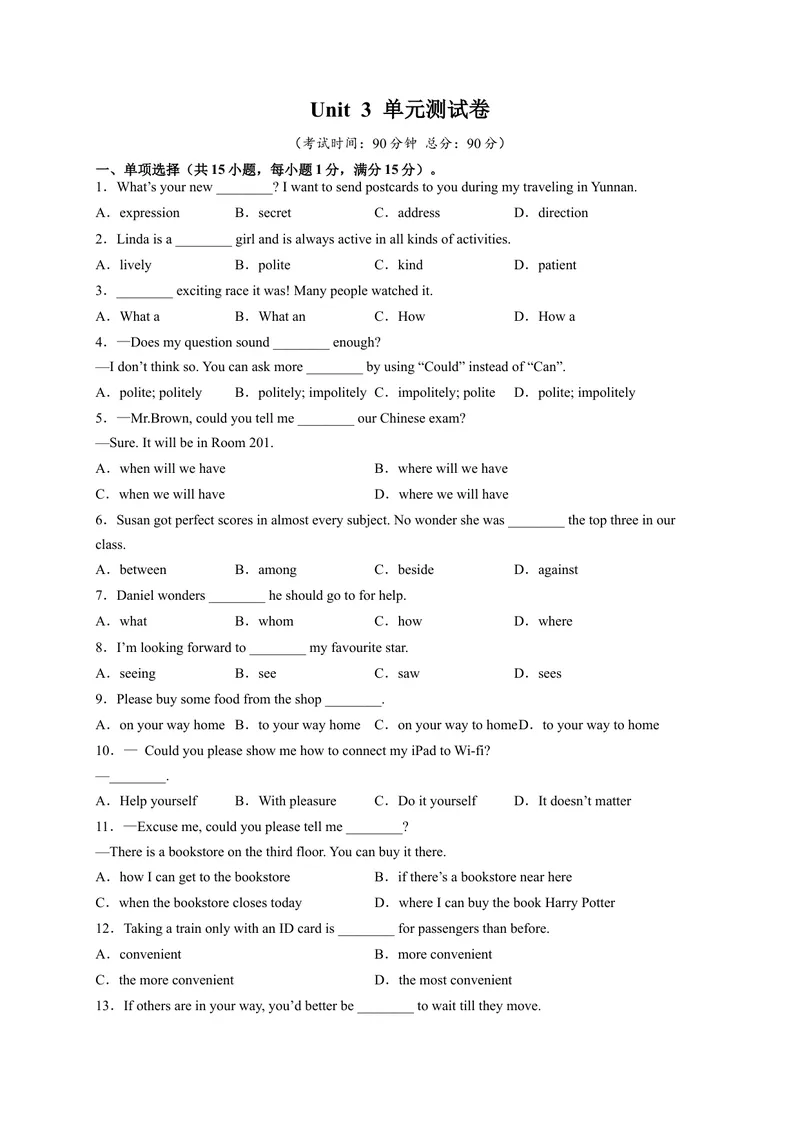
一、单项选择(共15小题,每小题1分,满分15分)。
1.What’s your new ________? I want to send postcards to you during my traveling in Yunnan.
A.expression B.secret C.address D.direction
2.Linda is a ________ girl and is always active in all kinds of activities.
A.lively B.polite C.kind D.patient
3.________ exciting race it was! Many people watched it.
A.What a B.What an C.How D.How a
4.—Does my question sound ________ enough?
—I don’t think so. You can ask more ________ by using “Could” instead of “Can”.
A.polite; politely B.politely; impolitely C.impolitely; polite D.polite; impolitely
5.—Mr.Brown, could you tell me ________ our Chinese exam?
—Sure. It will be in Room 201.
A.when will we have B.where will we have
C.when we will have D.where we will have
6.Susan got perfect scores in almost every subject. No wonder she was ________ the top three in our
class.
A.between B.among C.beside D.against
7.Daniel wonders ________ he should go to for help.
A.what B.whom C.how D.where
8.I’m looking forward to ________ my favourite star.
A.seeing B.see C.saw D.sees
9.Please buy some food from the shop ________.
A.on your way home B.to your way home C.on your way to homeD.to your way to home
10.— Could you please show me how to connect my iPad to Wi-fi?
—________.
A.Help yourself B.With pleasure C.Do it yourself D.It doesn’t matter
11.—Excuse me, could you please tell me ________?
—There is a bookstore on the third floor. You can buy it there.
A.how I can get to the bookstore B.if there’s a bookstore near here
C.when the bookstore closes today D.where I can buy the book Harry Potter
12.Taking a train only with an ID card is ________ for passengers than before.
A.convenient B.more convenient
C.the more convenient D.the most convenient
13.If others are in your way, you’d better be ________ to wait till they move.A.too proper B.polite enough C.too polite D.proper enough
14.I’m going to ________ cooking because I like eating delicious food.
A.clean up B.put up C.take up D.make up
15.It’s difficult for me to do ________ much work in ________ a short time.
A.so; so B.such; so C.so; such D.such; such
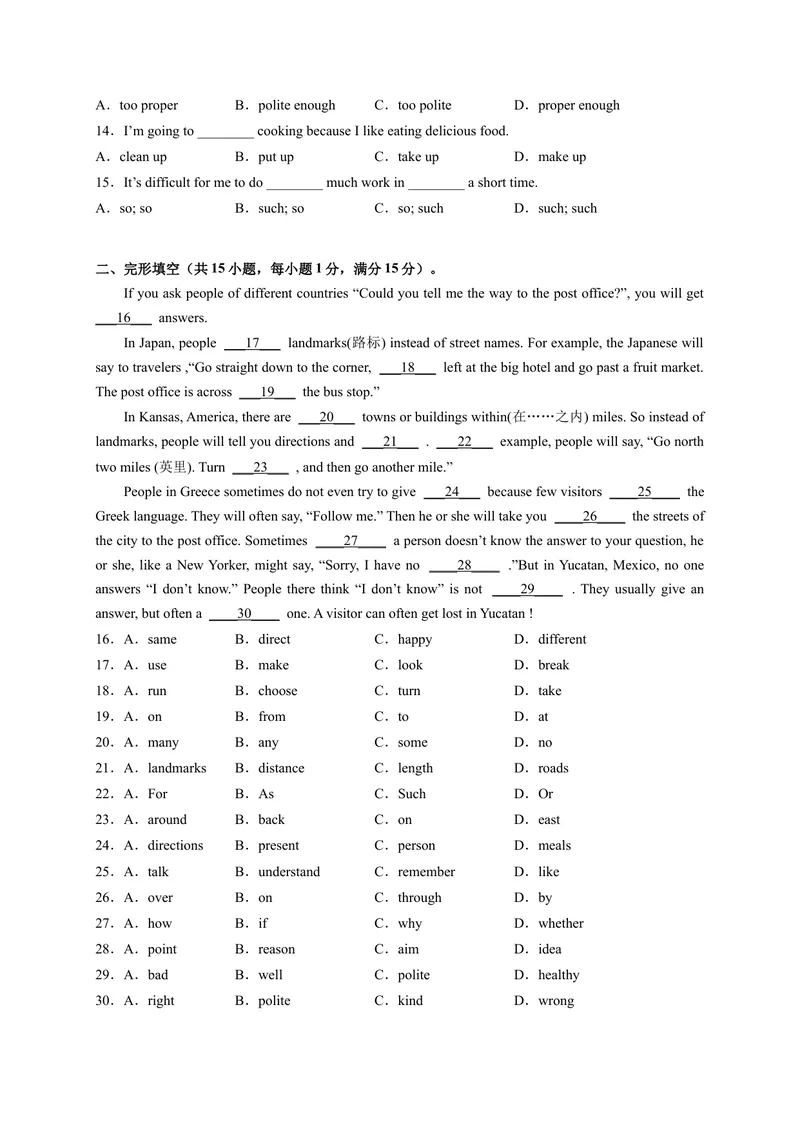
二、完形填空(共15小题,每小题1分,满分15分)。
If you ask people of different countries “Could you tell me the way to the post office?”, you will get
___16___ answers.
In Japan, people ___17___ landmarks(路标) instead of street names. For example, the Japanese will
say to travelers ,“Go straight down to the corner, ___18___ left at the big hotel and go past a fruit market.
The post office is across ___19___ the bus stop.”
In Kansas, America, there are ___20___ towns or buildings within(在……之内) miles. So instead of
landmarks, people will tell you directions and ___21___ . ___22___ example, people will say, “Go north
two miles (英里). Turn ___23___ , and then go another mile.”
People in Greece sometimes do not even try to give ___24___ because few visitors ____25____ the
Greek language. They will often say, “Follow me.” Then he or she will take you ____26____ the streets of
the city to the post office. Sometimes ____27____ a person doesn’t know the answer to your question, he
or she, like a New Yorker, might say, “Sorry, I have no ____28____ .”But in Yucatan, Mexico, no one
answers “I don’t know.” People there think “I don’t know” is not ____29____ . They usually give an
answer, but often a ____30____ one. A visitor can often get lost in Yucatan !
16.A.same B.direct C.happy D.different
17.A.use B.make C.look D.break
18.A.run B.choose C.turn D.take
19.A.on B.from C.to D.at
20.A.many B.any C.some D.no
21.A.landmarks B.distance C.length D.roads
22.A.For B.As C.Such D.Or
23.A.around B.back C.on D.east
24.A.directions B.present C.person D.meals
25.A.talk B.understand C.remember D.like
26.A.over B.on C.through D.by
27.A.how B.if C.why D.whether
28.A.point B.reason C.aim D.idea
29.A.bad B.well C.polite D.healthy
30.A.right B.polite C.kind D.wrong三、阅读理解(共20小题,阅读单选每小题2分,阅读判断每小题1分,满分35分)。
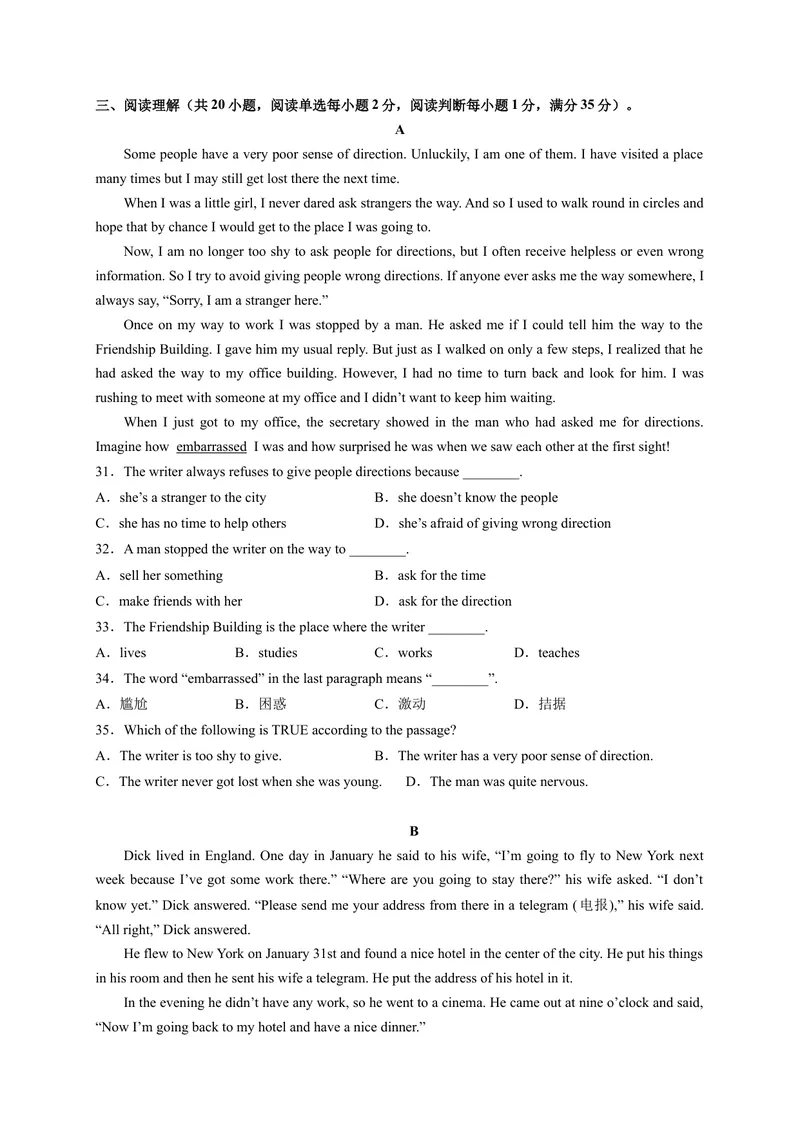
A
Some people have a very poor sense of direction. Unluckily, I am one of them. I have visited a place
many times but I may still get lost there the next time.
When I was a little girl, I never dared ask strangers the way. And so I used to walk round in circles and
hope that by chance I would get to the place I was going to.
Now, I am no longer too shy to ask people for directions, but I often receive helpless or even wrong
information. So I try to avoid giving people wrong directions. If anyone ever asks me the way somewhere, I
always say, “Sorry, I am a stranger here.”
Once on my way to work I was stopped by a man. He asked me if I could tell him the way to the
Friendship Building. I gave him my usual reply. But just as I walked on only a few steps, I realized that he
had asked the way to my office building. However, I had no time to turn back and look for him. I was
rushing to meet with someone at my office and I didn’t want to keep him waiting.
When I just got to my office, the secretary showed in the man who had asked me for directions.
Imagine how embarrassed I was and how surprised he was when we saw each other at the first sight!
31.The writer always refuses to give people directions because ________.
A.she’s a stranger to the city B.she doesn’t know the people
C.she has no time to help others D.she’s afraid of giving wrong direction
32.A man stopped the writer on the way to ________.
A.sell her something B.ask for the time
C.make friends with her D.ask for the direction
33.The Friendship Building is the place where the writer ________.
A.lives B.studies C.works D.teaches
34.The word “embarrassed” in the last paragraph means “________”.
A.尴尬 B.困惑 C.激动 D.拮据
35.Which of the following is TRUE according to the passage?
A.The writer is too shy to give. B.The writer has a very poor sense of direction.
C.The writer never got lost when she was young. D.The man was quite nervous.
B
Dick lived in England. One day in January he said to his wife, “I’m going to fly to New York next
week because I’ve got some work there.” “Where are you going to stay there?” his wife asked. “I don’t
know yet.” Dick answered. “Please send me your address from there in a telegram (电报),” his wife said.
“All right,” Dick answered.
He flew to New York on January 31st and found a nice hotel in the center of the city. He put his things
in his room and then he sent his wife a telegram. He put the address of his hotel in it.
In the evening he didn’t have any work, so he went to a cinema. He came out at nine o’clock and said,
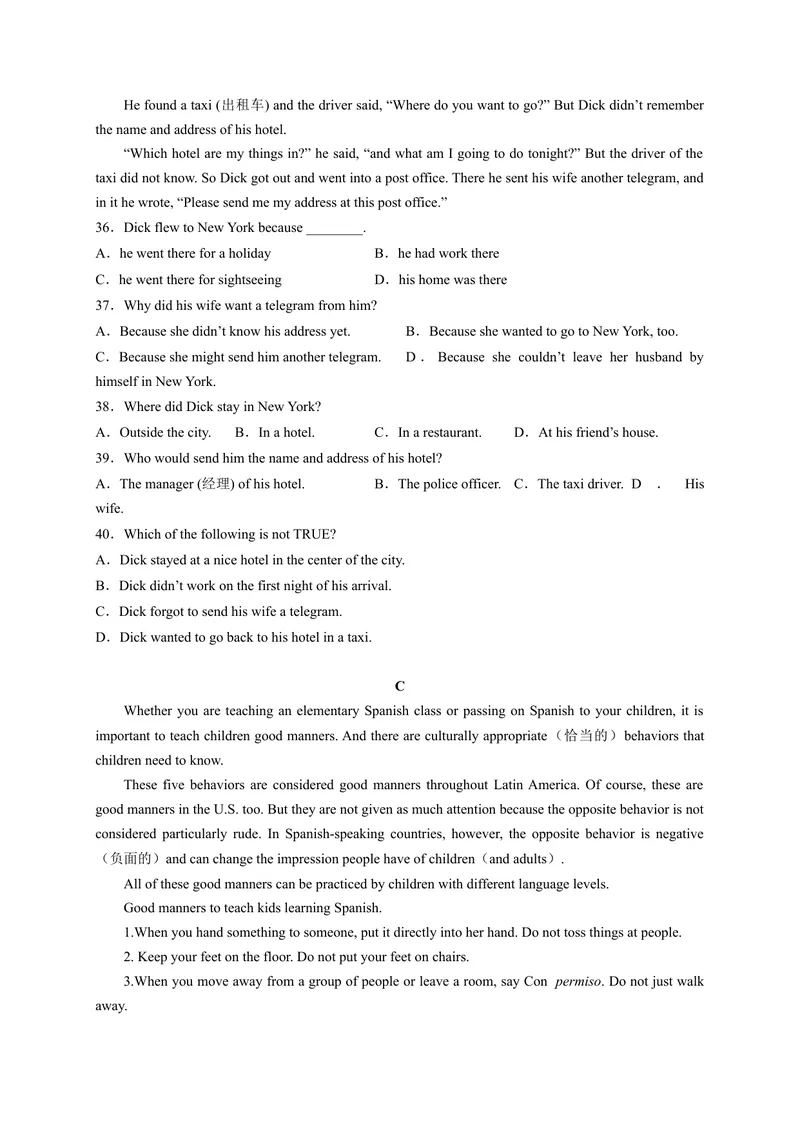
“Now I’m going back to my hotel and have a nice dinner.”He found a taxi (出租车) and the driver said, “Where do you want to go?” But Dick didn’t remember
the name and address of his hotel.
“Which hotel are my things in?” he said, “and what am I going to do tonight?” But the driver of the
taxi did not know. So Dick got out and went into a post office. There he sent his wife another telegram, and
in it he wrote, “Please send me my address at this post office.”
36.Dick flew to New York because ________.
A.he went there for a holiday B.he had work there
C.he went there for sightseeing D.his home was there
37.Why did his wife want a telegram from him?
A.Because she didn’t know his address yet. B.Because she wanted to go to New York, too.
C.Because she might send him another telegram. D.Because she couldn’t leave her husband by
himself in New York.
38.Where did Dick stay in New York?
A.Outside the city. B.In a hotel. C.In a restaurant. D.At his friend’s house.
39.Who would send him the name and address of his hotel?
A.The manager (经理) of his hotel. B.The police officer. C.The taxi driver. D . His
wife.
40.Which of the following is not TRUE?
A.Dick stayed at a nice hotel in the center of the city.
B.Dick didn’t work on the first night of his arrival.
C.Dick forgot to send his wife a telegram.
D.Dick wanted to go back to his hotel in a taxi.
C
Whether you are teaching an elementary Spanish class or passing on Spanish to your children, it is
important to teach children good manners. And there are culturally appropriate(恰当的)behaviors that
children need to know.
These five behaviors are considered good manners throughout Latin America. Of course, these are
good manners in the U.S. too. But they are not given as much attention because the opposite behavior is not
considered particularly rude. In Spanish-speaking countries, however, the opposite behavior is negative
(负面的)and can change the impression people have of children(and adults).
All of these good manners can be practiced by children with different language levels.
Good manners to teach kids learning Spanish.
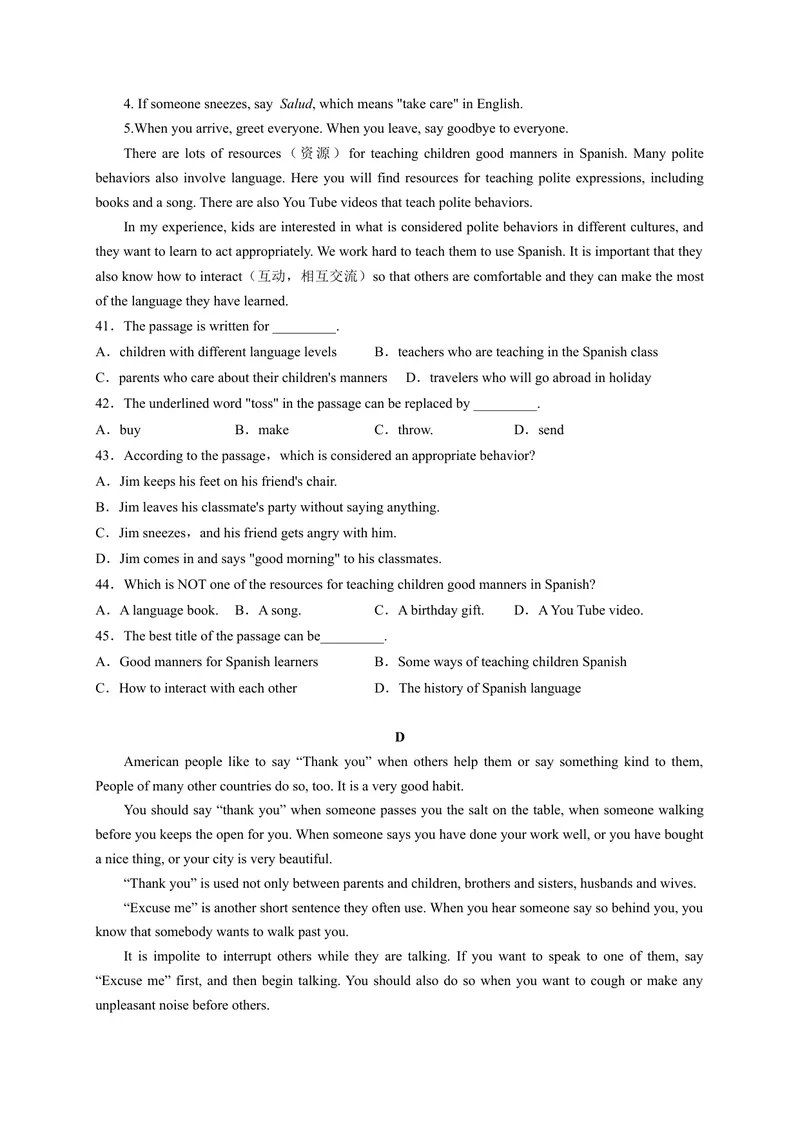
1.When you hand something to someone, put it directly into her hand. Do not toss things at people.
2. Keep your feet on the floor. Do not put your feet on chairs.
3.When you move away from a group of people or leave a room, say Con permiso. Do not just walk
away.4. If someone sneezes, say Salud, which means "take care" in English.
5.When you arrive, greet everyone. When you leave, say goodbye to everyone.
There are lots of resources(资源)for teaching children good manners in Spanish. Many polite
behaviors also involve language. Here you will find resources for teaching polite expressions, including
books and a song. There are also You Tube videos that teach polite behaviors.
In my experience, kids are interested in what is considered polite behaviors in different cultures, and
they want to learn to act appropriately. We work hard to teach them to use Spanish. It is important that they
also know how to interact(互动,相互交流)so that others are comfortable and they can make the most
of the language they have learned.
41.The passage is written for _________.
A.children with different language levels B.teachers who are teaching in the Spanish class
C.parents who care about their children's manners D.travelers who will go abroad in holiday
42.The underlined word "toss" in the passage can be replaced by _________.
A.buy B.make C.throw. D.send
43.According to the passage,which is considered an appropriate behavior?
A.Jim keeps his feet on his friend's chair.
B.Jim leaves his classmate's party without saying anything.
C.Jim sneezes,and his friend gets angry with him.
D.Jim comes in and says "good morning" to his classmates.
44.Which is NOT one of the resources for teaching children good manners in Spanish?
A.A language book. B.A song. C.A birthday gift. D.A You Tube video.
45.The best title of the passage can be_________.
A.Good manners for Spanish learners B.Some ways of teaching children Spanish
C.How to interact with each other D.The history of Spanish language
D
American people like to say “Thank you” when others help them or say something kind to them,
People of many other countries do so, too. It is a very good habit.
You should say “thank you” when someone passes you the salt on the table, when someone walking
before you keeps the open for you. When someone says you have done your work well, or you have bought
a nice thing, or your city is very beautiful.
“Thank you” is used not only between parents and children, brothers and sisters, husbands and wives.
“Excuse me” is another short sentence they often use. When you hear someone say so behind you, you
know that somebody wants to walk past you.
It is impolite to interrupt others while they are talking. If you want to speak to one of them, say
“Excuse me” first, and then begin talking. You should also do so when you want to cough or make any
unpleasant noise before others.Let’s all learn to say “Thank you” and “Excuse me”.
根据短文内容判断句子正(T)误(F).
46.American people like to say “Excuse me” when others help them or say something kind to them.
47.You should say “Thank you” when someone says you have done your work well.
48.“Thank you” is only used between friends.
49.When you hear someone say” Excuse me” behind you, you know that somebody wants to walk past
you.
50.You should also say “Excuse me” when you want to cough or make any unpleasant noise before
others.
四、语法填空(共10小题,每小题1分,满分10分)。
“Thank you” is widely used in a modern society. It is a very good manner. You should say “Thank
you” __51__ (whenever) others help you or say something kind to you. For example, when someone opens
the door for you, when someone says you have done your work __52__ (good), when someone says you
have bought a nice shirt, or __53__ (you) city is very beautiful, you should say “Thank you”.“Thank
you” is used not only between friends, but also between parents and children, brothers and sisters, husbands
and __54__ (wife).
“Excuse me” is another short __55__ (politely) usage. We use it as the same as “Thank you”.When
you hear someone say so behind you, you'd better __56__ (get) to know that somebody wants to walk past
you without __57__ (touch) you. It __58__ (be) polite to interrupt(打断)others while they are talking. If
you want to have a word with one of them, please say “Excuse me” __59__ (one), and then begin to talk.
You should also do so when you want ___60___ (cough)or make any unpleasant noise before others. Let's
say “Thank you” and “Excuse me” in the right situation.
五、情景交际(共5小题,每小题1分,满分5分)。
根据上下文意思,从方框中选择5个句子补全对话,使其意思完整。
根据对话内容,从文后的选项中选出能填入空白处的最佳选项,其中有两个为多余选项。
A: You seem to get lost. ___61___
B: Oh, yes. I’m going to the Dragon Fruit Farm. ___62___
A: Well, it’s far from here. You’d better take a bus.
B: ___63___
A: At least half an hour.
B: I see. ___64___
A: I’m not quite sure. You can check it yourself on the map at the bus stop.
B: Thanks. Could you show me the nearest bus stop?
A: Sure. Go along this street and turn left at the first crossing. ___65___
B: Thank you very much.A: You’re welcome.
A.That’s a good idea!
B.You’ll see it just in front of you.
C.How long does the bus ride take?
D.Is there anything I can do for you?
E.When does the Dragon Fruit Farm close?
F.Can you tell me which bus I should take?
G.Could you please tell me how I can get there?
六、短文改错(共5小题,每小题2分,满分10分)。
改错。(每句只有一处错误,请将错误部分的字母填在相应题号后面的括号内,并将正确答案写在
横线上,保持句意不变)
66.It is important to know how to ask for help polite. ( ) ________
A B C
67. Thousan d of tourists come to visit the Great Wall. ( ) ________
A B C
68.Henry is such humorous that he often makes us laugh. ( ) ________
A B C
69.This will help you communicate better to others. ( ) ________
A B C
70.I am sorry. I took your book in mistake. ( ) ________
A B C
七、书面表达(共1小题,满分10分)。
71.小明今年暑期想参加上海英语夏令营(Shanghai English Summer Camp)。假设你是小明,请你写
一封信向负责人Miss Chen咨询一些信息。要求80词左右,开头和结尾已给出,不计入总词数。
内容包括:1.介绍自己的一些个人信息,如姓名、年龄、英语成绩等;2.礼貌询问信息,如时间、吃住、
活动、英语学习等; 3.表示感谢。
Dear Miss Chen,
I’m Xiao Ming,a Grade Nine student at Xinxing
School.________________________________________________________________________________
______________________________________________________________________________________
______________________________________________________________________________________
______________________________________________________________________________________
______________________________________________________________________________________
______________________________________________________________________________________
____________________________________________________________________________________________________________________________________________________________________________
_______________________________________________
Xiao Ming
【答案】Dear Miss Chen,
I’m Xiao Ming,a Grade Nine student at Xinxing School. I love English and I hope to improve my
English.I’d like to come to your school soon for the English Summer Camp.I am writing to know about
more information about the summer camp.Could you please tell me when the summer camp will begin and
how long it will last?I also want to know what we will do during the summer camp.Will it be fun?And
could you please tell me where we will stay?I’m wondering if the hotel is clean and comfortable.I also want
to know if it is convenient to go shopping.What’s more,let me know how much it costs and what I need to
take.
I’m looking forward to your reply.
Yours faithfully,
Xiao Ming