Unit 4 Amazing Plants and Animals达标测试卷
第一部分 听力(共四大题,满分20分)
一、短对话理解(共5小题;每小题1分,满分5分)
你将听到五段对话,每段对话后有一个小题。请在每小题所给的A、B、C三个
选项中选出一个最佳选项。每段对话读两遍。
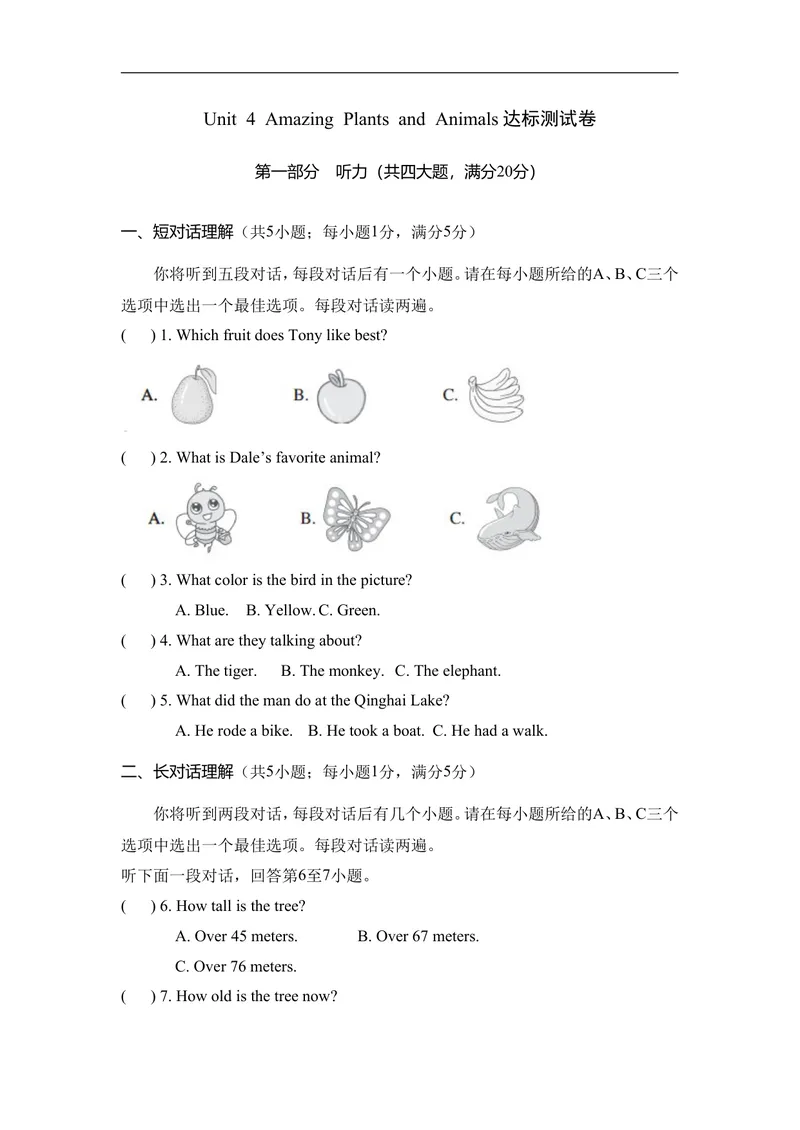
( ) 1. Which fruit does Tony like best?
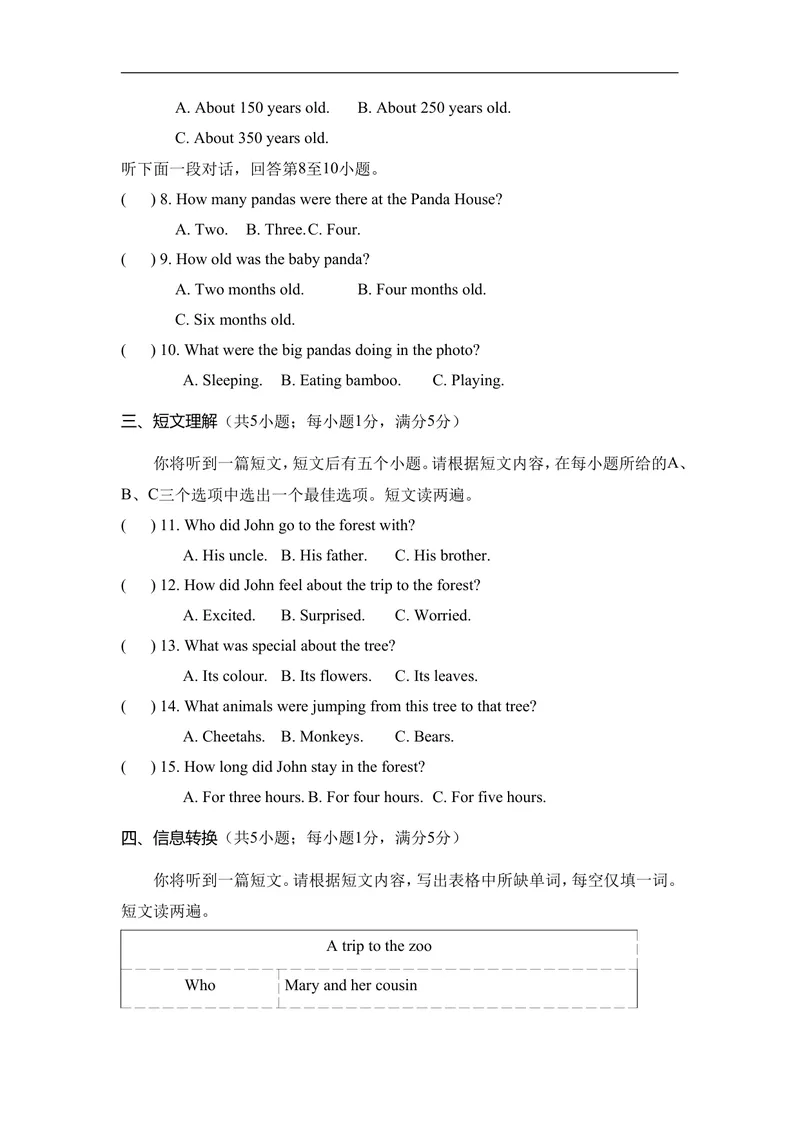
( ) 2. What is Dale’s favorite animal?
( ) 3. What color is the bird in the picture?
A. Blue. B. Yellow.C. Green.
( ) 4. What are they talking about?
A. The tiger. B. The monkey. C. The elephant.
( ) 5. What did the man do at the Qinghai Lake?
A. He rode a bike. B. He took a boat. C. He had a walk.
二、长对话理解(共5小题;每小题1分,满分5分)
你将听到两段对话,每段对话后有几个小题。请在每小题所给的A、B、C三个
选项中选出一个最佳选项。每段对话读两遍。
听下面一段对话,回答第6至7小题。
( ) 6. How tall is the tree?
A. Over 45 meters. B. Over 67 meters.
C. Over 76 meters.
( ) 7. How old is the tree now?A. About 150 years old. B. About 250 years old.
C. About 350 years old.
听下面一段对话,回答第8至10小题。
( ) 8. How many pandas were there at the Panda House?
A. Two. B. Three.C. Four.
( ) 9. How old was the baby panda?
A. Two months old. B. Four months old.
C. Six months old.
( ) 10. What were the big pandas doing in the photo?
A. Sleeping. B. Eating bamboo. C. Playing.
三、短文理解(共5小题;每小题1分,满分5分)
你将听到一篇短文,短文后有五个小题。请根据短文内容,在每小题所给的A、
B、C三个选项中选出一个最佳选项。短文读两遍。
( ) 11. Who did John go to the forest with?
A. His uncle. B. His father. C. His brother.
( ) 12. How did John feel about the trip to the forest?
A. Excited. B. Surprised. C. Worried.
( ) 13. What was special about the tree?
A. Its colour. B. Its flowers. C. Its leaves.
( ) 14. What animals were jumping from this tree to that tree?
A. Cheetahs. B. Monkeys. C. Bears.
( ) 15. How long did John stay in the forest?
A. For three hours.B. For four hours. C. For five hours.
四、信息转换(共5小题;每小题1分,满分5分)
你将听到一篇短文。请根据短文内容,写出表格中所缺单词,每空仅填一词。
短文读两遍。
A trip to the zoo
Who Mary and her cousinWhen Last 16.
Weather 17.
How By 18.
About the mother
She is 19. cm tall and weighs 90 kilos.
panda
About the baby panda He was born(出生)in 20. .
第二部分 语言知识运用(共三大题,满分35分)
五、单项填空(共10小题;每小题1分,满分10分)
从每小题所给的A、B、C、D四个选项中,选出一个可以填入空白处的最佳选
项。
( ) 21. —We should always remember the of good health.
—Exactly. With it, we can study well.
A. height B. importance
C. price D. nature
( ) 22. It’s difficult to that he could finish the work in such a short time.
A. imagine B. realize
C. reach D. understand
( ) 23. —The movie star is so that many people want to take photos with him.
—You are right.
A. serious B. free C. popular D. busy
( ) 24. We can’t work out the math problem your help.
A. for B. by C. with D. without
( ) 25. Danny was student in his class last year, but now he is much taller
than the other students.
A. taller B. the tallest C. shorter D. the shortest
( ) 26. —You mean that we’ll work on the farm tomorrow.
— ! That’s what I’m trying to say.
A. Probably B. ExactlyC. Especially D. Hopefully
( ) 27. The young man said he was a doctor. , he is a teacher.
A. At first B. For example
C. In fact D. By accident
( ) 28. The teacher’s teaching way made the students very interested in the
subject.
A. boringB. quiet C. strange D. lively
( ) 29. —Family education(教育) children’s lives.
—Yes. I think it is more important than school education.
A. looks like B. picks up
C. plays a role in D. feels like
( ) 30. —Can I borrow your science book?
—Sure. .
A. Feel free B. That’s all right
C. You’re welcome D. It doesn’t matter
六、完形填空(共20小题,每小题1分;满分20分)
阅读下列短文,从每小题所给的A、B、C、D四个选项中选出最佳选项。
A
Look at the koala! It is so 31 that I want to touch it. How much do you know
about koalas, especially a baby koala? Let’s look at it.
A newborn koala is smaller than a peanut(花生). For the first few months the
baby 32 inside its mother’s pouch(育儿袋), and drinks its mother’s milk.
By the time it is 5 33 old, its eyes are open and it can look out of the pouch.
But it still stays there.
About six months after the baby is born, it leaves its mother’s pouch for the 34
time, but it hangs on to its mother’s back.
It 35 about 500g now. It comes in and out of the pouch. It keeps very close to
its 36 and returns to the pouch within a few minutes. Gradually the baby will stay
out longer.
By the age of 1, the baby wants to eat only eucalyptus(桉树) 37 ,no more itsmother’s milk. The mother koala begins teaching her baby which eucalyptus leaves
are 38 to eat.
A one-year-old koala can 39 on its own, 40 it doesn’t often do that. Most
young koalas stay with their mothers until they are two or three years old.
( ) 31. A. lovelyB. boring C. scary D. awful
( ) 32. A. runs B. jumps C. shakesD. stays
( ) 33. A. days B. months C. years D. weeks
( ) 34. A. third B. first C. fourth D. second
( ) 35. A. looks B. touches C. weighs D. covers
( ) 36. A. father B. brother C. sister D. mother
( ) 37. A. leavesB. fruit C. flowersD. roots
( ) 38. A. beautiful B. good C. cheap D. interesting
( ) 39. A. eat B. work C. live D. cook
( ) 40. A. and B. but C. or D. because
B
“Come with me. I’ll show you something amazing.”
Last 41 , my friend Zhu decided to give me a tour of his childhood
neighbourhood. After a 20-minute walk, we arrived at Qiaojia Road. 42 ,we stopped
in front of a small garden. “Here we are,” my friend said excitedly.
“Excuse me, 43 where is the amazing thing?” I asked.
“Isn’t it beautiful?” My friend pointed at a tall ginkgo tree in the garden.
“Yes,” I answered. “But golden ginkgo trees are everywhere at this time of
autumn.”
“This one is 44 ,” said Zhu. “It’s over 700 years old.”
The tree looked healthy. But my friend said luck wasn’t always on its side. During
the Kangxi years of the Qing Dynasty, 45 wanted to cut it down. Luckily, Zhang
Xiyi, a government official, 46 it from the axe(斧头). And in its early years, it
was attacked(被攻击)by insects and hit by lightning. It stood still 47 so many
challenges(挑战). Many people believed that the tree was magical. They used to
pray(祈祷)under it, hoping it would bring them good luck. They had the 48 ofseeing many of their dreams come true. I looked at the “magical” tree and its fan-
shaped leaves in 49 . “Amazing!” I said.
Last weekend, I visited the 50 again. It looked as healthy as ever. It was like a
lonely old man. It was always ready to tell its stories, if someone would like to stop
and listen.
( ) 41. A. springB. summer C. autumn D. winter
( ) 42. A. Finally B. Recently
C. Actually D. Luckily
( ) 43. A. and B. but C. or D. so
( ) 44. A. tall B. difficult C. boring D. different
( ) 45. A. someone B. anyone
C. nobody D. everyone
( ) 46. A. found B. caughtC. saved D. saw
( ) 47. A. through B. across C. past D. around
( ) 48. A. love B. feeling
C. pleasure D. success
( ) 49. A. time B. order C. future D. surprise
( ) 50. A. house B. tree C. river D. flower
七、补全对话(共5小题;每小题1分,满分5分)
根据对话内容,从方框内的选项中选出能填入空白处的最佳选项。选项中有
两项为多余选项。
A: Hi, Gina. What are you reading?
B: I’m reading a book about amazing plants and animals. 51.
A: Really? That sounds interesting. 52.
B: Well, there are so many, such as the Venus flytrap. It can catch insects.53.
When an insect lands on it, the leaves close quickly and trap(困住)the
insect.
A: Wow, that’s so cool! Are there any amazing animals in the book?
B: Of course! The chameleon(变色龙)is really amazing. 54.
Its enemies can’t see it easily.A: I didn’t know that before. I’m really interested in these special plants and animals.
B: 55. You’ll find out a lot of interesting facts about plants and animals.
A: OK, I will. Can I borrow it from you after you finish it?
B: Sure!
A. It has special leaves.
B. You should read this book.
C. It’s hard to believe such small plants eat insects.
D. There are so many amazing things in nature.
E. What do you think is the most amazing animal?
F. What kinds of amazing plants are there in the book?
G. It can change its color to match the environment(环境).
第三部分 阅读(共两节,满分40分)
八、阅读理解(共20小题;每小题2分,满分40分)
第一节 阅读下列短文,从每小题所给的A、B、C、D四个选项中选出最佳选项。
A
Bees are interesting insects. They live in groups and each member has its own
role. Their body structure(结构)is perfectly fit for their work. Bees are important to
us not only for the honey but also for the help they give to plants. Protecting bees is of
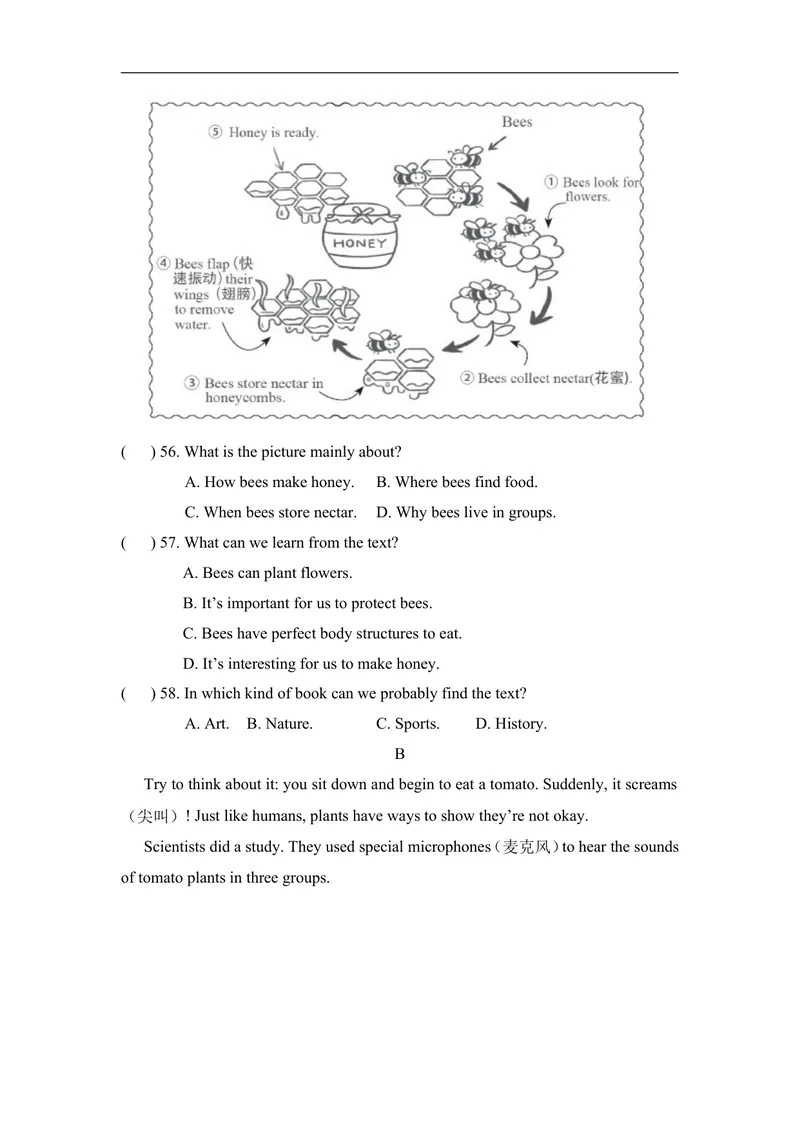
great importance to our ecosystems.( ) 56. What is the picture mainly about?
A. How bees make honey. B. Where bees find food.
C. When bees store nectar. D. Why bees live in groups.
( ) 57. What can we learn from the text?
A. Bees can plant flowers.
B. It’s important for us to protect bees.
C. Bees have perfect body structures to eat.
D. It’s interesting for us to make honey.
( ) 58. In which kind of book can we probably find the text?
A. Art. B. Nature. C. Sports. D. History.
B
Try to think about it: you sit down and begin to eat a tomato. Suddenly, it screams
(尖叫)! Just like humans, plants have ways to show they’re not okay.
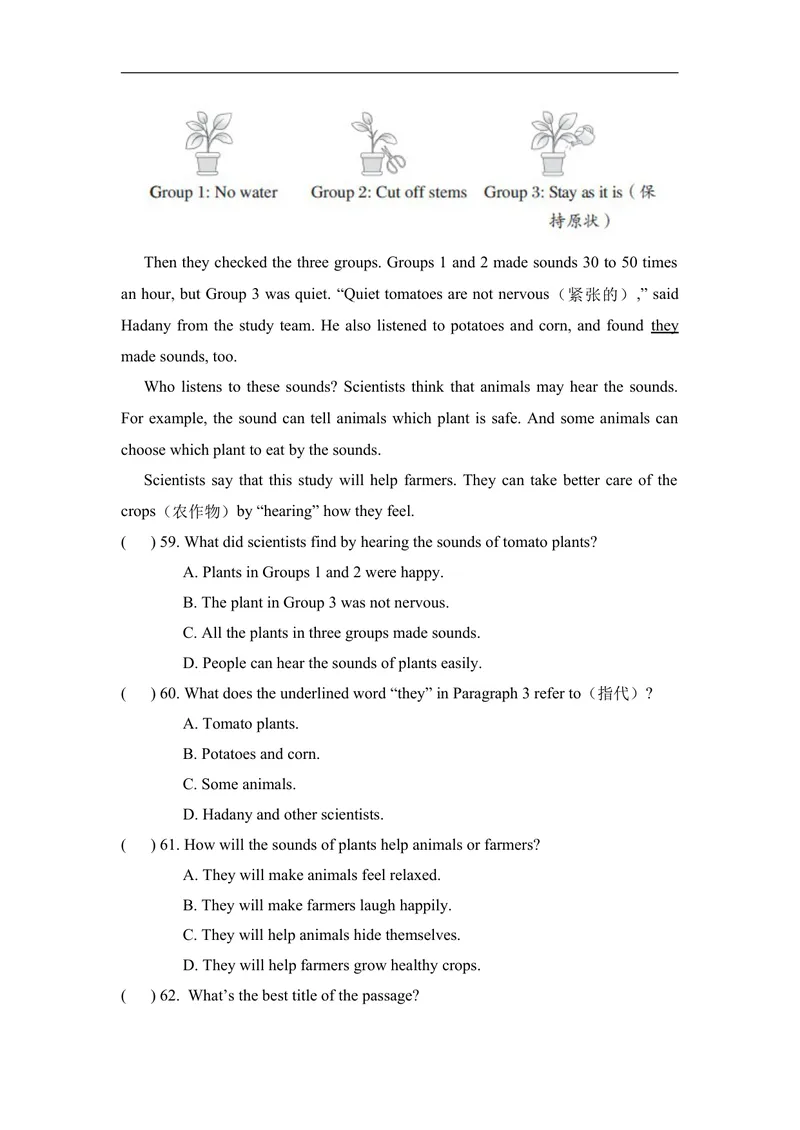
Scientists did a study. They used special microphones(麦克风)to hear the sounds
of tomato plants in three groups.Then they checked the three groups. Groups 1 and 2 made sounds 30 to 50 times
an hour, but Group 3 was quiet. “Quiet tomatoes are not nervous(紧张的),” said
Hadany from the study team. He also listened to potatoes and corn, and found they
made sounds, too.
Who listens to these sounds? Scientists think that animals may hear the sounds.
For example, the sound can tell animals which plant is safe. And some animals can
choose which plant to eat by the sounds.
Scientists say that this study will help farmers. They can take better care of the
crops(农作物)by “hearing” how they feel.
( ) 59. What did scientists find by hearing the sounds of tomato plants?
A. Plants in Groups 1 and 2 were happy.
B. The plant in Group 3 was not nervous.
C. All the plants in three groups made sounds.
D. People can hear the sounds of plants easily.
( ) 60. What does the underlined word “they” in Paragraph 3 refer to(指代)?
A. Tomato plants.
B. Potatoes and corn.
C. Some animals.
D. Hadany and other scientists.
( ) 61. How will the sounds of plants help animals or farmers?
A. They will make animals feel relaxed.
B. They will make farmers laugh happily.
C. They will help animals hide themselves.
D. They will help farmers grow healthy crops.
( ) 62. What’s the best title of the passage?A. Plants can also “scream”
B. Tasty vegetables
C. How can vegetables make sounds?
D. Imagination about vegetables
C
Hippos are called “river horses”. They are one of the biggest land animals in
Africa.
Usually, in most photos of these huge African animals, we can see them in the
water. The reason is that hippos stay in the water for 16 hours a day to keep
themselves cool in hot weather in Africa. They sleep in the water, and their babies are
also born there. You may think hippos live only in rivers and lakes, and that they are
good at swimming. However, they can’t swim. They are just so big that they can walk
in the water and stand on the bottom of a lake. They can breathe(呼吸), see and hear
when their bodies are under the water because their noses, eyes and ears are on the top
of their heads. When the sun goes down, hippos will come out of the water and travel
to look for food.
It’s easy to think hippos are funny and friendly animals. In fact, they are easy to be
angry and often fight. Why do hippos fight? They fight with lions for land or rivers.
They fight to protect their young babies. They also attack(攻击)the boats for their
safety if the boats come too close to them. Hippos are very dangerous!
Hippos may look like big, slow animals, but they can run fast—about 30
kilometers an hour. That’s faster than a person can run. In a word, if you meet hippos
in the wild, just stay away from them!
( ) 63. Why do hippos stay in the water during daytime?
A. To have a long sleep.
B. To keep cool in hot weather.
C. To play with their babies.
D. To fight with crocodiles.
( ) 64. What is Paragraph 2 mainly about?
A. The reason why hippos are dangerous.B. The photos of hippos.
C. The living habits of hippos.
D. The babies of hippos.
( ) 65. What’s the purpose(目的)of this passage?
A. To show love for hippos.
B. To share some facts about hippos.
C. To give some suggestions on protecting hippos.
D. To tell people to stay away from hippos.
D
National Tree Planting Day falls on March 12 every year. But do you know that
the tradition of planting trees started a long time ago in China? It rained a lot around
the Qingming Festival. People planted trees around this time because trees could grow
better with enough rain.
Ancient Chinese planted many kinds of trees like mulberry trees(桑树)and fruit
trees. Farmers needed mulberry leaves to feed silkworms. They made clothes with
silk, sold them to the west of the world and brought back what they needed. Another
famous tree-planting lover, Zhuge Liang, planted 800 mulberry trees and left them to
his children after his death to support their lives.
Dong Feng, a famous doctor in the Three Kingdoms Period(三国时期), saved
many people’s lives. He didn’t ask them for money. What he only asked for was to
plant apricot trees(杏树)on a hill. As time went by, a forest of apricot trees grew on
the hill. That’s why we now show our thanks to a good doctor with the words “the
warmth in an apricot forest”.
There are many other interesting stories about planting trees. When National Tree
Planting Day comes next year, will you plant a tree with your wishes on it?
( ) 66. Ancient Chinese planted trees around the Qingming Festival because .
A. it was much warmer around that time
B. farmers had more free time at that time
C. the weather was better for trees to grow
D. it was time to remember their dead family( ) 67. The writer wrote Paragraph 2 to tell us that .
A. people planted trees to help the environment
B. people could make mulberry leaves into clothes
C. people only planted mulberry trees and fruit trees
D. people could get what they needed by planting trees
( ) 68. The proper Chinese for the underlined words “the warmth in an apricot
forest” is “ ”.
A. 妙手回春 B. 古道热肠
C. 杏林春暖 D. 悬壶济世
( ) 69. What is the best title of this passage?
A. The Best Time to Plant Trees
B. Tree Planting in Ancient China
C. Good Reasons for Planting Trees
D. An Interesting Story of a Doctor
E
There are many delicious fruits in autumn. Many people like fruits because they
are sweet. Do you know why fruits are sweet?
The answer is very easy. Fruits are sweet because trees are smart. For some trees,
the key to survival(生存)is bearing(结出)sweet fruits. Some animals eat the fruits.
Their seeds(种子)can move to new places with the help of the animals. For example,
bears like apples’ sweet taste. They eat apples and carry the seeds in their stomachs.
The bears don’t stay in the same place all the time. They walk around instead. They
stop in a new place. The seeds come out of the bears’ bodies in the new place and fall
onto the ground. Some time later, the seeds might grow into new trees.
Moving the seeds to a different place is really important and it is a new tree’s start.
In this way, it doesn’t have to compete(竞争)with its nearby trees for the water or
the sun.
However, not all fruits are sweet. Some fruits are sour, such as lemons. Maybe
you don’t like lemons, but some animals enjoy lemons. They help lemon trees spread
seeds.How clever the trees are! They can start the new lives without too much trouble.
( ) 70. How do animals help seeds move to new places?
A. By flying the seeds in the wind.
B. By throwing the seeds far away.
C. By planting the seeds in the ground.
D. By carrying the seeds in their stomachs.
( ) 71. What does Paragraph 3 mainly tell us?
A. Why not all fruits are sweet.
B. When the seeds start their new lives.
C. How the seeds get the water and the sun.
D. Why moving the seeds to a different place is important.
( ) 72. What does the underlined word “spread” mean in Paragraph 4?
A. Enjoy something very much.
B. Leave something important.
C. Move something to another place.
D. Find something in a different place.
第二节 阅读下面短文,并用英语回答问题(请注意每小题的词数要求)。
F
More and more people want to have pets. Wild(野外的)animals are lovely and
smart. You may like them and want to have them as your pets. But they are not like
cats or dogs. They may be unhappy to be your pets. Some of them even lose their
lives after leaving the wild. Today, they have something to say.
A little otter(水獭)says, “I miss my mom. About three months ago, some bad
people caught me. They put me in a cage(笼子)and fed me with fish and milk. And
they spent lots of time playing with me. But I’m still unhappy. I miss my mom! I like
to swim. I often swim in the water in the evening. Could you please send me back to
my mom?”A little turtle says, “Please don’t touch(碰)me. I’m from India. I have some
things on my back. They look like stars. When I meet my enemies(敌人)in the wild,
they can help me. People like my stars, so they take me home as a pet. They like to
touch my back. But I don’t like it. Sometimes, the touch can even kill me. Please help
me! I want to go home!”
73. What do people feed the little otter?(不超过5个词)
74. Why do people take the little turtle as a pet?(不超过5个词)
75. What can we learn from the stories of the otter and the turtle?(不超过15个词)
第四部分 写(共两大题,满分25分)
九、单词拼写(共5小题;每小题1分,满分5分)
根据首字母及汉语提示,完成下列单词的拼写,使句意明确,语言通顺。
76. There are many b (竹子)forests in the mountains.
77. My grandfather likes drinking warm water with h (蜂蜜).
78. A bird uses its two w (翅膀)to fly across the sky.
79. Look! The girl is holding a t (极小的)flower in her hand.
80. The new bridge c (连接)the two sides of the river.
十、书面表达(共1小题;满分20分)
假如你是李华,你对野生动物很感兴趣。寒假中,你想邀请Henry一起研究你
最喜欢的一种野生动物,请根据下图完成电子邮件。
提示词:binoculars(双筒望远镜)
注意事项:
1. 邮件须包括所给提示内容,可适当发挥,要求语句通顺、意思连贯;
2. 词数80~100,邮件的首尾已给出,不计入总词数。Dear Henry,
How is everything going? I like wild animals very much. I want to invite you to
study my favourite animal with me.
I will be very happy if you can join me. Looking forward to seeing you soon.
Yours sincerely,
Li Hua答案
一、1. W: Hi, Tony. Which do you like best, pears, apples or bananas?
M: I like apples best. You know, an apple a day keeps the doctor away.
2. W: Do you like pandas, Dale?
M: Yes, they are very cute. But the bee is my favorite animal. It is the most hard-
working.
3. W: Which picture do you think is the most beautiful?
M: The one with a blue bird in the tree.
4. W: At birth, this elephant was only 100 kilos.
M: Yeah, but now it weighs about 5,000 kilos.
5. W: Did you go to the Qinghai Lake last autumn?
M: Yes, I even rode a bike to go around the lake. It was so wonderful.
二、Text 1
M: Good morning, Kate.
W: Good morning, Bill.
M: Oh, look! How tall is that big tree?
W: It is over 67 meters.
M: Is it the tallest one in your city?
W: Yes, and it is also the oldest one in our city. The tree is about 350 years old now.
Text 2
M: How was your trip to the Panda House last weekend?
W: Really great.
M: How many pandas were there?
W: Three, two big pandas and one baby panda. Both big pandas were five years old
and the baby panda was only six months old.
M: Did you take photos of them?
W: Yes. Let me show you the photos now. Look at this one! The baby panda was
sleeping and the two big pandas were eating bamboo.三、M: Hello, I’m John. This summer holiday, I went to a forest with my father.
Because this was my first time to visit a forest, I was really excited. When we
entered the forest, a very big tree was in front of us. It had special leaves and they
looked just like small umbrellas. We walked on and saw many different kinds of
animals along the way. From time to time, there were a lot of monkeys jumping
from this tree to that tree. How funny they were! We got to the forest at 2:00 pm
and left at 5:00 pm. We learned about different plants and animals and had a
wonderful time there.
四、W: My name is Mary. Last Tuesday, the weather was warm. After breakfast, I
took the bus to the zoo with my cousin. We saw pandas first. A mother panda was
eating bamboo. How lovely! We talked to the keeper and learned a lot about her.
She is 145 cm tall and weighs 90 kilos. She had a baby panda in March. We took a
photo that day. In the photo, the baby panda is sitting next to his mother. He looks
so cute.
第一部分 听力
一、1~5:BAACA 二、6~10:BCBCB
三、11~15:BACBA
四、16. Tuesday 17. Warm 18. bus 19. 145 20. March
第二部分 语言知识运用
五、21~25:BACDD 26~29:BCDC
30. A 点拨:当对方问能否借东西时,回答“Sure. Feel free.”表示“当然,随
意(借)”。“That’s all right”意为“没关系”,用于回答道歉;“You’re
welcome”用于回答感谢;“It doesn’t matter”也表示 “没关系”,用于回应
道歉,所以选 A。六、A) 31~35:ADBBC 36~40:DABCB
B) 41~45:CABDA 46~50:CACDB
七、51~55:DFAGB
第三部分 阅读
八、A) 56. A 点拨:根据图片中的关键词“HONEY”以及酿造蜂蜜的步骤介绍
可知,该图片主要是关于蜜蜂如何酿造蜂蜜的。故选A。
57. B 58. B
B) 59~62:BBDA C) 63~65:BCB
D) 66~69:CDCB E) 70~72:DDC
F) 73. Fish and milk.
74. Because they like the/its stars.
75. We should let wild animals stay in the wild.
第四部分 写
九、76. bamboo 77. honey 78. wings 79. tiny
80. connects
十、Dear Henry,
How is everything going? I like wild animals very much. I want to invite
you to study my favourite animal with me.
My favourite wild animal is the tiger. Some live in North-east China. I like
tigers because they are big and strong. They prefer to live alone and can run
fast. They are also good swimmers and climbers.
When we visit them, we should take some water as it takes hours to watch
them closely. Don’t forget to bring a pair of binoculars.
Sadly, tigers are in danger. People cut down too many trees so they have
no place to live in. We can make some posters to let others know the
importance of protecting them.I will be very happy if you can join me. Looking forward to seeing you
soon.
Yours sincerely,
Li Hua