文档文本内容
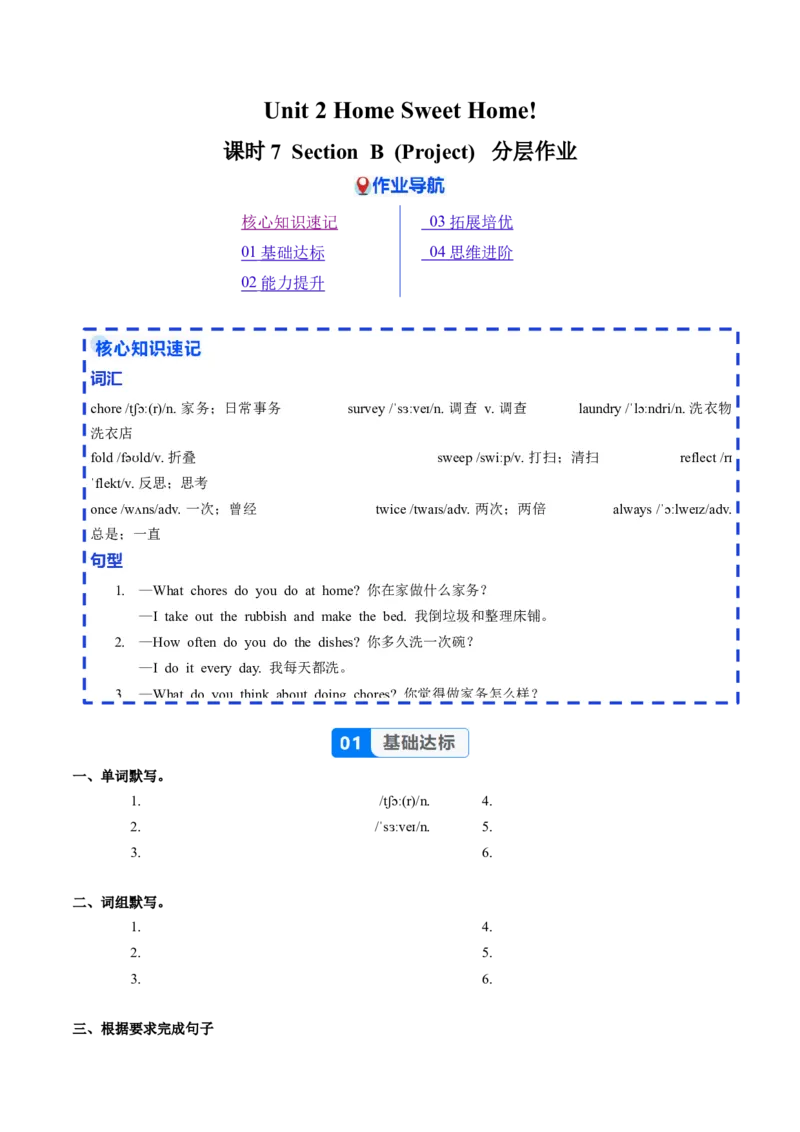
Unit 2 Home Sweet Home!
课时 7 Section B (Project) 分层作业
核心知识速记 0 3 拓展培优
01 基础达标 0 4 思维进阶
02 能力提升
词汇
chore /tʃɔː(r)/n. 家务;日常事务 survey /ˈsɜːveɪ/n. 调查 v. 调查 laundry /ˈlɔːndri/n. 洗衣物
洗衣店
fold /fəʊld/v. 折叠 sweep /swiːp/v. 打扫;清扫 reflect /rɪ
ˈflekt/v. 反思;思考
once /wʌns/adv. 一次;曾经 twice /twaɪs/adv. 两次;两倍 always /ˈɔːlweɪz/adv.
总是;一直
句型
1. —What chores do you do at home? 你在家做什么家务?
—I take out the rubbish and make the bed. 我倒垃圾和整理床铺。
2. —How often do you do the dishes? 你多久洗一次碗?
—I do it every day. 我每天都洗。
3. —What do you think about doing chores? 你觉得做家务怎么样?
一、单词默写。
1. /tʃɔː(r)/n. 4.
2. /ˈsɜːveɪ/n. 5.
3. 6.
二、词组默写。
1. 4.
2. 5.
3. 6.
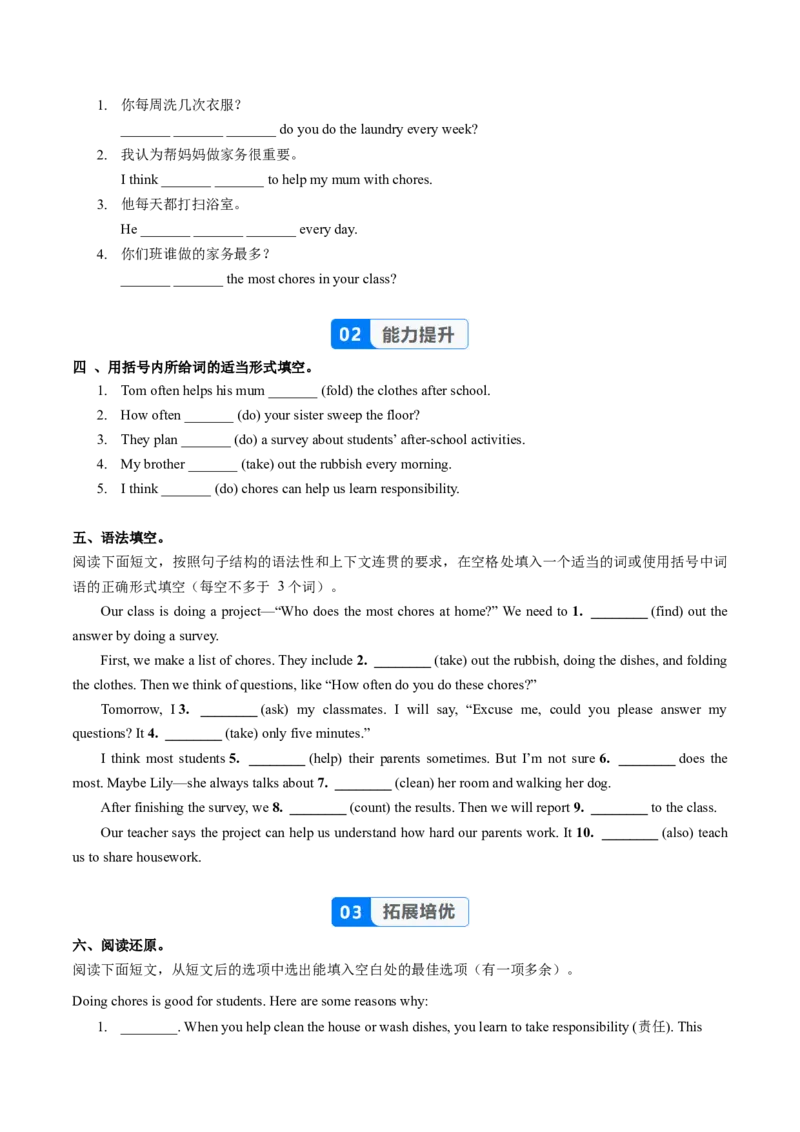
三、根据要求完成句子1. 你每周洗几次衣服?
_______ _______ _______ do you do the laundry every week?
2. 我认为帮妈妈做家务很重要。
I think _______ _______ to help my mum with chores.
3. 他每天都打扫浴室。
He _______ _______ _______ every day.
4. 你们班谁做的家务最多?
_______ _______ the most chores in your class?
四 、用括号内所给词的适当形式填空。
1. Tom often helps his mum _______ (fold) the clothes after school.
2. How often _______ (do) your sister sweep the floor?
3. They plan _______ (do) a survey about students’ after-school activities.
4. My brother _______ (take) out the rubbish every morning.
5. I think _______ (do) chores can help us learn responsibility.
五、语法填空。
阅读下面短文,按照句子结构的语法性和上下文连贯的要求,在空格处填入一个适当的词或使用括号中词
语的正确形式填空(每空不多于 3 个词)。
Our class is doing a project—“Who does the most chores at home?” We need to 1. ________ (find) out the
answer by doing a survey.
First, we make a list of chores. They include 2. ________ (take) out the rubbish, doing the dishes, and folding
the clothes. Then we think of questions, like “How often do you do these chores?”
Tomorrow, I 3. ________ (ask) my classmates. I will say, “Excuse me, could you please answer my
questions? It 4. ________ (take) only five minutes.”
I think most students 5. ________ (help) their parents sometimes. But I’m not sure 6. ________ does the
most. Maybe Lily—she always talks about 7. ________ (clean) her room and walking her dog.
After finishing the survey, we 8. ________ (count) the results. Then we will report 9. ________ to the class.
Our teacher says the project can help us understand how hard our parents work. It 10. ________ (also) teach
us to share housework.
六、阅读还原。
阅读下面短文,从短文后的选项中选出能填入空白处的最佳选项(有一项多余)。
Doing chores is good for students. Here are some reasons why:
1. ________. When you help clean the house or wash dishes, you learn to take responsibility (责任). Thishelps you grow into a responsible person.
2. ________. Chores like folding clothes or tidying your room need patience (耐心). You learn to finish a task
well, which is useful in life.
3. ________. In a family, everyone should share chores. Working together makes family life better. You also
learn to communicate with your parents.
4. ________. After doing chores, you may feel tired, but you’ll also feel proud. Seeing a clean room or a tidy
house makes you happy.
A. It teaches teamwork
B. It builds confidence
C. It keeps you healthy
D. It develops responsibility
E. It trains patience
七、阅读理解。
A class in No.2 Middle School does a survey about “Students and Chores”. They ask 100 students: “What
chores do you do?” and “How often?” Here are the results:
Chores Number of Students How Often
Take out the 85 Every day: 60; Once a week: 25
rubbish
Make the bed 70 Every day: 50; Sometimes: 20
Do the dishes 40 Every day: 15; Twice a week: 25
Fold the clothes 30 Once a week: 20; Rarely: 10
The students also answer: “What do you think about doing chores?”
75% say: “It’s good to help parents.”
15% say: “It’s tiring but necessary.”
10% say: “I have no time—too much homework.”
1. (细节题)How many students take out the rubbish every day?
A. 85. B. 60. C. 25.
2. (细节题)Which chore do the fewest students do?
A. Fold the clothes. B. Do the dishes. C. Make the bed.
3. (推理题)What can we infer from the survey?
A. Most students hate doing chores.
B. Students do “take out the rubbish” most often.
C. All students have time to do chores.
4. (判断题)Which is TRUE according to the passage?
A. 70 students make the bed every day.
B. 40 students do the dishes twice a week.C. 75% of students think helping parents is good.
5. (主旨题)What is the passage mainly about?
A. A school’s chore rules.
B. A survey about students and chores.
C. How to do chores well.
八、完形填空。
A group of students in Class 3 are doing a project about chores. They want to know how often their classmates
do housework.
Li Tao is in charge of the survey. He makes a list of chores, 1. ______ “make the bed”, “do the dishes”, and
“sweep the floor”. Then he asks his classmates, “2. ______ do you do these things?”
Most students say they do chores 3. ______ a week. Some do them every day. “My mum is busy,” says Chen
Yu. “I help her wash clothes 4. ______ school.”
But a few students say they 5. ______ do chores. “My parents think I should only study,” says Wang Hong.
Li Tao writes down all the 6. ______ .
After the survey, the group discusses the results. “It’s good to help our parents,” says Li Tao. “Doing chores
teaches us to be 7. ______ .”
They also find that girls do more chores than boys. “Maybe boys can try to do 8. ______ ,” says Zhang Na.
Finally, they make a poster. It 9. ______ : “Share chores, share love at home!” They put it on the classroom
wall to tell everyone the 10. ______ of doing housework.
1. A. as B. like C. for
2. A. How often B. How long C. How far
3. A. once or twice B. one or two C. first or second
4. A. before B. after C. during
5. A. always B. often C. never
6. A. names B. results C. stories
7. A. lazy B. responsible C. funny
8. A. more B. less C. little
9. A. tells B. speaks C. says
10. A. difficulty B. importance C. happiness
Part 1: Project Introduction
Your task is to finish a mini-project: “Find out who does the most chores in your group (3-4 classmates)”. Follow
these steps:
1. Make a list of chores (at least 5).
2. Design 3 survey questions (e.g., How often do you...?).
3. Ask your group members and record results.4. Analyze (分析) and report: Who does the most?
Part 2: Project Tasks
Task 1: Design Survey Questions
Write 3 questions for your survey. Use “how often” and “what”.
1.
2.
3.
Task 2: Analyze Fake Results
Suppose you survey 3 classmates. Here are their answers. Who does the most chores? Why?
Tom: Takes out rubbish (every day), makes bed (every day).
Lucy: Does dishes (twice a day), folds clothes (once a day), walks dog (once a day).
Jack: Sweeps floor (once a week), waters plants (once a week).
_________________________________________________________________
_________________________________________________________________
_________________________________________________________________
Task 3: Write a Short Report
Based on Task 2, write a 3-sentence report about your finding.