文档文本内容
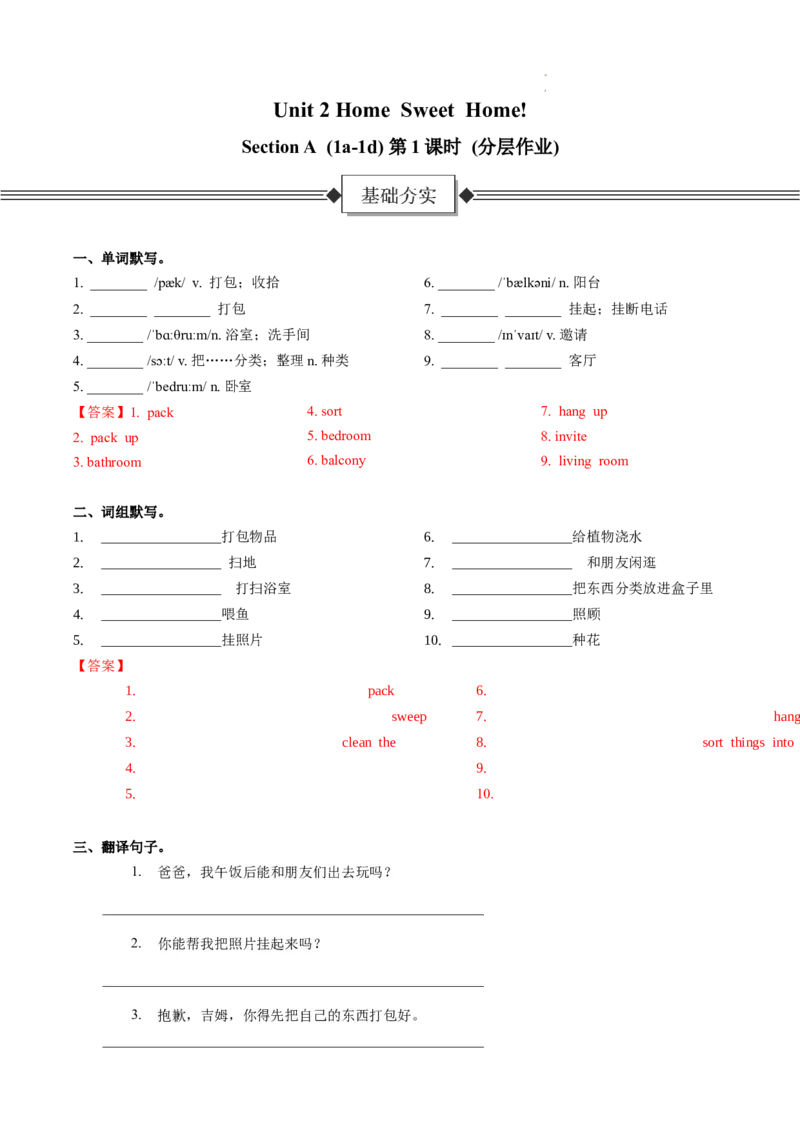
Unit 2 Home Sweet Home!
Section A (1a-1d) 第1课时 (分层作业)
一、单词默写。
1. ________ /pæk/ v. 打包;收拾 6. ________ /ˈbælkəni/ n. 阳台
2. ________ ________ 打包 7. ________ ________ 挂起;挂断电话
3. ________ /ˈbɑːθruːm/n. 浴室;洗手间 8. ________ /ɪnˈvaɪt/ v. 邀请
4. ________ /sɔːt/ v. 把……分类;整理n. 种类 9. ________ ________ 客厅
5. ________ /ˈbedruːm/ n. 卧室
【答案】1. pack 4. sort 7. hang up
2. pack up 5. bedroom 8. invite
3. bathroom 6. balcony 9. living room
二、词组默写。
1. _________________打包物品 6. _________________给植物浇水
2. _________________ 扫地 7. _________________ 和朋友闲逛
3. _________________ 打扫浴室 8. _________________把东西分类放进盒子里
4. _________________喂鱼 9. _________________照顾
5. _________________挂照片 10. _________________种花
【答案】
1. pack 6.
2. sweep 7. hang
3. clean the 8. sort things into
4. 9.
5. 10.
三、翻译句子。
1. 爸爸,我午饭后能和朋友们出去玩吗?
______________________________________________________
2. 你能帮我把照片挂起来吗?
______________________________________________________
3. 抱歉,吉姆,你得先把自己的东西打包好。
______________________________________________________4. 记得在每个箱子上写上 “吉姆的卧室”!
______________________________________________________
5. 可以,彼得,但得先帮忙打扫。你能扫下地吗?
______________________________________________________
【答案】1. Dad, can I hang out with my friends after lunch? 2. Could you please help me hang up the
photos?
3. Sorry, Jim, you have to pack up your things first. 4. Remember to write “Jim’s bedroom” on each box!
5. Yes, Peter, but help clean up first. Could you please sweep the floor?
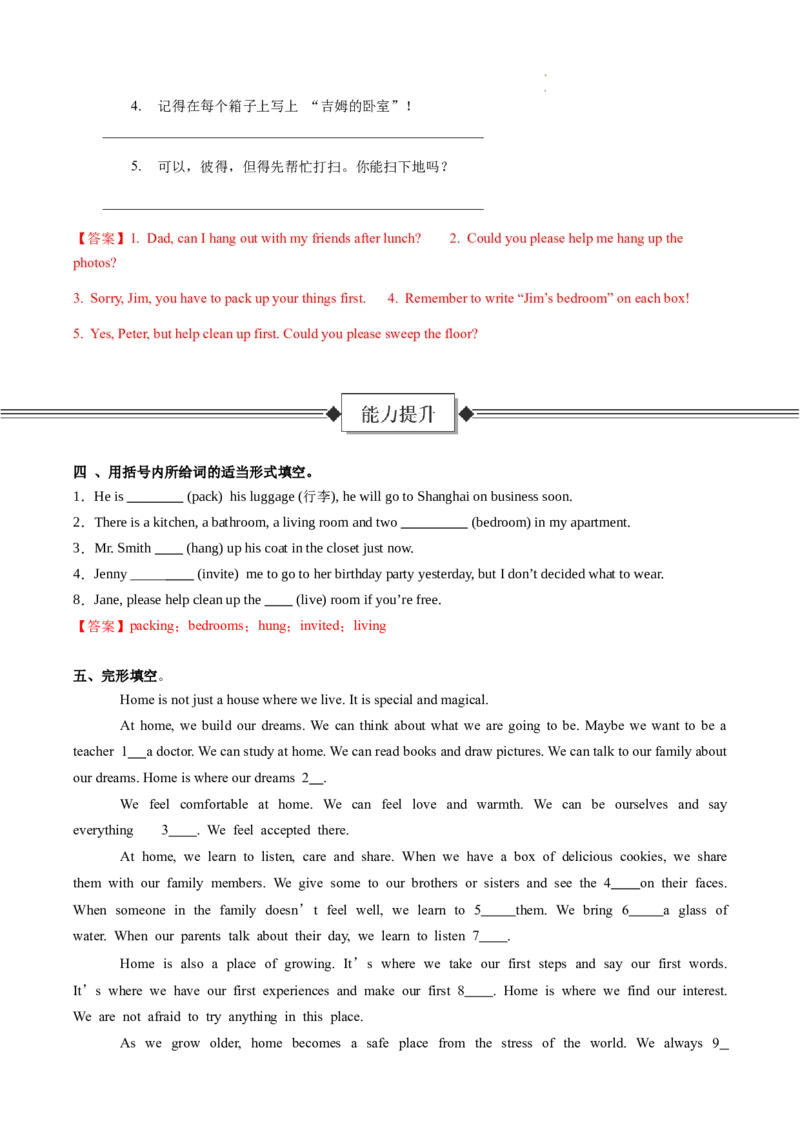
四 、用括号内所给词的适当形式填空。
1.He is ____ (pack) his luggage (行李), he will go to Shanghai on business soon.
2.There is a kitchen, a bathroom, a living room and two ______ (bedroom) in my apartment.
3.Mr. Smith (hang) up his coat in the closet just now.
4.Jenny _____ (invite) me to go to her birthday party yesterday, but I don’t decided what to wear.
8.Jane, please help clean up the (live) room if you’re free.
【答案】packing;bedrooms;hung;invited;living
五、完形填空。
Home is not just a house where we live. It is special and magical.
At home, we build our dreams. We can think about what we are going to be. Maybe we want to be a
teacher 1 a doctor. We can study at home. We can read books and draw pictures. We can talk to our family about
our dreams. Home is where our dreams 2 .
We feel comfortable at home. We can feel love and warmth. We can be ourselves and say
everything 3 . We feel accepted there.
At home, we learn to listen, care and share. When we have a box of delicious cookies, we share
them with our family members. We give some to our brothers or sisters and see the 4 on their faces.
When someone in the family doesn’t feel well, we learn to 5 them. We bring 6 a glass of
water. When our parents talk about their day, we learn to listen 7 .
Home is also a place of growing. It’s where we take our first steps and say our first words.
It’s where we have our first experiences and make our first 8 . Home is where we find our interest.
We are not afraid to try anything in this place.
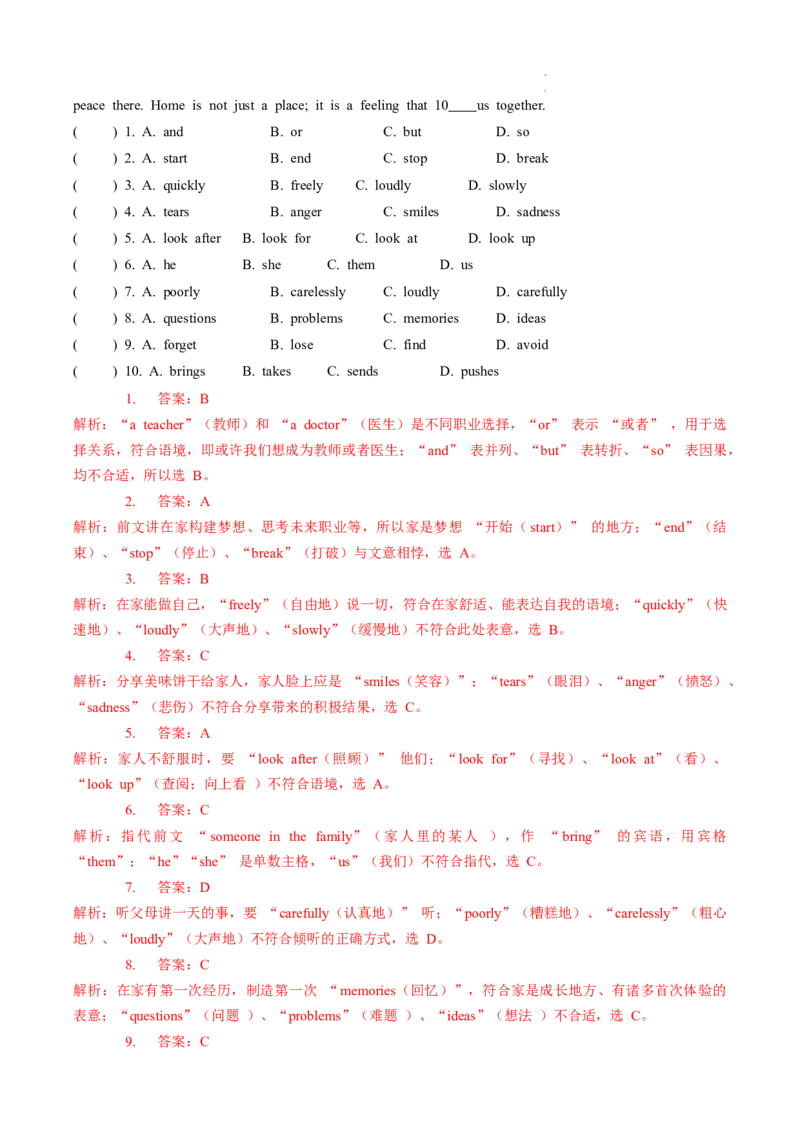
As we grow older, home becomes a safe place from the stress of the world. We always 9peace there. Home is not just a place; it is a feeling that 10 us together.
( ) 1. A. and B. or C. but D. so
( ) 2. A. start B. end C. stop D. break
( ) 3. A. quickly B. freely C. loudly D. slowly
( ) 4. A. tears B. anger C. smiles D. sadness
( ) 5. A. look after B. look for C. look at D. look up
( ) 6. A. he B. she C. them D. us
( ) 7. A. poorly B. carelessly C. loudly D. carefully
( ) 8. A. questions B. problems C. memories D. ideas
( ) 9. A. forget B. lose C. find D. avoid
( ) 10. A. brings B. takes C. sends D. pushes
1. 答案:B
解析:“a teacher”(教师)和 “a doctor”(医生)是不同职业选择,“or” 表示 “或者” ,用于选
择关系,符合语境,即或许我们想成为教师或者医生;“and” 表并列、“but” 表转折、“so” 表因果,
均不合适,所以选 B。
2. 答案:A
解析:前文讲在家构建梦想、思考未来职业等,所以家是梦想 “开始(start)” 的地方;“end”(结
束)、“stop”(停止)、“break”(打破)与文意相悖,选 A。
3. 答案:B
解析:在家能做自己,“freely”(自由地)说一切,符合在家舒适、能表达自我的语境;“quickly”(快
速地)、“loudly”(大声地)、“slowly”(缓慢地)不符合此处表意,选 B。
4. 答案:C
解析:分享美味饼干给家人,家人脸上应是 “smiles(笑容)”;“tears”(眼泪)、“anger”(愤怒)、
“sadness”(悲伤)不符合分享带来的积极结果,选 C。
5. 答案:A
解析:家人不舒服时,要 “look after(照顾)” 他们;“look for”(寻找)、“look at”(看)、
“look up”(查阅;向上看 )不符合语境,选 A。
6. 答案:C
解析:指代前文 “someone in the family”(家人里的某人 ),作 “bring” 的宾语,用宾格
“them”;“he”“she” 是单数主格,“us”(我们)不符合指代,选 C。
7. 答案:D
解析:听父母讲一天的事,要 “carefully(认真地)” 听;“poorly”(糟糕地)、“carelessly”(粗心
地)、“loudly”(大声地)不符合倾听的正确方式,选 D。
8. 答案:C
解析:在家有第一次经历,制造第一次 “memories(回忆)”,符合家是成长地方、有诸多首次体验的
表意;“questions”(问题 )、“problems”(难题 )、“ideas”(想法 )不合适,选 C。
9. 答案:C解析:家是远离外界压力的安全地方,能在那 “find(找到)” 平静;“forget”(忘记)、“lose”
(失去)、“avoid”(避免)不符合语境,选 C。
10. 答案:A
解析:“bring us together”(把我们凝聚在一起 ),家是一种把我们凝聚的感觉;“take”(带走 )、
“send”(发送;派遣 )、“push”(推 )不符合表意,选 A。。
六、阅读还原。
Your mom does a lot of housework, and you’d really like to help her out. 1
Caring for your own space. 2 If you make a mess, clean it up as soon as possible.
Sharing some of your mom’s tasks (工作). Find out what tasks you could do. 3 Children can begin to
take care of their own washing from around the age of 8.
Help out with making dinner. You may not cook a big dinner, but you can try to make a simple lunch.
Organizing a “Mom’s Day Off”. Choose a day to do all chores with your dad and your sister or brother. 4
Being active. 5 She probably has advice for things you can do for her. If she asks for your help, don’t
refuse. She wouldn’t ask if she didn’t need your help. Do not wait until she tells you or asks to do something.
Always help your mom, and she will be very happy.
A.It depends on your age.
B.Try to keep your room clean.
C.Here is some advice for you.
D.Let your mom enjoy a relaxing day.
E.Housework is a waste of our own time.
F.Ask your mom what you can help with.
G.Doing chores also helps us to understand the idea of fairness.
【答案】CBADF
【导语】本文主要讲述了在帮助妈妈分担家务上给出了几点建议,并鼓励大家通过这种方式帮助妈妈。
1.根据“Your mom does a lot of housework, and you’d really like to help her out.”及下文每段段首
句可知,此处提出想帮妈妈分担家务,下文具体列举建议,因此空处应表达提出一些建议。选项C“这里
有一些建议。”符合题意。故选C。
2.根据“Caring for your own space.”可知,此处应表达保持自己的空间整洁。选项B“尽量保持你的房
间干净。”符合题意。故选B。
3.根据“Find out what tasks you could do.”及下文“Children can begin to take care of their own
washing from around the age of 8.”可知,能做的工作取决于年龄。A“这取决于你的年龄。”符合题意。
故选A。
4.根据“Choose a day to do all chores with your dad and your sister or brother.”可知,这样做是为了
让妈妈享受轻松的一天。选项D“让你的妈妈享受轻松的一天。”符合题意。故选D。
5.根据“Being active.”及下文“She probably has advice for things you can do for her.”可知,此处表达要主动询问妈妈需要什么帮助。选项F“问问你妈妈你能帮上什么忙。”符合题意。故选F。
七、阅读理解。
Do teenagers in small villages do chores at home? How about the teenagers in big cities? To know the
answers, we made a survey (调查) last month. We asked 4,000 teenagers in China. Half of them come from big
cities like Beijing, Shanghai and Guangzhou. The others are from small villages. We made a chart (图表) according
to our survey. Let’s have a look at it.
We can find out that teenagers in small villages do more chores than those in big cities. Maybe it is because
they live a harder life. We will give our advice to parents in big cities. We think parents should give their children
some chores to do because it’s a good chance for teenagers to learn how to take care of themselves.
根据短文和图表内容,选择最佳答案。
1.They surveyed _________ teenagers from big cities.
A.1000 B.2000 C.3000 D.4000
2.1,000 teenagers from the cities ________.
A.take out the rubbish B.do the dishes
C.make the bed D.fold the clothes
3.The number of teenagers in big cities is bigger than that in small villages only in ________.
A.taking out the rubbish B.making the bed
C.sweeping the floor D.doing the dishes
4.They made the survey because________.
A.they wanted to know more about teenagers in China
B.they didn’t want teenagers in China to do chores at home
C.they wanted to know if (是否) teenagers in China do chores at home
D.they thought doing housework could help teenagers to take care of themselves
5.From the passage, we can know________.
A.more than 3000 teenagers take out the rubbish
B.fewer than 1000 teenagers in big cities make the bed
C.more than 1500 teenagers in Beijing fold the clothes
D.4000 teenagers from small villages take part in the survey
【答案】BDBCA
【导语】本文中作者主要讲述了在中国4000多名青少年中就是否做家务做的调查报告的结果。从结果中可以看到农村的孩子比城市的孩子做的家务相对要多一些。
1.细节理解题。根据“We asked 4,000 teenagers in China”和“Half of them come from big cities like
Beijing, Shanghai and Guangzhou”可知,调查了4000名青少年,一半来自大城市,也就是2000人,故选
B。
2.细节理解题。根据柱状图可知,1000名来自城市的青少年叠衣服。故选D。
3.细节理解题。根据柱状图可知,仅在铺床方面,大城市的青少年人数比农村的孩子多。故选B。
4.细节理解题。根据“Do teenagers in small villages do chores at home? How about the teenagers in
big cities? To know the answers,...”可知,他们做这项调查是因为他们想知道中国的青少年是否在家做家
务。故选C。
5.细节理解题。根据柱状图中的第一个可知,倒垃圾的青少年总数要超过3000,故选A。