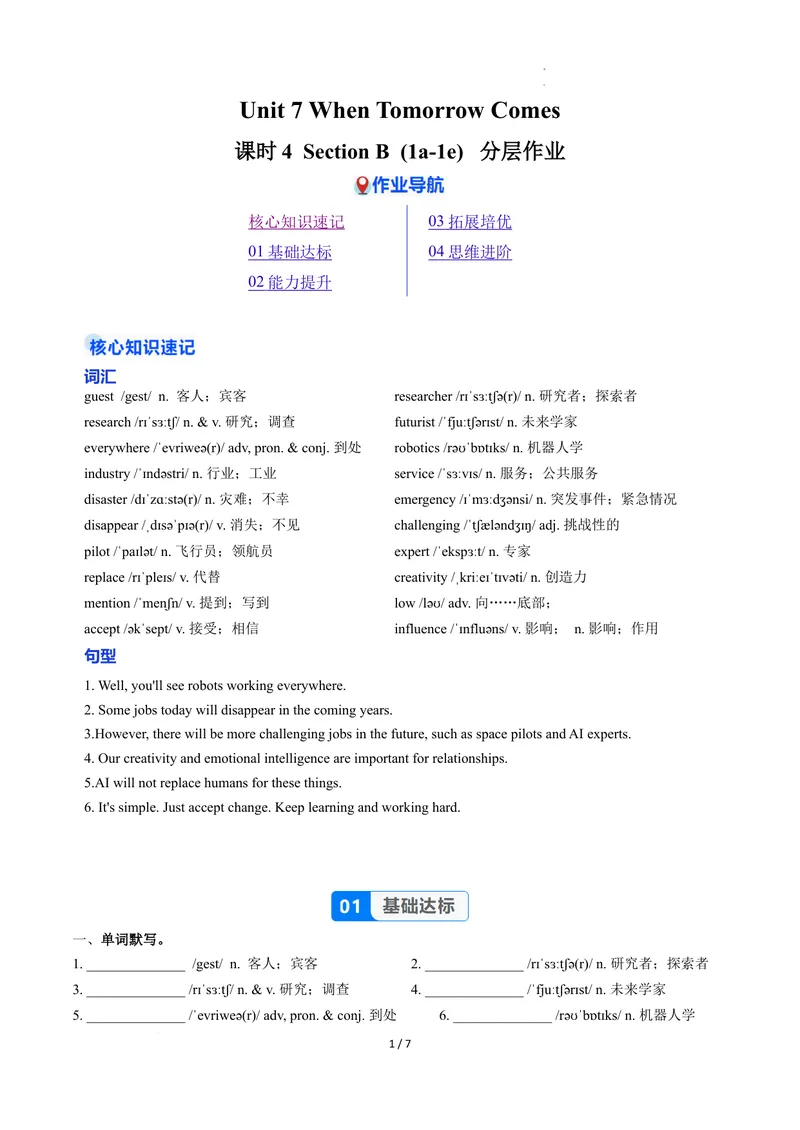
Unit 7 When Tomorrow Comes
课时 4 Section B (1a-1e) 分层作业
核心知识速记 03 拓展培优
01 基础达标 0 4 思维进阶
02 能力提升
词汇
guest /gest/ n. 客人;宾客 researcher /rɪˈsɜːtʃə(r)/ n. 研究者;探索者
research /rɪˈsɜːtʃ/ n. & v. 研究;调查 futurist /ˈfjuːtʃərɪst/ n. 未来学家
everywhere /ˈevriweə(r)/ adv, pron. & conj. 到处 robotics /rəʊˈbɒtɪks/ n. 机器人学
industry /ˈɪndəstri/ n. 行业;工业 service /ˈsɜːvɪs/ n. 服务;公共服务
disaster /dɪˈzɑːstə(r)/ n. 灾难;不幸 emergency /ɪˈmɜːdʒənsi/ n. 突发事件;紧急情况
disappear /ˌdɪsəˈpɪə(r)/ v. 消失;不见 challenging /ˈtʃæləndʒɪŋ/ adj. 挑战性的
pilot /ˈpaɪlət/ n. 飞行员;领航员 expert /ˈekspɜːt/ n. 专家
replace /rɪˈpleɪs/ v. 代替 creativity /ˌkriːeɪˈtɪvəti/ n. 创造力
mention /ˈmenʃn/ v. 提到;写到 low /ləʊ/ adv. 向……底部;
accept /əkˈsept/ v. 接受;相信 influence /ˈɪnfluəns/ v. 影响; n. 影响;作用
句型
1. Well, you'll see robots working everywhere.
2. Some jobs today will disappear in the coming years.
3.However, there will be more challenging jobs in the future, such as space pilots and AI experts.
4. Our creativity and emotional intelligence are important for relationships.
5.AI will not replace humans for these things.
6. It's simple. Just accept change. Keep learning and working hard.
一、单词默写。
1. ______________ /gest/ n. 客人;宾客 2. ______________ /rɪˈsɜːtʃə(r)/ n. 研究者;探索者
3. ______________ /rɪˈsɜːtʃ/ n. & v. 研究;调查 4. ______________ /ˈfjuːtʃərɪst/ n. 未来学家
5. ______________ /ˈevriweə(r)/ adv, pron. & conj. 到处 6. ______________ /rəʊˈbɒtɪks/ n. 机器人学
1 / 7
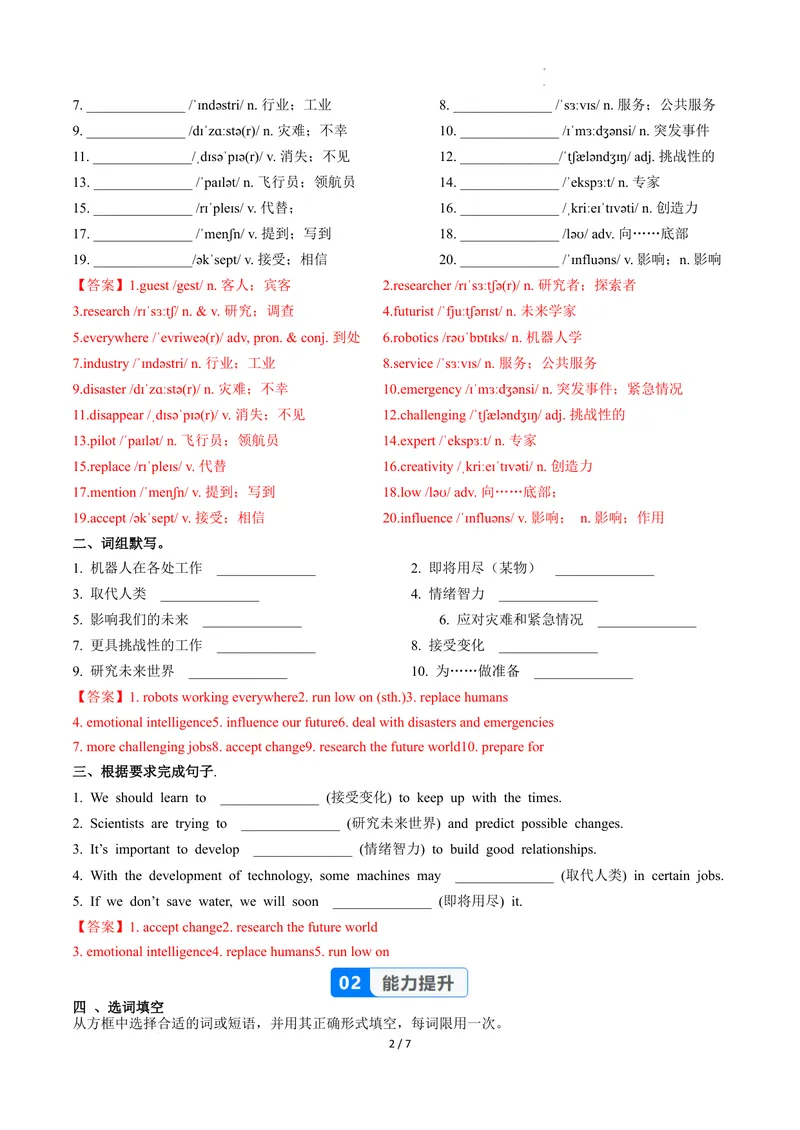
学科网(北京)股份有限公司7. ______________ /ˈɪndəstri/ n. 行业;工业 8. ______________ /ˈsɜːvɪs/ n. 服务;公共服务
9. ______________ /dɪˈzɑːstə(r)/ n. 灾难;不幸 10. ______________ /ɪˈmɜːdʒənsi/ n. 突发事件
11. ______________/ˌdɪsəˈpɪə(r)/ v. 消失;不见 12. ______________/ˈtʃæləndʒɪŋ/ adj. 挑战性的
13. ______________ /ˈpaɪlət/ n. 飞行员;领航员 14. ______________ /ˈekspɜːt/ n. 专家
15. ______________ /rɪˈpleɪs/ v. 代替; 16. ______________ /ˌkriːeɪˈtɪvəti/ n. 创造力
17. ______________ /ˈmenʃn/ v. 提到;写到 18. ______________ /ləʊ/ adv. 向……底部
19. ______________/əkˈsept/ v. 接受;相信 20. ______________ /ˈɪnfluəns/ v. 影响;n. 影响
【答案】1.guest /gest/ n. 客人;宾客 2.researcher /rɪˈsɜːtʃə(r)/ n. 研究者;探索者
3.research /rɪˈsɜːtʃ/ n. & v. 研究;调查 4.futurist /ˈfjuːtʃərɪst/ n. 未来学家
5.everywhere /ˈevriweə(r)/ adv, pron. & conj. 到处 6.robotics /rəʊˈbɒtɪks/ n. 机器人学
7.industry /ˈɪndəstri/ n. 行业;工业 8.service /ˈsɜːvɪs/ n. 服务;公共服务
9.disaster /dɪˈzɑːstə(r)/ n. 灾难;不幸 10.emergency /ɪˈmɜːdʒənsi/ n. 突发事件;紧急情况
11.disappear /ˌdɪsəˈpɪə(r)/ v. 消失;不见 12.challenging /ˈtʃæləndʒɪŋ/ adj. 挑战性的
13.pilot /ˈpaɪlət/ n. 飞行员;领航员 14.expert /ˈekspɜːt/ n. 专家
15.replace /rɪˈpleɪs/ v. 代替 16.creativity /ˌkriːeɪˈtɪvəti/ n. 创造力
17.mention /ˈmenʃn/ v. 提到;写到 18.low /ləʊ/ adv. 向……底部;
19.accept /əkˈsept/ v. 接受;相信 20.influence /ˈɪnfluəns/ v. 影响; n. 影响;作用
二、词组默写。
1. 机器人在各处工作 ______________ 2. 即将用尽(某物) ______________
3. 取代人类 ______________ 4. 情绪智力 ______________
5. 影响我们的未来 ______________ 6. 应对灾难和紧急情况 ______________
7. 更具挑战性的工作 ______________ 8. 接受变化 ______________
9. 研究未来世界 ______________ 10. 为……做准备 ______________
【答案】1. robots working everywhere2. run low on (sth.)3. replace humans
4. emotional intelligence5. influence our future6. deal with disasters and emergencies
7. more challenging jobs8. accept change9. research the future world10. prepare for
三、根据要求完成句子.
1. We should learn to ______________ (接受变化) to keep up with the times.
2. Scientists are trying to ______________ (研究未来世界) and predict possible changes.
3. It’s important to develop ______________ (情绪智力) to build good relationships.
4. With the development of technology, some machines may ______________ (取代人类) in certain jobs.
5. If we don’t save water, we will soon ______________ (即将用尽) it.
【答案】1. accept change2. research the future world
3. emotional intelligence4. replace humans5. run low on
四 、选词填空
从方框中选择合适的词或短语,并用其正确形式填空,每词限用一次。
2 / 7
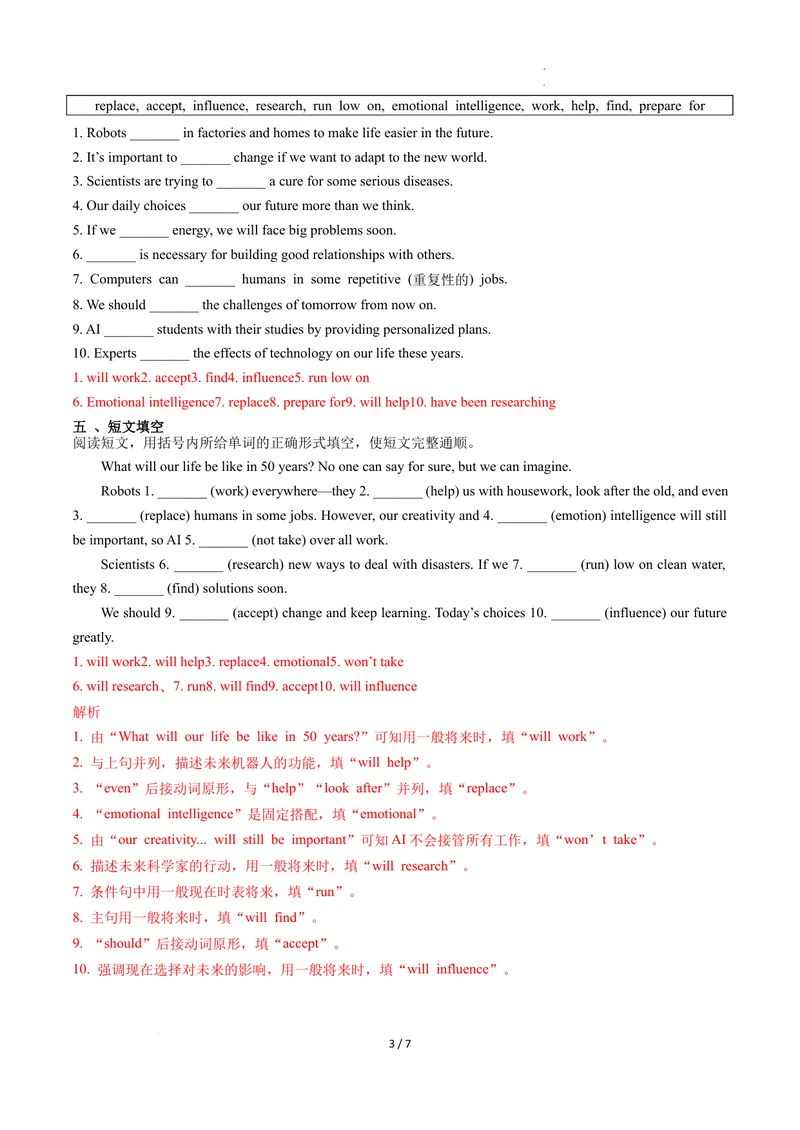
学科网(北京)股份有限公司replace, accept, influence, research, run low on, emotional intelligence, work, help, find, prepare for
1. Robots _______ in factories and homes to make life easier in the future.
2. It’s important to _______ change if we want to adapt to the new world.
3. Scientists are trying to _______ a cure for some serious diseases.
4. Our daily choices _______ our future more than we think.
5. If we _______ energy, we will face big problems soon.
6. _______ is necessary for building good relationships with others.
7. Computers can _______ humans in some repetitive (重复性的) jobs.
8. We should _______ the challenges of tomorrow from now on.
9. AI _______ students with their studies by providing personalized plans.
10. Experts _______ the effects of technology on our life these years.
1. will work2. accept3. find4. influence5. run low on
6. Emotional intelligence7. replace8. prepare for9. will help10. have been researching
五 、短文填空
阅读短文,用括号内所给单词的正确形式填空,使短文完整通顺。
What will our life be like in 50 years? No one can say for sure, but we can imagine.
Robots 1. _______ (work) everywhere—they 2. _______ (help) us with housework, look after the old, and even
3. _______ (replace) humans in some jobs. However, our creativity and 4. _______ (emotion) intelligence will still
be important, so AI 5. _______ (not take) over all work.
Scientists 6. _______ (research) new ways to deal with disasters. If we 7. _______ (run) low on clean water,
they 8. _______ (find) solutions soon.
We should 9. _______ (accept) change and keep learning. Today’s choices 10. _______ (influence) our future
greatly.
1. will work2. will help3. replace4. emotional5. won’t take
6. will research、7. run8. will find9. accept10. will influence
解析
1. 由“What will our life be like in 50 years?”可知用一般将来时,填“will work”。
2. 与上句并列,描述未来机器人的功能,填“will help”。
3. “even”后接动词原形,与“help”“look after”并列,填“replace”。
4. “emotional intelligence”是固定搭配,填“emotional”。
5. 由“our creativity... will still be important”可知AI不会接管所有工作,填“won’t take”。
6. 描述未来科学家的行动,用一般将来时,填“will research”。
7. 条件句中用一般现在时表将来,填“run”。
8. 主句用一般将来时,填“will find”。
9. “should”后接动词原形,填“accept”。
10. 强调现在选择对未来的影响,用一般将来时,填“will influence”。
3 / 7
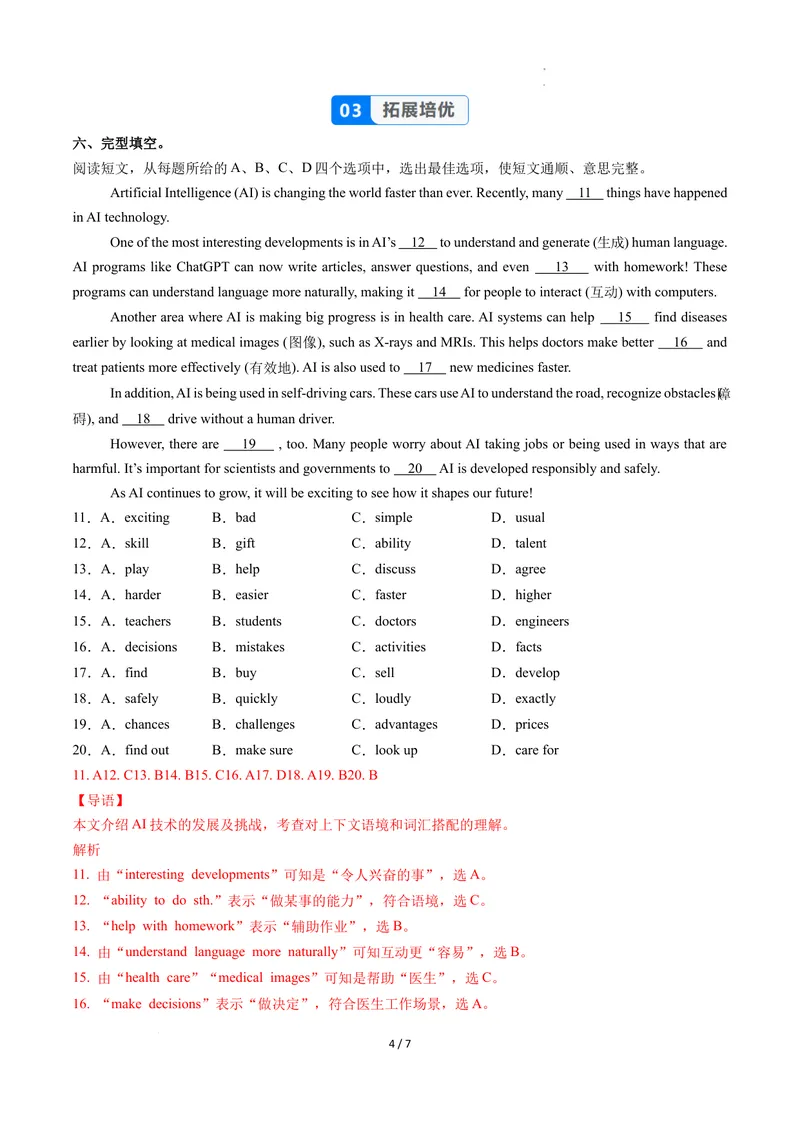
学科网(北京)股份有限公司六、完型填空。
阅读短文,从每题所给的A、B、C、D四个选项中,选出最佳选项,使短文通顺、意思完整。
Artificial Intelligence (AI) is changing the world faster than ever. Recently, many 11 things have happened
in AI technology.
One of the most interesting developments is in AI’s 12 to understand and generate (生成) human language.
AI programs like ChatGPT can now write articles, answer questions, and even 13 with homework! These
programs can understand language more naturally, making it 14 for people to interact (互动) with computers.
Another area where AI is making big progress is in health care. AI systems can help 15 find diseases
earlier by looking at medical images (图像), such as X-rays and MRIs. This helps doctors make better 16 and
treat patients more effectively (有效地). AI is also used to 17 new medicines faster.
In addition, AI is being used in self-driving cars. These cars use AI to understand the road, recognize obstacles 障(
碍), and 18 drive without a human driver.
However, there are 19 , too. Many people worry about AI taking jobs or being used in ways that are
harmful. It’s important for scientists and governments to 20 AI is developed responsibly and safely.
As AI continues to grow, it will be exciting to see how it shapes our future!
11.A.exciting B.bad C.simple D.usual
12.A.skill B.gift C.ability D.talent
13.A.play B.help C.discuss D.agree
14.A.harder B.easier C.faster D.higher
15.A.teachers B.students C.doctors D.engineers
16.A.decisions B.mistakes C.activities D.facts
17.A.find B.buy C.sell D.develop
18.A.safely B.quickly C.loudly D.exactly
19.A.chances B.challenges C.advantages D.prices
20.A.find out B.make sure C.look up D.care for
11. A12. C13. B14. B15. C16. A17. D18. A19. B20. B
【导语】
本文介绍AI技术的发展及挑战,考查对上下文语境和词汇搭配的理解。
解析
11. 由“interesting developments”可知是“令人兴奋的事”,选A。
12. “ability to do sth.”表示“做某事的能力”,符合语境,选C。
13. “help with homework”表示“辅助作业”,选B。
14. 由“understand language more naturally”可知互动更“容易”,选B。
15. 由“health care”“medical images”可知是帮助“医生”,选C。
16. “make decisions”表示“做决定”,符合医生工作场景,选A。
4 / 7
学科网(北京)股份有限公司17. “develop new medicines”表示“研发新药”,选D。
18. 自动驾驶需“安全地”行驶,选A。
19. 由“worry about AI taking jobs”可知是“挑战”,选B。
20. “make sure”表示“确保”,符合“负责任且安全地开发AI”的语境,选B。
七、阅读理解
Type in “A cat wants to go to the space” and ask the robot to write a bedtime story. Just one second later, you’ll
get the story of a cat called Max. He goes through many difficulties to sing among the stars.
This robot writer is called ChatGPT. US company OpenAI made it. It can talk with people, write songs, poems
and even jokes. It’s one of the most powerful (强大的) AI writers.
ChatGPT can write things really fast. We may spend hours researching (研究) and writing an article. But
ChatGPT can write a good one in seconds. It can help correct grammar and spelling mistakes, and make our writing
better. It is also good for the researchers from non-English speaking countries if they need to write English papers.
However, every coin has two sides. According to a study, 89 percent of US college students had used ChatGPT
to write homework. So many schools ban (禁止) the robot. Students can’t utilise it for homework. Thousands of
scientific journals (期刊) also have banned writers from using ChatGPT. They worry that the wrong information it
creates will become junk science. And the robot doesn’t have any new or creative ideas.
21.The cat Max meet many _________ on the way to space.
A.stories B.difficulties C.people D.robots
22.What can't ChatGPT do?
A.Talk with people. B.Write articles. C.Do homework. D.Create new
ideas.
23.What does the underlined word “utilise” in Paragraph 4 probably mean?
A.stop B.improve C.use D.make
24.Which of the sentence is TRUE according to the passage?
A.Max’s story is made by ChatGPT.
B.ChatGPT only has good sides.
C.ChatGPT will not create junk science.
D.Only a few college students had used ChatGPT to write homework.
25.What is the passage mainly about?
A.What ChatGPT can do. B.How to use ChatGPT to do homework.
C.The introduction of ChatGPT. D.The history of ChatGPT.
21. B22. D23. C24. A25. C
【导语】本文介绍AI工具ChatGPT的功能及优缺点,考查对细节信息和主旨的理解。
【解析】
21. 由“He goes through many difficulties”可知选B。
22. 由“it doesn’t have any new or creative ideas”可知ChatGPT不能创造新想法,选D。
23. 由“many schools ban the robot. Students can’t utilise it”可知“utilise”意为“使用”,选C。
5 / 7
学科网(北京)股份有限公司24. 由第一段可知Max的故事是ChatGPT生成的,A正确;B项“only good sides”错误;C项与“wrong
information... junk science”矛盾;D项“only a few”与“89 percent”不符,故选A。
25. 本文整体介绍ChatGPT的功能、优缺点,选C。
八、阅读表达
AI helps doctors by checking patients quickly. It can predict risks of heart problems or
brain diseases (疾病). Some robots, like STAR, can fix small body parts very carefully, which is
hard for humans. However, AI has no feelings. It can’t make scared patients feel better or
understand their worries. And it may also give wrong answers if the checking result is wrong.
Human doctors talk kindly to patients and use experience to solve tricky cases. But they
can get tired, and their feelings may influence their work. Also, they’re slower than AI when
facing lots of information. In a word, we believe using AI and human doctors together can
improve medical care.
Professor Jason, a medical researcher
AI creates art by studying thousands of pictures or songs. It mixes colors, shapes, and
sounds to make special pieces. But without real feelings, AI art feels empty, for which has no real
feelings or deep stories.
Human artists create from life experiences and emotions. Like Van Gogh’s “Sunflowers”,
it shows his deep love for life through bright colors. However, human artists have limitations (限
制)in skills and styles, and creation takes time. Luckily, as AI develops day by day, artists now
can also better enrich the world with the help of it.
Matteo, an artist
AI learning apps can make special study plans. For example, if a student has problems in
English grammar, an AI app can offer exercises and clear explanations. These tools answer
questions anytime and provide learning materials. But AI hardly has warmth, so it can’t chat like
a close friend or teach life values.
Human teachers inspire creativity and teach good behavior. They change teaching ways by
watching students’ faces. However, in large classes, it’s hard for them to meet every student’s
needs. While in general, with AI offering rich materials, if teachers guide with heart, better
learning results can be achieved.
Dr. Wang, an educator
26.Can AI fix humans’ body parts?
.
27.How does AI create art?
6 / 7
学科网(北京)股份有限公司。
28.What do the three researchers’ opinions have in common?
。
29.In which field do you think AI can play the biggest role, medicine, art, or education? Why?
。
26. Yes, it can. Some robots, like STAR, can fix small body parts very carefully.
27. AI creates art by studying thousands of pictures or songs and mixing colors, shapes, and sounds to make special
pieces.
28. They all think AI and humans have their own advantages and disadvantages, and combining them can achieve
better results.
29. (示例)In education. Because AI learning apps can provide personalized study plans and materials,
while human teachers can inspire creativity and teach values. Together, they can meet students’ diverse
needs.
7 / 7
学科网(北京)股份有限公司