( 英语 )科试题
注意事项:
1. 答题前,考生须将自己的姓名、班级、考场/座位号填写在答题卡指定位置上,并粘贴条形
码。
2. 回答选择题时,选出每小题答案后,用2B铅笔把答题卡上对应题目的答案标号涂黑。如需
改动,用橡皮擦干净后,再选涂其它答案标号。
3. 回答非选择题时,请使用 0.5 毫米黑色字迹签字笔将答案写在答题卡各题目的答题区域内,
超出答题区域或在草稿纸、本试题卷上书写的答案无效。
4. 保持卡面清洁,不要折叠、不要弄皱、弄破,不准使用涂改液、修正带、刮纸刀。
第一部分 听力(1~20小题)在笔试结束后进行。
第二部分 阅读(共两节,满分50分)
第一节(共15小题;每小题2.5分,满分37.5分)
阅读下列短文,从每题所给的A、B、C和D四个选项中选出最佳选项。
A
Clean Energy: The Future Is Here
Nearly a century ago, Thomas Edison envisioned using the sun’s unlimited energy. Today, that vision
is a reality. “Clean energy” covers various technologies — here are five ways to use virtually limitless
power sources:
CLEAN ENERGY
SOLAR WIND
Solar panels have become less expensive and Wind machines produce the lowest-priced
more efficient in recent years. That’s making it renewable energy. In places with enough wind, it
more competitive with other technologies and can be cost-competitive without government
driving a rapid growth in solar adoption. allowance, and it may even be cheaper than fossil
fuels.
BIOMASS GEOTHERMAL WATERPOWER
Biomass (生物质) energy Geothermal (地热) energy Falling or running water is
originates from living or taps into the internal heat of the one of the oldest energy sources
recently living organisms — earth — from hot water just in the world. When sustainably
everything from natural waste below the ground to steam designed, it can be a reliable
from forests to algae (藻类). produced much further down. clean energy.
Technological innovations and new financing methods are making renewable energy more accessible
than ever before. As a result, these energy sources are expected to account for half of our global energy
mix by 2030. Here are the details:
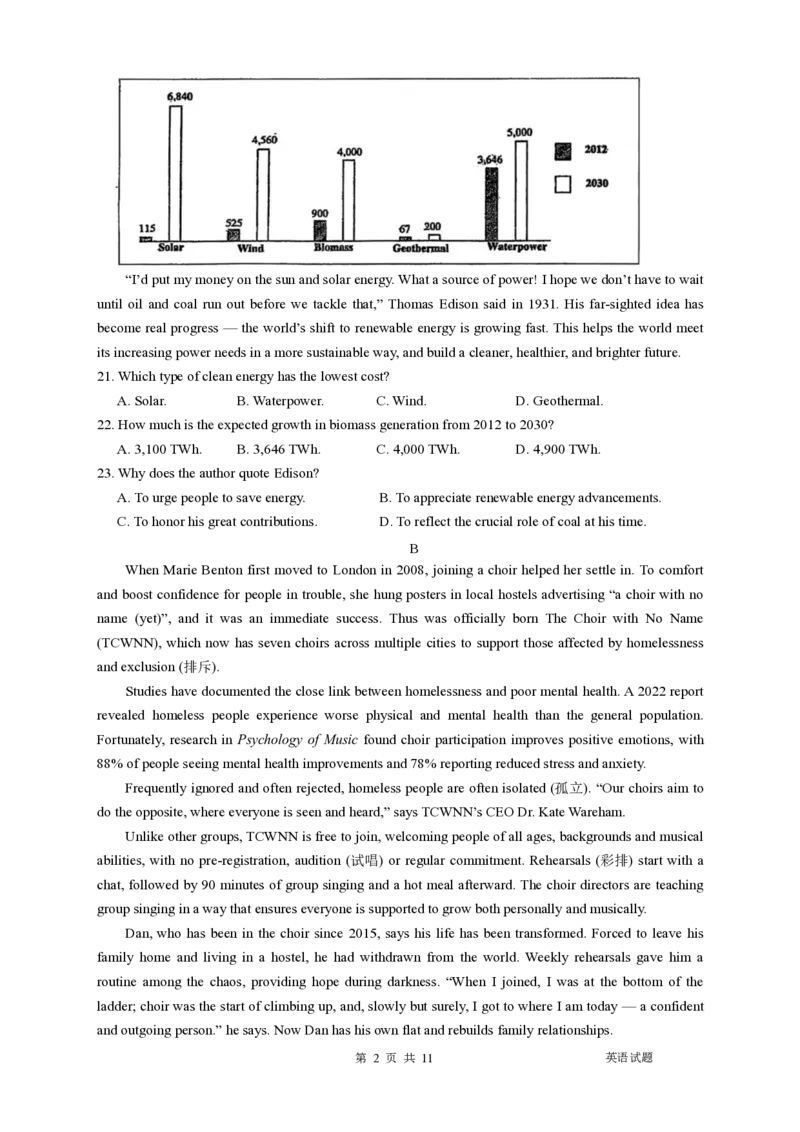
Renewable Energy Generation: 2012 vs. 2030/TWh
第 1 页 共 11 英语试题
页“I’d put my money on the sun and solar energy. What a source of power! I hope we don’t have to wait
until oil and coal run out before we tackle that,” Thomas Edison said in 1931. His far-sighted idea has
become real progress — the world’s shift to renewable energy is growing fast. This helps the world meet
its increasing power needs in a more sustainable way, and build a cleaner, healthier, and brighter future.
21. Which type of clean energy has the lowest cost?
A. Solar. B. Waterpower. C. Wind. D. Geothermal.
22. How much is the expected growth in biomass generation from 2012 to 2030?
A. 3,100 TWh. B. 3,646 TWh. C. 4,000 TWh. D. 4,900 TWh.
23. Why does the author quote Edison?
A. To urge people to save energy. B. To appreciate renewable energy advancements.
C. To honor his great contributions. D. To reflect the crucial role of coal at his time.
B
When Marie Benton first moved to London in 2008, joining a choir helped her settle in. To comfort
and boost confidence for people in trouble, she hung posters in local hostels advertising “a choir with no
name (yet)”, and it was an immediate success. Thus was officially born The Choir with No Name
(TCWNN), which now has seven choirs across multiple cities to support those affected by homelessness
and exclusion (排斥).
Studies have documented the close link between homelessness and poor mental health. A 2022 report
revealed homeless people experience worse physical and mental health than the general population.
Fortunately, research in Psychology of Music found choir participation improves positive emotions, with
88% of people seeing mental health improvements and 78% reporting reduced stress and anxiety.
Frequently ignored and often rejected, homeless people are often isolated (孤立). “Our choirs aim to
do the opposite, where everyone is seen and heard,” says TCWNN’s CEO Dr. Kate Wareham.
Unlike other groups, TCWNN is free to join, welcoming people of all ages, backgrounds and musical
abilities, with no pre-registration, audition (试唱) or regular commitment. Rehearsals (彩排) start with a
chat, followed by 90 minutes of group singing and a hot meal afterward. The choir directors are teaching
group singing in a way that ensures everyone is supported to grow both personally and musically.
Dan, who has been in the choir since 2015, says his life has been transformed. Forced to leave his
family home and living in a hostel, he had withdrawn from the world. Weekly rehearsals gave him a
routine among the chaos, providing hope during darkness. “When I joined, I was at the bottom of the
ladder; choir was the start of climbing up, and, slowly but surely, I got to where I am today — a confident
and outgoing person.” he says. Now Dan has his own flat and rebuilds family relationships.
第 2 页 共 11 英语试题
页24. Why did Marie Benton start TCWNN?
A. To establish a choir network across the UK.
B. To help herself settle in London quickly.
C. To help with the promotion of local hostels.
D. To uplift people facing hardships.
25. What does the research in Psychology of Music show?
A. Growing popularity of singing activities.
B. The poor physical health of homeless people.
C. The link between homelessness and mental health.
D. Positive effects of choir involvement on health.
26. What does TCWNN feature?
A. Advanced registration. B. Easy access for everyone.
C. High attendance demands. D. Professional musical skills.
27. What can be a suitable title for the text?
A. TCWNN: Where Every Voice Matters B. Hope: What Science Says about Choirs
C. Singing: A Way to Beat Stress D. Music: A Cure for Poor Health
C
A field trip to a water treatment plant inspired two teenagers from Texas to develop a device that
targets one of the most widespread forms of modern pollution: microplastics.
As detailed by Business Insider, Victoria Ou and Justin Huang, who have been friends since primary
school, won a $50,000 prize after presenting their ultrasonic microplastic filter (超声波微塑料过滤器).
They revealed their invention in May at the Regeneron International Science and Engineering Fair (ISEF)
in Los Angeles, a platform for young innovators working on projects to benefit humanity.
Ou and Huang, both 17, had long cared about environmental issues, but their trip to the water
treatment plant was when the light bulb went on regarding their ISEF project. There, they discovered that
microplastics are not regulated and thus remain in our wastewater. “We wanted to find a solution to this
because current solutions aren’t really effective,” Huang explained.
Though microplastics, measuring less than five millimeters, are hard to detect, a study shows that the
average person consumes a credit-card-sized amount every week. They are linked to serious health issues
including cancer, dementia (痴呆) and organ damage.
While existing methods to remove microplastics show some promise, they have severe limitations,
including high costs and a tendency to cause pollution. To solve these problems, Huang and Ou developed
a filter that uses ultrasonic waves to trap microplastics without blocking the flow of water. According to a
Society for Science news release, this method can remove 84% to 94% of microplastics from water.
In the future, the pair plans to scale up (扩大规模) their device into an affordable method for
widespread use. They also hope to create a smaller version for household use, such as filtering water
during laundry. “But first we have to improve it, as the technology is still in its early stage,” Huang said.
28. What does the underlined part “the light bulb went on” in paragraph 3 mean?
A. An issue disappeared. B. An inspiration emerged.
C. A device was revealed. D. A reward was secured.
第 3 页 共 11 英语试题
页29. What is paragraph 4 intended to show?
A. The influence of the new device. B. The major causes of microplastics.
C. The need to handle microplastics. D. The current serious water problem.
30. What is an advantage of Huang and Ou’s device according to the text?
A. It is free of charge. B. It is eco-friendly.
C. It can reuse microplastics. D. It filters 100% of microplastics.
31. What is Huang’s opinion about their device?
A. It is far from promising. B. It is under fire.
C. It is to be bettered. D. It is well received.
D
What if everything happens for a reason? Burnt toast theory, a modern view on this classic idea,
suggests that every little inconvenience we experience in our day-to-day lives happens for a bigger reason.
Imagine you accidentally burn your toast before leaving for work. According to burnt toast theory,
this tiny inconvenience can cause a domino effect (多米诺效应). Your morning gets delayed by three to
five minutes — just enough time to leave the house later than usual and avoid a potential car accident. Or
perhaps you catch a later train, missing an awkward encounter with someone you don’t intend to see. You
might even meet someone new whom you wouldn’t have otherwise met, leading to a friendship or
romantic connection.
When we feel like things are outside our control, that can be scary. The burnt toast theory can help
some people let go of their need for control and take negative situations more positively.
However, while maintaining a positive mindset can be beneficial, over-optimism can lead to
“poisonous positivity”.(公众号悦爱学堂) When we only allow ourselves to focus on positive thoughts, we
are denying ourselves the chance to properly deal with challenges and difficult situations to better
ourselves, focusing on creating a false positive façade (表象) instead. By constantly avoiding negative
experiences, we might ignore their real impact on us and fail to acknowledge when we’re struggling. It can
make us feel worse about ourselves, and may lead to pushing down negative feelings or experiences, and
refusing to acknowledge or deal with them fully.
Instead of focusing purely on positive thinking, working towards developing a growth mindset may
be more helpful. You don’t always have to look for life’s silver linings, or even the meaning behind a little
burnt toast. Sometimes things happen, and they suck. But as long as we take time to acknowledge how
these things make us feel, and recognize that we can’t always control everything around us, we can still
work towards improving ourselves. It is how we handle life’s unexpected changes that really matters.
32. What can be inferred from the burnt toast theory?
A. Lost in the east, gained in the west. B. Life is a process, not a destination.
C. Lost time will never be found again. D. Life is full of endless challenges.
33. Which can be an outcome from “poisonous positivity”?
A. Inability to control emotions. B. Decline in physical health.
C. Loss of chances to grow. D. Failure to acknowledge others.
34. Which can be seen as a growth mindset mentioned in the last paragraph?
A. Avoiding pushing others too hard. B. Finding reasons for failure.
第 4 页 共 11 英语试题
页C. Always looking on the bright side. D. Accepting misfortunes in life.
35. What is the author’s purpose in writing the text?
A. To illustrate a theory and its hidden risks. B. To explain the function of a life theory.
C. To advocate ignoring daily negative things. D. To prove troubles bring hidden benefits.
第二节(共5小题;每小题2.5分,满分12.5分)
阅读下面短文,从短文后的选项中选出能填入空白处的最佳选项。选项中有两项为多余选项。
For individuals with social anxiety, entering a social gathering can feel overwhelming, as if you are
under the spotlight and nothing you say will be possibly smart or funny enough. This fear can trigger
different physical and mental symptoms. For some people, it may lead to a fast heartbeat, dizziness and a
red face. 36 . Here are some tips to help you carry on a conversation when you have social
anxiety.
Practice in low-pressure settings
Before attending a major event, try starting short conversations with waiters or neighbors. These
small interactions can be a low-pressure way to build confidence. Smaller, manageable social interactions
don’t carry as much emotional weight, so you can practice without feeling stressed. 37 .
Use the echo technique
Another powerful technique is to “echo” the speaker. Paraphrase what they’ve said and encourage
them to explain further. For example, if they mention they’re struggling at work, repeat back their words
with a question in your voice: “Struggling?” 38 . It also takes the pressure off you, as you don’t
have to think of replies on the spot.
Find an anchor
Try to find a physical “anchor” (锚点) when anxiety attacks. Holding a cold drink, pressing your
feet firmly into the floor, or touching a small object can bounce you back to the present moment and signal
safety to your brain. 39 .
40
The good news about social events is that they all eventually end — and your departure can arrive
as soon as you’d like. Informing friends beforehand of a planned leave time, or having a polite excuse to
end a conversation (e.g., “It was really nice talking to you — I’m going to check in with Jane.”) can help
reduce anxiety about being trapped in a conversation.
A. Avoid social events politely
B. Have an exit strategy ready
C. This simple response often leads them to share more
D. It ensures you can keep the dialogue flowing without needing to flee
E. Others might be in a negative thought cycle, or feel like their mind is going blank
F. Over time, you’ll gain a sense of confidence as you step into larger social settings
G. Sensory tricks like these help you stay focused on the present and thus relieve anxiety
第三部分 语言运用(共两节, 满分30分)
第一节(共15小题;每小题1分,满分15分)
阅读下面短文, 从每题所给的A、B、C、D四个选项中选出可以填入空白处的最佳选项。
第 5 页 共 11 英语试题
页Mrs. Reed noticed the empty lot in her community was overgrown with weeds, a dull spot in the
lively neighborhood. The abandoned area was filled with dry grass and scattered (分散的) garbage, which
not only 41 the neighborhood’s beauty but also wasted valuable space.
Instead of complaining, Mrs. Reed 42 to take brave action. She knocked on every neighbor’s
door, warmly 43 they work together to turn the messy lot into a dynamic community garden.
At first, only a few people 44 — young parents hoping to teach their kids about nature, retired
elders looking for a relaxing pastime, and even some teens 45 to find a meaningful activity to fill
their weekends. They gathered every weekend, rolling up their sleeves to work hard: clearing weeds,
turning hard soil with shovels (铲子), and carefully 46 plots so that everyone had their own small
area to tend. 47 , more people joined. Young adults brought their own gardening tools to share; busy
office workers woke up early every morning to water the plants before going to work, 48 they grew
well.
Slowly but steadily, the empty lot transformed. It wasn’t just a garden anymore; it 49 a warm
gathering place where neighbors chatted happily, helped each other out, and built closer bonds. Passers-by
often stopped to 50 the beautiful garden. Mrs. Reed always smiled and said, “A small idea, when
acted on together, can change a place 51 .”
Kindness and cooperation don’t need grand 52 — they start with one person having enough
53 to take the first step, and grow when everyone is willing to join in and contribute their bit.
The 54 became living proof of community spirit. Neighbors who once barely exchanged
greetings now shared stories over watering cans and harvest baskets. The 55 from an ignored lot to a
cherished shared space taught everyone the power of collective action.
41. A. ruined B. created C. saved D. challenged
42. A. chose B. agreed C. refused D. pretended
43. A. urging B. claiming C. suggesting D. confirming
44. A. watched B. hesitated C. protested D. participated
45. A. content B. eager C. unwilling D. qualified
46. A. drawing B. building C. dividing D. finding
47. A. Gradually B. Instantly C. Suddenly D. Normally
48. A. guessing B. ensuring C. doubting D. ignoring
49. A. broke into B. ran into C. turned into D. looked into
50. A. overlook B. paint C. avoid D. admire
51. A. slightly B. completely C. hardly D. cautiously
52. A. tools B. promises C. gestures D. effects
53. A. courage B. patience C. time D. wisdom
54. A. cleaning B. garden C. movement D. seed
55. A. fall B. distance C. trend D. journey
第二节 (共10小题;每小题1.5分,满分15分)
阅读下面短文, 在空白处填入1个适当的单词或括号内单词的正确形式。
第 6 页 共 11 英语试题
页Canadian musicians Rozette and JKAI never expected their “reaction” videos, 56 they started
to create and post simply for fun, to go viral in China.
Rozette first 57 (appear) on the stage about 20 years ago and earned praise with her powerful
voice, impressive stage performances and 58 (accomplish) singing. With her vocal skills and musical
knowledge, (公众号悦爱学堂)Rozette shares in the videos her instant feelings about the singer’s
performance, the song’s production values, and even the singer’s personality .
They rarely make 59 (preparation) or do any research about the song or singer they are to
review, meaning that the reactions are natural, honest and spontaneous (自发的). Such honesty is 60
unique and key feature valued by an audience seeking a refreshing view of China.
Yet as the 61 (popular) of their videos increases, some people question their qualifications.
JKAI, who plans the videos, however, is relaxed about the mixed opinions and determined to stick 62
their original plan of delivering genuine and spontaneous reviews, 63 (ask) their audience to “agree to
disagree” instead.
With the universal language of music, they would also like to inspire audiences beyond their videos.
Both JKAI and Rozette feel it is their mission 64 (remind) people of what “real and raw” human
voices sound like. “ 65 makes us human is that we all have flaws (缺陷). It is meaningful if we can
even slightly change people’s minds and help them stop pursuing perfection.” JKAI says.
第四部分 写作(共两节,满分40分)
第一节 (满分15分)
假定你是李华,你校交换生 Jack正在做一项关于高中生学习中使用AI的情况研究,寻求你的
帮助。你给他写邮件说明你了解的情况,内容包括:
(1) 同学使用AI的情况;
(2) 你的看法。
注意: (1) 写作词数应为80个左右;
(2) 请按如下格式在答题卡的相应位置作答。
第 7 页 共 11 英语试题
页Dear Jack,
Yours,
Li Hua
第二节 (满分25分)
阅读下面材料,根据其内容和所给段落开头语续写两段,使之构成一篇完整的短文。
I felt looked down upon, degraded, and rejected in seventh grade. At school and at home, I was
constantly blamed for things I never did, feeling low, embarrassed, and forever behind. Their opinions
defined me — I truly believed I was worthless.
A new start came in Mr. Lee’s ninth-grade science class with a group project on insect behavior — a
topic I’d secretly loved since childhood. I’d stayed up late reading books, drawing sketches (草图) of ant
groups, and even setting up a small observation box at home. As expected, when group formation began, I
was left standing alone. “She’ll just sit there doing nothing,” whispered Omar, a boy from the front row.
My cheeks burned, and I slid my notebook into my desk, fighting back tears. Just then, Mr. Lee walked
over. He picked up my notebook — filled with detailed sketches of ant groups I had been making for
months. “I’ve been reviewing your observations,” he said, his voice warm and firm. “Your notes on the
ants’ communication methods are remarkably precise, and your sketches show exceptional attention to
detail. Seeing such a bright kid fills me with pleasure.”
The word “bright” deeply touched me. Fueled by this first-ever praise, I decided to work alone,
spending every lunch break on my observations while others worked in groups.
One afternoon, I entered the lab to find my observation box broken, ants running everywhere, and
my precious notebook — the very proof of my “brightness” — was torn apart. Omar called it an accident. I
sank to the floor, tears streaming down my face, my hard-won confidence broken completely. I felt as
worthless as I had in seventh grade, unaware of Mr. Lee’s approach until his gentle voice pulled me from
the darkness.
注意:(1) 续写词数应为 150个左右;
(2) 请按如下格式在答题卡的相应位置作答。
第 8 页 共 11 英语试题
页“Your brightness isn’t torn like the notebook,” Mr. Lee said softly.
On presentation day, I proved my true worth through the restored project.
英语听力
注意事项:英语听力共两节,共20小题,每小题1.5分,满分30分。
做题时,先将答案标在试卷上。录音内容结束后,你将有两分钟的时间将试卷上的答案转涂到
答题卡上。
第一节 (共5小题;每小题1.5分,满分7.5分)
听下面5段对话。每段对话后有一个小题,从题中所给的A、B、C三个选项中选出最佳选项,
并标在试卷的相应位置。听完每段对话后,你都有10秒钟的时间来回答有关小题和阅读下一小题。
每段对话播放两遍。
1. What will the man probably ask his dad for?
A. A dog. B. A cat. C. A rabbit.
2. What does the woman mean?
A. She objects to moving the bed.
B. She accepts Susie’s suggestion.
C. She refuses to buy new curtains.
3. What did the man and his sister use to do during summer vacations?
A. They watched TV. B. They went outdoor camping. C. They played in the park.
4. What is the woman’s duty in the event?
A. To distribute flyers. B. To play in the band. C. To give directions.
5. Why would Sarah miss the group presentation?
A. She got her part covered. B. Her flight was delayed. C. She didn’t plan for it.
第 9 页 共 11 英语试题
页第二节 (共15小题;每小题1.5分,满分22.5分)
听下面 5 段对话或独白。每段对话或独白后有几个小题,从题中所给的 A、B、C 三个选项中
选出最佳选项,并标在试卷的相应位置。听每段对话或独白前,你将有时间阅读各个小题,每小题
5秒钟;听完后,各小题将给出5秒钟的作答时间。每段对话或独白读两遍。
听第6段材料,回答6、7题。
6. What are the speakers mainly talking about?
A. A photo. B. A job. C. A lighthouse.
7. What does the man think of working in La Jument?
A. It’s meaningful. B. It’s worthwhile. C. It’s dangerous.
听第7段录音,回答第8至10题。
8. What is the probable relationship between the speakers?
A. Brother and sister. B. Husband and wife. C. Father and daughter.
9. Where are the man’s glasses?
A. On his nose. B. In his pocket. C. In the bathroom.
10. What impressed the man most about his forgetfulness?
A. He forgot to take the fishing pole.
B. He was not dressed appropriately.
C. He went fishing on his wedding day.
听第8段录音,回答第11至13题。
11. Who is the woman most probably?
A. A consumer. B. A supplier. C. An investor.
12. What do we know about Paul?
A. He is raising money for his business.
B. He is designing clothes for the woman.
C. He is giving the woman a clothing class.
13. How does Paul sound?
A. Stressed. B. Ambitious. C. Doubtful
听第9段录音,回答第14至17题。
14. Why is the man being interviewed?
A. He’s publishing a book. B. He’s acting in a movie. C. He’s filming a TV series.
15. How did the man become successful?
A. By getting a good education.
B. By enriching work experience.
C. By learning from a great coach.
16. What did the man learn from his experience?
A. It’s easy to get a stable job.
B. It’s useful to read more books.
C. It’s important to learn persistence.
17. What will the woman do next?
A. Hand out some books. B. Talk to the next guest. C. Discuss her future plans.
听第10段录音,回答第18至20题。
18. What is the main goal of the C-dramas according to the speaker?
A. To educate people. B. To entertain people. C. To sell things to people.
19. What positive effect do C-dramas have?
第 10 页 共 11 英语试题
页A. They encourage people to travel to China.
B. They enrich the content of history textbooks.
C. They inspire people’s interest in Chinese culture.
20. What is the main topic of the talk?
A. The educational role of C-dramas.
B. The factual issues within C-dramas.
C. The international impact of C-dramas.
第 11 页 共 11 英语试题
页