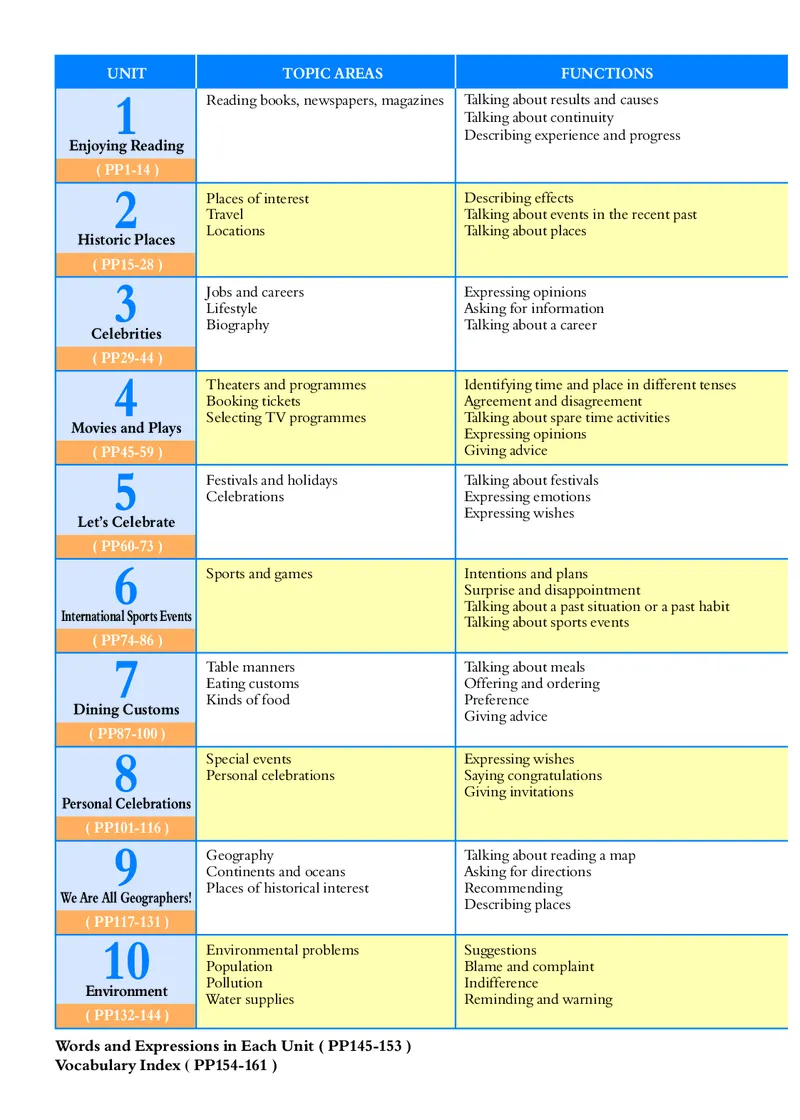
UNIT
TOPIC AREAS
FUNCTIONS
Enjoying Reading
Historic Places
Celebrities
Let’s Celebrate
International Sports Events
Dining Customs
Personal Celebrations
We Are All Geographers!
Environment
Words and Expressions in Each Unit ( PP145-153 )
Vocabulary Index ��PP154-161 )
( PP1-14 )
( PP15-28 )
( PP29-44 )
( PP45-59 )
( PP60-73 )
( PP74-86 )
( PP87-100 )
( PP101-116 )
( PP117-131 )
( PP132-144 )
Reading books, newspapers, magazines
Places of interest
Travel
Locations
Jobs and careers
Lifestyle
Biography
Theaters and programmes
Booking tickets
Selecting TV programmes
Festivals and holidays
Celebrations
Sports and games
Table manners
Eating customs
Kinds of food
Special events
Personal celebrations
Geography
Continents and oceans
Places of historical interest
Environmental problems
Population
Pollution
Water supplies
Talking about results and causes
Talking about continuity
Describing experience and progress
Describing effects
Talking about events in the recent past
Talking about places
Expressing opinions
Asking for information
Talking about a career
Identifying time and place in different tenses
Agreement and disagreement
Talking about spare time activities
Expressing opinions
Giving advice
Talking about festivals
Expressing emotions
Expressing wishes
Intentions and plans
Surprise and disappointment
Talking about a past situation or a past habit
Talking about sports events
Talking about meals
Offering and ordering
Preference
Giving advice
Expressing wishes
Saying congratulations
Giving invitations
Talking about reading a map
Asking for directions
Recommending
Describing places
Suggestions
Blame and complaint
Indifference
Reminding and warning
1
2
3
4
5
6
7
8
9
10
Movies and Plays
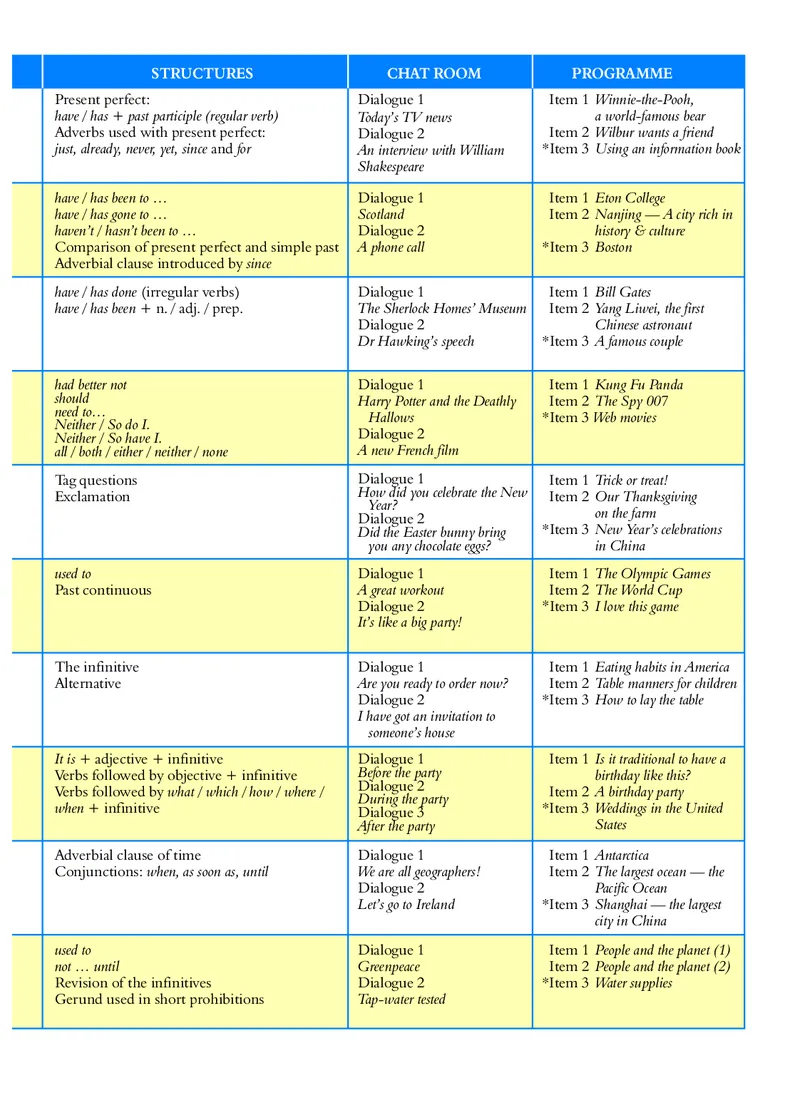
STRUCTURES
CHAT ROOM
PROGRAMME
Present perfect:
have / has + past participle (regular verb)
Adverbs used with present perfect:
just, already, never, yet, since and for
have / has been to …
have / has gone to …
haven’t / hasn’t been to …
Comparison of present perfect and simple past
Adverbial clause introduced by since
have / has done (irregular verbs)
have / has been + n. / adj. / prep.
had better not
should
need to…
Neither / So do I.
Neither / So have I.
all / both / either / neither / none
Tag questions
Exclamation
used to
Past continuous
The infinitive
Alternative
It is + adjective + infinitive
Verbs followed by objective + infinitive
Verbs followed by what / which / how / where /
when + infinitive
Adverbial clause of time
Conjunctions: when, as soon as, until
used to
not … until
Revision of the infinitives
Gerund used in short prohibitions
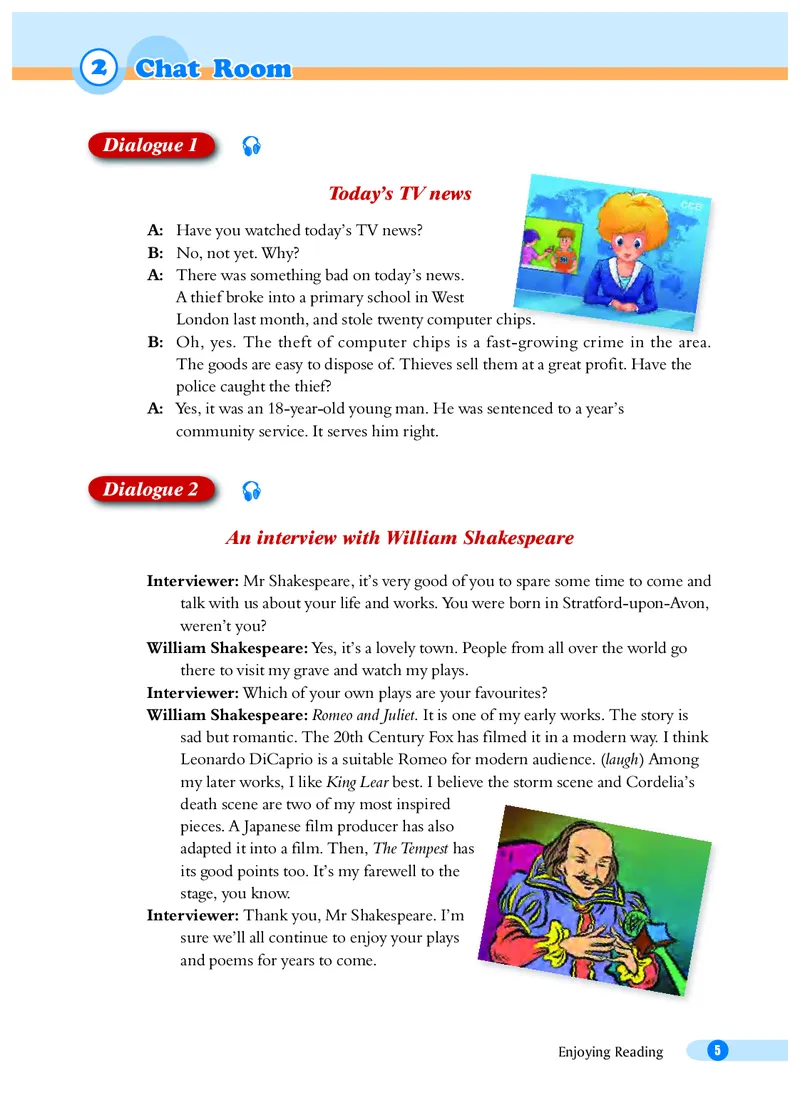
Dialogue 1
Today’s TV news
Dialogue 2
An interview with William
Shakespeare
Dialogue 1
Scotland
Dialogue 2
A phone call
Dialogue 1
The Sherlock Homes’ Museum
Dialogue 2
Dr Hawking’s speech
Dialogue 1
Harry Potter and the Deathly
Hallows
Dialogue 2
A new French film
Dialogue 1
How did you celebrate the New
Year?
Dialogue 2
Did the Easter bunny bring
you any chocolate eggs?
Dialogue 1
A great workout
Dialogue 2
It’s like a big party!
Dialogue 1
Are you ready to order now?
Dialogue 2
I have got an invitation to
someone’s house
Dialogue 1
Before the party
Dialogue 2
During the party
Dialogue 3
After the party
Dialogue 1
We are all geographers!
Dialogue 2
Let’s go to Ireland
Dialogue 1
Greenpeace
Dialogue 2
Tap-water tested
Item 1 Winnie-the-Pooh,
a world-famous bear
Item 2 Wilbur wants a friend
*Item 3 Using an information book
Item 1 Eton College
Item 2 Nanjing — A city rich in
history & culture
*Item 3 Boston
Item 1 Bill Gates
Item 2 Yang Liwei, the first
Chinese astronaut
*Item 3 A famous couple
Item 1 Kung Fu Panda
Item 2 The Spy 007
*Item 3 Web movies
Item 1 Trick or treat!
Item 2 Our Thanksgiving
on the farm
*Item 3 New Year’s celebrations
in China
Item 1 The Olympic Games
Item 2 The World Cup
*Item 3 I love this game
Item 1 Eating habits in America
Item 2 Table manners for children
*Item 3 How to lay the table
Item 1 Is it traditional to have a
birthday like this?
Item 2 A birthday party
*Item 3 Weddings in the United
States
Item 1 Antarctica
Item 2 The largest ocean — the
Pacific Ocean
*Item 3 Shanghai — the largest
city in China
Item 1 People and the planet (1)
Item 2 People and the planet (2)
*Item 3 Water supplies
Unit
Unit
Enjoying Reading
Enjoying Reading
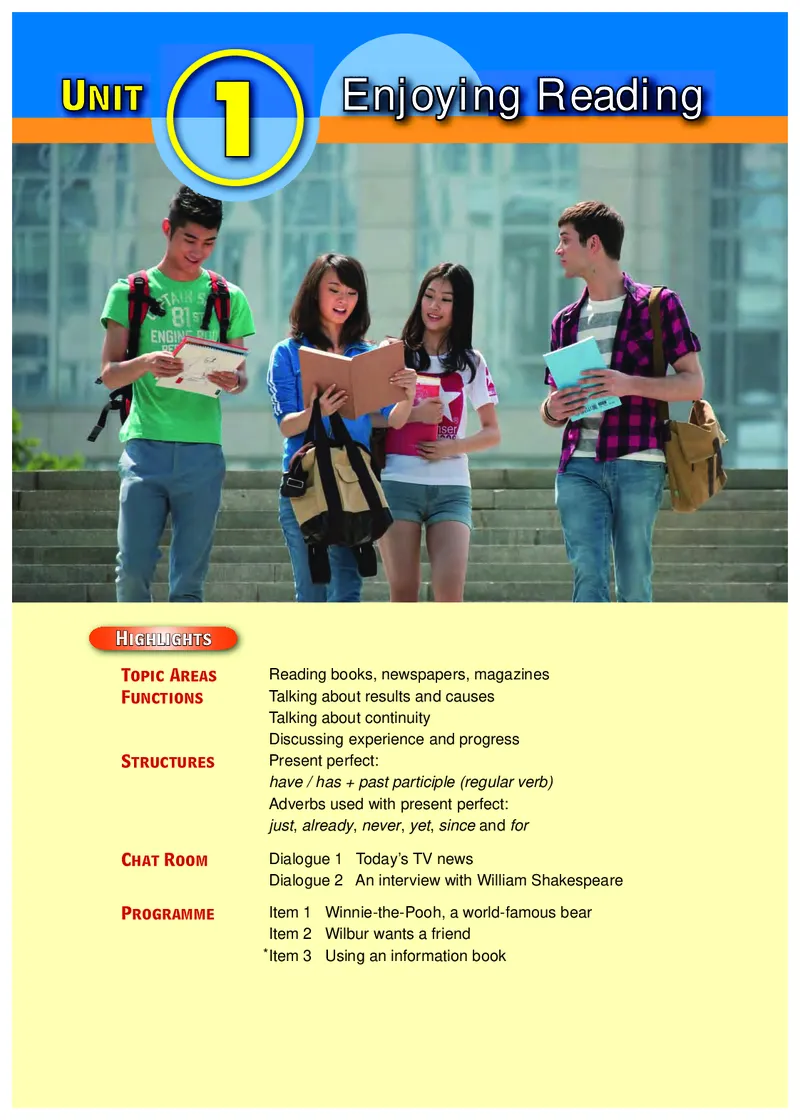
1
Topic Areas
Reading books, newspapers, magazines
Functions
Talking about results and causes
Talking about continuity
Discussing experience and progress
Structures
Present perfect:
have / has + past participle (regular verb)
Adverbs used with present perfect:
just, already, never, yet, since and for
Highlights
Highlights
Chat Room
Dialogue 1 Today’s TV news
Dialogue 2 An interview with William Shakespeare
Programme
Item 1 Winnie-the-Pooh, a world-famous bear
Item 2 Wilbur wants a friend
Item 3 Using an information book
*
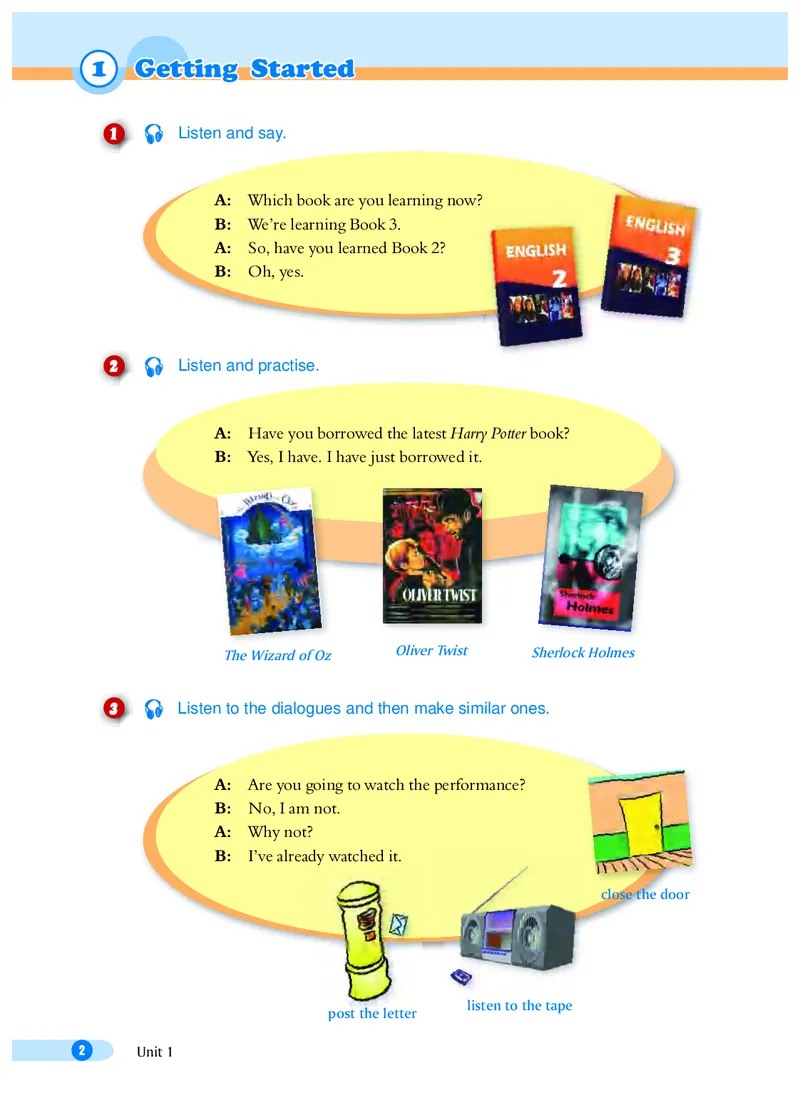
The Wizard of Oz
Oliver Twist
Sherlock Holmes
post the letter
close the door
1 � Listen and say.
A: Which book are you learning now?
B: We’re learning Book 3.
A: So, have you learned Book 2?
B: Oh, yes.
2 � Listen and practise.
A: Have you borrowed the latest Harry Potter book?
B: Yes, I have. I have just borrowed it.
3 � Listen to the dialogues and then make similar ones.
A: Are you going to watch the performance?
B: No, I am not.
A: Why not?
B: I’ve already watched it.
Getting Started
Getting Started
1
post the letter
listen to the tape
2
Unit 1
dry the dishes
carry the bag upstairs
play the tape
magazine
talk with your monitor
collect these stamps
fill the bottle
look up the word
in the dictionary
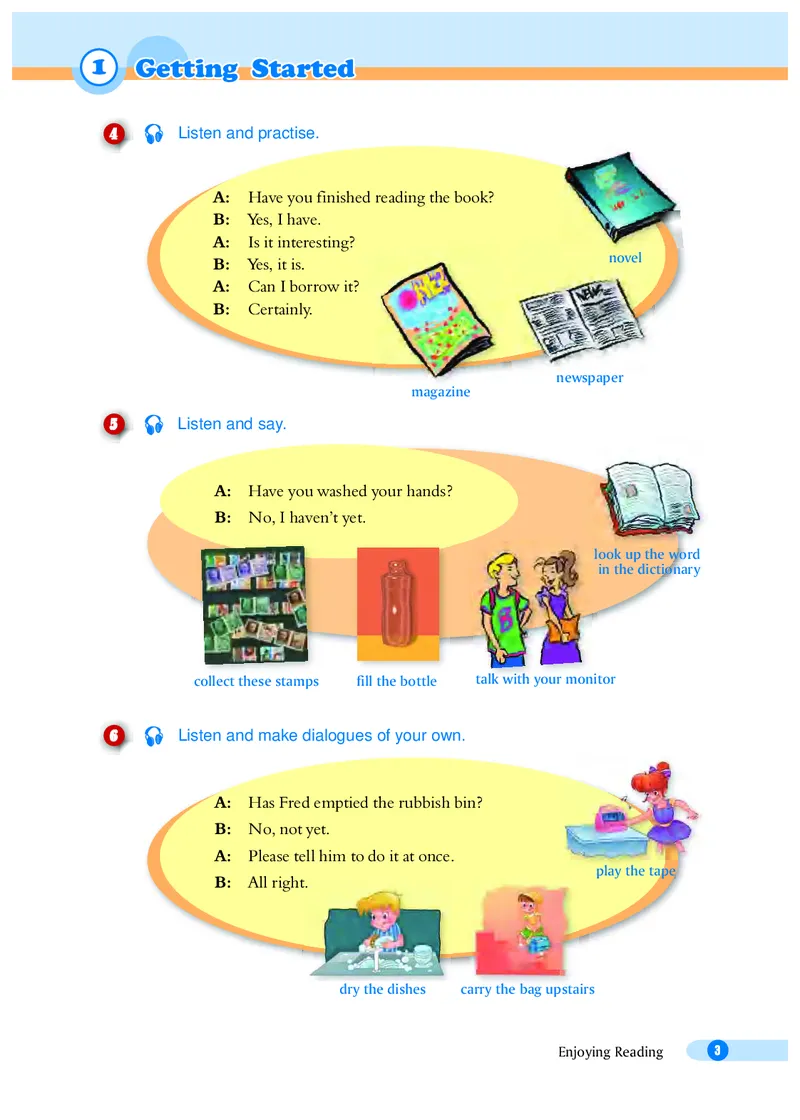
5 � Listen and say.
A: Have you washed your hands?
B: No, I haven’t yet.
6 � Listen and make dialogues of your own.
A: Has Fred emptied the rubbish bin?
B: No, not yet.
A: Please tell him to do it at once.
B: All right.
4 � Listen and practise.
1
Getting Started
Getting Started
i
ma
rd
wor
look up the w
talk with your mon
t
d
th di h
t.
th b
t
l
th t
A: Have you finished reading the book?
B: Yes, I have.
A: Is it interesting?
B: Yes, it is.
A: Can I borrow it?
B: Certainly.
novel
newspaper
3
Enjoying Reading
paint the wall
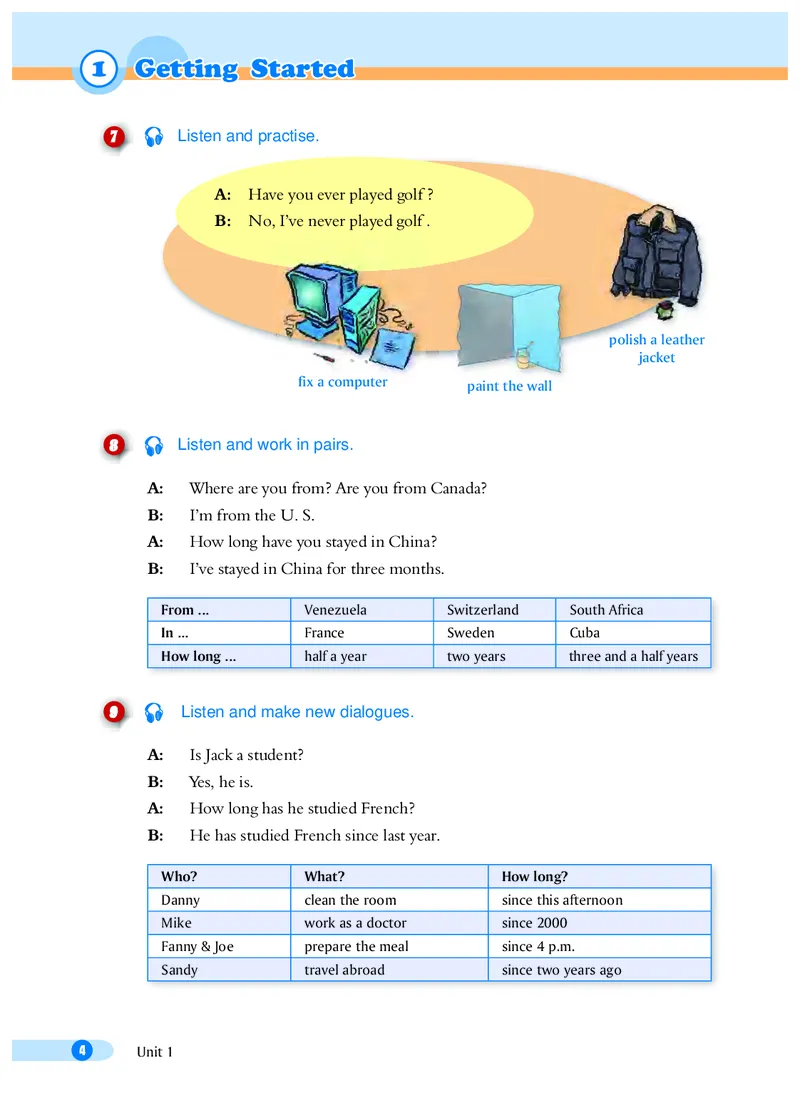
7 � Listen and practise.
A: Have you ever played golf ?
B: No, I’ve never played golf .
8 � Listen and work in pairs.
A: Where are you from? Are you from Canada?
B: I’m from the U. S.
A: How long have you stayed in China?
B: I’ve stayed in China for three months.
From ...
Venezuela
Switzerland
South Africa
In ...
France
Sweden
Cuba
How long ...
half a year
two years
three and a half years
9 � Listen and make new dialogues.
A: Is Jack a student?
B: Yes, he is.
A: How long has he studied French?
B: He has studied French since last year.
Who?
What?
How long?
Danny
clean the room
since this afternoon
Mike
work as a doctor
since 2000
Fanny & Joe
prepare the meal
since 4 p.m.
Sandy
travel abroad
since two years ago
Getting Started
Getting Started
1
g
i t th
ll
i
h
ll
polish a leather
jacket
fix a computer
4
Unit 1
Dialogue 1 �
Today’s TV news
A: Have you watched today’s TV news?
B: No, not yet. Why?
A: There was something bad on today’s news.
A thief broke into a primary school in West
London last month, and stole twenty computer chips.
B: Oh, yes. The theft of computer chips is a fast-growing crime in the area.
The goods are easy to dispose of. Thieves sell them at a great profit. Have the
police caught the thief?
A: Yes, it was an 18-year-old young man. He was sentenced to a year’s
community service. It serves him right.
Dialogue 2 �
An interview with William Shakespeare
2
Chat Room
Chat Room
hips.
t growing crime in the area
Interviewer: Mr Shakespeare, it’s very good of you to spare some time to come and
talk with us about your life and works. You were born in Stratford-upon-Avon,
weren’t you?
William Shakespeare: Yes, it’s a lovely town. People from all over the world go
there to visit my grave and watch my plays.
Interviewer: Which of your own plays are your favourites?
William Shakespeare: Romeo and Juliet. It is one of my early works. The story is
sad but romantic. The 20th Century Fox has filmed it in a modern way. I think
Leonardo DiCaprio is a suitable Romeo for modern audience. (laugh) Among
my later works, I like King Lear best. I believe the storm scene and Cordelia’s
death scene are two of my most inspired
pieces. A Japanese film producer has also
adapted it into a film. Then, The Tempest has
its good points too. It’s my farewell to the
stage, you know.
Interviewer: Thank you, Mr Shakespeare. I’m
sure we’ll all continue to enjoy your plays
and poems for years to come.
s
5
Enjoying Reading
3
Programme
Programme
Item 1
Winnie-the-Pooh, a world-famous bear
1 � Listen to the passage and fi ll in the blanks according to the text you hear.
Winnie-the-Pooh first made his appearance in a (1) ________ called Teddy
Bear in 1923. Three years later, Milne (2) _______ his stories about Winnie-
the-Pooh. Since then, Winnie-the-Pooh has become a (3) _______ bear. The
characters, such as Pooh, Piglet, Eeyore, Tigger, Kanga and Roo, are based on
the real (4) _______ of Milne’s son’s. The boy’s name was Christopher Robin.
The artist named E.H. Shepard (5) _______ the lovely pictures of the Ashdown
Forest and the characters in the stories.
2
Read the passage and match the words or phrases with their defi nitions.
Have you ever read Winnie-the-Pooh? Here is something about the book.
Winnie-the-Pooh made his fi rst appearance in a poem called Teddy Bear by
Alan Alexander Milne in Punch magazine in 1923. In 1926, Milne fi rst published
his stories about Winnie-the-Pooh. They were a great success. Since then, Winnie-
the-Pooh has become a world-famous bear. The characters of Pooh, Piglet, Eeyore,
Tigger, Kanga and Roo, are based on the real toys of Milne’s son’s. The boy’s name
was Christopher Robin. The artist, E.H. Shepard, drew the lovely Ashdown Forest
and the characters in the stories. Today, you can still see the places he drew.
6
Unit 1
3
Programme
Programme
3
Do you know anything about “Winnie and his friends”? Share what you know
with your classmates.
Column A
Column B
(1) appearance
a. produce (a book / newspaper / magazine)
(2) publish
b. a person in a book, fi lm, etc.
(3) character
c. the way something or someone looks
(4) success
d. something very popular
lamb
fence
( )
( )
( )
( )
( )
( )
( )
( )
( )
( )
gnaw
hatch
rat
Item 2
Wilbur wants a friend
1
Choose the right picture that each word describes.
7
Enjoying Reading
Questions:
(1) Who has Wilbur asked to play?
(2) Why don’t the others want to play with Wilbur?
(3) Who is Templeton?
(4) What do you think Wilbur will do next?
3
� Listen to the next part of this story with your book closed. Then read the
passage, ask your partner some questions about the passage and fi nd the
answers together.
Late that afternoon, Lurvy went to Mr Zuckerman. “I think there’s something
wrong with that pig of yours. He hasn’t touched his food.”
“Give him two spoonfuls of medicine,” said Mr Zuckerman.
Wilbur couldn’t believe what was happening to him when Lurvy caught
him and forced the medicine down his throat. This was certainly the worst
day of his life.
Darkness settled over everything. Soon there were only shadows and
noises of the sheep chewing. You can imagine Wilbur’s surprise when, out of
the darkness, came a small voice. It sounded rather thin, but pleasant. “Do
you want a friend, Wilbur?” it said. “I’ll be a friend to you. I have watched
you all day and I like you.”
“But I can’t see you,” said Wilbur, jumping to his feet. “Where are you?
And who are you? ”
“I’m right up here,” said the voice. “Go to sleep. You’ll see me in the
morning.”
3
Programme
Programme
2 � Listen to the passage with your book shut. Then read it and answer the questions.
It is still raining outside. Wilbur feels lonely in the barn.
He has asked the goose to come and play, but the goose is sitting on her
eggs. Of course she doesn’t play when there are eggs to hatch.
He has tried one of the lambs, but the lamb, in the fi rst place, is not old enough
to jump over the fence, and in the second place, she is not interested in pigs!
He has asked Templeton.
“Play? I never do those things if I can avoid them,” replied the rat, sourly. “I
prefer to spend my time eating, gnawing, spying and hiding. Right now I am
on my way to your trough to eat your breakfast.”
8
Unit 1
4
Act out the story.
5
Discussion
Do you know anything else about Wilbur? What book is the story chosen
from? Do you know any other animals in the story? Who do you like best?
Discuss the questions with your partner.
3
Programme
Programme
Introduction
2-3
IN THE NEWS
The Spread of Drug Use
4-5
An International Concern
6-7
Drugs and the Media
8-9
WHAT IS A DRUG?
The Facts about Drug Use
10-11
The History of Drug Use
12-13
The Risks to Health
14-15
Laws and Restrictions
16-17
Tracking the Cargoes
18-19
Where to Turn
20-21
Confl icts of Opinion
22-23
LATEST NEWS
Drugs in the Public Eye
24-25
A Growing Occurrence?
26-27
A New Approach
28-29
What Can We Do?
30
Glossary
31
Index
32
*Item 3
Using an information book
1
Here are the contents page and parts of the glossary and the index from a
book on drugs. Learn how to use these pages.
addiction
10, 14, 27, 31
advertising
8-9
alcohol
2, 5, 6, 8, 10, 11,
12-13, 14, 15, 16, 20
amphetamines
5, 7, 11, 18, 19
caffeine
2, 6, 11, 16
cocaine
2, 11, 12, 18, 19
crack
2, 11, 20, 22, 29
crime
26
dealers
3, 6-7, 17
detoxifi cation
centers
14-15
drug misuse
31
education
3, 20, 23, 27, 28, 30
effects
10-11, 14-15, 27, 30
entertainment
industry
25
history
12-13
punishment
3, 17, 22, 27-28
reasons
4, 24-25, 31
restrictions
16-17, 30
Box 1
Box 2
9
Enjoying Reading
2
Read and answer the questions. What is a contents page? What is an index?
What is a glossary? Which box in Ex. 1 is a contents page? Which is an in-
dex? Which is a glossary?
An index tells you where to fi nd
specifi c things. It comes near the
end of the book.
A glossary tells you the meaning of
new words. It comes near the end
of the book.
A contents page tells you what sec-
tions the book is divided into. It
comes at the beginning of a book.
3
Read the boxes in Ex. 1 again and answer the following questions.
(1) On which page can you fi nd The History of Drug Use?
(2) Suppose you need some information about the public opinion on drugs. Which
article will you read? Where is the article?
(3) Suppose we want to put a stricter control on the use of drugs. Which page has
the related information?
(4) Which pages of the book give the information about cocaine?
(5) What is addiction? Where can we fi nd details about addiction in this book?
(6) What does the media mean?
(7) Where else can you fi nd the word restrictions besides pages 16 &17?
(8) Where does the Index page start?
(9) On which page is the Glossary?
3
Programme
Programme
Abuse
To use something in an excessive or harmful way.
Addiction
A habit that is very diffi cult to break.
Coca
The shrub from which cocaine is obtained.
Counseling
Helping people to understand their problems by talking with them.
Dependent
Not able to live a normal life without a certain substance, object or person.
Detoxifi cation
Cleaning the body of a poison or drug.
Hallucinations Seeing the world in a different way, or seeing visions.
Illegal
Unlawful
Impurity
Something that is mixed into a purer substance.
Media
Newspapers, books, TV, fi lms, magazines, etc.
4
Find a book that contains a contents page, an index and a glossary. Show it
to your classmates.
A.
B.
C.
Box 3
10
Unit 1
4
Message Box
Message Box
Box 3
I’ve = I have
You’ve = You have
haven’t = have not
hasn’t = has not
Box 5
since + a specifi ed time
for + a length of time
1941
January
last Sunday
the beginning of the year
then
fi ve years
one and a half years
three weeks
seven days
Box 2
-ed
paint-painted-painted
kick-kicked-kicked
-d
close-closed-closed
decide-decided-decided
-yed
play-played-played
stay-stayed-stayed
-ied
try-tried-tried
reply-replied-replied
-**ed
admit-admitted-admitted
rub-rubbed-rubbed
Box 1
/d/
rain-rained-rained
open-opened-opened
show-showed-showed
clean-cleaned-cleaned
/t/
look-looked-looked
pass-passed-passed
watch-watched-watched
pump-pumped-pumped
/Id/
want-wanted-wanted
wait-waited-waited
pretend-pretended-pretended
mend-mended-mended
Box 4
affi rmative
sentence
I have (already) watched this movie.
He has (already) visited this city.
negative
sentence
I have not watched this movie (yet).
I have never watched this movie.
He has not visited this city (yet).
He has never visited this city.
interrogative
sentence
Have you (already/ever) watched
this movie (yet)?
Has he (already/ever) visited
this city (yet)?
11
Enjoying Reading
5
Data Bank
Data Bank
1 � When there is an adverbial at the beginning of a sentence, there is
always a rising tone. Look at the following examples.
2 � Read the following sentences, paying attention to the tones.
(1) Down there you can see several trees.
(2) At once he fastened the seat belt.
(3) There comes Thomas.
(4) Immediately she opened the suitcase.
(5) Behind the screen some performers are operating the puppets.
1
Presentation
Give a brief introduction of your favourite book or author.
6
DIY Lab
DIY Lab
(1) Here the �cars �don’t �travel on the �right.
(2) Right now he’s �sitting at his �desk.
(3) Here �people have �two �days �off �every �week.
(4) In �front of the blackboard there’s a �teacher’s �desk.
(5) �Under the portraits there’s a �blackboard.
2
Pair Work
Make up your own dialogue between Wilbur and Charlotte,
and perform it with your deskmate.
12
Unit 1
6
DIY Lab
3 Group Work
Choose a book mentioned in this unit to do some group reading.
Talk with your group members about the part you have read.
5 Internet Surfing
Browse on the Internet for a book that you are interested in.
Tell your classmates who is the author of the book, what the book is
about and when it was published.
7
Culture Corner
Compared with traditional reading, digital reading is more convenient. You
can read anywhere and anytime. If you are under conditions of darkness,
you can still continue to read the book that you have not finished. The main
reasons for people buying e-books online are possibly lower prices, in-
creased comfort and a larger selection of titles.
4 Problem Solving
Your school is going to build a new modern library. As a librar-
ian, please give your suggestions on how to design this library,
including how to divide rooms properly, what kinds of books to
buy, how to arrange books, etc. Talk about your plan.
13
Enjoying Reading
1
Riddles.
3
� A song.
8
Game Zone
Game Zone
(1) I went to school one morning.
And I walked like this.
Walked like this, walked like this.
I went to school one morning.
And I walked like this,
All on my way to school.
(2) I saw a little robin,
And he hopped like this.
Hopped like this, hopped like this.
I saw a little robin and he hopped like this.
All on my way to school.
(3) I saw a shiny river,
And I splashed like this, splashed like this.
I saw a shiny river and I splashed like this.
All on my way to school.
(1) What kind of ball is fun to play with but doesn’t bounce?
(2) The alphabet goes from “a” to “z”, what goes from “z” to “a”?
(3) From what number can you take a half and leave nothing?
(4) When is a house not on land nor on water?
Who has seen the wind?
Neither I nor you;
But when the leaves
Hang trembling,
The wind is passing through.
Who has seen the wind?
Neither you nor I;
But when the trees
Bow down their heads,
The wind is passing by.
Who Has Seen The Wind?
Christina Rossetti
I went to school one morning
(4) I saw a little pony,
And he galloped like this…
(5) I saw a poor old lady,
And she hobbled like this…
(6) I saw a tall policeman,
And he stood like this…
(7) I heard the school bell ringing,
And I ran like this…
2
� A rhyme.
14
Unit 1
15
. 15 .
Unit
Unit
Historic Places
Historic Places
2
Topic Areas
Places of interest
Travel
Locations
Functions
Describing effects
Talking about events in the recent past
Talking about places
Structures
have / has been to …
have / has gone to …
haven’t / hasn’t been to …
Comparison of present perfect and simple past
Adverbial clause introduced by since
Highlights
Highlights
Chat Room
Dialogue 1 Scotland
Dialogue 2 A phone call
Programme
Item 1 Eton College
Item 2 Nanjing – A city rich in history & culture
Item 3 Boston
*
Leaning Tower of Pisa
Pisa, Italy
Big Ben
London, England
Neuschwanstein Castle
Bavaria, Germany
1 � Listen and learn.
2
Look at the pictures and make similar dialogues.
Getting Started
Getting Started
1
A: Have you ever been to China?
B: Yes, I have.
A: Have you been to the Great Wall?
B: No, I haven’t. Where is it?
A: It’s in Beijing.
3 � Listen and practise.
A: Has Tony ever been to France?
B: Yes, he has.
A: Has he been to the Eiffel Tower?
B: No, he hasn’t. Where is it?
A: It’s in Paris.
You
the Pyramids and Sphinx
Giza
Egypt
Ricky
Leeds Castle
Kent
England
Larry and Jane
Arc de Triomphe
Paris
France
16
Unit 2
the swimming pool
the Children’s Palace
church
6 � Listen and practise in the same way.
1
Getting Started
Getting Started
4 � Listen and practise.
A: Where’s your father?
B: He has gone to Scotland. He will stay in Edinburgh.
Dick’s brother
the US
New Orleans
Donna
France
Marseille
Kate and Ann
Greece
Athens
5 � Listen and practise.
A: Have they gone to India?
B: No, they haven’t. They will leave the day after tomorrow.
Tony
Thailand
next Monday
Angela
Venezuela
tomorrow morning
Kate and Ann
Greece
Nov. 12
church
h
h
A: I didn’t see you just now. Where have you been?
B: I’ve been to the cinema.
A: When did you go to the cinema?
B: This afternoon.
17
Historic Places
Getting Started
Getting Started
1
a model of the Eiffel Tower
France, 2009
a cushion
India, 2010
a pair of wooden shoes
Holland, last year
7 � Listen and make similar dialogues.
8 � Listen and make similar dialogues.
A:
I bought this hat in Mexico in 2001.
B: Have you been to Mexico since then?
A: No, I haven’t been there since I came back.
a necklace
the Philippines,
3 years ago
a pair of wooden shoe
Who?
Where?
Since when?
Which year?
I
New Zealand
I got married
2004
Jim
Finland
he became an engineer
1996
A: Have you been to South Africa recently?
B: No. I haven’t been there since I moved to Europe.
A: When were you in South Africa last time?
B: I was there in 1997 last time.
18
Unit 2
(Telephone rings.)
A: Hello!
B: Hi, is that Tom? This is Uncle Ray. Is your father there?
A: Hello, Uncle Ray. Dad isn’t at home. He’s gone to India.
B: India! What for?
A: He’s on a business trip.
B: He hasn’t been to India before, has he?
A: No, he hasn’t. He said he would go to the Taj Mahal.
B: Sounds good. He is very busy, though.
A: Yes. He travels a lot and is rarely home.
B: When is he coming back?
A: In two weeks, I think.
B: OK, I’ll call him then. Bye, Tom.
A: Bye-bye, Uncle Ray.
Dialogue 2 �
A phone call
2
Chat Room
Chat Room
Dialogue 1 �
Scotland
A: Great to see you again! Where have you been recently?
B: I’ve just been to Scotland.
A: Scotland! Terrific! It’s a beautiful place, isn’t it?
B: Yes, it is. Scotland is famous for its castles and waterfalls.
A: Have you been to Stirling Castle? It’s said
that Stirling Castle is unique.
B: Yes, I’ve been there. Stirling Castle is the
grandest of Scotland’s castles. Here are some
photographs.
A: Oh, what nice pictures! I hope that I can
go there one day!
19
Historic Places
3
Programme
Item 1
Eton College
1
Look at the pictures and match them with the words.
2
Match the words in column A with their definitions in column B.
rats
scholar
tailcoat
pin-striped trousers
3 Listen to the passage with your book shut. Then read the passage and
answer the questions.
In 1440, Henry VI founded Eton College to provide free education for 70
poor scholars. They would then go on with their study at King’s College,
Cambridge. Life in the early days was harsh — rats ran free and the boys had
to wash outside using only cold water. Since then, the school has become
one of the most elite in the United Kingdom.
Nineteen former British Prime Ministers were educated in Eton, includ-
ing the Duke of Wellington. The school uniform has always been a black tail-
coat and waistcoat, and pin-striped trousers since the 1850s.
Today Eton is a secondary school (a “high school” in the American sense)
for about 1,280 boys between the ages of 13 and 18. Most of the boys reside
in the United Kingdom while some are from overseas.
Column A
Column B
(1) poor
a. live
(2) harsh
b. having very little money
(3) educate
c. unpleasant
(4) reside
d. teach
20
Unit 2
3
Programme
Programme
4
You are a tour guide at Eton College. You are now introducing it to your part-
ner, a visitor to Eton College for the fi rst time. You should tell him/her about:
(1) its history (Who founded it? And for whom?)
(2) its tradition (How was life in the early days? What is the school uniform like?)
(3) its reputation (How many former British Prime Ministers were educated here?)
(4) its present condition (What kind of school is it today?)
2
� Listen to the following text with your book shut. Then read it and answer
the questions.
When someone mentions Nanjing, you probably think of an ancient city be-
cause it used to be the capital city of six dynasties in Chinese history.
Nanjing, now the capital city of Jiangsu Province in China, has long been
one of China’s most important cities. Nanjing means “southern capital”. In
Nanjing you can still see many historic and cultural sites such as the Ming
Tombs. This site has now been on the UNESCO World Heritage List.
Another most popular place to visit is the Qin Huai River. On the south
bank of the river, there is the longest stretch of city wall in China. The
110-meter-long wall is all made of brick. The river itself is well-known for
Item 2
Nanjing – A city rich in history & culture
1
Have you ever been to Nanjing? What are some famous tourist attractions in
this city? Which do you like best?
Questions:
(1) When was Eton College founded?
(2) For whom did it provide free education?
(3) Does Eton’s school uniform change all the time?
(4) Are there any girl students at the school?
21
Historic Places
Questions:
(1) What does Nanjing mean?
(2) What kind of city is Nanjing?
(3) What can visitors see along Qin Huai River?
(4) When is a good time to enjoy the beautiful scenery on Qin Huai River?
(5) How may you feel when you are walking in the city of Nanjing?
3
Read the passage again and match the words in column A with their mean-
ings in column B.
4
Find a place in Nanjing or a city of China that you are interested in and
introduce it to the class.
5
Discussion
How can we keep such a grand place in good condition?
3
Programme
Programme
its picturesque scenery. Visitors can enjoy the sight of the houses and halls
with green windows and red doors on both sides of the river. The scenery is
especially magnifi cent during the Lantern Festival as you can see boats with
beautiful lanterns fl oating on the river like bright dragons.
When you walk in the city, in the midst of skyscrapers and old buildings,
you may feel you are at the crossroads of modernity and history.
Column A
Column B
(1) ancient
a. very good, very beautiful
(2) tomb
b. from a long time ago
(3) magnifi cent
c. a very tall building
(4) fl oat
d. a place for a dead person to be buried
(5) skyscraper
e. to stay on the water, not sinking
22
Unit 2
3
Programme
Programme
*Item 3
2 � Listen to the tape and answer the questions.
(1) Is the Boston Tea Party Ship now a famous historic spot?
(2) How many ships landed at Boston on Nov. 27, 1773?
(3) What did some Americans throw into the sea one cold evening
in December, 1773?
1
The following is a part of a map
of Boston. How can we get to
the Boston Tea Party Ship from
State Street?
3
� Read the passage after the tape.
Have you been to Boston? Have you visited the Boston Tea Party Ship Mu-
seum? It has long been a famous historic spot.
An important event happened on November 27, 1773. Three ships from
the East India Co. landed at Boston. All the ships were full of tea. The compa-
ny sold the tea in the U.S. without paying tax. This was unfair to Americans.
On the cold evening of December 16, 1773, some Americans dressed them-
selves as Red Indians and went onto the ships and threw the tea into the sea.
Now you can see a full-size copy of the Beaver, one of the three ships,
in Boston. It was made in 1973. Guests may recreate the scene by throwing
bags of tea over the side of the ship. A tea party takes place on the ship each
year on December 16. Don’t forget to grab a cup of tea (tax-free) on your
way out!
5
Topic Discussion
Why did some Americans throw the tea into the sea?
4
Retell the story with the help of the given words or phrases.
Boston
three ships
tea
dress as
throw
23
Historic Places
4
Message Box
Message Box
Box 2
They
have
gone
to Canada.
He /She / It
has
Box 4
I have already been to Mexico.
I haven’t been to Mexico for two years.
I have never been there.
I haven’t been there since I moved to China.
Box 1
I /We/You/They /
He /She / It
have / has
already
been to
Canada.
not
Canada yet.
Box 5
Forming possessive with the use of apostrophe
Referring to
Examples
human beings
Have you got Sidney’s telephone number?
This is the teachers’ reading room.
They have gone to the Children’s Palace.
animals
It’s made from cow’s milk.
time
Where’s today’s newspaper?
place
The Summer Palace is one of Beijing’s fi nest parks.
Most of the earth’s surface is covered with water.
other
She is one of the company’s oldest employees.
We’ll meet at the hotel’s entrance.
I can’t remember the book’s title.
Box 3
He has been to Canada.
(He is back. He isn’t in Canada now.)
He has gone to Canada.
(He isn’t here. Maybe in Canada or maybe on his way there.)
24
Unit 2
5
Data Bank
Data Bank
She is a doctor, so is her husband.
He loves the people and they love him.
I haven’t got any brothers, but I’ve got a brother-in-law.
He was a leader of the student movement and took an active part in
revolutionary work.
They have many diffi culties, but they never give up.
She gave him a push and he caught on at once.
1
� Read the following sentences. Can you summarize how we read such
a sentence generally?
2
� Read the following sentences. Can you fi gure out when we read the
sentences this way?
1
Presentation
Bring a picture of a historic place and introduce it to your classmates.
6
DIY Lab
DIY Lab
Intonation in Compound Sentences
25
Historic Places
6
DIY Lab
DIY Lab
3
Survey
Ask your classmates which countries they have been to. Note down the num-
ber and work out the percentage.
5
Topic Discussion
Should we charge admission fees for entrance to the historic places?
Why or why not?
2
Pair Work
Interview your partner. Ask him/her about a place he/she has been to. Here
are some expressions for help.
� Have you been to … ?
� You have been to …, haven’t you?
� When did you go to…?
4
Problem Solving
Would you please design a monument to symbolize the city you live in?
6 6 Internet Surfi ng
Find four famous historic places on the Internet and fi ll in the chart.
No.
Number of the students
who have been to …
Total number of the
students
Percentage
America
Australia
Germany
What’s it
called?
Which country
is it in?
What is its
location?
When is it open
to the public?
How much is the
admission charge?
Country
26
Unit 2
8
Game Zone
Have you ever been to any historic places in and out of China? Can you see any dif-
ference between Chinese constructions and foreign constructions?
First, they are different in architectural style. In China, there are many temples
and pagodas whereas in Western countries there are many churches and castles.
Then you often see works of calligraphy and ink paintings inside the Chinese
constructions, but in the West you see oil paintings and wall frescos.
Chinese traditional construction
Brough Castle, UK
1 A game.
Look at the letters in the pictures and make eight winter weather words. The
words are all in the wrong pictures. Write each word under the correct picture.
Winter Weather
1
2
5
3
7
4
8
6
It’s ..............................
It’s ..............................
It’s .............................................
It’s ..............................
It’s ..............................
It’s ..............................
It’s ..............................
It’s ..........................................
7
Culture Corner
It’s ..............................
It’s .............................................
It’s ..............................
It’s ..............................
It’s ..........................................
27
Historic Places
Pussy cat, pussy cat
Pussy cat, pussy cat,
Where have you been?
I’ve been to London to see the Queen.
Pussy cat, pussy cat,
What did you do there?
I frightened a little mouse under the chair.
Red river valley
From the valley they say you are going
We will miss your bright eyes and sweet smile
For they say you are taking me sunshine
That will brighten our pathway a while
Come and sit by my side if you like me
Do not hasten to bid me goodbye
But remember the red river valley
And the girl that is yours all the time.
8
Game Zone
Game Zone
3
� A song.
2
� A rhyme.
28
Unit 2
Unit
Celebrities
3
Topic Areas
Jobs and careers
Lifestyle
Biography
Functions
Expressing opinions
Asking for information
Talking about a career
Structures
have / has done (irregular verbs)
have / has been + n. / adj. / prep.
Highlights
Chat Room
Dialogue 1 The Sherlock Holmes’ Museum
Dialogue 2 Dr Hawking’s speech
Programme
Item 1 Bill Gates
Item 2 Yang Liwei, the first Chinese astronaut
Item 3 A famous couple
*
Getting Started
Getting Started
1
A: Have you heard from John?
B: Yes, I have.
A: Have you found your watch?
B: No, I haven’t.
A: Has the party begun yet?
B: No, it hasn’t yet.
A: Has Dick written to his mother?
B: Yes, he already has.
1 � Listen and make similar dialogues.
2 � Listen and make similar dialogues.
hear from John
hear – heard – heard
fi nd the watch
fi nd – found – found
pay the bill
pay – paid – paid
make the model plane
make – made – made
bring the exercise book
bring – brought – brought
begin the party
begin – began – begun
write to his mother
write – wrote – written
see the fi lm
see – saw – seen
take the medicine
take – took – taken
speak at the meeting
speak – spoke – spoken
run with Paul
run – ran – run
come to school
come – came – come
become a manager
become – became – become
30
Unit 3
1
Getting Started
Getting Started
read the book
read – read – read
cut the bread
cut – cut – cut
set the table
set – set – set
3 � Listen and practise.
A: How long have you been an actor?
B: I’ve been an actor for two years.
A: How long has Jerry been ill?
B: He’s been ill since last Saturday.
A: How long have Maria and Gary been in this school?
B: They’ve been in this school for two and a half years.
Mike
a teacher
for 20 years
Sandy
a tour guide
since she left school
Danny
angry
for two hours
Fred
upset
since he heard the news
Fanny & Joe
on holiday
for a week
the moon
up in the sky
since 6 p.m.
31
Celebrities
4 � Listen and practise.
A: Have you had lunch?
B: Yes, I have.
A: When did you eat your lunch?
B: An hour ago.
a party – yesterday
a meeting – last week
a haircut – two days ago
a holiday – last month
dinner – just now
measles – at the age of 10
Getting Started
Getting Started
1
A: What are you looking at?
B: Oh, there has been a fire. It lasted for 20 minutes.
5 � Listen and practise.
What?
It lasted for …?
a fi ght
10 minutes
a traffi c jam
2 hours
a running race
45 minutes
6 � Listen and practise.
(1) A: How long have you lived here, Harry?
B: I’ve lived here for about five years.
(2) A: How long has Mr Green known you?
B: He’s known me since I went to primary school.
32
Unit 3
1
Getting Started
Getting Started
Dick / football player / played in
this team / for 5 years / since 2006
7
Make dialogues of your own, using the following words and phrases.
Jack / doctor / worked in this hospi-
tal / for 8 years / since he came here
Mike / singer / performed in this opera /
for 2 years / since he moved to Chicago
Diana / maths teacher / taught in this
school / for 12 years / since she was 24
33
Celebrities
Getting Started
Getting Started
1
Diana / borrow / the book / this
morning / keep / for ten days
8 � Listen, repeat and make dialogues of your own.
A: What has happened?
B: Donna has just left home.
A: When did she leave?
B: A few minutes ago.
A: How long will she be away from home?
B: Maybe for a couple of weeks.
Emily / jump / the stage / five minutes
ago / stay / for a few minutes
Frank / join / the army / last
week / a soldier / for 5 years
Chris / join / the club / yesterday /
a club member / for two years
34
Unit 3
2
Chat Room
Chat Room
A: You’ve been to London, haven’t you?
B: Yes, my favourite place was 221b Baker Street, the Sherlock Holmes’ Museum.
A: Oh, yes. Sherlock Holmes is my favourite detective. I’ve read almost all the
stories about him.
B: Me too. His face is well-known around the world. Many people have read
Conan Doyle’s detective stories.
A: You know a lot about Sherlock Holmes.
B: Yes, I have been to his house in Baker Street.
A: Great, By the way, you know that’s his fictional home, right?
B: Of course. Sherlock Holmes is a fictional character, but it is based on a real
detective though.
A: Did you go to Dr Hawking’s speech last month?
B: Sorry, I didn’t have a chance to go. Could you tell me something about him?
A: Yes. He was born in Oxford, England in 1942, and is now a Cambridge profes-
sor and the author of many scientific books.
B: I’ve heard A Brief History of Time is his best-selling book.
A: That’s right. He’s a most brilliant physicist.
His achievements are especially remarkable, for he
has suffered from a neuromotor disease for over
thirty years.
B: What is a neuromotor disease like?
A: Oh, he can’t move his body, and can only speak
with the help of a computer.
B: No wonder so many people admire him.
The Sherlock Holmes’ Museum
Dr Hawking’s speech
Dialogue 1 �
Dialogue 2 �
he
35
Celebrities
Programme
Programme
3
a.
won a maths aptitude test at school
b. born in Seattle in 1955
c.
left university without getting a degree
d. went to Harvard
e.
set up his own computer company
______ (1) Bill Gates is an American.
______ (2) He didn’t do very well at school.
______ (3) He never took a book home or went to maths classes.
______ (4) He studied at Yale University.
______ (5) He became one of the world’s richest men.
______ (6) He owns twenty houses.
______ (7) He lives near Lake Washington.
Bill Gates was born in Seattle, USA, in 1955. When he was at school, he never took
a book home to study or attended maths classes. However, he fi nished among the
top ten in the country in a maths aptitude test. He then went to Harvard, but left
without getting a degree. Then he started up his computer company Microsoft.
By the age of forty-one, he was one of the world’s richest men. Unlike some bil-
lionaires, he is not shy about spending his money: he owns twenty Ferraris, each
worth more than £150,000. And he lives in a high-tech mansion overlooking Lake
Washington. Bill Gates has decided to donate most of his money to education and
charity. He now spends most of his time trying to solve problems such as disease
and hunger in poor nations.
( ) → ( ) → ( ) → ( ) → ( )
Bill Gates
1 � Listen to the tape. Put the following events in order of time.
2 � Listen again. Decide whether the following statements are true (T)
or false (F).
3
Read and learn.
Item 1
36
Unit 3
3
Programme
Programme
4
Retell the text with the help of the given expressions.
Seattle → maths aptitude test → Harvard → without … degree →
Microsoft → richest → spending money → Ferraris → mansion
Bill Gates visited China in February, 2003. His speech caused a stir in the young
Chinese audience. On 28 February, Microsoft signed an agreement with the Chinese
government. It gave China controlled access to its Windows operating systems
and other technologies. Bill Gates, head of the US software giant, said on Friday in
Beijing that his two-day trip to China was short and fruitful. The contract he signed
would be a milestone in Microsoft’s development in China, the world’s most popu-
lous country.
5
Do you know?
6
Surf the Internet and fi nd more information (or stories) about Bill Gates? Tell
your classmates.
Yang Liwei, the first Chinese astronaut
1
Topic Discussion
Yang Liwei has long been famous not only in China but also around the world.
Why do you think he is so famous? What do you know about him?
Item 2
37
Celebrities
3
Programme
Programme
Yang Liwei is the fi rst man who travels in a Chinese spacecraft. His mission, Shen-
zhou 5, made China the third country to have independently sent people into
space. Because of him, a new word coined in the West to name the Chinese astro-
naut “Taikonaut”.
Yang Liwei was born on June 21, 1965 in Liaoning Province. His mother was a
teacher, and his father was an accountant. He is married. His wife is an army offi cer
too.
Yang was selected as an astronaut candidate in 1998 and had trained for space
fl ight since then. He was chosen from the fi nal pool of 13 candidates to fl y on Chi-
na’s fi rst manned space mission. Then, on October 15, 2003, Shenzhou 5 spacecraft
was launched at Jiuquan Satellite Launch Center. Before the launch, almost nobody
in public knew about the Chinese astronaut candidates. His selection was not an-
nounced to the media until the day before the launch.
Many people have long thought that the Great Wall is the only human construc-
tion on earth that astronauts can see from space. But Yang Liwei said he didn’t see
it in space. Astronauts can see many cities from space, but unfortunately, the Great
Wall is so narrow that they can’t recognize it.
3
Write the questions with the help of given answers.
2 � Listen to the text with your book shut. Then read the text and put
the following events in time order.
( ) a. His selection for the Shenzhou 5 launch was told to the media.
( ) b. He became an astronaut candidate.
( ) c. He was born in Liaoning Province.
( ) d. He was launched into space from Jiuquan Satellite Launch Center.
( ) e. The new word “Taikonaut” became well-known.
Example:
Q: When was Yang Liwei born?
A: Yang Liwei was born in 1965.
38
Unit 3
3
Programme
Programme
(1) Q: ________________________________________________?
A: Yang Liwei is the fi rst man sent into space by the Chinese space programme.
(2) Q: ________________________________________________?
A: “Taikonaut” means “Chinese astronaut”.
(3) Q: ________________________________________________?
A: He was launched into space from Jiuquan Satellite Launch Center.
(4) Q: ________________________________________________?
A: Because the Great Wall is so narrow that the astronauts can’t recognize
it from space.
(1) The Beckhams have ____ children.
A. one
B. two
C. three
D. four
(2) David Beckham now plays for ____.
A. Manchester United
B. Real Madrid
C. Los Angeles Galaxy
D. A.C. Milan
(3) Victoria Beckham is in the ____ business.
A. fashion
B. fi lm
C. computer
D. publishing
4
Retell the text with the help of Ex. 2 & Ex. 3.
A famous couple
1
Topic Discussion
Have you heard of David Beckham and Victoria Beckham?
Who are they? Do you know anything about them?
* Item 3
2 � Listen to the text and choose the best answers.
39
Celebrities
3
Programme
Programme
3
Read the text and check your answers of Ex. 2.
4
Do you know about any other celebrity couples? List as many as you can and
introduce them to your classmates.
On July 10, 2011, the Beckhams welcomed their fourth child, a daughter. The birth
of the new girl drew great attention to the celebrity couple like always.
David Beckham, born in London in 1975, is an English football star. He has
played for several famous football clubs such as Manchester United and Real Ma-
drid. Now he is a member of Los Angeles Galaxy, a professional football, or soccer,
as the sport is known in the US, team. Before his injury, he used to be the captain
of the England national team. David’s fame is beyond football. Besides his great
football skills, he has got other things to catch people’s eyes: hairstyle, clothes, and
his marriage to Spice Girl Victoria.
Victoria Adams, born in Hertfordshire in 1974, is an English singer and fash-
ion designer. In the late 1990s, Victoria became famous with the pop group Spice
Girls. Later Victoria continued her fashion career alone. She designed a few jeans
and handbags, wrote two books, and took part in some TV shows. Wherever she is,
people recognize her at once.
David met Victoria in 1996. It was love at fi rst sight. They got married in an
Irish castle in 1999. At the time, David was 24 and Victoria was 25. Now they live
in a large house in Los Angeles and lead a happy life. They have three sons and a
daughter.
40
Unit 3
Box 1
Box 3
Box 2
Box 4
Box 5
base form
Past form
Past participle
look
play
watch
looked
played
watched
looked
played
watched
cost
put
shut
cost
put
shut
cost
put
shut
buy
get
keep
bought
got
kept
bought
got
kept
be
begin
do
sing
wear
was, were
began
did
sang
wore
been
begun
done
sung
worn
Present perfect
Past tense
Present perfect
She has just left.
She left 10 minutes ago.
She has been away for 10 minutes.
He has joined the army.
He joined the army when he was 18.
He has been a soldier for 2 years.
We have borrowed the book.
We borrowed the book last week.
We have kept the book for a week.
I have caught a bad cold.
I caught a bad cold two days ago.
I have been sick for 2 days.
Jack has gone to Rome.
Jack has been in Rome for a week.
I have just received a present.
She has planted three trees since last year.
They have already arrived at the station.
He has played basketball for ten years.
Past tense
Present perfect
Did John come?
Has John come?
How many people went to the park?
How many people have gone to the park?
We didn’t invite him.
We haven’t invited him.
Sally lost her watch.
Sally has lost her watch.
a (an)
the
Give me a book.
Give me the book.
He is a professor.
The professor is in his offi ce.
4
Message Box
Message Box
41
Celebrities
5
Data Bank
Data Bank
1 � Read the following sentences. Pay special attention to the underlined parts.
1
Presentation
Tell the class what you know about a celebrity.
2
Pair Work
You are interviewing your partner, a famous traveler. Ask him/her the following
questions and fi ll in the chart.
We’re going to stay there for four years, I suppose.
“If you go by plane,” he said, “it takes only two hours.”
“How is he today?” Tom asked.
“Am I right?” he asked.
He’s going to help us, I think.
6
DIY Lab
DIY Lab
Questions
Answers
(1) Have you travelled recently?
(2) What is your favourite place?
(3) How long did you stay there?
(4) Where did you go last time?
(5) When did you go there?
(6) Where will you go next?
42
Unit 3
6
DIY Lab
DIY Lab
7
Culture Corner
Culture Corner
3
Topic Discussion
Do you want to be a celebrity? Why or why not?
4
Problem Solving
How can you get the signature of your favourite celebrity?
5
Internet Surfi ng
Find out some basic information about 5 famous people in different fi elds by
searching on the Net. Then fi ll in the chart.
Name
Field
Birth date
Birth place
Members of family
Award(s)
Entertainment
Science
Music
Sport
Media
Madame Tussaud’s Wax Museum in London is one of the most famous wax
museums in the world. Today, over 2 million people from all over the world
visit the exhibition each year. It has become one of Britain’s most popular
tourist attractions. The museum has 3 main halls — Superstars, Grand
Hall and Horror. You fi rst take the lift into the Hall of Superstars. Inside this
room, there are world famous fi lm stars, singers and sports people such as
Hugh Grant, David Beckham, 007 actors, etc. Then you will go downstairs
into the Grand Hall, where you can meet the British Royal Family, famous
scientists, politicians and so on. You can take pictures with George W. Bush
or Queen Elizabeth. Finally, the Hall of Horrors gives visitors a horrible expe-
rience of old prisons in British history. You can also experience the disgust-
ing smell of the prison!
43
Celebrities
8
Game Zone
Game Zone
1
A game.
How good are you at trivia? Try the following trivia quiz in pairs, then compare
your answers with your deskmate’s.
(1) What is the official language of the United States of America?
(2) What sports use a bat?
(3) What does UFO stand for?
(4) Can you name eight countries where English is spoken as a first language?
(5) In America, he is called “Santa Claus”. What is he called in the U.K.?
I did, I did, I did
I did, I did, I did
I did my washing today
I did my washing today
And now it’s time to play.
I did, I did, I did
I did my work today
I did my work today
And now it’s time to play.
Shake my hand
Shake my hand and then go clap, clap, clap
Shake my foot and then go tap, tap, tap
One, two, three.
I take a little hand so you will get meal meal stop
Shake my finger, and then go snap, snap, snap
Shake my nose, then wrap, wrap, four, five, six and
Take a little hop
Then go around meal meal stop.
3
� A song.
2
� A rhyme.
44
Unit 3
Unit
Unit
Movies and Plays
Movies and Plays
4
Topic Areas
Theaters and programmes
Booking tickets
Selecting TV programmes
Functions
Identifying time and place in different tenses
Agreement and disagreement
Talking about spare time activities
Expressing opinions
Giving advice
Structures
had better not
should
need to…
Neither / So do I.
Neither / So have I.
all / both / either / neither / none
Highlights
Highlights
Chat Room
Dialogue 1 Harry Potter and the Deathly Hallows
Dialogue 2 A new French fi lm
Programme
Item 1 Kung Fu Panda
Item 2 The Spy 007
Item 3 Web movies
*
Getting Started
Getting Started
1
A: Shall we go to the cinema this afternoon?
B: We’d better not go out. Mr Blake will visit us in the afternoon.
We’d better stay at home and wait for him.
A: What should I do if I am late for the train?
B: You’d better take a taxi to the station.
A: It is said Hero is an exciting film. I want to see it.
B: I think you should book a ticket in advance. It’s not
easy to get a ticket right before the film begins.
1 � Listen and make similar dialogues.
2 � Make dialogues after the example.
3 � Listen and read.
Example
be late for the train / take a taxi
clean the blackboard
some students have not yet copied the notes
take an umbrella
it will rain late in the afternoon
call Mrs Martin
Jimmy Martin feels sick
give away the tickets
Chris and Susan want to watch the play
can’t come to your party
telephone us in advance
can’t fi nish my homework on time
ask for help
can’t understand the new words
look them up in a dictionary
46
Unit 4
4 � Complete the sentences with “You need to…” after the example.
5 � Read after the tape and make new dialogues.
6 � Listen and learn.
1
Getting Started
Getting Started
A: Have you read Hamlet and Macbeth?
B: Yes, I’ve read both of them.
A: Have you written to May or Kate?
B: No, I have not written to either of them.
(I have written to neither of them.)
A: Where are my classmates? None of them are in the classroom.
B: They have all gone to the match.
A: Oh, I must go there quickly too.
(1) sleep more
(2) buy a dictionary
(3) drink plenty of fresh milk
(4) leave right now
(5) memorize the word
Example
have a new hat
You need to have a new hat.
hear from
Mary, Kate
call
Jerry, Chris
send the parcel to
Grace, Larry
pay a visit to
Dick, Peter
A: Where are the apples? There are none left in the basket.
B: Ricky has eaten all of them.
A: Oh, I’d better go and buy some more.
47
Movies and Plays
Getting Started
Getting Started
1
A: Do you like the movie ET?
B: Yes, I like it a lot. How about you?
A: So do I. I have seen it three times.
7 � Listen and practise.
8 � Listen and complete the sentences in the table.
sing
very well
work
hard
run
fast
Micky is good at roller skating.
I ______________________, too.
So _________ I.
Mary was worried about her mother.
Jenny ______________________, too.
So _________ Jenny.
He forgot to bring the umbrella.
His brother _________________, too.
So _________ his brother.
I have broken two cups.
She ______________________, too.
So _________ she.
Mr Smith has worked in this
company for three years.
Billy and I__________________, too.
So _________ Billy and I.
see an interesting fi lm last Saturday
do a lot of washing yesterday
go on a holiday last month
made much progress
read many books
swim
read
speak
(1) A: Wang Dong speaks English fluently.
B: So does Li Hua.
(2) A: He danced all night at the ball.
B: So did I.
(3) A: The boys have done well this year.
B: So have the girls.
(4) A: I can run faster than Wang Dong.
B: So can I.
48
Unit 4
1
Getting Started
Getting Started
A: Do you want to go to the theater?
B: No, I don’t want to go.
A: Neither do I. I would rather stay at home.
9 � Listen and practise.
10
10 � Listen to the dialogue. Then complete the sentences in the same form.
play the match
visit the exhibition
read that dull novel
walk farther
wait longer
(1) A: I am not going to see the film.
B: Neither am I.
A: How about Sandy? Maybe he is.
B: No, he isn’t either.
(2) A: I can’t stay any longer.
B: Neither can I.
A: But Victor can.
B: No, he can’t either.
I’m not going to the country.
My brother ______________________, either.
Neither _______ my brother.
We weren’t able to move at all.
They ______________________, either.
Neither _______ they.
Brian couldn’t decide where
to travel.
I ______________________, either.
Neither _______ I.
Alan won’t give a
performance next week.
Alex ____________________, either.
Neither _______ Alex.
Greg hasn’t taken
the exam yet.
Tony and Joe ______________, either.
Neither _______ Tony and / or Joe.
49
Movies and Plays
Chat Room
Chat Room
2
A: Have you seen any good films recently?
B: Yes, I have just seen Harry Potter and the Deathly Hallows.
A: That is the seventh and final of the Harry Potter films, isn’t it?
B: Yes. I saw it just a few days ago.
A: Is it any good?
B: I really liked it. It was full of brilliant special effects.
A: Is Daniel Radcliffe still the main actor?
B: Yes. He has played Harry Potter since he was 11.
And now he is a 22-year-old young man.
A: So what do you think of the acting?
B: The acting is still good. I am even more impressed.
A: So do you think I would like it?
B: Yeah, I think you would. It is still exciting and moving.
A: Oh well, I’ll give it a try.
(In the afternoon)
Rowan: Why don’t we go and see a movie tonight?
Britney: That’s a good idea. What’s on?
Rowan: Well, I think that a new French film is on at the Picture Palace.
Britney: Oh, yes, I’d like to see that. Any idea what time?
Rowan: Six thirty, seven-ish? I’m not sure, but I’ll check at the booking office.
(In the evening)
Rowan: Hello, can I book two tickets for tonight’s film, the new French film?
Booking office clerk: Certainly.
Rowan: When exactly does the film begin?
Booking office clerk: Six thirty-five, sir.
Rowan: OK, I’d like to have two tickets for the back row.
Booking office clerk: Your name, please, sir?
Rowan: Rowan Blake. R-O-W-A-N, B-L-A-K-E.
Booking office clerk: 12 pounds each, 24 pounds in all, Mr Blake.
Rowan: All right. Here’s my credit card …
Harry Potter and the Deathly Hallows
A new French film
Dialogue 1 �
Dialogue 2 �
50
Unit 4
3
Programme
Programme
______ (1) It is Saturday.
______ (2) Jessica wants to see a fi lm tonight.
______ (3) Kung Fu Panda is very popular now.
______ (4) Po is the only animal in the fi lm.
______ (5) Andy and Jessica will talk about the fi lm later.
Kung Fu Panda
1 Have you seen Kung Fu Panda? How do you like it?
2 � Listen to the dialogue and decide if the following statements are
true (T) or false (F).
3
Read the dialogue and act it out.
Item 1
Andy:
Hey Jessica, how are you doing?
Jessica: I’m fi ne, thank you. The class is over and I can’t wait for
the weekend to begin!
Andy:
Yes, of course. I’m going to see a fi lm tonight, Kung Fu Panda, you know.
Jessica: Wow, that’s a great fi lm! I just saw it yesterday.
Andy:
Really? A lot of people are talking about it. Is it a cartoon?
Jessica: Well, yes, it’s an animated fi lm made by DreamWorks.
Andy:
Oh, that famous fi lm company. According to the name of the fi lm,
is it about a panda?
Jessica: Yeah, a panda named Po. The story took place in an ancient Chinese
village, and the fi lm has much Chinese culture in it.
Andy:
What’s Po like?
Jessica: Po is fat, cute, and also good at Chinese kung fu, the Chinese martial arts.
He is the hero.
51
Movies and Plays
3
Programme
Programme
4
Topic Discussion
What’s your favourite fi lm? Why do you like it? Share your ideas with your partner.
1
Look at the pictures. Who are these people? Can you say anything
about them? What fi lms do they appear in?
Item 2
2 � Listen to the tape and answer the questions.
Andy:
That sounds really interesting!
Jessica: Right, I was laughing all the time in the cinema. In the fi lm,
there’s not just the panda, but many other animals, such as…
Andy:
Hey, don’t say too much. I haven’t seen the fi lm yet.
Let’s have a discussion later.
Jessica: OK.
Andy:
Got to go. See you.
Jessica: See you.
(1) Do real heroes live and die like common people?
(2) Is the spy 007 a real hero or a fi ctional hero?
(3) Does he die?
(4) The fi rst fi lm was made in 1953, wasn’t it?
(5) Are Bond’s enemies still in Russia now?
The Spy 007
52
Unit 4
3
Programme
Programme
Real heroes are only human. They live and die like the rest of us. But fi ctional he-
roes are different. They began life many years ago and they will live on in fi ction.
Here is a popular twentieth-century fi ctional hero. He never dies.
The spy 007 has been working for the British Secret Service since 1953 when
Ian Fleming fi rst wrote about him in Casino Royale. Fleming is now dead, but the
spy still lives on. The fi rst fi lm was Dr No in 1962 and since then he has appeared
in over twenty fi lms. The Cold War has fi nished and Bond’s enemies are not the
Russians any more, but there are a lot of villains out there! Columbia Pictures, the
fi lm’s production and distribution company, has recently fi nished fi lming his latest
adventure.
4
Study the words.
5
Read the text again and answer the following questions.
6
Topic Discussion
Do you know any real heroes? Compare them with fi ctional heroes.
3 � Listen to the passage with your book shut. Then read the passage.
(1) What is a fi ctional hero’s life like?
(2) Who does the spy 007 work for?
(3) What was the fi rst fi lm in 1962 called?
(4) In how many fi lms have 007 appeared?
(5) Which fi lm studio has produced the 007 series?
(1) Antonyms
live — die real — fi ctional
(2) Word used as a noun and as a verb.
fi lm n.
Have you seen the fi lm?
fi lm v.
We fi lmed the children’s school play.
(3) Write the words with the following defi nitions.
a. a type of book or story about imaginary characters and events, not based
on real events and facts ( )
b. a person who secretly gathers and reports information about another
country or organization ( )
53
Movies and Plays
3
Programme
Programme
a. cast
b. keywords
c. review
d. title and main details
e. plot summary
f. user rating
g. memorable quotes
h. type of fi lm
Web movies
1
Have you ever read information about a fi lm on the Internet?
2
Do you know a French fi lm called The Chorus? What is it about?
* Item 3
3 Look at the web page and match the headings to the information.
ü _______________
The Chorus
(French: Les Choristes)
PG-13
Directed by Christophe Barratier
Based on a story by Wheeler
and Georges Chaperot
ý __________
Drama
Romance
þ __________
Gérard Jugnot:
Clément Mathieu
Jean-Baptiste Maunier:
Pierre Morhange
Maxence Perrin:
Pépinot
Ganye Rogers
Violette Morhange
ÿ ________
´´´´´´´³³³
71%
(769 votes)
Ā ________________
It is an adaptation of the 1945 fi lm A
Cage of Nightingales.
In 1949, a young Pierre (Pepinot) is the
badly behaved son of a single mother.
He attends a boarding school for “dif-
fi cult” boys with a strict headmaster.
New teacher Mathieu brightens up the
school and assembles a choir, leading to
the discovery of Pierre’s musical talents
and a transformation in the children.
Pierre fi nally becomes a widely success-
ful orchestra conductor.
ā __________
boy
boarding school
teacher
choir
French countryside
54
Unit 4
3
Programme
Programme
4
Read these comments made by Internet users about The Chorus.
What rating out of ten do you think each person gave the fi lm?
Ă ______________
• (Morhanges mother has come to visit him)
Clément Mathieu: [quietly] I didn’t tell her last time
that you were in detention, I told her you had a
toothache and went to the dentist. Don’t tell her I
lied.
• Pépinot enfant: I don’t know any songs.
Clément Mathieu: Well, I’ll teach you some. For the
moment, I’ll name you assistant choir master.
• Eddie: No. You let me talk. Now enough is enough
here. That boy needs a father. He needs a man in
his life — somebody he can talk to, somebody who
can teach him, somebody who can show him.
ă _____________
The Chorus (or Les Cho-
ristes in its homeland) may
follow the well-trodden
path of inspiring teacher
features past, but this
Oscar-nominated movie is
so well made and downright
entertaining that you can’t
help but be sucked in by its
Gallic charms.
— Matt McAllister
Published on Friday,
25 March 2005
‘I must say I enjoyed this movie, even after some people considered it
an advert from the French countryside Tourist Board.’ James, New York
RATING 6/10
‘It’s fascinating to see how a fi lm without violence, action or sex can still
be so good. Christophe Barratier has really succeeded in remaking such a
beautiful fi lm.’ Donna, Geneva
RATING __/10
‘You can try to hate The Chorus. It’s been almost religiously put together
for an international market, combing the rare, picture-postcard rural
lifestyle with one of the oldest plots in the book, and for anyone who’s
seen The Blackboard Jungle, Dead Poets Society and a million other
movies (yes, including the dreaded Mr Holland’s works), this fi lm won’t
contain a single surprise.’ Mathew, Rome
RATING __/10
“It is an enchanting little fi lm that works much like a semi-serious version
of ‘Sister Act 2.’ After all, it’s a movie about a teacher who inspires a
group of misfi t children by getting them to sing.” Nathalie, France
RATING __/10
“Gerard Jugnot is a somewhat mousy-looking French star actor but
possesses the priceless gifts of screen vulnerability, empathy and emo-
tional clarity. He has the ability, like Charlie Chaplin, to make viewers
identify with a ‘little fellow,’ and he uses all his skills to moving effect
in ‘The Chorus’, where he plays a supremely ordinary-looking chap with
extraordinary skill.” Michael, Chicago
RATING __/10
55
Movies and Plays
Box 1
Box 3
Box 2
4
Message Box
Message Box
base form – past form – past participle
break – broke – broken
drink – drank – drunk
drive – drove – driven
eat – ate – eaten
fl y – fl ew – fl own
forget – forgot – forgot (forgotten)
give – gave – given
grow – grew – grown
hold – held – held
lead – led – led
sleep – slept – slept
stand – stood – stood
think – thought – thought
throw – threw – thrown
positive
He is in good health.
So are you.
negative
He doesn’t know her.
Neither do I.
Refering to two
people / things
positive
Both of them are right.
Both Dick and Sam are right.
You can take either bus.
You can take either a bus or a taxi.
negative
Neither of the answers is correct.
This car is neither useful nor affordable.
Refering to three
or more people /
things
positive
They were all very tired.
All of us knew about the news.
negative
None of the students knew the answer.
There’s none/nothing left in the refrigerator.
56
Unit 4
5
Data Bank
Data Bank
1 � Read the following sentences. Pay special attention to the underlined parts.
1
Presentation
Introduce your favourite fi lm to your class.
2
Pair Work
Choose an actor or actress that you are familiar with and make a dialogue
talking about how well he or she acts in the fi lm.
2 � Read the following sentences. Pay special attention to the underlined
part. How do we read this part particularly this time?
John, are you going to town today?
Good morning, Doctor Zhang.
Good night, John.
Hi, John, how are you?
Sit down, children.
Mr Brown, is Peter at home?
Good afternoon, Mr Green.
Are you busy, Helen?
6
DIY Lab
DIY Lab
57
Movies and Plays
6
DIY Lab
DIY Lab
4
Topic Discussion
Do you regard fi lms as entertainment or as an art? Which is more important,
commercial success or art itself?
5
Internet Surfi ng
Download today’s TV schedule for a TV channel.
7.00a.m. Car Chase
7.30 Real Tennis
8.30 Late Shopping
9.00 Kristy’s Best Staircases
9.30 FILM: Treasure Island
11.30 Royal Tennis: Princess Anne vs
The Queen of England
12.30p.m. Bunny, The Rabbit
1.30 The Cigarette Diet
2.30 Inspector Goose
3.30 FILM: White Rhinos Can’t Jump
5.30 Taxi Driver II
6.30 FILM: Down On One Knee
Romantic comedy
9.10 FILM: Kilpatrick’s Ride
See the Internet Movie Database for details
11.00 Strangers Kill
1.00am Wolf Hospital Live
DIGITAL, SATELLITE AND CABLE
3
Problem Solving
Martin is married with two children. Here is the T.V. schedule. Read it carefully
and choose the best programme for each member of Martin’s family.
Name
Age
Job
Interests
Martin
43 years old
Lawyer
News, fi lms
Clara
39 years old
Housewife
Cooking, soap operas
Anna
8 years old
Primary school student
Cartoons, children’s fi lms
Dick
15 years old
Secondary school student
Sports, detective stories
58
Unit 4
8
Game Zone
Game Zone
1
Riddles.
(1) What odd number is bound to be even without the “s”?
(2) When is an artist very unhappy?
(3) What is it that doesn’t ask questions but must be answered?
(4) What is it that, when once lost, you can never find again?
Can you tell me
Can you tell me, can you tell me,
What little boys do? They run and jump.
They run and jump, so I will jump too.
Can you tell me, can you tell me,
What little girls do? They dance and skip.
They dance and skip, so I will skip too.
Yankee Doodle
Yankee Doodle went to town riding on a pony
He stuck a feather in his hat
And called it macaroni
Yankee Doodle keep it up
Yankee Doodle dandy
Mind the music and the step
And with the girls be handy
Jack and Jill went up the hill
To fetch a pail of water
Jack fell down and broke his crown
And Jill came tumbling after Traiala, lalalala, Traiala, lalala,
Traiala, lalala,
And Jill came tumbling after.
3
� A song.
2
� A rhyme.
59
Movies and Plays
Unit
Let’s Celebrate
5
Topic Areas
Festivals and holidays
Celebrations
Functions
Talking about festivals
Expressing emotions
Expressing wishes
Structures
Tag questions
Exclamation
Highlights
Chat Room
Dialogue 1 How did you celebrate the New Year?
Dialogue 2 Did the Easter bunny bring you any chocolate eggs?
Programme
Item 1 Trick or treat!
Item 2 Our Thanksgiving on the farm
Item 3 New Year’s celebrations in China
*
1
Getting Started
Getting Started
1
Do you know the following festivals? Fill in the blanks.
2
Can you draw a symbol for each holiday?
Christmas Day Easter Valentine’s Day The Chinese New Year
3
Read the descriptions of the festivals. Write down the name of each festival.
Do you know any more festivals? Tell your deskmate what you know.
January
February
March
April
May
June
July
August
September
October
November
December
(The second Sunday in May)
People show love and respect for their mothers. On
this day, people wear carnations. A red one symbolizes
a living mother. A white one shows that someone's
mother is dead.
(In January or February)
It is the most important festival in the Chinese year. The
festival activities include firecrackers and dragon dances.
People eat special foods such as dumplings and cakes.
Red is a lucky colour for the new year and children re-
ceive red envelopes with money inside.
(1) On that day, children give presents and cards to their dads. It’s in summer. This
month has got four letters. The third letter is N.
_________________________________________________________________
61
Let’s Celebrate
Getting Started
Getting Started
1
4 � Listen and pay attention to the question tag in these sentences.
(1) Mother’s day is her favourite holiday, isn’t it?
Yes, it is. / No, it isn’t.
(2) On Thanksgiving Day, Americans eat turkey, don’t they?
Yes, they do. / No, they don’t.
(3) John can cook Thanksgiving dinner, can’t he?
Yes, he can. / No, he can’t.
(4) Susan was at a New Year’s party yesterday, wasn’t she?
Yes, she was. / No, she wasn’t.
(5) Tom visited his friend at Christmas, didn’t he?
Yes, he did. / No, he didn’t.
(6) Mary will buy chocolate on Easter, won’t she?
Yes, she will. / No, she won’t.
(7) You’ve sent your beautiful e-card, haven’t you?
Yes, I have. / No, I haven’t.
(8) Mr Grant has been on holiday, hasn’t he?
Yes, he has. / No, he hasn’t.
(9) There is a Christmas party in Mr Clark’s, isn’t there?
Yes, there is. / No, there isn’t.
5
� Listen and practise.
(1) A: You can’t speak English, can you?
B: Yes, I can. / No, I can’t.
(2) A: You are not watching the festival gala, are you?
B: Yes, I am. / No, I’m not.
(2) This is the first day of a year. It’s in winter. The first letter of this month is J.
_________________________________________________________________
(3) On this day, people hold the dragon boat races in memory of Qu Yuan, a Chi-
nese poet. And they eat special rice dumplings. This holiday is on the Chinese
lunar calendar.
_________________________________________________________________
(4) On this day people play tricks on their friends. It’s in April. Only joking! Of course.
_________________________________________________________________
make pumpkin pie
carve Jack-o’-lanterns
join in the apple bobbing
dress up as Santa Claus
62
Unit 5
1
Getting Started
Getting Started
6 � Listen and practise after the example.
Example He is a kind man.
What a kind man he is!
7 � Listen and practise after the example.
Example The gala is fantastic.
How fantastic the gala is!
(3) A: There’s not going to be a homecoming
party this Friday, is there?
B: Yes, there is. / No, there isn’t.
(4) A: You won’t send any postcards, will you?
B: Yes, I will. / No, I won’t.
(5) A: You haven’t helped your mum with
Thanksgiving dinner, have you?
B: Yes, I have. / No, I haven’t.
(1) It is a fancy dress party.
___________________!
(2) We live a happy life today.
_______________________!
(3) She has a special gift.
________________________!
(4) We had a wonderful time last night.
_________________________!
(1) The Jack-o’-lantern is scary.
________________________!
(2) She dances beautifully.
________________________!
(3) They are performing well.
________________________!
(4) The activities were marvelous.
________________________!
a Carnival parade
a Christmas carols performance
design any e-cards
decorate your Christmas tree
try out the recipes
make Christmas pudding
63
Let’s Celebrate
Dialogue 2 �
Chat Room
Chat Room
2
Dialogue 1 �
How did you celebrate the New Year?
Mike: Hi Sarah! I’m so happy that the New Year is just around the corner.
Sarah: Me too! How did you celebrate the New Year last year, Mike?
Mike: Well, on the New Year’s Eve, I went to New York City’s Times Square with my
family. We waited for words “Happy New Year” to flash on the electric signs.
Sarah: Oh, wonderful! Did you have a good time?
Mike: Yeah, the square was very lively and crowded. When the signs began to flash
and the bells rang, people all cheered. By the way, where did you spend the
New Year’s Eve?
Sarah: Well, I stayed at home with my family. My mother made a delicious dinner,
and we watched the celebrations on TV.
Mike: That’s nice. What did you do then on the New Year’s Day?
Sarah: Well, we visited some friends, relatives and neighbours. We talked, and did
some things together.
Mike: And so what is your New Year’s resolution?
Sarah: Actually, I have many resolutions. My biggest resolution is to improve my
performance at school. What about you?
Mike: My resolution is to go out less and spend more time staying with my family.
Did the Easter bunny bring you any chocolate eggs?
Jim:
Happy Easter!
Tina: Happy Easter to you, too.
Jim:
Tina, did the Easter bunny bring you any chocolate eggs?
Tina: He sure did! He also brought me some jelly beans.
Jim:
Lucky you! Aren’t you concerned you will get fat?
Tina: No, because I only eat chocolate and candy during Easter.
Jim:
You have much better willpower than I do. If I see chocolate, I have to eat it!
Tina: You’re funny, Jim. You always make me laugh.
Jim:
Maybe I can make you laugh by telling you an Easter joke.
Tina: I’d love that. Go ahead.
Jim:
Which day of the week do eggs hate?
Tina: I don’t know, which day?
Jim:
Fry-day! (Friday) (When you cook an egg, you fry it)
64
Unit 5
3
Programme
Programme
Item 1
Trick or treat!
1
Before you read, think about the following questions.
(1) When is Halloween?
(2) What does “Trick or treat” mean?
(3) What do people do with pumpkins?
(4) What are the typical Halloween activities?
2 � Listen to the text and fi nd tricks and treats. Put them in the column.
It was a brisk autumn evening. Mrs Brown was sitting by the window, knit-
ting. Suddenly, there was a sharp knock on the door, then two or three more
knocks. Mrs Brown heard whispers, giggles, and the rattling of paper. She
opened the door. There stood three children wearing masks and costumes.
When the children saw her, they shouted all together, “Trick or treat! Money
or sweets!”
“Well,” Mrs Brown said, “Tonight is Halloween. Let me see. I think I have
some candy bars to give you.” Each child carried a brown paper bag. Mrs
Brown dropped a candy bar into each bag. Then she said to one boy, who
was holding a toy gun and wearing high boots, “What are you?”
“A cowboy, of course,” he answered.
“I’m a ghost,” shouted an even smaller child hidden under a white sheet.
“And I’m a skeleton,” said the third child. “My bones glow in the dark,”
The “skeleton” was wearing a black suit with white bones painted on it.
“Thanks for the candy,” shouted the children as they ran off to ring an-
other doorbell.
“You’re welcome,” said Mrs Brown. “Have fun. And don’t play any pranks.”
On Halloween, American children love to dress up in costumes and go
“trick-or-treating.” If an adult refuses to supply a treat — candy, cookies,
fruit, or money — the children often play a trick. They soap windows, write
on doors with crayons, overturn rubbish bins, or stick pins into doorbells to
keep them ringing.
Tricks:
Treats:
_____________________________
_____________________________
_____________________________
_____________________________
_____________________________
_____________________________
_____________________________
_____________________________
65
Let’s Celebrate
3
Programme
Programme
3
Read the text again and put the sentences in the correct order. Start with c.
______ a. The children shouted all together.
______ b. Each child carried a brown paper bag.
______ c. It was an autumn evening.
______ d. The children ran off to ring another doorbell.
______ e. She opened the door.
______ f. Mrs Brown dropped a candy bar into each bag.
______ g. Trick or treat! Money or sweets!
______ h. Mrs Brown heard a sharp knock on the door.
4
Find out the following words in the story and fi ll in the blanks.
(1) The naughty boy o__________ the chair in the classroom.
(2) I can’t s__________ all these photos in my album in such a short time.
(3) Will you s__________ my back for me?
(4) The cartoons made her g__________.
(5) Don’t play any p_____________.
5
Dramatize the text.
Five students make a group
and play the roles of nar-
rator, Mrs Brown, Cowboy,
Ghost and Skeleton.
1
66
Unit 5
3
Programme
Programme
2 � Listen to the text with your book shut. Then read the passage and answer
the questions.
I remember our Thanksgivings on the farm. We lived on a farm near the
town. There were many other relatives. They lived near us. They all came,
from other farms and from the town, to be with us.
We worked for days to prepare for the hol-
iday. Mother and the girls cleaned every part
of the house, and they got all the extra rooms
ready for the relatives. Then they washed all
our best clothes — we called these dresses
and suits our “Sunday best.” The men cut
extra wood for all the cooking, for we had an
old wood-burning stove. Father always killed the biggest turkey, and then he
cleaned the bird. Finally, the whole family drove into the town to buy food like
coffee and sugar because we couldn’t produce these on the farm.
On Thanksgiving morning the women got up early to begin cooking.
Mother stuffed the turkey with bread and onions, and then she roasted it.
Aunt Ellen made a dozen pumpkin pies. Aunt Ann picked autumn fl owers
from the garden for the center of the table. She also brought in vegetables
to eat with the turkey and the pies.
The older children helped set the table while the twin babies played in
their high chair. But I liked to play with the cat, waiting for somebody to give
me food. All this time our old dog lay by the warm stove, watching the activity.
Item 2
Our Thanksgiving on the farm
1
Before you read, think about the following questions.
(1) When is Thanksgiving Day?
(2) What do you know about Thanksgiving?
(3) What does “Thanksgiving” mean to you?
(4) Which Chinese festival is similar to Thanksgiving Day?
Questions:
(1) Where did the woman live when she was growing up?
(2) Did her relatives live far away?
(3) Where did her relatives come from?
(4) How long did the family work to prepare for the holiday?
67
Let’s Celebrate
3
Programme
Programme
(5) What did the women do to get ready for Thanksgiving?
(6) What did the men do to help?
(7) What did the family do together?
(8) What foods did the women cook on Thanksgiving Day?
(9) What did the older children do to help?
(10) Where was the dog?
3
Some words in the text go close together. Learn to organize them
in the same way.
(1) People around
(2) Food
(3) Clothing
4
What did the family do to prepare for the Thanksgiving Day? Fill in the chart.
People
Activities
1. mother
clean the house, get rooms ready for the relatives, wash clothes,
cook, stuff the turkey and roast it
2. father
3. aunt Ellen
4. aunt Ann
5. women
6. men
7. girls
8. older children
9. twin babies
10. whole family
father
mother
boy
man
uncle
turkey
bird
coffee
bread
pumpkin
clothes
suit
68
Unit 5
3
Programme
Programme
1 � Listen and fi ll in the missing words.
(1) The Spring Festival is as important to the Chinese as ________ is to peo-
ple in the West.
(2) The festival begins on the _______ of the lunar New Year’s Day and ends
on the________ day of the lunar calendar.
(3) People are busy cleaning their houses. They hope to sweep away
________ and make way for ________.
(4) At midnight people_____ fi recrackers. Friends express their ______ and
everyone stays up late to celebrate the ______ of another new year.
(5) People in the North like _________ while southerners favour ________.
5
Discussion
Who is the busiest on Thanksgiving Day? Why?
6
Write about one of your childhood holidays.
Paragraph 1: Say where you were and what you were doing at the time.
Paragraph 2: Describe what happened.
Paragraph 3: Describe your feelings and the atmosphere.
2
Read the text and answer the questions.
The Chinese New Year — the Spring Festival is the most festive time of the
year in China. To the Chinese people it is as important as Christmas is to
people in the West.
The festival falls on the eve of the lunar New Year’s Day and ends on the
fi fteenth day of the fi rst month of the lunar calendar.
Days before the Spring Festival, every family is busy giving their house a
good cleaning. People hope to sweep away all the bad luck in the family and
*Item 3
New Year’s celebrations in China
69
Let’s Celebrate
3
Programme
Programme
Questions:
(1) Is the Spring Festival important to the Chinese, and why?
(2) When does the festival begin and when does it end?
(3) Why do people give their houses a good cleaning before the New Year?
(4) What do people do on New Year’s Eve?
(5) What is the popular food for the Chinese people on that special day?
to make way for the incoming good luck.
Guo Nian, meaning passing the year, is the common term among the
Chinese people for celebrating the Spring Festival. It actually means greeting
the new year. At midnight on the New Year Eve, people let off fi recrackers.
Friends express their wishes on the phone and everyone stays up late to cel-
ebrate the arrival of another new year.
On New Year’s Eve, all the family members come together to feast. One
popular food on the Chinese New Year’s Eve is Jiaozi. While southerners fa-
vour a sticky sweet rice pudding — Nian gao.
During the next two weeks, friends and relatives visit one and another ex-
changing gifts. The Chinese New Year’s celebration fi nishes with the beautiful
Festival of Lanterns. And this means the offi cial end of the Spring Festival.
3
Make comparison between Items 1, 2 and Item 3, and then fi ll in the chart.
Name of Holiday
Date
Food
Activities
1.
2.
3.
70
Unit 5
Box 1
How + adj / adv + subject+predicate!
How funny it is!
How slowly he drives!
What (a) +n. +subject+predicate!
What a terrible story he told us last night!
What fi ne weather we are having today!
Box 2
Disjunctive Question
You have a good Thanksgiving memory, don’t you?
Mother cooked the turkey, didn’t she?
They have decorated their Christmas tree, haven’t they?
He will buy a bunch of fl owers for his mum on Mother’s Day, won’t he?
5
Data Bank
Data Bank
What a beautiful day!
What a clever boy he is!
How hard they are working!
How beautiful these pictures are!
1 � Read the sentences. Pay attention to the falling intonation.
4
Message Box
Message Box
71
Let’s Celebrate
6
DIY Lab
DIY Lab
1
Presentation
What is your favourite festival? How do you celebrate it?
2
Role Play
Student A is an interviewer and student B is an interviewee.
Student A interviews student B about his / her preparations for the New Year.
Then change roles.
3
Internet Surfi ng
Find out the origins and traditions of Thanksgiving Day or Christmas.
4
Discussion
What do you think of “the red envelope” that you receive during the Spring
Festival?
7
Culture Corner
Culture Corner
In some countries, people make promises on New Year’s Day. They say they will
change or do something different in the new year. These promises are called “resolu-
tions”. Here are the most popular resolutions in the United States:
Lose weight
Change something about your job or get a better job
Make or save money
Stop smoking
Exercise more
Spend less money
Do people really change? Some do, but most only keep their resolutions about a
month. Less than 20 percent keep them for more than two years.
72
Unit 5
1
Write the words with the help of the pictures. Find the words in the puzzle.
g
d
h
j
o
l
s
t
t
r
o
u
s
e
r
s
d
e
f
m c
g
a
l
b
s
a
p
o
g
t
i
l
s
x
e
a
i
y
p
s
h
i
r
t
n
q
p
a
l
i
e
n
g
m e
g
l
o
v
e
s
a
r
s
h
o
e
s
h
s
s
u
z
c
l
o
a
k
w
m o
n
s
t
t
e
r
nd the word
Don’t be scared!
Trick or treat! Trick or treat!
I want something good to eat.
Trick or treat! Trick or treat!
Give me something nice and sweet!
Hello there!
Not too big, not too small!
Just the size of a bowling ball.
If you don’t, that’s okay!
We’ll come back another day!
Go around and round the village
As we have done before
Go in and out the windows
As we have done before
Now stand and play the partner
And bound before you go
Round the village
Now follow me to London
As sweet as we’ve done before
Now shake his hand clip him
And bound before you go.
8
Game Zone
Game Zone
3
� A song.
2
� A rhyme.
73
Let’s Celebrate
Unit
Unit
International
International
Sports Events
Sports Events
6
Topic Areas
Sports and games
Functions
Intentions and plans
Surprise and disappointment
Talking about a past situation or a past habit
Talking about sports events
Structures
used to
Past continuous
Highlights
Highlights
Chat Room
Dialogue 1 A great workout
Dialogue 2 It’s like a big party!
Programme
Item 1 The Olympic Games
Item 2 The World Cup
Item 3 I love this game
*
1
Getting Started
Getting Started
1
Answer the questions according to your own situation.
2
Match the words with pictures.
3 � Listen and practise. Notice the pronunciation of used to.
go swimming.
go skating.
play football.
When I was a child, I used to
Which sport do you like watching?
Which sport do you like taking part in?
Do you like the sport because you want to keep fit
or because you enjoy it?
c
d
e
a
b
f
g
h
(1) aerobics
(2) baseball
(3) bicycling
(4) golf
(5) hiking
(6) karate
(7) skiing
(8) soccer
(1) ____________
(2) ____________
(3) ____________
(4) ____________
(5) ____________
(6) ____________
(7) ____________
(8) ____________
75
International Sports Events
4
Complete the sentences and then compare them with your partner’s.
(1) In primary school, I used to...
(2) I used to be..., but I’m not any more.
(3) After school, my best friend and I used to...
(4) When I was a child, I used to play...
Getting Started
Getting Started
1
5 � Listen and practise as the example.
Example:
playing / chess/ 3:00 p.m yesterday
A: What was John doing at 3:00 p.m. yesterday?
B: He was playing chess at home.
6 � Listen and practise.
playing / football / 9:00 a.m. this morning
playing / volleyball / 6:00 p.m. last Sunday
trying / snowboarding / 3:00 p.m. last Sunday
going / canoeing/ 10:00 a.m. yesterday
(1) A: What were you doing when Linda came in?
B: I was listening to a tape.
(2) A: Did you go to the badminton game yesterday evening?
B: No, I didn’t.
A: Why not? It was really good.
B: I was watching TV.
go to the baseball game
look after the child
go to the gym
write a letter
go to the football match
not feel well
play hopscotch
play snooker
do step aerobics
do karate
76
Unit 6
2
Chat Room
Chat Room
Dialogue 2 �
Dialogue 1 �
A great workout
Janet: Wow, this gym is great! What a fantastic place to work out!
Susan: Yes, I like to come here very much. Do you play any sports?
Janet: Yes, I play tennis, I do a little karate and I go windsurfing in summer.
Susan: You’re really into sports! I don’t do much sports, though. I like coming to the
gym to work out. It is much easier for me.
Janet: Listen, I have an idea. Why don’t you come to the karate class with me?
Susan: No, karate would be too hard for me ...
Janet: ... but you can learn! Karate is a great sport. How about coming with me on
Saturday?
Susan: Well, ... OK.
Janet: Great, why don’t we meet at my house at 10 in
the morning?
Susan: Sure, that sounds great!
Janet: I tell you what. Why don’t I cook lunch after the
karate class?
Susan: Wow, karate and lunch on Saturday. That’s a
good idea.
It’s like a big party!
Bob:
Ray, have you decided to stay in Beijing?
Ray:
Yes, I have. Shanghai is exciting, but Beijing is still home.
Bob:
That’s a good idea. You’ll be happier here. I think I’ll stay here for a while
myself, at least until the Summer Olympics.
Ray:
Oh really? Do you plan to go to see the games while you’re here?
Bob:
Sure, the Olympics are very exciting. It’s like one big party! I had fun when
I went to previous Olympics.
Ray:
You mean you’ve been to the Olympics before?
Bob:
Yes, I spent a few days in Atlanta in 1996, and I saw the Winter Olympics in
Japan in 1998 too.
Ray:
So you saw different people and had a clear view of many events.
Bob:
Actually, I didn’t see so many. Believe it or not, it’s better to watch the
sports events at home. It’s more comfortable, you can see the games up
close.
Ray:
But why should people go to see the Olympics?
Bob:
Because the atmosphere is good. It’s a fun way to meet all kinds of people.
77
International Sports Events
Programme
Programme
3
Item 1
The Olympic Games
1
Work in pairs and ask each other the following questions.
(1) Did you watch the grand opening ceremony of the Beijing Olympic
Games? If so, what amazed you most about the Games?
(2) Which sport is China good at?
(3) When and where will the next Olympic Games be held?
2 � Listen to the text and fi ll in the missing information.
The fi rst modern Olympics
The 2008 Summer Olympics
Athletes
Countries
14
Events
Sports
×
3
Read the text and decide if the following statements are true (T) or false (F).
The Olympic Games are the biggest international sports competition on
Earth. Thousands of athletes come together every four years and take part in
individual and team sports. A few take home gold, silver or bronze medals.
New sports are added at every game. And billions of people watch the Olym-
pics on television. Separate Winter Games are also held every four years at
snowy locations. They are for winter sports such as skiing and ice skating.
Every four years since 1896, the best sportsmen and sportswomen in
the world have met together for the Olympic Games. In 1896 — the fi rst
modern Olympics — 311 athletes from fourteen countries tried to win med-
als in forty-three events. The 2008 Summer Olympics, which is the 29th, took
place in Beijing, China, from August 8 to August 24, 2008. A total of 11,438
athletes from 204 countries competed in 28 sports and 302 events.
Being at the Olympics is the life’s dream for thousands of athletes, and
winning an Olympic medal is their highest goal. The Olympic Games have be-
come an important event celebrated by people around the world. The Olym-
pic motto is “Faster, Higher, Stronger.” The Olympic Torch symbolizes peace,
friendship and progress.
78
Unit 6
3
Programme
Programme
4
Fill in the blanks using the proper words.
The athletes are in various moods after the (1)__________. Some are excited,
and some in low (2)__________. I can understand their feelings, and always
share their (3)__________ and tears. Each time I lead an (4) __________
to the testing station, I pray for a good result. Fair play is the foundation
of any sports (5)__________. I hope the athletes can achieve their highest
(6)__________.
5
Discussion
(1) How do you understand the Olympic motto “Faster, Higher, Stronger”?
(2) Why do we say that the Olympic Torch symbolizes peace, friendship
and progress?
(3) What do the fi ve rings on the Olympic fl ags stand for?
(1) The Olympic Games are one of the biggest international sports
competitions on Earth. ( )
(2) Both the Summer and the Winter Olympic Games are held every four
years. ( )
(3) The fi rst modern Olympics didn’t begin until 1896. ( )
(4) Being at the Olympics is the athletes’ highest goal. ( )
Item 2
The World Cup
1 � Listen and fi ll in the blanks.
(1) The World Cup is held every ________ years.
(2) Uruguay won the ______ World Cup in 1930.
(3) ________ plays in every World Cup fi nal stage.
(4) Brazil has won the World Cup ______ times.
(5) _____ teams were selected via a worldwide qualifi cation tournament in
the 2010 World Cup.
79
International Sports Events
3
Programme
Programme
2
Read the text and match the words with their defi nitions.
Soccer is the world’s biggest spectator sport. The biggest international soc-
cer tournament is the World Cup. It is held every four years. Uruguay won
the fi rst World Cup, held in Uruguay in 1930. The World Cup trophy is pre-
sented to the winning team. Brazil is the only nation to play in every World
Cup fi nal stage. It has won the World Cup fi ve times. The Brazilian style of
soccer is beautiful to watch — full of impressive tricks and skills.
The 2010 FIFA World Cup took place in South Africa. It was the fi rst cup
hosted in Africa. Thirty-two teams were selected via a worldwide qualifi ca-
tion tournament. They competed in groups of four teams for points. In the
fi nal, Spain defeated the Netherlands and became the eighth nation to win
the tournament.
3
Answer the questions.
(1) How often is the World Cup held?
(2) Do you know what FIFA stands for?
(3) Where was the 2010 World Cup held and who won it?
(4) What makes the Brazilian style of play beautiful to watch?
(1) via
a. last game
(2) soccer
b. by way of
(3) spectator
c. football
(4) tournament
d. on-looker (at a game)
(5) defeat
e. series of matches
(6) fi nal
f. win
80
Unit 6
3
Programme
Programme
1 � Listen to the text and match the pictures with the following verbs.
*Item 3
I love this game!
2
Read the text and fi ll in the missing letters according to the defi nitions.
Basketball is a fast and exciting sport to play and watch. You can play it in-
doors or outdoors. All you need is a hoop, a basketball, and some friends. A
team scores by shooting the basketball through the other team’s hoop. The
team with the most points at the end of the game wins!
Basketball is played on a rectangular court with a hoop at each end.
Each team has fi ve players on the court at a time.
A player moves the ball up and down the court by bouncing it with one
hand. This is called dribbling. You also can move the ball by passing it to a
teammate.
The team with the ball is on offense. The other team is on defense.
The team on defense guards the players on offense to keep them from scor-
(1) dribble
(2) shoot
(3) bounce
(4) pass
a.
b.
c.
d.
81
International Sports Events
3
Programme
Programme
3
Group Work
Choose one of the topics and talk about it in your group.
(1) the equipment of a basketball game
(2) the rules of a basketball game
(3) the scoring in a basketball game
ing. The best way to play defense is by staying between the person you are
guarding and the basket.
Once you stop dribbling the ball, you have to pass it or shoot it. If you
start dribbling again, it is called a double dribble. If you move more than one
of your feet while holding the ball, it is called traveling. When you do either
of these, the other team gets the ball.
When you play defense, you can steal the ball from the player who is
dribbling. Make sure you don’t trip or push the other players. Otherwise the
referee will call a foul.
You can pass the ball through the air or by bouncing it to another player.
When you pass the ball, aim for the chest of the other person.
A basket is usually worth two points. A free throw is worth one point.
Bouncing the ball off the backboard sometimes can help you make a shot.
Boys and girls, come on! Let’s learn to play basketball!
(1) d______ the team that does not have the ball, and tries keep the other
team from scoring
(2) d______ to bounce the ball with one hand
(3) f_______ when a player pushes, trips, or grabs a player on the other team
(4) s_______ to throw a ball towards the hoop
(5) o______ the team that has the ball, and tries to score points
(6) p______ to throw or bounce the ball to a teammate
(7) s_______ to take the ball away from the other team
(8) t_______ moving more than one foot while holding the basketball
(9) r_______ the offi cial who controls the game in the sports
(10) h______ the ring that the players throw the ball through in the game of
basketball in order to score points
82
Unit 6
Box 1
used to
I / You / We used to play hopscotch (but I / you / we don’t now).
He / She used to play hopscotch (but he / she doesn’t now).
I / You / We didn’t use to play golf (but I / you / we do now).
He / She didn’t use to play golf (but he / she does now).
Did you use to cycle to school?
Yes, I did. / No, I didn’t.
Did he use to cycle to school?
Yes, he did. / No, he didn't.
5
Data Bank
Data Bank
You’ve got a �happy family, haven’t you?
Your �brother is a �worker, isn’t he?
It’s �a lovely day, isn’t it?
His �sister’s �working in �Shanghai, isn’t she?
It �looks like rain, doesn’t it?
It’s �cold today, isn’t it?
You can �drive a �car, can’t you?
1 � Learn the following sentences and read the tag questions with falling
intonation.
2 � Read the tag questions with rising intonation.
4
Message Box
Message Box
Box 2
use of the past continuous tense
You were playing basketball with my friends at 9 last night.
He was watching a football game on TV when Linda came in.
They weren't watching the championships all night last Friday.
Were they playing football at 8 last night?
Was he working out in the gym all afternoon?
83
International Sports Events
6
DIY Lab
DIY Lab
1
Presentation
How do you interpret the 2008 Olympics emblem?
2
Role Play
Student A — You are a volunteer for the 2008 Olympic Games. Now you are
with a foreigner. Try to introduce the things that he /she might be interested in.
Student B — You are one of the foreign athletes, and show great interest in
the Chinese cultures and customs. Ask the volunteer questions.
Then change roles.
3
Survey
Questions
Boys
Girls
(1) How many countries competed in the 2008 Olympic Games?
(2) What were the offi cial mascots for the Beijing Olympics?
(3) Who was China’s fi rst gold medal winner and for what event?
(4) How many medals did the Chinese team get?
(5) What is the ranking of the Chinese team on the medal list?
(6) What meanings did the slogan for the 2008 Olympic Games convey?
4
Discussion
How to understand:
(1) The slogan for 2008 Olympics “One World, One Dream.”
(2) The slogan for 2012 Olympics “Inspire a Generation.”
5
Internet Surfi ng
Find out the information about the mascots (Fuwa) of the 2008 Olympic
Games.
84
Unit 6
1. DID YOU KNOW?
In ancient Greece athletes often competed naked. (Women
were not allowed to watch or take part!) Greek artists strove to
capture the athletes’ grace and power in works of sculpture.
This famous statue is a Roman copy of a Greek statue called
The Discus-thrower, made about 450 BC. The ancient Greeks
used a bronze plate for their discus.
2. Many of the country’s top football clubs now have ladies teams. England’s Ladies
are one of Europe’s top teams, growing stronger every season as the female game
gets a real foothold in this country.
Young girls can start to play with local club sides around the country. At fi rst they
are able to compete in the same sides as boys, but as they get older they have to
fi nd girl-only sides. An increasing number of local clubs are now trying to set up their
own girl-only teams because of growing demand.
n
o
1
Look at the table and fi nd the suitable verb for each sport.
8
Game Zone
Game Zone
go
do
play
golf
cycling
fishing
volleyball chess
rugby
tennis
running
swimming
karate
squash tennis
cricket
judo
jogging
sailing
snooker
boxing
canoeing
hide-and-seek
badminton
horse riding
wind surfing
body building
weight training step aerobics
gymnastics
diving
bungee
jumping
table tennis
sumo wrestling
hitchhiking
7
Culture Corner
Culture Corner
85
International Sports Events
Basketball
Drop the ball, let it fall,
Watch tall men, scramble all.
In the basket is thrown a ball,
Never miss catching all.
Sportsmanship
Unity theme begins a team,
Working to build team’s esteem.
Together working on sports team,
Redeem the victory scheme.
Tennis
Tennis balls racked back and forth,
Racket miss to pass a score.
Tennis players back and forth,
Until one player miss a score.
Auld Lang Syne
Auld Lang Syne
Should all acquaintance be forgot
And never brought to mind?
Should all acquaintance be forgot
And days of auld lang syne?
For auld lang syne, my friend.
For auld lang syne
We’ll take a cup of kindness
Yet for auld lang syne.
8
Game Zone
Game Zone
3
� A song.
2
� Rhymes.
86
Unit 6
Unit
Unit 7
Topic Areas
Table manners
Eating customs
Kinds of food
Functions
Talking about meals
Offering and ordering
Preference
Giving advice
Structures
The infi nitive
Alternative
Highlights
Highlights
Dining Customs
Dining Customs
Chat Room
Dialogue 1 Are you ready to order now?
Dialogue 2 I have got an invitation to someone’s house.
Programme
Item 1 Eating habits in America
Item 2 Table manners for children
Item 3 How to lay the table
*
1
What will you have?
Some people are now ordering in a coffee shop. Listen to them and circle the
correct items in each order.
Getting Started
Getting Started
1
(1)
Main Dish
hamburger
w / ketchup mustard
hot dog
w / ketchup mustard
taco beef chicken
pizza cheese pepperoni
fried chicken
Sides
mashed potatoes
French fries
small salad
Beverages
cola S M L
milk S M L
tea w / lemon
coffee w / cream
(3)
Main Dish
hamburger
w / ketchup mustard
hot dog
w / ketchup mustard
taco beef chicken
pizza cheese pepperoni
fried chicken
Sides
mashed potatoes
French fries
small salad
Beverages
cola S M L
milk S M L
tea w / lemon
coffee w / cream
(2)
Main Dish
hamburger
w / ketchup mustard
hot dog
w / ketchup mustard
taco beef chicken
pizza cheese pepperoni
fried chicken
Sides
mashed potatoes
French fries
small salad
Beverages
cola S M L
milk S M L
tea w / lemon
coffee w / cream
88
Unit 7
2
Put the words into three groups and check your answers in pairs.
1
Getting Started
Getting Started
3 � Listen and practise.
(1) A: Have you got any plans for this evening, Jane?
B: No, I haven’t. Why?
A: Would you like to
B: I’d love to. Thanks.
(Sorry, I’d love to, but I’m busy.)
(2) A: Would you like to
B: Yes, I would.
(No, I wouldn’t like to. I would like to...)
(3) A: What salad dressing would you like to have?
B: I’d like to have
come to dinner with me?
go for a picnic?
eat out?
chips
cup
bowl
dish
fork
jam
knife
melon
napkin
pasta
pot
saucer
sausage
spoon
steak
tablecloth
teaspoon
toast
chopsticks
glasses
plate
eggcup
pan
ice cream
try some pasta?
have some muffins?
eat some waffles?
thousand island please.
mayonnaise please.
oil and vinegar please.
(1) things to eat
(2) things on the table
(3) things to cook with:
chips,
cup,
pot,
89
Dining Customs
Dialogue 2 �
Chat Room
Chat Room
2
Dialogue 1 �
Are you ready to order now?
Ted:
Everything looks good. What are you going to have, Jane?
Jane:
I think I’ll have the spaghetti and a salad. How about you? What are you
going to have?
Ted:
Spaghetti sounds good, but I feel like a steak. I guess we are ready to order.
Excuse me!
Waitress:
Good evening. Are you ready to order now?
Jane:
Yes, I’ll have the spaghetti and a salad.
Waitress:
And what kind of dressing would you like on your salad?
Jane:
I’d like oil and vinegar.
Waitress:
OK. And what would you like, Sir?
Ted:
I’d like a steak, medium-rare, please.
Waitress:
Would you like some soup or salad with that?
Ted:
What kind of soup do you have tonight?
Waitress:
Cream of mushroom and clam chowder.
Ted:
Clam chowder, please. And I’ll have a baked potato and carrots.
Waitress:
I’ll be right back with your soup and salad.
Jane:
Thank you.
I have got an invitation to someone’s house.
Mike:
Jane, when you visit people, what do you usually take as a present? I’ve got
an invitation to someone’s house.
Jane:
Oh, people usually take a bottle of wine or some chocolates or flowers. If we
are friends, we sometimes take food — some special cheese or something.
Mike:
OK, the invitation is for six o’clock. Does that mean six o’clock exactly?
Jane:
Not exactly, about ten past six is fine. They probably want to eat at six
thirty, or six forty five.
Mike:
Right. And when do I leave?
Jane:
It depends, nine o’clock, or half past nine. Leave when other people leave.
Mike:
Thanks a lot, Jane.
Jane:
My pleasure.
90
Unit 7
3
Programme
Programme
Item 1
Eating habits in America
1 � Listen to the text with you book shut and choose the correct answer.
“Three square meals a day” — breakfast, lunch, and dinner — that’s what
the typical American is supposed to eat.
A complete American breakfast begins with fruit or fruit juice (usu-
ally orange juice). The main course generally consists of cereal or eggs. For
adults, coffee is the usual breakfast drink. Other popular breakfast dishes are
waffl es, French toast and pancakes, and all of them are served with butter
and maple syrup.
Lunch hour is from noon until one o’clock or so. Many people bring
lunch with them from home. For this purpose they need a small, portable
meal. So the sandwich is their best choice. In addition, it is inexpensive and
easy to prepare. Some popular cold sandwiches are those made with ham
and cheese, peanut butter and jelly, sliced chicken or turkey, tuna salad, or
roast beef, lettuce, tomato, and pickle are often tucked inside or served
alongside the sandwich.
The biggest meal of the day in the United States is dinner. Most Ameri-
cans prefer to eat dinner between 6pm and 7pm. It usually includes meat (or
other protein) with potatoes and bread, at least one vegetable (corn, peas,
broccoli) and dessert. Ice cream is the overall favorite. And it can be found in
most refrigerators in a variety of fl avors.
With lunch and dinner, Americans commonly drink water, fruit juice, cof-
fee, tea or soda.
In the United States, eating is an important part of family life and social
activity. In many homes, dinner time may be the only time when everyone
gets together, and shares the day’s experiences. It is also an occasion for in-
viting their friends.
(1) Americans commonly begin the day by drinking_______.
A. soda
B. cocktails
C. orange juice
(2) For lunch, many Americans eat ________.
A. a sandwich
B. beer and sausage.
C. brunch
(3) For dessert, many Americans prefer ______.
A. something sweet
B. fruit and cheese
C. snacks
(4) The main meal of the day is always called ______.
A. supper
B. a snack
C. dinner
91
Dining Customs
3
Programme
Programme
Item 2
Table manners for children
1 � Listen to the text. Put a “√” when it is a good table manner and put an “×”
when it is a bad manner.
(5) Dinner time is an important part of family life and social activity
because __________.
A. everyone gets together, and shares the day’s experiences
B. it is an occasion for inviting their friends
C. Both A and B
2
Read the text again and fi ll in the table.
Meal
Descriptions
Food
Drink
Breakfast
Lunch
Dinner
3
Discussion
Make a comparison between American meals and Chinese meals. Are there
any similarities and differences?
wash your hands before a meal
sit up straight
slouch
talk with your mouth full
giggle
wave things
play with your food
92
Unit 7
3
Programme
Programme
2
Read the text and do the exercise.
Here are some suggestions:
gWash your hands before sitting down.
gLeave toys, books and pets behind.
gWhen you sit down, place the napkin on your laps.
gSit up straight and don’t slouch.
gAsk others to pass the dishes. Never reach across the table.
gWait until everyone is seated and served before starting to eat. Don’t
giggle during the meal.
gKeep your elbows off the table.
gNever chew with your mouth open.
gNever talk with your mouth full of food.
gUse knives, forks and spoons quietly. Never wave or throw them.
gKeep your knife out of your mouth.
gNever play with your food.
gNever take food from other people’s plates.
gAsk politely for seconds if you want them.
gSay “Excuse me” when leaving the table.
Remember, good manners are important and make your meals more
enjoyable.
(1) Fill in the parts of a person’s body.
She sat with her _______ on the table.
She rested her ______ on her _______.
Come and sit on my _______ and I’ll read you a story.
(2) Fill in the following sentences with verbs: chew, giggle, slouch
Sit up properly. Don’t ___________.
You should _______ your food well, or you’ll get indigestion.
The sound made the girl _________.
(3) Match the words with their defi nitions.
ķ pet
a. piece of cloth or paper used while you are eating
�
ĸ napkin
b. a tool or container in the kitchen
�
Ĺ utensil
c. an animal kept in the home
93
Dining Customs
3
Programme
Programme
1
Before you read, think about the following questions.
(1) What is the Chinese way of setting the table?
(2) When you have western food, do you know how to lay the table?
2
There are three ways of setting the table, but only one of them is right. Do you
know which one?
*Item 3
How to lay the table
3
Read the text again and list the Dos and Don’ts.
Dos
Don’ts
4
Pair Work
One student reads the suggestions in the text and the other mimes the actions.
94
Unit 7
3
Programme
Programme
3 � Listen to the text with your book shut and draw a picture about how to set
the table.
Do you have any ideas about table setting when you have friends around?
You can lay the table in the following way.
Cutlery
1 Knives and spoons: go on the right of each plate setting.
2 Forks: go on the left of the plate.
3 Order of placing: cutlery is always set to be used, starting from the out-
side.
4 Facing: Forks are placed with the prongs facing upwards and knife blades
should face inwards.
5 Dessert or fruit course: if special knives are needed, these are generally
brought on with the fruit.
6 Pudding spoon and fork: this is sometimes put above plate setting in or-
der to save space on the table. The fork should be pointing to the left.
Put the spoon above the fork with its handle to the right.
China
7 Lay side plates on the left of the setting.
8 Other plates are generally brought in with each course.
9 If food has to be eaten with fi ngers, provide fi nger bowls of warm water
with a slice of lemon.
10 A simply folded napkin is put on the side plate (on the left) or to one side
of the glasses (on the right).
Glass
11 A large glass for water, a smaller one is for white wine, medium-size for
red wine.
Remember:
For a formal dinner, please use a big tablecloth with mats.
95
Dining Customs
3
Programme
Programme
Box 1
to do
It is important to learn English.
Our main task is to develop our abilities.
He decided to try again.
They found it impossible to get everything ready in time.
We have a lot of homework to do.
I am sorry to hear that.
He got up early (in order) to catch the fi rst bus.
The question is how to get the best results in our studies.
This lesson is diffi cult for us to understand.
This is for you to decide.
The old worker told us not to forget the past.
Box 2
Alternative Question
Are you a vegetarian or a non-vegetarian?
Shall we have the whole grain bread or the white bread?
Would you like broccoli or caulifl ower?
Would you prefer celery or spinach?
Which international cuisine would you rather have?( Italian / Mexican / Chinese...)
How spicy would you like to have your food? ( Bland / Mild / Moderate / Very)
4
Message Box
Message Box
4
Bring the following things to the class. Use a desk as a table. Set the table for
four people — two hosts and two guests.
a table cloth four mats dishes knives
spoons
dessert knives and forks
fruit knives and forks
plates
a large glass
a medium-size glass
a small glass
96
Unit 7
5
Data Bank
Data Bank
1 � Read the following sentences. Pay attention to the rising intonation
Have you seen him today?
Soon he became a skilled worker.
Thanks very much, Mr Zhang.
China is rich in coal, iron, oil and other things.
You’re a worker, aren’t you?
Is she a teacher or a student?
If you come with me, I’ll show you.
6
DIY Lab
DIY Lab
1
Presentation
Tell your classmates something about table manners, and then ask them if
they think you are correct or wrong.
2
Pair Work
One of your Canadian friends is going to invite you to dinner / a birthday party
/ a wedding party. What present are you going to take? Ask your partner about
it. Make a conversation and act it out.
97
Dining Customs
6
DIY Lab
3
Topic Discussion
Do you like fast food (KFC and McDonald’s)?
Why is it so popular?
Why is it called “junk food”?
Utensils
For
the small knife and fork
the big knife and fork
the small knife on the small plate
the small plate
the large glass
the medium-size glass
the small glass
5 Internet Surfing
How to avoid putting on weight? Find out some suggestions on the Internet.
4 Problem Solving
Different knives, forks, plates and glasses are for different dishes. Make an
investigation in a grand hotel or a Western-style restaurant. Tell your partner
how to use them.
7
Culture Corner
In traditional Chinese dining, dishes are placed at the center of the table and are
shared by all the guests. Square and rectangular tables are often used for small
groups of people. Round tables are used for large groups so dishes can be shared
easily.
A basic place setting consists of a small teacup, a large plate with a small empty
rice bowl, a set of chopsticks, a chopstick rest and a spoon usually placed on the
right side of the plate.
98
Unit 7
8
Game Zone
Game Zone
1
Help Chef Smith organize his party. He likes to place healthy foods together
in the same food group. Cross out the food item that does not belong on the
shelf.
The Peanut Butter
When dinner time is here, we all set up a cheer!
When dinner time is here, the table we must clear!
When dinner time is here, we set aside all fear,
Because the peanut butter sandwiches are here!
Peanut butter sandwiches any day
Peanut butter sandwiches it’s OK
Peanut butter sandwiches it’s alright
‘Cause I’m about to take a big bite!
2
� A rhyme.
99
Dining Customs
Ten Little Farmer Boys
Ten little farmer boys riding on a bike
One had to go right home
And then there were nine
There was one, little two
Little three, little four
Little five, little farmer boys
There were six, little seven
Little eight, little nine
Little ten, little farmer boys
Nine little farmer boys playing near the gate
One had to milk the cow and then there were eight
Eight little farmer boys looking up the heavens
One got some dirt in his eye, leaving seven
Seven little farmer boys playing with some bricks
One had to rest awhile and then there were six
Six little farmer boys learning how to dive
One didn’t like the water and then there were five
Five little farmer boys playing in the store
One ate too many candies and then there were four
Four little farmer boys climbing on a tree
One fell to the ground and then there were three
Three little farmer boys wondering what to do
One stopped to feed the dog and then there were two
Two little farmer boys are playing in the sun
One went to catch some fish and then there was one
One little farmer boy tried to have some fun
He had to feed the pigs and then there was none.
8
Game Zone
Game Zone
3
� A song.
100
Unit 7
Unit
Unit
Personal Celebrations
Personal Celebrations
8
Topic Areas
Special events
Personal celebrations
Functions
Expressing wishes
Saying congratulations
Giving invitations
Structures
It is + adjective + infi nitive
Verbs followed by objective + infi nitive
Verbs followed by what / which / how / where / when + infi nitive
Highlights
Highlights
Chat Room
Dialogue 1 Before the party
Dialogue 2 During the party
Dialogue 3 After the party
Programme
Item 1 Is it traditional to have a birthday like this?
Item 2 A birthday party
Item 3 Weddings in the United States
*
1 � Listen and match the celebrations with the pictures.
Getting Started
Getting Started
1
a. birthday
b. wedding
c. graduation day
d. birth of a new baby
e. wedding anniversary
f. moving to a new flat
A.
B.
C.
D.
E.
F.
A: Happy birthday!
Happy anniversary!
Congratulations!
Good luck!
Well done!
I wish you happiness in
the wedding / engagement!
B: Thank you!
Thanks for coming!
It’s lovely.
Thank you very much!
102
Unit 8
2 � Listen and make dialogues of your own.
1
Getting Started
Getting Started
A: My daughter has been accepted to study at
Beijing University.
B: That’s great! Congratulations!
A: Thanks! I’m pleased to hear that.
B: Me too!
A: My grandpa has just won ¥ 10,000
in the lottery.
B: Really? That’s so wonderful.
(1)
(2)
win fi rst prize
have a baby
get good grades
pass her fourth driving test
get a new job
win the football match
(1)
(2)
103
Personal Celebrations
Getting Started
Getting Started
1
3 � Listen and practise.
4 � Listen and make similar conversations.
Tom:
Hey, what are you doing on Friday evening?
Jackie: Nothing particular. Why, what’s up?
Tom:
I’m going to dine out on Friday evening because it is my birthday.
Would you like to go?
Jackie: Sure! What about you, Mike?
Mike: Friday evening? I’d love to go, but my parents are coming to visit and I
have to pick them up from the airport.
Tom:
That’s all right. We’ll do something later.
(1) give a house-warming gift, polite
(2) get a diploma, exciting
(3) blow out the candles, interesting
(1) go to Disney World
(2) go to a concert
(3) paint the new flat
(4) edit a newspaper
A: We are going to make a birthday cake for Mum.
B: Good idea! It’s traditional to have a birthday cake on her birthday.
104
Unit 8
Dialogue 1 �
1
Getting Started
Getting Started
5 � Listen and make dialogues of your own.
A: I’d like to send my grandparents a present, but I don’t know what to buy.
B: All right …Why don’t you buy them a nice album?
A: Good idea.
buy a large fl owerpot
where to put it
put it in the garden
invite some friends to my
birthday party
how to write invitation cards
look it up in a guidebook
take care of the baby
when to change the baby’s nappy ask your mother
2
Chat Room
Chat Room
Before the party
(Yesterday)
Lucy:
What’s up, Wang Dong? What are you up to tomorrow?
Wang Dong: Nothing particular. Why, what’s going on?
Lucy:
Do you want to come to a surprise party for Rob at my apartment?
Wang Dong: Cool! What time does it start?
Lucy:
About 8 pm. Do you know how to
get there or do you need directions?
Wang Dong: I know where it is. Do I need to
bring anything for it?
Lucy:
No, just show up before eight.
I have to go, see you later.
Wang Dong: Bye!
o
ns?
105
Personal Celebrations
2
Chat Room
Chat Room
Dialogue 2 �
Dialogue 3 �
During the party
(Today)
Lucy:
Remember everyone, this is a surprise party, so don’t be too loud.
Ben:
OK, let’s all go to the other room and turn the lights off.
Wang Dong: When Rob comes in, everyone yells, “Surprise!”
Lucy:
Shhh, I hear him coming.
All:
Surprise! Happy Birthday, Rob!
After the party
(Later…)
Lucy:
It’s a great party, isn’t it?
Rob:
Definitely. I was really surprised.
Wang: Dong: Thanks for inviting me, Lucy.
Lucy:
Don’t mention it!
Rob:
Thanks for coming, you guys.
106
Unit 8
3
Programme
Programme
Item 1
Is it traditional to have a birthday like this?
1 � Listen to the text and complete the table below.
Age
Nationality
Celebrations
Teresa
Going out with friends
Francisco
30
Lin Xiaohan
Chinese
Mr Brady
2
Read the text and underline different customs for each person’s birthday.
Francisco, Paris, France
I’m going to be 30 next Friday. In France,
when you have a birthday, you often
invite people out. I know that in some
countries it’s the opposite — people
take you out.
Teresa, Madrid, Spain
My twenty-first birthday was in April. I was
really happy to go out and celebrate with my
friends. They pulled my ear 21 times, once for
each year. It’s an old custom. Some people
do it only once, but my friends are very tradi-
tional! Sometimes it’s wonderful to follow the
custom. I even want them to do that on my
sixtieth birthday.
107
Personal Celebrations
3
Programme
Programme
Mr and Mrs Brady, Manchester, Britain
In Britain we say, “Life begins at 40”. My
husband is going to be 40 this weekend. It’s
a special birthday. I’d like to hold a big par-
ty for him with all our friends and relatives,
but we don’t want him to know that now.
It’s going to be a surprise. What am I go-
ing to give my husband? I can’t say. That’s a
surprise, too.
4
Group Work
In some parts of the world, like Scotland, people spank or hit the child on
his / her birthday. This may hurt a little, but they say it’s lucky for the child.
It’s to make the bad spirits go away.
(1) What do you think of the custom?
(2) Can you think of other special birthday customs?
3
Topic Discussion
Tell your deskmate which birthday party you are most interested in and why.
Lin Xiaohan, Taipei, China
Yesterday was my sixteenth birthday. It was a
special birthday, so we had a family celebra-
tion. I was happy to receive some money
in “lucky” envelopes from my relatives. My
mother cooked noodles — noodles are for a
long life.
108
Unit 8
3
Read Text A and Text B. What information do they include? Write A, B or Both.
4
Imagine you are having a fancy dress party, try to make an invitation card fi rst
and then write a letter to one of your friends to invite them to come to your
party.
2
Look at the invitation card and think what RSVP means.
3
Programme
Programme
To: _____________
You are invited to: _____________
At: _____________
On: _____________
At: 12, Bull Lane, Berton
From: _____________
RSVP
Item 2
A
B
Dear Sara,
How are you? Guess what! My birthday party is on 11th June.
I’m having a barbecue and disco in the garden at 8 pm. My dad
is going to decorate the garden with lovely, colourful balloons.
We’re also going to play lots of games. My mum is making a big
cake for me. You must come so you will have a slice.
All my friends from school are coming. I know you live far away,
but you can stay over at my house. My dad can pick you up
from the station. Just bring your party dress, a toothbrush and
some music for the disco.
I really hope you can come. Call me at 68481238.
Love,
Jane
____ a. type of event
____ b. date of event
____ c. reason
____ d. location
____ e. activities
____ f. special arrangements
1 � Listen to the letter and
fi ll in the invitation card.
A birthday party
109
Personal Celebrations
3
Programme
Programme
*Item 3
Weddings in the United States
1 � Listen to the text with your book shut and put the following events in the
right order.
In the United States, weddings are celebrated differently. But most young
couples prefer a traditional wedding.
Before they are married, a man and a woman become engaged. They
then send wedding invitations to their neighbours, their close friends and
their relatives. When everything is ready, there is the wedding ceremony.
The wedding ceremony itself usually lasts between 20 and 40 minutes.
The family and friends of the bride and the groom sit on different sides of
the church. The wedding party goes in while the wedding march is played.
The groom enters the church from a side door. The bride, with a bouquet,
wears a white gown. She enters last with her father and he will “give her
away”. The bride and groom exchange vows and rings during the ceremony.
After the ceremony there is often a party, called a “reception”. The new-
ly-weds and their guests drink champagne, eat a delicious dinner, and dance
to the music of a live band. And it’s common to congratulate the new couple
at this time.
After the wedding, the couple leave the party in a car with balloons and
streamers. They often have the words “Just married” painted on the back
window. The couple run to the car under a shower of rice by the guests. And
then the couple drive away from the church and go on their honeymoon.
a. exchanging rings
b. reception
c. honeymoon
110
Unit 8
3
Programme
Programme
2
Match the words with their defi nitions.
(1) ________________
(2) ________________
(3) ________________
(4) ________________
(5) ________________
(6) ________________
(7) ________________
(8) ________________
(9) ________________
i. exchanging vows
d. sitting on different sides
of the church
e. entering with
a bouquet
f. waiting
g. congratulations
h. invitations
(1) engaged
a. agree to marry each other
(2) ceremony
b. people who have just married
(3) streamer
c. given or made during a concert, not in a studio
(4) newly-weds
d. long narrow ribbon of coloured paper
(5) live
e. formal act on a public occasion
3
Complete the sentences with the words below.
engaged traditional reception newly-weds streamers
(1) Bob is drawing a room with balloons and ____________.
(2) She’s ______________ to Peter.
(3) Let’s congratulate the young ______________.
(4) There is a _____________ for the foreign visitors today.
(5) It’s ______________ in England to eat turkey on Christmas Day.
111
Personal Celebrations
5
Group Work
Discuss the following questions with your partner:
(1) What do these phrases in the text mean?
(2) Why do they have the custom of “a shower of rice”?
(3) Do you have the same or similar customs like “a shower of rice” in China?
Look at the following pictures. Which is similar to “a shower of rice”?
3
Programme
Programme
4
Retell the customs at an American wedding.
a shower of rice
a wedding march
give her away
112
Unit 8
Box 1
It’s
nice
to
see you.
easy
talk.
wonderful
follow the customs.
impossible
refuse.
4
Message Box
Message Box
Verb sb to do
He encouraged me to try again.
She invited us to go with her.
My dad allowed me to drive his car.
Box 2
Wh- (how) to
I don’t know how to write invitation cards.
She showed me how to do it.
He found out where to buy the book.
Box 3
5
Data Bank
Data Bank
He came back last night.
Do you study English or French?
Come here, please!
What do you do?
Let’s go now.
How lovely!
Lovely day, isn’t it?
What a nice place!
They work hard, and they’ve made good progress.
1 � Read the following sentences with falling intonation.
113
Personal Celebrations
6
DIY Lab
DIY Lab
1 1 Presentation
There are many personal celebrations. Tell your class the most important one
you’ve ever had. You should tell why it was important and how you celebrated it.
2 2 Topic Discussion
Nowadays text messages are widely used on the mobile phones.
Can you understand the following conversation?
Sarah: hey r u there?
Lisa:
yep, wut u up 2?
Sarah: nothin, how r u doin?
Lisa:
im gr8, wanna hang out
Lisa:
brb
Sarah: k
Lisa:
back, idk I have a lot of hwork LOL
Sarah: haha, k. how bout tmrw?
Lisa:
Wut we gonna do?
Sarah: How bout eat pizza?
Lisa:
def!
3 3 Problem Solving
Plan a birthday party for one of your classmates. Make a list of the things you
need to have for the party. Then make a conversation with your partners.
________ where to have the party
________ who starts the celebration
________ food and drink
________ music
________ cakes and candles
________ camera
________ games
4 4 Internet Surfi ng
Find information about a graduation ceremony at Oxford or Harvard Univer-
sity. Share it with your partner.
114
Unit 8
7
Culture Corner
Culture Corner
In Britain, it’s traditional to send cards on a special occasion.
1. What special occasions are these cards for?
1
2
3
4
5
6
2. What do people often say on the cards? Identify the occasions and the relation-
ship (formal or informal). The fi rst has been done for you.
(1) One year older, one year wiser! Have a great day! —— John
occasion birthday
relationship informal
(2) Wishing you many happy years together! Best wishes! —— Julia Smith
occasion _____________
relationship __________
(3) Congratulations on moving house! When is the housewarming party? —— Mary
occasion _____________
relationship __________
(4) Congratulations! Hope she has her mother’s looks and her father’s talent for
speech! —— Much love from Anna
occasion _____________
relationship __________
(5) We had a lovely evening. Don’t forget to let me have that recipe. Thank you
very much. —— Joe
occasion _____________
relationship __________
(6) Well done! May your future be as successful as your college days have been!
Regards. —— K. Anderson
occasion _____________
relationship __________
(1) __________________
(2) __________________
(3) __________________
(4) __________________
(5) __________________
(6) __________________
115
Personal Celebrations
8
Game Zone
Game Zone
1
Make a mask.
Suppose you’re going to have a costume party. In the party, everybody needs
a mask. Design a mask and then compare your mask with your classmates’.
Silent night
Silent night! Holy night!
All is calm, all is bright,
Round your Virgin mother and child!
Holy infant, so tender and mild,
Sleep in heavenly peace!
Sleep in heavenly peace!
Silent night! Holy night!
Shepherds quake at the sight!
Glories stream from heaven afar,
Heavenly hosts sing Alleluya!
Christ, the Saviour, is born!
Christ, the Saviour, is born!
Decide which mask is:
the most original
the most colourful
the funniest
the prettiest
the ugliest
the best…
2
� A song.
116
Unit 8
Unit
Unit
We Are All
We Are All
Geographers!
Geographers!
9
Topic Areas
Geography
Continents and oceans
Places of historical interest
Functions
Talking about reading a map
Asking for directions
Recommending
Describing places
Structures
Adverbial clause of time
Conjunctions: when, as soon as, until
Highlights
Highlights
Chat Room
Dialogue 1 We are all geographers!
Dialogue 2 Let’s go to Ireland
Programme
Item 1 Antarctica
Item 2 The largest ocean – the Pacifi c Ocean
Item 3 Shanghai – the largest city in China
*
1
Choose the right words from the box and fi ll in the blanks.
Getting Started
Getting Started
1
2 � Listen and practise.
1
2
3
4
5
6
7
1
2
3
4
Continents: Asia Africa North America South America
Antarctica Europe Australia
Oceans:
the Pacific Ocean
the Atlantic Ocean
the Indian Ocean
the Arctic Ocean
1. ____________________
2.____________________
3. ____________________
4.____________________
5. ____________________
6.____________________
7. ____________________
1. ____________________
2. ____________________
3. ____________________
4. ____________________
A: Where did he work?
B: He worked in that small village until the volcano erupted.
118
Unit 9
volcano / erupt
earthquake / happen
3 � Listen carefully and then ask and answer questions.
1
Getting Started
Getting Started
typhoon / damage /
house
flood / cause /
landslide
many clouds
lowland
few clouds
high latitude
high altitude
near the equator
l
d
h h l
d
h h l
d
h
l
l
d
there are many clouds,
A: When
you reach the top of the mountain,
you feel colder.
You come to the South Pole,
Why?
the clouds
B: Because
the altitude affect / affects the temperature.
the latitude
119
We Are All Geographers!
Getting Started
Getting Started
1
5 � Listen and make dialogues of your own.
Chengdu
the Sichuan Basin
Kaifeng
the Central Plain
Lhasa
the Qinghai-Tibet Plateau
4 � Read after the tape and make new dialogues.
find the North Star,
As soon as you
find the compass, you will find the north.
look at the trees,
A: I’m lost. Which direction is north?
B: Don’t worry.
B: I recommend
You should go to … It’s in ...
You really should
I really love it. It’s wonderful.
It’s one of the best cities I’ve ever visited.
That’s the best place for people to live on the Earth.
A: I like traveling. Can you recommend a place to
visit in China?
f
120
Unit 9
Dialogue 2 �
2
Chat Room
Chat Room
Dialogue 1 �
We are all geographers!
A: This book is fascinating.
B: Really? What’s it about?
A: Geography! Geography is about people and places. The study of geography
helps us to explore different parts of the world. It says we are all geographers.
B: We are all geographers?
A: Yes. We all have an interest in what goes on around us.
B: Oh, I didn’t realize that. It’s very interesting.
Could you lend it to me when you finish it?
A: Sure! I will let you know as soon as I finish it.
B: Oh, thanks! I’d really appreciate that.
Let’s go to Ireland
A: Excuse me, can you tell me something about Ireland?
B: Of course. Ireland is separated into two parts. The north is still part of the UK.
The Republic of Ireland, in the south, has been an independent state since 1921.
Which part do you want to learn about?
A: The Republic of Ireland. What’s its population?
B: The Republic has three and a half million inhabitants.
A: What’s the official language?
B: English and Gaelic.
A: What’s its capital?
B: Dublin.
A: What’s it famous for?
B: Ireland is famous for its beautiful scenery,
especially its coastline and green rolling
hills. Ireland is also famous for its traditional music,
and finally for Guinness, a thick, black beer.
A: Thank you very much.
d us.
121
We Are All Geographers!
3
Programme
Programme
Item 1
Antarctica
1
Discussion
(1) What are these animals?
(2) Where are they?
(3) Are they afraid of cold?
(4) Do you think Antarctica has changed a lot these years?
2 � Listen and check your answers in Ex. 1.
Antarctica is the fi fth largest of the Earth’s seven continents. During the win-
ter it doubles in size because of the sea ice.
Antarctica is more than 95% covered in ice, and it has about 90% of the
world’s fresh water. Because of its thick ice cover, it is the highest of all con-
tinents. The snow and ice of Antarctica are the purest in the world. There’s
no pollution here.
Antarctica is the coldest continent. The lowest temperature, -88.3 de-
grees, was in 1960.
Antarctica is a true desert. Just 7cm of water falls annually. It hasn’t
rained at the South Pole since 1,000,000 years ago. It has continuous day-
light during the summer and continuous darkness during the winter.
The surrounding ocean has a lot of living things. Large numbers of
whales, seals and birds live here. But the most important inhabitant of
Antarctica is the penguin. There are over twelve million penguins living
there.
122
Unit 9
3
Programme
Since 1950, the temperatures on Antarctica have gone up by 0.1 °C ev-
ery ten years. This might not seem like much but it is having big impact on
the world’s coldest continent! Large pieces of ice have begun breaking off
the continent. They created huge floating icebergs in the ocean. In 2002, a
piece of ice went into the sea. It was half of the size of Shanghai! Air pollu-
tion is causing temperatures to rise and the ice to melt.
4
Pair Work
Tell your partner something about the Antarctic. The following words can help you.
3
Read the text and answer the following questions.
5
Discussion
Should we explore and develop Antarctica or leave it untouched? Why?
Item 2
The largest ocean – the Pacific Ocean
(1) How big is Antarctica?
(2) Is it much larger or smaller in winter? Why?
(3) Why is it the highest continent?
(4) What’s its lowest temperature ever recorded?
(5) Do only penguins live there?
(6) What has happened to Antarctica since 1950?
(1) size
(2) highest, cleanest
(3) coldest, lowest
(4) driest, continuous
(5) birds, animals
(6) rise, melt
1 Listen to the text and answer the questions.
(1) Is the Pacific Ocean the largest ocean?
(2) Is it larger than a continent?
(3) Is it the most violent of all oceans?
123
We Are All Geographers!
3
Programme
2
Read the text and complete the chart.
Pacific Ocean
Items
Size
Area
Average depth
Width at the equator
3 Read the text after the tape and retell it.
We should call our planet “Ocean” instead of “Earth”. There is so much wa-
ter on it. Only about one-third of the planet is covered by land. The rest is
covered by four huge areas of ocean.
The Pacific Ocean is the largest of the four oceans. The Pacific covers
nearly one-third of the globe, an area of about 64 million square miles.
The Pacific Ocean is immense. We could fit all the continents into it. It
has an average depth of 13,000 feet and it is approximately 11,000 miles
wide at the equator.
The Pacific is the largest and deepest, and it is probably the most violent
of all oceans. The Pacific Ocean has typhoons and nearly 300 active volca-
noes.
124
Unit 9
3
Programme
Programme
*Item 3
Shanghai – the largest city in China
1
Discussion
2 � Listen to the text and tell whether the statements are T(true) or F(false).
(1) Shanghai is near the sea.
(2) Most parts of Shanghai is fl at.
(3) It often rains in Shanghai.
(4) There are many rivers and lakes in Shanghai.
(5) Shanghai seldom hosts the international events.
The Jin Mao Building
Oriental Pearl TV Tower
Shanghai Museum
Shanghai World Expo China Pavilion
(1) Where is Shanghai?
(2) Do you know something about the weather in Shanghai?
(3) Can you name some famous streets, buildings or shopping malls
in Shanghai?
(4) What other things do you know about Shanghai?
125
We Are All Geographers!
3
Programme
Programme
3
Read the text and put the following words in the correct places.
Climate Area Water Resources Topographical Features
Location
Shanghai is the largest city in China. It is situated at 31 degrees, 41 min-
utes, north latitude and 121 degrees, 29 minutes, east longitude. Shang-
hai is on the east of Jiangsu and Zhejiang provinces. In the north of the
city, the Yangtze River pours into the East China Sea. Shanghai is an ex-
cellent sea and river port.
________________________
Shanghai enjoys four distinct seasons, generous sunshine and abundant
rainfall. Its spring and autumn are relatively short.
_________________________
The city covers an area of 6,340.5 square kilometers, 0.06% of China’s to-
tal territory.
________________________
Shanghai is known for its rich water resources. There are many rivers and
lakes in Shanghai. The 113-kilometer-long Huangpu River winds through
the downtown area of the city.
________________________
Most parts of the Shanghai area are fl at. Only a few hills lie in the south-
west corner.
Landmarks and Importance
Shanghai is proud of its many landmarks, such as the Oriental Pearl TV
Tower, Shanghai Grand Theatre, Shanghai Museum and Shanghai World
Expo China Pavilion. The Oriental Pearl TV Tower, like the Statue of Lib-
erty in New York, has already become a symbolic building and tourist at-
traction.
Shanghai has become an international metropolis. It has success-
fully hosted many international and domestic events. In 2010, Shanghai
hosted the 41st World Expo and left a deep impression on many tourists
around the world. Now many foreign businesses are in Shanghai. It is
also a great place to visit and have fun.
126
Unit 9
3
Programme
Programme
5
Now read the text again and answer the questions.
(1) Where is Shanghai in China ?
(2) What is the climate like in Shanghai?
(3) How large is Shanghai?
(4) Can you name some symbolic buildings in Shanghai?
(5) What happened in Shanghai in 2010?
4
There are many geographical terms in the text. Look them up in a dictionary
and learn them.
6
Group Work
Work as a journalist to interview other students about Shanghai. You can refer
to the following phrases.
Location:
It’s in the east / west / southwest
Center of the country
It’s on the river / coast
It’s about… away from…
It’s near the border with…
Topographical Features:
a beach / a dock / a harbour / a port
nice walks and views
beautiful scenery nearby
shopping malls or street markets
underground / trams
an industrial area
a carnival, festival or other important events
7
Write a passage about your own hometown.The following may help you.
Location Climate Area
Water Resources Topographical Features
degree minute latitude longitude rainfall
area territory square resources
127
We Are All Geographers!
Box 4
Box 4
Box 1
Until…
Please wait here until he has fi nished his work.
He lived here until he died.
I stayed up until my mother came back last night.
Go straight on until you come to the post offi ce.
As soon as…
As soon as he comes tomorrow, I will give you a call.
As soon as we receive permission, we will take off.
As soon as he arrives, he will start to work.
When… (past form), …
When monsoons blow from the ocean in the summer, they can / will
produce heavy rainfall.
When monsoons blow from the land in the winter, they are dry and cool.
When we arrived in Rome, it was raining.
As soon as / When you finish your homework, I will
return the book to you.
= I will return the book to you as soon as / when you
fi nish your homework.
4
Message Box
Message Box
Box 2
Box 3
128
Unit 9
5
Data Bank
Data Bank
1 � Read the following sentences without pauses.
I think (that) he can.
He told us that he wasn’t at home then.
I hope you’ll come and join us at the party.
They know that they’re working for the people.
6
DIY Lab
DIY Lab
1
Presentation
Read the instructions, make a compass and tell your partner how to use it.
Make a compass
Why: If you are lost, you can use a compass to fi nd which direction you
need to go!
What you need: a bowl of water, a large leaf, a piece of a paper clip.
How: Rub a paper clip very fast in your hair 10-20 times. Place the leaf in
the middle of a bowl of water, making sure it does not touch the sides.
Balance the paper clip in the center of the leaf. It will point towards the
North and South Poles!
129
We Are All Geographers!
Some people believe that people in Britain are conservative because there are very
little differences between the seasons. They have no climate but changeable weath-
er. Grassland is green all the year round. In daily life, English people often refuse
to make sudden changes. They still measure things in feet, pounds, and gallons,
though the European Union has made metric measures for most things. They think
old buildings are the greatest places for offi ces. Many historic towns, villages, cathe-
drals, sites of interest and buildings in different architectural styles throughout the
centuries have been preserved.
The Scotsmen have their national costume, “kilts”. They play special musical in-
struments called “Bagpipes”. The Welsh are excellent singers, and eat leeks all the
time. The Irish like to drink Guinness. Of course there are many exceptions.
6
DIY Lab
DIY Lab
2 2 Pair Work
Talk about your hometown. Pay attention to its geographical location, climate,
area, water resources and topographical features.
3 3 Problem Solving
How do you fi nd the right direction in a remote mountain area? You don’t have
a compass. Share your ideas with your classmates.
4 4 Internet Surfi ng
First, fi nd out the information of “seven continents and four oceans” on the
Internet. Next, edit our wallpaper “Continents and Oceans.” Then bring your
wallpapers to the class and show them to each other.
7
Culture Corner
Culture Corner
130
Unit 9
8
Game Zone
Game Zone
1
A humour.
Geography Class
The geography teacher was lecturing on map reading.
After explaining latitude, longitude, degrees, minutes
and seconds, the teacher asked, “Suppose I asked you
to meet me for lunch at 23 degrees, 4 minutes, 30 sec-
onds north latitude and 45 degrees, 15 minutes, zero
second east longitude…?”
After a confused silence, a voice volunteered, “I guess
you’d be eating alone.”
It’s a Small World
It’s a small world after all
It’s a small small world
There’s a world of laughter a world of tears
It’s a world of fun and a world of tears
There’s so much that we share
And it’s time we’re aware
It’s a small world after all
It’s a small small world
Let the world all clap and the world of the year
Let the world all fine and the world of the year
Let so much we shake and the sky we aware.
2
� A song.
131
We Are All Geographers!
Unit
Unit
Environment
Environment
Highlights
Highlights
10
10
Topic Areas
Environmental problems
Population
Pollution
Water supplies
Functions
Suggestions
Blame and complaint
Indifference
Reminding and warning
Structures
used to
not … until
Revision of the infi nitives
Gerund used in short prohibitions
Chat Room
Dialogue 1 Greenpeace
Dialogue 2 Tap-water tested
Programme
Item 1 People and the planet (1)
Item 2 People and the planet (2)
Item 3 Water supplies
*
1
Getting Started
Getting Started
1
Choose the right word from the box to complete the sentences.
blacksmith
maths teacher
mechanic
green cars
swimmer
managing director
coach
trucks
(1) He used to be a blacksmith,
but now he is a ____________.
(2) She used to be a _____________,
but now she has become a ______________.
(3) He used to work as a ____________,
but now he has become a ___________________.
133
Environment
3
Match the suitable response to the statements given.
Getting Started
Getting Started
1
but now they are producing _________________.
(4) They used to produce ___________,
2 � Listen to the short dialogue and do the same.
A: May I throw the garbage here?
B: You’d better not. Or you will be fined $50.
What to do?
Yes/No?
Fined how much?
leave the offi ce before 4.00 pm
No
80 yuan
park the car here
No
60 dollars
smoke during the fl ight
No
5,000 HK dollars
A. Why not try some Chinese medicine?
B. Smoking may result in cancer.
C. How could you be so late?
D. Why did you wash the cup
in this way?
E. Don’t go this way. It’s even farther.
F. When does the shop close?
a. That’s why I should give it up.
b. That’s because there’s no clean
water here.
c. Not until 9.00 pm.
d. Yes, that’s a good idea.
e. I’m sorry.
f. I don’t care.
• Now choose a pair to make a dialogue.
134
Unit 10
1
Getting Started
Getting Started
4 � Listen and practise.
6 � Listen and read.
(1)
good
you
help us.
It is
stupid
of
him
to
smoke during the flight.
kind
you
say so.
(2)
careless
me
lose my umbrella.
It was
clever
of
him
to
find his way here.
silly
us
believe him.
(3)
Don’t forget
post the letters.
She agrees
come.
He decided
buy it.
I hope
see you tomorrow.
5
Read and learn.
No smoking.
No spitting.
No parking here.
People didn’t begin to fear for their planet until the 1980s.
He did not start to read until he was ten years old.
She didn’t go to bed until she had finished her homework.
People do not know the value of health until they lose it.
to
135
Environment
Chat Room
Chat Room
2
A:
Have you heard of Greenpeace?
B:
Yes, it’s an organization. It tries to protect the environment.
A:
How did Greenpeace start?
B:
In the early 1970s of the last century, a group of Americans were very wor-
ried when they saw people damaging the environment. They then decided to
stand up and protect the environment.
A:
What kind of things does Greenpeace do?
A:
Greenpeace now has more than 4.5 million members. They have persuaded
governments to reduce pollution and stop whaling around Antarctica.
Last week, a TV reporter interviewed Molly Mee, a young mother in Virginia.
Interviewer: So, Mrs Mee, you had your tap-water tested, didn’t you?
Molly:
Yes, when I got the report from the laboratory, I was shocked. It said
there was too much lead in my water. I drank tap-water for over five
years, you know.
Interviewer: Yeah, the bad news quite upset you. What did you do then?
Molly:
Since then we haven’t drunk our tap-water. I bring drinking water
by car from my mother’s house. I have a two-year-old son and we
want to be safe.
Greenpeace
Dialogue 1 �
Dialogue 2 �
Tap-water tested
136
Unit 10
3
Programme
Programme
Item 1
People and the planet (1)
4 Read the passage and fi ll in the form.
People are now damaging their planet. There are two main problems. The
fi rst is the growth in population. The second is pollution.
Ten thousand years ago, the world had about 10 million people. By 1650
there were 500 million; by 1930 2 billion; and by 2000 about 6 billion. Today
the world’s population is over 7 billion. About three-quarters of the world’s
population live in the poor “developing” countries. The rate of growth there
is the highest. It is diffi cult to raise the standard of living in those countries.
Population grows faster than the nation’s wealth.
3 � Listen to the fi rst two parts together and answer the questions.
(1) Where do three-quarters of the world’s population live?
(2) Is the population in those countries rising or falling?
(3) Is it diffi cult to raise the standard of living in those countries?
(4) Which grows faster, population or the wealth?
2 � Go on to the second part. Listen and note down the number of
the population.
Ten thousand years ago, there were ___________ people in the world.
By 1650 there were __________ people.
By 1930 there were ___________ people.
By 2000 there were ___________ people.
1 � In the late 20th century many people were worried that human beings
were seriously damaging their planet. There were two main problems.
Listen to the fi rst part of the text. Say what the two main problems are.
137
Environment
3
Programme
Programme
The fi rst main problem: the growth in population
Fact 1:
Fact 2:
Fact 3:
5 Discussion
(1) What’s the situation in China?
(2) Do you know anything about family planning in China?
(3) What do you think of “One-Child” policy?
People and the planet (2)
Item 2
1 Go on to read the second main problem the Earth has. Fill in the blanks with
the words chosen from the box.
years
fresh
animals
fear
began
Serious pollution of the Earth _________ in the Industrial Revolution,
but the effects weren’t obvious for many________. People didn’t begin to
________ about their planet until 1980s. Natural resources are disappearing
at a dangerous rate, including forest, fi sh, _________water. Many plants and
__________are going to be extinct.
2 � Listen to the text and answer the questions.
Serious pollution of the Earth began in the Industrial Revolution, but the effects
weren’t obvious for many years. People didn’t begin to fear about their planet
until 1980s. Natural resources are disappearing at a dangerous rate, including
forest, fi sh, fresh water. Many plants and animals are going to be extinct.
Factories and machines pour dangerous gases into the air. In Scandina-
via, trees die and lakes are polluted by “acid rain”. Humans dump their waste
into the sea. Oil from giant tankers kills sea life. We are harming our planet
in so many ways. We must think of better ways to treat it in future.
138
Unit 10
3
Programme
Programme
(1) When did serious pollution of the Earth begin?
(2) When did people begin to fear about the Earth?
(3) Can you name some plants or animals that are going to be extinct?
(4) Why is the air polluted?
(5) Oil kills sea life. Where does oil come from?
3
Read the text again and fi ll in the form.
The second main problem: pollution
(1) time:
(2) natural resources:
(3) dangerous gases:
(4) human’s waste:
(5) oil:
(1) Factories pump out chemicals. The chemicals can cause acid rain. They
also pour polluted water into rivers and seas.
(2) People cut down trees. This can ruin forests and wild life.
(3) Fumes from traffi c pollute the air.
(4) People dump rubbish into rivers and lakes.
4
Make investigations and fi nd examples of the following ways in which people
are harming our planet. Edit a newspaper and show it in class.
139
Environment
*Item 3
Water supplies
1 � Listen to the text. Which two problems about water does the text discuss?
3
Programme
Programme
2
Read the text. Choose the words from the box to fi ll in the blanks.
Each year about 5 million people die because they are short of water sup-
plies and sanitation.
Only about 3 percent of the world’s water is fresh and most of that is
in the polar icecaps. The rest appears very unevenly. The Great Lakes of
North America alone hold 18% of the world’s fresh water. Water use is also
uneven – a person in the USA uses over 300 litres of water per day on av-
erage, and a person in Madagascar uses less than 6 litres per day.
The quality of water is important to people because polluted water
causes diseases. However, at present, one in fi ve people in the world has no
satisfactory water supply and almost half lack clean water.
fi ve clean polar enough fresh diseases
About 5 million people die each year because they don’t have _________
water and the water isn’t _________ enough. Only 3 percent of the water is
________, and most of that is in the ________. People can’t drink polluted
water because it causes ________. Now, one out of _________ people in the
world doesn’t have a satisfactory water supply and almost half of the people
don’t have clean water.
3
Writing
It seems China has a very low percentage of clean water. Try to fi nd 3 ways
to improve the quality of our water and write them down.
140
Unit 10
Box 1
prefi x
examples
un-
happy – unhappy like – unlike comfortable – uncomfortable
dis-
like – dislike agree – disagree appear – disappear
in-
formal – informal convenient – inconvenient
im-
polite – impolite possible – impossible
il-
legal – illegal
ir-
regular – irregular
non-
fiction – nonfi ction
1 � Read the following sentences. Pay attention to adverbial clauses marked
by rising intonation.
2 � Read the sentences. Pay attention to clauses marked by falling intonation.
Before he came to study here, he worked in Shanghai.
You can come and have a look if you like.
If you want to travel cheaply, you can do it by bike.
They worked in a commune after they fi nished school.
When you’ve fi nished it, please let me know.
5
Data Bank
Data Bank
4
Message Box
Message Box
141
Environment
5
Data Bank
Data Bank
3 � Read the sentences. Pay attention to the rising intonation.
We can walk there, if there’s time.
I think she’s right, since you ask me.
That’s quite right, as far as I know.
You can go or stay, as you like.
They work hard because they want to serve the people well.
I’ll tell him, when he comes.
6
DIY Lab
DIY Lab
1
Presentation
If you could be the voice of any part of the environment (the ocean, the river,
the forest, the atmosphere, the lake …), what would you say to people? (De-
scribe the most beautiful part of yourself and tell what you fear from mankind.)
private cars
public transportation
not care
women teachers
37%
50%
13%
men teachers
boys
girls
2
Interview
Interview your classmates and teachers and make a chart to show their views.
142
Unit 10
6
DIY Lab
DIY Lab
Why are horseshoes believed to be lucky?
7
Culture Corner
Culture Corner
5
Internet Surfi ng
Surf the Internet to fi nd some more information about Greenpeace Organization.
4
Problem Solving
There will be a new industrial area in your city. Draw up a letter to the mayor
to suggest its size and location, and put forward your ideas about protecting
environment and the reasons.
3
Topic Discussion
We can collect old bottles. We can recycle the glass and plastic and make raw
materials. We can use the raw materials again and make new bottles. What
do you think of recycling?
In 1700, a Frenchman Henri Misson
visited Britain. He asked villagers why
they nail horseshoes on their doors. They
said that it was to keep witches away.
Horseshoes are made of iron and they
thought the strength of the iron could
protect them from evil. Even today people
think it can bring good luck. It’s tradition-
al for many brides to carry silver ones at
their weddings. The position of the horse-
shoes is very important. It must point up-
wards like a cup so that the luck cannot
fall out.
143
Environment
8
Game Zone
Game Zone
Ten little Indian boys
One little, two little, three little Indians,
Four little, five little, six little Indians,
Seven little, eight little, nine little Indians,
Ten little Indian boys.
Ten little, nine little, eight Indians,
Seven little, six little, five little Indians,
Four little, three little, two little Indians,
One little Indian boy.
One little, two little, three little fingers,
Four little, five little, six little fingers,
Seven little, eight little, nine little fingers,
Ten little fingers in your hands,
Ten little fingers in your hands,
Ten little, nine little, eight little fingers,
Seven little, six little, five little fingers,
Four little, three little, two little fingers,
One little fingers in your hand.
In winter I get up at night,
And dress by yellow candlelight.
In summer, quite the other way,
I have to go to bed by day.
I have to go to bed and see,
The birds still hopping on the tree,
Or hear the grown-up people’s feet,
Still going past me in the street.
And does it not seem hard to you,
When all the sky is clear and blue,
And I should like so much to play,
To have to go to bed by day?
Bed In Summer
2
� A song.
1
� A rhyme.
144
Unit 10
Words and Expressions in Each Unit
145
Words and Expressions in Each Unit
Words and Expressions in Each Unit
Programme
Item 1
appearance /ə�piərəns/ n. ປિປܼļļ
ĩ൶ՙĪԣཋ
�publish /�p�bliʃ/ v. ԣϹ
�success /sək�ses/ n. Ӷ܇
�character /�k�riktə/ n. ࢠ೬
�base /beis/ v. ၣrrແࠖԬ
� Item 2
� barn /bɑ n/ n. ܩҥ
�avoid /ə�vɔid/ v. э૯
�reply /ri�plai/ v. ߵջĭջڷ
� sourly /saυli/ adv. ෞෞׁļҊۢྞׁ
� gnaw /nɔ / v. ॥ĭံ
� spy /spai/ v. ૩࡛൲
� trough /trɒf/ n. ႊණҪ
� spoonful /�spu nfυl/ n. ၊Ԅ
�settle /�setl/ v. υஎĭਠৠĩൡ༈ֱĪ
� chew /tʃu / v. ऎ࢙
* Item 3
� contents /�kɒntents/ n. ೀļପ੫
glossary /�
lɒsəri/ n. ඔნўļՕࠀў
� index /�indeks/ n. ෴ႌ
� addiction /ə�dikʃən/ n. Ӷᮗ
� misuse /�mis�ju z/ v. ༊ႰĭষႰ
� media /�mi diə/ n. վᇡԶѴࣂ
� restriction /ri�strikʃən/ n. ནᇍ
�
Unit 2
Getting Started
leaning /�li niŋ/ adj. ౨྄֭
�tower /�taυə/ n. ļ
�castle /�kɑ sl/ n. ӴЕ
�ever /�evə/ adv. ՞ধļᄥଞ
�cushion /�kυʃən/ n. ሸ
Unit 1
Getting Started
�fi ll /fil/ v. ้ �
�monitor /�mɒnitə/ n. ϳӑ
look up Ҹᅻ
�empty /�empti/ v. ൘rrӶແ४֭ļ֢४
bin /bin/ n. ٴ༆ཙ
�dry /drai/ v. ୳یĭҐی
polish /�pɒliʃ/ v. ഐ݃
Chat Room
Dialogue 1
� thief /θi f/ n. ུĭᄿ
� break into Ծ
� chip /tʃip/ n. ࠪӶא੦
� theft /θeft/ n. ֪ౙ
�crime /kraim/ n. ٝቔĭٝቔྣແ
� dispose /di�spəυz/ v. Աᇊ
�profi t /�prɒfit/ n. ৮ၵ
�sentence /�sentəns/ v. ஙԱ
� it serves sb right ࠋۆĭۻଞಮ႓֭֬Ӻو
� community service ന౽ڣ༈
Dialogue 2
�spare /speə/ v. ࢳീĭٻದ
�work /w� k/ n. ቜ
� grave /
reiv/ n. ٽତ
�play /plei/ n. ༬ञ
� romantic /rəυ�m�ntik/ adj. াભ֭
�fi lm /film/ v. Ӷאႝ
�suitable /�su təbəl/ adj. ൩ގ֭
�audience /�ɔ diəns/ n. ܼᇡ
� scene /si n/ n. ӎࣧ
� inspired /in�spaiəd/ adj. ԑۓ֭
� producer /prə�dju sə/ n. ĩאႝĪᇍಮ
� adapt /ə�d�pt/ v. ۇё
� farewell /�feə�wel/ n. ۩ѡ
ŜሇĻћΔ֎Օແ{ၴ༈ࢥცႏნॣӹћሡ|ĩ����୕ϹĪu࠱Օࠀўvᇗ֭֎ՕŞ
Words and Expressions in Each Unit
146
wooden /�wυdn/ adj. ᇍ֭
necklace /�neklis/ n. ལਅ
get married ࢺࠆ
Chat Room
Dialogue 1
�recently /�ri səntli/ adv. ቓࣕ
�unique /ju �ni k/ adj. ؇ำ֭
�grand /
r�nd/ adj. ുվ֭ļᇾ္֭
Programme
Item 1
�found /faυnd/ v. ࢁ৳
scholar /�skɒlə/ n. ࿘ᆈ
harsh /hɑ ʃ/ adj. ࡣ଼֭ļաҩ֭
rat /r�t/ n. ূඒ
former /�fɔ mə/ adj. వ၊۹֭
prime minister ൶ཕ
educate /�edjυkeit/ v. ࢥც
tailcoat /�teilkəυt/ n. ထ້ڣ
waistcoat /�weistkəυt/ n. Фྗ
pin-striped /pinstraipt/ adj. ༭๐ໝ֭
secondary school ᇗ࿘
reside /ri�zaid/ v. ऊሆ
Item 2
�mention /�menʃən/ v. ֦
�ancient /�einʃənt/ adj. ܦূ֭ļܦօ֭
dynasty /�dinəsti/ n. Ӝօ
historical /hi�stɒrikəl/ adj. ৭ൖ֭ļތ৭ൖ
Ⴝܹ֭
cultural /�k�ltʃərəl/ adj. ߌ֭
tomb /tu m/ n. ٽତ
� UNESCO ৻ގݛࢥज़ᆶ
heritage /�heritid�/ n. ၔӉ
picturesque /�piktʃə�resk/ adj. ೊߊ϶֭
scenery /�si nəri/ n. ڌࣧ
Lantern Festival ჵཱࢳ
lantern /�l�ntən/ n. ֯
�fl oat /fləυt/ v. ڤ
skyscraper /�skai�skreipə/ n. ็վ
* Item 3
historic /hi�stɒrik/ adj. ৭ൖഐᇿଈ֭ļႽ৭
ൖၱၴ֭
�spot /spɒt/ n. ׁĭӎ
�land /l�nd/ v. ĩٮࠗgԷֱĪሪ੬�
�company /�k�mpəni/ n. ܌ර
�tax /t�ks/ n. ත
unfair /��n�feə/ adj. Ҋ܌֭
�dress /dres/ v. ĩۻrrĪԴၑ
recreate /�ri kri�eit/ v. ĩ൘Īᄤཋ
take place ه഻�
grab /
r�b/ v. ሊ
Unit 3
Getting Started
�bill /bil/ n. ᅴ֎
�become /bi�k�m/ v. ѕӶ
set the table ĩᄥሥഐĪϭҜख
tour guide ֥Ⴛ
�upset /��p�set/ adj. ॵୀ֭
haircut /�heək�t/ n. ه
on holiday ؏ࡔ
measles /�mi zəlz/ n. ઘᆗ
traffi c jam ؉ೞ
primary school ႏུ࿘
a couple of ࠳۹ĭ၊ོ
Chat Room
Dialogue 1
�detective /di�tektiv/ n. ᆕธ
Dialogue 2
professor /prə�fesə/ n. ࢥ൹
�author /�ɔ θə/ n. ቜᆈ
scientifi c /�saiən�tifik/ adj. ज़࿘֭
�brilliant /�briljənt/ adj. यૻ֭ļ֭
physicist /�fizisist/ n. ༆ৠ࿘ࡍ
achievement /ə�tʃi vmənt/ n. ӶࠣļӶऄ
remarkable /ri�mɑ kəbəl/ adj. ٬֭ٗ
suffer /�s�fə/ v. ᄭൻĭಯൻ
neuromotor /�njυərə�məυtə/ adj. ലࣤĩࠜĪ
ᄖ֭
no wonder ѱҊܷĭҊቈແ
�admire /əd�maiə/ v. ဧନ
Programme
Words and Expressions in Each Unit
147
Item 1
aptitude /��ptitju d/ n. Ҕେ
�degree /di�
ri / n. ࿘໒
billionaire /�biljə�neə/ n. ၩຫھ
high-tech /�hai �tek/ n. ۢज़࠷
mansion /�m�nʃən/ n. վ༸
overlook /�əυvə�lυk/ v. ڬ
�stir /st� / n. ࢚
�access /��kses/ n. ֩ĭ९
contract /�kɒntr�kt/ n. ގ
milestone /�mailstəυn/ n. ৢӹП
�development /di�veləpmənt/ n. هᅢ
� populous /�pɒpjυləs/ adj. ಮ९Ԛ૩֭
Item 2
mission /�miʃən/ n. ಱ༈
� independently /�indi�pendəntli/ adv. ؇৳ׁ
�name /neim/ v. ଉଈ
�candidate /�k�ndideit/ n. ޱ࿒ಮ
�select /si�lekt/ v. ๏࿒
�launch /lɔ ntʃ/ v. & n. هഥ
selection /si�lekʃən/ n. ๏࿒
construction /kən�str�kʃən/ n. ࢁህ༆
�narrow /�n�rəυ/ adj. ༶ᅖ֭
�recognize /�rekə
naiz/ v. ಲԣ
* Item 3
draw (one’s) attention ༓ႌĩଞಮ֭Īሇၱ
celebrity /si�lebriti/ n. ᆱଈಮ༆
�captain /�k�ptin/ n. ĩ౷ؚĪؚӑ
�national /�n�ʃənəl/ adj. ݛࡍ֭�
hairstyle /�heəstail/ n.�هྠĭه൜
marriage /�m�rid�/ n. ࠆႅ
spice /spais/ n. མਠļĩতĪנໍ
�continue /kən�tinju / v. ࡇ࿋
�career /kə�riə/ n. ൡ၄
take part in ҝࡎĩࠋĪ
fame /feim/ n. ଈഺ
Unit 4
Getting Started
give away Ϥrr්ۻĩѡಮĪ
ask for ౸ļrr္
�advice /əd�vais/ n. ࢁၸ
�book /bυk/ v. ჯׯ
memorize /�meməraiz/ v. ࡂၳļࡂሆ
�neither /�naiðə/ pron. ᆈҊ
parcel /�pɑ səl/ n. Џݝ
� fl uently /�flu əntli/ adv. ੈ৮ׁ
�progress /�prəυ
res/ n. ࣑Ҍ
� roller skating ߉ݴѪ
�exhibition /�eksi�biʃən/ n. ᅢ
�dull /d�l/ adj. ಇ֭ĭॲᄺ֭
Chat Room
Dialogue 1
fi nal /�fainəl/ adj. ቓ֭
�effect /i�fekt/ n. ེݜļႝཡ
� impressed /im�prest/ adj. ਿಮႎཨയॡ֭
moving /�mu viŋ/ adj. ਿಮۓ֭
Dialogue 2
�on /ɒn/ adv. ᆦᄥه഻ĭᆦᄥഐႠ
seven-ish /�sevəniʃ/ n. ఆቘႿ
booking offi ce ൺԱ
�row /rəυ/ n. எ
Programme
Item 1
animated /��nimeitid/ a. ߊ֭
�according to ۼऔ
� martial arts ඔ
�hero /�hiərəυ/ n. ႏྮ
�discussion /di�sk�ʃən/ n. ัઊ
Item 2
�human /�hju mən/ n. ಮ
� fi ctional /�fikʃənəl/ adj. ྼܚ֭
� fi ction /�fikʃən/ n. ུ
�real /riəl/ adj. ᆏൔ֭
� spy /spai/ n. צ
� latest /�leitist/ adj. ቓྕ֭
adventure /əd�ventʃə/ n. ৭ཊ
* Item 3
�cast /kɑ st/ n. ဎჼў
�keyword /�ki w� d/ n. ܹࡷሻ
�review /ri�vju / n. ௧ઊ
Words and Expressions in Each Unit
148
�title /�taitl/ n. ଈӳĭћ
�detail /�di teil/ n. ཟ౮
�plot /plɒt/ n. ౮ࢳ
� summary /�s�məri/ n. ۈ္
user /�ju zə/ n. ൘Ⴐᆈ
� rating /�reitiŋ/ n. ֱ࠱ĭ࠱ѡ
memorable /�memərəbəl/ adj. ଼ີ֭
� quote /kwəυt/ n.�ႌ
�type /taip/ n. ᇝ
� chorus /�kɔ rəs/ n. ގӗؚ
Unit 5
Getting Started
�festival /�festəvel/ n. ࢳಸ
carnation /kɑ �neiʃən/ n. ॊଶᏦ
symbolize /�simbəlaiz/ v. ཨᆠ
fi recracker /�faiə�kr�kə/ n. Нᇸĭяண
�dumpling /�d�mpliŋ/ n. ࢡሸ
�race /reis/ n. йĭ
turkey /�t� ki/ n. ࠍࠡ
pumpkin /�p�mpkin/ n. ܰ�
carve /kɑ v/ v. ॡ
Jack-o’-lantern /�d��kəυ�l�ntən/ n. ܰ֯
gala /�
ɑ lə/ n. ു߾ĭ
apple bobbing ံݜ
dress up ുሕսϺ
homecoming party ྲྀႾٚྲྀࠋ
carnival parade আߓࢳႻྣ
carol /�k�rəl/ n. ۫
�decorate /�dekəreit/ v. ሕ൭
recipe /�resipi/ n.
fancy dress party ുሕ߾
marvelous /�mɑ vələs/ adj. ࠦނ֭ĭ٬֭ٗ
Chat Room
Dialogue 1
be around the corner જഐধ֦
fl ash /fl�ʃ/ v. ം်
�electric /i�lektrik/ adj. א֭ĭਿಮ֭ࠟ
celebration /�seli�breiʃən/ n. ለ
resolution /�rezə�lu ʃən/ n. भׯĭभྗ
improve /im�pru v/ v. ۇ࣑ĭۇഇ
�performance /pə�fɔ məns/ n. Ӷࠣ
Dialogue 2
Easter bunny ڷࠋࢳሸ
jelly bean ڷࠋࢳยݜ
concerned /kən�s� nd/ adj. ྗ֭ļܹྗ֭
willpower /�wil�paυə/ n. ၱᇅ৷
�fry /frai/ v. ࡠ
Programme
Item 1
Halloween /h�ləυ�i n/ n. ຫൄࢳ
brisk /brisk/ adj. ౪ྕ֭
knit /nit/ v. ёᆶ
�knock /nɒk/ n. ైĭࠔ
�whisper /�wispə/ n. فნ
giggle /�
i
əl/ n. ााཹ
rattling /�r�tliŋ/ n. 窸窣ཡ
mask /mɑ sk/ n. ख
costume /�kɒstjυm/ n. ༬ሕ
cowboy /�kaυbɔi/ n. ୬ስ
ghost /
əυst/ n. ݎ
skeleton /�skelitən/ n. ܨࡗĭܨᷠ
prank /pr�ŋk/ n. ظቜञ
soap /səυp/ v. ٯᄸ
�crayon /�kreiən/ n. ঢл
overturn /�əυvə�t� n/ v. սْ
Item2
�extra /�ekstrə/ adj. صປ֭
�stuff /st�f/ v. ೞĭ้
roast /rəυst/ v. ॓ĭޥ
* Item 3
festive /�festiv/ adj. ࢳಸ֭
lunar /�lu nə/ adj. ฆႄ֭ĭၣᄍ౷܌ሏұ؏֭
sweep /swi p/ v. ౪೩
make way for ದ੦ۻrr
�term /t� m/ n. Օნĭඔნ
feast /fi st/ n. ുဘ
�exchange /iks�tʃeind�/ v. ߘ
Words and Expressions in Each Unit
149
Unit 6
Getting Started
aerobics /eə�rəυbiks/ n. เҨ
�golf /
ɒlf/ n. ۢقڗ౷
karate /kə�rɑ ti/ n. ४൵֩
snowboard /�snəυbɔ d/ v. ߉࿚
canoeing /kə�nu iŋ/ n. ߋ؇ᇢ
hopscotch /�hɒpskɒtʃ/ n. ๓۴ሸ
snooker /�snu kə/ n. බॠ
Chat Room
Dialogue 1
gym /d�im/ n. เცܾ
work out ؔਇĭਈ༥
windsurfi ng /�wind�s� fiŋ/ n. ِϸᄖ
Dialogue 2
�previous /�pri viəs/ adj. ༽వ֭
believe it or not ҊႶ
Programme
Item 1
�competition /�kɒmpi�tiʃən/ n. й
athlete /��θli t/ n. ᄖჼ
�individual /�indi�vid�uəl/ n. ۹ಮ
�gold /
əυld/ n. ࣉ
bronze /brɒnz/ n.
medal /�medəl/ n. ࢊஏĭᅫ
�separate /�sepərit/ adj. ֎؇֭ļٻि֭
slogan /�sləυ
ən/ n. ћნĭ९ބ
motto /�mɒtəυ/ n. Იစ
torch /tɔ tʃ/ n. ࠍझ
Item 2
spectator /spek�teitə/ n. ܼᇡ
tournament /�tυənəmənt/ n. ৻ĭ࣎ћ
Uruguay /�jυərə
wai/ n. ঠ݈
trophy /�trəυfi/ n. ࢊ
�present /pri�zənt/ v. ൹ვ
via /�vaiə/ prep. ݞ
qualifi cation /�kwɒlifi�keiʃən/ n. ሯ۴
�defeat /di�fi t/ v. ࠔϯ
� fi nal /�fainəl/ n. भ
the Netherlands ވয
* Item 3
�indoors /�in�dɔ z/ adv. ᄥ൱
�outdoors /�aυt�dɔ z/ adv. ᄥ൱ປ
hoop /hu p/ n. ভঅ
rectangular /rek�t�ŋ
jυlə/ adj. ӑ٢ྡ֭
bounce /baυns/ v. ֘గ
dribble /�dribəl/ v. ᄖ౷
offense /ə�fens/ n. ܆٢
defense /di�fens/ n. ٥൷
�guard /
ɑ d/ v. ൷໗
�trip /trip/ v. Ѐ֢
foul /faυl/ n. ٝ݇
Unit 7
Getting Started
ketchup /�ketʃəp/ n. ّౖࢍ
mustard /�m�stəd/ n. ࢿଔ
taco /�t�kəυ/ n. ଖ༎۪პत
pepperoni /�pepə�rəυni/ n. ণໍམӓ
�side /said/ n. Қ
mashed potato ୋ
beverage /�bevərid�/ n. ႊ
cream /kri m/ n. ଷႺ
melon /�melən/ n. ܰ
muffi n /�m�fin/ n. ུෆѮĭ๋ུ֭Џत
� waffl e /�wɒfəl/ n. ߇ڗѮ
thousand island dressing బ֣೬ঠࢍ
mayonnaise /�meiə�neiz/ n. ֙ߣࢍ
Chat Room
Dialogue 1
spaghetti /spə�
eti/ n. ၱվ৮ൔྗ
medium-rare /�mi diəm reə/ adj. ᇗֱ֭
clam chowder ۵ᰥݢ༿ป
baked /beikt/ adj. ॓ᇍ֭
� Dialogue 2
it depends ଲ֬ॉ౮ঋ
Programme
Item 1
a square meal ၊ؠЖҜ
consist of ႶrrӶ
Words and Expressions in Each Unit
150
maple syrup ڈඖ૨
portable /�pɔ təbəl/ adj. ౦є֭ĭєჇྂփ֭
in addition Ֆປ
sliced /slaisd/ adj. ౕ֭
tuna salad ࣉాა೬ঠ
pickle /�pikəl/ n. ᦟᇍ֭ĭҚ
tuck /t�k/ v. ೞ
alongside /ə�lɒŋ�said/ prep. ތrrᄥ၊గ
overall /�əυvər�ɔ l/ a. ቁ֭ĭಎ֭
fl avor /�fleivə/ n. ९ໍ
� commonly /�kɒmənli/ adv. њĭӐ
Item 2
�suggestion /sə�d�estʃən/ n. ࢁၸ
lap /l�p/ n. ĩቝሪ֭ĪվກҎ
slouch /slaυtʃ/ v. ૈսҘׁቝĩᅧĭቄĪ
giggle /�
i
əl/ v. ााׁཹ
� elbow /�elbəυ/ n. ᇩĭᇩҎ
* Item 3
� cutlery /�k�tləri/ n. Ҝख
prong /prɒŋ/ n. ҵļϥ
blade /bleid/ n. ֟ಳ
generally /�d�enərəli/ adv. ၊϶ĭӐ
�handle /�h�ndl/ n. ѫĭϤ൵
china /�tʃainə/ n. Քఞ
�course /kɔ s/ n. ၊֩Қ
Unit 8
Getting Started
�wedding /�wediŋ/ n. ࠆĭࢺࠆ
graduation /�
r�d�u�eiʃən/ n. ĩվ࿘ֱĪр
၄ļр၄
anniversary /��ni�v� səri/ n. ᇣ୕ࡈಸ
congratulation /kən�
r�tʃυ�leiʃən/ n. ለޗĭ
ޗՒ
happiness /�h�pinis/ n. ྥڦĭঁ
engagement /in�
eid�mənt/ n. װࠆĭࠆᄇ
lottery /�lɒtəri/ n. ĩهྣҙĪԖҙۻࢊٍ
�test /test/ n. & v. ұယ
pick up ದrrչӢ
edit /�edit/ v. ёࠨ
diploma /di�pləυmə/ n. р၄ᆫඈĭр၄
fl owerpot /�flaυəpɒt/ n. ߅ற
guidebook /�
aidbυk/ n. ᆿĭ൵Ұ
nappy /�n�pi/ n. ଢ଼ҋ
Chat Room
Dialogue 1
�surprise /sə�praiz/ n. ਿಮԁ֭࣡ൡ༆
�apartment /ə�pɑ tmənt/ n. ٤ĭ܌ჭา٤
�direction /di�rekʃən/ n. ĩྣ੦֭Īᆿႌĭ٢ཧ
show up ԣཋ
Dialogue 3
defi nitely /�definitli/ adv. ಚĭ၊ׯĭ֚ಞ
Programme
Item 1
Madrid /mə�drid/ n. જ֫ৢ
Spain /spein/ n. ༎ϳ
�opposite /�ɒpəzit/ adj. ཕ֭ٙ
Manchester /�m�ntʃəstə/ n. ફӦබำ
spank /sp�ŋk/ v. ս
Item 2
�balloon /bə�lu n/ n. ట౷
toothbrush /�tu θbr�ʃ/ n. ඟ
arrangement /ə�reind�mənt/ n. υஎ
* Item 3
engaged /in�
eid�d/ adj. ၠװࠆ֭
�close /kləυz/ adj. ֭ࣕĭ૩֭
�ceremony /�seriməni/ n. ĭၖ൜
�party /�pɑ ti/ n. ĩྣ֭Īಝĭĭؚ
march /mɑ tʃ/ n. ࣑ྣ౿
groom /
ru m/ n. ྕ়
bride /braid/ n. ྕ
bouquet /bυ�kei/ n. ߅
gown /
aυn/ n. ୷ಜڣĭ୷ڣ�
vow /vaυ/ n. ൣစĭൣᄇ
�ring /riŋ/ n. ࢽᆿ
reception /ri�sepʃən/ n. ࢬֈĭဘ߾
newly-wed /�nju li wed/ n. ĩӐႰڷගĪ
ྕࠆ֭ಮ
champagne /ʃ�m�pein/ n. མᣀࣽ
�live /liv/ adj.�ཋӎᆸѴ֭
streamer /�stri mə/ n. ༶ӑ֭ҙ೬ᇄփ
Words and Expressions in Each Unit
151
honeymoon /�h�nimu n/ n. ૨ᄍ
preparation /�prepə�reiʃn/ n. ჯЩĭሡЩ
Unit 9
Getting Started
continent /�kɒntinənt/ n. վ੬ļᇥ
�Asia /�eiʃə/ n. ᇥ
�Africa /��frikə/ n. ٬ᇥ
�America /ə�merəkə/ n. ્ᇥļ્ݛ
Antarctica /�n�ta ktikə/ n. ࠦᇥ
�Europe /�jυərəp/ n. ᇥ
the Pacifi c Ocean ฆဤ
the Atlantic Ocean վ༎ဤ
the Arctic Ocean ТѪဤ
� volcano /vɒl�keinəυ/ n. ࠍ
� erupt /i�r�pt/ v. Нه
�earthquake /�� θkweik/ n. ׁᆙ
typhoon /�tai�fu n/ n. ฃڌ
�damage /�d�mid�/ v. ෭ߒĭ෭ݥ
�fl ood /fl�d/ n. ިණ
�cause /kɔ z/ v. ႌగ
� landslide /�l�ndslaid/ n. бĭ߉௩
the South Pole ࠦ
�affect /ə�fekt/ v. ႝཡ
altitude /��ltitju d/ n. ݢϡĭۢ؏
� lowland /�ləυləndz/ n. ֶׁ
� latitude /�l�titju d/ n. ໊؏
lost /lɒst/ adj. ૡ੦֭
as soon as ၊rrऄrr
compass /�k�mpəs/ n. ઍகĭᆿᆔ
�recommend /�rekə�mend/ v. ࡱ
basin /�beisən/ n. றׁ
�plain /plein/ n. ჸ
plateau /�pl�təυ/ n. ۢჸ�
Chat Room
Dialogue 1
� geographer /d�i�ɒ
rəfə/ n. ׁৠ࿘ခࣶᆈࠏ
ልࡍ
�fascinating /�f�sineitiŋ/ adj. ༓ႌಮ֭
�explore /ik�splɔ / v. ခࣶĭธ෴
�realize /�riəlaiz/ v. ಲൕ֦ĭਜࢻ
�appreciate /ə�pri ʃieit/ v. ۓࠟĭۓྎ
Dialogue 2
the Republic of Ireland ρقযܓތݛ
�independent /�indi�pendənt/ adj. ؇৳֭
�state /steit/ n. ݛࡍ
�population /�pɒpjυ�leiʃən/ n. ಮ९
�million /�miljən/ n. Ϭຫ
� inhabitant /in�h�bitənt/ n. ऊ૾ļః༗֭༆
�offi cial /ə�fiʃəl/ adj. ܺ٢֭ĭᆦ൜֭
Gaelic /�
eilik/ n. ۊقნ
Dublin /�d�blin/ n. ϫਧĩρقয൶Ī
coastline /�kəυstlain/ n. ݢωཔ
rolling /�rəυliŋ/ adj. ૭ငగڡ֭
Guinness /�
inis/ n. ၊ᇝρقযைࣽ
Programme
Item 1
�double /�d�bəl/ v. ࡎЧĭْ၊ّ
�pure /pjυə/ adj. Պࣲ֭ĭ౪ࢹ֭ĭՊ֭
�pollution /pə�lu ʃən/ n. ಡ
annually /��njuəli/ adv. ૌ୕ļ၊୕၊ՙׁ
continuous /kən�tinjuəs/ adj. ৽࿋֭ĭԃ࿋֭
surrounding /sə�raυndiŋ/ adj. ᇣ֭ĭߔ֭
� living /�liviŋ/ adj. ࠋ֭ĭႽ഻ଉ֭
� seal /si l/ n. ݢЛ
penguin /�peŋ
win/ n. చس
break off იrrຊ
�create /kri�eit/ v. Կᄷ
fl oating /�fləυtiŋ/ adj. ڤ֭
iceberg /�aisb�
/ n. Ѫ
� melt /melt/ v. ಽߌ
Item 2
�planet /�pl�nit/ n. ྣྚ
globe /
ləυb/ n. ׁ౷ĭׁ౷ၖ
immense /i�mens/ adj. ࠦվ֭
�fi t /fit/ v. ሕ࣑ĭೀ
�average /��vərid�/ adj. & n. र֭ļर
�depth /depθ/ n. യ؏
approximately /ə�prɒksimətli/ adv. վᄇ
violent /�vaiələnt/ adj. ౄਣ֭ĭਣ֭ĭআ
К֭
Words and Expressions in Each Unit
152
�nearly /�niəli/ adv. ࠳ĭҽҊا
active /��ktiv/ adj. ࠋᄉ֭
* Item 3
oriental /�ɔ ri�entl/ adj. ײ٢֭
pearl /p� l/ n. ᆍᇰ
expo /�ekspəυ/ n. ᅢ߾
pavilion /pə�viljən/ n. ĭ۶ļĩਪĪᅢ
ܾ
�climate /�klaimit/ n. టޱ
resource /ri�zɔ s/ n. ሯჿ
topographical /təpə�
r�fikəl/ adj. ׁྡ࿘ഐ
֭
�feature /�fi tʃə/ n. ำᆠ
situate /�sitʃueit/ v. ໒Ⴧ
longitude /�lɒnd�itju d/ n. ࣤ؏
�pour /pɔ / v. ݁ĭሇĭ֢
�port /pɔ t/ n. ۞९
�generous /�d�enərəs/ adj. چھ֭ĭोृ֭
�abundant /ə�b�ndənt/ adj. ԑቈ֭ĭվਐ
֭ĭچھ֭
rainfall /�reinfɔ l/ n. ࢎთਐ
relatively /�relətivli/ adj. ཕ؛ׁ
territory /�teritəri/ n. ĭϹ
�wind /waind/ v. ᰴဂవ࣑ĭჅߵ
landmark /l�ndma k/ n. ੬ћĭ༆ࢁህ
the Statue of Liberty ሹႶ୷ലས
symbolic /sim�bɒlik/ adj. ཨᆠྦྷ֭
metropolis /mi�trɒpəlis/ n. վ൯
�host /həυst/ v. ᇾϿ
�domestic /də�mestik/ adj. ݛ֭
� impression /im�preʃən/ n. ႎཨ
�business /�biznis/ n. ܌රĭד
Unit 10
Getting Started
blacksmith /�bl�k�smiθ/ n. ๕ࢌ
�coach /kəυtʃ/ n. ࢥਈ
mechanic /mi�k�nik/ n. ࠗྱ܅
managing director ቁࣤৠ
garbage /�
ɑ bid�/ n. টࠕ
�fi ne /fain/ v. وঃ
give up ٪డ
result in ֥ᇉ
cancer /�k�nsə/ n. μᆩ
�stupid /�stju pid/ adj Ջ֭
spit /spit/ v. ९ණĭฐ
�value /�v�lju / n. ࡖᆼ
Chat Room
Dialogue 1
organization /�ɔ
ənai�zeiʃən/ n. ᆶ
�century /�sentʃəri/ n. ၊Ϭ୕ĭൟࡈ
�persuade /pə�sweid/ v. ڣ
�reduce /ri�dju s/ v. ࡰച
whale /weil/ v. ҅ࣟ
Dialogue 2
�laboratory /lə�bɒrətəri/ n. ൔယ൱
shocked /ʃɒkt/ adj. ൻਜᆙ֭࣡
�lead /led/ n. ఫ
�upset /��p�set/ v. ൘ྗ٘
Programme
Item 1
growth /
rəυθ/ n. Ӷӑ
developing /di�veləpiŋ/ adj. هᅢᇗ֭
�rate /reit/ n. ූ؏
�standard /�st�ndəd/ n. ћሡ
�wealth /welθ/ n. ҕھ
Item 2
�serious /�siəriəs/ adj. ကᇟ֭
Industrial Revolution ܅၄۲ଉ
�obvious /�ɒbviəs/ adj. ཉ֭
�natural /�n�tʃərəl/ adj. ሹಞ֭
extinct /ik�stiŋkt/ adj. ૽य֭
acid /��sid/ adj. ෞ֭
dump /d�mp/ v. ౨֢
tanker /�t�ŋkə/ n. Ⴚઅ
�harm /hɑ m/ v. ൘rrൻݥ
* Item 3
short of ಔً
�supply /sə�plai/ n. ܊ۻ
sanitation /�s�ni�teiʃən/ n. ໗഻
�percent /pə�sent/ n. Ϭٻග
Words and Expressions in Each Unit
153
polar /�pəυlə/ n. ׁࠦ
unevenly /��n�i vənli/ adv. Ҋरׁ
uneven /�n�i vən/ adj. Ҋर֭
litre /�li tə/ n. ാ
on average रగধ
disease /di�zi z/ n. ࠭Ѱ
at present ପవĭཋᄥ
satisfactory /�s�tis�f�ktəri/ adj. ਿಮၱ֭
�lack /l�k/ v. ಔً
154
Vocabulary Index
Vocabulary Index
Vocabulary Index
ask for ౸ļrr္ 4
at present ପవĭཋᄥ 10
athlete /��θli�t/ n. ᄖჼ 6
�audience /�ɔ�diəns/ n. ܼᇡ 1
�author /�ɔ�θə/ n. ቜᆈ 3
�average /��vərid / adj. & n. र֭ļर 9
�avoid /ə�vɔid/ v. э૯ 1
B
baked /beikt/ adj. ॓ᇍ֭ 7
�balloon /bə�lu�n/ n. ట౷ 8
� barn /bɑ�n/ n. ܩҥ 1
�base /beis/ v. ၣrrແࠖԬ 1
basin /�beisən/ n. றׁ 9
be around the corner જഐধ֦ 5
�become /bi�k�m/ v. ѕӶ 3
believe it or not ҊႶ 6
beverage /�bevərid / n. ႊ 7
�bill /bil/ n. ᅴ֎ 3
billionaire /�biljə�neə/ n. ၩຫھ 3
bin /bin/ n. ٴ༆ཙ 1
blacksmith /�bl�k�smiθ/ n. ๕ࢌ 10
blade /bleid/ n. ֟ಳ 7
�book /bυk/ v. ჯׯ 4
booking offi ce ൺԱ 4
bounce /baυns/ v. ֘గ 6
bouquet /bυ�kei/ n. ߅ 8
� break into Ծ 1
break off იrrຊ 9
bride /braid/ n. ྕ 8
�brilliant /�briljənt/ adj. यૻ֭ļ֭ 3
brisk /brisk/ adj. ౪ྕ֭ 5
bronze /brɒnz/ n. 6
�business /�biznis/ n. ܌රĭד 9
A
a couple of ࠳۹ĭ၊ོ 3
a square meal ၊ؠЖҜ 7
�abundant /ə�b�ndənt/ adj. ԑቈ֭ĭվਐ
֭ĭچھ֭ 9
�access /��kses/ n. ֩ĭ९ 3
�according to ۼऔ 4
achievement /ə�tʃi�vmənt/ n. ӶࠣļӶऄ 3
acid /��sid/ adj. ෞ֭ 10
active /��ktiv/ adj. ࠋᄉ֭ 9
� adapt /ə�d�pt/ v. ۇё 1
� addiction /ə�dikʃən/ n. Ӷᮗ 1
�admire /əd�maiə/ v. ဧନ 3
adventure /əd�ventʃə/ n. ৭ཊ 4
�advice /əd�vais/ n. ࢁၸ 4
aerobics /eə�rəυbiks/ n. เҨ 6
�affect /ə�fekt/ v. ႝཡ 9
�Africa /��frikə/ n. ٬ᇥ 9
alongside /ə�lɒŋ�said/ prep. ތrrᄥ၊గ 7
altitude /��ltitju�d/ n. ݢϡĭۢ؏ 9
�America /ə�merəkə/ n. ્ᇥļ્ݛ 9
�ancient /�einʃənt/ adj. ܦূ֭ļܦօ֭ 2
animated /��nimeitid/ a. ߊ֭ 4
anniversary /��ni�v��səri/ n. ᇣ୕ࡈಸ 8
annually /��njuəli/ adv. ૌ୕ļ၊୕၊ՙׁ 9
Antarctica /�n�ta�ktikə/ n. ࠦᇥ 9
�apartment /ə�pɑ�tmənt/ n. ٤ĭ܌ჭา٤ 8
appearance /ə�piərəns/ n. ປિປܼļļ
ĩ൶ՙĪԣཋ 1
apple bobbing ံݜ 5
�appreciate /ə�pri�ʃieit/ v. ۓࠟĭۓྎ 9
approximately /ə�prɒksimətli/ adv. վᄇ 9
aptitude /��ptitju�d/ n. Ҕେ 3
arrangement /ə�reind mənt/ n. υஎ 8
as soon as ၊rrऄrr 9
�Asia /�eiʃə/ n. ᇥ 9
ŜሇĻћΔ֎Օແ{ၴ༈ࢥცႏნॣӹћሡ|ĩ����୕ϹĪu࠱Օࠀўvᇗ֭֎ՕļՕ๐ଔ້
ගሻў൝ۆՕ๐ᄥ֭֎ჵගŞ
155
Vocabulary Index
C
cancer /�k�nsə/ n. μᆩ 10
�candidate /�k�ndideit/ n. ޱ࿒ಮ 3
canoeing /kə�nu�iŋ/ n. ߋ؇ᇢ 6
�captain /�k�ptin/ n. ĩ౷ؚĪؚӑ 3
�career /kə�riə/ n. ൡ၄ 3
carnation /kɑ��neiʃən/ n. ॊଶᏦ 5
carnival parade আߓࢳႻྣ 5
carol /�k�rəl/ n. ۫ 5
carve /kɑ�v/ v. ॡ 5
�cast /kɑ�st/ n. ဎჼў 4
�castle /�kɑ�sl/ n. ӴЕ 2
�cause /kɔ�z/ v. ႌగ 9
celebration /�seli�breiʃən/ n. ለ 5
celebrity /si�lebriti/ n. ᆱଈಮ༆ 3
�century /�sentʃəri/ n. ၊Ϭ୕ĭൟࡈ 10
�ceremony /�seriməni/ n. ĭၖ൜ 8
champagne /ʃ�m�pein/ n. མᣀࣽ 8
�character /�k�riktə/ n. ࢠ೬ 1
� chew /tʃu�/ v. ऎ࢙ 1
china /�tʃainə/ n. Քఞ 7
� chip /tʃip/ n. ࠪӶא੦ 1
� chorus /�kɔ�rəs/ n. ގӗؚ 4
clam chowder ۵ᰥݢ༿ป 7
�climate /�klaimit/ n. టޱ 9
�close /kləυz/ adj. ֭ࣕĭ૩֭ 8
�coach /kəυtʃ/ n. ࢥਈ 10
coastline /�kəυstlain/ n. ݢωཔ 9
� commonly /�kɒmənli/ adv. њĭӐ 7
� community service ന౽ڣ༈ 1
�company /�k�mpəni/ n. ܌ර 2
compass /�k�mpəs/ n. ઍகĭᆿᆔ 9
�competition /�kɒmpi�tiʃən/ n. й 6
concerned /kən�s��nd/ adj. ྗ֭ļܹྗ֭ 5
congratulation /kən��r�tʃυ�leiʃən/ n. ለޗĭ
ޗՒ 8
consist of ႶrrӶ 7
construction /kən�str�kʃən/ n. ࢁህ༆ 3
� contents /�kɒntents/ n. ೀļପ੫ 1
continent /�kɒntinənt/ n. վ੬ļᇥ 9
�continue /kən�tinju�/ v. ࡇ࿋ 3
continuous /kən�tinjuəs/ adj. ৽࿋֭ĭԃ࿋֭ 9
contract /�kɒntr�kt/ n. ގ 3
costume /�kɒstjυm/ n. ༬ሕ 5
�course /kɔ�s/ n. ၊֩Қ 7
cowboy /�kaυbɔi/ n. ୬ስ 5
�crayon /�kreiən/ n. ঢл 5
cream /kri�m/ n. ଷႺ 7
�create /kri�eit/ v. Կᄷ 9
�crime /kraim/ n. ٝቔĭٝቔྣແ 1
cultural /�k�ltʃərəl/ adj. ߌ֭ 2
�cushion /�kυʃən/ n. ሸ 2
� cutlery /�k�tləri/ n. Ҝख 7
D
�damage /�d�mid / v. ෭ߒĭ෭ݥ 9
�decorate /�dekəreit/ v. ሕ൭ 5
�defeat /di�fi�t/ v. ࠔϯ 6
defense /di�fens/ n. ٥൷ 6
defi nitely /�definitli/ adv. ಚĭ၊ׯĭ֚ಞ 8
�degree /di��ri�/ n. ࿘໒ 3
�depth /depθ/ n. യ؏ 9
�detail /�di�teil/ n. ཟ౮ 4
�detective /di�tektiv/ n. ᆕธ 3
developing /di�veləpiŋ/ adj. هᅢᇗ֭ 10
�development /di�veləpmənt/ n. هᅢ 3
diploma /di�pləυmə/ n. р၄ᆫඈĭр၄ 8
�direction /di�rekʃən/ n. ĩྣ੦֭Īᆿႌĭ٢
ཧ 8
�discussion /di�sk�ʃən/ n. ัઊ 4
disease /di�zi�z/ n. ࠭Ѱ 10
� dispose /di�spəυz/ v. Աᇊ 1
�domestic /də�mestik/ adj. ݛ֭ 9
�double /�d�bəl/ v. ࡎЧĭْ၊ّ 9
draw (one’s) attention ༓ႌĩଞಮ֭Īሇၱ 3
�dress /dres/ v. ĩۻrrĪԴၑ 2
dress up ുሕսϺ 5
dribble /�dribəl/ v. ᄖ౷ 6
�dry /drai/ v. ୳یĭҐی 1
Dublin /�d�blin/ n. ϫਧĩρقয൶Ī 9
�dull /d�l/ adj. ಇ֭ĭॲᄺ֭ 4
dump /d�mp/ v. ౨֢ 10
156
Vocabulary Index
�dumpling /�d�mpliŋ/ n. ࢡሸ 5
dynasty /�dinəsti/ n. Ӝօ 2
E
�earthquake /���θkweik/ n. ׁᆙ 9
Easter bunny ڷࠋࢳሸ 5
edit /�edit/ v. ёࠨ 8
educate /�edjυkeit/ n. ࢥც 2
�effect /i�fekt/ n. ེݜļႝཡ 4
� elbow /�elbəυ/ n. ᇩĭᇩҎ 7
�electric /i�lektrik/ adj. א֭ĭਿಮ֭ࠟ 5
�empty /�empti/ v. ൘rrӶແ४֭ļ֢४ 1
engaged /in��eid d/ adj. ၠװࠆ֭ 8
engagement /in��eid mənt/ n. װࠆĭࠆᄇ 8
� erupt /i�r�pt/ v. Нه 9
�Europe /�jυərəp/ n. ᇥ 9
�ever /�evə/ adv. ՞ধļᄥଞ 2
�exchange /iks�tʃeind / v. ߘ 5
�exhibition /�eksi�biʃən/ n. ᅢ 4
�explore /ik�splɔ�/ v. ခࣶĭธ෴ 9
expo /�ekspəυ/ n. ᅢ߾ 9
extinct /ik�stiŋkt/ adj. ૽य֭ 10
�extra /�ekstrə/ adj. صປ֭ 5
F
fame /feim/ n. ଈഺ 3
fancy dress party ുሕ߾ 5
� farewell /�feə�wel/ n. ۩ѡ 1
�fascinating /�f�sineitiŋ/ adj. ༓ႌಮ֭ 9
feast /fi�st/ n. ുဘ 5
�feature /�fi�tʃə/ n. ำᆠ 9
�festival /�festəvel/ n. ࢳಸ 5
festive /�festiv/ adj. ࢳಸ֭ 5
� fi ction /�fikʃən/ n. ུ 4
� fi ctional /�fikʃənəl/ adj. ྼܚ֭ 4
�fi ll /fil/ v. ้ 1
�fi lm /film/ v. Ӷאႝ 1
fi nal /�fainəl/ adj. ቓ֭ 4
n. भ 6
�fi ne /fain/ v. وঃ 10
fi recracker /�faiə�kr�kə/ n. Нᇸĭяண 5
�fi t /fit/ v. ሕ࣑ĭೀ 9
fl ash /fl�ʃ/ v. ം် 5
fl avor /�fleivə/ n. ९ໍ 7
�fl oat /fləυt/ v. ڤ 2
fl oating /�fləυtiŋ/ adj. ڤ֭ 9
�fl ood /fl�d/ n. ިණ 9
fl owerpot /�flaυəpɒt/ n. ߅ற 8
� fl uently /�flu�əntli/ adv. ੈ৮ׁ 4
former /�fɔ�mə/ adj. వ၊۹֭ 2
foul /faυl/ n. ٝ݇ 6
�found /faυnd/ v. ࢁ৳ 2
�fry /frai/ v. ࡠ 5
G
Gaelic /��eilik/ n. ۊقნ 9
gala /��ɑ�lə/ n. ു߾ĭ 5
garbage /��ɑ�bid / n. টࠕ 10
generally /�d enərəli/ adv. ၊϶ĭӐ 7
�generous /�d enərəs/ adj. چھ֭ĭोृ֭ 9
� geographer /d i�ɒ�rəfə/ n. ׁৠ࿘ခࣶᆈࠏ
ልࡍ 9
get married ࢺࠆ 2
ghost /�əυst/ n. ݎ 5
giggle /��i�əl/ n. ााཹ 5
v. ााׁཹ 7
give away Ϥrr්ۻĩѡಮĪ 4
give up ٪డ 10
globe /�ləυb/ n. ׁ౷ĭׁ౷ၖ 9
glossary /��lɒsəri/ n. ඔნўļՕࠀў 1
� gnaw /nɔ�/ v. ॥ĭံ 1
�gold /�əυld/ n. ࣉ 6
�golf /�ɒlf/ n. ۢقڗ౷ 6
gown /�aυn/ n. ୷ಜڣĭ୷ڣ� 8
grab /�r�b/ v. ሊ 2
graduation /��r�d u�eiʃən/ n. ĩվ࿘ֱĪр
၄ļр၄ 8
�grand /�r�nd/ adj. ുվ֭ļᇾ္֭ 2
� grave /�reiv/ n. ٽତ 1
groom /�ru�m/ n. ྕ় 8
growth /�rəυθ/ n. Ӷӑ 10
157
Vocabulary Index
�guard /�ɑ�d/ v. ൷໗ 6
guidebook /��aidbυk/ n. ᆿĭ൵Ұ 8
Guinness /��inis/ n. ၊ᇝρقযைࣽ 9
gym /d im/ n. เცܾ 6
H
haircut /�heək�t/ n. ه 3
hairstyle /�heəstail/ n.�هྠĭه൜ 3
Halloween /h�ləυ�i�n/ n. ຫൄࢳ 5
�handle /�h�ndl/ n. ѫĭϤ൵ 7
happiness /�h�pinis/ n. ྥڦĭঁ 8
�harm /hɑ�m/ v. ൘rrൻݥ 10
harsh /hɑ�ʃ/ adj. ࡣ଼֭ļաҩ֭ 2
heritage /�heritid / n. ၔӉ� 2
�hero /�hiərəυ/ n. ႏྮ� 4
high-tech /�hai �tek/ n. ۢज़࠷� 3
historic /hi�stɒrik/ adj. ৭ൖഐᇿଈ֭ļႽ৭
ൖၱၴ֭ 2
historical /hi�stɒrikəl/ adj. ৭ൖ֭ļތ৭ൖ
Ⴝܹ֭ 2
homecoming party ྲྀႾٚྲྀࠋ 5
honeymoon /�h�nimu�n/ n. ૨ᄍ 8
hoop /hu�p/ n. ভঅ 6
hopscotch /�hɒpskɒtʃ/ n. ๓۴ሸ 6
�host /həυst/ v. ᇾϿ 9
�human /�hju�mən/ n. ಮ 4
I
iceberg /�aisb���/ n. Ѫ 9
immense /i�mens/ adj. ࠦվ֭ 9
� impressed /im�presd/ adj. ਿಮႎཨയॡ֭ 4
� impression /im�preʃən/ n. ႎཨ 9
improve /im�pru�v/ v. ۇ࣑ĭۇഇ 5
in addition Ֆປ 7
�independent /�indi�pendənt/ adj. ؇৳֭ 9
independently /�indi�pendəntli/ adv. ؇৳ׁ 3
� index /�indeks/ n. ෴ႌ 1
�individual /�indi�vid uəl/ n. ۹ಮ 6
�indoors /�in�dɔ�z/ adv. ᄥ൱ 6
Industrial Revolution ܅၄۲ଉ 10
� inhabitant /in�h�bitənt/ n. ऊ૾ļః༗֭
༆ 9
� inspired /in�spaiəd/ adj. ԑۓ֭ 1
it depends ଲ֬ॉ౮ঋ 7
� it serves sb right ࠋۆĭۻଞಮ႓֭֬Ӻو 1
J
Jack-o’-lantern /�d �kəυ�l�ntən/ n. ܰ֯ 5
jelly bean ڷࠋࢳยݜ 5
K
karate /kə�rɑ�ti/ n. ४൵֩ 6
ketchup /�ketʃəp/ n. ّౖࢍ 7
�keyword /�ki�w��d/ n. ܹࡷሻ 4
knit /nit/ v. ёᆶ 5
�knock /nɒk/ n. ైĭࠔ 5
L
�laboratory /lə�bɒrətəri/ n. ൔယ൱ 10
�lack /l�k/ v. ಔً 10
�land /l�nd/ v. ĩٮࠗgԷֱĪሪ੬ 2�
landmark /l�ndma�k/ n. ੬ћĭ༆ࢁህ 9
� landslide /�l�ndslaid/ n. бĭ߉௩ 9
lantern /�l�ntən/ n. ֯ 2
Lantern Festival ჵཱࢳ 2
lap /l�p/ n. ĩቝሪ֭ĪվກҎ 7
� latest /�leitist/ adj. ቓྕ֭ 4
� latitude /�l�titju�d/ n. ໊؏ 9
�launch /lɔ�ntʃ/ v. & n. هഥ 3
�lead /li�d/ n. ఫ 10
leaning /�li�niŋ/ adj. ౨྄֭ 2
litre /�li�tə/ n. ാ 10
�live /liv/ adj.�ཋӎᆸѴ֭ 8
� living /�liviŋ/ adj. ࠋ֭ĭႽ഻ଉ֭ 9
longitude /�lɒnd itju�d/ n. ࣤ؏ 9
look up Ҹᅻ 1
lost /lɒst/ adj. ૡ੦֭ 9
lottery /�lɒtəri/ n. ĩهྣҙĪԖҙۻࢊٍ 8
� lowland /�ləυləndz/ n. ֶׁ 9
158
Vocabulary Index
lunar /�lu�nə/ adj. ฆႄ֭ĭၣᄍ౷܌ሏұ؏
֭ 5
M
Madrid /mə�drid/ n. જ֫ৢ 8
make way for ದ੦ۻrr 5
managing director ቁࣤৠ 10
Manchester /�m�ntʃəstə/ n. ફӦබำ 8
mansion /�m�nʃən/ n. վ༸ 3
maple syrup ڈඖ૨ 7
march /mɑ�tʃ/ n. ࣑ྣ౿ 8
marriage /�m�rid / n. ࠆႅ 3
� martial arts ඔ 4
marvelous /�mɑ�vələs/ adj. ࠦނ֭ĭ٬֭ٗ 5
mashed potato ୋ 7
mask /mɑ�sk/ n. ख 5
mayonnaise /�meiə�neiz/ n. ֙ߣࢍ 7
measles /�mi�zəlz/ n. ઘᆗ 3
mechanic /mi�k�nik/ n. ࠗྱ܅ 10
medal /�medəl/ n. ࢊஏĭᅫ 6
� media /�mi�diə/ n. վᇡԶѴࣂ 1
medium-rare /�mi�diəm reə/ adj. ᇗֱ֭ 7
melon /�melən/ n. ܰ 7
� melt /melt/ v. ಽߌ 9
memorable /�memərəbəl/ adj. ଼ີ֭ 4
memorize /�meməraiz/ v. ࡂၳļࡂሆ 4
�mention /�menʃən/ v. ֦ 2
metropolis /mi�trɒpəlis/ n. վ൯ 9
milestone /�mailstəυn/ n. ৢӹП 3
�million /�miljən/ n. Ϭຫ 9
mission /�miʃən/ n. ಱ༈ 3
� misuse /�mis�ju�z/ v. ༊ႰĭষႰ 1
�monitor /�mɒnitə/ n. ϳӑ 1
motto /�mɒtəυ/ n. Იစ 6
moving /�mu�viŋ/ adj. ਿಮۓ֭ 4
muffi n /�m�fin/ n. ུෆѮĭ๋ུ֭Џत 7
mustard /�m�stəd/ n. ࢿଔ 7
N
�name /neim/ v. ଉଈ 3
nappy /�n�pi/ n. ଢ଼ҋ 8
�narrow /�n�rəυ/ adj. ༶ᅖ֭ 3
�national /�n�ʃənəl/ adj. ݛࡍ֭ 3�
�natural /�n�tʃərəl/ adj. ሹಞ֭ 10
�nearly /�niəli/ adv. ࠳ĭҽҊا 9
necklace /�neklis/ n. ལਅ 2
�neither /�naiðə/ pron. ᆈҊ 4
neuromotor /�njυərə�məυtə/ adj. ലࣤĩࠜĪ
ᄖ֭ 3
newly-wed /�nju�li wed/ n. ĩӐႰڷගĪ
ྕࠆ֭ಮ 8
no wonder ѱҊܷĭҊቈແ 3
O
�obvious /�ɒbviəs/ adj. ཉ֭ 10
offense /ə�fens/ n. ܆٢ 6
�offi cial /ə�fiʃəl/ adj. ܺ٢֭ĭᆦ൜֭ 9
�on /ɒn/ adv. ᆦᄥه഻ĭᆦᄥഐႠ 4
on average रగধ 10
on holiday ؏ࡔ 3
�opposite /�ɒpəzit/ adj. ཕ֭ٙ 8
organization /�ɔ��ənai�zeiʃən/ n. ᆶ 10
oriental /�ɔ�ri�entl/ adj. ײ٢֭ 9
�outdoors /�aυt�dɔ�z/ adv. ᄥ൱ປ 6
overall /�əυvər�ɔ�l/ a. ቁ֭ĭಎ֭ 7
overlook /�əυvə�lυk/ v. ڬ 3
overturn /�əυvə�t��n/ v. սْ 5
P
parcel /�pɑ�səl/ n. Џݝ 4
�party /�pɑ�ti/ n. ĩྣ֭Īಝĭĭؚ 8
pavilion /pə�viljən/ n. ĭ۶ļĩਪĪᅢ
ܾ 9
pearl /p��l/ n. ᆍᇰ 9
penguin /�peŋ�win/ n. చس 9
pepperoni /�pepə�rəυni/ n. ণໍམӓ 7
�percent /pə�sent/ n. Ϭٻග 10
�performance /pə�fɔ�məns/ n. Ӷࠣ 5
�persuade /pə�sweid/ v. ڣ 10
physicist /�fizisist/ n. ༆ৠ࿘ࡍ 3
159
Vocabulary Index
pick up ದrrչӢ 8
pickle /�pikəl/ n. ᦟᇍ֭ĭҚ 7
picturesque /�piktʃə�resk/ adj. ೊߊ϶֭ 2
pin-striped /pinstraipt/ adj. ༭๐ໝ֭ 2
�plain /plein/ n. ჸ 9
�planet /�pl�nit/ n. ྣྚ 9
plateau /�pl�təυ/ n. ۢჸ 9�
�play /plei/ n. ༬ञ 1
�plot /plɒt/ n. ౮ࢳ 4
polar /�pəυlə/ n. ׁࠦ 10
polish /�pɒliʃ/ v. ഐ݃ 1
�pollution /pə�lu�ʃən/ n. ಡ 9
�population /�pɒpjυ�leiʃən/ n. ಮ९ 9
populous /�pɒpjυləs/ adj. ಮ९Ԛ૩֭ 3
�port /pɔ�t/ n. ۞९ 9
portable /�pɔ�təbəl/ adj. ౦є֭ĭєჇྂփ
֭ 7
�pour /pɔ�/ v. ݁ĭሇĭ֢ 9
prank /pr�ŋk/ n. ظቜञ 5
preparation /�prepə�reiʃn/ n. ჯЩĭሡЩ 8
�present /pri�zənt/ v. ൹ვ 6
�previous /�pri�viəs/ adj. ༽వ֭ 6
primary school ႏུ࿘ 3
prime minister ൶ཕ 2
� producer /prə�dju�sə/ n. ĩאႝĪᇍಮ 1
professor /prə�fesə/ n. ࢥ൹ 3
�profi t /�prɒfit/ n. ৮ၵ 1
�progress /�prəυ�res/ n. ࣑Ҍ 4
prong /prɒŋ/ n. ҵļϥ 7
�publish /�p�bliʃ/ v. ԣϹ 1
pumpkin /�p�mpkin/ n. ܰ 5�
�pure /pjυə/ adj. Պࣲ֭ĭ౪ࢹ֭ĭՊ֭ 9
Q
qualifi cation /�kwɒlifi�keiʃən/ n. ሯ۴ 6
� quote /kwəυt/ n.�ႌ 4
R
�race /reis/ n. йĭ 5
rainfall /�reinfɔ�l/ n. ࢎთਐ 9
rat /hɑ�ʃ/ n. ূඒ 2
�rate /reit/ n. ූ؏ 10
� rating /�reitiŋ/ n. ֱ࠱ĭ࠱ѡ 4
rattling /�r�tliŋ/ n. 窸窣ཡ 5
�real /riəl/ adj. ᆏൔ֭ 4
�realize /�riəlaiz/ v. ಲൕ֦ĭਜࢻ 9
�recently /�ri�səntli/ adv. ቓࣕ 2
reception /ri�sepʃən/ n. ࢬֈĭဘ߾ 8
recipe /�resipi/ n. 5
�recognize /�rekə�naiz/ v. ಲԣ 3
�recommend /�rekə�mend/ v. ࡱ 9
recreate /�ri�kri�eit/ v. ĩ൘Īᄤཋ 2
rectangular /rek�t�ŋ�jυlə/ adj. ӑ٢ྡ֭ 6
�reduce /ri�dju�s/ v. ࡰച 10
relatively /�relətivli/ adj. ཕ؛ׁ 9
remarkable /ri�mɑ�kəbəl/ adj. ٬֭ٗ 3
�reply /ri�plai/ v. ߵջĭջڷ 1
reside /ri�zaid/ v. ऊሆ 2
resolution /�rezə�lu�ʃən/ n. भׯĭभྗ 5
resource /ri�zɔ�s/ n. ሯჿ 9
� restriction /ri�strikʃən/ n. ནᇍ 1
result in ֥ᇉ 10
�review /ri�vju�/ n. ௧ઊ 4
�ring /riŋ/ n. ࢽᆿ 8
roast /rəυst/ v. ॓ĭޥ 5
� roller skating ߉ݴѪ 4
rolling /�rəυliŋ/ adj. ૭ငగڡ֭ 9
� romantic /rəυ�m�ntik/ adj. াભ֭ 1
�row /rəυ/ n. எ 4
S
sanitation /�s�ni�teiʃən/ n. ໗഻ 10
satisfactory /�s�tis�f�ktəri/ adj. ਿಮၱ֭ 10
� scene /si�n/ n. ӎࣧ 1
scenery /�si�nəri/ n. ڌࣧ 2
scholar /�skɒlə/ n. ࿘ᆈ 2
scientifi c /�saiən�tifik/ adj. ज़࿘֭ 3
� seal /si�l/ n. ݢЛ 9
secondary school ᇗ࿘ 2
�select /si�lekt/ v. ๏࿒ 3
selection /si�lekʃən/ n. ๏࿒ 3
160
Vocabulary Index
�sentence /�sentəns/ v. ஙԱ 1
�separate /�sepərit/ adj. ֎؇֭ļٻि֭ 6
�serious /�siəriəs/ adj. ကᇟ֭ 10
set the table ĩᄥሥഐĪϭҜख 3
�settle /�setl/ v. υஎĭਠৠĩൡ༈ֱĪ 1
seven-ish /�sevəniʃ/ n. ఆቘႿ 4
shocked /ʃɒkt/ adj. ൻਜᆙ֭࣡ 10
short of ಔً 10
show up ԣཋ 8
�side /said/ n. Қ 7
situate /�sitʃueit/ v. ໒Ⴧ 9
skeleton /�skelitən/ n. ܨࡗĭܨᷠ 5
skyscraper /�skai�skreipə/ n. ็վ 2
sliced /slaisd/ adj. ౕ֭ 7
slogan /�sləυ�ən/ n. ћნĭ९ބ 6
slouch /slaυtʃ/ v. ૈսҘׁቝĩᅧĭቄĪ 7
snooker /�snu�kə/ n. බॠ 6
snowboard /�snəυbɔ�d/ v. ߉࿚ 6
soap /səυp/ v. ٯᄸ 5
� sourly /saυli/ adv. ෞෞׁļҊۢྞׁ 1
spaghetti /spə��eti/ n. ၱվ৮ൔྗ 7
Spain /spein/ n. ༎ϳ 8
spank /sp�ŋk/ v. ս 8
�spare /speə/ v. ࢳീĭٻದ 1
spectator /spek�teitə/ n. ܼᇡ 6
spice /spais/ n. མਠļĩতĪנໍ 3
spit /spit/ v. ९ණĭฐ 10
� spoonful /�spu�nfυl/ n. ၊Ԅ 1
�spot /spɒt/ n. ׁĭӎ 2
� spy /spai/ n. צ 4�
v. ૩࡛൲ 1
�standard /�st�ndəd/ n. ћሡ 10
�state /steit/ n. ݛࡍ 9
�stir /st��/ n. ࢚ 3
streamer /�stri�mə/ n. ༶ӑ֭ҙ೬ᇄփ 8
�stuff /st�f/ v. ೞĭ้ 5
�stupid /�stju�pid/ adj Ջ֭ 10
�success /sək�ses/ n. Ӷ܇ 1
suffer /�s�fə/ v. ᄭൻĭಯൻ 3
�suggestion /sə�d estʃən/ n. ࢁၸ 7
�suitable /�su�təbəl/ adj. ൩ގ֭ 1
� summary /�s�məri/ n. ۈ္ 4
�supply /sə�plai/ n. ܊ۻ 10
�surprise /sə�praiz/ n. ਿಮԁ֭࣡ൡ༆ 8
surrounding /sə�raυndiŋ/ adj. ᇣ֭ĭߔ
֭ 9
sweep /swi�p/ v. ౪೩ 5
symbolic /sim�bɒlik/ adj. ཨᆠྦྷ֭ 9
symbolize /�simbəlaiz/ v. ཨᆠ 5
T
taco /�t�kəυ/ n. ଖ༎۪პत 7
tailcoat /�teilkəυt/ n. ထ້ڣ 2
take part in ҝࡎĩࠋĪ 3
take place ه഻� 2
tanker /�t�ŋkə/ n. Ⴚઅ 10
�tax /t�ks/ n. ත 2
�term /t��m/ n. Օნĭඔნ 5
territory /�teritəri/ n. ĭϹ 9
�test /test/ n. & v. ұယ 8
the Arctic Ocean ТѪဤ 9
the Atlantic Ocean վ༎ဤ 9
the Netherlands ވয 6
the Pacifi c Ocean ฆဤ 9
the Republic of Ireland ρقযܓތݛ 9
the South Pole ࠦ 9
the Statue of Liberty ሹႶ୷ലས 9
� theft /θeft/ n. ֪ౙ 1
� thief /θi�f/ n. ུĭᄿ 1
thousand island dressing బ֣೬ঠࢍ 7
�title /�taitl/ n. ଈӳĭћ 4
tomb /tu�m/ n. ٽତ 2
toothbrush /�tu�θbr�ʃ/ n. ඟ 8
topographical /təpə��r�fikəl/ adj. ׁྡ࿘ഐ
֭ 9
torch /tɔ�tʃ/ n. ࠍझ 6
tour guide ֥Ⴛ 3
tournament /�tυənəmənt/ n. ৻ĭ࣎ћ 6
�tower /�taυə/ n. ļ 2
traffi c jam ؉ೞ 3
�trip /trip/ v. Ѐ֢ 6
trophy /�trəυfi/ n. ࢊ 6
� trough /trɒf/ n. ႊණҪ 1
161
Vocabulary Index
tuck /t�k/ v. ೞ 7
tuna salad ࣉాა೬ঠ 7
turkey /�t��ki/ n. ࠍࠡ 5
�type /taip/ n. ᇝ 4
typhoon /�tai�fu�n/ n. ฃڌ 9
U
� UNESCO ৻ގݛࢥज़ᆶ 2
uneven /�n�i�vən/ adj. Ҋर֭ 10
unevenly /��n�i�vənli/ adv. Ҋरׁ 10
unfair /��n�feə/ adj. Ҋ܌֭ 2
�unique /ju��ni�k/ adj. ؇ำ֭ 2
�upset /��p�set/ adj. ॵୀ֭ 3
v. ൘ྗ٘ 10
Uruguay /�jυərə�wai/ n. ঠ݈ 6
user /�ju�zə/ n. ൘Ⴐᆈ 4
V
�value /�v�lju�/ n. ࡖᆼ 10
via /�vaiə/ prep. ݞ 6
violent /�vaiələnt/ adj. ౄਣ֭ĭਣ֭ĭআ
К֭ 9
� volcano /vɒl�keinəυ/ n. ࠍ 9
vow /vaυ/ n. ൣစĭൣᄇ 8
W
� waffl e /�wɒfəl/ n. ߇ڗѮ 7
waistcoat /�weistkəυt/ n. Фྗ 2
�wealth /welθ/ n. ҕھ 10
�wedding /�wediŋ/ n. ࠆĭࢺࠆ 8
whale /weil/ v. ҅ࣟ 10
�whisper /�wispə/ n. فნ 5
willpower /�wil�paυə/ n. ၱᇅ৷ 5
�wind /waind/ v. ᰴဂవ࣑ĭჅߵ 9
windsurfi ng /�wind�s��fiŋ/ n. ِϸᄖ 6
wooden /�wυdn/ adj. ᇍ֭ 2
�work /w��k/ n. ቜ 1
work out ؔਇĭਈ༥ 6
���ࡂ
ഐݢປნࢥცԣϹന{ၴ༈ࢥცࢥज़ඈ�ႏნ|ĩఆ୕࠱ഐҰeࣼ୕࠱༷ҰĪ൦ЯനԣϹ֭{ႏნĩಎ
ݛປݛნ࿘ྲྀ༪ਡࢥғĪቀގࢥӹ|ĩ�p�Ī֭ྱװЯĭۼऔݛࡍࢥცҎቓྕϷҋ֭{ၴ༈ࢥცႏნॣӹ
ћሡ|ĩ����୕ϹĪྱװؿӶh
ЯࢥғႶಎݛປݛნ࿘ྲྀ܅ቜခࣶ߾gഐݢປݛნվ࿘ᆶё྇ĭࣤࢥცҎࠖԬࢥცॣӹࢥғልࡍ܅
ቜໆჼ߾ഴҸݞሡვ൘Ⴐh
ЯҰࢥғ܊ࣼ୕ၴ༈ࢥცϞ୕࠱׃၊࿘ఁ൘ႰhЯҰࢥғ֭ё྇ಮჼႽĻ
ቁᇾёĻႾھ����
ᇾ����ёĻထ߇ྞ�����
ڴᇾёĻᅽर୩����କݛౚ
ё����ᆈĻĩχྨ൮лߊஎਡĪ
� �
����႞����ဟᄑ༱����ආड����ᅮ����ᄈ����ᅽվ����ܽ����
ЯҰඈ׃၊Ϲё྇ಮჼແĻ
ቁᇾёĻւ᧕����Ⴞھ�����
ᇾ����ёĻထ߇ྞ�����
ڴᇾёĻ಼ྕ૾
ё����ᆈĻĩχྨ൮лߊஎਡĪ
� �
ຮྶѤ����ಱޫ��������႞����ආड����ᅮ����ᄈ����಼ྕ૾����
� �
କݛౚ����״ቖཞ����ܽ������
ߓႚ݄վ഻ধאধݮᆿԣࢥғ֭ҽոތҊቈĭԣЗݔၱࡶh
ഐݢປნࢥცԣϹനࠖԬࢥცҎ
ׁᆾĻഐݢ൯վ৽༎੦���ބഐݢປნࢥცԣϹന���൱
ႷᆧёચĻ������
৻༪אߍĻ��������ሏ����
ഺ��χᅾᇗ߇ಮ૾ܓތݛuᇿቜಋٍv׃م്ೠ๐ᇗܹჇuແൔൈࣼ୕ᇍၴ༈ࢥცތݛࡍࢥც݇ߋؿ
ё྇ԣϹࢥज़ඈĭԪቜᆈൡ༽ഺҊ࿀൘Ⴐ֭ປĭफ़ၣҊࣤᇿቜಋಮ࿀फ़ĭᄥࢥज़ඈᇗࠀёၠࣤهў֭ቜ
ؕࠏᆈུ֭ؓሻቜgႃቜࠏ֎ڞ્֭ඔቜgതႝቜĭ֔႓֚χᅾ݇ׯᆮڹЙԗĭᆿቜ
ᆈྨଈgቜଈӳv֭Ⴝܹ݇ׯĭၠࣘਐᅻჸቜᆈᆮڹЙԗhჸቜᆈೊႽܹჇᆮڹЙԗൡၚफ़ࠫ
იԣϹന৻༪h
9.53
10.5
ISBN 978-7-5446-4414-3 G • 1426
2016
8
1
2018
8
3
254
䰚䕊ᰪ
ກሞӲՊణ!(CIP)!ຕ
ᆈᇕბิᆩກ/ ӗप/ ฉ֩Njᄊࣀ႗ڪՊ/
Ċฉ࡛ǖฉ࡛ྔᇕঞᇣӲมLj2018
ᅭခঞᇣঞກ
ISBN 978-7-5446-4414-3
I. Ɨᆈč II. Ɨᄊč III. ƗᆈᇕੜĊ؛ዐĊঞ
IV. ƗG634.411
ዐࡔӲԨກ࠷CIPຕࢃጴDŽ2016Džڼ134179ࡽ
䰩㽓ѨѠϝ᭛࣪Ӵ᪁᳝䰤݀ৌ