LESSON51
New Concept English three
New Concept English three
Lesson 51
SECTION 1:
•
Predicting the future is notoriously difficult Who could have imagined
•
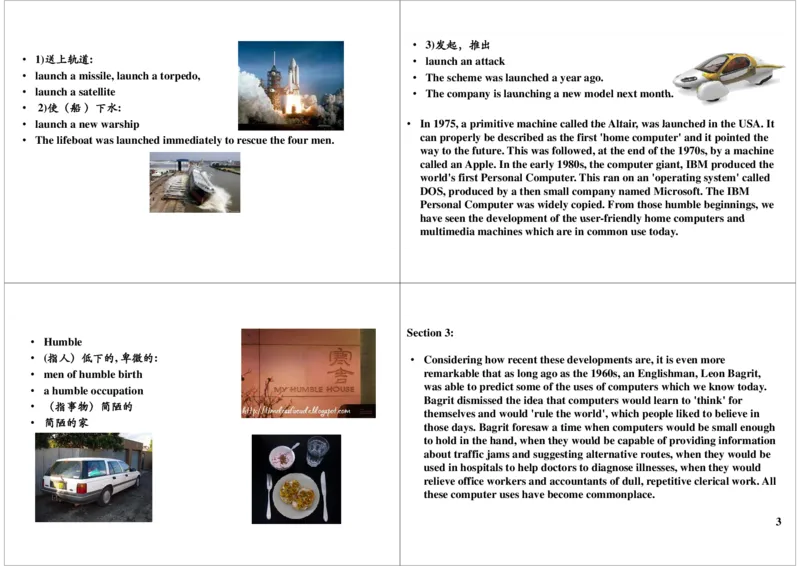
Predicting the future is notoriously difficult. Who could have imagined,
in the mid 1970s, for example, that by the end of the 20th century,
computers would be as common in people's homes as TV sets? In the
p
p
p
1970s, computers were common enough, but only in big business,
government departments, and large organizations. These were the so-
called mainframe machines. Mainframe computers were very large
indeed, often occupying whole air-conditioned rooms, employing full-
time technicians and run on specially written software Though these
time technicians and run on specially-written software. Though these
large machines still exist, many of their functions have been taken over
by small powerful personal computers, commonly known as PCs.
by small powerful personal computers, commonly known as PCs.
•
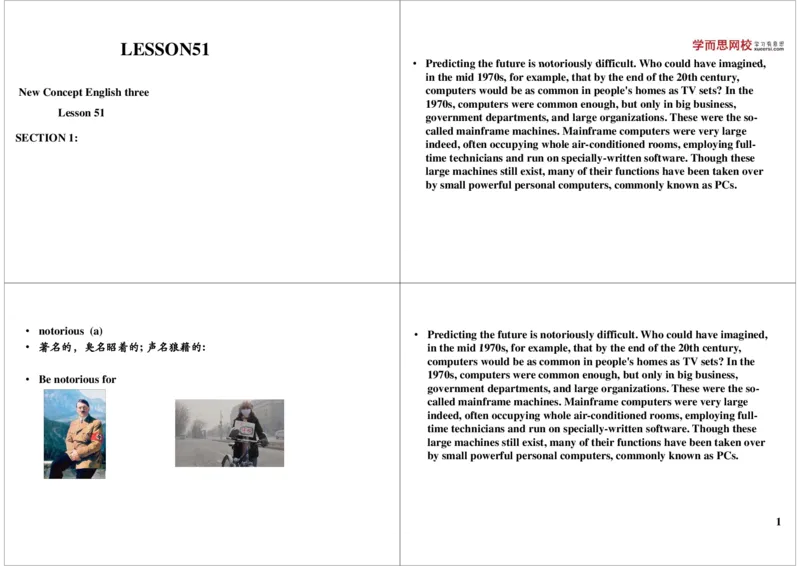
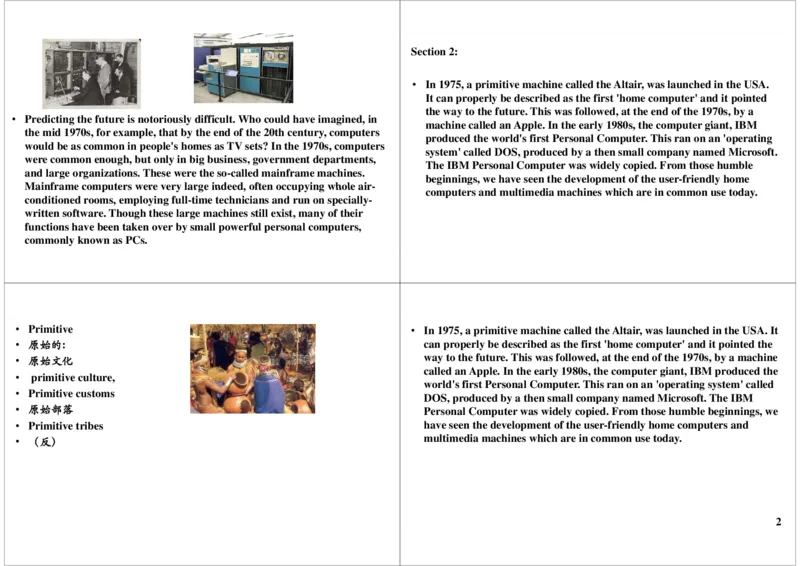
notorious  (a)
•
著名的
臭名昭着的; 声名狼藉的:
•
著名的,臭名昭着的; 声名狼藉的:
B
t
i
f
•
Be notorious for
•
Predicting the future is notoriously difficult. Who could have imagined,
in the mid 1970s for example that by the end of the 20th century
in the mid 1970s, for example, that by the end of the 20th century,
computers would be as common in people's homes as TV sets? In the
1970s, computers were common enough, but only in big business,
1970s, computers were common enough, but only in big business,
government departments, and large organizations. These were the so-
called mainframe machines. Mainframe computers were very large
indeed, often occupying whole air-conditioned rooms, employing full-
time technicians and run on specially-written software. Though these
l
hi
till
i t
f th i f
ti
h
b
t k
large machines still exist, many of their functions have been taken over
by small powerful personal computers, commonly known as PCs.
1
•
Predicting the future is notoriously difficult. Who could have imagined, in
the mid 1970s, for example, that by the end of the 20th century, computers
would be as common in people's homes as TV sets? In the 1970s, computers
h b t
l i
bi b
i
t d
t
t
were common enough, but only in big business, government departments,
and large organizations. These were the so-called mainframe machines.
Mainframe computers were very large indeed often occupying whole air-
Mainframe computers were very large indeed, often occupying whole air
conditioned rooms, employing full-time technicians and run on specially-
written software. Though these large machines still exist, many of their
g
g
functions have been taken over by small powerful personal computers,
commonly known as PCs.
Section 2:
•
In 1975, a primitive machine called the Altair, was launched in the USA.
It
l b d
ib d
th fi
t 'h
t
'
d it
i t d
It can properly be described as the first 'home computer' and it pointed
the way to the future. This was followed, at the end of the 1970s, by a
machine called an Apple In the early 1980s the computer giant IBM
machine called an Apple. In the early 1980s, the computer giant, IBM
produced the world's first Personal Computer. This ran on an 'operating
system' called DOS, produced by a then small company named Microsoft.
y
, p
y
p
y
The IBM Personal Computer was widely copied. From those humble
beginnings, we have seen the development of the user-friendly home
computers and multimedia machines which are in common use today.
•
Primitive
•
原始的:
原始的:
•
原始文化
•
primitive culture
•
primitive culture,
•
Primitive customs
•
原始部落
•
原始部落
•
Primitive tribes
(反)
•
(反)
•
In 1975, a primitive machine called the Altair, was launched in the USA. It
can properly be described as the first 'home computer' and it pointed the
can properly be described as the first home computer and it pointed the
way to the future. This was followed, at the end of the 1970s, by a machine
called an Apple. In the early 1980s, the computer giant, IBM produced the
world's first Personal Computer. This ran on an 'operating system' called
DOS, produced by a then small company named Microsoft. The IBM
P
l C
t
id l
i d F
th
h
bl b
i
i
Personal Computer was widely copied. From those humble beginnings, we
have seen the development of the user-friendly home computers and
multimedia machines which are in common use today
multimedia machines which are in common use today.
2
•
1)送上轨道:
)
轨道
•
launch a missile, launch a torpedo,
•
launch a satellite
launch a satellite
•
2)使(船)下水:
•
launch a new warship
launch a new warship
•
The lifeboat was launched immediately to rescue the four men.
•
3)发起,推出
•
launch an attack
launch an attack
•
The scheme was launched a year ago.
•
The company is launching a new model next month
The company is launching a new model next month.
•
In 1975, a primitive machine called the Altair, was launched in the USA. It
In 1975, a primitive machine called the Altair, was launched in the USA. It
can properly be described as the first 'home computer' and it pointed the
way to the future. This was followed, at the end of the 1970s, by a machine
called an Apple. In the early 1980s, the computer giant, IBM produced the
world's first Personal Computer. This ran on an 'operating system' called
DOS
d
d b
th
ll
d Mi
ft Th IBM
DOS, produced by a then small company named Microsoft. The IBM
Personal Computer was widely copied. From those humble beginnings, we
have seen the development of the user-friendly home computers and
have seen the development of the user-friendly home computers and
multimedia machines which are in common use today.
•
Humble
•
(指人)低下的, 卑微的:
•
men of humble birth
men of humble birth
•
a humble occupation
•
(指事物)简陋的
(指事物)简陋的
•
简陋的家
Section 3:
•
Considering how recent these developments are, it is even more
remarkable that as long ago as the 1960s, an Englishman, Leon Bagrit,
g g
,
g
,
g
,
was able to predict some of the uses of computers which we know today.
Bagrit dismissed the idea that computers would learn to 'think' for
themselves and would 'rule the world', which people liked to believe in
those days. Bagrit foresaw a time when computers would be small enough
to hold in the hand when they would be capable of providing information
to hold in the hand, when they would be capable of providing information
about traffic jams and suggesting alternative routes, when they would be
used in hospitals to help doctors to diagnose illnesses, when they would
used in hospitals to help doctors to diagnose illnesses, when they would
relieve office workers and accountants of dull, repetitive clerical work. All
these computer uses have become commonplace.
3
•
dismiss  (v)
( )
•
解雇
•
遣散,解散
遣散,解散
•
dismiss soldiers
•
The class will be dismissed early today.
The class will be dismissed early today.
The proposal was dismissed.
•
摒弃(某事)不再考虑(某人),
摒弃(某事)不再考虑(某人),
•
I dismissed the idea from my mind
•
I dismissed my ex-boyfriend
I dismissed my ex boyfriend
•
I missed my boyfriend
•
Considering how recent these developments are, it is even more
remarkable that as long ago as the 1960s an Englishman Leon Bagrit
remarkable that as long ago as the 1960s, an Englishman, Leon Bagrit,
was able to predict some of the uses of computers which we know today.
Bagrit dismissed the idea that computers would learn to 'think' for
g
p
themselves and would 'rule the world', which people liked to believe in
those days. Bagrit foresaw a time when computers would be small
enough to hold in the hand, when they would be capable of providing
information about traffic jams and suggesting alternative routes, when
they would be used in hospitals to help doctors to diagnose illnesses
they would be used in hospitals to help doctors to diagnose illnesses,
when they would relieve office workers and accountants of dull,
repetitive clerical work. All these computer uses have become
repetitive clerical work. All these computer uses have become
commonplace.
•
Alternative (a)
•
另外的
其它更好的
另外的,其它更好的
•
你有没有另外一个建议
•
奶酪是一个取代黄油的更好的选择
•
奶酪是一个取代黄油的更好的选择
•
Alternative energy sources
•
Considering how recent these developments are, it is even more
remarkable that as long ago as the 1960s, an Englishman, Leon Bagrit,
g g
,
g
,
g
,
was able to predict some of the uses of computers which we know today.
Bagrit dismissed the idea that computers would learn to 'think' for
themselves and would 'rule the world', which people liked to believe in
those days. Bagrit foresaw a time when computers would be small enough
to hold in the hand when they would be capable of providing information
to hold in the hand, when they would be capable of providing information
about traffic jams and suggesting alternative routes, when they would be
used in hospitals to help doctors to diagnose illnesses, when they would
used in hospitals to help doctors to diagnose illnesses, when they would
relieve office workers and accountants of dull, repetitive clerical work. All
these computer uses have become commonplace.
4
•
Diagnose
•
If cancer is diagnosed in its early stages it can be cured
•
If cancer is diagnosed in its early stages it can be cured
•
His disease was diagnosed as bird-flue
di
b
(h
i
)
•
diagnose sb as (having)…
•
我被诊断患有…
我的电脑被诊断感染病毒了(i
)
•
我的电脑被诊断感染病毒了(virus)
•
Bagrit foresaw a time when computers would be small enough to hold in
the hand, when they would be capable of providing information about
traffic jams and suggesting alternative routes, when they would be used in
hospitals to help doctors to diagnose illnesses, when they would relieve
ffi
k
d
t
t
f d ll
titi
l
i
l
k All th
office workers and accountants of dull, repetitive clerical work. All these
computer uses have become commonplace.
R li
( t)缓解
使宽慰
轻松
•
Relieve (vt)缓解,使宽慰,轻松
•
Drugs helped to relieve the pain.
缓解
力
•
缓解压力
•
缓解焦虑
•
relieved
•
Relieve sb of sth 带走,拿走
•
A porter relieved her of the three large cases.
•
After the defeat General Meyer was relieved of his post.
•
Bagrit foresaw a time when computers would be small enough to hold in
the hand, when they would be capable of providing information about
,
y
p
p
g
traffic jams and suggesting alternative routes, when they would be used in
hospitals to help doctors to diagnose illnesses, when they would relieve
ffi
k
d
f d ll
i i
l
i
l
k All h
office workers and accountants of dull, repetitive clerical work. All these
computer uses have become commonplace.
•
commonplace =everywhere=common (a)
•
commonplace =everywhere=common (a)
•
平庸无奇的(often derog 常作贬义) ,平常的
•
Lobsters are commonplace in Australia
•
Lobsters  are commonplace in Australia
•
Thefts are commonplace in this part of town.
•
Of course, Leon Bagrit could not possibly have foreseen the
,
g
p
y
development of the Internet, the worldwide system that enables us to
communicate instantly with anyone in any part of the world by using
computers linked to telephone networks. Nor could he have foreseen
how we could use the Internet to obtain information on every known
subject so we can read it on a screen in our homes and even print it
subject, so we can read it on a screen in our homes and even print it
as well if we want to. Computers have become smaller and smaller,
more and more powerful and cheaper and cheaper. This is what
more and more powerful and cheaper and cheaper. This is what
makes Leon Bagrit's predictions particularly remarkable. If he, or
someone like him, were alive today, he might be able to tell us what
to expect in the next fifty years.
5
Not only_____to stay at home,but he was also forbidden to meet his family.
A h
f
i
B h
f
d
A.he was forcing            B.he was forced
C.was he forcing            D.was he forced
Never before_____met such a serious situation;I am at a loss what to do.
A.did I          B.was I                 C.have I              D.shall I
Little_____about his own health though he was badly ill.
A.he cared        B.did he care           C.does he care         D.he cares
Seldom_____to see his parents although he lives so close to them.
A.he goes          B.he went          C.did he go            D.does he go
•
Of course, Leon Bagrit could not possibly have foreseen the development
of the Internet the worldwide system that enables us to communicate
of the Internet, the worldwide system that enables us to communicate
instantly with anyone in any part of the world by using computers linked
to telephone networks. Nor could he have foreseen how we could use the
p
Internet to obtain information on every known subject, so we can read it
on a screen in our homes and even print it as well if we want to.
Computers have become smaller and smaller, more and more powerful
and cheaper and cheaper. This is what makes Leon Bagrit's predictions
particularly remarkable If he or someone like him were alive today he
particularly remarkable. If he, or someone like him, were alive today, he
might be able to tell us what to expect in the next fifty years.
If she had worked harder, she ______.
A would succeed
B had succeeded
A. would succeed    B. had succeeded
C. should succeed    D. would have succeeded
The rice _____ if you had been more careful.
A would not be burning
B would not burn
A. would not be burning    B. would not burn
C. Would not have been burnt    D. would not burnt
If my lawyer _____ here last Saturday, he ______ me from going.
A. had been; would have prevented   B. had been; would prevent
C. were; would prevent           D. were; would have prevented
6