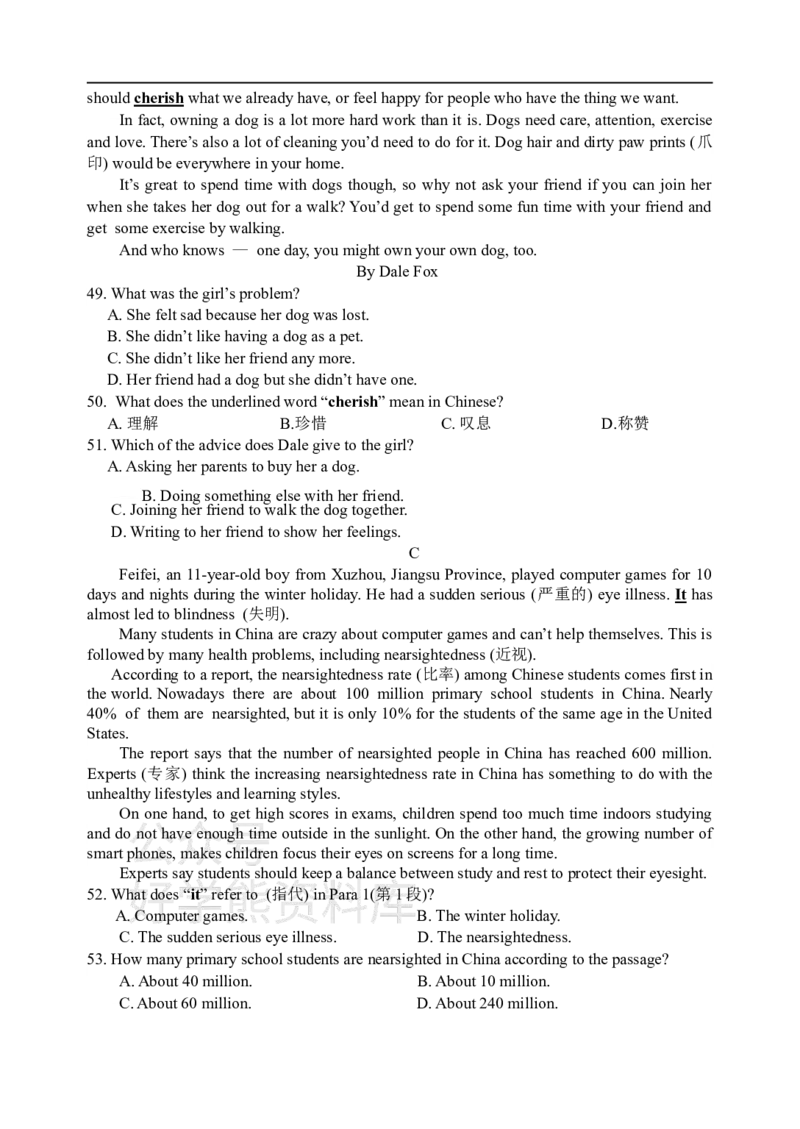
译林牛津版七年级上册英语期末试卷
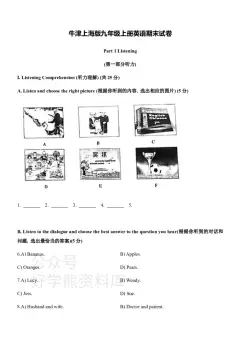
一、听力(共20 小题;每小题1 分,满分20 分)
A)听对话回答问题,每段对话听两遍。
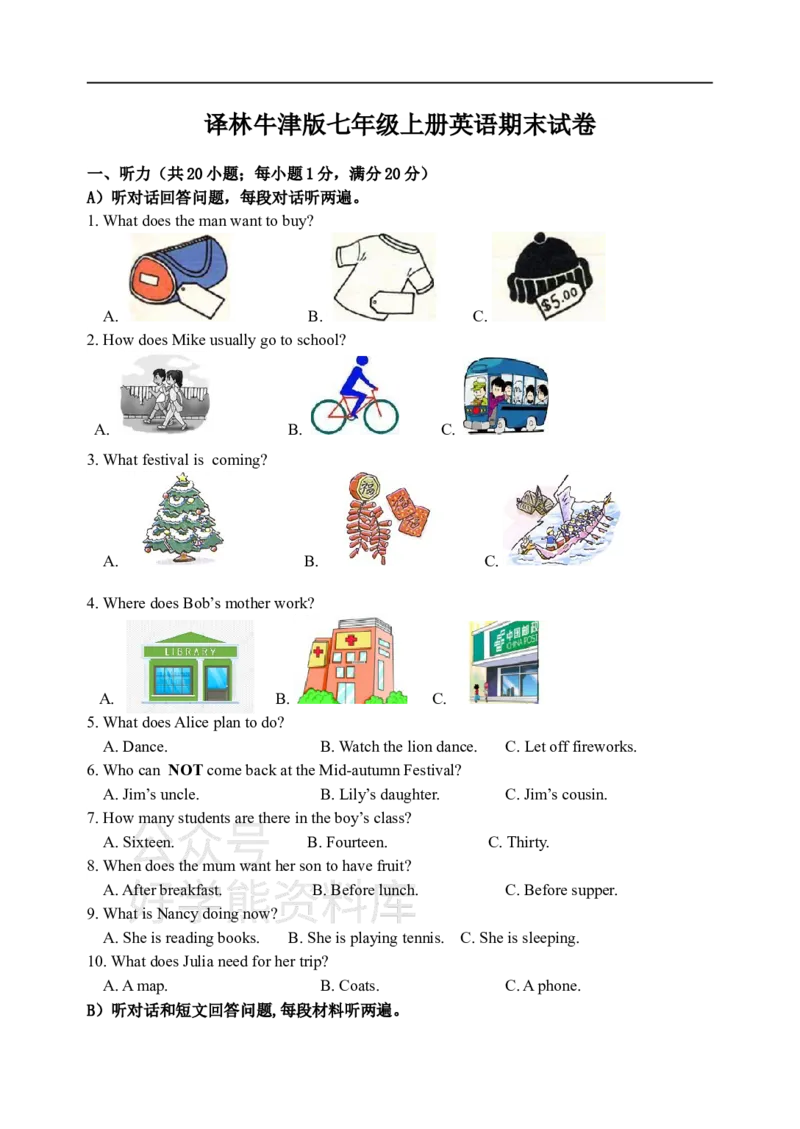
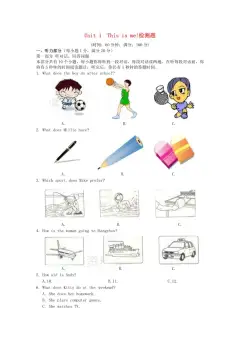
1. What does the man want to buy?
A.
     B.
C.
2. How does Mike usually go to school?
  A.

 B.
     C.
3. What festival is coming?
A.

     B.
     C.
4. Where does Bob’s mother work?
  A.                         B.
      C.
5. What does Alice plan to do?
A. Dance.
 B. Watch the lion dance.
C. Let off fireworks.
6. Who can NOT come back at the Mid-autumn Festival?
A. Jim’s uncle.
 B. Lily’s daughter.
    C. Jim’s cousin.
7. How many students are there in the boy’s class?
A. Sixteen.                  B. Fourteen.             C. Thirty.
8. When does the mum want her son to have fruit?
A. After breakfast.
     B. Before lunch.
    C. Before supper.
9. What is Nancy doing now?
A. She is reading books.       B. She is playing tennis.    C. She is sleeping.
10. What does Julia need for her trip?
A. A map.
 B. Coats.
C. A phone.
B)听对话和短文回答问题,每段材料听两遍。
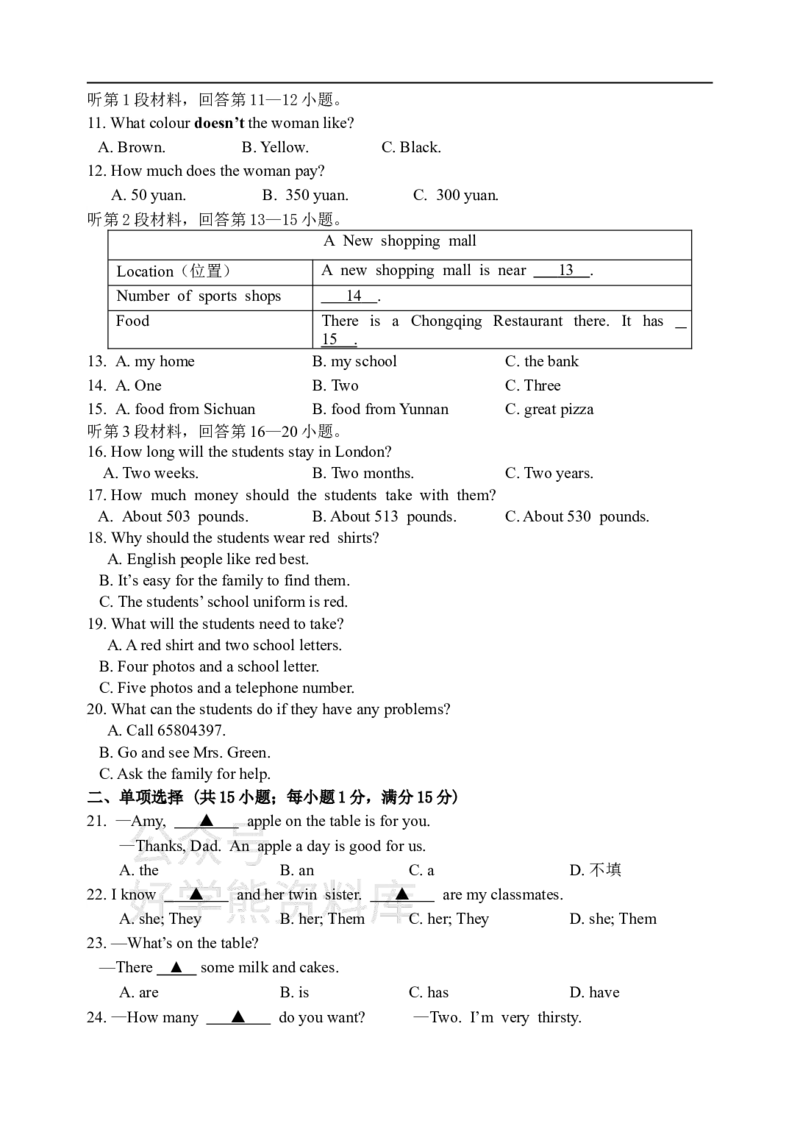
听第1 段材料,回答第11—12 小题。
11. What colour doesn’t the woman like?
   A. Brown.                B. Yellow.                C. Black.
12. How much does the woman pay?
A. 50 yuan.               B. 350 yuan.              C. 300 yuan.
听第2 段材料,回答第13—15 小题。
A New shopping mall
Location(位置)
A new shopping mall is near
  13

  .
Number of sports shops

  14

  .
Food
There is a Chongqing Restaurant there. It has
15

  .
13. A. my home
B. my school
C. the bank
14. A. One
B. Two
C. Three
15. A. food from Sichuan
B. food from Yunnan
    C. great pizza
听第3 段材料,回答第16—20 小题。
16. How long will the students stay in London?
   A. Two weeks.
B. Two months.
    C. Two years.
17. How much money should the students take with them?
   A. About 503 pounds.
    B. About 513 pounds.
    C. About 530 pounds.
18. Why should the students wear red shirts?
   A. English people like red best.
   B. It’s easy for the family to find them.
   C. The students’ school uniform is red.
19. What will the students need to take?
   A. A red shirt and two school letters.
   B. Four photos and a school letter.
   C. Five photos and a telephone number.
20. What can the students do if they have any problems?
   A. Call 65804397.
   B. Go and see Mrs. Green.
   C. Ask the family for help.
二、单项选择 (共15 小题;每小题1 分,满分15 分)
21. —Amy,    ▲    apple on the table is for you.
—Thanks, Dad. An apple a day is good for us.
A. the
    B. an
C. a
        D. 不填
22. I know    ▲    and her twin sister.    ▲    are my classmates.
A. she; They
B. her; Them
C. her; They
D. she; Them
23. —What’s on the table?
   —There    ▲    some milk and cakes.
A. are
B. is
C. has
D. have
24. —How many    ▲    do you want?      —Two. I’m very thirsty.
A. juice
B. glasses of juice C. bread
D. pieces of bread
25. —How much are your new trousers, Kitty?
   —They are not too    ▲   . They are only 60 yuan.
   A. low
B. high          C. expensive
D. cheap
26. Which is the pronunciation (发音) of “match”?
   A. [mæʃ]
    B. [mɅtʃ]        C. [mɒtʃ]
D. [mætʃ]
27. I usually go shopping with my Mum    ▲    Sunday afternoon.
   A. on
    B. in            C. /
D. at
28. What do you do    ▲    good grades in English exams?
   A. getting
B. get           C. to get
D. gets
29. There isn’t    ▲    tea in the cup. Would you like    ▲    water?
   A. some; any
B. any; some
C. some; some
D. any; any
30. My daughter is too young. She can’t    ▲    herself.
   A. wear
B. put on
C. dress
D. have
31. —Where is your father?
   —Oh, he    ▲    to my mum in the sitting room.
   A. talks
B. talk
C. is talking
D. will talk
32. —   ▲    TV does he watch every day?
   —For two or three hours a day.
   A. How long
B. How many     C. How often
D. How much
33. —Do we have enough books for the music lesson?
   —No, we need    ▲    books.
   A. much more
B. some more     C. any more
D. no more
34. Which underlined part has different pronunciation?
   A. shout
B. down         C. note
D. blouse
35. —Mum, I am going to take the final exam (期末考试) today.
   —   ▲   !
   A. Good luck to you
 B. Congratulations
   C. Have a good time
     D. That sounds good
三、完形填空(共10 小题:每小题1 分,满分10 分)
阅读下面短文,根据短文内容,从短文后各题所给的A、B、C、D 四个选项中,选
择最佳选项。
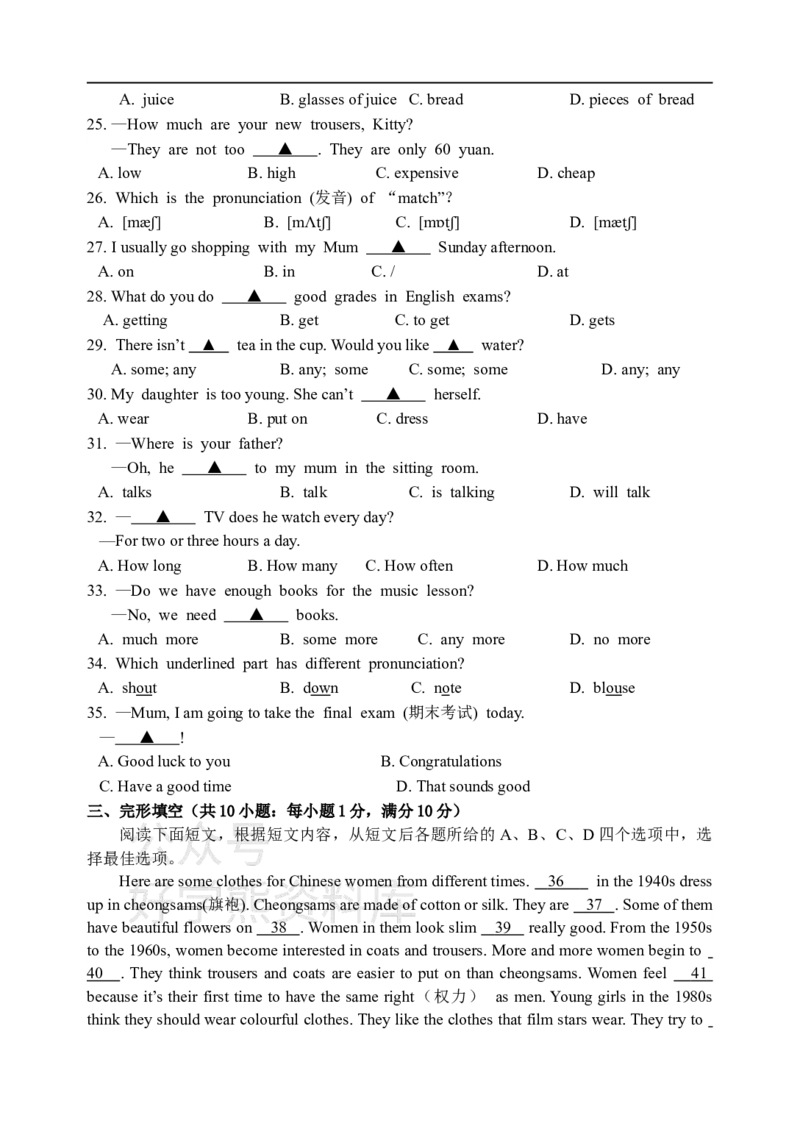
Here are some clothes for Chinese women from different times.      36

     in the 1940s dress
up in cheongsams(旗袍). Cheongsams are made of cotton or silk. They are      37
       . Some of them
have beautiful flowers on    3

 8
  . Women in them look slim
  39

   really good. From the 1950s
to the 1960s, women become interested in coats and trousers. More and more women begin to
40

  . They think trousers and coats are easier to put on than cheongsams. Women feel
  41

because it’s their first time to have the same right(权力) as men. Young girls in the 1980s
think they should wear colourful clothes. They like the clothes that film stars wear. They try to
42

   some clothes like the stars. So there are many tailor’s shop(裁缝店)on the street. Now
women like
  43

    their own clothes. They want to be their own designers. Different people
may wear different
  44

   of clothes. But many people
  45

   to use leather and fur to make
clothes because it will hurt animals. We should protect animals.
36. A. Men
B. Women
C. Children
D. Mothers
37. A. colourful    B. clean

C. cheap
D. light
38. A. it          B. them          C. us
D. you
39. A. or
B. but

C. so
D. and
40. A. work
B. study          C. shop          D. play
41. A. shy
B. bad

C. good
D. worried
42. A. borrow
B. make
C. lend
D. draw
43. A. buying
B. collecting       C. showing
D. designing
44. A. styles
B. materials

C. sizes

D. colours
45. A. like
B. dislike
C. want

D. plan
四、阅读理解 (共10 小题;每小题2 分,满分20 分)
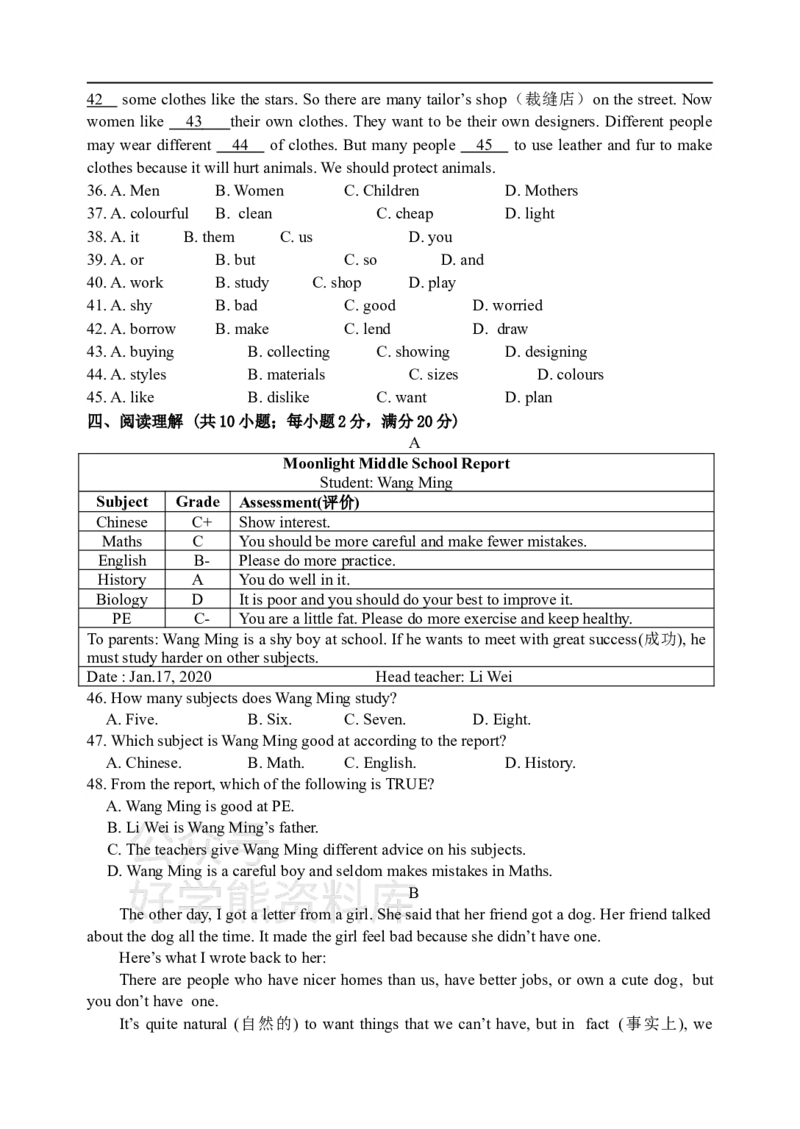
A
Moonlight Middle School Report
                                                          Student: Wang Ming
Subject
Grade
Assessment(评价)
Chinese
 C+
Show interest.
Maths
C
You should be more careful and make fewer mistakes.
English
 B-
Please do more practice.
History
A
You do well in it.
Biology
D
It is poor and you should do your best to improve it.
PE
 C-
You are a little fat. Please do more exercise and keep healthy.
To parents: Wang Ming is a shy boy at school. If he wants to meet with great success(成功), he
must study harder on other subjects.
Date : Jan.17, 2020                                         Head teacher: Li Wei
46. How many subjects does Wang Ming study?
 A. Five.
B. Six.
C. Seven.
D. Eight.
47. Which subject is Wang Ming good at according to the report?
 A. Chinese.
B. Math.       C. English.
D. History.
48. From the report, which of the following is TRUE?
 A. Wang Ming is good at PE.
 B. Li Wei is Wang Ming’s father.
 C. The teachers give Wang Ming different advice on his subjects.
 D. Wang Ming is a careful boy and seldom makes mistakes in Maths.
B
The other day, I got a letter from a girl. She said that her friend got a dog. Her friend talked
about the dog all the time. It made the girl feel bad because she didn’t have one.
Here’s what I wrote back to her:
There are people who have nicer homes than us, have better jobs, or own a cute dog, but
you don’t have one.
It’s quite natural (自然的) to want things that we can’t have, but in fact (事实上), we
should cherish what we already have, or feel happy for people who have the thing we want.
In fact, owning a dog is a lot more hard work than it is. Dogs need care, attention, exercise
and love. There’s also a lot of cleaning you’d need to do for it. Dog hair and dirty paw prints (爪
印) would be everywhere in your home.
It’s great to spend time with dogs though, so why not ask your friend if you can join her
when she takes her dog out for a walk? You’d get to spend some fun time with your friend and
get some exercise by walking.
And who knows — one day, you might own your own dog, too.
                                                                   By Dale Fox
49. What was the girl’s problem?
   A. She felt sad because her dog was lost.
   B. She didn’t like having a dog as a pet.
   C. She didn’t like her friend any more.
   D. Her friend had a dog but she didn’t have one.
50. What does the underlined word “cherish” mean in Chinese?
   A. 理解
B.珍惜
C. 叹息
D.称赞
51. Which of the advice does Dale give to the girl?
   A. Asking her parents to buy her a dog.

B. Doing something else with her friend.
 C. Joining her friend to walk the dog together.
   D. Writing to her friend to show her feelings.
C
Feifei, an 11-year-old boy from Xuzhou, Jiangsu Province, played computer games for 10
days and nights during the winter holiday. He had a sudden serious (严重的) eye illness. It has
almost led to blindness (失明).
Many students in China are crazy about computer games and can’t help themselves. This is
followed by many health problems, including nearsightedness (近视).
According to a report, the nearsightedness rate (比率) among Chinese students comes first in
the world. Nowadays there are about 100 million primary school students in China. Nearly
40% of them are nearsighted, but it is only 10% for the students of the same age in the United
States.
The report says that the number of nearsighted people in China has reached 600 million.
Experts (专家) think the increasing nearsightedness rate in China has something to do with the
unhealthy lifestyles and learning styles.
On one hand, to get high scores in exams, children spend too much time indoors studying
and do not have enough time outside in the sunlight. On the other hand, the growing number of
smart phones, makes children focus their eyes on screens for a long time.
Experts say students should keep a balance between study and rest to protect their eyesight.
52. What does “it” refer to (指代) in Para 1(第1 段)?
    A. Computer games.                     B. The winter holiday.
    C. The sudden serious eye illness.          D. The nearsightedness.
53. How many primary school students are nearsighted in China according to the passage?
A. About 40 million.                     B. About 10 million.
C. About 60 million.                     D. About 240 million.
54. Which of the following sentences is TRUE according to the passage?
A. It is not bad for students to spend much time on smart phones.
B. Children should spend much time reading and studying outside in the sunlight.
C. The boy called Feifei had a serious eye illness because he did his homework for too long.
D. The nearsightedness rate in primary school students in China is 30% higher than that in the
USA.
55. What is the main idea of the passage?
A. The ways to protect your eyesight.
B. The number of nearsighted people in China.
C. The advice about choosing the right computer games.
D. The reasons for the high rate of the nearsightedness in China.
五、词汇运用(共10 小题:每小题1 分,满分10 分)
A) 根据句意,用括号中所给词的正确形式填空,每空一词。
56. — What is Sandy doing?
   — She is    ▲    (lie) on the bed and watching TV.
57. Doing morning exercises is good for our    ▲   (healthy).
58. Look! Here    ▲    (come) No.4 bus. Let’s get on it.
59. Jim with his classmates often    ▲   (carry) books for teachers.
60. Zhong Nanshan won the medal of the PRC(共和国勋章). He is one of my    ▲
(hero).
B) 根据句意及汉语、音标提示,写出各单词的正确形式,每空一词。
61. Zhenjiang is a    ▲    (现代的) city with many beautiful parks and big shopping malls .
62. It    ▲    ([si:mz]) that my sister is unhappy today.
63. The colour of the hair clips    ▲    (匹配) your coat.
64. Millie says drinking a cup of coffee can give her energy for the    ▲  (整个的)
afternoon.
65. The silk scarf feels soft and    ▲    ([smuːð]) . My mum likes it very much.
六、句型转换(共5 小题:每空一词,每空1 分,满分10 分)
66. The girl over there under the tree is my cousin. (对画线部分提问)
   ▲       ▲    is your cousin?
67. How much is your new watch? (改为同义句)
How much    ▲    your new watch    ▲   ?
68. Mum, can I borrow your silk blouse? (改为同义句)
Mum, can you    ▲    your silk blouse    ▲    me?
69. I sleep for
    more

   than

   8    hours

  every night. (对画线部分提问)
   ▲       ▲    do you sleep every night?
70. I like watching fashion shows. My mother likes watching fashion shows too. (改为同
义句)
   ▲    my mother    ▲


  I like watching fashion shows.
七、短文填空 (共10 小题:每小题1 分,满分10 分)
根据短文内容及所给首字母提示写出所缺单词,使短文意思完整,每空一词。
Each year on October 31, children in Britain often play a game called “trick or treat”. They
ask for candy from t
  7  1

  neighbours. However, because of COVID-19, this year’s Halloween
was d     7  2
   from the years’ before.
The UK government (政府) made many rules and asked us to c
  7  3

  Halloween earlier in
the month. To stay safe, we had to k
  7  4

  away from others and follow the rule of six.
According to this rule, we can’t go o     7  5
   in a group more than six people.
People came up with new ways to have f
  7  6

 , such as having a treasure hunt (寻宝) at
home, w     7  7
   a scary film, dressing up your house with spooky (恐怖的) things or giving some
packaged(袋装的) sweets to your neighbour.
As for me, my p
  7  8

  and I bought lots of candy and hung up some lights and balls in our
house. I a     7  9
   had an online party over video call with my friends. Even with so many rules, it
was still a s     8  0
   day! I will never forget it.
八、任务型阅读 (共10 小题;每小题1 分,满分10 分)
A
If you go to a fast food restaurant, you will probably see a lot of teenagers. Today, many
teenagers are overweight, and some of this is because of their bad eating habits. Most teenagers
love food with a lot of fat, oil, salt, and sugar. People often call this kind of food “junk food”.
But bad eating habits go beyond fast food. Some don’t have breakfast before they go to
school. During the day, some don’t have a proper meal for lunch. In a recent survey (调查),
scientists find that more than two-thirds (三分之二) of the students don’t follow a healthy diet.
They don’t like vegetables or fruit. They like to eat junk food.
Parents today also worry about their children’s diet. Some doctors give the following advice:
  ● Teenagers shouldn’t eat too much junk food.
  ● Teenagers should eat food with less fat, oil, and sugar.
  ● Teenagers need to eat some fruit and vegetables every day. They are rich in vitamins and
have little fat.
  ● Teenagers need to drink more milk. It will help their bones (骨骼) grow.
  ● Teenagers need to eat breakfast every day. This is good for their body and mind.
根据短文内容填空,每空一词。
    Today, a lot of parents are worried about their children’s health. Many teenagers are
overweight      8  1
    their eating habits are bad. Many of them love junk food, some of them go to
school      8  2
    breakfast, some of them don’t have a proper meal at lunchtime. The survey shows
that
  8  3

  2/3 of them have an unhealthy diet. Some doctors give them advice. They
  8  4

   eat
food with much fat, oil and sugar. They need to eat more fruit and vegetables and drink more
milk. Drinking milk helps their bones
  8  5

 . To keep fit, they also need to have breakfast every
day.
B
Your schooldays should be some of the best and happiest days of your life. How can you get
the most from them and be sure you do not waste (浪费) this great chance to learn?
Be active (积极的) at school
Don’t say things are difficult or boring. Take interest in school life and your school
subjects. Join lots of activities. Put up your hands quickly in class. Go around the school with a
big smile.
Keep fit
    If you do not eat a good breakfast, you will be thinking about food in class. If you go to bed
late and do not have enough sleep, you will be sleepy in class. Play enough sports every day in
order to keep your body strong.
Face the problem
    Do not say you will do things tomorrow. If you get behind the class, it is very difficult to get
back in front. Not everyone can always do well in some exams. Don’t make small problems
big and important. Other people can help you.
Follow our advice, and have a happy school life!
     8  6
    to have a good school life
Be active at school
● Be interested in the school life and subjects.
●
  8 7
   the teachers’ questions actively.
● Take part in lots of activities.
● Make yourself happy every day.
Keep fit
● Have breakfast every morning.
● Go to bed      8  8
    and have enough sleep.
● Take a lot of exercise daily.
Face the problem
● Don’t put off(推迟) what you can do till      8  9
  .
● Don’t make small problems very big and important.
● You can ask other people for
  9 0
  .
九、书面表达 (共1 题;满分15 分)
期末临近,阳光中学将对每个学生一学期的表现做评价,以下是老师和同学们对交
换生Tony 的评价,请根据表格内容对Tony 进行描述并给出你的建议。
老师的评价
1. 聪明善良,擅长学习,爱运动。
2. 对中国节日感兴趣,了解春节的活动,如……
3. 饮食习惯不健康。
同学们的评价
1. 看起来很酷,运动服穿在他身上特别神气。
2. 经常用零花钱帮助贫困地区的孩子。
3. 花太多时间玩电脑游戏。
你的建议
……(至少2 点)
注意:1. 不少于80 词;文章的开头已经给出,不计入总词数;
      2. 内容必须包括表中的要点,可适当发挥,不要逐字翻译;
      3. 语意通顺,意思连贯,条理清楚,书写规范;
      4. 文中不得出现真实的校名和姓名。
Tony is a good student in his class. His teacher thinks

 ▲


 ▲


 ▲


参考答案及评分标准
一、听力(共20 小题;每小题1 分,满分20 分)
1-5 CBBAB       6-10 CCBCA       11-15 BCBAA      16-20 ACBBA
二、单项选择(共15 小题;每小题1 分,满分15 分)
21-25 ACBBC    26-30 DACBC     31-35 CDBCA
三、完形填空(共10 小题;每小题1 分,满分10 分)
36-40 BABDA    41-45 CBDAB
四、阅读理解(共10 小题;每小题2 分,满分20 分)
46-48 BDC          49-51 DBC         52-55 CADD
五、词汇运用(共10 小题;每小题1 分,满分10 分)
56. lying         57.health            58. Comes         59. Carries       60.
heroes
61. modern      62. Seems         63. matches        64. Whole       65. smooth
六、句型转换(共5 小题;每空一词,每空1 分,满分10 分)
66. Which girl   67. does cost   68. lend   to       69. How long  70. Both   and
七、短文填空(共10 小题;每小题1 分,满分10 分)
71. their          72. different       73. celebrate      74. keep         75. out/outside
76. fun             77. watching       78. Parents        79. also          80. special
八、任务型阅读(共10 小题;每小题1 分,满分10 分)
81. because          82. without       83. over          84. shouldn’t     85.grow
86. How/Ways    87. answer        88. early          89. tomorrow     90. help
九、书面表达(共1 题;满分15 分)
       Tony is a good student in his class. His teacher thinks he is a clever and kind
boy. He does well in all his subjects and he enjoys sports. He is interested in Chinese
festivals. He knows a lot about the activities at the Spring Festival, such as letting off
fireworks, getting together and having a big dinner. But he has an unhealthy diet. He
seldom eats fruit and vegetables.
His classmates think he looks cool. Sports clothes look smart on him. He often uses
his pocket money to help the children in poor areas. But he spends too much time
playing computer games.
I think he should change his diet. He’d better eat more healthy food. What’s more,
he shouldn’t play computer games for too long. It’s bad for his eyes.
评分细则
先根据文章整体内容和语言表达确定档次,然后在该档次内评出分数。
第五档(15–13 分)
完全符合题目要求,表达思想清楚,内容丰富。使用多种语法结构和丰富的词汇,语言
通顺,语意连贯,具有逻辑性。允许个别语言错误。
第四档(12–10 分)
符合题目要求,表达思想基本清楚,内容完整。语法结构和词汇基本满足文章需要。语
言基本通顺,语意基本连贯。有少量语言错误,但不影响整体理解。
第三档(9–7 分)
基本符合题目要求,表达思想不够清楚,内容基本完整。语法结构和词汇错误较多,语
言欠通顺。
第二档(6–4 分)
部分内容符合题目要求,表达思想不清楚,内容不完整。语法结构和词汇错误很多,所
写内容难以理解。
第一档(3–0 分)
与题目有关的内容不多,不能表达自己的思想。只是简单拼凑提示词语,所写内容难以
理解。