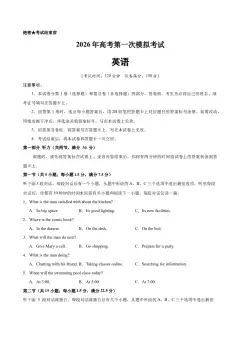
绝密★考试结束前
2026 年高考第二次模拟考试
英语
(考试时间:120 分钟 试卷满分:150 分)
注意事项:
1.本试卷分第Ⅰ卷(选择题)和第Ⅱ卷(非选择题)两部分。答卷前,考生务必将自己的姓名、准
考证号填写在答题卡上。
2.回答第Ⅰ卷时,选出每小题答案后,用2B 铅笔把答题卡上对应题目的答案标号涂黑。如需改动,
用橡皮擦干净后,再选涂其他答案标号。写在本试卷上无效。
3.回答第Ⅱ卷时,将答案写在答题卡上。写在本试卷上无效。
4.考试结束后,将本试卷和答题卡一并交回。
第一部分 听力(共两节,满分 30 分)
做题时,请先将答案标在试卷上。录音内容结束后,你将有两分钟的时间将试卷上的答案转涂到答
题卡上。
第一节(共5 小题;每小题1.5 分,满分7.5 分)
听下面5 段对话。每段对话后有一个小题,从题中所给的A、B、C 三个选项中选出最佳选项。听完每段
对话后,你都有10 秒钟的时间来回答有关小题和阅读下一小题。每段对话读两遍。
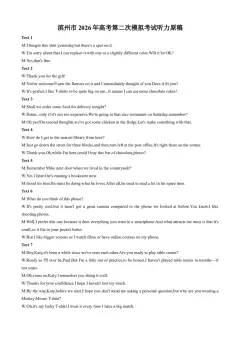
1.What book has the woman bought?
A.A music book.
B.A history book.
C.An English book.
2.What problem does the woman come across?
A.She has no enough money.
B.There is no bread available.
C.She is not sure what to order.
3.What will the woman probably do next?
A.Arrange the party.
B.Order flowers online.
C.Help Robert buy snacks.
4.Who is the woman speaking to?
A.A policeman.
B.A housekeeper.
C.A thief.
5.What is the probable relationship between the speakers?
A.Doctor and patient.
B.Teacher and student.
C.Waiter and customer.
第二节(共15 小题;每小题1.5 分,满分22.5 分)
听下面 5 段对话或独白。每段对话或独白后有几个小题,从题中所给的A、B、C 三个选项中选出最佳
选项,并标在试卷的相应位置。听每段对话或独白前,你将有时间阅读各个小题,每小题 5 秒钟;听完
后,各小题将给出 5 秒钟的作答时间。每段对话或独白读两遍。
听下面一段对话,回答以下小题。
6.What is Lisa doing recently?
A.Making nice meals.
B.Writing school papers.
C.Studying for final exams.
7.What does the man suggest Lisa do?
A.Redo work the next day.
B.Switch to healthier meals.
C.Create a balanced study plan.
听下面一段对话,回答以下小题。
8.Where does the conversation take place?
A.In a hospital.
B.In a hotel.
C.In a cinema.
9.What is the man going to do?
A.Change the sheets.
B.Have breakfast.
C.Meet his friends.
10.What does the man ask the woman to do in the end?
A.Take the plate away.
B.Bring some towels.
C.Turn on the light.
听下面一段对话,回答以下小题。
11.Why does the man refuse Emma’s request for adopting a pet at first?
A.It’s too expensive.
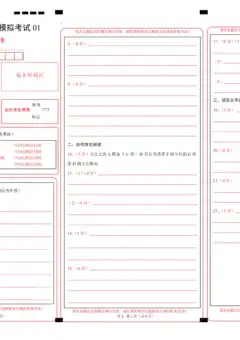
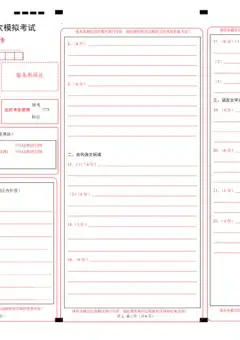
B.It may affect her health.
C.It requires much responsibility.
12.What will Emma do if she adopts a pet?
A.Buy fewer toys.
B.Have more money.
C.Read more reports.
13.How will the speakers probably adopt a pet?
A.By making a call.
B.By searching online.
C.By visiting the shelter.
听下面一段对话,回答以下小题。
14.What does the man do?
A.A doctor.
B.An astronaut.
C.An interviewer.
15.What impressed Tim most on the International Space Station?
A.The space walking.
B.The weightless environment.
C.The unnoticeable moving speed.
16.Why did Tim have to exercise on the International Space Station?
A.To adjust to the environment.
B.To have fun with teammates.
C.To get ready for returning to the earth.
17.How long did it take Tim to fully recover?
A.About 2 days.
B.About 2 months.
C.About half a year.
听下面一段独白,回答以下小题。
18.Where were the first skis found?
A.In China.
B.In Norway.
C.In Switzerland.
19.What was skiing considered as in ancient times?
A.A basic economy.
B.A mode of transport.
C.A recreational activity.
20.What can we know about skiing in the 19th century?
A.It was safer than modern skiing.
B.It was mainly enjoyed by the wealthy.
C.It required advanced ski technology.
第二部分 阅读(共两节,满分50 分)
第一节(共15 小题;每小题2.5 分,满分37.5 分)
阅读下列短文,从每题所给的A、B、C、D 四个选项中选出最佳选项。
A
Virginia Tech is inviting second-and fifth-grade students to participate in a new child-development study
organized by the Human Development and Family Science Department. The project focuses on how children
develop literacy (读写能力), math, self-regulation, and executive function (执行功能) skills. Researchers are
especially interested in how daily experiences shape these skills, so teachers and parents can better help kids with
their learning.
To help families plan their participation, the study team provides the following activity schedule:
Date
Time
Activity
Location
2026/3/06
10:00 — 11:00
Reading
VT Blacksburg Campus Lab
2026/3/13
13:00 — 14:00
Lego building & math
VT Roanoke Early Learning Lab
2026/3/20
10:00 — 11:00
The iPad learning games
Children’s Home (on-site visit)
2026/3/23
15:00 — 16:00
Executive-function tests
VT Learning Lab Annex
Families who wish to participate are asked to complete an online form available at
bit.ly/VTLearningStudy.com. Registration is open on a rolling basis, and confirmation will be sent by email within
three working days. This registration step is needed for scheduling the session.
During the project, each child will complete one 60-minute video-recorded session. During the session,
children will build with Lego, read short passages, solve math problems, play iPad learning games, and take part
in the Head-Toes-Knees-Shoulders activity. Parents will also finish two 15-minute surveys about their child’s
background and daily routines. Participants will receive a$20 electronic gift card after this project. For additional
questions, please contact Isabel Valdivia at learnlab@vt.edu.
21.What is the purpose of the study?
A.To evaluate children’s literacy.
B.To compare students’ learning abilities.
C.To measure the influence of hands-on activities.
D.To explore the effect daily experiences have on children.
22.Which activity will take place at Children’s Home?
A.Reading.
B.Lego building & math.
C.The iPad learning games.
D.Executive-function tests.
23.What are the participants required to do?
A.Pay a fixed fee.
B.Register on the appointed website.
C.Film their daily routines in advance.
D.Finish a survey after the project.
B
British man David Ferguson holds more than one identity. Though better known for his translations of
Chinese classics and government documents, his connection with China began around two decades ago.
He first came to China in 2004 to visit his future in-laws in Jilin. Two years later, he moved to China and
soon discovered a striking contrast between the reality he witnessed and the narrative presented by certain Western
media. It was then that he resolved to become a journalist and share what he truly saw in person.
During his years of reporting, one of his most memorable experiences is one in Nantong, where he
encountered self-made business people in the textile (纺织) industry who built international enterprises out of
nothing. “In the early 1970s, one of them travelled to Romania with a backpack of pillowcases and tablecloths.
Knowing little Romanian, he penciled the pronunciation of the words in Chinese pinyin so that he could
communicate,” Ferguson recalled. “They make me understand why Chinese people are successful in business, and
why China has a successful economy.”
In 2010, Ferguson joined the Foreign Languages Press, and has since authored several books introducing
Chinese cities. According to him, China’s remarkable achievements and prosperity (繁荣) over the past decades
are also due to its stable social and economic system. Besides, as a senior editor, his job is to carefully compare
and refine the translations of the Chinese texts, ensuring that they gain the broadest recognition in the English
context.
In 2023, David Ferguson was awarded the Orchid Awards, a recognition to international friends for
enhancing cultural exchanges between China and the rest of the world. As he stated in his acceptance speech,
among the people who built the Forbidden City, there were craftsmen, and there were also those who helped them
carry materials. “Translators are the wood carriers,” he said, “What we build is development, prosperity and world
peace.”
24.Why did Ferguson decide to become a journalist?
A.To pursue a career in China.
B.To present a true image of China.
C.To introduce Chinese culture.
D.To compare China and the West.
25.What factors contributed to China’s economic success, according to Ferguson?
A.Chinese people’s drive and creativity.
B.Chinese people’s vision and honesty.
C.Chinese people’s courage and integrity. D.Chinese people’s generosity and patience.
26.Why did Ferguson compare translators to “wood carriers”?
A.They play a crucial but hidden role.
B.They take on minor responsibilities.
C.They do heavy and continuous work.
D.They support professional exchanges.
27.What can be a suitable title for the text?
A.A True Story Behind Western Media
B.A Secret of China’s Rapid Development
C.A Foreigner’s Passion for Academic Exchange
D.A British Man’s Devotion to Documenting China
C
There exists a certain human experience that goes beyond cultures and generations- the sudden shake that
runs down your spine when a violin reaches its highest note, or when singers’ harmony resolves perfectly. These
electrifying feelings triggered by emotionally powerful music, sometimes accompanied by visible goosebumps,
represent a fascinating blend between art and neurology ( 神经学) . Recent advances in brain imaging have
revealed it to be a complex neurological event involving multiple brain regions.
The process begins with pattern recognition in the auditory cortex (听觉皮层) , which constantly predicts
where a musical phrase will lead. When a composer breaks these expectations on purpose, through an unexpected
key change or a delay in resolution, it creates what neuroscientists call “prediction error.” This surprise element
triggers the brain’s pleasure center associated with reward processing. Within milliseconds, the area releases
dopamine, the same substance involved in the pleasures of eating chocolate or falling in love.
The evolutionary origins of this response may come before humanity itself. Charles Darwin first noted that
music shares characteristics with animal distress calls and mating songs. The physiological markers of musical
chills, including goosebumps and changes in heart rate, mirror ancient fear and excitement responses. Some
theorists suggest music developed as an early language that promoted social unity, with chill responses
strengthening group bonding through shared emotional peaks.
Neurologists now use musical chill tests to assess lack of emotional response in depression patients, as
reduced chill response connects with an inability to feel pleasure. Music therapists working with Alzheimer’s
patients have documented cases where exhilarating songs temporarily restore access to lost memories, likely
through activation of the region relatively spared in early dementia (痴呆症) .
The next time you feel that familiar shake during a favorite song, recognize it for what it truly is. In those
chilling notes lies evidence of our incredible neural complexity, our ancient evolutionary past, and our enduring
capacity for amazing experience.
28.According to paragraph 2, what triggers the “prediction error”?
A.The release of dopamine from the brain’s pleasure center.
B.The intentional breaking of listeners’ musical expectations.
C.The auditory cortex’s failure to recognize familiar musical patterns.
D.The similarity between musical chills and other pleasant experiences.
29.What can we learn about musical chills?
A.They were developed to distinguish between fear and excitement responses.
B.Their origin lay in similar biological mechanism as animal mating behaviors.
C.They played a role in promoting social connection among early human groups.
D.Their physical indicators like goosebumps faded away in the evolution process.
30.What does the underlined word “exhilarating” in paragraph 4 mean?
A.Relaxing
B.Catchy.
C.Timeless.
D.Stimulating.
31.What does the author imply in the last paragraph?
A.Music with specific notes can trigger strong emotions.
B.Musical chills reflect multiple aspects of human nature.
C.Musical chills are a potential way to study human brains.
D.The ability to feel musical chills is unique to the human race.
D
At the start and end of every school day, many Australian children head to the car park to get picked up.
While they’ re waiting, they will be breathing in a mix of harmful pollutants because many parents leave their car
engines idling (未熄火) while parked.
Children are particularly delicate. They breathe in and out more often, have a greater lung surface area
relative to their body size and are shorter than adults, placing them closer to harmful emissions from vehicles.
Even brief exposure can increase the risk of lung-related illness.
To tackle the problem, we created the Idle Off program. We ran three hands-on sessions for 40 students in
Melbourne’s inner western suburbs, where we presented information about air pollution from vehicle emissions
and what these smogs could do to human health and the climate. While raising awareness of issues is important,
we wanted to give students the tools to make a visible change. To that end, our sessions focused on how to
advocate for change. Students designed posters and gave speeches on the topic. Some stuck posters up around car
parks. Others used their prepared notes to talk to their parents about why keeping engines running while parked
was a problem worth handling.
A week after the program, we observed a drop in idling of 18% during morning drop-off and 40% during
afternoon pick-up. The differing figures made sense, because parents were often in a rush to get to work in the
mornings and were less likely to turn off their cars for a quick goodbye. After the program, the number of students
believing children were able to advocate for change rose from 68% to 97%. The parents of our participants also
perceived a growing sense of responsibility both in their children and in themselves.
The program shows children are not only capable of understanding complex issues, but able to influence
adults, shape conversations and drive actual behaviour change, which could be used to address other
environmental issues.
32.Why are the children mentioned in the first two paragraphs?
A.To show Australia’s severe air pollution.
B.To explain the reason for children’s delicacy.
C.To stress the link between idling and kids’ health.
D.To introduce the problem of leaving engines running.
33.What did the students do during the Idle Off program?
A.They surveyed the surrounding environment.
B.They designed posters and delivered speeches.
C.They questioned parents on their driving expenses.
D.They organized campaigns to ban idling in suburbs.
34.How did the program influence the students?
A.It boosted their confidence in advocacy.
B.It improved their academic performances.
C.It urged them to cycle to school every day.
D.It motivated them to request more monitors.
35.Where can you most likely read the passage?
A.In a leaflet about road traffic guidance.
B.In a textbook chapter on children’s health.
C.In a school paper on environmental activities.
D.In a news report about harmful vehicle emissions.
第二节(共5 小题;每小题2.5 分,满分12.5 分)
阅读下面短文,从短文后的选项中选出可以填入空白处的最佳选项。选项中有两项为多余选项。
Effective communication is the process of expressing your thoughts and ideas while listening to the
opinions of others. Then how to communicate effectively?
Organize your thoughts before speaking.
Before you attempt to communicate ideas, organize your thoughts using key points. 36
That way, if you go off topic, you can easily come back to your main points without getting upset.
<u><span leftindent quesindex="37">37</span>.</u>
If you’re giving a presentation, consider the listeners’ interests, differences, and levels of knowledge on the
topic you’re speaking on. For instance, if you’re lecturing a college-level Biology course, students should have a
good grasp of evolution and cell theory. Similarly, if you’re lecturing students, you may want to choose visual aids
to catch their attention.
Be clear when speaking.
Be clear about your goal so your message comes across in a way that every listener can understand. 38
You want to speak at a volume level that is guaranteed to be heard. It may be helpful to remember to be clear,
brief, consistent (一致), connected, and confident while communicating with others.
Maintain eye contact.
Eye contact builds harmony, helps convince others you’re trustworthy and shows interest. During a
conversation or presentation, maintain eye contact for as long as it feels natural. Generally, you’ll want to aim for
2 to 4 seconds at a time. 39 If you’re addressing a boardroom (董事会), look each member in the eye.
Ignoring any single person can easily be taken as a sign of disrespect.
Practise active listening skills.
40 By actively listening, you can judge how much of your message is getting through your listeners
and whether or not it’s being received correctly. If your audience doesn’t fully get what you mean, asking for their
opinions is often helpful.
A.Keep your audience in mind.
B.Communication is a two-way street.
C.Understand your audience’s specific needs.
D.This helps individuals feel personally valued.
E.Be sure to express clearly to avoid any kind of misunderstanding.
F.A good rule is to choose three key points to center your conversation around.
G.Common signs someone isn’t listening to you include looking bored and silence.
第三部分 语言运用(共两节,满分30 分)
第一节 (共15 小题;每小题1 分,满分15 分)
阅读下面短文,从每题所给的A、B、C、D 四个选项中选出可以填入空白处的最佳选项。
The summer before college, I worked at a local bookstore. I spent my days arranging shelves, scanning
books, and repeating greetings to regulars. Most tasks felt 41 , with no real joy, so I often stared at the
clock, 42 down to closing time — until Mrs. Henderson walked in.
She was an elderly woman with silver hair. Every Tuesday, she’d 43 the same section:
secondhand travel books. She never bought anything, just ran her fingers gently over the book covers, eyes soft
with 44 . She’d stay there for an hour, never acting 45 . Until one afternoon, I plucked up
courage to ask, my voice 46 , “Did you travel a lot?”
She smiled. “I planned to. But life 47 — kids, work, illness. These books are my late husband’s
— I donated them years ago.” She pulled out a tattered copy of Journey Through Tuscany. “We never 48
it to Italy, but these pages held our dreams and they were my 49 from the busy, hard days.”
That day, we talked for an hour. She shared tales of missed chances, and I shared my college fears of
failing, or feeling lost. As she left, she handed me the book and a note. “Life isn’t about the trips we take, but the
50 we share along the way. Thank you for listening. Sometimes, a stranger’s 51 is the most
precious gift — someone to hold your unspoken hopes.”
That summer, I stopped counting hours. 52 , I listened to regulars’ stories, cherished quiet
hopes, and 53 that even ordinary days have meaning. It turns out that the best moments aren’t the
ones we chase. They’re the gentle, unplanned connections that 54 us we’re never alone. A simple act
of listening can turn a boring summer job into a journey of self-discovery — one that taught me to slow down and
cherish the 55 in the ordinary.
41.A.repetitive
B.dull
C.creative
D.tough
42.A.settling
B.looking
C.winding
D.counting
43.A.pass by
B.look into
C.head for
D.pick up
44.A.curiosity
B.regret
C.eagerness
D.excitement
45.A.hurriedly
B.calmly
C.casually
D.firmly
46.A.booming
B.trembling
C.muttering
D.echoing
47.A.got in the way B.took over
C.came to light
D.fell apart
48.A.reached
B.got
C.had
D.made
49.A.burden
B.regret
C.dilemma
D.escape
50.A.plans
B.moments
C.promises
D.adventures
51.A.patience
B.curiosity
C.ear
D.honesty
52.A.Instead
B.Besides
C.Therefore
D.However
53.A.imagined
B.denied
C.realized
D.pretended
54.A.warn
B.remind
C.inform
D.assure
55.A.beauty
B.comfort
C.entertainment
D.peace
第二节(共10 小题;每小题1. 5 分, 满分15 分)
阅读下面材料,在空白处填入适当的内容(1 个单词)或所给单词的正确形式。
After four years of conservation and restoration work, the gilded bronze armor (鎏金铜甲) has been fully
restored to present to people the ceremonial (礼仪的) style of the Tuyuhun Kingdom during the Tang Dynasty.
This precious object 56 (dig) up from the Xuewei No. 1 Tomb in Dulan County, Qinghai Province. 57
makes it special is that it is the only surviving Tang Dynasty gilded armor in China.
Han, a researcher from an archaeological institute, said this restoration provides detailed and 58
(rely) materials which can deepen the understanding of funeral traditions, ethnic exchanges and integration, as
well as production techniques on the Qinghai-Xizang Plateau.
The tomb in Qinghai has 59 history of about 1, 300 years. It yielded piles of broken pieces of
bronze armor and lacquered horse armor. These pieces were 60 a mess and had no clear connection in
structure. Even a light touch could make them break into much 61 (small) pieces. To solve the problem,
62 (expert) employed 3D scanning to record the original shape and position of these pieces. They also used
two advanced technologies-scanning electron microscopy and ultra- depth microscopy 63 (study) how the
armors were made and what materials they were made of. 64 (eventual) , they managed to create a clear
visual model of the original armors.
Han added that the successful restoration has built a good technical system and a research method for future
lab archaeology, 65 (transform) the way archaeologists (考古学家) think about their work.
第四部分 写作(共两节, 满分40 分)
第一节(满分15 分)
66.上周末你参加了一个垃圾分类、回收科普活动。请你就此写一篇短文向校英语报投稿,内容包括:
1. 活动目的;
2. 活动经过;
3. 你的收获。
注意:1. 写作词数应为80 个左右;
2. 请按如下格式在答题卡的相应位置作答。
My Experience at an Educational Waste-Sorting Workshop
___________________________________________________________________________________________
___________________________________________________________________________________________
___________________________________________________________________________________________
___________________________________________________________________________________________
_________________________________________________________
第二节(满分25 分)
67.阅读下面材料,根据其内容和所给段落开头语续写两段,使之构成一篇完整的短文。
Having been working hard for a long time, I decided to treat myself to a solo (独自的) trip to Türkiye. It
felt like the perfect way to mark the end of one chapter and the beginning of another.
The first few days were magical — walking through busy markets, admiring ancient architecture, and
enjoying delicious local cuisine. Istanbul, the largest city of Türkiye, offers unforgettable beauty at every turn. I
started my day watching the Hagia Sophia, one of Istanbul’s most impressive landmarks, shining in the sunlight. I
ended my day drinking the local tea. Everything was going smoothly, until a sudden announcement from the
airport made my plans in chaos — my flight to the next stop was cancelled.
My heart sank. It wasn’t just the next stop; it was an important, previously planned part of my trip. A non-
refundable, luxurious cave hotel awaited me. I’d prepaid for a private car service that was expecting me tonight,
and crucially, tomorrow’s prebooked hot air balloon ride and guided valley tours demanded an early start. Panic
seized me. Anxiously checking alternatives, I found only one flight arriving late the next afternoon.
Standing alone at the airport, holding my useless boarding pass, I was in despair (绝望). My heart ached at
the thought of losing hundreds of euros. Tears welled up in my eyes. At that moment, my travel agency was
unreachable. My only hope rested with the driver, Mr. Demir, who was the same age as my dad and supposedly
waiting at the airport of my next stop. Had the car company received the email and notified him of the
cancellation? Would he check? Would he care enough to adjust without charging me a lot of money?
Hours passed as I rearranged my flight for the next morning. Extremely tired and overwhelmed (不知所措
的), I boarded the rescheduled flight, unsure of what to expect. Eventually, I landed, but I felt like going into
continued uncertainty.
注意:
(1)续写词数应为150 个左右;
(2)请按如下格式作答。
Suddenly, a loud voice cut through the noise: “Miss Doros? From Athens?”
___________________________________________________________________________________________
___________________________________________________________________________________________
___________________________________________________________________________________________
___________________________________________________________________________________________
________________
On the way to the hotel, I appreciated what Mr. Demir had done for me again.
___________________________________________________________________________________________
___________________________________________________________________________________________
___________________________________________________________________________________________
___________________________________________________________________________________________
________________