绝密★考试结束前
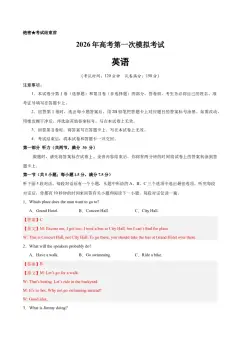
2026 年高考第二次模拟考试
英语
(考试时间:120 分钟  试卷满分:150 分)
注意事项:
1.本试卷分第Ⅰ卷(选择题)和第Ⅱ卷(非选择题)两部分。答卷前,考生务必将自己的姓名、准
考证号填写在答题卡上。
2.回答第Ⅰ卷时,选出每小题答案后,用2B 铅笔把答题卡上对应题目的答案标号涂黑。如需改动,
用橡皮擦干净后,再选涂其他答案标号。写在本试卷上无效。
3.回答第Ⅱ卷时,将答案写在答题卡上。写在本试卷上无效。
4.考试结束后,将本试卷和答题卡一并交回。
第一部分 听力(共两节,满分 30 分)
做题时,请先将答案标在试卷上。录音内容结束后,你将有两分钟的时间将试卷上的答案转涂到答
题卡上。
第一节(共5 小题;每小题1.5 分,满分7.5 分)
听下面5 段对话。每段对话后有一个小题,从题中所给的A、B、C 三个选项中选出最佳选项。听完每段
对话后,你都有10 秒钟的时间来回答有关小题和阅读下一小题。每段对话读两遍。
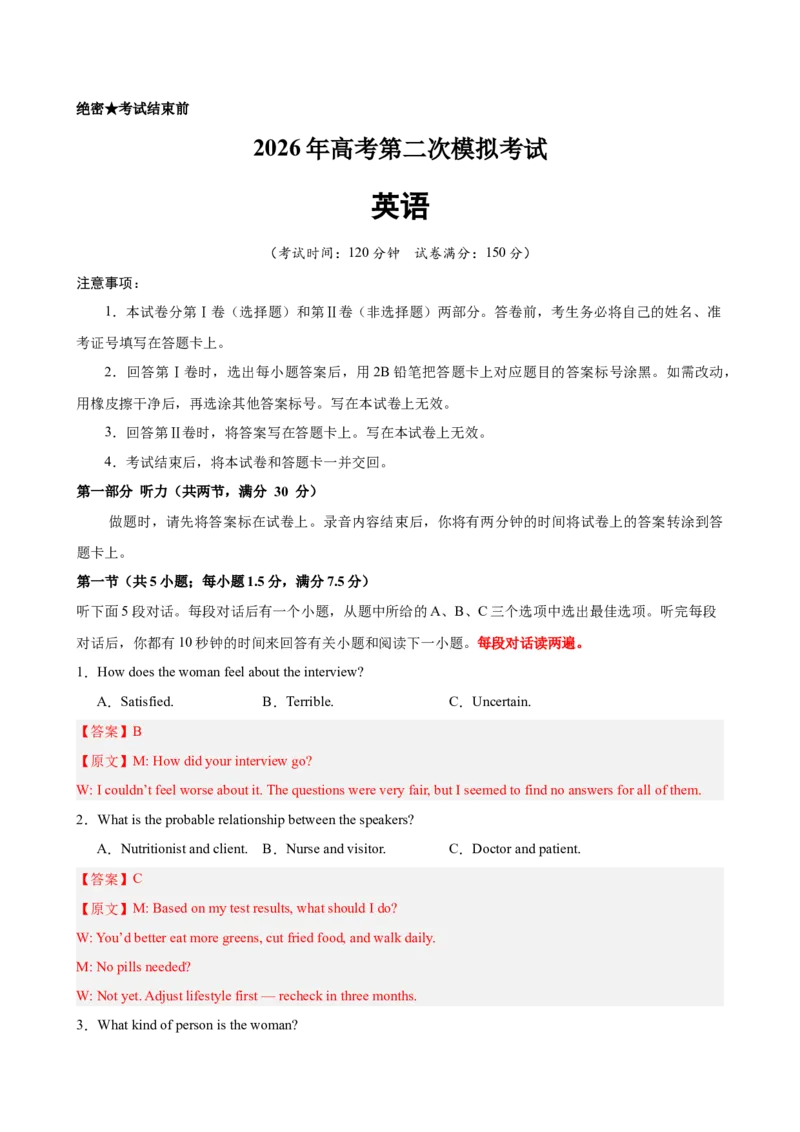
1.How does the woman feel about the interview?
A.Satisfied.
B.Terrible.
C.Uncertain.
【答案】B
【原文】M: How did your interview go?
W: I couldn’t feel worse about it. The questions were very fair, but I seemed to find no answers for all of them.
2.What is the probable relationship between the speakers?
A.Nutritionist and client.
B.Nurse and visitor.
C.Doctor and patient.
【答案】C
【原文】M: Based on my test results, what should I do?
W: You’d better eat more greens, cut fried food, and walk daily.
M: No pills needed?
W: Not yet. Adjust lifestyle first — recheck in three months.
3.What kind of person is the woman?
A.Considerate.
B.Persistent.
C.Independent.
【答案】A
【原文】M: I’ve got a headache. Sick in bed, and I’ve read most of those magazines twice.
W: Well, if it’ll help, I’ll run to the store and get you some new ones.
4.What happened to the speakers?
A.They went lost.
B.They missed their exit.
C.They reported a traffic issue.
【答案】A
【原文】M: This doesn’t look familiar. We’d better get some directions.
W: There is a policeman over there. Let’s pull in right here and ask him for help.
5.Where does the conversation probably take place?
A.At a travel agency.
B.At a hotel check-in.
C.At an immigration counter.
【答案】C
【原文】W: Next, please. Good morning. May I have your passport and the landing card you’ve just filled out?
M: Certainly. Here they are. I hope I’ve completed the form correctly.
W: It looks fine. Now, are you here for a holiday or is this a business trip?
M: I’m here for a week-long conference.
第二节(共15 小题;每小题1.5 分,满分22.5 分)
听下面 5 段对话或独白。每段对话或独白后有几个小题,从题中所给的A、B、C 三个选项中选出最佳
选项,并标在试卷的相应位置。听每段对话或独白前,你将有时间阅读各个小题,每小题 5 秒钟;听完
后,各小题将给出 5 秒钟的作答时间。每段对话或独白读两遍。
听下面一段较长对话,回答以下小题。
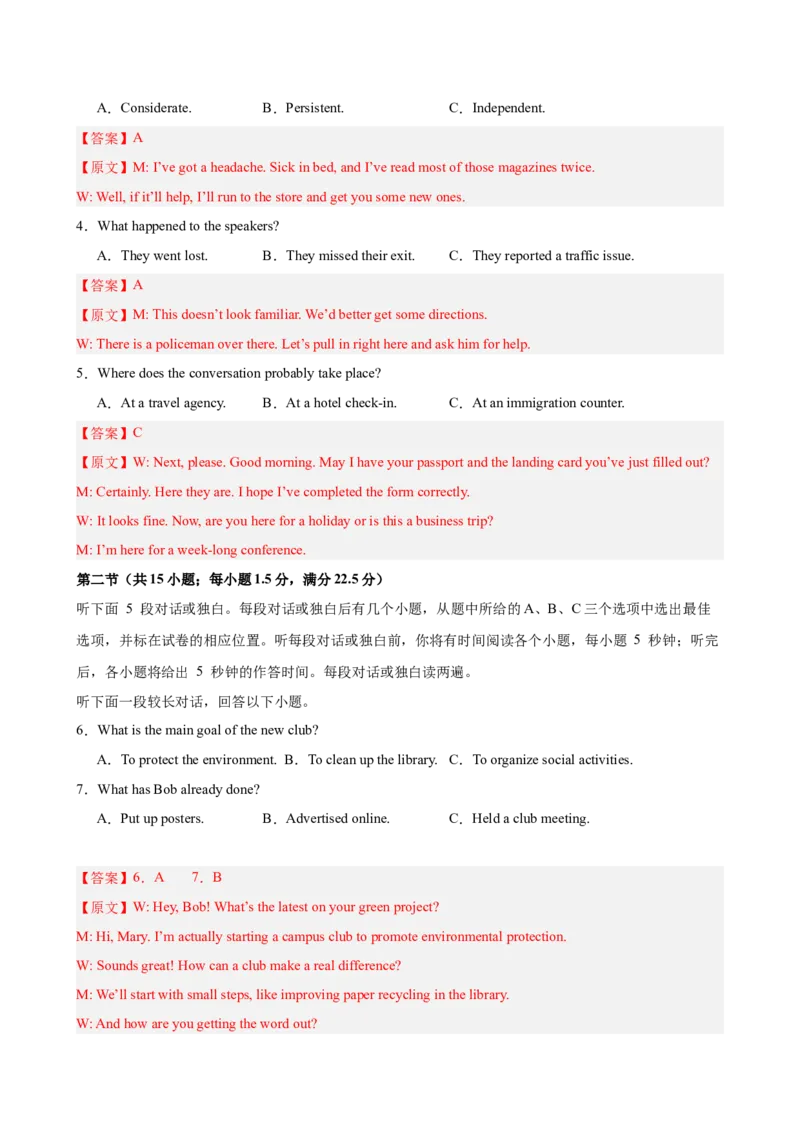
6.What is the main goal of the new club?
A.To protect the environment. B.To clean up the library. C.To organize social activities.
7.What has Bob already done?
A.Put up posters.
B.Advertised online.
C.Held a club meeting.
【答案】6.A    7.B
【原文】W: Hey, Bob! What’s the latest on your green project?
M: Hi, Mary. I’m actually starting a campus club to promote environmental protection.
W: Sounds great! How can a club make a real difference?
M: We’ll start with small steps, like improving paper recycling in the library.
W: And how are you getting the word out?
M: I’ve posted on the university’s social media, and forty people have already signed up. Plus, I’ve got thirty
posters to hang up. Want to help?
听下面一段对话,回答以下小题。
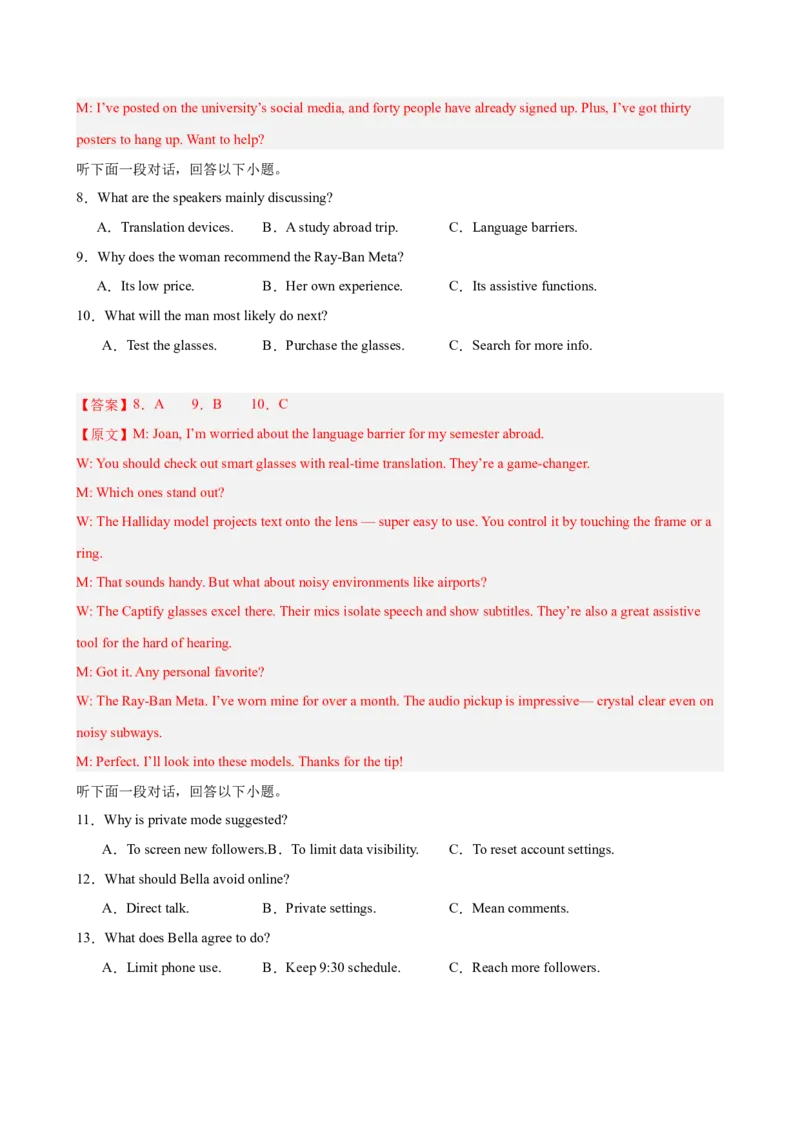
8.What are the speakers mainly discussing?
A.Translation devices.
B.A study abroad trip.
C.Language barriers.
9.Why does the woman recommend the Ray-Ban Meta?
A.Its low price.
B.Her own experience.
C.Its assistive functions.
10.What will the man most likely do next?
A.Test the glasses.
B.Purchase the glasses.
C.Search for more info.
【答案】8.A    9.B    10.C
【原文】M: Joan, I’m worried about the language barrier for my semester abroad.
W: You should check out smart glasses with real-time translation. They’re a game-changer.
M: Which ones stand out?
W: The Halliday model projects text onto the lens — super easy to use. You control it by touching the frame or a
ring.
M: That sounds handy. But what about noisy environments like airports?
W: The Captify glasses excel there. Their mics isolate speech and show subtitles. They’re also a great assistive
tool for the hard of hearing.
M: Got it. Any personal favorite?
W: The Ray-Ban Meta. I’ve worn mine for over a month. The audio pickup is impressive— crystal clear even on
noisy subways.
M: Perfect. I’ll look into these models. Thanks for the tip!
听下面一段对话,回答以下小题。
11.Why is private mode suggested?
A.To screen new followers.B.To limit data visibility.
C.To reset account settings.
12.What should Bella avoid online?
A.Direct talk.
B.Private settings.
C.Mean comments.
13.What does Bella agree to do?
A.Limit phone use.
B.Keep 9:30 schedule.
C.Reach more followers.
【答案】11.B    12.C    13.A
【原文】M: Bella, I’m concerned about your social media safety. It’s better to switch your account to private
mode.
W: But then my followers can’t see everything I post!
M: I know, but it keeps your personal information safe.
W: Okay, I’ll change the settings.
M: Good. Also, think twice before you post a comment. Never say anything online that you wouldn’t say to
someone’s face.
W: So, I should stay respectful. Got it.
M: Exactly. Finally, let’s manage your screen time. You usually stop at 9:30 p.m., right? Try putting the phone
away an hour earlier.
W: 8:30 p.m.? That’s a big change!
M: It’ll help you sleep better and manage your time.
W: Alright, deal. Thanks for looking out for me.
听下面一段对话,回答以下小题。
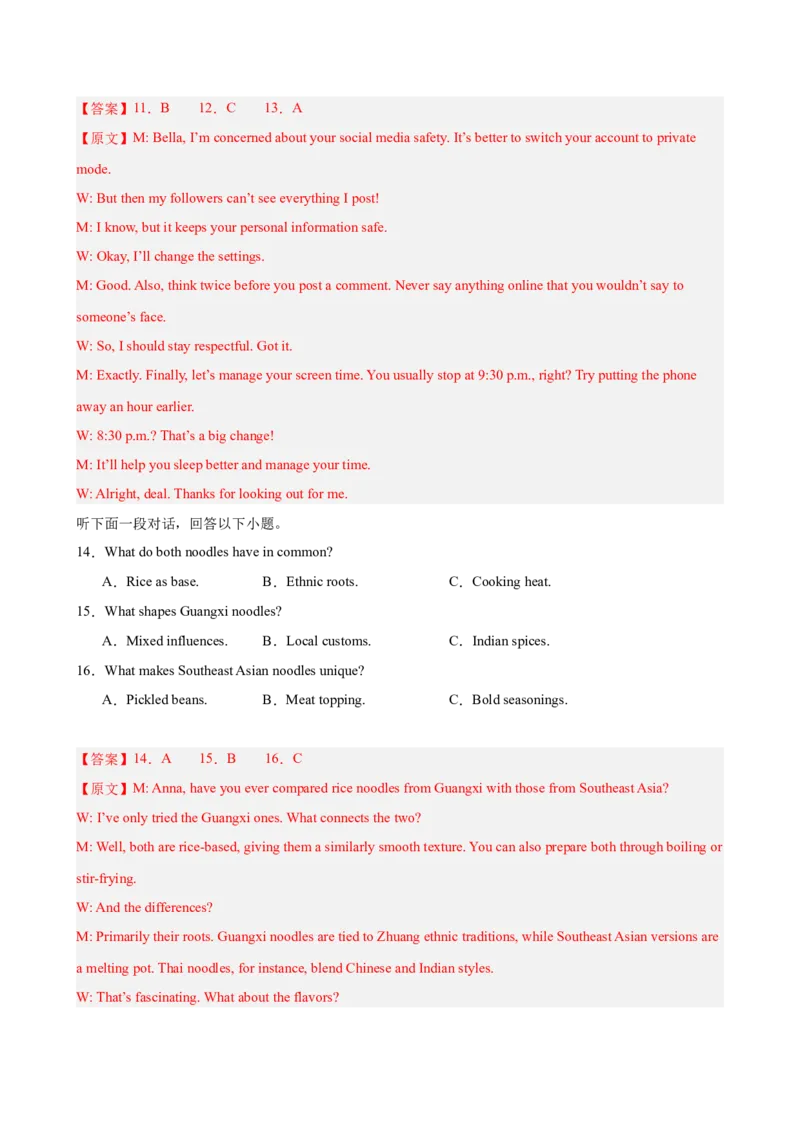
14.What do both noodles have in common?
A.Rice as base.
B.Ethnic roots.
C.Cooking heat.
15.What shapes Guangxi noodles?
A.Mixed influences.
B.Local customs.
C.Indian spices.
16.What makes Southeast Asian noodles unique?
A.Pickled beans.
B.Meat topping.
C.Bold seasonings.
【答案】14.A    15.B    16.C
【原文】M: Anna, have you ever compared rice noodles from Guangxi with those from Southeast Asia?
W: I’ve only tried the Guangxi ones. What connects the two?
M: Well, both are rice-based, giving them a similarly smooth texture. You can also prepare both through boiling or
stir-frying.
W: And the differences?
M: Primarily their roots. Guangxi noodles are tied to Zhuang ethnic traditions, while Southeast Asian versions are
a melting pot. Thai noodles, for instance, blend Chinese and Indian styles.
W: That’s fascinating. What about the flavors?
M: They use different seasonings. Guangxi style usually features meat and pickled beans. In contrast, Southeast
Asian bowls rely on a wider range of ingredients, like lemongrass or shrimp paste.
W: I see. It’s a matter of regional taste!
听下面一段独白,回答以下小题。
17.What does the route pass by?
A.Iconic city landmarks. B.Private sports tracks.
C.Quiet countryside parks.
18.Why did the runners join the London marathon?
A.To gain public fame.
B.To help personal causes.
C.To run national charities.
19.What do we know about Sarah?
A.She ran for her daughter. B.She is a professional.
C.She is a busy student.
20.Why does the speaker give the talk?
A.To give race advice.
B.To highlight the event.
C.To recruit more runners.
【答案】17.A    18.B    19.C    20.B
【原文】M: Welcome to Global Sports Report. Today, we highlight the London Marathon, a world-famous
spring event known for its breathtaking views. The 26.2-mile journey begins in the quiet Greenwich Park, leading
runners past iconic sights like the Tower Bridge and London Eye, before a grand finish near Buckingham Palace.
It’s more than just a race; it’s a massive charity drive. Many participants wear creative costumes to raise funds.
For instance, David, a local doctor, completed the course dressed as a superhero. He wanted to give back to the
children’s hospital that successfully treated his daughter. The event also welcomes non-professionals, like 19-year-
old Sarah. Despite her heavy college workload, she balanced intense study sessions with six months of training
alongside her friends. Sarah ran to support a mental health charity, inspired by her brother’s personal struggles
with anxiety. Ultimately, the marathon remains a powerful celebration of fitness, friendship, and the city’s
incredible community spirit.
第二部分  阅读(共两节,满分50 分)
第一节(共15 小题;每小题2.5 分,满分37.5 分)
阅读下列短文,从每题所给的A、B、C、D 四个选项中选出最佳选项。
A
Teen Creative Writing
Release your creativity as a writer, while learning the tricks of the trade. You have the freedom to write
what you want, but you also need to gain the discipline of writing. There are no grades, no exams, and no wrong
answers — just creative writing. Each class is taught by a teacher experienced in helping young writers discover
and develop their unique voices. This course is offered as a 6-week online class (with a 3-hour session per week).
It’s open to students aged from 13 to 17.
Upcoming Classes
Start on Tuesday, October 14th
Online, anytime
Price: Registration fee $25, paid once per term
The Syllabus (教学大纲)
The syllabus varies from teacher to teacher, term to term. Many topics will be similar to those covered in
the online classes.
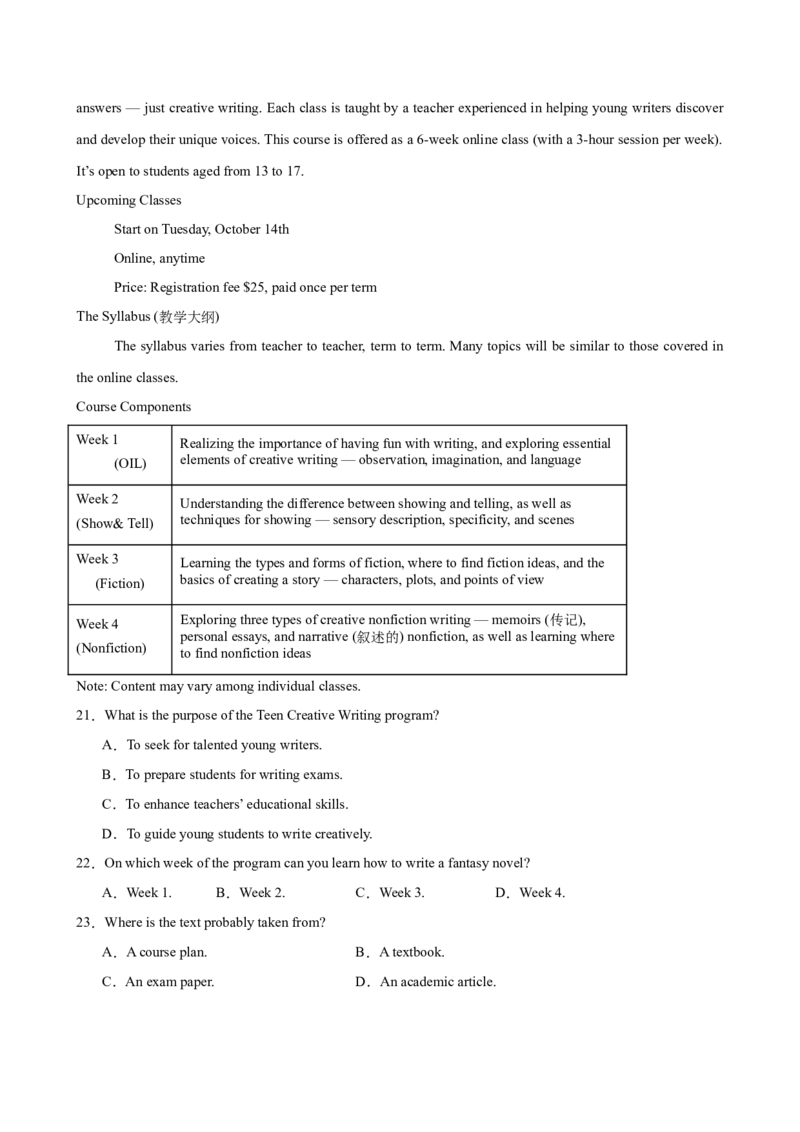
Course Components
Week 1
(OIL)
Realizing the importance of having fun with writing, and exploring essential
elements of creative writing — observation, imagination, and language
Week 2
(Show& Tell)
Understanding the difference between showing and telling, as well as
techniques for showing — sensory description, specificity, and scenes
Week 3
(Fiction)
Learning the types and forms of fiction, where to find fiction ideas, and the
basics of creating a story — characters, plots, and points of view
Week 4
(Nonfiction)
Exploring three types of creative nonfiction writing — memoirs (传记),
personal essays, and narrative (叙述的) nonfiction, as well as learning where
to find nonfiction ideas
Note: Content may vary among individual classes.
21.What is the purpose of the Teen Creative Writing program?
A.To seek for talented young writers.
B.To prepare students for writing exams.
C.To enhance teachers’ educational skills.
D.To guide young students to write creatively.
22.On which week of the program can you learn how to write a fantasy novel?
A.Week 1.
B.Week 2.
C.Week 3.
D.Week 4.
23.Where is the text probably taken from?
A.A course plan.
B.A textbook.
C.An exam paper.
D.An academic article.
【答案】21.D    22.C    23.A
【导语】本文是一篇应用文。主要介绍了青少年创意写作课程的相关信息,包括课程目的、时间、价格、
教学大纲和课程内容等。
21.细节理解题。根据第一段中“Release your creativity as a writer, while learning the tricks of the trade. You
have the freedom to write what you want, but you also need to gain the discipline of writing. There are no grades,
no exams, and no wrong answers — just creative writing. Each class is taught by a teacher experienced in helping
young writers discover and develop their unique voices. (释放你作为作家的创造力,同时学习这门行当的技
巧。你可以自由地写自己想写的东西,但也需要培养写作的自律性。这里没有成绩,没有考试,也没有
错误的答案 —— 只有创意写作。每节课都由经验丰富的老师授课,他们擅长帮助年轻作家发现并培养
自己独特的风格。)”可知,青少年创意写作课程旨在引导年轻学生创造性地写作。故选D 项。
22.细节理解题。根据Course Components 中Week 3 (Fiction)部分“Learning the types and forms of fiction,
where to find fiction ideas, and the basics of creating a story — characters, plots, and points of view (学习小说的
类型和形式、获取小说灵感的途径,以及创作故事的基础知识 —— 人物、情节和视角)”可知,在第三周
可以学习小说的类型和形式,因此可以在第三周学习如何写科幻小说。故选C 项。
23.推理判断题。根据第一段中“This course is offered as a 6-week online class (with a 3-hour session per
week). (本课程为期6 周,为在线课程(每周3 小时)。)”以及下文对课程的具体介绍,包括课程目的、时
间、价格、教学大纲和课程内容等可推知,本文最有可能选自一份课程计划。故选A 项。
B
My priceless heritage from my father is a box of yellow pencils. Some are barely used, some are worn-
down, but each is unfailingly functional. They remind me of his love of solving crossword puzzles. They remind
me of him sitting by the window, bathed in morning light, carefully filling in their tiny boxes.
In his 80s, my father would read the day’s newspaper cover to cover, with a pleasant smile on his face.
“What are you reading that’s so funny, Dad?” I would ask. “Oh, nothing. I don’t pay much attention to the news.
But reading reminds me of forgotten words that help me solve the crossword. Ah, got it! 12-D, CLASH!”
When he read the papers, our dog would curl up beside him, enjoying his soft touches for an hour or two,
which left me free to write without being bothered by it. He would gladly put his paper down to engage with
curious grandchildren, telling them stories about language, people and places. More importantly, he would listen.
It’s a good life lesson for the little ones, as they grew to appreciate that not all grown-ups are pushy or impatient.
In addition, he would live his life quietly helping people, never forgetting those who had lent him a hand. He
believed that more wealth did not mean greater happiness, and that no kindness should be undervalued.
While my father used words for love, I did the same for a living as a professional writer. He understood
this, and that may have been why he never asked me to suggest a word or help him with a puzzle. For him, my
words were precious; each held value. Actually, I learned the worth of my work through his love for word puzzles.
It did not matter how much I got paid for my writing. I wrote because I loved words and I enjoyed writing stories
that brought ideas to life, often for or about non-profits.
24.Why is a box of yellow pencils mentioned?
A.To introduce the father’s hobby.
B.To stress the tool’s value.
C.To show the father’s collection.
D.To express the past regret.
25.Why did the author’s father read the newspaper page by page?
A.To read stories for amusement.
B.To know the latest news.
C.To find words to solve puzzles.
D.To kill his boring time.
26.Which can best describe the author’s father?
A.Humorous and outgoing.
B.Patient and helpful.
C.Creative and ambitious.
D.Grateful and strict.
27.Which is the suitable title for the text?
A.My Love for Crossword Game.
B.My Father’s Yellow Pencil Box.
C.My Gains from Word Puzzles.
D.My Father’s Crossword Magic.
【答案】24.A    25.C    26.B    27.D
【导语】本文是一篇记叙文,作者以父亲的遗物黄铅笔为引,回忆父亲酷爱填字游戏,并对自己产生巨
大影响。
24.推理判断题。根据第一段“My priceless heritage from my father is a box of yellow pencils. Some are
barely used, some are worn-down, but each is unfailingly functional. They remind me of his love of solving
crossword puzzles. (我从父亲那里得到的无价之宝是一盒黄色铅笔。有些几乎没用过,有些已经磨损,但
每支都功能完好。它们让我想起他喜欢解填字游戏)”可知,这盒黄色铅笔让作者回忆起父亲酷爱解填字游
戏。由此可推知,作者提及这盒铅笔,是为了引出父亲的爱好。故选A 项。
25.细节理解题。根据第二段“Oh, nothing. I don’t pay much attention to the news. But reading reminds me of
forgotten words that help me solve the crossword. Ah, got it! 12-D, CLASH! (“哦,没什么。我不太关注新闻。
但阅读让我想起那些有助于我解填字游戏的遗忘的单词。啊,想到了!12-D,冲突!”)”可知,父亲把报
纸从头读到尾,是为了找到那些遗忘的单词来完成填字游戏。故选C 项。
26.推理判断题。根据第三段“He would gladly put his paper down to engage with curious grandchildren,
telling them stories about language, people and places. More importantly, he would listen. It’s a good life lesson
for the little ones, as they grew to appreciate that not all grown-ups are pushy or impatient. In addition, he would
live his life quietly helping people, never forgetting those who had lent him a hand. (他会很高兴地放下报纸,与
好奇的孙子们互动,给他们讲关于语言、人和地方的故事。更重要的是,他会倾听。这对小家伙们来说
是一堂很好的人生课,因为他们逐渐意识到,并不是所有的成年人都咄咄逼人或缺乏耐心。此外,他会
默默地帮助别人,永远不会忘记那些帮助过他的人)”可知,作者的父亲很有耐心,乐于助人。故选B 项。
27.主旨大意题。根据第一段“My priceless heritage from my father is a box of yellow pencils. (我从父亲那
里得到的无价之宝是一盒黄色铅笔)”以及后文对父亲解填字游戏以及父亲对自己的影响的描述可知,文章
主要围绕父亲解填字游戏展开,介绍了父亲解填字游戏的爱好以及自己从父亲解填字游戏中所获得的感
悟与收获,所以“My Father’s Crossword Magic (我父亲的填字游戏魔力)”适合作为文章标题。故选D 项。
C
The numerous bacteria that naturally inhabit the human body seem to help us in many ways. One group is
emerging as particularly beneficial: a type of gut ( 肠道) bacteria known as Blautia, which has made headlines
recently because it seems to produce some really remarkable effects. Now, a Chinese team is glimpsing another
potential benefit of Blautia: helping people adapt to high altitudes. Their findings suggest that providing Blautia
could help mountaineers and others perform better in these challenging environments.
Qing-Peng Kong, a geneticist at the Chinese Academy of Sciences, and his team recruited 45 men to move
from their homes at 250 meters above sea level to a town at about 3,700 meters. Despite the thin air, the men ate
similar food as they had at home, minimizing the effects of diet changes on their gut bacteria. After 2 days, Blautia
went from being rare to very abundant in their guts.
In the second experiment, the team exposed mice to controlled low-oxygen conditions in the lab first and
then simulated an altitude of 4,000 meters, while giving Blautia to half of them every other day. The Blautia-
treated mice showed milder response of altitude sickness. This opens the door into whether altitude sickness might
be amenable to treatment through the gut.
The bacteria’s effect may also extend to the brain. “Its superpower comes from the connection between the
gut and the brain,” says Klepac-Cerak at Wellesley College. The fatty acids it makes are known to activate
receptors (神经受体) on nerves that connect the digestive system, heart and brain. This could help explain a
surprising relationship that Klepac-Cerak reported last year: Kids are more likely to talk and laugh when they
have more Blautia in their guts. “There’s lots of communication happening between our brain; we are just
beginning to uncover what services bacteria do for us.” Klepac-Cerak notes.
 Blautia’s apparent superpowers suggest to Kong it could serve as a supplement (补充) that benefits people
regardless of whether they are planning a trip to Tibet. But first, Kong says, he wants to find out whether Blautia
is a “solo” player or has these protective effects only as part of a larger group of bacteria.
28.What’s the newly-found benefit of the study led by the Chinese team?
A.Winning wide public attention.
B.Improving high-altitude performance.
C.Discovering a new bacterial species.
D.Confirming its essential role for survival.
29.What do we know about the subjects in both experiments?
A.They received Blautia in their diet.
B.They moved to high-altitude regions.
C.They suffered low-oxygen conditions.
D.They experienced severe altitude sickness.
30.What does the underlined word “amenable” in Paragraph 3 mean?”.
A.Careless.
B.Untreatable.
C.Unchangeable.
D.Responsive.
31.How would both Kong and Klepac-Cerak describe Blautia’s role in human health?
A.A solo player.
B.An extremely effective solution.
C.A double-edged sword.
D.A partially-understood influence.
【答案】28.B    29.C    30.D    31.D
【导语】本文是一篇说明文。文章主要介绍中国团队发现肠道细菌Blautia 的新益处,及其对高海拔适应、
高原反应的作用和与大脑的关联。
28.细节理解题。根据第一段中的“Now, a Chinese team is glimpsing another potential benefit of Blautia:
helping people adapt to high altitudes. Their findings suggest that providing Blautia could help mountaineers and
others perform better in these challenging environments. (现在,一个中国团队发现了 Blautia 的另一个潜在
益处:帮助人们适应高海拔环境。他们的研究结果表明,补充Blautia 可以帮助登山者和其他人在这些具
有挑战性的环境中表现得更好)”可知,中国团队领导的研究发现Blautia 的新益处是提升高海拔环境下的
表现。故选B 项。
29.细节理解题。根据第二段中的 “Qing-Peng Kong, a geneticist at the Chinese Academy of Sciences, and
his team recruited 45 men to move from their homes at 250 meters above sea level to a town at about 3,700
meters. Despite the thin air, the men ate similar food as they had at home, minimizing the effects of diet changes
on their gut bacteria.  (中国科学院遗传学家孔庆鹏及其团队招募了45 名男性,让他们从海拔250 米的居
住地搬到海拔约3700 米的小镇。尽管空气稀薄,这些人吃的食物与在家时相似,从而最大限度减少了饮
食变化对其肠道细菌的影响)”和第三段中的“In the second experiment, the team exposed mice to controlled
low-oxygen conditions in the lab first and then simulated an altitude of 4,000 meters, while giving Blautia to half
of them every other day.  (在第二个实验中,研究团队首先将小鼠置于实验室里可控的低氧环境中,然后
模拟海拔4000 米的环境,同时每隔一天给其中一半小鼠补充Blautia)”可知,两个实验的研究对象都处于
低氧环境中。故选C 项。
30.词句猜测题。根据第三段中的“The Blautia-treated mice showed milder response of altitude sickness.
This opens the door into whether altitude sickness might be amenable to treatment through the gut. (注射 Blautia
的小鼠高原反应更轻微。这为高原反应是否可以通过肠道进行治疗打开了大门)”可知,Blautia 能缓解小鼠
的高原反应,由此可推测,高原反应可能“可以通过肠道治疗”,即“对治疗有反应”,故划线词
amenable 意为“有反应的、易受影响的”,与D 项 Responsive(有反应的)意思相近。故选D 项。
31.推理判断题。根据最后一段中的“But first, Kong says, he wants to find out whether Blautia is a “solo”
player or has these protective effects only as part of a larger group of bacteria. (但孔庆鹏说,首先,他想弄清楚
Blautia 是一个“单独作用者”,还是只有作为更大细菌群的一部分时才具有这些保护作用)”和第四段中的
“There’s lots of communication happening between our brain; we are just beginning to uncover what services
bacteria do for us. (我们的大脑之间有很多交流;我们才刚刚开始发现细菌为我们提供的服务)”可知,孔庆
鹏尚未明确Blautia 的作用形式,Klepac-Cerak 也表示人类才刚开始了解细菌的作用,两人都认为Blautia
对人类健康的影响尚未被完全了解,是部分被认知的。故选D 项。
D
At the start of every new year, many of us think about how to make our lives better. Perhaps we want to
lose weight or stay off our cell phones. If only we had more willpower, the thinking goes, we could meet our
goals. But a new study suggests that we could have that backwards.
In the study, two groups of participants filled out surveys measuring their level of self-control and
happiness over time to see if their self-control at one point led to greater well-being later on, and vice versa (反之
亦然). People in both groups reported on how well they employed strategies like inhibition (e. g., the ability to
resist temptations), initiation (e. g., not wasting time before getting to a project), and continuation (e. g., being
consistent in their actions) to have better self-control. For well-being measures, researchers asked participants how
much they agreed with statements like, “I am happy”, “I appreciate my own self-worth”, and “I am appreciative of
life”, or asked them to report on things like how optimistic, energetic, and happy they were.
When looking within individuals over time, the researchers found that a person with greater self-control at
one point in time did not report having greater well-being at later points in time. However, people who had greater
well-being at one point in time did experience greater self-control later on.
What is the science behind this? Lile Jia, an author of the study, points to Barbara Fredrickson’s “broaden-
and-build” theory of positive emotions, which suggests that having positive feelings increases our psychological
resources. This means that when feeling good, we can be more creative and open to new experiences, helping us
manage difficulties better — including the “work” of stopping ourselves from walking away from our goals.
“When you find yourself struggling to stick to your goals, I would encourage you to resist the urge to label
yourself as undisciplined or unworthy. Instead, consider it a signal to check in on your own state of being,” says
Jia. “Feeling good is not just the destination. It is a critical part of the journey.”
32.What were the participants asked to do in the study?
A.Recall memorable experiences.
B.Report their own state of being.
C.Put forward practical strategies.
D.Show gratitude to group members.
33.Why is Barbara Fredrickson’s theory mentioned in paragraph 4?
A.To explain why feeling good boosts self-control.
B.To tell the function of psychological resources.
C.To compare factors contributing to fulfilling goals.
D.To prove that self-control leads to ultimate happiness.
34.What does Jia try to do in the last paragraph?
A.Remind us to set realistic goals.
B.Urge us to push ourselves harder.
C.Suggest paying attention to our well-being.
D.highlight external encouragement.
35.What is the main idea of the text?
A.Greater well-being comes from better self-control.
B.It’s necessary to set goals at the start of every new year.
C.The level of self-control and happiness changes over time.
D.We need well-being more than willpower to reach our goals.
【答案】32.B    33.A    34.C    35.D
【导语】本文是一篇说明文。文章主要介绍一项新研究发现幸福感能提升自控力,而非反之,并解释其
原理及给出相关建议。
32.细节理解题。根据第二段中的“In the study, two groups of participants filled out surveys measuring their
level of self-control and happiness over time to see if their self-control at one point led to greater well-being later
on, and vice versa (在这项研究中,两组参与者填写了调查问卷,随着时间的推移测量他们的自控力和幸福
感水平,以观察他们在某一时刻的自控力是否会在后来带来更高的幸福感,反之亦然) ”和“For well-
being measures, researchers asked participants how much they agreed with statements like, “I am happy”, “I
appreciate my own self-worth”, and “I am appreciative of life”, or asked them to report on things like how
optimistic, energetic, and happy they were.(在幸福感评估方面,研究人员让参与者对诸如 “我很快乐”
“我认可自身价值”“我感恩生活” 等陈述表达认同程度,或者让他们说明自己有多乐观、精力多充沛、
心情多愉快) ”可知,参与者被要求填写调查问卷,报告自己的自控力水平、运用自控策略的情况以及幸
福感相关的状态。故选B 项。
33.推理判断题。根据第四段中的“What is the science behind this? Lile Jia, an author of the study, points to
Barbara Fredrickson’s ‘broaden-and-build’ theory of positive emotions, which suggests that having positive
feelings increases our psychological resources. This means that when feeling good, we can be more creative and
open to new experiences, helping us manage difficulties better — including the ‘work’ of stopping ourselves from
walking away from our goals (这背后的科学原理是什么?该研究的作者李乐嘉(音译)提到了芭芭拉
弗
・
雷德里克森的积极情绪“拓展与构建”理论,该理论认为积极情绪能增加我们的心理资源。这意味着当
感觉良好时,我们可以更有创造力,更愿意接受新体验,帮助我们更好地应对困难 —— 包括阻止自己
放弃目标的 “工作”) ”可知,提到芭芭拉
弗雷德里克森的理论是为了解释为什么良好的感觉(幸福
・
感)能提升自控力。故选A 项。
34.推理判断题。根据最后一段中的“When you find yourself struggling to stick to your goals, I would
encourage you to resist the urge to label yourself as undisciplined or unworthy. Instead, consider it a signal to
check in on your own state of being (当你发现自己难以坚持目标时,我鼓励你不要急于给自己贴上缺乏自律
或不值得的标签。相反,把它看作是检查自己状态的一个信号) ”以及“Feeling good is not just the
destination. It is a critical part of the journey (感觉良好不仅仅是目的地。它是旅程中至关重要的一部分)  可
知,Jia 建议人们在难以坚持目标时,关注自己的状态和幸福感,而非否定自己。故选C 项。
35.主旨大意题。根据第一段中的“If only we had more willpower, the thinking goes, we could meet our
goals. But a new study suggests that we could have that backwards (人们认为,只要我们有更强的意志力,我
们就能实现目标。但一项新的研究表明,我们可能搞反了) ”以及第三段中的“When looking within
individuals over time, the researchers found that a person with greater self-control at one point in time did not
report having greater well-being at later points in time. However, people who had greater well-being at one point
in time did experience greater self-control later on (当长期追踪观察同一个人时,研究人员发现,在某一时刻
自控力较强的人,在后来的时刻并没有报告更高的幸福感。然而,在某一时刻幸福感较强的人,后来确
实会体验到更强的自控力) ”可知,文章主要讲述一项研究发现幸福感能提升自控力,实现目标更需要幸
福感而非意志力。故选D 项。
第二节(共5 小题;每小题2.5 分,满分12.5 分)
阅读下面短文,从短文后的选项中选出可以填入空白处的最佳选项。选项中有两项为多余选项。
Every day, we speak to and spend time with the people who mean the most to us. However, think about
how many people you interact with in a typical week are the ones you wouldn’t consider as close connections.
36    . In sociology, these are known as our “weak ties”, referred to as such to differentiate them from our strong
ties, like close friends and family members.
    37    . For example, if you spoke about your job hunt to a group of close friends, they might only be
aware of the same job opportunities as you because you move in the same circles. However, mentioning it to an
acquaintance, like a regular waiter, connects you to people outside your own social circle, which can provide
unexpected job opportunities.
“Weak ties can serve special functions not served by close ties, including providing access to unique
information and resources,” says Susan Sprecher, distinguished professor at Illinois State University.
“Additionally, many people interact with more weak ties throughout a day than they do with close ties.     38
.”
Indeed, weak ties can give us a real mental health boost. A recent study done by Sprecher indicated people
with wider connections of weak ties tend to be happier.     39    . They reported feeling more happiness and
greater feelings of belonging on days when they interacted with more classmates than usual.
Given they have such a strong impact on our lives, why not create weak ties?     40    . Often, this will
mean going outside and speaking to people, whether it’s those you pass in the street, who serve you in shops, or
with whom you share a class.
A.The research involved students
B.You find yourself in a better mood
C.We just need to engage with other people
D.Weak ties can have a smaller effect than you might think
E.This diverse social network is related with good health and well-being
F.For example, you chat with the guys who regularly serve you at the store
G.Strong ties tend to form closed social groups with limited new information
【答案】36.F    37.G    38.E    39.A    40.C
【导语】本文是一篇说明文,介绍了社会学中的“弱连接”概念(指非亲密朋友或家人的人际关系),
阐述了其在提供独特信息资源、促进心理健康等方面的作用,并给出建立弱连接的建议。
36.根据上文“However, think about how many people you interact with in a typical week are the ones you
wouldn’t consider as close connections.(然而,想一想在一个典型的星期里,你与之互动的人中有多少是你
认为不亲密的人)”可知,上文提到了你认为不亲密的人,可推理出空白处在举例说明那些不亲密的人,与
F 项“For example, you chat with the guys who regularly serve you at the store(例如,你和经常在商店为你服
务的人聊天)”表达的含义一致,故选F 项。
37.根据下文“For example, if you spoke about your job hunt to a group of close friends, they might only be
aware of the same job opportunities as you because you move in the same circles. However, mentioning it to an
acquaintance, like a regular waiter, connects you to people outside your own social circle, which can provide
unexpected job opportunities.(例如,如果你和一群亲密的朋友谈论你的求职,他们可能只知道和你一样的
求职机会,因为你们在同一个圈子里。然而,如果你对一个熟人,比如一个经常为你服务的服务员提起
这件事,就会把你和你社交圈之外的人联系起来,这可能会提供意想不到的工作机会)”可知,此处是在对
比亲密关系和弱连接在信息获取上的不同,与G 项“Strong ties tend to form closed social groups with
limited new information(牢固的关系往往形成封闭的社会群体,导致新信息有限)”表达的含义一致,通过对
比说明弱连接的优势,故选G 项。
38.根据上文““Weak ties can serve special functions not served by close ties, including providing access to
unique information and resources,” says Susan Sprecher, distinguished professor at Illinois State University.
“Additionally, many people interact with more weak ties throughout a day than they do with close ties (伊利诺伊
州立大学的杰出教授苏珊·斯普雷彻说:“弱连接可以发挥亲密关系无法发挥的特殊功能,包括提供独特
的信息和资源。”“此外,许多人一天中与弱连接的互动比与亲密关系的互动更多”)”可知,此处是在说
明弱连接的好处,与E 项“This diverse social network is related with good health and well-being(这种多样化
的社交网络与良好的健康和幸福有关)”表达的含义一致,进一步阐述弱连接带来的积极影响,故选E 项。
39.根据下文“They reported feeling more happiness and greater feelings of belonging on days when they
interacted with more classmates than usual.(他们报告说,在与比平时更多的同学互动的日子里,他们感到更
快乐,更有归属感)”可知,此处是在说明研究的对象,与A 项“The research involved students(这项研究涉
及学生)”表达的含义一致,引出下文对研究结果的描述,故选A 项。
40.根据上文“Given they have such a strong impact on our lives, why not create weak ties?(鉴于它们对我们
的生活有如此大的影响,为什么不建立弱连接呢?)”以及下文“Often, this will mean going outside and
speaking to people, whether it’s those you pass in the street, who serve you in shops, or with whom you share a
class.(通常,这意味着走出去和别人交谈,无论是你在街上遇到的人,在商店里为你服务的人,还是和你
一起上课的人)”可知,此处是在说明建立弱连接的方法,与C 项“We just need to engage with other
people(我们仅仅需要和其他人交往即可)”表达的含义一致,承接上文的问题,引出下文具体的做法,故选
C 项。
第三部分  语言运用(共两节,满分30 分)
第一节  (共15 小题;每小题1 分,满分15 分)
阅读下面短文,从每题所给的A、B、C、D 四个选项中选出可以填入空白处的最佳选项。
While playing at the Zed & Co Free-range Farms in Victoria, southeast Australia, the farmer’s daughter and
her friends heard a strange noise.     41    , they looked around until they realized that the noise was coming
from under their feet. Soon, they learned that it was a baby lamb     42     in a pipe.
Somehow, a baby lamb had     43     into a draining pipe (排水管) and got stuck. Instead of     44
, however, the lamb pushed deeper and deeper into the pipe until it was literally     45     in the middle of the
field.     46    , the girls were around to hear the cries of help from the little animal. Grabbing their parents, a
47     operation soon began.
Using a circular saw (圆锯), the adults     48     into the black plastic tube. Since the pipe was so
small, they had to be careful not to     49     the lamb during the rescue. Trying as hard as they could, they
finally opened the plastic tube enough to      50      inside the dark pipe.
“I can see it...it’s still alive...it’s black,” the children said in a      51      commentary (实况报道)
during the rescue operation. Finally, the sheep was taken out by one of the children who had a strong      52

to save the little sheep. Within moments you could hear all the kids asking for their      53      to hold the
little creature.
At last the little black sheep was      54     ! Wet but still warm. Operation “Save Lamb” was declared
a      55     .
41.A.Shocked
B.Annoyed
C.Confused
D.Delighted
42.A.hidden
B.trapped
C.sheltered
D.delivered
43.A.wandered
B.looked
C.rushed
D.knocked
44.A.hurrying up
B.giving up
C.catching up
D.backing up
45.A.lost
B.buried
C.settled
D.banned
46.A.Generally
B.Initially
C.Frankly
D.Thankfully
47.A.search
B.military
C.rescue
D.training
48.A.cut
B.fitted
C.launched
D.jumped
49.A.awake
B.disturb
C.restrict
D.harm
50.A.clean
B.monitor
C.see
D.attack
51.A.casual
B.critical
C.similar
D.continuous
52.A.feature
B.desire
C.influence
D.position
53.A.turn
B.honor
C.choice
D.award
54.A.lucky
B.alive
C.content
D.free
55.A.trick
B.signal
C.success
D.miracle
【答案】
41.C    42.B    43.A    44.D    45.B    46.D    47.C    48.A    49.D    50.C
51.D    52.B    53.A    54.D    55.C
【导语】本文是一篇记叙文。文章主要讲述了澳大利亚维多利亚州泽德&科自由放养农场的一群孩子发现
一只小羊羔被困在排水管中,随后在大人的帮助下成功实施救援的故事。
41.考查形容词词义辨析。句意:困惑地,她们环顾四周,直到意识到声音来自脚下。A. Shocked 震惊的;
B. Annoyed 恼怒的;C. Confused 困惑的;D. Delighted 高兴的。根据上文“While playing at the Zed & Co
Free-range Farms in Victoria, southeast Australia, the farmer’s daughter and her friends heard a strange noise.”及
下文“they looked around until they realized that the noise was coming from under their feet”可知,孩子们听到
了奇怪的声音,环顾四周。由此可知,她们一开始不知道声音来源,感到困惑。故选C。
42.考查动词词义辨析。句意:很快,她们得知是一只小羊羔被困在管道里。A. hidden 隐藏;B. trapped
困住;C. sheltered 庇护;D. delivered 递送。根据下文“Somehow, a baby lamb had ____ into a draining pipe
(排水管) and got stuck.”可知,小羊羔被困在管道中。故选B。
43.考查动词词义辨析。句意:不知怎么回事,一只小羊羔走到排水管里,被困住了。A. wandered 闲逛;
B. looked 看;C. rushed 冲;D. knocked 敲。根据下文“into a draining pipe (排水管) and got stuck.”可知,
小羊羔是闲逛时,走进排水管里的。故选A。
44.考查动词短语词义辨析。句意:然而,小羊羔并没有后退,反而越钻越深,最后几乎整个身子都埋
在了田地中间的管子里。A. hurrying up 赶快;B. giving up 放弃;C. catching up 赶上;D. backing up 后退。
根据下文“however, the lamb pushed deeper and deeper into the pipe”可知,小羊没有后退。故选D。
45.考查形容词词义辨析。句意同上。A. lost 迷失的;B. buried 埋葬的;C. settled 定居的;D. banned 被
禁的。根据上文“however, the lamb pushed deeper and deeper into the pipe”可知,小羊在管道里没有后退,
反而越钻越深,排水管铺设在田野地下,因此小羊钻到田野中央的排水管里,相当于被埋在地下。故选
B。
46.考查副词词义辨析。句意:幸运的是,女孩们当时就在附近,听到了那只小动物发出的求救声。A.
Generally 通常;B. Initially 最初;C. Frankly 坦率地;D. Thankfully 幸运地。根据下文“the girls were
around to hear the cries of help from the little animal.”可知,女孩们在场听到了小羊的求救声,这是幸运的。
故选D。
47.考查名词词义辨析。句意:她们叫来父母,一场救援行动很快就开始了。A. search 搜索;B. military
军事;C. rescue 救援;D. training 训练。根据下文“operation”及“Since the pipe was so small, they had to be
careful not to ____ the lamb during the rescue.”可知,这是一场救援行动。故选C。
48.考查动词词义辨析。句意:使用圆锯,大人们切开了黑色塑料管。A. cut 切开;B. fitted 安装;C.
launched 发射;D. jumped 跳跃。根据上文“Using a circular saw (圆锯)”可知,大人们用圆锯切开管道。故
选A。
49.考查动词词义辨析。句意:由于管道非常狭窄,他们在救援过程中必须格外小心,以免伤害到小羊。
A. awake 唤醒;B. disturb 打扰;C. restrict 限制;D. harm 伤害。根据上文“Since the pipe was so small,
they had to be careful not to”可知,管道非常狭窄,他们格外小心,是为了不伤害到小羊。故选D。
50.考查动词词义辨析。句意:他们竭尽全力,终于把塑料管打开足够大,以便能看清那黑暗管道内的
情况。A. clean 清洁;B. monitor 监控;C. see 看见;D. attack 攻击。根据下文““I can see it...it’s still
alive...it’s black,” the children said”可知,他们打开管道是为了看见里面。故选C。
51.考查形容词词义辨析。句意:“我能看见它……它还活着……它是黑色的,”孩子们在救援行动中
进行连续的实况报道。A. casual 随意的;B. critical 批评的;C. similar 相似的;D. continuous 连续的。根
据下文“commentary (实况报道) during the rescue operation.”可知,孩子们一直在连续地说话报道。故选
D。
52.考查名词词义辨析。句意:最后,羊被其中一个孩子有强烈愿望拯救小羊的孩子抱了出来。A.
feature 特征;B. desire 愿望;C. influence 影响;D. position 位置。根据上文“strong”及下文“to save the
little sheep”可知,这个孩子有拯救小羊的强烈愿望。故选B。
53.考查名词词义辨析。句意:片刻之间,你就能听到所有的孩子要求轮到他们抱这个小生物。A. turn
轮流;B. honor 荣誉;C. choice 选择;D. award 奖励。根据上文“Finally, the sheep was taken out by one of
the children who had a strong ____ to save the little sheep. Within moments you could hear all the kids asking for
their”可知,小羊被一个孩子抱出来后,其他的孩子们想轮流抱小羊。故选A。
54.考查形容词词义辨析。句意:最后小黑羊自由了!A. lucky 幸运的;B. alive 活着的;C. content 满足
的;D. free 自由的。根据上文“Finally, the sheep was taken out by one of the children”及下文“Wet but still
warm.”可知,小羊被救出来了,它自由了。故选D。
55.考查名词词义辨析。句意:“拯救小羊”行动被宣布为成功。A. trick 诡计;B. signal 信号;C.
success 成功;D. miracle 奇迹。根据上文“Finally, the sheep was taken out by one of the children”及下文
“Wet but still warm.”可知,小羊被救出来了,拯救行动是成功的。故选C。
第二节(共10 小题;每小题1. 5 分, 满分15 分)
阅读下面材料,在空白处填入适当的内容(1 个单词)或所给单词的正确形式。
Wang has worked     56     a book restorer for 17 years at the Capital Library of China in Beijing. Her
mission is     57     (breathe) new life into old books     58     (damage) by insects, water, or fire.
According to Wang, every step is crucial, and behind every sheet of paper and every drop of paste ( 浆糊) lies a
deep     59     (culture) memory.
Wang saw two major challenges in restoration work. The first is about technique. “Only by identifying the
paper that best     60     (match) the book can the restoration begin. Sometimes choosing the right repair
paper can take over a month,” Wang noted. The second is about dedication. This means she had to devote     61
(she) to the work, which requires a deep sense of responsibility toward the books.
It is estimated that China currently has 50 million surviving ancient books, of     62     15 million are
in urgent need of restoration. Moreover, some ancient books have suffered further damage due to improper
restoration     63     (method) used in earlier years, according to a report by Fudan University in November.
Du,     64     ancient book restoration expert, said something that left the deepest impression on Wang:
“Each time you restore a book, you must approach it as if it were your very first. That’s how a book gets     65
(true) restored.”
【答案】
56.as    57.to breathe    58.damaged    59.cultural    60.matches    61.herself    62.which
63.methods    64.an    65.truly
【导语】本文是一篇记叙文。文章主要讲述了古籍修复师王老师在首都图书馆17 年的工作经历,以及古
籍修复工作的挑战与意义。
56.考查介词。句意:王老师在北京的首都图书馆担任古籍修复师已有17 年。work as 为固定搭配,意为
“担任……工作”。故填as。
57.考查非谓语动词。句意:她的使命是为那些被虫蛀、水浸或火烧损坏的旧书注入新的生命。此处用
不定式作表语,表示具体的、将要发生的动作或使命。故填to breathe。
58.考查非谓语动词。句意:她的使命是为那些被虫蛀、水浸或火烧损坏的旧书注入新的生命。此句已
有谓语成分is,空处应填非谓语形式,动词damage 与old books 之间是被动关系,且动作已完成,所以用
过去分词作后置定语。故填damaged。
59.考查形容词。句意:据王老师所说,每一步都至关重要,在每一张纸和每一滴糨糊的背后,都蕴藏
着深厚的文化记忆。此处修饰名词memory,需用形容词形式cultural,作定语。故填cultural。
60.考查动词时态和主谓一致。句意:只有确定了最匹配这本书的纸张,修复工作才能开始。句子描述
的是客观事实,用一般现在时;关系代词that 指代先行词the paper,为单数,所以谓语动词用第三人称单
数形式。故填matches。
61.考查反身代词。句意:这意味着她必须全身心投入到工作中,这需要对书籍有强烈的责任感。devote
oneself to... 为固定搭配,意为“全身心投入于……”,主语是she,所以用反身代词herself。故填
herself。
62.考查定语从句。句意:据估计,中国目前有5000 万册存世古籍,其中1500 万册急需修复。此处为
“介词+关系代词”引导的非限制性定语从句,先行词是50 million surviving ancient books,指物,所以用
which。故填which。
63.考查名词复数。句意:此外,根据复旦大学11 月的一份报告,由于早年使用不当的修复方法,一些
古籍遭受了进一步的损坏。method 是可数名词,早年使用的修复方法不止一种,所以用复数形式。故填
methods。
64.考查冠词。句意:杜先生是一位古籍修复专家,他说的一番话给王老师留下了最深刻的印象:“每
次修复一本书,你都必须把它当作第一次来对待。这样一本书才能得到真正的修复。”此处表示泛指
“一位”古籍修复专家,ancient 的发音以元音音素开头,所以用不定冠词an。故填an。
65.考查副词。句意:杜先生是一位古籍修复专家,他说的一番话给王老师留下了最深刻的印象:“每
次修复一本书,你都必须把它当作第一次来对待。这样一本书才能得到真正的修复。”此处修饰动词
restored,需用副词形式truly。故填truly。
第四部分 写作(共两节, 满分40 分)
第一节(满分15 分)
66.假定你是李华,在某英语问答平台上看到网友Chris 提出“Why are electric cars so popular in China?”
这个问题。请你用英语回答他的提问,内容包括:
1. 你的理解;
2. 你的评价。
注意:
1. 写作词数应为80 个左右;
2. 请按如下格式在答题卡的相应位置作答。
Hi, Chris! Glad to know that you are interested in Chinese electric cars.
___________________________________________________________________________________________
___________________________________________________________________________________________
___________________________________________________________________________________________
___________________________________________________________________________________________
___________________________________________________________________________________________
________
【答案】     Hi, Chris! Glad to know that you are interested in Chinese electric cars.
I think that electric cars are popular in China mainly due to rapid technological progress and strong policy
support. Breakthroughs in battery life and charging speed have solved the “range anxiety” problem, while the
government’s subsidies and tax cuts lower the purchase cost. Additionally, the widespread construction of
charging piles makes recharging as convenient as refueling.
In my view, this trend is highly positive. It not only reduces urban air pollution, but also demonstrates
China’s leadership in the global green transition. With continuous innovation, electric vehicles will undoubtedly
shape the future of mobility in China and beyond.
【导语】本篇书面表达属于应用文。要求考生以李华的身份,在英语问答平台回应网友的问题,阐述中
国电动汽车流行的原因并给出个人评价。
【详解】1.词汇积累
流行的:popular → prevalent
技术进步:technological progress → technological advancement
广泛的:widespread → extensive
塑造:shape → forge
2.句式拓展
同义句转换
原句:It not only reduces urban air pollution, but also demonstrates China’s leadership in the global green
transition.
拓展句:Not only does it reduce air pollution in urban areas, but it also demonstrates China’s leading role in the
global green transformation.
【点睛】【高分句型1】I think that electric cars are popular in China mainly due to rapid technological
progress and strong policy support.(运用了that 引导的宾语从句)
 【高分句型2】
Additionally, the widespread construction of charging piles makes recharging as convenient as
refueling.(运用了动名词charging、recharging、refueling 作宾语)
第二节(满分25 分)
67.阅读下面材料,根据其内容和所给段落开头语续写两段,使之构成一篇完整的短文。
The bell above the bakery door sounded, marking the end of another long day. Six-year-old Ana watched
her mother, Elena, wipe flour-dusted hands on her apron (围裙)—the same faded blue one she wore every day.
Her mother’s dress, a simple grey shift washed thin at the elbows, was as constant as the sunrise.
Tomorrow was Mama’s birthday. A secret, heavy with love, sat in Ana’s chest. Mama never bought clothes
for herself. Her gifts were the warm bread on the table, the quiet mending of Ana’s socks, and the gentle song she
hummed while making bread. Ana’s biggest wish was to wrap her love in something beautiful: a new dress, the
color of the sky just after dawn.
But coins were for flour and eggs, not for dreams. As Elena locked the door, an idea started to form and
grow in Ana’s mind. She would grow her gift, like the seeds in the window box.
The next morning, Ana became a tiny, determined entrepreneur. She gathered fallen flowers from the
geraniums (天竺葵) by the step, threading them onto strings to make “necklaces”. She drew careful pictures of
their bakery, selling them to kindly neighbors for a penny. She even offered to carefully dust old Mr. Henderson’s
collection of tin soldier statues, her small face serious with effort. Her piggy bank began to whisper with a few
lonely coins.
Days passed. Her piggy bank grew heavier, but not heavy enough. On the eve of the birthday, Ana poured
the coins onto her blanket. It wasn’t enough for a dress, not even a scarf. Downstairs, she found her mother at the
kitchen table, mending that same grey dress by lamplight. The sight was a quiet ache. “Mama,” Ana whispered,
the coins held firmly in her small fist. “I wanted to buy you a blue dress for tomorrow. But I only have this.”
注意:
1.续写词数应为150 左右;
2.请按如下格式在答题卡的相应位置作答。
Ana’s voice trembled (颤抖) as she opened her hand.
___________________________________________________________________________________________
___________________________________________________________________________________________
___________________________________________________________________________________________
___________________________________________________________________________________________
___________________________________________________________________________________________
_____
“Oh, could you buy some multi-color threads for me?” Elena asked.
___________________________________________________________________________________________
___________________________________________________________________________________________
___________________________________________________________________________________________
___________________________________________________________________________________________
___________________________________________________________________________________________
_____
【答案】    Ana’s voice trembled (颤抖) as she opened her hand. The coins, polished by her tiny palms, gleamed
under the lamplight. Elena’s eyes softened, and a gentle smile spread across her face. She reached out, cupping
Ana’s face in her flour-dusted hands. “Sweetheart, this is the most precious gift I’ve ever received. But let’s think
of something else we can do together to celebrate my birthday.” Ana looked at her mother, confusion and
disappointment in her eyes, but she nodded slowly.
    “Oh, could you buy some multi-color threads for me?” Elena asked. Ana’s eyes lit up with curiosity. The next
day, Ana rushed to the store with the coins and bought the threads. Elena then taught Ana how to embroider.
Together, they worked on the grey dress, adding colorful patterns of flowers and stars. When it was done, the dress
was a beautiful piece of art. Elena put it on, and Ana saw that her mother looked more radiant than ever. This
simple act of creating together had made the birthday truly special.
【导语】本文以人物为线索展开,讲述了六岁小女孩安娜看到母亲埃琳娜每天穿着洗得发白的旧围裙和
灰色连衣裙辛苦经营面包店,且从不给自己买衣服。明天是母亲生日,安娜想送她一件像黎明后天空颜
色一样美的蓝色新裙子,可钱要用于买面粉和鸡蛋。于是安娜决定自己赚钱。多日后,存钱罐里的钱仍
不够买裙子甚至围巾。生日前夕,安娜看着钱,又看到母亲在灯下修补旧裙子,心疼地向母亲坦白心意。
【详解】1.段落续写:
①由第一段首句内容“安娜打开手时声音都颤抖了。”可知,第一段可描写安娜向母亲展示辛苦攒下的
钱时紧张又期待的心情,以及母亲看到后温柔回应,母女间温馨互动的场景。
②由第二段首句内容““哦,你能给我买些彩色丝线吗?”埃琳娜问道。”可知,第二段可描写母亲提
出新想法后,母女俩共同通过刺绣改造旧裙子,让母亲生日变得格外特别的温馨过程。
2.续写线索:Elena 温柔回应——Elena 提议——安娜点头——买丝线——为裙子刺绣——Elena 穿上裙子
——感悟
3.词汇激活
行为类
①伸出手:reach out/stretch out
②买:buy/purchase
③添加:add/append
情绪类
①困惑:confusion/puzzlement
②失望:disappointment/dismay
【点睛】[高分句型1] Sweetheart, this is the most precious gift I’ve ever received. (运用了关系代词that 引导
的限制性定语从句,省略了that)
[高分句型2] But let’s think of something else we can do together to celebrate my birthday. (运用了关系代词that
引导的限制性定语从句,省略了that)