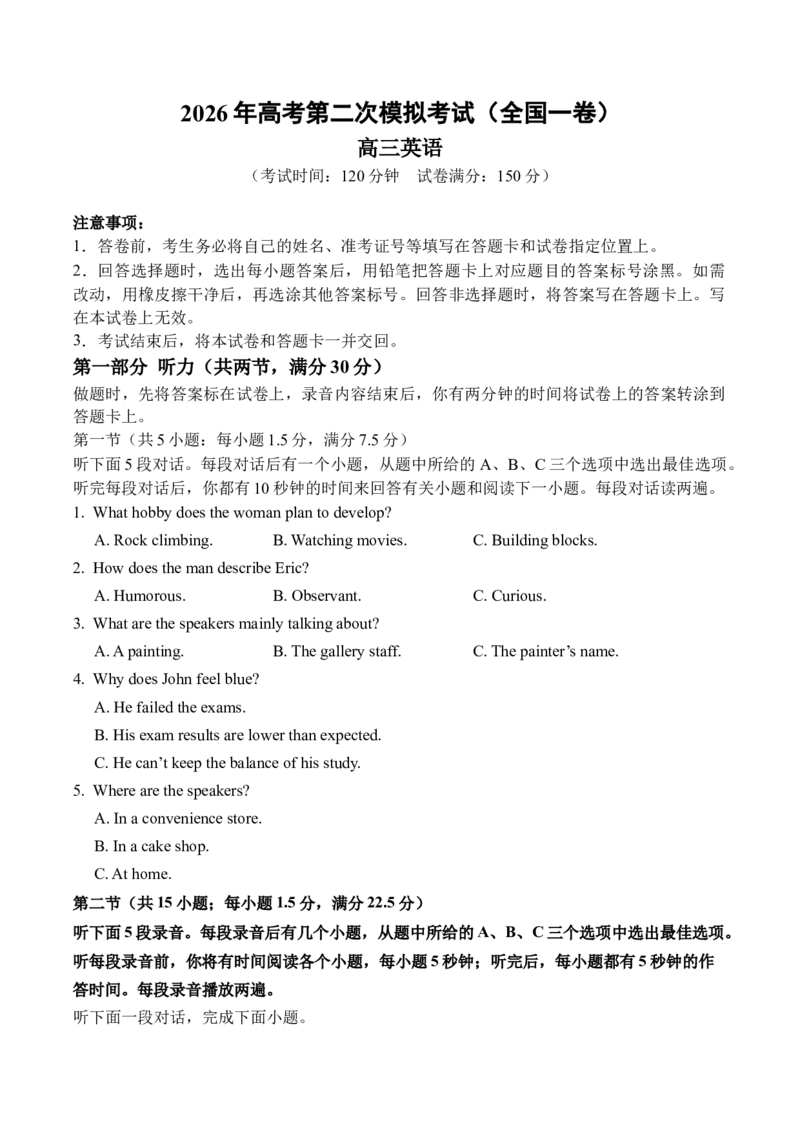
2026 年高考第二次模拟考试(全国一卷)
高三英语
(考试时间:120 分钟  试卷满分:150 分)
注意事项:
1.答卷前,考生务必将自己的姓名、准考证号等填写在答题卡和试卷指定位置上。
2.回答选择题时,选出每小题答案后,用铅笔把答题卡上对应题目的答案标号涂黑。如需
改动,用橡皮擦干净后,再选涂其他答案标号。回答非选择题时,将答案写在答题卡上。写
在本试卷上无效。
3.考试结束后,将本试卷和答题卡一并交回。
第一部分 听力(共两节,满分30 分)
做题时,先将答案标在试卷上,录音内容结束后,你有两分钟的时间将试卷上的答案转涂到
答题卡上。
第一节(共5 小题:每小题1.5 分,满分7.5 分)
听下面5 段对话。每段对话后有一个小题,从题中所给的A、B、C 三个选项中选出最佳选项。
听完每段对话后,你都有10 秒钟的时间来回答有关小题和阅读下一小题。每段对话读两遍。
1. What hobby does the woman plan to develop?
A. Rock climbing.
B. Watching movies.
C. Building blocks.
2. How does the man describe Eric?
A. Humorous.
B. Observant.
C. Curious.
3. What are the speakers mainly talking about?
A. A painting.
B. The gallery staff.
C. The painter’s name.
4. Why does John feel blue?
A. He failed the exams.
B. His exam results are lower than expected.
C. He can’t keep the balance of his study.
5. Where are the speakers?
A. In a convenience store.
B. In a cake shop.
C. At home.
第二节(共15 小题;每小题1.5 分,满分22.5 分)
听下面5 段录音。每段录音后有几个小题,从题中所给的A、B、C 三个选项中选出最佳选项。
听每段录音前,你将有时间阅读各个小题,每小题5 秒钟;听完后,每小题都有5 秒钟的作
答时间。每段录音播放两遍。
听下面一段对话,完成下面小题。
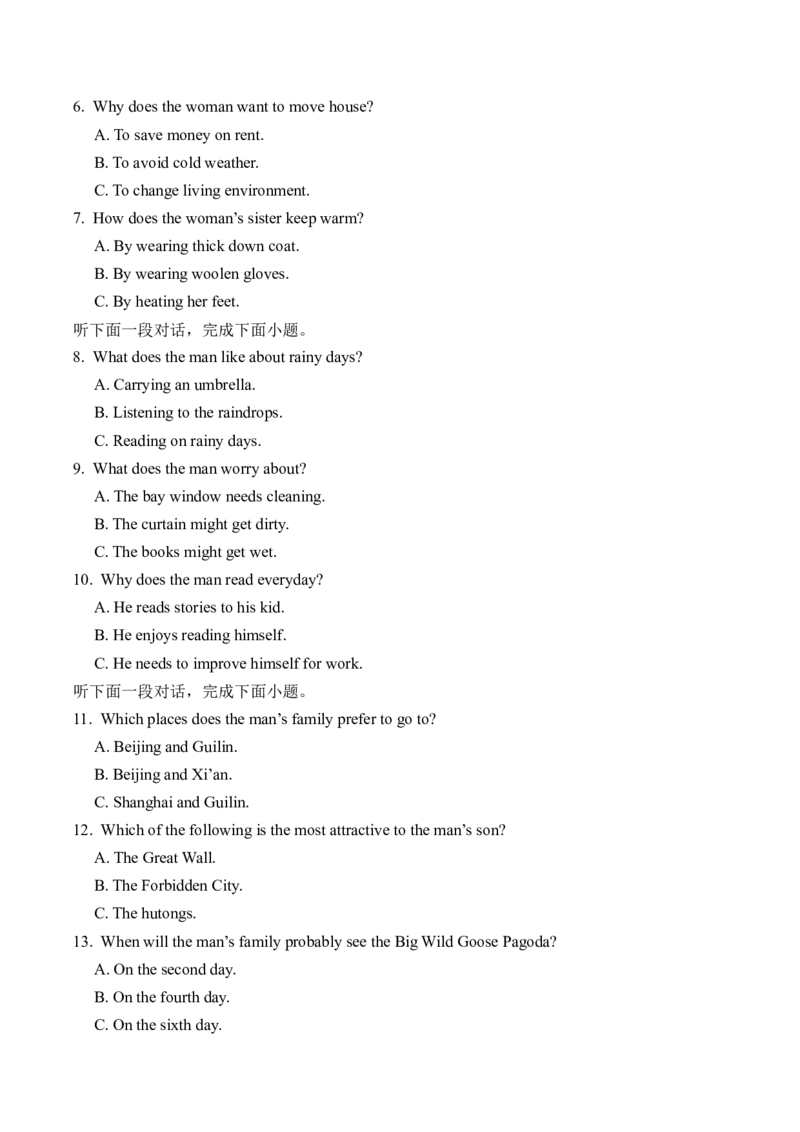
6. Why does the woman want to move house?
A. To save money on rent.
B. To avoid cold weather.
C. To change living environment.
7. How does the woman’s sister keep warm?
A. By wearing thick down coat.
B. By wearing woolen gloves.
C. By heating her feet.
听下面一段对话,完成下面小题。
8. What does the man like about rainy days?
A. Carrying an umbrella.
B. Listening to the raindrops.
C. Reading on rainy days.
9. What does the man worry about?
A. The bay window needs cleaning.
B. The curtain might get dirty.
C. The books might get wet.
10. Why does the man read everyday?
A. He reads stories to his kid.
B. He enjoys reading himself.
C. He needs to improve himself for work.
听下面一段对话,完成下面小题。
11. Which places does the man’s family prefer to go to?
A. Beijing and Guilin.
B. Beijing and Xi’an.
C. Shanghai and Guilin.
12. Which of the following is the most attractive to the man’s son?
A. The Great Wall.
B. The Forbidden City.
C. The hutongs.
13. When will the man’s family probably see the Big Wild Goose Pagoda?
A. On the second day.
B. On the fourth day.
C. On the sixth day.
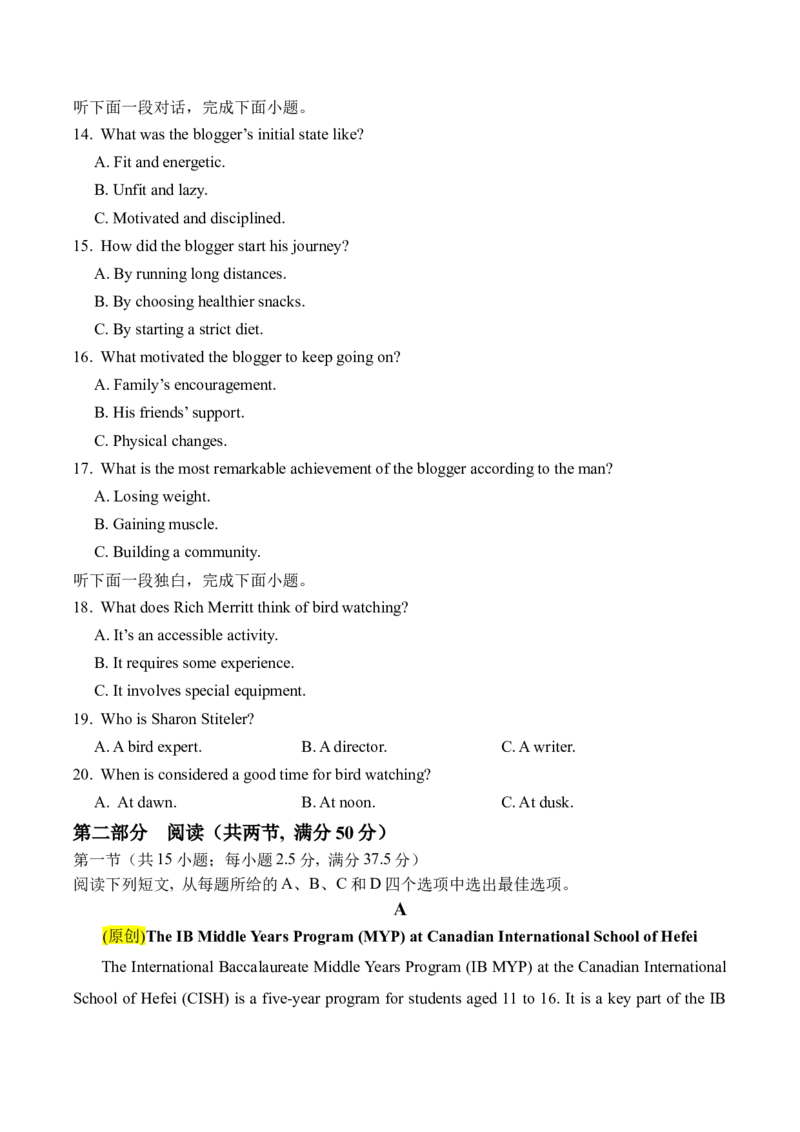
听下面一段对话,完成下面小题。
14. What was the blogger’s initial state like?
A. Fit and energetic.
B. Unfit and lazy.
C. Motivated and disciplined.
15. How did the blogger start his journey?
A. By running long distances.
B. By choosing healthier snacks.
C. By starting a strict diet.
16. What motivated the blogger to keep going on?
A. Family’s encouragement.
B. His friends’ support.
C. Physical changes.
17. What is the most remarkable achievement of the blogger according to the man?
A. Losing weight.
B. Gaining muscle.
C. Building a community.
听下面一段独白,完成下面小题。
18. What does Rich Merritt think of bird watching?
A. It’s an accessible activity.
B. It requires some experience.
C. It involves special equipment.
19. Who is Sharon Stiteler?
A. A bird expert.
B. A director.
C. A writer.
20. When is considered a good time for bird watching?
A. At dawn.
B. At noon.
C. At dusk.
第二部分  阅读(共两节, 满分50 分)
第一节(共15 小题;每小题2.5 分, 满分37.5 分)
阅读下列短文, 从每题所给的A、B、C 和D 四个选项中选出最佳选项。
A
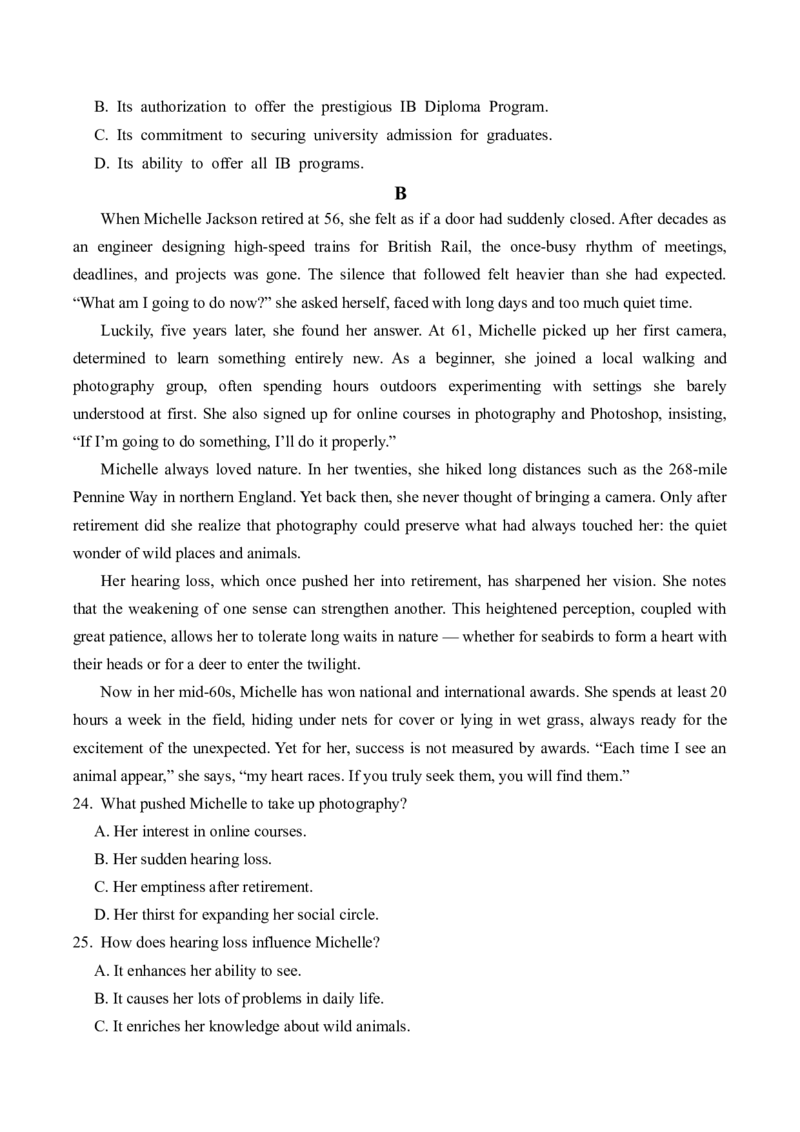
(原创)The IB Middle Years Program (MYP) at Canadian International School of Hefei
The International Baccalaureate Middle Years Program (IB MYP) at the Canadian International
School of Hefei (CISH) is a five-year program for students aged 11 to 16. It is a key part of the IB
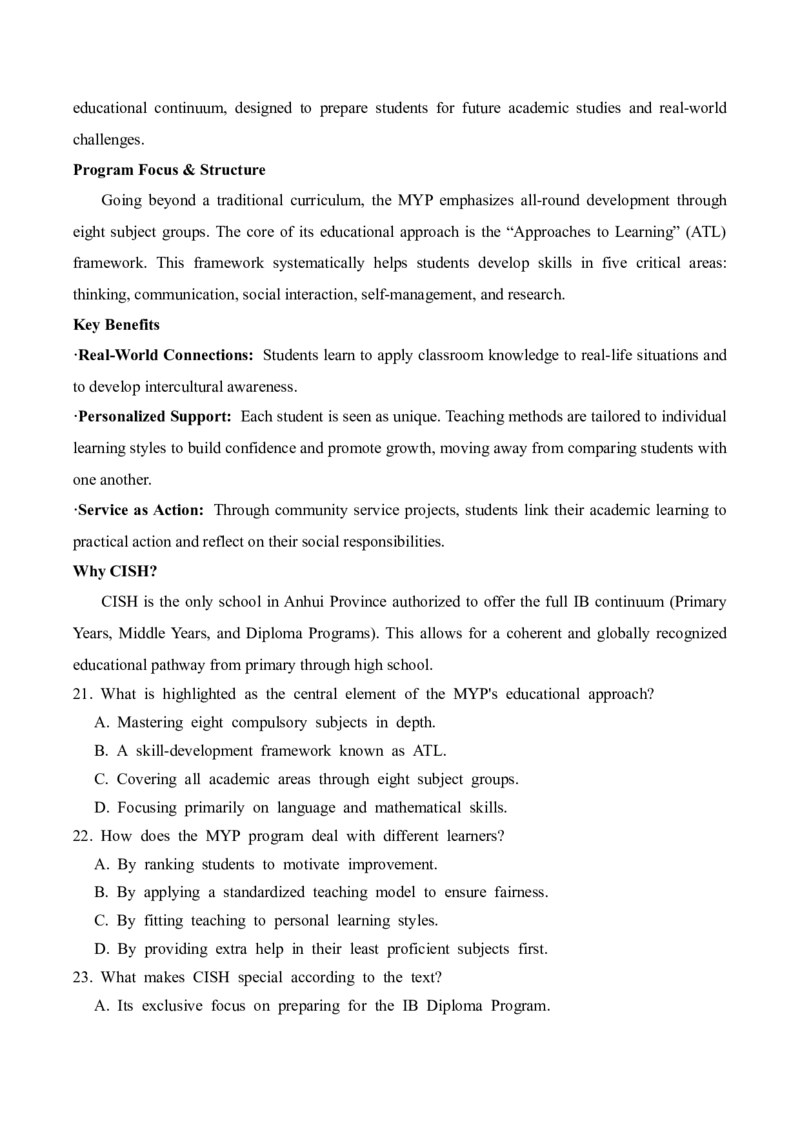
educational continuum, designed to prepare students for future academic studies and real-world
challenges.
Program Focus & Structure
Going beyond a traditional curriculum, the MYP emphasizes all-round development through
eight subject groups. The core of its educational approach is the “Approaches to Learning” (ATL)
framework. This framework systematically helps students develop skills in five critical areas:
thinking, communication, social interaction, self-management, and research.
Key Benefits
·Real-World Connections: Students learn to apply classroom knowledge to real-life situations and
to develop intercultural awareness.
·Personalized Support: Each student is seen as unique. Teaching methods are tailored to individual
learning styles to build confidence and promote growth, moving away from comparing students with
one another.
·Service as Action: Through community service projects, students link their academic learning to
practical action and reflect on their social responsibilities.
Why CISH?
CISH is the only school in Anhui Province authorized to offer the full IB continuum (Primary
Years, Middle Years, and Diploma Programs). This allows for a coherent and globally recognized
educational pathway from primary through high school.
21. What is highlighted as the central element of the MYP's educational approach?
A. Mastering eight compulsory subjects in depth.
B. A skill-development framework known as ATL.
C. Covering all academic areas through eight subject groups.
D. Focusing primarily on language and mathematical skills.
22. How does the MYP program deal with different learners?
A. By ranking students to motivate improvement.
B. By applying a standardized teaching model to ensure fairness.
C. By fitting teaching to personal learning styles.
D. By providing extra help in their least proficient subjects first.
23. What makes CISH special according to the text?
A. Its exclusive focus on preparing for the IB Diploma Program.
B. Its authorization to offer the prestigious IB Diploma Program.
C. Its commitment to securing university admission for graduates.
D. Its ability to offer all IB programs.
B
When Michelle Jackson retired at 56, she felt as if a door had suddenly closed. After decades as
an engineer designing high-speed trains for British Rail, the once-busy rhythm of meetings,
deadlines, and projects was gone. The silence that followed felt heavier than she had expected.
“What am I going to do now?” she asked herself, faced with long days and too much quiet time.
Luckily, five years later, she found her answer. At 61, Michelle picked up her first camera,
determined to learn something entirely new. As a beginner, she joined a local walking and
photography group, often spending hours outdoors experimenting with settings she barely
understood at first. She also signed up for online courses in photography and Photoshop, insisting,
“If I’m going to do something, I’ll do it properly.”
Michelle always loved nature. In her twenties, she hiked long distances such as the 268-mile
Pennine Way in northern England. Yet back then, she never thought of bringing a camera. Only after
retirement did she realize that photography could preserve what had always touched her: the quiet
wonder of wild places and animals.
Her hearing loss, which once pushed her into retirement, has sharpened her vision. She notes
that the weakening of one sense can strengthen another. This heightened perception, coupled with
great patience, allows her to tolerate long waits in nature — whether for seabirds to form a heart with
their heads or for a deer to enter the twilight.
Now in her mid-60s, Michelle has won national and international awards. She spends at least 20
hours a week in the field, hiding under nets for cover or lying in wet grass, always ready for the
excitement of the unexpected. Yet for her, success is not measured by awards. “Each time I see an
animal appear,” she says, “my heart races. If you truly seek them, you will find them.”
24. What pushed Michelle to take up photography?
A. Her interest in online courses.
B. Her sudden hearing loss.
C. Her emptiness after retirement.
D. Her thirst for expanding her social circle.
25. How does hearing loss influence Michelle?
A. It enhances her ability to see.
B. It causes her lots of problems in daily life.
C. It enriches her knowledge about wild animals.
D. It deepens her understanding of human-nature relationship.
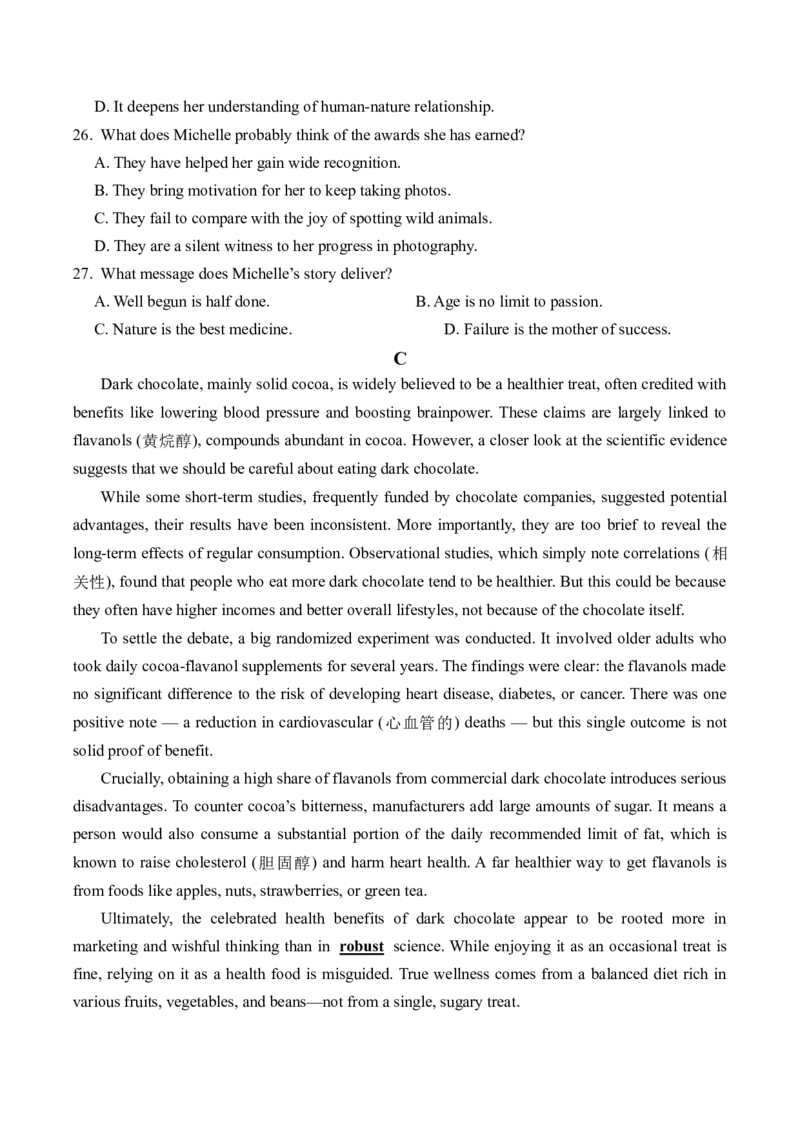
26. What does Michelle probably think of the awards she has earned?
A. They have helped her gain wide recognition.
B. They bring motivation for her to keep taking photos.
C. They fail to compare with the joy of spotting wild animals.
D. They are a silent witness to her progress in photography.
27. What message does Michelle’s story deliver?
A. Well begun is half done.
B. Age is no limit to passion.
C. Nature is the best medicine.
D. Failure is the mother of success.
C
Dark chocolate, mainly solid cocoa, is widely believed to be a healthier treat, often credited with
benefits like lowering blood pressure and boosting brainpower. These claims are largely linked to
flavanols (黄烷醇), compounds abundant in cocoa. However, a closer look at the scientific evidence
suggests that we should be careful about eating dark chocolate.
While some short-term studies, frequently funded by chocolate companies, suggested potential
advantages, their results have been inconsistent. More importantly, they are too brief to reveal the
long-term effects of regular consumption. Observational studies, which simply note correlations (相
关性), found that people who eat more dark chocolate tend to be healthier. But this could be because
they often have higher incomes and better overall lifestyles, not because of the chocolate itself.
To settle the debate, a big randomized experiment was conducted. It involved older adults who
took daily cocoa-flavanol supplements for several years. The findings were clear: the flavanols made
no significant difference to the risk of developing heart disease, diabetes, or cancer. There was one
positive note — a reduction in cardiovascular (心血管的) deaths — but this single outcome is not
solid proof of benefit.
Crucially, obtaining a high share of flavanols from commercial dark chocolate introduces serious
disadvantages. To counter cocoa’s bitterness, manufacturers add large amounts of sugar. It means a
person would also consume a substantial portion of the daily recommended limit of fat, which is
known to raise cholesterol (胆固醇) and harm heart health. A far healthier way to get flavanols is
from foods like apples, nuts, strawberries, or green tea.
Ultimately, the celebrated health benefits of dark chocolate appear to be rooted more in
marketing and wishful thinking than in robust science. While enjoying it as an occasional treat is
fine, relying on it as a health food is misguided. True wellness comes from a balanced diet rich in
various fruits, vegetables, and beans—not from a single, sugary treat.
28. What is a common belief about dark chocolate?
A. It has inconsistent benefits.
B. Its benefits come at a high cost.
C. It contributes to physical health.
D. Its advantages rely on long-term intake.
29. What is a result of taking in flavanols from dark chocolate?
A. Faster fat burning.
B. Resistance to cholesterol.
C. Reduction of cancer risks.
D. Increase in sugar consumption.
30. What does the underlined word “robust” in the last paragraph mean?
A. Basic.
B. Solid.
C. Advanced.
D. Emerging.
31. Which is the best title for the text?
A. The Bitter Truth About Dark Chocolate
B. A Guide to Choosing Healthy Chocolate
C. The Impact of Flavanols on Your Health
D. Marketing vs. Science in the Food Industry
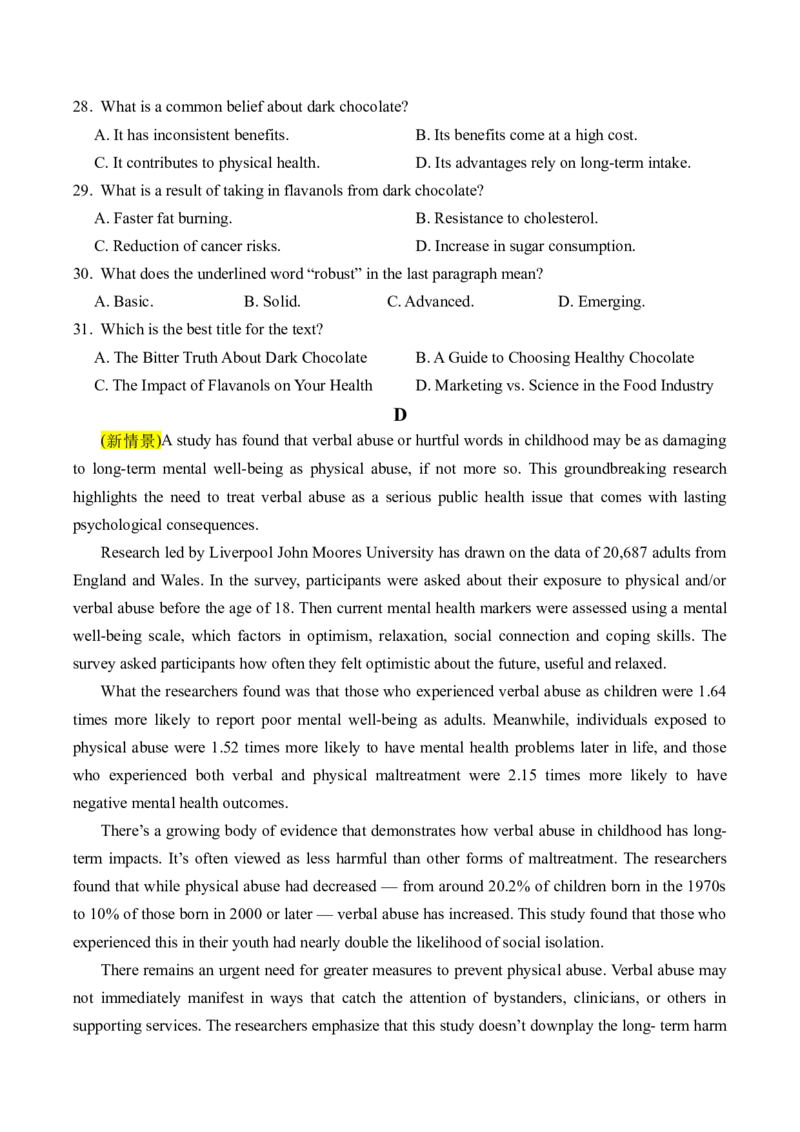
D
(新情景)A study has found that verbal abuse or hurtful words in childhood may be as damaging
to long-term mental well-being as physical abuse, if not more so. This groundbreaking research
highlights the need to treat verbal abuse as a serious public health issue that comes with lasting
psychological consequences.
Research led by Liverpool John Moores University has drawn on the data of 20,687 adults from
England and Wales. In the survey, participants were asked about their exposure to physical and/or
verbal abuse before the age of 18. Then current mental health markers were assessed using a mental
well-being scale, which factors in optimism, relaxation, social connection and coping skills. The
survey asked participants how often they felt optimistic about the future, useful and relaxed.
What the researchers found was that those who experienced verbal abuse as children were 1.64
times more likely to report poor mental well-being as adults. Meanwhile, individuals exposed to
physical abuse were 1.52 times more likely to have mental health problems later in life, and those
who experienced both verbal and physical maltreatment were 2.15 times more likely to have
negative mental health outcomes.
There’s a growing body of evidence that demonstrates how verbal abuse in childhood has long-
term impacts. It’s often viewed as less harmful than other forms of maltreatment. The researchers
found that while physical abuse had decreased — from around 20.2% of children born in the 1970s
to 10% of those born in 2000 or later — verbal abuse has increased. This study found that those who
experienced this in their youth had nearly double the likelihood of social isolation.
There remains an urgent need for greater measures to prevent physical abuse. Verbal abuse may
not immediately manifest in ways that catch the attention of bystanders, clinicians, or others in
supporting services. The researchers emphasize that this study doesn’t downplay the long- term harm
of physical abuse, but it highlights the need to better consider verbal maltreatment when it comes to
both child protection policies and mental health treatment in adults who have experienced this
trauma.
32. What did the survey in paragraph 2 focus on?
A. Adult abuse experiences.
B. Social connection in childhood.
C. Current physical health markers.
D. Childhood abuse and adult mental health.
33. How does the author present the issue in paragraph 3?
A. By presenting comparative research data.
B. By introducing the study’s background.
C. By explaining research methodology.
D. By proposing policy solutions.
34. What change in abuse patterns did researchers note?
A. Physical abuse increased since 2000.
B. Verbal abuse decreased significantly.
C. Verbal abuse rose while physical abuse declined.
D. Both types dropped among newer generations.
35. What is the best title for the text?
A. Physical abuse prevention strategies
B. Verbal abuse’s lasting adult impact
C. Survey methods in psychology research
D. Improving childhood mental health policies
第二节(共5 小题;每小题2. 5 分, 满分12. 5 分)
阅读下面短文, 从短文后的选项中选出可以填入空白处的最佳选项。选项中有两项为多余选
项。
(原创)The Benefits of Power Naps
Winston Churchill swore by them. After polishing off a boozy lunch and a cigar the
former British prime minister would climb into bed for an afternoon nap. The last part of
his regime may be worth imitating.
____3

 6  ____

 A randomised controlled trial in 2023 found that nappers woke up with
improvements to mood, alertness and memory. Napping habitually might also be wise. A
study from 2007 found that healthy adults who took regular naps had a 37% lower risk of
dying from heart disease.
____37____Sleep scientists tend to agree that a short “power” nap, somewhere between
ten and 30 minutes, is best. For example, in 1994 NASA found that a 26-minute power nap
enhanced pilots’ performance. Sleep for too long and you enter deeper sleep phases and
wake up feeling groggy. ____3

 8  ____

 A meta-analysis in 2016 concluded that daily naps
lasting more than an hour increased the risk of developing diabetes.
Some sleep experts contend that humans are biologically disposed to nap. They point to
a natural dip in alertness after midday. ____3

 9  ____

 In cultures where this is common,
however, nappers must still rest at night for the recommended seven hours.
Coffee is a popular antidote to midday drowsiness. ____

 40
  ____

 A study published in
2008 found power naps to be more effective than caffeine at improving alertness and
memory.
“The rest in the middle of the day”, Churchill wrote, “refresh the human frame far
more than a long night.” Modern sleep experts might not go so far. But if you have time
for a catnap, it could do you some good. Just remember to set an alarm.
A. However, the duration of your nap is critical.
B. This natural dip in alertness makes a brief daytime sleep appealing.
C. Sleeping during the day is not just for shift workers and cats.
D. Moreover, studies show such short naps do not harm nighttime sleep quality.
E. Therefore, office workers should be encouraged to take naps during lunch breaks.
F. Taking longer naps on a regular basis could even have negative health effects.
G. But research suggests a short nap might be a more effective solution.
第三部分 语言运用(共两节,满分30 分)
第一节(共15 小题,每小题1 分,满分15 分)
阅读下面短文, 从每题所给的A、B、C 和D 四个选项中选出可以填入空白处的最佳选项。
One day, Lavonne Schaafsma spent a few hours in Millennium Park, people-watching. On the
way back to her car, as she____

 4  1____

 for her keys, she realized her purse was missing. She started
to ____

 4  2____

 , because her purse held her ID, credit cards and hundreds of dollars in cash.
Lavonne retraced every____

 4  3____

 , searching for over an hour. Finally, she stopped in front of
a gift shop. She had no real____

 4  4____

 to believe her purse would be there, but she walked in
anyway and asked the cashier if anyone had____

 4  5____

 a black purse. The cashier’s
eyes____

 4  6____

 . Someone had. Tears of____

 4  7____

 filled Schaafsma’s eyes instantly.
The cashier said that about half an hour earlier two women had come into the shop. They
____

 4  8____

 the purse on a bench near the store, but they noticed a man rifling (翻找) through it —
and immediately became____

 4  9____

 .
The women____

 5  0____

 him and asked if the purse was his. He mumbled (含糊地说) that it was,
but they didn’t buy it. So they did something bold: they ___

 5  1___

 the purse was theirs and took it
back.
The women then brought the purse to the shop and____

 5  2____

 waited for about half an hour to
see if the owner would return, but when no one appeared, they____

 5  3____

 the purse with the cashier.
“These women who I don’t know saved me hours of work____

 5  4____

 credit cards.
They____

 5  5____

 me from massive anxiety,” Schaafsma said. “The story restores my faith in
everyday heroes.”
41. A. reached
B. waited
C. prepared
D. paid
42. A. wonder
B. doubt
C. panic
D. imagine
43. A. attraction
B. park
C. shop
D. step
44. A. reason
B. excuse
C. duty
D. target
45. A. hunted for
B. turned in
C. begged for
D. given out
46. A. narrowed
B. closed
C. widened
D. rolled
47. A. sadness
B. shock
C. regret
D. relief
48. A. attached
B. spotted
C. held
D. put
49. A. suspicious
B. calm
C. ashamed
D. confident
50. A. ignored
B. approached
C. enrolled
D. assessed
51. A. refused
B. realized
C. pretended
D. decided
52. A. patiently
B. occasionally
C. secretly
D. independently
53. A. combined
B. connected
C. discussed
D. left
54. A. identifying
B. matching
C. canceling
D. evaluating
55. A. hid
B. rescued
C. discouraged
D. accepted
第二节(共10 小题;每小题1.5 分 ,满分15 分)
阅读下面短文,在空白处填入1 个适当的单词或括号内单词的正确形式。
(热点话题)A Chinese research team has developed a deep-learning tool called DeepWheat,
____

 5  6____

  can help plant growers to predict the parts that decide plant features with high
____

 5  7____

  (accurate). It uses AI to accurately predict how genes work in different plant parts and
types of crops. This is very useful because crops like wheat have a ____

 5  8____

  (remarkable) large
set of genetic materials — about 40 times ____

 5  9____

  (big) than rice’s, and five times the size of
humans’.
____

 6  0____

  (address) this complexity, the team built two core models into one tool. DeepWheat
can find out how changing genes ____

 6  1____

  (affect) plants and predict these changes clearly.
Many crop genes can influence multiple traits (特征), sometimes in good ways and sometimes in bad
ones. For example, ____

 6  2____

 rice gene might increase the number of flowers but weaken the
stems (茎) if it’s too active. Current gene-editing relies on tiring, blind trial and error. DeepWheat
offers a better alternative: systems that enable researchers to keep ____

 6  3____

  (run) computer
simulations (模拟) for testing all possible gene changes let them spot useful adjustments before real
experiments, improving precision and saving effort.
Successfully ____

 6  4____

  (test) in rice and corn, the tool has proved effective for many crops. It
identifies key parts, improves editing targets, and solves a farming bottleneck — when improving
one trait weakens another. By making better gene networks, DeepWheat reduces such trade-offs,
speeds up good trait combination, and serves ____

 6  5____

  a practical AI solution for developing
high-quality crops.
第四部分 写作(共两节, 满分40 分)
第一节(满分15 分)
假定你是校广播站负责人,现需在校内招聘一名英语新闻播音员,请你用英语以“An
announcer wanted”为题目写一则招聘启事。内容包括:
(1)主要工作;
(2)招聘条件;
(3)报名时间和地点。
注意:
(1)写作词数应为80 个左右;
(2)请按如下格式在答题纸的相应位置作答。
An announcer wanted
_________________________________________________________________________________
_________________________________________________________________________________
_________________________________________________________________________________
_________________________________________________________________________________
_________________________________________________________________________________
_________________________________________
The Students’ Union
第二节(满分25 分)
阅读下面材料,根据其内容和所给段落开头语续写两段,使之构成一篇完整的短文。
The ancient oak tree in the school courtyard served as the traditional “memories bank”. On the
final day of senior year, students gathered to bury time capsules - letters to their future selves. Mia
stood among them, clutching her sealed envelope with a heavy heart. Unlike others filled with hopes
and dreams, hers contained a painful confession (忏悔) she had carried for three long years.
Her mind flashed back to the science lab, where her curiosity had led to disaster. Reaching for
the school’s antique microscope, she accidentally knocked it from the table. It broke into two parts.
She quickly picked them up and put them together. At this moment, the door opened revealing Ben, a
quiet classmate, with Mr. Davies behind him. Ben came to fetch the microscope for an experiment.
Hardly had he touched the microscope when it split into two parts.
To Mia’s astonishment, Ben quietly claimed responsibility. “I was moving it and it slipped,” he
murmured, accepting the teacher’s disappointment that should have been hers. Mia watched in guilty
silence as he bore the blame she deserved.
Now, watching Ben place his own letter in the hole and offer her a sad smile, Mia held the
envelope tightly in her hand. The breeze rustled the oak leaves like whispering voices. She looked
from the freshly dug earth to Ben’s figure, wondering if burying her truth was truly how she wanted
to end her high school story.
注意:1. 续写词数应为150 词左右;
2. 请按如下格式在答题卡的相应位置作答。
Just as the dirt was about to cover the capsules, Mia suddenly stepped forward.
_________________________________________________________________________________
_________________________________________________________________________________
_________________________________________________________________________________
_________________________________________________________________________________
_________________________________________________________________________________
_______________________________________________________
After telling the truth, Mia felt a light tap on her shoulder.
_________________________________________________________________________________
_________________________________________________________________________________
_________________________________________________________________________________
_________________________________________________________________________________
_________________________________________________________________________________
_______________________________________________________