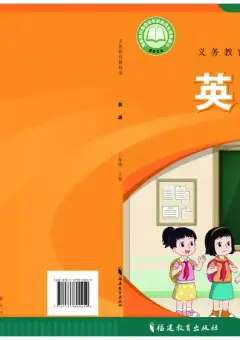
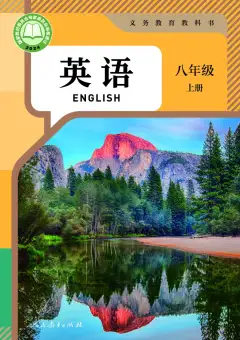
义务教育教科书
五·四学制
义
务
教
育
教
科
书
八年级 下册
八
年
级
下
册
定价:7.86元
五
·
四
学
制
英
语
英语(五四学制) 7-9年级下册.indd   2
2015.2.6   3:58:28 PM
8
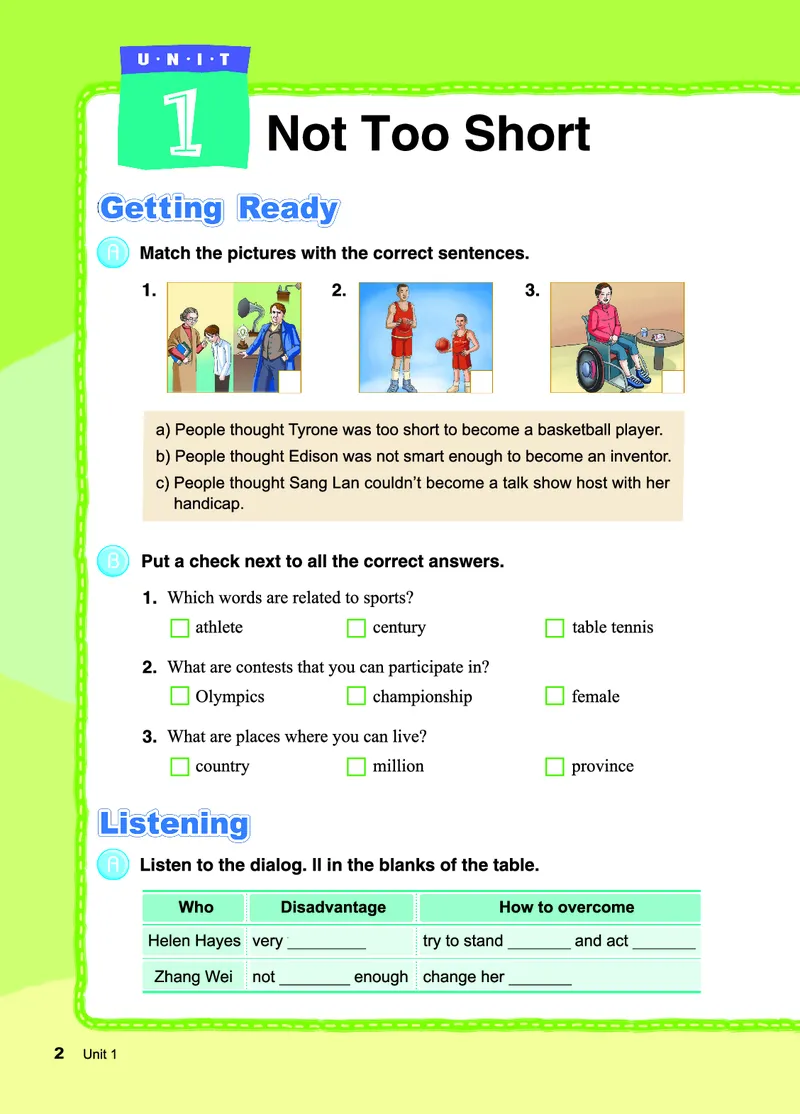
Unit 1
9
Not Too Short
1.
  Read an English newspaper every day so that you can improve your
  reading skills.
2.
3.
4.
1.  This newspaper also said that table tennis was invented by soldiers
      from England.
2.  Most mountain climbers need to use their eyes to climb mountains.
3.  We should never give up our dreams!
4.  While he was growing up, he always dreamed of flying through the air.
34
Before Reading
Put a check next to the words you can use with each verb. Add one more to
the list.
Reading - It Smells Good
taste
look                   sound
         smell                     feel
good
soft
smart
bitter
tired
delicious
big
lovely
salty
beautiful
sour
noisy
sweet
happy
terrible
  A baby learns about the world through the five senses: his eyes, ears, fingers,
nose, and tongue. He sees his parents. They look big to him. He hears a song. It
sounds beautiful. He touches a pillow. It feels soft. He smells food. It smells good.
He eats food. It tastes good.
  Wait! Food smells good, and food tastes good, too. Do our noses and tongues do
the same thing? Not really. Let’s look more closely at noses and tongues. A person’s
nose can smell many different things. Try this test. Close your eyes and tell your
friend to put something right under your nose. Now smell it. Can you tell what it is?
Mostly, yes. Our noses are very smart. Most people can smell thousands of different
things. For example, when you smell a rose, you know it smells different from other
flowers.
  What about our tongues? A person’s tongue is not as smart as his nose. In the
past, we thought we could only taste four different flavors such as sweet, sour, salty,
and bitter. Some food tastes like sugar or lemons. Other food can taste like salt or
bitter medicine. Recently, however, scientists found out
about a fifth taste. The fifth taste is hard to describe. It’s
the taste in meat. A food like cheese also has this taste.
  Why do foods have different flavors? All candy tastes
sweet, but not all candy tastes the same. We use our noses
and tongues at the same time. Thus, grape candy tastes different from orange candy.
Unit 5
taste
look
sound
smell
feel
64
Before Reading
Look at the pictures below. What did the people in the pictures do when
they were alive? Talk about them with your partner.
Reading - A Volunteer
Mom, you’ve been a volunteer, haven’t you? I think I want to
volunteer somewhere, too. I’m old enough to do it, don’t you think so?
Sure you are, Susan. It’s a great idea. I used to be a volunteer in our
hometown in America for many years. I have also done this in other
countries, too.
Which other countries have you been a volunteer in?
Well, I have been a volunteer in several countries in Africa. Because
we live in China now, I also do volunteer work here. Since last
year, I have helped at both the local hospital and an elementary
school.
What kind of volunteer work did you do in America?
I worked in schools and nursing homes. Also, I helped any of our
neighbors who needed help. There are so many things which you
can do to help people.
Do they pay you for volunteer work?
No, Susan. A volunteer is a person who does work without being
paid for it. We help people in order to show them our love and
kindness. We feel good when we are showing kindness to others.
What can I do?
I have already seen some jobs which are suitable for you at the local
hospital. Let me talk to some of the nurses right now.
Thank you, Mom. I can’t wait to start.
Albert Schweitzer
Henry Norman Bethune
Florence  Nightingale
Susan:
Susan’s mother:
Susan:
Susan’s mother:
Susan:
Susan’s mother:
Susan:
Susan’s mother:
Susan:
Susan’s mother:
Susan:
Unit 9
Wang Dandan
Your own
   What do you enjoy doing?
  drawing
   What do you want to be in the
   future?
  artist

   What will you do for your dream?
  draw every day /
  study art in Paris
80
Before Reading
Look at the pictures. Find out which items you can recycle and how.
Share your ideas with your partner.
Reading - Reduce, Reuse, Recycle
  Many years ago, people never thought about buying drinking water. But today,
millions of people must buy drinking water because clean water is getting hard to
find. This is just one example of a huge problem. There aren’t enough resources
left — trees, water, oil, fish, animals, or clean air — for our future. If we continue
to waste these natural resources, our life will get much more difficult. One day, we
may even have to pay for the air that we breathe! But it is still not too late. There are
things that we can do to make things better. We can remember the “3R’s” : Reduce,
Reuse, and Recycle. Let’s think about what these three words mean.
  To reduce means to use less. Here are some simple things that you can do to
reduce waste.
  • Turn off the water while you brush your teeth.
  • Take a cloth bag when you go shopping so you won’t need to use plastic bags.
  To reuse means to use something again. How can you reuse things? Here are
some examples.
  • Buy things that you can fill again and again, like refillable pens and refillable
shampoo bottles.
  • Use both sides of a sheet of paper before you use a new one.
  To recycle means to make something new from used things. Fortunately,
recycling is now a common practice in most parts of the world. Here are some
materials that can be recycled.
  • Paper         • Glass
• Plastic
• Metal
  Please remember to reduce, reuse, and recycle. If
you do this, the quality of life will improve for us and our
children.
Unit 11
Appendix
Notes to the Texts
课文注释
Appendix
附录
Unit 1
1.
I’ll keep my fingers crossed!
我将为你祈祷!
·keep one蒺s fingers crossed
手指交叉(祈求好运)
crossed 意思是“交叉的”“十字形的”,为形容词。就是中指和食指交叉,呈“X”
形,就像十字架的形状,代表“好运”“上帝保佑你”。
例- What terrible weather!
Do you think we could go to the zoo tomorrow?
天气真是太糟糕了!你觉得我们明天还能去动物园吗?
- Let蒺s keep our fingers crossed!
让我们祈祷好运吧!
2.
According to a newspaper in England, more than 4 million people around the
world play table tennis.
根据一份英国报纸的报道,在全世界有超过四百万人在打乒乓球。
·according to ...
根据……
例You can make pancakes according to the recipe.
你可以按食谱做薄煎饼。
3.
Despite this fact, the best table tennis athletes today are not from England.
尽管事实如此,现今最好的乒乓球运动员却不是英国人。
·despite ...
尽管……
despite 后面接名词或名词词组。
例Despite the difficulties, he finished his work on time.
尽管困难重重,他还是按时完成了他的工作。
4.
People call her one of the best table tennis athletes ever.
人们认为她是至今最棒的乒乓球运动员之一。
ever 可与比较级、最高级连用,译为“至今”。
92
Notes to the Texts
例I think she is the best actress ever.
我认为她是至今最优秀的女演员。
5.
However, this did not make her give up.
然而,这并没有让她放弃。
·make somebody do something
让某人做某事
例He had to make me leave.
他不得不让我离开。
·give up
放弃
后面可接名词或动词-ing 形式,表示“放弃某事物”或“放弃做某事”。
例Never give up your dream.
永远不要放弃你的梦想。
You must give up smoking.
你必须戒烟。
6.
One year later, the national team changed their mind.
一年后,国家队改变了他们的想法。
·change one蒺s mind
改变某人的想法
例He always changes his mind.
他总是改变主意。
7.
She was named one of the top ten athletes in China for six years straight.
她连续六年被提名为中国十佳运动员。
·top ten
十佳,最杰出的十位
例Her name is in the list of top ten female singers of 2012.
她的名字在2012年十佳女歌手的名单里。
·straight
连续地
例He蒺s been without sleep for three days straight.
他已经连续三天没有睡觉了。
8.
Deng Yaping is only 1 meter 50 centimeters tall, but she never believed she was
too short for anything.
邓亚萍身高只有1.5 米,但她从不相信有什么事是因为个子矮而做不到的。
·1 meter 50 centimeters tall
身高1.5 米
描述某人的身高要用tall,而不用high。
例The boy is 150 centimeters tall.
那个男孩身高150 厘米。
93
Appendix
Unit 2
1.
I am dying to listen to you playing the guitar.
我非常渴望听到你的吉他演奏。
·be dying to do ...
渴望做……
dying 是die 的现在分词形式,字面理解为“不惜生命想做某事”,引申为“非常渴望
做某事”。
例I am dying to see you.
我非常渴望见到你。
2.
They wear special jackets with hanging bells, and he follows the sounds made by
the bells.
他们穿着挂有铃铛的特制夹克,他就随着铃铛所发出的声音前进。
·with hanging bells 介词短语作后置定语,修饰jackets。
·made by the bells 分词短语作后置定语,修饰前面的sounds。
3.
After training hard for many years, Eric decide to climb Mt. Qomolangma.
经过多年的刻苦训练,艾瑞克决定攀登珠穆朗玛峰。
·decide to do something
决定做某事
例He decides to go to Beijing alone.
他决定独自去北京。
4.
His friends weren蒺t worried, either.
他的朋友们也不担心。
·either
也
当either 译为“也”时,只用于否定句中,是副词,且常用于句末。
例I haven蒺t seen the movie and my brother hasn蒺t either.
我没看过这部电影,我弟弟也没看过。
5.
On the last day of the climb, they couldn蒺t start until 9 p.m. because of bad weather.
在攀登的最后一天,由于天气恶劣他们直到晚上九点钟才开始攀爬。
·not ... until ...
直到……才……
例Jake can蒺t go to the park until weekend.
直到周末杰克才可以去公园。
6.
Due to his blindness, he has been climbing that way his whole life.
由于眼睛看不见,所以他这一生都是以那种方式攀登的。
·due to ...
由于……
due to 引导的介词短语用于说明理由,后面接名词或动词-ing 形式,与because of ...
94
Notes to the Texts
表达的意思相同。上面的句子还可以表达为:Because of his blindness, he has been
climbing that way his whole life.
例Due to the fog, the train was late.
由于有雾,火车晚点了。
Unit 3
1.
While he was growing up, he always dreamed of flying through the air.
在他成长的过程中,他一直梦想着在天空翱翔。
·grow up
成长,长大
grow 可以指人的成长,还可以指种植或栽培某种植物。
例We grow up every day.
我们每天都在成长。
I grow flowers in my garden.
我在花园里种花。
2.
Therefore, he planned to become a pilot.
因此,他计划成为一名飞行员。
·become
变成,成为
become 多指身份、职业等的改变。
例She became a famous writer.
她成了一位著名的作家。
3.
On October 14, 2003, Yang Liwei was told that he was going to be the first Chinese
astronaut to travel in space.
2003 年10 月14 日,杨立伟接到通知,他将会成为第一个遨游太空的中国宇航员。
·was told 此处用被动语态表示杨立伟被别人告知、通知。
·to travel in space 动词不定式做后置定语,修饰astronaut,译为“遨游太空的”。
4.
On October 15, 2003, Yang Liwei boarded the spaceship Shenzhou-5 that was
going to blast off for space.
2003 年10 月15 日,杨利伟登上即将升入太空的神舟五号飞船。
·board
登上(船、车、飞机等)
board 在本句是“登上飞船”的意思,为动词。board 还可以指“板”“木板”,为名
词。例如:blackboard 黑板。
例The passengers boarded the plane at 9 a.m.
旅客们上午九点登上飞机。
There is a board on the wall.
墙上有一块板子。
95
Appendix
·blast off
发射,升空
例The spaceship blasted off at 14:30.
宇宙飞船在十四点三十分发射升空。
5.
When he returned to Earth from space, Yang Liwei was a hero!
当杨利伟从太空返回地球时,他成为了一名英雄!
·return to
返回
return to 指回到原来的位置,相当于go back。另外,还有“归还”的意思,相当
于give something back。
例Tom didn蒺t return to America until 2002.
直到2002 年汤姆才回到美国。
I have to return these books to the library today.
我不得不在今天把这些书还给图书馆。
Unit 5
1.
Have you ever heard about the bird that can speak nearly a thousand words?
你听说过那只几乎能说一千个单词的鸟吗?
·Have you ever heard about ... ?
你曾经听说过……吗?
例Have you ever heard about the fire?
你曾经听说过有关那场大火的事吗?
2.
I read it in the Guinness Book of World Records.
我在《吉尼斯世界纪录》一书中读到过它。
《吉尼斯世界纪录》(Guinness Book of World Records)是根据休·比弗爵士的设想,
由诺里斯·麦克沃特和罗斯·麦克沃特编辑创立,第一版于1955 年问世。《吉尼
斯世界纪录》集世界上最好、最坏、最美、最怪、最惨、最伟大的事物为大全,内
容包括人类世界、生物世界、自然空间、科技世界、建筑世界、交通运输、商业世
界、艺术欣赏、人类潜能、体育世界、社会政治等类别,收录了许多光怪陆离、难
以想象的纪录。
3.
Maybe you picture a zoo in your mind,or you may think about pets like dogs or cats.
也许在你的大脑中会想象到一个动物园,或者你会联想到猫或狗一类的宠物。
·picture
想象,设想
picture 是“形成图像”的意思,翻译为“想象”,此处作动词。picture 用作名词时,
译为“图片”。
96
Notes to the Texts
例I can蒺t picture the village without the old church.
我无法想象村子里没有那座旧教堂会是什么样子。
4.
For instance, there are horses that help people who cannot walk.
例如,有些马可以帮助不能走路的人。
·此句的结构是一个定语从句中包含着另一个定语从句。关系代词that 引导的定语
从句限定先行词horses,that 在从句中作主语。who 在that 从句中引导一个定语从
句,限定先行词people,who 在从句中也作主语。
·for instance
例如
意思相当于for example,可放在句末。
例Several of his friends came: Ben, Carol and Mike, for instance.
他的几个朋友来了,有:本、卡罗尔和迈克。
For example, I have problems with writing.
举例来说,我在写作方面有些问题。
5.
In some American hospitals, dogs visit lonely patients so that they feel less lonely.
在一些美国医院,狗会探望孤单的病人,让他们感觉不那么孤独。
·feel lonely
感觉孤单
lonely 意思是“孤单的”“寂寞的”,可以作表语或定语修饰名词。
例He is a lonely boy.
他是一个孤单的男孩儿。
I am lonely without my friends.
没有朋友们,我是孤独的。
6.
They are very happy to have the company of a loving friend.
他们很开心有喜爱的朋友陪伴。
·the company of ...
在……陪同下
在上面的句子中,company 译为“陪伴”,作名词。
例I go shopping with the company of my sister.
我在姐姐的陪同下去购物。
Unit 6
1.
It turned into a flower!
它变成了一朵花。
·turn into
变成
A turns into B,译为“A 变成B”;turn A into B,译为“把A 变成B”。turn into
通常用来表达人或物品的转变。
例The sofa turns into a bed.
沙发变成床了。
97
Appendix
In the story, the old woman turned the boy into a frog.
在故事中,老太婆把那个男孩变成了一只青蛙。
2.
Let me tell you how I became interested in magic.
让我来告诉你我是怎么对魔术产生兴趣的吧。
·become interested in ...
变得对……感兴趣
词组中的become 是强调转变的动作和过程,说明原来不感兴趣或不太感兴趣的变
得感兴趣了。介词in 后面接名词、动名-ing 形式或代词。
例I became interested in piano.
我开始对钢琴感兴趣了。
I became interested in playing the piano.
我对弹钢琴变得有兴趣了。
Everybody becomes interested in her.
大家都开始对她感兴趣了。
3.
One rainy day, my uncle came to visit our home.
一个下雨天,我的叔叔到我家看望我们。
·come to visit
来看望,来参观
例When can we come to visit you?
我们什么时候可以去看望您?
Lots of visitors come to visit the Great Wall.
许多游客来参观长城。
4.
It was so interesting that I wanted to learn how he did it.
这个魔术如此有趣以至于我想跟他学是怎么做的。
·so ... that ...
如此……以至于……
表示由于前面的原因而导致后面的结果,引导结果状语从句。
例The boy ran so fast that I couldn蒺t catch him.
小男孩跑得如此快以至于我没抓到他。
5.
It was really kind of him to do this, since magicians don蒺t like to tell their secrets.
他能这么做实在是太好了,因为魔术师们都不愿意说出他们魔术的秘密。
·be kind of somebody to do something
某人能做某事太好了
在to do this 中,this 指的是tell their secrets。
例It蒺s kind of you to say so.
你能这么说太好了。
·since 因为
since 引导原因状语从句,表示对方已知的,无需加以说明的原因或事实,语气比
because 要弱。
例Since he was lazy, he didn蒺t finish his homework.
因为他很懒,所以他没有完成作业。
98
Notes to the Texts
6.
Most magic is a type of trick on your eyes.
大多数的魔术都是迷惑人眼睛这一类的把戏。
·a type of
一种,一类
例This is a type of book that you like to read.
这是你喜欢读的一类书籍。
·on
对于
在此句中,on 后面的部分表示魔术迷惑的对象,是介词。
7.
Magicians make people pay attention to something else.
魔术师让大家注意其他的东西。
·pay attention to
注意
在to 后面加名词,译为“注意到某事物”;在to 后面加动词-ing 形式,表示“留
心做某事”。
例You must pay attention to your health.
你必须多注意你的健康。
Please pay attention to taking care of your baby.
请注意照顾好你的小孩。
8.
Let me give you an example.
让我给你做个示范。
·give somebody an example
给某人示范,给某人举个例子
例It蒺s hard to understand, can you give me an example?
这太难理解了,你能给我举个例子吗?
9.
When you dip the tip of the“magic toothpick”into the water, the triangle will
break apart.
当你把神奇牙签的顶端浸在水里时,那个三角形就会分解开。
·dip ... into ...
把……浸到……中
例He likes to dip the bread into the milk.
他喜欢将面包浸到牛奶中。
·break apart
分解,分裂
例The country began to break apart.
国家开始分裂了。
Unit 7
1.
How about drinking plenty of water?
多喝点水怎么样?
·plenty of
大量的
用来修饰可数名词和不可数名词,用法与a lot of 或lots of 相同。
例There are plenty of eggs in the market.
市场上在出售大量的鸡蛋。
99
Appendix
2.
What would you do if you were in my shoes?
如果遇到我这种情况你会怎么做?
·What would you do if ... ?
如果……你会怎么做?
表示一种假设的情况,在if 从句中动词要用过去式。通常用于在假设情况下,询
问他人的意见或想法。
·be in one蒺s shoes
站在某人的立场
例Would you tell her the truth if you were in my shoes?
如果你站在我的立场,你会告诉她真相吗?
3.
There is a saying, however,“Good medicine tastes bitter, but is good for the body. ”
然而,俗语说:“良药苦口利于病。”
·There is a saying ...
俗话说……
有时也会说There is an old saying ... 译为“古语云……”或“有句古话……”。
例There is a saying“An apple a day, keeps the doctor away.”
有句俗语说:“一天一苹果,医生远离我。”
4.
Zhang Wei has an experience related to this saying.
关于这句俗语张薇深有体会。
·relate to
涉及,有关
句中用过去分词related to 作定语来修饰限定experience。
例I蒺m looking for a book related to body language.
我正在找一本有关肢体语言的书。
5.
And they say that it is better to eat cut-up garlic than whole garlic.
并且他们说大蒜切碎吃比整个吃更好。
·it is better ... than ...
……比……更好
better 后面可接动词不定式。
例It is better to make salad than cookies.
做沙拉比做饼干更好一些。
·cut-up
切碎的
在句中作定语,修饰garlic,译为“切碎的”。
* cut up
切碎
例Cut up the carrots before you put them into the pot.
把胡萝卜切碎后再放进锅内。
100
Notes to the Texts
6.
Why don蒺t you eat some more?
为什么不多吃一些呢?
·Why don蒺t you ...?
为什么不……?
表示提建议,等同于Why not ...? 这句话还可以表述为Why not eat some more?
Unit 9
1.
I advise that you write things down so you don蒺t forget.
我建议你把事情记下来,那样你就不会忘记了。
·advise
建议
在此句中,advise 后面加that 引导的从句作宾语,从句是should + v. 的形式表达,
通常省略should。advise 常用的表达形式还有advise sb. to do sth.,译为“建议某
人做某事”。
例The teacher advised that we read more books.
老师建议我们读更多的书。
= The teacher advised us to read more books.
2.
Some people are not satisfied with their jobs.
有些人对他们的工作不满意。
·be satisfied with ...
对……感到满意
satisfied 译为“满足的”“满意的”,是形容词。
例Are you satisfied with your food?
你对你的食物满意吗?
3.
Here are some tips that will help you make the right choice.
这些建议能帮助你做出正确的决定。
·make the right choice
做出正确的选择
“做出错误的选择”可以表达为:make the wrong choice。
例Make sure that you don蒺t make the wrong choice.
你要确定没有做出错误的选择。
4.
So, the first thing you should consider is what you like to do.
因此,你要考虑的第一件事就是:你喜欢做什么。
句子的主语是the first thing,you should consider 是省略了关系代词that 的定语从
101
Appendix
句,修饰先行词the first thing, what you like to do 作表语。
5.
It is not easy to predict the kinds of jobs that will be needed, but we should take it
into account.
想要预测出哪些工作急需用人不是件容易的事,但是我们也应该把它列入考虑范围。
·take ... into account
把……考虑在内
例They had to take the baby into account when they wanted to go out.
当他们要外出时,他们不得不考虑如何将婴儿安顿好。
6.
It seems that there are so many things to consider before deciding your future job.
似乎在决定未来职业之前你有很多事情要考虑。
·It seems that ...
看起来……,似乎……
seem 是系动词,that 后面的从句为表语从句,表达的是现在的情况。表达过去的
情况时用It seemed that ...
例It seems that he is wrong.
看起来他错了。
It seems that he has known the secret.
他似乎已经知道那个秘密了。
7.
Therefore, try to consider what jobs will be needed in the future as well as your
interests, values, and skills, and you will be happier with your job and life.
因此,尽量把未来所需的职业与你的兴趣、价值、技能综合考虑,这样将来你所
从事的工作和生活将会使你更开心。
·句子what jobs will be ... and skills 是由what 引导的宾语从句,作consider 的宾语。
·try to consider ..., and you will be happier ... 中的and 连接两个句子,带有因果关系。
通常前一句是祈使句,后一句表示结果。
例Study hard, and you蒺ll pass the exam.
努力学习,这样你才能通过考试。
Unit 10
1.
Then, we won蒺t have to worry about housing any more.
那么,我们就不用再担心住房了。
·not have to
无须,不必
例We won蒺t have to go out the building in this rain.
我们不必在这样的雨天走出大楼。
102
Notes to the Texts
2.
If machines take over people蒺s jobs, people will forget important skills and
knowledge.
如果机器接管人的工作,人们将忘记重要的技能和知识。
·take over
接管
例He decides to take over the school.
他决心接管学校。
3.
Future cars might be able to fly in the sky!
未来的汽车也许能在天上飞!
·be able to do something
能够做某事
强调有能力做某事,后面接动词原形。be 动词随着人称单、复数及要表达的时态
而变化。
例We are able to use computers to learn more.
我们能用电脑学到更多东西。
4.
With careful planning, technology can be used to clean up the environment — not
pollute it.
通过精心设计,科技可以被用于清理环境,而不是污染环境。
·with careful planning
通过精心设计
with 与后面的动词-ing 形式短语组合构成介词短语,作方式状语。说明通过某种
方式来达到目的。
例With her help, I passed the exam.
在她的帮助下,我通过了考试。
·破折号在后面的句子中起到进一步解释说明的作用。
例I was neither happy nor unhappy — only surprised.
我不是高兴,也不是不高兴——
—只是感到惊奇。
5.
It is up to us to make the future better than today.
让未来变得比现在更好就看我们的了。
·be up to somebody(to do something)(做某事)取决于某人
例It蒺s up to him to decide it.
那件事由他决定。
- Shall we have some juice or milk?
我们喝点果汁还是牛奶?
- It蒺s up to you.
你决定吧。
103
Appendix
Unit 11
1.
Neither do I.
我也不喜欢。
neither,是副词,译为“也不”,用在主语前面的情态动词或助动词之前,表示前面
所说的情况与后者相同。Neither do I. 表示“我也不……”。如果表达“我也一样”,
则用So do I.
例She often goes to school by bus and so do I.
她经常乘公共汽车上学,我也是。
They don蒺t like singing and neither do I.
他们不喜欢唱歌,我也不喜欢。
2.
What would you do if you were chosen to fight against the enemy?
如果你被选中与敌人做斗争,你将怎么做?
·fight against ...
与……做斗争
例He is ready to fight against his destiny.
他已经准备好与命运做斗争了。
3.
Ender, a six-year-old boy, bravely faces his destiny.
安德,一个六岁大的男孩,勇敢地面对自己的命运。
·本句中a six-year-old boy 指的就是Ender,作Ender 的同位语。通常在同位语前
后加逗号,起补充、说明的作用。如果去掉同位语,句子结构依然完整。
例My two children, Jane and Tom, are very lovely.
我的两个孩子,简和汤姆,都很可爱。
·face
面对
face 在本句的意思是“面临”“面对”,一般面对的是困难的局面,是动词。
例He faced the difficulty with courage.
他勇敢地面对困难。
4.
The government decides to send Ender to Battle School, a special school located
in outer space.
政府决定送安德去作战培训学校,一所设于外太空的特殊学校。
· a special school located in outer space 是Battle School 的同位语,用来对Battle
School 作进一步解释说明。located in outer space 是过去分词短语作后置定语,限
定special school。
·send ... to ...
送……去……
可以表达送某人或某物去某地send somebody / something to someplace。
例We sent Mary to the hospital.
我们把玛丽送到医院。
104
Notes to the Texts
5.
Ender tries his best with each game until he passes the last test — the last game.
每次比赛,安德都尽自己最大的努力,直到通过最后考验——
—终级竞赛。
· try one蒺s best with ...
在……方面尽自己最大努力
表达在某件事情上尽自己最大的努力,with 后面接表示某件事情的名词。try one蒺s
best to do something 表达尽自己最大努力做某事。
例Try your best with your exam.
尽你最大的努力去考试。
I蒺ll try my best to win the game.
我将尽我最大的努力去赢得比赛。
6.
Although Ender wins the game, it is at a great cost.
尽管安德赢得了这个比赛,但却付出了很大的代价。
·at a great cost
付出很大的代价
at a great cost 在句子中作表语。
例He finished the difficult work at a great cost.
完成这项困难的工作,他付出了很大的代价。
105
Appendix
Grammar
语法
Unit 1
使役动词在句中的应用
使役动词是表示使、令、让、帮、叫等意义的动词,主要有let,have,make,help 等。
这些动词在“主语垣谓语垣宾语垣补语”的句式中,其宾语后的补语通常是不带to 的
动词不定式,即动词原形。
例如:(1)What makes the player keep practicing table tennis?
是什么促使这名运动员坚持乒乓球训练?
(2)The little girl蒺s father had her play table tennis every night.
小女孩的父亲让她每晚打乒乓球。
(3)Let us be proud of her winning the world championship.
让我们为她获得世界冠军感到骄傲吧。
由上述例句可以看出the player, her, us 分别是使役动词的宾语,而不带to 的不定式
keep,play,be 是对宾语的补充说明,称为补语,此种“宾语垣补语”所表达的语义在逻
辑上构成主谓关系。
动词help 其后的宾语补足语(动词不定式)带to 或不带to 都可以。
例如:She will help me(to)wash the dishes.
他将帮我洗盘子。
Unit 2
动词的现在分词与过去分词形式在句中的应用
1. 现在分词
动词原形加-ing 形式除了作动名词外,还可用作现在分词。现在分词作定语,所表
达的内容有“正在”或主动的含义,其用法如下:
(1)现在分词作定语,通常放在所修饰的名词前。
例如:The sleeping boy is Tom.
那个睡觉的男孩是汤姆。
(2)现在分词短语作定语,通常放在所修饰的名词后,相当于一个定语从句。
例如:The boys playing outside make too much noise.
在外面玩的男孩们弄出很大噪音。
2. 过去分词
过去分词作定语,所表达的内容有“已完成的”或被动的含义,其用法如下:
106
(1)过去分词作定语,通常放在所修饰的名词前。
例如:Do not eat too much frozen food.
不要吃太多冷冻食品。
(2)过去分词短语作定语,通常放在所修饰的名词后,相当于一个定语从句。
例如:The tree planted yesterday is a pine.
昨天栽的那棵树是松树。
3. 现在分词和过去分词在词组中作定语的固定表达
waiting room 候车室
running water 自来水
a falling star 流星
spoken language 口语
used paper 废纸
fried eggs 煎鸡蛋
Unit 3
目的状语从句;
表示地点(场所)的介词(from ... to ..., into, over, through)
1. 目的状语从句
目的状语从句指从句部分用以补充说明主句中所述之事要达到的目的。目的状语从句
通常由so that 引导,并且谓语中常含有may, might, can, could, should, would 等情态动词。
例如:Say it louder so that you can be heard by all.
大声说,以便大家都能听到。
I got up early so that I could catch the first bus.
我起得很早,是为了能够赶上头班公共汽车。
2. 表示地点(场所)的介词(from ... to ..., into, over, through)
(1)from ... to ...
意思是“从……到……”,可以表示空间的跨越,也可以表示时间的跨越。
例如:I walk from my house to the park every morning.
我每天早晨从家步行至公园。
I was doing my homework from 6:00 to 9:00 last night.
昨晚六点至九点,我一直在做作业。
(2)into
意思是“到……里”。
例如:The man jumped into the river and disappeared.
那个人跳进河里不见了。
(3)over
意思是“越过”,强调从上方穿过。
例如:The airplanes fly over the river every day.
飞机每天从河上飞过。
(4)through
意思是“穿过”,强调“从……中穿越”。
例如:We walked through the forest.
我们步行穿过森林。
Unit 5
关系代词that 和连词that 的区分
1. 关系代词that 常用来引导定语从句。它指代先行词,同时在从句中作一定的句子成分。
Grammar 107
Appendix
例如:The building that stands by the river is our school.
河边的那座建筑是我们的学校。
本句中building 是先行词,that 指代的就是building,that 在定语从句中又作主语。
例如:She is the a singer(that)I want to see very much.
她就是我很想要见到的歌手。
本句中singer 是先行词,that 在定语从句中作宾语,可以被省略。
2. 连接词that 可用来引出名词性从句。当句子中的宾语从句是陈述语气时用that 引导,
that 在句子中只起连接作用,在从句中不作句子成分。引出宾语从句的that 常可以省略。
例如:I know(that)he has returned.
我知道他已经回来了。
He told us(that)he felt ill.
他对我们说他感到不舒服。
Unit 6
不定式的特殊用法(域)
1. It is + 形容词+ for / of + 人+ 动词不定式
(1)我们在七年级下册的教科书中已经学习了由不定式或不定式短语作主语的句子。
若句子主语太长,通常用it 作句子的形式主语放在句首,将作真正主语的动词
不定式(或不定式短语)放在句子的后部。
例如:It is not easy to learn a foreign language well.
学好一门外语是不容易的。
It is dangerous to play in the street.
在街道上玩耍是很危险的。
(2)带有逻辑主语的动词不定式的复合结构,动词不定式的逻辑主语一般由for 引
出,译为“对……来说”。但句子中若有对人品进行评价的形容词(如:kind,
good, careful, careless, foolish, clever, rude, right, wrong, brave等)出现时,动词不定
式的逻辑主语常由介词of 引出。
例如:It is useful for us to learn English.
对我们来说,学好英语是有用的。
It is kind of you to help her like that.
你那样帮助她真是太好了。
2. enough 与too ... to 的应用区别
(1)enough
表示“足够……去做某事”,一般用“形容词+ enough (for +人)to do”的句式。
此句式也可以与so ... that 互换。
例如:The house is big enough for us to live in.
这房子给我们住足够大了。
The house is so big that we can live in.
这房子真大,我们能住得下。
(2)too ... to
表示“太……而不能”。此句式也可以用so ... that 的句式替代。
例如:He is too young to go to school.
他年纪太小不能去上学。
He is so young that he can蒺t go to school.
他年纪太小不能去上学。
108
Unit 7
it 作先行主语的主语从句;派生构词法(玉)
1. it 作先行主语的主语从句
用作主语的从句叫作主语从句。我们在本单元主要学习由it 作先行主语(句子中的
形式主语)置于句首,而由that 引导的从句作真正主语位于句后的这一类型。主要分为
以下几类:
(1)It + be + 形容词+ that 从句
例如:It is natural that they should have different views.
他们有不同的观点是很正常的。
It蒺s sure that our friends are all over the world.
我们的朋友遍布全世界是肯定的。
(2)It + be + 名词+ that 从句
例如:It蒺s a pity that he can蒺t swim.
真遗憾他不会游泳。
(3)It + 动词的被动语态+ that 从句
例如:It蒺s said that our team has won the first prize.
据说我们队赢得了冠军。
It蒺s reported that there will be a storm tomorrow.
据报道明天将有暴风雨。
2. 派生构词法(玉)
所谓派生构词法是指一个单词通过加前缀或后缀之后又构成另一个新词。
(1)有些前缀可用来构成反义词:
例如:un -
untidy
unfinished
unlucky
unable
dis -
disappear
dislike
disable
disadvantage
(2)有些前缀表示特定的含义,如表示“重新”“再次”:
例如:re -
rebuild
rewrite
reuse
recycle
(3)构成形容词的后缀:
例如:- ful
beautiful
hopeful
useful
successful
- ly
friendly
lovely
weekly
monthly
- al
natural
national
personal
central
- ing
interesting
surprising
exciting
scaring
(4)构成副词的后缀:
例如:- ly
clearly
suddenly
finally
sadly
(5)构成名词的后缀:
例如:- ion
action
decision
education
invention
- ment
agreement
movement
development
government
Unit 9
冠词与零冠词的基本用法;派生构词法(域)
1. 冠词与零冠词的基本用法
冠词分不定冠词(a, an)和定冠词(the)两种。不定冠词是泛指某一类事物;定冠
Grammar 109
Appendix
词是特指某一类事物。零冠词是指名词前没有不定冠词或定冠词,也没有其他限定词的
现象。
(1)定冠词用法:
淤重复前面提到的人或事物;
例如:He gave me a book. The book was very thick.
他给我一本书。那本书很厚。
于表示说话人和听话人都明白其所指的人或事物;
例如:Close the window, please.
请关窗户。
盂表示“一个种类”“一个种族”;
例如:The cow is a useful animal.
牛是有用的动物。
榆修饰形容词最高级、序数词等内容;
例如:Bill is the tallest of the five.
比尔是五个人当中个头最高的。
虞表述太阳、地球、月亮等世界上独一无二的事物;
例如:The moon has risen.
月亮已经升起来了。
愚用在某些形容词前,表示某一类人或某种品质;
例如:The young should help the old.
年轻人应该帮助老年人。
舆用在某些国名或政治组织名称前;
例如:the People蒺s Republic of China
中华人民共和国
the United Nations
联合国
余用在某些地理名词前,如:江河、海洋、山脉、海峡等。
例如:the Nile
尼罗河
the Pacific
太平洋
(2)零冠词的用法:
淤一般物质名词、抽象名词和专有名词前;
例如:Music can bring people pleasure.
音乐可以给人们带来欢乐。
于泛指的复数名词表示一类人或事物时;
例如:Young people like to read books.
年轻人喜欢读书。
盂表示学科、语言、三餐、球类等名词前以及在日期、月份、季节、节日等名词前;
例如:I like playing basketball.
我喜欢打篮球。
I had breakfast.
我吃早饭了。
English is my favorite subject.
英语是我最喜欢的科目。
榆表示职位、头衔以及称呼的名词前;
例如:Mom, I蒺m home.
妈妈,我回来了。
虞表示交通手段的介词短语中;
例如:by bus / car / train / ship
愚某些固定短语中的名词前;
例如:watch TV
看电视
go to bed
去睡觉
go to church
做礼拜
2. 派生构词法(域)
构成表示“从事某项职业的人”的后缀:
110
(1)- er
driver
writer
reporter
teacher
(2)- or
actor
visitor
sailor
director
(3)- ist
scientist
artist
pianist
specialist
Unit 10
情态动词may, might, could 在句中的应用;
连接词however 及常见固定搭配的词组
1. 情态动词may, might, could 在句中的应用
may,might,could 都是情态动词,它们可以和一个动词原形构成谓语,作谓语时,
词形上无人称和单、复数的变化。
(1)may 通常用于陈述句,表示“可能”“可以”;也可用来提出问题。
例如:Jim may go to Nanjing.
吉姆可能要去南京。
May I use your phone?
我可以用你的电话吗?
(2)might
淤may 的过去式,表示“可以”“可能”。
例如:I thought you might stay with us.
我想你可以住我们这儿。
于用来代替may,谈论现在的情况,口气比may 更婉转些。
a. 表示“可以”。
例如:You might call me when you get home.
你到家时可以给我打电话。
b. 表示“可能”“或许”。
例如:Mom might still be waiting for us there.
妈妈可能还在那里等着我们。
(3)could
淤can 的过去式,表示过去的情况。
例如:They said they could come earlier the next time.
他们说他们下次能早点来。
于用来代替can,说明现在的情况。
a. 婉转地提出请求。
例如:Could you show me the way to the hospital?
您能告诉我去医院的路怎么走吗?
b. 表示个人的看法、建议等。
例如:You could be right, I suppose.
我想你可能是对的。
We could write a letter to our teacher.
我们可以给老师写封信。
2. 连接词however 及常见固定搭配的词组
连接副词通常用于连接句子或从句,表示前后句子之间的关系,如并列、因果、转
折等,通常用逗号、句号或分号与前句隔开,与后句用逗号隔开。
(1)however 意思是“然而”“可是”“但是”,表示转折关系。可置于句首,后面用逗
号隔开;也可用在句中,前后都用逗号隔开。
例如:This is a simple process. However, there are dangers.
这是一个简单的方法,不过有些危险。
Grammar 111
Appendix
(2)在英语中,常可见到一些固定搭配的短语或词组,它们具有一定的语义和句子功能。
淤on the other hand
另一方面(表示并列)
例如:We have enough time. On the other hand, we have enough money.
我们有足够的时间。另一方面,我们也有足够的金钱。
于as a result
结果,因此(表示结果)
例如:His watch stopped. As a result, he was late for school today.
他的手表停了。因此,他今天上学迟到了。
盂for example
例如(表示举例)
例如:There are a lot of things to do. For example, help the poor.
有很多事情可以去做。例如:帮助穷人们。
Unit 11
让步状语从句
所谓“让步”,就是表示“虽然”“尽管”“即使”的含义,让步状语从句通常由though,
although,while 等从属连词引导。在大部分情况下,though 或although 作为从属连词有时
可相互交替使用,两个词的含义基本相同。
例如:Though / Although he is busy, he keeps learning a foreign language.
他虽然很忙,但坚持学一门外语。
The engineer didn蒺t stop working, though / although he was very tired.
尽管很累,工程师仍不停地工作。
当从属连词though 引出的从句表示非真实情况时,或though 从句前带有强调词even
时,不可以用although 替代though。
例如:Though everybody is late, I will not.
即使每个人都迟到,我也不会。
Even though it rains tomorrow, we will still go out.
即使明天下雨,我们依然会出去。
112
Words and Expressions in Each Unit
各单元单词和习惯用语
Unit 1
talk show host
脱口秀主持人
2
* related /r覦謖le覦t覦d/ adj. 相关的
2
* athlete /謖覸兹li蘼t/ n. 运动员
2
century /謖sent蘩藜ri/ n. 世纪;百年
2
* participate /p倩蘼(r)謖t覦s藜(謣)pe覦t/ v. 参加,参与
2
* championship /謖t蘩覸mpi藜n(謣)蘩覦p/ n. 锦标赛
2
* female /謖fi蘼(謣)me覦l/ adj. 女性的
2
* province /謖pr鬑v覦ns/ n. 省
2
disadvantage /謣d覦s藜d謖v倩蘼nt覦d廾/, /謣凿覦泽藜凿謖增覸灶贼覦凿廾/
2
n. 不利条件;劣势
* overcome /謣藜尬v藜(则)謖k蘧m/ v. 战胜;克服
2
* attitude /謖覸t覦tju蘼d/, /謖覸贼藜謣贼怎蘼凿/ n. 态度
2
successful /泽藜噪謖泽藻泽枣藜l/ adj. 成功的
2
crossed /kr鬑st/ adj. 交叉的
2
* despite /d覦謖spa覦t/ prep. 尽管,任凭
4
give up
放弃
4
train /tre覦n/ v. 训练
4
national /謖n覸蘩藜n藜l/, /謖n覸蘩藜nl/ adj. 国家的
4
gold /弈藜尬ld/ adj. 金制的
4
* medal /謖medl/ n. 奖牌
4
produce /pr藜謖d躁u蘼s/, /pr藜謖du蘼s/ v. 生产
6
southern /謖s蘧奁藜(则)n/ adj. 南方的
6
* treasure /謖tre廾藜(则)/ n. 财富;宝物
6
note /n藜尬t/ n. 笔记;便条
7
wheel /wi蘼l/ n. 轮子
8
Unit 2
blind /bla覦nd/ adj. 失明的
10
deaf /def/ adj. 聋的
10
happiness /謖h覸pin覦s/ n. 幸福;快乐
10
disability /謣d覦s藜謖b覦l藜ti/ n. 残疾;无能
10
* Stephen Hawking /sti蘼vn 謖澡蘅蘼k覦耷/
斯蒂芬·霍金10
(英国科学家)
Britain /謖br覦t藜n/, /謖br覦tn/ n. 英国;不列颠
10
* universe /謖ju蘼n藜(謣)v誻蘼(则)s/ n. 宇宙;万物
10
* equipment /覦謖kw覦pm藜nt/ n. 设备;装备
12
* eyesight /謖a覦(謣)sa覦t/ n. 视力
12
climber /謖kla覦m藜(则)/ n. 攀登者;爬山者
12
bell /bel/ n. 铃;钟
12
* challenging /謖t蘩覸l覦nd廾覦耷/ adj. 挑战性的
12
* due /d躁u蘼/, /du蘼/ adj. 应归因于的
12
due to
由于……
12
blindness /謖bla覦ndn藜s/ n. 失明
12
in the end
最后,终于
12
reach /ri蘼t蘩/ v. 到达
12
general /謖d廾en藜r藜l/ adj. 综合的;总的
13
Words and Expressions in Each Unit
注:带* 的词为非《英语课程标准》要求掌握的词。单词后的数字是指本单词第一次出现时所在的页码。
在英式发音和美式发音有区别时,英式发音在前,美式发音在后。
113
Appendix
lead /li蘼d/ v. 带领;引导
13
cancel /謖k覸nsl/ v. 取消;作废
14
till /t覦l/ prep. 直到……为止
14
broken /謖br藜尬k藜n/ adj. 弄坏的;破碎的
15
kick /k覦k/ v. 踢
16
wife /wa覦f/ n. 妻子,夫人
16
basket /謖b倩蘼sk覦t/, /謖遭覸泽噪覦贼/ n. 篮子;筐
16
* Hellen Keller /謖澡藻造藜灶謖噪藻造藜/
海伦·凯勒
16
(美国盲聋女作家)
* wounded /謖wu蘼nd覦d/ adj. 受伤的
17
Unit 3
* mission /謖m覦蘩藜n/ n. 使命;任务
18
* launch /l蘅蘼nt蘩/ v. 发射
18
* blast /bl倩蘼st/, /遭造覸泽贼/ v. 爆破;摧毁
18
blast off (火箭、航天飞机等的)点火升空
18
board /b蘅蘼(则)d/ v. 登上(飞机、车、船等)
18
engineer /謣end廾藜謖n覦藜(r)/ n. 工程师
18
spaceman /謖spe覦s(謣)m覸n/ n. 宇航员
18
task /t倩蘼sk/, /贼覸泽噪/ n. 任务;工作
18
army /謖倩蘼(则)mi/ n. 军队
18
* shot /蘩鬑t/ n. 投篮;投球
18
roller skate
溜旱冰
19
* therefore /謖奁e藜(r)(謣)f蘅蘼(则)/ adv. 因此
20
at last
最后
20
skill /sk覦l/ n. 技能;技巧
20
choose /t蘩u蘼z/ v. 选择
20
at the end
最后
20
journey /謖d廾誻蘼(则)ni/ n. 旅程;旅行
21
record /r覦謖k蘅蘼(则)d/ v. 记录
22
hole /h藜尬l/ n. 洞;孔
23
* fence /fens/ n. 栅栏
23
active /謖覸kt覦v/ adj. 活跃的;积极的
25
* Neil Armstrong /灶蚤蘼造謖藁蘼皂泽贼则鬑耷/
25
尼尔·阿姆斯特朗(第一个登上月球的人)
Unit 4
beginner /b覦謖弈覦n藜(则)/ n. 初学者;新手
26
* challenge /謖贼蘩覸造覦灶凿廾/ v. 挑战
26
world record
世界纪录
26
March of the Volunteers
义勇军进行曲
26
list /l覦st/ n. 清单;目录
29
owner /謖藜尬n藜(则)/ n. 拥有者;主人
29
* blooming /謖blu蘼m覦耷/ adj. 正开花的
30
* frozen /謖fr藜尬zn/ adj. 冰冻的
30
tough /贼蘧枣/ adj. 强硬的;严格的
30
Unit 5
* confidence /謖k鬑nf藜d藜ns/ n. 信心
32
patient /謖pe覦蘩藜nt/ n. 病人
32
condition /k藜n謖d覦蘩藜n/ n. 条件;情况
32
disabled /d覦s謖e覦bld/ adj. 残疾的;有缺陷的
32
* treatment /謖tri蘼tm藜nt/ n. 治疗
32
* muscle /謖m蘧sl/ n. 肌肉
32
company /謖k蘧mp藜ni/ n. 伙伴
32
* trick /tr覦k/ n. 把戏;技巧
32
nearly /謖n覦藜(r)li/ adv. 几乎;差不多
33
Guinness Book of World Records
33
吉尼斯世界纪录
* hunting /謖h蘧nt覦耷/ adj. 打猎的n. 打猎;搜寻
33
well-known /謣wel謖n藜尬n/ adj. 众所周知的;
34
出名的
for instance
例如
34
control /k藜n謖tr藜尬l/ v. 控制;支配
34
114
homeless /謖h藜尬ml藜s/ adj. 无家可归的
34
advantage /藜d謖v倩蘼nt覦d廾/, /藜凿謖增覸灶贼覦凿廾/
35
n. 优势;有利条件
sadness /謖s覸dn藜s/ n. 悲哀
35
passenger /謖责覸泽覦灶凿廾藜/, /謖责覸泽灶凿廾藜r/ n. 乘客,旅客36
* stretch /stret蘩/ v. 伸展,延伸
36
* survive /s藜(r)謖va覦v/ v. 存活;幸免于难
38
World Trade Center
世界贸易中心
38
* attack /藜謖t覸k/ n. 攻击
38
for a while
一会儿
38
Unit 6
magic /謖m覸d廾覦k/ adj. 有魔力的;魔术的
40
n. 魔术
* magician /m藜謖d廾覦蘩藜n/ n. 魔术师
40
* triangle /謖tra覦(謣)覸耷弈l/ n. 三角(形)
40
wise /wa覦z/ adj. 聪明的;有智慧的
40
* foolish /謖fu蘼l覦蘩/ adj. 愚蠢的
40
* remove /r覦謖mu蘼v/ v. 移动
40
tie /ta覦/ v. 系,捆绑
40
certainly /謖s誻蘼(则)tnli/ adv. 当然
40
to start with
首先;一开始
40
* sleeve /sli蘼v/ n. 袖子
40
hide /ha覦d/ v. 隐藏
41
public /謖p蘧bl覦k/ adj. 公共的
41
receiver /r覦謖si蘼v藜(则)/ n. 接收工具
41
* moment /謖m藜尬m藜nt/ n. 片刻;瞬间
42
at that moment
在那时
42
later on
后来;过些时候
42
secret /謖si蘼kr覦t/ n. 秘密
42
ever since
从那时起
42
* type /ta覦p/ n. 类型
42
attention /藜謖贼藻灶蘩藜灶/ n. 注意;留心
42
pay attention
注意
42
* toothpick /謖tu蘼兹p覦k/ n. 牙签
42
surface /謖s誻蘼(则)f覦s/ n. 表面
42
* apart /藜謖p倩蘼(则)t/ adv. 分开地
42
* magical /謖m覸d廾覦k藜l/, /謖m覸d廾覦kl/ adj. 魔力的;
43
神奇的
* toe /t藜尬/ n. 脚趾
44
part-time /謣p倩蘼(则)t謖ta覦m/ adj. 兼职的
45
* stage /ste覦d廾/ n. 舞台
46
Unit 7
* ginger /謖d廾覦nd廾藜(r)/ n. 姜
48
* aloe /謖覸l藜尬/ n. 芦荟
48
treat /tri蘼t/ v. 治疗
48
plenty /謖plenti/ pron. 大量;充足
49
cough /k鬑f/, /噪蘅蘼枣/ n.& v. 咳嗽
49
saying /謖se覦覦耷/ n. 谚语;俗语;格言
50
awful /謖蘅蘼fl/ adj. 糟糕的;可怕的
50
blood /bl蘧d/ n. 血
50
cut-up /謖k蘧t謣蘧p/ adj. 切碎的
50
* curiously /謖kj尬藜ri藜sli/, /謖kj尬ri藜sli/ adv. 好奇地
50
uncooked /謣蘧n謖k尬kt/ adj. 未煮过的;生的
50
from now on
从现在起;今后
50
* prevent /pr覦謖vent/ v. 预防;防止
51
* awe /蘅蘼/ v. 使敬畏;使惊惧
53
* inform /覦n謖f蘅蘼(则)m/ v. 通知;告诉
53
fair /fe藜(r)/ adj. 公平的
53
indoors /謣覦n謖d蘅蘼(则)z/ adv. 在户内
53
imagination /覦謣m覸d廾藜謖ne覦蘩藜n/ n. 想象力
54
fat /f覸t/ adj. 肥胖的
54
* broccoli /謖br鬑k藜li/ n. 西兰花
55
Words and Expressions in Each Unit 115
Appendix
* vitamin /謖v覦t藜m覦n/, /謖增葬覦贼藜皂覦灶/ n. 维生素
55
risk /r覦sk/ n. 危险;风险
55
bean /bi蘼n/ n. 豆子
55
* mushroom /謖m蘧蘩ru蘼m/ n. 蘑菇
55
Unit 8
medical /謖med覦kl/ adj. 医疗的;医学的;医药的
56
missing /謖m覦s覦耷/ adj. 失踪的;丢失的
56
Unit 9
* kindergarten /謖k覦nd藜(则)(謣)弈倩蘼(则)tn/ n. 幼儿园
62
* architect /謖倩蘼(r)k藜(謣)tekt/ n. 建筑师
62
policeman /p藜謖li蘼sm藜n/ n. 警察
62
although /蘅蘼l謖奁藜尬/ conj. 虽然;尽管
62
nowadays /謖灶葬尬藜(謣)凿藻覦z/ adv. 当今
62
* talent /謖t覸l藜nt/ n. 天赋;才能
62
social /謖s藜尬蘩藜l/ adj. 社会的;社交的
64
* position /责藜謖扎覦蘩藜灶/ n. 位置;地位
64
choice /t蘩蘅覦s/ n. 选择
64
value /謖v覸lju蘼/ v. 重视
n. 价值
64
* predict /pr覦謖d覦kt/ v. 预言;预报
64
* account /藜謖ka尬nt/ n. 账,账目
64
take... into account
把……考虑在内
64
* rashly /謖r覸蘩li/ adv. 轻率地,仓促地
64
regret /r覦謖弈ret/ v. 后悔
64
society /s藜謖sa覦藜ti/ n. 社会
65
influence /謖覦nflu藜ns/ v. 影响
66
UK(= United Kingdom)n. 英国
67
director /d藜謖rekt藜(则)/ n. 导演;主管
67
put out
熄灭
67
* branch /br倩蘼nt蘩/, /遭则覸灶贼蘩/ n. 树枝;分支
68
* nest /nest/ n. 巢;窝
68
* realize /謖ri蘼藜謣la覦z/, /謖则覦藜造葬覦扎/ v. 实现
68
manager /謖m覸n覦d廾藜(则)/ n. 经理;管理者
69
Unit 10
* pill /p覦l/ n. 药片,药丸
70
* submarine /謖泽蘧遭皂藜则蚤蘼灶/, /謣s蘧bm藜謖ri蘼n/ n. 潜水艇70
disagree /謣d覦s藜謖弈ri蘼/ v. 不同意
70
* fingerprint /謖f覦耷弈藜(则)謣pr覦nt/ n. 指纹
70
* thumb /兹蘧m/ n. 拇指
70
* replace /r覦謖ple覦s/ v. 取代;替换
71
stupid /謖st躁u蘼p覦d/, /謖stu蘼p覦d/ adj. 愚蠢的
72
take over
接收;接管
72
knowledge /謖n鬑l覦d廾/ n. 学问,知识
72
modern /謖m鬑dn/, /謖m鬑d藜则n/ adj. 现代的
72
* handle /謖h覸ndl/ v. 处理
72
cure /kj尬藜(r)/ n. 治疗,治愈
72
* lifestyle /謖la覦f(謣)sta覦l/ n. 生活方式
72
technology /tek謖n鬑l藜d廾i/ n. 科技
72
manage /謖m覸n覦d廾/ v. 管理;经营
73
traffic jam
交通阻塞
73
* violence /謖va覦藜l藜ns/ n. 暴力;暴行
73
get rid of
摆脱;除去
73
* transportation/謣tr覸nsp蘅蘼謖te覦蘩藜n/, /謣贼则覸灶泽责藜则謖贼藻覦蘩藜灶/
73
n. 运输
Unit 11
* destiny /謖dest藜ni/ n. 命运
78
outer space
太空;外层空间
78
* battle /謖b覸tl/ n. 战斗
78
force /f蘅蘼(则)s/ n. 力量;武力
78
116
* fiction /謖f覦k蘩藜n/ n. 小说
78
* character /謖k覸r覦kt藜(则)/ n. 人物;角色
80
humankind /謣hju蘼m藜n謖ka覦nd/, /謖澡躁怎蘼皂藜灶謣噪葬覦灶凿/
80
n.(总称)人类
government /謖弈蘧v藜m藜nt/, /謖弈蘧v藜则灶m藜nt/ n. 政府
80
danger /de覦nd廾藜(r)/ n. 危险
80
in danger
在危险中
80
* locate /l藜尬謖ke覦t/, /謖造藜尬噪藻覦贼/ v. 位于
80
* guilty /謖弈覦lti/ adj. 内疚的;有罪的
80
businessman /謖b覦zn覦sm藜n/, /謖遭覦扎灶覦泽謣皂覸灶/ n. 商人83
* ape /e覦p/ n. 猿
85
Planet of the Apes
人猿猩球(书名)
85
* publish /謖p蘧bl覦蘩/ v. 出版;发行
85
Unit 12
* Germany /謖d廾誻蘼(r)m藜ni/ n. 德国
86
* biology /ba覦謖鬑l藜d廾i/ n. 生物学
88
mailbox /謖me覦l(謣)b鬑ks/ n. 邮箱
88
geography /d廾覦謖鬑弈r藜fi/ n. 地理(学)
89
mad /m覸d/ adj. 生气的;发疯的
89
tourist /謖t尬藜r覦st/ n. 旅游者
90
gentleman /謖d廾entlm藜n/ n. 绅士;先生
90
Words and Expressions in Each Unit 117
Appendix
Vocabulary
词汇表
A
* account /藜謖ka尬nt/ n. 账,账目
9
64
active /謖覸kt覦v/ adj. 活跃的;积极的
3
25
advantage /藜d謖v倩蘼nt覦d廾/, /藜凿謖增覸灶贼覦凿廾/
5
35
n. 优势;有利条件
* aloe /謖覸l藜尬/ n. 芦荟
7
48
although /蘅蘼l謖奁藜尬/ conj. 虽然;尽管
9
62
* apart /藜謖p倩蘼(r)t/ adv. 分开地
6
42
* ape /e覦p/ n. 猿
11
85
* architect /謖倩蘼(r)k藜(謣)tekt/ n. 建筑师
9
62
army /謖倩蘼(则)mi/ n. 军队
3
18
* athlete /謖覸兹li蘼t/ n. 运动员
1
2
* attack /藜謖t覸k/ n. 攻击
5
38
attention /藜謖贼藻灶蘩藜灶/ n. 注意;留心
6
42
at last
最后
3
20
at that moment
在那时
6
42
at the end
最后
3
20
* attitude /謖覸t覦tju蘼d/, /謖覸贼藜謣贼怎蘼凿/ n. 态度
1
2
* awe /蘅蘼/ v. 使敬畏;使惊惧
7
53
awful /謖蘅蘼fl/ adj. 糟糕的;可怕的
7
50
B
basket /謖b倩蘼sk覦t/, /謖遭覸泽噪覦贼/ n. 篮子;筐
2
16
* battle /謖b覸tl/ n. 战斗
11
78
bean /bi蘼n/ n. 豆子
7
55
beginner /b覦謖弈覦n藜(则)/ n. 初学者;新手
4
26
bell /bel/ n. 铃;钟
2
12
* biology /ba覦謖鬑l藜d廾i/ n. 生物学
12
88
* blast /bl倩蘼st/, /遭造覸泽贼/ v. 爆破;摧毁
3
18
blast off (火箭、航天飞机等的)点火升空3
18
blind /bla覦nd/ adj. 失明的
2
10
blindness /謖bla覦ndn藜s/ n. 失明
2
12
blood /bl蘧d/ n. 血
7
50
* blooming /謖blu蘼m覦耷/ adj. 正开花的
4
30
board /b蘅蘼(则)d/ v. 登上(飞机、车、船等)
3
18
* branch /br倩蘼nt蘩/, /遭则覸灶贼蘩/ n. 树枝;分支
9
68
Britain /謖br覦t藜n/, /謖br覦tn/ n. 英国;不列颠
2
10
* broccoli /謖br鬑k藜li/ n. 西兰花
7
55
broken /謖br藜尬k藜n/ adj. 弄坏的;破碎的
2
15
businessman/謖b覦zn覦sm藜n/,/謖遭覦扎灶覦泽謣皂覸灶/ n. 商人11
83
C
cancel /謖k覸nsl/ v. 取消;作废
2
14
century /謖sent蘩藜ri/ n. 世纪;百年
1
2
certainly /謖s誻蘼(则)tnli/ adv. 当然
6
40
* challenge /謖贼蘩覸造覦灶凿廾/ v. 挑战
4
26
* challenging /謖t蘩覸l覦nd廾覦耷/ n. 挑战
2
12
* championship /謖t蘩覸mpi藜n(謣)蘩覦p/ n. 锦标赛
1
2
* character /謖k覸r覦kt藜(则)/ n. 人物;角色
11
80
注:带* 号的单词为非《英语课程标准》要求掌握的词。
单词后的前一个数字标示所在单元,后一个数字为本单词第一次出现时所在的页码。
在英式发音和美式发音有区别时,英式发音在前,美式发音在后。
118
choice /t蘩蘅覦s/ n. 选择
9
64
choose /t蘩u蘼z/ v. 选择
3
20
climber /謖kla覦m藜(则)/ n. 攀登者;爬山者
2
12
company /謖k蘧mp藜ni/ n. 伙伴
5
32
condition /k藜n謖d覦蘩藜n/ n. 条件;情况
5
32
* confidence /謖k鬑nf藜d藜ns/ n. 信心
5
32
control /k藜n謖tr藜尬l/ v. 控制;支配
5
34
cough /k鬑f/, /噪蘅蘼枣/ n.& v. 咳嗽
7
49
crossed /kr鬑st/ adj. 交叉的
1
2
cure /kj尬藜(r)/ n. 治疗,治愈
10
72
* curiously /謖kj尬藜ri藜sli/, /謖kj尬ri藜sli/ adv. 好奇地7
50
cut-up /謖k蘧t謣蘧p/ adj. 切碎的
7
50
D
danger /de覦nd廾藜(r)/ n. 危险
11
80
deaf /def/ adj. 聋的
2
10
despite /d覦謖泽责葬覦贼/ prep. 尽管,任凭
1
4
* destiny /謖dest藜ni/ n. 命运
11
78
director /d藜謖rekt藜(则)/ n. 导演;主管
9
67
disability /謣d覦s藜謖b覦l藜ti/ n. 残疾;无能
2
10
disabled /d覦s謖e覦bld/ adj. 残疾的;有缺陷的
5
32
disadvantage /謣d覦s藜d謖v倩蘼nt覦d廾/, /謣凿覦泽藜凿謖增覸灶贼覦凿廾/ 1
2
n. 不利条件;劣势
disagree /謣d覦s藜謖弈ri蘼/ v. 不同意
10
70
* due /d躁u蘼/, /du蘼/ adj. 应归因于的
2
12
due to
由于……
2
12
E
engineer /謣end廾藜謖n覦藜(r)/ n. 工程师
3
18
* equipment /覦謖kw覦pm藜nt/ n. 设备;装备
2
12
ever since
从那时起
6
42
* eyesight /謖a覦(謣)sa覦t/ n. 视力
2
12
F
fair /fe藜(r)/ adj. 公平的
7
53
fat /f覸t/ adj. 肥胖的
7
54
* female /謖fi蘼(謣)me覦l/ adj. 女性的
1
2
* fence /fens/ n. 栅栏
3
23
* fiction /謖f覦k蘩藜n/ n. 小说
11
78
* fingerprint /謖f覦耷弈藜(则)謣pr覦nt/ n. 指纹
10
70
* flight /fla覦t/ n. 航班;飞行
10
75
* foolish /謖fu蘼l覦蘩/ adj. 愚蠢的
6
40
for a while
一会儿
5
38
force /f蘅蘼(则)s/ n. 力量;武力
11
78
for instance
例如
5
34
from now on
从现在起;今后
7
50
* frozen /謖fr藜尬zn/ adj. 冰冻的
4
30
G
general /謖d廾en藜r藜l/ adj. 综合的;总的
2
13
gentleman /謖d廾entlm藜n/ n. 绅士;先生
12
90
geography /d廾覦謖鬑弈r藜fi/ n. 地理(学)
12
89
* Germany /謖d廾誻蘼(r)m藜ni/ n. 德国
12
86
get rid of
摆脱;除去
10
73
* ginger /謖d廾覦nd廾藜(则)/ n. 姜
7
48
give up
放弃
1
4
gold /弈藜尬ld/ adj. 金制的
1
4
government /謖弈蘧v藜m藜nt/, /謖弈蘧v藜则灶m藜nt/
11
80
n. 政府
* guilty /謖弈覦lti/ adj. 内疚的;有罪的
11
80
Guinness Book of World Records
5
33
吉尼斯世界纪录
H
* handle /謖h覸ndl/ v. 处理
10
72
happiness /謖h覸pin覦s/ n. 幸福;快乐
2
10
* Hellen Keller /謖hel藜灶謖噪藻造藜/
海伦·凯勒
2
16
(美国盲聋女作家)
Vocabulary 119
Appendix
hide /ha覦d/ v. 隐藏
6
41
hole /h藜尬l/ n. 洞;孔
3
23
homeless /謖h藜尬ml藜s/ adj. 无家可归的
5
34
humankind /謣hju蘼m藜n謖ka覦nd/, /謖澡躁怎蘼皂藜灶謣噪葬覦灶凿/ 11
80
n.(总称)人类
* hunting /謖h蘧nt覦耷/ adj. 打猎的n. 打猎;搜寻5
33
I
imagination /覦謣m覸d廾藜謖ne覦蘩藜n/ n. 想象力
7
54
in danger
在危险中
11
80
indoors /謣覦n謖d蘅蘼(则)z/ adv. 在户内
7
53
influence /謖覦nflu藜ns/ v. 影响
9
66
* inform /覦n謖f蘅蘼(则)m/ v. 通知;告诉
7
53
in the end
最后,终于
2
12
J
journey /謖d廾誻蘼(则)ni/ n. 旅程;旅行
3
21
K
kick /k覦k/ v. 踢
2
16
* kindergarten /謖k覦nd藜(则)(謣)弈倩蘼(则)tn/ n. 幼儿园9
62
knowledge /謖n鬑l覦d廾/ n. 学问,知识
10
72
L
later on
后来;过些时候
6
42
* launch /l蘅蘼nt蘩/ v. 发射
3
18
lead /li蘼d/ v. 带领;引导
2
13
* lifestyle /謖la覦f(謣)sta覦l/ n. 生活方式
10
72
list /l覦st/ n. 清单;目录
4
29
* locate /l藜尬謖ke覦t/, /謖造藜尬噪藻覦贼/ v. 位于
11
80
M
mad /m覸d/ adj. 生气的;发疯的
12
89
magic /謖m覸d廾覦k/ adj. 有魔力的;魔术的
6
40
n. 魔术
magical /謖m覸d廾覦k藜l/, /謖m覸d廾覦kl/ adj. 魔力的;6
43
神奇的
* magician /m藜謖d廾覦蘩藜n/ n. 魔术师
6
40
mailbox /謖me覦l(謣)b鬑ks/ n. 邮箱
12
88
manage /謖m覸n覦d廾/ v. 管理;经营
10
73
manager /謖m覸n覦d廾藜(则)/ n. 经理;管理者
9
69
March of the Volunteers
义勇军进行曲
4
26
* medal /謖medl/ n. 奖牌
1
4
medical /謖med覦kl/ adj. 医疗的;医学的;
8
56
医药的
missing /謖m覦s覦耷/ adj. 失踪的;丢失的
8
56
* mission /謖m覦蘩藜n/ n. 使命;任务
3
18
modern /謖m鬑dn/, /謖皂鬑凿藜则灶/ adj. 现代的
10
72
* moment /謖m藜尬m藜nt/ n. 片刻;瞬间
6
42
* muscle /謖m蘧sl/ n. 肌肉
5
32
* mushroom /謖m蘧蘩ru蘼m/ n. 蘑菇
7
55
N
national /謖n覸蘩藜n藜l/, /謖n覸蘩藜nl/ adj. 国家的
1
4
nearly /謖n覦藜(r)li/ adv. 几乎;差不多
5
33
* Neil Armstrong /謖n蚤蘼造謖藁蘼皂泽贼则鬑耷/
3
25
尼尔·阿姆斯特朗(第一个登上月球的人)
* nest /nest/ n. 巢;窝
9
68
note /n藜尬t/ n. 笔记;便条
1
7
nowadays /謖n葬尬藜(謣)凿藻覦扎/ adv. 当今
9
62
O
outer space
太空;外层空间
11
78
* overcome /謣藜尬v藜(则)謖k蘧m/ v. 战胜;克服
1
2
owner /謖藜尬n藜(则)/ n. 拥有者;主人
4
29
P
* participate /p倩蘼(则)謖t覦s藜(謣)pe覦t/ v. 参加,参与
1
2
part-time /謣p倩蘼(则)t謖ta覦m/ adj. 兼职的
6
45
passenger /謖责覸泽覦灶凿廾藜/, /謖责覸泽灶凿廾藜r/ 灶. 乘客,5
36
旅客
patient /謖pe覦蘩藜nt/ n. 病人
5
32
120
pay attention
注意
6
42
* pill /p覦l/ n. 药片,药丸
10
70
Planet of the Apes
人猿猩球(书名)
11
85
plenty /謖plenti/ pron. 大量;充足
7
49
policeman /p藜謖li蘼sm藜n/ n. 警察
9
62
* p燥泽蚤贼蚤燥灶/p藜謖扎覦蘩藜灶/ n. 位置;地位
9
64
* predict /pr覦謖d覦kt/ v. 预言;预报
9
64
* prevent /pr覦謖vent/ v. 预防;防止
7
51
produce /pr藜謖dju蘼s/, /pr藜謖du蘼s/ v. 生产
1
6
* province /謖pr鬑v覦ns/ n. 省
1
2
public /謖p蘧bl覦k/ adj. 公共的
6
41
* publish /謖p蘧bl覦蘩/ v. 出版;发行
11
85
put out
熄灭
9
67
R
* rashly /謖r覸蘩li/ adv. 轻率地,仓促地
9
64
reach /ri蘼t蘩/ v. 到达
2
12
* realize /謖ri蘼藜謣la覦z/, /謖则覦藜造葬覦扎/ v. 实现
9
68
receiver /r覦謖si蘼v藜(则)/ n. 接收工具
6
41
record /r覦謖k蘅蘼(则)d/ v. 记录
3
22
regret /r覦謖弈ret/ v. 后悔
9
64
* related /r覦謖le覦t覦d/ adj. 相关的
1
2
* remove /r覦謖mu蘼v/ v. 移动
6
40
* replace /r覦謖ple覦s/ v. 取代;替换
10
71
risk /r覦sk/ n. 危险;风险
7
55
roller skate
溜旱冰
3
19
S
sadness /謖s覸dn藜s/ n. 悲哀
5
35
saying /謖se覦覦耷/ n. 谚语;俗语;格言
7
50
secret /謖si蘼kr覦t/ n. 秘密
6
42
* shot /蘩鬑t/ n. 投篮;投球
3
18
skill /sk覦l/ n. 技能;技巧
3
20
* sleeve /sli蘼v/ n. 袖子
6
40
social /謖s藜尬蘩藜l/ adj. 社会的;社交的
9
64
society /s藜謖sa覦藜ti/ n. 社会
9
65
southern /謖s蘧奁藜(则)n/ adj. 南方的
1
6
spaceman /謖spe覦s(謣)m覸n/ n. 宇航员
3
18
* stage /ste覦d廾/ n. 舞台
6
46
* Stephen Hawking /st蚤蘼增灶謖澡蘅蘼噪覦耷/
2
10
斯蒂芬·霍金(英国科学家)
* stretch /stret蘩/ v. 伸展,延伸
5
36
stupid /謖st躁u蘼p覦d/, /謖stu蘼p覦d/ adj. 愚蠢的
10
72
* submarine /謣s蘧bm藜謖ri蘼n/, /謖泽蘧遭皂藜则蚤蘼灶/ n. 潜水艇10
70
successful /泽藜噪謖泽藻泽枣藜l/ adj. 成功的
1
2
surface /謖s誻蘼(则)f覦s/ n. 表面
6
42
* survive /s藜(则)謖va覦v/ v. 存活;幸免于难
5
38
T
take... into account
把……考虑在内
9
64
take over
接收;接管
10
72
* talent /謖t覸l藜nt/ n. 天赋;才能
9
62
talk show host
脱口秀主持人
1
2
task /t倩蘼sk/, /贼覸泽噪/ n. 任务;工作
3
18
technology /tek謖n鬑l藜d廾i/ n. 科技
10
72
* therefore /謖奁e藜(r)(謣)f蘅蘼(则)/ adv. 因此
3
20
* thumb /兹蘧m/ n. 拇指
10
70
tie /ta覦/ v. 系,捆绑
6
40
till /t覦l/ prep. 直到……为止
2
14
* toe /t藜尬/ n. 脚趾
6
44
* toothpick /謖tu蘼兹p覦k/ n. 牙签
6
42
to start with
首先;一开始
6
40
tough /贼蘧枣/ adj. 强硬的;严格的
4
30
tourist /謖t尬藜r覦st/ n. 旅游者
12
90
Vocabulary 121
Appendix
traffic jam
交通阻塞
10
73
train /tre覦n/ v. 训练
1
4
* transportation /謣tr覸nsp蘅蘼謖te覦蘩藜n/
10
73
/謣贼则覸灶泽责藜则謖贼藻覦蘩藜灶/ n. 运输
* treasure /謖tre廾藜(则)/ n. 财富;宝物
1
6
treat /tri蘼t/ v. 治疗
7
48
* treatment /謖tri蘼tm藜nt/ n. 治疗
5
32
* triangle /謖tra覦(謣)覸耷弈l/ n. 三角(形)
6
40
* trick /tr覦k/ n. 把戏;技巧
5
32
* type /ta覦p/ n. 类型
6
42
U
UK(= United Kingdom)n. 英国
9
67
uncooked /謣蘧n謖k尬kt/ adj. 未煮过的;生的
7
50
* universe /謖躁怎蘼灶藜(謣)增誻蘼(则)泽/ n. 宇宙;万物
2
10
V
value /謖v覸lju蘼/ v. 重视
n. 价值
9
64
* violence /謖va覦藜l藜ns/ n. 暴力;暴行
10
73
* vitamin /謖v覦t藜m覦n/, /謖增葬覦贼藜皂覦灶/ n. 维生素
7
55
W
well-known /謣wel謖n藜尬n/ adj. 众所周知的;
5
34
出名的
wheel /wi蘼l/ n. 轮子
1
8
wife /wa覦f/ n. 妻子,夫人
2
16
wise /wa覦z/ adj. 聪明的;有智慧的
6
40
world record
世界纪录
4
26
World Trade Center
世界贸易中心
5
38
* wounded /謖wu蘼nd覦d/ adj. 受伤的
2
17
122
Listening Script
听力录音稿
Unit 1
Listening .....................................................p.2
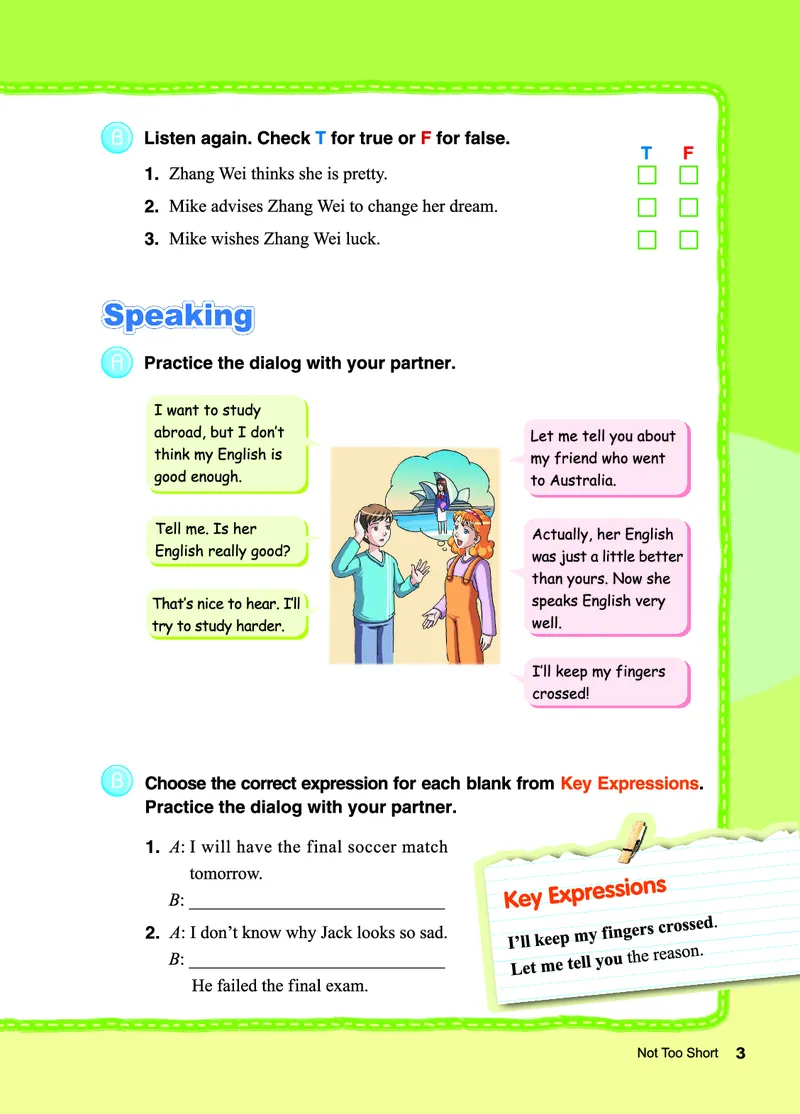
Mike: What do you want to do after you
finish school, Zhang Wei?
Zhang Wei: I want to be an actress. But I don蒺t
think I蒺m pretty enough.
Mike: I don蒺t think so. Let me tell you about
an actress who was very short.
Zhang Wei: Who?
Mike: Her name is Helen Hayes. When she
was a young actress, people told her
she was too short.
Zhang Wei: Really? So what did she do, Mike?
Mike: She tried to stand straight and act
tall.
Later,
she
became
a
very
successful actress.
Zhang Wei: Wow. I guess I should change my
attitude. Maybe I can be successful,
too!
Mike: I蒺ll keep my fingers crossed.
Unit 2
Listening ...................................................p.10
Tim: Congratulations, Dandan! You got
the highest score in science.
Wang Dandan: Thanks, Tim. Scienceismyfavorite
subject.
Tim: I think you can be a great scientist
one day.
Wang Dandan: That蒺s nice of you to say so. I really
want to be a scientist like Stephen
Hawking.
Tim: Who is he?
Wang Dandan: He is a British scientist. He has
become one of the most famous
scientists of our time even with
his disability.
Tim: Really? He is very amazing.
Wang Dandan: He sure is. He is studying about
the universe. I have the book about
his studies.
Tim: That sounds interesting. I蒺m dying
to read it.
Wang Dandan: Then, I will lend the book to you
tomorrow.
Tim: Thank you so much.
Unit 3
Listening ...................................................p.18
Liu Chang: What蒺s the matter, Susan?
Susan: I蒺m just
worried
about
my
test
tomorrow, Liu Chang.
Liu Chang: Which class is the test for?
Susan: It蒺s a basketball test for gym class.
I蒺m supposed to make five shots out
of ten tries.
Liu Chang: I thought you were good at basketball.
Susan: Not really. I蒺m not sure if I can do
it.
Liu Chang: Come on! There蒺s nothing you can蒺t
do if you practice hard.
Susan: But the test is tomorrow!
Listening Script 123
Appendix
Liu Chang: That蒺s all right. We蒺ll go practice now.
Come on!
Susan: Okay.
Unit 5
Listening ...................................................p.32
Mike: Oh, look at that dog, Zhang Wei. It蒺s
playing catch with its owner.
Zhang Wei: Wow!It can hold a whole tennis ball
in its mouth!
Mike: Have you ever heard about the dog
that can hold five tennis balls in its
mouth?
Zhang Wei: Five
tennis
balls ?
That
sounds
impossible, Mike.
Mike: And there is another dog that can
jump 167 centimeters high.
Zhang Wei: I can蒺t believe it.
Mike: I agree. Some animals can do amazing
things. My sister told me about a
dog in Canada that can do over 500
tricks.
Zhang Wei: 500 tricks? There蒺s no such dog!
Mike: Sure
there
is ! She
saw
it
on
television.
Unit 6
Listening ...................................................p.40
Liu Chang: Hey, Amy. Let me show you a magic
trick. Watch this!
Amy: That sounds fun!
Liu Chang: Do you see this coin? Now watch
carefully. Ta dah!
Amy: It蒺s gone! How did you do that? Can
you teach me, Liu Chang?
Liu Chang: Certainly. I蒺ll show you if you don蒺t
tell anyone else.
Amy: I promise.
Liu Chang: It蒺s just a simple trick. To start with,
make sure you have a long sleeve.
Amy: And?
Liu Chang: Then put the coin into your sleeve
quickly. It蒺s quite easy. But you
have to do it quickly.
Amy: Great! I had better practice.
Unit 7
Listening ...................................................p.48
Tim: I蒺ve gained 3 kilograms in one
month! What am I going to do?
Wang Dandan: Have you tried dieting, Tim?
Tim: Yes. But nothing seems to work.
What would you do if you were
in my shoes, Dandan?
Wang Dandan: If I were you, I would drink Oolong
tea.
Tim: Oolong tea? Are you sure that will
help?
Wang Dandan: Yes. Some people drink it to lose
weight.
Tim: I guess millions of people can蒺t
be wrong. Where can I buy some?
Wang Dandan: I know a market not too far from
here.
Tim: Can you take me there?
Wang Dandan: Sure! We can go now if you want.
Unit 9
Listening ...................................................p.62
Liu Chang: What kind of job do you want, Susan?
Susan: I蒺m not really sure. But I蒺m interested
in fashion.
Liu Chang: Then maybe you can be a fashion
designer.
124
Susan: I don蒺t think so, Liu Chang. I蒺m
terrible at drawing. That蒺s why I
can蒺t be a designer.
Liu Chang: I advise you not to think that way.
Many designs are done on computers
these days.
Susan: Yeah. I never really thought about
that. Maybe I could do it then.
Liu Chang: I蒺m sure you can. And you always
dress very nice. You have talent.
Susan: Thanks for your kind words. You are
a good friend.
Liu Chang: Will you give me free clothes when
you become a designer?
Susan: Of course I will.
Unit 10
Listening ...................................................p.70
Tim: Zhang Wei, how do you think we will
pay for things in the future?
Zhang Wei: Well, I read somewhere that we will
use our fingerprints to buy things.
Tim: Really? How can we use them?
Zhang Wei: Asyou know, each person蒺sfingerprint
is special. So your fingerprint will
be like a bankcard.
Tim: So they蒺ll have machines everywhere
that can read our fingerprints?
Zhang Wei: Exactly. We won蒺t have to carry money
around any more.
Tim: That蒺s a great idea!
We won蒺t have
to worry about losing our fingerprints!
Zhang Wei: That蒺s right, Tim. But if you have a
cut on your thumb, you can蒺t buy
anything.
Tim: Yeah, I guess it can be good and bad.
Unit 11
Listening ...................................................p.78
Wang Dandan: Did you read this, Tim? It says
that people might live on the moon
one day.
Tim: Really? Why would anyone want
to live on the moon?
Wang Dandan: I can think of a couple of reasons.
First, there might be too many
people on Earth.
Tim: Yeah. Some cities are already too
crowded.
Wang Dandan: Also, our planet will become too
polluted.
Tim: That would be terrible!
Wang Dandan: I couldn蒺t agree with you more!
Tim: I love the Earth. It蒺s so beautiful.
The moon is just gray.
Wang Dandan: You蒺re right. But I guess we don蒺t
have to worry about this now.
Tim: I don蒺t think so. This is a quite
serious problem.
Listening Script 125
Appendix
Theme玉: Challenge
4
1
2
3
Communicative
Functions
Listening
&
Speaking
Target Language
Not Too Short
·Wishing one蒺s luck
·Providing information
·I蒺ll keep my fingers
crossed.
·Let me tell you the
reason.
Never Give Up
·Expressing one蒺s wish
·Responding to
encouragement and
praise
·I蒺m dying to have it.
·That蒺s nice of you to
say so.
Yang Liwei蒺s
Mission to Space
·Expressing
uncertainty
·Encouraging someone
·I蒺m not sure if I can
do that.
·There蒺s nothing you
can蒺t do if you practice
hard.
Reading
&
Writing
Structure
·Understanding a story
about a table tennis
athlete, Deng Yaping
·Writing back to a
friend, Susie, to
encourage her
·Causative verbs:
make, have, let, help
·Understanding a letter
about a mountain
climber, Eric
Weihenmeyer
·Writingaboutaperson
who I admire
·The present participle
& the past participle
·Understanding a story
about the first Chinese
astronaut, Yang Liwei
·Writing sentences
about how to improve
our English
·Writing a biography
of a person using an
idea map
·Adverbial clauses of
purpose: so that
·Prepositions: through,
into, over, from ...to
Unit
Title
Scope and Sequence
单元学习要点
126
Theme域: How Amazing
8
5
6
7
Communicative
Functions
Listening
&
Speaking
Target Language
Animals Helping
People
·Asking about one蒺s
experiences
·Expressing surprise
·Have you ever heard
about the bird that
canspeak 1,000words?
·There蒺s no such bird.
The Magic Trick
·Attracting one蒺s
attention
·Responding to
requests
·To start with, hold
the receiver and add
your coins.
·Certainly, I can give
you the recipe.
An Amazing Plant
·Asking for advice
·Making suggestions
·What would you do if
you were in my shoes?
·If I were you, I would
drink ginger tea.
Reading
&
Writing
Structure
·Understanding a
reading about animals
helping people
·Writing a story about
animal helpers
·Relative pronoun that
& conjunctive that
·Understanding a
reading about a magic
trick
·Writing the sentences
using so ... that
·The special use of
the infinitive: It is
+ adj.+ for / of sb. + to
do sth., enough to,
too ... to, so ... that
·Understanding a
reading about how
Zhang Wei became
interested in garlic
·Writing about what
makes me worried
and what I蒺d like to
change
·Making a list of the
health benefits of
food
·Subjective clauses: It
is + adj. + that ...
·Word formation(玉)
Unit
Title
Scope and Sequence 127
Appendix
Theme 芋: In the Future
12
9
10
11
Communicative
Functions
Listening
&
Speaking
Target Language
Preparing for the
Future
·Expressing the reason
why
·Giving advice
·That蒺s why I bought
them.
·I advise you to take
a rest.
The Future World
·Expressing the
necessary condition
·Guessing
·Then, we won蒺t have
to worry about our
picnic next Saturday.
·I guess they can be
good and bad.
Ender蒺s Game
·Expressing possibilities
·Agreeing
·There might be some
sandwiches in the
refrigerator.
·I couldn蒺t agree with
you more.
Reading
&
Writing
Structure
·Understanding a
reading about
preparing for future
jobs
·Writing about my
dream job
·Definite article & zero
article
·Word formation(域)
·Understanding a
reading about the
future world
·Writing about things
I may do on a day in
2050
·Modal verbs: may,
might, could
·Transitional words:
however, on the other
hand, as a result, for
example
·Understanding a story
about Ender蒺s Game,
which is an interesting
science fiction
storybook
·Writing a letter to the
main character, Ender
·Adverbial clauses of
concession: although,
though, even though
Unit
Title
128