g
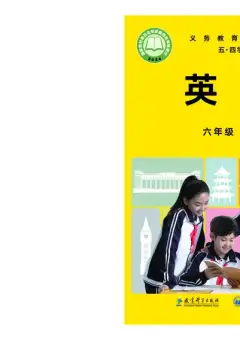
义务教育教科书
(五·四学制)
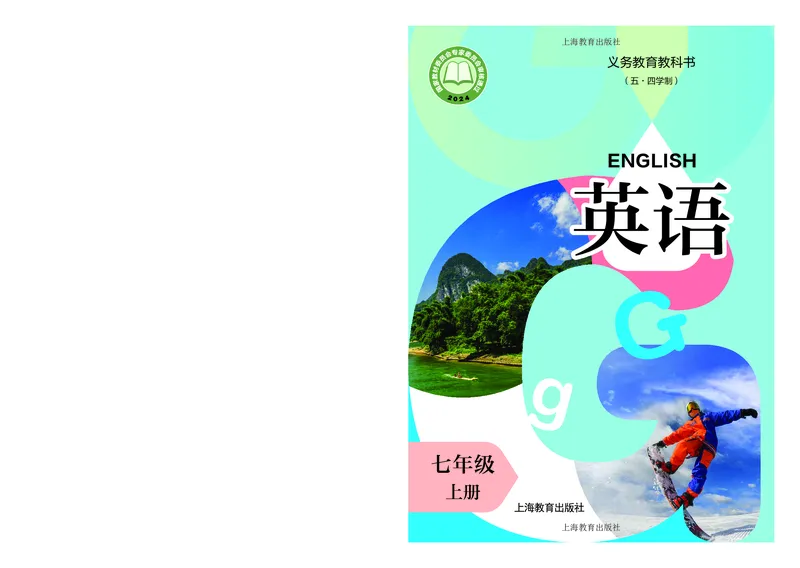
ENGLISH
英语
英语
英语
七年级
上册
上海教育出版社
上海教育出版社
英语
七年级
上册
义务教育教科书
(五·四学制)
主编 束定芳
上海教育出版社
上海教育出版社
致同学
亲爱的同学:
欢迎与我们一起继续初中阶段的英语学习!
在接下来的三年中,我们将通过教材,帮助你运用科学有效的方法学习英语,发展英语语言
能力,培育文化意识,提升思维品质,提高学习能力。
在这套教材中,你还会遇到一些已经熟悉的小伙伴。他们是就读于新星中学(New Star Middle
School)的王一鸣(Wang Yiming)、陆遥(Lu Yao)、林东(Lin Dong)、李百灵(Li Bailing),还有插
班生英国男孩哈利·特纳(Harry Turner),以及他在英国就读的好友莉萨·格林(Lisa Green)。他们
会和你一起,在学习英语的同时,探索新世界、思考大问题(Big Question),在真实情境中“讲(文
化)小故事,悟(人生)大道理,学百科新知识,用英语做事情”。
本套教材的每个单元以主题为引领,从大问题入手,设有五个小话题,分别对应听力、口语、
阅读、写作和项目探究五大板块。每个话题下包含符合初中生学习、生活和成长特点的类型丰富
的语篇,设计层层推进的学习活动,帮助你获得丰富的学习体验,并在学习过程中了解自己的学
习成效,最终对单元大问题有更加全面、深入的认识和理解。
在你学习教材的过程中,有一位智能机器人“胡博士”(Dr Hu)会帮助你掌握语言知识、技能
和学习策略。每个单元都设有“语音”(Pronunciation)、“词汇”(Word study)、“语法”(Grammar
in use)、“青少年技能提示”(TEEN skill)等特色小栏目,以及旨在展示多元文化、拓展视野的“探
索发现”(Discovery)板块。“学习笔记”(My learning notes)用来帮助你积累所学、拓展常用的语
言表达。每当你顺利完成“更新任务清单”(Update my to-do list)之后,就可以在单元首页的“任
务清单”(To-do list)上对应条目前打钩。单元最后的“项目探究”(Project)是你展示学习成果的
好机会。你可以和同学合作,综合运用课内外学到的跨学科知识技能,学会在真实情境中用英语
思考并解决真实问题。
本册教材除了常规单元以外,还设有一个衔接单元(Starter)、两个文化角(Culture corner)和
一个文学角(Literature corner)。衔接单元帮助你顺利从义务教育英语课程学习的二级开始向三级
进阶。文化角不仅带你更深入地了解中国文化,学会用英语讲中国故事,还带你领略多样的世界
文化。文学角中,我们精选了广受青少年喜爱的优秀文学作品片段,供你赏析。
希望这套教材给你带来学习英语的新体验、新收获,为你插上一双逐梦的翅膀,飞向世界,飞
向未来!
上海教育出版社
上海教育出版社
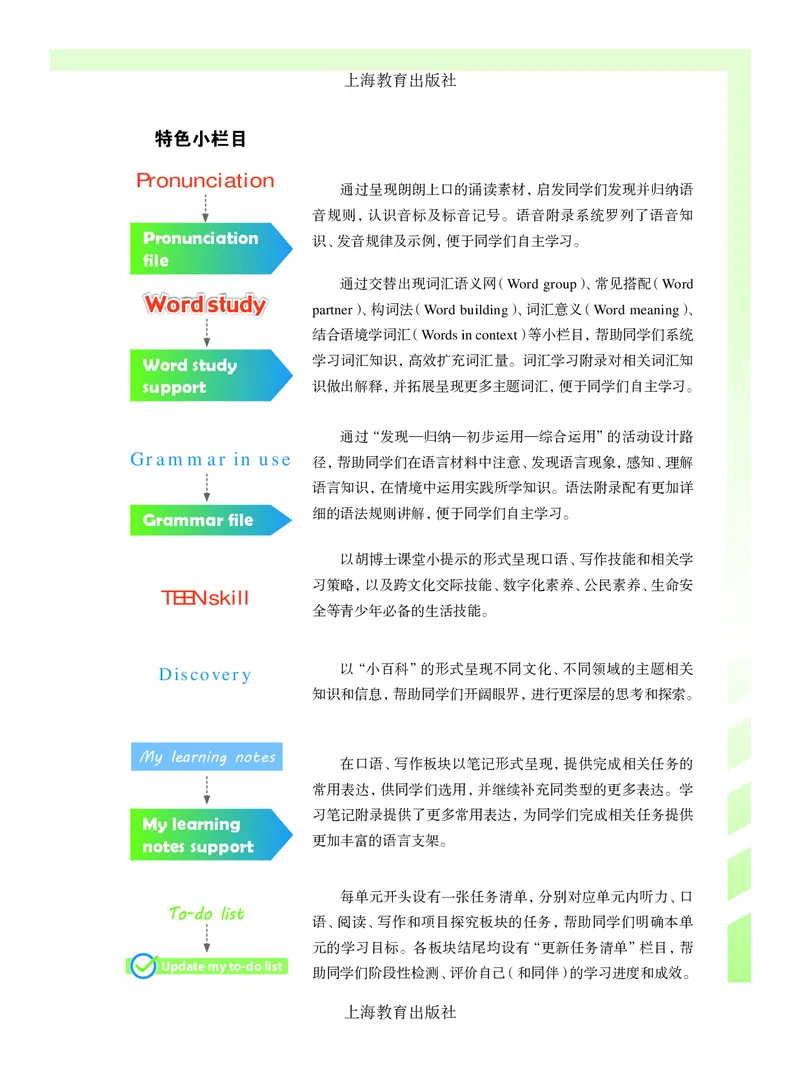
特色小栏目
通过呈现朗朗上口的诵读素材,启发同学们发现并归纳语
音规则,认识音标及标音记号。语音附录系统罗列了语音知
识、发音规律及示例,便于同学们自主学习。
通过交替出现词汇语义网(Word group)、常见搭配(Word
partner)、构词法(Word building)、词汇意义(Word meaning)、
结合语境学词汇(Words in context)等小栏目,帮助同学们系统
学习词汇知识,高效扩充词汇量。词汇学习附录对相关词汇知
识做出解释,并拓展呈现更多主题词汇,便于同学们自主学习。
通过“发现—归纳—初步运用—综合运用”的活动设计路
径,帮助同学们在语言材料中注意、发现语言现象,感知、理解
语言知识,在情境中运用实践所学知识。语法附录配有更加详
细的语法规则讲解,便于同学们自主学习。
以胡博士课堂小提示的形式呈现口语、写作技能和相关学
习策略,以及跨文化交际技能、数字化素养、公民素养、生命安
全等青少年必备的生活技能。
在口语、写作板块以笔记形式呈现,提供完成相关任务的
常用表达,供同学们选用,并继续补充同类型的更多表达。学
习笔记附录提供了更多常用表达,为同学们完成相关任务提供
更加丰富的语言支架。
以“小百科”的形式呈现不同文化、不同领域的主题相关
知识和信息,帮助同学们开阔眼界,进行更深层的思考和探索。
每单元开头设有一张任务清单,分别对应单元内听力、口
语、阅读、写作和项目探究板块的任务,帮助同学们明确本单
元的学习目标。各板块结尾均设有“更新任务清单”栏目,帮
助同学们阶段性检测、评价自己(和同伴)的学习进度和成效。
Pronunciation
My learning notes
Grammar in use
Grammar file
Discovery
TEEN skill
Update my to-do list
Pronunciation
file
My learning
notes support
Word study
Word study
support
上海教育出版社
上海教育出版社
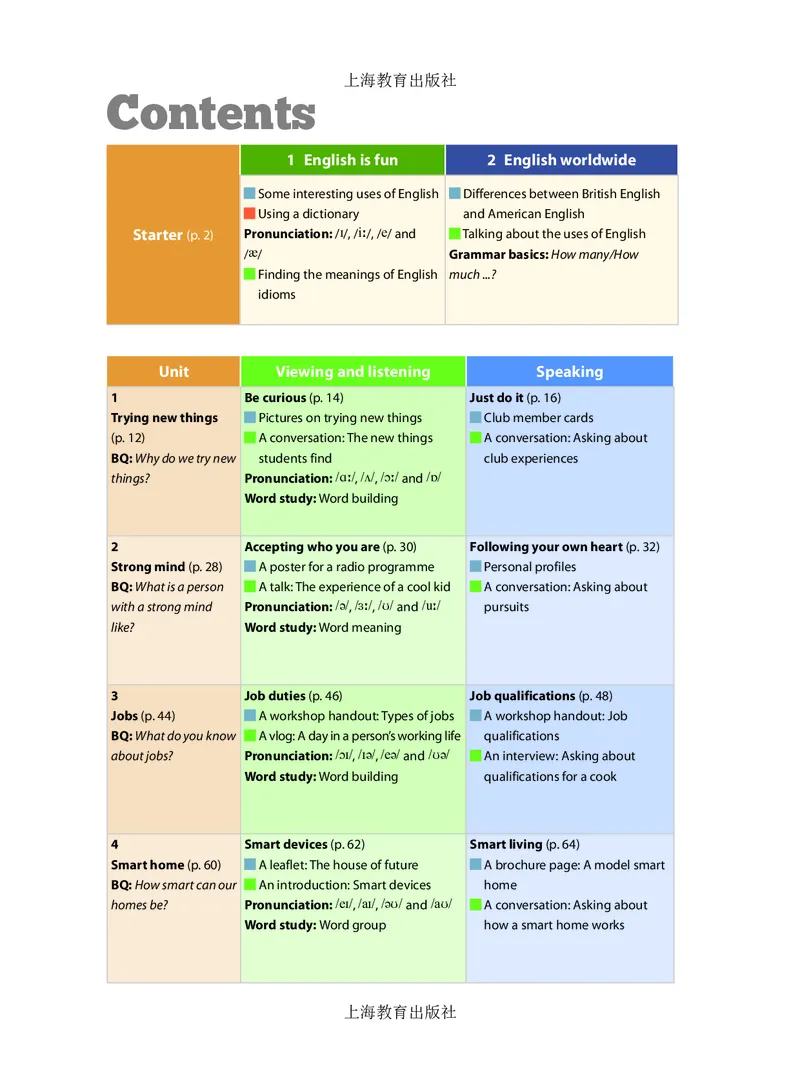
Unit
Viewing and listening
Speaking
1
Trying new things
(p. 12)
BQ: Why do we try new
things?
Be curious (p. 14)
�Pictures on trying new things
�A conversation: The new things
students find
Pronunciation: /A:/, /V/, /O:/ and /B/
Word study: �Word building
Just do it (p. 16)
�Club member cards
�A conversation: Asking about
club experiences
2
Strong mind (p. 28)
BQ: What is a person
with a strong mind
like?
Accepting who you are (p. 30)
�A poster for a radio programme
�A talk: The experience of a cool kid
Pronunciation: /R/, /F:/, /W/ and /u:/
Word study: �Word meaning
Following your own heart (p. 32)
�Personal profiles
�A conversation: Asking about
pursuits
3
Jobs (p. 44)
BQ: What do you know
about jobs?
Job duties (p. 46)
�A workshop handout: Types of jobs
�A vlog: A day in a person’s working life
Pronunciation: /OI/, /IR/, /eR/ and /WR/
Word study: �Word building
Job qualifications (p. 48)
�A workshop handout: Job
qualifications
�An interview: Asking about
qualifications for a cook
4
Smart home (p. 60)
BQ: How smart can our
homes be?
Smart devices (p. 62)
�A leaflet: The house of future
�An introduction: Smart devices
Pronunciation: /eI/, /aI/, /RW/ and /aW/
Word study: Word group
Smart living (p. 64)
�A brochure page: A model smart
home
�A conversation: Asking about
how a smart home works
Starter (p. 2)
1 English is fun
2 English worldwide
�Some interesting uses of English
Using a dictionary
Pronunciation: /I/, /i:/, /e/ and
/C/
�Finding the meanings of English
idioms
�Differences between British English
and American English
�Talking about the uses of English
Grammar basics: How many/How
much ...?
Contents
上海教育出版社
上海教育出版社
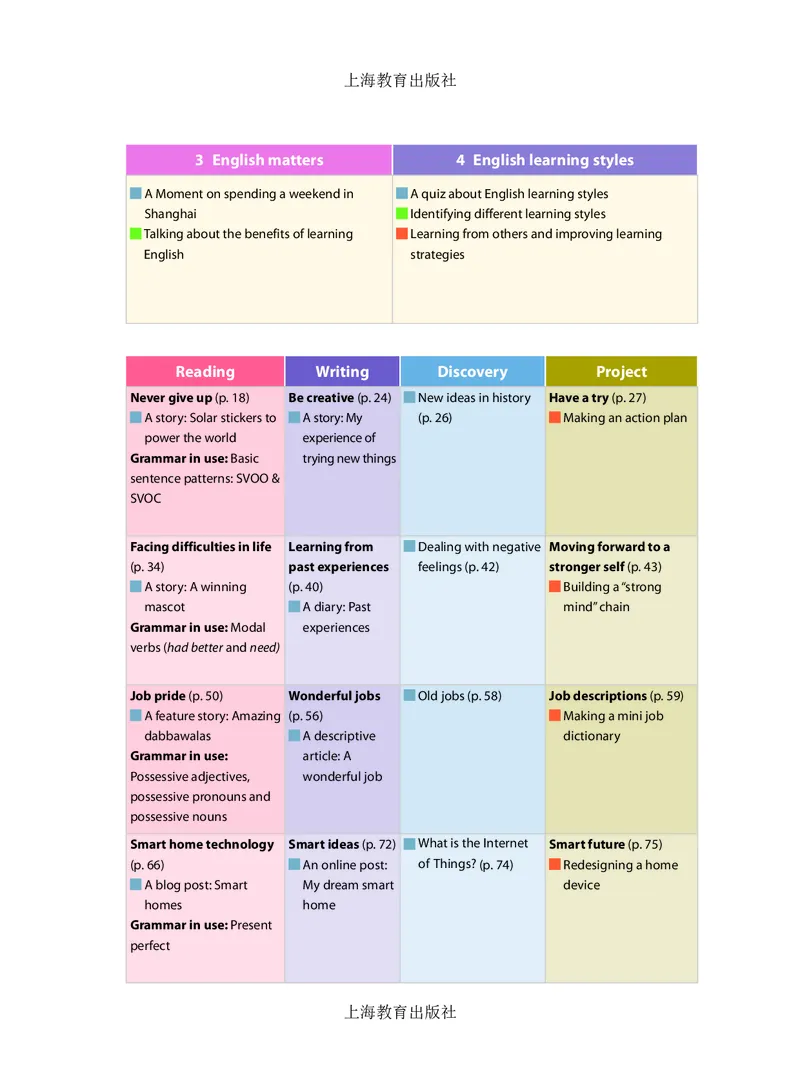
Reading
Writing
Discovery
Project
Never give up (p. 18)
�A story: Solar stickers to
power the world
Grammar in use: Basic
sentence patterns: SVOO &
SVOC
Be creative (p. 24)
�A story: My
experience of
trying new things
�New ideas in history
(p. 26)
Have a try (p. 27)
�Making an action plan
Facing difficulties in life
(p. 34)
�A story: A winning
mascot
Grammar in use: Modal
verbs (had better and need)
Learning from
past experiences
(p. 40)
�A diary: Past
experiences
�Dealing with negative
feelings (p. 42)
Moving forward to a
stronger self (p. 43)
�Building a “strong
mind” chain
Job pride (p. 50)
�A feature story: Amazing
dabbawalas
Grammar in use:
Possessive adjectives,
possessive pronouns and
possessive nouns
Wonderful jobs
(p. 56)
�A descriptive
article: A
wonderful job
�Old jobs (p. 58)
Job descriptions (p. 59)
�Making a mini job
dictionary
Smart home technology
(p. 66)
�A blog post: Smart
homes
Grammar in use: Present
perfect
Smart ideas (p. 72)
�An online post:
My dream smart
home
�What is the Internet
of Things? (p. 74)
Smart future (p. 75)
�Redesigning a home
device
3 English matters
4 English learning styles
�A Moment on spending a weekend in
Shanghai
�Talking about the benefits of learning
English
�A quiz about English learning styles
�Identifying different learning styles
�Learning from others and improving learning
strategies
上海教育出版社
上海教育出版社
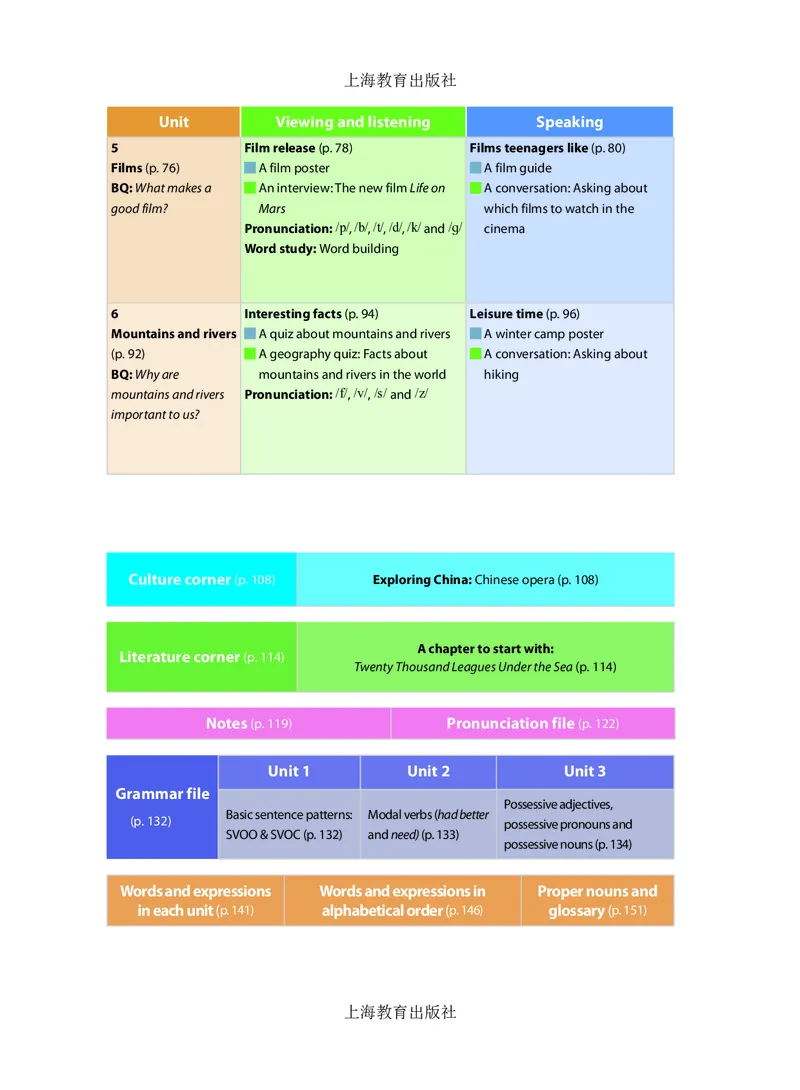
Unit
Viewing and listening
Speaking
5
Films (p. 76)
BQ: What makes a
good film?
Film release (p. 78)
�A film poster
�An interview: The new film Life on
Mars
Pronunciation: /p/, /b/, /t/, /d/, /k/ and /G/
Word study: �Word building
Films teenagers like (p. 80)
�A film guide
�A conversation: Asking about
which films to watch in the
cinema
6
Mountains and rivers
(p. 92)
BQ: Why are
mountains and rivers
important to us?
Interesting facts (p. 94)
A quiz about mountains and rivers
�A geography quiz: Facts about
mountains and rivers in the world
Pronunciation: /f/, /v/, /s/ and /z/
Leisure time (p. 96)
�A winter camp poster
�A conversation: Asking about
hiking
Literature corner (p. 114)
A chapter to start with:
Twenty Thousand Leagues Under the Sea (p. 114)
Grammar file
(p. 132)
Unit 1
Unit 2
Unit 3
Basic sentence patterns:
SVOO & SVOC (p. 132)
Modal verbs (had better
and need) (p. 133)
Possessive adjectives,
possessive pronouns and
possessive nouns (p. 134)
Culture corner (p. 108)
Exploring China: Chinese opera (p. 108)
Notes (p. 119)
Pronunciation file (p. 122)
Words and expressions
in each unit (p. 141)
Words and expressions in
alphabetical order (p. 146)
Proper nouns and
glossary (p. 151)
上海教育出版社
上海教育出版社
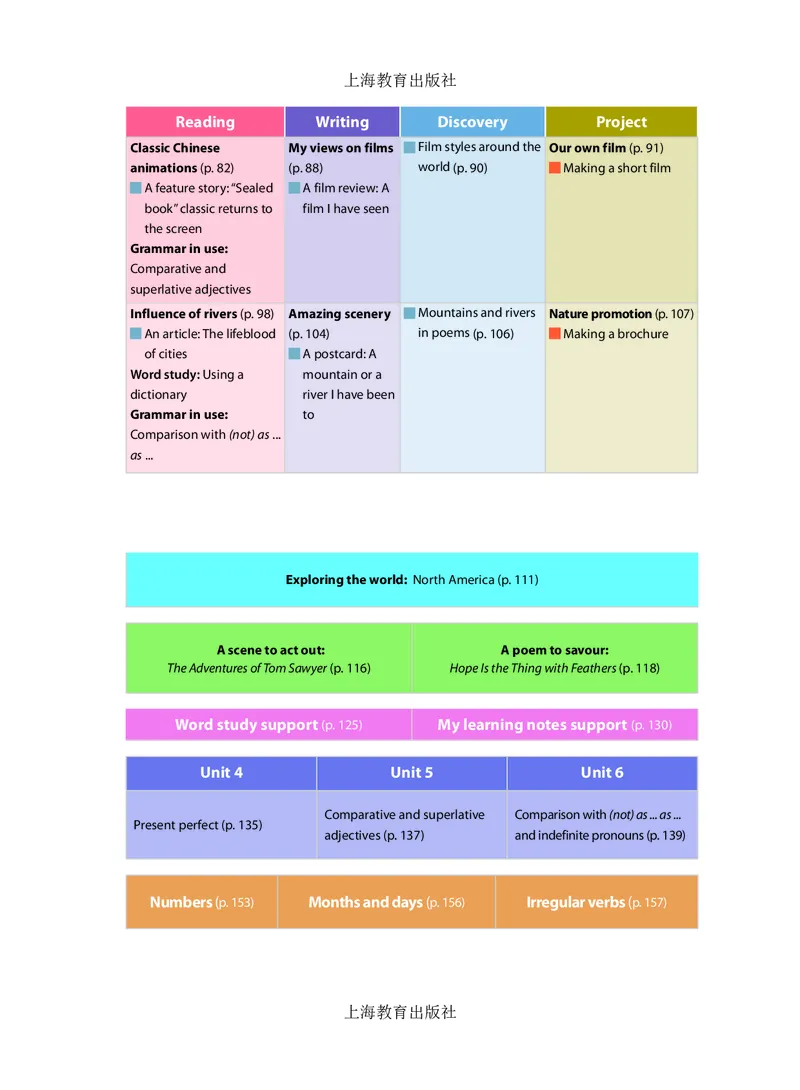
Reading
Writing
Discovery
Project
Classic Chinese
animations (p. 82)
�A feature story: “Sealed
book” classic returns to
the screen
Grammar in use:
Comparative and
superlative adjectives
My views on films
(p. 88)
�A film review: A
film I have seen
�Film styles around the
world (p. 90)
Our own film (p. 91)
�Making a short film
Influence of rivers (p. 98)
�An article: The lifeblood
of cities
Word study: Using a
dictionary
Grammar in use:
Comparison with (not) as ...
as ...
Amazing scenery
(p. 104)
�A postcard: A
mountain or a
river I have been
to
�Mountains and rivers
in poems (p. 106)
Nature promotion (p. 107)
�Making a brochure
A scene to act out:
The Adventures of Tom Sawyer (p. 116)
A poem to savour:
Hope Is the Thing with Feathers (p. 118)
Unit 4
Unit 5
Unit 6
Present perfect (p. 135)
Comparative and superlative
adjectives (p. 137)
Comparison with (not) as ... as ...
and indefinite pronouns (p. 139)
Exploring the world: North America (p. 111)
Word study support (p. 125)
My learning notes support (p. 130)
Numbers (p. 153)
Months and days (p. 156)
Irregular verbs (p. 157)
上海教育出版社
上海教育出版社
2
1a �What interesting facts about English can you get from the following pictures?
Match the pictures with the possible explanations.
A A word may have several meanings.
B Idioms① have cultural meanings.
C One word may sound like another, but it has a different meaning.
During the summer holidays, Wang Yiming noticed the following interesting
uses of English.
1b �Yiming heard two people talking about an accident. Listen to their
conversation. How many times have you heard the word cross? How about
the word fine? Guess their meanings. Then take a look at their meanings in
the dictionary.
(1)
(2)
(3)
cross /krBs/
1 v. �to go from one side to another
2 n. a mark on paper
3 adj. angry
fine /faIn/
1 adj. very thin or small
2 adj. in good health
3 v. �to make somebody pay
money for breaking rules
English is fun
Starter
1
Right!
Turn left,
right?
Watt.
Sure!
What is
your name?
Let’s go Dutch!
① idiom 习语;成语
上海教育出版社
上海教育出版社
Starter
3
Think Do you know other words which have the same pronunciation but
different meanings?
Think �Do you know other idioms? What do they mean?
1c �Yiming and Lisa are talking about a new café. Listen and complete their
conversation. Find the pairs of words with the same pronunciation.
1d �Read the conversations between Yiming and Lisa and explain the meanings of
the idioms. Work in pairs and make conversations with the two idioms.
(1) Yiming: Hey, it’s showtime! Go on stage and break a leg out there!
Lisa:
�Thanks! I’ll give it my all.
(2) Yiming: Hey, it’s your big day for the concert! Break a leg!
Lisa:
�Thanks! I’m feeling confident.
(3) Yiming: I had a fever last night. I’m under the weather.
Lisa:
�Have a good rest. Hope you’ll be fine soon.
(4) Yiming: You don’t look too good today. Are you feeling alright?
Lisa:
�Well, not really. I’m feeling a bit under the weather.
I
(1) an
(2) on the board yesterday.
Oh, what’s new?
It says there’s a new café near the
(3) .
Let me
(4) . I like
(5)
(6)
roof, bright and lovely. And the drinks look tasty.
I think so too.
(7) nice to take photos
there! Shall we have a try this Sunday?
Good idea! Let’s ask David to go with us!
OK. That will
(8) more fun!
上海教育出版社
上海教育出版社
4
2a �James and Lisa are talking on the way.
(1) �What do we call the things in the pictures? Write down the words for them
in British English and American English. Then listen to the conversation and
check your answer.
James, an American boy, is visiting the UK. He and Lisa are going to a
food court.
(2) Do you know other pairs of words that show such a difference?
British English
American English
Spelling
favour
favor
Pronunciation
aunt (/A:nt/)
aunt (/ænt/)
British English
American English
taxi
cab
2b �James and Lisa also find that some pairs of words are different only in
spelling or pronunciation in British or American English. Can you give more
examples?
Starter
① worldwide 世界各地
English worldwide
①
2
上海教育出版社
上海教育出版社
Starter
5
2c �James has found some information about English on the internet. Talk
about it with your classmates.
S1:
How many people speak English as their first language?
S2:
... speak English as their first language.
S1:
How many/How much ...?
S2:
...
...
About 300,000,000 people
in the world speak English as their
first language.
More than 50 countries officially
list English as an official language.
English
English
Over of the
population in the
world speak English.
30%
About of the
information online is
in English.
60%
international
pilots use English
while they are
flying a plane.
All
Think What else do you know about the use of English around the world?
上海教育出版社
上海教育出版社
6
Wang Yiming had a good time at the weekend. He posted a Moment.
Yiming
I spent a nice weekend with my grandparents in the city
centre! An exhibition① at the Shanghai Museum reminded my
grandparents of their childhood. We had traditional snacks at
Yu Garden. The Bund is beautiful at night!
James: Is the exhibition easy to understand? I’m not good
at Chinese.
Yiming @ James: Take it easy. You can read the English
introduction. And the tour guides speak fluent② English.
James @ Yiming: Fantastic③!
Lisa: The steamed buns look nice! What do you call them in
Chinese?
James @ Lisa: Xiaolongbao. The restaurant has English
menus. It’s foreigner-friendly.
John: Oh! Will I get lost in Shanghai?
Yiming @ John: Don’t worry. The signs and maps at
underground stations are written in both Chinese and
English. Besides, the volunteers speak English as well.
David:
Shanghai changes so fast! My father said it was not
easy for a foreigner to travel in the city twenty years ago.
❤ Lu Yao, David, Sally Wang, Lisa, Lin Dong, Sandy
2 hrs ago
Moments
English matters
Starter 3
① exhibition 展览;展出 ② fluent 流利的 ③ fantastic 极好的
上海教育出版社
上海教育出版社
Starter
7
3a �Yiming has noticed that English is almost everywhere in Shanghai. Read his
Moment and complete the table.
3b �How would Yiming reply to David?
Examples
Entertainment①
The exhibition at the museum is in both
Chinese and English.
...
Travelling
Dining
. . .
Moments
David:
Shanghai changes so fast! My father said it was not easy for a
foreigner to travel in the city twenty years ago.
Yiming @ David: �
�
�
�
�
① entertainment 娱乐
上海教育出版社
上海教育出版社
8
3d �Yiming talked with Lu Yao about the benefits of learning English.
(1) �How does English benefit Lu Yao? Choose the answer that fits the blank in the
conversation above.
A build confidence
B make more friends
C have fun
(2) How useful is English to you? Share your thoughts with each other.
3c �Look at the pictures and find out where else English is used in Shanghai. Why
is English useful in these places?
on ads
in the shopping centres
in the booklets
What benefits does English bring to you?
English helps me __________. It allows me to
enjoy films, music and books from hundreds
of countries around the world. I don’t need to
depend on translations anymore.
English helps me make
friends from other countries.
...
上海教育出版社
上海教育出版社
Starter
9
4a �Do the quiz. Count how many As/Bs/Cs you have got. What is your learning style?
I’ve got
A(s),
B(s) and
C(s).
Wang Yiming finds a quiz about learning styles.
1 I’d like to for fun.
A read a picture book
B listen to stories
C do crossword puzzles①
2 When I am not sure how to spell a word, I .
A write it down to see if it looks right
B spell it out loud to see if it is right
C draw the letters in the air
3 Of these three classes, I like the best.
A Art class
B Music class
C PE class
4 After class, I prefer .
A reading
B listening to music
C exercising
5 When I meet new people, I remember .
A their faces but not their names
B their names but not their faces
C what I talked with them
6 When I give others directions
②, I will tell them .
A the landmarks③ they will pass on the way
B the names of the streets they will be on
C to follow me and I will show them the way
A quiz
English learning styles
Starter 4
① crossword puzzle 纵横字谜 ② direction 方向 ③ landmark 地标
上海教育出版社
上海教育出版社
10
What type of learner are you?
Mostly A:
You like learning by seeing.
Mostly B:
You like learning by hearing.
Mostly C:
You like learning by doing.
read aloud
do
draw
listen to
watch
see
move around
4b �Yiming and his classmates are talking about their learning styles. Choose
proper words or phrases to complete their talks.
I like to
(1) hands-on activities. I always take part
in fun activities and I like to
(2) the classroom. If I
work with others, I will learn better.
I always
(3) the teacher
carefully. I often
(4) to
remember what I’ve learned.
It’s easier for me to understand when I
(5) pictures and charts. I always
(6) mind maps to remember
new words. Besides, I
(7) films to
practise English.
上海教育出版社
上海教育出版社
Starter
11
4c �Project
Step 1 How do you learn new words? Think and write.
__________________________________________________________________
__________________________________________________________________
Step 2 Do a survey in your class. Find out your classmates’ learning styles and
their methods of learning new words.
Step 3 Write about what you can learn from your classmates.
Names
Learning styles
Learning methods
上海教育出版社
上海教育出版社
1
Why do we try new things?
Trying
new things
12
上海教育出版社
上海教育出版社
Getting started
Look at Wang Yiming’s action calendar of trying new things and circle the things
you also want to try. Are there any other things you are interested in?
01
Make a list
of things I
want to try.
Monday
02
Read a different
magazine, or
visit a new
website.
Tuesday
03
Enjoy new
music today.
Wednesday
04
Choose a
different
route to
school.
Thursday
05
Learn to
say a word
in three
different
languages.
Friday
06
Learn a
new skill
like paper
cutting.
Saturday
07
Cook a new
dish.
Sunday
“You never know what you can do until you try.”
1 �Listen to a conversation
about new things around us.
2 �Talk about experiences of
trying new things.
3 �Read a story about the
importance of keeping on
trying.
4 �Write a story about the
birth of a new idea.
5 �Make a plan for trying a
new thing this term.
13
上海教育出版社
上海教育出版社
14
Viewing and listening
Be curious
A
Wang Yiming is looking at the pictures in a magazine and finds some new
things.
1
4
5
2
3
6
1 test a talk light
try windsurfing
take up roof gardening
act in a play
go rock climbing
make fruit animals
A1 �Look and say Match the pictures with the phrases. Which activities are new
to you?
A2 �Listen and think Listen to the conversation. What are Ms Chen and her
students talking about?
/A:/, /V/, /O:/ and /B/
Read the poem.
I love playing the drums. It’s such fun.
Robots can talk while they walk. Do they
have thoughts?
I carved a giraffe from bananas. It’s art!
I collect glass elephants. They’re amazing!
Can robots play ping-pong? I’m not sure!
Listening for main ideas
Pronunciation
上海教育出版社
上海教育出版社
1
15
A3 �Listen and take notes Listen again and complete the table below.
Names
New things
Facts
Feelings
Wang
Yiming
1
People use their
2 to climb
up the rock wall.
He thinks people are
brave to do so. He
likes challenges.
Lu Yao
A talk light
It’s a new machine.
It changes with the
3 .
She is very
4
about it.
Lin Dong
5
They’re
6
crafts.
He thinks it’s great
7 .
Word study Word building Compounding (Ⅰ)
Sometimes we can put two words together to make a new word. Match the words
in blue balloons with the ones in orange balloons to form a new word. Can you
make some new words in this way?
skate
wind
rock
roof
light
gardening
surfing
board
climbing
traffic
Compounds:
windsurfing , , , ,
Share with your partner your experience of discovering something new and write
down the new things he or she discovered.
Update my to-do list
上海教育出版社
上海教育出版社
16
Speaking
Just do it
B
Wang Yiming wants to join a school club and his friends are showing him
their club member cards.
B1 �Look and say Look at the member cards. Which club are you interested in
the most? Why?
B2 �Listen, read and think Listen to the conversation between Yiming and Lu
Yao about the roof gardening club. What has Lu Yao learned in the club?
Club Member Card
Name: Wu Ling
Class: 3
Club: �The 3D
printing club
Club: �The roof
gardening club
I like building models. I would like
to build a 3D house in this club.
I like watching vegetables grow.
I would like to improve my
gardening skills in this club.
Club Member Card
Name: Lu Yao
Class: 3
Club Member Card
Name: Lin Dong
Class: 3
Club: �The rock
climbing club
I like skating and camping. I want to
learn how to climb up with my legs
more in this club.
上海教育出版社
上海教育出版社
1
17
B3 �Role-play Yiming goes on asking some more students about their club
experiences. Pick a role from the club member cards in B1 and act out their
conversation. Use the conversation in B2 as a model.
Yiming: What made you join the roof gardening club?
Lu Yao:
�I really love watching plants grow. I joined the club because I
wanted to learn some gardening skills. It would be so much fun.
Yiming: What do you mean by “gardening skills”?
Lu Yao:
�We learn about all sorts of plants and how to care for them. Last
week I learned how to grow strawberries.
Yiming: Did you say strawberries? Can you eat them when they are fully grown?
Lu Yao:
�Sure we can. We also grow tomatoes, potatoes and cabbages, all on
the roofs!
Yiming: Wow! I’m getting hungry!
Lu Yao:
You will never go hungry if you join the roof gardening club!
Think of a club you have joined, fill in your own club member card and share it with
your partner.
Update my to-do list
My learning notes
Asking for clarification:
Could you say that again?
What do you mean by that?
To better understand what others say, you can:
�ask the person to explain it;�
ask the person to repeat it.
Understanding others better
TEEN skill
上海教育出版社
上海教育出版社
Reading
C Never give up
18
C1 �Predicting Look at the title and the pictures, and think: How can we use the
invention in the story?
C2 �Read the story.
Wang Yiming finds it hard to try something new, and then he finds the
following story on a website.
As solar scientists, we love sunlight. It makes us
warm and brings us renewable energy. We often
discuss how wonderful it will be to collect and use
solar energy everywhere.
However, many people thought it was impossible.
The solar panel is made of solar cells on a very
heavy glass holder. We failed many times to make
the holder light, until pizza gave us an idea.
One night, we went for pizza after work and one of
us got burnt by the pizza pan while he was moving
it. “The pan is just like the holder! It’s heavy and
troublesome! Luckily, we have a paper box to take
the pizza home,” he said. “Paper box ... Wait!”
shouted someone else excitedly, “Why not put a
layer between the holder and solar cells to separate
5
10
15
Solar stickers to power the world
TECHNOLOGY
TODAY
Home Sign in About us Menu
FAQ
Contact
Email us
上海教育出版社
上海教育出版社
1
19
20
Personal touch
Do you think solar stickers will be useful in your life? Why or why not?
them? Then we can easily take away the solar cells from the holder and
stick them on different devices.” We hurried to the lab to test this new
idea. After countless tries, we succeeded!
Hopefully, one day we can stick these solar cells to the sides of buildings,
cars and bags. With that, we can power the world.
Pan
Layer
Paper box
Solar cells
Pizza
Holder
上海教育出版社
上海教育出版社
C3 �General understanding Complete the sentence.
The story tells us:
Solar scientists borrowed ideas from and made .
C4 Detailed reading Complete the table with information from the story.
Questions
Answers
Paragraph 1:
Why do scientists study solar
energy?
The sunlight brings us
1 .
�They wish to
2
everywhere.
Paragraph 2:
What problem did they have?
�The solar panel was
3 to move.
�They
4 many times to make it light.
Paragraph 3:
How did they solve the
problem?
The
5 gave them a good idea.
�They put
6 between solar cells
and the holder.
C5 Further thinking
1 Answer the questions.
(1) What do you think of the solar scientists?
(2) Do you think the scientists’ idea is effective? Give your reasons.
Understanding main ideas
20
上海教育出版社
上海教育出版社
Items
the pizza box
the layer
Use
move pizza to different places
Material
metal-like element
Weight
light
�Find important features of things and compare which features
are similar.
�New ideas may come from finding similarities of things in our
daily lives.
Finding similarities
TEEN skill
Vocabulary focus Fill in each blank with a word from the text.
Discuss with a partner: What led to the success of the solar scientists?
Update my to-do list
The solar scientists are always interested in
1 since it
brings us renewable
2 . They failed many times to make
the solar panel
3 . One day, when they were having
dinner in a pizza restaurant, they had an idea from the pizza box to
4 solar cells from the holder. In this way, they invented
the solar
5 .
2 �Complete the table about the features of the two items. Which features
are similar?
1
21
上海教育出版社
上海教育出版社
22
1 �Read and think How many objects does each sentence have?
(1) I call them vegetable animals.
(2) Sunlight makes us warm.
(3) Sunlight brings us renewable energy.
(4) Pizza gave us an idea.
2 Work out the rules Write the correct numbers.
subject
(S)
direct
object
(DO)
complement
(C)
indirect
object
(IO)
verb
(V)
Grammar in use Basic sentence patterns: SVOO & SVOC
• �The verbs in sentence and sentence of the
above sentences take two objects. We use SVOO to describe
their sentence structures.
• �The verbs in sentence and sentence of the
above sentences take one object, but there is more information
about the object. We use SVOC to describe their sentence
structures.
Grammar file
p. 132
3 �Practise Read the passage and underline sentences with SVOO and SVOC
patterns.
I grew up in a town in Mexico. It was not easy for people
to get hot water. People were often ill from taking cold
baths. I used water bottles and a rubber tube to make a
solar-powered water heater. In this way, I brought them
warm baths. People thought my invention very useful.
They made me a prize winner. I was so happy!
上海教育出版社
上海教育出版社
1
23
4 �Talk Jiaming is trying the following things for the first time. Work in pairs.
Describe (one of) the things from the pictures below to your partner.
Jiaming puts his clothes into a washing
machine. When he finishes the washing,
...
...
(1) Washing the clothes
(2) Giving a present
上海教育出版社
上海教育出版社
24
Writing
Be creative
D
D1 �Think Read Jerry’s story. What problem did his grandma have and how did
he solve it?
Students are sharing their stories of trying new things on TEEN-Land forum.
You want to have a try.
solution①
problem
feeling
Grandma’s
stick
Paragraph 1
Paragraph 2
Paragraph 3
D2 �Prepare Fill in the blanks with the words in the boxes according to the story in
D1.
① solution 解决方法
Group: 7th-graders
TEEN-Land
My grandma uses a stick to walk, but when it rains,
it’s not easy for her to use an umbrella.
One day, I thought, why not put the stick and the
umbrella together? I put an umbrella on the handle
of the stick. Now when it rains, she doesn’t get wet.
She is proud of me and I feel very happy!
A narrative:
has one topic;
describes an experience that the writer had;
may have the elements of problem, solution and feeling.
Writing a narrative
TEEN skill
上海教育出版社
上海教育出版社
1
25
D3 �Plan Plan your writing by making notes in the diagram below.
What difficulty I met with
(problem)
What I did with it
(solution)
How I felt
(feeling)
D4 �Write Write your story.
D5 �Check Check your story. Pay attention to the basic features of a narrative.
�
�
�
�
�
�
�
�
Work in groups. Help your group members to revise their stories.
Update my to-do list
My learning notes
Describing problems and solutions:
Problems: find it difficult (to do), ,
Solutions: think of (an idea), ,
上海教育出版社
上海教育出版社
26
New ideas in history
Read and think How do the life-changing ideas come into being?
Ice cream (China)
Ancient Chinese people stored ice in
winter. Then in summer, they broke it into
pieces and mixed other things, like milk,
sugar or flavours with it. This is the early
ice cream.
Adhesive bandage① (the USA)
Earle Dickson’s wife often cut or burned
her fingers in the kitchen. Dickson used a
long piece of sticky cloth and put a thin
square piece of cotton down the middle.
It was the first adhesive bandage.
Cat’s eyes on the road (the UK)
One night, Percy Shaw’s car lights
caught the eyes of a cat. The cat’s eyes
shone back brightly. He had an idea.
He put something like cat’s eyes on the
road to make drivers safer.
① adhesive bandage 创可贴
Discovery
上海教育出版社
上海教育出版社
1
27
Project
Have a try
E
Make an action plan to try something new.
�Share Introduce your plan to the class and put your plan on the
classroom wall.
�Brainstorm Work
in groups of four and
decide on what to try
this term.
�List Make a to-do list
for the new experience.
Share the information
you collect.
Create You can use Lu
Yao’s plan as an example
or use other forms.
Setting the goal
Finding ways to learn
Making a time plan
Keeping on practising
Lu Yao's action plan
The goal
The time plan
Reminders of
practice
Ways to learn
I would like to
learn five basic
moves of hip
hop dancing.
I plan to practise
the dance moves
twice a week.
I will check my progress every two weeks.
I can set alarm
clocks, make
notes or ask my
friend to remind
me.
I can join a dancing
club, visit some
websites on dancing
or enroll in an online
course.
Listen to the introductions of action plans of your classmates. Are their plans clear
and easy to follow?
Update my to-do list
Making an action plan
Step 1
Step 2
Step 3
Step 4
上海教育出版社
上海教育出版社
Strong mind
2
What is a person with a strong mind like?
28
上海教育出版社
上海教育出版社
1 �Listen to a talk by a cool
kid.�
2 �Talk about an experience of
following my own heart.�
3 �Read a story about dealing
with difficulties in life.�
4 �Write a diary about my
past experience of facing a
challenge.�
5 �Build a “strong mind” chain.
Getting started
Look at the pictures above and answer the questions.
1 What changes does the person go through in the pictures?
2 How do you deal with challenges in your life?
29
上海教育出版社
上海教育出版社
30
Viewing and listening
Accepting who you
are
A
A1 �Look and say Look at the poster for the radio programme and answer the
questions.
A2 �Listen and think Listen to the recording. What was Yang Feifei once afraid of
and what is she now proud of?
The school counsellor
① sets up a special group: “Stronger Me”. Lu Yao, its
group member, makes a radio programme about cool kids.
Pronunciation
/R/, /F:/, /W/ and /u:/
If
If you can keep your head when all about you are losing theirs,
If you can trust yourself when all the world doubts you,
If you don’t look too good, nor talk too wise,
You will be a Man, my boy!
(Adapted from If by Rudyard Kipling)
1 Who will give the talk?
2 What will she talk about?
3 According to the photos, what is special about her everyday life?
① counsellor (心理)咨询师
This week in New Star Cool Kids, Yang
Feifei, 13, will talk about how she deals
with fear and what she is proud of.
Starts at 12:00
14 Oct.
on New Star Radio
Welcome!
Listening for key information
Read the poem.
上海教育出版社
上海教育出版社
2
31
Name
Yang Feifei
My best choice
I take my deep, rough voice as a
1 .
My hobbies
and talents
I write songs,
2 at school and
3 .
My hope
Everyone can be
4 of who they are and speak out
5 .
My belief
It is important to
6 about ourselves.
Word study Word meaning Opposites
Find the opposites of the following words and write them down in the table
below.
Words
Opposites
afraid
brave
difficult
smooth
weak
heavy
“Best self” info-sheet
Listen to Yang Feifei’s talk again. Do you think she is a cool girl? Why or why not?
Share your view(s) with your classmates.
Update my to-do list
A3 �Listen and take notes Yang Feifei sees the best in herself. Listen again and
complete the info-sheet.
上海教育出版社
上海教育出版社
32
Speaking
Following your own
heart
B
The “Stronger Me” group are going to discuss the following topics. Lu Yao is
talking with some students for ideas on topic A.
What do you do if ...
A you would like to do something but face many difficulties?
B your friends do something wrong and ask you to join in?
C others are following a popular style of clothes, hair, music and so on?
Zhao Peng
Name
Nina Brown
doing paper
cutting
Free time
activity
running her
programme
“Teenager Helper”
(collecting
money & writing
encouraging
stories)
to remember his
grandpa
Reason
to help kids deal
with fears and go
after their dreams
(it) taking a lot of
time, no friends to
do it together with
Difficulty
not having enough
money, no time
to enjoy other
hobbies
...
Hope
...
B1 �Look and say Look at the information about Zhao Peng and Nina Brown.
What do you find special about them?
上海教育出版社
上海教育出版社
2
33
B2 �Listen, read and think Listen to the conversation between Lu Yao and
Zhao Peng. What makes Zhao Peng keep on with paper cutting when he
meets with difficulties?
Lu Yao:
Hello, Zhao Peng! You seem to really enjoy paper cutting!
Zhao Peng: �Hello, Lu Yao! Yes, I love it.
Lu Yao:
�Why?
Zhao Peng: My grandpa taught me how to do it. It’s a way of remembering him.
Lu Yao:
I see. By the way, what do you think is difficult for you?
Zhao Peng: �To be honest, it’s hard to keep on going when it takes so much
time and everyone around is doing something else.
Lu Yao:
Why do you keep doing it then?
Zhao Peng: �I hope to keep Chinese traditions alive.
Lu Yao:
You should teach your friends how to do it.
Zhao Peng: �Good idea. Would you like to learn?
Lu Yao:
Sure!
B3 �Role-play Lu Yao is now talking with Nina Brown. Act out their conversation
with a partner. Use the conversation in B2 as a model.
Talk with a partner about one of the topics in the yellow box on page 32. What do
you do in that situation? Share your experiences and opinions.
Update my to-do list
My learning notes
Asking for opinions:
• How do you feel about ...?
• What do you like best about ...?
•
•
上海教育出版社
上海教育出版社
Reading
Facing difficulties in
life
C
34
Lu Yao shares a story in the group discussion about dealing with problems
in life.
C1 �Predicting Look at the title and the pictures. Guess what happened to the girl.
C2 �Read Claire’s story.
Claire, 12, dreamed of playing on her
school football team. But when she
saw the word “Mascot” next to her name in the final team list, her
heart sank.
Later, she told her mum the news. “I will just run around in a
funny costume instead of playing in the game! I had better give
up!” she cried.
“Things won’t always go your way, but disappointment can be good
for you. It’s all to do with how you respond,” her mum said.
In the next few days, Mum’s words rang in Claire’s head. She could
A winning
mascot
5
10
上海教育出版社
上海教育出版社
2
35
still feel strongly the call of the football
field. “After all, players and mascots
perform on the same field, don’t they?”
She finally decided to work hard at
becoming a good mascot.
Through careful preparation, Claire
made a lovely sunflower costume. At the
first game, she put it on, took a deep breath, danced and ran around the
field. The crowd chanted happily, “Go! Go! Sunflower!” Claire felt as bright
as a sunflower.
After the game, she ran into the coach. He said, “We all love your costume.
Why not enter for the mascot designing competition? I’m sure you will
win!”
Well, with every disappointment comes a new chance!
Personal touch
Have you ever met with a similar problem?
15
20
上海教育出版社
上海教育出版社
Clues: ① Claire dreamed of playing on her school football team.
② But when she saw the word “Mascot” next to her name, her heart sank.
She felt
1 at being a mascot.
Clue: In the next few days, Mum’s words
2 �
�
She was still unsure about what to do and tried
to figure out how she felt.
Clues: ① She danced and ran around the field.
② She felt
4
She felt
5 with being a mascot.
Clue: She finally decided to
3 �
She was quite clear what the right choice was.
C3 �General understanding What is Claire’s story about?
A What made Claire disappointed.
B Why Claire chose to make a mascot costume.
C How Claire dealt with her disappointment.
C4 �Detailed reading How did Claire’s feelings change as the story went on?
Fill in the blanks.
Making inferences
C5 �Further thinking Answer the questions.
1 How did Claire deal with her problem?
2 What is your understanding of with every disappointment comes a new chance?
36
上海教育出版社
上海教育出版社
Vocabulary focus Complete Claire’s diary with the proper forms of the
words and phrases in the box.
Wednesday, 12 October�
Sunny
Dear Diary,
I used to
1 of playing on the school
football team. When I knew I would be a
mascot, my heart
2 . But with Mum’s
help, I then realised it was important to change
my focus to what I could do.
I
3 making a lovely costume. Everyone
liked it! I took the suggestion of the coach and
4 the mascot designing competition.
Tomorrow, the Big Games in our town will begin
and I am the designer of its mascot! Oh, Diary,
I feel happy that I am able to
5 my
problem well. Something even better has
opened up for me.
enter for sink deal with work hard at dream
• �The theme is the main point of the story, its central message or
lesson.
• �It adds understanding of life and makes readers think about their
own beliefs and behaviour.
� Understanding the theme①
Talk with your partner about the problem Claire met with and how she dealt with it.
Update my to-do list
TEEN skill
① theme 主题
2
37
上海教育出版社
上海教育出版社
talk with them in
a calm way
3
keep silent
7
1 �Read and think Read the sentences and then answer the questions a and b.
(1) “I had better give up!” she cried.
(2) He’d better not follow others blindly and make fun of that poor kid again.
(3) �My parents kept telling me, “You needn’t worry.”
a What are the short forms for had better and need not?
b What follows had better (not) and need(n’t)?
2 �Work out the rules Complete the rules by ticking (3) the one(s) you agree
with.
3 �Practise
(1) �You’d better (not) do it!
Complete the sentences with had better or had better not.
You �
�
.
You �
�
.
Grammar in use �Modal verbs (had better and need)
write a diary to
cool down
You’d better write a
diary to cool down.
3
I sometimes feel angry
with my friends.
38
(1) �We use had better (not) to ...
talk about an ability
talk about a rule
give advice
(2) �We use need(n’t) to say that something is or is not ...
necessary
possible
true
Grammar file
p. 133
上海教育出版社
上海教育出版社
(2) �She needn’t do it!
Complete the sentences. Use needn’t and the
verbs in brackets.
Amy is short and she is not happy.
① �She about her height so much.
(care)
② �She unhappy because it’s OK
to be different. (feel)
③ �She on how she looks. She
should think of what she is good at. (focus)
4 �Talk and share Work in a group. Talk about your problems and give advice
to one another. Choose from the situations below or talk about your own
challenges.
2
39
You’d better (not) .../
You need(n’t) ...
�My friend did better
than me in the
spelling competition
last week.
�I will have a test
tomorrow and I
feel very worried.
I waste a lot of time
playing online games.
But I can’t stop.
...
上海教育出版社
上海教育出版社
40
Writing
Learning from past
experiences
D
After reading Claire’s story, you want to write about your own experience
in a diary.
D1 Think Read Amy’s diary. What does she learn from the experience?
D2 �Prepare Match the sentences 1–4 with the adjectives A–D. Notice how
Amy’s feelings changed.
What happened?
How did Amy feel?
Sentence 1
A angry
Sentence 2
B light-hearted
Sentence 3
C unhappy
Sentence 4
D worried
Thursday, 22 September �
Sunny
Dear Diary,
1Last week my new deskmate kept pulling my hair.
I felt unhappy but didn’t say anything.
2However,
things got worse.
3Today, he pulled it again and I
couldn’t bear it! After thinking for a while, I said
firmly, “Stop doing that. I don’t like it!” He was
surprised. Slowly, he said sorry.
4My worry finally
went away. Sometimes, it is helpful to speak out
bravely instead of keeping back our feelings.
上海教育出版社
上海教育出版社
2
41
D3 Plan Plan your writing by making notes in the chart.
�
�
�
�
�
�
What happened?
______________
______________
______________
Then, what
happened?
______________
______________
______________
What do I learn
from it?
______________
______________
______________
How did I feel?
______________
How did I feel?
______________
D4 �Write Write your diary.
D5 �Check Check your diary. Pay attention to the order in writing about events
and feelings.
�Writing about events and feelings
in proper order
We write about events and feelings in the order in which they happen.
�Our feelings change with the development of our story and, in turn,
help the story further develop.
...
Share your experience with someone you trust and help each other with more
solutions.
Update my to-do list
TEEN skill
上海教育出版社
上海教育出版社
① negative 消极的;负面的
42
School counsellors are
here to help YOU!
Dealing with negative
① feelings
It’s wonderful to be a teenager. But sometimes you may
experience negative feelings such as sadness, worry or fear.
How can you deal with them?
Read and think What are the ways to deal with negative feelings?
School counselling
is becoming
popular. School
counsellors are like
your friends. They
listen to you and
work together with
you to make things
better. If you need
help, why not reach
out to them?
Another way is to write
to personal advice
columns in magazines
or newspapers. The
experts read about
your problems and give
advice. They often share
similar experiences
of their own or other
people’s. You see, you
are not alone!
Exercise always makes
people feel better!
Have you heard of
breathing exercises?
They will help calm
you down in the face
of fear or difficulties.
Give them a try!
Discovery
上海教育出版社
上海教育出版社
2
43
Project
Moving forward to a
stronger self
E
�Choose Choose one from the following or come up with a challenge of
your own.
• You feel lonely and think no one understands you.
• You have an enemy called “Other People’s Kids”.
• You feel it’s hard to take control of your feelings.
Collect ideas Discuss how to deal with the challenge. Search for more
information.
Work in groups. Build your “strong mind” chain.
Write Write 5 to 8 tips based on your discussion.
Present Present your chain in class and share how you will deal with
the challenge.
Create
1 �Draw chain links like those on the top of this page and fill in each link
with one of your tips. Make the links colourful and attractive.
2 �Cut out all the chain links. Use tape or glue to make your “strong mind”
chain out of them.
Chain links
A “strong mind”
chain
How to deal with pressure from our studies
We need to set goals for our studies and work towards our goals.
Fall down seven times, and stand up eight. — A saying
Don’t be afraid of mistakes or failures. See them as a chance to grow.
Talk with friends and family about how we feel and ask for help.
We’d better focus on our progress instead of comparing ourselves with others.
sayings
quotes
...
poems
stories of yourselves/
your friends
Put together all the chains you and your classmates made to build a class “strong
mind” chain and make a display board with it.
Update my to-do list
Building a “strong mind” chain
Step 1
Step 2
Step 3
Step 4
Step 5
上海教育出版社
上海教育出版社
Jobs
3 Jobs
3
What do you know about jobs?
44
上海教育出版社
上海教育出版社
Getting started
Listen to a song and answer the questions.
1 Can you tick (3) the jobs in the song?
2 What do you learn from the song?
scientist
astronaut
pilot
fireman
dentist
1 �Look into a day in a
person’s working life.
2 Make a job interview.
3 �Read a feature story about
dabbawalas
①
.
4 �Write about a wonderful
job.
5 �Make a mini dictionary
about jobs.
45
① dabbawala (印度)送饭盒人
上海教育出版社
上海教育出版社
46
Viewing and listening
Job duties
A
A1 �Look and say Look at the first page of the handout② for the workshop.
Choose the jobs you know and talk about what those people do.
A2 �Listen and think Listen and guess what the person is. How do you know?
New Star Middle School is holding a career guidance workshop for students.
What does an actor do?
What is an actor’s job like
on a work day?
An actor usually gets to a film set
early to remember lines, and plays
roles in different scenes ...
An actor entertains audiences by
acting, singing or dancing.
Read the tongue-twisters.
1 �Cooking is the thing I enjoy, because it gives me much joy.
2 �When would the waiter appear, and bring my dad a
glass of beer?
3 �The teacher often sits on a chair, so she needs more
fresh air.
4 �Sure, we need a guide on the tour.
Types of jobs
Practical jobs
cook
hairdresser
tailor
Public service jobs
police officer
doctor
fireman
Artistic jobs
photographer
artist
actor
Technical① jobs
engineer
architect
designer
Career Guidance
Workshop
① technical 技术的 ② handout 传单
/OI/, /IR/, /eR/ and /WR/
Identifying the speaker
Pronunciation
上海教育出版社
上海教育出版社
3
47
A3 �View, listen and take notes Listen and complete the person’s daily
schedule.
Word study Word building Suffixes
Add the correct suffix (-er, -or, -ist, -ess) to each of the words and write
the new word. Tick (3) the right parts of speech for both words.
Words
Parts of speech
New words
Parts of speech
teach
verb
noun
verb
noun
act
verb
noun
verb
noun
science
verb
noun
verb
noun
wait
verb
noun
verb
noun
piano
verb
noun
verb
noun
host
verb
noun
verb
noun
• Getting up
• �Doing morning
exercises
• Arriving at the
2
• Having a quick breakfast
• Doing the work
• Remembering the
4
• �Taking care of work emails and
phone calls
• �Waiting for the work at night
• �Starting to do
the
5
• Discussing with others
4:00
5:00
6:00
7:00
9:00
10:00
11:00
14:00
13:00
15:00
16:00
18:00
17:00
19:00
20:00
21:00
In the
afternoon
At 18:00
Until 1:00
12:00
8:00
At 8:00
In the
morning
From 4:00
to 5:00
We need to stay
1 .
I have a
6 day!
There’s much change and much
3 during work.
Listen to a talk by a photographer and find out what he does on a typical day.
Update my to-do list
上海教育出版社
上海教育出版社
48
Speaking
Job qualifications
B
Lin Dong turns to the next page of the handout for the workshop and finds
out what it takes to do the following jobs.
B1 �Look and tick Look at the handout. Which of the following are
mentioned? Tick (3) the right answers.
personality
interest
experience
habits
skills
education
health
appearance
What do we need to do the job?
Career Guidance
Workshop
• Ability to work in a team;
• Knowledge of biology and art;
• High school education or above.
• Readiness to help others;
• Good communication skills;
• Strong body and mind.
• Great curiosity about space;
• Ability to pass a special f light test;
• Years of special training.
What do we need to do other jobs?
Cook
Police officer
Astronaut
...
There are several ways for teenagers to get a “job” at school. If you
have a chance, you can apply to be:
an assistant to a school teacher;
a school newspaper editor;
a PC and internet tutor;
a school radio host.
�“Jobs” for teenagers
TEEN skill
上海教育出版社
上海教育出版社
3
49
B3 �Role-play Lin Dong goes on to interview his uncle, a police officer and
another neighbour, Ms Liu, an astronaut. Choose one role and act out the
interview with your partner.
B2 �Listen, read and think Lin Dong meets Mr Ma for an interview at their
community garden. How does Mr Ma like his job?
Lin Dong: Hello, Mr Ma! Thank you for coming.
Mr Ma:
No problem.
Lin Dong: �I want to ask you about your job. What does it take to be a cook?
Mr Ma:
�I studied cooking after high school. Being a cook is like being a
scientist in some way. You need to know what things taste good
together.
Lin Dong: �Maybe that is why my food is never as good as yours! What do
you like most about your job?
Mr Ma:
�The best part is when customers come in and enjoy my food.
Lin Dong: What do you need to do every day?
Mr Ma:
I go to the market early to make sure everything is fresh.
Lin Dong: That’s why everything in your restaurant tastes so good!
Interview your family members or neighbours about their jobs.
Update my to-do list
My learning notes
Asking for impressions:
How do you like ...?
What do you think of ...?
上海教育出版社
上海教育出版社
Reading
C Job pride
50
The students at the workshop find an article about an amazing job.
C1 �Text type Skim the article. Where can you probably find the story?
In a newspaper.
In a tour guide.
In a novel.
They travel more than 100 kilometres every day. They bring about 200,000
meals on bikes or on foot to hungry workers, all at exactly 12:30 p.m.
Many of them can’t read or write. But only 1 in every around 6,000,000
lunch boxes ever goes missing in one of the biggest cities in the world.
Who are they?
They are dabbawalas, the lunch
carriers in Mumbai, India. To
people working in the centre of
Mumbai, home-cooked meals
are like a greeting from their
family. But it’s not easy to travel
long distances with a lunch box.
5
10
C2 �Read the feature story①.
① feature story 专题故事;新闻特写
Understanding the text type
Amazing dabbawalas
上海教育出版社
上海教育出版社
3
51
Personal touch
Who do dabbawalas make you think of?
Thanks to dabbawalas, they can enjoy a hot, fresh and healthy meal
from home far away.
Kiran, an experienced dabbawala, tells the story. “Our method is
simple but works well. In the morning we pick up lunch boxes at
people’s homes by bike. Then we meet at the local railway station
to sort the boxes out. We use colours, numbers and letters to help
each other remember the customers’ names and addresses. We
won’t get it wrong even in our sleep! When in Mumbai, each of us
delivers meals in a set area. The streets can be busy. The weather
can be bad. But the lunch will always be on time.”
“We work hard to serve
people. We get back their
trust and respect. We feel
proud of ourselves.”
15
20
25
上海教育出版社
上海教育出版社
52
C3 �General understanding Which one is not mentioned in the article?
C4 Detailed reading
1 Read the article and put the events 1–5 in the right order.
A
They sort out the lunch boxes at the local railway station.
B
People enjoy their hot and healthy meals from home.
C
Dabbawalas pick up lunch boxes at people’s homes.
D
They travel a long way by train to Mumbai.
E
They deliver the lunch boxes on foot or on bikes in Mumbai.
2 Answer the four questions about the article in the box in C3.
C5 Further thinking Answer the questions.
1 �The title of the article is Amazing dabbawalas. Do you agree that they are
amazing? Why or why not?
2 �Why don’t people working in the centre of Mumbai eat in restaurants or take
lunch themselves?
A What do dabbawalas do?
B How do they work?
C How do they feel about their job?
D What do they do to enjoy themselves?
E How hard and how well do they work?
1
A feature story is a newspaper or magazine article or report of an
event, a person, etc. It is a more personal report and gives readers
more descriptions and details compared to hard news.
Feature stories
Text type
上海教育出版社
上海教育出版社
3
53
Vocabulary focus Fill in the blanks with words and phrases from the text.
Reporter: �I’ve heard you’re one of
the most experienced
dabbawalas. Can I ask you
some questions?
Kiran:
Of course.
Reporter: �You work hard to
1 people and get back their
trust and
2 . What are the biggest challenges in
your job?
Kiran:
�Well, many of us have never learned to read or write, so we have
to think of a
3 method to sort out the lunch boxes.
Besides, it’s not easy to deliver meals
4 when the
weather is bad or when the train is late.
Reporter: �Now we have modern ways to deliver meals. Are you afraid
of the future of the job?
Kiran:
�No, I’m not. You know we hardly
5 it
in our work. Only 1 in every around 6,000,000 lunch boxes
6 goes missing.
Reporter: �That’s really amazing!
Discuss with a partner whether the dabbawala system works well, and why.
Update my to-do list
上海教育出版社
上海教育出版社
54
1 �Read and think Read the sentences and then put the underlined words into
three groups.
(1) Our method is simple but works well.
(2) We work hard to serve people. We get back their trust and respect.
(3) That is why my food is never as good as yours!
(4) You feel proud of your work and we feel proud of ours.
(5) Wang Yiming’s dream job is a photographer.
(6) �We use colours, numbers and letters to help each other remember the
customers’ names and addresses.
Grammar in use Possessive adjectives, possessive
pronouns and possessive nouns
2 �Work out the rules Study the sentences in exercise 1. Then tick (3)
the one(s) you agree with.
�We use possessives like our, yours and possessive nouns like
Wang Yiming’s to say who
does
has something.
�We put
our, their
ours, theirs before a noun; we use yours,
his, ... when we don’t want to repeat a(n)
adjective
noun.
�We add
’
’s to singular nouns like Wang Yiming and
’
’s to plural nouns like customers.
Grammar file
p. 134
上海教育出版社
上海教育出版社
3
55
3 �Practise Complete the article about pilots by filling in each blank with the
proper form of the word in brackets.
Flying through the sky may be a dream
of
(1) (you), but you should
also understand that the job of pilots has
(2) (it) challenges.
A
(3) (pilot) main duty is to safely
transport people and goods. They get hard
training for it and they have a lot to do. Before
the flight, they check the weather and the flight plan. During the flight, they focus
(4) (they) attention on every detail. Sometimes they have to make important
decisions quickly. They may work late at night, on weekends and even on holidays.
If you still consider it
(5) (you) dream job, work hard for it!
4 �Discuss Choose one of the following jobs and discuss with a partner: How is it
different from the other jobs in the pictures?
What is the person’s job in picture A?
He brings lunches to people at work
from their homes.
No, his are often bikes and lunch boxes,
but a painter often uses paintbrushes.
Are his tools similar to a painter’s?
A
B
C
上海教育出版社
上海教育出版社
56
Writing
Wonderful jobs
D
You decide to write about a wonderful job in your eyes.
D1 �Think Read the passage. Why does the writer think it’s wonderful to be a
teacher?
A wonderful job
Topic sentence:
...
Detail
Detail
Detail
(e.g. What do people do in the job?)
(e.g. What wonderful skills do they have?)
(e.g. How important is the job?)
D2 �Prepare Underline the topic sentence of the passage above and then find
the sentences that tell you more about it.
D3 Plan Plan your writing by making notes in the following diagram.
In my eyes, it’s wonderful to be a
teacher. Teachers give lively and
interesting lessons and help us
deal with problems. They also play
with us. Teachers keep learning and
trying new ideas. That is the most
wonderful part of the job. The hard work and love from teachers help us
really grow. They matter a lot to us.
上海教育出版社
上海教育出版社
3
57
D4 �Write Write a passage about a wonderful job.
�
�
�
�
�
�
�
�
D5 Check �Check your writing. Pay attention to the topic sentence.
Share your writing with your classmates and see which jobs you all think are
wonderful.
Update my to-do list
My learning notes
Useful expressions to describe a job:
• In my view, ...
• It’s wonderful to ...
• ... is the most wonderful part ...
• ... matter a lot ...
•
•
�A topic sentence expresses the main idea of a paragraph and tells
just enough to interest readers.
�The other sentences in the paragraph further explain the main
idea.
�Writing the topic sentence
TEEN skill
上海教育出版社
上海教育出版社
58
Read and think What jobs do you think are disappearing in the next 20
years?
① beeper 传呼机 ② grinder 磨刀匠 ③ projectionist 电影放映员
Beep, beep! You’ve got a message on your
beeper. In the 1990s, it was common to call
a beeper operator to send the messages.
Being a beeper operator was a very popular
job in China back then. However, now
people use smartphones to send messages.
Old jobs
From the 1960s to the 1970s open-air cinemas
became popular. The operator would set up a
screen and speakers, and use a special machine
called a projector to play the film. The audience
enjoyed the film while usually sitting on small
seats. Today people watch films at home or in
the cinema.
Grinders often went door to door to sharpen tools
like scissors, knives and so on. Fewer and fewer
people take up the job now because most people
find it easier and cheaper to buy tool sharpeners.
Grinder②
Beeper① operator
Open-air film projectionist③
Discovery
上海教育出版社
上海教育出版社
3
59
Project
Job descriptions
E
Form groups and make a mini job dictionary by putting all the pages
together.
�Create Present your part of the dictionary to the class. Then put the
pages of all the class together to make a mini job dictionary.
�Choose Form a group of
four and decide on a job
type to focus on. Brainstorm
jobs that belong to this
type.
�Search Each group
member chooses a job
and searches for its tasks,
qualifications, personal
qualities, etc.
Make an entry Organise
the information, write
about the job on one page
and check each other’s
work.
Hairdresser
Hairdressers offer services
involving hair, such as
cutting, styling and colouring.
Qualifications and training
Salons may offer training, and some
colleges also offer courses in design,
fashion styling for hair and make-up. After
training, hairdressers usually work for at
least a year to get more experience before
they are fully qualified.
Personal qualities
Hairdressers should stay calm under
pressure, have an eye for beauty, and be
good at observing① people.
① observe 观察
Share with your group members about other jobs you are interested in.
Update my to-do list
Making a mini job dictionary
Step 1
Step 2
Step 3
Step 4
上海教育出版社
上海教育出版社
Smart home
4
How smart can our homes be?
60
上海教育出版社
上海教育出版社
1 �Listen and learn about
smart devices.
2 �Talk about smart living.
3 �Read a website article about
smart homes.
4 �Write a description about
dream smart homes.
5 �Make a poster about new
smart home ideas.
Look at the picture of a smart home and answer the questions.
1 �Can you name any of the smart devices in the picture?
Guess what they can do.
2 Which is your favourite? Why?
Getting started
61
上海教育出版社
上海教育出版社
62
Viewing and listening
Smart devices
A
/eI/, /aI/, /RW/ and /aW/
Read the poem.
Technology today is not just for play.
It can speak; it can pay.
It may look like a stone,
but it works like a phone.
It can work; it can sing.
It can guide me round the town.
It is so useful that I can’t put it down!
Lu Yao’s class is visiting a Tech Expo
①. They are reading a leaflet “The house
of the future”.
A1 �Match and say Match the words with the pictures. Work in pairs and guess
what the smart devices can do.
A2 �Listen and think Listen to an introduction. What is the magic of a smart home?
A smart home makes our life and .
A smart toilet
B smart tap
C smart light
D smart camera
E smart fridge
F smart speaker
G smart door
H smart thermostat②
Smart home
Make your house a smart home. It can make your life convenient.
We can help you find the right smart devices for your home.
Devices
What can a smart toilet do?
I guess it can clean itself.
① Tech Expo 科技博览会 ② thermostat 温控器
Pronunciation
上海教育出版社
上海教育出版社
4
63
Word study Word group
Put the words and phrases about smart homes into two groups. Then add more
to each box.
smart lock
smart tap
voice control
robot cleaner
internet
cloud
Wi-Fi
Smart devices
Smart technology
The smart speaker controls the
1 and is
2 the smartphone.
The smart thermostat
3 your home is at
the right temperature.
The smart door has an alarm that will
4 if
any stranger
5 .
The smart camera helps you know what is happening in every room
6 .
Good habits: Use devices to help, not harm.
Secure data: Use strong passwords to keep private things safe.
Respect others: Be quiet, and don’t bother others.
Save power: Turn off devices not in use.
�Using smart devices smartly
Recalling details in messages
Listen to an introduction to a smart fridge and find out its magic.
Update my to-do list
TEEN skill
① recall 记起;回想起
A3 �Listen and take notes Listen again and find out how the smart
devices help people. Fill in the blanks with the information you recall①.
上海教育出版社
上海教育出版社
64
Speaking
Smart living
B
Lu Yao and her school friends are exploring a model smart home at the
Tech Expo.
B1 Look and say �Look at the brochure page. Which smart device(s) do you like?
protect your family
save money
make life easy
smart bed
rock you to
sleep and help
you have a
good night
smart shower
have different
shower modes
smart fridge
suggest dishes
right for you
smart light
give colourful,
low-energy
lighting
smart door
answer your
door from your
phone 24/7
bedroom
living room
kitchen
bathroom
smart camera
see everything
that happens in
your home
smart speaker
read text
messages and
play all kinds of
songs
上海教育出版社
上海教育出版社
4
65
B2 �Listen, read and think Lu Yao and Wang Yiming are talking to Dr Smith,
an IT engineer at the expo. Listen to their conversation. What does Lu Yao
like and dislike?
Lu Yao:
�Yiming! Have you seen this smart speaker? I really like it! I just tell it
the song I want to listen to and here it goes!
Yiming:
Yes, it’s amazing. Does it do anything else, Dr Smith?
Dr Smith: It can read your text messages.
Lu Yao:
How about other devices in the smart home?
Dr Smith: �The smart bed can rock you to sleep! And if you go to the kitchen,
the smart fridge suggests dishes right for you.
Lu Yao:
�But the smart home has not connected all smart devices. I don’t
like that. I want the bed to rock me to sleep as music plays and the
smart kitchen prepares breakfast for me.
Yiming:
If the smart home does everything, what is there for us to do?
Dr Smith: Sit back and enjoy it!
Yiming:
�You’re kidding, Dr Smith.
B3 �Role-play Work in pairs and talk about what you like or dislike about the
smart home in B1. Pick a role and start a conversation.
You are interested in the smart
home/one of the smart rooms.
A
You are asking A what he/she likes or
dislikes about the smart home and why.
B
Work in pairs. Imagine the future smart way of living at home and talk about what
you like or dislike.
Update my to-do list
My learning notes
Talking about “likes” and “dislikes”:
Likes
Dislikes
• I love ...
• I hate ...
•
•
上海教育出版社
上海教育出版社
Reading
Smart home
technology
C
66
Lu Yao and Wang Yiming are reading Dr Smith’s blog about smart homes
and its reviews.
C1 �Predicting Look at the title, photos and headings on the web page. Discuss what
the blog post is about.
C2 Read the blog post.
In a smart home, the internet controls everything
from heating to cooking. Smart devices share
information with each other. Smart homes “talk”
to us and guide our activities.
Better personal care
Smart homes learn what their owners often
do. An alarm clock keeps track of its owner’s
sleeping schedule and sets itself. Health care
devices know when their owners are not feeling
well and order medicine.
Easy control
We can control our smart devices by speaking and
signalling. Sometimes, we do not have to control
them at all. Smart devices can sense what we need.
12 Nov.
3 minutes read
5
10
Home
About us
Pages
Read more
Contact
Smart homes
Dr Smith
Predicting
上海教育出版社
上海教育出版社
4
67
15
Personal touch
Do you like living with smart home technology?
Low energy
Smart homes manage energy use. For example, they turn off lights
when there is no one in the room. They also remind us of the best
ways to use energy.
Comments
If smart homes can produce, store and save energy, they
save us money.
Jacob
I’ve had a sore throat for two days. I said to the smart door,
“Open the door.” It said, “I don’t understand.”
Cathy
Smart homes have already changed our lives. But will
we depend too much on them?
Henry
20
25
上海教育出版社
上海教育出版社
68
C3 �General understanding Answer the question.
What are smart homes like?
C4 �Detailed reading Understand smart home technology and fill in the blanks.
Headings
Supporting details
Better personal care
Smart homes learn
1 .
Easy control
�We can control smart devices by
2
and
3 .
Low energy
�Smart homes
4 energy use and
tell us
5 to use energy.
C5 Further thinking Answer the questions.
1 What are the advantages and disadvantages of smart homes?
2 What does the word “technology” mean to you?
Advantages
Disadvantages
上海教育出版社
上海教育出版社
4
69
① toothpaste 牙膏
guide depend on remind order sense
Talk about how smart the future smart home will be.
Update my to-do list
Vocabulary focus Here is a comment under Dr Smith’s blog post about
smart homes. Complete the post with the proper forms of the words and phrase
in the box.
Home
About us
Pages
Contact
Hi, it is 7 o’clock in the morning. The windows have just
opened up. My smart home
1 I am happy
now and plays my favourite music. As soon as I step
into the bathroom, the warm light is already on. The
smart mirror
2 me to choose a dress for
today’s meeting. My toothpaste① is
running low, and the smart home
3 more on its own. “Your
breakfast is ready,” the smart speaker
4 me to have breakfast.
My life
5 my smart home
in many ways. It knows me well, just
like a friend.
Holla
上海教育出版社
上海教育出版社
70
1 �Read and think How are the underlined parts formed?
(1) Look! The smart fridge has just changed temperature.
(2) Smart homes have already changed our lives.
(3) I’ve had a sore throat for two days.
(4) But the smart home has not connected all smart devices.
(5) Have you seen this smart speaker?
2 �Work out the rules Tick (3) the one(s) you agree with.
(1) Look! The smart fridge has just changed temperature.
Do we know exactly when it happened?
Yes
No
Did the situation begin in the past?
Yes
No
(2) I’ve had a sore throat for two days.
?
0 °C
4 °C
Power
Cool
Power
Cool
NOW
Grammar file
p. 135
Grammar in use �Present perfect
Is there a result now?
Yes
No
Does the situation still continue now?
Yes
No
For two days
Two days ago
Now
上海教育出版社
上海教育出版社
4
71
3 �Practise: Make a conversation Talk about what Lu Yao and Wang Yiming
have and haven’t done at the Tech Expo using the information below.
heard about
bought
used
a smart .
broken
...
4 �Pair and share Ask your partner questions and find out whether he or she
has done the following things.
(1) �Find out if your partner has ever:
Has Yiming visited the
smart home?
Yes, he has. Lu Yao has just/already
visited the smart home too.
(2) �Listen to your partner. If his/her answer is Yes, ask questions for more
information like:
(3) Take turns to ask and answer questions.
To-do list
To-do list
visit the smart home
visit the smart home
get information
get information
try new devices
try new devices
play games
play games
make a smart thing
make a smart thing
3
3
3
When did you ...?
What did you ...?
How did you ...?
上海教育出版社
上海教育出版社
72
Writing
Smart ideas
D
Dr Smith invites you to post your ideas about dream smart homes on his
website.
D1 �Think Read the article. How can smart kitchens change your life?
Have you ever thought that smart kitchens can change
our life?
1Smart kitchens make our
life easier.
2The smart fridge,
the oven and other devices
listen to each other and us.
3The oven asks the fridge
to plan our meals and tells us when our dinner is ready.
4Smart kitchens can cook our meals without wasting any
food.
5Also, fresh vegetables grow in the smart indoor
garden. Smart kitchens are truly amazing!
D2 �Prepare Put sentence numbers in the right place.
Dream smart kitchens
Topic sentence
Supporting sentences
上海教育出版社
上海教育出版社
4
73
D3 Plan Work out a plan for your dream smart home.
Topic sentence
(How it helps people)
�
Supporting
sentences
Detail 1
Detail 2
...
D5 Check Check your online post. Pay attention to the supporting sentences.
�Writing supporting sentences
The supporting sentences add information about the topic sentence
and explain it. They provide the details of the paragraph.
D4 Write Write an online post.
�
�
�
�
�
�
�
Work in groups. Share your work in your group and see whose ideas you like best.
Update my to-do list
TEEN skill
上海教育出版社
上海教育出版社
74
The Internet of Things (IoT) connects machines to the internet. They send
and receive information, talking to themselves and to other people. This
helps people solve problems before they arise①. Now, GPT② makes it
easier to design and manage IoT projects.
The smart home is one of the most common IoT projects. Smart devices
such as your washing machine, lights, music player, TV and air conditioner
can communicate with you. They can let you know when your washing
is done, when the temperature in your home is too high, or when your
favourite football match is on TV.
IoT will allow smart devices at home to better understand people’s
behaviour and even the feelings behind the behaviour.
What is
the Internet of Things?
① arise 发生;出现 ② GPT (= Generative Pre-trained Transformer) 生成型预训练转换器
Read and think Why is IoT useful in operating smart homes?
Discovery
上海教育出版社
上海教育出版社
4
75
Project
Smart future
E
� Brainstorm Think of a home device. What can you do to make it smart?
• How can it communicate with other home devices?
• How can it help people in need?
• How can it help us save energy?
• ...
Collect information Use the table below to help you redesign the
device. Search for more information.
Work in groups. Redesign a home device by making it smart and then make
a poster.
What it looks like
How it works
What it can do
How we feel
about it
Size, weight,
colour, material, ...
Smart
technology
Make life safe/
comfortable/...;
save energy, ...
User
experience
Organise information Select and organise the information you’ve got.
Create Put your ideas about the redesigned smart home device on a
poster. An example is given below.
Smart wall
What it looks like
·�Just like a
normal wall
·�Electronic
surface
·�Large touch
screen
How it works
·�To allow us to
control other
smart things
by waving,
touching or
speaking.
·�To control lighting
and music
·�To offer sports
games
·�To play 3D films
·�To report a fire
What it can do
·�“Talking to a
wall will be
the smart
thing to do.”
How we feel about it
Give a presentation on how your smart home ideas can make life better.
Update my to-do list
Redesigning a home device
Step 1
Step 2
Step 3
Step 4
上海教育出版社
上海教育出版社
Films
5
What makes a good film?
76
76
上海教育出版社
上海教育出版社
1 �Listen to an interview
about a new f ilm.
2 �Talk about our favourite
films.
3 ��Read a feature story about
what a good film is like.
4 Write a f ilm review.
5 �Make a short film.
Look at the film posters and answer the questions.
1 �What types of films are they? (e.g. musical, animation, sci-fi film, drama,
action, ...)
(1)
(2)
(3)
(4)
(5)
2 What type(s) of films do you like? Why?
Getting started
77
77
上海教育出版社
上海教育出版社
78
Viewing and listening
Film release
A
A1 �Look and say Look at the film poster and answer the questions.
1 What type of film is it?
2 What may happen in the film?
A2 �Listen and think Listen to an interview and find out what the two speakers
are talking about.
A film has just been released
① at this year’s International Film Festival (IFF).
/p/, /b/, /t/, /d/, /k/ and /G/
Doe, a deer, a female deer
Ray, a drop of golden Sun
Me, a name I call myself
Far, a long, long way to run
Sew, a needle pulling thread
La, a note to follow Sew
Tea, a drink with jam and bread
That will bring us back to Do, oh, oh, oh
LIFE ON MARS
A FILM BY DAVID SMITH
COMING SOON
EXPLORE MARS
EXPECT A PLEASANT LIFE
① release 发布
Enjoy the song.
(Do Re Mi from The Sound of Music)
C
Pronunciation
上海教育出版社
上海教育出版社
Interview some of your classmates about the films they like or know about and
make notes. Use the notes in A3 to help you.
Update my to-do list
5
79
A3 �Listen and take notes Listen again and fill in the blanks with information
from the interview.
Word study Word building Prefixes
Can you add more words with the prefixes “un-”, “dis-”, “im-/in-” and “re-” in the table
below?
Prefixes
Words
New words
More words with the prefixes
un-
happy
unhappy
uninteresting, unfriendly, ...
dis-
like
dislike
dishonest, disorder, ...
im-/in-
possible
impossible
impolite, incorrect, ...
re-
view
review
reread, rewrite, ...
Listening for key information
Name: Life on Mars
Type of film:
1
Plot: �It’s about
2 . A group of scientists go to Mars.
They hope people will live a
3 life than before.
They
4 , learn to farm and
5 .
...
Main
6 : Bob Affleck and Kevin Lawrence
Director: David Smith
It’s an
7 film and won’t let film-goers down.
上海教育出版社
上海教育出版社
80
Speaking
Films teenagers like
B
Li Bailing and Lu Yao are at the “Best Film Tour” of IFF. They are talking about
which film to watch in the cinema.
Film guide
The Sound of Music (1965)
Plot: Maria, a young woman, goes to help a
family with seven children through teaching.
Screen Three, Musical, English, 172 minutes
Monday & Friday at 9:30
Weekend at 19:00
Charlotte’s Web (2006)
Plot: It tells the story of a spider named
Charlotte and her friendship with a pig
called Wilbur.
Screen One, Animation
①, English with
Chinese subtitles, 97 minutes
Wednesday at 13:00 and 16:00
Saturday at 12:00 and 20:00
Dangal (2016)
Plot: The film comes from a true story of an
Indian father. He teaches his daughters to
wrestle.
Screen Two, Action, Hindi with Chinese
subtitles, 161 minutes
Weekdays at 10:00
Saturday at 14:00 and Sunday at 18:00
① animation 动画片
上海教育出版社
上海教育出版社
5
81
B1 �Look and say Look at the film guide. What information can you get
about each film?
B2 �Listen, read and think Listen to the conversation between Bailing
and Lu Yao. Which film are they going to watch?
Lu Yao: �Look! They are showing Charlotte’s Web at twelve o’clock on
Saturday!
Bailing: What’s it about? I’ve heard it’s really sad.
Lu Yao: �It’s a story about how a pig named Wilbur becomes the best friend
of a spider named Charlotte.
Bailing: �Oh, I don’t want to watch a sad film about animals. Can we watch
The Sound of Music instead?
Lu Yao: �I’m afraid musicals are not my cup of tea. I want to laugh with the
characters and cry with them too.
Bailing: We should watch Charlotte’s Web then.
Lu Yao: �Great! But what made you change your mind?
Bailing: You’ll cry an ocean for sure!
B3 �Pair and share Which film will you watch? With a partner, act out your
conversation with the information in the film guide in B1.
Think of a film you like. Tell your partner why you like it.
Update my to-do list
My learning notes
Making requests:
Would you mind ...?
Responding to requests:
All right./No problem.
上海教育出版社
上海教育出版社
Reading
C
Classic Chinese
animations
82
C1 �Background knowledge Look at the words and phrases below. Which
aspects help to make a good Chinese animation? Why?
plot
character design
traditional art
setting
an experienced director
voice actors
others:
C2 Read the feature story.
Li Bailing and Lu Yao are talking about what makes Chinese animations
classic. Here is what they find.
With a common goal, generations
of Chinese artists have managed
to keep The Legend of Sealed Book
alive. Thirty-eight years after
it first came out, the classic
animated
① film returned to the
screen in 2021.
The story comes from an old
Chinese legend. The hero, Eggborn,
fights three bad but silly foxes in
a brave and clever way. The story
is full of fun and imagination. It is
also meaningful because it teaches
children to help others.
5
10
“Sealed book” classic
returns to the screen
① animated 动画的
上海教育出版社
上海教育出版社
5
83
Personal touch
Do you like the film? Why or why not?
Artists bring the story to life by making the best use
of different Chinese art forms. They use ink wash
painting for mountains and rivers. The faces of many
characters come from Peking opera face make-up. For
example, a young fox wears huadan make-up to look
prettier. Traditional customs like paper cutting and
lion dancing are also shown in the film. Each scene is
poem-like!
From the story to the pictures, the film gives younger
children a rich taste of the traditional Chinese culture,
making them proud of Chinese animation.
15
20
25
上海教育出版社
上海教育出版社
C3 �General understanding What does the article mainly tell us?
A A film making process.
B Traditional art in the film.
C Elements of a good Chinese animation.
C4 �Detailed reading Read and complete the notes.
C5 �Further thinking Answer the questions.
1 What can the classic The Legend of Sealed Book bring to us?
2 �What other elements of a good film do you know?
Scanning for specific information
1 :
�A boy tries to fight three bad
but silly foxes. It’s full of
2
and imagination. It’s also
3 .
Setting:
�
4 is used for mountains
and rivers.
5 :
�Many of the characters look like
roles in Peking opera such as huadan.
Traditional customs: �
6 and
7 are
also shown in the film.
The Legend of Sealed Book
84
上海教育出版社
上海教育出版社
Vocabulary focus Fill in the blanks with the proper forms of the
words and phrases in the box.
meaningful
ink wash painting
return to screen
traditional
setting
fight bad foxes
come from
Choose a film you have seen and decide whether it is a good film or not.
Update my to-do list
As one of the most classic animated films, The
Legend of Sealed Book
1 in 2021 after
its first showing in 1983. It
2 an old
Chinese story. It is about a boy who
3 .
The story is great fun. It is also
4 . The
artists use many
5 art forms in the
film to design the
6 and characters,
such as
7 , Peking opera and paper
cutting. What makes the film classic? What do
you think?
5
85
上海教育出版社
上海教育出版社
86
1 � Read and think What do you notice about the forms of the underlined
adjectives?
(1) Eggborn is smarter than the fox.
(2) �A young fox wears huadan make-up to look prettier.
(3) �They hope people will live a more pleasant life than before.
(4) �That’s the oldest film of all.
(5) �As one of the most classic animated films, The Legend of Sealed Book returned
to the screen in 2021.
(6) �Artists bring the story to life by making the best use of different Chinese art forms.
2 � Work out the rules Tick (3) the one(s) you agree with and fill in the blanks
with the information in exercise 1.
Grammar in use Comparative and superlative adjectives
�When we compare
two people or things
more than two people or things, we use
comparative adjectives like smarter,
and .
�We often use after comparative
adjectives.
�When we compare
two people or things
more than two people or things, we use
superlative adjectives like the oldest,
and .
Grammar file
p. 137
上海教育出版社
上海教育出版社
5
87
3 �Practise Complete the paragraph about filming in studios① with the
proper adjective forms in brackets.
4 �Discuss: Compare Work in groups. Think of your favourite films and then
compare them (about plots, characters, actors, music, etc.) like this:
① studio 电影摄影棚;电影制片厂
Which film do you think is more meaningful,
The Sound of Music or Charlotte’s Web?
�Some of
(1) (better-known/the best-known) film-makers in the
world would like to make films in studios. They say it’s
(2) (easier/
the easiest) to film inside a studio than outside. One of
(3) (bigger/
the biggest) advantages is that they can have complete control over the
light. This makes the film
(4) (quicker/the quickest) and
(5)
(cheaper/the cheapest) to make. Actors also like working inside because it
saves time and is
(6) (more comfortable/the most comfortable).
Actually, many of the world’s
(7) (more successful/most
successful) films are made in studios. Can you name some?
Charlotte’s Web. It helps me
understand true friendship.
Can you tell me something
about your favourite film?
Sure. I like the sci-fi film The Wandering Earth
best. It is the most exciting film in my eyes.
And I can learn a lot about space science.
上海教育出版社
上海教育出版社
88
Writing
My views on films
D
The IFF has started a forum about teenagers’ views on popular films. You
want to leave a short review.
D2 �Prepare What does the writer cover in the review? Tick (3) the elements
below and highlight the words and sentences related to the elements in the
review.
Actor(s)
Special effects
Character(s)
Type
Setting and plot
Name of the film
18 Feb.
Little Joe
I think everyone should watch Harry Potter and the Philosopher’s
Stone! I love watching Harry find a whole new world of magic and
make new friends. The special effects are also really great. All the
magic looks like it’s real! The only thing I don’t like about the film
is that it can be a little hard to remember so many characters.
However, it is still a wonderful film and I strongly recommend it!
D1 �Think Read Joe’s review. What does he like and dislike about the film?
上海教育出版社
上海教育出版社
5
89
D4 �Write Write your film review.
D3 �Plan Complete the notes about your film review.
D5 �Check Check your film review. Pay attention to the concluding sentence.
�
�
�
�
�
�
① restate 重申
Work in groups. Share your review in your group and vote for the best film review in
your group. How many “likes” have you got?
Update my to-do list
It follows the supporting statements and ends a paragraph.
�It restates① the main idea of a paragraph or gives a final point for
the readers to take away.
�Writing the concluding sentence
TEEN skill
My film review
The basic information about the film (the type, the setting, ...):
What you like or dislike about it:
The concluding sentence:
上海教育出版社
上海教育出版社
90
Film styles
around the world
Kung fu films are famous.
In the 1970s, Bruce Lee, a
kung fu master and film
star, successfully introduced
Chinese kung fu films to the
world with Fist of Fury② and
The Big Boss③.
Bollywood is the largest film
industry in India. It produces
thousands of films a year! Many
Bollywood films have singing
and dancing.
Films were first born in France. In 1895,
the Lumière brothers showed the
world’s first film. Now when we talk of
romantic
① films, we think of France.
Read and think How special are the films in different countries?
① romantic 浪漫的 ② Fist of Fury 《精武门》(电影名称) ③ The Big Boss 《唐山大兄》(电影名称)
Discovery
上海教育出版社
上海教育出版社
5
91
Project
Our own film
E
�Present Introduce and show your film to the class.
Work in groups. Make a short film for the school film festival.
�Collect ideas What film are you going to make?
� Prepare Tick (3) the ones you’ve done.
Shoot and edit Start shooting and then choose the right editing
software.
Name: What’s the film’s name?
Type: What type of film is it?
�Setting: When and where does the story
take place?
Characters: Who are the main characters?
�Plot: How does the story begin? What
happens? How does it end?
�...
Give a role to each member, such as director and actor.
Write the screenplay①.
Make sure actors/actresses know the lines well.
Find a place to film.
Get all the things you need ready, like cameras and lights.
Make your filming plan.
...
① screenplay 电影剧本
Make comments on the film(s) you like.
Update my to-do list
Making a short film
Step 1
Step 2
Step 3
Step 4
上海教育出版社
上海教育出版社
6
Why are mountains and rivers important to us?
Mountains
and rivers
92
上海教育出版社
上海教育出版社
Lin Dong loves mountains and rivers. Look at his desktop and tick
(3) the one(s) you are interested in. Why?
Getting started
1 �Listen to a quiz about famous
mountains and rivers in the world.
2 �Talk about interesting activities on
mountains and rivers.
3 �Read an article about two important
rivers.
4 �Write a postcard about a mountain
or river I have been to.
5 �Make a brochure about famous
mountains and rivers in China.
B
Wang Yiming and Lu Yao are looking at a winter ca
p
d nswer the questions about the
Winter Camp
25 January – 3 February
Monday – Friday 8:30 a.m. – 5:00 p.m.
Activities
Hiking
Come hiking with us if you like taking long walks
in the mountains and breathing the fresh air. Bring
sports clothes, comfortable shoes and water.
Mountain biking
It’s great to explore the mountains on a bike! You’ll
feel healthy and full of energy! You need to bring
your own bike on the trip.
lce fishing
Would you like to try your luck on a frozen river?
The trainers will share their wonderful fishing skills
and you can even visit a fish house. Do remember
to wear warm clothes.
Start your winter adventure!
See the back of the poster for more information.
WINTER
TRAVEL PLANNER
Destination: the Yellow River (Linfen City)
2 Oct.
Arrival
Hotel location
Duration of stay
Budget
Budget
Budget
Budget
Place to see
Place to see
Place to see
Place to see
No.3 Huanghe Road
4 days
280 yuan
the Hukou Waterfalls
Day 1
Day 2
Day 3
Day 4
Choice Quiz
Let’s Go
Mountains
Mountains and
rivers in China
Mount Lu
the Yangtze River
Mount Tai
the Xiang River
MOUNTAIN
COAST MOUNTAINS
LIFE
BACKYARD
93
上海教育出版社
上海教育出版社
94
Viewing and listening
Interesting facts
A
A1 �Look and tick Tick (3) the right answer for each statement in the quiz.
A2 �Listen and take notes Listen to the paragraph and write down some key
information.
Lin Dong finds a geography quiz about mountains and rivers on a website.
e.g. The Amazon is the greatest river in South America. Its total
length is six thousand, four hundred and eighty kilometres. It is
the second longest river in the world, shorter than the Nile.
...
Notes: Amazon
SA
6,480 km
second longest
Taking notes
• �Write words or phrases, not full sentences.
• �Pay attention to the names, numbers and places.
• Match the numbers and places in a clear way.
1 �This river, the longest river in the world, is called the
“father of African rivers”.
the Nile
the Yangtze River
the Amazon
the Yellow River
2 �This mountain, 8,848.86 metres high, is located
between China and Nepal.
Mount Qomolangma
the Jungfrau
the Andes
the Rocky Mountains
Quiz 1
Notes:
Taking notes
TEEN skill
上海教育出版社
上海教育出版社
6
95
A3 �Listen and answer Listen and answer the questions about the mountains
and rivers with the help of your notes.
/f/, /v/, /s/ and /z/
I love the mountains,
I love the red roses,
I love the rolling hills,
I love the singing birds,
I love the lakes,
I love the landscapes,
I love the flowing rivers.
I love all the amazing views on Earth!
Quiz 2
Q1: How long are the Rocky Mountains?
�
Q2: What is the height of the Jungfrau?
�
Q3: How long is the Nile? What influence does it have?
�
Q4: What is the Yellow River called? How long is it?
�
Read the poem.
Listen to the last paragraph in A3 again and take notes.
Update my to-do list
Pronunciation
Notes:
上海教育出版社
上海教育出版社
96
Speaking
Leisure time
B
Lin Dong and Lu Yao are looking at a winter camp poster.
Winter Camp
25 January – 3 February
Monday – Friday 8:30 a.m. – 5:00 p.m.
Activities
Hiking
Come hiking with us if you like taking long
walks in the mountains and breathing the
fresh air. Bring sports clothes, comfortable
shoes and water.
Mountain biking
It’s great to explore the mountains on a bike!
You’ll feel healthy and full of energy! You
need to bring your own bike on the trip.
lce fishing
Would you like to try your luck on a frozen
river? The trainers will share their wonderful
fishing skills and you can even visit a fish
house. Do remember to wear warm clothes.
Start your winter adventure!
See the back of the poster for more
information.
WINTER
上海教育出版社
上海教育出版社
6
97
B1 �Look and say Work in pairs. Ask and answer the questions about the poster.
B2 �Listen, read and think Lin Dong and Lu Yao are talking about hiking. What
does Lu Yao plan to do?
Lu Yao:
�What an interesting poster! What are they doing?
Lin Dong: Some of them are hiking.
Lu Yao:
What is “hiking”?
Lin Dong: �It’s when you go on long walks in
the woods or on mountains.
Lu Yao:
That sounds like it would be fun!
Lin Dong: �If you want to go hiking, you can go to Sheshan National Forest Park.
Lu Yao:
�My dad said that we would do something fun this weekend. We
could go hiking. Would you like to join us?
Lin Dong: �That’s great! I promise I’ll be there. Just make sure we wear
comfortable clothes and shoes.
Lu Yao:
�Will do! What else can I do this weekend?
Lin Dong: Shouldn’t you be studying?
B3 �Pair and share Talk about the other activities in the poster with your
friends. Use the conversation in B2 as a model.
Which activity interests you most?
I want to try ice fishing. I’ve never
seen a fish house before.
Search for more activities in different mountains and rivers and tell your partner
about them.
Update my to-do list
My learning notes
Making promises:
• You have my word.
• Don’t worry. I’ll/I won’t ...
•
•
上海教育出版社
上海教育出版社
① cruise 乘船游览
Reading
Influence of rivers
C
98
C1 �Predicting Look at the pictures of the River Thames and the Huangpu
River. What do they have in common?
C2 �Read the magazine article.
Lin Dong is reading an article about rivers in a magazine.
The lifeblood of cities
5
The rich history of London comes into view when we travel on the River
Thames. It reminds me of the Huangpu River in Shanghai. The two
rivers have a lot in common.
The River Thames cruise
① passes famous places of interest like the Tower
of London and Big Ben. The boats on the Huangpu River in Shanghai go
past tourist attractions such as the Bund and Jin Mao Tower. When you
travel on the rivers, you can sense a mix of the old and new and feel their
power to shape the life of people in both of the two cities.
Grammar file
p. 139
上海教育出版社
上海教育出版社
① nurture 养育
6
99
Personal touch
Which part of the article matches your prediction?
The River Thames enters the North Sea while the Huangpu River flows into the
Yangtze River, making London and Shanghai the leading ports in the world.
They also help improve the environment, and provide water, fish and some
other food.
London and Shanghai are not alone as riverside cities. Almost every world-
class city is built along the banks of great rivers — Rome, Paris, Tokyo, to
name just a few. Rivers are “the lifeblood of cities”. They flow as quietly as
they come, nurturing
① cities on their way.
10
15
上海教育出版社
上海教育出版社
C3 �General understanding Read the article and choose the best answer.
The article mainly talks about: .
A the importance of the Huangpu River
B the development of riverside cities
C the relationship between rivers and cities
C4 �Detailed reading Fill in the information chart and find out the similarities
of the two rivers.
C5 �Further thinking Answer the questions.
1 How can rivers shape the life of people in cities?
2 Do you know any other benefits that rivers can bring? (e.g. cultural development, ...)
Comparison and contrast
View
Location
Influence
the River Thames
Passing famous
1
like the Tower of London
and Big Ben
Connecting with
3
• Shaping
4 ;
• Making the cities
5 ;
• Improving the environment and
6 .
the Huangpu River
Going past tourist attractions
such as the Bund and
2
Entering the Yangtze River
Comparing and contrasting
Two rivers
100
上海教育出版社
上海教育出版社
Word study Using a dictionary
• The words in a dictionary are in alphabetical order.
• Guide words are always at the top of the pages.
How to use the dictionary:
Step 1: Find the first letter of the word you want to look up in the dictionary.
Step 2: Read the guide words.
Step 3: Scan down the page for the word.
Step 4: Read its meanings.
Talk with a partner. Why do people live near a mountain or a river?
Update my to-do list
Rivers are found on every continent and on nearly every kind of land. The
Yangtze River and the Yellow River are two great rivers in China. They have a lot
1 . Both of them flow through many cities.
The Yangtze River, the longest river in China, comes from the mountains in Qinghai
province and
2 the East Sea of China. The Yellow River, the second
longest river in China, flows through nine provinces in China. Since both rivers
are the
3 of many cities in China, people living near them make joint
efforts to
4 their living environment. Nowadays, along the rivers we
can enjoy
5 history and modern life.
lifeblood a mix of flow into improve in common
Vocabulary focus Yiming is writing an article about the Yangtze
River and the Yellow River. Complete the article with the proper forms of the
words and phrases in the box.
6
101
上海教育出版社
上海教育出版社
1 �Read and think Take a look at the first sentence. Can you identify similar
patterns in sentences 2–4?
(1) The Huangpu River is not as long as the Amazon.
(2) My brochure is not as/so colourful as hers.
(3) This part of the river is not as deep as its source①.
(4) The views of the Amazon are as beautiful as those of the Nile.
2 �Work out the rules We usually make comparisons in the following patterns.
Fill in the squares in the left column with the numbers.
adj.
n.
n.
① source 源头
3 �Practise Describe the pictures by using the “(not) as + adjective + as” structure.
(1) �Mount Huashan is higher than
Mount Taishan.
=
(2) �The Yangtze River is longer than the
Yellow River.
=
Mount Huashan
Mount Taishan
the Yangtze River
the Yellow River
(1) A<B (2) A=B
A
not
so/as
adjective
as
B
as
adjective
Grammar file
p. 139
Grammar in use �Comparison with (not) as ... as ...
102
上海教育出版社
上海教育出版社
4 �Do research Work in groups of four. Search for information about the
mountains and rivers you are interested in.
Name of the
mountain/
river
The Amazon
Height/
Length/Depth
6,480 km
Climate
Wet/Warm
Activities
Kayaking①/
Looking for
pink dolphins
① kayak 划皮艇
6
103
How long is the Amazon?
It’s 6,480 km. The Yellow River
is not as long as the Amazon.
上海教育出版社
上海教育出版社
104
Writing
Amazing scenery
D
�Using similes to make the writing vivid
A simile is a word or phrase that compares something to something
else, using the words like or as.
e.g. The lake under the moon is like a mirror.
D1 �Think Read the postcard and underline the words about place, view and
feeling.
D2 �Prepare Read the postcard and find out the simile in it. Why does Lin Dong
use it?
You are on a trip and you want to write a postcard to your friend.
Dear Harry,
Do you know where I am? I’m watching
the Hukou Waterfalls! I’m so excited!
I love the beautiful environment
along the Yellow River. The river turns
left and right, reaching the Bohai Gulf
like a silver belt.
Now I can understand the poem:
The Sun behind the mountain glows,
down to the sea the Yellow River flows.
Hope you will come here one day!
Yours,
Dong
Harry Turner
123 Main Street
Edinburgh
EH16 XXX
United Kingdom
TEEN skill
上海教育出版社
上海教育出版社
6
105
D3 �Plan Plan your writing by making notes about the place, view and feeling.
D4 � Write Write your postcard.
D5 � Check Check your postcard. Pay attention to the use of similes.
place
view
feeling
Share your postcard within your group. Which place do you want to go to the most
after reading your group members’ postcards?
Update my to-do list
My learning notes
Using adjectives to describe the scenery:
• amazing
• beautiful
•
•
上海教育出版社
上海教育出版社
106
Mountains and rivers
in poems
The River
Sara Teasdale
I came from the sunny valleys
And sought for the open sea,
For I thought in its gray expanses
My peace would come to me.
I came at last to the ocean
And found it wild and black,
And I cried to the windless valleys,
“Be kind and take me back!”
But the thirsty tide ran inland,
And the salt waves drank of me,
And I who was fresh as the rainfall
Am bitter as the sea.
Watching the Lu Mountain Falls
Li Bai
Purple smoke rises from the mountaintop,
The peak looks like an incense burner in the sunlight,
Far away I see the valley stretching before me.
The whole waterfall hangs there.
The torrent dropping three thousand feet
Straight down to the valley floor,
I think it must be the milky way
Spilling to the earth from the heavens.
(Translated by Wang Shouyi, John Knoepfle)
Read and think What do mountains and rivers stand for in these poems?
Discovery
上海教育出版社
上海教育出版社
6
107
Project
Nature promotion
E
� Think Work in a group and discuss which mountain or river to promote.
Collect information Search for the following information and fill in
the blanks after discussion.
Lin Dong and his classmates decide to make a brochure to promote
mountains and rivers in China.
Design Arrange the information and photos properly. Here’s an example.
Present Share your brochure in class, and then post it online.
Location and climate: �
Open time: �
Fee:
Allegheny Mountains
Things to do
Information
The beautiful Allegheny
Mountains cover a large area
of the state. There are some
famous scenic spots in this
area.
Summer skiing: In summer,
the ski resort will be open to
skiers. You can also take the
elevator to reach the top.
Boating and sailing: People
can carry out all kinds of water
sports like swimming, sailing,
windsurfing, diving and
rowing in the clear lake water.
Cycling: Mountains are a
kingdom of bicycles. There
Climate: Subtropical climate
Summer: Around 23 °C
Winter: Around 1 °C
Business hours: 8:00 – 16:30
Monday to Friday
Address: 200 Sycamore St.
Tuition: Free
Tel: +130463618××
Tourist information
Famous for: �
Ways to get there: �
Popular activities: �
Contact info: �
are many routes at different
heights near the resort.
Discuss with a classmate from another group. How can we promote the mountains
and rivers in China?
Update my to-do list
Making a brochure
Step 1
Step 2
Step 3
Step 4
上海教育出版社
上海教育出版社
Culture
corner
108
Exploring China: Chinese opera
All the world’s a stage.
— William Shakespeare
First impressions
The China National Peking Opera Company presented the British audience with two
classic productions of A River All Red and The Phoenix Returns Home in London several
years ago. The colour, the setting and the way of singing impressed① the audience.
① impress 给……留下深刻印象
About Chinese opera
Chinese opera is one of the oldest
art forms in the world. Other early
forms of opera include Greek drama
and Indian Sanskrit opera.
Popular opera styles in China
include Peking opera, Yue opera,
Huangmei opera, Ping opera, Yu
opera and so on.
Today, there are over three hundred
different styles of traditional Chinese
opera.
We can enjoy music, singing and
other forms of art when we are
watching Chinese operas. The
costumes and facial masks are
attractive too.
Chinese opera is an
impression of culture. You
can understand a little
bit more about people by
listening to and watching
a performance like this.
— Marina
Although I don’t
understand the language,
I get the feeling.
— Peter
上海教育出版社
上海教育出版社
Culture corner
109
Highlights
① major means 主要方式 ② emotion 情感;情绪 ③ peak 顶峰 ④ combine (使)结合
Find out more information on the facial masks of Peking opera and share
it with your classmates.
Explore
Beijing opera, also known as Peking opera, is one of the most famous operas
in China. It is on UNESCO’s list of the Intangible Cultural Heritage of Humanity.
Singing, recitation, acting and acrobatic fighting are the basic skills of Peking
opera. The performers have to practise for many years to master these four skills.
Singing
Singing is the major
means① of Peking opera
performance. Singing can
express the character’s
feelings and thoughts.
Each role requires a
special singing skill.
Recitation
Recitation is an important
skill in Peking opera. It
is a way to prepare for
the singing part. When
actors’ emotions② reach
their peak③, they stop
recitation and start to sing.
Acrobatic fighting
The acrobatic fighting in Peking opera is different from the fighting in Chinese kung
fu. However, training in acrobatic fighting for Peking opera is never easier than that for
Chinese kung fu. A fighter for Peking opera usually begins training at the age of 4 or 5.
Acting
The acting skill in Peking opera is of dancing effect. Performers combine④ the
movements of hands, eyes, body and feet. A well-known example of acting in
Peking opera is the waving of long sleeves.
Read and answer: Which of the four basic skills of Peking opera
attracts you most?
上海教育出版社
上海教育出版社
Culture
corner
110
Dos
Arrive on time.
Silence your mobile phones.
...
Don’ts
�Don’t eat or make careless
noises.
�Don’t take photos during the
performance.
...
Word bank
Find out more practices of dos and don’ts when attending Western and
Chinese opera performances, and add them to Lu Yao’s list below.
Explore
China National Peking Opera Company
中国国家京剧院
A River All Red 《满江红》(京剧剧目)
The Phoenix Returns Home 《凤还巢》
(京剧剧目)
setting 舞台布景
Greek play 希腊戏剧
Sanskrit opera 梵语戏剧
Peking opera 京剧
Yue opera 越剧
Huangmei opera 黄梅戏
Ping opera 评剧
Yu opera 豫剧
facial mask 脸谱
UNESCO (United Nations Educational,
Scientific and Cultural Organization)
联合国教科文组织
Intangible Cultural Heritage of
Humanity 人类非物质文化遗产
recitation (戏曲表演中的)念白
acrobatic fighting 武打
long sleeves (戏剧中的)水袖
scene (戏剧的)场
applaud 鼓掌
martial art 武术
In the beginning, they watched Peking opera like watching Western opera and sat
there quietly. When one scene finished, they applauded. But now they were more like
the Chinese audience. They would cheer “bravo” when actors showed up. They would
applaud the brilliant② parts. They would applaud the martial art performances.
They now realised that expressing your love by saying “bravo” in the middle of the
performances is welcomed and preferred, and I think this is the biggest change.
�
— A leading actress in the Peking opera A River All Red
Bridging cultures
Lu Yao found the news below very interesting. Read the news to see how the British
audience reacted① in the Chinese way when they were watching the Peking opera
performances in London.
① react (作出)反应 ② brilliant 精彩的
上海教育出版社
上海教育出版社
Culture corner
111
Welcome to our “First impression quiz”. Here you can test your knowledge of North America.
Highlights
Read and think: What does each of the following foods tell us
about the country behind it?
People use the saying “as American as apple pie”
when talking about typical① American things
such as blue jeans, baseball and rock and roll
music. Apple pie is often served with ice cream
or cheese. Apples were an important food for the
early American settlers②. They were easy to grow
and store throughout the year. Many Americans believe John Chapman
made apples popular in the United States in the 19th century. John is also
known as “Johnny Appleseed”. His story has made apples and apple pie very
American.
① typical 典型的 ② settler 移民;殖民者
Exploring the world: North America
First impressions
Food tells us about culture
Questions
How many countries are there on the North American continent?
Which is the largest country by area in North America?
Which is the largest city by population in North America?
What is the name of the longest mountain range of North America?
Which two rivers in North America form the largest river system
on the continent?
上海教育出版社
上海教育出版社
Culture
corner
112
① liquid 液体的;液态的 ② sap (植物体内运送养分的)液,汁 ③ soul 灵魂 ④ pin 胸针
Search for information about other famous foods in North America
and see if we can find them in China.
Bridging cultures
Lu Yao is curious about how the art of gift-giving differs between China and
America. She is reading news stories to look for examples of gift-giving. Here is
one of them. Match the news with the item(s) in Lu Yao’s list.
Two Chinese sportsmen presented two American sportsmen with
gifts at the Olympic Winter Games Beijing 2022. The match was a
curling contest. The Chinese female curler gave two sets of pins④ to
the American sportsmen. The pins feature the mascot Bing Dwen
Dwen for the Olympic Winter Games Beijing 2022.
“The pins are beautiful and so special. We’ll remember this forever,”
said the American female curler.
The saying “as Canadian as maple syrup” describes
things that represent Canadian culture. The maple tree
is special to Canada. The maple leaf is on the national
flag of Canada. Maple syrup is known as liquid① gold.
It is made from the sweet sap② of the maple trees.
Most of the natural maple syrup comes from Quebec,
the French-speaking part of Canada. Canadians even
celebrate the Maple Syrup Festival.
Mexican food is popular all over the world. The history of
Mexican food dates back to thousands of years ago. Corn
and chilli peppers are the soul③ of Mexican cooking. Beans,
tomatoes and chicken are key ingredients too. One of
the most famous Mexican dishes is the taco. The phrase,
“echarse un taco”, meaning “to grab a taco”, has become so
common in Mexico that it now means getting any kind of
food.
Explore
上海教育出版社
上海教育出版社
Culture corner
113
① shove 推撞
Search for more examples to support the items in Lu Yao’s list.
1 Chinese and American cultures each have
several days connected with gift-giving. Many of
these days (such as weddings) are shared between
the two cultures.
2 In both cultures, any meaningful thing is
considered gift-worthy.
3 In Chinese culture, “pushing and shoving①”
when receiving a gift does not necessarily mean
that you don’t like the gift. This behaviour may
mean that you think the gift giver is being far too
kind.
4 In American culture, after one receives a gift, it is
not necessary to reply with another gift in return.
One can also choose to reply with a gift to show
care, respect and love.
Lu Yao’s list of gift-giving between China and America
Word bank
Mexico City 墨西哥城
mountain range 山脉
the Mississippi River 密西西比河
the Missouri River 密苏里河
rock and roll music 摇滚音乐
apple pie 苹果派
maple 枫树
maple syrup 枫糖浆
Quebec (加拿大)魁北克省
chilli pepper 辣椒
curling 冰壶
Explore
上海教育出版社
上海教育出版社
Twenty Thousand Leagues① Under the Sea is a classic
science fiction novel written by French author Jules Verne
(1828-1905) and published in 1869-1870. The story follows
the adventures of a French professor Pierre Aronnax, his
servant Conseil, and Canadian harpooner② Ned Land, as they
get caught by the strange Captain Nemo and taken to his
underwater ship, the Nautilus.
At the beginning of the story, strange things started
happening in the world’s oceans. People saw a scary monster
attacking ships in the sea. It made everyone very scared. No
one knew what it was or why it was doing this.
Literature
corner
114
① league 里格(长度单位,约等于3 英里或4 000 米) ② harpooner 鱼叉手 ③ decrease 降低
④ float 飘浮
During the year 1866, the world was shocked to hear stories of a sea monster
attacking several ships that passed through the oceans. The governments of many
countries were quite interested in the matter. The monster was said to be much
larger than a whale. Most agreed that the monster’s shape was similar to that of a
whale, however. Some said the strange animal was nearly two hundred feet long;
others promised the monster was more than a mile long.
On the 20th of July 1866, a great ship was leaving India for Australia when it
was hit by the strange animal, and sunk into the ocean, only five miles off the east
coast of Australia. Just three days later, in the Pacific Ocean, the sea animal attacked
another ship.
Right away after these scary events, people all over the world were talking about
the sea animal. Newspapers always had new stories about the monster. Scientists,
news reporters, and many others wrote many pages about their views on the newly
discovered sea monster. For six months, people talked of nothing but the strange
animal.
During the first months of the year 1867, however, interest in the sea monster
seemed to decrease③ a great deal. People were no longer curious to read about
the sea monster, until the 5th of March 1867, when another ship, Canadian,
had been hit. Now, however, people began to believe this sea monster was not
an animal, but rather a small island in the sea that floated④ to different places
in the ocean. The ship, though, had not been hit terribly; it returned to its port
for repairs. Had the ship hit a rock under water? No one knew, but after a close
examination, it was found that part of the ship’s bottom was broken. As this
A chapter to start with
上海教育出版社
上海教育出版社
Literature corner
115
When you are reading a story, it is helpful to draw a plot outline to have a general
understanding.
Organise my reading
An outline shows the structure of a story. With its help, you can easily find out the
stages and important moments in the development of the story. Usually, the main
plot has a beginning, a middle and an ending — the structure of the starting event,
problem, and solution for this story.
In this novel, the main plot can be divided into several parts, called subplots.
Remember that each subplot has its own little journey.
Go ahead and drop everything you read into the table below for every subplot as
well as the main plot.
Read the story. Answer the questions.
1 What happened in the year 1866 that shocked the world?
2 What did the sea monster look like according to most people who saw it?
3 �What did people begin to believe about the sea monster after the Canadian
ship was hit?
ship’s accident was not serious, it should have been forgotten. But three weeks
later, another ship was hit again in the same manner.
’s outline of Twenty Thousand Leagues Under the Sea
Main Plot
Subplot 1
Subplot 2
Subplot 3
Starting event
Problem
Solution
Post-reading activities
上海教育出版社
上海教育出版社
The Adventures of Tom Sawyer is an 1876 novel by
Mark Twain (1835-1910) about a boy growing up along
the Mississippi River. In the novel, Tom Sawyer has several
adventures, often with his friend Huckleberry Finn.
A fun-loving boy, Tom misses school to go swimming
and is made to paint his aunt’s fence① for the whole of
the next day, Saturday, as punishment. Tom cleverly gets
several children who live near him to paint his aunt’s
fence by making them pay.
116
① fence 篱笆;围栏 ② whitewash 石灰水;刷石灰水 ③ effect (艺术家或作家所要创造的特定)外观
④ pretend to be reluctant 假装不情愿 ⑤ core (水果的)核 ⑥ entire 整个的
�Tom Sawyer lived with his aunt because his mother and father were dead. Tom
didn’t like going to school, and he didn’t like working. He liked playing and having
adventures. One Friday, he didn’t go to school — he went to the river. Aunt Polly was
angry.
Aunt Polly:
�You’re a bad boy! Tomorrow you can’t play with your friends because
you didn’t go to school today. Tomorrow you’re going to work for
me. You can paint the fence.
�Saturday morning, Tom was not happy, but he started to paint the fence. His friend
Jim was in the street.
Tom:
Do you want to paint?
Jim:
No, I can’t. I’m going to get water.
Then Ben came to Tom’s house. He watched Tom.
Ben:
�I’m going to swim today. You can’t swim because you’re working.
�Tom points out that it is not exactly work if he is enjoying himself, and he makes
a great show of applying whitewash② and then stepping back to admire his own
effects③. When Ben wants to try his hand at whitewashing, Tom pretends to be
reluctant ④ until Ben offers him first the core⑤ of the apple and then the entire⑥
apple.
Tom:
�This isn’t work. I like painting.
Ben:
Can I paint too?
A scene to act out
Literature
corner
上海教育出版社
上海教育出版社
Literature corner
117
① marble (玻璃)弹子 ② Jew’s harp 单簧口琴
Tom:
�No, you can’t. Aunt Polly asked me because I’m a very good
painter.
Ben:
�I’m a good painter too. Please, can I paint? I have some fruit. Do
you want it?
Tom:
�OK, give me the fruit. Then you can paint.
�Ben started to paint the fence. Later, many boys came to Tom’s house. They
watched Ben, and they wanted to paint too.
�Tom stayed in the yard, and the boys painted. They painted the fence three times. It
was beautiful and white.
�By the middle of the afternoon, the fence was whitewashed (by the other boys), and
Tom found himself a rich man, having collected marbles①, a part of a Jew's harp②, a
kite, and many other items as payment from the boys doing the work.
�Tom said to himself that it was not such a simple world, after all. He had found out
a great law of human action, without knowing it, that in order to make a man or a
boy want a thing, it is only necessary to make the thing difficult to get. He realised
that Work is what someone is made to do, and that Play is something someone is not
made to do.
上海教育出版社
上海教育出版社
Hope Is the Thing with Feathers① is a poem by Emily Elizabeth Dickinson
(1830-1886), who was an American poet. Little-known during her lifetime, she has
since been regarded② as one of the most important poets in American poetry.
In this poem, hope is like a bird in our hearts. It sings even when times are hard.
It always brings comfort and never asks for anything in return.
118
① feather 羽毛 ② regard 将……认为 ③ upset 使……沮丧 ④ extremity 极限;极度
A poem to savour
Hope Is the Thing with Feathers
Hope is the thing with feathers
That hides in our hearts,
And sings the song without the words,
And never stops at all,
And sweetest in the storm is heard;
And sore must be the storm
That could upset③ the little bird
That kept so many warm.
I’ve heard it in the coldest land,
And on the strangest sea;
Yet, never, in extremity④,
It asked a bit of me.
Literature
corner
上海教育出版社
上海教育出版社
119
Notes
Unit 1
(Page 19) With that, we can power the world.
译文:有了它,我们就能为整个世界提供电能。
注释:句中的power 作动词用,表达“提供动力”的意思,在此处的语境中表
示“提供电能”。“the world”是虚指,表示“世界上形形色色的事物”,说明太阳能
的应用会非常广泛,表达了作者对该项发明光明前景的展望。
power 也用作名词,表示“能量;力量”,如:solar power(太阳能),wind
power(风能)等。
e.g. He hit the ball with as much power as he could. 他用尽全力击球。
Unit 2
1. (Page 35) ..., with every disappointment comes a new chance!
译文:……伴随每一次失望而来的是全新的机会!
注释:本句为倒装句结构。句首的with every disappointment 是介词短语,
做状语,comes a new chance 为倒装结构。在英语中,常常为了保持句子结构的
平衡或表示强调而使用倒装结构。
e.g. With age comes wisdom. 随着年龄的增长,智慧也随之而来。
2. (Page 40) Sometimes, it is helpful to speak out bravely instead of keeping
back our feelings.
译文:有时候,勇敢地说出来,不压抑自己的感受,是有益处的。
注释:句中的keep back 表示“抑制(或阻止)感情等的流露”,例如:keep
back tears(忍住泪水)。此外,keep back 还表示“隐瞒”,例如:He is keeping back
something about what has happened. 关于已发生的事,他是有所隐瞒的。
Unit 4
1. (Page 62) Tech Expo
译文:科技博览会
上海教育出版社
上海教育出版社
120
注释:Tech Expo 是Technology Exposition 的缩写,意为“科技博览会”。这类
词通常由一个描述展会主题的词和Expo、Exhibition、Show 或Fair 等表示展览会
的词结合而成。例如: Auto Expo(汽车展览会),Book Fair(书展),Game Show
(游戏展),Art Exhibition(艺术展)。
2. (Page 65) The smart bed can rock you to sleep!
译文:智能床可以摇晃着让你入睡!
注释:句中的rock 是一个动词,其基本含义是“(使)轻轻摇晃,缓缓摆动”。
这个词通常用来描述柔和且循环往复的移动,与人们摇晃摇篮来帮助婴儿入睡的
动作类似,以此体现智能床的特殊功能,即通过模拟摇摆动作来促进睡眠,形象
地表现这种智能床的舒适性。
3. (Page 66) Smart homes “talk” to us and guide our activities.
译文:智能家居与我们“交流”并指导我们的活动。
注释:句中的talk 是拟人的用法,用来描述智能家居通过它们的功能和反馈
与用户进行交流。
Unit 5
(Page 81) You’ll cry an ocean for sure!
译文:你一定会痛哭流涕!
注释:句中的cry an ocean 是习语,与cry a great deal 同义,是一种比较夸张
的说法。
Unit 6
1. (Page 96) Would you like to try your luck on a frozen river?
译文:你想在冰冻的河面上试试运气吗?
注释:该句通过“Would you like ...?”的句型礼貌询问对方是否对在冰冻的河
面上尝试钓鱼感兴趣。try one’s luck 有尝试依赖运气或偶然性来达到某个目标的
含义,此处指冰上钓鱼项目是否有收获是要凭借运气的。
上海教育出版社
上海教育出版社
121
2. (Page 99) They flow as quietly as they come, nurturing cities on their way.
译文:河流静静地流淌着,一路滋养着所经之处的城市。
注释: nurturing 使用了比喻手法,把河流比喻成抚养孩子成长的母亲,生动
描述了河流对城市的滋养和培育。as quietly as 是as ... as 的结构,用来比较河流
的流动方式,强调它们安静平缓的流动状态。
上海教育出版社
上海教育出版社
122
Pronunciation file
国际音标
英语字母及其发音
元音
/i:/
/F:/
/O:/
/u:/
/A:/
/I/
/R/
/B/
/W/
/æ/
/e/
/V/
/aI/
/eI/
/OI/
/IR/
/eR/
/RW/
/WR/
/aW/
Aa /eI/
Bb /bi:/
Cc /si:/
Dd /di:/
Ee /i:/
Ff /ef/
Gg /dZi:/
Hh /eItS/
Ii /aI/
Jj /dZeI/
Kk /keI/
Ll /el/
Mm /em/
Nn /en/
Oo /RW/
Pp /pi:/
Qq /kju:/
Rr /A:(r)/
Ss /es/
Tt /ti:/
Uu /ju:/
Vv /vi:/
Ww /9dVblju:/
Xx /eks/
Yy /waI/
Zz /zed/, /zi:/
元音(20 个)
辅音(24 个)
清音
/p/
/t/
/k/
/f/
/s/
/P/
/S/
/tS/
/h/
浊音
/b/
/d/
/G/
/v/
/z/
/ð/
/Z/
/dZ/
/r/
/m/
/n/
/N/
/l/
/w/
/j/
注:本册重点关注表中黄底标注的音标,灰底部分详见七年级下册。
元音
字母/
字母
组合
示例
/i:/
e
he
these
ea
leaf
mean
ee
sheep
deep
元音
字母/
字母
组合
示例
/I/
i
pill
prince
y
beauty
empty
上海教育出版社
上海教育出版社
123
元音
字母/
字母
组合
示例
/F:/
er
serve
personal
or
work
world
ur
turn
hurt
/R/
a
about
allow
e
tired
sentence
o
polite
provide
er
danger
power
or
actor
doctor
/O:/
al
talk
walk
or
pork
short
oor
door
floor
/B/
o
not
robot
/u:/
u
rule
truth
oo
cool
tool
ou
group
soup
ue
blue
true
/W/
u
full
push
oo
look
good
/A:/
a
glass
giraffe
ar
art
car
/æ/
a
salad
sand
元音
字母/
字母
组合
示例
/e/
e
test
very
ea
heavy
head
/V/
u
fun
such
ou
cousin
double
/aI/
i
sign
smile
ie
die
tie
/eI/
a
taste
wake
ay
pay
play
ea
break
great
/OI/
oi
oil
choice
oy
enjoy
boy
/IR/
ea
really
realise
ear
appear
hear
eer
beer
cheer
/eR/
air
air
chair
are
care
share
/RW/
oa
boat
coat
ow
blow
slow
/WR/
oor
poor
our
tour
ure
sure
/aW/
ow
now
town
(续表)
上海教育出版社
上海教育出版社
124
辅音
辅音
字母/
字母
组合
示例
/p/
p
packet
drop
/t/
t
to
flat
清辅音
+(e)d
hoped
looked
/k/
k
kite
drink
c
cake
picnic
/f/
f
fly
leaf
ph
photo
paragraph
/s/
s
same
focus
c
centre
dancer
/b/
b
baby
lab
辅音
字母/
字母
组合
示例
/d/
d
dear
and
浊辅音
+(e)d
lived
managed
/G/
g
gold
bag
gu
guess
guest
/v/
v
very
twelve
f
of
/z/
z
zoo
prize
-s(复
数名词
后缀)
clubs
rivers
上海教育出版社
上海教育出版社
125
Word study support
Unit 1
Word building: Compounding (Ⅰ) 构词法:合成法(Ⅰ)
构词法指的是通过组合不同的语素来形成新词的过程,通常可以通过添加词
缀(前缀或后缀)、合并词汇等方式来生成新的词语。构词法可以帮助我们表达新
的概念或想法,体现了语言的创造力。
合成法(Compounding)是构词法中的一种,将两个或多个单独的单词组合
成具有特定含义的新词,这个新词叫作复合词(Compound)。复合词有多种形
式,既可以加空格或连字符,也可以不加。
armchair
toothbrush
lipstick
windsurfing
roof gardening
life-changing
skateboard
fruit animals
open-minded
sunlight
talk light
second-hand
football
ice cream
full-time
raincoat
action plan
home-cooked
hometown
solar energy
well-known
上海教育出版社
上海教育出版社
126
Unit 2
Word meaning: Opposites 词汇意义: 反义词
反义词,是指意思相反的词。英语中有很多反义词,例如:happy(快乐的)
和sad(伤心的),up(向上)和down(向下),come(来)和go(去)。建立英语
词汇间的这种反义联想关系有助于加深对词汇的理解和记忆,扩大词汇量。
Opposites: What is a person with/without a strong mind like?
Group A
(Adjectives for describing a
person with a strong mind)
Group B
(Adjectives for describing a
person without a strong mind)
brave
afraid, timid
proud
ashamed
calm
angry, anxious
hardworking
lazy, idle
positive
negative
confident
unsure, uncertain
...
...
Unit 3
Word building: Suffixes 构词法:后缀
派生法(Derivation)是构词法中的一种,指在原词的基础上,通过添加词缀
(前缀或后缀)构成新词的方法。
后缀是添加在词后面以改变其词义或语法功能的成分。在英语中,后缀通常
可以显示词性,即一个词是名词、动词、形容词还是副词。
上海教育出版社
上海教育出版社
127
Suffixes (-er, -or, -ist): Jobs
-er
-or
-ist
drive
driver
act
actor
science
scientist
farm
farmer
direct
director
journal
journalist
report
reporter
invent
inventor
piano
pianist
bake
baker
edit
editor
art
artist
office
officer
visit
visitor
dent
dentist
manage
manager
translate
translator
violin
violinist
Unit 4
Word group 词汇语义网
Key features
Benefits
Everyday uses
Technology
voice control
mobile app
automation
Wi-Fi
IoT
convenient
energy-saving
safe
AI
VR
AR
home robots
communication
fun
e-learning
health care
Smart
technology
上海教育出版社
上海教育出版社
128
Unit 5
Word building: Prefixes 构词法:前缀
前缀是添加在词前面以改变其词义的成分。
Prefixes (un-/dis-/im-/in-/re-)
Adjectives & verbs
friendly
unfriendly
popular
unpopular
pleased
displeased
appear
disappear
patient
impatient
perfect
imperfect
active
inactive
dependent
independent
visit
revisit
build
rebuild
Unit 6
Using a dictionary 使用词典
词典是收集词汇,按某种顺序排列并加以解释以供人参考的工具书。在词典
中可以找到单词的拼写方式、发音、释义、词性等,也可以查到该单词是否需要大
写或缩写,相关前缀和后缀的含义等信息。有的词条还会配插图(illustration)和
例句。
英语词典中的词条(word entry)是按照字母顺序来排列的,每页前后都有引
导词(guide words),便于根据拼写定位单词的位置。
上海教育出版社
上海教育出版社
129
river /9rIvR(r)/ noun
1 (abbr. R.) a natural flow of water that continues
in a long line across land to the sea/ocean: the
River Thames ◇ the Hudson River ◇ on the banks of
the river (= the ground at the side of a river) ◇ to
travel up/down river (= in the opposite direction
to/in the same direction as the way in which the
river is flowing) ◇ the mouth of the river (= where
it enters the sea/ocean) ◇ Can we swim in the
river? ◇ a boat on the river ◇ They have a house on
the river (= beside it). 2 ~ (of sth) a large amount
of liquid that is flowing in a particular direction:
Rivers of molten lava flowed down the mountain.
entry
pronunciation
part of speech
sample
phrase
sample
sentence
上海教育出版社
上海教育出版社
130
My learning notes
support
Unit 1 Asking for clarification
• Can you tell me more?
• Can you provide more details?
• Could you give me further information about ...?
• Can you expand on that point?
• Can you explain further?
• What specifically do you mean by ...?
• I’m interested in learning more about ...
• I’d like to know more about ...
Unit 2 Asking for opinions
• How do you feel about your performance in the speech?
• What do you like best about working with others?
• What do you think of turning to a school counsellor for help?
• In your opinion, how can teenagers deal with negative feelings like sadness or fear?
• Would you agree that it’s important to follow your own heart?
Unit 3 Asking for impressions
• What are your thoughts on ...?
• How do you feel about ...?
• Could you share your impressions of ...?
• What’s your opinion about ...?
• How did you find ...?
• What’s your perspective on ...?
• What do you make of ...?
• Could you describe your feelings regarding ...?
• What was your impression of ...?
Unit 4 Talking about “likes” and “dislikes”
Talking about “likes”:
• �I enjoy using the smart TV a lot because it allows me to easily watch my favourite
shows.
• I’m really into using my voice to control my smart speaker.
• The smart garden is my favourite because it helps me water the plants.
(to be continued)
上海教育出版社
上海教育出版社
131
Talking about “dislikes”:
• I don’t like expensive smart devices.
• I’m not crazy about the smart toilet because there are so many buttons.
• I can’t stand my smart light when it loses its Wi-Fi connection.
Unit 5 Making and responding to requests
Making requests:
• Can you recommend a cartoon film to me?
• Would it be possible for you to go to the cinema with me this weekend?
• Could you possibly book a film ticket online for me?
• Would you be kind enough to help me with this film review?
Responding to requests:
• Sure./Certainly./Of course.
• I’m afraid I have something else to do.
• Sorry, I don’t have enough time for it.
Unit 6 Making promises
• I assure you that ...
• I promise to ...
• You can count on me to ...
• I’ll make sure that ...
• I give you my word that ...
• I’m committed to ...
• Rest assured, I’ll ...
• I’ll do everything in my power to ...
(continued)
上海教育出版社
上海教育出版社
132
Grammar file
The sentence explains the action of transferring something from one person to
another. You can remember this general structure: “I give somebody something.”
这个句子描述了把某物从一个人转移给另一个人的动作。可以通过“我给某人某
物”这个结构记住这个句型。
The sentence explains what one does to something and adds the state of the thing.
这个句子描述了“一个人对某物做了什么”,并说明了某物的状态。
Ronda
gave
her cat
some food.
SUBJECT
VERB
INDIRECT OBJECT
DIRECT OBJECT
The indirect object
benefits from the action.
The direct object is what
the verb “gave” refers to.
Ronda
kept
her hands
warm.
SUBJECT
VERB
DIRECT OBJECT
COMPLEMENT
The complement describes the state of the object.
补语描述宾语的状态。
Unit 1
Basic sentence patterns: SVOO & SVOC
基本句型:主谓宾宾和主谓宾补
SVOO pattern
Notes:
The indirect object comes after the verb; the direct object comes after the indirect
object.
间接宾语跟在(谓语)动词后面;直接宾语跟在间接宾语后面。
SVOC pattern
Notes:
The complement comes after the object and often renames or describes it.
补语出现在宾语之后,通常重命名或描述宾语。
上海教育出版社
上海教育出版社
133
Unit 2
Modal verbs (had better and need)
情态动词(had better 和need)
had better
need
Notes:
1 The short form for had better is ’d better.
had better 的缩略形式是’d better。
e.g. You’d better talk with your family or friends about the problem.
2 The main verb after had better is in the base form.
had better 后接动词原形。
e.g. He’d better not play that computer game again.
We use had better mainly to give advice. We use had better or had better not to
say it is a good/bad idea to do something. When we use had better, there is often a
suggestion that if the advice is not taken, something bad will happen.
had better 主要用于提出建议或劝告。我们使用had better 或had better not 来表
示做某事是明智的或不明智的。had better 常用于强调如果不听从劝告,可能会
有不好的后果。
e.g. You had better have enough sleep today, or you can’t focus well in the test tomorrow.
They’d better not bottle up their feelings. It would only make things worse.
We use need mainly to talk about necessity. We use need or needn’t to say it is
necessary/not necessary to do something.
need 表示需要。我们使用need 或needn’t 来表示是否有必要做某事。
e.g. You needn’t follow the fashion.
We use need mostly in negative sentences. (The question form of need as a modal
Affirmative 肯定句
Negative 否定句
I/You/We/
They/He/
She/It
had better
start now.
I/You/We/
They/He/
She/It
had better
not
start now.
Negative 否定句
I/You/We/They/
He/She/It
needn’t
go outside.
上海教育出版社
上海教育出版社
134
Notes:
1 �We always use the short form needn’t in negative sentences.
否定句中通常使用缩略形式needn’t。
e.g. You needn’t be shy. You are good at so many things.
2 �The main verb after need(n’t) is in the base form.
情态动词need(n’t) 后接动词原形。
e.g. They needn’t finish it today.
verb is not very common. It is rather formal.)
need 作情态动词时,主要用于否定句(情态动词need 不常用于疑问句,这是比
较正式的用法)。
Possessive adjectives, possessive pronouns and possessive nouns
形容词性物主代词、名词性物主代词和名词所有格
Unit 3
I
you
he
she
we
they
it
Possessive
adjectives
形容词性
物主代词
my
your
his
her
our
their
its
Possessive
pronouns
名词性
物主代词
mine
yours
his
hers
ours
theirs
its
Possessives are forms that we use to talk about possessions and relationships
between things and people. They show ownership. They have two different forms:
possessive adjectives and possessive pronouns, depending on how they are used.
“所有格”是用来谈论人与物之间的所属和关系的形式。它们显示所有权,根据用
法不同,有两种不同的形式:形容词性物主代词和名词性物主代词。
Possessive adjectives are adjectives that show possession. They include words like
my, your, our, his, her, its and their. They are used to describe a noun and come
before nouns.
“形容词性物主代词”是表示所有权的形容词,包括my、your、our、his、her、its 和
their 等。它们出现在名词之前,对该名词进行描述。
e.g. His job is a doctor.
上海教育出版社
上海教育出版社
135
Present perfect 现在完成时
Unit 4
Affirmative 肯定句
I/You/We/They
He/She/It
have
has
used a smart light.
Negative 否定句
I/You/We/They
He/She/It
have not (haven’t)
has not (hasn’t)
used a smart light.
Possessive pronouns also show ownership. They are used alone. They include words
like mine, yours, ours, his, hers and theirs.
“名词性物主代词”也表示所有权,包括mine、yours、ours、his、hers 和theirs 等
词,是单独使用的。
e.g. They like their jobs. We like ours.
Possessive nouns are nouns that show possession. In most cases, possessive nouns
are formed by adding “an apostrophe(’) + s” to the noun, or if the noun is plural and
already ends in “s”, only an apostrophe needs to be added.
“名词所有格”是表示所有权的名词。通常情况下,所有格名词由名词后加“撇号
(’)+s”构成,如果名词是以“s”结尾的复数形式,只需加一个撇号。
e.g. the boy’s dog, students’ books
Rule 1: In singular nouns (a person, a place, a thing or an idea), we add “an
apostrophe+s” after the noun.
单数名词(表示某人、某地、某事或某想法)后加“撇号+s”。
e.g. Mary’s dog
Rule 2: In irregular plural nouns like “men” and “children”, we add “an apostrophe + s”
to show possession.
不规则复数名词(如men 和children)后,加“撇号+s”表示所有格。
e.g. Children’s Day
上海教育出版社
上海教育出版社
136
Question 疑问句
Yes/No question 一般疑问句
Answer 答句
Have
I/you/we/
they
used a smart light?
Yes, I/you/we/they have.
No, I/you/we/they haven’t.
Has
he/she/it
Yes, he/she/it has.
No, he/she/it hasn’t.
Past participles of regular verbs are the same as the past form.
规则动词的过去分词与其过去式相同。
Base form 原形
Past form 过去式
Past participle 过去分词
like
liked
liked
want
wanted
wanted
change
changed
changed
Notes:
To form Yes/No questions in the present perfect, we put have or has before the
subject.
构成现在完成时的一般疑问句时,助动词have/has 置于主语之前。
Past participles of irregular verbs are sometimes the same as the past form, but
sometimes different.
部分不规则动词的过去分词与过去式相同,部分则不同。
Base form 原形
Past form 过去式
Past participle 过去分词
read
read
read
see
saw
seen
go
went
gone
Notes:
1 �We use the present perfect to talk about the present result of an action completed
at an unspecified time in the past.
现在完成时用于描述过去不明确时间所发生动作的结果。
2 �We also use the present perfect to talk about actions and situations that began in
the past and continue now.
现在完成时也用于描述始于过去,到目前仍持续的动作或状态。
上海教育出版社
上海教育出版社
137
Present perfect vs Past simple 现在完成时与一般过去时
(a) �He has been to the Tech
Expo.
(b) �He went to the Tech Expo
last week.
The past simple talks about an action completed
at a specific time (or during a period of time) in the
past, as in (b) and (f).
一般过去时用于描述过去某个明确的时间点或时
间段内发生的动作,如例句(b)和(f)所示。
The past simple talks about specific past details, as
in (d).
一般过去时用于描述过去发生的具体细节,如例
句(d)所示。
The present perfect talks about an action when the
time is not important but the result of this action is
important, as in (a) and (c).
现在完成时用于描述发生时间不重要,但结果很
重要的动作,如例句(a)和(c)所示。
In sentences with for, the present perfect talks about
an activity that began in the past and continues to
the present, as in (e).
句中含有“for”的现在完成时用于描述始于过去
并持续到现在的动作,如例句(e)所示。
(c) �She has already tried
new devices.
(d) �Firstly, she visited the
smart home, and then
she tried new devices.
(e) �I have had a sore throat
for two days.
(f) �I had a sore throat two
days ago.
Comparative and superlative adjectives 形容词比较级和最高级
Unit 5
Forming comparative and superlative adjectives
形容词比较级和最高级的变化规则
Rules
变化规则
Base
forms
原形
Comparative and
superlative forms
比较级和最高级形式
one-syllable words
单音节词
+er; +est
词尾直接加er 或est
old
older;
the oldest
one-syllable words
ending with a vowel + a
consonant
以“一个元音+ 一个辅
音”结尾的单音节词
double the
consonant +er; +est
双写辅音字母,再
加er 或est
big
bigger;
the biggest
one-syllable words
ending with e
以 e 结尾的单音节词
+r; +st
词尾直接加r 或st
nice
nicer;
the nicest
上海教育出版社
上海教育出版社
138
Common irregular forms of comparative and superlative adjectives
常见形容词比较级和最高级的不规则变化
good/well
better
the best
bad
worse
the worst
far
farther/further
the farthest/furthest
little
less
the least
Comparative adjectives are used to compare two people or things and superlative
adjectives are used to compare more than two people or things.
形容词比较级用于比较两个人或事物,而形容词最高级用于比较两个以上的人或
事物。
e.g. �This film is more exciting than that one. (comparing two things)
Of all the films I’ve seen, this one is the most exciting. (comparing more than two things)
Judy is braver than Annie in this film. (comparing two people)
Judy is the bravest character in this film. (comparing more than two people)
Forming comparative and superlative adjectives
形容词比较级和最高级的变化规则
Rules
变化规则
Base
forms
原形
Comparative and
superlative forms
比较级和最高级形式
two-syllable words
ending with a consonant
+ y
以 “辅音字母+y”结尾
的双音节词
change y to i +er;
+est
变y 为i, 再加er 或
est
happy
happier;
the happiest
two-syllable
(or longer) words
双音节或多音节词
add more or the most
in front of the word
在形容词前直接加
more 或 the most
interesting more interesting;
the most interesting
Notes:
For the superlative form, don’t forget “the” in front, such as “the longest” and “the
most wonderful”.
在形容词最高级前面需加the,例如the longest 和the most wonderful。
(续表)
上海教育出版社
上海教育出版社
139
Rules for using as ... as ..., not so/as ... as ... to compare adjectives
Affirmative: as + adj. + as ...
e.g. This river is as important as that one to the country.
Negative: not so/as + adj. + as ...
e.g. The mountain is not so high as that one.
Rules of comparative form (as)同级比较的规则
as
adjective
as
noun
not
so/
as
Indefinite pronouns 不定代词 (both, neither, all, none)
both
singular noun
单数名词
and
singular noun
单数名词
are/do (plural)
of
plural noun (=2)
复数名词
neither
singular noun
单数名词
nor
singular noun
单数名词
is/does (singular)
of
plural noun (=2)
复数名词
all
of
uncountable noun
is/does (singular)
plural noun (≥3)
复数名词
are/do (plural)
none
of
uncountable noun/
plural noun (≥3)
复数名词
is/does (singular)
Comparison with (not) as ... as ... and indefinite pronouns
形容词的同级比较和不定代词
Unit 6
Indefinite pronouns (both, neither, all, none) are used to represent the nouns.
不定代词(both、neither、all 和none)用来代表名词。
1 �Both is used with plural nouns to mean “the two” or “the one as well as the other”.
both 与复数名词连用,表示“两个”或“一个和另一个”。
e.g. Both of the rivers are very deep.
Both the Huangpu River and the River Thames are connected to the sea.
上海教育出版社
上海教育出版社
140
2 �Neither means “not one nor the other of two things or people”.
neither 表示“都不”,指“不是两件事或两个人中之一,也不是另一个”。
e.g. Neither of the rivers is in Europe.
Neither the Huangpu River nor the Yangtze River starts in Guangdong province.
3 �All is used with uncountable nouns or plural nouns to mean “the entire or total
number”.
all 与不可数名词或复数名词连用,表示“全部或总数”。
e.g. All of the water here is clean.
All of the mountains are famous.
4 �None means “not any”.
none 指“没有”。
e.g. None of the information is correct.
None of the mountains is visited by this tourist group.
上海教育出版社
上海教育出版社
141
Words and expressions
in each unit
Unit 1
curious /9kjWRriRs/ adj. 好奇的
p. 14
magazine /0mCGR9zi:n/ n. 杂志 p. 14
test /test/ v. 测试;检测
p. 14
windsurf /'wIndsF:f/ v. 做帆板运动 p. 14
feeling /9fi:lIN/ n. 感受
p. 15
brave /breIv/ adj. 勇敢的
p. 15
challenge /'tSælIndZ/ n. 挑战
p. 15
machine /mR'Si:n/ n. 机器
p. 15
traffic /9trCfIk/ n. 交通
p. 15
board /bO:d/ n. 板
p. 15
print /prInt/ v. 打印
p. 16
printing /9prIntIN/ n. 印刷;打印 p. 16
grow /GrRW/ v. 生长;栽种
p. 16
improve /Im'pru:v/ v. 改善;改进 p. 16
camp /kæmp/ v. 露营
n. 营地
p. 16
sticker /9stIkR(r)/ n. 贴纸
p. 18
power /9paWR(r)/ v. 驱动(机器) p. 18
discuss /dI9skVs/ v. 讨论
p. 18
everywhere /9evriweR(r)/ adv.
到处
p. 18
impossible /Im'pBsRbl/ adj.
不可能的
p. 18
solar panel /0sRWlR 9pCnl/ n.
太阳能电池板
p. 18
solar cell /0sRWlR 9sel/ n. 太阳能
电池
p. 18
holder /'hRWldR(r)/ n. 支托物
p. 18
fail /feIl/ v. 失败
p. 18
pizza /'pi:tsR/ n. 比萨饼
p. 18
burn /bF:n/ v. 烫伤
p. 18
pan /pæn/ n. 平底锅
p. 18
troublesome /'trVblsRm/ adj.
令人烦恼的
p. 18
luckily /9lVkIli/ adv. 幸好
p. 18
layer /'leIR(r)/ n. 层;层次
p. 18
separate /'sepRreIt/ v. 隔开;分离 p. 18
away /R9weI/ adv. 离开
p. 19
take away 拿走
p. 19
stick /stIk/ v. 粘贴
n. 拐杖;枝条;棍子
p. 19
device /dI9vaIs/ n. 仪器
p. 19
countless /'kaWntlRs/ adj. 无数的;
数不尽的
p. 19
succeed /sRk'si:d/ v. 成功
p. 19
hopefully /9hRWpfRli/ adv. 有希望地 p. 19
creative /kri9eItIv/ adj. 有创造力的 p. 24
handle /'hændl/ n. 把手
p. 24
proud /praWd/ adj. 骄傲的;自豪的 p. 24
�
Unit 2
radio /'reIdiRW/ n. 无线电广播;
收音机
p. 30
deal /di:l/ v. 处理
p. 30
deal with 处理
p. 30
fear /fIR(r)/ n. 害怕;担忧
p. 30
deep /di:p/ adj. 低沉的;深的
p. 31
rough /rVf/ adj. 令人不舒服的;
粗糙的
p. 31
belief /bI9li:f/ n. 信念;相信
p. 31
ourselves /A:9selvz/ /0aWR9selvz/
pron. (we 的反身形式)我们自己 p. 31
weak /wi:k/ adj. 虚弱的;无力的 p. 31
heart /hA:t/ n. 心脏;内心
p. 32
paper cutting 剪纸
p. 32
teenager /'ti:neIdZR(r)/ n. 青少年 p. 32
honest /'BnIst/ adj. 坦率的;诚实的 p. 33
alive /R'laIv/ adj. 继续存在的;
活着的
p. 33
dream /dri:m/ v. 梦想;做梦
p. 34
final /9faInl/ adj. 最终的
p. 34
注:本词表中粗体词为课标三级词汇表中收录的初中阶段基本词汇。
上海教育出版社
上海教育出版社
142
sink /sINk/ v. 下沉;沉没
p. 34
later /9leItR(r)/ adv. 随后;后来
p. 34
news /nju:z/ n. 消息;新闻
p. 34
funny /9fVni/ adj. 滑稽的;好笑的 p. 34
costume /'kBstju:m/ n. 服装;
演出服
p. 34
instead /In9sted/ adv. 代替
p. 34
instead of 代替�
p. 34
had better 最好�
p. 34
disappointment /0dIsR'pOIntmRnt/
n. 失望
p. 34
respond /rI9spBnd/ v. 作出反应;回应 p. 34
ring /rIN/ v. 回响
p. 34
after all 毕竟�
p. 35
decide /dI'saId/ v. 决定
p. 35
become /bI9kVm/ v. 变成
p. 35
through /Pru:/ prep. 凭借;穿过 p. 35
preparation /0prepR9reISn/ n. 准备 p. 35
breath /breP/ n. 呼吸;呼气
p. 35
crowd /kraWd/ n. 观众;人群
p. 35
chant /tSA:nt/ v. 反复呼喊;反复唱 p. 35
bright /braIt/ adj. 快活而
生气勃勃的;明亮的
p. 35
coach /kRWtS/ n. 教练
p. 35
enter /9entR(r)/ v. 进来
p. 35
enter for 报名参加�
p. 35
design /dI9zaIn/ v. 设计
p. 35
competition /0kBmpR'tISn/ n.
竞争;比赛
p. 35
chance /tSA:ns/ n. 机会
p. 35
past /pA:st/ adj. 过去的;以往的
prep. 经过�
p. 40
deskmate /'deskmeIt/ n. 同桌
p. 40
while /waIl/ n. 一会儿;一段时间
conj. (对比两件事物)然而�
p. 40
firmly /'fF:mli/ adv. 坚定地;坚固地 p. 40
�
Unit 3
career /kR'rIR(r)/ n. 职业;事业
p. 46
�guidance /'GaIdns/ n. 指导;引导 p. 46
practical /9prCktIkl/ adj. 实际的 p. 46
�hairdresser /'heRdresR(r)/ n. 理发师 p. 46
tailor /'teIlR(r)/ n. 裁缝
p. 46
service /'sF:vIs/ n. 服务
p. 46
officer /9BfIsR(r)/ n. 长官
p. 46
fireman /9faIRmRn/ n.
( pl. firemen) 消防员
p. 46
artistic /A:9tIstIk/ adj. 艺术的
p. 46
photographer /fR'tBGrRfR(r)/ n.
摄影师
p. 46
artist /'A:tIst/ n. 艺术家
p. 46
actor / actress /'æktR(r)//9CktrRs/ n.
(男/ 女)演员
p. 46
engineer /0endZI'nIR(r)/ n. 工程师 p. 46
architect /9A:kItekt/ n. 建筑师
p. 46
designer /dI9zaInR(r)/ n. 设计师
p. 46
entertain /0entR9teIn/ v. 使快乐;
娱乐
p. 46
�audience /'O:diRns/ n. 观众
p. 46
set /set/ n. 摄影场
adj. 指定的�
p. 46
role /rRWl/ n. 角色
p. 46
scene /si:n/ n. 现场;场景
p. 46
arrive /R9raIv/ v. 到达
p. 47
page /peIdZ/ n. (书刊或纸张的)页 p. 48
knowledge /'nBlIdZ/ n. 知识;学问 p. 48
biology /baI'BlRdZi/ n. 生物学
p. 48
education /0edZu9keISn/ n. 教育 p. 48
above /R9bVv/ adv. (水平)超过,
更多,更大
p. 48
readiness /9redinRs/ n. 乐意
p. 48
communication /kR0mju:nI'keISn/
n. 交流;交际
p. 48
training /9treInIN/ n. 训练;培训 p. 48
taste /teIst/ v. 品尝
p. 49
maybe /9meIbi/ adv. 有可能
p. 49
yours /jO:z/ pron. 您的;你的;
你们的
p. 49
customer /'kVstRmR(r)/ n. 顾客;
客户
p. 49
market /'mA:kIt/ n. 市场;集市
p. 49
上海教育出版社
上海教育出版社
143
everything /9evriPIN/ pron.
每样事物
p. 49
fresh /freS/ adj. 新鲜的
p. 49
restaurant /'restrBnt/ n. 餐厅
p. 49
pride /praId/ n. 骄傲;自豪
p. 50
kilometre (AmE kilometer)
/'kIlRmi:tR(r)/ n. 公里;千米
p. 50
exactly /IG'zæktli/ adv. 确切地
p. 50
ever /9evR(r)/ adv. 在任何时候;从来 p. 50
centre (AmE center) /'sentR(r)/ n.
中心;中央
p. 50
greet /Gri:t/ v. 打招呼;欢迎
p. 50
distance /'dIstRns/ n. 距离
p. 50
method /'mePRd/ n. 方法;措施 p. 51
simple /'sImpl/ adj. 简单的
p. 51
railway /'reIlweI/ n. 铁路;铁道
p. 51
each other 相互;彼此�
p. 51
address /R'dres/ n. 地址
p. 51
deliver /dI'lIvR(r)/ v. 递送
p. 51
serve /sF:v/ v. 服务
p. 51
trust /trVst/ n. 信任
p. 51
respect /rI'spekt/ n. 尊重;尊敬
v. 尊重;尊敬�
p. 51
lively /'laIvli/ adj. 有活力的;活泼的 p. 56
dictionary /9dIkSRnri/ n. 词典;字典 p. 59
Unit 4
�camera /9kæmRrR/ n. 照相机;
摄影机
p. 62
itself /It9self/ pron. 它自己(it 的
反身形式)
p. 62
alarm /R'lA:m/ n. 警报器
p. 63
stranger /'streIndZR(r)/ n. 陌生人 �p. 63
lock /lBk/ n. 锁
p. 63
explore /Ik9splO:(r)/ v. 探索;探究 p. 64
rock /rBk/ v. (使)轻轻摇晃
p. 64
shower /'SaWR(r)/ n. 淋浴
p. 64
mode /mRWd/ n. 模式;方式
p. 64
text message (手机)短信息�
p. 64
bedroom /9bedru:m/ n. 卧室
p. 64
bathroom /9bA:Pru:m/ n. 浴室;
盥洗室
p. 64
suggest /sR9dZest/ v. 建议
p. 64
protect /prR'tekt/ v. 保护
p. 64
review /rI9vju:/ n. 评论
v. 复习�
p. 66
heating /9hi:tIN/ n. 供暖;暖气设备 p. 66
guide /GaId/ v. 指导;指引
p. 66
personal /'pF:sRnl/ adj. 个人的;
私人的
p. 66
owner /9RWnR(r)/ n. 物主; 主人
p. 66
alarm clock 闹钟�
p. 66
keep track of 追踪�
p. 66
schedule /'Sedju:l/ n. 日程安排
p. 66
health care 医疗(服务)�
p. 66
order /'O:dR(r)/ v. 订购
p. 66
signal /'sIGnRl/ v. 发信号;示意
p. 66
sense /sens/ v. 感觉到;意识到
p. 66
manage /'mænIdZ/ v. 明智地使用;
管理;完成(困难的事)
p. 67
remind /rI'maInd/ v. 提醒;
使……想起
p. 67
produce /prR'dju:s/ v. 生产
p. 67
store /stO:(r)/ v. 保存
p. 67
sore /sO:(r)/ adj. 疼痛的;酸痛的 p. 67
throat /PrRWt/ n. 嗓子
p. 67
understand /0VndR9stænd/ v. 懂;
理解
p. 67
already /O:l'redi/ adv. 已经
p. 67
depend /dI9pend/ v. 依靠;
根据……而定
p. 67
depend on 依赖�
p. 67
oven /'Vvn/ n. 烤箱;烤炉
p. 72
truly /'tru:li/ adv. 确实地;真诚地 p. 72
Unit 5
expect /Ik'spekt/ v. 期望;期待
p. 78
pleasant /'pleznt/ adj. 令人愉快的 p. 78
element /9elImRnt/ n. 要素
p. 79
plot /plBt/ n. 故事情节
p. 79
上海教育出版社
上海教育出版社
144
main /meIn/ adj. 主要的
p. 79
director /dR9rektR(r)/ n. 导演;
(某一活动的)负责人
p. 79
polite /pR9laIt/ adj. 有礼貌的
p. 79
impolite /0ImpR9laIt/ adj. 不礼貌的 p. 79
correct /kR9rekt/ adj. 准确无误的 p. 79
incorrect /0InkR9rekt/ adj. 不准确的 p. 79
screen /skri:n/ n. 银幕;屏幕
p. 80
web /web/ n. 网
p. 80
spider /'spaIdR(r)/ n. 蜘蛛
p. 80
friendship /'frendSIp/ n. 友谊;
朋友关系
p. 80
subtitle /'sVbtaItl/ n. 字幕
p. 80
true /tru:/ adj. 真实的
p. 80
wrestle /'resl/ v. 摔跤
p. 80
weekday /'wi:kdeI/ n. 工作日
(星期一到星期五的任何一天)
p. 80
ocean /'RWSn/ n. 海洋
p. 81
classic /'klæsIk/ adj. 经典的
n. (书、电影或歌曲的)经典作品� p. 82
return /rI'tF:n/ v. 回来
p. 82
common /'kBmRn/ adj. 共同的;
常见的
p. 82
�generation /0dZenR'reISn/ n.
代;一代人
p. 82
hero /'hIRrRW/ n. 男主人公;英雄 p. 82
fight /faIt/ v. 打斗;战斗
p. 82
silly /'sIli/ adj. 愚蠢的;不明事理的 p. 82
fox /fBks/ n. 狐狸
p. 82
imagination /I0mædZI'neISn/ n.
想象;想象力
p. 82
meaningful /'mi:nINfl/ adj.
有意义的
p. 82
form /fO:m/ n. 形式;类型
p. 83
ink /INk/ n. 墨水
p. 83
painting /'peIntIN/ n. 绘画
p. 83
make-up /9meIkVp/ n. 化妆品
p. 83
pretty /'prIti/ adj. 漂亮的
p. 83
custom /'kVstRm/ n. 习俗
p. 83
rich /rItS/ adj. 丰富的
p. 83
whole /hRWl/ adj. 完全的
p. 88
magic /9mCdZIk/ n. 魔法
p. 88
special effects (电影或电视节目的)
特技效果�
p. 88
recommend /0rekR'mend/ v. 推荐;
建议
p. 88
Unit 6
metre (AmE meter) /9mi:tR(r)/ n.
米
p. 94
locate /lRW'keIt/ v. 确定……的
准确地点
p. 94
total /9tRWtl/ adj. 总的
p. 94
length /leNP/ n. 长度
p. 94
height /haIt/ n. 高度
p. 95
influence /9InfluRns/ n. 影响
p. 95
poster /'pRWstR(r)/ n. 海报
p. 96
breathe /bri:Q/ v. 呼吸
p. 96
frozen /'frRWzn/ adj. 冰冻的
p. 96
adventure /Rd'ventSR(r)/ n. 冒险 p. 96
woods /wWdz/ n. 树林
p. 97
promise /'prBmIs/ v. 承诺
n. 诺言�
p. 97
blood /blVd/ n. 血;血液
p. 98
lifeblood /'laIf blVd/ n. 生命线
p. 98
have ... in common 有相同的特征� p. 98
interest /9IntrRst/ n. 趣味;兴趣
p. 98
tower /9taWR(r)/ n. 塔
p. 98
tourist /9tWRrIst/ n. 旅行者
p. 98
attraction /R9trCkSRn/ n. 向往的
地方
p. 98
both /bRWP/ det.& pron. (与复数
名词连用)两个,两个都
p. 98
flow /flRW/ v. 流;流动
p. 99
leading /'li:dIN/ adj. 最重要的
p. 99
port /pO:t/ n. 港口
p. 99
environment /In'vaIrRnmRnt/ n.
环境
p. 99
provide /prR'vaId/ v. 提供;供应 p. 99
riverside /9rIvRsaId/ n. 河畔;河岸 p. 99
上海教育出版社
上海教育出版社
145
almost /9O:lmRWst/ adv. 几乎
p. 99
along /R'lBN/ prep. 沿着;顺着
p. 99
bank /bæNk/ n. 岸
p. 99
waterfall /9wO:tRfO:l/ n. 瀑布
p. 104
silver /'sIlvR(r)/ adj. 银色的
p. 104
belt /belt/ n. 皮带;腰带
p. 104
glow /GlRW/ v. 发光
p. 104
上海教育出版社
上海教育出版社
146
Words and expressions
in alphabetical order
A
above /R9bVv/ adv. (水平)超过,
更多,更大
U3
actor / actress /'æktR(r)//9CktrRs/ n.
(男/ 女)演员
U3
address /R'dres/ n. 地址
U3
adventure /Rd'ventSR(r)/ n. 冒险
U6
after all 毕竟�
U2
alarm /R'lA:m/ n. 警报器
U4
alarm clock 闹钟�
U4
alive /R'laIv/ adj. 继续存在的;活着的 U2
almost /9O:lmRWst/ adv. 几乎
U6
along /R'lBN/ prep. 沿着;顺着
U6
already /O:l'redi/ adv. 已经
U4
architect /9A:kItekt/ n. 建筑师
U3
arrive /R9raIv/ v. 到达
U3
artist /'A:tIst/ n. 艺术家
U3
artistic /A:9tIstIk/ adj. 艺术的
U3
attraction /R9trCkSRn/ n. 向往的地方�U6
audience /'O:diRns/ n. 观众
U3
away /R'weI/ adv. 离开
U1
B
bank /bæNk/ n. 岸
U6
bathroom /9bA:Pru:m/ n. 浴室;
盥洗室
U4
become /bI'kVm/ v. 变成
U2
bedroom /'bedru:m/ n. 卧室
U4
belief /bI9li:f/ n. 信念;相信
U2
belt /belt/ n. 皮带;腰带
U6
biology /baI'BlRdZi/ n. 生物学
U3
blood /blVd/ n. 血;血液
U6
board /bO:d/ n. 板
U1
both /bRWP/ det.& pron. (与复数
名词连用)两个,两个都
U6
brave /breIv/ adj. 勇敢的
U1
breath /breP/ n. 呼吸;呼气
U2
breathe /bri:Q/ v. 呼吸
U6
bright /braIt/ adj. 快活而生气勃勃的;
明亮的
U2
burn /bF:n/ v. 烫伤
U1
C
camera /'kæmRrR/ n. 照相机;
摄影机
U4
camp /kæmp/ v. 露营
n. 营地�
U1
career /kR'rIR(r)/ n. 职业;事业
U3
�centre (AmE center) /'sentR(r)/ n.
中心;中央
U3
challenge /'tSælIndZ/ n. 挑战
U1
chance /tSA:ns/ n. 机会
U2
chant /tSA:nt/ v. 反复呼喊;反复唱 U2
classic /'klæsIk/ adj. 经典的
n. (书、电影或歌曲的)经典作品�
U5
coach /kRWtS/ n. 教练
U2
common /'kBmRn/ adj. 共同的;
常见的
U5
communication /kR0mju:nI'keISn/
n. 交流;交际
U3
competition /0kBmpR'tISn/ n.
竞争;比赛
U2
correct /kR9rekt/ adj. 准确无误的�
U5
�costume /'kBstju:m/ n. 服装;
演出服
U2
countless /'kaWntlRs/ adj. 无数的;
数不尽的
U1
creative /kri9eItIv/ adj. 有创造力的 U1
crowd /kraWd/ n. 观众;人群
U2
�curious /9kjWRriRs/ adj. 好奇的
U1
custom /'kVstRm/ n. 习俗
U5
customer /'kVstRmR(r)/ n. 顾客;客户 U3
上海教育出版社
上海教育出版社
147
D
deal /di:l/ v. 处理
U2
deal with 处理�
U2
decide /dI'saId/ v. 决定
U2
deep /di:p/ adj. 低沉的;深的
U2
deliver /dI'lIvR(r)/ v. 递送
U3
depend /dI9pend/ v. 依靠;
根据……而定
U4
depend on 依赖�
U4
design /dI9zaIn/ v. 设计
U2
designer /dI9zaInR(r)/ n. 设计师
U3
deskmate /'deskmeIt/ n. 同桌
U2
�device /dI'vaIs/ n. 仪器
U1
dictionary /'dIkSRnRri/ n. 词典;字典 U3
director /dR'rektR(r)/ n. 导演;
(某一活动的)负责人
U5
disappointment /0dIsR'pOIntmRnt/
n. 失望
U2
discuss /dI9skVs/ v. 讨论
U1
distance /'dIstRns/ n. 距离
U3
dream /dri:m/ v. 梦想;做梦
U2
E
each other 相互;彼此�
U3
education /0edZu9keISn/ n. 教育
U3
element /9elImRnt/ n. 要素
U5
engineer /0endZI'nIR(r)/ n. 工程师 U3
enter /9entR(r)/ v. 进来
U2
enter for 报名参加�
U2
entertain /0entR9teIn/ v.
使快乐;娱乐
U3
environment /In'vaIrRnmRnt/ n.
环境
U6
ever /'evR(r)/ adv. 在任何时候;从来 U3
everything /9evriPIN/ pron. 每样事物 U3
everywhere /9evriweR(r)/ adv. 到处 U1
exactly /IG'zæktli/ adv. 确切地
U3
expect /Ik'spekt/ v. 期望;期待
U5
explore /Ik'splO:(r)/ v. 探索;探究 U4
F
fail /feIl/ v. 失败
U1
fear /fIR(r)/ n. 害怕;担忧
U2
feeling /9fi:lIN/ n. 感受
U1
fight /faIt/ v. 打斗;战斗
U5
final /9faInl/ adj. 最终的
U2
fireman /9faIRmRn/ n. ( pl. firemen)
消防员
U3
firmly /'fF:mli/ adv. 坚定地;坚固地
U2
flow /flRW/ v. 流;流动
U6
form /fO:m/ n. 形式;类型
U5
fox /fBks/ n. 狐狸
U5
fresh /freS/ adj. 新鲜的
U3
friendship /'frendSIp/ n. 友谊;
朋友关系
U5
frozen /'frRWzn/ adj. 冰冻的
U6
funny /9fVni/ adj. 滑稽的;好笑的 U2
G
�generation /0dZenR'reISn/ n. 代;
一代人
U5
glow /GlRW/ v. 发光
U6
greet /Gri:t/ v. 打招呼;欢迎
U3
grow /GrRW/ v. 生长;栽种
U1
guidance /'GaIdns/ n. 指导;引导
U3
guide /GaId/ v. 指导;指引
U4
H
had better 最好�
U2
�hairdresser /'heRdresR(r)/ n.
理发师
U3
handle /'hændl/ n. 把手
U1
have ... in common 有相同的特征�
U6
health care 医疗(服务)�
U4
heart /hA:t/ n. 心脏;内心
U2
heating /9hi:tIN/ n. 供暖;暖气设备 U4
height /haIt/ n. 高度
U6
hero /'hIRrRW/ n. 男主人公;英雄
U5
�holder /'hRWldR(r)/ n. 支托物
U1
上海教育出版社
上海教育出版社
148
�honest /'BnIst/ adj. 坦率的;诚实的 U2
hopefully /9hRWpfRli/ adv. 有希望地 U1
I
imagination /I0mædZI'neISn/ n.
想象;想象力
U5
impolite /0ImpR9laIt/ adj. 不礼貌的� U5
impossible /Im'pBsRbl/ adj.
不可能的
U1
improve /Im'pru:v/ v. 改善;改进
U1
incorrect /0InkR9rekt/ adj. 不准确的 U5
influence /9InfluRns/ n. 影响
U6
ink /INk/ n. 墨水
U5
instead /In'sted/ adv. 代替
U2
instead of 代替
U2
interest /9IntrRst/ n. 趣味;兴趣
U6
itself /It9self/ pron. 它自己(it 的
反身形式)
U4
K
keep track of 追踪�
U4
kilometre (AmE kilometer) /'kIlRmi:tR(r)/
n. 公里;千米
U3
knowledge /'nBlIdZ/ n. 知识;学问 U3
L
later /9leItR(r)/ adv. 随后;后来
U2
layer /'leIR(r)/ n. 层;层次
U1
leading /'li:dIN/ adj. 最重要的
U6
length /leNP/ n. 长度
U6
lifeblood /'laIf blVd/ n. 生命线
U6
lively /'laIvli/ adj. 有活力的;
活泼的
U3
�locate /lRW'keIt/ v. 确定……的
准确地点
U6
lock /lBk/ n. 锁
U4
luckily /9lVkIli/ adv. 幸好
U1
M
machine /mR'Si:n/ n. 机器
U1
magazine /mæGR'zi:n/ n. 杂志
U1
magic /9mCdZIk/ n. 魔法
U5
main /meIn/ adj. 主要的
U5
make-up /'meIkVp/ n. 化妆品
U5
manage /'mænIdZ/ v. 明智地使用;
管理;完成(困难的事)
U4
market /'mA:kIt/ n. 市场;集市
U3
maybe /9meIbi/ adv. 有可能
U3
meaningful /'mi:nINfl/ adj. 有意义的 U5
method /'mePRd/ n. 方法;措施
U3
metre (AmE meter) /9mi:tR(r)/ n. 米 U6
mode /mRWd/ n. 模式;方式
U4
N
news /nju:z/ n. 消息;新闻
U2
O
ocean /'RWSn/ n. 海洋
U5
officer /9BfIsR(r)/ n. 长官
U3
order /'O:dR(r)/ v. 订购
U4
ourselves /A:'selvz/ /0aWR9selvz/
pron. (we 的反身形式)我们自己 U2
oven /'Vvn/ n. 烤箱;烤炉
U4
owner /9RWnR(r)/ n. 物主; 主人
U4
P
page /peIdZ/ n. (书刊或纸张的)页
U3
painting /'peIntIN/ n. 绘画
U5
pan /pæn/ n. 平底锅
U1
paper cutting 剪纸
U2
past /pA:st/ adj. 过去的;以往的
prep. 经过�
U2
personal /'pF:sRnl/ adj. 个人的;
私人的
U4
�photographer /fR'tBGrRfR(r)/ n.
摄影师
U3
上海教育出版社
上海教育出版社
149
pizza /'pi:tsR/ n. 比萨饼
U1
�pleasant /'pleznt/ adj. 令人
愉快的
U5
plot /plBt/ n. 故事情节
U5
polite /pR9laIt/ adj. 有礼貌的
U5
port /pO:t/ n. 港口
U6
poster /'pRWstR(r)/ n. 海报
U6
power /9paWR(r)/ v. 驱动(机器)
U1
practical /9prCktIkl/ adj. 实际的
U3
preparation /0prepR9reISn/ n. 准备 U2
pretty /'prIti/ adj. 漂亮的
U5
pride /praId/ n. 骄傲;自豪
U3
print /prInt/ v. 打印
U1
printing /9prIntIN/ n. 印刷;打印
U1
produce /prR'dju:s/ v. 生产
U4
promise /'prBmIs/ v. 承诺
n. 诺言�
U6
protect /prR'tekt/ v. 保护
U4
proud /praWd/ adj. 骄傲的;自豪的 U1
provide /prR'vaId/ v. 提供;供应
U6
R
radio /'reIdiRW/ n. 无线电广播;
收音机
U2
railway /'reIlweI/ n. 铁路;铁道
U3
readiness /9redinRs/ n. 乐意
U3
recommend /0rekR'mend/ v. 推荐;
建议
U5
remind /rI'maInd/ v. 提醒;使……
想起
U4
respect /rI'spekt/ n. 尊重;尊敬
v. 尊重;尊敬�
U3
�respond /rI9spBnd/ v. 作出反应;
回应
U2
restaurant /'restrBnt/ n. 餐厅
U3
return /rI'tF:n/ v. 回来
U5
review /rI9vju:/ n. 评论
v. 复习�
U4
rich /rItS/ adj. 丰富的
U5
ring /rIN/ v. 回响
U2
riverside /9rIvRsaId/ n. 河畔;河岸
U6
rock /rBk/ v. (使)轻轻摇晃
U4
role /rRWl/ n. 角色
U3
rough /rVf/ adj. 令人不舒服的;
粗糙的
U2
S
scene /si:n/ n. 现场;场景
U3
schedule /'Sedju:l/ n. 日程安排
U4
screen /skri:n/ n. 银幕;屏幕
U5
sense /sens/ v. 感觉到;意识到
U4
separate /'sepRreIt/ v. 隔开;分离
U1
serve /sF:v/ v. 服务
U3
service /'sF:vIs/ n. 服务
U3
set /set/ n. 摄影场
adj. 指定的�
U3
shower /'SaWR(r)/ n. 淋浴
U4
signal /'sIGnRl/ v. 发信号;示意
U4
silly /'sIli/ adj. 愚蠢的;不明事理的 U5
silver /'sIlvR(r)/ adj. 银色的
U6
simple /'sImpl/ adj. 简单的
U3
sink /sINk/ v. 下沉;沉没
U2
solar cell /0sRWlR 9sel/ n. 太阳能电池 U1
solar panel /0sRWlR 9pCnl/ n. 太阳能
电池板�
U1
sore /sO:(r)/ adj. 疼痛的;酸痛的
U4
special effects (电影或电视节目的)
特技效果�
U5
spider /'spaIdR(r)/ n. 蜘蛛
U5
stick /stIk/ v. 粘贴
n. 拐杖;枝条;棍子�
U1
sticker /9stIkR(r)/ n. 贴纸
U1
store /stO:(r)/ v. 保存
U4
stranger /'streIndZR(r)/ n. 陌生人
U4
subtitle /'sVbtaItl/ n. 字幕
U5
succeed /sRk'si:d/ v. 成功
U1
suggest /sR9dZest/ v. 建议
U4
上海教育出版社
上海教育出版社
150
T
tailor /9teIlR(r)/ n. 裁缝
U3
take away 拿走
U1
taste /teIst/ v. 品尝
U3
teenager /'ti:neIdZR(r)/ n. 青少年
U2
test /test/ v. 测试;检测
U1
text message (手机)短信息�
U4
�throat /PrRWt/ n. 嗓子
U4
through /Pru:/ prep. 凭借;穿过
U2
total /9tRWtl/ adj. 总的
U6
tourist /9tWRrIst/ n. 旅行者
U6
tower /9taWR(r)/ n. 塔
U6
traffic /9trCfIk/ n. 交通
U1
training /9treInIN/ n. 训练;培训
U3
troublesome /'trVblsRm/ adj.
令人烦恼的 �
U1
true /tru:/ adj. 真实的
U5
truly /'tru:li/ adv. 确实地;真诚地
U4
trust /trVst/ n. 信任
U3
U
understand /0VndR'stænd/ v. 懂;
理解
U4
�
W
waterfall /9wO:tRfO:l/ n. 瀑布
U6
weak /wi:k/ adj. 虚弱的;无力的
U2
web /web/ n. 网
U5
weekday /'wi:kdeI/ n. 工作日
(星期一到星期五的任何一天)
U5
while /waIl/ n. 一会儿;一段时间
conj. (对比两件事物)然而�
U2
whole /hRWl/ adj. 完全的
U5
�windsurf /'wIndsF:f/ v. 做帆板运动 U1
woods /wWdz/ n. 树林
U6
�wrestle /'resl/ v. 摔跤
U5
Y
yours /jO:z/ pron. 您的;你的;你们的
U3
上海教育出版社
上海教育出版社
151
Proper nouns and
glossary
Australia 澳大利亚�
p. 114
Australian n. 澳大利亚人
adj. 澳大利亚(人)的
Bob Affleck 鲍勃·阿弗莱克(男名)�p. 79
Bohai Gulf 渤海湾�
p. 104
Charlotte 夏洛特(女名)�
p. 80
Charlotte’s Web 《夏洛的网》
(电影名称)�
p. 80
Dangal 《摔跤吧!爸爸》(电影名称)
�
p. 80
David Smith 大卫·史密斯(男名)� p. 78
Dr Smith 史密斯博士�
p. 65
Eggborn 蛋生�
p. 82
Harry Potter and the Philosopher’s Stone
《哈利·波特与魔法石》(电影名称)�p. 88
Henry 亨利(男名)�
p. 67
Hindi 印地语�
p. 80
Hukou Waterfalls 壶口瀑布�
p. 104
Jacob 雅各(男名)�
p. 67
Jin Mao Tower 金茂大厦�
p. 98
Kevin Lawrence 凯文·劳伦斯(男名)�p. 79
Kiran 基兰(男名)�
p. 51
Life on Mars 《火星生活》(电影名称)� p. 78
Maria 玛丽亚(女名)�
p. 80
Mount Qomolangma 珠穆朗玛峰� p. 94
Mumbai 孟买(印度地名)�
p. 50
Nepal 尼泊尔�
p. 94
Nina Brown 妮娜·布朗(女名)�
p. 32
Paris 巴黎(法国地名)�
p. 99
Rome 罗马(意大利地名)�
p. 99
Sheshan National Forest Park
佘山国家森林公园�
p. 97
the Amazon 亚马孙河�
p. 94
the Andes 安第斯山�
p. 94
the Bund 外滩�
p. 6
the Huangpu River 黄浦江�
p. 98
the Jungfrau 少女峰�
p. 94
The Legend of Sealed Book
《天书奇谭》(动画电影名称)�
p. 82
the Nile 尼罗河�
p. 94
the North Sea 北海�
p. 99
the Pacific Ocean 太平洋�
p. 114
the River Thames 泰晤士河�
p. 98
the Rocky Mountains 落基山脉�
p. 94
The Sound of Music 《音乐之声》
(电影名称)�
p. 80
the Tower of London 伦敦塔
p. 98
the Yangtze River 长江
p. 94
the Yellow River 黄河
p. 94
Tokyo 东京(日本地名)
p. 99
Wilbur 威尔伯(男名)
p. 80
Proper nouns
上海教育出版社
上海教育出版社
152
apostrophe 撇号 �
p. 135
basic sentence pattern 基本句型
p. 22
comparative and superlative adjectives
形容词比较级和最高级 �
p. 86
comparative and superlative forms
比较级和最高级形式 �
p. 137
complement 补足语 �
p. 22
compound 复合词 �
p. 15
concluding sentence 结尾句
p. 89
direct object 直接宾语 �
p. 22
indefinite pronoun 不定代词 �
p. 139
indirect object 间接宾语 �
p. 22
irregular forms of comparative and
superlative adjectives
形容词比较级和最高级的不规则
变化 �
p. 138
irregular plural noun 不规则
复数名词 �
p. 135
irregular verb 不规则动词 �
p. 136
modal verb 情态动词 �
p. 38
one-syllable word 单音节词 �
p. 137
past participle 过去分词 �
p. 136
possessive adjective
形容词性物主代词 �
p. 54
possessive noun 名词所有格 �
p. 54
possessive pronoun 名词性
物主代词 �
p. 54
prefix 前缀 �
p. 79
present perfect 现在完成时 �
p. 70
question form 疑问形式 �
p. 133
simile 明喻 �
p. 104
singular noun 单数名词 �
p. 54
suffix 后缀 �
p. 47
two-syllable word 双音节词 �
p. 138
Glossary
上海教育出版社
上海教育出版社
153
Numbers
Cardinal numbers 基数词
0
zero
1
one
2
two
3
three
4
four
5
five
6
six
7
seven
8
eight
9
nine
10
ten
11
eleven
12
twelve
13
thirteen
14
fourteen
15
fifteen
16
sixteen
17
seventeen
18
eighteen
19
nineteen
20
twenty
21
twenty-one
30
thirty
33
thirty-three
40
forty
50
fifty
60
sixty
70
seventy
80
eighty
90
ninety
100
one hundred
102
one hundred and two
110
one hundred and ten
113
one hundred and thirteen
120
one hundred and twenty
136
one hundred and thirty-six
200
two hundred
1,000 one thousand
1,001 one thousand and one
1,012 one thousand and twelve
1,103 �one thousand one hundred and
three
1,230 �one thousand two hundred and
thirty
1,357 �one thousand three hundred and
fifty-seven
1,500 �one thousand five hundred
Decimal numbers 小数
For temperatures 温度
0.8 °C = zero point eight degrees Celsius
5.4 °C = five point four degrees Celsius
40.3 °C = forty point three degrees Celsius
89.2 °C = eighty-nine point two degrees Celsius
上海教育出版社
上海教育出版社
154
Ordinal numbers 序数词
1st
first
2nd
second
3rd
third
4th
fourth
5th
fifth
6th
sixth
7th
seventh
8th
eighth
9th
ninth
10th tenth
11th eleventh
12th twelfth
20th twentieth
21st
twenty-first
22nd twenty-second
23rd twenty-third
40th fortieth
100th hundredth
Years and dates 年份和日期
• 25 January 1600: �the twenty-fifth of January/January the twenty-fifth, sixteen
hundred
• 3 February 1735: �the third of February/February the third, seventeen thirty-five
• 18 March 1830: the eighteenth of March/March the eighteenth, eighteen thirty
• 5 April 1905: the fifth of April/April the fifth, nineteen o five
• 22 May 1910: the twenty-second of May/May the twenty-second, nineteen ten
• 2 June 2000: the second of June/June the second, two thousand
• 14 July 2006: �the fourteenth of July/July the fourteenth, two thousand and six/
twenty o six
• 12 August 2010: �the twelfth of August/August the twelfth, two thousand and
ten/twenty ten
–12.2 °C = twelve point two degrees Celsius below zero/minus twelve point two
degrees Celsius
For length 长度
8,848.86 m eight thousand eight hundred and forty-eight point eight six metres
(to be continued)
上海教育出版社
上海教育出版社
155
• �5 September 2016: �the fifth of September/September the fifth, two thousand
and sixteen/twenty sixteen
• 10 October 2020: �the tenth of October/October the tenth, two thousand and
twenty/twenty twenty
• 30 November 2021: �the thirtieth of November/November the thirtieth, two
thousand and twenty-one/twenty twenty-one
• 31 December 2050: �the thirty-first of December/December the thirty-first, two
thousand and fifty/twenty fifty
Notes:
The last two letters of the number word are sometimes added in the dates in
written language (e.g. 1st, 2nd, 3rd, 4th).
Time 一天中时间的表达法
9:30 a.m.
half past nine/nine thirty a.m.
12:00 p.m.
noon/twelve p.m.
12:30 p.m.
half past twelve/twelve thirty p.m.
4:30 p.m.
half past four/four thirty p.m.
7:00 p.m.
seven p.m.
(continued)
上海教育出版社
上海教育出版社
156
Months and days
Months
Days
January
一月
February
二月
March
三月
April
四月
May
五月
June
六月
July
七月
August
八月
September
九月
October
十月
November
十一月
December
十二月
Monday
星期一
Tuesday
星期二
Wednesday
星期三
Thursday
星期四
Friday
星期五
Saturday
星期六
Sunday
星期日
上海教育出版社
上海教育出版社
157
Irregular verbs
动词
过去式
过去分词
awake
awoke
awoken
be
(am, is, are)
was, were
been
bear
bore
born/borne
beat
beat
beaten
become
became
become
begin
began
begun
bleed
bled
bled
blow
blew
blown
break
broke
broken
bring
brought
brought
build
built
built
burn
burnt/
burned
burnt/
burned
buy
bought
bought
can
could
/
catch
caught
caught
choose
chose
chosen
come
came
come
cost
cost
cost
cut
cut
cut
deal
dealt
dealt
dig
dug
dug
动词
过去式
过去分词
do
did
done
draw
drew
drawn
dream
dreamt/
dreamed
dreamt/
dreamed
drink
drank
drunk
drive
drove
driven
eat
ate
eaten
fall
fell
fallen
feed
fed
fed
feel
felt
felt
fight
fought
fought
find
found
found
fly
flew
flown
forget
forgot
forgotten
freeze
froze
frozen
get
got
got/gotten
give
gave
given
go
went
gone
grow
grew
grown
hang
(悬挂)
hung
hung
have
had
had
hear
heard
heard
上海教育出版社
上海教育出版社
158
动词
过去式
过去分词
hide
hid
hidden
hit
hit
hit
hold
held
held
hurt
hurt
hurt
keep
kept
kept
know
knew
known
lay
laid
laid
lead
led
led
learn
learnt/
learned
learnt/
learned
leave
left
left
lend
lent
lent
let
let
let
lie(躺)
lay
lain
light
lit/lighted
lit/lighted
lose
lost
lost
make
made
made
may
might
/
mean
meant
meant
meet
met
met
mistake
mistook
mistaken
must
had to / must
/
pay
paid
paid
put
put
put
read /ri:d/
read /red/
read /red/
ride
rode
ridden
动词
过去式
过去分词
ring
rang
rung
rise
rose
risen
run
ran
run
say
said
said
see
saw
seen
sell
sold
sold
send
sent
sent
set
set
set
shake
shook
shaken
shall
should
/
shine
shone
shone
shoot
shot
shot
show
showed
shown
shut
shut
shut
sing
sang
sung
sit
sat
sat
sleep
slept
slept
smell
smelt/
smelled
smelt/
smelled
speak
spoke
spoken
speed
sped/
speeded
sped/
speeded
spell
spelt/
spelled
spelt/
spelled
spend
spent
spent
spread
spread
spread
(续表)
上海教育出版社
上海教育出版社
159
动词
过去式
过去分词
stand
stood
stood
steal
stole
stolen
stick
stuck
stuck
sweep
swept
swept
swim
swam
swum
take
took
taken
teach
taught
taught
tell
told
told
动词
过去式
过去分词
think
thought
thought
throw
threw
thrown
understand
understood
understood
wake
woke
woken
wear
wore
worn
will
would
/
win
won
won
write
wrote
written
(续表)
上海教育出版社
上海教育出版社
本套教材根据教育部颁布的《义务教育英语课程标准(2022 年版)》编写。
本套教材是多方智慧和心血的结晶。编写团队汇集了我国英语教育教学领域知名专家、高
校学者、资深教研员、一线骨干教师。束定芳担任教材主编,安琳、施志红负责统筹全套教材
的编写工作。除了核心编者以外,杨丽、葛奕婷、郭晓梅、柴本胜、陈杰、吴明、吕晶晶等老师
也参与了本册部分单元的编写。Emily Yinchang Shi(加拿大)、Gillian Flaherty(澳大利亚)、
James Bean(澳大利亚)、Mark Edward Alexander(英国)、Nathaniel Thomas Murray(美国)等
参与了教材部分文本创作和语言润色。编写过程中,程晓堂教授、Stephanie Ashford(英国)、
Ian McGrath(英国)、Renata Geld(克罗地亚)、Marc Young(加拿大)等为提升教材质量提出
了宝贵意见。
本套教材编写吸取了上海市“二期课改”的经验和成果。编写过程中,上海市课程教育教
学研究基地(中小学课程方案基地)、上海市心理教育教学研究基地、上海基础教育教材建设重
点研究基地、上海市英语教育教学研究基地等上海高校“立德树人”人文社会科学重点研究基
地给予了大力支持。
在此,我们对参与和支持本套教材编写的各方表示衷心的感谢!
欢迎广大师生来电来函指出教材中的不足,提出宝贵意见。
联系电话:021-64319241(内容) 021-64373213(印刷或装订)
电子邮箱:jcjy@seph.com.cn
地 址:上海市闵行区号景路 159 弄 C 座上海教育出版社(201101)
编者
后 记
上海教育出版社
上海教育出版社
定价:19.40元
YINGYU
英语
七年级 上册
上海教育出版社
上海教育出版社