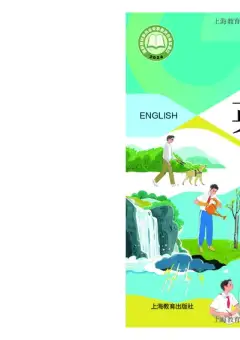
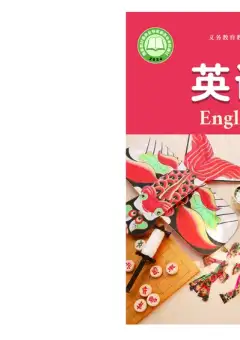
义务教育教科书
(五·四学制)
ENGLISH
英语
英语
英语
七年级
下册
上海教育出版社
上海教育出版社
英语
七年级
下册
义务教育教科书
(五·四学制)
主编 束定芳
上海教育出版社
上海教育出版社
致同学
亲爱的同学:
欢迎与我们一起继续初中阶段的英语学习!
本学期,你将继续和教材中的小伙伴们一起,在学习英语的同时,探索新世界、思考大问题(Big
Question),在真实情境中“讲(文化)小故事,悟(人生)大道理,学百科新知识,用英语做事情”。我
们将通过教材,帮助你运用科学有效的方法学习英语,发展英语语言能力,培育文化意识,提升思维
品质,提高学习能力。
本套教材的每个单元以主题为引领,从大问题入手,设有五个小话题,分别对应听力、口语、
阅读、写作和项目探究五大板块。每个话题下包含符合初中生学习、生活和成长特点的类型丰富
的语篇,设计层层推进的学习活动,帮助你获得丰富的学习体验,并在学习过程中了解自己的学
习成效,最终对单元大问题有更加全面、深入的认识和理解。
围绕不同的主题,教材通过鲜活真实的语言素材,为你提供地道的语言示范。本册教材中,
听力、口语板块的多模态文本图文结合,均以日常生活中常见的真实情境为范本设计(如海报、资
讯图表、节目预告、网页等);听力板块配有对话、讲座、广播、访谈等各类音频素材;在阅读板
块,你可以接触到故事、演讲、文学作品节选、新媒体文章、报刊杂志文章等丰富的语篇类型;教
材中小伙伴们的日常会话和他们的习作,也会为你提供口语和写作表达的范例。
在你学习教材的过程中,智能机器人“胡博士”(Dr Hu)将会继续陪伴你左右,帮助你掌握语
言知识、技能和学习策略。每单元最后的“项目探究”(Project)为你准备了更多的挑战任务。你
准备好迎接挑战了吗?
本册教材除了常规单元以外,还设有两个文化角(Culture corner)和一个文学角(Literature
corner)。文化角不仅带你更深入地了解中国文化,学会用英语讲中国故事,还带你领略多样的世
界文化。文学角中,我们精选了广受青少年喜爱的优秀文学作品片段,供你赏析。
希望这套教材给你带来学习英语的新体验、新收获,为你插上一双逐梦的翅膀,飞向世界、飞
向未来!
上海教育出版社
上海教育出版社
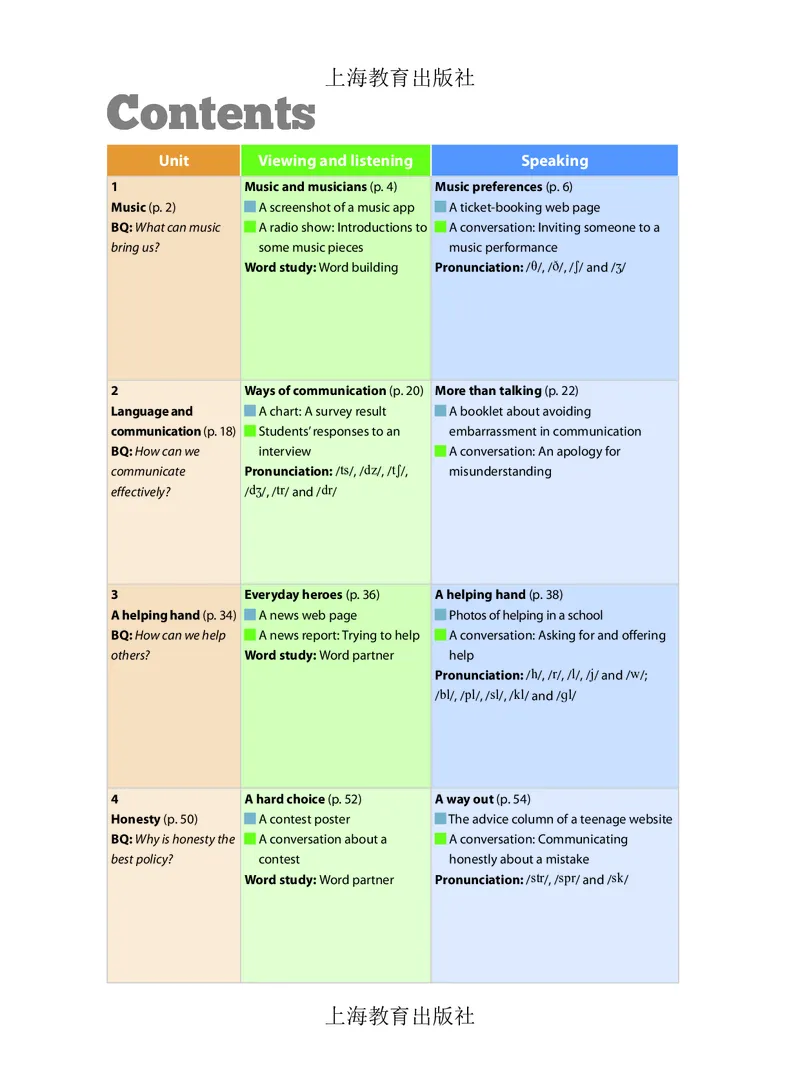
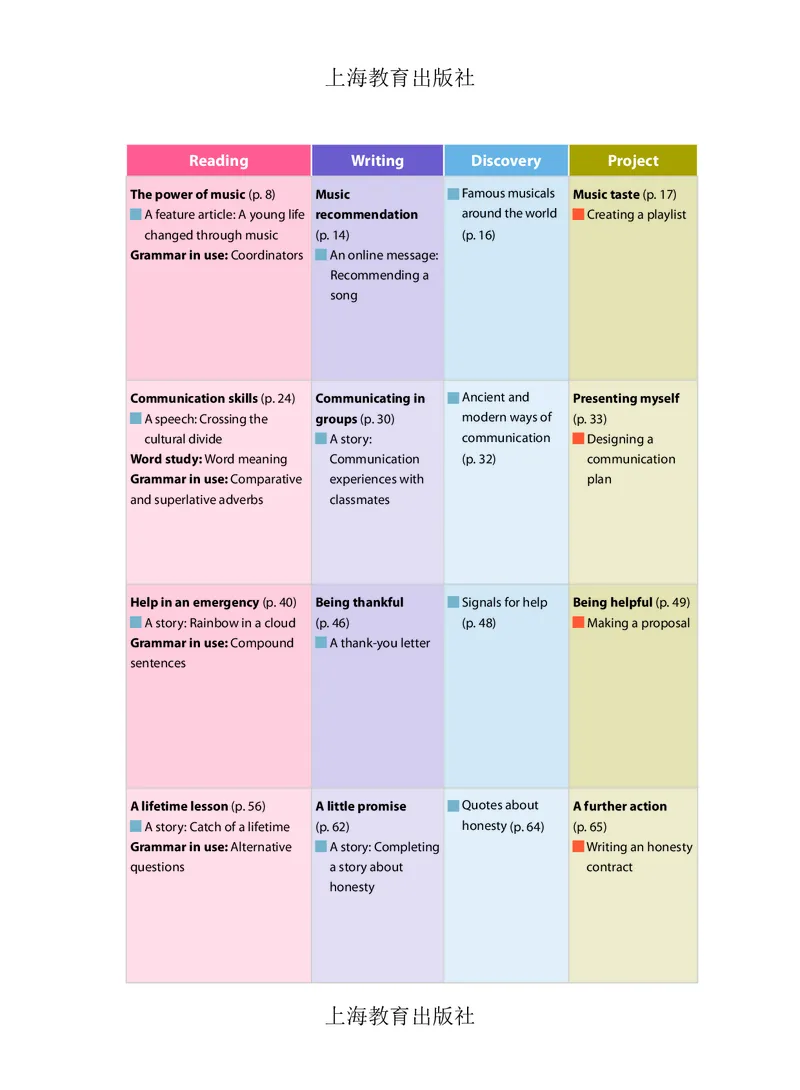
Contents
Unit
Viewing and listening
Speaking
1
Music (p. 2)
BQ: What can music
bring us?
Music and musicians (p. 4)
�A screenshot of a music app
�A radio show: Introductions to
some music pieces
Word study: Word building
Music preferences (p. 6)
�A ticket-booking web page
�A conversation: Inviting someone to a
music performance
Pronunciation: /P/, /ð/, /S/ and /Z/
2
Language and
communication (p. 18)
BQ: How can we
communicate
effectively?
Ways of communication (p. 20)
�A chart: A survey result
�Students’ responses to an
interview
Pronunciation: /ts/, /dz/, /tS/,
/dZ/, /tr/ and /dr/
More than talking (p. 22)
�A booklet about avoiding
embarrassment in communication
�A conversation: An apology for
misunderstanding
3
A helping hand (p. 34)
BQ: How can we help
others?
Everyday heroes (p. 36)
�A news web page
A news report: Trying to help
Word study: Word partner
A helping hand (p. 38)
�Photos of helping in a school
�A conversation: Asking for and offering
help
Pronunciation: /h/, /r/, /l/, /j/ and /w/;
/bl/, /pl/, /sl/, /kl/ and /Gl/
4
Honesty (p. 50)
BQ: Why is honesty the
best policy?
A hard choice (p. 52)
�A contest poster
�A conversation about a
contest
Word study: Word partner
A way out (p. 54)
�The advice column of a teenage website
�A conversation: Communicating
honestly about a mistake
Pronunciation: /str/, /spr/ and /sk/
Contents
上海教育出版社
上海教育出版社
Reading
Writing
Discovery
Project
The power of music (p. 8)
�A feature article: A young life
changed through music
Grammar in use: Coordinators
Music
recommendation
(p. 14)
�An online message:
�Recommending a
song
�Famous musicals
around the world
(p. 16)
Music taste (p. 17)
�Creating a playlist
Communication skills (p. 24)
�A speech: Crossing the
cultural divide
Word study: Word meaning
Grammar in use: Comparative
and superlative adverbs
Communicating in
groups (p. 30)
�A story:
Communication
experiences with
classmates
�Ancient and
modern ways of
communication
(p. 32)
Presenting myself
(p. 33)
�Designing a
communication
plan
Help in an emergency (p. 40)
�A story: Rainbow in a cloud
Grammar in use: Compound
sentences
Being thankful
(p. 46)
�A thank-you letter
�Signals for help
(p. 48)
Being helpful (p. 49)
�Making a proposal
A lifetime lesson (p. 56)
�A story: Catch of a lifetime
Grammar in use: Alternative
questions
A little promise
(p. 62)
�A story: Completing
a story about
honesty
�Quotes about
honesty (p. 64)
A further action
(p. 65)
�Writing an honesty
contract
上海教育出版社
上海教育出版社
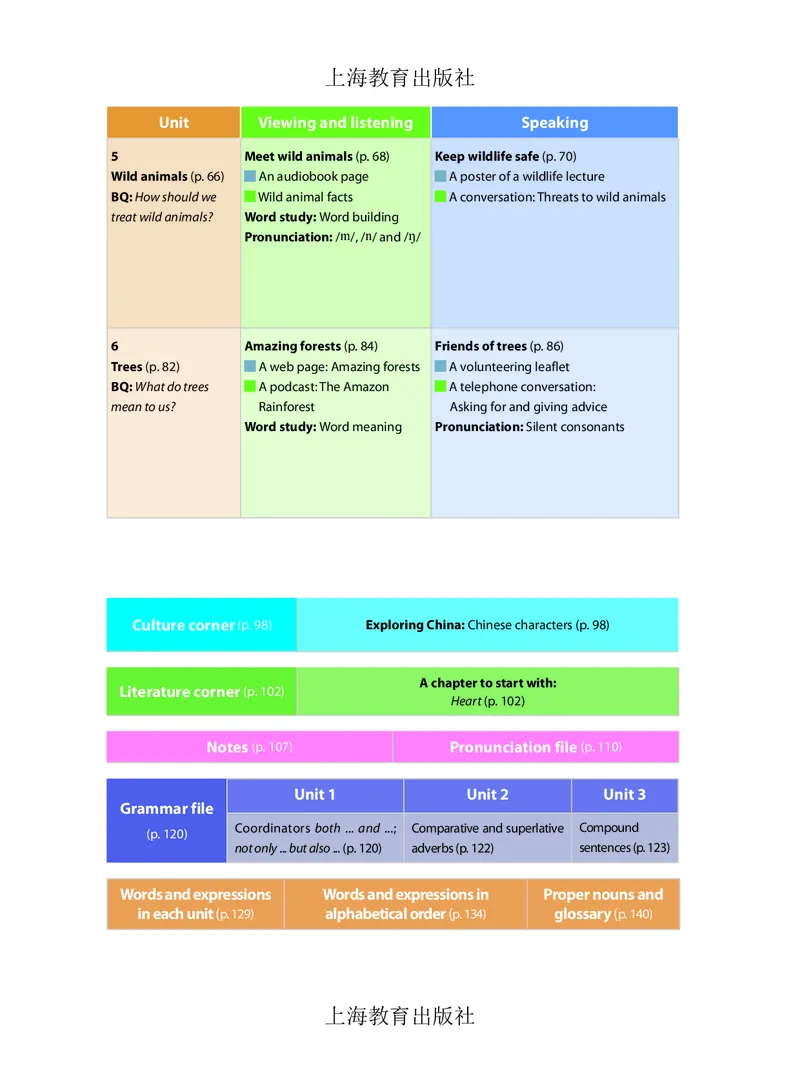
Unit
Viewing and listening
Speaking
5
Wild animals (p. 66)
BQ: How should we
treat wild animals?
Meet wild animals (p. 68)
An audiobook page
�Wild animal facts
Word study: Word building
Pronunciation: /m/, /n/ and /N/
Keep wildlife safe (p. 70)
�A poster of a wildlife lecture
�A conversation: Threats to wild animals
6
Trees (p. 82)
BQ: What do trees
mean to us?
Amazing forests (p. 84)
�A web page: Amazing forests
�A podcast: The Amazon
Rainforest
Word study: Word meaning
Friends of trees (p. 86)
�A volunteering leaflet
�A telephone conversation:
Asking for and giving advice
Pronunciation: Silent consonants
Literature corner (p. 102)
A chapter to start with:
Heart (p. 102)
Notes (p. 107)
Pronunciation file (p. 110)
Grammar file
(p. 120)
Unit 1
Unit 2
Unit 3
Coordinators both ... and ...;
not only ... but also ... (p. 120)
Comparative and superlative
adverbs (p. 122)
Compound
sentences (p. 123)
Words and expressions
in each unit (p. 129)
Words and expressions in
alphabetical order (p. 134)
Proper nouns and
glossary (p. 140)
Culture corner (p. 98)
Exploring China: Chinese characters (p. 98)
上海教育出版社
上海教育出版社
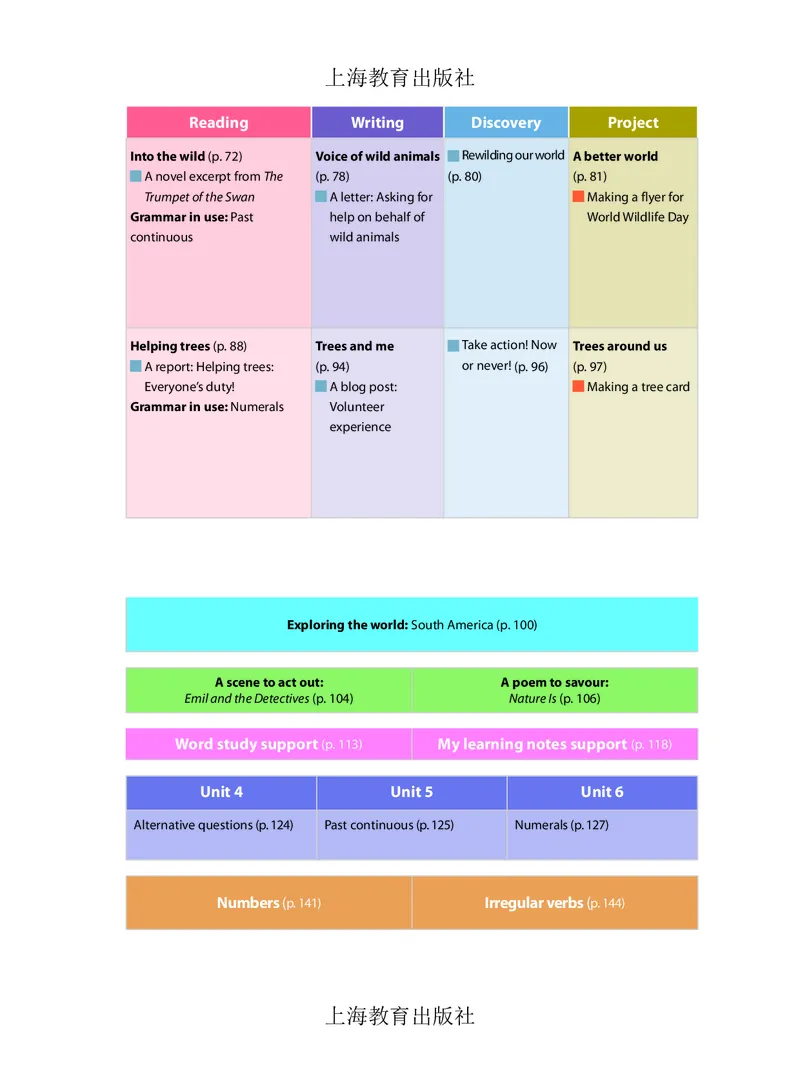
Reading
Writing
Discovery
Project
Into the wild (p. 72)
�A novel excerpt from The
Trumpet of the Swan
Grammar in use: Past
continuous
Voice of wild animals
(p. 78)
�A letter: Asking for
help on behalf of
wild animals
Rewilding our world
(p. 80)
A better world
(p. 81)
�Making a flyer for
World Wildlife Day
Helping trees (p. 88)
�A report: Helping trees:
Everyone’s duty!
Grammar in use: Numerals
Trees and me
(p. 94)
�A blog post:
Volunteer
experience
�Take action! Now
or never! (p. 96)
Trees around us
(p. 97)
Making a tree card
Word study support (p. 113)
My learning notes support (p. 118)
A scene to act out:
Emil and the Detectives (p. 104)
A poem to savour:
Nature Is (p. 106)
Unit 4
Unit 5
Unit 6
Alternative questions (p. 124)
Past continuous (p. 125)
Numerals (p. 127)
Numbers (p. 141)
Irregular verbs (p. 144)
Exploring the world: South America (p. 100)
上海教育出版社
上海教育出版社
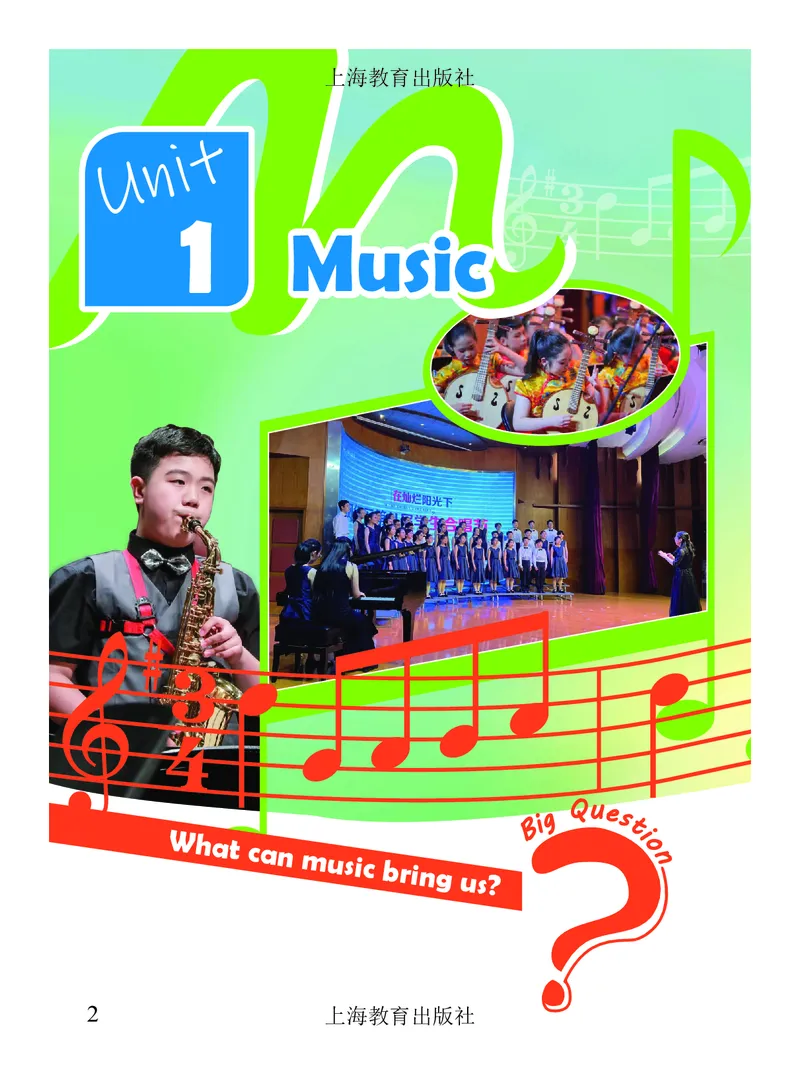
C
1
What can music bring us?
Music
2
C
上海教育出版社
上海教育出版社
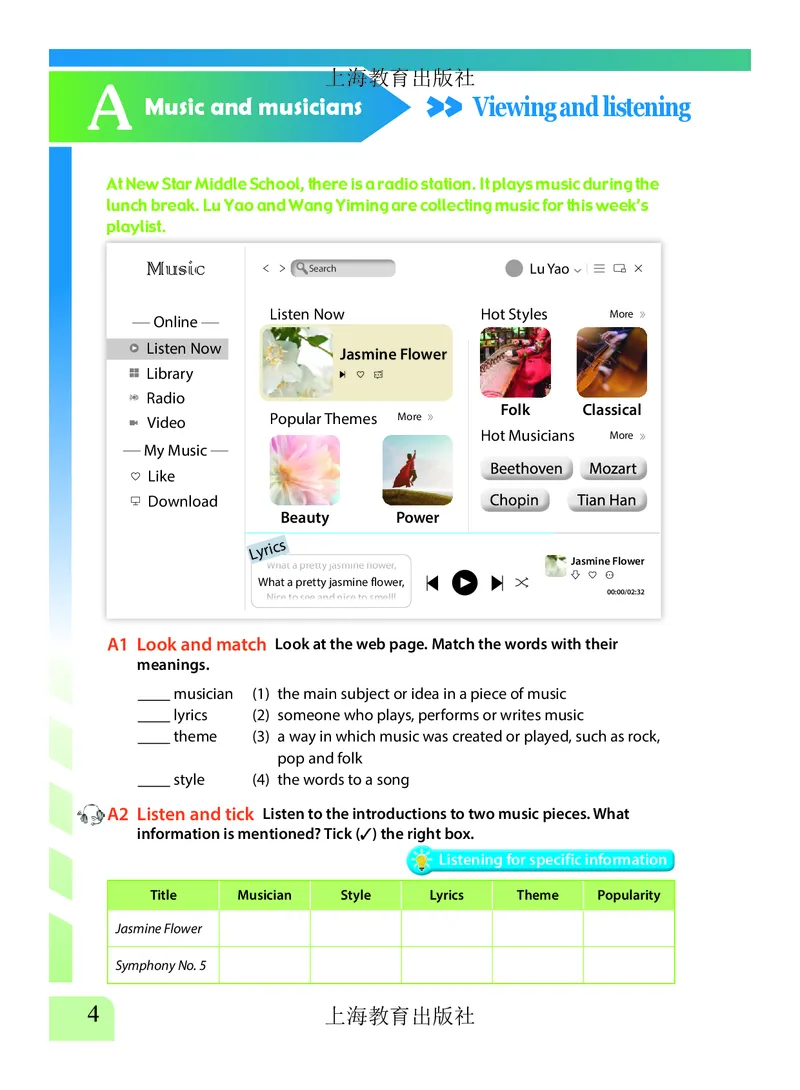
Getting started
Listen to a song and answer the questions.
1 How does the song make you feel?
2 Do you like the song? Why or why not?
1 �Listen to a radio show about
different music pieces.
2 �Talk about music preferences.
3 �Read a newspaper article
about the power of music.
4 �Write a message to
recommend a song.
5 �Create a playlist for the
school radio station.
3
上海教育出版社
上海教育出版社
4
Viewing and listening
Music and musicians
A
A1 �Look and match Look at the web page. Match the words with their
meanings.
musician
(1) the main subject or idea in a piece of music
lyrics
(2) someone who plays, performs or writes music
theme
(3) �a way in which music was created or played, such as rock,
pop and folk
style
(4) the words to a song
A2 �Listen and tick Listen to the introductions to two music pieces. What
information is mentioned? Tick (3) the right box.
At New Star Middle School, there is a radio station. It plays music during the
lunch break. Lu Yao and Wang Yiming are collecting music for this week’s
playlist.
Title
Musician
Style
Lyrics
Theme
Popularity
Jasmine Flower
Symphony No. 5
Listen Now
Hot Styles
Hot Musicians
Listen Now
Library
Radio
Video
Like
Download
Online
My Music
Lu Yao
Music
Search
00:00/02:32
Popular Themes
More 》
More 》
More 》
Jasmine Flower
Jasmine Flower
Folk
Classical
Power
Beauty
What a pretty jasmine flower,
What a pretty jasmine flower,
Nice to see and nice to smell!
Lyrics
Listening for specific information
上海教育出版社
上海教育出版社
1
5
A3 �Listen and take notes �Listen again and complete the information cards.
• Title: Jasmine Flower
• Musician: Unknown
• Style:
1
• Theme:
It praises the
2 of the jasmine flower.
• Popularity:
It’s well-known both in China and
3 .
• Title: Symphony No. 5
• Musician: Beethoven
• Style:
4
• Theme:
It is about the fight against
5 in life.
• Popularity:
It is one of the
6 works in the classical music world.
Listen to the introduction to the third piece and create its music information card.
Update my to-do list
Word study Word building Compounding (Ⅱ)
Complete the following sentences with one word.
1 �Beethoven’s Symphony No. 5 is the best-known work in the classical
music world. (a work that is best known)
2 �It’s a walk to the nearest theatre. (a walk of ten minutes)
3 �After years of hard work, the young man got a job as a
singer. (a job that was paid well)
4 �The Chinese folk song Jasmine Flower became because of
its beautiful melody. (famous around the world)
上海教育出版社
上海教育出版社
6
Speaking
Music preferences
B
Li Bailing wants to invite her friend Mary to watch a show this weekend. Here
is the website information.
B1 �Look and say Complete the table. Circle a number for each show in the
table and share your ideas about them. (1=disagree, 3=agree)
B2 �Listen, read and think Listen to the conversation between Bailing and
Mary. Which show(s) would they like to watch?
Bailing: �Hi, Mary! There are some great music events this weekend. Would you
like to go with me?
Mary:
Yes, I’d love to. Which one do you have in mind?
Bailing: Let’s check out the website for the events.
The performance
seems interesting.
I would like to read
more information.
Beethoven Concert
1
2
3
1
2
3
Journey to the West
1
2
3
1
2
3
Sunf lower Chorus’s
Charity Show
1
2
3
1
2
3
Beethoven Concert
Journey to the West
Sunflower Chorus’s Charity Show
Classical Music
Musical
Chorus
Read more
Read more
Read more
Music
Show
Event
UPCOMING EVENTS
Calendar
Tickets
Blog
About us
News
上海教育出版社
上海教育出版社
1
7
My learning notes
Mary:
Here are three shows. They all look interesting. It’s hard to choose!
Bailing: �Shall we watch Journey to the West? I haven’t seen it done in English
before. Maybe it’s new to you too.
Mary:
�Actually, I’ve seen it already. How about Sunflower Chorus? They
have sweet voices and it’s a charity show. They are raising money for
homeless animals.
Bailing: �Good choice. Let’s watch Sunflower Chorus’s Charity Show this
weekend.
Mary:
That’ll be great!
B3 �Role-play Wang Yiming would like to invite his friend Harry to watch a show
from the website on page 6. With a partner, act out their conversation.
Talking about one’s feelings:
They all look interesting. It’s hard to choose!
I really want to ...
I’m glad/excited to ...
.
Pronunciation
Pop is always popular, fashionable and fun,
Folk is more traditional, songs for everyone.
The rhythms of jazz are cool; classical gives us pleasure,
A piece of music is worth a thousand words.
All music is a treasure.
Sing the rap.
/P/, /Q/, /S/ and /Z/
You would like to invite your friend to watch a show this weekend. Act out the
conversation.
Update my to-do list
上海教育出版社
上海教育出版社
Reading
C The power of music
In TEENS, a local newspaper, Wang Yiming read a story about Kevin Blake.
C1 Predicting Read the title of the news story and choose the best answer.
In which section of the newspaper will you probably find this story?
A Business.
B Sports.
C Entertainment.
D Feature.
C2 Read the story.
“Music changed everything,” says 13-year-
old Kevin Blake. I spoke with Kevin at his
home in Manchester. “I used to have a bad
stutter. I knew what I wanted to say but
when I started to speak, I had to stop. I
tried hard, but the words didn’t come out
smoothly. Other kids made fun of me. I kept
silent.”
Kevin’s music teacher, Penny Fisher, advised
using music to help him. She says singing can
help kids who stutter. “It not only helps you
know the rhythm of music, but also teaches
you to breathe calmly.” Kevin’s parents
decided to try it.
A young life
changed through music
5
10
8
上海教育出版社
上海教育出版社
1
“When Penny first asked me to sing, I felt shy,” says
Kevin. “But she encouraged me. I discovered that the
words came out freely.”
After three months, Kevin joined the school chorus.
“In the chorus, everyone else was singing too, so
they weren’t listening to me. I could relax and enjoy
myself.”
Kevin gained confidence and found the courage to
sing solo. “People liked my singing,” he says. “It felt
great when the words came out without a stutter. It
helped my speaking. Through singing, I found my
voice!”
Kevin now gives talks to other young people who stutter.
He describes how music has helped him. “I still stutter
a little, but I’ve learned how to be calmer and more
confident. I want to tell the world what magic music can
do.”
15
20
25
30
Personal touch
Does music matter much to Kevin?
If yes, in what way?
9
上海教育出版社
上海教育出版社
10
C3 General understanding Read and fill in the blanks.
1 Music helps a shy boy named Kevin Blake find his .
2 He has learned how to be .
3 From Kevin’s story, we can learn the of the music.
Paragraphs
Supporting details
Paragraph(s)
1 �
What problem did
Kevin have?
Kevin
2 �
.
Paragraph(s)
3 �
How did music change
Kevin?
At first,
Kevin felt
4 �
.
With Penny’s
encouragement,
Kevin discovered
5 �
�
.
In the school
chorus,
Kevin relaxed and
6 �
�
.
Finally,
Kevin gained
7 �
;
8 �
.
Paragraph(s)
9 �
How did Kevin use
music to help others?
Kevin gives
10 �
.
Kevin describes the power of music.
C4 Detailed reading Read and complete the table.
C5 �Further thinking How do you understand Kevin’s words “Through singing,
I found my voice!”?
Scanning for specific information
上海教育出版社
上海教育出版社
1
11
Vocabulary focus Fill in the blanks with the proper forms of the words
and phrases in the box.
come out freely used to encourage make fun of confident
Kevin is a 13-year-old boy from Manchester.
He
1 have a stutter and was
very shy, so other kids
2 him.
Luckily, later Kevin found that his words could
3 after he learned singing
in the chorus. The music has brought him
4 so that he can give talks to
5 other young people. He
wants to tell the world what magic music
can do.
Will you share Kevin’s story with other young people? Why or why not?
Update my to-do list
上海教育出版社
上海教育出版社
12
1 Read and think Read the sentences and think: How are they formed?
(1) I like both pop music and rock music.
(2) �Both Beethoven and Mozart are famous composers in the history of Western
music.
(3) �Johann Sebastian Bach not only played keyboard instruments but also
composed music.
(4) Albert Einstein was not only a famous physicist but also a musician.
2 Work out the rules Tick (3) the one(s) you agree with.
Grammar in use Coordinators
3 �Practise: Fun facts There are many interesting facts about famous people.
Use both ... and ... or not only ... but also ... to describe them.
Albert Einstein developed
the theory of relativity.
Albert Einstein played the
violin well.
(1)
We usually use both ... and .../not only ... but also ... to:
�suggest the difference between two things.
�stress the link between two things.
Grammar file
p. 120
�
�
.
上海教育出版社
上海教育出版社
1
13
4 �A survey Read the four students’ ideas. Make sentences by using coordinators
like both ... and ... , not only ... but also ... . You can interview your classmates for
more ideas.
Wolfgang Mozart was good at
writing music pieces.
Wolfgang Mozart was good at
playing the piano.
(2)
I like classical music. I often listen to Chopin after
school because his piano pieces sound relaxing. It
makes me less stressed.
Rock music is my favourite. I always listen to rock music
after school. Every time I hear it, I get refreshed. It keeps
me energetic.
I like rock music. I always share rock music with my friends.
I feel refreshed and energetic when I enjoy it.
Classical music is always on my playlist. It makes
me relaxed and helps me go to sleep easily.
�
�
.
Grammar file
p. 122
上海教育出版社
上海教育出版社
14
Writing
Music
recommendation
D
The school radio station is calling on students to recommend songs to play
next week. You want to recommend a song.
D1 �Think Read Zhao Peng’s reply to Lu Yao’s post. Why does he like the song We
Will Rock You?
D2 �Prepare Read Dr Hu’s tip and find examples of parallel structure from the
text in D1. Underline them.
Lu Yao
28 Feb.
+ Subscribe
The Radio Station is calling!
Hey, everyone, if you would like us to play a special song, just let us
know which one you like and why you like it. The most popular three
will be on next week’s playlist.
528
1
Zhao Peng
28 Feb.
I would like to recommend a song — We Will Rock You. It is one of
the greatest songs of all time. It not only offers a strong melody but
also has powerful lyrics. Every time you listen to it, you want to sing
along. What’s more, it is widely used in many sports events around
the world to show team spirit and encourage the athletes. I’m sure
your audience will enjoy this song.
77
0
上海教育出版社
上海教育出版社
1
15
D3 �Plan Complete the chart with your ideas.
D5 �Check Check your writing. Pay attention to the use of parallel structures.
Recommendation
Feelings/Hopes/...
1
2
...
Reasons
My reply
D4 �Write Write your reply to the post.
Reply
(Name)
(Date)
�
�
�
�
A parallel structure involves two or more words, phrases, or clauses
that are similar in length and grammatical form, such as ... and ...,
not only ... but also ..., both ... and ..., etc.
e.g.
Kevin gained confidence and found the courage to sing solo.
It not only offers a strong melody but also has powerful lyrics.
Writing parallel structures (Ⅰ)
TEEN skill
Work in groups and share your writing. Vote for your favourite one in the group
and say why you like it. How many votes do you get?
Update my to-do list
上海教育出版社
上海教育出版社
16
Discovery
Famous musicals around the world
The Butterf ly Lovers is a modern musical based
on a traditional Chinese story Liang Shanbo and
Zhu Yingtai. In 4th-century China, Liang Shanbo
and Zhu Yingtai fell in love with each other, but
Yingtai’s parents refused to marry their daughter
to Shanbo. After their deaths, they turned into a
pair of butterf lies and f lew happily together.
This musical is based on a true story about the
von Trapp family. In 1930s Austria, a lady called
Maria became the tutor
① to the seven children
of Captain Georg von Trapp. She brought music
and joy to the whole family.
This musical is from Victor Hugo’s novel of the
same name. In 19th-century France, Jean Valjean
was once in prison because he stole bread
to feed his sister’s children. He tried to find a
meaningful life after he was free.
Read and think Which of the three musicals impresses you most?
① tutor 家庭教师
The Butterf ly Lovers
The Sound of Music
Les Misérables
上海教育出版社
上海教育出版社
1
17
Project
Music taste
E
The school radio station is collecting music pieces for different occasions.
Work in groups and recommend a playlist.
�Brainstorm Discuss and decide on the occasion and music pieces you
would like to play.
�Collect Search for information about the music pieces you have chosen.
Make an information card for each of them.
Create Create a playlist and present it to the whole class.
Lunchtime
Radio gymnastics
...
The school sports meeting
A break between classes
Title:
Musician:
Style:
Theme:
Reasons for recommendation: �
�
Creating a playlist
Vote for the best three playlists and recommend them to the school radio station.
Update my to-do list
Step 1
Step 2
Step 3
上海教育出版社
上海教育出版社
How can we communicate effectively?
2 Language
and communication
18
上海教育出版社
上海教育出版社
Getting started
Look at the pictures and answer the
following questions to see if you are an active
communicator.
1 Do you listen to others carefully?
2 �Do you look at others in their eyes when you
speak to them?
3 �Do you often give your opinion in public?
1 �Listen to interviews about
ways of communication.
2 �Talk about embarrassing
moments in communication.
3 �Read a story about breaking
down communication barriers.
4 �Write a story about my
communicating experiences.
5 �Make a communication
plan.
19
上海教育出版社
上海教育出版社
20
Viewing and listening
Ways of
communication
A
The communication club is doing a survey among students. Here’s a chart
about New Star Middle School students’ favourite ways to communicate with
friends.
A1 �Look and say Read and say what you can learn from the chart.
A2 �Listen and think Listen to the recording and match the students with
their favourite ways of communication.
*Based on a survey of over 500 teenagers (aged 12 to 15).
From the chart, we can learn that ...
• over
1 students took part in the survey.
• �communicating
2 is the most popular among students.
•
3 is the second most popular way of communication.
• only five per cent of the students prefer to talk with their friends by
4 .
Students
Favourite ways
Lu Yao
Texting
Writing
Video-chatting
Talking on the phone
Lin Dong
Li Bailing
texting
in person
social media video-chatting
talking on
the phone
others
writing
35%
35%
0%
5%
10%
15%
20%
25%
30%
29%
16%
10%
5%
3%
2%
上海教育出版社
上海教育出版社
2
21
A3 Listen and take notes Listen again and fill in the blanks.
Lu Yao
It allows her to
1 �
.
She can read it
2 �
.
Lin Dong
He can get
3 �
.
He and his friends can see
4 �
.
Li Bailing
It’s
5 �
.
Emojis help her
6 �
.
Sing the rap.
George enjoys words,
Joe likes emojis; they’re like chalk and cheese.
George sends letters; he has no phone.
Joe chats online so he won’t feel alone.
George visits friends; he just drops by.
Joe sends texts; he wants George to try.
Together they don’t communicate much,
But always manage to stay in touch.
Pronunciation /ts/, /dz/, /tS/, /dZ/, /tr/ and /dr/
Listening for supporting details
Listen to Wang Yiming. What is his favourite way of communication? Why?
Update my to-do list
上海教育出版社
上海教育出版社
22
Speaking
More than talking
B
At the communication club, students are making a booklet about avoiding
embarrassment in communication.
B1 �Look and say What caused the embarrassments in the booklet above?
Have you ever had any similar experiences? How did you deal with them?
B2 �Listen, read and think Listen to the conversation between Harry and Li
Bailing. What is the conversation mainly about?
Harry:
�Hey, Bailing. You seemed unhappy with me these days. What happened?
Bailing: �I just ... I don’t know how to say it. But I thought you were a bit rude
to me.
Harry:
Why do you say so?
Bailing: �Do you remember the performance last Friday? I was cheering for you,
but you pointed your finger at me. Were you angry with me?
Harry:
�I’m really sorry. But I didn’t mean to do that. I just wanted to invite you
to sing with me.
Do you mind if I
sit here?
Not at all.
Go ahead.
Choose suitable topics.
...
How much does
your father earn?
Avoid embarrassment
in communication
Mind your body language.
Respond properly.
Yes, please.
上海教育出版社
上海教育出版社
2
23
Bailing: �It doesn’t matter. I apologise for misunderstanding you. In our
culture, we usually use a sweep of the open hand — palm upwards.
Harry:
I see. I’ll keep that in mind.
B3 �Role-play Choose one of the situations in the booklet on page 22. Pick a
role and make up a conversation.
B
A
Situation 1 You ask your classmate a very
personal question.
Your classmate asks you a very
personal question and you think
it’s rude.
Situation 2
Your classmate doesn’t respond to
your request properly. You don’t
know what he/she really means. Talk
to your classmate to fix the problem.
You don’t respond to your
classmate in a proper way. That
causes misunderstanding. Talk to
your classmate to fix the problem.
You can start your conversation like this:
Situation 1
Situation 2
A: �You look beautiful in your new
coat!
B: Thank you.
A: How much is it?
B: Hmm ...
A: Excuse me, do you mind if I sit here?
B: Yes, please.
A: Well ...
My learning notes
Making apologies:
• I’m sorry./My apologies./My fault.
• I’m sorry for being late.
• I’m sorry that I said that.
•
Responding to apologies:
• It doesn’t matter.
• Don’t worry about it.
• That’s OK.
•
Choose another situation in the booklet on page 22 and do B3 again, or think of an
embarrassing moment in your life and act it out with your partner.
Update my to-do list
上海教育出版社
上海教育出版社
Reading
Communication skills
C
24
Wang Yiming is giving a speech about his experience at an international
summer camp.
C1 �Predicting Look at the title and guess what Yiming may probably talk
about.
C2 Read Yiming’s speech.
5
10
Crossing
the cultural divide
Last summer, I went to an international summer camp.
There, I spent two months with 50 campers from 30
different countries in the world. I thought it would be easy
for us to understand each other, since we
all speak English, one of the most widely
used languages. However, I was wrong.
The first challenge was the variety
of accents, which made it difficult
for us to understand each other.
In addition, the differences
24
上海教育出版社
上海教育出版社
2
25
in food, clothing, customs and traditions also caused some
misunderstandings.
But I soon realised that these differences can be used to bridge
the gap between different cultures. I showed my fellow campers
how to do finger counting with one hand. They were surprised,
and interested in how I did it. I introduced them the changes of
Chinese characters through history.
I also taught them how to pronounce some Chinese characters.
They were excited to find that our pinyin is very much like their
alphabet system. I even taught them the hand gestures we often
use. Much to my pleasure, more and more campers came to talk
to me.
I will never forget this experience. It
was a good chance to introduce our
culture to the world. If we better
understand cultural differences, we
can communicate more effectively.
Let’s listen to each other and better
understand our differences!
15
20
25
Personal touch
What do you think of Yiming and why?
25
上海教育出版社
上海教育出版社
26
C3 �General understanding Which of the following best describes the
structure of the speech?
A Topic sentence — Examples — Closing
B Opinion — Supporting details — Conclusion
C Background — Problem — Solution — Conclusion
C4 �Detailed reading According to Yiming, what made it difficult to understand
each other? How did he cross the cultural divide? Read and fill in the blanks.
C5 Further thinking Answer the questions.
�1 �What else can Yiming do to help the teenagers better understand each other
at the campsite?
2 �What does Yiming mean by saying “Let’s listen to each other and better
understand our differences!”?
3 �Do you think Yiming is a good communicator? Why or why not?
•
1
• differences in
2
�
�
He showed them
4 �
.
He introduced them
5 �
.
He
6 �
and
7 �
.
Difficulties in
communication
3 our cultural differences
More and more campers
8 .
Understanding the text structure
上海教育出版社
上海教育出版社
2
27
Vocabulary focus Fill in the blanks with the proper forms of the
given words in the box. One is extra.
misunderstanding gesture pleasure challenge culture
Word study Word meaning Synonyms
Find the synonyms from the text for the words in the table.
Words
Synonyms
chat
talk
hard
joy
know
1 �When you are giving a public speech, make sure your hand
are natural and they support your message.
2 �Sometimes, not only our words, but also our body language
can create .
3 �What
does a speaker face when giving a
speech to an audience with different cultural backgrounds?
4 �Travelling abroad allows you to experience different
in person.
What have you learned from Yiming’s camp experience?
Update my to-do list
上海教育出版社
上海教育出版社
28
Grammar in use �Comparative and superlative adverbs
1 �Read and think How do we make comparisons with adverbs?
(1) Emojis help me show my feelings more clearly than words.
(2) �Understanding cultural differences allows us to communicate more effectively.
(3) English is one of the most widely used languages in the world.
2 Work out the rules Fill in the blanks.
3 �Practise: Be the judge The communication club is holding a public speaking
contest. Three students are competing for the winner. Look at their scores and
complete the report by using comparative and superlative adverbs.
Wang Yiming
Lu Yao
Lin Dong
Clarity①
Fluency②
Confidence
It’s hard to make a decision. Everyone has his or her own strengths.
In terms of clarity, Wang Yiming spoke
(1) more clearly than Lu Yao
but
(2)
than Lin Dong. As for fluency, Lu Yao spoke
(3)
than Yiming but
(4)
than Lin Dong.
① clarity 清晰;清楚 ② fluency 流利;流畅
• �We usually use comparative and superlative adverbs when we
the way things happen.
• �We usually form comparative and superlative adverbs by adding
and before the adverbs.
Grammar file
p. 122
上海教育出版社
上海教育出版社
2
29
smile sweetly
...
...
...
listen carefully
4 �Discussion
I think ... is the best communicator. He speaks
the most politely.
I would like to choose ...
She smiles the most sweetly in our class.
I don’t think so. I think ... speaks even more
politely than him.
...
(1) Brainstorming: What should a good communicator do?
(2) Discussion: Who is the best communicator in your class? Give your reasons.
Lin Dong presented his speech
(5)
among the three
students. But he was not the most confident one. He expressed
himself
(6)
than Lu Yao and Yiming.
A good communicator should ...
speak politely
上海教育出版社
上海教育出版社
30
Writing
Communicating in
groups
D
Ms Chen asks her students to share stories about their communicating
experiences.
D1 Think Read Li Xin’s story. What does she write about?
D2 �Prepare Answer the following questions about Li Xin’s story.
The Best Team
Our class were going to perform in the school
Music Week. We girls focused on singing while
the boys practised dancing. Everybody worked
hard, but some of the boys found it hard to keep
up. We girls worried about the situation and
shouted to the boys. This made them angry and they stopped
practising. We soon regretted what we did and texted the
boys’ leader to apologise for being rude. The next day, the boys
arrived much earlier and practised hard. In the end, we won
first prize. The moment we hugged each other, we realised that
effective communication is just like a bridge — it connects us
and builds understanding.
1 Who is the story about?
______________________
2 �When and where did the
story take place?
______________________
3 �What happened at the
beginning of the story?
______________________
4 �What happened in the
middle of the story?
______________________
______________________
5 How did the story end?
______________________
The Best Team
上海教育出版社
上海教育出版社
2
31
D4 Write Write your story.
To write a story, you can use guiding questions to help
brainstorm ideas, develop characters and build the structure.
The questions can usually start with who, what, where, when,
how, etc.
D5 �Check Check your story. Pay attention to whether you have followed the
guiding questions.
�
�
�
�
�
�
�
�
D3 �Plan Use the guiding questions in D2 to plan your own story. Make notes
about each question.
�Using guiding questions
TEEN skill
Work in groups. Share your story with your group members and help revise each
other’s stories. Pick a story you like best.
Update my to-do list
上海教育出版社
上海教育出版社
32
Discovery
Ancient and modern ways
of communication
Symbols for communication
Symbols were used to deliver messages. The
Chinese language was first written over 5,000 years
ago. Oracle Bone Script ① are words or symbols on
bones or tortoise shells in the Shang dynasty.
Smoke signals
Smoke signals were used to send messages.
They were mostly used in ancient China.
Chinese soldiers along the Great Wall sent
smoke into the air as warnings of enemy
attack.
Switzerland Alphorns ②
Alphorns were once used to communicate
in the mountains of Switzerland. Alphorns
are very long and heavy. The sound made
by Alphorns travels much farther than the
human voice.
Telephones
The first telephone was invented by
Alexander Graham Bell in 1876. This allowed
people to send voices over wires. Landline
telephone services began in the 1900s.
Mobile phones were invented in 1973.
① Oracle Bone Script 甲骨文 ② Switzerland Alphorn 瑞士山笛
Read and think Why did people invent different ways of communication?
上海教育出版社
上海教育出版社
2
33
Project
Presenting myself
E
The school talent show is coming. Your class is in charge of it. Each group
has a specific task, and you will have to communicate with others and
finish your task.
� Plan Discuss in groups, then make a list of your tasks and audience.
Brainstorm In groups, choose your ways of communication and draft
messages.
Identify problems Think about the problems you might have in
communication and prepare solution plans.
Practise Design your communication plan and present it to the whole
class.
Audience
• Teachers
• Students
• Parents
• Headmaster
• ...
Tasks
...
• What events?
• When?
• Design a poster
• �Invite parents
• Choose a place
• Buy awards or gifts
• ...
Communication Plan
Possible problems: �
Solutions: �
Audience: �
Goals: �
Ways: �
Key messages: �
Designing a communication plan
Step 1
Step 2
Step 3
Step 4
Work in groups. Make comments on your classmates’ communication plan.
Update my to-do list
上海教育出版社
上海教育出版社
How can we help others?
3
A helping
hand
34
上海教育出版社
上海教育出版社
1 �Listen to a news report
about everyday acts of kindness.
2 �Talk about how to ask for
and offer help.
3 �Read a story about a helping
hand in an emergency.
4 �Write a thank-you letter to
someone who has helped you.
5 �Make a proposal for giving a
helping hand to someone in
need.
There are many ways to help others. Tick (3) the things you’ve done and add
some more.
——————————
——————————
cheer someone up
do voluntary work
�help someone work out a
difficult problem
hold a door for a stranger
donate money to a charity
�help someone who
got hurt
——————————
Getting started
35
上海教育出版社
上海教育出版社
36
Viewing and listening
Everyday heroes
A
A1 �Look and say Look at the web page and think: Which piece of news
impressed you most?
A2 �Listen, view and think Listen to a news report. Which piece of news on
the web page did you hear?
Lu Yao is looking through the news about “Everyday Heroes” on TEEN-Land
website.
30 March, Monday
Everyday Heroes
1 �To help out sick people, a 12-year-old girl saved
her hair for three years for donation.
2 �Students volunteered to hand out food to the
elderly who live alone.
3 �Teenagers visited people in need to help them
rebuild confidence and encourage them never to
give up hope.
4 �Four children helped pick up cigarette ends in
the park to prevent fires.
TEEN-Land News
Which piece of news
impressed you most?
...
上海教育出版社
上海教育出版社
3
37
A3 �Listen and take notes Listen to the news report again and complete
the notes.
1 When did the two teenagers start to give a helping hand?
�
.
2 Who received help?
people who �
.
�
.
3 Why do they need help?
They find it difficult to �
.
They are �
.
4 What kind of help do they receive?
bring �
to them.
�
.
5 Who else has joined the programme?
�
.
Word study Word partner
Use the phrases in the box to complete the following sentences.
1 �Don’t give your hopes up ./Don’t give up your
hopes. I’m here to help you.
2 me here! I can’t find my key.
3 �James had a bad day today. Let’s go and
him .
4 �Look! The man over there dropped his wallet. Let’s it and
return it.
5 This maths problem is so hard. Can you help me it ?
help (...) out
work (...) out
cheer (...) up
give (...) up
pick (...) up
Listening for key information
Listen to the news report in A2 again and discuss in groups. What do the teenagers
learn from the programme? How would you help in the same situation?
Update my to-do list
上海教育出版社
上海教育出版社
Speaking
A helping hand
B
38
B1 �Look and say Look at the photos. What are the students doing in each
photo?
B2 �Listen, read and think Listen to the conversation between Wang Yiming
and Lu Yao. How did they ask for and offer help?
Yiming:
Hi, Lu Yao! You look a little lost. What are you looking for?
Lu Yao:
�Hey Yiming! I’m looking for a book of maps for my geography class.
What are you doing here?
Yiming:
I’m a volunteer at the school library.
Lu Yao:
�Could you please give me a hand?
Yiming:
Sure!
Lu Yao:
�I don’t know where to start looking for it. The book is called The
World Atlas.
Yiming:
Oh! It is on the shelf next to the librarian’s desk.
Lu Yao:
Thanks. How do I check out a book?
Yiming:
Do you have your student card with you?
Lu Yao:
Yes, I never come to school without it.
Yiming:
�Just show the librarian your student card and she’ll let you take the
book home.
Lu Yao:
Thank you for your help.
Yiming:
I’m happy to help you out.
The school photography club held a photo contest of school life. Here are the
“Star Students of the Week”.
上海教育出版社
上海教育出版社
3
39
My learning notes
B3 �Role-play Look at the photos on page 38. Imagine how they ask for and
offer help and act out the conversations.
Lend a helping hand, whenever
you can.
Reach out to others, you polite
little man.
Kindness is never wrong; joy is
always sent.
Wait for no more; offer your
helping hands!
/h/, /r/, /l/, /j/ and /w/
/bl/, /pl/, /sl/, /kl/ and /Gl/
The wind blew away Grandpa’s hat.
Grandpa was slow and the wind was fast.
“I’m not even close!” Grandpa said.
“Please get it back!”
I ran so fast and I got the hat.
When I gave it to Grandpa, he was no
longer sad,
“Thank you for your help. You’ve made
me so glad!”
Sing the rap.
Sing the rap.
Responding politely to others:
A: Could you please give me a hand?
B: Sure! How can I help you?/
A: Thank you for your help.
B: I’m happy to help you out./
I’m not tall enough to reach
the top of the blackboard.
Could you give me a hand?
Excuse me, my leg
hurts. Could you
help me?
Hey! You seem a bit
upset. How can I
help you?
Thank you for your help.
I am glad to help you out.
...
...
Certainly. It would be my
pleasure. Let me help you
clean the blackboard.
Work in pairs. Make more conversations to ask for and offer help.
Update my to-do list
Pronunciation
上海教育出版社
上海教育出版社
C1 Predicting Read the first paragraph and answer the questions.
1 What probably happened to Mrs Bell?
2 What would Tom probably do?
C2 Read the story.
Lu Yao is reading a story about acts of kindness.
One sunny Saturday morning, as usual, Tom was reading a newspaper to his
old neighbour Mrs Bell in her garden. Suddenly Mrs Bell cried out and put her
hand to her heart.
“Mrs Bell, are you okay?” asked Tom, very worried.
“I think I’m having a heart attack!” she said in a weak voice. Her face
turned pale, and she broke out in a cold sweat.
A heart attack! Tom was shocked, but the eleven-year-old boy took a
few deep breaths to calm himself down. He remembered a lesson he had
5
Rainbow
in a cloud
Reading
C Help in an emergency
40
上海教育出版社
上海教育出版社
learned in a summer camp. In an emergency, you must stay calm.
Who could he turn to for help? Mrs Bell lived alone, so there was
nobody around. His parents were out shopping for the old lady.
He quickly took out his phone and called the emergency number.
He told the operator clearly where Mrs Bell lived and what had
happened. The operator said an ambulance was on its way.
“Tom, get me the blue bottle by my bed,” said Mrs Bell. Tom ran
into the house and got Mrs Bell’s heart pills. She took one.
When the ambulance arrived, two doctors gave Mrs Bell first aid at
once. One of them said, “You must be the boy who called us.” Tom
nodded. “Well done!” the doctors said.
After they left for the hospital, Tom thought to himself, “Mum often
says she is happy to be a rainbow in someone’s cloud. Now I seem to
understand what she means.”
10
15
20
Personal touch
What do you think of the story?
Did Tom do the right thing?
3
41
上海教育出版社
上海教育出版社
42
C5 Further thinking Answer the questions.
1 What can you learn from Tom?
2 �“Mum often says she is happy to be a rainbow in someone’s cloud.” What does
“a rainbow in someone’s cloud” probably mean?
C3 �General understanding Read and find out the two things that Tom did to
help Mrs Bell.
C4 �Detailed reading In what order did the following events happen? Complete
the timeline with A-G.
Understanding sequence
�
�
�
�
�
�
A Mrs Bell had a heart attack.
C �The ambulance took
Mrs Bell to the hospital.
E �Tom ran into the house and
got Mrs Bell’s heart pills.
F �Tom was reading a newspaper
to Mrs Bell in her garden.
G Tom called the emergency number and reported the case.
B Two doctors gave Mrs Bell first aid.
D �Tom found a way to
calm himself down.
上海教育出版社
上海教育出版社
3
43
Vocabulary focus Complete the post by a doctor with the words and
phrases in the box. One is extra.
ambulance
weak
poor
emergency
cases
operator
hospital
cold sweats
heart attack
Posted by Lillian Wang
In my six years as a doctor, I’ve been called to many
1
of chest pain.
In one case, a woman in her late 60s said she had
2
and generally felt
3 all morning. She waited several
hours to call us because she thought the feeling would go away.
When we arrived, we found she had a serious
4 . We
took her straight to the
5 .
What happens when you call emergency services?
When you make the call, tell the
6 that you may have
an
7 , and it will be taken seriously. They will send an
8 to you as soon as possible.
If there is an emergency
Discuss in pairs. Besides Tom, who else gave a helping hand in the story? How did
they help?
Update my to-do list
上海教育出版社
上海教育出版社
44
1 �Read and think Read the following sentences and pay attention to the
underlined words. What are they used for?
(1) �A heart attack! Tom was shocked, but the eleven-year-old boy took a few
deep breaths to calm himself down.
(2) Mrs Bell lived alone, so there was nobody around.
(3) �Mrs Bell’s face turned pale, and she broke out in a cold sweat.
2 � Work out the rules Choose the right conjunction.
Grammar in use Compound sentences
3 �Practise Connect the two halves of the sentences with and, but or so.
(2) �My mother often helps
me with my homework,
(3) �I caught a bad cold and
felt awful last week,
(4) �You have no idea what
your help means to me,
(1) �I wanted to call you for
help,
I didn’t have your
phone number.
I went to see the
doctor.
she also helps me
learn about the world.
please accept my
sincere thanks.
but
so
and
�We use (so/and/but) to link sentences that are about
similar ideas.
�We use (so/and/but) to describe the result of an
action or a situation.
�We use (so/and/but) to link sentences that are about
different or opposite ideas.
Grammar file
p. 123
上海教育出版社
上海教育出版社
3
45
4 �A survey
Have you helped anyone recently?
How did you help him/her?
How did you feel when you helped him/her out?
Have you received help from anyone recently?
How did he/she help you?
How did you feel when he/she helped you out?
When should we help others?
...
(1) �Work in groups of four. Read the questions. What else do you want to
know? Discuss and add more questions to the list.
Have you helped
anyone recently?
Yes, I have. I helped
my classmate Lisa
last week.
How did you
help her?
She broke her leg, so she couldn’t
walk. I took her to the school
canteen in a wheelchair every
day, and now she is much better.
(2) �Interview your group members with 2-3 questions about their views of
helping others.
(3) Answer the questions by using proper conjunctions.
上海教育出版社
上海教育出版社
46
Writing
Being thankful
D
D1 �Think Read the thank-you letter from Mrs Bell to Tom. How did she thank him?
Have you ever received help from others? Write a thank-you letter to show
how much you thank them.
D2 �Prepare Find out these aspects in the thank-you letter.
What Tom did to
help Mrs Bell
How Mrs Bell felt
about the help
Say thank you
Dear Tom,
Thank you very much for your help. You called the
emergency number for me and gave me the heart pills
just in time. The doctors gave me first aid and they
took good care of me. I am feeling much better now.
You have no idea how much your help means to me,
so please accept my sincere thanks. I’m so happy and
grateful to have kind people like you and your parents
around me.
All the best,
Mrs Bell
上海教育出版社
上海教育出版社
3
47
D3 �Plan Choose one person you would like to give thanks to and make notes
below.
D5 �Check Check your writing. Pay attention to the elements of a thank-you letter.
Dear ,
�
�
�
�
�
�
D4 Write Write your thank-you letter.
Writing a thank-you letter
Start with a greeting.
Show your gratitude with one or two details.
�End with your thoughts, feelings or some additional
information.
Say thank you:
What did he/she do to help you?
How did you feel about the help?
�
�
�
Work in groups. Help one another polish the letters and share them in class.
Update my to-do list
TEEN skill
上海教育出版社
上海教育出版社
48
① Morse code 摩尔斯电码 ② dot (摩尔斯电码中的)点 ③ dash (摩尔斯电码中的)长划
④ f lap (上下或左右)拍打
Read and think Do you know any other signals for help? What do they mean?
Signals for help
Sign languages for the deaf-mute
Sign languages allow the deaf-mute to ask for
help, but they vary from country to country.
In China, showing your palms out and
f lapping④ twice means “help”, but in
America, you have to put a thumb up on
your other palm to deliver the same message.
SOS
The best-known signal for help may be
“SOS”. It’s an international signal that
can be used in any emergency. It comes
from the Morse code
①, which uses dots
②
and dashes
③, so it’s not the short form of
any English words. However, it does have a less-known form — “191519”,
which are the positions of “S”, “O”, “S” in the 26 English letters.
Discovery
上海教育出版社
上海教育出版社
3
49
Project
Being helpful
E
�Share Report your group proposal in class.
Work in groups. Make a proposal for helping someone in need.
�Brainstorm Observe the people around you and think about the
questions.
Who may need help?
How can we help this person/these people?
How can we make him/her/them feel glad to accept our help?
�Plan Design the plan and activities. Make arrangements for these
activities.
Make a group proposal In groups, complete the following table and
draw up a proposal.
We could write
encouraging
notes ...
Some old people are
lonely. Why don’t we
read to them?
A creative project
name
A general
introduction
Activities and
arrangements
Goals
Which group’s proposal sounds the most practical? Follow the arrangements and
offer a helping hand.
Update my to-do list
Making a proposal
Step 1
Step 2
Step 3
Step 4
上海教育出版社
上海教育出版社
Why is honesty the best policy?
4 Honesty
50
上海教育出版社
上海教育出版社
1 �Listen to a conversation
about a spelling bee contest.
2 �Make apologies for what has
been done.
3 �Read a story about a
bass-f ishing experience.
4 �Complete a story about
honesty.
5 �Make a class honesty
contract.
Read and think. Is the person honest?
Tick (3) the right box.
1 �Mary’s teacher gave her an A by mistake. She told the teacher
about the mistake immediately.
2 Kelly broke her mum’s favourite cup but blamed her sister.
3 �James borrowed his friend’s comic book and lost it. He explained
and offered to replace it.
4 �Garcia didn’t like Emily’s new dress, but she still told Emily it
looked nice.
5 �Andy copied an article from the internet, but he said he wrote it
himself.
Yes No Not sure
Getting started
51
上海教育出版社
上海教育出版社
52
Viewing and listening
A hard choice
A
Wang Yiming wants to take part in the school “spelling bee” contest. He is
looking at the poster on the noticeboard.
A1 �Look and say Look at the poster above and talk about it.
A2 �Listen and think Listen to the conversation between Yiming and his mother.
Did Yiming win the contest?
What is a “spelling bee”?
Open to all the students of 6th Grade–7th Grade
SPELLING BEE
Contest
If you love to spell, then come on board!
You could be the next champion!
Friday, 24 April
15:00 - 16:00
Media Centre,
New Star Middle School Library
It’s a game for students
to spell English words.
上海教育出版社
上海教育出版社
4
53
A3 �Listen and complete How did Yiming and his mother feel about the
contest? Listen again and complete the table.
I was almost the winner, but ...
Word study Word partner
e.g. Mike made a mistake in the maths test yesterday.
tell
make
the truth
a mistake
the time
the difference
a suggestion
a decision
a lie
Match the phrase halves, and make sentences with the proper forms of the phrases.
They praised me for
being honest. But I lost.
Making inferences
Listen to the conversation again. What did Yiming’s mother mean by saying “You
have learned a good lesson.”?
Update my to-do list
Yiming’s feelings
Mother’s feelings
1
1
2
1
2
2
上海教育出版社
上海教育出版社
54
Speaking
A way out
B
Lu Yao is in a bit of trouble. She is reading the advice column of a teenage
website and seems to have found an answer.
B1 �Look and say What advice did Annie give to Mike and Maggie? What do
you think Lu Yao may have learned from the advice column?
B2 �Listen, read and think How does Lu Yao deal with her trouble then? Listen
to the conversation and find it out.
Lu Yao:
Hey Lin Dong, do you have a minute to talk?
Lin Dong: Yes! Is anything wrong? You look worried.
Lu Yao:
Remember that you lent me your favourite book?
Lin Dong: Yes, what about it?
Lu Yao:
�I’m so sorry! I accidentally spilled a glass of water on it. The pages
are all stuck together.
Lin Dong: My favourite book?!
Ask Annie!
Dear Annie,
I borrowed my friend’s skateboard
and unluckily it broke while I was
using it. I’m worried about how
my friend will feel when he finds
it out. What should I do to make it
right?
Mike
Dear Mike,
I think you should be honest with
your friend and apologise to him.
Then he won’t mind.
Dear Annie,
I have won first prize in a writing
contest at school, but I’m not
excited at all. The fact is — I copied
it from someone else. Now I feel
guilty about it. What should I do?
Maggie
Dear Maggie,
I think you should tell the truth to
your teacher and explain what you
have done. Remember: Honesty is
always the best policy.
Advice column
Annie
Annie
上海教育出版社
上海教育出版社
4
55
Work in pairs. Pick a role and start a conversation. Use the conversation in B2 as a
model.
My learning notes
Lu Yao:
�I was careless. I know that book means a lot to you, and I want to
be honest with you.
Lin Dong: �I guess accidents sometimes happen. I know you didn’t mean it.
Lu Yao:
I’m truly sorry. Can I buy you another copy?
Lin Dong: �OK. Let’s go to the bookshop after class then!
B3 �Pair work Mike accepted Annie’s advice and apologised to his friend. What
might they say? Work in pairs. Use the conversation above as a model.
You are Wang Yiming. You didn’t
notice that one of your files was
missing. Now your friend Bailing is
telling you the truth. Together you
are trying to find a solution.
B
You are Li Bailing. You were doing
a project on your friend Wang
Yiming’s computer. However, you
accidentally deleted one of his files.
Now you are explaining it to him.
A
In the spring of truth, let
honesty show,
Like a strong tree, with
roots that grow.
With a square promise, we’ll
be true,
Spreading kindness in all
we do.
Honesty stands straight,
like a star,
Making the sky brighter,
near and far.
At a street crossing, we’ll
never be lost,
Being strict with truth to
gain a lot.
Read the poem.
/str/, /spr/ and /sk/
Making and accepting excuses:
• I’m truly sorry, but ...
• Don’t worry about it.
• I didn’t mean to ...
•
Update my to-do list
Pronunciation
上海教育出版社
上海教育出版社
Reading
A lifetime lesson
C
C1 �Background knowledge What do you know about the bass fishing season?
C2 Read the story.
He was eleven years old and lived on an island in the middle of a
lake. On the day before the bass season opened, he and his father
were fishing early in the evening. He tied a small bait and practised
casting. When his pole doubled over, he knew something huge was
on the other end. Finally, he lifted the fish from the water. It was
the largest one he had ever seen, and it was a bass.
The father looked at the handsome fish. Then he lit a match and
5
by James P. Lenfestey
CATCH OF A LIFETIME
56
NOTICE
NOTICE
BASS FISHING SEASON
Open from 23 June to 30 November
Please protect fish and limit the catch.
Bass fishing is a popular sport and hobby for many fishermen. But can we
catch bass all year round?
上海教育出版社
上海教育出版社
4
looked at his watch. It was 10 p.m. —two hours before the
season opened. “You’ll have to put it back, son,” he said. “Dad!”
cried the boy. “There will be other fish,” said his father. “Not
as big as this one,” cried the boy. He looked around the lake.
No other fishermen or boats were anywhere around in the
moonlight. He looked again at his father. Even though no one
had seen them, the boy could tell by his father’s voice that he
had no choice. He slowly worked the hook out of the lip of the
bass and lowered it into the black water. The fish gave a wave
with its tail and disappeared.
That was 34 years ago. Today, the boy is a successful
architect in New York City. He often takes his own son and
daughters to go fishing at the same place. He has
never again caught such a huge fish as the one
he caught that night long ago, but he does
see that same fish—again and again.
10
15
20
Personal touch
�How do you like the father’s decision?
57
上海教育出版社
上海教育出版社
58
C3 �General understanding Answer the question.
What is the theme of the story?
C4 �Detailed reading Read and infer how the boy felt during the process of
fishing.
Making inferences
The boy tied a small bait
and practised casting.
1
Action
Feeling
The father told the boy that
it was two hours before the
fishing season opened.
3
Action
Feeling
The boy lowered the fish
into the black water.
5
Action
Feeling
The boy saw his
pole doubled over.
2
Action
Feeling
The boy cried and refused to
put the fish back into the lake.
4
Action
Feeling
上海教育出版社
上海教育出版社
4
59
C5 �Further thinking In groups, discuss the questions.
1 What does the last sentence of the story mean?
2 What is your understanding of the title “Catch of a lifetime”?
Vocabulary focus Complete the sentences with the proper forms of
the words and phrases in the box. Two are extra.
One evening before the bass season opened, a father and his son were
fishing in the middle of a lake. The father taught the boy how to
1 a bait on the pole. With the help of his father, the boy
2 casting carefully. After a while, his pole doubled over. The
boy was excited and wanted to lift the fish out of the water, but it was
hard. He tried
3 . Finally he made it. He had never seen such
a
4 fish, but it was a bass. They decided to put the fish back.
The fish
5 as soon as the boy lowered it into the water.
handsome
disappear
again and again
practise successful tie lifetime
Retell the story in your own words. Discuss in groups: What may be “the handsome
bass” for you? What will you do if you are in the same situation?
Update my to-do list
上海教育出版社
上海教育出版社
60
Grammar file
p. 124
Grammar in use �Alternative questions
1 �Read and think Read the sentences and think: How are they formed?
(1) A: Did the boy give the bag to the police or its owner?
B: The police.
(2) A: Does his action bring about good results or bad ones?
B: Good ones.
(3) A: Did he tell the truth to his mother or to his teacher?
B: Both/Neither.
(4) A: Where did he get the news, from the newspaper or from the radio?
B: From the newspaper.
2 �Work out the rules Tick (3) the one(s) you agree with.
3 �Practise: This or that? Complete the conversations with alternative
questions.
(1) A: I got up late and was late for school this morning. Mr Li was unhappy.
B: Did you make up a story or tell the truth? (make up a story/tell the truth)
A: I told the truth.
(2) A: I found a mobile phone at the bus stop yesterday.
B: � ? (hand in the mobile
phone to the police/wait for the owner)
A: .
To form an alternative question, we can ...
use the conjunction “or” to separate the answer choices.
use question words to begin the sentences.
We can answer an alternative question ...
using short answers such as “yes” or “no”.
with an alternative.
上海教育出版社
上海教育出版社
4
61
What will you do if you break a valuable vase at home? Will
you tell your parents the truth or keep your mouth shut?
I will tell them the truth because
honesty is more precious than a vase.
4 �What will you do in these situations? Why? Take turns to ask and answer.
(1) You break a valuable vase at home.
(2) You see a thief on the bus.
(3) Your friend asks you to help him cheat his mother.
(4) Your bike scratches① the side of a parked car.
(5)
(3) A: �I went shopping with my grandma last Sunday, and the salesgirl gave us too
much change.
B: � ? (return the money/
keep it)
A: .
(4) A: My sister bought a new dress, but I don’t like it.
B: � ? (tell her your true
feelings/tell a white lie)
A: .
(5) A: �I visited Mr Baker last night, and his wife offered me some cakes, but I don’t
eat cakes.
B: � ? (take the cakes/
say no politely)
A: .
① scratch (尤指意外地)擦破,划损,刮坏
上海教育出版社
上海教育出版社
Writing
A little promise
D
62
Read the story about an honest boy who lives in a small village. Complete
the story according to the given part.
D1 �Think Read Lin Dong’s version. Why didn’t the boy come back?
At that moment, up came another boy.
One of the visitors asked, “Hi, who are you looking for?”
“My brother promised to buy some water for you, but he only bought four
bottles,” the boy said. “He had to go over a mountain to buy the other six bottles.
Unluckily, on his way back, he hurt his leg.”
The boy told the truth in tears and gave the water to the visitors. The visitors
were deeply moved. One of them wrote down the story and posted it on the
internet. The village became famous.
Direct speech is a report of the exact words someone has said.
Direct speech appears inside quotation marks. It usually has a
reporting verb. The most common reporting verb is “said”.
The story took place in a village at the foot
of a mountain. One day, several visitors
came to the village. They wanted to buy
some water. A local boy offered to help.
Several hours later, the boy didn’t come
back. One of them thought, “Perhaps the
boy cheated us for the money.”
“You have to put it back,” said his father.
quotation marks
reporting verb
�Using direct speech
TEEN skill
上海教育出版社
上海教育出版社
4
63
D2 �Prepare How does Lin Dong use direct speech in his story? Underline the
examples of direct speech and see how reporting verbs are used.
D3 �Plan Plan your story by making notes about the following questions.
Why didn’t the boy come back?
�
�
What’s the ending of the story?
�
�
D4 �Write Complete the story. Use direct speech in your story.
D5 �Check Check your story. Pay attention to the use of direct speech.
�
�
�
�
�
�
�
�
Share your story in your group. Vote for the best one of the group.
Update my to-do list
上海教育出版社
上海教育出版社
64
Discovery
Quotes about honesty
Keep what you say and carry out what you do.
— Confucius (551 BCE – 479 BCE)
The liar’s① punishment② is not in the least
that he is not believed, but that he cannot
believe anyone else.
— George Bernard Shaw (1856 – 1950)
If you tell the truth, you don’t have to
remember anything.
— Mark Twain (1835 – 1910)
① liar 说谎者 ② punishment 惩罚
Read and think Which of the quotes is the most impressive to you? Why?
Whoever is careless with the truth in small
matters cannot be trusted with important
matters.
— Albert Einstein (1879 – 1955)
上海教育出版社
上海教育出版社
4
65
Project
A further action
E
Work in groups and make an honesty contract for your class. An honesty
contract usually includes the purpose, promises and signatures.
�Discuss Discuss and list some actions of honesty and dishonesty in
your class.
Write Write an honesty contract. You may follow the format below.
Share Share your contracts in class. Vote for the best one.
① contract 契约
Honesty Contract of Class , Grade 7
This contract is to show what behaviours are expected.
As honest students in this class, we will ...
�
�
�
We won’t ...
�
�
�
Date �
purpose
Signatures
promises
signatures
Sign your name on the contract. Post it on the display board of your classroom.
Update my to-do list
Writing an honesty contract
①
Step 1
Step 2
Step 3
上海教育出版社
上海教育出版社
5
How should we treat wild animals?
Wild
animals
66
上海教育出版社
上海教育出版社
Look at the pictures and answer the following questions.
1 What animals are they?
2 Where do they live?
1 �Listen to an audiobook about
wild animal facts.
2 �Talk about threats to wild
animals.
3 �Read a story of a swan
family.
4 �Write a letter for help on
behalf of wild animals.
5 �Make a f lyer for World
Wildlife Day.
Getting started
67
上海教育出版社
上海教育出版社
68
Viewing and listening
Meet wild animals
A
A1 �Look and say Look at the buttons and talk about the animals with the
words from the box.
A2 �Listen and take notes Yiming and Li Bailing are playing animal guessing
games. Listen and take notes. Guess the animals and check your answers with
your partner.
Wang Yiming saw some wild animals on TV. Now he is using an audiobook
app to learn more about wildlife.
smart lovely lazy strong dangerous friendly gentle
What is the largest living
animal on the Earth?
How does it look?
The blue whale.
It looks strong.
I am ...
I live ...
I have ...
I can ...
I eat ...
·�large, black and
white bears
·�live in the
bamboo forests
of central and
western China
·�the biggest land
animal
·�have a long trunk
·�live in Africa
·�the largest living
animal on the
Earth
·�live in almost
every ocean
·�travel by jumping,
use their big tails
to keep balance
·�live in Australia
Giant panda
Giant panda
African elephant
African elephant
Blue whale
Blue whale
Kangaroo
Kangaroo
Listening for key information
上海教育出版社
上海教育出版社
5
69
A3 �Think and say Think of some other wild animals. In pairs, ask and answer.
Where does it live?
What does it eat?
How many legs does it have?
...
Is it a/an ...?
It lives ...
It eats ...
It has ...
...
Yes, it is .../No, it isn’t. It is ...
Word study Word building Suffix
Fill in the blanks with the proper forms of the words in the brackets.
We can turn a noun into an adjective by adding -ly, -ful, -less or -y to it.
1 After a (care) search, they found another swan with an injured wing.
2 Some animals look (love), while others look dangerous.
3 �A (home) dog followed a team of cyclists for 24 days along the
highway.
4 �Some birds would rather go (hunger) when people put them in
cages.
5 �In the Antarctic, penguins stay together to protect themselves against the cold
and (wind) weather.
Read the poem.
In forests deep and grasslands wide,
Animals walk with joy and pride.
From big lions to tiny ants,
Nature’s creatures
①, in their charming dance.
The mighty
② elephant, strong and grand
③,
With a trunk that reaches, like a helping hand.
The graceful
④ dolphin, playful and free,
Dancing in waves, in the deep blue sea.
① creature 生物;动物 ② mighty 强而有力的 ③ grand 壮丽的;重大的 ④ graceful 优美的;优雅的
/m/, /n/ and /N/
Listen to A2 again, and say which animal is the most dangerous/the cleverest/the
strongest ...
Update my to-do list
Pronunciation
上海教育出版社
上海教育出版社
70
Speaking
Keep wildlife safe
B
Wang Yiming and Lu Yao went to a wildlife lecture. They saw a poster on the
display board at the entrance.
B2 �Listen, read and think Listen to a recording played in the lecture. Find out
what problem Ala and her family have and what they are going to do.
Pip: You look worried, Ala. What’s the problem?
Ala: I’m leaving with my family in a few days.
Pip: Why are you leaving?
B1 �Look and say Read the poster and talk about what problems the animals have.
He is suffering
from diseases.
Look at the poster. What’s
the problem with the owl?
People are polluting
the oceans.
Diseases, like bird flu
and fever, are killing us.
The weather is
getting warmer and
the ice is melting.
We are losing
our habitat.
Wildlife
Under
Threat
上海教育出版社
上海教育出版社
5
71
Pip
Ala
We are ...
People are ...
You look worried.
What’s the problem?
Ala: We are running out of food, so we have to move.
Pip: What happened?
Ala: People are cutting down the forest for farming.
Pip: �I’m sorry about that. Where are you
leaving for?
Ala: �We are going to set out for the north in
a few days, but we don’t know what is
waiting for us.
Pip: �Don’t worry, Ala. I believe things will
change for the better. Perhaps you
could talk to humans first and see if they can help.
Ala: Good idea! Thank you, Pip. Bye.
Pip: Goodbye and good luck.
B3 �Pair and share Choose an animal from the display board and make up
a conversation. Use the conversation above as a model.
Work in pairs. Tell your partner what threats your favourite wild animal is facing
and what you are going to do about it.
Update my to-do list
My learning notes
Expressing intention:
I’m (doing) ...
I was going to ...
上海教育出版社
上海教育出版社
Reading
C Into the wild
72
Wang Yiming has just f inished reading a book named The Trumpet of the
Swan. In the story, Sam, an eleven-year-old boy, went camping in Canada
with his father. There he found a trumpeter swan, Louis, and his family. Here
is an excerpt from the book.
C1 �Predicting Look at the pictures in the story and guess: What happened
between the boy and the swan family?
C2 �Read the story.
5
10
It was still only a little after seven o’clock; the Sun
was pale, and the air was cool. The morning smelled
delicious. Sam sat down quietly by the pool and
lifted his field glasses. The mother swan appeared
to be only a few feet away. She was sitting very
close, not moving. The father swan was nearby.
Both birds were listening and waiting. Both birds
saw Sam, but they didn’t mind his being there—in
fact, they rather liked it. Sam was very happy. He was keeping company
with these two great birds in the wilderness. It satisfied him greatly.
上海教育出版社
上海教育出版社
5
73
In midmorning, when the Sun was up in the sky, Sam focused his glasses
on the nest again. At last he saw a small head pushing through the
mother’s feathers, the head of a baby Trumpeter. The baby climbed out
of the nest. Sam could see its grey head and neck, and its body covered
with soft fine feathers. Soon another baby appeared. Then another. Then
the first one walked his way down into his mother’s feathers again, for
warmth. Then one tried to climb up his mother’s back, but her feathers
were wet, and he fell off. The mother swan just sat and sat, enjoying her
babies, watching them use their legs.
“One, two, three, four, five,” Sam counted. “One, two, three, four, five.
Five babies, just as sure as I’m alive! This is my lucky day.”
(Adapted from The Trumpet of the Swan by E. B. White)
15
20
Personal touch
How do you like the swan family?
上海教育出版社
上海教育出版社
74
C3 �General understanding What was the story about? Read and tick (3) the
best answer.
A hunting experience.
A training experience.
A camping experience.
C4 Detailed reading Read and find out what was happening at the same time.
C5 Further thinking Answer the question.
How did Sam feel when he was watching the swan family?
Identifying story elements: setting
Sam lifted his
field glasses.
The mother swan
1
very close, not moving.
Sam could see its grey head
and neck, and its body
covered with soft fine feathers.
The head of a baby Trumpeter
2 the
mother’s feathers.
The baby swans
4 their legs.
Sam focused his glasses
on the nest again.
The baby
3 of
the nest.
The swan mother just sat
and sat, enjoying her babies.
上海教育出版社
上海教育出版社
5
75
expect sit push lift mind climb
Vocabulary focus Complete Sam’s diary with the proper forms of the
words in the box.
1 April�
Clear
At about seven o’clock, I arrived at the
pond. I sat down and
1 my field
glasses. I saw a nesting swan and a male swan
2 nearby. They also saw me, but
they didn’t
3 . I was glad to stay
with them so close.
When the Sun was up in the sky, I saw a
baby Trumpeter
4 through her
mother’s feathers and
5 out of the
nest. Then one after another. There were
five of them. They were sort of brownish-
grey in colour, a bit dirty but very cute.
The male swan led them right up to me. I
wasn’t
6 to see this, but I kept
still. What a lucky day it was!
Work in groups. Discuss why Sam thought it was his lucky day.
Update my to-do list
上海教育出版社
上海教育出版社
76
1 �Read and think Read the sentences and think: How is the tense used in the
sentences?
(1) The mother swan was sitting very close, not moving.
(2) Both birds were listening and waiting.
(3) A small head was pushing through the mother’s feathers.
(4) �The mother swan was watching them use their legs.
2 �Work out the rules Tick (3) the one(s) you agree with.
Grammar in use Past continuous
3 �Practise Zhao Yuan and his family visited the wild animal park yesterday.
Look at the pictures and say what they were doing at different times.
It was a beautiful day. The Sun was shining and the birds
were singing.
take a truck tour
have a picnic
We can use the past continuous to talk about ...
an event that happened in the past.
an event that was in progress at/around a point of time in the past.
an event that started in the past and is still going on.
Grammar file
p. 125
上海教育出版社
上海教育出版社
5
77
4 �Think and say
(1) What were you doing at this time yesterday?
Time
Activities
9:00 a.m.
12:00 p.m.
3:00 p.m.
6:00 p.m.
(2) Ask your classmates questions like this:
feed the giraffe
watch birds
Were you having a picnic
at 9:00 yesterday morning?
What were you doing at 3:00
yesterday afternoon?
...
...
上海教育出版社
上海教育出版社
78
Writing
Voice of wild animals
D
D1 Think Read the letter. Why did the blue whales write this letter?
D3 �Plan What threats do other wild animals face? Choose a wild animal, discuss
and note down its problem(s) and possible cause(s).
Problem(s): �
You want to write a letter for help on behalf of wild animals to an animal
protection organisation.
Dear humans,
①We are some blue whales in the Antarctic waters. We are one
of the oldest and largest living animals on the planet. ②We are
writing to ask for help.
③We have to say your boats and ships are putting us in
danger. ④Because of our huge size, we easily get hurt by
fishing nets. When we are close to the surface of the ocean,
we are more likely to be hit by moving ships. Even worse, they
make so much noise that we cannot communicate or find our
way around.
So, ⑤please do something to help us. We need your care and
protection.
Yours,
Blue whales
Writing a letter for help
Be clear and polite when writing a letter for help and pay attention
to the following:
Introduce yourself briefly.
Explain your writing purpose clearly.
Say why you need help with strong reasons.
End your letter with a request.
cause
request
problem
writing
purpose
self-
introduction
TEEN skill
D2 �Prepare How do the animals explain the problem? Match the cards on the
left with the sentences in the letter.
上海教育出版社
上海教育出版社
5
79
D5 �Check Check your letter according to TEEN skill on page 78 and pay
attention to the way you present a problem.
D4 �Write Complete the following letter.
Dear humans,
We are . In the past 10 years, our
number has dropped sharply. �
�
�
�
�
�
Yours,
self-introduction
request
cause
problem
writing purpose
Cause(s): �
�
My learning notes
Presenting a problem politely:
We have to say that ...
We are sorry to say that ...
We have no choice but to say that ...
Work in pairs. Review your partner’s letter and revise it.
Update my to-do list
上海教育出版社
上海教育出版社
80
Rewilding our world
Wolves
With different degrees of success, wolves have returned to
the central Rocky Mountains of North America and much
of northern Europe. Wolves help keep deer and elk ①
populations under control, which can benefit nature.
Giant Pandas
China is raising baby pandas and working hard to put
them back into its bamboo forests. By 2021, the number
of wild pandas had reached more than 1,800 in China —
the only place where the black and white bears live in the
wild. They are officially no longer endangered, but still
need great protection.
Seeds
By rewilding your garden, balcony, or window boxes, you
can help native plants and animals! Choose the seeds that
are friendly to bees and butterf lies. Ask an adult where you
can plant the seeds. Perhaps you can try a sunny spot in your
garden or a small pot on your balcony. Every little bit helps!
All around the world, clever humans have reintroduced plants and animals to
certain areas where they used to live naturally. Actions both big and small help.
Here are some success stories.
Read and think What did people do to rebuild the planet?
① elk 驼鹿
Discovery
上海教育出版社
上海教育出版社
5
81
Project
A better world
E
�Share Read other groups’ flyers and vote for the best three of your class.
�Prepare Do research and find out what animals are in danger around
the world.
�Create a card Discuss, choose the four most endangered animals, and
make a card for each of them.
On 3 March, people around the world hold events to celebrate World Wildlife
Day. Work in groups and make a f lyer for the next World Wildlife Day.
Species:
Weight:
Food:
Look:
Natural habitat: �
Problems: �
�
(Stick a picture here)
Make a flyer Put the cards together and design a flyer with a slogan.
Put your group flyer on the classroom wall.
Species: White rhinos
Weight: Up to 3,500 kg
Food: Mainly grass and leaves
Look: Grey
Natural habitat: Grasslands and open
woodlands
Problems: Hunting for their horns
What have you learned about wild animals? How should we treat them?
Update my to-do list
Making a flyer for World Wildlife Day
Step 1
Step 2
Step 3
Step 4
上海教育出版社
上海教育出版社
82
6 Trees
上海教育出版社
上海教育出版社
83
Getting started
1 �Listen to a podcast about
the Amazon Rainforest.
2 �Talk about what people can
do for trees.
3 �Read a report on helping
trees.
4 �Write a blog post about the
experience of helping trees
as a volunteer.
5 �Design a tree card for the
trees on campus.
What do trees mean to us?
Look at the two pictures and tell what has happened.
①
②
上海教育出版社
上海教育出版社
84
Viewing and listening
Amazing forests
A
Wang Yiming is preparing for his project on forests. He is going through a
website for ideas.
A1 �Look and match Look at the pictures on the web page and match them
(1–4) with their descriptions (A–D).
Four Amazing Forests Around the World
2 part of the Amazon Rainforest
in Brazil
3 the Black Forest in Germany
4 the Dancing Forest in Russia
A �It is full of colourful lakes, lovely
waterfalls and beautiful forests.
B �The trees have strange shapes
and no one can explain why.
C �Thick treetops block out the sun,
even during the daytime.
D �The air is humid and there are a
large number of trees.
1 the Jiuzhaigou Valley in China
上海教育出版社
上海教育出版社
6
85
A3 �Listen and take notes Listen again and fill in the blanks with correct
numbers.
About the Amazon Rainforest
1
About 60% of the rainforest is in Brazil.
2
It covers about million square kilometres.
3
People can find nearly kinds of plants and about kinds
of freshwater fish here.
4
It contains of the world’s liquid fresh water.
Word study Word meaning British English vs American English
Add more examples to the table.
① podcast 播客
A2 �Listen and think Listen to the podcast ① about the Amazon Rainforest
and tick (3) the information that is mentioned.
location
coverage
kinds of animals
climate
kinds of trees
Listening for numbers
Listen to the podcast again and explain why the Amazon Rainforest is amazing.
Update my to-do list
Spelling
Synonyms
BrE
AmE
BrE
AmE
humour
humor
autumn
fall
kilometre
kilometer
flat
apartment
analyse
analyze
rubbish
garbage
traveller
traveler
garden
yard
上海教育出版社
上海教育出版社
86
Speaking
Friends of trees
B
The school club Friends of Trees is looking for volunteers among students.
Here is its leaf let.
B1 �Look and say Read the leaflet for the club. Discuss with a partner: Which
activity are you most interested in?
B2 �Listen, read and think Wang Yiming is talking to Cathy, a member of the
club, on the phone. Listen and find out what they are talking about.
Cathy:
Hello! This is Cathy from Friends of Trees. How can I help you?
Yiming: �Hello! This is Wang Yiming from Class 3, Grade 7. I saw a leaflet for your
club and want to know more about it. Can I volunteer?
Cathy:
�Yes, we are always looking for new members!
Yiming: �Do I have to know how to plant a tree?
Cathy:
�No, you don’t. But we do have volunteer training and our volunteers can
learn about environmental protection through talks and study groups.
VOLUNTEERING TO MAKE A DIFFERENCE
Friends
of Trees
VOLUNTEERS WANTED
Do you want to help plants and
trees? Here are some of our
activities in June. You can find
more at the school website.
Together, we can do amazing
things. You can reach us by
calling 500 -102 -12××.
Activity Calendar — June
Sat. 5 June
Listening to a talk on the
science of tree planting
Sun. 13 June
Visiting the garden nearby and
planting trees
Sat. 19 June
Updating the posters in our
science lab at school
Fri. 25 June
Watching a video about tree
planting
Sun. 27 June
Taking care of the trees in the
nearby Sunshine Park
上海教育出版社
上海教育出版社
6
87
My learning notes
Yiming: What can I do as a volunteer?
Cathy:
�I think you can encourage people to save wood by recycling,
for example.
Yiming: �Is that enough? Shouldn’t I be doing
more to protect the environment?
Cathy:
Every little bit counts!
Yiming: How do I join the club?
Cathy:
�Come to our office during working
hours, and fill in an application
form. And that’s it!
B3 �Role-play In pairs, discuss what else Friends of Trees does for trees. Use the
conversation in B2 as a model.
Read the chant.
Sunshine Park is a place known to hikers in town.
It will take one to two hours to drive there.
Climb the hill and enjoy the scenery.
Take a few deep breaths to calm yourself down.
If you listen closely, you can hear the quiet of the outdoors.
Remember: The park is closed on Wednesdays, and Autumn
is its best season.
Silent consonants
Work in pairs. Tell your partner what you are going to do for trees.
Update my to-do list
Pronunciation
Asking for and giving advice:
• What can I do ...?
• I think you can ...
•
•
上海教育出版社
上海教育出版社
5
10
Reading
Helping trees
C
88
Wang Yiming is reading Rita’s report on ways of helping trees from three
people.
C1 �Predicting Read the title and introduction of the report and predict what it
is about. Tick (3) the one(s) you agree with.
steps to plant a tree
small acts of kindness to trees
tips on protecting trees
C2 Read the report.
I interviewed three people about how they help trees in their everyday lives. This is
what they told me.
One basic way to help trees is to plant
one, but it is not easy to keep it healthy.
There are different kinds of trees in my
grandpa’s garden. He said that before
we could care for trees, we must know
their needs. He taught me to cut off some
of the branches from a tree so that it
would grow better and stronger. “Water
effectively,” he said, “and don’t forget to
put old leaves around the tree to protect
its roots.”
Yang (a student)
Helping trees:
Everyone’s duty!
上海教育出版社
上海教育出版社
15
20
25
30
35
6
89
Personal touch
Which piece(s) of advice in Rita’s report are
you most likely to follow? Explain why.
Believe it or not, eating less meat
can be a great help for trees. I read
in a newspaper article that factory-
farmed animals require a ton of space
to eat plants and this often leads to
the damage of the forest, so I tell
my students that they don’t have
to become a vegetarian like me, but
trying a day without meat every week
will help protect the trees out there.
Mrs Liu (a ranger)
Mr Wu (a teacher)
We can all help trees by saving paper.
When people come to ask me how
to protect trees, I always tell them
printing less paper can be a good
start. Do you usually write on only
one side of a piece of paper? You can
write your shopping list on the other
side. If you are a book lover, you can buy
second-hand books or just choose e-books.
And of course, paying online is an excellent way
to save a lot of paper over the years!
上海教育出版社
上海教育出版社
90
C3 �General understanding Match the person with his or her advice.
C4 Detailed reading Read the report again and complete the table.
C5 Further thinking Answer the questions.
1 What are the other ways of saving paper? Give examples.
2 What will happen to the Earth if everybody helps to protect trees?
Yang
1 �Eating less meat can be
a great help for trees.
Mrs Liu
2 �One basic way to help
trees is to plant one.
Mr Wu
3 �We can all help trees by
saving paper.
People
Advice
Yang
• Know the
1 of trees.
•
2 some of the
3 from a tree.
•
4 effectively.
• Put
5 around a tree.
Mrs Liu
• Write on
6 of a piece of paper.
• Buy
7 books or choose
8 .
• Send and receive payments
9 .
Mr Wu
• Don’t have to become a
10 , but try a day
11 every week.
Identifying key information
上海教育出版社
上海教育出版社
6
91
Vocabulary focus Label the tree parts with the words in the box and
fill in the blanks with the proper forms of the given words.
1 �Part of a tree grows underground, as its spread through the soil in
search of water and energy.
2 �The strong of the oak① tree support the . They reach out
in all directions.
3 �The of trees provide shelter for animals on hot summer days.
4 �Some animals like squirrels make their homes in trees and eat tree .
(1)
(2)
(4)
(5)
(3)
① oak 栎树;橡树
leaf branch trunk root fruit
Read the suggestions from the three people and answer the questions: What have
you already done to protect trees, and what advice will you follow in the future?
And why?
Update my to-do list
上海教育出版社
上海教育出版社
92
Grammar in use �Numerals
2 �Work out the rules Tick (3) the one(s) that you agree with.
4,800 3
4 116.07 17%
1 �Read and think Read the sentences and write down the numbers in Arabic
forms.
(1) �The Amazon Rainforest covers about six point seven
million square kilometres.
(2) �Forests cover about thirty-one per cent of the Earth’s
land area.
(3) �There are over one hundred lakes in the Jiuzhaigou Valley.
(4) �The Amazon Rainforest contains one fifth of the world’s
liquid fresh water.
① currently 现时;目前 ② coast redwood 海岸红杉 ③ bristlecone pine 刺果松;长寿松
3 �Practise Complete each of the sentences with one number in the box. Spell
out the numbers in full.
(1) �More than
three fourths
of all people outside cities live within 1
kilometre of a forest.
(2) �Currently①, the tallest tree is a coast redwood②. It reached
metres in 2019.
(3) �The oldest tree is a bristlecone pine③. It is over years old.
(4) �About of the Amazon Rainforest was destroyed by human
activities in the last half century.
Grammar file
p. 127
In the above context, we use numbers to ...
show a specific amount.
take a measurement.
make something easier to understand.
上海教育出版社
上海教育出版社
6
93
4 �An introduction Introduce the plane tree① to your deskmate according to
the information below.
① plane tree 悬铃木
Height: up to 40 metres
Leaf length: 10-24 centimetres
Trunk width: up to around 1.3 metres
e.g. The plane tree can grow up to 40 metres tall.
上海教育出版社
上海教育出版社
94
Writing
Trees and me
D
You want to write a blog post about your experience of helping trees.
D1 �Think Read Wang Yiming’s blog post. Why did he write this?
D2 �Prepare How does Yiming organise his blog post? Match the paragraphs to
their main ideas.
Paragraph 1
Paragraph 2
Paragraph 3
Paragraph 4
Last week was really important to me. I joined
Friends of Trees and did my part to help trees. I did it
because I believe we need more trees than ever.
I went to the neighbourhood and planted
several trees with my classmates. We also went to
communities to give out flyers.
Planting trees is tiring. It takes time and energy. After
planting my first tree, I promised myself that I would
never waste any paper again.
I hope more and more people will join us. Together
we can do amazing things for trees and the
environment. So are you in now?
Wang’s blog
About me
Files
A Why he wrote this blog
B What he has learned from his experience
C Why he became a volunteer
D What he did for/with trees
>>One year ago
>>This year
>>This month
Search
A blog is like a public diary. It shares the writer’s experiences,
thoughts, feelings and opinions with others.
�Writing a blog
TEEN skill
上海教育出版社
上海教育出版社
6
95
D3 �Plan Plan your writing.
What I did for/with trees: �
What I have learned: �
D4 �Write Write your blog post.
�
�
�
�
’s blog
What I did for/with
trees
What I have learned
from my experience
Why I wrote this blog
�
�
�
�
�
�
�
D5 �Check Check your blog post. Pay attention to its organisation.
Share your blogs in pairs and revise each other’s posts.
Update my to-do list
上海教育出版社
上海教育出版社
96
Discovery
Take action! Now or never!
Read and think What actions are these three countries taking to help trees?
① stretch 延伸;绵延
China is building another “Great Wall”. People are planting lots
of trees in a project called “the Great Green Wall”. The “wall” is
very long — it stretches① nearly from one side of the country
to the other! People there are planting trees to stop the sand
from turning everything into a big desert. The project has been
very successful so far — billions of trees have been planted! It’s
the biggest tree-planting project in history.
The Amazon Regional Protected Areas (ARPA) is a programme
that aims to save the Amazon Rainforest by protecting a large
area of land. It is still continuing, and the government promises
to take good care of the protected areas and make sure people
understand why it’s important to protect the environment. They
want to stop people from cutting down too many trees.
Paris is a city that gets very hot in summer, and the government
has a plan to make it cooler. The plan is to plant some small
forests near important places in the city. These forests will have
groups of trees in places where people walk a lot and where it’s
more peaceful. The trees will be pretty and will also help make
Paris cooler during the hot summer months.
Brazil and the ARPA programme
China and the Great Green Wall
France and an island of coolness
上海教育出版社
上海教育出版社
6
97
Project
Trees around us
E
To help people better understand the trees around us, let’s choose a tree
and make a tree card.
�Prepare In groups, find out how many types of trees there are in your
school.
Create a tree card For each group, choose one kind of tree, dig out some
facts about it and complete the card.
Share Introduce your tree friend in class and say what you can do for it.
(Stick a picture of your
tree friend)
Name: �
Origin: �
History: �
Look: �
Natural habitat: �
�
Use: �
I’m ginkgo.
I’m from China.
I have lived on this planet since ancient times.
I can be as tall as 40 metres.
I can survive in cold weather.
In autumn, my leaves turn from green to yellow.
People often use me in traditional Chinese medicine.
In groups, make a tree card and hang it on the tree.
Update my to-do list
Making a tree card
Step 1
Step 2
Step 3
上海教育出版社
上海教育出版社
Culture
corner
98
Exploring China: Chinese characters
To the Chinese, the written character is not just a symbol representing a sound or an
idea, but an object with its own form, beauty and significance.
�
— Jonathan Spence
First impressions
It’s a good idea to start from pinyin. Pinyin is the sound of the Chinese
characters. It uses the same letters as we use in English. You can use pinyin to
type in Chinese on your phone or computer.
Tones can be difficult! There’re four tones in Chinese putonghua: the level
tone, the rising tone, the fall-rise tone and the falling tone. Learning tones is
like learning to sing.
Chinese characters are like pictures. With active imagination, you can think of
stories about them to help remember their meanings. For example, the character
“大” (meaning “big”) looks like a tall person spreading out his arms and legs.
Highlights
Collect more stories about Chinese characters and share them with your
classmates.
Explore
Cang Jie: The inventor of Chinese characters
According to legend, Cang Jie, an official historian of the Yellow
Emperor, invented Chinese characters.
Before the inventions of characters, ancient people knotted
ropes to remember things. Cang Jie wanted to create a style of
writing. It was said that he got ideas from the tracks of animals.
He was told by a hunter that different footprints belonged to
different animals. Cang Jie believed that if he could turn every
single thing on the Earth into a single painting, writing would become possible.
From that day on, Cang Jie observed everything very carefully, such as the tracks of birds,
animals, insects and fish, and the shapes of grasses and trees. He then drew different
symbols and gave meanings to each of them. This is how the characters were invented.
It’s 20 April, the International Chinese Language Day. Some international students
are sharing their Chinese-learning experiences.
Read and think: Where did Cang Jie get his ideas of new character writings?
上海教育出版社
上海教育出版社
Culture corner
99
Bridging cultures
Lu Yao went on an educational visit to Greenway School in the UK for a week. She
prepared some pictures of Chinese characters to share with her British friends.
① sideways 往(或向、从)一侧;侧面朝前
Word bank
人人
This is a basic Chinese character. It means
a person. It started out as a picture of the
sideways① view of a person.
木木
This is another basic Chinese character. It
means a tree.
休休
This is a compound character 休 (xiū), “to rest”. It
is made up of two parts: 人 → 亻 (rén), “person”,
and 木 (mù), “tree”. It means a person resting in the
shade of a tree.
日日
This Chinese character shows the Sun. It also
started out as a picture of the Sun.
月月
This character means the moon.
明明
This is a compound character 明 (míng), “bright”.
It is made up of two parts: 日 (rì), “the Sun”, and 月
(yuè), “the moon”. The two bright objects together
give the meaning of “brightness”. It is also used in
words like 明天 (míng tiān), “tomorrow”.
Find more interesting Chinese characters and introduce them to your
classmates.
Explore
character 文字
tone 声调
official historian 史官
the Yellow Emperor 黄帝
knot ropes to remember things 结绳
记事
compound character 合体字
上海教育出版社
上海教育出版社
Culture
corner
100
Highlights
Read and think: What is South America famous for?
① lifeline 生命线 ② volume 容量;量 ③ theory of evolution 进化论
Exploring the world: South America
First impressions
South America
Population: about 434 million
Languages: Spanish, Portuguese, etc.
Area: 17,840,000 km²
Largest country: Brazil
South America is the fourth largest continent in size and the fifth largest in
population. It has the world’s longest mountain range, the Andes Mountain Range
and the largest natural tropical rainforest in the world, the Amazon Rainforest. Some
countries, such as Brazil, Argentina, Bolivia, Chile, Peru and Venezuela lie on this
continent of South America.
The Amazon River
The Amazon River is the world’s second longest
river. It is the lifeline① of the rainforest and most
of its water comes from the snow melted in the
Andes of Peru. It has the largest water volume②
of all rivers in the world.
Galápagos Islands
The Galápagos Islands are famous for their unusual
animals. These animals helped Charles Darwin
to develop his theory of evolution③. The islands
remain a living laboratory for scientists today.
Cof fee
With its mix of high mountains and humid
forests, South America has the perfect climate
for growing coffee beans. Today, South America
produces about 60% of the world’s coffee.
上海教育出版社
上海教育出版社
Culture corner
101
① core 核心 ② iconic 标志性的 ③ parade 游行
Music and dances
Traditional South American music and dances
have long been at the core① of Latin culture.
Some of the most iconic② dances and musical
styles in South America are: the Cuban salsa,
mambo, rumba and cha cha, the Brazilian samba
and the Argentina tango.
Discover more cultural highlights in South America and share them with
your classmates.
Explore
Bridging cultures
Lin Dong is back from a week-long school football trip. He has visited Rio de
Janeiro in Brazil during the Carnival. He’s now giving a speech to his classmates
about his experiences.
Every year for a week in February or March, you may find carnivals all over Brazil.
A carnival is a public festival. The Rio de Janeiro Carnival is one of the most
colourful and important carnivals in Brazil and one of the largest in the world.
Samba dancers dress themselves in colourful feathers. People join street
parades③, watching Rio’s best Samba schools’ plays and dancing to the
drums. Some people also go to street parties to celebrate.
Word bank
South America 南美洲
Brazil 巴西
Andes Mountain Range 安第斯山脉
Argentina 阿根廷
Bolivia 玻利维亚
Chile 智利
Peru 秘鲁
Venezuela 委内瑞拉
Galápagos Islands 加拉帕戈斯群岛
Charles Darwin 查尔斯·达尔文
salsa 萨尔萨舞
mambo 曼波舞
rumba 伦巴舞
cha cha 恰恰
samba 桑巴
tango 探戈
Rio de Janeiro 里约热内卢
carnival 狂欢节
Compare them with traditional festivals in China. Share your findings
with your classmates.
Explore
上海教育出版社
上海教育出版社
102
Heart is an 1886 children’s story by the Italian writer
Edmondo De Amicis. This book is written in a form of diary
and is told by Enrico Bottini, an 11-year-old primary school
student from an upper-class background who is surrounded①
by classmates from a working-class background.
In the excerpt, the girls left school and saw a chimney-sweep②
crying because he lost his day’s money. What did they do to help
him? Let’s read and find out.
① surround 包围 ② chimney-sweep 烟囱清扫工
THE CHIMNEY-SWEEP
1 November
Yesterday afternoon I went to the girls’ school building, near ours, to give the
story of the boy from Padua to Silvia’s teacher, who wished to read it. There are seven
hundred girls there. Just as I arrived, they began to come out, all very happy at the
holiday; and here is a beautiful thing that I saw: Opposite the door of the school, on
the other side of the street, stood a very small chimney-sweep, his face completely
black, with one arm resting against the wall, and his head supported on his arm,
crying. Two or three of the girls of the second grade went to him and said, “What is
the matter, that you cry like this?” But he made no reply, and went on crying.
“Come, tell us what is the matter with you and why you are crying,” the girls
repeated. And then he raised his face from his arm, — a baby face —, and said that
he had been to several houses to sweep the chimneys, and had earned thirty cents,
and that he had lost them, that they had fallen through a hole in his pocket, — and
he showed the hole, — and he was too scared to return home without the money.
“The master will beat me,” he said, crying, and again dropped his head upon his
arm. The children stood and looked at him very seriously. All the while, other girls,
large and small, poor girls and girls of the upper classes, with their books under their
arms, had come up; and one large girl, who had a blue feather in her hat, pulled two
cents from her pocket, and said, “I have only two cents; let us work together.”
“I have two cents, also,” said another girl, dressed in red, “we shall certainly find
thirty cents among the whole of us”; and then they began to call out: “Amalia! Luigia!
Annina! — A cent. Who has any money? Bring your money here!”
A chapter to start with
Literature
corner
上海教育出版社
上海教育出版社
Literature corner
103
Organise my reading
There are 10 chapters in Heart. Each chapter, written in a form of diary, represents
a different month of the school year, and focuses on a particular character and their
experiences during that month.
Read the diaries. Following the order of the chapters in Heart, make your own
reading log. Put down anything that stands out to you.
Read the story. Answer the questions.
1 Who is your favourite character in the story? And why?
2 �What messages do you think the author tries to convey through the excerpt?
3 Would you recommend this book to someone else? If so, who and why?
My reading log
Book title: Author:
Chapter
Character
Storyline
Week 1
Introduction and
October
Enrico
the background of the story
Enrico’s self-introduction
...
My favourite part
1
Chapter
Page
When reading a story in a timeline, it is necessary to pay attention to the order of
events and how they unfold over time. Understanding the timeline helps readers
make sense of the plot, characters and the whole structure.
Post-reading activities
上海教育出版社
上海教育出版社
104
Emil and the Detectives① is a 1929 novel by the
German writer Erich Kästner.
Emil is a hard-working student, the best in class. He lives
in a small town in Germany. He lost his father at a young age
and grew up alone with his mother. When school ended, Emil’s
mum sent him to live with her sister in Berlin for the holidays.
On the train to Berlin, Emil fell asleep and he believed a strange
man had stolen his money. He followed the man all the way
to Berlin, where many boys and girls joined him to catch the
strange man. The strange man went into a bank. Emil and his
friends followed him closely all the way.
① detective 侦探 ② cashier 出纳员 ③ mark 马克(原德国货币单位) ④ swear 发誓
⑤ pin 别针
The thief:
I ... Please change this.
Emil:
Stop! Wait, Mr cashier②, sir. The money’s stolen.
The cashier:
Stolen? What’s that, little man?
Emil:
�That’s my money, 140 marks③, which he stole from me on the
train.
The thief:
What madness! That won’t help. What a liar!
The cashier:
�Quiet! Be quiet! You’ll first have to prove that it’s really your
money.
Emil:
I swear④.
The cashier:
Sorry, but that’s not enough.
The thief laughed aloud.
Emil:
�The money was held by a pin⑤. There must be pinholes in those
notes. Here are the pins that made them.
The cashier:
He’s right. There are pinholes.
Emil grabbed the remaining 40 marks from the thief.
Emil:
He stole it from my pocket! Look at the pinholes.
A scene to act out
Literature
corner
上海教育出版社
上海教育出版社
Literature corner
105
① arrest 逮捕;抓住 ② court 法庭 ③ reluctant 不情愿的 ④ robber 抢劫犯
The thief tried to run away from the bank.
The cashier:
Stop him!
Emil:
Stop him!
�The cashier blew the whistle. All the children surrounded the thief and he was
arrested ①.
In the court ②.
Judge:
What’s your name?
The thief:
Schulze.
Emil:
Schulze? At the hotel he said his name was “Grundeis”.
Police:
�He carried two passports. One under the name of “Kiessling” and
the other one under the name of “Markus”.
Judge:
I wonder what his real name is.
A boy:
He’s got as many names as you’ve got hairs.
Judge:
Take that hat off!
The thief was reluctant
③.
Police:
Didn’t you hear him? Off with the hat!
Judge:
�Your scar seems quite familiar. I think I can recognise this guy.
He’s Mitlinski, the bank robber ④ from Hanover.
A boy:
Mitlinski, a bank robber.
The thief was taken away. The money was returned to Emil.
Judge:
Great job, boys, you’re like real detectives!
上海教育出版社
上海教育出版社
106
① f loat 漂浮 ② mound 土堆 ③ stately 壮观的 ④ lagoon 环礁湖;小淡水湖 ⑤ billow 波涛般的
浓烟(或蒸汽等) ⑥ gentle 温和的 ⑦ howl 怒号;呼啸 ⑧ hurricane 飓风 ⑨ pebble 鹅卵石
Nature is the endless sky,
The Sun of golden light,
A cloud that floats① serenely by,
The silver moon of night.
Nature is a sandy mound②,
A tall and stately③ tree,
The waters of a clear lagoon④,
The billows⑤ on the sea.
Nature is a gentle⑥ rain
And winds that howl⑦ and blow,
A thunderstorm, a hurricane⑧,
A silent field of snow.
Nature is a soft breeze
And pebbles⑨ on a shore
Nature’s each and all of these
And infinitely more.
A poem to savour
Literature
corner
Jack Prelutsky is a poet who has published over 50 poetry collections. He
is much loved for his fresh, humorous poems. This poem, Nature Is, is selected
from his collection Book of Poetry for Children.
上海教育出版社
上海教育出版社
107
Notes
Unit 2
1. (Page 22) — Do you mind if I sit here?
— Not at all. Go ahead.
译文:你介意我坐在这里吗?
当然不。请便。
注释:有时候,当我们想在一个位置落座时,需要征求座位旁边人的同意,以
避免打扰到别人。“Do you mind if I sit here?”是一种很有礼貌的表达。如果表示
不介意,常见的表达有:
No, I don’t mind. 不,我不介意。
Not at all. 一点也不。
No, go ahead. 不,请便。
Of course not. 当然不介意。
若介意,常见回答有:
I’m sorry. 我很抱歉。
I’d rather you don’t. 我宁愿你不要。
通常后面说明原因,会显得比较礼貌,如:
— Do you mind if I open the window?
— I’m sorry. I feel cold now.
2. (Page 23) In our culture, we usually use a sweep of the open hand—palm
upwards.
译文:在我们的文化中,我们通常五指伸开,掌心向上,再轻挥手掌。
注释:在中国文化中,当我们需要表达“请”的意愿时,常常使用右手四指并
拢、大拇指张开、手心向上、屈肘的动作来表示。此句中的sweep 为名词,用来表
示手部动作,意为“挥动”或“掠过”;upwards 是副词,用来修饰palm,说明做这
个动作时掌心是向上的。
上海教育出版社
上海教育出版社
108
Unit 3
1. (Page 36) Teenagers visited people in need to help them rebuild confidence
and encourage them never to give up hope.
译文:青少年看望需要帮助的人们,去帮助他们重建信心并鼓励他们永远不
要放弃希望。
注释:build 作动词意为 “建筑;建造”,rebuild 中的前缀re-表示“又;再;重
新”,此句中的rebuild 解释为“使复原;使恢复”。
2. (Page 38) You look a little lost.
译文:你看上去有点茫然无措。
注释:lost 除了是lose 的过去式和过去分词之外,还可以作形容词。此句中
的lost 为形容词,解释为“不知所措;一筹莫展”。
3. (Page 40) Her face turned pale, and she broke out in a cold sweat.
译文:她面色发白,出了一身冷汗。
注释:break out 为动词词组,表示“(战争、打斗、疾病等) 爆发”,break out
in a cold sweat 解释为“出了一身冷汗”。
Unit 5
(Page 73) At last he saw a small head pushing through the mother’s feathers,
the head of a baby Trumpeter.
译文:终于,他看见了一个小脑袋从妈妈的羽毛中钻了出来,那是一只小天
鹅的脑袋。
注释:该句子主句后跟随一个名词短语the head of a baby Trumpeter,用逗号
隔开。该名词短语为a small head 的同位语,用来补充说明是谁的小脑袋。
Unit 6
1. (Page 87) Every little bit counts!
译文:一点一滴都很重要!
注释:这句话强调每一个微小的贡献都是有价值的,即便是最小的努力也能
上海教育出版社
上海教育出版社
109
产生积极影响。在这句话中,count 作动词,表示“有重要性”。有类似用法的还
有matter。
2. (Page 89) And of course, paying online is an excellent way to save a lot of
paper over the years!
译文:当然,长期坚持网上支付是节省大量纸张的好方法!
注释:这句话用动词-ing 形式paying online 作主语,凸显了在线支付这一环
保方式的长期效益,即有助于减少树木砍伐。
3. (Page 96) People there are planting trees to stop the sand from turning
everything into a big desert.
译文:那里的人们正在植树,以防止沙子把所有东西变成一大片沙漠。
注释:这句话描述了人们通过植树来防止沙漠扩张。这种积极的环保举措不
仅有助于防止土地沙漠化,还保护和改善了生态系统。stop somebody from doing
something 是常见的短语,强调了主观的干预。类似意思的短语还有prevent
somebody from doing something 或keep somebody from doing something。
上海教育出版社
上海教育出版社
110
Pronunciation file
辅音
字母/ 字母组合
示例
/tS/
ch
check
speech
tch
catch
switch
/S/
sh
shy
push
/P/
th
thick
worth
/m/
m
mile
form
/N/
ng
among
sing
/h/
h
hold
huge
wh
whole
who
/w/
w
wild
wood
wh
whale
when
/j/
y
you
year
u /ju:/
use
usually
/ð/
th
with
breathe
/i:/
/F:/
/O:/
/u:/
/A:/
/I/
/R/
/B/
/W/
/æ/
/e/
/V/
/aI/
/eI/
/OI/
/IR/
/eR/
/RW/
/WR/
/aW/
元音(20 个)
辅音(24 个)
清音
/p/
/t/
/k/
/f/
/s/
/P/
/S/
/tS/
/h/
浊音
/b/
/d/
/G/
/v/
/z/
/ð/
/Z/
/dZ/
/r/
/m/
/n/
/N/
/l/
/w/
/j/
注:本册重点关注表中黄底标注的音标,灰底部分详见七年级上册。
国际音标
辅音
上海教育出版社
上海教育出版社
111
辅音
字母/ 字母组合
示例
/Z/
s
treasure
usually
g
garage
/dZ/
j
jam
joy
g
giant
village
/n/
n
need
dolphin
kn
knock
knife
/r/
r
rock
relax
wr
write
wrong
/l/
l
lady hold useful
辅音连缀
在同一单词内,有两个或两个以上的辅音音素结合在一起,如bl,cl,spr 等。
音标
字母/ 字母组合
示例
/bl/
bl
block
blind
/fl/
fl
flu
floor
/Gl/
gl
glass
glad
/kl/
cl
classical
climate
/pl/
pl
place
playlist
/sk/
sk
skate
sky
sk
desk
mask
sc
score
scan
sch
school
scholar
/sl/
sl
slight
slow
/spr/
spr
spring
spread
(续表)
上海教育出版社
上海教育出版社
112
音标
字母/ 字母组合
示例
/str/
str
street
strange
/tr/
tr
truth
trouble
/ts/
ts
starts
texts
/dr/
dr
drop
dry
/dz/
ds
words
sends
常见的不发音的辅音字母(或字母组合)
字母/ 字母组合
示例
d
Wednesday
handsome
h
honest
honour
l
calm
palm
s
island
aisle
t
castle
fasten
gh
light
high
mb
lamb
climb
mn
autumn
column
sc
science
scene
(续表)
上海教育出版社
上海教育出版社
113
Word study support
Unit 1
Word building: Compounding (Ⅱ) 构词法:合成法(Ⅱ)
复合形容词(Compound adjectives)一般由两个部分构成,通常两部分之间
有连字符。
Part of speech
Examples
noun + adjective
world-famous, ____________
noun + past participle
middle-aged, ____________
number + noun
five-minute, ____________
adjective + past participle
old-fashioned, ____________
noun + present participle
record-breaking, ____________
adverb + past participle
well-known, ____________
...
...
Unit 2
Word meaning: Synonyms 词汇意义:近义词
近义词,是指同一种语言中意思相同或相近的词或短语。有些词使用地域
不同,如football 和soccer,holiday 和vacation;有些词正式程度不同,如father
和dad, complete 和end;还有的词只有细微语义差别,往往可以替代使用,如
famous 和well-known。
上海教育出版社
上海教育出版社
114
Unit 3
Word partner 常见搭配
Intransitive
Transitive
Whenever I need help, my
father always shows up.
Could you help me
work out the maths
problem?
Could you help me
work the maths
problem/it out?
I’ll stand by and offer my help
to those in need.
I’m happy to help you
out.
The doctor and the nurse
helped the patient lie
down on the bed.
Tom picked up all the
toys.
Tom picked all the toys/
them up.
Don’t wait out there. Please
come in and have a seat.
Lily taught her younger
brother how to put
on his shoes.
Lily taught her younger
brother how to put
his shoes/them on.
The children are growing up
quickly and they help the
family with the housework.
The engineer came to
sort out the problem.
The engineer came to
sort the problem/it
out.
Synonyms: Communication-related words
understand
get
...
follow
see
communicate
talk
speak
discuss
chat
...
(to be continued)
上海教育出版社
上海教育出版社
115
Intransitive
Transitive
I am going to stay in this
evening to spend some
time with my family.
The firefighters soon
put out the fire.
The firefighters soon
put the fire/it out.
Unit 4
Word partner 常见搭配
Verb + noun
make
money
noise
friends
a difference
a mistake
a decision
_____________
_____________
It is not easy to make money in a strange city.
The children next door made a lot of noise.
I’m sure the honest boy can make many friends.
You will make a difference if you tell the truth.
She said that she made a few mistakes in the exam.
Think over the matter and make a decision.
_________________________________________
_________________________________________
tell
a story
a joke
a lie
the truth
the difference
the time
_____________
_____________
The old man tells his grandson a story every day.
Someone told a joke and people burst out laughing.
The boy never tells a lie to his parents.
I think the man is telling the truth.
Nobody can tell the difference between the two pictures.
The little girl is learning to tell the time.
_________________________________________
_________________________________________
(continued)
上海教育出版社
上海教育出版社
116
Unit 5
Word building: Suffix (-ly, -ful, -less, -y) 构词法:后缀(-ly,-ful,-less,-y)
后缀是加在单词末尾的字母或字母组合,以使该单词变为另一个单词。 名词加
后缀-ly,-ful,-y 构成形容词,通常表示“具有……性质或特征”或“以……方式”;
常见的否定后缀是-less,表示“没有;无”。加后缀-y 时,如果名词是重读闭音节
结尾,要双写最后一个辅音字母再加y,如sunny,foggy 等。
Suffix
Meaning
Examples
-ly
以……方式;具
有……性质
friend + ly →friendly
love + ly →lovely
like + ly →likely
...
-ful
充满的;有……性
质(或倾向)的
help + ful →helpful
thank + ful →thankful
beauty + ful →beautiful
...
-less
没有;无
help + less →helpless
harm + less →harmless
care + less →careless
...
-y
充满的;有……特
性的
hair + y →hairy
sun + y →sunny
noise + y →noisy
...
上海教育出版社
上海教育出版社
117
Unit 6
Word meaning 词汇意义
British English vs American English
Spelling
Synonyms
BrE
AmE
BrE
AmE
centre
center
flat
apartment
favourite
favorite
holiday
vacation
per cent
percent
timetable
schedule
programme
program
biscuit
cookie
analyse
analyze
football
soccer
...
...
...
...
上海教育出版社
上海教育出版社
118
My learning notes
support
Unit 1 Talking about one’s feelings
• I feel a little happy/sad/...
• This makes me feel excited/angry/nervous/upset/...
• This never bothers me.
• It’s been a difficult day.
Unit 2 Making and responding to apologies
Making apologies:
• I feel terrible about what I did.
• I’m terribly sorry for ...
• Excuse me for ... I’m so sorry.
• I’m really ashamed of what I did.
Responding to apologies:
• That’s all right.
• Never mind. I quite understand.
• Forget about it.
Unit 3 Responding politely to others
• A: Could you spare a moment?
B: Certainly.
• A: Would you mind helping me out?
B: Not at all.
• A: Could you possibly do me a favour?
B: Sure. What is it?
Unit 4 Making and accepting excuses
Making excuses:
• I’m truly sorry. I happen to ...
• I’m afraid I ... I’m really sorry.
• I did not mean it.
• I apologise ... It’s my fault.
• I’m so sorry that ... Is there anything I can do to make it right?
(to be continued)
上海教育出版社
上海教育出版社
119
Accepting excuses:
• That’s all right.
• Don’t let it worry you. It’s not your fault.
• Never mind. It doesn’t really matter.
Unit 5 Expressing intention
• I’m thinking about ...
• I plan to ...
• I’m going to ...
• I’m considering ...
Unit 6 Asking for and giving advice
Asking for advice:
• Could you please give me some advice on ...?
• What would you advise me to do about ...?
• I’m considering ..., what do you think?
Giving advice:
• I would recommend that you ...
• Based on my experience, I would advise you to ...
• You might want to consider ...
(continued)
上海教育出版社
上海教育出版社
120
Grammar file
Unit 1
Coordinators both ... and ...; not only ... but also ...
连词both ... and ... 与not only ... but also ...
both ... and ...
These students are
both clever
and careful.
Both Andy
and Jason
are nice to me.
not only ... but also ...
She can
not only sing
but also dance.
Maria joined
not only the singing
group
but also the painting group.
Both ... and ... emphasizes the link between two things.
both ... and ... 强调两个事物之间的联系。
1 To link nouns 连接名词
Subject (S) + v. + both + n. + and + n.
e.g. I spoke to both the waiter and his manager.
She is both the director and the actress.
2 To link verbs 连接动词
S + both + v. + and + v.
e.g. She both likes and recommends this song.
The music both encourages and comforts us.
3 To link adjectives 连接形容词
S + be + both + adj. + and + adj.
e.g. She is both pretty and clever.
The car is both good-looking and cheap.
Both can also appear at the beginning of the sentence.
both 也可出现在句首。
Both + n. + and + n.
e.g. Both Tom and Kelly have attended more than one classical concert.
Both Kitty and Ben are going to join the music club.
上海教育出版社
上海教育出版社
121
Notes:
The verb is always in plural form.
动词常用复数形式。
There are also some other coordinators including: and, or, so, either ... or ..., neither ...
nor ..., as well as, etc.
除以上连词外,还有一些常见的连词,如and,or,so,either ... or ...,neither ... nor ...,
as well as 等。
Not only ... but also ... emphasizes the second thing more than the first one.
not only ... but also ... 更强调后者。
1 To link nouns 连接名词
S + v. + not only + n. + but also + n.
e.g. She is not only an actress but also a singer.
Those children like not only cakes but also cheese.
2 To link verbs 连接动词
S + not only + v. + but also + v.
e.g. She not only read the book but also remembered what she read.
She not only writes her own plays but also acts in them.
3 To link adjectives 连接形容词
S + be + not only + adj. + but also + adj.
e.g. She is not only beautiful but also intelligent.
Tom is not only rich but also famous.
4 To link adverbials 连接状语
S + v. + not only + adv. + but also + adv.
e.g. Thomas writes not only correctly but also neatly.
We go there not only in winter, but also in summer.
Not only can also appear at the beginning of the sentence.
not only 也可以出现在句首。
Not only + n. + but also + n.
e.g. Not only my parents but also my brother likes playing the violin.
�Not only beautiful music but also encouraging books are important for teenagers.
Not only my parents but also my sister has gone to Paris.
Notes:
The verb agrees with the noun closest to it.
谓语动词要和与其最近的主语保持人称和数的一致。
上海教育出版社
上海教育出版社
122
Unit 2
Comparative and superlative adverbs 副词比较级和最高级
Positive
原级
Comparative
比较级
Superlative
最高级
Adverbs with the same forms
as adjectives
与形容词词形一致的副词
hard
harder
hardest
Two syllable adverbs
两个音节的副词
early
earlier
earliest
Adverbs formed from
adjective + ly
形容词 + ly 组成的副词
slowly
more slowly
most slowly
Regular 规则变化:
Linking verbs 系动词
Linking verbs are verbs that don’t show an action but rather describe the subject.
Linking verbs define the subject or add more details about it.
系动词不表示动作,而用来描述主语。系动词说明主语的状态、性质、特征等
情况。
1 Linking verbs simply explain the state of the subject.
系动词说明主语的状态。
e.g. I am thirteen years old.
She seems happy today.
2 Sensory verbs like appear, look, feel, smell, sound, or taste can act as linking verbs
when they describe the subject.
感官动词如appear, look, feel, smell, sound 或taste 可作为系动词描述主语。
e.g. I feel refreshed and energetic when I enjoy it.
His piano pieces sound relaxing.
3 Come, grow, get, and turn are linking verbs when used to show a change.
部分系动词如come,grow,get 和turn 作系动词时用来表示变化。
e.g. Every time I hear it, I get refreshed.
上海教育出版社
上海教育出版社
123
Positive 原级
Comparative 比较级
Superlative 最高级
well
badly
much
little
far
better
worse
more
less
farther/further
best
worst
most
least
farthest/furthest
1 �We use comparative and superlative adverbs when we compare and contrast the
way things happen.
副词的比较级和最高级用来对比事情发生的方式。
e.g. �Jack spoke more loudly than Alice but Ken spoke (the) most clearly.
2 �We also use comparative adverbs when we ask or advise people to change their
behaviour.
我们也可用副词的比较级来表达要求或建议人们对其行为方式作出改变。
e.g. �You made a lot of mistakes in your exam. You should do it more carefully next time.
Notes:
1 We use less and least for decreasing comparisons.
less 和least 用来表示降级的比较。
2 �We use as ... as ... to make comparisons between things which are equal or similar
in some way.
as ... as ... 用来表示两个事物在某方面相似或相同。
Compound sentences 并列复合句
Unit 3
A compound sentence is a sentence with at least two independent clauses.
Conjunctions are “joining” words. They join two pieces of information together.
Different conjunctions show different relationships between the two sentences.
并列复合句由两个或两个以上独立的简单句连接而成。连词是用来连接信息的
词。不同的连词用来表示两个分句之间不同的逻辑关系。
Clause 分句
Conjunction 连词
Clause 分句
Mum is working in the garden,
and
Dad is helping her.
I’ve read the book,
but
I haven’t watched the movie.
It started to rain,
so
we went inside.
Irregular 不规则变化:
上海教育出版社
上海教育出版社
124
1 �We use compound sentences to turn repetitive sentences into one clear sentence.
并列复合句可用来把重复的句子变成一个清晰的句子。
2 �We use compound sentences to help the reader understand the relation between
different ideas.
并列复合句可帮助读者理解并列分句之间不同的关系。
The Sun is shining.
It’s 30℃.
The Sun is shining, and it’s 30℃.
It was late.
He didn’t sleep.
It was late, and he didn’t sleep.
It was late, but he didn’t sleep.
e.g.
e.g.
Alternative questions 选择疑问句
Unit 4
Alternative 1
选择部分1
Conjunction
or
连词or
Alternative 2
选择部分2
Question
mark
问号
Does his action
bring about
good results
or
bad ones
?
Did you
make up a story
or
tell him the truth
?
Did you
take his offer
or
turn it down
?
Notes:
1 We use and to connect words, phrases or parts of sentences.
and 用来连接单词、短语或分句。
2 We use but to introduce a phrase or clause contrasting with what has already been
mentioned.
but 用来引入一个短语或分句,与已经提到的内容形成对比。
3 We use so to describe the result of an action or a situation.
so 用来描述动作或情况造成的结果。
For Yes/No questions 针对一般疑问句:
上海教育出版社
上海教育出版社
125
We use alternative questions to present a closed choice between two or more answers.
我们用选择疑问句询问两个或更多选项的选择。
e.g. A: Should I tell him the truth or keep the secret?
B: You should tell him the truth.
A: Which shirt did he choose, the white one, the red one or the blue one?
B: The white one.
Past continuous 过去进行时
Unit 5
Affirmative 肯定
I/He/She/It
was watching
a bird on the phone wire at
4:30 p.m. yesterday.
We/You/They
were watching
Negative 否定
I/He/She/It
wasn’t (was not) watching
a bird on the phone wire at
4:30 p.m. yesterday.
We/You/They
weren’t (were not) watching
Alternative 1
选择部分1
Conjunction
or
连词or
Alternative
2
选择部分2
Question
mark
问号
Whose bike
scratched the side
of your car,
Tom’s
or
Ben’s
?
Which story do
you prefer
The Adventures
of Pinocchio
or
Alice’s
Adventures in
Wonderland
?
Notes:
1 To form alternative questions, we use the conjunction or to separate the answer choices.
选择疑问句中,两个选项之间用or 分隔。
2 To answer alternative questions, we cannot use short answers such as “yes” or “no”.
We start the answer straight away with an alternative.
回答选择疑问句时,不能用yes 或no 之类的简短回答,而是要从选项中选择一
项来回答。
For Wh- questions 针对特殊疑问句:
上海教育出版社
上海教育出版社
126
We use the past continuous ...
我们使用过去进行时来:
1 �to talk about actions or activities that happened at/around a certain time in the
past, and to show that they continued for some time.
谈论过去某一特定时间发生的,且持续一段时间的动作或者活动。
e.g. It was eight o’clock in the morning. The children were waiting for their school bus.
2 �to talk about two events or activities that were going on at the same time in the
past.
谈论过去两个同时发生的事件或者活动。
e.g. Sam was watching the swans, while his father was preparing dinner at the
campsite.
3 �to describe a situation.
描述一个情境。
e.g. The light went out suddenly when I was doing my homework.
Yes/No questions 一般疑问句
Answers 回答
Was
he/she
making a bird feeder at
that time?
Yes, he/she was.
No, he/she wasn’t.
Were
you/they
Yes, we/they were.
No, we/they weren’t.
Wh- questions 特殊疑问句
What
were
you doing
at this time yesterday?
Who
was
swimming
in the pond?
How
was
the tiger
hunting for food?
Notes:
1 To form Yes/No questions in the past continuous, we put was or were before the
subject.
我们把 was 或者were 放在主语前,来构成过去进行时的一般疑问句。
2 To form Wh- questions, question words like who, what, which, how, why, where,
when come at the start.
特殊疑问句以疑问代词who,what,which,how,why,where,when 等开头。
上海教育出版社
上海教育出版社
127
Ordinal numbers 序数词
1st
first
2nd
second
3rd
third
5th
fifth
8th
eighth
9th
ninth
12th twelfth
13th
thirteenth
20th twentieth
21st
twenty-first
23rd twenty-third 100th hundredth
Decimals 小数
0.3
zero point three
7.145
seven point one four five
36.36
thirty-six point three six
Fractions 分数
1
2
a/one half
3
4
three fourths/three quarters
2
3
two thirds
2 1
5
two and one fifth
Numerals 数词
Unit 6
Cardinal numbers 基数词
3
three
11 eleven
12 twelve
13 thirteen
15 fifteen
18 eighteen
20 twenty
30 thirty
32 thirty-two
40 forty
50 fifty
63 sixty-three
71 seventy-one
80 eighty
98 ninety-eight
100
one hundred
375
three hundred and seventy-five
1000
one thousand
4189
�four thousand one hundred and eighty-nine
15362
fifteen thousand three hundred and sixty-two
100,000
one hundred thousand
284,653
�two hundred and eighty-four thousand six hundred and fifty-three
1,000,000
one million
1,367,982
�one million three hundred and sixty-seven thousand nine hundred
and eighty-two
上海教育出版社
上海教育出版社
128
1 �We use cardinal numbers to count and say how many of something there are.
我们用基数词来计数和表示事物的确切数量。
e.g. There are seven days in a week.
2 �We use ordinal numbers to show the position of something in an order list.
我们用序数词来表示事物在有序列表中的顺序。
e.g. Carl won second prize in the speech competition.
3 �We say each number separately after a decimal point.
小数点后的每个数字应分别念出。
4 �A fraction is the exact division of a number. Fractions are expressed by using
cardinal numbers and ordinal numbers together.
分数是对数量的精确分配。分数用基数词和序数词共同来表示。
5 �Numbers help express time and dates.
数字帮助我们表达时间和日期。
e.g. We have lunch at 12 o’clock every day.
My birthday is on the 31st of January.
上海教育出版社
上海教育出版社
129
Words and expressions
in each unit
Unit 1
�musician /mju'zISn/ n. 音乐家;
作曲家�
p. 4
�playlist /9pleIlIst/ n. 音乐播放
清单�
p. 4
video /9vIdiRW/ n. 音乐短片;视频� p. 4
download /0daWn9lRWd/ v. 下载�
p. 4
folk /fRWk/ n. 民间音乐�
p. 4
classical /'klCsIkl/ adj. 古典的;
经典的�
p. 4
�theme /Pi:m/ n. (乐曲的)主题,
主旋律�
p. 4
�beauty /9bju:ti/ n. 美;美丽�
p. 4
�lyrics /'lIrIks/ n. ( pl.) 歌词�
p. 4
�jasmine /9dZæzmIn/ n. 茉莉�
p. 4
rock /rBk/ n. 摇滚乐 �
p. 4
�pop /pBp/ n. 流行音乐�
p. 4
�title /9taItl/ n. (乐曲等的)名称,
标题,题目�
p. 4
popularity /0pBpju'lCrRti/ n. 流行� p. 4
�unknown /0Vn9nRWn/ adj. 不出名的;
无名的�
p. 5
�well-known /0wel 9nRWn/ adj.
众所周知的�
p. 5
both ... and ... 不仅……而且……�
p. 5
�best-known /0best 'nRWn/ adj.
最知名的�
p. 5
�melody /'melRdi/ n. 旋律;曲调�
p. 5
�preference /9prefrRns/ n. 偏爱;偏好 �p. 6
�chorus /'kO:rRs/ n. 合唱团;歌唱队� p. 6
charity /9tSærRti/ n. 慈善�
p. 6
choose /tSu:z/ v. 选择;挑选�
p. 7
actually /9æktSuRli/ adv. 的确;
真实地;事实上�
p. 7
raise /reIz/ v. 提升;筹集�
p. 7
homeless /9hRWmlRs/ adj. 无家的� p. 7
stutter /'stVtR(r)/ n. & v. 口吃;结巴� p. 8
smoothly /'smu:Qli/ adv. 连续而
流畅地�
p. 8
silent /9saIlRnt/ adj. 不说话的;
沉默的�
p. 8
advise /Rd'vaIz/ v. 劝告;忠告;建议� p. 8
not only ... but also ... 不仅……
而且……�
p. 8
�rhythm /'rIQRm/ n. 节奏;韵律�
p. 8
calmly /9kA:mli/ adv. 沉着地 �
p. 8
shy /SaI/ adj. 羞怯的;腼腆的�
p. 9
relax /rI'lCks/ v. 放松;休息�
p. 9
�gain /GeIn/ v. 增加;增添�
p. 9
confidence /'kBnfIdRns/ n. 信心;
信任�
p. 9
courage /'kVrIdZ/ n. 勇气�
p. 9
�solo /'sRWlRW/ n. 独唱;独奏�
p. 9
describe /dI'skraIb/ v. 描述;形容� p. 9
confident /9kBnfIdRnt/ adj. 自信的;
有自信心的�
p. 9
recommendation /0rekRmen9deISn/
n. 正式建议;提议�
p. 14
offer /'BfR(r)/ v. 主动提出;
自愿给予�
p. 14
what’s more 而且;另外�
p. 14
widely /9waIdli/ adv. 普遍地;
广泛地�
p. 14
spirit /'spIrIt/ n. 精神;心灵�
p. 14
athlete /'CPli:t/ n. 运动员�
p. 14
�
Unit 2
survey /9sF:veI/ n. 民意调查�
p. 20
among /R'mVN/ prep. 在……当中�p. 20
�chart /tSA:t/ n. 图表;曲线图�
p. 20
communicate /kR9mju:nIkeIt/
v. 交流;沟通�
p. 20
注:本词表中粗体词为课标三级词汇表中收录的初中阶段基本词汇。
上海教育出版社
上海教育出版社
130
in person 亲自;当面�
p. 20
text /tekst/ v. (用手机给某人)
发短信�
p. 20
social /9sRWSl/ adj. 社交的;社会的� p. 20
medium /9mi:diRm/ ( pl. media) n.
(传播信息的)媒介,手段�
p. 20
social media 社交媒体�
p. 20
chat /tSCt/ v. 闲聊;聊天�
p. 20
�based on 基于�
p. 20
per cent (AmE percent) /pR 9sent/
n., adj. & adv. 百分之……�
p. 20
allow /R'laW/ v. 允许;准许 �
p. 21
�emoji /I9mRWdZi/ n. 表情符号�
p. 21
�booklet /9bWklRt/ n. 小册子�
p. 22
avoid /R'vOId/ v. 避免;防止�
p. 22
�embarrassment /Im'bCrRsmRnt/
n. 难堪�
p. 22
language /'lCNGwIdZ/ n. 语言�
p. 22
earn /F:n/ v. 挣得;赚得�
p. 22
�suitable /'su:tRbl/ adj. 合适的;
适宜的�
p. 22
go ahead 继续;着手做�
p. 22
properly /9prBpRli/ adv. 正确地;
适当地�
p. 22
bit /bIt/ n. 小量�
p. 22
a bit 有点儿;稍微�
p. 22
�rude /ru:d/ adj. 粗鲁的;无礼的�
p. 22
cheer /tSIR(r)/ v. 欢呼;喝彩;加油� p. 22
cheer for 鼓励;支持�
p. 22
finger /'fINGR(r)/ n. 手指�
p. 22
apologise (AmE apologize)
/R'pBlRdZaIz/ v. 道歉�
p. 23
�misunderstand /0mIsVndR9stCnd/
v. 误解;误会�
p. 23
palm /pA:m/ n. 手掌;手心�
p. 23
�upwards /9VpwRdz/ adv. 向上;
向高处�
p. 23
request /rI9kwest/ n. 要求;请求� p. 23
proper /9prBpR(r)/ adj. 正确的;
恰当的�
p. 23
fix /fIks/ v. 解决�
p. 23
fault /fO:lt/ n. 责任;过错�
p. 23
speech /spi:tS/ n. 演说;讲话�
p. 24
cross /krBs/ v. 穿越;越过�
p. 24
cultural /9kVltSRrRl/ adj. 文化的;
与文化有关的�
p. 24
divide /dI9vaId/ n. 不同;差异�
p. 24
�variety /vR'raIRti/ n. (同一事物的)
不同种类,多种式样�
p. 24
accent /'CksRnt/ n. 口音�
p. 24
in addition 此外;另外�
p. 24
�clothing /9klRWQIN/ n. 衣服;
服装�
p. 25
realise (AmE realize) /'ri:RlaIz/ v.
认识到;意识到�
p. 25
bridge /brIdZ/ v. 在……上架桥�
p. 25
�fellow /9felRW/ adj. 同类的;同伴的�p. 25
interested /9IntrRstId/ adj. 感兴趣的;
关心的�
p. 25
pronounce /prR'naWns/ v. 发音;
读(音)�
p. 25
system /9sIstRm/ n. 体系;系统�
p. 25
gesture /'dZestSR(r)/ n. 手势;姿势� p. 25
forget /fR9Get/ v. 忘记;遗忘�
p. 25
focus /9fRWkRs/ v. 集中(注意力、
精力于)�
p. 30
situation /0sItSu9eISn/ n. 情况;
状况�
p. 30
regret /rI9Gret/ v. 感到遗憾;惋惜;懊悔
�
p. 30
in the end 最后;终于�
p. 30
prize /praIz/ n. 奖;奖赏�
p. 30
hug /hVG/ v. 拥抱;搂抱�
p. 30
effective /I9fektIv/ adj. 有效的�
p. 30
present /prI9zent/ v. (以某种方式)
展现,显示�
p. 33
�
Unit 3
look through 浏览;查看�
p. 36
everyday /9evrideI/ adj. 每天的;
日常的�
p. 36
�elderly /'eldRli/ adj. 上了年纪的 � p. 36
上海教育出版社
上海教育出版社
131
rebuild /0ri:9bIld/ v. 重建;重组�
p. 36
cigarette /0sIGR9ret/ n. 香烟�
p. 36
prevent /prI9vent/ v. 阻止;阻碍�
p. 36
�impress /Im9pres/ v. 给……留下
深刻的好印象�
p. 36
key /ki:/ n. 钥匙�
p. 37
drop /drBp/ v. 落下;掉下�
p. 37
wallet /9wBlIt/ n. 钱包�
p. 37
contest /9kBntest/ n. 比赛;竞赛� p. 38
lost /lBst/ adj. 弄不懂;困惑�
p. 38
shelf /Self/ n. 架子;搁板�
p. 38
�librarian /laI'breRriRn/ n. 图书馆
馆长;图书管理员�
p. 38
check out 借阅;借出�
p. 38
emergency /I9mF:dZRnsi/ n. 突发
事件;紧急情况�
p. 40
kindness /9kaIndnRs/ n. 仁慈;善良�p. 40
usual /9ju:ZuRl/ adj. 通常的;寻常的�p. 40
as usual 像往常一样;照例�
p. 40
neighbour (AmE neighbor)
/'neIbR(r)/ n. 邻居;邻人�
p. 40
sudden /9sVdn/ adj. 突然的;
忽然的�
p. 40
suddenly /'sVdRnli/ adv. 突然;忽然�p. 40
attack /R'tCk/ n. 发作;侵袭�
p. 40
pale /peIl/ adj. 灰白的;苍白的�
p. 40
sweat /swet/ n. 汗�
p. 40
shock /SBk/ v. 使震惊;使惊愕�
p. 40
calm /kA:m/ v. 使平静;使镇静�
p. 40
himself /hIm'self/ pron. (用作男性的
反身代词)他自己;自己�
p. 40
nobody /'nRWbRdi/ pron. 没有人� p. 41
lady /'leIdi/ n. 女士;女子�
p. 41
quickly /9kwIkli/ adv. 迅速地;
很快地�
p. 41
�operator /'BpRreItR(r)/ n. 电话员;
接线员�
p. 41
clearly /'klIRli/ adv. 清楚地;清晰地� p. 41
�ambulance /'CmbjRlRns/ n. 救护车� p. 41
pill /pIl/ n. 药丸;药片�
p. 41
aid /eId/ n. 帮助;援助�
p. 41
once /wVns/ adv. 一次;曾经�
p. 41
at once 马上;立刻�
p. 41
nod /nBd/ v. 点头�
p. 41
thankful /9PCNkf l/ adj. 感谢;感激� p. 46
�grateful /'GreItf l/ adj. 感激的;
表示感谢的�
p. 46
Unit 4
spell /spel/ v. 拼写;用字母拼写� p. 52
champion /9tSCmpiRn/ n. 冠军;
第一名�
p. 52
winner /9wInR(r)/ n. 获胜的人;
优胜者�
p. 53
praise /preIz/ v. 表扬;赞扬;称赞�p. 53
mistake /mI'steIk/ n. (言语或行为上的)
错误,失误�
p. 53
truth /tru:P/ n. 真相;实情;事实;
真实情况 �
p. 53
lie /laI/ n. 谎言;谎话�
p. 53
decision /dI9sIZn/ n. 决定;抉择�
p. 53
suggestion /sR9dZestSRn/ n. 建议;
提议�
p. 53
trouble /9trVbl/ n. 问题;困难�
p. 54
advice /Rd9vaIs/ n. 建议;意见�
p. 54
column /9kBlRm/ n. 专栏;栏目�
p. 54
�unluckily /Vn'lVkIli/ adv. 不幸地;
遗憾地;倒霉地 �
p. 54
copy /'kBpi/ v. 抄袭�
p. 54
n. ( 书、报纸等的)一本,一册,一份�p. 55
explain /Ik9spleIn/ v. 解释;说明� p. 54
lend /lend/ v. 借给;借出�
p. 54
accidentally /0CksI9dentRli/ adv.
意外地;偶然地�
p. 54
spill /spIl/ v. (使)洒出,泼出,溢出�p. 54
careless /'keRlRs/ adj. 不小心的;
不仔细的;粗心的 �
p. 55
accident /'CksIdRnt/ n. 意外;
偶然的事�
p. 55
another /R'nVQR(r)/ det. 又一;再一� p. 55
lifetime /'laIftaIm/ n. 一生;终身;
有生之年�
p. 56
上海教育出版社
上海教育出版社
132
bass /bCs/ n. 鲈
p. 56
�fisherman /9fISRmRn/ n. 渔民;
钓鱼的人
p. 56
island /9aIlRnd/ n. 岛
p. 56
tie /taI/ v. 系;拴
p. 56
bait /beIt/ n. 鱼饵;诱饵
p. 56
practise (AmE practice) /9prCktIs/
v. 练习;训练
p. 56
�cast /kA:st/ v. 投(钓线);
抛(钓钩)
p. 56
pole /pRWl/ n. 杆子;棍;杖
p. 56
double /'dVbl/ v. 把……对折;
折叠
p. 56
end /end/ n. 尽头;末梢
p. 56
lift /lIft/ v. 举起;抬起
p. 56
handsome /'hCnsRm/ adj. 美观的;
悦目的
p. 56
as ... as ... 像……一样的�
p. 57
anywhere /'eniweR(r)/ adv.
在任何地方
p. 57
though /ðRW/ conj. 虽然;尽管;
即使
p. 57
even though 尽管;虽然�
p. 57
hook /hWk/ n. 钩;钓钩;鱼钩
p. 57
lip /lIp/ n. 嘴唇
p. 57
�lower /'lRWR(r)/ v. 把……放低;
使……降下
p. 57
�disappear /0dIsR9pIR(r)/ v. 消失;
不见
p. 57
village /'vIlIdZ/ n. 村庄;村镇
p. 62
according to 依照;根据�
p. 62
perhaps /pR'hCps/ adv. 可能;
大概;也许
p. 62
cheat /tSi:t/ v. 欺骗;蒙骗
p. 62
tear /tIR(r)/ n. 眼泪;泪珠;泪水 � p. 62
Unit 5
wild /waIld/ adj. 自然生长的;
野的;野生的
p. 68
wildlife /9waIldlaIf/ n. 野生动物;
野生生物
p. 68
�giant /'dZaIRnt/ adj. 巨大的;特大的;
伟大的
p. 68
bamboo /0bCm'bu:/ n. 竹;竹子 p. 68
central /9sentrRl/ adj. 在中心的;
中央的
p. 68
western /9westRn/ adj. 西方的;
西部的
p. 68
land /lCnd/ n. 陆地;大地
p. 68
trunk /trVNk/ n. 象鼻
p. 68
whale /weIl/ n. 鲸
p. 68
almost /9O:lmRWst/ adv. 几乎;
差不多
p. 68
�kangaroo /0kCNGR'ru:/ n. 袋鼠
(产于澳大利亚) �
p. 68
balance /'bClRns/ n. 平衡
p. 68
dangerous /9deIndZRrRs/ adj.
危险的
p. 68
�gentle /9dZentl/ adj. 温柔的;
文静的
p. 68
wing /wIN/ n. 翅膀;翼
p. 69
rather /'rA:QR(r)/ adv. 反而;有点儿;
稍微
p. 69
�cage /keIdZ/ n. 笼子
p. 69
penguin /9peNGwIn/ n. 企鹅
p. 69
themselves /QRm9selvz/ pron. 他/
她/它们自己
p. 69
lecture /9lektSR(r)/ n. 讲座;演讲 p. 70
display /dI9spleI/ n. 陈列;展示
p. 70
�melt /melt/ v. (使)熔化,融化
p. 70
disease /dI'zi:z/ n. 病;疾病
p. 70
flu /f lu:/ n. 流行性感冒;流感
p. 70
fever /'fi:vR(r)/ n. 发烧;发热
p. 70
kill /kIl/ v. 杀死;弄死
p. 70
�habitat /'hCbItCt/ n. (动植物的)
生活环境,栖息地
p. 70
pollute /pR9lu:t/ v. 污染
p. 70
suffer /9sVfR(r)/ v. 受苦;受难
p. 70
set out 出发�
p. 71
human /'hju:mRn/ n. 人
p. 71
trumpet /9trVmpIt/ n. 小号;喇叭 p. 72
上海教育出版社
上海教育出版社
133
smell /smel/ v. 有(或发出)……
气味�
p. 72
delicious /dI'lISRs/ adj. 令人开心的;
令人愉快的;宜人的�
p. 72
pool /pu:l/ n. 水坑;水塘;池塘�
p. 72
appear /R'pIR(r)/ v. 显得;看来;
似乎�
p. 72
�nearby /0nIR'baI/ adv. 在附近;不远
adj. 附近的;邻近的�
p. 72
company /'kVmpRni/ n. 陪伴;做伴�p. 72
wilderness /9wIldRnRs/ n. 荒野�
p. 72
satisfy /'sCtIsfaI/ v. 使满意;使满足�p. 72
sky /skaI/ n. 天;天空�
p. 73
nest /nest/ n. 巢穴;窝�
p. 73
push /pWS/ v. 推动(人或物);
移动(身体部位)�
p. 73
grey (AmE gray) /GreI/ adj. 灰色的;
烟灰色的;灰白色的 �
p. 73
cover /'kVvR(r)/ v. 遮蔽;遮盖�
p. 73
soft /sBft/ adj. 软的;柔软的�
p. 73
warmth /wO:mP/ n. 温暖;暖和�
p. 73
protection /prR9tekSn/ n. 保护�
p. 78
danger /9deIndZR(r)/ n. 危险;风险�p. 78
net /net/ n. 网;网状物�
p. 78
surface /'sF:fIs/ n. 水面;地面�
p. 78
likely /9laIkli/ adj. 可能的�
p. 78
purpose /9pF:pRs/ n. 意图;目的� p. 78
Unit 6
strange /streIndZ/ adj. 奇怪的;奇特的
�
p. 84
thick /PIk/ adj. 浓密的;茂密的�
p. 84
treetop /9tri:tBp/ n. 树梢�
p. 84
block /blBk/ v. 挡住;阻碍�
p. 84
humid /9hju:mId/ adj. 温暖潮湿的�p. 84
coverage /9kVvRrIdZ/ n. 覆盖范围�p. 85
climate /9klaImRt/ n. 气候�
p. 85
nearly /9nIRli/ adv. 几乎;差不多;
将近�
p. 85
freshwater /9freSwO:tR(r)/ adj. 淡水的
�
p. 85
contain /kRn9teIn/ v. 包含;含有;
容纳�
p. 85
liquid /9lIkwId/ adj. 液体的;液态的�p. 85
humour (AmE humor) /9hju:mR(r)/
n. 幽默;幽默感�
p. 85
analyse (AmE analyze) /9CnRlaIz/
v. 分析�
p. 85
leaflet /9li:flRt/ n. 散页印刷品;传单�p. 86
update /0Vp9deIt/ v. 更新;
向……提供最新信息�
p. 86
wood /wWd/ n. 木;木头�
p. 87
office /'BfIs/ n. 办公室;办公楼�
p. 87
fill /fIl/ v. (使)充满,装满,注满,
填满�
p. 87
application /0CplI'keISn/ n. 申请;
请求�
p. 87
interview /9IntRvju:/ v. 采访;访谈� p. 88
basic /'beIsIk/ adj. 基本的;基础的�p. 88
branch /brA:ntS/ n. 树枝�
p. 88
root /ru:t/ n. 根;根部�
p. 88
ranger /9reIndZR(r)/ n. 护林人�
p. 89
second-hand /0sekRnd 9hCnd/
adj. 二手的;旧的�
p. 89
excellent /'eksRlRnt/ adj. 优秀的;
杰出的;极好的�
p. 89
article /9A:tIkl/ n. (报刊上的)文章,
论文,报道�
p. 89
factory-farmed /'fCktri fA:md/
adj. 工厂化养殖的�
p. 89
require /rI'kwaIR(r)/ v. 需要;依靠;
依赖�
p. 89
ton /tVn/ n. 吨�
p. 89
lead to 导致�
p. 89
�damage /'dCmIdZ/ n. (有形的)损坏,
破坏,损失�
p. 89
�vegetarian /0vedZR'teRriRn/ n. 素食者;
吃素的人�
p. 89
community /kR9mju:nRti/ n. 社区;
社会�
p. 94
flyer /'f laIR(r)/ n. 小(广告)传单� p. 94
上海教育出版社
上海教育出版社
134
Words and expressions
in alphabetical order
A
a bit 有点儿;稍微
U2
accent /'CksRnt/ n. 口音
U2
accident /'CksIdRnt/ n. 意外;
偶然的事
U4
accidentally /0CksI9dentRli/ adv.
意外地;偶然地
U4
according to 根据;依照�
U4
actually /9CktSuRli/ adv. 的确;真实地;
事实上
U1
advice /Rd'vaIs/ n. 建议;意见
U4
advise /Rd'vaIz/ v. 劝告;忠告;建议
U1
aid /eId/ n. 帮助;援助
U3
allow /R'laW/ v. 允许;准许 �
U2
almost /9O:lmRWst/ adv. 几乎;差不多
U5
�ambulance /'CmbjRlRns/ n. 救护车 U3
among /R'mVN/ prep. 在……当中 U2
analyse (AmE analyze) /9CnRlaIz/
v. 分析�
U6
another /R'nVQR(r)/ det. 又一;再一 U4
anywhere /'eniweR(r)/ adv. 在任何
地方
U4
apologise (AmE apologize)
/R'pBlRdZaIz/ v. 道歉
U2
appear /R'pIR(r)/ v. 显得;看来;似乎
U5
application /0CplI'keISn/ n. 申请;
请求 �
U6
article /9A:tIkl/ n. (报刊上的)文章,
论文,报道
U6
as usual 像往常一样;照例�
U3
as ... as ... 像……一样的
U4
at once 马上;立刻�
U3
athlete /'CPli:t/ n. 运动员
U1
attack /R'tCk/ n. 发作;侵袭
U3
avoid /R'vOId/ v. 避免;防止
U2
B
bait /beIt/ n. 鱼饵;诱饵
U4
balance /'bClRns/ n. 平衡
U5
bamboo /0bCm'bu:/ n. 竹;竹子
U5
based on 基于�
U2
basic /'beIsIk/ adj. 基本的;基础的 U6
bass /bCs/ n. 鲈
U4
beauty /9bju:ti/ n. 美;美丽
U1
best-known /0best 'nRWn/ adj. 最知
名的
U1
bit /bIt/ n. 小量
U2
block /blBk/ v. 挡住;阻碍
U6
booklet /9bWklRt/ n. 小册子
U2
both ... and ... 不仅……而且……�
U1
branch /brA:ntS/ n. 树枝
U6
bridge /brIdZ/ v. 在……上架桥
U2
C
cage /keIdZ/ n. 笼子
U5
calm /kA:m/ v. 使平静;使镇静
U3
calmly /9kA:mli/ adv. 沉着地 �
U1
careless /'keRlRs/ adj. 不小心的;
不仔细的;粗心的 �
U4
�cast /kA:st/ v. 投(钓线);抛(钓钩) U4
central /9sentrRl/ adj. 在中心的;
中央的
U5
champion /9tSCmpiRn/ n. 冠军;
第一名
U4
charity /9tSærRti/ n. 慈善
U1
chart /tSA:t/ n. 图表,曲线图
U2
chat /tSCt/ v. 闲聊;聊天
U2
cheat /tSi:t/ v. 欺骗;蒙骗
U4
check out 借阅;借出�
U3
上海教育出版社
上海教育出版社
135
cheer /tSIR(r)/ v. 欢呼;喝彩;加油� U2
cheer for 鼓励;支持�
U2
choose /tSu:z/ v. 选择;挑选�
U1
chorus /'kO:rRs/ n. 合唱团;歌唱队�
U1
cigarette /0sIGR9ret/ n. 香烟�
U3
classical /'klCsIkl/ adj. 古典的;
经典的�
U1
clearly /'klIRli/ adv. 清楚地;清晰地�U3
climate /9klaImRt/ n. 气候�
U6
�clothing /9klRWQIN/ n. 衣服;
服装�
U2
column /9kBlRm/ n. 专栏;栏目�
U4
communicate /kR9mju:nIkeIt/
v. 交流;沟通�
U2
community /kR9mju:nRti/ n. 社区;
社会�
U6
company /'kVmpRni/ n. 陪伴;做伴�U5
confidence /'kBnfIdRns/ n. 信心;
信任�
U1
confident /9kBnfIdRnt/ adj. 自信的;
有自信心的�
U1
contain /kRn9teIn/ v. 包含;含有;容纳�U6
contest /9kBntest/ n. 比赛;竞赛�
U3
copy /'kBpi/ v. 抄袭�
n. ( 书、报纸等的)一本,一册,一份� U4
courage /'kVrIdZ/ n. 勇气�
U1
cover /'kVvR(r)/ v. 遮蔽;遮盖�
U5
coverage /9kVvRrIdZ/ n. 覆盖范围�
U6
cross /krBs/ v. 穿越;越过�
U2
cultural /9kVltSRrRl/ adj. 文化的;
与文化有关的�
U2
D
�damage /'dCmIdZ/ n. (有形的)
损坏,破坏,损失�
U6
danger /9deIndZR(r)/ n. 危险;风险� U5
dangerous /9deIndZRrRs/ adj. 危险的�U5
decision /dI9sIZn/ n. 决定;抉择�
U4
delicious /dI'lISRs/ adj. 令人开心的;
令人愉快的;宜人的�
U5
describe /dI'skraIb/ v. 描述;形容� U1
�disappear /0dIsR9pIR(r)/ v. 消失;
不见�
U4
disease /dI'zi:z/ n. 病;疾病�
U5
display /dI9spleI/ n. 陈列;展示�
U5
divide /dI9vaId/ n. 不同;差异�
U2
double /'dVbl/ v. 把……对折;折叠�U4
download /0daWn9lRWd/ v. 下载�
U1
drop /drBp/ v. 落下;掉下�
U3
E
earn /F:n/ v. 挣得;赚得�
U2
effective /I9fektIv/ adj. 有效的�
U2
elderly /'eldRli/ adj. 上了年纪的 �
U3
�embarrassment /Im'bCrRsmRnt/ n.
难堪�
U2
emergency /I'mF:dZRnsi/ n. 突发
事件;紧急情况�
U3
emoji /I9mRWdZi/ n. 表情符号�
U2
end /end/ n. 尽头;末梢�
U4
even though 尽管;虽然�
U4
everyday /9evrideI/ adj. 每天的;
日常的�
U3
excellent /'eksRlRnt/ adj. 优秀的;
杰出的;极好的�
U6
explain /Ik9spleIn/ v. 解释;说明�
U4
F
factory-farmed /'fCktri fA:md/ adj.
工厂化养殖的�
U6
fault /fO:lt/ n. 责任;过错�
U2
fellow /9felRW/ adj. 同类的;同伴的� U2
fever /'fi:vR(r)/ n. 发烧;发热�
U5
fill /fIl/ v. (使)充满,装满,注满,
填满�
U6
finger /'fINGR(r)/ n. 手指�
U2
�fisherman /9fISRmRn/ n. 渔民;
钓鱼的人�
U4
fix /fIks/ v. 解决�
U2
flu /flu:/ n. 流行性感冒;流感�
U5
上海教育出版社
上海教育出版社
136
flyer /'flaIR(r)/ n. 小(广告)传单�
U6
focus /9fRWkRs/ v. 集中(注意力、
精力于)�
U2
folk /fRWk/ n. 民间音乐�
U1
forget /fR9Get/ v. 忘记;遗忘�
U2
freshwater /9freSwO:tR(r)/ adj. 淡水的
�
U6
G
gain /GeIn/ v. 增加;增添�
U1
�gentle /9dZentl/ adj. 温柔的;文静的� U5
gesture /'dZestSR(r)/ n. 手势;姿势�
U2
�giant /'dZaIRnt/ adj. 巨大的;特大的;
伟大的�
U5
go ahead 继续;着手做�
U2
�grateful /'GreItfl/ adj. 感激的;
表示感谢的�
U3
grey (AmE gray) /GreI/ adj. 灰色的;
烟灰色的;灰白色的 �
U5
H
�habitat /'hCbItCt/ n. (动植物的)
生活环境,栖息地�
U5
handsome /'hCnsRm/ adj. 美观的;
悦目的�
U4
himself /hIm'self/ pron. (用作男性的
反身代词)他自己;自己�
U3
homeless /9hRWmlRs/ adj. 无家的�
U1
hook /hWk/ n. 钩;钓钩;鱼钩�
U4
hug /hVG/ v. 拥抱;搂抱�
U2
human /'hju:mRn/ n. 人�
U5
humid /9hju:mId/ adj. 温暖潮湿的� U6
humour (AmE humor) /9hju:mR(r)/
n. 幽默;幽默感�
U6
I
�impress /Im9pres/ v. 给……留下
深刻的好印象�
U3
in addition 此外;另外�
U2
in person 亲自;当面�
U2
interested /9IntrRstId/ adj. 感兴趣的;
关心的�
U2
interview /9IntRvju:/ v. 采访;访谈� U6
in the end 最后;终于�
U2
island /9aIlRnd/ n. 岛�
U4
J
jasmine /9dZæzmIn/ n. 茉莉�
U1
K
�kangaroo /0kCNGR'ru:/ n. 袋鼠
(产于澳大利亚) �
U5
key /ki:/ n. 钥匙�
U3
kill /kIl/ v. 杀死;弄死�
U5
kindness /9kaIndnRs/ n. 仁慈;善良�
U3
L
lady /'leIdi/ n. 女士;女子�
U3
land /lCnd/ n. 陆地;大地�
U5
language /'lCNGwIdZ/ n. 语言�
U2
lead to 导致�
U6
leaflet /9li:flRt/ n. 散页印刷品;传单� U6
lecture /9lektSR(r)/ n. 讲座;演讲�
U5
lend /lend/ v. 借给;借出�
U4
librarian /laI'breRriRn/ n. 图书馆
馆长;图书管理员 �
U3
lie /laI/ n. 谎言;谎话�
U4
lifetime /'laIftaIm/ n. 一生;终身;
有生之年�
U4
lift /lIft/ v. 举起;抬起�
U4
likely /9laIkli/ adj. 可能的�
U5
liquid /9lIkwId/ adj. 液体的;液态的� U6
lip /lIp/ n. 嘴唇�
U4
look through 浏览;查看�
U3
lost /lBst/ adj. 弄不懂;困惑�
U3
�lower /'lRWR(r)/ v. 把……放低;
使……降下�
U4
lyrics /9lIrIks/ n. ( pl.) 歌词�
U1
上海教育出版社
上海教育出版社
137
M
medium /9mi:diRm/ ( pl. media) n.
(传播信息的)媒介,手段
U2
melody /'melRdi/ n. 旋律;曲调
U1
melt /melt/ v. (使)熔化,融化
U5
mistake /mI'steIk/ n. (言语或行为上的)
错误,失误
U4
�misunderstand /0mIsVndR9stCnd/
v. 误解;误会
U2
musician /mju'zISn/ n. 音乐家;
作曲家 �
U1
N
�nearby /0nIR'baI/ adv. 在附近;不远
adj. 附近的;邻近的�
U5
nearly /9nIRli/ adv. 几乎;差不多;
将近
U6
neighbour (AmE neighbor) /'neIbR(r)/
n. 邻居;邻人
U3
nest /nest/ n. 巢穴;窝
U5
net /net/ n. 网;网状物
U5
nobody /'nRWbRdi/ pron. 没有人
U3
nod /nBd/ v. 点头
U3
not only ... but also ... 不仅……
而且……�
U1
O
offer /'BfR(r)/ v. 主动提出;自愿给予 U1
office /'BfIs/ n. 办公室;办公楼
U6
once /wVns/ adv. 一次;曾经
U3
�operator /'BpRreItR(r)/ n. 电话员;
接线员
U3
P
pale /peIl/ adj. 灰白的;苍白的
U3
palm /pA:m/ n. 手掌;手心
U2
penguin /9peNGwIn/ n. 企鹅
U5
per cent (AmE percent) /pR 9sent/
n., adj. & adv. 百分之……
U2
perhaps /pR'hCps/ adv. 可能;大概;
也许
U4
pill /pIl/ n. 药丸;药片
U3
�playlist /9pleIlIst/ n. 音乐播放清单 U1
pole /pRWl/ n. 杆子;棍;杖
U4
pollute /pR9lu:t/ v. 污染
U5
pool /pu:l/ n. 水坑;水塘;池塘
U5
pop /pBp/ n. 流行音乐
U1
popularity /0pBpju'lCrRti/ n. 流行
U1
practise (AmE practice) /9prCktIs/
v. 练习;训练
U4
praise /preIz/ v. 表扬;赞扬;称赞 U4
preference /9prefrRns/ n. 偏爱;
偏好
U1
present /9preznt/ v. (以某种方式)
展现,展示
U2
prevent /prI9vent/ v. 阻止;阻碍
U3
prize /praIz/ n. 奖;奖赏
U2
pronounce /prR'naWns/ v. 发音;
读(音)
U2
proper /9prBpR(r)/ adj. 正确的;
恰当的
U2
properly /9prBpRli/ adv. 正确地;
适当地
U2
protection /prR9tekSn/ n. 保护
U5
purpose /9pF:pRs/ n. 意图;目的
U5
push /pWS/ v. 推动(人或物);
移动(身体部位)
U5
Q
quickly /9kwIkli/ adv. 迅速地;很快地 U3
R
raise /reIz/ v. 提升;筹集
U1
ranger /9reIndZR(r)/ n. 护林人
U6
rather /'rA:QR(r)/ adv. 反而;有点儿;
稍微
U5
realise (AmE realize) /'ri:RlaIz/ v.
认识到;意识到
U2
rebuild /0ri:9bIld/ v. 重建;重组
U3
上海教育出版社
上海教育出版社
138
recommendation /0rekRmen9deISn/
n. 正式建议;提议�
U1
regret /rI9Gret/ v. 感到遗憾;惋惜;懊悔
�
U2
relax /rI'lCks/ v. 放松;休息�
U1
request /rI9kwest/ n. 要求;请求�
U2
require /rI'kwaIR(r)/ v. 需要;依靠;
依赖�
U6
�rhythm /'rIQRm/ n. 节奏;韵律�
U1
rock /rBk/ n. 摇滚乐 �
U1
root /ru:t/ n. 根;根部�
U6
rude /ru:d/ adj. 粗鲁的;无礼的�
U2
S
satisfy /'sCtIsfaI/ v. 使满意;使满足�U5
�second-hand /0sekRnd 9hCnd/ adj.
二手的;旧的�
U6
set out 出发�
U5
shelf /Self/ n. 架子;搁板�
U3
shock /SBk/ v. 使震惊;使惊愕�
U3
shy /SaI/ adj. 羞怯的;腼腆的�
U1
silent /9saIlRnt/ adj. 不说话的;沉默的
�
U1
�situation /0sItSu9eISn/ n. 情况;状况� U2
sky /skaI/ n. 天;天空�
U5
smell /smel/ v. 有(或发出)……
气味�
U5
smoothly /'smu:Qli/ adv. 连续而
流畅地�
U1
social /9sRWSl/ adj. 社交的;社会的� U2
social media 社交媒体�
U2
soft /sBft/ adj. 软的;柔软的�
U5
solo /'sRWlRW/ n. 独唱;独奏�
U1
speech /spi:tS/ n. 演说;讲话�
U2
spell /spel/ v. 拼写;用字母拼写�
U4
spill /spIl/ v. (使)洒出,泼出,溢出� U4
spirit /'spIrIt/ n. 精神;心灵�
U1
strange /streIndZ/ adj. 奇怪的;奇特的
�
U6
stutter /'stVtR(r)/ n. & v. 口吃;结巴�U1
sudden /9sVdn/ adj. 突然的;忽然的� U3
suddenly /'sVdRnli/ adv. 突然;
忽然�
U3
suffer /9sVfR(r)/ v. 受苦;受难�
U5
suggestion /sR9dZestSRn/ n. 建议;
提议�
U4
�suitable /'su:tRbl/ adj. 合适的;
适宜的�
U2
surface /'sF:fIs/ n. 水面;地面�
U5
survey /9sF:veI/ n. 民意调查�
U2
sweat /swet/ n. 汗�
U3
system /9sIstRm/ n. 体系;系统�
U2
T
tear /tIR(r)/ n. 眼泪;泪珠;泪水 �
U4
text /tekst/ v. (用手机给某人)
发短信�
U2
thankful /9PCNkf l/ adj. 感谢;感激�
U3
�theme /Pi:m/ n. (乐曲的)主题,
主旋律�
U1
themselves /QRm9selvz/ pron. 他/
她/它们自己�
U5
thick /PIk/ adj. 浓密的;茂密的�
U6
though /ðRW/ conj. 虽然;尽管; 即使
�
U4
tie /taI/ v. 系;拴�
U4
�title /9taItl/ n. (乐曲等的)名称,
标题,题目�
U1
ton /tVn/ n. 吨�
U6
treetop /9tri:tBp/ n. 树梢�
U6
trouble /9trVbl/ n. 问题;困难�
U4
trumpet /9trVmpIt/ n. 小号;喇叭�
U5
trunk /trVNk/ n. 象鼻�
U5
truth /tru:P/ n. 真相;实情;事实;
真实情况 �
U4
U
�unknown /0Vn9nRWn/ adj. 不出名的;
无名的�
U1
上海教育出版社
上海教育出版社
139
unluckily /Vn'lVkIli/ adv. 不幸地;
遗憾地;倒霉地 �
U4
update /0Vp9deIt/ v. 更新;向……提供
最新信息�
U6
�upwards /9VpwRdz/ adv. 向上;
向高处�
U2
usual /9ju:ZuRl/ adj. 通常的;寻常的� U3
V
�variety /vR'raIRti/ n. (同一事物的)
不同种类,多种式样�
U2
�vegetarian /0vedZR'teRriRn/ n.
素食者;吃素的人�
U6
video /9vIdiRW/ n. 音乐短片;视频� U1
village /'vIlIdZ/ n. 村庄;村镇�
U4
W
wallet /9wBlIt/ n. 钱包�
U3
warmth /wO:mP/ n. 温暖;暖和�
U5
�well-known /0wel 9nRWn/ adj.
众所周知的�
U1
western /9westRn/ adj. 西方的;
西部的�
U5
whale /weIl/ n. 鲸�
U5
what’s more 而且;另外�
U1
widely /'waIdli/ adv. 普遍地;广泛地
�
U1
wild /waIld/ adj. 自然生长的;野的;
野生的�
U5
wilderness /9wIldRnRs/ n. 荒野�
U5
wildlife /9waIldlaIf/ n. 野生动物;
野生生物�
U5
wing /wIN/ n. 翅膀;翼�
U5
winner /9wInR(r)/ n. 获胜的人;优胜者
�
U4
wood /wWd/ n. 木;木头�
U6
上海教育出版社
上海教育出版社
140
Proper nouns and
glossary
Africa 非洲
African adj. 非洲的 n. 非洲人� p. 68
Annie 安妮(女名)�
p. 54
Beethoven’s Symphony No. 5
贝多芬《第五交响曲》�
p. 5
Jasmine Flower 《茉莉花》�
p. 4
Journey to the West 《西游记》�
p. 6
Kevin Blake 凯文·布莱克�
p. 8
Maggie 玛吉(女名)�
p. 54
Manchester 曼彻斯特(英国地名)� p. 8
Mary 玛丽(女名)�
p. 6
Mrs Bell 贝尔夫人�
p. 40
Penny Fisher 佩妮·费希尔�
p. 8
Rita 丽塔(女名)�
p. 88
Sam 山姆(男名)�
p. 72
the Amazon Rainforest 亚马孙热带雨林
�
p. 84
the Antarctic 南极地区�
p. 69
The Trumpet of the Swan 《吹小号的天鹅》
�
p. 72
Tom 汤姆(男名)�
p. 40
Proper nouns
alternative question 选择疑问句 � p. 60
comparative and superlative adverb
副词比较级和最高级 �
p. 28
compound sentence 并列句 �
p. 44
conjunction 连词 �
p. 44
coordinator 连接词 �
p. 12
direct speech 直接引语 �
p. 62
numeral 数词 �
p. 92
parallel structure 并列结构 �
p. 15
past continuous 过去进行时 �
p. 76
tense 时态 �
p. 76
Glossary
上海教育出版社
上海教育出版社
141
Numbers
Cardinal numbers 基数词
0
zero
1
one
2
two
3
three
4
four
5
five
6
six
7
seven
8
eight
9
nine
10
ten
11
eleven
12
twelve
13
thirteen
14
fourteen
15
fifteen
16
sixteen
17
seventeen
18
eighteen
19
nineteen
20
twenty
21
twenty-one
30
thirty
33
thirty-three
40
forty
50
fifty
60
sixty
70
seventy
80
eighty
90
ninety
100
one hundred
102
one hundred and two
110
one hundred and ten
113
one hundred and thirteen
120
one hundred and twenty
136
one hundred and thirty-six
200
two hundred
1,000 one thousand
1,001 one thousand and one
1,012 one thousand and twelve
1,103 �one thousand one hundred and
three
1,230 �one thousand two hundred and
thirty
1,357 �one thousand three hundred and
fifty-seven
1,500 �one thousand five hundred
Decimal numbers 小数
For temperatures 温度
0.8 °C = zero point eight degrees Celsius
5.4 °C = five point four degrees Celsius
40.3 °C = forty point three degrees Celsius
89.2 °C = eighty-nine point two degrees Celsius
上海教育出版社
上海教育出版社
142
–12.2 °C = twelve point two degrees Celsius below zero/minus twelve point two
degrees Celsius
For length 长度
8,848.86 m eight thousand eight hundred and forty-eight point eight six metres
Percentage 百分比
1%
one per cent
10%
ten per cent
17%
seventeen per cent
31%
thirty-one per cent
60%
sixty per cent
89%
eighty-nine per cent
100%
one hundred per cent
Ordinal numbers 序数词
1st
first
2nd
second
3rd
third
4th
fourth
5th
fifth
6th
sixth
7th
seventh
8th
eighth
9th
ninth
10th tenth
11th eleventh
12th twelfth
20th twentieth
21st
twenty-first
22nd twenty-second
23rd twenty-third
40th fortieth
100th hundredth
上海教育出版社
上海教育出版社
143
Years and dates 年份和日期
• 25 January 1600: �the twenty-fifth of January/January the twenty-fifth, sixteen
hundred
• 3 February 1735: �the third of February/February the third, seventeen thirty-five
• 18 March 1830: the eighteenth of March/March the eighteenth, eighteen thirty
• 5 April 1905: the fifth of April/April the fifth, nineteen o five
• 22 May 1910: the twenty-second of May/May the twenty-second, nineteen ten
• 2 June 2000: the second of June/June the second, two thousand
• 14 July 2006: �the fourteenth of July/July the fourteenth, two thousand and six/
twenty o six
• 12 August 2010: �the twelfth of August/August the twelfth, two thousand and
ten/twenty ten
• �5 September 2016: �the fifth of September/September the fifth, two thousand
and sixteen/twenty sixteen
• 10 October 2020: �the tenth of October/October the tenth, two thousand and
twenty/twenty twenty
• 30 November 2021: �the thirtieth of November/November the thirtieth, two
thousand and twenty-one/twenty twenty-one
• 31 December 2050: �the thirty-first of December/December the thirty-first, two
thousand and fifty/twenty fifty
Notes:
The last two letters of the number word are sometimes added in the dates in
written language (e.g. 1st, 2nd, 3rd, 4th).
Time 一天中时间的表达法
9:30 a.m.
half past nine/nine thirty a.m.
12:00 p.m.
noon/twelve o’clock p.m.
12:30 p.m.
half past twelve/twelve thirty p.m.
4:30 p.m.
half past four/four thirty p.m.
7:00 p.m.
seven p.m.
上海教育出版社
上海教育出版社
144
Irregular verbs
动词
过去式
过去分词
awake
awoke
awoken
be
(am, is, are)
was, were
been
bear
bore
born/borne
beat
beat
beaten
become
became
become
begin
began
begun
bleed
bled
bled
blow
blew
blown
break
broke
broken
bring
brought
brought
build
built
built
burn
burnt/
burned
burnt/
burned
buy
bought
bought
can
could
/
catch
caught
caught
choose
chose
chosen
come
came
come
cost
cost
cost
cut
cut
cut
deal
dealt
dealt
dig
dug
dug
动词
过去式
过去分词
do
did
done
draw
drew
drawn
dream
dreamt/
dreamed
dreamt/
dreamed
drink
drank
drunk
drive
drove
driven
eat
ate
eaten
fall
fell
fallen
feed
fed
fed
feel
felt
felt
fight
fought
fought
find
found
found
fly
flew
flown
forget
forgot
forgotten
freeze
froze
frozen
get
got
got/gotten
give
gave
given
go
went
gone
grow
grew
grown
hang
(悬挂)
hung
hung
have
had
had
hear
heard
heard
上海教育出版社
上海教育出版社
145
动词
过去式
过去分词
hide
hid
hidden
hit
hit
hit
hold
held
held
hurt
hurt
hurt
keep
kept
kept
know
knew
known
lay
laid
laid
lead
led
led
learn
learnt/
learned
learnt/
learned
leave
left
left
lend
lent
lent
let
let
let
lie(躺)
lay
lain
light
lit/lighted
lit/lighted
lose
lost
lost
make
made
made
may
might
/
mean
meant
meant
meet
met
met
mistake
mistook
mistaken
must
must
/
pay
paid
paid
put
put
put
read /ri:d/
read /red/
read /red/
ride
rode
ridden
动词
过去式
过去分词
ring
rang
rung
rise
rose
risen
run
ran
run
say
said
said
see
saw
seen
sell
sold
sold
send
sent
sent
set
set
set
shake
shook
shaken
shall
should
/
shine
shone
shone
shoot
shot
shot
show
showed
shown
shut
shut
shut
sing
sang
sung
sit
sat
sat
sleep
slept
slept
smell
smelt/
smelled
smelt/
smelled
speak
spoke
spoken
speed
sped/
speeded
sped/
speeded
spell
spelt/
spelled
spelt/
spelled
spend
spent
spent
spread
spread
spread
(续表)
上海教育出版社
上海教育出版社
146
动词
过去式
过去分词
stand
stood
stood
steal
stole
stolen
stick
stuck
stuck
sweep
swept
swept
swim
swam
swum
take
took
taken
teach
taught
taught
tell
told
told
动词
过去式
过去分词
think
thought
thought
throw
threw
thrown
understand
understood
understood
wake
woke
woken
wear
wore
worn
will
would
/
win
won
won
write
wrote
written
(续表)
上海教育出版社
上海教育出版社
本套教材根据教育部颁布的《义务教育英语课程标准(2022 年版)》编写。
本套教材是多方智慧和心血的结晶。编写团队汇集了我国英语教育教学领域知名专家、
高校学者、资深教研员、一线骨干教师。束定芳担任教材主编,安琳、施志红负责统筹全套教
材的编写工作。除了核心编者以外,顾翡、戴燕、孙琦、宫同喜、薛琼琼、唐树华、吕晶晶、盛
迪韵、孟逸苓等老师也参与了本册部分单元的编写。Emily Yinchang Shi(加拿大)、Gillian
Flaherty(澳大利亚)、James Bean(澳大利亚)、Mark Edward Alexander(英国)、Nathaniel
Thomas Murray(美国)等参与了教材部分文本创作和语言润色。美国作家兼诗人James P.
Lenfestey 先生提供了本册第四单元阅读语篇“Catch of a lifetime”的文章版权。编写过程中,
程晓堂教授、Stephanie Ashford(英国)、Ian McGrath(英国)、Renata Geld(克罗地亚)、Marc
Young(加拿大)等为提升教材质量提出了宝贵意见。
本套教材编写吸取了上海市“二期课改”的经验和成果。编写过程中,上海市课程教育教
学研究基地(中小学课程方案基地)、上海市心理教育教学研究基地、上海基础教育教材建设重
点研究基地、上海市英语教育教学研究基地等上海高校“立德树人”人文社会科学重点研究基
地给予了大力支持。
在此,我们对参与和支持本套教材编写的各方表示衷心的感谢!
欢迎广大师生来电来函指出教材中的不足,提出宝贵意见。
联系电话:021-64319241(内容) 021-64373213(印刷或装订)
电子邮箱:jcjy@seph.com.cn
地址:上海市闵行区号景路 159 弄 C 座上海教育出版社(201101)
编者
后 记
上海教育出版社
上海教育出版社
YINGYU
英语
七年级 下册
定价:23.00元
上海教育出版社
上海教育出版社