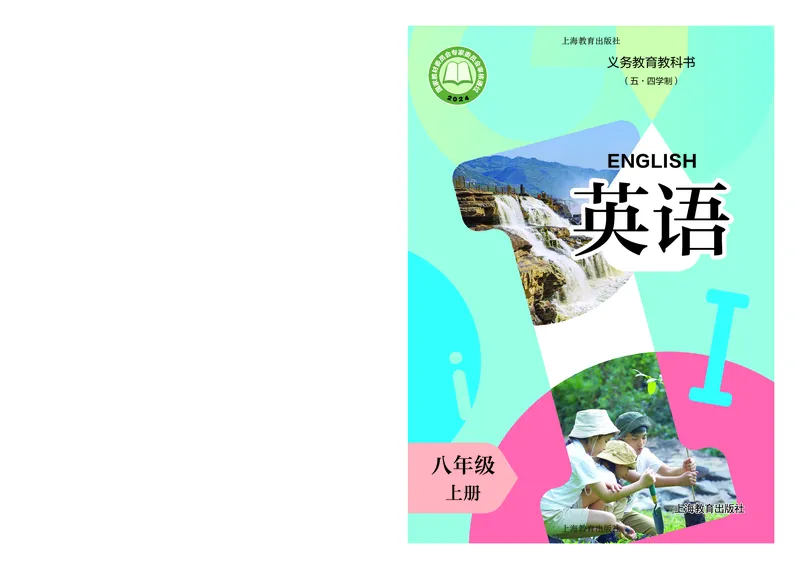
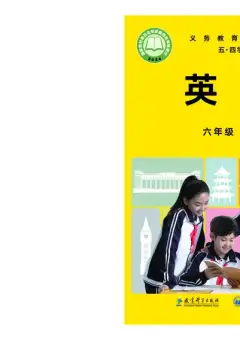
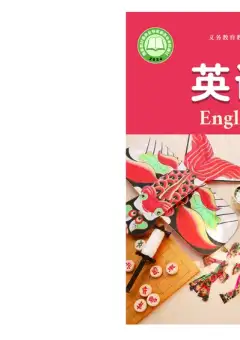
义务教育教科书
(五·四学制)
ENGLISH
英语
英语
英语
八年级
上册
上海教育出版社
上海教育出版社
英语
八年级
上册
义务教育教科书
(五·四学制)
主编 束定芳
上海教育出版社
上海教育出版社
致同学
亲爱的同学:
欢迎与我们一起继续初中阶段的英语学习!
本学期,你将继续和教材中的小伙伴们一起,在学习英语的同时,探索新世界、思考大问题
(Big Question),在真实情境中“讲(文化)小故事,悟(人生)大道理,学百科新知识,用英语做
事情”。我们将通过教材,帮助你运用科学有效的方法学习英语,发展英语语言能力,培育文化意
识,提升思维品质,提高学习能力。
本套教材的每个单元以主题为引领,从大问题入手,设有五个小话题,分别对应听力、口语、
阅读、写作和项目探究五大板块。每个话题下包含符合初中生学习、生活和成长特点的类型丰富
的语篇,设计层层推进的学习活动,帮助你获得丰富的学习体验,并在学习过程中了解自己的学
习成效,最终对单元大问题有更加全面、深入的认识和理解。
围绕不同的主题,教材通过鲜活真实的语言素材,为你提供地道的语言示范。本册教材中,
听力、口语板块的多模态文本图文结合,均以日常生活中常见的真实情境为范本设计(如海报、资
讯图表、节目预告、网页等);听力板块配有讲座、纪录片、访谈等各类音频素材;在阅读板块,你
可以接触到文学作品节选、新媒体文章、报刊文章、科幻小说等丰富的语篇类型;教材中小伙伴们
的日常会话和他们的习作,也会为你提供口语和写作表达的范例。
在你学习教材的过程中,智能机器人“胡博士”(Dr Hu)将会继续陪伴你左右,帮助你掌握语
言知识、技能和学习策略。每单元最后的“项目探究”(Project)为你准备了更多的挑战任务。你
准备好迎接挑战了吗?
本册教材除了常规单元以外,还设有两个文化角(Culture corner)和一个文学角(Literature
corner)。文化角不仅带你更深入地了解中国文化,学会用英语讲中国故事,还带你领略多样的世
界文化。文学角中,我们精选了广受青少年喜爱的优秀文学作品片段,供你赏析。
希望这套教材给你带来学习英语的新体验、新收获,为你插上一双逐梦的翅膀,飞向世界,飞
向未来!
上海教育出版社
上海教育出版社
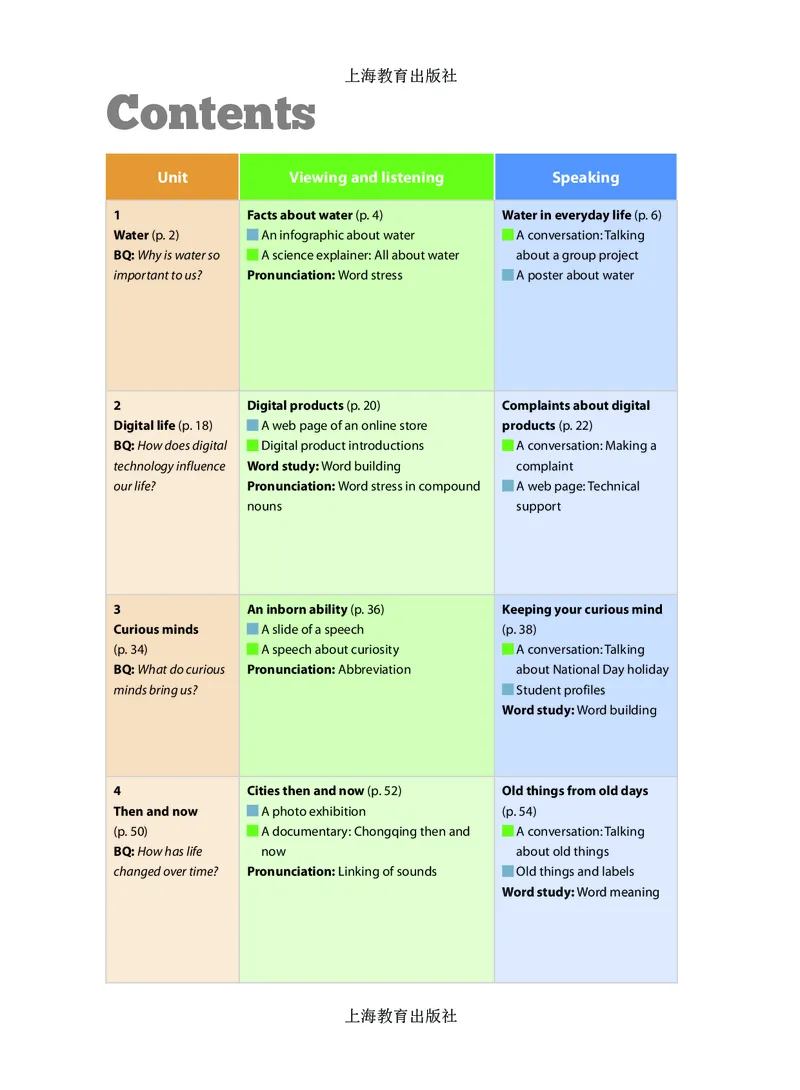
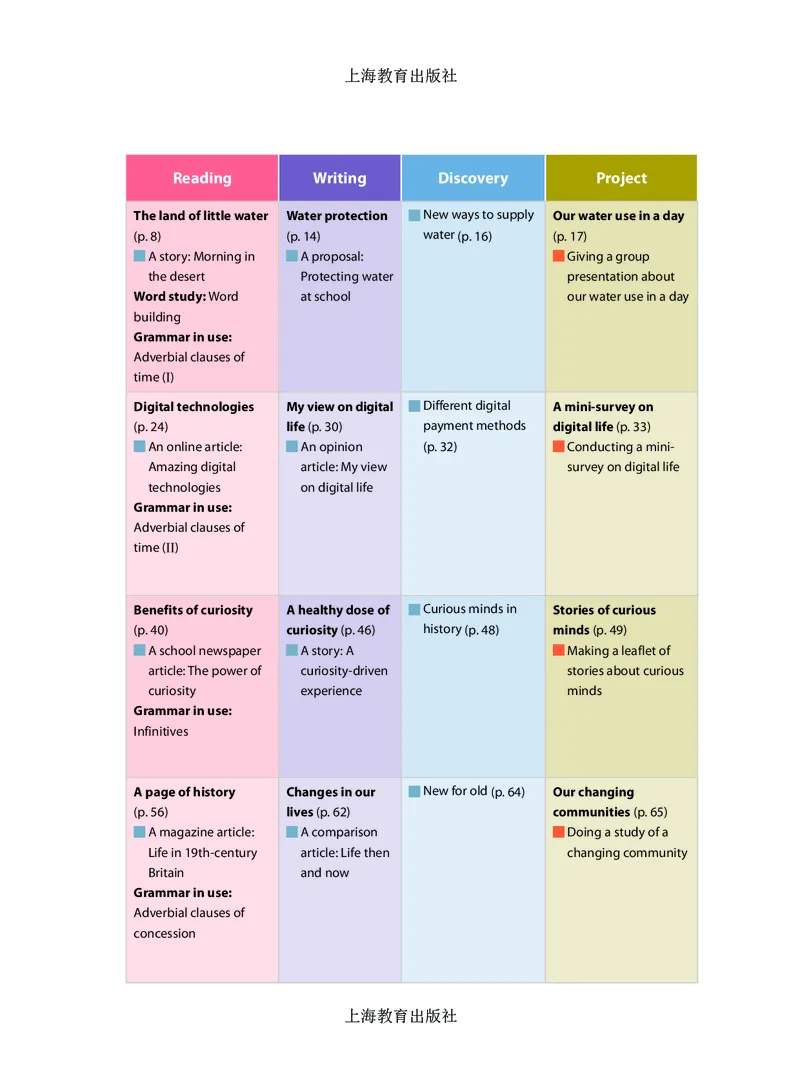
Unit
Viewing and listening
Speaking
1
Water (p. 2)
BQ: Why is water so
important to us?
Facts about water (p. 4)
�An infographic about water
A science explainer: All about water
Pronunciation: Word stress
Water in everyday life (p. 6)
�A conversation: Talking
about a group project
�A poster about water
2
Digital life (p. 18)
BQ: How does digital
technology influence
our life?
Digital products (p. 20)
�A web page of an online store
�Digital product introductions
Word study: Word building
Pronunciation: Word stress in compound
nouns
Complaints about digital
products (p. 22)
�A conversation: Making a
complaint
�A web page: Technical
support
3
Curious minds
(p. 34)
BQ: What do curious
minds bring us?
An inborn ability (p. 36)
�A slide of a speech
�A speech about curiosity
Pronunciation: Abbreviation
Keeping your curious mind
(p. 38)
�A conversation: Talking
about National Day holiday
�Student profiles
Word study: Word building
Cities then and now
4
Then and now
(p. 50)
BQ: How has life
changed over time?
(p. 52)
�A photo exhibition
�A documentary: Chongqing then and
now
Pronunciation: Linking of sounds
Old things from old days
(p. 54)
�A conversation: Talking
about old things
�Old things and labels
Word study: Word meaning
Contents
上海教育出版社
上海教育出版社
Reading
Writing
Discovery
Project
The land of little water
(p. 8)
�A story: Morning in
the desert
Word study: Word
building
Grammar in use:
Adverbial clauses of
time (I)
Water protection
(p. 14)
�A proposal:
Protecting water
at school
�New ways to supply
water (p. 16)
Our water use in a day
(p. 17)
�Giving a group
presentation about
our water use in a day
Digital technologies
(p. 24)
�An online article:
Amazing digital
technologies
Grammar in use:
Adverbial clauses of
time (II)
My view on digital
life (p. 30)
�An opinion
article: My view
on digital life
�Different digital
payment methods
(p. 32)
A mini-survey on
digital life (p. 33)
�Conducting a mini-
survey on digital life
Benefits of curiosity
(p. 40)
�A school newspaper
article: The power of
curiosity
Grammar in use:
Infinitives
A healthy dose of
curiosity (p. 46)
�A story: A
curiosity-driven
experience
�Curious minds in
history (p. 48)
Stories of curious
minds (p. 49)
�Making a leaflet of
stories about curious
minds
A page of history
(p. 56)
�A magazine article:
Life in 19th-century
Britain
Grammar in use:
Adverbial clauses of
concession
Changes in our
lives (p. 62)
�A comparison
article: Life then
and now
�New for old (p. 64)
Our changing
communities (p. 65)
�Doing a study of a
changing community
上海教育出版社
上海教育出版社
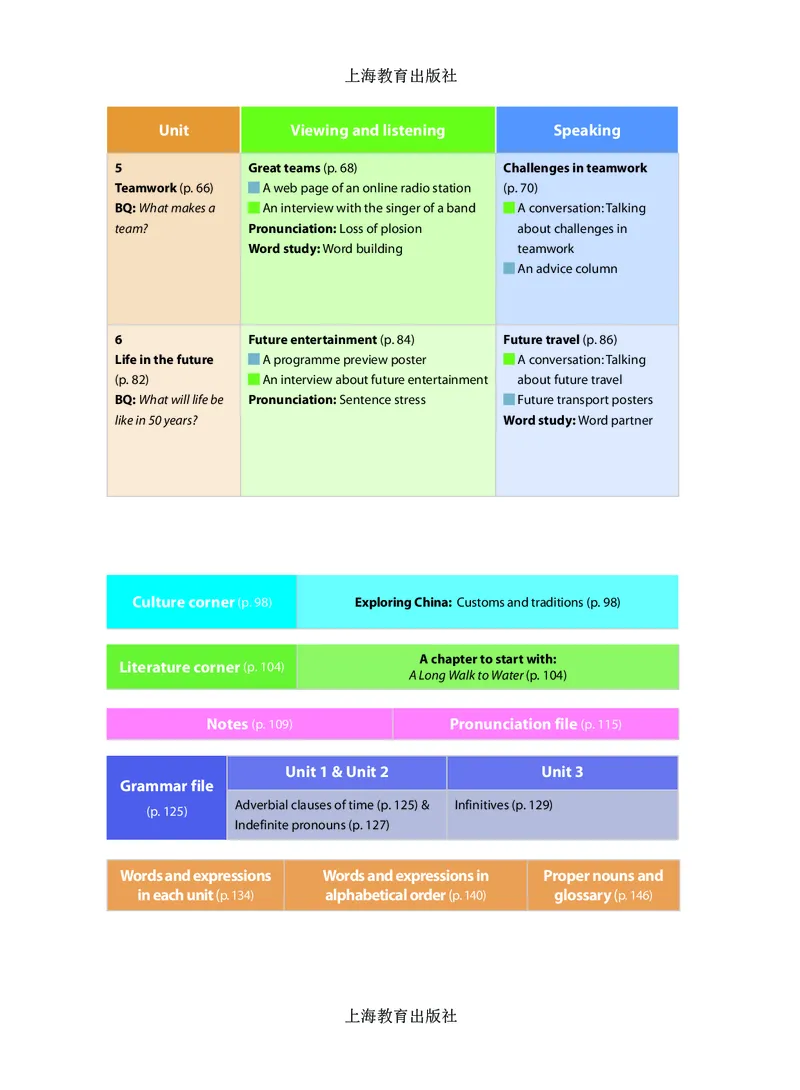
Unit
Viewing and listening
Speaking
5
Teamwork (p. 66)
BQ: What makes a
team?
Great teams (p. 68)
�A web page of an online radio station
�An interview with the singer of a band
Pronunciation: Loss of plosion
Word study: Word building
Challenges in teamwork
(p. 70)
�A conversation: Talking
about challenges in
teamwork
�An advice column
6
Life in the future
(p. 82)
BQ: What will life be
like in 50 years?
Future entertainment (p. 84)
�A programme preview poster
�An interview about future entertainment
Pronunciation: Sentence stress
Future travel (p. 86)
�A conversation: Talking
about future travel
�Future transport posters
Word study: Word partner
Literature corner (p. 104)
A chapter to start with:
A Long Walk to Water (p. 104)
Notes (p. 109)
Pronunciation file (p. 115)
Grammar file
(p. 125)
Unit 1 & Unit 2
Unit 3
Adverbial clauses of time (p. 125) &
Indefinite pronouns (p. 127)
Infinitives (p. 129)
Culture corner (p. 98)
Exploring China: Customs and traditions (p. 98)
Words and expressions
in each unit (p. 134)
Words and expressions in
alphabetical order (p. 140)
Proper nouns and
glossary (p. 146)
上海教育出版社
上海教育出版社
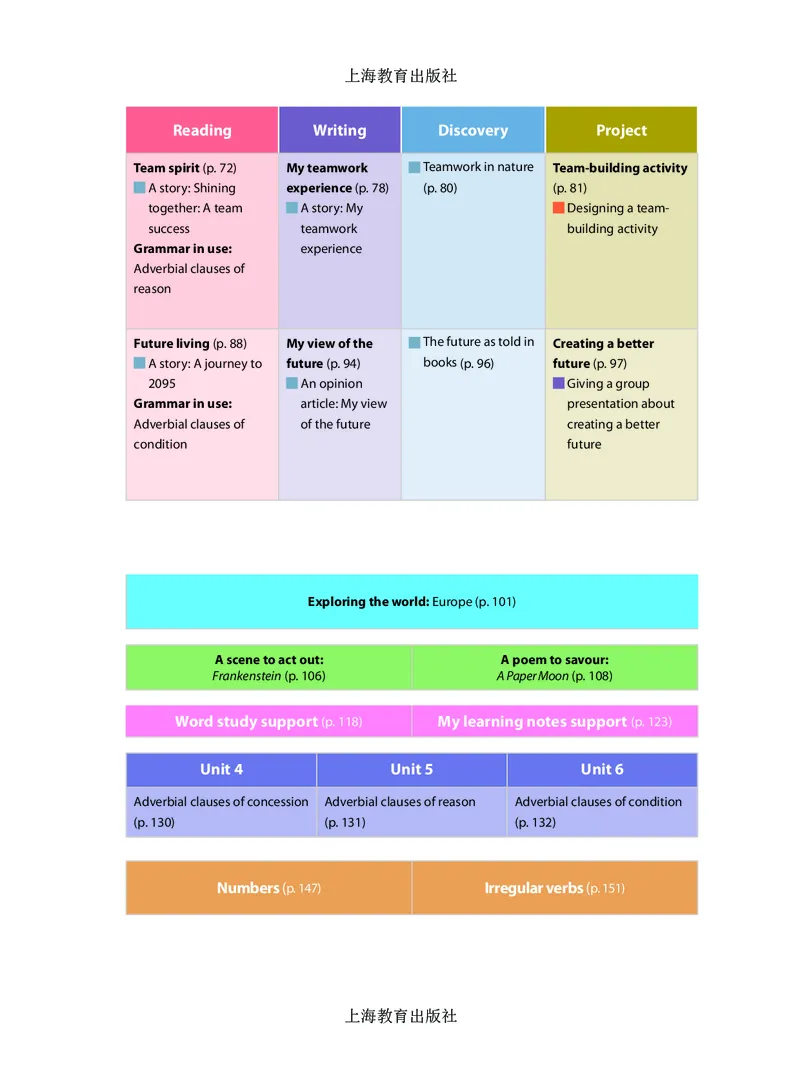
Reading
Writing
Discovery
Project
Team spirit (p. 72)
�A story: Shining
together: A team
success
Grammar in use:
Adverbial clauses of
reason
My teamwork
experience (p. 78)
�A story: My
teamwork
experience
�Teamwork in nature
(p. 80)
Team-building activity
(p. 81)
�Designing a team-
building activity
Future living (p. 88)
�A story: A journey to
2095
Grammar in use:
Adverbial clauses of
condition
My view of the
future (p. 94)
�An opinion
article: My view
of the future
�The future as told in
books (p. 96)
Creating a better
future (p. 97)
�Giving a group
presentation about
creating a better
future
Word study support (p. 118)
My learning notes support (p. 123)
A scene to act out:
Frankenstein (p. 106)
A poem to savour:
A Paper Moon (p. 108)
Unit 4
Unit 5
Unit 6
Adverbial clauses of concession
(p. 130)
Adverbial clauses of reason
(p. 131)
Adverbial clauses of condition
(p. 132)
Exploring the world: Europe (p. 101)
Numbers (p. 147)
Irregular verbs (p. 151)
上海教育出版社
上海教育出版社
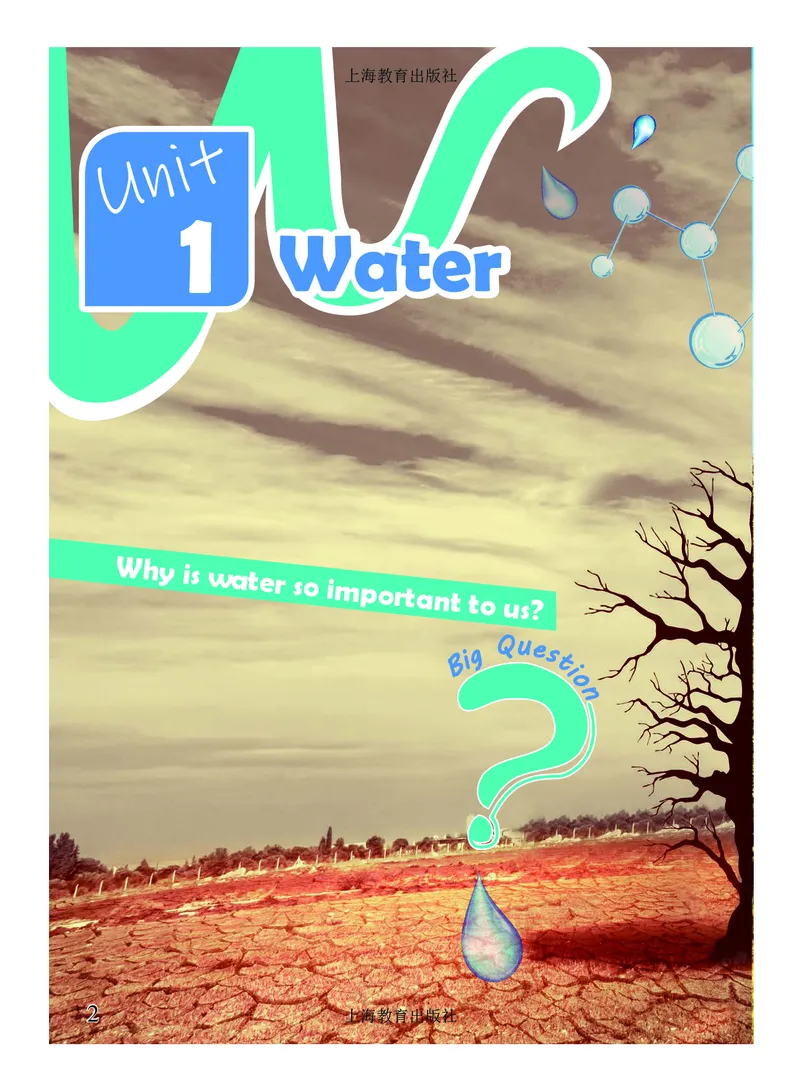
1
Why is water so important to us?
Water
2
上海教育出版社
上海教育出版社
Getting started
Answer the questions.
1 How many days can we live without fresh water?
2 What percentage of an adult’s body is water?
3 How long does it take groundwater to move a kilometre?
1 �Listen and learn about water
facts.
2 �Talk about water in our
daily life.
3 �Read a story about a land
of little water.
4 �Write a proposal about
protecting water.
5 �Give a group presentation
about our water use
in a day.
3
上海教育出版社
上海教育出版社
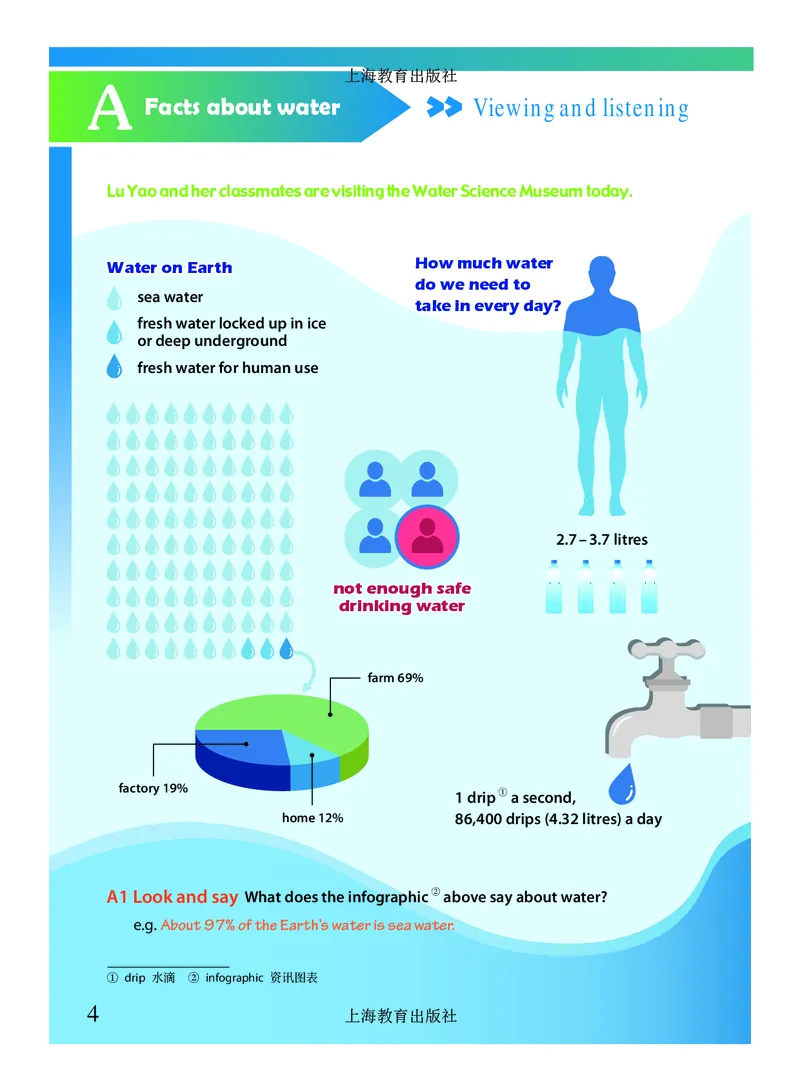
Lu Yao and her classmates are visiting the Water Science Museum today.
1 drip ① a second,
86,400 drips (4.32 litres) a day
sea water
fresh water locked up in ice
or deep underground
fresh water for human use
not enough safe
drinking water
2.7 – 3.7 litres
home 12%
farm 69%
factory 19%
A1 Look and say What does the infographic ② above say about water?
e.g. About 97% of the Earth’s water is sea water.
4
Viewing and listening
Facts about water
A
Water on Earth
How much water
do we need to
take in every day?
① drip 水滴 ② infographic 资讯图表
上海教育出版社
上海教育出版社
1
5
Pronunciation �Word stress
Listen again and answer the question. What numbers does the speaker use to
support the following ideas?
• Water is everywhere.
• Clean fresh water is rare.
Update my to-do list
A2 �Listen and circle Listen to some facts about water and circle the numbers
you hear.
97%
3%
17% 70% 2 billion
10.3 0.3%
1
3
2
3
2 million
A3 �Listen and take notes Listen again and complete the sentences with the
numbers in A2.
1 �More than _________ of the Earth’s surface is covered with water.
2 �About _________ of the water on Earth is salty. The rest is fresh water.
3 �We can reach only _________ of the world’s fresh water and the other
_________ is locked up in ice or deep underground.
4 �Most of the fresh water we can reach is polluted, leaving only about
_________ for people to drink.
5 �About _________ people in the world cannot get safely managed drinking
water.
Listening for numbers
Read aloud. Pay attention to the stress of the underlined words.
Water, water, where do you flow?
Through soil, oceans, and skies, I go.
Where does your journey end?
Never! It’s the water cycle, my friend!
I enjoy the exciting and satisfying ride.
In supporting life, I take great pride.
I’ll continue to supply ①,
If you keep me clean, not running dry!
① supply 供给
上海教育出版社
上海教育出版社
6
Speaking
Water in everyday
life
B
My learning notes
Showing agreement:
• Sounds great!/I couldn’t agree more.
• �_________________________________
Showing disagreement:
• �I’m afraid I don’t agree./I don’t think that’s a good idea.
• �_________________________________
Lu Yao and Wang Yiming are going to give a group presentation about water.
Lu Yao:
Shall we talk about how useful water is?
Yiming:
�I’m afraid that’s a little boring. Let’s share something new, not things
people already know.
Lu Yao:
�You’re right. What if we talk about the bad things that happen when
we waste water?
Yiming:
�Good idea! With water everywhere, many people don’t see the need
to save it.
Lu Yao:
�Exactly! The problem is, the more water we use, the
more energy and chemicals are needed for wastewater
treatment. This not only wastes energy but also makes
water less safe for drinking.
Yiming:
�Oh! That’s really bad! We can include more facts like this in our
presentation to encourage everyone to save water when they can.
Lu Yao:
�That’s really clever! I’ll start researching right away!
Grammar file
p. 127
B1 �Listen, read and think What are they going to say about water in their
presentation?
上海教育出版社
上海教育出版社
Water tips
Everybody talks about saving water, but many may think it’s just a matter of turning
off the tap. Actually, there are countless methods beyond this.
Indirect water footprint
It takes water to make these things, even though we don’t see water in them.
Wasting these things also means wasting water.
Take shorter
showers.
1 kilo of sugar
Water plants
with grey water.
a hamburger
Use energy-
saving washing
machines.
a cotton shirt
Run the
dishwasher only
when it is full.
a pair of shoes
1
7
Narrowing down the topic for a presentation
TEEN skill
Work in pairs. Discuss what else you can say about water in a presentation. You
may follow the example in B1.
Update my to-do list
B2 �Discuss If you are going to give a group presentation about water,
what will you say about it? Discuss with a partner. Use the information below
to help you.
• As a group, discuss possible topics that interest everyone.
• �Narrow your focus to a specific aspect of the topic: for example, “Water
in industry” or “Water culture” rather than “Water”.
• �Ask questions, such as “How useful is water for industry?” or “Are
factories treating wastewater properly?”
• �Make sure you can provide new information to your audience while
answering the questions.
上海教育出版社
上海教育出版社
Lu Yao is reading a novel. She finds a chapter about a girl’s morning in the
desert very touching.
C1 �Predicting Look at the picture and guess: What is the girl going to do?
C2 �Read the story.
Morning in the desert
The sky is grey when I wake up. Rubbing
① my eyes, I get up and tie a piece
of soap into the corner of my clothes. I pick up two water pots, putting one
on my head and the other under my arm. Then I set off for the toba, the
water hole.
At the toba I look out over our water. We will have about a month before it
dries up, but the rainy season will not begin for another two months. As I
step into the water, the mud covers my feet. I push the scum
② on the water
5
① rub 擦;搓 ② scum 浮沫;浮渣
Reading
C
The land of little
water
8
上海教育出版社
上海教育出版社
Personal touch
Do you use water in the same way
as Shabanu, the girl in the story?
10
15
to the side. To keep the mud out, I place a piece of cloth over
the mouth of the water pot. When the pot is full, I take it to the
nearby bathing rock.
The sun shines brightly. I throw my hair forward and pour
water over it. I can feel the heat as the water wets my head and
my neck. Keeping my eyes shut, I carefully rub the soap into
my hair and skin until every drop of water is fully used. Water
is precious, so I can’t waste any. Mum used to bathe my sister
and me with just one cup of water when we were small.
Over the next week we watch our pool get smaller. As the water
quietly disappears with the hot desert wind, we also prepare to
leave the toba and move on.
�
(Adapted from Shabanu: Daughter of
�
the Wind by Suzanne Fisher Staples)
1
9
上海教育出版社
上海教育出版社
10
C3 �General understanding How does Shabanu feel this morning?
Tick (3) the correct answer.
She is tired of collecting water from the water hole.
She worries about their water.
She misses the time when Mum bathed her and her sister.
C4 �Detailed reading Fill in the blanks according to the story.
C5 Further thinking Answer the questions.
1 Where do you think Shabanu’s family will go?
2 What can be done to help those living in very dry parts of the world?
Understanding sequence
The sky is grey.
Over the next week
I wake up and
1 ______________
for the toba.
Our pool gets
4 ______________
and we
5 ______________ to
move on.
At the
2 ______________
I fill the pot with water.
The sun
3 ______________.
I wash my hair.
上海教育出版社
上海教育出版社
11
1
Discuss with a partner: What is the author’s purpose of writing Shabanu’s story?
Update my to-do list
Word study Word building Conversion (Ⅰ)
Fill in the blanks with the proper forms of the given words in the box.
shoulder snake picture dry vacation
1 The river almost __________ up, so the thirsty animals left to look for new water.
2 They are now __________ at the beach.
3 I’ve never been to the desert, nor can I __________ the life there.
4 The river __________ through the village.
5 He offered to __________ the water pot as they walked to the river.
dried
hole pot forward bathe set pour
Vocabulary focus Fill in the blanks with the proper forms of the given
words in the box.
Sarah lives in Gulu, Uganda. Every morning, she
1 __________ off on
a long walk to collect water for her family. When she finds a muddy
water
2 __________, she carefully fills her
3 __________ with water.
Back home, Sarah
4 __________ the water into a container and heats
it over fire to make it safe for drinking. Without enough water to
5
__________ herself, she has to make do with very little. Though life is
hard, Sarah steps
6 __________ with hope, dreaming of a future with
plenty of clean water.
上海教育出版社
上海教育出版社
12
Grammar in use Adverbial clauses of time (Ⅰ)
(1) �In each sentence above, the underlined clause starts with a
linking word (e.g. before, when, as, until ) and says
when
how
why an action happens. We therefore call this an
“adverbial clause of time”.
(2) �An adverbial clause of time comes
before
after
either
before or after the main clause.
Grammar file
p. 125
1 Read and think How are the underlined clauses formed?
(1) We will have about a month before it dries up.
(2) When the pot is full, I take it to the nearby bathing rock.
(3) I can feel the heat as the water wets my head and my neck.
(4) �I carefully rub the soap into my hair and skin until every drop of water is fully
used.
2 Work out the rules Tick (3) the answer(s) you agree with.
3 �Practise Help Lu Yao improve her notes from a science lesson. Rewrite each
note into one sentence, adding as, when, before, or until.
(1) people drive cars and build factories / they produce greenhouse gases
�
(2) more and more greenhouse gases trap extra heat / our planet continues to warm
�
(3) the Earth warms / glaciers begin to melt
�
(4) glaciers melt / sea levels rise, endangering low-lying places
�
(5) �If the problem continues / all the glaciers melt / sea levels could rise by about
70 metres
�
上海教育出版社
上海教育出版社
13
1
(6) we must take action / it becomes too late
�
4 �Explain You are reading a picture book to your four-year-old cousin. Explain to
him/her where the hot shower water comes from, using when, before, after or
until.
After water from rivers or lakes gets cleaned in a plant, it ...
Water from
rivers or lakes
gets cleaned
in a plant.
Turn on the
hot tap. The
boiler starts
heating water.
Water comes
to your home
through pipes.
The water becomes warm. It’s
time to enjoy your shower!
Cold water
often comes out
first. Be patient
and wait.
上海教育出版社
上海教育出版社
14
Writing
Water protection
D
Writing parallel structures (II)
TEEN skill
Your school is having a Water Week event. Write a proposal to encourage
people to protect water.
D2 �Prepare Read Dr Hu’s tip and find examples of parallel structure from the
text in D1.
�
Dear friends,
Clean water is limited and will become less as we continue to use and pollute it.
I suggest we act now to protect water at school.
It’s easy to start small — turn off the tap while soaping our hands, use rainwater
for plants, and tell the teacher when we find something wrong with a tap.
We should also spread the ideas to everyone. We can put up signs, start river
clean-up groups, or show videos to raise awareness of water protection.
Water is nature’s gift. Together, we can save it for now and the future. Be a water
hero!
Lu Yao
D1 �Think Read Lu Yao’s proposal. How many water tips can you find in it?
Using the same grammatical form for two or more expressions in
a sentence makes a parallel structure. The structure is used to list
information or ideas of equal importance.
e.g. I like swimming and diving; my father likes fishing and boating.
�We use water everywhere — at home, on the farm and in factories.
�Floods are dangerous. They may take lives, sweep things away and
destroy buildings.
上海教育出版社
上海教育出版社
1
15
Share your article with a classmate and help revise each other’s writing. Did you
both use parallel structures correctly?
Update my to-do list
D4 Write Write your proposal.
�
D5 Check Check your writing. Pay attention to the use of parallel structures.
D3 �Plan What can be done to protect water? Choose one mind map below to
organise your body paragraphs, or use your own ideas if you like.
don’ts
dos
action
public places
home
where
...
上海教育出版社
上海教育出版社
16
1
Discovery
Cloud seeding ①
Cloud seeding is a method of using special
chemicals to make clouds rain. At present,
over 50 countries in the world, including
China, Australia, India and South Africa, use
cloud seeding to increase rainfall in their dry regions.
New ways to supply water
The Iceberg ④ Project
In 2017, an Emirati ⑤ company announced
plans to bring icebergs from Antarctica to
the UAE to provide a new source of fresh
water for the country. The company is still
working on ways to reduce the cost and keep the ice frozen. If successful,
the project will provide millions of people with safe drinking water.
The South-North Water Transfer ② Project
The project started in 2002, and transports
water over 1,000 km from the Yangtze
River basin ③ to the Yellow River basin. It
has helped to improve the water supply in northern China for homes,
farming and industry.
Read and think Which method do you like best? Why?
① cloud seeding 人工降雨 ② transfer 搬迁;转移 ③ basin 流域 ④ iceberg 冰山
⑤ Emirati 阿联酋的
上海教育出版社
上海教育出版社
1
17
Project
Our water use in a
day
E
Giving a group presentation about our water use
in a day
Prepare Prepare some bottles of water. Make sure you know the
amount in each bottle (e.g. 5L, 550ml).
Step 1
Record Use water only from
your bottles if possible. Take
notes when you use water not
from your bottles.
Step 2
Add up Add up all the water you
used in a day. DON’T FORGET the
water not from your bottles.
Step 3
Discuss Discuss what information to
include in your group presentation.
e.g. �How much water does everyone in
your group use on average?
�Would you use water differently if you
had to walk for hours to fetch water
every day?
...
Step 4
Present Give a group presentation to share your findings and ideas.
Step 5
Listen to other groups’ presentations. Which do you like best? What have you
learned?
Update my to-do list
Find out how much water you use in a day and give a group presentation
about your findings.
• 6:40 flush the toilet
• 12:00 refill the 5L bottle
• 20:45 take a shower
You can search the
internet for the
information you need.
For example, “How
much water does a
shower take?”
上海教育出版社
上海教育出版社
Digital life
2
How does digital technology influence our life?
1 �Listen and learn about some
digital products.
2 �Make a complaint about a
digital product.
3 �Read an online article about
three digital technologies.
4 �Write an opinion article on
digital life.
5 �Conduct a mini-survey on
digital life.
①
18
上海教育出版社
上海教育出版社
Match the digital technologies or products with the pictures ①– ⑥. Then answer
the questions.
Which of them have you seen or used before? How do you like them?
A self-driving car ___
B speech recognition ___
C robot waiter ___
D face recognition ___
E 3D printer ___
F wearable device ___
Getting started
②
④
⑤
⑥
③
19
上海教育出版社
上海教育出版社
20
Viewing and listening
Digital products
A
Technical support
Store
A1 �Look and say Which of these products might be a good choice?
Wang Yiming and his mother are visiting a website to choose some New Year
presents for the family.
A2 �Look and describe Describe one or two products in A1. The following
words and expressions are for your reference.
Noun
Noun
+
e.g. laptop
1
2
e.g.
+
Word study Word building Compounding (Ⅲ)
Can you find the compounds on the web page? How are they formed?
• fast/powerful/convenient/user-friendly ...
• easy to carry around/easy to type on/comfortable to wear ...
• large screen/nice design/clear sound ...
• �video chat/listen to music/be easily paired with other devices/enjoy some
private time ...
bluetooth
speaker
earphones
keyboard
headset
laptop
Need shopping help?
Ask your AI customer service
smartphone smart watch
mouse
desktop
上海教育出版社
上海教育出版社
2
21
Pronunciation Word stress in compound nouns
I pick up my 'smartphone next to my 'laptop,
Then call my friend Mike, the King of Pop.
I put on my 'earphones, look at the screen,
And suddenly digital Mike can be seen.
We reach for our 'headsets, open an app,
Tap on the 'keyboard, then start to rap.
Recording is easy; don’t be surprised,
The sounds and the beats are digitalised!
Sing the rap and pay attention to the stressed syllable in each compound noun.
A3 �Listen and take notes Listen to three digital product introductions and
complete the notes below.
Touch screen
laptop
New Hu Phone
New Smart Watch T
Advantages:
• having a
1 chip
•
2 and lightning fast
• easy to separate the keyboard and screen
Colours:
• classic black and popular ice
3
Advantages:
• keeping your information
4 on the phone
• having
5 cameras on the back
Colours:
•
6 , brown, purple and red
Advantages:
• using the latest AI (artificial intelligence) technology
• �understanding what you say
7 and following your orders
• �keeping an eye on your health and calling the emergency services
8
Colours:
• red,
9 and brown
Listening for descriptive information
C
Listen to another introduction and note down the product’s advantages.
Update my to-do list
上海教育出版社
上海教育出版社
22
Speaking
Complaints about
digital products
B
My learning notes
Making complaints:
• I have a problem with ...
• ________________________________________
• ________________________________________
Wang Yiming is now calling CS (customer service) to make a complaint.
B1 �Listen, read and think Listen to the conversation. What is Yiming
complaining about?
CS:
�Welcome to Science Power Customer Service. For product
information, press “1”. For stores, press “2”. For complaints, press “3” ...
Yiming:
�(pressing 3) Hello, this is Wang. I’d like to make a complaint about
the laptop I bought last week. It keeps
shutting down on its own.
CS:
�Sorry for the inconvenience. Can I have
your order number, please?
Yiming: It’s 68399.
CS:
�Thank you. Have you tried turning it off
and on again?
Yiming:
�Yes. I’ve repeated that a couple of times, but it didn’t help! What else
can I do?
CS:
I’m afraid I cannot answer this question.
Yiming:
Wait ... Are you a robot?
CS:
�Yes, I am. I’ll ask our technical support team to call you back right
away. Would that be okay?
Yiming:
Sure, thanks.
CS:
You’re welcome. Have a nice day!
上海教育出版社
上海教育出版社
2
23
Do the task in B2 again. Switch roles and pick another problem.
Update my to-do list
B2 �Role-play Work in pairs, pick a role and start a conversation. Use the
information below to help you.
Store
Technical support
Technical support
• Be clear and specific about the problem.
• Be honest about what you have experienced.
• Stay calm and polite.
You are the customer. You have one
of the problems shown in the pictures
below and want to make a complaint to
customer service.
A
You are the AI customer
service. Offer advice to
your customer about the
problem he/she has.
B
Problem:
failing to connect to
the internet
Problem:
keeping running out
of space
Problem:
keeping freezing
Advice:
updating the software
on the watch
Advice:
clearing out apps that
you don’t need
Advice:
checking your Wi-Fi
and making sure it’s
connected to the
right network
�Making an effective complaint
TEEN skill
上海教育出版社
上海教育出版社
TECH TEEN
Live Now
Amazing digital technologies
Wang Yiming is reading an online article on Tech Teen.
C1 �Predicting Look at the three pictures and discuss: What digital products
might the article be about?
C2 Read the article.
5
10
Digital technology makes life a lot easier
for the disabled. For example, a new type
of smart walking stick for the blind can
detect any object as soon as the person
gets close, and then warn the person of
the danger. It can also give directions and
inform its owner of the bus and train
timetables. It is believed that this type
of technology will make the lives
of blind people safer and easier.
Reading
Digital technologies
C
24
上海教育出版社
上海教育出版社
Digital technology makes it easier to share knowledge.
It gives students the same chance to learn, no matter
where they live. According to a 2022 report, over 22%
of the Indian population couldn’t read or write. To
change this situation, Indian schools in rural areas were
provided with a powerful
internet connection. Many
of the students there didn’t
have a chance to learn until
the project started. They
can now enjoy wonderful
online lessons taught at a
top school in New Delhi.
Firefighting robots are saving lives. They can walk,
run, climb and communicate with people caught in a
fire. While the robots move around, they send video
information to the control
unit. In this way, firefighters
can see the fire environment
clearly and then make a safe
plan. Robots can really be
a great help in dangerous
situations.
15
20
25
30
More
Personal touch
Which digital technology impressed you most? Why?
2
25
上海教育出版社
上海教育出版社
26
C3 �General understanding Think of a heading for each paragraph.
C4 �Detailed reading Complete the following table with the sentences from
the text.
Facts
Opinions
• �To change this situation, Indian
schools in rural areas were provided
with a powerful internet connection.
• �Digital technology makes life a lot easier
for the disabled.
Paragraph 1
Paragraph 2
Paragraph 3
C5 �Further thinking Answer the questions.
1 What’s the author’s attitude towards life in the digital age?
2 What other amazing digital technologies can you tell?
Identifying facts and opinions
上海教育出版社
上海教育出版社
2
27
Has the article changed your view on digital life? Why or why not?
Update my to-do list
Digital technology makes
the lives of the disabled
much easier. For example, a
new type of smart walking
stick can warn the blind of
the danger that is close by
and
1p them with
useful information.
An internet project in India
enables top schools in cities
to
2s knowledge
with schools in rural areas,
giving students there the
same
3c to learn.
Vocabulary focus Complete the summary map with words from
the text.
DIGITAL TECHNOLOGIES
for people working
under difficult conditions
Robots can be quite helpful in
4f and they do part
of the dangerous work of firefighters. Firefighters can make
a
5s plan with the help of the video information
the robots
6s to the control unit.
for the disabled
for the students in
rural areas
上海教育出版社
上海教育出版社
28
Grammar in use �Adverbial clauses of time (Ⅱ)
(1) �__________: �One thing happens immediately after another is
complete.
(2) __________: Two actions happen at the same time.
Grammar file
p. 125
1 �Read and think Underline the adverbial clauses of time and circle the linking
words.
(1) �A new type of smart walking stick for the blind can detect any object as soon
as the person gets close.
(2) �While the robots move around, they send video information to the control
unit.
2 �Work out the rules Match the words with the time relationships.
3 �Practise Make as many sentences as you can with the words and expressions
in the word cloud. Each sentence must contain a time expression.
As soon as John got his new 3D
printer, he connected it to his
laptop and started to print a
model of the Palace Museum.
...
while
as soon as
上海教育出版社
上海教育出版社
2
29
4 �Tell a story
(1) Look at the following pictures and discuss with a partner.
• What was the dog doing while Jimmy was flying a kite?
• �What was Jimmy doing while the dog was watching him, lonely and bored?
• What did the dog do as soon as it saw Jimmy’s broken tablet?
• How did the dog feel as soon as Jimmy gave it a big hug?
Jimmy was flying a kite. I was
running after him happily.
His tablet was broken.
I ran to comfort him.
He got a tablet, and
everything changed. I was
lonely and bored.
He gave me a big hug.
I became happy.
...
(2) �Tell the story in the third person, instead of the dog’s first-person point of
view.
Use while and as soon as in your story. You may start with: A little dog used to
have lots of fun with his little master Jimmy ...
上海教育出版社
上海教育出版社
30
Writing
My view on digital
life
D
�Writing an opinion article
TEEN skill
You want to write about your views on digital life for your school newspaper.
D1 �Think Read the opinion article below. Is the writer’s attitude towards digital
life positive or negative? Explain how you know.
D2 �Prepare Underline the opinion, circle the reasons and bracket the examples
in the article.
• �An opinion article expresses the writer’s point of view or attitude
towards something.
• �An opinion article usually has three main parts: introduction
(stating the opinion), body (supporting the opinion), and
conclusion (restating the opinion).
• �In the body part, you can first give reasons and then use
examples as supporting details.
Many people enjoy digital life. It’s convenient and fun. However, in my
opinion, we should be aware of its disadvantages.
First of all, it leads to too much screen time. Some people spend too
much time playing computer games, watching videos or chatting online,
so they have less time for healthy outdoor activities.
What’s more, digital life is not always safe. For
example, when we visit some websites, hidden
software or viruses on them may collect our personal
information.
In conclusion, though digital technology brings many
benefits to our lives, it also causes problems, so we must learn to use it
wisely.
上海教育出版社
上海教育出版社
2
31
Work in groups. Help each other revise the articles.
Update my to-do list
D4 Write Write your opinion article.
D5 �Check Check your opinion article. Pay attention to the three main parts.
__________________________________________________________
__________________________________________________________
__________________________________________________________
__________________________________________________________
__________________________________________________________
__________________________________________________________
__________________________________________________________
__________________________________________________________
D3 �Plan What are your views on digital life? Plan your writing by completing
the following diagram.
Introduction (Opinion)
Conclusion
Reason 1:
Examples:
Reason 2:
Examples:
上海教育出版社
上海教育出版社
32
Discovery
Different digital
payment methods
Quick response code payment
A quick response (QR) code is a barcode ① your
phone can read. Developed in Japan in 1994,
QR codes can be used in many ways, such as
marketing and information sharing. In China,
they are widely used for mobile payments.
Digital money
Digital money uses software codes to work as
money over a computer network. It also uses
offline technology when there is no network.
The People’s Bank of China began working on
the e-CNY ② in 2014, making China a leader in
central bank digital money.
Digital wallets
A digital wallet allows you to use your mobile
phone or smart watch to pay in shops. Simple and
safe with a password for protection, it can store all
your electronic cards. Digital wallets were first used
in Sweden in 1997, but they are now most widely
used in China.
Read and think Which payment method do you use most often?
① barcode 条码 ② e-CNY 数字人民币
上海教育出版社
上海教育出版社
2
33
Project
A mini-survey on
digital life
E
Work in groups to conduct a mini-survey about the digital life of the
people around you.
Conducting a mini-survey on digital life
Prepare Design your survey. Use the sample below to help you.
Add more questions if necessary.
Conduct the survey Each member in the group invites at least two
adults to take part in the survey.
Discuss Study the group data. Make charts and graphs to show it.
Discuss the results. Draw the conclusions.
Present Give a group presentation to share your group findings.
Step 1
Step 2
Step 3
Step 4
Listen to the other groups’ presentations. Do they have similar or different
findings?
Update my to-do list
A survey of digital life
1 Your personal information:
• Age group:
13–19
20–40
41–65
over 65
• Gender:
Male
Female
• Occupation:
2 Which three digital products do you use most often?
No. 1 No. 2 No. 3
3 What do you mostly use your digital products for?
A Shopping.
B Entertainment.
C Education.
D Work.
E Interpersonal communication.
F Other (Please specify: �
).
4 �
5 �
上海教育出版社
上海教育出版社
C
3
What do curious minds bring us?
Curious
minds
Why does everything have a name?
Why do we have two eyes, but we can see even with just one?
34
①
②
上海教育出版社
上海教育出版社
Getting started
Look, read and discuss.
Have you ever asked similar questions?
1 �Listen to a speech about
curiosity.
2 �Talk about how to keep
curious.
3 �Read an article about the
benef its of curiosity.
4 �Write about an experience of
being curious.
5 �Make a leaf let of stories
about curious minds.
Why does water make things wet?
Why do stars twinkle?
35
④
③
上海教育出版社
上海教育出版社
36
Viewing and listening
An inborn ability
A
Dr Gu, a psychology professor, is giving a speech to students at New Star
Middle School.
A2 �Look and say What details does Dr Gu use to support his point of view?
Curiosity: An inborn ability
Babies:
looking at new or
unfamiliar things
Preschoolers:
playing longer to
learn how toys work
School children:
asking countless
questions
Grown-ups:
learning by continuous
reading & exploring
Everyone is curious by nature.
Children are curious in different ways.
After growing up, people are no longer curious.
A1 �Look and think Read a slide of Dr Gu’s speech and tick (3) the main point
he makes.
上海教育出版社
上海教育出版社
3
37
Listen to Dr Gu’s speech again and write down one more supporting detail.
Update my to-do list
Sing the rap.
A curious mind takes no rest;
With curiosity, let’s aim to be the best.
On the internet and in books,
On radio, TV, and learning apps,
We explore new things every day,
In a fun, playful and enjoyable way.
With STEM, we’ll create amazing things,
And our dreams will take wings.
Babies are interested in new
1 __________ and
often reach for
2 __________ that they haven’t
seen before.
Preschoolers
3 __________
4 __________
5 __________
a toy when it’s harder to know how it works.
School children ask countless questions to
6 __________
7 __________ the world.
A3 �Listen and take notes Listen to part of Dr Gu’s speech and complete the
supporting details.
Listening for supporting details
C
Pronunciation Abbreviation
上海教育出版社
上海教育出版社
38
Speaking
Keeping your curious
mind
B
My learning notes
Giving compliments:
• Well done!
• I’m proud of you.
• That’s great! Fantastic!
• ___________________________
At the end of his speech, Dr Gu asks students to list some special things they
did during the National Day holiday and talk about them.
B1 �Listen, read and think What was special about Li Bailing’s National Day
holiday?
Yiming:
Hey, Bailing! How was your holiday?
Bailing:
�Pretty good! I read seven books.
Yiming:
Wow, that’s a lot!
Bailing: �My brother kept asking me strange questions, so I had to look for
answers in books.
Yiming:
Really? So, what did he ask?
Bailing:
�Well, why do we have two eyes when we can see even with just
one? Do you know?
Yiming:
No, I don’t!
Bailing:
�I didn’t, either. Luckily, books seem to have the answer to
everything! And the more I read, the more I wanted to find out.
Yiming:
Good for you! Any good books to recommend?
Bailing:
�Tons! But don’t read them all at once, or you’ll ruin your eyesight!
Yiming:
�Maybe that’s why we have two eyes instead of one! So we can read
more!
上海教育出版社
上海教育出版社
3
39
B2 Role-play Work in pairs. Pick a role and act out the conversation.
You want to know about
the special things your
classmate did during his/
her National Day holiday.
Student A
Student B
Name: Li Mei
Age: 14
Special things:
• �learn how TVs and
washing machines work
• �join a young engineer
camp
• …
You are one of the following
students. Your classmate is asking
you about the special things you did
during your National Day holiday.
Name: Liu Chao
Age: 13
Special things:
• �visit my grandparents
on the farm
• �watch ants and train
dogs
• …
Name: Han Gang
Age: 13
Special things:
• �take all the metro lines around the city
• �watch some videos about metro
systems around the world
• …
Work in pairs. Share some of your special experiences with your classmates.
Update my to-do list
Word study Word building Suffixes -ed and -ing
Fill in the blanks with the proper forms of the given words.
Yiming felt
1 surprised (surprise) when he learned that Bailing had read seven books
during the holiday. However, it wasn’t
2 (surprise) at all—she always
reads a lot. When Bailing asked Yiming about his holiday, Yiming talked about his
3 (excite) trip to Mount Tai. He was so
4 (excite) to watch the
sunrise that he stayed awake all night. He’d always remember that moment: as the
sun rose, an eagle flew high in the sky. Finally, they talked about a
5
(touch) cartoon movie they had both watched. They had a great chat!
上海教育出版社
上海教育出版社
Lu Yao is reading an article written by Dr Gu in her school newspaper.
C1 �Background knowledge Have you ever been curious about something
and explored it?
C2 �Read the article.
“Why?” the little girl asks her father. He gives an answer,
and she asks again, “Why?” To the parent, these questions
may seem never-ending, even a little annoying. But a child’s
curiosity is very important for the growing mind.
Curiosity helps the brain to better take in new information.
In a 2014 study, the researcher invited some people to rate
their curiosity about some questions before telling them the
answers. One hour later, the researcher tested how well they
remembered the answers. Results showed that when people
were very curious about the fact, they were 30% more likely to
remember it.
Curiosity also leads to more exciting ideas. In 1918, magician
Harry made a big elephant disappear on the stage. In a recent
experiment, people were asked how curious they were about
Harry’s trick and then given a few minutes to design their own
5
10
15
Reading
C Benefits of curiosity
40
The power of curiosity
上海教育出版社
上海教育出版社
magic tricks. It turned out the more curious group came up with
more wonderful ideas.
Curiosity encourages voluntary learning and helps discover career
interests. Jeff Armstrong, a successful engineer, designs cars. “As
a kid, I was crazy about cars,” says Jeff. “I learned to do simple
repairs to the family car. This led me to study engineering.” Dr
Fiona Grey, a leading heart doctor, says, “As a girl, I was very
curious about how the human body
worked, so I studied medicine.”
As Richard Feynman said, “Nearly
everything is really interesting if
you go into it deeply enough.”
Therefore, keep a curious mind —
keep asking why. You never know
where it may lead you!
Personal touch
Which benefit of curiosity impressed you most?
20
25
30
3
41
上海教育出版社
上海教育出版社
42
C5 �Further thinking Answer the questions.
1 What types of evidence does Dr Gu use to support his opinions?
2 What other evidence can you find to support Dr Gu’s opinions?
C3 �General understanding In what ways is curiosity important for the
growing mind? Underline Dr Gu’s opinions in the text.
Identifying facts and opinions
Fact(s) for Opinion 1:
Fact(s) for Opinion 2:
Fact(s) for Opinion 3:
C4 Detailed reading List the facts that support the opinions in C3.
上海教育出版社
上海教育出版社
3
43
Lu Yao: �Hello, Dr Gu! Thank you for agreeing to this interview. We all enjoyed your
article about curiosity. Were you curious when you were young?
Dr Gu:
�Well, I asked countless questions every day. I think my parents sometimes
got
1 with me.
Lu Yao: What kind of questions?
Dr Gu:
�When I watched a magic show, I kept asking how the
2 did it.
I learned the tricks and practised them. I even
3 some new tricks.
Lu Yao: �Amazing. I suppose children are always curious. But in a
4 online
article that I read, the author says curiosity
5 as people grow
up. Do you agree?
Dr Gu:
�I don’t think so. We never lose curiosity. You see, whenever we have
something we don’t understand, we read, ask, or do
6 to find
out the answers. That’s
actually curiosity.
Lu Yao: �Yes, I guess it is. Thank you
very much, Dr Gu. We will
7 your words
and stay curious.
Dr Gu:
Good for you!
annoy come up with disappear magician recent remember research
Why do you think Dr Gu wrote about the benefits of curiosity?
Update my to-do list
Vocabulary focus Complete the conversation with the proper forms of
the words and phrase in the box.
上海教育出版社
上海教育出版社
44
Grammar file
p. 129
Grammar in use Infinitives
1 �Read and think What do the underlined parts have in common?
(1) Dr Gu gave a speech to encourage everyone to keep a curious mind.
(2) Curiosity helps the brain (to) better take in new information.
(3) In 1918, magician Harry made a big elephant disappear on the stage.
(4) I learned to do simple repairs to the family car.
2 Work out the rules Tick (3) the answer(s) you agree with.
Use
do
to do
1) With verbs like learn, want, decide
2) �With VO structures like encourage sb/sth, allow sb/
sth
3) With VO structures like make sb/sth, let sb/sth
Dear students,
We have decided
(1) __________ (have) a section about curiosity
(2) __________ (encourage) curious minds. We hope
(3) __________ (receive)
Notice
Notes: The verb _______ and the VO structure _______ sb/sth can be
followed by either the infinitive with to or the infinitive without to.
(3) An infinitive can be used ...
to express a purpose
as the object of a sentence
to describe the state of a sentence’s object
(1) An infinitive is the basic form of a verb, including ...
do
to do
doing
does
(2) �Infinitives of different forms are used with different verbs or verb-
object (VO) structures.
3 �Practise Your school newspaper plans to have a section about curiosity.
Complete the notice with the proper forms of the given verbs.
上海教育出版社
上海教育出版社
3
45
4 �Discuss
(1) �Discuss your suggestions on the Curiosity section in the school newspaper
with your group members. The words in the box may help you.
some suggestions from all of you. You can call or email us
(4) __________
(share) your ideas. Please let us
(5) __________ (know) if you have any
questions at any time.
The editors, School Newspaper
I prefer ...
After the discussion, we ...
I want to collect students’
experiences about curiosity.
Let’s ...
Sure. We can also invite
some model students
to give us speeches.
(2) Report your suggestions to the class.
decide
help
plan
hope
ask
make
invite
...
上海教育出版社
上海教育出版社
46
Writing
A healthy dosea of
curiosity
D
Making your writing vivid
TEEN skill
• Describe your thoughts and feelings.
• Add some sensory details.
• �Make your readers wonder what’s going
to happen next.
① dose (药的)一剂,一服 ② yap 吠叫
The school newspaper is collecting students’ stories about their experiences
of being curious. You want to have a try.
D1 Think Read Wang Yiming’s story. What happened as a result of his curiosity?
The night before my seventh
birthday, I couldn’t sleep.
Every now and then I heard
a little yap ②. “What can that
be?” I wondered. Driven by
curiosity, I decided to have a
look. Following the sound, I
came to the kitchen. I saw a box
shaking on a shelf. I reached up for it with the help of a chair. As I
was climbing down, the box suddenly fell out of my hands. A puppy
jumped out and started barking loudly — in the middle of the
night! This is how my curiosity ruined a birthday surprise!
D2 �Prepare Read Dr Hu’s tips. How does Yiming make his story vivid?
上海教育出版社
上海教育出版社
3
47
Work in pairs. Share your story and help revise each other’s writing.
Update my to-do list
D5 Check Check your story. Make it more vivid, if you can.
D4 Write Write your story.
__________________________________________________________
__________________________________________________________
__________________________________________________________
__________________________________________________________
__________________________________________________________
__________________________________________________________
__________________________________________________________
__________________________________________________________
__________________________________________________________
__________________________________________________________
D3 �Plan Plan your story by making notes about the following questions.
• �What were you curious about?
�
• �What did you do or what happened?
�
• �How did you feel?
�
上海教育出版社
上海教育出版社
Discovery
It is said that one day, Isaac Newton was sitting
under a tree. An apple fell and hit the ground
beside him. (Some people say the apple fell on
his head, but who knows?) He then wondered
why things fall down, not up or sideways. That’s
how he came up with the idea of gravity.
Curious minds in history
When young, Qian Xuesen was curious about why
paper planes could fly and how to make them go
faster. Driven by this curiosity, he worked hard and
became a pioneer in aerospace ②. His research
laid the groundwork ③ for the technology used in
Shenzhou spacecraft.
Legend has it that Archimedes noticed that
when he got out of his bath, the water in it
went down. He then found that the level of
the water in the bath was related ① to how
much of his body was in the water! This
was a very important discovery in physics.
Read and think What can you learn from these curious minds?
① related 相关的;有联系的 ② aerospace 航空航天(工业) ③ groundwork 基础工作
48
上海教育出版社
上海教育出版社
3
49
Project
Stories of curious
minds
E
Making a leaflet of stories about curious minds
Prepare Work in a group and choose the field you want to explore,
e.g. sports, art, farming, business, science, etc.
Gather information Search for information about curious minds in
the field you have chosen.
Discuss Share your findings in the group. Discuss and decide which
curious mind(s) to include in your group’s leaf let.
Create Organise the information you have collected and make your
leaf let. Add pictures to make it look better.
Present Present your leaflet in class.
Step 1
Step 2
Step 3
Step 4
Step 5
Which leaflets/stories impressed you most? What have you learned from them?
Update my to-do list
Work in groups to collect stories of curious minds and make a leaf let.
What he did:
• �asked people around
him to tell him what
colours things were
• �had a medical
examination
• �did experiments
What he was curious
about:
why a stocking looked
red to some people
but through his eyes
looked grey
John Dalton
The first person to
discover colour blindness
上海教育出版社
上海教育出版社
Then
and now
4
How has life changed
over time?
①
②
50
上海教育出版社
上海教育出版社
Getting started
1 �Listen to a documentary
and learn about the changes
in a city.
2 �Talk about old things at
home.
3 �Read a magazine article
about life in Britain long
ago.
4 �Write a comparison article on
how our lives have changed.
5 �Do a study of a changing
community.
Look at the pictures and discuss the questions.
1 �Are the pictures about life today or long ago?
How can you tell?
2 How do we learn about the past?
④
③
51
上海教育出版社
上海教育出版社
52
Viewing and listening
Cities then and now
A
A1 �Look and say Compare the photos on the left with those on the right. What
changes can you see from these photos?
A2 �Read and think Does each sentence talk about life in the past or the
present? Underline the time expressions.
1 Transport used to be very slow and difficult in the past.
2 Today, Chongqing is an international city.
3 �Many years ago, people seldom travelled by air but made long journeys by
land or sea.
4 �Nowadays, ships and planes transport goods from faraway places, and trucks take
them to stores and homes.
Here is a photo exhibition on the city of Chongqing, past and present.
chongqing
memories
A mountain porter ① 1995
a
b
d
c
�A boat on the Yangtze River 1998
A tunnel ② 2023
Dongshuimen Yangtze River
Bridge 2020
① porter 搬运工 ② tunnel 隧道
Identifying time expressions
上海教育出版社
上海教育出版社
4
53
Pronunciation Linking of sounds
Listen again and discuss: How has Chongqing changed over time?
Update my to-do list
A3 �Listen and take notes Listen to a documentary and complete
the timeline.
Many years ago
Today
Chongqing looked
1 .
• �High mountains and wide rivers made the
city
2 to get to.
• �In the city people used to climb
mountains or
3 to get from
one place to another.
Chongqing has become a
modern
6 city.
• �Bus stops, underground
7 , highways and
bridges are everywhere.
• �Tourists from all over the world
come to Chongqing and
8 their stay here.
Things began to
4 .
• �The government decided to
build a long bridge across
the Jialing River.
• �The number of bridges
5 .
1958 and after
Read the conversation between Harry and his great-grandma.
Pay attention to the linking sounds.
Harry:
�Great-grandma, what was it like when you were a
child? Did you travel in a plane?
Great-grandma: No, dear Harry. I used to ride a train.
Harry:
Did you use a computer?
Great-grandma: No, dear Harry. We didn’t have computers back in those days.
Harry:
How did you send emails then?
Great-grandma: We didn’t. We used to write letters by hand.
上海教育出版社
上海教育出版社
54
B days
Old things from old
Speaking
My learning notes
Expressing surprise:
• Really?
• I can’t believe it!
• That’s hard to imagine.
•
Harry:
�What’s in this box? What are all these little squares?
Great-grandma: �Oh! They’re my cassette tapes ③!
Harry:
�What’s a cassette tape? I’ve never seen one before.
Great-grandma: �That can’t be true! It seems
like only yesterday that I
bought my first cassette!
Harry:
�What does it do?
Great-grandma: �It plays music. Everyone used to have a cassette player. You
put the cassette inside the machine and music plays.
Harry:
�Wow! Can we play a cassette right now?
Great-grandma: �My cassette player doesn’t work any more. You can ask your
dad to borrow his.
Harry:
Dad has one too?!
Great-grandma: �Yes! I bought him one when he was a little boy. He just loved
it.
Harry:
�I like listening to music too. I have tons of songs on my
smartphone.
Great-grandma: �SMART? Phones can think now? Technology has gone so far
since I was young!
Harry is in the attic
① with his great-grandma. They are choosing items to
sell at the car boot sale
②.
B1 �Listen, read and think Listen to Harry’s conversation with his great-
grandma. What do they find in the attic? What did people use these things for?
① attic 阁楼 ② car boot sale 汽车尾箱集市 ③ cassette tape 盒式磁带
上海教育出版社
上海教育出版社
4
55
Do B2 again with the same partner, but switch roles and use a different picture.
Update my to-do list
B2 �Look and say Harry and his great-grandma find more old items in the
attic. With a partner, choose one of the pictures from below and act out a
conversation.
A roll of film
• It is used to take photos.
• �We put it into a camera and
take photos.
Today smartphones
A phone book
• �It has names, addresses and phone
numbers of people and businesses.
• We use it when we make phone calls.
Today smartphones
A record
• It is used to play music.
• �We put it on a record player and
music plays.
Today smartphones
Word study Word meaning Chameleon words (Ⅰ)
Read the sentences. Match each underlined word with its meaning.
1 �They found a roll of film in the attic.
A �to keep information by writing it
down or storing it on a computer
2 �Everyone in the family watched the
film except Harry.
B �a flat round piece of plastic on
which music is stored
3 �This old record player belongs to my
great-grandma.
C �thin dark plastic used for taking
photos
4 �She records everything that happens
to her in her diary.
D �a movie
上海教育出版社
上海教育出版社
Harry is reading a magazine article about life in 19th-century Britain.
C1 �Text type Think and discuss: What are the features of a magazine article?
C2 Read the article.
he 19th century saw great changes in Britain. Industry grew fast and
more jobs were created. Progress in technology made travel and
communication much easier. The lives of ordinary people also changed
dramatically, both for the better and for the worse.
Transport
At the beginning of the 19th century, there were no buses or railways in
London. Ordinary people walked to work and rarely travelled far from home.
Over the next few decades, horse buses and railway trains became popular.
The development of public transport brought new chances for travelling,
carrying goods and developing businesses.
Living conditions
Another major change was the growth of cities. Many people moved from the
countryside into fast-growing cities. Although there were more new chances
in the city, living conditions there were unpleasant for most people. Large
families with five or six children lived in one or two rooms. Few homes had
a bathroom with a toilet, bath, or even running water. The conditions outside
Life in 19th-century Britain
It was the best of times; it was the worst of times.
— Charles Dickens
5
10
15
Reading
A page of history
C
56
上海教育出版社
上海教育出版社
Personal touch
Did you find anything unexpected in the article?
the homes were also extremely bad. The air was foggy. The streets were dirty
and smelly. The rivers were heavily polluted.
Life of children
Not all children went to school. Children from wealthy families received
education and were encouraged to learn music and foreign languages.
Children from poor families, however, were not so lucky. Many became
child workers. They worked long hours in places like factories and mines,
and even the smallest mistake could result in severe punishments.
Life moves fast. Today’s world is a lot different from the past. But still, it is
important to learn about the past if a better future is to be created.
20
25
4
57
上海教育出版社
上海教育出版社
58
C3 �General understanding What aspects of life in 19th-century Britain does
the author talk about in this article?
C4 �Detailed reading Read each item below. Does it tell us about the good or the
bad about life in 19th-century Britain? Write the number of each item in the right
place.
The good
The bad
1 easier travel and communication
2 �new chances for travelling, carrying goods and developing businesses
3 unpleasant living conditions
4 foggy air
5 dirty and smelly streets
6 polluted rivers
7 child workers
上海教育出版社
上海教育出版社
59
4
C5 �Further thinking Answer the questions.
1 �What do you think of the words of Charles Dickens on the life of
19th-century Britain?
2 �What do you know about life in Britain today? Compare it with life in
19th-century Britain.
Comparing and contrasting
Imagine living in 19th-century Britain. Which aspect(s) of life would you find most
difficult?
Update my to-do list
Vocabulary focus Answer the questions with the underlined words.
Share your answers with a partner.
1 What great changes has the 21st century seen in China?
�
�
�
�
2 How has modern technology changed education?
3 Do we enjoy better living conditions than people in the past?
4 Why is it important to learn a foreign language?
上海教育出版社
上海教育出版社
60
Grammar in use �Adverbial clauses of concession
We use although and though to ...
express a contrast between ideas
show something unexpected
give a reason
Grammar file
p. 130
It works well.
This pocket watch is very old.
1 �Read and think Read the sentences. What is the relationship between the
two parts of each sentence? How are they connected?
2 �Work out the rules Tick (3) the one(s) you agree with.
My suggestion:
They should keep it. Although/Though the pocket watch is very old, it works well.
Or: They should sell it. The pocket watch is very old although/though it works well.
(1)
3 �Practise: Make suggestions Harry and his great-grandma can’t decide
whether to sell or keep some old items. Help them make decisions.
(1) �People in Chongqing were open to
new things
(2) Though it’s a very old radio,
(3) �Many children had to go to work
(4) �Although there were more new
chances in the city,
although high mountains and wide
rivers made travel difficult.
it still works well.
although they were very young.
living conditions there were
unpleasant for most people.
上海教育出版社
上海教育出版社
61
4
It’s too heavy to carry around.
It has a very special and beautiful design.
My mum always says
children today have more
fun. Do you think so?
Although we can go to amusement parks
and watch films and TV shows, we don’t
spend as much time with friends in person
as children did in the past.
Yes, I think so. You see, there
are so many amusement
parks ①, films and TV shows
for us to enjoy.
This dictionary is easy to read.
This desk lamp isn’t very bright.
(2)
(3)
My suggestion:
My suggestion:
4 �Pair and share Do children today have more fun? Discuss with a partner.
Opinions
Reasons
Children today have
more fun.
Children today do not
have more fun.
...
① amusement park 游乐场
上海教育出版社
上海教育出版社
62
Writing
Changes in
our lives
D
�Showing contrast
TEEN skill
living conditions
schools
sports
communication
In your social studies class, the teacher asks you to write an article about
how people’s lives have changed.
D1 �Think Read Harry’s article. What changes does he write about? Tick (3) the
answer(s).
D2 �Prepare What words and expressions does Harry use to show contrast?
Circle them in the article.
My great-grandma often tells me about life in the past. You can’t
imagine how different it was.
When she was a child, people lived in houses without electricity.
They burned wood to keep warm and had no machines to help with
cooking or cleaning. Life today is much easier. We use electric heaters
to warm the house and have machines do the housework.
In the old days, many schools had only one room, where children of
different ages learned together. Today, schools are much larger. There
are classrooms, libraries and even labs.
It’s amazing how much life has changed!
When writing about differences, you may use:
• words or phrases of contrast: unlike, be different from;
• �words or expressions with opposite meanings: when she was a
child ... vs. life today ..., in the old days vs. nowadays;
• comparative adjectives or adverbs: easier, larger.
上海教育出版社
上海教育出版社
4
63
Work in pairs. Read each other’s articles and comment on how your partner shows
contrast.
Update my to-do list
D3 �Plan Plan your writing by making notes in the following chart.
D4 Write Write your article.
�
D5 �Check Check your writing. Pay attention to the ways of showing contrast.
�
�
�
�
Changes
in our
lives
上海教育出版社
上海教育出版社
64
Discovery
New for old
Laser ① technology is used to create 3D
digital models for important old buildings.
One success story has been the Kasubi
Tombs ② in Uganda. A digital copy of the
tombs was made before a fire destroyed
them. This helps rebuild the tombs.
Museums around the world are using
AR (augmented reality) to bring ancient
objects to life. A museum in Paris held
a special AR exhibition in 2021. Visitors
could come face-to-face with digital
animals that no longer exist in the real
world.
Modern technology has brought
ancient books back for new readers. A
team from a university in Tianjin has
used scanners to make digital copies of
more than 20,000 ancient books. The
most recent book is over 70 years old
and the oldest more than 300 years old.
Read and think Explain the meaning of the title, giving examples from
the text.
① laser 激光 ② Kasubi Tombs 卡苏比王陵
上海教育出版社
上海教育出版社
4
65
Project
Our changing
communities
E
Doing a study of a changing community
Choose Discuss and choose a community that you know well or are
interested in.
Search
Analyse Analyse the information you have gathered. Have a discussion
and write down the biggest changes.
Share Give a group presentation in class to share your findings.
Step 1
Step 2
Step 3
Step 4
Discuss in your group: Which group’s presentation impressed you most? Why?
Update my to-do list
You are going to carry out a study of a changing community. Work in
groups and follow the steps below.
1 �Interview people who have lived there for many years. Here are
some sample questions.
• How long have you lived in this area?
• What changes have you noticed or experienced?
• How do you feel about these changes? Why?
• ...
2 �Search for information about the community using different resources
(e.g. websites, museums, books, newspapers).
�
上海教育出版社
上海教育出版社
Teamwork
5
What makes a team?
1 �Listen to an interview about the
secrets of a great team.
2 �Talk about challenges in teamwork.
3 �Read a story about team spirit.
4 �Write a story about my teamwork
experience.
5 �Design a team-building activity.
66
上海教育出版社
上海教育出版社
Getting started
Match the teams with the pictures ① – ④. Then answer the question.
A medical team ___
B school choir ___
C volunteer group ___
D basketball team ___
Have you ever been part of a team?
①
②
④
③
67
上海教育出版社
上海教育出版社
68
Viewing and listening
Great teams
A
Pronunciation �Loss of plosion
Li Bailing wants to start a school band, so she does some research online to
learn from other bands’ experiences.
Read the poem aloud.
The flo(ck) does better than a single bird;
The single bird is not as good as herd;
Some stay behin(d) to help, in case it needs;
Good friends are blessing indeed for goo(d) deeds!
In this interview, DJ Luna talks to Jack, the lead singer of
Lucky Island. The conversation shares the secrets of a great
team: shared passion, a good leader, support, and much
more. Click to learn more if you are interested.
never lets you down!
ONLINE
A1 �Look and say What does the picture tell us about the band?
Lucky Island
00:00:00/00:01:20
上海教育出版社
上海教育出版社
5
69
Listen again. Take notes about the secrets of the band’s success.
Update my to-do list
A2 �Listen and take notes Listen to an interview and complete the questions
you hear.
A3 �Listen and arrange Listen again. Put the following steps in the correct
order.
Introducing and greeting Jack, the guest
Talking about Jack’s role in the band
Talking about their off-stage lives
Talking about what holds the band together
Talking about their recent performance
1
Life’s problems can be tackle(d) together;
Flo(ck) together, birds of the same feather.
We gain right attitude from all around;
We keep the direction, whither we’re bound!
— by Dr John Celes
1 How did you ?
2 What has helped you for so long?
3 �As the lead singer, are you all the members ?
4 Do you also off-stage?
Word study Word building Abbreviation (Ⅰ)
What do the following abbreviations mean?
e.g. “UN” means “United Nations”.
IT
DIY
VIP
ASAP
PRC CPC WTO WHO
Understanding the logical order of a conversation
上海教育出版社
上海教育出版社
70
Speaking
Challenges in
teamwork
B
My learning notes
Expressing disappointment:
• That’s too bad.
• What a pity/shame!
• ___________________
• ___________________
After the Science Contest, Wang Yiming and his friends are having a
meeting.
B1 �Listen, read and think What teamwork challenges have they met?
Lu Yao:
I can’t believe we lost.
Yiming:
That’s so sad. But what did we do wrong?
Lin Dong: I think the biggest problem was that we didn’t share the work well.
Lu Yao:
�I agree. I hate to complain, but sometimes I felt like I was doing all
the work.
Yiming:
And I did too little.
Lin Dong: �Next time, let’s make sure all the
members know their tasks.
Lu Yao:
Yes, that’s very important.
Yiming:
�I also think we spent too much time discussing ideas.
Lin Dong: �You’re right. Next time we really have to manage our time better.
Lu Yao:
Mmm! If we make these changes, I’m sure we’ll win next year!
Problem: �Some members complain a lot.
Solution: �They can talk to the team
leader about their problems
and feelings.
B2 �Discuss Your team comes across some problems. Pick two from the
following and discuss how you can do better next time. You may provide your
own solutions if you like.
上海教育出版社
上海教育出版社
5
71
Work in pairs. Pick a role and start a conversation.
Update my to-do list
Problem: �Some members do not listen
to others.
Solution: �They need a discussion leader
to keep order in meetings.
Problem: �Some members work on their
own and don’t cooperate with
others.
Solution: �You can remind them that
helping other members grow
is just as important as
getting their own work done.
You are having some problems with your
team. Ask your classmate (B) for advice.
A
Give your classmate (A) some suggestions
on how to deal with his/her problems.
B
上海教育出版社
上海教育出版社
Lin Dong reads a story about teamwork in the school newspaper.
C1 �Background knowledge What kinds of behind-the-scenes work does a
school play often involve?
C2 �Read the article.
Ms Jones’s class was going to put on a play, Alice in Wonderland. The
students took turns reading lines to the teacher, hoping to get their
favourite parts.
The next day, they eagerly checked the noticeboard to see which parts
they got. Shirley was disappointed that her dream role, Alice, had gone
to Ella. Three boys were also unhappy because they got no parts to play
but the job of helping out backstage with Shirley.
“Why do we have to do all the hard work while they get all the
attention?” complained Jerry. Sam pulled a long face as he felt the same
way.
“Come on,” said Andy. “Our work is important too, and it can be fun!”
He was right. For the next two weeks, they built the sets together and
found the work very enjoyable and satisfying.
Finally, the big day arrived. Jerry and Shirley helped with costumes.
Andy controlled the lights and sound, and Sam managed the stage
curtain. When Ella came on stage, Shirley was not very pleased. Since
Shining together:
A team success
5
10
15
Reading
C Team spirit
72
上海教育出版社
上海教育出版社
Personal touch
Do you think helping out backstage can be as
satisfying as acting on the stage?
Ella always seemed self-important, Shirley had never liked her. But
seeing her act with natural confidence, Shirley thought, “Ms Jones was
right. Ella is perfect for the role.”
The play went really well. As everyone clapped and cheered, Ms Jones
invited the backstage helpers onto the stage. Shirley smiled at Ella, “Nice
acting!” Ella smiled back and replied, “Thank you for the beautiful sets.
They truly made the play very special.”
“Our talented actors and hard-working backstage team have shown
us the true power of team spirit,” Ms Jones said proudly. “Now let’s
celebrate the success of our play together!”
20
25
5
73
上海教育出版社
上海教育出版社
74
C3 �General understanding Tick (3) the main idea of the story.
□The kids faced some challenges when preparing for a school play.
□With team spirit, the kids worked together to put on a great play.
□In a class play, the kids learned to recognise each other’s strengths.
C4 �Details Complete the “story mountain” by filling paragraph number(s) in
each box. Find details from the story about each step.
Falling action [paragraph(s) ____]:
�
Conclusion [paragraph(s) ____]:
�
Beginning [paragraph(s) ____]:
�
Rising action [paragraph(s) ____]:
�
Climax ① [paragraph(s) ____]:
�
① climax (重要事情或时刻的)高潮
Identifying story elements: plot
上海教育出版社
上海教育出版社
5
75
Ms Jones’s class was preparing for a play. Shirley’s favourite
role went to Ella, whom Shirley saw as
1 . Though
unhappy at first, Shirley and three boys started to enjoy
their work backstage — it was enjoyable and
2 .
The play began. Ella played Alice in a
3 ,
confident manner. She was
4 for the part. When
the play ended, the backstage team was invited onto the
stage. Ms Jones thanked everybody for being great team
players. The
5 of the play depended on their
teamwork.
C5 �Further thinking Answer the questions.
1 Why did Ms Jones invite the backstage team onto the stage?
2 How do you understand the title “Shining together: A team success”?
Vocabulary focus Fill in the blanks with proper words from the text.
What have you learned about team spirit from this story?
Update my to-do list
Shining together
上海教育出版社
上海教育出版社
76
Grammar in use Adverbial clauses of reason
• �In each sentence above, the underlined part starts with a linking
word (e.g. because, as, since) and introduces the
reason for
result of something. It answers the
“why”
“how” question.
We therefore call this an “adverbial clause of reason”.
• �An adverbial clause of reason comes
before
after
either
before or after the main clause.
Grammar file
p. 131
1 �Read and think How are the underlined parts
formed?
(1) �Three boys were also unhappy because they got no
parts to play but the job of helping out backstage
with Shirley.
(2) �Sam pulled a long face as he felt the same way.
(3) �Since Ella always seemed self-important, Shirley
had never liked her.
3 �Practise: Let’s guess! Wang Yiming’s team won first prize in the Creativity
Competition. What do you think were the possible reasons?
2 Work out the rules Tick (3) the one(s) you agree with.
• They supported each other.
• They had a shared interest in the activity.
• They made a good plan before starting to work on the project.
• All the team members knew their responsibilities.
• ...
clause
linking
word
clause
I think they won because
they supported each other.
上海教育出版社
上海教育出版社
5
77
4 �Discuss Some school clubs are looking for new members. Talk to a partner
about which club you would like to join and why.
Hi, Yiming! Would you like to join any of these clubs?
Oh! You’re perfect for them since you always have so
many creative ideas. They’re sure to want you on their
team. Good luck!
Hi, Bailing. I’m thinking about the robot
club because I’m crazy about robots.
Thanks. It’s so nice of you to say so.
• �Yiming was a responsible team leader. It was natural for him to lead
the team to success.
• �Yiming and his members got along well with each other. They
probably worked well together.
• The competition was held at their school. They were not nervous at all.
• ...
Since Yiming was a responsible team leader, it
was natural for him to lead the team to success.
3 Ideas will be heard!
3 Opinions will be valued!
Do you
want to
speak up?
DEBATING CLUB
ANYONE who is passionate about
robots and has creative ideas!
Every Friday 3:30–5:00 p.m.
We are waiting for you!
We want you!
Robot Club
Join us if you love basketball!
Grades: 6–9
Time: �Every Monday
3:40–4:30 p.m.
JOIN US FOR
FRIDAY DEBATE!
School clubs
上海教育出版社
上海教育出版社
78
Writing
My teamwork
experience
D
Writing a good ending to your story
TEEN skill
You want to share your teamwork experience on TEEN-Land Forum.
D1 Think Read Wang Yiming’s story. What helped his team to win?
A good ending may touch your readers, surprise them, or make them think.
You can end your story by:
• describing how you feel;
• explaining what you have learned from the experience;
• showing the importance of your story to the readers;
• asking a question for the readers to think about;
• inviting the readers to take action or make a change.
Group: 8th-graders
TEEN-Land
The basketball match began — the Yellows against us, the Reds. They took
an early lead. As they scored more points, we started to feel down.
Our fans waved the red flags to cheer us on. Our captain encouraged us to
keep working together as a team. When someone missed a shot①, another
player would quickly save the ball and score. This
gave us hope and we played harder. Everyone
followed the coach’s game plan, passing to each
other and looking for the right moment to shoot.
We won nine points in a row. The Yellows became
worried, and some started playing on their own.
In the end, we won a narrow victory because we
trusted each other and worked together as one.
D2 �Prepare Read Dr Hu’s tips. How does Yiming end his story?
① shot 投篮
上海教育出版社
上海教育出版社
5
79
Work in pairs. Share your story and help revise each other’s writing.
Update my to-do list
D3 �Plan Plan your story by making notes about the following questions.
Group: 8th-graders
TEEN-Land
�
D5 Check Check your writing. Pay attention to the ending.
D4 Write Write your story.
• �What kind of team did you work in?
�
• �How did your team work together towards your team goal?
�
• �What have you learned from the experience?
�
上海教育出版社
上海教育出版社
80
Discovery
Some wild geese fly in a V shape when flying
long distances. This helps them save energy
and fly more easily. When the lead wild
goose gets tired, another bird will take its
place. Sharing the leadership ① and watching
out for each other make the team work well
together.
Teamwork in nature
Wolves live in packs ③ where each member
has a clear position under the leader. A
wolf’s howl ④ can be heard from far away.
This serves many purposes and can also help
build stronger connections within the pack.
Ants live in groups called colonies ②. Each
ant has its own role in the colony. As well
as being able to lift things much heavier
than themselves, ants also work together
to carry larger pieces of food. They can
also work as a team to solve problems.
Read and think What have you learned about teamwork from these animals?
① leadership 领导地位 ② colony (蚁)群 ③ pack 一群(动物) ④ howl (狗、狼等的)嗥叫
上海教育出版社
上海教育出版社
5
81
Project
Team-building
activity
E
Designing a team-building activity
Brainstorm Discuss
in a group of 4–6. Pool
your ideas of good team-
building activities for
students.
Design Choose the best
idea and work out the
details, including rules,
materials, etc.
Try Try out the activity to
see if there is a problem.
Revise it until it works.
Present Make a video or
poster to introduce your
activity.
Step 1
Step 2
Step 3
Step 4
Read or listen to each group’s introductions to their activities and vote for your
favourite. Carry out the most popular one in class.
Update my to-do list
To bring everyone in the class closer together, your teacher invites you to
work in groups to design a team-building activity for the class.
In fifteen minutes, four team members
must build the tallest free-standing
structure out of the following
materials.
Ping-pong ball tower
challenge
• one metre of tape
• one ping-pong ball
• one metre of string
• �twenty straws
上海教育出版社
上海教育出版社
1 �Listen to an interview about
future entertainment.
2 �Talk about future travel.
3 �Read a story about future
living.
4 �Write an opinion article
about the future.
5 �Give a group presentation
about creating a better future.
6 Life
in the future
What will life
be like in 50 years?
82
上海教育出版社
上海教育出版社
Getting started
Look at the pictures and discuss:
Which predictions do you think may
come true?
1 People will live to
an average age of 120.
2 With the aid of special
tools, we will be able to “talk”
to animals.
3 Robots will replace humans to f ly aeroplanes.
4 We will discover life on other planets.
5 People will have computer
chips in their brains.
83
上海教育出版社
上海教育出版社
84
Viewing and listening
Future
entertainment
A
In a science programme, Jerry Todd, a technology futurist
①, talks about future
entertainment.
A1 �Look and say Look at the pictures and discuss: Which do you most want to
come true? Explain why.
① futurist 未来学家 ② contact lenses 隐形眼镜 ③ star 由……担任主演
Interview with Jerry Todd
Topic: Future entertainment
What changes will you see in future entertainment?
Will people wear VR contact lenses ② instead of VR glasses?
Will hats double as music players?
Will you be able to play sports with a friend’s digital twin?
Will films star ③ digital humans instead of real actors? ...
Radio interview
Join us
On Wednesday, 16 December 19:00
上海教育出版社
上海教育出版社
6
85
Pronunciation Sentence stress
Read aloud.
When 9scientists 9state that something is 9possible,
They are 9almost 9certainly 9right.
When they 9state that something is 9impossible,
They are 9very 9probably 9wrong.
�
— by Arthur C. Clarke
A2 �Listen and tick Listen to an interview. Which possibilities are mentioned in
the programme? Tick (3) the right answers.
Computer technology in the future will be more powerful than ever.
VR technology will allow you to attend live concerts anywhere you want.
�With VR contact lenses, you will be able to play ping-pong with a friend
who is physically absent.
You can make a film about people who lived in the past coming back to life.
A3 �Listen and complete the table Listen again. Fill in the blanks and tick (3)
the interviewer’s attitude towards each possibility in future entertainment.
What she said
Attitude
That’s
1amazing. I can attend any live event anywhere I want.
Wow, that’s
2 ! It’s like
3 people
4 in a whole new way.
Well, it sounds both
5 and a little disturbing. We
won’t be able to
6 and what isn’t.
Understanding a speaker’s attitude
Listen to an audio clip. What new sport does the man mention? What does the
woman think of it?
Update my to-do list
上海教育出版社
上海教育出版社
86
Speaking
Future travel
B
My learning notes
Talking about possibilities and impossibilities:
• I can’t imagine ...
• Perhaps people will ...
• It’s likely/unlikely that ...
•
Lin Dong is talking to Lu Yao after a history class on Egypt.
B1 �Listen, read and think What ways of travel does Lin Dong mention?
Lin Dong:
�Can you imagine visiting the Great Pyramids of Egypt on a school
day in the future?
Lu Yao :
It won’t be possible unless I cut school and fly to Egypt.
Lin Dong:
�No, you don’t need to. Just put on your VR headset and you are
ready to go. With a VR headset, it feels like you’re really there!
Lu Yao:
Then I can visit Egypt any time I want.
Lin Dong:
�Absolutely! And I think the way
people travel will change a lot in
the future.
Lu Yao:
�I agree. We’ll probably travel much
faster and with more fun.
Lin Dong:
�If I visit Egypt in the future, I’ll circle
around the pyramids in a jetpack
①
like a “rocket man”!
Lu Yao:
�I hope you don’t have a fear of
heights!
B2 �Look and say Talk about means of transport in the future with a partner.
Use the poster to help you.
① jetpack 飞行背包;单人飞行器
上海教育出版社
上海教育出版社
6
87
Talk about more possible changes in future travel.
Update my to-do list
• �travel to the
deepest oceans
• �enjoy the beauty
of the underwater
world
• �fly at an amazing speed
• �reach any part of the world
within one hour
• �enjoy holidays on
other planets
• meet aliens
Space elevator
Super-speed plane
Underwater ship
Future transport
Super-speed train (T-flight)
• �travel around China in one
day in a tube ①
• travel up to 4,000 km/h
① tube 管道
Word study Word partner Phrasal verbs
Fill in the blanks with the proper forms of the following phrasal verbs.
put off put out put on put up
1 �Before he left for work on that cold morning, he kissed the children goodbye and
____________ his smart scarf.
2 �In the future, smart robots can help ____________ fires, so firefighters won’t need
to risk their lives.
3 �They decided to ____________ the painting of future cities in the centre of the
town hall.
4 �The primary reason for ____________ the AI project is that they don’t have enough
money.
上海教育出版社
上海教育出版社
C Future living
Reading
88
Lin Dong is reading an excerpt ① from a science f iction novel.
C1 �Predicting Look at the title and the picture below, and discuss: How will life
in 2095 be different?
C2 Read the excerpt.
The museum doors opened, and we rushed out. The street was full of people
floating about one foot above the ground. Buildings towered into the clouds.
Countless cars and lines of people snaked around high above us.
“Look! Everyone has a small disk on them,” said Sam. “It must be the
antigravity disk
②. People have figured out how to fly!”
“Stop talking! Run!” I shouted, seeing the robot coming our way. Just then,
Uncle Joe appeared, along with two girls looking strangely familiar.
“Come with us,” said one girl. She put flying disks on us, and we followed
her to a building unbelievably tall. The door opened at her voice. She put
her hand over a shining handprint on the wall, and in five seconds we were
brought to her home about five miles above the city.
While visiting the Museum of
Natural History, Eric (the narrator)
accidentally sends himself and his
friend Sam from the year 1995 into
2095 with a time-travel guide from
his uncle. As this excerpt begins, they
are running away from a security
robot, and Uncle Joe time-travels to
the future to help them.
A journey to 2095
5
10
① excerpt 摘录;节选 ② antigravity disk 反重力圆盘
上海教育出版社
上海教育出版社
6
89
“You must be hungry. Try some Vitagorp and Unicola,” she said, offering us
something like dried dog food and some pill-like plastic balls.
“Who are you?” I asked.
“I’m Erica. This is Sammy. We were named after our great-grandfathers —
Eric and Sam.”
“You are our great-grandchildren! Unbelievable!” I said.
“We must bring the flying disk technology back to 1995. Then we’d become
great inventors!” Sam cut in.
“The antigravity power comes from BHT
①, a chemical discovered in a
breakfast accident,” said Sammy.
“What accident?” asked Sam. “And who found out BHT could make things
fly?”
“You did,” said Sammy. “We can’t tell you more. The time-travel guide says
anyone travelling through time with too much information from another
time blows up.”
“I knew! Don’t tell me another word,” shouted Sam. “But how can we go
back? Could you help, Uncle Joe?”
“Sure. That’s why I’m here,” Uncle Joe smiled, holding up his time-travel
watch.
“We’re saved!” shouted Sam.
(Adapted from The Time Warp
Trio 2095 by Jon Scieszka)
Personal touch
What amazed you most about life in 2095?
15
20
25
30
① BHT 二丁基羟基甲苯(抗氧化剂)
上海教育出版社
上海教育出版社
90
C4 �Detailed reading Complete the diagram about life in 2095.
life in
2095
housing
• towering buildings
• a home five miles
1
• door opened at one’s
2
• �put the hand over a shining
3 on the wall
and got to the room in
4
• flying cars
• �people floating above the ground with a small
7
•
5 , something like dried dog food
•
6 , plastic balls like pills
transport
food
C3 �General understanding Complete the table about the story.
Science fiction is a type of storytelling that explores ideas about
the future. It often includes scientific ideas, such as exciting
journeys through time or space and new inventions, to show
how real or imagined science influences people and society.
Who?
Uncle Joe,
1
What?
travel to the future
When?
in the year
2
How?
use the time-travel guide and a
time-travel
4
Where?
in the street and Erica’s
3
Scanning for specific information
�Science fiction
Text type
上海教育出版社
上海教育出版社
6
91
Which details in the story tell us this is science fiction?
Update my to-do list
disk discover great-grandchildren unbelievable appear
C5 Further thinking Answer the questions.
1 Why didn’t Sam know that he himself discovered the antigravity power?
2 What do you think will happen next in the story?
Vocabulary focus Complete the introduction to the novel with the words
in the box.
In the novel, Eric and Sam time-travel to
the year 2095 and
1 in the
museum. When they get out of the museum,
they meet their
2 and Uncle
Joe. They are amazed that people fly with the
antigravity
3 . And Sam finds it
4 that he will
5
BHT, a chemical for the antigravity power.
After lots of laughs, magic and adventures,
they return home safely.
The Time Warp Trio 2095
上海教育出版社
上海教育出版社
92
Grammar in use �Adverbial clauses of condition
(1) �We use conditional clauses (See the underlined parts above.)
�• �to describe a possible
situation
action
result that
allows the possible result in the main clause to happen.
�• �with the
present simple
future.
(2) �The conditional clause comes
before
after
either
before or after the main clause.
(3) We can use unless to replace
if
if ... not.
Grammar file
p. 132
1 �Read and think What do the underlined parts express?
(1) If I visit Egypt in the future, I’ll circle around the pyramids in a jetpack.
(2) Robots will become friends with us if we use them wisely.
(3) It won’t be possible unless I cut school and fly to Egypt.
2 �Work out the rules Tick (3) the one(s) you agree with.
3 �Practise: What will happen if/unless ...? Professor Huang is asking
questions about life in the future.
(1) Match the pictures with the possible results A–C.
�improve health
care ( )
(don’t) stop cutting
down trees ( )
use solar and wind
energy more ( )
A �Global warming will begin to
slow down.
B �People will live to an average
age of 120.
C �The forest will disappear.
上海教育出版社
上海教育出版社
6
93
If I fly to Mars, I will
plant a tree there.
If I become an astronaut,
I will fly to Mars.
If I plant a tree on Mars, ...
(2) �Use if or unless to complete the questions and answers with the information
above.
1) Prof Huang: What will happen if we improve health care?
Student: �
2) Prof Huang: �
Student: �
3) Prof Huang: �
Student: �
4 �Play a game Use if to talk about the future. Read the following example. Take
turns to make a chain of sentences.
If we improve health care,
Your chain
Student A:
Student B:
Student C:
...
上海教育出版社
上海教育出版社
94
Writing
My view of
the future
D
�Avoiding shifts between different persons
TEEN skill
You want to share how you see life in the future on TEEN-Land Forum.
D1 �Think Read Lin Dong’s post. What is his opinion about life in the future?
Why?
In writing, make sure the pronouns agree in person. Don’t mix them.
In the example on page 95, since we use first person to refer to people
in general (our life instead of people’s life), we must continue to use first
person (us and we) in the following part, not second person (you) or third
person (people and they).
Group: 8th-graders
TEEN-Land
It’s fun to imagine what the future might look like. Will it
be better, worse or just different? What is your opinion?
In my opinion, life will be better in the future.
I feel positive about life in the future for three main
reasons. First, robots will help us in many ways.
We won’t need to clean the house or cook meals
because robots will do all the housework. What’s
more, scientists will find amazing ways to keep us
healthy. They will find cures for diseases such as
cancer. The most exciting part is future travel. It
is likely that everyone will be able to explore the
deepest oceans or go into space.
In short, I think we will have a more convenient, healthier and more colourful
life in the future.
�
Lin Dong 8 Nov.
D2 �Prepare Circle the pronouns used in the post. Do they agree in person?
上海教育出版社
上海教育出版社
6
95
D5 Check Check your article. Pay attention to agreement in person.
Group: 8th-graders
TEEN-Land
D3 �Plan Plan your writing by making notes about the following questions.
1 Will technology make our life easier/more difficult?
2 Will robots be helpful/harmful to our life?
3 Will we live in a better/worse environment?
Life in the future will
be .
Reason
Example
D4 Write Write your opinion article.
�
e.g. �Robots will make our life more convenient. They will help us in many ways.
We won’t have to do housework like cleaning or cooking.
Read your partner’s post. What is his/her opinion about life in the future and why?
Update my to-do list
上海教育出版社
上海教育出版社
96
Discovery
The future as told in books
Rendezvous with Rama by Arthur C. Clarke (1973)
A huge, strange craft, called Rama, appears in space.
Humans visit and find secrets from another world. But
who built Rama and where are they? And why is Rama so
close to the Earth? These are questions that readers must
answer themselves.
The Descendants of Mars by Zheng Wenguang (1984)
A group of pioneers land on Mars with the hope and
strong will of turning it into a home for mankind. The
living conditions are tough, with sandstorms, cosmic
radiation ② , black holes, lab explosions, and more. In the
face of these challenges, will they ever make it?
Twenty Thousand Leagues Under the Sea by Jules
Verne (1869)
The great submarine ① is 70 metres long, able to sink any
ship, and comes with a huge library and an art collection
with works by great artists. Powered by electricity, the
submarine is silent and fast.
Read and think Which book would you like to read? Why?
① submarine 潜水艇 ② cosmic radiation 宇宙辐射
RENDEZVOUS
WITH RAMA
Arthur C. Clarke
THE DESCENDANTS
OF MARS
战神的后裔
郑文光
TWENTY THOUSAND
LEAGUES UNDER THE SEA
TWENTY THOUSAND
LEAGUES UNDER THE SEA
Jules Verne
上海教育出版社
上海教育出版社
6
97
Project
Creating a better
future
E
Giving a group presentation about creating a
better future
Brainstorm Choose a topic about the future you want to work on.
Discuss Talk about the topic with your group members and make
notes.
Design Design PPT slides.
Present Give a group presentation about your findings to the class.
Step 1
Step 2
Step 3
Step 4
Share your comment on the ideas of each group.
Update my to-do list
Work in groups to give a presentation about how to create a better
future.
• �Add some pictures to show
your dream future. You can find
photos from films, magazines,
the internet, or draw your own
pictures.
• �Use the notes in Step 2 and the
pictures to make your PPT slides.
• What does your dream future look like?
• What problems might we have?
• �What can we do to solve the problem(s) and create a better future?
• �...
transport
food
communication
housing
school
environment
...
Conclusion
Solutions
Possible problems
Possible ways of travel
上海教育出版社
上海教育出版社
Culture
corner
98
Exploring China: Customs and traditions
Customs and traditions vary from place to place.
�
—The Spring and Autumn Annals of Master Yan ①
First impressions
Daniel has received an invitation to the “Experiencing China” event for
international students. He is very interested in the activities and decides to go.
9 a.m.—4 p.m., 24—31 December
Central Square
Experiencing Chinese festival customs by
Experiencing Chinese food customs by
Experiencing Chinese folk art by
writing the Spring Festival couplets, guessing
lantern riddles, and making red envelopes.
tasting traditional dishes and listening to the
stories behind their names.
watching paper-cut artworks, dragon and lion
dances, and shadow plays.
Experiencing China
Chinese folk customs
① The Spring and Autumn Annals of Master Yan 《晏子春秋》
上海教育出版社
上海教育出版社
Culture corner
99
The Long Street Feast of the Hani people
Farmers’ dance of China’s Korean
ethnic group
The dance of the Korean ethnic group
in China comes from a tradition where
people gather to celebrate events in
fields and villages. Musicians play the
drums, gongs and suona, and dancers
move together with them. The dance
is based on the movements of farming
and has spread to other contexts ①.
① context 背景;环境
Find out more about the traditional customs of some other ethnic
groups and share them with your classmates.
Explore
Traditionally, the Hani people of Yunnan
province gather on the longest road in
their village for New Year’s Day feasts.
Different families bring delicious dishes
for the feast. On the morning of the
feast, musicians and dancers perform in
the street. You can also see the different
styles of costumes and dances of the
Hani and other ethnic groups.
Highlights Read and think: Why do people follow these traditional customs?
上海教育出版社
上海教育出版社
Culture
corner
100
Bridging cultures
At a summer school for international students in the UK,
Wang Yiming asked his classmates from different countries
about the Chinese New Year celebrations in their countries.
Compare those celebrations with ours in China.
We have a two-day holiday for the
Chinese New Year. During the holiday,
we visit friends with two oranges in a
paper bag as a gift expressing the wish
that good things always come in pairs.
The Chinese New Year is a public celebration. Local government
officials also join in the festivities. Once I received red envelopes
from them. And of course, the red envelopes contain candy, not
money.
London has a big celebration every year with Chinese costume
shows, dragon and lion dances, along with all kinds of Chinese
food and other cultural activities.
The Spring Festival has already become an official celebration.
Festival activities include fireworks displays, Chinese-style concerts,
and even dragon boat races because the Spring Festival falls during
the Australian summer.
Sara from
Singapore
Tom from
the UK
Amy from
Canada
Jack from
Australia
Word bank
The Chinese New Year traditions around the world
the Spring Festival couplet 春联
lantern riddle 灯谜
red envelope 红包
paper-cut artwork 剪纸作品
dragon and lion dance 舞龙舞狮
shadow play 皮影戏
Korean ethnic group 朝鲜族
gong 锣
Long Street Feast 长街宴
the Hani people 哈尼族
ethnic group 少数民族
firework(s) display 烟花表演
上海教育出版社
上海教育出版社
Culture corner
101
Europe is the second smallest continent in size but the third largest in population.
There are very few deserts in Europe. Europe is home to more than 40 countries, such
as the United Kingdom (UK), France, Germany and the Netherlands. The European
Union (EU) is an important organization with most European countries as members.
The Alps are the largest mountain
range and a beautiful sight in Europe.
There are many beautiful bridges in Berlin.
It has even more bridges than the water city
Venice in Italy.
Highlights
Read and think: What is each of the following museums
famous for?
There are many good museums in Europe. There is lots to see and learn.
The Louvre Museum in Paris used to be a palace. Its main entrance is a
glass pyramid. It is also a symbol of Paris. There are about 35,000 works
of art on display ①. Among them is the painting Mona Lisa by Leonardo
da Vinci.
The British Museum in London is a museum of human history, art and
culture. It was the world’s first national public museum. Today there are
over 8,000,000 collections② in the museum. Only 1% or 80,000 of them
are on display at any given time.
The Rijksmuseum in Amsterdam is one of the world’s most famous
museums. There are around one million objects in its collection. Only
about 8,000 of them are on display. The star of the collection is The
Night Watch painted by Rembrandt.
Search for more information on the collections in the museums.
Exploring the world: Europe
First impressions
A trip to European museums
Explore
① on display 展览 ② collection 收藏品
上海教育出版社
上海教育出版社
Culture
corner
102
Bridging cultures
Wang Yiming read an advertisement for a 7-day trip to four European cities. What
are the differences between these cities and where you live?
This trip sends you to four of the most romantic cities in Europe.
Day 1 Arrive in London and spend the day visiting a few of the city’s most
unforgettable tourist attractions before taking the train to Paris after dinner.
Day 2 Spend a full day in Paris, the City of Lights. Enjoy lunch in the shadow of
the Eiffel Tower and an afternoon cruise on the river Seine.
Day 3 Board your train to Interlaken. Enjoy great views of France, the sight of
the Alps and wild flowers during your seven-hour journey.
Day 4 Explore the town of Interlaken. Consider white water rafting and a
visit to the glaciers.
Day 5 It’s time to enjoy this lakeside village. Pack a picnic lunch and go for a
hike, and end with a fine meal at one of Interlaken’s local restaurants.
Day 6 Get up early and board a train to Rome. When you arrive, visit the
Colosseum on your first day there.
Day 7 Spend the day as you wish, exploring Rome and leaving this
wonderful city.
Paris
Interlaken
Rome
London
Introduction
Places you will see
Trip schedule
A 7-day trip across Europe
上海教育出版社
上海教育出版社
Culture corner
103
Word bank
Explore
Search for more information on other European cities you wish to visit.
Compare them with your hometown.
European Union (EU) 欧盟
the Alps 阿尔卑斯山脉
Berlin 柏林(德国地名)
Venice 威尼斯(意大利地名)
Italy 意大利
the Louvre Museum 卢浮宫
Mona Lisa 《蒙娜丽莎》
Leonardo da Vinci 列奥纳多·达·芬奇
the British Museum 大英博物馆
the Netherlands 荷兰
the Rijksmuseum 荷兰国立博物馆
Amsterdam 阿姆斯特丹(荷兰地名)
Rembrandt 伦勃朗
Interlaken 因特拉肯(瑞士地名)
tourist attraction 旅游胜地
the Eiffel Tower 埃菲尔铁塔
the river Seine 塞纳河
white water rafting 白浪漂流
the Colosseum 古罗马斗兽场
上海教育出版社
上海教育出版社
Literature
corner
104
A Long Walk to Water is a short novel written by Linda
Sue Park and published in 2010. Park used this book to
support a non-profit organization ①, Water for South Sudan.
The story is about two main characters: Salva and Nya.
In 1985, Salva gets separated from his family during a war.
He walks for weeks to find safety in Ethiopia ②. After living
there for six years, he goes on a tough journey to Kenya ③
with other lost boys. Nya’s story takes place in 2008. She
spends her days fetching water for her family. In the end,
they meet during a well-digging project.
① non-prof it organization 非营利机构 ② Ethiopia 埃塞俄比亚 ③ Kenya 肯尼亚 ④ bury 埋葬;安葬
⑤ bone 骨头
He ran until he could not run anymore. Then he walked. For hours, until the sun
was nearly gone from the sky.
Other people were walking, too. There were so many of them that they couldn’t
all be from the school village; they must have come from the whole area.
As Salva walked, the same thoughts kept going through his head in time with his
steps. Where are we going? Where is my family? When will I see them again?
(Jumping ahead in the story)
Sure enough, there were now three women giving water to the men on the
ground. As if by magic, the water made them feel alive again. They were able to get
up onto their feet and join the group as the walking continued.
1 How heartbreaking!
But their five dead friends were left behind. There were no tools with which to
dig, and besides, burying ④ the dead men would have taken too much time. Salva
tried not to look as he walked past the bodies, but his eyes were drawn towards
them. He knew what would happen. Before long, these bodies will be reduced to
nothing more than bones ⑤. He felt sick at the thought of those men — first dying in
such a terrible way, and then having even their dead bodies eaten by animals.
If he were older and stronger, would he have given water to those men? Or
would he, like most of the group, have kept his water for himself?
3 What would I do in a similar situation?
A chapter to start with
A LONG WALK
TO WATER
Linda Sue Park
Based on a True Story
2 be reduced to sth
上海教育出版社
上海教育出版社
Literature corner
105
① sunset 日落 ② Itang 伊坦(埃塞俄比亚西部小镇) ③ refugee 难民;避难者
④ giant 巨大的 ⑤ despair 绝望
When reading a book, you can highlight anything you consider important and
make notes in the empty space. Making notes while reading will help you to
concentrate, understand and use what you are reading.
Match the following note-making strategies with the notes to the text. Learn to
use them as you read other chapters of the book.
Make notes while reading
It was the group’s third day in the desert. By sunset ①, they would be out of the
desert, and after that, it would not be far to the Itang ② refugee ③ camp in Ethiopia.
(Jumping ahead in the story)
Uncle’s words came back to him: “The village was attacked ... burned. Few people
survived ...” He suddenly realised what Uncle had meant — something he had known
in his heart for a long time: His family was gone.
He was on his own now. He felt as though he were standing by a giant ④ hole — a
hole filled with the black despair ⑤ of nothingness.
5 Salva crossing the desert to a refugee camp in Ethiopia
4 about 300 km from South Sudan
( ) Adding background knowledge
( ) Highlighting language use that you consider important
( ) Writing down your feelings
( ) Summarising a page or chapter that you have read
( ) Making connections to your own life or previous reading
Read the book A Long Walk to Water. Answer the questions.
1 �Salva, along with many other people, walked several days in the desert. What had
put them in such a situation?
2 What challenges did Salva face during his journey?
3 How did Salva’s thoughts described in the book show his growth over the years?
Post-reading activities
上海教育出版社
上海教育出版社
Literature
corner
106
Frankenstein is an 1818 novel written by English writer
Mary Shelley. It tells the story of Victor Frankenstein ①, a
young scientist who is crazy about life science. He creates a
human-like creature, but then leaves him alone because of his
frightening ② appearance. The creature learns to speak and
understand human feelings. He is very lonely because people
call him a monster ③ and nobody wants to be friends with him.
One day, he finds Frankenstein again.
① Frankenstein 弗兰肯斯坦(玛丽·雪莱小说《科学怪人》的主人公) ② frightening 使惊恐的;
骇人的 ③ monster (传说中的)怪兽,怪物 ④ owe 欠(债);欠(人情)
�Upon hearing about his little brother’s death, Frankenstein is very sad and goes home
right away. One day, he and the monster meet at the top of a mountain.
Frankenstein: You monster! How dare you show up after what you’ve done?
Monster:
�Calm down, my creator. Listen to my story before you judge me.
You don’t know what I have gone through.
�The monster talks about his experiences all these years. Wherever he went, people
misunderstood, feared and attacked him. He hated people and did terrible things to
hurt them.
Frankenstein: What do you want from me now?
Monster:
�I want you to create a wife for me. One who won’t be afraid of my
ugly face but will understand me, and like me, so that I won’t be
lonely anymore.
Frankenstein: �Never! I will not create another thing like you, and then watch it
do the same terrible things you have done! Kill me if you want,
but I will not do this!
Monster:
�But you owe ④ it to me! You gave me life, but then left me all
alone in this world to suffer.
Frankenstein: �I created you in my scientific exploration, and it was a mistake ...
A scene to act out
上海教育出版社
上海教育出版社
Literature corner
107
① hold (somebody/something) dear 十分看重;极为珍视
Monster:
�This is all because of you! If you don’t do what I ask, I will follow
you for the rest of your life and ruin everything you hold dear ①.
You will never get a moment’s peace!
�Frankenstein is very afraid because he knows that the monster means it.
Frankenstein: I need some time to think.
Monster:
�Listen to me, Frankenstein. If you make me a wife, no one will see
either of us again. We will go far away from here, and leave you
alone. And we’ll never hurt anyone again.
Frankenstein: �If I do what you want, you’d better do what you promise, or I’ll
kill you.
Monster:
�How would you kill me? I’m much stronger than you ... Now,
begin your work. When you’re done, I’ll come back to meet my
wife.
�With that, the monster disappears. Frankenstein starts crying helplessly. How he
regrets having created this creature!
上海教育出版社
上海教育出版社
Literature
corner
108
The poem A Paper Moon is collected in American poet Annette Wynne’s
book of poems for children, published in 1919.
In this poem, a child wants to use his/her imagination to create a magical
world where he/she can be happy and free. He/She wants to make a paper moon
and imagine sleeping on the grass like a gypsy ① child. The poem celebrates
imagination and creativity.
A Paper Moon
A paper moon, I’ll hang it high
Up in a dark blue paper sky;
Some pretty silvery stars I’ll make —
All for the little lone moon’s sake;
My bed shall be the evening grass,
Where only fairy people pass;
Where no one sees,
But the breeze
That hurries lightly through the trees;
The sky I’ll hang above my head,
When I’m undressed to go to bed;
And so, a gypsy child I’ll play
That has no real home to stay.
① gypsy 吉卜赛人
A poem to savour
上海教育出版社
上海教育出版社
109
Notes
Unit 1
1. (Page 4) infographic
译文:资讯图表
注释:资讯图表是一种呈现和传达信息的视觉手段,它通过图文结合的方式
呈现关于某一主题的多方面信息,相比纯文字信息更直观易懂,使人们不需阅读
大段文字即可快速获取关于某一主题的信息。
2. (Page 8) The sky is grey when I wake up.
译文:当我醒来时,天空还灰蒙蒙的。
注释:这是全文的开头,说的是主人公醒来时天才蒙蒙亮。需要注意的是:
尽管天亮、起床及后文所述的一系列事件都已经发生了,但作者并未使用过去时
来叙述(如:The sky was grey when I woke up.)。用现在时态讲述过去事件的表达
方式,是小说文体中常见的文学技巧。这一写作手法将读者带入过去的时空,使
其仿佛可以目睹每一个事件的发生,从而使故事叙述具有即时感,也更真实生动、
引人入胜。
3. (Page 8) Rubbing my eyes, I get up and tie a piece of soap into the corner of
my clothes.
译文:我揉着眼睛起了床,然后把一块肥皂系在我的衣角。
注释:rubbing my eyes 是一个现在分词结构,在句中作伴随状语,表示“揉眼
睛”这一“小”动作伴随着“起床”这一主要动作发生。句子的叙述重心不是揉眼
睛,而是起床以及之后的活动。分词结构作为独立于句子主体结构之外的附加成
分,既可放在句子开头,也可放在句子结尾。课文中还有两个例子:
(1) I pick up two water pots, putting one on my head and the other under my
arm. 我拿起两个水罐,一个顶在头上,一个用胳膊抱着。
(2) Keeping my eyes shut, I carefully rub the soap into my hair and skin until
every drop of water is fully used. 我闭着眼睛,仔细地将肥皂揉入头发和皮肤,直到
每滴水都被充分利用。
上海教育出版社
上海教育出版社
110
4. (Page 8) Then I set off for the toba, the water hole.
译文:然后我就动身前往toba,也就是水池。
注释:作者预测到读者可能不熟悉toba 一词,因此该词后面紧跟了对它的解
释:the water hole 构成toba 的同位语,二者指称相同。这种表达在英文中很常
见,如:Mrs Brown, our science teacher, took us to the Water Science Museum last
week. 布朗太太,也就是我们的科学老师,上周带我们去水科学博物馆了。这句话
中,our science teacher 构成Mrs Brown 的同位语,向读者解释说明布朗太太是谁
(和说话人的关系是什么)。
此外,toba 这里用了斜体,表明它不是一个英文单词,而是一个外来词汇。
本文的主人公女孩生活在巴基斯坦(Pakistan)的焦利斯坦沙漠(the Cholistan
Desert)地区。在当地的语言中,toba 表示含水的坑洞或凹陷水池。在小说原著
的术语汇编中,该词被解释为a freshwater pond that serves as a water supply for
desert nomads(作为沙漠流浪牧民水源的淡水小池塘)。
Unit 2
1. (Page 22) Have you tried turning it off and on again?
译文:你是否试过关机重启?
注释:这里的turn it off and on again 是省略的说法,相当于turn it off and
then turn it on again,即先关机,然后再开机。
2. (Page 25) While the robots move around, they send video information to the
control unit.
译文:当消防机器人四处移动时,它们同时会将拍摄到的现场视频信息传送
到消防控制室。
注释:control unit 意为“消防控制室”,是火灾救援的应急指挥中心,用于接
收、显示、处理火灾报警信号,控制相关消防设施等。
3. (Page 33) Make charts and graphs to show it.
译文:用图表来呈现它(调查数据)。
上海教育出版社
上海教育出版社
111
注释:chart 和graph 都是指图表,通常chart 可以泛指一切图表,graph 主要
指折线图。常见的图表包括:bar chart(条形图),flow chart(流程图),pie chart
(饼图)和line graph(折线图)。
Unit 3
1. (Page 36) Preschoolers: playing longer to learn how toys work
译文:幼儿园孩子:为了弄清楚玩具的工作原理而玩更久
注释:preschooler 是美式英语中的表达,意为“幼儿园孩子”。preschool 作
形容词,意为“未满学龄的;学前的”,作名词,意为“幼儿园”(相当于英式英语
中的kindergarten)。在英文中,有一些名词后面可以加er 词缀构成新的名词,
例如football(足球)—footballer(足球运动员),garden(花园)—gardener(园
丁),farm(农场)—farmer(农场主),photograph(照片)—photographer(摄
影师)等。
2. (Page 38) The more I read, the more I wanted to find out.
译文:我阅读得越多,就越想找出答案。
注释:“the + 比较级,the + 比较级”是英语中一种特殊的比较结构,用于表示
两种事物或状态之间同向变化的情况,通常翻译为“越……,就越……”。例如:
The harder you work, the greater progress you will make. 你越努力,取得的进步就
会越大。
Unit 4
1. (Page 54) They are choosing items to sell at the car boot sale.
译文:他们在找一些可以到汽车尾箱集市上卖的东西。
注释:car boot sale ( 汽车尾箱/ 后备箱集市) 是一个典型的英式英语表达。
汽车的后备箱,英式英语里用boot,而美式英语中用trunk。car boot sale 是在英
国较为流行的二手商品买卖形式:在假日里,大家把家里的闲置物品放到后备箱
上海教育出版社
上海教育出版社
112
中,然后开车聚集到一起,把后备箱打开售卖物品。而美国较为流行的跳蚤市场
是yard sale 和garage sale,即在自家院子里或车库里摆摊卖旧货。
2. (Page 57) They worked long hours in places like factories and mines, ...
译文:他们在工厂和矿井之类的地方工作,且工作时间非常长,……
注释:此处long hours 的用法是典型的名词短语作状语。名词短语作状语时,
一般置于句末,有些已经演化成了固定表达。例如:
Wait a minute. 请稍等。
See you next Saturday. 下周六见。
I hope to visit London one day. 我希望有一天能游览伦敦。
Unit 5
1. (Page 69) Flock together, birds of the same feather.
译文:同样羽毛的鸟聚集在一起。 / 物以类聚,人以群分。
注释:这句话改编自英文谚语“Birds of the same feather flock together.”。诗
歌的一个基本特征是末尾押韵(end rhyme),即前后句结尾词押韵,如诗中前四
句的bird 与herd,needs 与deeds。但要避免前后两句用同样的单词结尾,如诗
中第五句结尾为together,为避免第六句仍以together 结尾,便将flock together
这一谓语结构移到主语之前。注意:这种语序的灵活变化仅限于诗歌这样的特殊
文体中,不可随意使用。
2. (Page 78) Everyone followed the coach’s game plan, passing to each other
and looking for the right moment to shoot.
译文:每个人都遵循教练的比赛方案,互相传球,寻找合适的时机投篮。
注释:这里的passing to each other 和looking for the right moment to shoot
是两个现在分词结构构成的平行结构(参见Unit 1 写作TEEN skill)。同时,它们作
为独立于句子主干之外的伴随状语(参见附录Notes Unit 1 第3 条),其内容是对
如何follow the coach’s game plan 提供细节。再如:Factories have long used robot
technology, taking advantage of robots’ ability to carry out tasks too boring or
上海教育出版社
上海教育出版社
113
dangerous for humans to do. 工厂使用机器人技术由来已久,利用机器人的优势
完成对人类来说太枯燥或危险的工作。
Unit 6
1. (Page 88) Uncle Joe time-travels to the future to help them.
译文:乔叔叔穿越时空到了未来去帮助他们。
注释:time-travel 是复合词,由time 和travel 两个词组合而成。在这句话中
time-travel 作动词,意为“穿越时空”。time-travel 也可以作名词,如time-travel
guide 意为“时空穿越之书”。由各种词性的词两两组合可以构成不同类型的复
合词(参见附录Word study support Unit 2)。本单元课文中的great-grandfather,
great-grandchildren, pill-like 也是复合词。
2. (Page 88) The street was full of people floating about one foot above the
ground.
译文:街上到处都是人,他们都漂浮在离地大约一英尺高的空中。
注释:floating about one foot above the ground 是现在分词结构,修饰前面
的名词people,表示他们的动作或状态。在英语中,现在分词单独作定语时,
通常放在其所修饰词的前面,如:walking stick(拐杖)、running water(自来
水)、growing pains(成长的烦恼)等。现在分词和其他成分(如名词、介词、副
词等)组合在一起作定语时,通常放在其所修饰词的后面,如:two girls looking
strangely familiar(两个看起来异常面熟的女孩),anyone travelling through time
with too much information(任何一个带着太多信息穿越时空的人)。
3. (Page 88) “Stop talking! Run!” I shouted, seeing the robot coming our way.
译文:当我看到机器人朝我们这个方向追来时,就大声喊道:“别说了!快跑!”
注释:seeing the robot coming our way 是现在分词表示时间,其作用相当于
时间状语从句when I saw the robot coming our way。
上海教育出版社
上海教育出版社
114
4. (Page 89) “Sure. That’s why I’m here,” Uncle Joe smiled, holding up his time-
travel watch.
译文:“当然可以。这就是我为什么来这里的原因。”乔叔叔一边笑着一边举
起了他的时空穿梭手表。
注释:现在分词结构holding up his time-travel watch 表示伴随状态,与用
and 连接两个并列动作略有不同。“Uncle Joe smiled and held up his time-travel
watch.”的意思是两个动作先后发生,乔叔叔先笑了,后举起手表;而用伴随状语
holding up his time-travel watch 则表示乔叔叔边笑边举起手表。
上海教育出版社
上海教育出版社
115
Pronunciation file
国际音标
元音
/i:/
/F:/
/O:/
/u:/
/A:/
/I/
/R/
/B/
/W/
/æ/
/e/
/V/
/aI/
/eI/
/OI/
/IR/
/eR/
/RW/
/WR/
/aW/
辅音
/p/
/t/
/k/
/f/
/s/
/P/
/S/
/tS/
/h/
/b/
/d/
/G/
/v/
/z/
/ð/
/Z/
/dZ/
/r/
/m/
/n/
/N/
/l/
/w/
/j/
朗读基本知识
规则
说明
示例
Word stress 单词重音
每个英语单词都有一个重
音。在音节多于一个的单
词中,要重读其中一个音
节
单音节单词需重读元音
she /Si:/
car /kA:(r)/
双音节单词重音位置比
较灵活,有的在第一个
音节,也有的在第二个
音节。其中,名词多重
读第一个音节,动词多
重读第二个音节,但都
常有例外
pencil /'pensl/
hotel /hRW'tel/
supply /sR9plaI/
open /'RWpRn/
三音节单词通常重读第
一个或第二个音节
satisfy /'sætIsfaI/
vegetable /'vedZtRbl/
continue /kRn9tInju:/
• 以-teen 结尾的数词,
重读最后一个音节
• 以-ty 结尾的数词,重
读第一个音节
thirteen /0PF:9ti:n/
thirty /9PF:ti/
上海教育出版社
上海教育出版社
116
规则
说明
示例
以-ese 结尾的词,该音
节需重读
Chinese /0tSaI'ni:z/
Japanese /0dZæpR9ni:z/
以-tion,-(s)sion 等/Sn/
音结尾的词,需重读之
前的一个音节
attention /R'tenSn/
discussion /dI9skVSn/
在复合名词中,重音通
常在第一个单词上
blackboard /9blækbO:d/
classroom /9klA:sru:m/
Sentence stress 句子重读
在一个句子中,不是所有
的词都发出同等音量和音
长,而是有的词重读,有
的词弱读
一般情况下:
• 重读句子中的实词,
如名词、动词、形容词、
副词
• 弱读句子中的虚词,
如连词、冠词、介词、
助动词、情态动词等
• 根据句意,想要强调
的信息重读
9C hildren 9like to 9play in
the 9playground.
Th e 9playground is 9large
and 9clean.
Loss of plosion 失爆
爆破音共有三组(/p/ 和
/b/、/t/ 和/d/、/k/ 和/G/),
当两个爆破音相邻时,其
中一个会失去爆破,简称
“失爆”
发生在单词内部:
前一个音节以爆破音结
尾,后一个音节以爆破
音开始
bla(ck)board
foo(t)ball
ke(p)t
pi(c)ture
发生在相邻的单词之
间:
前一个单词末尾的音节
以爆破音结尾,后一个
单词起始音节以爆破音
开始
bac(k) garden
Wha(t) do you want?
Please ta(ke) care.
We ’(d) better kee(p)
going.
It’s no bi(g) deal.
(续表)
上海教育出版社
上海教育出版社
117
规则
说明
示例
Linking of sounds 连读
在同一个意群中,两个相
邻的词之间,前一个词的
末尾辅音与后一个词的开
头元音连成一个音节读,
这种现象叫连读
辅音+ 元音
Stand up.
Look at it.
-r/-re+ 元音
Ask the teacher for it.
Th ere is a new school
nearby.
Abbreviation 缩略词
英文缩略词,是用一个单
词或词组的简写形式来代
表一个完整的形式
缩略词的读音分为两种
情况:
一是按照字母发音读出;
二是按照单词读音规则
进行拼读
USA /0ju: es 9eI/
we’ll /wi:l/
STEM /stem/
(续表)
上海教育出版社
上海教育出版社
118
Word study support
Unit 1
Word building: Conversion (Ⅰ) 构词法:转化法(Ⅰ)
转化法(Conversion)是英语构词法的一种,是指某个词性的单词用作另一
种词性而产生新的意义,例如名词water(水)可用作动词,表示“浇水”;形容词
wet(湿的)可用作动词,表示“弄湿;使变得湿”。
• They will ship the
package out tomorrow.
• He always plates the
dishes beautifully
before serving.
• The sun cast a warm gold
on the ocean.
• The river narrows as it runs across the valley.
• Trees yellow in autumn.
n.
v.
adj.
名词用作动词
形容词用作动词
形容词用作名词
Unit 2
Word building: Compounding (Ⅲ) 构词法:合成法(Ⅲ)
合成法(Compounding)是构词法的一种,将两个或多个单词组合成具有特定
含义的新词。通过合成法产生的词通常称为“复合词”。复合词可由不同词性的词
构成,其意义通常与其组成成分密切相关。
noun
noun
noun
noun
adjective
noun
adjective/
adverb
adjective/
adverb
adjective
adjective/
adverb
preposition
noun
adjective
adjective
noun
earphone
timetable
website
notebook
headache
touch screen
bluetooth
smartphone
software
e-mail
e-CNY
dark-blue
super-fast
faraway
online
offline
outdoor
user-friendly
ice-cold
paper-thin
上海教育出版社
上海教育出版社
119
Unit 3
Word building: Suffixes -ed and -ing 构词法:后缀(-ed 和-ing)
英语中有一些动词,词尾加上ed 后缀构成形容词(若动词以e 结尾,则直接
加d),用来表达人或其他生命体的心情或感觉。这些动词词尾加上ing 后缀也构
成形容词(若动词以e 结尾,则去掉e 加ing),用来表达人或物的特征、特点。
如:They’ve got exciting news. 他们得到了令人激动的消息。
They are so excited. 他们很激动。
EXCITING
NEWS!
Use 用途
Example 示例
Adjectives ending
in -ed
describe a feeling
(描述心情 / 感觉)
tired 疲劳的
amazed 大为惊奇的
shocked 感到震惊的
confused 糊涂的;迷惑的
frightened 受惊的;害怕的
上海教育出版社
上海教育出版社
120
Use 用途
Example 示例
Adjectives ending
in -ing
describe a characteristic
(描述特点)
tiring 累人的;使人疲劳的
amazing 令人大为惊奇的
shocking 令人震惊的
confusing 难以理解的;不清楚的
frightening 使惊恐的
Unit 4
Word meaning: Chameleon words (Ⅰ) 词汇意义:变色龙词(Ⅰ)
变色龙词(Chameleon words)是指在不同上下文中具有不同发音、词性或词
义的单词。根据其变化的特点,主要分为以下几类:
• 拼写、发音和词性相同,词义不同。例如,table 作名词时既可以指“桌子”,也
可以指“表格”。
• 拼写和发音相同,词性和词义不同。例如,fair 作名词时有“露天游乐场;集市”
的含义,作形容词时则可意为“合理的;白皙的;晴朗的”。
• 拼写相同,发音、词性和词义不同。例如,record 作名词时发音为/9rekO:d/,意
为“记录;唱片;纪录”;作动词时发音为/rI9kO:d/,意为“记录;录制;显示”。
又如,live 作动词时发音为/lIv/,意为“居住;生存”;作形容词时发音为/laIv/,
意为“活的;现场直播的”。
这些词在英语中非常常见,就像变色龙能够根据环境变换肤色一样,其发音、
词性或词义需要根据上下文来判断,充分体现了词语的多义性和语言的灵活性。
更多示例如下:
player
n.
运动员
播放机
(商业或政治方面
的)竞争者,玩家
My father used to be a basketball player.
Cassette players were once very popular.
This company is a leading player in the
art market.
(续表)
上海教育出版社
上海教育出版社
121
Unit 5
Word building: Abbreviation (Ⅰ) 构词法:简写和缩写(Ⅰ)
简写和缩写(Abbreviation)是指将一个单词或短语用简化或缩短的形式来
创造新的词形的构词方式。常见的简写和缩写的方式有:读字母式首字母缩略词
(如TV)、首字母缩略词(如STEM)、缩约形式(如we’ll)、截短词(如app)、简写
式(如Dr 代表doctor)等。本单元重点学习前两种形式,示例如下:
head
v.
n.
顶端;上端
头;头部
在(页或篇章的)
顶端加标题
负责人;领导人
头脑
朝(某方向)行进
He wrote a title at the head of the page.
He nodded his head.
The chapter is headed “China
in the 19th century”.
She is now the head of the team.
The thought never entered my head.
Where are we heading now?
bow
/baW/ v.
/bRW/ n.
鞠躬
弓
(使)弯曲
蝴蝶结
The boy bowed to the teacher
when he entered the classroom.
Bows are used for shooting arrows.
The trees bowed in the wind.
She tied a pretty bow on her dress.
上海教育出版社
上海教育出版社
122
Unit 6
Word partner: Phrasal verbs 常见搭配:短语动词
短语动词(Phrasal verbs)是由动词加上一个或两个小品词(Particle)构成的
语义单位。小品词可以是介词或副词,如along, away, back, by, down, forward, in,
off, on, out, over, round, under, up 等。同一个动词与不同的小品词组合后,可形成
不同意思的短语动词,如:look forward to(盼望)、look after(照看);take off(起
飞;脱下)、take away(消除);get along with(与……和睦相处)、get up(起床)。
短语动词的意义常常难以根据其组成成分被猜测出来,因此,短语动词是英
语学习的难点之一,需要结合语境学习和理解它们。
• Life will go on(继续).
• They went away(离开)for the weekend.
• Go over(检查)your homework before you hand it in.
• He is going for(努力争取)the world record.
go
on
away
over
for
by the way
frequently asked questions
personal identification number
BTW 顺便说一下
FAQ 常见问题
PIN /pIn/ 个人密码
Communist Party of China
CPC 中国共产党
United Nations Educational,
Scientific and Cultural Organization
UNESCO /ju:9neskRW/
联合国教科文组织
上海教育出版社
上海教育出版社
123
My learning notes
support
Unit 1 Showing agreement and disagreement
Showing agreement:
• I (totally) agree./Couldn’t agree more.
• �Sure!/Absolutely.
• �That’s true./Right./Absolutely right.
• �That makes sense.
• �I’m with you on that./I second that.
• �You can say that again.
Showing disagreement:
• �I disagree./I can’t agree with that./I’m afraid I have to disagree with you.
• �I don’t think so.
• �Oh, no! That’s silly.
• �That’s not quite right.
• �I’m afraid that’s not true.
• �I'm not so sure about that.
• �Correct, but .../Not bad, but .../I see your point, but ...
Unit 2 Making complaints
• �I’d like to complain about ...
• �I’m calling about a problem I’ve run into.
• �Could I speak to the manager? I’d like to make a complaint.
• �Excuse me, but I’m not happy with ...
• �I’m experiencing difficulties with the ... I bought. Can you ...?
• �I’m sorry to have to say this, but I have a problem with ...
Unit 3 Giving compliments
• �Good job!
• �You are so talented!/You have a talent for this./You’re really good at this.
• �You have the best ideas.
• �You always give your best effort.
• �You are making a difference.
• �You’re a great example to others.
• �I can always count on you.
上海教育出版社
上海教育出版社
124
Unit 4 Expressing surprise
• �Are you sure about that?
• �Unbelievable!
• �I can’t believe my ears. We won the game!
• �Wait, is this new beautiful dress for me? Oh my gosh, I can’t believe my eyes!
• �Are you serious? You want to sell the old pocket watch?
Unit 5 Expressing disappointment
• �How disappointing!/That’s so disappointing!/It’s a little bit disappointing,
isn’t it?
• �It’s a great shame.
• �I thought you could do better.
• �It wasn’t as good as I thought it would be./This falls short of my expectations.
• �I’ve never been so disappointed in my life.
Unit 6 Talking about possibilities and impossibilities
Talking about possibilities:
• �Possibly/Probably, we will have flying cars in the future.
• �People may be able to live on other planets one day.
• �It’s likely/possible that schools will have VR lessons.
• �It might be possible that/There’s a good chance that we will have talking pets
someday.
• �It can/may/could happen that we will wear clothes that change colour with a
touch.
Talking about impossibilities:
• �It’s unlikely that people will travel through time with our existing knowledge of
physics.
• �There’s no chance of people living on clouds; it’s just not possible.
• �It cannot happen that our toys will come to life.
• �There’s no way that we will live forever.
上海教育出版社
上海教育出版社
125
Grammar file
Unit 1 & Unit 2
Adverbial clauses of time 时间状语从句
An adverbial clause of time starts with a linking word/phrase like when, as, before,
until, as soon as, and so on. It cannot stand alone but always comes along with a
main clause.
Use 用途
Example 示例
Something happens or a
state of being exists at/
before/after a certain point
in time.
在某个时间点 / 之前 / 之后
发生的动作或状态。
The sky was grey when I woke up.
We� must take action to protect water before it’s too
late.
Af�ter I cleared out some apps, my phone started
working better.
Adverbial clause of time
时间状语从句
Main clause
主句
Water takes up more space when it becomes ice.
We use sentences with an adverbial clause of time to say ...
Adverbial clause of time
时间状语从句
Main clause
主句
When water becomes ice, it takes up more space.
时间状语从句通常由连接词/ 短语引导,如when, as, before, until, as soon as 等。
时间状语从句不能独立存在,必须和主句一起构成复合句。
时间状语从句通常用于表示……
上海教育出版社
上海教育出版社
126
Use 用途
Example 示例
A situation/An action
continues for some time or
along with something else.
某种情形/ 动作持续一段
时间,或伴随其他情形/
动作一起发生。
Mu�m used to bathe my sister and me with only one
cup of water when we were small.
�As� the water quietly disappeared with the hot desert
wind, we also prepared to leave the toba and move
on.
I w�ill use this computer until it becomes too old. Then I’ll
buy a new one.
Si�nce social media was introduced, people have been
sharing their lives online like never before.
One thing happens during
the process of another or a
time period.
某件事发生于另一件事的
进程中或某时间段中。
I broke a cup when I washed/was washing the dishes.
I r�an into my science teacher when/while/as I was
visiting the Water Science Museum.
I f�ound an interesting article about AI technology
while I was browsing the internet.
Two things happen
together or at the same
time.
两件事一起或同时发生。
As I stepped into the water, the mud covered my feet.
My� mother got breakfast ready while the robot cleaner
cleaned the floor.
Wh�ile the robot cleaner is cleaning the floor, my
mother is preparing the breakfast.
One thing happens
immediately after another
is complete.
一件事紧接着另一件事
发生。
I’ll call you as soon as I arrive.
As� soon as he receives a new message, he will reach
for his phone to check it.
Notes:
When talking about an event or action in the future, we use the present simple rather
than the future in the adverbial clause of time.
当我们谈论未来即将发生的事件或动作时,时间状语从句用一般现在时,而非将
来时。
(续表)
上海教育出版社
上海教育出版社
127
Use 用途
Example 示例
some-/no-
in affirmative sentences
用于肯定句
We� should do something to raise people's
awareness of water protection.
In� the digital world, nobody can escape
the influence of technology.
any-
in negative sentences
用于否定句
He�r mother told her not to trust anyone
she met online.
in questions
用于疑问句
Is� there anything we can do to reduce
water pollution?
Indefinite pronouns 不定代词
An indefinite pronoun is formed by joining every-, some-, any- or no- with -thing,
-body or -one.
不定代词由 every-, some-, any- 或no-,与-thing,-body 或-one 组合而成。
We use indefinite pronouns when we talk about things or people without using their
names, because the names are unknown or unimportant.
不定代词用来指代事物或人,但不提及具体名称或名字,因为这些信息未知或不
重要。
-thing
-body/-one
every-
everything
everybody/everyone
some-
something
somebody/someone
any-
anything
anybody/anyone
no-
nothing
nobody/no one
a thing/things
事物
“all” things or people
in a group
一个群体中的所有事
物或人
“no one” or “none”
一个都没有
an unnamed thing
or person
某个不确定的事物
或人
a person/people
人
-one and -body have the
same meaning
-one 和-body 意思相同
上海教育出版社
上海教育出版社
128
Use 用途
Example 示例
-one/-body
refer to a person/people
用来指代人
So�meone didn't turn off the tap completely,
and water kept dripping for hours.
Nobody can live without water.
-thing
refer to a thing/things
用来指代事物
Wh�en he has something important to do,
he often turns off his mobile phone.
You can buy everything you need online.
some-
offer or ask for things
用于主动给或请求要
某物
Would you like something to drink?
Notes:
1 �When the subject is an indefinite pronoun, we use a third-person singular verb.
主语是不定代词时,谓语动词要用第三人称单数。
2 �We often use adjectives, infinitives, and other modifiers after (rather than before)
indefinite pronouns.
用来修饰不定代词的形容词、不定式和其他修饰语,放在不定代词之后(而非
之前)。
Use 用途
Example 示例
every-
in affirmative sentences
用于肯定句
Everyone must learn to save water.
in questions
用于疑问句
Ha�s everyone in the class attended the
online lecture?
(续表)
上海教育出版社
上海教育出版社
129
Sentence constituent 句子成分
Example 示例
object 宾语
Dr� Gu wants to give students a speech
about curiosity.
object complement 宾语补足语
Ou�r teacher asked us to share our
opinions about curiosity in class.
adverbials of purpose 目的状语
To�m enjoyed exploring nature to see
different kinds of plants.
Type 类别
Use 用途
Example 示例
the full infinitive
带to 的动词不定式
with verbs like agree, want,
hope, promise
和agree, want, hope,
promise 等动词连用
Ju�lie wants to learn more
about different cultures.
with VO structures like ask/
advise/invite/require sb/sth
和ask/advise/invite/require
sb/sth 等动宾结构连用
Th�e school newspaper is
inviting students to share
their opinions on how to
keep a curious mind.
the bare infinitive
不带to 的动词不定
式
with VO structures like make/
let/have/see/hear sb/sth
和make/let/have/see/hear
sb/sth 等动宾结构连用
Ev�ery time he hears someone
mention a new book, he
will get one and read it
right away.
Unit 3
Infinitives 动词不定式
Infinitives take two forms: the full infinitive (to + the base form of a verb), and the
bare infinitive (the infinitive without to).
动词不定式包括两类:带to 的动词不定式和不带to 的动词不定式。
Notes:
The verb help and the VO structure help sb/sth can be followed by either the full
infinitive or the bare infinitive.
动词help 及其动宾结构help sb/sth 后接带to 或不带to 的不定式均可。
e.g. Exploring nature helps children to learn about the world around them.
Travelling helps satisfy people's curiosity about different cultures.
上海教育出版社
上海教育出版社
130
Adverbial clause 状语从句
Main clause 主句
Although/Though this pocket watch looks old,
it works well.
Main clause 主句
Adverbial clause 状语从句
This pocket watch works well
although/though it looks old.
An adverbial clause of concession comes either before or after the main clause.
In general, use a comma (,) when an adverbial clause begins the sentence.
让步状语从句出现在主句前或主句后。让步状语从句出现在句首时,通常用逗号
(,)将其与主句隔开。
1 We use although and though to connect sentences together.
although 和though 可用于将两个句子合并成一句。
e.g. She spends a lot on stamps. She does not have much money.
→�She spends a lot on stamps although/though she does not have much money.
→�Although/Though she does not have much money, she spends a lot on stamps.
2 We use although and though to show contrasting ideas.
although 和though 可用于表达对立的意思。
e.g. Though the robot cleaner is quite useful, it makes a lot of noise.
The dictionary is heavy to carry around although it is easy to read.
3 We use although and though to show something unexpected.
although 和though 可用于表达出乎意料的情况。
e.g. This pocket watch still works well though it looks very old.
�Although he said he no longer needed the old watch, he took it with him
everywhere.
Unit 4
Adverbial clauses of concession 让步状语从句
上海教育出版社
上海教育出版社
131
Unit 5
Adverbial clauses of reason 原因状语从句
An adverbial clause of reason starts with a linking word/phrase (e.g. subordinating
conjunction) like because, since, as and now that, and comes before or after the main
clause.
原因状语从句通常由because,since,as,now that 等连接词 / 短语(如从属连词)
引导。原因状语从句可放在主句前,也可放在主句后。
Main clause
主句
Adverbial clause of reason
原因状语从句
Our team won the medal because we worked as a team.
Use 用途
Example 示例
explain why something
happens
解释事情发生的原因
Th�ey were able to complete the group project on time
because they managed their time well.
Be�cause some members refused to take others’ advice,
the team failed to work together.
introduce a fact as
a weak reason for
something
介绍某事的事实性缘由
(因果关系较弱)
Si�nce/As Yiming was a good listener, his team members
were encouraged to share their ideas.
Al�l the members know what they should do since/as they
have a clear plan.
give an explanation of a
new situation
解释新情况
Now that everyone is ready, why don’t we start at once?
No�w that the match has been put off, we now have more
time to practise.
Adverbial clause of reason
原因状语从句
Main clause
主句
Because we worked as a team, our team won the medal.
上海教育出版社
上海教育出版社
132
Notes:
1 �Don’t forget to use a comma (,) when the adverbial clause comes before the main
clause.
当状语从句出现在主句之前时,不要忘记加逗号(,)。
2 �Because is used when the information focus of a speaker/writer is on the reason;
since, as and now that are used when the focus is on the result.
说话者 / 作者强调原因时用because,强调结果时用since,as 和now that。
Unit 6
Adverbial clauses of condition 条件状语从句
An adverbial clause of condition (also called “conditional clause”) is introduced by if/
unless, followed by the present simple. We use adverbial clauses of condition to talk
about the general truth, or the possible result of a possible situation or action.
条件状语从句( 又称“条件分句”) 由if 或unless 引导,用一般现在时表示将来。
条件状语从句常用来表示一般事实或某些情形或行动可能产生的结果。
In the main clause (the result clause), we use the present simple to express the
general truth, and use the future with will to express the possible result in the
future.
主句(即结果分句)中,用一般现在时表示一般事实,用将来形式will 表示将来可
能发生的结果。
General truth (present simple)
一般事实(一般现在时)
Action (present simple)
动作(一般现在时)
Ice melts
if you put salt on it.
Possible result (the future with will)
可能的结果(will 表示一般将来时)
Situation (present simple)
情形(一般现在时)
The Earth will be too crowded
if the population grows too fast.
The conditional clause comes before or after the result clause. Use a comma (,) after
the conditional clause when it comes before the result clause.
条件分句可出现在结果分句之前或之后。当条件分句出现在结果分句之前时,需
要在其后加逗号(,)。
上海教育出版社
上海教育出版社
133
We use unless to mean if ... not in negative adverbial clause of condition.
用unless 引导的肯定条件分句和if 引导的否定条件分句意思相同。
e.g. Unless we take immediate action, global warming will get more serious.
= If we don’t take immediate action, global warming will get more serious.
Condition 条件
Result 结果
If I have a robot friend,
I’ll play games with it.
If any part of one’s body
isn’t healthy,
doctors will print a “new” one with 3D printers.
Result 结果
Condition 条件
Will you play games with
a robot friend
if you have one?
Doctors will print a “new”
one with 3D printers
if any part of one’s body isn’t healthy.
上海教育出版社
上海教育出版社
134
Words and expressions
in each unit
Unit 1
litre (AmE liter) /9li:tR(r)/ n. 升 �
p. 4
factory /9fæktri/ n. 工厂 �
p. 4
billion /9bIljRn/ n. 十亿 �
p. 5
salty /9sO:lti/ adj. 含盐的;咸的 �
p. 5
rest /rest/ n. 剩余部分;休息时间 � p. 5
rare /reR(r)/ adj. 稀少的;珍贵的 � p. 5
presentation /0prezn9teISn/ n. 展示会;
介绍会 �
p. 6
boring /9bO:rIN/ adj. 没趣的 �
p. 6
chemical /'kemIkl/ n. 化学品 �
p. 6
wastewater /9weIstwO:tR(r)/ n.
废水 �
p. 6
treatment /9tri:tmRnt/ n. (净化或
防治)处理;加工 �
p. 6
include /In9klu:d/ v. 把……列为……
的一部分;包括 �
p. 6
research /rI9sF:tS/ v. 研究;探讨;调查
n. 研究;调查;探索 �
p. 6
agree /R9Gri:/ v. 同意;赞成 �
p. 6
beyond /bI9jBnd/ prep.
除……之外 �
p. 7
energy-saving /9enRdZi 0seIvIN/ adj.
节能的 �
p. 7
dishwasher /9dISwBSR(r)/ n.
洗碗碟机 �
p. 7
indirect /0IndR9rekt; 0IndaI9rekt/ adj.
间接的 �
p. 7
kilo /9ki:lRW/ n. (= kilogram) 千克;
公斤 �
p. 7
hamburger /9hæmbF:GR(r)/ n.
汉堡包 �
p. 7
cotton /9kBtn/ n. 棉织物;棉布 �
p. 7
touching /'tVtSIN/ adj. 令人同情的;
感人的 �
p. 8
desert /9dezRt/ n. 沙漠 �
p. 8
soap /sRWp/ n. 肥皂
v. 抹肥皂;用肥皂擦洗 �
p. 8
corner /9kO:nR(r)/ n. 角 �
p. 8
pot /pBt/ n. 罐;瓶;壶;锅 �
p. 8
set off 出发;动身;启程 �
p. 8
hole /hRWl/ n. 洞;坑 �
p. 8
step /step/ v. 迈步;踩 �
p. 8
mud /mVd/ n. 泥;淤泥 �
p. 8
bathe /beIð/ v. 用水清洗(尤指身体
部位) �
p. 9
shine /SaIn/ v. 照耀 �
p. 9
forward /9fO:wRd/ adv. 向前 �
p. 9
pour /pO:(r)/ v. 使(液体)连续流出;
倒出 �
p. 9
shut /SVt/ adj. & v. 关闭;合上 �
p. 9
drop /drBp/ n. 滴;水珠 �
p. 9
fully /9fWli/ adv. 完全地;充分地 � p. 9
precious /9preSRs/ adj. 宝贵的;
珍贵的 �
p. 9
shoulder /9SRWldR(r)/ n. 肩膀
v. 背;扛;挑 �
p. 11
snake /sneIk/ n. 蛇
v. 曲折前行;蛇行;蜿蜒伸展 �
p. 11
thirsty /9PF:sti/ adj. 口渴的 �
p. 11
nor /nO:(r)/ conj. 也不 �
p. 11
limited /9lImItId/ adj. 有限的 �
p. 14
spread /spred/ v. 传播 �
p. 14
awareness /R9weRnRs/ n. 意识 �
p. 14
Unit 2
digital /9dIdZItl/ adj. 数码的;
数字式的 �
p. 18
support /sR9pO:t/ n. 技术支持;
支持;帮助 �
p. 20
laptop /9læptBp/ n. 便携式电脑;
笔记本电脑 �
p. 20
注:本词表中粗体词为课标三级词汇表中收录的初中阶段基本词汇。
上海教育出版社
上海教育出版社
135
keyboard /9ki:bO:d/ n. (计算机或打
字机的)键盘 �
p. 20
bluetooth /9blu:tu:P/ n. 蓝牙(用于
手机、计算机等电子设备的短距离无
线连接技术) �
p. 20
smartphone /9smA:tfRWn/ n.
智能手机 �
p. 20
headset /'hedset/ n. (尤指带麦克风
的)头戴式受话器,耳机 �
p. 20
large /lA:dZ/ adj. 大的;大规模的;
大量的 �
p. 20
clear /klIR(r)/ adj. 听得清的;清楚的;
明白的
v. 移走,清除(不需要的东西) � p. 20
private /9praIvRt/ adj. 私人的;
个人的 �
p. 20
touch /tVtS/ n. 触摸;触觉
v. 触摸;碰 �
p. 21
touch screen /9tVtS skri:n/ n.
(计算机)触摸屏 �
p. 21
advantage /Rd9vA:ntIdZ/ n. 优点;
优势 �
p. 21
chip /tSIp/ n. 芯片 �
p. 21
lightning /9laItnIN/ adj. 闪电般的;
飞快的
n. 闪电 �
p. 21
purple /'pF:pl/ adj. 紫色的 �
p. 21
AI abbr. (= artificial intelligence)
人工智能 �
p. 21
keep an eye on 照看;留神;留意 �p. 21
health /helP/ n. 人的身体(或精神)
状况;健康 �
p. 21
complaint /kRm9pleInt/ n. 投诉;
抱怨 �
p. 22
press /pres/ v. 按,压(使启动) � p. 22
inconvenience /0InkRn9vi:niRns/ n.
不便;麻烦;困难 �
p. 22
repeat /rI9pi:t/ v. 重复;重做;
重说 �
p. 22
couple /9kVpl/ n. 几个人;
几件事物 �
p. 22
freeze /fri:z/ v. (屏幕)冻结 �
p. 23
software /9sBftweR(r)/ n. 软件 �
p. 23
app /æp/ n. (= application) 应用
程序;应用软件 �
p. 23
network /9netwF:k/ n. (互联)
网络 �
p. 23
disabled /dIs9eIbld/ adj.
有残疾的 �
p. 24
type /taIp/ n. 类型;种类 �
p. 24
blind /blaInd/ adj. 瞎的;失明的 �p. 24
detect /dI9tekt/ v. 发现;查明;
侦察出 �
p. 24
object /9BbdZIkt/ n. 物体;东西 � p. 24
as soon as 一……就…… �
p. 24
warn /wO:n/ v. 提醒注意(可能
发生的事);使警惕 �
p. 24
direction /dR9rekSn; daI9rekSn/ n.
方向;用法说明(常为复数) �
p. 24
inform /In9fO:m/ v. 知会;通知 �
p. 24
report /rI9pO:t/ n. 调查报告;报告 �p. 25
population /0pBpju9leISn/ n. (地区、
国家等的)人口,人口数量 �
p. 25
rural /9rWRrRl/ adj. 乡村的;农村的 �p. 25
connection /kR9nekSn/ n. 连接 � p. 25
firefighting /9faIRfaItIN/ n. 灭火;
消防 �
p. 25
send /send/ v. 发送 �
p. 25
unit /9ju:nIt/ n. 装置;机件 �
p. 25
opinion /R9pInjRn/ n. 意见;看法 �p. 30
in my opinion 依我看 �
p. 30
aware /R9weR(r)/ adj. 意识到;
明白 �
p. 30
be aware of 知道;意识到;明白 � p. 30
disadvantage /0dIsRd'vA:ntIdZ/ n.
不利因素 �
p. 30
hide /haId/ v. 藏;隐蔽 �
p. 30
hidden /9hIdn/ adj. 隐藏的 �
p. 30
virus /9vaIrRs/ n. 病毒 �
p. 30
conclusion /kRn9klu:Zn/ n. 结束;
结尾;结论 �
p. 30
in conclusion 最后 �
p. 30
上海教育出版社
上海教育出版社
136
benefit /9benIfIt/ n. 优势;益处;
成效 �
p. 30
Unit 3
inborn /0In9bO:n/ adj. 天生的 �
p. 36
unfamiliar /0VnfR9mIliR(r)/ adj.
陌生的;不熟悉的 �
p. 36
grown-up /0GrRWn 9Vp/ n. (尤指
用于对儿童说话时)大人 �
p. 36
continuous /kRn9tInjuRs/ adj. 不断
的;持续的;连续的 �
p. 36
either /9aIðR(r)/ adv. (用于否定
词组后)也 �
p. 38
ruin /9ru:In/ v. 毁坏;破坏 �
p. 38
eyesight /9aIsaIt/ n. 视力 �
p. 38
fantastic /fæn'tæstIk/ adj. 极好的;
了不起的 �
p. 38
ant /ænt/ n. 蚂蚁 �
p. 39
surprising /sR9praIzIN/ adj. 令人吃
惊的 �
p. 39
awake /R9weIk/ adj. 醒着(尤指
入睡前或刚醒时) �
p. 39
eagle /9i:Gl/ n. 雕 �
p. 39
cartoon /kA:9tu:n/ n. 动画片;
卡通片 �
p. 39
movie /9mu:vi/ n. (美)电影 �
p. 39
never-ending /0nevRr 9endIN/ adj.
永无止境的;没完没了的 �
p. 40
annoying /R'nOIIN/ adj. 恼人的;
讨厌的 �
p. 40
brain /breIn/ n. 脑;脑力 �
p. 40
researcher /rI9sF:tSR(r)/ n.
研究者 �
p. 40
rate /reIt/ v. 划分等级;评估 �
p. 40
result /rI'zVlt/ n. 结果 �
p. 40
magician /mR'dZISn/ n. 魔术师;
变戏法的人 �
p. 40
recent /9ri:snt/ adj. 近来的;
新近的 �
p. 40
trick /trIk/ n. 戏法;把戏 �
p. 40
voluntary /9vBlRntri/ adj. 自愿的;
主动的;志愿的 �
p. 41
crazy /'kreIzi/ adj. 热衷的;
狂热的 �
p. 41
therefore /9ðeRfO:(r)/ adv. 因此 � p. 41
wonder /9wVndR(r)/ v. 想知道;
想弄明白;琢磨 �
p. 46
shake /SeIk/ v. 摇动;抖动 �
p. 46
bark /bA:k/ v. (狗)吠叫 �
p. 46
Unit 4
memory /9memRri/ n. 记忆 �
p. 52
seldom /9seldRm/ adv. 不常;很少;
难得 �
p. 52
journey /'dZF:ni/ n. 旅行 �
p. 52
nowadays /9naWRdeIz/ adv. 现今;
现在;目前 �
p. 52
truck /trVk/ n. 卡车;货运汽车 �
p. 52
wide /waId/ adj. 宽的;宽阔的 � p. 53
modern /9mBdn/ adj. 现代的;
近代的 �
p. 53
stay /steI/ n. 停留;逗留(时间) � p. 53
tape /teIp/ n. 磁带;录像带 �
p. 54
inside /0In9saId/ prep. 在(或向)……
内;在(或向)……里 �
p. 54
any more adv. (常用于否定句和
疑问句句末)再也(不),(不)再 �p. 54
borrow /9bBrRW/ v. 借;借用 �
p. 54
imagine /I9mædZIn/ v. 想象;
设想 �
p. 54
roll /rRWl/ n. 卷;卷轴 �
p. 55
record /9rekO:d/ n. 唱片 �
p. 55
business /9bIznRs/ n. 公司;商业 �p. 55
except /Ik9sept/ prep.
除……之外 �
p. 55
belong /bI9lBN/ v. 应在(某处) � p. 55
belong to sb 属于某人;
归某人所有 �
p. 55
century /9sentSRri/ n. 世纪;百年 �p. 56
上海教育出版社
上海教育出版社
137
worst /wF:st/ adj. 最差的;最坏的;
最糟的 �
p. 56
industry /9IndRstri/ n. 工业 �
p. 56
progress /9prRWGres/ n. 进步;
进展 �
p. 56
ordinary /9O:dnri/ adj. 普通的;
平凡的 �
p. 56
dramatically /drR9mætIkli/ adv.
突然地;巨大地;令人吃惊地 �
p. 56
rarely /9reRli/ adv. 罕有;很少;
不常 �
p. 56
decade /9dekeId/ n. 十年 �
p. 56
development /dI9velRpmRnt/ n. 发展;
成长;壮大 �
p. 56
develop /dI9velRp/ v. (使)成长,发展,
壮大 �
p. 56
condition /kRn9dISn/ n. 状况;
状态 �
p. 56
living conditions 生活条件 �
p. 56
major /9meIdZR(r)/ adj. 主要的;
重要的 �
p. 56
growth /GrRWP/ n. 增长 �
p. 56
countryside /9kVntrisaId/ n. 乡村;
农村 �
p. 56
although /O:l9ðRW/ conj. 虽然;
尽管 �
p. 56
unpleasant /Vn9pleznt/ adj. 令人不
快的;不舒服的 �
p. 56
bath /bA:P/ n. 浴缸;洗澡 �
p. 56
extremely /Ik9stri:mli/ adv. 极其;
非常 �
p. 57
smelly /9smeli/ adj. 有难闻气味的;
有臭味的 �
p. 57
wealthy /9welPi/ adj. 富有的;
富裕的 �
p. 57
education /0edZu9keISn/ n. 教育 �p. 57
foreign /9fBrRn/ adj. 外国的 �
p. 57
mine /maIn/ n. 矿井;矿 �
p. 57
result in 造成;导致 �
p. 57
severe /sI9vIR(r)/ adj. 极为恶劣的;
十分严重的 �
p. 57
punish /9pVnIS/ v. 处罚;惩罚 �
p. 57
punishment /9pVnISmRnt/ n. 惩罚;
处罚 �
p. 57
burn /bF:n/ v. 燃烧;烧 �
p. 62
heater /9hi:tR(r)/ n. 加热器;炉子;
热水器 �
p. 62
housework /9haWswF:k/ n. 家务劳
动;家务事 �
p. 62
Unit 5
teamwork /9ti:mwF:k/ n. 协同工作;
配合 �
p. 66
band /bænd/ n. 流行音乐乐队 �
p. 68
DJ n. (= disc jockey) (电台、电视台、
俱乐部)唱片节目主持人 �
p. 68
lead /li:d/ n. (戏剧、电影等中的)
主角;(竞赛中的)领先地位 �
p. 68
conversation /0kBnvR9seISn/ n.
(非正式)交谈,谈话 �
p. 68
secret /9si:krRt/ n. 秘密;机密 �
p. 68
passion /9pæSn/ n. 酷爱;热衷的
爱好(或活动等) �
p. 68
off-stage /0Bf 9steIdZ/ adj. 舞台外的;
幕后的
adv. 在舞台外;在幕后 �
p. 69
guest /Gest/ n. 客人;宾客 �
p. 69
hold /hRWld/ v. 使保持(在某位置) �p. 69
nation /9neISn/ n. 国家;民族 �
p. 69
IT n. (= information technology)
信息技术 �
p. 69
VIP n. (= Very Important Person)
要人;贵宾 �
p. 69
ASAP abbr. (= as soon as possible)
尽快 �
p. 69
meeting /'mi:tIN/ n. 会议 �
p. 70
complain /kRm9pleIn/ v. 抱怨;
投诉 �
p. 70
task /tA:sk/ n. 任务;工作 �
p. 70
pity /9pIti/ n. (用于表示失望)
遗憾,可惜 �
p. 70
上海教育出版社
上海教育出版社
138
shame /SeIm/ n. 令人惋惜的事;
让人遗憾的事 �
p. 70
discussion /dI9skVSn/ n. 讨论;
商讨 �
p. 71
cooperate /kRW9BpRreIt/ v. 合作;
协作 �
p. 71
success /sRk'ses/ n. 成功;胜利 � p. 72
wonderland /'wVndRlænd/ n.
(童话中的)仙境,奇境 �
p. 72
eagerly /9i:GRli/ adv. 渴望地;
热切地 �
p. 72
disappoint /0dIsR9pOInt/ v.
使失望 �
p. 72
disappointed /0dIsR'pOIntId/ adj.
失望的;沮丧的 �
p. 72
backstage /0bæk9steIdZ/ adv. 在后台
adj. 后台的�
p. 72
enjoyable /In9dZOIRbl/ adj. 有乐趣的;
令人愉快的 �
p. 72
satisfying /9sætIsfaIIN/ adj. 令人满意
(或满足)的 �
p. 72
curtain /9kF:tn/ n. (舞台上的)幕,
幕布 �
p. 72
pleased /pli:zd/ adj. 高兴;满意;
愉快 �
p. 72
self-important /0self Im'pO:tnt/ adj.
自大的;自负的 �
p. 73
natural /'nætSrRl/ adj. 自然的 �
p. 73
perfect /9pF:fIkt/ adj. 完美的 �
p. 73
clap /klæp/ v. 鼓掌,拍手(表示赞许
或欣赏) �
p. 73
talented /9tælRntId/ adj. 有才能的;
天才的;有才干的 �
p. 73
flag /flæG/ n. (体育运动的)信号旗;
标志旗 �
p. 78
captain /9kæptIn/ n. (尤指运动队的)
队长 �
p. 78
miss /mIs/ v. 未击中;未得到;
错过 �
p. 78
row /rRW/ n. 一排;一列;一行 �
p. 78
in a row 连续几次地 �
p. 78
victory /9vIktRri/ n. 胜利;成功 � p. 78
Unit 6
VR abbr. (= virtual reality)
虚拟现实 �
p. 84
hat /hæt/ n. (常指带檐的)帽子 � p. 84
able /9eIbl/ adj. 能;能够 �
p. 84
be able to 能;能够 �
p. 84
attend /R9tend/ v. 出席;参加 �
p. 85
absent /9æbsRnt/ adj. 缺席;不在 �p. 85
attitude /9ætItju:d/ n. 态度;看法 �p. 85
disturbing /dI'stF:bIN/ adj. 令人
不安的 �
p. 85
possible /9pBsRbl/ adj. 可能 �
p. 86
unless /Rn'les/ conj. 除非;
如果不 �
p. 86
any time /9enI taIm/ adv. (= anytime)
在任何时候 �
p. 86
probably /'prBbRbli/ adv. 很可能;
大概 �
p. 86
circle /9sF:kl/ v. (尤指在空中)盘旋,
环行
n. 圆形 �
p. 86
rocket /9rBkIt/ n. 火箭 �
p. 86
unlikely /Vn'laIkli/ adj. 不大可能
发生的 �
p. 86
super-speed /'sju:pR spi:d/ adj.
超高速的 �
p. 87
flight /flaIt/ n. 航班飞机;飞行 �
p. 87
elevator /9elIveItR(r)/ n. 电梯;
升降机 �
p. 87
alien /9eIliRn/ n. 外星人;
外星生物 �
p. 87
within /wI9ðIn/ prep. 在(某段时间)
之内 �
p. 87
kiss /kIs/ v. 亲吻 �
p. 87
scarf /skA:f/ n. 围巾;头巾 �
p. 87
risk /rIsk/ v. 冒……的风险
(或危险) �
p. 87
town /taWn/ n. 镇;市镇 �
p. 87
上海教育出版社
上海教育出版社
139
primary /9praImRri/ adj. 主要的;
最重要的;基本的 �
p. 87
security /sI9kjWRrRti/ n. 安全工作;
保安部门 �
p. 88
float /flRWt/ v. 飘动;漂移 �
p. 88
tower /9taWR(r)/ v. 高于,
超过(附近的人或物) �
p. 88
figure /9fIGR(r) / v. 计算 �
p. 88
figure out 弄懂;弄明白 �
p. 88
familiar /fR9mIliR(r)/ adj. 熟悉的 �p. 88
handprint /'hændprInt/ n. 手印 � p. 88
mile /maIl/ n. 英里(= 1 609 米或
1 760 码) �
p. 88
unbelievable /0VnbI'li:vRbl/ adj.
难以置信的;惊人的 �
p. 89
cut in 插嘴 �
p. 89
blow /blRW/ v. 炸开;吹 �
p. 89
blow up 爆炸 �
p. 89
positive /9pBzRtIv/ adj.
积极乐观的 �
p. 94
cure /kjWR(r)/ n. 药物;疗法 �
p. 94
cancer /9kænsR(r)/ n. 癌;癌症 �
p. 94
上海教育出版社
上海教育出版社
140
Words and expressions
in alphabetical order
A
able /9eIbl/ adj. 能;能够�
U6
absent /9æbsRnt/ adj. 缺席;不在�
U6
advantage /Rd9vA:ntIdZ/ n. 优点;
优势�
U2
agree /R9Gri:/ v. 同意;赞成�
U1
AI abbr. (= artificial intelligence)
人工智能�
U2
alien /9eIliRn/ n. 外星人;外星生物� U6
although /O:l9ðRW/ conj. 虽然;
尽管�
U4
annoying /R'nOIIN/ adj. 恼人的;
讨厌的�
U3
ant /ænt/ n. 蚂蚁�
U3
any more adv. (常用于否定句和疑问
句句末)再也(不),(不)再�
U4
any time /9enI taIm/ adv. (= anytime)
在任何时候�
U6
app /æp/ n. (= application) 应用程
序;应用软件�
U2
as soon as 一……就……�
U2
ASAP abbr. (= as soon as possible)
尽快 �
U5
attend /R9tend/ v. 出席;参加�
U6
attitude /9ætItju:d/ n. 态度;看法�
U6
awake /R9weIk/ adj. 醒着(尤指
入睡前或刚醒时) �
U3
aware /R9weR(r)/ adj. 意识到;明白� U2
awareness /R9weRnRs/ n. 意识�
U1
B
backstage /0bæk9steIdZ/ adv. 在后台
adj. 后台的�
U5
band /bænd/ n. 流行音乐乐队�
U5
bark /bA:k/ v. (狗)吠叫�
U3
bath /bA:P/ n. 浴缸;洗澡�
U4
bathe /beIð/ v. 用水清洗(尤指身体
部位)�
U1
be able to 能;能够�
U6
be aware of 知道;意识到;明白�
U2
belong /bI9lBN/ v. 应在(某处)�
U4
belong to sb 属于某人;归某人所有� U4
benefit /9benIfIt/ n. 优势;益处;
成效�
U2
beyond /bI9jBnd/ prep. 除……之外� U1
billion /9bIljRn/ n. 十亿�
U1
blind /blaInd/ adj. 瞎的;失明的�
U2
blow /blRW/ v. 炸开;吹�
U6
blow up 爆炸�
U6
bluetooth /9blu:tu:P/ n. 蓝牙(用于
手机、计算机等电子设备的短距离无
线连接技术)�
U2
boring /9bO:rIN/ adj. 没趣的�
U1
borrow /9bBrRW/ v. 借;借用�
U4
brain /breIn/ n. 脑;脑力�
U3
burn /bF:n/ v. 燃烧;烧�
U4
business /9bIznRs/ n. 公司;商业�
U4
C
cancer /9kænsR(r)/ n. 癌;癌症�
U6
captain /9kæptIn/ n. (尤指运动队的)
队长�
U5
cartoon /kA:9tu:n/ n. 动画片;
卡通片�
U3
century /9sentSRri/ n. 世纪;百年�
U4
chemical /'kemIkl/ n. 化学品�
U1
chip /tSIp/ n. 芯片�
U2
circle /9sF:kl/ v. (尤指在空中)盘旋,
环行
n. 圆形�
U6
clap /klæp/ v. 鼓掌,拍手(表示赞许
或欣赏)�
U5
上海教育出版社
上海教育出版社
141
clear /klIR(r)/ adj. 听得清的;清楚的;
明白的
v. 移走,清除(不需要的东西)�
U2
complain /kRm9pleIn/ v. 抱怨;
投诉�
U5
complaint /kRm9pleInt/ n. 投诉;
抱怨�
U2
conclusion /kRn9klu:Zn/ n. 结束;
结尾;结论�
U2
condition /kRn9dISn/ n. 状况;状态� U4
connection /kR9nekSn/ n. 连接�
U2
continuous /kRn9tInjuRs/ adj. 不断
的;持续的;连续的�
U3
conversation /0kBnvR9seISn/ n.
(非正式)交谈,谈话�
U5
cooperate /kRW9BpRreIt/ v. 合作;
协作�
U5
corner /9kO:nR(r)/ n. 角�
U1
cotton /9kBtn/ n. 棉织物;棉布�
U1
countryside /9kVntrisaId/ n. 乡村;
农村�
U4
couple /9kVpl/ n. 几个人;几件事物�U2
crazy /'kreIzi/ adj. 热衷的;狂热的� U3
cure /kjWR(r)/ n. 药物;疗法�
U6
curtain /9kF:tn/ n. (舞台上的)幕,
幕布�
U5
cut in 插嘴�
U6
D
decade /9dekeId/ n. 十年�
U4
desert /9dezRt/ n. 沙漠�
U1
detect /dI9tekt/ v. 发现;查明;
侦察出�
U2
develop /dI9velRp/ v. (使)成长,
发展,壮大�
U4
development /dI9velRpmRnt/ n. 发展;
成长;壮大�
U4
digital /9dIdZItl/ adj. 数码的;
数字式的�
U2
direction /dR9rekSn; daI9rekSn/ n.
方向;用法说明(常为复数)�
U2
disabled /dIs9eIbld/ adj. 有残疾的� U2
disadvantage /0dIsRd'vA:ntIdZ/ n.
不利因素�
U2
disappoint /0dIsR9pOInt/ v. 使失望� U5
disappointed /0dIsR'pOIntId/ adj.
失望的;沮丧的�
U5
discussion /dI9skVSn/ n. 讨论;商讨� U5
dishwasher /9dISwBSR(r)/ n.
洗碗碟机�
U1
disturbing /dI'stF:bIN/ adj. 令人
不安的�
U6
DJ n. (= disc jockey) (电台、电视台、
俱乐部)唱片节目主持人�
U5
dramatically /drR9mætIkli/ adv. 突然
地;巨大地;令人吃惊地�
U4
drop /drBp/ n. 滴;水珠�
U1
E
eagerly /9i:GRli/ adv. 渴望地;
热切地�
U5
eagle /9i:Gl/ n. 雕 �
U3
education /0edZu9keISn/ n. 教育�
U4
either /9aIðR(r)/ adv. (用于否定词组
后)也�
U3
elevator /9elIveItR(r)/ n. 电梯;
升降机�
U6
energy-saving /9enRdZi 0seIvIN/ adj.
节能的�
U1
enjoyable /In9dZOIRbl/ adj. 有乐趣的;
令人愉快的�
U5
except /Ik9sept/ prep. 除……之外� U4
extremely /Ik9stri:mli/ adv. 极其;
非常�
U4
eyesight /9aIsaIt/ n. 视力�
U3
F
factory /9fæktri/ n. 工厂�
U1
familiar /fR9mIliR(r)/ adj. 熟悉的�
U6
fantastic /fæn'tæstIk/ adj. 极好的;
了不起的�
U3
上海教育出版社
上海教育出版社
142
figure /9fIGR(r) / v. 计算�
U6
figure out 弄懂;弄明白�
U6
firefighting /9faIRfaItIN/ n. 灭火;
消防�
U2
flag /flæG/ n. (体育运动的)信号旗;
标志旗�
U5
flight /flaIt/ n. 航班飞机;飞行�
U6
float /flRWt/ v. 飘动;漂移�
U6
foreign /9fBrRn/ adj. 外国的�
U4
forward /9fO:wRd/ adv. 向前�
U1
freeze /fri:z/ v. (屏幕)冻结�
U2
fully /9fWli/ adv. 完全地;充分地�
U1
G
grown-up /0GrRWn 9Vp/ n. (尤指用于
对儿童说话时)大人�
U3
growth /GrRWP/ n. 增长�
U4
guest /Gest/ n. 客人;宾客�
U5
H
hamburger /9hæmbF:GR(r)/ n.
汉堡包�
U1
handprint /'hændprInt/ n. 手印�
U6
hat /hæt/ n. (常指带檐的)帽子�
U6
headset /'hedset/ n. (尤指带麦克风
的)头戴式受话器,耳机�
U2
health /helP/ n. 人的身体(或精神)
状况;健康�
U2
heater /9hi:tR(r)/ n. 加热器;炉子;
热水器�
U4
hidden /9hIdn/ adj. 隐藏的�
U2
hide /haId/ v. 藏;隐蔽�
U2
hold /hRWld/ v. 使保持(在某位置)� U5
hole /hRWl/ n. 洞;坑�
U1
housework /9haWswF:k/ n. 家务
劳动;家务事�
U4
I
imagine /I9mædZIn/ v. 想象;设想� U4
in a row 连续几次地�
U5
in conclusion 最后�
U2
in my opinion 依我看�
U2
inborn /0In9bO:n/ adj. 天生的�
U3
include /In9klu:d/ v. 把……列为……
的一部分;包括�
U1
inconvenience /0InkRn9vi:niRns/ n.
不便;麻烦;困难�
U2
indirect /0IndR9rekt; 0IndaI9rekt/ adj.
间接的�
U1
industry /9IndRstri/ n. 工业�
U4
inform /In9fO:m/ v. 知会;通知�
U2
inside /0In9saId/ prep. 在(或向)……
内;在(或向)……里�
U4
IT n. (= information technology)
信息技术 �
U5
J
journey /'dZF:ni/ n. 旅行�
U4
K
keep an eye on 照看;留神;留意�
U2
keyboard /9ki:bO:d/ n. (计算机或打
字机的)键盘�
U2
kilo /9ki:lRW/ n. (= kilogram) 千克;
公斤�
U1
kiss /kIs/ v. 亲吻 �
U6
L
laptop /9læptBp/ n. 便携式电脑;
笔记本电脑�
U2
large /lA:dZ/ adj. 大的;大规模的;
大量的�
U2
lead /li:d/ n. (戏剧、电影等中的)
主角;(竞赛中的)领先地位�
U5
lightning /9laItnIN/ adj. 闪电般的;
飞快的
n. 闪电�
U2
limited /9lImItId/ adj. 有限的�
U1
上海教育出版社
上海教育出版社
143
litre (AmE liter) /9li:tR(r)/ n. 升�
U1
living conditions 生活条件�
U4
M
magician /mR'dZISn/ n. 魔术师;变戏
法的人�
U3
major /9meIdZR(r)/ adj. 主要的;
重要的�
U4
meeting /'mi:tIN/ n. 会议�
U5
memory /9memRri/ n. 记忆�
U4
mile /maIl/ n. 英里(= 1 609 米或
1 760 码)�
U6
mine /maIn/ n. 矿井;矿�
U4
miss /mIs/ v. 未击中;未得到;错过� U5
modern /9mBdn/ adj. 现代的;
近代的�
U4
movie /9mu:vi/ n. (美)电影�
U3
mud /mVd/ n. 泥;淤泥�
U1
N
nation /9neISn/ n. 国家;民族�
U5
natural /'nætSrRl/ adj. 自然的�
U5
network /9netwF:k/ n. (互联)网络� U2
never-ending /0nevRr 9endIN/ adj.
永无止境的;没完没了的�
U3
nor /nO:(r)/ conj. 也不 �
U1
nowadays /9naWRdeIz/ adv. 现今;
现在;目前�
U4
O
object /9BbdZIkt/ n. 物体;东西�
U2
off-stage /0Bf 9steIdZ/ adj. 舞台外的;
幕后的
adv. 在舞台外;在幕后�
U5
opinion /R9pInjRn/ n. 意见;看法�
U2
ordinary /9O:dnri/ adj. 普通的;
平凡的�
U4
P
passion /9pæSn/ n. 酷爱;热衷的爱好
(或活动等)�
U5
perfect /9pF:fIkt/ adj. 完美的�
U5
pity /9pIti/ n. (用于表示失望)
遗憾,可惜�
U5
pleased /pli:zd/ adj. 高兴;满意;
愉快�
U5
population /0pBpju9leISn/ n. (地区、
国家等的)人口,人口数量�
U2
positive /9pBzRtIv/ adj. 积极乐观的�U6
possible /9pBsRbl/ adj. 可能�
U6
pot /pBt/ n. 罐;瓶;壶;锅�
U1
pour /pO:(r)/ v. 使(液体)连续流出;
倒出�
U1
precious /9preSRs/ adj. 宝贵的;
珍贵的�
U1
presentation /0prezn9teISn/ n.
展示会;介绍会�
U1
press /pres/ v. 按,压(使启动)�
U2
primary /9praImRri/ adj. 主要的;
最重要的;基本的 �
U6
private /9praIvRt/ adj. 私人的;
个人的�
U2
probably /'prBbRbli/ adv. 很可能;
大概�
U6
progress /9prRWGres/ n. 进步;进展� U4
punish /9pVnIS/ v. 处罚;惩罚�
U4
punishment /9pVnISmRnt/ n. 惩罚;
处罚�
U4
purple /'pF:pl/ adj. 紫色的�
U2
R
rare /reR(r)/ adj. 稀少的;珍贵的�
U1
rarely /9reRli/ adv. 罕有;很少;不常�U4
rate /reIt/ v. 划分等级;评估�
U3
recent /9ri:snt/ adj. 近来的;新近的�U3
record /9rekO:d/ n. 唱片�
U4
repeat /rI9pi:t/ v. 重复;重做;重说� U2
上海教育出版社
上海教育出版社
144
report /rI9pO:t/ n. 调查报告;报告�
U2
research /rI9sF:tS/ v. 研究;探讨;调查
n. 研究;调查;探索�
U1
researcher /rI9sF:tSR(r)/ n. 研究者�
U3
rest /rest/ n. 剩余部分;休息时间�
U1
result /rI'zVlt/ n. 结果�
U3
result in 造成;导致�
U4
risk /rIsk/ v. 冒……的风险
(或危险)�
U6
rocket /9rBkIt/ n. 火箭�
U6
roll /rRWl/ n. 卷;卷轴�
U4
row /rRW/ n. 一排;一列;一行�
U5
ruin /9ru:In/ v. 毁坏;破坏�
U3
rural /9rWRrRl/ adj. 乡村的;农村的� U2
S
salty /9sO:lti/ adj. 含盐的;咸的�
U1
satisfying /9sætIsfaIIN/ adj. 令人满意
(或满足)的�
U5
scarf /skA:f/ n. 围巾;头巾�
U6
secret /9si:krRt/ n. 秘密;机密�
U5
security /sI9kjWRrRti/ n. 安全工作;
保安部门�
U6
seldom /9seldRm/ adv. 不常;很少;
难得�
U4
self-important /0self Im'pO:tnt/ adj.
自大的;自负的�
U5
send /send/ v. 发送�
U2
set off 出发;动身;启程�
U1
severe /sI9vIR(r)/ adj. 极为恶劣的;
十分严重的�
U4
shake /SeIk/ v. 摇动;抖动�
U3
shame /SeIm/ n. 令人惋惜的事;
让人遗憾的事�
U5
shine /SaIn/ v. 照耀�
U1
shoulder /9SRWldR(r)/ n. 肩膀
v. 背;扛;挑�
U1
shut /SVt/ adj. & v. 关闭;合上�
U1
smartphone /9smA:tfRWn/ n. 智能
手机�
U2
smelly /9smeli/ adj. 有难闻气味的;
有臭味的�
U4
snake /sneIk/ n. 蛇
v. 曲折前行;蛇行;蜿蜒伸展�
U1
soap /sRWp/ n. 肥皂
v. 抹肥皂;用肥皂擦洗�
U1
software /9sBftweR(r)/ n. 软件�
U2
spread /spred/ v. 传播�
U1
stay /steI/ n. 停留;逗留(时间)�
U4
step /step/ v. 迈步;踩�
U1
success /sRk'ses/ n. 成功;胜利�
U5
super-speed /'sju:pR spi:d/ adj.
超高速的�
U6
support /sR9pO:t/ n. 技术支持;
支持;帮助�
U2
surprising /sR9praIzIN/ adj. 令人吃
惊的�
U3
T
talented /9tælRntId/ adj. 有才能的;
天才的;有才干的�
U5
tape /teIp/ n. 磁带;录像带�
U4
task /tA:sk/ n. 任务;工作�
U5
teamwork /9ti:mwF:k/ n. 协同工作;
配合�
U5
therefore /9ðeRfO:(r)/ adv. 因此�
U3
thirsty /9PF:sti/ adj. 口渴的�
U1
touch /tVtS/ n. 触摸;触觉
v. 触摸;碰�
U2
touch screen /9tVtS skri:n/ n.
(计算机)触摸屏�
U2
touching /'tVtSIN/ adj. 令人同情的;
感人的�
U1
tower /9taWR(r)/ v. 高于,超过
(附近的人或物)�
U6
town /taWn/ n. 镇;市镇�
U6
treatment /9tri:tmRnt/ n. (净化或防治)
处理;加工�
U1
trick /trIk/ n. 戏法;把戏�
U3
truck /trVk/ n. 卡车;货运汽车�
U4
上海教育出版社
上海教育出版社
145
type /taIp/ n. 类型;种类�
U2
U
unbelievable /0VnbI'li:vRbl/ adj.
难以置信的;惊人的�
U6
unfamiliar /0VnfR9mIliR(r)/ adj. 陌生
的;不熟悉的�
U3
unit /9ju:nIt/ n. 装置;机件�
U2
unless /Rn'les/ conj. 除非;如果不� U6
unlikely /Vn'laIkli/ adj. 不大可能
发生的�
U6
unpleasant /Vn9pleznt/ adj. 令人不
快的;不舒服的�
U4
V
victory /9vIktRri/ n. 胜利;成功�
U5
VIP n. (= Very Important Person)
要人;贵宾�
U5
virus /9vaIrRs/ n. 病毒�
U2
voluntary /9vBlRntri/ adj. 自愿的;
主动的;志愿的 �
U3
VR abbr. (= virtual reality)
虚拟现实�
U6
W
warn /wO:n/ v. 提醒注意(可能发生的
事);使警惕�
U2
wastewater /9weIstwO:tR(r)/ n.
废水�
U1
wealthy /9welPi/ adj. 富有的;
富裕的�
U4
wide /waId/ adj. 宽的;宽阔的�
U4
within /wI9ðIn/ prep. 在(某段时间)
之内�
U6
wonder /9wVndR(r)/ v. 想知道;想弄
明白;琢磨�
U3
wonderland /'wVndRlænd/ n.
(童话中的)仙境,奇境�
U5
worst /wF:st/ adj. 最差的;最坏的;
最糟的�
U4
上海教育出版社
上海教育出版社
146
Proper nouns and
glossary
Charles Dickens 查尔斯·狄更斯 � p. 56
CPC (Communist Party of China)
中国共产党 �
p. 69
Fiona Grey 菲奥娜·格雷 �
p. 41
Jeff Armstrong 杰夫·阿姆斯特朗 � p. 41
New Delhi 新德里 �
p. 25
PRC (People’ s Republic of China)
中华人民共和国 �
p. 69
Sweden 瑞典 �
p. 32
the Great Pyramids of Egypt 埃及
大金字塔 �
p. 86
UAE (United Arab Emirates)
阿拉伯联合酋长国 �
p. 16
Uganda 乌干达 �
p. 64
UN (United Nations) 联合国 �
p. 69
WHO (World Health Organization)
世界卫生组织 �
p. 69
WTO (World Trade Organization)
世界贸易组织 �
p. 69
Proper nouns
Glossary
abbreviation 简写;缩写;缩略词 �p. 37
adverbial clause 状语从句 �
p. 12
adverbial clause of concession
让步状语从句 �
p. 60
adverbial clause of condition
条件状语从句 �
p. 92
adverbial clause of reason
原因状语从句 �
p. 76
adverbial clause of time
时间状语从句 �
p. 12
chameleon word 一词多义 �
p. 55
conversion 转化法 �
p. 11
infinitive (动词的)不定式 �
p. 44
linking of sounds 连读 �
p. 53
loss of plosion 失爆 �
p. 68
sentence stress 句子重读 �
p. 85
word stress 单词重音 �
p. 5
上海教育出版社
上海教育出版社
147
Numbers
Cardinal numbers 基数词
0
zero
1
one
2
two
3
three
4
four
5
five
6
six
7
seven
8
eight
9
nine
10
ten
11
eleven
12
twelve
13
thirteen
14
fourteen
15
fifteen
16
sixteen
17
seventeen
18
eighteen
19
nineteen
20
twenty
21
twenty-one
30
thirty
33
thirty-three
40
forty
50
fifty
60
sixty
70
seventy
80
eighty
90
ninety
100
one hundred
102
one hundred and two
110
one hundred and ten
113
one hundred and thirteen
120
one hundred and twenty
136
one hundred and thirty-six
200
two hundred
1,000 one thousand
1,001 one thousand and one
1,012 one thousand and twelve
1,103 �one thousand one hundred and
three
1,230 �one thousand two hundred and
thirty
1,357 �one thousand three hundred
and fifty-seven
1,500 �one thousand five hundred
Decimal numbers 小数
For temperatures 温度
0.8 °C = zero point eight degrees Celsius
5.4 °C = five point four degrees Celsius
40.3 °C = forty point three degrees Celsius
89.2 °C = eighty-nine point two degrees Celsius
上海教育出版社
上海教育出版社
148
–12.2 °C = twelve point two degrees Celsius below zero/minus twelve point two
degrees Celsius
For length 长度
8,848.86 m eight thousand eight hundred and forty-eight point eight six metres
Percentage 百分比
1%
one per cent
10%
ten per cent
17%
seventeen per cent
31%
thirty-one per cent
60%
sixty per cent
89%
eighty-nine per cent
100%
one hundred per cent
Fractions 分数
1
2
1
3
1
4
1
10
2
3
1 1
2
2 3
5
a half/one half/one-half
a third/one third/one-third
a fourth/one fourth/a quarter/one quarter/
one-fourth
a tenth/one tenth/one-tenth
two thirds/two-thirds/two over three
one and a half/one and one half/one and
one-half
two and three fifths/two and three-fifths/two
and three over five
上海教育出版社
上海教育出版社
149
Ordinal numbers 序数词
1st
first
2nd
second
3rd
third
4th
fourth
5th
fifth
6th
sixth
7th
seventh
8th
eighth
9th
ninth
10th tenth
11th eleventh
12th twelfth
20th twentieth
21st
twenty-first
22nd twenty-second
23rd twenty-third
40th fortieth
100th hundredth
Years and dates 年份和日期
• 25 January 1600: �the twenty-fifth of January/January the twenty-fifth, sixteen
hundred
• 3 February 1735: �the third of February/February the third, seventeen thirty-five
• 18 March 1830: the eighteenth of March/March the eighteenth, eighteen thirty
• 5 April 1905: the fifth of April/April the fifth, nineteen o five
• 22 May 1910: the twenty-second of May/May the twenty-second, nineteen ten
• 2 June 2000: the second of June/June the second, two thousand
• 14 July 2006: �the fourteenth of July/July the fourteenth, two thousand and six/
twenty o six
• 12 August 2010: �the twelfth of August/August the twelfth, two thousand and
ten/twenty ten
• �5 September 2016: �the fifth of September/September the fifth, two thousand
and sixteen/twenty sixteen
• 10 October 2020: �the tenth of October/October the tenth, two thousand and
twenty/twenty twenty
• 30 November 2021: �the thirtieth of November/November the thirtieth, two
thousand and twenty-one/twenty twenty-one
• 31 December 2050: �the thirty-first of December/December the thirty-first, two
thousand and fifty/twenty fifty
Notes:
The last two letters of the number word are sometimes added in the dates in
written language (e.g. 1st, 2nd, 3rd, 4th).
上海教育出版社
上海教育出版社
150
Time 一天中时间的表达法
9:30 a.m.
half past nine/nine thirty a.m.
12:00 p.m.
noon/twelve p.m.
12:30 p.m.
half past twelve/twelve thirty p.m.
4:30 p.m.
half past four/four thirty p.m.
7:00 p.m.
seven p.m.
上海教育出版社
上海教育出版社
151
Irregular verbs
动词
过去式
过去分词
awake
awoke
awoken
be
(am, is, are)
was, were
been
bear
bore
born/borne
beat
beat
beaten
become
became
become
begin
began
begun
bleed
bled
bled
blow
blew
blown
break
broke
broken
bring
brought
brought
build
built
built
burn
burnt/
burned
burnt/
burned
buy
bought
bought
can
could
/
catch
caught
caught
choose
chose
chosen
come
came
come
cost
cost
cost
cut
cut
cut
deal
dealt
dealt
dig
dug
dug
do
did
done
draw
drew
drawn
动词
过去式
过去分词
dream
dreamt/
dreamed
dreamt/
dreamed
drink
drank
drunk
drive
drove
driven
eat
ate
eaten
fall
fell
fallen
feed
fed
fed
feel
felt
felt
fight
fought
fought
find
found
found
fly
flew
flown
forget
forgot
forgotten
freeze
froze
frozen
get
got
got/gotten
give
gave
given
go
went
gone
grow
grew
grown
hang
(悬挂)
hung
hung
have
had
had
hear
heard
heard
hide
hid
hidden
hit
hit
hit
hold
held
held
hurt
hurt
hurt
上海教育出版社
上海教育出版社
152
动词
过去式
过去分词
keep
kept
kept
know
knew
known
lay
laid
laid
lead
led
led
learn
learnt/
learned
learnt/
learned
leave
left
left
lend
lent
lent
let
let
let
lie(躺)
lay
lain
light
lit/lighted
lit/lighted
lose
lost
lost
make
made
made
may
might
/
mean
meant
meant
meet
met
met
mistake
mistook
mistaken
must
had to/must
/
pay
paid
paid
put
put
put
read /ri:d/
read /red/
read /red/
ride
rode
ridden
ring
rang
rung
rise
rose
risen
run
ran
run
say
said
said
动词
过去式
过去分词
see
saw
seen
sell
sold
sold
send
sent
sent
set
set
set
shake
shook
shaken
shall
should
/
shine
shone
shone
shoot
shot
shot
show
showed
shown
shut
shut
shut
sing
sang
sung
sit
sat
sat
sleep
slept
slept
smell
smelt/
smelled
smelt/
smelled
speak
spoke
spoken
speed
sped/
speeded
sped/
speeded
spell
spelt/
spelled
spelt/
spelled
spend
spent
spent
spread
spread
spread
stand
stood
stood
steal
stole
stolen
stick
stuck
stuck
sweep
swept
swept
(续表)
上海教育出版社
上海教育出版社
153
动词
过去式
过去分词
swim
swam
swum
take
took
taken
teach
taught
taught
tell
told
told
think
thought
thought
throw
threw
thrown
动词
过去式
过去分词
understand
understood
understood
wake
woke
woken
wear
wore
worn
will
would
/
win
won
won
write
wrote
written
(续表)
上海教育出版社
上海教育出版社
本套教材根据教育部颁布的《义务教育英语课程标准(2022 年版)》编写。
本套教材是多方智慧和心血的结晶。编写团队汇集了我国英语教育教学领域知名专家、高
校学者、资深教研员、一线骨干教师。束定芳担任教材主编,安琳、施志红负责统筹全套教材
的编写工作。除了核心编者以外,倪良涛、柒静、唐树华、吕晶晶、倪静等老师也参与了本册部
分单元的编写。Emily Yinchang Shi(加拿大)、Gillian Flaherty(澳大利亚)、James Bean(澳大
利亚)、Mark Edward Alexander(英国)、Nathaniel Thomas Murray(美国)等参与了教材部分文
本创作和语言润色。编写过程中,程晓堂教授、Stephanie Ashford(英国)、Ian McGrath(英国)、
Renata Geld(克罗地亚)、Marc Young(加拿大)等为提升教材质量提出了宝贵意见。
本套教材编写吸取了上海市“二期课改”的经验和成果。编写过程中,上海市课程教育教
学研究基地(中小学课程方案基地)、上海市心理教育教学研究基地、上海基础教育教材建设重
点研究基地、上海市英语教育教学研究基地等上海高校“立德树人”人文社会科学重点研究基
地给予了大力支持。
在此,我们对参与和支持本套教材编写的各方表示衷心的感谢!
欢迎广大师生来电来函指出教材中的不足,提出宝贵意见。
联系电话:021-64319241(内容) 021-64373213(印刷或装订)
电子邮箱:jcjy@seph.com.cn
地 址:上海市闵行区号景路159 弄C 座上海教育出版社(201101)
编者
后 记
上海教育出版社
上海教育出版社
YINGYU
英语
八年级 上册
定价:23.20元
上海教育出版社
上海教育出版社