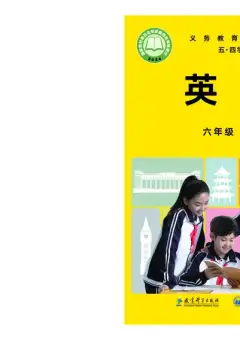
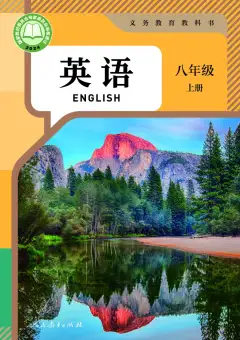
义务教育教科书
(五·四学制)
ENGLISH
英语
英语
英语
八年级
下册
上海教育出版社
上海教育出版社
智慧中小学000120260122
英语
八年级
下册
义务教育教科书
(五·四学制)
主编 束定芳
上海教育出版社
上海教育出版社
智慧中小学000220260122
主  编:束定芳
分册主编:葛现茹
本册编写人员:安 琳 施志红 张海波
       王颖婷 吕 娜 郑 琳 丁永花 衣永刚
责任编辑:倪雅菁 阎冰清 林 妍
特约审读:吕 晔 黄 艳 戴嘉子 周长天
封面设计:陆 弦 朱博韡
版式设计:赵 兵 朱博韡
插图绘制:赵 兵 顾依青
本册教材部分图片由图虫·创意、壹图网、视觉中国等图片网站提供
义务教育教科书(五·四学制)  英语  八年级下册
出 版 上海教育出版社(上海市闵行区号景路 159 弄 C 座)
版权所有·未经许可不得采用任何方式擅自复制或使用本产品任何部分·违者必究
上海教育出版社
上海教育出版社
智慧中小学000320260122
致同学
亲爱的同学:
欢迎与我们一起继续初中阶段的英语学习!
本学期,你将继续和教材中的小伙伴们一起,在学习英语的同时,探索新世界、思考大问题
(Big Question),在真实情境中“讲(文化)小故事,悟(人生)大道理,学百科新知识,用英语做
事情”。我们将通过教材,帮助你运用科学有效的方法学习英语,发展英语语言能力,培育文化意
识,提升思维品质,提高学习能力。
本套教材的每个单元以主题为引领,从大问题入手,设有五个小话题,分别对应听力、口语、
阅读、写作和项目探究五大板块。每个话题下包含符合初中生学习、生活和成长特点的类型丰富
的语篇,设计层层推进的学习活动,帮助你获得丰富的学习体验,并在学习过程中了解自己的学
习成效,最终对单元大问题有更加全面、深入的认识和理解。
围绕不同的主题,教材通过鲜活真实的语言素材,为你提供地道的语言示范。本册教材中,
听力、口语板块的多模态文本图文结合,均以日常生活中常见的真实情境为范本设计(如网页、电
子书、海报、触摸屏、展板等);听力板块配有采访、对话、新闻播报、电影片段等各类音频素材;
在阅读板块,你可以接触到故事、轶事、信息类文章、说理文、新闻报道、文学经典节选等丰富的
语篇类型;教材中小伙伴们的日常会话和他们的习作,也会为你提供口语和写作表达的范例。
在你学习教材的过程中,智能机器人“胡博士”(Dr Hu)将会继续陪伴你左右,帮助你掌握
语言知识、技能和学习策略。每单元最后的“项目探究”(Project)为你准备了更多的挑战任
务。你准备好迎接挑战了吗?
本册教材除了常规单元以外,还设有两个文化角(Culture corner)和一个文学角 (Literature
corner)。文化角不仅带你更深入地了解中国文化,学会用英语讲中国故事,还带你领略多样的世
界文化。文学角中,我们精选了广受青少年喜爱的优秀文学作品片段,供你赏析。
希望这套教材给你带来学习英语的新体验、新收获,为你插上一双逐梦的翅膀,飞向世界,飞
向未来!

上海教育出版社
上海教育出版社
智慧中小学000420260122
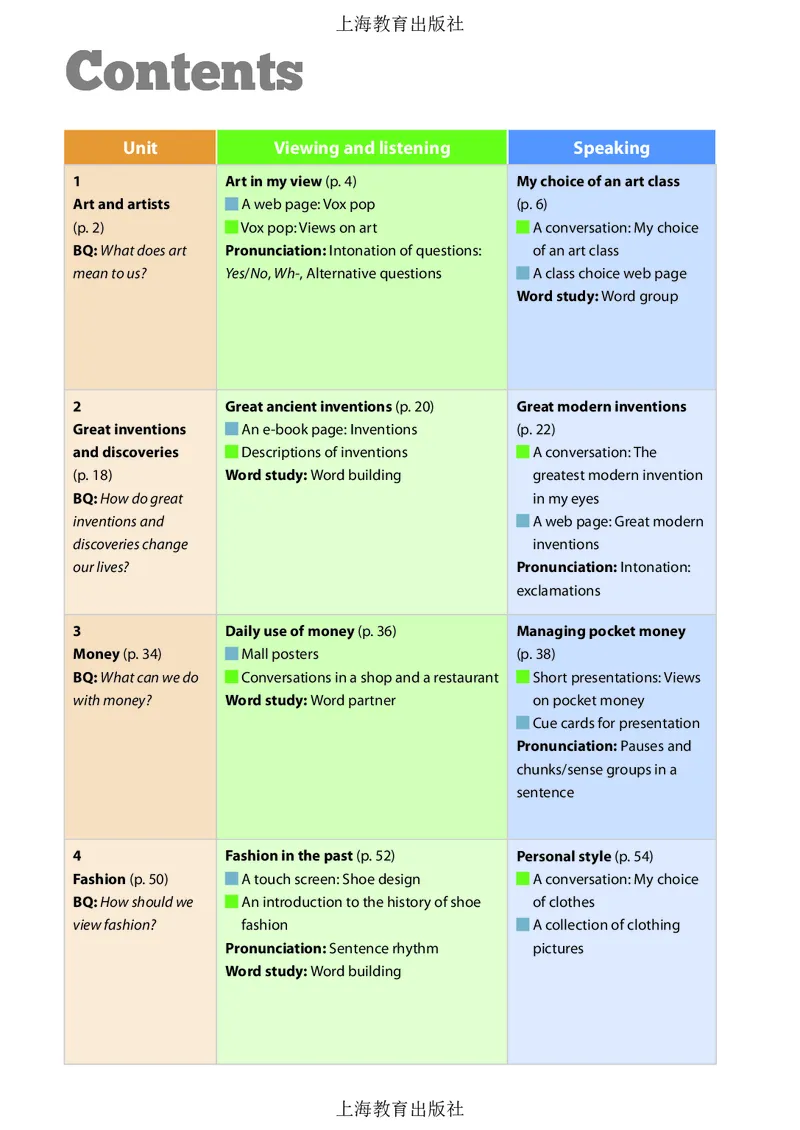
Unit
Viewing and listening
Speaking
1
Art and artists
(p. 2)
BQ: What does art
mean to us?
Art in my view (p. 4)
 A web page: Vox pop
  Vox pop: Views on art
Pronunciation: Intonation of questions:
Yes/No, Wh-, Alternative questions
My choice of an art class
(p. 6)
  A conversation: My choice
of an art class
  A class choice web page
Word study: Word group
2
Great inventions
and discoveries
(p. 18)
BQ: How do great
inventions and
discoveries change
our lives?
Great ancient inventions (p. 20)
 An e-book page: Inventions
 Descriptions of inventions
Word study: Word building
Great modern inventions
(p. 22)
  A conversation: The
greatest modern invention
in my eyes
  A web page: Great modern
inventions
Pronunciation: Intonation:
exclamations
3
Money (p. 34)
BQ: What can we do
with money?
Daily use of money (p. 36)
 Mall posters
  Conversations in a shop and a restaurant
Word study: Word partner
Managing pocket money
(p. 38)
  Short presentations: Views
on pocket money
  Cue cards for presentation
Pronunciation: Pauses and
chunks/sense groups in a
sentence
4
Fashion (p. 50)
BQ: How should we
view fashion?
Fashion in the past (p. 52)
 A touch screen: Shoe design
  An introduction to the history of shoe
fashion
Pronunciation: Sentence rhythm
Word study: Word building
Personal style (p. 54)
  A conversation: My choice
of clothes
  A collection of clothing
pictures
Contents
Contents
上海教育出版社
上海教育出版社
智慧中小学000520260122
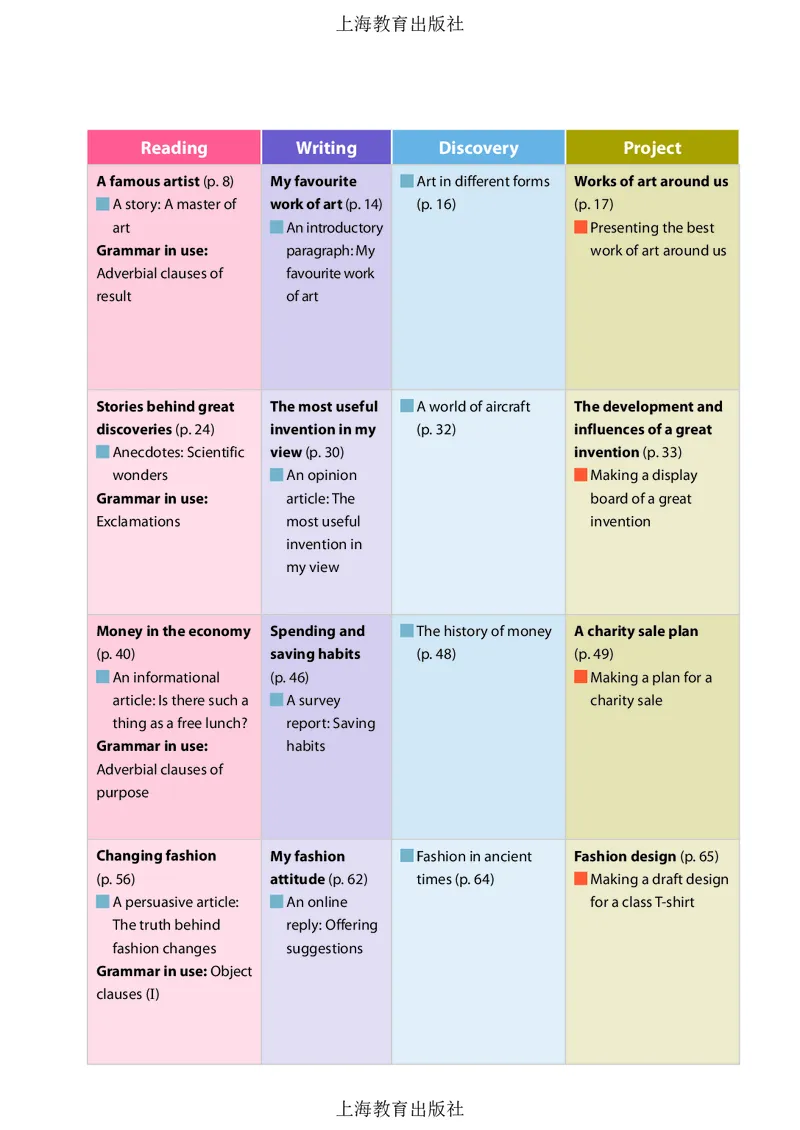
Reading
Writing
Discovery
Project
A famous artist (p. 8)
  A story: A master of
art
Grammar in use:
Adverbial clauses of
result
My favourite
work of art (p. 14)
  An introductory
paragraph: My
favourite work
of art
  Art in different forms
(p. 16)
Works of art around us
(p. 17)
  Presenting the best
work of art around us
Stories behind great
discoveries (p. 24)
  Anecdotes: Scientific
wonders
Grammar in use:
Exclamations
The most useful
invention in my
view (p. 30)
  An opinion
article: The
most useful
invention in
my view
  A world of aircraft
(p. 32)
The development and
influences of a great
invention (p. 33)
  Making a display
board of a great
invention
Money in the economy
(p. 40)
  An informational
article: Is there such a
thing as a free lunch?
Grammar in use:
Adverbial clauses of
purpose
Spending and
saving habits
(p. 46)
  A survey
report: Saving
habits
   The history of money
(p. 48)
A charity sale plan
(p. 49)
  Making a plan for a
charity sale
Changing fashion
(p. 56)
  A persuasive article:
The truth behind
fashion changes
Grammar in use: Object
clauses (Ⅰ)
My fashion
attitude (p. 62)
  An online
reply: Offering
suggestions
  Fashion in ancient
times (p. 64)
Fashion design (p. 65)
  Making a draft design
for a class T-shirt
上海教育出版社
上海教育出版社
智慧中小学000620260122
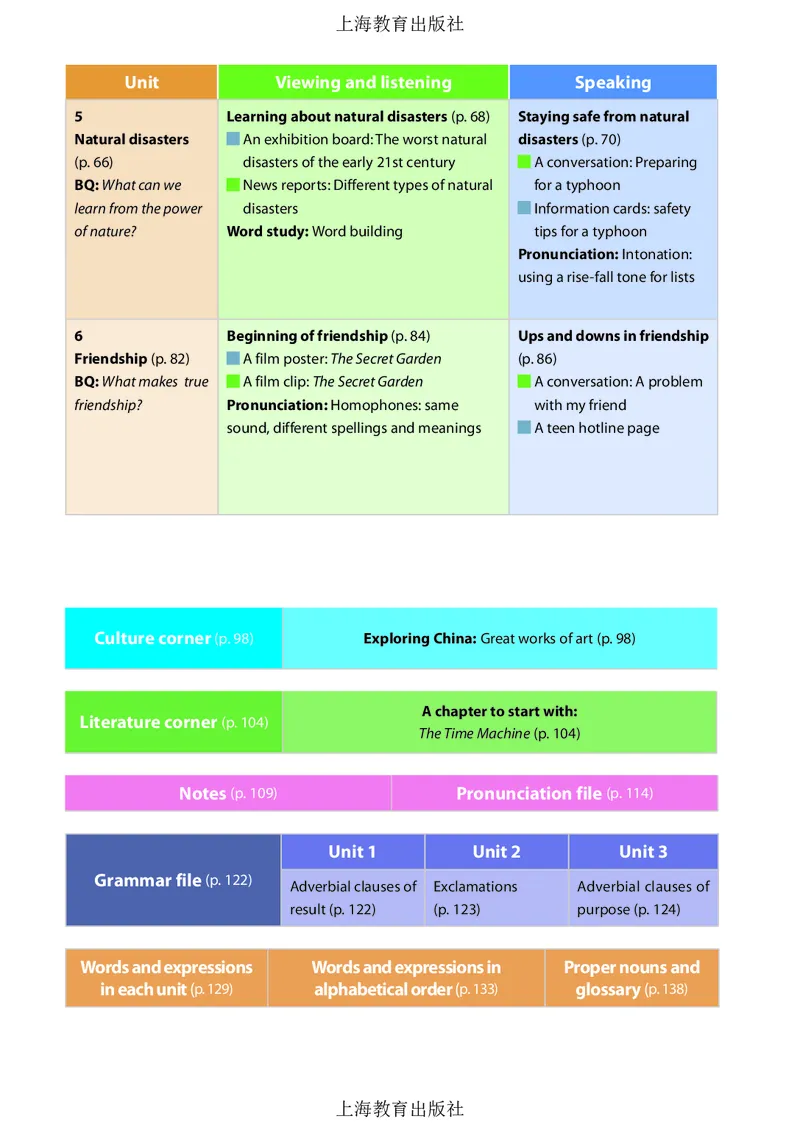
Unit
Viewing and listening
Speaking
5
Natural disasters
(p. 66)
BQ: What can we
learn from the power
of nature?
Learning about natural disasters (p. 68)
  An exhibition board: The worst natural
disasters of the early 21st century
  News reports: Different types of natural
disasters
Word study: Word building
Staying safe from natural
disasters (p. 70)
  A conversation: Preparing
for a typhoon
  Information cards: safety
tips for a typhoon
Pronunciation: Intonation:
using a rise-fall tone for lists
6
Friendship (p. 82)
BQ: What makes  true
friendship?
Beginning of friendship (p. 84)
 A film poster: The Secret Garden
 A film clip: The Secret Garden
Pronunciation: Homophones: same
sound, different spellings and meanings
Ups and downs in friendship
(p. 86)
  A conversation: A problem
with my friend
  A teen hotline page
Literature corner (p. 104)
A chapter to start with:
The Time Machine (p. 104)
Grammar file (p. 122)
Unit 1
Unit 2
Unit 3
Adverbial clauses of
result (p. 122)
Exclamations
(p. 123)
Adverbial clauses of
purpose (p. 124)
Culture corner (p. 98)
Exploring China: Great works of art (p. 98)
Notes (p. 109)
Pronunciation file (p. 114)
Words and expressions
in each unit (p. 129)
Words and expressions in
alphabetical order (p. 133)
Proper nouns and
glossary (p. 138)
上海教育出版社
上海教育出版社
智慧中小学000720260122
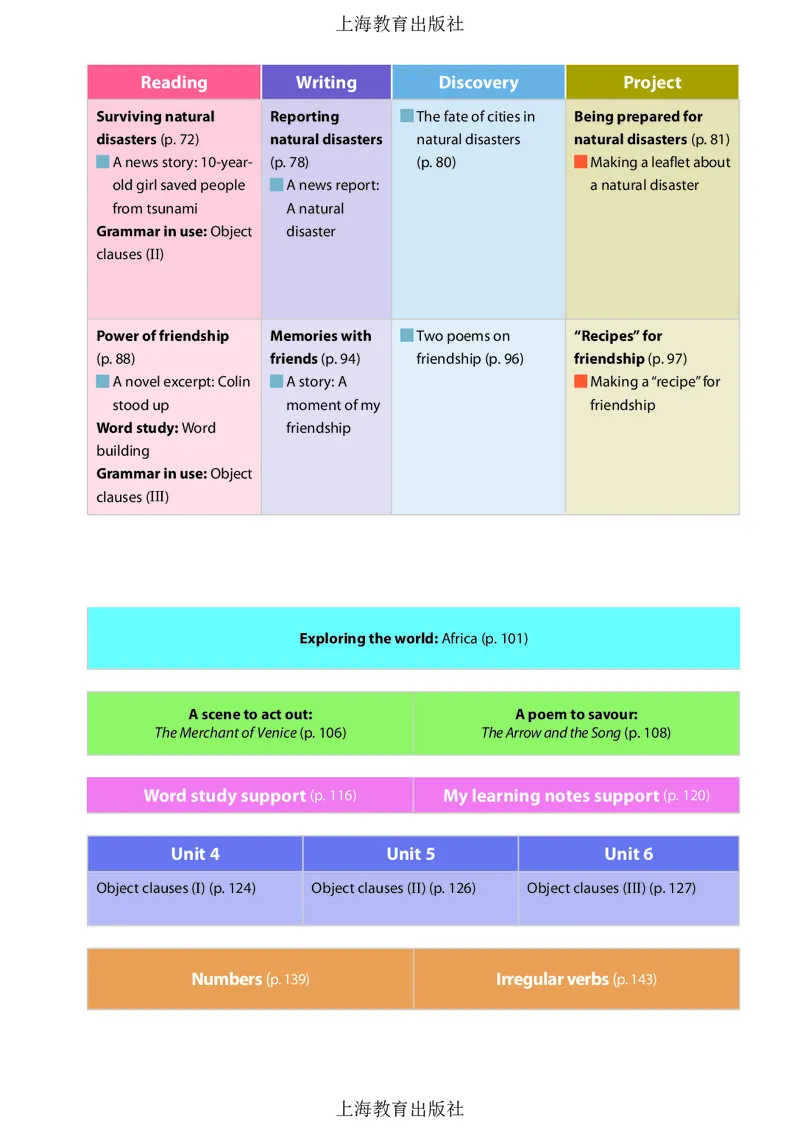
Reading
Writing
Discovery
Project
Surviving natural
disasters (p. 72)
  A news story: 10-year-
old girl saved people
from tsunami
Grammar in use: Object
clauses (Ⅱ)
Reporting
natural disasters
(p. 78)
  A news report:
A natural
disaster
  The fate of cities in
natural disasters
(p. 80)
Being prepared for
natural disasters (p. 81)
  Making a leaflet about
a natural disaster
Power of friendship
(p. 88)
  A novel excerpt: Colin
stood up
Word study: Word
building
Grammar in use: Object
clauses (Ⅲ)
Memories with
friends (p. 94)
  A story: A
moment of my
friendship
  Two poems on
friendship (p. 96)
“Recipes” for
friendship (p. 97)
  Making a “recipe” for
friendship
Unit 4
Unit 5
Unit 6
Object clauses (Ⅰ) (p. 124)
Object clauses (Ⅱ) (p. 126)
Object clauses (Ⅲ) (p. 127)
A scene to act out:
The Merchant of Venice (p. 106)
A poem to savour:
The Arrow and the Song (p. 108)
Exploring the world: Africa (p. 101)
Word study support (p. 116)
My learning notes support (p. 120)
Numbers (p. 139)
Irregular verbs (p. 143)
上海教育出版社
上海教育出版社
智慧中小学000820260122
2
Art and
artists
1

What does art mean to us?
上海教育出版社
上海教育出版社
智慧中小学000920260122
3
1  Listen to vox pops about
what art is.
2  Talk about choices for an art
class.
3  Read a story about an
artist.
4  Write a description of my
favourite work of art.
5  Present the best work of
art around us.
Read the quotes and discuss what
they mean.
Getting started
Great art picks up where nature ends.

—Marc Chagall
Every child is an artist. The problem is how
to remain an artist once he grows up.

—Pablo Picasso
上海教育出版社
上海教育出版社
智慧中小学001020260122
4
Viewing and listening
 Art in my view
A
Lu Yao is browsing through a vox pop
① website.
A1  Look and say What topic are these people probably talking about?
A2  Read and think Read these sentences and decide whether each of the
statements is a fact (F) or an opinion (O).
1 In my opinion, art means everything.

2 Art can be painting, theatre, music, folk art and more.

3 Paper cutting is a traditional Chinese art form.

4 I create art with scissors.

5 To me, almost anything is possible with paper cutting.

Art is a form of self-
expression and creativity.
Making dolls is part of
my family tradition.
I often visit art
museums at weekends.
VOX POP
This week’s voice of the people
Home
About us Topics Join us
Carlos (Brazil)
Emma (France)
Tracy (South Africa)
Art can be painting,
theatre, music, folk
art and more.
VOX POP
① vox pop 公众之声
Zhao Xi (China)
Identifying opinions
上海教育出版社
上海教育出版社
智慧中小学001120260122
1
5
A3  Listen and take notes Listen to three interviews and write down the
opinions of the speakers.
Carlos: Art is a form of self-expression and creativity. It allows
me to communicate ideas and feelings in a personal way. ... It
is a
(1)
 and
(2)
 activity. It also helps to
develop environmental awareness and encourage others to
(3)
 in their own lives.
1
Emma: Art
(4)
 in our lives. It
(5)
 in many different forms. Artists use their
(6)
 to bring beauty into the world
through their work.
2
Tracy: Art is an important part of
(7)
.
It is
(8)
.
... It requires creativity and imagination. For me, it is art.
3
Intonation of questions: Yes/No, Wh-, Alternative questions
Who are your favourite artists?
What makes their art stand out?
How do their works make you feel?
What is their art all about?
Do you see yourself as a painter?
Can you act,
 dance,
 or sing?
Are you a great entertainer,
Or is your talent in paper cutting?
Listen to the interviews in A3 again. Which opinion(s) do you agree with? Share
your ideas of art.
Update my to-do list
Pronunciation
Listen and imitate the intonation of different questions.
上海教育出版社
上海教育出版社
智慧中小学001220260122
6
Speaking
My choice of an art
class
B
Lu Yao and her classmates are choosing which art class to attend.
B1  Listen, read and think Listen to the conversation and say which art class
Lu Yao, Wang Yiming and Li Bailing would like to choose.

Yiming:   Lu Yao, which art class are you going to choose?

Lu Yao:
 I’m thinking of taking the drama class. I have never done any acting
before, but it seems really interesting. I want to try something outside
my normal interests.

Yiming:  Oh, drama isn’t really my thing. I prefer photography to drama. I
want to learn how to take good
pictures.

Lu Yao:
 It’s a pity that we won’t be in
the same class. What about you,
Bailing?

Bailing:
 I want to choose pottery. I’d like
to develop a new hobby and I
want to learn to make cups and
bowls for myself.

Lu Yao:
Oh, no! Are you leaving me too?

Bailing:
 Sorry! I hope you have fun in the
drama class though!

Lu Yao:
 I was just kidding. I hope you
both learn a lot!

Yiming:   And I’m sure you’ll make lots of
new friends in the drama class!
My learning notes
Showing preference:
• I prefer ... to ...
• I’d prefer ... rather than ...
•
上海教育出版社
上海教育出版社
智慧中小学001320260122
1
7
B2  Pair and share Work in pairs. Look at the art classes on the school web
page and choose your favourite one. Share your choice and the reasons with
your partner.
Word study Word group
Please match different types of art with artists.
1 sculpture
• painter
2 photography
• musician
3 painting
• sculptor
4 music
• photographer
Music
Learn the
basic skills of
singing, creating
music and
playing simple
instruments.
Home > Guidance > The arts
Drama
Learn to explore
the world through
performance and
acting skills.
Pottery
Learn to make
your own pots
and dishes.
Painting
Explore and
experience
different
painting skills.
The arts Language Maths Science Sports ICT
Dance
Develop
knowledge,
understanding
and skills about
dance.
Photography
Learn to take
great photos
through skills
like finding the
best shooting
positions.
NS
NS
NS
NS
NS
NS
In pairs, talk about other art classes you would like to choose and the reasons for
your choice.
Update my to-do list
上海教育出版社
上海教育出版社
智慧中小学001420260122
Reading
C A famous artist
8
Lu Yao is reading a story about a famous landscape painter.
C1  Background knowledge Do you know about any famous painters? What
are they famous for?
C2 Read the story.
Fan Kuan was one of the greatest landscape painters of the Song
dynasty. Fan was so good at painting that young artists always
asked him to teach them to paint.
“You must study with a greater master than me,” Fan replied.
“Who is he? Where can we find him?” they asked curiously.
Fan replied with a smile, “He is called Nature. He lives all
around you.”
Fan painted with the idea of being in harmony with nature. He
believed that if you wanted to understand nature, you had to
touch it, smell it and listen to it. That was what he always did.
He lived in mountains and forests, and watched the seasons
change. However, many people thought he was strange.
One morning, after sleeping under a rock, Fan walked
down a foggy mountain path. He saw an old farmer a
few steps ahead in the fog.
“Stop right there, whoever you are!” the farmer
warned suddenly. He never expected to come across
a stranger here.
5
10
15
A master of art
上海教育出版社
上海教育出版社
智慧中小学001520260122
1
9
Travellers among Mountains and Streams, Fan Kuan
Personal  touch
 Do you think Fan Kuan was a
strange man? Why or why not?
Fan stayed calm and said, “Don’t be scared, my friend! I’m just
trying to find my way to the town.”
“What are you doing here in the mountains?” the farmer asked.
“Looking. Thinking,” answered Fan.
The farmer relaxed when he was certain this strange man was not
a danger. He invited Fan to his
home and gave him something
to eat. Fan, in return, painted a
picture for the farmer. Everything
in the picture, the farmer, the trees
and the mountains, was so vivid
that the farmer was shocked. He
wondered how Fan had done it.
Fan told him that it was a gift from
the mountains.
As Fan was leaving, the farmer
asked where he lived. Fan
answered that mountains or forests,
east or west, all could be his home.
20
25
30
35
上海教育出版社
上海教育出版社
智慧中小学001620260122
10
C5  Further thinking What can you infer about Fan Kuan from these sentences?
C3  General understanding What made Fan Kuan an excellent landscape
painter?
C4  Detailed reading Fill in the fact file of Fan Kuan.
Name:


    Dynasty:
Fame:
Home:
Idea(s) of painting:

Making inferences
1  “You must study with a
greater master than me,” Fan
replied. (Line 4)
A  Fan Kuan didn’t want to teach young artists.
B  Fan Kuan was modest and he greatly
respected and admired nature.
He believed that if you wanted to understand nature, you had to touch
it, smell it and listen to it. That was what he always did. He lived in
mountains and forests, and watched the seasons change. (Lines 8–12)
That was what he always did.
He believed that ...
He lived ... and watched ...
We can infer that ...
A Fan Kuan always walked the walk.
B Fan Kuan always talked about his beliefs in public.
上海教育出版社
上海教育出版社
智慧中小学001720260122
1
11
certain shock paint danger in return
This morning, when I was walking down a mountain path, I met a stranger
and I thought he was a
1      . But later I was
2       that he
was a
3       who loved looking and thinking in the mountains.
Then I invited him to my home for some food. He painted a picture for
me
4      . He told me his painting was a gift from the mountains.
What
5       me most was that he told me mountains or forests,
east or west, all could be his home.
Vocabulary focus The farmer told his neighbour what had happened.
Complete his story with the proper forms of the words and phrase in the box.
2  Fan, in return, painted a picture
for the farmer. (Lines 26–27)
Fan Kuan

.
3  Fan told him that it was a gift
from the mountains. (Lines
32–33)
Fan Kuan

.
4  Fan answered that mountains or
forests, east or west, all could
be his home. (Lines 35–37)
______________________________________
_____________________________________.
5

______________________________________
_____________________________________.
What have you learned about art from the story of Fan Kuan?
Update my to-do list
上海教育出版社
上海教育出版社
智慧中小学001820260122
12
1  Read and think What’s the cause and what’s the result in each sentence?
(1)  Fan was so good at painting that young artists always asked him to teach
them to paint.
(2)  Everything in the picture, the farmer, the trees and the mountains, was so
vivid that the farmer was shocked.
(3)  It was such a brilliant song that I bought the soundtrack.
(4)  He made sculptures so well that other artists wanted to learn his skill.
2  Work out the rules Read the above sentences again and circle the correct
answer.
3  Practise Look at the pictures and make sentences by using so ... that or such ...
that.
(The film is exciting. Li Yi wants to
see it again.)
The film is so exciting that Li Yi wants
to see it again./It is such an exciting
film that Li Yi wants to see it again.
(The girl worked hard. She created an
excellent painting.)


(1)
(2)
  We use so ... that and such ... that to introduce a clause of result.
• The clause after that is the cause / result of the event.
• We use so / such before (an adjective +) a noun.
•  We use so / such before an adjective (without a noun) or an adverb.
Grammar file
 p. 122
Grammar in use Adverbial clauses of result
上海教育出版社
上海教育出版社
智慧中小学001920260122
1
13
Last night, I went to bed so late that I didn’t hear
the alarm in the morning. I didn’t hear the alarm
so I missed the appointment ① with my friend.
4  Make up a story
(Lu Lan is good at dancing. She won
first prize in the dancing competition.)


(Peter is a music lover. He plays the
violin even when he travels.)


I didn’t hear the alarm in the morning.
I missed the appointment with my friend.
I got bored.
I went to the art museum.
The famous artworks were great.
They impressed me a lot.
Then I saw some sculptures.
They were very real.
I was shocked and went home.
I had a dream that night.
The artworks came alive in my dream.
I didn’t hear the alarm in the morning.
(3)
(4)
① appointment 约定
(1)  In pairs, follow the f low chart on the left to make a story. The beginning of the
story is given.
(2) Fill in the flow chart on the right and make your own story.
上海教育出版社
上海教育出版社
智慧中小学002020260122
14
Writing
My favourite work
of art
D
You are going to introduce your favourite work of art at your art class.
D1  Think Read Lisa’s introduction below. What makes this work of art special?
D2  Prepare What words or phrases does Lisa use to describe the details of
her favourite work of art? Circle them in the introduction.
My favourite work of art is A Sunday Afternoon on the Island of La Grande
Jatte, created by the French artist Seurat. It was painted from 1884 to 1886.
The painting presents a scene of weekend life. Some people are sitting and
chatting on the cool, green grass. Others are enjoying the summer view of
the River Seine with small white boats on it. Dogs are running and children
are playing. It’s such a peaceful scene that I want to step into the painting
and spend a day there. I love the relaxed life in it. Do you like it too?
上海教育出版社
上海教育出版社
智慧中小学002120260122
1
15
D3  Plan Choose your favourite work of art and note down the key
information of it.
D5  Check Check your description. Pay attention to the descriptive details.
title, artist, time of creation, ...
Basic information


scenery, people, activities, ...
Descriptive details
theme of the work, your feelings, ...
Your thoughts
A description is a “picture” in words. Effective descriptive writing should have:
•  vivid details. Specific details paint a “picture” in the reader’s mind and
readers can enter the writer’s experience through all five senses.
•  precise language. Specific adjectives and nouns and strong action
verbs give life to the “picture” being painted in the reader’s mind.
D4  Write Write an introductory paragraph about your favourite work of art.
 Adding descriptive details
Work in groups. Share your work with other group members. Choose the best
description.
Update my to-do list
TEEN skill
上海教育出版社
上海教育出版社
智慧中小学002220260122
16
One of the most famous pieces of classical
music is called “The Four Seasons” by the
Italian composer Antonio Vivaldi. Each part
tries to sound like a season. Spring sounds
like birds. Summer sounds like thunder.
Autumn sounds like the hunters’ horns.
Winter sounds like the chattering② of teeth.
Art  in  different  forms
Shadow plays are an old traditional folk art of
China. They’re like a very old form of cinema.
The puppets① appear as shadows on the screen
thanks to a light. People move the puppets and
tell stories. Chinese people have enjoyed this
early form of entertainment for more than a
thousand years.
Argentina’s “Cave of the Hands” is a rock art
site with countless painted hands on the walls.
There are not only handprints but also pictures
showing animals, people and different shapes.
The artwork tells us about the lives of people
who lived thousands of years ago.
Read and think Which art form do you find the most interesting? Explain why.
① puppet 木偶  ② chatter 打颤
Discovery
T
h
e

F
o
u
r

S
e
a
s
o
n
s
Antonio Vivaldi
上海教育出版社
上海教育出版社
智慧中小学002320260122
1
17
Project
Works of art
around us
E
 Describe Describe the work of art you have found. You can refer to the
following questions for help.
• What is it? Who created it? When was it made? What type of art is it?
•  Where did you find it? In your opinion, what is the purpose of making this
work of art?
• Why have you chosen it?
• ...
 Present In class, do a presentation to introduce the work of art your
group has found. Include a picture and a short introduction.
 Search Take a walk around your school and agree on the best work
of art around you. Take a picture of it. It can be anything, a painting, a
sculpture, a piece of calligraphy, a dance performance or a piece of work
by a student on the display board.
Today is the School Photo Day. Work in groups, find the best work of art in
your school and do a presentation about your choice.
a painting drawn by a student
(photo taken by Adam, 10 March)
a piece of calligraphy written by a student
 (photo taken by Mary, 10 March)
Listen to the presentations. Then vote to decide the best work of art in your school.
Update my to-do list
Presenting the best work of art around us
Step 1
Step 2
Step 3
上海教育出版社
上海教育出版社
智慧中小学002420260122
How do great inventions and
discoveries change our lives?
Steam engine:
invented in 1698
Compass: invented
between 475 BCE
and 221 BCE
Paper-making:
invented around 105
2
X-ray:
discovered in 1895
Wheel: invented around
3500 BCE
Great inventions
and discoveries
Telephone:
invented in 1876
18
上海教育出版社
上海教育出版社
智慧中小学002520260122
Getting started
Look at the pictures and answer the question.
What do you know about these inventions and discoveries?
1  Listen to descriptions of
great ancient inventions in
history.
2  Talk about great inventions
in the modern world.
3  Read stories behind great
discoveries.
4  Write an opinion article about
the most useful invention in
my view.
5  Make a display board showing
the development and influences
of a great invention.
Penicillin:
discovered in 1928
Computer:
invented in 1946
Qinghaosu:
discovered in 1971
Internet:
invented in 1969
19
上海教育出版社
上海教育出版社
智慧中小学002620260122
20
Viewing and listening
Great ancient
inventions
A
Identifying key information
Wang Yiming is using an e-book app to learn about inventions. He finds out
many things in daily life were actually invented in ancient times.
A1  Look and say Look at the e-book page and answer the questions: Which
invention(s) have you learned about? Which is new to you?
A2  Listen and tick  Listen to a description of an invention and tick (3) the key
information that is mentioned.
The ship
•  Egypt, around
4000 BCE
•  Used for water
transport and
world exploration
Shoes
•  North America,
around 7000 BCE
•  Made of plants to
protect people’s
feet
The Arabic number system
•  India, around 500 CE–600 CE
•  Helps the development of
science and the economy
The wheel
•  Mesopotamia, around 3500
BCE
•  Makes people’s work, travel
and life easier
A3  Listen and take notes Listen to three descriptions of inventions and
complete the table on the next page. Write “M” for material(s), “U” for use(s) and
“I” for influence(s).
□ material(s)
□ use(s)
□ influence(s)
Paper-making
•  China, around 105 CE
•  Helps spread knowledge
上海教育出版社
上海教育出版社
智慧中小学002720260122
2
21
Word study Word building Noun suffixes -ment, -th, -ness and -ism
Change the words into their noun forms by adding suffixes. Put them into different
groups. Remember other changes may be necessary.
develop  long  real  excite  ill  sad  agree  grow  social  happy  tour  wide
Nouns ending
with -ment
• development
•
•
Nouns ending
with -th
• growth
•
•
Nouns ending
with -ness
• illness
•
•
Nouns ending
with -ism
• socialism
•
•
Inventions
Notes
Aspects
Paper-
making
1          and fishnets

M
 Easier for people to
2          and
3
information

 U
Helps
4                  knowledge

  I
The ship
5          and reeds ①
12


6          on the Nile
13


In wars and
7

U
The Arabic
number
system
Easier for people to write
8          numbers

U
Helps
9                  together easily
14
Develops
10          and the
11

  I
① reed 芦苇
Listen to a description of an invention and note down its key information.
Update my to-do list
上海教育出版社
上海教育出版社
智慧中小学002820260122
22
Speaking
Great modern
inventions
B
Wang Yiming and his classmates are reading a web page and discussing
great modern inventions.
B1  Listen, read and think Listen to their conversation. What do they think are
the greatest modern inventions?

Yiming:  Lu Yao, look at the great modern inventions on this web page. I think
the light bulb is the greatest. Do you agree?

Lu Yao:
 I’d say yes. It has changed our daily habits. Just imagine our life
without it. We couldn’t do homework or play games after dark.

Yiming:  I totally agree. It would be hard to do homework with candles! While
Edison was inventing a safe and inexpensive light bulb, he failed
thousands of times.

Lu Yao:
How encouraging!

Harry:
 Edison was great, but I don’t think the light bulb is the greatest
modern invention.

Lu Yao:
What do you think is the greatest then?

Harry:
 The car. It’s really fast and convenient. It can take people to hospital
quickly in an emergency.

Lu Yao:
I see your point! Imagine going to hospital on a horse!
B2  Discuss In groups, talk about the other great modern inventions on the web
page on the next page. Support your ideas with details. Use the conversation
in B1 for help.
My learning notes
Expressing opinions:
•  In my opinion/view, ...
• I (don’t) believe ...
• _____________________
• _____________________
上海教育出版社
上海教育出版社
智慧中小学002920260122
2
23
When you express an opinion, try to support your ideas with details. Details can
be facts, examples, f igures ①, quotations ②, etc.
Home > Technology & Inventions > Great modern inventions that have changed our lives
Great modern inventions that have changed our lives
Our lives would not be the same without these inventions!
The light bulb
changes people’s
daily habits; is safer
than candles; ...
The car
makes travel easier
and faster; helps to
connect people in
the countryside; ...
The telephone
makes
communication
easier; changes the
way people work; ...
The computer
allows people to
work faster; stores
more information; ...
Click the pictures to learn more.
 Supporting ideas with details
 Intonation: exclamations
① figure 数字 ② quotation 引语
Work in pairs. Think of other great inventions and talk about their influences on our lives.
Update my to-do list
Pronunciation
TEEN skill
We use falling tones in exclamations.
Listen to the conversations and pay attention to the intonation.
• A: Edison’s words encourage me to keep going when I want to give up.
 B: What inspiring words they are!
• A: We can pay the bill on the phone.
 B: How convenient it is!
• A: Wow!       What a smart robot it is!
 B: Yes. It’s the latest model.
上海教育出版社
上海教育出版社
智慧中小学003020260122
Reading
Stories behind great
discoveries
C
24
Wang Yiming and Harry are reading pages of a book about stories behind
great discoveries for their science project.
C1  Background knowledge What do you know about X-rays, penicillin and
qinghaosu?
C2  Read the article.
The German scientist Wilhelm
Conrad Röntgen wanted to
use tubes to do experiments on
electricity. The tubes were covered
in heavy black paper. He was
surprised to see a green light
coming from the tubes. And he
was even more surprised when the
light appeared on a screen beside
him. How strange! He learned that
the light can pass through objects.
Röntgen knew he had discovered something important. When
he passed the light through his wife’s hand, something exciting
happened. He could see the bones inside her hand! This was how
Röntgen discovered X-rays in 1895. After many tests on humans,
they were soon widely used in hospitals and Röntgen was awarded
the Nobel Prize.
The British scientist, Sir Alexander Fleming, discovered penicillin by
accident. In 1928, he went on holiday but forgot to clean up his lab
before he left. When he got back, he found some strange mould
①
growing on some of his Petri dishes. To his surprise, the mould
seemed to stop the bacteria
② around it from growing. With more
research, he discovered penicillin. Later, other scientists turned
5
10
15
20
X-ray of Röntgen’s wife’s hand
① mould 霉;霉菌 ② bacteria 细菌
上海教育出版社
上海教育出版社
智慧中小学003120260122
2
25
Around 1970, when a lot of
people were getting sick with
malaria
①, Tu Youyou was
chosen to find a medicine.
She read a large number of
ancient Chinese medical books
and discovered a treatment
using a plant called qinghao.
However, no matter how hard
they tried, Tu and her team failed to get the active part from the plant.
Tu took another closer look at the medical classics. Finally, one line
lit up an idea for her — a low-heat method! With this method, she
and her team successfully got the active part and named it qinghaosu.
Tu volunteered to test the medicine on herself before giving it to
others. Later, qinghaosu became an important treatment for malaria
and has saved millions of lives. Tu called the discovery “a gift from
Traditional Chinese Medicine to the world”.
Personal  touch
Which discovery impressed you most? Why?
penicillin into life-saving
medicine. The discovery of
penicillin changed the course
of medicine and has made it
possible for doctors to treat
serious illnesses. What an
amazing discovery!
25
30
35
40
45
Mould growing on Petri dishes
Qinghao plant
① malaria 疟疾
上海教育出版社
上海教育出版社
智慧中小学003220260122
26
C3  General understanding  How have the discoveries in the article changed
the world?
C4  Detailed reading What was the turning point of the scientists’ discoveries?
Following signal words
He was surprised to see a green light coming
from the tubes. And he was even more surprised
when the light appeared on a screen beside him.
How strange! He learned that the light can pass
through objects.
The turning point: He saw a green light from the
tubes passing through objects and appearing on a
screen.
The turning point: _______________________
_______________________________________
_______________________________________
The turning point: _______________________
_______________________________________
_______________________________________
Sir Alexander Fleming
Wilhelm Conrad Röntgen
Tu Youyou
上海教育出版社
上海教育出版社
智慧中小学003320260122
2
27
C5  Further thinking Answer the questions.

1  The discovery of X-rays and penicillin both resulted from unexpected findings.
How does chance play a role in scientific discoveries?

2  What important qualities in Tu Youyou helped her make the discovery of
qinghaosu?
What led to the success of the discoveries in the article?
Update my to-do list
Vocabulary focus Harry is writing a diary. Complete his diary with
the proper forms of the words and phrases in the box. One is extra.
Saturday, 15 April
Sunny
I read the stories about X-rays, penicillin and
qinghaosu today for the science project. I was
most amazed at the
1          of penicillin.
It is a kind of medicine to
2          serious
illnesses. One day, Sir Alexander Fleming left his
lab without cleaning it up. When he got back from
holiday, he found something
3          the
bacteria          growing. It was penicillin!
It was discovered
4         . Then some
scientists
5          it          medicine
and it is widely used in hospitals and has saved
the lives of countless people.
by accident
discover
turn ... into
treat
invent
stop ... from
上海教育出版社
上海教育出版社
智慧中小学003420260122
28
Group B
Group A
1  Read and think Read two groups of sentences. Which group shows stronger
feelings?
2  Work out the rules Read aloud the sentences that show stronger feelings
again and complete the rules.
•  Edison’s story was very
encouraging.
•  She did the experiment
carefully.
•  Penicillin is an amazing
discovery.
•  How encouraging Edison’s story
was!
•  How carefully she did the
experiment!
•  What an amazing discovery
penicillin is!
3  Practise In pairs, complete the conversations with words and phrases in the
box, using What …! or How …!
lucky a good idea exciting news smart an amazing invention
(1) A: The ten-year-old boy has invented five toys.

B: _____________________________________________________________
(2) A: The fridge can keep food fresh for a longer time.

B: _____________________________________________________________
(3) A: Scientists have found a way to stop the disease from spreading.

B: _____________________________________________________________
(4) A: Thanks to so many wonderful inventions, we can live a comfortable life.

B: _____________________________________________________________
(5) A: Why not go to the Technology Fair this weekend?

B: _____________________________________________________________
When we express strong feelings such as surprise and excitement,
we use an exclamatory word, phrase or sentence. An exclamatory
sentence usually begins with What or How:
•          + adjective/adverb (+ subject + verb)!
•          + (a/an) + adjective + noun (+ subject + verb)!
• An exclamation mark “!” is used at the end of the sentence.
Grammar file
 p. 123
Grammar in use  Exclamations
上海教育出版社
上海教育出版社
智慧中小学003520260122
2
29
Look at this drone. It
costs 59,800 yuan. How
expensive it is!
It weighs 3.2 kg, but it can
carry goods as heavy as 5 kg
and fly for 40 minutes.
How heavy is it?
...
4  Pair and share Work in pairs. Look at the product files of two inventions
and talk about them.
Drone H70
Price
¥59,800
Size
750 mm × 750 mm × 450 mm
Weight
3.2 kg
Specialty
 have a battery life of 40 minutes and can deliver
goods up to 5 kg in weight; fly as high as 500 m
and cover a distance of 10 km

Robot 87
Price
¥19,500
Size
410 mm × 410 mm × 1,000 mm
Weight
21 kg
Specialty
 greet hotel guests; answer their
questions; sing and dance
(1)  Use proper words to describe the features of the drone and the robot .
The drone
expensive, powerful,
The robot
a smart machine,
(2) Talk about the inventions with your partner.
上海教育出版社
上海教育出版社
智慧中小学003620260122
30
Writing
The most useful
invention in my view
D
The school newspaper is collecting opinion articles on “The most useful
invention in my view” for its feature section.
D1  Think Read Lin Dong’s article. Why does he think the internet is the most
useful invention?
For me, the most useful invention is the internet. It is useful for many reasons.
First, it makes communication easier. I can keep in touch with my friends and
family through email or social media. Besides, it helps
a lot with my studies. It allows me to find information
for my projects and have online lessons. What’s more, it
brings more fun into my life. I can relax in my spare time
by listening to music or watching films online. How great
it is! In short, I believe the internet is of great help.
My opinion
My conclusion
Reason 1
Reason 2
Reason 3
D2  Prepare Underline the linking words in Lin Dong’s article and think about
their functions.
D3  Plan What is the most useful invention in your view? Plan your writing by
completing the mind map below.
上海教育出版社
上海教育出版社
智慧中小学003720260122
2
31
D4  Write Write your opinion article.
D5  Check Check your opinion article. Pay attention to the use of linking words.


•  Linking words can join ideas and sentences together.
•  When the linking word is at the beginning of the sentence, it should be followed
by a comma ①.
•  Linking words can show different relationships between
sentences.
  For introduction: to begin with, to start with, first, ...
  For addition: what’s more, in addition, besides, as well,
more importantly, ...
 For result: therefore, as a result, for these reasons, ...
  For contrast ②: however, instead, on the other hand ③, ...
 For summary ④: in short, in a word, ...
 ...
① comma 逗号 ② contrast 对比  ③ on the other hand 在另一方面  ④ summary 概要
Share your article in groups. Choose the one you like best and explain why.
Update my to-do list
  Using linking words
TEEN skill
上海教育出版社
上海教育出版社
智慧中小学003820260122
32
The first idea for a helicopter
②
The first idea for a helicopter was drawn by
Leonardo da Vinci about 500 years ago. However,
the first helicopter was not built until around 1940.
A  world  of  aircraft
①
The fastest passenger plane
In the 1970s, Concorde became the world’s fastest
passenger plane. It could fly from New York to London in
less than three hours. However, it stopped flying in 2003
because of technical and financial ③ problems. Many
people think the plane is a wonder in flight history.
The first human flight
As children, Wilbur and Orville Wright grew up curious
about flight. They tried to fly many times before they
succeeded. In fact, Orville didn’t even sit up during the
first flight. Instead, he lay flat on the lower wing.
Read and think Which aircraft do you think had the greatest influence in the
history of flight? Why?
① aircraft 飞机;航空器 ② helicopter 直升机 ③ financial 财政的;金融的
Discovery
上海教育出版社
上海教育出版社
智慧中小学003920260122
2
33
Project
The development and
inf luences of a great invention
E
Fun story: Bell and the telephone
On 10 March 1876, Alexander Bell said to his assistant Thomas Watson, “Mr
Watson—come here—I want to see you.”  They were the first words spoken
over a telephone. Watson heard him in another room. His voice came
through over the wires. How excited they were!
the 20th century
Work in groups. Make a display board to show the development (past,
present and future) and any influences of a great invention.
 Choose Discuss and choose an invention.
 Collect Collect information to answer the following questions. The first
two questions are a must. Choose or think of at least one more question.
• How has it changed people’s lives?
•  How has it changed during its development? (appearance/functions/...)
•  How is the invention likely to develop in the future? How might the
invention change our lives?
•  Are there any interesting stories or facts about the invention and its inventor(s)?
• ...
Display Put the information together and design a display board. Cover at
least three aspects of the information in Step 2. Use pictures to add interest.
The following is part of a display board.
 Share Introduce your display board to other groups.
Step 4
rotary dial
telephone
Bell’s first
telephone
wall
telephone
push-button
telephone
cordless
telephone
the 19th century
Take turns to present and introduce the display boards. Vote for the best one.
Update my to-do list
Making a display board of a great invention
Step 1
Step 2
Step 3
上海教育出版社
上海教育出版社
智慧中小学004020260122
3
What can we do with money?
Money
34
上海教育出版社
上海教育出版社
智慧中小学004120260122
1  Listen to conversations in a
mall.
2  Give a talk on managing
pocket money.
3  Read an article about money
in the economy.
4  Write a survey report on
saving habits.
5  Make a plan for a
charity sale.
Getting started
Read the following sentences and guess the meanings of the
underlined parts.
1  Hey, in for a penny, in for a pound. Let’s carry on.
2  Don’t spend too much money. Remember to save money
for a rainy day.
3  As soon as she gets paid, she goes shopping. Money
burns a hole in her pocket.
35
上海教育出版社
上海教育出版社
智慧中小学004220260122
36
Viewing and listening
Daily use of money
A
It’s Saturday afternoon. Lisa is shopping with her mum in a mall.
A1  Look and say Read the posters and talk about them with your partner.
Look, Mum! What does
the poster “SUMMER
SALE” mean here?
Then I can get a T-shirt
at a lower price!
Honey, it means this store is
offering discounts on its products
during the summer season.
Yes. We can even get a special discount
with our membership card.
SUMMER
MEMBERSHIP ① DISCOUNTS ②
We Accept
CASH, CREDIT
③ & DEBIT
④
THE FOLLOWING
FORMS OF PAYMENT
ARRIVAL
SHOP NOW
① membership 会员资格  ② discount 折扣  ③ credit 信用(卡)  ④ debit 借记(卡)
 SALE ITEMS
BUY 2
GET 1
FREE
50
上海教育出版社
上海教育出版社
智慧中小学004320260122
3
37
A2  Listen and think Listen and say who is talking to Lisa. Give reasons for
your answer.
A3  Listen and take notes Listen to two conversations and answer the questions.
1
2
3
4
A her mother
B her friend
C her teacher
D a shop assistant
Word study Word partner
Look at the verbs in the box that commonly go with “money”. Complete the
sentences in their proper forms.
raise earn donate waste save
1  How much money do shop assistants usually         ?
2  He kindly          3,000 pounds to the community centre’s programmes for
children every year.
3  The school organised a book sale to          money for improving the library.
4  Shopping at a discount store is a great way to buy cheap things and
money.
5  You          your money when you bought so much chocolate. You never eat it!
Conversation 1
1 Where was Lisa?

.
2 Who was talking to her?

.
3 What did she want to buy?

.
4 Did she get a good deal?

.
5 How did she pay?

.
Conversation 2
1 Where was Lisa’s mum?

.
2 Who was talking to her?

.
3 What discount did she get?

.
4 How did she pay her bill?

.
5 Did she offer a tip?

.
Inferring the relationship between speakers
Listen to a conversation and work out the relationship between the speakers.
Update my to-do list
上海教育出版社
上海教育出版社
智慧中小学004420260122
38
Speaking
Managing pocket
money
B
Lisa and her classmates are presenting their ideas on pocket money in the
class.
B1  Listen, read and think Listen to what Lisa and her classmate Henry say.
Which of the following questions do they respond to? How are their views
different?
A  Should parents give us pocket money for doing chores?
B  Should parents tell us how to spend our pocket money?
C  Should parents give us pocket money regularly ①?
① regularly 有规律地;定期地
YES
I think parents should tell us how
to spend our pocket money. Our
parents have more experience in
using money. By setting some rules
and expectations, they can help us
learn how to budget, save and make
good choices. With their help and
suggestions, we may save some
pocket money or only spend it on
things we really need. This can help
us develop important financial skills.
In short, I hope my parents can help
me spend my pocket money wisely.
NO
I don’t think parents should tell
us how to spend our pocket
money. We need to learn how to
make decisions and manage our
own pocket money. This can help
us become more independent
and responsible. If we mess
up, we’ll learn from it and get
better at managing money in
the future. In a word, parents
can give advice when needed,
but it’s up to us to decide how to
spend our pocket money.
上海教育出版社
上海教育出版社
智慧中小学004520260122
3
39
B2  Present Present your ideas on one of the questions in B1 using the cue
cards ① for help.
• Write key words on your cue card.
• Hold the cue card in one hand.
•  Do not read directly from the cue card. Look at it quickly only
when necessary.
Listen and repeat Lin Dong’s presentation. Pay attention to each pause he makes.
I love getting pocket money. It’s like a mini salary, // but sometimes //  I spend it all in
one go. And then // I feel like a zero. My parents say // I need to learn to save // so that I
can buy bigger things in the future. But it’s hard // when there’s so much I want to have.
Maybe // I should start a piggy bank
② // and put my money in there, safe and sound.
Cue card 1
•  Family responsibility
• Life skills development
• Value of hard work
• ...
Cue card 2
• Spending wisely
• Opening a savings account at a bank
• Developing saving habits
• ...
① cue card 提词卡 ② piggy bank 猪形储蓄罐
  Pauses and chunks/sense groups in a
sentence
 Using a cue card to present ideas
Give a short presentation about your own views on pocket money.
Update my to-do list
My learning notes
Concluding views:
• In summary, ...
• In a word, ...
•
•
Pronunciation
TEEN skill
上海教育出版社
上海教育出版社
智慧中小学004620260122
Reading
C
Money in the
economy
40
Lisa is reading an article about money in the economy.
C1  Predicting Read the title of the article. What do you think the article will
explain?
C2  Read the article.
Home > Economics for Teens > Is there such a thing as a free lunch?
Is there such a thing as a free lunch ?
Have you ever wished
everything to be free? Imagine
being able to walk into your
favourite shop and take
whatever you want without
having to pay for it. It sounds
amazing, doesn’t it? But have
you ever stopped to think
about why everything isn’t free?
According to economists, our society depends on trading goods and
services for money. People use their time and talents to produce
goods and services for the exchange of money so that our society can
keep running smoothly. If everything is free, people won’t get paid
for their work. Think about it: farmers grow the food. When you buy
it, they get paid for their hard work. If the food is free, farmers won’t
5
10
15
Free ?
上海教育出版社
上海教育出版社
智慧中小学004720260122
3
41
have the money to keep growing crops and then you won’t have
the chance to see and value their hard work.
Although most things aren’t free, you may still come across free
things from time to time. For example, many shops offer free
samples of food and other products. You can also find free events
and activities in shopping centres, such as concerts, festivals and
films. But are these things really free? Economists will say no! In
fact, they will probably reply with a well-known saying: “There’s
no such thing as a free lunch.” According to them, when something
is offered for free, there is still a hidden cost even if it’s not in the
form of money.
It might be exciting to imagine a world where everything is
free. However, economists will tell you it is impossible to have a
completely “free lunch”. Instead of trying to get everything for free,
you might find it more valuable to appreciate the hard work of
others and make better choices in your life.
Personal  touch
Do you believe there’s such a thing as a free lunch, or has
your thought changed? Explain what you think now.
20
25
30
上海教育出版社
上海教育出版社
智慧中小学004820260122
42
C3  General understanding What is the writer’s answer to the question “Is
there such a thing as a free lunch?”
Skimming for main ideas
C4  Detailed reading

1 Read and tick (3) the examples the article uses.
People can get things without having to pay. Not everything has a hidden
cost, and it’s possible to enjoy free things without worrying about money
or other costs.
There is no completely free lunch. The smooth running of our society
depends on the exchange of goods and services for money. Also, “free”
things cost us something even if it’s not in the form of money.
YES
NO
 A Farmers won’t grow crops if the food is free.
 B People can enjoy free Wi-Fi in many coffee shops and restaurants.
 C Many shops offer free samples of food and other products.
 D  People can find free events and activities in shopping centres,
such as concerts, festivals and films.
 E  If waiters in restaurants don’t get paid, they won’t offer services.
上海教育出版社
上海教育出版社
智慧中小学004920260122
3
43
Vocabulary focus Complete Lisa’s review of this article with the proper
forms of the words and phrase in the box.
produce cost free trade come across
I’ve learnt a lot from the article. I know the society depends
on
1       goods and services for money. The saying
“There’s no such thing as a free lunch” reminds me that
even if I may
2       something free, there’s still a
hidden
3      . The article suggests it’s impossible
to have everything for
4      . Instead, it’s better to
appreciate the efforts people make to
5       goods
and services. I understand the importance of respecting
their work.
C5  Further thinking Answer the questions.

1  Please give more examples to match the economic truths talked about in the
article.

2  Is there any work you would be happy to do without payment? Please explain
the reason with examples.
Read again and think: If everything is free, what may happen to our society and the
economy?
Update my to-do list

2  Complete the economic truths and put the examples on page 42 into
the following boxes to match the truths.
Economic truths
Our society depends
on trading goods and
services for money.
When something is offered
for free,

.
Examples:
Examples:
上海教育出版社
上海教育出版社
智慧中小学005020260122
44
1  Read and match Match the sentences in Column A to those in Column B.
A
Parents should give their
children pocket money
regularly
○
People use their time
and talents to produce
goods and services for the
exchange of money
○
Sam saved his money
○
Stores use colourful posters ○
B
○ our society can keep
running smoothly.
○ they may attract more
customers.
○ they can learn to manage
pocket money themselves.
○he would buy a new bike.
2  Work out the rules Read the above sentences again and circle the correct
answer.
3  Practise Lu Yao and her mother are discussing their shopping plan on Sunday.
Complete the conversation on the next page using the clauses in the box.
so that/in
order that
A so that I may buy the gift at a lower price
B so that I can buy a nice gift for Grandma
C that I can’t afford what I want
D in order that we will have more time in the shopping centre
We usually use so ... that clauses to talk about results.
We usually use so that or in order that clauses to talk about reasons /
purposes.
Grammar file
 p. 124
Grammar in use Adverbial clauses of purpose
上海教育出版社
上海教育出版社
智慧中小学005120260122
3
45

Lu Yao:  Mum, Grandma’s birthday is coming!

Mum:
I know. Let’s go to the Sunshine Shopping Centre this Sunday.

Lu Yao:  What time do you think we should go?

Mum:
I think we should set out early
(1)      .

Lu Yao:  Great! I have saved this month’s pocket money
(2)      .

Mum:
Good girl! Will you buy anything for yourself?

Lu Yao:   Maybe not. I think Grandma’s gift will cost so much
(3)      .
Mum, remember to take your membership card
(4)      .
4  Discuss Lu Yao and her classmates made a to-do list for the School Charity
Sale.
(1)  Work on your own. Read the to-do list and write sentences explaining why
they should be done.
(2)  Work in groups. Discuss what else they should do and why.
Why?
1)  They think about time and
location so that/in order
that students can have
more time to attend the
event and more items can
be put in the place for sale.
To-do list
for the School Charity Sale
1)  Think about time and
location.
2)  Collect items for sale and
set the price for each item.
3)  Design some posters for
the charity sale.
Why?
To-do list
for the School Charity Sale
4)
5)
6)
...
上海教育出版社
上海教育出版社
智慧中小学005220260122
46
Writing
Spending and saving
habits
D
You and Lu Yao are going to write survey reports about students’ spending
and saving habits.
D1 Think Read Lu Yao’s survey report.  Which pie chart is she describing?
D2  Prepare Read the survey report again, and mark “the introduction to
the survey” with “  ”, “results” with “  ”, “findings” with “( )” and
“suggestions” with “[ ]”.
A
B
Spending habits
books, pens and paper
entertainment
public transport
food
others
46%
32%
8%
10%
4%
Saving habits
in the bank
in a piggy bank
no savings
with parents
others
23%
34%
8%
29%
6%
Our school has interviewed 100 students about their spending
habits. They spend a higher percentage of their money on
books, pens and paper than anything else—46%. Entertainment
comes a close second at 32%. Everything else has much less.
Food accounts for only 10%, public transport 8% and other
spending makes up just 4%. It seems that having fun is very
important to students. Students don’t spend much on food
because they eat mainly at home or at school. Public transport
is an important way for them to get around. They should try to
spend less on entertainment so that they can save money.
上海教育出版社
上海教育出版社
智慧中小学005320260122
3
47
D5  Check Check your survey report. Pay attention to key elements in a survey
report.
__________________________________________________________
__________________________________________________________
__________________________________________________________
__________________________________________________________
__________________________________________________________
__________________________________________________________
A survey report usually includes:
• a brief introduction to the survey;
•  some descriptions of key facts including survey statistics ① and
simple analyses such as 23 per cent of ..., Most of the ... at 49%., A
higher percentage of ...;
• general findings of the survey;
• some suggestions based on the findings.
D3  Plan Read pie chart B and answer the questions.
1 What is the title of the pie chart?
2 How do students keep the money they save?
3 How many students chose “no savings”? What do you think of this percentage?
D4  Write Write a survey report on pie chart B.
① statistics (pl.)数据
 Writing a survey report
Work in pairs. Share your survey report and help revise each other’s writing.
Update my to-do list
TEEN skill
上海教育出版社
上海教育出版社
智慧中小学005420260122
48
Between 11,000 and 6,000 years ago, people
started exchanging things like cows, sheep,
camels and crops to get what they needed.
The  history  of  money
More than 3,000 years ago, people thought shells
were a good form of money because they were
beautiful and hard to find. Others did the same
thing with feathers. The first coin was made in
Lydia. Soon, other countries had their own coins.
Later, people used gold and silver to make coins.
In the 1950s and 1960s, people started to pay
for things in new ways. Credit cards and debit
cards became popular and made payment
easier. Today, many people prefer to use QR
codes and smartphones for payment.
Over 1,000 years ago, the Chinese started printing
paper money. The Song dynasty issued
① the world’s
first paper money, known as jiaozi. Paper money is
light and easy to carry, but it is also easy to copy.
Read and think Should electronic payment replace paper money? Discuss the
pros and cons of each method.
① issue 发行
Discovery
上海教育出版社
上海教育出版社
智慧中小学005520260122
3
49
Project
A charity sale plan
E
The annual charity sale will be held for the students of the partner school. Work
in groups, make a plan and present it to your classmates.
 List List the items for sale.
 Discuss Brainstorm and talk about what you are going to do before,
during and after the sale.
Make a budget Discuss
and draw a pie chart to show
suggestions on how to use the
money raised from the charity
sale.
 Plan Put Step 1, Step 2
and Step 3 together and
make a plan.
 Present Polish your plan and present it to your classmates.
to buy books
to buy plants
to
to
10%
40%
30%
20%
Charity sale plan
(This may include: items to
sell, your tasks, suggestions
on how to use the money, ...)
ON THE DAY
AFTER THE EVENT
1 Decide on the place.
2
3

4
1 Decorate the sale corner.
2
3
4
1
2
3
4
UP TO 2 WEEKS BEFORE
How to use the money
 Comment on the other groups’ plans. Polish your own plan based on the feedback.
Update my to-do list
Making a plan for a charity sale
Step 1
Step 2
Step 3
Step 5
Step 4
e.g.
上海教育出版社
上海教育出版社
智慧中小学005620260122
50
Fashion
4
上海教育出版社
上海教育出版社
智慧中小学005720260122
How should we view fashion?
51
Talk with your partner and answer the following questions.
1 What does fashion mean to you?
2 Who decides what is fashionable?
Getting started
 1  Listen to an introduction to
the history of shoe fashion.
2  Talk about personal clothing
style.
3  Read an article about the
truth behind fashion changes.
4  Write an online forum reply
to someone’s worries about
fashion.
5  Make a draft design of a
class T-shirt.
上海教育出版社
上海教育出版社
智慧中小学005820260122
52
Viewing and listening
Fashion in the past
A
Li Bailing is looking for ideas for a project about fashion in a fashion
museum. She is looking at the touch screen in the museum.
① sandal 凉鞋 ② chopine 软木高底鞋 ③ boot 靴子  ④ leather 皮革  ⑤ rubber 橡胶
Step 1: Choose the type of your shoes.
Fashion
□ sandals ①
□ trainers
□ boots ③
□ chopines ②
Type
Material
Decoration
Step 2: Choose the material for your shoes.
Step 3: Choose the decoration for your shoes.
□ leather ④
□ rubber ⑤
□ metal
□ paint
□ plastic
□ cloth
□ plant
The type of the shoes is ...
They are made of ...
They are decorated with ...
A2  Listen and take notes Listen to an introduction to the history of shoe
fashion. Complete the first two rows of the table in A3.
A1  Look and say Look at the touch screen. Choose and design your own shoes.
Then describe them to your classmates.
Listening for time periods
上海教育出版社
上海教育出版社
智慧中小学005920260122
4
53
 Sentence rhythm
Read the following jingle, and pay attention to the rhythmic
patterns in each line.
‘Just ‘now, ‘shop a‘round.

‘Look in’side, ‘shape and ‘size.
‘Nice ‘dress, ‘well ‘done.

‘It’s on ‘sale; ‘try it ‘out.
‘That’s ‘true, ‘pretty ‘good.

‘Let me ‘see; ‘what a ‘crowd!
‘Take a ‘look; ‘buy it ‘now.
Timeline of the history
of shoe fashion
about ________
years ago
during _________
centuries
the 19th century
Types of shoes
chopines
Places where the
shoes became
popular
England
People who liked
those shoes
children and
adults
Materials of the
shoes
Word study Word building Adjective suffixes -able, -ic
Form new words by adding -able or -ic and make sentences.
Base words
New words
Sentences
change
changeable
The weather is very changeable at the moment.
We don’t know what to expect.
afford
energy
energetic
She looks energetic in her yellow dress.
artist
A3  Listen and take further notes Listen again and complete the last
three rows of the table.
Listen again. Find out the reasons for the popularity of the shoes, take notes and
add a row to the table in A3.
Update my to-do list
Pronunciation
上海教育出版社
上海教育出版社
智慧中小学006020260122
54
Speaking
Personal style
B
Li Bailing is choosing clothes for her singing performance at the Arts
Festival from the pictures Ms Chen gave her. Lu Yao is helping her.
B1  Listen, read and think Listen to their conversation. What is Bailing’s
clothing style?

Bailing:
 Wow, there are so many pictures. Where should I start?

Lu Yao:
 What do you like? Do you have anything particular ① in mind?

Bailing:
 Well, you know me. I prefer comfortable clothes like sportswear and
T-shirts, but those won’t work for my performance. I guess I need
something fashionable for the show.

Lu Yao:
 How about a polka dot ② dress? I think Ms Chen sent you a picture of a
black one with white dots. Oh, here!

Bailing:
I don’t know. I love the pattern, but isn’t it too ... um, formal?

Lu Yao:
 No. I’m sure you’ll look great in it! It can bring out the best of you.

Bailing:  Are you sure?

Lu Yao:
Yes! You’ll be as beautiful as the song you’ll be singing tomorrow!

Bailing:
 You’re so nice to me. Thank you!

Lu Yao:
I’m only telling the truth.
B2  Role-play Talk with your partner about your choice of the clothes for your
performance at the Arts Festival. Use the conversation in B1 and the pictures
on the next page to help you.
① particular 特别的  ② polka dot 波卡圆点
My learning notes
Asking for confirmation:
• Is that correct?
• Do you really think so?
•

•
上海教育出版社
上海教育出版社
智慧中小学006120260122
4
55
① dub 配音 ② bow tie 领结
Do B2 again with a different partner. You may use different pictures.
Update my to-do list
blue and pink hanfu
dark suit jacket
with a bow tie ②
black dress with
white polka dots
flowery shirt
street dance outfit
folk dance dress
singing, folk dance,
street dance,
drama, violin-playing,
drumming, film
dubbing
①, ...
Arts
Festival
Join us!
1 June–6 June
上海教育出版社
上海教育出版社
智慧中小学006220260122
Reading
Changing fashion
C
56
Li Bailing shares an article about the truth behind fashion changes with her
classmates.
C1  Predicting  Read the title of the article. What do you think the article will
explain about fashion changes?
C2 Read the article.
One year skirts are long, and the next they’re short. Jeans are
narrow one year, and baggy the next. The only certain thing about
fashion is that it is always changing! It’s hard to keep up if you
always want to wear the latest fashions. Who decides what is
fashionable?
One big influence on fashion is advertising. The fashion industry
spends a great deal of money advertising their products: online, in
magazines, on screens and on outdoor advertisements. We often
see images of “beautiful people” living exciting lives and wearing
expensive clothes. They are all around us, so they influence
our thoughts about how we look. However, if you see the truth
behind advertising, you will be careful when you spend money
on fashion.
THE TRUTH BEHIND
FASHION CHANGES
5
10
上海教育出版社
上海教育出版社
智慧中小学006320260122
4
57
Personal  touch
Are these inf luencing factors out
of your expectation? Explain why.
Popular culture also influences fashion. Famous people are often
fashion pioneers. Film stars, sports stars, or even social media
“influencers” are paid to wear fashionable clothes and jewellery, so
they are always looking for new ways to attract attention. As a result,
their fans follow their style. These fans are so blind that they don’t
realise how much this behaviour costs them in time and money.
If we want to look good, do we really need to copy
a beautiful model in a magazine or a social media
influencer? Don’t forget that there’s a better way
to think about how you dress. Having your
own style can mean wearing clothes that are
older, but wearing them with confidence.
As long as they fit well and you feel
comfortable and relaxed in them, you are
creating your own personal style.
15
20
25
上海教育出版社
上海教育出版社
智慧中小学006420260122
58
C3  General understanding Read the article again and match each paragraph
with its main idea.
Paragraph 1
A the effect of popular culture on fashion
Paragraph 2
B the importance of personal style
Paragraph 3
C an introduction to fashion
Paragraph 4
D the effect of advertising on fashion
C4  Detailed reading Read each sentence below. Decide which sentences go
together as a cause-effect relationship.
Understanding cause and effect
Cause
the reason(s) why
something happened


Effect
what happened because
of the cause
1 The only certain thing about fashion is that it is always changing!
2 Advertisements influence our thoughts about how we look.
3  Famous people are always looking for
new ways to attract attention.
4 Advertisements are all around us.
5  It’s hard to keep up if you always
want to wear the latest fashions.
6  Famous people are paid to wear
fashionable clothes and jewellery.
7 Their fans follow their style.
上海教育出版社
上海教育出版社
智慧中小学006520260122
4
59
C5 Further thinking Answer the questions.
1  Can you think of an example from your own life where you were influenced
by advertising or popular culture when it came to fashion choices? What
happened as a result?
2  How important is it to develop your own style? Explain why.
Vocabulary focus Complete the passage with the proper forms of the
words and phrase in the box. One is extra.
avoid popular comfortable keep up influence
Fashion is always changing, and many things
1          fashion. One
big influence is advertising. The fashion industry spends a lot of money
showing us images of beautiful people wearing expensive clothes. They
want us to think we need to follow the trends. Another influence is
2          culture. Famous people like film stars and sports stars
often lead fashion trends ①. But we don’t have to copy others to look
good. We can have our own style by wearing older clothes that we feel
3         , relaxed and confident in. It’s important to think for
ourselves and not always try to
4          with every new fashion.
To what extent has the article changed your attitude towards fashion?
Update my to-do list
① trend 趋势
上海教育出版社
上海教育出版社
智慧中小学006620260122
60
Grammar in use  Object clauses (Ⅰ)
1  Read and think How are the underlined parts formed?
2  Work out the rules Read the above conversations again and complete
 the rules.
3  Practise What do you think? Please write answers to the following questions
in complete sentences.
(1) Is fashion a way to express creativity or a way to follow trends?


(2)  Is fashion a way to stand out from the crowd or a way to fit in with a certain
group?


(3)  Is fashion a way to experiment with different styles or a way to stick to a safe
look?


(4) Is fashion a way to challenge traditions or a way to support traditions?


I think (that) fashion is a way to express creativity.
•  An object clause acts as the          of a sentence.
•  We use          to introduce an object clause that is a
statement.
Grammar file
 p. 124
Sorry, what shouldn’t I forget?
Who decided it, Mum?
Who decided that blue jeans
and T-shirts are “cool” for kids
to wear today?
Who decided what?
You should not forget this.
You should not forget that
there is a better way to think
about how you dress.
上海教育出版社
上海教育出版社
智慧中小学006720260122
4
61
I don’t agree. I believe (that) fashion is more
important than comfort. Looking fashionable
makes me feel happy.
4  Do a survey: Show your fashion attitude Work in groups and do a
survey about your classmates’ attitudes towards fashion.
(1)  Read the statements. Are there any other statements you want to add? Discuss
and add more statements to the list if you can.

• Fashion is more/less important than comfort.

• Fashion will/will not change much in the next ten years.

• Our clothes can/cannot show our taste.

• We can/cannot judge people by their clothes.

• The rise of fast fashion is/isn’t harmful to the environment.

• ...
(2)  Each of you chooses one or two statements. First give your opinions and then
ask for your group members’ opinions. Remember to note down the answers.
I agree (that) fashion is less important than
comfort. I only buy comfortable clothes.
 I think (that) fashion is less important
than comfort. What do you think?
(3)  Report your findings to the class.

e.g. Two of us believe (that) fashion is less important than comfort ...
...
上海教育出版社
上海教育出版社
智慧中小学006820260122
62
Writing
My fashion attitude
D
On an “Online anonymous
① wall” , you read some posts about fashion
problems. You want to write a reply to offer your suggestions.
D1  Think Read one of the online replies. What problem is the student answering?
D2 Prepare  Complete the diagram based on the reply.
Online anonymous wall
Problem:


Cause:


Suggestion 1:
Suggestion 2:
Suggestion 3:
Hi there,
My close friend spends a lot of
money chasing
② fashion, and she
is not getting good marks for quite
a few subjects. What should I do?
Many of my friends like to copy
social media influencers! Should I
follow the trend?
Hi,
Help! My parents asked me to cut
my hair short, but I don’t like short
hair at all!
Hello,
I don’t like the new T-shirt my best
friend sent to me! What should I do?
① anonymous 匿名的 ② chase 追逐
Hi,
You mentioned your friend
was chasing fashion. I think the
most likely reason for this is
that she wants to be different
and get noticed. You know, at
some schools, everyone wears
the same thing.
I think you should try to ask her
why she’s chasing fashion, and
remind her that her grades are
going down. Perhaps you can find
some common interests between
the two of you so that she has
other things to think about.
I really hope these suggestions
will help.
上海教育出版社
上海教育出版社
智慧中小学006920260122
4
63
D3  Plan Plan your writing by making notes about the following questions.

1 What problem in D1 do you want to give suggestions about?

2 What is the cause of the problem?

3 What are your suggestions?
D4  Write Write your reply.
D5  Check Check your reply. Pay attention to the proper way of offering
suggestions.
You may:
• describe the problem;
• explain the cause(s) of the problem;
• offer several suggestions.
Online anonymous wall


Work in groups. Share your replies and decide whose suggestions are most likely
to be accepted.
Update my to-do list
 Responding to a post to offer suggestions
TEEN skill
上海教育出版社
上海教育出版社
智慧中小学007020260122
64
Ancient India
In ancient India, men usually put robes ④ over their
shoulders and women liked to wear knee-length
skirts. Both men and women enjoyed jewellery
made of pearl ⑤, bronze ⑥, silver or gold.
Ancient China
Wearing silk became popular among the nobility ①
in ancient China. The gown ② in this picture was
discovered in Han Tomb No.1 at Mawangdui,
Changsha, Hunan, China. It weighs only 49 grams ③
and is the lightest piece of silk clothing in history.
Ancient Egypt
In ancient Egypt, men usually wore a skirt that was tied
at the waist with a belt. Women liked to wear a dress
created from a single piece of cloth. It was wrapped
around a woman’s body in different ways.
Read and think Which of the clothes would you most/least like to wear?
Explain why.
① nobility 贵族 ② gown 女裙;女长服 ③ gram 克  ④ robe 袍服  ⑤ pearl 珍珠 ⑥ bronze 青铜
Fashion  in  ancient  times
Discovery
上海教育出版社
上海教育出版社
智慧中小学007120260122
4
65
Project
Fashion design
E
 Plan Think of the school events that you usually take part in. In your
group, choose one event when you would wear this T-shirt as a class.
 Design Design your group’s ideal class T-shirt. Make sure it is both
stylish and suitable for the event. The following cues may help.
• Colour: □ green □ red □ dark brown □ light blue □
• Pattern: □ striped ① □ spotted □ checked ② □
• Logo:
• ...
 Describe Make a draft design for the T-shirt. Describe it and explain
why you have come up with this design.


The T-shirt is for
 (school event).
Description of our design:


Reasons for our design:

A draft design for our class T-shirt
Your class is going to take part in some school events this term. Work in
groups and design a T-shirt for your class.
① striped 有条纹的  ② checked 有方格图案的
Present your design to the class. Vote for the design you like most.
Update my to-do list
Making a draft design for a class T-shirt
Step 1
Step 2
Step 3
上海教育出版社
上海教育出版社
智慧中小学007220260122
5
 What can we learn from the power of nature?
Natural
disasters

66
上海教育出版社
上海教育出版社
智慧中小学007320260122
Getting started
Read the statements about natural disasters and tick (3) “Agree” or
“Disagree”. Discuss your answers in pairs.
1  Listen to news reports
about natural disasters.
2  Talk about ways to stay safe
when there is a typhoon.
3  Read a news story about a
tsunami survivor.
4  Write a news report about a
natural disaster.
5  Make a leaflet about a
natural disaster.
1  When an earthquake is happening, running out of a
building is really dangerous.
2  You should hide under tall trees during a
thunderstorm.
3  Volcanic eruptions ① may result in an earthquake or
a tsunami ②.
4  Frequent rainstorms can cause f loods and landslides ③.
Statements
Agree
Disagree
① volcanic eruption 火山爆发 ② tsunami 海啸 ③ landslide (山坡或悬崖的)崩塌
67
上海教育出版社
上海教育出版社
智慧中小学007420260122
68
Viewing and listening
Learning about
natural disasters
A
Wang Yiming and his classmates are visiting the Natural History Museum.
They are reading some information on an exhibition
 board in the Natural
Disaster Exhibition Hall.
① Hurricane Katrina 卡特里娜飓风  ② Cyclone Nargis 纳尔吉斯旋风  ③ drought 旱灾
A1  Look and say Look at the exhibition board and answer the questions: Can
you think of any other natural disasters that have taken place since 2012?
When and where did they happen?
The worst natural disasters
of the early 21st century
The worst natural disasters
of the early 21st century
Natural disasters are terrible events in nature. They are caused by the
force of nature and usually result in serious injuries and many deaths.
Mozambique Flood
February-March
2000
Indian Ocean
Tsunami
26 December 2004
Haiti
Earthquake
12 January 2010
European
Heatwave
Summer
2003
Hurricane
Katrina ①
August 2005
Myanmar
Cyclone
Nargis ②
2 May 2008
East Africa
Drought ③
2010-2012
上海教育出版社
上海教育出版社
智慧中小学007520260122
5
69
A3  Listen and take notes Listen to two news reports about the natural
disasters on the exhibition board and fill in the cause-and-effect chain below.
A2  Read and say Read this news report about one of the natural disasters
on the exhibition board. For each statement, write either “C” for a cause or
“E” for an effect.
Cause:
7


Effect 1:
8

News 1
News 2
Effect 1: It has caused
2          and damaged
3          from central Florida to Texas.
Effect 2: Over 1,000 people
4

and many people
5                 .
Effect 3: The full
6          of the damage is still
unknown, but it is certain to be huge.
Effect 2:
9

Effect 3:
10

On 12 January 2010, a powerful earthquake hit Haiti.
1
It destroyed more than 300,000 homes.


2
About 200,000 people were killed and around 300,000
people were injured.


3
About 1.5 million people were left homeless because of
this disaster.


4
Word study Word building Abbreviation (Ⅱ)
Think and write: What do these abbreviations stand for?
Jan.    January
Mon.
Rd
exam
Feb.
Wed.
Dr
photo
Identifying cause and effect
Listen to a news report about a natural disaster and draw a cause-and-effect chain
to describe it.
Update my to-do list
Cause:
1

上海教育出版社
上海教育出版社
智慧中小学007620260122
70
Speaking
Staying safe from
natural disasters
B
A typhoon is coming. Wang Yiming and his mother are talking about
typhoon safety.
B1  Listen, read and think Listen to their conversation and say whether they
are well prepared for a typhoon. Give reasons for your answer.

Mum:
 Well, the weather report says there is going to be a typhoon
tomorrow. It says it’s going to be the worst one this year.

Yiming: Oh no! That’s terrible! What are we going to do?

Mum:
 Your dad has already made sure we have enough food, fresh water
and batteries in case the power goes off.

Yiming: I will make sure we haven’t left anything outside.

Mum:
 Don’t open the door. The wind is picking up now. We’ll lock all the
doors and windows.

Yiming: Oh, OK! Anyway, do you think I can go and check if Harry is OK?

Mum:
 You’d better not. Hm, I’m sure his family is preparing for the typhoon
too. I don’t think anybody should go out tonight.

Yiming:  Can I call him instead?

Mum:
Yes, of course!
My learning notes
Giving warnings:
• You’d better not ...
•  Be careful!
____________________________
____________________________
上海教育出版社
上海教育出版社
智慧中小学007720260122
5
71
 Understanding the role of fillers ①
  Intonation: using a rise-fall tone for lists
 Fillers allow speakers time to pause and consider what to say next.
Common fillers are: “well”, “er(m)”, “hm”, “so”, “right”, “anyway”, “you
know”, “I mean”.
Listen and imitate the rise-fall tone.
Make sure you have enough food,
 fresh water
 and batteries
 in case the power
goes off. Also, get the first-aid kit ready. It should include a torch,
 a radio,
 some
bandages,
 some face masks
 and some medicine.
 Remember, in the coming
typhoon season, we should stay calm,
 stay ready
 and stay safe.

What should we do during a
typhoon?
During a
typhoon, ...
•  Stay away from low-lying areas
and go to higher ground.
•  Stay inside a safe and strong
house.
•  Cancel all travel and outdoor
activities.
• Go to a shelter if necessary.
• ...
During a typhoon
•  Don’t drink tap water until it is
safe to do so.
•  Keep all power and electronic
devices off until it is safe.
•  Watch out for flooding, which can
happen after a typhoon.
•  Avoid sharp things to prevent
bleeding.
•  ...
After a typhoon
B2  Role-play Yiming and Lu Yao are discussing what people should and
shouldn’t do during a typhoon and after a typhoon.
① filler 填充词
Choose a natural disaster from the exhibition board in A1. Talk with a partner: What
should we do to stay safe before, during and after a disaster like this?
Update my to-do list
Pronunciation
TEEN skill
上海教育出版社
上海教育出版社
智慧中小学007820260122
① foam 泡沫
Reading
C
Surviving natural
disasters
72
Wang Yiming has read some stories about survivors of natural disasters.
Here is one of them.
C1  Background knowledge Do you know the natural warning signs of a
tsunami?
C2  Read the news story.
A 10-year-old girl, Tilly Smith, saved more than 100 tourists from
the tsunami on Mai Khao Beach in Phuket, Thailand on 26 December
2004.
Tilly was walking along the beach with her family when she noticed
something strange about the waves. She realised there was going to be
a tsunami because she had seen similar waves in a tsunami video in her
geography class two weeks earlier. Her teacher had taught them about
the early signs and causes of tsunamis.
“There was white foam
① on the surface of the sea,” Tilly
remembered. “The water was coming in rapidly, but it wasn’t going
out again. It was coming in, and then in, and then in, towards the
World News
5
10
10-year-old girl
saved people
 from tsunami
上海教育出版社
上海教育出版社
智慧中小学007920260122
5
73
hotel. The beach was becoming smaller and smaller.”
She told her parents that a tsunami was coming. Her parents knew
nothing about tsunamis so they could not tell whether she was right.
They wondered if it was just bad weather. But she was certain and
started shouting, “Tsunami, there’s going to be a tsunami. We have to
get away; we have to run!”
Seeing his daughter so scared, Tilly’s father, Colin Smith, decided to
return to their hotel. They rushed up the beach and warned people
of the coming tsunami. Mr Smith also told the hotel guard about the
tsunami. The guard urged everyone on the beach to run towards the
hotel.
The Smiths had just made it onto the second floor of their hotel when
a wall of water rushed onto the beach and hit the building.
The tsunami killed more than 200,000 people in different parts of
Asia, but no one was killed on Mai Khao Beach.
Personal  touch
What impressed you most about the news story?
15
20
25
上海教育出版社
上海教育出版社
智慧中小学008020260122
74
C3  General understanding How did Tilly save people from the tsunami?
C4  Detailed reading In what order did the following events happen? Match
them with the time order phrases.
At first, ...
Shortly after, ...
Immediately
following that, ...
Soon after, ...
Moments later, ...
At last, ...
Tilly noticed the waves were strange.
Tilly told her parents that a tsunami was coming.
Tilly was walking along the beach with her family.
Tilly’s father ran to tell the hotel guard about the
tsunami.
Tilly thought of the signs of a tsunami from a
video.
everyone left the beach.
C5 Further thinking Answer the questions.
1 What do you think of Tilly?
2  If you were a tourist on the beach, would you listen to a 10-year-old girl’s
warning? Why or why not?
Understanding sequence
上海教育出版社
上海教育出版社
智慧中小学008120260122
5
75
guard  sign  scare  rush  get away
Amber Mason, an eight-year-old girl, was riding an elephant,
Ningnong, when a tsunami hit the beach. With water up to his
shoulders, Ningnong
1          out of the waves to the top
of the beach, carrying Amber to safety. Back home, Amber said
she felt very lucky that Ningnong had helped her to survive the
disaster. She said, ”I think Ningnong knew the
2          of the
tsunami and was trying to
3          from the beach. Everyone
was
4          and my mum began to cry because
she thought she’d lost me. I will
always be grateful. It taught
me at a very young age
that terrible things
can happen in
a second and
change your
life forever.”
Work with your partner and retell the story from Tilly’s point of view or her parent’s
point of view.
Update my to-do list
Vocabulary focus Complete the passage with the proper forms of the
words and phrase in the box. One is extra.
上海教育出版社
上海教育出版社
智慧中小学008220260122
76
1  Read and think How are the underlined parts formed?
Is Tilly right?
Is it just bad weather?
I don’t know.
Perhaps, but I’d like
to know for sure.

(1)  Tilly’s parents knew nothing about tsunamis so they could not tell whether
Tilly was right.

(2) Tilly’s parents wondered if it was just bad weather.
2  Work out the rules Read the above sentences again and complete the rules.
3  Practise Wang Yiming and his classmates listened to a talk about natural
disasters. After the talk, they asked the speaker several questions. Complete
the conversation with their questions.
Can we predict an earthquake?
Are we having more natural disasters
than before?
Should we get out of bed when
an earthquake happens?
When we report Yes/No questions, we use ________ or ________ to
introduce them, and they follow statement word order (subject +
verb).
Grammar file
 p. 126
Grammar in use Object clauses (Ⅱ)
上海教育出版社
上海教育出版社
智慧中小学008320260122
5
77

Host:
 Thank you, Mr An, for giving us such a great talk. Now it’s time for
the question and answer session.

Yiming: Mr An, I really wonder
.

Mr An:
 Yeah, that’s true. The number of disasters has increased over the last
50 years because of climate change and more extreme weather.

Lu Yao:
 I’d like to know
.

Mr An:
 Up to now, we cannot predict exactly when and where an earthquake
will happen.

Yiming: Would you please tell us
?

Mr An:
 That’s a good question. If you are in bed, hold on and stay there, and
protect your head with a pillow.
4  Do a survey Work in groups of four and do a survey about your classmates’
disaster awareness.
(1)  Read the questions. What else do you want to know? Discuss and add more
questions to the list if you can.
(2)  Each of you asks your group members 2–3 questions and notes down their
answers.
(3) Report your findings to the class.
• Is disaster education important?
• Does your school give you enough disaster education?
•  Is it necessary to set a meeting place for your family
before disasters?
•  Should we plan and prepare for disasters with family
members?
•  Do you know about the possible natural disasters in your
city?
• ...
e.g.  I asked three students whether disaster education was important. One
student said it was important.  ...
上海教育出版社
上海教育出版社
智慧中小学008420260122
78
Writing
Reporting natural
disasters
D
Super typhoon hits Moon Bay
A super typhoon hit the seaside
town of Moon Bay on 14 August.
The typhoon began at around 9
p.m. and lasted all through the
night.
The super typhoon, with its heavy rain, terrible thunder and strong winds,
seemed to destroy almost everything. It blew down hundreds of trees and
damaged some buildings along the coast. The water level rose quickly,
leaving half of Moon Bay under water. Hundreds of people were either
seriously injured or left homeless.
Rescue work has started. Food, water, medicine and tents have been
provided by the government. Local people have begun picking up the
pieces of their lives.
You are taking part in a training programme by the school newspaper
to learn how to write news reports. You will write a news report about a
natural disaster.
D1  Think Match the labels with the parts of the news report.
D2  Prepare Number these questions (A-F) in the correct order to show the
structure of the news report in D1.
Situation of the event
Measures taken to help
Cause and effect
       A Where did the disaster happen?
       B What was the cause of the disaster?
       C What has been done to help the local people?
       D What was the effect of the disaster?
       E When did the disaster happen?
       F What was the natural disaster?
1
上海教育出版社
上海教育出版社
智慧中小学008520260122
5
79
D3  Plan Choose a natural disaster you know about, search for information
about this disaster online, and answer the questions in D2.
D4  Write Write a news report based on your answers in D3. You can surf the
internet to get a photo.
D5  Check Check your news report. Pay attention to key elements of a news
report.
A news report:
• presents the facts;
•  has a headline, a picture, a lead paragraph, body paragraph(s) and
a final paragraph;
•  usually has information about the nature of the event, the time
and place, the cause and effect and the measures taken;
• is often written in the third person;
•  usually uses the past simple and the present perfect.


 Writing a news report
Work in groups. Compare your news reports about the natural disasters. Choose
the one you like best and explain why.
Update my to-do list
TEEN skill
上海教育出版社
上海教育出版社
智慧中小学008620260122
80
City of Pompeii
In the year 79 CE, lava ① from the eruption of Mount Vesuvius ② buried the
ancient Roman city of Pompeii and killed about two thousand people.
The ruins ③ at Pompeii were first discovered in the late 16th century, but
excavation ④ work didn’t begin until 1748. Explorers were surprised to find
that Pompeii was almost exactly the same as it had been. Its buildings had
not been destroyed. Later, people even found dried fruit and bread!
The  fate  of  cities  in

natural  disasters
San Francisco
On 18 April 1906, an earthquake shook San Francisco out of sleep. Then,
fires broke out and burned the city in the next four days. Over 3,000 people
died, and more than 200,000 people lost their homes. However, the city
was rebuilt very quickly. The earthquake was important in scientific terms
because for the very first time scientists started to record information
about earthquakes.
A city destroyed
and protected
A city destroyed
and rebuilt
Read and think Which of the two cities would you like to visit? Why?
① lava 岩浆 ② Mount Vesuvius 维苏威火山 ③ ruin 废墟 ④ excavation (对古物的)发掘,挖掘
Discovery
上海教育出版社
上海教育出版社
智慧中小学008720260122
5
81
Project
Being prepared for
natural disasters
E
Work in groups. Make a leaflet about a natural disaster for your community.
 Choose Discuss and decide on one type of natural disaster for your
leaflet.
 Research Answer the questions and find the news report(s).
Design Design your leaflet by following the requirements below.
• earthquakes
• wildfires
• floods
• tsunamis
• What causes this (type of) natural disaster?
• What are the effects?
•  What should people do before, during and after the disaster?
•  Find one or more news reports about this (type of) disaster
and make notes on what happened.
• Include a picture and the name of the natural disaster.
• Introduce the disaster, its cause and effect.
•  Say what we should do before, during and after the disaster.
• Report a piece of news about this (type of) disaster.
Show your leaflet in class to introduce the natural disaster. Put leaflets of all groups
together to make a collection.
Update my to-do list
Making a leaflet about a natural disaster
Step 1
Step 2
Step 3
• typhoons
• heatwaves
• ...
上海教育出版社
上海教育出版社
智慧中小学008820260122
Friendship
6
What makes true friendship?
82
上海教育出版社
上海教育出版社
智慧中小学008920260122
1  Listen to a film clip and find
out how the friendship of
two teenagers started.
2  Talk about problems with
friends.
3  Read an excerpt from the
novel The Secret Garden.
4  Write a story about true
friendship.
5  Conduct an interview to come up
with a “recipe” for friendship.
Read the following quotations and discuss: Do you agree with them?
What do friends mean to you?
1  A real friend is one who walks in when the rest of the world walks out.
2  Good friends are like a four-leaf clover—hard to find and lucky to have.
Getting started
83
上海教育出版社
上海教育出版社
智慧中小学009020260122
84
Viewing and listening
Beginning of
friendship
A
New Star Middle School students are watching the film The Secret Garden.
A special place where magic, hope, love and friendship grow.
A1  Look and say Look at the poster for The Secret Garden and think: Where are
the children and how do they feel?
A2  Listen and think Listen to what they say. Mark the word stress and tones,
and choose the words from the box to match their feelings.
A surprised B sad C proud D doubtful E firm F curious
Dickon (sounded       ): I can understand rabbits and birds!
Mary (sounded       ): Really? How can you talk to them?
Colin (sounded       ): Do they understand what you are saying?
Dickon
12, is always
kind, clever
and creative;
can talk to
animals
Colin
10, used to
be sad and
sick; turns
into a happy,
cheerful boy
Mary
10, changes from
rude and bad-
tempered to
caring and helpful
Based on the classic children’s novel by Frances Hodgson Burnett.
A girl discovered a magical garden ...
The Secret
Garden
Identifying a speaker’s feelings
上海教育出版社
上海教育出版社
智慧中小学009120260122
6
85
  Homophones: same sound, different
spellings and meanings
Read the following jokes, and think about the homophones of the underlined words
and phrase.
1 What do you call a deer without eyes?

No idea.
2 Why was the pepper sad?

Because it was chilli.
3 Why did the bicycle fall over?

Because it was two-tyred!
A3  Listen and take notes Listen to a film clip and write down the sentences
that show Dickon’s and Mary’s feelings. What feelings are expressed?
I’m Dickon. And you must be
Miss Mary. I have got your
garden tools and your seeds.
Let me show you the tools — a shovel ①,
a knife, a fork and two packets of seeds.


If I couldn’t keep secrets about fox
cubs ② and bird nests from the other
boys, then nothing would be safe on
the moor ③. Yes, I can keep secrets.


Maybe everything is
dead in it already.


(friendly)
(    )
(    )
(    )
(    )
(    )
(    )
(    )
① shovel 铲;铁铲  ② cub 幼兽;崽 ③ moor 旷野;荒野
Work in pairs. Choose a character and dub the film clip in English.
Update my to-do list
Pronunciation
上海教育出版社
上海教育出版社
智慧中小学009220260122
86
Speaking
Ups and downs
in friendship
B
Li Bailing is calling Ms Wang, the school counsellor, to talk about her
problem with her friend.
B1  Listen, read and think Listen to their conversation. What is Bailing’s
problem? How does Ms Wang comfort her?

Ms Wang:  Hello, this is Ms Wang from Teen Hotline. How can I help you?

Bailing:
Hello, this is Bailing. I’m having a problem with my friend.

Ms Wang: I’m sorry to hear that. Can you tell me more about what’s going on?

Bailing:
 My best friend and I are both cheerleaders, but we’re on different
teams.

Ms Wang: You should be proud of yourselves!

Bailing:
 The problem is that our teams always play against each other. I’m afraid
that if my team wins and hers loses, she won’t like me anymore.

Ms Wang:  I understand how you feel. You like your friend not because she’s a
cheerleader, but because of who she is, right?

Bailing:
Yes.

Ms Wang: Your friend probably feels the same way.

Bailing:
 You mean we won’t stop being friends just because we are on
different teams?

Ms Wang:  Exactly! Just remember games should be
fun, and you will still be friends after they
are done!
My learning notes
Offering comfort:
• It’s okay to feel worried.
• I understand how you feel.
•
•
上海教育出版社
上海教育出版社
智慧中小学009320260122
6
87
My friend has a new friend
and hardly notices me.
Whenever I get better grades than
my friend, she is mean to me.
My friend is unkind to me
when I do something wrong.
B2  Role-play Work in pairs. Look at the pictures of the students below and their
problems. Choose one of the problems and make a phone call to Ms Wang.
My friend spends too much
time playing e-games and
doesn’t care about his study.
Talk with your partner about your own problems with friends and offer each other
comfort.
Update my to-do list
上海教育出版社
上海教育出版社
智慧中小学009420260122
Reading
Power of friendship
C
88
Ms Chen has introduced the novel The Secret Garden to the students. Here’s
an excerpt from the novel.
C1  Predicting Look at the title and the pictures. Where are the children and
what are they doing there?
C2  Read the novel excerpt.
Mary had never seen such a beautiful afternoon. Even Dickon, who lived every
day outside, shook his head and said, “Well, I’ve seen a lot of pretty days, but
never one as nice as this.”
They pushed Colin’s chair under a tree. Colin could not stop staring at
everything. He asked Mary what the trees with white and pink flowers were.
He wondered why bees flew everywhere, drinking from the flowers. It was like
being in a magical world. Dickon pushed the chair slowly around the garden so
Colin could see everything.
“I don’t want this afternoon to end. I’ll come back tomorrow, and every
day after that. I’ve seen the spring now, and I’ll see the summer. I’ll watch
everything grow here and I’ll grow here too!”
“Certainly, you will!” said Dickon. “We’ll have you walking, hanging out and
digging with us, before long.”
5
10
Colin stood up
上海教育出版社
上海教育出版社
智慧中小学009520260122
6
89
Colin’s face turned red.
“Walk?” he said. “Dig? Will I?”
Dickon looked at him carefully. So
did Mary. Neither of them knew
if anything was really wrong with
Colin’s legs. Could he walk if he
wanted to?
“Of course, you’ll walk. You—You’ve
got legs, the same as other people!”
Mary felt worried until Colin
answered.
“Nothing’s really wrong with my legs,” he said. “They’re very thin and
weak, however. I always thought I shouldn’t walk, and all the doctors and
nurses did too. I haven’t tried for a long time. They shake so much that I’m
afraid to try to stand up.”
Dickon and Mary both felt better. “When you stop being afraid, you’ll
stand on them,”  Dickon cheered him up. “And you’ll stop being afraid
pretty soon!”
“I will!” said Colin, as if it surprised him.
They lay still for a while, enjoying the day.
Then Colin said to Dickon, “Dickon, I am going to walk over to that
cherry tree. I want to be standing there. Put a rug
① under the tree. When
I want to sit down, I will.”
Dickon held Colin’s arm, but Colin was strong on his feet. He slowly
walked over to the tree.
15
20
25
30
35
Personal  touch
How did you feel when Colin stood up and walked by himself?
① rug 垫子;小地毯
上海教育出版社
上海教育出版社
智慧中小学009620260122
90
C3  General understanding What helped Colin to stand up?
C4  Detailed reading Find the words and actions of the three characters, and
say what kind of people they are.
Words:
Words:
Words: When you stop being afraid, you’ll stand on them. And you’ll
stop being afraid pretty soon!
Actions: Dickon pushed Colin’s chair slowly, looked at Colin carefully
and cheered him up.

 Dickon was helpful, caring and good at encouraging others.


Actions:
Actions:
Identifying story elements: characters
C5  Further thinking Answer the questions.
1 What do you think Colin has learned from Dickon and Mary?
2 Which of the three characters do you like most? Explain why.
上海教育出版社
上海教育出版社
智慧中小学009720260122
6
91
Discuss in groups: Which part of the story shows the power of friendship?
Update my to-do list
Word study Word building Conversion (Ⅱ)  Verb →Noun
Complete the following sentences with the proper forms of the words in the box.
stare shake ache cheer wonder
1  When Colin managed to walk over to that cherry tree by himself, Dickon and Mary
gave him a great _________.
2  Dickon gave Mary a _________ to wake her up when she was lying comfortably
under the tree.
3 It’s a _________ that many kinds of plants and animals lived in the secret garden.
4  Dickon pushed Colin’s chair around the garden and Colin gave the beautiful roses
a long _________.
5  Colin’s legs ached from time to time. We can also say Colin felt _________ in his
legs from time to time.
Vocabulary focus Use the words and phrases from the story to
replace those in bold in the following conversation in their proper forms.

Martha:   Mary, I looked for you everywhere. Where did you spend the whole
afternoon?

Mary:
  Dickon and I took Colin to a secret garden. Colin thought it was a(n)
amazing place/            .

Martha:   What did you do there?

Mary:
  At first Colin looked at everything around him for a long time/
        . Then we wanted him to walk, hang out and dig with us.

Martha:   Walk? Hang out? Dig? That’s impossible! His legs are so thin and weak
that they move from side to side/        .

Mary:
  Nothing is impossible! Dickon encouraged him to stop being afraid.
He made Colin more cheerful/            .

Martha:   I always thought he shouldn’t walk. He spends almost every minute
lying quiet/         in his bed.

Mary:
  Believe it or not, when the Sun went down, Colin was standing on his
feet and he didn’t look tired at all!
上海教育出版社
上海教育出版社
智慧中小学009820260122
92
Grammar in use Object clauses (Ⅲ)
1  Read and think Compare what Dickon, Mary and Colin are thinking with
what they are saying. How are the sentence patterns different?
Who is working
over there?
What kind of flower
seeds has he brought?
I’m wondering where
the robin is.
Do you know who is working over there?
Could you show me what
kind of flower seeds you
have brought?
2  Work out the rules Read the above sentences again and complete the rules.
Where is the
robin today?
•  When we report a Wh- question, we usually
(change/don’t change) the question into a statement.
•  However, if the Wh- word is the subject of the question,
we          (change/don’t change) the word order.
Grammar file
 p. 127
上海教育出版社
上海教育出版社
智慧中小学009920260122
6
93
Yiming, Lisa is doing a project on
friendship. Would you mind answering
some of her questions?
She asks
She also asks
She wonders
She wants to know
3  Practise Work in pairs. Lisa is doing a project on friendship. She asks Bailing
to collect some ideas about friendship.
Friendship in ___________ view(s)
(1)  Who is your best friend?
(2)  Why do you regard him/her as your best friend?
(3)  What do you often do together?
(4)  How do you deal with arguments?
4  Role-play Work in groups. Suppose you are the assistant of the school
counsellor. Some students come to share their problems with friends.
Of course not. What does
she want to know?
Could you please tell me ...?
I want to know ...
I am wondering ...
...
I talked to Tina this afternoon. She has been sad for
several days. I asked her ... She told me ... I suggested ...
(2) Report to the school counsellor.
(1) Ask them about their problems, offer your suggestions and keep a file.
Date: __________
Name: ___________
Problem(s):
Suggestion(s):
上海教育出版社
上海教育出版社
智慧中小学010020260122
94
Writing
Memories with
friends
D
Your school’s English club is holding a writing competition. The task is to
describe a moment when you or your friend proved to be a true friend.
D1  Think Read the story.  Why was Lily the writer’s true friend?
Lily and I are best friends, but a joke almost drove us apart. She said
she was just trying to be funny, but I thought it was rude. We stopped
talking to each other. Then one day everything changed. I was sharing
an English poem in class, and it went terribly wrong. I forgot the
words. My legs were shaking, and my mouth felt dry. Ms Li gave me
an encouraging smile, but my mind just went blank ①. Then I heard a
whisper ②. It was Lily. She was prompting ③ me. We had once read the
poem together, and she remembered it! I finished the poem in the
end, and everyone clapped. I was over the moon especially because I
had my best friend at my side again.
D2  Prepare  Compare the sentences in the draft with the revised version.
Why did the writer make these revisions?
Lily and I are best friends, but a joke almost drove us apart. She said she was just
trying to be funny, but I thought it was rude. We stopped talking to each other.
Then one day everything changed. I was sharing an English poem in class, and
it went terribly wrong. I forgot the words. I was very nervous. Ms Li gave me an
encouraging smile, but I couldn’t remember anything. Then I heard a voice. It
was Lily. She was prompting me. We had once read the poem together, and she
remembered it! I finished the poem in the end, and everyone was pleased. I was
happy especially because I had my best friend at my side again.
Draft
clapped
over the moon
① blank 不理解的  ② whisper 耳语(声);私语(声) ③ prompt 鼓励,提醒(某人说话)
My legs were shaking, and my mouth felt dry.
my mind just went blank
whisper
上海教育出版社
上海教育出版社
智慧中小学010120260122
6
95
Words and expressions can be general or specific. Specific words and expressions
help to create a clear picture by presenting details.
D5  Check Check your story. Pay attention to the use of specific words and
expressions.
D3  Plan Follow the steps to plan your own story.

1  Think about a moment when something special happened to you and your
friend.

2 Think of details to prove your friend is a true friend.

3  Choose specific words and expressions to show the readers exactly what is
happening  (or has happened).
D4 Write Write your story.
teacher
instructor/coach/professor/...
say
argue/explain/suggest/...
beautiful
lovely/handsome/pretty/...
He was nervous.
His legs were shaking./...


In groups, share your story and say whose story touches you most.
Update my to-do list
  Using specific words and expressions
TEEN skill
上海教育出版社
上海教育出版社
智慧中小学010220260122
96
Two  poems  on  friendship
Friendship is like the breeze


by Terri Fanning
Friendship is like the breeze,
You can’t hold it,
Smell it,
Taste it,
Or know when it’s coming,
But you can always know it’s there,
It may come and then go,
But you can know it’ll always be back.
Farewell to Vice-prefect Du setting out for his official post in Shu


by Wang Bo, translated by Witter Bynner
By this wall that surrounds the three Qin districts,
Through a mist that makes five rivers one.
We bid each other a sad farewell,
We two officials going opposite ways.
And yet, while China holds our friendship,
And heaven remains our neighbourhood.
Why should you linger at the fork of the road,
Wiping your eyes like a heart-broken child?
Read and think Do you think these two poems express similar or different
views on friendship?
Discovery
上海教育出版社
上海教育出版社
智慧中小学010320260122
6
97
Project
“Recipes” for
friendship
E
World Friendship Day is coming up. Your school is encouraging you to
interview grown-ups to gather some ingredients to make a “recipe” for
friendship.
 Plan Think about who to interview and what to ask.
A “recipe” for
friendship
10 spoonfuls of kindness
8 spoonfuls of respect
...
Simply mix them all
together to make
true friendship!
I’d like to interview my uncle what
he always shares with his friends.
I interviewed ... I asked him/her ...
He/She told me ... I’ve got
one important ingredient for
friendship. That is “...” ...
I’d like to ask my mother how she dealt
with arguments with her friends.
 Interview Ask the grown-up the questions and take notes or record
the entire interview.
 Collect Work in groups of four or five and gather the information.
• Put all your information together and select the most important tips.
• Work out your group’s “recipe” for friendship with the selected tips.
 Present Take turns to present your “recipe”.
Discuss with your group members and select the “recipe” that you like most.
Update my to-do list
Making a “recipe” for friendship
Step 1
Step 2
Step 3
Step 4
上海教育出版社
上海教育出版社
智慧中小学010420260122
Culture
corner
98
 Exploring China: Great works of art
Art is the signature of civilizations.

— Beverly Sills
First impressions
Works of art, such as Chinese silk, lanterns, fans,
wood carvings and paper cuttings, are treasures of
Chinese culture and wisdom
①.
China was once known
as the “Silk Country” and
tourists still like to buy
silk products as gifts for
their friends. Suzhou and
Hangzhou are famous for
silk production.
Chinese artists usually
painted on scrolls. They
painted landscapes,
animals, beauties ② ,
etc. in great detail ③.
Peter, a French artist, has lived in China for more than 10 years and is interested in
Chinese art. He is talking about what he knows about Chinese works of art.
① wisdom 智慧 ② beauty 美人 ③ detail 细节
上海教育出版社
上海教育出版社
智慧中小学010520260122
Culture corner
99
Chinese embroidery is a symbol of China
and a popular choice for Chinese souvenirs.
Embroidery themes usually include mountains,
waters, flowers, animals and people. The four
most famous types of embroidery in China are
Su Xiu, Xiang Xiu, Yue Xiu and Shu Xiu.
Find out more about Chinese handicrafts. Choose one and introduce
it to your classmates.
Explore
China was first known to the world for its
porcelain. In English, porcelain is also called
china, the same spelling as “China” (as a country).
China introduced its porcelain to Europe
through the Silk Road as “the white gold”, for its
price was even higher than that of gold. China is
the only country that produced porcelain before
the mid-17th century.
Like a beautiful painting flying in the sky, the
kite has been part of Chinese culture for over
2,000 years. It is made of paper or silk, and
bamboo. The most famous kites in China are
the dragon-head centipede kite from Weifang,
the swallow kite from Beijing, the soft-wing
kite from Tianjin, and the whistling kite from
Nantong.
Highlights Read and say which handicraft you like most.
上海教育出版社
上海教育出版社
智慧中小学010620260122
Culture
corner
100
Word bank
wood carving 木雕
scroll 卷轴
porcelain 瓷器
dragon-head centipede kite 龙头蜈蚣
  风筝
swallow kite 沙燕风筝
soft-wing kite 软翅风筝
whistling kite 哨口风筝
embroidery 刺绣
souvenir 纪念品
Russian nesting dolls 俄罗斯套娃
Scottish kilt 苏格兰裙
Kutani-yaki 谷烧
Mexican mask 墨西哥面具
Bridging cultures
It is the school’s International Culture Festival. Wang Yiming and Lin Dong are
now at the “Pair and Show” interactive zone. Some famous handicrafts from other
countries are on display. Help them to think of some similar Chinese works of art
for each of the exhibits below.
Find out more information about similar handicrafts in China and
abroad. Make a brochure to introduce them to your classmates.
Explore
Russian nesting dolls
Russia
Scottish kilt
UK
Kutani-yaki
Japan
Mexican mask
Mexico
上海教育出版社
上海教育出版社
智慧中小学010720260122
Culture corner
101
Africa in Chinese students’ eyes
Highlights
Read and answer: Which of the following places would you like
to visit and why?
The Great Sphinx is a huge stone lion with
a human head on the western bank of the
Nile, facing directly east. The Great Sphinx is
widely believed to have been built by Pharaoh
Khafre, the ruler of the Old Kingdom. Khafre’s
father, Khufu, built the Great Pyramid, about
400 metres from the Sphinx.
① diamond 钻石 ② mining 采矿 ③ fossil 化石
 Exploring the world: Africa
First impressions
Farming is very important in many African
countries. However, industry also plays a part in
the economy. Diamond ① and gold mining ② are
important in the south. Oil and natural gas are
produced mainly in the west.
Africa is said to be the birthplace of human
beings and many human-like fossils ③ have
been found there. People there speak
about 2,000 different languages!
Africa is the second largest continent with about
one-fifth of the world’s land area. It is surrounded
by oceans and seas.
上海教育出版社
上海教育出版社
智慧中小学010820260122
Culture
corner
102
Bridging cultures
Wang Yiming’s father is planning a business trip to Mali. Yiming is helping
his father to collect some information about the country. Can you find some
differences between Mali and China?
Climate
There are two seasons in Mali, dry season
and rainy season. The dry season lasts from
November to May with high temperatures.
When a dry, hot wind blows from the east out
of the Sahara, daytime temperatures rise to
40 to 45 °C. The rainy season lasts from June
to October and temperatures are low.
History
Located in West Africa, the Mali Empire
reached its height in the 14th century.
Mansa Musa ruled the Mali Empire
from 1312 to 1337 CE and controlled
the trans-Saharan trade routes that
transported ③ salt and gold.
① northeast 东北部 ② leopard 豹 ③ transport 运输
What other must-visit places in Africa have you heard of? Find out more
about these places and share them with your classmates.
Explore
The Kruger National Park, in the northeast ① of South
Africa, is one of the largest wildlife parks in Africa. It
covers an area of 19,485 square kilometres and is a
UNESCO World Heritage Site. It is home to elephants,
lions, leopards ②, wild dogs and giraffes.
上海教育出版社
上海教育出版社
智慧中小学010920260122
Culture corner
103
Food
Local dishes are prepared with grains ①
and all kinds of sauces ② made from
tomatoes, sweet potatoes and a type
of local tree known as the baobab.
Search for more differences between Mali and China and add them
to Yiming’s notes.
Explore
Word bank
the Great Sphinx 大狮身人面像
the Nile 尼罗河
Pharaoh 法老
the Old Kingdom 古王国时期
the Great Pyramid 大金字塔
the Kruger National Park 克鲁格国家公园
World Heritage Site 世界遗产地
the Mali Empire 马里帝国
trans-Saharan trade routes 跨撒哈拉
  贸易路线
the Sahara 撒哈拉沙漠
baobab 猴面包树
① grain 谷物 ② sauce 酱汁
Dancing culture
Dancing plays an important role in
the culture of Mali. Locals often take
part in dance parties and traditional
mask dances during special events.
Baobab
上海教育出版社
上海教育出版社
智慧中小学011020260122
104
The Time Machine is a book by the British writer
H. G. Wells, published in 1895. The story was the first to
use the idea of time travel by using a machine to travel
backwards and forwards through time. The Time Traveller
travels in his time machine to 802701 CE, where he meets
the Eloi, a society of small, childlike adults. Returning to the
place where he arrived, the Time Traveller is shocked to find
his time machine missing.
① catch sight of 看见 ② statue 雕像 ③ lever 操控杆 ④ bush 灌木丛 ⑤ f ist 拳头
As the Sun began to disappear, the cold of night started to fall upon the Earth.
Walking back toward the village, I noticed how quiet and lonely the land had
suddenly become. Not a single person could be seen anywhere. Looking for the main
hall, I caught sight of ① the large bird-man statue ②. Following its eyes, I noticed the
little garden area that I had found myself in when I first arrived in my time machine.
But then, I thought to myself that I had made a mistake, for I could not see my
machine anywhere.
A terrible fear took hold of me.
What if I could never return to my own time?
What if I had to stay here for the rest of my life?
Suddenly, I felt the need to run, and I started off, running harder than I had ever
run before. Not knowing where else to go, I headed toward the statue. The idea that
the people of the village had just moved my machine to a safer place kept running
through my mind. But I knew they were not smart enough to act so thoughtfully.
I felt slightly better knowing that the machine was still in the present time with
me because I had taken out the two levers ③ that would start the machine running
again. I also knew that it could not be too far away, for these people had no tools to
move it.
Looking back on that moment, I think I must have gone crazy for a short time.
I remember running around the statue and looking under the bushes ④ and trees
nearby. Having failed to find the machine, I started beating the trees with my fists ⑤
until my hands were covered in blood.
 A chapter to start with
Literature
corner
上海教育出版社
上海教育出版社
智慧中小学011120260122
Literature corner
105
As you read, you can monitor your understanding of the story. If you lose the
meaning or have a problem, you can try different ways of finding the meaning
again or solving the problem. Some repair strategies are listed in the table below.
Monitor my reading
Use the given strategies or your own ways to solve problems in your reading.
Book title: The Time Machine
Page/Paragraph
Problem I had
What I did
How it worked
Problem
What I can do
Not knowing a word
• Sound it out
• Use contextual clues
• Look for structural clues
• Use a dictionary
• Ask for help
Not understanding what I’m
trying to read
• Reread
• Check the title, pictures, headings & graphics
• Visualise
• Break it into small parts
• Ask for help
Read the whole story. Answer the questions.
1  If the Time Traveller could not find the time machine, what might happen to
him?
2  If you had a time machine, would you go back in time or forwards in time?
Explain why.
Post-reading activities
上海教育出版社
上海教育出版社
智慧中小学011220260122
106
The Merchant① of Venice is a 16th-century play
written by William Shakespeare in which a merchant
in Venice named Antonio cannot pay back a large
loan provided by a Jewish ② moneylender, Shylock.
Although it is thought to be a comedy ③ as it
shares certain similarities with Shakespeare’s other
comedies, the play is most remembered for its
serious parts, and it is best known for Shylock and
his famous deal for a “pound ④of flesh ⑤” in return.
① merchant 商人 ② Jewish 犹太人的 ③ comedy 喜剧 ④ pound 磅(重量单位) ⑤ f lesh ( 人或
动物的)肉 ⑥ charge 收(费) ⑦ interest 利息 ⑧ Ducat 达克特(旧时在多个欧洲国家通用的金币)

Antonio:
 Shylock, are you listening to me?

Shylock:
 I was just thinking about how much money I could lend you.

Antonio:
 Shylock, you know I don’t believe in charging ⑥ interest ⑦
for lending money. But for my friend, I will break my rule.
Has he told you what he wants?

Shylock:
 Yes, three thousand Ducats ⑧ for three months. Senior
Antonio, many times you have called me names in public
for the money I lend and the interest I charge. You’ve done
this just because I choose to use my money this way. Now
you need my help. You ask me for money. What should I
say?

Antonio:
 I’m not asking as a friend. This is business. And I will pay
you for its use!

Shylock:
 Don’t be angry! I will lend you the money without interest!

Bassanio:
That is kind!
 A scene to act out
Literature
corner
上海教育出版社
上海教育出版社
智慧中小学011320260122
Literature corner
107
① legal 合法的 ② repay 偿还 ③ courtroom 法庭 ④ trial 审判 ⑤ mercy 仁慈;宽恕
⑥ slave 奴隶
 Shylock:
 Of course it is. Come with me to a bank and we’ll make it legal ①.
And as a joke, if you don’t repay ② me on the agreed day, you’ll
give me a pound of your flesh to be cut from whatever part of your
body I wish.
 Antonio:
 I’ll agree to that. My ships will come home a month before you
want your money back!
 Bassanio:
 No, no! I won’t hear of it.
  Soon, in a courtroom ③ in Venice, the trial ④ to decide what would happen to
Antonio began.
 Judge:
 Shylock, you have agreed to take the pound of this man’s flesh to
which the law allows you to do. I think, in this last hour, you will
show mercy ⑤.
 Shylock:
 No. I have decided to have a pound of his flesh—and I will have it.
 Bassanio:
 But here are six thousand Ducats for your three thousand!
 Shylock:
 If you offered me thirty-six thousand, I would not take it!
 Antonio:
It’s no use. Let him have his way.
 Shylock:
 If I told you to let your slaves
⑥ go free, you wouldn’t do it! I bought
this pound of flesh, and I won’t let it go free!
上海教育出版社
上海教育出版社
智慧中小学011420260122
108
The Arrow ① and the Song is a poem by Henry Wadsworth Longfellow. He
was an American poet and educator, and the most popular American poet of his
time. The poem explores the impact of our words and actions on others, even if
we do not notice it immediately. The arrow stands for words and actions that can
hurt others, while the song stands for words or feelings of love and kindness.
The Arrow and the Song
I shot an arrow into the air,
It fell to earth, I knew not where;
For, so swiftly ② it flew, the sight ③
Could not follow it in its flight ④.
I breathed a song into the air,
It fell to earth, I knew not where;
For who has sight so keen ⑤ and strong,
That it can follow the flight of a song?
Long, long afterward, in an oak
I found the arrow, still unbroke ⑥;
And the song, from beginning to end,
I found again in the heart of a friend.
① arrow 箭 ② swiftly 很快地 ③ sight 视力范围 ④ flight 飞行 ⑤ keen 灵敏的
⑥ unbroke 未折断的
 A poem to savour
Literature
corner
上海教育出版社
上海教育出版社
智慧中小学011520260122
109
Notes
Unit 1
1. (Page 6) Oh, drama isn’t really my thing.
译文:哎呦,我真的不喜欢戏剧。
注释:thing 作名词,解释为“物件;物品;事物”。在非正式表达中, one’s
thing 解释为“爱好;关切的事”,此句中的my thing 意为“我的爱好”。
2.  (Page 9) He wondered how Fan had done it.
译文:他想知道范宽是如何做到的。
注释:此句中的wonder 作动词,解释为“想知道;想弄明白”,后面跟的是
how 引导的宾语从句。wonder 还可以作不可数名词,表示“惊讶;惊奇”,或作可
数名词,表示“奇迹;奇观”。
3. (Page 9) As Fan was leaving, the farmer asked where he lived.
译文:当范宽要离开的时候,农夫问他住在哪里。
注释:as 作连词,引导时间状语从句,表示“当……的时候”。 be doing 中do
如为瞬间性动词则可以表示“马上要做或马上发生的事”,此句中的was leaving
解释为“马上要离开”。
Unit 2
1. (Page 22) I see your point! Imagine going to hospital on a horse!
译文:我懂你的意思了!想象一下骑着马去医院(看病)的情景!
注释:“I see your point! ”意为“我明白了;我懂你的意思了”。这里的point
表示“观点;想法”。“Imagine going to hospital on a horse!”是一种幽默的表达。
上一句哈利说:“The car. It’s really fast and convenient. It can take people to hospital
quickly in an emergency. 汽车很方便快捷,在紧急情况下,可以把人们快速送到医
院。”此处陆遥的回复表示她同意哈利的观点。
2. (Page 24) When he got back, he found some strange mould growing on some
of his Petri dishes. To his surprise, the mould seemed to stop the bacteria around it
from growing.
上海教育出版社
上海教育出版社
智慧中小学011620260122
110
译文:回来后,他发现一些培养皿上长出了一些奇怪的霉菌。令他惊讶的是,
这些霉菌似乎能阻止周围的细菌生长。
注释:Petri dish 意为“培养皿(用于培养细菌等的有盖玻璃碟)”。to one’s
surprise 表示“令某人惊讶的是”。stop somebody/something from doing something
也可以用stop somebody/something doing something 替换,表示“阻止某人/ 某物
做某事”。
3. (Page 25) The discovery of penicillin changed the course of medicine and has
made it possible for doctors to treat serious illnesses.
译文:青霉素的发现改变了医学的进程,使得医生能够治疗严重的疾病。
注释:course 在句中表示 “进程”,它还有“课程;一道菜”等意思。这句中的
it 是形式宾语,真正的宾语为to treat serious illnesses。当句子中宾语比较长时,
可以用it 作为形式宾语,把真正的宾语置后。
Unit 3
1. (Page 38) ..., but it’s up to us to decide how to spend our pocket money.
译文:……但是如何花零花钱取决于我们自己。
注释:up to somebody 意为“取决于某人”。how to spend our pocket money
作decide 的宾语。由疑问词加带to 不定式构成的结构具备名词的功能,在句子
中可以作主语或宾语。
2. (Page 40) People use their time and talents to produce goods and services for
the exchange of money so that our society can keep running smoothly.
译文:人们利用他们的时间和才能生产商品、提供服务来换取金钱,从而使
我们的社会能够保持平稳运行。
注释:exchange 这里作名词,表示“交换”。so that 在句中引导目的状语从
句,从句部分常使用情态动词can/could,will/would。此处指社会持续平稳运行
是人们进行商品、服务和货币交换的目的。
3. (Page 41) There’s no such thing as a free lunch.
译文:天下没有免费的午餐。
上海教育出版社
上海教育出版社
智慧中小学011720260122
111
注释:“... no such thing as ...”表示“不存在……;没有……”。这句谚语强调
任何看似免费的东西都有一定的代价或后果,它经常被用来提醒人们在做决策时
要考虑隐藏的成本或后果。
Unit 4
1. (Page 54) Well, you know me.
译文:嗯,你是知道我的。
注释:you know me 常常作为固定搭配出现在日常交谈中。当你认为对方很
了解或熟悉你的性格、喜好时,通常会使用这个短语。与它相近的表达还有“You
know who I am.”。
2. (Page 56) Who decides what is fashionable?
译文:时尚由谁来决定?
注释:这句是由who 引导的特殊疑问句。what is fashionable 是宾语从句,充
当谓语动词decides 的宾语。
3. (Page 57) These fans are so blind that they don’t realise how much this
behaviour costs them in time and money.
译文:这些仰慕者太盲目了,以至于没有意识到这种行为给他们带来了多大
的时间浪费和金钱损失。
注释:blind 解释为“盲目的”。so ... that ... 意为“太……以至于……”,用于引
导结果状语从句。
Unit 5
1. (Page 68) They are caused by the force of nature and usually result in serious
injuries and many deaths.
译文:它们(这些自然灾害)是由大自然的力量引起的,通常会导致严重伤亡。
注释:cause 既可以作名词,通常指“导致某个结果或事件的原因”,也可以作
动词,解释为“导致”或“引起”。在本句中cause 作动词,be caused by 强调了结果
(They,即the natural disasters)是由某个因素(the force of nature)引发的。无论是
作为动词还是名词,cause 都涉及原因和结果之间的关系,表示一种因果关联。
上海教育出版社
上海教育出版社
智慧中小学011820260122
112
2. (Page 73) Her parents knew nothing about tsunamis so they could not tell
whether she was right.
译文:她的父母对海啸一无所知,所以他们无法判断她是否正确。
注释:这句话包含两个否定形式:knew nothing about tsunamis(对海啸一无
所知)和could not tell whether she was right(无法判断她是否正确),它们各自属
于句子的不同部分。knew nothing about tsunamis 中的nothing 是一个否定表达,
表示“对海啸一无所知”。 could not tell 是对能力的否定,意为“无法判断”。
3. (Page 73) Seeing his daughter so scared, Tilly’s father, Colin Smith, decided to
return to their hotel.
译文:看到女儿如此害怕,蒂莉的父亲科林• 史密斯决定返回他们的酒店。
注释:Seeing his daughter so scared 是一个现在分词短语,用作状语,用来描
述主语动作产生的原因。Colin Smith 是主语Tilly’s father 的同位语,对主语进行
补充说明。这种结构在英语中很常见。
Unit 6
1. (Page 83) A real friend is one who walks in when the rest of the world walks out.
译文:真正的朋友是在整个世界都离开你时走近你的人。
注释:这句话表明:真正的朋友就是在困难时期,即使其他所有人都抛弃你,
也会陪伴在你身边提供支持和陪伴的人。它强调了在逆境中忠诚、信任和坚定不
移的友谊的价值。
2. (Page 83) Good friends are like a four-leaf clover—hard to find and lucky to have.
译文:好朋友就像四叶草一样,难得一遇,能拥有就是幸运。
注释:这句话表明:真诚可靠的朋友是难能可贵的。拥有好朋友就像找到四
叶草一样,被视为一种幸运。它强调了真正的友谊的价值,暗示着它应该被珍惜
和欣赏。
3. (Page 85) If I couldn’t keep secrets about fox cubs and bird nests from the
other boys, then nothing would be safe on the moor. Yes, I can keep secrets.
译文:如果我不能对其他男孩保守关于狐狸幼崽和鸟巢的秘密,那么旷野上
上海教育出版社
上海教育出版社
智慧中小学011920260122
113
就没有什么安全的了。是的,我可以保守秘密。
注释: “If I couldn’t keep secrets ..., then nothing would be safe on the moor.”是
虚拟语气,表达一种假设或不真实的情况。句子中的“不能保守秘密”呈现了一
个与事实相反的情况,实际表明了迪肯对自己能够保守秘密充满信心。
上海教育出版社
上海教育出版社
智慧中小学012020260122
114
 Pronunciation file
规则
说明
示例
Intonation 语调
语调通常用于表达
句子的情感和语气。
基本语调分为升调
和降调,符号分别
为
和
陈述句用降调
I’m a student.
一般疑问句用升调
Are you a student?
特殊疑问句用降调
What do you like to do after
 school?
句中出现并列结构,如举
例时,前面每个项目用升
调,直到最后一个用降调
I like to play football,

 basketball
 and tennis.
感叹句表达强烈情感,用
高声降调
What a wonderful day!
祈使句与感叹句相同,用
高声降调
Don’t do it.
Pauses and chunks/
sense groups in a
sentence 句子中的
停顿和语块/意群
句中停顿指说话过
程中自然出现的短
暂中断或断句,停顿
有助于在交流中有
效地传达意思。语
块或意群是句子中
的单词、词组,或者
是意义相对完整的
分句,意群之间可以
用符号// 分隔
一般情况下,英语中根据
完整意义的需要或者发音
换气进行停顿。如果语
速快,通常意群停顿可减
少,或者根据意义需要重
点突出;如果语速放慢,
通常会增加意群停顿
Well, // do you like it?
Do you mean //  this one // or
 that one?
Hello! // How are you?
You can never wake up a
 person // who pretends to
 be asleep.
上海教育出版社
上海教育出版社
智慧中小学012120260122
115
规则
说明
示例
Rhythm 节奏
句子中音节的强弱
交替会形成节奏
英语中重读的音节和词与
不重读的音节和词形成一
强一弱,一重一轻的变化,
让说话听起来抑扬顿挫
She ‘sells ‘seashells at the
 ‘seashore.
I’ll be ‘back at the ‘school on
 ‘Tuesday ‘night.
Could you ‘meet me at the
 ‘station?
Homophones 同音
异形异义词
指读音相同但是拼
写和意思不同的词
/
My son is walking in the sun
and he wants to go to see the
 sea.
We ate eight eggs for breakfast.
(续表)
上海教育出版社
上海教育出版社
智慧中小学012220260122
116
Word study support
Unit 1
Word group 词汇语义网
The arts
dance
music
theatre
novel
literary arts
drama
short story
poetry
visual arts
painting
drawing
sculpture
…
…
performing arts
…
上海教育出版社
上海教育出版社
智慧中小学012320260122
117
Unit 2
Word building: Noun suffixes (-ment, -th, -ness, -ism)
构词法:名词后缀-ment,-th,-ness,-ism
名词后缀-ment 加在动词后、-th 加在形容词或动词后、-ness 加在形容词后、
-ism 加在形容词或名词后构成名词。
Verb
Noun
-ment
enjoy
pay
improve
enjoyment
payment
improvement
Adjective/Verb
Noun
-th
warm
strong
grow
warmth
strength
growth
Adjective
Noun
-ness
kind
dark
mad
kindness
darkness
madness
Adjective/Noun
Noun
-ism
social
journal
tour
socialism
journalism
tourism
上海教育出版社
上海教育出版社
智慧中小学012420260122
118
Unit 3
Word partner 常见搭配
Money
donate
save
earn
make
invest
lend
borrow
count
spend
waste
Unit 4
Word building: Adjective suffixes: -able, -ic 构词法:形容词后缀-able, -ic
形容词后缀-able 加在动词后构成形容词,表达“能够;适合;趋向于”的意
思;-ic 加在名词后构成形容词,表达“有……特点的;与……相关的”的意思。
Verb
Adjective
-able
understand
understandable
enjoy
enjoyable
accept
acceptable
value
valuable
use
usable
believe
believable
Noun
Adjective
-ic
economy
economic
poet
poetic
history
historic
science
scientific
上海教育出版社
上海教育出版社
智慧中小学012520260122
119
Unit 5
Word building: Abbreviation (Ⅱ) 构词法:简写和缩写(Ⅱ)
本单元重点学习简写和缩写中的截短词,即通过删除单词的一部分而缩短单词
的形式。
e.g. info = information

lab = laboratory

ad = advertisement

app = application
Unit 6
Word building: Conversion (Ⅱ): Verb →Noun
构词法:转化法(Ⅱ):动词转化为名词
Verb
Noun
I like to run in the morning.
I had a good run today.
We danced all night at the party.
Ballet is a form of dance.
They play football every weekend.
The children had a fun play.
I slept well last night.
I had a good sleep last night.
She is good at cooking.
She is a great cook.
The little girl dressed herself in the
morning.
Her mum bought a beautiful dress for her.
上海教育出版社
上海教育出版社
智慧中小学012620260122
120
My learning notes
support
Unit 1 Showing preference
• I’d rather ... than ...
• I like ... better than ...
• I have a preference for ...
• I would like to do ... rather than ...
Unit 2 Expressing opinions
• I (don’t) believe ...
• I think/guess/suppose/...
• I’d say yes./I can’t agree more!/I totally agree!
• What you’ve said is quite right, but ...
• I’m not sure about that.
Unit 3 Concluding views
• To sum up, ...
• To conclude, ...
• All in all, ...
• To bring it all together, ...
Unit 4 Asking for confirmation
• Are you sure about that?
• Do you agree with me?
• Did I understand you correctly?
• Would you mind double-checking that?
• Did I get that right?
Unit 5 Giving warnings
• Look out!
• Watch out for the traffic!
• Don’t touch that!
• Mind the step!
• I don’t think you should do that.
(to be continued)
上海教育出版社
上海教育出版社
智慧中小学012720260122
121
Unit 6 Offering comfort
• Let’s find a way to make things better together.
• I'm here for you, no matter what.
• Remember that it’s okay to feel sad or upset.
• You are not alone; I am always by your side.
• Can I give you a hug?
• I understand how difficult this must be for you.
(continued)
上海教育出版社
上海教育出版社
智慧中小学012820260122
122
Grammar file
Unit 1
Adverbial clauses of result 结果状语从句
We use so ... that or such ... that to talk about the result of an action or situation. The
clauses are called “adverbial clauses of result”.
我们用so ... that 或such ... that 来谈论某种行为或情况的结果。so ... that 或such ...
that 引导的从句称为“结果状语从句”。
so ... that/such ... that
Pattern 句式
Example 示例
such a/an + adj. + singular
countable noun + that
such + adj. + plural countable
noun + that
Van Gogh is such a great painter that his many

works are shown in the museum.
Tom has such wonderful painting skills that

we all love his works.
so + adj./adv. + that
Beijing opera is so special that many foreigners

want to learn it.
Qi Baishi painted so well that people called him

a real artist.
so many/few + plural countable
noun + that
Wang Xizhi practised calligraphy for so many

years that he became very famous.
There are so few people interested in paper-

cutting that it may disappear in the future.
so much/little + uncountable
noun + that
There was so much dust on the painting frame

that we couldn’t see the picture clearly.
She had so little art education that she wasn’t

suitable to be an art teacher.
Notes:
We can leave out the word that in informal speech.
口语中我们可以省略that。
上海教育出版社
上海教育出版社
智慧中小学012920260122
123
Unit 2
Exclamations 感叹语
We usually use an exclamatory sentence with What or How to express a surprise or
shock or a strong emotion about something. It usually ends with an exclamation mark.
我们通常用What 或How 引导的感叹句来表达对某事的惊讶、震惊或强烈的情
感。句尾通常用感叹号。
Exclamatory sentences with What
What 引导的感叹句
Pattern 句式
Example 示例
What + a/an (+ adj.) + singular
countable noun (+ subject + v.)!
What a surprise (it is)!
What a clever idea (the girl thought of)!
What an important invention (the wheel is)!
What + adj. + uncountable/plural
countable noun (+ subject + v.)!
What nice music (it is)!
What inspiring words (he said)!
Exclamatory sentences with How
How 引导的感叹句
Pattern 句式
Example 示例
How + adj./adv. (+ subject + v.)!
How lucky!
How brilliant the invention is!
How carefully he designed the machine!
Notes:
1  We can use an interjection in front of an exclamatory sentence to reinforce the effect.
 我们可以在感叹句前使用感叹词来增强效果。
 e.g. Hurrah! What exciting news!

Wow! How amazing!
2  Don’t overuse exclamations. We use exclamations more in speaking than in
writing.
不要过度使用感叹语。感叹语多用于口语。
3  Don’t use more than one exclamation mark.
感叹号使用一次即可。
上海教育出版社
上海教育出版社
智慧中小学013020260122
124
Unit 3
Adverbial clauses of purpose 目的状语从句
We use adverbial clauses of purpose with so that or in order that to talk about the
purpose of an action.
我们使用so that 或in order that 引导的目的状语从句来描述一个动作的目的。
so that/in order that
Pattern 句式
Example 示例
so that/in order that +
can/could
I’m saving my pocket money so that I can go on a fun trip

with my friends during the summer holidays.
Nancy cut her spending in order that she could save up

for her children’s college education.
so that/in order that +
will/would
I woke up early every day so that I would have time to

exercise before work.
Parents should give their children pocket money regularly

in order that they will learn to manage pocket money.
Notes:
1  In order that is rather formal. In an informal style, so that is more common than in
order that.
in order that 非常正式,so that 多用于非正式文体。
2  The word that in so that can be omitted, especially in speaking.
so that 中的that 可省略,尤其在口语中。
Unit 4
Object clauses (Ⅰ) 宾语从句(Ⅰ)
Object clauses with that that 引导的宾语从句
An object clause is a noun clause. It functions like a noun as the object of a sentence.
We use that to introduce an object clause when it is a statement. We can leave out
the word that with no change in meaning.
宾语从句是名词性从句。它与名词一样,在句子中作宾语。当宾语从句是一个陈
述句时,用that 来引导。that 可以省略,句子意思不变。
He realised (that) fashion changed with time.
main clause
object clause
144424443
144444444444444244444444444443
上海教育出版社
上海教育出版社
智慧中小学013120260122
125
Explanation 说明
Example 示例
We use object clauses after verbs, such
as know, think, hope, believe, decide,
realise, feel, say, notice.
在某些动词后可以使用宾语从句,
如know, think, hope, believe, decide,
realise, feel, say, notice。
Some people think (that) clothes can show

our taste.
She hopes (that) hard work can bring her

success.
We also use object clauses after
adjectives that express certainty or
emotion, such as certain, sure and glad.
在表示确定性或情感的形容词后也
可以使用宾语从句,如certain,sure,
glad。
I am sure/certain (that) she doesn’t like

this dress.
I’m glad (that) you can shop with me.
Tense agreement between object clauses and main clauses
宾语从句与主句的时态一致问题
When the main clause is in the present tense 主句为现在时
Explanation 说明
Example 示例
We use a present form in the object clause
to express a fact or general truth.
宾语从句中使用现在时表达事实或普遍
真理。
I think (that) my mother is making a

new dress for me.
We all know (that) the Earth moves

around the Sun.
We use a past form in the object clause to
describe a past event.
宾语从句中使用过去时描述过去的事件。
They don’t know (that) people in ancient

Egypt had a good taste for fashion.
I guess (that) she was researching all

day yesterday.
We use a future form in the object clause
to describe a future event.
宾语从句中使用一般将来时描述将来的
事件。
I am sure (that) you are going to get up

late tomorrow morning.
上海教育出版社
上海教育出版社
智慧中小学013220260122
126
Unit 5
Object clauses (Ⅱ) 宾语从句(Ⅱ)
Object clauses with whether or if whether 或if 引导的宾语从句
When we report a Yes/No question, we use whether or if to introduce it.
如果宾语从句转述的是一般疑问句,我们用whether 或if 引导。
When the main clause is in the past tense 主句为过去时
Explanation 说明
Example 示例
We use a past form in the object clause to
describe an event that happened at the
same time as the event in the main clause.
宾语从句中使用过去时描述与主句中的
事件同时发生的事件。
The teacher noticed (that) many

students were listening to the same

song.
We use a present form in the object clause
to express a general truth.
宾语从句中使用现在时表达普遍真理。
Who discovered (that) the Earth is

round?
Yes/No question
一般疑问句
Object clause
宾语从句
Explanation
说明
Will she go to the
 beach?
Do her parents
 know about
 tsunamis?
I don’t know whether/if she will

go to the beach.
She wondered whether/if her

parents knew about tsunamis.
Object clauses with
whether or if use
statement word order
(subject + v.).
whether 或if 引导的宾
语从句使用陈述句语序
(主语+ 动词)。
Does he need help?
I wonder whether/if he needs

help or not.
I wonder whether or not he

needs help.
We can use or not at the
end of both whether
and if clauses, but or not
can only follow whether
immediately.
whether 或if 引导的宾
语从句结尾都可以跟or
not,但是or not 只能紧
跟在whether 后面。
(续表)
上海教育出版社
上海教育出版社
智慧中小学013320260122
127
Unit 6
Object clauses (Ⅲ) 宾语从句(Ⅲ)
Object clauses with Wh- words 特殊疑问词引导的宾语从句
When we report Wh- questions, we use object clauses beginning with Wh- words:
when, what, which, where, who/whom, whose, why, how.
如果宾语从句转述的是特殊疑问句,我们用特殊疑问词引导。
Notes:
1  Whether is more formal and common in writing while if is more common in
speaking.
在书面语中,whether 更正式、常见,if 在口语中更常见。
2  We often use object clauses with whether or if after the following verbs: wonder,
find out, doubt, ask, etc.
我们常在wonder、find out、doubt、ask 等动词后使用whether 或if 引导的宾语
从句。
Yes/No question
一般疑问句
Object clause
宾语从句
Explanation
说明
Do you know
 the differences
 between a
 typhoon and a
 hurricane?
I asked him/her/them whether/if

he/she/they knew the

differences between a

typhoon and a hurricane.
She asked me whether/if I knew

the differences between a

typhoon and a hurricane.
The personal pronoun in
the Yes/No question may
need to change in the
object clause. The pronoun
in the object clause
depends on who is asked.
转述一般疑问句时,宾
语从句中的人称代词要
根据具体情况发生改变。
(续表)
Wh- question
特殊疑问句
Object clause
宾语从句
Explanation
说明
Where did they
 go?
I don’t know where they

went.
Do you know where they

went?
Object clauses with Wh- words use
statement word order (subject + v.).
特殊疑问词引导的宾语从句使用
陈述句语序(主语+ 动词)。
上海教育出版社
上海教育出版社
智慧中小学013420260122
128
Notes:
 In object clauses with Wh- words, do not use the auxiliary verb do, does or did.
特殊疑问词引导的宾语从句中不使用助动词do、does 或did。
Wh- question
特殊疑问句
Object clause
宾语从句
Explanation
说明
Who wrote the
 novel?
I wonder who wrote the

novel.
The word order is the same in both
the question and the object clause
because who is the subject in both.
该宾语从句的语序与特殊疑问句
的语序一样,因为两个句子的主语
都是who。
Who are those
 men?
He asked who those men

were.
Those men is the subject of the
question, so the word order is
changed in the object clause.
特殊疑问句的主语是those men,所
以宾语从句中的语序发生了变化。
What qualities
 do you look
 for in a friend?
Why do you
 make friends
 with Tilly?
I asked him/her/them

what qualities he/

she/they looked for in

a friend.
He asked me why I made

friends with Tilly.
The personal pronoun in the Wh-
question may need to change in
the object clause. The pronoun in
the object clause depends on who
is asked.
转述特殊疑问句时,宾语从句中
的人称代词要根据具体情况发生
改变。
(续表)
上海教育出版社
上海教育出版社
智慧中小学013520260122
129
Words and expressions
in each unit
Unit 1
self-expression /0self Ik'spreSn/ n.
  自我表达
p. 4
creativity /0kri:eI'tIvRti/ n. 创造力  p. 4
require /rI9kwaIR(r)/ v. 需要;
  依靠
p. 5
scissors /'sIzRz/ n. ( pl.) 剪刀
p. 4
drama /9drA:mR/ n. 戏剧
p. 6
acting /'æktIN/ n. 表演
p. 6
normal /9nO:ml/ adj. 典型的;正常的 p. 6
prefer ... to 更喜欢……
p. 6
pottery /9pBtRri/ n. 陶器;制陶技艺 p. 6
rather than 而不是
p. 6
position /pR9zISn/ n. 位置;地方
p. 7
instrument /9InstrRmRnt/ n. 器具;
  仪器
p. 7
sculpture /'skVlptSR(r)/ n. 雕塑;
  雕塑作品
p. 7
sculptor /'skVlptR(r)/ n. 雕塑家;
  雕刻家
p. 7
landscape /9lændskeIp/ n. 风景;
  景色
p. 8
master /9mA:stR(r)/ n. 能手;大师;
  擅长……的人
p. 8
dynasty /9dInRsti/ n. 王朝;朝代
p. 8
paint /peInt/ v. 绘画
p. 8
harmony /9hA:mRni/ n. 融洽;和谐 p. 8
path /pA:P/ n. 小道;小径
p. 8
ahead /R'hed/ adv. 在前方
p. 8
whoever /hu:'evR(r)/ pron. 无论谁;
  不管什么人
p. 8
come across (偶然)遇见,碰见,
  发现
p. 8
scare /skeR(r)/ v. 惊吓;使害怕;
  使恐惧
p. 9
scared /skeRd/ adj. 害怕的;恐惧的;
  担心的
p. 9
vivid /9vIvId/ adj. 生动的;逼真的  p. 9
east /i:st/ n. 东;东方;东部
p. 9
west /west/ n. 西;西方;西部
p. 9
peaceful /9pi:sfl/ adj. 安静的;
  宁静的
p. 14
Unit 2
discovery /dI'skVvRri/ n. 发现;发觉

p. 18
ancient /'eInSRnt/ adj. 古代的;古老的

p. 20
BCE abbr. (= before the Common Era)

公元前
p. 20
exploration /0eksplR9reISn/ n. 探索;
  勘查
p. 20
wheel /wi:l/ n. 轮子;车轮
p. 20
CE abbr. (= Common Era) 公元
p. 20
economy /I9kBnRmi/ n. 经济
p. 20
material /mR9tIRriRl/ n. 材料;原料  p. 20
fishnet /'fISnet/ n. 渔网
p. 21
war /wO:(r)/ n. 战争
p. 21
illness /9IlnRs/ n. (身体或精神上的)
  疾病,病
p. 21
socialism /9sRWSRlIzRm/ n. 社会主义 p. 21
habit /'hæbIt/ n. 习惯
p. 22
totally /'tRWtRli/ adv. 全部地;整个地

p. 22
tube /tju:b/ n. (金属、塑料、橡皮制
  成的)管,管子
p. 24
bone /bRWn/ n. 骨头
p. 24
X-ray /'eks reI/ n. X 射线;X 光
p. 24
award /R'wO:d/ v. 颁奖
 n. 奖;奖品
p. 24
sir /sF:(r)/ n. (贵族头衔,用于爵士或
  准男爵的名字或姓名前面)爵士;
  (对不认识男性的尊称)先生
p. 24
by accident 偶然;意外地
p. 24
注:本词表中粗体词为课标三级词汇表中收录的初中阶段基本词汇。
上海教育出版社
上海教育出版社
智慧中小学013620260122
130
to one’s surprise 令某人惊讶的是  p. 24
turn ... into 使……变成
p. 25
life-saving /9laIf seIvIN/ adj. 救命的;
  救生的
p. 25
course /kO:s/ n. 进程;课程
p. 25
treat /tri:t/ v. 医治;治疗
p. 25
serious /'sIRriRs/ adj. 严重的;
  严肃的
p. 25
medical /9medIkl/ adj. 医学的;
  医疗的
p. 25
light up 使……变亮
p. 25
volunteer /0vBlRn9tIR(r)/ v. 自愿做;
  义务做;无偿做
p. 25
herself /hF:9self/ pron. (用作女性的
  反身代词)她自己,自己
p. 25
keep in touch 保持联系
p. 30
spare /speR(r)/ adj. 空闲的
p. 30
Unit 3
mall /mO:l/ n. 购物商场;购物广场 p. 36
sale /seIl/ n. 出售;特价销售
p. 36
payment /'peImRnt/ n. 支付;付款;
  收款
p. 36
cash /kæS/ n. 现金
p. 36
honey /'hVni/ n. (爱称)亲爱的;
  宝贝
p. 36
assistant /R'sIstRnt/ n. 店员;助手  p. 37
deal /di:l/ n. 交易;协议
p. 37
bill /bIl/ n. (餐馆的)账单
p. 37
donate /dRW9neIt/ v. (尤指向慈善机
  构)捐赠,赠送
p. 37
pound /paWnd/ n. 英镑(英国货币单
  位);磅(重量单位)
p. 37
cheap /tSi:p/ adj. 便宜的;廉价的 p. 37
chocolate /9tSBklRt/ n. 巧克力;
  朱古力
p. 37
pocket /9pBkIt/ n. 衣袋;口袋
p. 38
pocket money /9pBkIt mVni/ n.
  (父母给孩子的)零花钱
p. 38
expectation /0ekspek'teISn/ n. 期望;
  预期
p. 38
budget /'bVdZIt/ v. 做预算
 n. 预算
p. 38
in short 总之;简而言之
p. 38
independent /0IndI'pendRnt/ adj.

独立的;自主的
p. 38
responsible /rI'spBnsRbl/ adj. 负责的;
  负责任的;可信任的
p. 38
mess /mes/ v. 使不整洁;弄脏;弄乱 p. 38
mess up 出错;搞砸;(在某事上)处理
  不当
p. 38
responsibility /rI0spBnsR'bIlRti/ n.
  责任;负责
p. 39
value /'vælju:/ n. 用途;积极作用;
  价值
p. 39
account /R9kaWnt/ n. 账户
p. 39
bank /bæNk/ n. 银行
p. 39
economics /0i:kR'nBmIks/ n. 经济学

p. 40
whatever /wBt'evR(r)/ pron. 任何事物;
  什么都可以
p. 40
economist /I'kBnRmIst/ n. 经济学家;
  经济专家
p. 40
society /sR'saIRti/ n. 社会
p. 40
trade /treId/ v. 互相交换
 n. 贸易;交易
p. 40
goods /GWdz/ n. ( pl.) 商品;货品 p. 40
exchange /Iks'tSeIndZ/ n. 交换;
  互换
p. 40
sample /'sA:mpl/ n. 样品;试用产品

p. 41
saying /'seIIN/ n. 谚语;格言;警句 p. 41
cost /kBst/ n. 成本
 v. 花费;价钱为
p. 41
even if 即使;纵然;虽然
p. 41
might /maIt/ modal v. 可能;可以 p. 41
complete /kRm9pli:t/ adj. (用以强调)
  完全的,彻底的
 v. 完成;使完整
p. 41
completely /kRm9pli:tli/ adv. (用以强
  调)完全地, 彻底地
p. 41
上海教育出版社
上海教育出版社
智慧中小学013720260122
131
valuable /'væljuRbl/ adj. 很有用的;
  很重要的;宝贵的
p. 41
pie /paI/ n. 果馅饼;果馅派
p. 46
pie chart /9paI tSA:t/ n. 饼状图
p. 46
percentage /pR9sentIdZ/ n. 百分率;
  百分比
p. 46
account for (数量上、比例上)占  p. 46
Unit 4
fashion /9fæSn/ n. 时尚
p. 50
trainers /9treInRz/ n. ( pl.) 运动鞋;
  便鞋
p. 52
decoration /0dekR'reISn/ n. 装饰品;
  装饰
p. 52
afford /R'fO:d/ v. 买得起;(有时间)做
  某事;承担得起
p. 53
changeable /'tSeIndZRbl/ adj. 易变的;
  常变的
p. 53
energetic /0enR9dZetIk/ adj. 精力充沛的;
  充满活力的
p. 53
fashionable /9fæSnRbl/ adj. 流行的;
  时髦的
p. 54
flowery /9f laWRri/ adj. 用花装饰的  p. 55
outfit /9aWtfIt/ n. 全套服装;装束  p. 55
narrow /'nærRW/ adj. 狭窄的;
  窄小的
p. 56
baggy /'bæGi/ adj. 宽松的
p. 56
advertising /'ædvRtaIzIN/ n. 广告活动;
  广告业;广告
p. 56
a great deal of 很多;大量
p. 56
advertisement /Rd9vF:tIsmRnt/ n. (= ad)
  广告;启事
p. 56
image /'ImIdZ/ n. 形象;印象;图像 p. 56
pioneer /0paIR9nIR(r)/ n. 先锋;先驱;
  带头人
p. 57
influencer /9InfluRnsR(r)/ n. 有影响力
  的人
p. 57
jewellery (AmE jewelry) /9dZu:Rlri/
 n. 珠宝;首饰
p. 57
attract /R'trækt/ v. 吸引;引起……的
  好感
p. 57
fit /fIt/ v. (形状和尺寸)适合,合身 p. 57
relaxed /rI'lækst/ adj. 放松的;自在的

p. 57
mention /'menSn/ v. 提到;写到;
  说到
p. 62
grade /GreId/ n. 分数
p. 62
interest /'IntrRst/ n. 兴趣;爱好
p. 62
Unit 5
disaster /dI9zA:stR(r)/ n. 灾难;灾害 p. 66
flood /flVd/ n. 洪水;水灾
p. 68
earthquake /9F:PkweIk/ n. 地震  p. 68
terrible /9terRbl/ adj. 非常讨厌的;
  可怕的
p. 68
force /fO:s/ n. 力;力量
 v. 强迫,迫使(某人做某事)
p. 68
injury /9IndZRri/ n. 伤害;损伤
p. 68
death /deP/ n. 死;死亡
p. 68
destroy /dI9strOI/ v. 摧毁;破坏
p. 69
injure /'IndZR(r)/ v. 伤害;使受伤  p. 69
effect /I'fekt/ n. 影响;作用
p. 69
Rd abbr. (= road) 路;道路
p. 69
exam /IG9zæm/ n. (= examination)
 (笔头、口头或操作)考试
p. 69
typhoon /taI9fu:n/ n. 台风
p. 70
battery /'bætri/ n. 电池
p. 70
case /keIs/ n. 具体情况;事例;实例 p. 70
in case 以防;以防万一
p. 70
go off 断电
p. 70
pick up 增强;改善;收拾
p. 70
lock /lBk/ v. 锁住;把……锁起来  p. 70
anyway /9eniweI/ adv. 不过;总之;
  而且;加之
p. 70
anybody /'enibBdi/ pron. (= anyone)

任何人;随便哪一个人
p. 70
low-lying /0lRW 'laIIN/ adj. 低洼的 p. 71
cancel /'kænsl/ v. 取消;终止
p. 71
necessary /'nesRsRri/ adj. 必要的;
  必需的
p. 71
electronic /I0lek9trBnIk/ adj. 电子的 p. 71
上海教育出版社
上海教育出版社
智慧中小学013820260122
132
sharp /SA:p/ adj. 锋利的;锐利的;
  尖的
p. 71
bleed /bli:d/ v. 流血;失血
p. 71
survive /sR'vaIv/ v. 幸存
p. 72
similar /9sImRlR(r)/ adj. 相像的;
  相仿的;类似的
p. 72
rapid /9ræpId/ adj. 迅速的;快速的;
  快捷的
p. 72
rapidly /9ræpIdli/ adv. 迅速地;
  快速地;快捷地
p. 72
towards (AmE toward) /tR'wO:dz/
 prep. 向;朝着;接近
p. 72
hotel /hRW'tel/ n. 旅馆;旅社
p. 72
nothing /'nVPIN/ pron. 没有什么;
  无关紧要的事
p. 73
whether /'weðR(r)/ conj. 是否
  (表示选择或可能性)
p. 73
get away 离开;逃离
p. 73
guard /GA:d/ n. 警卫;看守
p. 73
urge /F:dZ/ v. 敦促;力劝
p. 73
super /'su:pR(r)/ adj. 超级的
p. 78
seaside /'si:saId/ n. 海边;海滨
p. 78
thunder /9PVndR(r)/ n. 雷;雷声   p. 78
coast /kRWst/ n. 海岸;海滨
p. 78
rise /raIz/ v. 上涨;升高
p. 78
injured /'IndZRd/ adj. 受伤的
p. 78
rescue /9reskju:/ n. & v. 营救;援救  p. 78
tent /tent/ n. 帐篷
p. 78
Unit 6
novel /9nBvl/ n. 小说
p. 84
magical /'mædZIkl/ adj. 魔法的;
  神奇的
p. 84
cheerful /'tSIRfl/ adj. 开朗的;乐观的

p. 84
bad-tempered /0bæd 9tempRd/ adj.
  易怒的;爱发脾气的
p. 84
caring /'keRrIN/ adj. 关心他人的;
  体贴的
p. 84
doubtful /'daWtfl/ adj. 怀疑的;
  不确定的
p. 84
firm /fF:m/ adj. 坚定的;坚决的
p. 84
tool /tu:l/ n. 工具
p. 85
seed /si:d/ n. 种子;籽
p. 85
knife /naIf/ n. ( pl. knives) 刀
p. 85
fork /fO:k/ n. 叉;餐叉
p. 85
packet /9pækIt/ n. 密封小袋
p. 85
dead /ded/ adj. 死的;枯萎的
p. 85
cheerleader /'tSIRli:dR(r)/ n. 拉拉队
  队员;支持者
p. 86
yourself /jO:'self/ pron. ( pl. yourselves)
  你自己
p. 86
hers /hF:z/ pron. 她的;属于她的  p. 86
whenever /wen'evR(r)/ conj. 无论何时;
  每当
p. 87
be mean to sb 对某人刻薄
p. 87
hardly /'hA:dli/ adv. 几乎不;
  几乎没有
p. 87
stare /steR(r)/ v. 盯着看;凝视;注视 p. 88
stare at 盯着看
p. 88
hang /hæN/ v. 悬挂;吊
p. 88
hang out 常去某处
p. 88
dig /dIG/ v. 挖(土);掘(地)
p. 88
neither /9naIQR(r)/ pron. & det.
  两者都不
p. 89
as if 好像;仿佛
p. 89
lie /laI/ v. 躺;平躺
p. 89
ache /eIk/ v. 疼痛
 n. (身体某部位的)疼痛
p. 91
joke /dZRWk/ n. 玩笑;笑话
p. 94
terribly /'terRbli/ adv. 非常糟地;
  严重地
p. 94
finish /9f InIS/ v. 完成;做好;
  (使)结束
p. 94
over the moon  欣喜若狂
p. 94
especially /I'speSRli/ adv. 尤其;特别;
  非常
p. 94
上海教育出版社
上海教育出版社
智慧中小学013920260122
133
Words and expressions
in alphabetical order
A
a great deal of 很多;大量
U4
account /R9kaWnt/ n. 账户
U3
account for (数量上、比例上)占
U3
ache /eIk/ v. 疼痛
 n. (身体某部位的)疼痛
U6
acting /'æktIN/ n. 表演
U1
advertisement /Rd9vF:tIsmRnt/ n.
  (= ad) 广告;启事
U4
advertising /'ædvRtaIzIN/ n. 广告活动;
  广告业;广告
U4
afford /R'fO:d/ v. 买得起;(有时间)做
  某事;承担得起
U4
ahead /R'hed/ adv. 在前方
U1
ancient /'eInSRnt/ adj. 古代的;古老的 U2
anybody /'enibBdi/ pron. (= anyone)
  任何人;随便哪一个人
U5
anyway /9eniweI/ adv. 不过;总之;
  而且;加之
U5
as if 好像;仿佛
U6
assistant /R'sIstRnt/ n. 店员;助手
U3
attract /R'trækt/ v. 吸引;引起……的
  好感
U4
award /R'wO:d/ v. 颁奖
 n. 奖;奖品
U2
B
bad-tempered /0bæd 9tempRd/ adj.
  易怒的;爱发脾气的
U6
baggy /'bæGi/ adj. 宽松的
U4
bank /bæNk/ n. 银行
U3
battery /'bætri/ n. 电池
U5
BCE abbr. (= before the Common Era)

公元前
U2
bleed /bli:d/ v. 流血;失血
U5
be mean to sb 对某人刻薄
U6
bill /bIl/ n. (餐馆的)账单
U3
bone /bRWn/ n. 骨头
U2
budget /'bVdZIt/ v. 做预算
 n. 预算
U3
by accident 偶然;意外地
U2
C
cancel /'kænsl/ v. 取消;终止
U5
caring /'keRrIN/ adj. 关心他人的;
  体贴的
U6
case /keIs/ n. 具体情况;事例;实例  U5
cash /kæS/ n. 现金
U3
CE abbr. (= Common Era) 公元
U2
changeable /'tSeIndZRbl/ adj. 易变的;
  常变的
U4
cheap /tSi:p/ adj. 便宜的;廉价的  U3
cheerful /'tSIRfl/ adj. 开朗的;乐观的

U6
cheerleader /'tSIRli:dR(r)/ n. 拉拉队
  队员;支持者
U6
chocolate /9tSBklRt/ n. 巧克力;朱古力 U3
coast /kRWst/ n. 海岸;海滨
U5
come across (偶然)遇见,碰见,
  发现
U1
complete /kRm9pli:t/ adj. (用以强调)
  完全的,彻底的
 v. 完成;使完整
U3
completely /kRm9pli:tli/ adv. (用以强
  调)完全地, 彻底地
U3
cost /kBst/ n. 成本 v. 花费;价钱为 U3
course /kO:s/ n. 进程;课程
U2
creativity /0kri:eI'tIvRti/ n. 创造力
U1
上海教育出版社
上海教育出版社
智慧中小学014020260122
134
D
dead /ded/ adj. 死的;枯萎的
U6
deal /di:l/ n. 交易;协议
U3
death /deP/ n. 死;死亡
U5
decoration /0dekR'reISn/ n. 装饰品;
  装饰
U4
destroy /dI9strOI/ v. 摧毁;破坏
U5
dig /dIG/ v. 挖(土);掘(地)
U6
disaster /dI9zA:stR(r)/ n. 灾难;灾害 U5
discovery /dI'skVvRri/ n. 发现;发觉 U2
donate /dRW9neIt/ v. (尤指向慈善机
  构)捐赠,赠送
U3
doubtful /'daWtfl/ adj. 怀疑的;
  不确定的
U6
drama /9drA:mR/ n. 戏剧
U1
dynasty /9dInRsti/ n. 王朝;朝代
U1
E
earthquake /9F:PkweIk/ n. 地震
U5
east /i:st/ n. 东;东方;东部
U1
economics /0i:kR'nBmIks/ n. 经济学 U3
economist /I'kBnRmIst/ n. 经济学家;
  经济专家
U3
economy /I9kBnRmi/ n. 经济
U2
effect /I'fekt/ n. 影响;作用
U5
electronic /I0lek9trBnIk/ adj. 电子的  U5
energetic /0enR9dZetIk/ adj. 精力充沛的;
  充满活力的
U4
especially /I'speSRli/ adv. 尤其;特别;
  非常
U6
even if 即使;纵然;虽然
U3
exam /IG9zæm/ n. (= examination)
 (笔头、口头或操作)考试
U5
exchange /Iks'tSeIndZ/ n. 交换;互换 U3
excite /Ik'saIt/ v. 使激动;使兴奋
U2
expectation /0ekspek'teISn/ n. 期望;
  预期
U3
exploration /0eksplR9reISn/ n. 探索;
  勘查
U2
F
fashion /9fæSn/ n. 时尚
U4
fashionable /9fæSnRbl/ adj. 流行的;
  时髦的
U4
finish /9f InIS/ v. 完成;做好;
  (使)结束
U6
firm /fF:m/ adj. 坚定的;坚决的
U6
fishnet /'fISnet/ n. 渔网
U2
fit /fIt/ v. (形状和尺寸)适合,合身
U4
flood /flVd/ n. 洪水;水灾
U5
flowery /9flaWRri/ adj. 用花装饰的  U4
force /fO:s/ n. 力;力量
 v. 强迫,迫使(某人做某事)
U5
fork /fO:k/ n. 叉;餐叉
U6
G
get away 离开;逃离
U5
go off 断电
U5
goods /GWdz/ n. ( pl.) 商品;货品
U3
grade /GreId/ n. 分数
U4
guard /GA:d/ n. 警卫;看守
U5
H
habit /'hæbIt/ n. 习惯
U2
hang /hæN/ v. 悬挂;吊
U6
hang out 常去某处
U6
hardly /'hA:dli/ adv. 几乎不;
  几乎没有
U6
harmony /9hA:mRni/ n. 融洽;和谐  U1
hers /hF:z/ pron. 她的;属于她的
U6
herself /hF:9self/ pron. (用作女性的
  反身代词)她自己,自己
U2
honey /'hVni/ n. (爱称)亲爱的;
  宝贝
U3
hotel /hRW'tel/ n. 旅馆;旅社
U5
I
illness /9IlnRs/ n. (身体或精神上的)
  疾病,病
U2
上海教育出版社
上海教育出版社
智慧中小学014120260122
135
image /'ImIdZ/ n. 形象;印象;图像 U4
in case 以防;以防万一
U5
in short 总之;简而言之
U3
independent /0IndI'pendRnt/ adj.

独立的;自主的
U3
influencer /9InfluRnsR(r)/ n. 有影响
  力的人
U4
injure /'IndZR(r)/ v. 伤害;使受伤
U5
injured /'IndZRd/ adj. 受伤的
U5
injury /9IndZRri/ n. 伤害;损伤
U5
instrument /9InstrRmRnt/ n. 器具;
  仪器
U1
interest /'IntrRst/ n. 兴趣;爱好
U4
J
jewellery (AmE jewelry) /9dZu:Rlri/
 n. 珠宝;首饰
U4
joke /dZRWk/ n. 玩笑;笑话
U6
K
keep in touch 保持联系
U2
knife /naIf/ n. ( pl. knives) 刀
U6
L
landscape /9lændskeIp/ n. 风景;景色 U1
lie /laI/ v. 躺;平躺
U6
life-saving /9laIf seIvIN/ adj. 救命的;

救生的
U2
light up 使……变亮
U2
lock /lBk/ v. 锁住;把……锁起来
U5
low-lying /0lRW 'laIIN/ adj. 低洼的
U5
M
magical /'mædZIkl/ adj. 魔法的;
  神奇的
U6
mall /mO:l/ n. 购物商场;购物广场  U3
master /9mA:stR(r)/ n. 能手;大师;
  擅长……的人
U1
material /mR9tIRriRl/ n. 材料;原料  U2
medical /9medIkl/ adj. 医学的;
  医疗的
U2
mention /'menSn/ v. 提到;写到;
  说到
U4
mess /mes/ v. 使不整洁;弄脏;弄乱  U3
mess up 出错;搞砸;(在某事上)
  处理不当
U3
might /maIt/ modal v. 可能;可以
U3
N
narrow /'nærRW/ adj. 狭窄的;
  窄小的
U4
necessary /'nesRsRri/ adj. 必要的;
  必需的
U5
neither /9naIQR(r)/ pron. & det. 两者
  都不
U6
normal /9nO:ml/ adj. 典型的;
  正常的
U1
nothing /'nVPIN/ pron. 没有什么;
  无关紧要的事
U5
novel /9nBvl/ n. 小说
U6
O
 outfit /9aWtfIt/ n. 全套服装;装束
U4
over the moon 欣喜若狂
U6
P
packet /9pækIt/ n. 密封小袋
U6
paint /peInt/ v. 绘画
U1
path /pA:P/ n. 小道;小径
U1
payment /'peImRnt/ n. 支付;付款;
  收款
U3
peaceful /9pi:sfl/ adj. 安静的;
  宁静的
U1
percentage /pR9sentIdZ/ n. 百分率;
  百分比
U3
pick up 增强;改善;收拾
U5
pie /paI/ n. 果馅饼;果馅派
U3
pie chart /9paI tSA:t/ n. 饼状图
U3
上海教育出版社
上海教育出版社
智慧中小学014220260122
136
pioneer /0paIR9nIR(r)/ n. 先锋;先驱;
  带头人
U4
pocket /9pBkIt/ n. 衣袋;口袋
U3
pocket money /9pBkIt mVni/ n.
  (父母给孩子的)零花钱
U3
position /pR9zISn/ n. 位置;地方
U1
pottery /9pBtRri/ n. 陶器;制陶技艺  U1
pound /paWnd/ n. 英镑(英国货币单
  位);磅(重量单位)
U3
prefer ... to 更喜欢……
U1
R
rapid /9ræpId/ adj. 迅速的;快速的;
  快捷的
U5
rapidly /9ræpIdli/ adv. 迅速地;
  快速地;快捷地
U5
rather than 而不是
U1
Rd abbr. (= road) 路;道路
U5
relaxed /rI'lækst/ adj. 放松的;
  自在的
U4
rescue /9reskju:/ n. & v. 营救;援救 U5
responsibility /rI0spBnsR'bIlRti/ n.
  责任;负责
U3
responsible /rI'spBnsRbl/ adj. 负责
  的;负责任的;可信任的
U3
require /rI9kwaIR(r)/ v. 需要;
  依靠
U1
rise /raIz/ v. 上涨;升高

U5
S
sale /seIl/ n. 出售;特价销售
U3
sample /'sA:mpl/ n. 样品;试用产品 U3
saying /'seIIN/ n. 谚语;格言;警句  U3
scare /skeR(r)/ v. 惊吓;使害怕;使恐惧 U1
scared /skeRd/ adj. 害怕的;恐惧的;
  担心的
U1
scissors /'sIzRz/ n. ( pl.) 剪刀
U1
sculptor /'skVlptR(r)/ n. 雕塑家;
  雕刻家
U1
sculpture /'skVlptSR(r)/ n. 雕塑;
  雕塑作品
U1
seaside /'si:saId/ n. 海边;海滨
U5
seed /si:d/ n. 种子;籽
U6
self-expression /0self Ik'spreSn/ n.
  自我表达
U1
serious /'sIRriRs/ adj. 严重的;
  严肃的
U2
sharp /SA:p/ adj. 锋利的;锐利的;
  尖的
U5
similar /9sImRlR(r)/ adj. 相像的;
  相仿的;类似的
U5
sir /sF:(r)/ n. (贵族头衔,用于爵士或
  准男爵的名字或姓名前面)爵士;
  (对不认识男性的尊称)先生
U2
socialism /9sRWSRlIzRm/ n. 社会主义 U2
society /sR'saIRti/ n. 社会
U3
spare /speR(r)/ adj. 空闲的
U2
stare /steR(r)/ v. 盯着看;凝视;注视  U6
stare at 盯着看
U6
super /'su:pR(r)/ adj. 超级的
U5
survive /sR'vaIv/ v. 幸存
U5
T
tent /tent/ n. 帐篷
U5
terrible /9terRbl/ adj. 非常讨厌的;
  可怕的
U5
terribly /'terRbli/ adv. 非常糟地;
  严重地
U6
thunder /9PVndR(r)/ n. 雷;雷声
U5
to one’s surprise 令某人惊讶的是
U2
tool /tu:l/ n. 工具
U6
totally /'tRWtRli/ adv. 全部地;
  整个地
U2
towards (AmE toward) /tR'wO:dz/
 prep. 向;朝着;接近
U5
trade /treId/ v. 互相交换
 n. 贸易;交易
U3
trainers /9treInRz/ n. ( pl.) 运动鞋;
  便鞋
U4
上海教育出版社
上海教育出版社
智慧中小学014320260122
137
treat /tri:t/ v. 医治;治疗
U2
tube /tju:b/ n. (金属、塑料、橡皮制
  成的)管,管子
U2
turn ... into 使……变成
U2
typhoon /taI9fu:n/ n. 台风
U5
U
urge /F:dZ/ v. 敦促;力劝
U5
V
valuable /'væljuRbl/ adj. 很有用的;
  很重要的;宝贵的
U3
value /'vælju:/ n. 用途;积极作用;
  价值
U3
vivid /9vIvId/ adj. 生动的;逼真的
U1
volunteer /0vBlRn9tIR(r)/ v. 自愿做;
  义务做;无偿做
U2
W
war /wO:(r)/ n. 战争
U2
west /west/ n. 西;西方;西部
U1
whatever /wBt'evR(r)/ pron. 任何事物;
  什么都可以
U3
wheel /wi:l/ n. 轮子;车轮
U2
whenever /wen'evR(r)/ conj.
  无论何时;每当
U6
whether /'weðR(r)/ conj. 是否
  (表示选择或可能性)
U5
 whoever /hu:'evR(r)/ pron. 无论谁;
  不管什么人
U1
X
X-ray /'eks reI/ n. X 射线;X 光
U2
Y
yourself /jO:'self/ pron. ( pl. yourselves)
  你自己
U6
上海教育出版社
上海教育出版社
智慧中小学014420260122
138
Proper nouns and
glossary
A Sunday Afternoon on the Island of La

Grande Jatte 《大碗岛的星期日下午》

p. 14
East Africa 东非
p. 68
Florida 佛罗里达州(美国地名)
p. 69
Frances Hodgson Burnett 弗朗西丝·霍
  奇森·伯内特
p. 84
Haiti 海地
p. 68
Mai Khao Beach 迈考海滩
p. 72
Mesopotamia 美索不达米亚
p. 20
Mozambique 莫桑比克
p. 68
Myanmar 缅甸
p. 68
North America 北美洲
p. 20
Phuket 普吉岛
p. 72
Seine 塞纳河
p. 14
Texas 德克萨斯州(美国地名)
p. 69
Thailand 泰国
p. 72
(the) Indian Ocean 印度洋
p. 68
The Secret Garden 《秘密花园》
p. 84
Wilhelm Conrad Röntgen 威廉·康拉
  德·伦琴
p. 24
Proper nouns
adverbial clause of purpose
  目的状语从句
  p. 44
adverbial clause of result
  结果状语从句
  p. 12
chunk 语块
  p. 39
descriptive writing 描述性写作    p. 15
exclamation 感叹;感叹语
  p. 23
exclamatory sentence 感叹句
  p. 28
falling tone 降调
  p. 23
homophone 同音异形异义词
  p. 85
interjection 感叹词
  p. 123
jingle 短歌
  p. 53
main clause 主句
  p. 124
object clause 宾语从句
  p. 60
past tense 过去时态
  p. 79
pause 停顿
  p. 39
present tense 现在时态
  p. 125
rhythm 节奏
  p. 53
sense group 意群
  p. 39
statement 陈述句
  p. 60
Glossary
上海教育出版社
上海教育出版社
智慧中小学014520260122
139
 Numbers
Cardinal numbers 基数词
0
zero
1
one
2
two
3
three
4
four
5
five
6
six
7
seven
8
eight
9
nine
10
ten
11
eleven
12
twelve
13
thirteen
14
fourteen
15
fifteen
16
sixteen
17
seventeen
18
eighteen
19
nineteen
20
twenty
21
twenty-one
30
thirty
33
thirty-three
40
forty
50
fifty
60
sixty
70
seventy
80
eighty
90
ninety
100
one hundred
102
one hundred and two
110
one hundred and ten
113
one hundred and thirteen
120
one hundred and twenty
136
one hundred and thirty-six
200
two hundred
1,000 one thousand
1,001 one thousand and one
1,012 one thousand and twelve
1,103  one thousand one hundred and
three
1,230  one thousand two hundred and
thirty
1,357  one thousand three hundred and
fifty-seven
1,500  one thousand five hundred
Decimal numbers 小数
For temperatures 温度
0.8 °C = zero point eight degrees Celsius
5.4 °C = five point four degrees Celsius
40.3 °C = forty point three degrees Celsius
89.2 °C = eighty-nine point two degrees Celsius
上海教育出版社
上海教育出版社
智慧中小学014620260122
140
–12.2 °C =  twelve point two degrees Celsius below zero/minus twelve point two
degrees Celsius
For length 长度
8,848.86 m eight thousand eight hundred and forty-eight point eight six metres
Percentage 百分比
1%
one per cent
10%
ten per cent
17%
seventeen per cent
31%
thirty-one per cent
60%
sixty per cent
89%
eighty-nine per cent
100%
one hundred per cent
Fractions 分数

1
2

1
3

1
4

1
10

2
3

1 1
2

2 3
5
a half/one half/one-half
a third/one third/one-third
a fourth/one fourth/a quarter/one quarter/
one-fourth
a tenth/one tenth/one-tenth
two thirds/two-thirds/two over three
one and a half/one and one half/one and
one-half
two and three fifths/two and three-fifths/two
and three over five
上海教育出版社
上海教育出版社
智慧中小学014720260122
141
Ordinal numbers 序数词
1st
first
2nd
second
3rd
third
4th
fourth
5th
fifth
6th
sixth
7th
seventh
8th
eighth
9th
ninth
10th tenth
11th eleventh
12th twelfth
20th twentieth
21st
twenty-first
22nd twenty-second
23rd twenty-third
40th fortieth
100th hundredth
Years and dates 年份和日期
• 25 January 1600:  the twenty-fifth of January/January the twenty-fifth, sixteen
hundred
• 3 February 1735:  the third of February/February the third, seventeen thirty-five
• 18 March 1830: the eighteenth of March/March the eighteenth, eighteen thirty
• 5 April 1905: the fifth of April/April the fifth, nineteen o five
• 22 May 1910: the twenty-second of May/May the twenty-second, nineteen ten
• 2 June 2000: the second of June/June the second, two thousand
• 14 July 2006:  the fourteenth of July/July the fourteenth, two thousand and six/
twenty o six
• 12 August 2010:  the twelfth of August/August the twelfth, two thousand and
ten/twenty ten
•  5 September 2016:  the fifth of September/September the fifth, two thousand
and sixteen/twenty sixteen
• 10 October 2020:  the tenth of October/October the tenth, two thousand and
twenty/twenty twenty
• 30 November 2021:  the thirtieth of November/November the thirtieth, two
thousand and twenty-one/twenty twenty-one
• 31 December 2050:  the thirty-first of December/December the thirty-first, two
thousand and fifty/twenty fifty
Notes:
The last two letters of the number word are sometimes added in the dates in
written language (e.g. 1st, 2nd, 3rd, 4th).
上海教育出版社
上海教育出版社
智慧中小学014820260122
142
Time 一天中时间的表达法
9:30 a.m.
half past nine/nine thirty a.m.
12:00 p.m.
noon/twelve p.m.
12:30 p.m.
half past twelve/twelve thirty p.m.
4:30 p.m.
half past four/four thirty p.m.
7:00 p.m.
seven p.m.
上海教育出版社
上海教育出版社
智慧中小学014920260122
143
 Irregular verbs
动词
过去式
过去分词
awake
awoke
awoken
be
(am, is, are)
was, were
been
bear
bore
born/borne
beat
beat
beaten
become
became
become
begin
began
begun
bleed
bled
bled
blow
blew
blown
break
broke
broken
bring
brought
brought
build
built
built
burn
burnt/
burned
burnt/
burned
buy
bought
bought
can
could
/
catch
caught
caught
choose
chose
chosen
come
came
come
cost
cost
cost
cut
cut
cut
deal
dealt
dealt
dig
dug
dug
动词
过去式
过去分词
do
did
done
draw
drew
drawn
dream
dreamt/
dreamed
dreamt/
dreamed
drink
drank
drunk
drive
drove
driven
eat
ate
eaten
fall
fell
fallen
feed
fed
fed
feel
felt
felt
fight
fought
fought
find
found
found
fly
flew
flown
forget
forgot
forgotten
freeze
froze
frozen
get
got
got/gotten
give
gave
given
go
went
gone
grow
grew
grown
hang
(悬挂)
hung
hung
have
had
had
hear
heard
heard
上海教育出版社
上海教育出版社
智慧中小学015020260122
144
动词
过去式
过去分词
hide
hid
hidden
hit
hit
hit
hold
held
held
hurt
hurt
hurt
keep
kept
kept
know
knew
known
lay
laid
laid
lead
led
led
learn
learnt/
learned
learnt/
learned
leave
left
left
lend
lent
lent
let
let
let
lie(躺)
lay
lain
light
lit/lighted
lit/lighted
lose
lost
lost
make
made
made
may
might
/
mean
meant
meant
meet
met
met
mistake
mistook
mistaken
must
had to/must
/
pay
paid
paid
put
put
put
read /ri:d/
read /red/
read /red/
ride
rode
ridden
动词
过去式
过去分词
ring
rang
rung
rise
rose
risen
run
ran
run
say
said
said
see
saw
seen
sell
sold
sold
send
sent
sent
set
set
set
shake
shook
shaken
shall
should
/
shine
shone
shone
shoot
shot
shot
show
showed
shown
shut
shut
shut
sing
sang
sung
sit
sat
sat
sleep
slept
slept
smell
smelt/
smelled
smelt/
smelled
speak
spoke
spoken
speed
sped/
speeded
sped/
speeded
spell
spelt/
spelled
spelt/
spelled
spend
spent
spent
spread
spread
spread
(续表)
上海教育出版社
上海教育出版社
智慧中小学015120260122
145
动词
过去式
过去分词
stand
stood
stood
steal
stole
stolen
stick
stuck
stuck
sweep
swept
swept
swim
swam
swum
take
took
taken
teach
taught
taught
tell
told
told
动词
过去式
过去分词
think
thought
thought
throw
threw
thrown
understand
understood
understood
wake
woke
woken
wear
wore
worn
will
would
/
win
won
won
write
wrote
written
(续表)
上海教育出版社
上海教育出版社
智慧中小学015220260122
本套教材根据教育部颁布的《义务教育英语课程标准(2022 年版)》编写。
本套教材是多方智慧和心血的结晶。编写团队汇集了我国英语教育教学领域知名专家、高
校学者、资深教研员、一线骨干教师。束定芳担任教材主编,安琳、施志红负责统筹全套教材
的编写工作。除了核心编者以外,盛肇靖、倪蓉、吁思敏、孔菊芳、唐树华、吕晶晶、徐惠佳、
宋莹等老师也参与了本册部分单元的编写。Emily Yinchang Shi(加拿大)、Gillian Flaherty(澳
大利亚)、James Bean(澳大利亚)、Mark Edward Alexander(英国)、Nathaniel Thomas Murray
(美国)等参与了教材部分文本创作和语言润色。编写过程中,程晓堂教授、Stephanie Ashford
(英国)、Ian McGrath(英国)、Renata Geld(克罗地亚)、Marc Young(加拿大)等为提升教材
质量提出了宝贵意见。
本套教材编写吸取了上海市“二期课改”的经验和成果。编写过程中,上海市课程教育教
学研究基地(中小学课程方案基地)、上海市心理教育教学研究基地、上海基础教育教材建设重
点研究基地、上海市英语教育教学研究基地等上海高校“立德树人”人文社会科学重点研究基
地给予了大力支持。
在此,我们对参与和支持本套教材编写的各方表示衷心的感谢!
欢迎广大师生来电来函指出教材中的不足,提出宝贵意见。
联系电话:021-64319241(内容) 021-64373213(印刷或装订)
电子邮箱:jcjy@seph.com.cn
地 址:上海市闵行区号景路 159 弄 C 座上海教育出版社(201101)
编者
后  记
上海教育出版社
上海教育出版社
智慧中小学015320260122
YINGYU
英语
八年级 下册
上海教育出版社
上海教育出版社
智慧中小学015420260122