临沂一模
2024 RELEASED EXAMS 14
READING A
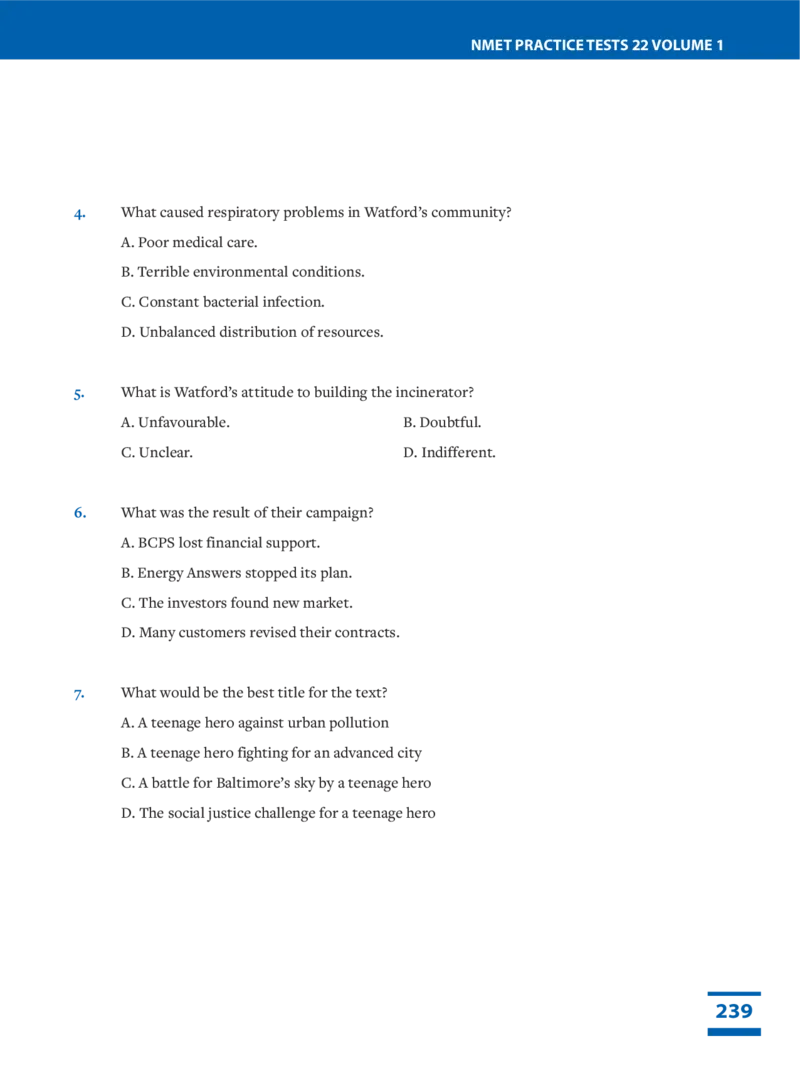
EYLEA
Consumer Brief Summary
This summary contains risk and safety information for patients about EYLEA. It does not
include all the information and does not take the place of talking to your eye doctor.
What is EYLEA?
EYLEA is a medicine that works by blocking vascular endothelial growth factor (VEGF), which
can cause fluid to leak into the macula (视网膜黄斑).
What is EYLEA used for?
EYLEA is indicated for the treatment of patients with:
•
Macular Edema Following Retinal Vein Occlusion (RVO)
•
Diabetic Macular Edema (DME)
•
Diabetic Retinopathy (DR)
How is EYLEA given?
EYLEA is an injection (注射) administered by eye doctor and the injections are given on
different schedules. Confirm with your doctor which schedule is appropriate.
What are the most common side effects of EYLEA?
•
Eye pain
•
Light sensitivity
•
Increased eye redness
For more possible side effects, ask your eye doctor. You are encouraged to report negative side
effects of prescription drugs to the FDA. Visit www.fda.gov/medwatch, or call1-800-FDA-1088.
What should I tell my eye doctor before receiving EYLEA?
•
Infections in or around the eye
•
Eye pain or redness
•
Being allergic to any ingredients in EYLEA
•
Being or planning to be pregnant
236
2024 年山东省临沂市高三模拟考试
Where can I learn more about EYLEA?
For a more comprehensive review of EYLEA safety and risk information, talk to your health care
provider and see the full information at EYLEA.com.
1.
Who is the passage intended for?

A. Eye doctors.


B. Medicine students.

C. Drug researchers.

D. Patients with eye conditions.
2.
How can you learn more about EYLEA?

A. Visit EYLEA.com.

B.Call1-800-FDA-1088.

C. Visit www.fda.gov/medwatch.

D. Talk to a medical professor.
3.
What is this text?

A. A medical report.

B. An introduction to a book.

C. A healthcare contract.


D. A piece of medical instructions.
NMET PRACTICE TESTS 22 VOLUME 1
237
READING B
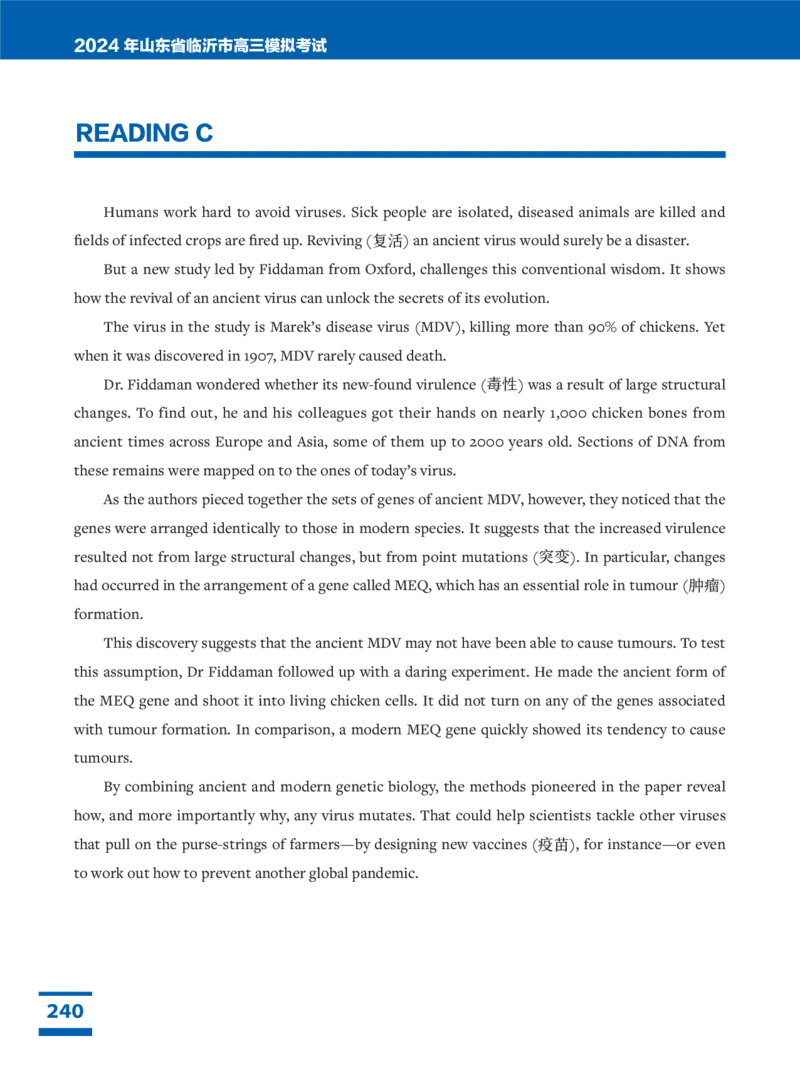
Watford and her family have lived in Curtis Bay, Baltimore for generations. Her community has
faced environmental injustice. Heavy industries continued to move in her community. As a result,
her neighbors have had to live with serious respiratory (呼吸的) problems.
When she knew a plan to build the nation’s largest trash-burning incinerator (焚化炉) less than
a mile away from her high school, she realized she had to take action. The incinerator was being sold
wrongly as clean, renewable energy equipment but actually it would be a source of brain-damaging
chemicals and would release 200 million tons of greenhouse gases per year, both worse than coal
burning. Watford felt she had a responsibility to warn her community to work together to shut this
plant down.
She co-founded Free Your Voice (FYV), a 10-person student organization devoted to community
rights and social justice. Together, they decided to start a campaign to take down Energy Answers,
the incinerator’s developer. They went door-to-door talking to neighbors and organizing protests.
When it was discovered that Baltimore City Public Schools (BCPS) was going to be a customer
of Energy Answers, the organization fought with the board and presented their case, urging BCPS to
withdraw from the project. BCPS was convinced to cancel their contract, which in turn inspired 22
other customers to do the same. Without any financial gain, Energy Answers had no market to move
forward with its plan.
Watford continues to work with Curtis Bay residents toward fair development. They have a
vision for the future which includes building a zero-waste movement, a solar farm, and green jobs.
She wants the entire human family to join the fight for environmental justice because survival as a
species depends on our ability to take action.
238
2024 年山东省临沂市高三模拟考试
4.
What caused respiratory problems in Watford’s community?

A. Poor medical care.

B. Terrible environmental conditions.

C. Constant bacterial infection.

D. Unbalanced distribution of resources.
5.
What is Watford’s attitude to building the incinerator?

A. Unfavourable.


B. Doubtful.

C. Unclear.


D. Indifferent.
6.
What was the result of their campaign?

A. BCPS lost financial support.

B. Energy Answers stopped its plan.

C. The investors found new market.

D. Many customers revised their contracts.
7.
What would be the best title for the text?

A. A teenage hero against urban pollution

B. A teenage hero fighting for an advanced city

C. A battle for Baltimore’s sky by a teenage hero

D. The social justice challenge for a teenage hero
NMET PRACTICE TESTS 22 VOLUME 1
239
READING C
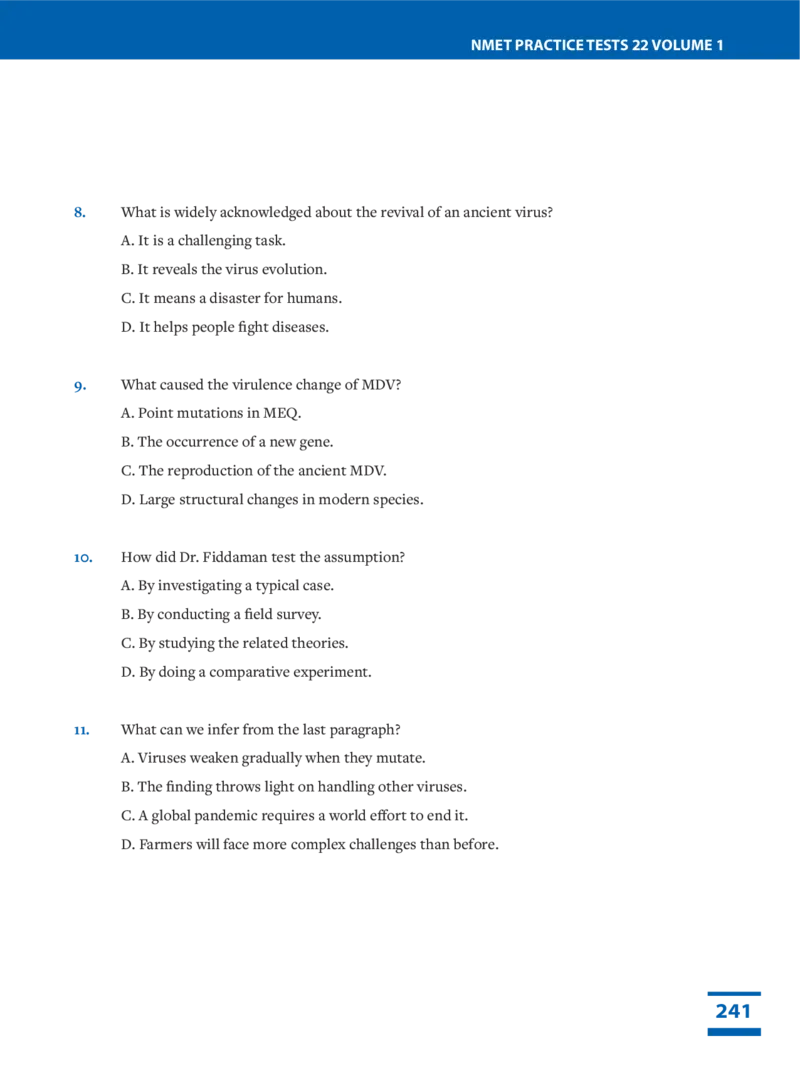
Humans work hard to avoid viruses. Sick people are isolated, diseased animals are killed and
fields of infected crops are fired up. Reviving (复活) an ancient virus would surely be a disaster.
But a new study led by Fiddaman from Oxford, challenges this conventional wisdom. It shows
how the revival of an ancient virus can unlock the secrets of its evolution.
The virus in the study is Marek’s disease virus (MDV), killing more than 90% of chickens. Yet
when it was discovered in 1907, MDV rarely caused death.
Dr. Fiddaman wondered whether its new-found virulence (毒性) was a result of large structural
changes. To find out, he and his colleagues got their hands on nearly 1,000 chicken bones from
ancient times across Europe and Asia, some of them up to 2000 years old. Sections of DNA from
these remains were mapped on to the ones of today’s virus.
As the authors pieced together the sets of genes of ancient MDV, however, they noticed that the
genes were arranged identically to those in modern species. It suggests that the increased virulence
resulted not from large structural changes, but from point mutations (突变). In particular, changes
had occurred in the arrangement of a gene called MEQ, which has an essential role in tumour (肿瘤)
formation.
This discovery suggests that the ancient MDV may not have been able to cause tumours. To test
this assumption, Dr Fiddaman followed up with a daring experiment. He made the ancient form of
the MEQ gene and shoot it into living chicken cells. It did not turn on any of the genes associated
with tumour formation. In comparison, a modern MEQ gene quickly showed its tendency to cause
tumours.
By combining ancient and modern genetic biology, the methods pioneered in the paper reveal
how, and more importantly why, any virus mutates. That could help scientists tackle other viruses
that pull on the purse-strings of farmers—by designing new vaccines (疫苗), for instance—or even
to work out how to prevent another global pandemic.
240
2024 年山东省临沂市高三模拟考试
8.
What is widely acknowledged about the revival of an ancient virus?

A. It is a challenging task.


B. It reveals the virus evolution.

C. It means a disaster for humans.

D. It helps people fight diseases.
9.
What caused the virulence change of MDV?

A. Point mutations in MEQ.

B. The occurrence of a new gene.

C. The reproduction of the ancient MDV.

D. Large structural changes in modern species.
10.
How did Dr. Fiddaman test the assumption?

A. By investigating a typical case.

B. By conducting a field survey.

C. By studying the related theories.

D. By doing a comparative experiment.
11.
What can we infer from the last paragraph?

A. Viruses weaken gradually when they mutate.

B. The finding throws light on handling other viruses.

C. A global pandemic requires a world effort to end it.

D. Farmers will face more complex challenges than before.
NMET PRACTICE TESTS 22 VOLUME 1
241
READING D
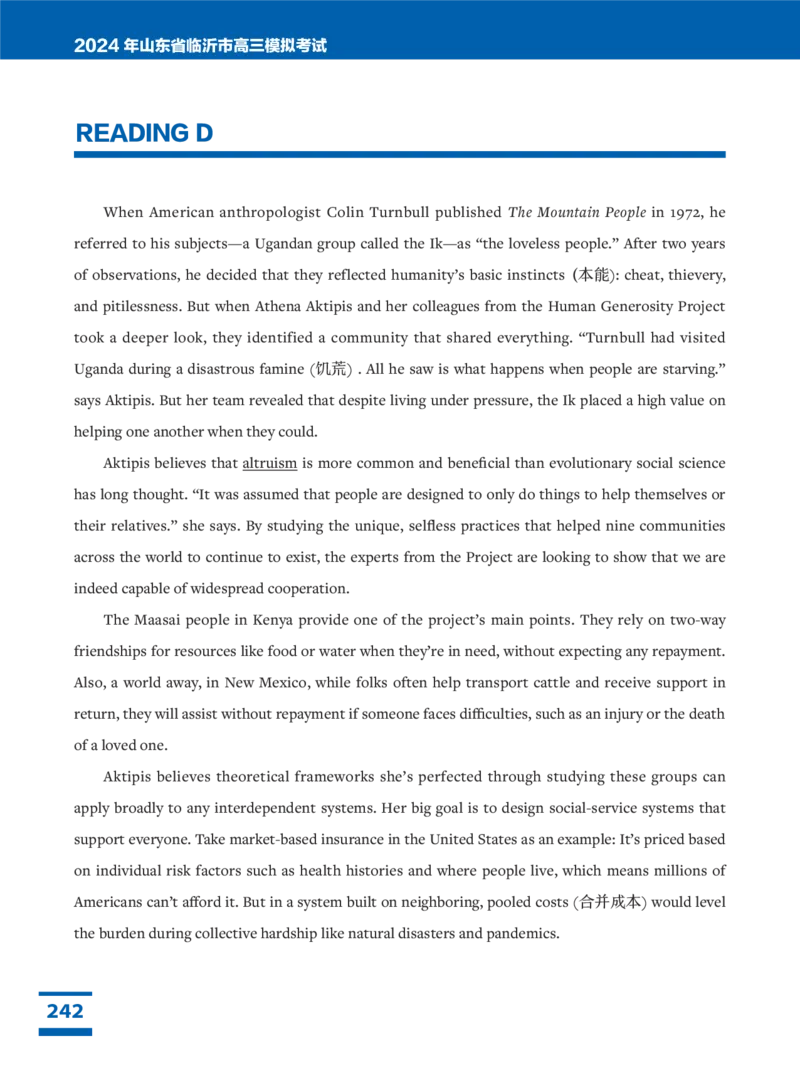
When American anthropologist Colin Turnbull published The Mountain People in 1972, he
referred to his subjects—a Ugandan group called the Ik—as “the loveless people.” After two years
of observations, he decided that they reflected humanity’s basic instincts (本能): cheat, thievery,
and pitilessness. But when Athena Aktipis and her colleagues from the Human Generosity Project
took a deeper look, they identified a community that shared everything. “Turnbull had visited
Uganda during a disastrous famine (饥荒) . All he saw is what happens when people are starving.”
says Aktipis. But her team revealed that despite living under pressure, the Ik placed a high value on
helping one another when they could.
Aktipis believes that altruism is more common and beneficial than evolutionary social science
has long thought. “It was assumed that people are designed to only do things to help themselves or
their relatives.” she says. By studying the unique, selfless practices that helped nine communities
across the world to continue to exist, the experts from the Project are looking to show that we are
indeed capable of widespread cooperation.
The Maasai people in Kenya provide one of the project’s main points. They rely on two-way
friendships for resources like food or water when they’re in need, without expecting any repayment.
Also, a world away, in New Mexico, while folks often help transport cattle and receive support in
return, they will assist without repayment if someone faces difficulties, such as an injury or the death
of a loved one.
Aktipis believes theoretical frameworks she’s perfected through studying these groups can
apply broadly to any interdependent systems. Her big goal is to design social-service systems that
support everyone. Take market-based insurance in the United States as an example: It’s priced based
on individual risk factors such as health histories and where people live, which means millions of
Americans can’t afford it. But in a system built on neighboring, pooled costs (合并成本) would level
the burden during collective hardship like natural disasters and pandemics.
242
2024 年山东省临沂市高三模拟考试
12.
What did Turnbull think of the Ik people?

A. Heartless.


B. Helpful.

C. Restless.


D. Generous.
13.
What does the underlined word “altruism” in paragraph 2 probably mean?

A. Trying to be strong and tough to survive.

B. Making full use of the surrounding resources.

C. Being devoted to themselves or their relatives.

D. Caring about the needs and happiness of others.
14.
What does paragraph 3 intend to convey?

A. Friendships guarantee a well-being life.

B. Folks assist each other to get support.

C. Cooperation is a good and natural instinct.

D. People tend to provide resources for free.
15.
How does Aktipis intend to apply her findings?

A. By designing a policy for public health.

B. By monitoring individual health histories.

C. By creating a system against collective hardship.

D. By lowering insurance prices for individual victims.
NMET PRACTICE TESTS 22 VOLUME 1
243
Mark Covington, founder of the Georgia Street Community Collective in Detroit, stands in a
corner of his urban farm, breathing the fresh air in the early morning. (16) __________ Early in the
day, the green crops giving life to tomatoes, cabbages, eggplants, and more are bathed in gold, as if
being watered by the sun. The sounds of dogs, pigs, roosters, and a group of stirring bees drown out
the sounds of the city.
In 2007, Covington lost his job and returned to his childhood street. (17) __________ “It was
dirty,” he said. “There were always vacant lots, but they had always been maintained for children to
play on.” He knew that if he just cleaned them up, people would pile on them again. (18) __________
Covington started with a small community garden. (19) __________ One mother sent three
children to help him build a larger garden where the kids could grow food, stay busy during the
summer and add structure to their lives. Little by little the seeds took root, as the hands on the
garden that would evolve into a farm multiplied.
 (20) __________ On one corner: a movie screen and a public garden with vegetable and flower
beds. On another: a farm and a community center in a building. Nearby are garlic beds and a
greenhouse. “It’s somewhat spiritual for me,” Covington says. “It’s like a sanctuary (圣殿). People
come here and don’t want to leave.”
COMPLETION
244
2024 年山东省临沂市高三模拟考试
A.
But if he planted stuff, they might not.
B.
It’s a typical morning scene at the collective.
C.
He saw garbage piled high in vacant, abandoned lots.
D.
Covington made the garden a little bigger to plant more.
E.
And almost immediately neighbors began asking to participate.
F.
He planted a garden to help feed residents and enrich their lives.
G.
What began as an effort to remove trash has turned into a site of community.
NMET PRACTICE TESTS 22 VOLUME 1
245
CLOZE
Whatever the patient’s age or disease, a hospital stay can be stressful, especially for kids. Efforts
like Ella’s are a (an) (21) __________ spot during a tough time.
It began in 2018, when Ella celebrated her birthday in a (22) __________ way—a gift drive. Since
then, it has (23) __________ each year in early October, a few weeks before her birthday. Along with a
(an) (24) __________ to her party, Ella’s friends get a list of gift ideas for kids at the hospital. For the
youngest (25) __________ , gifts might include building blocks or stuffed toys. Then it’s time to share
the gifts. “Seeing other people’s (26) __________—that’s all that matters to me,” Ella says.
After the first round, the number of donations (27) __________ every year. But she doesn’t keep
an exact count. (28) __________ , she judges by sight. “We measure how much of the carpet it covers
in our living room,” Ella says. “Last year, it (29) __________  the entire carpet.”
Allison, working at Brigham Children’s Hospital, has seen firsthand the (30) __________ of Ella’s
gift-giving. “She puts smile on the faces of these little patients in our hospital,” Allison says. “They
are all amazed at her (31) __________ at such a young age.”
Ella’s (32) __________ to help kids in the hospital have inspired others to (33) __________ in her
footsteps. Friends have collected and (34) __________ gifts for their birthdays too.
“(35) __________ to others is a good feeling to have at the end of the day,” Ella says. “I want to
keep doing this as long as I can.”
246
2024 年山东省临沂市高三模拟考试
21.
A. independent
B. extra
C. free
D. bright
22.
A. new
B. private
C. fancy
D. natural
23.
A. worked out
B. kicked off
C. given out
D. thought up
24.
A. letter
B. recreation
C. invitation
D. cake
25.
A. workers
B. patients
C. parents
D. nurses
26.
A. happiness
B. recognition
C. behavior
D. admiration
27.
A. changes
B. grows
C. declines
D. maintains
28.
A. Thus
B. Somehow
C. Sometimes
D. Instead
29.
A. reached
B. included
C. decorated
D. covered
30.
A. excitement
B. effect
C. inspiration
D. feature
31.
A. generosity
B. exploration
C. ambition
D. progress
32.
A. promises
B. aims
C. efforts
D. proposals
33.
A. follow
B. engage
C. track
D. mix
34.
A. received
B. counted
C. gathered
D. donated
35.
A. Responding
B. Relating
C. Giving
D. Comparing
NMET PRACTICE TESTS 22 VOLUME 1
247
Playing an instrument or singing in a choir may boost your brain. For generations, parents (36)
__________ (encourage) their children to practice playing musical instruments. Parents have good
reason to prioritize their children’s musical education. Learning an instrument is not only associated
with (37) __________ (good) educational attainment but also with improved cognitive (认知的)
abilities and intelligence (智力) scores in children.
The results of a recent study (38) __________ (investigate) this question showed that musical
people had better memory and the ability to stay (39) __________ (focus) on tasks than those with
less or no musicality.
However, (40) __________ made a difference among those who played an instrument was
whether they continued to play (41) __________ had only played in the past. Current amateur
musicians exhibited the highest cognitive performance among participants.
Continued engagement (42) __________ cognitively stimulating activities, like playing an
instrument, is likely (43) __________ (lead) to sustained brain health. In contrast, playing the
recorder for only three years in primary school may not (44) __________ (significant) impact our
cognitive performance later in life.
Given the overall benefits of learning an instrument or participating in a choir, engaging in such
a cognitive (45) __________ (stimulate) as we age could be beneficial.
GRAMMAR
248
2024 年山东省临沂市高三模拟考试
WRITING
假如你是李华,你校外教Ryan打算开展英语阅读活动,现向学生征求意见,请你给外教回
复一封邮件,陈述建议并给出理由,内容包括:
1.	 材料选择;
2.	阅读形式(小组合作或自主阅读)。
SAMPLE WRITING
Dear Ryan.
All the students are excited about the upcoming English reading activity, and I am writing to
express my opinion about it.
If students are allowed to choose what they read, I believe they will prove to be enthusiastic
readers. Besides, it is beneficial to form reading groups so that we can discuss with those who have
the same taste. Activities like role-play, movie appreciation, or reading experience sharing would
provide more chances for students to better the understanding of the books as well.
Hope my opinion will be helpful and the event will start soon!
Yours.
Li Hua
NMET PRACTICE TESTS 22 VOLUME 1
249
Becky, a 12-year-old girl, was deep in her maths homework. Her father Bill asked her to help
fix the gate of the stall (牛栏). “I couldn’t come out and help, Daddy,” she responded, without even
looking up. “I’ll get extra marks if I do these equations (方程式).”
Frowning, Bill was concerned about Becky. She only loved numbers, showing little interest in
other things. Bill hoped his daughter could enjoy animals and help on their farm.
“Wouldn’t you like to win the blue ribbon competition with your very own calf next year?” Bill
refused to give up. In the competition, children show the calves they raise and the best calf (小牛)
with a large build, well-developed muscles and strong legs would get the blue ribbon.
Becky listened without a word. “You know, raising a calf also requires mathematics, like
calculating the expenses to maintain health and muscle development during growth.” Bill continued.
It seemed that something clicked with Becky, “It might be a perfect opportunity to show my
math talents.” She then followed her dad into the stall. Bill pointed to a new born calf. “Here she is!
Tag 333. She will be the best calf!” Becky looked, and a smile brightened her face. “OK. I’ll give it a
try.”
In the following weeks, she started a journal of projected expenses—vaccinations, registration
fees, vet bills, grain and hay. “She’s finally getting interested in cattle,” Bill thought. But for Becky,
the calf seemed more like a mathematical challenge than a living animal that would require care and
love.
Winter came—the tough time for the calves. One morning, an extreme snowstorm hit. Calves!
Bill and Becky hurried to the stall to check. All the calves were inside except Tag 333! Where was she?
They searched everywhere and finally found her a mile away from the stall. The little calf was lying
still, covered in ice and snow. Her eyelids were sealed shut by glittering frost. “Is she dead?” Becky
cried. Bill pressed his fingers against the calf’s chest. “No. But we need to do something—fast,” he
urged.
CONTINUATION
250
2024 年山东省临沂市高三模拟考试
They rushed the calf into the stall. Bill quickly started a fire while Becky quickly fetched blankets
and wrapped her, rubbing and holding her body gently. “Dad, she is moving!” Becky gave an excited
shout. Then she fed a few drops of warm milk in the calf’s mouth and the tiny jaws moved slightly.
From then on, the first thing Becky did after school was going to the stall and feeding her. Day by
day, Tag 333 became a strong calf with huge brown eyes, and a coat that shone like silk. “She’ll be the
champion in the competition!” Becky thought.
Time flying by,the judging day finally arrived. Flags, musicians, shouting children and bawling
cattle added to the excitement at the county fair. The judge began checking each calf carefully, then
questioned its young owner, who tried hard to describe how good their calves looked like. Becky’s
turn came last. She recited all the numbers since Tag 333’s birth she had clearly memorized. Pointing
to Tag 333, the judge announced, “Ladies and gentlemen, my choice for first place is this one!”
Holding the blue ribbon, Becky realized the experience of love and care is beyond what numbers can
convey.
SAMPLE WRITING
NMET PRACTICE TESTS 22 VOLUME 1
251
READING
A
1. D
2. A
3. D
B
4. B
5. A
6. B
7. C
C
8. C
9. A
10. D
11. B
D
12. A
13. D
14. C
15. C
COMPLETION
16. B
17. C
18. A
19. E
20. G
CLOZE
21. D
22. A
23. B
24. C
25. B
26. A
27. B
28. D
29. D
30. B
31. A
32. C
33. A
34. D
35. C
GRAMMAR
36. have encouraged
37.  better
38. investigating
39. focused
40. what
41. or
42. in
43. to lead
44. significantly
45. stimulator
ANSWER KEY
252
2024 年山东省临沂市高三模拟考试