2024 年高考第二次模拟考试(上海02)
英 语
(考试时间:120分钟 试卷满分:140分)
注意事项:
1.答卷前,考生务必将自己的姓名、考生号等填写在答题卡和试卷指定位置上。
2.回答选择题时,选出每小题答案后,用铅笔把答题卡对应题目的答案标号涂黑。如需改动,用橡
皮擦干净后,再选涂其他答案标号。回答非选择题时,将答案写在答题卡上。写在本试卷上无效。
3.考试结束后,将本试卷和答题卡一并交回。
I.Listening Comprehension (第1-10题, 每题1分;第11-20题,每题1.5分;共25分)
Section A
Directions: In Section A, you will hear ten short conversations between two speakers. At the end of each
conversation, a question will be asked about what was said. The conversations and the questions will be spoken
only once. After you hear a conversation and the question about it, read the four possible answers on your paper,
and decide which one is the best answer to the questions you have heard.
1. A. In a library. B. In a bookstore.
C. In an office. D. In a furniture store.
2. A. Three. B. Six C. Nine. D. Twelve.
3. A. Mother and son. B. Teacher and parent.
C. Husband and wife. D. Teacher and student.
4. A. Doubtful. B. Excited. C. Frustrated. D. Indifferent.
5. A. He had a worthy trip. B. He didn’t enjoy the trip.
C. The trip was too exhausting. D. The trip took him by surprise.
6. A. Press the button of every floor.
B. Take another lift down to the 7th floor.
C. Ask the woman which floor she’s going to.
D. Stay in the same lift to go down to his floor.
7. A. The size of the electric vehicle market.
B. A new trend in the car making industry.
C. The very profitable business of making cakes.D. How manufacturers profit from making electric cars.
8. A. The woman was a new customer of the garage.
B. The woman called to make a complaint about the garage’s service.
C. The woman hadn’t expected the maintenance service to take so long.
D. The woman was satisfied with the improvement in the garage’s service.
9. A. The man didn’t intend to make the woman unhappy.
B. The man thought the woman was being unreasonable.
C. The man believed the woman had misunderstood him.
D. The man wanted to say something upsetting to the woman.
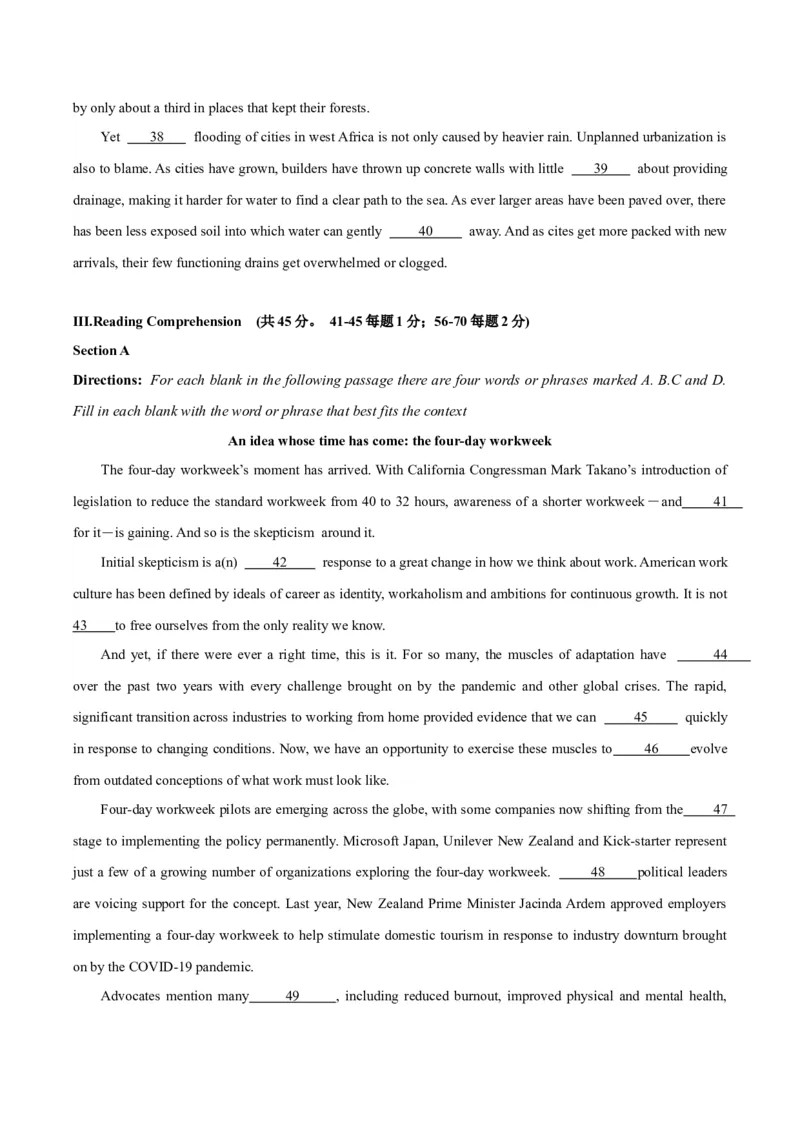
10. A. The woman may need to reevaluate her priorities.
B. The woman should deal with the urgent matters first.
C. The woman has failed to take care of the urgent matters.
D. The woman should keep track of everything using a to-do list.
Section B
Directions: In Section B, you will hear two passages and one longer conversation. After each passage or
conversation, you will be asked several questions. The passages and the conversation will be read twice, but the
questions will be spoken only once. When you hear a question, read the four possible answers on your paper, and
decide which one is the best answer to the question you have heard.
Questions 11 through 13 are based on the following passage.
11. A. He was laughed at by other students.
B. He was interested in studying in his youth.
C. He got his graduate degree at the age of 60.
D. He made his fellow students more open-minded.
12. A. Considerate. B. Independent. C. Intelligent. D. Energetic.
13. A. It is never too late to learn. B. Two heads are better than one.
C. A friend in need is friend indeed. D. You can’t teach an old dog new tricks.
Questions 14 through 16 are based on the following passage.
14. A. Alert. B. Unfocused. C. Awake. D. Busy.
15. A. They are solution providers. B. They are a source of inspiration.
C. They are normally full of bad news. D. They are more educational than websites.16. A. Drink more coffee.
B. Scroll through news websites.
C. Allow ourselves some time to relax.
D. Release our stress with constant complaints.
Questions 17 through 20 are based on the following conversation.
17. A. Open. B. Selfish. C. Friendly. D. Reserved.
18. A. They stay quiet. B. They read a book.
C. They talk about the weather. D. They chat with fellow passengers.
19. A. She was always treated as a foreigner.
B. She was eager to visit an English castle.
C. She was never invited to a colleague’s home.
D. She was unwilling to make friends with workmates.
20. A. Houses are much quieter. B. Houses provide more privacy.
C. They want to have more space. D. They want a garden of their own.
II.Grammar and Vocabulary (每题1分;共20分)
Section A
Directions: After reading the passage below, fill in the blanks to make the passage coherent and grammatically
correct. For the blanks with a given word, fill in each blank with the proper form of the given word; for the other
blanks, use one word that best fits each blank.
What Can One City Do?
People around the world are concerned about global warming and are talking about ways to stop it. The city of
Cambridge, Massachusetts, in the United States, is doing more than just talking. Cambridge wants to become a
world leader in energy-efficient buildings.
Today, Naema Omar is improving her 80-year-old house in Cambridge. To keep the heat inside in the winter,
she is filling the space inside the walls with insulation(绝缘). Insulation is usually made from chemicals, but in her
house, she is using 21 new - insulation made from recycled blue jeans and other clothes. She has also put
in a new type of light called an LED lamp 22 uses only a tiny amount of electricity. The light-bulbs in it
last for 20 to 30 years before needing 23 (change).
But eco-friendly insulation and lighting are much more expensive than the usual kind 24
________many people in Cambridge can’t afford them. A group called Cambridge Energy Alliance (CEA) 25(work) to solve this problem. They want to help every resident and business in the city conserve energy. People can
ask the group to come and look at 26 they can make their house or office building eco-friendly. The CEA
then makes them a plan to save 15 to 30 percent on heating, gas, water, and electricity. Then the group help people
borrow money to pay for the improvements. The money that people save by being 27 (efficient) should
be enough to pay back the loan.
It was ten years ago that the city of Cambridge decided to try to reduce its carbon emissions. More than 80
percent of the carbon dioxide 28 (produce) in Cambridge comes from buildings - not from cars 29
successful, the program will not only save a lot of energy but also make new jobs for local people. Workers 30
(need) to put in insulation, install better doors and windows, and make other energy improvements on buildings.
The CEA hopes that their program will be an example for other cities.
Section B
Directions: Fill in each blank with a proper word chosen from the box. Each word can be used only once.
Note that there is one word more than you need.
A.claimed B.evacuate C. fabrics D.regular E. significantly F. sink
G. rainstorms H. similar I. initially J. swallowing K. thought
“It was a wave of water,” says Oulimata Sambe. She points out the still-sodden(湿透的) armchairs, muddy
wardrobe and the water stain a metre and a half up the wall in her small house in Ngor, a fishing village within
Dakar, the capital of Senegal. “I had two grandkids on my bed, I had to 31 them out of the window,” she
adds. Not faraway, underpasses on Dakar’s scenic corniche(滨海路) became car- 32 lakes. Just weeks earlier
another downpour had turned quiet streets in Dakar into raging rivers and collapsed a section of motorway.
33 events regularly occur across the region. Recent flooding and landslides also killed eight people in
Freetown, the capital of Sierra Leone. In June flooding killed 12 people in Abidjan, the commercial capital of Ivory
Coast. Floods in Lagos, Nigeria’s commercial capital, 34 another seven lives. Even when they are not
deadly, city floods ruin lives and livelihoods. Storm water recently flooded the biggest textile market in Kano, a
city in northern Nigeria, destroying hundreds of thousands of dollars’ worth of 35 .
Unusually heavy rains have become 36 more common over the past 30 years, leaving huge numbers of
people at risk. In places this is partly because of deforestation. A recent study by Christopher Taylor of the UK
Centre for Ecology and Hydrology, a research institute, and his coauthors found that afternoon 37 in
deforested parts of coastal west Africa happen twice as often compared with 30 years ago. Their frequency went upby only about a third in places that kept their forests.
Yet 38 flooding of cities in west Africa is not only caused by heavier rain. Unplanned urbanization is
also to blame. As cities have grown, builders have thrown up concrete walls with little 39 about providing
drainage, making it harder for water to find a clear path to the sea. As ever larger areas have been paved over, there
has been less exposed soil into which water can gently 40 away. And as cites get more packed with new
arrivals, their few functioning drains get overwhelmed or clogged.
III.Reading Comprehension (共45分。 41-45每题1分;56-70每题2分)
Section A
Directions: For each blank in the following passage there are four words or phrases marked A. B.C and D.
Fill in each blank with the word or phrase that best fits the context
An idea whose time has come: the four-day workweek
The four-day workweek’s moment has arrived. With California Congressman Mark Takano’s introduction of
legislation to reduce the standard workweek from 40 to 32 hours, awareness of a shorter workweek-and 41
for it-is gaining. And so is the skepticism around it.
Initial skepticism is a(n) 42 response to a great change in how we think about work. American work
culture has been defined by ideals of career as identity, workaholism and ambitions for continuous growth. It is not
43 to free ourselves from the only reality we know.
And yet, if there were ever a right time, this is it. For so many, the muscles of adaptation have 44
over the past two years with every challenge brought on by the pandemic and other global crises. The rapid,
significant transition across industries to working from home provided evidence that we can 45 quickly
in response to changing conditions. Now, we have an opportunity to exercise these muscles to 46 evolve
from outdated conceptions of what work must look like.
Four-day workweek pilots are emerging across the globe, with some companies now shifting from the 47
stage to implementing the policy permanently. Microsoft Japan, Unilever New Zealand and Kick-starter represent
just a few of a growing number of organizations exploring the four-day workweek. 48 political leaders
are voicing support for the concept. Last year, New Zealand Prime Minister Jacinda Ardem approved employers
implementing a four-day workweek to help stimulate domestic tourism in response to industry downturn brought
on by the COVID-19 pandemic.
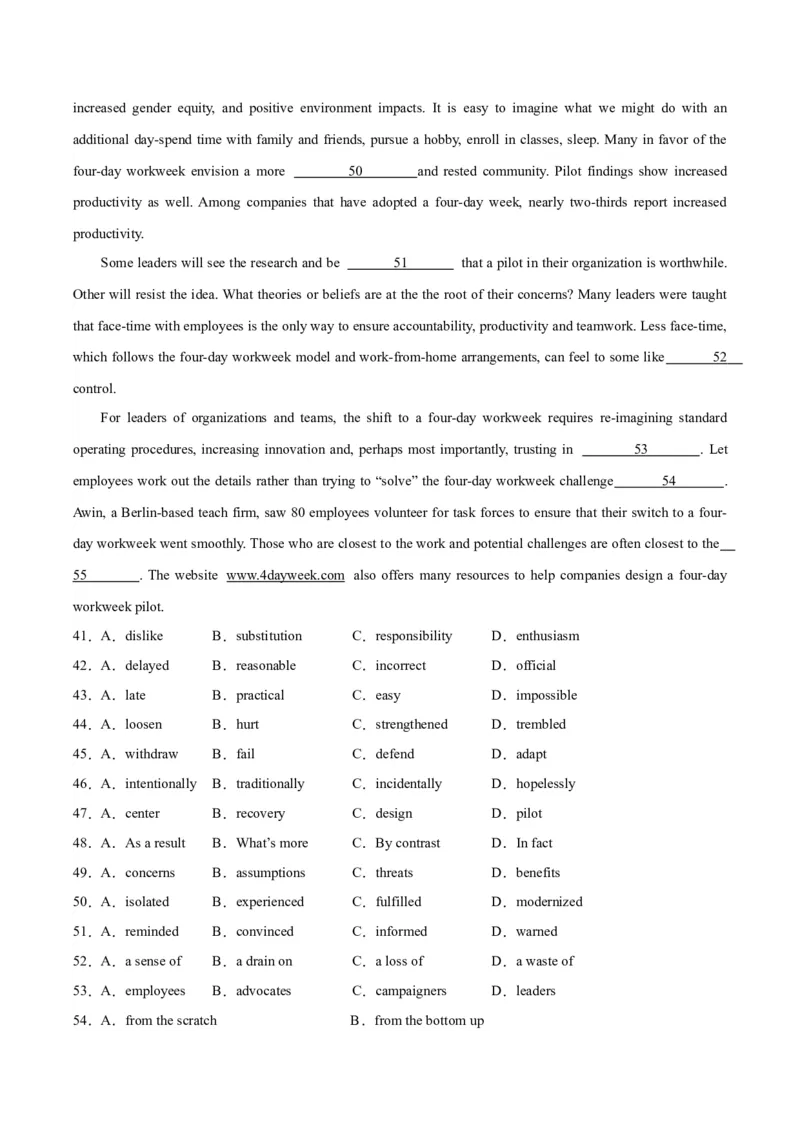
Advocates mention many 49 , including reduced burnout, improved physical and mental health,increased gender equity, and positive environment impacts. It is easy to imagine what we might do with an
additional day-spend time with family and friends, pursue a hobby, enroll in classes, sleep. Many in favor of the
four-day workweek envision a more 50 and rested community. Pilot findings show increased
productivity as well. Among companies that have adopted a four-day week, nearly two-thirds report increased
productivity.
Some leaders will see the research and be 51 that a pilot in their organization is worthwhile.
Other will resist the idea. What theories or beliefs are at the the root of their concerns? Many leaders were taught
that face-time with employees is the only way to ensure accountability, productivity and teamwork. Less face-time,
which follows the four-day workweek model and work-from-home arrangements, can feel to some like 52
control.
For leaders of organizations and teams, the shift to a four-day workweek requires re-imagining standard
operating procedures, increasing innovation and, perhaps most importantly, trusting in 53 . Let
employees work out the details rather than trying to “solve” the four-day workweek challenge 54 .
Awin, a Berlin-based teach firm, saw 80 employees volunteer for task forces to ensure that their switch to a four-
day workweek went smoothly. Those who are closest to the work and potential challenges are often closest to the
55 . The website www.4dayweek.com also offers many resources to help companies design a four-day
workweek pilot.
41.A.dislike B.substitution C.responsibility D.enthusiasm
42.A.delayed B.reasonable C.incorrect D.official
43.A.late B.practical C.easy D.impossible
44.A.loosen B.hurt C.strengthened D.trembled
45.A.withdraw B.fail C.defend D.adapt
46.A.intentionally B.traditionally C.incidentally D.hopelessly
47.A.center B.recovery C.design D.pilot
48.A.As a result B.What’s more C.By contrast D.In fact
49.A.concerns B.assumptions C.threats D.benefits
50.A.isolated B.experienced C.fulfilled D.modernized
51.A.reminded B.convinced C.informed D.warned
52.A.a sense of B.a drain on C.a loss of D.a waste of
53.A.employees B.advocates C.campaigners D.leaders
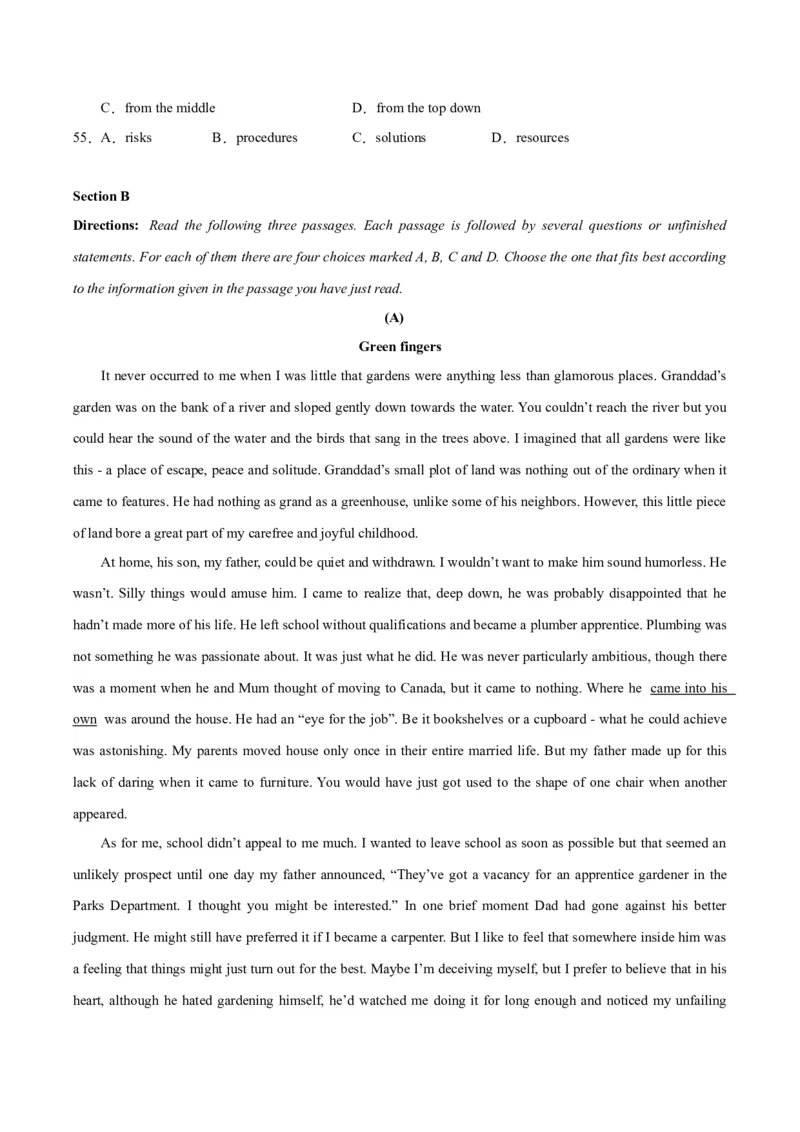
54.A.from the scratch B.from the bottom upC.from the middle D.from the top down
55.A.risks B.procedures C.solutions D.resources
Section B
Directions: Read the following three passages. Each passage is followed by several questions or unfinished
statements. For each of them there are four choices marked A, B, C and D. Choose the one that fits best according
to the information given in the passage you have just read.
(A)
Green fingers
It never occurred to me when I was little that gardens were anything less than glamorous places. Granddad’s
garden was on the bank of a river and sloped gently down towards the water. You couldn’t reach the river but you
could hear the sound of the water and the birds that sang in the trees above. I imagined that all gardens were like
this - a place of escape, peace and solitude. Granddad’s small plot of land was nothing out of the ordinary when it
came to features. He had nothing as grand as a greenhouse, unlike some of his neighbors. However, this little piece
of land bore a great part of my carefree and joyful childhood.
At home, his son, my father, could be quiet and withdrawn. I wouldn’t want to make him sound humorless. He
wasn’t. Silly things would amuse him. I came to realize that, deep down, he was probably disappointed that he
hadn’t made more of his life. He left school without qualifications and became a plumber apprentice. Plumbing was
not something he was passionate about. It was just what he did. He was never particularly ambitious, though there
was a moment when he and Mum thought of moving to Canada, but it came to nothing. Where he came into his
own was around the house. He had an “eye for the job”. Be it bookshelves or a cupboard - what he could achieve
was astonishing. My parents moved house only once in their entire married life. But my father made up for this
lack of daring when it came to furniture. You would have just got used to the shape of one chair when another
appeared.
As for me, school didn’t appeal to me much. I wanted to leave school as soon as possible but that seemed an
unlikely prospect until one day my father announced, “They’ve got a vacancy for an apprentice gardener in the
Parks Department. I thought you might be interested.” In one brief moment Dad had gone against his better
judgment. He might still have preferred it if I became a carpenter. But I like to feel that somewhere inside him was
a feeling that things might just turn out for the best. Maybe I’m deceiving myself, but I prefer to believe that in his
heart, although he hated gardening himself, he’d watched me doing it for long enough and noticed my unfailingpassion for all things that grew and flowered and fruited.
56.When the writer describes his granddad’s garden, he is ________.
A.proud that his granddad was such a good gardener
B.embarrassed that the garden was not as good as others nearby
C.annoyed that items in the garden were often damaged
D.positive about the time he spent in the garden
57.What is the writer’s attitude to his father in the second paragraph?
A.He was regretful that his father had not achieved more.
B.He was annoyed that his father used words he didn’t understand.
C.He was sympathetic to the reasons why his father behaved as he did.
D.He was grateful that his father had not taken the family to Canada.
58.What does the writer mean by the underlined phrase “came into his own”?
A.was able to do something by himself
B.was able to show how talented he was
C.was able to continue his day job
D.was able to forget his failure
59.What does the writer think is the reason behind his father’s decision in the last paragraph?
A.His father did not manage to make a better judgment.
B.His father was tired of disagreeing with his son.
C.His father had been impressed by his son’s love of gardening.
D.His father came to realize the charm of gardening.
(B)
INNOVATION CUP 2022Great minds come together at Merck
What’s in it for me? How it works:
If you are a post-graduate student with an interest in During a one-week Summer Camp, 50 selected
the pharmaceutical and chemical industry, the Merck students will attend in-depth presentations about the
Innovation Cup is your chance to gain in-depth pharmaceutical and chemical industry given by Merck
knowledge about research and development, to network researchers and managers. The participants will be
with top students from around the world and to build a divided into teams, work together to develop a business
business case together with experienced professionals. plan and present it to a grand jury, who will award the
Merck Innovation Cup for the best plan along with a
Who can apply:
cash prize of EUR 20,000 plus EUR 5,000 for the
Advanced students and postdocs in the fields of life runner-up.
science, data science and business administration from
A conference with alumni of previous Innovation
all over the world can apply:
Cup editions will be held on the first day of the
Sciences: Post graduate students on their way Summer Camp.towards a PhD in biology, medicine, biotech, Further information about the program and how to
bioinformatics, data sciences, biochemistry, chemistry, apply online from November 1, 2021, until January 31,
pharmacy, physics or engineering. 2022:
Business: Advanced MBA students and recent MBA http://innovationcup.merckgroup.com
graduates with an interest in the pharmaceutical and
Location:
chemical business and a science background.
Near Frankfurt, Germany, June 20 - 26, 2022.
The Innovation Cup will comprise the following
team topics: oncology, immuno-oncology, autoimmunity, Travel, accommodation and food expenses will be
drug discovery technologies digitalization. paid by Merck.
60.Who can apply to participate in the event?
A.High school students interested in life science.
B.Post-graduate students majoring in mathematics.
C.MBA graduates knowledgeable about finance.
D.Exceptional students specializing in developing new drugs.
61.What’s the purpose of this passage?
A.To deepen top students’ interest in innovation.
B.To attract talent to the Innovation Cup competition
C.To promote the Merck company around the world.
D.To inform alumni of an important conference.
62.Which of the following is true about the event?
A.Merck will cover the expenses of travel, research and food.
B.The event plans to select 50 researchers to give presentations.
C.The top two winners of the Cup will be awarded cash prizes.
D.Applicants should apply online within a duration of two months.
(C)
That everyone’s too busy these days is a cliche. But one specific complaint is made frequently: There’s never
any time to read. A professional reader, the novelist and critic Tim Parks, wrote in a New York Review of Books
essay: “Every moment of serious reading has to be fought for, planned for.” Parks wrote that in June; last month, I
finally found time to read it.
What makes the problem thornier is that the usual time-management techniques don’t seem sufficient. The
web’s full of articles offering tips on making time to read: “Give up TV” or “Carry a book with you at all times”.
But in my experience, using such methods to free up the odd 30 minutes doesn’t work. Sit down to read and the
flywheel of work-related thoughts keeps spinning — or else you’re so exhausted that a challenging book’s the last
thing you need. “The modern mind,” Parks writes, “is overwhelmingly inclined toward communication ... It is notsimply that one is interrupted; it is that one is actually inclined to interruption.” Deep reading requires not just time,
but a special kind of time which can’t be obtained merely by becoming more efficient.
In fact, “becoming more efficient” is part of the problem. Thinking of time as a resource to be maximized
means you approach it instrumentally, judging any given moment as well spent only in so far as it advances
progress toward some goal. Immersive reading, by contrast, depends on being willing to risk inefficiency,
goallessness, even time-wasting. Try to slot it as a to-do list item and you’ll manage only goal-focused reading —
useful, sometimes, but not the most fulfilling kind. “The future comes at us like empty bottles along an unstoppable
and nearly infinite convey or belt,” writes Gary Eberle in his book Sacred Time, and “we feel a pressure to fill these
different-sized bottles (days, hours, minutes) as they pass, for if they get by without being filled, we will have
wasted them”. No mind-set could be worse for losing yourself in a book.
So what does work? Perhaps surprisingly, scheduling regular times for reading. You’d think this might fuel the
efficiency mind-set, but in fact, Eberle notes, such ritualistic behaviour helps us “step outside time’s flow” into
“soul time”. You could limit distractions by reading only physical books, or on single-purpose e-readers. “Carry a
book with you at all times” can actually work, too-providing you dip in often enough, so that reading becomes the
default state from which you temporarily surface to take care of business, before dropping back down. On a really
good day, it no longer feels as if you’re “making time to read,” but just reading, and making time for everything
else.
63.The usual time-management techniques don’t work because _________.
A.what they can offer does not ease the modern mind
B.what challenging books demand it repetitive reading
C.what people often forget is carrying a book with them
D.what deep reading requires cannot be guaranteed
64.The “empty bottles” metaphor illustrates that people feel a pressure to _________.
A.update their to-do lists B.make passing time fulfilling
C.carry their plans through D.pursue carefree reading
65.Eberle would agree that scheduling regular times for reading helps __________.
A.encourage the efficiency mind-set B.develop online reading habits
C.promote ritualistic reading D.achieve immersive reading
66.“Carry a book with you at all times” can work if _________.
A.reading becomes your primary business of the day
B.all the daily business has been promptly dealt withC.you are able to drop back to business after reading
D.time can be evenly split for reading and business
Section C
Directions: Complete the following passage by using the sentences in the box Each sentence can only be used
once. Note that there are two sentences more than you need.
How to Thrive in a video age
The pandemic embedded video into the workplace. Workers who had never previously been on camera
suddenly spent every hour of the day getting used to the sight of themselves and their colleagues on screen. 67
There is no going back. Blogs have become vlogs. Meetings are now recorded as a matter so that people can
fail to watch them back later. Some firms routinely ask applicants to record answers to certain questions on video,
so that people can’t see how well prospective recruits communicate.
Since video has become more central to work, it pays to be good at it. 68 . Workers can
improve under their own steam, but companies can help, too.
To see what the right set-up looks like, just observe the range of images on your next, video-conferencing call.
It will probably be a complete mishmash (大杂烩). Some people will be bathed in the warm glow of a ring light;
others will be emerging from the shadows like the Emperor Palpatine. Obviously, there is a limit to how level the
playing-field-between home offices can be, when living environments between employees differ so greatly. 69
: people who regularly make presentations or see clients have greater claim on fancier equipment.
Advice on how to present well on video is not that different to advice on presenting in general. But there are
some specific pitfalls with video. One is where to look. Staring into the camera is unnatural. Some advice pinning a
photo of someone you respect right by the lens. But looking at the camera is harder if you are referring to notes no
the screen at the same time. Teleprompter (提词器) software maybe the right answer.
Perhaps the least recognised skill in the video age is listening well. 70 — being able to turn
your camera off when your time is being royally wasted may be the pandemic’s greatest gift to productivity. Yet
one of the downsides is how distracting it can be: as well as checking yourself out and following the online chat,
you can comment on someone’s new wallpaper while watching their neighbour shovel noodles into their mouth. It
takes real effort to stay focused in such circumstances.
A.Being a star in the video age means having the right set-up, speaking well and listening well
B.Whether providing decent home-working equipment or giving feedback on how people appear on
screen, employers can help everyone improve their video gameC.Whether you are on camera or in the room, it is always easier to listen when there is something
worth hearing
D.Executives realized that they could send video messages to their workforces rather than having to
assemble in town halls
E.However, not everyone needs to look like an A-lister
F.After all, one great benefit of the virtual meeting is that you can get actual work done in it
IV.Summary Writing (共10分)
Directions: Read the following passage. Summarize the main idea and the main point( s)of the passage in no more
than 60 words. Use your own words as far as possible.
What do We Know About “Mathephobia”
Mathematician Mary de Lellis Gough, who often observed her struggling students fail to work out
mathematical problems, coined the term ‘mathephobia’ in 1953. She described it as “a disease that proves fatal
before its presence is detected”. Other experts have defined it as “the panic, helplessness and mental
disorganization that arises among some people when they are required to solve a mathematical problem” and “a
general fear of contact with mathematics”.
Sian Beilock, a cognitive scientist and her colleagues of Barnard College in New York have shown that math
anxiety can start as soon as we enter formal schooling. “Math is one of the first places in school in western cultures
where we really learn about whether we got something right or wrong, and are exposed to being evaluated in timed
tests.”
Girls may be more prone to it than boys. Primary school teachers often have high levels of math anxiety, says
Beilock, and in the US and elsewhere, they are mostly female. Since young children tend to identify with adults of
the same gender, this means girls are more likely to pick up math anxiety from their female teachers. Having a
female teacher with math anxiety makes girls more likely to believe gendered stereotypes about math, leading to
poorer achievement.
“Once you have it, it can be self-lasting. Worrying about it can make it worse.” says Beilock, whose study of
children between the ages of five and eight suggests math anxiety might weaken performance by burdening
working memory. “As our ability to focus limited, our attention gets divided when we do more than one task at a
time.” she says. “If you’re worried about having to do math, you may have an internal monologue saying you can’t
do this and at the same time you’re trying to calculate numbers.”
When people have math anxiety, they tend to avoid the subject, as researchers from 2019 show. But since math
builds on itself, avoiding it makes it harder to catch up. “Math is foundational. If you miss a certain idea, it’s harderto learn the next one.” says Darcy Hallett. “And then you can fall behind, which might make math more of a
targeted anxiety compared to other topics.”
____________________________________________________________________________________________
____________________________________________________________________________________________
____________________________________________________________________________________________
____________________________________________________________________________________________
________________________________________________________________________________________
V.Translation (共15分。第1小题和第2小题,每题3分;第3题4分;第4题5分。)
Directions:Translate the following sentences into English, using the words given in the brackets
72.书展的门票只能提前一天在网上购买。(available)
73.一个连头盔都不肯戴的骑车人怎么可能会有安全意识?(How)
74.尽管有网红受邀为这款产品站台,消费者仍需考虑价格、质量等诸多因素。(account)
75.新落成的学校拔地而起,已不是5年前的学校了,它配以现代化设施,为学生营造出良好的学习环境。
(equip)
VI.Guided Writing (共25分)
Directions: Write an English composition in 120-150 words according to the instructions given below in Chinese
毕业前夕,由高三各班选出的学生代表召开了一个会议,讨论为母校送上一份礼物。经过讨论,最终他们
定下了如下两个方案:
方案一:以年级的名义捐给学校一棵树;
方案二:为母校拍一部新学期的招生短视频。
现在,他们通过WeLink校园网征询年级同学们的意见。假设你是李华,请你写一封邮件给高三学生代表
团表达你的想法。你的邮件必须包含:
1.你选择哪个方案;
2.通过比较说明你的理由。
____________________________________________________________________________________________
____________________________________________________________________________________________
____________________________________________________________________________________________
____________________________________________________________________________________________
__________________________________________________________________________________________