文档文本内容
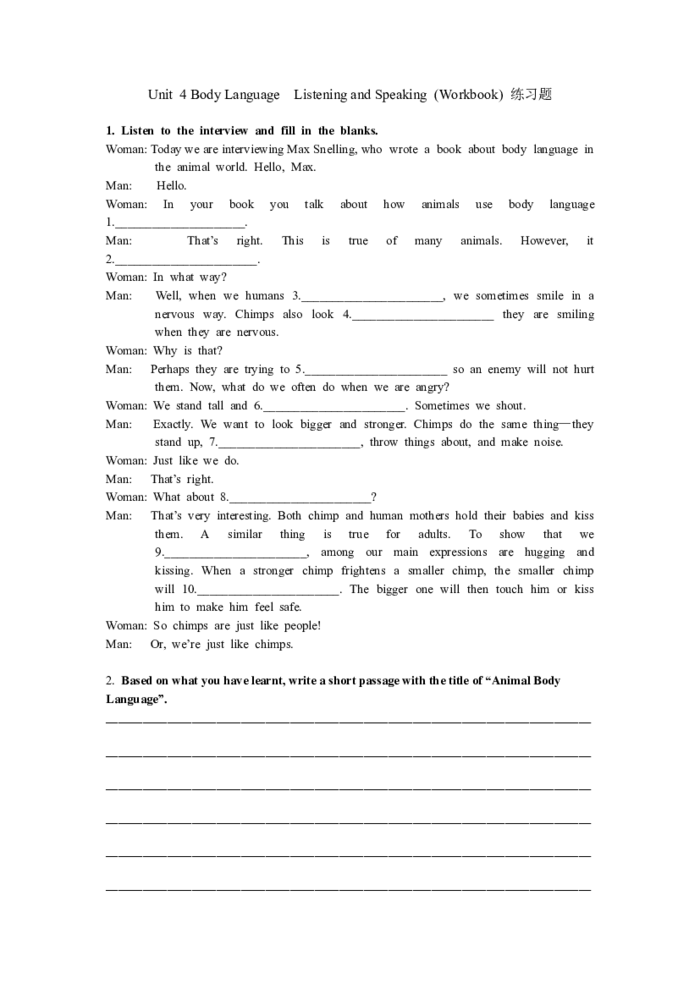
Unit 4 Body Language  Listening and Speaking (Workbook) 练习题
1. Listen to the interview and fill in the blanks.
Woman: Today we are interviewing Max Snelling, who wrote a book about body language in
the animal world. Hello, Max.
Man:    Hello.
Woman:
In
your
book
you
talk
about
how
animals
use
body
language
1._____________________.
Man:


That’s
right.
This
is
true
of
many
animals.
However,
it
2._______________________.
Woman: In what way?
Man:   Well, when we humans 3._______________________, we sometimes smile in a
nervous way. Chimps also look 4._______________________ they are smiling
when they are nervous.
Woman: Why is that?
Man:   Perhaps they are trying to 5._______________________ so an enemy will not hurt
them. Now, what do we often do when we are angry?
Woman: We stand tall and 6._______________________. Sometimes we shout.
Man:   Exactly. We want to look bigger and stronger. Chimps do the same thing—they
stand up, 7._______________________, throw things about, and make noise.
Woman: Just like we do.
Man:   That’s right.
Woman: What about 8._______________________?
Man:   That’s very interesting. Both chimp and human mothers hold their babies and kiss
them.
A
similar
thing
is
true
for
adults.
To
show
that
we
9._______________________, among our main expressions are hugging and
kissing. When a stronger chimp frightens a smaller chimp, the smaller chimp
will 10._______________________. The bigger one will then touch him or kiss
him to make him feel safe.
Woman: So chimps are just like people!
Man:   Or, we’re just like chimps.
2. Based on what you have learnt, write a short passage with the title of “Animal Body
Language”.
_______________________________________________________________________________
_______________________________________________________________________________
_______________________________________________________________________________
_______________________________________________________________________________
_______________________________________________________________________________
_______________________________________________________________________________
_______________________________________________________________________________
Unit 4 Body Language  Listening and Speaking (Workbook) 练习题答案
1. Listen to the interview and fill in the blanks.
1. the same way as people do
2. is especially true of chimps
3. are worried or frightened
4. as though
5. look friendly
6. put our hands on our sides
7. move their arms around
8. in family relationships
9. accept and love each other
10. hold his head low
2. Based on what you have learnt, write a short passage with the title of “Animal Body
Language”.
One possible version:
Animals often use body language to show their emotions. For example, when it
wants to show fear and tell you to stay away, a polar bear will slap the ground. This is
very different from a dog, which will put its tail between its legs to show fear. Of
course, polar bears also slap the ground when they are angry—for example, if a polar
bear is trying to catch a seal and the seal gets away, the bear may throw a fit.
Sometimes polar bears wag their heads from side to side when they see another bear.
While this could mean that the bear is worried, if the bear stands up on its hind legs
with its paws hanging down, it probably means it wants to play. A polar bear who wants
to show that it is friends to another bear will often slowly circle the other bear, and then
slowly move forward with its head down and touch its nose to the other bear’s nose. Of
course, if a polar bear rushes forward with its head down, beware! It could mean that it
just wants you to go away. However, there is a good chance that it is going to attack.