文档文本内容
Unit 2 Looking into the Future  Listening and Speaking(Workbook) 练习题
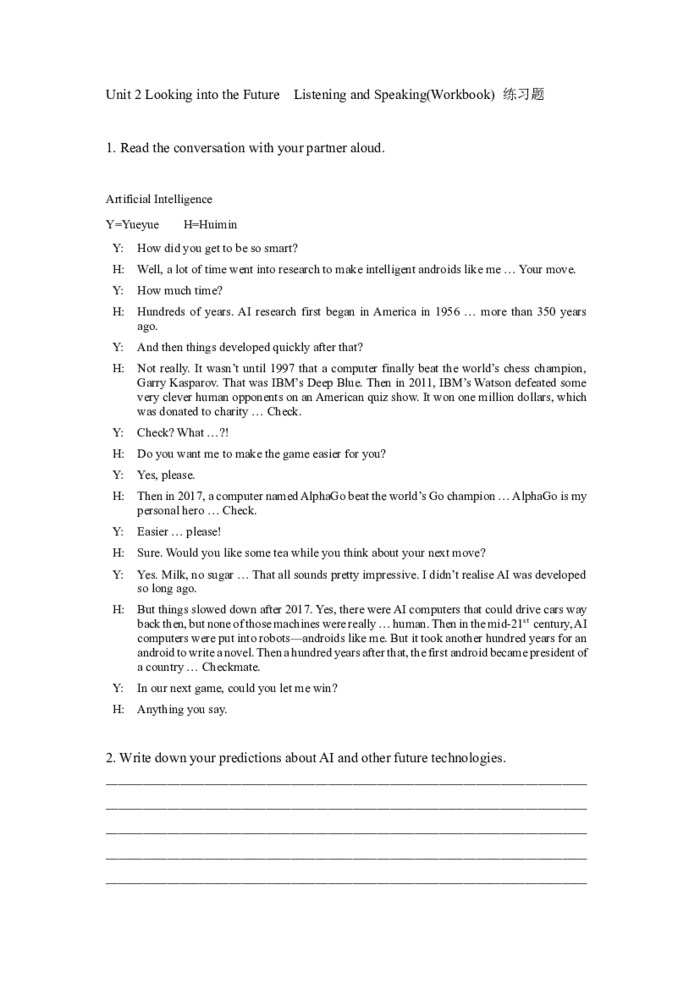
1. Read the conversation with your partner aloud.
Artificial Intelligence
Y=Yueyue    H=Huimin
Y:
How did you get to be so smart?
H:
Well, a lot of time went into research to make intelligent androids like me … Your move.
Y:
How much time?
H:
Hundreds of years. AI research first began in America in 1956 … more than 350 years
ago.
Y:
And then things developed quickly after that?
H:
Not really. It wasn’t until 1997 that a computer finally beat the world’s chess champion,
Garry Kasparov. That was IBM’s Deep Blue. Then in 2011, IBM’s Watson defeated some
very clever human opponents on an American quiz show. It won one million dollars, which
was donated to charity … Check.
Y:
Check? What …?!
H:
Do you want me to make the game easier for you?
Y:
Yes, please.
H:
Then in 2017, a computer named AlphaGo beat the world’s Go champion … AlphaGo is my
personal hero … Check.
Y:
Easier … please!
H:
Sure. Would you like some tea while you think about your next move?
Y:
Yes. Milk, no sugar … That all sounds pretty impressive. I didn’t realise AI was developed
so long ago.
H:
But things slowed down after 2017. Yes, there were AI computers that could drive cars way
back then, but none of those machines were really … human. Then in the mid-21st century, AI
computers were put into robots—androids like me. But it took another hundred years for an
android to write a novel. Then a hundred years after that, the first android became president of
a country … Checkmate.
Y:
In our next game, could you let me win?
H:
Anything you say.
2. Write down your predictions about AI and other future technologies.
———————————————————————————————————————
———————————————————————————————————————
———————————————————————————————————————
———————————————————————————————————————
———————————————————————————————————————