主题语境:人与自我
主题群:生活与学习
语篇类型:说明文
来源:marker.medium.com 20200402
Word count:525
Flesch-Kincaid Grade Level:10.7
What Everyone’s Getting Wrong About the Toilet Paper
Shortage
It isn’t really about hoarding. And there isn’t an easy fix.
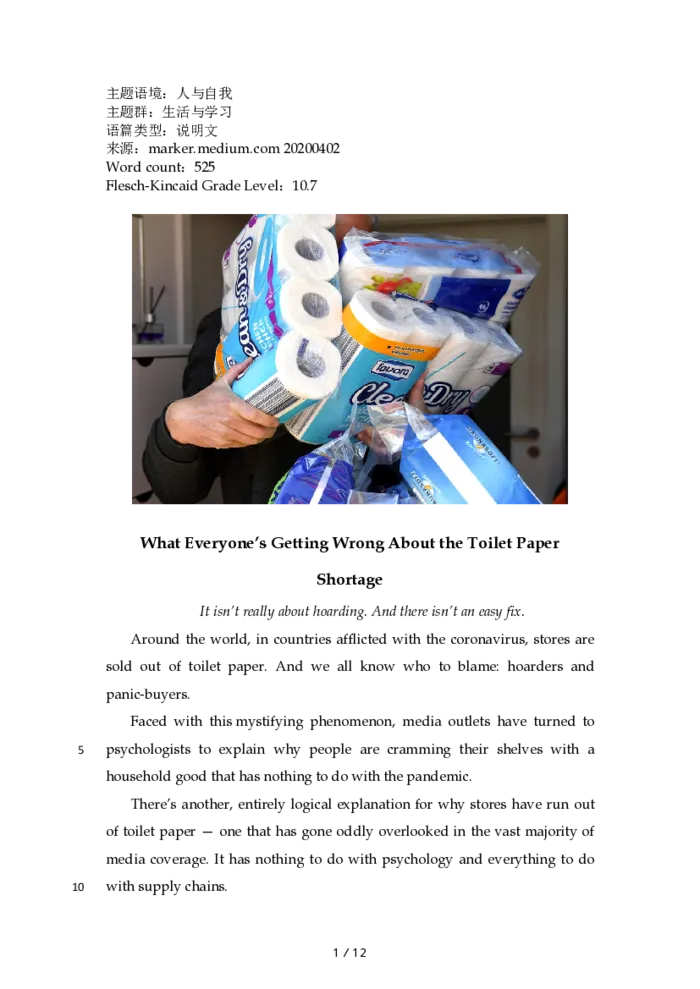
Around the world, in countries afflicted with the coronavirus, stores are
sold out of toilet paper. And we all know who to blame: hoarders and
panic-buyers.
Faced with this mystifying phenomenon, media outlets have turned to
psychologists to explain why people are cramming their shelves with a
5
household good that has nothing to do with the pandemic.
There’s another, entirely logical explanation for why stores have run out
of toilet paper — one that has gone oddly overlooked in the vast majority of
media coverage. It has nothing to do with psychology and everything to do
with supply chains.
10
1/12
In short, the toilet paper industry is split into two, largely separate
markets: commercial and consumer. The pandemic has shifted the lion’s share
of demand to the latter. People actually do need to buy significantly more
toilet paper during the pandemic — not because they’re making more trips to
the bathroom, but because they’re making more of them at home. With some
15
75% of the U.S. population under stay-at-home orders, Americans are no
longer using the restrooms at their workplace, in schools, at restaurants, at
hotels, or in airports.
Georgia-Pacific, a leading toilet paper manufacturer based in Atlanta,
estimates that the average household will use 40% more toilet paper than
20
usual if all of its members are staying home around the clock. That’s a huge
leap in demand for a product whose supply chain is predicated on the
assumption that demand is essentially constant. It’s one that won’t fully
subside even when people stop hoarding or panic-buying.
If you’re looking for where all the toilet paper went, forget about people’s
25
attics or hall closets. Think instead of all the toilet paper that normally goes to
the commercial market — those office buildings, college campuses, Starbucks,
and airports that are now either mostly empty or closed. That’s the toilet
paper that’s suddenly going unused.
So why can’t we just send that toilet paper to Safeway or CVS? That’s
30
where supply chains and distribution channels come in.
Talk to anyone in the industry, and they’ll tell you the toilet paper made
for the commercial market is a fundamentally different product from the toilet
paper you buy in the store. It comes in huge rolls, too big to fit on most home
dispensers. The paper itself is thinner and more utilitarian. It comes
35
individually wrapped and is shipped on huge pallets, rather than in brightly
branded packs of six or 12.
In theory, some of the mills that make commercial toilet paper could try to
redirect some of that supply to the consumer market. But the industry can’t
just flip a switch. Because toilet paper is high volume but low value, the
40
2/12
industry runs on extreme efficiency, with mills built to work at full capacity
around the clock even in normal times. That works only because demand is
typically so steady. If toilet paper manufacturers spend a bunch of money
now to refocus on the retail channel, they’ll face the same problem in reverse
once people head back to work again.
45
If there’s any good news, it’s that we can stop blaming these shortages on
the alleged idiocy of our fellow consumers.
3/12
话题:人与社会(文学艺术)
体裁:说明文
来源:News.artnet.com, 20190312
词数:281
FK Grade Level: 13.4

Do You Really, Really, Really Love Yves Klein? Well, Now You
Can Paint Your Entire Home in His Proprietary Blue
Here’s your chance to bring fine art supplies into your living room.
If you’re looking to bring a bit of Yves Klein into your home, we have
some good news for you.
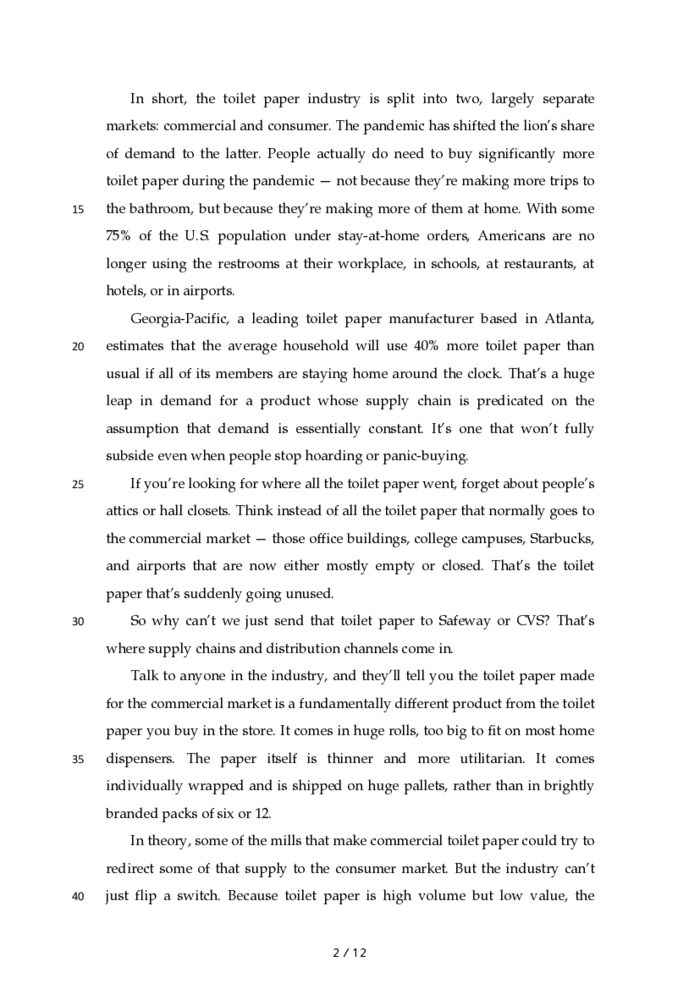
Thanks to the high-end decorative paint company Ressource, you can
now paint your walls with a color very close to the French artist’s
International Klein Blue, and it won’t cost you seven figures at auction.
5
In cooperation with the Yves Klein Estate, the company is marking what
would have been Klein’s 90th birthday by releasing a paint (dubbed Yves
Klein®) that is inspired by the artist’s signature color. Available in matte and
velvet matte finishes, the paint sets (available at the company’s New York
4/12
showroom are selling for $100 per liter (you also get a liter of undercoat).
10
That’ll cover about 85 square feet—so not much, but still a deal compared
with the $22 million it cost the buyer of Klein’s Archisponge (Re11) (1960),
which sold at Sotheby’s in 2008.
So what’s the backstory? In the mid-1950s, Klein began making
monochromatic paintings, to which he would apply layers of paint to build
15
up an even surface without any variation, achieving what he called “the
Unity.” After experimenting with a variety of colors, all of which were
dubbed “Expressions of the Universal Color,” he decided to focus just on
blue.
Working with a paint supplier named Edouard Adam, who helped Klein
20
develop a resin binder called polyvinyl acetate, Klein was able to harness the
intensity of the blue he wanted. Adam still sells the pigment from his
Montparnasse store.
Before his death at age 34, Klein was a member of the French post-war
Nouveau Réalisme movement along with Arman, Martial Raysse, Jean
25
Tinguely, and Niki de Saint Phalle, among others.
5/12

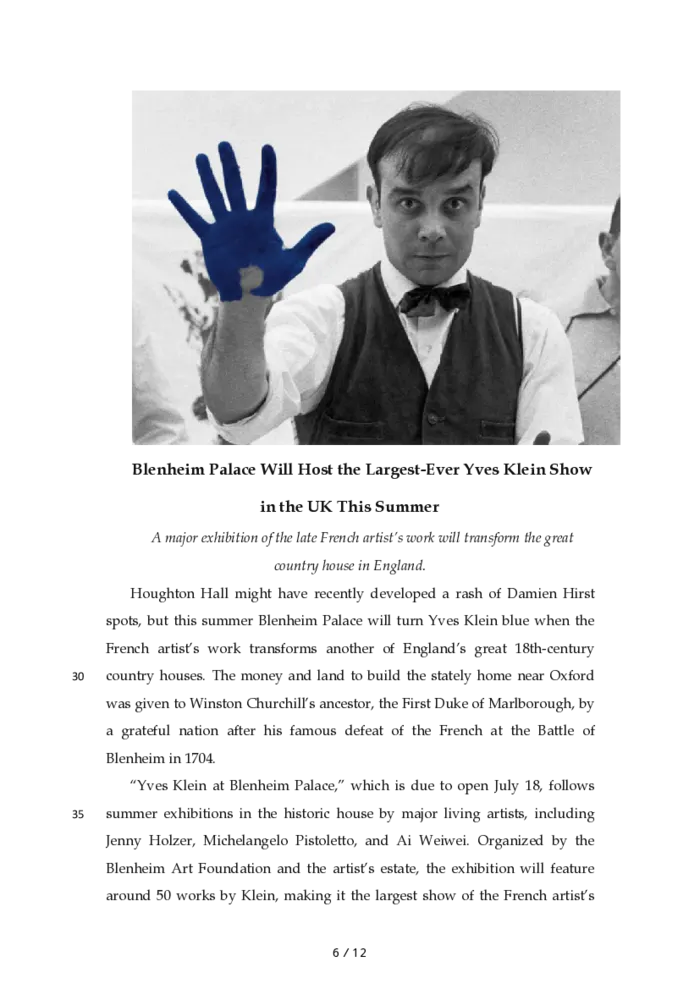
Blenheim Palace Will Host the Largest-Ever Yves Klein Show
in the UK This Summer
A major exhibition of the late French artist’s work will transform the great
country house in England.
Houghton Hall might have recently developed a rash of Damien Hirst
spots, but this summer Blenheim Palace will turn Yves Klein blue when the
French artist’s work transforms another of England’s great 18th-century
country houses. The money and land to build the stately home near Oxford
30
was given to Winston Churchill’s ancestor, the First Duke of Marlborough, by
a grateful nation after his famous defeat of the French at the Battle of
Blenheim in 1704.
“Yves Klein at Blenheim Palace,” which is due to open July 18, follows
summer exhibitions in the historic house by major living artists, including
35
Jenny Holzer, Michelangelo Pistoletto, and Ai Weiwei. Organized by the
Blenheim Art Foundation and the artist’s estate, the exhibition will feature
around 50 works by Klein, making it the largest show of the French artist’s
6/12
work in the UK.
Daniel Moquay, the manager of the Yves Klein Archives, who is also the
40
husband of Klein’s widow, said in a statement that it will present the artist’s
work “in a totally different environment from the usual exhibitions that we
organize.” The Klein show will include a large-scale blue pigment installation,
and works from his famous series: “Monochrome Paintings,” “Fire Paintings,”
plus works created with “living models,” as well as classically inspired
45
sculptures coated in the artist’s signature blue, IKB.
Michael Frahm, the director of the Blenheim Art Foundation, says that
Klein was “a clear choice: his radical work changed the course of modern art
in the 1950s and early 1960s, and his practice remains as relevant today as it
was during his meteoric lifetime.” The exhibition marks what would have
50
been the French artist’s 90th birthday. John Churchill, the First Duke might be
turning in his grave, however, or atop the victory column in the grounds.
“Yves Klein at Blenheim Palace,” runs from July 18 through October 7,
Blenheim Palace, Oxfordshire.

55
7/12
话题:人与自然(饮食)
体裁:说明文
来源:1843magazine.com
Word count:323
Flesch-Kincaid Grade Level:11.6

The bittersweet charms of tiramisu
Its name means “pick-me-up” in Italian
Tiramisu,” murmurs Rob Reiner’s character knowingly to Tom Hanks in
“Sleepless in Seattle”. “What is tiramisu?” asks Hanks, a widower venturing
back into the world of dating. “Some woman is gonna want me to do it to her
and I’m not gonna know what it is!” “You’ll love it,” Reiner assures him.
5
When the film was released in 1993 tiramisu was an obscure confection
unheard of even in an America rich with Italians. The offices of Tristar, which
distributed the movie, apparently received as many as 30 calls a day from
viewers as anxious as Hanks to be enlightened. Some were disappointed to
discover it was merely a dessert, others relieved.
10
Today it appears on Italian menus everywhere, from the trattorias and
ristoranti of Venice to red-sauce joints of Boston’s North End. But the
supposed Italian classic probably dates back only as far as the 1960s. The
name means “pick me up” in Italian: Ada Campeol, an exhausted young
mother and owner of Le Beccherie restaurant in Veneto in northern Italy, is
15
8/12
said to have come up with the dessert. Others credit Carminantonio
Iannaccone, an Italian chef who ran a bakery in Baltimore’s Little Italy and
brought the recipe with him to America. The governor of Veneto was
outraged when, in 2016, two food writers suggested that tiramisu instead
originated in Friuli-Venezia Giulia, a region that borders Austria and
20
Slovenia.
Whatever its origins, shattered parents everywhere can attest to the
reviving qualities of lavish quantities of caffeine and sugar. Start with
savoiardi biscuits, Italy’s version of ladyfingers, light, crumbly and eager to
absorb other flavours. Sodden (but not to the point of mushiness) with
25
espresso and brandy, marsala or rum to form the dark heart of the dish.
Layers of zabaglione – mascarpone whipped up with eggs and sugar to a light
custard – provide contrast. A thick dusting of cocoa finishes it off, like
moleskin on the tongue. The perfect way to seduce anyone.
9/12
话题:人与自然(人与物的特征)
体裁:说明文
来源:The New York Times
Word count:626
Flesch-Kincaid Grade Level:8.7


How to Overcome ‘Impostor Syndrome’
My impostor syndrome has played out during public speeches, job
negotiations and when I received my first book deal — prompting me to ask,
“But why would anyone pay money to read what I have to say?” My editor, a
woman, didn’t miss a beat:  “I often wonder the same about my editing!” she
said.
5
The term “impostor syndrome” wasn’t coined until 1978 (by two
American psychologists, Pauline Clance and Suzanne Imes), but it’s safe to
assume that women have always felt it. It’s that nagging feeling that you’re
not good enough, that you don’t belong, that you don’t deserve the job, the
promotion, the book deal, the seat at the table. According to Valerie Young, an
10
educator and the author of “The Secret Thoughts of Successful Women,” it is
common among high achievers, creative people and students. It persists
through college and graduate school and into the working world, where
women tend to judge their performance as worse than they objectively are
while men judge their own as better. It tends to affect minority groups
15
disproportionately, Ms. Young said — anyone who has the pressure of
10/12
accomplishing “firsts.”
But there are ways to overcome feeling like an impostor.

Psyche Yourself Up
Research has found that what you say to yourself can actually change the
20
way you see yourself — boosting confidence during a nerve-racking event.
Here are four exercises to change the way you think about yourself.
Make a list. Make a list of at least 10 things that show you are just as
qualified as anyone else for the role you are seeking. Having trouble? First ask
yourself what evidence exists that you are any less qualified than anybody
25
else to do this work. Is there anything that makes you, I daresay, more
qualified?
Say your name aloud. Research has found that the simple act of taking a
positive affirmation (such as “I’m awesome”) and adding your name to it
(“Jessica is awesome”) can have a powerful effect on how you perceive
30
yourself. And before you get bashful, LeBron James does it. “I wanted to do
what was best for LeBron James," he said when explaining his decision to
leave the Cleveland Cavaliers for the Miami Heat in 2010. The Nobel laureate
Malala Yousafzai has done it, too. “I said, 'If he comes, what would you do,
Malala?’” she told Jon Stewart, describing how she wrestled with her decision
35
to speak out against the Taliban. “Then I would reply to myself, 'Malala, just
take a shoe and hit him.’” If it’s good enough for a Nobel Peace Prize winner,
I’m pretty sure it’s good enough for the rest of us.
Own your accomplishments. Women tend to explain their successes
away by ascribing them to things like “luck,” “hard work” or “help from
40
others” rather than the innate ability or intelligence than men often cite. Try to
own the role you played in your success by forbidding yourself from falling
back on excuses. Practice saying these words out loud: “I’m proud of what
I’ve accomplished.”
Visualize success. Visualize precisely how you’ll navigate the situation —
45
11/12
successfully — before it happens. This is a tactic that is taught to military
recruits, training them to visualize how they’re going to handle a situation
before it happens. “I've used this a ton in my career,” said Maj. Nicole Miner,
a former instructor at West Point. “Before confronting a naysayer I would
conduct a mental rehearsal to make sure I was clear and firm. Self-talk then
50
helps me stay under control and in the ‘right’ mindset for the situation. Your
confidence doesn't have to come from just experience, otherwise we would
never try things for the first time.” Imagine yourself killing the job interview,
nailing the presentation, or kicking the winning goal. Try it.
12/12