八年级
上册
义 务 教 育 教 科 书
义 务 教 育 教 科 书
·北 京·
八年级
上册
人民教育出版社 课程教材研究所
编著
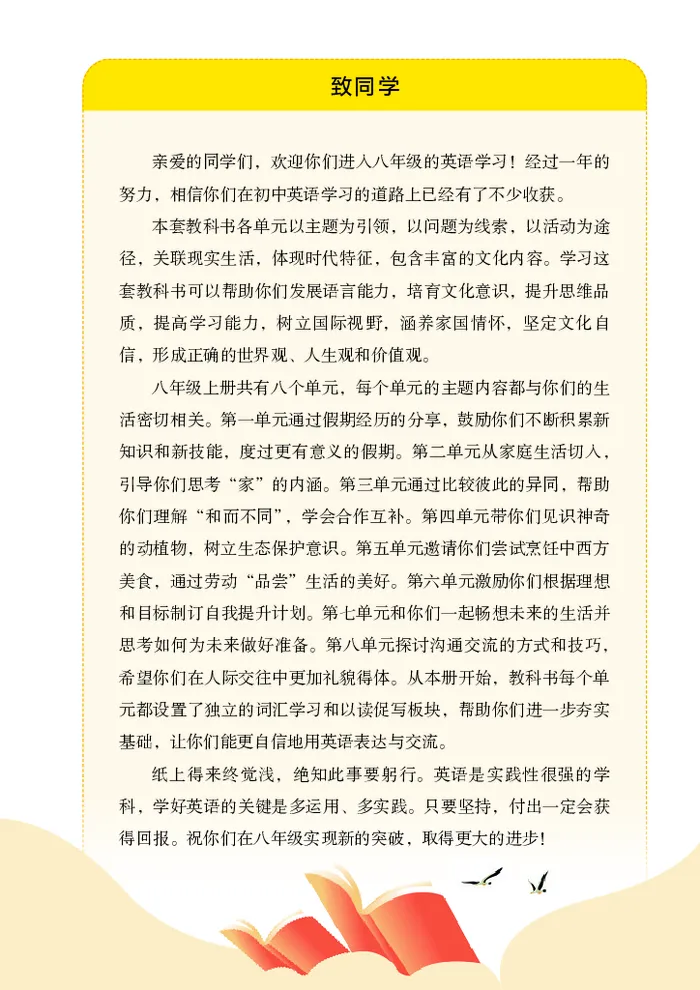
致同学
亲爱的同学们,欢迎你们进入八年级的英语学习!经过一年的
努力,相信你们在初中英语学习的道路上已经有了不少收获。
本套教科书各单元以主题为引领,以问题为线索,以活动为途
径,关联现实生活,体现时代特征,包含丰富的文化内容。学习这
套教科书可以帮助你们发展语言能力,培育文化意识,提升思维品
质,提高学习能力,树立国际视野,涵养家国情怀,坚定文化自
信,形成正确的世界观、人生观和价值观。
八年级上册共有八个单元,每个单元的主题内容都与你们的生
活密切相关。第一单元通过假期经历的分享,鼓励你们不断积累新
知识和新技能,度过更有意义的假期。第二单元从家庭生活切入,
引导你们思考“家”的内涵。第三单元通过比较彼此的异同,帮助
你们理解“和而不同”,学会合作互补。第四单元带你们见识神奇
的动植物,树立生态保护意识。第五单元邀请你们尝试烹饪中西方
美食,通过劳动“品尝”生活的美好。第六单元激励你们根据理想
和目标制订自我提升计划。第七单元和你们一起畅想未来的生活并
思考如何为未来做好准备。第八单元探讨沟通交流的方式和技巧,
希望你们在人际交往中更加礼貌得体。从本册开始,教科书每个单
元都设置了独立的词汇学习和以读促写板块,帮助你们进一步夯实
基础,让你们能更自信地用英语表达与交流。
纸上得来终觉浅,绝知此事要躬行。英语是实践性很强的学
科,学好英语的关键是多运用、多实践。只要坚持,付出一定会获
得回报。祝你们在八年级实现新的突破,取得更大的进步!
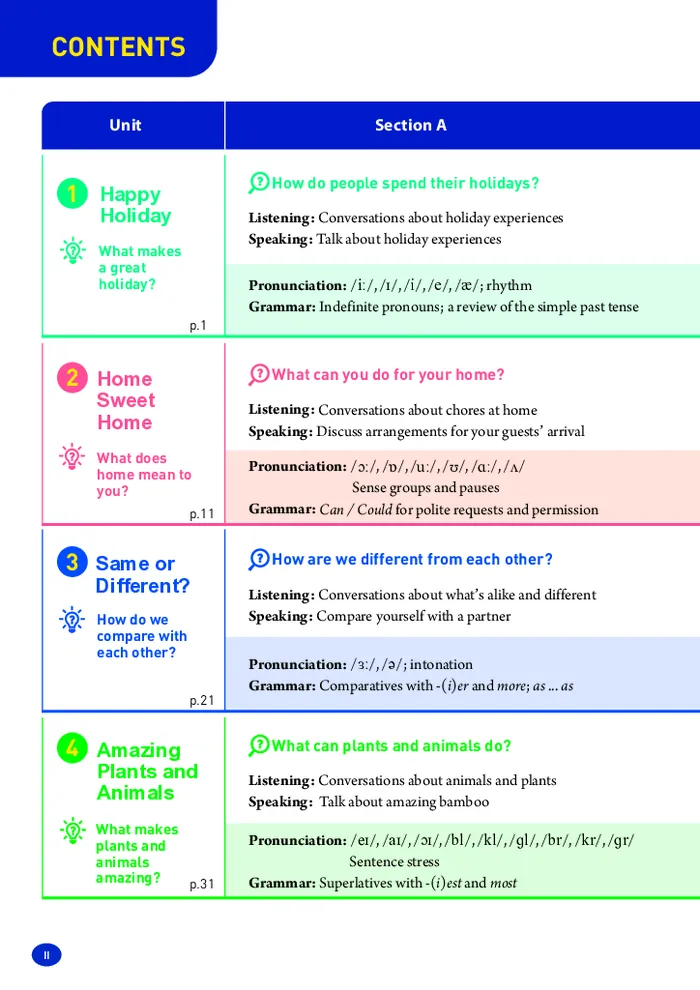
Unit
Happy
Holiday
Same or
Different?
How do people spend their holidays?
How are we different from each other?
Listening: Conversations about holiday experiences
Speaking: Talk about holiday experiences
Listening: Conversations about chores at home
Speaking: Discuss arrangements for your guests’ arrival
Listening: Conversations about what’s alike and different
Speaking: Compare yourself with a partner
What makes
a great
holiday?
How do we
compare with
each other?
Home
Sweet
Home
Amazing
Plants and
Animals
What can you do for your home?
What can plants and animals do?
What does
home mean to
you?
What makes
plants and
animals
amazing?
p.1
p.21
p.11
p.31
1
2
3
4
Listening: Conversations about animals and plants
Speaking: Talk about amazing bamboo
CONTENTS
Section A
Pronunciation: /iː/, /ɪ/, /i/, /e/, /æ/; rhythm
Grammar: Indefinite pronouns; a review of the simple past tense
Pronunciation: /ɔː/, /ɒ/, /uː/, /ʊ/, /ɑː/, /ʌ/
Sense groups and pauses
Grammar: Can / Could for polite requests and permission
Pronunciation: /ɜː/, /ə/; intonation
Grammar: Comparatives with -(i)er and more; as ... as
Pronunciation: /eɪ/, /aɪ/, /ɔɪ/, /bl/, /kl/, /ɡl/, /br/, /kr/, /ɡr/
Sentence stress
Grammar: Superlatives with -(i)est and most
II
What can we learn from holiday experiences?
How do we understand differences?
Reading: Posts on similarities and differences between friends
Writing: Write a reply to a post on friends
Reading: A story of going home for the Spring Festival
Writing: Email a friend for help with decorating your room
Reading: Vincent’s summer holiday diary
Writing: Write a holiday story
How do you feel at home?
How are plants and animals connected with us?
Reading: A popular science article on bees
Writing: Rewrite an article about the blue whale
* Project
Make a holiday to-do
list
Find out who does the
most chores at home
See who changed
the most
Make a poster about
a plant or an animal
Section B
Vocabulary: Words related to holiday
Vocabulary: Words related to home
Vocabulary: Words related to comparison
Vocabulary: Noun suffixes (-ance, -(t)ion, -ness, -ity)
III
*Reading Plus
p.81
Listening Scripts
p.93
Unit
What a
Delicious
Meal!
When
Tomorrow
Comes
How do we make food?
What are your predictions about the future?
Listening: A conversation about making mashed potatoes
Speaking: Describe the process for making food
Listening: Conversations about what’s coming up
Speaking: Make predictions about the future
Why do we
learn to cook?
What will the
future look
like?
Plan for
Yourself
Let’s
Communicate!
When do we make plans?
How do we communicate?
Why do we
need plans?
What makes
good
communication?
p.41
p.61
p.51
p.71
5
6
7
8
Listening: Conversations with family members near and far
Speaking: Encourage people to communicate
Listening: Conversations about dream jobs
Speaking: Talk about future intentions
Section A
Pronunciation: /əʊ/, /aʊ/, /ɪə/, /eә/, /ʊə/, /sk/, /st/, /sp/, /str/
Intonation and pauses
Grammar: Exclamatory sentences; countable / uncountable nouns
Pronunciation: /h/, /w/, /θ/, /ð/, /k/, /kw/, /ʃ/, /ʒ/; weak forms
Grammar: Future with be going to; infinitives as objects
Pronunciation: /n/, /ŋ/, /ŋk/, /ŋɡ/, /tʃ/, /dʒ/, /f/, /r/
Intonation
Grammar: Simple future tense (will)
Pronunciation: /-pl/, /-bl/, /-kl/, /-ɡl/, /-tl/, /-dl/, /-fn/, /-vn/,
/-sn/, /-zn/, /-tn/, /-dn/; pronunciation review
Grammar: Zero and first conditionals
Pronunciation
p.102
Grammar
p.104
IV
Vocabulary in Each Unit
p.111
Vocabulary A–Z
p.123
What does cooking give us?
How can we prepare for the future?
Reading: An interview with a futurist
Writing: Write a description of your life in 20 years
Reading: A reflection on food and memory
Writing: Write a post on how to make a dish
How can we make good plans?
How can we communicate better?
Reading: A guide on how to make a better conversation
Writing: Write an invitation letter
Reading: An expository essay on making resolutions
Writing: Write about your resolutions
*Project
Section B
Create a recipe for a
tasty dish
Make plans for solving
problems
Create a picture about
the future
Tell a chain story
Vocabulary: Adverbs of sequence
Words related to food and cooking
Measure words
Vocabulary: Words related to jobs
Vocabulary: Quantities with more, less, fewer
Opposite words
Vocabulary: Words related to communication
Noun suffixes (-er, -or, -th, -ment, -ship)
Vocabulary from Primary School
p.135
Irregular Verbs
p.136
V
1
UNIT
BIG
Question
What makes a
great holiday?
In this unit, you will
1. talk about holiday activities and experiences.
2. use indefinite pronouns to talk about uncertain people,
things, or places.
3. express your feelings about holidays.
4. explore the benefits of holiday experiences.
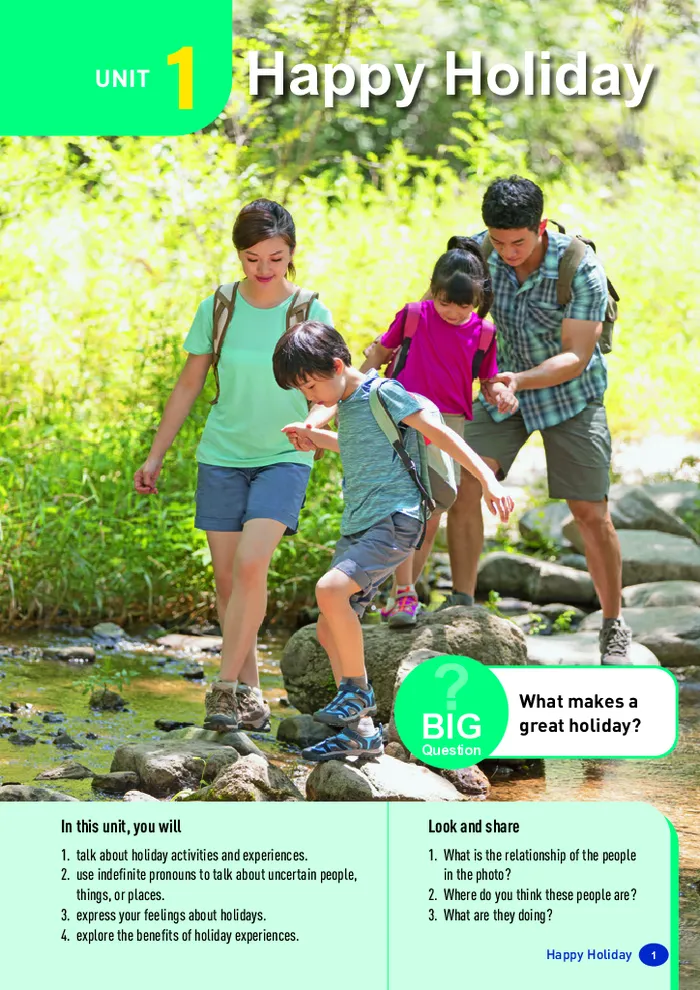
Look and share
1. What is the relationship of the people
in the photo?
2. Where do you think these people are?
3. What are they doing?
Happy Holiday
1
UNIT
Happy Holiday
1
How do people spend their holidays?
S
E
C
T
I
O
N
A
Tick the activities you did during the summer holidays. You can add more.
1a
He / She went to …
Where did Yaming / Emma go on holiday / vacation?
Yes, he / she …
Did he / she do anything interesting?
Listen to the conversations and circle the holiday activities you hear in 1a.
1b
Listen again and complete the two summaries.
1c
Talk about Yaming’s and Emma’s holidays.
1d
took music lessons
visited my grandparents
visited some ancient buildings
went to a festival
went to the mountains
went to a summer camp
1. Yaming went to Mount
Huangshan with his .
The landscape there was
amazing. Yaming saw the
Guest-Greeting Pine, the
Sea of , lots of
strange , and many
ancient .
2. Emma went back to the US with
her and .
She went to a strawberry festival
near her house in
Seattle. At the festival, she
some strawberry
cookies and chocolates. She
stayed with her for
days.
UNIT 1
2
/iː/
/ɪ/
/i/
/e/
/æ/
e
ee
ea
i
y
e
ea
a
he
see
beach
trip
city
fresh
bread
camp
she
need
peace
swim
busy
forget
ready
relax
Listen and repeat. Add one more word to each group.
1
Listen and repeat. Notice the rhythm.
2
1. A: How was your holiday?
2. A: How was your holiday?
B: My holiday? Great!
B: My holiday? Really good!
A: What did you do?
A: What did you do?
B: I went to Beijing
B: I hiked in the mountains
and saw the Great Wall.
and saw the sunrise.
Oh, how great it was!
Oh, how beautiful it was!
Pronunciation
Listen to the conversation and choose the correct sentences to complete it.
2a
Adam: Hi, Peter. How are you?
Peter: Hi, Adam. I’m fine, thanks.
Adam: How was your holiday?
Peter: It was fantastic.
Adam:
Peter: Yes, I went to Yunnan with
my family.
Adam: Wow! That sounds great.
Peter: Yes, we stayed in the old town for a few days, and we enjoyed it very much.
Adam: Did you visit Yulong Mountain?
Peter: It is! It just took my breath away. We took a lot of great photos there.
Adam:
Peter: Yes, we did! Everything tasted good, especially the steamed chicken
soup. What about you?
Adam: No, not this holiday. I just stayed
at home to read, play games, and relax, but it was still fun.
A. Did you eat anything special?
B. Did you go anywhere interesting?
C. I did nothing special.
D. Did you go to Lijiang?
E. Everyone says it’s beautiful.
F. Someone said you went to Beijing.
Happy Holiday
3
Share your summer holiday experience with a partner.
2f
Complete the summary of the conversation.
2c
Read the conversation and complete the table.
2b
Name
Where did he
go / stay?
What did he do?
How did he feel?
Peter
Adam
A: How was your summer holiday, …?
B: It was …
A: Did you go anywhere interesting?
B: Yes, I … / No, I didn’t. I just ...
A: Really? Did you do anything special?
B: Well, …
Peter had a holiday. He went to Yunnan with his . They
stayed in the old of Lijiang for a few days and it very
much. They Yulong Mountain and took a lot of photos there. They
also tried some Yunnan dishes, and they the steamed chicken soup.
Adam didn’t do special, but he still had a relaxing and holiday.
Listen to the conversation again. Then role-play it.
2d
Tick the words that describe your last summer holiday experience.
2e
great
amazing excellent
fantastic
relaxing
wonderful
OK
not too bad
boring
terrible
4
UNIT 1
Read the sentences and notice the indefinite pronouns in bold. Then discuss
when you use these pronouns.
3a
Where did you go on holiday?
I didn’t go anywhere special, but I tried
something new — I worked as a tour guide
at a museum.
Did you do anything interesting on
your holiday?
No, nothing special. But I met someone
interesting.
Did you go anywhere interesting?
Yes, I went to Yunnan.
Did you go with anyone?
Yes, I went with my family.
Did you eat anything special?
Yes, we did! Everything tasted good, especially
the steamed chicken soup. Everyone loved it.
Complete the conversation with the correct indefinite pronouns.
3b
A: Did you do interesting on your holiday?
B: No, special. How about you?
A: Well, I went to Hangzhou and spent a few days there.
B: Really? says the scenery around the West Lake is so beautiful.
A: It is. We had a wonderful experience.
B: Great! So, did you go there with ?
A: Yes, I went with my family. Oh! I just remembered. I got you as
a gift. Here you are!
B: Wow, it’s a silk scarf. Thank you!
A: You’re welcome!
Grammar Focus
Complete the passage with the correct indefinite pronouns.
3c
It was summer. Like else, I was ready to go on a holiday somewhere.
I chose a town near my city, but
could join me, so I went by
myself. When I got to the town, it started raining heavily. I could do
but stay in the hotel. The hotel was nice, with a comfortable bed, and
was very clean. I felt bored, so I decided to look for
to read. I
found a book in my room and started reading by my bed. Then, I heard
shout from outside, “Look at the sky! How amazing!” I got up and
walked towards the window. There was a beautiful double rainbow in the sky.
someone no one everyone something nothing everything
Happy Holiday
5
What can we learn from holiday
experiences?
S
E
C
T
I
O
N
B
Look at the photos below. Do you know which country it is? Would you like
to visit it?
1a
Read Vincent’s diary entries about his holiday. Then answer the questions.
1b
1. What places did Vincent visit?
2. How did he feel during the trip?
Red Square
Alexander Garden
17 July
Today was our first day to visit Moscow. The weather was fine and everyone
felt excited to visit some famous places in Russia.
In the morning, we went to the Victory Museum. The Russian people built
this museum to remember their fight against the Nazis during World
War II. As we walked through the halls, the tour guide told us stories about
the war.
In one hall, I saw an artwork with thousands of glass “tears” falling down. It
reminds us that war is terrible and peace does not come easily. We should
not forget that.
At noon, we had lunch at a restaurant near the park. I liked the ice cream
there, so I ate a lot of it. But, during dinner, I didn’t feel like eating because
I felt sick. So now, I just want to get a good night’s sleep.
UNIT 1
6
What can you learn from Vincent’s travel experience? Make a list of your ideas
and share them with a partner.
1d
Read the diary entries again. Complete the timeline.
1c
1. I can learn about the history of a country or a city.
2.
3.
…
In the morning
In the morning
In the afternoon
At noon
During dinner
went to the Victory
Museum
17
July
18
July
18 July
It rained last night, so this morning the air was fresh and cool. I felt much
better today.
We took the Moscow Metro to travel around. The metro stations are really
beautiful. Sometimes I felt like I was walking inside a palace. After that, we
went to Red Square. We saw some
fantastic buildings there.
In the afternoon, we arrived at a
school and met a group of Russian
students. We played games and
soon became friends. Later,
someone took out his accordion,
and soon everyone got together to
sing and dance. We were so happy
that we didn’t notice the time. It
was such a good experience!
Moscow Metro
Happy Holiday
7
Vocabulary in Use
Think of as many words as possible to make phrases. Then write them down.
2a
1. holiday summer holiday(s), go on holiday, …
2. experience
3. scenery
4. station
5. camp
6. square
Complete the sentences with the correct words in the box.
2b
1. I felt after staying in the sun for too long.
2. The tour guide told us the tower was over 1,000 years old.
3. Don’t spend too much on holiday shopping, or you might go
over budget.
4. When the night fell, the small town was finally at .
5. The mountain scenery was so beautiful that it took my away!
6. Please me to take my passport before I leave. I’m getting a little
forgetful these days.
ancient breath remind peace sick easily
Complete the passage with the correct forms of the words in the box.
2c
People spend their holidays in different ways. Some travel to see beautiful
sights and in strange, faraway places. The amazing scenery makes
them smile and their worries. Others stay comfortable at home,
when they are tired or not feeling well. They do nothing but relax,
sleep, or watch TV. Many people with friends and family to have
a meal or play sport. There are lots of ways to relax and have fun. However,
the most important part of a holiday is to rest your mind and body. Then you
can go back to your regular life, and be to see what comes next.
especially ready forget landscape get together
8
UNIT 1
Read Gina’s holiday story and write down the things that she did.
3a
My Holiday in Scotland
Last autumn, my family took a train to Scotland
for a holiday. We stayed in a comfortable house in
the countryside with beautiful scenery. I live in a
big city, so everything there seemed so different.
For example, beside the house, there was a huge
forest.
On the last day, early in the morning, I went to the
forest to explore. While there, something made a
noise. I turned around and was surprised to see a
deer.
I ran home and told my parents what I saw. My mum smiled and
said, “The deer is probably looking for food and hoping to get some
from you.” What a wonderful experience I had! I really hope I can go
back again.
Things that Gina did
took
stayed
went to
saw
ran home and
Think of an unforgettable holiday experience and answer the questions.
3b
Use your ideas above to write a holiday story.
3c
1. When did it happen?
2. Where were you?
3. What did you do?
4. How did you feel?
5. What did you learn?
Happy Holiday
9
Reflecting
Share your five activities with your class. Then find out the top three activities
that everyone likes to do.
4c
Work in groups. Make a list of the activities you did during your holidays.
4a
Make a holiday to-do list
Project
A holiday is a time to relax, enjoy life,
and make memories.
Choose five meaningful activities you think everyone should try. Then give
your reasons.
4b
Holiday activity
Place
Reason
1
visiting Mount Taishan
Tai’an city
to enjoy the beautiful
scenery and …
2
3
4
5
1. Can you use the simple past tense to describe your holiday experiences?
2. When do you use indefinite pronouns?
3. How would you describe your last holiday? How did you feel?
4. What can people learn from travel experiences and other holiday activities?
*
UNIT 1
10
2
UNIT
BIG
Question
What does home
mean to you?
In this unit, you will
1. talk about what you can do for your home.
2. make polite requests and ask for permission.
3. find more ways to make a home comfortable.
4. explore the meaning of home.
Look and share
1. What are the people doing in the
photo?
2. Where are they?
3. How do you think they feel?
Home
Sweet Home
Home Sweet Home
11
What can you do for your home?
S
E
C
T
I
O
N
A
Do you do these things at home? What chores do you do?
1a
Make a conversation with the chores from 1a.
1d
Listen to the first conversation. Tick the things that Jim’s dad asks him to do.
1b
hang out with friends sort things into boxes
write “Jim’s bedroom” on each box
pack up his things
Listen to the second conversation and match the people with what they will do.
1c
1. Jim
2. Peter
3. Helen
4. Mum
5. Dad
A. sweep the floor
B. grow flowers on the balcony
C. hang up the photos
D. clean the bathroom
E. invite friends to the new house
F. keep fish in the living room
Sure. / Sorry, I have to clean the bathroom now.
pack up things
water the plants
sweep the floor
hang up photos
clean the bathroom
feed the fish
Can / Could you please water the plants?
UNIT 2
12
Listen and read. Notice the sense groups and pauses.
2
Peter: Mum, | can I invite my friends | to our new house?
Mum: Sure, | Peter. || But we need to clean up first. || Would you like to mop
the floor | or clean the windows?
Peter: I’d like to clean the windows.
[An hour later.]
Mum: Good job, | Peter! || The windows are really clean, | and they look like
mirrors!
Pronunciation
Listen to the conversation and fill in the blanks.
2a
Dad: Guess what! Grandpa and Grandma are visiting us this weekend!
Jim: Oh, great!
Peter: I can’t wait to show them our new house!
Mum: Yes, but now we need to for their arrival. Can you help
me their room?
Peter: But their room is already clean!
Mum: Well, it’s not “grandma clean” yet!
Peter: Oh, OK.
Dad: Jim, can you help me on the wall? I bought it for
Grandpa to see the time.
Jim: Sure, Dad.
Dad: Helen, can you to their room? Grandpa likes reading
books in front of the window.
Helen: No problem, Dad. Can I by the window?
Dad: Yes, good idea! Grandma loves flowers.
Helen: Mum, could you take me to the later?
Mum: No problem. Let’s go after lunch.
/ɔː/
/ɒ/
/uː/
/ʊ/
/ɑː/
/ʌ/
or
oor
o
oo
u
oo
ar
u
short
door
drop
spoon
blue
cook
far
but
sport
floor
borrow
food
flute
good
party
hunt
Listen and repeat. Add one more word to each group.
1
Home Sweet Home
13
Read the conversation and answer the questions.
2b
1. Did Peter’s grandparents visit his new home before? Why do you think so?
2. What does “grandma clean” mean?
3. Why does Helen want to go to the flower shop?
4. What do you usually do for your grandparents?
Listen to the conversation again. Then role-play it.
2d
Peter is preparing for his friend’s visit to his new home, but he needs help.
In groups make up conversations between Peter and his family.
2e
Peter: Dad, could you please give me a lift to the shop this afternoon?
Dad: Sorry, but I have to work from home all day.
Peter: Helen, can I borrow your chess set?
Helen: Sure. Here you are.
go shopping
buy drinks
buy fruit
make biscuits
cook a meal borrow a chess set
plan a treasure hunt
…
2c
Complete the mind map with the information from 2a. Add more things to the
“other” section.
a clock
make
grandparents
feel at home
add things
to their
room
a chair
for reading
_______
_______
_______
_______
sweep
the floor
other:
_______
other:
_______
_______ up
their room
UNIT 2
14
Read the questions with can or could. Notice how they are answered. Then
write R for requests or P for permission next to each question.
3a
Could you please sweep the floor?
OK, Mum. I’ll do it at once.
Could I hang out with my friends after
lunch?
Sorry, Jim, but you have to pack up your
things first.
Can I put some flowers on the table?
Yes, good idea!
Can you help me hang up the photos?
Sure. / No problem!
Make up conversations for each setting, using can or could.
3c
1. You are at your friend’s home. You want to call your parents, but your
phone is dead.
A: Can / Could I use your phone? B: Sure. / Of course.
2. You were sick at home yesterday. Your friend went to an English class and
took notes. You want to know more about the class.
3. You are holding a large box. It is difficult to open the door. Your neighbour
comes.
4. You and your classmates want to help clean up the community. Ask your
classmates to bring gloves and rubbish bags.
Grammar Focus
Choose the best question to complete each conversation.
3b
1. A:
B: Of course you can. Let me
show you the way.
2. A:
B: Yes, if you are careful with it.
4. A: Can I go to the movies?
B: Of course.
A:
B: I can’t. I have to do some
work now.
3. A:
B: No, you can’t. You have a
basketball game tomorrow,
remember? You need a
good rest.
A. Could you give me a ride to town now? B. Can I stay out until eleven?
C. Mr Lake, can I use your toilet? D. Could I use your computer?
Home Sweet Home
15
How do you feel at home?
S
E
C
T
I
O
N
B
How does home make you feel? Share your ideas with a partner.
1a
Read the story and answer the questions.
1b
Going Home for the Spring Festival
“It’s almost the Spring Festival. Can we go to Hainan for the holiday, Dad?”
“Not this time,” Dad answered with a smile. “We’re going to your mum’s
hometown!”
Soon the day of our family trip came. We got up very early in the
morning to catch the train. The train journey took more than five hours, and
then we changed to a bus to get to my grandparents’ village in the afternoon.
At the end of the road, I saw Grandpa and my little cousin standing in the
cold wind waiting for us. We walked quickly to greet them.
Grandpa helped us pull the heavy luggage into the house.
“Ah, home again!” said Mum with a smile on her face. Grandma, my
aunt, and my uncle were busy cooking dinner in the kitchen. They were very
happy to see us. After a little while, my parents went to the kitchen to help.
“Could you bring Wenwen her favourite snacks?” Grandma asked
Grandpa.
I shared the snacks with my cousin and told Grandpa about school.
He was happy to hear I was doing well at school. When dinner was ready, I
asked, “Can I help?”
“You can set the table,” Dad said.
We then enjoyed all the delicious food.
“Mm, the familiar taste of home!” said Mum.
During the dinner, my uncle told us some jokes and we had a good laugh.
Several days later when we were leaving, Grandma held my hands and
asked us, “Will you come home more often?”
Mum nodded, with tears in her eyes.
16
UNIT 2
UNIT 2
Complete the sentences to see what each family member did to make the home
full of love. Find more examples from the text.
1c
1. Grandpa and my cousin in the cold wind.
2. helped us pull our luggage into the house.
3. Grandma, my aunt, and my uncle in the kitchen.
4. went to the kitchen to help.
5. Grandpa my favourite snacks.
6. shared the snacks with my cousin.
Discuss the questions.
1d
1. Why do you think the family spent the Spring Festival at the village?
2. What do you think about the writer’s family members?
Read the poem and opinions. Then share your understanding of“home”.
1e
Follow the road,
Anywhere it goes.
But at the end,
Are family and friends.
Wherever I go,
Finally I go,
To my home, sweet home.
Home
My home is also
called family.
No matter how long I’m
away, home is always glad
to see me again.
Home is a place of love.
It always welcomes
me with open arms―
and perhaps a plate of
freshly-made biscuits.
Home is not a place …
It’s a kind of feeling. It
greets me when I walk
through the door.
1. Where did the writer go for the Spring Festival?
2. What is the name of the writer?
3. In the text, what words are used to describe people’s feelings?
Home Sweet Home
17
Vocabulary in Use
Complete the puzzle with the new words in this unit. The clues can help you.
2a
1. to look for something
2. to move your head up and down
3. the people living in the same area
4. not living
5. a room in a house for people to relax
6. something important or with a high price
7. a room for sleeping in
8. a long trip
9. maybe
10. a dish to put food on
Match the words in column A with those in column B. Then use the phrases to
complete the sentences.
2b
Complete the letter with the words in the box.
2c
community ready free arrival invite soon
1. Could you after taking a
shower? We should keep it clean.
2. Could you please ? It’s
starting to smell.
3. Let’s and get ready to go
home.
4. Can you help me on the
wall? Grandma looks really young in it.
pack up
clean up
hang up
take out
the luggage
the rubbish
the photo
the bathroom
A
B
Dear friends,
Welcome! We’re excited to have you in our community. We hope you’ll
feel at home here.
Your
brings joy to us. We would like to
you to the
community party at 2 p.m. on Sunday. You can find us on the first floor of
Apartment Block A.
In our , everyone is friendly and always to give a hand.
If you have any questions or need help, feel to ask.
Best wishes,
The Sunshine Community
H
1
2
3
4
5
6
7
8
9
10
O
M
E
I
S
B
E
S
T
UNIT 2
18
Read the email and find out what Zhang Peng asks his friend to do.
3a
Put the things in order to see how Zhang Peng organizes his ideas in writing.
3b
ask John to bring the brushes
1 ask John to help decorate the room
ask John to help choose some photos to hang on the walls
describe how the room looks now
tell John about the plan for the walls
ask John to meet on Sunday at the paint shop
Write an email to ask a friend to help decorate your room. Below is a list of
things you may need help with.
3c
buy some flowers
make a poster
go shopping
bring a pair of scissors
buy glue
bring a brush
make paper-cuts
bring a painting
…
EMAIL
To:
Send
Subject:
Hi John,
It was fun to decorate your room last month. I share a room with my
brother. We want to decorate it too. Can you help us?
Right now, the walls are blue. There are cute animals on them, but the
animals look too young for us. We want to cover the animals and paint
the walls light green. What do you think about the colour?
On Sunday, we can meet at the paint shop near the shopping centre and
choose the paint together. Then we can paint the room with my brother.
I loved the brushes we used for your room. Can you bring them?
After painting, could you help choose some photos to hang on the walls?
Let me know what you think.
Best,
Zhang Peng
Home Sweet Home
19
Reflecting
Report your findings to the class.
4c
Find out who does the most chores at home.
4d
Find out who does the most chores
at home
Project
East or west, home is best.
Tick the chores you do at home. You can add more.
4a
Chores
Tick
Chores
Tick
take out the rubbish
do the laundry
do the dishes
fold the clothes
walk the dog
sweep the floor
make the bed
clean the bathroom
help to cook
other:
Do a class survey. Ask your classmates the following questions.
4b
1. What chores do you do?
2. How often do you do chores?
3. What do you think about doing chores?
1. What words and expressions can you use to talk about your home?
2. Can you use can or could to make polite requests and ask for permission?
3. What can you do to make your home comfortable?
4. What did you learn about the meaning of home?
*
UNIT 2
20
3
UNIT
BIG
Question
How do we compare
with each other?
In this unit, you will
1. compare people and things.
2. discuss whether friends should be similar or different.
3. talk about how you are different from the past.
4. discover why differences are important.
Look and share
1. What is the possible relationship
between the girls in the photo?
2. What do they have in common?
3. How are they different from each
other?
Same or
Different?
Same or Different?
21
No, she is shorter than Emma.
…
How are we different from each other?
S
E
C
T
I
O
N
A
Match each word with its opposite.
1a
Use the information from 1d to make comparisons.
1e
Listen to the conversations. Tick the locations where the conversations
take place.
1b
Conversation 1:
at the music club
at the music festival
Conversation 2:
at the music club
at the music festival
1. Peter and Chen Jie are talking about the . Chen Jie is afraid of
performing alone so they solve the problem by playing a song .
2. Mrs Brown and Peter are talking about and show.
Listen to the conversations again and complete the sentences.
1c
1d Listen to the two conversations again. Match the characters with the correct
descriptions.
Is Ella taller than Emma?
Who dances better, Ella or Emma?
fast shy late tall lazy loud funny
outgoing boring short quiet early slow hard-working
plays the Chinese
flute better
works harder
is more outgoing
is shyer
Peter
Chen Jie
is taller
has longer hair
sings louder
dances better
Ella
Emma
UNIT 3
22
Listen and repeat. Notice the intonation.
2
1. A: You know Ella and
Emma? They won first prize in the school
music
festival.
B: Ella and
Emma? They
did?
A:
Yes. They
did.
2. A: How was school today?
B: I took part in the school music festival.
A:
Today? You
did? I thought the festival would be tomorrow.
B: No. Today.
Pronunciation
1
Listen and repeat. Add one more word to each group.
Han Lin: Congratulations on winning the prize at the school music festival!
The twins: Thank you!
Han Lin: You attended the festival last year and this year. How is this year different?
Ella:
There are more students and more this year. I think
it is more than last year.
Han Lin: As twins, you look very similar. How are you different?
Emma: I’m a little than Ella. And she is funnier than me.
Ella:
Emma always earlier than me. Many people say I’m
lazier than Emma, but that’s not true! I work as hard as her!
Han Lin: That’s really interesting. Besides , how do you spend
your spare time?
Ella:
I love more than anything.
Emma:
I like reading. You see, we’re different in many ways, but together,
we make a great team!
Han Lin: Thanks for talking with me.
The twins: Our pleasure!
Han Lin is interviewing Emma and Ella for the school newspaper. Listen to
their conversation and fill in the blanks.
2a
/ɜː/
/ə/
er
ir
ur
ear
a
e
o
er, or
term
first
nurse
early
China
happen
together
number
person
dirty
Thursday
learn
agree
moment
compare
doctor
Same or Different?
23
Compare yourself with a partner using your ideas from 2d. Then answer the
questions below.
2e
A: I’m taller than you.
B: That’s true. I am a little shorter than you, but I can run faster than you.
A: Yes. I’m as hard-working as you, but you read more than me.
…
Read the conversation and answer the questions.
2b
1. What does Ella think of the festival?
2. What do Emma and Ella have in common?
3. How are they different?
4. What do you think makes Emma and Ella a great team?
How can we make a comparison? Add words to each aspect.
2d
Appearance
Habit
Personality
Strength
tall
strong
short hair
…
get up early
work hard
…
run fast
sing well
…
quiet
outgoing
serious
…
● How are you different from each other?
● What do you have in common?
● What can you learn from each other?
Listen to the conversation again. Then role-play it.
2c
UNIT 3
24
Read the sentences and notice the comparatives in bold. Find more examples in
Section A.
3a
There are more activities this year. It is more colourful than last year.
Emma is taller than Ella, but her hair is shorter than Ella’s.
Ella dances better than Emma, but Emma sings louder than her.
Emma always gets up earlier than me, but I work as hard as her!
Grammar Focus
Use the words in brackets to write questions and answers.
3b
1. Q: Is Julie slimmer than you ? (Julie / slim / you)
A: No, she isn’t. She is as slim as me.
2. Q: ? (you / serious / your cousin)
A: No, I’m not. I am than he is.
3. Q: ? (Tom / smart / Sam)
A: No, I don’t think so. I think Sam is as as Tom.
4. Q: ? (Jack / swim / fast / Sally)
A: No, he doesn’t. He swims as as Sally.
Look at the chart. Then complete the sentences to compare Guangzhou and
Vancouver. Use the words in the box and than.
3c
1. The population of Vancouver was that of Guangzhou in 2024.
2. In area, Guangzhou is Vancouver.
3. It rains
in Guangzhou
in Vancouver.
4. Guangzhou has a pleasant temperature in January. It is
Vancouver in January.
5. Vancouver is Guangzhou in July.
large small much warm cool
Guangzhou
Vancouver
Population (2024)
18.978 million
0.76 million
Area
7,436 square km
115 square km
Average rainfall per year
1,923 mm
1,475 mm
Average January temperature
16 °C
5 °C
Average July temperature
31 °C
18 °C
Facts
Same or Different?
25
How do we understand differences?
S
E
C
T
I
O
N
B
Read the posts. What are Matt’s and Diana’s opinions about friends?
1b
Are you similar to or different from your friends? In what ways?
1a
Matt
I think a good friend is like a mirror. You can understand
people by knowing their friends. My friend, Stephen, is a
great example. We often hang out together because we
have similar hobbies and interests. For example, we both
love sports. He plays badminton better than I do, so he
always wins our matches. Because of that, I try harder
when I practise, and now I’m getting better at badminton.
Stephen and I are similar in other ways. He is as serious
as me. When we aren’t playing sports, we enjoy reading
together. I read more history books than he does, and he
reads a lot of novels. We often share interesting books with
each other.
4 hours ago
5 hours ago
Some people think that friends should be alike, but some
other people think that friends should be different. What
do you think? Should friends be similar or different?
Tom
Forum
UNIT 3
26
Discuss the questions.
1e
Read the posts again and answer the questions.
1d
1. Why does Matt think that a good friend is like a mirror?
2. Why is Matt getting better at badminton?
3. In what ways is Stephen similar to Matt?
4. How is Yuan Lei different from Diana?
5. Why is Diana glad to have an honest friend?
6. How should we treat each other’s differences?
Match the people with the descriptions.
1c
1. Matt
A. reads a lot of novels
2. Stephen
B. reads more history books
3. Diana
C. gives direct opinions
4. Yuan Lei
D. is kind of shy
5. Zhang Yong
E. helps a friend become more outgoing
Diana
I don’t agree. For me, friends who are different make me
better. I think we should respect each other’s differences and
learn from each other. For example, I am kind of shy, but my
best friend, Yuan Lei, is outgoing. She has a great sense of
humour too. Thanks to her, I am becoming more outgoing.
Now I think meeting new people is really fun!
I have another friend, Zhang Yong. He is not afraid to give his
opinion, especially when he thinks I am making a mistake.
I am less straightforward than he is, but I am glad to have
an honest friend.
3 hours ago
What can similarities bring to a friendship?
What can differences bring to a friendship?
What really matters
in a friendship?
Same or Different?
27
Vocabulary in Use
Find the words hidden in the word snake. Then match them with the meanings.
2a
being afraid to speak in front of people
being friendly and liking to meet people
not wanting to do anything
speaking in a straightforward way
not laughing a lot
putting a lot of time into a job and doing it well
Complete the sentences with the words in the box.
2b
1. The of Shanghai is much larger than that of Lanzhou.
2. The weather was , with white clouds and warm sunshine.
3. We got great from the prize we won.
4. We should respect the in others.
5. I love all fruits, strawberries.
6. The height of the students in the class is around 1.6 metres.
7. I enjoy reading books in my time.
8. It is about three from my house to school.
average spare differences especially
pleasure kilometres population pleasant
w
di
re
c t y
fcs
erio
usds
hyiyhardwork i n g h
d o
u tg
o i n g
c rla z yo
Complete the passage with the correct forms of the words in the box.
2c
The prince, Edward, and the poor boy, Tom, are the
two characters in Mark Twain’s famous ,
The Prince and the Pauper. They looked and
both had kind . They exchanged their lives
by accident.
During his time as a pauper, Edward learnt to respect
others. this, he also realized that people’s
lives were much harder than he expected. After
becoming king, he made a by trying to
help the people of his country.
personality alike novel difference besides
UNIT 3
28
Read the post. Is Rose’s opinion the same as or different from the posts in
Section B 1b?
3a
What is your opinion? Use personal experiences to support your opinion.
3b
Opinion
Reason
Example
Friends should be
similar.
Friends should be
different.
I don’t mind.
Use the table above to write your reply to the post.
3c
I think that because
. For example, my friend
is . When
, .
I don’t really care if my friends are similar to or different
from me. I have two amazing friends. Lily is funnier than
anyone else I know. When I feel sad or have a problem, she
makes me laugh and feel better. She helps me see the silver
lining in difficult situations.
My other friend, Lucy, is not as funny as Lily. Lucy is quieter,
but she listens better than others. Lucy and I talk about
everything. I know she cares about me because she’s always
there to listen.
My favourite saying is, “A true friend reaches for your hand
and touches your heart.” Both Lily and Lucy are true friends.
We are always ready to help each other by lending a hand.
3 hours ago
Rose
Same or Different?
29
Reflecting
Answer the questions and then ask your partner’s opinions about your changes.
Do your answers match your partner’s opinions?
4b
Did you change a lot after you entered junior high school? Let’s see!
4a
See who changed the most
Project
Create your growth chart. Give examples. Add photos or videos if possible.
4c
Share your growth chart in class. What did you learn about yourself? Who
changed the most in your class?
4d
Growth
area
Question
My answer
Partner’s
opinion
Physical
Am I taller / stronger / ... than last year?
Mental
Am I more confident / ... than last year?
Study
Do I study more efficiently / ... than last year?
Sports
Do I play sport better / ... than last year?
Other
Personal Growth
Mental
Study
Sports
Other
Physical
1. What words and expressions can you use to make comparisons?
2. How can we benefit from each other’s similarities and differences?
3. How should you treat people who are different from you?
4. Is being different a good thing? Why?
We are different, but we can be stronger together.
*
UNIT 3
30
4
UNIT
BIG
Question
What makes plants
and animals amazing?
In this unit, you will
1. talk about some amazing plants and animals.
2. use superlatives to compare more than two things.
3. discuss the connection between plants, animals, and our
lives.
4. explore why plants and animals are important to us.
Look and share
1. What do you see in the photo?
2. What do you think of when you see the
photo?
Amazing Plants
and Animals
Amazing Plants and Animals
31
What can plants and animals do?
S
E
C
T
I
O
N
A
Look at the plants and animals. Use the words in the box to talk about them.
1a
Listen to the conversations and number the plants and animals in 1a in the
order you hear them.
1b
Listen again. Match the words with the plants and animals in 1a. Some have
two answers.
1c
A. heaviest B. largest
C. most beautiful
D. oldest
E. fastest
F. tallest
Ask and answer questions about the plants and animals in 1a.
1d
beautiful
big fast heavy large
long
old small tall short
□moss:
□blue whale:
□redwood tree:
□cheetah:
It’s the largest / biggest animal in the world.
What’s amazing about the blue whale?
UNIT 4
32
/eɪ/
/aɪ/
/ɔɪ/
/bl/
/kl/
/ɡl/
/br/
/kr/
/ɡr/
a, ai, ay i, y, igh
oy, oi
bl
cl
gl
br
cr
gr
whale
mice
toy
black
clean
glad
bread
cross
grass
rain
fly
join
blow
climb
glass
bring
cream
great
stay
high
choice
blue
clock
globe
brown
cry
grow
Listen and repeat. Add one more word to each group.
1
Listen and repeat. Notice the difference in stress and meaning of the same sentence.
2
I visited the redwood forests in California several times. (not other forests)
I visited the redwood forests in California several times. (not other places)
I visited the redwood forests in California several times. (not only once)
Pronunciation
Listen to the conversation and fill in the blanks.
2a
Ella:
Oh, what’s that, Chen Jie? It’s so beautiful!
Chen Jie: Thanks. It’s a folding fan. I bought it last year.
Ella:
Oh! It has a painting of bamboo on it.
Chen Jie: Yeah. Bamboo is one of the most popular subjects
in Chinese paintings. It’s a of
goodness in Chinese culture.
Ella:
I didn’t know that before. So, where did you
get that fan?
Chen Jie: At the Bamboo Sea in Sichuan, the
and bamboo forest in China.
I learnt lots of interesting things when I was
there.
Ella:
Really? Like what?
Chen Jie: Well, bamboo is one of the fastest-growing plants. Some bamboo can grow
almost one metre in one day. Also, it’s one of the plants
in the world. People can use it to build houses and make tools and
instruments.
Ella:
Oh, that’s interesting. I remember pandas love to eat bamboo too,
right?
Chen Jie: Exactly! Actually we eat bamboo shoots too. They’re really delicious.
Bamboo Sea
Amazing Plants and Animals
33
2d
Read the conversation and answer the questions.
2b
Complete the mind map with the information from 2a.
2c
Listen to the conversation again. Then role-play it.
Imagine you are a tour guide at the Bamboo Sea and your partner is a foreign
tourist. Make up a conversation about bamboo and its importance.
2e
1. What does Ella see on the folding fan?
2. Why does bamboo often appear in Chinese paintings?
3. Where is the Bamboo Sea?
4. What do people use bamboo for?
5. Is Ella interested in bamboo? How do you know?
A: Welcome to the Bamboo Sea! I’m your tour guide today. I’d love to share all
the interesting things about bamboo with you. Please feel free to ask me any
questions you have.
B: Bamboo seems to be a very popular plant in China. Can you tell me why
the Chinese people like bamboo so much?
A: Well, …
on Chen Jie’s
folding fan
one of the
fastest-growing
plants
a popular
subject in Chinese
paintings
one of the
most useful
plants
in the world
got at __________
a symbol of
__________
the __________ and __________
bamboo forest in China
Bamboo
food for __________
and __________
build __________
make __________
and __________
grow __________
in one day
UNIT 4
34
Read the sentences and notice the words in bold. What are the ways to form
a superlative adjective or adverb?
3a
The blue whale is the largest and heaviest animal in the world.
The biggest land animal in the world is the African elephant.
The cheetah runs the fastest among all land animals.
I think the most useful plant in the world is bamboo.
It is perhaps the most interesting plant in the world.
Complete the sentences with the superlative forms of the words in brackets.
3b
1. Among all animals, I love pandas the best. I think
they are (cute) animals in the world.
2. Which do you think is (beautiful),
the rose, the peony, or the lotus flower?
3. Look at that butterfly! It has (colourful)
wings.
4. Which animal jumps (high), the lion,
the monkey, or the tree frog?
5. The elephant birds were (large) and
(heavy) birds ever on earth. Some could
stand up to three metres tall and weigh up to 860 kg.
Complete the passage with the superlative forms of the words in the box.
3c
Grammar Focus
ancient beautiful common good popular
The ginkgo tree is one of living trees on earth. Ginkgo trees
first appeared over 200 million years ago. Chinese people love the ginkgo, as
it is a symbol of hope and long life. Many Chinese believe that the old ginkgo
tree in the Zhongnan Mountains in Shaanxi Province is .
Thousands of tourists come to see it each year, especially in mid-October, as it
is time to see it. The ginkgo tree is one of trees in streets,
parks, and gardens across China. When autumn comes, one of activities
is to take a walk under ginkgo trees. People believe the bright yellow leaves can
bring joy to their heart.
Amazing Plants and Animals
35
How are plants and animals
connected with us?
S
E
C
T
I
O
N
B
Look at the title and the pictures below. Guess what the text is about.
1a
Read the text and underline the adjectives the writer uses to describe bees.
1b
We Can’t Live Without Bees
Imagine you go to the supermarket in your area,
but there are almost no fruits, vegetables, honey,
milk, eggs, or chocolate. How would you feel?
Disappointed? Angry? Sad? At this moment
you realize people, plants, and animals are
all connected. We need each other to live,
and bees are one of the best examples of this
connection.
Bees are very hard-working animals, and their
greatest work is pollination. On one trip, they often visit
50 to 100 flowers. As they fly from one flower to another, they take pollen with
them. This action helps plants grow. In fact, without their work, about 80 per
cent of the plants in the world cannot grow. For this reason, many scientists
believe that bees are the most important animals on this planet.
Bees are also one of the most interesting
animals in the world. For example, they
work hard together to make their homes.
In order to store honey, they create
honeycombs. Another interesting thing
about bees is how they communicate.
When a bee finds new food, it uses a
dance to tell the others where and how far
away the food is.
Bees play an important part in the ecosystem of our planet. However, the
number of bees is dropping, and scientists are worried. Bees need our help,
and there is a lot we can do. Think about what you can do to protect one of
the most amazing animals on earth.
pollination
honeycomb
honeycomb
UNIT 4
36
Read again and complete the mind map with the information from the text.
1c
Discuss the questions.
1d
1. Can you give another title for the text?
2. What other interesting facts do you know about bees?
3. What do you know about the connection between humans and other
insects, such as ants and butterflies?
How do you understand the connection between plants, animals, and people?
Think of some examples and then share them with a partner.
1f
Imagine you are the writer. Write one more paragraph about bees and add it
to the text.
1e
A: We all know people and nature are connected. But can you give me an
example of how they are connected?
B: Sure. I visited a small town in Guangdong once. There are many large trees
in the town. They are home to many birds. A lot of tourists come to see
the trees and the birds …
importance
their number is
their greatest work:
visit
help
interesting facts
problem
Bees
37
Amazing Plants and Animals
Vocabulary in Use
Circle the odd ones. Then give your reasons.
2a
1. habit height size
weight
2. joy happiness fun enjoy
3. angry disappointed smart
sad
4. appear look seem
watch
5. honey milk
juice
bread
1. act
2. good
3. kind
4. appear
5. real
6. imagine
7. connect
8. popular
9. communicate
10. important
1. I felt when my favourite flowers died.
2. After the rain, some mushrooms in the garden.
3. In my hometown, people often use bamboo baskets to food.
4. What did you put in your luggage? It a ton.
5. I can’t my life without my pets. They mean a lot to me.
Add the endings -ance, -(t) ion, -ness, and -ity to form nouns. Use your dictionary.
2b
Complete the sentences with the correct forms of the words in the box.
2c
Complete the passage with the correct forms of the words in the box.
2d
however important land planet protect
appear disappoint imagine store weigh
You may not realize it, but frogs play an important role in
our ecosystem. The smallest frogs are about the
size of a pea, while larger ones can grow as big as a human hand.
Many people know that frogs help to farms
by eating insects. , not everyone understands their
in nature. Frogs can live on and in water.
Because of this, they are popular subjects in studies on climate
change and the ecosystem.
UNIT 4
38
Read the text and complete the table.
3a
Imagine you are a blue whale. Use the first person to rewrite the first paragraph.
3b
Complete your passage about the blue whale based on the text in 3a.
3c
Blue whale facts
Weight
Where they live
Food
How long they live
Importance in nature
Hello everyone! My name is Billy the Blue Whale. I am
I’m heavy, but I
I live in
I can eat .
The Blue Whale
The blue whale is the largest and heaviest animal
on earth. It can weigh as much as 200 tons. Many
people like watching blue whales swim, and they
think it is one of the most beautiful things to see.
Blue whales live in all oceans except the Arctic
Ocean. They eat a lot, but they eat some of the
tiniest animals in the ocean. A blue whale can eat
around four tons of these a day.
Blue whales can live up to 90 years. When a blue
whale dies at sea, it becomes food for many kinds
of animals living in and around the sea. This food
lasts for over a year and it helps to create a lively and
healthy ecosystem. Blue whales play an important
role in our world, so we must protect them.
Amazing Plants and Animals
39
Make your poster.
4c
Present your poster in class. Then vote for the best one.
4d
Make a poster about a plant or an animal
Collect pictures and find out information about the plant or animal that you
chose.
4b
Work in groups. Choose or create the title of your poster.
4a
1. What is its name?
2. Where does it live / grow?
3. Why did you choose it?
4. What are some interesting facts about it?
Reflecting
1. What amazing plants and animals did you learn about in the unit?
2. When do you use the superlative forms of adjectives and adverbs?
3. Can you describe some amazing plants or animals in the world?
4. How are we connected with plants and animals?
The Strangest
Animal
The Most
Beautiful
Animal
The Cutest
Animal
The Oldest
Tree
The Most
Amazing Plant
The Most
Popular
House Plant
Project
Take care of animals and plants because we
cannot live without them.
*
UNIT 4
40
5
UNIT
BIG
Question
Why do we learn
to cook?
In this unit, you will
1. talk about food and cooking.
2. give cooking instructions.
3. describe a process using adverbs of sequence.
4. use exclamatory sentences to express strong feelings.
5. explore how food and cooking can bring people together.
Look and share
1. Who are the people in the photo and what
are they doing?
2. How do you think they feel?
3. In your family, who usually does the
cooking? Do you help?
What a Delicious
Meal!
What a Delicious Meal!
41
How do we make food?
S
E
C
T
I
O
N
A
Match the instructions with the pictures.
1a
Listen again and number the instructions.
1c
Listen to the conversation and tick the ingredients you hear.
1b
Wash the potatoes and cut them into pieces.
Add salt and pepper.
Get one tablespoon of butter and half a cup of milk.
Mash the potatoes.
Add the milk and the butter to the potatoes, and mix.
Put the potatoes in a pot and boil them until they are soft.
First, wash the potatoes.
Then, …
How do we make mashed potatoes?
What do we do after that?
______ Add pepper to the soup. ______ Cut up the tomatoes.
______ Mix the vegetables. ______ Bake the cake in the oven.
______ Pour the milk into the flour. ______ Boil the potatoes.
Talk about how to make mashed potatoes in your own words.
1d
potatoes
tomatoes
milk
butter
sugar salt pepper
cheese
A
D
B
E
C
F
UNIT 5
42
/əʊ/
/aʊ/
/ɪə/
/eә/
/ʊə/
/sk/
/st/
/sp/
/str/
o, oa
ou, ow
ear
air, are ure, our sk, sch
st
sp
str
potato
house
dear
air
sure
sky
stay
speak
straight
coat
how
near
care
tour
school
stir
spoon
street
Listen and repeat. Add one more word to each group.
1
Listen and repeat. Pay attention to the intonation and pauses.
2
To make a banana milk shake, | you need to get three
bananas, one tablespoon of ice cream, and a cup of
milk. || First, | peel the bananas. || Then, | cut up the
bananas. || After that, | put the bananas and ice
cream in the blender. || Next, | pour the milk into
the blender | and turn it on. || Finally, | pour the
milk shake into a glass | and drink it.
Listen to the conversation and fill in the blanks.
2a
Peter:
Hey Teng Fei, can you teach me how to cook a popular Chinese dish?
Teng Fei: Sure. How about stir-fried eggs and tomatoes?
Peter:
Great idea! How do we make it?
Teng Fei: We need eggs, tomatoes, , and .
Peter:
OK. How many tomatoes and eggs do we need?
Teng Fei: tomatoes and eggs.
Peter:
OK. What should we do with the tomatoes and eggs?
Teng Fei: First, cut the tomatoes into small . Next, mix the eggs in a
bowl.
Peter:
Like this?
Teng Fei: Perfect. Then, heat some oil in a pan and add the to it.
Stir-fry for one minute. Then take the eggs out of the pan.
Peter:
Got it.
Teng Fei: Next, cook the tomatoes in the pan until they’re . Then,
add some salt and sugar.
Peter:
What an amazing ! What’s next?
Teng Fei: Finally, put the eggs back into the pan and mix them with the tomatoes.
Peter:
Wow, it looks so good! How simple!
Pronunciation
What a Delicious Meal!
43
Read the conversation and complete the recipe.
2b
Listen to the conversation again. Then role-play it.
What dish can you make by yourself? Talk about how to cook it with a partner.
2d
Stir-fried Eggs and Tomatoes
Ingredients
Instructions
First,
.
Next,
.
Next,
.
Then,
.
Then, .
for one minute
and then .
Finally,
and .
2c
First …
Next …
Then …
Finally …
How do we make steamed fish /…?
How much beef / salt / tofu /… do we need?
How many green peppers /onions /… do we need?
What else do we need?
beef with
black pepper
hot and
sour soup
steamed fish
1
2
5
4
3
6
UNIT 5
44
Read the sentences and discuss how to make exclamatory sentences with what
or how.
3a
Change the following sentences into exclamatory sentences.
3b
1. It’s a pretty hat. (what)
2. The weather is terrible. (how)
3. The Christmas tree looks fantastic. (how)
4. It was an interesting film. (what)
5. Emma sings very well. (how)
6. The pancake tastes delicious. (how)
Grammar Focus
Complete the conversations using the correct exclamatory sentences.
3c
What an amazing smell (it is)!
How delicious the dish looks!
What a mess (it is)!
How clever you are!
What luck (we have)!
How wonderful life is!
A. How nice to see you! B. What a surprise! C. What a lovely cake!
D. What a beautiful day! E. How time flies!
F. What a great idea!
1. A: Did you make it?
B: Yes. I made it for you.
A: Oh, how kind of you! Thank you so much.
2. A: John?
B: Mary? I didn’t
think you could come.
A: I finished work early.
B: That’s great.
4. A:
B: Yes, it is.
A: Let’s go boating on the lake!
B:
3. A: Sue got into her dream
university!
B: Wow! It feels like yesterday that
she started high school.
What a Delicious Meal!
45
What does cooking give us?
S
E
C
T
I
O
N
B
Discuss the questions.
1a
Read the text and tick the best main idea.
1b
1. What’s your favourite dish? Who often makes the dish for you?
2. What kind of food makes you happy?
“Cooking is love made visible.” That is what my grandmother always told me.
Thanks to her, I love cooking. It’s a great way for me to share my love with
others. Every time I sit at the table, after cooking for my family, we create
memories. The smells and the food’s taste, along with our conversations,
connect us to each other. What wonderful memories I have!
One of my favourite memories is my grandmother’s pumpkin pie. She always
made it in autumn, when the weather got colder. Her friendly kitchen was
the perfect place to warm up and enjoy a taste of the changing seasons. I
still remember the days when the smell of cinnamon filled the room with
sweetness. Now, every time I smell cinnamon, I think of my grandmother’s
pumpkin pie.
My grandmother told me about her first pumpkin pie. When she was a
college student in the US, she stayed with a host family. One year around
Thanksgiving, the hostess taught her how to make a pumpkin pie. Many
years later, she taught me how to make it too.
Food for Thought
Pumpkin Pie Recipe
Ingredients: eggs, sugar, cinnamon, salt, pumpkin, cream, pie crust
First, mix the eggs.
Then, add the sugar, cinnamon, salt, pumpkin, and cream.
Next, pour the mixture into the pie crust.
After that, place the pie in the oven and cook for 40 to 50 minutes.
Finally, let the pie cool for at least an hour before serving.
Instructions:
Through food and cooking we create memories and show love to others.
It is fun to learn how to make food from other cultures.
I have wonderful memories of my grandmother’s kitchen.
UNIT 5
46
Read again and answer the questions.
1c
Read the recipe and put the pictures in the correct order.
1d
1. Why does the writer love cooking?
2. What was so special about the grandmother’s kitchen?
3. Where did the grandmother learn to make pumpkin pie?
4. When did the grandmother usually make the pie?
5. According to the text, what kind of person do you think the writer’s
grandmother is?
Complete the summary of the text.
1e
I love to cook because it is a good way to share love with others. Food
people and creates . For example, I remember my grandmother and
her pumpkin pie whenever I cinnamon. My grandmother first learnt
how to make it from her family, and after that, she made it every
year. She also taught me how to make it. My grandmother made food from other
and made with people from around the world. Thanks to her,
I also like to try new food and new from different places.
Think about a memory you have of food and love. Share it with a partner.
1f
My grandmother loved learning how to make food from other cultures. “It’s my
way of making friends from around the world,” she said. Grandmother taught me
the secret to cooking: Cook with love. Thanks to my grandmother, I love to try
new food and new recipes from other countries and cultures.
— — — —
A
D
B
E
C
What a Delicious Meal!
47
2a
Vocabulary in Use
List the words you learnt about food and cooking. Are the words countable
nouns or uncountable nouns? Put the words into two groups.
2c
Complete the recipe with the words in the box.
add … to pour … into cut … into share … with mix … with
Apple Pie
Then, in a bowl, the eggs the yogurt and
oil. Add the apples.
Next, the mixture a pan. Place the pan
in the oven and cook for 45 minutes.
Finally, the pie your friends and enjoy it
together!
First, the apples pieces. the flour,
salt, and sugar the apples and mix them.
1. Vegetables:
2. Fruit:
3. Drinks:
4. Meat:
5. Snacks:
6. Kitchen items:
Match the pictures with the phrases.
2b
1. a bottle of milk
3. a cup of tea
5. a glass of grape juice
7. a bag of flour
9. a slice of bread
2. a bowl of rice
4. a piece of cake
6. a plate of spaghetti
8. a spoon of sugar
A
E
B
F
C
G
D
H
I
UNIT 5
48
Read the post and circle the ingredients that the chef uses.
3a
What dish do you like the best? Complete the notes.
3b
Write a response to the post about how to make your favourite dish.
3c
Hi! My favourite dish is ...
Here’s how to make it. First, ...
● My favourite dish:
● Why I like it:
● Ingredients:
● Steps:
@thechinesechefblog Long ago,
there was a couple living in Yunnan
Province, China. The husband studied
on an island far from his home.
When his wife went a long way to
send meals, the food always got
cold. One day, the wife boiled some
chicken soup and used a large pot to keep it warm. And she kept the
ingredients separate. She put the ingredients into the soup when she
reached the island, and she found everything still hot. The Guoqiao
Rice Noodles was born!
Here’s how to make the dish:
● First, wash the vegetables and mushrooms.
● Next, cut the chicken and pork into thin pieces.
● Then, boil the chicken soup and pour it into a large bowl.
● After that, put the ingredients into the bowl, one by one.
● Finally, add the boiled rice noodles to the bowl.
So, that’s my favourite dish. What’s yours?
My Favourite Dish: Guoqiao Rice Noodles
What a Delicious Meal!
49
Make your own recipe with the ingredients, cooking instructions, and the
pictures.
4c
Present your recipe in class. Then vote for your favourite recipes.
4d
Create a recipe for a tasty dish
Work in groups. Choose a dish you want to make and do research on it.
4a
Cook the dish at home and take pictures.
4b
Reflecting
1. Can you explain how to cook some dishes?
2. What information should a recipe include?
3. What words and expressions can you use to describe a process?
4. What sentences can you use to express strong feelings?
5. How do food and cooking make you feel?
Project
Ingredients: 1 pound dried spaghetti,
1 pound beef, 1 onion, 2 pieces of garlic,
1 can of tomatoes, 1 cup of cheese
Instructions:
First, cut up the onion and garlic. Put them in a pot.
Next, for the sauce, add the beef to the pot and cook until it changes colour.
After that, add the tomatoes and cook for 30 minutes.
Then, cook the spaghetti until it is ready.
Finally, put the spaghetti on a plate and pour the beef and tomato
sauce on top. Add some cheese and serve.
Recipe for
SPAGHETTI BOLOGNESE
Cooking brings us happiness and love.
*
UNIT 5
50
BIG
Question
Why do we need
plans?
In this unit, you will
1. talk about your dream jobs.
2. use be going to to talk about your future plans.
3. read and write New Year’s resolutions.
4. explore ways to improve yourself.
Look and share
1. What can you see in the photo?
2. What do you think the student is doing?
3. When do you make a plan?
Plan for Yourself
6
UNIT
Plan for Yourself
51
When do we make plans?
S
E
C
T
I
O
N
A
Look at the pictures. Do you think these jobs are interesting? List all the
jobs you know and discuss what jobs interest you.
1a
Listen to the conversations. Circle in 1a the three jobs you hear.
1b
Listen again and find out what each student is going to do. Match the names
with the statements.
1c
Talk about the jobs that John, Jason, and Tina want to do.
1d
He wants to be …
What does John want to be when he grows up?
He is going to …
How is he going to realize his dream?
IT engineer
musician
teacher
film director
fashion designer
fireman
1. I’m going to exercise every day.
2. I’m going to work hard at maths.
3. I’m going to take art lessons.
4. I’m going to practise my drawing skills every day.
5. I’m going to read more books about IT and AI.
John
Jason
Tina
UNIT 6
52
/h/
/w/
/θ/
/ð/
/k/
/kw/
/ʃ/
/ʒ/
h, wh
w, wh
th
th
c, k, ck
qu
s, sh
s
habit
want
think
than
actor
quiet
sugar
usually
human
week
earth
though
cook
queen
share
pleasure
who
what
maths
father
luck
question
fashion
television
Listen and repeat. Add one more word to each group.
1
Listen to the conversation and fill in the blanks.
2a
Adam:
What are you reading, Fu Xing?
Fu Xing: It’s a book of essays by a famous .
Adam:
Wow, now I know why you’re so good at writing.
Fu Xing: Thanks! You know, I want to be a writer when I’m older.
Adam:
Really? How do you do that?
Fu Xing: I’m going to read more classics. And also, I’m going to keep on
writing .
Adam:
Your plan sounds wonderful! I think you’re going to be a great writer.
Fu Xing: I hope so! What about you, Adam? What do you want to be when
you’re older?
Adam:
My parents want me to , but I’m not sure about that.
Fu Xing: Well, don’t worry. Not everyone knows what they want to be. Just
make sure you try your best at school. Then you can do anything you
want!
Adam:
Yeah, you’re right.
Pronunciation
Listen and repeat. Notice how the coloured words are pronounced.
2
A: What do you want to be when you grow up?
B: I want to be a fireman.
A: How are you going to do that?
B: I’m going to exercise every day, because a fireman needs to be strong.
Plan for Yourself
53
Read the conversation and decide whether these statements are true (T) or
false (F).
2b
Listen to the conversation again. Then role-play it.
Ask your classmates about their dream jobs and how they are going to make
their dreams come true.
2d
1. Fu Xing is reading a novel by a famous Chinese writer.
�
T F
2. Fu Xing is going to read classic literature.
�
T F
3. Fu Xing is going to write novels.
�
T F
4. Adam’s parents want him to be a doctor.
�
T F
5. Adam is not sure about what he wants to be.
�
T F
A: What do you want to be when you grow up?
B: I want to be …
A: How are you going to do that?
B: I’m going to …
Name
What
How
Su Yan
a lawyer
She is going to study law at university.
athlete
photographer
worker
doctor
painter
businessman
farmer
actress
2c
UNIT 6
54
Read the sentences and notice the words in bold. Then discuss when you use
be going to.
3a
Match the situations with what people are going to do.
3b
Grammar Focus
Complete the conversation using the words in brackets.
3c
Make your own timetable for the weekend. Then talk to a partner and try to
arrange a time to do something together.
3d
A: What you (do) this weekend?
B: I have no idea. What about you?
A: I don’t know either. you (want) to do something together?
B: Sure. What you (want) to do?
A: How about playing badminton on Saturday?
B: OK. Where we (meet)?
A: Let’s meet at Zhongshan Park.
B: What time we (meet)?
A: What about 9:30?
B: Great! This (be) fun. See you on Saturday.
A: See you then.
A: What are you going to do on Saturday morning?
B: I’m going to …
1. Alice wants to be an actress. A. I’m going to take a hot bath.
2. I miss my parents very much. B. They are going to live in the countryside.
3. It’s going to rain. C. She is going to take acting classes.
4. They are tired of city life. D. He is going to take a taxi.
5. I’m wet and cold. E. I’m going to get my umbrella.
6. He can’t drive after drinking. F. I’m going to see them this weekend.
What do you want to be in the future?
I want to be an IT engineer.
How do you plan to do that?
I’m going to work hard at maths.
Are you going to read more books
about IT?
Yes, I am.
What else are you going to do?
I’m going to learn about AI too.
Plan for Yourself
55
How can we make good plans?
S
E
C
T
I
O
N
B
Discuss the questions.
1a
Read the text. Put the sentences in the correct places.
1b
1. What kinds of plans did you make last year?
2. Were you able to stick to the plans? Why or why not?
A. Some resolutions have to do with learning new things.
B. For example, a student may decide to start a new study plan.
C. Try to set mini-goals to help you achieve your resolution.
D. After all, the start of the year is often a perfect time for making resolutions.
Making Resolutions
Do you know what a resolution is? A resolution is a promise that you
make to yourself. People make resolutions to improve their life. The most
common kind is a New Year’s resolution.
Resolutions can be about anything. Some are about physical health.
For example, some people may promise to exercise more or eat more
healthily. People might decide they are going to
take up a hobby, like painting or photography. And some resolutions
have to do with self-improvement, like becoming more confident or
organized.
Although there are differences, most resolutions
have one thing in common: People hardly ever
keep them! But there are good reasons for this.
Sometimes the resolutions may be too difficult to
keep. And sometimes people just forget about them.
To make your resolutions work, you need to plan
them wisely. Always make sure your resolution
is possible to achieve. Don’t set a goal that is too
difficult or too much for you.
And if you don’t want to forget your resolutions,
write them down. Also, talk about them with your
family and friends. Encourage them to remind you
of your goals. So what resolutions are you going to
make? How are you going to keep them?
UNIT 6
56
Read the text again and match each paragraph with its main purpose.
1c
Complete the mind map with the information from the text.
1d
Discuss the questions.
1e
Paragraph 1
A. To list some popular resolutions.
Paragraph 2
B. To introduce the meaning of a resolution.
Paragraph 3
C. To give advice on how to achieve resolutions.
Paragraph 4
D. To explain why some people fail to keep resolutions.
1. Do you think it is useful to make resolutions? Why or why not?
2. Do you like to plan ahead or do things at the last moment? Why?
how to
make
resolutions
work
Resolution
a promise that
meaning
most
common
kind
when to
make it
resolutions
can be
about
reasons
why people
hardly keep
resolutions
Plan for Yourself
57
Vocabulary in Use
Write the jobs based on the definitions. Then add more for your partner to
guess.
2a
Write your own sentences using the words in brackets.
2b
Complete the passage with the correct forms of the words in the box.
2c
1. This person helps to put out fires. fireman
2. This person is good at playing music.
3. This person acts in a play or a film.
4. This person designs or builds machines, roads, or bridges.
5. This person designs clothes, shoes, or other items for people.
6. This person gives advice to people about the law.
7.
1. My father’s job . (have to do with)
2. My best friend and I . (make sure)
3. I’m going to . (take up)
4. I’m going to . (stick to)
5. I . (be tired of)
I still remember how disappointed I was when I my maths exam for
the first time. Mr Guo found me crying in the classroom after school. He said to
me, “Don’t give up. Keep working hard and again in the next exam.”
I promised him that I would not lose hope. After that, Mr Guo often spared
some time to help me. Whenever I found something I didn’t understand, he was
always happy to it. With his help, my maths skills started to improve.
One day, Mr Guo smiled and said, “You see, you are doing a great job. Now keep
on and be in your abilities.” I went into the final exam
with great confidence. Later, I found out I got an A in maths! I was so excited
about achieving my goal.
confident explain fail practise try one’s best
UNIT 6
58
Read the text and complete the table.
3a
Use the notes above to write three paragraphs. In each paragraph, write what
you are going to improve and how.
3c
Write down the things you want to improve and your resolutions.
3b
To improve …
Resolution
1.
2.
3.
To improve …
My resolution
1.
2.
3.
New Year, New Me
As the year draws to a close, it is the perfect
time to think about the changes we want to
make in the coming new year. We can improve
our lives by learning something new, forming
good habits, working harder at something, or
even improving our relationships with others.
I hope to make next year better than this one, so I am going to make three
resolutions.
The first one is about taking up a new hobby. I am going to join the school
music club to improve my singing! I think singing is a great activity. And my
friends and family all love my singing.
I am also going to get fitter. Besides jogging, I am going to do push-ups and
sit-ups. I feel energetic after I exercise. I’m sure I’m going to be a healthier and
happier person.
Last but not least, my English isn’t good enough, so I am going to study for
two more hours each weekend. It might be hard, but I am going to get a lot
better at English!
Plan for Yourself
59
Work in groups. Discuss what problems there are in your class or at school.
Then make a list of the problems and the reasons why they exist.
Make plans for solving problems
4a
Prepare a presentation to share your plans with the whole class.
4c
Write down some plans to solve the problems.
4b
Reflecting
1. What is your dream job? How are you going to achieve your goal?
2. What expressions can you use to talk about future plans?
3. Do you think it is important to make resolutions? Why?
4. What resolutions are you going to make? How are you going to keep them?
5. How did this unit help you think of ways to improve yourself?
Problems
Reasons
Solutions
There are some
scribbles on the walls
of our school.
Project
Dream big, plan well, work hard, smile
often, and good things will happen.
*
UNIT 6
60
7
UNIT
BIG
Question
What will the
future look like?
In this unit, you will
1. make predictions about the future.
2. talk about the future using the simple future tense.
3. explore how technology will change our lives.
4. find out how to prepare for the future.
Look and share
1. What do you think of when you
look at the picture?
2. Would you like to have a robot at
home? Why?
When Tomorrow
Comes
When Tomorrow Comes
61
Yes, we will. I believe people will make the earth a
better place.
Which of the predictions do you think will come true in 100 years? Tick the
ones that you agree with.
1a
Listen to the first conversation and complete the summary.
1b
Listen to the second conversation and circle T for true or F for false.
1c
Ask and answer questions about the predictions in 1a.
1d
What are your predictions about the
future?
S
E
C
T
I
O
N
A
A new sci-fi film is coming out. Teng Fei invited Peter to the to see it.
Teng Fei booked the tickets . The film starts at , and they
will meet at the cinema at .
Will we be able to live on earth in 100 years?
1. Peter thinks climate change will be worse in the future. �
T F
2. Teng Fei thinks there will be less land to grow food.
� T F
3. Peter is quite positive about the future.
�
T F
4. Teng Fei believes people will find ways to solve
the food problem.
� T F
5. Teng Fei thinks most people will live in outer space
in the future.
� T F
1. We won’t be able to live on earth.
2. There will be less food.
3. Many people will live in outer space.
4. Climate change will be worse.
5. AI and robots will take over boring work.
6. People won’t work together in big offices.
Well, I don’t think …
Will many people live in outer space?
UNIT 7
62
Listen and repeat. Add one more word to each group.
1
Listen and match the emotions with the sentences.
2
1. What an exciting sci-fi film! I really loved the story.
bored
2. Can you hear the wind? It sounds scary!
excited
3. My test is next week, but I don’t have time to study.
scared
4. It’s still raining. There’s nothing to do.
tired
5. I can hardly keep my eyes open. I’m going to bed now.
worried
Pronunciation
Listen to the conversation and fill in the blanks.
2a
Helen:
Hi, Jennifer. What’s up?
Jennifer: Oh, hi, Helen. I’m watching a video about future predictions.
Helen:
So, what will the future be like?
Jennifer: Well, , but the transport system will be more
efficient. It means that .
Helen:
Sounds great! Any other predictions?
Jennifer: Students probably won’t go to a school in the future. They will
study at home or any place they want.
Helen:
Oh, but I really like going to school! Anything else?
Jennifer: And .
Helen:
Really? Why?
Jennifer: Because in our homes. Machines will tell us
how to solve small health problems before they become bigger.
Helen:
That’ll be great. How long will most people live?
Jennifer: Well, more people will live to be over 100 years old. Some may even
live to be 150.
Helen:
Wow, that sounds wonderful!
/n/
/ŋ/
/ŋk/
/ŋɡ/
/tʃ/
/dʒ/
/f/
/r/
n, kn
ng
nk
ng
ch, tch
j, ge, g
f, ph
r, wr
news
song
ink
hunger
cheap
jacket
face
race
mind
hang
bank
angry
much
change
photo
orange
know
dying
monkey
English
watch
magic
elephant
write
A. there will be fewer traffic accidents
B. there will be more people in cities
C. we’ll have better health care technology
D. people will live longer
When Tomorrow Comes
63
Read the conversation and complete the table.
2b
What do you think life will be like in the future? Make up a conversation about
your future predictions.
2e
What will the future be like?
People in cities
Transport system
Education
Health care
Length of life
Read again and answer the questions.
2c
1. What is Jennifer watching?
2. Is Helen interested in the future? How do you know?
3. Is the video positive about the future or not? How do you know?
Listen to the conversation again. Then role-play it.
2d
Topic
My prediction
My partner’s prediction
Home
Population
Transport
Job
Free time
A: Will there be more / less / fewer … in the future?
B: Yes, I think there will … / Well, I don’t think there will …
A: Do you think we will …?
B: …
UNIT 7
64
Read the sentences and notice the words in bold. Find more sentences in
Section A that use the simple future tense.
3a
Shall we go to see the sci-fi film?
Oh, I’d love to.
What will the future be like?
There will be more people in cities, but
there will be fewer traffic accidents.
Will most people live in outer space?
Yes, they will. / No, they won’t.
How long will people live?
Well, more people will live to be over 100
years old.
Complete the conversations with the correct forms of the verbs in the box.
Some verbs are used more than once.
3b
1. A: Do you think it’s going to rain?
B: Yes, but don’t worry. I think we home before it rains.
2. A: the exam difficult?
B: It (not) easy, but I’m sure you’ll pass it.
3. A: Who do you think the prize?
B: Well, I think Harry the winner.
4. A: Do you think scientists a cure for cancer in 50 years?
B: Yes, I do. And I believe more people up to 100 years old.
5. A: The concert begins at 7:30 p.m. we at
7:15 p.m. outside the theatre?
B: OK. I you then.
6. A: Do you think we will still use cash when shopping?
B: No, and I don’t think I a wallet either.
Write some predictions about your partner’s life in 20 years and then make
up a conversation.
3c
A: You’re so friendly and nice. I think you will be a good teacher.
B: Well, I don’t think so. I think I’ll ...
Grammar Focus
be find get live meet need see win
When Tomorrow Comes
65
How can we prepare for the future?
S
E
C
T
I
O
N
B
Look at the title of the interview below. What do you think the interview is
about?
1a
Read the interview and see if your guess was correct.
1b
Ready for Tomorrow?
Host: Good evening, everyone! Our guest today is Dr Lu Xingyuan, chief
researcher of the Future World Research Centre. So welcome to
our show, Dr Lu.
Dr Lu: Good evening. Thank you, it’s a pleasure to be here.
Host: Dr Lu, thank you for joining us. So, as a futurist, can you tell us how
life will be different in 50 years?
Dr Lu: Well, you’ll see robots working everywhere.
Host: Can you give us some examples?
Dr Lu: Well, as we all know, China’s robotics industry is growing fast.
Robots will make our life easier. We’ll have service robots. They
will do almost all our housework. They will also help save lives
when disasters and emergencies happen.
Host: So, what jobs will humans still do in the future?
Dr Lu: Good question! Some jobs today will disappear in the coming
years. However, there will be more challenging jobs in the future,
such as space pilots and AI experts.
Host: Do you think robots will replace humans one day?
Dr Lu: No, I don’t. Our creativity and emotional intelligence are important
for relationships. AI will not replace humans for these things.
Host: You mentioned AI. How will AI change our world?
Dr Lu: Well, it will certainly change how we work, study, and live. For
example, a smart refrigerator will know what you need and order
food for you when you’re running low.
Host: Wow, that’ll save us a lot of time! Now, my last question: How can
we prepare for the future?
Dr Lu: It’s simple. Just accept change. Keep learning and working hard.
Today’s choices will influence your future.
Host: Thank you for your time, Dr Lu.
UNIT 7
66
Discuss the questions.
1e
1. Do you think
robots will
replace humans
one day? Why
do you think so?
2. What do you
think are the
most important
qualities that
people in the
future should
develop?
3. What do you
think we
should do to
prepare for
the future?
Read again and tick the statements that you can infer from the interview.
1d
1. Dr Lu is very positive about the future.
2. In the future, robots will take over most jobs of today.
3. Robots will save lives during emergencies.
4. Humans will have more challenging jobs and do creative work.
5. Our emotional intelligence will always be important.
6. It is impossible for us to prepare for the future.
Complete the table with the information from the interview.
1c
Guest name
Job
Future
prediction
about robots:
about jobs in the future:
about AI:
Advice
When Tomorrow Comes
67
Vocabulary in Use
Write the opposites of the words. Use your dictionary.
2a
1. more
3. better
5. appear
7. positive
2. possible
4. challenging
6. winner
8. everywhere
Complete the passage with the correct forms of the words in the box.
2c
How will AI technology the future world? Many experts think AI
will improve the of our future life and change many industries.
For example, AI will help us build a smart public transport system and solve
problems. AI will also change education. It will make learning
better match what students need. While some jobs may go away, people will
focus on more and difficult tasks. Will AI make our life better
or
? It depends on how we choose to improve and use AI to
meet future .
Complete the sentences with the correct forms of the words in the box.
2b
1. He a plan to learn German, but he didn’t say when he would
start.
2. It is important for young students to
skills that will be
valuable in the future.
3. Asimov’s ideas about robots
many sci-fi writers and even
some AI scientists.
4. China will take steps to improve the public health system to meet the
public’s needs for medical and health .
5. the challenges and don’t run away from your problems. Try
to solve them and then you will find your way.
challenge create influence quality traffic bad
accept develop influence mention service
68
UNIT 7
Read about Mandy’s dreams for the future and find out what she wants to be.
3a
Complete the table about Mandy’s dreams and yours.
3b
Item
Mandy
You
Future job
Place to live
Free time activity
How to make dreams
come true
What will your life be like in 20 years? Write a short passage about your
dreams for the future. Use your notes in 3b.
3c
What will my life be like in 20 years? It’s not
an easy question, but here are a few of my
predictions. I love art, so I think I will become
an artist. I want to study art in France,
and then I will visit all the famous art
museums. I will learn a lot about different
artists and their works of art, and I will
create my own too.
As an artist, I will live in the countryside
and stay close to nature. There will be
flowers and plants around my home. Life
there will give me good ideas for making
art. At the weekend, I will invite friends
to come over and have fun together.
I believe these dreams will come true as
long as I study hard and keep on trying.
My Dreams for the Future
When Tomorrow Comes
69
Reflecting
Create a picture about the future
Project
Seize the day, and look forward to the
future.
Work in groups. Discuss what your city / town will be like in the future. Try
to think of many different ideas. For example:
4a
As a group, decide which predictions are more likely to come true.
4b
Draw pictures that show these predictions.
4c
Show your pictures to other groups. Have them guess your predictions.
4d
1. What future predictions did you learn from this unit?
2. Can you use the simple future tense to talk about your future life?
3. How do you think technology will change our lives?
4. How will you get ready for the future?
● Will many people live here?
● What will the buildings be like? How
will people travel around?
● What activities will people be able to do in their free time?
● Will there be more parks and museums?
● What will the environment be like?
● What will our city /
town be like when
we are 35 years old?
*
UNIT 7
70
8
UNIT
BIG
Question
What makes good
communication?
In this unit, you will
1. discover different forms of communication.
2. describe how people communicate with others.
3. talk about real situations in the present and
predictions for the future.
4. find ways to improve your communication skills.
Look and share
1. What forms of communication
can you see in the photo?
2. Why do you think they choose
the forms of communication?
Let’s
Communicate!
Let’s Communicate!
71
How do you communicate with others? Match the phrases with the pictures.
1a
Listen to the conversations and complete the table.
1b
Listen again and answer the questions.
1c
Imagine you are phoning a friend from the UK and you want to invite the
friend to visit China. Make up a conversation about what you both will do.
1d
S
E
C
T
I
O
N
A
Conversation 1
1. When will the rehearsal end if it’s on time?
2. When will the man pick Jim up?
Conversation 2
3. Where is the girl now?
4. What will the man do if he visits China this year?
How do we communicate?
If I go there, I’ll try all the
delicious local food.
If you come to my city / town, I’ll
show you around.
talk face to face
send text messages
make a video call
send emails
use sign language
make a phone call
A
D
B
E
C
F
Conversation
How the speakers communicate
Their relationship
1
2
UNIT 8
72
Listen and repeat.
1
Listen and read. Notice the linking, stress, intonation, and pauses.
2
Pronunciation
Listen to the conversation and fill in the blanks.
2a
Jason: Professor, thanks for the helpful speech on communication. I have
a question. Sometimes my friends and I argue but don’t know how
to make up. What’s the best way to communicate in this situation?
Professor: If you want to solve the problem, .
Jason: I understand, but meeting in person is not always easy.
Professor: If you can’t meet, . Some of you
may prefer texting, but if you’re
not careful with your words.
Jason: But what if we argue more over the phone?
Professor: If you stay calm and say sorry, it will help. If it is still hard to talk,
. Meet when you’re both ready.
Jason: I’ll call and try to meet. Because friendship is important. Thanks
for the advice!
Professor: You’re welcome.
A. take a break
B. just call your friend
C. a face-to-face talk usually works the best
D. it takes longer and can make things worse
If you ʹgive
a ʹcat some milk, | she will beʹcome your friend.
If she beʹcomes your friend, | she will ʹprobably ʹfollow you everywhere.
If she ʹfollows you everywhere, | she may ʹwant to ʹplay games with you.
If you ʹplay ʹgames with her, | you might ʹget ʹtired.
And if you ʹget ʹtired | and beʹgin to sleep, | she might ʹwake you ʹup | and ʹask
for ʹmore milk!
/-pl/
apple people
/-kl/
uncle
article
/-tl/
little
hospital
/-bl/
able
possible
/-ɡl/
eagle
single
/-dl/
middle noodle
/-fn/
often soften
/-sn/
listen
person
/-tn/
certain
Britain
/-vn/
even
seven
/-zn/
cousin reason
/-dn/
garden pardon
Let’s Communicate!
73
Read the conversation and answer the questions.
2b
Choose a situation from below and make up a conversation. The expressions
in the box may help you.
2e
Talk about how you communicate with different people in your life and then
complete the chart.
2c
1. When did this conversation probably happen?
2. What does the professor think is the best way to solve the problem?
3. What are the problems with texting?
4. Why does Jason worry about talking on the phone?
1. Susan, one of your classmates,
invites you to her birthday
party this weekend.
2. You have some problems
with your homework, and
you really need help.
3. You found a good place to go
jogging, and you want to ask
someone to go with you.
If you can come, I’ll be very happy.
If you want to make some new friends,
this is a good chance.
If you need help, I think you should tell …
If you talk to …, I think he / she will be
happy to help you.
If you go there, you’ll …
If you join me, we can …
Situations
Expressions
Listen to the conversation. Then role-play it.
2d
friends
family
How I
communicate
with …
Classmates
Teachers
Friends
Family
· parents: talk face to face, every
day, talk about school life
UNIT 8
74
Grammar Focus
Read the sentences. Find more sentences with if-clauses in Section A.
3a
Match the two parts to make sentences.
3b
If you want to solve the problem, a face-to-face talk usually works the best.
Texting can make things worse if you’re not careful with your words.
If the rehearsal ends at 7:00 p.m., I’ll pick you up at 7:15 p.m.
If you stay calm and say sorry, it will help.
If I go there, I will try all the delicious local food.
Fill in the blanks with the correct forms of the verbs in brackets. Then discuss
what the situations are and whom the information is for.
3c
1. If we have a face-to-face
meeting,
2. If I have good news,
3. If you need to leave,
4. If you can finish your work early
today,
5. If the old man has difficulties in
hearing,
6. If you can’t reach her by phone,
A. try texting.
B. we’ll understand each
other better.
C. you can write things down
for him.
D. I’ll call you right away.
E. I’ll call a taxi for you.
F. will you join me for dinner?
Hey, it’s me. I wanted to talk to you
about the training plan for our team.
The new season is coming, so it’s time
to make a plan for our training. If we
(start) earlier this year, I think we
(perform) better. (give)
me a call and (let) me know if
you
(think) of a good time for
everyone to meet. Talk to you soon!
... If things
(go)
well, we
(see) all
those old faces again. Just
think how great it will be!
If you think you can come,
(drop) me a line and
I
(give) you all the
details about the reunion.
But promise me you’ll think
about it seriously.
00:35
Let’s Communicate!
75
How can we communicate better?
S
E
C
T
I
O
N
B
What do you talk about when you meet someone for the first time?
1a
Read the text. Who did the author write this text for?
1b
How to Make a Better Conversation
Do you get nervous when you talk to someone? Do you find it hard to have
a conversation with a stranger? If you have such worries, it is time for you to
learn some more conversation skills. Here are some tips for making better
conversations.
1. Listen carefully and show interest in others. One of the most important things
is to listen to the person you speak to. If you are a good listener, you will find
some good points to ask questions about. For example, if someone tells you
their hobby and you can ask questions about it, they will surely be happy to
continue the conversation.
2. Choose the right topic. Some of the best topics
might be the weather, sports, music, films, food, or
travel. However, it is impolite to ask someone’s age,
weight, or other personal information. Also, if you
don’t agree with others, don’t argue with them. Just
move on to another topic.
3. Be honest and sincere. If you have no idea of a
subject, just say “I don’t know much about it.” If you
want to make the other person happy, mention
his or her strong points. But don’t just pretend to
be nice, because people can find out you are not
telling the truth.
4. Pay attention to your body language. Sometimes it
is just as important as your words. Don’t be nervous.
Stand up straight, smile, and be yourself—you have
a lot to offer.
If you really work at it, you will find having conversations much easier.
UNIT 8
76
Find out what the pronouns in bold refer to.
1d
Discuss the questions.
1e
Complete the table with the information from the text.
1c
1. According to the text, listening plays an important role in a conversation.
What do you think makes a good listener?
2. Do you think the tips are reasonable? Why or why not?
3. What other tips can you add to the text?
1. ... if someone tells you their hobby and you can ask questions about it, ...
2. Also, if you don’t agree with others, don’t argue with them.
3. If you have no idea of a subject, just say “I don’t know much about it.”
4. If you want to make the other person happy, mention his or her strong
points.
5. Sometimes it is just as important as your words.
6. If you really work at it, you will find having conversations much easier.
How to make a better conversation
Tip
Example
1.
● listen and find to ask about, such
as his / her
2.
● talk about but do not
ask
3.
● just say if you have no
idea of a subject
● mention the
of the
other person
4.
● stand up
,
, and be
yourself
Let’s Communicate!
77
Add the proper suffix to each word in brackets to make a new word. Then
complete the sentences with the new words.
2a
Complete the sentences with the phrases in the box.
2b
Complete the sentences with the correct forms of the words in the box. Then
put them in the correct order to make a short passage.
2c
Vocabulary in Use
-er -or -th -ment -ship
make up right away show … around show … interest worry about
1. It was the first time for my cousin to visit Beijing, so I offered to
her .
2. My brother and I often have fights, but we always
soon after.
3. If you want to watch the drama, you should book the seats
.
4. He great in music when he was a small child.
5. If you are sure about your choice, you don’t have to
what other people will say.
Many people today communicate by and social media
instead of in person.
When we meet and talk, our body language and voice help
others better understand our meaning.
Also, it may be easier to build trust and develop stronger .
This can keep us away from misunderstandings and .
However, in-person is an important skill to learn.
text face to face communication relationship argue
1. To keep a (friend), you need to make time for each other and
care about your friend’s feelings.
2. If you want to solve the (argue), perhaps you should talk about
the situation with your friend.
3. If you don’t know what to say to her, I think the best way is to tell the
(true).
4. They always welcome the (visit) in a kind, friendly way.
5. While giving a speech, you should watch the (listen) carefully
to see if they understand.
UNIT 8
78
Read an invitation letter for an event. Underline the date, time, place, and
topic of the speech.
3a
Decide whether each sentence is the opening (O) or the closing (C) for an
invitation letter.
3b
Write a letter to invite all students and their parents to attend the speech.
Make sure you include these points:
3c
10 December 20
Dear Professor Jones,
We would like to invite you to give a speech at our Education Talk
event. The event will take place at 9 a.m. on 10th January. If you are
able to attend the event, we will cover all your travel and hotel costs.
The event is an excellent opportunity for students, parents, and
teachers to hear new opinions and ideas. If you can spare the time
to give a speech on teenagers’ communication skills, we are sure the
students will benefit a lot from you.
We are looking forward to your reply. If you have any special needs,
please let us know. It would be a great honour to have you speak at
our school.
Yours sincerely,
● the opening and the closing sentences
● the date, time, and topic of the speech
● why they should attend the speech (with if-clauses)
Minghua Middle School
A. Hoping to meet you there.
B. I’m writing to invite you to …
C. I hope you’ll be able to make it.
D. We would like to invite you to …
E. Looking forward to seeing you then.
Let’s Communicate!
79
Reflecting
Tell a chain story
Project
Good communication skills are key to
success in life.
Work in groups. Each student writes one sentence beginning with “If ...” on
their own piece of paper. For example:
4a
Put all the pieces of paper into a box or jar. The first person picks one and reads
it aloud. Others then add “if ” sentences to continue the story. For example:
4b
Take turns to add sentences until the story ends naturally. Each story should
include at least five sentences.
4c
When a story ends, pick another piece of paper. Take turns to tell the next
story.
4d
If it doesn’t rain tomorrow,
we’ll go for a picnic.
1. What forms of communication do you often use?
2. Which form of communication do you think works the best for you?
3. What will you do to improve your communication skills?
4. Can you use if-clauses to talk about possible future actions?
If everyone is excited,
we’ll play some fun games.
If we go for a picnic,
everyone will be excited.
*
UNIT 8
80
*Reading Plus
Unit 1
Unit 1
My best holiday experience was two years ago. My family
lives in Wuhan, the biggest city in Central China. That
summer, I decided to do something cool: cycling from
Wuhan to Beijing with some friends from college. My
parents were surprised at my idea, but soon they gave me
all their support. With their help, I made a cycling plan.
I also learnt a lot from other people’s cycling experiences. I packed everything I
needed and started the trip. The cycling took us almost a month to complete. It
was tiring but worthwhile. I saw beautiful mountains, forests, and rivers. I met
a lot of nice people, and some of them gave me a lot of help along the way. But
there were also difficulties, and sometimes I just wanted to give up. However,
when I finally arrived at the Tian’anmen Square, I was so proud of myself.
My best holiday experience was when I learnt to
scuba dive. My family and I went to a town beside
the ocean. At first, I took some classes to learn how to
scuba dive safely. I practised in a swimming pool for
a few days. Then, I lived on a boat for a week in order
to do scuba diving in the ocean. Every day, I went
scuba diving with a guide. I saw so many colourful fish, amazing sea animals,
and fantastic coral everywhere. While I was diving, another diver pointed, and
I realized there was a baby shark near me. It was a stunning experience, and I
will never forget it!
Lin Tao
Amanda
Holiday Experiences
*Reading Plus
81
Tick the correct column.
2
1. Where did Lin Tao finish his adventure?
2. Who helped Lin Tao make his plans?
3. Where did Amanda learn to scuba dive?
4. Why did Amanda stay on a boat?
5. How did Amanda feel about seeing the baby shark?
Holiday experience
Lin Tao
Amanda
● did the activity outside
● did the activity with family
● did the activity with friends
● felt the activity was
sometimes very hard
Read about Lin Tao’s and Amanda’s holiday experiences and answer the questions.
1
Unit 2
Anne came back and found Marilla sitting by the kitchen table. She looked tired.
“Are you OK, Marilla?”
“I saw the doctor,” Marilla said sadly. “But it’s no good talking about it, Anne.
Can you get me a cup of tea?”
“Could you tell me what the doctor said?” Anne asked softly as she brought tea
to Marilla.
Anne’s Decision
(Adapted from Lucy Montgomery’s Anne of
Green Gables)
Anne was adopted by Marilla when she was little.
They lived happily together on a farm called Green
Gables. Now Anne is going to a university out of
town, but Marilla gets sick …
*Reading Plus
82
Discuss the questions.
2
1. What is the problem at the beginning of the story?
2. What are Anne’s two dreams?
3. Why does Anne make her decision?
4. Why doesn’t Mrs Lynde think Anne is foolish?
5. What do you think will happen next?
Read the story and find out what Anne’s decision is.
1
“He said I must give up all reading, sewing, and farming, or I will go blind.”
“Marilla, don’t think of it,” said Anne. “There is still hope.”
“I don’t know,” said Marilla. “I’m afraid I have to sell Green Gables.”
Anne was surprised. “Oh, Marilla, you can’t! It’s our home!”
“What else can I do, Anne? I’m sorry you won’t have a home to come to during
your university holidays.” Marilla began to cry.
That night, Anne sat in the darkness, alone with her tears and heavy heart. But
before long, there was a smile on her lips and peace in her heart.
The next day, she spoke with Marilla. “You mustn’t sell Green Gables. I’m going to
teach here. I can’t leave you alone, Marilla. I’ll read to you. We’ll be happy together.”
“Oh, Anne, you can’t do that for me.”
“But I want to! Nothing is worse than giving up our home.”
“But your dreams ...”
“My dreams are the same: to be a good teacher, and to help you stay healthy.
Nobody loves Green Gables as we do. We must keep it.”
Most people, not knowing about Marilla’s eyes, thought Anne was foolish.
Mrs Lynde, their neighbour, did not. She often found Anne and Marilla sitting
outside their home. They liked sitting there at dusk, when the smell of flowers filled
the air.
*Reading Plus
83
Unit 3
Once upon a time, there were four brothers.
“I can see farther than anyone,” the first brother said. “At the top of that
tree, there are five eggs in a nest.”
“I am faster than all of you—I move as quickly as a cat,” said the
second brother. He climbed up, took the eggs quietly, and then put them back.
The bird never noticed it.
“I can shoot better than all of you,” said the third. He then shot a leaf
above the nest.
The fourth brother said, “I can sew anything together, even something as
soft as that leaf.” In no time, the leaf was as good as new.
Not long after, the king’s daughter was taken away by a dragon. The king
said whoever brought the princess back could marry her.
The first brother said, “I see her! She is far away, on a rock at sea, with the
dragon.” So the brothers sailed to the rock.
The third brother said, “I may hurt the princess if I shoot the dragon.”
“Leave it to me,” said the second brother. He moved as quietly as a mouse
and quickly freed the princess.
Suddenly, the dragon began to chase them. The third brother shot it, but
its fall broke their ship. Luckily, the fourth brother took his needle and sewed
the ship together. Then they sailed home safely.
The happy king asked, “Which of you will marry my daughter?” The
brothers began to argue. Each brother believed that he did more than the
others. Finally, the king said, “Each of you is as good as the others, but you are
much stronger together. Instead, I give half of my kingdom to you as a reward.”
The brothers were pleased. It was much better to share than to fight.
Four Brothers
(Adapted from Grimm’s Fairy Tales)
*Reading Plus
84
Read the story and complete the table.
1
Character
First
brother
Second
brother
Third
brother
Fourth
brother
Ability
Action to save
the princess
Discuss the questions.
2
1. Who did the most in saving the princess? Could any of them save her
alone?
2. How did the king settle their argument? What do you think of his
solution?
3. What did you learn from the story?
Unit 4
Somewhere in the Atlantic Ocean, 1862.
The captain sighed. This was the thickest fog he had ever seen. They were over
330 kilometres from the closest land, so he didn’t know where to go. The ship was on
its way to Europe. Just ten hours ago they left New York, but now the engine stopped
working. Clearly, they needed help!
Suddenly, the captain remembered the homing pigeons. He ran to them quickly,
wrote a message for help, and tied it to Big Blue’s leg. Big Blue flew up and then
returned almost right away.
The captain became more worried.
The Brave Homing Pigeon
(Adapted from Ernest Seton’s Animal Heroes)
*Reading Plus
85
Read the story and answer the questions.
1
1. What was the captain’s problem?
2. When did the captain’s problem start?
3. How did the captain send a message to Billy?
4. Why did the captain say “That’s a good sign”?
5. Why was Arny so thirsty?
“You are our last hope, little guy,” said the captain as he tied a note to Arny, the
smaller and younger of the two pigeons. The captain threw him into the air. Arny flew
around and around, higher and higher. Soon, the bird was away from the ship, and
the captain couldn’t see Arny anymore.
“That’s a good sign,” said the captain with more hope.
Almost 340 kilometres away, Billy heard fast-moving wings come into his building
and go straight to the water bowl.
“Hi there, little guy. Well, aren’t you the thirstiest bird!” Billy smiled. Then he
saw the note.
Billy knew what to do. He took the note, running as fast as he could to the
company office. There, he learnt Arny had flown in fog and over the sea, for more
than four hours.
Thanks to Arny, people sent help to the ship.
The captain later explained, “Arny really is the most amazing bird!”
Do you know any stories about animals that helped people? Share a story
with a partner.
2
*Reading Plus
86
Unit 5
Read the text and choose the best answers.
1
Do you know pizza is one of the most popular fast foods in the world? In fact, around
the world, people eat 5 billion pizzas every year! But where did pizza come from and
what makes it so popular? Read on to find out.
Thousands of years ago, the Greeks, Italians, and Persians started putting vegetables,
oil, cheese, and other things on flat bread. The ingredients depended on the area,
but there was one thing in common: Everyone put the toppings on some type of
bread. This was the ancient form of “pizza”.
Our modern pizza goes back to the Romans more than 2,000 years ago. They put
cheese and olive oil on bread. In the 1700s, a pizza with tomato sauce and cheese
became popular in Naples, Italy. Later, Italians brought the pizza to America, and
then it became a popular food all over the world, with different pizzas from different
places.
Photographs of movie stars and famous athletes with pizza helped it become more
and more popular, and that led to competitions. Today, we have the World Pizza
Games. There are also all kinds of world records. For example, in 2017, there was a
new record for the world’s longest pizza. It was over 1.9 kilometres long!
Today, pizza is popular all over the world, and different places have their own local
pizzas. So do you like eating or cooking pizza? What is your favourite pizza style?
The History of Pizza
1. The text is mainly about .
A. how pizza spread
B. how pizza became popular
C. who made pizza famous
*Reading Plus
87
2. How many pizzas do people eat every year?
A. 5 billion. B. 2,000. C. 1,700.
3. Which of the following is NOT a pizza topping?
A. Bread.
B. Cheese. C. Tomato sauce.
4. In Paragraph 4, that means .
A. pictures of movie stars
B. pizza’s popularity
C. new kinds of pizza
Discuss the questions.
2
1. Why do you think pizza is so popular all over the world?
2. What is the most popular food or dish in your region? What do you know
about it?
Unit 6
It was summertime. The ant and the grasshopper
were in the farmer’s field. The ant was busy collecting
corn. The grasshopper was relaxing in the sun.
“Hey, Ant, come sit with me,” said the grasshopper.
“No, thanks,” said the ant. “I have to take this corn
home. I’m preparing for the winter.”
A few weeks later, summer was almost at an end. The ant continued to take corn
home every day, but the grasshopper just played his violin and danced around.
“Come on, Ant!” said the grasshopper. “Dance with me!”
“No,” replied the ant. “I’m going to get more corn. Why don’t you join me? You
should plan for the winter.”
“But the winter is so far away! Your work looks so boring! Come with me! Let’s
have a picnic!”
“No, thanks, Grasshopper. I’m going to continue with my boring work.”
The Ant and the Grasshopper
(Adapted from Aesop’s Fables)
*Reading Plus
88
Read the story and answer the questions.
1
The grasshopper was silent for a
while, but then he happily danced away.
The ant looked tired, but she felt happy
when she saw all the food in her kitchen.
The autumn arrived and the weather
became cool and windy. The grasshopper
ran around the farm singing songs. The
poor ant had to fight her way through the
wind. She wanted to collect lots of wood.
“Ant, it’s too windy to work!” said the
grasshopper. “Come and sing with me!”
“No, thanks, Grasshopper. There’s just a little bit more work for me to do. I want
to be warm in the winter.”
And then the cold winter came. The ant sat at home by her fire, enjoying some
lovely corn soup. Then she heard a knock at the door.
“Oh, dear Ant,” said the grasshopper, “you must help me! I have no food! And
no fire to keep me warm!”
“Sorry, Grasshopper, you must learn to look after yourself. Keep dancing and
singing through the winter, and work hard when spring comes!”
1. What did Ant do to get ready for the winter?
2. What did Grasshopper do before winter came?
3. What do you think of Ant? What about Grasshopper?
Write a new ending to the story.
2
And then the cold winter came.
*Reading Plus
89
Unit 7
Are you curious about the future? What do you think our life will be like in 50 years
or more? To answer this, you can read a sci-fi book. Perhaps you will have some ideas
then. Today, many young readers are interested in science fiction. But what makes it
so popular?
For one thing, science fiction gives us a chance to imagine what our future will be like.
Anything is possible. We can dream big. Some people think there will be flying cars and
robot servants. Others believe we will learn more about strange aliens and other worlds.
Another reason is that sci-fi writers and their work can inspire us to create the future.
In 1945, a sci-fi author named Arthur C. Clarke wrote about a system of space stations.
In the article, he predicted the earth of the future would have many TV stations and
people would send TV programmes around the world. However, this was before TV
was a common item at home! In a short story by Clarke, he suggested people in the
future would use a system to talk with others around the world. Amazingly, the short
story was actually the inspiration for the internet!
Science fiction is also popular because it can make us think about our world in new
ways. Although many sci-fi stories are set in imaginary worlds or societies, they can
help us better understand the real world. They can also make us excited when we feel
like we are living in a boring world.
What will the future be like? Sci-fi inspires us and helps us to understand what it
could be like.
Looking into the Future
*Reading Plus
90
Discuss the questions.
2
1. Do you like science fiction? Why?
2. Who is your favourite sci-fi writer? Give a short introduction to the writer
and his / her works.
Unit 8
No matter whether you like it or not, social media is becoming a big part of many
teenagers’ lives. The internet is popular among young people in China. According to
a survey by the Central Committee of the Communist Youth League, over 90 per cent
of all Chinese minors use the internet and 50 per cent of these young people have
made new friends online.
Social media allows people to connect with friends, share experiences, and stay on
trend. However, the internet also has risks. It is important to stay safe while having
fun online. Here are some simple tips.
First, if you have accounts on different apps, make sure you use strong passwords.
Avoid using easy-to-guess information, like your birthday or your pet’s name.
Second, be careful when you talk to strangers online. Not every person online is
friendly or telling the truth about themselves. Don’t share personal details, like your
address, school name, or phone number.
Third, if you want to post anything online, think it over. Once it is out there, it is hard
How to Stay Safe Online
Read the text and answer the questions.
1
1. What makes science fiction so popular?
2. What did Arthur C. Clarke do to inspire people to create the important
inventions of today?
3. According to the text, what do you think most sci-fi writers have in
common?
*Reading Plus
91
1. What is the writer’s purpose of writing this text?
2. What do people use social media for?
3. What kinds of passwords are easy to guess?
Discuss the questions.
2
1. What are the risks of going online? Give some examples.
2. Why is it important to keep your personal details private?
3. What should you keep in mind if you want to post something online?
Make a list of the dos and don’ts.
Read the text and answer the questions.
1
to know who sees it. Don’t talk about things you may regret.
Lastly, keep your social media profiles private so only real friends can see your posts
and information.
Remember, by following these tips, you can stay safe on social media and the internet.
Your parents and teachers want the best for you. Be aware of the risks and protect
yourself.
*Reading Plus
92
Unit 1 Happy Holiday
Section A, 1b and 1c
Conversation 1
Emma: Hi, Yaming. How was your vacation?
Yaming: Hi, Emma. It was great. I went to Mount Huangshan.
Emma: Oh, really? What was it like?
Yaming: It was so beautiful. No one wanted to leave.
Emma: What did you see there?
Yaming: I saw the Guest-Greeting Pine, the Sea of Clouds, lots of strange rocks, and many
ancient buildings. Here, I can show you some photos.
Emma: Thanks. ... Wow! That looks amazing! Did you go with anyone?
Yaming: Yeah, I went with my family. Everyone said they wanted to go again.
Emma: Cool! I’d like to go too!
Conversation 2
Yaming: How about you, Emma? Where did you go on holiday?
Emma: I went back to the US with my mum and sister.
Yaming: I see. So, did you do anything interesting there?
Emma: Yes, I went to a strawberry festival. The food was great! Everything had strawberries
in it. I ate strawberry cookies and strawberry chocolates. They were delicious!
Yaming: That sounds fantastic!
Emma: Yeah, it was. The festival was near my grandparents’ house in Seattle too.
Yaming: Nice! Did you stay with them?
Emma: Yes, we stayed for ten days.
Section A, 2a and 2d
Adam: Hi, Peter. How are you?
Peter: Hi, Adam. I’m fine, thanks.
Adam: How was your holiday?
Peter: It was fantastic.
Adam: Did you go anywhere interesting?
Peter: Yes, I went to Yunnan with my family.
Listening Scripts
Listening Scripts
93
Adam: Wow! That sounds great. Did you go to Lijiang?
Peter: Yes, we stayed in the old town for a few days, and we enjoyed it very much.
Adam: Did you visit Yulong Mountain? Everyone says it’s beautiful.
Peter: It is! It just took my breath away. We took a lot of great photos there.
Adam: Did you eat anything special?
Peter: Yes, we did! Everything tasted good, especially the steamed chicken soup. What
about you? Someone said you went to Beijing.
Adam: No, not this holiday. I did nothing special. I just stayed at home to read, play games,
and relax, but it was still fun.
Unit 2 Home Sweet Home
Section A, 1b and 1c
Conversation 1
Jim:
Dad, can I hang out with my friends after lunch?
Dad:
Sorry, Jim, you have to pack up your things first.
Jim:
But I want to spend time with them before we move.
Dad:
I know, but we need to get ready before the movers come. Can you sort your things
into those boxes?
Jim:
OK. After that, could I go out?
Dad:
Yes. Remember to write “Jim’s bedroom” on each box!
Jim:
No problem, Dad.
Conversation 2
Jim:
I love our new house. The living room is so big! Could we keep some fish here?
Dad:
Well, Jim, that’s a lot of work. Can you take care of them every day?
Jim:
Yes!
Dad:
OK. Now, could you please help me hang up the photos?
Jim:
Sure.
Helen: Our balcony is so big and gets a lot of sunshine. Can I grow some flowers there?
Mum: Yes, you can. That’s a great idea, Helen!
Peter: Mum, can I invite my friends to our new house?
Mum: Yes, Peter, but help clean up first. Could you please sweep the floor? I’ll clean the
bathroom.
Peter: OK, Mum.
Listening Scripts
94
Section A, 2a and 2d
Dad:
Guess what! Grandpa and Grandma are visiting us this weekend!
Jim:
Oh, great!
Peter: I can’t wait to show them our new house!
Mum: Yes, but now we need to get ready for their arrival. Can you help me clean up their
room?
Peter: But their room is already clean!
Mum: Well, it’s not “grandma clean” yet!
Peter: Oh, OK.
Dad:
Jim, can you help me put the new clock on the wall? I bought it for Grandpa to see the
time.
Jim:
Sure, Dad.
Dad:
Helen, can you move this chair to their room? Grandpa likes reading books in front
of the window.
Helen: No problem, Dad. Can I put some flowers by the window?
Dad:
Yes, good idea! Grandma loves flowers.
Helen: Mum, could you take me to the flower shop later?
Mum: No problem. Let’s go after lunch.
Unit 3 Same or Different?
Section A, 1b, 1c, and 1d
Conversation 1
Peter: Chen Jie, did you hear about the school music festival?
Chen Jie: Yeah, it sounds fun.
Peter: Why don’t you perform? You play the Chinese flute better than anyone else in
our music club.
Chen Jie: Well, I’m afraid of performing alone. I’m not as outgoing as you.
Peter: But you work harder than me. And last week you played a really beautiful song!
Chen Jie: You liked it? Maybe we could play it together!
Peter: Great idea!
Conversation 2
Mrs Brown:
I loved your performance! You two did a wonderful job!
Peter and Chen Jie: Thank you!
Peter:
Look, it’s time for Ella and Emma’s show!
Mrs Brown:
Is that Ella singing?
Peter:
No, that’s Emma. Emma is taller than Ella. And she sings louder than Ella.
Listening Scripts
95
Chen Jie:
Look! That is Ella dancing. Her hair is longer than Emma’s.
Peter:
They both dance well, but I think Ella dances better than her sister.
Section A, 2a and 2c
Han Lin: Congratulations on winning the prize at the school music festival!
The twins: Thank you!
Han Lin: You attended the festival last year and this year. How is this year different?
Ella:
There are more students and more activities this year. I think it is more colourful
than last year.
Han Lin: As twins, you look very similar. How are you different?
Emma:
I’m a little quieter than Ella. And she is funnier than me.
Ella:
Emma always gets up earlier than me. Many people say I’m lazier than Emma,
but that’s not true! I work as hard as her!
Han Lin: That’s really interesting. Besides singing, how do you spend your spare time?
Ella:
I love playing sports more than anything.
Emma:
I like reading. You see, we’re different in many ways, but together, we make a
great team!
Han Lin: Thanks for talking with me.
The twins: Our pleasure!
Unit 4 Amazing Plants and Animals
Section A, 1b and 1c
Conversation 1
Emma: Hi, Yaming. What are you doing?
Yaming: Hi, Emma. I’m starting a test on animals and plants.
Emma: Sounds fun. Let’s take it together.
Yaming: OK. First question. What’s the largest animal in the world?
Emma: It’s the blue whale, right?
Yaming: Right. It’s also the heaviest animal on earth. Next question. Which animal runs the
fastest?
Emma: Oh wait! I just read about it. The cheetah runs the fastest.
Yaming: Right again! And I think it’s the most beautiful animal in the world.
Emma: I completely agree with you.
Conversation 2
Yaming: Now let’s answer the questions about plants. What is the oldest plant in the
world?
Listening Scripts
96
Emma: Hmm, I’m not sure. Do you have any idea?
Yaming: Well, I think moss is one of the oldest plants. It appeared on earth around 470
million years ago ... Oh, look here. I’m correct!
Emma: Interesting! Let’s go on!
Yaming: Which kind of tree is the tallest in the world?
Emma: The redwood tree, right?
Yaming: Yes! I hope I can see some one day.
Section A, 2a and 2d
Ella:
Oh, what’s that, Chen Jie? It’s so beautiful!
Chen Jie: Thanks. It’s a folding fan. I bought it last year.
Ella:
Oh! It has a painting of bamboo on it.
Chen Jie: Yeah. Bamboo is one of the most popular subjects in Chinese paintings. It’s a
symbol of goodness in Chinese culture.
Ella:
I didn’t know that before. So, where did you get that fan?
Chen Jie: At the Bamboo Sea in Sichuan, the largest and oldest bamboo forest in China. I
learnt lots of interesting things when I was there.
Ella:
Really? Like what?
Chen Jie: Well, bamboo is one of the fastest-growing plants. Some bamboo can grow almost
one metre in one day. Also, it’s one of the most useful plants in the world. People
can use it to build houses and make tools and instruments.
Ella:
Oh, that’s interesting. I remember pandas love to eat bamboo too, right?
Chen Jie: Exactly! Actually we eat bamboo shoots too. They’re really delicious.
Unit 5 What a Delicious Meal!
Section A, 1b and 1c
Peter:
Let’s make some mashed potatoes for lunch.
Teng Fei: Great idea! How do we make them?
Peter:
Well, first, get some potatoes and wash them.
Teng Fei: OK. How many do we need?
Peter:
Six. Cut them into pieces.
Teng Fei: OK. Done.
Peter:
Next, put the potatoes in the pot and boil them until they are soft.
Teng Fei: Got it.
Peter:
Then, we need some milk and butter. Can you get them for me, please?
Teng Fei: Sure. How much do we need?
Peter:
One tablespoon of butter and half a cup of milk ... Thanks. Now, let’s start mashing
Listening Scripts
97
the potatoes.
Teng Fei: The potatoes are done.
Peter:
Now, add the milk and butter to the potatoes, and mix.
Teng Fei: Like this?
Peter:
Great! Finally, add salt and pepper ... OK. We’re done! Let’s try them!
Teng Fei: Mmm ... How delicious they taste!
Section A, 2a and 2c
Peter:
Hey Teng Fei, can you teach me how to cook a popular Chinese dish?
Teng Fei: Sure. How about stir-fried eggs and tomatoes?
Peter:
Great idea. How do we make it?
Teng Fei: We need eggs, tomatoes, salt, and sugar.
Peter:
OK. How many tomatoes and eggs do we need?
Teng Fei: Four tomatoes and three eggs.
Peter:
OK. What should we do with the tomatoes and eggs?
Teng Fei: First, cut the tomatoes into small pieces. Next, mix the eggs in a bowl.
Peter:
Like this?
Teng Fei: Perfect. Then, heat some oil in a pan and add the eggs to it. Stir-fry for one minute.
Then take the eggs out of the pan.
Peter:
Got it.
Teng Fei: Next, cook the tomatoes in the pan until they’re soft. Then, add some salt and sugar.
Peter:
What an amazing smell! What’s next?
Teng Fei: Finally, put the eggs back into the pan and mix them with the tomatoes.
Peter:
Wow, it looks so good! How simple!
Unit 6 Plan for Yourself
Section A, 1b and 1c
Conversation 1
Susan: John, what do you want to be when you grow up?
John:
I want to be a fireman.
Susan: Wow! But why?
John:
Well, my uncle is a firefighter. He is like a hero to me. So I want to be just like him.
Susan: So how are you going to become a fireman?
John:
I’m going to exercise every day, because a fireman needs to be strong.
Susan: Yes, you need to be really fit.
98
Listening Scripts
Conversation 2
Jason:
Tina, what do you want to be when you grow up?
Tina:
I want to be a fashion designer.
Jason:
Cool! How are you going to do that?
Tina:
I’m going to take art lessons and practise my drawing skills every day.
Jason:
That sounds great!
Tina:
What about you, Jason? What do you want to be when you’re older?
Jason:
I want to be an IT engineer.
Tina:
Nice! How do you plan to do that?
Jason:
I’m going to work hard at maths. And I’m also going to read more books
about IT and AI.
Section A, 2a and 2c
Adam: What are you reading, Fu Xing?
Fu Xing: It’s a book of essays by a famous Chinese writer.
Adam: Wow, now I know why you’re so good at writing.
Fu Xing: Thanks! You know, I want to be a writer when I’m older.
Adam: Really? How do you plan to do that?
Fu Xing: I’m going to read more classics. And also, I’m going to keep on writing stories and
essays.
Adam: Your plan sounds wonderful! I think you’re going to be a great writer.
Fu Xing: I hope so! What about you, Adam? What do you want to be when you’re older?
Adam: My parents want me to be a doctor, but I’m not sure about that.
Fu Xing: Well, don’t worry. Not everyone knows what they want to be. Just make sure you
try your best at school. Then you can do anything you want!
Adam: Yeah, you’re right.
Unit 7 When Tomorrow Comes
Section A, 1b
Teng Fei: Hi, Peter! Are you free tomorrow? A new sci-fi film is coming out. I know you like
sci-fi films. Shall we go to see it?
Peter:
Oh, I’d love to! Which cinema shall we go to?
Teng Fei: What about the Huaxia Cinema?
Peter:
Good idea!
Teng Fei: OK. I’ll book the tickets online now ... OK, done. The film starts at 5:15 p.m.
Peter:
Good. Shall we meet at the cinema at five o’clock?
Teng Fei: All right. See you then!
Listening Scripts
99
Section A, 1c
Peter:
What an exciting sci-fi film! I really loved the story.
Teng Fei: Me too. But do you think the film was right? Will climate change be worse in the
future?
Peter:
I’m afraid so. Some scientists believe there will be less land to grow food.
Teng Fei: I don’t think there will be less land.
Peter:
You seem quite positive about the future.
Teng Fei: I am. I read that people could plant trees and turn deserts into forests. And we can
make more farmland too.
Peter: Perhaps you are right. So, do you think we will still live on earth in the future?
Teng Fei: Yes, but I believe we’ll keep on exploring space.
Section A, 2a and 2d
Helen:
Hi, Jennifer. What’s up?
Jennifer: Oh, hi, Helen. I’m watching a video about future predictions.
Helen: So, what will the future be like?
Jennifer: Well, there will be more people in cities, but the transport system will be more
efficient. It means that there will be fewer traffic accidents.
Helen:
Sounds great! Any other predictions?
Jennifer: Students probably won’t go to a school in the future. They will study at home or
any place they want.
Helen:
Oh, but I really like going to school! Anything else?
Jennifer: And people will live longer.
Helen:
Really? Why?
Jennifer: Because we’ll have better health care technology in our homes. Machines will tell
us how to solve small health problems before they become bigger.
Helen: That’ll be great. How long will most people live?
Jennifer: Well, more people will live to be over 100 years old. Some may even live to be 150.
Helen: Wow, that sounds wonderful!
Unit 8 Let’s Communicate!
Section A, 1b and1c
Conversation 1
Dad:
Hello?
Jim:
Hi Dad, I have a rehearsal after school. Can you pick me up later?
Dad:
Sure. When does it end?
Jim:
We’ll finish at 7:00 p.m. if it’s on time. Can you pick me up at 7:15?
100
Listening Scripts
Dad:
OK. If everything goes well, I’ll see you at 7:15. If the traffic is too bad, you’ll have
to wait for a few minutes.
Jim:
Got it. I’ll wait for you at the school gate. Bye!
Dad:
Bye!
Conversation 2
Emma: Grandpa, can you see me? Welcome to People’s Park! Let me use the camera to
show you around.
Grandpa: Hello! Yes, I can see you and the park. Oh, people are singing and dancing. They
seem happy.
Emma:
Yeah. Many people come here to exercise and relax.
Grandpa: If I visit China this year, I will go to the park with you. It seems fun and lively.
Emma: Great! If you can make it, I’ll show you around the city and let you taste all the
yummy local food.
Grandpa: Wonderful!
Section A, 2a and 2d
Jason:
Professor, thanks for the helpful speech on communication. I have a question.
Sometimes my friends and I argue but don’t know how to make up. What’s the
best way to communicate in this situation?
Professor: If you want to solve the problem, a face-to-face talk usually works the best.
Jason:
I understand, but meeting in person is not always easy.
Professor: If you can’t meet, just call your friend. Some of you may prefer texting, but it
takes longer and can make things worse if you’re not careful with your words.
Jason:
But what if we argue more over the phone?
Professor: If you stay calm and say sorry, it will help. If it is still hard to talk, take a break.
Meet when you’re both ready.
Jason:
I’ll call and try to meet. Because friendship is important. Thanks for the advice!
Professor: You’re welcome.
Listening Scripts
101
Pronunciation
一、句子重音 (Sentence Stress)
在英语句子中,实词(如名词、动词、形容词、副词等)承载重要信息,一般需要
重读;而充当语法功能的虚词(如冠词、连词、介词、助动词等)一般弱读。但这条读
音规律并非一成不变,句子中的重音可以随着说话者要表达的意思的变化而变化。例如:
Please pass me the ʹbook. (强调把“书”递给我,而不是把别的东西给我)
Please pass the book to ʹme. (强调把书递给“我”,而不是给其他人)
A: I think she will win.
B: She ʹwon’t. (预测她“不会”赢)
A: She ʹwill. (坚信她一定“会”赢)
一般情况下,me、will等功能词在句中弱读,但在上述情境中这两个词需要重读。
二、弱读(Weak Form)
在英语语流中,说话者一般会遵循省力原则,弱读不太重要的功能词,给听者的印
象是某些词一带而过,甚至含混不清。实际上,这种听觉上的模糊读音有规律可循。了
解弱读的一些基本规律,一方面有助于我们准确理解语流中的弱读音,另一方面在自己
表达时也能尽量做到强弱得当。
表1 常见功能词的弱读形式
a /ə/
am /əm/
from /frəm/
an /ən/
are /ə/
have /həv; əv/
you /jə; jʊ/
do /də/
has /həz; əz/
them /ðəm/
does /dəz/
had /həd; əd/
her /hə; ə/
and /ənd; ən/
can /kən/
us /əs/
but /bət/
could /kəd/
there /ðə/
for /fə/
must /məst; məs/
根据表中例词可以看出,这些功能词的元音一般会弱化为/ə/。
三、意群(Sense Group)
意群是句子内部意义相对完整的一组词。意群的界限是相对的。一个句子可以是一
个大意群,也可分为若干个小意群,句子内的意群之间停顿时间较短,用一根竖直线
102
Pronunciation
()标出。句子和句子之间的停顿时间较长,用两根竖直线( )标出。例如:
Home is a place of love.
It always welcomes me with open arms —and perhaps a plate
of freshly-made biscuits.
每个意群要一口气说完。在说每个意群时,要注意词与词之间的连读、不完全爆破
和词的弱读等现象。
四、语调(Intonation)
英语有两种最基本的语调,即降调和升调。降调的基本意义是“肯定”和“完结”,
通常用于陈述句、特殊疑问句、选择疑问句的后半部分、祈使句和感叹句等。升调的基
本意义是“不确定”和“未完结”,可表示犹豫、怀疑、婉转、含蓄、试探等含义。升调
通常用于一般疑问句、陈述句表示疑问的各类句子,以及表示意思未完的各种情况。升
调可以用于说话者不能确定信息是否准确,需要对方核实的情况。例如:
A: I’m putting the mixture into the oven. What temperature and time should I set?
B: 160 degrees, 50 minutes.
A: 160 degrees? 50 minutes?
B: Exactly.
在列举事物时,前面的各件事物都用升调,最后一件事物用降调。例如:
The family enjoy outdoor activities such as mountain
climbing,
hiking,
boating, and camping.
同一句话用不同语调表达时,意义也会有所不同。
Be quiet. (表示命令)
Be quiet. (表示善意的警告)
I’m sorry. (比较随意)
I’m sorry. (比较真诚)
You will go to the party, won’t you? (说话人不太确定,提出问题让对方回答)
You will go to the party, won’t you? (说话人比较确定,提出问题让对方确认)
Pronunciation
103
Grammar
一、不定代词(Indefinite Pronouns)
不指明代替任何特定名词或形容词的代词叫作不定代词。常见的不定代词如下:
some 一些
somebody某人
someone某人
something某事;某物
any 一些;任何
anybody任何人
anyone任何人
anything任何事物
nobody无人
no one无人
nothing没有任何东西
everybody每人;大家;人人
everyone每人
everything每一件事物;一切
one 一个(人或物)
another另外一个;又一个
other(s)另一个(些)
all 全体;全部
both两个(都)
each每个
either任何一个(指两个当中)
neither没人或物(指两个当中)
none没人或物(指两个以上)
many很多
much很多
few很少;几乎没有
a few 一些;几个
little很少;几乎没有
a little 一些;一点儿
不定代词大都可以代替名词和形容词,在句子中用作主语、宾语、定语等。关于不
定代词的用法,需要注意以下几点:
1. some 和any
这两个代词既可代替或修饰可数名词,也可代替或修饰不可数名词。some多用于肯
定句,any则多用于否定句、疑问句和条件从句。例如:
A: Are there any apples in the fridge?
B: Yes, there are some. / No, there aren’t any.
A: Is there any water in the bottle?
B: Yes, there is some water. / No, there isn’t any water.
但是,在“Would you like some tea?”这类疑问句中则用some,而不用any,这是
因为说话人希望得到对方肯定的答复。
104
Grammar
2. many 和much
这两个词均表示“很多”,但many只代替或修饰可数名词复数,而much只代替或
修饰不可数名词。例如:
In the future, many people will live in outer space.
He didn’t say much about his family.
I’m afraid the kids spend too much time online.
3. few 与a few; little 和a little
few与a few代替或修饰可数名词复数;little与a little代替或修饰不可数名词。few
和little 的意思是“很少;几乎没有”,侧重“否定”的含义;a few 和a little 的意思是
“一些”, 侧重“肯定” 的含义。例如:
We stayed in the old town for a few days.
Don’t worry. There is a little time left.
I’ve read all of his books. Only a few are interesting.
There is now little hope of success.
4. 复合不定代词
由some、any、no、every加上-body、-one、-thing构成的不定代词叫作复合不定
代词。除了no one以外,其他复合不定代词都写成一个词。复合不定代词只相当于名词,
在句中用作主语、宾语或表语。复合不定代词作主语时,都作单数看待。例如:
Everyone says Yulong Mountain is beautiful.
Nobody knows what the future will be like.
I’m on vacation in Hangzhou and everything is fantastic.
复合不定代词如果有定语修饰,定语须置于复合不定代词之后。例如:
Did you do anything fun on your holiday?
I did nothing special.
Yesterday, I met someone interesting.
二、形容词和副词的比较级与最高级(Comparative and Superlative Forms
of Adjectives and Adverbs)
大多数形容词和副词有三个等级:原级,即原形;比较级,表示“较……”或
“更……一些”;最高级,表示“最……”。
Grammar
105
1. 形容词和副词的比较级和最高级的构成
(1)规则变化
表1 形容词和副词的比较级和最高级的构成(规则变化)
构成方法
原级
比较级
最高级
单音节词
和部分双
音节词
一般情况下,比较
级词尾加-er,最高
级词尾加-est。
tall
short
fast
high
taller
shorter
faster
higher
tallest
shortest
fastest
highest
以字母e结尾的词,
比较级词尾加-r,
最高级词尾加-st。
large
late
larger
later
largest
latest
重读闭音节词尾只
有一个辅音字母
时,先双写该辅音
字母,然后比较级
词尾加-er,最高级
词尾加-est。
big
fat
thin
bigger
fatter
thinner
biggest
fattest
thinnest
以“辅音字母+ y”
结尾的双音节词,
先把y改为i,然后
比较级词尾加-er,
最高级词尾加-est。
easy
heavy
early
easier
heavier
earlier
easiest
heaviest
earliest
多音节词
和部分双
音节词
词前加more构成
比较级,词前加
most构成最高级。
beautiful
quickly
popular
more beautiful
more quickly
more popular
most beautiful
most quickly
most popular
(2)不规则变化
表2 形容词和副词的比较级和最高级的构成(不规则变化)
原级
比较级
最高级
good / well
better
best
bad / badly
worse
worst
many / much
more
most
little
less
least
far
farther
farthest
further
furthest
106
Grammar
2. 形容词和副词的比较级和最高级的用法
表3 形容词和副词的比较级和最高级的用法
等级
用法
例句
比较级
表示两者(人或事物)的比较。在“比较
级+ than”的句型中,当than前后所使用
的动词相同时,通常用助动词代替后面的
动词。该助动词也可以省略。
I’m more outgoing than my
sister.
You know more about yourself
than I (do).
He works much harder than me.
(口语中一般用me)
最高级
表示三者或三者以上(人或事物)的比
较,其中有一个在某一方面超过其他几
个,后面可用带有of、in、among的短语
等来说明比较的范围。形容词最高级的前
面一般要加定冠词the,副词最高级前的
the可以省略。
The blue whale is the largest and
heaviest animal in the world.
In my country, July is the hottest
month of the year.
The cheetah runs (the) fastest
among all land animals.
注:在形容词和副词的比较级前,可以用much、a little、a lot、even等修饰。例如:
I’m feeling much better today.
My brother is a little taller than me.
3. “as + 形容词或副词原形 + as”句型
(1)表示两者在某一方面相同时,用“as + 形容词或副词原形 + as”的句型。例如:
I think science is as important as maths.
Tom runs as fast as Jack.
(2)表示一方在某一方面不及另一方时,用“not as / so + 形容词或副词原形 + as”的
句型。例如:
It is not as / so warm today as yesterday.
He did not come as / so early as Wang Lin.
三、情态动词 (Modal Verbs)
情态动词can / could
情态动词can和could都可用于表示能力、请求允许和给予许可,以及提出请求和建
议。例如:
Can you speak English? 你会说英语吗?(能力)
He could sing very well when he was young. 他年轻的时候歌唱得很好。(能力)
A: Can I put some flowers on the table? 我能在桌上摆些花吗?(请求允许)
Grammar
107
B: Yes, of course you can. 可以,当然可以。(表示许可)
Could I use your mobile phone? 我可以用你的手机吗?(请求允许)
Can you help me hang up the photos? 你能帮我把这些照片挂起来吗?(提出请求)
Could you please sweep the floor? 请你打扫一下地板,好吗?(提出请求)
We can eat in a restaurant this evening. 今晚我们可以在餐馆吃饭。(提出建议)
Maybe I could give you a lift to the supermarket. 也许我可以让你搭我的车去超市。
(提出建议)
We could go fishing this weekend. 这个周末我们可以去钓鱼。(提出建议)
四、一般将来时 (Simple Future Tense)
一般将来时通常由“助动词will(shall)+动词原形”构成,表示将来某个时间要发
生的动作或存在的状态,也表示将来经常或反复发生的动作,常与表示将来的时间状语
连用,如tomorrow、next week、next year、in the future等。例如:
We will come to see you next week.
You will see robots working everywhere in the future.
Some jobs today will disappear in the coming years. However, there will be more
challenging jobs in the future.
What will your life be like in 20 years?
在口语中,will常缩略为’ll,will not常缩略为won’t /wəʊnt/。在表示“带意愿色
彩的将来”时,常用助动词will。例如:
I will tell you all about it.
当主语为第一人称(I或we)时,也可用助动词shall。例如:
Shall we go to see the sci-fi film?
在书面语中,当主语为第一人称(I或we)时,也可用助动词shall,表达比较正式。
例如:
I shall write you a letter next month.
但在口语中,所有人称都可以用will。
注:“be going to + 动词原形”也可表示将要发生的动作或安排,或打算、计划、决
定要做的事。例如:
I’m going to read more books about IT and AI.
She is hungry. She is going to make a sandwich.
What are you going to do tonight?
How are you going to improve yourself?
108
Grammar
五、句子种类(Sentence Types)
英语句子按照用途可分为陈述句、疑问句、祈使句和感叹句四类。
表4 句子种类
句子种类
用途
例句
陈述句
用于说明事实或说话人
的看法。
Bamboo is a symbol of goodness in Chinese
culture.
I think you are going to be a great writer.
疑问句
用于提出问题。
Did you do anything special on holiday?
What do you want to be when you grow up?
Which would you like, tea or coffee?
It’s a lovely day, isn’t it?
祈使句
用于表示请求、命令、
劝说、号召、警告、建
议等。
Let’s make some mashed potatoes for lunch.
Don’t be nervous.
Pay attention to your body language.
Come in, please.
感叹句
用于表达强烈的感情。
How clever you are!
What wonderful memories I have!
六、句子的成分(Parts of a Sentence)
句子的成分可分为主语、谓语、表语、宾语、宾语补足语、定语和状语等。主语和
谓语是句子的主体部分。
表5 句子的成分
句子成分
意义
例句
主语
表示句子所说的是“什么
人”或“什么事物”,一般
由名词、代词或相当于名词
的词或短语等充当。
My sister wants to be a singer.
Everything tasted good.
The film starts at half past two.
谓语
说明主语“做什么”“是什
么”或者“怎么样”。谓语
(谓语部分主要的词)用动
词。谓语和主语在人称和数
两方面必须一致。
I love our new house.
I often do my homework after school.
Many people are singing and dancing
in the park.
表语
说明主语“是什么”或者
“怎么样”,由名词、形容词
或相当于名词或形容词的词
或短语等充当,和系动词一
起构成谓语。
The metro stations are beautiful.
You seem positive about the future.
A good friend is like a mirror.
I felt sick after walking in the rain for
too long.
Grammar
109
句子成分
意义
例句
宾语
表示动作、行为的对象,由
名词、代词或相当于名词的
词或短语等充当,和谓语一
起说明主语“做什么”。
We need some milk and butter.
Could you take me to the flower shop?
Grandpa likes reading books in front of
the window.
宾语补足语
用来补足宾语的意义,一般
置于宾语之后,由名词、形
容词、不定式、分词、介词
短语等充当。
I found the book very interesting.
My parents want me to be a doctor.
定语
用来修饰名词或代词。作定
语的除形容词外,还有代
词、数词、名词、介词短语
或其他相当于形容词的词或
短语等。
What’s your name?
I am going to make three resolutions.
Bees are hard workers, and their
greatest work is pollination.
状语
用来修饰动词、形容词或副
词,一般表示行为发生的时
间、地点、目的、方式、程
度等,通常由副词、介词短
语或其他相当于副词的词或
短语等充当。
I like it very much.
We will meet at nine o’clock.
My friend will go to the airport to pick
you up.
What jobs will humans still do in the
future?
七、简单句的五种基本句型(Five Kinds of Simple Sentences)
表6 简单句的五种基本句型
类别
主语
Subject
(S)
谓语部分 Predicate
谓语动词
Verb (V)
表语
Predicative
(P)
宾语
Object (O)
宾语补足语
Object
Complement
(OC)
主谓
(SV)
Ella
is dancing.
(不及物动词)
主(系)表
(SP)
They
They
are
look
(系动词)
friends.
the same.
主谓宾
(SVO)
I
like
(及物动词)
bananas.
主谓宾宾
(SVOO)
She
gave
(及物动词)
me
a pen.
(间接
(直接
宾语) 宾语)
主谓宾补
(SVOC)
He
made
(及物动词)
us
laugh.
续表
110
Grammar
Vocabulary in Each Unit
Unit 1
ancient /ˈeɪnʃənt/ adj. 古代的;古老的 p.2
camp /kæmp/ n. 度假营;营地
v. 露营;宿营
p.2
landscape /ˈlændskeɪp/ n. 风景;景色 p.2
strange /streɪndʒ/ adj. 奇怪的;陌生的 p.2
vacation /vəˈkeɪʃn/ n. 假期;度假
p.2
fantastic /fænˈtæstɪk/
adj. 极好的;吸引人的
p.3
town /taʊn/ n. 镇;商业区
p.3
breath /breθ/ n. 呼吸的空气;一口气 p.3
take sb’s breath away
令人惊叹;让人叹绝
p.3
especially /ɪˈspeʃəli/ adv. 尤其;特别
p.3
steamed /stiːmd/ chicken soup 汽锅鸡 p.3
anywhere /ˈeniweə(r)/ adv. & pron.
在任何地方;随便哪个地方
p.3
nothing /ˈnʌθɪŋ/
pron. 没有事;没有任何东西
p.3
guide /ɡaɪd/ n. 导游;指南;手册
v. 给某人领路;指导
p.5
scenery /ˈsiːnəri/ n. 风景;景色
p.5
silk /sɪlk/ n. 丝绸;(蚕)丝
p.5
scarf /skɑːf/ n. 围巾;披巾
p.5
ready /ˈredi/ adj. 准备好的;现成的
adv. 已做完;已完成
p.5
ready to do sth 马上要(做某事);
愿意做(某事)
p.5
somewhere /ˈsʌmweə(r)/
adv. 在某处;到某处
pron. 某处;某个地方
p.5
myself /maɪˈself/ pron. 我自己
p.5
nothing but 只有;只是
p.5
hotel /həʊˈtel/ n. 旅馆;旅社
p.5
comfortable /ˈkʌmftəbl/
adj. 使人舒服的;舒适的
p.5
bored /bɔːd/ adj. 厌倦的;烦闷的
p.5
sky /skaɪ/ n. 天;天空
p.5
towards /təˈwɔːdz; tɔːrdz/ (= toward)
prep. 向;朝
p.5
rainbow /ˈreɪnbəʊ/ n. 虹;彩虹
p.5
square /skweə(r)/ n. 广场;正方形
adj. 正方形的;平方的
p.6
during /ˈdjʊərɪŋ/ prep. 在……期间
p.6
victory /ˈvɪktəri/ n. 胜利;成功
p.6
Russian /ˈrʌʃn/
adj. 俄罗斯的;俄罗斯人的
n. 俄罗斯人;俄语
p.6
fight /faɪt/ n. 战斗;搏斗;斗争
v. (fought /fɔːt/) 打仗;打架
p.6
against /əˈɡenst/
prep. 反对;与……相反;紧靠
p.6
fight against sb / sth 与……作战;
与……作斗争
p.6
artwork /ˈɑːtwɜːk/ n. 艺术作品;插图 p.6
thousands of 数以千计的;成千上万的 p.6
tear /tɪə(r)/ n. 眼泪;泪水
p.6
remind /rɪˈmaɪnd/ v. 提醒;使想起
p.6
peace /piːs/ n. 和平;太平
p.6
easily /ˈiːzəli/ adv. 容易地;轻易地
p.6
(注:依据《义务教育英语课程标准(2022年版)》,本词表中的重点词汇用粗体显示。)
Vocabulary in Each Unit
111
forget /fəˈɡet/ v. (forgot /fəˈɡɒt/)
忘记;遗忘
p.6
noon /nuːn/ n. 正午;中午
p.6
sick /sɪk/ adj. 恶心的;生病的
p.6
metro /ˈmetrəʊ/ n. 地下铁道系统
p.7
station /ˈsteɪʃn/ n. 车站;所;局
p.7
palace /ˈpæləs/ n. 王宫;宫殿
p.7
accordion /əˈkɔːdiən/ n. 手风琴
p.7
get together 聚会;相聚
p.7
in the sun 在阳光下
p.8
tower /taʊə(r)/ n. 塔;塔楼
p.8
might /maɪt/ modal v. 可能;可以
p.8
budget /ˈbʌdʒɪt/ n. 预算
v. 把……编入预算;精打细算
p.8
passport /ˈpɑːspɔːt/ n. 护照
p.8
forgetful /fəˈgetfl/
adj. 健忘的;好忘事的
p.8
faraway /ˈfɑːrəweɪ; ˌfɑːrəˈweɪ/
adj. 远方的;遥远的
p.8
regular /ˈreɡjələ(r)/
adj. 平常的;有规律的
p.8
countryside /ˈkʌntrisaɪd/
n. 乡村;农村
p.9
turn around 转身;翻转
p.9
surprised /səˈpraɪzd/
adj. 惊奇的;惊讶的
p.9
deer /dɪə(r)/ n. (pl. deer)鹿
p.9
probably /ˈprɒbəbli/
adv. 很可能;大概
p.9
look for 寻找
p.9
Guest-Greeting /ˈɡestˌɡriːtɪŋ/ Pine /paɪn/
迎客松
p.2
Sea of Clouds 云海
p.2
Seattle /siˈætl/ 西雅图(美国城市)
p.2
Red Square 红场
p.6
Alexander /ˌælɪɡˈzɑːndə(r)/ Garden
亚历山大花园
p.6
Vincent /ˈvɪnsənt/ 文森特
p.6
Moscow /ˈmɒskəʊ/
莫斯科(俄罗斯首都)
p.6
Russia /ˈrʌʃə/ 俄罗斯
p.6
the Victory Museum 胜利博物馆
p.6
Nazi /ˈnɑːtsi/ n. 纳粹党人;纳粹分子
p.6
World War II 第二次世界大战
p.6
Moscow Metro 莫斯科地铁
p.7
Scotland /ˈskɒtlənd/ 苏格兰
p.9
Unit 2
pack /pæk/ v. 打包;收拾
p.12
pack up 打包
p.12
bathroom /ˈbɑːθruːm/
n. 浴室;洗手间
p.12
sort /sɔːt/ v. 把……分类;整理
n. 种类
p.12
bedroom /ˈbedruːm/ n. 卧室
p.12
balcony /ˈbælkəni/ n. 阳台
p.12
hang up 挂起;挂断电话
p.12
invite /ɪnˈvaɪt/ v. 邀请
p.12
living room 客厅
p.12
arrival /əˈraɪvl/ n. 到达
p.13
yet /jet/ adv. (用于否定句和疑问句)还
conj. 但是
p.13
add /æd/ v. 添加;加
p.14
add sth to sth 把……加入……
p.14
go shopping 去购物
p.14
biscuit /ˈbɪskɪt/ n. 饼干
p.14
borrow /ˈbɒrəʊ/ v. 借
p.14
112
Vocabulary in Each Unit
plan /plæn/ v. 策划;打算
n. 计划;方案
p.14
treasure /ˈtreʒə(r)/ n. 宝物;财富
v. 珍视
p.14
hunt /hʌnt/ n. 搜寻;狩猎
v. 搜寻;打猎
p.14
treasure hunt 寻宝游戏
p.14
lift /lɪft/ n. 搭便车;电梯
v. 举起;抬起
p.14
give sb a lift 开车顺便送某人
p.14
until /ənˈtɪl/
prep. 到……时;直到……为止
p.15
be careful with 注意;当心
p.15
movie /ˈmuːvi/ n. 电影
p.15
the movies 电影院;电影产业
p.15
dead /ded/ adj. 不运行的;死的
p.15
note /nəʊt/ n. 笔记;记录;便条
v. 注意;指出
p.15
take notes 做笔记
p.15
clean up 清扫
p.15
community /kəˈmjuːnəti/
n. 社区;社团
p.15
rubbish /ˈrʌbɪʃ/ n. 垃圾
p.15
almost /ˈɔːlməʊst/ adv. 差不多;几乎 p.16
journey /ˈdʒɜːni/ n. 旅行;历程
v. 旅行
p.16
pull /pʊl/ v. & n. 拉;拖;拽
p.16
luggage /ˈlʌɡɪdʒ/ n. 行李
p.16
ah /ɑː/ interj. 啊(表示高兴、惊奇等) p.16
share sth with sb 把……与……分享 p.16
mm /m/ (= mmm) interj.
嗯(表示喜欢、同意等)
p.16
familiar /fəˈmɪliə(r)/ adj. 熟悉的
p.16
joke /dʒəʊk/ n. 笑话 v. 开玩笑
p.16
several /ˈsevrəl/ pron. 几个;一些
p.16
nod /nɒd/ v. & n. 点头
p.16
writer /ˈraɪtə(r)/ n. 作者
p.17
text /tekst/ n. 正文;文本
v. (用手机给某人)发短信
p.17
describe /dɪˈskraɪb/ v. 描述;形容
p.17
wherever /weərˈevə(r)/ adv. & conj.
无论去哪里;在任何地方
p.17
matter /ˈmætə(r)/ v. 要紧 n. 问题
p.17
no matter不论;不要紧
p.17
perhaps /pəˈhæps; præps/
adv. 也许;可能
p.17
plate /pleɪt/ n. 盘子;碟子
p.17
freshly /ˈfreʃli/ adv. 刚刚
p.17
smell /smel/ v. 发臭;闻到
n. 气味;臭味
p.18
joy /dʒɔɪ/ n. 喜悦;乐趣
p.18
apartment /əˈpɑːtmənt/
n. 房间;公寓套房
p.18
block /blɒk/ n. 大楼;街区;大块
v. 阻挡;堵塞
p.18
decorate /ˈdekəreɪt/ v. 装饰;装潢
p.19
cover /ˈkʌvə(r)/ v. 遮盖;包括
n. 遮盖物;封皮
p.19
poster /ˈpəʊstə(r)/ n. 海报
p.19
scissors /ˈsɪzəz/ n. (pl. )剪刀
p.19
glue /ɡluː/ n. 胶水 v. 粘贴
p.19
paper-cut /ˈpeɪpə(r)kʌt/ n. 剪纸
p.19
Unit 3
compare /kəmˈpeə(r)/ v. 比较;对比 p.21
shy /ʃaɪ/ adj. 害羞的
p.22
lazy /ˈleɪzi/ adj. 懒惰的;懒洋洋的
p.22
loud /laʊd/ adv. 响亮地 adj. 大声的
p.22
Vocabulary in Each Unit
113
outgoing /ˌaʊtˈɡəʊɪŋ/ adj. 外向的
p.22
hard-working /ˌhɑːd ˈwɜːkɪŋ/
adj. 勤奋的
p.22
perform /pəˈfɔːm/ v. 表演;执行
p.22
alone /əˈləʊn/ adv. & adj. 独自;单独 p.22
solve /sɒlv/ v. 解决;解答
p.22
flute /fluːt/ n. 长笛
p.22
congratulation /kənˌɡrætʃəˈleɪʃn/
n. 祝贺;恭喜
p.23
Congratulations (on ...) !
(对……表示)祝贺!
p.23
prize /praɪz/ n. 奖;奖励
p.23
attend /əˈtend/ v. 参加;出席
p.23
as … as … 像……一样……
p.23
besides /bɪˈsaɪdz/ prep. 除……之外(还)
adv. 而且
p.23
spare /speə(r)/ adj. 空闲的;备用的
v. 抽出;拨出
p.23
spare time 空闲时间
p.23
pleasure /ˈpleʒə(r)/
n. 乐事;愉快;荣幸
p.23
have sth in common 有共同之处
p.24
appearance /əˈpɪərəns/ n. 外表;露面 p.24
personality /ˌpɜːsəˈnæləti/
n. 性格;品质
p.24
serious /ˈsɪəriəs/ adj. 严肃的;严重的 p.24
strength /streŋθ/ n. 优势;力量
p.24
slim /slɪm/ adj. 苗条的;薄的
p.25
fact /fækt/ n. 事实;现实
p.25
population /ˌpɒpjuˈleɪʃn/ n. 人口
p.25
km (= kilometre /ˈkɪləmiːtə(r);
kɪˈlɒmɪtə(r)/; kilometer)千米;公里 p.25
average /ˈævərɪdʒ/
adj. 平均的;平常的
n. 平均数;平均水准
p.25
rainfall /ˈreɪnfɔːl/ n. 降雨量
p.25
per /pə(r); pɜː(r)/ prep. 每
p.25
mm (= millimetre /ˈmɪlimiːtə(r)/;
millimeter) 毫米
p.25
pleasant /ˈpleznt/ adj. 宜人的;友好的 p.25
difference /ˈdɪfrəns/ n. 差异
p.26
alike /əˈlaɪk/ adj. 相像的 adv. 相似地
p.26
mirror /ˈmɪrə(r)/ n. 镜子
p.26
interest /ˈɪntrest/ n. 业余爱好;兴趣
v. 使感兴趣
p.26
novel /ˈnɒvl/ n. 小说
p.26
sense /sens/ n. 理解力;感觉
v. 意识到;感觉到
p.27
humour /ˈhjuːmə(r)/ (= humor)
n. 幽默;幽默感
p.27
thanks to 归功于;由于;因为
p.27
opinion /əˈpɪnjən/ n. 看法;意见
p.27
make a mistake 犯错误
p.27
less /les/ adj. 较少的;更少的
adv. 较少地;更少地
pron. 较少;更少
p.27
straightforward /ˌstreɪtˈfɔːwəd/
adj. 坦率的;简单的
p.27
honest /ˈɒnɪst/ adj. 坦诚的;诚实的
p.27
direct /dəˈrekt; daɪˈrekt/
adj. 率直的;直接的
p.27
similarity /ˌsɪməˈlærəti/ n. 相似之处
p.27
friendship /ˈfrendʃɪp/ n. 友谊;友情 p.27
metre /ˈmiːtə(r)/ (= meter) n. 米
p.28
prince /prɪns/ n. 王子
p.28
character /ˈkærəktə(r)/ n. 人物;个性 p.28
pauper /ˈpɔːpə(r)/ n. 贫民;乞丐
p.28
exchange /ɪksˈtʃeɪndʒ/ v. & n. 交换
p.28
114
Vocabulary in Each Unit
accident /ˈæksɪdənt/
n. 意外;(交通)事故
p.28
by accident 偶然;意外地
p.28
expect /ɪkˈspekt/ v. 预料;期待
p.28
silver /ˈsɪlvə(r)/ adj. 银色的 n. 银
p.29
lining /ˈlaɪnɪŋ/ n. 内衬
p.29
silver lining 一线光明
p.29
situation /ˌsɪtʃuˈeɪʃn/ n. 情况;状况
p.29
care about 关心;担心
p.29
reach /riːtʃ/ v. 伸手;到达
p.29
reach for 伸手触碰
p.29
touch /tʌtʃ/ v. 触动;触碰
p.29
lend (sb) a hand 帮助(某人)
p.29
Julie /ˈdʒuːli/ 朱莉
p.25
Vancouver /vænˈkuːvə(r)/
温哥华(加拿大城市)
p.25
Matt /mæt/ 马特
p.26
Stephen /ˈstiːvən/ 斯蒂芬
p.26
Diana /daɪˈænə/ 戴安娜
p.27
Edward /ˈedwəd/ 爱德华
p.28
Mark Twain /tweɪn/ 马克· 吐温
p.28
Rose /rəʊz/ 罗丝
p.29
Unit 4
moss /mɒs/ n. 苔藓
p.32
redwood /ˈredwʊd/ n. 红杉;红木
p.32
cheetah /ˈtʃiːtə/ n. 猎豹
p.32
folding /ˈfəʊldɪŋ/ adj.
折叠式的;可折叠的
p.33
folding fan 折扇
p.33
bamboo /ˌbæmˈbuː/ n. 竹;竹子
p.33
yeah /jeə/ interj.是的;对
p.33
popular /ˈpɒpjələ(r)/
adj. 广受欢迎的;流行的
p.33
goodness /ˈɡʊdnəs/ n. 美德;营养
p.33
tool /tuːl/ n. 工具;手段
p.33
actually /ˈæktʃuəli/ adv. 实际上;居然 p.33
shoot /ʃuːt/ n. 幼苗;嫩芽
v. (shot /ʃɒt/) 开(枪);射击
p.33
appear /əˈpɪə(r)/ v. 出现;看来好像
p.34
feel free (to do sth)可以随便做某事 p.34
land /lænd/ n. 陆地;土地
v. 降落;着陆
p.35
African /ˈæfrɪkən/
adj. 非洲的;非洲人的
n. 非洲人
p.35
rose /rəʊz/ n. 玫瑰;蔷薇
p.35
peony /ˈpiːəni/ n. 牡丹;芍药
p.35
lotus /ˈləʊtəs/ n. 莲花
p.35
butterfly /ˈbʌtəflaɪ/ n. 蝴蝶
p.35
wing /wɪŋ/ n. 翅膀;翼
p.35
frog /frɒɡ/ n. 蛙;青蛙
p.35
up to 接近;直到
p.35
weigh /weɪ/ v. 有……重;称重量
p.35
kg (= kilogram; kilogramme)
千克;公斤
p.35
ginkgo /ˈɡɪŋkəʊ/ n. 银杏
p.35
believe /bɪˈliːv/ v. 相信;认为有可能 p.35
province /ˈprɒvɪns/ n. 省份
p.35
take a walk 散步
p.35
connect /kəˈnekt/ v. 关联;连接
p.36
connected /kəˈnektɪd/
adj. 连接的;相关的
p.36
be connected with / to 与……相连;
与……有关联
p.36
without /wɪˈðaʊt/ prep. 没有;缺乏
p.36
imagine /ɪˈmædʒɪn/ v. 想象;猜想
p.36
Vocabulary in Each Unit
115
honey /ˈhʌni/ n. 蜂蜜;(爱称)亲爱的 p.36
disappointed /ˌdɪsəˈpɔɪntɪd/
adj. 失望的;沮丧的
p.36
connection /kəˈnekʃn/ n. 联系;连接 p.36
pollination /ˌpɒləˈneɪʃn/ n. 授粉
p.36
pollen /ˈpɒlən/ n. 花粉
p.36
action /ˈækʃn/ n. 行动;行为
p.36
in fact 确切地说;实际上
p.36
per cent /pə ˈsent/ (= percent)
n. 百分之……
adj. & adv. 每一百中
p.36
for this reason 出于这个原因
p.36
planet /ˈplænɪt/ n. 行星
p.36
in order to 为了;以便
p.36
store /stɔː(r)/ v. 贮存;存储
n. 百货商店;商店
p.36
honeycomb /ˈhʌnikəʊm/ n. 蜂巢
p.36
communicate /kəˈmjuːnɪkeɪt/
v. 交流;沟通
p.36
play a part (in sth) 参与某事
p.36
ecosystem /ˈiːkəʊsɪstəm/ n. 生态系统 p.36
protect /prəˈtekt/ v. 保护;防护
p.36
importance /ɪmˈpɔːtns/ n. 重要性
p.37
title /ˈtaɪtl/ n. 标题;题目;名称
p.37
human /ˈhjuːmən/ n. 人
adj. 人的;人类的
p.37
ant /ænt/ n. 蚂蚁
p.37
be home to sb / sth 有……栖息;
是……的家乡
p.37
happiness /ˈhæpinəs/ n. 幸福;快乐 p.38
disappoint /ˌdɪsəˈpɔɪnt/
v. 使失望;使破灭
p.38
mushroom /ˈmʌʃrʊm/ n. 蘑菇;伞菌 p.38
ton /tʌn/ n. 吨
p.38
role /rəʊl/ n. 作用;职能;角色
p.38
play a role (in) 在……中发挥作用;
扮演角色
p.38
pea /piː/ n. 豌豆
p.38
climate /ˈklaɪmət/ n. 气候
p.38
ocean /ˈəʊʃn/ n. 大海;海洋
p.39
except /ɪkˈsept/
prep. 除……之外;除了
p.39
tiny /ˈtaɪni/ adj. 极小的;微小的
p.39
lively /ˈlaɪvli/
adj. 精力充沛的;生机勃勃的
p.39
the Arctic /ˈɑːktɪk/ Ocean 北冰洋
p.39
Billy /ˈbɪli/ 比利
p.39
Unit 5
pepper /ˈpepə(r)/ n. 胡椒粉;菜椒
p.42
cut up 切碎;剁碎
p.42
mix /mɪks/ v. (使)混合;融合;调配
n. 混合;混杂;混合料
p.42
bake /beɪk/ v. 烘焙
p.42
oven /ˈʌvn/ n. 烤箱;烤炉
p.42
pour sth into sth 将……倒入……
p.42
flour /ˈflaʊə(r)/ n. 面粉
p.42
boil /bɔɪl/ v. 煮沸;烧开
n. 沸腾;沸点
p.42
butter /ˈbʌtə(r)/ n. 黄油
p.42
cheese /tʃiːz/ n. 奶酪;干酪
p.42
cut sth in / into sth 将……切成…… p.42
tablespoon /ˈteɪblspuːn/
n. 一汤匙(的量);餐匙;汤匙 p.42
mash /mæʃ/ v. 捣烂;捣碎
p.42
mashed /mæʃt/ potatoes 土豆泥
p.42
stir-fry /ˈstɜːfraɪ/ v. 翻炒;炒;煸
p.43
116
Vocabulary in Each Unit
do with处理
p.43
bowl /bəʊl/ n. 碗;钵;盆
p.43
heat /hiːt/ v. 加热;变热
n. 热;温度;炎热天气
p.43
oil /ɔɪl/ n. 食用油;石油;燃油
p.43
pan /pæn/ n. 平底锅;烤盘
p.43
put sth back 将……放回
p.43
mix … with … (使)……和……混合 p.43
simple /ˈsɪmpl/ adj. 简单的;朴素的 p.43
ingredient /ɪnˈɡriːdiənt/ n. 食材;成分 p.44
instruction /ɪnˈstrʌkʃn/ n. (pl.)
用法说明;操作指南
p.44
steamed fish 清蒸鱼
p.44
sour /ˈsaʊə(r)/ adj. 酸的;有酸味的
p.44
hot and sour soup酸辣汤
p.44
mess /mes/ n. 脏乱;凌乱
p.45
pretty /ˈprɪti/ adj. 漂亮的;美丽的
adv. 相当;十分;非常
p.45
Christmas /ˈkrɪsməs/ n. 圣诞节
p.45
pancake /ˈpænkeɪk/ n. 烙饼;薄饼
p.45
dream /driːm/ n. 梦想;梦
v. (dreamt /dremt/或dreamed)
做梦;梦见;梦想
p.45
university /ˌjuːnɪˈvɜːsəti/
n. (综合性)大学;高等学府
p.45
go boating 去划船
p.45
memory /ˈmeməri/ n. 回忆;记忆
p.46
visible /ˈvɪzəbl/ adj. 看得见的;可见的 p.46
along with sb / sth 除……以外(还);
与……同样地
p.46
pumpkin /ˈpʌmpkɪn/ n. 南瓜
p.46
pie /paɪ/ n. 果馅饼;肉馅饼
p.46
warm up (使)活跃起来;热身;预热 p.46
cinnamon /ˈsɪnəmən/
n. 肉桂皮;桂皮香料
p.46
fill … with … (使)充满;(使)填满 p.46
sweetness /ˈswiːtnəs/
n. 甜;芬芳;愉悦
p.46
college /ˈkɒlɪdʒ/ n. 学院;大学
p.46
host /həʊst/ n. 主人;东道主
v. 主办;主持(活动)
p.46
hostess /ˈhəʊstəs/ n. 女主人;女房东 p.46
recipe /ˈresəpi/ n. 食谱;烹饪法
p.46
cream /kriːm/ n. 奶油;护肤霜
p.46
crust /krʌst/ n. 糕饼酥皮;面包皮
p.46
mixture /ˈmɪkstʃə(r)/
n. 混合物;结合体
p.46
least /liːst/ adv. & pron. 最小;最少
p.46
at least 至少
p.46
secret /ˈsiːkrət/ n. 诀窍;秘密
adj. 秘密的;隐秘的
p.47
according /əˈkɔːdɪŋ/ to 根据;依照
p.47
whenever /wenˈevə(r)/ adv. & conj.
每当;在任何……的时候
p.47
item /ˈaɪtəm/ n. 项目;条
p.48
spaghetti /spəˈɡeti/ n. 意大利细面条
p.48
spoon /spuːn/
n. (= spoonful) 一勺的量;勺
p.48
slice /slaɪs/ n. 薄片;片
v. 把……切成薄片;切;割
p.48
couple /ˈkʌpl/ n. 夫妻;情侣;两人 p.49
island /ˈaɪlənd/ n. 岛
p.49
wife /waɪf/ n. (pl. wives /waɪvz/) 妻子 p.49
separate adj. /ˈseprət/ 单独的;分开的
v. /ˈsepəreɪt/ (使)分开;(使)分离 p.49
born /bɔːn/ v. 出生;出世
adj. 天生(有某方面才能)的
p.49
one by one 逐个地;逐一地
p.49
Vocabulary in Each Unit
117
Thanksgiving /ˌθæŋksˈɡɪvɪŋ/ 感恩节 p.46
Guoqiao Rice Noodles 过桥米线
p.49
Unit 6
yourself /jɔːˈself/
pron. (pl. yourselves /jɔːˈselvz/)
你自己;您自己
p.51
engineer /ˌendʒɪˈnɪə(r)/
n. 工程师 ;技师
p.52
fashion /ˈfæʃn/ n. 时装业;时尚
p.52
designer /dɪˈzaɪnə(r)/ n. 设计师
p.52
director /dəˈrektə(r); daɪˈrektə(r)/
n. 导演;主任;董事
p.52
musician /mjuˈzɪʃn/ n. 音乐家;乐师 p.52
fireman /ˈfaɪəmən/
n. (pl. firemen /ˈfaɪəmən/) 消防队员 p.52
AI /ˌeɪ ˈaɪ/ (= artificial /ˌaːtɪˈfɪʃəl/
intelligence /ɪnˈtelɪdʒəns/) 人工智能 p.52
essay /ˈeseɪ/ n. 小品文;文章
p.53
classic /ˈklæsɪk/ n. 经典作品;名著
adj. 最优秀的;古典的
p.53
keep on doing sth 继续做;反复做
p.53
make sure 确保;保证
p.53
try one’s best 尽最大努力
p.53
literature /ˈlɪtrətʃə(r)/ n. 文学;文献 p.54
athlete /ˈæθliːt/ n. 运动员
p.54
photographer /fəˈtɒɡrəfə(r)/
n. 摄影师;拍照者
p.54
painter /ˈpeɪntə(r)/ n. 画家;油漆匠
p.54
businessman /ˈbɪznəsmæn/
n. 商界人士;企业家
p.54
actress /ˈæktrəs/ n. 女演员
p.54
lawyer /ˈlɔːjə(r)/ n. 律师
p.54
law /lɔː/ n. 法律;法规
p.54
bath /bɑːθ/ n. 洗澡;浴缸
p.55
miss /mɪs/ v. 想念;错过
p.55
be tired of 对……感到厌倦
p.55
able /ˈeɪbl/ adj. 能够;有才能的
p.56
stick /stɪk/ v. (stuck /stʌk/)
粘贴;将……刺入
n. 枝条;棍
p.56
stick to sth 坚持;维持
p.56
resolution /ˌrezəˈluːʃn/ n. 决定;决议 p.56
have (…) to do with sb / sth
与……有关系
p.56
mini-goal /ˈmɪniˌɡəʊl/ n. 小目标
p.56
achieve /əˈtʃiːv/
v. (经过努力)达到;完成
p.56
physical /ˈfɪzɪkl/ adj. 身体的;物质的 p.56
health /helθ/ n. 健康
p.56
healthily /ˈhelθɪli/ adv. 健康地
p.56
take up 开始学;开始从事
p.56
photography /fəˈtɒɡrəfi/
n. 照相术;摄影
p.56
self-improvement /ˌselfɪmˈpruːvmənt/
n. 自我改进;自我提高
p.56
confident /ˈkɒnfɪdənt/
adj. 自信的;肯定的
p.56
organized /ˈɔːɡənaɪzd/ (= organised)
adj. 有条理的;有组织的
p.56
wisely /ˈwaɪzli/ adv. 聪明地;明智地 p.56
possible /ˈpɒsəbl/
adj. 可能的;合理的
p.56
paragraph /ˈpærəɡrɑːf/ n. 段;段落
p.57
introduce /ˌɪntrəˈdjuːs/
v. 介绍;引见;引进
p.57
meaning /ˈmiːnɪŋ/ n. 意义;含义
p.57
fail /feɪl/ v. 未能(做到);失败
p.57
118
Vocabulary in Each Unit
ahead /əˈhed/ adv. 提前;在前面
p.57
put out 扑灭;把……摆好
p.58
design /dɪˈzaɪn/ v. 设计;计划
n. 设计;花纹
p.58
bridge /brɪdʒ/ n. 桥
p.58
final /ˈfaɪnl/ adj. 最后的;最终的
n. 决赛
p.58
confidence /ˈkɒnfɪdəns/ n. 信心;信任 p.58
draw to a close 即将结束;即将完成 p.59
form /fɔːm/ v. (使)形成;组成
n. 类型;形式;表格
p.59
relationship /rɪˈleɪʃnʃɪp/
n. 关系;联系
p.59
push-up /ˈpʊʃʌp/ n. 俯卧撑
p.59
energetic /ˌenəˈdʒetɪk/
adj. 精力充沛的;充满活力的
p.59
last but not least 最后但同等重要的 p.59
Jason /ˈdʒeɪsən/ 贾森
p.52
Tina /ˈtiːnə/ 蒂娜
p.52
Unit 7
prediction /prɪˈdɪkʃn/ n. 预测;预言
p.62
outer /ˈaʊtə(r)/ adj. 外围的;外表的
p.62
outer space (= space)太空;外层空间 p.62
worse /wɜːs/ adj. (bad 的比较级)
更差的;更糟的;更坏的
adv. (badly 的比较级)
更差;更糟;更坏
p.62
take over 接替;接管;接收
p.62
sci-fi /ˈsaɪ faɪ/ n. (= science fiction)
科幻小说(或影片等)
p.62
ticket /ˈtɪkɪt/ n. 票;券
p.62
positive /ˈpɒzətɪv/
adj. 乐观的;积极的;良好的
p.62
traffic /ˈtræfɪk/ n. 交通;运输
v. (非法)进行交易;做……买卖 p.63
technology /tekˈnɒlədʒi/ n. 科技;工艺 p.63
video /ˈvɪdiəʊ/ n. 视频;录像系统
v. 录视频;给……录像
p.63
transport n. /ˈtrænspɔːt/
交通运输系统;旅行方式
v. /trænˈspɔːt/ 运输;运送
p.63
system /ˈsɪstəm/ n. 系统
p.63
efficient /ɪˈfɪʃnt/
adj. 效率高的;有功效的
p.63
education /ˌedʒuˈkeɪʃn/ n. 教育
p.64
length /leŋθ/ n. 时长;长度
p.64
topic /ˈtɒpɪk/ n. 话题;题目;标题
p.64
partner /ˈpɑːtnə(r)/ n. 搭档;同伴
p.64
shall /ʃəl; ʃæl/ modal v. (should /ʃʊd/)
将要;将会
p.65
pass /pɑːs/ v. 及格;通过
n. 及格;通行证
p.65
winner /ˈwɪnə(r)/ n. 优胜者;成功者 p.65
cure /kjʊə(r)/ n. 药物;疗法
v. 治愈;治好
p.65
cancer /ˈkænsə(r)/ n. 癌症
p.65
concert /ˈkɒnsət/ n. 音乐会;演奏会 p.65
cash /kæʃ/ n. 现金;金钱 v. 兑现
p.65
wallet /ˈwɒlɪt/ n. 钱包;皮夹
p.65
guest /gest/ n. 客人;宾客
p.66
chief /tʃiːf/ adj. 首席的;最重要的
n. 首领;酋长
p.66
researcher /rɪˈsɜːtʃə(r)/
n. 研究者;探索者
p.66
research /rɪˈsɜːtʃ/ n. & v.研究;调查 p.66
futurist /ˈfjuːtʃərɪst/ n. 未来学家
p.66
Vocabulary in Each Unit
119
everywhere /ˈevriweə(r)/
adv., pron. & conj. 到处;所有地方 p.66
robotics /rəʊˈbɒtɪks/ n. 机器人学
p.66
industry /ˈɪndəstri/ n. 行业;工业
p.66
service /ˈsɜːvɪs/ n. 服务;公共服务
p.66
disaster /dɪˈzɑːstə(r)/ n. 灾难;不幸
p.66
emergency /ɪˈmɜːdʒənsi/
n. 突发事件;紧急情况
p.66
disappear /ˌdɪsəˈpɪə(r)/ v. 消失;不见 p.66
challenging /ˈtʃælɪndʒɪŋ/
adj. 挑战性的
p.66
pilot /ˈpaɪlət/ n. 飞行员;领航员
p.66
expert /ˈekspɜːt/ n. 专家;行家
adj. 熟练的;内行的
p.66
replace /rɪˈpleɪs/ v. 代替;取代
p.66
creativity /ˌkriːeɪˈtɪvəti/ n. 创造力
p.66
emotional /ɪˈməʊʃənl/
adj. 情感的;情绪的
p.66
intelligence /ɪnˈtelɪdʒəns/
n. 智力;智慧
p.66
emotional intelligence 情绪智力
p.66
mention /ˈmenʃn/ v. 提到;写到
p.66
refrigerator /rɪˈfrɪdʒəreɪtə(r)/
(= fridge /frɪdʒ/) n. 冰箱
p.66
low /ləʊ/ adv. 向……底部;低
adj. 低的;矮的
n. 低水平;低谷
p.66
run low (on sth) 即将用尽;快用完 p.66
accept /əkˈsept/ v. 接受;相信
p.66
influence /ˈɪnfluəns / v. 影响;对……起作用
n. 影响;作用
p.66
creative /kriˈeɪtɪv/
adj. 创造性的;创作的
p.67
impossible /ɪmˈpɒsəbl/ adj. 不可能的 p.67
quality /ˈkwɒləti/ n. 素质;质量;品质
adj. 优质的;高质量的
p.67
develop /dɪˈveləp/
v. 增强;发展;开发
p.67
German /ˈdʒɜːmən/ n. 德语;德国人
adj. 德国的
p.68
valuable /ˈvæljuəbl/
adj. 很有用的;宝贵的
p.68
public /ˈpʌblɪk/ adj. 公共的;公众的 p.68
medical /ˈmedɪkl/ adj. 医学的;医疗的 p.68
challenge /ˈtʃælɪndʒ/ n. 挑战;质疑
v. 向(某人)挑战;对……怀疑 p.68
task /tɑːsk/ n. 任务;工作
p.68
depend /dɪˈpend/ v. 取决于;依靠
p.68
depend on / upon 取决于;依靠
p.68
come over 来访;拜访
p.69
as long as 只要
p.69
Jennifer /ˈdʒenifə/ 珍妮弗
p.63
Harry /ˈhæri/ 哈里;哈丽
p.65
Asimov /ˈæzɪmɒf/ 阿西莫夫
p.68
France /frɑːns/ 法国
p.69
Mandy /ˈmændi/ 曼迪
p.69
Unit 8
communication /kəˌmjuːnɪˈkeɪʃn/
n. 表达;交流
p.71
face to face 面对面
p.72
text message (手机)短信息;短信 p.72
sign /saɪn/ n. 手势;迹象;标志
v. 签(名);签字
p.72
speaker /ˈspiːkə(r)/ n. 说话者;发言者 p.72
rehearsal /rɪˈhɜːsl/ n. 排演;排练
p.72
show sb around 领某人参观
p.72
120
Vocabulary in Each Unit
local /ˈləʊkl/ adj. 当地的;地方的
n. 当地人;本地人
p.72
face-to-face adj. 面对面的
p.73
professor /prəˈfesə(r)/ n. 教授
p.73
speech /spiːtʃ/ n. 演说;发言
p.73
argue /ˈɑːɡjuː/ v. 争论;争吵
p.73
make up (with sb) 与……言归于好 p.73
in person 亲自;亲身
p.73
prefer /prɪˈfɜː(r)/ v. 较喜欢
p.73
calm /kɑːm/ adj. 镇静的;沉着的
v. 使平静;使镇静
p.73
worry about 为……担心
p.74
expression /ɪkˈspreʃn/
n. 表达方式;表达
p.74
chance /tʃɑːns/ n. 机会;可能性
adj. 意外的;偶然的
p.74
meeting /ˈmiːtɪŋ/ n. 会面;会议
p.75
difficulty /ˈdɪfɪkəlti/ n. 困难;难题
p.75
right away 立即;马上
p.75
line /laɪn/ n. 字行;便条;线
p.75
drop sb a line 给……写信
p.75
detail /ˈdiːteɪl/ n. 细节;详情
p.75
reunion /ˌriːˈjuːniən/
n. 团聚;重逢;聚会
p.75
seriously /ˈsɪəriəsli/
adv. 严肃地;认真地
p.75
training /ˈtreɪnɪŋ/ n.训练;培训
p.75
nervous /ˈnɜːvəs/
adj. 担忧的;焦虑的;胆怯的
p.76
stranger /ˈstreɪndʒə(r)/ n. 陌生人
p.76
tip /tɪp/ n. 指点;实用的提示;尖端
v. (使)倾斜;倒出;给小费
p.76
carefully /ˈkeəfəli/
adv. 认真地;仔细地;小心地
p.76
show interest in sth
对……表现出兴趣
p.76
listener /ˈlɪsənə(r)/ n. 听者
p.76
point /pɔɪnt/ n. 观点;重点
v. 指向;瞄准
p.76
surely /ˈʃʊəli/ adv. 想必;必定
p.76
continue /kənˈtɪnjuː/ v. 持续;继续做 p.76
impolite /ˌɪmpəˈlaɪt/
adj. 不礼貌的;粗鲁的
p.76
personal /ˈpɜːsənl/
adj. 个人的;私人的
p.76
argue with sb 与某人争论
p.76
move on (to sth)
换话题;开始做(别的事)
p.76
sincere /sɪnˈsɪə(r)/ adj. 真诚的;诚实的 p.76
find out 查明;弄清(情况)
p.76
pay /peɪ/ v. (paid /peɪd/) 付费;交纳;偿还
n. 工资;薪水
p.76
attention /əˈtenʃn/ n. 注意;专心;关注 p.76
pay attention (to …) 注意;关注
p.76
be yourself 行为自然;不做作
p.76
offer /ˈɒfə(r)/ v. 提供;主动提出
n. 主动提议;出价
p.76
reasonable /ˈriːznəbl/
adj. 公平的;合理的
p.77
social /ˈsəʊʃl/ adj. 社会的;社交的
n. 联谊会;联欢会
p.78
medium /ˈmiːdiəm/ n. (pl. media /ˈmiːdiə/)
媒介;手段
adj. 中等的;适中的
p.78
social media 社交媒体
p.78
trust /trʌst/ n. & v. 信任;相信
p.78
keep (…) away from …
(使)远离;避免……靠近
p.78
Vocabulary in Each Unit
121
misunderstanding /ˌmɪsʌndəˈstændɪŋ/
n. 误解;误会
p.78
event /ɪˈvent/ n. 公开活动;重要事情 p.79
take place 发生;进行
p.79
cost /kɒst/ n. 费用;价钱;代价
v. 价格为;使损失;使付出努力 p.79
opportunity /ˌɒpəˈtjuːnəti/
n. 机会;时机
p.79
benefit /ˈbenɪfɪt/ v. 对……有用;使受益
n. 益处;成效
p.79
benefit … from … 从……获益
p.79
reply /rɪˈplaɪ/ n. & v. 回答;回复
p.79
honour /ˈɒnə(r)/ (= honor)
n. 荣幸;尊敬
v. 给……荣誉;表彰
p.79
sincerely /sɪnˈsɪəli/
adv. 真诚地;诚实地
p.79
opening /ˈəʊpənɪŋ/
adj. 开篇的;开始的
n. 开始;孔;洞
p.79
closing /ˈkləʊzɪŋ/ adj. 结尾的;结束的
n. 停业;关闭
p.79
sentence /ˈsentəns/ n. 句子;判决
v. 判决;宣判
p.79
date /deɪt/ n. 日期;日子;约会
v. 确定年代;注明日期
p.79
clause /klɔːz/ n. 从句;分句
p.79
Susan /ˈsu:zən/ 苏珊
p.74
Jones /dʒəunz/ 琼斯
p.79
122
Vocabulary in Each Unit
A
able /ˈeɪbl/ adj. 能够;有才能的
p.56
accept /əkˈsept/ v. 接受;相信
p.66
accident /ˈæksɪdənt/
n. 意外;(交通)事故
p.28
according /əˈkɔːdɪŋ/ to 根据;依照
p.47
accordion /əˈkɔːdiən/ n. 手风琴 p.7
achieve /əˈtʃiːv/
v. (经过努力)达到;完成
p.56
action /ˈækʃn/ n. 行动;行为
p.36
actress /ˈæktrəs/ n. 女演员
p.54
actually /ˈæktʃuəli/ adv. 实际上;居然 p.33
add /æd/ v. 添加;加
p.14
add sth to sth 把……加入……
p.14
African /ˈæfrɪkən/
adj. 非洲的;非洲人的
n. 非洲人
p.35
against /əˈɡenst/
prep. 反对;与……相反;紧靠
p.6
ah /ɑː/ interj. 啊(表示高兴、惊奇等) p.16
ahead /əˈhed/ adv. 提前;在前面
p.57
AI /ˌeɪ ˈaɪ/ (= artificial /ˌaːtɪˈfɪʃəl/
intelligence /ɪnˈtelɪdʒəns/) 人工智能 p.52
alike /əˈlaɪk/ adj. 相像的 adv. 相似地 p.26
almost /ˈɔːlməʊst/ adv. 差不多;几乎 p.16
alone /əˈləʊn/ adv. & adj. 独自;单独 p.22
along with sb / sth 除……以外(还);
与……同样地
p.46
ancient /ˈeɪnʃənt/ adj. 古代的;古老的 p.2
ant /ænt/ n. 蚂蚁
p.37
anywhere /ˈeniweə(r)/ adv. & pron.
在任何地方;随便哪个地方 p.3
apartment /əˈpɑːtmənt/
n. 房间;公寓套房
p.18
appear /əˈpɪə(r)/ v. 出现;看来好像
p.34
appearance /əˈpɪərəns/ n. 外表;露面 p.24
argue /ˈɑːɡjuː/ v. 争论;争吵
p.73
argue with sb 与某人争论
p.76
arrival /əˈraɪvl/ n. 到达
p.13
artwork /ˈɑːtwɜːk/ n. 艺术作品;插图 p.6
as … as … 像……一样……
p.23
as long as 只要
p.69
athlete /ˈæθliːt/ n. 运动员
p.54
at least 至少
p.46
attend /əˈtend/ v. 参加;出席
p.23
attention /əˈtenʃn/
n. 注意;专心;关注
p.76
average /ˈævərɪdʒ/
adj. 平均的;平常的
n. 平均数;平均水准
p.25
B
bake /beɪk/ v. 烘焙
p.42
balcony /ˈbælkəni/ n. 阳台
p.12
bamboo /ˌbæmˈbuː/ n. 竹;竹子
p.33
bath /bɑːθ/ n. 洗澡;浴缸
p.55
bathroom /ˈbɑːθruːm/ n. 浴室;洗手间 p.12
be careful with 注意;当心
p.15
be connected with / to 与……相连;
与……有关联
p.36
Vocabulary A–Z
(注:依据《义务教育英语课程标准(2022年版)》,本词表中的重点词汇用粗体显示。)
Vocabulary A–Z
123
be home to sb / sth 有……栖息;
是……的家乡
p.37
be tired of 对……感到厌倦
p.55
be yourself 行为自然;不做作
p.76
bedroom /ˈbedruːm/ n. 卧室
p.12
believe /bɪˈliːv/ v. 相信;认为有可能 p.35
benefit /ˈbenɪfɪt/ v. 对……有用;使受益
n. 益处;成效
p.79
benefit … from … 从……获益
p.79
besides /bɪˈsaɪdz/ prep. 除……之外(还)
adv. 而且
p.23
biscuit /ˈbɪskɪt/ n. 饼干
p.14
block /blɒk/ n. 大楼;街区;大块
v. 阻挡;堵塞
p.18
boil /bɔɪl/ v. 煮沸;烧开
n. 沸腾;沸点
p.42
bored /bɔːd/ adj. 厌倦的;烦闷的
p.5
born /bɔːn/ v. 出生;出世
adj. 天生(有某方面才能)的
p.49
borrow /ˈbɒrəʊ/ v. 借
p.14
bowl /bəʊl/ n. 碗;钵;盆
p.43
breath /breθ/ n. 呼吸的空气;一口气 p.3
bridge /brɪdʒ/ n. 桥
p.58
budget /ˈbʌdʒɪt/ n. 预算
v. 把……编入预算;精打细算
p.8
businessman /ˈbɪznəsmæn/
n. 商界人士;企业家
p.54
butter /ˈbʌtə(r)/ n. 黄油
p.42
butterfly /ˈbʌtəflaɪ/ n. 蝴蝶
p.35
by accident 偶然;意外地
p.28
C
calm /kɑːm/ adj. 镇静的;沉着的
v. 使平静;使镇静
p.73
camp /kæmp/ n. 度假营;营地
v. 露营;宿营
p.2
cancer /ˈkænsə(r)/ n. 癌症
p.65
care about 关心;担心
p.29
carefully /ˈkeəfəli/
adv. 认真地;仔细地;小心地
p.76
cash /kæʃ/ n. 现金;金钱 v. 兑现
p.65
challenge /ˈtʃælɪndʒ/ n. 挑战;质疑
v. 向(某人)挑战;对……怀疑 p.68
challenging /ˈtʃælɪndʒɪŋ/
adj. 挑战性的
p.66
chance /tʃɑːns/ n. 机会;可能性
adj. 意外的;偶然的
p.74
character /ˈkærəktə(r)/ n. 人物;个性 p.28
cheese /tʃiːz/ n. 奶酪;干酪
p.42
cheetah /ˈtʃiːtə/ n. 猎豹
p.32
chief /tʃiːf/ adj. 首席的;最重要的
n. 首领;酋长
p.66
Christmas /ˈkrɪsməs/ n. 圣诞节
p.45
cinnamon /ˈsɪnəmən/
n. 肉桂皮;桂皮香料
p.46
classic /ˈklæsɪk/ n. 经典作品;名著
adj. 最优秀的;古典的
p.53
clause /klɔːz/ n. 从句;分句
p.79
clean up 清扫
p.15
climate /ˈklaɪmət/ n. 气候
p.38
closing /ˈkləʊzɪŋ/ adj. 结尾的;结束的
n. 停业;关闭
p.79
college /ˈkɒlɪdʒ/ n. 学院;大学
p.46
come over 来访;拜访
p.69
comfortable /ˈkʌmftəbl/
adj. 使人舒服的;舒适的
p.5
communicate /kəˈmjuːnɪkeɪt/
v. 交流;沟通
p.36
124
Vocabulary A–Z
communication /kəˌmjuːnɪˈkeɪʃn/
n. 表达;交流
p.71
community /kəˈmjuːnəti/
n. 社区;社团
p.15
compare /kəmˈpeə(r)/ v. 比较;对比 p.21
concert /ˈkɒnsət/ n. 音乐会;演奏会 p.65
confidence /ˈkɒnfɪdəns/
n. 信心;信任
p.58
confident /ˈkɒnfɪdənt/
adj. 自信的;肯定的
p.56
congratulation /kənˌɡrætʃəˈleɪʃn/
n. 祝贺;恭喜
p.23
Congratulations (on ...) !
(对……表示)祝贺!
p.23
connect /kəˈnekt/ v. 关联;连接
p.36
connected /kəˈnektɪd/
adj. 连接的;相关的
p.36
connection /kəˈnekʃn/ n. 联系;连接 p.36
continue /kənˈtɪnjuː/ v. 持续;继续做 p.76
cost /kɒst/ n. 费用;价钱;代价
v. 价格为;使损失;使付出努力 p.79
countryside /ˈkʌntrisaɪd/ n. 乡村;农村 p.9
couple /ˈkʌpl/ n. 夫妻;情侣;两人 p.49
cover /ˈkʌvə(r)/ v. 遮盖;包括
n. 遮盖物;封皮
p.19
cream /kriːm/ n. 奶油;护肤霜
p.46
creative /kriˈeɪtɪv/
adj. 创造性的;创作的
p.67
creativity /ˌkriːeɪˈtɪvəti/ n. 创造力
p.66
crust /krʌst/ n. 糕饼酥皮;面包皮
p.46
cure /kjʊə(r)/ n. 药物;疗法
v. 治愈;治好
p.65
cut sth in / into sth 将……切成…… p.42
cut up 切碎;剁碎
p.42
D
date /deɪt/ n. 日期;日子;约会
v. 确定年代;注明日期
p.79
dead /ded/ adj. 不运行的;死的
p.15
decorate /ˈdekəreɪt/ v. 装饰;装潢
p.19
deer /dɪə(r)/ n. (pl. deer)鹿
p.9
depend /dɪˈpend/ v. 取决于;依靠
p.68
depend on / upon 取决于;依靠
p.68
describe /dɪˈskraɪb/ v. 描述;形容
p.17
design /dɪˈzaɪn/ v. 设计;计划
n. 设计;花纹
p.58
designer /dɪˈzaɪnə(r)/ n. 设计师
p.52
detail /ˈdiːteɪl/ n. 细节;详情
p.75
develop /dɪˈveləp/
v. 增强;发展;开发
p.67
difference /ˈdɪfrəns/ n. 差异
p.26
difficulty /ˈdɪfɪkəlti/ n. 困难;难题
p.75
direct /dəˈrekt; daɪˈrekt/
adj. 率直的;直接的
p.27
director /dəˈrektə(r); daɪˈrektə(r)/
n. 导演;主任;董事
p.52
disappear /ˌdɪsəˈpɪə(r)/ v. 消失;不见 p.66
disappoint /ˌdɪsəˈpɔɪnt/
v. 使失望;使破灭
p.38
disappointed /ˌdɪsəˈpɔɪntɪd/
adj. 失望的;沮丧的
p.36
disaster /dɪˈzɑːstə(r)/ n. 灾难;不幸
p.66
do with 处理
p.43
draw to a close 即将结束;即将完成 p.59
dream /driːm/ n. 梦想;梦
v. (dreamt/dremt/或dreamed)
做梦;梦见;梦想
p.45
drop sb a line 给……写信
p.75
during /ˈdjʊərɪŋ/ prep. 在……期间
p.6
Vocabulary A–Z
125
E
easily /ˈiːzəli/ adv. 容易地;轻易地
p.6
ecosystem /ˈiːkəʊsɪstəm/ n. 生态系统 p.36
education /ˌedʒuˈkeɪʃn/ n. 教育
p.64
efficient /ɪˈfɪʃnt/
adj. 效率高的;有功效的
p.63
emergency /ɪˈmɜːdʒənsi/
n. 突发事件;紧急情况
p.66
emotional /ɪˈməʊʃənl/
adj. 情感的;情绪的
p.66
emotional intelligence 情绪智力
p.66
energetic /ˌenəˈdʒetɪk/
adj. 精力充沛的;充满活力的
p.59
engineer /ˌendʒɪˈnɪə(r)/
n. 工程师 ;技师
p.52
especially /ɪˈspeʃəli/ adv. 尤其;特别
p.3
essay /ˈeseɪ/ n. 小品文;文章
p.53
event /ɪˈvent/ n. 公开活动;重要事情 p.79
everywhere /ˈevriweə(r)/
adv., pron. & conj. 到处;所有地方 p.66
except /ɪkˈsept/
prep. 除……之外;除了
p.39
exchange /ɪksˈtʃeɪndʒ/ v. & n. 交换
p.28
expect /ɪkˈspekt/ v. 预料;期待
p.28
expert /ˈekspɜːt/ n. 专家;行家
adj. 熟练的;内行的
p.66
expression /ɪkˈspreʃn/
n. 表达方式;表达
p.74
F
face to face 面对面
p.72
face-to-face adj. 面对面的
p.73
fact /fækt/ n. 事实;现实
p.25
fail /feɪl/ v. 未能(做到);失败
p.57
familiar /fəˈmɪliə(r)/ adj. 熟悉的
p.16
fantastic /fænˈtæstɪk/
adj. 极好的;吸引人的
p.3
faraway /ˈfɑːrəweɪ; ˌfɑːrəˈweɪ/
adj. 远方的;遥远的
p.8
fashion /ˈfæʃn/ n. 时装业;时尚
p.52
feel free (to do sth)可以随便做某事
p.34
fight /faɪt/ n. 战斗;搏斗;斗争
v. (fought /fɔːt/) 打仗;打架
p.6
fight against sb / sth 与……作战;
与……作斗争
p.6
fill … with … (使)充满;(使)填满 p.46
final /ˈfaɪnl/ adj. 最后的;最终的
n. 决赛
p.58
find out查明;弄清(情况)
p.76
fireman /ˈfaɪəmən/
n. (pl. firemen /ˈfaɪəmən/) 消防队员 p.52
flour /ˈflaʊə(r)/ n. 面粉
p.42
flute /fluːt/ n. 长笛
p.22
folding /ˈfəʊldɪŋ/ adj.
折叠式的;可折叠的
p.33
folding fan 折扇
p.33
for this reason 出于这个原因
p.36
forget /fəˈɡet/ v. (forgot /fəˈɡɒt/)
忘记;遗忘
p.6
forgetful /fəˈgetfl/
adj. 健忘的;好忘事的
p.8
form /fɔːm/ v. (使)形成;组成
n. 类型;形式;表格
p.59
freshly /ˈfreʃli/ adv. 刚刚
p.17
friendship /ˈfrendʃɪp/ n. 友谊;友情 p.27
frog /frɒɡ/ n. 蛙;青蛙
p.35
futurist /ˈfjuːtʃərɪst/ n. 未来学家
p.66
126
Vocabulary A–Z
G
get together 聚会;相聚
p.7
German /ˈdʒɜːmən/ n. 德语;德国人
adj. 德国的
p.68
ginkgo /ˈɡɪŋkəʊ/ n. 银杏
p.35
give sb a lift 开车顺便送某人
p.14
glue /ɡluː/ n. 胶水 v. 粘贴
p.19
go boating 去划船
p.45
go shopping 去购物
p.14
goodness /ˈɡʊdnəs/ n. 美德;营养
p.33
guest /ɡest/ n. 客人;宾客
p.66
guide /ɡaɪd/ n. 导游;指南;手册
v. 给某人领路;指导
p.5
H
hang up 挂起;挂断电话
p.12
happiness /ˈhæpinəs/ n. 幸福;快乐 p.38
hard-working /ˌhɑːd ˈwɜːkɪŋ/
adj. 勤奋的
p.22
have (…) to do with sb / sth
与……有关系
p.56
have sth in common 有共同之处
p.24
health /helθ/ n. 健康
p.56
healthily /ˈhelθɪli/ adv. 健康地
p.56
heat /hiːt/ v. 加热;变热
n. 热;温度;炎热天气
p.43
honest /ˈɒnɪst/ adj. 坦诚的;诚实的
p.27
honey /ˈhʌni/ n. 蜂蜜;(爱称)亲爱的 p.36
honeycomb /ˈhʌnikəʊm/ n. 蜂巢
p.36
honour /ˈɒnə(r)/ (= honor)
n. 荣幸;尊敬
v. 给……荣誉;表彰
p.79
host /həʊst/ n. 主人;东道主
v. 主办;主持(活动)
p.46
hostess /ˈhəʊstəs/ n. 女主人;女房东 p.46
hot and sour soup酸辣汤
p.44
hotel /həʊˈtel/ n. 旅馆;旅社
p.5
human /ˈhjuːmən/ n. 人
adj. 人的;人类的
p.37
humour /ˈhjuːmə(r)/ (= humor)
n. 幽默;幽默感
p.27
hunt /hʌnt/ n. 搜寻;狩猎
v. 搜寻;打猎
p.14
I
imagine /ɪˈmædʒɪn/ v. 想象;猜想
p.36
impolite /ˌɪmpəˈlaɪt/
adj. 不礼貌的;粗鲁的
p.76
importance /ɪmˈpɔːtns/ n. 重要性
p.37
impossible /ɪmˈpɒsəbl/ adj. 不可能的 p.67
in fact 确切地说;实际上
p.36
in order to为了;以便
p.36
in person 亲自;亲身
p.73
in the sun 在阳光下
p.8
industry /ˈɪndəstri/ n. 行业;工业
p.66
influence /ˈɪnfluəns / v. 影响;对……起作用
n. 影响;作用
p.66
ingredient /ɪnˈɡriːdiənt/ n. 食材;成分 p.44
instruction /ɪnˈstrʌkʃn/ n. (pl.)
用法说明;操作指南
p.44
intelligence /ɪnˈtelɪdʒəns/
n. 智力;智慧
p.66
interest /ˈɪntrest/ n. 业余爱好;兴趣
v. 使感兴趣
p.26
introduce /ˌɪntrəˈdjuːs/
v. 介绍;引见;引进
p.57
invite /ɪnˈvaɪt/ v. 邀请
p.12
island /ˈaɪlənd/ n. 岛
p.49
Vocabulary A–Z
127
item /ˈaɪtəm/ n. 项目;条
p.48
J
joke /dʒəʊk/ n. 笑话 v. 开玩笑
p.16
journey /ˈdʒɜːni/ n. 旅行;历程
v. 旅行
p.16
joy /dʒɔɪ/ n. 喜悦;乐趣
p.18
K
keep (…) away from …
(使)远离;避免……靠近
p.78
keep on doing sth 继续做;反复做
p.53
kg (= kilogram; kilogramme)
千克;公斤
p.35
km (= kilometre /ˈkɪləmiːtə(r);
kɪˈlɒmɪtə(r)/; kilometer)千米;公里 p.25
L
land /lænd/ n. 陆地;土地
v. 降落;着陆
p.35
landscape /ˈlændskeɪp/ n. 风景;景色 p.2
last but not least 最后但同等重要的 p.59
law /lɔː/ n. 法律;法规
p.54
lawyer /ˈlɔːjə(r)/ n. 律师
p.54
lazy /ˈleɪzi/ adj. 懒惰的;懒洋洋的
p.22
least /liːst/adv. & pron. 最小;最少
p.46
lend (sb) a hand 帮助(某人)
p.29
length /leŋθ/ n. 时长;长度
p.64
less /les/ adj. 较少的;更少的
adv. 较少地;更少地
pron. 较少;更少
p.27
lift /lɪft/ n. 搭便车;电梯
v. 举起;抬起
p.14
line /laɪn/ n. 字行;便条;线
p.75
lining /ˈlaɪnɪŋ/ n. 内衬
p.29
listener /ˈlɪsənə(r)/ n. 听者
p.76
literature /ˈlɪtrətʃə(r)/ n. 文学;文献 p.54
lively /ˈlaɪvli/
adj. 精力充沛的;生机勃勃的
p.39
living room 客厅
p.12
local /ˈləʊkl/
adj. 当地的;地方的
n. 当地人;本地人
p.72
look for 寻找
p.9
lotus /ˈləʊtəs/ n. 莲花
p.35
loud /laʊd/ adv. 响亮地 adj. 大声的
p.22
low /ləʊ/ adv. 向……底部;低
adj. 低的;矮的
n. 低水平;低谷
p.66
luggage /ˈlʌɡɪdʒ/ n. 行李
p.16
M
make a mistake 犯错误
p.27
make sure 确保;保证
p.53
make up (with sb) 与……言归于好 p.73
mash /mæʃ/ v. 捣烂;捣碎
p.42
mashed /mæʃt/ potatoes土豆泥
p.42
matter /ˈmætə(r)/ v. 要紧 n. 问题
p.17
meaning /ˈmiːnɪŋ/ n. 意义;含义
p.57
medical /ˈmedɪkl/ adj. 医学的;医疗的 p.68
medium /ˈmiːdiəm/ n. (pl. media /ˈmiːdiə/)
媒介;手段
adj. 中等的;适中的
p.78
meeting /ˈmiːtɪŋ/ n. 会面;会议
p.75
memory /ˈmeməri/ n. 回忆;记忆
p.46
mention /ˈmenʃn/ v. 提到;写到
p.66
mess /mes/ n. 脏乱;凌乱
p.45
metre /ˈmiːtə(r)/ (= meter) n. 米
p.28
128
Vocabulary A–Z
metro /ˈmetrəʊ/ n. 地下铁道系统
p.7
might /maɪt/ modal v. 可能;可以
p.8
mini-goal /ˈmɪniˌɡəʊl/ n. 小目标
p.56
mirror /ˈmɪrə(r)/ n. 镜子
p.26
miss /mɪs/ v. 想念;错过
p.55
misunderstanding /ˌmɪsʌndəˈstændɪŋ/
n. 误解;误会
p.78
mix /mɪks/ v. (使)混合;融合;调配
n. 混合;混杂;混合料
p.42
mix ... with ... (使)……和……混合 p.43
mixture /ˈmɪkstʃə(r)/
n. 混合物;结合体
p.46
mm (= millimetre /ˈmɪlimiːtə(r)/;
millimeter) 毫米
p.25
mm /m/ (= mmm) interj.
嗯(表示喜欢、同意等)
p.16
moss /mɒs/ n. 苔藓
p.32
move on (to sth)
换话题;开始做(别的事)
p.76
movie /ˈmuːvi/ n. 电影
p.15
mushroom /ˈmʌʃrʊm/ n. 蘑菇;伞菌 p.38
musician /mjuˈzɪʃn/ n. 音乐家;乐师 p.52
myself /maɪˈself/ pron. 我自己
p.5
N
nervous /ˈnɜːvəs/
adj. 担忧的;焦虑的;胆怯的
p.76
nod /nɒd/ v. & n. 点头
p.16
no matter不论;不要紧
p.17
noon /nuːn/ n. 正午;中午
p.6
note /nəʊt/ n. 笔记;记录;便条
v. 注意;指出
p.15
nothing /ˈnʌθɪŋ/
pron. 没有事;没有任何东西
p.3
nothing but 只有;只是
p.5
novel /ˈnɒvl/ n. 小说
p.26
O
ocean /ˈəʊʃn/ n. 大海;海洋
p.39
offer /ˈɒfə(r)/ v. 提供;主动提出
n. 主动提议;出价
p.76
oil /ɔɪl/ n. 食用油;石油;燃油
p.43
one by one 逐个地;逐一地
p.49
opening /ˈəʊpənɪŋ/
adj. 开篇的;开始的
n. 开始;孔;洞
p.79
opinion /əˈpɪnjən/ n. 看法;意见
p.27
opportunity /ˌɒpəˈtjuːnəti/
n. 机会;时机
p.79
organized /ˈɔːɡənaɪzd/ (= organised)
adj. 有条理的;有组织的
p.56
outer /ˈaʊtə(r)/ adj. 外围的;外表的
p.62
outer space (= space)太空;外层空间 p.62
outgoing /ˌaʊtˈɡəʊɪŋ/ adj. 外向的
p.22
oven /ˈʌvn/ n. 烤箱;烤炉
p.42
P
pack /pæk/ v. 打包;收拾
p.12
pack up 打包
p.12
painter /ˈpeɪntə(r)/ n. 画家;油漆匠
p.54
palace /ˈpæləs/ n. 王宫;宫殿
p.7
pan /pæn/ n. 平底锅;烤盘
p.43
pancake /ˈpænkeɪk/ n. 烙饼;薄饼
p.45
paper-cut /ˈpeɪpə(r)kʌt/ n. 剪纸
p.19
paragraph /ˈpærəɡrɑːf/ n. 段;段落
p.57
partner /ˈpɑːtnə(r)/ n. 搭档;同伴
p.64
pass /pɑːs/ v. 及格;通过
n. 及格;通行证
p.65
Vocabulary A–Z
129
passport /ˈpɑːspɔːt/ n. 护照
p.8
pauper /ˈpɔːpə(r)/ n. 贫民;乞丐
p.28
pay /peɪ/ v. (paid /peɪd/) 付费;交纳;偿还
n. 工资;薪水
p.76
pay attention (to …) 注意;关注
p.76
pea /piː/ n. 豌豆
p.38
peace /piːs/ n. 和平;太平
p.6
peony /ˈpiːəni/ n. 牡丹;芍药
p.35
pepper /ˈpepə(r)/ n. 胡椒粉;菜椒
p.42
per /pə(r); pɜː(r)/ prep. 每
p.25
per cent /pə ˈsent/ (= percent)
n. 百分之……
adj. & adv. 每一百中
p.36
perform /pəˈfɔːm/ v. 表演;执行
p.22
perhaps /pəˈhæps; præps/
adv. 也许;可能
p.17
personal /ˈpɜːsənl/
adj. 个人的;私人的
p.76
personality /ˌpɜːsəˈnæləti/
n. 性格;品质
p.24
photographer /fəˈtɒɡrəfə(r)/
n. 摄影师;拍照者
p.54
photography /fəˈtɒɡrəfi/
n. 照相术;摄影
p.56
physical /ˈfɪzɪkl/ adj. 身体的;物质的 p.56
pie /paɪ/ n. 果馅饼;肉馅饼
p.46
pilot /ˈpaɪlət/ n. 飞行员;领航员
p.66
plan /plæn/ v. 策划;打算
n. 计划;方案
p.14
planet /ˈplænɪt/ n. 行星
p.36
plate /pleɪt/ n. 盘子;碟子
p.17
play a part (in sth) 参与某事
p.36
play a role (in) 在……中发挥作用;
扮演角色
p.38
pleasant /ˈpleznt/ adj. 宜人的;友好的 p.25
pleasure /ˈpleʒə(r)/
n. 乐事;愉快;荣幸
p.23
point /pɔɪnt/ n. 观点;重点
v. 指向;瞄准
p.76
pollen /ˈpɒlən/ n. 花粉
p.36
pollination /ˌpɒləˈneɪʃn/ n. 授粉
p.36
popular /ˈpɒpjələ(r)/
adj. 广受欢迎的;流行的
p.33
population /ˌpɒpjuˈleɪʃn/ n. 人口
p.25
positive /ˈpɒzətɪv/
adj. 乐观的;积极的;良好的
p.62
possible /ˈpɒsəbl/
adj. 可能的;合理的
p.56
poster /ˈpəʊstə(r)/ n. 海报
p.19
pour sth into sth 将……倒入……
p.42
prediction /prɪˈdɪkʃn/ n. 预测;预言
p.62
prefer /prɪˈfɜː(r)/ v. 较喜欢
p.73
pretty /ˈprɪti/ adj. 漂亮的;美丽的
adv. 相当;十分;非常
p.45
prince /prɪns/ n. 王子
p.28
prize /praɪz/ n. 奖;奖励
p.23
probably /ˈprɒbəbli/ adv. 很可能;大概 p.9
professor /prəˈfesə(r)/ n. 教授
p.73
protect /prəˈtekt/ v. 保护;防护
p.36
province /ˈprɒvɪns/ n. 省份
p.35
public /ˈpʌblɪk/ adj. 公共的;公众的 p.68
pull /pʊl/ v. & n. 拉;拖;拽
p.16
pumpkin /ˈpʌmpkɪn/ n. 南瓜
p.46
push-up /ˈpʊʃʌp/ n. 俯卧撑
p.59
put sth back 将……放回
p.43
put out 扑灭;把……摆好
p.58
130
Vocabulary A–Z
Q
quality /ˈkwɒləti/ n. 素质;质量;品质
adj. 优质的;高质量的
p.67
R
rainbow /ˈreɪnbəʊ/ n. 虹;彩虹
p.5
rainfall /ˈreɪnfɔːl/ n. 降雨量
p.25
reach /riːtʃ/ v. 伸手;到达
p.29
reach for 伸手触碰
p.29
ready /ˈredi/ adj. 准备好的;现成的
adv. 已做完;已完成
p.5
ready to do sth 马上要(做某事);
愿意做(某事)
p.5
reasonable /ˈriːznəbl/
adj. 公平的;合理的
p.77
recipe /ˈresəpi/ n. 食谱;烹饪法
p.46
redwood /ˈredwʊd/ n. 红杉;红木
p.32
refrigerator /rɪˈfrɪdʒəreɪtə(r)/
(= fridge /frɪdʒ/) n. 冰箱
p.66
regular /ˈreɡjələ(r)/
adj. 平常的;有规律的
p.8
rehearsal /rɪˈhɜːsl/ n. 排演;排练
p.72
relationship /rɪˈleɪʃnʃɪp/
n. 关系;联系
p.59
remind /rɪˈmaɪnd/ v. 提醒;使想起
p.6
replace /rɪˈpleɪs/ v. 代替;取代
p.66
reply /rɪˈplaɪ/ n. & v. 回答;回复
p.79
research /rɪˈsɜːtʃ/ n. & v.研究;调查 p.66
researcher /rɪˈsɜːtʃə(r)/
n. 研究者;探索者
p.66
resolution /ˌrezəˈluːʃn/ n. 决定;决议 p.56
reunion /ˌriːˈjuːniən/
n. 团聚;重逢;聚会
p.75
right away 立即;马上
p.75
robotics /rəʊˈbɒtɪks/ n. 机器人学
p.66
role /rəʊl/ n. 作用;职能;角色
p.38
rose /rəʊz/ n. 玫瑰;蔷薇
p.35
rubbish /ˈrʌbɪʃ/ n. 垃圾
p.15
run low (on sth) 即将用尽;快用完 p.66
Russian /ˈrʌʃn/
adj. 俄罗斯的;俄罗斯人的
n. 俄罗斯人;俄语
p.6
S
scarf /skɑːf/ n. 围巾;披巾
p.5
scenery /ˈsiːnəri/ n. 风景;景色
p.5
sci-fi /ˈsaɪ faɪ/ n. (= science fiction)
科幻小说(或影片等)
p.62
scissors /ˈsɪzəz/ n. (pl.)剪刀
p.19
secret /ˈsiːkrət/ n. 诀窍;秘密
adj. 秘密的;隐秘的
p.47
self-improvement /ˌselfɪmˈpruːvmənt/
n. 自我改进;自我提高
p.56
sense /sens/ n. 理解力;感觉
v. 意识到;感觉到
p.27
sentence /ˈsentəns/ n. 句子;判决
n. 判决;宣判
p.79
separate adj. /ˈseprət/ 单独的;分开的
v. /ˈsepəreɪt/ (使)分开;(使)分离 p.49
serious /ˈsɪəriəs/ adj. 严肃的;严重的 p.24
seriously /ˈsɪəriəsli/
adv. 严肃地;认真地
p.75
service /ˈsɜːvɪs/ n. 服务;公共服务
p.66
several /ˈsevrəl/ pron. 几个;一些
p.16
shall /ʃəl; ʃæl/ modal v. (should/ʃʊd/)
将要;将会
p.65
share sth with sb 把……与……分享
p.16
shoot /ʃuːt/ n. 幼苗;嫩芽
Vocabulary A–Z
131
v. (shot /ʃɒt/) 开(枪);射击
p.33
show interest in sth 对……表现出兴趣 p.76
show sb around 领某人参观
p.72
shy /ʃaɪ/ adj. 害羞的
p.22
sick /sɪk/ adj. 恶心的;生病的
p.6
sign /saɪn/ n. 手势;迹象;标志
v. 签(名);签字
p.72
silk /sɪlk/ n. 丝绸;(蚕)丝
p.5
silver /ˈsɪlvə(r)/ adj. 银色的 n. 银
p.29
silver lining 一线光明
p.29
similarity /ˌsɪməˈlærəti/ n. 相似之处
p.27
simple /ˈsɪmpl/ adj. 简单的;朴素的 p.43
sincere /sɪnˈsɪə(r)/ adj. 真诚的;诚实的 p.76
sincerely /sɪnˈsɪəli/ adv. 真诚地;诚实地 p.79
situation /ˌsɪtʃuˈeɪʃn/ n. 情况;状况
p.29
sky /skaɪ/ n. 天;天空
p.5
slice /slaɪs/ n. 薄片;片
v. 把……切成薄片;切;割
p.48
slim /slɪm/ adj. 苗条的;薄的
p.25
smell /smel/ v. 发臭;闻到
n. 气味;臭味
p.18
social /ˈsəʊʃl/ adj. 社会的;社交的
n. 联谊会;联欢会
p.78
social media 社交媒体
p.78
solve /sɒlv/ v. 解决;解答
p.22
somewhere /ˈsʌmweə(r)/
adv.在某处;到某处
pron. 某处;某个地方
p.5
sort /sɔːt/ v. 把……分类;整理
n. 种类
p.12
sour /ˈsaʊə(r)/ adj. 酸的;有酸味的
p.44
spaghetti /spəˈɡeti/ n. 意大利细面条
p.48
spare /speə(r)/ adj. 空闲的;备用的
v. 抽出;拨出
p.23
spare time 空闲时间
p.23
speaker /ˈspiːkə(r)/ n. 说话者;发言者 p.72
speech /spiːtʃ/ n. 演说;发言
p.73
spoon /spuːn/
n. (= spoonful)一勺的量;勺
p.48
square /skweə(r)/ n. 广场;正方形
adj. 正方形的;平方的
p.6
station /ˈsteɪʃn/ n. 车站;所;局
p.7
steamed /stiːmd/ chicken soup 汽锅鸡 p.3
steamed fish 清蒸鱼
p.44
stick /stɪk/ v. (stuck /stʌk/)
粘贴;将……刺入
n. 枝条;棍
p.56
stick to sth 坚持;维持
p.56
stir-fry /ˈstɜːfraɪ/ v. 翻炒;炒;煸
p.43
store /stɔː(r)/ v. 贮存;存储
n. 百货商店;商店
p.36
straightforward /ˌstreɪtˈfɔːwəd/
adj. 坦率的;简单的
p.27
strange /streɪndʒ/ adj. 奇怪的;陌生的 p.2
stranger /ˈstreɪndʒə(r)/ n. 陌生人
p.76
strength /streŋθ/ n. 优势;力量
p.24
surprised /səˈpraɪzd/
adj. 惊奇的;惊讶的
p.9
surely /ˈʃʊəli/ adv. 想必;必定
p.76
sweetness /ˈswiːtnəs/
n. 甜;芬芳;愉悦
p.46
system /ˈsɪstəm/ n. 系统
p.63
T
tablespoon /ˈteɪblspuːn/
n. 一汤匙(的量);餐匙;汤匙 p.42
take a walk 散步
p.35
take notes 做笔记
p.15
132
Vocabulary A–Z
take over 接替;接管;接收
p.62
take place 发生;进行
p.79
take sb’s breath away
令人惊叹;让人叹绝
p.3
take up 开始学;开始从事
p.56
task /tɑːsk/ n. 任务;工作
p.68
tear /tɪə(r)/ n. 眼泪;泪水
p.6
technology /tekˈnɒlədʒi/ n. 科技;工艺 p.63
text /tekst/ n. 正文;文本
v. (用手机给某人)发短信
p.17
text message (手机)短信息;短信 p.72
thanks to 归功于;由于;因为
p.27
the movies 电影院;电影产业
p.15
thousands of
数以千计的;成千上万的
p.6
tiny /ˈtaɪni/ adj. 极小的;微小的
p.39
ticket /ˈtɪkɪt/ n. 票;券
p.62
tip /tɪp/ n. 指点;实用的提示;尖端
v. (使)倾斜;倒出;给小费
p.76
title /ˈtaɪtl/ n. 标题;题目;名称
p.37
ton /tʌn/ n. 吨
p.38
tool /tuːl/ n. 工具;手段
p.33
topic /ˈtɒpɪk/ n. 话题;题目;标题
p.64
touch /tʌtʃ/ v. 触动;触碰
p.29
towards /təˈwɔːdz; tɔːrdz/ (= toward)
prep. 向;朝
p.5
tower /ˈtaʊə(r)/ n. 塔;塔楼
p.8
town /taʊn/ n. 镇;商业区
p.3
traffic /ˈtræfɪk/ n. 交通;运输
v. (非法)进行交易;做……买卖 p.63
training /ˈtreɪnɪŋ/ n. 训练;培训
p.75
transport n. /ˈtrænspɔːt/
交通运输系统;旅行方式
v. /trænˈspɔːt/ 运输;运送
p.63
treasure /ˈtreʒə(r)/ n. 宝物;财富
v. 珍视
p.14
treasure hunt 寻宝游戏
p.14
trust /trʌst/ n. & v. 信任;相信
p.78
try one’s best 尽最大努力
p.53
turn around 转身;翻转
p.9
U
university /ˌjuːnɪˈvɜːsəti/
n. (综合性)大学;高等学府
p.45
until /ənˈtɪl/
prep. 到……时;直到……为止
p.15
up to 接近;直到
p.35
V
vacation /vəˈkeɪʃn/ n. 假期;度假
p.2
valuable /ˈvæljuəbl/
adj. 很有用的;宝贵的
p.68
victory /ˈvɪktəri/ n. 胜利;成功
p.6
video /ˈvɪdiəʊ/ n. 视频;录像系统
v. 录视频;给……录像
p.63
visible /ˈvɪzəbl/ adj. 看得见的;可见的 p.46
W
wallet /ˈwɒlɪt/ n. 钱包;皮夹
p.65
warm up (使)活跃起来;热身;预热 p.46
weigh /weɪ/ v. 有……重;称重量
p.35
whenever /wenˈevə(r)/ adv. & conj.
每当;在任何……的时候
p.47
wherever /weərˈevə(r)/ adv. & conj.
无论去哪里;在任何地方
p.17
wife /waɪf/ n. (pl. wives /waɪvz/) 妻子 p.49
wing /wɪŋ/ n. 翅膀;翼
p.35
winner /ˈwɪnə(r)/ n. 优胜者;成功者 p.65
Vocabulary A–Z
133
wisely /ˈwaɪzli/ adv. 聪明地;明智地 p.56
without /wɪˈðaʊt/ prep. 没有;缺乏
p.36
worry about 为……担心
p.74
worse /wɜːs/ adj. (bad的比较级)
更差的;更糟的;更坏的
adv. (badly的比较级)
更差;更糟;更坏
p.62
writer /ˈraɪtə(r)/ n. 作者
p.17
Y
yeah /jeə/ interj.是的;对
p.33
yet /jet/ adv. (用于否定句和疑问句)还
conj. 但是
p.13
yourself /jɔːˈself/
pron. (pl. yourselves /jɔːˈselvz/)
你自己;您自己
p.51
134
Vocabulary A–Z
Unit 1
game /ɡeɪm/ n. 游戏;运动
p.3
excited /ɪkˈsaɪtɪd/ adj. 兴奋的;激动的 p.6
sleep /sliːp/ n. 睡觉;睡眠
v. (slept /slept/)睡觉;入睡
p.6
worry /ˈwʌri/ n. & v. 担心;发愁
p.8
autumn /ˈɔːtəm/ n. 秋天;秋季
p.9
train /treɪn/ n. 火车;列车
v. 训练;培训
p.9
beside /bɪˈsaɪd/ prep. 在……旁边;
在……附近
p.9
Unit 2
sweep /swiːp/ v. (swept /swept/)
扫;清扫
p.12
floor /flɔː(r)/ n. 地板
p.12
toilet /ˈtɔɪlət/ n. 厕所;抽水马桶
p.15
careful /ˈkeəfl/ adj. 小心;注意;细致的 p.15
tomorrow /təˈmɒrəʊ/ n. 明天
p.15
face /feɪs/ n. 脸
p.16
kitchen /ˈkɪtʃɪn/ n. 厨房
p.16
word /wɜːd/ n. 词;字
p.17
Unit 3
slow /sləʊ/ adj. 慢的;迟钝的
p.22
Unit 4
fan /fæn/ n. 扇子;电风扇
p.33
earth /ɜːθ/ n. 地球;世界
p.35
bee /biː/ n. 蜜蜂
p.36
far /fɑː(r)/ adv. 远;(离……)有多远
adj. 较远的;远端的
p.36
Unit 5
meat /miːt/ n. 肉
p.48
grape /ɡreɪp/ n. 葡萄
p.48
thin /θɪn/ adj. 薄的;细的;瘦的
p.49
Unit 6
worker /ˈwɜːkə/ n. 工人;工作者
p.54
fire /faɪə(r)/ n. 火;火灾
v. 射击;开火
p.58
Unit 8
helpful /ˈhelpfl/ adj. 有用的;有益的 p.73
Vocabulary from Primary School
Vocabulary from Primary School
135
Irregular Verbs
Verb
Past tense
awake
awoke
be (am, is, are)
was, were
bear
bore
beat
beat
become
became
begin
began
bleed
bled
blow
blew
break
broke
bring
brought
build
built
burn
burnt / burned
buy
bought
catch
caught
choose
chose
come
came
cost
cost
cut
cut
deal
dealt
dig
dug
do
did
draw
drew
dream
dreamt / dreamed
drink
drank
drive
drove
eat
ate
fall
fell
feed
fed
feel
felt
Verb
Past tense
fight
fought
find
found
fly
flew
forget
forgot
freeze
froze
get
got
give
gave
go
went
grow
grew
hang (悬挂)
hung
have
had
hear
heard
hide
hid
hit
hit
hold
held
hurt
hurt
keep
kept
know
knew
lay
laid
lead
led
learn
learnt / learned
leave
left
lend
lent
let
let
lie (躺)
lay
light
lit / lighted
lose
lost
make
made
mean
meant
(注:本词表不含情态动词。)
136
Irregular Verbs
Verb
Past tense
meet
met
mistake
mistook
pay
paid
put
put
read /riːd/
read /red/
ride
rode
ring
rang
rise
rose
run
ran
say
said
see
saw
sell
sold
send
sent
set
set
shake
shook
shine
shone
shoot
shot
shut
shut
sing
sang
sit
sat
sleep
slept
Verb
Past tense
smell
smelt / smelled
speak
spoke
speed
sped / speeded
spell
spelt / spelled
spend
spent
spread
spread
stand
stood
steal
stole
stick
stuck
sweep
swept
swim
swam
take
took
teach
taught
tell
told
think
thought
throw
threw
understand
understood
wake
woke
wear
wore
win
won
write
wrote
续表
Irregular Verbs
137
后 记
本套教科书(七~九年级)由人民教育出版社课程教材研究所英语课程教材研究
开发中心依据教育部《义务教育英语课程标准(2022年版)》编写。
本套教科书集中反映了基础教育课程改革的最新成果,总结了上一版《义务教育
教科书 英语》的编写经验,凝聚了教育专家、学科专家、教材编写人员、教研人员及
一线教师的集体智慧。本套教科书封面设计由中央美术学院设计团队完成,人民教育
出版社设计部制作。本册教科书版式设计为胡白珂,内文插图绘制为王平,参加编写
工作的还有马小洁、辜翔宇、张琳琳、熊金霞、游晓霞,参加编辑工作的还有肖菲、
张译峻、唐芳心。我们感谢为本册教科书提供部分内容素材和咨询的赵曼云、黄乘明
以及所有对教科书的编写、审读、试教、出版等提供过帮助与支持的同仁和社会各界
朋友。
本册教科书出版之前,我们通过多种渠道与教科书选用作品的作者进行了联
系,得到了他们的大力支持。视觉中国等图库、成都市高新区银都紫藤初中学校以及
张朝平、雷淼为本册教科书提供了图片素材。对此,我们表示衷心的感谢!
我们真诚地希望广大教师、学生及家长在使用本册教科书过程中提出宝贵的意见
和建议。我们将本着精益求精的态度,集思广益,不断修订,努力使教科书日趋完善。
联系方式
电 话:010-58758086,58758866
电子邮箱:jcfk@pep.com.cn
意见反馈平台:jcyjfk.pep.com.cn
人民教育出版社 课程教材研究所
绿色印刷产品
®
YIWU JIAOYU JIAOKESHU
八年级
上册
义务教育教科书
YINGYU