热点时文11 落基山警示·高山湖泊变绿(阅读专练)(全国通用)
Alpine Lakes Turn Green: A Warning from the Rockies
高山湖泊变绿:落基山脉发出的警示
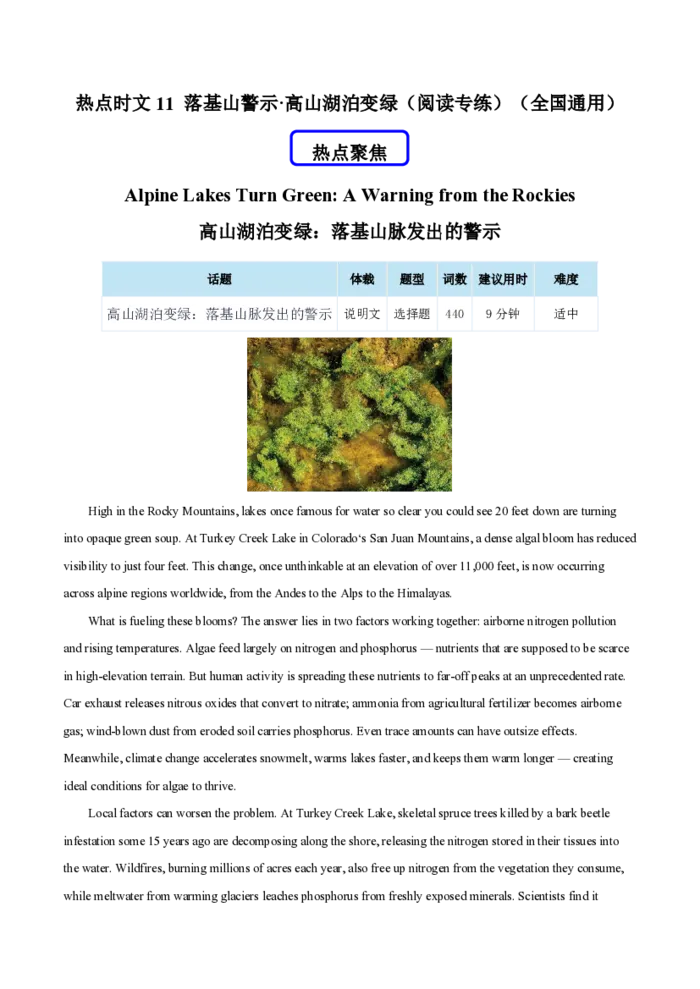
High in the Rocky Mountains, lakes once famous for water so clear you could see 20 feet down are turning
into opaque green soup. At Turkey Creek Lake in Colorado‘s San Juan Mountains, a dense algal bloom has reduced
visibility to just four feet. This change, once unthinkable at an elevation of over 11,000 feet, is now occurring
across alpine regions worldwide, from the Andes to the Alps to the Himalayas.
What is fueling these blooms? The answer lies in two factors working together: airborne nitrogen pollution
and rising temperatures. Algae feed largely on nitrogen and phosphorus — nutrients that are supposed to be scarce
in high-elevation terrain. But human activity is spreading these nutrients to far-off peaks at an unprecedented rate.
Car exhaust releases nitrous oxides that convert to nitrate; ammonia from agricultural fertilizer becomes airborne
gas; wind-blown dust from eroded soil carries phosphorus. Even trace amounts can have outsize effects.
Meanwhile, climate change accelerates snowmelt, warms lakes faster, and keeps them warm longer — creating
ideal conditions for algae to thrive.
Local factors can worsen the problem. At Turkey Creek Lake, skeletal spruce trees killed by a bark beetle
infestation some 15 years ago are decomposing along the shore, releasing the nitrogen stored in their tissues into
the water. Wildfires, burning millions of acres each year, also free up nitrogen from the vegetation they consume,
while meltwater from warming glaciers leaches phosphorus from freshly exposed minerals. Scientists find it
话题
体裁
题型
词数
建议用时
难度
高山湖泊变绿:落基山脉发出的警示
说明文
选择题
440
9 分钟
适中
热点聚焦
difficult to discern large-scale patterns because the sources of nutrients vary so widely from lake to lake.
The consequences go beyond unsightly green water. When algae die and sink to the bottom, the
decomposition process uses up oxygen in the water. In Turkey Creek Lake, dissolved oxygen levels dropped almost
to zero at depths of 30 to 40 feet — a condition known as anoxia that often kills fish. Even more alarming is the
potential for cyanobacteria, a type of algae that produces toxins capable of poisoning wildlife and contaminating
drinking water. So far, cyanobacteria remain rare in mountain lakes because they prefer warmer water. But as
alpine temperatures rise, these toxic organisms could gain a foothold.
Researchers are now working to understand how severe and widespread this trend is. Sediment cores taken
from lakes in Rocky Mountain National Park show that algal biomass has more than doubled over the past 70
years, in step with regional pollution and climate change. Scientists fear that what is happening at Turkey Creek
Lake may be a preview of what lies ahead for other alpine lakes — a clear warning that even Earth’s most remote
waters are not safe from human impact.
from https://www.scientificamerican.com/article/scientists-reveal-why-rocky-mountain-lakes-are-turning-green/有
删减
【牛刀·小试】
(
) 1. What has caused the reduced visibility in Turkey Creek Lake?
A. Increased water temperature due to climate change.
B. A dense growth of algae in the water.
C. Decomposition of trees killed by beetles.
D. Airborne nitrogen from car exhaust.
(
)2. Why is it difficult for scientists to identify large-scale patterns in alpine lake pollution?
A. The number of mountain lakes is too large to monitor.
B. Climate change affects different lakes at different rates.
C. The sources of nutrients vary greatly from lake to lake.
D. Remote sensing technology cannot capture small lakes.
(
)3. What can be inferred about cyanobacteria from the passage?
A. They have already become the dominant species in most alpine lakes.
B. They are likely to become more common as alpine temperatures continue to rise.
C. They produce toxins that are harmless to most wildlife.
D. They prefer colder water conditions to warm ones.
(
)4. What is the main purpose of this passage?
A. To explain why alpine lakes are turning green and what this means.
B. To describe the methods scientists use to study lake pollution.
C. To call for immediate action to stop the spread of algal blooms.
D. To compare different types of algae found in mountain lakes.
【词库·筑基】——课标词汇提取
1. sensitive /ˈsensətɪv/ adj. 敏感的;易受影响的
2. emission /iˈmɪʃən/ n. 排放;散发
3. diversity /daɪˈvɜːsəti/ n. 多样性
4. accelerate /əkˈseləreɪt/ v. 加速;促进
5. preserve /prɪˈzɜːv/ v. 保护;保存
6. interact /ˌɪntərˈækt/ vi. 相互作用;互动
7. in response to 对……作出回应;响应
8. be exposed to 暴露于;接触
9. play a vital role in 在……中起至关重要的作用
10. be at risk of 面临……的风险
【词汇·练习】
一、根据首字母提示填空
1. In a healthy lake ecosystem, different species constantly i_________ with each other, forming a complex food
web.
2. To combat air pollution, many countries are taking measures to reduce harmful gas e_________ from factories
and vehicles.
3. It is our duty to p_________ these fragile alpine lakes before they are permanently damaged by human activities.
4. The Amazon rainforest is known for its incredible biological d_________, which supports millions of plant and
animal species.
5. Climate change has been found to a_________ the melting of glaciers, leading to a faster rise in sea levels.
6. The ecosystem of high‑elevation lakes is extremely s_________ to small changes in water temperature and nutrient
levels.
二、根据汉语提示填空
1. 那座老桥在上周的暴风雨中面临坍塌的风险。
That old bridge ________ ________ ________ ________ collapsing during last week’s storm.
2. 这家公司去年改变了生产计划,以回应环保组织的建议。
The company changed its production plan last year ________ ________ ________ the recommendations of
environmental groups.
3. 在20 世纪,抗生素在对抗传染病中起了至关重要的作用。
In the 20th century, antibiotics ________ ________ ________ ________ ________ fighting infectious diseases.
4. 这些工人在施工期间长期暴露于有害粉尘中。
These workers ________ ________ ________ harmful dust for a long time during the construction.
【长句·解码】
Even more alarming is the potential for cyanobacteria, a type of algae that produces toxins capable of poisoning
wildlife and contaminating drinking water.
【分析】这是一个倒装句,表语“Even more alarming”置于句首,主语是“__________________________”;
“a type of algae”作________,补充说明cyanobacteria,其后跟有that 引导的定语从句
“__________________________”,修饰algae;形容词短语“capable of poisoning wildlife and contaminating
drinking water”作________,修饰toxins。
【译文】
_____________________________________________________________________________________
【以读促写·训练】
假设你是李华,你校英文报正在举办以“保护高山湖泊”为主题的征文活动。请你写一封倡议信,呼吁同
学们关注高山湖泊的生态危机。内容包括:
1.描述高山湖泊面临的问题及其原因;
2.说明可能带来的严重后果;
3.提出至少两条具体的保护建议。
注意:
1.词数100 左右;
2.可适当增加细节,使行文连贯;
3.开头和结尾已给出,不计入总词数。
Dear fellow students,
I am writing to draw your attention to a serious environmental crisis happening high in the Rocky Mountains
and across alpine regions worldwide.
_____________________________________________________________________________________________
_____________________________________________________________________________________________
_____________________________________________________________________________________________
_____________________________________________________________________________________________
_____________________________________________________________________________________________
_____________________________________________________________________________________________
_____________________________________________________________________________________________
_____________________________________________________________________________________________
_____________________________________________________________________________________________
_____________________________________________________________________________________________
Let’s join hands and take action before it’s too late!
Yours sincerely,
Li Hua
Alpine lakes, typically situated at altitudes above 3,000 meters, are among the most pristine ecosystems on
Earth. Known for their crystal-clear waters and low nutrient levels, these lakes are extremely sensitive to
environmental changes, earning them the title of “sentinels of global change” among scientists. These fragile water
bodies support unique food webs composed of algae, plankton, and fish species such as cutthroat trout, while their
sediment layers preserve records of environmental change spanning centuries or even millennia.
Recent decades, however, have witnessed alarming transformations in these once-pristine waters. Atmospheric
nitrogen deposition — largely from vehicle exhaust, agricultural fertilizers, and industrial emissions — has spread
from industrial and agricultural regions to remote mountain ranges. Studies indicate that nitrogen deposition in Rocky
Mountain National Park has increased five to tenfold compared to pre-industrial levels. In the Loch Vale Watershed,
for instance, sediment cores reveal that algal biomass has more than doubled over the past 70 years. Meanwhile,
climate change has extended the ice-free period of alpine lakes and raised summer water temperatures, creating longer
growing windows for algae to thrive. Bark beetle infestations, which have killed vast expanses of forest, and
increasingly frequent wildfires further compound the problem by releasing additional nutrients into the water.
In response to these threats, the U.S. National Park Service has implemented air quality monitoring programs
and collaborated with state and federal agencies to develop the Nitrogen Deposition Reduction Plan for Rocky
背景拓展
Mountain National Park. The Clean Air Act provides a legal framework to prevent air quality deterioration in national
parks and wilderness areas. However, achieving meaningful reductions in nitrogen deposition requires coordinated
efforts across multiple jurisdictions, as air pollution travels far from its sources. Individuals can also contribute by
reducing private vehicle use, conserving energy, and supporting clean energy policies. Scientists are calling for the
establishment of a global alpine lake monitoring network to more accurately assess ecological risks and take timely
protective measures before it is too late.
译文
高山湖泊通常位于海拔3000 米以上,是地球上最原始的生态系统之一。这些湖泊以水质清澈、营养贫
乏著称,对环境变化极为敏感,因此被科学家称为“全球变化的哨兵”。这些脆弱的湖泊支撑着由藻类、浮
游生物和鱼类(如割喉鳟)构成的独特食物网,而它们的沉积物层则记录着长达数百年甚至数千年的环境变
化。
然而近几十年来,这些曾经纯净的水域正经历令人担忧的转变。大气氮沉降——主要来自汽车尾气、农
业化肥和工业排放——已从工农业地区扩散至偏远山脉。研究表明,落基山国家公园的氮沉降量比工业化
前增加了5 至10 倍。例如,在洛克谷流域,沉积物岩芯显示过去70 年间藻类生物量增长了一倍以上。与
此同时,气候变化使高山湖泊的无冰期延长、夏季水温升高,为藻类的大量繁殖创造了更长的生长窗口。此
外,甲虫灾害导致的大面积树木死亡以及日益频繁的野火,进一步向水体释放了额外的营养盐。
面对这些威胁,美国国家公园管理局已实施空气质量监测计划,并与州及联邦机构合作,为落基山国家
公园制定了氮沉降减排计划。《清洁空气法》为保护国家公园和荒野地区的空气质量提供了法律框架。然
而,实现氮沉降的有效减少需要多个行政区域的协调努力,因为空气污染物能够从其源头远距离传播。个人
也可以通过减少私家车使用、节约能源、支持清洁能源政策等方式贡献力量。科学家呼吁建立全球高山湖泊
监测网络,以便更准确地评估生态风险,及时采取保护措施。