热点时文11 落基山警示·高山湖泊变绿(阅读专练)(全国通用)
Alpine Lakes Turn Green: A Warning from the Rockies
高山湖泊变绿:落基山脉发出的警示
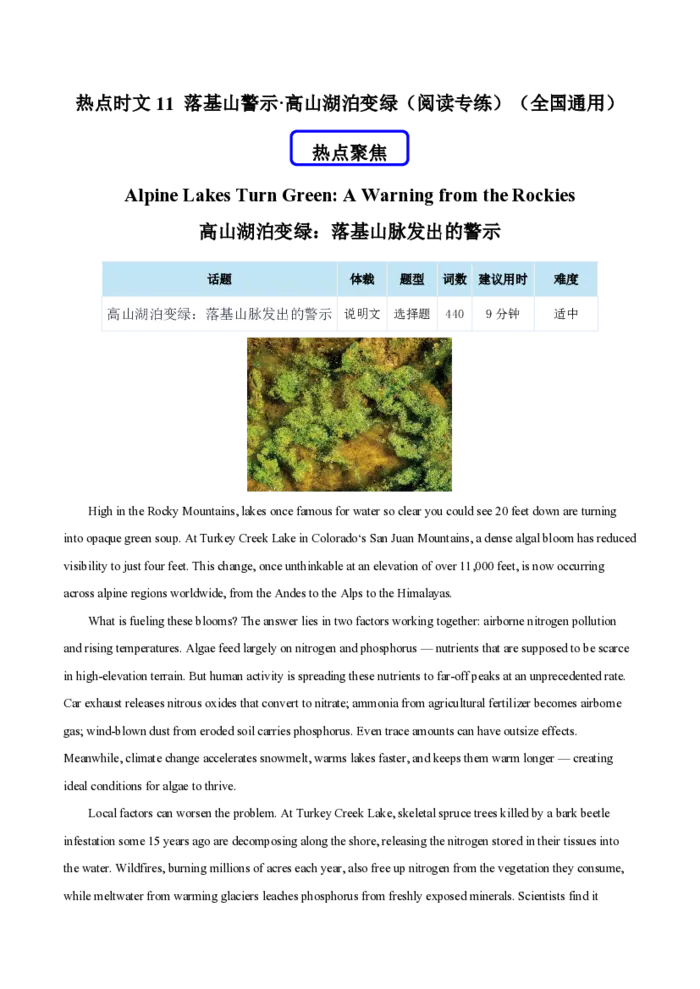
High in the Rocky Mountains, lakes once famous for water so clear you could see 20 feet down are turning
into opaque green soup. At Turkey Creek Lake in Colorado‘s San Juan Mountains, a dense algal bloom has reduced
visibility to just four feet. This change, once unthinkable at an elevation of over 11,000 feet, is now occurring
across alpine regions worldwide, from the Andes to the Alps to the Himalayas.
What is fueling these blooms? The answer lies in two factors working together: airborne nitrogen pollution
and rising temperatures. Algae feed largely on nitrogen and phosphorus — nutrients that are supposed to be scarce
in high-elevation terrain. But human activity is spreading these nutrients to far-off peaks at an unprecedented rate.
Car exhaust releases nitrous oxides that convert to nitrate; ammonia from agricultural fertilizer becomes airborne
gas; wind-blown dust from eroded soil carries phosphorus. Even trace amounts can have outsize effects.
Meanwhile, climate change accelerates snowmelt, warms lakes faster, and keeps them warm longer — creating
ideal conditions for algae to thrive.
Local factors can worsen the problem. At Turkey Creek Lake, skeletal spruce trees killed by a bark beetle
infestation some 15 years ago are decomposing along the shore, releasing the nitrogen stored in their tissues into
the water. Wildfires, burning millions of acres each year, also free up nitrogen from the vegetation they consume,
while meltwater from warming glaciers leaches phosphorus from freshly exposed minerals. Scientists find it
话题
体裁
题型
词数
建议用时
难度
高山湖泊变绿:落基山脉发出的警示
说明文
选择题
440
9 分钟
适中
热点聚焦
difficult to discern large-scale patterns because the sources of nutrients vary so widely from lake to lake.
The consequences go beyond unsightly green water. When algae die and sink to the bottom, the
decomposition process uses up oxygen in the water. In Turkey Creek Lake, dissolved oxygen levels dropped almost
to zero at depths of 30 to 40 feet — a condition known as anoxia that often kills fish. Even more alarming is the
potential for cyanobacteria, a type of algae that produces toxins capable of poisoning wildlife and contaminating
drinking water. So far, cyanobacteria remain rare in mountain lakes because they prefer warmer water. But as
alpine temperatures rise, these toxic organisms could gain a foothold.
Researchers are now working to understand how severe and widespread this trend is. Sediment cores taken
from lakes in Rocky Mountain National Park show that algal biomass has more than doubled over the past 70
years, in step with regional pollution and climate change. Scientists fear that what is happening at Turkey Creek
Lake may be a preview of what lies ahead for other alpine lakes — a clear warning that even Earth’s most remote
waters are not safe from human impact.
from https://www.scientificamerican.com/article/scientists-reveal-why-rocky-mountain-lakes-are-turning-green/有
删减
【牛刀·小试】
(
) 1. What has caused the reduced visibility in Turkey Creek Lake?
A. Increased water temperature due to climate change.
B. A dense growth of algae in the water.
C. Decomposition of trees killed by beetles.
D. Airborne nitrogen from car exhaust.
(
)2. Why is it difficult for scientists to identify large-scale patterns in alpine lake pollution?
A. The number of mountain lakes is too large to monitor.
B. Climate change affects different lakes at different rates.
C. The sources of nutrients vary greatly from lake to lake.
D. Remote sensing technology cannot capture small lakes.
(
)3. What can be inferred about cyanobacteria from the passage?
A. They have already become the dominant species in most alpine lakes.
B. They are likely to become more common as alpine temperatures continue to rise.
C. They produce toxins that are harmless to most wildlife.
D. They prefer colder water conditions to warm ones.
(
)4. What is the main purpose of this passage?
A. To explain why alpine lakes are turning green and what this means.
B. To describe the methods scientists use to study lake pollution.
C. To call for immediate action to stop the spread of algal blooms.
D. To compare different types of algae found in mountain lakes.
【词库·筑基】——课标词汇提取
1. sensitive /ˈsensətɪv/ adj. 敏感的;易受影响的
2. emission /iˈmɪʃən/ n. 排放;散发
3. diversity /daɪˈvɜːsəti/ n. 多样性
4. accelerate /əkˈseləreɪt/ v. 加速;促进
5. preserve /prɪˈzɜːv/ v. 保护;保存
6. interact /ˌɪntərˈækt/ vi. 相互作用;互动
7. in response to 对……作出回应;响应
8. be exposed to 暴露于;接触
9. play a vital role in 在……中起至关重要的作用
10. be at risk of 面临……的风险
【词汇·练习】
一、根据首字母提示填空
1. In a healthy lake ecosystem, different species constantly i_________ with each other, forming a complex food
web.
2. To combat air pollution, many countries are taking measures to reduce harmful gas e_________ from factories
and vehicles.
3. It is our duty to p_________ these fragile alpine lakes before they are permanently damaged by human activities.
4. The Amazon rainforest is known for its incredible biological d_________, which supports millions of plant and
animal species.
5. Climate change has been found to a_________ the melting of glaciers, leading to a faster rise in sea levels.
6. The ecosystem of high‑elevation lakes is extremely s_________ to small changes in water temperature and nutrient
levels.
二、根据汉语提示填空
1. 那座老桥在上周的暴风雨中面临坍塌的风险。
That old bridge ________ ________ ________ ________ collapsing during last week’s storm.
2. 这家公司去年改变了生产计划,以回应环保组织的建议。
The company changed its production plan last year ________ ________ ________ the recommendations of
environmental groups.
3. 在20 世纪,抗生素在对抗传染病中起了至关重要的作用。
In the 20th century, antibiotics ________ ________ ________ ________ ________ fighting infectious diseases.
4. 这些工人在施工期间长期暴露于有害粉尘中。
These workers ________ ________ ________ harmful dust for a long time during the construction.
【长句·解码】
Even more alarming is the potential for cyanobacteria, a type of algae that produces toxins capable of poisoning
wildlife and contaminating drinking water.
【分析】这是一个倒装句,表语“Even more alarming”置于句首,主语是“__________________________”;
“a type of algae”作________,补充说明cyanobacteria,其后跟有that 引导的定语从句
“__________________________”,修饰algae;形容词短语“capable of poisoning wildlife and contaminating
drinking water”作________,修饰toxins。
【译文】
_____________________________________________________________________________________
【以读促写·训练】
假设你是李华,你校英文报正在举办以“保护高山湖泊”为主题的征文活动。请你写一封倡议信,呼吁同
学们关注高山湖泊的生态危机。内容包括:
1.描述高山湖泊面临的问题及其原因;
2.说明可能带来的严重后果;
3.提出至少两条具体的保护建议。
注意:
1.词数100 左右;
2.可适当增加细节,使行文连贯;
3.开头和结尾已给出,不计入总词数。
Dear fellow students,
I am writing to draw your attention to a serious environmental crisis happening high in the Rocky Mountains
and across alpine regions worldwide.
_____________________________________________________________________________________________
_____________________________________________________________________________________________
_____________________________________________________________________________________________
_____________________________________________________________________________________________
_____________________________________________________________________________________________
_____________________________________________________________________________________________
_____________________________________________________________________________________________
_____________________________________________________________________________________________
_____________________________________________________________________________________________
_____________________________________________________________________________________________
Let’s join hands and take action before it’s too late!
Yours sincerely,
Li Hua
Alpine lakes, typically situated at altitudes above 3,000 meters, are among the most pristine ecosystems on
Earth. Known for their crystal-clear waters and low nutrient levels, these lakes are extremely sensitive to
environmental changes, earning them the title of “sentinels of global change” among scientists. These fragile water
bodies support unique food webs composed of algae, plankton, and fish species such as cutthroat trout, while their
sediment layers preserve records of environmental change spanning centuries or even millennia.
Recent decades, however, have witnessed alarming transformations in these once-pristine waters. Atmospheric
nitrogen deposition — largely from vehicle exhaust, agricultural fertilizers, and industrial emissions — has spread
from industrial and agricultural regions to remote mountain ranges. Studies indicate that nitrogen deposition in Rocky
Mountain National Park has increased five to tenfold compared to pre-industrial levels. In the Loch Vale Watershed,
for instance, sediment cores reveal that algal biomass has more than doubled over the past 70 years. Meanwhile,
climate change has extended the ice-free period of alpine lakes and raised summer water temperatures, creating longer
growing windows for algae to thrive. Bark beetle infestations, which have killed vast expanses of forest, and
increasingly frequent wildfires further compound the problem by releasing additional nutrients into the water.
In response to these threats, the U.S. National Park Service has implemented air quality monitoring programs
and collaborated with state and federal agencies to develop the Nitrogen Deposition Reduction Plan for Rocky
背景拓展
Mountain National Park. The Clean Air Act provides a legal framework to prevent air quality deterioration in national
parks and wilderness areas. However, achieving meaningful reductions in nitrogen deposition requires coordinated
efforts across multiple jurisdictions, as air pollution travels far from its sources. Individuals can also contribute by
reducing private vehicle use, conserving energy, and supporting clean energy policies. Scientists are calling for the
establishment of a global alpine lake monitoring network to more accurately assess ecological risks and take timely
protective measures before it is too late.
译文
高山湖泊通常位于海拔3000 米以上,是地球上最原始的生态系统之一。这些湖泊以水质清澈、营养贫
乏著称,对环境变化极为敏感,因此被科学家称为“全球变化的哨兵”。这些脆弱的湖泊支撑着由藻类、浮
游生物和鱼类(如割喉鳟)构成的独特食物网,而它们的沉积物层则记录着长达数百年甚至数千年的环境变
化。
然而近几十年来,这些曾经纯净的水域正经历令人担忧的转变。大气氮沉降——主要来自汽车尾气、农
业化肥和工业排放——已从工农业地区扩散至偏远山脉。研究表明,落基山国家公园的氮沉降量比工业化
前增加了5 至10 倍。例如,在洛克谷流域,沉积物岩芯显示过去70 年间藻类生物量增长了一倍以上。与
此同时,气候变化使高山湖泊的无冰期延长、夏季水温升高,为藻类的大量繁殖创造了更长的生长窗口。此
外,甲虫灾害导致的大面积树木死亡以及日益频繁的野火,进一步向水体释放了额外的营养盐。
面对这些威胁,美国国家公园管理局已实施空气质量监测计划,并与州及联邦机构合作,为落基山国家
公园制定了氮沉降减排计划。《清洁空气法》为保护国家公园和荒野地区的空气质量提供了法律框架。然
而,实现氮沉降的有效减少需要多个行政区域的协调努力,因为空气污染物能够从其源头远距离传播。个人
也可以通过减少私家车使用、节约能源、支持清洁能源政策等方式贡献力量。科学家呼吁建立全球高山湖泊
监测网络,以便更准确地评估生态风险,及时采取保护措施。
【牛刀·小试】
【导语】本文是一篇说明文。通过落基山脉高山湖泊(以 Turkey Creek Lake 为例)因藻类大量繁殖而由清
澈变为绿色的现象,揭示了人类活动(氮污染与气候变化)对偏远高山生态系统的深远影响,警示即使地球
上最遥远的水域也无法免受人类活动的危害。
1. B 【解析】细节理解题。根据第一段第二句“At Turkey Creek Lake in Colorado‘s San Juan Mountains, a dense
algal bloom has reduced visibility to just four feet.”可知,导致湖水能见度下降的直接原因是密集的藻类大量
繁殖(algal bloom)。A 项气候变化导致的水温升高是藻类繁殖的促进因素之一,但不是直接原因;C 项树
木分解释放氮元素是营养来源之一,并非导致能见度下降的直接原因;D 项汽车尾气中的氮是污染物来源,
同样不是直接原因。本题旨在考查考生对因果关系的准确把握——题目问的是直接原因(reduced visibility
的直接原因),考生需要在文中准确定位“a dense algal bloom has reduced visibility”这一关键信息。
2. C 【解析】细节理解题。根据第三段最后一句“Scientists find it difficult to discern large-scale patterns because
the sources of nutrients vary so widely from lake to lake.”可知,科学家难以识别大规模规律的原因是不同湖
泊的营养物质来源差异很大。A 项湖泊数量大并非文中提及的原因;B 项气候变化对不同湖泊的影响速率不
同并非原文表述;D 项遥感技术限制虽然文中第四段有所提及,但并非解释本问题的原因。本题考查考生对
文中明确陈述的因果关系的识别能力。
3. B 【解析】推理判断题。根据第四段最后两句“So far, cyanobacteria remain rare in mountain lakes because they
prefer warmer water. But as alpine temperatures rise, these toxic organisms could gain a foothold.”可以推断,蓝
藻目前在高山湖泊中仍较为稀少,原因是它们偏好温暖的水温;随着高山地区气温持续上升,它们可能会获
得立足之地。因此,B 项“随着高山气温持续上升,它们很可能变得更加常见”是合理的推断。A 项与文中
“remain rare”相悖;C 项与文中“produces toxins capable of poisoning wildlife”相悖;D 项与“prefer warmer water”
相悖。本题考查考生根据已有信息进行合理推断的能力。
4. A 【解析】主旨大意题。全文围绕“高山湖泊为何变绿”以及“这一现象意味着什么”展开:第一段以Turkey
Creek Lake 为例引出高山湖泊变绿的现象及其全球性趋势;第二段解释原因(氮污染和气温上升);第三段
补充局部因素的复杂影响;第四段阐述生态后果(缺氧、蓝藻毒素威胁);第五段总结科学家的研究发现及
其警示意义。全文的核心目的并非描述研究方法(B 项),也不是发出行动呼吁(C 项,文中并未提出具体
建议),更不是比较不同类型的藻类(D 项)。A 项准确概括了文章的主题——解释原因并揭示意义,符合
高考英语科普说明文主旨大意题的命题思路。
【词汇·练习】
一、
1. interact
2. emissions
3. preserve
4. diversity
5. accelerate
6. sensitive
答案与解析
二、
1. was at risk of
2. in response to
3. played a vital role in 4.were exposed to
【长句·解码】
【分析】the potential for cyanobacteria;同位语;that produces toxins;后置定语。
【译文】更令人担忧的是蓝藻潜在爆发的风险——这类藻类会产生毒素,可毒害野生动物、污染饮用水
源。
【以读促写·训练】
Dear fellow students,
I am writing to draw your attention to a serious environmental crisis happening high in the Rocky Mountains
and across alpine regions worldwide.
Alpine lakes, once famous for crystal-clear water, are turning green due to dense algal blooms. The main
causes are airborne nitrogen pollution from car exhaust and agriculture, combined with rising temperatures from
climate change. These factors create perfect conditions for algae to thrive.
The consequences are alarming. Algal decomposition consumes oxygen, creating “dead zones” that kill fish.
Worse still, warmer waters may allow toxic cyanobacteria to grow, poisoning wildlife and contaminating drinking
water. To help, we can reduce car use and support clean energy. Also, we should save electricity and spread the
word about protecting these fragile ecosystems.
Let’s join hands and take action before it’s too late!
Yours sincerely,
Li Hua
高山湖泊变绿:落基山脉发出的警示
在落基山脉高处,那些曾以水质清澈著称、能见度可达20 英尺的湖泊,如今正变成浑浊的绿色“浓
汤”。在科罗拉多州圣胡安山脉的土耳其溪湖,密集的水藻爆发已将湖水能见度降至仅4 英尺。这一变化
在海拔超11000 英尺的地区曾难以想象,如今却在全球高山地带接连上演——从安第斯山脉、阿尔卑斯山
脉到喜马拉雅山脉,无一幸免。
究竟是什么催生了这些水藻爆发?答案在于两大因素的共同作用:大气氮污染与气温上升。水藻主要
以氮和磷为养分,而这类营养物质在高海拔地区本应十分稀缺。但人类活动正以前所未有的速度,将这些
营养物质输送到遥远的高山之巅。汽车尾气排放的氮氧化物会转化为硝酸盐;农业化肥产生的氨气会形成
气态污染物;受侵蚀土壤扬起的粉尘则携带磷元素。即便只是微量,也能引发巨大影响。与此同时,气候
变化加速了积雪融化,让湖泊升温更快、高温持续更久,为水藻疯长创造了理想条件。
局部因素还会加剧这一问题。在土耳其溪湖,约15 年前因树皮甲虫泛滥枯死的云杉残干在岸边腐
烂,将树木组织中储存的氮释放到水中;每年烧毁数百万英亩土地的野火,也会从燃烧的植被中释放氮元
素;而冰川消融产生的融水,会从新裸露的矿物质中淋滤出磷。由于不同湖泊的营养物质来源差异极大,
科学家很难梳理出大范围的变化规律。
其影响远不止湖水变绿这般有碍观瞻。水藻死亡后沉入湖底,分解过程会消耗水中的氧气。在土耳其
溪湖,30 至40 英尺深的水域溶解氧含量几乎降至零,这种被称为缺氧的状况常会导致鱼类死亡。更令人
担忧的是蓝藻潜在爆发的风险——这类藻类会产生毒素,可毒害野生动物、污染饮用水源。目前蓝藻在高
山湖泊中仍较为少见,因为它们更偏爱温暖水域,但随着高山气温持续升高,这些有毒生物很可能在此扎
根繁衍。
研究人员正致力于摸清这一趋势的严重程度与波及范围。从落基山国家公园湖泊采集的沉积物岩芯显
示,过去70 年间,水藻生物量翻了一倍多,与区域污染和气候变化的进程高度吻合。科学家担忧,土耳
其溪湖发生的一切,或许正是其他高山湖泊的未来预演——这清晰地警示着,即便地球上最偏远的水域,
也难逃人类活动的影响。
参考译文