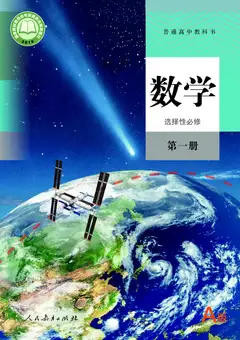
普通高中教科书
第一册
必修
普通高中教科书
第一册
必修
主
编:陈
琳
北京
主 编:陈 琳
副 主 编:张连仲
编 者:刘 晓 李陆桂 张京生 钱建源 徐 浩 雷传利
(按照姓氏笔画排序)
项目策划:王 芳 王 勇
项目负责:张黎新 郎 崧 张 涛
基础教育出版分社:
地 址:北京市西三环北路19 号 外研社大厦 基础教育出版分社(100089)
咨询电话:(010)88819117/88819688
传 真:(010)88819423
本教材是外语教学与研究出版社根据教育部制定的《普通高中英语课程标准(2017 年版)》,在充分
调研和科学论证的基础上推出的中小学“一条龙”英语教材——《英语》(新标准)的高中部分。
本教材的主编为北京外国语大学陈琳教授,副主编为张连仲教授,编写团队包括国内高校的知名专家
学者、教研人员和一线教师。陈琳教授秉承周恩来总理提出的“一条龙”外语教学理念,总结自己从事
外语教育工作70 年的经验,提出了符合中国外语教育实践的教育理论——辩证实践外语教育途径,并在
《英语》(新标准)教材中贯彻实施。
根据教育部2017 年新课程标准的精神,我们启动了《英语》(新标准)高中教材的修订工作。本次
修订全面依托新课程标准要求,坚持陈琳教授的特色理论,由陈琳教授、张连仲教授指导编写团队,在充
分考虑我国英语教育实际学情和教情的前提下,进行了全面的框架重建和内容设计,保证了理论与实践的
紧密结合。
《英语》(新标准)高中教材共分10 册:1—3 册为必修课程教材,4—7 册为选择性必修课程教材,
8—10 册为选修课程中的提高类教材。
必修课程教材具备良好的体系性、延伸性和接续性,能够帮助学生根据自己的需求不断提升个性化的
语言能力,确保学生达到高中毕业基本要求,为日后进入选择性必修课程打下坚实的基础。《英语》(新标
准)必修课程教材的主要特色如下:
一、坚持立德树人根本任务。在教材的选材、内容、语言等各个方面突出学科的育人本质,帮助学生更好
地培育中国情怀,坚定文化自信,拓展国际视野,形成正确的世界观、人生观和价值观。
二、突出学科核心素养的重要性,全面培养学生的语言能力、文化意识、思维品质和学习能力,帮助学生
逐步形成正确的价值观念、必备品格和关键能力。
三、坚持理论与实践的辩证关系。从语言实践的角度设计教材的主题架构、内容结构直至每一项具体活
动,确保有实践、可实践,并通过实践促进提升,帮助学生形成素养,发展素养。
四、遵循“理解—发展—实践”的原则,以“主题”为纲设计单元任务,重要题材在各册教材中均得到体
现,且内容逐步扩展加深、螺旋式上升,符合语言教学规律。
五、语篇题材多样、体裁丰富,语言地道鲜活、难度适中,符合学生的兴趣特点,同时能够提升学生的语
篇意识,丰富语言感知与学习体验,有利于学生通过与主题语篇互动,培养在获取信息、处理信息、
重构信息过程中的逻辑思维、多元思维和批判性思维。
六、活动设计紧密围绕主题语境,注重整合语言技能和学习技能,充分体现了英语学习活动观;同时强调
交际情境的真实性和丰富性,帮助学生掌握语言技能、建构完善的知识基础,在实践中逐步形成交际
能力。
七、强调学习策略的培养,鼓励学生通过体验、实践、讨论、合作、探究等方式,利用各种学习资源完成
学习任务,解决学习中的困难,从而形成自主学习能力。
八、融通多元文化,促进文明互鉴。引导学生在增强国家认同的基础上,尊重世界文化多样性,开展灵
活、有效、坚守中国立场的跨文化沟通,提升文化自信。
九、为教师编写了流程清晰、内容丰富的教师用书,帮助教师快速理解教材内容和相关背景知识,明确教
学目标,掌握教学节奏;同时开发了配套的网络教材和其他多媒体配套资源,丰富课程资源,拓展教
学模式。
我们希望,《英语》(新标准)高中必修课程教材能够初步培养学生的语言能力、文化意识、思维品质
和学习能力等英语学科核心素养,为他们继续学习英语和终身发展打下坚实的基础。
《英语》(新标准)系列教材
高中阶段编委会
前 言
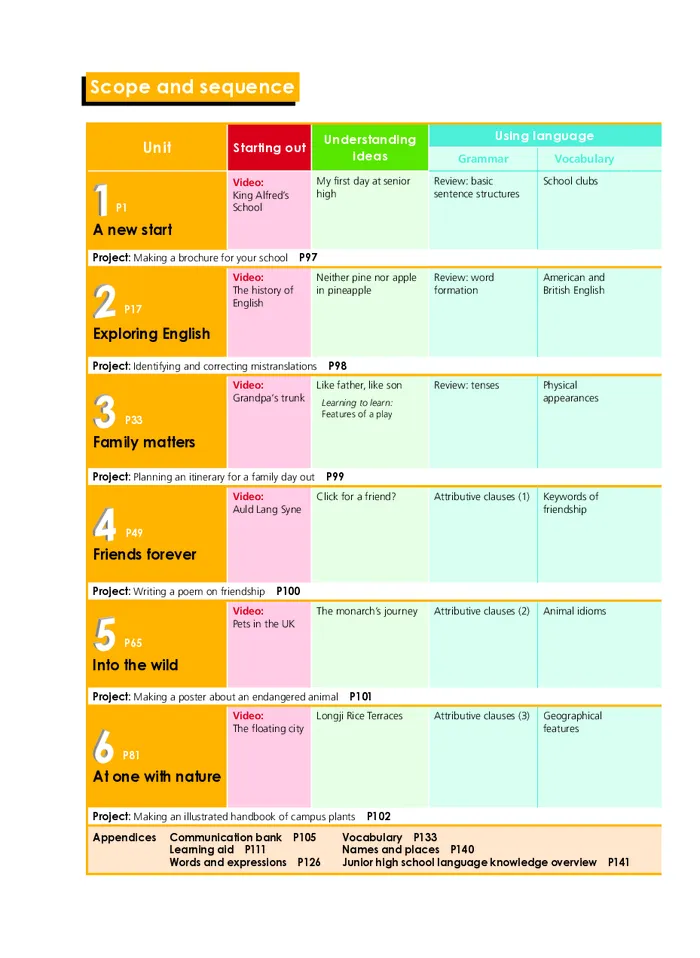
Scope and sequence
Unit
Starting out
Understanding
ideas
Using language
Grammar
Vocabulary
P1
A new start
Video:
King Alfred’s
School
My first day at senior
high
Review: basic
sentence structures
School clubs
Project: Making a brochure for your school P97
P17
Exploring English
Video:
The history of
English
Neither pine nor apple
in pineapple
Review: word
formation
American and
British English
Project: Identifying and correcting mistranslations P98
P33
Family matters
Video:
Grandpa‘s trunk
Like father, like son
Learning to learn:
Features of a play
Review: tenses
Physical
appearances
Project: Planning an itinerary for a family day out P99
P49
Friends forever
Video:
Auld Lang Syne
Click for a friend?
Attributive clauses (1)
Keywords of
friendship
Project: Writing a poem on friendship P100
P65
Into the wild
Video:
Pets in the UK
The monarch’s journey
Attributive clauses (2)
Animal idioms
Project: Making a poster about an endangered animal P101
P81
At one with nature
Video:
The floating city
Longji Rice Terraces
Attributive clauses (3)
Geographical
features
Project: Making an illustrated handbook of campus plants P102
Appendices Communication bank P105
Vocabulary P133
Learning aid P111
Names and places P140
Words and expressions P126
Junior high school language knowledge overview P141
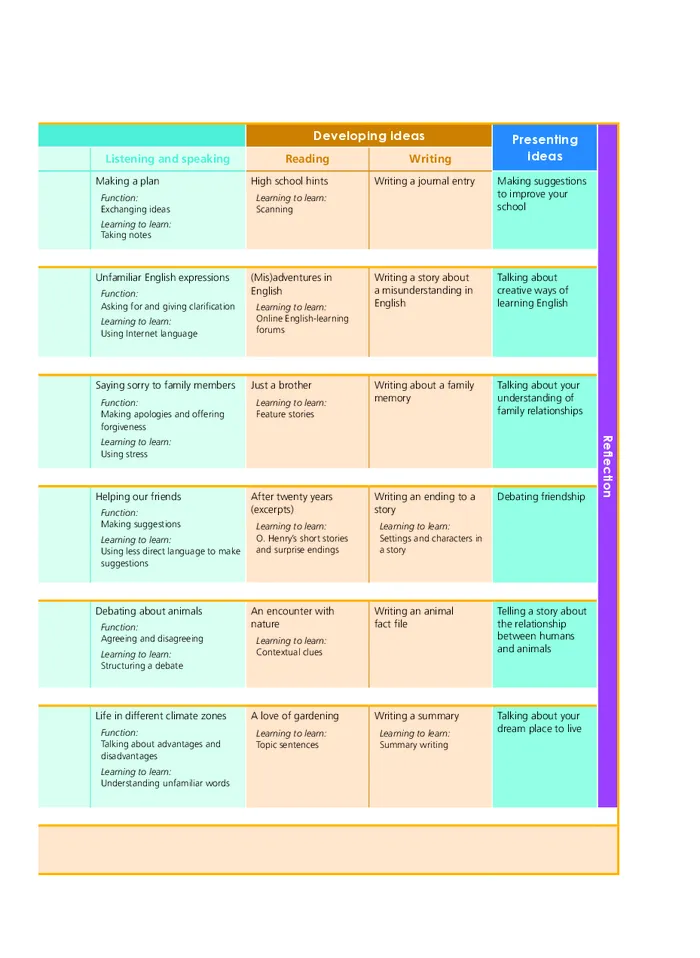
Self-assessment
Developing ideas
Presenting
ideas
Listening and speaking
Reading
Writing
Making a plan
Function:
Exchanging ideas
Learning to learn:
Taking notes
High school hints
Learning to learn:
Scanning
Writing a journal entry
Making suggestions
to improve your
school
Unfamiliar English expressions
Function:
Asking for and giving clarification
Learning to learn:
Using Internet language
(Mis)adventures in
English
Learning to learn:
Online English-learning
forums
Writing a story about
a misunderstanding in
English
Talking about
creative ways of
learning English
Saying sorry to family members
Function:
Making apologies and offering
forgiveness
Learning to learn:
Using stress
Just a brother
Learning to learn:
Feature stories
Writing about a family
memory
Talking about your
understanding of
family relationships
Helping our friends
Function:
Making suggestions
Learning to learn:
Using less direct language to make
suggestions
After twenty years
(excerpts)
Learning to learn:
O. Henry’s short stories
and surprise endings
Writing an ending to a
story
Learning to learn:
Settings and characters in
a story
Debating friendship
Debating about animals
Function:
Agreeing and disagreeing
Learning to learn:
Structuring a debate
An encounter with
nature
Learning to learn:
Contextual clues
Writing an animal
fact file
Telling a story about
the relationship
between humans
and animals
Life in different climate zones
Function:
Talking about advantages and
disadvantages
Learning to learn:
Understanding unfamiliar words
A love of gardening
Learning to learn:
Topic sentences
Writing a summary
Learning to learn:
Summary writing
Talking about your
dream place to live
Reflection
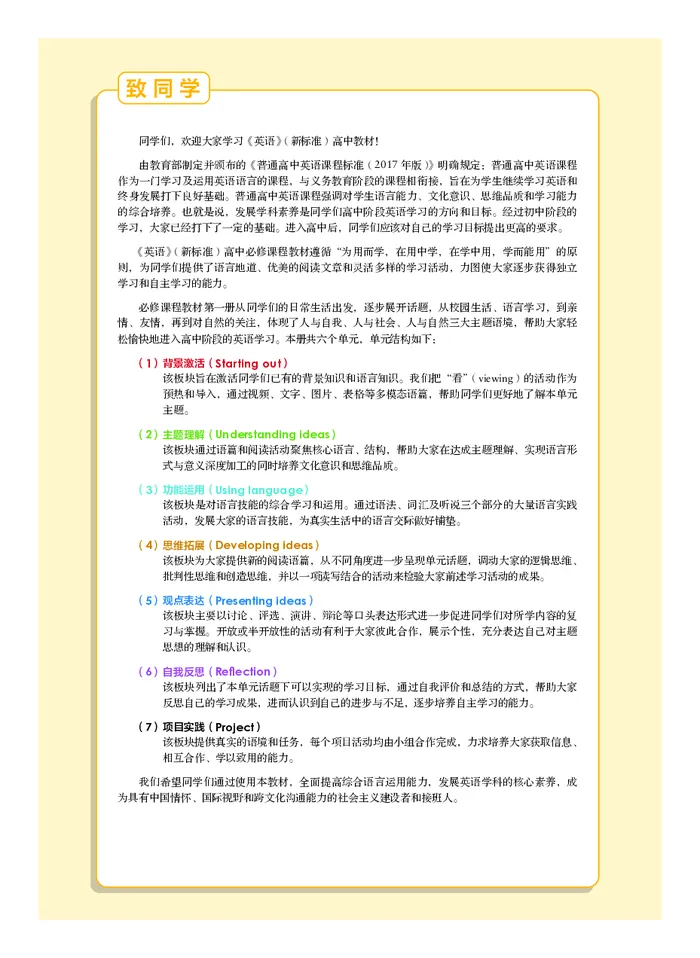
同学们,欢迎大家学习《英语》(新标准)高中教材!
由教育部制定并颁布的《普通高中英语课程标准(2017 年版)》明确规定:普通高中英语课程
作为一门学习及运用英语语言的课程,与义务教育阶段的课程相衔接,旨在为学生继续学习英语和
终身发展打下良好基础。普通高中英语课程强调对学生语言能力、文化意识、思维品质和学习能力
的综合培养。也就是说,发展学科素养是同学们高中阶段英语学习的方向和目标。经过初中阶段的
学习,大家已经打下了一定的基础。进入高中后,同学们应该对自己的学习目标提出更高的要求。
《英语》(新标准)高中必修课程教材遵循“为用而学,在用中学,在学中用,学而能用”的原
则,为同学们提供了语言地道、优美的阅读文章和灵活多样的学习活动,力图使大家逐步获得独立
学习和自主学习的能力。
必修课程教材第一册从同学们的日常生活出发,逐步展开话题,从校园生活、语言学习,到亲
情、友情,再到对自然的关注,体现了人与自我、人与社会、人与自然三大主题语境,帮助大家轻
松愉快地进入高中阶段的英语学习。本册共六个单元,单元结构如下:
(1) 背景激活(Starting out)
该板块旨在激活同学们已有的背景知识和语言知识。我们把“看”(viewing)的活动作为
预热和导入,通过视频、文字、图片、表格等多模态语篇,帮助同学们更好地了解本单元
主题。
(2) 主题理解(Understanding ideas)
该板块通过语篇和阅读活动聚焦核心语言、结构,帮助大家在达成主题理解、实现语言形
式与意义深度加工的同时培养文化意识和思维品质。
(3) 功能运用(Using language)
该板块是对语言技能的综合学习和运用。通过语法、词汇及听说三个部分的大量语言实践
活动,发展大家的语言技能,为真实生活中的语言交际做好铺垫。
(4) 思维拓展(Developing ideas)
该板块为大家提供新的阅读语篇,从不同角度进一步呈现单元话题,调动大家的逻辑思维、
批判性思维和创造思维,并以一项读写结合的活动来检验大家前述学习活动的成果。
(5) 观点表达(Presenting ideas)
该板块主要以讨论、评选、演讲、辩论等口头表达形式进一步促进同学们对所学内容的复
习与掌握。开放或半开放性的活动有利于大家彼此合作,展示个性,充分表达自己对主题
思想的理解和认识。
(6) 自我反思(Reflection)
该板块列出了本单元话题下可以实现的学习目标,通过自我评价和总结的方式,帮助大家
反思自己的学习成果,进而认识到自己的进步与不足,逐步培养自主学习的能力。
(7) 项目实践(Project)
该板块提供真实的语境和任务,每个项目活动均由小组合作完成,力求培养大家获取信息、
相互合作、学以致用的能力。
我们希望同学们通过使用本教材,全面提高综合语言运用能力,发展英语学科的核心素养,成
为具有中国情怀、国际视野和跨文化沟通能力的社会主义建设者和接班人。
致 同 学
U
N
I
T
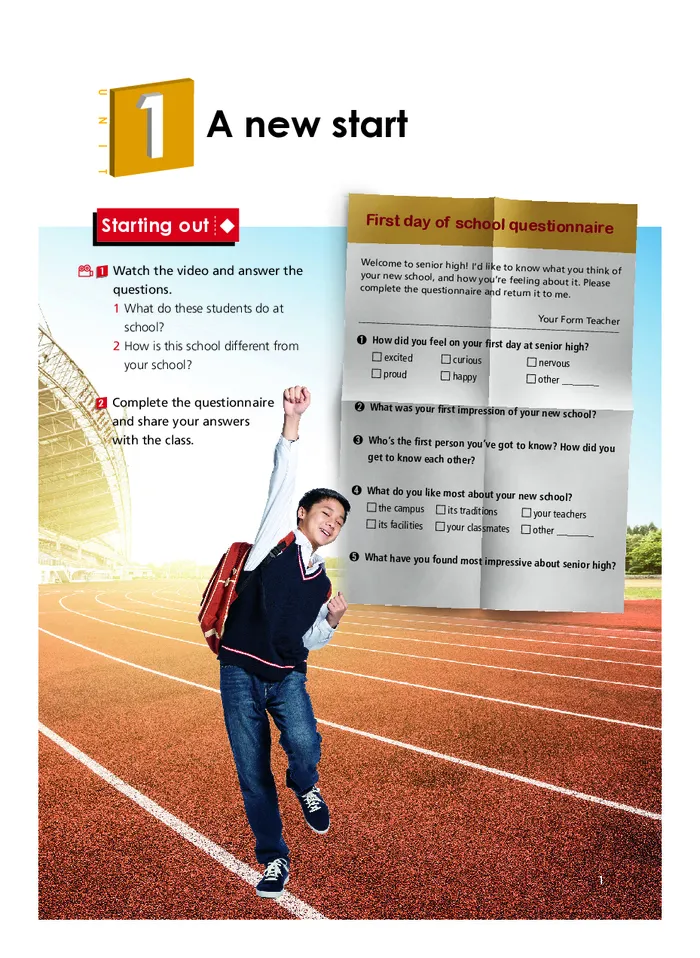
A new start
1
Watch the video and answer the
questions.
1 What do these students do at
school?
2 How is this school different from
your school?
2
Complete the questionnaire
and share your answers
with the class.
First day of school questionnaire
Welcome to senior high! I’d like to know what you think of
your new school, and how you’re feeling about it. Please
complete the questionnaire and return it to me.
Your Form Teacher
➊ How did you feel on your first day at senior high?
excited
curious
nervous
proud
happy
other _______
➋ What was your first impression of your new school?
➌ Who’s the first person you’ve got to know? How did you
get to know each other?
➍ What do you like most about your new school?
the campus
its traditions
your teachers
its facilities
your classmates
other _______
➎ What have you found most impressive about senior high?
1
Starting out
1
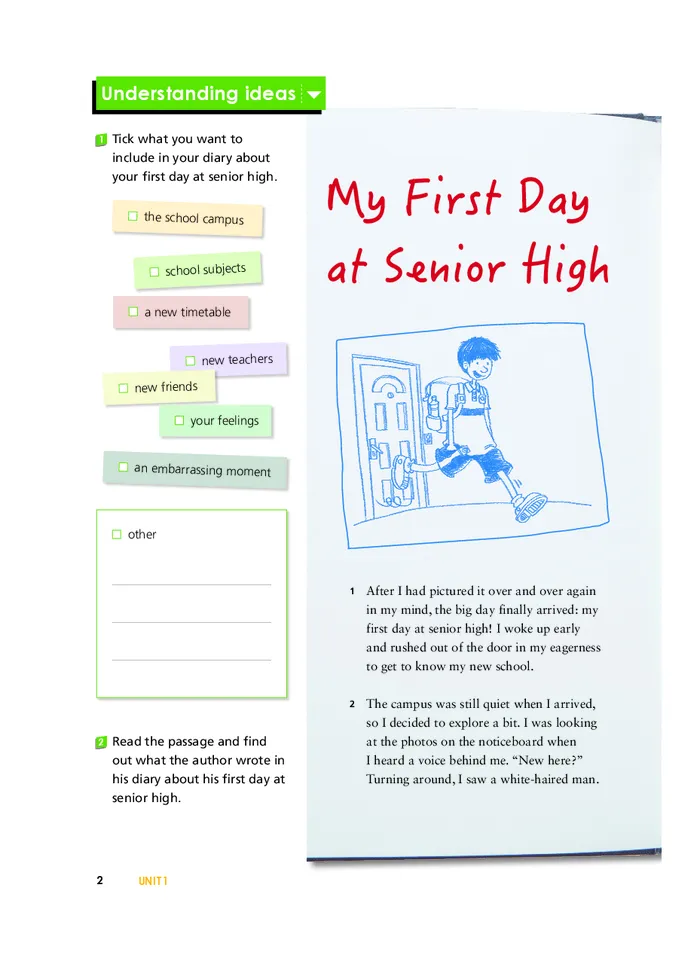
Tick what you want to
include in your diary about
your first day at senior high.
at Senior High
My First Day
Understanding ideas
2
Read the passage and find
out what the author wrote in
his diary about his first day at
senior high.
the school campus
new teachers
school subjects
a new timetable
an embarrassing moment
new friends
your feelings
1 After I had pictured it over and over again
in my mind, the big day finally arrived: my
first day at senior high! I woke up early
and rushed out of the door in my eagerness
to get to know my new school.
2 The campus was still quiet when I arrived,
so I decided to explore a bit. I was looking
at the photos on the noticeboard when
I heard a voice behind me. “New here?”
Turning around, I saw a white-haired man.
other
2
UNIT 1
Monday 4 September
“Yes,” I replied. “I’m wondering what life is going
to be like here.” “Don’t worry,” he gave me a smile.
“You’ll soon find out.”
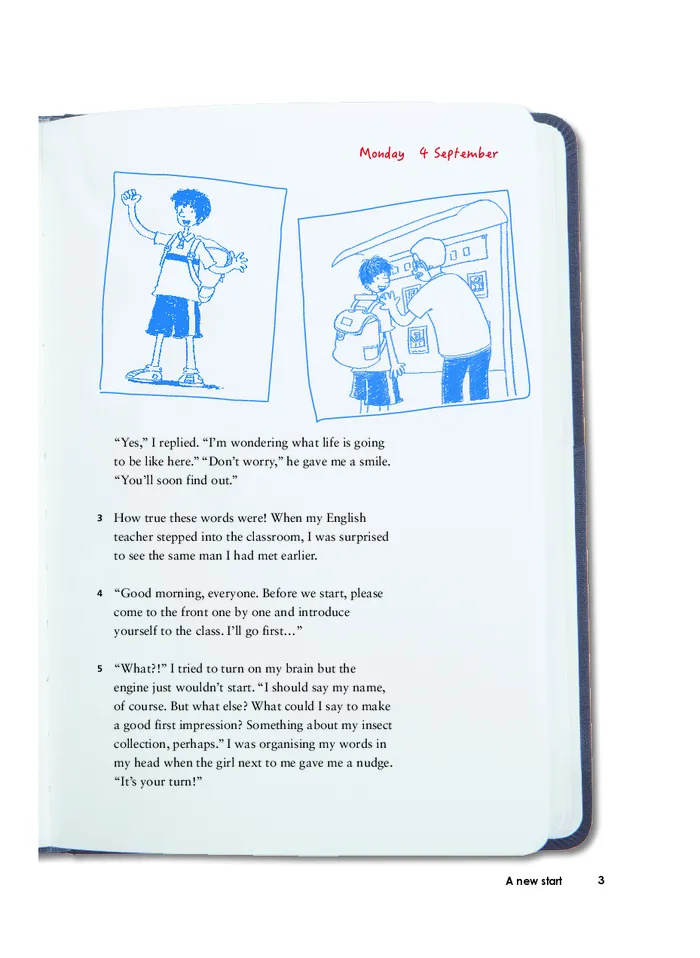
3 How true these words were! When my English
teacher stepped into the classroom, I was surprised
to see the same man I had met earlier.
4 “Good morning, everyone. Before we start, please
come to the front one by one and introduce
yourself to the class. I’ll go first…”
5 “What?!” I tried to turn on my brain but the
engine just wouldn’t start. “I should say my name,
of course. But what else? What could I say to make
a good first impression? Something about my insect
collection, perhaps.” I was organising my words in
my head when the girl next to me gave me a nudge.
“It’s your turn!”
A new start
3
3
Choose the best description of Meng Hao’s first day at senior high.
1 He found the English class difficult and was not sure what to do.
2 With the English teacher’s support, he thought senior high was easy
and felt confident about his future.
3 He was not sure about life at senior high, but after the English class,
he felt more confident.
6 With butterflies in my stomach, I
breathed deeply. “Hi, I’m Meng Hao.”
Everyone started laughing. I looked at
them in panic. “Nice to know we share
the same name,” said my new teacher. I
had been too nervous to pay attention
when he introduced himself! Although
I was embarrassed, his words made
me a lot more relaxed!
7 When we had all introduced ourselves, Mr
Meng said, “Well done, everyone! I know this
isn’t easy for many of you. But this is just the
kind of thing you are going to face at senior high.
Challenges like this might sometimes put you under
pressure. But it all depends on what you do. Keep
calm and be prepared. That way, you’ll make the
most of your time at senior high.”
8 People say, “Well begun, half done.” I guess this
was a good beginning to my new school life.
4
UNIT 1
Now find expressions that show Meng Hao’s feelings and complete
the table.
4
Complete Meng Hao’s experiences with expressions from the passage.
Think Share
&
1 What is your understanding of the saying “Well begun,
half done”?
2 What happened on your first day at senior high? Share your
experiences and feelings with the class.
Meng Hao’s experiences
Meng Hao’s feelings
Before going to school
Because it was Meng Hao’s first day at
1_______________,
he got up early and
2_______________ to his new school.
excited: woke up early;
rushed out of the door
Arriving at school
The campus was still quiet, so Meng Hao decided
to
3_______________. He met a man who he
4_______________ find out later was his English teacher.
During the English class
Meng Hao was nervous about introducing himself in
front of the class. With
5_______________, he began,
but everyone laughed. It turned out that he and his
teacher shared
6_______________.
Mr Meng said that challenges at senior high might
put them
7_______________. He advised everyone to
8_______________ and
9_______________.
After the English class
Meng Hao thought he had
10_______________ to his
new school life.
A new start
5
Review: basic sentence structures
1
Match the sentences that share the same structures.
1 I saw a white-haired man.
a He was friendly.
2 I replied.
b The exam made me quite nervous.
3 He gave me a smile.
c I passed him a book.
4 I breathed deeply.
d She agreed.
5 I looked at them in panic.
e He wrote a long letter.
6 I was embarrassed.
f He talked loudly.
7 His words made me a lot more relaxed!
g She looked after her sister patiently.
Now look for more sentences with these structures in the reading passage.
2
Look at the pictures and tell the story with your own ending. See how many
different basic sentence structures you can use.
a
b
d
c
Using language
6
UNIT 1
9____________ CLUB
School clubs
4
Work in pairs. Talk about the school clubs you would like to join and
the activities you can do in them.
3
Complete the posters with the correct form of the words in the box.
badminton drama band debate gym piano
stage photography science
Meet new people &
stay fit and healthy!
1____________ Club
Daily practice after
class at the school
2____________.
Room 302 at 4 pm every Tuesday
What killed the dinosaurs?
Why are dolphins so intelligent?
Investigate questions like these
at our club.
Join the
7____________ Club!
4 pm on Thursdays
Room 301
Argue about the week’s hottest
topics with the school’s
sharpest minds!
We meet twice a month on Saturdays.
Want to play the
5____________
or the guitar?
Or sing in a
6____________?
This is the place for you!
Music Club
Music Club
Every Tuesday
4 pm-5 pm
The Music Room
Get ready to
make some
music
!
8____________ CLUB
W
E
W
A
N
T
Y
O
U
!
C
o
m
e
a
l
o
n
g
a
n
d
t
a
k
e
g
r
e
a
t
p
i
c
t
u
r
e
s
w
i
t
h
u
s
.
Every Wednesday
5 pm-7 pm
Room 201
Join us on
4____________
and let our experienced
director help you find
your inner star.
3____________ Club
Love acting?
A new start
7
5
Listen to the conversation and decide what the speakers are mainly
talking about.
1 The clubs they have joined and the activities they do after school.
2 The things they should do to manage their time well.
3 The challenges they face in their new school.
Making a plan
?
Did You Know
In the UK and the US, senior high school students take part in various after-
school activities, such as club activities and volunteer work. These activities
not only help them gain more skills, but also teach them to care about
others. After-school activities also play a part when students apply to college.
However, they can take up a lot of time, so students have to learn to organise
their busy schedules. To help them do this, some senior high schools offer
courses in time management.
8
UNIT 1
6
Listen again and complete the plan.
Now talk about how the speakers discuss managing
their time. Listen again if necessary.
7
Work in pairs. Act out the conversation to discuss
ideas for a weekend study plan for English.
Student A: Turn to Page 105.
Student B: Turn to Page 108.
8
Work in pairs. Make another weekend plan and have
a similar conversation.
1. the things we’re going to do.
2. Record to do the activities.
3. Only at a time.
4. Do first.
As you listen, make
notes of key information
such as names,
numbers, facts and
instructions. This will
help you understand
and remember the
information you hear.
Learning to learn
A new start
9
1
Think about the things you
want to achieve at high
school and rank them in order
of importance. (1 = most
important)
join a school club
take a trip with your classmates
get the highest score in a test
at least once
get to know all the schoolmates
in your grade
stand on stage at least once
win an award
read as many books as possible
learn a new skill
other ________
2
Look at the word cloud and the
picture. Predict what is talked
about in the interview.
Now read the interview and
check your prediction.
important
give your friends a hand
deal with
challenge
keep an open mind
fail
opportunity
disappointed
work hard
High School Hints
ST
School Talk
Subscribed 3,101
Add to
Share
More
Developing ideas
10
UNIT 1
Interviewer: Hello and welcome to School Talk! Today I’m
joined by a former student of our school, Lisa Osborne. Lisa
graduated from our school last June and is about to go to
college in New York. Lisa, thank you for coming to share your
suggestions for high school with us.
Lisa: Hi, everybody. I’m very glad to be back. I feel as if high
school was only yesterday!
Interviewer: So what helped when you first started high
school?
Lisa: Orientation Day was really helpful. It’s a fantastic
opportunity for new students to get to know the school and
the other students. I even made some new friends! Just keep
an open mind and take part in as much as possible.
Interviewer: That’s sound advice for sure. But how did you
deal with new challenges, like starting a new course?
Lisa: I had a chemistry test right at the end of the first week.
I was frightened at the sight of the test paper. But then I
figured I’d better just go all out and see what happens.
If you fail, no problem – next time you can fail better!
Interviewer: So, hold your head up, then. But life is not
always easy. You must have had some moments when you
were disappointed. If so, how did you deal with them?
Lisa: As a member of the school volleyball team, I wasn’t
selected for the end-of-year competition. At first I was
really sad, but later I realized that I joined the team
for the love of the sport. It wasn’t just about winning.
998
1,231 views
Published on 10 July 2017
A new start
11
3
Scan the interview and answer the questions.
1 What did Lisa find most helpful when she started high school?
2 How did she deal with new challenges?
3 How did she handle disappointments?
So I kept working hard to support my teammates during our
training. There’s always a way to be part of something you
love, isn’t there?
Interviewer: Yes, I totally agree. Is there anything else in
particular that you’d like to share with us?
Lisa: Looking back on my high school life, the most
important advice I’d give is these wonderful words from the
writer Maya Angelou. She said, “Be a rainbow in somebody
else’s cloud.” So, give your friends a hand when they need it.
And this will make you feel good, too.
Interviewer: Neat! Well, thanks again for coming to speak to
us, Lisa. And good luck with college!
Lisa: Thank you.
When scanning a text, you read it quickly in order to find a specific piece of
information. For example, to find out the answer to the question “What did
Lisa find most helpful when she started high school?”, you would look for the
key words “helpful” and “started high school”.
Learning to learn
12
UNIT 1
4
Work in groups. Give a speech to the new students on their first day
at high school.
1 Make notes of the problems the new students may face and your advice.
Refer to the interview for ideas.
Problems the new students
may face
Your advice
1 What do you think Lisa means by “If you fail, no
problem – next time you can fail better”?
2 Think about the words from Maya Angelou: “Be a rainbow in
somebody else’s cloud.” Do you know of any similar sayings?
3 Which piece of Lisa’s advice is the most helpful to you? Why?
4 What else would you like to ask Lisa about starting high school?
Think Share
&
2 Organise your speech following the steps below.
• Start by welcoming the new students.
• Talk about the problems and give your advice.
• End by summarising the main points of your speech.
3 Give your speech to the class.
A new start
13
5
Read the journal entry and answer the questions.
Finally, it’s Friday! I can’t believe the first week is coming to an end. Things
are going well, but there is always something new just around the corner.
At junior high, I took lots of notes during class. So in physics class on Monday,
I did the same, but the teacher spoke so fast that I couldn’t take everything
down. The teacher found I was struggling with note-taking and told me to stop
and just listen. “Thinking is a more important ability than note-taking and
memorising,” he said.
After class on Wednesday, I hurried to the school skateboarding club. I was
running out of the classroom when I bumped into a girl literally. I said sorry to
her and she smiled at me. At the club, I had my first try at skateboarding and
fell off the board a lot. Suddenly, a girl bumped into me – the same girl from
the corridor! This time, both of us
laughed. Her name is Sarah. We
started to practise together and
soon became friends.
I’m going to watch a film with
Sarah tomorrow evening. I'm looking
forward to it!
Friday 8 September
1 What’s the passage about?
2 What happened in her physics class?
3 What did she do after class?
Writing a journal entry
14
UNIT 1
Now write a journal entry about your first-week experiences at senior
high. Use the expressions in the box to help you.
6
Think of your own experiences of the first week at senior high and
complete the notes.
7
Share your journal entry with the class.
My impression of the first week
An enjoyable class
After-school activities
How I made a new friend
• Things are going well…
• At junior high, …
• After class, …
• I’m going to…
Useful expressions
A new start
15
2
Work in groups. Talk about your
suggestions and prepare a short
presentation. Use the expressions in
the box to help you.
3
Present your suggestions to the class.
• What to change:
lunch break, school uniform, …
• Why change it:
____________________________
• How to change it:
____________________________
1
After completing this unit, I can rate
my performance 1 (excellent), 2 (good)
or 3 (in need of improvement).
talk about school clubs
exchange ideas
write a journal entry
describe my school experiences
build self-confidence
2
I’ve learnt to make use of the
following words and expressions:
3
I still need to improve:
Suggestions to the Head Teacher
Presenting ideas
Reflection
• The first thing I would suggest is…
• I think it would be a good idea to…
• Another thing I would suggest is…
Useful expressions
1
Imagine you are a member of your class committee. Think about the
changes you would suggest to the head teacher to improve your
school. Give your reasons.
16
UNIT 1
Exploring English
U
N
I
T
Chart 3 English learners in China
5
0
m
i
l
l
i
o
n
2
0
0
m
il
l
i
o
n
3
0
0
m
i
l
li
o
n
1
9
9
3
20
1
4
2
0
0
3
Chart 1 �Top 5 languages by number
of native speakers
a
y
y
T
T
k
a
a
B
p
a
a
j
z
z
p
f
n
n
z
s
n
j
T
K
Y
N
m
u
u
p
k
I
p
p
Q
H
a
L
Chart 2 �Top 5 languages by number
of total speakers
�English
1,500 million
�Mandarin Chinese
1,365 million
�Hindi
610 million
�Spanish
559 million
�French
310 million
1
Look at the charts and answer the
questions.
1 According to Chart 1, which
language has the largest number of
native speakers? According to Chart
2, which language has the largest
number of total speakers?
2 What can you learn from Chart 3?
Why do you think many people in
China learn English?
2
Watch the video and answer the
questions.
1 Which countries mentioned in the
video have English as their first
language?
2 Where do a third of English words
come from? What examples are given
in the video?
Starting out
�Mandarin Chinese
1,165 million
�Spanish
485 million
�English
380 million
�Arabic
373 million
�Hindi
345 million
1250
1000
750
500
250
0
(million)
17
1
Look at the title of the passage
and the pictures. Tick what you
think the passage is about.
Understanding ideas
2
Read the passage and check
your answer to Activity 1.
food
cooking
words
plants
fruit
Neither Pine
nor Apple in
Pineapple
UNIT 2
18
1 H
ave you ever asked yourself why people often have
trouble learning English? I hadn’t, until one day
my five-year-old son asked me whether there was ham
in a hamburger. There isn’t. This made me realize that
there’s no egg in eggplant either. Neither is there pine nor
apple in pineapple. This got me thinking how English can
be a crazy language to learn.
2 For example, in our free time we can sculpt a sculpture
and paint a painting, but we take a photo. And when we
are traveling we say that we are in the car or the taxi, but
on the train or bus! While we’re doing all this traveling,
we can get seasick at sea, airsick in the air and carsick
in a car, but we don’t get homesick when we get back
home. And speaking of home, why aren’t homework and
housework the same thing?
3 If “hard” is the opposite of “soft”, why are “hardly” and
“softly” not an opposing pair? If harmless actions are
the opposite of harmful actions, why are
shameless and shameful behaviors
the same?
Exploring English
19
3
Choose the author’s purpose in writing the passage.
1 To tell us that English is very difficult to learn.
2 To give advice on how to learn English.
3 To show that English is interesting and creative.
4 To explain how English was created.
4 When we look out of the window and see rain or snow, we can say “it’s
raining” or “it’s snowing”. But when we see sunshine, we can’t say “it’s
sunshining”.
5 Even the smallest words can be confusing. When you see the capitalized
“WHO” in a medical report, do you read it as the “who” in “Who’s
that?” What about “IT” and “US”?
6 You also have to wonder at the unique madness of a language in which
a house can burn up as it burns down, in which you fill in a form by
filling it out, and in which an alarm is only heard once it goes off!
7 English was invented by people, not computers, and it reflects the
creativity of the human race. That is why when the stars are out, they
are visible, but when the lights are out, they are invisible. And that
is why when I wind up my watch, it starts, but when I wind up this
passage, it ends.
UNIT 2
20
4
Complete the notes with words from the passage.
5
Read the following information and answer the questions.
The word “pineapple” developed from the Spanish word “piña”, which means pine
cone. When it came to England, “apple” was added to show it is a kind of fruit.
The origin of “hamburger” was a hard beef steak called “Hamburg steak”, eaten
without bread. Later, people reinvented it and called it “hamburger”.
Eggplants used to be smaller and yellow or white. They looked a bit like eggs, which
led to the name “eggplant”.
Think Share
&
1 Do you agree with the
author’s opinion about the English
language? Give your reasons.
2 What do you find most challenging
about learning English? How do
you deal with this?
1 How did pineapples, hamburgers and
eggplants get their names?
2 Does the information above give you a
better understanding of the passage?
Give your reasons.
In order to support his idea, the author uses many examples
that show the
1
madness of English.
no egg in eggplant
no ham in
2
neither pine nor apple
in
3
seasick → sick at sea
5
→ sick in the air
6
→ sick in a car
BUT
7
→ sick at
home
“Hard” is the opposite
of “soft”.
“Hardly” and “softly”
are not a(n)
8
pair.
Stars are out. → They
are visible.
Lights are out. → They
are
11
.
I wind up my watch.
→ It starts.
I wind up the passage.
→ It
12
.
The reason is that English was invented by people,
and it
13
the creativity of the human race.
burn up → burn down
fill in a form →
10
a form
sculpt a sculpture
paint a(n)
4
BUT take a photo
“Harmless” is the
opposite of “harmful”.
Shameful and
shameless
9
are
the same.
Exploring English
21
1
Look at the sentences and expressions from the reading passage.
Match the words in bold to the types of word formation.
Review: word formation
When you open a dictionary, you often come
across a lot of unfamiliar words. You might
think this is a bit scary. But many of them
are formed using other simpler words. This is
called word formation.
Words formed by combining other words are
called compounds, for example,
1 (a friend that you contact by
writing, traditionally using a pen) and
2 (known by many people).
Prefixes and suffixes often have fixed
meanings. If you add un- or in- to a word,
the new word usually means the opposite.
For example, if something isn’t correct it’s
3 , and if someone isn’t happy
they’re
4 . Words with the
suffixes -ment and -ness are often nouns.
2
Complete the passage with the help of word formation.
1 abbreviating
2 changing the part of speech
3 adding a prefix or suffix
4 combining two or more words
Now look for more examples of each type in the reading passage.
Using language
a Neither is there pine nor apple in pineapple.
b … sculpt a sculpture…
c When we… see rain…, we can say “it’s raining”…
d WHO
For example, if somebody has improved a lot,
they have made great
5 .
Some nouns and adjectives can be used as
verbs, or the other way round. When we
calm somebody down, they become
6 . And we can give someone a
present by
7 it.
And sometimes a word is made up of the
first letters of several words: “World Trade
Organization” can be referred to as
8 , and
9 is short
for “as soon as possible”.
It is impossible to know the meaning of every
word, but knowing about word formation
can help us guess their meanings.
UNIT 2
22
3
Work in groups. Choose one type and come up with as many words
as possible.
Group A
unlike, dislike, likely,
likelihood
Group B
unlike, dislike, likeness,
likely, liking, unlikely
abbreviating
changing the part of speech
adding a prefix or suffix
combining two or more words
4
Look at the pictures and get to know the American English words
and their British equivalents.
American and British English
a
subway / underground
c
theater / theatre
e
apartment / flat
b
highway / motorway
d
gas / petrol
f
elevator / lift
Group B
is the winner.
like
Exploring English
23
Unfamiliar English expressions
5
Work in pairs. Find more examples of differences between American
and British English. Use a dictionary or search on the Internet.
Today, American English is in common
international use. It is different from
British English in several ways, mostly in
spelling and vocabulary. Some American
spellings were created by Noah Webster,
who made one of America’s first
dictionaries. He changed “-re” spellings
to “-er”, which is why
1 is
spelt
2 in American English.
The Americans and the British also use
different words for everyday things. For
example, Americans talk about putting
3 in their cars and driving
along the
4 , whereas in the
UK, people put
5 in their
?
Did You Know
• Each year, many additions are made to English dictionaries.
Recent additions include “selfie” (a photograph that
you take of yourself, usually with a mobile phone)
and “netizen” (a citizen who uses the Internet).
• Some messaging abbreviations have also been
added, for example, BRB (be right back), COZ
(because) and G2G (got to go).
cars and drive along the
6 .
Americans take the
7 to the
top floor of a building, but the British use
the
8 . In the US, they take
the
9 , but in the UK, people
travel on the
10 . Americans
live in a(n)
11 , while the
British live in a(n)
12 .
It’s not as confusing as it seems: usually
people from the two countries can
understand each other from the context.
But that doesn’t stop them having a
friendly argument about which word is
the “right” one!
Now complete the passage with the words above.
UNIT 2
24
6
Listen to three conversations and match them to the pictures.
8
Work in pairs. Act out the conversation
to ask for and explain the meanings of
the expressions.
Student A: Turn to Page 105.
Student B: Turn to Page 108.
9
Work in pairs. Find new words and
their meanings on the Internet, and
have a similar conversation.
b
a
c
7
Listen again and complete the table.
Words
Meaning
Origin
dim sum
a kind of traditional
1
from
2
3
using a cellphone without caring
about others
a combination of the words
4 and
5
6
a shorter way of saying
7
from the Internet
Some of the language used on the
Internet is different to the language
used in other forms of communication.
It may be a quick and, to you, clear way
to communicate, but before you use
it, stop and think: who do you want to
communicate with and why? Make sure
that any abbreviations and emojis you
use are appropriate for the situation, and
consider whether your readers will even
know what you mean by BRB or COZ.
Learning to learn
Now talk about how the speakers ask
for and explain the meanings of the
words. Listen again if necessary.
Exploring English
25
1
Read the following expressions
and guess their meanings.
Developing ideas
Now think about more
English expressions that may
cause misunderstandings.
2
Read the passage
and find the words or
expressions that caused the
misunderstandings.
What’s up?
toilet water
pull up one’s socks
small potatoes
green fingers
at sixes and sevens
ring a bell
Misadventures
Last week, our forum asked if
you had any funny or strange
stories about using English. We
didn’t expect to get so many
posts! Here are some of our
favourites, to remind us that some
of the English we learn in the
classroom is rather different from
the English in the outside world!
Online English-learning forums can be a very useful
learning resource. Not only can you post specific
questions, but you can also broaden your knowledge
by reading posts from other English learners around
the world.
Learning to learn
Forum Announcement
366
favourites
Share
325 comments
UNIT 2
26
People say that the British always play safe
with what they eat. Not true! I went to a
summer school in Manchester and my English
teacher was called Maggie. One day, a different
teacher took our class. He told us that Maggie
couldn’t teach that day COZ she had a frog in
her throat. Poor Maggie – but why did she try
to eat such a big frog?
When I first visited New York, I went to a
downtown shopping centre to buy some winter
boots. At the information desk at the entrance,
I asked a lady where the shoe section was. She
said that it was on the first floor. So I went up
to the first floor, but couldn’t find any shoes.
I decided to leave. When I was looking for the exit, I saw that
shoes were actually sold downstairs on the ground floor, not the
first floor. Why did she give me the wrong information? X-(
Re: Misadventures in English
Re: Misadventures in English
Yancy
Sophie
in English
favourites
favourites
Share
Share
135 comments
128 comments
Exploring English
27
3
Read the definitions of the words and expressions that caused the
misunderstandings. Match the definitions to the posts.
a (British English) the floor of a building above the one at ground level;
(American English) the floor of a building at ground level
b pretty good, better than you expected
c unable to speak clearly for a short time because your throat is dry or blocked
d morally wrong and intending to hurt people; (informal) very good, fantastic
I’ve got an English penfriend, who I finally
got to meet in London this summer. He had
told me that his grandfather was “really
wicked”. But when I met his grandfather,
I liked him a lot. I found it very odd. Why
did my friend use a negative word about
such a nice man?
Re: Misadventures in English
Julien
favourites
Share
63 comments
The British must have really high
standards. I was part of a student
exchange programme between a university in England and my university
in China. I spent days preparing and writing my first English paper.
I knew I had done a good job and was looking forward to getting a
positive comment. When I got the paper back, I found my teacher had
written the comment “Not bad!” Not bad? But there weren’t any errors
in my paper. :-(
Re: Misadventures in English
Zheng Xu
favourites
Share
85 comments
UNIT 2
28
Sophie
Julien
Yancy
Zheng Xu
Where?
Who?
What happened?
4
Work in pairs. Retell the situations in the four posts.
1 Which post do you find most interesting? Why?
2 How would you deal with the situations described in the posts?
3 What examples of Internet language are used in the passage? What
do they mean?
4 Do you know of any Chinese expressions that often cause
misunderstandings for people from other countries? Share them
with the class.
Think Share
&
Exploring English
29
5
Look at the pictures and answer the questions.
1 Who were the people in the story?
2 Where did the story take place?
3 What happened?
4 What caused the misunderstanding?
Last summer, I stayed with
a British family.
a
c
d
b
Writing a story about a misunderstanding in English
We‘ll have toad-in-
the-hole for dinner.
A toad in a hole?!
It’s delicious!
sausages
pancake
UNIT 2
30
• I was really surprised when…
• I wasn’t sure whether…
• To my astonishment, …
• It turned out that…
Useful expressions
6
Write a paragraph to tell the story. Use the expressions in the box to
help you.
7
Share your story with the class.
Last summer, I stayed with a British family.
One day, …
?
Exploring English
31
1
Work in groups. Talk about creative ways to learn English. List your ideas on a piece
of paper.
• changing your mobile phone language to English
• doing a voice-over for English language films
•
•
•
•
1
After completing this unit, I can rate
my performance 1 (excellent), 2 (good)
or 3 (in need of improvement).
recognise differences between American
English and British English
ask for and give clarification
write a story based on given pictures
notice and analyse specific language
phenomena
be aware of cultural differences
2
I’ve learnt to make use of the following
words and expressions:
3
I still need to improve:
Presenting ideas
Reflection
2
Choose the most creative idea and prepare
a short presentation following the steps
below. Use the expressions in the box to
help you.
• Introduce the idea.
• Explain why it is useful.
• Describe what you should do.
3
Present your idea to the class.
• I think… is the most creative idea.
• It can help us…
• First of all, we can…
• Then, …
Useful expressions
UNIT 2
32
Family matters
1
Watch the video and answer the questions.
1 What is the video mainly about?
2 How do you feel about the family?
2
Look at the pictures and answer the questions.
1 What do you already know about these families?
Which family do you relate to most? Give your
reasons.
2 What other family stories do you know?
U
N
I
T
Starting out
Father and Son
• Father and Son (comic)
• Germany
The von Trapp family
• The Sound of Music (film)
• Austria
The Parr family
• The Incredibles (film)
• United States
33
1
Tick the things you would ask your
parents about for advice.
school studies
friendship troubles
joining an after-school club
getting a new hairstyle
shopping for new clothes and shoes
choosing your future area of study
2
Read the play and find out what
conflict the son has with his father.
Like
Like
Like
Like
Father
Father,
Son
Son
Understanding ideas
A play is a story performed on a
stage. It has a plot, settings, characters
and actions, as well as dialogue
between characters.
Learning to learn
34
UNIT 3
Grandfather: And... I win!
(Son enters room.)
Father: Not again! Oh look, here comes my boy. How are you, son?
Son: (nervously approaching the table) Erm… Dad, can we talk?
Father: Sure! You know you can always turn to your dad for a chat.
Son: OK. Here it is. I’ve decided not to go to university. I want to
focus on my band and have a career in music when I leave
school.
Father: (raising his voice in surprise) You can’t be serious! What about
your future career as a lawyer?!
Son: I knew you’d say that. You just assume I want to be a lawyer,
but that’s only because you are a lawyer.
Father: What’s wrong with being a lawyer? Lawyers help people and
are respected by others.
Son: Yes, but I’m not interested in law. I want to work in a studio,
not a court.
Grandfather: (looking at Father) Calm down. OK?
Father: (ignoring Grandfather’s words) Stop daydreaming! Playing in
a band is not a job.
Son: Of course it is! The music industry is developing fast now.
Making music is a job.
Grandfather: (stepping between Father and Son and raising his voice) Hey! I
told you to calm down, both of you!
Father: But I told him to study something useful at university!
Grandfather: (laughing) Easy, son! I remember when you were his age, you
said that you wanted to be a professional football player.
Father: And you wanted me to be an engineer!
(The living room. Friday night. A table and two chairs at front centre.
Grandfather and Father, seated at the table, are playing chess.)
Family matters
35
Grandfather: I just wanted you to be happy, and an engineer – a happy
engineer.
Father: But in the end, you just advised me to think carefully.
Grandfather: Yes, and you have found the career that suits your talents. I’m
so proud of you. Your son is proud of you, too.
Son: Of course I am, but I have different talents.
Grandfather: (turning to Son) Why don’t you also take my advice and think
carefully before jumping in with both feet?
Son: Well, I could try…
Grandfather: If you go to university and play music at the same time, you
will have two options for your future. And I’m sure playing in
a band will help you make lots of new friends at university.
Father: Yes, lots of new lawyer friends!
Son: (with a sigh) Dad…
(Curtain)
3
Choose another suitable title for the play and give your reasons.
1 The Secret to a Happy Family
2 A Generation Gap
3 A Dream Job
4 Grandfather’s Advice
5 My Career, My Choice
36
UNIT 3
4
Add the tags to the director’s notes.
Now complete the director’s notes with expressions from the play.
The living room, with
1 at front centre.
• Grandfather – in his 0s, keen
chess player
• Father – in his 40s, lawyer,
football fan
• Son – 16 years old, senior high
student, music lover
The son doesn’t plan to go to university.
He wants to 2 and
3 , because it suits his
talents. But the father wants his son to
4 and 5 ,
because lawyers help people and
6 . The grandfather
advises his grandson to go to university
and 7 at the same time.
This way, he can 8 .
Setting
Plot
Characters
Think Share
&
1 If you were in a similar situation to the son, what
would you do? Why?
2 What conflicts have you had with your parents? How did you
solve them?
Family matters
37
2
Complete the dialogue with the
correct form of the words and
expressions in brackets.
Dad:
Adam, Sally, come here.
Mum
1 (have)
something to tell you.
Adam: Coming!
Sally: Coming!
Mum: I
2 (call)
Grandma yesterday and
invited her to our house
this Sunday.
We
3 (throw)
her a big birthday party!
So, we each need to
choose a present.
Adam: I know – I
4
(give) her a new tea set.
She
5 (like)
drinking tea!
Mum: Good choice. What about
you, Sally?
Sally: I
6 (think of)
making a scarf for her.
Mum: Good idea. I’m sure
Grandma
7
(love) it. Oh,
8
you
9 (finish)
the guest list yet, dear?
Dad:
Yes, I have, and I’m
working on the invitations.
Mum: OK. So we still need to
prepare food and drinks. I’ll
make a checklist.
1 Something that started in the past and is
affecting the present.
2 Something that is currently taking place.
3 Something that is certain to take place in
the future.
4 Something that was completed in the past.
5 Something that happens regularly in
the present.
Past
Present
Future
D
Past
Present
Future
E
Past
Present
Future
A
Past
Present
Future
B
Past
Present
Future
C
Now match the sentences to the correct
timelines and find more examples of these
tenses in the reading passage.
Using language
Review: tenses
1
Look at the sentences from the reading
passage. Decide which tense each is in and
match the tenses to what they describe.
a Grandfather and Father, seated at the table,
are playing chess.
b Lawyers help people and are respected
by others.
c ... you said that you wanted to be a
professional football player.
d ... you have found the career that suits
your talents.
e ... you will have two options for your future.
38
UNIT 3
3
Look at the checklist for Grandma’s birthday party and talk about the
preparations. Use as many of the tenses in Activity 1 as possible.
Preparation
Who’s responsible?
Done
Ongoing
To do
choose presents for Grandma
Everyone
draw up the guest list on Wednesday
Dad
make invitations
Dad
prepare food and drinks on Sunday morning
Mum
Physical appearances
4
Read the email and answer the questions.
From
To
Subject
Hi Anna,
Great to hear from you! Yes, we had a fantastic holiday. Mum, Dad and I
went camping in Beidaihe. In fact, we stayed at the same campsite as we
did ten years ago. Dad showed me a photo we had taken then – just see
how time flies!
Dad has changed quite a bit! In his thirties, he was quite thin and pale, and
he had red, bushy hair. Nowadays, he’s well-built and tanned. He’s always
had a square jaw, but now he’s grown a beard. Strangely, his beard is still red
even though his hair is turning grey!
Mum looks almost the same, though. She still has smooth skin and straight
black hair, and jogging has kept her slim and fit.
I still have light skin and black hair, of course. But I usually wear my hair in
a ponytail these days as it has got a lot longer. Mum says I had cute rosy
cheeks, but now I have freckles. I think they are kind of cute too, right?
Can’t wait to see you back in school!
Penny
Anna
A family memory
Penny
They have decided to throw a party to celebrate Grandma’s birthday…
1 What did Penny’s dad look like ten years ago?
2 What does Penny’s mum look like now and why?
3 How does Penny look different now compared to ten years ago?
Family matters
39
Saying sorry to family members
7
Listen to the conversation and choose the feelings that the speakers
express.
a
b
c
d
e
f
6
Work in pairs and describe how your family members’ physical
appearances have changed.
My mother was / had... Now she is / has got...
5
Underline the words and expressions used to describe appearances in
Activity 4 and put them into the table. Add any more you can think of.
Face
Hair
Skin
Height and build
?
Did You Know
The International Day of Families, which was
set by the United Nations in 1993, is held
on 15 May every year. The day celebrates
the importance of families. It aims to deepen
people’s understanding of issues that are
related to families. With a different theme
each year, the day is observed with a wide
range of events that are organised at local,
national and international levels.
40
UNIT 3
Today, I was in a(n) 1 , but Mum missed it
. Later, on the phone she
apologised and explained that she was busy with work because someone was
2 . I wish she had come!
I know she’s been busy recently, and I understand that. I’m just worried about her.
I don’t like seeing her so 3 .
I think she needs to take some time off work to 4 .
I told her my worries. To make up for it, next week we plan to go to the 5
together. We’ll go camping and have a(n) 6 . Most importantly, we’ll have
time to talk and 7 . I’m really looking forward to it!
Now talk about how Alice’s mother makes an apology. Listen again
if necessary.
9
Work in pairs. Act out the conversation to apologise to a family
member.
Student A: Turn to Page 106.
Student B: Turn to Page 109.
10
Work in pairs. Think about another situation in which you need to
make an apology and have a similar conversation.
Saturday 22 September
8
Listen again and complete Alice’s journal entry.
Placing stress on particular words can have a big impact on the meaning and
strength of apologies. For example, saying “I am sorry” has more of an impact
than “I’m sorry”. Another way of strengthening an apology is by using and
stressing adverbs: I’m really sorry, I’m so sorry.
Learning to learn
Family matters
41
1
Look at the words and
expressions and choose the
ones that can be applied to
your relationship with your
family members.
Now look at the title of the
passage and the pictures.
Predict which of the words
and expressions above can
be applied to the brothers’
relationship.
Developing ideas
JUST
1
support
judge
punish
encourage
cooperate
with
compete
against
disagree
with
settle for
have
arguments
admire
love
hate
I
t was the final part of the
2016 World Triathlon
Series in Mexico. With just
700 metres to go, Alistair
Brownlee was in third place
and his younger brother, Jonny,
was in the lead. Alistair pushed
himself towards the finish line
in the burning heat, but as
he came round the corner, he
saw his brother about to fall
onto the track. Alistair had to
choose – brotherly love, or a
chance to win the race?
2 For Alistair, the choice was
clear. His brother was in
trouble. He had to help.
Alistair ran towards Jonny,
caught him and started pulling
him towards the finish line.
Alistair then pushed his
03
42
UNIT 3
brother over the line. The move
put Jonny in second place and
Alistair himself in third. It was
an unexpected end to the race,
but Alistair did not want to
discuss it with the media. He
just wanted to see his younger
brother, who had been rushed
to the medical area.
3 The Brownlee brothers have
been doing triathlons since
they were children. “Obviously,
when your older brother
is doing it, you think it’s a
cool thing to do,” says Jonny.
A BROTHER
Features are “people stories”, and are typically longer than standard news stories.
Features are written in an individual style, with extra detail and background.
Feature stories typically start with a “hook” that gets the interest of the reader. The
style of the first paragraph also needs to set the tone of the whole piece. The middle
part contains the “meat” of the story, with the ending being a summary, a powerful
quote or even a surprise for the reader.
Learning to learn
Family matters
43
2
Choose the main message of the passage.
1 Love and competition between the Brownlee brothers
make them successful athletes.
2 People have different opinions about Alistair
Brownlee‘s actions in the triathlon final.
3 For Alistair Brownlee, family love is more
important than winning the triathlon final.
28 September 2016
Alistair says that they encourage
each other as much as they
can when they train. Despite
arguments over “stupid things”
now and then, Alistair agrees that
having a brother is an advantage.
“Throughout my entire life, I’ve
had my brother trying to beat me
at everything I do. It has been an
enormously positive force.”
4 Watched by millions, the ending
to the race has divided opinions:
should the brothers have been
disqualified or highly praised for
their actions? But for Alistair,
his decision was easy to explain:
“Mum wouldn’t have been happy
if I’d left Jonny behind.” At that
moment, he was no longer an
athlete aiming for a medal – he
was just a brother.
44
UNIT 3
1
2
3
4
5
Who are they?
When did the story happen?
Where did the story happen?
What did Alistair do?
Why did he do it?
3 Share your story and ideas with the class.
2 Organise your words following the
steps below.
Retell the story of the
Brownlee brothers.
Give your opinion on Alistair’s
actions.
End by saying what you have
learnt from the story.
1
2
3
3
Work in groups. Talk about the
Brownlee brothers’ story.
1 Answer the questions to help retell
the story.
1 How are opinions
about the Brownlee brothers
divided? Which do you agree with?
Give your reasons.
2 Why does Alistair think that having
a brother is “an advantage”?
3 What do you think about having a
brother or sister?
4 Do you know any Chinese stories
about family love? Share one with
the class.
Think Share
&
Family matters
45
4
Read the journal entry and answer the questions.
Writing about a family memory
I was tidying my room yesterday and found an old photo in a notebook. As
I was looking at it, the lovely memory of that day came back to me.
It was my mother’s birthday ten years ago, and I decided to surprise her
with home-made scrambled eggs. I woke up really early and tip-toed to
the kitchen. I had never cooked anything before, so I tried to copy how she
did it. But somehow they ended up burnt.
I was about to throw everything away when my mother came in. I showed
her the eggs and sadly explained what happened. To my surprise, she tasted
them and said they weren’t bad! I guess love is
indeed a magical ingredient. In fact, we ended up
laughing and ate them all.
This weekend is her 45th birthday. I’ll make her
scrambled eggs again, and this time they won’t
be burnt!
1 What brought back the author‘s lovely memory?
2 What happened in the author‘s memory?
3 Why is it a lovely memory?
Sunday 20 October
46
UNIT 3
5
Think of a special family memory of your own and complete the table.
6
Share your story with the class.
Who was in the memory?
When did it happen?
Where did it take place?
What happened?
Why is it special or memorable?
Now write a short story about this memory. Use the expressions in the
box to help you.
• Last summer, … / In 2015, … /
Many years ago, …
• I was at…
• It made me feel so…
• I remember this because…
• I learnt that…
Useful expressions
Family matters
47
Reflection
1
Read the messages and decide who sent each one: Stuart’s friend, his teacher or his
mother. Give your reasons.
2
Read the messages again. Think about the
saying “Home is where you are loved the most
and act the worst”.
1 What does the saying mean?
2 Do you agree with it? Give examples to support
your opinion.
1
After completing this unit, I can rate
my performance 1 (excellent), 2 (good)
or 3 (in need of improvement).
describe people’s physical appearances
make apologies and offer forgiveness
write about a family memory
develop my own opinions on controversial
issues
learn how to resolve family conflicts
2
I’ve learnt to make use of the following
words and expressions:
3
I still need to improve:
Presenting ideas
• I think it means that…
• In my opinion, …
• Young people should respect…
because…
• As an example, I often…
Useful expressions
a
How’s it going? Want to
meet up later and do
something fun?
?
Stuart
Cool! What do you have
in mind?
b
Stuart, what time does
Bob’s birthday party
finish tonight? Do you
need me to pick you up?
?
Stuart
I can take care of myself.
I’m no longer a child...
c
Stuart, did you leave your
basketball in my office
today?
?
Stuart
Oh yes, I did. Sorry I was
in a big hurry then. May
I come and get it early
tomorrow morning?
3
Work in groups. Share your opinions about
the saying. Use the expressions in the box to
help you.
4
Present your ideas to the class.
48
UNIT 3
Friends forever
1
Listen and read the poem. Answer the
questions.
1 What is the poem about?
2 Who would you send this poem to and
why? Tell the class about him / her.
2
Watch the video and answer the
questions.
1 Which poem is mentioned in the video?
2 What idea does the poem mainly
express?
3 What other poems do you know on the
same topic?
U
N
I
T
When I’m sad and feeling low,
And worries are all I know,
Just hearing you say “Hello”
Fills me with a cheerful glow.
When I’m away in places new,
With no familiar faces in view,
It gives me pleasure to think of you
And the adventures we’ve been through.
When life seems like one long night,
And nothing is ever going right,
There’s just one sure delight:
Friendship, like sunrise, warm and bright.
Starting out
49
1
Look at the questions about friendship
and tick your answers.
1 How would you feel if moving to
a new town meant losing track of
your friends? What if the only way
of getting news from faraway friends
was writing letters that took ages to
be delivered? This was how things
worked not very long ago. Thanks
to advances in technology, how we
make friends and communicate with
them has changed significantly.
2 Nowadays, we can move around the
world and still stay in touch with
the people that we want to remain
friends with. Social media tools let
us see what our friends are up to and
maintain friendships. All you need is
a wi-fi connection.
Understanding ideas
CLICK
CLICK
Now work in groups and find out the
most popular answers. Share your
group‘s result with the class.
2
Read the passage and find out the
author’s opinions about online
friendship.
1 How do you prefer to make friends?
Joining a club to meet people
who share the same interests.
Using a social app.
Through other friends.
Posting a “friends wanted”
notice online.
Taking part in community
activities.
2 How do you prefer to communicate
with friends every day?
Talking face to face.
Using social networking apps.
Writing letters.
Writing emails.
Telephoning each other.
3 How do you stay in touch with
faraway friends?
Using social networking apps.
Writing letters.
Writing emails.
Telephoning.
Visiting friends whenever possible.
50
UNIT 4
3 The digital age also enables us to find people who share
our interests, such as collecting model cars or playing an
unusual instrument. Whatever our hobbies, the Internet
can connect us with others who also enjoy doing them,
even if they live on the other side of the world.
4 But when you “friend” people online, does this mean that
they really are your friends?
5 It depends.
6 If people always exchange true personal information
online, then yes, these friendships can be real and
meaningful. But we need to keep in mind that what we
see on social media is often not the whole truth about
a person.
FOR A FRIEND?
FOR A FRIEND?
Friends forever
51
7 On social media sites, people tend to post only positive updates that
make them appear happy and friendly. But smiling photos can hide real
problems. Remember the saying: on the Internet, nobody knows you’re
a dog. A young person could be old; a woman could be a man; we could
even be sharing our information with criminals.
8 But this doesn’t mean that we should throw the baby out with the
bathwater. Although technology has changed the way we acquire friends,
the meaning of friendship and our longing for friends remain the same. As
Aristotle said, no one would choose to live without friends, even if he had
all other goods.
3
Choose the author’s purpose in writing the passage.
1 To prove that making friends was easier in the past.
2 To illustrate how it is better to make friends online.
3 To persuade people to abandon traditional ways of making friends.
4 To discuss the advantages and disadvantages of making friends online.
52
UNIT 4
It might not be real because
social media doesn’t present
6 , and people
tend to
7 .
4
Complete the diagrams with expressions from the passage.
• People lost track of their friends
after
1 .
• The only way to stay in touch was
2 .
Think Share
&
1 Why does the author say “But this doesn’t mean that
we should throw the baby out with the bathwater”? Do you know
of any similar sayings in Chinese?
2 Do you prefer to make friends online? Why?
• It’s easy to
3
with social media tools.
• Online, people can easily make new
friends with those who
4 .
Past
Present
It can be real if people
5 online.
CLICK FOR A FRIEND?
CLICK FOR A FRIEND?
Ways of making friends
Online friendship: real or not?
Friends forever
53
Lucy is my friend. She has a hearing problem.
When she first came to my school, she
seemed lonely, but we soon became friends.
At first it was difficult to communicate with
her. So I learnt a new language. It allows me
to “speak” with my hands.
Lucy is a smart girl. Her ideas are always
inspiring. I sometimes have problems. I can’t
solve them. When this happens, I always ask
Lucy for help. Lucy is a good listener. I enjoy
sharing moments of my life with her.
1 What does “that” refer to in sentence (a)?
2 What does “who” refer to in sentence (b)?
Compare them with the following sentences and answer the questions.
3 What is the difference between the two groups of sentences?
4 Why does the author choose to use sentences (a) and (b) in the
reading passage?
5 What other words are used to introduce attributive clauses?
What do they refer to?
Now look for more sentences with attributive clauses in the
reading passage.
Attributive clauses (1)
1
Look at the sentences from the reading passage and answer the
questions.
a We can… stay in touch with the people that we want to remain
friends with.
b The digital age also enables us to find people who share our interests…
c We can... stay in touch with people. We want to remain friends with
them.
d The digital age also enables us to find people. These people share our
interests…
2
Rewrite the underlined sentences with that, which, who, whom
or whose.
Using language
54
UNIT 4
3
Complete the online forum post with that, which, who, whom or whose.
Wang Lei
Walking group welcomes new members!
Walk and Talk is a group
1________ meets every Sunday.
It is free to join. Walk and Talk is perfect for anyone
2________ weekends need some excitement. We are
all teenagers
3________ love walking and making
new friends.
We want you to join us! The next walk
4________ is
open to new members is on 22 July. You can also bring
your friends. However, anyone
5________ you bring
must be over 12 years old.
Come along and join the fun!
4
Read the recipe and work out the meaning of the words in bold.
Keywords of friendship
Friendship soup
Like any good soup,
this won’t fail to make you smile when
you’re feeling down.
All you need to get started is a box of love.
Pour it into a pot and mix it with five
grams of smiles.
Next, add:
two cups of trust,
one spoon of encouragement,
three spoons of helpfulness,
three cups of good conversation,
one pack of similar interests,
one glass of comfort,
two drops of patience,
one bag of passion,
one piece of generosity,
... and a slice of humour!
Friends forever
55
6
Work in pairs. Talk about the keywords of your “Friendship soup”
and create your own recipe. Come up with more words if you can.
5
Match the words in bold in Activity 4 to the dictionary entries.
noun [U] an act of
being kind, especially by giving
things to others
noun [U] a feeling that
shows you believe that someone is
honest and fair
noun [U] a strong
feeling of love or interest
noun [U] a quality that
offers help to others
noun [U] words or
actions that make people feel better
noun [U] the quality
of being funny and understanding
funny situations
noun [U] words or
actions that give someone support
and hope
noun [U] the ability
to wait without becoming anxious or
angry
Helping our friends
?
Did You Know
• The word “friend” comes from the Old English
word “fre-ond”, meaning “the loved one”.
• According to a study from Yale University and
the University of California at San Diego in 2014,
good friends are often genetically similar. In fact,
good friends can share up to 1% of the same
genes – as much as we might share with our
great-great-great grandparents!
56
UNIT 4
8
Listen again and complete the table.
Suggestion
Comment
We could send him
1 of the
places we visit.
That might make him
2 .
How about sending him
3 from
every place we visit?
They may
4 to arrive.
How about having a(n)
5 with
him at different places?
They aren’t
6 in some places.
We can print Matt‘s photo on a
7
cardboard cutout and take photos with it
everywhere we go.
It will feel like he’s there with us and Matt
will
8 at the photos.
When you make a suggestion, use less
direct language than you would to make
a statement or give an order. This makes
it clear to the other person that you
are giving them a choice. For example,
you can begin with expressions such as
Why don’t we…? How about…? or use a
past tense to distance yourself from the
suggestion: I was wondering whether…
Learning to learn
Now talk about how Andy and Clara
give suggestions. Listen again if
necessary.
9
Work in pairs. Act out the conversation
to solve a problem between friends.
Student A: Turn to Page 106.
Student B: Turn to Page 109.
10
Work in pairs. Think about a problem
that has come up between you
and your friends and have a similar
conversation.
7
Listen to the conversation and number the events in the correct order.
Andy and Clara thought about postponing their trip.
Matt broke his leg.
Andy and Clara agreed on a plan.
Matt called Clara.
Andy, Clara and Matt decided to go to London.
Andy and Clara decided to make a cardboard version of Matt.
Friends forever
57
1
Read the short introduction to O. Henry
and answer the questions.
William Sydney Porter (1862–1910),
whose pen name was O. Henry, was
a world-famous American short
story writer. In his stories, he often
focused on the everyday life of
ordinary people in New York City at
that time. His stories are best known
for their surprise endings.
Developing ideas
1 Have you read any stories by O. Henry?
Share one with the class.
2 Do you like stories with surprise
endings? Why or why not?
2
Read the passage and find out why
the man is standing outside the shop.
T
he short story “After Twenty
Years” is set in New York on
a cold, dark night. Most people have
left work to go home, and this part
of the city is now quiet. A policeman
who is checking the area sees a man
outside a shop. He goes up to the
man and finds he has a scar on his
face. They have a chat and the man
starts to tell his story.
Read the complete short story “After
Twenty Years” and other short stories by
O. Henry, such as “The Gift of the Magi”
and “The Last Leaf”. This way, you can get
a deeper understanding of his works and
the surprise endings to his stories.
Learning to learn
58
UNIT 4
1 “Twenty years ago tonight,” said the man, “I dined here
at ‘Big Joe’ Brady’s with Jimmy Wells, my best chum,
and the finest chap in the world. He and I were raised
here in New York, just like two brothers, together. I was
eighteen and Jimmy was twenty. The next morning I was
to start for the West to make my fortune. You couldn’t
have dragged Jimmy out of New York; he thought it
was the only place on earth. Well, we agreed that night
that we would meet here again exactly twenty years
from that date and time, no matter what our conditions
might be or from what distance we might have to come.
BY O. HENRY
AFTER
AFTER
TWENTY
TWENTY
YEARS
YEARS
Friends forever
59
3
Work in groups. Think of a possible ending to “After Twenty Years”
and find evidence to support your ideas. Use the following questions
to help you.
1 Did Jimmy come to meet his friend?
2 What has Jimmy experienced over the past twenty years?
3 What might happen between the policeman and the man?
We figured that in twenty years each of us ought to have
our destiny worked out and our fortunes made, whatever
they were going to be.”
2 “It sounds pretty interesting,” said the policeman. “Rather
a long time between meets, though, it seems to me.
Haven’t you heard from your friend since you left?”
3 “Well, yes, for a time we corresponded,” said the other.
“But after a year or two we lost track of each other.
You see, the West is a pretty big proposition, and I kept
hustling around over it pretty lively. But I know Jimmy
will meet me here if he’s alive, for he always was the
truest, staunchest old chap in the world. He’ll never
forget. I came a thousand miles to stand in this door
tonight, and it’s worth it if my old partner turns up.”
(Excerpts from “After Twenty Years” by O. Henry)
60
UNIT 4
Bob, I was at the appointed place on time. When you struck
the match to light your cigar I saw it was the face of the man
wanted in Chicago. Somehow I couldn't do it myself, so I went
around and got a plain clothes man to do the job.
JIMMY
4
Work in groups. Act out the whole story.
1 Think about what happened in each of the three scenes, using the
information you have already read in the story. Retell the whole story.
Now read the note from the original ending and find out what
actually happened.
2 Choose a character to play and decide what you will say and do.
3 Act out the whole story.
Scene 1:
Bob dining with Jimmy
at “Big Joe” Brady’s
twenty years ago
Scene 2:
Bob making his fortune
in the West
Scene 3:
Bob and Jimmy meeting
again after twenty years
The story is about two friends named Bob and Jimmy. Twenty years ago, …
1 What does the note tell you about the ending of
the story?
2 How do you think Bob would react when he read the note?
3 Do you think that Jimmy did the right thing? Why or why not?
4 Do you like this ending? Give your reasons.
Think Share
&
Friends forever
61
5
Read Bob’s story after he was released from jail and answer
the questions.
Writing an ending to a story
1 How did Bob feel when he finally got out of jail?
2 What kind of ending is this? More than one description may be suitable.
A happy ending.
A sad ending.
A surprise ending.
An open ending.
3 Do you like this ending? Give your reasons.
Stepping out of jail into the cold wind, Bob, now 58, felt lost and helpless.
“Twenty years is a long time,” he smiled bitterly, not knowing where to
go. He had no family, and had never heard a word from Jimmy again since
that cold, dark night. “Was he ashamed of having a friend like me?” Bob
longed for an answer.
“Excuse me, sir, are you Bob?” Bob heard the voice of a young man.
“Yes.”He turned around and was surprised to find a familiar-looking man
in his thirties. “Have we met before?”
“No, sir,” replied the man. “My father told me to meet you today. I have a
note for you from him.”
Doubtfully, Bob unfolded the note. His hands were shaking by the time he
had finished reading.
Bob, the doctor says I’ve only got three months. I’m afraid I won’t
be able to meet you this time, but you’ll always be my dear friend.
Jimmy
“You’re Jimmy’s son?!” Bob shouted in surprise.
“Yes, sir,” the young man smiled. “And my name is Bob.”
62
UNIT 4
• settings
• characters
• actions
6
Read the ending in Activity 5 again. Find the expressions that describe:
To bring your story to life, describe the
settings and characters.
Settings: time, location and descriptions
of the environment or surroundings
help your readers picture the scene. For
example, The street was long and dark, and
there was no one around…
Characters: introducing characters
means describing both appearance and
personality. For example, He was a tall
man with curly brown hair. She always
seemed happy and friendly. Characters’
actions, or their behaviours, not only tell
your readers what kind of people they
are, but also drive the plot forward and
create a particular atmosphere.
Learning to learn
7
Come up with your own ending to
Jimmy and Bob’s story, twenty years
after Bob was arrested. Answer the
questions to help you.
1 What type of ending will it be?
2 Do you want to introduce other
characters in the ending? If so, who
are they?
3 Where will the ending take place?
4 What has happened to Bob and Jimmy
over the past twenty years?
5 How will the story end?
8
Write your own ending.
9
Share your ending with the class.
Friends forever
63
Point of view
Arguments
Supporting examples
3
Team up with a group with the opposite
opinion and hold a debate. Use the
expressions in the box to help you.
2
Think of reasons to support your opinion and make notes.
vs
A few true friends
are enough.
Presenting ideas
1
Read the two points of view about friendship. Decide which one you agree with.
The more friends you
have, the happier
you’ll be.
1
After completing this unit, I can rate
my performance 1 (excellent), 2 (good)
or 3 (in need of improvement).
talk about friendship
make suggestions using less direct language
write an ending to a story
give your point of view with logical
reasoning and supporting facts
appreciate and understand the values of
friendship
2
I’ve learnt to make use of the following
words and expressions:
3
I still need to improve:
Reflection
• In my opinion, …
• I’m sorry, but I don’t agree because…
• I see your point, but…
• That’s a good point, but…
Useful expressions
64
UNIT 4
Into the wild
U
N
I
T
1
Watch the video and answer
the questions.
1 What are the most popular
pets in the UK?
2 What is the most important
animal charity in the UK?
2
Look at the pictures and
answer the questions.
1 What are the relationships
between the people and the
animals?
2 What animals do you often
interact with? What is your
relationship with them?
Starting out
65
1
Look at the pictures and choose
the animals that migrate.
Understanding ideas
M
any animals move from one
place to another at certain
times of the year. This annual
movement is called migration. They
migrate to find food, seek a partner,
or in search of warmer weather.
One of the most wonderful
migrations in nature is that of the
North American monarch butterfly.
2 Every autumn, millions of these
beautiful insects with fine black
and orange wings begin a long and
difficult journey. Somehow they
1
2
Read the passage and find out
what mystery the scientists have
solved.
Now talk about what you know
about animal migration.
Atlantic salmon
Siberian crane
monarch butterfly
African lion
red panda
killer whale
a
c
e
b
d
f
66
UNIT 5
manage to travel around 4,000
kilometres south and find their way
to California or Mexico. However,
until recently no one knew how
they did this.
3 A team of scientists led by Professor
Eli Shlizerman at the University
of Washington has now found the
answer. They have found out that
the monarch is able to tell the time
of day. It uses its eyes to measure
the position of the sun. These
two pieces of information – the
time of day and the point where
the sun is in the sky – allow the
butterfly to determine the way to
go. Eventually, it manages to reach
the places where it will spend the
winter.
Into the wild
67
3
Choose where you are most likely to find the passage.
1 In a scientific research paper about the monarch butterfly’s migration.
2 In a popular nature magazine introducing the monarch butterfly.
3 In a travel leaflet encouraging people to visit North America.
4 The solution to the mystery of the monarch’s amazing ability comes at a
time when it is in serious trouble. Its population has crashed by as much
as 90 per cent in the last few years. Sadly, human activity is the main
reason why the number of monarch butterflies is falling. In many of the
places where the butterfly can be found, people are destroying the natural
environment. They cut down trees and use chemicals that kill the plants
that monarch caterpillars eat.
5 The research on the monarch’s behaviour has however led to a greater
awareness of this creature. People have been working together to record
its migration and make sure that there are enough plants for it to feed on.
If this works, there may come a time when the number of monarch
butterflies increases once again. The more we know about this lovely
creature, the greater the chance it will survive and keep its place in the
natural world for a long time to come.
68
UNIT 5
h
d
e Humans
5 trees.
f The
6 where monarchs can be found is destroyed.
g Humans use chemicals that
7 that monarch
caterpillars eat.
h The monarch butterfly’s population
8 in the last
few years.
4
Complete the sentences with expressions from the passage. Then use
the sentences to complete the “cause-effect” flow charts.
a The monarch butterfly is able to tell
1 .
b Using these two pieces of information, the monarch butterfly determines
2 .
c The monarch butterfly measures
3 with its eyes.
d The monarch butterfly reaches
4 .
Think Share
&
1 What impresses you most about the monarch
butterfly?
2 What can people do to help protect the monarch butterfly?
Into the wild
69
Attributive clauses (2)
Using language
2
Read the passage and underline the
words that where, when and why
refer to.
In April 2017, two giant pandas
from China arrived at a zoo in the
Netherlands. There, they were
welcomed to the Chinese-style
compound where they were to live.
On 30 May, after the preparations
were complete, the day finally came
when the pandas met their fans for
the first time. People were excited –
the zoo is the only place in the country
where it is possible to see pandas. In
fact, the last time there were pandas
in the Netherlands was in 1987. And
of course, the main reason why they
were so excited is that pandas are just
so cute!
1 What do “where”, “when” and “why”
refer to in each sentence?
Compare them with the following
sentences and answer the questions.
2 What’s the difference between the two
groups of sentences?
3 Why does the author choose to use
sentences (a), (b) and (c) in the reading
passage?
Now look for more sentences with
attributive clauses in the reading
passage.
1
Look at the sentences from the
reading passage and answer the
question.
a Eventually, it manages to reach the
places where it will spend the winter.
b The solution… comes at a time when
it is in serious trouble.
c Sadly, human activity is the main
reason why the number of monarch
butterflies is falling.
d Eventually, it manages to reach those
places. It will spend the winter there.
e It is in serious trouble. The solution…
comes at this time.
f Sadly, human activity is the main
reason. For this reason, the number
of monarch butterflies is falling.
70
UNIT 5
Animal idioms
4
Look at the pictures and complete the
idioms with animal names.
1 as busy as a(n)
2 kill two with one stone
3 When the cat’s away, the will play.
4 hold your
5 It‘s raining and .
3
Complete the email with where, when or why.
3
4
5
From
To
Subject
Hi Kay,
We’re having an amazing time here in South Africa. Our accommodation is perfect.
It is in a location
1 we can watch animals wandering past on their way to the
waterhole. Sunset is the time of day
2 we sit on the balcony and count how
many giraffes or antelopes we can see. I guess this is the reason
3 this place is
so popular. Next week, we are going to fly up to Zambia. That’s one of the countries
4 you can visit the famous Victoria Falls.
See you soon.
David
Kay Silverman
Back to nature
David Waters
1
2
Into the wild
71
Debating about animals
5
Complete the paragraph with the animal idioms in Activity 4.
6
Work in pairs. Find more animal idioms. Choose an idiom and describe
a situation with it.
A: She’s as busy as a bee.
B: What makes you say that?
…
?
Did You Know
• Dogs were first domesticated over 14,000
years ago. Sheep, cows and pigs have
been kept at home as sources of food for
around 7,000 years.
• The oldest zoo in the world is in Vienna,
opened in 1752. The oldest zoo in China
is Beijing Zoo, which was founded in 1906.
h
i
E
n g l i s
s
d i o m
English idioms are a way of adding colour to the language. For
example, instead of saying “It’s raining heavily”, you could say
“
1 ”. Another reason to use idioms is that they
are concise. For example, to describe someone who is always working or
busy doing something, we can say they are
2 .
If they’re rushing into something and should wait and be patient, you could
say “
3 ”. Learning idioms can be fun, especially
when we compare them to Chinese equivalents. Take, for example,
“
4 ” (people do what they want and have fun
when someone in authority is absent) and “
5 ”
(solve two problems with one action) – are there corresponding idioms
in Chinese?
72
UNIT 5
7
Listen to the TV debate and choose the correct topic.
1 Can zoo animals survive in the wild?
2 Can zoos offer animals their natural environment?
3 Should we keep wild animals in zoos?
4 Should we educate people more about animals?
9
Work in pairs. Hold a debate on whether we
should keep animals as pets.
Student A: Turn to Page 107.
Student B: Turn to Page 110.
10
Work in pairs. Think of another topic that is
related to animals and hold a debate.
Now talk about how the speakers express
agreement and disagreement. Listen again
if necessary.
Against
For
8
Listen again and complete the mind map.
In a debate, first listen out for
the main topic. This is usually a
statement or question at the very
start of the debate. Speakers will
state whether they are for or
against the statement. Then, they
will introduce their supporting
arguments with expressions such
as We must remember that… and
We can’t deny that…
Learning to learn
Zoos can help protect animals
1 .
Zoo animals can
4 and be unable
to live on their own when returned to the wild.
Zoos cannot offer animals an environment
that’s
5 their natural one.
Zoos
6 people than for
animals.
Zoos are a good way to
2 .
Zoos allow us to see and learn about
animals in places similar to their
3 .
Into the wild
73
Developing ideas
1
Look at the word cloud and the pictures.
Predict what happens in the story.
2
Read the passage and check your
prediction.
nature
observe animals
bear
national park
forest
frightening
press the button
recovered from the shock
photographer
Yellowstone
show respect
A
s a nature photographer, I have
to brave the elements. But
despite the wind and the rain, I still
enjoy working outside in the wild.
One of the best things about this job
is that you can observe animals in
their natural environment.
2 My favourite place to take photos
is Yellowstone National Park. As the
1
74
UNIT 5
world’s first national park, Yellowstone is
famous for the variety of its wildlife, but
it is probably best known for its bears.
These huge, strong animals can live for
30 years. Despite a weight of up to 300
kilograms, they can run at a speed of
around 64 kilometres per hour and are
also excellent swimmers.
3 Last spring in Yellowstone, I followed a
path that took me through a dark forest.
When I finally stepped out of the trees,
the view was breathtaking. An eagle
flew over the snow-capped mountains,
which were reflected in the still lake
below. While I was concentrating on
photographing this amazing scene,
I suddenly had a feeling that I was being
watched. Slowly, and with the camera
still held to my eye, I turned… and froze.
An Encounter with
Nature
Into the wild
75
Only metres away from me was a bear. With water falling off its thick,
brown hair, the bear stared back at me. Time stood still as the bear and
I both waited to see who would move first. My legs started shaking.
Somehow, I forced my finger to press the button. A second later, the bear
turned and ran back into the forest. When I recovered from the shock,
I looked at my camera. My most frightening but magical experience was
now captured forever in a single image.
4 From time to time I look at the photo as a reminder to show respect to all
animals. It is after all we who are the visitors to their world.
3
Number the events in the correct order.
I felt I was being watched.
I admired the landscape.
I took a photo of the bear.
The bear ran away.
I walked through a forest.
I saw a bear.
4
Read the sentences from the passage and work out
the meaning of the words in bold.
1 When I finally stepped out of the trees, the view was
breathtaking.
2 An eagle flew over the snow-capped mountains, which
were reflected in the still lake below.
3 My most frightening but magical experience was now
captured forever in a single image.
When you read an
unfamiliar word, make
sure that you read the
whole sentence. Try to
work out what type
of word it is (noun,
adjective, verb, etc),
then use the words
before and after it to
help you guess the
meaning.
Learning to learn
76
UNIT 5
police dog handler
5
Work in groups. Give a talk about a job that involves working with
animals.
1 Look at the pictures and choose a job you would like to talk about.
Job description
Wildlife photographers aim to photograph animals in their
natural habitats.
Job requirements
Being a wildlife photographer requires good photography
skills, knowledge of animal behaviour and a lot of patience.
Rewards of the job
Wildlife photographers have the opportunity to see animals in
the wild and help improve people’s understanding of them.
2 Refer to the table below to help plan your talk.
3 Give your talk to the class.
1 What difficulties do you think a nature photographer
might encounter?
2 What is your opinion of the photographer‘s reaction when he saw
the bear?
3 How would you react if you were in the same situation as the
photographer?
4 What can we do to show our respect for animals?
Think Share
&
zoologist
groomer
vet
Into the wild
77
6
Read the paragraph about the red-crowned crane and answer the
questions.
1 What symbolic meaning does the red-crowned crane have in Chinese culture?
2 What does the red-crowned crane look like?
3 Where can you find the red-crowned crane?
4 Where does the red-crowned crane migrate to?
5 What does the red-crowned crane eat?
In Chinese culture, the red-crowned crane has long been regarded as
a symbol of happiness and good luck. It is one of the largest cranes
in the world, standing at about 150 cm tall. The feathers of the
bird are as white as snow, except for some black ones on its face,
neck and wings. Its unique feature, from which it gets its name, is
the bright red skin on the top of its head. The red-crowned crane is
found in China, Russia, Mongolia, Japan and the Korean Peninsula.
In China, it spends the warmer months in the rivers and wetlands
in the north-east. When the weather gets cold, it migrates to east-
central China. Its food includes fish, snails and water plants. It
only breeds where the natural habitat is safe. Thanks to increasing
protection measures, the number of red-crowned cranes in China is
on the rise.
Writing an animal fact file
78
UNIT 5
Animal:
Appearance
Habitat
Migration
Diet
Other information
8
Write a short description of the animal.
Use the notes in Activity 7 and the
expressions in the box to help you.
9
Share your animal fact file with the class.
7
Choose an animal you want to write about and make notes.
• It is… tall.
• It gets its name from…
• Its unique feature is…
• Its food includes…
• It is a symbol of…
Useful expressions
Into the wild
79
Reflection
2
Practise telling your story in the group.
Use your notes in Activity 1 and the
expressions in the box to help you.
3
Tell the story to the class. Vote for the
best story.
1
Work in groups. Think of a film or story you know about relationships between
humans and animals and complete the notes.
1
After completing this unit, I can rate
my performance 1 (excellent), 2 (good)
or 3 (in need of improvement).
understand and use animal idioms
express agreement and disagreement
write an animal fact file
identify cause and effect in a text
have a better understanding of
relationships between humans and
animals and respect nature
2
I’ve learnt to make use of the
following words and expressions:
3
I still need to improve:
Presenting ideas
• Time
• Place
• Main character(s)
• Relationship between characters
• Main plot
• Message behind the story
• The story is about…
• The main characters are…
• It takes place in…
• It starts with…
• It ends with…
• It’s written for…
• It’s told through the eyes of…
• It’s based on…
Useful expressions
80
UNIT 5
At one with nature
U
N
I
T
1
Watch the video and answer the questions.
1 What are the problems faced by Venice?
2 Are there any similar cities or towns in China?
Introduce one to the class.
2
Look at the pictures and answer the questions.
1 How does the natural environment influence the
lives of the local people in each picture?
2 What is the natural environment of your home
town like? How is your life influenced by it?
Russia
United Kingdom
Myanmar
China
81
Starting out
I
magine mountains wrapped in
silver water, shining in the spring
sun. Summer sees the mountains turn
bright green with growing rice. During
autumn, these same mountains are
gold, and in winter they are covered
in sheets of white frost. These are the
colours of the Longji Rice Terraces.
2 These terraces were built by the local
Zhuang and Yao people, to whom
Guangxi is home. Starting in the Yuan
Dynasty, work on the terraces took
hundreds of years, until its completion
in the early Qing Dynasty. Reaching as
1
Look at the pictures and talk about
what you know about the Zhuang and
Yao ethnic groups.
2
Read the passage and find out what
problems the local people solved by
working with nature.
Zhuang people
Yao people
Understanding ideas
1
82
UNIT 6
far as the eye can see, these terraces cover tall mountains,
often from the bottom to the very top.
3 So why did these people go to so much trouble to turn
the entire mountains into terraces? Firstly, there
are few large, flat areas of land in the region.
Building the terraces therefore meant that
they could increase the areas in which
they could grow rice. Secondly,
although the region has plenty
of rain, the mountains are
steep and the soil is shallow.
The flat terraces catch the
rainwater and prevent
the soil from being
washed away.
At one with nature
83
3
Choose the author’s purpose in writing the passage.
1 To praise the wisdom of the ethnic groups living in Guangxi Zhuang
Autonomous Region.
2 To explain how people worked in harmony with nature to create the
Longji Rice Terraces.
3 To describe the beauty of the Longji Rice Terraces and to attract visitors
to this scenic spot.
4 But perhaps what is most significant is the way in which people have
worked in harmony with nature to make these terraces and grow rice.
The terraces are cleverly designed, with hundreds of waterways that
connect with each other. During the rainy season, it is along these
waterways that rainwater moves down the mountains and into the
terraces. The sun heats the water and turns it into vapour. This forms
clouds from which rain falls down onto the mountain terraces once again.
These terraces also provide a perfect environment for birds and fish, some
of which feed on insects that can harm the rice crops.
5 Although modern technology could help produce more crops, these
terraces still mean a lot to the local people for whom traditions hold
much value. This knowledge is passed down through families, which
means that new generations continue to use ancient methods of agriculture
to maintain the terraces. Today, the Longji Rice Terraces attract thousands
of visitors who come to admire this great wonder created by people and
nature working together.
84
UNIT 6
The Longji Rice Terraces were built by the local Zhuang ethnic group
alone. Though there are many large, flat areas in the region, they
built terraces on the mountains to have more areas to grow rice. The
terraces are cleverly designed, and can wash away the shallow soil.
There are hundreds of waterways, along which rainwater moves down
the mountains and into the terraces. Today, local people use modern
methods to maintain the terraces, and they attract lots of visitors from
all over the country.
5
Work in pairs. Read the passage again and find out the working
principle of the Longji Rice Terraces. Then use the picture to retell it
in your own words.
4
Read the summary of the passage and correct four factual mistakes.
Think Share
&
1 Why do the local people still keep their traditional way
of growing rice?
2 In what other ways do people live in harmony with nature? Give
examples.
At one with nature
85
1 The Zhuang is an ethnic group. Its population is the largest of all ethnic
groups in China.
2 Guangxi is a province. The Longji Rice Terraces are located in it.
3 I want to visit this cultural landscape. The title of UNESCO World
Heritage Site was given to it in 2016.
4 He is an expert on rice planting. The local Zhuang people have learnt a
lot from him.
1 What do “which” and “whom” refer to in each sentence?
2 Why do we use prepositions before “which” and “whom”?
3 In sentence (a), can we replace ”in which“ with ”where“ without
changing the meaning?
Compare them with the following sentences and answer the questions.
4 What is the difference between the two groups of sentences?
5 Why does the author choose to use sentences (a) and (b) in the reading
passage?
Now look for more sentences with attributive clauses in the reading
passage.
Attributive clauses (3)
Using language
1
Look at the sentences from the reading passage and answer the
questions.
a … they could increase the areas in which they could grow rice.
b … these terraces still mean a lot to the local people for whom
traditions hold much value.
c … they could increase the areas. They could grow crops in these areas.
d … these terraces still mean a lot to the local people. Traditions hold
much value for them.
2
Connect the sentences with a preposition + whom / which.
86
UNIT 6
Geographical features
4
Read the descriptions and match them to the pictures.
a
b
c
d
3
Complete the passage with a preposition + whom / which.
Among the many beautiful treasures people can receive from nature are
natural dyes. The most common natural source
1
natural dyes
come is plants. Materials for making natural dyes can often be found in
gardens
2
colourful flowers are planted. Other natural dyes
are made from insects, sea creatures and mineral compounds.
Natural dyes are now returning to popularity, especially with artists
and craftspeople. The reasons
3
they prefer natural dyes are
that the colours are brighter and can be kept longer. Natural dyes are
also becoming more popular with consumers
4
caring for
the environment is a priority. More and more people feel that by using
natural dyes, we can remind ourselves of nature’s beauty and protect
the natural world.
1 Located off the coast of Australia,
the Great Barrier Reef is the biggest
structure made by living organisms. You
can explore the Great Barrier Reef by
visiting an underwater observatory.
2 Part of the Colorado River Basin, the
Grand Canyon is a valley that is almost
two kilometres deep. Tourists can stand
on a narrow glass platform called the
Skywalk to see the Grand Canyon.
4 The English Channel separates England
from France. These two countries are joined
by the Channel Tunnel, a rail tunnel with
a length of about 50 kilometres, most of
which is under the sea.
3 Victoria Falls is the largest waterfall in
the world. The local people call it “the
smoke that thunders”. The Victoria Falls
Bridge connects the countries Zimbabwe
and Zambia.
At one with nature
87
Life in different climate zones
6
Work in pairs. Talk about other geographical features in the world.
5
Complete the email with the words in bold in Activity 4.
?
Did You Know
• Around four million people live in the Arctic region, of
whom around 170,000 are Inuit.
• In the Arctic, the temperature can reach as low as −70°C.
• The Arctic includes parts of eight countries: Canada, Russia,
the United States, Denmark, Norway, Iceland, Sweden
and Finland.
From
To
Subject
Hi Jane,
I’m now back in the hotel after a fantastic day exploring Huangguoshu
National Park. The park is most famous for its
1 . Check
out this video that I made – it shows the water falling into the deep
2 below.
Next week we are flying to the Turpan
3 in Xinjiang,
which is famous for its sweet grapes. I‘ve heard that grapes are dried
in drying houses to make raisins. The walls of the houses have a lot of
holes in them to allow wind to pass through. How clever! We are also
going to ride camels, “the ships of the desert”. It sounds like I will be
sailing on a(n)
4 of sand!
See you soon.
Emma
Jane
Hello from Guizhou!
Emma
Huangguoshu Waterfall.MP4
88
UNIT 6
When you hear a word that
you don’t recognise, don’t
panic! Try to note down
how it sounds, and keep
listening. When you have
finished listening, try to
work out the meaning from
the context of the word.
Learning to learn
Inuit
life
Advantages
Disadvantages
Housing Igloos are quite warm inside and it’s easy
to find the
1 .
Igloos can only
2
for around 50 days.
Food
Eating a lot of fish and meat keeps
our bodies strong so that we can
3 .
The
4 makes it difficult
for us to grow enough vegetables
and fruit.
Polar
night
It gives us more
5 to be
with our family and friends.
Life can be
6 sometimes.
Tourism It brings more money and
7 .
Our environment is being
8 .
8
Listen again and complete the table.
Now identify the language the girl uses to discuss
advantages and disadvantages. Listen again if
necessary.
9
Work in pairs. Talk about life in the tropics and
the Arctic.
Student A: Turn to Page 107.
Student B: Turn to Page 110.
10
Work in pairs. Talk about the differences between
life in southern China and northern China.
7
Listen to a girl talking about Inuit life and identify the things that
are mentioned.
a
b
c
d
e
At one with nature
89
Quiz
1 The earliest British gardens were
planted in __________.
a the 5th century BC
b the 1st century AD
c the 6th century AD
2 By 2020, about __________ of British
homes are likely to have a garden.
a 80%
b 85%
c 90%
3 It is estimated that __________
species of insects can be found in a
British garden.
a over 800
b over 8,000
c over 80,000
Developing ideas
1
Complete the quiz to see how much
you know about British gardens. Try to
guess if you are not sure of the correct
answers.
2
Look at the title of the passage and
the pictures. Tick what you think is
mentioned in the passage.
different kinds of plants
famous gardens
gardening competitions
greening of cities
air quality
country life
Now read the passage and check your
answer.
1
“If you look the right way, you can
see that the whole world is a garden.”
These words come from the author
of the book The Secret Garden,
first published in 1911. At that time,
only the very rich in Britain had
gardens. Very soon after this, homes
with gardens began to be built.
�
A
L
o
v
e
90
UNIT 6
Today, millions of Brits like to say that they have
“green fingers”, with around half the population
spending their free time gardening.
2 �
Each spring, children plant sunflowers and wait
to see which one is the tallest. Expert gardeners
know just the right corner for roses,
of G
ar
de
nin
g
At one with nature
91
3
Choose the topic sentences and write them on the
lines to complete the passage.
a As well as being good for the environment, gardening is
also good for the soul.
b But in cities, limited space has led to people looking for
new solutions.
c For many people in the UK, their garden is their own
private world.
d This is what started the British love of gardening!
A topic sentence is a
sentence that states or
suggests the main idea
or topic of a paragraph.
Often, a topic sentence
comes at the beginning
of a paragraph;
sometimes, it appears
in the middle or at
the end.
Learning to learn
and others spend hours trying to grow perfect vegetables
to enter into competitions. And while many Brits like
nothing better than spending their Sunday cutting the
grass, some are happy just to sit under the branches of the
trees and enjoy the beauty of the world around them.
3 �
Those without outside space can rent small pieces of
land on which to grow things. Today, there are over
4,000 people in London waiting for such pieces of land.
One recent idea has been to turn rooftops and walls into
private gardens. These gardens have helped make the
cities greener and improve air quality.
4 �
What other free-time activity allows you to be at one with
nature and create more beautiful living things? And if you’re
in any doubt about this, take a moment to reflect on this
line from The Secret Garden: “Where you tend a rose…
A thistle cannot grow.”
92
UNIT 6
•
•
•
•
•
•
4
Work in pairs. Act out an interview about gardening in Britain.
1 Read the passage again and find out important information.
2 Prepare questions for the interview. Use the information from the
passage.
3 Decide the roles of interviewer and interviewee. Act out the interview.
Interview questions
1 What do you think the sentence “Where you tend a
rose… A thistle cannot grow” means?
2 What are the benefits of gardening?
3 In what ways do people bring nature into their lives?
4 Do you know anyone who loves gardening? Tell the class about
him / her.
Think Share
&
• How many British people love gardening?
At one with nature
93
5
Read the passage and underline the topic sentence of each
paragraph.
British people love to make tea with fruit and herbs. With pleasant
flavours and scents, and coming in a variety of colours, fruit and
herbal teas make a nice change to traditional teas. Many people grow
their very own tea gardens, in which they plant easy-to-grow herbs
such as mint and lemongrass.
Flavours such as lemon and ginger have long been popular in the UK.
However, recent years have seen more and more unusual flavours come
onto the market. Fruit teas now include mango, strawberry, apple and
pear. Herbal teas include blackberry leaf and dandelion.
Herbal tea has various health benefits. Many people enjoy herbal tea
because it can have a positive effect on energy levels. If you need a
good night’s sleep, choose a tea that helps you relax. If you haven’t
been feeling very well, drink some ginger tea to give your immune
system a helping hand. Mint tea, meanwhile, is good for digestion.
Writing a summary
94
UNIT 6
6
Write a summary of the passage. Use the notes in Activity 5 to
help you.
7
Share your summary with the class.
Now make notes under the headings.
When writing a summary, don’t just combine all the topic sentences. Instead,
reconstruct the key information to make the paragraph coherent, concise
and natural.
Learning to learn
Fruit and herbal teas
Their popularity
Unusual flavours
Health benefits
At one with nature
95
out in the grasslands
Reflection
on a tropical island
in a jungle
1
After completing this unit, I can rate
my performance 1 (excellent), 2 (good)
or 3 (in need of improvement).
describe natural landmarks
talk about advantages and disadvantages
write a summary using topic sentences
respect the traditions of different cultures
appreciate the wisdom of living in
harmony with nature
2
I’ve learnt to make use of the
following words and expressions:
3
I still need to improve:
Presenting ideas
1
Work in groups. Look at the
pictures and decide in which
place you would most like to live.
• We think the best place to live in would be…
• Although we like…, we prefer…
• The problem with… is that…
• The good thing about… is…
• If we lived in…, we would miss…
• I would love to have…
Useful expressions
in the mountains
3
Prepare a talk about your chosen place. Use
the notes in Activity 2 and the expressions
in the box to help you.
2
Think about why you want to live there and
make notes.
• benefits of living there
• disadvantages of living there
• things you need to bring
• how you deal with the local environment
...
4
Present your talk to the class.
96
UNIT 6
Investigate
Plan
Create
Present
Making a brochure for your school
A school brochure is a good way to help the students get to know the school
quickly. Make a brochure for your own school for new and future students – and
maybe you can learn something new about your school, too!
Show your brochure to the class. Find out what they like about it and whether
there is any other information that they think should be included.
Work in groups. Collect some brochures for other schools and find out what
features they mention, such as:
1 Discuss what features of your school to include in your brochure and write a list.
2 Make notes about each feature.
3 Plan a layout for your brochure to make sure the information is presented
clearly and attractively. Consider the following:
• paper size
• text layout
• text type, size and colour
• headings and subheadings
• pictures
1 Write the text for each feature using your notes.
2 Choose suitable pictures and set them with the text according to your chosen
layout.
3 Decide on a slogan for your school and add it to the brochure.
UNIT 1
Project
• school history
• classroom facilities
• elective subjects
• after-school activities
• teaching staff
• successful alumni
Project
97
Investigate
Plan
Create
Present
1 Work in groups. Think about public places where you might see English
translations, for example, road signs and restaurant menus. Decide where
to go.
1 Discuss what the mistake(s) is / are in each mistranslation:
Make a list of your corrections using a notebook or slide presentation. Include
any photos you have taken.
Show your list of mistranslations to the class. Explain where you saw them, why
they are incorrect and what corrections you would make.
Identifying and correcting mistranslations
New measures are in place to regulate English translations in public places in
China. Identify mistranslations in your local area and correct them.
UNIT 2
Project
2 Get out into your local area and look for mistranslations. Take a photo of each
one and make notes in the table.
Location
Chinese
English mistranslation
• grammar mistake(s)
• spelling mistake(s)
• other
• wrong choice of words
• word for word translation
2 Work out what the correct translations should be. You may use a dictionary.
98
Investigate
Plan
Create
Present
1 Present your final itinerary to your group. Give comments on the final
itineraries of other group members.
2 Decide on the two best itineraries in your group and present them to the class.
1 Work in groups. Think about different types of family day out.
1 Work individually. Choose one or more of the activities and plan your day out.
Consider the following:
Make a detailed itinerary for your day out. You may use the following table or
design your own.
Planning an itinerary for a family day out
Even when members of a family all live under one roof, each member is often
busy with their own daily life. A family day out is an opportunity to put aside
work, school and other commitments and spend quality time together.
UNIT 3
Project
• transport
• how long the activity will take
• cost
• clothing
• things to take with you
• things to do during the day out
2 Look at some websites and brochures to find out which of these
family-friendly activities are on offer in your local area. Make a note of
the venue or location.
• visiting a museum
• playing games in the park
• going on a bike ride
• exploring a national park
2 Discuss in groups. Help your group members improve their plans.
A Family Day Out
TO: ON:
Morning
•
•
•
Afternoon
•
•
•
Evening
•
•
•
Project
99
Investigate
Plan
Create
Present
1 Work in groups. Find and read poems on the theme of friendship.
2 Make notes about:
• the emotions that are expressed
• the language that moves you most
• the number of verses
• the number of lines in each verse
1 Decide what you would like to write in your poem. You could write about
your understanding of friendship, your friendship with a specific friend, or a
special memory of friendship.
2 Decide on a structure and point of view for your poem.
1 Write your poem individually or in groups. Use as many creative expressions
as you can.
2 Read the first draft carefully and make revisions or corrections if necessary.
Present the poem to the class and ask for feedback.
Writing a poem on friendship
For centuries, poetry has been a way for people to express their deepest feelings, and
many poems have been written about friendship. Try writing your own friendship
poem. You don’t have to use difficult words or advanced writing skills – expressing
true feelings is the most important thing!
UNIT 4
Project
100
Investigate
Plan
Create
Present
Present your poster to the class.
1 Choose an animal that is endangered. You can choose from those in the
pictures or any other endangered animal you know.
1 Think of an interesting title for your poster.
2 Sketch the layout of your poster, and decide how to position the text and
pictures.
1 Use your research notes to write a short paragraph about your chosen animal.
2 Find or draw some pictures of your chosen animal and add them to the poster.
Making a poster about an endangered animal
Human impact on the animal kingdom, such as hunting and destruction of
habitats, has already resulted in certain species becoming endangered. Learning
more about the animals with which we share the planet is key to helping protect
them. Make a poster promoting awareness about an animal under threat of
extinction.
UNIT 5
Project
2 Research information about your chosen animal. Use the Internet to help you.
Make notes about:
• its habitat
• its population
• its distinctive features
• why it has become endangered
• any action already taken by people to protect it
• what needs to be done to ensure its survival
Project
101
Investigate
Plan
Create
Present
1 Look at the “plant profile” and find out what information is included.
1 Get a notebook in which to put the “plant profiles”. You will use this
notebook to make your handbook.
2 Choose the plants you want to include and make notes about each of them.
1 Write your “plant profiles” in your notebook. Use your notes to help you.
2 Add photos or sketches of the plants.
Present your handbook to the class.
Making an illustrated handbook of campus plants
Plants are all around us. Not only do they provide us with food, clothes and oxygen
to breathe, but they also make our surroundings more beautiful. Despite all this,
plants often go unnoticed. Next time you go to school, keep an eye out for the
plants you see along the way. Find out information about the plants and make a
handbook to share with other students.
UNIT 6
Project
2 Explore your school campus to find out what different types of plants grow
there. Take a photo of each one, making a note of its name and where you
found it.
3 Look for information online or in the library about the plants you have found.
Family:
grass
Varieties:
over 1,000 species
Size:
from a few centimetres to over 30 metres
Distribution: Bamboos can be found mostly in East and South-east Asia and
on islands of the Indian Ocean and Pacific Ocean.
Fun facts:
• It is the main source of food for giant pandas.
• It helps prevent erosion and flooding.
• Many bamboo species only flower once in a lifetime.
• A bamboo forest can grow from a single bamboo plant.
Cultural meanings:
• The bamboo is regarded as a symbol of virtue in China, representing integrity
and perseverance.
• The pine, the bamboo and the plum are known as the “Three Friends of
Winter”.
Bamboo
102
Appendices
• Communication bank
• Learning aid
• Words and expressions
• Vocabulary
• Names and places
• Junior high school language knowledge overview
UNIT
Making a plan
7
Work in pairs. Act out the conversation to discuss ideas
for a weekend study plan for English.
Student A
You and Student B want to improve your English and are
making a weekend study plan. Decide on the time and place
for each study activity. You have the following ideas:
• Go to the bookshop to buy a new dictionary. (It’s open
from 9 am to 6 pm.)
• Take part in the English Club Drama Day. (It’s on Saturday
from 6 pm to 8 pm.)
UNIT
Unfamiliar English expressions
8
Work in pairs. Act out the conversation to ask for and
explain the meanings of the expressions.
Student A
Situation 1:
You are a waiter / waitress in a restaurant. You ask your
customer whether he / she needs a doggy bag.
(Note: A “doggy bag” is a bag or box in which you take
unfinished food home from a restaurant.)
Situation 2:
You see a sign in a supermarket saying “3 for 2”. You
don’t know what it means and ask the shop assistant
to explain.
• What do you think?
• How about…?
• What’s your opinion?
• It would be a good idea to…
• I’ve got an idea.
Useful expressions
Situation 1
• It means…
• You use it to…
Situation 2
• I beg your pardon?
• What does… mean?
• What’s that for?
• When you say… you mean…,
right?
Useful expressions
Communication bank
Communication bank
105
Communication bank
UNIT
Helping our friends
9
Work in pairs. Act out the conversation to solve a
problem between friends.
Student A
One of your friends has been avoiding you all week. He /
She doesn’t talk to you and refuses to text or phone you
back. Ask Student B for suggestions and give comments
on them.
• Can you help me with…?
• I’d like your advice about…
• What can I do to…?
• Do you think I should…?
• Maybe, but…
• That might work.
Useful expressions
UNIT
Saying sorry to family members
9
Work in pairs. Act out the conversation to apologise to
a family member.
Student A
You’re Student B’s son / daughter. Student B asked you to
teach him / her how to use a new app to take photos. You
started to help but soon became very impatient. Now, you
feel sorry about your behaviour. Apologise to Student B and
make up.
• I’m so sorry!
• I’m really sorry that…
• Can you forgive me?
• Please forgive me for…
• Please don’t be angry with me…
• I didn’t mean to…
Useful expressions
106
Agreeing
• Exactly!
• I agree.
• That is true.
• I see your point.
• No doubt about it.
• I suppose so.
Disagreeing
• I don’t agree.
• That’s just not true.
• I’m afraid I totally disagree.
• I’m not so sure about that.
• I don’t think so.
• That’s not always the same.
Useful expressions
UNIT
Debating about animals
9
Work in pairs. Hold a debate on whether we should
keep animals as pets.
Student A
You are in favour of keeping animals as pets. You have the
following arguments:
• Keeping pets develops a kind and caring attitude
towards animals.
• Keeping pets is good for people’s physical and mental
health.
• Keeping pets helps people know more about animals.
UNIT
Life in different climate zones
9
Work in pairs. Talk about life in the tropics and the Arctic.
Student A
You live in the tropics. Talk about your life with Student B
from the Arctic.
Advantages of living in the tropics:
• It’s usually warm all year round.
• It’s easy to grow food.
• The jungles are full of beautiful plants and animals.
Disadvantages of living in the tropics:
• It can get too hot to go outside.
• There are tropical storms.
• Food can go bad quickly.
• This can only be a good / bad
thing.
• The upside / downside to this is…
• The advantage / disadvantage is…
• There are pros and cons to this.
• Another good / negative aspect
is…
• Best / Worst of all, …
Useful expressions
Communication bank
107
Communication bank
UNIT
Unfamiliar English expressions
8
Work in pairs. Act out the conversation to ask for and
explain the meanings of the expressions.
Student B
Situation 1:
You are asking for the bill in a restaurant. The waiter /
waitress asks you if you need a doggy bag. You don’t
know what it is and ask him / her to explain.
Situation 2:
You are a shop assistant. A customer asks you what
“3 for 2” means.
(Note: “3 for 2” means that if you buy two items,
you get a third one for free.)
Situation 1
• I beg your pardon?
• What does… mean?
• What’s that for?
• When you say… you mean…,
right?
Situation 2
• It means…
• It’s a shorter way of saying…
• You use it to…
Useful expressions
UNIT
Making a plan
7
Work in pairs. Act out the conversation to discuss ideas
for a weekend study plan for English.
Student B
You and Student A want to improve your English and are
making a weekend study plan. Decide on the time and place
for each study activity. You have the following ideas:
• Review this week’s English lessons together at your or
Student A’s home.
• Watch a new English-language film at the cinema. (There’s
one that starts at 12:30 pm, 3:30 pm and 7:30 pm, lasting
one and a half hours.)
• What do you think?
• How about…?
• What’s your opinion?
• It would be a good idea to…
• I’ve got an idea.
Useful expressions
108
• It’s OK.
• It’s all right.
• I understand that…
• Let’s forget about it.
• Don’t worry about it.
Useful expressions
UNIT
Saying sorry to family members
9
Work in pairs. Act out the conversation to apologise to
a family member.
Student B
You’re Student A’s father / mother. You wanted to learn
how to use a new photo-taking app, so you asked Student
A for help. However, he / she was very impatient. Now
Student A wants to apologise to you. Accept the apology
and comfort him / her.
• You should…
• How about…?
• Perhaps you could…
• It might be a good / bad idea to…
• Why don’t you…?
Useful expressions
UNIT
Helping our friends
9
Work in pairs. Act out the conversation to solve a
problem between friends.
Student B
Student A has a problem and needs your help. Find out what
the problem is and give him / her some suggestions as to
how to solve it.
Communication bank
109
Communication bank
UNIT
Debating about animals
9
Work in pairs. Hold a debate on whether we should
keep animals as pets.
Student B
You are against keeping animals as pets. You have the
following arguments:
• Caring for other people is more important than caring for
animals.
• It is bad for animals’ physical and mental health to be kept
as pets.
• Animals kept at home can cause trouble for neighbours.
UNIT
Life in different climate zones
9
Work in pairs. Talk about life in the tropics and the Arctic.
Student B
You live in the Arctic. Talk about your life with Student A
from the tropics.
Advantages of living in the Arctic:
• The Northern Lights are amazing.
• Food can be preserved for a long time.
• It’s not too crowded.
Disadvantages of living in the Arctic:
• It gets very cold and is dark during much of the year.
• Fruit and vegetables don’t grow naturally.
• Life can sometimes be boring and dull.
Agreeing
• Exactly!
• I agree.
• That is true.
• I see your point.
• No doubt about it.
• I suppose so.
Disagreeing
• I don’t agree.
• That’s just not true.
• I’m afraid I totally disagree.
• I’m not so sure about that.
• I don’t think so.
• That’s not always the same.
Useful expressions
• This can only be a good / bad
thing.
• The upside / downside to this is…
• The advantage / disadvantage is…
• There are pros and cons to this.
• Another good / negative aspect
is…
• Best / Worst of all, …
Useful expressions
110
We could also say
I turned around and saw a man with white hair. “Yes,” I replied.
“I’m thinking about what life is going to be like here.” “Don’t
worry,” he said, giving me a smile. “You’ll soon find out.”
Q:英语中有哪几种基本句型?
A: 英语中有七种最基本的句型。(1)主语+谓语。例如:I replied.
(2)主语+系动词+表语。例如:I was embarrassed.(3)主
语+谓语+宾语。例如:I saw a white-haired man.(4)主语+
谓语+间接宾语+直接宾语。例如:He gave me a smile.
(5)主语+谓语+宾语+宾语补足语。例如:His words
made me a lot more relaxed. (6)主语+谓语+状语。例如:
I breathed deeply. (7)主语+谓语+宾语+状语。例如:I
looked at them in panic.
Q: 直接宾语和间接宾语的区别是什么?
A: 直接宾语指的是动作的对象、承受者或后果,如He gave me a
smile. 中的a smile;间接宾语表示动作是向某人或为某人做的,
如前述例句中的me。
1 Turning around, I saw a white-haired man. “Yes,” I replied.
“I’m wondering what life is going to be like here.” “Don’t
worry,” he gave me a smile. “You’ll soon find out.”
2 Before we start, please come to the front one by one and
introduce yourself to the class.
one by one: separately, one after the other
eg They entered the classroom one by one.
Learning aid
U N I T
Key expressions
one by one
butterflies in one’s
stomach
in panic
put… under pressure
depend on
make the most of
graduate from
be about to do
as if
start high school
keep an open mind
deal with
at the sight of
go all out
hold one’s head up
in particular
give… a hand
butterflies in one’s stomach: (informal) a feeling of being very
nervous before doing something
eg Do you get butterflies in your stomach when you have to talk
to lots of people?
3 With butterflies in my stomach, I breathed deeply.
Learning aid
111
Learning aid
4 Challenges like this might sometimes put you under pressure. But it all depends on what you do.
Keep calm and be prepared. That way, you’ll make the most of your time at senior high.
5 Orientation Day was really helpful. It’s a fantastic opportunity for new students to get to know the
school and the other students.
depend on: if one thing depends on another, it is changed or affected by the other thing
eg Their future depends on how hard they work in their study.
make the most of: to gain the greatest possible advantage from something
eg It’s a beautiful day. We should make the most of it.
Background information
In the United States, there is an Orientation Day at the beginning of the school year for new students.
Orientation Day is a way to welcome new students and help them know the school, including its
history, campus, facilities and other relevant information. School staff and student volunteers will show
new students around the school, and the new students will get their schedules and find out where their
classrooms are.
7 So, hold your head up, then.
We could also say
I was very nervous when I saw the test paper. But then I thought I’d better try my best and see what
happens. It’s okay to fail, just as long as you learn something that helps you do better next time.
hold one’s head up: to be very confident and proud
eg If you know that you did your best, you can hold your head up.
6 I was frightened at the sight of the test paper. But then I figured I’d better just go all out and see
what happens. If you fail, no problem – next time you can fail better!
112
8 Looking back on my high school life, the most important advice I’d give is these wonderful words
from the writer Maya Angelou. She said, “Be a rainbow in somebody else’s cloud.” So, give your
friends a hand when they need it.
give… a hand: to help somebody
eg Could you give me a hand with these bags?
Background information
Maya Angelou (1928–2014) was an American poet, writer and civil rights activist. She received
dozens of awards and more than 50 honorary degrees. Angelou is best known for her series of
seven autobiographies, which focus on her childhood and early adult experiences. Maya Angelou
explained she first heard the “rainbow in the clouds” metaphor in a 19th-century African-American
song. She said, “I’ve had a lot of clouds, but I’ve had so many rainbows,” and that she always carried
the “rainbows” with her to her speeches and classes. The “rainbow in the clouds” philosophy has
encouraged a lot of people.
Learning aid
113
Learning aid
本句中出现的five-year-old 是把five,year 和old 三个单词
通过连字符连接而构成的新单词,词义是“五岁大的”;
eggplant 是egg 和plant 组合在一起构成的新单词,词义是“茄
子”。five-year-old 和eggplant 都是通过合成法构成的单词。
Q: 合成法是什么意思?
A: 合成法是构词法的一种,是把两个或两个以上的单词连在一起
合成一个新词,有些带连字符,有些不带。合成词的词义通常
可以由组成它的几个单词的意思推测出。
Q: painting 和madness 是什么构词法?
A: 这是派生法,指在单词前面加上前缀或后面加上后缀而构成新
词。常见的前缀有im-,in-,un- 等;常见的后缀有-ful,-ly,
-ment,-ness 等。
Q: 除了合成法、派生法,还有哪些主要的构词法?
A: 还有转化法、缩写和简写。转化法是指把一种词性用作另一种
词性而词形不变的方法。例如:snow,rain 可以由名词转化
成动词使用。缩写和简写有多种方式。例如,文中的WHO,
IT,US 是由多个单词的首字母拼在一起而构成的单词。
have trouble doing: to find it difficult to do something
eg Students often have trouble understanding different English
accents.
1 Have you ever asked yourself why people often have trouble
learning English? I hadn’t, until one day my five-year-old son
asked me whether there was ham in a hamburger. There isn’t.
This made me realize that there’s no egg in eggplant either.
2 While we’re doing all this traveling, we can get seasick at
sea, airsick in the air and carsick in a car, but we don’t get
homesick when we get back home. And speaking of home,
why aren’t homework and housework the same thing?
speaking of: used for introducing another topic that relates to one
either you or someone else has just mentioned
eg Speaking of travel, have you booked our hotel yet?
U N I T
Key expressions
have trouble doing
get… doing
in one’s free time
speaking of
wonder at
burn up / down
fill in / out a form
human race
wind up
play safe
have a frog in one’s
throat
spend time doing
look forward to doing
114
We could also say
You will also feel confused about the unique craziness of English. When a house is destroyed by fire, you
can say “it burns up”, and you can also say “it burns down”. “To fill in a form” means the same as “to
fill out a form”. And when an alarm “goes off”, it makes a noise so you can hear it.
3 You also have to wonder at the unique madness of a language in which a house can burn up as it
burns down, in which you fill in a form by filling it out, and in which an alarm is only heard once it
goes off!
wind up: to end something; to make an old-fashioned watch or clock work
eg I’d like to wind up the meeting soon.
I forget to wind up the clock. What time is it?
4 English was invented by people, not computers, and it reflects the creativity of the human race. That
is why when the stars are out, they are visible, but when the lights are out, they are invisible. And
that is why when I wind up my watch, it starts, but when I wind up this passage, it ends.
We could also say
English was created by people, not by computers, so it does not follow strict rules. For example, in
English, “the stars are out” means “the stars can be seen in the sky”, but “the lights are out” means “the
lights are off”. And “to wind up a watch” means “to make a watch work”, while “to wind up a passage”
means “to end a passage”.
5 People say that the British always play safe with what they eat. Not true! I went to a summer school
in Manchester and my English teacher was called Maggie.
play safe: to avoid taking any risks
eg It’s probably OK to eat them raw, but it’s best to play safe by cooking them.
6 He told us that Maggie couldn’t teach that day COZ she had a frog in her throat. Poor Maggie –
but why did she try to eat such a big frog?
have a frog in one’s throat: to be unable to speak clearly for a short period of time because your throat is
dry or blocked
eg I’m supposed to give a presentation today, but I have a frog in my throat!
Learning aid
115
Learning aid
8 When I got the paper back, I found my teacher had written the comment “Not bad!” Not bad? But
there weren’t any errors in my paper.
Background information
“Not bad!” here means “very good”. This way of making something seem less important or impressive
than it actually is, is called understatement, and British people often use it. Americans use understatement
too, but less than British people do.
7 When I was looking for the exit, I saw that shoes were actually sold downstairs on the ground floor,
not the first floor. Why did she give me the wrong information?
Background information
In Britain, the floor of a building at the bottom level is called the “ground floor” and the floor above it is
called the “first floor”. In America, just like in China, the “first floor” is at the bottom level and the one
above it is the “second floor”.
116
1 The living room. Friday night. A table and two chairs at front
centre. Grandfather and Father, seated at the table, are playing
chess.
2 Father: (raising his voice in surprise) You can’t be serious!
What about your future career as a lawyer?!
3 Grandfather: (looking at Father) Calm down. OK?
这段话为剧本开头的场景描写。Grandfather and Father,
seated at the table, are playing chess. 这句话使用了现在进行
时,用来描述舞台上正在发生的事。
Q: 到目前为止我们学过哪些时态?
A: 我们学过的时态包括:(1)一般现在时。例如:Here comes
my boy.(2)一般过去时。例如:I told you to calm down.
(3)一般将来时。例如:You will have two options for
your future.(4)现在完成时。例如:I’ve decided not to go
to university.(5)现在进行时。例如:The music industry
is developing fast now. (6)过去进行时。例如:We were
discussing this then.
you can’t be serious: used for telling someone that you think what
they are saying is not sensible
eg You can’t be serious! You’re actually going to lend him money
again?
calm down: to begin to feel more relaxed and less emotional, or to
make someone do this
eg Calm down and tell us what’s going on.
Key expressions
turn to… for
focus on
raise one’s voice
you can’t be serious
calm down
be proud of
take one’s advice
jump in with both feet
play music
in the lead
finish line
now and then
leave… behind
4 Grandfather: (turning to Son) Why don’t you also take my
advice and think carefully before jumping in with both feet?
jump in with both feet: to become involved in a situation too
quickly without thinking about it first
eg You’d better not jump in with both feet before you know
the facts.
Learning aid
117
Learning aid
5 It was the final part of the 2016 World Triathlon Series in Mexico. With just 700 metres to go,
Alistair Brownlee was in third place and his younger brother, Jonny, was in the lead.
Background information
• A triathlon is a sports competition in which people run, swim and cycle over various distances,
depending on age and ability. The World Triathlon Series is held by the International Triathlon
Union. It is an annual series of triathlon events, and athletes compete for a chance to be World
Champion.
• Alistair Brownlee, born in 1988, is a British triathlon athlete. He is the 2012 and 2016 Olympic gold
medalist in the triathlon. He is also a two-time Triathlon World Champion and a two-time World
Team Champion.
• Jonny Brownlee, born in 1990, is also a triathlon athlete. He won the 2012 World Championship,
placed third in the 2012 Olympics and second in the 2016 Olympics.
6 Despite arguments over “stupid things” now and then, Alistair agrees that having a brother is an
advantage. “Throughout my entire life, I’ve had my brother trying to beat me at everything I do. It
has been an enormously positive force.”
We could also say
Although the brothers sometimes argue over “stupid things”, Alistair thinks that it is a good thing to
have a brother. He explains that in his entire life, his brother always tries to beat him at everything he
does and that it has been a very positive force.
now and then: sometimes, but not regularly or often
eg Now and then I receive letters from my cousin.
118
1 Thanks to advances in technology, how we make friends and
communicate with them has changed significantly.
thanks to: used for saying that someone or something is
responsible for something good that happened
eg Thanks to the kind words of her friend, she felt much better.
stay in touch with: to continue to write or speak to somebody
although you do not see them often
eg They moved away five years ago, but we still stay in touch
with each other.
2 Nowadays, we can move around the world and still stay in
touch with the people that we want to remain friends with.
Social media tools let us see what our friends are up to and
maintain friendships.
Nowadays, we can… stay in touch with the people that we want
to remain friends with. → Nowadays, we can… stay in touch with
people. We want to remain friends with them.
这句中的that we want to remain friends with 是限制性定语从句,起定
语的作用,修饰the people。
Q: 限制性定语从句的功能是什么?
A: 限制性定语从句对其前面所修饰的名词加以限制,使其意思更
加清楚、明确。它是句中不可缺少的部分,如果去掉它,整个
句子的意思就不明确、不完整。
Q: 限制性定语从句的一般结构是什么?
A: 限制性定语从句的一般结构为:先行词+关系词+其他成分。先
行词是指被定语从句修饰的词。关系词有关系代词和关系副词,
其中关系代词包括that,which,who,whom,whose;关系副
词包括when,where,why。
Key expressions
lose track of
thanks to
move around the
world
stay in touch with
social media tools
be up to
the digital age
connect… with
keep in mind
leave work
make one’s fortune
ought to do
work out
hear from
be worth it
turn up
be up to: (informal) to be occupied or busy with
eg What’s he been up to lately?
Learning aid
119
Learning aid
5 The next morning I was to start for the West to make my fortune. You couldn’t have dragged Jimmy
out of New York; he thought it was the only place on earth.
make one’s fortune: to become very rich
eg Jack made his fortune from mining.
Background information
The story is set in the early 1900s. This was near the end of America’s Westward Expansion, which
started in the early 1800s. During the expansion, many people went to the West to make money. New
York City is located in the north-east of the US and was already a big city by then.
3 The digital age also enables us to find people who share our interests, such as collecting model cars
or playing an unusual instrument. Whatever our hobbies, the Internet can connect us with others
who also enjoy doing them, even if they live on the other side of the world.
We could also say
In the digital age, we are able to find people who have the same interests as we do, such as collecting
model cars or playing an unusual instrument. No matter what our hobbies are, with the help of the
Internet, we can find other people who enjoy doing the same thing. It doesn’t matter if they live on the
other side of the world.
We could also say
But we should not try to get rid of online friendship just because there is something bad about it.
Although technology has changed the way we are connected, the meaning of friendship and our longing
for friends haven’t been changed. As Aristotle said, no one would choose to live without friends, even if
he had all other things.
Background information
Aristotle (384–322 BC) was an Ancient Greek philosopher and scientist. He is one of the most influential
thinkers of all time. His books cover a lot of subjects, including philosophy, logic, politics and natural
science.
4 But this doesn’t mean that we should throw the baby out with the bathwater. Although technology
has changed the way we acquire friends, the meaning of friendship and our longing for friends
remain the same. As Aristotle said, no one would choose to live without friends, even if he had all
other goods.
120
6 We figured that in twenty years each of us ought to have our destiny worked out and our fortunes
made, whatever they were going to be.
7 But after a year or two we lost track of each other. You see, the West is a pretty big proposition, and
I kept hustling around over it pretty lively.
We could also say
We thought that no matter what our future held or how much money we would make, we would find
out in twenty years’ time.
We could also say
But after a year or two we lost contact with each other. You see, the West is a very big business, and I
was working hard and moving from place to place.
be worth it: used for saying that there is a good enough reason for doing something
eg It was hard work, but it was worth it in the end.
turn up: to arrive or show up at an appointed or expected time or place
eg I should not turn up late. I don’t want my friend to wait.
8 I came a thousand miles to stand in this door tonight, and it’s worth it if my old partner turns up.
ought to do: used when you have strong reasons for believing or expecting something
eg As a true friend, she ought to come and help.
work out: to solve a problem
eg They’ll work out what to do next together.
Learning aid
121
Learning aid
2 Eventually, it manages to reach the places where it will spend
the winter.
1 These two pieces of information – the time of day and the
point where the sun is in the sky – allow the butterfly to
determine the way to go.
We could also say
The butterfly is aware of the time of day and the position of the
sun in the sky, so it can use these two pieces of information to
find out which way to go.
Eventually, it manages to reach the places where it will spend
the winter. → Eventually, it manages to reach those places. It will
spend the winter there.
这句中的where it will spend the winter 是关系副词where 引导的定语从
句,修饰先行词places。
Q: 关系副词在句子中起什么作用?
A: 关系副词在句子中有双重作用,一方面把定语从句和主句连接
起来,一方面在定语从句中起状语作用。
Q: 可以引导定语从句的关系副词有哪些?
A: 关系副词包括when,where,why。
Q: 使用关系副词时需要注意什么?
A: when 在定语从句中用作时间状语,其先行词须是表时间的名
词。where 在定语从句中用作地点状语,其先行词须是表地点
的名词。why 在定语从句中用作原因状语,其先行词一般是
reason(s)。
Key expressions
manage to do
the solution to
human activity
cut down trees
brave the elements
be famous for
be known for
at a speed of
concentrate on
recover from
show respect to
after all
brave the elements: to go out in bad weather
eg Researchers will be braving the elements over the next two
weeks to study the snow leopards.
3 As a nature photographer, I have to brave the elements.
122
be known for: to be famous or known about by a lot of people because of something
eg This zoo is known for its elephant conservation programme.
Background information
Yellowstone National Park was set up in 1872. It covers an area of about 9,000 square kilometres, and
there are lakes, canyons, rivers and mountains. The park sits on a supervolcano, and visitors can see
colourful hot springs, bubbling pots of mud and geysers. The park is also famous for its bears, wolves
and bison and elk herds.
4 My favourite place to take photos is Yellowstone National Park. As the world’s first national park,
Yellowstone is famous for the variety of its wildlife, but it is probably best known for its bears.
5 An eagle flew over the snow-capped mountains, which were reflected in the still lake below. While
I was concentrating on photographing this amazing scene, I suddenly had a feeling that I was being
watched. Slowly, and with the camera still held to my eye, I turned… and froze.
We could also say
An eagle flew over the mountains, whose tops were covered in snow. The mountains were reflected
in the still lake below. I was focusing on taking photos of the beautiful view, but suddenly I felt that
someone or something was watching me. While still holding the camera to my eye, I turned slowly…
then stopped still.
concentrate on: to give most of your attention or effort to one thing
eg Bryan wants to concentrate on his career in photography.
6 From time to time I look at the photo as a reminder to show respect to all animals. It is after all we
who are the visitors to their world.
We could also say
Now and then I look at the photo to remind myself that we need to respect all animals, because we are
the visitors to their world.
after all: used when giving a reason to explain what you have just said
eg As a wildlife photographer, I should be patient. After all, the animals aren’t going to come and pose
for me!
Learning aid
123
Learning aid
1 Imagine mountains wrapped in silver water, shining in the
spring sun. Summer sees the mountains turn bright green with
growing rice.
We could also say
Imagine that in spring the mountains are covered by strips of
water, which shine brightly in the sun. In summer, rice is growing
on these mountains, which makes them turn bright green.
2 These terraces were built by the local Zhuang and Yao people,
to whom Guangxi is home.
These terraces were built by the local Zhuang and Yao people, to
whom Guangxi is home. → These terraces were built by the local
Zhuang and Yao people. Guangxi is home to them.
to whom Guangxi is home 是由“介词+whom”引导的定语从句,修饰
the local Zhuang and Yao people。
Q: 什么情况下使用“介词+关系代词”引导的定语从句?
A: 当关系代词在定语从句中作介词的宾语时,通常用“介词+关
系代词”引导定语从句。如果指人,用“介词+whom”;如
果指物,用“介词+which”。
Q: 如何选用介词?
A: 要根据介词与先行词的关系以及句子的意思来选择介词。常常
可以根据定语从句中谓语动词的搭配习惯来确定介词。
Q: 使用这个结构时有什么需要注意的?
A: 要注意含有介词的动词固定短语一般不能拆开,介词仍然放在
后面。例如:hear from,look after 等。
Key expressions
be covered in
be home to
from the bottom to the
very top
go to the trouble to do
turn… into
plenty of
prevent… from
wash away
in harmony with
provide… for
pass down
enter… into a
competition
lead to
free-time activity
allow… to do
be at one with
be in doubt
reflect on
Background information
The Longji Rice Terraces are located in Longsheng County, about
100 kilometres from Guilin, Guangxi. The terraces are built on
the slopes that rise up from the river to the top of the mountains.
The terraces got the name because they look like a dragon’s scales,
while the mountain ridge looks like its backbone.
124
go to the trouble to do: to make an effort to do something
eg Why did they go to the trouble to build the dam?
plenty of: a large amount of, usually more than enough
eg Plenty of rice can grow on the terraces now.
wash away: if something such as rain or a river washes something away, it carries it away
eg Heavy rains have washed away the bridge.
3 So why did these people go to so much trouble to turn the entire mountains into terraces?
4 Secondly, although the region has plenty of rain, the mountains are steep and the soil is shallow. The
flat terraces catch the rainwater and prevent the soil from being washed away.
Background information
The Secret Garden is a children’s novel by British-American novelist Frances Hodgson Burnett. It was
first published in 1911 and is considered a classic of English children’s literature. It tells the heart-warming
story of three children and the healing power of the secret garden.
5 “If you look the right way, you can see that the whole world is a garden.” These words come from
the author of the book The Secret Garden, first published in 1911.
6 But in cities, limited space has led to people looking for new solutions. Those without outside space
can rent small pieces of land on which to grow things.
7 What other free-time activity allows you to be at one with nature and create more beautiful living
things? And if you’re in any doubt about this, take a moment to reflect on this line from The Secret
Garden: “Where you tend a rose… A thistle cannot grow.”
lead to: to cause something to happen or exist
eg The long hot summer has led to serious water shortages.
be at one with: to feel very calm or relaxed in the situation or environment you are in
eg Here in the mountains I feel totally at one with nature.
be in doubt: if you are in doubt about something, you do not know what to do about it
eg If you’re in doubt, you should consult your doctor.
reflect on: to think deeply or carefully about
eg He went into the garden to reflect on the events of the day.
Learning aid
125
Words and expressions
126
注:词汇表中,未加符号的单词为必修单词;加▫的为选择性必修单词;加* 的为未做要求的单词。
UNIT 1
senior /ˈsiːniə/ adj. (地位、水平或级别)高的,
高级的�
1
senior high 高中�
1
curious /ˈkjʊəriəs/ adj. 好奇的�
1
impression /ɪmˈpreʃ(ə)n/ n. 印象,感想�
1
campus /ˈkæmpəs/ n. 校园�
1
tradition /trəˈdɪʃ(ə)n/ n. 传统�
1
facility /fəˈsɪlɪti/ n. 设施�
1
▫impressive /ɪmˈpresɪv/ adj. 令人钦佩的,
给人深刻印象的�
1
moment /ˈməʊmənt/ n. 某一时刻�
2
author /ˈɔːθə/ n. 作者,作家�
2
eagerness /ˈiːɡənəs/ n. 热切,渴望�
2
explore /ɪkˈsplɔː/ v. 考察,探险�
2
one by one 依次地,一个接一个地�
3
engine /ˈendʒɪn/ n. 发动机,引擎�
3
insect /ˈɪnsekt/ n. 昆虫�
3
▫collection /kəˈlekʃ(ə)n/ n. (一批)收藏品�
3
organise /ˈɔːɡənaɪz/ v. 组织�
3
* nudge /nʌdʒ/ n. (通常用肘)轻推�
3
* butterfly /ˈbʌtəflaɪ/ n. 蝴蝶�
4
butterflies in one’s stomach 情绪紧张,
心里发慌�
4
breathe /briːð/ v. 呼吸�
4
▫panic /ˈpænɪk/ n. 惊恐,惊慌�
4
in panic 惊慌地�
4
challenge /ˈtʃæləndʒ/ n. 挑战�
4
pressure /ˈpreʃə/ n. 压力�
4
calm /kɑːm/ adj. 镇静的,沉着的�
4
description /dɪˈskrɪpʃ(ə)n/ n. 描述,描写,
叙述,形容�
4
confident /ˈkɒnfɪd(ə)nt/ adj. 有信心的,自信的�
4
poster /ˈpəʊstə/ n. 海报�
7
badminton /ˈbædmɪntən/ n. 羽毛球�
7
▫drama /ˈdrɑːmə/ n. 戏剧�
7
band /bænd/ n. 乐队,乐团�
7
▫debate /dɪˈbeɪt/ n. 讨论,辩论�
7
gym /dʒɪm/ n. 体育馆,健身房�
7
piano /piˈænəʊ/ n. 钢琴�
7
stage /steɪdʒ/ n. 舞台�
7
* photography /fəˈtɒɡrəfi/ n. 摄影�
7
▫inner /ˈɪnə/ adj. (想法或情感)未表达出来的,
隐藏的,内心的�
7
pm /ˌpiːˈem/ 下午�
7
argue /ˈɑːɡjuː/ v. 争论,争辩�
7
topic /ˈtɒpɪk/ n. 话题,论题�
7
sharp /ʃɑːp/ adj. 敏锐的,聪明的�
7
dinosaur /ˈdaɪnəsɔː/ n. 恐龙�
7
dolphin /ˈdɒlfɪn/ n. 海豚�
7
intelligent /ɪnˈtelɪdʒ(ə)nt/ adj. 有智慧的,聪明的� 7
▫investigate /ɪnˈvestɪɡeɪt/ v. 查明,调查�
7
various /ˈveəriəs/ adj. 各种各样的,各种不同的� 8
volunteer /ˌvɒlənˈtɪə/ n. 志愿者,义务工作者,
自愿参加者�
8
▫gain /ɡeɪn/ v. 获得,赢得�
8
apply /əˈplaɪ/ v. 申请�
8
schedule /ˈʃedjuːl/ n. 计划表,进度表,日程表�
8
award /əˈwɔːd/ n. 奖,奖赏�
10
opportunity /ˌɒpəˈtjuːnɪti/ n. 机会,时机�
10
* hint /hɪnt/ n. 有益的建议�
10
▫subscribe /səbˈskraɪb/ v. 订阅(报纸或杂志)�
10
view /vjuː/ n. (一次)观看�
11
former /ˈfɔːmə/ adj. 从前的�
11
graduate /ˈɡrædʒueɪt/ v. 毕业�
11
* orientation /ˌɔːriənˈteɪʃ(ə)n/ n. (新工作或学习
课程开始前一段时间的)培训,迎新�
11
Orientation Day 迎新日�
11
Words and expressions
127
frightened /ˈfraɪtnd/ adj. 受惊的,害怕的�
11
sight /saɪt/ n. 看到,看见�
11
figure /ˈfɪɡə/ v. 认为,以为�
11
go all out 全力以赴,竭尽全力�
11
select /səˈlekt/ v. 挑选,选择�
11
particular /pəˈtɪkjʊlə/ n. 细节�
12
in particular 尤其,特别�
12
▫rainbow /ˈreɪnbəʊ/ n. 彩虹�
12
neat /niːt/ adj. 好的,令人愉快的�
12
specific /spəˈsɪfɪk/ adj. 具体的,特定的�
12
refer /rɪˈfɜː/ v. 参考,查阅�
13
refer to 参考,查阅�
13
journal /ˈdʒɜːnl/ n. 日记,日志�
14
junior /ˈdʒuːniə/ adj. 低年级的�
14
struggle /ˈstrʌɡ(ə)l/ v. 奋斗,拼搏�
14
memorise /ˈmeməraɪz/ v. 记住,熟记�
14
▫skateboarding /ˈskeɪtbɔːdɪŋ/ n. 滑板运动�
14
forward /ˈfɔːwəd/ adv. 向前�
14
look forward to (兴奋地)期待,盼望�
14
committee /kəˈmɪti/ n. 委员会�
16
improve /ɪmˈpruːv/ v. 改善,改进�
16
rate /reɪt/ v. 对……作评估,评价�
16
performance /pəˈfɔːməns/ n. (工作或活动中的)
表现�
16
exchange /ɪksˈtʃeɪndʒ/ v. 交流(信息、想法等)� 16
UNIT 2
title /ˈtaɪtl/ n. 题目,标题�
18
* pine /paɪn/ n. 松树�
18
* pineapple /ˈpaɪnæp(ə)l/ n. 菠萝�
18
▫ham /hæm/ n. 火腿�
19
* eggplant /ˈeɡplɑːnt/ n. 茄子�
19
▫sculpt /skʌlpt/ v. 雕刻,雕塑�
19
▫sculpture /ˈskʌlptʃə/ n. 雕像,雕刻品,
雕塑作品�
19
* seasick /ˈsiːˌsɪk/ adj. 晕船的�
19
* airsick /ˈeəˌsɪk/ adj. 晕机的�
19
* carsick /ˈkɑːˌsɪk/ adj. 晕车的�
19
* homesick /ˈhəʊmˌsɪk/ adj. 想家的�
19
▫opposing /əˈpəʊzɪŋ/ adj. (观点、意见等)
相反的,相对立的�
19
behavior /bɪˈheɪvjə/ n. 举止,行为�
19
▫confusing /kənˈfjuːzɪŋ/ adj. 令人困惑的�
20
* capitalized /ˈkæpɪtlaɪzd/ adj. 大写的�
20
unique /juːˈniːk/ adj. 独一无二的,独特的�
20
burn up 烧毁,烧尽�
20
burn down 烧毁�
20
alarm /əˈlɑːm/ n. 警报器;闹钟�
20
reflect /rɪˈflekt/ v. 显示,反映�
20
creativity /ˌkriːeɪˈtɪvɪti/ n. 创造性,创造力�
20
▫visible /ˈvɪzɪb(ə)l/ adj. 看得见的,可见的�
20
wind up 给(机械)上发条;使(活动、
会议等)结束�
20
creative /kriˈeɪtɪv/ adj. 创造(性)的�
20
type /taɪp/ n. 类型,种类�
22
come across 偶然发现�
22
unfamiliar /ˌʌnfəˈmɪliə/ adj. 不熟悉的,
不了解的�
22
contact /ˈkɒntækt/ v. 联系,联络�
22
organization /ˌɔːɡənaɪˈzeɪʃ(ə)n/ n. 组织,团体,
机构�
22
likely /ˈlaɪkli/ adj. 可能的,可能发生的�
23
subway /ˈsʌbweɪ/ n. 地铁�
23
* highway /ˈhaɪweɪ/ n. 公路�
23
* motorway /ˈməʊtəweɪ/ n. 高速公路�
23
gas /ɡæs/ n. 汽油�
23
petrol /ˈpetrəl/ n. 汽油�
23
apartment /əˈpɑːtmənt/ n. 一套住房,公寓套房� 23
flat /flæt/ n. 一套住房,公寓套房�
23
* elevator /ˈelɪveɪtə/ n. 电梯,升降机�
23
context /ˈkɒntekst/ n. 上下文,语境�
24
addition /əˈdɪʃ(ə)n/ n. 增加物,添加物�
24
Words and expressions
128
* forum /ˈfɔːrəm/ n. (因特网上的)论坛,讨论区� 26
resource /rɪˈzɔːs/ n. 资料,(教学)资源�
26
misadventure /ˌmɪsədˈventʃə/ n. 事故,灾难�
26
remind /rɪˈmaɪnd/ v. 提醒,使……想起�
26
rather /ˈrɑːðə/ adv. 相当,颇�
26
comment /ˈkɒment/ n. 评论�
26
▫frog /frɒɡ/ n. 蛙,青蛙�
27
* throat /θrəʊt/ n. 喉咙,咽喉�
27
have a frog in one’s throat (尤因喉咙痛)
说话困难�
27
downtown /ˌdaʊnˈtaʊn/ adj. 在城镇中心区的,
在闹市区的�
27
boot /buːt/ n. 靴子�
27
entrance /ˈentrəns/ n. 大门(口),入口(处)�
27
section /ˈsekʃ(ə)n/ n. 区域�
27
exit /ˈeɡzɪt/ n. 出口�
27
actually /ˈæktʃuəli/ adv. 事实上,实际上�
27
downstairs /ˌdaʊnˈsteəz/ adv. 在楼下�
27
* wicked /ˈwɪkɪd/ adj. 缺德的,邪恶的;很棒的,
极好的�
28
odd /ɒd/ adj. 奇特的,古怪的�
28
negative /ˈneɡətɪv/ adj. 消极的,负面的�
28
positive /ˈpɒzɪtɪv/ adj. 好的,积极的�
28
error /ˈerə/ n. 错误,谬误�
28
intend /ɪnˈtend/ v. 计划,打算�
28
informal /ɪnˈfɔːm(ə)l/ adj. (书写或言谈)
非正式的�
28
recognise /ˈrekəɡnaɪz/ v. 认识,辨认出�
32
base /beɪs/ v. 以……为基础�
32
aware /əˈweə/ adj. 意识到的,明白的�
32
be aware of 意识到,察觉到�
32
UNIT 3
character /ˈkærɪktə/ n. (书、剧本、电影等中的)
人物,角色�
34
approach /əˈprəʊtʃ/ v. 走近,靠近�
35
chat /tʃæt/ n. 闲谈,聊天�
35
focus /ˈfəʊkəs/ v. (把……)集中(于)�
35
▫career /kəˈrɪə/ n. 职业,事业�
35
▫lawyer /ˈlɔːjə/ n. 律师�
35
assume /əˈsjuːm/ v. 假定,假设,认为�
35
respect /rɪˈspekt/ v. 尊敬,敬重�
35
studio /ˈstjuːdiəʊ/ n. (音乐)录音室�
35
court /kɔːt/ n. 法院,法庭�
35
ignore /ɪɡˈnɔː/ v. 忽视,不理�
35
professional /prəˈfeʃ(ə)nəl/ adj. 职业的,
专业的�
35
▫suit /suːt/ v. 适合�
36
talent /ˈtælənt/ n. 天赋,才能�
36
option /ˈɒpʃ(ə)n/ n. 选择,可选择的东西�
36
* sigh /saɪ/ n. 叹气,叹息(尤因厌烦、失望、
疲倦等)�
36
▫curtain /ˈkɜːtn/ n. (舞台上的)幕,帷幕�
36
generation /ˌdʒenəˈreɪʃ(ə)n/ n. 一代(人)�
36
gap /ɡæp/ n. 差距,差别�
36
currently /ˈkʌrəntli/ adv. 现时,当前�
38
regularly /ˈreɡjʊləli/ adv. 经常�
38
responsible /rɪˈspɒnsɪb(ə)l/ adj. (对事故、
错误、罪行等)负有责任的,应承担责任的�
39
memory /ˈmem(ə)ri/ n. 记忆,回忆�
39
nowadays /ˈnaʊədeɪz/ adv. 现今,现时�
39
▫jaw /dʒɔː/ n. 下巴,下颌�
39
▫beard /bɪəd/ n. 胡须�
39
skin /skɪn/ n. 皮肤�
39
jogging /ˈdʒɒɡɪŋ/ n. 慢跑锻炼�
39
slim /slɪm/ adj. 苗条的,修长的�
39
▫cheek /tʃiːk/ n. 面颊,脸颊�
39
nation /ˈneɪʃ(ə)n/ n. 国家�
40
aim /eɪm/ v. 力求达到�
40
issue /ˈɪʃuː/ n. (尤指社会或政治方面的)议题;
争论的问题�
40
theme /θiːm/ n. 主题�
40
Words and expressions
129
observe /əbˈzɜːv/ v. 庆祝,过(节日、生日等)� 40
range /reɪndʒ/ n. 一系列�
40
event /ɪˈvent/ n. 活动(指演出、体育比赛、
聚会等)�
40
apologise /əˈpɒlədʒaɪz/ v. 道歉�
41
stress /stres/ n. 重音,重读�
41
impact /ˈɪmpækt/ n. 作用,影响�
41
strength /streŋθ/ n. 强烈程度�
41
admire /ədˈmaɪə/ v. 钦佩,赞美,羡慕�
42
judge /dʒʌdʒ/ v. 认为,判断�
42
settle /ˈsetl/ v. 和解,结束(争论)�
42
settle for 勉强接受,将就�
42
* triathlon /traɪˈæθlən/ n. 铁人三项运动�
42
series /ˈsɪəriːz/ n. 系列比赛�
42
in the lead 领先�
42
onto /ˈɒntə/ prep. 到……上,向……上,
朝……上�
42
track /træk/ n. 跑道�
42
media /ˈmiːdiə/ n. 新闻媒体,传媒�
43
obviously /ˈɒbviəsli/ adv. 明显地,显而易见地� 43
feature /ˈfiːtʃə/ n. (报纸或杂志的)特写�
43
typically /ˈtɪpɪkli/ adv. 一般,通常�
43
individual /ˌɪndɪˈvɪdʒuəl/ adj. 独特的,
与众不同的(一般含褒义)�
43
style /staɪl/ n. 风格�
43
extra /ˈekstrə/ adj. 额外的,另外的�
43
detail /ˈdiːteɪl/ n. 细节,细微之处�
43
contain /kənˈteɪn/ v. 包含,含有�
43
summary /ˈsʌməri/ n. 总结,概要�
43
powerful /ˈpaʊəf(ə)l/ adj. 强有力的,
有影响(感染)力的�
43
despite /dɪˈspaɪt/ prep. 尽管,虽然�
44
throughout /θruːˈaʊt/ prep. 在整个期间,
自始至终�
44
entire /ɪnˈtaɪə/ adj. 全部的,整个的�
44
▫enormously /ɪˈnɔːməsli/ adv. 非常,极其�
44
▫million /ˈmɪljən/ num. 许多,无数�
44
▫disqualify /dɪsˈkwɒlɪfaɪ/ v. (因犯规而)
取消……的资格�
44
athlete /ˈæθliːt/ n. 运动员,田径运动员�
44
medal /ˈmedl/ n. 奖牌,勋章�
44
somehow /ˈsʌmhaʊ/ adv. 用某种方法,
不知怎的�
46
indeed /ɪnˈdiːd/ adv. 当然,确实(用于强调
陈述或回答)�
46
UNIT 4
▫forever /fərˈevə/ adv. 永远�
49
familiar /fəˈmɪliə/ adj. 熟悉的�
49
adventure /ədˈventʃə/ n. 历险(经历),奇遇�
49
prefer /prɪˈfɜː/ v. 更喜欢�
50
click /klɪk/ v. 点击(鼠标)�
50
lose track of 不了解……的情况,不了解……
的动态�
50
deliver /dɪˈlɪvə/ v. 递送,传送�
50
thanks to 归功于……,多亏……�
50
advance /ədˈvɑːns/ n. 进步,进展�
50
significantly /sɪɡˈnɪfɪkəntli/ adv. 重大地,
显著地�
50
social media 社交媒体�
50
maintain /meɪnˈteɪn/ v. 保持,维持�
50
wi-fi /ˈwaɪ faɪ/ n. 无线网络,无线上网�
50
digital /ˈdɪdʒɪtl/ adj. 数字的,数码的�
51
enable /ɪˈneɪb(ə)l/ v. 使可能,使发生�
51
▫unusual /ʌnˈjuːʒuəl/ adj. 异常的,不平常的�
51
site /saɪt/ n. 网站�
52
tend /tend/ v. 易于做某事,往往会发生某事�
52
update /ˈʌpdeɪt/ n. 最新消息�
52
▫saying /ˈseɪ-ɪŋ/ n. 格言,谚语,警句�
52
* criminal /ˈkrɪmɪn(ə)l/ n. 罪犯�
52
▫bathwater /ˈbɑːθˌwɔːtə/ n. 浴水,洗澡水�
52
Words and expressions
130
throw the baby out with the bathwater
不分良莠一起抛弃�
52
acquire /əˈkwaɪə/ v. 获得,得到�
52
goods /ɡʊdz/ n. 商品�
52
prove /pruːv/ v. 证明,证实�
52
illustrate /ˈɪləstreɪt/ v. (举例)说明,阐明�
52
diagram /ˈdaɪəɡræm/ n. 图解,示意图�
53
inspiring /ɪnˈspaɪərɪŋ/ adj. 鼓舞人心的,
启发灵感的�
54
teenager /ˈtiːneɪdʒə/ n. 青少年,十几岁的孩子
(13 到19 岁之间的孩子)�
55
▫pour /pɔː/ v. 灌,注,倒�
55
▫pot /pɒt/ n. 锅�
55
▫gram /ɡræm/ n. 克�
55
▫pack /pæk/ n. 小盒,小包�
55
▫comfort /ˈkʌmfət/ n. 安慰,慰藉�
55
▫patience /ˈpeɪʃ(ə)ns/ n. 耐心�
55
▫passion /ˈpæʃ(ə)n/ n. 强烈的情感,激情�
55
* generosity /ˌdʒenəˈrɒsɪti/ n. 慷慨,大方�
55
▫slice /slaɪs/ n. 片,薄片�
55
* humour /ˈhjuːmə/ n. 幽默感�
55
quality /ˈkwɒlɪti/ n. 素质,品德�
56
anxious /ˈæŋkʃəs/ adj. 焦虑的,不安的�
56
postpone /pəʊsˈpəʊn/ v. 使(事件、行动等)
延期,推迟�
57
distance /ˈdɪstəns/ v. 使与……保持距离,
撇清和……的关系�
57
ordinary /ˈɔːd(ə)nəri/ adj. 普通的,平常的�
58
* scar /skɑː/ n. 伤疤�
58
* dine /daɪn/ v. 进餐�
59
* chum /tʃʌm/ n. 好朋友�
59
* chap /tʃæp/ n. 小伙子,家伙�
59
* fortune /ˈfɔːtʃ(ə)n/ n. 大笔的钱,巨款�
59
make one’s fortune 发财�
59
▫drag /dræɡ/ v. 拖,拉�
59
ought to 应该,应当�
60
* destiny /ˈdestɪni/ n. 命运,天命�
60
▫correspond /ˌkɒrɪˈspɒnd/ v. 通信�
60
* proposition /ˌprɒpəˈzɪʃ(ə)n/ n. 事业,生意�
60
* hustle /ˈhʌs(ə)l/ v. 拼命干,努力干�
60
* staunch /stɔːntʃ/ adj. 坚定的,忠实可靠的�
60
partner /ˈpɑːtnə/ n. 伙伴,搭档�
60
turn up (意外地或终于)出现�
60
* excerpt /ˈeksɜːpt/ n. 摘录,节录�
60
▫appointed /əˈpɔɪntɪd/ adj. 约定的,指定的�
61
▫strike /straɪk/ v. 划(火柴)�
61
* cigar /sɪˈɡɑː/ n. 雪茄烟�
61
▫plain /pleɪn/ adj. 简单的,朴素的�
61
scene /siːn/ n. 场景�
61
▫bitterly /ˈbɪtəli/ adv. 痛苦地,愤恨地�
62
▫ashamed /əˈʃeɪmd/ adj. 感到不好意思的,
难为情的�
62
▫unfold /ʌnˈfəʊld/ v. (卷着的东西)展开,打开� 62
location /ləʊˈkeɪʃ(ə)n/ n. 地点,位置�
63
▫surroundings /səˈraʊndɪŋz/ n. 周围的事物,
环境�
63
personality /ˌpɜːsəˈnælɪti/ n. 个性,性格�
63
▫atmosphere /ˈætməsfɪə/ n. 气氛,氛围,环境�
63
UNIT 5
charity /ˈtʃærɪti/ n. 慈善机构,慈善团体�
65
* monarch /ˈmɒnək/ n. 君主,国王�
66
monarch butterfly 黑脉金斑蝶�
66
Atlantic /ətˈlæntɪk/ adj. 大西洋的�
66
whale /weɪl/ n. 鲸�
66
annual /ˈænjuəl/ adj. 一年一度的,每年的�
66
* migration /maɪˈɡreɪʃ(ə)n/ n. 迁徙�
66
* migrate /maɪˈɡreɪt/ v. 移栖,迁徙�
66
seek /siːk/ v. 寻找,寻求�
66
▫professor /prəˈfesə/ n. 教授�
67
measure /ˈmeʒə/ v. 量,测量�
67
position /pəˈzɪʃ(ə)n/ n. 位置�
67
Words and expressions
131
determine /dɪˈtɜːmɪn/ v. 测定,确定�
67
eventually /ɪˈventʃuəli/ adv. 终于,最终�
67
solution /səˈluːʃ(ə)n/ n. 解决,解决方法�
68
* mystery /ˈmɪst(ə)ri/ n. 难以理解的事物,谜�
68
amazing /əˈmeɪzɪŋ/ adj. 惊人的,了不起的�
68
crash /kræʃ/ v. 暴跌�
68
per cent /pəˈsent/ n. 百分比�
68
destroy /dɪˈstrɔɪ/ v. 破坏,毁掉�
68
▫chemical /ˈkemɪk(ə)l/ n. 化学品�
68
* caterpillar /ˈkætəˌpɪlə/ n. 毛虫(蝴蝶等昆虫的
幼虫)�
68
▫creature /ˈkriːtʃə/ n. 生物,动物�
68
survive /səˈvaɪv/ v. 活下来,幸存�
68
effect /ɪˈfekt/ n. 影响,结果�
69
flow chart 流程图,作业图�
69
▫accommodation /əˌkɒməˈdeɪʃ(ə)n/ n. 住处,
工作场所�
71
▫idiom /ˈɪdiəm/ n. 习语,成语�
71
kill two birds with one stone 一举两得,
一箭双雕�
71
when the cat’s away (the mice will play)
猫儿不在,老鼠作怪(指管事的不在,下面的
人玩个痛快)�
71
hold your horses 慢点,别急�
71
rain cats and dogs 下倾盆大雨�
71
authority /ɔːˈθɒrɪti/ n. 当权,权力�
72
source /sɔːs/ n. 来源,出处�
72
▫found /faʊnd/ v. 创立,创建�
72
▫photographer /fəˈtɒɡrəfə/ n. 摄影师�
74
button /ˈbʌtn/ n. 按钮�
74
recover /rɪˈkʌvə/ v. (从糟糕经历中)恢复�
74
shock /ʃɒk/ n. 吃惊,震惊�
74
element /ˈelɪmənt/ n. 基本部分,要素�
74
the elements 天气(尤指坏天气)�
74
brave the elements 不顾天气恶劣,冒着风雨�
74
▫encounter /ɪnˈkaʊntə/ n. 意外的相遇,邂逅�
75
variety /vəˈraɪəti/ n. 多样化,变化�
75
per /pə/ prep. 每�
75
path /pɑːθ/ n. 小径,小道�
75
* breathtaking /ˈbreθˌteɪkɪŋ/ adj. 令人惊叹的�
75
▫eagle /ˈiːɡ(ə)l/ n. 鹰�
75
concentrate /ˈkɒns(ə)ntreɪt/ v. 专注,专心�
75
▫freeze /friːz/ v. 突然停止,呆住�
75
▫stare /steə/ v. 凝视,盯着看�
76
* capture /ˈkæptʃə/ v. (用文字或图片)记录,
捕捉�
76
image /ˈɪmɪdʒ/ n. 图像,影像�
76
after all 毕竟,终究�
76
reaction /riˈækʃ(ə)n/ n. (对某一情形或事件的)
反应�
77
file /faɪl/ n. 档案,文件�
78
UNIT 6
▫wrap /ræp/ v. 包,裹�
82
sheet /ʃiːt/ n. (冰或水等的)一大片�
82
▫frost /frɒst/ n. 霜�
82
* terrace /ˈterɪs/ n. 梯田�
82
▫dynasty /ˈdɪnəsti/ n. 朝代�
82
* completion /kəmˈpliːʃ(ə)n/ n. 完成,结束�
82
region /ˈriːdʒ(ə)n/ n. 地区,区域�
83
therefore /ˈðeəfɔː/ adv. 因此,由此�
83
* steep /stiːp/ adj. 陡的,陡峭的�
83
▫soil /sɔɪl/ n. 土壤�
83
shallow /ˈʃæləʊ/ adj. 浅的�
83
prevent /prɪˈvent/ v. 阻挡,防止�
83
▫harmony /ˈhɑːməni/ n. 融洽相处,和谐�
84
design /dɪˈzaɪn/ v. 设计�
84
* vapour /ˈveɪpə/ n. 蒸气�
84
▫harm /hɑːm/ v. 伤害,损害�
84
▫crop /krɒp/ n. 庄稼,作物�
84
agriculture /ˈæɡrɪˌkʌltʃə/ n. 农业�
84
replace /rɪˈpleɪs/ v. 以……替换,更换�
86
Words and expressions
132
material /məˈtɪəriəl/ n. 材料�
87
▫mineral /ˈmɪn(ə)rəl/ n. 矿物,矿产�
87
▫consumer /kənˈsjuːmə/ n. 消费者�
87
▫priority /praɪˈɒrɪti/ n. 优先处理的事,当务之急� 87
▫beauty /ˈbjuːti/ n. 美,美丽�
87
▫barrier /ˈbæriə/ n. 障碍,壁垒�
87
* reef /riːf/ n. 礁�
87
▫structure /ˈstrʌktʃə/ n. 结构,构造,组织�
87
living /ˈlɪvɪŋ/ adj. 活的,活着的�
87
* organism /ˈɔːɡənɪz(ə)m/ n. 生物,有机体�
87
* observatory /əbˈzɜːvət(ə)ri/ n. 天文台,观象台� 87
▫basin /ˈbeɪs(ə)n/ n. 盆地,低洼地�
87
▫grand /ɡrænd/ adj. 宏伟的,壮丽的�
87
* canyon /ˈkænjən/ n. 峡谷�
87
▫valley /ˈvæli/ n. 谷,山谷�
87
narrow /ˈnærəʊ/ adj. 狭窄的,不宽的�
87
▫platform /ˈplætfɔːm/ n. 高台,平台�
87
* waterfall /ˈwɔːtəfɔːl/ n. 瀑布�
87
▫thunder /ˈθʌndə/ v. 打雷�
87
▫channel /ˈtʃænl/ n. 海峡�
87
* tunnel /ˈtʌnl/ n. 隧道�
87
▫camel /ˈkæm(ə)l/ n. 骆驼�
88
desert /ˈdezət/ n. 沙漠,荒漠�
88
▫sail /seɪl/ v. (乘船)航行�
88
climate /ˈklaɪmɪt/ n. 气候�
88
inside /ɪnˈsaɪd/ adv. 在(建筑物、房间)内�
89
publish /ˈpʌblɪʃ/ v. 出版�
90
green fingers 高超的种植技能�
91
* sunflower /ˈsʌnˌflaʊə/ n. 向日葵�
91
expert /ˈekspɜːt/ adj. 内行的,专家的�
91
branch /brɑːntʃ/ n. 树枝�
92
▫rent /rent/ v. 租用,租借�
92
▫rooftop /ˈruːftɒp/ n. 屋顶�
92
* thistle /ˈθɪs(ə)l/ n. 蓟�
92
limited /ˈlɪmɪtɪd/ adj. 有限的�
92
benefit /ˈbenɪfɪt/ n. 好处,益处�
93
▫herb /hɜːb/ n. (用于调味)香草�
94
▫pleasant /ˈplez(ə)nt/ adj. 令人愉快的�
94
▫flavour /ˈfleɪvə/ n. 味,味道�
94
energy /ˈenədʒi/ n. 力量,活力�
94
system /ˈsɪstəm/ n. 系统�
94
Vocabulary
133
A
▫accommodation /əˌkɒməˈdeɪʃ(ə)n/ n. 住处,
工作场所�
71
acquire /əˈkwaɪə/ v. 获得,得到�
52
actually /ˈæktʃuəli/ adv. 事实上,实际上�
27
addition /əˈdɪʃ(ə)n/ n. 增加物,添加物�
24
admire /ədˈmaɪə/ v. 钦佩,赞美,羡慕�
42
advance /ədˈvɑːns/ n. 进步,进展�
50
adventure /ədˈventʃə/ n. 历险(经历),奇遇�
49
after all 毕竟,终究�
76
agriculture /ˈæɡrɪˌkʌltʃə/ n. 农业�
84
aim /eɪm/ v. 力求达到�
40
* airsick /ˈeəˌsɪk/ adj. 晕机的�
19
alarm /əˈlɑːm/ n. 警报器;闹钟�
20
amazing /əˈmeɪzɪŋ/ adj. 惊人的,了不起的�
68
annual /ˈænjuəl/ adj. 一年一度的,每年的�
66
anxious /ˈæŋkʃəs/ adj. 焦虑的,不安的�
56
apartment /əˈpɑːtmənt/ n. 一套住房,公寓套房� 23
apologise /əˈpɒlədʒaɪz/ v. 道歉�
41
apply /əˈplaɪ/ v. 申请�
8
▫appointed /əˈpɔɪntɪd/ adj. 约定的,指定的�
61
approach /əˈprəʊtʃ/ v. 走近,靠近�
35
argue /ˈɑːɡjuː/ v. 争论,争辩�
7
▫ashamed /əˈʃeɪmd/ adj. 感到不好意思的,
难为情的�
62
assume /əˈsjuːm/ v. 假定,假设,认为�
35
athlete /ˈæθliːt/ n. 运动员,田径运动员�
44
Atlantic /ətˈlæntɪk/ adj. 大西洋的�
66
▫atmosphere /ˈætməsfɪə/ n. 气氛,氛围,环境�
63
author /ˈɔːθə/ n. 作者,作家�
2
authority /ɔːˈθɒrɪti/ n. 当权,权力�
72
award /əˈwɔːd/ n. 奖,奖赏�
10
aware /əˈweə/ adj. 意识到的,明白的�
32
B
badminton /ˈbædmɪntən/ n. 羽毛球�
7
band /bænd/ n. 乐队,乐团�
7
▫barrier /ˈbæriə/ n. 障碍,壁垒�
87
base /beɪs/ v. 以……为基础�
32
▫basin /ˈbeɪs(ə)n/ n. 盆地,低洼地�
87
▫bathwater /ˈbɑːθˌwɔːtə/ n. 浴水,洗澡水�
52
be aware of 意识到,察觉到�
32
▫beard /bɪəd/ n. 胡须�
39
▫beauty /ˈbjuːti/ n. 美,美丽�
87
behavior /bɪˈheɪvjə/ n. 举止,行为�
19
benefit /ˈbenɪfɪt/ n. 好处,益处�
93
▫bitterly /ˈbɪtəli/ adv. 痛苦地,愤恨地�
62
boot /buːt/ n. 靴子�
27
branch /brɑːntʃ/ n. 树枝�
92
brave the elements 不顾天气恶劣,冒着风雨�
74
breathe /briːð/ v. 呼吸�
4
* breathtaking /ˈbreθˌteɪkɪŋ/ adj. 令人惊叹的�
75
burn down 烧毁�
20
burn up 烧毁,烧尽�
20
butterflies in one’s stomach 情绪紧张,
心里发慌�
4
* butterfly /ˈbʌtəflaɪ/ n. 蝴蝶�
4
button /ˈbʌtn/ n. 按钮�
74
C
calm /kɑːm/ adj. 镇静的,沉着的�
4
▫camel /ˈkæm(ə)l/ n. 骆驼�
88
campus /ˈkæmpəs/ n. 校园�
1
* canyon /ˈkænjən/ n. 峡谷�
87
* capitalized /ˈkæpɪtlaɪzd/ adj. 大写的�
20
* capture /ˈkæptʃə/ v. (用文字或图片)记录,
捕捉�
76
▫career /kəˈrɪə/ n. 职业,事业�
35
* carsick /ˈkɑːˌsɪk/ adj. 晕车的�
19
* caterpillar /ˈkætəˌpɪlə/ n. 毛虫(蝴蝶等昆虫的
幼虫)�
68
challenge /ˈtʃæləndʒ/ n. 挑战�
4
Vocabulary
Vocabulary
134
▫channel /ˈtʃænl/ n. 海峡�
87
* chap /tʃæp/ n. 小伙子,家伙�
59
character /ˈkærɪktə/ n. (书、剧本、电影等中的)
人物,角色�
34
charity /ˈtʃærɪti/ n. 慈善机构,慈善团体�
65
chat /tʃæt/ n. 闲谈,聊天�
35
▫cheek /tʃiːk/ n. 面颊,脸颊�
39
▫chemical /ˈkemɪk(ə)l/ n. 化学品�
68
* chum /tʃʌm/ n. 好朋友�
59
* cigar /sɪˈɡɑː/ n. 雪茄烟�
61
click /klɪk/ v. 点击(鼠标)�
50
climate /ˈklaɪmɪt/ n. 气候�
88
▫collection /kəˈlekʃ(ə)n/ n. (一批)收藏品�
3
come across 偶然发现�
22
▫comfort /ˈkʌmfət/ n. 安慰,慰藉�
55
comment /ˈkɒment/ n. 评论�
26
committee /kəˈmɪti/ n. 委员会�
16
* completion /kəmˈpliːʃ(ə)n/ n. 完成,结束�
82
concentrate /ˈkɒns(ə)ntreɪt/ v. 专注,专心�
75
confident /ˈkɒnfɪd(ə)nt/ adj. 有信心的,自信的�
4
▫confusing /kənˈfjuːzɪŋ/ adj. 令人困惑的�
20
▫consumer /kənˈsjuːmə/ n. 消费者�
87
contact /ˈkɒntækt/ v. 联系,联络�
22
contain /kənˈteɪn/ v. 包含,含有�
43
context /ˈkɒntekst/ n. 上下文,语境�
24
▫correspond /ˌkɒrɪˈspɒnd/ v. 通信�
60
court /kɔːt/ n. 法院,法庭�
35
crash /kræʃ/ v. 暴跌�
68
creative /kriˈeɪtɪv/ adj. 创造(性)的�
20
creativity /ˌkriːeɪˈtɪvɪti/ n. 创造性,创造力�
20
▫creature /ˈkriːtʃə/ n. 生物,动物�
68
* criminal /ˈkrɪmɪn(ə)l/ n. 罪犯�
52
▫crop /krɒp/ n. 庄稼,作物�
84
curious /ˈkjʊəriəs/ adj. 好奇的�
1
currently /ˈkʌrəntli/ adv. 现时,当前�
38
▫curtain /ˈkɜːtn/ n. (舞台上的)幕,帷幕�
36
D
▫debate /dɪˈbeɪt/ n. 讨论,辩论�
7
deliver /dɪˈlɪvə/ v. 递送,传送�
50
description /dɪˈskrɪpʃ(ə)n/ n. 描述,描写,
叙述,形容�
4
desert /ˈdezət/ n. 沙漠,荒漠�
88
design /dɪˈzaɪn/ v. 设计�
84
despite /dɪˈspaɪt/ prep. 尽管,虽然�
44
* destiny /ˈdestɪni/ n. 命运,天命�
60
destroy /dɪˈstrɔɪ/ v. 破坏,毁掉�
68
detail /ˈdiːteɪl/ n. 细节,细微之处�
43
determine /dɪˈtɜːmɪn/ v. 测定,确定�
67
diagram /ˈdaɪəɡræm/ n. 图解,示意图�
53
digital /ˈdɪdʒɪtl/ adj. 数字的,数码的�
51
* dine /daɪn/ v. 进餐�
59
dinosaur /ˈdaɪnəsɔː/ n. 恐龙�
7
▫disqualify /dɪsˈkwɒlɪfaɪ/ v. (因犯规而)
取消……的资格�
44
distance /ˈdɪstəns/ v. 使与……保持距离,
撇清和……的关系�
57
dolphin /ˈdɒlfɪn/ n. 海豚�
7
downstairs /ˌdaʊnˈsteəz/ adv. 在楼下�
27
downtown /ˌdaʊnˈtaʊn/ adj. 在城镇中心区的,
在闹市区的�
27
▫drag /dræɡ/ v. 拖,拉�
59
▫drama /ˈdrɑːmə/ n. 戏剧�
7
▫dynasty /ˈdɪnəsti/ n. 朝代�
82
E
eagerness /ˈiːɡənəs/ n. 热切,渴望�
2
▫eagle /ˈiːɡ(ə)l/ n. 鹰�
75
effect /ɪˈfekt/ n. 影响,结果�
69
* eggplant /ˈeɡplɑːnt/ n. 茄子�
19
element /ˈelɪmənt/ n. 基本部分,要素�
74
* elevator /ˈelɪveɪtə/ n. 电梯,升降机�
23
enable /ɪˈneɪb(ə)l/ v. 使可能,使发生�
51
Vocabulary
135
▫encounter /ɪnˈkaʊntə/ n. 意外的相遇,邂逅�
75
energy /ˈenədʒi/ n. 力量,活力�
94
engine /ˈendʒɪn/ n. 发动机,引擎�
3
▫enormously /ɪˈnɔːməsli/ adv. 非常,极其�
44
entire /ɪnˈtaɪə/ adj. 全部的,整个的�
44
entrance /ˈentrəns/ n. 大门(口),入口(处)�
27
error /ˈerə/ n. 错误,谬误�
28
event /ɪˈvent/ n. 活动(指演出、体育比赛、
聚会等)�
40
eventually /ɪˈventʃuəli/ adv. 终于,最终�
67
* excerpt /ˈeksɜːpt/ n. 摘录,节录�
60
exchange /ɪksˈtʃeɪndʒ/ v. 交流(信息、想法等)� 16
exit /ˈeɡzɪt/ n. 出口�
27
expert /ˈekspɜːt/ adj. 内行的,专家的�
91
explore /ɪkˈsplɔː/ v. 考察,探险�
2
extra /ˈekstrə/ adj. 额外的,另外的�
43
F
facility /fəˈsɪlɪti/ n. 设施�
1
familiar /fəˈmɪliə/ adj. 熟悉的�
49
feature /ˈfiːtʃə/ n. (报纸或杂志的)特写�
43
figure /ˈfɪɡə/ v. 认为,以为�
11
file /faɪl/ n. 档案,文件�
78
flat /flæt/ n. 一套住房,公寓套房�
23
▫flavour /ˈfleɪvə/ n. 味,味道�
94
flow chart 流程图,作业图�
69
focus /ˈfəʊkəs/ v. (把……)集中(于)�
35
▫forever /fərˈevə/ adv. 永远�
49
former /ˈfɔːmə/ adj. 从前的�
11
* fortune /ˈfɔːtʃ(ə)n/ n. 大笔的钱,巨款�
59
* forum /ˈfɔːrəm/ n. (因特网上的)论坛,讨论区� 26
forward /ˈfɔːwəd/ adv. 向前�
14
▫found /faʊnd/ v. 创立,创建�
72
▫freeze /friːz/ v. 突然停止,呆住�
75
frightened /ˈfraɪtnd/ adj. 受惊的,害怕的�
11
▫frog /frɒɡ/ n. 蛙,青蛙�
27
▫frost /frɒst/ n. 霜�
82
G
▫gain /ɡeɪn/ v. 获得,赢得�
8
gap /ɡæp/ n. 差距,差别�
36
gas /ɡæs/ n. 汽油�
23
generation /ˌdʒenəˈreɪʃ(ə)n/ n. 一代(人)�
36
* generosity /ˌdʒenəˈrɒsɪti/ n. 慷慨,大方�
55
go all out 全力以赴,竭尽全力�
11
goods /ɡʊdz/ n. 商品�
52
graduate /ˈɡrædʒueɪt/ v. 毕业�
11
▫gram /ɡræm/ n. 克�
55
▫grand /ɡrænd/ adj. 宏伟的,壮丽的�
87
green fingers 高超的种植技能�
91
gym /dʒɪm/ n. 体育馆,健身房�
7
H
▫ham /hæm/ n. 火腿�
19
▫harm /hɑːm/ v. 伤害,损害�
84
▫harmony /ˈhɑːməni/ n. 融洽相处,和谐�
84
have a frog in one’s throat (尤因喉咙痛)
说话困难�
27
▫herb /hɜːb/ n. (用于调味)香草�
94
* highway /ˈhaɪweɪ/ n. 公路�
23
* hint /hɪnt/ n. 有益的建议�
10
hold your horses 慢点,别急�
71
* homesick /ˈhəʊmˌsɪk/ adj. 想家的�
19
* humour /ˈhjuːmə/ n. 幽默感�
55
* hustle /ˈhʌs(ə)l/ v. 拼命干,努力干�
60
I
▫idiom /ˈɪdiəm/ n. 习语,成语�
71
ignore /ɪɡˈnɔː/ v. 忽视,不理�
35
illustrate /ˈɪləstreɪt/ v. (举例)说明,阐明�
52
image /ˈɪmɪdʒ/ n. 图像,影像�
76
Vocabulary
136
impact /ˈɪmpækt/ n. 作用,影响�
41
impression /ɪmˈpreʃ(ə)n/ n. 印象,感想�
1
▫impressive /ɪmˈpresɪv/ adj. 令人钦佩的,
给人深刻印象的�
1
improve /ɪmˈpruːv/ v. 改善,改进�
16
in panic 惊慌地�
4
in particular 尤其,特别�
12
in the lead 领先�
42
indeed /ɪnˈdiːd/ adv. 当然,确实(用于强调
陈述或回答)�
46
individual /ˌɪndɪˈvɪdʒuəl/ adj. 独特的,
与众不同的(一般含褒义)�
43
informal /ɪnˈfɔːm(ə)l/ adj. (书写或言谈)
非正式的�
28
▫inner /ˈɪnə/ adj. (想法或情感)未表达出来的,
隐藏的,内心的�
7
insect /ˈɪnsekt/ n. 昆虫�
3
inside /ɪnˈsaɪd/ adv. 在(建筑物、房间)内�
89
inspiring /ɪnˈspaɪərɪŋ/ adj. 鼓舞人心的,
启发灵感的�
54
intelligent /ɪnˈtelɪdʒ(ə)nt/ adj. 有智慧的,聪明的� 7
intend /ɪnˈtend/ v. 计划,打算�
28
▫investigate /ɪnˈvestɪɡeɪt/ v. 查明,调查�
7
issue /ˈɪʃuː/ n. (尤指社会或政治方面的)议题;
争论的问题�
40
J
▫jaw /dʒɔː/ n. 下巴,下颌�
39
jogging /ˈdʒɒɡɪŋ/ n. 慢跑锻炼�
39
journal /ˈdʒɜːnl/ n. 日记,日志�
14
judge /dʒʌdʒ/ v. 认为,判断�
42
junior /ˈdʒuːniə/ adj. 低年级的�
14
K
kill two birds with one stone 一举两得,
一箭双雕�
71
L
▫lawyer /ˈlɔːjə/ n. 律师�
35
likely /ˈlaɪkli/ adj. 可能的,可能发生的�
23
limited /ˈlɪmɪtɪd/ adj. 有限的�
92
living /ˈlɪvɪŋ/ adj. 活的,活着的�
87
location /ləʊˈkeɪʃ(ə)n/ n. 地点,位置�
63
look forward to (兴奋地)期待,盼望�
14
lose track of 不了解……的情况,不了解……
的动态�
50
M
maintain /meɪnˈteɪn/ v. 保持,维持�
50
make one’s fortune 发财�
59
material /məˈtɪəriəl/ n. 材料�
87
measure /ˈmeʒə/ v. 量,测量�
67
medal /ˈmedl/ n. 奖牌,勋章�
44
media /ˈmiːdiə/ n. 新闻媒体,传媒�
43
memorise /ˈmeməraɪz/ v. 记住,熟记�
14
memory /ˈmem(ə)ri/ n. 记忆,回忆�
39
* migrate /maɪˈɡreɪt/ v. 移栖,迁徙�
66
* migration /maɪˈɡreɪʃ(ə)n/ n. 迁徙�
66
▫million /ˈmɪljən/ num. 许多,无数�
44
▫mineral /ˈmɪn(ə)rəl/ n. 矿物,矿产�
87
misadventure /ˌmɪsədˈventʃə/ n. 事故,灾难�
26
moment /ˈməʊmənt/ n. 某一时刻�
2
* monarch /ˈmɒnək/ n. 君主,国王�
66
monarch butterfly 黑脉金斑蝶�
66
* motorway /ˈməʊtəweɪ/ n. 高速公路�
23
* mystery /ˈmɪst(ə)ri/ n. 难以理解的事物,谜�
68
N
narrow /ˈnærəʊ/ adj. 狭窄的,不宽的�
87
nation /ˈneɪʃ(ə)n/ n. 国家�
40
neat /niːt/ adj. 好的,令人愉快的�
12
negative /ˈneɡətɪv/ adj. 消极的,负面的�
28
Vocabulary
137
nowadays /ˈnaʊədeɪz/ adv. 现今,现时�
39
* nudge /nʌdʒ/ n. (通常用肘)轻推�
3
O
* observatory /əbˈzɜːvət(ə)ri/ n. 天文台,观象台� 87
observe /əbˈzɜːv/ v. 庆祝,过(节日、生日等)� 40
obviously /ˈɒbviəsli/ adv. 明显地,显而易见地� 43
odd /ɒd/ adj. 奇特的,古怪的�
28
one by one 依次地,一个接一个地�
3
onto /ˈɒntə/ prep. 到……上,向……上,
朝……上�
42
opportunity /ˌɒpəˈtjuːnɪti/ n. 机会,时机�
10
▫opposing /əˈpəʊzɪŋ/ adj. (观点、意见等)
相反的,相对立的�
19
option /ˈɒpʃ(ə)n/ n. 选择,可选择的东西�
36
ordinary /ˈɔːd(ə)nəri/ adj. 普通的,平常的�
58
organise /ˈɔːɡənaɪz/ v. 组织�
3
* organism /ˈɔːɡənɪz(ə)m/ n. 生物,有机体�
87
organization /ˌɔːɡənaɪˈzeɪʃ(ə)n/ n. 组织,团体,
机构�
22
* orientation /ˌɔːriənˈteɪʃ(ə)n/ n. (新工作或学习
课程开始前一段时间的)培训,迎新�
11
Orientation Day 迎新日�
11
ought to 应该,应当�
60
P
▫pack /pæk/ n. 小盒,小包�
55
▫panic /ˈpænɪk/ n. 惊恐,惊慌�
4
particular /pəˈtɪkjʊlə/ n. 细节�
12
partner /ˈpɑːtnə/ n. 伙伴,搭档�
60
▫passion /ˈpæʃ(ə)n/ n. 强烈的情感,激情�
55
path /pɑːθ/ n. 小径,小道�
75
▫patience /ˈpeɪʃ(ə)ns/ n. 耐心�
55
per /pə/ prep. 每�
75
per cent /pəˈsent/ n. 百分比�
68
performance /pəˈfɔːməns/ n. (工作或活动中的)
表现�
16
personality /ˌpɜːsəˈnælɪti/ n. 个性,性格�
63
petrol /ˈpetrəl/ n. 汽油�
23
▫photographer /fəˈtɒɡrəfə/ n. 摄影师�
74
* photography /fəˈtɒɡrəfi/ n. 摄影�
7
piano /piˈænəʊ/ n. 钢琴�
7
* pine /paɪn/ n. 松树�
18
* pineapple /ˈpaɪnæp(ə)l/ n. 菠萝�
18
▫plain /pleɪn/ adj. 简单的,朴素的�
61
▫platform /ˈplætfɔːm/ n. 高台,平台�
87
▫pleasant /ˈplez(ə)nt/ adj. 令人愉快的�
94
pm /ˌpiːˈem/ 下午�
7
position /pəˈzɪʃ(ə)n/ n. 位置�
67
positive /ˈpɒzɪtɪv/ adj. 好的,积极的�
28
poster /ˈpəʊstə/ n. 海报�
7
postpone /pəʊsˈpəʊn/ v. 使(事件、行动等)
延期,推迟�
57
▫pot /pɒt/ n. 锅�
55
▫pour /pɔː/ v. 灌,注,倒�
55
powerful /ˈpaʊəf(ə)l/ adj. 强有力的,
有影响(感染)力的�
43
prefer /prɪˈfɜː/ v. 更喜欢�
50
pressure /ˈpreʃə/ n. 压力�
4
prevent /prɪˈvent/ v. 阻挡,防止�
83
▫priority /praɪˈɒrɪti/ n. 优先处理的事,当务之急� 87
professional /prəˈfeʃ(ə)nəl/ adj. 职业的,
专业的�
35
▫professor /prəˈfesə/ n. 教授�
67
* proposition /ˌprɒpəˈzɪʃ(ə)n/ n. 事业,生意�
60
prove /pruːv/ v. 证明,证实�
52
publish /ˈpʌblɪʃ/ v. 出版�
90
Q
quality /ˈkwɒlɪti/ n. 素质,品德�
56
Vocabulary
138
R
rain cats and dogs 下倾盆大雨�
71
▫rainbow /ˈreɪnbəʊ/ n. 彩虹�
12
range /reɪndʒ/ n. 一系列�
40
rate /reɪt/ v. 对……作评估,评价�
16
rather /ˈrɑːðə/ adv. 相当,颇�
26
reaction /riˈækʃ(ə)n/ n. (对某一情形或事件的)
反应�
77
recognise /ˈrekəɡnaɪz/ v. 认识,辨认出�
32
recover /rɪˈkʌvə/ v. (从糟糕经历中)恢复�
74
* reef /riːf/ n. 礁�
87
refer /rɪˈfɜː/ v. 参考,查阅�
13
refer to 参考,查阅�
13
reflect /rɪˈflekt/ v. 显示,反映�
20
region /ˈriːdʒ(ə)n/ n. 地区,区域�
83
regularly /ˈreɡjʊləli/ adv. 经常�
38
remind /rɪˈmaɪnd/ v. 提醒,使……想起�
26
▫rent /rent/ v. 租用,租借�
92
replace /rɪˈpleɪs/ v. 以……替换,更换�
86
resource /rɪˈzɔːs/ n. 资料,(教学)资源�
26
respect /rɪˈspekt/ v. 尊敬,敬重�
35
responsible /rɪˈspɒnsɪb(ə)l/ adj. (对事故、
错误、罪行等)负有责任的,应承担责任的�
39
▫rooftop /ˈruːftɒp/ n. 屋顶�
92
S
▫sail /seɪl/ v. (乘船)航行�
88
▫saying /ˈseɪ-ɪŋ/ n. 格言,谚语,警句�
52
* scar /skɑː/ n. 伤疤�
58
scene /siːn/ n. 场景�
61
schedule /ˈʃedjuːl/ n. 计划表,进度表,日程表�
8
▫sculpt /skʌlpt/ v. 雕刻,雕塑�
19
▫sculpture /ˈskʌlptʃə/ n. 雕像,雕刻品,
雕塑作品�
19
* seasick /ˈsiːˌsɪk/ adj. 晕船的�
19
section /ˈsekʃ(ə)n/ n. 区域�
27
seek /siːk/ v. 寻找,寻求�
66
select /səˈlekt/ v. 挑选,选择�
11
senior /ˈsiːniə/ adj. (地位、水平或级别)高的,
高级的�
1
senior high 高中�
1
series /ˈsɪəriːz/ n. 系列比赛�
42
settle /ˈsetl/ v. 和解,结束(争论)�
42
settle for 勉强接受,将就�
42
shallow /ˈʃæləʊ/ adj. 浅的�
83
sharp /ʃɑːp/ adj. 敏锐的,聪明的�
7
sheet /ʃiːt/ n. (冰或水等的)一大片�
82
shock /ʃɒk/ n. 吃惊,震惊�
74
* sigh /saɪ/ n. 叹气,叹息(尤因厌烦、失望、
疲倦等)�
36
sight /saɪt/ n. 看到,看见�
11
significantly /sɪɡˈnɪfɪkəntli/ adv. 重大地,
显著地�
50
site /saɪt/ n. 网站�
52
▫skateboarding /ˈskeɪtbɔːdɪŋ/ n. 滑板运动�
14
skin /skɪn/ n. 皮肤�
39
▫slice /slaɪs/ n. 片,薄片�
55
slim /slɪm/ adj. 苗条的,修长的�
39
social media 社交媒体�
50
▫soil /sɔɪl/ n. 土壤�
83
solution /səˈluːʃ(ə)n/ n. 解决,解决方法�
68
somehow /ˈsʌmhaʊ/ adv. 用某种方法,
不知怎的�
46
source /sɔːs/ n. 来源,出处�
72
specific /spəˈsɪfɪk/ adj. 具体的,特定的�
12
stage /steɪdʒ/ n. 舞台�
7
▫stare /steə/ v. 凝视,盯着看�
76
* staunch /stɔːntʃ/ adj. 坚定的,忠实可靠的�
60
* steep /stiːp/ adj. 陡的,陡峭的�
83
strength /streŋθ/ n. 强烈程度�
41
stress /stres/ n. 重音,重读�
41
▫strike /straɪk/ v. 划(火柴)�
61
Vocabulary
139
▫structure /ˈstrʌktʃə/ n. 结构,构造,组织�
87
struggle /ˈstrʌɡ(ə)l/ v. 奋斗,拼搏�
14
studio /ˈstjuːdiəʊ/ n. (音乐)录音室�
35
style /staɪl/ n. 风格�
43
▫subscribe /səbˈskraɪb/ v. 订阅(报纸或杂志)�
10
subway /ˈsʌbweɪ/ n. 地铁�
23
▫suit /suːt/ v. 适合�
36
summary /ˈsʌməri/ n. 总结,概要�
43
* sunflower /ˈsʌnˌflaʊə/ n. 向日葵�
91
▫surroundings /səˈraʊndɪŋz/ n. 周围的事物,
环境�
63
survive /səˈvaɪv/ v. 活下来,幸存�
68
system /ˈsɪstəm/ n. 系统�
94
T
talent /ˈtælənt/ n. 天赋,才能�
36
teenager /ˈtiːneɪdʒə/ n. 青少年,十几岁的孩子
(13 到19 岁之间的孩子)�
55
tend /tend/ v. 易于做某事,往往会发生某事�
52
* terrace /ˈterɪs/ n. 梯田�
82
thanks to 归功于……,多亏……�
50
the elements 天气(尤指坏天气)�
74
theme /θiːm/ n. 主题�
40
therefore /ˈðeəfɔː/ adv. 因此,由此�
83
* thistle /ˈθɪs(ə)l/ n. 蓟�
92
* throat /θrəʊt/ n. 喉咙,咽喉�
27
throughout /θruːˈaʊt/ prep. 在整个期间,
自始至终�
44
throw the baby out with the bathwater
不分良莠一起抛弃�
52
▫thunder /ˈθʌndə/ v. 打雷�
87
title /ˈtaɪtl/ n. 题目,标题�
18
topic /ˈtɒpɪk/ n. 话题,论题�
7
track /træk/ n. 跑道�
42
tradition /trəˈdɪʃ(ə)n/ n. 传统�
1
* triathlon /traɪˈæθlən/ n. 铁人三项运动�
42
* tunnel /ˈtʌnl/ n. 隧道�
87
turn up (意外地或终于)出现�
60
type /taɪp/ n. 类型,种类�
22
typically /ˈtɪpɪkli/ adv. 一般,通常�
43
U
unfamiliar /ˌʌnfəˈmɪliə/ adj. 不熟悉的,
不了解的�
22
▫unfold /ʌnˈfəʊld/ v. (卷着的东西)展开,打开� 62
unique /juːˈniːk/ adj. 独一无二的,独特的�
20
▫unusual /ʌnˈjuːʒuəl/ adj. 异常的,不平常的�
51
update /ˈʌpdeɪt/ n. 最新消息�
52
V
▫valley /ˈvæli/ n. 谷,山谷�
87
* vapour /ˈveɪpə/ n. 蒸气�
84
variety /vəˈraɪəti/ n. 多样化,变化�
75
various /ˈveəriəs/ adj. 各种各样的,各种不同的� 8
view /vjuː/ n. (一次)观看�
11
▫visible /ˈvɪzɪb(ə)l/ adj. 看得见的,可见的�
20
volunteer /ˌvɒlənˈtɪə/ n. 志愿者,义务工作者,
自愿参加者�
8
W
* waterfall /ˈwɔːtəfɔːl/ n. 瀑布�
87
whale /weɪl/ n. 鲸�
66
when the cat’s away (the mice will play)
猫儿不在,老鼠作怪(指管事的不在,下面的
人玩个痛快)�
71
* wicked /ˈwɪkɪd/ adj. 缺德的,邪恶的;很棒的,
极好的�
28
wi-fi /ˈwaɪ faɪ/ n. 无线网络,无线上网�
50
wind up 给(机械)上发条;使(活动、
会议等)结束�
20
▫wrap /ræp/ v. 包,裹�
82
Names and places
140
NAMES
Lisa /ˈliːzə/ 莉萨�
11
Osborne /ˈɒzbən/ 奥斯本�
11
Maya Angelou /ˈmaɪə ˈændʒəluː/ 玛雅·安吉罗� 12
Sarah /ˈseərə/ 萨拉�
14
Yancy /ˈjænsi/ 扬西�
27
Maggie /ˈmæɡi/ 玛吉�
27
Sophie /ˈsəʊfi/ 索菲�
27
Julien /ˈdʒuːliən/ 朱利恩�
28
Adam /ˈædəm/ 亚当�
38
Sally /ˈsæli/ 萨莉�
38
Penny /ˈpeni/ 彭妮�
39
Anna /ˈænə/ 安娜�
39
Alice /ˈælɪs/ 艾丽斯�
41
Alistair Brownlee /ˈælɪstə ˈbraʊnli/ 阿利斯泰尔·
布朗利�
42
Jonny /ˈdʒɒni/ 乔尼�
42
Stuart /stjʊət/ 斯图尔特�
48
Bob /bɒb/ 鲍勃�
48
Aristotle /ˈærɪstɒtl/ 亚里士多德�
52
Lucy /ˈluːsi/ 露西�
54
Andy /ˈændi/ 安迪�
57
Clara /ˈkleərə/ 克拉拉�
57
Matt /mæt/ 马特�
57
O. Henry /əʊ ˈhenri/ 欧·亨利�
58
William Sydney Porter /ˈwɪljəm ˈsɪdni ˈpɔːtə(r)/
威廉·悉尼·波特�
58
Joe /dʒəʊ/ 乔�
59
Brady /ˈbreɪdi/ 布雷迪�
59
Jimmy Wells /ˈdʒɪmi welz/ 吉米·韦尔斯�
59
Eli Shlizerman /ˈiːlaɪ ˈʃlɪzəmən/ 伊莱·史利
泽曼�
67
David Waters /ˈdeɪvɪd ˈwɔːtəz/ 戴维·沃特斯�
71
Kay Silverman /keɪ ˈsɪlvəmən/ 凯·西尔弗曼�
71
Emma /ˈemə/ 埃玛�
88
Jane /dʒeɪn/ 简�
88
PLACES
New York /ˌnjuː ˈjɔːk/ 纽约(美国城市)�
11
Manchester /ˈmæntʃɪstə(r)/ 曼彻斯特(英国
城市)�
27
Austria /ˈɒstriə/ 奥地利(国家)�
33
Mexico /ˈmeksɪkəʊ/ 墨西哥(国家)�
42
San Diego /ˌsæn diˈeɪɡəʊ/ 圣迭戈(美国城市)�
56
Chicago /ʃɪˈkɑːɡəʊ/ 芝加哥(美国城市)�
61
California /ˌkælɪˈfɔːnjə/ 加利福尼亚(美国州名)� 67
Netherlands /ˈneðələndz/ 荷兰(国家)�
70
South Africa /ˈæfrɪkə/ 南非(国家)�
71
Zambia /ˈzæmbiə/ 赞比亚(国家)�
71
Victoria /vɪkˈtɔːriə/ Falls 维多利亚瀑布�
71
Vienna /viˈenə/ 维也纳(奥地利首都)�
72
Venice /ˈvenɪs/ 威尼斯(意大利城市)�
81
Myanmar /ˈmjænmɑː(r)/ 缅甸(国家)�
81
Guangxi Zhuang Autonomous /ɔːˈtɒnəməs/
Region 广西壮族自治区(中国自治区名)�
84
the Great Barrier Reef 大堡礁�
87
Colorado /ˌkɒləˈrɑːdəʊ/ River Basin 科罗拉多
河流域�
87
Grand Canyon /ˈkænjən/ 科罗拉多大峡谷�
87
Zimbabwe /zɪmˈbɑːbweɪ/ 津巴布韦(国家)�
87
English Channel /ˈtʃænəl/ 英吉利海峡�
87
France /frɑːns/ 法国(国家)�
87
Turpan /tʊəˈpɑːn/ 吐鲁番(中国城市)�
88
the Arctic /ˈɑːktɪk/ 北极地区�
88
Denmark /ˈdenmɑːk/ 丹麦(国家)�
88
Norway /ˈnɔːweɪ/ 挪威(国家)�
88
Iceland /ˈaɪslənd/ 冰岛(国家)�
88
Sweden /ˈswiːd(ə)n/ 瑞典(国家)�
88
Finland /ˈfɪnlənd/ 芬兰(国家)�
88
Part I Functions
Junior high school language knowledge overview
Giving personal information
My name is Li Fang.
I’m Chinese.
I’m 13 years old.
I’m in Class 4.
Talking about family members
Liz is Tony’s aunt.
Mike and Helen are Tony’s cousins.
These are my parents.
My mother is an English teacher.
Talking about school
There are six buildings in our school.
The library is on the left of the playground.
There are 30 students in my class.
Each lesson lasts for 45 minutes.
Talking about healthy food
Too much chocolate isn’t good for you.
Too much sugar is bad for you.
Carrots are good for your eyes.
Meat and fish are healthy food.
Talking about daily routines
I go to school on weekdays.
I get up at half past seven.
We have Chinese at eight o’clock.
I go to bed at ten o’clock.
Describing animals
The tiger lives in Asia.
It likes water and is good at swimming.
The panda eats about 30 kilos of bamboo a day.
It’s black and white.
Describing a process
First, open a new document.
Next, write your homework in the new document.
Finally, click “print” and “OK”.
Inviting and describing birthday parties
Would you like to come to my birthday party?
Yes, I’d love to.
We eat birthday cake.
We sometimes give birthday cards.
Finding out what belongs to whom
Whose bag is this?
Is the football Tony’s?
Are these crayons yours?
They’re mine.
Asking and answering about abilities
What can you do?
Can you cook?
Yes, I can. / No, I can’t.
Can Daming speak Chinese?
Describing the future
Everyone will study at home.
We won’t travel by bus or bike any more.
Maybe there’ll be traffic jams in the air.
Talking about going shopping
I’d like to buy a T-shirt for my mum.
May I try it on?
There’s a sale on today.
How much are they?
Asking for, giving and following directions
Can you tell me the way to Wangfujing Dajie?
Go along the street and turn left at the third street
on the left.
Junior high school language knowledge overview
141
Junior high school language knowledge overview
Is there a bookshop near here?
Take the Underground to the Olympic Sports Centre.
Talking about people’s lives
Mark Twain was born in 1835 in Missouri.
He left school and began work at the age of 12.
Later he got work on a boat.
He became famous in the 1860s.
Talking about a holiday journey in the past
I went there two years ago and enjoyed it a lot.
We went to Disneyland.
We stayed there for two days.
Yesterday we went to the Louvre Museum.
Giving suggestions
We should always speak English in class.
Why not write down our mistakes in our notebooks?
How about listening to the radio?
Why don’t we try to find some English pen friends?
Making comparisons
Ours is a bit bigger.
We have more students here.
People live longer than they did in the past.
But people don’t take as much exercise as they used to.
The cheapest way is by coach.
Talking about intentions
I want to see the Peking Opera.
I hope to understand more next time.
I want to go to Xinjiang and ride horses.
Telling a story
Once upon a time, there was a little girl called
Goldilocks.
First, she tried the big chair.
Finally, she tried the small chair.
Suddenly a white rabbit with pink eyes ran by.
Then she saw the Cheshire Cat.
Talking about what was happening at a
specific time
While the lights were changing to red, a car suddenly
appeared round the corner.
When the accident happened, I was walking along
the street.
I was trying to pick it up when it bit me again.
Talking about population
The population of China is about 1.41 billion.
China has a population of about 1.41 billion.
That’s almost one fifth of the world’s population.
It was a city with 200,000 people.
Describing the weather
It’s really cold today.
It’s between minus eight and minus two degrees.
Most Decembers are wet and rainy.
We have cold winters and hot summers.
Describing customs
In China, we open a gift later.
You’d better not have your hair cut during the Spring
Festival month.
In England, you usually drink tea with milk.
In some places, it isn’t polite to look at people when
you talk.
Talking about safety and first aid
Make sure he’s warm.
Cover him with a coat.
Stay away from windows and heavy furniture.
Do not stand near street lights or under power lines.
142
Describing feelings and impressions
It looks lovely.
It smells too strong and it tastes a bit sour.
I can’t tell you how excited I am about going to
China!
He’s really friendly and kind.
What a beautiful city!
Asking and answering questions about
experiences
Have you ever won any prizes before?
Yes, I have. / No, I haven’t.
I’ve never visited the US.
They have been to many interesting places.
I’m having a wonderful time in Beijing.
Talking about recent events
I’ve just made a model spaceship for our school
project.
We have not found life on any other planets yet.
They have just received a message from one of our
spaceships.
Talking about healthy living
Stop eating fast food and have breakfast every day.
Don’t play computer games too much.
It is important for you to get about eight hours’ sleep
at night.
You should exercise for at least half an hour each day.
Talking about hobbies
I collect coins and notes.
I like playing volleyball, too.
He enjoys playing music as well as listening to it.
My hobby is reading.
Talking about future plans and activities
I’m leaving at the end of July.
I’m going to stay there for four weeks.
I’ll finish my high school education here.
I want to become an English teacher!
Talking about travelling
I’m having a wonderful time here in Zhangjiajie.
We’ll be back home next week!
We toured the city by bus and by taxi.
We flew directly to Hong Kong.
It was great fun!
Asking for information
Could you explain what happened then?
Do you know why she treats you like that?
Can I take a message?
Talking about memories
When I was four years old, I sat close to the radio in
the living room.
As I grew older, my interest in radio grew.
This was how my first real job in radio began.
I first appeared on TV at the age of 13.
Describing the location and size of places
It runs for several hundred metres on the eastern
coast of Northern Ireland.
It is in the north of China.
The Grand Canyon was not just big.
Giving reasons
She’s my hero because she’s one of the best table
tennis players in the world.
She trained hard, so she became a great player later.
He wrote books so that they could learn about how
he treated the sick.
Junior high school language knowledge overview
143
Junior high school language knowledge overview
Talking about rules
Don’t cross that rope.
No shouting, please!
You must be careful of falling stones.
You mustn’t walk too close to the edge of the hill path.
Talking about books and writers
We’re still influenced by Confucius’s ideas.
The Adventures of Tom Sawyer is a great book.
Today, it is still read and loved by people all over
the world.
It is thought to be one of the greatest American
stories.
Plato was a great thinker and writer.
Describing a country
The Australians have a close relationship with the
British.
The foods that Australians like most are ham and
beef with lots of salad.
They love all sports, but the game that they like most
is Australian football.
Australians speak English, but in their own way.
Measuring
The size of the photo that you take should be 9 cm ×
13 cm.
It’s about 1,700 metres wide and 100 metres high.
Talking about meals and eating customs
In some Western countries, lunch is usually eaten at
about 1 pm.
Knives and forks are used for most Western food.
It is not polite if you leave as soon as you finish
eating.
When the food is served, you should wait until you’re
invited to eat.
Describing language
I think Chinese will be more and more popular in
the future.
It is now the common language for international
travel.
English has borrowed many words from other
languages.
144
Consonants
Symbol
Keyword
p
pen
b
back
t
ten
d
day
k
keyboard
ɡ
get
f
fat
v
visit
θ
thing
ð
then
s
soup
z
zoo
ʃ
shop
ʒ
usually
h
hot
tʃ
chair
dʒ
job
m
some
n
sun
ŋ
spring
w
war
l
let
r
red
j
year
Vowels
Symbol
Keyword
short
ɪ
bit
e
desk
æ
cat
ɒ
dog
ʌ
cut
ʊ
put
ə
about
i
happy
u
actual
long
iː
bean
ɑː
father
ɔː
four
uː
pool
ɜː
bird
diphthongs
eɪ
make
aɪ
lie
ɔɪ
boy
əʊ
home
aʊ
now
ɪə
idea
eə
chair
ʊə
tour
( I )
Part II Pronunciation guide
Junior high school language knowledge overview
145
Junior high school language knowledge overview
/iː/
green
he
me
meet
/i/
busy
country
family
happy
/ɪ/
big
live
sit
trip
/e/
desk
let
pen
red
/æ/
at
bag
cat
lab
/ə/
about
America
teacher
mother
/ɜː/
bird
girl
shirt
thirty
/ʌ/
luck
much
mum
sun
/ɑː/
card
farm
park
start
/ɒ/
box
dog
hot
job
/ɔː/
forty
important morning sport
/ʊ/
book
cook
football
good
/uː/
cool
food
room
tooth
/eɪ/
cake
date
game
name
/aɪ/
fine
like
nice
time
/ɔɪ/
boy
enjoy
join
/əʊ/
close
home
open
those
/aʊ/
brown
down
how
now
/ɪə/
dear
hear
near
year
/eə/
chair
share
their
where
/ʊə/
tour
/p/
help
map
pen
put
/b/
bean
bear
bit
bus
/t/
cut
let
tall
tea
/d/
dad
desk
good
hand
/k/
back
chick
kilo
kind
/ɡ/
bag
egg
girl
green
/f/
Africa
family
father
friend
/v/
five
have
very
visit
/θ/
thank
thing
think
thirty
/ð/
brother
mother
that
then
/s/
sale
see
send
sit
/z/
eggs
is
labs
these
/ʃ/
fish
shall
she
wash
/ʒ/
usually
/h/
home
house
how
hurry
/r/
read
red
rice
run
/tʃ/
chair
check
search
such
/dʒ/
January
job
join
juice
/tr/
travel
train
tree
trip
/dr/
draw
drink
drive
driver
/ts/
gets
lots
meets
parents
/dz/
cards
sends
weekends
words
/m/
home
make
meat
time
/n/
can
name
now
run
/ŋ/
coming
eating
standing
talking
/l/
call
leave
luck
wall
/w/
what
when
where
which
/j/
year
yes
you
your
( II )
146
后 记
为了在高中英语学科教育中全面贯彻党的教育方针,落实立德树人根
本任务,外语教学与研究出版社以党的十九大精神为指引,组织专业团队,
在深入领会《普通高中英语课程标准(2017 年版)》精神的基础上,对
《英语》(新标准)高中教材进行了全面修订。
在主编陈琳教授的指导下,副主编张连仲教授带领作者团队、编辑团
队和设计团队精心设计、反复打磨,确保全面落实党的教育方针,实现从
学科角度培养学生的核心素养,提升高中学生的英语应用能力和学习能力。
我们对整个团队的艰辛努力表示由衷的感谢。
此次修订得到了广大教研员和一线教师的无私帮助。他们丰富细致的
意见和建议,确保修订后的教材具有更为合理的内容和结构设计,更加贴
合一线教学需求。我们向各位可敬的教研员和老师致以诚挚的谢意。
此次修订也得到了众多专家学者、社会各界人士及组织的大力支持。
本册第二单元“背景激活”部分的图表一和图表二由《华盛顿邮报》提
供,图表三由《人民日报》提供。美国作家Richard Lederer 先生提供了
第二单元“主题理解”部分的文章版权(Richard Lederer, Crazy English,
Pocket Books 1998)。英国作家Christine Mc Cafferty 女士提供了第六
单元“主题理解”文章的部分内容。他们的支持保证了教材的语言真实地
道、内容鲜活多样。在此,我们一并向他们表示真诚的感谢。
教材是学生学习与教师教学的重要内容和手段,是落实学科课程标准
的重要介质。时代在前进,教材的建设也将持续发展,教材编写工作是永
无止境的。我们热切期待修订后的《英语》(新标准)高中教材得到业内
专家持续指正,在未来的实践中亦将广泛征求使用者的意见,使之更加完
善,适应我国高中英语教育的不断发展,为学生继续学习英语和终身发展
打下良好基础,为培养具有中国情怀、国际视野和跨文化沟通能力的社会
主义建设者和接班人做出应有的贡献。
外语教学与研究出版社
N
e
w
S
t
a
n
d
a
r
d