普通高中教科书
第三册
必修
普通高中教科书
第三册
必修
主
编:陈
琳
北京
主 编:陈 琳
副 主 编:张连仲
编 者:刘 晓 李陆桂 张京生 钱建源 徐 浩 雷传利
(按照姓氏笔画排序)
项目策划:王 芳 王 勇
项目负责:张黎新 郎 崧 张 涛
基础教育出版分社:
地 址:北京市西三环北路19 号 外研社大厦 基础教育出版分社(100089)
咨询电话:(010)88819117/88819688
传 真:(010)88819423
本教材是外语教学与研究出版社根据教育部制定的《普通高中英语课程标准(2017 年版)》,在充分
调研和科学论证的基础上推出的中小学“一条龙”英语教材——《英语》(新标准)的高中部分。
本教材的主编为北京外国语大学陈琳教授,副主编为张连仲教授,编写团队包括国内高校的知名专家
学者、教研人员和一线教师。陈琳教授秉承周恩来总理提出的“一条龙”外语教学理念,总结自己从事
外语教育工作70 年的经验,提出了符合中国外语教育实践的教育理论——辩证实践外语教育途径,并在
《英语》(新标准)教材中贯彻实施。
根据教育部2017 年新课程标准的精神,我们启动了《英语》(新标准)高中教材的修订工作。本次
修订全面依托新课程标准要求,坚持陈琳教授的特色理论,由陈琳教授、张连仲教授指导编写团队,在充
分考虑我国英语教育实际学情和教情的前提下,进行了全面的框架重建和内容设计,保证了理论与实践的
紧密结合。
《英语》(新标准)高中教材共分10 册:1—3 册为必修课程教材,4—7 册为选择性必修课程教材,
8—10 册为选修课程中的提高类教材。
必修课程教材具备良好的体系性、延伸性和接续性,能够帮助学生根据自己的需求不断提升个性化的
语言能力,确保学生达到高中毕业基本要求,为日后进入选择性必修课程打下坚实的基础。《英语》(新标
准)必修课程教材的主要特色如下:
一、坚持立德树人根本任务。在教材的选材、内容、语言等各个方面突出学科的育人本质,帮助学生更好
地培育中国情怀,坚定文化自信,拓展国际视野,形成正确的世界观、人生观和价值观。
二、突出学科核心素养的重要性,全面培养学生的语言能力、文化意识、思维品质和学习能力,帮助学生
逐步形成正确的价值观念、必备品格和关键能力。
三、坚持理论与实践的辩证关系。从语言实践的角度设计教材的主题架构、内容结构直至每一项具体活
动,确保有实践、可实践,并通过实践促进提升,帮助学生形成素养,发展素养。
四、遵循“理解—发展—实践”的原则,以“主题”为纲设计单元任务,重要题材在各册教材中均得到体
现,且内容逐步扩展加深、螺旋式上升,符合语言教学规律。
五、语篇题材多样、体裁丰富,语言地道鲜活、难度适中,符合学生的兴趣特点,同时能够提升学生的语
篇意识,丰富语言感知与学习体验,有利于学生通过与主题语篇互动,培养在获取信息、处理信息、
重构信息过程中的逻辑思维、多元思维和批判性思维。
六、活动设计紧密围绕主题语境,注重整合语言技能和学习技能,充分体现了英语学习活动观;同时强调
交际情境的真实性和丰富性,帮助学生掌握语言技能、建构完善的知识基础,在实践中逐步形成交际
能力。
七、强调学习策略的培养,鼓励学生通过体验、实践、讨论、合作、探究等方式,利用各种学习资源完成
学习任务,解决学习中的困难,从而形成自主学习能力。
八、融通多元文化,促进文明互鉴。引导学生在增强国家认同的基础上,尊重世界文化多样性,开展灵
活、有效、坚守中国立场的跨文化沟通,提升文化自信。
九、为教师编写了流程清晰、内容丰富的教师用书,帮助教师快速理解教材内容和相关背景知识,明确教
学目标,掌握教学节奏;同时开发了配套的网络教材和其他多媒体配套资源,丰富课程资源,拓展教
学模式。
我们希望,《英语》(新标准)高中必修课程教材能够初步培养学生的语言能力、文化意识、思维品质
和学习能力等英语学科核心素养,为他们继续学习英语和终身发展打下坚实的基础。
《英语》(新标准)系列教材
高中阶段编委会
前 言
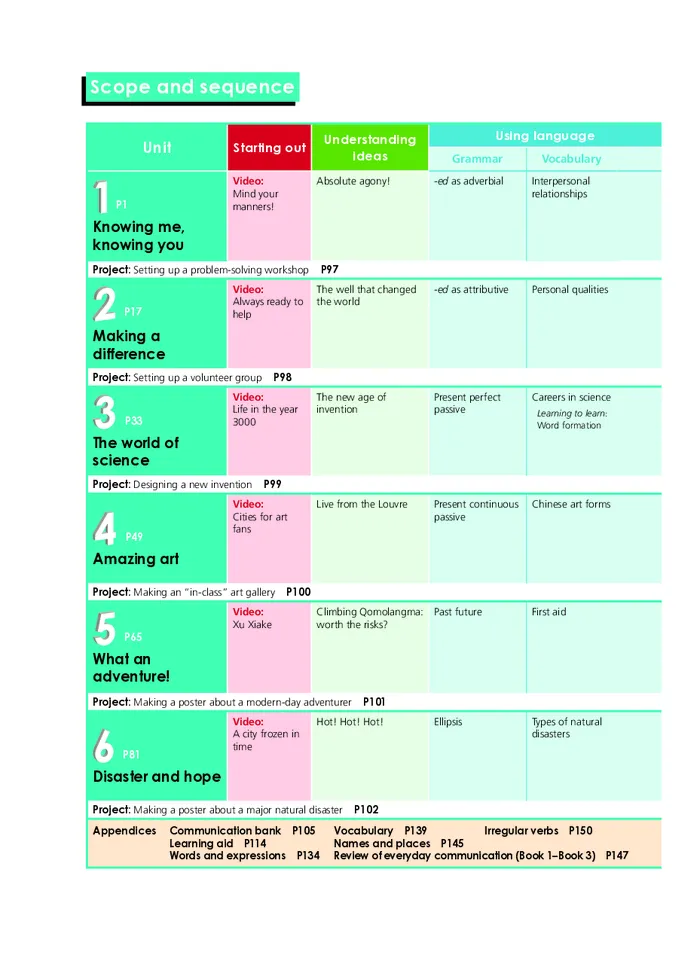
Scope and sequence
Unit
Starting out
Understanding
ideas
Using language
Grammar
Vocabulary
P1
Knowing me,
knowing you
Video:
Mind your
manners!
Absolute agony!
-ed as adverbial
Interpersonal
relationships
Project: Setting up a problem-solving workshop P97
P17
Making a
difference
Video:
Always ready to
help
The well that changed
the world
-ed as attributive
Personal qualities
Project: Setting up a volunteer group P98
P33
The world of
science
Video:
Life in the year
3000
The new age of
invention
Present perfect
passive
Careers in science
Learning to learn:
Word formation
Project: Designing a new invention P99
P49
Amazing art
Video:
Cities for art
fans
Live from the Louvre
Present continuous
passive
Chinese art forms
Project: Making an “in-class” art gallery P100
P65
What an
adventure!
Video:
Xu Xiake
Climbing Qomolangma:
worth the risks?
Past future
First aid
Project: Making a poster about a modern-day adventurer P101
P81
Disaster and hope
Video:
A city frozen in
time
Hot! Hot! Hot!
Ellipsis
Types of natural
disasters
Project: Making a poster about a major natural disaster P102
Appendices Communication bank P105 Vocabulary P139
Irregular verbs P150
Learning aid P114
Names and places P145
Words and expressions P134 Review of everyday communication (Book 1–Book 3) P147
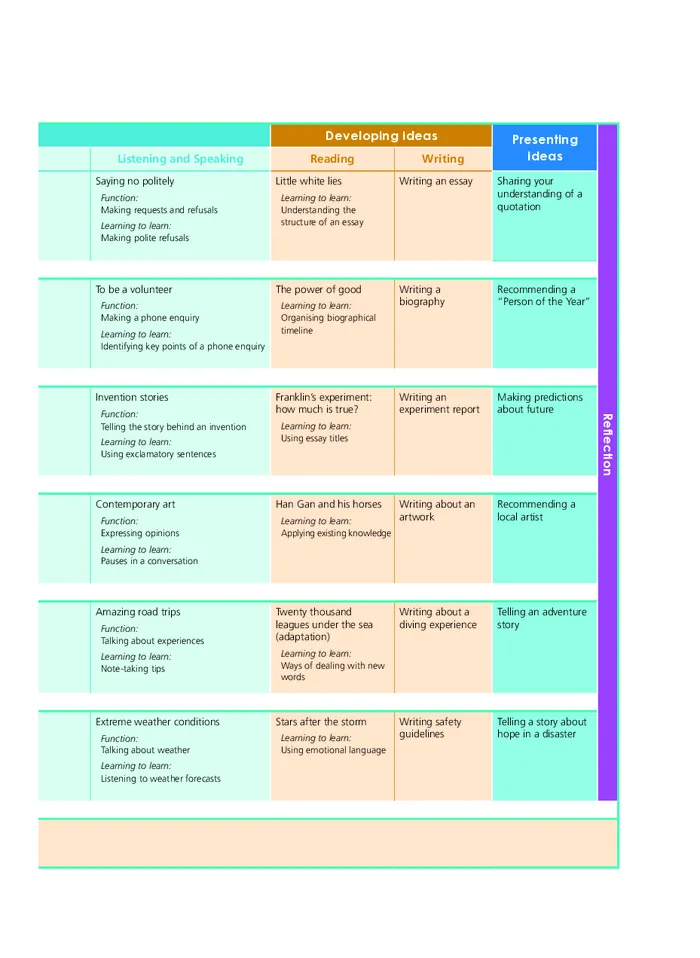
Developing ideas
Presenting
ideas
Listening and Speaking
Reading
Writing
Saying no politely
Function:
Making requests and refusals
Learning to learn:
Making polite refusals
Little white lies
Learning to learn:
Understanding the
structure of an essay
Writing an essay
Sharing your
understanding of a
quotation
To be a volunteer
Function:
Making a phone enquiry
Learning to learn:
Identifying key points of a phone enquiry
The power of good
Learning to learn:
Organising biographical
timeline
Writing a
biography
Recommending a
“Person of the Year”
Invention stories
Function:
Telling the story behind an invention
Learning to learn:
Using exclamatory sentences
Franklin’s experiment:
how much is true?
Learning to learn:
Using essay titles
Writing an
experiment report
Making predictions
about future
Contemporary art
Function:
Expressing opinions
Learning to learn:
Pauses in a conversation
Han Gan and his horses
Learning to learn:
Applying existing knowledge
Writing about an
artwork
Recommending a
local artist
Amazing road trips
Function:
Talking about experiences
Learning to learn:
Note-taking tips
Twenty thousand
leagues under the sea
(adaptation)
Learning to learn:
Ways of dealing with new
words
Writing about a
diving experience
Telling an adventure
story
Extreme weather conditions
Function:
Talking about weather
Learning to learn:
Listening to weather forecasts
Stars after the storm
Learning to learn:
Using emotional language
Writing safety
guidelines
Telling a story about
hope in a disaster
Reflection
同学们,欢迎大家继续学习《英语》(新标准)高中教材!
由教育部制定并颁布的《普通高中英语课程标准(2017 年版)》明确规定:普通高中英语课程
作为一门学习及运用英语语言的课程,与义务教育阶段的课程相衔接,旨在为学生继续学习英语和
终身发展打下良好基础。普通高中英语课程强调对学生语言能力、文化意识、思维品质和学习能力
的综合培养。也就是说,发展学科素养是同学们高中阶段英语学习的方向和目标。时光飞逝,必修
课程的学习已进入尾声,相信大家对必修阶段的学习要求已有了充分的认识,并为进一步发展英语
学科核心素养打下了坚实的基础。
《英语》(新标准)高中必修课程教材遵循“为用而学,在用中学,在学中用,学而能用”的原
则,为同学们提供了语言地道、优美的阅读文章和灵活多样的学习活动,力图使大家逐步获得独立
学习和自主学习的能力。
必修课程教材第三册进一步拓展话题,从自我认知、社会责任,到科技发展、艺术欣赏,再到
探索及认识自然,帮助大家提升对人与自我、人与社会、人与自然三大主题语境的认识,为选择性
必修阶段的学习做好准备。本册共六个单元,单元结构如下:
(1) 背景激活(Starting out)
该板块旨在激活同学们已有的背景知识和语言知识。我们把“看”(viewing)的活动作为
预热和导入,通过视频、文字、图片、表格等多模态语篇,帮助同学们更好地了解本单元
主题。
(2) 主题理解(Understanding ideas)
该板块通过语篇和阅读活动聚焦核心语言、结构,帮助大家在达成主题理解、实现语言形
式与意义深度加工的同时培养文化意识和思维品质。
(3) 功能运用(Using language)
该板块是对语言技能的综合学习和运用。通过语法、词汇及听说三个部分的大量语言实践
活动,发展大家的语言技能,为真实生活中的语言交际做好铺垫。
(4) 思维拓展(Developing ideas)
该板块为大家提供新的阅读语篇,从不同角度进一步呈现单元话题,调动大家的逻辑思维、
批判性思维和创造思维,并以一项读写结合的活动来检验大家前述学习活动的成果。
(5) 观点表达(Presenting ideas)
该板块主要以讨论、评选、演讲、辩论等口头表达形式进一步促进同学们对所学内容的复
习与掌握。开放或半开放性的活动有利于大家彼此合作,展示个性,充分表达自己对主题
思想的理解和认识。
(6) 自我反思(Reflection)
该板块列出了本单元话题下可以实现的学习目标,通过自我评价和总结的方式,帮助大家
反思自己的学习成果,进而认识到自己的进步与不足,逐步培养自主学习的能力。
(7) 项目实践(Project)
该板块提供真实的语境和任务,每个项目活动均由小组合作完成,力求培养大家获取信息、
相互合作、学以致用的能力。
我们希望同学们通过使用本教材,全面提高综合语言运用能力,发展英语学科的核心素养,成
为具有中国情怀、国际视野和跨文化沟通能力的社会主义建设者和接班人。
致 同 学
1
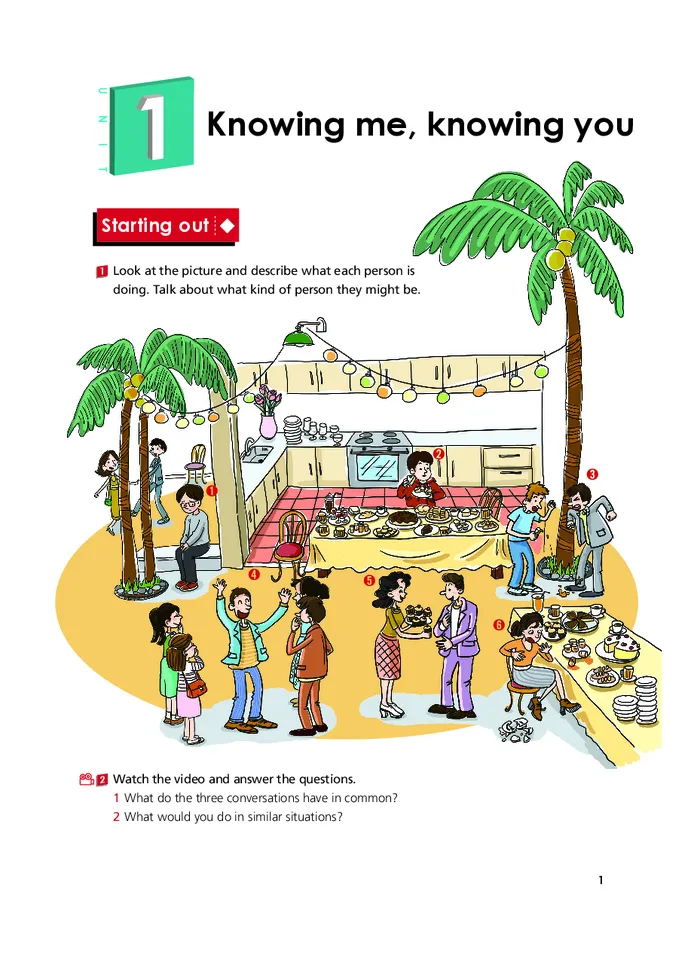
1
Look at the picture and describe what each person is
doing. Talk about what kind of person they might be.
2
Watch the video and answer the questions.
1 What do the three conversations have in common?
2 What would you do in similar situations?
➊
➋
➌
➍
➎
➏
Knowing me, knowing you
U
N
I
T
Starting out
2
UNIT 1
1
Look at the problems you may face
at school. Discuss which you think
is the most difficult to overcome
and why.
• bad performance in a subject
• pressure to look good
• conflict with classmates
• difficulties fitting in with others
Now think about who you turn to
for help when you face a problem.
• friends
• parents
• teachers
• online forums
• no one – you prefer to keep things
to yourself
• other
2
Read the letters and find out what
kind of problems Ben has and who
he turns to for help.
Dear Agony Aunt,
1 I’m in a total mess here – hope you
can help me out!
2 I’m 17, and a member of our school
basketball team. I’m crazy about
basketball, and pretty good at it too,
which is probably why I was so mad
when we lost our last match. We
played well, but I felt the team were let
down by one member, our point guard.
The point guard is a key player, but it
was like he wasn’t even on the court!
Disappointed by his behaviour, I said
all this to my best friend. I was just
letting off steam really, because I was
so angry, but then my friend went and
told everyone else what I’d said.
3 This is so totally awkward. I’m really
angry with my friend – what should I
say to him? And should I say anything
at all to my teammate?
4 Embarrassed and ashamed, I can’t
concentrate on anything. Please help!
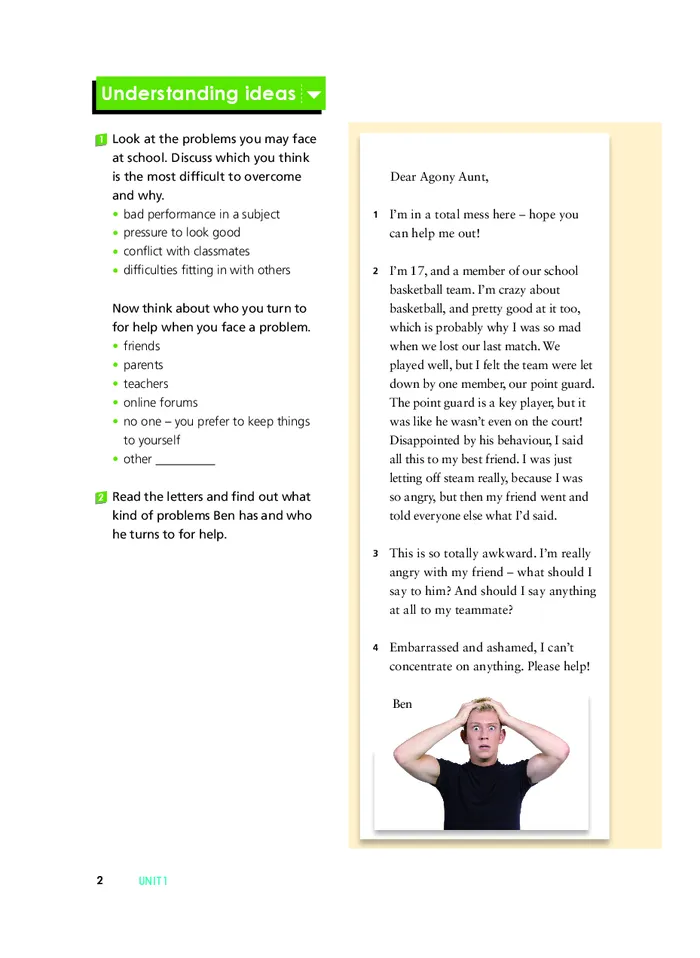
Ben
Understanding ideas
Knowing me, knowing you
3
Dear Ben,
1 There is an old American
saying, “Loose lips sink ships.”
This means that if you speak
too much about something,
especially to people who you
don’t know so well, it’ll cause
all kinds of trouble.
2 The situation here is so much
worse because the “loose lips”
were your best friend’s. Treated
this way, you’re sure to feel
hurt – we should always be
able to trust those closest to us,
and it hurts even more when
we find we can’t.
3 But I have to say that it’s
partly your fault, isn’t it?
You admit that you were
“letting off steam”. It is
understandable in that situation, but we should always think before
we speak.
4 Here’s what you need to do. First, apologise to your teammate. If you
ever want to win any more basketball games (and I’m sure you do!), you
need to work together, and that means communicating with each other
clearly and resolving conflicts. So have a chat with your teammate. Tell
him directly and honestly that you were talking without thinking.
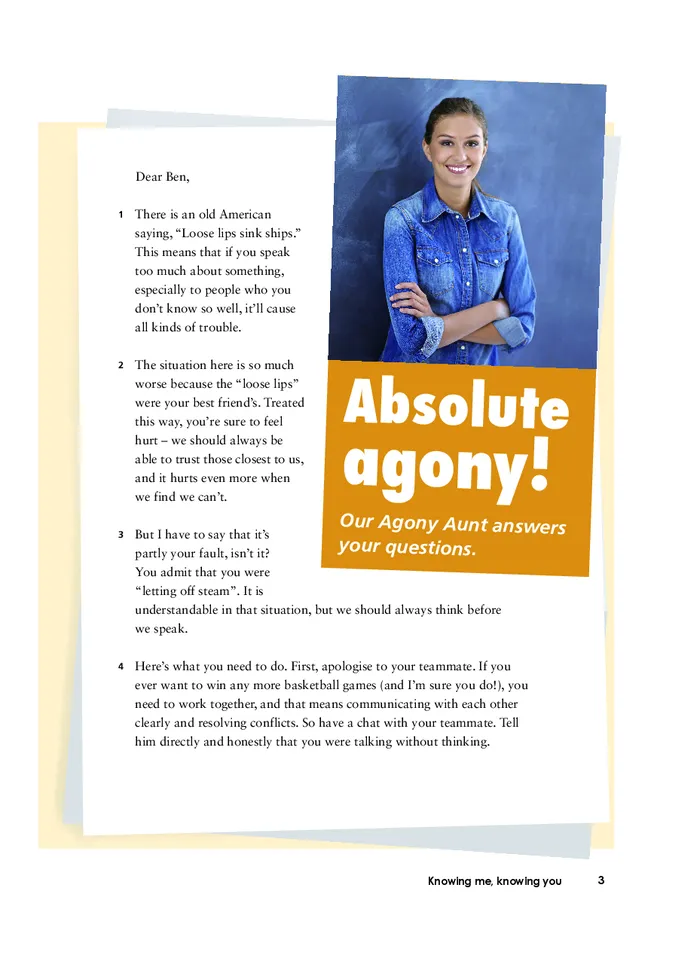
Our Agony Aunt answers
your questions.
Absolute
agony!
4
UNIT 1
5 Then, talk to your friend. Friendship should be one of the
greatest things in the world, but sometimes it can be difficult.
Again, your strategy is clear communication. Tell your friend
you’re angry with him for repeating what you said and making
the situation worse, but that you want to move on. Approached
in this way, your friendship will soon be repaired.
6 Thirdly, and perhaps most importantly, think about your own
behaviour. Don’t say too much when you’re angry! Filled with
anger, you tend to say whatever comes to your mind. This gives
people the wrong signal. Take a deep breath, calm down, and
always remember: think first, speak later. If you feel one of your
teammates isn’t pulling their weight, then raise your concerns in
a professional way with your team coach.
7 If you think about other people’s feelings as well as your own,
you’ll soon find everything works out.
8 Good luck!
Agony Aunt
3
Choose the best summary of the letters.
1 Ben said something bad about his best friend, and Agony Aunt told him
to apologise to his friend.
2 Ben was angry that his team was let down by some members, and
Agony Aunt told him to take it easy.
3 Ben didn’t play well in the match, and Agony Aunt advised him to
apologise to his teammate.
4 Ben was in an awkward situation, and Agony Aunt gave him suggestions
as to how to deal with his problems.
4
UNIT 1
Knowing me, knowing you
5
Agony Aunt’s suggestions
Think Share
&
1 What do you think of Agony Aunt’s advice? What other
advice would you give to Ben?
2 What is your understanding of the saying “Loose lips sink ships”? Do
you know any similar sayings in Chinese?
Now match the suggestions to Ben’s problems.
• I was disappointed with my teammate because I felt
1
by him.
• My best friend
3 .
I don’t know what to do.
• I told my best friend that my teammate was to blame, just
2 .
• Don’t
9 when you’re angry. Always remember:
10 .
• Tell your best friend you’re angry with him for
7
and
8 , but that you want to move on.
• You should
4 . You need to work together, and
that means
5 and
6 .
Ben’s problems
4
Complete the sentences with expressions from the passage.
6
UNIT 1
1
Look at the sentences from the reading
passage and answer the questions.
2
Rewrite the underlined sentences with
the -ed form.
a Disappointed by his behaviour, I said
all this to my best friend.
b Approached in this way, your
friendship will soon be repaired.
c Because I was disappointed by his
behaviour, I said all this to my best
friend.
d If it is approached in this way, your
friendship will soon be repaired.
1 Who was disappointed in sentence (a)?
What is approached in sentence (b)?
2 Why does the author use -ed instead
of -ing here?
Compare them with the following
sentences and answer the questions.
3 What is the difference between the two
groups of sentences?
4 Why does the author choose to use -ed
instead of an adverbial clause in the
reading passage?
Now look for more sentences with -ed
as adverbial in the reading passage.
Last week, Anne was attracted by a
particular article in a magazine, so she
bought it. Three days ago, to complete
her homework quickly, she grabbed
the magazine from her desk drawer
and copied part of the article without
thinking. Her teacher was very satisfied
with her homework. Anne was praised
in class, and she felt happy as well as
ashamed. Then, the teacher wanted
to enter her homework into a writing
competition. Anne was shocked by
the decision and did not know what
to do. If she told the truth, the whole
class would find out and accuse her of
cheating. They would look down on
her. If she kept silent, maybe no one
would ever find out…?
What should Anne do?
Using language
-ed as adverbial
Knowing me, knowing you
7
3
Read the plot summary and choose the correct form of the words.
Inside Out is an animated film about the five emotions of a girl
called Riley: Joy, Sadness, Fear, Disgust and Anger. Influencing /
Influenced mainly by Joy, most of Riley’s memories are happy ones.
Believing / Believed that she is Riley’s most important emotion,
Joy always tries to take the lead.
Preventing / Prevented from
playing her role in Riley’s emotional development, Sadness feels annoyed. When Riley
moves to a new city, she has a hard time adjusting to her new surroundings. Sadness
wants to do her duty but by accident causes the loss of Riley’s happy core memories
with Joy. Now separating / separated from her friends and her beloved hockey team,
Riley starts to feel lost and helpless, and wants to run away from her parents and new
school. Worried about her, Joy and Sadness try to work together to ensure she gets
her core memories back.
Eventually, realising / realised that every emotion has a role, Joy understands it is
okay for Riley to feel sad sometimes. Accepting sadness as part of life helps Riley
deal with the emotional complexity of growing up, and settle down in her new life.
Interpersonal relationships
4
Read the tips and underline the words that describe behaviour towards others.
for happy and healthy
relationships
Tips
It’s not a good idea to criticise someone in
front of others. This can cause embarrassment.
2
It’s important to tell the truth. Don’t lie.
3
Don’t judge someone too quickly. It
takes time to understand a person.
4
Don’t always complain about people. Try to look
on the bright side.
5
Try to forgive someone when they apologise.
It’s not easy for anyone to say sorry.
1
8
UNIT 1
?
Did You Know
Saying no politely
Emotional quotient (EQ), or emotional
intelligence quotient, is a measurement of
the ability to recognise one’s own and other
people’s emotions. It is believed that EQ
plays an even more important role than
IQ (intelligence quotient)
in people’s lives. Being able
to say no politely is one of
the features of emotional
intelligence.
5
Describe the situations with the words
you underlined in Activity 4.
1 I’m really sorry. I didn’t mean it.
____________
2 You’re so selfish! ____________
3 I know you’re sorry. It’s OK. Don’t worry
about it. ____________
4 I can tell he is not easy to get along
with. ____________
5 I don’t want to wait for him all the time.
____________
6 My pet parrot flew away with my
homework. ____________
6
Work in pairs. Discuss what you should
do in the following situations and
explain your reasons.
1 You forgot your best friend’s birthday,
and you feel bad about it.
2 Your neighbour always makes a lot of
noise late at night. You cannot stand it.
3 I slipped at art class and spilt some paint
on my classmate’s favourite jeans.
4 Your friends have asked you to watch a
boxing match with them, but you don’t
like boxing.
5 Your colleague says that a person’s
gender matters a lot in the workplace,
but you don’t agree.
7
Listen to three conversations and
match them to the pictures.
a
b
c
8
UNIT 1
Knowing me, knowing you
9
8
Listen again and complete the table.
Request
Refusal
1
Tina has to leave her flat
1 . She wants
to stay at Kerry’s place.
Kerry thinks that
2
is too long. Tina is welcome to stay
for
3 .
2
Mike invites Ryan to
4 on
5 .
Ryan cannot come, because he has
to
6 to New York
at the weekend.
3
Jane would like to see Becky’s
7 for some
ideas.
Becky refuses because she thinks it is
better for Jane to
8 .
9
Work in pairs. Act out the conversation about asking for a favour and
refusing politely.
Student A: Turn to Page 105.
Student B: Turn to Page 109.
10
Work in pairs. Think of another situation and have a similar
conversation.
If you have to say no to a request, your refusal will sound more polite if you
begin with a statement of regret, such as I’m sorry…, I’d really like to, but… Then
explain why your answer is no, eg I’m really busy right now. If possible, suggest an
alternative – How about next week?
Learning to learn
Now talk about how the speakers make requests and refusals. Listen
again if necessary.
10
UNIT 1
Little
White
Lies
1
Look at the pictures. What would you
say if you were student B?
2
Read the passage and find out the
meaning of “white lies”.
A
B
I didn't do very well in
the exam. I only scored
60. What about you?
Developing ideas
Knowing me, knowing you
11
1 Written more than two hundred
years ago, these lines by Walter Scott
remain one of the most well-known
excerpts of Scottish poetry:
Oh, what a tangled web we weave,
When first we practise to deceive!
2 We all know that honesty is an
important value and that lying is
wrong, but who can honestly say
that they’ve never told a lie? Perhaps
we comfort ourselves with the
knowledge that most of the lies we
tell are “white lies”: little lies that we
tell to protect others from the truth.
3 We’ve all surely had the experience
of someone cooking a meal for us
that we don’t like. The majority of us
of course don’t tell the truth – we lie
and say that the food is “delicious”.
4 Or if a friend asks us what we think
of their new haircut, we say “It’s
great!”, even if we think it’s awful.
But to what extent can we justify
telling white lies like these?
5 One of the main reasons for telling
a white lie is to try to make others
feel better. However, when we lie
and say that someone’s haircut
looks good, or when we say that we
love a meal that we secretly hate,
are we really hoping to improve the
situation for someone else? Perhaps
we are in fact lying to protect
ourselves from the disappointment
and anger of others.
12
UNIT 1
An essay usually consists of three parts: introduction, main body and conclusion.
Start with an introduction that contains the aims and an overview of the essay.
The main body of an essay is a series of paragraphs that explore and develop
your argument. The conclusion contains a summary of your ideas – do not
introduce any new material here! End your essay by linking your conclusion back
to the essay title.
Learning to learn
6 Another reason for telling a white lie is to give encouragement. Say for example
that your friend asks you what you think of his singing. You of course say that it’s
wonderful, despite secretly thinking that your cat can sing better. Stop for a moment
and consider that perhaps your friend wants some frank comments from you so
that they can improve. Or perhaps, they need to know that they should look for a
different hobby.
7 Finally, we may also tell a white lie when we want to protect others from bad news.
If you’ve had a bad day, do you tell your parents about it, or do you hide your tears
and lie that your day was “fine”? If the latter, don’t you think your parents would
want to listen to you and understand your feelings? Wouldn’t it be better to respect
their concern for you and ask for their advice?
8 Going back to Walter Scott’s lines, we may find even white lies have results we
cannot know in advance. Perhaps the meal you said was “delicious” will be served
every time you visit. Would your friend trust your opinion again if he found out
you had lied about his “wonderful” singing? How would you expect others to truly
understand your emotions if you only shared good news instead of bad? Moreover,
how would you feel if you discovered that the people closest to you had been hiding
the truth from you?
Knowing me, knowing you
13
4
Work in groups. Give a
talk on the importance of
honesty following the steps
below.
• Explain what honesty is.
• Give reasons for the
importance of being
honest.
• Support your reasons with
examples.
• End with your conclusion.
3
Complete the diagram with information from the passage.
Introduction
We know lying is wrong, so why do we tell white lies?
Conclusion
Even white lies may have results we cannot predict.
So ____________________________________________.
Think Share
&
1 What does the “web” in the
poem represent?
2 What would you do in the situations described
in the passage?
3 What do you think is the difference between a lie
and a white lie?
4 How would you feel if you were told a white
lie? Share your experience with the class if this
has happened to you.
Reason1
To make others
.
Example(s)
Someone’s cooking
.
Someone’s haircut
.
Analysis
Perhaps we lie to protect
ourselves
.
Reason 2
Example(s)
Analysis
Perhaps your friend wants
.
Perhaps they need to know
.
Reason 3
Example(s)
Analysis
Perhaps your parents
.
Main body
14
UNIT 1
5
Read the fable and choose the message you think it conveys.
1 Porcupines are not sociable animals.
2 The more independent you are, the better your life will be.
3 There should be boundaries in interpersonal relationships.
Writing an essay
One cold winter night, a group of porcupines
gathered together to keep warm. As soon as
they started to get closer, they hurt each other
with their quills, so they had to move apart. After
a short time, they started to feel cold again, so
they moved closer together. But again they had
to move away because of the pain caused by
the other porcupines’ quills. After repeating this
process a few times, they eventually found the
ideal distance where they could feel warm while
managing not to hurt each other.
The Porcupine Dilemma
Adapted from a work by Schopenhauer
Knowing me, knowing you
15
6
Make notes based on the passage in Activity 5 with your own opinions.
7
Share your essay with the class.
Now write an essay. Use the expressions in the box to help you.
• This fable describes…
• The fable teaches us that…
• One example of this from real life is…
• In conclusion, …
Useful expressions
Introduction
Conclusion
Original author:
Summary of the fable:
Original author:
Summary of the fable:
Viewpoint:
Supporting examples in your real life:
Viewpoint:
Supporting examples in your real life:
Main body
16
UNIT 1
1
Work in groups. Read the
quotations and discuss their
meanings.
2
Choose one quotation and discuss the
following points:
• its main message
• how it applies to everyday life, giving examples
• what we can learn from the quotation
3
Present your ideas to the class. Use the
expressions in the box to help you.
Good fences make good neighbours.
�
Proverb
Do not do to others what you do
not want others to do to you.
�
Confucius
The most basic of all human needs
is the need to understand and be
understood.
�
Ralph G. Nichols
• We have chosen to talk about the quotation…
• The main message of this quotation is…
• In daily life, …
• Another example is…
• In conclusion, this quotation teaches us that…
Useful expressions
Presenting ideas
1
After completing this unit, I can rate
my performance 1 (excellent), 2 (good)
or 3 (in need of improvement).
interpret interpersonal behaviour
make requests and refusals
write an essay
give suggestions to resolve interpersonal
conflicts
improve interpersonal skills and
relationships
2
I’ve learnt to make use of the
following words and expressions:
3
I still need to improve:
Reflection
16
UNIT 1
Making a difference
17
1
Watch the video and answer the
questions.
1 What kinds of good deeds are shown
in the video?
2 What idea does the video convey?
2
Look at the pictures of the three
people and read the quotations. Talk
about the following points:
• the contribution these people made
to society
• the qualities you admire in each of them
• other people who have similar qualities
Florence Nightingale,
founder of modern nursing
The amount of relief and comfort
experienced by the sick after the
skin has been carefully washed and
dried, is one of the commonest
observations made at a sick bed.
Red Adair, oil well firefighter
It scares you: all the noise, the
rattling, the shaking. But the look on
everybody’s face when you’re finished
and packing, it’s the best smile in the
world; and there’s nobody hurt, and
the well’s under control.
Bai Fangli, tricycle driver
I’m old. All I can do is ride a
tricycle and make money for
the students... Knowing that
the kids now have money for
school is what keeps me going
and gives me more energy.
Making a difference
U
N
I
T
Starting out
17
18
UNIT 2
1
Look at the map and talk about water
problems in Africa.
Now tick the solutions that you think
are most effective to supply Africa
with fresh water.
collect and purify rainwater
fund water projects
build wells and pumps
recycle waste water
set up facilities to purify water
develop new water conservation
technologies
2
Read the passage and find out what
Ryan did to help solve the problem of
water shortage in Africa.
Freshwater stress (1,000 to 1,700 m
3/capita/year)
Globally, renewable internal freshwater resource
per
capita was around 6,000 m
3 in 2014.
*
Freshwater shortage (less than 1,000 m
3/capita/year)
1 As a six-year-old Canadian
schoolboy, Ryan had trouble
believing the words spoken by
his teacher that many people
in developing African countries
couldn’t get enough clean water. He
looked across the classroom at the
drinking fountain. It was very close –
only ten steps away. So, Ryan asked
himself, “Why do some African
children have to walk ten kilometres
to get water every day? And why is
the water so dirty that it makes them
sick?” Young Ryan thought, “Life
is easy for me, but hard for those
people. Why don’t I help?”
FRESHWATER
PROBLEMS
in Africa by 2025
Understanding ideas
Making a difference
19
2 At first, his plan was to earn money to
build a single well somewhere in Africa.
He cleaned windows and did gardening
for his family and neighbours. He soon
reached his first target of $70, but when
he gave the money to a charity, he was
told that it actually cost $2,000 to build
a well. Seventy dollars was only enough
for a hand pump. Ryan understood that
a hand pump wouldn’t help the children.
What they needed was a well dug near
their homes.
3 Two thousand dollars was a lot of
money, but Ryan didn’t give up. He was
determined to help other children have
clean water. He started to ask for help
That Changed
The Well
the World
from his classmates and neighbours and
persuaded them to donate money. At the
same time, a friend of Ryan’s mother
helped make his story go public. After
several months, Ryan had raised the
$2,000, with which a well was built near
a primary school in Uganda. The children
at the school no longer needed to walk
for hours to get water. They were grateful
to him and invited him to visit.
20
UNIT 2
3
Choose the best explanation of the title and give your reasons.
1 The well built by Ryan solved the problem of worldwide water shortage.
2 The more wells you dig, the better the world will be.
3 The well built by Ryan encouraged more people to help make the world
a better place.
4 In Uganda, Ryan at last saw the finished
well with his own eyes. But that was not
all. He also saw hundreds of delighted
students who had turned out to welcome
him. They sang and danced happily.
Some even offered him food and gifts. At
first Ryan was nervous, but soon a great
warmth filled him. He really had made
a difference for these children. He broke
into a joyful smile.
5 Later, Ryan’s experience led him to
set up a foundation to encourage
more people to help. Many inspired
people gave him their support. Ryan’s
foundation continues to attract support
from more and more people, so the work
of building more wells can go on. Today,
over 800,000 people in 16 countries
across Africa have benefited from the
life-changing gift of clean, safe water.
6 Now, as an adult, Ryan says that the
question to ask is not “Why don’t I
help?”, but “How can I help today?”.
This insight grew from the determined
attitude of a six-year-old boy who had
the courage and perseverance to make his
dream a reality.
Making a difference
21
Think Share
&
1 What kind of person do you think Ryan is? Which of his
qualities do you admire most? Why?
2 As a senior high school student, what can you do to help people
in need?
Ryan’s story
1 Ryan could get clean drinking water within ten steps, but some African
children had to
1 . So Ryan decided to help.
2 Ryan cleaned windows and did gardening, and reached
2 .
But when he
3 , he was told it cost $2,000 to build a well.
3 Ryan persuaded his classmates and neighbours to
4 . His
mother’s friend also helped him. After several months, he raised enough
money and a well was built in Uganda.
4 Ryan visited Uganda. He saw
5 . He also saw
6
who had turned out to welcome him.
5 Later, Ryan’s experience led him to
7 to encourage more
people to help.
6 Today, the life-changing gift of clean water
8 .
4
Complete Ryan’s story with expressions from the passage.
22
UNIT 2
a … Ryan had trouble believing the
words spoken by his teacher…
b In Uganda, Ryan at last saw the
finished well with his own eyes.
c ... Ryan had trouble believing the
words which were spoken by his
teacher...
d In Uganda, Ryan at last saw the well,
which was finished, with his own
eyes.
2
Read the discussion between two
students about Ryan’s foundation.
Rewrite the underlined sentences using
the -ed form.
1
Look at the sentences from the reading
passage and answer the questions.
Ryan is a young man who is admired
by a lot of people. The money which is
raised by his foundation supports schools
and communities in Africa. I think
digging wells for drinking water is a
good way to solve the problem of
water shortage.
1 What was spoken in sentence (a)? What
was finished in sentence (b)?
2 Why does the author use -ed instead
of -ing?
Compare them with the following
sentences and answer the questions.
I absolutely agree with you. Digging
wells is a good way, but not the only
way, to solve the problem of water
shortage in Africa. As in the words
which were spoken by Ryan, we need
to not only donate money but also get
new ideas. I think the support which
is needed includes new technology for
recycling water and education on how to
use and save water.
3 What is the difference between the two
groups of sentences?
4 Why does the author choose to use -ed
instead of an attributive clause in the
reading passage?
Now look for more sentences with -ed
as attributive in the reading passage.
Using language
-ed as attributive
Making a difference
23
3
Read the passage and choose the correct form of the words.
The United Nations Children’s Fund, also knowing / known as UNICEF,
is a United Nations (UN) organisation basing / based in New York. It
offers help needing / needed by children all over the world.
UNICEF was founded on 11 December 1946, to provide food and
healthcare to children in countries damaging /
damaged in World War II. Since 1953, UNICEF
has taken up an extended mission to help children
in the developing / developed world, including
those living / lived with diseases or disabilities,
and those affecting / affected by rapid
modernisation and environmental problems.
Now, UNICEF has been working to improve
the lives of children and their families across
190 countries and territories.
Personal qualities
She’s usually very shy,
but she’s generous
and never hesitates
to help. She’s also
the most honest
person I know. I can
always trust her with
my secrets.
Li Mei
4
Read the descriptions and underline the words that describe personal qualities.
She’s easygoing
with a sense of
humour. She’ll try
to cheer you up if
you have a problem,
but she’s somewhat
lazy. Her desk is
extremely messy!
Anna
He’s always
confident about
everything. He’s
a good public
speaker and I have
never seen him get
nervous. And he’s
creative. He often
comes up with
good ideas.
Tim
He’s sensitive and
rather serious,
which sometimes
makes him appear
to be a little
bookish. But he’s
also an independent
thinker. He always
knows how to make
wise decisions.
Liu Tao
24
UNIT 2
To be a volunteer
7
Listen to the phone enquiry and
complete the sentences with the
correct ending.
1 Sarah likes _____.
2 The man suggests _____.
3 Erica Marshall needs to know _____.
a teaching children with disabilities
b when Sarah can start work
c if Sarah is suitable for the work
d horses and being with children
e helping out three times a week
f taking care of old people
Ryan’s charity work is not unusual. Many
people donate money and others volunteer
to help run charities. On most UK high
streets, for example, you will often come
across people raising money and looking
for volunteers for Cancer Research UK, the
British Heart Foundation, the Royal National
Lifeboat Institution and many more. In China,
volunteers are also playing an increasingly
important role in environmental protection,
disability assistance and many other fields.
5
Put the words you underlined in
Activity 4 into the table. Add any more
you can think of.
Positive
Neutral
Negative
6
Work in pairs. Talk about people’s
personal qualities using the words you
have learnt.
A:I think my cousin is very brave.
B: Why do you think so?
…
?
Did You Know
Making a difference
25
Now talk about how Sarah makes a phone enquiry on becoming a
volunteer. Listen again if necessary.
Before making a phone enquiry, take a moment to prepare
your questions. Take notes if necessary. Also, remember that
it’s okay to ask again when you think it’s not clear enough!
Learning to learn
Registration Form
Winchester Volunteer Centre
8
Listen again and complete the form.
Personal information
Name: Sarah White
Sex: Female
Telephone: 077 8665 3048
Preferred field:
1
Voluntary work description
• Intended voluntary work: teaching children with disabilities
2 at Peter’s Stables
• Aim: for the children to 3 and realise that they can
4 in spite of their disabilities
• Role: working 5 with the same children in order to
6
Additional information needed
• Your previous experience
7
• A
8 for confirmation
• Available working hours
9
Work in pairs. Act out a telephone enquiry.
Student A: Turn to Page 105.
Student B: Turn to Page 109.
10
Work in pairs. Think about other voluntary work you would like to be
involved in, and have a similar conversation.
26
UNIT 2
1
Look at the word cloud and predict
what the man in the pictures might
have done.
I
t is August 1939, and a group
of frightened children are
boarding a train at Prague’s
Wilson Station. Their heartbroken
parents do not join them. Indeed,
they fear they may never see their
children again. But they know that
their children will live. These are
among the 669 children, most of
them Jewish, that Nicholas Winton
will go on to save from death at the
hands of the Nazis.
2 Nicholas Winton was born on 19
May 1909 in London, to
German-Jewish parents. The family
later took British nationality. On
leaving school, Winton worked in
banks in Germany and France. He
returned to Britain in 1931, where
he worked in business.
3 In December 1938, a friend asked
Winton to come to Prague to aid
people who were escaping from
the Nazis. In Prague, Winton saw
people living in terrible conditions
and whose lives were in danger.
2
Read the biography of Nicholas Winton
and check your prediction in Activity 1.
1
frightened children
heartbroken parents
Nazis
Jewish
business Britain
saved
during World War II
forgotten journal
public attention
various honours
Most biographies are organised in the order
in which events happened. Whilst reading a
biography, it’s a good idea to make a timeline
to record and track important information,
such as dates, places and key events. This can
be a useful way of displaying the kind of life
the person led and even, sometimes, what
he / she was really like.
Learning to learn
Developing ideas
Making a difference
27
THE POWER of GOOD
“The British Schindler”: the life of Nicholas Winton
He decided to help transport children to
safety in Britain. He established an office
to keep records of the children, and then
returned to Britain to find temporary
homes for them. He used donated funds
and his own money to pay the 50 pounds
per child that the British government
required. By August 1939, Winton had
saved 669 children.
4 During World War II, Winton
served as an officer in
Britain’s Royal Air Force.
He left the military
in 1954. He then worked for international
charities and for various companies. For
the most part, he did not mention the
children he saved, and his actions soon
disappeared from people’s memories.
5 That all changed in 1988 when his wife
Grete found a forgotten journal at home.
The journal contained photographs and
names of the children and addresses of
the families that took them
in. She sent the journal
to a newspaper,
28
UNIT 2
3
Match the events to the years in which they happened.
a Winton left the military.
b He was awarded the Order of the White Lion.
c He went to Prague to help refugees escape from the Nazis.
d He was invited onto the British television programme That’s Life.
e He became a businessman.
1931
1938
1954
1988
and that year Winton was seen on the British
television programme That’s Life. At one
point, the host asked people in the audience
to stand up if Nicholas Winton had saved
their lives. A shocked Winton watched as
the majority of people rose to their feet. The
programme brought his actions to public
attention, and Winton became a respected
figure around the world.
6 Later, Winton received various honours
for his achievement, including a
knighthood in 2003, and the Czech
government’s highest honour, the Order
of the White Lion, in 2014.
7 Nicholas Winton passed away on 1 July
2015, at the age of 106. As the Chinese
saying goes, “A kind-hearted person lives
a long life.”
2014
28
UNIT 2
Making a difference
29
4
Work in groups. Give a talk in honour of Nicholas Winton.
1 Use the table to help plan your talk.
Key actions
Personal qualities
Think Share
&
1 Why did the parents fear that they would never see
their children again?
2 Why do you think it took such a long time for Winton’s actions to
become known?
3 Which three words would you use to describe Winton’s personal qualities?
4 Do you know of any Chinese who have acted in a similar way to
Winton? Share their stories with the class.
2 Organise your talk following the steps below.
• Say who you are going to talk about.
• Talk about his key actions.
• Talk about his personal qualities.
• End with the main reasons why he inspires you.
3 Give your talk to the class.
Making a difference
29
30
UNIT 2
5
Read Tu Youyou’s CV and fill in the boxes with the corresponding
information.
Writing a biography
PERSONAL
INFORMATION
Date of birth:
30 December 1930
Place of birth:
Ningbo, Zhejiang,
China
Tu Youyou
Education
1951–1955: Beijing Medical College (now
Peking University Health Science
Centre)
Work Experience
1955–present: China Academy of Chinese
Medical Sciences
Title: Tenured & Chief Researcher
Major Achievements and Awards
1969: Worked as the leader of a research
team aiming to discover a treatment
for malaria
1972: Managed to extract qinghaosu from a
Chinese herb, which is very effective in
fighting malaria
1986: Obtained a New Drug Certificate for
qinghaosu, issued by the Ministry of
Health of China
2015: Won the Nobel Prize in Physiology
or Medicine for discovering a novel
therapy against malaria
2019: Nominated for “The Greatest Person of
the 20th Century”
Making a difference
31
Introduction
Name of the person:
Her biggest achievement:
Name of the person:
Her biggest achievement:
Main body
Conclusion
Major events (in time order):
Major events (in time order):
Your opinion on her contribution:
Your opinion on her contribution:
• In (year), …
• On (day / date), …
• Later, …
• Finally, …
• At the age of…
• At one point, …
• By (year / day /
date), …
Useful expressions
Now write a biography of Tu Youyou. Use the expressions in the box
to help you. Do further research if necessary.
6
Share your biography with the class.
32
UNIT 2
1
Think of someone you want to recommend as “Person of the Year”.
You can choose a well-known person or someone you know. Complete
the form about the person.
Reasons for
recommendation
2
Work in groups. Talk about your
“Person of the Year” and choose
the best one in your group. Use the
information in Activity 1 and the
expressions in the box to help you.
3
Present your “Person of the Year” to
the class.
Name
Personal qualities
Achievements
PERSON
OF THE YEAR
• I recommend… because…
• I think… is the best choice, because…
• I agree with him / her.
• Really? I don’t think so. I think…
Useful expressions
Presenting ideas
1
After completing this unit, I can rate
my performance 1 (excellent), 2 (good)
or 3 (in need of improvement).
describe personal qualities
make a phone enquiry
write a short biography
comment on people’s moral values
develop a sense of social responsibility
2
I’ve learnt to make use of the
following words and expressions:
3
I still need to improve:
Reflection
32
UNIT 2
The world of science
33
1
Read about the inventions
from famous novels and choose
those that have become a
reality.
2
Watch the video and answer
the questions.
1 Which of the inventions in the
video interests you most? Why?
2 Which of the inventions in the
video do you think will become
a reality?
3 Of all the inventions in the
world, which do you think is
the most useful? Why?
The world of science
U
N
I
T
Starting out
33
Harry threw the cloak around his
shoulders… Harry looked down at his
feet, but they were gone.
Harry Potter and the Philosopher’s Stone
A faint blue light shot across it,
darkening to purple, and presently she
could see the image of her son, who
lived on the other side of the earth, and
he could see her.
The Machine Stops
Presently I am going to press the lever,
and off the machine will go. It will
vanish, pass into future time, and
disappear.
The Time Machine
Instead of being printed, the Earth
Chronicle is every morning spoken
to subscribers, who, in interesting
conversations with reporters, statesmen,
and scientists, learn the news of the day.
In the Year 2889
34
UNIT 3
1
Look at the pictures and talk about
how the way we live has changed
over time. Discuss the reasons
behind these changes.
2
Read the interview and find out
what inventions are mentioned.
The New Age of
Interviewer: Good evening, and welcome to
Between the Pages. This evening, I’ll be talking
to Dr Richard Fairhurst, whose new book The
New Age of Invention has just been published.
Welcome, Richard!
Richard: Thank you. It’s a pleasure to be here.
Interviewer: I guess you have been asked about
the title of your book before. It suggests that
the present day is a new age for inventions,
but many people might think that the great
age of invention is over.
Invention
BETWEEN
THE PAGES
BTP
Understanding ideas
The world of science
35
Richard: Sure. New inventions like 3D
printers have been used to make replacement
hearts and bone parts. In terms of the
environment, it is now possible to create
an intelligent walking house. It is capable
of using GPS technology to travel to
different places, with computing technology
controlling its “legs”. What’s more, huge
advances in solar technology mean it can be
eco-friendly, too.
Richard: Well, that’s an interesting point.
There have been golden ages of invention
throughout history. Think of the four great
inventions in Ancient China: gunpowder,
papermaking, printing and the compass.
These things changed the world forever.
Then there were the great Western
inventions: the steam engine, the telephone
and the radio. And now, we find ourselves in
the great new age of technology.
Interviewer: So are most of the new great
inventions tech-based?
Richard: A lot, yes. For example, advances
in virtual reality and wearable tech, as well
as the flexible battery, mean we should soon
be seeing further developments. In addition,
important advances have been made in
medicine and environmental science thanks
to increasing computer power.
Interviewer: Can you give us some examples?
36
UNIT 3
Interviewer: Impressive stuff! I’ve also been told
that you’re an inventor yourself. Is that correct?
Richard: Yes, I am, but I’m only one member
of a big team – most inventors now work as
part of big international teams.
Interviewer: I see. So what is it that inspires
us to invent things?
Richard: Most inventions start with
recognising a problem that needs a
solution. This was no doubt the reason
behind the invention of the wheel in ancient
times, which much later developed into
the car. Now, reduced energy supplies and
environmental pollution have led to more
advances in the technology of new energy
vehicles. But what remains important is
that we have an incredible desire to think
and create, and that’s the real spirit of
invention.
Interviewer: One last question. This is the
one everyone really wants to know: will
anybody ever invent a time machine?
Richard: I think you’ve been watching too
many movies! Nothing like this has been
invented yet and I’d say we’re a long way
from an invention like that at the moment!
But, as they say, “Never say never!”
3
Choose the sentences that describe Dr Fairhurst’s opinions.
1 Inventions in Ancient China were better than those in the West.
2 A lot of today’s great inventions are tech-based.
3 Today, most inventors prefer working by themselves.
4 The desire to solve problems inspires invention.
5 A time machine will definitely be invented in the future.
BETWEEN
THE PAGES
BTP
The world of science
37
4
Complete the mind map with information from the passage.
8
virtual reality
Ancient China –
1
the West –
2
wearable tech
3
replacement
4
made by 3D printers
5
using GPS, computing
technology and
6
recognising
7
Think Share
&
1 If you were the interviewer, what other questions would
you ask Dr Richard Fairhurst?
2 In your opinion, what else inspires people to invent things?
I
n
s
p
i
r
a
t
i
o
n
f
o
r
i
n
v
e
n
ti
o
n
s
t
o
d
a
y
I
n
v
e
n
t
i
o
n
s
o
f
INVENTIONS
I
n
v
e
n
t
i
o
n
s
o
f
t
h
e
p
a
s
t
38
UNIT 3
Present perfect passive
1
Look at the sentences from the reading
passage and answer the questions.
2
Rewrite the underlined parts using the
present perfect passive.
a I guess you have been asked about the
title of your book before.
b New inventions like 3D printers have
been used to make replacement hearts
and bone parts.
c I guess someone has asked you about
the title of your book before.
d People have used new inventions like
3D printers to make replacement
hearts and bone parts.
1 What has happened to “you” in
sentence (a)?
2 Who has used new inventions to make
replacement hearts and bone parts in
sentence (b)?
Compare them with the following
sentences and answer the questions.
3 What is the difference between the two
groups of sentences?
4 Why does the author choose to use the
passive form instead of the active form
in the reading passage?
Now look for more sentences with the
present perfect passive in the reading
passage.
Using language
Within the next 80 years, our lives
may be changed beyond recognition
by 3D printing. It has already affected
many things in our lives, right down to
the food we eat. For instance, some
restaurants in London have served
3D-printed hamburgers to customers.
But perhaps the most significant
success that people have achieved to
date is in medicine. They have made
human body parts, including a beating
heart, with 3D printing technology.
And it is not just humans who are
benefiting – in Brazil, people have
given a new 3D-printed shell to a turtle
injured in a forest fire!
The world of science
39
3
Imagine you are Dr Moore. Look at
the pictures and tell the police about
the damage and loss to your lab. Use
the present perfect passive where
appropriate.
Dr Moore
My lab has been
broken into! My...
Careers in science
4
Look at the pictures and answer
the questions.
Words about different careers in science
can be formed by adding -er, -ist or -ian at
the end of the words about subjects, eg
biology – biologist.
Learning to learn
1 What do you know about these careers?
2 What famous scientists can you name in
these fields?
physicist
mathematician
chemist
astronomer
geographer
biologist
40
UNIT 3
5
Complete the introductions about different scientists with the words in
Activity 4. Pay attention to the language that describes their careers.
6
Work in pairs. Think about other careers in science and discuss what
interests you most.
I’m interested in the work of a(n)… because…
Guo Shoujing (1231–1316) was a famous Chinese
1____________ of the Yuan Dynasty. He invented twelve new
instruments to study stars and planets. He also developed a
calendar which is as accurate as the Gregorian calendar. A
mountain on the Moon and a minor planet are named after him.
British
2____________ Charles Darwin (1809–1882) is best known
for his work On the Origin of Species, in which he explains changes
in species due to natural selection. His ideas deeply influence our
understanding of the relationship between humans and nature.
Marie Curie (1867–1934) was a world-famous
4___________, and
was first awarded the Nobel Prize in 1903 for her extraordinary work
on radioactivity. She was also regarded as a brilliant
5____________,
and was again awarded the Nobel Prize in 1911 for the isolation of
pure radium.
Chen Jingrun (1933–1996) was one of the world’s leading
6____________. His work on Chen’s Theorem made an important
advance towards proving Goldbach’s Conjecture, the greatest
unsolved problem in number theory.
Li Daoyuan (ca 466–527) was a famous writer and
3____________ of the Northern Wei Dynasty. He did field
research across China and studied more than a thousand rivers
and streams, along with the landscape, history and culture of
the surrounding areas.
The world of science
41
?
Did You Know
8
Listen again and complete the notes.
Invention stories
Alzheimer’s disease is a brain disorder that
causes problems with memory, thinking
and behaviour.
The majority of people with Alzheimer’s are
65 and above. It is recognised as the most
common mental disease among older people,
and the number of sufferers is growing.
Currently, there’s no
cure for Alzheimer’s, but
scientists are researching
ways to improve the
quality of life for people
living with the disease.
Exclamatory sentences express strong
emotions, such as surprise, shock, joy,
emphasis and excitement. These are usually
formed with what or how, and in written
form usually end with an exclamation mark.
Learning to learn
9
Work in pairs. Act out the conversation
about the invention of the telephone.
Student A: Turn to Page 106.
Student B: Turn to Page 110.
10
Work in pairs. Choose another story
of an invention you know and have a
similar conversation.
Now talk about how the speakers
describe the story behind an invention.
Listen again if necessary.
7
Listen to the conversation and number
the pictures in the correct order.
What is it?
It’s
1______________.
Who was it invented by?
It was invented by
2______________
called Kenneth.
Who inspired the invention?
3______________, who has Alzheimer’s.
How does it work?
4______________ is sent to a mobile
phone like an alarm when the person with it
5______________.
a
b
c
d
e
42
UNIT 3
1
Read the short introduction to
Benjamin Franklin and share any other
information you know about him.
2
Read the passage and find out what
Franklin’s experiment aimed to prove.
FRANKLIN’S
EXPERIMENT:
How Much Is True?
Benjamin Franklin (1706–1790)
was one of the Founding
Fathers of the United States and
helped draft the Declaration
of Independence and the US
Constitution. Apart from being
a successful statesman, he was
also well known as a leading
American author, printer and
publisher, successful diplomat,
creative scientist and inventor.
1 Benjamin Franklin’s famous
experiment with lightning has
introduced generations of children
to science. However, new research
suggests that the story may be fiction
instead of fact.
2 The well-known story is that the
American Founding Father and
scientist flew a kite during a storm in
1752. At that time, there was much
interest in electricity. People wanted to
know if lightning was really produced
by electricity or something else.
Franklin was one of them. He raised
the kite with a piece of string tied to
it. A metal key was attached to the
string. A flash of lightning hit the kite,
and electricity was conducted through
the string to the key. Franklin then
touched the key with his finger and
got an electric shock. This, he said,
proved that lightning was a form
of electricity.
An essay title often contains an explicit or
implicit question which your essay should
focus on answering. For example, the
title “Franklin’s Experiment: How Much Is
True?” makes it clear what question is being
answered within the essay.
Learning to learn
Developing ideas
The world of science
43
3 For many years, schools have taught
the story of Franklin’s lightning
experiment. More than one generation
of schoolchildren has been amazed by
his bravery and his scientific approach
to looking for the truth. Franklin,
along with many other scientists, has
inspired us and taught us that scientific
experiments are important in order to
establish the truth and to contribute
towards later scientific discoveries
and inventions.
4 However, neither the story nor the
details of the experiment are entirely
true. Although it has been proved
that Franklin’s experiment took place,
more than one scientist has questioned
what really happened. The detail
about the string and the key is true.
44
UNIT 3
But scientists all agree that if Franklin
had actually touched the key, he would
certainly have died from the electric
shock.
5 Scientists often question accepted ideas
because they want to establish the facts.
Some have even questioned the story
about the apple that fell on Newton’s
head and led him to come up with his
theory of gravity. In fact, more than one
account suggests that while Newton was
certainly inspired by a falling apple, there
is no proof that it hit him on the head.
6 Admittedly, fiction is often more
interesting than the truth. People have
been more inspired by Franklin’s spirit
of scientific exploration than by the facts
themselves. But in science, facts should
be proved by experiments and research,
and we should not always believe
everything we read or hear – even if it is
a great story.
3
Number the statements to show how people’s attitudes towards
Franklin’s experiment have changed.
Franklin’s spirit of scientific exploration is still considered an inspiration.
People are amazed at and inspired by Franklin’s experiment.
Scientists question what really happened in Franklin’s experiment.
44
UNIT 3
The world of science
45
4
Work in groups. Explain your understanding of the saying “Seeing is
believing”, and then give a talk about it. You may use information in
the passage as examples.
1 Make notes about your understanding of the saying and list
supporting details.
2 Organise your talk following the steps below.
• Start your talk by explaining how you understand this saying.
• Explain why you think this way. Use the notes you have made to
support your ideas.
• End your talk by summarising your points.
3 Give your talk to the class.
Your understanding
Supporting details
Think Share
&
1 Do you think it matters that Franklin’s experiment might
not be true? Why?
2 What is your opinion about the statement “... we should not always
believe everything we read or hear – even if it is a great story”?
3 What qualities do you think a great scientist should have?
4 In what ways do scientists contribute to society?
46
UNIT 3
Writing an experiment report
Materials
・ A boiled egg
・ A glass bottle (bottleneck a bit smaller than the egg)
・ Hot water
Procedure
1. Remove the shell of the egg.
2. Carefully pour some hot water into the bottle.
3. Shake the bottle gently.
4. Pour out the hot water.
5. Quickly put the egg on top of the bottle.
Results
…
Note:
Do the experiment under the
instructions of a teacher.
Magic bottle
28 March
5
Read the instructions for the experiment and answer the questions.
1 What do you think the results of this experiment will be?
2 What can you learn from this experiment?
The world of science
47
6
Complete the boxes with the information in Activity 5. Do further
research if necessary.
Now write a report of the experiment.
Introduction
Introduce the aim
of the experiment.
Conclusion
Report the
results and what
you have learnt.
This experiment is designed to
This experiment is designed to
I prepared
to do this experiment.
Procedure:
I prepared
to do this experiment.
Procedure:
After the experiment, I can draw the conclusion that
After the experiment, I can draw the conclusion that
7
Share your report with the class.
Main body
Describe the
materials used in
the experiment
and explain the
procedure.
48
UNIT 3
1
Work in groups. Look at the pictures
and discuss how these objects have
changed over the years.
2
Choose one of the objects in Activity 1
or an object that you use every day.
Predict how it will further change over
the next 50 years. Make notes about
your ideas.
3
Present your ideas to the class. Use the
notes in Activity 2 and the expressions
in the box to help you.
My object:
How it will change:
Why it will change:
1
After completing this unit, I can rate
my performance 1 (excellent), 2 (good)
or 3 (in need of improvement).
talk about careers in science
tell the story behind an invention
write an experiment report
think critically about what I’ve read
and heard
cultivate a spirit of innovation
• It will become…
• People will use… instead of…
• It will be… for people to…
• There will be no… because…
Useful expressions
2
I’ve learnt to make use of the
following words and expressions:
3
I still need to improve:
Presenting ideas
Reflection
48
UNIT 3
1
Watch the video and answer the questions.
1 What cities are introduced in the video?
2 What is each city famous for in the world
of art?
2
Look at the pictures and answer the
questions.
1 What forms of art are these works?
2 How do you feel about these works?
3 What is the most impressive artwork,
building or performance you’ve ever seen?
Why did it make such an impression on
you? Share your answer with the class.
The Persistence of Memory by Salvador Dalí
Turandot by Giacomo Puccini
The Thinker by Auguste Rodin
Amazing art
U
N
I
T
The Red Detachment of Women
by the National Ballet of China
49
Starting out
1 Hi, it’s Zack! Greetings from Paris,
everyone! This broadcast is being
brought to you from one of the largest
museums on Earth – the Louvre! Today
we’re going to find out about some of
the Louvre’s most amazing treasures.
Here we go!
2 Now, at the top of these stone stairs…
get a load of that! That huge sculpture
you can see is the Winged Victory of
Samothrace, or Nike of Samothrace!
I can’t even begin to tell you how
amazing this is! It looks like she has
1
Work in pairs and complete the quiz.
Try to guess if you are not sure of the
answers.
2
Read the passage and find out what
Zack is doing in the Louvre.
1 Where is the Louvre Museum?
a In London.
b In Paris.
c In Berlin.
2 When was the original castle of the
Louvre built?
a The 12th century.
b The 15th century.
c The 18th century.
3 How many works of art are there in
its collection?
a Around 180,000.
b Around 400,000.
c Around 480,000.
4 Which work of art is among the “Big
Three” attractions of the Louvre?
a The Code of Hammurabi.
b Liberty Leading the People.
c Venus de Milo.
live
716
LOUVRE FUN QUIZ
Understanding ideas
50
UNIT 4
just flown down out of the sky and is
standing on a ship. Her head and arms
are missing, but you can imagine her
holding her arms up high, celebrating the
result of an ancient battle. And just look
at how her dress is being folded by the
wind! I really can’t believe she’s made
of stone. The skill of the sculptor is just
incredible.
3 Okay, I’d better move on. You can see
there are so many people here. I’m
being pushed around quite a bit, in fact.
And you’re really going to love what’s
coming up next. It’s the one and only
Mona Lisa! The painting is a lot smaller
than you would expect, and is protected
by glass. But from here I can get a good
view to show you. When I look into her
eyes it seems she has a mind of her own!
Live from the Louvre
live
845
One moment she seems to be laughing
at me, but then again I catch a sense of
sadness in her smile. I guess that’s why
she attracts so many visitors every day.
4 And now, it’s time to get up close and
personal with one of history’s greatest
artists – Rembrandt! He painted this
self-portrait about 400 years ago. Throughout
his life, he made over 90 self-portraits!
Amazing art
51
3
Choose three tags that best describe the main idea of the passage and
give reasons for your choices.
live
1120
No one really knows why. Perhaps it was his way of
taking a 17th-century selfie? Or was it simply cheaper
to paint himself than to pay for a model?
5 About 35,000 works are currently being displayed
in over 300 rooms in the Louvre, and it would take
a lifetime to see everything! I’ll say bye for now,
and hope you can all visit this fantastic place one
day to feel the power of these great works of art for
yourselves. They really do reach out to us across the
centuries as if time itself were nothing. By the way,
if you have enjoyed this live broadcast, subscribe to
find out where I’m visiting next!
selfie
art
Mona Lisa
exhibition
museum
history
live broadcast
fantastic
tour guide
Louvre
52
UNIT 4
Think Share
&
1 Which of the three artworks makes the greatest
impression on you? Why?
2 Which galleries and museums have you visited? Share your experience
with the class.
4
Complete the route with expressions from the passage.
➡ ➡
➡ ➡ ➡ ➡ ➡ ➡ ➡ ➡ ➡ ➡
Mona Lisa
This is perhaps the most famous
painting here, protected by glass.
It’s smaller than
4 .
The lady in the painting seems to have
5 , which makes her so
interesting!
Winged Victory of
Samothrace
Here at the top of the
stairs is this
1 .
Although
2 , you can still
imagine her posture. The folded dress
shows incredible
3 .
Rembrandt’s self-portrait
This is one of the 90 or more self-portraits
Rembrandt made in his lifetime. We don’t
know why he made so many – perhaps it was
his way of
6 ! Or maybe it was
just
7 ?
Amazing art
53
2
Rewrite the underlined parts using
the passive.
1
Look at the sentences from the reading
passage and answer the questions.
a And just look at how her dress is
being folded by the wind!
b I’m being pushed around quite a bit,
in fact.
c And just look at how the wind is
folding her dress!
d People are pushing me around quite a
bit, in fact.
1 What causes the action in sentence (a)?
The dress or the wind?
2 What is happening to “me” in sentence (b)?
Compare them with the following
sentences and answer the questions.
3 What is the difference between the two
groups of sentences?
4 Why does the author choose to use the
passive form instead of the active form
in the reading passage?
Now look for more sentences with
the present continuous passive in the
reading passage.
Do you think going to a museum is
the only way to see art? Actually, art is
everywhere around us! For example,
on the walls of my local pub, young
people are painting beautiful pictures.
Some people find graffiti too random
and don’t like it, but I like its colours.
Even trees can be art – some people
are trimming trees into interesting
shapes, like animals or clouds. And
look up – construction workers are
building impressive, original buildings
in every neighbourhood. Anyhow,
it’s easy to see great art nowadays,
because people are creating it
everywhere you look.
Present continuous passive
Using language
54
UNIT 4
3
Look at the picture. Describe what is happening using the passive
form of the words and expressions in the box.
arrange carry hang paint put up sweep write
Chinese art forms
4
Look at the pictures and answer the questions.
paper cutting
seal cutting
embroidery
calligraphy
porcelain
Chinese painting
1 What do you know about these art forms?
2 Have you tried any of these art forms? Share your experience with the class.
Amazing art
55
?
Did You Know
Contemporary art
5
Complete the passage with the words and
expressions in Activity 4.
6
Work in pairs. Talk about a
Chinese art form that your home
town is famous for.
My home town is famous
for the traditional art of…
People use… to…
Since it began in the late 20th
century, the Contemporary Art
Movement has raised questions and
doubts, with people asking, “Is it really
art?” This was the case in 1999 with
British artist Tracey Emin’s work,
My bed – which was, quite literally,
her unmade bed. Then, in 2015,
cleaners in an Italian gallery threw
away an art piece after mistaking
the pile of empty bottles, cigarette
ends and pieces of coloured
paper for rubbish! While some
say contemporary art lacks skill,
meaning and artistic value, others
argue that its worth lies in its ability
to stimulate new discussions and
understanding of everyday objects,
such as water pipes and iron wires.
Yesterday, I went to an amazing Chinese art
festival. There were different stands where artists
could demonstrate their skills and teach the
visitors! It was definitely an exciting experience
for a foreign student like me.
What caught my attention first was a 15th-century
qinghua bowl in a breathtaking exhibition of
Chinese
1______________. It vividly illustrated a
dragon playing with a ball.
Then I tried some
2______________, that is,
making images out of paper. It was difficult, but
a lot of fun! With help from the artist, I managed
to make one in the shape of a fish. Meanwhile,
a woman at the next stand was using a needle
and some thread to do some
3______________.
It looked so pretty! Then I went into a section
decorated like a traditional Chinese study, with
two beautiful
4______________ of a pine tree and
some bamboo hung on the walls.
There was also an old man writing Chinese
5______________: his writing was so free and
elegant! Another man sitting next to him showed
me how
6______________ works. Chinese
characters are carved into small squares of stone
and stamped onto paper with ink. He made
one for me with my name in Chinese – pretty
awesome!
I also came away with a beautifully embroidered
handkerchief made of soft cotton fabric, and a
porcelain cup and saucer painted in wonderful
shades of blue.
56
UNIT 4
8
Listen again and complete the table.
Jill’s opinions
Andrew’s opinions
Empty
It was boring and there was
1________________. It had
2________________ for me.
It was really clever and the viewer can
3________________.
Living room
It was rather lazy because
the artist didn’t
4________________.
Everyday objects can also be art.
I could
5________________ when looking at the
details.
Future
It was just
6________________ anyone
can make, and my cat
would love to play in them.
That was my favourite piece and it really
7________________.
Now talk about how Jill and Andrew express their opinions towards contemporary
artworks. Listen again if necessary.
9
Work in pairs. Act out the conversation
to share your opinions about
the artwork.
Student A: Turn to Page 106.
Student B: Turn to Page 111.
10
Work in pairs. Think of another artwork
and have a similar conversation.
7
Listen to the conversation and choose the main idea.
1 Everyone can create art, whatever their background.
2 We can use art to learn about the world.
3 Art means different things to different people.
4 Everyone should try to include art in their lives.
Pauses give the listener extra time to
understand what is being said. Pausing also
allows the speaker to emphasise certain
words within a sentence. Try to be aware
of where and when to pause during a
conversation.
Learning to learn
Amazing art
57
1
Tick the words that you would use to
describe horses. Add any more you can
think of.
Now compare your choices with the
rest of the class and share what you
know about horses.
2
Read the passage and find out what it
is about.
a An introduction to the Metropolitan
Museum of Art.
b The story behind Night-Shining White.
c The famous artist Han Gan.
1 What a magnificent horse! Even after
more than a thousand years have
passed, we can still feel the power
within its burning eyes, bared teeth and
kicking hooves. Night-Shining White,
now kept in New York’s Metropolitan
Museum of Art, is regarded as one of
Han Gan
and
His Horses
calm
cute
fast
wild
brave
clever
loyal
strong
Before reading a passage, think of what you
already know about the topic. For example,
you may already know some facts about the
Chinese horse painter, Han Gan and
his paintings. Make connections between
your background knowledge about this
Chinese historical figure and the new
information you read in the passage. This
will improve your understanding of new
concepts and information.
Learning to learn
韩
干
Developing ideas
58
UNIT 4
the most significant horse paintings in
the history of Chinese art. Its artist,
Han Gan, is known for his skill in
capturing not only the physical features
of the animal, but also its inner spirit
and strength.
2 Born into a poor family in the early Tang
Dynasty, the young Han Gan had to
help support his family by working in a
local wine shop. His artistic talent was
discovered by accident when he was sent
to the poet Wang Wei’s house to collect
payment for some wine. While waiting at
the gate, Han Gan used a stick to draw
pictures in the dirt and was seen by the
poet himself. Wang Wei decided to sponsor
the young man to study painting and
recommended him to a master. Due to
Han Gan’s natural talent and years of hard
work, he was eventually chosen to serve
Emperor Xuanzong in the royal palace.
3 The Tang emperors were very fond of
horses. This meant that the animal was
a frequent subject for artists. At that
time, the most common way to study
horse painting was by copying the
works of previous painters. Han Gan’s
method, however, was different – he
observed the animal itself. He was a
frequent visitor to the royal stables and
even moved in to live with the stable
workers for quite some time. The
horses, whether resting or on the move,
offered him plenty of inspiration.
Amazing art
59
5 Those who saw Han Gan’s horse
paintings all sang high praises for his
unique skill, saying that his horses
“could gallop off the paper”. Even
Su Shi, the famous poet of the Song
Dynasty, expressed his admiration for
Han Gan as a master of horse painting
with the words, “The horses painted by
Han Gan are real horses.”
The more time he spent observing these
animals, the more his understanding
of them grew. Day after day, Han Gan
painted the horses, his brush presenting
every detail that he saw with his own eyes.
4 It is said that when the Emperor asked
Han Gan to take a master of horse
painting as his teacher, the artist replied,
“I have my own teachers, Your Majesty.
All the horses in your stables are my
very teachers.”
60
UNIT 4
3
Complete the diagram with information from the passage.
4
Work in groups. Imagine you are
a tour guide in the Metropolitan
Museum of Art. Use the information
in Activity 3 to talk about the life and
work of Han Gan.
1 Think about what information to include.
2 Decide in what order you will introduce.
3 Introduce Han Gan and his painting to
your group members.
Think Share
&
1 What made Han Gan a
successful painter?
2 What does Su Shi’s comment mean
to you?
3 What can you learn from Han Gan’s
way of painting?
4 Do you know of any other artists
famous for painting animals? Introduce
one to the class.
Name of the artist
Name of the painting
Description of the painting
Su Shi
Other viewers
Personal information
(birth, dynasty, etc)
How he became a painter
What he did as a court
painter
The artist and
his masterpiece
The life of the artist
Comments on
his work
Amazing art
61
5
Read the museum introduction to the painting and answer the questions.
Sunflowers
Arles, January 1889, Vincent van Gogh (1853–1890)
oil on canvas, 95 cm x 73 cm
Van Gogh’s sunflower paintings are among his most famous, and this one
was completed in Arles in 1889. It shows sunflowers in a vase, mostly
in three shades of yellow. The colours of the flowers range from bright
yellows to brownish yellows, showing that the flowers are at different
stages of life.
The sunflower paintings held special meaning for Van Gogh. When his
friend Paul Gauguin, who was also a famous painter, came to live with him
for a while, he hung the first two in his guest’s room to welcome him.
1 What else do you know about Van Gogh’s sunflower paintings?
2 What do you think of this one?
Writing about an artwork
62
UNIT 4
Now write an article about the painting Sunflowers.
7
Share your article with the class.
6
Complete the boxes with the information in Activity 5. Do further
research if necessary.
Introduction
give basic information
about the artist and
the artwork
Main body
describe the artwork
Conclusion
give your own
comments
• This sunflower painting was an
1
by
2 .
• It is among his
3 .
• It was completed 4 .
• It shows
5 .
• It is painted mostly in
6 .
• The colours range from
7 .
•
8
__________________________________________
__________________________________________
__________________________________________
__________________________________________
__________________________________________
Amazing art
63
1
Recommend a local artist and complete the form with
information about him / her.
Name
Speciality
Representative works
Key features
Reasons for
recommendation
• I recommend… because…
• I think… is the best choice, because…
• He / She specialises in…
• His / Her work shows…
• I agree with him / her.
• I’m afraid that I have to disagree. I think…
Useful expressions
3
Present your chosen artist to the class. Vote for the
best “Neighbourhood Artist”.
2
Work in groups. Talk about your recommended artist
and vote for the most interesting. Use the information
in Activity 1 and the expressions in the box to help you.
Presenting ideas
Reflection
1
After completing this unit, I can rate
my performance 1 (excellent), 2 (good)
or 3 (in need of improvement).
introduce Chinese art forms
express opinions about artworks
write about an artwork
compare and contrast different forms
of art
develop an ability to appreciate art
2
I’ve learnt to make use of the
following words and expressions:
3
I still need to improve:
64
UNIT 4
What an adventure!
65
1
Look at the map, and read the
information about the three explorers.
Match the routes to the explorers.
1 Ferdinand Magellan (1480–1521)
was a Portuguese explorer who sailed
west from Spain across the Atlantic
and Pacific oceans in search of a
westward route to the Spice Islands
(now part of Indonesia).
2 Vasco da Gama (1460–1524) was
a Portuguese explorer and the first
European to reach India by sea. His initial
journey to India opened up the sea route
from Western Europe to the east by way
of the Cape of Good Hope.
3 Christopher Columbus (1451–
1506) was an Italian explorer who
completed journeys between Spain
and the Americas, thus marking the
beginning of European exploration
of the Americas. He brought native
plants such as tomatoes and tobacco
back to Spain.
2
Watch the video and answer the
questions.
1 What kind of difficulties did
Xu Xiake meet?
2 Do you know any other great explorers?
Share their stories with the class.
What an adventure!
U
N
I
T
Starting out
b
c
a
65
66
UNIT 5
1
Look at the map and answer the questions.
1 Last year, hundreds of people
spent good money on an
experience that they knew would
include crowds, discomfort and
danger. Many would become
sick, due to the extreme cold
and low air pressure, and a few
would even lose their lives. Yet,
despite all this, by the end of
CLIMBING
QOMOLANGMA:
WORTH THE
RISKS?
1 Who were the first people confirmed to have
reached the top of the mountain? When did
this happen?
2 Why do you think the climbers need so
many camps along the route?
3 What else do you know about
Qomolangma? Share the information with
the class.
2
Read the passage and find out what
“Type T” personalities are.
Facts about Qomolangma
• Qomolangma lies on the border of Nepal and the
Xizang Autonomous Region of China.
• The best time to climb Qomolangma is in April
and May.
• The temperature on the mountain can get as low
as −60℃.
• The first people confirmed to have reached the top
were Edmund Hillary and Tenzing Norgay in 1953.
The South-east Ridge Route
on Qomolangma
8,000 m above sea level
Only 30% as much oxygen
as available at sea level. The
human body can only stand
this height for a few days.
DEATH
ZONE
SUMMIT: 8,848.86 m
CAMP 4:
8,016 m
CAMP 3:
7,163 m
CAMP 2:
6,400 m
CAMP 1:
5,944 m
BASE CAMP:
5,334 m
Understanding ideas
What an adventure!
67
3 In 2011, words similar to those of
Mallory were spoken by American
mountain climber Alan Arnette, who
climbed Qomolangma in that year
and was going to climb other high
mountains around the world. “It
brings into focus what’s important to
you.” He added, “There are a thousand
reasons to turn around and only one to
keep going. You really have to focus on
the one reason that’s most important
and unique to you. It forces you to
look deep inside yourself and figure
out if you really have the physical,
as well as mental, toughness to push
when you want to stop.”
4 With the majority of attempts
to climb Qomolangma resulting
either in total success or failure,
the trip many were already planning
to return. For these people, climbing
Qomolangma is an experience like
no other, making some feel weak and
others, powerful.
2 British mountain climber George
Mallory wrote of climbing
Qomolangma, “What we get from
this adventure is just sheer joy... We
do not live to eat and make money.
We eat and make money to be able
to enjoy life. That is what life means
and what life is for.” Sadly, Mallory
would die on the mountain in 1924,
although his body would not be
found until many years later. It is
still not known if he succeeded in
reaching the top of Qomolangma
before it took his life.
68
UNIT 5
3
Choose the author’s purpose in writing the passage.
1 To encourage people to climb Qomolangma if fully prepared, as risks
bring many benefits.
2 To remind people to balance the benefits and risks before deciding to
climb Qomolangma.
3 To suggest that people stop taking risks and climbing Qomolangma, as
the risks outweigh the benefits.
is there also a scientific reason
behind this risk-taking? Recent studies
indicate that risk-taking may be part
of human nature, with some of us
more likely to take risks than others.
Psychologist Frank Farley has spent
years studying people who jump out
of planes and drive fast cars, as well
as those who climb Qomolangma.
He refers to the personalities of these
people as “Type T”, with the “T”
standing for “thrill”.
5 Speaking to the LA Times about the
“Type T” personalities, Farley said,
“They’ll say, ‘I’m not taking risks, I’m
an expert…’ They don’t want to die
and they don’t expect to die.”
6 Research also suggests that our desire to
seek risks can be connected to how much
we expect to benefit from the result.
7 With this in mind, are the benefits
of climbing Qomolangma worth the
risks? It’s totally up to you.
What an adventure!
69
Think Share
&
1 Do you agree with Mallory’s and Arnette’s opinions? Why?
2 If you were given the chance, would you like to climb Qomolangma? Why
or why not?
Why Do People Climb
Qomolangma?
Alan Arnette
Each person has a(n)
3
reason for climbing a mountain. It forces
people to
4 themselves.
To succeed, people must have the physical
as well as
5 .
George Mallory
What people get from this adventure is just
1 . People eat and make
money to be able to
2 ,
not the other way round.
Scientific reasons
Risk-taking may be part of
6 . People
who are more likely to
7
have “Type T” personalities.
Research also suggests that
our desire to seek risks can
be connected to how much
we expect to
8 .
4
Complete the paragraphs with expressions from the passage.
70
UNIT 5
1
Compare the two groups of sentences and
answer the questions. Sentences (a) and (b) are
from the reading passage.
Now look for more sentences with the past
future tense in the reading passage.
2
Write the clauses in the correct
order.
a which / for three full days / the
storm / would last
b remain / there / we would / for
many months to come
c wouldn’t / for a very long time /
be back / we
d from port / we / sailing / were
Now complete the captain’s
memoir with the clauses.
It was spring, and 1 . We
were excited – none of us knew
that these would be our final days
together. At first, the waters of
the strait were calm and we spent
our days working, fishing and playing
cards, happily unaware that 2 .
At that point, 3 was just a
few dark clouds on the horizon.
Hours later, the waves rose up over
our ship, breaking it into two and
throwing us overboard. Choking with
water, we swam to the nearest
island. 4 , hatching plans to
escape.
B
A
a Last year, hundreds of people spent good
money on an experience that they knew
would include crowds, discomfort
and danger.
b … Alan Arnette, who climbed Qomolangma
in that year and was going to climb other
high mountains around the world.
c This year, hundreds of people will spend good
money on an experience that they know
will include crowds, discomfort and danger.
d … Alan Arnette, who has climbed
Qomolangma and is going to climb other high
mountains around the world.
1 What is the difference between the two groups
of sentences?
2 What clues in the sentences help you decide
which tense to use?
3 Match each group of sentences to the correct
timeline.
Past
Present
Future
Past
Present
Future
Using language
Past future
What an adventure!
71
3
Imagine you were one of the sailors in Activity 2. Answer the captain’s
questions using I was going to…, but…
Did you collect any water?
Did you put up the tent?
Did you fi nd logs to
build a fi re?
Did you hunt for food?
First aid
4
Look at the items in the fi rst aid kit and talk about what they are used
for. Add anything else that you think would be useful.
bandage
ice pack
plasters
alcohol
painkillers
scissors
thermometer
rubber gloves
cotton wool balls
Learning fi rst aid is helpful before you go
on an adventure!
72
UNIT 5
?
Did You Know
Amazing road trips
6
Work in pairs. Offer first aid
advice for injuries or illness in
Activity 5. Add any more you can
think of.
A:Are you OK? What’s the matter?
B: I think I’ve broken my arm /
wrist / finger. What should I do?
…
FIRST AID GUIDELINES
Broken arm
To reduce the pain, place a(n)
1____________ on the arm. If it
is too cold, cover it with cloth
beforehand. It is important to keep the arm
still and rigid, so make a sling out of a(n)
2____________.
Heatstroke
Take the person to a cool place
and give him / her lots of water
to drink. Take the person’s
temperature by putting a(n)
4____________
under his / her tongue. If it is 40°C or higher,
take the person to hospital as soon as possible.
Insect bite
Wash the area with liquid
medicine. If the bite becomes
hot, red and itchy, try to cool it
down. If the bite is painful, give the person
one or two
5____________. Go to hospital
if necessary.
China’s National Highway 318,
stretching over 5,000 kilometres, runs
from Shanghai to Zhangmu, Xizang.
It is one of the longest highways
in China, and perhaps the most
dangerous, too. It is known as the
“heavenly road”, both for its amazing
views and for its role in boosting the
local economy.
5
Complete the first aid guidelines with the
words and expressions in Activity 4.
Cut
Put pressure on the cut with a
clean cloth. Once the bleeding
has stopped, clean the area out
with fresh water or
3____________. Once
the wound is cleaned and dry, cover it
with a bandage.
What an adventure!
73
7
Listen to the interview and choose
the words that best describe the
speakers’ experiences.
1 Expensive but fun.
2 Difficult and unpleasant.
3 Challenging but rewarding.
Now talk about how the speakers describe their experiences. Listen again
if necessary.
9
Work in pairs. Act out the conversation to talk about the road trips across China.
Student A: Turn to Page 107.
Student B: Turn to Page 112.
10
Work in pairs. Think about a trip you have taken and have a similar conversation.
8
Listen again and complete the blog.
Why did you do it?
We did it to
1_____________________.
How did you prepare?
We really practised a lot! If we weren’t studying, we were
2_______________.
HIGHWAY
318
A TRIP
ALONG
How did you feel after the trip?
It was the best feeling in the world! We had an adventure, raised some
money and
7_________________ to some children’s lives.
What did you see?
The views were fantastic! The most impressive ones were those of
6_________________.
When we came back, we were asked a lot of questions about our
adventure. Here we’ll try to answer the most frequently asked questions.
What difficulties did you encounter?
We had to
3_________________ day after day. We also had to face
4_________________ and dangerous falling rocks.
5_________________
started from Chengdu, but three friends got injured.
While listening and taking notes, you don’t need
to write down every word in full. Using symbols
and abbreviations can allow you to take notes
more quickly. Next time you need to take
notes, try using some of these: ∵ / because,
∴ / therefore, 5 / five,↑/ up, C20 / 20th century,
20 K / twenty thousand, diff. / difference.
Learning to learn
74
UNIT 5
1
Read the short introduction to Jules
Verne and answer the questions.
2
Read the passage and underline the
key sentences of each paragraph. Find
out what the author intends to tell us.
Unde
r
The
S
ea
Jules Verne (1828–1905) was a French
writer best known for his adventure
stories. Often called the “Father of
Science Fiction”, Verne described in
his stories technology and inventions
years before they became realities.
Verne’s most famous books are
Journey to the Centre of the Earth
(1864), Twenty Thousand Leagues
Under the Sea (1870) and Around the
World in Eighty Days (1873).
Lea
gu
es
Tho
usa
nd
Twe
nty
1 Have you read any stories written by
Jules Verne? What are they about?
2 What amazing things do you think you
might find in Twenty Thousand Leagues
Under the Sea?
Developing ideas
What an adventure!
75
I
n 1866, a terrible sea creature is seen by several ships. Biologist
Professor Pierre Aronnax and his servant, Conseil, join a ship to
find and kill the creature. After a long journey into the Pacific
Ocean, the creature is finally seen. While attacking from the ship,
Aronnax and Conseil, along with the whale hunter Ned Land, fall
into the sea, and discover that the “creature” is actually a submarine.
They are captured and taken inside the submarine, where they meet
the man in charge, Captain Nemo. Ahead of its time, the submarine
is also a secret from the rest of the world. In order to keep this secret,
Captain Nemo tells his three newest passengers that they are not
permitted to leave the submarine. While Ned Land can think only of
escaping, Aronnax and Conseil are fascinated by their adventures in
the new underwater world. In this part adapted from a chapter of the
book, Aronnax describes the experience of walking on the sea bed…
1 And now, how can I look back upon the impression
left upon me by that walk under the waters? Words
are not enough to relate such wonders! Captain Nemo
walked in front, one of his men following some steps
behind. Conseil and I remained near each other, as if
an exchange of words had been possible through our
metal cases. I no longer felt the weight of my clothes,
or of my shoes, of my air supply, or my thick helmet,
inside which my head shook like a nut in its shell.
2 The light, which lit the soil thirty feet below the
surface of the ocean, astonished me by its power.
The solar rays shone through the watery mass
easily, and consumed all colour, and I clearly
distinguished objects at a distance of a hundred and
fifty yards. Beyond that the colours darkened into
fine shades of deep blue, and gradually disappeared.
76
UNIT 5
Truly this water which surrounded me was but another
air heavier than the Earth’s atmosphere, but almost as
clear. Above me was the calm surface of the sea. We
were walking on fine, even sand, not wrinkled, as on
a flat shore, which keeps the impression of the waves.
This dazzling carpet, really a reflector, drove away
the rays of the sun with wonderful intensity, which
accounted for the vibration which passed through
every atom of liquid. Shall I be believed when I say
that, at the depth of thirty feet, I could see as if I was
in broad daylight?
(Adaptation from Twenty Thousand Leagues Under
the Sea by Jules Verne)
3
Complete the table with expressions from the passage.
Adventures under the sea
Actions
Feelings
Views
walked under the waters
no longer felt the
weight
solar rays shone through
the watery mass easily
What an adventure!
77
4
Work in pairs. Imagine you are the marine biologist from the story
walking on the sea bed. Talk about your experiences.
1 Plan your conversation by answering the questions.
• What did you wear and how did you breathe?
• Who did you go with?
• What did you see?
• How did you feel?
2 Have the conversation with your partner. Take turns asking each other
questions and respond to your partner’s comments.
3 Give your talk to the class.
When reading an unfamiliar word, first try to use the context of the sentence
or passage to infer its meaning. Then think about what other words would
make sense in the sentence. Parts of the word, such as prefixes, word roots and
suffixes, can also be used to try and work out its meaning.
Learning to learn
Think Share
&
1 What does the author mean by “Words are not
enough to relate such wonders”?
2 What do you think will happen next in the story? Share your ideas
with the class.
3 What do you know about the world beneath the surface of
the oceans?
4 Why do you think people want to explore this underwater world?
What an adventure!
77
78
UNIT 5
5
Read the poster and answer the questions.
Writing about a diving experience
WRECK DIVING:
Let our instructors take
you on a circuit through
the 6,810-ton steamer
Somali, which sank in
1941 during the Second World War. The ship
rests upright on the sea bed, about 30 metres
below the waves. She almost looks as though
she is about to set sail once again!
SCENIC DIVING:
Swim with Farne’s most
lovely residents: the
thousands of grey seals
that live on the island all
year. Although the 300 kg adult males can look
a bit scary – don’t worry, they’re harmless! – the
young seals will delight you with their curiosity,
as they follow you among the seaweed forests
and schools of unusual fish.
UNDERSEA ADVENTURE
DISCOVER A HIDDEN ENGLAND
Come and explore the magical waters around
the Farne Islands, one of England’s premier dive
sites. With both shallow and deep-water diving,
there’s something for divers of all skill levels,
from shipwrecks waiting for you to discover their
secrets to the islands’ lovely baby seals!
One-
day tour to
the Farne
Islands
Two
dives and
buffet lunch
included
Available
every day
from 1 June to
31 July
12 divers
and 6 dive
instructors
per tour
1 Where are the divers going on this adventure?
2 What are they going to do and see during the trip?
3 Which of the experiences appeals to you most and why?
What an adventure!
79
6
Imagine you have been on this adventure. Make notes about
your experience.
What did you do?
What did you see?
How did you feel?
Now write a diary entry about your adventure.
7
Share your diary entry with the class.
80
UNIT 5
1
Think of an adventure story you have read or heard and
make notes. Look at the pictures for ideas.
• The hero / heroine of my story is…
• This is how it all began…
• He / She was to… when suddenly…
• To make a long story short, …
• It was a(n) exciting / scary / memorable / impressive experience!
• It made me feel…
Useful expressions
2
Work in groups. Tell your story to other group members. Use the
notes in Activity 1 and the expressions in the box to help you.
Presenting ideas
1
After completing this unit, I can rate
my performance 1 (excellent), 2 (good)
or 3 (in need of improvement).
describe items in first aid kit and
their uses
talk about adventure experiences
write about a diving experience
evaluate the benefits and risks of
adventurous activities
cultivate a spirit of exploration
2
I’ve learnt to make use of the
following words and expressions:
3
I still need to improve:
Reflection
80
UNIT 5
Main character(s)
Time
Place
What happened?
What do you think
about the story?
3
Choose one story as your group story and present it to the class.
Disaster and hope
81
U
N
I
T
Disaster and hope
1
Watch the video and answer the questions.
1 Where is the city? What happened there?
2 How did people there react to the disaster?
What was the result?
2
Look at the film posters and answer
the questions.
1 Have you seen the films? What are
they about?
2 What do you think the main characters do
in the face of these disasters?
3 What other stories do you know about
natural disasters? Share an example with
the class.
Starting out
81
82
UNIT 6
1
Look at the thermometer and answer
the questions.
2
Look at the pictures and predict what
the passage is about. Then read the
passage and check your prediction.
1 What happens when the temperature
goes very high or very low? How do
people deal with extreme temperatures?
2 What were the highest and lowest
temperatures recorded where you
live? How do you feel in extreme
temperatures?
1 Picking up a free newspaper
at the Tube station, I see the
title “Hot! Hot! Hot!”. Today,
the temperature in London is
expected to reach 30 plus degrees!
The average high temperature in
July is only 22 degrees, so over
30 is not usual for London. It’s
going to be awful on the Central
Line, with no air conditioning.
Why did they have to invent the
Tube before air conditioning? It’s
just typical that my journey is on
one of the oldest lines, as well as
one of the deepest. It’s the hottest
on the whole Tube system.
0
20
−20
40
60
80
100
℃
The lowest temperature
recorded on Earth
(Antarctica, 2010)
The highest temperature
recorded on Earth
(California, 1913)
−93.2℃
−40
−60
−80
−100
56.7℃
Understanding ideas
Disaster and hope
83
2 Sure enough, going down the stairs and onto the platform
is like jumping into a volcano that’s erupting. This,
however, is nothing compared to the train. Because there’s
no air conditioning, the temperature inside the train
can reach 35 degrees! It’s lovely at the beach, but not so
when you’re wearing a suit and in a crowd of passengers!
I’m sure the passenger next to me and I are melting and
becoming one! I had bacon and eggs for breakfast, and
now I’m feeling a bit sick – I hope I can make it to Bank
station… I’ll avoid the feeling by thinking about work. I
work in a tall, glass building. One very hot summer, the
sun reflected off it and melted cars parked below! Will
this happen again today?
84
UNIT 6
3
Choose the author’s purpose in writing the passage.
1 To explain why summers in London are getting hotter and hotter.
2 To complain about the London Tube.
3 To warn people about the danger of London being flooded.
4 To express his worries about the dangers of extreme weather conditions.
3 Yes, each summer in London definitely seems hotter than the last. I
suddenly feel a bit scared. Perhaps now is the time to start planning for
the future? I should probably put my flat on the market and buy a boat.
That way, when the Thames rises and there is a flood in London, I’ll still
be able to get to work. But wait! Would I still have a workplace to go to?
My office is only on the third floor of the building, so quite low. I’ll speak
with my manager about moving to the top floor. Most importantly, I will
need to learn to swim! I’ll join a beginner’s swimming class immediately.
Then I’ll be able to survive even when the tall buildings are flooded.
4 Looking through my newspaper, I’m shocked by photos showing that
a typhoon in Asia has destroyed a town. What’s more, heavy rain in
Eastern Europe has caused landslides, and the heat across Southern
Europe has caused forest fires. Experts say this bad weather has occurred
due to climate change. News like this makes me feel nervous. Now that
it’s hard to avoid a disaster on Earth, perhaps I should start thinking
about moving to space…
5 “The next station is Bank!” comes the announcement. That’s my
destination. Stepping out of the station with a heavy heart, I suddenly feel
a fresh wind on my face. Well, maybe I have been worrying too much.
After all, it’s only 30 degrees outside!
Disaster and hope
85
The author is travelling on the London Tube.
It is very hot and the temperature outside
will be
1 . He feels awful.
Thinking that London will probably get hotter, the
author feels
3 . To prepare for the
future, he thinks he should:
•
4
•
5
•
6
In the newspaper, there are reports of
natural disasters around the world caused
by
7 , which makes the
author feel
8 .
Going outside, the author
feels refreshed and realises he
has been
9 .
It is even hotter inside the train
than outside, and the author thinks
he is
2 with the
passenger next to him.
Think Share
&
1 Do you share the author’s concerns about extreme
weather conditions? Why?
2 Do you think climate change will affect your life in the future? How
would you adapt?
4
Complete the flow chart with words and expressions from the passage.
86
UNIT 6
Ellipsis
2
Read the paragraph and find out what words
have been removed before or after the
underlined words.
Technology isn’t the only way to forecast the
weather. Nature has its ways, too. Unusual
animal behaviour, for example, can indicate
whether it’s cold, wet weather that’s on the
way or a hot, dry period. If fish are jumping
higher than usual or frogs are croaking more
loudly, it may rain. And next time you look up
at the sky, don’t just look for rain clouds, but
also for birds. If they are flying low, grab your
umbrella. It is also said that mice and snakes
head for safer ground several days before an
earthquake, while dogs avoiding the beach
may be a sign that a tsunami is approaching.
Of course, although these things may suggest
something bad is going to happen, they won’t
tell us when and where. So, for accurate and
reliable predictions, it’s best to check an official,
scientific report.
1
Look at the sentences from the
reading passage.
a It’s just typical that my journey
is on one of the oldest lines, as
well as one of the deepest.
b My office is only on the third
floor of the building, so quite low.
c It’s just typical that my journey
is on one of the oldest lines, as
well as one of the deepest lines.
d My office is only on the third
floor of the building, so it is
quite low.
Compare them with the
following sentences and answer
the questions.
1 What has been left out in
sentences (a) and (b)?
2 Why does the author leave
them out?
Now look for more sentences
with ellipsis in the reading
passage.
Using language
Disaster and hope
87
3
Remove words from the news report to
make it more concise.
The 8.1-magnitude earthquake that
hit Nepal on 25 April 2015, was one
of the worst earthquakes in history. On
hearing the news, China was quick to
start organising emergency aid.
International rescue teams soon
began to arrive in the country.
Amongst all the international heavy
rescue teams, the China International
Search and Rescue Team (CISAR) was
the first international heavy rescue
team to arrive. Consisting of 62
people, it not only included rescuers
and medical staff, but also included
earthquake experts. By early May,
emergency aid worth 9.7 million US
dollars had been donated by China,
with a further round of emergency
aid to follow.
CHINA’S RESCUE
EFFORTS IN NEPAL
Types of natural disasters
4
Look at the pictures and answer
the questions.
tsunami
drought
wildfire
typhoon
avalanche
blizzard
earthquake
1 Which one do you think is the most
dangerous?
2 Can you name some big natural
disasters in history?
88
UNIT 6
?
Did You Know
Extreme weather conditions
6
Work in pairs. Talk about a recent natural disaster you have heard
about or seen on the news.
5
Complete the reports with the words in Activity 4. Pay attention to
the words describing natural disasters.
For thousands of years, people have been trying to predict the weather. In China
during the Shang Dynasty, people recorded weather forecasts on animal bones
and tortoise shells. Centuries later, in Greece, the philosopher, Aristotle wrote his
theories about how weather conditions formed. Weather forecasting advanced
over time, with more and more instruments to measure temperature, humidity
and air pressure. Today, satellite data and computer technology help scientists
predict the weather more precisely and comprehensively.
In 1881, a(n)
1____________ struck the small Vietnamese city of Haiphong, bringing terrible
strong winds. When it hit the coast, huge tidal waves caused severe flood, costing the lives of up
to 300,000 citizens.
A(n)
6____________ hit Iran in February 1972, causing a week of extremely low
temperatures. Winter storms brought as much as 7.9 metres of snow in the south of the
country, resulting in the deaths of about 4,000 people.
In 1960, Chile suffered the strongest
4____________ to be recorded in the 20th century. The
shock is generally agreed to have had a magnitude of 9.5. It caused a(n)
5____________ with
waves of up to 25 metres affecting places as far away as Hawaii and Japan.
In July 2011, a(n)
7____________ struck East Africa. It was said to be the worst in 60 years,
and not a single drop of rain fell for almost a whole year. It led to a severe food crisis and
threatened the livelihoods of more than 9.5 million people.
The winter of 1950 to 1951 came to be known as the Winter of Terror when over 600
3____________ struck towns and villages in the mountains of the Swiss-Austrian Alps.
Caused by exceptionally heavy snowfall within a short period of time, they destroyed
buildings and forests, and claimed over 256 lives.
In August 1949, the Landes region of South-west France faced a major
2____________ that lasted
almost a week. Some 500 km
2 of forested land was burnt and 82 people killed. Even today, it is
considered one of Europe’s most deadly forest fires.
Disaster and hope
89
7
Listen to the weather forecast and match the weather symbols to the
locations on the map.
9
Work in pairs. Act out the conversation
to talk about an extreme weather
condition.
Student A: Turn to Page 108.
Student B: Turn to Page 113.
8
Listen again and complete the form.
Anchorage
• You will need
1___________.
• Temperatures will stay around
2___________℃.
Phoenix
• Temperatures are really high and it’s probably hot enough to
3__________.
• Be sure to
4___________ if you or others have symptoms of
heatstroke.
Houston
• It’s
5___________ season and there will be a big one across the Atlantic.
• Stay
6___________ and listen out for the latest forecasts.
Washington, DC
• Temperatures are going to stay around
7___________℃.
• Don’t drive
8___________!
San Francisco
• Temperatures are going to be around
9___________℃.
• People are suffering from
10___________, which are causing damage
and loss.
Now talk about how the speaker describes the weather. Listen again if necessary.
a
e
c
When listening to a weather forecast,
pay attention to the following
information:
• temperature levels
• descriptions of forthcoming
weather conditions
• weather warnings
Learning to learn
b
d
10
Choose another extreme weather
condition and have a similar
conversation.
90
UNIT 6
1
Look at the map and answer the questions.
2
Read the passage and talk about your
understanding of the title.
1 Where did Hurricane Katrina form?
2 Where did it hit?
3 How long did it last?
4 How many people lost their lives in the hurricane?
5 What was the cost of the damage Hurricane
Katrina caused?
HURRICANE KATRINA
AUGUST 23–31, 2005
Hurricane
EDT: Eastern Daylight Time
Tropical storm
mph: miles per hour
Mississippi
Alabama
Gulf of Mexico
Atlantic Ocean
Louisiana
It is one of the costliest natural disasters
in US history, causing USD 108 billion in
damage. It claimed more than 1,800 lives.
Florida
People often use emotional words and imagery to
describe an important event or memorable experience.
These words and phrases help us identify and interpret
the thoughts and feelings of the author of the passage.
Learning to learn
1 It’s strange, but I don’t
really remember much
about the hurricane
itself. It all happened so
quickly. I was sitting in
my room with my cat,
Smartie, on my lap, when
the roof just flew off. All
of a sudden, there was
sky where the roof had
been. I was so frightened
that I just froze.
2 Mom cried to get out
quickly, but it was
already too late by then.
The rain was coming
down so hard and so
fast. Our street turned
into a river in seconds.
We were going nowhere.
3 At first, I was pleased
we could stay at home,
Developing ideas
Aug 29, 08:00 EDT
Category 3, 125-mph winds
Aug 28, 20:00 EDT
Category 5, 160-mph winds
Aug 23, 14:00 EDT
tropical depression forms
Aug 24, 20:00 EDT
tropical storm, 50-mph winds
Bahamas
New Orleans
Disaster and hope
91
Stars
but soon it got really tough. Without a
roof, staying inside was too dangerous.
There was water everywhere, but we
couldn’t drink any of it otherwise we’d
get really sick. We just had drinking
water that was sent to us by helicopter,
but it was never enough. It was August,
so it was really, really hot and it smelled
so bad everywhere! I just spent the days
watching the boats going up and down
the street and looking out for Smartie.
He had disappeared the moment the
storm hit.
4 Living in the open air, we became
breakfast, lunch and dinner for the
mosquitos. But Mom said that whatever
happens, we should always try to see the
good side of things. It was difficult to stay
positive, though. We had lost our home
and everything in it, including Smartie.
All we had left were the clothes on our
backs. But as Mom kept on reminding
us, we were all together and safe.
after the storm
92
UNIT 6
him with us, although then, none of us
knew that we wouldn’t be back for quite
a while.
6 Now, one year has passed and I’m back
home in New Orleans. Some families
have yet to return, but many others have
come back. Although we are surrounded
by reminders of the disaster, we are
working together to rebuild our homes
and our lives. Now we have another
chance to look up at the stars of New
Orleans, their beauty inspiring us and
giving us confidence to move on.
Mom’s words made us feel better. I
remember us all lying under the midnight
sky and looking up at the stars. Because
there were no lights, we could see the Big
Dipper, the Little Dipper and the Milky
Way. It was amazing! Even though we
had lost a lot, moments like those gave us
hope for the future.
5 Although it was only a few days before
we were rescued, it felt like months. We
were taken to another town in a faraway
county. Thankfully, Smartie came home
just in time. We were so happy to take
Disaster and hope
93
3
Complete the diagram with words and expressions from the passage.
HURRICANE
KATRINA
Feelings
Causes
• The roof
2
.
• The street turned into a river
and we were going nowhere.
Right
after the
hurricane
A few days
later
One year
later
• We didn’t have enough drinking
water.
• It was hot and
3
.
• Mom told us to
4 .
• The amazing stars at night gave
us hope for the future.
• We were rescued.
• Smartie
6
.
Many families have come back
to New Orleans and are working
together to
7
.
1
5
optimistic
worried
hopeful
During the
hurricane
Think Share
&
1 Why does the author say “Although it was only a few days before we
were rescued, it felt like months”?
2 What sort of attitude to life is reflected in the author’s experience of looking at the
night sky?
3 If you were in the same situation as the author, what would you think and do?
4 What do you think could be done to help the local people rebuild their homes?
94
UNIT 6
5
Read the hurricane safety guidelines and answer the questions.
Writing safety guidelines
Many people have no idea what to do when a disaster strikes. Being prepared is the best
way to increase your chances of survival. Read these tips on hurricane safety so that you
and your family can survive this common threat to coastal cities.
Hurricane Safety Guidelines
Things to do before a hurricane
• Protect your property: close windows and tape them up, and bring indoors anything that
could blow away.
• Make sure you have sufficient food, water, medicine and batteries for electrical appliances.
• If you cannot get home in time, find other shelter as soon as you can.
Things to do during a hurricane
• Stay in the shelter.
• Stay away from windows.
• Listen to weather warnings.
Things not to do during a hurricane
• Do not go outside.
• Do not go near any glass structures.
• Do not assume the storm has passed even if the wind stops. Dangerous winds may return.
1 What is the purpose of safety guidelines?
2 What type of language is used in safety guidelines?
4
Work in pairs. Act out an interview with the author about their
experience of Hurricane Katrina.
1 Read the passage again and underline the important information.
2 Prepare questions for the interview using the information you underlined.
3 Decide the roles of interviewer and interviewee. Act out the interview.
• How did you feel when you realised that Smartie had disappeared?
Disaster and hope
95
• The first thing to do is…
• Do not…
• Never…
• Remember (not) to…
• Try to…
• It’s important (not) to…
Useful expressions
6
Make notes for flood safety guidelines based on the hurricane safety
guidelines in Activity 5. Do further research if necessary.
Now write flood safety guidelines. Use the expressions in the box to
help you.
7
Share your guidelines with the class.
FLOOD SAFETY GUIDELINES
Things to do before a flood:
Things to do during a flood:
Things not to do during a flood:
96
UNIT 6
1
Do some research online and find a
story about hope in the face of disaster.
Complete the notes with information
about your story.
• This story took place in… on…
• We follow our main character(s)…, as he /
she / they…
• Unwilling to abandon his / her / their…,
he / she / they…
• He / She / They finally made it to
safety by…
• I think this story is touching because…
• From the story, I realise that…
Useful expressions
2
Work in groups. Tell your story to
other group members. Use the notes
in Activity 1 and the expressions in the
box to help you.
3
Choose one story as your group story
and present it to the class.
Date:
Place:
Main character(s):
What happened?
Do you think it’s a touching story? Why?
What did you learn from the story?
Presenting ideas
1
After completing this unit, I can rate
my performance 1 (excellent), 2 (good)
or 3 (in need of improvement).
describe natural disasters
talk about the weather
write safety guidelines
find out more about weather and climate
develop environmental awareness and
make efforts to protect Earth
2
I’ve learnt to make use of the
following words and expressions:
3
I still need to improve:
Reflection
96
UNIT 6
Investigate
Plan
Create
Present
Setting up a problem-solving workshop
It is both common and normal for teenagers to come across personal problems
that are difficult to solve. Besides getting advice from parents and teachers, it
can also be helpful to ask friends and classmates to suggest ways to solve these
problems. Set up a problem-solving workshop in class and become an Agony
Aunt or Uncle yourself!
Tell the rest of the class about your problem-solving workshop. You may include
the following information:
• how many letters you received
• what difficulties you encountered when working out possible solutions
• how you overcame these difficulties
1 Work in groups. Research advice columns for teenagers in newspapers,
magazines or online and find out:
• what problems teenagers commonly face
• what sort of advice is given to them
2 Organise these problems into the following categories. Add more if necessary.
• issues with friends
• conflicts with parents
• problems with studies
1 Run your problem-solving workshop. Let your class know how to use your
workshop and encourage them to take part.
2 As a group, review the letters you have received. Discuss the problems and
work out possible solutions. Write your replies.
UNIT 1
Project
Choose one category for your group and set up a problem-solving workshop.
You need to:
• think of a name for your workshop
• set up a mailbox either in the classroom or online to collect letters asking for help
• decide how and when you will reply to the letters
Project
97
Investigate
Plan
Create
Present
Tell the rest of the class about your volunteering experience. Explain how you
overcame the challenges and how helping others made you feel.
1 Work in groups. Research volunteer groups that already exist in your
neighbourhood and find out:
• what they focus on (eg environmental protection, animal welfare)
• what sort of work they do
• how much time they devote to this work
2 Think about other people and places in your neighbourhood that would
benefit from the support of a volunteer group. Make a list of ideas. You may:
• search online
• consult existing volunteer groups and organisations
1 Decide which of the people or places on your list you would most like to help.
2 Discuss possible ways to help.
3 Organise your ideas and make a detailed plan. Make sure you include all the
information in the table.
1 Set up your group and think of a name for it.
2 Start volunteering! Remember to:
• get permission
• respect others and their privacy
• ask for help if you need it
Time
Location
Team members
Aim(s)
Action(s)
Setting up a volunteer group
Volunteering is a great way to help others. From picking up litter, to organising a
charity concert, planting flowers or helping out at your local hospital, there are
many things you can do to help make where you live a better place.
UNIT 2
Project
98
Investigate
Plan
Create
Present
1 Work in groups. Think of some practical problems that you face in daily life
and make a list.
2 Choose the problem you would most like to solve and discuss:
• What has caused the problem?
• How could you solve the problem?
1 Decide what invention you will design to solve the problem and discuss its
working principles.
2 Make notes about the key features of your invention.
3 Decide what skills and materials you will need to create it.
1 Draw a picture of your invention.
2 Label the key features and list the materials needed to make it.
3 Write a general introduction explaining the working principles of the invention.
1 Show your picture and present your invention to the rest of the class.
Remember:
• state the problem you want to solve
• explain how the invention works in solving the problem
• describe how you would create the invention
2 Share what you have learnt through the process of designing the invention
and ask the class for advice about how to further improve it.
3 If possible, try making the invention after class.
Designing a new invention
Invention is a creative process, and it often begins with an everyday problem that
needs to be solved. Inspiration is all around you, so keep an open and curious mind,
identify a problem and solve it!
UNIT 3
Project
Project
99
Investigate
Plan
Create
Present
1 Find out where these works of art are on display.
1 Work in groups. Discuss and decide on a theme for an exhibition in your
gallery. You could consider:
• a famous artist (eg Picasso, Wu Guanzhong)
• a particular genre (eg landscape painting, pop art)
2 Decide which works of art you would like to include in the exhibition.
3 Design the layout of the exhibition.
1 Print out pictures of your selected works of art.
2 Write a brief introduction to each work.
3 Display the pictures according to the design and layout of the exhibition.
1 Welcome the class to your gallery. Find out what they think of it and of the
artworks you have included in the exhibition.
2 If possible, make a web page for your gallery after class.
Making an “in-class” art gallery
Art is a powerful way to represent life and express feelings. Understanding and
appreciating art not only brings us joy, but also opens doors to better expressing
ourselves and understanding the world. Visiting an art gallery is a way to see and
experience the power of art. Bring that power to your classmates by creating your
own gallery in class.
UNIT 4
Project
Campbell’s Soup Cans
Andy Warhol
Galloping Horse
Xu Beihong
Water Lilies and Japanese Bridge
Claude Monet
2 Visit the websites of these museums or galleries and find information about
these works of art. Make sure to make notes of the following:
• the size and positioning of the work
• the content and layout of related text
3 Visit the websites of other major art galleries and museums to find out what
famous works of art they have on display. You could visit the websites of:
• the Palace Museum, Beijing
• the National Portrait Gallery, London
• the Uffizi Gallery, Florence
100
1 Present your poster to the class. Find out what they think of your modern-
day adventurer.
2 Vote as a class for the adventurer who most inspires you.
Investigate
Plan
Create
Present
1 Find out the most famous modern-day adventurers. Make notes about:
• their names, ages and nationalities
• where they went and what they did there
1 Decide what information you will include in your poster.
2 Draft the layout of your poster. Include photos and maps to bring the
adventurer’s story to life.
Making a poster about a modern-day adventurer
From the first explorers to today’s travellers, humans have always had a desire to
discover new places and experiences. This adventurous spirit is part of what drives
understanding, learning and progress. Even today, there are still many adventurers
constantly pushing human limits. Make a poster about a modern-day adventurer
and find out more about this big, exciting world.
UNIT 5
Project
1 Make your poster according to your draft layout.
2 Prepare a short commentary explaining why you chose this adventurer and
what you think we can learn from him / her.
2 Work in groups. Choose one of the adventurers and research him / her in
more detail. You may want to find out about:
• his / her experiences
• his / her motivation
• the risks and dangers he / she faced
• what skills and knowledge he / she had beforehand
Project
101
Investigate
Plan
Create
Present
1 Work in groups. Discuss some natural disasters and choose the one that
most interests you.
2 Go online or search the library to find out:
• what caused the natural disaster and how or why it occurred
• the worst-hit country or region
• its impact on the surrounding environment and the people living there
• what happened to the people caught up in it
• what actions these people took or could have taken to protect themselves
and others
1 Decide what information to include in your poster.
2 Collect pictures, diagrams and maps.
3 On a large piece of paper, sketch the layout of your poster, deciding how
best to position the text and pictures.
1 Organise the information you have collected and make your poster according
to your chosen layout.
2 Review your design to make it more effective.
Present your poster to the class.
Making a poster about a major natural disaster
Every year, tens of millions of people around the world are affected by natural
disasters. A disaster can destroy a community and the after-effects can lead to
drought, disease and even death. Quick and appropriate action in the face of a
disaster can limit its effects on you as well as others.
UNIT 6
Project
102
Appendices
• Communication bank
• Learning aid
• Words and expressions
• Vocabulary
• Names and places
• Review of everyday communication
(Book 1–Book 3)
• Irregular verbs
104
Communication bank
104
105
Communication bank
Communication bank
105
UNIT
Saying no politely
9
Work in pairs. Act out the conversation about asking
for a favour and refusing politely.
Student A
You will go on a trip with your family for two weeks and you
would like to ask Student B to take care of your pet cat. Explain
to him / her:
• You’d like to send your pet cat to his / her flat to stay for
two weeks.
• Your cat is well-behaved and won’t make any trouble.
• You will treat him / her to dinner when you come back.
• Have you got a minute?
• Hello…! Just the person I wanted
to see.
• Well, the thing is…
• I was just wondering if you could…
• I promise…
• Oh, come on, please…
Useful expressions
UNIT
To be a volunteer
9
Work in pairs. Act out a telephone enquiry.
Student A
You’re interested in taking up voluntary work about
environmental protection, and you’re going to make a
telephone enquiry about it. Information you’d like to know:
• what kind of work is available
• the responsibilities of the work
• the requirements on you
• the person to contact
• I’m interested in…
• Could you tell me how to become
a volunteer?
• I enjoy…
• Can you tell me a bit more?
• What should I do to get the work?
• Is there anything else I need to
know?
Useful expressions
Communication bank
106
Communication bank
106
UNIT
Contemporary art
9
Work in pairs. Act out the conversation to share your
opinions about the artwork.
Student A
You like this painting very much. Share what you think of it,
based on the following opinions:
• It has a wonderful sense of movement and energy.
• It is vivid and original.
• It expresses the artist’s emotions and imagination.
• Some art critics have described the painting as a form of dance or music.
Jackson Pollock
Summertime: Number 9A 1948
UNIT
Invention stories
9
Work in pairs. Act out the conversation about the
invention of the telephone.
Student A
You are going to give a presentation about the invention of
the telephone. As part of your research, you speak to Student
B who has just read a book about it. Ask him / her questions
to find out more information. Information you’d like to know:
• the inventor
• year of invention
• the inventing process
• the first phone call
• other interesting things about the invention
• What do you think of…?
• I think it is…
• I especially like…
• I have to disagree because…
• There’s a great deal of meaning in
the work. For example, …
• I think the artist is saying…
Useful expressions
• Who invented…?
• When was… invented?
• How was… invented?
• What was the first phone call
about?
• What other interesting things…?
Useful expressions
107
Communication bank
Communication bank
107
UNIT
Amazing road trips
9
Work in pairs. Act out the conversation to talk about
the road trips across China.
Student A
You and Student B have just come back from two
different trips north-to-south across China. You took the
following route, visited some scenic spots and tasted
some local food:
Cities he / she went to
Places of interest he /
she visited
Food he / she tasted
• Qingdao / Zhanqiao Pier / seafood
• Hangzhou / West Lake and gardens / Dongpo Pork
• Xiamen / Gulangyu Island / fish ball soup
• Nanchang / Bayi Square / clay pot soup
Ask Student B about his / her trip and complete the table. Then answer his / her questions
about your trip.
• Which city did you…?
• Did you go to…?
• Which places of interest did
you…?
• Did you enjoy any…?
• What about…?
• The first city I…
• Then…
• In…, I visited…
• The most delicious…
Useful expressions
108
Communication bank
108
UNIT
Extreme weather conditions
9
Work in pairs. Act out the conversation to talk about an
extreme weather condition.
Student A
You learn from a TV report that Student B’s city has been
suffering from rainstorms and floods. Call Student B to check
if he / she is safe and ask about the weather. Information
you’d like to know:
• how long the rainstorms have lasted
• the effect of the rainstorms on his / her city
• how to cope during rainstorms and floods
• what you can do to help
• how the weather has changed over recent years
• I’m calling to check that…
• How long have… lasted?
• What’s the effect of…?
• How do you cope with…?
• Is there anything I can do to…?
• How has the weather changed…?
Useful expressions
109
Communication bank
Communication bank
109
UNIT
Saying no politely
9
Work in pairs. Act out the conversation about asking
for a favour and refusing politely.
Student B
Student A would like you to do him / her a favour. You have to
refuse politely. Explain to him / her:
• You don’t want your room to be messy.
• Your parents won’t allow it.
• You know another classmate who likes cats and maybe
he / she would like to help.
UNIT
To be a volunteer
9
Work in pairs. Act out a telephone enquiry.
Student B
You work at a volunteer centre. Your job is to answer enquiries
about voluntary work and give practical step-by-step advice
on how to get started. The voluntary work you recommend is
coastal clean-up at North Beach.
Responsibilities:
• collect waste from the beach
• stop people from littering the beach and the ocean
• record the waste and write reports
Requirements:
• fill in the registration form
• provide a letter of recommendation
• think about the time you want to help out
Contact:
• Mr Brown, Tel. 012 3481 2177
• What’s up?
• Oh, you mean…?
• I’m afraid…
• I’m sorry, but…
• I think it would be better to…
• But maybe…
Useful expressions
• First of all, you need to…
• Well, they do…
• The most important thing is…
• You can contact…
• Well, once you’ve contacted…
• And then, you should think
about…
Useful expressions
110
Communication bank
110
UNIT
Invention stories
9
Work in pairs. Act out the conversation about the
invention of the telephone.
Student B
You’ve just read a book about the invention of the telephone.
Student A, who is going to give a presentation on the same
topic, asks you for information.
• The telephone was invented by…
in…
• When…, he…
• He later…, and finally…
• The first phone call was about…
• It is interesting that…
Useful expressions
• Inventor: Alexander Graham Bell
• Invention created in: 1876
• Background: Bell was a teacher at a school for the deaf. He tried to invent a machine to
send messages over an electronic wire. This eventually led to the idea of a telephone. Later,
with his assistant, he created a device to produce and receive sound waves using electrical
signals.
• First phone call: On 10 March 1876, Bell made the first clear and complete phone call to his
assistant, saying, “Mr Watson – come here – I want to see you.”
• Other information: Bell never had a telephone in his study, where he wanted to be alone
with his thoughts and work.
111
Communication bank
Communication bank
111
UNIT
Contemporary art
9
Work in pairs. Act out the conversation to share your
opinions about the artwork.
Student B
You think this painting is boring and meaningless. Share what
you think of it, based on the following opinions:
• It’s just paint poured in random lines and shapes.
• There is no recognisable form within the painting, so it is
difficult to understand.
Jackson Pollock
Summertime: Number 9A 1948
• What do you think of…?
• I think it is…
• I have to disagree because…
• There’s no meaning in the work.
For example, …
• I can’t see… in the work, but I can
see…
• To be honest, I prefer…
Useful expressions
• It didn’t require much artistic skill to create.
• It doesn’t hold as much meaning as more traditional paintings of recognisable subjects.
112
Communication bank
112
UNIT
Amazing road trips
9
Work in pairs. Act out the conversation to talk about
the road trips across China.
Student B
You and Student A have just come back from two
different trips north-to-south across China. You took the
following route, visited some scenic spots and tasted
some local food:
• Jiaozuo / Yuntaishan Geopark / youcha
• Changsha / Yuelu Mountain / preserved meat
• Guilin / Lijiang River / rice noodles
• Yan’an / Baota Mountain / Zichang pancake
• The first city I…
• Then…
• In…, I visited…
• The most delicious…
• Which city did you…?
• Did you go to…?
• Which places of interest did
you…?
• Did you enjoy any…?
• What about…?
Useful expressions
Answer Student A’s questions about your trip. Then ask Student A about his / her trip and
complete the table.
Cities he / she went to
Places of interest he /
she visited
Food he / she tasted
113
Communication bank
Communication bank
113
UNIT
Extreme weather conditions
9
Work in pairs. Act out the conversation to talk about an
extreme weather condition.
Student B
Your city has been suffering from rainstorms and floods.
Student A calls you to check you are safe and ask about the
weather. Give him / her the information.
• Thank you for…
• The… have lasted…
• The most serious effect is…
• Be sure to…
• I’d really appreciate it if you
would…
• There have been more…
Useful expressions
• Duration: about five days
• Effect: no electricity; shortage of food and drinking water; damage to property
• Points for attention: stay away from fallen power lines, particularly in or near water; move
to higher ground, away from the flow of water
• Things to help: make a donation; volunteer to help people in need; share knowledge on
how to prevent disease
• Changes to the weather: more frequent extreme weather conditions; more severe
rainstorms and floods
Learning aid
114
We could also say
Although we played well, I personally thought the team didn’t get
the best result because our point guard didn’t do a great job.
let… down: to not do something that someone trusts or expects
you to do
eg She’s a great player and never lets her fans down.
point guard: the guard who leads the offense by directing or
setting up the plays
eg He kept his eyes fixed on the television as the point guard hit a
three-point shot from the corner.
1 We played well, but I felt the team were let down by one
member, our point guard.
2 Disappointed by his behaviour, I said all this to my best friend.
I was just letting off steam really, because I was so angry, but
then my friend went and told everyone else what I’d said.
disappointed by his behaviour → because I was disappointed by
his behaviour
disappointed by his behaviour 是一个过去分词短语,在句中作状语,表
示原因。
Q: 过去分词的作用是什么?
A: 过去分词表达被动语义或动作的完成,可在句中构成谓语,
以及用作表语、定语、状语和复合宾语。其引导的短语作状语
修饰谓语动词或整个句子时,可表示原因、伴随、时间等意义,
说明谓语动作发生的背景或情况。
Q: 使用过去分词时应注意哪些问题?
A: 过去分词在句中作状语时一般情况下其逻辑主语与主句的主语
一致。比如,本句中disappointed 的逻辑主语为主句主语I,
即“我对他的行为感到失望”。
let off steam: to get rid of your anger, excitement, or energy in a
way that does not harm anyone by doing something active
eg When Jackie was frustrated, she let off steam by going for
a run.
Key expressions
in a mess
let… down
point guard
let off steam
be angry with
be sure to do
apologise to
communicate with
move on
pull one’s weight
white lies
tell a lie
protect… from
tell the truth
to what extent
even if
hide… from
Learning aid
115
We could also say
I can’t focus on anything because I feel embarrassed and ashamed.
4 Loose lips sink ships.
Q: 本句中过去分词的用法和第2 条注释里的用法有什么不同?
A: 此处的过去分词是单独的过去分词在句中作状语,不表示动作,而是表示状态。
Q: 这种情况下过去分词只能放在句首吗?
A: 不是的,也可放在句中或句后。例如:1) He turned away disappointed.
2) Shelley, astonished, urged her to explain.
We could also say
Don’t speak carelessly because you never know who is listening and how they will react to what they hear.
Background information
This phrase was coined as a slogan during World War II when the US Office of War Information
attempted to limit the possibility of people unintentionally giving useful information to the enemy. It
was one of several similar slogans which all came under the campaign’s basic message – “Careless talk
costs lives”.
3 Embarrassed and ashamed, I can’t concentrate on anything.
5 Treated this way, you’re sure to feel hurt – we should always be able to trust those closest to us, and
it hurts even more when we find we can’t.
6 If you feel one of your teammates isn’t pulling their weight, then raise your concerns in a
professional way with your team coach.
be sure to do: to be certain to happen, succeed, or have a particular result
eg If you practise a lot, you’re sure to pass the exam.
We could also say
If you feel one of your teammates isn’t playing well as they should, you should talk to your team
coach about your concerns in a professional way.
pull one’s weight: to do one’s full share of work
eg Everyone has to pull their weight during a match.
Learning aid
116
7 Written more than two hundred years ago, these lines by Walter Scott remain one of the most
well-known excerpts of Scottish poetry…
8 But to what extent can we justify telling white lies like these?
to what extent: to the degree or limit of something
eg To what extent does concern for others influence the choices you make?
We could also say
Although Walter Scott wrote these lines more than two hundred years ago, they are still known by a
lot of people as famous excerpts of Scottish poetry…
Background information
Sir Walter Scott (1771–1832) was a Scottish novelist, poet, historian, and biographer who is often
considered both the inventor and the greatest practitioner of the historical novel. The lines quoted in the
passage are from his long epic poem Marmion: A Tale of Flodden Field, which is a historical romance in
verse of 16th-century Britain, ending with the Battle of Flodden Field (1513). What we can learn from
the lines “Oh, what a tangled web we weave, / When first we practise to deceive!” is that lying often
snowballs into a bigger problem. If a person starts out by telling one lie, then they have to follow it up
with another and another.
Learning aid
117
1 As a six-year-old Canadian schoolboy, Ryan had trouble
believing the words spoken by his teacher that many people in
developing African countries couldn’t get enough clean water.
He looked across the classroom at the drinking fountain.
drinking fountain: a piece of equipment in a public place that
produces a stream of water for you to drink from
the words spoken by his teacher → the words which were spoken
by his teacher
spoken by his teacher 是一个过去分词短语,修饰the words,补充更多
信息,表示words 是老师说出的。
Q: 本句中过去分词结构的用法与上一单元所学的用法有什么不同?
A: 此处的过去分词结构作定语,放在所修饰名词的后面,相当于
一个定语从句,使语言更加简洁。
look across: to look from one side to the other
eg After helping clean the window, he looked across the room to
see if there was anything else he could do.
Q: look across 与look over,look through 有什么区别?
A: look across 强调从一边看到另一边。look over 强调迅速地检
查。例如:look over the proposal before the meeting 意为“会
前迅速检查提案”。look through 可以表示翻查、翻找,也可
以表示(假装)没有注意到。例如:She looked through me. 意
为“她假装没看到我”。
Key expressions
look across
drinking fountain
earn money
turn out
make a difference
set up
benefit from
make one’s dream a reality
transport… to safety
keep records of
temporary home
at one point
rise to one’s feet
bring… to public attention
pass away
the finished well → the well which was finished
finished 也是-ed 结构,修饰 well,表示井已经建好了。
2 In Uganda, Ryan at last saw the finished well with his own
eyes. But that was not all. He also saw hundreds of delighted
students who had turned out to welcome him.
Learning aid
118
3 Ryan’s foundation continues to attract support from more and more people, so the work of building
more wells can go on. Today, over 800,000 people in 16 countries across Africa have benefited from
the life-changing gift of clean, safe water.
Q: 本句中过去分词结构有什么特别之处?
A: 此处的过去分词是单个词作定语,一般放在所修饰名词或代词的前面。
Q: 在词典上可以查到finished 词条,释义为“完成的,结束的”,也就是说-ed 结构可以充当形容词?
A: 是的,这种单个词的-ed 结构常常也可以看作是形容词。这段话中的delighted 也是这种用法。
turn out: to go somewhere in order to be present at an event or take part in an activity
eg Crowds of people turned out to watch the charity performance.
Background information
Uganda is a landlocked country in East Africa. Its official languages are English and Swahili. Poverty is
widespread and many local people have limited access to clean water. However, the water situation is
improving, partly due to international aid.
We could also say
Ryan’s foundation is still running and more and more people are offering their support. Because of this,
more wells are being built and clean, safe water is now available to more than 800,000 people in 16
countries across Africa. The water is a gift that has changed these people’s lives.
the life-changing gift → the gift that has changed people’s lives
Q: life-changing 是什么用法,该如何理解?
A: life-changing 为合成形容词,由名词life 和动词change 的现在分词构成,意为“能改变人的一生的”。
这种类型的合成形容词比较常见。例如:English-speaking 意为“说英语的”;life-threatening 意为“危
及生命的”;troublemaking 意为“捣乱的”;heartbreaking 意为“令人心碎的”。两个词之间有时加“-”,
有时不加“-”,平时要多注意积累。
Q: heartbreaking 和heartbroken 这两个词的用法有什么不同?
A: 在heartbreaking 和heartbroken 中,heart 都是break 的施动对象,但heartbreaking 意为“使人心碎的”,
主语可以是人也可以是物、事,而heartbroken 意为“心碎的”,主语一般是人。
4 Now, as an adult, Ryan says that the question to ask is not “Why don’t I help?”, but “How can I
help today?”. This insight grew from the determined attitude of a six-year-old boy who had the
courage and perseverance to make his dream a reality.
Learning aid
119
We could also say
These children are among the 669 children, and most of them are Jewish. Their lives will be saved by
Nicholas Winton from the hands of the Nazis.
We could also say
Now, Ryan has grown up. He no longer asks the question “Why don’t I help?”, but “How can I help
today?”. This understanding began when he was six years old. Even as a little boy, he was determined to
help and kept working to make his dream come true.
5 These are among the 669 children, most of them Jewish, that Nicholas Winton will go on to save
from death at the hands of the Nazis.
We could also say
He set up an office to record information about the children, and then he returned to Britain to find
homes for them to live in temporarily. The British government demanded 50 pounds for each child, and
he used the money that was collected and his own money to pay it.
keep records of: to keep information about something that has happened
eg They kept records of every book they had sold.
temporary home: a home that you intend to live in for a limited time
eg During World War II, many children were sent out of the city to live in temporary homes in the
countryside, where it was safer.
6 He established an office to keep records of the children, and then returned to Britain to find
temporary homes for them. He used donated funds and his own money to pay the 50 pounds per
child that the British government required.
7 At one point, the host asked people in the audience to stand up if Nicholas Winton had saved their
lives. A shocked Winton watched as the majority of people rose to their feet.
We could also say
At one moment, the host asked people in the audience to stand up if Nicholas Winton had saved their
lives. Winton was shocked as he saw most of the people standing up.
at one point: at one moment
eg At one point, someone in the crowd started cheering and, after that, everyone joined in.
rise to one’s feet: to stand up
eg When he had finished his meal, he rose to his feet and left the restaurant.
Learning aid
120
Background information
• A knighthood is a title in the British honours system, and is often granted to those who have made a
significant contribution to the country.
• The Order of the White Lion was first created in 1922 by Czechoslovakia as an award for foreign
citizens. After World War II, it became an award for those who had helped liberate the country from
Nazi occupation. In the 1990s, it was re-established as the highest order of the Czech Republic. Unlike
in the past, it is now awarded to Czech citizens and foreigners alike for outstanding services to the
Czech Republic.
8 Later, Winton received various honours for his achievement, including a knighthood in 2003, and
the Czech government’s highest honour, the Order of the White Lion, in 2014.
Learning aid
121
1 I guess you have been asked about the title of your book
before. It suggests that the present day is a new age for
inventions, but many people might think that the great age of
invention is over.
2 So are most of the new great inventions tech-based?
you have been asked about → someone has asked you about
you have been asked about 是现在完成时的被动语态,突出动作承受者
you,而非动作实施者someone,侧重体现人们对事件本身的关注。
Q: 现在完成时的被动语态的基本结构是什么?
A: 现在完成时的被动语态的基本结构为“主语+ have / has been +
过去分词”。使用时需注意: 主语是行为动作的承受者;动作
或状态在说话之前已经结束或持续到现在并对现在产生影响或
造成结果。
Q: 一般在什么情况下使用现在完成时的被动语态呢?
A: 可根据主语与谓语之间的关系以及动作或状态与现在有无联系
进行判断。一般情况下,在学术语体和新闻报道中使用比较频繁,
旨在体现论述的客观性和公正性。
tech-based: using or involving technology
eg Investors were accused of not giving new tech-based
companies enough support.
Key expressions
virtual reality
wearable tech
in addition
in terms of
fly a kite
tie… to
along with
establish the truth
take place
die from
come up with
We could also say
For example, we can expect further developments very soon, as
great progress has been made in virtual reality, wearable tech and
the flexible battery.
wearable tech: wearable technology, consisting of things that
can be worn (such as clothing or glasses) and contain computer
technology
eg Wearable tech such as “smart clothes” can be used to monitor
heart rate.
3 For example, advances in virtual reality and wearable tech,
as well as the flexible battery, mean we should soon be seeing
further developments.
Learning aid
122
Q: be used to do 与be used to doing, used to do 有什么区别?
A: be used to do 表示被动,意为“被用来做某事”。be used to doing 意为“习惯于做某事”。例如:be
used to sleeping early 意为“习惯早睡”。used to do 意为“过去常常做某事”,特别强调现在不那样了。
例如:used to enjoy gardening 意为“过去喜爱园艺”。
Background information
Virtual reality is the term used to describe a three-dimensional, computer-generated environment that a
person can interact with and explore. People are immersed in the environment of this virtual world and,
while there, are able to manipulate objects and perform actions. Virtual reality is usually implemented
using technology such as special headsets and gloves that stimulate the wearer’s senses and create the
illusion of reality.
4 New inventions like 3D printers have been used to make replacement hearts and bone parts.
Background information
A 3D printer can create a solid, three-dimensional object. It does this by printing multiple layers of
material that build up to form the object.
5 It is capable of using GPS technology to travel to different places, with computing technology
controlling its “legs”. What’s more, huge advances in solar technology mean it can be eco-friendly, too.
6 Most inventions start with recognising a problem that needs a solution. This was no doubt the
reason behind the invention of the wheel in ancient times, which much later developed into the car.
We could also say
The intelligent walking house can move around using GPS technology. Computing technology controls
its “legs”. Moreover, the use of advanced solar technology ensures that it is harmless to the environment.
We could also say
The ideas behind most inventions come from people trying to solve a problem. This is certainly why the
wheel was invented long ago. Many years after the invention, the wheel developed into the car.
eco-friendly: not harmful to the environment
Q: eco-friendly 中eco 是哪个单词的缩写?
A: eco 是ecology 的缩写,ecology 意为“生态”。以eco 为前缀的词大多与生态相关,如ecotourism 意为“生
态旅游”, ecosystem 意为“生态系统”。
Learning aid
123
7 More than one generation of schoolchildren has been amazed by his bravery and his scientific
approach to looking for the truth. Franklin, along with many other scientists, has inspired us and
taught us that scientific experiments are important in order to establish the truth and to contribute
towards later scientific discoveries and inventions.
We could also say
Many generations of children have been impressed by Franklin’s brave behaviour and his use of scientific
methods to look for the truth. We can learn from Franklin and many other scientists that scientific
experiments are important for discovering and proving the truth. In addition, scientific experiments help
with the success of later scientific discoveries and inventions.
8 Some have even questioned the story about the apple that fell on Newton’s head and led him to
come up with his theory of gravity. In fact, more than one account suggests that while Newton was
certainly inspired by a falling apple, there is no proof that it hit him on the head.
We could also say
Some scientists have doubts about the story of an apple falling on Newton’s head, which inspired him
to discover the law of gravity. However, many reports mention that although the falling apple certainly
provided inspiration, there is nothing to prove that the apple actually hit him on the head.
along with: accompanying; together with
eg Positive thinking, along with a little action, will help you turn your ideas into reality.
establish the truth: to find out facts that will prove that something is true
eg Efforts are being made to establish the truth behind the mysterious paintings.
come up with: to suggest or think of an idea or a plan
eg He’s come up with a new way to test his ideas.
Background information
In 2010, to celebrate its 350th anniversary, Britain’s Royal Society released a digital version of a
manuscript containing an early account of the apple story. The manuscript would become a biography
of Newton, entitled Memoirs of Sir Isaac Newton’s Life, written by William Stukeley, one of Newton’s
contemporaries and first biographers. In his 1752 book on Newton, Stukeley writes: “After dinner, the
weather being warm, we went into the garden and drank tea, under the shade of some apple trees, only
he and myself. Amidst other discourse, he told me, he was just in the same situation, as when formerly,
Learning aid
124
We could also say
We are agreeing unwillingly that fiction is often more interesting than the truth. People have been more
encouraged by Franklin’s spirit of scientific exploration than by the actual facts.
9 Admittedly, fiction is often more interesting than the truth. People have been more inspired by
Franklin’s spirit of scientific exploration than by the facts themselves.
the notion of gravitation came into his mind. It was occasion’d by the fall of an apple, as he sat in a
contemplative mood. Why should that apple always descend perpendicularly to the ground, thought he
to himself. Why should it not go sideways or upwards, but constantly to the earth’s centre? Assuredly the
reason is, that the earth draws it.”
Learning aid
125
1 This broadcast is being brought to you from one of the largest
museums on Earth – the Louvre! Today we’re going to find out
about some of the Louvre’s most amazing treasures.
This broadcast is being brought to you… → I’m bringing the
broadcast to you…
be being done 是现在进行时被动语态的基本结构,表示说话时或现阶段
正在进行或发生的被动动作,强调主语是动作的承受者。
Q: 现在进行时的主动语态变为被动语态需注意哪些问题?
A: 现在进行时的主动语态变为被动语态的关键是把be doing 变为
be being done。此外,一般情况下可以省略原来充当主语的名
词或代词,如果有必要强调时可以用“by + 施动者”表示,
常放在句子后面。比如课文第二段中的And just look at how
her dress is being folded by the wind! 。
Q: 现在进行时的主动语态有时可以表示将来意义,现在进行时的
被动语态也可以吗?
A: 是的,现在进行时的被动语态也可以表示将来意义。例如:
A party is being held tonight. 但是要注意,此种用法仅限于少数
及物动词。
Key expressions
get a load of
have a mind of one’s own
but then again
reach out to
by the way
by accident
be fond of
on the move
day after day
sing high praises for
2 Now, at the top of these stone stairs… get a load of that!
That huge sculpture you can see is the Winged Victory of
Samothrace, or Nike of Samothrace!
We could also say
Now, at the top of these stone stairs, take a look and you can see
the huge sculpture of the Winged Victory of Samothrace, also
known as Nike of Samothrace!
Background information
The Louvre Museum in Paris, France, is one of the oldest, largest and
most famous art galleries and museums in the world. The Louvre was
originally a royal palace, until Louis XIV moved his court to Versailles
in 1682. It became a public museum in the late 18th century, and has
since built one of the greatest collections of art in the world, including
da Vinci’s Mona Lisa, Delacroix’s Liberty Leading the People and
Alexandros’s Venus de Milo.
Learning aid
126
3 Her head and arms are missing, but you can imagine her holding her arms up high, celebrating the
result of an ancient battle. And just look at how her dress is being folded by the wind! I really can’t
believe she’s made of stone.
get a load of: used to tell someone to look at or listen to someone or something that you think is funny
or interesting
eg Get a load of that view!
Q: 现在进行时被动语态中的被动动作一定是说话时正在发生的吗?
A: 不一定,现在进行时的被动语态也可以用来表示现阶段正在进行的被动动作或经常性的一些行为。例如:
A new station is being built. 和He is always being praised by the teacher.
Q: 哪些动词一般不用于现在进行时的被动语态呢?
A: 一些表示状态、心理活动、拥有、存在等的动词, 一般不用现在进行时的被动语态,而是常用一般现在
时的被动语态来表示此时此刻或目前主语正承受的动作。例如:Mary, come here. You are wanted on the
phone.
4 When I look into her eyes it seems she has a mind of her own! One moment she seems to be
laughing at me, but then again I catch a sense of sadness in her smile. I guess that’s why she attracts
so many visitors every day.
We could also say
When I look into her eyes, it seems she has her own thoughts and opinions! At one point she seems to
be laughing at me, yet I also get a feeling of sadness in her smile. I guess that’s what makes her such an
attraction to visitors every day.
have a mind of one’s own: to have strong opinions and the ability to make one’s own decisions
eg Olivia certainly has a mind of her own!
but then again: used for introducing a statement that makes what you have just said seem less true, or
that is the opposite of what you have just said
eg I suppose Elaine might help; but then again, she might not.
Background information
Winged Victory of Samothrace is a marble sculpture of Nike, the Greek goddess of victory. Created
around the 2nd century BC, it shows the winged goddess standing on the prow of a ship. As one of
the most celebrated sculptures in the world, it was most likely commissioned in commemoration of a
naval victory. It was discovered in 1863 by a French diplomat, Charles Champoiseau, on Samothrace,
Greece, and since 1884 has been prominently on display at the Louvre.
Learning aid
127
5 I’ll say bye for now, and hope you can all visit this fantastic place one day to feel the power of these
great works of art for yourselves. They really do reach out to us across the centuries as if time itself
were nothing.
We could also say
I’ll say bye for the moment, and I hope all of you can visit this wonderful and impressive museum one
day, and feel the power of these great works of art for yourselves. Although several centuries have passed
since their creation, they really do interest us and touch us as if no time at all has gone by.
6 Night-Shining White, now kept in New York’s Metropolitan Museum of Art, is regarded as one of the
most significant horse paintings in the history of Chinese art.
We could also say
Night-Shining White is now housed in the Metropolitan Museum of Art in New York. It is considered
one of the most important horse paintings in the history of Chinese art.
7 Those who saw Han Gan’s horse paintings all sang high praises for his unique skill, saying that his
horses “could gallop off the paper”.
Background information
Night-Shining White is a portrait, and the name, of a favourite horse of Emperor Xuanzong (r. 712–756).
The painting is 34 cm wide by 30.8 cm high. Delicate and precise, it is an example of “baihua” (or “white
painting”), a term used in Tang texts to describe monochrome painting with ink shading, as opposed to
full colour painting.
Over the years, many seals and inscriptions have been added to the painting and its borders by its
owners. Being a distinctive mark of Chinese art collecting, these serve as a record of the work’s journey
through history and the impression it has left upon each generation.
We could also say
People who saw Han Gan’s horse paintings praised highly for his skill, and said that his images were so
lifelike that it seemed as if the horses were going to come out of the paper and run away.
sing high praises for: to speak very highly of something or someone
eg People sing high praises for poetry of Li Bai and Du Fu.
Learning aid
128
1 Last year, hundreds of people spent good money on an
experience that they knew would include crowds, discomfort
and danger.
2 For these people, climbing Qomolangma is an experience like no
other, making some feel weak and others, powerful.
an experience that they knew would include → (比较)an
experience that they know will include
Q: 这句话中knew 表示过去,would 表示将来,应该如何理解?
A: 这里使用的是过去将来时态,表示过去某个时间点对未来的看法。
We could also say
Climbing Qomolangma is a unique experience for people seeking
adventure. It is an adventure that can make some feel powerless
and others feel powerful.
good money: an amount of money that you think is large
eg His father paid good money for the once-in-a-lifetime
experience of walking the Inca Trail.
3 Sadly, Mallory would die on the mountain in 1924, although
his body would not be found until many years later. It
is still not known if he succeeded in reaching the top of
Qomolangma before it took his life.
Key expressions
good money
make money
succeed in
take one’s life
bring… into focus
figure out
human nature
refer to
leave an impression
upon somebody
account for
Q: 这句话中有两处用到了过去将来时,这两处应该如何理解?
A: 第一处Mallory would die on… 是过去将来时最基本的用法,
表示从过去看将要发生的情况或动作。第二处 although his
body would not be found… 是过去将来时的否定用法,并且使
用了被动语态。
Q: 过去将来时也分主动语态和被动语态吗?
A: 是的,过去将来时被动语态的基本形式为:would be done;
was / were going to be done。如果掌握了一般将来时的被动语态,
那么过去将来时的被动语态也可以轻松拿下。
Learning aid
129
take one’s life: to kill someone
eg The Himalayas have taken the lives of countless mountain climbers.
bring… into focus: if you bring something into focus, people start to talk about it and pay attention to it
eg People have recently brought these issues into focus.
Background information
George Mallory (1886–1924) was a British explorer and mountaineer who was a leading member
of early expeditions to Mount Qomolangma. He disappeared in 1924 while attempting to reach the
summit. In 1999, Mallory’s body was found at 8,155 metres, and it was determined that he had died
after a bad fall. It is hoped that his camera will one day be found and reveal whether he made it to the
top. Nonetheless, he will always be remembered for his famous reply to a reporter’s question about why
he wanted to climb Mount Qomolangma: “Because it’s there!”
5 There are a thousand reasons to turn around and only one to keep going. You really have to focus
on the one reason that’s most important and unique to you. It forces you to look deep inside yourself
and figure out if you really have the physical, as well as mental, toughness to push when you want
to stop.
4 It brings into focus what’s important to you.
We could also say
During the climb, you may find many excuses to stop and turn back. You must think about the most
significant reason why you want to continue. It makes you look deep inside yourself and decide whether
you’re strong and determined enough in both body and mind to keep going.
figure out: to understand or to find the answer to something by thinking carefully about it
eg We had to figure out the connection between the two events.
6 With the majority of attempts to climb Qomolangma resulting either in total success or failure, is
there also a scientific reason behind this risk-taking?
We could also say
Many people try to climb Qomolangma and they either make it or they don’t. Why is it that they risk
their lives in this way? Is there a scientific reason for doing so?
Learning aid
130
7 And now, how can I look back upon the impression left upon me by that walk under the waters?
Words are not enough to relate such wonders!
We could also say
And now, what can I say about the way it felt to walk underwater? Words are not enough to describe the
beauty and uniqueness of the experience!
8 We were walking on fine, even sand, not wrinkled, as on a flat shore, which keeps the impression
of the waves. This dazzling carpet, really a reflector, drove away the rays of the sun with wonderful
intensity, which accounted for the vibration which passed through every atom of liquid. Shall I be
believed when I say that, at the depth of thirty feet, I could see as if I was in broad daylight?
We could also say
We were walking on flat and smooth sand. It was different to the sand on a beach, which still bears the
marks of the tide. Like a bright carpet, the sand reflected the sunlight shining through the water, which
shook with small, quick movements. Will anyone believe me when I say that, even thirty feet beneath the
surface, I could see as clearly as in the light of day?
account for: to be the reason why something exists or happens
eg Recent pressures at work may account for Steve’s odd behavior.
Learning aid
131
1 It’s just typical that my journey is on one of the oldest lines, as
well as one of the deepest. It’s the hottest on the whole Tube
system.
2 Sure enough, going down the stairs and onto the platform is
like jumping into a volcano that’s erupting. This, however, is
nothing compared to the train.
Q: 本句中as well as one of the deepest 后的lines 为什么可以省略?
A: 此处as well as 连接的是两个平行的名词短语,因为这两个平
行名词短语的中心词同为lines,所以可以省略。在省略名词
中心词时,我们既可以省略前一个名词短语的中心词,也可以
省略后一个名词短语的中心词,因此我们也可以说:It’s just
typical that my journey is on one of the oldest as well as one of
the deepest lines. 不过这种省略现象主要见于书面语体。
Q: 英语中的并列句也可以进行省略吗?
A: 是的,并列句的省略是最常见的。一般说来,在后句中与上文
相同的成分通常会被省略。但需要注意,省略并不是随意而为
的,只有当省略的词义已经出现在句中,并且在不影响句意的
情况下才可以省略。
We could also say
As expected, when I go down the stairs and walk onto the
platform, I feel very hot. It is just like jumping into an erupting
volcano. However, it is much hotter inside the train.
Key expressions
air conditioning
go down the stairs
look through
move to space
fly off
all of a sudden
keep on
have yet to do
3 My office is only on the third floor of the building, so quite
low. I’ll speak with my manager about moving to the top
floor.
so quite low → so it is quite low
Q: 本句中的省略应该如何理解?
A: 第一句的后半部分省略了主语和谓语,即:my office is,因
为它们与前半部分的主语和谓语相同,如果不省略的话就会
显得很啰唆。当然,我们也可以说:On the third floor of the
building, my office is quite low.
Learning aid
132
We could also say
I read the newspaper and am shocked by the photos, which show that a typhoon in Asia has destroyed
a town.
We could also say
I was sitting in my room and my cat Smartie was on my lap. Just then, the roof of my room was blown
away. Suddenly, there was no roof, but the sky. I was very scared and didn’t know what to do.
4 Looking through my newspaper, I’m shocked by photos showing that a typhoon in Asia has
destroyed a town.
5 I was sitting in my room with my cat, Smartie, on my lap, when the roof just flew off. All of a sudden,
there was sky where the roof had been. I was so frightened that I just froze.
look through: to read quickly
eg I looked through the database and found the information I needed.
fly off: to go away or separate quickly and suddenly
eg The car crashed when the wheel flew off.
all of a sudden: quickly and without warning
eg All of a sudden we heard a loud noise.
6 Our street turned into a river in seconds. We were going nowhere.
7 I remember us all lying under the midnight sky and looking up at the stars. Because there were no
lights, we could see the Big Dipper, the Little Dipper and the Milky Way.
Background information
The Big Dipper is a pattern of stars that looks like the outline of a large ladle, or dipper. It consists of the
seven brightest stars of the constellation Ursa Major, also known as the Great Bear.
We could also say
Our street became a river very quickly. We couldn’t go anywhere.
Q: 英语中省略句的作用是什么?
A: 英语中,为了使语言简洁明了、重点突出或上下文紧密相连,可以省去某些句子成分而保持句子原意不变。
了解和掌握这一现象,在阅读上有助于理解,在写作上有助于用词简练、行文自然流畅。
Learning aid
133
We could also say
Although some families have not returned yet, many others have. The surroundings remind us of the
hurricane, but we are working together to build our homes and our lives again after the disaster.
8 Some families have yet to return, but many others have come back. Although we are surrounded by
reminders of the disaster, we are working together to rebuild our homes and our lives.
The seven stars of the Little Dipper belong to the constellation Ursa Minor, or the Little Bear. Some of
them are rather dim and can only be seen without the influence of light pollution.
The Milky Way is the galaxy that contains our solar system. “Milky” describes its appearance seen from
Earth – a dim glowing band arching across the night sky, in which the naked eye cannot distinguish
individual stars.
have yet to do: if you have yet to do something, you have not done it
eg The group has yet to find a replacement for the director who left in September.
reminder: someone or something that makes you remember a particular person, event or situation
eg The cold served as a reminder that winter wasn’t quite over.
Words and expressions
134
注:词汇表中,未加符号的单词为必修单词;加▫的为选择性必修单词;加* 的为未做要求的单词。
UNIT 1
* agony /ˈæɡəni/ n. 痛楚,苦难�
2
agony aunt 知心阿姨�
2
help out 帮一把�
2
let down 使失望,辜负�
2
▫steam /stiːm/ n. 蒸汽,水蒸气�
2
let off steam 发泄怒火,宣泄情绪�
2
▫loose /luːs/ adj. 说话随便(轻率)的�
3
* lip /lɪp/ n. (嘴)唇�
3
▫sink /sɪŋk/ v. 使(船)沉没�
3
loose lips sink ships 祸从口出�
3
▫fault /fɔːlt/ n. 责任,过错�
3
▫resolve /rɪˈzɒlv/ v. 解决(问题、困难)�
3
strategy /ˈstrætədʒi/ n. 计谋,策略;行动计划�
4
signal /ˈsɪɡn(ə)l/ n. 信号;暗号�
4
▫breath /breθ/ n. 一口气�
4
take a breath 吸一口气�
4
pull one’s weight 做好分内事,尽责�
4
concern /kənˈsɜːn/ n. 忧虑,担心�
4
▫annoyed /əˈnɔɪd/ adj. 恼怒的,烦恼的�
7
▫adjust /əˈdʒʌst/ v. 适应,(使)习惯�
7
duty /ˈdjuːti/ n. 职责,义务;责任�
7
accident /ˈæksɪd(ə)nt/ n. 意外事件,偶然因素�
7
by accident 偶然,意外地�
7
▫core /kɔː/ adj. 核心的(课程、团体等)�
7
ensure /ɪnˈʃʊə/ v. 确保,保证�
7
▫complexity /kəmˈpleksɪti/ n. 复杂性,错综复杂� 7
▫forgive /fəˈɡɪv/ v. 原谅,宽恕�
7
▫criticise /ˈkrɪtɪsaɪz/ v. 批评,指责�
7
▫embarrassment /ɪmˈbærəsmənt/ n. 尴尬,难为情� 7
boxing /ˈbɒksɪŋ/ n. 拳击(运动)�
8
▫gender /ˈdʒendə/ n. 性别�
8
* tangled /ˈtæŋɡ(ə)ld/ adj. 纠结的;复杂的�
11
* web /web/ n. 蜘蛛网;错综复杂的事物�
11
* weave /wiːv/ v. 编,织�
11
* deceive /dɪˈsiːv/ v. 欺骗�
11
▫justify /ˈdʒʌstɪfaɪ/ v. 证明(别人认为不合理的事)
有道理;为……辩护�
11
frank /fræŋk/ adj. 坦率的,坦诚的,直言不讳的� 12
tear /tɪə/ n. 眼泪,泪水�
12
* latter /ˈlætə/ n. 后者�
12
moreover /mɔːrˈəʊvə/ adv. 此外,而且�
12
independent /ˌɪndɪˈpendənt/ adj. 独立的�
14
▫apart /əˈpɑːt/ adv. 分离,分开�
14
▫fence /fens/ n. 栅栏,围栏,篱笆�
16
UNIT 2
contribution /ˌkɒntrɪˈbjuːʃ(ə)n/ n. 贡献�
17
relief /rɪˈliːf/ n. 减轻,缓解�
17
▫shortage /ˈʃɔːtɪdʒ/ n. 短缺,不足,缺乏�
18
▫internal /ɪnˈtɜːnl/ adj. 内部的�
18
effective /ɪˈfektɪv/ adj. 有效的,产生预期效果的� 18
fund /fʌnd/ v. 为……提供资金,资助�
18
▫recycle /ˌriːˈsaɪk(ə)l/ v. 再利用,回收利用�
18
▫fountain /ˈfaʊntɪn/ n. 喷水池�
18
earn /ɜːn/ v. 挣(钱)�
19
donate /dəʊˈneɪt/ v. 捐赠,捐献�
19
break into a smile 突然笑起来�
20
▫foundation /faʊnˈdeɪʃ(ə)n/ n. 基金会�
20
▫insight /ˈɪnsaɪt/ n. 顿悟,猛醒�
20
* perseverance /ˌpɜːsɪˈvɪərəns/ n. 不屈不挠,
坚持不懈�
20
▫reality /riˈælɪti/ n. 真实,现实�
20
▫extend /ɪkˈstend/ v. 持续;延伸�
23
Words and expressions
135
▫mission /ˈmɪʃ(ə)n/ n. 职责;使命�
23
disease /dɪˈziːz/ n. 疾病,病�
23
▫disability /ˌdɪsəˈbɪlɪti/ n. 残疾,残障�
23
▫territory /ˈterɪt(ə)ri/ n. 地区,地方�
23
▫sensitive /ˈsensɪtɪv/ adj. 敏感的,容易生气的�
23
generous /ˈdʒen(ə)rəs/ adj. 慷慨的,大方的�
23
hesitate /ˈhezɪteɪt/ v. 迟疑,犹豫�
23
▫cancer /ˈkænsə/ n. 癌症�
24
▫royal /ˈrɔɪəl/ adj. 王室的,皇家的�
24
▫institution /ˌɪnstɪˈtjuːʃ(ə)n/ n. 机构,团体�
24
▫assistance /əˈsɪst(ə)ns/ n. 帮助,援助�
24
▫registration /ˌredʒɪˈstreɪʃ(ə)n/ n. 登记,注册�
25
sex /seks/ n. 性别�
25
confirmation /ˌkɒnfəˈmeɪʃ(ə)n/ n. 证实,证明� 25
* Nazi /ˈnɑːtsi/ n. 纳粹党员,纳粹分子�
26
* Jewish /ˈdʒuːɪʃ/ adj. 犹太人的,犹太教的�
26
aid /eɪd/ v. 帮助,援助�
26
▫temporary /ˈtemp(ə)rəri/ adj. 短期的,短暂的;
临时的�
27
military /ˈmɪlɪt(ə)ri/ n. 军队�
27
rise to one’s feet 站起身来�
28
achievement /əˈtʃiːvmənt/ n. 成绩,成就�
28
* knighthood /ˈnaɪthʊd/ n. (英国的)爵士封号或
头衔�
28
chief /tʃiːf/ adj. 最高级别的,首席的�
30
major /ˈmeɪdʒə/ adj. 重要的,主要的�
30
treatment /ˈtriːtmənt/ n. 治疗;疗法�
30
▫obtain /əbˈteɪn/ v. 获得,得到�
30
▫drug /drʌɡ/ n. 药物,药材�
30
▫certificate /səˈtɪfɪkət/ n. 证明书,证书�
30
▫ministry /ˈmɪnɪstri/ n. (政府的)部�
30
further /ˈfɜːðə/ adj. 更多的,附加的�
31
UNIT 3
press /pres/ v. 按�
33
shoot /ʃuːt/ v. 射出(光线等),放射�
33
* gunpowder /ˈɡʌnˌpaʊdə/ n. 火药�
35
* compass /ˈkʌmpəs/ n. 指南针,罗盘�
35
▫virtual /ˈvɜːtʃuəl/ adj. 虚拟的,模拟的�
35
virtual reality 虚拟现实�
35
wearable tech 可穿戴技术�
35
flexible /ˈfleksɪb(ə)l/ adj. 易弯曲的,柔韧的�
35
battery /ˈbæt(ə)ri/ n. 电池�
35
in addition 除此之外,另外�
35
* compute /kəmˈpjuːt/ v. 计算�
35
capable /ˈkeɪpəb(ə)l/ adj. 有能力的�
35
stuff /stʌf/ n. 东西,物品�
36
desire /dɪˈzaɪə/ n. 渴望,欲望�
36
never say never 别轻易说决不�
36
passive /ˈpæsɪv/ adj. 被动的�
38
beyond /bɪˈjɒnd/ prep. 无法……�
38
▫instance /ˈɪnstəns/ n. 例子,实例�
38
significant /sɪɡˈnɪfɪkənt/ adj. 重要的,影响
深远的�
38
▫injure /ˈɪndʒə/ v. 使受伤,弄伤�
38
▫chemist /ˈkemɪst/ n. 化学家�
39
▫astronomer /əˈstrɒnəmə/ n. 天文学家�
39
▫biologist /baɪˈɒlədʒɪst/ n. 生物学家�
39
▫accurate /ˈækjʊrət/ adj. 精确的�
40
Gregorian calendar 公历,阳历(自1582 年
起在西方使用的历法)�
40
▫minor /ˈmaɪnə/ adj. 小的�
40
▫origin /ˈɒrɪdʒɪn/ n. 起源,起因�
40
▫species /ˈspiːʃiːz/ n. 物种�
40
natural selection 自然选择�
40
field research 实地研究,实地调研�
40
▫stream /striːm/ n. 小河,小溪�
40
Words and expressions
136
▫extraordinary /ɪkˈstrɔːd(ə)n(ə)ri/ adj. 非凡的,
出色的�
40
▫brilliant /ˈbrɪljənt/ adj. 聪颖的,才华横溢的�
40
▫radium /ˈreɪdiəm/ n. 镭(一种化学元素)�
40
Goldbach’s Conjecture 哥德巴赫猜想�
40
▫theory /ˈθɪəri/ n. 学说,理论�
40
mental /ˈmentl/ adj. 精神的;精神健康的�
41
cure /kjʊə/ n. 药剂;疗法�
41
▫draft /drɑːft/ v. 起草,草拟�
42
declaration /ˌdekləˈreɪʃ(ə)n/ n. 声明,宣告�
42
experiment /ɪkˈsperɪmənt/ n. (科学)实验�
42
* lightning /ˈlaɪtnɪŋ/ n. 闪电�
42
▫fiction /ˈfɪkʃ(ə)n/ n. 虚构的事,想象的事�
42
metal /ˈmetl/ n. 金属�
42
attach /əˈtætʃ/ v. 系,绑;贴�
42
flash /flæʃ/ n. 闪光�
42
conduct /kənˈdʌkt/ v. 传导(热、电)�
42
▫scientific /ˌsaɪənˈtɪfɪk/ adj. 科学(上)的�
43
entirely /ɪnˈtaɪəli/ adv. 完全地,彻底地�
43
▫gravity /ˈɡrævɪti/ n. 重力,引力�
44
account /əˈkaʊnt/ n. 记述,描述�
44
▫proof /pruːf/ n. 证明,证据�
44
procedure /prəˈsiːdʒə/ n. 程序,步骤,手续�
46
UNIT 4
▫greet /ɡriːt/ v. 问候,迎接,招呼�
50
▫broadcast /ˈbrɔːdkɑːst/ n. 广播节目,电视节目� 50
stair /steə/ n. 楼梯�
50
▫load /ləʊd/ n. 某物的量�
50
get a load of… 注意,仔细看(常用于表示
惊讶或羡慕)�
50
battle /ˈbætl/ n. 战斗,战役�
51
▫fold /fəʊld/ v. 折起�
51
▫sculptor /ˈskʌlptə/ n. 雕刻家,雕塑家�
51
* portrait /ˈpɔːtrɪt/ n. 人物照片;肖像�
51
* selfie /ˈselfi/ n. 自拍照�
52
▫exhibition /ˌeksɪˈbɪʃ(ə)n/ n. 展出,展览�
52
▫neighbourhood /ˈneɪbəhʊd/ n. 社区,街坊�
54
* embroidery /ɪmˈbrɔɪd(ə)ri/ n. 刺绣图案,
刺绣品�
55
* seal /siːl/ n. 印章,图章�
55
seal cutting 篆刻�
55
▫calligraphy /kəˈlɪɡrəfi/ n. 书法�
55
* porcelain /ˈpɔːslɪn/ n. 瓷器�
55
▫demonstrate /ˈdemənstreɪt/ v. 示范,演示�
56
▫vividly /ˈvɪvɪdli/ adv. 生动地�
56
▫needle /ˈniːdl/ n. 缝衣针�
56
▫elegant /ˈelɪɡənt/ adj. 高雅的,优美的�
56
▫carve /kɑːv/ v. 刻(图形或字母)�
56
▫contemporary /kənˈtemp(ə)rəri/ adj. 当代的�
56
▫cigarette /ˌsɪɡəˈret/ n. 香烟�
56
▫lack /læk/ v. 没有,缺乏�
56
▫stimulate /ˈstɪmjʊleɪt/ v. 刺激,促使,促进�
56
* magnificent /mæɡˈnɪfɪs(ə)nt/ adj. 宏伟的,
壮丽的�
58
* bare /beə/ v. 使暴露,露出�
58
* hoof /huːf/ n. 蹄�
58
wine /waɪn/ n. 葡萄酒�
59
* dirt /dɜːt/ n. 灰尘,尘土�
59
▫sponsor /ˈspɒnsə/ v. 资助�
59
▫emperor /ˈemp(ə)rə/ n. 皇帝�
59
▫fond /fɒnd/ adj. 喜爱的�
59
be fond of… 喜欢……�
59
frequent /ˈfriːkwənt/ adj. 经常发生的,频繁的� 59
* majesty /ˈmædʒɪsti/ n. 陛下�
60
* gallop /ˈɡæləp/ v. (马)飞奔,疾驰�
60
Words and expressions
137
▫vase /vɑːz/ n. 花瓶�
62
▫mostly /ˈməʊstli/ adv. 大部分;主要地�
62
▫shade /ʃeɪd/ n. (色彩的)浓淡,深浅,色度�
62
UNIT 5
▫initial /ɪˈnɪʃ(ə)l/ adj. 开始的,最初的�
65
thus /ðʌs/ adv. 因此,从而�
65
▫zone /zəʊn/ n. 地区,地带�
66
oxygen /ˈɒksɪdʒ(ə)n/ n. 氧气�
66
▫border /ˈbɔːdə/ n. 国界,边界�
66
confirm /kənˈfɜːm/ v. 证实,证明�
66
crowd /kraʊd/ n. 人群�
66
* sheer /ʃɪə/ adj. 纯粹的,十足的�
67
bring… into focus 使……成为焦点�
67
attempt /əˈtempt/ n. 努力,尝试�
67
failure /ˈfeɪljə/ n. 失败�
67
▫psychologist /saɪˈkɒlədʒɪst/ n. 心理学家�
68
* thrill /θrɪl/ n. 惊险,刺激�
68
port /pɔːt/ n. 港,港口�
70
unaware /ˌʌnəˈweə/ adj. 未觉察到的,
未意识到的�
70
▫alcohol /ˈælkəhɒl/ n. 酒精�
71
* bandage /ˈbændɪdʒ/ n. 绷带�
71
* plaster /ˈplɑːstə/ n. 创可贴�
71
* thermometer /θəˈmɒmɪtə/ n. 体温计�
71
▫rubber /ˈrʌbə/ n. 橡胶,合成橡胶�
71
▫cotton /ˈkɒtn/ n. 棉布,棉纱�
71
▫wool /wʊl/ n. 羊毛,毛织物�
71
cotton wool 药棉,脱脂棉�
71
guideline /ˈɡaɪdlaɪn/ n. 指导方针,指导原则�
72
▫cloth /klɒθ/ n. 布�
72
▫bleeding /ˈbliːdɪŋ/ n. 流血,失血�
72
▫liquid /ˈlɪkwɪd/ n. 液体,液态物�
72
▫injury /ˈɪndʒəri/ n. 伤,损害�
72
▫stretch /stretʃ/ v. 延伸,绵延�
72
▫league /liːɡ/ n. 里格(旧时长度单位,相当于
3 英里或3 海里)�
74
▫servant /ˈsɜːv(ə)nt/ n. 仆人,佣人�
75
* submarine /ˈsʌbməriːn/ n. 潜(水)艇�
75
charge /tʃɑːdʒ/ n. 主管,负责�
75
▫captain /ˈkæptɪn/ n. 船长�
75
ahead /əˈhed/ adv. 在前面�
75
permit /pəˈmɪt/ v. 允许,准许,许可�
75
* fascinated /ˈfæsɪneɪtɪd/ adj. 被迷住的,
被吸引住的�
75
chapter /ˈtʃæptə/ n. 章节�
75
▫relate /rɪˈleɪt/ v. 相联系,有关联;讲述�
75
* helmet /ˈhelmɪt/ n. 头盔,钢盔�
75
nut /nʌt/ n. 坚果(仁)�
75
▫astonish /əˈstɒnɪʃ/ v. 使吃惊,使惊讶�
75
▫ray /reɪ/ n. 光线,光束�
75
▫consume /kənˈsjuːm/ v. 消耗�
75
▫distinguish /dɪˈstɪŋɡwɪʃ/ v. 看清;认出�
75
▫gradually /ˈɡrædʒuəli/ adv. 逐渐地,逐步地�
75
surround /səˈraʊnd/ v. 环绕,围绕�
76
▫wrinkled /ˈrɪŋk(ə)ld/ adj. 有皱褶的�
76
▫shore /ʃɔː/ n. 岸,滨�
76
▫carpet /ˈkɑːpɪt/ n. 地毯�
76
▫intensity /ɪnˈtensɪti/ n. (光、声等的)强度�
76
* vibration /vaɪˈbreɪʃ(ə)n/ n. 震颤,震动�
76
* atom /ˈætəm/ n. 原子�
76
▫depth /depθ/ n. 深,深度�
76
broad /brɔːd/ adj. 宽的,阔的�
76
in broad daylight 在大白天�
76
beneath /bɪˈniːθ/ prep. 在……之下,
在……正下方�
77
Words and expressions
138
▫resident /ˈrezɪd(ə)nt/ n. 居民,住户�
78
male /meɪl/ n. 雄性动物�
78
UNIT 6
disaster /dɪˈzɑːstə/ n. 灾难,灾祸�
81
tube /tjuːb/ n. 管子�
82
the Tube (伦敦的)地下铁道,地铁�
82
plus /plʌs/ adj. (用于数字后面表示)多,余�
82
erupt /ɪˈrʌpt/ v. (火山)爆发,喷发�
83
immediately /ɪˈmiːdiətli/ adv. 即刻,马上�
84
▫typhoon /ˌtaɪˈfuːn/ n. 台风�
84
* landslide /ˈlændslaɪd/ n. 山崩,滑坡�
84
occur /əˈkɜː/ v. 发生�
84
announcement /əˈnaʊnsmənt/ n. 通告,公告�
84
▫forecast /ˈfɔːkɑːst/ v. 预测,预报�
86
▫grab /ɡræb/ v. 攫取,抓住�
86
* tsunami /tsʊˈnɑːmi/ n. 海啸�
86
▫reliable /rɪˈlaɪəb(ə)l/ adj. 可信赖的,可靠的�
86
▫rescue /ˈreskjuː/ n. 营救,解救�
87
▫emergency /ɪˈmɜːdʒ(ə)nsi/ n. 紧急情况,
不测事件�
87
* blizzard /ˈblɪzəd/ n. 暴风雪�
87
* avalanche /ˈævəlɑːntʃ/ n. 雪崩�
87
▫exceptionally /ɪkˈsepʃ(ə)nəli/ adv. 极其,非常� 88
▫claim /kleɪm/ v. (战争、事故等)夺去(生命)�
88
▫crisis /ˈkraɪsɪs/ n. 危机�
88
▫threaten /ˈθretn/ v. 威胁到,危及�
88
▫satellite /ˈsætɪlaɪt/ n. 人造卫星�
88
▫precisely /prɪˈsaɪsli/ adv. 精确地,准确地�
88
hurricane /ˈhʌrɪkən/ n. 飓风�
90
▫billion /ˈbɪljən/ num. 十亿�
90
lap /læp/ n. (坐着时的)大腿部�
90
nowhere /ˈnəʊweə/ adv. 什么地方都不,无处�
90
otherwise /ˈʌðəwaɪz/ adv. 否则,要不然�
91
* helicopter /ˈhelɪkɒptə/ n. 直升机�
91
▫mosquito /məˈskiːtəʊ/ n. 蚊子�
91
midnight /ˈmɪdnaɪt/ n. 子夜,午夜�
92
the Big Dipper 北斗七星�
92
the Little Dipper 小北斗七星�
92
the Milky Way 银河�
92
county /ˈkaʊnti/ n. (美国等国家的)县;
(英国的)郡�
92
have yet to 还没有�
92
▫threat /θret/ n. 威胁,可能会带来危险的
人(事)�
94
▫property /ˈprɒpəti/ n. 所有物,资产,财产�
94
sufficient /səˈfɪʃ(ə)nt/ adj. 足够的,充足的�
94
▫shelter /ˈʃeltə/ n. 庇护,掩蔽�
94
Vocabulary
139
A
accident /ˈæksɪd(ə)nt/ n. 意外事件,偶然因素�
7
account /əˈkaʊnt/ n. 记述,描述�
44
▫accurate /ˈækjʊrət/ adj. 精确的�
40
achievement /əˈtʃiːvmənt/ n. 成绩,成就�
28
▫adjust /əˈdʒʌst/ v. 适应,(使)习惯�
7
* agony /ˈæɡəni/ n. 痛楚,苦难�
2
agony aunt 知心阿姨�
2
ahead /əˈhed/ adv. 在前面�
75
aid /eɪd/ v. 帮助,援助�
26
▫alcohol /ˈælkəhɒl/ n. 酒精�
71
announcement /əˈnaʊnsmənt/ n. 通告,公告�
84
▫annoyed /əˈnɔɪd/ adj. 恼怒的,烦恼的�
7
▫apart /əˈpɑːt/ adv. 分离,分开�
14
▫assistance /əˈsɪst(ə)ns/ n. 帮助,援助�
24
▫astonish /əˈstɒnɪʃ/ v. 使吃惊,使惊讶�
75
▫astronomer /əˈstrɒnəmə/ n. 天文学家�
39
* atom /ˈætəm/ n. 原子�
76
attach /əˈtætʃ/ v. 系,绑;贴�
42
attempt /əˈtempt/ n. 努力,尝试�
67
* avalanche /ˈævəlɑːntʃ/ n. 雪崩�
87
B
* bandage /ˈbændɪdʒ/ n. 绷带�
71
* bare /beə/ v. 使暴露,露出�
58
battery /ˈbæt(ə)ri/ n. 电池�
35
battle /ˈbætl/ n. 战斗,战役�
51
be fond of… 喜欢……�
59
beneath /bɪˈniːθ/ prep. 在……之下,
在……正下方�
77
beyond /bɪˈjɒnd/ prep. 无法……�
38
▫billion /ˈbɪljən/ num. 十亿�
90
▫biologist /baɪˈɒlədʒɪst/ n. 生物学家�
39
▫bleeding /ˈbliːdɪŋ/ n. 流血,失血�
72
* blizzard /ˈblɪzəd/ n. 暴风雪�
87
▫border /ˈbɔːdə/ n. 国界,边界�
66
boxing /ˈbɒksɪŋ/ n. 拳击(运动)�
8
break into a smile 突然笑起来�
20
▫breath /breθ/ n. 一口气�
4
▫brilliant /ˈbrɪljənt/ adj. 聪颖的,才华横溢的�
40
bring… into focus 使……成为焦点�
67
broad /brɔːd/ adj. 宽的,阔的�
76
▫broadcast /ˈbrɔːdkɑːst/ n. 广播节目,电视节目� 50
by accident 偶然,意外地�
7
C
▫calligraphy /kəˈlɪɡrəfi/ n. 书法�
55
▫cancer /ˈkænsə/ n. 癌症�
24
capable /ˈkeɪpəb(ə)l/ adj. 有能力的�
35
▫captain /ˈkæptɪn/ n. 船长�
75
▫carpet /ˈkɑːpɪt/ n. 地毯�
76
▫carve /kɑːv/ v. 刻(图形或字母)�
56
▫certificate /səˈtɪfɪkət/ n. 证明书,证书�
30
chapter /ˈtʃæptə/ n. 章节�
75
charge /tʃɑːdʒ/ n. 主管,负责�
75
▫chemist /ˈkemɪst/ n. 化学家�
39
chief /tʃiːf/ adj. 最高级别的,首席的�
30
▫cigarette /ˌsɪɡəˈret/ n. 香烟�
56
▫claim /kleɪm/ v. (战争、事故等)夺去(生命)�
88
▫cloth /klɒθ/ n. 布�
72
* compass /ˈkʌmpəs/ n. 指南针,罗盘�
35
▫complexity /kəmˈpleksɪti/ n. 复杂性,错综复杂� 7
* compute /kəmˈpjuːt/ v. 计算�
35
concern /kənˈsɜːn/ n. 忧虑,担心�
4
conduct /kənˈdʌkt/ v. 传导(热、电)�
42
confirm /kənˈfɜːm/ v. 证实,证明�
66
Vocabulary
Vocabulary
140
confirmation /ˌkɒnfəˈmeɪʃ(ə)n/ n. 证实,证明� 25
▫consume /kənˈsjuːm/ v. 消耗�
75
▫contemporary /kənˈtemp(ə)rəri/ adj. 当代的�
56
contribution /ˌkɒntrɪˈbjuːʃ(ə)n/ n. 贡献�
17
▫core /kɔː/ adj. 核心的(课程、团体等)�
7
▫cotton /ˈkɒtn/ n. 棉布,棉纱�
71
cotton wool 药棉,脱脂棉�
71
county /ˈkaʊnti/ n. (美国等国家的)县;
(英国的)郡�
92
▫crisis /ˈkraɪsɪs/ n. 危机�
88
▫criticise /ˈkrɪtɪsaɪz/ v. 批评,指责�
7
crowd /kraʊd/ n. 人群�
66
cure /kjʊə/ n. 药剂;疗法�
41
D
* deceive /dɪˈsiːv/ v. 欺骗�
11
declaration /ˌdekləˈreɪʃ(ə)n/ n. 声明,宣告�
42
▫demonstrate /ˈdemənstreɪt/ v. 示范,演示�
56
▫depth /depθ/ n. 深,深度�
76
desire /dɪˈzaɪə/ n. 渴望,欲望�
36
* dirt /dɜːt/ n. 灰尘,尘土�
59
▫disability /ˌdɪsəˈbɪlɪti/ n. 残疾,残障�
23
disaster /dɪˈzɑːstə/ n. 灾难,灾祸�
81
disease /dɪˈziːz/ n. 疾病,病�
23
▫distinguish /dɪˈstɪŋɡwɪʃ/ v. 看清;认出�
75
donate /dəʊˈneɪt/ v. 捐赠,捐献�
19
▫draft /drɑːft/ v. 起草,草拟�
42
▫drug /drʌɡ/ n. 药物,药材�
30
duty /ˈdjuːti/ n. 职责,义务;责任�
7
E
earn /ɜːn/ v. 挣(钱)�
19
effective /ɪˈfektɪv/ adj. 有效的,产生预期效果的� 18
▫elegant /ˈelɪɡənt/ adj. 高雅的,优美的�
56
▫embarrassment /ɪmˈbærəsmənt/ n. 尴尬,难为情� 7
* embroidery /ɪmˈbrɔɪd(ə)ri/ n. 刺绣图案,
刺绣品�
55
▫emergency /ɪˈmɜːdʒ(ə)nsi/ n. 紧急情况,
不测事件�
87
▫emperor /ˈemp(ə)rə/ n. 皇帝�
59
ensure /ɪnˈʃʊə/ v. 确保,保证�
7
entirely /ɪnˈtaɪəli/ adv. 完全地,彻底地�
43
erupt /ɪˈrʌpt/ v. (火山)爆发,喷发�
83
▫exceptionally /ɪkˈsepʃ(ə)nəli/ adv. 极其,非常� 88
▫exhibition /ˌeksɪˈbɪʃ(ə)n/ n. 展出,展览�
52
experiment /ɪkˈsperɪmənt/ n. (科学)实验�
42
▫extend /ɪkˈstend/ v. 持续;延伸�
23
▫extraordinary /ɪkˈstrɔːd(ə)n(ə)ri/ adj. 非凡的,
出色的�
40
F
failure /ˈfeɪljə/ n. 失败�
67
* fascinated /ˈfæsɪneɪtɪd/ adj. 被迷住的,
被吸引住的�
75
▫fault /fɔːlt/ n. 责任,过错�
3
▫fence /fens/ n. 栅栏,围栏,篱笆�
16
▫fiction /ˈfɪkʃ(ə)n/ n. 虚构的事,想象的事�
42
field research 实地研究,实地调研�
40
flash /flæʃ/ n. 闪光�
42
flexible /ˈfleksɪb(ə)l/ adj. 易弯曲的,柔韧的�
35
▫fold /fəʊld/ v. 折起�
51
▫fond /fɒnd/ adj. 喜爱的�
59
▫forecast /ˈfɔːkɑːst/ v. 预测,预报�
86
▫forgive /fəˈɡɪv/ v. 原谅,宽恕�
7
▫foundation /faʊnˈdeɪʃ(ə)n/ n. 基金会�
20
▫fountain /ˈfaʊntɪn/ n. 喷水池�
18
Vocabulary
141
frank /fræŋk/ adj. 坦率的,坦诚的,直言不讳的� 12
frequent /ˈfriːkwənt/ adj. 经常发生的,频繁的� 59
fund /fʌnd/ v. 为……提供资金,资助�
18
further /ˈfɜːðə/ adj. 更多的,附加的�
31
G
* gallop /ˈɡæləp/ v. (马)飞奔,疾驰�
60
▫gender /ˈdʒendə/ n. 性别�
8
generous /ˈdʒen(ə)rəs/ adj. 慷慨的,大方的�
23
get a load of… 注意,仔细看(常用于表示
惊讶或羡慕)�
50
Goldbach’s Conjecture 哥德巴赫猜想�
40
▫grab /ɡræb/ v. 攫取,抓住�
86
▫gradually /ˈɡrædʒuəli/ adv. 逐渐地,逐步地�
75
▫gravity /ˈɡrævɪti/ n. 重力,引力�
44
▫greet /ɡriːt/ v. 问候,迎接,招呼�
50
Gregorian calendar 公历,阳历(自1582 年
起在西方使用的历法)�
40
guideline /ˈɡaɪdlaɪn/ n. 指导方针,指导原则�
72
* gunpowder /ˈɡʌnˌpaʊdə/ n. 火药�
35
H
have yet to 还没有�
92
* helicopter /ˈhelɪkɒptə/ n. 直升机�
91
* helmet /ˈhelmɪt/ n. 头盔,钢盔�
75
help out 帮一把�
2
hesitate /ˈhezɪteɪt/ v. 迟疑,犹豫�
23
* hoof /huːf/ n. 蹄�
58
hurricane /ˈhʌrɪkən/ n. 飓风�
90
I
immediately /ɪˈmiːdiətli/ adv. 即刻,马上�
84
in addition 除此之外,另外�
35
in broad daylight 在大白天�
76
independent /ˌɪndɪˈpendənt/ adj. 独立的�
14
▫initial /ɪˈnɪʃ(ə)l/ adj. 开始的,最初的�
65
▫injure /ˈɪndʒə/ v. 使受伤,弄伤�
38
▫injury /ˈɪndʒəri/ n. 伤,损害�
72
▫insight /ˈɪnsaɪt/ n. 顿悟,猛醒�
20
▫instance /ˈɪnstəns/ n. 例子,实例�
38
▫institution /ˌɪnstɪˈtjuːʃ(ə)n/ n. 机构,团体�
24
▫intensity /ɪnˈtensɪti/ n. (光、声等的)强度�
76
▫internal /ɪnˈtɜːnl/ adj. 内部的�
18
J
* Jewish /ˈdʒuːɪʃ/ adj. 犹太人的,犹太教的�
26
▫justify /ˈdʒʌstɪfaɪ/ v. 证明(别人认为不合理的事)
有道理;为……辩护�
11
K
* knighthood /ˈnaɪthʊd/ n. (英国的)爵士封号或
头衔�
28
L
▫lack /læk/ v. 没有,缺乏�
56
* landslide /ˈlændslaɪd/ n. 山崩,滑坡�
84
lap /læp/ n. (坐着时的)大腿部�
90
* latter /ˈlætə/ n. 后者�
12
▫league /liːɡ/ n. 里格(旧时长度单位,相当于
3 英里或3 海里)�
74
let down 使失望,辜负�
2
let off steam 发泄怒火,宣泄情绪�
2
* lightning /ˈlaɪtnɪŋ/ n. 闪电�
42
* lip /lɪp/ n. (嘴)唇�
3
▫liquid /ˈlɪkwɪd/ n. 液体,液态物�
72
▫load /ləʊd/ n. 某物的量�
50
Vocabulary
142
▫loose /luːs/ adj. 说话随便(轻率)的�
3
loose lips sink ships 祸从口出�
3
M
* magnificent /mæɡˈnɪfɪs(ə)nt/ adj. 宏伟的,
壮丽的�
58
* majesty /ˈmædʒɪsti/ n. 陛下�
60
major /ˈmeɪdʒə/ adj. 重要的,主要的�
30
male /meɪl/ n. 雄性动物�
78
mental /ˈmentl/ adj. 精神的;精神健康的�
41
metal /ˈmetl/ n. 金属�
42
midnight /ˈmɪdnaɪt/ n. 子夜,午夜�
92
military /ˈmɪlɪt(ə)ri/ n. 军队�
27
▫ministry /ˈmɪnɪstri/ n. (政府的)部�
30
▫minor /ˈmaɪnə/ adj. 小的�
40
▫mission /ˈmɪʃ(ə)n/ n. 职责;使命�
23
moreover /mɔːrˈəʊvə/ adv. 此外,而且�
12
▫mosquito /məˈskiːtəʊ/ n. 蚊子�
91
▫mostly /ˈməʊstli/ adv. 大部分;主要地�
62
N
natural selection 自然选择�
40
* Nazi /ˈnɑːtsi/ n. 纳粹党员,纳粹分子�
26
▫needle /ˈniːdl/ n. 缝衣针�
56
▫neighbourhood /ˈneɪbəhʊd/ n. 社区,街坊�
54
never say never 别轻易说决不�
36
nowhere /ˈnəʊweə/ adv. 什么地方都不,无处�
90
nut /nʌt/ n. 坚果(仁)�
75
O
▫obtain /əbˈteɪn/ v. 获得,得到�
30
occur /əˈkɜː/ v. 发生�
84
▫origin /ˈɒrɪdʒɪn/ n. 起源,起因�
40
otherwise /ˈʌðəwaɪz/ adv. 否则,要不然�
91
oxygen /ˈɒksɪdʒ(ə)n/ n. 氧气�
66
P
passive /ˈpæsɪv/ adj. 被动的�
38
permit /pəˈmɪt/ v. 允许,准许,许可�
75
* perseverance /ˌpɜːsɪˈvɪərəns/ n. 不屈不挠,
坚持不懈�
20
* plaster /ˈplɑːstə/ n. 创可贴�
71
plus /plʌs/ adj. (用于数字后面表示)多,余�
82
* porcelain /ˈpɔːslɪn/ n. 瓷器�
55
port /pɔːt/ n. 港,港口�
70
* portrait /ˈpɔːtrɪt/ n. 人物照片;肖像�
51
▫precisely /prɪˈsaɪsli/ adv. 精确地,准确地�
88
press /pres/ v. 按�
33
procedure /prəˈsiːdʒə/ n. 程序,步骤,手续�
46
▫proof /pruːf/ n. 证明,证据�
44
▫property /ˈprɒpəti/ n. 所有物,资产,财产�
94
▫psychologist /saɪˈkɒlədʒɪst/ n. 心理学家�
68
pull one’s weight 做好分内事,尽责�
4
R
▫radium /ˈreɪdiəm/ n. 镭(一种化学元素)�
40
▫ray /reɪ/ n. 光线,光束�
75
▫reality /riˈælɪti/ n. 真实,现实�
20
▫recycle /ˌriːˈsaɪk(ə)l/ v. 再利用,回收利用�
18
▫registration /ˌredʒɪˈstreɪʃ(ə)n/ n. 登记,注册�
25
▫relate /rɪˈleɪt/ v. 相联系,有关联;讲述�
75
▫reliable /rɪˈlaɪəb(ə)l/ adj. 可信赖的,可靠的�
86
relief /rɪˈliːf/ n. 减轻,缓解�
17
▫rescue /ˈreskjuː/ n. 营救,解救�
87
▫resident /ˈrezɪd(ə)nt/ n. 居民,住户�
78
▫resolve /rɪˈzɒlv/ v. 解决(问题、困难)�
3
Vocabulary
143
rise to one’s feet 站起身来�
28
▫royal /ˈrɔɪəl/ adj. 王室的,皇家的�
24
▫rubber /ˈrʌbə/ n. 橡胶,合成橡胶�
71
S
▫satellite /ˈsætɪlaɪt/ n. 人造卫星�
88
▫scientific /ˌsaɪənˈtɪfɪk/ adj. 科学(上)的�
43
▫sculptor /ˈskʌlptə/ n. 雕刻家,雕塑家�
51
* seal /siːl/ n. 印章,图章�
55
seal cutting 篆刻�
55
* selfie /ˈselfi/ n. 自拍照�
52
▫sensitive /ˈsensɪtɪv/ adj. 敏感的,容易生气的�
23
▫servant /ˈsɜːv(ə)nt/ n. 仆人,佣人�
75
sex /seks/ n. 性别�
25
▫shade /ʃeɪd/ n. (色彩的)浓淡,深浅,色度�
62
* sheer /ʃɪə/ adj. 纯粹的,十足的�
67
▫shelter /ˈʃeltə/ n. 庇护,掩蔽�
94
shoot /ʃuːt/ v. 射出(光线等),放射�
33
▫shore /ʃɔː/ n. 岸,滨�
76
▫shortage /ˈʃɔːtɪdʒ/ n. 短缺,不足,缺乏�
18
signal /ˈsɪɡn(ə)l/ n. 信号;暗号�
4
significant /sɪɡˈnɪfɪkənt/ adj. 重要的,影响
深远的�
38
▫sink /sɪŋk/ v. 使(船)沉没�
3
▫species /ˈspiːʃiːz/ n. 物种�
40
▫sponsor /ˈspɒnsə/ v. 资助�
59
stair /steə/ n. 楼梯�
50
▫steam /stiːm/ n. 蒸汽,水蒸气�
2
▫stimulate /ˈstɪmjʊleɪt/ v. 刺激,促使,促进�
56
strategy /ˈstrætədʒi/ n. 计谋,策略;行动计划�
4
▫stream /striːm/ n. 小河,小溪�
40
▫stretch /stretʃ/ v. 延伸,绵延�
72
stuff /stʌf/ n. 东西,物品�
36
* submarine /ˈsʌbməriːn/ n. 潜(水)艇�
75
sufficient /səˈfɪʃ(ə)nt/ adj. 足够的,充足的�
94
surround /səˈraʊnd/ v. 环绕,围绕�
76
T
take a breath 吸一口气�
4
* tangled /ˈtæŋɡ(ə)ld/ adj. 纠结的;复杂的�
11
tear /tɪə/ n. 眼泪,泪水�
12
▫temporary /ˈtemp(ə)rəri/ adj. 短期的,短暂的;
临时的�
27
▫territory /ˈterɪt(ə)ri/ n. 地区,地方�
23
the Big Dipper 北斗七星�
92
the Little Dipper 小北斗七星�
92
the Milky Way 银河�
92
the Tube (伦敦的)地下铁道,地铁�
82
▫theory /ˈθɪəri/ n. 学说,理论�
40
* thermometer /θəˈmɒmɪtə/ n. 体温计�
71
▫threat /θret/ n. 威胁,可能会带来危险的
人(事)�
94
▫threaten /ˈθretn/ v. 威胁到,危及�
88
* thrill /θrɪl/ n. 惊险,刺激�
68
thus /ðʌs/ adv. 因此,从而�
65
treatment /ˈtriːtmənt/ n. 治疗;疗法�
30
* tsunami /tsʊˈnɑːmi/ n. 海啸�
86
tube /tjuːb/ n. 管子�
82
▫typhoon /ˌtaɪˈfuːn/ n. 台风�
84
U
unaware /ˌʌnəˈweə/ adj. 未觉察到的,
未意识到的�
70
V
▫vase /vɑːz/ n. 花瓶�
62
Vocabulary
144
* vibration /vaɪˈbreɪʃ(ə)n/ n. 震颤,震动�
76
▫virtual /ˈvɜːtʃuəl/ adj. 虚拟的,模拟的�
35
virtual reality 虚拟现实�
35
▫vividly /ˈvɪvɪdli/ adv. 生动地�
56
W
wearable tech 可穿戴技术�
35
* weave /wiːv/ v. 编,织�
11
* web /web/ n. 蜘蛛网;错综复杂的事物�
11
wine /waɪn/ n. 葡萄酒�
59
▫wool /wʊl/ n. 羊毛,毛织物�
71
▫wrinkled /ˈrɪŋk(ə)ld/ adj. 有皱褶的�
76
Z
▫zone /zəʊn/ n. 地区,地带�
66
Names and places
145
NAMES
Ben /ben/ 本�
2
Riley /ˈraɪli/ 莱莉�
7
Tina /ˈtiːnə/ 蒂娜�
9
Kerry /ˈkeri/ 克丽�
9
Ryan /ˈraɪən/ 瑞安�
9
Becky /ˈbeki/ 贝姬�
9
Walter Scott /ˈwɔːltə skɒt/ 沃尔特·司各特�
11
Schopenhauer /ˈʃəʊpənˌhaʊə(r)/ 叔本华�
14
Confucius /kənˈfjuːʃəs/ 孔子�
16
Ralph G. Nichols /rælf dʒiː ˈnɪkəlz/ 拉尔夫·
G. 尼科尔斯�
16
Florence Nightingale /ˈflɒr(ə)ns ˈnaɪtɪŋɡeɪl/
弗洛伦丝·南丁格尔�
17
Adair /əˈdeə(r)/ 阿代尔�
17
Tim /tɪm/ 蒂姆�
23
Erica Marshall /ˈerɪkə ˈmɑːʃ(ə)l/ 埃丽卡·
马歇尔�
24
Schindler /ˈʃɪndlə(r)/ 辛德勒�
27
Nicholas Winton /ˈnɪkələs ˈwɪntən/ 尼古拉斯·
温顿�
27
Richard Fairhurst /ˈrɪtʃəd ˈfeəhɜːst/ 理查德·
费尔赫斯特�
34
Moore /mʊə(r)/ 穆尔�
39
Charles Darwin /tʃɑːlz ˈdɑːwɪn/ 查尔斯·
达尔文�
40
Marie Curie /ˈmɑːri ˈkjʊəri/ 玛丽·居里�
40
Benjamin Franklin /ˈbendʒəmɪn ˈfræŋklɪn/
本杰明·富兰克林�
42
Newton /ˈnjuːt(ə)n/ 牛顿�
44
Salvador Dalí /ˈsælvədɔː ˈdɑːli/ 萨尔瓦多·达利� 49
Giacomo Puccini /ˈdʒɑːkəʊməʊ pʊˈtʃiːni/
贾科莫·普契尼�
49
Auguste Rodin /ɒˈɡjuːst ˈrəʊdæn/ 奥古斯特·
罗丹�
49
Zack /zæk/ 扎克�
50
Rembrandt /ˈrembrænt/ 伦勃朗�
51
Tracey Emin /ˈtreɪsi ˈemɪn/ 特蕾西·艾敏�
56
Jill /dʒɪl/ 吉尔�
57
Vincent van Gogh /ˈvɪnsənt vænˈɡɒf/ 文森特·
梵高�
62
Paul Gauguin /pɔːl ˈɡəʊɡæn/ 保罗·高庚�
62
Ferdinand Magellan /ˈfɜːdɪnənd məˈɡelən/
费迪南德·麦哲伦�
65
Christopher Columbus /ˈkrɪstəfə kəˈlʌmbəs/
克里斯托弗·哥伦布�
65
Vasco da Gama /ˈvæskəʊ dəˈɡɑːmə/ 瓦斯科·
达·伽马�
65
Edmund Hillary /ˈedmənd ˈhɪləri/ 埃德蒙·
希拉里�
66
Tenzing Norgay /ˈtenzɪŋ ˈnɔːɡeɪ/ 丹增·诺尔盖� 66
George Mallory /dʒɔːdʒ ˈmæləri/ 乔治·马洛里� 67
Alan Arnette /ˈælən ɑːˈnet/ 艾伦·阿内特�
67
Frank Farley /fræŋk ˈfɑːli/ 弗兰克·法利�
68
Jules Verne /dʒjuːlz vɜːn/ 儒勒·凡尔纳�
74
Pierre Aronnax /piˈeə(r) ˈærənæks/ 皮埃尔·
阿龙纳斯�
75
Conseil /kɒnˈseɪ/ 康塞尔�
75
Ned Land /ned lænd/ 内德·兰德�
75
Nemo /ˈniːməʊ/ 尼摩�
75
Smartie /ˈsmɑːti/ 斯玛蒂�
90
Andy Warhol /ˈwɔːhəʊl/ 安迪·沃霍尔�
100
Claude Monet /klɔːd mɒˈneɪ/ 克劳德·莫奈�
100
Picasso /pɪˈkɑːsəʊ/ 毕加索�
100
Jackson Pollock /ˈdʒæks(ə)n ˈpɒlək/ 杰克逊·
波洛克�
106
Names and places
Names and places
146
Alexander Graham Bell /ˌælɪɡˈzɑːndə ˈɡreɪəm bel/
亚历山大·格雷厄姆·贝尔�
110
Watson /ˈwɒts(ə)n/ 沃森�
110
PLACES
Uganda /juːˈɡændə/ 乌干达(国家)�
19
Winchester /ˈwɪntʃɪstə(r)/ 温切斯特(英国城市)� 25
Prague /prɑːɡ/ 布拉格(捷克首都)�
26
Wilson /ˈwɪls(ə)n/ Station 威尔逊车站�
26
Brazil /brəˈzɪl/ 巴西(国家)�
38
Louvre /ˈluːvr(ə)/ 卢浮宫�
50
Berlin /bɜːˈlɪn/ 柏林(德国首都)�
50
Metropolitan Museum of Art 大都会艺术
博物馆�
58
Arles /ɑːlz/ 阿尔勒(法国城市)�
62
Pacific /pəˈsɪfɪk/ Ocean 太平洋�
65
Spice /spaɪs/ Islands 香料群岛�
65
Indonesia /ˌɪndəʊˈniːziə/ 印度尼西亚(国家)�
65
Spain /speɪn/ 西班牙(国家)�
65
Cape of Good Hope 好望角�
65
Nepal /nɪˈpɔːl/ 尼泊尔(国家)�
66
Mount Qomolangma /ˈtʃəʊməʊˌlɑːŋmə/
珠穆朗玛峰�
66
Xizang Autonomous Region 西藏自治区
(中国自治区名)�
66
Farne /fɑː(r)n/ Islands 法恩群岛�
78
Antarctica /æntˈɑːktɪkə/ 南极洲�
82
Thames /temz/ 泰晤士河�
84
Haiphong /ˌhaɪˈfɒŋ/ 海防(越南城市)�
88
Chile /ˈtʃɪli/ 智利(国家)�
88
Alps /ælps/ 阿尔卑斯山脉�
88
Iran /ɪˈrɑːn/ 伊朗(国家)�
88
Anchorage /ˈæŋkərɪdʒ/ 安克雷奇(美国城市)�
89
Houston /ˈhjuːstən/ 休斯敦(美国城市)�
89
Phoenix /ˈfiːnɪks/ 菲尼克斯(美国城市)�
89
San Francisco /ˌsænfrænˈsɪskəʊ/ 旧金山(美国
城市)�
89
Washington /ˈwɒʃɪŋt(ə)n/, DC 华盛顿(美国
首都)�
89
Mississippi /ˌmɪsɪˈsɪpi/ 密西西比(美国州名)�
90
Alabama /ˌæləˈbæmə/ 亚拉巴马(美国州名)�
90
Louisiana /luːˌiːziˈænə/ 路易斯安那(美国州名)� 90
Florida /ˈflɒrɪdə/ 佛罗里达(美国州名)�
90
Bahamas /bəˈhɑːməz/ 巴哈马(国家)�
90
New Orleans /njuː ˈɔːliənz/ 新奥尔良(美国
城市)�
92
Uffizi /uːˈfɪtsi/ Gallery 乌菲齐美术馆�
100
Florence /ˈflɒr(ə)ns/ 佛罗伦萨(意大利城市)� 100
Review of everyday communication (Book 1–Book 3)
147
Book 1
Exchanging ideas
What do you think?
How about…?
What’s your opinion?
It would be a good idea to…
I’ve got an idea.
Asking for and giving clarification
I beg your pardon?
What does… mean?
What’s that for?
When you say… you mean…, right?
It means…
It’s a shorter way of saying…
You use it to…
Making apologies and offering forgiveness
I’m so sorry!
I’m really sorry that…
Can you forgive me?
Please forgive me for…
Please don’t be angry with me…
I didn’t mean to…
It’s OK.
It’s all right.
I understand that…
Let’s forget about it.
Don’t worry about it.
Making suggestions
You should…
How about…?
Perhaps you could…
It might be a good / bad idea to…
Why don’t you…?
Agreeing and disagreeing
Exactly!
I agree.
That is true.
I see your point.
No doubt about it.
I suppose so.
I don’t agree.
That’s just not true.
I’m afraid I totally disagree.
I’m not so sure about that.
I don’t think so.
That’s not always the same.
Talking about advantages and disadvantages
This can only be a good / bad thing.
The upside / downside to this is…
The advantage / disadvantage is…
There are pros and cons to this.
Another good / negative aspect is…
Best / Worst of all, …
Book 2
Persuading others
Did you know that…?
It’s made from…
It’s rich in…
Absolutely. It’s good for…
There’s… off the total price.
Extending and accepting an invitation
Are you free…?
Review of everyday communication (Book 1–Book 3)
148
Review of everyday communication (Book 1–Book 3)
Would you like to…?
It’s celebrated for… on…
You can wear…
You can… if you like.
Yes, I’d love to…
When does…?
What’s the origin of…?
Do I need to…?
Should I bring… with me?
Giving explanations
The main reason was…
The best / worst thing is…
My biggest challenge was…
What keeps me going is…
I hope that…
It’s been a pleasure.
Making arrangements
I’ve got tickets…
It’s close to…
It starts at…
We can…
I think…
Let’s meet at… at…
I suggest…
Did you manage to get tickets for…?
Where is…?
When does it start?
How can we get there?
How about…?
Where / When shall we meet?
Should I bring…?
Asking for and giving information
I was wondering where the… is.
Could you please tell me how I can get to…?
When does… open / close?
Could you recommend any…?
What else do you recommend?
Do you happen to know…?
I’d like to know…
It’s on… Street / Road.
Take the first / second turning on your right / left.
Go straight on.
It opens / closes at…
There’s a… called… It’s…
I’d recommend…
You can…
Interrupting politely
Sorry to interrupt, but…
Excuse me, but can I just ask…?
Could I just stop you again to check…?
Do you mind if I ask another question?
Sorry, but I was wondering whether…
Is it OK if I jump in for a second?
Book 3
Making requests and refusals
Have you got a minute?
Hello…! Just the person I wanted to see.
Well, the thing is…
I was just wondering if you could…
I promise…
Oh, come on, please…
What’s up?
Oh, you mean…?
I’m afraid…
I’m sorry, but…
Review of everyday communication (Book 1–Book 3)
149
I think it would be better to…
But maybe…
Making a phone enquiry
I’m interested in…
Could you tell me how to become a volunteer?
I enjoy…
Can you tell me a bit more?
What should I do to get the work?
Is there anything else I need to know?
Telling the story behind an invention
The telephone was invented by… in…
When…, he…
He later…, and finally…
The first phone call was about…
It is interesting that…
Expressing opinions
What do you think of…?
I think it is…
I especially like…
I have to disagree because…
There’s a great deal of meaning in the work. For
example, …
I think the artist is saying…
There’s no meaning in the work. For example, …
I can’t see… in the work, but I can see…
To be honest, I prefer…
Talking about experiences
Which city did you…?
Did you go to…?
Which places of interest did you…?
Did you enjoy any…?
What about…?
The first city I…
Then…
In…, I visited…
The most delicious…
Talking about weather
I’m calling to check that…
How long have… lasted?
What’s the effect of…?
How do you cope with…?
Is there anything I can do to…?
How has the weather changed…?
Thank you for…
The… have lasted…
The most serious effect is…
Be sure to…
I’d really appreciate it if you would…
There have been more…
150
Irregular verbs
Infinitive
Past tense
Past participle
am / is
was
been
are
were
been
beat
beat
beaten
become
became
become
begin
began
begun
bet
bet
bet
break
broke
broken
bring
brought
brought
build
built
built
burn
burnt, burned
burnt, burned
buy
bought
bought
can
could
—
catch
caught
caught
choose
chose
chosen
come
came
come
cost
cost
cost
dig
dug
dug
do
did
done
draw
drew
drawn
dream
dreamt, dreamed
dreamt, dreamed
drink
drank
drunk
drive
drove
driven
eat
ate
eaten
fall
fell
fallen
feed
fed
fed
feel
felt
felt
Irregular verbs
151
Infinitive
Past tense
Past participle
fight
fought
fought
find
found
found
fly
flew
flown
forget
forgot
forgotten
forgive
forgave
forgiven
freeze
froze
frozen
get
got
got
give
gave
given
go
went
gone
grow
grew
grown
hang ( 悬挂)
hung
hung
have / has
had
had
hear
heard
heard
hide
hid
hidden
hit
hit
hit
hold
held
held
hurt
hurt
hurt
keep
kept
kept
know
knew
known
lay
laid
laid
lead
led
led
learn
learnt, learned
learnt, learned
leave
left
left
lend
lent
lent
let
let
let
lie ( 躺)
lay
lain
152
Irregular verbs
Infinitive
Past tense
Past participle
lose
lost
lost
make
made
made
may
might
—
mean
meant
meant
meet
met
met
pay
paid
paid
put
put
put
read
read
read
rebuild
rebuilt
rebuilt
ride
rode
ridden
ring
rang
rung
rise
rose
risen
run
ran
run
say
said
said
see
saw
seen
seek
sought
sought
sell
sold
sold
send
sent
sent
set
set
set
shake
shook
shaken
shall
should
—
shine
shone, shined
shone, shined
shoot
shot
shot
shut
shut
shut
sing
sang
sung
sink
sank
sunk
Irregular verbs
153
Infinitive
Past tense
Past participle
sit
sat
sat
smell
smelt, smelled
smelt, smelled
speak
spoke
spoken
spell
spelt, spelled
spelt, spelled
spend
spent
spent
spread
spread
spread
stand
stood
stood
stick
stuck
stuck
strike
struck
struck
sweep
swept
swept
swim
swam
swum
swing
swung
swung
take
took
taken
teach
taught
taught
tell
told
told
think
thought
thought
throw
threw
thrown
understand
understood
understood
wake
woke
woken
wear
wore
worn
weave
wove
woven
will
would
—
win
won
won
wind
wound
wound
write
wrote
written
后 记
为了在高中英语学科教育中全面贯彻党的教育方针,落实立德树人根
本任务,外语教学与研究出版社以党的十九大精神为指引,组织专业团队,
在深入领会《普通高中英语课程标准(2017 年版)》精神的基础上,对
《英语》(新标准)高中教材进行了全面修订。
在主编陈琳教授的指导下,副主编张连仲教授带领作者团队、编辑团
队和设计团队精心设计、反复打磨,确保全面落实党的教育方针,实现从
学科角度培养学生的核心素养,提升高中学生的英语应用能力和学习能力。
我们对整个团队的艰辛努力表示由衷的感谢。
此次修订得到了广大教研员和一线教师的无私帮助。他们丰富细致的
意见和建议,确保修订后的教材具有更为合理的内容和结构设计,更加贴
合一线教学需求。我们向各位可敬的教研员和老师致以诚挚的谢意。
此次修订也得到了众多专家学者、社会各界人士及组织的大力支
持。本册第二单元“主题理解”部分的非洲淡水资源紧缺图片由Philippe
Rekacewicz,Delphine Digout,UNEP/GRID-Arendal 提供,Ryan 和非洲
儿童的照片由Ryan’s Well 基金会授权使用。“思维拓展”部分的Nicholas
Winton 爵士的部分照片由他的女儿Barbara Winton 女士授权使用。第四
单元“背景激活”部分的《图兰朵》剧照由国家大剧院提供,“思维拓展”
部分的韩干画像由画家苏文授权使用。他们的支持保证了教材的语言真实
地道、内容鲜活多样。在此,我们一并向他们表示真诚的感谢。
教材是学生学习与教师教学的重要内容和手段,是落实学科课程标准
的重要介质。时代在前进,教材的建设也将持续发展,教材编写工作是永
无止境的。我们热切期待修订后的《英语》(新标准)高中教材得到业内
专家持续指正,在未来的实践中亦将广泛征求使用者的意见,使之更加完
善,适应我国高中英语教育的不断发展,为学生继续学习英语和终身发展
打下良好基础,为培养具有中国情怀、国际视野和跨文化沟通能力的社会
主义建设者和接班人做出应有的贡献。
外语教学与研究出版社
N
e
w
S
t
a
n
d
a
r
d