普通高中教科书
第二册
必修
主
编:陈
琳
普通高中教科书
第二册
必修
北京
主 编:陈 琳
副 主 编:张连仲
编 者:刘 晓 李陆桂 张京生 钱建源 徐 浩 雷传利
(按照姓氏笔画排序)
项目策划:王 芳 王 勇
项目负责:张黎新 郎 崧 张 涛
基础教育出版分社:
地 址:北京市西三环北路19 号 外研社大厦 基础教育出版分社(100089)
咨询电话:(010)88819117/88819688
传 真:(010)88819423
本教材是外语教学与研究出版社根据教育部制定的《普通高中英语课程标准(2017 年版)》,在充分
调研和科学论证的基础上推出的中小学“一条龙”英语教材——《英语》(新标准)的高中部分。
本教材的主编为北京外国语大学陈琳教授,副主编为张连仲教授,编写团队包括国内高校的知名专家
学者、教研人员和一线教师。陈琳教授秉承周恩来总理提出的“一条龙”外语教学理念,总结自己从事
外语教育工作70 年的经验,提出了符合中国外语教育实践的教育理论——辩证实践外语教育途径,并在
《英语》(新标准)教材中贯彻实施。
根据教育部2017 年新课程标准的精神,我们启动了《英语》(新标准)高中教材的修订工作。本次
修订全面依托新课程标准要求,坚持陈琳教授的特色理论,由陈琳教授、张连仲教授指导编写团队,在充
分考虑我国英语教育实际学情和教情的前提下,进行了全面的框架重建和内容设计,保证了理论与实践的
紧密结合。
《英语》(新标准)高中教材共分10 册:1—3 册为必修课程教材,4—7 册为选择性必修课程教材,
8—10 册为选修课程中的提高类教材。
必修课程教材具备良好的体系性、延伸性和接续性,能够帮助学生根据自己的需求不断提升个性化的
语言能力,确保学生达到高中毕业基本要求,为日后进入选择性必修课程打下坚实的基础。《英语》(新标
准)必修课程教材的主要特色如下:
一、坚持立德树人根本任务。在教材的选材、内容、语言等各个方面突出学科的育人本质,帮助学生更好
地培育中国情怀,坚定文化自信,拓展国际视野,形成正确的世界观、人生观和价值观。
二、突出学科核心素养的重要性,全面培养学生的语言能力、文化意识、思维品质和学习能力,帮助学生
逐步形成正确的价值观念、必备品格和关键能力。
三、坚持理论与实践的辩证关系。从语言实践的角度设计教材的主题架构、内容结构直至每一项具体活
动,确保有实践、可实践,并通过实践促进提升,帮助学生形成素养,发展素养。
四、遵循“理解—发展—实践”的原则,以“主题”为纲设计单元任务,重要题材在各册教材中均得到体
现,且内容逐步扩展加深、螺旋式上升,符合语言教学规律。
五、语篇题材多样、体裁丰富,语言地道鲜活、难度适中,符合学生的兴趣特点,同时能够提升学生的语
篇意识,丰富语言感知与学习体验,有利于学生通过与主题语篇互动,培养在获取信息、处理信息、
重构信息过程中的逻辑思维、多元思维和批判性思维。
六、活动设计紧密围绕主题语境,注重整合语言技能和学习技能,充分体现了英语学习活动观;同时强调
交际情境的真实性和丰富性,帮助学生掌握语言技能、建构完善的知识基础,在实践中逐步形成交际
能力。
七、强调学习策略的培养,鼓励学生通过体验、实践、讨论、合作、探究等方式,利用各种学习资源完成
学习任务,解决学习中的困难,从而形成自主学习能力。
八、融通多元文化,促进文明互鉴。引导学生在增强国家认同的基础上,尊重世界文化多样性,开展灵
活、有效、坚守中国立场的跨文化沟通,提升文化自信。
九、为教师编写了流程清晰、内容丰富的教师用书,帮助教师快速理解教材内容和相关背景知识,明确教
学目标,掌握教学节奏;同时开发了配套的网络教材和其他多媒体配套资源,丰富课程资源,拓展教
学模式。
我们希望,《英语》(新标准)高中必修课程教材能够初步培养学生的语言能力、文化意识、思维品质
和学习能力等英语学科核心素养,为他们继续学习英语和终身发展打下坚实的基础。
《英语》(新标准)系列教材
高中阶段编委会
前 言
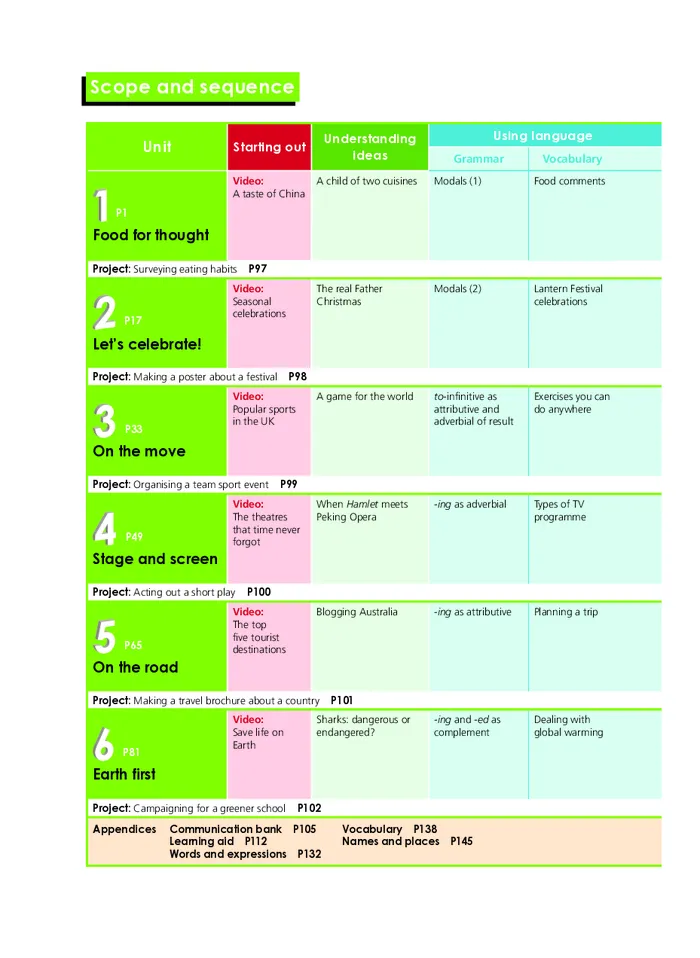
Scope and sequence
Unit
Starting out
Understanding
ideas
Using language
Grammar
Vocabulary
P1
Food for thought
Video:
A taste of China
A child of two cuisines
Modals (1)
Food comments
Project: Surveying eating habits P97
P17
Let’s celebrate!
Video:
Seasonal
celebrations
The real Father
Christmas
Modals (2)
Lantern Festival
celebrations
Project: Making a poster about a festival P98
P33
On the move
Video:
Popular sports
in the UK
A game for the world
to-infinitive as
attributive and
adverbial of result
Exercises you can
do anywhere
Project: Organising a team sport event P99
P49
Stage and screen
Video:
The theatres
that time never
forgot
When Hamlet meets
Peking Opera
-ing as adverbial
Types of TV
programme
Project: Acting out a short play P100
P65
On the road
Video:
The top
five tourist
destinations
Blogging Australia
-ing as attributive
Planning a trip
Project: Making a travel brochure about a country P101
P81
Earth first
Video:
Save life on
Earth
Sharks: dangerous or
endangered?
-ing and -ed as
complement
Dealing with
global warming
Project: Campaigning for a greener school P102
Appendices Communication bank P105
Vocabulary P138
Learning aid P112
Names and places P145
Words and expressions P132
Self-assessment
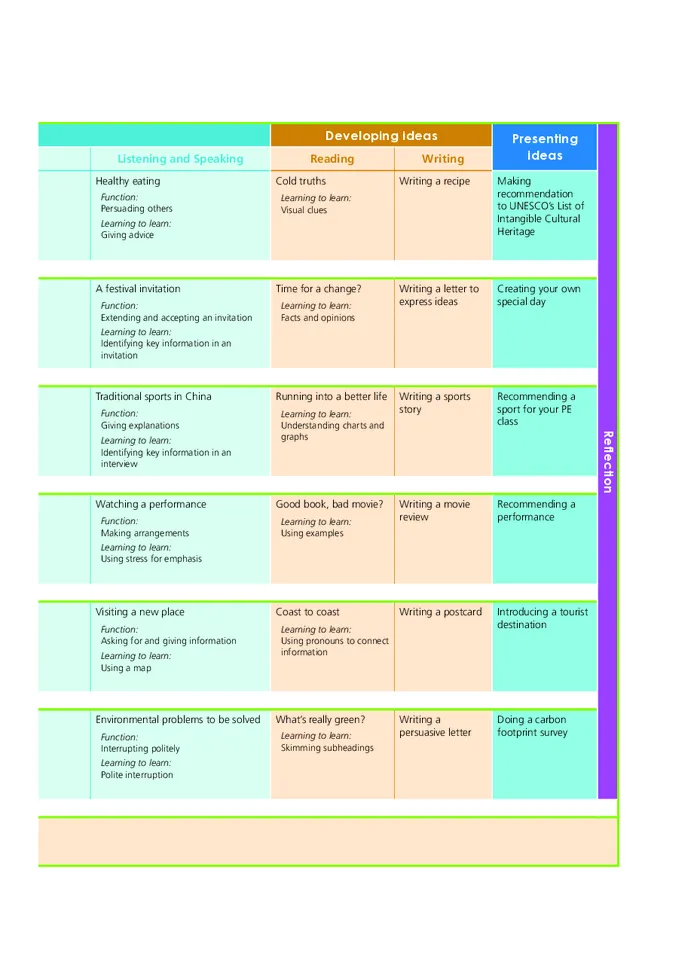
Developing ideas
Presenting
ideas
Listening and Speaking
Reading
Writing
Healthy eating
Function:
Persuading others
Learning to learn:
Giving advice
Cold truths
Learning to learn:
Visual clues
Writing a recipe
Making
recommendation
to UNESCO’s List of
Intangible Cultural
Heritage
A festival invitation
Function:
Extending and accepting an invitation
Learning to learn:
Identifying key information in an
invitation
Time for a change?
Learning to learn:
Facts and opinions
Writing a letter to
express ideas
Creating your own
special day
Traditional sports in China
Function:
Giving explanations
Learning to learn:
Identifying key information in an
interview
Running into a better life
Learning to learn:
Understanding charts and
graphs
Writing a sports
story
Recommending a
sport for your PE
class
Watching a performance
Function:
Making arrangements
Learning to learn:
Using stress for emphasis
Good book, bad movie?
Learning to learn:
Using examples
Writing a movie
review
Recommending a
performance
Visiting a new place
Function:
Asking for and giving information
Learning to learn:
Using a map
Coast to coast
Learning to learn:
Using pronouns to connect
information
Writing a postcard
Introducing a tourist
destination
Environmental problems to be solved
Function:
Interrupting politely
Learning to learn:
Polite interruption
What’s really green?
Learning to learn:
Skimming subheadings
Writing a
persuasive letter
Doing a carbon
footprint survey
Reflection
同学们,欢迎大家继续学习《英语》(新标准)高中教材!
由教育部制定并颁布的《普通高中英语课程标准(2017 年版)》明确规定:普通高中英语课程
作为一门学习及运用英语语言的课程,与义务教育阶段的课程相衔接,旨在为学生继续学习英语和
终身发展打下良好基础。普通高中英语课程强调对学生语言能力、文化意识、思维品质和学习能力
的综合培养。也就是说,发展学科素养是同学们高中阶段英语学习的方向和目标。经过必修课程教
材第一册的学习,大家对高中阶段英语的学习已有了基本认识,并取得了一定的进步。在此基础上,
同学们应该对自己的学习目标提出更高的要求。
《英语》(新标准)高中必修课程教材遵循“为用而学,在用中学,在学中用,学而能用”的原
则,为同学们提供了语言地道、优美的阅读文章和灵活多样的学习活动,力图使大家逐步获得独立
学习和自主学习的能力。
必修课程教材第二册进一步展开话题,从饮食文化、节日传统,到体育与健康、戏剧与影视,
再到旅行与环保,帮助大家加深对人与自我、人与社会、人与自然三大主题语境的认识,进一步发
展英语学科核心素养。本册共六个单元,单元结构如下:
(1) 背景激活(Starting out)
该板块旨在激活同学们已有的背景知识和语言知识。我们把“看”(viewing)的活动作为
预热和导入,通过视频、文字、图片、表格等多模态语篇,帮助同学们更好地了解本单元
主题。
(2) 主题理解(Understanding ideas)
该板块通过语篇和阅读活动聚焦核心语言、结构,帮助大家在达成主题理解、实现语言形
式与意义深度加工的同时培养文化意识和思维品质。
(3) 功能运用(Using language)
该板块是对语言技能的综合学习和运用。通过语法、词汇及听说三个部分的大量语言实践
活动,发展大家的语言技能,为真实生活中的语言交际做好铺垫。
(4) 思维拓展(Developing ideas)
该板块为大家提供新的阅读语篇,从不同角度进一步呈现单元话题,调动大家的逻辑思维、
批判性思维和创造思维,并以一项读写结合的活动来检验大家前述学习活动的成果。
(5) 观点表达(Presenting ideas)
该板块主要以讨论、评选、演讲、辩论等口头表达形式进一步促进同学们对所学内容的复
习与掌握。开放或半开放性的活动有利于大家彼此合作,展示个性,充分表达自己对主题
思想的理解和认识。
(6) 自我反思(Reflection)
该板块列出了本单元话题下可以实现的学习目标,通过自我评价和总结的方式,帮助大家
反思自己的学习成果,进而认识到自己的进步与不足,逐步培养自主学习的能力。
(7) 项目实践(Project)
该板块提供真实的语境和任务,每个项目活动均由小组合作完成,力求培养大家获取信息、
相互合作、学以致用的能力。
我们希望同学们通过使用本教材,全面提高综合语言运用能力,发展英语学科的核心素养,成
为具有中国情怀、国际视野和跨文化沟通能力的社会主义建设者和接班人。
致 同 学
1
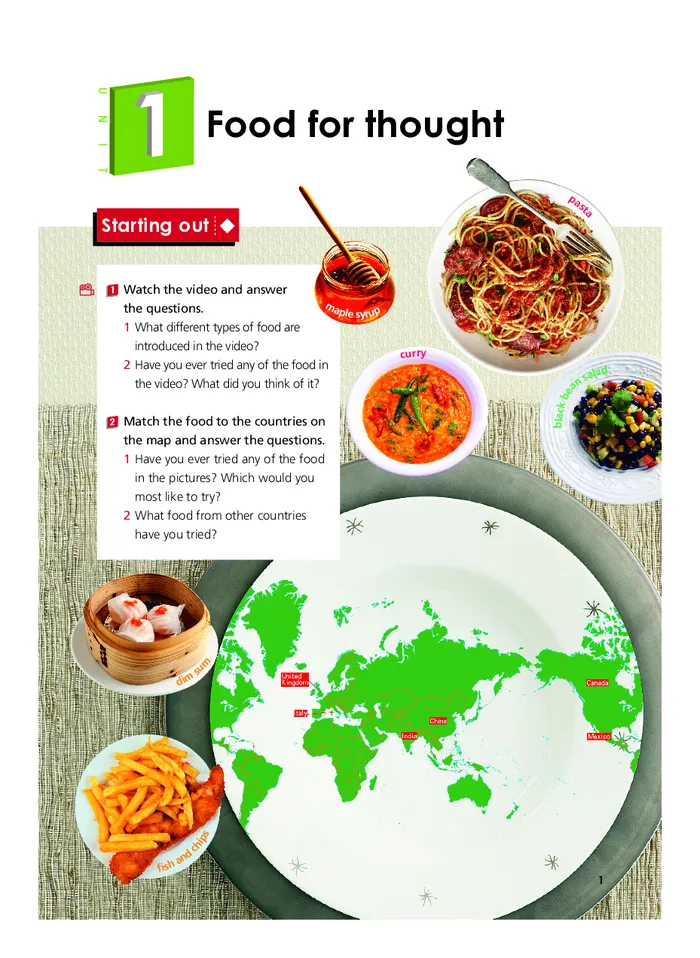
Watch the video and answer
the questions.
1 What different types of food are
introduced in the video?
2 Have you ever tried any of the food in
the video? What did you think of it?
2
Match the food to the countries on
the map and answer the questions.
1 Have you ever tried any of the food
in the pictures? Which would you
most like to try?
2 What food from other countries
have you tried?
Food for thought
Starting out
U
N
I
T
p
a
st
a
c
u
rr
y
m
a
p
l
e
s
y
r
u
p
b
l
a
c
k
b
e
a
n
s
a
l
a
d
d
i
m
s
u
m
fi
s
h
a
n
d
c
h
i
p
s
1
2
Read the passage and talk about your
understanding of the title.
1
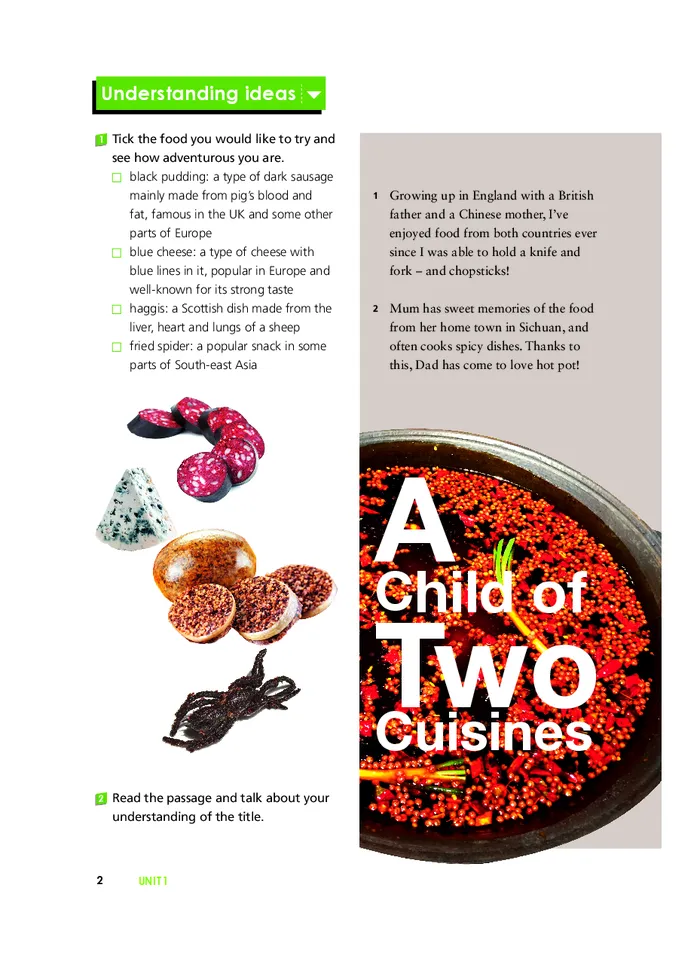
Tick the food you would like to try and
see how adventurous you are.
black pudding: a type of dark sausage
mainly made from pig’s blood and
fat, famous in the UK and some other
parts of Europe
blue cheese: a type of cheese with
blue lines in it, popular in Europe and
well-known for its strong taste
haggis: a Scottish dish made from the
liver, heart and lungs of a sheep
fried spider: a popular snack in some
parts of South-east Asia
Understanding ideas
Child of
A
Two
Cuisines
1 Growing up in England with a British
father and a Chinese mother, I’ve
enjoyed food from both countries ever
since I was able to hold a knife and
fork – and chopsticks!
2 Mum has sweet memories of the food
from her home town in Sichuan, and
often cooks spicy dishes. Thanks to
this, Dad has come to love hot pot!
2
UNIT 1
But there are still some dishes that Dad dare not try even after many
years of marriage to my mother. He once told me he was surprised
by what he saw on the table when he first visited my mother’s
parents in China. He was even shocked at their wedding when he
saw how the Chinese ate almost every part of an animal. Even today,
he still does not easily take to eating things like chicken feet.
3 But I enjoy that sort of food myself. Last week, I went to the
butcher’s and asked, “Do you have pigs’ ears?” “No,” the butcher
said, pulling at his own ears, “just these ordinary ones.” He must
have thought I was joking.
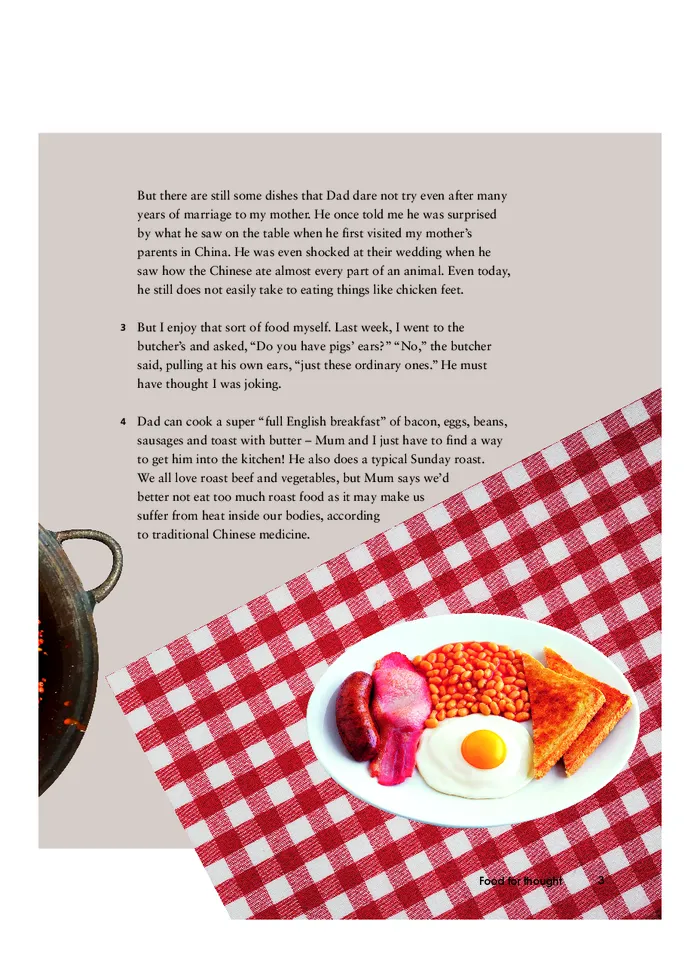
4 Dad can cook a super “full English breakfast” of bacon, eggs, beans,
sausages and toast with butter – Mum and I just have to find a way
to get him into the kitchen! He also does a typical Sunday roast.
We all love roast beef and vegetables, but Mum says we’d
better not eat too much roast food as it may make us
suffer from heat inside our bodies, according
to traditional Chinese medicine.
Food for thought
3
5 I’ll never forget my first visit to China. Mum encouraged me to try
different kinds of food, and I did! I loved everything. But just when I
thought I could deal with all Chinese food, I came across stinky tofu,
a horrible grey thing that looked and smelt like a burnt sports shoe.
“You needn’t try it if you don’t want to,” Mum said, but I gathered
all my courage to take a bite and was amazed to find it wasn’t so
bad. It reminded me of blue cheese, a similarly strong smelling type
of food you either love or hate. Maybe I’ll fall in love with stinky
tofu – someday.
6 People say that one man’s meat is another
man’s poison, but I feel at home with food
from both my cultures. To me, there’s
nothing better than a cross-cultural
afternoon tea of English biscuits and a cup
of Chinese oolong tea in a fine china cup!
3
Choose the main idea of the passage.
1 How the family stays healthy by eating Chinese food.
2 What the family has done to promote Chinese food.
3 How the family cooks both Chinese and English food.
4 How the family combines food from two cultures.
4
UNIT 1
Think Share
&
4
Choose the correct symbols and complete the table with information
from the passage.
1 What does the author mean by saying “one man’s
meat is another man’s poison”? Do you know of any similar sayings in
Chinese?
2 What food from other regions in China or other countries has made
an impression on you? Why?
Sichuan
hot pot
Opinion
Supporting
details
Animal parts
Opinion
Supporting
details
Full English
breakfast
Opinion
Supporting
details
Sunday roast
Opinion
Supporting
details
Stinky tofu
Opinion
Supporting
details
Mum
Dad
Son
N/A
N/A
N/A
N/A
N/A
N/A
N/A
N/A
N/A
N/A
N/A
N/A
N/A
N/A
N/A
Food for thought
5
Modals (1)
Using language
Now talk about the function of modals.
Then match the meanings to the words in bold above.
1 be afraid to do something
2 not be necessary to do something
3 give advice to do or not to do something
4 be necessary or give strong advice to do something
5 have the ability to do something
1
Look at the sentences from the reading passage. Think and work out
the meanings of the words in bold.
2
Underline the modals in the introduction to an app and talk about
their meanings.
a … I was able to hold a knife and fork – and chopsticks!
b But there are still some dishes that Dad dare not try even after many
years of marriage to my mother.
c … Mum and I just have to find a way to get him into the kitchen!
d … we’d better not eat too much roast food as it may make us suffer
from heat inside our bodies, …
e “You needn’t try it if you don’t want to,” Mum said, …
Healthy Eating Trainer
Health & Fitness
Download
(96)
If you dare not try a “painful” diet to stay healthy, this new
app is the perfect solution – and you needn’t pay for it! The
app works by quickly showing photos of different food. All
you have to do is select the photos of healthy food. Then
you’ll be able to train your brain to select healthy food in real
situations. So, if you’re a sugar addict and aren’t able to say
no to chocolate or cola, you had better download it now!
Soon, you’ll be filling your cupboards with real healthy food.
6
UNIT 1
3
Complete the tips for good table manners with the correct form of
the modals in Activity 1.
4
Read and match the comments to the pictures.
Food comments
While going on your first trip to the UK is exciting, new and different customs can also be
confusing. Table manners are no exception. But don’t worry – here are some tips:
• You
1 wait until everyone else has been served before you start eating.
• Sometimes there are so many knives and forks that you
2 pick them up in
case you get it wrong. The trick is to start with the ones on the outside.
• When you finish your meal, you
3 place the knife and fork together on
your plate with the handles at the four o’clock position.
Table manners, however, can differ in different situations. For
example, you
4 use a knife and fork when eating
a hamburger or pizza. Just remember: when in Rome, do as the
Romans do, and you will
5 enjoy the local cuisine!
1 Backyard BBQ, Kansas City, US
The most tender steak I’ve ever had! The barbecue gives it that
famous smoky flavour, and it comes with a shiny sauce that’s
very, very spicy!
2 Bund 59, Shanghai, China
A bowl of soup with a large, round meatball! The meatball is
cooked through, which looked slightly pink inside. Incredibly
soft and juicy – it melts in the mouth!
3 Antonio’s Pizzeria, London, UK
Worst pizza ever! I ordered a large vegetarian pizza, but it
was tiny! It was served cold and came with some sort of sticky
sauce which tasted bitter and smelt really fishy! The waiter even
spilled some beer on me!
4 Madame Laurent’s Bakery, Paris, France
You’ve got to try the strawberry cheesecake. It’s smooth and
creamy with fresh strawberries, which give it a lovely sweet and
fruity taste. Highly recommended!
98 reviews
86 reviews
95 reviews
a
b
c
d
56 reviews
Food for thought
7
7
Listen to the conversation and tick the food
and drinks ordered.
5
Underline the words that
describe food in Activity 4 and
put them into the table. Add
any more you can think of.
6
Work in pairs. Talk about your
favourite food using the words
you have learnt.
A: What’s your favourite food?
B: My favourite food is...
A: How does it look / smell / taste /
feel?
B: It looks / smells / tastes / feels…
…
Appearance
Smell
Taste
Feel
Healthy eating
a salad with
dressing
a glass of
water
yoghurt
a glass of
juice
a glass of
cola
a salad without
dressing
a double hamburger
with French fries
?
Did You Know
• The sugar in soft drinks forms acid and
attacks our teeth for about 20 minutes
each time we drink them.
• About 30% of the world’s population
is overweight.
8
UNIT 1
8
Listen again and complete the notes.
10
Work in pairs. Think of a similar situation and have a conversation.
9
Work in pairs. Act out the conversation to persuade a customer to buy
a new mixed fruit drink.
Student A: Turn to Page 105.
Student B: Turn to Page 108.
Food and drinks Janet
wants to order
Harriet’s views
a lot of sugar, 1
and unhealthy 2
salad with dressing
•
fat-free yoghurt
When giving advice, it’s usual to give your opinion within your
first sentence. This makes the listener more interested in what
you are saying. Here are some examples: Not a good idea. Did
you know that…? Sorry, but there’s a problem with…
Learning to learn
a lot of sugar to improve the
5 , which can
be 6
fruit juice
just a small 3
of real fruit in it
has as much sugar as 4
•
•
•
Now talk about what Harriet says to persuade Janet.
Listen again if necessary.
Food for thought
9
1
Work in pairs. Talk about what you
usually eat for dinner and decide who
eats more healthily.
2
Read the passage and match the
pictures of the fridges to their owners.
Developing ideas
b
a
d
c
e
10
UNIT 1
Cold Truths
There’s not enough room to swing a cat in my small apartment, so I don’t
cook very often. My fridge is usually half empty and I’m often too tired
to eat much anyway. I often end up saving part of my meal for the next
day. Some evenings, I’ll just have something quick, like toast, or even just a
yoghurt with honey. As a doctor, I know I had better change the way I eat,
but I just don’t have the time or the energy right now.
Ellie 24
Junior doctor
Is there any truth behind the saying “You are what you eat”? We put this to the
test by asking five people to open their fridge doors and talk about their lifestyles.
Can you guess which fridge belongs to which person? Maybe you can recognise
your own fridge here!
My husband and I avoid all products that come from animals. This means
we don’t eat meat, and any milk or cheese had better be dairy-free. We
like cooking at home and make our meals from fresh, seasonal fruit and
vegetables. Cooking together gives us a chance to relax and catch up on
each other’s days. If we have children, I want to bring them up just like
us, but my husband says that everyone should be able to make their own
lifestyle choices.
Jenny 31
Teacher
Healthy You!
Food for thought
11
3
Find out who might say the sentences below.
Visual information, such as photos and illustrations, can support reading and
help you identify the theme and content of a text. Make the most of these
images to look for clues to help you understand the text.
Learning to learn
With five children, we’re one big family! My wife and I both work full-
time, so life can get pretty busy! Like a lot of chefs I know, I don’t really do
much cooking at home. Sometimes I bring home food from the restaurant
where I work. Once a week, we do a big shop and buy a lot of frozen food.
I know we should eat more fresh fruit and vegetables, but ready meals are
so convenient.
Each day at the construction site is more or less the same – tiring! When
I get back home, there’s nothing more satisfying than a big meat dinner. I
guess I’ve always been a big meat eater and in this house, no family meal is
complete without some form of meat. I still don’t think that anything can
beat my mum’s homemade sausages, though.
Mike 49
Ted 35
There are five of us living in our shared student house. My mum says I need
to have three healthy meals a day, but I’m too busy studying and meeting
friends! We don’t really buy fresh food, and I suppose the fridge could be
kind of cleaner… I daren’t let my mum see this photo!
Max 19
1 “There is a lot of food from my workplace in our fridge.”
2 “You might find bean products in our fridge, but hamburgers? Never!”
3 “My fridge is a total mess! All I do is party and hit the books.”
4 “There isn’t really much in my fridge. I’m just too busy and tired to
cook at home!”
5 “If you’re someone who avoids animal products, you wouldn’t find
anything to eat in my fridge!”
Construction worker
Chef
College student
12
UNIT 1
Think Share
&
1 What do you think the saying
“You are what you eat” means?
2 Do you know of any Chinese sayings
about food and health? What is your
understanding of them?
3 Which person’s eating habits are most
similar to yours?
4 What can you do to improve your eating
habits from now on?
4
Work in groups. Make comments and
suggestions about the lifestyle of each
person in the passage.
1 Discuss the lifestyle of each person. Use
the table to make notes.
Jenny
Mike
Ellie
Max
Ted
a
b
c
d
e
Name
Lifestyle
2 Organise your ideas following the steps below.
• Describe the lifestyle of each person
in the passage.
• Explain the possible problems with
their lifestyles.
• Make suggestions about how they
can improve their lifestyles.
3 Share your ideas with the class.
Food for thought
13
5
Read the food blog and answer the questions.
Writing a recipe
1 What is the origin of Gong Bao Chicken?
2 What are the two main parts of a recipe?
3 How do you cook Gong Bao Chicken? Describe
the process in your own words.
Gong Bao Chicken (also known as Kung Pao
Chicken) was originally a family dish of Ding
Baozhen, or Ding Gongbao, a high-ranking
court official of the Qing Dynasty who helped
reconstruct the Dujiangyan Irrigation System
in Chengdu, Sichuan. Over the years, it has
become one of the most popular dishes in
Chinese restaurants throughout the world.
The combination of spicy, salty, sweet and sour flavours
makes Gong Bao Chicken hard to resist. What’s more, it is
easy to make and can be adapted to individual tastes.
Instructions
1 Heat the oil over a high heat.
2 When the oil is hot, add the chillies
and stir them for about 30 seconds.
3 Add the spring onions and stir them
for about 30 seconds.
4 Add the chicken and cook it through.
5 Add the soy sauce, vinegar and sugar.
6 Add the peanuts and dried tofu and
cook for another 1 to 2 minutes.
7 Season with salt and serve.
Ingredients
chicken breast··················300g
roasted peanuts··················50g
small pieces of dried tofu····50g
cooking oil·················2 spoons
dried chillies····················5 or 6
spring onions············· a handful
soy sauce·················1 teaspoon
vinegar····················1 teaspoon
sugar····················· 2 teaspoons
salt··························1 teaspoon
So, don’t forget to pick up some chicken on your way home
and try this recipe out!
RECIPE
14
UNIT 1
7
Share your recipe with the class. Try cooking the dish at home.
6
Think of your favourite dish and complete the recipe.
My favourite dish:
Ingredients:
Instructions:
Food for thought
15
2
Work in groups. Talk about
your recommendation
following the steps below.
1 Say what food or drink you
would like to recommend.
2 Give a description of it.
3 State why you would like to
recommend it.
Presenting ideas
1
Look at the food and drink on the list of China’s
Intangible Cultural Heritage and think of other
typical ones you know. Recommend one you
wish to add to the UNESCO list.
3
Present your food or drink to
the class. Use the expressions
in the box to help you.
Now discuss and decide on a
winning food or drink.
green tea
roast duck
Food / Drink
mooncake
Description
Reasons for recommendation
• We would like to recommend…
• It comes from…
• It is famous for…
• It looks / tastes / smells…
• We recommend it because…
Useful expressions
1
After completing this unit, I can rate
my performance 1 (excellent), 2 (good)
or 3 (in need of improvement).
express opinions about food
encourage others to develop healthy eating
habits
understand how different lifestyles can
affect people’s diets
write a recipe for my favourite dish
appreciate different food cultures
2
I’ve learnt to make use of the
following words and expressions:
3
I still need to improve:
Reflection
16
UNIT 1
1
Watch the video and answer
the questions.
1 What festivals are mentioned
in the video?
2 Why do people celebrate these
festivals?
2
Read the festival descriptions and
complete the sentences.
________ is to celebrate the harvest.
________ is to celebrate a season.
________ is to honour an event.
________ is to honour a person.
3
Work in groups. Talk about:
• other festivals of each type
• other reasons to celebrate
a festival
Let’s celebrate!
U
N
I
T
Starting out
Freedom Day is held every year on
27 April to celebrate South Africa’s
first fully-participated elections
in 1994, in which everyone was
allowed to vote regardless of skin
colour. It celebrates the end of
racial inequality in the country.
May Day is a festival to celebrate
the start of summer, with
celebrations held across Europe
and in parts of North America.
People prepare decorations
with flowers and dance around
maypoles.
Thanksgiving is celebrated mainly
in North America, in October or
November. Traditionally, it was a chance
to give thanks for a good harvest. Now,
it is also a time for families to get
together for a big dinner.
Dragon Boat Festival celebrations take
place in China on the fifth day of the fifth
lunar month. They are held in memory of
Qu Yuan, a poet and statesman in Ancient
China. It was the first traditional Chinese
festival added to UNESCO’s List of
Intangible Cultural Heritage.
17
1 Have you ever read any of Tolkien’s
books or seen any of the films based on
them? What do you think of them?
2 What else do you know about Tolkien?
Find out more about him and share your
research with the class.
2
Read the passage and find out what
Letters from Father Christmas is about
and why Tolkien wrote these letters.
1 Many people still remember the magic
of Father Christmas from when they
were children. As parents, they try to
keep that magic alive for their children
for as long as they can.
2 That is why Letters from Father
Christmas could be the perfect book
for those who regard Christmas as
a special time of year. The man who
wrote these letters is one of the most
famous names in English literature –
J.R.R. Tolkien, author of The Lord of
the Rings. The letters were Tolkien’s
1
Read the introduction to Tolkien and
answer the questions.
Understanding ideas
J.R.R. Tolkien (1892–1973)
was an English writer, poet
and university professor, best
known as the author of some
of the world’s most popular
high-fantasy novels. With his
limitless imagination, he created
new worlds for his readers to
explore. His novels The Hobbit
and The Lord of the Rings have
been made into films.
18
UNIT 2
way of keeping Father Christmas alive
for his four children, over a period of
more than twenty years.
3 Every Christmas, an envelope with
a North Pole stamp arrived. It was
addressed to Tolkien’s children. Who
could it be from? The children must
have been very excited as they opened
it. Inside, they would find a handwritten
letter from Father Christmas. The letters
were also beautifully illustrated – each
must have taken its true author, Tolkien,
a long time to complete.
4 The letters told wonderful stories about
Father Christmas’s life and adventures at
the North Pole. A regular character in the
letters was Polar Bear, who once climbed
the North Pole (an actual pole in this
case) and fell through the roof of Father
Christmas’s house. In another letter,
Father Christmas complained about how
he could not stop his helpers playing
games with the toys instead of wrapping
them up. Interestingly, the letters did not
contain the usual warnings to children
that they might not receive their presents
if they were not good. The letters did,
Let’s celebrate!
19
3
Choose the sentence that best explains the title of the passage.
1 The real Father Christmas was actually Tolkien himself.
2 Tolkien is the real Father Christmas, because he wrote letters using the
name “Father Christmas”.
3 Tolkien’s love and care for his children made him very like Father
Christmas.
however, change as Tolkien’s children got older:
... but if you find that not many of the things you asked for have come,
and not perhaps quite as many as sometimes, remember that this
Christmas all over the world there are a terrible number of poor and
starving people.
5 Letters from Father Christmas tells us that as well as enjoying the
adventures of Father Christmas, Polar Bear and other characters at the
North Pole, we can all share the true spirit of giving at Christmas time. By
expressing love for his children in such a special way, Tolkien may indeed
have been the real Father Christmas.
20
UNIT 2
Think Share
&
4
Complete the notes with expressions from the passage.
1 Would you like to read the book Letters from Father
Christmas? Give your reasons.
2 What is the most special gift you have received from your family?
Why is it special to you?
Title of the book:
1________________________________
Author:
2________________________________
Background information:
Every Christmas, Tolkien’s children would get an envelope with
3________________________________. Inside it, they would find
4________________________________. Of course, the letters were
written by Tolkien.
Contents of the letters:
They tell wonderful stories about
5________________________________.
In one letter, Polar Bear
6________________________________ and
7________________________________ of Father Christmas’s house.
In another letter, Father Christmas complained about
8________________________________ with the toys.
Let’s celebrate!
21
Modals (2)
Using language
1 What do the words in bold indicate: an order,
a request, ability or possibility?
2 Will the meaning of sentence (a) change if we
replace “could” with “must” or “might”?
3 What happens if we change “must” and
“might” in sentences (b) and (c) into “could”?
Now look for more sentences with modals in
the reading passage.
3
Look at the picture and make as many sentences as possible using can /
could, may / might and must.
1
Look at the sentences from the reading
passage and answer the questions.
a That is why Letters from Father Christmas
could be the perfect book…
b The children must have been very excited as
they opened it.
c … they might not receive their presents if
they were not good.
Chris: I spent ages putting up all the
balloons and flowers last night.
Jean: I expect you are feeling tired
now!
Chris: Yes, I am. Look, that guy is
dressed as Batman. Is that Mike?
Jean: It’s possibly him. Check out that
girl over there dressed as a bride.
I’m sure that’s Lucy.
Chris: No, I don’t think that’s Lucy. Lucy
isn’t that tall.
Jean: Look at those two guys dressed
as chickens! Oh, they’re
waving at us! Maybe they’re
from our school.
Chris: Let’s go and find out.
(At a fancy dress party.)
Black Friday is one of the
busiest shopping days of
the year. Stores have big
sales and open their doors
very early.
The customers must
have got up very early.
2
Rewrite the underlined
sentences in the conversation
using can / could, may / might
and must.
22
UNIT 2
4
Underline the words and expressions about celebrations during the
Lantern Festival in the speech bubbles and complete the mind map.
Add any more you can think of.
5
Describe a festival celebration using the words and expressions you have learnt.
To celebrate…, we often drink / eat…, give… as gifts, decorate with…
Lantern Festival celebrations
To celebrate the
Lantern Festival, we
decorate our windows
with balloons and
posters. We’ll hold
a lantern riddles
competition, too.
Come and join us!
The fireworks will start at 8:00
this evening in Renmin Square...
In our restaurant, we
offer Western dinners
and desserts. But to
celebrate this festival,
we prepare Chinese
dishes, too. Rice balls
are very popular.
The lantern fair
attracts a lot of
people, so it’s one of
the busiest times of
year for the traffic
police. We do our
best to help the
traffic police keep
everyone safe.
Today, I gave
my aunt some
flowers and a
scarf. I received
a red envelope
from her.
Food
Activities
Decorations
we give / receive
Things
Celebrations
Let’s celebrate!
23
6
Listen to the conversation and complete the sentences with the
correct ending.
?
Did You Know
Traditionally, people send written invitations for formal events such as weddings.
Similarly, these invitations are answered in writing. For more informal events,
however, spoken invitations are more common.
Remember to arrive on time if you accept the invitation. Depending on regional
customs, it may be acceptable to be 15 to 30 minutes late. It is not advisable to
be early, as the host may not be ready.
A festival invitation
1 Tony would like to _____.
2 Hugo wants to find out _____.
3 On that day they will _____.
a go to Hugo’s apartment to give thanks
b invite Hugo to his apartment to celebrate Thanksgiving
c what he needs to bring to the party
d what he should say at the party
e go shopping together and watch the parade
f watch an American football game on TV
24
UNIT 2
8
Work in pairs. Act out the conversation about extending and
accepting an invitation.
Student A: Turn to Page 105.
Student B: Turn to Page 109.
9
Work in pairs. Think about a similar situation and have a conversation.
7
Listen again and complete the notes.
Now talk about what the speakers say to extend and accept an
invitation. Listen again if necessary.
Occasion: a
1_________________ party
When: the fourth 2_________________ in
3_________________
Where: Tony's
4_________________
What to eat: a
5_________________ with all the side dishes and homemade
6_________________
What to bring: some flowers or
7_________________
What to wear:
8_________________
When you are extending or accepting an invitation, pay
special attention to the following information: the date
and time, what to bring, where to meet, etc.
Learning to learn
Let’s celebrate!
25
1
Look at the pictures and talk about
Chinese Spring Festival traditions.
2
Read the passage and find out
each person’s point of view.
Developing ideas
A family dinner is an important
tradition to celebrate Spring
Festival. Nowadays, some people
choose to have the dinner in a
restaurant, but not everyone is
keen on this idea. What do our
readers think?
Social Insights
26
UNIT 2
Dear Editor,
1 We have eaten out for the Spring
Festival family dinner for the last
three years, and we have enjoyed it
no less than eating at home. I don’t
understand why some people refuse
to embrace the change.
2 Can’t they admit that the preparations for the dinner are hard work?
I really don’t think it’s worth the effort of spending so much time
preparing for a single meal, and then another hour cleaning up the
mess after it’s over. We work all year, so why can’t one day be about
spending time with family and relaxing?
3 Eating out is a good choice and it has nothing to do with loss of
traditions. We still have the dinner with the same people, just in a
different place. The occasion is more enjoyable without all that tiring
cooking, and the dishes taste better!
4 In my opinion, what or where we eat on Spring Festival Eve really
doesn’t matter. Eating out may change the form of this tradition, but
the love between the family members sitting around the table together
remains the same.
Wang Peng, software engineer
Time for a
Change?
Let’s celebrate!
27
Dear Editor,
1 For this year’s Spring Festival family dinner, my son has booked
a table at the best restaurant in town, but I’m a bit unhappy
about it. For me, it just won’t feel like Spring Festival having
the dinner out.
2 When I was a little boy, the dinner on the eve of Spring
Festival was what I looked forward to most. It was not only
for the delicious food that we seldom got to eat, but for the
opportunity to have our whole family gathered together. I
would run around the house, listening to the adults chatting
about their year. I’d get under my mother’s feet in the kitchen,
watching her make dumplings. She’d put tokens in some
dumplings: candies for a sweet life and peanuts for a long and
healthy one. In the evening, all of us would sit around the table,
enjoying the food and being together again. We toasted each
other, we laughed, and the simple, homemade dishes tasted
more delicious than anything cooked by a top chef.
3 I hope my children and their children will still value our
memories of preparing the dinner together. To me, the process
is even more important than the dinner itself.
Liu Yonghui, retired teacher
28
UNIT 2
3
Read the sentences from the passage and
decide if they are facts (F) or opinions (O).
1 Eating out is a good choice and it has
nothing to do with loss of traditions. _____
2 ... what or where we eat on Spring Festival
Eve really doesn’t matter. _____
3 ... it just won’t feel like Spring Festival having
the dinner out. _____
4 I’d get under my mother’s feet in the kitchen,
watching her make dumplings. _____
5 She’d put tokens in some dumplings... _____
Think Share
&
A fact is something that exists or has happened,
for example, an object, event or experience. Facts
are statements that can be proved by evidence.
An opinion can be a general or individual view,
belief or impression. Opinions can sometimes be
identified by the presence of words such as ‘‘feel”,
‘‘believe” and ‘‘think”.
Learning to learn
1 What do you think the
retired teacher means by ‘‘To me, the
process is even more important than the
dinner itself”?
2 Which of the two opinions do you agree
with? Why?
3 How would you describe a Spring Festival
family dinner to a friend from overseas?
4 Can you think of any other Chinese festival
traditions? Share them with the class.
4
Work in groups. Give a talk
about the importance of the
Spring Festival family dinner for
Chinese people.
1 Think about why Chinese people
value the Spring Festival family
dinner and make notes.
2 Organise your talk following the
steps below.
• State the importance of the
Spring Festival family dinner for
Chinese people.
• Explain why it is important.
• Share your personal experience
about the family dinner.
• End by summarising the main
points in your talk.
3 Give your talk to the class.
Reasons:
Let’s celebrate!
29
5
Read the editorial column and answer the questions.
Writing a letter to express ideas
1 Which countries are mentioned and how do they celebrate Chinese
Spring Festival?
2 Which event would you most like to attend? Why?
3 Why do you think Chinese Spring Festival is ‘‘going global”?
Nowadays, more and more countries around the world are holding
celebrations for Chinese Spring Festival. What’s more, not only are these
attended and enjoyed by Chinese citizens living abroad, but by many
other nationalities, too.
With colourful decorations of lanterns and lamps, shopping centres have
been organising events and activities to celebrate Chinese Spring Festival
for years, while concerts and other performances are also proving a big
success. Tickets for the 2017 Grand Chinese New Year Concert in
St Petersburg sold out, with 90% of the audience local Russians. People
are also discovering the fun of interacting with the celebrations, rather
than simply watching as part of an audience. To celebrate the 2017
festival, over 1,000 Ghanaian junior high school students got up on
stage to perform Chinese songs and dances. Students in New York City,
meanwhile, have since 2016 been able to enjoy an official day’s holiday
for Chinese Spring Festival.
It seems that Chinese Spring Festival is becoming a global celebration of
joy and love. What do you think of this phenomenon? Write to us to
share your opinion!
Chinese Spring Festival Going Global
30
UNIT 2
7
Share your letter with the class.
6
Complete the notes to help organise your ideas.
Now write a letter to the editor to express your ideas. Use the
expressions in the box to help you.
• What the phenomenon is:
• What reasons lie behind it:
• How you feel about it:
• In my opinion / For me…
• I (don’t) think…
• On the contrary, …
• It’s not only…, but…
• I hope…
Useful expressions
Let’s celebrate!
31
3
Work in groups. Talk about your
ideas following the steps below.
1 Say what day you would like to
create and when it is.
2 State why you would like to
create it.
3 Talk about special activities to
celebrate it.
2
Think of a special day you would like to
create. Complete the table to help organise
your ideas.
Presenting ideas
1
Look at the pictures and answer the questions.
1 Do you know any of these days?
2 Why do you think people create these days?
• Our day is called…
• It celebrates…
• It could be held on…
• Everyone would…
• The activities include…
Useful expressions
4
Present your special day to the
class. Use the expressions in the
box to help you.
World Smile Day
World Health Day
World Book Day
Now discuss and decide on a
winning day.
Name
Date
Reasons to create it
Activities
1
After completing this unit, I can rate
my performance 1 (excellent), 2 (good)
or 3 (in need of improvement).
give details about the Lantern Festival
celebrations
extend and accept an invitation
write a letter to express ideas
observe and compare cultural phenomena
and changes of traditions
cherish Chinese culture and traditions
2
I’ve learnt to make use of the
following words and expressions:
3
I still need to improve:
Reflection
32
UNIT 2
rock climbing
cycling
yoga
surfing
tennis
U
N
I
T
On the move
Starting out
1
Watch the video and answer
the questions.
1 What sports are mentioned in the
video?
2 Which one do you like best? Why?
2
Look at the pictures and answer
the questions.
1 Have you tried any of these sports?
2 Which would you most like to
try? Why?
3 What benefits can you get from
doing sports?
33
2
Read the passage and find out where
modern football started.
1
Talk about what you think these things
represent in a football game.
Understanding ideas
1 These days, football is one of the
most popular sports in the world.
Given that Neil Armstrong
wanted to take a football to the
Moon, we could even say that
it is also the most popular sport
out of this world! The history
of the game goes back over
two thousand years to Ancient
China. It was then known as
cuju (kick ball), a game using a
ball of animal skins with hair
inside. Goals were hung in the
air. Football as we know it today
started in Great Britain, where
the game was given new rules.
34
UNIT 3
Wo
A Game for
the
2 That football is such a simple game to play is perhaps
the basis of its popularity. It is also a game that is very
cheap to play. You don’t need expensive equipment; even
the ball doesn’t have to cost much money. All over the
world you can see kids playing to their hearts’ content
with a ball made of plastic bags; just like Pelé did when
he was a boy.
3 Another factor behind football’s global popularity is the
creativity and excitement on the field. It is fun enough to
attract millions of people. You do not have to be a fan to
recognise the skill of professional players – how they use
their bodies to pass, score and defend can be amazing to
see – or to feel the excitement of a game ending with a
surprising twist.
On the move
35
3
Choose the author’s purpose in writing the passage.
1 To talk about the history of football.
2 To express his / her love of football.
3 To explain why football is such a popular game.
4 To prove that he / she is a professional football fan.
4 What’s more, football has become one of the best
ways for people to communicate: it does not require
words, but everyone understands it. It breaks down walls and
brings people together on and off the field. Take, for example, the
famous football game on Christmas Day 1914. World War I had
broken out months before, but British and German soldiers put
down their guns and played football together – one moment of
peace to remember during years of conflict.
5 “Some people believe football is a matter of life and death, ... ”
said Bill Shankly, the famous footballer and manager. “I can assure
you it is much, much more important than that.” This might sound
funny, but one only has to think about the Earth to realise that our
planet is shaped like a football.
36
UNIT 3
Think Share
&
4
Complete the chart with expressions from the passage.
1 What is your understanding of the last sentence
of the passage?
2 What other sports are as popular as football in China? What makes
them so popular?
Football is much more than just a sport.
Conclusion
Football enjoys popularity all over the world and it has
a history that goes back to
1___________________.
Opening
Reason 1
It is
2__________________.
Example
The young Pelé
played football to his
heart’s content with
3__________________.
Reason 2
It is a game with
4__________________.
Example
It is amazing to see how
professional players
use their bodies to
5__________________.
Reason 3
It breaks down walls and
6__________________.
Example
British and German
soldiers put down
their guns and
7__________________ on
Christmas Day 1914.
On the move
37
to
to-infinitive as attributive and adverbial of result
Using language
1 What is the function of “to play” in sentence (a)? Is it used to give
description or show result?
2 What is the function of “to attract” in sentence (b)? Is it used to give
description or show result?
Compare them with the following sentences and answer
the questions.
Now look for more sentences with these structures in the
reading passage.
1
Look at the sentences from the reading passage and answer
the questions.
2
Join the sentences using the to-infinitive form.
a That football is such a simple game to play is perhaps the basis of its
popularity.
b It is fun enough to attract millions of people.
c That football is such a simple game that people play is perhaps the
basis of its popularity.
d It is so fun that it attracts millions of people.
1 The rules of the game are so simple. They make the game easy to play.
2 The ball is small enough. It fits into most sports bags.
3 Give me a list of the teams. They can enter the competition.
4 The footballer has a dream. He wants to play for a top team.
5 We arrived at the stadium. We found that the game had been cancelled.
3 What is the difference between the two groups of sentences?
4 Why does the author choose to use sentences (a) and (b) in the reading
passage?
38
UNIT 3
c
3
Rewrite the underlined parts using the
to-infinitive form.
4
Look at the pictures and answer the
questions.
Exercises you can do
anywhere
DX Sports Watch
Are you looking for a sports watch that
can help you keep track of your fitness
and chart your training progress?
Whether you’re a professional athlete
or keen sportsperson, DX Sports
Watch is the ideal choice for you. It
has a digital display that records your
steps, speed and distance, as well as
monitoring your heart rate and calories
burnt. It also has a voice control
setting that enables you to stay hands-
free, while its waterproof band is fully
adjustable so that it is comfortable to
wear.
DX Sports Watch is only available
online, so go to our website
and place your order today!
1 What do you know about these exercises?
2 Which of these exercises have you tried?
jogging
d
pull-up
a
push-up
sit-up
e
skipping
b
plank
f
On the move
39
5
Read and match the descriptions
to the exercises in Activity
Underline the words and
expressions describing their
benefits.
1 You have to keep your body
very still. This develops your
core muscles and strengthens
your lower back.
2 This develops your chest and
shoulder muscles. Remember
to keep your back completely
straight.
3 Using only a rope, you can
develop your footwork and
balance. It’s good for your
heart and you’ll burn a lot
of calories without going
anywhere!
4 Find a bar that will support
your weight. This builds
strength in your upper body,
especially in your arms and
back.
5 This develops the muscles
in your stomach region and
improves the way you stand.
6 This gives you improved heart
and lung function. It also helps
build strong leg bones.
6
Work out your weekly exercise
plan. Then use the words and
expressions you have learnt to
share the reasons behind your
plan with the class.
Traditional sports in China
7
Listen to the interview and choose the points
mentioned.
1 Difficulties of studying in China.
2 A tai chi school in China.
3 First visit to China.
4 A great master of yoga.
5 Reasons for learning tai chi.
6 Reasons for keeping going.
7 Reasons for choosing Yangshuo.
When you listen to an interview, it is important to
find out who is being interviewed and the purpose
of the interview. Before listening to the interview,
think about what topics might be discussed. During
the interview, listen carefully to each question
and try to understand the main ideas within the
interviewee’s responses.
Learning to learn
4.
?
Did You Know
Chinese martial arts are famous all around the
world. Each year, tens of thousands of people from
other countries come to China to learn Chinese
martial arts. Tai chi, which is a martial art with a long
history, is usually a popular choice. It involves doing
very slow physical exercises to relax your mind and
calm your body.
40
UNIT 3
8
Listen again and complete the journalist’s notes.
9
Work in pairs. Act out the interview between a sports journalist and a
member of a dragon boat team.
Student A: Turn to Page 106.
Student B: Turn to Page 109.
10
Work in pairs. Think about another interview with a fan of a
traditional sport in China and have a similar conversation.
Now talk about the explanations Leah gives for doing tai chi. Listen
again if necessary.
• loves watching 1____________ films and took
2____________; fell in love with tai chi due to the classes
• first went to China 3____________ years ago
• reasons for choosing Yangshuo: a 4____________ of tai chi lives
there; the beautiful 5____________ views
• challenges: learning to use Chinese; practising basic
6____________; getting up early
• benefits of tai chi: helps relax and brings 7____________;
a simple way to 8____________; improves 9____________
Leah and Tai Chi
On the move
41
1
Look at the chart and answer
the questions.
1 What key information is shown
in this chart?
2 What reasons lie behind the
phenomenon?
Developing ideas
When learning about a new topic, it is
important to collect facts and figures. These
are often represented through charts or
graphs, because they can make information
quicker and easier to interpret. Bar charts
are used to show how something changes
over time, or can be used to compare data.
It’s important to read its title to know what
the facts and figures represent, to read
the labels along the vertical and horizontal
sides, and to look at and understand the key
information.
Learning to learn
2
Read the passage and talk about your
understanding of the title.
Marathon participants
in China
Number of participants
(thousand)
2800
2600
2400
2200
2000
1800
1600
1400
1200
1000
800
600
400
200
0
500
750
900
1500
2800
I was born with asthma and I never
thought I’d be a runner! I only joined
my local athletics club because my
doctor told me that in my particular
case exercise could improve how my
lungs work. But before I knew it, I was
taking part in local races. As my fitness
and my running improved, I started
running in national competitions. This
year I won silver in the under 18’s
10,000 metres! And who knows, next
year I could win gold!
Li Yue, 16, Beijing
This global site is a place for
runners to share their stories
about running. So, if you are a
runner with a story to tell, get
in touch – we’d love to hear
from you!
2012
2013
2014
2015
2016
42
UNIT 3
Running into
a Better Life
Not so long ago,
I didn’t do any
exercise – not even
any jogging! Then
I discovered an app
called Running
Power. It lists
your performance
against other
runners in your
social network. At
As a computer
engineer, there’s
always a new
challenge just
around the corner!
It can be quite
stressful at times,
though, which in
turn makes me feel
anxious. To help
deal with this, I
first, I kept running just to see my name
in the top five. Soon, I found that I was
not alone – I came across other runners
in the same area running for the same
purpose! Now I no longer use the app,
but I’ve fallen in love with running, and
still do it with my running friends.
go running as often as I possibly can.
Whether I’m at the gym or on the road,
my nervous energy pushes me through
mile one. By mile two, the tension has
moved from my mind to my legs. By
the end of the run, all my stress has
disappeared and I’m ready to face the
next day at work!
David, 52, New York
On the move
43
Reasons for starting running
Benefits gained from running
Running could improve
1___________________ and help
him treat his asthma.
Running
2___________________
and led him to achieve things he
never thought he could do.
She discovered an app that
3___________________ and she
wanted to see her name in the
top five.
She came across
4___________________ and fell in
love with running.
His job sometimes
5___________________ and
makes him feel anxious. To help
deal with this, he started running.
After running,
6___________________ and he
is ready to face the next day
at work.
She participated in a programme
run to
7___________________.
She had a great day in London, as
well as
8___________________.
3
Complete the table with expressions from the passage.
This year I entered the Great Gorilla Run
in London. This is a programme run by The
Gorilla Organization to raise money to save
the world’s last remaining gorillas from dying
out. Each runner receives a gorilla suit and off
they go! It’s a bit hot and sweaty inside the
suit, and my legs ache, but it’s a lot of fun. The
funniest moment was when someone watching
the race offered me a banana – a real treat
for a running gorilla! I had a great day out in
London, as well as helping to save gorillas!
44
UNIT 3
Think Share
&
1 Which of these running stories impresses you
most? Why?
2 What can you learn from these people?
3 In what ways do you think apps and social media can help us
do sports?
4 Do you know of any running events in China? Have you ever
participated in any of them?
2 Organise your talk following the steps below.
• Give details about the runner.
• Talk about his / her experience of running.
• End by saying why he / she inspires you.
3 Give your talk to the class.
Runner’s name:
Age:
When he / she started running:
What he / she thinks about running:
4
Work in groups. Give a talk about a runner you know.
1 Use the notes to help plan your talk.
On the move
45
5
Read the notice and post and answer the questions.
Writing a sports story
This new global site is a place for sports lovers to share
their stories. We are looking for stories to inspire our
readers. Do you want to share your story? Send it to
us right now!
Stories
wanted!
1 What kind of stories does the website want?
2 Why is the website looking for stories?
3 What information is included in Nick’s story?
I was so proud when my team won the ice hockey competition.
It made me feel like I could achieve anything. Only three years
ago, I was terrified of sports like skiing and skating. To deal
with this, I decided to join a skating club. I really envied the
other club members, who were so confident and dynamic on
the ice. But my teacher was great and before I knew it, I was
able to skate. He then persuaded me to try ice hockey. I loved
it and was soon practising with my local team almost every
evening. We’re now training for national competitions and
hope to be champions one day, but my ultimate goal is to be
an ice hockey teacher and help people learn to play this game.
Nick
31 Oct
11:00 am
46
UNIT 3
7
Share your story with the class.
6
Think of your own sports story and make notes.
Now write your own sports story. Use the expressions in
the box to help you.
Sport:
How you got started with the sport:
How you feel about the sport:
What you've done to improve:
What you hope to achieve in the future:
• When I was younger, …
• I never thought…
• The first time…
• Before I knew it, …
• Soon I found…
Useful expressions
On the move
47
Presenting ideas
1
After completing this unit, I can rate
my performance 1 (excellent), 2 (good)
or 3 (in need of improvement).
talk about the benefits of doing sports
ask questions and give explanations in an
interview
write a personal sports story
promote Chinese culture through sports
handle pressure and improve fitness
through sports
2
I’ve learnt to make use of the
following words and expressions:
3
I still need to improve:
Reflection
1
Work in groups. Recommend a sport for your PE class and complete the table.
2
Talk about your recommendation
following the steps below.
1 Say what sport you would like
to recommend.
2 Talk about its rules.
3 State why you would like to
recommend it.
• The sport is called…
• The rules are as follows: …
• It’s a sport which needs…
• It can bring us such benefits as…
Useful expressions
Sport
Rules for the sport
Reasons for recommendation
3
Present your sport to the class. Use the
expressions in the box to help you.
48
UNIT 3
Stage and screen
Starting out
U
N
I
T
2
Watch the video and answer the
questions.
1 What theatres are mentioned in the video?
2 What are the differences between them?
In what ways are they similar?
1
Look at the posters and answer the
questions.
1 Which of these types of entertainment are
you most familiar with?
2 What other types of entertainment have
you seen?
3 Which do you like most? Why?
22 & 23 December 8 pm
Palace Theatre
The Old Teahouse
Sichuan Opera
Face-changing
Waiting
for
Godot
26 October 7 pm
Royal Theatre
29 May
6 pm
EAST THEATRE
CHINESE
CROSSTALK
SHOW
LISA
CENTRAL STADIUM
7 July 7 pm
9 April
2 pm & 7 pm
BROWN
Gala
10 February
8 pm
49
2
Read the passage and find out
what aspects of Peking Opera most
impressed the author.
1 I thought I knew a lot about Hamlet.
As a high school student with English
literature as one of my main subjects,
I have to! Shakespeare’s Hamlet is
probably the most important play by
the most important writer in English.
Almost everybody knows “To be, or
not to be”, right? Having seen quite a
few productions of Hamlet and read
the play many times, I was full of
confidence – until the Peking Opera
came to town!
2 Dating back to the 18th century, Peking
Opera has over two hundred years of
history. Does this mean it’s easier than
a Shakespeare play to understand? To
find out the answer, I just had to go
and see The Revenge of Prince Zidan –
the Peking Opera version of Hamlet.
3 Starting with an orchestra playing
traditional Chinese instruments, the
opera brought a completely new sound
to my Western ears. At first, I thought
what I heard was a violin, but later
I learnt that it was an instrument
with two strings called jinghu. Then,
seeing the main characters come on
1
Look at the pictures of two
performances and talk about their
differences and similarities. Consider
the following:
• orchestra
• costumes and masks
• stage set
• performers’ movements
Understanding ideas
50
UNIT 4
stage, I was surprised! The costumes and
masks were amazing. The performers of
course sang in Chinese, but the music,
exaggerated movements and mime
helped get the meanings across to the
audience. The voices themselves sounded
really unique – some of the female
HAMLET
PEKING
OPERA
meets
When
voices were so high that I was sure
they could break glass! And the stage
was really simple: a decorated whip
represented a horse, and a screen with
Chinese characters, a study. Using such
techniques, the opera had transformed
a small stage into the whole universe.
Stage and screen
51
4 Easily my favourite part of the show was how
the characters moved on stage. I had never
seen Prince Hamlet do a backflip before! That
was simply incredible. It was so dazzling and
energetic that I wasn’t sure if the characters were
performers or athletes! Everyone was clapping.
5 Before experiencing The Revenge of Prince
Zidan, I wasn’t sure if I would enjoy it. But,
in fact, I was on the edge of my seat! Feeling the
strong emotions of love, anger, fear and grief
in the performance, I could easily recognise the
theme of Hamlet. So, if you want to see a show
that combines music, singing, drama, poetry
and costume design with explosive effect, The
Revenge of Prince Zidan ticks all the right
boxes!
3
Choose the author’s purpose in writing the passage.
1 To prove that Peking Opera is a better way to perform Hamlet.
2 To inform the readers how to perform Hamlet through Peking Opera.
3 To share the unique experience of seeing a Peking Opera version of Hamlet.
4 To make a comparison between Eastern and Western cultures.
52
UNIT 4
Think Share
&
4
Complete the chart with words and expressions from the passage.
1 Why does the author say “The Revenge of Prince Zidan
ticks all the right boxes”?
2 How could you help a friend from overseas understand Peking Opera?
THE REVENGE OF
PRINCE ZIDAN
Feelings
Reasons
• He thought
2___________________.
• He wondered if Peking Opera is easier
than a Shakespeare play to understand.
• The opera brought a
4___________________ sound to his
ears.
•
5___________________ were amazing.
• The voices
6___________________.
• The stage
7___________________.
• The movements of the characters were
8___________________.
• He felt
9___________________.
•
1____________
• curious
•
3____________
• impressed
Before the
performance
During the
performance
After the
performance
Stage and screen
53
-ing
-ing as adverbial
Using language
1 In sentence (a), who had seen quite a few productions of Hamlet and
read the play many times? In sentence (b), who saw the main characters
come on stage?
2 Is this structure used more often in spoken or written English?
Compare them with the following sentences and answer
the questions.
3 What is the difference between the two groups of sentences?
4 Why does the author choose to use sentences (a) and (b) in the reading
passage?
Now look for more sentences with this structure in the
reading passage.
1
Look at the sentences from the reading passage and answer
the questions.
a Having seen quite a few productions of Hamlet and read the play
many times, I was full of confidence – until the Peking Opera came to
town!
b ... seeing the main characters come on stage, I was surprised!
c Since I had seen quite a few productions of Hamlet and read the play
many times, I was full of confidence – until the Peking Opera came to
town!
d ... when I saw the main characters come on stage, I was surprised!
54
UNIT 4
3
Rewrite the paragraph using the
-ing form.
2
Complete the journal entry with the correct
form of the verbs in brackets.
Friday 15 May
Today I performed in the school play. I
did a good job! 1____________ (see) all
my family and friends in the audience
applaud me, I 2____________ (feel) so
confident and grateful.
At first, I hadn’t realised how much
work it would be. The teacher was
very strict, 3____________ (make)
me so nervous that I would forget my
lines. I often stayed up late at night
4____________ (practise) my part.
I went to watch the ballet
The Peony Pavilion last night.
Because I thought ballet
was more or less the same
everywhere, I was totally
unprepared for its unique
beauty. As soon as the curtain
rose, I was absorbed. The
performance borrowed a
lot from Chinese dance and
music, so the Eastern influence
on the ballet was clear. The
production was full of colours
and romantic symbols, and
challenged my senses in new
ways. I enjoyed it so much that
it’s changed my opinion about
ballet. I can’t wait to go again!
5____________ (feel) extremely
discouraged, I almost gave up. But
thanks to the support of my teacher,
parents and friends, I overcame my
fears, 6____________ (know) that I did
the best I could.
It’s an unforgettable experience. No
pain, no gain, as the saying goes.
Stage and screen
55
5
Read and match the descriptions to the types of TV
programme in Activity 4. Underline the words and
expressions describing them.
6
Work in pairs. Talk about your favourite TV programme
using the words and expressions you have learnt.
A: What’s your favourite TV programme?
B: My favourite TV programme is… It’s a…
A: Why do you like it?
…
1 I absolutely loved last night’s episode of Best Singer! It
was very exciting and totally unforgettable. Each of the
contestants put on a wonderful performance – they all really
wanted to win! The final winner was so talented.
2 The Real Lives of Leopards – what an amazing programme!
Leopards are such appealing creatures and the cubs are
adorable! Incredible photography of them in the wild. Highly
recommended!
3 I used to love A Good Laugh and I watched it every week. It
was so popular, but now it’s got really boring. The jokes aren’t
funny at all. What a waste of time! I’m going to delete it from
my favourites list.
4 Monkey King: Hero Is Back is my favourite! The Monkey
King is really cool, and definitely a hero to me! I also enjoy
the creative plot and settings. The writers and artists have
such great imaginations. I’m thrilled to see Chinese culture
presented in such an amazing and magical way.
5 I like to know what’s going on in the world first thing in
the morning, so I never miss this programme! It has all the
headlines and market information you could possibly need.
And there’s a handy traffic report, too!
6 I watched Talk King last night, but I didn’t like it. What a rude
person the host was! He hardly let his guests say a word! It’s
a wonder they didn’t walk out of the studio.
Types of TV
programme
4
Look at the pictures and
answer the questions.
cartoon
nature documentary
comedy
news programme
talent show
talk show
a
b
c
d
e
Linda’s Show
f
1 What do you know
about these types of
TV programme?
2 Can you think of some
examples of each type?
56
UNIT 4
7
Listen to the conversation and choose
the correct memo.
8
Listen again and complete the flyer.
?
Did You Know
Watching a performance
Dating back to the 1970s, Glastonbury Festival
is a music and arts festival that takes place
on a large farm in Somerset in South-west
England. Most of the organisers are volunteers
and much of the money raised from ticket
sales goes to charity. Many famous bands have
performed at the festival over the years, and
the number of people attending has grown to
about 200,000.
1 Meet at London Paddington
Take a train to Castle Cary
Stay in a hotel for four nights
Take a rain jacket and food
2 Meet at London Victoria
Take a coach to Castle Cary
Camp for four nights
Take a tent and a rain jacket
3 Meet at London Victoria
Take a coach to the festival site
Camp for four nights
Take a tent and an umbrella
9
Work in pairs. Act out the conversation
about making arrangements to go to a
comedy show.
Student A: Turn to Page 106.
Student B: Turn to Page 110.
10
Work in pairs. Make arrangements to
attend a concert in another city.
Now talk about how Josh makes
arrangements. Listen again if necessary.
Words within a complete sentence can be
pronounced in two different ways: weak and
strong. The strong, or stressed, pronunciation
is less common as it is used to emphasise
the most important words in a sentence.
It helps clearly convey meaning and also
creates a natural rhythm to the sentence.
Learning to learn
By train at
Cost
How to get there
From
to
June
First bus leaves Castle Cary at
Last bus leaves for the festival site at
*Free bus service from station:
By coach at
Cost
*Public transport:
Festival
Stage and screen
57
1
Look at the pictures and answer
the questions.
1 Have you ever read any of these books?
What are they about?
2 Have you ever seen the movies or TV
plays based on these books? What do
you think of them?
2
Scan the passage. Find out which of the
books in Activity 1 are mentioned.
Developing ideas
Good Book,
1 They say that “a picture is worth
a thousand words”, but the briefest
look at books and the movies
based on them would have anyone
questioning this common saying. All
too often, great words end up being
turned into cinematic “turkeys”.
2 Good movies need good stories.
If so, why has one of the earliest
and greatest works in Western
storytelling, Homer’s The Odyssey,
never had an equally great movie
based on it? Movies need strong
characters. So why have the movies
based on The Great Gatsby never
been praised as “great”? Movies of
course need impressive images, so
58
UNIT 4
Bad Movie?
why has Alice in Wonderland only resulted in movies best described
as “interesting”?
3 One of the key reasons behind this is that while a book usually takes a
few days to read, a movie typically lasts under two hours. This means
that great books can lose plot details and characters when they move
to the big screen. This is something that even the highly successful
Harry Potter movies can’t escape from, with fans of the books
disappointed not to see some of their favourite characters in the movie
versions.
4 Movies also disappoint us when things don’t look the way we
imagined them in the books. Take, for example, the epic movie Troy,
which is in part based on Homer’s The Iliad and was met with mixed
reviews from the audience. The most questionable issue was the
actress chosen to play the part of Helen. Many people thought she
didn’t live up to Helen’s title of “the most beautiful woman in the
world”, influencing opinions of the movie to some extent.
Stage and screen
59
Stage and screen
59
3
Match the author’s opinions about the movie adaptations to the
examples from the passage.
1 Some parts of the story and some characters are missing in the movie.
2 The visual images are not as striking as the descriptions in the book.
3 The movie is not as great as the book.
4 The movie doesn’t look the way we visualised while reading the book.
5 The characters do not stand out.
5 There are a thousand Hamlets in a thousand people’s
eyes. Furthermore, books and movies are two different
forms of media and therefore have different rules. With
this in mind, perhaps we should judge a movie in its own
right, and not against its original source. Interestingly,
audiences have in recent years turned to television series
such as Sherlock or Mad Men, which can have many
characters and gradual plot development. Perhaps, one
day, readers of F. Scott Fitzgerald’s most admired work
will find themselves glued to their screens by episodes of
The Great Gatsby.
Examples in argumentative essays can serve several
purposes. They can be used to explain ideas and concepts,
to support arguments, and also as a way of providing
additional information.
Learning to learn
b
The
Odyssey
c
e
The ILIAD
Alice in
W nderland
d
o
a
60
UNIT 4
Think Share
&
1 What does the saying “There are a thousand Hamlets in a
thousand people’s eyes” mean? Do you know of any similar sayings
in Chinese?
2 What books would you like to see made into movies? Why?
3 What other reasons do you think make movie adaptations less
satisfactory than the original books?
4
Work in groups. Give a talk about a movie adapted from a book.
1 Use the notes to help plan your talk.
2 Organise your talk following the steps below.
• Introduce the book.
• Describe the movie adaptation.
• Give your opinion of the movie adaptation.
3 Give your talk to the class.
Title of the book:
Your point of view (successful / disappointing):
Reasons:
Stage and screen
61
5
Read the movie review and answer the questions.
Writing a movie review
The Princess Diaries is a movie about a teenager named Mia Thermopolis.
Shortly before her sixteenth birthday, she is shocked by the life-changing
news that she is the princess of a fictional kingdom called Genovia. Starring
Anne Hathaway, it is definitely a movie you should not miss!
Mia, a socially awkward American girl, becomes princess of Genovia when
her long-absent father, the Crown Prince, dies. She’s taught how to behave
perfectly. However, things get out of hand when the media gets hold of
the story, putting Mia in the spotlight. On top of this, she must make a
choice between continuing the normal life of a San Francisco teen and
stepping up to the throne.
The movie explores the theme of responsibility in an intelligent and
humorous way. The most memorable scene is towards the end of the
movie when, during Mia’s darkest moment of self-doubt, she is touched by
a letter her father left her. “Courage is not the absence of fear, but rather
the judgement that something else is more important than fear.” It’s one of
the most unforgettable lines from the movie.
The Princess Diaries is an interesting movie. It’s about being and bettering
yourself, and about knowing who your real friends are. Watch it now!
The Princess Diaries
Viewer reviews
★★★★★What an interesting movie
2 March | by Jane
1 What is the movie about?
2 Who is the main character?
3 What is the most memorable scene in the movie?
4 What does the viewer think of the movie?
62
UNIT 4
7
Share your review with the class.
6
Choose a Chinese movie that you have seen recently and complete
the table.
Now write your movie review. Use the expressions in the box
to help you.
• … is a… movie about…
• The main character(s) is / are…
• The movie explores…
• The most memorable scene is…
• I (don’t) like the movie. I think it’s…
Useful expressions
General introduction
Main plot
The most memorable scene
Comments
Stage and screen
63
2
Work in groups. Talk about your
recommendation following the steps
below.
1 Say what performance you would like to
recommend.
2 Give a description of it.
3 State why you would like to recommend it.
Presenting ideas
1
Think about a performance that you
want to recommend to the class and
complete the notes.
3
Present your recommendation to the
class. Use the expressions in the box to
help you.
1
After completing this unit, I can rate
my performance 1 (excellent), 2 (good)
or 3 (in need of improvement).
describe and comment on TV
programmes
make arrangements to attend events
write a movie review
discover and analyse connections
between different types of entertainment
appreciate and enjoy art forms from
different cultures
2
I’ve learnt to make use of the
following words and expressions:
3
I still need to improve:
Reflection
• We’d like to tell you about a performance
of…
• We highly recommend this performance.
It’s called…
• You’ve just got to see…
• It’s about / It’s a story of…
• It makes you feel…
Useful expressions
Now discuss and decide on a winning
performance.
Title
General introduction
Why you recommend it
64
UNIT 4
1
Watch the video and answer
the questions.
1 What are the top five tourist
destinations?
2 Which country do you want to visit
most? Why?
2
Do the quiz and answer the
questions.
1 What is your next destination?
Are you pleased with your result?
2 What do you know about your
next destination?
3 Where else would you like to
travel? Why?
On the road
Starting out
U
N
I
T
1 Have you ever gone on holiday on your own?
a Yes, and I met some great people along the way.
b No, but I would like to try.
c No, I wouldn’t like to do that.
2 What is your ideal type of accommodation?
a A tent under the stars.
b A room in a local family home.
c A luxury hotel with great facilities.
3 What’s the first thing you do when you arrive in a new city?
a Set off to explore and talk to the locals.
b Take a bus tour.
c Visit the top ten sites in the guidebook.
4 Some locals invite you to their home for dinner. Will you go?
a Of course – it’ll be an amazing experience!
b Probably, but I wouldn’t go alone.
c No, I would feel uncomfortable in that situation.
5 You are offered some unusual local food, like fried insects.
Will you try it?
a Of course! Travel is all about trying new things.
b Maybe, but only if it doesn’t look dangerous.
c No way.
Turn to Page 111 to find out your result.
65
2
Read the interview and write the
questions on the lines.
a What do you love most about
Western Australia?
b What is your connection to
Western Australia?
c Who are you and what do you do?
d Does your photography support
environmental protection?
e How does your love of nature
influence your photography?
1 �
My name is Lauren Elizabeth Pirie
Bath. Until a few years ago I was a chef,
and a happy one at that, but I wanted
more out of life. I wanted to TRAVEL.
At that time I discovered blogging and
found that I took pretty good pictures.
So I decided to post pictures on my
blog. In less than 18 months, there
were over 200,000 people reading my
blog! At first, I only regarded it as a
hobby, but companies started paying
me to take photos and publish them.
In 2013, I was determined to make
my dream come true: I would become
Australia’s first professional photo
blogger. It was a challenging job, but I
did it. Now I spend three weeks out of
every month travelling and have over
464,000 fans following me online. I’ve
got to know more about this country
and its people.
1
Read the saying and answer the
questions.
1 What do you think the saying means?
2 Do you agree with the saying? Give
some examples to support your opinion.
Understanding ideas
Home
About
66
UNIT 5
Gallery
Blog
Media
Services
Events
Contact
2 �
I first visited Western Australia for work in 2013. I fell
in love with northern WA and have been back six times.
Some of my favourite photographs were taken there. I
have made over 140 work trips, but my best work trip
ever was to Broome in the Kimberley region.
3 �
It is extremely beautiful and you can experience the
indigenous Australia there more than anywhere else.
The Kimberley region, in particular, is unique and
untouched. As a photographer, I love the bright light
and amazing colours: red rocks, green plants, blue-green
waters and blue skies.
4 �
To work full time in travel, you have to love nature. I
try to take every opportunity to get outside and admire
the natural world. I love to photograph the rising sun,
On the road
67
Gallery
Blog
Media
Services
Events
Contact
so I force myself into the natural world by waking early
each day. I also enjoy photographing animals, such as
dolphins and kangaroos.
5 �
I hope so. I use my photography to make an impact on
people, especially when it comes to environmental issues.
Today I’ve been photographing a crocodile swimming
close to our boat, the Kimberley Quest, all day. When I
post the picture online, I will make a comment about how
bad it is to feed wild crocodiles. This crocodile is used
to passengers throwing food from boats and now she is
becoming familiar with humans. Over time, this could
make her a danger to people living in the area. If I can
do something to make others aware of the problem, then
that’s part of the solution.
3
Choose the best description of the interview with Lauren Bath.
1 Why Lauren Bath quit her job as a chef and chose a different profession.
2 Where Lauren Bath loves to travel and how she helps protect the
environment.
3 How Lauren Bath turned her hobby into a career and her story of being
a blogger.
68
UNIT 5
Think Share
&
4
Complete the blogger profile with words and expressions from
the passage.
Now read the sentence from the passage and answer the questions.
1 Why was Lauren Bath determined to change from being
a chef to a photographer?
2 How do Lauren Bath’s travel experiences influence her and the readers
of her blog?
3 What other jobs involve travel? Which would you most like to do?
Why?
Favourite place to visit
4
Subject of photos
5
Example of important work and its story
Lauren Bath is using her photography to make people aware of
6 .
For example, one of her photos shows a crocodile that is used to passengers
7 and is becoming
8 . Over time, this
could make her
9 to humans. People should stop
10 .
Name Lauren Bath
Previous job
1
Present job
2
Number of fans
3
On the road
69
-ing
-ing as attributive
Using language
1 In sentence (a), who read the blog?
2 In sentence (b), what is rising?
3 When do we put the -ing form before the noun it modifies and when do
we put it after?
Compare them with the following sentences and answer the
questions.
4 What is the difference between the two groups of sentences?
5 Why does the author choose to use sentences (a) and (b) in the
reading passage?
Now look for more sentences with this structure in the interview.
1
Look at the sentences from the interview and answer the questions.
2
Rewrite the underlined words using the -ing form.
a ... there were over 200,000 people reading my blog!
b I love to photograph the rising sun, …
c ... there were over 200,000 people who read my blog!
d I love to photograph the sun that is rising, …
The Bernina Express follows a route that runs
from Eastern Switzerland to Northern Italy. People
who travel aboard the Bernina Express have the
chance to see incredible views. The landscape
that lines the route is beautiful and dramatic,
with snowy mountains and green valleys. There is
no doubt that the Bernina Express is a journey for
travellers who want to get back to nature: the
train window becomes the TV screen, and the
natural world is the show.
70
UNIT 5
3
Rewrite the advertisement using the -ing form to make it more
compact and coherent.
4
Read the emails. Underline the tasks Andrew and Matt have to do
before going on a trip.
Are you one of those people who
work around the clock? Are you
getting “itchy feet”? Take a look at
our new offer: a once-in-a-lifetime
adventure to the beautiful islands of
Hawaii!
Go on a boat trip to see whales that
jump out of the water and hear the
song of dolphins that sing. Watch
surfers who catch the waves – and
maybe even give it a go yourself!
Put on your hiking boots and explore
islands with waterfalls and active
volcanoes. And at the end of the day,
you won’t want to miss the view of
the sun that is setting on the sea!
Time for a Break in Hawaii!
Planning a trip
Hey Matt,
Hey Matt,
Good news for our trip! I checked the embassy
Good news for our trip! I checked the embassy
website and we don’t need to apply for a visa now.
website and we don’t need to apply for a visa now.
We can get one when we arrive at the airport in
We can get one when we arrive at the airport in
Jakarta. I’ve also booked accommodation based
Jakarta. I’ve also booked accommodation based
on the budget we made. I found the Holiday Hotel
on the budget we made. I found the Holiday Hotel
chain when I was doing research online. According
chain when I was doing research online. According
to the reviews, these hotels are clean, central and
to the reviews, these hotels are clean, central and
inexpensive. By the way, did you buy the plane
inexpensive. By the way, did you buy the plane
tickets?
tickets?
Andrew
Andrew
Hey Andrew,
Hey Andrew,
I‘ve bought the plane tickets and arranged
I‘ve bought the plane tickets and arranged
transfer from the airport to the hotel. So we are
transfer from the airport to the hotel. So we are
almost set! Don’t forget to check in online and
almost set! Don’t forget to check in online and
print your boarding pass in advance. Then all we
print your boarding pass in advance. Then all we
have to do is pack luggage. Remember to bring
have to do is pack luggage. Remember to bring
your camera! Oh, one last thing… Have you
your camera! Oh, one last thing… Have you
exchanged foreign currency? I don’t have a credit
exchanged foreign currency? I don’t have a credit
card. I’d like to buy souvenirs for my family so I’m
card. I’d like to buy souvenirs for my family so I’m
going to take $300 just in cash. Can’t wait!
going to take $300 just in cash. Can’t wait!
Matt
Matt
From
Subject
From
Subject
To
To
Andrew
Matt
Matt
Andrew
Travel arrangements
Re: Travel arrangements
On the road
71
5
Complete the chart with the tasks in Activity 4.
6
Work in groups. Choose a destination and prepare your trip
together. Use the chart in Activity 5 to help you.
•
1
• do research
• book flights or other transport
•
2
• arrange transfer to hotel
check if you need to
3
exchange foreign currency if
necessary
•
4
• check the weather
•
5
print boarding pass
or collect tickets in
advance
Make travel
arrangements
Choose a
destination
Get ready
to go
*
*
*
Now think of other things you may have to do before a trip and add
them to the chart.
?
Did You Know
Visiting a new place
Different types of tourism:
• Food tourism: travellers choose their destination
for its food.
• Cultural tourism: travellers go to theatres,
museums and festivals to learn about local art,
history and lifestyle.
• Adventure tourism: travellers explore unusual or
remote destinations, often engaging in risky activities.
72
UNIT 5
8
Listen again and complete the map and the
information for the tourist.
Now talk about how the speakers ask for and
give information. Listen again if necessary.
9
Work in pairs. Act out asking for
and giving information.
Student A: Turn to Page 107.
Student B: Turn to Page 110.
10
Work in pairs. Draw your
own map and have a similar
conversation.
1 History Museum • behind
1
• opens at
2
2 Paul’s Restaurant • next to
3
• serves
4
3 boat race
• between
5
and
6 universities
• starts
7
When you visit a place for the
first time, a map is a great help for
getting to know the place better. An
online map on your mobile phone
is convenient. But if you don’t have
Internet connection when you
travel, a paper map is still an option.
You should be able to find one in
your hotel or at the local tourist
information centre. Whenever
someone gives you directions, mark
your destination and draw an arrow
to show the route.
Learning to learn
7
Listen to the conversation and find out where it takes place.
a
b
c
On the road
73
1
Read and answer the questions to see
how much you know about Canada.
1 What is the capital of Canada?
a Toronto. b Ottawa. c Montreal.
2 Which is not an official language in
Canada?
a French. b English. c Spanish.
3 What is on the Canadian national flag?
a An oak leaf.
b A maple leaf.
c A laurel leaf.
4 What is the most popular sport in
Canada?
a Gymnastics.
b Soccer.
c Ice hockey.
5 What animal is a national symbol of
Canada?
a Moose. b Beaver. c Polar bear.
2
Scan the email and write the places on
the map.
Developing ideas
Rocky Mountains Vancouver
Newfoundland Quebec
Coast
to
Coast
74
UNIT 5
Hi Amy,
1 We made it! My family and I have managed to cross the North
American continent, from western to eastern Canada, in two
weeks! I can’t wait to share the stories with you.
2 We started from Vancouver, where we picked up our vehicle
for the trip – a home on wheels. It took us where we wanted,
when we wanted. Dad did the driving but he has a poor sense
of direction. We got lost a few times even with the help of GPS,
but eventually we managed to cross the Rocky Mountains. I
was hoping to see a bear or even an eagle, but all I saw was a
small group of deer. The views were fantastic, though. There
were forests, mountains with snowy tops and masses of ice. It’s
like another world.
3 We reached Quebec on the eighth day, where most people speak
French. Well, actually, they speak Quebecois, which is a type of
Canadian French. The funniest thing happened on that day.
From
Subject
To
Eva
Amy
Coast to coast
On the road
75
3
Find out what the underlined words refer to.
1 It took us where we wanted, ... (Paragraph 2)
2 The funniest thing happened on that day. (Paragraph 3)
3 How did that happen? (Paragraph 3)
Pronouns such as “it”, “this”, “that”, “these” and “those” are used to make
connections between parts of a text. These pronouns may refer to a word,
a phrase or a sentence, or even several words, phrases or sentences. They
can refer back to previous information or forward to new information.
Learning to learn
I’d fallen asleep, when I heard Dad’s phone ringing. He was driving, so
I answered it. Guess who it was? Mum! It was then that I realised her
seat was empty! How did that happen? Well, while I was sleeping, Dad
stopped for some petrol and Mum also got out to take photos, and
you can guess the rest… She was so mad! To cheer her up, we went to
a typical Quebec restaurant for lunch. We had the famous “poutine”,
which is a dish of French fries, fresh cheese and a hot brown sauce
called “gravy”. It’s usually followed by pancakes with maple syrup –
delicious!
4 So, we’re now in Newfoundland, the very eastern part of Canada and
the end of our journey. To celebrate, we went on a boat trip yesterday.
Mum was using Dad’s phone to take photos of the colourful little
houses along the coast when we saw something amazing – a killer
whale! Mum was so excited that she dropped the phone into the sea.
This time it was Dad’s turn to get mad! Anyway, another family from
Quebec was also on the boat and they got some great photos of the
whale. They’re going to send them to us when they get back home.
What’s more, their son’s the same age as me. He’s so cool! We’re going
to keep in touch, so I now have someone to practise French with!
With love,
Eva
76
UNIT 5
UNIT 5
UNIT 5
4
Work in groups. Imagine you are Eva and give a talk about your
travel experience.
1 Use the table to help plan your talk.
Think Share
&
1 Why do you think Eva and her family chose to travel by
motor home?
2 What do you think Eva enjoyed most about the trip?
3 What do you think was the most memorable moment of their trip?
4 Have you ever travelled with your family? Share your experience with
the class.
Things you enjoyed
Problems you faced
2 Organise your talk following the steps below.
• Say where you went and who you went with.
• Share what you enjoyed about the trip.
• Describe what problems you faced.
• End by talking about your overall feelings about the trip.
3 Give your talk to the class.
On the road
77
5
Read the postcard and answer the questions.
Writing a postcard
Greeting
Hi Emma,
I'm having a really great time in
Yunnan, China! At the moment, we're
at the foot of Yulong Snow Mountain.
We spent the whole day hiking and I
even saw some huge yaks! The landscape
is so beautiful! Tomorrow we're going
to visit the famous old town of Lijiang.
Let's pray for good weather! It's going
to be a lot of fun!
I've got to go, but miss you a lot.
Alice
Emma Brooke
184 Collins Street
Melbourne,VIC 3000
Australia
Main body
Recipient’s address
16 May
Close
Signature
1 Who wrote the postcard and from
where did she send it?
2 Who is receiving the postcard and
where is she?
3 What has the writer done so far?
4 What is the writer going to do next?
78
UNIT 5
7
Show your postcard to the class.
6
Read the message and write a postcard to
Sam. Use the expressions in the box to help
you.
Stamp
• I’ve been in… for…
• At the moment, I’m at…
• The weather is…
• I’m going to…
• Bye for now.
• Take care.
Useful expressions
55%
Hey! I haven’t heard from you
since you left. You must be having
a great time! How’s your trip been
so far? What have you seen? Have
you met anybody interesting?
Hope to hear from you soon.
Please send me a postcard!
Sam
On the road
79
Presenting ideas
2
Choose a different place you know well and talk about
why it is worth visiting. Design a logo to represent it.
3
Prepare a short presentation for tourists about the
place you’ve chosen, following the steps below.
1 Write a short introduction about why the place is
worth visiting.
2 Explain what the logo represents.
3 Practise giving your presentation.
4
Give your presentation to the class, showing your logo.
Use the expressions in the box to help you.
1
After completing this unit, I can rate
my performance 1 (excellent), 2 (good)
or 3 (in need of improvement).
make plans for a trip
ask for and give information
write a postcard
develop a broader understanding of the
world and have an open mind
respect different cultures and appreciate
cultural diversity
2
I’ve learnt to make use of the
following words and expressions:
3
I still need to improve:
Reflection
• I’m going to introduce…
• It’s famous for…
• The best part of it is…
• The logo represents…
Useful expressions
1
Work in groups. Look at the logos and decide which Chinese cities
they represent. Find out what each city is best known for.
80
UNIT 5
U
N
I
T
1
Watch the video and answer
the questions.
1 Which of the facts in the video do
you find most alarming?
2 What does the video want to
tell us?
2
Look at the cartoons and answer
the questions.
1 What environmental problem
does each cartoon refer to?
2 What are the causes of these
problems?
3 What do you think is the most
serious environmental problem we
face today? What should be done
to help solve it?
Earth first
Starting out
North Pole
81
2
Read the passage and find out how
sharks are described in the film Jaws.
1
Tick the words that you would use to
describe sharks. Add any more you can
think of.
dangerous
powerful
endangered
interesting
man-eating
terrifying
cute
intelligent
huge
Now compare your choices with the
class. Share what you know about
sharks.
Understanding ideas
W
e see a woman
swimming at night in a
dark sea. Suddenly, she
is pulled underwater. She surfaces,
cries in fear, then disappears
forever. This is the opening scene
from the 1975 film Jaws, showing
a shark attack. It tells the story of a
great white shark that attacks and
kills swimmers. Jaws was a great
success, attracting huge audiences
and winning many awards. It
strengthened people’s long-held
idea of the great white shark as a
dangerous animal.
2 People have always been scared
of sharks, but Jaws made things
worse. It made people frightened
of sharks, especially of the great
white shark. Many people who
saw the film started to believe that
sharks were bad animals that ate
humans. Some people stopped
swimming in the sea, afraid of the
horrible creature from the film.
Other people started fishing for
sharks, killing as many as they
could. At that time, nobody cared
if sharks were killed, or how many
were killed. People just wanted
them killed.
1
82
UNIT 6
DANGEROUS OR ENDANGERED?
3 After 1975, the number of large sharks around America fell quickly, and
soon fell around the world. This was not only due to fear of sharks, but
also finning. Finning is a type of fishing where sharks are caught and their
fins cut off. The sharks are thrown back into the sea where they die slowly
and painfully. The fins are used in shark fin soup. Finning kills millions of
sharks a year.
4 Finning would have an unexpected effect upon Peter Benchley, the man
who wrote the book the film Jaws was based on. In 1980, Benchley
was diving when he came across an awful sight. It was an area where
fishermen were finning, and the sea floor was covered with dead sharks.
Benchley saw sharks being killed and this caused a deep change in him.
Earth first
83
3
Choose the author’s purpose in writing the passage.
1 To criticise Peter Benchley’s misleading description of sharks in his book and
advocate the protection of sharks.
2 To explain people’s misunderstanding of sharks and raise awareness of
shark protection.
3 To inform people about sharks and recommend the film and the book to
them.
He came to see people as a danger to sharks, rather
than the other way round. From that day on, he
fought to protect sharks. He admitted that his book
was wrong about sharks’ behaviour. “Sharks don’t
target humans,” he said. Experts have proved that
sharks do not see people as food, and they attack
us by mistake. Only around six people are killed by
sharks every year.
5 Fortunately, not everyone who watched the film Jaws
became afraid of sharks – some became interested in
understanding them. Today, as we learn more about
sharks, more people than ever want to protect them
from extinction.
84
UNIT 6
Think Share
&
4
Complete the chart showing how attitudes towards sharks have
changed with words and expressions from the passage.
1 How do you think Peter Benchley felt after diving in
1980?
2 What other films or books do you know that feature wild animals?
Do they “paint” a good or bad picture of these animals? Say how the
animals are described.
• People who saw the film Jaws
believed
2 .
• Some people stopped
3 while others
started to
4 .
• The number of large sharks fell
quickly due to
5 .
People are more frightened
of sharks.
• Peter Benchley admitted that his book
6 and fought
7 them.
• Experts have proved that
8 , and they attack us
by mistake.
• Some people became interested in
9 and more are
willing to
10 .
More people are against finning and
wish to protect sharks.
• People have always been
scared of sharks because
they are considered
1 .
People have a normal
fear of sharks.
Earth first
85
-ing
-ing and -ed
-ed as complement
Using language
1 In sentence (a), who is swimming at night?
2 In sentence (b), who is frightened of sharks?
3 Why does the author choose to use different forms of verbs in the two
sentences?
Now look for more sentences with these structures in the reading
passage.
1
Look at the sentences from the reading passage and answer the
questions.
2
Read the passage and choose the correct form of the verbs.
a We see a woman swimming at night in a dark sea.
b It made people frightened of sharks, ...
Attracted / Attracting by mermaids since she was a child, Hannah
Fraser created her first tail when she was only nine years old. Now,
she is a model and performance artist devoted / devoting to ocean
conservation. She can be seen worn / wearing mermaid clothing
and dived / diving up to 50 feet underwater to swim with dolphins,
sharks and whales. She appeared in The Cove, a documentary
aiming at highlighting the cruelty of dolphin hunting. Besides
performing and modelling, Hannah travels the world given / giving
presentations and talks, getting more people involved / involving in
the conservation of ocean life.
86
UNIT 6
3
Rewrite the underlined sentences in the interview, using the -ing and
-ed forms to make it more compact and coherent.
Reporter: Hello from Sanjiangyuan National Nature Reserve (SNNR).
With me today is Lin Feng, a staff member working here.
Lin Feng, can you tell us a bit about SNNR?
Lin Feng: Well, SNNR was established in 2000 and is the highest
and second largest nature reserve in China. Here, you can
see dramatic landscapes. They change from mountains to
grasslands, forests to rivers. Most importantly, it contains the
headwaters of the Yellow River, the Changjiang River and the
Lancang River.
Reporter: What’s the biggest problem faced by SNNR?
Lin Feng: In recent years, we have seen large areas of wetland that
were damaged by human activity. This has had a negative
impact on the unique plants and animals living there. We’ve
also seen droughts and floods caused by these changes,
which affect the water supply downstream. It is an integrated
system, you see.
Reporter: And what sort of work are you doing to help solve these
problems?
Lin Feng: Our job is to protect and restore the natural environment.
This includes keeping the original environment from being
touched, as well as adopting new, sustainable ways of
feeding farm animals.
Reporter: Research shows that the environment and vegetation
coverage in the wetlands have been greatly improved.
You’ve done a great job!
Earth first
87
carbon footprint
greenhouse effect
LED bulb
renewable energy
reusable water bottle
water conservation
• Reduce waste by choosing
reusable products – get
a(n)
1 ,
for example.
Six things you can
do NOW to help
stop global warming
• Try to reduce your
2 .
Walk or ride a bike instead
of taking a car.
• Use
3
such as solar energy and
wind power.
• The less energy you use,
the less carbon dioxide
is released. Replacing a
regular light bulb with a(n)
4 is a
great start.
•
5 is
important because
clean water is a limited
resource. Also, we use a
lot of energy to process
clean water.
• Planting trees can help a
lot in reducing the
6
because trees absorb the
carbon dioxide in the air.
6
Work in pairs. Discuss what you can do to help deal with global
warming, using the words and expressions you have learnt.
A: I will go to school by bike to reduce my carbon footprint.
B: I will ask for an electronic receipt when I go shopping.
…
5
Complete the brochure with the expressions in Activity 4.
4
Share what you know about these expressions.
Dealing with global warming
88
UNIT 6
7
Listen to the lecture and choose the
topics that are covered.
1 What the word “smog” means.
2 When the word “smog” appeared.
3 What caused smog in the past.
4 What causes smog now.
5 The effects of smog on the environment.
6 How governments try to reduce smog.
7 What will happen if we don’t
reduce smog.
9
Work in pairs and talk about recycling.
Student A: Turn to Page 108.
Student B: Turn to Page 111.
10
Work in pairs. Talk about another
environmental problem and have a
similar conversation.
8
Listen again and complete the slides.
Environmental problems to
be solved
?
Did You Know
Smog comes from the words “smoke” and
“fog”, and it is used to describe the air
pollution in cities caused mainly by traffic and
factories. Smog can be dangerous because
it causes severe breathing problems and
infections.
A polite interruption is usually framed
as a request for permission to interrupt
someone, often starting with If…, May I…?
or Can I…? This may be preceded with an
apology such as Sorry, … or Excuse me, …
Usually we interrupt someone when they
pause for breath, or during the slight pause
between spoken clauses.
Learning to learn
Now talk about what the students say
to interrupt the lecturer politely. Listen
again if necessary.
Term created in:
1
Big problem in London:
2
in December 1952
Causes of the problem: burning too much coal
and
3
Smog in the past
Causes of the problem:
4
and factories
Measures: rules about using
5 in
factories and
6 in
the city centre
Smog in the present
Earth first
89
1
Look at the questions about “green
living” and tick your answers.
Now work in groups and see if other
people share your ideas.
2
Read the four subheadings in
the passage and decide if they
are true or false. Then read the passage
and check your answers.
Developing ideas
As subheadings expand on the main heading
or title, they can be slightly longer than the
main heading. Although not every paragraph
needs a subheading, they can be skimmed to
give the reader an overall understanding of
the content of a text.
Learning to learn
1 Which shopping bag is more
environmentally friendly?
A plastic bag.
A paper bag.
Neither of these.
2 What should you do to save energy when
leaving your home?
Turn off a device.
Unplug a device.
Neither of these.
3 What food is better for the environment?
�Food produced near to where you live.
�Food produced far from where you live.
It depends.
4 Which uses less water?
Taking a bath.
Taking a shower.
It depends.
What’s
M
ost of us are aware that
we must take care of the
environment, and the majority of us
take steps to save energy and reduce
waste and pollution. But recently, some
“green truths” have been shown to
be only half true, or even completely
false. Here are some common ones.
Which are really green?
Paper shopping bags are
better than plastic ones.
?
90
UNIT 6
really
?
green
When you turn off a device, it
stops using power.
When we turn off a
device, such as television,
it goes into stand-by
mode. Devices in this
mode still use power,
and older devices in
stand-by mode can use
even more. This happens
?
?
Eating local food is good
for the environment.
It seems like common sense: eating
local food should be better for the
environment, because it does not need to
be transported long distances and kept
cold during transport. Unfortunately,
it is not that simple. It is the production
of food, not its transport, that uses most
of the energy and produces most of the
greenhouse gases. In some cases, local
produce might have used more energy
and produced more greenhouse gases
than produce grown a long way away –
even taking into account its transport.
Plastic bags cause litter and are a danger to
wild animals, which mistake them for food.
It takes hundreds of years for plastic to
break down, but much less time for paper.
Because of this, people think paper bags are
the better environmental choice.
However, making a paper bag uses four
times as much energy as making a plastic
bag and up to three times the amount of
water. The process also produces more
greenhouse gases.
In fact, both kinds of bags are bad for the
environment. So, take a reusable bag with
you when you go shopping.
because electricity continues to leak
from the device, even when it is turned
“off”. To make sure your appliance is in
fact off, remove the plug from its power
supply.
Earth first
91
3
Read the effects and complete the causes of these according
to the passage.
It depends on how long you spend in the shower and how large your bath
is. If you spend more than eight minutes in a shower, you’ll use as much
water as in a bath – about 50 litres of water. Therefore, the key is to keep
your shower time as short as possible.
Environmental awareness is now part of daily life. But it’s worth checking
common ideas and opinions to see what’s really green.
1 �Making a paper bag uses more energy
and water than making a plastic bag. It
also produces more greenhouse gases.
CAUSES
EFFECTS
Paper bags are not good for
the environment.
2
Turning off a device won’t
stop it from using power.
3
Eating local food isn’t always
better for the environment.
4
It’s not always better to take a
shower than a bath.
It’s better to take a shower
than a bath.
?
92
UNIT 6
Think Share
&
1 Which of the “green truths” surprises you most? Give
your reasons.
2 Are you aware of any other “green truths” that are not true? Share
them with the class.
3 How “green” are you? Share your “green actions” with the class.
4 What can you do to become “greener”?
4
Work in groups. Give a talk about one of the “green truths” in the
passage.
1 Use these questions to help plan your talk.
• Which “green truth” are you going to talk about?
• Why do people believe it is “green”?
• Why is it not completely true?
• What can you do to become “greener”?
2 Organise your talk following the steps below.
• Start your talk by stating the topic.
• Describe your chosen “green truth” in more detail.
• Explain why it is not completely “green”.
• End your talk by encouraging your audience to become “greener”.
3 Give your talk to the class.
Earth first
93
5
Read the letter and answer the questions.
Writing a persuasive letter
1 What is the purpose of the letter?
2 What is the existing problem?
3 What are the proposed actions from Class 8?
Dear Friends,
We are writing this letter to call on everyone to take part in
the Clear Your Plate campaign. It urges people to save food
by not wasting anything on the dining table. You may not
know over 30% of the world’s food is wasted, while many
people in poor areas do not have enough to eat. In order
to save food, we propose:
1 Do not order more than you need in the school canteen.
2 Order less and take leftover food home when dining in
restaurants.
3 Call on family members and friends to take part in
the campaign.
Reducing daily food waste by just 5% could save millions
of people from starvation. Let’s start doing what we can to
make the world a greener, cleaner place!
With best wishes,
Class 8
94
UNIT 6
7
Share your letter with the class.
6
Work in groups. Discuss another environmental issue about which to
write a persuasive letter and make notes.
Now write a persuasive letter. Use the expressions in the
box to help you.
• We are writing this letter to raise your awareness of…
• We are concerned that…
• We would like to suggest…
• We hope that you will consider…
• One of the reasons for this is…
• In order to improve the situation, we should…
Useful expressions
Problem:
Cause(s):
Solution(s):
Earth first
95
2
Create a carbon footprint survey. Think of two
questions and possible answers for each topic.
Give each answer a score from 1 (a low carbon
footprint) to 3 (a high carbon footprint).
Presenting ideas
4
Report the results of your survey and your ideas
to the class. Use the expressions in the box to
help you.
3
Carry out the survey and use the results to come
up with ways to reduce carbon footprint.
1
After completing this unit, I can rate
my performance 1 (excellent), 2 (good)
or 3 (in need of improvement).
talk about environmental issues
interrupt someone politely
write a persuasive letter to raise
awareness of an environmental issue
challenge views or assumptions and make
informed decisions
live a greener life at home and at school
2
I’ve learnt to make use of the
following words and expressions:
3
I still need to improve:
Reflection
• The average score of our group is…
• The results show that…
• The biggest problem is…
• We’re glad to see that…
• In order to…, we suggest…
Useful expressions
• transport
• meat products
• modern appliances
Carbon footprint survey
1 How often do you walk, cycle or take public transport to school?
Never (3) One to three times a week (2) Almost every day (1)
…
1
Work in groups. Look at the
three items that contribute to
a carbon footprint. Add any
more you can think of.
96
UNIT 6
Investigate
Plan
Surveying eating habits
As a teenager, your body is going through many physical changes, which need to
be supported by a healthy, balanced diet. With good eating habits, you will be able
to get the energy and nutrients you need to allow your body to grow and develop
properly.
1 Present your survey results and suggestions on healthier eating habits to
the class.
2 Vote as a class for the group with the healthiest eating habits.
1 Work in groups. Find out what makes a healthy diet:
• nutritional requirements for a healthy diet (protein, fat, carbohydrate, etc)
• main sources of the nutrients (fruit and vegetables for fibre; dairy products for
protein; meat for protein and fat, etc)
1 Decide what specific information you’d like to collect in the survey
concerning eating habits. Consider the following:
• What food or drink do the subjects of the survey have most frequently?
• What food or drink do they have least frequently?
• How much time do they spend having each meal?
2 Decide how you’d like to carry out the survey and prepare related
documents.
1 Carry out the survey among another group and collect data.
2 Discuss the survey results in your own group. Identify any unhealthy eating
habits and decide how they could be changed.
UNIT 1
Project
Create
Present
2 Research methods to carry out a survey.
Project
97
Investigate
Plan
Create
Present
1 Choose a festival that interests you. It can be a festival in China or elsewhere
in the world.
1 Decide what information should be included in your poster.
2 Organise the information into categories for your poster. Consider the
following:
• Why is the festival celebrated?
• When and how often is it celebrated?
• What are its origins and history?
• How has it changed over time?
1 Write a short paragraph about each piece of information.
2 Find some pictures and add them to the poster.
Present your poster to the class and find out if it makes them interested in this
festival. Develop your poster into a web page and upload it to the Internet
if possible.
Making a poster about a festival
Every nation has its own festivals celebrating different things. Each is special, but
many are little known to us. Choose a festival and make a poster to help more
people learn about it.
UNIT 2
Project
2 Research information about the chosen festival, including its origins,
history, celebrations, etc.
98
Investigate
Plan
Create
Present
1 Think about different types of team sports. For example:
• tug-of-war
• football / basketball / volleyball
• relay race
• long-rope skipping
Work in groups. Choose one of the sports and plan a team sport event.
Think about:
1 Take part in your team sport event, making sure that:
• Everyone is fit enough to take part.
• You have examined the equipment for safety before you start.
• You have enough drinking water and some healthy, high-energy snacks.
2 Record the activity by taking photos or shooting a video.
1 In your group, talk about how taking part in the team sport event made you
feel and what benefits it brought you.
2 Share your experiences of the team sport event with the class.
Organising a team sport event
Team sports are a great thing for young people. They can be a lot of fun and a good
way to make friends. Team sports also teach teamwork and build social skills.
UNIT 3
Project
2 Search online to find out more about team sports.
• time
• place
• rules of the team sport
• things to prepare
Project
99
Investigate
Plan
Create
Present
1 Refer back to Book 1 Unit 3 to review the features of a play.
2 Go online or to a library to find out roles in the theatre.
1 Work in groups. Decide on a story you would like to use. You can choose
a real story from your life, or make one up.
2 Divide your group into the following roles:
• author(s)
• actor(s) / actress(es)
• costume and set designer(s)
• director
• cameraman / camerawoman
1 Write the play, using the story you decided on earlier.
2 After the play is written, the actor(s) / actress(es), director and cameraman /
camerawoman can work together on how to say the lines, and decide where
the actor(s) / actress(es) should be on stage.
3 Meanwhile, the costume and set designer(s) should prepare the costumes
and sets.
4 Rehearse with everyone together. You might need to do this more than once.
Make the last practice a dress rehearsal on set.
5 Record your performance by taking photos or shooting a video.
Show your photos or video to the class. Share your opinions of the plays.
Acting out a short play
Have you ever wanted to be part of the magic of the theatre? Here is your chance!
Work with your very own theatre group to create a great work!
UNIT 4
Project
100
Investigate
Plan
Create
Present
Present your travel brochure to the class. Find out if they would like to visit your
chosen country and why.
1 Work in groups. Collect some travel brochures about other countries and find
out what information they include, such as:
2 Choose a country that you are all interested in and collect information and
pictures about it. You may use the pictures below for inspiration.
1 Decide what information and pictures you are going to include in your
brochure.
2 Draft the layout of your brochure, thinking about how you will organise
the information, what headings you will use and where you will insert
the pictures.
1 Write the content for your brochure – remember that it must fit into your
chosen layout. Make sure you leave room for your pictures!
2 Arrange the written content and pictures together to form the finished
brochure.
Making a travel brochure about a country
People say that travel broadens the mind, but what if you can’t travel anywhere
right now? Small in size but full of information, a travel brochure can be a great
way to find out all about another country, including its culture, people, geography
and many other details.
UNIT 5
Project
• geography
• population
• culture
• food
• climate
• famous scenic sites
Project
101
Investigate
Plan
Create
Present
1 Identify areas in your school that would benefit from greater environmental
awareness.
2 Work in groups. Discuss in which areas you can make a difference. Research
information about:
• energy saving
• water conservation
• tree planting
1 Decide what you can do to make your school a greener place.
2 Consider your target audience and the best way to reach them. For example:
• posters, stickers or advertisements
• messages via school website or magazine
• speeches and lectures
• meetings or other events
Make a detailed plan for your campaign. You may want to consider:
1 Present your campaign plan to the class.
2 Evaluate all the plans.
3 Vote as a class for the best campaign plan. If possible, carry out the campaign
together as a class.
Campaigning for a greener school
Climate change and pollution are issues that affect us all, so everyone has a
responsibility to protect the environment. Look around and find what you can do
to make your school a greener place.
UNIT 6
Project
• date, time and location
• how the campaign will be carried out
• any materials you need to prepare
• duties for each group member
102
Appendices
• Communication bank
• Learning aid
• Words and expressions
• Vocabulary
• Names and places
Communication bank
105
UNIT
Healthy eating
9
Work in pairs. Act out the conversation to persuade a
customer to buy a new mixed fruit drink.
Student A
You are a salesperson. You want to persuade a customer to buy
a new mixed fruit drink. You have the following information about the drink:
• It’s a mixture of six different fruits and vegetables.
• It’s rich in fibre and vitamins.
• It’s good for our digestive system.
• It’s 15 yuan per bottle.
• Customers can get 20% off if they buy five bottles or more at a time.
UNIT
A festival invitation
8
Work in pairs. Act out the conversation about extending
and accepting an invitation.
Student A
You are inviting a teacher from overseas to celebrate a
traditional festival. You need to give him / her the following information:
• It‘s called the Double Ninth Festival.
• It’s on the ninth day of the ninth lunar month.
• It’s a traditional Chinese festival celebrating good health and a long life.
• It’s a good opportunity to visit elderly relatives.
• People celebrate the festival by climbing mountains, appreciating chrysanthemum flowers
and drinking chrysanthemum wine.
• Remember to wear comfortable walking shoes.
• He / She doesn’t need to bring anything.
• Did you know that…?
• It’s made from…
• It’s rich in…
• Absolutely. It’s good for…
• There’s… off the total price.
Useful expressions
• Are you free…?
• Would you like to…?
• It’s celebrated for… on…
• You can wear…
• You can… if you like.
Useful expressions
Communication bank
Communication bank
106
UNIT
Watching a performance
9
Work in pairs. Act out the conversation about making
arrangements to go to a comedy show.
Student A
You want to go to a comedy show this weekend. Tell
Student B about the show and make arrangements to go
and see it together.
• I’ve got tickets…
• It’s close to…
• It starts at…
• We can…
• I think…
• Let’s meet at… at…
• I suggest…
Useful expressions
UNIT
Traditional sports in China
9
Work in pairs. Act out the interview between a sports
journalist and a member of a dragon boat team.
Student A
You are a sports journalist and are about to interview a
member of a dragon boat team. You want to find out the
following information:
• why he / she chose dragon boat racing
• the best and worst things about the sport
• the challenges he / she faced
• why he / she keeps going
• his / her plan for the future
• Can you tell me something
about…?
• Why did you choose…?
• What’s the best / worst thing
about…?
• What challenges did you face?
• What makes you keep going?
• What’s your plan…?
• Thank you for sharing your story
with us.
Useful expressions
Argentina’s Famous Mime Comedian
Nana Stuart
Comedy Club
(near the Central Station)
17 & 18 April 6 pm
Tickets $25 at the door (cash only)
Communication bank
107
UNIT
Visiting a new place
9
Work in pairs. Act out asking for and giving information.
Student A
You’re visiting a new town and want to find places to do the
following things:
• buy a souvenir for a friend
• find information on the history of the town
• taste the famous local food
Ask Student B for information. Take notes while you listen and try to find the places correctly,
marking your route on the map. Don’t hesitate to ask Student B for further information about
the town.
• I was wondering where the… is.
• Could you please tell me how I
can get to…?
• When does… open / close?
• Could you recommend any…?
• What else do you recommend?
• Do you happen to know…?
• I’d like to know…
Useful expressions
Science
Museum
Sports Centre
Blue Café
East Park
Petrol
Station
Train Station
Flower Shop
High Street
Queen Street
Green Street
Cherry Street
South Street
Park Road
Water Street
Bookshop
You are here.
Senior High School
?
?
?
Communication bank
108
UNIT
Healthy eating
9
Work in pairs. Act out the conversation to persuade a
customer to buy a new mixed fruit drink.
Student B
You are a customer. Student A is selling a new mixed fruit drink, but you want to make sure
that it’s healthy. Ask Student A for the following information about the drink and decide if you
want to buy it:
• ingredients
• taste
• benefits from drinking it
• price
UNIT
Environmental problems to be solved
9
Work in pairs and talk about recycling.
Student A
Tell Student B about recycling using the information below.
Be prepared to be corrected by Student B.
• The classification of household waste aims to help people
separate different types of waste. This is important because these different types of waste
can be disposed of or recycled appropriately and effectively.
• Household waste can be roughly divided into:
* food waste
* non-recyclable waste
* recyclable waste, including paper, glass, plastic and used batteries
• China plans to introduce household waste classification and sorting in the first batch of
cities by 2020. Only Beijing, Shanghai, Tianjin and Chongqing are included in the first batch.
• The target recycling rate in these cities has been set at 55% by 2020.
• Please feel free to stop me if you
have any questions.
• Sorry, I’ve made a mistake.
• You’re right, …
• I’m afraid…
• Well, …
Useful expressions
• What’s… made from?
• Does it have any… in it?
• Is it good for…?
• How much is it?
Useful expressions
Communication bank
109
UNIT
A festival invitation
8
Work in pairs. Act out the conversation about extending
and accepting an invitation.
Student B
You are a teacher from overseas working in China. One of your
Chinese students invites you to celebrate a traditional festival. Accept the invitation, but ask
for the following information:
• what the festival is called
• when the festival takes place
• what it celebrates
• what the customs are
• what you need to bring
UNIT
Traditional sports in China
9
Work in pairs. Act out the interview between a sports
journalist and a member of a dragon boat team.
Student B
You are a member of a dragon boat team and are about to be
interviewed by a sports journalist. Answer his / her questions
using the following information:
• You were born in a city with a long history of dragon boat races.
• Building a strong body is the best reward from the sport.
• You once missed a national dragon boat race because of injuries.
• How to keep going was the biggest challenge in the sport.
• You enjoy and love the sport.
• You hope to spread the Chinese dragon boat culture to the world.
• The main reason was…
• The best / worst thing is…
• My biggest challenge was…
• What keeps me going is…
• I hope that…
• It’s been a pleasure.
Useful expressions
• Yes, I’d love to…
• When does…?
• What’s the origin of…?
• Do I need to…?
• Should I bring… with me?
Useful expressions
Communication bank
110
UNIT
Watching a performance
9
Work in pairs. Act out the conversation about making
arrangements to go to a comedy show.
Student B
Student A wants to go to a comedy show this weekend. Listen
for information about the show and make arrangements to
go and see it together. You will need to ask for the following
information:
• time and place of the show
• how to get there
• where and when to meet
• what to take with you
Science
Museum
Shopping
Centre
Sports Centre
Blue Café
Library
East Park
John’s
Pizza
Petrol
Station
Train Station
Flower Shop
High Street
Queen Street
Green Street
Cherry Street
South Street
Park Road
Water Street
Bookshop
You are here.
Senior High School
UNIT
Visiting a new place
9
Work in pairs. Act out asking for and giving information.
Student B
Student A is visiting your town and has a list of things to do.
Give directions and be prepared to provide further information
about your town.
• Did you manage to get tickets
for…?
• Where is…?
• When does it start?
• How can we get there?
• How about…?
• Where / When shall we meet?
• Should I bring…?
Useful expressions
• It’s on… Street / Road.
• Take the first / second turning on
your right / left.
• Go straight on.
• It opens / closes at…
• There’s a… called… It’s…
• I’d recommend…
• You can…
Useful expressions
Communication bank
111
• Sorry to interrupt, but…
• Excuse me, but can I just ask…?
• Could I just stop you again to
check…?
• Do you mind if I ask another
question?
• Sorry, but I was wondering
whether…
• Is it OK if I jump in for a second?
Useful expressions
UNIT
Environmental problems to be solved
9
Work in pairs and talk about recycling.
Student B
Listen to Student A talking about recycling. Interrupt politely
to correct him / her using the following information:
• Used batteries are usually regarded as non-recyclable waste
and should be disposed of separately.
• The first batch of cities to introduce household waste
classification and sorting includes Beijing, Shanghai, Tianjin,
Chongqing and all capitals of provinces and autonomous regions.
• The target recycling rate in these cities has been set at 35% by 2020.
Mostly ‘‘a”: You’re a true adventurer.
You believe travel is about broadening your mind and growing as a person.
You love trying new things, experiencing new places and meeting new
people. The world is one ultimate adventure to you. Bring it on!
Your next destination: the Antarctic, to journey to the South Pole.
Mostly ‘‘b”: You’re a curious traveller.
While climbing Mount Qomolangma might be a step too far, you have a
healthy sense of adventure. Too many risks would take the fun out of travel,
but you are still keen to embrace new experiences. Follow your curiosity
and see where it takes you next!
Your next destination: Thailand, to visit some islands.
Mostly ‘‘c”: You’re a traditional tourist.
You prefer to feel safe and comfortable when you travel. There’s nothing
wrong with this, but don’t miss out on new experiences for fear of the
unknown. Take a few steps off the well-beaten path and give yourself a bit
more room for adventure!
Your next destination: London, to go sightseeing.
Results of the quiz on Page 65
Learning aid
1 But there are still some dishes that Dad dare not try even
after many years of marriage to my mother. He once told me
he was surprised by what he saw on the table when he first
visited my mother’s parents in China.
2 Dad can cook a super “full English breakfast” of bacon, eggs,
beans, sausages and toast with butter – Mum and I just have
to find a way to get him into the kitchen! He also does a
typical Sunday roast. We all love roast beef and vegetables,
but Mum says we’d better not eat too much roast food as it
may make us suffer from heat inside our bodies, according to
traditional Chinese medicine.
some dishes that Dad dare not try → Dad does not have enough
courage to try some of the Chinese dishes.
dare 在此句中是一个情态动词,没有人称和数的变化,dare not 表示
“不敢”。
Q: dare 只能用在否定句中吗?
A: dare 作情态动词主要用于否定句和疑问句,形式分别是dare
not (daren’t) 和Dare I / you / he…? 等,后面跟动词原形。在
肯定句中,通常只用于I dare say 这一习惯用语,表示“我想;
我敢说”。
Q: dare 可以作实义动词吗?
A: dare 作为实义动词,意为“敢,敢于”,在人称、数和时态等
形式变化上与其他实义动词相同。比如在此句中,dare 也可以
改为实义动词的用法,即:There are still some dishes Dad does
not dare to try.
We could also say
Dad can cook a super “full English breakfast”of bacon, eggs,
beans, sausages and toast with butter if Mum and I can find a way
to get him into the kitchen! He also can make a typical Sunday
roast. We all love roast beef and vegetables, but Mum says that,
according to traditional Chinese medicine, our bodies will get hot
and wear out after we eat too much roast food.
U N I T
Key expressions
hot pot
take to doing
suffer from
traditional Chinese medicine
come across
remind… of
one man’s meat is another
man’s poison
feel at home with
had better
put… to the test
belong to
not enough room to swing
a cat
end up doing
dairy-free
catch up
bring… up
112
have to: 表示“必须,不得不”,人称、数和时态的变化形式为has to 和had to,否定形式为don’t / doesn’t
have to 和didn’t have to。
Q: have to 和must 有什么区别?
A: must 表示说话人主观上认为必须做的事以及职责、义务等。例如:I must get up early tomorrow. There
are many things I want to do. have to 表示由于客观情况造成的必须要做的事。例如:I have to get up
early tomorrow. The train leaves at 7:30.
Q: don’t have to 和mustn’t 有什么区别?
A: must 用于否定形式表示“禁止”,have to 用于否定形式表示“没必要”。比如,You mustn’t tell
others. 相当于Don’t tell others. 即不要告诉别人;而You don’t have to tell others. 则相当于You
needn’t tell others. 即不用告诉别人,自己知道就可以了。
Background information
• Sunday roast is a traditional British main meal, typically served on Sunday. It consists of roast meat,
roast potatoes and vegetables. Traditional accompaniments such as Yorkshire pudding, sausages,
stuffing and gravy are also served.
• According to traditional Chinese medicine, “heat inside our bodies” is a general condition of
hyperactivity that arises as a result of a fundamental physical imbalance. When we eat too much
roast or spicy food, or undergo too much physical or emotional stress, our bodies will get “hot”,
and we will become unwell.
3 But just when I thought I could deal with all Chinese food, I came across stinky tofu, a horrible grey
thing that looked and smelt like a burnt sports shoe.
come across: to meet, find or discover someone or something by chance
eg I came across my uncle in the gym.
one man’s meat is another man’s poison: used for saying that something that one person likes may not
be liked by someone else
eg Jack loves to travel to remote areas, but that’s not for Lucy – one man’s meat is another man’s
poison, you know.
4 People say that one man’s meat is another man’s poison, but I feel at home with food from both
my cultures.
Learning aid
113
Learning aid
7 Cooking together gives us a chance to relax and catch up on each other’s days. If we have children, I
want to bring them up just like us, but my husband says that everyone should be able to make their
own lifestyle choices.
dairy-free: -free combines with nouns to form adjectives that indicate that something does not have the
thing mentioned. Here it means containing no food made from dairy. 以-free 构成的词还有fat-free,
duty-free,trouble-free 等。
eg Dairy-free recipes often use oil instead of butter.
catch up: to spend time finding out what has been happening while you have been away or during the
time you have not seen someone
eg Come over tomorrow and we can catch up.
bring… up: to look after a child until he / she becomes an adult
eg She brought up three sons on her own.
6 My husband and I avoid all products that come from animals. This means we don’t eat meat, and
any milk or cheese had better be dairy-free.
not enough room to swing a cat: used for saying that a room is very small and there is not enough space
to live comfortably in it
eg How can you cook in such a small kitchen? There’s not enough room to swing a cat.
5 There’s not enough room to swing a cat in my small apartment, so I don’t cook very often.
114
Background information
The Lord of the Rings is an epic high-fantasy novel written by
J.R.R. Tolkien, the sequel to his earlier work, The Hobbit. The
Lord of the Rings was published in three volumes in 1954 and
1955, and has become one of the world’s best-selling novels.
That is why Letters from Father Christmas could be the perfect
book… → That is why Letters from Father Christmas is possibly
the perfect book…
情态动词could 在此句中表示可能性,在时间上指的是现在或将来。
Q: could 也可以作can 的过去式来使用吗?
A: 是的,could 作为can 的过去式意为“能,会”。例如:Ten
years ago I could run as fast as you.
Q: could 也可以表示对过去的推测吗?
A: could 后加“have + 过去分词”才能表示对过去的推测,意为
“可能已经”。例如:The present is not in my bag. I could
have left it in the classroom. 而“could not + have + 过去分词”
则表示对过去否定的推测。例如:She couldn’t have joined the
party yesterday. She went abroad last week.
regard… as: to think of someone or something in a particular way
eg Mid-Autumn Festival is regarded as a time for families to get
together in China.
1 That is why Letters from Father Christmas could be the
perfect book for those who regard Christmas as a special time
of year. The man who wrote these letters is one of the most
famous names in English literature – J.R.R. Tolkien, author of
The Lord of the Rings.
U N I T
Key expressions
keep… alive
as… as
regard… as
address… to
complain about
wrap… up
be keen on
eat out
have… to do with
in one’s opinion
not only… but (also)
2 Every Christmas, an envelope with a North Pole stamp
arrived. It was addressed to Tolkien’s children.
address… to: to write on an envelope, package, etc the name and
address of the person who receives it
eg That letter was addressed to me.
Learning aid
115
Learning aid
3 The letters were also beautifully illustrated – each must have taken its true author, Tolkien, a long
time to complete.
4 Interestingly, the letters did not contain the usual warnings to children that they might not receive
their presents if they were not good.
they might not receive their presents if they were not good → they would probably not receive their
presents if they did not behave
情态动词might 在此句中表示推测,意为“可能”,主要用于肯定句和否定句。
Q: may 也可以表示推测吗?
A: 是的,might 比may 表示的可能性更为不确定。例如:Mum may be preparing for the festival in the
kitchen. Let’s go and see!
Q: 在表示推测时,might 和could 有什么区别呢?
A: might 和could 均可表示“可能性”,在肯定句中二者意思相近,用于否定句时二者含义不同。could
not / cannot 表示“不可能”,might not / may not 表示“可能不”。比如,It could not be Lucy. 意为“那
个人不可能是露西”;It might not be Lucy. 意为“那个人可能不是露西”。
We could also say
Tolkien had made beautiful pictures and put them in the letters, which had probably taken him a
long time.
each must have taken its true author, Tolkien, a long time to complete → each letter had probably taken
Tolkien a long time to finish
“must + have + 过去分词”表示对过去相当肯定的推测,意为“一定(已经)”。
Q: “must + have + 过去分词”这个结构应该如何表示否定呢?
A: “must + have + 过去分词”只能用于肯定句。否定句中要用“cannot / could not have done”,意为“不
可能(已经)”。例如:Jane walked past me without speaking. She can’t have seen me.
5 … but if you find that not many of the things you asked for have come, and not perhaps quite as
many as sometimes, remember that this Christmas all over the world there are a terrible number of
poor and starving people.
We could also say
… but when you find that you have not received the presents, or as many as the presents you asked for,
you should remember that a large number of people around the world are still suffering from lack of
food during this Christmas.
116
be keen on: to like someone or something
eg I’m not keen on cabbage.
6 Nowadays, some people choose to have the dinner in a restaurant, but not everyone is keen on
this idea.
We could also say
When I was a little boy, I couldn’t wait for the dinner on the eve of Spring Festival to come, because at
that time we could enjoy the delicious food that we rarely had at other times, and more importantly, it
was an opportunity for our whole family to get together.
not only… but (also): used for emphasising that, although something is true, something else is also true
or is more important
eg In China, Dragon Boat Festival is celebrated not only as a festival but also as a public holiday.
7 When I was a little boy, the dinner on the eve of Spring Festival was what I looked forward to most.
It was not only for the delicious food that we seldom got to eat, but for the opportunity to have our
whole family gathered together.
Learning aid
117
Learning aid
U N I T
Key expressions
given that
go back
to one’s heart’s content
take… for example
put down
a matter of life and death
list… against
social network
around the corner
in turn
raise money
save… from
die out
as well as
1 Given that Neil Armstrong wanted to take a football to the
Moon, we could even say that it is also the most popular sport
out of this world!
2 The history of the game goes back over two thousand years to
Ancient China. It was then known as cuju (kick ball), a game
using a ball of animal skins with hair inside.
given that: taking something into account
eg Usually, I am sensible with money, given that I don’t earn that
much.
Background information
Neil Armstrong was born in the US in 1930. He was the
commander of the Apollo 11 manned lunar landing mission, and
was the first man to step on the lunar surface. Armstrong passed
away in 2012 at the age of 82.
go back: to have existed since or for a particular time
eg Some of these houses go back to the early 19th century.
Background information
Cuju was an ancient football game in China. It’s a form of sport
and entertainment which was influential in China for more than
2,000 years. In the Chinese language, cu means “to kick” and ju
means “a ball made of leather”. Therefore, cuju literally means “to
kick a ball with the foot”.
3 All over the world you can see kids playing to their hearts’
content with a ball made of plastic bags; just like Pelé did
when he was a boy.
to one’s heart’s content: to do something as much as one wants
eg I was delighted to be able to eat my favourite dishes to my
heart’s content.
118
4 Another factor behind football’s global popularity is the creativity and excitement on the field. It is
fun enough to attract millions of people.
It is fun enough to attract millions of people. → It is so fun that it attracts millions of people.
动词不定式to attract 在句中作结果状语,表示足球非常有趣,足以吸引成千上万的人。
Q: … enough to do 是固定搭配吗?
A: 动词不定式在作结果状语时往往用于某些特定的句型结构中,… enough to do 即是其中之一,该结构
中enough 可置于形容词之后。比如,The room is large enough to take a third bed. 意为“这个房间很大,
足够放下第三张床”。
Q: 动词不定式作结果状语还有哪些特定结构呢?
A: 最常见的结构之一就是only to do,用以引出意想不到的或不愉快的结果,表示说话人并不希望它发生。
比如,We hurried to the railway station, only to find that the train had just left. 意为“我们匆忙赶到火
车站,结果却发现火车刚刚出站了”。如果把此处的动词不定式only to find 当作目的状语,就会误解
为“我们匆忙赶到火车站,目的就是为了看火车开走”,出现谬以千里的情况。
Q: 动词不定式作结果状语只能用在上面提到的特定结构中吗?
A: 在某些情况下,动词不定式也可以直接在句中作结果状语。比如,He lived to be a hundred years old.
意为“他活到了一百岁”。又如,What have I done to offend you? 意为“我做什么得罪了你?”。
Background information
Edson Arantes do Nascimento, known as Pelé, was born in 1940 in Brazil and grew up in poverty.
He developed a talent for football by kicking a ball made of rubbish around the streets. Pelé played
professionally in Brazil for two decades, winning three World Cups along the way, and is considered to
be one of the greatest football players.
5 You do not have to be a fan to recognise the skill of professional players – how they use their bodies
to pass, score and defend can be amazing to see – or to feel the excitement of a game ending with a
surprising twist.
We could also say
Even if you are not a football fan, it can be amazing to watch professional players use their bodies to
pass, score and defend. You will also become excited at a game which has an unexpected ending.
Learning aid
119
Learning aid
one moment of peace to remember during years of conflict → a moment that can be remembered for the
soldiers and the world in times of war
动词不定式to remember 作定语,起形容词作用,修饰名词moment。
Q: 动词不定式作定语时,都放在所修饰的名词后面吗?
A: 是的。需要注意的是,当动词不定式与其所修饰的名词构成逻辑上的动宾关系,而该动词为不及物动
词时,其后须加上适当的介词,构成及物动词短语。例如:There is nothing to worry about. 但是,当
动词不定式修饰的名词是time,place 或way 时,不定式中的介词一般可以省去。例如:He had no
money and no place to live.
Q: 动词不定式作定语时,可以使用被动形式吗?
A: 当动词不定式所修饰的名词是不定式动作的承受者时,不定式既可以用主动形式,也可用被动形式,
但其含义有所不同。比如,Do you have anything to send? 意为“你有需要寄的东西吗?”,“寄东
西”的执行者是“你”;而Do you have anything to be sent? 意为“你有什么需要我(或别人)去寄
的东西吗?”,动作的执行者是问话者或其他人。
take… for example: used to give an example of something you have just been talking about
eg Take, for example, Journey to the West; it has been considered as one of the most successful TV
adaptations of Chinese literature.
put down: to put someone or something onto a surface, especially the floor
eg Emma put her bag down and went upstairs.
Background information
World War I began in 1914 and lasted until 1918. During the conflict, Germany, Austria-Hungary,
Bulgaria and the Ottoman Empire (the Central Powers) fought against the British Empire, France, Russia
and other countries (the Allied Powers). It ended with the defeat of the Central Powers, at a huge cost in
human lives.
6 Take, for example, the famous football game on Christmas Day 1914. World War I had broken out
months before, but British and German soldiers put down their guns and played football together –
one moment of peace to remember during years of conflict.
120
Background information
Bill Shankly (1913–1981) was one of Britain’s most successful and respected football managers. He
was also a good player, but his career was interrupted during World War II. In 1959, he took charge
of Liverpool Football Club and established it as one of the major forces in the English and European
football. Shankly retired from Liverpool in 1974.
7 “Some people believe football is a matter of life and death, …” said Bill Shankly, the famous
footballer and manager.
8 As a computer engineer, there’s always a new challenge just around the corner! It can be quite
stressful at times, though, which in turn makes me feel anxious. To help deal with this, I go running
as often as I possibly can.
around the corner: likely to happen soon
eg Spring is just around the corner.
in turn: as a result of something that is part of a connected series of events
eg Her mother taught her, and she in turn taught her own daughter.
die out: to disappear or stop existing completely
eg The tribe’s traditional way of life is dying out.
Background information
• The annual Great Gorilla Run is to help save gorillas, a species on the edge of extinction. Since the
first Great Gorilla Run in 2003, thousands of people have joined the 8 km fun run route in gorilla
suits through the city of London. It has raised over £2 million for gorilla conservation and poverty
reduction projects in Central Africa.
• The Gorilla Organization works on gorilla conservation projects in Rwanda, Uganda and the
Democratic Republic of Congo. Its field staff in Africa oversee a range of grassroots conservation
projects, all of them aimed at addressing the key threats facing gorillas today.
9 This year I entered the Great Gorilla Run in London. This is a programme run by The Gorilla
Organization to raise money to save the world’s last remaining gorillas from dying out.
Learning aid
121
Learning aid
Having seen quite a few productions of Hamlet and read the
play many times… → Since I had seen quite a few productions of
Hamlet and read the play many times…
现在分词的完成式作原因状语,强调该动作在句子的谓语动词之前发
生,表示以前看过很多《哈姆雷特》的戏剧并读过很多遍《哈姆雷特》
的剧本。
Q: 在什么情况下可以使用现在分词作状语?
A: 现在分词作状语时,分词的逻辑主语和句子的主语要保持一致,
一般用在句首。在此句中,having seen 的逻辑主语是I,和句
子I was full of confidence… 的主语是一致的,表示两个动作
是由一个人完成的。
Q: 为什么这句话中的现在分词要用完成式?
A: 现在分词的完成式强调该分词所表示的动作在句子谓语动词所
表示的动作开始之前就已经完成。例如:Having finished his
homework, he went to play football. 表示他先完成了家庭作
业,然后才去踢足球。
Background information
• William Shakespeare is regarded as England’s national poet
and is considered the greatest playwright of all time. His
works are known throughout the world, though few details
are known about his life. He wrote a total of 37 plays,
which are classified as histories, tragedies, comedies and
tragicomedies. His plays remain popular today and are often
reinterpreted in performances with wide-ranging cultural
and historical contexts.
1 Shakespeare’s Hamlet is probably the most important play
by the most important writer in English. Almost everybody
knows “To be, or not to be”, right? Having seen quite a few
productions of Hamlet and read the play many times, I was
full of confidence – until the Peking Opera came to town!
U N I T
Key expressions
be full of confidence
Peking Opera
get across
transform… into
on the edge of one’s seat
tick all the right boxes
base… on
all too often
result in
live up to
to some extent
with… in mind
in one’s own right
turn to
122
• Hamlet is a tragedy written by William Shakespeare. As his longest play, it is considered among
the most powerful and influential works of world literature. Prince Hamlet is called upon by
the supernatural to take revenge upon his uncle, Claudius, who has murdered his brother the
king, seized the throne and married the dead king’s widow in unseemly haste. Concerned with
love, death and betrayal, Hamlet gives no easy answers to the questions it raises, and everyone
understands it in a personal way.
• “To be, or not to be” is the opening phrase spoken by Prince Hamlet in William Shakespeare’s
play Hamlet, Act III, Scene I. These are possibly the most famous words in English literature and
introduce Hamlet’s meditations upon life – “To be, or not to be” refers to the choice to be made
between dying or continuing to live. The speech also contains a reference to Hamlet’s hesitation to
avenge his father’s murder on his uncle, King Claudius.
2 To find out the answer, I just had to go and see The Revenge of Prince Zidan – the Peking Opera
version of Hamlet.
Background information
The Revenge of Prince Zidan is an adaptation of Hamlet into Peking Opera by Shanghai Jingju
Theatre Company. The plot follows that of Hamlet, with Prince Zidan taking revenge upon his evil
uncle, who has murdered Prince Zidan’s father and married his mother. The production includes some
of Shakespeare’s famous lines, such as the “To be, or not to be” speech.
get across: to succeed in communicating an idea or a piece of information to someone
eg What message is the director trying to get across to us?
on the edge of one’s seat: waiting excitedly to see what happens next
eg This film will keep you on the edge of your seat.
3 The performers of course sang in Chinese, but the music, exaggerated movements and mime helped
get the meanings across to the audience.
4 Before experiencing The Revenge of Prince Zidan, I wasn’t sure if I would enjoy it. But, in fact, I was
on the edge of my seat!
Learning aid
123
Learning aid
6 All too often, great words end up being turned into cinematic “turkeys”.
We could also say
It happens rather often that people make very bad films based upon very good books.
all too often: used for saying that something makes you sad or upset because it happens more often than
you think it should
eg All too often, parents leave their children at home alone.
turkey: (informal) movies or plays that are very unsuccessful
eg That movie is one of Hollywood’s biggest turkeys of all time.
Background information
• Homer is traditionally regarded as the author of two epic poems from Ancient Greece, The Iliad and
The Odyssey. He is supposed to have lived sometime between the 9th and 8th centuries BC, possibly
on the coast of Asia Minor. Scholars still debate whether a single poet named Homer ever existed,
as the poems were transmitted orally for many years before they were written down, and may have
been worked on by many different poets. Nonetheless, The Iliad and The Odyssey have had an
enormous effect on Greek and subsequent Western culture.
• The Odyssey is the second of the two epic poems attributed to the Ancient Greek poet Homer. It
tells the story of the Greek hero Odysseus and his ten-year voyage home to his island kingdom of
Ithaca after the Trojan War, which is the subject of The Iliad. It has had a strong influence on later
European literature. Modern English still uses the word “odyssey” to describe an epic voyage or
journey.
7 If so, why has one of the earliest and greatest works in Western storytelling, Homer’s The Odyssey,
never had an equally great movie based on it? Movies need strong characters. So why have the
movies based on The Great Gatsby never been praised as “great”? Movies of course need impressive
images, so why has Alice in Wonderland only resulted in movies best described as “interesting”?
result in: to cause something, or to produce something
eg The car accident resulted in the death of two passengers.
5 So, if you want to see a show that combines music, singing, drama, poetry and costume design with
explosive effect, The Revenge of Prince Zidan ticks all the right boxes!
tick all the right boxes: (informal) if something ticks all the right boxes, it does everything that you
wanted it to do or is everything you wanted it to be
eg The newest thriller ticks all the right boxes the author’s fans will be hoping for.
124
• The Great Gatsby is a 1925 novel written by American author F. Scott Fitzgerald. Though now
regarded as one of the greatest American novels, the book sold poorly to begin with and Fitzgerald
died before it received acclaim. Set in the Jazz Age of the 1920s, the story primarily concerns the
young and mysterious millionaire Jay Gatsby and his passion for the beautiful Daisy Buchanan.
As the narrative progresses, it shows Gatsby’s rise from humble origins to immense wealth, all in a
quest to win back Daisy, his first love.
• Alice’s Adventures in Wonderland is an 1865 novel written by English mathematician Charles
Lutwidge Dodgson, better known by his pen name Lewis Carroll. It tells the story of a girl named
Alice, who falls through a rabbit hole into a fantasy world where she has some highly illogical
adventures with the peculiar characters that live there. The book was an immediate success with
children and adults, and has remained popular ever since.
8 Take, for example, the epic movie Troy, which is in part based on Homer’s The Iliad and was met
with mixed reviews from the audience. The most questionable issue was the actress chosen to play
the part of Helen. Many people thought she didn’t live up to Helen’s title of “the most beautiful
woman in the world”, influencing opinions of the movie to some extent.
live up to: if something or someone lives up to a particular standard or promise, they do as well as
they were expected to, or what they promised, etc
eg The film has certainly lived up to my expectations.
to some extent: used for saying how true something is or how great an effect or change is
eg To some extent this was the truth.
Background information
• Troy is a 2004 American movie directed by Wolfgang Petersen and loosely based on Homer’s epic
The Iliad. The movie shows the assault on Troy by the Greek forces and described the fates of the
men involved.
• The Iliad is an epic poem, reputedly by the Ancient Greek poet Homer, which recounts the last
weeks of the Trojan War. The Iliad is considered to be the earliest work in the Western literary
tradition, and has featured in many other later Greek, Roman and Renaissance writings.
• In Greek mythology, Helen was known as the most beautiful woman in the world, and her
abandonment of her Spartan husband Menelaus for Paris of Troy provided the pretext for the
Trojan War.
Learning aid
125
Learning aid
9 With this in mind, perhaps we should judge a movie in its own right, and not against its original
source. Interestingly, audiences have in recent years turned to television series such as Sherlock or
Mad Men, which can have many characters and gradual plot development.
with… in mind: while thinking about someone or something
eg With that in mind, let us turn to Page 77.
in one’s own right: as a result of one’s own ability, achievements, qualifications, etc and not because of
anyone or anything else
eg Her father is a well-known author, but she is an excellent writer in her own right.
turn to: to start doing something new or different from what you were doing before
eg The ex-football star later turned to acting.
Background information
• Sherlock is a crime drama series based on Sir Arthur Conan Doyle’s Sherlock Holmes detective
stories. Unlike the original stories, it is set in modern times and features modern technologies such
as computers and smartphones. The character of Sherlock Holmes, however, remains close in tone
to the original.
• Mad Men is an American television drama series. Set in the 1960s, it tells the story of one of New
York’s best advertisement agencies, focusing on the firm’s mysterious but talented advertisement
executive, Don Draper. The series won critical acclaim for its scripts and high production values.
126
Background information
Western Australia is one of the six states of Australia. As the name
suggests, it is located on the west of the continent, and takes up
about one-third of the continent’s landmass. Though much of
Western Australia is desert, its great size means that it has a diverse
climate, flora and fauna. Its capital city is Perth.
Background information
• Located 2,240 kilometres north of Perth, Broome is a coastal
tourist town in the Kimberley region of Western Australia. It is
one of Western Australia’s most popular tourist destinations,
as it provides access to the Kimberley region’s wilderness areas.
• The Kimberley region covers Australia’s northwestern corner,
and is well known for its spectacular wilderness. It has a
complex landscape that includes great gorges, waterfalls and
cave systems, pockets of rainforest and a large variety of
wildlife.
1 I first visited Western Australia for work in 2013.
2 I have made over 140 work trips, but my best work trip ever
was to Broome in the Kimberley region.
U N I T
Key expressions
post pictures on a blog
be determined to do
fall in love with
work full time
make an impact on
make a comment about
be used to
over time
can’t wait to do
pick up
a sense of direction
fall asleep
cheer… up
keep in touch
3 This crocodile is used to passengers throwing food from boats
and now she is becoming familiar with humans. Over time,
this could make her a danger to people living in the area.
people living in the area → people who live in the area
living in the area 是一个现在分词短语,修饰people,补充更多信息,
表示“那些住在该地区的”人。
Q: 现在分词结构的作用是什么?
A: 现在分词结构具有主动意义,可以替代定语从句,从而使语言
更加简洁而正式。
Q: 现在分词结构放在名词前还是名词后?
A: 单个分词作定语,一般置于所修饰的名词前,其作用相当于形
容词;分词短语作定语,置于所修饰的名词后。
Learning aid
127
Learning aid
be used to: if you are used to doing something, it is familiar to you because you have often done it
before
eg I am used to travelling up and down the country.
4 We started from Vancouver, where we picked up our vehicle for the trip – a home on wheels. It took
us where we wanted, when we wanted.
We could also say
The starting point of our trip was Vancouver. There we rented a motor home and drove to any places at
any time we liked.
pick up: to collect something that has been left elsewhere
eg I picked up a car and drove to Rome.
Background information
Vancouver is a major seaport on the coast of Southwestern British Columbia, Canada. With its beautiful
views, mild climate and friendly people, Vancouver is known as both a popular tourist attraction and a
good place to live in. It is also ethnically diverse, and has a high proportion of immigrants from China.
5 We got lost a few times even with the help of GPS, but eventually we managed to cross the Rocky
Mountains.
6 We reached Quebec on the eighth day, where most people speak French. Well, actually, they speak
Quebecois, which is a type of Canadian French.
GPS: abbreviation for Global Positioning System, a system for finding exactly where you are anywhere
in the world using satellites
Background information
The Rocky Mountains are a broad mountain range running some 4,800 kilometres from Northern
Alberta and British Columbia in Canada to New Mexico in the United States.
Background information
• Quebec is an eastern province of Canada, with Quebec City as its capital and Montreal the
economic and cultural centre. The name “Quebec” was taken from an Algonquin word meaning
“where the river narrows”.
• Quebecois is the variety of French spoken in the province of Quebec, often called “Quebec French”
in English.
128
7 So, we’re now in Newfoundland, the very eastern part of Canada and the end of our journey.
Background information
Newfoundland is part of the easternmost province of Canada, known since 2001 as Newfoundland and
Labrador. The province of Newfoundland and Labrador is divided into two unequal areas: Labrador is
the much larger mainland territory to the north, while Newfoundland is the smaller island to the south.
Learning aid
129
Learning aid
1 We see a woman swimming at night in a dark sea. Suddenly,
she is pulled underwater. She surfaces, cries in fear, then
disappears forever. This is the opening scene from the 1975
film Jaws, showing a shark attack.
see a woman swimming at night → see a woman who is swimming
at night
swimming at night 是一个现在分词短语,在句中作宾语补足语,修饰
woman,补充更多信息,表示看见一个女人在夜晚游泳。
Q: 现在分词作宾语补足语的用法是什么?
A: 现在分词作宾语补足语有两个典型的结构,一是“see / smell /
hear / feel / … + 宾语+ 现在分词”,表示动作正在进行。例
如:Do you smell something burning? 意为“你有没有闻到什
么东西烧煳了?”,强调“烧煳了”这个动作正在进行。二是
“have / get / … + 宾语+ 现在分词”,表示“让……一直做
某事”。例如:The farmers had the tractor working day and
night at harvest time. 意为“农忙时,农民们让拖拉机夜以继
日地干活”,强调拖拉机一直在运转。
Q: 过去分词可以作宾语补足语吗?
A: 可以。过去分词作宾语补足语的结构与前面讲过的现在分词
作宾语补足语的结构相同,但是意义不同。过去分词在see,
smell 等动词后作宾语补足语,强调被动的状态。例如:He
heard his name called. 意为“他听见有人叫他的名字”,表示
名字是“被叫”的。在have,get 等动词后作宾语补足语,常
表示动词的主语请别人来完成该动作。例如:He got his tooth
pulled out yesterday. 意为“他昨天拔牙了”,含有请牙医完
成拔牙这个动作的含义。
in fear: used when you are afraid or worried that something bad is
going to happen
eg The children looked at her in fear.
U N I T
Key expressions
in fear
be scared / frightened /
afraid of
cut… off
have a(n)… effect upon
see… as
the other way round
mistake… for
break down
stand-by mode
common sense
take… into account
Background information
Jaws is a 1975 American film, a thriller by noted director Steven
Spielberg. It is based on Peter Benchley’s 1974 novel of the same
name. In the story, a giant man-eating white shark attacks beachgoers
at an American seaside town. The local police chief teams up with
a marine biologist and an old shark hunter to hunt it down.
130
2 Finning would have an unexpected effect upon Peter Benchley, the man who wrote the book the film
Jaws was based on.
3 Benchley saw sharks being killed and this caused a deep change in him. He came to see people as a
danger to sharks, rather than the other way round.
the other way round: the opposite of what you have just mentioned
eg Students practise translating from Chinese into English and the other way round.
Background information
Peter Benchley (1940–2006) was an American author and screenwriter. He is best known for his best-
selling novel Jaws, which was later adapted as a film by Steven Spielberg. Some of his other works were
also adapted for cinema, including The Deep, The Island and White Shark. Benchley later regretted
writing sensationalist works about sharks, and became a strong advocate for marine conservation.
5 In some cases, local produce might have used more energy and produced more greenhouse gases
than produce grown a long way away – even taking into account its transport.
We could also say
Sometimes, even when we consider food transport, local food might have used more energy and
produced more greenhouse gases than food that is grown a long way away.
take… into account: to consider something when you are trying to make a decision
eg A good transport strategy must take into account the environmental issues.
4 It takes hundreds of years for plastic to break down, but much less time for paper.
break down: if a substance breaks down or is broken down into parts, it separates into the parts that it is
made up of
eg The substance is easily broken down by bacteria.
Learning aid
131
Words and expressions
132
注:词汇表中,未加符号的单词为必修单词;加▫的为选择性必修单词;加* 的为未做要求的单词。
UNIT 1
maple /ˈmeɪp(ə)l/ n. 枫树,槭树�
1
pudding /ˈpʊdɪŋ/ n. 布丁�
2
black pudding 血肠,黑香肠�
2
snack /snæk/ n. (正餐以外的)小吃,点心�
2
▫cuisine /kwɪˈziːn/ n. 烹饪(法)�
2
* spicy /ˈspaɪsi/ adj. (食物)加有香料的,辛辣的�
2
hot pot 火锅�
2
▫dare /deə/ modal verb 胆敢,敢于�
3
marriage /ˈmærɪdʒ/ n. 婚姻�
3
wedding /ˈwedɪŋ/ n. 婚礼�
3
sort /sɔːt/ n. 种,类�
3
▫butcher /ˈbʊtʃə/ n. 肉贩�
3
super /ˈsuːpə/ adj. 极好的,了不起的�
3
▫bacon /ˈbeɪkən/ n. (通常切成薄片的)咸猪肉,
熏猪肉�
3
▫sausage /ˈsɒsɪdʒ/ n. 香肠�
3
▫toast /təʊst/ n. 烤面包(片),吐司�
3
butter /ˈbʌtə/ n. 黄油,牛油�
3
typical /ˈtɪpɪk(ə)l/ adj. 典型的,有代表性的�
3
▫roast /rəʊst/ �n. 大块烤肉�
adj. 烤好的,烤制的�
3
suffer /ˈsʌfə/ v. (身体或精神上)受苦�
3
* stinky /ˈstɪŋki/ adj. 难闻的,有臭味的�
4
▫tofu /ˈtəʊfuː/ n. 豆腐�
4
horrible /ˈhɒrəb(ə)l/ adj. 糟糕的�
4
gather /ˈɡæðə/ v. 聚集�
4
bite /baɪt/ n. 咬�
4
▫cheese /tʃiːz/ n. 干酪,奶酪�
4
* someday /ˈsʌmdeɪ/ adv. 将来会有一天,
有朝一日�
4
poison /ˈpɔɪz(ə)n/ n. 毒素,毒物,毒药�
4
* oolong /ˈuːˌlɒŋ/ n. 乌龙茶�
4
china /ˈtʃaɪnə/ n. 瓷,瓷料�
4
symbol /ˈsɪmb(ə)l/ n. 象征,标志�
5
opinion /əˈpɪnjən/ n. 意见,看法�
5
function /ˈfʌŋkʃ(ə)n/ n. (事物的)功能;作用�
6
download /ˌdaʊnˈləʊd/ v. 下载(信息或程序)�
6
▫related /rɪˈleɪtɪd/ adj. 有关系的,相关的�
6
diet /ˈdaɪət/ n. 日常饮食�
6
addict /ˈædɪkt/ n. 对……着迷的人�
6
tip /tɪp/ n. 指点,建议�
7
custom /ˈkʌstəm/ n. 风俗,习惯,传统�
7
▫manners /ˈmænəz/ n. 礼貌,礼仪�
7
in case 以防万一�
7
▫trick /trɪk/ n. 诀窍,技巧,技法�
7
plate /pleɪt/ n. 盘,碟�
7
▫handle /ˈhændl/ n. 柄,把手�
7
▫differ /ˈdɪfə/ v. 不同,不一样,有区别�
7
▫BBQ /ˈbɑːbɪkjuː/ n. (barbecue 的缩写)烧烤野餐� 7
* tender /ˈtendə/ adj. 嫩的,软的(尤指烹饪恰到
好处)�
7
▫steak /steɪk/ n. 牛排�
7
* sauce /sɔːs/ n. 调味汁,酱汁�
7
slightly /ˈslaɪtli/ adv. 略微,稍微�
7
▫incredibly /ɪnˈkredɪbli/ adv. 极端地,非常地�
7
* pizzeria /ˌpiːtsəˈriːə/ n. 比萨饼餐厅�
7
* vegetarian /ˌvedʒɪˈteəriən/ adj. (全是)蔬菜的,
没有肉类的�
7
▫bitter /ˈbɪtə/ adj. 苦的,有苦味的�
7
▫bakery /ˈbeɪkəri/ n. 面包店,糕饼店�
7
* cheesecake /ˈtʃiːzkeɪk/ n. 干酪蛋糕�
7
▫creamy /ˈkriːmi/ adj. 似奶油的,软厚平滑的,
光滑细软的�
7
recommend /ˌrekəˈmend/ v. 推荐�
7
▫acid /ˈæsɪd/ n. 酸�
8
attack /əˈtæk/ v. 侵袭,侵蚀�
8
yoghurt /ˈjɒɡət/ n. 酸乳,酸奶�
8
Words and expressions
133
within /wɪðˈɪn/ prep. 在……里�
9
* lifestyle /ˈlaɪfstaɪl/ n. 生活方式�
11
belong /bɪˈlɒŋ/ v. 属于�
11
belong to 属于�
11
▫swing /swɪŋ/ v. (使)(前后)摆动,(使)摇摆� 11
end up (尤指经历一系列意外后)最终处于,
到头来�
11
honey /ˈhʌni/ n. 蜂蜜�
11
catch up 打听(不在时所发生的事情),
别后叙谈�
11
▫construction /kənˈstrʌkʃ(ə)n/ n. 建造,建筑�
12
satisfying /ˈsætɪsfaɪ-ɪŋ/ adj. 令人高兴的,
令人满意的�
12
* homemade /ˌhəʊmˈmeɪd/ adj. 自制的,家里做的�12
▫chef /ʃef/ n. 厨师�
12
convenient /kənˈviːniənt/ adj. 方便的,便利的� 12
identify /aɪˈdentɪfaɪ/ v. 确定,发现�
12
▫recipe /ˈresɪpi/ n. 烹饪法,食谱�
14
blog /blɒɡ/ �v. 写博客�
n. 博客,网络日志�
14
originally /əˈrɪdʒɪn(ə)li/ adv. 原先,最初�
14
▫ranking /ˈræŋkɪŋ/ n. 排行,排名�
14
official /əˈfɪʃ(ə)l/ n. 官员,高级职员�
14
▫reconstruct /ˌriːkənˈstrʌkt/ v. 重建,再建�
14
▫salty /ˈsɔːlti/ adj. 含盐的,咸的�
14
▫sour /saʊə/ adj. 酸(味)的�
14
▫resist /rɪˈzɪst/ v. 忍住,按捺�
14
adapt /əˈdæpt/ v. (使)适应,(使)适合�
14
pick up 买,购买�
14
▫breast /brest/ n. (禽类的)胸脯肉�
14
▫onion /ˈʌnjən/ n. 洋葱(头)�
14
UNIT 2
honour /ˈɒnə/ v. 向……表示敬意�
17
dragon /ˈdræɡən/ n. 龙�
17
▫lunar /ˈluːnə/ adj. 月球的�
17
▫poet /ˈpəʊɪt/ n. 诗人�
17
▫harvest /ˈhɑːvɪst/ n. 收成�
17
decoration /ˌdekəˈreɪʃ(ə)n/ n. 装饰物�
17
▫freedom /ˈfriːdəm/ n. 自由,自由权利�
17
▫participate /pɑːˈtɪsɪpeɪt/ v. 参加,参与�
17
▫vote /vəʊt/ v. 投票,表决�
17
regardless /rɪˈɡɑːdləs/ adv. 不管,不顾�
17
inequality /ˌɪnɪˈkwɒləti/ n. (社会上的)不平等� 17
▫fantasy /ˈfæntəsi/ n. 幻想,想象�
18
▫novel /ˈnɒv(ə)l/ n. (长篇)小说�
18
▫limitless /ˈlɪmɪtləs/ adj. 无限的�
18
regard /rɪˈɡɑːd/ v. 认为,看作�
18
regard… as… 把……视作……�
18
literature /ˈlɪt(ə)rətʃə/ n. 文学�
18
envelope /ˈenvələʊp/ n. 信封�
19
pole /pəʊl/ n. (行星的)地极,(尤指地球的)
北极或南极�
19
* handwritten /ˌhændˈrɪtn/ adj. 手写的�
19
regular /ˈreɡjʊlə/ adj. 频繁的,经常的�
19
▫polar /ˈpəʊlə/ adj. 极地的�
19
▫roof /ruːf/ n. (建筑物、汽车、帐篷等的)顶,
顶部�
19
▫complain /kəmˈpleɪn/ v. 抱怨,不满,发牢骚�
19
▫warning /ˈwɔːnɪŋ/ n. 警告,警示,告诫�
19
▫starving /ˈstɑːvɪŋ/ adj. 挨饿的,即将饿死的�
20
indicate /ˈɪndɪkeɪt/ v. 表明,显示�
22
request /rɪˈkwest/ n. 请求,要求�
22
fancy /ˈfænsi/ adj. 花哨的,别致的�
22
fancy dress 化装服�
22
guy /ɡaɪ/ n. (尤指青年)男子�
22
▫wave /weɪv/ v. 挥手,招手�
22
lantern /ˈlæntən/ n. 灯笼�
23
▫dessert /dɪˈzɜːt/ n. (饭后的)甜食,甜品,甜点� 23
attract /əˈtrækt/ v. 吸引,引起……的兴趣�
23
* firework /ˈfaɪəwɜːk/ n. 烟火,烟花�
23
decorate /ˈdekəreɪt/ v. 装饰,布置,美化�
23
Words and expressions
134
▫riddle /ˈrɪdl/ n. 谜,谜语�
23
▫competition /ˌkɒmpɪˈtɪʃ(ə)n/ n. 比赛,竞赛�
23
formal /ˈfɔːm(ə)l/ adj. 正式的�
24
host /həʊst/ n. 东道主,主人�
24
occasion /əˈkeɪʒ(ə)n/ n. 场合,时刻�
25
editor /ˈedɪtə/ n. (报纸、杂志的)主编,编辑�
27
* embrace /ɪmˈbreɪs/ v. 欣然接受,乐意采纳
(新思想、意见等)�
27
admit /ədˈmɪt/ v. (不情愿地)承认�
27
effort /ˈefət/ n. 力气,精力�
27
loss /lɒs/ n. 失去,丧失�
27
eve /iːv/ n. 前夕,前一天�
27
software /ˈsɒftweə/ n. (计算机)软件�
27
adult /ˈædʌlt/ n. 成人,成年人�
28
* token /ˈtəʊkən/ n. 象征,标志�
28
process /ˈprəʊses/ n. (为达到某目标的)过程,
进程�
28
retired /rɪˈtaɪəd/ adj. 退休的�
28
exist /ɪɡˈzɪst/ v. 存在,实际上有�
29
overseas /ˌəʊvəˈsiːz/ adv. 在海外,在外国�
29
global /ˈɡləʊb(ə)l/ adj. 全球的,全世界的�
30
▫citizen /ˈsɪtɪz(ə)n/ n. 公民,市民�
30
nationality /ˌnæʃəˈnæləti/ n. 国籍;民族�
30
audience /ˈɔːdiəns/ n. 听众,观众�
30
▫interact /ˌɪntərˈækt/ v. 互动�
30
joy /dʒɔɪ/ n. 欢欣,愉快,喜悦�
30
▫phenomenon /fɪˈnɒmɪnən/ n. 现象�
30
UNIT 3
surfing /ˈsɜːfɪŋ/ n. 冲浪(运动)�
33
represent /ˌreprɪˈzent/ v. 代表,表示�
34
goal /ɡəʊl/ n. 球门�
34
basis /ˈbeɪsɪs/ n. 基础;根据�
35
equipment /ɪˈkwɪpmənt/ n. 装备,设备,用具� 35
content /kənˈtent/ n. 满意,满足�
35
to one’s heart’s content 尽情地;心满意足地�
35
▫plastic /ˈplæstɪk/ adj. 塑料制的�
35
factor /ˈfæktə/ n. 因素,要素�
35
▫defend /dɪˈfend/ v. (在比赛中)防守,防卫�
35
* twist /twɪst/ n. (形势或事态的)意外转折�
35
▫soldier /ˈsəʊldʒə/ n. 士兵,军人�
36
▫conflict /ˈkɒnflɪkt/ n. 武装冲突,战斗,战争�
36
death /deθ/ n. 死,死亡�
36
* assure /əˈʃʊə/ v. 向……保证,使确信�
36
▫chart /tʃɑːt/ v. 记录,跟踪(变化或进展)�
39
▫ideal /ˌaɪˈdɪəl/ adj. 理想的,最好的�
39
▫display /dɪˈspleɪ/ n. 显示器�
39
▫monitor /ˈmɒnɪtə/ v. 监视,监测�
39
▫setting /ˈsetɪŋ/ n. (机器、仪器等调控装置的)
设定位置,调节点�
39
▫adjustable /əˈdʒʌstəb(ə)l/ adj. 可调整的,
可调节的�
39
▫available /əˈveɪləb(ə)l/ adj. 可用的,可获得的� 39
▫skip /skɪp/ v. 跳绳�
39
* plank /plæŋk/ n. 平板支撑�
39
balance /ˈbæləns/ n. 平衡�
40
bar /bɑː/ n. 横木�
40
upper /ˈʌpə/ adj. (位置)较上的,较高的,
上面的�
40
bone /bəʊn/ n. 骨头,骨�
40
▫involve /ɪnˈvɒlv/ v. 包含,需要�
40
master /ˈmɑːstə/ n. 大师,能手�
40
response /rɪˈspɒns/ n. 回答,答复�
40
▫interpret /ɪnˈtɜːprɪt/ v. 理解,了解,解释�
42
data /ˈdeɪtə/ n. 资料,数据�
42
▫label /ˈleɪb(ə)l/ n. 标签,标记�
42
* asthma /ˈæsmə/ n. 哮喘(病)�
42
▫lung /lʌŋ/ n. 肺�
42
power /ˈpaʊə/ n. 力量�
43
▫network /ˈnetwɜːk/ n. 人际关系网,联络网�
43
tension /ˈtenʃ(ə)n/ n. 紧张,焦虑�
43
disappear /ˌdɪsəˈpɪə/ v. 消失,不见�
43
Words and expressions
135
* gorilla /ɡəˈrɪlə/ n. 大猩猩�
44
die out 消失,绝迹,灭绝�
44
sweaty /ˈsweti/ adj. 满是汗的,被汗水湿透的�
44
ache /eɪk/ v. (持续而隐隐地)作痛�
44
inspire /ɪnˈspaɪə/ v. 鼓舞,激励�
45
am /ˌeɪˈem/ 午前,上午�
46
▫persuade /pəˈsweɪd/ v. 说服,劝服�
46
champion /ˈtʃæmpiən/ n. (尤指体育比赛中的)
冠军,第一名�
46
▫ultimate /ˈʌltɪmɪt/ adj. (目标等)最终的�
46
UNIT 4
opera /ˈɒp(ə)rə/ n. 歌剧�
49
movement /ˈmuːvmənt/ n. 运动,动作�
50
aspect /ˈæspekt/ n. 方面�
50
* revenge /rɪˈvendʒ/ n. 报复,报仇�
50
* prince /prɪns/ n. 王子�
50
▫version /ˈvɜːʃ(ə)n/ n. 版本�
50
▫string /strɪŋ/ n. (乐器的)弦�
50
* exaggerated /ɪɡˈzædʒəreɪtɪd/ adj. (声音或动作)
夸张的�
51
* mime /maɪm/ n. (演戏等时的)做手势(或其他
示意动作)�
51
get across 解释清楚,传达�
51
female /ˈfiːmeɪl/ adj. 女(性)的�
51
* whip /wɪp/ n. 鞭子�
51
technique /tekˈniːk/ n. 技巧,手法�
51
▫transform /trænsˈfɔːm/ v. 使改观,使变形,
使转化�
51
▫universe /ˈjuːnɪvɜːs/ n. 宇宙,天地,万物�
51
* backflip /ˈbækflɪp/ n. 直体后空翻�
52
▫incredible /ɪnˈkredɪb(ə)l/ adj. 难以置信的�
52
* dazzling /ˈdæz(ə)lɪŋ/ adj. 令人印象深刻的,
特别吸引人的�
52
energetic /ˌenəˈdʒetɪk/ adj. 精力充沛的,
充满活力的�
52
clap /klæp/ v. 拍(手),鼓(掌)�
52
▫edge /edʒ/ n. 边缘�
52
on the edge of one’s seat 极为激动�
52
▫emotion /ɪˈməʊʃ(ə)n/ n. 强烈的情感�
52
▫anger /ˈæŋɡə/ n. 愤怒,怒火�
52
* grief /ɡriːf/ n. 悲痛�
52
▫combine /kəmˈbaɪn/ v. (使)结合,(使)组合�
52
poetry /ˈpəʊɪtri/ n. 诗,诗歌�
52
▫explosive /ɪkˈspləʊsɪv/ adj. 爆炸(式)的,
爆发的�
52
tick all the right boxes 事情发展如人所愿,
一切顺利�
52
▫applaud /əˈplɔːd/ v. (为……)鼓掌�
55
▫grateful /ˈɡreɪtf(ə)l/ adj. 感谢的,感激的�
55
extremely /ɪkˈstriːmli/ adv. 极度,极其�
55
▫overcome /ˌəʊvəˈkʌm/ v. 控制(感情),克服
(困难)�
55
ballet /ˈbæleɪ/ n. 芭蕾舞剧,芭蕾舞表演�
55
▫absorbed /əbˈsɔːbd/ adj. 专心致志的�
55
romantic /rəʊˈmæntɪk/ adj. 浪漫的�
55
▫comedy /ˈkɒmɪdi/ n. 喜剧�
56
documentary /ˌdɒkjʊˈment(ə)ri/ n. 纪录片�
56
absolutely /ˈæbsəluːtli/ adv. 完全地,绝对地�
56
▫episode /ˈepɪsəʊd/ n. (电视连续剧或广播连载
节目中的)一集�
56
put on 表演(节目)�
56
▫appealing /əˈpiːlɪŋ/ adj. 有吸引力的,有趣的�
56
definitely /ˈdefɪnɪtli/ adv. 确切地,肯定地�
56
▫plot /plɒt/ n. (书、电影、戏剧的)情节�
56
▫rude /ruːd/ adj. 粗鲁的,无礼的�
56
transport /ˈtrænspɔːt/ n. 交通运输系统,
运输方式�
57
arrangement /əˈreɪndʒmənt/ n. 安排,筹划�
57
brief /briːf/ adj. 短暂的�
58
* cinematic /ˌsɪnɪˈmætɪk/ adj. 电影的�
58
turkey /ˈtɜːki/ n. (电影或戏剧的)失败之作�
58
Words and expressions
136
* storytelling /ˈstɔːrɪˌtelɪŋ/ n. 讲故事,说书�
58
* wonderland /ˈwʌndəlænd/ n. (故事中的)仙境,
奇境�
59
escape /ɪˈskeɪp/ v. (从危险或糟糕的处境中)
逃离,逃避,摆脱�
59
▫disappointed /ˌdɪsəˈpɔɪntɪd/ adj. 失望的,
沮丧的�
59
* epic /ˈepɪk/ adj. 史诗般的;壮丽的,宏大的�
59
live up to 符合(标准),不负(盛名)�
59
extent /ɪkˈstent/ n. 程度�
59
to some extent 在某种程度上�
59
in one’s own right 凭借自身,靠自己�
60
original /əˈrɪdʒɪn(ə)l/ adj. 原先的,最初的�
60
▫fictional /ˈfɪkʃ(ə)nəl/ adj. 虚构的,编造的,
小说(中)的�
62
awkward /ˈɔːkwəd/ adj. 紧张的;不舒适的�
62
▫behave /bɪˈheɪv/ v. 表现�
62
normal /ˈnɔːm(ə)l/ adj. 正常的,平常的�
62
▫responsibility /rɪˌspɒnsɪˈbɪlɪti/ n. 责任�
62
▫absence /ˈæbs(ə)ns/ n. 缺乏,没有�
62
UNIT 5
destination /ˌdestɪˈneɪʃ(ə)n/ n. 目的地,终点�
65
▫gallery /ˈɡæləri/ n. 美术馆,画廊�
67
* indigenous /ɪnˈdɪdʒ(ə)nəs/ adj. 本地的,
土生土长的�
67
kangaroo /ˌkæŋɡəˈruː/ n. 袋鼠�
68
* crocodile /ˈkrɒkədaɪl/ n. 鳄鱼�
68
* quest /kwest/ n. (长期的)寻求,探索,追求�
68
quit /kwɪt/ v. 离开(工作岗位、学校等);离任� 68
▫profession /prəˈfeʃ(ə)n/ n. (需要高等教育和
训练的)专业,行业�
68
previous /ˈpriːviəs/ adj. 以前的,先前的�
69
▫route /ruːt/ n. 路线�
70
▫aboard /əˈbɔːd/ prep. 在(船、飞机、火车)上� 70
▫landscape /ˈlændskeɪp/ n. (陆上的)风景,景致� 70
▫dramatic /drəˈmætɪk/ adj. 激动人心的;给人
印象深刻的�
70
▫hike /haɪk/ v. 在……徒步旅行,远足�
71
volcano /vɒlˈkeɪnəʊ/ n. 火山�
71
* embassy /ˈembəsi/ n. 大使馆�
71
* visa /ˈviːzə/ n. (护照上的)签证�
71
▫budget /ˈbʌdʒɪt/ n. 预算�
71
chain /tʃeɪn/ n. 连锁店,连锁集团�
71
* transfer /ˈtrænsfɜː/ n. 转乘,换乘�
71
* luggage /ˈlʌɡɪdʒ/ n. 行李�
71
* currency /ˈkʌrənsi/ n. 货币,通货�
71
credit /ˈkredɪt/ n. 赊购,信贷�
71
credit card 信用卡�
71
* souvenir /ˌsuːvəˈnɪə/ n. 纪念品,纪念物�
71
cash /kæʃ/ n. 现款,现金�
71
flight /flaɪt/ n. 航班,班机�
72
▫remote /rɪˈməʊt/ adj. 偏僻的,偏远的�
72
▫engage /ɪnˈɡeɪdʒ/ v. 参与,参加�
72
café /ˈkæfeɪ/ n. 咖啡馆,小餐馆�
73
soccer /ˈsɒkə/ n. 英式足球�
74
continent /ˈkɒntɪnənt/ n. 洲,大洲,大陆�
75
vehicle /ˈviːɪk(ə)l/ n. 交通工具,车辆�
75
deer /dɪə/ n. 鹿�
75
mass /mæs/ n. 大量,许多�
75
* poutine /puːˈtɪn/ n. 肉汁乳酪薯条(加拿大一种
食品)�
76
* gravy /ˈɡreɪvi/ n. (调味用的)肉汁�
76
UNIT 6
▫shark /ʃɑːk/ n. 鲨(鱼)�
82
scare /skeə/ v. 使(某人)惊恐,吓唬�
82
due to 由于,因为�
83
* fin /fɪn/ �v. 切去(鱼的)鳍�
n. 鱼鳍�
83
▫dive /daɪv/ v. (通常指使用呼吸设备的)潜水�
83
target /ˈtɑːɡɪt/ v. 把……作为目标�
84
Words and expressions
137
fortunately /ˈfɔːtʃ(ə)nətli/ adv. 幸运地�
84
extinction /ɪkˈstɪŋkʃ(ə)n/ n. 灭绝,绝种�
84
attitude /ˈætɪtjuːd/ n. (尤指通过行为表现出的
对某事的一般)看法,态度�
85
▫devote /dɪˈvəʊt/ v. 致力,献身,倾注�
86
ocean /ˈəʊʃ(ə)n/ n. 海洋,大海�
86
▫highlight /ˈhaɪlaɪt/ v. 使……突出,使注意力
集中于�
86
▫cruelty /ˈkruːəlti/ n. 残忍,残酷,残暴�
86
▫hunting /ˈhʌntɪŋ/ n. 打猎,狩猎�
86
▫presentation /ˌprez(ə)nˈteɪʃ(ə)n/ n. 报告,
(观点的)陈述,说明�
86
▫reserve /rɪˈzɜːv/ n. (野生生物)保护区�
87
staff /stɑːf/ n. 员工�
87
establish /ɪˈstæblɪʃ/ v. 建立,设立�
87
▫damage /ˈdæmɪdʒ/ v. 破损,损害,损伤�
87
drought /draʊt/ n. 旱灾,干旱�
87
flood /flʌd/ n. 洪水,水灾�
87
▫affect /əˈfekt/ v. 影响�
87
supply /səˈplaɪ/ n. (煤气、电力、自来水等)
供应(系统)�
87
▫restore /rɪˈstɔː/ v. 使恢复�
87
▫adopt /əˈdɒpt/ v. 采取(某种方法)�
87
▫sustainable /səˈsteɪnəb(ə)l/ adj. 可持续的,
不破坏环境的�
87
* bulb /bʌlb/ n. 灯泡�
88
* renewable /rɪˈnjuːəb(ə)l/ adj. (能源)可更新的,
可再生的,可恢复的�
88
carbon /ˈkɑːbən/ n. 碳�
88
greenhouse /ˈɡriːnhaʊs/ n. 温室,暖房�
88
* reusable /riːˈjuːzəb(ə)l/ adj. 可再度使用的,
可多次使用的�
88
brochure /ˈbrəʊʃə/ n. 小册子�
88
reduce /rɪˈdjuːs/ v. 减少,降低�
88
▫solar /ˈsəʊlə/ adj. 利用太阳光(能)的�
88
▫release /rɪˈliːs/ v. 释放,排放�
88
smog /smɒɡ/ n. 烟雾,雾霾�
89
▫fog /fɒɡ/ n. 雾�
89
▫severe /sɪˈvɪə/ adj. (问题、伤势、疾病等)
很严重的�
89
▫infection /ɪnˈfekʃ(ə)n/ n. 感染,传染病�
89
lecture /ˈlektʃə/ n. (尤指大学里的)讲座,
讲课,演讲�
89
permission /pəˈmɪʃ(ə)n/ n. 允许,许可�
89
slide /slaɪd/ n. 幻灯片�
89
majority /məˈdʒɒrəti/ n. 多数,大多数
(人或物)�
90
▫false /fɔːls/ adj. 不正确的,错误的�
90
amount /əˈmaʊnt/ n. 数量,数额�
91
▫device /dɪˈvaɪs/ n. 设备,仪器,装置�
91
* stand-by /ˈstændbaɪ/ adj. 备用的�
91
▫mode /məʊd/ n. (机器、设备的)运行方式,
状态,模式�
91
electricity /ɪˌlekˈtrɪsɪti/ n. 电�
91
▫leak /liːk/ v. (使)漏,(使)渗漏�
91
* appliance /əˈplaɪəns/ n. 家用电器,家用器具�
91
remove /rɪˈmuːv/ v. 移走,搬走,去掉�
91
▫plug /plʌɡ/ n. (电)插头�
91
take… into account 把……考虑进去�
91
* litre /ˈliːtə/ n. 升,公升�
92
▫campaign /kæmˈpeɪn/ n. (宣传)活动�
94
▫urge /ɜːdʒ/ v. 竭力主张,强烈要求,敦促�
94
▫canteen /kænˈtiːn/ n. (工厂、学校等的)食堂,
餐厅�
94
concerned /kənˈsɜːnd/ adj. 焦急的,担忧的�
95
contribute /kənˈtrɪbjuːt/ v. 促成,造成(某事
发生)�
96
average /ˈæv(ə)rɪdʒ/ adj. 平均(数)的�
96
Vocabulary
138
A
▫aboard /əˈbɔːd/ prep. 在(船、飞机、火车)上� 70
▫absence /ˈæbs(ə)ns/ n. 缺乏,没有�
62
absolutely /ˈæbsəluːtli/ adv. 完全地,绝对地�
56
▫absorbed /əbˈsɔːbd/ adj. 专心致志的�
55
ache /eɪk/ v. (持续而隐隐地)作痛�
44
▫acid /ˈæsɪd/ n. 酸�
8
adapt /əˈdæpt/ v. (使)适应,(使)适合�
14
addict /ˈædɪkt/ n. 对……着迷的人�
6
▫adjustable /əˈdʒʌstəb(ə)l/ adj. 可调整的,
可调节的�
39
admit /ədˈmɪt/ v. (不情愿地)承认�
27
▫adopt /əˈdɒpt/ v. 采取(某种方法)�
87
adult /ˈædʌlt/ n. 成人,成年人�
28
▫affect /əˈfekt/ v. 影响�
87
am /ˌeɪˈem/ 午前,上午�
46
amount /əˈmaʊnt/ n. 数量,数额�
91
▫anger /ˈæŋɡə/ n. 愤怒,怒火�
52
▫appealing /əˈpiːlɪŋ/ adj. 有吸引力的,有趣的�
56
▫applaud /əˈplɔːd/ v. (为……)鼓掌�
55
* appliance /əˈplaɪəns/ n. 家用电器,家用器具�
91
arrangement /əˈreɪndʒmənt/ n. 安排,筹划�
57
aspect /ˈæspekt/ n. 方面�
50
* assure /əˈʃʊə/ v. 向……保证,使确信�
36
* asthma /ˈæsmə/ n. 哮喘(病)�
42
attack /əˈtæk/ v. 侵袭,侵蚀�
8
attitude /ˈætɪtjuːd/ n. (尤指通过行为表现出的
对某事的一般)看法,态度�
85
attract /əˈtrækt/ v. 吸引,引起……的兴趣�
23
audience /ˈɔːdiəns/ n. 听众,观众�
30
▫available /əˈveɪləb(ə)l/ adj. 可用的,可获得的� 39
average /ˈæv(ə)rɪdʒ/ adj. 平均(数)的�
96
awkward /ˈɔːkwəd/ adj. 紧张的;不舒适的�
62
B
* backflip /ˈbækflɪp/ n. 直体后空翻�
52
▫bacon /ˈbeɪkən/ n. (通常切成薄片的)咸猪肉,
熏猪肉�
3
▫bakery /ˈbeɪkəri/ n. 面包店,糕饼店�
7
balance /ˈbæləns/ n. 平衡�
40
ballet /ˈbæleɪ/ n. 芭蕾舞剧,芭蕾舞表演�
55
bar /bɑː/ n. 横木�
40
basis /ˈbeɪsɪs/ n. 基础;根据�
35
▫BBQ /ˈbɑːbɪkjuː/ n. (barbecue 的缩写)烧烤野餐� 7
▫behave /bɪˈheɪv/ v. 表现�
62
belong /bɪˈlɒŋ/ v. 属于�
11
belong to 属于�
11
bite /baɪt/ n. 咬�
4
▫bitter /ˈbɪtə/ adj. 苦的,有苦味的�
7
black pudding 血肠,黑香肠�
2
blog /blɒɡ/ �v. 写博客�
n. 博客,网络日志�
14
bone /bəʊn/ n. 骨头,骨�
40
▫breast /brest/ n. (禽类的)胸脯肉�
14
brief /briːf/ adj. 短暂的�
58
brochure /ˈbrəʊʃə/ n. 小册子�
88
▫budget /ˈbʌdʒɪt/ n. 预算�
71
* bulb /bʌlb/ n. 灯泡�
88
▫butcher /ˈbʊtʃə/ n. 肉贩�
3
butter /ˈbʌtə/ n. 黄油,牛油�
3
C
café /ˈkæfeɪ/ n. 咖啡馆,小餐馆�
73
▫campaign /kæmˈpeɪn/ n. (宣传)活动�
94
▫canteen /kænˈtiːn/ n. (工厂、学校等的)食堂,
餐厅�
94
carbon /ˈkɑːbən/ n. 碳�
88
cash /kæʃ/ n. 现款,现金�
71
catch up 打听(不在时所发生的事情),
别后叙谈�
11
chain /tʃeɪn/ n. 连锁店,连锁集团�
71
Vocabulary
139
champion /ˈtʃæmpiən/ n. (尤指体育比赛中的)
冠军,第一名�
46
▫chart /tʃɑːt/ v. 记录,跟踪(变化或进展)�
39
▫cheese /tʃiːz/ n. 干酪,奶酪�
4
* cheesecake /ˈtʃiːzkeɪk/ n. 干酪蛋糕�
7
▫chef /ʃef/ n. 厨师�
12
china /ˈtʃaɪnə/ n. 瓷,瓷料�
4
* cinematic /ˌsɪnɪˈmætɪk/ adj. 电影的�
58
▫citizen /ˈsɪtɪz(ə)n/ n. 公民,市民�
30
clap /klæp/ v. 拍(手),鼓(掌)�
52
▫combine /kəmˈbaɪn/ v. (使)结合,(使)组合�
52
▫comedy /ˈkɒmɪdi/ n. 喜剧�
56
▫competition /ˌkɒmpɪˈtɪʃ(ə)n/ n. 比赛,竞赛�
23
▫complain /kəmˈpleɪn/ v. 抱怨,不满,发牢骚�
19
concerned /kənˈsɜːnd/ adj. 焦急的,担忧的�
95
▫conflict /ˈkɒnflɪkt/ n. 武装冲突,战斗,战争�
36
▫construction /kənˈstrʌkʃ(ə)n/ n. 建造,建筑�
12
content /kənˈtent/ n. 满意,满足�
35
continent /ˈkɒntɪnənt/ n. 洲,大洲,大陆�
75
contribute /kənˈtrɪbjuːt/ v. 促成,造成(某事
发生)�
96
convenient /kənˈviːniənt/ adj. 方便的,便利的� 12
▫creamy /ˈkriːmi/ adj. 似奶油的,软厚平滑的,
光滑细软的�
7
credit /ˈkredɪt/ n. 赊购,信贷�
71
credit card 信用卡�
71
* crocodile /ˈkrɒkədaɪl/ n. 鳄鱼�
68
▫cruelty /ˈkruːəlti/ n. 残忍,残酷,残暴�
86
▫cuisine /kwɪˈziːn/ n. 烹饪(法)�
2
* currency /ˈkʌrənsi/ n. 货币,通货�
71
custom /ˈkʌstəm/ n. 风俗,习惯,传统�
7
D
▫damage /ˈdæmɪdʒ/ v. 破损,损害,损伤�
87
▫dare /deə/ modal verb 胆敢,敢于�
3
data /ˈdeɪtə/ n. 资料,数据�
42
* dazzling /ˈdæz(ə)lɪŋ/ adj. 令人印象深刻的,
特别吸引人的�
52
death /deθ/ n. 死,死亡�
36
decorate /ˈdekəreɪt/ v. 装饰,布置,美化�
23
decoration /ˌdekəˈreɪʃ(ə)n/ n. 装饰物�
17
deer /dɪə/ n. 鹿�
75
▫defend /dɪˈfend/ v. (在比赛中)防守,防卫�
35
definitely /ˈdefɪnɪtli/ adv. 确切地,肯定地�
56
▫dessert /dɪˈzɜːt/ n. (饭后的)甜食,甜品,甜点� 23
destination /ˌdestɪˈneɪʃ(ə)n/ n. 目的地,终点�
65
▫device /dɪˈvaɪs/ n. 设备,仪器,装置�
91
▫devote /dɪˈvəʊt/ v. 致力,献身,倾注�
86
die out 消失,绝迹,灭绝�
44
diet /ˈdaɪət/ n. 日常饮食�
6
▫differ /ˈdɪfə/ v. 不同,不一样,有区别�
7
disappear /ˌdɪsəˈpɪə/ v. 消失,不见�
43
▫disappointed /ˌdɪsəˈpɔɪntɪd/ adj. 失望的,
沮丧的�
59
▫display /dɪˈspleɪ/ n. 显示器�
39
▫dive /daɪv/ v. (通常指使用呼吸设备的)潜水�
83
documentary /ˌdɒkjʊˈment(ə)ri/ n. 纪录片�
56
download /ˌdaʊnˈləʊd/ v. 下载(信息或程序)�
6
dragon /ˈdræɡən/ n. 龙�
17
▫dramatic /drəˈmætɪk/ adj. 激动人心的;给人
印象深刻的�
70
drought /draʊt/ n. 旱灾,干旱�
87
due to 由于,因为�
83
E
▫edge /edʒ/ n. 边缘�
52
editor /ˈedɪtə/ n. (报纸、杂志的)主编,编辑�
27
effort /ˈefət/ n. 力气,精力�
27
electricity /ɪˌlekˈtrɪsɪti/ n. 电�
91
* embassy /ˈembəsi/ n. 大使馆�
71
* embrace /ɪmˈbreɪs/ v. 欣然接受,乐意采纳
(新思想、意见等)�
27
Vocabulary
140
▫emotion /ɪˈməʊʃ(ə)n/ n. 强烈的情感�
52
end up (尤指经历一系列意外后)最终处于,
到头来�
11
energetic /ˌenəˈdʒetɪk/ adj. 精力充沛的,
充满活力的�
52
▫engage /ɪnˈɡeɪdʒ/ v. 参与,参加�
72
envelope /ˈenvələʊp/ n. 信封�
19
* epic /ˈepɪk/ adj. 史诗般的;壮丽的,宏大的�
59
▫episode /ˈepɪsəʊd/ n. (电视连续剧或广播连载
节目中的)一集�
56
equipment /ɪˈkwɪpmənt/ n. 装备,设备,用具� 35
escape /ɪˈskeɪp/ v. (从危险或糟糕的处境中)
逃离,逃避,摆脱�
59
establish /ɪˈstæblɪʃ/ v. 建立,设立�
87
eve /iːv/ n. 前夕,前一天�
27
* exaggerated /ɪɡˈzædʒəreɪtɪd/ adj. (声音或动作)
夸张的�
51
exist /ɪɡˈzɪst/ v. 存在,实际上有�
29
▫explosive /ɪkˈspləʊsɪv/ adj. 爆炸(式)的,
爆发的�
52
extent /ɪkˈstent/ n. 程度�
59
extinction /ɪkˈstɪŋkʃ(ə)n/ n. 灭绝,绝种�
84
extremely /ɪkˈstriːmli/ adv. 极度,极其�
55
F
factor /ˈfæktə/ n. 因素,要素�
35
▫false /fɔːls/ adj. 不正确的,错误的�
90
fancy /ˈfænsi/ adj. 花哨的,别致的�
22
fancy dress 化装服�
22
▫fantasy /ˈfæntəsi/ n. 幻想,想象�
18
female /ˈfiːmeɪl/ adj. 女(性)的�
51
▫fictional /ˈfɪkʃ(ə)nəl/ adj. 虚构的,编造的,
小说(中)的�
62
* fin /fɪn/ �v. 切去(鱼的)鳍�
n. 鱼鳍�
83
* firework /ˈfaɪəwɜːk/ n. 烟火,烟花�
23
flight /flaɪt/ n. 航班,班机�
72
flood /flʌd/ n. 洪水,水灾�
87
▫fog /fɒɡ/ n. 雾�
89
formal /ˈfɔːm(ə)l/ adj. 正式的�
24
fortunately /ˈfɔːtʃ(ə)nətli/ adv. 幸运地�
84
▫freedom /ˈfriːdəm/ n. 自由,自由权利�
17
function /ˈfʌŋkʃ(ə)n/ n. (事物的)功能;作用�
6
G
▫gallery /ˈɡæləri/ n. 美术馆,画廊�
67
gather /ˈɡæðə/ v. 聚集�
4
get across 解释清楚,传达�
51
global /ˈɡləʊb(ə)l/ adj. 全球的,全世界的�
30
goal /ɡəʊl/ n. 球门�
34
* gorilla /ɡəˈrɪlə/ n. 大猩猩�
44
▫grateful /ˈɡreɪtf(ə)l/ adj. 感谢的,感激的�
55
* gravy /ˈɡreɪvi/ n. (调味用的)肉汁�
76
greenhouse /ˈɡriːnhaʊs/ n. 温室,暖房�
88
* grief /ɡriːf/ n. 悲痛�
52
guy /ɡaɪ/ n. (尤指青年)男子�
22
H
▫handle /ˈhændl/ n. 柄,把手�
7
* handwritten /ˌhændˈrɪtn/ adj. 手写的�
19
▫harvest /ˈhɑːvɪst/ n. 收成�
17
▫highlight /ˈhaɪlaɪt/ v. 使……突出,使注意力
集中于�
86
▫hike /haɪk/ v. 在……徒步旅行,远足�
71
* homemade /ˌhəʊmˈmeɪd/ adj. 自制的,家里做的�12
honey /ˈhʌni/ n. 蜂蜜�
11
honour /ˈɒnə/ v. 向……表示敬意�
17
horrible /ˈhɒrəb(ə)l/ adj. 糟糕的�
4
host /həʊst/ n. 东道主,主人�
24
hot pot 火锅�
2
▫hunting /ˈhʌntɪŋ/ n. 打猎,狩猎�
86
Vocabulary
141
I
▫ideal /ˌaɪˈdɪəl/ adj. 理想的,最好的�
39
identify /aɪˈdentɪfaɪ/ v. 确定,发现�
12
in case 以防万一�
7
in one’s own right 凭借自身,靠自己�
60
▫incredible /ɪnˈkredɪb(ə)l/ adj. 难以置信的�
52
▫incredibly /ɪnˈkredɪbli/ adv. 极端地,非常地�
7
indicate /ˈɪndɪkeɪt/ v. 表明,显示�
22
* indigenous /ɪnˈdɪdʒ(ə)nəs/ adj. 本地的,
土生土长的�
67
inequality /ˌɪnɪˈkwɒləti/ n. (社会上的)不平等� 17
▫infection /ɪnˈfekʃ(ə)n/ n. 感染,传染病�
89
inspire /ɪnˈspaɪə/ v. 鼓舞,激励�
45
▫interact /ˌɪntərˈækt/ v. 互动�
30
▫interpret /ɪnˈtɜːprɪt/ v. 理解,了解,解释�
42
▫involve /ɪnˈvɒlv/ v. 包含,需要�
40
J
joy /dʒɔɪ/ n. 欢欣,愉快,喜悦�
30
K
kangaroo /ˌkæŋɡəˈruː/ n. 袋鼠�
68
L
▫label /ˈleɪb(ə)l/ n. 标签,标记�
42
▫landscape /ˈlændskeɪp/ n. (陆上的)风景,景致� 70
lantern /ˈlæntən/ n. 灯笼�
23
▫leak /liːk/ v. (使)漏,(使)渗漏�
91
lecture /ˈlektʃə/ n. (尤指大学里的)讲座,
讲课,演讲�
89
* lifestyle /ˈlaɪfstaɪl/ n. 生活方式�
11
▫limitless /ˈlɪmɪtləs/ adj. 无限的�
18
literature /ˈlɪt(ə)rətʃə/ n. 文学�
18
* litre /ˈliːtə/ n. 升,公升�
92
live up to 符合(标准),不负(盛名)�
59
loss /lɒs/ n. 失去,丧失�
27
* luggage /ˈlʌɡɪdʒ/ n. 行李�
71
▫lunar /ˈluːnə/ adj. 月球的�
17
▫lung /lʌŋ/ n. 肺�
42
M
majority /məˈdʒɒrəti/ n. 多数,大多数
(人或物)�
90
▫manners /ˈmænəz/ n. 礼貌,礼仪�
7
maple /ˈmeɪp(ə)l/ n. 枫树,槭树�
1
marriage /ˈmærɪdʒ/ n. 婚姻�
3
mass /mæs/ n. 大量,许多�
75
master /ˈmɑːstə/ n. 大师,能手�
40
* mime /maɪm/ n. (演戏等时的)做手势(或其他
示意动作)�
51
▫mode /məʊd/ n. (机器、设备的)运行方式,
状态,模式�
91
▫monitor /ˈmɒnɪtə/ v. 监视,监测�
39
movement /ˈmuːvmənt/ n. 运动,动作�
50
N
nationality /ˌnæʃəˈnæləti/ n. 国籍;民族�
30
▫network /ˈnetwɜːk/ n. 人际关系网,联络网�
43
normal /ˈnɔːm(ə)l/ adj. 正常的,平常的�
62
▫novel /ˈnɒv(ə)l/ n. (长篇)小说�
18
O
occasion /əˈkeɪʒ(ə)n/ n. 场合,时刻�
25
ocean /ˈəʊʃ(ə)n/ n. 海洋,大海�
86
official /əˈfɪʃ(ə)l/ n. 官员,高级职员�
14
on the edge of one’s seat 极为激动�
52
▫onion /ˈʌnjən/ n. 洋葱(头)�
14
* oolong /ˈuːˌlɒŋ/ n. 乌龙茶�
4
opera /ˈɒp(ə)rə/ n. 歌剧�
49
opinion /əˈpɪnjən/ n. 意见,看法�
5
original /əˈrɪdʒɪn(ə)l/ adj. 原先的,最初的�
60
originally /əˈrɪdʒɪn(ə)li/ adv. 原先,最初�
14
Vocabulary
142
▫overcome /ˌəʊvəˈkʌm/ v. 控制(感情),克服
(困难)�
55
overseas /ˌəʊvəˈsiːz/ adv. 在海外,在外国�
29
P
▫participate /pɑːˈtɪsɪpeɪt/ v. 参加,参与�
17
permission /pəˈmɪʃ(ə)n/ n. 允许,许可�
89
▫persuade /pəˈsweɪd/ v. 说服,劝服�
46
▫phenomenon /fɪˈnɒmɪnən/ n. 现象�
30
pick up 买,购买�
14
* pizzeria /ˌpiːtsəˈriːə/ n. 比萨饼餐厅�
7
* plank /plæŋk/ n. 平板支撑�
39
▫plastic /ˈplæstɪk/ adj. 塑料制的�
35
plate /pleɪt/ n. 盘,碟�
7
▫plot /plɒt/ n. (书、电影、戏剧的)情节�
56
▫plug /plʌɡ/ n. (电)插头�
91
▫poet /ˈpəʊɪt/ n. 诗人�
17
poetry /ˈpəʊɪtri/ n. 诗,诗歌�
52
poison /ˈpɔɪz(ə)n/ n. 毒素,毒物,毒药�
4
▫polar /ˈpəʊlə/ adj. 极地的�
19
pole /pəʊl/ n. (行星的)地极,(尤指地球的)
北极或南极�
19
* poutine /puːˈtɪn/ n. 肉汁乳酪薯条(加拿大一种
食品)�
76
power /ˈpaʊə/ n. 力量�
43
▫presentation /ˌprez(ə)nˈteɪʃ(ə)n/ n. 报告,
(观点的)陈述,说明�
86
previous /ˈpriːviəs/ adj. 以前的,先前的�
69
* prince /prɪns/ n. 王子�
50
process /ˈprəʊses/ n. (为达到某目标的)过程,
进程�
28
▫profession /prəˈfeʃ(ə)n/ n. (需要高等教育和
训练的)专业,行业�
68
pudding /ˈpʊdɪŋ/ n. 布丁�
2
put on 表演(节目)�
56
Q
* quest /kwest/ n. (长期的)寻求,探索,追求�
68
quit /kwɪt/ v. 离开(工作岗位、学校等);离任� 68
R
▫ranking /ˈræŋkɪŋ/ n. 排行,排名�
14
▫recipe /ˈresɪpi/ n. 烹饪法,食谱�
14
recommend /ˌrekəˈmend/ v. 推荐�
7
▫reconstruct /ˌriːkənˈstrʌkt/ v. 重建,再建�
14
reduce /rɪˈdjuːs/ v. 减少,降低�
88
regard /rɪˈɡɑːd/ v. 认为,看作�
18
regard… as… 把……视作……�
18
regardless /rɪˈɡɑːdləs/ adv. 不管,不顾�
17
regular /ˈreɡjʊlə/ adj. 频繁的,经常的�
19
▫related /rɪˈleɪtɪd/ adj. 有关系的,相关的�
6
▫release /rɪˈliːs/ v. 释放,排放�
88
▫remote /rɪˈməʊt/ adj. 偏僻的,偏远的�
72
remove /rɪˈmuːv/ v. 移走,搬走,去掉�
91
* renewable /rɪˈnjuːəb(ə)l/ adj. (能源)可更新的,
可再生的,可恢复的�
88
represent /ˌreprɪˈzent/ v. 代表,表示�
34
request /rɪˈkwest/ n. 请求,要求�
22
▫reserve /rɪˈzɜːv/ n. (野生生物)保护区�
87
▫resist /rɪˈzɪst/ v. 忍住,按捺�
14
response /rɪˈspɒns/ n. 回答,答复�
40
▫responsibility /rɪˌspɒnsɪˈbɪlɪti/ n. 责任�
62
▫restore /rɪˈstɔː/ v. 使恢复�
87
retired /rɪˈtaɪəd/ adj. 退休的�
28
* reusable /riːˈjuːzəb(ə)l/ adj. 可再度使用的,
可多次使用的�
88
* revenge /rɪˈvendʒ/ n. 报复,报仇�
50
▫riddle /ˈrɪdl/ n. 谜,谜语�
23
▫roast /rəʊst/ �n. 大块烤肉�
adj. 烤好的,烤制的�
3
romantic /rəʊˈmæntɪk/ adj. 浪漫的�
55
Vocabulary
143
▫roof /ruːf/ n. (建筑物、汽车、帐篷等的)顶,
顶部�
19
▫route /ruːt/ n. 路线�
70
▫rude /ruːd/ adj. 粗鲁的,无礼的�
56
S
▫salty /ˈsɔːlti/ adj. 含盐的,咸的�
14
satisfying /ˈsætɪsfaɪ-ɪŋ/ adj. 令人高兴的,
令人满意的�
12
* sauce /sɔːs/ n. 调味汁,酱汁�
7
▫sausage /ˈsɒsɪdʒ/ n. 香肠�
3
scare /skeə/ v. 使(某人)惊恐,吓唬�
82
▫setting /ˈsetɪŋ/ n. (机器、仪器等调控装置的)
设定位置,调节点�
39
▫severe /sɪˈvɪə/ adj. (问题、伤势、疾病等)
很严重的�
89
▫shark /ʃɑːk/ n. 鲨(鱼)�
82
▫skip /skɪp/ v. 跳绳�
39
slide /slaɪd/ n. 幻灯片�
89
slightly /ˈslaɪtli/ adv. 略微,稍微�
7
smog /smɒɡ/ n. 烟雾,雾霾�
89
snack /snæk/ n. (正餐以外的)小吃,点心�
2
soccer /ˈsɒkə/ n. 英式足球�
74
software /ˈsɒftweə/ n. (计算机)软件�
27
▫solar /ˈsəʊlə/ adj. 利用太阳光(能)的�
88
▫soldier /ˈsəʊldʒə/ n. 士兵,军人�
36
* someday /ˈsʌmdeɪ/ adv. 将来会有一天,
有朝一日�
4
sort /sɔːt/ n. 种,类�
3
▫sour /saʊə/ adj. 酸(味)的�
14
* souvenir /ˌsuːvəˈnɪə/ n. 纪念品,纪念物�
71
* spicy /ˈspaɪsi/ adj. (食物)加有香料的,辛辣的�
2
staff /stɑːf/ n. 员工�
87
* stand-by /ˈstændbaɪ/ adj. 备用的�
91
▫starving /ˈstɑːvɪŋ/ adj. 挨饿的,即将饿死的�
20
▫steak /steɪk/ n. 牛排�
7
* stinky /ˈstɪŋki/ adj. 难闻的,有臭味的�
4
* storytelling /ˈstɔːrɪˌtelɪŋ/ n. 讲故事,说书�
58
▫string /strɪŋ/ n. (乐器的)弦�
50
suffer /ˈsʌfə/ v. (身体或精神上)受苦�
3
super /ˈsuːpə/ adj. 极好的,了不起的�
3
supply /səˈplaɪ/ n. (煤气、电力、自来水等)
供应(系统)�
87
surfing /ˈsɜːfɪŋ/ n. 冲浪(运动)�
33
▫sustainable /səˈsteɪnəb(ə)l/ adj. 可持续的,
不破坏环境的�
87
sweaty /ˈsweti/ adj. 满是汗的,被汗水湿透的�
44
▫swing /swɪŋ/ v. (使)(前后)摆动,(使)摇摆� 11
symbol /ˈsɪmb(ə)l/ n. 象征,标志�
5
T
take… into account 把……考虑进去�
91
target /ˈtɑːɡɪt/ v. 把……作为目标�
84
technique /tekˈniːk/ n. 技巧,手法�
51
* tender /ˈtendə/ adj. 嫩的,软的(尤指烹饪恰到
好处)�
7
tension /ˈtenʃ(ə)n/ n. 紧张,焦虑�
43
tick all the right boxes 事情发展如人所愿,
一切顺利�
52
tip /tɪp/ n. 指点,建议�
7
to one’s heart’s content 尽情地;心满意足地�
35
to some extent 在某种程度上�
59
▫toast /təʊst/ n. 烤面包(片),吐司�
3
▫tofu /ˈtəʊfuː/ n. 豆腐�
4
* token /ˈtəʊkən/ n. 象征,标志�
28
* transfer /ˈtrænsfɜː/ n. 转乘,换乘�
71
▫transform /trænsˈfɔːm/ v. 使改观,使变形,
使转化�
51
transport /ˈtrænspɔːt/ n. 交通运输系统,
运输方式�
57
▫trick /trɪk/ n. 诀窍,技巧,技法�
7
turkey /ˈtɜːki/ n. (电影或戏剧的)失败之作�
58
Vocabulary
144
* twist /twɪst/ n. (形势或事态的)意外转折�
35
typical /ˈtɪpɪk(ə)l/ adj. 典型的,有代表性的�
3
U
▫ultimate /ˈʌltɪmɪt/ adj. (目标等)最终的�
46
▫universe /ˈjuːnɪvɜːs/ n. 宇宙,天地,万物�
51
upper /ˈʌpə/ adj. (位置)较上的,较高的,
上面的�
40
▫urge /ɜːdʒ/ v. 竭力主张,强烈要求,敦促�
94
V
* vegetarian /ˌvedʒɪˈteəriən/ adj. (全是)蔬菜的,
没有肉类的�
7
vehicle /ˈviːɪk(ə)l/ n. 交通工具,车辆�
75
▫version /ˈvɜːʃ(ə)n/ n. 版本�
50
* visa /ˈviːzə/ n. (护照上的)签证�
71
volcano /vɒlˈkeɪnəʊ/ n. 火山�
71
▫vote /vəʊt/ v. 投票,表决�
17
W
▫warning /ˈwɔːnɪŋ/ n. 警告,警示,告诫�
19
▫wave /weɪv/ v. 挥手,招手�
22
wedding /ˈwedɪŋ/ n. 婚礼�
3
* whip /wɪp/ n. 鞭子�
51
within /wɪðˈɪn/ prep. 在……里�
9
* wonderland /ˈwʌndəlænd/ n. (故事中的)仙境,
奇境�
59
Y
yoghurt /ˈjɒɡət/ n. 酸乳,酸奶�
8
Names and places
145
NAMES
Antonio /ænˈtəʊniəʊ/ 安东尼奥�
7
Laurent /ˈlɒrənt/ 劳伦特�
7
Janet /ˈdʒænɪt/ 珍妮特�
9
Harriet /ˈhæriɪt/ 哈丽雅特�
9
Ellie /ˈeli/ 埃莉�
11
Jenny /ˈdʒeni/ 珍妮�
11
Ted /ted/ 特德�
12
Mike /maɪk/ 迈克�
12
Max /mæks/ 马克斯�
12
J.R.R. Tolkien /ˈtɒlkiːn/ J.R.R. 托尔金�
18
Chris /krɪs/ 克里斯�
22
Jean /dʒiːn/ 琼�
22
Tony /ˈtəʊni/ 托尼�
24
Hugo /ˈhjuːɡəʊ/ 雨果�
24
Neil Armstrong /niːl ˈɑːmstrɒŋ/ 尼尔·阿姆斯
特朗�
34
Pelé /ˈpeleɪ/ 贝利�
35
Bill Shankly /bɪl ˈʃæŋkli/ 比尔·香克利�
36
Leah /lɪə/ 利亚�
41
Grace /ɡreɪs/ 格雷丝�
44
Nick /nɪk/ 尼克�
46
Brown /braʊn/ 布朗�
49
Shakespeare /ˈʃeɪkspɪə(r)/ 莎士比亚�
50
Hamlet /ˈhæmlɪt/ 哈姆雷特�
52
F. Scott Fitzgerald /skɒt fɪtsˈdʒerəld/ F. 斯科特·
菲茨杰拉德�
58
Homer /ˈhəʊmə(r)/ 荷马�
58
Harry Potter /ˈhæri ˈpɒtə(r)/ 哈利·波特�
59
Helen /ˈhelɪn/ 海伦�
59
Mia Thermopolis /ˈmɪːə ˈθɜːmɒpəlɪs/ 米娅·
泰梅波莉斯�
62
Anne Hathaway /æn ˈhæθəweɪ/ 安妮·海瑟薇� 62
Lauren Elizabeth Pirie Bath /ˈlɒr(ə)n iˈlɪzəbəθ
ˈpɪri bɑːθ/ 劳伦·伊丽莎白·皮里·巴思�
66
Andrew /ˈændruː/ 安德鲁�
71
Amy /ˈeɪmi/ 埃米�
75
Eva /ˈiːvə/ 伊娃�
75
Brooke /brʊk/ 布鲁克�
78
Peter Benchley /ˈpiːtə ˈbentʃli/ 彼得·本奇利�
83
Hannah Fraser /ˈhænə ˈfreɪzə(r)/ 汉娜·弗雷泽� 86
John /dʒɒn/ 约翰�
110
PLACES
Italy /ˈɪtəli/ 意大利(国家)�
1
Rome /rəʊm/ 罗马(意大利首都)�
7
Kansas /ˈkænzəs/ City 堪萨斯城(美国城市)�
7
Paris /ˈpærɪs/ 巴黎(法国首都)�
7
Dujiangyan Irrigation /ˌɪrɪˈɡeɪʃən/ System
都江堰�
14
St Petersburg /seɪnt ˈpiːtəzbɜːɡ/ 圣彼得堡
(俄罗斯城市)�
30
Montreal /ˌmɒntriˈɔːl/ 蒙特利尔(加拿大城市)� 43
Glastonbury /ˈɡlæstənb(ə)ri/ 格拉斯顿伯里
(英国城镇)�
57
Somerset /ˈsʌməset/ 萨默塞特(英国郡名)�
57
London Paddington /ˈpædɪŋtən/ 伦敦帕丁顿
(英国火车站)�
57
Castle Cary /ˈkeəri/ 凯里堡(英国城镇)�
57
Genovia /ˈdʒenəviə/ 捷诺维亚(虚拟的国家)�
62
Broome /bruːm/ 布鲁姆(澳大利亚城镇)�
67
the Kimberley /ˈkɪmbəli/ region 金伯利地区
(澳大利亚西北部)�
67
Switzerland /ˈswɪtsələnd/ 瑞士(国家)�
70
Hawaii /həˈwaɪiː/ 夏威夷(美国州名)�
71
Jakarta /dʒəˈkɑːtə/ 雅加达(印度尼西亚首都)�
71
Toronto /təˈrɒntəʊ/ 多伦多(加拿大城市)�
74
Ottawa /ˈɒtəwə/ 渥太华(加拿大首都)�
74
Rocky /ˈrɒki/ Mountains 落基山脉�
74
Vancouver /vænˈkuːvə(r)/ 温哥华(加拿大城市)� 74
Newfoundland /ˈnjuːfəndlənd/ 纽芬兰(加拿大
省名)�
74
Names and places
Names and places
146
Quebec /kwɪˈbek/ 魁北克(加拿大省名)�
74
Collins /ˈkɒlɪnz/ Street 科林斯街�
78
Melbourne /ˈmelbən/ 墨尔本(澳大利亚城市)� 78
the Antarctic /ænˈtɑːktɪk/ 南极地区�
111
Thailand /ˈtaɪlænd/ 泰国(国家)�
111
后 记
为了在高中英语学科教育中全面贯彻党的教育方针,落实立德树人根
本任务,外语教学与研究出版社以党的十九大精神为指引,组织专业团队,
在深入领会《普通高中英语课程标准(2017 年版)》精神的基础上,对
《英语》(新标准)高中教材进行了全面修订。
在主编陈琳教授的指导下,副主编张连仲教授带领作者团队、编辑团
队和设计团队精心设计、反复打磨,确保全面落实党的教育方针,实现从
学科角度培养学生的核心素养,提升高中学生的英语应用能力和学习能力。
我们对整个团队的艰辛努力表示由衷的感谢。
此次修订得到了广大教研员和一线教师的无私帮助。他们丰富细致的
意见和建议,确保修订后的教材具有更为合理的内容和结构设计,更加贴
合一线教学需求。我们向各位可敬的教研员和老师致以诚挚的谢意。
此次修订也得到了众多专家学者、社会各界人士及组织的大力支持。
本册第一单元“主题理解”部分课后活动4 的一家三口照片由刘怡女士(美
国籍)提供。第二单元“主题理解”部分的图片及语篇中部分语段由哈
珀柯林斯出版集团授权使用(Reprinted by permission of HarperCollins
Publishers Ltd © 2009 J.R.R. Tolkien)。第五单元“主题理解”部分的图
片由Lauren Bath 女士授权使用;“观点表达”部分的三幅城市徽标图片
由设计师石昌鸿先生授权使用。他们的支持保证了教材的语言真实地道、
内容鲜活多样。在此,我们一并向他们表示真诚的感谢。
教材是学生学习与教师教学的重要内容和手段,是落实学科课程标准
的重要介质。时代在前进,教材的建设也将持续发展,教材编写工作是永
无止境的。我们热切期待修订后的《英语》(新标准)高中教材得到业内
专家持续指正,在未来的实践中亦将广泛征求使用者的意见,使之更加完
善,适应我国高中英语教育的不断发展,为学生继续学习英语和终身发展
打下良好基础,为培养具有中国情怀、国际视野和跨文化沟通能力的社会
主义建设者和接班人做出应有的贡献。
外语教学与研究出版社
N
e
w
S
t
a
n
d
a
r
d