普通高中教科书
第四册
选择性必修
普通高中教科书
第一册
选择性必修
第一册
选择性必修
主
编:陈
琳
北京
普通高中教科书
主 编:陈 琳
副 主 编:张连仲
编 者:刘 晓 李陆桂 张京生 钱建源 徐 浩 雷传利
(按照姓氏笔画排序)
项目策划:王 芳 王 勇
项目负责:张黎新 郎 崧 张 涛
基础教育出版分社:
地 址:北京市西三环北路19 号 外研社大厦 基础教育出版分社(100089)
咨询电话:(010)88819117/88819688
传 真:(010)88819423
本教材是外语教学与研究出版社根据教育部制定的《普通高中英语课程标准(2017 年版)》,在充分
调研和科学论证的基础上推出的中小学“一条龙”英语教材——《英语》(新标准)的高中部分。
本教材的主编为北京外国语大学陈琳教授,副主编为张连仲教授,编写团队包括国内高校的知名专家
学者、教研人员和一线教师。陈琳教授秉承周恩来总理提出的“一条龙”外语教学理念,总结自己从事
外语教育工作70 年的经验,提出了符合中国外语教育实践的教育理论——辩证实践外语教育途径,并在
《英语》(新标准)教材中贯彻实施。
根据教育部2017 年新课程标准的精神,我们启动了《英语》(新标准)高中教材的修订工作。本次
修订全面依托新课程标准要求,坚持陈琳教授的特色理论,由陈琳教授、张连仲教授指导编写团队,在充
分考虑我国英语教育实际学情和教情的前提下,进行了全面的框架重建和内容设计,保证了理论与实践的
紧密结合。
《英语》(新标准)高中教材共分10 册:1—3 册为必修课程教材,4—7 册为选择性必修课程教材,
8—10 册为选修课程中的提高类教材。
选择性必修课程教材与必修课程教材形成递进关系,进一步夯实基础,为学生的深度发展与进阶做好
准备,既适应今后高考的普遍要求,也能够适应学生今后人生和职业发展的语言需求。《英语》(新标准)
选择性必修课程教材的主要特色如下:
一、坚持立德树人根本任务。在教材的选材、内容、语言等各个方面突出学科的育人本质,帮助学生更好
地培育中国情怀,坚定文化自信,拓展国际视野,形成正确的世界观、人生观和价值观。
二、突出学科核心素养的重要性,全面培养学生的语言能力、文化意识、思维品质和学习能力,帮助学生
逐步形成正确的价值观念、必备品格和关键能力。
三、坚持理论与实践的辩证关系。从语言实践的角度设计教材的主题架构、内容结构直至每一项具体活
动,确保有实践、可实践,并通过实践促进提升,帮助学生形成素养,发展素养。
四、遵循“理解—发展—实践”的原则,以“主题”为纲设计单元任务,重要题材在各册教材中均得到体
现,且内容逐步扩展加深、螺旋式上升,符合语言教学规律。
五、语篇题材多样、体裁丰富,语言地道鲜活、难度适中,符合学生的兴趣特点,同时能够提升学生的语
篇意识,丰富语言感知与学习体验。
六、活动设计紧密围绕主题语境,更加突出综合技能的整合训练,充分体现了英语学习活动观;同时强调
交际情境的真实性和丰富性,帮助学生掌握语言技能、建构完善的知识基础,在实践中逐步形成交际
能力,培养在获取信息、处理信息、重构信息过程中的逻辑思维、多元思维和批判性思维。
七、强调学习策略的培养,鼓励学生通过体验、实践、讨论、合作、探究等方式,利用各种学习资源完成
学习任务、解决学习中的困难;同时鼓励学生在学习过程中及时进行自我反思和评价,进一步提升自
主学习能力。
八、融通多元文化,促进文明互鉴。引导学生在增强国家认同的基础上,尊重世界文化多样性,开展灵
活、有效、坚守中国立场的跨文化沟通,提升文化自信。
九、为教师编写了流程清晰、内容丰富的教师用书,帮助教师快速理解教材内容和相关背景知识,明确教
学目标,掌握教学节奏;同时开发了配套的网络教材和其他多媒体配套资源,丰富课程资源,拓展教
学模式。
我们希望,《英语》(新标准)高中选择性必修课程教材能够进一步培养学生的语言能力、文化意识、
思维品质和学习能力等英语学科核心素养,为他们继续学习英语和终身发展打下坚实的基础。
《英语》(新标准)系列教材
高中阶段编委会
前 言
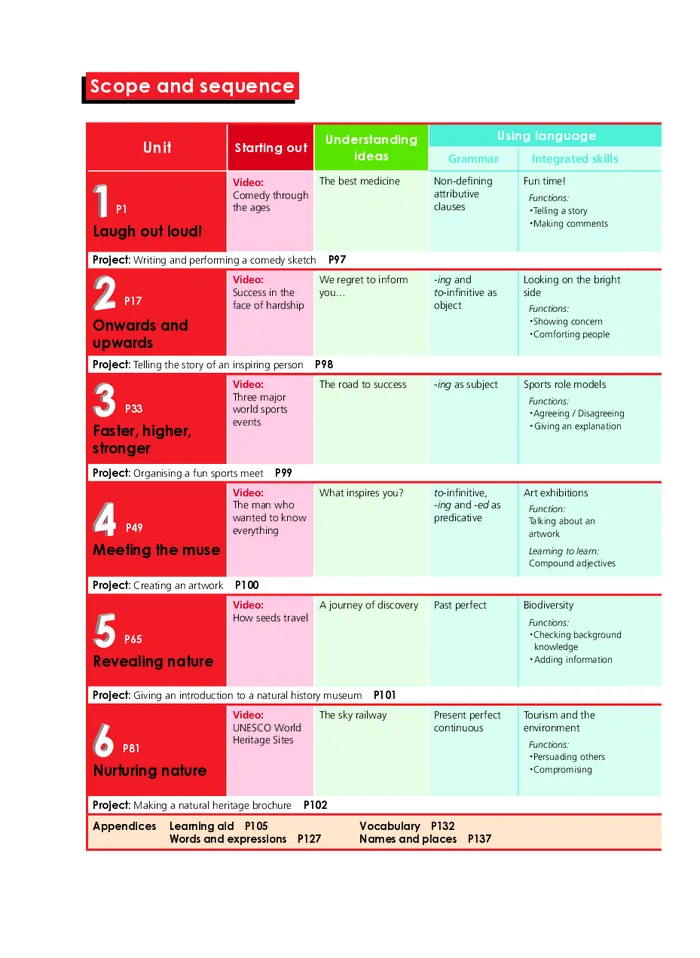
Scope and sequence
Unit
Starting out
Understanding
ideas
Using language
Grammar
Integrated skills
P1
Laugh out loud!
Video:
Comedy through
the ages
The best medicine
Non-defining
attributive
clauses
Fun time!
Functions:
・Telling a story
・Making comments
Project: Writing and performing a comedy sketch P97
P17
Onwards and
upwards
Video:
Success in the
face of hardship
We regret to inform
you…
-ing and
to-infinitive as
object
Looking on the bright
side
Functions:
・Showing concern
・Comforting people
Project: Telling the story of an inspiring person P98
P33
Faster, higher,
stronger
Video:
Three major
world sports
events
The road to success
-ing as subject
Sports role models
Functions:
・Agreeing / Disagreeing
・ Giving an explanation
Project: Organising a fun sports meet P99
P49
Meeting the muse
Video:
The man who
wanted to know
everything
What inspires you?
to-infinitive,
-ing and -ed as
predicative
Art exhibitions
Function:
Talking about an
artwork
Learning to learn:
Compound adjectives
Project: Creating an artwork P100
P65
Revealing nature
Video:
How seeds travel
A journey of discovery
Past perfect
Biodiversity
Functions:
・Checking background
knowledge
・ Adding information
Project: Giving an introduction to a natural history museum P101
P81
Nurturing nature
Video:
UNESCO World
Heritage Sites
The sky railway
Present perfect
continuous
Tourism and the
environment
Functions:
・Persuading others
・Compromising
Project: Making a natural heritage brochure P102
Appendices Learning aid P105
Vocabulary P132
Words and expressions P127
Names and places P137
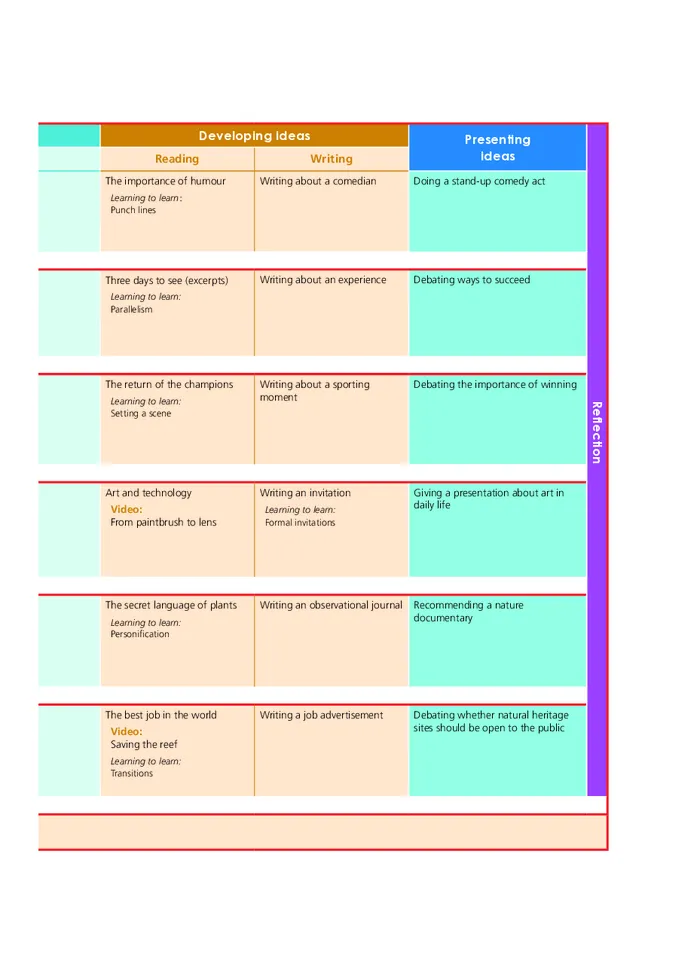
Developing ideas
Presenting
ideas
Reading
Writing
The importance of humour
Learning to learn:
Punch lines
Writing about a comedian
Doing a stand-up comedy act
Three days to see (excerpts)
Learning to learn:
Parallelism
Writing about an experience
Debating ways to succeed
The return of the champions
Learning to learn:
Setting a scene
Writing about a sporting
moment
Debating the importance of winning
Art and technology
Video:
From paintbrush to lens
Writing an invitation
Learning to learn:
Formal invitations
Giving a presentation about art in
daily life
The secret language of plants
Learning to learn:
Personification
Writing an observational journal
Recommending a nature
documentary
The best job in the world
Video:
Saving the reef
Learning to learn:
Transitions
Writing a job advertisement
Debating whether natural heritage
sites should be open to the public
Reflection
同学们,欢迎大家继续《英语》(新标准)高中教材的学习!
经过必修课程教材的学习,大家已经打下了更为扎实的英语基础,达到了高中英语学业质量水
平一的要求。现在大家应根据升学或就业的需要,对自己的学习目标提出更高的要求。由教育部制
定并颁布的《普通高中英语课程标准(2017 年版)》明确规定:普通高中英语课程作为一门学习及
运用英语语言的课程,与义务教育阶段的课程相衔接,旨在为学生继续学习英语和终身发展打下良
好基础。普通高中英语课程强调对学生语言能力、文化意识、思维品质和学习能力的综合培养。这
就是同学们在高中阶段学习英语的方向和目标。
要达到这个目标,需要大家的主观努力,也需要一套适应更高更广的语言学习需求的教材。《英
语》(新标准)高中选择性必修课程教材在延续了必修课程教材的基础上,为有升学要求或有个性化
发展需求的学生设计,在话题内容、语言理论、语言技能、跨文化意识、思维能力、学习能力等方
面,都提出了更高的要求,延伸出了如下特点:
一、作为必修课程教材的延续,选择性必修课程教材的话题选择更注意广度和深度,既关注话题的
现实意义,又关注语言学习的思想内涵,充分反映语言的发展和社会的进步,力求培养同学们
的文化意识和思维能力。
二、选择性必修课程教材具体语篇内容的选择将会引导大家进入英语语言学习的较高阶段。课文中
不但会出现更有挑战性的阅读篇章,同时还会根据每个单元的主题补充更多语篇供大家阅读并
赏析,提高语言水平和鉴赏能力。
三、思维方面,选择性必修课程教材对高阶思维做了更多要求,且对思维过程的启动、运行和开展
均做了更多的过程分解与清晰化设计,更强调基于同学们头脑中已有的内容及其再加工,与新
的语言和内容输入相结合,产生更丰富、更复杂的认知互动,深化思维发展活动。
四、在新课标规定的英语学习活动观的指导下,遵循“理解—发展—实践”的原则,对活动的要求
进一步提升,在“功能运用”板块中,将原有的词汇和听力部分整合成综合语言运用活动,通
过创设符合单元主题的话题,设计一系列首尾呼应、前后紧密关联的活动串,灵活融入听、说、
读、看、写等各项技能的训练,兼顾学习策略、功能和文化的引导与思考,帮助大家全方位提
升综合语言运用水平。
五、根据该阶段教学特点、教学内容和教学要求,充分遵循循序渐进的原则,强调对义务教育阶段
和高中必修阶段语言知识的复现、综合练习与重新认识,以形成内化的语用能力。
六、在呈现更为丰富多彩的文化现象的同时,更加强调中外文化对比,尤其是中国文化、中国故事、
中国传统价值观和世界问题的中国视角的介绍,让大家更好地理解文化异同,形成正确的文化
价值观和有利于国家、个人发展的跨文化态度与意识。
七、在单元学习的过程中帮助大家总结学习成果,发现问题并及时解决,最后通过对单元主题、语
言、文化思维等多方面提出问题,帮助大家写出自我反思日志,既完成了对学习目标、语言知
识和技能、思维品质、文化意识等维度的自我评价和总结,更显性体现了学习和思维的过程,
帮助大家进一步培养自主学习和反思总结的能力。
我们衷心希望,同学们能够通过学习本教材,了解到更加丰富的信息,在理解祖国文化、坚定
文化自信的同时,发展跨文化交流能力,更好地适应宽广的世界。愿《英语》(新标准)伴随同学们
度过有意义的高中时代!
致 同 学
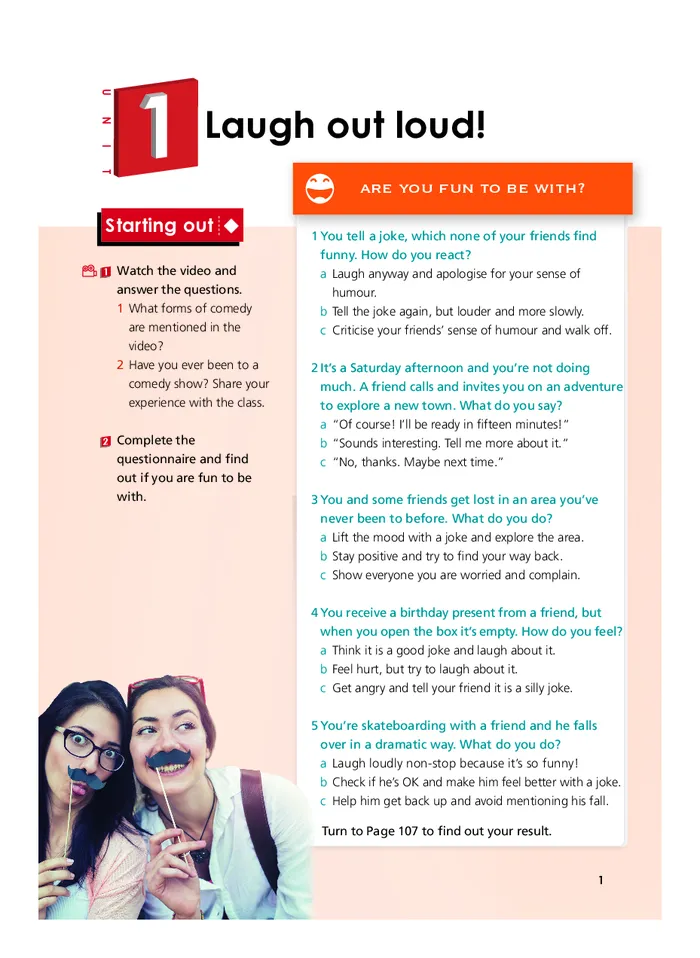
Laugh out loud!
1
Laugh out loud!
U
n
i
t
1 You tell a joke, which none of your friends find
funny. How do you react?
a �Laugh anyway and apologise for your sense of
humour.
b �Tell the joke again, but louder and more slowly.
c �Criticise your friends’ sense of humour and walk off.
2 It’s a Saturday afternoon and you’re not doing
much. A friend calls and invites you on an adventure
to explore a new town. What do you say?
a “Of course! I’ll be ready in fifteen minutes!”
b “Sounds interesting. Tell me more about it.”
c “No, thanks. Maybe next time.”
3 You and some friends get lost in an area you’ve
never been to before. What do you do?
a �Lift the mood with a joke and explore the area.
b Stay positive and try to find your way back.
c �Show everyone you are worried and complain.
4 You receive a birthday present from a friend, but
when you open the box it’s empty. How do you feel?
a Think it is a good joke and laugh about it.
b Feel hurt, but try to laugh about it.
c Get angry and tell your friend it is a silly joke.
5 You’re skateboarding with a friend and he falls
over in a dramatic way. What do you do?
a Laugh loudly non-stop because it’s so funny!
b �Check if he’s OK and make him feel better with a joke.
c Help him get back up and avoid mentioning his fall.
Turn to Page 107 to find out your result.
are you fun to be with?
1
Watch the video and
answer the questions.
1 What forms of comedy
are mentioned in the
video?
2 Have you ever been to a
comedy show? Share your
experience with the class.
2
Complete the
questionnaire and find
out if you are fun to be
with.
Starting out
1
2
Unit 1
1
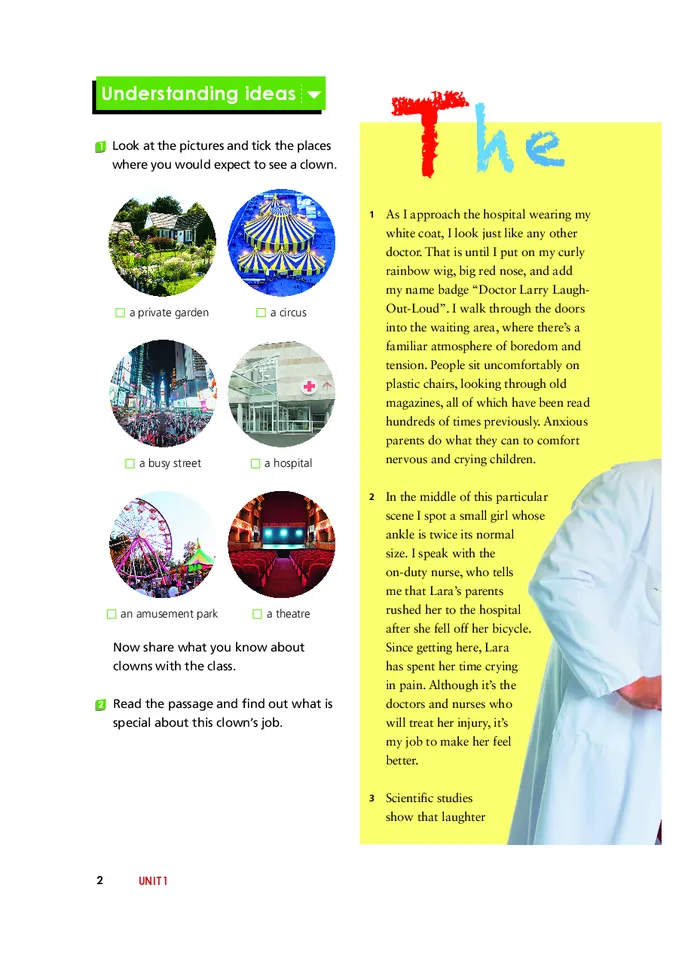
Look at the pictures and tick the places
where you would expect to see a clown.
Now share what you know about
clowns with the class.
2
Read the passage and find out what is
special about this clown’s job.
a private garden
a busy street
an amusement park
a circus
a hospital
a theatre
1 As I approach the hospital wearing my
white coat, I look just like any other
doctor. That is until I put on my curly
rainbow wig, big red nose, and add
my name badge “Doctor Larry Laugh-
Out-Loud”. I walk through the doors
into the waiting area, where there’s a
familiar atmosphere of boredom and
tension. People sit uncomfortably on
plastic chairs, looking through old
magazines, all of which have been read
hundreds of times previously. Anxious
parents do what they can to comfort
nervous and crying children.
2 In the middle of this particular
scene I spot a small girl whose
ankle is twice its normal
size. I speak with the
on-duty nurse, who tells
me that Lara’s parents
rushed her to the hospital
after she fell off her bicycle.
Since getting here, Lara
has spent her time crying
in pain. Although it’s the
doctors and nurses who
will treat her injury, it’s
my job to make her feel
better.
3 Scientific studies
show that laughter
Understanding ideas
Laugh out loud!
3
produces chemicals to make people feel better, which
means clown doctors can be helpful. We are specially
trained clowns who work as part of a programme known
as “hospital clowning”. I chose this career because of my
experience of going to hospital when I was a kid. Although
the doctors and nurses did a great job, hospitals weren’t
really designed for children. I spent much of the time
when I was there feeling frightened and more than a little
bored! Being a clown doctor means I can help people by
entertaining them.
4 Visiting hospitals and other health care facilities, we clown
doctors work together with medical professionals. On a
typical day, we spend our time cheering up patients, their
families, and more often than not, the hospital staff, too! We
do this by doing magic tricks, singing songs, telling stories
and, of course, telling silly jokes. Some children, though,
don’t feel like laughing, especially if they’re in pain.
4
Unit 1
3
Match the questions to the paragraphs and find out the answers.
a Which patient is in need of the clown doctor’s attention and why?
b What is a clown doctor and why did the author choose to be one?
c How does the author feel after a day’s work?
d What are the responsibilities of a clown doctor?
e How does the clown doctor help the patient?
f What does this clown doctor wear and what is his working
environment like?
We have to be very sensitive and work closely with the
doctors and nurses, who keep us updated on each
patient.
5 And my magic medicine does indeed seem to do
the trick. While the doctor concentrates on
examining Lara’s ankle, I get her attention by doing
a magic trick. Although she is clearly still in some
pain, her scared and anxious look has been replaced –
first by a small smile, and then by loud laughter as
I “magically” produce her sock from out of my
pocket. Seeing their daughter so much happier
has in turn made Lara’s parents more relaxed.
6 And as for me? Well, when I take off
my wig and my red nose, I’m still wearing
a big smile, as I remember all the fun
and laughter of the day. While there might
be more hospital visits ahead for Lara and
others, I hope that clown doctors help make it
a friendlier place to visit. After all, it really is true
that “laughter is the best medicine”.
Laugh out loud!
5
Think Share
&
1 How important do you think clown doctors are?
2 What is your understanding of the saying “laughter is the best medicine”?
Do you agree with it? Why?
3 Would you like to work as a clown doctor? Why or why not?
4 How does the diagram in Activity 5 help you to better understand the passage?
wear white coats
train as actors
Medical
doctors
Cl wn
doctors
need medical training
Similarities
5
Complete the diagram comparing clown doctors and medical doctors.
4
Organise information from the passage and complete the job advertisement.
Clown Doctors Wanted!
Employer
The Healthy Humour Foundation
Job
Clown Doctor (part-time)
Responsibilities
• visit hospitals and other
1_____________________ on a weekly basis
• entertain young patients who are feeling
2_____________________
• cheer up the patients, their families and
3_____________________
• sing songs, tell stories and jokes, and do
4_____________________
• help make the hospital
5_____________________
Send your CV to:
healthyhumourfoundation@email.com
6
Unit 1
2
Read the passage and rewrite the tips using non-defining attributive
clauses. Add more tips to the list if you can.
Achieving a positive state of mind isn’t easy for everyone. But
there are ways to maintain a healthy mind even during times of
difficulty.
• �Go for a walk in the countryside. There you can enjoy the beautiful
views and a peaceful atmosphere.
• �Spend time with your family and friends. This will activate chemicals
in your brain to make you feel happier.
• Try to accept your mistakes. You can learn a lot through them.
• �Close your eyes and picture the future. You’ve made your dreams
come true.
SECRETS TO HAPPINESS
a I walk through the doors into the waiting area, where there’s a familiar
atmosphere of boredom and tension.
b … laughter produces chemicals to make people feel better, which means
clown doctors can be helpful.
c I spent much of the time when I was there feeling frightened…
1
Look at the sentences from the reading passage and answer the
questions.
1 What do “where”, “which” and “when” refer to in each sentence?
2 Which sentences contain a clause with essential information and which
with extra information? If you take away the clauses, do the sentences still
make sense?
3 Which clauses are separated by a comma, the ones with essential
information or the ones with extra information?
Now look for more sentences with non-defining attributive clauses in
the reading passage, and summarise their uses in your own words.
Using language
Non-defining attributive clauses
Laugh out loud!
7
4
Think of a joke you find funny
and write it down using
non-defining attributive clauses
where appropriate. Then share
your joke with the class.
3
Complete the joke with the
sentence parts in the box using
who / which and put commas in
the correct position.
has lost his patience by now
he thinks will impress Holmes
is lying next to him
he finds annoying
One day, Sherlock Holmes and Dr
Watson go camping. They put up
their tent under the stars and go
to sleep. Suddenly, in the middle
of the night, Watson is woken up
by Holmes
1_________________.
“Watson,” Holmes says,
“look up at the stars, and tell
me what they tell you.” Not
quite sure what he means,
Watson thinks Holmes is joking
2_________________ at this time
of night. Even so, he replies, “I
see millions of stars and it’s quite
likely there are some planets like
Earth. And if so, this means that
there might also be life on other
planets.” Watson is pleased with
his answer
3_________________.
But Holmes
4_________________
shouts, “Watson, look around
you! Use your eyes! Somebody’s
stolen our tent!”
Fun time!
5
Listen and complete the conversations.
Why are you grinning from
1_________?
I’ve won a free cinema ticket.
Cool! What are you going to watch?
My Crazy Family. Have you seen it?
Yes! I laughed my
2_________.
You’ll enjoy it!
I really don’t get Harry.
Why? Is he still not talking to you?
No. Today, he was all
3_________...
He asked me to help him with that
website of his.
Really? What did you say?
Well, I said yes. We all deserve a
second chance, I guess.
What’s the matter?
Why the long face?
Yesterday, I stepped on a banana
skin and fell over in front of the
whole class.
That’s so funny!
I was the
4_________ stock of the
class. Even my teacher cracked
5_________!
8
Unit 1
8
Listen to the radio
programme and choose the
pictures mentioned.
6
Match the expressions you have completed in
Activity 5 to their meanings.
Now work in groups and think of more
expressions about laughter.
7
Work in pairs. Discuss other situations in
which you could use these expressions.
?
Did You Know
April Fool’s Day is on 1 April. It’s the one
day of the year when people in many
parts of the world play practical jokes on
each other. Even newspapers, radio and
TV stations play tricks on their readers and
audiences. The jokes
traditionally last until
noon in the UK. But in
some other countries,
such as the US, they
can last all day!
a
: a person that
everyone laughs at because they have done
something funny or silly
: to look friendly
and happy, especially when other people are
not expecting you to
: to look
extremely happy because you are very
pleased about something
: to smile slightly
: to laugh very
loudly and for a long time
b
c
d
Laugh out loud!
9
9
Listen again and complete the notes.
10
Complete the boxes with expressions from the radio programme.
Now work in pairs. Discuss which of the practical jokes you think is funny.
• Let’s start with…
• I don’t get it.
• Now, my favourite one...
• It’s a good one!
• That’s so funny!
• I can imagine!
Telling a story
Making comments
11
Work in pairs. Tell each other a funny story and make comments using
the expressions in this section.
Now give feedback on each other’s stories and help your partner to
improve theirs.
Joke 1
• Year: 1698
• �Main story: A newsletter reported people going to watch
1______________________ at the Tower of London. The joke was played
on visitors throughout the 2______________________.
Joke 2
• Year: 3______________________
• �Main story: The 4______________________ introduced an invention called
"Smellovision". It allowed 5___________________ over the airwaves.
Joke 3
• Year:
6______________________
• �Main story: A news programme told viewers that the spaghetti trees in
Switzerland were having
7______________________.
10
Unit 1
1 Humour has been an essential
part of human behaviour for
thousands of years. There is
comedy in the texts of Ancient
Greece, and medieval writings
are filled with jokes. While
these same jokes might not be
as funny to us now as they were
then, their authors understood
that humour could not only
entertain but also throw new
light on sensitive or emotive
issues.
2 Closer to modern times,
someone who is remembered
for his ability to combine
humour with more serious
messages is American writer
Mark Twain. Twain’s particular
style of writing is funny
and often mischievous. For
example, in his classic novel
The Adventures of Tom Sawyer,
he famously says, “Writing is
easy. All you have to do is cross
out the wrong words.” But he
is equally well known for his
witty remarks in his everyday
interactions with people. For
instance, while on a lecture
tour of the United States, Twain
went into a barber’s shop to
get a haircut and a shave. The
1
Read the short introductions to Mark Twain
and Wang Zengqi and share what else you
know about them with the class.
2
Read the passage and find out Mark Twain
and Wang’s attitude towards humour.
Developing ideas
Mark Twain (1835–1910) was an American
writer, humorist, lecturer and adventurer,
who acquired international fame for his travel
narratives, in particular The Innocents Abroad,
and for his adventure stories of boyhood,
such as The Adventures of Tom Sawyer
and Adventures of Huckleberry Finn. He is
regarded as one of North America’s best and
most beloved writers due to his wit and satire.
Wang Zengqi (1920–1997) was a Chinese
writer. Born in Gaoyou, Jiangsu, he was
deeply influenced by his family’s strong
literary tradition. His most famous works
include A Tale of Big Nur, Special Gift and
Old Flavour. Despite life’s ups and downs, his
works consistently convey optimism. Even in
the lows of life, he could discover the bright
side in living and put them into words in his
unique humorous way.
Laugh out loud!
11
barber, not recognising him, asked if he
had a ticket to the lecture. When Twain
replied that he didn’t, the barber told
him that if he wanted to go to the event
he would have to stand, as there were no
seats left in the theatre. Twain’s response
was, “That’s just my luck. I always have
to stand when that fellow lectures!”
3 Like Twain, but on the other side of the
world, the Chinese writer Wang Zengqi
was soon to become famous for his own
unique brand of humour. In his essay “On
Humour”, Wang used fewer than 600
characters to introduce several humorous
examples of famous people, concluding
that, “The world is full of amusing things.
The thought of them would always make
you laugh out loud, even when you’re just
sitting by yourself.”
4 Wang believed that humour not only
shows one’s personality, but also reflects
a person’s attitude towards life. He
himself gives the best example to the
word “humour”. One day, one of his
readers flattered him by saying, “Gaoyou
is famous for, first, the poet Qin Shaoyou,
and second, Wang Zengqi.” Wang didn’t
show any displeasure but only gave a
gentle response, “No. Gaoyou salted duck
eggs are much more famous than me.
of Humour
Importance
The
12
Unit 1
3
Organise information from the passage and complete the diagram.
Introduction
Humour is an essential
part of
1________________.
Authors have used it
to
2________________,
and throw new light on
3________________.
Mark Twain
Remembered for: ability to
4________________ with more
5________________
Writing style:
6______________
Example:
7____________________
Also well known for his witty
remarks
Example:
8____________________
Wang Zengqi
Famous for his unique
brand of humour
He believed that
9______________________
Example 1:
10_____________________
Example 2:
11_____________________
_____________________
Conclusion
Humour is a
12________________ and a
tool that can be used to
13________________.
I can only stay in the third place.” On another occasion, Wang was invited
to give a speech in the US and was scheduled to speak last. He walked to
the podium and began, “Unfortunately, none of today’s speakers have last
names starting with X, Y, or Z, so I am the last one to speak. Speaking
last is difficult because everyone is already very tired. But don’t worry. My
speech will be as short as a rabbit’s tail.”
5 Both Twain and Wang understood that humour isn’t just about laughter,
but is a way of life and a tool that can be used to illuminate the world.
Wang once said, “Life may be like a dream, short and uncertain. But I
pour my true feelings into it. The world gave me its love first, so I cannot
help but love it back.” Life is never smooth sailing and sometimes can be
complicated and cruel. But humour can help us maintain our enthusiasm
for life. In fact, some may argue that our need for humour is almost as
great as our need for water and air. In the words of Mark Twain, “Humor
is mankind’s greatest blessing”.
Laugh out loud!
13
4
Work in groups. Give a talk on the importance of humour.
1 Discuss the questions below.
• What is humour according to the passage?
• What is your own definition of humour? Why?
• In what aspect do you think humour is important to you? Give
examples to support your idea.
2 Organise your ideas following the steps below.
• Begin with your own definition of humour.
• Choose one aspect in life where humour plays an important role and
give examples.
• Conclude by restating the importance of humour.
3 Give your talk to the class.
Now think about your performance in this activity. What contribution
did you make to your group? How could you improve your
performance?
Think Share
&
1 Do you find Wang Zengqi’s jokes funny? Give your
reasons.
2 Do you agree with Mark Twain’s remark on humour at the end of the
passage? Give your reasons.
3 How can a sense of humour help you in your daily life? Give an
example.
4 In what ways do the two reading passages in this unit help you to
better understand the meaning of having a light-hearted attitude
towards life?
A punch line concludes a joke and is intended to make people laugh. In a
broader sense, a punch line can also refer to the unexpected and funny
conclusion of any performance, situation or story.
Learning to learn
14
Unit 1
Charlie Chaplin’s Unique Acting Style
The Power of Charlie Chaplin’s Works
My Favourite Charlie Chaplin Film
General Introduction to Charlie Chaplin
Writing about a comedian
5
Read the blog post and match the headings to the paragraphs.
Charlie Chaplin’s
Legacy
1 Charlie Chaplin was a British actor, filmmaker and composer. He
became famous in the 1910s, when films were silent and in black
and white.
2 Charlie Chaplin was one of the best comedy actors of his time
because he knew how to use his body and facial features to make
people laugh. In my opinion, the funniest thing about Charlie
Chaplin was the way he walked when he was acting as the Tramp,
who is his most famous character. The Tramp is a poor man with a
kind heart who has unexpected adventures. These adventures, often
involving the police, are usually the funniest scenes.
3 My favourite Charlie Chaplin film is Modern Times and my favourite
scene is in the factory where Charlie Chaplin is working on a production
line. When a bee starts circling around Charlie’s face, he falls behind
with his work. It’s so funny to watch him trying to keep up!
4 I think the power of Charlie Chaplin’s works is not only in his acting,
but also in the stories and characters he created. The Tramp is a
symbol of the silent cinema and even after so many years, he is still
able to make people laugh.
Laugh out loud!
15
6
Read the blog post again. Find the information:
• an example of the actor’s works
• a reason why the actor is one of the best
• a funny scene
• a famous character played by the actor
• the author’s comments on the actor
7
Choose a comedian who makes you laugh. Think of the information
you want to include and complete the notes below.
Now write an introduction to this comedian.
8
Work in pairs. Make improvements to each other’s introductions and
share them with the class. Post your writing on your social media.
General introduction:
Why I like him / her:
His / Her funniest work:
My comments:
16
Unit 1
3
Write the script for your act and
complete the table. Add useful
expressions and structures you
can think of.
1
Work in groups. Think about the stand-up
comedy acts you have seen and answer the
questions.
1 What were the main topics of these acts?
2 How many people were there on the stage?
3 How did they make the audience laugh?
4 Were any props used?
2
Prepare your own comedy act. Consider the
following:
• way(s) of presenting: storytelling / joke
telling / audience interaction / mime...
• the punch line(s) of your stories / jokes
• the opening and closing: make it
surprising / exciting / funny...
• the topic of your comedy act: personal
experience / social event / popular culture...
Presenting ideas
Write a reflection after completing this unit. Consider the following:
1 What is your understanding of a good sense of humour?
2 What text types have you learnt about? What are their features?
3 What words, expressions and structures have you learnt?
4 What improvement have you made in understanding different cultures?
5 What improvement have you made in using learning strategies and exploring effective
ways of learning?
6 What improvement have you made in analysing and solving problems?
Reflection
Opening
Main body
Closing
4
Choose a group member to be
a stand-up comedian and help
them to perform the comedy
act you have written. Think of
actions or props to include.
5
Perform in front of the whole
class and vote for the best act.
17
Onwards and upwards
1
Watch the video and answer the
questions.
1 Who are the people mentioned in the
video and what are their achievements?
2 What made them successful?
2
Listen and read the poem. Answer
the questions.
1 What is the key message of the poem?
2 Which of life’s difficulties are
mentioned in the poem? What is your
understanding of the line “Success is
failure turned inside out”?
3 Do you like the poem? Give your reasons.
Don’t quit
When things go wrong as they sometimes will,
When the road you’re trudging seems all uphill,
When the funds are low and the debts are high,
And you want to smile, but you have to sigh,
When care is pressing you down a bit,
Rest if you must, but don’t you quit.
Life is queer with its twists and turns,
As every one of us sometimes learns,
And many a failure turns about,
When he might have won had he stuck it out;
Don’t give up though the pace seems slow –
You may succeed with another blow.
Success is failure turned inside out –
The silver tint of the clouds of doubt,
And you never can tell just how close you are,
It may be near when it seems so far;
So stick to the fight when you’re hardest hit –
It’s when things seem worst that you must not quit.
(Excerpts from “Don’t quit” by Edgar Albert Guest)
U
n
i
t
Starting out
18
Unit 2
1
Research these writers online and
match them to the information.
1 has the same birthday as
his / her most famous character: 31 July.
2 may have written and
hidden several unpublished works.
3 had to pay to have his /
her poetry published.
Now share anything else you know
about these writers with the class.
2
Read the passage and find out what
problems the writers overcame.
1 “We regret to inform you...”
These are the words that
every writer dreads receiving,
but words every writer
knows well. The response
from a publisher comes back
and the writer eagerly opens
and reads it, their hearts
sinking when they reach that
final sentence. You may have
spent years giving up your
weekends and free time to
write your life’s work, yet
still this is often not enough.
Everyone knows that success
rarely happens overnight,
but perhaps not many know
that a lot of highly successful
writers have previously faced
rejection.
J.D. Salinger
Emily Brontë
J.K. Rowling
Understanding ideas
Onwards and upwards
19
2 Take for example J.K. Rowling. When she received her first rejection
letter, she decided that it meant she now had something in common
with her favourite writers, and stuck it on her kitchen wall. Rowling
had spent years surviving on little money, spending all her time writing.
When she finally finished her first book, she received comments from
publishers along the lines of “too difficult for children”, “too long”,
“Children would not be interested in it”. Nevertheless, she persevered.
“I wasn’t going to give up until every single publisher turned me
down, but I often feared that would happen,” she later posted. After
a total of twelve rejections, one publisher eventually agreed to print
500 copies of her first book, and as we know, Harry Potter became a
global success, with over 400 million books sold and translated into
more than seventy different languages.
3 All too often writers of great works have had to face criticism along
with rejection. J.D. Salinger started writing short stories in high school,
but later struggled to get his works published. “We feel that we don’t
know the central character well enough” was the criticism he received
on his manuscript for The Catcher in the Rye. Despite rejections from
several publishers, J.D. Salinger refused to give up. Even when serving
in the US Army during the Second World War, he carried six chapters of
The Catcher in the Rye with him and worked on the novel throughout
his war service. When it was eventually published, the book became an
immediate best-seller and went on to sell millions and millions of copies.
20
Unit 2
4 Perhaps the overall prize for perseverance should go to three sisters
from Victorian England who dreamt of seeing their words in print. This,
however, was a time when women were not encouraged to become
writers. As the then Poet Laureate, Robert Southey, wrote to one of
them: “Literature cannot be the business of a woman’s life, and it ought
not to be.” Nevertheless, the sisters didn’t stop trying. Their response
was to write a book of poems under male names. Even when the
book sold only two copies, the sisters still didn’t give up. They started
writing novels, and today Charlotte Brontë’s Jane Eyre, Emily Brontë’s
Wuthering Heights and Anne Brontë’s Agnes Grey are regarded as
classics of world literature. In fact, it is within the pages of Jane Eyre
that we can find these words: “I honour endurance, perseverance,
industry, talent; because these are the means by which men achieve
great ends…”
5 So, it seems that talent alone isn’t enough to guarantee success. While
a lot of hard work and a touch of luck play a part, perseverance is the
key. Keep trying and eventually you will read the words
“We are delighted to inform you…”
3
Choose another suitable title for the passage and give your reasons.
1 Life Is Hard for Female Writers
2 Good Things Come to Those Who Wait
3 Never Give Up on Your Dreams
4 Successful Writers
Onwards and upwards
21
4
Organise information from the passage and complete the diagram.
Now read the sentences from the passage and answer the questions.
Think Share
&
1 What can you learn from these writers?
2 Have you read any books by these writers? Recommend one to your
classmates.
3 Do you know of any other writer who had similar experiences? Share
their stories with the class.
4 What words and expressions from the passage have you used to tell
these stories?
“We regret to inform you…”
“We are delighted to inform you…”
1 What might come next in each sentence?
2 Which paragraph does each of the sentences come from? Why does the
author use them like this within the passage?
Example
Writer: �
Best known for: �
�
Experience of rejection:
�
�
�
Eventual outcome:
�
Example
Writer: �
Best known for: �
�
Experience of rejection:
�
�
�
Eventual outcome:
�
Example
Writers: �
Best known for: �
�
Experience of rejection:
�
�
�
Eventual outcome:
�
1
3
2
Conclusion
Introduction
22
Unit 2
1
Look at the sentences and answer the questions. Sentences (a), (c) and
(e) are from the reading passage.
2
Complete the passage with the correct form of the verbs in brackets.
Using language
a J.D. Salinger started writing short stories in high school, …
b J.D. Salinger started to write short stories in high school, …
c Nevertheless, the sisters didn’t stop trying.
d Nevertheless, the sisters didn’t stop to try.
e These are the words that every writer dreads receiving, …
1 Do sentences (a) and (b) have the same meaning?
2 Do sentences (c) and (d) have the same meaning?
3 Can “receiving” in sentence (e) be changed into “to receive”?
Now look for more sentences with these structures in the reading
passage, and summarise their uses in your own words.
-ing and to-infinitive as object
At the age of ten, Liu Wei lost both his arms in an accident.
Despite this, he wanted
1 (live) life to the
full. He learnt
2 (use) his feet for everyday
activities, such as eating and brushing his teeth. He also
started
3 (swim) and won two gold medals at
the National Games for People with Disabilities. When he
had to stop
4 (swim) due to health problems,
he decided
5 (learn) how to play the piano with
his toes. It was difficult, but he kept
6 (practise) until he had
achieved his goal. In 2010, he won in
China’s Got Talent and became famous
nationwide. Today, Liu Wei still enjoys
7 (play) music, and his
positive attitude is an inspiration to us all.
Onwards and upwards
23
3
Write a report based on the interview
with the words in the box.
admit decide enjoy fail
regret want
4
Work in pairs. Share a story of your
own about overcoming challenges
using the words and structures in this
section where appropriate.
Many students choose to take
a camping programme during
the summer holiday, aiming at
building character and developing
physical fitness. Today, we’re with
camper Jamie Wells. Hi, Jamie.
Could you share your experience
with us?
Sure. I joined the sports camp
because I like to challenge myself.
I also like to meet new friends.
The camp was fun, but not
without its challenges! Each day
began with a 5-kilometer cross-
country run – at 6 am! At first I
couldn’t finish the whole route.
On the fourth day, I was so tired
that I even didn’t want to get out
of bed. I felt homesick and almost
phoned my dad to take me home.
But I didn’t give up. Things soon
got better. I felt I had become
stronger and more confident
and had made new friends. Even
though being a camper has its
challenges, I feel it is worthwhile.
Looking on the bright side
5
Listen to the conversations and match
the expressions to their meanings.
turn over a new leaf
e
f
cool as a cucumber
c
an eager beaver
b
a wet blanket
a
not lift a finger
d
drag one’s feet
24
Unit 2
7
Read the passage and answer the questions.
6
Put the expressions in Activity 5 into the boxes. Add any more you can
think of.
Positive
Negative
With life being made up of ups and downs, it is not always easy to maintain
a good and enthusiastic attitude. Nevertheless, looking on the bright side
is the best thing that we can do for ourselves as well as for others. A good
attitude can have a positive effect on other people. So if someone you know
is feeling low, lend them an ear and try to cheer them
up. Remember, your attitude is contagious, so
make sure you pass on a good one!
1 Why is it important to “look on the
bright side”?
2 How can our attitude affect others?
1 to change your life by starting to be a better person or stopping a bad habit
2 someone who is extremely enthusiastic and enjoys working extremely hard
3 to not make any effort
4 very calm and relaxed, especially in a difficult situation
5 to do something very slowly because you do not really want to do it
6 someone who refuses to join in, or wants to stop other people having fun
Onwards and upwards
25
Now act out a conversation between Dawei
and Jack, and think about how you would
comfort Dawei if you were Jack.
Now think about what language
in this section you used to show
concern and comfort others.
9
Listen again and complete the journal entry.
8
Listen to the conversation and number the
pictures according to the sequence of events.
11
Work in pairs. Choose one
situation and act out a
conversation to show concern
for people and comfort them.
Use the expressions in this
section.
1 You ran for Head of the Student
Committee but weren’t elected.
2 You feel annoyed because a
group member doesn’t want to
contribute to your group’s work.
10
Complete the boxes with the
expressions from the conversation.
• Are you OK?
• I don’t mean to be nosy, but are
you sure?
• Why don’t you tell me what’s up?
• I’m sure you did your best.
• You should be proud of yourself.
• Why are you so upset?
• I know this is hard for you, but
you should cheer up.
Today I came across my friend Dawei. He
looked sad, so I asked him what was wrong.
He said that he failed in a 1_____________
contest. Before the contest, he competed
against a girl at school. He won, but he said
it was because 2_____________. He thought
the girl should have gone to 3_____________
instead. If she had, the school would have been
4_____________. I tried to make him look on
the bright side, and he admitted that he had a
good time at the national contest. He met some
5_____________ and he liked the city. He also
said his parents felt 6_____________. I think I
made him feel better.
Friday 10 May
Showing concern
Comforting people
26
Unit 2
74%
26%
1
Look at the charts and answer
the questions.
Percentage of adults with a
disability in the US
People with a disability
People without a disability
Developing ideas
1 I have often thought it would be a blessing
if each human being were stricken blind and
deaf for a few days at some time during his
early adult life. Darkness would make him
more appreciative of sight; silence would
teach him the joys of sound.
2 Now and then I have tested my seeing
friends to discover what they see. Recently,
I asked a friend who had just returned from
a long walk in the woods what she had
observed. “Nothing in particular,”
she replied.
3 How was it possible, I asked myself, to
walk for an hour through the woods and
see nothing worthy of note? I who cannot
see find hundreds of things to interest me
through mere touch. If I can get so much
pleasure from touch, how much more
beauty must be revealed by sight? And I
have imagined what I should most like to
see if I were given the use of my eyes, say
for just three days.
4 On the first day, I should want to see the
people whose kindness and gentleness and
companionship have made my life worth
living. I do not know what it is to see into
the heart of a friend through that “window
of the soul”, the eye. I can only “see”
through my fingertips the outline of a face.
2
Read the passage and find out
what the author would do if
she could see.
1 Are the numbers different
from what you expected?
In what way?
2 What special assistance can
people with disabilities make
use of in their daily lives?
Percentage of adults with common
functional disability
13.7%
10.8%
4.6%
Mobility
Vision
…
…
Cognition
Onwards and upwards
27
Three Days
to See
Three Days
to See
I should like to see the books which have been read to me, and which have
revealed to me the deepest channels of human life and the human spirit. In the
afternoon I should take a long walk in the woods and intoxicate my eyes on the
beauties of the world of nature. That night, I should not be able to sleep.
5 On my second day, I should like to see the pageant of man’s progress, and I
should go to the museums. I should try to probe into the soul of man through his
art. The things I knew through touch I should now see. The evening of my second
day I should spend at a theater or at the movies.
28
Unit 2
3
Choose the author’s purpose in writing the passage and give your reasons.
1 To help readers understand what it is like to be blind.
2 To make readers without disabilities appreciate what they have.
3 To persuade readers to care about the blind.
Think Share
&
1 What are the main wishes of the author? Give an
example.
2 Do you know of any stories about people with disabilities?
Share one with the class.
3 How should we interact with people with disabilities?
4 What qualities do both reading passages in this unit convey?
6 The following morning, I should again greet the dawn, anxious to
discover new delights, new revelations of beauty. Today I shall spend in
the workaday world, amid the haunts of men going about the business
of life.
7 At midnight permanent night would close in on me again. Only when
darkness had again descended upon me should I realize how much I had
left unseen.
8 I who am blind can give one hint to those who see: Use your eyes as
if tomorrow you would be stricken blind. And the same method can
be applied to the other senses. Hear the music of voices, the song of a
bird, the mighty strains of an orchestra, as if you would be stricken deaf
tomorrow. Touch each object you want to touch as if tomorrow your
tactile sense would fail. Smell the perfume of flowers, taste with relish
each morsel, as if tomorrow you could never smell and taste again. But of
all the senses, I am sure that sight must be the most delightful.
(Excerpts from “Three Days to See” by Helen Keller)
Onwards and upwards
29
5
Work in groups. Give a talk about your opinion on the sentence from
the passage.
4
Read the sentences from the passage and answer the questions.
Parallelism as a literary device is
the use of expressions, clauses or
sentences that are similar in their
structure. It can make the content
more rhythmic, engaging and easier
to remember. It is commonly used in
literary works and speeches.
Learning to learn
3 Give your talk to the class.
Point of view
Arguments
Supporting examples
1 What sentence structure is
used repeatedly? What figure
of speech is it?
2 How does this technique help to
express the author’s emotions?
Now make your own sentences
using this technique.
1 Read and discuss the meaning of the sentence and decide whether you
agree or disagree with it.
2 Organise your talk and make notes.
Use your eyes as if tomorrow you would be stricken blind. And the same
method can be applied to the other senses. Hear the music of voices,
the song of a bird, the mighty strains of an orchestra, as if you would
be stricken deaf tomorrow. Touch each object you want to touch as if
tomorrow your tactile sense would fail.
… it would be a blessing if each human being were stricken blind and deaf
for a few days at some time during his early adult life.
Now think about your performance during group discussion. Did you
actively participate and contribute ideas?
30
Unit 2
6
Read the passage and answer the questions.
Writing about an experience
in the Dark
Dining
Recently I accompanied a friend to dine at a “dark
restaurant”, where people eat in complete darkness,
served by blind staff. We wanted to understand the
experience of being blind, and we thought eating would
be the most difficult activity.
It was a difficult meal. Because we couldn’t see where
anything was, my friend and I knocked over glasses and
dropped food. My senses of taste and smell became more
sensitive, and I ate much more slowly, trying to guess
what I was eating. Pouring water was very difficult, plus
I kept drinking from my friend’s glass.
After failing to pick up any food with a
fork for five minutes, I decided to use my
hands. I reached down, expecting rice
and vegetables, but instead stuck my
hand into a bowl of warm, thick soup.
Onwards and upwards
31
7
Try to experience what it is like to have
a disability and make notes.
1 Why did the author go to the “dark
restaurant”?
2 What difficulties did the author have
during the meal?
3 How did the author feel after finishing
the meal?
8
Work in pairs. Make improvements to
each other’s passages and share them
with the class.
Now write a short passage to describe
your experience.
1 What kind of experience you had
2 What the most difficult thing was and why
3 How you overcame the difficulty
4 What you have learnt
“It’s best to use a spoon for this course,”
the waiter said into my ear, helpfully
but much too late. Even using a spoon,
I spilled most of the soup on my shirt.
I felt embarrassed, even though no one
could see me.
Our waiter advised us to lift the plates
and bowls close to our faces. However,
I still left the restaurant feeling hungry,
though I was much more aware of the
challenges that blind people face.
32
Unit 2
Presenting ideas
Write a reflection after completing this unit. Consider the following:
1 What is your understanding of positive ways of facing frustration?
2 What text types have you learnt about? What are their features?
3 What words, expressions and structures have you learnt?
4 What improvement have you made in understanding different cultures?
5 What improvement have you made in using learning strategies and exploring effective
ways of learning?
6 What improvement have you made in analysing and solving problems?
Reflection
1
Read the two points of view and explain their meanings in your own words.
3
Prepare for a debate. Consider the following:
1 the roles and responsibilities for each member of your group
2 your arguments, opening and summary
3 the opposing arguments you might face and how you can respond to them
4 useful words, expressions and structures
4
Team up with a group with the opposite point of view and hold the debate.
2
Work in groups and decide which opinion you agree with more. Think of arguments
to support your point of view and make notes.
Point of view:
Arguments:
Supporting examples:
vs
If at first you don’t succeed,
try, try on and on.
If at first you don’t succeed,
set yourself another goal.
Faster, higher, stronger
1
Watch the video and answer
the questions.
1 What major sports events are
mentioned in the video?
2 What are the features of these
sports events?
2
Look at the pictures and answer
the questions.
1 What do you know about these
sportspeople?
2 What can you learn from them?
3 Are there any other sportspeople
who inspire you? Who are they
and why do they inspire you?
U
n
i
t
Starting out
33
Xu Haifeng
• Chinese former shooter born
in 1957
• First athlete to win an Olympic
gold medal for China
• Coach of two Chinese Olympic
gold medalists
• Canadian former ice hockey player
born in 1961
• One of the greatest players in the
history of the National Hockey
League (NHL) in Canada
• Over 100 official and unofficial
NHL records
Wayne Gretzky
• Russian former pole-vaulter born
in 1982
• Two-time Olympic gold medalist
• First woman to jump over five metres
Yelena Isinbayeva
The road
1
Research online and match the
five basketball positions to their
descriptions.
1 �usually the best ball handler
and / or best passer
2 �usually the main shooter
playing on the wing
3 �usually the most athletic player
on the team who can play
inside and outside the key
4 �usually a taller player who
catches the ball after a player
has tried but failed to get a
point
5 �usually the tallest player on the
team who plays inside the key
and should be a good scorer
2
Read the passage and find
out what Stephen Curry has
achieved.
Understanding ideas
1 Near the small town of Grottoes,
Virginia, a narrow dirt road goes from
the house of Stephen Curry’s grandfather
to the woods nearby. A far cry from
the bright lights and shiny courts of the
National Basketball Association (NBA),
it was along this road that Stephen’s
grandfather built a simple basket by
attaching a piece of plastic to a
telephone pole.
2 Like his father, basketball star Dell Curry,
Stephen spent many childhood hours
playing on this muddy basketball court.
He probably didn’t realise it at the time,
but it was where he learnt to be creative
and flexible as a player. You see, with
every shot, the weak plastic backboard
gave way. The bumps and rocks that lined
the road under the basket caused the
ball to bounce in all directions. Knowing
where the ball would go wasn’t easy.
A
E
B
C
D
point guard
shooting guard
small
forward
power
forward
center
34
Unit 3
to success
He had to adjust his own playing style
as a result. Shooting with great accuracy
was another thing he learnt. Only shots
perfectly aimed at its centre went into the
heavy, thick basket. In this way, practising
day in and day out helped Stephen
sharpen his skills.
3 Despite his father’s successful career,
Stephen was thought by many people,
including his high school teammates
and coaches, to be too short, too thin
and too weak to follow in his father’s
footsteps. But Stephen carried on. Playing
basketball was his dream. He would
not give up. He finally ended up playing
college ball at a small, little-known
school, Davidson College, not too far
from where he lived. His creativity and
perseverance made him Davidson’s star
player.
Faster, higher, stronger
35
4 Selected for the NBA in 2009, Stephen joined the
Golden State Warriors. He performed beyond
everyone’s expectations with his accurate shooting
and continuous efforts. In 2015, Stephen won his
first NBA championship, and he led the Warriors to
their first championship since 1975.
5 After receiving the Most Valuable Player award
for two years in a row, Stephen explained his
philosophy, “I never really set out to change the
game… What I wanted to do was just be myself…
I know it inspires a lot of the next generation, a lot
of people who love the game of basketball to value
the skill of it, value the fact that you can work every
single day to get better. You’ve got to be able to put
in the time and the work. That’s how I got here.
That’s how I continue to get better every single day.”
Inspiring others to believe in themselves, Stephen
Curry is living proof that what other people think
of you does not have to influence what you become.
Through self-belief, hard work, perseverance and
some help from an old hoop, he has shown that
anything is possible.
3
Choose the author’s purpose in writing the passage and give your
reasons.
1 To explain why Stephen Curry was doubted by many people.
2 To inform people about Stephen Curry’s basketball skills.
3 To inspire people with Stephen Curry’s determination to succeed.
36
Unit 3
4
Organise information from the passage and complete the profile of Stephen Curry.
Think Share
&
1 Why does the author mention the “simple basket” at the start of the passage?
2 Can you think of any other famous basketball players? Which of their qualities inspires you?
3 What have you learnt from doing sport? Share your experiences with the class.
4 How can you use the language in this passage to talk about sportspeople? Give examples.
Hard work
Perseverance
Self-belief
Stephen Curry is the son of the famous
basketballer Dell Curry. He spent his childhood
years practising basketball on
1 .
The poor conditions helped him develop his own
playing style. He also learnt to
2 .
Despite this, it seemed unlikely to many people
that Stephen would be a great basketball player, as
he was
3 . Nonetheless, Stephen
refused to
4 , and ended up
playing college ball for Davidson College. In 2009,
he joined the NBA’s Golden State Warriors. In
2015, he led them to their first NBA championship
since 1975. Stephen achieved his dream through
5 .
Stephen Curry
5
Complete the mind map with supporting details.
Nationality:
6
Occupation:
7
Awards:
8
Faster, higher, stronger
37
1
Look at the sentences from the reading
passage and answer the question.
Using language
2
Rewrite the underlined sentences with
the -ing form as subject.
a Knowing where the ball would go
wasn’t easy.
b Shooting with great accuracy was
another thing he learnt.
c Stephen Curry knew where the ball
would go. It wasn’t easy.
d Stephen Curry shot with great
accuracy. It was another thing he
learnt.
1 What are the subjects in sentences (a)
and (b)?
Compare them with the following
sentences and answer the questions.
2 What does “it” refer to in sentences (c)
and (d)?
3 Why does the author choose to use
sentences (a) and (b) in the reading
passage?
Now look for more sentences with
-ing as subject in the reading passage,
and summarise its use in your own
words.
Etenesh Diro had almost completed
two thirds of the 3000m
steeplechase, when disaster struck.
She got tangled up with some other
competitors. It made her fall. Her
right shoe started to come off. She
tried to pull the shoe back on, but it
cost her precious time. One after the
other, the runners overtook her. She
threw the shoe away. This meant
she could get up quickly and fight
for her position in the race.
She ran the rest of the race with
just one shoe on and her right foot
bare. It raised a big cheer for her.
Luckily, she was later given a chance
to compete in the final. She lost a
shoe. But it didn’t keep
her from taking
part. This is the
true spirit of
sport.
-ing as subject
38
Unit 3
3
Complete the passage with the correct form of the words in the box.
I like how technology is changing
sports.
1 the latest
equipment, such as smart
earphones, allows people to get
the best out of their training.
2 video technology
to help judge our sporting
competitions can
3
sure that no one cheats. Best
of all, instant replay facilities
4 us see all the action
all over again.
5 our
favourite sporting moments is
now a thing of the past!
4
Think about whether you agree with the point of view in Activity 3
and share your opinion with the class. Use the -ing form as subject
where appropriate.
Sports role models
5
Complete the voicemail messages with the correct form of do, play
and go.
wear let miss make use
Hi Ellen, it’s Todd here. I’ve
just finished my first day
volunteering at the Senior
Citizens’ Sports Club! It’s made
me see life as an older person
with fresh eyes!
Faster, higher, stronger
39
6
Underline the sports with do, play and go in Activity 5 and put them
into the boxes. Add any more you can think of.
Do
Play
Go
Now listen to the voicemail and check your answers.
Some members like to
1 yoga
because it helps them keep their
muscles toned, while others love to
2
aerobics – one elderly man says the energy of
it makes him feel young again! Ball games are
also popular. Many enjoy
3 table
tennis or
4 bowling, while there
were lots of people
5 badminton,
and many like to
6 golf. I even
encountered a man who, at the age of 68, was
brave enough to
7 roller skating!
Not only did he have guts, he was much
faster than me!
I must say, it was really inspiring to see
the people there
8 sports,
even at such advanced ages. It made
me think about going to the Central
Stadium this Saturday. The sports club
there doesn’t ask for membership. We can
9 tennis or
10 rock
climbing. It would do us a lot more good
than
11 computer games.
40
Unit 3
7
Read the passage and answer
the questions.
A sports role model is a sportsperson
who inspires other people in a certain
way. In this spirit, the Laureus World
Sports Awards is an annual ceremony
to honour remarkable sportspeople.
The first ceremony was held in 2000
in Monaco, where Pelé was given the
Lifetime Achievement Award. In 2003,
Yao Ming became the first Chinese
sportsperson to win the award, and in
Shanghai in 2015 Yao Ming and Li Na
both won awards. These sports role
models show us what sporting spirit
really means – that is, faster, higher
and stronger!
8
Listen to the conversation and
choose a topic for it.
1 The history of the Laureus World
Sports Awards.
2 Laureus World Team of the Year.
3 Laureus World Sportsman of
the Year.
4 The childhood of LeBron James.
9
Listen again and complete the table.
Nominees
Michelle’s opinion
Sam’s opinion
Usain
Bolt
He has won it three
times and other people
should
1 ,
too.
He should win
it because he
deserves it.
Andy
Murray
Hopefully, he will win.
He has won two
2
and more importantly,
he is a spokesperson
for
3 .
He could have
4 ,
but the winner
should not be
chosen based on
5 .
LeBron
James
He will not win
because he is
6 .
LeBron is world-
famous. He is an
excellent
7 and
a great
8 .
11
Work in pairs. Nominate three Chinese
sportspeople for the next Laureus World
Sports Awards. Give your reasons and share
your ideas using the expressions in this section.
Now talk about whether you have actively
participated in the group discussion. Were
you able to express yourself clearly and
understand what your partner was saying?
Agreeing / Disagreeing
Giving an explanation
Now work in pairs. Act out a similar
conversation based on the table.
10
Complete the boxes with the expressions
from the conversation.
1 Who does the Laureus World
Sports Awards honour?
2 What other sports role models
do you know? Share some
examples with the class.
• I don’t think it should be…
• Besides, …
• Are you serious?!
• That’s why…
• Well, I just think…
• I mean, …
Faster, higher, stronger
41
Developing ideas
1
Look at the pictures and answer
the questions.
2
Read the passage and find out
about the events mentioned.
1 What are the key differences
between team sports and
individual sports?
2 Can you think of any famous
sports teams? Why are they so
well-known?
1 “The atmosphere here at Rio de Janeiro
is electric! If China wins this point, they
will walk out of the stadium with an
Olympic gold medal. Zhang Changning
serves. Over the net, Popovic dives for
the ball. She only just reaches it… and
it’s sent straight back to her by the
Chinese spiker Hui Ruoqi. Popovic
can’t get the ball back this time… and
that’s it! It’s over! It’s gold for China!
Look how the crowd has gone wild.
You can see the joy and pride on the
faces of the Chinese fans. And there
we see the Chinese players embracing,
with tears of happiness in their eyes…
It’s a dream come true for China! The
Chinese women’s volleyball team is
Olympic champion once again!”
The Return
The Return
Setting a scene involves establishing the
time and place where events take place
and describing any main sights and sounds.
The scene you set at the beginning of
your writing – whether it is fiction or
non-fiction – will engage your readers
and help set the right atmosphere for the
remainder of your writing.
42
Unit 3
2 The Chinese women’s volleyball team
holds a very special place in the nation’s
heart. In the 1980s, the team burst
onto the international volleyball scene
with several major world titles, and an
amazing three-set victory over the United
States in the final of the 1984 Los Angeles
Olympics. They became national heroes
overnight. There was gold once more
at Athens in 2004. But winning gold in
Rio paints the most vivid portrait of the
team’s competitive spirit.
3 In Rio, the Chinese women’s volleyball
team needed all of its fighting spirit after
it was assigned to the “group of death”,
where it faced several strong opponents in
the group stage matches. Despite reaching
of the Champions
of the Champions
the quarter-finals as the fourth team in the
group, with just two wins in preliminary
matches, they were not going to give up.
Every single member of the team gave
their all to the fight, including Hui Ruoqi
who had had heart surgery less than five
months previously.
4 Their perseverance paid off with an epic
comeback against the defending champion
Brazil in the quarter-finals. Next, the
Chinese team defeated the Netherlands
in the semi-final matches, having lost to
them in the preliminaries. At last, showing
a strong will and the steeliest nerves, they
played a close match against Serbia to
seize gold in the final.
Faster, higher, stronger
43
5 But fighting spirit alone was not enough to guarantee victory. Strong
team spirit also contributed greatly to their success. Cooperation
between team members is essential. If each individual does her job
and works well with others, then the end goal can be achieved. In
fact, strong team spirit is more important than the skills of individual
players. Zhu Ting, named Most Valuable Player at the Rio Olympics,
also identified this as the special ingredient in the team’s success:
“Teamwork is the key to China’s victory. Thanks to my teammates’
hard efforts, I had the opportunity to show my spiking skills.”
6 Together, the Chinese women’s volleyball team has fought their way
through ups and downs. Led by well-known Chinese volleyball player
and coach Lang Ping, they have continued to aim high. Lang is only
too aware that as soon as a team steps off the victory
podium, they need to start from zero to prepare for
new challenges ahead. In this way, the team begins its
journey to the next Olympics.
3
Read the sentences and decide if they are facts (F) or opinions (O).
1 The Chinese women’s volleyball team won a three-set victory in the
final of the 1984 Los Angeles Olympics. _____
2 Facing several strong competitors in Rio, the Chinese women’s
volleyball team eventually won in the final. _____
3 Fighting spirit alone was not enough for victory. _____
4 Strong team spirit is more important than the skills of individual
players. _____
5 Zhu Ting was voted Most Valuable Player at the Rio Olympics. _____
44
Unit 3
Think Share
&
1 How does the author start the passage? What effect
does it achieve?
2 What do you think of the opinion that a team needs to start from
zero after winning a gold medal?
3 What achievements by other Chinese sports teams have made the
greatest impression on you? Give an example of their sporting spirit.
4 What kind of sporting spirit does each of the reading passages in
this unit reflect? Talk about their similarities and differences.
4
Work in groups. Give a talk about the spirit of the Chinese women’s
volleyball team.
1 Discuss the questions below.
• What spirit does the Chinese women’s volleyball team show in the passage?
• What else do you think has contributed to their success?
• What are the examples that support your ideas?
2 Complete the mind map with your ideas and the examples that support them.
Cooperation between team members allows
individuals to demonstrate their own skills.
Example:
Example:
Example(s):
Example(s):
The spirit of the Chinese
women's volleyball team
Teamwork
3 Give a talk to the class.
Now talk about how well you have contributed to your group
discussion and help each other to make improvements.
Faster, higher, stronger
45
5
Read the passage and answer the questions.
1 What event is described?
2 When and where did the event take place?
3 What did the author see?
4 What did the author hear?
5 How did the author feel?
Last Saturday, I went to the school playground to watch
the final of the 4×100-metre relay at our annual sports
tournament. It was an extraordinary experience and
something I will never forget. Before the race, everyone was
quiet and still. I had never imagined that the atmosphere at
a sports event could be so intense. When the runners set off,
everyone went wild! We all stood up and started cheering and
shouting. It was like being hit by a huge wave of excitement.
I could see the runners straining to run as fast as they could,
while trying not to drop their batons at the change. The
race was all over in just one minute. It was Li Chong, the
fastest student in our school, who first
crossed the finish line.
Everyone was on their
feet, cheering. I was
also caught up in the
excitement and cheered
so hard that I thought my
lungs would burst! It was
so wonderful to be part
of this sporting moment
and enjoy its speed and
passion.
Writing about a sporting moment
46
Unit 3
Now write a passage about the sporting moment.
7
Work in pairs. Make improvements to each other’s passages and share
them with the class.
6
Think about a sporting moment you have experienced and complete
the table.
General introduction
What you saw
and heard
before the event
during the event
after the event
How you felt
Faster, higher, stronger
47
Presenting ideas
Write a reflection after completing this unit. Consider the following:
1 What is your understanding of sporting spirit?
2 What text types have you learnt about? What are their features?
3 What words, expressions and structures have you learnt?
4 What improvement have you made in understanding different cultures?
5 What improvement have you made in using learning strategies and exploring effective
ways of learning?
6 What improvement have you made in analysing and solving problems?
Reflection
1
Work in groups. Read the two points of view about winning and take sides.
2
Think of arguments to support your point of view and make notes.
The most important thing in
the Olympic Games is not
to win but to take part, just
as the most important thing
in life is not the triumph but
the struggle.
The person that said
winning isn’t everything,
never won anything.
Pierre de Coubertin
Founder of the modern Olympic Games
Mia Hamm
US soccer player
Point of view:
Arguments:
Supporting examples:
3
Prepare for a debate. Consider the following:
1 the roles and responsibilities for each member of your group
2 your arguments, opening and summary
3 the opposing arguments you might face and how you can respond to them
4 useful words, expressions and structures
4
Team up with a group with the opposite point of view and hold the debate.
48
Unit 3
Meeting the muse
U
n
i
t
1
Watch the video and answer
the questions.
1 Which artist is the video
about? Which of his works are
mentioned?
2 What inspired the artist?
2
Look at the pictures and
read the quotes. Answer the
questions.
1 What do you know about
these people?
2 What is your understanding
of the words “imagination”,
“inspiration” and “rediscover”?
How do they help your
understanding of the quotes?
3 Which quote do you most or least
agree with? Give your reasons.
Starting out
Inspiration exists, but it has
to find you working.
Pablo Picasso
Imagination creates reality.
Richard Wagner
I invent nothing. I rediscover.
Auguste Rodin
Inspiration comes from
nothing but long-term
practice.
Zhu Guangqian
49
1
Tick what you think are the most
important sources of inspiration
for artists.
childhood
family and friends
books and films
other artists
history
travel
nature
social issues
private feelings
culture and traditions
imagination
Understanding ideas
Every artist’s wish is to create
something that expresses an idea.
But where do artists get their ideas
from? Who or what inspires them?
Here we find out more about the
influences behind the successes of
three very different artists.
Now work in pairs to compare
and explain your choices.
2
Read the passage and find
out what inspires each artist.
What
inspires
you?
50
Unit 4
Tan Dun, composer
4 “There is no territory in the world of music.” These are the
words of Chinese composer Tan Dun. He is most widely
known for composing music for the film Crouching Tiger,
Hidden Dragon and the 2008 Beijing Olympics.
5 To listen to Tan’s music is to experience a mix of Chinese
musical traditions and Western influences. Since his first
opera, Nine Songs, Tan Dun has been using a combination of
Chinese music and sounds from all over the world to
tell stories. As Tan once said, Chinese music should
carry “universal expression” of the human spirit
so as to be recognised by the whole world.
Florentijn Hofman, visual artist
1 Florentijn Hofman is a Dutch artist, whose large sculptures
are on display all over the world. One way for him to find
inspiration is turning to his children’s toys. These objects have
given him ideas for his animal sculptures, such as the famous
Rubber Duck. A more recent work of his is the huge Floating
Fish, which was set among the beautiful landscape of Wuzhen
West Scenic Zone.
2 Hofman’s inspiration for Floating Fish came from Chinese folk
tales passed down through the generations. He was particularly
interested in the old story about a fish jumping through the
“Dragon Gate”. This story came to life for Hofman when he
visited Wuzhen and saw how people lived there.
3 “During the walk and my stay here in the town,
I saw the fish being fed by people. You see also
some fish sculpted on the wall.” These sights set
Hofman’s idea for Floating Fish in motion.
Meeting the muse
51
3
Choose where you would most likely find the passage and give your
reasons.
1 An art magazine.
2 An artist biography.
3 An online art forum.
4 A poster for an art festival.
Dao Meilan, dancer
6 Dao Meilan’s passion is dancing. Widely known as the “Peacock
Princess”, she has dedicated her life to this art. Born into a Dai family
in Xishuangbanna, Yunnan Province, Dao showed her talent for
dancing from an early age. Her inspiration has come from the rich
cultural heritage and traditional stories of her home town, which often
feature the peacock, a symbol of natural beauty and good luck. She
created amazing dances to bring out the charm of the beautiful birds
and the local people’s lives. One of her most famous works is The
Golden Peacock. Through years of effort, she has made her dances
into a graceful picture of Dai culture, for audiences in China and
around the world.
7 “In China, I dance to represent the Dai people, and
abroad, I dance to represent China. A true artist
must carry the spirit of their country in
their heart,” said Dao.
52
Unit 4
A
rt
is
ts
an
d
th
ei
r
in
sp
ir
at
io
n
Florentijn Hofman
Well-known works:
• Rubber Duck
•
1___________________
Sources of inspiration:
• his children’s toys
•
2___________________
•
3___________________
Tan Dun
Well-known works:
•
4___________________
•
5___________________
Sources of inspiration:
•
6___________________
• Western influences
Dao Meilan
Well-known work:
•
7___________________
Sources of inspiration:
•
8___________________
•
9___________________
Think Share
&
1 What does the three artists’ inspiration have in
common?
2 What do you think is the “universal expression”of the human spirit?
3 What might inspire you to create an artwork?
4 What difficulties have you encountered in understanding this
passage? Share them with the class and ask for their advice.
Now work in pairs. Read the quotes from the passage and answer the
questions.
1 Can you use reported speech to rewrite the quotes?
2 Why do you think the author chose to use quotes instead of reported
speech in the passage?
“During the walk and my stay here in the town, I saw the fish being fed by
people. …”
“There is no territory in the world of music.”
“In China, I dance to represent the Dai people, ...”
4
Organise information from the passage and complete the diagram.
Meeting the muse
53
1
Look at the sentences from the reading
passage and answer the questions.
2
Read the passage and underline the
predicatives.
One of my biggest dreams had always been
to see the painting Girl with a Pearl Earring,
by the Dutch artist, Vermeer. It wasn’t until
we went on a trip to The Hague last year
that this dream came true! There were lots
of people waiting to enter the Mauritshuis.
Although my legs were tired from walking
around the city, I was determined to see
the painting, which is often called the
“Mona Lisa of the North”. Nobody is sure
of the identity of the girl in it. And there
she was. It was amazing to be
standing in front of her at
last! The girl is looking
over her shoulder. Her
eyes are wide and her
mouth is parted, just
as if she were about to
speak. I would love to
know what she was
going to say!
a Every artist’s wish is to create
something that expresses an idea.
b He was particularly interested in
the old story about a fish jumping
through the “Dragon Gate”.
c Dao Meilan’s passion is dancing.
1 Apart from nouns and adjectives,
what other word forms can serve as
predicative?
2 Can “interested” in sentence (b) be
replaced by “interesting”? Why or why
not?
Now look for more sentences with
these structures in the reading passage,
and summarise their uses in your own
words.
Using language
to-infinitive, -ing and -ed as
predicative
Wu Guanzhong
3
Complete the passage with the correct form of the verbs in brackets.
Chinese artist Wu Guanzhong is 1____________ (know) for his paintings using oils
and also for those using the more traditional Chinese method of ink. According to
Wu Guanzhong, his goal as an artist was 2____________ (combine) Western principles
of art with Chinese spirit, and his passion is 3____________ (seek) a point at which
the two could meet. To him, the important value of an artwork was 4____________
(reflect) the art within the life of Chinese people, and 5____________ (express) love
of and responsibility to his motherland. Wu Guanzhong remained 6____________ (interest) in exploring
ways of expression, with his style changing and developing throughout his career. His life’s work is now
7____________ (inspire) artists not only in China but across the world.
4
Think of an artist you admire and talk about his or her inspiration and artworks using
to-infinitive, -ing and -ed as predicative where appropriate.
54
Unit 4
Art exhibitions
In English, you can create compound adjectives by
joining two or more words together. You can guess
the meaning of compound adjectives by looking at
the individual words that make them up. You can
even try creating your own compound adjectives!
Learning to learn
15:55 PM
80%
5
Read the comments and answer the questions. Pay attention to the compound
adjectives in bold.
MAM
Modern Art Museum
@modernartmuseum
A new exhibition on abstract art is on from 10 am to 6 pm,
Tuesday to Sunday. Come and spend the day at MAM!
Amy @amyheart 9 Nov
What an exhibition! There are many well-known artists exhibiting their awe-
inspiring works. I’m totally amazed by Storm. I think the artist got that idea from
trees and fallen leaves after a storm.
Richard @richard77 9 Nov
Replying to @amyheart
Indeed the exhibition is worth visiting, despite the over-priced tickets. But personally,
I think the inspiration for Storm might be the overwhelming amount of information
in the digital age. The highly-skilled artist is voicing her attitude through the natural
form of a storm.
Meimei @meimei01 8 Nov
Check out the ground-breaking installations. The one named Superhighway is
breathtaking! It is absolutely astonishing to see a superhighway world map made
entirely of wires and cables. Like Storm, I think the artist is trying to state his attitude
towards the digital age.
Tickets
Adults £18
Students £12
Children under 16 Free
1 What is the exhibition about? What
artworks might you see in it?
2 Which comment makes the greatest
impression on you? Give your reasons.
3 Do you want to go to this exhibition after
reading the comments? Why or why not?
1920
889
498
Meeting the muse
55
7
Read the passage and answer the questions.
6
Match the compound adjectives in Activity 5 to their meanings. Think
of other words and expressions that can express the same meanings.
1 ____________: extremely impressive so as to take one’s breath away
2 ____________: known by a lot of people
3 ____________: �making you feel great respect and admiration, and
sometimes fear
4 ____________: very good at doing something
5 ____________: innovative, using new methods or achieving new results
6 ____________: very expensive
Now work in groups and think of more compound adjectives to
describe an art exhibition or an artwork.
Since the earliest cave paintings, humans have been exhibiting art on
walls. There has always been a connection between artists and their
works, their points of view, and the viewers. Bringing artworks together
into an exhibition enables all of us to experience the works, to respond
to, to enjoy and to connect with them.
Art exhibitions can have many themes, such as a historical period, a
location or a trend. Of them all, one everlasting source of inspiration
is war and peace. Countless artists have been protesting wars and
promoting peace via their works, including Spanish artist Pablo Picasso
and Chinese artist Feng Zikai, to name just a couple.
1 What else do you know about Pablo Picasso and Feng Zikai?
2 What other artists are famous for representing war and peace? What
are their best-known artworks?
56
Unit 4
9
Listen again and complete the notes.
11
Choose an art exhibition, or an
artwork from an exhibition you
like, and write about it using
the words and expressions in
this section.
Now work in pairs. Make
improvements to each other’s
writings and share them with
the class.
, by Feng Zikai
• Painted
5 Japanese aggression
against China
• Images: sandbags, an army cap, a wire fence and
6
• Contrast achieved with
7
• Showing Feng Zikai’s
8
• ... by the well-known...
• It measures...
• In the centre of the painting,
we can see...
• Through…, I can see / feel…
• In my opinion, this makes…
• ... create a strong contrast.
• I personally think...
• It is widely believed…
About an artwork
Basic
information
What you see How you feel
10
Complete the table with the
expressions from the audio
guide.
Now work in pairs. Discuss which artwork makes
the greater impression on you and why.
, by Pablo Picasso
• Painted after
1 of Guernica
• Size:
2
• Images: a bull, a horse, a light bulb and a(n)
3 lying on the ground
• Using only three colours for
4
8
Listen to the audio guide and find out the
main message of each artwork.
➊ Guernica
➋ The Battlefield
in Spring
➊
➋
Meeting the muse
57
1
Watch the video and answer
the questions.
1 How many artworks did you
see?
2 What methods did they use to
create the artworks?
3 Do you think technology can
be considered a form of art?
2
Read the passage and
compare your ideas with
those of the author.
1 Think “art”. What comes to your mind? Is it Greek
or Roman sculptures in the Louvre, or Chinese
paintings in the Palace Museum? Or maybe, just
maybe, it’s a dancing pattern of lights?
2 The artworks by American artist Janet Echelman
look like colourful floating clouds when they are
lit up at night. Visitors to one of her artworks in
Vancouver could not only enjoy looking at it, they
could also interact with it – literally. They did this
by using their phones to change its colours and
patterns. Exhibits such as these are certainly new
and exciting, but are they really art?
3 Whatever your opinion, people have been
expressing their thoughts and ideas through art for
thousands of years. To do this, they have used a
variety of tools and technologies. Yet Michelangelo
and others have been labelled as “artists” rather
than “technicians”. This means that art and
technology have always been seen as two very
separate things.
Developing ideas
58
Unit 4
4 Today, however, technological advances
have led to a combination of art and
technology. As a result, the art world
is changing greatly. Now art is more
accessible to us than ever before. Take
for example one of China’s most famous
paintings from the Song Dynasty, Along
the River During the Qingming Festival.
As this artwork is rarely on display,
people have sometimes queued up to six
hours for a chance to see it. Once in front
of the painting, they only have limited
time to spend taking in its five metres of
scenes along the Bian River in Bianjing.
Thanks to technology however, millions
more people have been able to experience
a digital version of this painting. Three-
dimensional (3D) animation means
that viewers can see the characters
move around and interact with their
surroundings. They can also watch as the
different scenes change from daylight into
nighttime.
TECHNOLOGY
Art &
Meeting the muse
59
5 The art-tech combination is also changing our concepts of “art” and
the “artist”. Not only can we interact with art, but also take part in its
creation. With new technological tools at our fingertips, more and more
people are exploring their creative sides. The result has been exciting new
art forms, such as digital paintings and videos.
6 However, the increase in the amount and variety of art produced has also
raised questions over its overall quality. Can a video of someone slicing a
tomato played in slow motion really be called “art”?
7 Similarly, such developments are making the line between art and
technology less distinct. Can someone unfamiliar with traditional artists’
tools really call themselves an “artist”? And is the artist the creator of the
art itself, or the maker of the technology behind it? A recent project used
technology and data in the same way that Rembrandt used his paints and
brushes. The end result, printed in 3D, was a new “Rembrandt painting”
created 347 years after the artist’s death. These advances are perhaps
bringing us closer to a time when computers rather than humans
create art.
8 Where technology will take art next is anyone’s guess. But one thing is for
sure – with so many artists exploring new possibilities, we can definitely
expect the unexpected.
60
Unit 4
Think Share
&
1 What effect do you
think technology will have on art in
the future?
2 Do you know of any artworks
created mainly by technology? Share
an example with the class.
3 What work of art can you create
with the help of technology?
4 Which of the two reading passages
in this unit, both about the artists’
inspiration, do you prefer? Why?
4
Work in groups. Hold a debate on
whether technology has had a positive
effect on art.
1 Divide each group in half. Each half
takes a side in the debate.
2 Do further research to find more
arguments and supporting examples
besides those in the passage.
3 Organise your ideas from the most
important to the least important.
4 Hold the debate.
Now think about your performance in
the debate. Vote for a group member
who performs the best. Ask them to
share their experience.
3
Organise information from the passage and complete the diagram.
Argument 1:
Art is more accessible to us than ever before.
Example(s):
2__________________________________________________
Argument 2:
We can take part in
3_________________________________.
Example(s):
4__________________________________________________
Argument 3:
It has raised questions over
5___________________________.
Example(s):
6__________________________________________________
Argument 4:
Such developments are
7______________________________.
Example(s):
8__________________________________________________
Positive
effects
Possible
problems
Today, technological advances
1_________________________.
We don’t know
9_________________________,
but we can
10____________________________.
Meeting the muse
61
5
Read the invitation to an art festival and answer the questions.
Tech Art
Woods High School
Student Art Festival
Williams Sports Centre
12 – 16 November
9 am – 8 pm
4th
Opening night
12 November 6 pm – 8 pm
Writing an invitation
5 November 2019
Mr John Smith
14 New Road
Surrey
TW14 2EH
Dear Mr Smith,
Woods High School requests the honour of your
presence at the opening of Tech Art Festival
on the twelfth of November. The event will
begin at Williams Sports Centre at 6 pm with a welcome address followed by
awards ceremony, with the evening closing at 8 pm.
Tech Art will run from the twelfth to the sixteenth of November and will
feature the works of over one hundred of our students. Visitors will be able
to see and experience a wide variety of artworks from 3D sculptures to
artworks made out of phone and computer parts.
We do hope you are able to join us at this event. Please reply to confirm
your attendance.
Yours sincerely,
Jane Brown
Woods High School
Recipient’s address
Date
Greeting
Main body
Close
Signature
1 What is the topic of each
paragraph?
2 Is the invitation written in
formal or informal style? Give
three examples.
62
Unit 4
6
Imagine you are helping to prepare an art festival in your school.
Answer the questions to help you write the invitation.
An invitation should give clear details about the name, place and time of the event,
and details about how to reply. A formal invitation letter may use either the third
person or first person “we” with the place and date often spelt out. The wording
and tone should be formal rather than conversational.
Learning to learn
Now write your invitation.
7
Work in pairs. Make improvements to each other’s invitations and
share them with the class.
1 What is the topic of the art festival?
2 When and where will it be held?
3 What artworks will be included?
4 What style will you use for the invitation?
Meeting the muse
63
Write a reflection after completing this unit. Consider the following:
1 What is your understanding of art and artists’ inspiration?
2 What text types have you learnt about? What are their features?
3 What words, expressions and structures have you learnt?
4 What improvement have you made in understanding different cultures?
5 What improvement have you made in using learning strategies and exploring effective
ways of learning?
6 What improvement have you made in analysing and solving problems?
Presenting ideas
Reflection
tree hole painting
Peking Opera mural
yarn bombing
manhole cover painting
1
Work in groups. Look at the pictures
and answer the questions.
1 What form of art does each picture show?
2 Have you ever come across them?
2
Think of other forms of art in daily life
and make notes.
3
Talk about these artworks and
complete the table. Do further
research if necessary.
Inspiration for
these artworks
Innovation behind
these artworks
Importance of art
in our lives
4
Prepare a short presentation. Consider
the following:
1 the structure of your presentation
2 useful words, expressions and structures
5
Give your presentation to the class.
Examples of artworks:
Detailed description:
64
Unit 4
65
Revealing nature
U
n
i
t
1
Look at the page from a science
magazine and answer the
questions.
1 What do you know about these
animals? What makes them
special?
2 What other similar animals do
you know about? Share your
knowledge with the class.
2
Watch the video and answer the
questions.
1 How can seeds travel? How can
this benefit plants?
2 Can you think of another example
of seeds travelling? Share it with
the class.
Starting out
Komodo dragon:
Komodo dragons were first
encountered by Western
researchers in 1910.
The researchers said the
ancestor of the Komodo
dragon most likely evolved
in Australia and spread
westward, reaching the
Indonesian island of Flores
900,000 years ago.
Duck-billed platypus:
The first scientists to
examine a preserved
platypus body judged it
a fake in the late 18th
century.
The oldest discovered fossil
of the modern platypus
dates back to about
100,000 years ago.
Nautilus:
Fossil records indicate that the nautilus
has survived relatively unchanged for
around 500 million years. It is often
considered a “living fossil”.
36
UNUSUAL ANIMALS TODAY
66
Unit 5
1
Look at the evolutionary tree and
answer the questions.
1 The captain of the ship, the Beagle,
wanted someone who would “profit
by the opportunity of visiting distant
countries yet little known”. The person
who answered the call was not the
captain’s first choice. It was a young man
who had left medical school without
completing his degree. What’s more, he
had recently received a letter from his
father predicting that he would be “a
disgrace to yourself and all your family”.
Despite all this, his adventures on this ship
1 What species do you recognise in
the picture?
2 What factors can cause the process
of evolution?
2
Read the passage and talk about
your understanding of the title.
Discovery
A Journey of
Understanding ideas
evolutionary
tree
Revealing nature
67
would lead to one of the most important
scientific discoveries of all time.
2 The young man in question, Charles
Darwin, was a geologist and naturalist,
fascinated by rocks, plants and animals.
He left England on the ship, the Beagle, in
1831. The journey gave him the chance to
study various living things in their natural
environments. After Darwin had spent
some time in South America, his room
on the ship was crowded with samples of
the plants and animals he had collected.
As he studied these, he asked himself the
question: how did different species come
to exist?
3 At that time, people believed that all
species had appeared on Earth at the
same time, and had not changed since.
But Darwin began to think differently. He
noticed that some species of animals were
very similar to each other. Maybe animals
evolved as they adapted to their changing
environments? It was just an idea, but
enough to inspire Darwin to look for
more evidence.
4 When the Beagle reached the Galápagos
Islands in 1835, Darwin saw a variety
of new species, but it was the birds that
interested him the most. Darwin noticed
that there was a difference between the
finches on each of the islands. It seemed
their beaks had evolved according
to what food was available on that
particular island.
68
Unit 5
5 Darwin suspected that the finches had evolved from a common ancestor,
which had arrived on the islands a long time before. Over time, it had
slowly evolved into many new species. And that was the answer to how
new species of plants and animals came to exist: they evolved from earlier
ancestors.
6 It was a completely new idea – a theory of evolution. Darwin explained
this theory in his book, On the Origin of Species. It was not published until
1859 and immediately caused a storm. Many people refused to believe that
living things, including humans, had evolved from lower forms of life. They
were shocked. But Darwin’s scientific studies were so convincing that more
and more people started to believe his theory.
7 Today, On the Origin of Species is regarded as one of the most important
works ever written. It has changed ideas about life on Earth forever. And it
all began with the journey on the Beagle.
3
Choose the main idea of the passage and give your reasons.
1 Darwin’s interest in various living things made him a great naturalist.
2 Darwin’s journey on the Beagle inspired his Theory of Evolution.
3 Darwin went on a journey to confirm his theory that humans had
evolved over time.
Revealing nature
69
Darwin asked the questions:
• How did different species
?
•
GENERATE IDEAS
• Darwin studied .
• He noticed that some species of
animals were .
Darwin suspected that
the finches
and it had
.
The Theory of Evolution: living
things, including humans,
.
On the Galápagos Islands:
• He noticed .
• It seemed the beaks
.
LOOK FOR MORE EVIDENCE
PROPOSE A THEORY
4
Number the puzzle pieces in order. Organise information from the passage
and complete them.
Now discuss why Darwin did not publish his Theory of Evolution until
1859, about twenty years after his discovery. Do further research if
necessary.
Think Share
&
1 Why were many people “shocked” by Darwin’s theory?
2 What kind of person was Darwin according to the passage?
3 How do you think the human species will evolve in the future?
4 What have you learnt about the spirit of scientific exploration?
How can this spirit help you in your life and studies?
On his journey
DEVELOP IDEAS
70
Unit 5
1
Look at the sentences from the reading passage and answer the
questions.
Past perfect
1 a Natural disasters led to food shortages in the 1960s.
b Yuan Longping began to do research on hybrid rice.
c Yuan Longping developed a better type of rice.
Gregor Mendel
4 study pea plants because their
characteristics were easy to control. By the time of his death in 1884,
he
5 important discoveries about genetics.
Yuan Longping
1 to do research on hybrid rice because
natural disasters
2 food shortages in the 1960s. In the end,
he
3 a better type of rice.
2
Complete the paragraphs with the information from the given
sentences. The sentences are in the order in which they happened.
They can help you to decide the use of tenses.
a Darwin suspected that the finches had evolved from a common
ancestor, …
b Many people refused to believe that living things, including humans,
had evolved from lower forms of life.
1 In sentence (a), which action happened first, “suspected” or “evolved
from a common ancestor”?
2 In sentence (b), which action happened first, “refused to believe” or
“evolved from lower forms of life”?
3 What does the structure had done indicate?
Now look for more sentences with the past perfect tense in the
reading passage, and summarise its use in your own words.
Using language
2 a �Gregor Mendel chose to study pea plants because their
characteristics were easy to control.
b Gregor Mendel made important discoveries about genetics.
c Gregor Mendel died in 1884.
Revealing nature
71
3
Complete the online
encyclopaedia entry with the
correct form of the words in
the box.
compete decline eat
live introduce arrive
Lonesome George was the
last Pinta Island tortoise. He
died in 2012. After George’s
death, the Pinta Island tortoise
was declared extinct.
The extinction of the Pinta
Island tortoise is blamed on
humans. Before humans
1 on the island, the
species
2 in isolation
and
3 the plants
that naturally grew there.
George was discovered many
years after their arrival, and by
then humans
4 new
species that
5 for
the food the tortoises ate.
After goats in particular had
been brought to the island, the
Pinta Island tortoise population
6 . Eventually, only
George remained.
Lonesome George
4
Work in pairs. Act out a role-play using the
information in Activity 3. One of you will play
the keeper of Lonesome George, and the other
will play the reporter asking about George. Use
the past perfect tense where appropriate.
Biodiversity
5
Listen to the podcast and choose the statements
that are made.
1 Biodiversity is important.
2 Bacteria are always harmful to humans.
3 Some species of bacteria are used in food
production.
4 Many species of bacteria recycle dead organic
matter.
5 Our immune systems are able to fight off all germs.
6
Listen again and complete the fact sheet.
Cells
• Every living thing is
1 . They are like
2 .
• In the human body there are
about
3 human
cells and around
4
bacteria cells.
Bacteria
• �Most bacteria in the human body can
5 .
• In the food production process, bacteria can
6 dead organic matter.
Now work in pairs. Discuss what you know
about cells and bacteria.
72
Unit 5
7
Complete the boxes with the expressions from the podcast.
• Do you know about…?
• By the way, ...
• Actually, ...
• Have you heard of…?
• In fact, ...
• Speaking of which, ...
Checking background knowledge
Adding information
8
Read the passage and answer the questions.
Earth is home to millions of different species. Some can
be very small, like bacteria and viruses, which are so
small that we cannot see them with only our eyes.
By contrast, the largest animal species so far found
on our planet is the blue whale, which can grow up
to almost 30 metres in length and weigh over 130,000
kilos. The toughest species is probably the water bear. This tiny organism
can survive temperatures from 150 °C to a below freezing −272 °C. To
best survive in their environment, each species has developed its own
unique physical characteristics.
Each year, scientists identify around
15,000 new species. However, diversity
on our planet is such, that there are still
millions of species on Earth remaining to
be discovered.
1 What species are mentioned and what is special about them?
2 What other unusual life forms do you know of?
Revealing nature
73
10
Work in pairs. Look at the pictures of the species native to different
regions of China. Talk about biodiversity in China using the words and
expressions in this section. Do online research to find more information.
9
Complete the paragraphs with the correct form of the words and
expressions in the box.
ancestor scientific be native to primitive
habitat appearance be home to ecosystem
Yak
Diversiform-leaved poplar
Peacock
Dawn redwood
Siberian tiger
Now talk about what
methods you used to
collect the information
required. Compare your
methods with your
partner’s and think
about which methods
are more efficient.
3
2
1 The Galápagos Islands are renowned
worldwide for their unique biodiversity.
The Giant Tortoise Reserve on Santa Cruz
1 several species of giant
tortoise that
2 the Galápagos
Islands. The island is also home to the
Charles Darwin Research Station, where
3 studies are carried out.
Mangroves are one of the coastal plants
that grow on Isabela. They serve as the
4 for various birds and fish,
and are very important to the
5 .
Iguanas can be found on San Cristóbal.
They have a very special
6 , with
comb-like spines on their back. There is
evidence that all the different iguanas have
developed from more
7 ones
and share a common
8 .
Developing ideas
74
Unit 5
1
Look at the pictures and tick
what plants can do.
2
Read the passage and find
out the ways in which plants
communicate.
attack
breathe
eat
sleep
move
speak
steal
think
1 Talking plants have long been a thing of
myths and legends. Many cultures have
stories of talking trees that give advice as well
as warnings to people. Alexander the Great
and Marco Polo were said to have visited
such a tree in India. And in some modern
stories, such as the film Avatar, trees can
communicate with animals and people.
2 With us long believing that talking plants
are fantasy, new research has revealed
something amazing: it appears that plants can
communicate after all.
3 It has been known for some time that plants
use chemicals to communicate with each other.
This happens when a plant, say a bean plant,
gets attacked by insects. The plant releases tiny
amounts of chemicals from the leaves that are
being eaten. This is like a warning, or a call
for help: “I’m being attacked!” When another
bean plant detects the chemicals from its
injured neighbour, it starts to release its own,
different chemicals. Some of these chemicals
drive insects away. Others attract insects –
the wasps! The wasps kill the insects that are
eating the bean plants. Scientists hope to
learn more about this plant warning system,
so that we can use it to grow crops without
pesticides.
Now talk about what else you
think plants can do and give
examples.
Revealing nature
75
The
Secret Language
of Plants
4 More surprisingly, plants also use sound to communicate. People can’t hear these
sounds, but plants are making them. Some plants make noises with their roots. Corn
and chilli plants do this. They also “listen” to the noises from other plants. A chilli
plant can tell if a neighbouring plant is helpful, or unfriendly. Some trees make clicking
noises when there is not enough water, indicating drought is arriving.
3
Organise information from the passage and complete the diagram.
Modern research is showing that plants can
1 .
Maybe one day we will be able to “talk” with plants.
Using chemicals
• The plant releases
chemicals
2
that are being eaten.
• When another plant
detects the chemicals, it
starts to
3 .
Using sound
• Some plants make noises
4 .
• A chilli plant can
5 .
• Some trees make
6 .
Using the “wood wide
web”
• This fungal network links
7 .
• Plants can
8
with each other.
• Plants can
9
to attack other plants.
76
Unit 5
5 Most surprisingly of all, plants have an amazing system of communication
that can link nearly every plant in a forest. Scientists call this system the
“wood wide web”. It is in some ways similar to the Internet we use. While
the Internet is a worldwide network of computers linked by cables and
satellites, the wood wide web is linked underground by fungi. This fungal
network links the roots of different plants to each other. Using the wood
wide web, plants can share information and even food with each other.
For example, some pine trees can send food to smaller pine trees to help
them grow. But just like our own Internet, the wood wide web has its
own version of “cybercrime”. Plants can steal food from each other, or
spread poisons to attack other plants. Perhaps one day scientists
will learn how to create a “firewall” to help prevent these attacks
within the wood wide web.
6 Scientists are learning more every day about the secret ways in
which plants talk to each other. Who knows? Maybe one day
we will know enough about plant communication to be able
to “talk” with them ourselves.
Think Share
&
1 What figure of speech is being used
when the plants are described as calling for help?
What is its function?
2 What does “wood wide web” mean?
3 What do you think are the benefits of studying
plant communication?
4 What discoveries are described in the two reading
passages in this unit and what do their meanings
have in common?
4
Work in groups. Give a talk about communication between living
things.
1 Read the passage again and talk about how plants communicate.
2 Think about and discuss the following ways of communication in the
animal world.
• Bees “dance” to signal to other bees that they have found food.
• Ants communicate with each other through touch, chemical signals,
moving their bodies and even using their legs to make sounds.
What other ways can you think of?
3 Organise your ideas following the steps below.
• Begin with what living things you have chosen to talk about.
• Explain how they communicate and give examples.
• Conclude by explaining what we have learnt from their behaviour.
4 Give a talk to the class about communication between living things.
Personification means
giving human characteristics
to something that is not
human. By using human
characteristics to describe
an object, animal or even
a place, personification
can make descriptions
more vivid.
Learning to learn
Now talk about how well you contributed to your group
discussion and help each other to make improvements.
Revealing nature
77
78
Unit 5
5
Read the observational journal and answer the questions.
Week 3
A single stem has sprouted from
each of the bulbs. On each stem
are two leaves, which are long
and narrow with a waxy texture.
The container has been moved to
a sunny, but cool place.
Week 1
The daffodil bulbs have been
planted side by side in soil,
with the pointed ends facing
up. Water has been added and
the container was put in a
cool, dark place. The bulbs are
being watered regularly.
Writing an observational journal
Revealing nature
79
6
Work in pairs. Look at the pictures and
talk about how the sunflower grows.
1 How were the daffodil bulbs
planted?
2 In what environment did the
leaves grow?
3 What do the flowers look like?
Now write your observational journal
about the sunflower.
7
Work in pairs. Make improvements to
each other’s observational journals and
share them with the class.
Week 6
The stems have grown to
around 20 centimetres tall
and each has produced a
single flower. The flowers
are yellow and white, and
shaped like trumpets.
1 June
6 July
26 July
80
Unit 5
Presenting ideas
Write a reflection after completing this unit. Consider the following:
1 What is your understanding of the importance of revealing nature’s secrets?
2 What text types have you learnt about? What are their features?
3 What words, expressions and structures have you learnt?
4 What improvement have you made in understanding different cultures?
5 What improvement have you made in using learning strategies and exploring effective
ways of learning?
6 What improvement have you made in analysing and solving problems?
Reflection
1
Work in groups. Look at the information about the nature documentaries and
answer the questions.
1 Can you guess what secrets of nature are revealed in these documentaries?
2 What other nature documentaries have you watched? Which one do you like most?
Give your reasons.
2
Choose one nature documentary you like and complete the notes.
3
Practise presenting information about your documentary. Consider the following:
1 the structure of your presentation
2 useful words, expressions and structures
4
Give your presentation to the class.
The Private Life of Plants
(1995, UK)
Life
(2009, UK)
Born in China
(2016, China, US & UK)
Big Cats
(2018, UK)
Title:
Main theme:
Reasons you recommend it:
Nurturing nature
81
Nurturing nature
1
Look at the pictures and
answer the questions.
1 What do you know about
these places?
2 What do these places have in
common?
2
Watch the video and answer
the questions.
1 What are the three types of
World Heritage Sites?
2 What other natural heritage
sites in China do you know of?
Huanglong, China
Uluru, Australia
Iguazú Falls, Argentina and Brazil
Mount Kilimanjaro, Tanzania
Starting out
U
n
i
t
81
82
Unit 6
1
Work in pairs and complete the
quiz. Try to guess if you are not sure
of the answers.
1 Which is the highest railway in the
world?
a The Trans-Siberian Railway.
b The Qinghai-Xizang Railway.
c �The Chengdu-Kunming Railway.
2 In which year was the completed
Qinghai-Xizang Railway put into
operation?
a 1984.
b 2001.
c 2006.
3 Which of these stations is not on the
Qinghai-Xizang Railway?
a Lhasa.
b Golmud.
c Lanzhou.
4 Which of these natural World
Heritage Sites does the Qinghai-
Xizang Railway pass by?
a Xinjiang Tianshan.
b Qinghai Hoh Xil.
c South China Karst.
2
Read the passage and find out why
the railway is particularly special to
the author.
1 Sitting back in my seat, I can’t quite
believe that I’m about to travel along
the railway that many foreign experts
claimed was “impossible”. The train
has been racing along steadily since
it left Xining. All this time, the song
“Sky Railway” has been playing inside
my head. The words “railways like
massive dragons are winding among the
mountains” seem particularly vivid as I
travel across the “roof of the world”.
TheSky
Railway
Understanding ideas
0050
0050
Quiz
Nurturing nature
83
2 I was one of the people who came from
all parts of China to work on this railway.
Taking years to complete, the Qinghai-
Xizang Railway is a record of all of our
efforts to overcome the most difficult
engineering challenges. How to protect
the delicate ecosystem was among the
top concerns.
3 The first landmark to catch my eye is the
splendid Qingshuihe Bridge, the world’s
longest bridge built over permafrost. Look!
A group of Tibetan antelopes is moving
under the bridge, with some stopping
to eat grass at their leisure. Thirty-three
passages have been built under the railway
to allow the animals to move safely
and freely in their natural habitat. Wild
animals such as these Tibetan antelopes
have now been using these passages for
years. They seem totally unaware that we
are speeding past at over 100 kilometres
an hour.
4 To prevent damage to wetlands and
grasslands, 675 bridges with a total length
of about 160 kilometres were built between
Golmud and Lhasa. We even moved
140,000 square metres of wetland to a
new area in order to protect its distinct
ecosystem.
5 The journey has been flying by, and before I
know it, we have reached Tanggula Station.
Located at over 5,000 metres above sea
level, this is the highest railway station in
the world. In locations such as this, the
thin air, changeable weather and high
levels of UV radiation presented perhaps
the greatest challenge for railway workers.
84
Unit 6
To make sure we stayed healthy, several oxygen-making stations were
constructed. We were also able to enjoy regular breaks in lower areas.
6 As we pass Cuona Lake, I feel a sense of pride and achievement.
Using thousands and thousands of sandbags, we built a twenty-
kilometre wall along the lake to protect it from construction waste.
Cuona Lake is so close to the railway that I want to reach out and
touch its pale blue mirror-like surface. Water birds playing in the
lake, and cattle and sheep wandering the grasslands bring the scenery
to life.
7 The Qinghai-Tibet Plateau has been attracting people’s admiration
for centuries. Now, thanks to our efforts, passengers from all over the
country have been enjoying these magical landscapes. I am proud that
we built our “impossible” railway, and did so with the care that the
environment deserves. It truly is an extraordinary “Sky Railway”.
3
Choose the author‘s purpose in writing the passage and give your
reasons.
1 To prove that humans can conquer nature.
2 To highlight the amount of work required to build the Qinghai-Xizang
Railway.
3 To praise the workers’ efforts in building the Qinghai-Xizang Railway.
Nurturing nature
85
4
Organise information from the passage and complete the table.
Challenges
Solutions
To protect wild animals.
To
3 .
To make sure the workers stayed
healthy.
To
8 .
•
1 have been built
under the railway to allow the animals to
2 .
• 675 bridges with
4
were built between Golmud and Lhasa.
• 140,000 square metres of wetland were
5 in order to
protect its distinct ecosystem.
•
6 were constructed.
• The workers also enjoyed
7
in lower areas.
• Thousands and thousands of sandbags were used
to
9 along the lake
to
10 .
The above table explains how the “impossible” railway was built.
Now do some online research to find out what other challenges were
met and overcome by the railway workers.
Think Share
&
1 Which of the solutions are you most impressed by?
Why?
2 Which words in the passage are used to describe the Qinghai-Xizang
Railway? What other words could you think of to describe it?
3 What changes do you think the Qinghai-Xizang Railway has brought
to the people living along the railway?
4 What method did you use to collect information? How did the
information help you to better understand the passage?
86
Unit 6
Present perfect continuous
1
Look at the sentences from the reading passage and answer the questions.
I
1 (hear) a strange
sound for a while. It’s a deep, loud
roar, like a lion’s. But there aren’t any
lions here… Or are there? Soon I see
what
2 (make) the noise:
a howler monkey. Now I feel less
worried. Realising that something
3 (move) on my
shoulder, I turn my head to look at
it. Oh no! It’s a giant spider! I brush
it off and it runs under some leaves.
I try to bat away the huge insects,
which
4 (fly) around my
head in a black cloud for quite
a while.
2
Complete the passage with the correct form of the verbs in brackets.
a Wild animals such as these Tibetan antelopes have now been using
these passages for years.
b … before I know it, we have reached Tanggula Station.
1 Which of these statements are true about sentence (a)?
(1) Wild animals started using these passages in the past.
(2) Wild animals used these passages only once.
(3) Wild animals still use these passages now.
2 What is the difference between the expressions in bold in sentences (a) and (b)?
Now look for more sentences with the present perfect continuous tense in the
reading passage, and summarise its use in your own words.
Using language
I pull off the headset and I’m
back in my living room. Thank
goodness! I
5 (give)
the latest virtual reality headset
and, for the last twenty minutes,
I
6 (use) it to explore
the Amazon. This is an amazing
experience and a reminder of how
many species there are in the rain
forest. We
must do all
we can to
protect it.
Nurturing nature
87
Tourism and the environment
3
Look at the charts and make
sentences using the present
perfect continuous tense.
4
Work in pairs. Talk about
how the environment where
you live has changed. Use the
present perfect continuous
tense where appropriate.
Desert areas
Butterfly population
Now
10 years ago
20 years ago
Now
10 years ago
20 years ago
Now
10 years ago
20 years ago
Wooded areas
5
Listen to the conversation and choose the places
mentioned.
?
Did You Know
Ecotourism is a type of tourism that conserves the
environment. It encourages people to be responsible
travellers and involves educating them about the natural
world. For countries such as Costa Rica, Kenya and
Nepal, ecotourism is an important part of the economy.
Some ecotourism holidays involve voluntary work, such
as planting trees or counting endangered animals.
a
b
c
d
Australia
Nepal
Thailand
South Africa
88
Unit 6
6
Listen again and complete the notes.
Now work in pairs. Discuss what type of travel you prefer.
7
Complete the boxes with the expressions from the conversation.
• The fact is that…
• Wouldn’t you agree that…?
• Let’s find a compromise.
• Let’s meet in the middle.
• As a compromise, …
• I agree, but…
Persuading others
Compromising
The first option
Rachel wants to
• 1 and plant trees.
• also 2 rhinos, which will help protect them.
• eat local food.
Rachel’s dad thinks
• he can eat that kind of food at home.
• the activities sound like 3 .
The second option
Rachel wants to
• look after 4 .
• sleep in a treehouse.
Rachel’s dad wants to
• 5 and read a book.
Compromise
They will stay in 6 .
Rachel can do ecotourism activities while her dad does what he likes.
They will go on 7 of the jungle.
Nurturing nature
89
8
Complete the passage with the expressions in the box.
9
Complete the boxes with the
expressions in Activity 8.
Advantages
Disadvantages
As tourism develops, people are becoming increasingly concerned
about the environment. Here in our city, there is a heated discussion
about whether a hotel should be built at White Beach. The owner of
the company thinks the hotel would attract more tourists, which will
1__________________ and
2__________________. However, the local
people worry that building the hotel is
3__________________ and
will
4__________________, in particular the turtles which lay their
eggs on White Beach. But they also admit that building the hotel will
5__________________ for people living in the area. Even though the owner
of the company guarantees that the design will be in harmony with its
beautiful surroundings, the local people are still concerned that the hotel
may
6__________________. Increased tourist numbers will also mean more
cars and aeroplanes, which in turn means
7__________________.
10
Work in pairs. Role-play a discussion to
reach an agreement that is satisfactory
for everyone. Use the expressions in
this section.
Student A: �You are a hotel operator who
wants to build a hotel on
some forested land.
Student B: �You are a conservationist who
wants to protect the wildlife
there.
Now think about how well you
approached the problem from
different perspectives and reached an
agreement.
not eco-friendly create opportunities for new businesses
disturb the wildlife help the local economy
higher carbon emissions provide more jobs use up natural resources
Now listen to the passage and check your answers.
Now think about more advantages and
disadvantages of building the hotel at
White Beach.
90
Unit 6
1
Watch the video and answer the
questions.
1 Which natural heritage site is introduced
in the video?
2 What kind of threat is it facing?
2
Look at the title of the passage and
the pictures. Predict what the passage
is about.
1 How would you like to
spend six months living on
an island and looking after
the Great Barrier Reef? The
working hours are flexible and
accommodation is provided.
Key duties include exploring the
islands of the reef and finding
out what the area has to offer.
You’ll need to report back via
weekly blogs, photo diaries and
video updates. You’ll also be
asked to promote the islands
through newspapers, magazines
and TV interviews.
2
It was actually a very clever
means to highlight the
importance of the Great Barrier
Reef and the need to protect it.
Now read the passage and check your
prediction.
Developing ideas
Nurturing nature
91
The Best
Job in the
World
3
About the size of Japan, it even can
be seen from outer space. More
than 25 million years old, the Great
Barrier Reef is made up of living
coral growing on dead coral. It is
host to many species of birds and
sea creatures. But this unique and
delicate place is now under threat
from pollution and climate change.
4 To get this job, the candidates had
to make a short video showing how
much they knew about the reef.
They also needed to prove why they
were the best person to do the job.
Out of the thousands of applicants,
eleven were selected, including
a young woman from China.
Eventually, the job was offered to
Ben Southall from the UK.
92
Unit 6
3
Choose the appropriate sentences and write them on the lines to
complete the passage.
a Located off the coast of North-east Australia, the Great Barrier Reef is the
largest living thing on the planet.
b Whether it was a genuine job offer or an eye-catching marketing event
isn’t really important.
c This call for an island caretaker attracted interest from all over the world.
d Ben did a lot during his time as an island caretaker.
5
In addition to blogging, taking photos and writing articles about
the reef, he made a number of appearances on television to argue
in favour of its defence. He also worked as a presenter for the
National Geographic Channel, before going on to write a book
about his experiences. Ben later joked that the job should have been
advertised not as the “best”, but the “busiest job in the world”!
6
The most important thing was that people all over the world became
aware of the beauty of the ocean in the area. What’s more, they came
to understand the delicate balance that the environment exists in and
what can, and must, be done to protect the reef. That way, it will
remain a safe habitat for wildlife, as well as a dream destination for
the millions of tourists who visit it each year.
Nurturing nature
93
4
Work in groups. Imagine you are an applicant for the job of
island caretaker. Discuss and present your ideas for the short
video required.
1 Think about what you would present in the video.
2 Organise your ideas by considering the following points.
Why I think environmental
protection is important
What I know about the reef
What I will do if I get the job
Good transitions highlight the ideas that connect different paragraphs and
bring the text together as a whole. Transitions can help readers understand
how paragraphs work together, how they relate to one another, and how they
build to a larger point.
Learning to learn
3 Share your ideas within the group.
4 Choose a group member to present their ideas to the class.
Now think about how you could use the language you have
learnt from the passages in your presentation and what you
have learnt from others’ presentations.
Think Share
&
1 What are the requirements of the job?
2 Why is the position described as “the best job in the world”? Do
you agree with this description? Why?
3 Can you think of some other creative ways of raising awareness of
protecting the reef?
4 How is the theme of nurturing nature presented differently in the
two reading passages of this unit?
My
video
2
4
1
Why I should get the job
3
94
Unit 6
1 How long will the job last?
2 What are the responsibilities of the job?
3 What benefits does it offer?
5
Read the job advertisement and answer the questions.
Writing a job advertisement
• Environmental worker, full-time from 1 June to 30 September
• Taihu Lake, Wuxi, Jiangsu Province
• Monitoring the area for algae; working on ships removing
algae from water
• Salary negotiable; accommodation and meals provided
All applications welcome, but preference will be given to
those with diving qualifications.
*Visit our website for a detailed job description.
Taihu, China’s third-largest
freshwater lake,
needs you!
Nurturing nature
95
6
Read what the three people say about their jobs. Choose one of the jobs and
complete the notes. Do research if necessary.
7
Work in pairs. Make improvements to each other’s job advertisements
and share them with the class.
I’m lucky enough to
call myself the “Guardian
of the Pine Tree”! I work
on Mount Huangshan in
Anhui Province, which
is home to the famous
Welcoming-Guest Pine.
I make sure that nothing
harms the tree. I check
it several times a day and
take notes recording my
observations. I occasionally
feel lonely, but overall, it’s a
hugely rewarding job.
Job
Responsibilities
Benefits
When people ask
me what I do, I tell them
that I’m a “spiderman”.
For me, a day at work
involves climbing up and
down the cliffs of Mount
Yuntai’s Red Stone Gorge.
With a rope tied around
my waist, I clear rubbish
left by tourists. The job
isn’t without its risks, but
I enjoy it. I’m very proud
that I can help conserve
the environment.
My name’s Li Wei,
but I’m also known as
the “Panda Nanny of
Wolong”. As you can
probably guess, I take care
of the pandas living in
Sichuan’s Wolong National
Nature Reserve. As well
as looking after these
incredible animals, I talk to
visitors and post updates
on social media. I hope
that one day, more people
can join me in taking care
of the pandas.
Now write a job advertisement. Do further research if necessary.
Location
96
Unit 6
1
Work in groups. Read the two points of view about whether natural
heritage sites should be open to the public and take sides.
3
Prepare for a debate. Consider the
following:
1 the roles and responsibilities for each
member of your group
2 your arguments, opening and summary
3 the opposing arguments you might face
and how you can respond to them
4 useful words, expressions and structures
4
Team up with a group with the
opposite point of view and hold the
debate.
2
Think of arguments to support your
point of view and make notes.
Point of view
Arguments
Supporting examples
Opening natural heritage
sites to the public would
mean people could get to
know more about them...
Natural heritage sites should
not be open to the public
because crowds of visitors
can cause damage to them…
Presenting ideas
Write a reflection after completing this unit. Consider the following:
1 What is your understanding of protecting nature?
2 What text types have you learnt about? What are their features?
3 What words, expressions and structures have you learnt?
4 What improvement have you made in understanding different cultures?
5 What improvement have you made in using learning strategies and exploring effective
ways of learning?
6 What improvement have you made in analysing and solving problems?
Reflection
Investigate
Plan
Writing and performing a comedy sketch
Comedy isn’t just about having a good laugh – it’s also about sharing ideas, seeing
the funny side of things and improving our overall well-being. There are many
different forms of comedy, among which comedy sketches are very popular. A
comedy sketch is a short comic play or performance which typically consists of
one scene.
1 Perform your comedy sketch for the class.
2 Vote for the best sketch.
Work in groups. Go online to find out more about comedy sketches:
• Describe the sketches you saw.
• How long does each last?
• What do you find funniest about them?
• What messages do they try to convey?
1 Work together to brainstorm the subject and setting of your own comedy
sketch. Think about what message you want to convey and how you can best
do this.
2 Assign roles to each member of the group:
1 Write your script and prepare the costumes and any props you will need.
2 Work together to practise saying the lines. Decide when and where the
actor(s) should appear on stage.
3 Rehearse with everyone together. You might need to do this more than once.
Unit 1
Project
Create
Present
• director
• scriptwriter(s)
• actor(s)
• costume and set designer(s)
3 Consider how you might present the sketch on stage. Think about:
• the characters
• the key actions
• the setting
Project
97
Investigate
Plan
Create
Present
1 Go online to find inspiring stories. What challenges have the people overcome
and how? Why are the stories inspiring?
2 Work in groups. Tell your group about someone who you think is inspiring.
It could be a family member, a classmate, a neighbour, or someone else you
know.
1 Decide whose story you want to tell and what information you will include.
For example:
• their personal information and background
• photos and other visuals
• what happened to them and how they overcame their challenges
• why they are a good role model and what we can learn from them
2 If possible, interview the person.
3 Decide who will be responsible for each aspect of the storytelling, including:
• who will write the text
• who will look for photos and other visuals
• who will create the slide presentation
• who will present the story
1 Write the text for your story.
2 Look for photos and other visuals to bring the person and their story to life.
3 Set up the presentation and add your content to tell the story slide by slide.
Tell the story to the class. Find out what aspect they think is the most inspiring.
Telling the story of an inspiring person
As we face life’s challenges, stories of courage and determination can help us face
our fears and overcome them. We can draw strength and inspiration from these
stories, and they’re often closer than you think. After all, the most extraordinary
stories often happen in the most ordinary places.
Unit 2
Project
98
Investigate
Plan
Create
Present
1 Present the advertisement of your fun sports meet to the class. Vote for
the best races and activities.
2 Choose the most suitable date, time and location, and hold your fun sports
meet!
1 Work in small groups. Discuss and decide which races and activities to
include in your fun sports meet.
2 Choose a date, time and location.
3 Decide how to advertise your fun sports meet, for example, on a poster
or via email.
Make an advertisement for your fun sports meet. You may want to include
details about:
• the races and activities
• the date, time and location
• how to sign up to participate
• prizes to be won
Organising a fun sports meet
“Faster, higher, stronger.” So goes the Olympic motto, encouraging athletes to
continuously push their limits. This doesn’t mean, of course, that sports can’t be
fun. A fun sports meet is a way to try out new and exciting activities in a relaxing
and enjoyable environment. You don’t need to worry about being “not good at
sports”. It’s about taking part, being active and feeling a sense of achievement.
Unit 3
Project
1 Go online to research fun races or activities you could include in your fun
sports meet. Make a list.
2 For each race or activity on your list, find out:
• what are the rules
• how many people take part
• where it takes place
• how long it takes
• what objects or materials it requires
Project
99
Investigate
Plan
Create
Present
1 Work in groups. Find inspiration from your life and discuss:
• What inspires you most?
• How could you make an artwork based on this inspiration?
2 Go online or to the library to get ideas for the forms of your artwork. Make
sure that your research includes interactive as well as more traditional forms
of art.
1 Decide what message you want your artwork to give and make notes.
2 Decide what form this artwork will take.
3 Find out what skills and materials you will need to create your work.
1 Get creative! Make sure you have a large enough space to create your work.
2 Draw a draft picture or make a draft model of your work, based on the
chosen form.
3 Further develop your work.
4 Write a short introduction to your work, explaining:
• its main message
• the inspiration behind it
• the material(s) used
• what you found most challenging about the creative process
• what you enjoyed most about the creative process
1 Display your artwork and present it to the class. Find out what they think of
your work and answer any questions they have about it.
2 Vote for the most inspiring artwork.
Creating an artwork
Art is much more than something nice to look at – it’s a way of communicating
ideas. For some, it inspires; for others, it’s a form of meditation. Art can make us see
ourselves clearly. It can also help us see the world from a new perspective.
Unit 4
Project
100
Investigate
Plan
Create
Present
1 Give your introduction to the natural history museum to the class.
2 Vote for the museum the class would most like to visit.
1 Work in groups. Find information about some of the most important natural
history museums in the world.
2 Visit a natural history museum. If it isn’t possible for you to do this, visit its
website. Here are some options:
• Beijing Museum of Natural History
• National Museum of Natural History, Washington, DC
• Natural History Museum, London
1 Work in groups. Discuss and decide which natural history museum you will
give a presentation about and make notes:
• history of the museum
• its collections and permanent exhibitions
• its contribution to society
2 Do further research on the museum’s collections. Take notes of the important
information, including:
• any special collections or items on exhibit
• facilities available to visitors and suggested routes around the exhibitions
3 Do more research into temporary exhibitions and special events at the
museum if necessary.
1 Organise the information from your research.
2 Search for photos and other pictures related to the museum.
3 Add your content to your presentation. Pay attention to the design and
layout, and carefully check all text.
Giving an introduction to a natural history museum
A natural history museum can both keep and reveal nature’s secrets. Its
collections and exhibits tell us about our own history as well as that of the world
long before humans appeared on Earth. By combining research with learning
experiences, a natural history museum can arouse our interest in the world and
help us understand it better.
Unit 5
Project
Project
101
Investigate
Plan
Create
Present
1 Visit UNESCO’s official website to find out what natural heritage sites there
are in China. Write down the names of the three sites that you would most
like to visit.
2 Work in groups. Share the three sites you have chosen with your group
members.
3 Choose the top three sites that your group wants to visit and do further
research online or in the library to find out:
• their locations
• how many visitors each of them receives each day / month / year
• what the key features of each site are
• why they are significant
• what is being done to protect them
• any interesting facts and figures
1 Decide what information about the natural heritage sites to include in your
brochure.
2 Make a list of visuals, such as photos, diagrams and maps.
3 Draft the layout of your brochure.
1 Write the text for your brochure.
2 Select or create suitable visuals.
3 Set up the layout of your brochure.
4 Insert your content.
Present your brochure to the class. Find out which place they would most like
to visit and why.
Making a natural heritage brochure
From ocean reefs to mountain peaks, there are many natural heritage sites all over
the world. UNESCO – the United Nations Educational, Scientific and Cultural
Organisation – maintains a list of sites of outstanding natural importance, so as to
protect, conserve and promote awareness of them.
Unit 6
Project
102
Appendices
• Learning aid
• Words and expressions
• Vocabulary
• Names and places
We could also say
I walk through the doors and get to the waiting area. There is
a familiar atmosphere of boredom and tension here. People sit
uncomfortably on plastic chairs and look through old magazines.
All of the magazines have been read many times before.
1 I walk through the doors into the waiting area, where there’s
a familiar atmosphere of boredom and tension. People
sit uncomfortably on plastic chairs, looking through old
magazines, all of which have been read hundreds of times
previously.
2 Scientific studies show that laughter produces chemicals to
make people feel better, which means clown doctors can be
helpful. We are specially trained clowns who work as part of a
programme known as “hospital clowning”.
Learning aid
I walk through the doors into the waiting area, where there’s a
familiar atmosphere of boredom and tension. → I walk through
the doors into the waiting area. There’s a familiar atmosphere of
boredom and tension here.
这句里的where there’s a familiar atmosphere of boredom and tension
是非限制性定语从句,修饰前面的the waiting area。
Q: 什么是非限制性定语从句?
A: 非限制性定语从句是指对先行词加以描述、解释或补充说明的
定语从句。它不是句中不可或缺的部分,如果去掉它,不会影
响主句意思的完整性。在形式上,非限制性定语从句同主句之
间一般用逗号隔开。
Q: 能够引导非限制性定语从句的关系词有哪些?
A: 能够引导非限制性定语从句的关系词包括关系代词which,
who,whom,whose 和关系副词when,where。
U n i t
Key expressions
in pain
do a great job
more often than not
work closely with
do the trick
throw light on
brand of
Learning aid
105
Learning aid
We could also say
And my magic is like medicine. It does indeed seem to be effective.
We could also say
We might not enjoy these jokes as much as the people who first heard them did, but the authors
understood that humour could help people understand sensitive or emotional issues as well as make
them laugh.
4 And my magic medicine does indeed seem to do the trick.
5 While these same jokes might not be as funny to us now as they were then, their authors understood
that humour could not only entertain but also throw new light on sensitive or emotive issues.
do the trick: if something does the trick, it solves a problem or provides what is needed to get a good
result
eg The surgery on my knee seemed to do the trick.
throw light on: to provide new information that helps you understand something
eg I had hoped that he would be able to throw some light on the problem.
more often than not: most of the time
eg More often than not, I can get the right answers.
3 On a typical day, we spend our time cheering up patients, their families, and more often than not,
the hospital staff, too!
We could also say
Similar to Mark Twain, the Chinese writer Wang Zengqi was soon to become famous for his unique style
of humour.
6 Like Twain, but on the other side of the world, the Chinese writer Wang Zengqi was soon to become
famous for his own unique brand of humour.
Background information
Hospital clowning is also known as “clown care”. Specially trained clowns visit health care facilities and
use magic tricks, music, storytelling and other clowning skills to entertain children and make the hospital
feel more welcoming. Professional clown doctors began working in hospitals in 1986 in the US and now
there are clown doctor programmes in many countries.
106
We could also say
Life is often filled with challenges and can sometimes be complex and difficult. However, humour can
help us keep our passion for life.
smooth sailing: a situation or process that is going on easily
eg Once the team solved the technical problem, it was smooth sailing for the rest of the project.
maintain: to keep something in a particular state
eg She works out regularly to maintain her physical fitness.
7 Wang believed that humour not only shows one’s personality, but also reflects a person’s attitude
towards life.
reflect: to show or express
eg The surface of the lake is like a mirror, reflecting the surrounding mountains.
brand of: a particular style of something
eg Churchill’s brand of politics was not suited to the mood of post-war Britain, and he lost the general
election of 1945.
Results of the questionnaire on Page 1
Mostly “a”
You’re fun to be with, which means most people like you. However, make sure you’re not the type of person
who does things only to please other people. It’s also important to make time for the things that you enjoy,
otherwise you might end up feeling miserable.
Mostly “b”
Your close friends probably think you’re fun to be with, which is great, but what about other people? Try
making an effort to understand others and accept that not everyone has the same sense of humour or fun.
Mostly “c”
You’re probably really happy to spend time by yourself, but try sharing your time and interests with others.
Finding people you can laugh with and have adventures with is what lifelong friendships are all about.
8 Life is never smooth sailing and sometimes can be complicated and cruel. But humour can help us
maintain our enthusiasm for life.
Learning aid
107
Learning aid
Supplementary reading
The Fable of the Chicken
Some stories have universal appeal: they go beyond the boundaries of individual countries and
cultures. Sometimes they achieve this by using animal characters with human faults and weaknesses.
By doing this, the storyteller does not have to make references to a specific culture. Such stories that
include animals and focus on what is right and what is wrong are called “fables”. Fables can be found
all over the world, part of their appeal being how they add humour to a more serious message. Some
fables are very old, for example those said to be written by Aesop.
Although we often do not know who first told the fables, they are passed down through the
generations from storyteller to storyteller, as is the case with The Fable of the Chicken from Africa.
Once upon a time, all the animals were called to an early morning meeting. As they
gathered in the public square, one of them, the chicken, was seen by her neighbours going
in the opposite direction. “Hey, Chicken! Why are you going away from the square?” they
asked. “Didn’t you receive the invitation?”
“Yes, I did,” replied the chicken. “And I would of course come to the meeting. The thing
is, I have some very important personal business that I must attend to. Now, if you’ll
excuse me, I really must go home. Please let everyone at the meeting know how sorry
I am. Tell them that although I won’t be there in body, I’ll certainly be there in spirit!
Whatever you decide, you can count on my complete support. Bye!”
The question that the animals were due to debate was what to do with the issue of
humans making frequent animal sacrifices. After a lively but surprisingly short debate,
they decided that they would offer the humans just one animal to sacrifice on a regular
basis. All they asked in exchange was that the humans left the other animals in peace. The
decision about which animal to offer was reached without any disagreement. They chose
the chicken.
108
We could also say
“We are sorry to tell you…” Every writer is afraid of receiving
these words, but they are familiar with them. The writer receives
the response from a publisher, and opens it with excitement and
starts to read it. And they feel very disappointed when they come
to that final sentence.
这句中的receiving 是动词的-ing 形式作dread 的宾语。
Q: 后接动词的-ing 形式作宾语的动词有哪些?
A: 有些动词后面通常用动词的-ing 形式作宾语,如avoid,
enjoy,mind 等。
Q: 哪些动词后面既可以用动词的-ing 形式,又可以用动词不定式
作宾语?
A: 有些动词后面可以用这两种形式作宾语,且两种用法意思通常
相同,如like,love,prefer,hate,start 等。但有些动词后接
这两种形式时意思不同,如forget,remember,stop 等。
Q: 动词的-ing 形式和动词不定式作宾语时,其否定形式是什么?
A: 动词的-ing 形式作宾语的否定形式是not + -ing。例如:When
I’m on holiday, I enjoy not having to get up early. 动词不定式
作宾语的否定形式是not + to do。例如:We decided not to go
out because of the weather.
1 “We regret to inform you…” These are the words that every
writer dreads receiving, but words every writer knows well.
The response from a publisher comes back and the writer
eagerly opens and reads it, their hearts sinking when they
reach that final sentence.
2 Take for example J.K. Rowling. When she received her
first rejection letter, she decided that it meant she now had
something in common with her favourite writers, and stuck it
on her kitchen wall.
U n i t
Key expressions
regret to do
take for example
have… in common
stick… on
along the lines of
turn… down
a total of
within the pages of
play a part
be stricken blind and
deaf
appreciative of
worthy of note
probe into
go about
close in on
descend upon
give one hint to
have… in common: to share the same interests or to have similar
characteristics
eg I found I had a lot in common with these people.
Learning aid
109
Learning aid
Background information
J.K. Rowling, born in 1965, is a British author and screenwriter, best known for her Harry Potter series
of books. Before her first novel was published, Rowling was working as a teacher in Edinburgh and
using every spare moment to work on its manuscript. Now she is one of the world’s best-selling authors.
Background information
Born on New Year’s Day 1919, J.D. Salinger was raised in Manhattan. He attended night school at
Columbia University, where his professor recognised his talent as a writer and helped him get some of his
stories published. After achieving literary fame from the publication of The Catcher in the Rye in 1951,
Salinger lived a very private life until his death in 2010.
3 J.D. Salinger started writing short stories in high school, but later struggled to get his works published.
4 Perhaps the overall prize for perseverance should go to three sisters from Victorian England who
dreamt of seeing their words in print. This, however, was a time when women were not encouraged
to become writers. As the then Poet Laureate, Robert Southey, wrote to one of them: “Literature
cannot be the business of a woman’s life, and it ought not to be.”
Background information
• The Brontë sisters, Charlotte (1816–1855), Emily (1818–1848) and Anne (1820–1849), lived in
nineteenth-century Yorkshire, England. In 1846, they paid to publish their own poetry, and like
many of their female contemporaries they used male names to do this. In 1847, Wuthering Heights
by Emily, Agnes Grey by Anne and Jane Eyre by Charlotte were published, and Jane Eyre became
one of the best-sellers of that year.
• Robert Southey (1774–1843) was an English poet. He was Poet Laureate for 30 years. A Poet
Laureate is a person who has been officially chosen to write poetry for the country’s important
occasions.
5 I have often thought it would be a blessing if each human being were stricken blind and deaf for a
few days at some time during his early adult life.
We could also say
I have often thought that if everyone became blind and deaf for a few days at some time when they are
young, it would be a good thing.
110
Background information
This passage was excerpted from Helen Keller’s essay “Three Days to See”. Helen Keller (1880–1968)
was an American writer, lecturer and social activist. She was born with the ability to see and hear. Aged
just 19 months old, she lost her hearing and sight as the result of an illness. With the help of her teacher,
Anne Sullivan, she overcame her disabilities and went on to earn a Bachelor of Arts degree.
6 How was it possible, I asked myself, to walk for an hour through the woods and see nothing worthy
of note? I who cannot see find hundreds of things to interest me through mere touch.
worthy of note: important or interesting and deserving particular attention
eg These are the recent books that are especially worthy of note.
go about: to do something that you usually do
eg The villagers were going about their business as usual.
close in on: to move closer to someone or something, especially in order to attack them
eg Enemy soldiers closed in on them from all sides.
7 Today I shall spend in the workaday world, amid the haunts of men going about the business of life.
8 At midnight permanent night would close in on me again.
Supplementary reading
A Story of Survival
On 5 December 1914, the ship Endurance left the remote island of South Georgia in the South
Atlantic Ocean. On board the ship were twenty-seven men and their leader, the Irish explorer Ernest
Shackleton.
Shackleton’s goal was to become the first person to cross the frozen continent of Antarctica. Despite
warnings of bad ice conditions at sea, Shackleton thought this journey of almost 3,000 kilometres
would take just six months.
Early in 1915, with land of Antarctica in sight, the Endurance became trapped in the ice. Shackleton
and his men lived on the ship for ten months while they waited for the ice to melt. When the ice did
Learning aid
111
Learning aid
begin to melt, it started to destroy the ship, leaving the men with no other choice but to set up camp
on the ice. It was from this cold, wet and uncomfortable camp that they watched the Endurance sink
into the icy sea.
In April 1916, Shackleton and his men eventually left the ice in three small boats that had been on the
Endurance. After seven long and difficult days, they reached Elephant Island, an uninhabited island
little more than a large rock in the sea.
Once there, Shackleton realised that their only hope was to sail back to South Georgia. This meant
crossing the Weddell Sea, one of the roughest waters in the world. Shackleton and his men had crossed
the Weddell Sea in the Endurance, but doing so in a small boat was considered deadly.
With no other alternative, Shackleton and five other men set sail in a small boat across the Weddell
Sea. After more than two terrible weeks of strong winds and monster waves, the boat reached South
Georgia Island. But the journey was not yet over for the exhausted men – they then had to endure
thirty-six hours of walking and climbing over mountains to reach the whale hunters’ camp. The whale
hunters couldn’t believe their eyes when they saw the six men approaching.
More than three months later, Shackleton returned to Elephant Island to rescue the men that he had
been forced to leave there. He might have failed in his goal to cross Antarctica, but he had ensured
that everyone on board the Endurance survived.
112
1 A far cry from the bright lights and shiny courts of the
National Basketball Association (NBA), it was along this road
that Stephen’s grandfather built a simple basket by attaching a
piece of plastic to a telephone pole.
2 The bumps and rocks that lined the road under the basket
caused the ball to bounce in all directions. Knowing where the
ball would go wasn’t easy. He had to adjust his own playing
style as a result.
We could also say
Along this road, Stephen’s grandfather built a simple basket by
fixing a piece of plastic to a telephone pole. It was very different
from the bright lights and shiny courts of the National Basketball
Association (NBA).
a far cry from: very different from
eg This place was a far cry from the village where she grew up.
Background information
The National Basketball Association (NBA) is the main
professional basketball league in the United States. It was formed
in 1946 as the Basketball Association of America and renamed
as the National Basketball Association when it merged with the
National Basketball League in 1949. The NBA originated with
eleven teams, and currently consists of thirty teams; twenty-nine of
these teams are located in the US, and one in Canada.
Key expressions
a far cry from
attach… to
sharpen one’s skills
follow in one’s
footsteps
set out to do
living proof
go wild
burst onto
be assigned to
ups and downs
Knowing where the ball would go wasn’t easy. → It wasn’t easy
knowing where the ball would go.
Knowing where the ball would go 是动词的-ing 形式作句子主语。也可
用it 作形式主语,把动词的-ing 形式放到句子后部去。
Q: 动词的-ing 形式在句中作主语有哪些形式?
A: 一般而言,有三种形式,(1)在句首直接作主语;(2)it 在句
首作形式主语,动词的-ing 形式在句子后部作真正的主语;
(3) There be + no + 动词的-ing 形式。例如:There was no
telling when this might happen again. 意为“没法预料这样的事什
么时候会再发生”。
Learning aid
113
Learning aid
3 Shooting with great accuracy was another thing he learnt. Only shots perfectly aimed at its centre
went into the heavy, thick basket. In this way, practising day in and day out helped Stephen sharpen
his skills.
4 Despite his father’s successful career, Stephen was thought by many people, including his high school
teammates and coaches, to be too short, too thin and too weak to follow in his father’s footsteps.
We could also say
Another thing he learnt was shooting accurately. The ball could go into the heavy, thick basket only
when he shot perfectly at its centre. In this way, Stephen improved his skills day after day.
Q: 动词的-ing 形式作主语时,句子的谓语动词要用单数吗?
A: 是的。动词的-ing 形式作主语通常表示抽象性、经常性以及习惯性动作,谓语动词要用单数。
Q:动词的-ing 形式作主语和动词不定式作主语有何区别?
A: 动词的-ing 形式作主语通常表示抽象动作,往往是普通的、一般的行为;动词不定式作主语通常表示某
次具体动作或行为。前者表示已知的事情或经验,后者通常表示一件未完成的事情或未达成的目的。例如:
Reading French is easier than speaking it. 意为“读法语比讲法语容易”;To stop the work now seems
impossible. 意为“现在把工作停下来似乎已不可能”。
We could also say
Stephen Curry has motivated others to believe in themselves. He is a good example to show that the
opinions of others do not have to affect who you are and what you achieve. With self-belief, hard work,
determination and some help from the simple basket his grandfather built, Stephen has proved that
nothing is impossible.
We could also say
Many people, including his high school teammates and coaches, thought Stephen was too short, too thin
and too weak to have a basketball career as successful as his father’s.
5 Inspiring others to believe in themselves, Stephen Curry is living proof that what other people think
of you does not have to influence what you become. Through self-belief, hard work, perseverance
and some help from an old hoop, he has shown that anything is possible.
follow in one’s footsteps: to do the same job or to work or live in the same way as someone else before
you, especially someone in your family
eg He is a doctor and expects his son to follow in his footsteps.
114
We could also say
The atmosphere here at Rio de Janeiro is exciting! If China gets this point, they will win an Olympic
gold medal. Zhang Changning hits the ball over the net. On the other side, Popovic moves quickly to
save the ball.
living proof: a good example of how true a particular fact is
eg Minning town in Ningxia Hui Autonomous Region is living proof of the success of China’s poverty
alleviation efforts.
6 The atmosphere here at Rio de Janeiro is electric! If China wins this point, they will walk out of the
stadium with an Olympic gold medal. Zhang Changning serves. Over the net, Popovic dives for the
ball.
We could also say
In the 1980s, the team suddenly became famous in the international volleyball scene with several major
world titles, and they beat the United States three to zero in the final of the 1984 Los Angeles Olympics.
They became national heroes quickly. They won gold once more at Athens in 2004. But it is the team’s
victory in Rio that best represents their competitive spirit.
burst onto: to suddenly appear and become very successful
eg The band burst onto the music scene in 1997.
8 Their perseverance paid off with an epic comeback against the defending champion Brazil in the
quarter-finals. Next, the Chinese team defeated the Netherlands in the semi-final matches, having
lost to them in the preliminaries. At last, showing a strong will and the steeliest nerves, they played a
close match against Serbia to seize gold in the final.
7 In the 1980s, the team burst onto the international volleyball scene with several major world
titles, and an amazing three-set victory over the United States in the final of the 1984 Los Angeles
Olympics. They became national heroes overnight. There was gold once more at Athens in 2004. But
winning gold in Rio paints the most vivid portrait of the team’s competitive spirit.
We could also say
The Chinese team was rewarded for their perseverance. They defeated the defending champion Brazil
in the quarter-finals. Next, in the semi-final matches, they played against the Netherlands, who had
previously beaten them. This time, the Chinese team won. The final saw them in a fierce fight against
Serbia, and they won gold with a strong will and determination.
Learning aid
115
Learning aid
9 Lang is only too aware that as soon as a team steps off the victory podium, they need to start from
zero to prepare for new challenges ahead.
We could also say
Lang knows only too well that a team needs to start from zero to prepare for new challenges ahead after
ranking at the top.
Supplementary reading
The Cloud Runners
Today, the first thing you see when you drive into the small town of McFarland, California, is a
welcome poster. “Home of the State Champions,” it says proudly. Written across the bottom are the
names of the members of the running teams that have brought McFarland nine state championships
over the past twenty years. Today, this little farming town is the “home of champions”, but things
weren’t always like this.
It all began with a group of seven young men, who were McFarland High School’s first running team.
They were called “cloud runners” because it looked like they were floating on a brown cloud of dust
as they carved paths through the surrounding fields.
They weren’t a very good team. But the turning point came one hot summer afternoon when the
young men were doing hill practice. As there were no hills in McFarland, their coach, Jim White, made
them run up and down large piles of nut shells covered in white plastic sheets.
“Enough!” one of the young men cried. The sound of breaking shells could be heard as he beat his
fists on the sheet. The plastic tore and a river of nut shells poured out. “Do you know what these are,
Mr White? They’re almond shells. Do you know where they come from? My family has been working
on farms picking almonds for forty years. You and your family, living in your big comfortable home,
eat these without giving a single thought to where they came from. And now you are making us run
on them! I’ve had enough!”
“We’re losers, Mr White, not winners,” another young man continued, his face wet with tears and
sweat. “Nothing has changed here for forty years and nothing’s ever going to change! Running is for
rich kids in private schools in the big city, not for us poor farm boys. We can’t even afford real shoes
for running. We belong in the fields, picking. We’re ‘pickers’. I’m going home!”
116
Something in Jim White’s heart changed that day. He went into the fields and worked with the
“pickers”. He bought running shoes for the boys. He spent evenings having dinner with the boys’
families. His wife baked and sold cookies to raise money. One small act of kindness led to another.
Other families began to take notice, and slowly, the entire town came to support Mr White as he
helped these young men change from farm workers to champions.
to create something 是动词不定式作表语。
Q: 动词不定式作表语有何功能?
A: 动词不定式作表语可以说明主语的具体内容,还可以表示目的、
结果、安排、命令、决定、劝告、意愿等。
Q: 动词不定式作表语时to 能否省略?
A: 一般情况下,不定式作表语to 不能省略。但也有特殊情况,
即其前面的主语从句中含有do 时,可以省略to。例如:All I
could do was wait. 此外,由and 或or 等连接并列的动词不定
式时,第二个(和后面的)不定式可以省略to。
turning to his children’s toys 在句中作表语,对主语进行解释、说明。
Q: 动词的-ing 形式作表语有何功能?
A: 动词的-ing 形式作表语用来说明主语的内容,表示主语的某种性
质或状态。当与主语是同一概念的时候,主语与表语的位置可以
互换。例如本句也可以改为:Turning to his children’s toys is one
way for him to find inspiration.
1 Every artist’s wish is to create something that expresses
an idea.
2 One way for him to find inspiration is turning to his
children’s toys.
3 He was particularly interested in the old story about a fish
jumping through the “Dragon Gate”. This story came to life
for Hofman when he visited Wuzhen and saw how people
lived there.
U n i t
Key expressions
on display
come to life
so as to do
bring out
carry... in one’s heart
label… as
unfamiliar with
expect the unexpected
Learning aid
117
Learning aid
interested in the old story 在句中作表语,表示一种状态。
Q: 动词的-ed 形式作表语和被动语态有何区别?
A: 动词的-ed 形式作表语通常用来描写情景、叙述人或事物的特征及所处的状态,而被动语态强调动作,
重点说明动作由谁完成、怎样完成。试比较以下两个句子:(1)The shop is closed now.(2)It was
closed by the manager. 此外,过去分词用作表语时,在功能上更接近形容词,它不仅可用于系动词be之后,
也可根据需要用于其他系动词(如seem)之后,而被动语态中的过去分词动作意味较强,它只能与助
动词be(有时可能是get)构成被动结构,不宜用于其他动词之后。
We could also say
Tan Dun’s music combines Chinese musical traditions and Western influences. You can experience it
when listening to his music. Nine Songs was Tan Dun’s first opera. From then on, he has been using a
combination of Chinese music and sounds from all over the world to tell stories.
4 To listen to Tan’s music is to experience a mix of Chinese musical traditions and Western influences.
Since his first opera, Nine Songs, Tan Dun has been using a combination of Chinese music and
sounds from all over the world to tell stories.
Background information
Tan Dun is a Chinese contemporary classical composer and conductor. His works often incorporate
audiovisual elements (achieved using instruments constructed from materials such as paper, water and
stone) and are often inspired by traditional Chinese theatrical and ritual performances. In 2013, he was
named a UNESCO Goodwill Ambassador. He has won numerous awards for his works, including an
Academy Award, a Grammy Award and a BAFTA Award.
5 Her inspiration has come from the rich cultural heritage and traditional stories of her home town,
which often feature the peacock, a symbol of natural beauty and good luck.
We could also say
She has got her ideas from the rich culture and old stories of her home town. The local culture and
stories often include the peacock, which stands for natural beauty and good luck.
We could also say
Yet Michelangelo and others have been categorised as “artists” instead of “technicians”. This shows that
art and technology have always been seen as two very different things.
6 Yet Michelangelo and others have been labelled as “artists” rather than “technicians”. This means
that art and technology have always been seen as two very separate things.
118
We could also say
A recent project used technology and data just like Rembrandt used his paints and brushes. The result
was that a new “Rembrandt painting” was created by using 3D technology 347 years after the artist’s
death. The development shows that computers could soon take the place of humans in creating art.
7 A recent project used technology and data in the same way that Rembrandt used his paints and
brushes. The end result, printed in 3D, was a new “Rembrandt painting” created 347 years after the
artist’s death. These advances are perhaps bringing us closer to a time when computers rather than
humans create art.
label… as: to use a word or phrase to describe someone or something as belonging to a particular
category
eg The newspapers had unjustly labelled him as a troublemaker.
Background information
Rembrandt van Rijn (1606–1669) was a Dutch painter and printmaker and is one of the most important
figures in European art. He is also known as a painter of light and shade and as an artist who favoured
a realism that leads some critics to claim that he preferred ugliness to beauty. His many self-portraits
provide us with a visual autobiography.
Supplementary reading
The Hidden Letter
At the height of his fame as a musician and composer, Ludwig van Beethoven slowly began to lose his
hearing. Beethoven did everything he possibly could to keep his disability a secret from everyone. As
his hearing got worse and worse, doctors sent him to the village of Heiligenstadt, near Vienna, in the
hope that he would recover.
It was there, after realising the awful truth that his disability was permanent, that Beethoven wrote
a letter to his two brothers, confessing his terrible secret. Beethoven, however, never sent them the
letter. He kept it hidden in a drawer in his desk. It was found years after his death. Now known as the
Heiligenstadt Testament, this letter reveals much about the heart and soul of this great artist.
Oh you men who think or say that I am bitter, stubborn, or unfriendly, how greatly do you wrong me.
You do not know the secret reason which makes me seem that way to you. From childhood on my
heart and soul have been full of kindness, but for six years now, I have been forced to remove myself
from society, to live life alone.
Learning aid
119
Learning aid
We could also say
The captain of the ship, the Beagle, needed someone who would
benefit from the chance to visit countries that were far away and
then unknown. One person applied for the job, but he was not the
person that the captain would have chosen first.
first choice: the thing or person you like best
eg Acting wasn’t her first choice of vocation.
1 The captain of the ship, the Beagle, wanted someone who
would “profit by the opportunity of visiting distant countries
yet little known”. The person who answered the call was not
the captain’s first choice.
Key expressions
first choice
of all time
in question
be crowded with
come to exist
adapt to
a variety of
tiny amounts of
drive… away
Ah, how could I possibly admit an illness in the one sense, the sense of hearing, which should be more
perfect in me than others, a sense which I once possessed in the highest perfection, a perfection that
few in my profession enjoy or ever have enjoyed. Oh I cannot do it; therefore forgive me when you see
me withdraw when I would have gladly joined you in conversation. If I approach near to people, a hot
terror seizes upon me, and I fear being exposed to the danger that my weakness might be noticed.
Thus it has been during the last six months which I have spent in the country. How shameful it is for
me when someone standing next to me heard a flute or person singing in the distance and I heard
nothing. Such events drove me almost to hopelessness; a little more of that and I would have ended my
life – it was only my art that held me back. Ah, it seemed impossible for me to leave the world until I
had expressed all that I felt was within me. Patience, they say, is what I must now choose for my guide,
and I have done so – I hope my courage will remain firm to continue until the bitter end.
Perhaps I shall get better, perhaps not; I am ready. … you know well that deep within me lives the love
of mankind and the desire to do good. Oh fellow men, when some day you read these words, reflect
that you have done me no justice. Farewell and love each other. With joy I race towards death.
(Adaptation from “Heiligenstadt Testament” by Ludwig van Beethoven)
120
We could also say
The young man we are talking about here is Charles Darwin. He was a geologist and naturalist and he
was very interested in rocks, plants and animals.
in question: being discussed or considered
eg The photograph in question was taken long before I met you.
2 The young man in question, Charles Darwin, was a geologist and naturalist, fascinated by rocks,
plants and animals.
3 When the Beagle reached the Galápagos Islands in 1835, Darwin saw a variety of new species, but it
was the birds that interested him the most.
Background information
The Galápagos Islands are situated in the Pacific Ocean around 1,000 kilometres off the west coast of
South America. This remote location is in part responsible for the islands’ diverse wildlife, such as the
giant tortoise. The unusual development of the wildlife on the islands, notably the many types of finches,
was the inspiration for Charles Darwin’s Theory of Evolution. Today, scientists as well as tourists visit
the Galápagos Islands to experience the variety of flora and fauna.
a variety of: a lot of things of the same type that are different from each other in some way
eg The island offers such a wide variety of scenery and wildlife.
4 Darwin explained this theory in his book, On the Origin of Species. It was not published until
1859 and immediately caused a storm. Many people refused to believe that living things, including
humans, had evolved from lower forms of life.
had evolved 是过去完成时,其结构是“had + 过去分词”,意为“had evolved”这个动作发生在“refused”之前。
Q: 过去完成时的功能是什么?
A: 过去完成时表示过去某一时刻或某一动作之前已完成的动作或状态,也可以说是“过去的过去”。
Q: 过去完成时和现在完成时有什么区别?
Background information
Charles Darwin (1809–1882) was an English geologist and naturalist. He is known for his Theory of
Evolution by natural selection. His father wanted him to study medicine, but he was more interested in
natural science. After achieving a Bachelor of Arts degree in 1831, he started his five-year voyage on the
Beagle, which led to his important discoveries and his famous work On the Origin of Species.
Learning aid
121
Learning aid
Background information
• Alexander the Great (356–323 BC) was a Macedonian ruler and one of history’s greatest military
leaders. As king of Macedonia, he established the largest empire the ancient world had ever seen.
• Marco Polo (1254–1324) was a Venetian merchant and explorer believed to have journeyed from
Europe to Asia from 1271 to 1295 and have remained in China for 17 of those years. He was known
for his book The Travels of Marco Polo, which describes his voyage to and experiences in Asia.
• Avatar is a 2009 American science fiction film directed by James Cameron. It tells the story of
a marine who is sent to the moon Pandora and becomes torn between following his orders and
protecting the world he feels is his home.
5 Alexander the Great and Marco Polo were said to have visited such a tree in India. And in some
modern stories, such as the film Avatar, trees can communicate with animals and people.
We could also say
While we have believed for a long time that talking plants are unreal, new research has found out
something amazing: it seems that plants can talk to each other after all.
6 With us long believing that talking plants are fantasy, new research has revealed something amazing:
it appears that plants can communicate after all.
Supplementary reading
Antarctica: the Last Continent
Antarctica is the coldest place on Earth. It’s also the driest. With very little rainfall, Antarctica is
technically a desert. Covering about 14 million square kilometres around the South Pole, it is the fifth
largest continent in the world. Antarctica holds about 90 per cent of the world’s ice, with most of
its fresh water in a frozen state. Almost all of its surface is covered by a vast ice sheet. Strong winds
driven by gravity blow from the pole to the coastline, while other winds blow round the coast. It is
difficult to imagine a more unwelcoming place.
A: 现在完成时以“现在”作为时间参照来谈论过去,而过去完成时则以“过去”作为时间参照来谈论更远
的过去。例如:I have lived in Beijing for one year. 表示到现在为止,“我已经在北京住了一年了”;I
had lived in Shanghai for three years before I went to Beijing.则表示在“去北京”这个过去的动作发生之前,
“我曾在上海住了三年”。
122
Yet Antarctica is home to a variety of wildlife that has adapted to its extreme conditions. There are
different types of penguins, flying birds, seals and whales. Most animals survive thanks to their fat,
which protects them from the cold. But the long Antarctic winter night, as well as the extreme cold
and lack of rainfall, means that only a few primitive plants can grow.
Most of the ice in Antarctica has been there for thousands of years. As a result, it has become a
window to the past, and can give researchers lots of useful information. Gases and minerals, in the
form of volcanic dust trapped in the ice, can tell us a lot about the history of our planet’s climate.
Likewise, the rocks are also very important for scientific research. Incredibly, Antarctica is the best
place in the world to find meteorites, meaning that not only is it a window to the past, but also to the
solar system.
Antarctica was the last continent to be discovered. But more than 2,000 years ago Greek geographers
believed that there was a large land mass in the south which balanced the frozen land in the north.
They called it Anti-Arktikos, or Antarctica: the opposite of the Arctic. It wasn’t until 1895 that the
first confirmed landing was conducted by a team of Norwegians.
Today, scientists from many countries travel to Antarctica to study its resources. In 1959, an agreement
was signed by twelve countries, and since then many more countries have joined. The countries discuss
topics together, such as scientific cooperation and protecting the environment. They are committed to
making sure that Antarctica should not become the scene or object of international conflict.
Learning aid
123
Learning aid
2 To prevent damage to wetlands and grasslands, 675 bridges
with a total length of about 160 kilometres were built between
Golmud and Lhasa.
1 Wild animals such as these Tibetan antelopes have now been
using these passages for years. They seem totally unaware that
we are speeding past at over 100 kilometres an hour.
have been using…,其结构是“have / has + been + 现在分词”,意为“(类
似藏羚羊等野生动物)已经使用(通道有好几年了)”。
Q: 现在完成进行时的用法是什么?
A: 现在完成进行时表示从过去开始一直延续到现在的动作,该动
作在说话时仍在继续进行,而且可能还要继续下去。这个时态
常和recently,all day,this week 等状语或for,since 引导的
时间状语连用。例如:It has been raining all day. 意为“雨已
经下了一整天”,表示下雨这个动作从过去一直延续到现在,
很有可能继续下雨。
Q: 现在完成进行时和现在完成时有什么区别?
A: 首先,现在完成时更多地体现动作的完成,而现在完成进行
时则更强调动作的延续。例如:I have knocked at the door
twice. 意为“我敲了两次门”;I have been knocking at the
door for five minutes. 意为“我不断敲门已经敲了五分钟了”,
强调现在还在敲门,很有可能接着敲门。其次,现在完成进
行时有时带有感情色彩,而现在完成时则是平铺直叙,说明
一个事实、一种影响或结果。例如:Who has been shouting
outside? 意为“谁一直在外面大喊大叫呢?”,带有某种不满
的情绪;Who has shouted outside? 意为“谁在外面大喊大叫
来着?”,则只是询问一件事情。
Key expressions
overcome the
challenges
among the top
concerns
catch one’s eye
at one’s leisure
bring… to life
highlight the
importance of
be made up of
under threat
in favour of
Background information
Golmud is a city on the Qinghai-Xizang Railway, to the west of
Xining, in Qinghai Province. The area holds large resources of
natural minerals, such as gold, copper, jade and precious stones.
3 As we pass Cuona Lake, I feel a sense of pride and
achievement.
124
Background information
Cuona Lake is located in China’s Xizang Autonomous Region. It is the source lake of Nu River and is
also the highest fresh water lake in the world. It can be seen on the right (west) as the train passes Cuona
Lake Railway Station towards Lhasa.
Background information
The Qinghai-Tibet Plateau in South-west China is the highest plateau in the world. With an average
elevation of about 4,000 to 5,000 metres, the Plateau is surrounded by massive mountain ranges. It is
home to over one hundred nature reserves and many rare species of animals and plants.
4 The Qinghai-Tibet Plateau has been attracting people’s admiration for centuries.
Background information
The Great Barrier Reef is located off the coast of Queensland, Australia. It is the world’s largest reef
system and comprises around 3,000 individual reefs. Because of its natural beauty, the Great Barrier Reef
has become one of the world’s most popular destinations, attracting about two million visitors each year.
5 How would you like to spend six months living on an island and looking after the Great Barrier
Reef?
6 More than 25 million years old, the Great Barrier Reef is made up of living coral growing on dead
coral. It is host to many species of birds and sea creatures. But this unique and delicate place is now
under threat from pollution and climate change.
be made up of: to be composed of
eg The committee is made up of six women.
under threat: if a person or thing is under threat, there is a danger that something bad might be done to
them, or that they might cease to exist
eg The ecosystem is under threat.
7 In addition to blogging, taking photos and writing articles about the Reef, he made a number of
appearances on television to argue in favour of its defence. He also worked as a presenter for the
National Geographic Channel, before going on to write a book about his experiences.
in favour of: if you are in favour of something, you support it and think that it is a good thing
eg I am all in favour of trying to find ways to save money.
Learning aid
125
Learning aid
Background information
The National Geographic Channel is an American digital cable and satellite television network. The
channel features documentaries with factual content involving nature, science, culture and history, plus
some reality and pseudo-scientific programmes.
Supplementary reading
Is Wildlife Ecotourism Eco-friendly?
“Join our exciting wildlife watching tours and experience the holiday of a lifetime!” Eco-wildlife
tours like this are becoming more and more popular with tourists. The opportunity to see whales and
dolphins swimming in their natural habitat is so much better than seeing these great mammals in zoos
and aquariums. As your boat edges out into the blue water, a group of dolphins come to greet you and
swim around the boat, jumping playfully around you. In some places, tour companies even encourage
tourists to go swimming with the dolphins. These intelligent mammals seem to enjoy our company,
and interact with us. But is it possible that this kind of human activity is putting their survival at risk?
A recent study has shown that the behaviour of whales and dolphins changes greatly when they are
close to boats. Interpreting the boats as a possible danger, they start to breathe more quickly. The boats
drive them away from the places where they feed and interrupt their routine of resting and taking care
of their young. All of these factors could have a very negative effect on their general health.
Another factor that should be taken into account is the effect of human attention on the animals. As
they become more used to interacting with humans, they become less afraid of them. There have been
several cases of tour boats running into dolphins or whales and causing their deaths. As dolphins live
within close communities, events like these cause a lot of stress.
Perhaps the best way to protect these animals is to reduce our interaction with them. This we could
do by keeping a minimum distance between the animals and the boats, and by limiting the number of
boats out on the water at one time. Most importantly, instead of disrupting these animals’ routines, we
should try to adapt to them. In this way, we could learn to exist in harmony with these wild animals
and ensure our continued co-existence on the planet that we all share.
126
Words and expressions
127
注:词汇表中,未加符号的单词为选择性必修单词;加* 的为未做要求的单词。
Words and expressions
UNIT 1
mood /muːd/ n. 心情�
1
circus /ˈsɜːkəs/ n. 马戏团�
2
amusement /əˈmjuːzmənt/ n. 娱乐,消遣�
2
amusement park 游乐场�
2
** curly /ˈkɜːli/ adj. 卷曲的�
2
** wig /wɪɡ/ n. 假发�
2
** badge /bædʒ/ n. 徽章�
2
spot /spɔt/ v. 发现,注意到,看出�
2
ankle /ˈæŋk(ə)l/ n. 脚踝�
2
** clown /klaʊn/ n. 小丑�
2
entertain /ˌentəˈteɪn/ v. 使快乐�
3
health care 医疗保健�
3
cheer up (使)高兴起来,(使)振作起来�
3
do the trick 奏效,达到预期效果�
4
examine /ɪɡˈzæmɪn/ v. 检查(身体)�
4
advertisement /ədˈvɜːtɪsmənt/ n. 广告�
5
employer /ɪmˈplɔɪə/ n. 雇用者,雇主�
5
essential /ɪˈsenʃ(ə)l/ adj. 极其重要的,
必不可少的�
6
impress /ɪmˈpres/ v. 使钦佩,使留下深刻印象�
7
** grin /ɡrɪn/ v. 露齿而笑,咧着嘴笑�
7
deserve /dɪˈzɜːv/ v. 应得,应受到�
7
long face 愁眉苦脸�
7
laughing stock 笑料,笑柄�
7
crack a smile 笑了起来�
7
practical joke 恶作剧�
8
** fame /feɪm/ n. 名声,名誉�
10
literary /ˈlɪt(ə)rəri/ adj. 文学的�
10
tale /teɪl/ n. 故事�
10
consistently /kənˈsɪst(ə)ntli/ adv. 一贯地,
一致地�
10
optimism /ˈɒptɪmɪz(ə)m/ n. 乐观;乐观主义�
10
** medieval /ˌmediˈiːv(ə)l/ adj. 中世纪的,
中古时期的�
10
** emotive /ɪˈməʊtɪv/ adj. 使情绪激动的�
10
** mischievous /ˈmɪstʃɪvəs/ adj. 调皮的,淘气的�
10
** witty /ˈwɪti/ adj. 说话风趣的;妙趣横生的�
10
** remark /rɪˈmɑːk/ n. 言论;意见,评论�
10
interaction /ˌɪntərˈækʃ(ə)n/ n. 交流�
10
** barber /ˈbɑːbə/ n. 男理发师�
10
shave /ʃeɪv/ n. 刮脸,刮胡子�
10
fellow /ˈfeləʊ/ n. 男人;家伙�
11
** brand /brænd/ n. 品牌,牌子�
11
brand of humour 某种类型的幽默�
11
essay /ˈeseɪ/ n. 短文,论说文�
11
conclude /kənˈkluːd/ v. 作出⋯⋯结论,推断出� 11
amusing /əˈmjuːzɪŋ/ adj. 逗人发笑的,好笑的,
有趣的�
11
flatter /ˈflætə/ v. 奉承,讨好�
11
gentle /ˈdʒentl/ adj. 和蔼友善的,温和的,温柔的
�
11
** podium /ˈpəʊdiəm/ n. 表演台,讲台�
12
** illuminate /ɪˈluːmɪneɪt/ v. 照亮,照明�
12
complicated /ˈkɒmplɪkeɪtɪd/ adj. 难处理的;
难懂的�
12
cruel /ˈkruːəl/ adj. 残忍的�
12
enthusiasm /ɪnˈθjuːziæz(ə)m/ n. 热情,热忱�
12
composer /kəmˈpəʊzə/ n. 作曲家�
14
fall behind 不能按时完成(工作)�
14
UNIT 2
debt /det/ n. 债务,欠款�
17
pace /peɪs/ n. 速度;进度�
17
Words and expressions
128
** inform /ɪnˈfɔːm/ v. 通知,告知�
18
** dread /dred/ v. 畏惧,惧怕�
18
rarely /ˈreəli/ adv. 很少,难得�
18
** overnight /ˌəʊvəˈnaɪt/ adv. 突然,一下子�
18
rejection /rɪˈdʒekʃ(ə)n/ n. 拒绝,否决�
18
nevertheless /ˌnevəðəˈles/ adv. 然而,不过�
19
** persevere /ˌpɜːsɪˈvɪə/ v. 锲而不舍,坚持不懈�
19
criticism /ˈkrɪtɪsɪz(ə)m/ n. 批评;指责�
19
** manuscript /ˈmænjʊskrɪpt/ n. 手稿,底稿�
19
** rye /raɪ/ n. 黑麦�
19
** best-seller /ˌbestˈselə/ n. 畅销书;畅销产品�
19
** Victorian /vɪkˈtɔːriən/ adj. 英国维多利亚
(女王)时代的�
20
** laureate /ˈlɔːriət/ n. 重要奖项获得者�
20
Poet Laureate 桂冠诗人�
20
classic /ˈklæsɪk/ n. 名著;经典作品�
20
** endurance /ɪnˈdjʊərəns/ n. (忍)耐力�
20
guarantee /ˌɡærənˈtiː/ v. 保证;确保�
20
** delighted /dɪˈlaɪtɪd/ adj. 愉快的,高兴的�
20
outcome /ˈaʊtkʌm/ n. 结果,后果�
21
worthwhile /ˌwɜːθˈwaɪl/ adj. 重要的;值得做的� 23
blanket /ˈblæŋkɪt/ n. 毯子,毛毯�
23
** beaver /ˈbiːvə/ n. 河狸,海狸�
23
** cucumber /ˈkjuːkʌmbə/ n. 黄瓜�
23
enthusiastic /ɪnˌθjuːziˈæstɪk/ adj. 热心的,
热衷的�
24
contest /ˈkɒntest/ n. 比赛,竞赛�
25
upset /ˌʌpˈset/ adj. 心烦意乱的,烦恼的�
25
elect /ɪˈlekt/ v. 选举,推选�
25
blessing /ˈblesɪŋ/ n. 幸事,幸运�
26
appreciative /əˈpriːʃətɪv/ adj. 感激的�
26
worthy /ˈwɜːði/ adj. 值得尊敬的;值得赞赏的�
26
worthy of 值得……的�
26
mere /mɪə/ adj. 仅仅,只不过�
26
gentleness /ˈdʒentlnɪs/ n. 和蔼,温和�
26
** companionship /kəmˈpænjənʃɪp/ n. 友谊;
友好交往�
26
** fingertip /ˈfɪŋɡəˌtɪp/ n. 指尖�
26
outline /ˈaʊtlaɪn/ n. 外形,轮廓�
26
** intoxicate /ɪnˈtɒksɪkeɪt/ v. 使兴奋,使陶醉�
27
** pageant /ˈpædʒ(ə)nt/ n. 盛大的(露天)演出�
27
the pageant of (历史事件的)缤纷场景�
27
** probe /prəʊb/ v. 调查;探究�
27
** dawn /dɔːn/ n. 黎明,破晓�
28
** delight /dɪˈlaɪt/ n. 使人高兴的事�
28
** revelation /ˌrevəˈleɪʃ(ə)n/ n. 展现,显示�
28
** workaday /ˈwɜːkədeɪ/ adj. 平凡的;平淡的�
28
** amid /əˈmɪd/ prep. 在……之中�
28
** haunt /hɔːnt/ n. (某人)常去的地方�
28
permanent /ˈpɜːmənənt/ adj. 长久的;永久的�
28
** descend /dɪˈsend/ v. 降临;来临�
28
** mighty /ˈmaɪti/ adj. 强有力的;雄伟的�
28
strains of 音乐的曲调或旋律�
28
** orchestra /ˈɔːkɪstrə/ n. (大型的)管弦乐队�
28
** tactile /ˈtæktaɪl/ adj. 触觉的�
28
** perfume /ˈpɜːfjuːm/ n. 香味�
28
** relish /ˈrelɪʃ/ n. 享受,乐趣�
28
** morsel /ˈmɔːs(ə)l/ n. (尤指食物的)一小片,
一小块�
28
** delightful /dɪˈlaɪtf(ə)l/ adj. 令人愉快的,
讨人喜欢的�
28
embarrassed /ɪmˈbærəst/ adj. 难堪的,尴尬的� 31
UNIT 3
a far cry from 与……大不相同�
34
** shiny /ˈʃaɪni/ adj. 光滑发亮的,闪光的�
34
Words and expressions
129
association /əˌsəʊsiˈeɪʃ(ə)n/ n. 协会,社团�
34
muddy /ˈmʌdi/ adj. 沾满泥的,泥泞的�
34
** shot /ʃɒt/ n. 投球,射球,击球�
34
** backboard /ˈbækbɔːd/ n. 篮板�
34
give way 倒塌,向下垮�
34
** bump /bʌmp/ n. 隆起之处�
34
bounce /baʊns/ v. (使)弹起,(使)反弹�
34
** sharpen /ˈʃɑːpən/ v. 使提高,使改进�
35
** teammate /ˈtiːmmeɪt/ n. 队友�
35
** footstep /ˈfʊtstep/ n. 脚步声;足迹�
35
follow in one’s footsteps 仿效某人;继承某人
(尤指家人)的事业�
35
carry on 继续�
35
** warrior /ˈwɒriə/ n. 武士,战士�
36
expectation /ˌekspekˈteɪʃ(ə)n/ n. 预料,预期�
36
beyond one’s expectations 超出某人的预期�
36
in a row 连续地�
36
philosophy /fɪˈlɒsəfi/ n. 人生哲学�
36
** self-belief /ˌselfbɪˈliːf/ n. 自信�
36
** hoop /huːp/ n. (篮球中的)篮圈�
36
cheat /tʃiːt/ v. 欺骗,作弊�
39
** yoga /ˈjəʊɡə/ n. 瑜伽�
40
roller skating 滑旱冰�
40
remarkable /rɪˈmɑːkəb(ə)l/ adj. 非凡的;
不寻常的�
41
net /net/ n. 球网�
42
** spiker /ˈspaɪkə/ n. (排球队的)扣球队员,
主攻手�
42
** burst /bɜːst/ v. 突然出现�
43
burst onto 突然出现在……(指突然成功)�
43
vivid /ˈvɪvɪd/ adj. 生动的,逼真的�
43
assign /əˈsaɪn/ v. 分配,分派�
43
opponent /əˈpəʊnənt/ n. (竞争、比赛等的)
对手�
43
** quarter-final /ˌkwɔːtəˈfaɪnl/ n. 四分之一决赛�
43
** preliminary /prɪˈlɪmɪn(ə)ri/ adj. 初步的;
预备的�
43
surgery /ˈsɜːdʒ(ə)ri/ n. 外科手术�
43
pay off 取得成功�
43
** comeback /ˈkʌmbæk/ n. 东山再起�
43
defeat /dɪˈfiːt/ v. 战胜,打败�
43
** semi-final /ˌsemiˈfaɪnl/ n. 半决赛�
43
steely /ˈstiːli/ adj. 钢铁般的;坚定的�
43
** nerve /nɜːv/ n. 意志力�
43
seize /siːz/ v. 夺取�
43
cooperation /kəʊˌɒpəˈreɪʃ(ə)n/ n. 合作,协作�
44
** ingredient /ɪnˈɡriːdiənt/ n. (完成某事的)要素,
因素�
44
** teamwork /ˈtiːmwɜːk/ n. 合作,协作�
44
tournament /ˈtʊənəmənt/ n. 锦标赛�
46
intense /ɪnˈtens/ adj. 紧张的,激烈的�
46
UNIT 4
quote /kwəʊt/ n. 引文,引语�
49
** Dutch /dʌtʃ/ adj. 荷兰的�
51
** float /fləʊt/ v. 浮,漂�
51
folk /fəʊk/ adj. 民间的,民俗的�
51
folk tale 民间故事�
10
motion /ˈməʊʃ(ə)n/ n. 动,运动�
51
set… in motion 使……开始�
51
compose /kəmˈpəʊz/ v. 作(曲)�
51
** crouch /kraʊtʃ/ v. 蹲下;蹲伏�
51
** peacock /ˈpiːkɒk/ n. (雄)孔雀�
52
** princess /ˌprɪnˈses/ n. 公主�
52
** dedicate /ˈdedɪkeɪt/ v. 致力于,献身于�
52
Words and expressions
130
** heritage /ˈherɪtɪdʒ/ n. 遗产;传统�
52
** charm /tʃɑːm/ n. 魅力,魔力�
52
** graceful /ˈɡreɪsf(ə)l/ adj. 优美的,优雅的�
52
abstract /ˈæbstrækt/ adj. 抽象(派)的�
55
** awe-inspiring /ˈɔːɪnˌspaɪərɪŋ/ adj. 令人起敬的,
令人钦佩的�
55
** installation /ˌɪnstəˈleɪʃ(ə)n/ n. 现代雕塑装置
(除物体外还包括光、声等)�
55
wire /waɪə/ n. 金属丝;电线�
55
** cable /ˈkeɪb(ə)l/ n. 电缆�
55
innovative /ˈɪnəvətɪv/ adj. 新颖的,创新的�
56
trend /trend/ n. 趋势,动向�
56
wire fence 铁丝网,铁丝栅栏�
57
contrast /ˈkɒntrɑːst/ n. 反差,对比�
57
** Greek /ɡriːk/ adj. 希腊的�
58
literally /ˈlɪt(ə)rəli/ adv. 根据字面意思�
58
** technician /tekˈnɪʃ(ə)n/ n. 巧匠�
58
** animation /ˌænɪˈmeɪʃ(ə)n/ n. 动画片�
59
concept /ˈkɒnsept/ n. 概念,观念�
60
distinct /dɪˈstɪŋkt/ adj. 清晰的;明显不同的�
60
innovation /ˌɪnəˈveɪʃ(ə)n/ n. 革新,创新�
64
UNIT 5
seed /siːd/ n. 种子,籽�
65
distant /ˈdɪstənt/ adj. 遥远的�
66
answer the call 响应号召�
66
** disgrace /dɪsˈɡreɪs/ n. 丢脸,耻辱�
66
be a disgrace 是耻辱,是丢脸的事�
66
** geologist /dʒiˈɒlədʒɪst/ n. 地质学家�
67
sample /ˈsɑːmp(ə)l/ n. 样本�
67
** evolve /ɪˈvɒlv/ v. 进化�
67
** finch /fɪntʃ/ n. 雀科鸣禽�
67
** beak /biːk/ n. 鸟嘴,喙�
67
suspect /səˈspekt/ v. 猜想,怀疑,觉得�
68
ancestor /ˈænsəstə/ n. (动物的)原种,祖先�
68
** evolution /ˌiːvəˈluːʃ(ə)n/ n. 进化(论)�
68
generate /ˈdʒenəreɪt/ v. 产生,创造�
69
characteristic /ˌkærɪktəˈrɪstɪk/ n. 特征,特性�
70
decline /dɪˈklaɪn/ v. 减少�
71
** tortoise /ˈtɔːtəs/ n. 陆龟�
71
blame /bleɪm/ v. 责怪,指责;把……归咎于�
71
goat /ɡəʊt/ n. 山羊�
71
be native to 源于……的,原产于……�
73
primitive /ˈprɪmɪtɪv/ adj. 原始的,低等的�
73
** worldwide /ˌwɜːldˈwaɪd/ adv. 遍及全世界�
73
** giant /ˈdʒaɪənt/ adj. 巨大的,特大的�
73
giant tortoise 巨型陆龟�
73
** mangrove /ˈmæŋɡrəʊv/ n. 红树(一种热带树木,
生于水中或水边,并从树枝上长出新根须)�
73
** iguana /ɪˈɡwɑːnə/ n. 鬣蜥(一种大型热带美洲
蜥蜴)�
73
** comb-like /ˈkəʊmlaɪk/ adj. 梳状的�
73
** spine /spaɪn/ n. (动植物的)刺,刺毛�
73
** myth /mɪθ/ n. (古代的)神话�
74
** legend /ˈledʒ(ə)nd/ n. 传说,传奇(故事)�
74
detect /dɪˈtekt/ v. 发现,察觉(尤指不易觉察到
的事物)�
74
** wasp /wɒsp/ n. 黄蜂�
74
** pesticide /ˈpestɪsaɪd/ n. 杀虫剂,农药�
74
root /ruːt/ n. 根�
75
** chilli /ˈtʃɪli/ n. 辣椒�
75
link /lɪŋk/ v. 把……联系起来;连接�
76
** fungus /ˈfʌŋɡəs/ n. 真菌(复数fungi)�
76
** fungal /ˈfʌŋɡ(ə)l/ adj. 真菌的�
76
** cybercrime /ˈsaɪbəkraɪm/ n. 网络犯罪�
76
centimetre /ˈsentɪˌmiːtə/ n. 厘米�
79
Words and expressions
131
UNIT 6
** steadily /ˈstedɪli/ adv. 平稳地�
82
massive /ˈmæsɪv/ adj. 巨大的�
82
delicate /ˈdelɪkɪt/ adj. 脆弱的�
83
** landmark /ˈlændmɑːk/ n. 地标�
83
splendid /ˈsplendɪd/ adj. 壮丽的�
83
** permafrost /ˈpɜːməfrɒst/ n. 永久冻土层�
83
** Tibetan /tɪˈbet(ə)n/ adj. 西藏的�
83
** antelope /ˈæntɪləʊp/ n. 羚羊�
83
leisure /ˈleʒə/ n. 空闲,闲暇�
83
at one’s leisure 空闲时�
83
** wetland /ˈwetlənd/ n. 湿地�
83
** grassland /ˈɡrɑːslænd/ n. 草原�
83
radiation /ˌreɪdiˈeɪʃ(ə)n/ n. 辐射�
83
mirror-like /ˈmɪrəˌlaɪk/ adj. 如镜面般的�
84
wander /ˈwɒndə/ v. 徘徊�
84
** scenery /ˈsiːnəri/ n. 风景,景色�
84
** plateau /ˈplætəʊ/ n. 高原�
84
** roar /rɔː/ n. 吼叫声,咆哮声�
86
economy /ɪˈkɒnəmi/ n. 经济�
87
jungle /ˈdʒʌŋɡ(ə)l/ n. (热带)丛林�
88
disturb /dɪˈstɜːb/ v. 干扰,扰乱�
89
** emission /ɪˈmɪʃ(ə)n/ n. 散发物,排放物�
89
operator /ˈɒpəreɪtə/ n. 经营者�
89
conservationist /ˌkɒnsəˈveɪʃ(ə)nɪst/ n. (动植物
或古旧建筑的)保护工作者;环境保护主义者� 89
** via /ˈvaɪə/ prep. 通过(某人、某机器等)传送
(某物);借助于�
90
candidate /ˈkændɪdɪt/ n. 申请者�
91
applicant /ˈæplɪkənt/ n. 申请人�
91
favour /ˈfeɪvə/ n. 支持,赞同�
92
in favour of 支持,赞同�
92
advertise /ˈædvətaɪz/ v. (为……)做广告
(宣传)�
92
genuine /ˈdʒenjuɪn/ adj. 真的,真正的�
92
salary /ˈsæləri/ n. 薪金,工资�
94
negotiable /nɪˈɡəʊʃiəb(ə)l/ adj. 可协商的�
94
preference /ˈpref(ə)rəns/ n. 优先(权)�
94
qualification /ˌkwɒlɪfɪˈkeɪʃ(ə)n/ n. 技能条件,
资格�
94
waist /weɪst/ n. 腰,腰部�
95
Vocabulary
132
A
a far cry from 与……大不相同�
34
abstract /ˈæbstrækt/ adj. 抽象(派)的�
55
advertise /ˈædvətaɪz/ v. (为……)做广告
(宣传)�
92
advertisement /ədˈvɜːtɪsmənt/ n. 广告�
5
** amid /əˈmɪd/ prep. 在……之中�
28
amusement /əˈmjuːzmənt/ n. 娱乐,消遣�
2
amusement park 游乐场�
2
amusing /əˈmjuːzɪŋ/ adj. 逗人发笑的,好笑的,
有趣的�
11
ancestor /ˈænsəstə/ n. (动物的)原种,祖先�
68
** animation /ˌænɪˈmeɪʃ(ə)n/ n. 动画片�
59
ankle /ˈæŋk(ə)l/ n. 脚踝�
2
answer the call 响应号召�
66
** antelope /ˈæntɪləʊp/ n. 羚羊�
83
applicant /ˈæplɪkənt/ n. 申请人�
91
appreciative /əˈpriːʃətɪv/ adj. 感激的�
26
assign /əˈsaɪn/ v. 分配,分派�
43
association /əˌsəʊsiˈeɪʃ(ə)n/ n. 协会,社团�
34
at one’s leisure 空闲时�
83
** awe-inspiring /ˈɔːɪnˌspaɪərɪŋ/ adj. 令人起敬的,
令人钦佩的�
55
B
** backboard /ˈbækbɔːd/ n. 篮板�
34
** badge /bædʒ/ n. 徽章�
2
** barber /ˈbɑːbə/ n. 男理发师�
10
be a disgrace 是耻辱,是丢脸的事�
66
be native to 源于……的,原产于……�
73
** beak /biːk/ n. 鸟嘴,喙�
67
** beaver /ˈbiːvə/ n. 河狸,海狸�
23
** best-seller /ˌbestˈselə/ n. 畅销书;畅销产品�
19
beyond one’s expectations 超出某人的预期�
36
blame /bleɪm/ v. 责怪,指责;把……归咎于�
71
blanket /ˈblæŋkɪt/ n. 毯子,毛毯�
23
blessing /ˈblesɪŋ/ n. 幸事,幸运�
26
bounce /baʊns/ v. (使)弹起,(使)反弹�
34
** brand /brænd/ n. 品牌,牌子�
11
brand of humour 某种类型的幽默�
11
** bump /bʌmp/ n. 隆起之处�
34
** burst /bɜːst/ v. 突然出现�
43
burst onto 突然出现在……(指突然成功)�
43
C
** cable /ˈkeɪb(ə)l/ n. 电缆�
55
candidate /ˈkændɪdɪt/ n. 申请者�
91
carry on 继续�
35
centimetre /ˈsentɪˌmiːtə/ n. 厘米�
79
characteristic /ˌkærɪktəˈrɪstɪk/ n. 特征,特性�
70
** charm /tʃɑːm/ n. 魅力,魔力�
52
cheat /tʃiːt/ v. 欺骗,作弊�
39
cheer up (使)高兴起来,(使)振作起来�
3
** chilli /ˈtʃɪli/ n. 辣椒�
75
circus /ˈsɜːkəs/ n. 马戏团�
2
classic /ˈklæsɪk/ n. 名著;经典作品�
20
** clown /klaʊn/ n. 小丑�
2
** comb-like /ˈkəʊmlaɪk/ adj. 梳状的�
73
** comeback /ˈkʌmbæk/ n. 东山再起�
43
** companionship /kəmˈpænjənʃɪp/ n. 友谊;
友好交往�
26
complicated /ˈkɒmplɪkeɪtɪd/ adj. 难处理的;
难懂的�
12
compose /kəmˈpəʊz/ v. 作(曲)�
51
composer /kəmˈpəʊzə/ n. 作曲家�
14
concept /ˈkɒnsept/ n. 概念,观念�
60
conclude /kənˈkluːd/ v. 作出⋯⋯结论,推断出� 11
Vocabulary
133
conservationist /ˌkɒnsəˈveɪʃ(ə)nɪst/ n. (动植物
或古旧建筑的)保护工作者;环境保护主义者� 89
consistently /kənˈsɪst(ə)ntli/ adv. 一贯地,
一致地�
10
contest /ˈkɒntest/ n. 比赛,竞赛�
25
contrast /ˈkɒntrɑːst/ n. 反差,对比�
57
cooperation /kəʊˌɒpəˈreɪʃ(ə)n/ n. 合作,协作�
44
crack a smile 笑了起来�
7
criticism /ˈkrɪtɪsɪz(ə)m/ n. 批评;指责�
19
** crouch /kraʊtʃ/ v. 蹲下;蹲伏�
51
cruel /ˈkruːəl/ adj. 残忍的�
12
** cucumber /ˈkjuːkʌmbə/ n. 黄瓜�
23
** curly /ˈkɜːli/ adj. 卷曲的�
2
** cybercrime /ˈsaɪbəkraɪm/ n. 网络犯罪�
76
D
** dawn /dɔːn/ n. 黎明,破晓�
28
debt /det/ n. 债务,欠款�
17
decline /dɪˈklaɪn/ v. 减少�
71
** dedicate /ˈdedɪkeɪt/ v. 致力于,献身于�
52
defeat /dɪˈfiːt/ v. 战胜,打败�
43
delicate /ˈdelɪkɪt/ adj. 脆弱的�
83
** delight /dɪˈlaɪt/ n. 使人高兴的事�
28
** delighted /dɪˈlaɪtɪd/ adj. 愉快的,高兴的�
20
** delightful /dɪˈlaɪtf(ə)l/ adj. 令人愉快的,
讨人喜欢的�
28
** descend /dɪˈsend/ v. 降临;来临�
28
deserve /dɪˈzɜːv/ v. 应得,应受到�
7
detect /dɪˈtekt/ v. 发现,察觉(尤指不易觉察到
的事物)�
74
** disgrace /dɪsˈɡreɪs/ n. 丢脸,耻辱�
66
distant /ˈdɪstənt/ adj. 遥远的�
66
distinct /dɪˈstɪŋkt/ adj. 清晰的;明显不同的�
60
disturb /dɪˈstɜːb/ v. 干扰,扰乱�
89
do the trick 奏效,达到预期效果�
4
** dread /dred/ v. 畏惧,惧怕�
18
** Dutch /dʌtʃ/ adj. 荷兰的�
51
E
economy /ɪˈkɒnəmi/ n. 经济�
87
elect /ɪˈlekt/ v. 选举,推选�
25
embarrassed /ɪmˈbærəst/ adj. 难堪的,尴尬的� 31
** emission /ɪˈmɪʃ(ə)n/ n. 散发物,排放物�
89
** emotive /ɪˈməʊtɪv/ adj. 使情绪激动的�
10
employer /ɪmˈplɔɪə/ n. 雇用者,雇主�
5
** endurance /ɪnˈdjʊərəns/ n. (忍)耐力�
20
entertain /ˌentəˈteɪn/ v. 使快乐�
3
enthusiastic /ɪnˌθjuːziˈæstɪk/ adj. 热心的,
热衷的�
24
enthusiasm /ɪnˈθjuːziæz(ə)m/ n. 热情,热忱�
12
essay /ˈeseɪ/ n. 短文,论说文�
11
essential /ɪˈsenʃ(ə)l/ adj. 极其重要的,
必不可少的�
6
** evolution /ˌiːvəˈluːʃ(ə)n/ n. 进化(论)�
68
** evolve /ɪˈvɒlv/ v. 进化�
67
examine /ɪɡˈzæmɪn/ v. 检查(身体)�
4
expectation /ˌekspekˈteɪʃ(ə)n/ n. 预料,预期�
36
F
fall behind 不能按时完成(工作)�
14
** fame /feɪm/ n. 名声,名誉�
10
favour /ˈfeɪvə/ n. 支持,赞同�
92
fellow /ˈfeləʊ/ n. 男人;家伙�
11
** finch /fɪntʃ/ n. 雀科鸣禽�
67
** fingertip /ˈfɪŋɡəˌtɪp/ n. 指尖�
26
flatter /ˈflætə/ v. 奉承,讨好�
11
Vocabulary
134
** float /fləʊt/ v. 浮,漂�
51
folk /fəʊk/ adj. 民间的,民俗的�
51
folk tale 民间故事�
51
follow in one’s footsteps 仿效某人;继承某人
(尤指家人)的事业�
35
** footstep /ˈfʊtstep/ n. 脚步声;足迹�
35
** fungal /ˈfʌŋɡ(ə)l/ adj. 真菌的�
76
** fungus /ˈfʌŋɡəs/ n. 真菌(复数fungi)�
76
G
generate /ˈdʒenəreɪt/ v. 产生,创造�
69
gentle /ˈdʒentl/ adj. 和蔼友善的,温和的,温柔的
�
11
gentleness /ˈdʒentlnɪs/ n. 和蔼,温和�
26
genuine /ˈdʒenjuɪn/ adj. 真的,真正的�
92
** geologist /dʒiˈɒlədʒɪst/ n. 地质学家�
67
** giant /ˈdʒaɪənt/ adj. 巨大的,特大的�
73
giant tortoise 巨型陆龟�
73
give way 倒塌,向下垮�
34
goat /ɡəʊt/ n. 山羊�
71
** graceful /ˈɡreɪsf(ə)l/ adj. 优美的,优雅的�
52
** grassland /ˈɡrɑːslænd/ n. 草原�
83
** Greek /ɡriːk/ adj. 希腊的�
58
** grin /ɡrɪn/ v. 露齿而笑,咧着嘴笑�
7
guarantee /ˌɡærənˈtiː/ v. 保证;确保�
20
H
** haunt /hɔːnt/ n. (某人)常去的地方�
28
health care 医疗保健�
3
** heritage /ˈherɪtɪdʒ/ n. 遗产;传统�
52
** hoop /huːp/ n. (篮球中的)篮圈�
36
I
** iguana /ɪˈɡwɑːnə/ n. 鬣蜥(一种大型热带美洲
蜥蜴)�
73
** illuminate /ɪˈluːmɪneɪt/ v. 照亮,照明�
12
impress /ɪmˈpres/ v. 使钦佩,使留下深刻印象�
7
in a row 连续地�
36
in favour of 支持,赞同�
92
** inform /ɪnˈfɔːm/ v. 通知,告知�
18
** ingredient /ɪnˈɡriːdiənt/ n. (完成某事的)要素,
因素�
44
innovation /ˌɪnəˈveɪʃ(ə)n/ n. 革新,创新�
64
innovative /ˈɪnəvətɪv/ adj. 新颖的,创新的�
56
** installation /ˌɪnstəˈleɪʃ(ə)n/ n. 现代雕塑装置
(除物体外还包括光、声等)�
55
intense /ɪnˈtens/ adj. 紧张的,激烈的�
46
interaction /ˌɪntərˈækʃ(ə)n/ n. 交流�
10
** intoxicate /ɪnˈtɒksɪkeɪt/ v. 使兴奋,使陶醉�
27
J
jungle /ˈdʒʌŋɡ(ə)l/ n. (热带)丛林�
88
L
** landmark /ˈlændmɑːk/ n. 地标�
83
laughing stock 笑料,笑柄�
7
** laureate /ˈlɔːriət/ n. 重要奖项获得者�
20
** legend /ˈledʒ(ə)nd/ n. 传说,传奇(故事)�
74
leisure /ˈleʒə/ n. 空闲,闲暇�
83
link /lɪŋk/ v. 把……联系起来;连接�
76
literally /ˈlɪt(ə)rəli/ adv. 根据字面意思�
58
literary /ˈlɪt(ə)rəri/ adj. 文学的�
10
long face 愁眉苦脸�
7
M
** mangrove /ˈmæŋɡrəʊv/ n. 红树(一种热带树木,
生于水中或水边,并从树枝上长出新根须)�
73
** manuscript /ˈmænjʊskrɪpt/ n. 手稿,底稿�
19
massive /ˈmæsɪv/ adj. 巨大的�
82
Vocabulary
135
** medieval /ˌmediˈiːv(ə)l/ adj. 中世纪的,
中古时期的�
10
mere /mɪə/ adj. 仅仅,只不过�
26
** mighty /ˈmaɪti/ adj. 强有力的;雄伟的�
28
mirror-like /ˈmɪrəˌlaɪk/ adj. 如镜面般的�
84
** mischievous /ˈmɪstʃɪvəs/ adj. 调皮的,淘气的�
10
mood /muːd/ n. 心情�
1
** morsel /ˈmɔːs(ə)l/ n. (尤指食物的)一小片,
一小块�
28
motion /ˈməʊʃ(ə)n/ n. 动,运动�
51
muddy /ˈmʌdi/ adj. 沾满泥的,泥泞的�
34
** myth /mɪθ/ n. (古代的)神话�
74
N
negotiable /nɪˈɡəʊʃiəb(ə)l/ adj. 可协商的�
94
** nerve /nɜːv/ n. 意志力�
43
net /net/ n. 球网�
42
nevertheless /ˌnevəðəˈles/ adv. 然而,不过�
19
O
operator /ˈɒpəreɪtə/ n. 经营者�
89
opponent /əˈpəʊnənt/ n. (竞争、比赛等的)
对手�
43
optimism /ˈɒptɪmɪz(ə)m/ n. 乐观;乐观主义�
10
** orchestra /ˈɔːkɪstrə/ n. (大型的)管弦乐队�
28
outcome /ˈaʊtkʌm/ n. 结果,后果�
21
outline /ˈaʊtlaɪn/ n. 外形,轮廓�
26
** overnight /ˌəʊvəˈnaɪt/ adv. 突然,一下子�
18
P
pace /peɪs/ n. 速度;进度�
17
** pageant /ˈpædʒ(ə)nt/ n. 盛大的(露天)演出�
27
pay off 取得成功�
43
** peacock /ˈpiːkɒk/ n. (雄)孔雀�
52
** perfume /ˈpɜːfjuːm/ n. 香味�
28
** permafrost /ˈpɜːməfrɒst/ n. 永久冻土层�
83
permanent /ˈpɜːmənənt/ adj. 长久的;永久的�
28
** persevere /ˌpɜːsɪˈvɪə/ v. 锲而不舍,坚持不懈�
19
** pesticide /ˈpestɪsaɪd/ n. 杀虫剂,农药�
74
philosophy /fɪˈlɒsəfi/ n. 人生哲学�
36
** plateau /ˈplætəʊ/ n. 高原�
84
** podium /ˈpəʊdiəm/ n. 表演台,讲台�
12
Poet Laureate 桂冠诗人�
20
practical joke 恶作剧�
8
preference /ˈpref(ə)rəns/ n. 优先(权)�
94
** preliminary /prɪˈlɪmɪn(ə)ri/ adj. 初步的;
预备的�
43
primitive /ˈprɪmɪtɪv/ adj. 原始的,低等的�
73
** princess /ˌprɪnˈses/ n. 公主�
52
** probe /prəʊb/ v. 调查;探究�
27
Q
qualification /ˌkwɒlɪfɪˈkeɪʃ(ə)n/ n. 技能条件,
资格�
94
** quarter-final /ˌkwɔːtəˈfaɪnl/ n. 四分之一决赛�
43
quote /kwəʊt/ n. 引文,引语�
49
R
radiation /ˌreɪdiˈeɪʃ(ə)n/ n. 辐射�
83
rarely /ˈreəli/ adv. 很少,难得�
18
rejection /rɪˈdʒekʃ(ə)n/ n. 拒绝,否决�
18
** relish /ˈrelɪʃ/ n. 享受,乐趣�
28
** remark /rɪˈmɑːk/ n. 言论;意见,评论�
10
remarkable /rɪˈmɑːkəb(ə)l/ adj. 非凡的;
不寻常的�
41
** revelation /ˌrevəˈleɪʃ(ə)n/ n. 展现,显示�
28
** roar /rɔː/ v. 哄笑,大笑�
86
roller skating 滑旱冰�
40
Vocabulary
136
root /ruːt/ n. 根�
75
** rye /raɪ/ n. 黑麦�
19
S
salary /ˈsæləri/ n. 薪金,工资�
94
sample /ˈsɑːmp(ə)l/ n. 样本�
67
** scenery /ˈsiːnəri/ n. 风景,景色�
84
seed /siːd/ n. 种子,籽�
65
seize /siːz/ v. 夺取�
43
** self-belief /ˌselfbɪˈliːf/ n. 自信�
36
** semi-final /ˌsemiˈfaɪnl/ n. 半决赛�
43
set… in motion 使……开始�
51
** sharpen /ˈʃɑːpən/ v. 使提高,使改进�
35
shave /ʃeɪv/ n. 刮脸,刮胡子�
10
** shiny /ˈʃaɪni/ adj. 光滑发亮的,闪光的�
34
** shot /ʃɒt/ n. 投球,射球,击球�
34
** spiker /ˈspaɪkə/ n. (排球队的)扣球队员,
主攻手�
42
** spine /spaɪn/ n. (动植物的)刺,刺毛�
73
splendid /ˈsplendɪd/ adj. 壮丽的�
83
spot /spɔt/ v. 发现,注意到,看出�
2
** steadily /ˈstedɪli/ adv. 平稳地�
82
steely /ˈstiːli/ adj. 钢铁般的;坚定的�
43
strains of 音乐的曲调或旋律�
28
surgery /ˈsɜːdʒ(ə)ri/ n. 外科手术�
43
suspect /səˈspekt/ v. 猜想,怀疑,觉得�
68
T
** tactile /ˈtæktaɪl/ adj. 触觉的�
28
tale /teɪl/ n. 故事�
10
** teammate /ˈtiːmmeɪt/ n. 队友�
35
** teamwork /ˈtiːmwɜːk/ n. 合作,协作�
44
** technician /tekˈnɪʃ(ə)n/ n. 巧匠�
58
the pageant of (历史事件的)缤纷场景�
27
** Tibetan /tɪˈbet(ə)n/ adj. 西藏的�
83
** tortoise /ˈtɔːtəs/ n. 陆龟�
71
tournament /ˈtʊənəmənt/ n. 锦标赛�
46
trend /trend/ n. 趋势,动向�
56
U
upset /ˌʌpˈset/ adj. 心烦意乱的,烦恼的�
25
V
** via /ˈvaɪə/ prep. 通过(某人、某机器等)传送
(某物);借助于�
90
** Victorian /vɪkˈtɔːriən/ adj. 英国维多利亚
(女王)时代的�
20
vivid /ˈvɪvɪd/ adj. 生动的,逼真的�
43
W
waist /weɪst/ n. 腰,腰部�
95
wander /ˈwɒndə/ v. 徘徊�
84
** warrior /ˈwɒriə/ n. 武士,战士�
36
** wasp /wɒsp/ n. 黄蜂�
74
** wetland /ˈwetlənd/ n. 湿地�
83
** wig /wɪɡ/ n. 假发�
2
wire /waɪə/ n. 金属丝;电线�
55
wire fence 铁丝网,铁丝栅栏�
57
** witty /ˈwɪti/ adj. 说话风趣的;妙趣横生的�
10
** workaday /ˈwɜːkədeɪ/ adj. 平凡的;平淡的�
28
** worldwide /ˌwɜːldˈwaɪd/ adv. 遍及全世界�
73
worthwhile /ˌwɜːθˈwaɪl/ adj. 重要的;值得做的� 23
worthy /ˈwɜːði/ adj. 值得尊敬的;值得赞赏的�
26
worthy of 值得……的�
26
Y
** yoga /ˈjəʊɡə/ n. 瑜伽�
40
Names and places
137
NAMES
Larry /ˈlæri/ 拉里�
2
Lara /ˈlɑːrə/ 拉拉�
2
Sherlock Holmes /ˈʃɜːlɒk həʊmz/ 夏洛克·
福尔摩斯�
7
Dr Watson /ˈwɒts(ə)n/ 华生医生�
7
Charlie Chaplin /ˈtʃɑːli ˈtʃæplɪn/ 查理·卓别林� 14
J.D. Salinger /ˈsælɪndʒə(r)/ J.D. 塞林格�
18
Emily Brontë /ˈemɪli ˈbrɒnteɪ/ 艾米莉·勃朗特� 18
J.K. Rowling /ˈrəʊlɪŋ/ J.K. 罗琳�
18
Robert Southey /ˈrɒbət ˈsaʊði/ 罗伯特·骚塞�
20
Charlotte /ˈʃɑːlət/ Brontë 夏洛蒂·勃朗特�
20
Anne /æn/ Brontë 安妮·勃朗特�
20
Jamie /ˈdʒeɪmi/ Wells 杰米·韦尔斯�
23
Jack /dʒæk/ 杰克�
25
Helen Keller /ˈkelə(r)/ 海伦·凯勒�
28
Wayne Gretzky /weɪn ˈɡretski/ 韦恩·格雷茨基� 33
Yelena Isinbayeva /ɪˈlenə ɪsɪnˈbajɪvə/ 叶莲娜·
伊辛巴耶娃�
33
Stephen Curry /ˈstiːv(ə)n ˈkʌri/ 斯蒂芬·库里�
34
Etenesh Diro /ˈeteneʃ ˈdɪrəʊ/ 埃特内什·迪罗�
38
Ellen /ˈelən/ 埃伦�
39
Todd /tɒd/ 托德�
39
LeBron James /leˈbrən dʒeɪmz/ 勒布朗·詹姆斯� 41
Usain Bolt /ʊˈseɪn bəʊlt/ 尤塞恩·博尔特�
41
Andy Murray /ˈmʌri/ 安迪·穆雷�
41
Pierre de Coubertin /də kubətɪn/ 皮埃尔·德·
顾拜旦�
48
Mia Hamm /ˈmiːə hæm/ 米娅·哈姆�
48
Richard Wagner /ˈrɪtʃəd ˈvaːɡnə(r)/ 理查德·
瓦格纳�
49
Pablo Picasso /ˈpæbləʊ pɪˈkæsəʊ/ 巴勃罗·
毕加索�
49
Florentijn Hofman /ˈflɒrəntɪn ˈhɒfmən/ 弗洛伦
泰因·霍夫曼�
51
Vermeer /vəˈmɪə(r)/ 维米尔�
54
Janet Echelman /ˈdʒænɪt ˈekəʊmən/ 珍妮特·
艾克曼�
58
Michelangelo /ˌmaɪk(ə)lˈændʒələʊ/ 米开朗基罗� 58
Smith /smɪθ/ 史密斯�
62
Williams /wɪljəmz/ 威廉斯�
62
Gregor Mendel /ˈɡreɡə(r) ˈmend(ə)l/ 格雷戈尔·
孟德尔�
70
Alexander /ˌælɪɡˈzɑːndə(r)/ the Great 亚历山大
大帝�
74
Marco Polo /ˈmɑːkəʊ ˈpəʊləʊ/ 马可·波罗�
74
Rachel /ˈreɪtʃ(ə)l/ 蕾切尔�
88
Ben Southall /ben ˈsaʊθɔːl/ 本·索撒尔�
91
PLACES
Monaco /ˈmɒnəkəʊ/ 摩纳哥(国家)�
41
Rio de Janeiro /ˌriːəʊ də dʒəˈnɪərəʊ/ 里约热内卢
(巴西城市)�
42
The Hague /heɪɡ/ 海牙(荷兰城市)�
54
Guernica /ˈɡɛːnikə/ 格尔尼卡(西班牙城镇)�
57
Surrey /ˈsʌri/ 萨里(英国郡名)�
62
Galápagos /ɡəˈlæpəɡəs/ Islands 加拉帕戈斯
群岛(厄瓜多尔)�
67
Pinta /ˈpɪntə/ Island 平塔岛�
71
Santa Cruz /ˈsæntə kruːz/ 圣克鲁斯岛�
73
Isabela /ˌɪzəˈbelə/ 伊莎贝拉岛�
73
San Cristóbal /krɪˈstəʊbæl/ 圣克里斯托瓦尔岛� 73
Iguazú /ˌɪːɡwɑːˈsuː/ Falls 伊瓜苏瀑布�
81
Argentina /ˌɑːdʒ(ə)nˈtiːnə/ 阿根廷(国家)�
81
Mount Kilimanjaro /ˌkɪlɪmənˈdʒɑːrəʊ/ 乞力马
扎罗山(坦桑尼亚)�
81
Names and places
Names and places
138
Tanzania /ˌtænzəˈniːə/ 坦桑尼亚(国家)�
81
Uluru /uːˈluːruː/ 乌卢鲁巨石(即艾尔斯岩)�
81
Amazon /ˈæməz(ə)n/ 亚马孙�
86
Costa Rica /ˌkɒstə ˈriːkə/ 哥斯达黎加(国家)�
87
Kenya /ˈkenjə/ 肯尼亚(国家)�
87
后 记
为了在高中英语学科教育中全面贯彻党的教育方针,落实立德树人根
本任务,外语教学与研究出版社以党的十九大精神为指引,组织专业团队,
在深入领会《普通高中英语课程标准(2017 年版)》精神的基础上,对
本套教材进行了全面修订。
在主编陈琳教授的指导下,副主编张连仲教授带领作者团队、编辑团
队和设计团队精心设计、反复打磨,确保全面落实党的教育方针,实现从
学科角度培养学生的核心素养,提升高中学生的英语应用能力和学习能力。
我们对整个团队的艰辛努力表示由衷的感谢。
本套教材在修订过程中得到了广大教研员和一线教师的无私帮助。他
们丰富细致的意见和建议,确保修订后的教材具有更为合理的内容和结构
设计,更加贴合一线教学需求。我们向各位可敬的教研员和老师致以诚挚
的谢意。
本套教材的修订也得到了众多专家学者、社会各界人士及组织的大力
支持。本册第四单元课后活动8 的第一幅图由毕加索遗产管理机构Picasso
Administration 提供,第二幅图由丰子恺先生的外孙杨子耘先生提供。他
们的支持保证了本套教材的语言真实地道、内容鲜活多样。在此,我们一
并向他们表示真诚的感谢。
教材是学生学习与教师教学的重要内容和手段,是落实学科课程标准
的重要介质。时代在前进,教材的建设也将持续发展,教材编写工作是永
无止境的。我们热切期待《英语》(新标准)高中教材得到业内专家持续
指正,在未来的实践中亦将广泛征求使用者的意见,使之更加完善,适应
我国高中英语教育的不断发展,为学生继续学习英语和终身发展打下良好
基础,为培养具有中国情怀、国际视野和跨文化沟通能力的社会主义建设
者和接班人做出应有的贡献。
外语教学与研究出版社
N
e
w
S
t
a
n
d
a
r
d
N
e
w
S
t
a
n
d
a
r
d