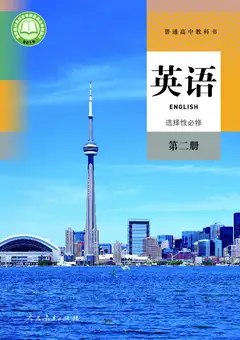
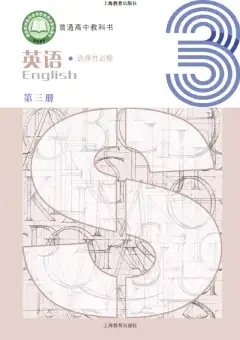
普通高中教科书
第三册
选择性必修
普通高中教科书
第三册
选择性必修
主
编:陈
琳
北京
主 编:陈 琳
副 主 编:张连仲
编 者:刘 晓 李陆桂 张京生 钱建源 徐 浩 雷传利
(按照姓氏笔画排序)
项目策划:王 芳 王 勇
项目负责:张黎新 郎 崧 张 涛
基础教育出版分社:
地 址:北京市西三环北路19 号 外研社大厦 基础教育出版分社(100089)
咨询电话:(010)88819117/88819688
传 真:(010)88819423
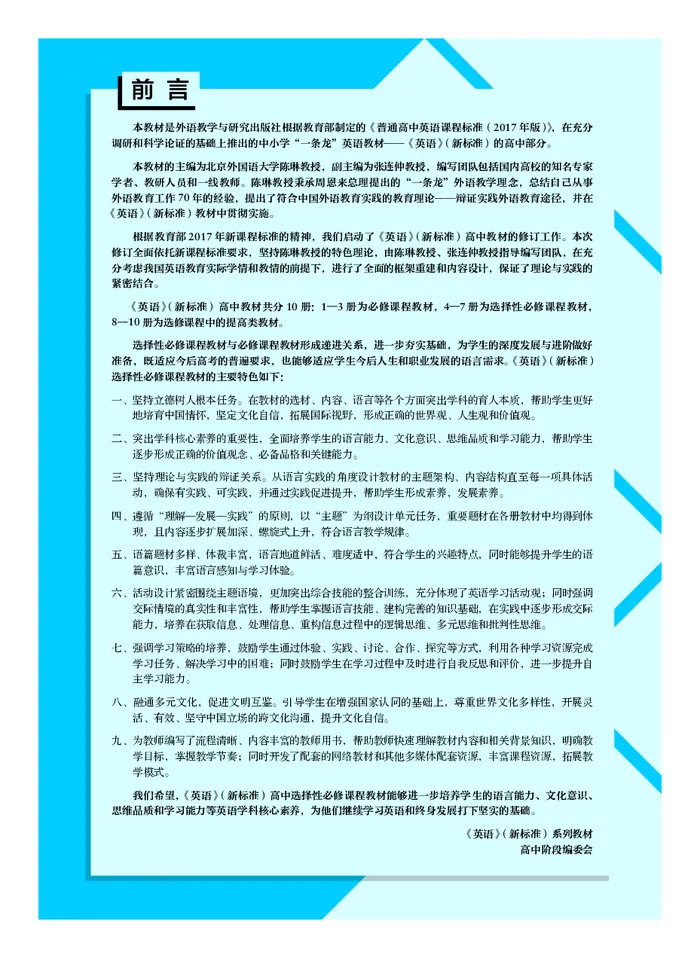
本教材是外语教学与研究出版社根据教育部制定的《普通高中英语课程标准(2017 年版)》,在充分
调研和科学论证的基础上推出的中小学“一条龙”英语教材——《英语》(新标准)的高中部分。
本教材的主编为北京外国语大学陈琳教授,副主编为张连仲教授,编写团队包括国内高校的知名专家
学者、教研人员和一线教师。陈琳教授秉承周恩来总理提出的“一条龙”外语教学理念,总结自己从事
外语教育工作70 年的经验,提出了符合中国外语教育实践的教育理论——辩证实践外语教育途径,并在
《英语》(新标准)教材中贯彻实施。
根据教育部2017 年新课程标准的精神,我们启动了《英语》(新标准)高中教材的修订工作。本次
修订全面依托新课程标准要求,坚持陈琳教授的特色理论,由陈琳教授、张连仲教授指导编写团队,在充
分考虑我国英语教育实际学情和教情的前提下,进行了全面的框架重建和内容设计,保证了理论与实践的
紧密结合。
《英语》(新标准)高中教材共分10 册:1—3 册为必修课程教材,4—7 册为选择性必修课程教材,
8—10 册为选修课程中的提高类教材。
选择性必修课程教材与必修课程教材形成递进关系,进一步夯实基础,为学生的深度发展与进阶做好
准备,既适应今后高考的普遍要求,也能够适应学生今后人生和职业发展的语言需求。《英语》(新标准)
选择性必修课程教材的主要特色如下:
一、坚持立德树人根本任务。在教材的选材、内容、语言等各个方面突出学科的育人本质,帮助学生更好
地培育中国情怀,坚定文化自信,拓展国际视野,形成正确的世界观、人生观和价值观。
二、突出学科核心素养的重要性,全面培养学生的语言能力、文化意识、思维品质和学习能力,帮助学生
逐步形成正确的价值观念、必备品格和关键能力。
三、坚持理论与实践的辩证关系。从语言实践的角度设计教材的主题架构、内容结构直至每一项具体活
动,确保有实践、可实践,并通过实践促进提升,帮助学生形成素养,发展素养。
四、遵循“理解—发展—实践”的原则,以“主题”为纲设计单元任务,重要题材在各册教材中均得到体
现,且内容逐步扩展加深、螺旋式上升,符合语言教学规律。
五、语篇题材多样、体裁丰富,语言地道鲜活、难度适中,符合学生的兴趣特点,同时能够提升学生的语
篇意识,丰富语言感知与学习体验。
六、活动设计紧密围绕主题语境,更加突出综合技能的整合训练,充分体现了英语学习活动观;同时强调
交际情境的真实性和丰富性,帮助学生掌握语言技能、建构完善的知识基础,在实践中逐步形成交际
能力,培养在获取信息、处理信息、重构信息过程中的逻辑思维、多元思维和批判性思维。
七、强调学习策略的培养,鼓励学生通过体验、实践、讨论、合作、探究等方式,利用各种学习资源完成
学习任务、解决学习中的困难;同时鼓励学生在学习过程中及时进行自我反思和评价,进一步提升自
主学习能力。
八、融通多元文化,促进文明互鉴。引导学生在增强国家认同的基础上,尊重世界文化多样性,开展灵
活、有效、坚守中国立场的跨文化沟通,提升文化自信。
九、为教师编写了流程清晰、内容丰富的教师用书,帮助教师快速理解教材内容和相关背景知识,明确教
学目标,掌握教学节奏;同时开发了配套的网络教材和其他多媒体配套资源,丰富课程资源,拓展教
学模式。
我们希望,《英语》(新标准)高中选择性必修课程教材能够进一步培养学生的语言能力、文化意识、
思维品质和学习能力等英语学科核心素养,为他们继续学习英语和终身发展打下坚实的基础。
《英语》(新标准)系列教材
高中阶段编委会
前 言
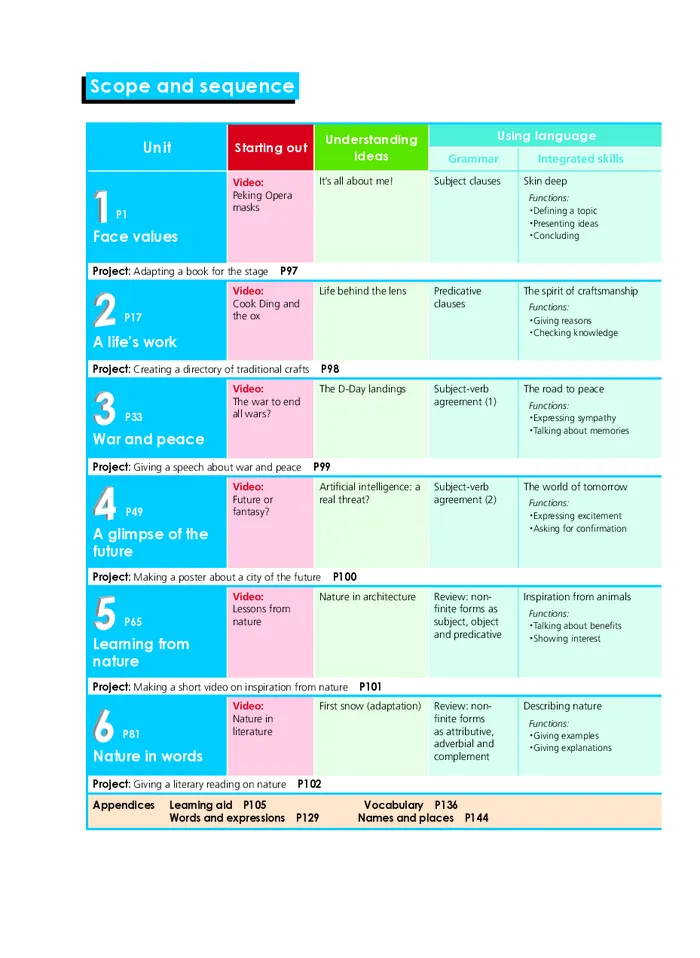
Scope and sequence
Unit
Starting out
Understanding
ideas
Using language
Grammar
Integrated skills
P1
Face values
Video:
Peking Opera
masks
It’s all about me!
Subject clauses
Skin deep
Functions:
・Defining a topic
・Presenting ideas
・Concluding
Project: Adapting a book for the stage P97
P17
A life’s work
Video:
Cook Ding and
the ox
Life behind the lens
Predicative
clauses
The spirit of craftsmanship
Functions:
・Giving reasons
・Checking knowledge
Project: Creating a directory of traditional crafts P98
P33
War and peace
Video:
The war to end
all wars?
The D-Day landings
Subject-verb
agreement (1)
The road to peace
Functions:
・Expressing sympathy
・Talking about memories
Project: Giving a speech about war and peace P99
P49
A glimpse of the
future
Video:
Future or
fantasy?
Artificial intelligence: a
real threat?
Subject-verb
agreement (2)
The world of tomorrow
Functions:
・Expressing excitement
・Asking for confirmation
Project: Making a poster about a city of the future P100
P65
Learning from
nature
Video:
Lessons from
nature
Nature in architecture
Review: non-
finite forms as
subject, object
and predicative
Inspiration from animals
Functions:
・Talking about benefits
・Showing interest
Project: Making a short video on inspiration from nature P101
P81
Nature in words
Video:
Nature in
literature
First snow (adaptation)
Review: non-
finite forms
as attributive,
adverbial and
complement
Describing nature
Functions:
・Giving examples
・Giving explanations
Project: Giving a literary reading on nature P102
Appendices Learning aid P105 Vocabulary P136
Words and expressions P129 Names and places P144
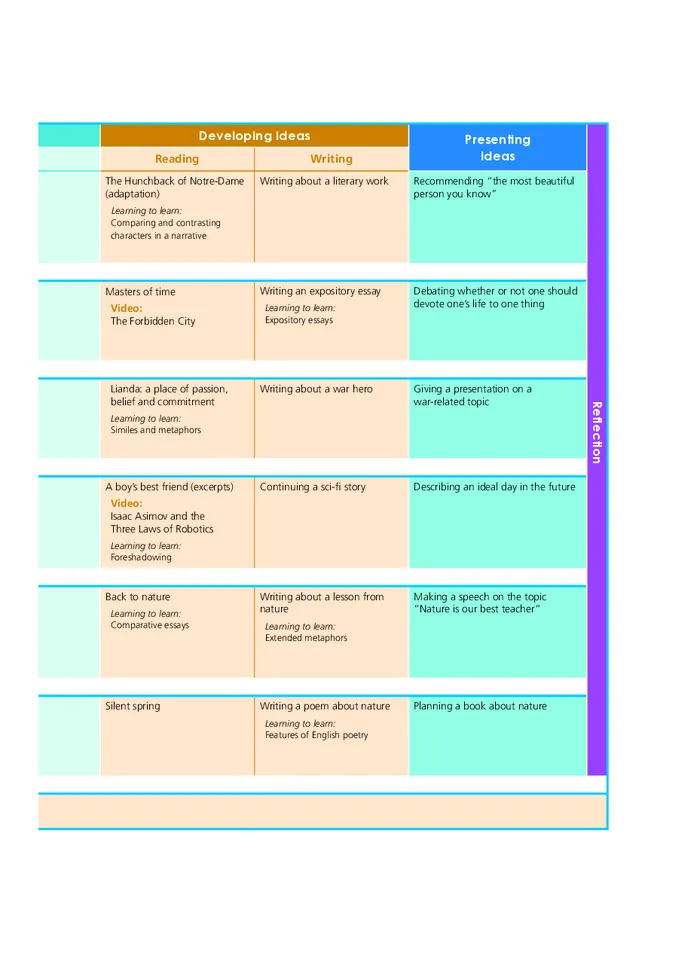
Developing ideas
Presenting
ideas
Reading
Writing
The Hunchback of Notre-Dame
(adaptation)
Learning to learn:
Comparing and contrasting
characters in a narrative
Writing about a literary work
Recommending “the most beautiful
person you know”
Masters of time
Video:
The Forbidden City
Writing an expository essay
Learning to learn:
Expository essays
Debating whether or not one should
devote one’s life to one thing
Lianda: a place of passion,
belief and commitment
Learning to learn:
Similes and metaphors
Writing about a war hero
Giving a presentation on a
war-related topic
A boy’s best friend (excerpts)
Video:
Isaac Asimov and the
Three Laws of Robotics
Learning to learn:
Foreshadowing
Continuing a sci-fi story
Describing an ideal day in the future
Back to nature
Learning to learn:
Comparative essays
Writing about a lesson from
nature
Learning to learn:
Extended metaphors
Making a speech on the topic
“Nature is our best teacher”
Silent spring
Writing a poem about nature
Learning to learn:
Features of English poetry
Planning a book about nature
Reflection
同学们,欢迎大家继续《英语》(新标准)高中教材的学习!
经过必修课程教材的学习,大家已经打下了更为扎实的英语基础,达到了高中英语学业质量水
平一的要求。现在大家应根据升学或就业的需要,对自己的学习目标提出更高的要求。由教育部制
定并颁布的《普通高中英语课程标准(2017 年版)》明确规定:普通高中英语课程作为一门学习及
运用英语语言的课程,与义务教育阶段的课程相衔接,旨在为学生继续学习英语和终身发展打下良
好基础。普通高中英语课程强调对学生语言能力、文化意识、思维品质和学习能力的综合培养。这
就是同学们在高中阶段学习英语的方向和目标。
要达到这个目标,需要大家的主观努力,也需要一套适应更高更广的语言学习需求的教材。《英
语》(新标准)高中选择性必修课程教材在延续了必修课程教材的基础上,为有升学要求或有个性化
发展需求的学生设计,在话题内容、语言理论、语言技能、跨文化意识、思维能力、学习能力等方
面,都提出了更高的要求,延伸出了如下特点:
一、作为必修课程教材的延续,选择性必修课程教材的话题选择更注意广度和深度,既关注话题的
现实意义,又关注语言学习的思想内涵,充分反映语言的发展和社会的进步,力求培养同学们
的文化意识和思维能力。
二、选择性必修课程教材具体语篇内容的选择将会引导大家进入英语语言学习的较高阶段。课文中
不但会出现更有挑战性的阅读篇章,同时还会根据每个单元的主题补充更多语篇供大家阅读并
赏析,提高语言水平和鉴赏能力。
三、思维方面,选择性必修课程教材对高阶思维做了更多要求,且对思维过程的启动、运行和开展
均做了更多的过程分解与清晰化设计,更强调基于同学们头脑中已有的内容及其再加工,与新
的语言和内容输入相结合,产生更丰富、更复杂的认知互动,深化思维发展活动。
四、在新课标规定的英语学习活动观的指导下,遵循“理解—发展—实践”的原则,对活动的要求
进一步提升,在“功能运用”板块中,将原有的词汇和听力部分整合成综合语言运用活动,通
过创设符合单元主题的话题,设计一系列首尾呼应、前后紧密关联的活动串,灵活融入听、说、
读、看、写等各项技能的训练,兼顾学习策略、功能和文化的引导与思考,帮助大家全方位提
升综合语言运用水平。
五、根据该阶段教学特点、教学内容和教学要求,充分遵循循序渐进的原则,强调对义务教育阶段
和高中必修阶段语言知识的复现、综合练习与重新认识,以形成内化的语用能力。
六、在呈现更为丰富多彩的文化现象的同时,更加强调中外文化对比,尤其是中国文化、中国故事、
中国传统价值观和世界问题的中国视角的介绍,让大家更好地理解文化异同,形成正确的文化
价值观和有利于国家、个人发展的跨文化态度与意识。
七、在单元学习的过程中帮助大家总结学习成果,发现问题并及时解决,最后通过对单元主题、语
言、文化思维等多方面提出问题,帮助大家写出自我反思日志,既完成了对学习目标、语言知
识和技能、思维品质、文化意识等维度的自我评价和总结,更显性体现了学习和思维的过程,
帮助大家进一步培养自主学习和反思总结的能力。
我们衷心希望,同学们能够通过学习本教材,了解到更加丰富的信息,在理解祖国文化、坚定
文化自信的同时,发展跨文化交流能力,更好地适应宽广的世界。愿《英语》(新标准)伴随同学们
度过有意义的高中时代!
致 同 学
U
n
i
t
1
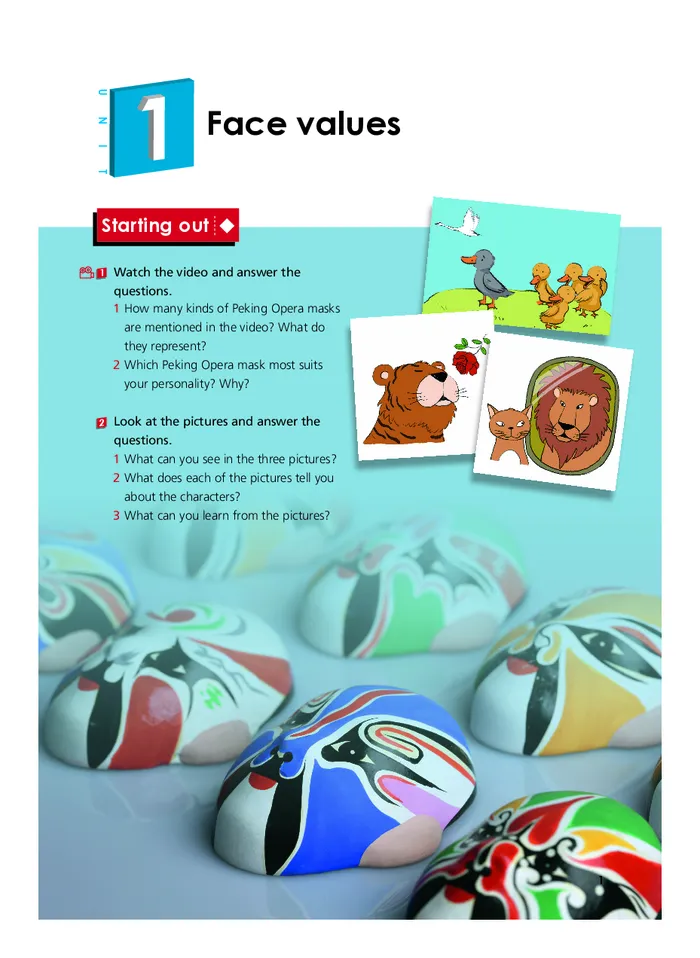
Watch the video and answer the
questions.
1 How many kinds of Peking Opera masks
are mentioned in the video? What do
they represent?
2 Which Peking Opera mask most suits
your personality? Why?
2
Look at the pictures and answer the
questions.
1 What can you see in the three pictures?
2 What does each of the pictures tell you
about the characters?
3 What can you learn from the pictures?
Face values
Starting out
1
1
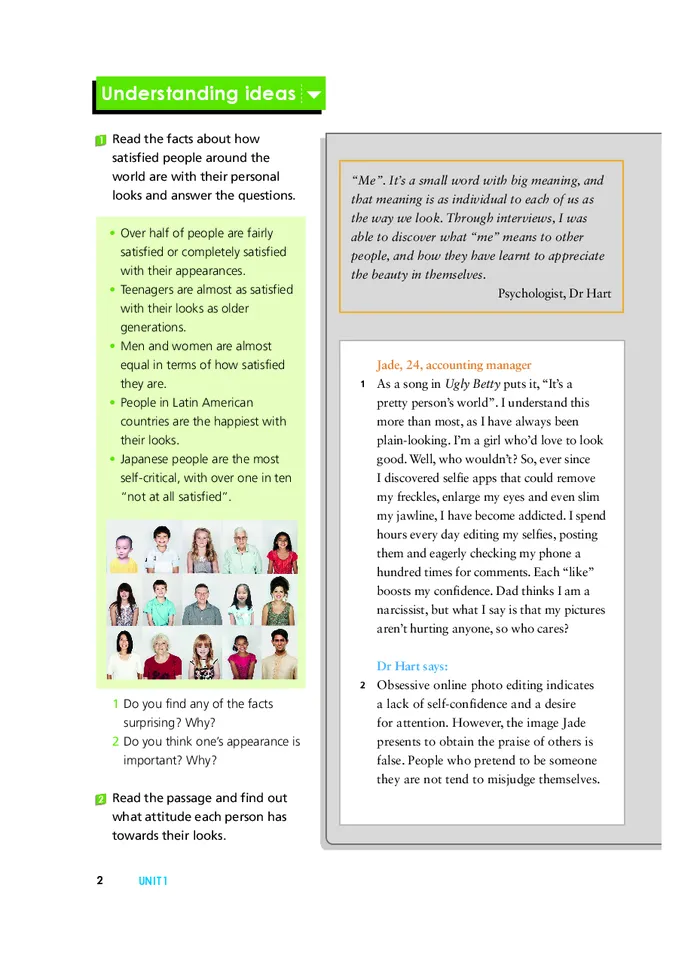
Read the facts about how
satisfied people around the
world are with their personal
looks and answer the questions.
1 Do you find any of the facts
surprising? Why?
2 Do you think one’s appearance is
important? Why?
2
Read the passage and find out
what attitude each person has
towards their looks.
• Over half of people are fairly
satisfied or completely satisfied
with their appearances.
• Teenagers are almost as satisfied
with their looks as older
generations.
• Men and women are almost
equal in terms of how satisfied
they are.
• People in Latin American
countries are the happiest with
their looks.
• Japanese people are the most
self-critical, with over one in ten
“not at all satisfied”.
Jade, 24, accounting manager
1 As a song in Ugly Betty puts it, “It’s a
pretty person’s world”. I understand this
more than most, as I have always been
plain-looking. I’m a girl who’d love to look
good. Well, who wouldn’t? So, ever since
I discovered selfie apps that could remove
my freckles, enlarge my eyes and even slim
my jawline, I have become addicted. I spend
hours every day editing my selfies, posting
them and eagerly checking my phone a
hundred times for comments. Each “like”
boosts my confidence. Dad thinks I am a
narcissist, but what I say is that my pictures
aren’t hurting anyone, so who cares?
Dr Hart says:
2 Obsessive online photo editing indicates
a lack of self-confidence and a desire
for attention. However, the image Jade
presents to obtain the praise of others is
false. People who pretend to be someone
they are not tend to misjudge themselves.
Understanding ideas
“Me”. It’s a small word with big meaning, and
that meaning is as individual to each of us as
the way we look. Through interviews, I was
able to discover what “me” means to other
people, and how they have learnt to appreciate
the beauty in themselves.
Psychologist, Dr Hart
2
Unit 1
Anthony, 21, college student
3 I never really cared about my appearance. That’s why I could never
understand my sister, who has 17 lipsticks and can’t decide which one to
use every morning. I only used to have five identical pairs of trousers and
five identical shirts. When I first moved into my dormitory at college, this
made my roommates quite confused as they saw me in the same clothes
day after day. Last month they registered me for a TV programme, A New
You. It felt bizarre at first. I didn’t like being reviewed from head to toe. But
I was surprised at how good I looked after the makeover! For the first time
in my life I saw myself as a handsome and well-presented young man. At
that moment, I perceived that external beauty isn’t totally worthless. It can
be an expression of our personalities, helping us make a good and positive
impression on others.
Dr Hart says:
4 It’s true that inner beauty is very important, but external beauty shouldn’t
be completely overlooked. It plays a part in the image we present to the
world, and making an effort with your appearance can leave a positive first
impression on others and boost your confidence.
Face values
3
3
Choose the purpose of the passage and give your reasons.
1 To persuade people to edit their photos less.
2 To prove that external beauty is not the most important thing.
3 To show the true meaning of beauty.
4 To warn readers about the physical dangers of losing weight.
Emma, 17, senior high school student
5 Ever since I was little, I’ve been larger
than other girls. For a long time, this
really bothered me. People would stare
at me because I was “big” and I hated
the way I looked. My anxiety drove
me to try every means possible to lose
weight, including dieting and weight-
loss pills, but this brought me nothing
but pain and poor health. Everything
changed when one day I came across the success story
of a plus-size model, Tess Holliday. Although she’s larger
than most other models, she’s really attractive and has
the confidence to be herself – even in an industry full of
beauty stereotypes. Her story changed my ideas about
what it means to be beautiful. I realised that my health,
mental and physical, is the most important thing. Now
I exercise a couple of times a week but just to keep fit. I
mean, isn’t it better that I’m large and happy, instead of
skinny and unhealthy?
Dr Hart says:
6 I completely agree with Emma – being healthy is beautiful,
and we should wear that beauty with confidence. What I
really admire is the way she has acknowledged that good
health not only makes us more beautiful, but happier, too!
4
Unit 1
4
Organise information from the passage and complete the diagram.
It’s all about
ME!
Anthony
Statements:
• I was surprised at
5
.
• I perceived that
6
.
Dr Hart’s comment:
7
Emma
Statements:
• My attempts to lose weight
brought me
8
.
• A plus-size model
9
.
• I realised that
10
.
Dr Hart’s comment:
11
Jade
Statements:
• I want to
1 .
• I have become
2
.
• The positive comments
3
.
Dr Hart’s comment:
4
Think Share
&
1 Do you agree that “It’s a pretty person’s world”? Why?
2 Has your understanding of the importance of appearance changed
after reading the passage? Why?
3 In addition to those methods mentioned in the passage, what other
ways do you think can make you become a better person?
4 Have you encountered any difficulties in understanding the main idea
of this passage? Share them with the class and ask for advice.
Now talk about which story or comment makes the greatest
impression on you and give your reasons.
Face values
5
1
Look at the sentences and answer the questions. Sentences (a) and (c)
are from the reading passage.
Subject clauses
1 What is the role of the words in bold in each sentence?
2 In sentence (a), what does “what” refer to?
3 What does “it” refer to in sentence (c)?
4 Why does the author choose to use sentences (a) and (c) instead of
sentences (b) and (d)?
Now look for more sentences with subject clauses in the reading
passage, and summarise their uses in your own words.
2
Read the passage and choose the correct words.
a … what I say is that my pictures aren’t hurting anyone, so who cares?
b “That my pictures aren’t hurting anyone is what I say, so who cares?”
c It’s true that inner beauty is very important…
d That inner beauty is very important is true…
Using language
It is a well-known fact that / what the faces some people show to
the world might be completely different to their real personalities. For
instance, most comedians never cease to have smiles on their faces and
always sound cheerful because that’s the nature of their work. From
this, it’s impossible to know what / where their true feelings are. Smiles
imply happiness, but remember – although they might be laughing on
the outside, they might be weeping on the inside. That / How others
are feeling is not something that we should make
assumptions about, because it’s not always
obvious who is truly happy. What / That
is certain is that comedians often use
comedy to help them understand
themselves and the world. In fact, comedy
is a very serious job indeed!
6
Unit 1
3
Write an introduction to Ma Xu based on the profile. Use three or
four subject clauses in your introduction.
4
Think of another famous person and give an introduction to the class.
Use three or four subject clauses in the introduction.
• Ma Xu became a military doctor in 1947. She applied to
become a paratrooper in 1961, but her first application
failed because there were no female paratroopers at that
time. Ma was only 1.53 metres tall and weighed just 37.5 kg.
But she learnt to parachute by training hard in secret. After
Ma proved that she could jump as well as anyone else, her
application was successful.
• Ma is China’s first female paratrooper. She completed over
140 parachute jumps over a period of 20 years – the most
of any female paratrooper. She also set a national record as
the oldest enlisted woman to do a parachute jump, at the
age of 51.
• In 2018, Ma donated her entire life savings to her home
town in Mulan County. This donation was to support local
education and public welfare.
Ma Xu is a famous paratrooper. What impress me most are her courage,
skill and determination...
Skin deep
5
Listen to the speech. Choose the title that best describes the topic and
give your reasons.
1 How to Hide Scars
2 Our True Self Lies Within
3 The Life Story of Dr Kleck
4 The Psychology of Sadness
Ma Xu
Face values
7
6
Listen again and complete the fact sheet.
The Scar Experiment
Now give a short introduction to the
experiment using the information in
the fact sheet.
Basic facts
The researcher: Dr Robert Kleck
Year:
1
The procedure:
•
2 was drawn on each
volunteer’s face using Hollywood-style
make-up.
• �Dr Kleck showed the scars to the
volunteers.
• �He
3 the scars without
the volunteers’ knowing it.
• �The volunteers went outside and
noted how people
4 .
• �They thought that people were ruder
to them, and less kind. They thought
people
5 the scars.
Findings
• The volunteers
6 others‘
behaviour towards them.
• Who we are is in our heads, not
7 .
• If people choose to feel
8 ,
they will actually feel that way.
• Today, I’m going to talk about…
• The subject of this speech is…
• First / Next / Then…
• After that, …
• As you can see, …
• To sum up, …
Defining a topic
Presenting ideas
Concluding
7
Complete the boxes with the expressions
from the speech.
8
Work in pairs and discuss the questions.
1 What can you learn from the Scar
Experiment?
2 Does your appearance influence how you
feel inside?
8
Unit 1
9
Read the descriptions and match them to the characters
from literature. Pay attention to the words in bold.
1 He is able to transform into various animals and objects. People
often regard him as frightful or monstrous, but in fact he is
just and righteous. When there’s danger, he never hesitates to
protect others.
2 She is small and her face is plain. Despite a difficult childhood,
she grows up to be an independent, determined and
generous young woman. She remains true to herself and never
loses hope, faith or dignity in her search for love and happiness.
3 He has the outward appearance of the King of the Beasts,
but he has a timid and sensitive character, which causes
him to believe he is a coward. However, he performs brave
actions even when he feels afraid, proving that he is in fact a
courageous individual.
10
Put the words in bold in Activity 9 into the boxes. Add any
more you can think of.
Appearance
Personality
11
Choose a character from literature and prepare a speech.
Talk about the character’s appearance and personality.
Work in pairs and make the speech to each other.
Now give feedback and talk about whether you have used
the words in this section properly in your speech.
4 He is a thin and bookish boy with untidy dark hair. He doesn’t
appear to be particularly tough and sometimes looks as if he lacks
confidence. In reality, he is brave and loyal, and always ready for
a dangerous challenge when it is necessary to do the right thing.
c Harry Potter
d Monkey King
b Cowardly Lion
a Jane Eyre
Face values
9
Developing ideas
Born in France in 1802, Victor
Hugo was a novelist, poet and
playwright and was part of the
Romantic Movement. Regarded
as one of France’s greatest
writers, he is celebrated as the
“Shakespeare of France”.
Hugo first found fame, as a poet,
when he was about 20 years
old. Less than ten years later, he
published one of his best-known
works, The Hunchback of Notre-
Dame. It was immediately a huge
success and is now considered
a key work of Romanticism. It
remains one of his most popular
works today.
1 Why do you think Victor Hugo is
known as the “Shakespeare of
France”?
2 What do you know about
Romanticism? Do some research
to find out more about it.
2
Read the passage and find
out why Quasimodo rescued
Esmeralda.
Published in 1831, The Hunchback of
Notre-Dame tells a tragic story of events in
Paris. Esmeralda’s beauty means that many
men fall in love with her. One such man
sends the hunchback Quasimodo to kidnap
Esmeralda. But Quasimodo fails and is
captured and tortured in public. Esmeralda
hears his call for water, and steps forwards
out of mercy. She offers Quasimodo a drink
of water, which saves him and also captures
his heart. When Esmeralda is later sentenced
to death for a crime she did not commit,
Quasimodo rescues her from an angry
crowd outside the Notre-Dame Cathedral.
Esmeralda is safe from execution as long as
she stays inside the cathedral...
1 Esmeralda and Quasimodo were still for
several moments, as they considered their
predicament in silence, she so graceful,
he so repulsive. Every moment Esmeralda
discovered some fresh defect in Quasimodo,
as her glance travelled from his knock knees
to his hunched back, from his hunched
back to his single eye. How anyone could
be formed in such a way was beyond her
comprehension. Yet there was so much
melancholy and so much gentleness spread
over all this that she gradually adjusted to
it.
2 He was the first to break the silence. “So
you were telling me to return?”
3 She moved her head, and said, “Yes.”
1
Read the short introduction to
Victor Hugo and answer the
questions.
10
Unit 1
4 He understood the motion of the head.
“But!” he said, as though hesitating
whether to finish, “I am – I am deaf.”
5 “Poor wretch!” exclaimed Esmeralda,
with an expression of heartfelt
compassion.
6 He began to smile sadly.
7 “You suppose that was all that I was
missing, do you not? Yes, I am deaf, that
is the way I am made. It is horrible, is it
not, next to your exquisite beauty!”
8 There lay in the accents of the
unfortunate man so significant an
awareness of his sadness that she had not
the strength to utter a syllable. In any
case, he would not have heard her. He
continued:
9 “Never have I viewed my ugliness as at
the present moment. When I compare
myself to you, I feel an immense pity
for myself, poor unfortunate monster
that I am! Be honest, to you I must
resemble some savage creature. You,
you are a ray of sunshine, a drop of
dew, a birdsong, whilst I am something
terrible, neither human nor beast. I
don’t know what I am, as I am coarser,
more downtrodden, and plainer than a
pebble!”
10 Then he began to laugh, and that laugh
was the most heartbreaking sound in the
world. He continued:
Hunchback
The
ofNotre-Dame
Face values
11
3
Underline the sentences that describe Esmeralda and Quasimodo’s
appearances and feelings. Write a short paragraph to describe
how Esmeralda and Quasimodo see each other.
Now work in pairs. Read the passage again and find out how
Esmeralda’s feelings towards Quasimodo changed. Share your
answers with your partner.
Esmeralda in Quasimodo’s eyes
Quasimodo in Esmeralda’s eyes
11 “Yes, I am deaf, but you shall talk to me with your hands
as my master talks to me, and then I shall quickly know
your wishes from the movement of your lips, from your
expression.”
12 “Well!” she smiled, “Explain to me why you rescued me.”
13 He watched her intently while she was speaking.
14 “I understand,” he replied. “You ask me why I rescued
you. You have forgotten an unfortunate person who
attempted to kidnap you one night, this same person to
whom you showed kindness when he was being punished.
A drop of water and a little pity – that is more than I can
repay with my life. You have forgotten that unfortunate
soul, but he remembers it.”
15 She listened to him with profound tenderness. A tear
swam in the eye of Quasimodo, but did not fall. He
seemed to make it a point of honour to keep it at bay.
�( Adaptation from The Hunchback of Notre-Dame
by Victor Hugo )
12
Unit 1
Think Share
&
1 What does the sentence “A tear
swam in the eye of Quasimodo, but did not
fall” tell us about Quasimodo’s personality?
2 In what different ways do the two reading
passages in this unit raise our awareness of
physical appearance and personal qualities?
3 What difficulties might people like Quasimodo
face in the real world? How should people
treat them?
4 Predict what happens next. Share your ideas
with the class. Read the novel and check your
prediction.
When comparing and contrasting
characters in a narrative, consider
their appearance, actions, and
motives. Appearance in literature
usually has meaning; a character’s
beauty and ugliness is not
accidental, as it is in real life. It is
also very important to consider
how each character changes over
time, that is, to compare each
character to earlier versions of
themselves.
Learning to learn
4
Work in groups. Give a talk about the character in the passage that
makes the greatest impression on you.
1 Organise your ideas by considering the questions.
• What is the character like?
• Has he / she experienced any emotional changes? If so, what
changes are they?
• What can you learn from him / her?
2 Present your ideas in your group.
3 Collect all your group‘s ideas and present them to
the class.
Now think about whether you can express yourself clearly or
understand others in the group talk, and what your strengths or
weaknesses are, compared to those of the others in your group.
Face values
13
This book by Oscar Wilde tells the story of Dorian
Gray, a very handsome young man who spends
his life only concerned with his own pleasure,
regardless of the suffering he brings to others.
The story starts with young Dorian having his
portrait painted. His friend Lord Wotton talks
about beauty and pleasure being the only
important things in life. Fascinated by his words,
Dorian wishes he could remain young and good-
looking always, with his portrait growing old
instead of him.
Soon afterwards, Dorian is surprised to find his
wish has come true, after he meets Sybil, an
innocent actress who falls in love with him.
Dorian heartlessly abandons her just because she
performs poorly one night. When he learns that
Sybil has killed herself, Dorian finds his face in
the painting has taken on a cruel look.
He hides the painting away so that no one else
may see it. For the next 18 years, Dorian engages
in various evil deeds, even murdering the painter
of the portrait. But he never feels guilty about the
harm he is doing. His portrait ages and reveals
his inner ugliness. One day, he suddenly comes
to be fearful of his past crimes and wants to start
5
Read the introduction to the novel and answer the questions.
Writing about a literary work
14
Unit 1
a new life. But his portrait remains the
same and reminds him of everything he
has done. Feeling desperate, he tries to
destroy the portrait with a knife, but it is
he who is killed. His body is discovered,
old and awful, while his portrait is
young and handsome once again.
In the story, what matters most to
Dorian Gray is that he is good-looking,
not that he has a good heart. He
sacrifices his true self in pursuit of
physical beauty and pleasure, which
leads to his destruction in the end.
General introduction: �
�
�
�
�
Plot: �
�
�
�
�
Central theme(s): �
�
�
�
�
Now write about this literary work
based on your notes.
7
Work in pairs. Make improvements to
each other’s introductions and share
them with the class.
6
Choose another literary work with
a focus on physical appearances
and personal qualities, such as The
Hunchback of Notre-Dame, and
complete the notes.
1 What kind of person is Dorian
Gray?
2 What message do you think the
novel conveys?
Face values
15
1
Work in groups. Read the quote and discuss the questions.
1 What is your understanding of the quote?
2 What is your definition of “true beauty”?
3 What qualities should a “beautiful person” have?
2
Think of someone you want to recommend as “the most beautiful person you
know”. Choose someone you know and complete the table.
3
Work in groups. Discuss who is “the most beautiful person you know” and agree on
the best candidate. Use the information in Activity 2 to help you.
4
Prepare a short presentation. Consider the following:
1 the structure of your presentation
2 useful words, expressions and structures
5
Give your presentation and recommend your candidate to the class. Vote for the best
presentation.
Name
Description of him / her
Appearance:
Personality:
Reasons to recommend him / her
A human being should be entirely beautiful: the face, the clothes,
the mind, the thoughts.
From Uncle Vanya by Anton Pavlovich Chekhov
Presenting ideas
Reflection
Write a reflection after completing this unit. Consider the following:
1 What is your understanding of true beauty?
2 What text types have you learnt about? What are their features?
3 What words, expressions and structures have you learnt?
4 What improvement have you made in understanding different cultures?
5 What improvement have you made in using learning strategies and exploring effective
ways of learning?
6 What improvement have you made in analysing and solving problems?
16
Unit 1
1
Watch the video and answer the
questions.
1 How did Cook Ding compare himself
to other cooks?
2 What lesson did Lord Wenhui learn
from Cook Ding?
2
Read the quotes and answer the
questions.
1 What is your understanding of these
quotes? Pay special attention to “the
price of success”, “stay with problems
longer” and “a mere reed shaken in
the wind”.
2 What qualities does each of these
quotes convey?
3 Which of these quotes is the most
meaningful to you? Give your reasons.
Starting out
Without craftsmanship,
inspiration is a mere reed
shaken in the wind.
Johannes Brahms
A life’s work
U
n
i
t
I know the price of
success: dedication,
hard work, and an
unremitting devotion to
the things you want to
see happen.
Frank Lloyd Wright
It’s not that I’m so smart,
it’s just that I stay with
problems longer.
Albert Einstein
17
1
Look at the photos and
answer the questions.
1 What differences are
there between these two
photographers?
2 What do you think they each
want to show through their
works?
3 What does the first picture tell
you about the photographer?
Now read the passage and
check your answers.
1 A white-haired old man riding an ordinary
bicycle around the streets of New York,
always wearing the same blue worker’s
jacket and simple black running shoes. If
you saw him, you’d never think there was
anything remarkable about him. And yet
every member of New York’s wealthy high
society wanted nothing more than to pose
for this man.
2 This ordinary-looking man was Bill
Cunningham, one of the most important
American photographers of the last 50 years.
3 What made Cunningham so great? It
certainly wasn’t the use of expensive,
technologically-advanced equipment.
Cunningham always used simple, relatively
cheap cameras and took all his pictures on
the streets of New York, not in a studio.
Understanding ideas
Life
Behind
the Lens
18
Unit 2
Nor was it a wide range of contacts
and connections. Although he always
knew where fashionable parties and
events were happening, Cunningham
liked to photograph ordinary people
in the poor Bronx as much as VIPs in
rich Manhattan. He found inspiration
where others could not, in simple,
everyday scenes, such as a man
buying oranges at the local grocery
store, or a woman riding home on
the graffiti-covered subway. These
things were real, and it was within
their reality that Cunningham saw
both beauty and potential. Through
his fascination with what people
were wearing, and not who they
were, he opened the doors of fashion
to everyone – fashion as he saw it
belonged to the people, not just to
high society and big brands.
4 Moreover, what made
Cunningham great was his
devotion to photography,
and the hours and hours
of sheer hard work he
put into his work.
Cunningham would go out onto the
streets of New York each and every
day, regardless of the weather. He
would even stay outside in a storm,
not coming back until he knew he had
the right photos. He hardly ever took
a day off and not once stayed home
sick. This devotion and hard work
is what we see reflected within his
photos. This is what makes them so
special.
A life’s work
19
2
Choose another suitable title for the passage and give your reasons.
1 Social Butterfly
2 Art and Devotion
3 Follower of Fashion
4 A Life in Photographs
5 Although he was a world-famous fashion photographer,
Cunningham’s approach to life was uncomplicated. He lived in
a small apartment with a shared washroom. A simple restaurant
was where he usually had the same meal of sausages, eggs and
coffee.
6 Cunningham never accepted the benefits offered to him for
being a fashion photographer. He valued his integrity and
would not be bought by anyone, no matter how many free
clothes or flights to faraway destinations he was offered. And
if he went to a celebrity party, he was there to work rather
than have fun. “Money’s the cheapest thing,” he once said,
then added: “... freedom is the most expensive.” This lack of
self-interest and promotion kept Cunningham focused on his
craft, enabling him to capture New York’s unique street style.
7 Cunningham’s passion for photography lasted throughout
his life. He was 87 when he passed away, and had been
working right up until his last illness. Nothing ever stopped
him from getting the photo he wanted. His hard work made
him more than a fashion photographer – he was a “cultural
anthropologist”, who we can thank for recording the life
of a whole city and its people over half a century. Bill
Cunningham was an observer, and not one of the observed,
a worker not a star – and this was how he wanted it.
20
Unit 2
Think Share
&
1 What is your understanding of Bill Cunningham’s
words “Money’s the cheapest thing”?
2 Why is Bill Cunningham called a “cultural anthropologist”?
3 What can you learn from Bill Cunningham? Share your thoughts with
the class.
4 What text types have you learnt about to help you describe people? If
you were to write about Bill Cunningham, which would you choose?
Now come up with five words or expressions to describe Bill
Cunningham. Give your reasons.
Bill Cunningham
Devotion to photography
• Regardless of the
weather, he would
4�
�
�
.
• He wouldn’t come
back until
5�
�
�
.
• He hardly ever
6�
�
�
.
Beliefs about fashion
• Fashion is not
restricted to
1�
�
�
.
• It belongs to
2�
�
�
.
• It is about what people
are wearing, not
3�
�
�
.
Life philosophy
• He lived in
7�
�
�
.
• He ate
8�
�
�
.
• He never accepted
9�
�
and valued
10�
�
�
.
3
Organise information from the passage and complete the diagram.
A life’s work
21
Predicative clauses
1
Look at the sentences from the reading passage and answer the
questions.
2
Listen to the story of Ruth Bancroft and complete the sentences
with predicative clauses. Listen again if necessary.
1 What form does the predicative take in sentences (a) and (b)?
2 Why is “what” used in sentence (a) and “where” used in sentence (b)?
3 What other words do you know that can lead a predicative clause?
a This is what makes them so special.
b A simple restaurant was where he usually had the same meal of
sausages, eggs and coffee.
Now look for more sentences with predicative clauses in the reading
passage, and summarise their uses in your own words.
Using language
1 One reason why the garden is unique is �
�
.
2 Another reason for its uniqueness is �
�
.
3 The drought-resistant plants with thick, fleshy leaves
became �
�
.
4 Although Walnut Creek was not �
�
,
Ruth managed to grow them by much trial and error.
5 It seemed �
�
.
22
Unit 2
5
Listen to the radio programme and
choose its purpose.
1 To introduce famous traditional crafts
to the audience.
2 To raise the audience’s awareness of
preserving traditional crafts.
3 To replace traditional crafts with modern
technology.
4 To tell the stories of some famous
craftworkers.
3
Rewrite the underlined sentences using
predicative clauses.
Mei Lanfang (1894 –1961)
Mei Lanfang was born into a family of
Peking and Kunqu Opera performers in
1894. At the age of eight, he started
training in Peking Opera on a daily
basis. When he was 17, he kept a flock
of pigeons and trained them to fly high.
Every day Mei watched them as they
flew, which helped him to develop the
expressive eye movements that were
so crucial to his art. His hard work and
dedication made him a leading artist in
Peking Opera.
Mei was also an innovator. In addition
to new stage designs and singing styles,
his innovations in make-up and costume
design allowed for more vivid depictions of
female characters. This contributed greatly
to the development of Peking Opera.
Until he passed away in 1961,
Mei had been performing
and encouraging the
spread of Peking Opera
for almost 60 years. This
lifelong devotion has
made him one of the most
celebrated Peking Opera
artists of all time.
The spirit of craftsmanship
6
Listen again and complete the table.
Traditional
crafts
• Clog making
•
1
Reasons
for their
dying out
•
2
has fallen.
• Substitutes are
3
and much cheaper, while
the cost of
4
for craftworkers is high.
• The younger generation
is
5
,
which can take years to
master.
Now work in pairs. Talk about how to
keep traditional crafts from dying out.
4
Think of another artist and write
about their devotion to their art. Use
predicative clauses where appropriate.
A life’s work
23
7
Complete the boxes with the expressions from
the radio programme.
• What do you know about…?
• Did you know that…?
• One reason is simply that…
• Another factor is that…
Giving reasons
Checking knowledge
9
Read the passage and answer
the questions. Pay attention
to the words and expressions
in bold.
In October 1964, China exploded
its first atomic bomb, marking
a successful start of the “two
bombs, one satellite” project, in
which more than 17,000 scientists
and researchers participated. Of
those, 23 were awarded for their
extraordinary contributions.
One of the 23 scientists was
Deng Jiaxian, who was among
the founders of China’s nuclear
programme. After coming back
from the US, Deng devoted
himself whole-heartedly to
the development of the “two
bombs”. Spending years apart
from his family and enduring the
extreme conditions of the Gobi
desert, he refused to back down
from his responsibilities and kept
on conducting scientific research.
After the successful development
of the atomic bomb, he worked
closely with Yu Min, another
leading scientist at the cutting
edge of nuclear technology.
Together, they thought outside
the box and broke new ground,
leading to the breakthrough
of the hydrogen bomb. This was
8
Read the passage and answer the questions.
Traditional crafts
have long been
disappearing
from countries
across the world.
With many crafts
having been, or
about to be, lost forever, people are beginning
to grasp the importance of preserving those that
remain. In fact, after a long period of decline,
traditional crafts have recently undergone a
renaissance. There is greater public interest in
old stories and traditions, as well as a desire for
high-quality products. Such objects are produced
through a combination of skill, respect for
materials, devotion to tradition, and focus on the
task. Craftsmanship speaks to the human need for
skilled and socially useful work; the sort of work
that can be admired and valued by society.
1 What is currently happening to traditional crafts?
2 Why are people starting to engage more with
traditional crafts?
24
Unit 2
11
Work in pairs. Talk about other
people who show the spirit
of craftsmanship using the
words and expressions in this
section. Do further research if
necessary.
Perseverance
Integrity
Innovation
Expertise
Now comment on each other’s
performances in using the
words and expressions in this
section.
10
Put the expressions that show
different qualities in Activity 9
into the boxes. Add any more
you can think of.
Deng Jiaxian
a remarkable achievement by the
Chinese team of scientists, in such
a short space of time.
Another respected scientist
among the 23 award-winners
was Qian Xuesen, who was
experienced in rocketry and
highly accomplished in his
field. He had been working in
the United States, where his
crack hand at jet propulsion had
won him acclaim. However, he
sought no fame and shunned
the spotlight, returning to China
with great resolution. He played
a key role in China’s missile and
aviation programmes, helping fast-
track the development by decades.
The 23 scientists and many
more like them overcame harsh
conditions and dedicated much
of their lives to their work. Their
expertise in science, perseverance,
integrity and innovation have
inspired generations of scientific
researchers to work towards a more
powerful and prosperous China.
Yu Min
1 What were the 23 scientists honoured for?
2 What challenges did they meet? How did they
overcome them?
Qian Xuesen
A life’s work
25
1
Watch the video and answer the
questions.
1 Who was the Forbidden City
built for?
2 When did it become home to the
Palace Museum?
3 How many works of art are there
in the Palace Museum?
4 What do you think makes the
Palace Museum unique in the
world?
2
Look at the title and the pictures.
Predict what the passage is about.
Now read the passage and
check your prediction.
Developing ideas
1 In the quiet courtyards of Xi San Suo,
behind the high walls of the Forbidden
City, time ticks at its own pace. If
it hadn’t been for a three-episode
documentary, outsiders would never
have known that the plainly-dressed
people working here are masters of
their craft, who have spent their lives
restoring precious antiques. Among
these is the clock restoration master,
Wang Jin.
2 Walking through the seven crimson
gates towards his workplace, Wang
Jin still regards himself as an ordinary
worker in the Palace Museum, although
now he is often stopped by admirers
time
Masters
of
26
Unit 2
wanting their photo taken with him.
Day in, day out, Mr Wang and his
students spend their time restoring
clocks dating back hundreds of years.
But for quite some time, he and his
student Qi Haonan used to be the only
two people repairing timepieces in the
Palace Museum.
3 Qing emperors were very fond of
clocks. Therefore, in order to please
them, foreign envoys presented these
emperors with the most intricate and
splendid timepieces. Today, the Palace
Museum has one of the most significant
collections of timepieces in the world,
mainly originating from Europe and
China. With objects ranging from small
pocket watches to clocks over one
metre in height, each of these requires
its own unique method of restoration.
Given the complexity of the work and
the lack of necessary materials, this
means that each expert can work on a
maximum of two large pieces a year.
But, through their painstaking efforts,
Mr Wang and his students do more
than repair the clocks – they bring
them back to life.
4 The only sound to break the silence
in Wang Jin’s workshop is the
chiming melody of the repaired and
polished clocks. To Wang Jin it is the
most beautiful music in the world.
Now, after eight months of endless
adjustments, the time has finally come
for Mr Wang to wind up the gigantic
clocks that date back to the time of
Emperor Qianlong. The intricately
fashioned objects that have stood still
for centuries instantly come back to
life: water flows, boats sail, dogs bark,
chickens flap their wings and a woman
starts to spin. It is a truly awe-inspiring
moment. It is suddenly clear that
when the clock masters say that “these
antiques have lives”, it is neither an
exaggeration nor a metaphor.
A life’s work
27
3
Match the questions to the paragraphs and find out the answers.
a Why is Wang Jin optimistic about the future of the timepieces in the
Palace Museum?
b Why is it painstaking for Wang Jin and his students to repair the
collection of timepieces in the Palace Museum?
c What has been done to the clocks that date back to the time of
Emperor Qianlong?
d Who is Wang Jin and where does he work?
e What qualities do Wang Jin and his colleagues display in their
work?
f What was special about Wang Jin and his student Qi Haonan?
5 But, despite the combined work of several generations of masters, it seems
unlikely that the restoration of the clocks will ever be complete. Even if
every clock in the Palace Museum were restored, there would still be
work to do, because restoration would probably need to begin again on
the clocks that were repaired long ago. This is a race against time that
can never be won! Nonetheless, Mr Wang remains optimistic about the
future of these timepieces. Following in the footsteps of his own teacher
all those years ago, Mr Wang has now passed on his skills to the new
members, who will take on many of the future repairs. What’s more,
inspired to follow in his father’s footsteps, Mr Wang’s son now has
also taken up repairing antique clocks. This new generation of
artisans will not only help preserve traditional skills; the innovation
they bring to the craft will also ensure that the art of clock
repairing stands the test of time.
6 �In today’s fast-paced world, the saying that “time waits for
no man” has never seemed more apt. Yet inside the hidden
courtyards of Xi San Suo, there is something timeless
about the way Mr Wang and his colleagues sedately
piece together the past with skilful hands and modest
hearts. It is as if they have become one with their
craft and with the history of the country.
28
Unit 2
4
Work in groups. Give a speech about the spirit of craftsmanship in the
Palace Museum.
1 Think about other masters in the Palace Museum. Then discuss the
questions within your group to prepare for your speech. Do further
research if necessary.
• Who are the masters?
• What fields do they work in?
• What specific examples can you give of their work?
• �What aspects of the spirit of craftsmanship are demonstrated through
their work?
• How can you develop and display such spirit in daily life?
2 Organise your speech by completing the table.
Think Share
&
1 What is your understanding of the title,“Masters of
Time”? What figure of speech does the author use?
2 What is your understanding of the sentence, “This is a race against
time that can never be won”? Do you agree with this? Give your
reasons.
3 What do Bill Cunningham and Wang Jin in the two reading passages
in this unit have in common?
4 What can you do to help to pass on traditional skills and the spirit of
craftsmanship?
Aspects of the spirit of
craftsmanship
Supporting examples
Conclusion
3 Give your speech to the class.
Now think about your performance in the speech. Vote for the
most convincing speech and ask the speaker to share some public
speaking skills.
A life’s work
29
5
Read the passage and answer the questions.
Writing an expository essay
What do the Summer Palace, Yuanmingyuan and the Chengde Mountain
Resort all have in common? These Qing-dynasty architectural marvels, along
with many others, were all built by members of the same family – the Lei
family.
For seven generations, the Lei family quietly dominated imperial architecture.
Their designs were admirable, varying from grand buildings to public works,
such as roads and dams. So incredible was their skill that many of their
buildings survived earthquakes and remained standing over hundreds of years.
The Lei family were also pioneering engineers, who used a grid system to
plan their projects in minute detail. They took careful notes and made models
of their projects, many of which have survived to this day and are registered
as part of UNESCO’s Memory of the World Programme.
In addition to their architectural achievements, the Lei family showed diligence
and humility. Each generation conscientiously learnt their craft and undertook
ambitious projects, many of which took years to complete. Yet they did not
30
Unit 2
An expository essay contains a fair and balanced
analysis of an event, a situation or an idea. It commonly
begins by clearly stating what it aims to explain
or analyse. The main body comprises paragraphs
with supporting evidence and facts. It concludes by
reviewing the main theme of the essay in light of all the
evidence that has been presented.
Learning to learn
Now write an expository essay.
Person:
Qualities:
Examples:
Conclusion:
6
Choose one person who demonstrates the spirit
of craftsmanship and complete the notes. Do
further research if necessary.
7
Work in pairs. Make improvements to each
other’s essays and share them with the class.
Consider how well you have understood how to
write expository essays.
1 What is the passage about?
2 What qualities of the Lei
family are mentioned? Find
examples in the passage to
support your answers.
3 What is the conclusion of
the passage?
seek fame, and even today, their
great works are associated more
with the imperial court than with
them.
With their remarkable skills,
innovation, diligence and humility,
the Lei family leave behind their
buildings and the legacy that true
craftwork is a treasure that can last
beyond a lifetime.
A life’s work
31
Write a reflection after completing this unit. Consider the following:
1 What is your understanding of the spirit of craftsmanship?
2 What text types have you learnt about? What are their features?
3 What words, expressions and structures have you learnt?
4 What improvement have you made in understanding different cultures?
5 What improvement have you made in using learning strategies and exploring effective
ways of learning?
6 What improvement have you made in analysing and solving problems?
Reflection
Presenting ideas
1
Read the two points of view and answer the questions.
1 What is James trying to express?
2 What is Ivy trying to express?
3 Which person do you agree with?
vs
I can’t understand why some people spend
their whole life doing just one thing.
I know these activities require time and effort
to do, but I’d rather try as many different
things as possible. I don‘t want to regret
things when I‘m old!
I admire those people who devote their
whole lives to one thing. Not only have
they mastered their skills, but they have also
mastered their lives! I hope that I can dedicate
myself to, and one day master, a craft.
James
Ivy
2
Work in groups and take sides. Think of arguments to support your point of
view and make notes.
3
Prepare for a debate. Consider the following:
1 the roles and responsibilities for each member of your group
2 your arguments, opening and summary
3 the opposing arguments you might face and how you can respond to them
4 useful words, expressions and structures
4
Team up with a group with the opposite point of view and hold a debate.
Point of view:
Arguments:
Supporting examples:
32
Unit 2
There never was a good
war or a bad peace.
Benjamin Franklin
The supreme art of war
is to beat the enemy
without fighting.
Sunzi
A good soldier is not
violent. A good fighter
is not angry. A good
winner is not vengeful.
Laozi
You cannot prevent and
prepare for war at the
same time.
Albert Einstein
1
Watch the video and answer the
questions.
1 Which wars are discussed in the video?
2 What was the deadliest conflict in human
history? How many people were killed?
2
Read the quotes about war and answer
the questions.
1 What is your understanding of the quotes?
2 Which of the quotes helps you to better
understand the nature of war? Give your
reasons.
3 What is your opinion on war? Come up
with three words or expressions to help
express your opinion.
U
n
i
t
War and peace
Starting out
33
1
Look at the picture and
the map and answer the
questions.
1 What do you think the picture
and the map show?
2 What do you expect to read
about in the passage? Share
your ideas with the class.
Now read the passage and
check your prediction.
English Channel
Normandy
FRANCE
UNITED KINGDOM
Understanding ideas
The
1 By spring 1944, the Second World War had been
raging across the globe for about five years. But
along the south coast of England, something
unusual was happening: Allied troops made up
mainly of British, Canadian and American soldiers
were gathering in large numbers. This marked one
of the final stages of a top-secret operation that
had been months, perhaps years, in the planning.
Code-named “Operation Overlord”, it was the
largest combined sea, air and land operation in
history, the aim being to free north-west Europe
from German occupation. After waiting for the
perfect combination of weather, moon and tides,
the date for the start of Operation Overlord was
set for 6 June.
34
Unit 3
2 An order issued by Supreme Allied Commander General Eisenhower to the troops
read: “Your task will not be an easy one. Your enemy is well trained, well equipped
and battle-hardened… But this is the year 1944… The tide has turned! The free men
of the world are marching together to Victory! I have full confidence in your courage,
devotion to duty and skill in battle. We will accept nothing less than full Victory!”
3 With these words ringing in their ears, Allied soldiers prepared for what would
become known as D-Day. At dawn on 6 June, thousands landed by parachute behind
enemy lines in northern France. Meanwhile, thousands more were journeying across
the English Channel to Normandy, protected by fighter planes in the skies above them.
Their objective was clear: to reach the Normandy beaches along about 80 kilometres
of French coastline. But even in the depths of war, few could have been prepared for
the violence and horror they would experience there.
4 The fiercest fighting was at Omaha Beach. The enemy were hiding, ready to attack
the Allied soldiers even before they reached land. Boats were hit and men drowned,
while those who did make it to the beach faced heavy machine gunfire. By mid-
morning, hundreds lay dead in the water and amongst the tanks on the beach. One
soldier recalled how he barely made it with bombs falling all around him: “I was the
first one out. The seventh man was the next one to get across the beach without being
hit. All the ones in between were hit. Two were killed; three were injured. That’s how
lucky you had to be.”
War and peace
35
2
Match the main ideas to the paragraphs and give your reasons.
The outcome of the operation
The background information of the operation
The severe casualties on Omaha Beach
The everlasting memory of the soldiers’ brave actions
The initial stage of the operation
The order issued by the Supreme Allied Commander before the
operation
The 70th anniversary of the D-Day landings
5 But, despite the high cost in human life, the D-Day landings
were a success and were seen widely as the beginning of the
end of the Second World War. By the end of August 1944, the
Allies had reached the River Seine, Paris was liberated and the
Germans had been removed from north-west France. The Allied
forces then prepared to enter Germany, where they would meet
up with the Soviet military moving in from the east.
6 Seventy years later, men who had fought on D-Day gathered
on both sides of the English Channel, where people were
coming together for memorial ceremonies. As part of this
solemn and moving occasion, a former soldier read out
to the crowd these lines from the poem For the Fallen, by
Laurence Binyon:
They shall grow not old, as we that are left grow old:
Age shall not weary them, nor the years condemn.
At the going down of the sun and in the morning
We will remember them.
7 Survivors of the D-Day landings continue to meet to
remember the fellow soldiers and friends they lost that
day. Although each year they are fewer in number, their
outstanding acts of courage mean that we will always
remember them – as well as those who lost their lives on
the beaches of northern France.
36
Unit 3
Date: Place:
Aim of the operation:
Supreme Allied Commander:
Timeline of the operation:
Spring 1944 Allied troops
6 June 1944 Start of
• dawn: thousands of troops were journeying across
• mid-morning: hundreds of soldiers
August 1944 The Allies liberated Paris and the Germans
Outcome of the operation:
The D-Day landings
Now think about how the author of the passage presents historical
facts to a powerful effect.
3
Organise information from the passage and complete the fact file.
Think Share
&
1 What is the historical
significance of the D-Day landings?
2 What is your understanding of the
poem For the Fallen?
3 How can you use the language you
have learnt to describe another event
during the Second World War? Share
your ideas with the class.
War and peace
37
Subject-verb agreement (1)
1
Look at the sentences from the reading passage and answer the
questions.
2
Correct any mistakes in these sentences or put a in the square
brackets if they are correct.
1 In which sentence does the word “enemy” refer to different members?
Is it followed by a singular verb or plural verb?
2 In which sentence does the word “enemy” refer to a single unit? Is it
followed by a singular verb or plural verb? Do you know any other similar
nouns?
3 Is the word “people” usually followed by a singular verb or plural verb?
Do you know any other similar nouns?
a Your enemy is well trained, well equipped and battle-hardened...
b The enemy were hiding, ready to attack the Allied soldiers...
c ... people were coming together for memorial ceremonies.
Now look for more sentences following this rule in the reading
passage, and summarise the use of subject-verb agreement in your
own words.
Using language
1 Government troop have put down the uprising.�
[troops]
2 The police is after him.�
[ ]
3 The military are well-organised and prepared to fight.�[ ]
4 All the machinery in this factory are made in the US.�
[ ]
5 The soldiers’ uniform look very smart.�
[ ]
6 The group was sent to rescue the missing pilot.�
[ ]
7 Politics are the study of the ways in which countries
are governed.�
[ ]
38
Unit 3
4
Write a short review of a film you have seen on the theme of war. Pay attention to
subject-verb agreement.
?
Did You Know
Among the many horrors inflicted on humanity by the Second World War was
the massive bombing of civilians, often referred to as “terror bombing”. The
purpose of doing this was to destroy the morale of ordinary people and stop
them from supporting the war effort. The Japanese used terror bombing in China,
especially in Chongqing, which they bombed more than 200 times over the
duration of five and a half years (1938–1943), killing thousands of Chinese civilians.
3
Complete the film review with the correct form of the verbs in brackets.
Saving Private Ryan is a film directed by Steven Spielberg. The two main characters
are Captain John Miller, played by Tom Hanks, and Private James Ryan, played by
Matt Damon.
James Ryan is the fourth son in his family to be sent to fight in the Second World War.
The enemy
1_____________ (kill) his three brothers. Their heart-broken mother receives
the news about all her dead sons on the same day. The US Army
2_____________ (decide)
to find Ryan and bring him home. A group of men are sent into the French countryside
to try to find the fourth brother. The rescue team
3_____________ (be) led by Captain
Miller, a hero and survivor of the Omaha Beach battle.
At the beginning of the film, the audience
4_____________ (be) thrown into
an incredible sequence of approximately 30 minutes, depicting the landings in
Normandy. They see the full horror of war, and the chaos and
senseless waste of life.
Saving Private Ryan is an unforgettable war film and, also, a
story of courage and sacrifice. It’s my favourite film and my family
5_____________ (love) watching it, too. The message of the film is
simple – we want peace; we don’t want war.
The road to peace
War and peace
39
• I remember…
• That must be terrible for...
• The first thing I remember was…
• I can only imagine how it must have felt.
• I’ll never forget…
• I’m sorry to hear that.
• I feel sad for…
6
Listen again and complete the interviewer’s notes.
First memories of the Chongqing bombing?
Gao Li: �1_________________ years old; remembers the house 2_________________
and saw 3________________
Gao Ming: �4_________________ years old; the first thing he remembers was
5_________________ ; went out on the street 6_________________ ; first felt
fascinated then 7_________________
The most terrible experience?
Gao Li: �happened on 8_________________ ; stayed in 9_________________ and waited
for 10_________________ in there; house destroyed and 11_________________
killed
Influence of bombing?
Gao Ming: �felt sad but bombing didn’t destroy 12_________________
Gao Li: �13_________________ soldiers went to
the front; Chongqing became known as the
14_________________
Remembrance today?
Gao Ming: �the air raid warning mourns
15_________________ , and reminds us to
16_________________
5
Listen to the interview and answer the questions.
1 Who is being interviewed?
2 What is the relationship between the two interviewees?
3 What are they talking about?
7
Complete the boxes with the expressions from the interview.
Expressing sympathy
Talking about memories
40
Unit 3
8
Read the introduction to UN
peacekeeping and answer the
questions. Pay attention to the
words and expressions in bold.
The cruelty of war is reason enough
to do everything we can to prevent it.
This is the motivation behind the United
Nation’s many peacekeeping missions.
Peacekeepers monitor the peace
process in areas that have experienced
friction and civil wars, making sure
that previously warring parties keep to
their agreements. They work to disarm
combatants and to secure weapons and
ammunition, removing them from use.
These measures aim to give stability to
conflict zones and allow governments
to reestablish authority. China is
playing an increasingly important role
in UN peacekeeping and it has trained
8,000 troops who are kept on standby
for UN missions. Chinese peacekeeping
forces are highly-valued in conflict
zones and have received praise for their
professionalism.
1 What is the significance of UN
peacekeeping missions?
2 What role is China playing in UN
peacekeeping?
9
Complete the fact file about UN‘s
peacekeeping mission in Liberia with
the correct form of the words and
expressions in Activity 8.
10
Work in pairs. Find out about someone's
experiences in war. Act out an interview
based on the information you have
found. Use the words and expressions in
this section.
Now think about your performance in
this activity. How did you collect useful
information? Share your experience with
the class.
Liberia suffered two
1
from 1989 to 2003, causing half the
population to flee their homes, and the
economy to collapse.
We carried out this
2
to monitor the
3
in Liberia.
Why we came
We stabilised the
4 by:
• disarming combatants
• securing weapons and ammunition
What we did
The professionalism of our
5
has stabilised the situation.
Government authority has been
6
.
Why we are leaving
War and peace
41
Developing ideas
1
Look at the pictures and
answer the questions.
1 What kind of university do
you think it is? What do you
know about it?
2 �How is it different from today’s
universities?
Now read the passage and
find out what is so special
about Lianda.
1 Throughout history, the great thinkers of the
world have often rather romantically referred
to their academic struggles as being like
“war”. However, for most of them, the “war”
has been purely symbolic. Real war is never
romantic as it brings suffering and immense
challenges.
2 In 1937, the aggression of the Japanese
army brought disaster to China’s three great
universities: Peking University and Tsinghua
University were occupied by Japanese troops,
while Nankai University was completely
destroyed by bombing. To save their
educational and intellectual heritage, the three
universities joined together in Kunming as
National Southwest Associated University,
otherwise known as Lianda.
3 Professors and students alike in the three
universities made an epic journey over a
distance of more than 2,000 kilometres, most
of them on foot. Their bed was the dusty road
and their roof was the open sky, often lit up by
exploding Japanese bombs. Conditions were
little better once they reached the remote and
mountainous south-west part of China. They
had to live in rough buildings, packed 40 to a
room, like sardines. There were dire shortages
of food, books, and equipment. Furthermore,
classes were frequently disrupted due to fierce
air attacks and often had to be held before
10 am and after 4 pm.
4 However, despite the immense hardships
and the daunting challenges, it was right in
this place, over a period of eight long years,
42
Unit 3
the windows. “On windy days, we had to
hold down the paper on the desk, which
would otherwise be blown away,” he said.
5 With the country at war, students at
Lianda were not going to shirk their
duty. Driven by a sense of commitment,
a great many joined the army to resist
the Japanese invaders and defend the
honour of the nation. In fact, Lianda
provided the largest number of student-
soldiers from any campus in China.
that the nation’s intellectual heritage
was not only guarded but fortified by
the passion and belief of the worthy
academics of Lianda. It is no wonder
that many, if not most, of China’s leading
scholars and scientists emerged at
Lianda, including the two Nobel Prize-
winning physicists, Yang Zhenning and Li
Zhengdao. “Lianda laid the foundation
for every achievement I have made,” Yang
recalled. He still remembers learning in a
temporary classroom that had no glass in
Lianda:
A Place of Passion,
Belief and Commitment
War and peace
43
2
Choose the ideas that are conveyed in the passage. Find evidence to
support your choices.
1 Lianda was the best university in Chinese history.
2 The story of Lianda shows Chinese intellectuals’ academic pursuit and
patriotism.
3 Only under difficult circumstances can students succeed.
4 Lianda has nurtured many outstanding scholars.
5 Lianda was a great success only because it had prominent professors and
gifted students.
6 People today still admire the spirit of Lianda.
Of the thousands of college students from all over China who served
as interpreters, one tenth were from Lianda, including the well-known
translators Zha Liangzheng and Xu Yuanchong. Zha later depicted the
contributions of his peers in a poem:
Softly, on the hillside forgotten by all,
A misty rain falls in a gentle breeze;
There is no trace of the footprints of history;
Where brave souls once stood, breathing new life into the trees.
6 �A product of the war, Lianda is now physically
gone. But it has become the crowning glory of
China’s modern universities, not only because of its
prominent professors and talented students, but also
because of the school’s strong spirit of perseverance
and dedication. In 2017, representatives from Peking
University, Tsinghua University, Nankai University
and Yunnan Normal University gathered to
commemorate the 80th anniversary of its founding.
7 �More than eighty years on, the priceless
contribution of Lianda still needs to be reaffirmed.
It has become part of the collective memory of the
Chinese nation, with its spirit as the blueprint for
all universities in China in the modern era.
44
Unit 3
3
Find out what figures of speech are used in the sentences and discuss how they
help to express the author’s emotions.
Think Share
&
1 What difficulties did the
professors and students of Lianda encounter?
How did they deal with these?
2 What is your understanding of the poem
written by Zha Liangzheng?
3 What contribution did Lianda make to the
education of the nation?
4 In what ways is the theme of war and
peace presented differently in the two
reading passages in this unit?
Similes and metaphors are two
commonly used, but easy to confuse,
figures of speech. Similes compare and
show similarities in typically different
things. Similes usually use connecting
words such as like, as, so and resemble.
For example, He is as cool as a
cucumber. Unlike similes, metaphors
make direct comparisons without using
connecting words. For example, She
has a heart of a lion.
Learning to learn
1 Their bed was the dusty road and their roof was the open sky, …
2 They had to live in rough buildings, packed 40 to a room, like sardines.
4
Work in groups. Give a talk about the spirit of Lianda.
1 Discuss the questions below.
• How can you describe the spirit of Lianda?
• What examples support your ideas?
• What can you learn from the story of Lianda?
2 Complete the diagram with your ideas and the examples that support them.
3 Give your talk to the class.
Now think about your performance in this activity. Did you actively participate
and contribute ideas?
Lianda
Spirit: Supporting evidence:
Spirit: Supporting evidence:
...
War and peace
45
5
Read the introduction to Yang Jingyu and answer the questions.
Writing about a war hero
Yang Jingyu, an anti-Japanese hero, was born in Henan Province in
1905. He joined the Communist Party of China (CPC) in 1927. In 1937
Yang became leader of the North-east Anti-Japanese United Army and
fought a guerrilla war against the Japanese invaders.
In 1938, the Japanese army offered a large sum of money for Yang‘s
head and a large number of troops surrounded his men. In early 1940,
facing a critical lack of supplies, Yang decided to let his men break
through in small groups, but his own section of 60 men was betrayed
to the Japanese. After these men were killed, Yang fought on alone
for five days. He was eventually tracked down on 23 February by a
large unit of Japanese troops. He killed more than 20 Japanese soldiers
before dying in a hail of machine gunfire. When the Japanese cut
open his body, they discovered only tree bark, cotton and grass roots,
but not a single grain of rice in his stomach.
Yang’s death was a huge blow to his loyal troops, but they turned
sorrow into anger and continued to fight fiercely against the
invaders. After the People‘s Republic of China (PRC) was
established, Yang was reburied with full military honours, in
Tonghua, Jilin Province. In 2005, a memorial hall was built
in memory of the martyrs represented by Yang, drawing
thousands of visitors every year to learn about the spirit of
the resistance against Japanese aggression.
1 Who was Yang Jingyu?
2 Why did Yang decide to let small groups of his
men break through the encirclement?
3 What did the Japanese find when they killed Yang?
4 How would you describe Yang‘s spirit in your own
words?
46
Unit 3
6
Work in groups. Talk about other war heroes and choose one to
write about. Organise your ideas by completing the notes below. Do
more research if necessary.
Now write an introduction to the war hero you chose.
7
Make improvements to each other’s writings and share
them with the class.
Name of the person: �
�
Background information: �
�
�
�
Introduction
Major events (in order):
�
�
�
�
Main body
Your opinion of this person:
�
�
�
�
Conclusion
Liu Hulan
Qiu Shaoyun
Huang Jiguang
War and peace
47
Presenting ideas
Reflection
Write a reflection after completing this unit. Consider the following:
1 What is your understanding of war and peace?
2 What text types have you learnt about? What are their features?
3 What words, expressions and structures have you learnt?
4 What improvement have you made in understanding different cultures?
5 What improvement have you made in using learning strategies and exploring effective
ways of learning?
6 What improvement have you made in analysing and solving problems?
1
Work in groups. Look at the pictures and answer the questions.
2
Think about the topics and complete the table. Add examples or
details to support your points. Do more research if necessary.
1 What can you see in each picture?
2 What do the pictures tell you about war?
Why people go to war
Effects of war on people
How we can maintain
peace around the world
3
Prepare a short presentation on one of the topics from Activity 2 or
think of another relevant topic. Consider the following:
1 the structure of your presentation
2 useful words, expressions and structures
4
Give your presentation to the class.
48
Unit 3
A glimpse of the future
49
A glimpse of the future
U
n
i
t
READY
PLAYER
ONE
2
Look at the pictures and answer the
questions.
1 Have you watched any of these films?
What stories do they tell about the future
of our world?
2 Do you think the events in these films
could come true? What do you think the
world will be like in the future?
1
Watch the video and answer the
questions.
1 What predictions about the future were
made? Were they correct?
2 What is your understanding of “the
future has unlimited possibilities”?
Starting out
49
50
Unit 4
1
Read the facts about AI and answer
the questions.
Milestones in Artificial Intelligence (AI)
1 What can you learn from the timeline?
2 Are you concerned about developments
in AI? Why or why not?
3 How do you think AI will develop in the
future?
In the words of Professor Stephen
Hawking, artificial intelligence will be
“either the best, or the worst thing, ever
to happen to humanity”. Technology of
Tomorrow Forum wants to hear your
thoughts on AI. Is it our greatest human
achievement so far? Or is it the biggest
threat to our existence?
Millenniumbutterfly
1 Thanks to AI, I’ve got my own super-
smart personal assistant built into my
phone. She always has an immediate
answer for any question I put to her,
and even uses my answers to learn
more about my preferences. It used to
feel like 50 per cent of my time was
spent researching new restaurants.
In contrast, my PA only needs
a few seconds to find
the right place. Every
recommendation
she gives me is
great since she can
predict if I will
like a particular
restaurant.
Understanding ideas
Mathematician and logician,
Alan Turing devised the Turing
Test, a test on the ability of
machines to show human-like
intelligence.
Computer scientist, John
McCarthy coined the term
“artificial intelligence”.
Shakey, the first mobile
robot able to make decisions
according to reason, was
completed.
The Electrolux Trilobite, the
first robotic vacuum cleaner
designed for home use, went
on sale.
AlphaGo became the first
computer program to beat a
human professional Go player.
AlphaGo Zero beat the previous
version of AlphaGo by 100
games to nil.
2
Read the passage to see if it changes
your opinion on the future of AI. If so,
in what ways?
A glimpse of the future
51
2 And speaking of hanging out, I’m hoping that self-driving cars
are available soon. I’ve been taking driving lessons for over a year,
and still haven’t got my licence. Self-driving cars can learn to drive
in the same way that we do, and can make judgements based on
information. And as they won’t be susceptible to human error,
they’ll certainly be a lot safer. The only thing is that there might
be a few machine-learning problems when the first cars hit the
market, so perhaps I’d better learn to drive first. Still, I do think
that developments in AI will on the whole make doing day-to-day
things a lot easier.
Popkid
3 The technology you’re using and enjoying today is
a basic form of AI which can’t think independently
without programming. Of course, it could be very
useful to have a more advanced form of AI – a truly
independent form of artificial intelligence, capable
of exercising its own judgement, could help us solve
many of the world’s problems. But have you ever
thought about the risks? After all, why would an
independent form of AI need to consider the opinions
and desires of humans? We could be seen as a “small”
inconvenience that’s in the way of a solution to a
bigger problem. If we’re lucky, AI might think we’re
valuable enough to keep around. If not, it might wipe
us all out!
A REAL THREAT?
52
Unit 4
4 Even if that doesn’t happen, there are other risks. Millenniumbutterfly,
you say how great it would be to have self-driving cars, but what about
all the taxi drivers who would lose their jobs? They would just be among
the first victims of AI. Nearly every job is potentially at risk in the long
run. Even journalists are now being replaced with technology that can
write basic news reports. As it is, almost 50 per cent of US jobs are at
risk from automation in the next 20 years.
5 The truth is that none of us is prepared for the challenges of AI.
Pink_haze
6 Machine learning is something we have come to accept as a part of our
modern world. I believe most of the value of AI lies in its capacity to
analyse and interpret vast amounts of data, which means it can even
solve problems that are too challenging for human experts.
7 But while super-intelligent AI could be the biggest leap forward in
human history, if it goes wrong or falls into the wrong hands, it could
also be the most dangerous. However, AI is not going to go away. We
have no choice but to embrace it and regulate it. One thing I think we all
agree on, though, is that saying “My AI did it!” won’t be any excuse for
illegal or immoral behaviour!
A glimpse of the future
53
3
Read the opinions and match them to the people. Talk about the opinion you agree with.
Think Share
&
1 What did Stephen Hawking mean when he said that AI will be “either
the best, or the worst thing, ever to happen to humanity”?
2 Do you use AI in your daily life? What other roles can AI play in people’s lives?
3 How does the diagram help you better understand the passage?
4
Organise information from the passage and complete the diagram.
Now come up with more ideas for each point of view and share them with the class.
AI is a real
threat.
• AI might wipe out human beings.
•
4
•
5
if it falls into the wrong hands.
• AI can help us save time.
•
1
•
2
•
3 ,
including those too challenging
for human experts.
AI is a real
achievement.
We all need to learn to live with AI technology whether we like it or
are concerned about it. We cannot stop the march of progress.
Millenniumbutterfly
I admit that more advanced AI could be helpful in solving the
world’s problems, but there is a high level of risk involved.
I can’t understand why some people worry so much. I hope more
breakthroughs in AI will be made soon, so that we can enjoy more
and more convenience.
Popkid
Pink_haze
54
Unit 4
Subject-verb agreement (2)
1
Look at the sentences from the reading passage and answer the
questions.
1 Why is 50 per cent singular in sentence (a) but plural in sentence (c)?
2 What are the subjects in sentences (b) and (d)? Are they singular or
plural?
Now look for more sentences following this rule in the reading
passage, and summarise the use of subject-verb agreement in your
own words.
2
Complete the passage by choosing the singular or plural form.
a … 50 per cent of my time was spent researching new restaurants.
b Every recommendation she gives me is great…
c … almost 50 per cent of US jobs are at risk from automation in the
next 20 years.
d … none of us is prepared for the challenges of AI.
Using language
Nowadays, there are many companies offering services in the domain of
genetic testing for children’s talents. A large number of clients have / has
been attracted to it. They are parents, eager to know what talents
their children may have in the future, even though they may still be in
kindergarten. The process is simple. Every child provide / provides
a small sample of blood or body tissue.
This is / These are analysed.
Each of the children is / are given a report showing their possible
talents. A recent example cited on the website is that one of the
testing companies compare / compares the talents of twins Bobby
and Benny. Bobby was assessed and his talents
was / were revealed
to be mostly scientific: a 66% chance of success in chemistry and
54% in physics was / were shown. Meanwhile, Benny’s highest
score
was / were shown to be in an arts subject: the test
gave him 68% for literary studies. Is genetic testing
reliable? Some scientists say that more evidence is / are
needed.
A glimpse of the future
55
3
Complete the description according to the
charts, paying attention to subject-verb
agreement.
4
Describe another planet for the future,
paying attention to subject-verb agreement.
Three quarters of the surface is made up of
land, ...
The world of tomorrow
5
Listen to the conversation and
choose its main idea.
1 Time travel is dangerous.
2 Talking to people in the past can
change the future.
3 Anything you say or do in the past
can affect the future.
4 Time travel within your own
lifetime should be avoided.
?
Did You Know
Time travel could result in a paradox –
an event that contradicts itself. For
example, if a person travelled back
in time and prevented an event, that
event would never have happened;
there would therefore be no reason
for the person to travel back in time to
prevent it.
75%
25%
Sea
Land
Surface
Land
20%
30%
50%
Original residents
From other planets
From Earth
People
20%
20%
20%
10%
50%
Forest
Residential area
Desert
Arable land
Last week, we asked you to design your ideal
planet for people on Earth to live on in the 22nd
century. We have received over 500 entries and
have been amazed by your imaginations! Here’s
one of the designs.
F U T U R E
56
Unit 4
7
Complete the boxes with the expressions from the conversation.
• Amazing!
• Wow!
• I can’t wait to...
• So, what you’re saying is that…
• How about…
• Imagine how excited...
Expressing excitement
Asking for confirmation
• That’s OK, isn’t it?
• Are you serious?
• Let me get this straight. You
mean that...
• It’ll be exciting enough to…
6
Listen again and complete the table.
Now work in pairs. Take turns to be the guide and explain the rules
of time travel.
RULE 2
5
• The guide said that
6
.
RULE 3
7
• A tourist wants to
8 .
• The guide told him not to because
9
.
RULE 1
1
• A tourist wants to
2
because
3 .
• The guide told her
4__________________________________________
.
Passport
A glimpse of the future
57
9
Complete the passage with the
expressions in Activity 8.
10
Work in pairs. Talk about another
aspect of life in the future using the
expressions you have learnt in this
section.
Now think about how effectively your
partner used these expressions, and
what you could learn from him or her.
Who knows in what exciting
ways transport will change
1________________________?
Trains that travel at the speed of
today’s aeroplanes may sound
2________________________, but
scientists are already developing
“hyperloop” trains that travel at over
1,000 km per hour. And although we
can’t
3________________________
flying cars being the norm
4________________________, there
are plans to introduce flying taxis that
will be stationed on rooftops around
busy cities. Many cities already have
elevated cycle paths and I’m sure that
these are
5________________________
for many others around the world.
As well as faster, safer and more
comfortable transport being just
6________________________, we
can also
7____________________ about
shorter waiting times, with companies
intending to provide on-demand
services.
8
Read the passage and put the
expressions in bold into the boxes.
Besides time travel, we have much to
look forward to in the future, thanks to
advances in technology. One area that
is likely to change dramatically within
our lifetimes is medical care. Although
I wouldn’t bank on patients feeling
confident about seeing a robot doctor
any time soon, I’m sure that AI doctors
are on the horizon. I think it’s also fair
to say that we can get our hopes up
when it comes to finding cures for serious
diseases, such as cancer. I reckon that
nanorobots that can eliminate cancerous
cells are just around the corner. Some
of these ideas may sound far ahead of
their time, but I’m sure they’re bound to
happen sooner or later!
2921
980
573
Marian
Expressions about
time
Expressions about
expectation
58
Unit 4
2
Complete the table to compare life
on Earth with life on the Moon.
1
Watch the video and answer the
questions.
1 How does Asimov set out the
relationship between humans and
robots?
2 Have you read any of Asimov’s novels?
If so, share one story you’ve read with
the class. If not, would you like to
read them? Why or why not?
1 Mr Anderson said, “Where’s Jimmy,
dear?” “Out on the crater,” said Mrs
Anderson. “Robutt is with him. Did
he arrive?” “Yes. He’s at the rocket
station, going through the tests. I
haven’t really seen one since I left
Earth 15 years ago.”
2 “Jimmy has never seen one,” said
Mrs Anderson.
3 “Because he’s Moon-born and can’t
visit Earth. That’s why I’m bringing
one here. I think it’s the first one ever
on the Moon.”
4 Jimmy was out on the crater, as
his mother had said. His arms
and legs were long and agile. He
looked thicker and stubbier with his
spacesuit on, but he could handle
the lunar gravity as no Earth-born
human being could. The outer side of
the crater sloped southward and the
Earth, which was low in the southern
sky, was nearly full, so that the entire
crater-slope was brightly lit. The
slope was a gentle one and even the
weight of the spacesuit couldn’t keep
Jimmy from racing up it in a floating
hop that made the gravity seem
nonexistent.
5 “Come on, Robutt,” he shouted.
Robutt, who could hear him by
radio, squeaked and bounded after.
Life on Earth
• Wear ordinary clothes and change
according to the seasons.
• Breathe the air freely.
• Have to make an effort to jump high.
• Keep pets, such as dogs, cats, etc.
Life on the Moon
•
•
•
•
Now read the passage and find out what
life on the Moon is like in the novel.
Developing ideas
A glimpse of the future
59
A Boy’s Best Friend
6 Jimmy, expert though he was, couldn’t outrace Robutt, who didn’t need a
spacesuit, and had four legs and tendons of steel. Jimmy couldn’t go wrong
while Robutt was around, tripping him when he was too near a rock, or
jumping on him to show how much he loved him, or circling around and
squeaking low and scared when Jimmy hid behind a rock, when all the time
Robutt knew well enough where he was.
7 He heard his father’s voice on his private wavelength. “Jimmy, come back. I
have something to tell you.”
8 Mr Anderson was smiling. “We have something for you, Jimmy. It’s at the
rocket station now, but we’ll have it tomorrow after all the tests are over.”
9 “From Earth, Dad?”
10 “A dog from Earth, son. The first dog on the Moon. You won’t need Robutt
any more. We can’t keep them both, and some other boy or girl will have
Robutt.” He seemed to be waiting for Jimmy to say something, then he
said, “You know what a dog is, Jimmy. It’s the real thing. Robutt’s only a
mechanical imitation, a robot-mutt. That’s how he got his name.”
11 Jimmy frowned. “Robutt isn’t an imitation, Dad.”
12 “Robutt’s just steel and wiring and a simple positronic brain.”
13 “He does everything I want him to do, Dad. He understands me.”
14 “No, son. Robutt is just a machine. It’s just programmed to act the way it
does. A dog is alive. You’ll see the difference once he gets here.”
15 Jimmy looked at Robutt, who was squeaking again, a very low, slow
squeak that seemed frightened. Jimmy held out his arms and Robutt
was in them in one bound.
16 Jimmy said, “What will the difference be between Robutt and the
dog?”
60
Unit 4
17 “It’s hard to explain,” said Mr Anderson, “but it will be easy to see. The dog
will really love you. Robutt is just adjusted to act as though it loves you.”
18 “But, Dad, we don’t know what’s inside the dog, or what his feelings
are. Maybe it’s just acting, too.”
19 Mr Anderson frowned. “Jimmy, you’ll know the difference when you
experience the love of a living thing.”
20 Jimmy held Robutt tightly. He was frowning, too, and the desperate
look on his face meant that he wouldn’t change his mind. He said, “But
what’s the difference how they act? How about how I feel? I love Robutt
and that’s what counts.”
21 And the little robot-mutt, which had never been held so tightly in all its
existence, squeaked high and rapid squeaks – happy squeaks.
(Adaptation of excerpts from “A Boy’s Best Friend” by Isaac Asimov)
Title�
Author�
Setting�
• Time:�
• Place:�
Characters�
• Jimmy, a Moon-born boy�
• �
• �
• �
Plot
�
Jimmy’s parents get a dog from Earth. They want to give it to Jimmy
as a pet. But...�
�
Different attitudes towards Robutt�
• Parents:
�
• Jimmy:
�
3
Complete the summary of the story.
Now talk about your attitudes towards the story.
A glimpse of the future
61
Think Share
&
Foreshadowing is when the author gives a clue as to what is to come later in the
story. This often appears at the beginning of a story, or a chapter, and helps the
reader develop expectations about the coming events in a story.
Learning to learn
1 What are the similarities and differences between
Robutt and a real dog?
2 Is there any foreshadowing of Jimmy’s final decision? Find clues in the
reading passage.
3 What other sci-fi novels about robots can you think of? Share one
with the class.
4 The two reading passages in this unit show us different aspects of
technology in the future. Which of these do you most expect to
encounter in your lifetime?
4
Work in groups. Give a talk on whether it is possible to have a real
friendship with a robot.
1 Answer the questions to help to form your point of view.
• Why do Jimmy and his parents have different feelings towards Robutt?
• If you were Jimmy, which one would you choose, Robutt or a real dog?
2 Organise the main points you would like to cover and complete the
table.
3 Give your talk to the class.
Point of view
Arguments
Supporting details
Conclusion
Now vote for the best speaker. Ask them to share their experiences.
62
Unit 4
5
Read the story and answer the questions.
1 What happened to the prison and what was the cause?
2 What kind of job do you think Carolyn has?
3 Are there any sentences that might foreshadow what will happen next?
Underline them.
Continuing a sci-fi story
Todd cried out in shock and waved his arm at the pale blue screen
hovering above the breakfast table. The hologram news paused.
“Carolyn,” he called across the kitchen, “did you see this?”
His wife, Carolyn, was collecting her cereal from the breakfast robot.
“What is it, honey?” she asked. Todd pointed at the floating blue
screen. Carolyn read the headline:
Another prison breakout: faulty robotics blamed.
“Oh, don’t worry,” Carolyn chuckled. “That’s an old facility. The
robots there were bound to break down sooner or later. Plus, I know
for a fact that they weren’t well maintained,“ she added. “Julius was
telling me about it. That place isn’t as advanced as ours.“
“But the report says that even new, regularly-maintained robots can
break down,” Todd protested. ”And in a maximum-security prison
like yours, one small error could cause a lot of problems.”
Carolyn smiled at him. “You worry too much,” she said. “Now, I’d
better be going or I’ll be late for work.” She grabbed her bag from
the kitchen counter and rushed out of the door. Todd heard the
aircar start up outside. It was not until an hour later that he noticed
that Carolyn had left her emergency call device on the breakfast
table.
A glimpse of the future
63
6
Think about what will happen next, based on the examples of
foreshadowing you have underlined. Complete the notes to plan
the rest of the story.
Now continue the story.
7
Share your story with the class.
Now make comments on your partner’s
story and see whether the language style
is consistent.
Setting�
• Time:�
• Place:�
�
Characters�
�
�
�
�
Plot�
�
�
�
�
Ending�
�
�
�
�
64
Unit 4
Presenting ideas
Reflection
Write a reflection after completing this unit. Consider the following:
1 What is your understanding of life in the future?
2 What text types have you learnt about? What are their features?
3 What words, expressions and structures have you learnt?
4 What improvement have you made in understanding different cultures?
5 What improvement have you made in using learning strategies and exploring effective
ways of learning?
6 What improvement have you made in analysing and solving problems?
1
Look at the pictures about
the future and answer the
questions.
3
Design your own ideal day in the future.
Consider the following:
1 Is it a weekday or weekend? What activities
will you do?
2 Who do you want to spend the day with?
3 In what ways is it different to your present
daily life?
4
Share your ideal day in the future with the class.
2
Work in groups. Discuss how other daily
activities might be different in the future and
complete the table.
Activities
Descriptions
Studying
Eating
Socialising
Having fun
...
1 What are the people doing in
each picture?
2 Imagine and describe their daily
lives. Would you like to live like
this?
1
Read the quotes and answer the
questions.
1 What is the common message
conveyed in these quotes?
2 Have you ever learnt anything from
nature? Give examples.
2
Watch the video and answer the
questions.
1 What lessons from nature are
mentioned in the video?
2 Which one inspires you the most?
Learning from nature
U
n
i
t
Starting out
65
The richness I achieve
comes from nature, the
source of my inspiration.
Claude Monet
A painter should regard
nature as their teacher,
and never stick with just
one style of painting.
Zhang Daqian
Adopt the pace of nature:
her secret is patience.
Ralph Waldo Emerson
Let nature be your teacher.
William Wordsworth
66
Unit 5
1
Look at the pictures and
answer the questions.
1 What is shown in the pictures?
How much do you know about
them?
2 How could you associate them
with architecture?
Now read the passage and
check your ideas.
lotus flower
termite mound
algae
1 Trees, plants and flowers are all around us
and we enjoy their beauty every day. In fact,
we are so used to them that we may even take
them for granted without realising how much
inspiration they have given us. When we look
at a pine cone, we might think how much it
looks like the tiles on a roof. An open flower
might make us think how closely it resembles
an umbrella. It is natural to think in this
way, but of course it wasn’t the umbrella that
inspired the flower or the roof that inspired
the pine cone.
2 Nature has inspired many of the most
fascinating designs around us, including those
Understanding ideas
Learning from nature
67
in architecture. From Barcelona’s forest-like Sagrada
Familia to the modern style of Beijing’s Water Cube,
nature is presented in various architectural designs. Today,
architects continue to explore ways to capture the beauty
of natural forms, to mimic the way nature works or even
to make natural organisms part of a building.
ArtScience Museum, Singapore
3 People whose interest is exploring the relationship between
art and science will enjoy Singapore’s ArtScience Museum.
The building was designed to show the connection between
nature and the modern city environment in which it sits.
Shaped to resemble a lotus flower, it appears to float above
the waterfront promenade and the water that surrounds it.
Its roof collects rainwater and channels it 35 metres down
to a waterfall in the centre of the space. The water is then
recycled through the building’s plumbing system. Visitors
are often amazed to find themselves in an urban building
that so truly captures the beauty of natural forms.
The Eastgate Centre, Harare
4 Harare’s Eastgate Centre is a superb example of
biomimicry. To use biomimicry is to create structures
based on natural forms and processes. Zimbabwean
architect Mick Pearce was inspired to create the Centre
while watching a nature documentary in which termites
were constructing their nests. The insects built mounds
covered in little holes designed to allow air to move
freely in and out of the mounds. In a similar way, the
Eastgate Centre has a “skin” covered in holes. During
the day, warm air is drawn into the building through the
holes, cooling as it reaches the middle of the building.
68
Unit 5
2
Choose the magazine in which you would most likely find the
passage. Give your reasons.
1 Extraordinary Architects
2 Living on Earth
3 Architecture Frontier
4 Natural World
At night, the heat absorbed by the wall during the day warms
the cool air, creating a comfortable temperature inside. The
design reduces the need for traditional air conditioning and
heating systems, so the building uses less energy and costs less
to run.
The Algae House, Hamburg
5 The world’s first algae-powered building is in Hamburg,
Germany. The surface of the apartment building is covered
in panels that contain algae. The algae are fed with liquid
nutrients and carbon dioxide to encourage them to grow.
In bright sunshine, they grow faster and provide shade. The
panels also capture heat from the sun and convert it into
energy that powers the building. And that’s not all – the algae
inside the panels can be harvested and used to produce fuel.
The building therefore not only responds to its environment
and uses less energy, but also reduces damage to the
environment by generating its own renewable energy.
6 Creating buildings such as these enables us to live in closer
harmony with our environment. To meet the needs of today
while protecting the world of tomorrow may be a challenge,
but even the simplest organisms can help teach us how to
achieve this.
Learning from nature
69
Think Share
&
1 Which of the three buildings are you most impressed
by? Why?
2 If you were given a chance to design a building, what inspiration
would you take from nature?
3 How did the pictures help your understanding of the passage? Share
your ideas with the class.
Introduction
There is much inspiration from nature in our daily lives, and nature has
also inspired
1 around us.
Conclusion
Nature-inspired buildings enable us to
12 .
Now work in pairs and talk about other examples of architecture
inspired by nature.
3
Organise information from the passage and complete the diagram.
To
8_________________
The Algae House is covered
in panels containing algae.
While the panels provide
shade,
9
and convert it
into energy, the algae can
also be used to
10
. The building
reduces damage to the
environment by
11
.
To
5_________________
Based on the form
and process of termite
mounds, Harare’s Eastgate
Centre also has little holes
in the walls allowing air to
6
,
thus reducing the need
for
7
.
In this way, it uses less
energy and costs less to
run.
To capture the beauty of
natural forms
Shaped to resemble a
2 ,
the ArtScience Museum
seems to float above the
waterfront promenade and
3
.
It collects rainwater
through the roof and
4
through its own plumbing
system.
Main body
70
Unit 5
Review: non-finite forms as subject, object and predicative
1
Look at the sentences from the reading passage and answer the
questions.
1 Look at the “to do” structures in sentences (a) and (b). Do they serve
the same function in each sentence?
2 In sentence (c), is the -ed form used as an adjective or a past participle?
Why does the author use the -ed form other than the -ing form?
3 What is the function of the -ing form in sentence (d)?
Now look for more sentences with these structures in the reading
passage.
a Today, architects continue to explore ways to capture the beauty of
natural forms,…
b … it appears to float above the waterfront promenade and the water that
surrounds it.
c Visitors are often amazed to find themselves in an urban building that
so truly captures the beauty of natural forms.
d Creating buildings such as these enables us to live in closer harmony with
our environment.
2
Complete the passage with the correct form of the verbs in brackets.
1 (draw) inspiration from nature is a tradition
that goes back centuries. Nowhere is this better illustrated than
in the beautiful Lingering Garden of Suzhou. The main principle
of its design is
2 (recreate) natural landscapes
in miniature. First established in the Ming Dynasty, the original
garden contained a rockery to symbolise Tiantai Mountain. Pine and
bamboo groves were added later, along with a pond and an island.
Visitors would be
3 (astonish) to find the garden
modeled closely on natural features. Visitors are also supposed
4 (explore) it scene-by-scene. This could vary from
a view of a pond and the splashing of fish, to a tree in blossom, a
pagoda or a moon-shaped gate.
Using language
Learning from nature
71
4
Work in pairs. Talk about one of the
Solar Terms using the structures you have
learnt in this unit where appropriate.
Origin
• created by farmers in Ancient China
• based on Chinese lunar calendar
• determined by the changes in the
position of the sun
Significance
• changes in weather mean a
lot to farmers
• determine the best time to
sow and harvest
• wisdom learnt from nature
First term
• Beginning of Spring
• days become longer and the
temperature increases
Cultural heritage
• added to UNESCO’s List of Intangible
Cultural Heritage in 2016
3
Read the information below and write
a paragraph introducing the 24 Solar
Terms with the words in the box. Use
the structures you have learnt in this
unit where appropriate.
Learning from nature’s wisdom led farmers in
Ancient China to create the 24 Solar Terms…
learn determine show amaze use
5
Read the passage about biomimicry and
answer the questions. Pay attention to
the words and expressions in bold.
Inspiration from animals
When solving a design problem, you can
sometimes look to nature for a solution.
One of the early examples is the study
of birds to enable human flight. The
Wright brothers got their inspiration
from observing pigeons in flight, and in
1903 successfully obtained a patent for
their designs for the first aeroplane. This
approach, called biomimicry, studies and
imitates nature’s designs and processes to
seek solutions to human problems. There
are many types of biomimicry, among
which the most common one is copying
form and shape. By imitating the beak of
a bird, high speed trains such as China’s
CRH trains can be made to run much
faster and more quietly. Another type of
biomimicry is taking inspiration from the
abilities of animals. Inspired by dolphins,
people have learnt how to send signals
underwater, which is currently employed
in tsunami early-warning systems.
1 What are the types of biomimicry
mentioned in the passage? What else
do you know about them?
2 What other examples of biomimicry can
you think of? Share them with the class.
72
Unit 5
7
Work in pairs. Talk about in what other ways we can learn from
animals. Give examples.
6
Complete the information with the words and expressions in Activity 5.
8
Read the passage and answer the questions.
By
3
dragonflies in
flight, people have
realised there are
better ways of
flying. Now we are
4
dragonflies with
our designs for
small drones.
As a land species,
how can we improve
our performance in
water?
2
the shape of the
scales on a shark’s
skin, we have
created swimsuits
that allow
swimmers to swim
much faster.
Spider silk is much
stronger than the
same weight of steel.
This means that it
could be used in
lots of products,
such as bullet-proof
clothing. But we
are still
5
one
problem – how to
increase the spiders’
output!
Bats use sound to
“see”. But how do
they avoid crashing
into each other? The
answer lies in their
use of echo-location
to identify the
position of objects.
Scientists are
1
bats to improve
radar systems.
One of the outstanding features of traditional Chinese martial arts is the
way they imitate animal movements. This came about because many
Chinese martial artists admired the natural instincts, senses and fighting
abilities that animals possess in order to survive in the wild.
The first set of animal-imitating exercises came into being about 2,000
years ago. It was called Wu Qin Xi, or Five-animal Exercises, created by
Hua Tuo (ca145–208). As a physician during the Han Dynasty, Hua Tuo
is often credited with being the first in China to use anesthesia during
surgery. He was known as the best physician of his time, and was an
expert in acupuncture.
1 Why were Chinese martial artists inspired by animal movements?
2 What were Hua Tuo‘s achievements?
Learning from nature
73
10
Listen again and complete the introduction
to Wu Qin Xi.
11
Complete the boxes with
the expressions from the
conversation.
12
Work in pairs. Think about
other exercises inspired by
animals. Discuss how they were
created and their benefits,
using the words and expressions
in this section.
Now think about your
performance. How well can
you use the language you
have learnt to talk about
traditional Chinese exercises?
9
Listen to the conversation about Wu Qin Xi and
tick the topics mentioned by the speakers.
The creator of Wu Qin Xi
Who can practise the exercises
Why these animals were chosen
Physical benefits
Mental benefits
How to teach the exercises
• By…, you learn…
• Really?
• It helps people to…
• ... is good for...
• That’s interesting!
• That’s very impressive.
• Sounds great!
Wu Qin Xi was created by Hua Tuo almost 2,000
years ago. It means “Five-animal Exercises”, and
each animal is
1 .
By doing these exercises, people learn from these
animals and help
2 .
For example, the tiger exercise
3
the liver. The bear exercise helps people with good
digestion. The monkey exercise helps
4
; the
5
is good for the kidney; and the crane exercise is
6
. Some people believe
Wu Qin Xi helps them
7
. Some of the Wu Qin Xi masters lived
to
8 , and still had
good eyesight, hearing and strong teeth. Wu Qin Xi
has
9 , too. It can
help
10 .
Talking about benefits
Showing interest
74
Unit 5
1
Read the short introductions to
Tao Yuanming and Henry David
Thoreau and share what else you
know about them with the class.
Born into a poor aristocratic
family in the Eastern Jin Dynasty,
Tao Yuanming (365–427) was
one of China’s greatest poets
and a noted recluse. A master of
the five-word line, Tao has been
described as the first great “poet
of fields and gardens”.
Henry David Thoreau (1817–1862)
was an American essayist, poet,
and philosopher. He began
writing nature poetry in his early
twenties, with poet Ralph Waldo
Emerson as a mentor and friend.
In 1845, he began his famous
two-year stay at Walden Pond,
which he wrote about in his
masterwork, Walden.
Developing ideas
1 Tao Yuanming and Henry David Thoreau
were both poets, but one lived in Ancient
China and the other in 19th century
America. Superficially, these two men,
whose lives were separated in time by
nearly 1,500 years, were polar opposites.
And yet they shared an intense respect
for nature, which made them each an
influential figure of their time.
2 Both men made dramatic transformations
to their lives in order to reconnect with
nature. As an official in the Eastern Jin
Dynasty, Tao felt conflicted over life at
court. In 405, he quit the service
of the court for good, expressing
his unhappiness in the now
2
Read the passage and find out
what Tao and Thoreau learnt
from nature.
Learning from nature
75
Back to Nature
famous line that he would not “bow
like a servant in return for five dou of
grain”. He spent the next 22 years until
his death, working the land in a poor,
rural area. From his poetry, we can learn
that although his life was arduous, he
succeeded in finding contentment in its
simplicity and in drawing pleasure from
nature.
3 While Tao’s return to nature was a
reaction to a lifestyle he was opposed
to, Thoreau’s was a personal decision
to transform the way he lived. He had
a decent quality of life, but he wanted
to live in a simpler way. For two years,
two months and two days, he lived in
a cottage in the forest on the edge of
Walden Pond, focusing on himself and
his writing. He explained his reason for
doing so in Walden: “I went to the woods
because I wished to live deliberately,
to front only the essential facts of life.”
Both men were happy to withdraw from
contemporary life, seeking a harmonious
relationship with nature in the quietness
of their lives.
4 Although Tao and Thoreau do not treat
nature in quite the same way, their
works show its beauty and value. Tao’s
nature is a place of fields and villages, in
other words, rural, and his animals are
domestic ones, such as chickens and dogs.
76
Unit 5
The calm and peaceful life he wrote about is in contrast to and critical
of the depressive court life:
Beyond the dark and distance lies a village,
The smoke above reluctant to depart.
A dog is barking somewhere down the lane,
And chickens sit atop the mulberry tree.
5 Thoreau’s descriptions of nature emphasised the beauty and purity of
the wild areas around him. Devoting himself to observations of the
natural phenomena, he recorded his detailed findings in his journals.
Thoreau’s writing aimed to convince people that animals and plants
had a right to live and prosper, as we do. We should live with them in
harmony and enjoy nature’s gifts, as he describes in his journals:
Live in each season as it passes; breathe the air, drink the drink, taste
the fruit, and resign yourself to the influences of each. Let them be
your only diet, drink and botanical medicines.
6 It takes considerable courage to reject the easy and familiar and instead
try to live closer to nature, as both Tao and Thoreau did. Their choices
led them to quiet and reflective lives with fewer material desires. In
today’s modern world, their ideas about living simply and being at ease
with nature may take us a step closer to attaining personal well-being
and fulfilment.
3
Organise information from the passage and complete the chart.
Tao Yuanming
• He went back to nature
because
•
•
Henry David Thoreau
•
•
• He wrote about nature in
order to
Similarities
They went back to
nature.
•
•
Learning from nature
77
Think Share
&
1 Why did it take Tao and
Thoreau great courage to walk away from
their previous lives?
2 Why are their ideas important to our lives
today?
3 What do you think about living in nature
like Tao and Thoreau? Give your reasons.
4 Compare the two reading passages in
this unit. In what ways does each passage
contribute to the unit theme?
4
Work in groups. Compare the quotes by Tao and Thoreau.
Beyond the dark and distance lies a village,
The smoke above reluctant to depart.
A dog is barking somewhere down the lane,
And chickens sit atop the mulberry tree.
Live in each season as it passes; breathe
the air, drink the drink, taste the fruit, and
resign yourself to the influences of each.
Let them be your only diet, drink and
botanical medicines.
1 Find the Chinese version of Tao’s poem, and translate
Thoreau’s quote into Chinese.
2 Decide which portrayal of nature you prefer and make notes.
Tao
Thoreau
• Genres of their works:
• Images in their works:
• �What nature means to them:
• �What message they try to convey:
3 Organise your thoughts and share them with the class.
Now think about your performance in this activity. How
effectively did you compare the two literary works? What
additional information did you need to make the comparison?
A comparative essay compares,
contrasts and evaluates two or
more topics. There must be
enough similarities and differences
between the topics so that they
can be discussed in a meaningful
way. A number of points should be
discussed within a comparative essay.
Learning to learn
78
Unit 5
5
Read the story and answer the questions.
Writing about a lesson from nature
1 What does a butterfly do to get out of its pupa?
2 Why did the man think he needed to help the butterfly?
3 What happened to the butterfly after the man enlarged the hole
in the pupa?
4 What is the lesson behind this story? What else can you learn from it?
The Meaning
of Struggle
One day, a man found the pupa of a butterfly.
Seeing an opening in the pupa, he realised that the
butterfly was ready to emerge. So he sat down and
watched as the butterfly struggled to force its body
through the little hole. However, minutes passed
and the butterfly still couldn’t get out. The struggle
was too hard for its weak body. The man then kindly
enlarged the hole in the pupa so that the butterfly
could finally break free. But instead of flying away,
it just dragged itself around weakly, then died. The struggle
to break out of the pupa was necessary for the butterfly’s
survival because it enabled its wings and body to grow strong.
Without the struggle, it was too weak to live.
In the same way, we need struggle to grow strong and
survive. We must go through some difficult things if we
really wish to spread our wings and fly.
Learning from nature
79
Now write your story.
8
Work in pairs. Make improvements to each other’s stories and share
them with the class.
6
Look at the pictures and think about what you can learn from
nature.
7
Work in pairs. Plan your writing. Consider the following:
• the topic you wish to write about
• whether you will use an extended metaphor
• what lesson it teaches us, and how we can apply this lesson to daily life
• a suitable title for your story
An extended metaphor refers to a comparison between two things that is
developed at length over many lines of text, or throughout an entire work
of literature. For example, in the butterfly story, the struggle of the butterfly
illustrates life’s struggles. While the story appears to be about a butterfly, it is
really about us.
Learning to learn
80
Unit 5
Presenting ideas
Write a reflection after completing this unit. Consider the following:
1 What is your understanding of how human beings learn from nature?
2 What text types have you learnt about? What are their features?
3 What words, expressions and structures have you learnt?
4 What improvement have you made in understanding different cultures?
5 What improvement have you made in using learning strategies and exploring effective
ways of learning?
6 What improvement have you made in analysing and solving problems?
Reflection
2
Organise your ideas by answering the questions.
1
Work in groups. Plan a speech on the topic “Nature is our best teacher”.
Think about what you have learnt in this unit.
3
Prepare a short speech. Consider the following:
1 the structure of your speech
2 useful words, expressions and structures
4
Share your speech with the class. Vote for the best speech.
• How can nature help people to solve practical problems in their lives?
• What lesson can you learn from nature?
• What else do you think people can learn from nature?
• How does this unit deepen your understanding of the relationship between
people and nature?
Nature in words
81
Nature in words
1
Watch the video and answer the
questions.
1 What literary forms are mentioned in
the video?
2 What other nature writers do you know
of? Tell the class about him or her.
2
Listen and read the poem by Emily
Dickinson. Answer the questions.
1 What images are used to symbolise nature?
2 What message does the poem try to
convey?
3 What does nature mean to you?
U
n
i
t
Starting out
“Nature” is what we see –
The Hill – the Afternoon –
Squirrel – Eclipse – the Bumble bee –
Nay – Nature is Heaven –
Nature is what we hear –
The Bobolink – the Sea –
Thunder – the Cricket –
Nay – Nature is Harmony –
Nature is what we know –
Yet have no art to say –
So impotent Our Wisdom is
To her Simplicity.
“Nature” Is What We See
by Emily Dickinson
81
82
Unit 6
1
Read the short introduction to the
author of First Snow and answer the
questions.
1 What careers did Priestley have in his
lifetime?
2 What kind of person do you think
Priestley was? Do more research if
necessary.
2
Describe snow in your own words.
Then read the passage and underline
the expressions the author uses to
describe the first snow.
1 Mr Robert Lynd once said of Jane
Austen’s characters: “They are people
in whose lives a slight fall of snow is an
event.” Even at the risk of appearing to
this fair and witty reviewer as another
Mr Woodhouse, I must insist that last
night’s fall of snow here was an event.
I was nearly as excited about it this
morning as the children, whom I found
all looking through the window at
the magic outside and talking away as
excitedly as if Christmas had suddenly
come round again. The fact is, however,
that the snow was as strange and
fascinating to me as it was to them. It
is the first fall we have had here this
winter, and last year I was out of the
country, sweating in a hot climate,
during the snowy season, so that it
really does seem an age since I saw the
ground so fantastically carpeted.
First Snow
John Boynton Priestley (1894-1984)
was born in the English county of
Yorkshire, and knew early on that
he wanted to become a writer. When
World War I broke out, Priestley joined
the army, and escaped death on a
number of occasions. After the war,
he gained a degree from Cambridge
University, and then moved to London,
where he worked as a freelance writer.
During World War II, he presented
a weekly radio programme, which
became immensely popular. Priestley
wrote many successful articles,
essays, novels and plays, but is best
remembered for his play An Inspector
Calls. Priestley loved snow and
expressed a desire to live in a country
where it often snowed.
Understanding ideas
Nature in words
83
2 The first fall of snow is not only an event but it is a magical
event. You go to bed in one kind of world and wake up to
find yourself in another quite different, and if this is not
magic, then where is it to be found? The very secrecy and
quietness of the thing makes it more magical.
3 When I got up this morning the world was a cold place
of dead white and pale blues. The light that came through
the windows was very strange, and it made the familiar
business of splashing and shaving and brushing and
dressing very strange too. Then the sun came out, and by
the time I had sat down to breakfast it was shining bravely
and flushing the snow with delicate pinks. The dining-room
window had been transformed into a lovely Japanese print.
The little plum tree outside, with the faintly flushed snow
lining its branches and artfully disposed along its trunk,
stood in full sunlight.
4 An hour or two later everything was a cold sparkle of
white and blue. The world had completely changed again.
The little Japanese prints had all disappeared. I looked
out of my study window, over the garden, the field, to
the low hills beyond, and the ground went on and on, the
sky was thick grey, and all the trees so many black and
threatening shapes. There was indeed something curiously
disturbing about the whole prospect. It was as if our kindly
countryside, close to the very heart of England, had been
turned into a cruel grassland. At any moment, it seemed,
a body of horsemen might be seen breaking out from the
black trees, so many weapons might be heard and some
distant spot of snow be reddened. It was that kind of
landscape.
84
Unit 6
5 Now it has changed again. The glare has gone and no touch
of the disturbing remains. But the snow is falling heavily, in
great soft flakes, so that you can hardly see across the shallow
valley, and the roofs are thick and the trees all bending, and
the weathercock of the village church, still to be seen through
the grey loaded air, has become some creature out of Hans
Andersen. From my study, which is apart from the house and
faces it, I can see the children flattening their noses against the
window, and there is running through my head a rhyme I used
to repeat when I was a child and flattened my nose against the
cold window to watch the falling snow:
Snow, snow faster:
White alabaster!
Killing geese in Scotland,
Sending feathers here!
(Adaptation from First Snow by John Boynton Priestley)
3
Choose the author’s purpose in writing the passage and
give your reasons.
1 By describing the magical scenery of the first snow, the
author encourages readers to come to England and
experience its beauty for themselves.
2 By depicting the beautiful, near-magical scenery of the first
snow, the author wants to convey his love for snow.
3 By recalling his memories as a child during the first snow,
the author expresses his longing for the innocent happiness
of childhood.
Nature in words
85
An hour or two later...
Think Share
&
1 Why does the author mention Jane Austen at the
beginning of the passage?
2 What images does the author use to enhance the description of snow?
3 What other literary works about snow do you know? Share them
with the class.
4 Have you encountered any difficulties in understanding this passage?
Can you use visualisation to better understand the passage?
When I got up this
morning...
Now...
The world became a
1______________________________.
The light coming through the windows seemed quite strange,
and it made the familiar business of splashing and shaving and
brushing and dressing very strange too.
The snow became
2______________________________. My dining-
room window changed into
3______________________________.
The little plum tree outside, with snow
4_______________________,
stood in full sunlight.
Everything was a
5______________________________. The ground
6______________________________, the sky was
7________________
______________, and all the trees
8____________________________.
The entire scene looked
9______________________________.
The snow is
10______________________________.
The roofs are
11______________________________. The trees are
12______________________________.
I can see the children flattening their noses against the window.
The sun came out...
Now work in pairs and talk about how the author organises the
structure of the passage.
Scenery
Timeline
4
The author uses picturesque language to depict the first snow.
Complete the diagram with the expressions you have underlined
in the passage.
86
Unit 6
1
Look at the sentences from the reading passage and answer the
questions.
2
Complete the passage with the correct form of the verbs in brackets.
1 What is the difference between the verbs in bold in sentences (a) and (c)?
2 In sentence (b), does “to find” indicate purpose or result?
3 In sentence (d), does “to watch” indicate purpose or result? What is the
function of “falling”?
Now look for more sentences with these structures in the reading
passage.
a … I saw the ground so fantastically carpeted.
b … wake up to find yourself in another quite different, …
c … I can see the children flattening their noses against the window, …
d … flattened my nose against the cold window to watch the falling
snow…
Using language
Review: non-finite forms as attributive, adverbial and
complement
The Lake Poets were a small group of poets
1 (live)
in the Lake District of England in the late 18th and early 19th
centuries. The Lake District,
2 (know) for its beauty,
is in the north-west of England. The first of the poets
3 (come) there was Robert Southey, one of the most
4 (respect) poets of his time. He was followed
by William Wordsworth, perhaps Britain’s most
5
(celebrate) 19th century poet, and then Samuel Coleridge, who
had written the
6 (pioneer) work Lyrical Ballads with
Wordsworth. Soon,
7 (draw) both by its natural beauty
and a desire to be near these famous poets, other poets came
8 (live) in the Lake District. All of these poets were
seen as part of the Romantic Movement.
Nature in words
87
4
Work in pairs. Talk about a
travel experience of your own
that brought you closer to
nature, using the structures you
have learnt in this unit where
appropriate.
Today, whilst walking along a
peaceful river running through a
university campus, I was amazed
to find…
3
Look at the picture and complete
the travel journal entry with
the words in the box. Use the
structures you have learnt in this
unit where appropriate.
find blow go see
fall relax enjoy run
Describing nature
5
Read the paragraph and answer the questions.
Pay attention to the words in bold.
There is no month in the whole year in which
nature wears a more beautiful appearance
than in the month of August. Spring has many
beauties, and May is a fresh and blooming
month, but the charms of this time of year are
enhanced by their contrast with the winter
season. August has no such advantage. It comes
when we remember nothing but clear skies,
green fields, and sweet-smelling flowers –
when the memory of snow, and ice, and bleak
winds, has faded from our minds as completely
as they have disappeared from the earth – and
yet what a pleasant time it is! Orchards and fields
sing with the sound of work; trees bend beneath
the thick clusters of rich fruit which bow their
branches to the ground; and the wheat, piled
in graceful sheaves, or waving in every gentle
wind that sweeps above it, tinges the landscape
with a golden colour. A soft, pleasant light
appears to hang over the whole earth; the
influence of the season seems to extend itself
even to a passing wagon, whose slow motion
across the well-reaped field is seen by the eye,
but makes no loud noises upon the ear.
(Adaptation from The Pickwick Papers by Charles
Dickens)
1 What does this paragraph mainly describe?
2 What aspects does the author describe?
88
Unit 6
?
Did You Know
Now think of more words in each category and add them to the
boxes. Then describe nature during your favourite season with the
words you have learnt.
6
Put the words in Activity 5 into the boxes. Find out what they are
used to describe.
7
Listen to the conversation and answer the questions.
1 What book was the man reading?
2 Why was the man annoyed?
3 What was the girl’s opinion?
Open a dictionary, and you’ll be surprised to find that there are many more
words about nature than you would think. There are various ways to describe
the things we see in the natural world, no matter whether it’s a flower, a weed,
an animal or the rain. For example, there are many ways to describe the different
sounds of birds, such as chatter, chirp, cluck, hoot and tweet. These words can help
us to write vivid descriptions of nature.
Colour
Shape
Smell
Sensation
Action
Sound
Nature in words
89
8
Listen to the conversation again and correct
the mistakes in the man’s blog.
Now work in pairs and act out the
conversation.
• … such as…
• The main reason…
• …, for instance.
• Two reasons, I think.
• Consider…
9
Complete the boxes with
the expressions from the
conversation.
10
Work in pairs. Talk about
your opinions of the issue
discussed in Activity 8 using the
expressions in this section.
Now think about your
performance. Have you actively
participated in the discussion?
What can you do to improve
your performance?
Recently I was reading a book called Landmarks
by Robert Macfarlane. What the author wrote
made me feel confused. He said that many
words describing nature were being added to
the new version of the junior dictionary. These
are words like “pasture” and “bluebell”. A
“pasture” is a dense forest for cows and horses
to eat. “Bluebells” are fruit shaped like bells.
The reason why they are doing this is that they
think these words are irrelevant to children,
so instead they’ve replaced them with terms
like “film”. Perhaps the dictionary does have
a point, because most children don’t get out
into nature that much nowadays. They spend
all their time watching TV instead. But it’s a
pity. In my opinion,these words form part of
our literature. They add colour to our lives, and
shouldn’t be lost. My granddaughter has the
same opinion as me. She says we are losing old
words all the time. And as times change, old
words become as normal to young people as
the new ones are to me.
Giving examples
Giving explanations
Eric’s blog
90
Unit 6
DDT
consumed by animals
absorbed by
plants
filtering into water
contamination
2
Read the book review on Silent
Spring, a book that led to the
banning of DDT. Predict what will be
mentioned in the passage.
Now read the passage and check
your prediction.
1 How does DDT reach the human body
in the food chain?
2 What harm does DDT cause?
1
Look at the infographic below and
answer the questions.
Developing ideas
Facts about DDT:
• DDT was first produced in 1874 and
was later used as pesticide.
• It stays in the environment.
• It is highly poisonous to living
organisms, including humans.
• Now banned in many countries, it is
still used in some for malaria control.
1 There was a strange stillness. The birds,
for example – where had they gone?
Many people spoke of them, puzzled
and disturbed. The feeding stations in
the backyards were deserted. The few
birds seen anywhere were moribund;
they trembled violently and could not
fly. It was a spring without voices. On
the mornings that had once throbbed
with the dawn chorus of robins,
catbirds, doves, jays, wrens, and scores
of other bird voices there was now no
sound; only silence lay over the fields
and woods and marsh.
2 Rachel Carson was a scientist by
profession, but these lines from
the opening chapter of her 1962
book Silent Spring, “A Fable for
Tomorrow”, show her talent as a
writer. By imagining a world without
birds, she aimed to alert not only
the scientific community but also
the general public to the damaging
effects of human activity on natural
ecosystems – in particular, to the
harmful use of pesticides, such as
DDT. She believed that the chemical
industry was knowingly causing harm
Nature in words
91
to plants, animals and even humans,
and wished to see pesticides used in a
more responsible, limited and carefully
monitored way.
3 Carson urged people to make
themselves aware of the facts and do
something about the situation. Silent
Spring contains a lot of scientific
research and case studies. The book
details the gypsy moth eradication
programme, which killed birds, in
addition to gypsy moths. Another case
study was the fire-ant programme
that killed cows, but not fire ants.
The book also gives dozens of other
examples of eradication programmes
that did nothing to reduce the
problems they were originally
designed to solve. The 50 or so pages
at the end of the book list Carson’s
sources, showing how thorough and
precise she was as a scientist.
4 Carson’s message was very
alarming, causing a great increase in
environmental awareness. Its impact
was immediate and far-reaching:
the use of DDT was banned and the
Environmental Protection Agency
(EPA) was established in the US. Silent
Spring was therefore regarded as a
milestone in the launch of the green
movement in the Western world. It
also earned Carson a posthumous
Presidential Medal of Freedom and put
her face on the 17-cent US stamp.
5 Silent Spring was not, however,
received positively by everyone.
Though Carson’s research was strong
and was supported by most scientists
who reviewed her work, the book
quickly became a target for critics in
the pesticide industry. They said that
Carson did not understand the science
behind her arguments because she was a
marine biologist rather than a chemist.
Silent Spring
BOOK OF THE WEEK
92
Unit 6
3
Organise information from the passage and complete the notes about
Silent Spring.
Now work in pairs. Talk about which aspects of the book review
make you want to read the book.
Some also said that her work was more emotional than scientific. These
were attempts to damage Carson’s reputation and stop her work from
influencing public policy, but she remained determined to stand by her
research. Carson appeared in public and on television to defend her claims –
and today, more than 50 years after it was published, the voice of Silent
Spring is still ringing loud and clear.
6 Personally, I enjoy Carson’s book. She made a crucial but potentially
difficult-to-understand subject interesting and accessible to millions of
people. This is not so much because of the quality of her arguments,
strong though they are, but because of the beauty and elegance of her
writing. Her book not only changed the world; half a century later it
remains a book that deserves to be reread today, so that we can once
again feel ourselves warm to the fire of its passionate message. For unless
we do listen to Rachel Carson’s warning, one day we may wake up to the
strange and quiet horror of another silent spring.
Author:
Rachel Carson
Year of publication:
1_________________________
Purposes:
• Carson aimed to alert people to
2_________________________ on natural ecosystems.
• She wished to see pesticides used in a
3_________________________ way.
Features of the book:
• Carson wrote a lot of
4_________________________ in the book.
• The arguments are strong and the language is
5_________________________.
Opposing voices:
6_________________________ said that Carson’s research is not precise. Carson appeared
in public and on television to
7_________________________.
Influence of the book: •
8_________________________ was banned and the EPA was established in the US.
• Carson earned a posthumous
9_________________________.
• The book changed the world by increasing people’s
Silent Spring
10_________________________.
Nature in words
93
Think Share
&
1 Why was Silent Spring so successful?
2 What is the moral lesson behind “A Fable for Tomorrow”?
3 Why did some people challenge Carson‘s findings?
4 In what different ways do First Snow and Silent Spring raise people’s
awareness of nature?
4
Work in groups. Write an award speech for Rachel Carson.
1 Read the passage again and make notes about Rachel Carson’s
contributions to environmental protection. Consider the following:
• her most influential work
• what points she tried to make
• difficulties she met with
• her personal qualities
2 Rachel Carson received her Presidential Medal of Freedom posthumously
in 1980. Read the excerpt from President Carter’s award speech and note
the language features.
3 Write your own award speech of about 100 words and share it with the
class.
Now think about your performance in group discussion. Were you
able to make an objective judgement about Rachel Carson?
Never silent herself in the face of destructive trends,
Rachel Carson fed a spring of awareness across America
and beyond. Always concerned, always eloquent, she
created a tide of environmental consciousness that has
not ebbed.
94
Unit 6
5
Read the poems and tick the correct box(es) for each question.
Twinkle, twinkle, little star,
How I wonder what you are!
Up above the world so high,
Like a diamond in the sky.
(from “The Star” by Jane Taylor)
l(a
le
af
fa
ll
s)
one
l
iness
(“A Leaf Falls with Loneliness”
by E.E. Cummings)
Writing a poem about nature
She wore her yellow sun-bonnet,
She wore her greenest gown;
She turned to the south wind
And curtsied up and down.
She turned to the sunlight
And shook her yellow head,
And whispered to her neighbour:
"Winter is dead."
(“Daffodowndilly” by A.A. Milne)
a
b
c
Nature in words
95
7
Work in pairs. Plan a poem. Consider the
following:
• what your poem will be about
• what kind of poem you are going to write
• what figures of speech you will use
• what words you can use for that rhyme (if using
rhyme)
Now write your poem.
8
Work in pairs. Make improvements to each
other’s poems and share them with the class.
Now discuss the similarities and differences
between Chinese and English poems.
Rhyme is a typical feature of
English poetry. A rhyme is a
repetition of similar sounds (or
the same sound) in two or more
words. Children’s poems, called
“nursery rhymes”, usually contain
strong rhymes so they are easy
to be remembered. In modern
poetry, however, features other
than rhyme are more important.
Lines of modern poetry can be
of variable length, the shape of
the words on the page is more
important, and rhyme is not often
used.
Learning to learn
Which poem...
a
b
c
... uses its shape
to help convey
message?
... has rhyming
words at the end
of lines?
... uses metaphor?
... uses simile?
... uses
personification?
6
Think about words and expressions related to
nature and add them to the mind map.
96
Unit 6
2
Discuss how many chapters the book
will have and make a brief table of
contents.
3
Think of a catchy title for your book
and design a book cover if possible.
4
Prepare a short introduction to the
book. Consider the following:
1 the structure of your introduction
2 useful words, expressions and structures
5
Give your introduction to the class.
Vote for the most creative book about
nature.
Chapter One
Chapter Two
Chapter Three
Chapter Four
Table of Contents
Presenting ideas
Theme
Genre
Content
Features
Now plan your own book about
nature based on your research. Think
about the questions and make notes.
1
Work in groups. Share with each other
a book about nature you have read.
Consider the following:
Write a reflection after completing this unit. Consider the following:
1 What is your understanding of nature in literature?
2 What text types have you learnt about? What are their features?
3 What words, expressions and structures have you learnt?
4 What improvement have you made in understanding different cultures?
5 What improvement have you made in using learning strategies and exploring effective
ways of learning?
6 What improvement have you made in analysing and solving problems?
Reflection
What is the theme of your book?
What is the genre of your book?
What content will you include in your book?
What makes your book interesting?
Investigate
Plan
Create
Present
1 Choose one of these books or any other book that you have enjoyed reading.
2 After reading, select an excerpt which you feel effectively contrasts a person’s
physical appearance with their personality and inner emotions.
1 Write your play.
2 Assign roles to the members of your group:
3 Rehearse your play.
1 Perform your play to the class.
2 Watch other performances and vote for the best play, best script, best set and
costume design, and best actor / actress.
Adapting a book for the stage
From the pages of a book, words and imagination come together to bring a story
to life, unlimited by space and time. Many a well-loved book has gone on to be
adapted for the stage, but how successful can this really be within the physical
constraints of a theatre and a defined length of time?
Unit 1
Project
• The Hunchback of Notre-Dame
• The Elephant Man
• Wonder
• The Phantom of the Opera
• director(s)
• actor(s) / actress(es)
1 Work in groups. Share your chosen excerpt with your group.
2 Discuss the excerpts you have shared and vote for the one that you would
like to adapt.
3 Talk about how you might adapt the excerpt into a short play to be acted
out on stage. Consider the following:
• key action in each part of the story – is there anything you will cut from
the original?
• setting – will you change the time and / or place in which the story is told?
• characters – will you keep all of these, or will you introduce new ones?
• narrative style – will you change it, or perhaps introduce a narrator?
• language – will you modernise any old-fashioned language?
• set and costume designers
Project
97
Investigate
Plan
Create
Present
1 Present your directory entry to the class. Respond to feedback and do further
research into the craft if necessary.
2 As a class, collect all the entries to create the directory. Make both print and
digital versions of the directory.
3 Give the print version to the school library and upload the digital version online
to promote local traditional crafts.
Do research online and visit museums, galleries and workshops. Try to interview
craftworkers to find out about traditional crafts in your area.
1 Work in groups. Talk about your findings.
2 Choose one of these crafts for your group to include in the directory.
1 Write a directory entry for your chosen craft. You may include:
• the origin and history of the craft
• how it has developed over time
• where and how it is practised today
• its cultural significance
• who the representative craftworkers are and how they learnt their art
• how the craft demonstrates the spirit of craftsmanship
• the future of the craft
2 Gather any visuals you wish to include.
Creating a directory of traditional crafts
Traditional crafts are dying out, being replaced by newer, faster and cheaper
technical methods. And yet, some people still love the old ways, seeing them as
requiring more skill, resulting in more beauty, and being somehow, more human.
In preserving traditional crafts, we are also passing on our history and culture.
Unit 2
Project
98
Investigate
Plan
Create
Present
Do research online or in the library to find out about some of history’s most
famous speeches about war and peace. Choose one to study. Pay attention to its:
1 Work together to write the speech.
2 Rehearse delivering the speech. You might want to:
• relax and make eye contact with the audience
• use gestures when appropriate
• vary your tone and volume
1 Select a representative from the group to deliver the speech to the class.
2 Vote for the best speaker.
Giving a speech about war and peace
War is fought with terrifying and dreadful weapons. And yet some people say the
greatest weapon of all is the power of human speech. Famous speeches during
wartime have lifted hearts in dark times, given hope to despair, honoured the dead
and even changed the course of history. Learn from them and write your own
speech about war and peace.
Unit 3
Project
• theme
• historical background
• language features
• historical influence
1 Work in groups. Talk about the speeches you have each found. Identify
useful words, expressions, structures and other features you can learn from.
2 Think of events during wartime that would be suitable for a speech. Consider
the following:
• acts of heroism
• key battles that helped win a war
• citizens risking their lives to help others
3 Decide on a theme and the content. Do further research if necessary.
Project
99
Investigate
Plan
Create
Present
1 Do research online or in the library to find out about the key features of a
city, including its location, size, industry, transport, etc.
2 Think about the problems cities today are facing.
3 Find depictions of future cities in science fiction novels, films and other
materials. What is special about them? Do any of them propose solutions to
the problems we are facing today?
Make a poster introducing your city of the future. You may include:
• a map of the city
• pictures to illustrate certain features
• short paragraphs to explain your design
Making a poster about a city of the future
What will the cities of the future look like? With advances in science and technology,
cities are developing fast. At the same time, we are also facing challenges, such as
booming populations and climate change. How can we design cities that will support
ever-increasing populations? And how can we make those cities pleasant places to
live in?
Unit 4
Project
1 Work in groups. Share your research.
2 Decide what kind of city of the future you would like to design. Consider the
following:
• Where is your city located, on land, in the air, under the sea or in space?
• How large is your city? What is the population?
• Where and how do its citizens live?
• How do they travel from place to place?
• How are its citizens educated and what other facilities do they need?
• How do the citizens of your future city relax?
1 Present your poster to the class and describe your city.
2 Develop your poster into a webpage and upload it to the Internet.
100
Investigate
Plan
Create
Present
1 Present your video to the class.
2 Watch the other videos and vote for the best one.
3 Discuss the most significant inspiration we can get from nature.
1 Draft the script for your video.
2 Create or source audiovisual content to accompany your script.
1 Shoot the video based on the content of the script.
2 Incorporate the audiovisual content.
3 Use a video editing tool to edit your video. Remember to update your script
with any changes.
4 Add narration to the video.
1 Work in groups. Talk about the ways in which nature inspires you. Refer to
these words for further help:
2 Go online to find specific examples supporting the inspirational power of
nature.
3 Choose one of these examples and do further research.
Making a short video on inspiration from nature
People have always drawn inspiration from nature. These days, audiovisual
technology further exposes us to the wonder of the natural world. We can use this
technology to share the inspiration we get from nature with our families, friends,
and other nature-lovers throughout the world.
Unit 5
Project
adaptation
beauty
harmony
reliance
strength
simplicity
regeneration
respect
Project
101
Investigate
Plan
Create
Present
1 Look for poems or literary excerpts about nature.
2 Work in groups. Share your poems or excerpts with your group and find out
what they think of them.
3 Choose one of the poems or excerpts and do research online or in the library
to find out about:
• its author
• background information as to when, where and why it was written
• analysis of key themes
• definitions and explanations of any unusual words or expressions
1 Prepare your presentation and practise giving your reading.
2 Remember to rehearse your reading with the slide presentation.
1 Give your reading and presentation to the class.
2 Vote for the most powerful presentation.
Giving a literary reading on nature
People have always loved a good performance. From Ancient Greek theatre to the
plays of Shakespeare, a good performance has always had the power to keep an
audience transfixed. Take the passion you feel for your favourite literary work about
nature and share it with others!
Unit 6
Project
1 Plan a slide presentation to accompany your reading. The presentation should
include the following:
• the text of your reading
• results from your research
• visual elements that reflect any key themes or emotions within the work
• suitable background music
2 Assign roles to the members of your group:
• presentation designer(s)
• sound and image researcher(s)
• narrator(s)
102
Learning aid
103
Appendices
• Learning aid
• Words and expressions
• Vocabulary
• Names and places
80
1 As a song in Ugly Betty puts it, “It’s a pretty person’s world”.
Learning aid
Background information
Ugly Betty is an American television series, originally broadcast
on ABC from 2006 to 2010. It tells the story of a young woman
named Betty Suarez. Despite her plain appearance and lack of
fashion sense, she lands a job at a reputable fashion magazine and
sets out on a journey to explore her inner beauty.
a lack of: not having any or enough of something you need
eg The match was cancelled due to a lack of support.
2 Obsessive online photo editing indicates a lack of self-confidence
and a desire for attention.
这句中的that inner beauty is very important 是主语从句。It 是形式主语,
代替主语从句这个真正的主语放于句首。
3 It’s true that inner beauty is very important, but external beauty
shouldn’t be completely overlooked.
Key expressions
a lack of
a desire for
be surprised at
make an effort
leave an impression on
keep fit
compare… to
attempt to do
Q: 主语从句有哪几种类型?
A: 用作主语的从句叫做主语从句,主要有三种类型:(1)由what,
whatever 等关系代词引导的主语从句。例如:What you need
is more practice.(2)由连词that 引导的主语从句。例如:It is
possible that I may not be able to come.(3)由who,whose 等
连接代词,when,where 等连接副词,或whether 引导的主语
从句。例如:When they will come has not been made public.
Q: 形式主语有什么作用?
A: 作为形式主语的it 并无实际语义,使用it 是为了平衡句子结构,
避免主语太长、头重脚轻。
Q: 使用形式主语时应注意哪些问题?
A: (1)第一类主语从句通常直接将主语从句放在句首。例如:
Whatever project he works on is always successful.(2)由that
引导的主语从句,大多数情况下会使用形式主语it,并将从句
放到句子后部。口语中,连词that 可以省略。当不用it 而直接
把从句放在句首作主语时,有时是为了强调主语从句的内容,
例如:That she is still alive is a consolation. 有时是为了使句子
前后平衡,例如:That Shelley became a poet may have been
Learning aid
105
Learning aid
106
leave an impression on: to make others have a certain opinion about you because of the way you look,
speak and behave
eg As a serious candidate, you want to leave a good impression on everyone you meet.
We could also say
She perceived such great sadness in the voice of the unfortunate man that she didn’t have the strength to
say a word.
6 There lay in the accents of the unfortunate man so significant an awareness of his sadness that she
had not the strength to utter a syllable.
Background information
Tess Holliday is a plus-size model in America. She advocates that women should love themselves regardless
of their body size.
5 Everything changed when one day I came across the success story of a plus-size model, Tess Holliday.
compare… to: to consider the similarities or differences between two or more things or people
eg Some people compared his work to that of James Joyce.
7 When I compare myself to you, I feel an immense pity for myself, poor unfortunate monster that I am!
8 You have forgotten an unfortunate person who attempted to kidnap you one night, this same person
to whom you showed kindness when he was being punished.
due to his mother’s influence.(3)第三类主语从句,可以直接将从句放于句首,或借助形式主语it 把从
句放到句子后部,语义上区别不大,需根据上下文的连贯性做出选择。(4)如果句子是疑问句,就必须
使用形式主语。例如:Has it been announced when the planes are to take off?
4 It plays a part in the image we present to the world, and making an effort with your appearance can
leave a positive first impression on others and boost your confidence.
We could also say
External beauty is important in our presenting a good image to the world. Improving your appearance can
help others to have a positive opinion of you at first sight and also make you feel more confident about
yourself.
Learning aid
107
attempt to do: to try to do something, especially something difficult
eg In this chapter I will attempt to explain what led up to the revolution.
We could also say
You have forgotten an unfortunate person who tried to take you away one night, but you showed kindness
to this same person when he was being punished.
Supplementary reading
Of Beauty
By Francis Bacon
Virtue is like a rich stone, best plain set: and surely virtue is best in a body that is comely, though
not of delicate features: and that hath rather dignity of presence, than beauty of aspect. Neither is it
almost seen, that very beautiful persons are otherwise of great virtue; as if nature were rather busy not
to err, than in labour to produce excellency. And therefore, they prove accomplished, but not of great
spirit; and study rather behaviour, than virtue; but this holds not always; for Augustus Caesar, Titus
Vespasianus, Philip le Belle of France, Edward the Fourth of England, Alcibiades of Athens, Ismael
the Sophy of Persia, were all high and great spirits; and yet the most beautiful men of their times.
In beauty, that of favour is more than that of colour, and that of decent and gracious motion, more
than that of favour. That is the best part of beauty, which a picture cannot express; no, nor the first
sight of the life. There is no excellent beauty, that hath not some strangeness in the proportion. A man
cannot tell, whether Apelles, or Albert Durer, were the more trifler: whereof the one would make a
personage by geometrical proportions: the other, by taking the best parts out of divers faces, to make
one excellent. Such personages, I think, would please nobody but the painter that made them. Not
but I think a painter may make a better face, than ever was; but he must do it, by a kind of felicity (as
a musician that maketh an excellent air in music) and not by rule. A man shall see faces, that if you
examine them, part by part, you shall find never a good; and yet all together do well. If it be true, that
the principal part of beauty is in decent motion, certainly it is no marvel though persons in years seem
many times more amiable; pulchrorum autumnus pulcher:* for no youth can be comely but by pardon,
and considering the youth as to make up the comeliness. Beauty is as summer fruits, which are easy to
corrupt, and cannot last and, for the most part, it makes a dissolute youth, and an age a little out of
countenance: but yet certainly again, if it light well, it maketh virtues shine, and vices blush.
*pulchrorum autumnus pulcher: Latin, a truly beautiful person becomes even more beautiful as they
grow older and wiser.
Learning aid
108
nothing more than: if you say you want nothing more than a
particular thing, you are emphasising that you want that thing
more than any other thing
eg I wanted nothing more than a safe place to live.
pose for: to sit or stand somewhere so that someone can take a
photograph of you or paint a picture of you
eg The leaders posed briefly for photographs before returning to
the conference hall.
1 And yet every member of New York’s wealthy high society
wanted nothing more than to pose for this man.
Background information
Bill Cunningham (1929–2016) was an American fashion
photographer, known for his shots of emerging trends on the
streets of New York City. As a self-taught photographer, he worked
for The New York Times for nearly 40 years and contributed
significantly to fashion journalism.
2 This ordinary-looking man was Bill Cunningham, one of the
most important American photographers of the last 50 years.
We could also say
It was not a wide range of contacts and connections that made
him so great, either.
3 Nor was it a wide range of contacts and connections.
Key expressions
nothing more than
pose for
as much as
fascination with
devotion to
put… into
regardless of
not once
approach to
passion for
at one’s own pace
day in, day out
originate from
range from… to
bring… back to life
neither… nor
pass on… to
take on
take up
We could also say
He was very interested in what people were wearing, and not
whether they had a high social status. Because of this, he opened
the doors of fashion to everyone. In his opinion, fashion belonged
to the people, not just to high society and big brands.
4 Through his fascination with what people were wearing,
and not who they were, he opened the doors of fashion to
everyone – fashion as he saw it belonged to the people, not
just to high society and big brands.
Learning aid
109
fascination with: the state of being very interested in or attracted by something
eg Most children share a fascination with dinosaurs.
devotion to: love, loyalty or enthusiasm for a person or activity
eg She showed great devotion to duty.
regardless of: without being affected or influenced by anything else that happens or exists
eg We will continue the race, regardless of the weather.
put… into: to spend a particular amount of time doing something or make a particular amount of effort
in order to do something
eg Candidates put a lot of time and effort into gaining qualifications.
5 Moreover, what made Cunningham great was his devotion to photography, and the hours and hours
of sheer hard work he put into his work.
6 Cunningham would go out onto the streets of New York each and every day, regardless of the weather.
not once: used to emphasise that something has never happened
eg Not once did he finish a job properly.
7 He hardly ever took a day off and not once stayed home sick.
本句中的what we see reflected within his photos 是what 引导的表语从句。
8 This devotion and hard work is what we see reflected within his photos.
Q: 什么是表语从句?
A: 用作表语的从句叫做表语从句,说明主语是什么或者怎么样。
Q: 含有表语从句的一般结构是什么?
A: 含有表语从句的一般结构为“主语 + 系动词 + 关联词 + 表语从句”。
Q: 引导表语从句的常见关联词有哪些?
A: 引导表语从句的常见关联词有连接代词who,which,whatever 等,连接副词how,why,whenever
等,从属连词as,that,whether 等。
9 Although he was a world-famous fashion photographer, Cunningham’s approach to life was
uncomplicated.
Learning aid
110
approach to: a particular way of thinking about or dealing with something
eg We need a fresh approach to sports in education.
passion for: a strong enthusiasm for or interest in something
eg He and his wife shared a passion for classical music.
10 Cunningham’s passion for photography lasted throughout his life.
day in, day out: every day for a long time, especially in a way that is boring or unpleasant
eg It’s so boring, eating the same food day in, day out.
range from… to: to include a variety of things
eg Products ranging from televisions to computer software are sold in this shop.
12 �Day in, day out, Mr Wang and his students spend their time restoring clocks dating back hundreds of
years.
13 �With objects ranging from small pocket watches to clocks over one metre in height, each of these
requires its own unique method of restoration.
Background information
The Forbidden City is located in the heart of Beijing. Built during the early Ming Dynasty, it is one of the
largest imperial palaces in the world. The magnificent halls and walls proudly display the essence and
culmination of traditional Chinese architecture. The Palace Museum was built in it in 1925 and in 1987
the former imperial residence was listed as a UNESCO World Heritage Site.
at one’s own pace: as slowly or quickly as one likes
eg The course allows students to progress at their own pace.
11 �In the quiet courtyards of Xi San Suo, behind the high walls of the Forbidden City, time ticks at its
own pace.
We could also say
Taking the complexity of the work and the lack of necessary materials into consideration, each expert
can work on two large pieces at most every year.
14 �Given the complexity of the work and the lack of necessary materials, this means that each expert
can work on a maximum of two large pieces a year.
Learning aid
111
We could also say
Just as his own teacher did all those years ago, Mr Wang has now shared his skills with the new
members, who will be responsible for many of the future repairs.
neither… nor: used for showing that something is not true of two or more people, things, actions,
qualities or ideas
eg Ron is neither as young nor as fit as the other members of the team.
pass on… to: to give someone something that someone else has given you
eg When you have read the message, please pass it on to the next person.
take on: to accept some work or responsibility
eg I can’t take on any more work at the moment.
15 �It is suddenly clear that when the clock masters say that “these antiques have lives”, it is neither an
exaggeration nor a metaphor.
16 �Following in the footsteps of his own teacher all those years ago, Mr Wang has now passed on his
skills to the new members, who will take on many of the future repairs.
Supplementary reading
The Literary Craftsmanship of Lu Gusun
Lu Gusun was one of China’s most renowned and loved teachers, translators, mentors and
lexicographers. Born in Shanghai in 1940, he spent the first years of his life there before the family
moved to his father’s home town in Yuyao, Zhejiang Province. Lu’s father, who spoke excellent French
and would read European novels such as The Three Musketeers to him, was an important role model,
sparking the young Lu’s lifelong interest in language and literature.
Lu returned to Shanghai in 1950 and, in 1965, graduated from Fudan University with a degree in
English Language and Literature. His attachment to the university and devotion to teaching were such
that he continued to teach there for about 50 years. Even at the age of 67, he was giving four classes
a week to both undergraduate and postgraduate students, as well as supervising doctoral students. Lu
retired from teaching only two years before passing away in 2016.
Learning aid
112
During his studies and working life, Lu developed a remarkable command of English, as well as of
his native Chinese. These linguistic skills enabled him to achieve many impressive accomplishments
over the course of his academic career, including translations of notable works such as The Young
Lions, The Moneychangers and The Death of the Moth. He was also a leading expert on the works of
William Shakespeare. But of them all, one of the most notable is undoubtedly his compilation of The
English-Chinese Dictionary.
In the 1970s, Lu was assigned to compile an English-Chinese dictionary. The dictionary, which
contained some 15 million characters, was the first English dictionary to be independently compiled
by an entirely Chinese team of lexicographers, of whom Lu remained chief editor for ten years. In
order to fully dedicate himself to the task, Lu established three rules for himself: no overseas travel,
no involvement in other books and no part-time jobs. Of the process, he remarked, “Compiling
dictionaries is like cooking in the kitchen. Anyone who cannot bear the smell of the kitchen is unable
to put up with the work of compilation.” When the first edition was finished in 1991, it became an
immediate success. Two years later, it won the first National Book Award and was later appointed by
the United Nations as the official reference for English to Chinese translation.
In addition to his published works, Lu Gusun’s legacy lives on in the way that his colleagues and
students remember him. He always made time to listen to and talk with them, showing them
unwavering patience and a genuine interest in hearing what they had to say. He would respond to
questions late into the night, whether in person, on the telephone or, later, online. He was also open to
receiving criticism, even from his students, as a way to help him develop, saying that “Like little grass,
we grow inch by inch, learning about our mistakes and correcting them”.
His knowledge and devotion aside, people who knew Lu Gusun had great respect for his integrity.
Despite being a renowned scholar, he never cared for material pursuits and personally felt no need
for them. Having devoted himself to a third edition of The English-Chinese Dictionary after his
retirement, Lu continued to edit the dictionary on the dining table of his modest Shanghai apartment.
Content with what he had, his greatest satisfaction was in his work and in inspiring those around him
to take pleasure in learning.
Learning aid
113
free… from: to allow someone to say and do what they want, after
controlling or restricting them in the past
eg They were freed from jail.
1 Code-named “Operation Overlord”, it was the largest combined
sea, air and land operation in history, the aim being to free north-
west Europe from German occupation.
这段话中的enemy 是集体名词,表示由个体组成的集体。集体名词是相
对于个体名词而言的,此段中的order,task 等即为个体名词,指作为个
体而存在的人或物。
2 An order issued by Supreme Allied Commander General
Eisenhower to the troops read: “Your task will not be an easy
one. Your enemy is well trained, well equipped and battle-
hardened… But this is the year 1944… The tide has turned!
The free men of the world are marching together to Victory!
I have full confidence in your courage, devotion to duty and
skill in battle. We will accept nothing less than full Victory!”
Key expressions
make up of
free… from
have (…) confidence in
nothing less than
prepare for
make it
meet up with
have (…) confidence in: to feel certain that something is true
eg You should have more confidence in your own abilities.
Q: 集体名词作主语时,谓语动词用单数还是复数形式?
A: 集体名词可归纳为以下三类。(1)有的集体名词表示复数
含义,作主语时谓语通常用复数形式,比如cattle,people
等。例如:How many people were at the meeting?(2)有
的集体名词作主语时谓语动词可用单数形式,也可用复数形
式。若视为整体,谓语动词用单数形式;强调集体中的各个
成员时,谓语动词用复数形式,比如family,class,enemy
等。Your enemy is well trained, well equipped and battle-
hardened… 此句将enemy 视为整体,作单数看待。His family
are all music lovers. 此句中的family 强调各个家庭成员,而
非家庭这一整体,因此作复数看待。(3)有的集体名词作主
语时只能用谓语动词的单数形式,比如baggage,clothing,
furniture,machinery,jewellery 等。例如:All baggage has to
be examined. Machinery was often unprotected and accidents
were frequent.
Learning aid
114
nothing less than: used for emphasising how important or serious something really is
eg Her survival was nothing less than miraculous.
make it: to succeed in reaching safety or in surviving
eg He has lived longer than the doctors expected. They didn’t think he would make it to November.
We could also say
One soldier later remembered that when bombs were falling all around him,
he came very close to losing his life, but survived in the end.
3 One soldier recalled how he barely made it with bombs falling all around him…
4 As part of this solemn and moving occasion, a former soldier read out to the crowd these lines from
the poem For the Fallen, by Laurence Binyon:
They shall grow not old, as we that are left grow old:
Age shall not weary them, nor the years condemn.
At the going down of the sun and in the morning
We will remember them.
Background information
Dwight D. Eisenhower (1890–1969) was the 34th President of the US from 1953 to 1961. During World
War II, he was a five-star general in the US Army.
We could also say
Throughout history and across the world, many great thinkers have used the image of war to describe
their quest for academic achievement in a romantic way.
5 Throughout history, the great thinkers of the world have often rather romantically referred to their
academic struggles as being like “war”.
6 To save their educational and intellectual heritage, the three universities joined together in Kunming
as National Southwest Associated University, otherwise known as Lianda.
Background information
Laurence Binyon (1869–1943) was an English poet, dramatist and art scholar. The excerpt above is the
most memorable stanza of his most famous poem For the Fallen, in which Binyon pledges that the living
will not forget the sacrifice of the soldiers who gave their lives.
Learning aid
115
Background information
During the Chinese People’s War of Resistance Against Japanese Aggression, in order to avoid the flames of
war, Peking University, Tsinghua University and Nankai University merged to form Changsha Temporary
University in Changsha and later National Southwest Associated University (Lianda) in Kunming. Formed
in 1937, Lianda existed for more than eight years. A year after the war ended, the three universities moved
back to their original locations and resumed their normal activities. What was left behind in Kunming
became today’s Yunnan Normal University.
We could also say
Living conditions were still very rough for the professors and students, even after they reached the
remote and mountainous south-west part of China.
7 Conditions were little better once they reached the remote and mountainous south-west part of China.
We could also say
But it has become China’s most respected university, not only because of the excellent professors and
students, but also because of the school’s strong values of determination and duty.
8 But it has become the crowning glory of China’s modern universities, not only because of its prominent
professors and talented students, but also because of the school’s strong spirit of perseverance and
dedication.
Supplementary reading
The Diary of a Young Girl
WEDNESDAY, 3 MAY 1944
Dearest Kitty,
For the last two weeks we’ve been eating lunch at eleven-thirty on Saturdays; in the mornings we have
to make do with a cup of cereal. Starting tomorrow it’ll be like this every day; that saves us a meal.
Vegetables are still very hard to come by. This afternoon we had rotten boiled lettuce. Ordinary lettuce,
spinach and boiled lettuce, that’s all there is. Add to that rotten potatoes, and you have a meal fit for a
king!
Learning aid
116
As you can no doubt imagine, we often say in despair, “What’s the point of the war? Why, oh, why
can’t people live together peacefully? Why all this destruction?”
The question is understandable, but up to now no one has come up with a satisfactory answer. Why
is England manufacturing bigger and better aeroplanes and bombs and at the same time churning
out new houses for reconstruction? Why are millions spent on the war each day, while not a penny is
available for medical science, artists or the poor? Why do people have to starve when mountains of
food are rotting away in other parts of the world? Oh, why are people so crazy?
I don’t believe the war is simply the work of politicians and capitalists. Oh no, the common man is
every bit as guilty; otherwise, people and nations would have rebelled long ago! There’s a destructive
urge in people, the urge to rage, murder and kill. And until all of humanity, without exception,
undergoes a metamorphosis, wars will continue to be waged, and everything that has been carefully
built up, cultivated and grown will be cut down and destroyed, only to start all over again!
I’ve often been down in the dumps, but never desperate. I look upon our life in hiding as an interesting
adventure, full of danger and romance, and every privation as an amusing addition to my diary. I’ve
made up my mind to lead a different life from other girls, and not to become an ordinary housewife
later on. What I’m experiencing here is a good beginning to an interesting life, and that’s the reason –
the only reason – why I have to laugh at the humorous side of the most dangerous moments.
I’m young and have many hidden qualities; I’m young and strong and living through a big adventure;
I’m right in the middle of it and can’t spend all day complaining because it’s impossible to have any
fun! I’m blessed with many things: happiness, a cheerful disposition and strength. Every day I feel
myself maturing, I feel liberation drawing near, I feel the beauty of nature and the goodness of the
people around me. Every day I think what a fascinating and amusing adventure this is! With all that,
why should I despair?
Yours,
Anne M. Frank
(Excerpts from The Diary of a Young Girl by Anne Frank)
Learning aid
117
U n i t
Background information
Stephen Hawking (1942–2018) was an English theoretical
physicist, cosmologist and author. His book A Brief History
of Time is an international bestseller. At the age of 21, he was
diagnosed with ALS, a form of Motor Neurone Disease that causes
paralysis gradually. Despite this, he continued his research into
black holes and quantum gravity, conveying it to a wide audience.
1 In the words of Professor Stephen Hawking, Artificial Intelligence
will be “either the best, or the worst thing, ever to happen to
humanity”.
两句中谓语动词的使用考虑到了主谓一致,即谓语动词在人称和数上必
须和主语一致。
2 It used to feel like 50 per cent of my time was spent researching
new restaurants.
As it is, almost 50 per cent of US jobs are at risk from automation
in the next 20 years.
Key expressions
happen to
so far
in contrast
hang out
be susceptible to
wipe out
lie in
agree on
go through
difference between… and
as though
change one’s mind
Q: 主谓一致有哪些需要注意的地方?
A: (1)如果主语是一个抽象概念或不可数名词,一般都用谓语
动词的单数形式。例如:Smoking cigarettes is bad for your
health. 第一句中的比例表示的是time 这一抽象名词,所以用
谓语动词的单数形式;而第二句中的比例表示的是jobs 这一
名词的复数形式,因此用谓语动词的复数形式。(2)当主语
是and 连接的两个名词时,如果主语表示一个单一概念,用谓
语动词的单数形式;若指两样东西,则需用谓语动词的复数形
式。例如:Breaking and entering is against the law. A car and
a bike are my means of transportation.(3)each 和由some,
any,no,every 构成的复合不定代词作主语时,谓语动词都用
单数形式。例如:Somebody is using the phone.(4)有些集体
名词指复数的人或动物,如people,cattle,poultry 等,后面
都用谓语动词的复数形式;有些集体名词,如public,family,
committee,audience 等,视作整体时跟谓语动词的单数形式,
着重于所包含的成员时,则可跟谓语动词的复数形式。例如:
Cattle are grazing on the pasture. The audience was enormous.
The audience were greatly moved by the hero’s words.(5)表
Learning aid
118
We could also say
There will certainly be some short-term problems with the technology when the first self-driving cars are
sold, so perhaps I’d better learn to drive first.
4 The only thing is that there might be a few machine-learning problems when the first cars hit the
market, so perhaps I’d better learn to drive first.
be susceptible to: to be easily influenced or affected by something
eg He was highly susceptible to flattery.
5 We could be seen as a “small” inconvenience that’s in the way of a solution to a bigger problem. If
we’re lucky, AI might think we’re valuable enough to keep around. If not, it might wipe us all out!
3 And as they won’t be susceptible to human error, they’ll certainly be a lot safer.
We could also say
AI might see us as a minor annoyance standing in the way of the solution to a bigger problem. In that
case, if we’re lucky, AI might decide we are worth preserving. If not, it might remove us.
wipe out: to destroy, remove, or get rid of something completely
eg The whole village was wiped out by the floods.
We could also say
Whatever happens, I’m sure we can all agree that nobody will be able to blame their illegal or immoral
behaviour on AI.
6 One thing I think we all agree on, though, is that saying “My AI did it!” won’t be any excuse for
illegal or immoral behaviour!
示时间、重量、长度、距离、价值等的名词,尽管是复数形式,如果视作整体,谓语动词可用单数形
式。例如:Three weeks was allowed for making the necessary preparations.(6)如果主语是单数,尽
管后面有with,together with,as well as,except 这类词引导的短语,谓语动词仍用单数形式,因
为这种短语多为修饰语。例如:An expert,together with some assistants,was sent to help with this
work.(7)当一个句子有两个主语,而它们又是由either / or 或neither / nor 连接时, 以及以there 开
头的句子,而主语又不止一个时,谓语动词的形式通常和最邻近的主语保持一致。例如:Either you or
David is to do the work. There is a pen, a few envelopes and some paper for you.
Learning aid
119
go through: to examine or search something very carefully
eg The new model electric car went through many safety tests before it was released to the public.
7 He’s at the rocket station, going through the tests.
We could also say
The entire crater-slope faced south and was brightly lit by the sun’s reflection on the Earth, which was
just above the horizon to the south. Jimmy was able to bound easily up the gentle slope, hardly noticing
the weight of his spacesuit because of the Moon’s low gravity.
8 The outer side of the crater sloped southward and the Earth, which was low in the southern sky,
was nearly full, so that the entire crater-slope was brightly lit. The slope was a gentle one and even
the weight of the spacesuit couldn’t keep Jimmy from racing up it in a floating hop that made the
gravity seem nonexistent.
We could also say
Since its creation, the little robot-mutt had never been held so tightly. It made high-pitched and quick
sounds because it was really happy.
11 �And the little robot-mutt, which had never been held so tightly in all its existence, squeaked high
and rapid squeaks – happy squeaks.
We could also say
Jimmy was always safe while Robutt was with him. Robutt would knock him out of trouble when he
was too near a rock, jump on him to show how much he loved him, or go round in circles making noises
as if he was scared when Jimmy hid behind a rock. Robutt always knew very well where Jimmy was.
9 Jimmy couldn’t go wrong while Robutt was around, tripping him when he was too near a rock, or
jumping on him to show how much he loved him, or circling around and squeaking low and scared
when Jimmy hid behind a rock, when all the time Robutt knew well enough where he was.
as though: in such a way that something seems to be true
eg Jack smiled as though he was enjoying a joke.
10 Robutt is just adjusted to act as though it loves you.
Learning aid
120
Supplementary reading
Victor Frankenstein’s Horror
It was on a cold November night that I saw my creation for the first time. Feeling very anxious, I
prepared the equipment that would give life to the thing that lay at my feet. It was already one in the
morning and the rain fell against the window. My candle was almost burnt out when, by its tiny light,
I saw the yellow eye of the creature open. It breathed hard, and moved its arms and legs.
How can I describe my emotions when I saw this happen? How can I describe the monster who I had
worked so hard to create? I had tried to make him beautiful. Beautiful! He was the ugliest thing I had
ever seen! You could see the veins beneath his yellow skin. His hair was black and his teeth were white.
But these things contrasted horribly with his yellow eyes, his wrinkled yellow skin and black lips.
I had worked for nearly two years with one aim only, to give life to a lifeless body. For this I had not
slept, I had destroyed my health. I had wanted it more than anything in the world. But now I had
finished, the beauty of the dream vanished, and horror and disgust filled my heart. Now my only
thoughts were, “I wish I had not created this creature, I wish I was on the other side of the world, I
wish I could disappear!” When he turned to look at me, I felt unable to stay in the same room as him.
I rushed out, and for a long time I walked up and down my bedroom. At last I threw myself on the
bed in my clothes, trying to find a few moments of sleep. But although I slept, I had terrible dreams. I
dreamt I saw my fiancée walking in the streets of our town. She looked well and happy but as I kissed
her lips, they became pale, as if she were dead. Her face changed and I thought I held the body of my
dead mother in my arms. I woke, shaking with fear. At that same moment, I saw the creature that I had
created. He was standing by my bed and watching me. His mouth opened and he made a sound, then
seemed to smile. I think he wanted to speak, but I did not hear. He put out a hand, as if he wanted to
keep me there, but I ran out of the room. I hid in the garden and stayed there till morning, terrified
by what I had done. Again and again I thought, “I wish I had not done this terrible thing, I wish I was
dead!”
You cannot imagine the horror of that face! I had seen him when he was unfinished – he was ugly then.
But when he stood up and moved, he became a creature from my worst nightmares.
(Adaptation from Frankenstein by Mary Shelley)
Learning aid
121
take… for granted: to expect that someone or something will always
be there when you need them and never think how important or
useful they are
eg Losing my job taught me never to take anything for granted.
1 In fact, we are so used to them that we may even take them
for granted without realising how much inspiration they have
given us.
Background information
• Barcelona is located on the Northeastern Mediterranean coast
of Spain. It has a rich cultural heritage and is an important
cultural centre and a major tourist destination. Many great
painters and artists, such as Picasso and Antoni Gaudí, worked
here at some time and their influence is still evident throughout
the city.
• The distinctive and unfinished Sagrada Familia is a Roman
Catholic church in Barcelona. It was designed by Catalan
architect Antoni Gaudí and is a UNESCO World Heritage Site.
2 From Barcelona’s forest-like Sagrada Familia to the modern
style of Beijing’s Water Cube, nature is presented in various
architectural designs.
此句中的realising 是非限定动词,又叫非谓语动词。
Key expressions
take… for granted
an example of
convert… into
respond to
in return for
draw… from
reaction to
withdraw from
resign oneself to
Q: 非限定动词有哪几类?
A: 非限定动词共有三类,即不定式、动名词和分词。
Q: 非限定动词与限定动词有何不同?
A: 限定动词在句中用作谓语,受主语的人称和数的限制。非限定
动词在句中不可单独用作谓语,不受主语的人称和数的限制,
它们在句中可以用作其他成分,如主语、宾语、表语等。
作主语:Roller skating on rough pavement invites accidents.
作宾语:He avoided talking about this.
作表语:My idea is to rent a bicycle.
Learning aid
122
convert… into: to change into a different form, or change into something that can be used for a different
purpose or in a different way
eg They converted the old school into luxury flats.
3 The panels also capture heat from the sun and convert it into energy that powers the building.
4 Superficially, these two men, whose lives were separated in time by nearly 1,500 years, were polar
opposites. And yet they shared an intense respect for nature, which made them each an influential
figure of their time.
We could also say
It may seem that these two men were very different because one lived nearly one thousand and five
hundred years earlier than the other, but they in fact shared a deep respect for nature that made them
important in their own times.
• The Beijing National Aquatics Centre, also known as the Water Cube, is an aquatics centre that was
built for the swimming competitions of the 2008 Summer Olympics. The building is coated with an
advanced membrane formed by bubbles of varying sizes, symbolising water.
in return for: as payment or in exchange for something, or as a way of thanking someone for something
eg We get many benefits in return for our taxes.
5 In 405, he quit the service of the court for good, expressing his unhappiness in the now famous line
that he would not “bow like a servant in return for five dou of grain”.
Background information
Walden Pond is a lake in Concord, Massachusetts, in the United States. Thoreau, the noted American
essayist, poet and philosopher, lived for about two years in a cabin on its shores. There, he produced his
best-known book Walden, a reflection on simple living in natural surroundings that was published in 1854.
6 For two years, two months and two days, he lived in a cottage in the forest on the edge of Walden
Pond, focusing on himself and his writing. He explained his reason for doing so in Walden: “I went
to the woods because I wished to live deliberately, to front only the essential facts of life.”
Learning aid
123
withdraw from: to no longer take part in something, or to stop someone or something from taking part
eg The injury has forced him to withdraw from the competition.
7 Both men were happy to withdraw from contemporary life, seeking a harmonious relationship with
nature in the quietness of their lives.
resign oneself to: to make oneself accept something that is bad but cannot be changed
eg You don’t have to resign yourself to doing a job that you don’t enjoy.
8 Live in each season as it passes; breathe the air, drink the drink, taste the fruit, and resign yourself to
the influences of each.
Supplementary reading
Walden
When I first paddled a boat on Walden, it was completely surrounded by thick and lofty pine and
oak woods, and in some of its coves grape-vines had run over the trees next the water and formed
bowers under which a boat could pass. The hills which form its shores are so steep, and the woods
on them were then so high that, as you looked down from the west end, it had the appearance of
an amphitheatre for some land of sylvan spectacle. I have spent many an hour, when I was younger,
floating over its surface as the zephyr willed, having paddled my boat to the middle, and lying on
my back across the seats, in a summer forenoon, dreaming awake, until I was aroused by the boat
touching the sand, and I arose to see what shore my fates had impelled me to; days when idleness was
the most attractive and productive industry. Many a forenoon have I stolen away, preferring to spend
thus the most valued part of the day; for I was rich, if not in money, in sunny hours and summer days,
and spent them lavishly; nor do I regret that I did not waste more of them in the workshop or the
teacher’s desk. But since I left those shores the woodchoppers have still further laid them waste, and
now for many a year there will be no more rambling through the aisles of the wood, with occasional
vistas through which you see the water... How can you expect the birds to sing when their groves are
cut down?
Learning aid
124
Now the trunks of trees on the bottom, and the old log canoe, and the dark surrounding woods, are
gone, and the villagers, who scarcely know where it lies, instead of going to the pond to bathe or
drink, are thinking to bring its water... to the village in a pipe, to wash their dishes with! – to earn their
Walden by the turning of a cock or drawing of a plug! ...
Nevertheless, of all the characters I have known, perhaps Walden wears best, and best preserves its purity.
Many men have been likened to it, but few deserve that honor. Though the woodchoppers have laid bare
first this shore and then that, and the Irish have built their sties by it, and the railroad has infringed on its
border, and the ice-men have skimmed it once, it is itself unchanged, the same water which my youthful
eyes fell on; all the change is in me. It has not acquired one permanent wrinkle after all its ripples. It is
perennially young, and I may stand and see a swallow dip apparently to pick an insect from its surface as
of yore. It struck me again tonight, as if I had not seen it almost daily for more than twenty years, – Why,
here is Walden, the same woodland lake that I discovered so many years ago; ... I see by its face that it is
visited by the same reflection; and I can almost say, Walden, is it you?
(Excerpts from Walden by Henry David Thoreau)
Learning aid
125
Background information
• Robert Wilson Lynd (1879–1949) was an Anglo-Irish writer,
literary essayist and Irish nationalist. He is best remembered
today for the remarkable sequence of essays he wrote over a
period of more than thirty years.
• Jane Austen (1775–1817) was an English novelist, best known
for her social commentary in novels such as Sense and Sensibility,
Pride and Prejudice and Emma. Mr Woodhouse is a central
character in Emma, and the father of the protagonist, Emma
Woodhouse. He is constantly worried about his health and
wants a quiet, simple life.
1 Mr Robert Lynd once said of Jane Austen’s characters: “They
are people in whose lives a slight fall of snow is an event.”
Even at the risk of appearing to this fair and witty reviewer as
another Mr Woodhouse, I must insist that last night’s fall of
snow here was an event.
talk away: to continue to talk for a long time
eg Nobody’s listening, but she just keeps talking away.
come round: to happen, often referring to a regular event
eg The summer holidays have come round again.
2 I was nearly as excited about it this morning as the children,
whom I found all looking through the window at the magic
outside and talking away as excitedly as if Christmas had
suddenly come round again.
Key expressions
talk away
come round
break out
alert… to
cause harm to
urge… to do
target for
stand by
3 It is the first fall we have had here this winter, and last year I
was out of the country, sweating in a hot climate, during the
snowy season, so that it really does seem an age since I saw
the ground so fantastically carpeted.
sweating 和carpeted 在此句中是非限定动词,分别作状语和补语。非限
定动词(不定式、动名词和分词)具有名词、形容词或副词的特征,不
能在句中单独作谓语。
Learning aid
126
Background information
Hans Christian Andersen (1805–1875) was a Danish author who wrote some of literature’s best-loved
fairy tales, including “The Emperor’s New Clothes”, “The Little Mermaid” and “The Ugly Duckling”.
His fairy tales are among the most frequently translated works in all of literary history, and the themes
of his stories appeal to adults and children alike.
4 But the snow is falling heavily, in great soft flakes, so that you can hardly see across the shallow
valley, and the roofs are thick and the trees all bending, and the weathercock of the village church,
still to be seen through the grey loaded air, has become some creature out of Hans Andersen.
alert… to: to make someone realise something important or dangerous
eg We will be assisting in alerting people to the dangers of cold weather.
5 By imagining a world without birds, she aimed to alert not only the scientific community but also
the general public to the damaging effects of human activity on natural ecosystems – in particular, to
the harmful use of pesticides, such as DDT.
Background information
The Environmental Protection Agency, established in 1970, is an independent agency of the US
government. It works to protect human health and the environment through regulating auto emissions,
banning the use of DDT, cleaning up toxic waste, increasing recycling, etc.
6 Its impact was immediate and far-reaching: the use of DDT was banned and the Environmental
Protection Agency (EPA) was established in the US.
Background information
DDT is a chemical compound that was originally developed as an insecticide. It has no colour, taste
or odour. Its agricultural use was banned in the US in 1972 because of its damaging effects on the
environment.
Q: 除了主语、宾语、表语外,非限定动词还能充当什么成分?
A: 非限定动词还可以作定语、状语、补语等。
作定语:He may be in the reading room.
作状语:He has returned only to be sent away again.
作补语:The fire is reported controlled.
Learning aid
127
stand by: to continue to have a particular belief or opinion, even though other people have doubts about
it or disagree with you
eg The doctors are standing by their claim that they are not at fault.
8 �These were attempts to damage Carson’s reputation and stop her work from influencing public policy,
but she remained determined to stand by her research.
9 �She made a crucial but potentially difficult-to-understand subject interesting and accessible to
millions of people.
target for: a person, idea or statement at risk of criticism
eg His war record became a target for his enemies.
We could also say
This subject is important but it can be difficult to understand. She made the subject interesting and easier
to understand for millions of people.
Supplementary reading
I Wandered Lonely as a Cloud
By William Wordsworth
I wandered lonely as a cloud
That floats on high o’er vales and hills,
When all at once I saw a crowd,
A host, of golden daffodils;
Beside the lake, beneath the trees,
Fluttering and dancing in the breeze.
Continuous as the stars that shine
And twinkle on the milky way,
They stretched in never-ending line
7 Though Carson’s research was strong and was supported by most scientists who reviewed her work, the
book quickly became a target for critics in the pesticide industry.
Learning aid
128
The Lake Isle of Innisfree
By William Butler Yeats
I will arise and go now, and go to Innisfree,
And a small cabin build there, of clay and wattles made;
Nine bean-rows will I have there, a hive for the honey-bee,
And live alone in the bee-loud glade.
And I shall have some peace there, for peace comes dropping slow,
Dropping from the veils of the morning to where the cricket sings;
There midnight’s all a glimmer, and noon a purple glow,
And evening full of the linnet’s wings.
I will arise and go now, for always night and day
I hear lake water lapping with low sounds by the shore;
While I stand on the roadway, or on the pavements grey,
I hear it in the deep heart’s core.
Along the margin of a bay:
Ten thousand saw I at a glance,
Tossing their heads in sprightly dance.
The waves beside them danced; but they
Out-did the sparkling waves in glee:
A poet could not but be gay,
In such a jocund company:
I gazed – and gazed – but little thought
What wealth the show to me had brought:
For oft, when on my couch I lie
In vacant or in pensive mood,
They flash upon that inward eye
Which is the bliss of solitude;
And then my heart with pleasure fills,
And dances with the daffodils.
Words and expressions
129
注:词汇表中,未加符号的单词为选择性必修单词;加* 的为未做要求的单词。
UNIT 1
self-critical /ˌself ˈkrɪtɪk(ə)l/ adj. 自我批评的,
自我批判的�
2
** freckle /ˈfrek(ə)l/ n. (尤指脸上的)雀斑,斑点�
2
** enlarge /ɪnˈlɑːdʒ/ v. (使)增大,扩大�
2
** jawline /ˈdʒɔːlaɪn/ n. 下巴的形状�
2
boost /buːst/ v. 促进,推动�
2
boost one’s confidence 增加某人的信心�
2
** narcissist /ˈnɑːsɪsɪst/ n. 自我陶醉者�
2
** obsessive /əbˈsesɪv/ adj. 痴迷的,迷恋的;
过度的(含贬义)�
2
pretend /prɪˈtend/ v. 假装,装作�
2
** misjudge /ˌmɪsˈdʒʌdʒ/ v. 对(人或情况)判断
错误�
2
** lipstick /ˈlɪpˌstɪk/ n. 唇膏,口红�
3
identical /aɪˈdentɪk(ə)l/ adj. 完全相同的;
非常相似的�
3
dormitory /ˈdɔːmɪt(ə)ri/ n. 寝室�
3
** roommate /ˈruːmˌmeɪt/ n. (尤指大学里的)室友� 3
** bizarre /bɪˈzɑː/ adj. 古怪的;奇异的�
3
from head to toe 从头到脚�
3
** makeover /ˈmeɪkəʊvə/ n. (以新衣服、新发型等
进行的)打扮,装扮�
3
** overlook /ˌəʊvəˈlʊk/ v. 忽视,忽略�
3
bother /ˈbɒðə/ v. (使)苦恼�
4
pill /pɪl/ n. 药丸,药片�
4
** stereotype /ˈsteriətaɪp/ n. 模式化的思想�
4
** skinny /ˈskɪni/ adj. 极瘦的,皮包骨的�
4
acknowledge /əkˈnɒlɪdʒ/ v. 承认(某事属实或
某情况存在)�
4
assumption /əˈsʌmpʃ(ə)n/ n. 假定,假设�
6
saving /ˈseɪvɪŋ/ n. 积蓄�
7
welfare /ˈwelfeə/ n. 帮助;福利�
7
psychology /saɪˈkɒlədʒi/ n. 心理,心理过程�
7
finding /ˈfaɪndɪŋ/ n. 研究的结果;发现�
8
** frightful /ˈfraɪtf(ə)l/ adj. 可怕的�
9
** monstrous /ˈmɒnstrəs/ adj. 丑陋的;骇人的�
9
** righteous /ˈraɪtʃəs/ adj. 正派的,正直的�
9
** outward /ˈaʊtwəd/ adj. 外表的,表面的�
9
** beast /biːst/ n. (尤指体型庞大或危险的)野兽�
9
** timid /ˈtɪmɪd/ adj. 胆小的,胆怯的�
9
** coward /ˈkaʊəd/ n. 胆小鬼;懦夫�
9
** bookish /ˈbʊkɪʃ/ adj. 好读书的,书呆子气的�
9
** loyal /ˈlɔɪəl/ adj. 忠贞的,忠实的,忠诚的�
9
novelist /ˈnɒv(ə)lɪst/ n. 小说家�
10
** kidnap /ˈkɪdnæp/ v. 绑架;劫持�
10
** torture /ˈtɔːtʃə/ v. 拷打,拷问�
10
** execution /ˌeksɪˈkjuːʃ(ə)n/ n. (尤指依法的)处死� 10
** predicament /prɪˈdɪkəmənt/ n. 尴尬的处境�
10
** repulsive /rɪˈpʌlsɪv/ adj. 令人厌恶的�
10
** defect /dɪˈfekt/ n. 缺点,缺陷,毛病�
10
** hunched /hʌntʃt/ adj. 弓身的,弓背的�
10
comprehension /ˌkɒmprɪˈhenʃ(ə)n/ n. 理解(力)� 10
** melancholy /ˈmelənk(ə)li/ n. 忧郁,无名的伤感� 10
** wretch /retʃ/ n. 可怜的人�
11
Words and expressions
Words and expressions
130
** exclaim /ɪkˈskleɪm/ v. (因惊讶、愤怒或兴奋而)
呼喊,惊叫�
11
** expression /ɪkˈspreʃ(ə)n/ n. 表情;神色�
11
** heartfelt /ˈhɑːtfelt/ adj. 衷心的,诚挚的�
11
** compassion /kəmˈpæʃ(ə)n/ n. 怜悯;同情�
11
** exquisite /ɪkˈskwɪzɪt/ adj. 精美的,精致的�
11
accent /ˈæks(ə)nt/ n. 口音�
11
** utter /ˈʌtə/ v. (尤指吃力地)发出(声音)�
11
** syllable /ˈsɪləb(ə)l/ n. 音节�
11
** immense /ɪˈmens/ adj. 巨大的�
11
** monster /ˈmɒnstə/ n. 怪物�
11
** resemble /rɪˈzemb(ə)l/ v. 像;与……类似,
与……相似�
11
** savage /ˈsævɪdʒ/ adj. 野蛮的�
11
** dew /djuː/ n. 露水�
11
** whilst /waɪlst/ conj. 而(用于强调两种情况、
活动等之间的差别)�
11
** coarse /kɔːs/ adj. 粗的,粗糙的�
11
** downtrodden /ˈdaʊnˌtrɒdn/ adj. 被践踏的,
受压迫的,遭蹂躏的�
11
** pebble /ˈpeb(ə)l/ n. 卵石,小圆石,砾石�
11
** heartbreaking /ˈhɑːtˌbreɪkɪŋ/ adj. 令人悲伤的�
11
** intently /ɪnˈtentli/ adv. 专心地;一心一意地�
12
** repay /rɪˈpeɪ/ v. 报答�
12
** profound /prəˈfaʊnd/ adj. (感情)强烈的,
深切的�
12
** tenderness /ˈtendənɪs/ n. 柔情�
12
motive /ˈməʊtɪv/ n. (尤指隐藏的)动机,原因,
目的�
13
UNIT 2
** lens /lenz/ n. (照相机、摄像机的)镜头�
18
pose /pəʊz/ v. (使)摆好姿势�
18
grocery /ˈɡrəʊs(ə)ri/ n. 食品杂货店�
19
grocery store 超级市场�
19
** fascination /ˌfæsɪˈneɪʃ(ə)n/ n. 着迷,迷恋�
19
fashion /ˈfæʃ(ə)n/ n. 时尚�
19
uncomplicated /ʌnˈkɒmplɪkeɪtɪd/ adj. 不复杂的,
简单的;单纯的�
20
** faraway /ˈfɑːrəweɪ/ adj. 遥远的�
20
celebrity /sɪˈlebrɪti/ n. 名人,明星�
20
** craft /krɑːft/ n. (某一行业所需的)技能�
20
** anthropologist /ˌænθrəˈpɒlədʒɪst/ n. 人类学家� 20
trial /ˈtraɪəl/ n. 试验�
22
by trial and error 反复试验(以得出最佳结果)� 22
** craftsmanship /ˈkrɑːftsmənʃɪp/ n. 手艺;工艺;
技艺�
23
** atomic /əˈtɒmɪk/ adj. 原子能的;核能的�
24
back down 退让;认输�
24
the cutting edge (of sth) (某事物发展的)
尖端,最前沿�
24
think outside the box 不拘一格地思考,
跳出框框思考�
24
break new ground 开辟新的领域;有新发现�
24
hydrogen /ˈhaɪdrədʒ(ə)n/ n. 氢�
24
propulsion /prəˈpʌlʃ(ə)n/ n. (车辆等的)推进力� 25
jet propulsion 喷气推进�
25
** acclaim /əˈkleɪm/ n. 表扬,赞赏�
25
** shun /ʃʌn/ v. (故意)避开,躲开�
25
** spotlight /ˈspɒtlaɪt/ n. 聚光灯;媒体的关注�
25
Words and expressions
131
** harsh /hɑːʃ/ adj. 恶劣的,艰苦的,严峻的�
25
** prosperous /ˈprɒsp(ə)rəs/ adj. 富裕的,繁荣的,
兴旺的,发达的�
25
** courtyard /ˈkɔːtjɑːd/ n. 庭院,院子�
26
precious /ˈpreʃəs/ adj. 珍稀的;贵重的�
26
antique /ˌænˈtiːk/ n. 古董,古玩,古物�
26
restoration /ˌrestəˈreɪʃ(ə)n/ n. (旧建筑或旧家具
等的)修复,整修�
26
** crimson /ˈkrɪmz(ə)n/ adj. 深红色的�
26
** workplace /ˈwɜːkpleɪs/ n. 工作场所�
26
** timepiece /ˈtaɪmpiːs/ n. 计时器;钟;表�
27
** envoy /ˈenvɔɪ/ n. 使者,使节�
27
** intricate /ˈɪntrɪkət/ adj. 错综复杂的�
27
maximum /ˈmæksɪməm/ n. 最大量,最大值�
27
** painstaking /ˈpeɪnzˌteɪkɪŋ/ adj. 小心的;费尽
心思的;精心的�
27
** workshop /ˈwɜːkʃɒp/ n. 车间,工场�
27
** melody /ˈmelədi/ n. 歌曲;曲调�
27
polish /ˈpɒlɪʃ/ v. 擦亮,擦光�
27
** gigantic /dʒaɪˈɡæntɪk/ adj. 巨大的,庞大的�
27
bark /bɑːk/ v. (狗)吠叫�
27
** flap /flæp/ v. 振(翼),扑动(翅膀)�
27
** spin /spɪn/ v. 将(棉花、羊毛等)纺成(线),
纺(线)�
27
** exaggeration /ɪɡˌzædʒəˈreɪʃ(ə)n/ n. 夸大,夸张� 27
** metaphor /ˈmetəfə/ n. 隐喻,暗喻�
27
** nonetheless /ˌnʌnðəˈles/ adv. 然而,但是;
尽管如此,虽然如此�
28
** artisan /ˌɑːtɪˈzæn/ n. 工匠,手艺人�
28
preserve /prɪˈzɜːv/ v. 维护,保护;保存�
28
** apt /æpt/ adj. 适当的,恰当的�
28
** timeless /ˈtaɪmləs/ adj. 永恒的,恒久的;
永不过时的�
28
** sedately /sɪˈdeɪtli/ adv. 安静地;慢悠悠地�
28
** modest /ˈmɒdɪst/ adj. 谦虚的,谦逊的�
28
dominate /ˈdɒmɪneɪt/ v. 支配,控制,主宰�
30
architecture /ˈɑːkɪtektʃə/ n. 建筑风格,
建筑设计�
30
ambitious /æmˈbɪʃəs/ adj. 宏大的,艰巨的�
30
associate /əˈsəʊʃieɪt/ v. 与……有关�
31
analysis /əˈnælɪsɪs/ n. 分析�
31
comprise /kəmˈpraɪz/ v. 包括,由……构成�
31
UNIT 3
violent /ˈvaɪələnt/ adj. 狂暴的,凶暴的�
33
** landing /ˈlændɪŋ/ n. (军队的)登陆�
34
** allied /ˈælaɪd/ adj. (第二次世界大战)同盟国的� 34
** troop /truːp/ n. 部队;军队�
34
** code-name /ˈkəʊdˌneɪm/ v. 起代号为�
34
** tide /taɪd/ n. 潮水�
34
** supreme /sʊˈpriːm/ adj. 最高的�
35
** commander /kəˈmɑːndə/ n. 指挥官,长官�
35
** parachute /ˈpærəʃuːt/ n. 降落伞�
35
objective /əbˈdʒektɪv/ n. 目的,目标�
35
** coastline /ˈkəʊstlaɪn/ n. 海岸线�
35
violence /ˈvaɪələns/ n. 暴力�
35
** horror /ˈhɒrə/ n. 惊恐�
35
Words and expressions
132
** drown /draʊn/ v. (使)淹死�
35
** gunfire /ˈɡʌnfaɪə/ n. 炮火�
35
** amongst /əˈmʌŋst/ prep. 在……当中
(= among)�
35
tank /tæŋk/ n. 坦克�
35
recall /rɪˈkɔːl/ v. 回想,回忆起�
35
barely /ˈbeəli/ adv. 勉强才能�
35
liberate /ˈlɪbəreɪt/ v. 解放(城市、国家等)�
36
memorial /məˈmɔːriəl/ adj. 纪念的,追悼的�
36
** solemn /ˈsɒləm/ adj. 严肃的,庄重的�
36
** weary /ˈwɪəri/ v. (使)非常疲倦�
36
** condemn /kənˈdem/ v. 迫使(某人)处于不幸的
境地�
36
outstanding /aʊtˈstændɪŋ/ adj. 杰出的,优秀的� 36
uniform /ˈjuːnɪfɔːm/ n. 制服�
38
bomb /bɒm/ v. 轰炸�
39
** peacekeeping /ˈpiːsˌkiːpɪŋ/ n. 维持和平
(的行动)�
41
** peacekeeper /ˈpiːsˌkiːpə/ n. 维和人员�
41
friction /ˈfrɪkʃ(ə)n/ n. 冲突,摩擦�
41
** disarm /dɪsˈɑːm/ v. 解除武装�
41
** combatant /ˈkɒmbətənt/ n. 战斗人员�
41
weapon /ˈwepən/ n. 武器,兵器�
41
** ammunition /ˌæmjʊˈnɪʃ(ə)n/ n. 弹药�
41
stability /stəˈbɪlɪti/ n. 稳固,稳定�
41
on standby 待命�
41
** professionalism /prəˈfeʃ(ə)nəlɪz(ə)m/
n. 专业水准;专业素质;职业精神�
41
academic /ækəˈdemɪk/ adj. 学术的�
42
** aggression /əˈɡreʃ(ə)n/ n. 侵略�
42
** intellectual /ɪntəˈlektʃʊəl/ adj. 智力的,脑力的� 42
** associated /əˈsəuʃieɪtɪd/ adj. 联合的�
42
** rough /rʌf/ adj. 简单的;粗糙的�
42
** sardine /sɑːˈdiːn/ n. 沙丁鱼�
42
** dire /ˈdaɪə/ adj. 极其严重的�
42
** disrupt /dɪsˈrʌpt/ v. 扰乱�
42
** daunting /ˈdɔːntɪŋ/ adj. 吓人的,使人气馁的�
42
** fortify /ˈfɔːtɪfaɪ/ v. 激励,加强�
43
emerge /ɪˈmɜːdʒ/ v. 出现�
43
** shirk /ʃɜːk/ v. 逃避�
43
** invader /ɪnˈveɪdə/ n. 侵略者,侵略军�
43
** depict /dɪˈpɪkt/ v. 描述,描写�
44
** peer /pɪə/ n. 同龄人;同辈�
44
** misty /ˈmɪsti/ adj. 多雾的�
44
** breeze /briːz/ n. 微风�
44
** crowning /ˈkraʊnɪŋ/ adj. 使圆满的,使完美的�
44
** glory /ˈɡlɔːri/ n. 辉煌的成就;荣耀的事�
44
** prominent /ˈprɒmɪnənt/ adj. 著名的,杰出的�
44
** dedication /ˌdedɪˈkeɪʃ(ə)n/ n. 奉献�
44
representative /reprɪˈzentətɪv/ n. 代表�
44
** commemorate /kəˈmeməreɪt/ v. 庆祝,为……
举行纪念活动�
44
** anniversary /ˌænɪˈvɜːs(ə)ri/ n. 周年纪念日�
44
** reaffirm /riːəˈfɜːm/ v. 重申,再次确定�
44
** collective /kəˈlektɪv/ adj. 集体的;共同的�
44
** blueprint /ˈbluːprɪnt/ n. 蓝图�
44
sum /sʌm/ n. 金额,款项�
46
grain /ɡreɪn/ n. 谷物,粮食�
46
Words and expressions
133
relevant /ˈreləv(ə)nt/ adj. 有关的,切题的�
48
UNIT 4
artificial /ˌɑːtɪˈfɪʃ(ə)l/ adj. 人造的,人工的�
50
artificial intelligence 人工智能�
50
** humanity /hjuːˈmænɪtɪ/ n. 人类�
50
assistant /əˈsɪst(ə)nt/ n. 助手,助理�
50
** susceptible /səˈseptəb(ə)l/ adj. 易受影响的�
51
victim /ˈvɪktɪm/ n. 受害者�
52
potentially /pəˈtenʃ(ə)li/ adv. 潜在地�
52
** automation /ɔːtəˈmeɪʃ(ə)n/ n. 自动化�
52
capacity /kəˈpæsɪti/ n. 能力,才能�
52
analyse /ˈæn(ə)laɪz/ v. 分析�
52
** leap /liːp/ n. 剧变�
52
** regulate /ˈreɡjʊleɪt/ v. 控制,管理�
52
illegal /ɪˈliːɡ(ə)l/ adj. 非法的,违法的�
52
immoral /ɪˈmɒrəl/ adj. 不道德的,道德败坏的� 52
client /ˈklaɪənt/ n. 客户,客人,顾客�
54
cite /saɪt/ v. 引用,引述�
54
assess /əˈses/ v. 评价,评定�
54
bank on 依靠,指望�
57
** horizon /həˈraɪz(ə)n/ n. 地平线�
57
on the horizon 将要发生�
57
** reckon /ˈrekən/ v. 认为,以为�
57
cell /sel/ n. 细胞�
57
bound /baʊnd/ adj. 可能的�
57
be bound to 很有可能,肯定会�
57
cycle /ˈsaɪk(ə)l/ n. 自行车�
57
demand /dɪˈmɑːnd/ n. 需要,需求�
57
** crater /ˈkreɪtə/ n. (物体坠落、炸弹爆炸等
在地上造成的)坑�
58
** agile /ˈædʒaɪl/ adj. 敏捷的,灵活的�
58
** slope /sləʊp/ v. 倾斜,成斜坡�
58
** hop /hɒp/ n. 跳跃�
58
** squeak /skwiːk/ v. 发出吱吱声�
58
** tendon /ˈtendən/ n. 腱�
59
** wavelength /ˈweɪvleŋθ/ n. 波长�
59
mechanical /mɪˈkænɪk(ə)l/ adj. 机械的�
59
** imitation /ˌɪmɪˈteɪʃ(ə)n/ n. 仿制品�
59
** mutt /mʌt/ n. 杂种狗�
59
** frown /fraʊn/ v. 皱眉�
59
** positronic /ˌpɒzɪˈtrɒnɪk/ adj. 正电子的�
59
tightly /ˈtaɪtli/ adv. 紧紧地�
60
desperate /ˈdesp(ə)rət/ adj. 拼命的,绝望的�
60
clue /kluː/ n. 线索,提示�
61
faulty /ˈfɔːlti/ adj. 有故障的,有缺陷的�
62
consistent /kənˈsɪst(ə)nt/ adj. 一贯的,一致的� 63
UNIT 5
** lotus /ˈləʊtəs/ n. 莲花,荷花�
66
** termite /ˈtɜːmaɪt/ n. 白蚁�
66
** mound /maʊnd/ n. 土堆,土丘�
66
** algae /ˈældʒiː/ n. 藻类(植物)�
66
take… for granted 认为……理所当然�
66
pine cone 松果,松球�
66
** tile /taɪl/ n. 瓦片�
66
architect /ˈɑːkɪtekt/ n. 建筑师�
67
** mimic /ˈmɪmɪk/ v. 模仿�
67
Words and expressions
134
** waterfront /ˈwɔːtəfrʌnt/ n. 滨水地区�
67
** promenade /ˌprɒməˈnɑːd/ n. 滨海步行道�
67
** plumbing /ˈplʌmɪŋ/ n. 管道系统�
67
superb /sjuːˈpɜːb/ adj. 极好的,出色的�
67
** biomimicry /ˌbaɪəʊˈmɪmɪkri/ n. 仿生学�
67
** dioxide /daɪˈɒksaɪd/ n. 二氧化物�
68
** convert /kənˈvɜːt/ v. 使转变;使转换�
68
frontier /ˈfrʌntɪə/ n. (学科的)知识前沿�
68
pond /pɒnd/ n. 池塘�
70
sow /səʊ/ v. 播(种)�
71
wisdom /ˈwɪzdəm/ n. 智慧�
71
seek solutions to 寻求解决方法�
71
take inspiration from 从……中获取灵感�
71
employ /ɪmˈplɔɪ/ v. 使用,运用�
71
bat /bæt/ n. 蝙蝠�
72
** echo-location /ˌekəʊləʊˈkeɪʃ(ə)n/ n. 回声定位�
72
** radar /ˈreɪdɑː/ n. 雷达�
72
** swimsuit /ˈswɪmsuːt/ n. 游泳衣�
72
** dragonfly /ˈdræɡənflaɪ/ n. 蜻蜓�
72
** drone /drəʊn/ n. 无人驾驶飞机�
72
** spider /ˈspaɪdə/ n. 蜘蛛�
72
physician /fɪˈzɪʃ(ə)n/ n. 医生�
72
** superficially /ˌsuːpəˈfɪʃ(ə)li/ adv. 表面(上)地� 74
bow /baʊ/ v. 鞠躬�
75
rural /ˈrʊərəl/ adj. 农村的,乡村的�
75
decent /ˈdiːs(ə)nt/ adj. 可接受的,相当好的�
75
cottage /ˈkɒtɪdʒ/ n. 乡村小屋�
75
** deliberately /dɪˈlɪb(ə)rɪtli/ adv. 不慌不忙地,
从容不迫地�
75
withdraw /wɪðˈdrɔː/ v. 退出�
75
domestic /dəˈmestɪk/ adj. 驯养的;家养的�
75
depressive /dɪˈpresɪv/ adj. 抑郁的�
76
** reluctant /rɪˈlʌktənt/ adj. 不情愿的;勉强的�
76
** depart /dɪˈpɑːt/ v. 离开�
76
** lane /leɪn/ n. (乡间的)小路�
76
** atop /əˈtɒp/ prep. 在……顶上�
76
** mulberry /ˈmʌlb(ə)ri/ n. 桑葚;桑树�
76
purity /ˈpjʊərɪti/ n. 纯洁;洁净�
76
resign /rɪˈzaɪn/ v. 使自己顺从于(做)某事;
安于�
76
botanical /bəˈtænɪk(ə)l/ adj. 植物(学)的�
76
reject /rɪˈdʒekt/ v. 拒绝接受�
76
ease /iːz/ n. 舒适,悠闲�
76
at ease with 不拘束,放松�
76
attain /əˈteɪn/ v. 得到,获得�
76
** fulfilment /fʊlˈfɪlmənt/ n. 满足(感)�
76
evaluate /ɪˈvæljueɪt/ v. 评估,评价�
77
UNIT 6
weekly /ˈwiːkli/ adj. 一周一次的,每周的�
82
inspector /ɪnˈspektə/ n. 检查员,巡视员�
82
insist /ɪnˈsɪst/ v. 坚称,坚决认为�
82
** secrecy /ˈsiːkrəsi/ n. 保密,秘密状态�
83
shaving /ˈʃeɪvɪŋ/ n. 刮胡子�
83
** flush /flʌʃ/ v. (使)发红�
83
** plum /plʌm/ n. 李子;梅子�
83
** faintly /ˈfeɪntli/ adv. 微弱地;模糊地�
83
** dispose /dɪˈspəʊz/ v. 排列,布置�
83
Words and expressions
135
** sparkle /ˈspɑːk(ə)l/ n. 闪耀,闪光�
83
prospect /ˈprɒspekt/ n. 开阔的景观,景色�
83
** redden /ˈredn/ v. (使)变红�
83
** glare /ɡleə/ n. 刺眼的强光�
84
** flake /fleɪk/ n. 小薄片�
84
bend /bend/ v. 变弯曲�
84
** weathercock /ˈweðəkɒk/ n. (公鸡形)风标�
84
church /tʃɜːtʃ/ n. 教堂�
84
rhyme /raɪm/ n. 儿歌,童谣�
84
** alabaster /ˈæləbɑːstə/ n. 雪花石膏�
84
** goose /ɡuːs/ n. 鹅�
84
** feather /ˈfeðə/ n. 羽毛�
84
innocent /ˈɪnəs(ə)nt/ adj. 天真无邪的�
84
enhance /ɪnˈhɑːns/ v. 改进;增强�
85
** bloom /bluːm/ v. 开花�
87
** bleak /bliːk/ adj. 阴冷的;阴郁的�
87
** fade /feɪd/ v. 逐渐消失;褪色�
87
** orchard /ˈɔːtʃəd/ n. 果园�
87
** cluster /ˈklʌstə/ n. 串,丛,簇�
87
wheat /wiːt/ n. 小麦�
87
** pile /paɪl/ v. 堆放,摞起�
87
sweep /swiːp/ v. 吹过,掠过�
87
** tinge /tɪndʒ/ v. 着淡色于……�
87
** wagon /ˈwæɡən/ n. 四轮运货车�
87
** reap /riːp/ v. 收割(庄稼)�
87
ban /bæn/ v. 禁止,取缔�
90
** puzzled /ˈpʌz(ə)ld/ adj. 困惑的,无法理解的�
90
** backyard /ˌbækˈjɑːd/ n. 后院�
90
** moribund /ˈmɒrɪbʌnd/ adj. 垂死的,
奄奄一息的�
90
** tremble /ˈtremb(ə)l/ v. 颤抖,发抖�
90
** throb /θrɒb/ v. 生机勃勃;热闹�
90
chorus /ˈkɔːrəs/ n. 合唱曲�
90
** robin /ˈrɒbɪn/ n. 知更鸟�
90
** catbird /ˈkætbɜːd/ n. 猫鹊�
90
** dove /dʌv/ n. 鸽子�
90
** jay /dʒeɪ/ n. 松鸦�
90
** wren /ren/ n. 鹪鹩(一种褐色小鸟)�
90
** marsh /mɑːʃ/ n. 沼泽,湿地�
90
** fable /ˈfeɪb(ə)l/ n. 寓言�
90
** alert /əˈlɜːt/ v. 提醒,使(某人)意识到�
90
** knowingly /ˈnəʊɪŋli/ adv. 故意地�
90
gypsy moth 舞毒蛾�
91
dozen /ˈdʌz(ə)n/ number 一打;许多�
91
thorough /ˈθʌrə/ adj. 仔细的;缜密的�
91
precise /prɪˈsaɪs/ adj. 精确的;一丝不苟的�
91
launch /lɔːntʃ/ n. 推出,发起�
91
** posthumous /ˈpɒstjʊməs/ adj. 死后获得的�
91
** marine /məˈriːn/ adj. 海洋的�
91
reputation /ˌrepjʊˈteɪʃ(ə)n/ n. 名誉,名望�
92
elegance /ˈelɪɡəns/ n. 优美;简洁�
92
passionate /ˈpæʃ(ə)nət/ adj. 具有强烈信念的�
92
diamond /ˈdaɪəmənd/ n. 钻石�
94
Vocabulary
136
A
academic /ækəˈdemɪk/ adj. 学术的�
42
accent /ˈæks(ə)nt/ n. 口音�
11
** acclaim /əˈkleɪm/ n. 表扬,赞赏�
25
acknowledge /əkˈnɒlɪdʒ/ v. 承认(某事属实或
某情况存在)�
4
** aggression /əˈɡreʃ(ə)n/ n. 侵略�
42
** agile /ˈædʒaɪl/ adj. 敏捷的,灵活的�
58
** alabaster /ˈæləbɑːstə/ n. 雪花石膏�
84
** alert /əˈlɜːt/ v. 提醒,使(某人)意识到�
90
** algae /ˈældʒiː/ n. 藻类(植物)�
66
** allied /ˈælaɪd/ adj. (第二次世界大战)同盟国的� 34
ambitious /æmˈbɪʃəs/ adj. 宏大的,艰巨的�
30
** ammunition /ˌæmjʊˈnɪʃ(ə)n/ n. 弹药�
41
** amongst /əˈmʌŋst/ prep. 在……当中
(= among)�
35
analyse /ˈæn(ə)laɪz/ v. 分析�
52
analysis /əˈnælɪsɪs/ n. 分析�
31
** anniversary /ˌænɪˈvɜːs(ə)ri/ n. 周年纪念日�
44
** anthropologist /ˌænθrəˈpɒlədʒɪst/ n. 人类学家� 20
antique /ˌænˈtiːk/ n. 古董,古玩,古物�
26
** apt /æpt/ adj. 适当的,恰当的�
28
architect /ˈɑːkɪtekt/ n. 建筑师�
67
architecture /ˈɑːkɪtektʃə/ n. 建筑风格,
建筑设计�
30
artificial /ˌɑːtɪˈfɪʃ(ə)l/ adj. 人造的,人工的�
50
artificial intelligence 人工智能�
50
** artisan /ˌɑːtɪˈzæn/ n. 工匠,手艺人�
28
assess /əˈses/ v. 评价,评定�
54
assistant /əˈsɪst(ə)nt/ n. 助手,助理�
50
associate /əˈsəʊʃieɪt/ v. 与……有关�
31
** associated /əˈsəuʃieɪtɪd/ adj. 联合的�
42
assumption /əˈsʌmpʃ(ə)n/ n. 假定,假设�
6
at ease with 不拘束,放松�
76
** atomic /əˈtɒmɪk/ adj. 原子能的;核能的�
24
** atop /əˈtɒp/ prep. 在……顶上�
76
attain /əˈteɪn/ v. 得到,获得�
76
** automation /ɔːtəˈmeɪʃ(ə)n/ n. 自动化�
52
B
back down 退让;认输�
24
** backyard /ˌbækˈjɑːd/ n. 后院�
90
ban /bæn/ v. 禁止,取缔�
90
bank on 依靠,指望�
57
barely /ˈbeəli/ adv. 勉强才能�
35
bark /bɑːk/ v. (狗)吠叫�
27
bat /bæt/ n. 蝙蝠�
72
be bound to 很有可能,肯定会�
57
** beast /biːst/ n. (尤指体型庞大或危险的)野兽�
9
bend /bend/ v. 变弯曲�
84
** biomimicry /ˌbaɪəʊˈmɪmɪkri/ n. 仿生学�
67
** bizarre /bɪˈzɑː/ adj. 古怪的;奇异的�
3
** bleak /bliːk/ adj. 阴冷的;阴郁的�
87
** bloom /bluːm/ v. 开花�
87
** blueprint /ˈbluːprɪnt/ n. 蓝图�
44
bomb /bɒm/ v. 轰炸�
39
** bookish /ˈbʊkɪʃ/ adj. 好读书的,书呆子气的�
9
boost /buːst/ v. 促进,推动�
2
boost one’s confidence 增加某人的信心�
2
botanical /bəˈtænɪk(ə)l/ adj. 植物(学)的�
76
Vocabulary
137
bother /ˈbɒðə/ v. (使)苦恼�
4
bound /baʊnd/ adj. 可能的�
57
bow /baʊ/ v. 鞠躬�
75
break new ground 开辟新的领域;有新发现�
24
** breeze /briːz/ n. 微风�
44
by trial and error 反复试验(以得出最佳结果)� 22
C
capacity /kəˈpæsɪti/ n. 能力,才能�
52
** catbird /ˈkætbɜːd/ n. 猫鹊�
90
celebrity /sɪˈlebrɪti/ n. 名人,明星�
20
cell /sel/ n. 细胞�
57
chorus /ˈkɔːrəs/ n. 合唱曲�
90
church /tʃɜːtʃ/ n. 教堂�
84
cite /saɪt/ v. 引用,引述�
54
client /ˈklaɪənt/ n. 客户,客人,顾客�
54
clue /kluː/ n. 线索,提示�
61
** cluster /ˈklʌstə/ n. 串,丛,簇�
87
** coarse /kɔːs/ adj. 粗的,粗糙的�
11
** coastline /ˈkəʊstlaɪn/ n. 海岸线�
35
** code-name /ˈkəʊdˌneɪm/ v. 起代号为�
34
** collective /kəˈlektɪv/ adj. 集体的;共同的�
44
** combatant /ˈkɒmbətənt/ n. 战斗人员�
41
** commander /kəˈmɑːndə/ n. 指挥官,长官�
35
** commemorate /kəˈmeməreɪt/ v. 庆祝,为……
举行纪念活动�
44
** compassion /kəmˈpæʃ(ə)n/ n. 怜悯;同情�
11
comprehension /ˌkɒmprɪˈhenʃ(ə)n/ n. 理解(力)� 10
comprise /kəmˈpraɪz/ v. 包括,由……构成�
31
** condemn /kənˈdem/ v. 迫使(某人)处于不幸的
境地�
36
consistent /kənˈsɪst(ə)nt/ adj. 一贯的,一致的� 63
** convert /kənˈvɜːt/ v. 使转变;使转换�
68
cottage /ˈkɒtɪdʒ/ n. 乡村小屋�
75
** courtyard /ˈkɔːtjɑːd/ n. 庭院,院子�
26
** coward /ˈkaʊəd/ n. 胆小鬼;懦夫�
9
** craft /krɑːft/ n. (某一行业所需的)技能�
20
** craftsmanship /ˈkrɑːftsmənʃɪp/ n. 手艺;工艺;
技艺�
23
** crater /ˈkreɪtə/ n. (物体坠落、炸弹爆炸等
在地上造成的)坑�
58
** crimson /ˈkrɪmz(ə)n/ adj. 深红色的�
26
** crowning /ˈkraʊnɪŋ/ adj. 使圆满的,使完美的�
44
cycle /ˈsaɪk(ə)l/ n. 自行车�
57
D
** daunting /ˈdɔːntɪŋ/ adj. 吓人的,使人气馁的�
42
decent /ˈdiːs(ə)nt/ adj. 可接受的,相当好的�
75
** dedication /ˌdedɪˈkeɪʃ(ə)n/ n. 奉献�
44
** defect /dɪˈfekt/ n. 缺点,缺陷,毛病�
10
** deliberately /dɪˈlɪb(ə)rɪtli/ adv. 不慌不忙地,
从容不迫地�
75
demand /dɪˈmɑːnd/ n. 需要,需求�
57
** depart /dɪˈpɑːt/ v. 离开�
76
** depict /dɪˈpɪkt/ v. 描述,描写�
44
depressive /dɪˈpresɪv/ adj. 抑郁的�
76
desperate /ˈdesp(ə)rət/ adj. 拼命的,绝望的�
60
** dew /djuː/ n. 露水�
11
diamond /ˈdaɪəmənd/ n. 钻石�
94
Vocabulary
138
** dioxide /daɪˈɒksaɪd/ n. 二氧化物�
68
** dire /ˈdaɪə/ adj. 极其严重的�
42
** disarm /dɪsˈɑːm/ v. 解除武装�
41
** dispose /dɪˈspəʊz/ v. 排列,布置�
83
** disrupt /dɪsˈrʌpt/ v. 扰乱�
42
domestic /dəˈmestɪk/ adj. 驯养的;家养的�
75
dominate /ˈdɒmɪneɪt/ v. 支配,控制,主宰�
30
dormitory /ˈdɔːmɪt(ə)ri/ n. 寝室�
3
** dove /dʌv/ n. 鸽子�
90
** downtrodden /ˈdaʊnˌtrɒdn/ adj. 被践踏的,
受压迫的,遭蹂躏的�
11
dozen /ˈdʌz(ə)n/ number 一打;许多�
91
** dragonfly /ˈdræɡənflaɪ/ n. 蜻蜓�
72
** drone /drəʊn/ n. 无人驾驶飞机�
72
** drown /draʊn/ v. (使)淹死�
35
E
ease /iːz/ n. 舒适,悠闲�
76
** echo-location /ˌekəʊləʊˈkeɪʃ(ə)n/ n. 回声定位�
72
elegance /ˈelɪɡəns/ n. 优美;简洁�
92
emerge /ɪˈmɜːdʒ/ v. 出现�
43
employ /ɪmˈplɔɪ/ v. 使用,运用�
71
enhance /ɪnˈhɑːns/ v. 改进;增强�
85
** enlarge /ɪnˈlɑːdʒ/ v. (使)增大,扩大�
2
** envoy /ˈenvɔɪ/ n. 使者,使节�
27
evaluate /ɪˈvæljueɪt/ v. 评估,评价�
77
** exaggeration /ɪɡˌzædʒəˈreɪʃ(ə)n/ n. 夸大,夸张� 27
** exclaim /ɪkˈskleɪm/ v. (因惊讶、愤怒或兴奋而)
呼喊,惊叫�
11
** execution /ˌeksɪˈkjuːʃ(ə)n/ n. (尤指依法的)处死� 10
** expression /ɪkˈspreʃ(ə)n/ n. 表情;神色�
11
** exquisite /ɪkˈskwɪzɪt/ adj. 精美的,精致的�
11
F
** fable /ˈfeɪb(ə)l/ n. 寓言�
90
** fade /feɪd/ v. 逐渐消失;褪色�
87
** faintly /ˈfeɪntli/ adv. 微弱地;模糊地�
83
** faraway /ˈfɑːrəweɪ/ adj. 遥远的�
20
** fascination /ˌfæsɪˈneɪʃ(ə)n/ n. 着迷,迷恋�
19
fashion /ˈfæʃ(ə)n/ n. 时尚�
19
faulty /ˈfɔːlti/ adj. 有故障的,有缺陷的�
62
** feather /ˈfeðə/ n. 羽毛�
84
finding /ˈfaɪndɪŋ/ n. 研究的结果;发现�
8
** flake /fleɪk/ n. 小薄片�
84
** flap /flæp/ v. 振(翼),扑动(翅膀)�
27
** flush /flʌʃ/ v. (使)发红�
83
** fortify /ˈfɔːtɪfaɪ/ v. 激励,加强�
43
** freckle /ˈfrek(ə)l/ n. (尤指脸上的)雀斑,斑点�
2
friction /ˈfrɪkʃ(ə)n/ n. 冲突,摩擦�
41
** frightful /ˈfraɪtf(ə)l/ adj. 可怕的�
9
from head to toe 从头到脚�
3
frontier /ˈfrʌntɪə/ n. (学科的)知识前沿�
68
** frown /fraʊn/ v. 皱眉�
59
** fulfilment /fʊlˈfɪlmənt/ n. 满足(感)�
76
G
** gigantic /dʒaɪˈɡæntɪk/ adj. 巨大的,庞大的�
27
** glare /ɡleə/ n. 刺眼的强光�
84
Vocabulary
139
** glory /ˈɡlɔːri/ n. 辉煌的成就;荣耀的事�
44
** goose /ɡuːs/ n. 鹅�
84
grain /ɡreɪn/ n. 谷物,粮食�
46
grocery /ˈɡrəʊs(ə)ri/ n. 食品杂货店�
19
grocery store 超级市场�
19
** gunfire /ˈɡʌnfaɪə/ n. 炮火�
35
gypsy moth 舞毒蛾�
91
H
** harsh /hɑːʃ/ adj. 恶劣的,艰苦的,严峻的�
25
** heartbreaking /ˈhɑːtˌbreɪkɪŋ/ adj. 令人悲伤的�
11
** heartfelt /ˈhɑːtfelt/ adj. 衷心的,诚挚的�
11
** hop /hɒp/ n. 跳跃�
58
** horizon /həˈraɪz(ə)n/ n. 地平线�
57
** horror /ˈhɒrə/ n. 惊恐�
35
** humanity /hjuːˈmænɪtɪ/ n. 人类�
50
** hunched /hʌntʃt/ adj. 弓身的,弓背的�
10
hydrogen /ˈhaɪdrədʒ(ə)n/ n. 氢�
24
I
identical /aɪˈdentɪk(ə)l/ adj. 完全相同的;
非常相似的�
3
illegal /ɪˈliːɡ(ə)l/ adj. 非法的,违法的�
52
** imitation /ˌɪmɪˈteɪʃ(ə)n/ n. 仿制品�
59
** immense /ɪˈmens/ adj. 巨大的�
11
immoral /ɪˈmɒrəl/ adj. 不道德的,道德败坏的� 52
innocent /ˈɪnəs(ə)nt/ adj. 天真无邪的�
84
insist /ɪnˈsɪst/ v. 坚称,坚决认为�
82
inspector /ɪnˈspektə/ n. 检查员,巡视员�
82
** intellectual /ɪntəˈlektʃʊəl/ adj. 智力的,脑力的� 42
** intently /ɪnˈtentli/ adv. 专心地;一心一意地�
12
** intricate /ˈɪntrɪkət/ adj. 错综复杂的�
27
** invader /ɪnˈveɪdə/ n. 侵略者,侵略军�
43
J
** jawline /ˈdʒɔːlaɪn/ n. 下巴的形状�
2
** jay /dʒeɪ/ n. 松鸦�
90
jet propulsion 喷气推进�
25
K
** kidnap /ˈkɪdnæp/ v. 绑架;劫持�
10
** knowingly /ˈnəʊɪŋli/ adv. 故意地�
90
L
** landing /ˈlændɪŋ/ n. (军队的)登陆�
34
** lane /leɪn/ n. (乡间的)小路�
76
launch /lɔːntʃ/ n. 推出,发起�
91
** leap /liːp/ n. 剧变�
52
** lens /lenz/ n. (照相机、摄像机的)镜头�
18
liberate /ˈlɪbəreɪt/ v. 解放(城市、国家等)�
36
** lipstick /ˈlɪpˌstɪk/ n. 唇膏,口红�
3
** lotus /ˈləʊtəs/ n. 莲花,荷花�
66
** loyal /ˈlɔɪəl/ adj. 忠贞的,忠实的,忠诚的�
9
M
** makeover /ˈmeɪkəʊvə/ n. (以新衣服、新发型等
进行的)打扮,装扮�
3
** marine /məˈriːn/ adj. 海洋的�
91
** marsh /mɑːʃ/ n. 沼泽,湿地�
90
Vocabulary
140
maximum /ˈmæksɪməm/ n. 最大量,最大值�
27
mechanical /mɪˈkænɪk(ə)l/ adj. 机械的�
59
** melancholy /ˈmelənk(ə)li/ n. 忧郁,无名的伤感� 10
** melody /ˈmelədi/ n. 歌曲;曲调�
27
memorial /məˈmɔːriəl/ adj. 纪念的,追悼的�
36
** metaphor /ˈmetəfə/ n. 隐喻,暗喻�
27
** mimic /ˈmɪmɪk/ v. 模仿�
67
** misjudge /ˌmɪsˈdʒʌdʒ/ v. 对(人或情况)判断
错误�
2
** misty /ˈmɪsti/ adj. 多雾的�
44
** modest /ˈmɒdɪst/ adj. 谦虚的,谦逊的�
28
** monster /ˈmɒnstə/ n. 怪物�
11
** monstrous /ˈmɒnstrəs/ adj. 丑陋的;骇人的�
9
** moribund /ˈmɒrɪbʌnd/ adj. 垂死的,
奄奄一息的�
90
motive /ˈməʊtɪv/ n. (尤指隐藏的)动机,原因,
目的�
13
** mound /maʊnd/ n. 土堆,土丘�
66
** mulberry /ˈmʌlb(ə)ri/ n. 桑葚;桑树�
76
** mutt /mʌt/ n. 杂种狗�
59
N
** narcissist /ˈnɑːsɪsɪst/ n. 自我陶醉者�
2
** nonetheless /ˌnʌnðəˈles/ adv. 然而,但是;
尽管如此,虽然如此�
28
novelist /ˈnɒv(ə)lɪst/ n. 小说家�
10
O
objective /əbˈdʒektɪv/ n. 目的,目标�
35
** obsessive /əbˈsesɪv/ adj. 痴迷的,迷恋的;
过度的(含贬义)�
2
on standby 待命�
41
on the horizon 将要发生�
57
** orchard /ˈɔːtʃəd/ n. 果园�
87
outstanding /aʊtˈstændɪŋ/ adj. 杰出的,优秀的� 36
** outward /ˈaʊtwəd/ adj. 外表的,表面的�
9
** overlook /ˌəʊvəˈlʊk/ v. 忽视,忽略�
3
P
** painstaking /ˈpeɪnzˌteɪkɪŋ/ adj. 小心的;费尽
心思的;精心的�
27
** parachute /ˈpærəʃuːt/ n. 降落伞�
35
passionate /ˈpæʃ(ə)nət/ adj. 具有强烈信念的�
92
** peacekeeper /ˈpiːsˌkiːpə/ n. 维和人员�
41
** peacekeeping /ˈpiːsˌkiːpɪŋ/ n. 维持和平
(的行动)�
41
** pebble /ˈpeb(ə)l/ n. 卵石,小圆石,砾石�
11
** peer /pɪə/ n. 同龄人;同辈�
44
physician /fɪˈzɪʃ(ə)n/ n. 医生�
72
** pile /paɪl/ v. 堆放,摞起�
87
pill /pɪl/ n. 药丸,药片�
4
pine cone 松果,松球�
66
** plum /plʌm/ n. 李子;梅子�
83
** plumbing /ˈplʌmɪŋ/ n. 管道系统�
67
polish /ˈpɒlɪʃ/ v. 擦亮,擦光�
27
pond /pɒnd/ n. 池塘�
70
pose /pəʊz/ v. (使)摆好姿势�
18
** positronic /ˌpɒzɪˈtrɒnɪk/ adj. 正电子的�
59
Vocabulary
141
** posthumous /ˈpɒstjʊməs/ adj. 死后获得的�
91
potentially /pəˈtenʃ(ə)li/ adv. 潜在地�
52
precious /ˈpreʃəs/ adj. 珍稀的;贵重的�
26
precise /prɪˈsaɪs/ adj. 精确的;一丝不苟的�
91
** predicament /prɪˈdɪkəmənt/ n. 尴尬的处境�
10
preserve /prɪˈzɜːv/ v. 维护,保护;保存�
28
pretend /prɪˈtend/ v. 假装,装作�
2
** professionalism /prəˈfeʃ(ə)nəlɪz(ə)m/
n. 专业水准;专业素质;职业精神�
41
** profound /prəˈfaʊnd/ adj. (感情)强烈的,
深切的�
12
** promenade /ˌprɒməˈnɑːd/ n. 滨海步行道�
67
** prominent /ˈprɒmɪnənt/ adj. 著名的,杰出的�
44
propulsion /prəˈpʌlʃ(ə)n/ n. (车辆等的)推进力� 25
prospect /ˈprɒspekt/ n. 开阔的景观,景色�
83
** prosperous /ˈprɒsp(ə)rəs/ adj. 富裕的,繁荣的,
兴旺的,发达的�
25
psychology /saɪˈkɒlədʒi/ n. 心理,心理过程�
7
purity /ˈpjʊərɪti/ n. 纯洁;洁净�
76
** puzzled /ˈpʌz(ə)ld/ adj. 困惑的,无法理解的�
90
R
** radar /ˈreɪdɑː/ n. 雷达�
72
** reaffirm /riːəˈfɜːm/ v. 重申,再次确定�
44
** reap /riːp/ v. 收割(庄稼)�
87
recall /rɪˈkɔːl/ v. 回想,回忆起�
35
** reckon /ˈrekən/ v. 认为,以为�
57
** redden /ˈredn/ v. (使)变红�
83
** regulate /ˈreɡjʊleɪt/ v. 控制,管理�
52
reject /rɪˈdʒekt/ v. 拒绝接受�
76
relevant /ˈreləv(ə)nt/ adj. 有关的,切题的�
48
** reluctant /rɪˈlʌktənt/ adj. 不情愿的;勉强的�
76
** repay /rɪˈpeɪ/ v. 报答�
12
representative /reprɪˈzentətɪv/ n. 代表�
44
** repulsive /rɪˈpʌlsɪv/ adj. 令人厌恶的�
10
reputation /ˌrepjʊˈteɪʃ(ə)n/ n. 名誉,名望�
92
** resemble /rɪˈzemb(ə)l/ v. 像;与……类似,
与……相似�
11
resign /rɪˈzaɪn/ v. 使自己顺从于(做)某事;
安于�
76
restoration /ˌrestəˈreɪʃ(ə)n/ n. (旧建筑或旧家具
等的)修复,整修�
26
rhyme /raɪm/ n. 儿歌,童谣�
84
** righteous /ˈraɪtʃəs/ adj. 正派的,正直的�
9
** robin /ˈrɒbɪn/ n. 知更鸟�
90
** roommate /ˈruːmˌmeɪt/ n. (尤指大学里的)室友� 3
** rough /rʌf/ adj. 简单的;粗糙的�
42
rural /ˈrʊərəl/ adj. 农村的,乡村的�
75
S
** sardine /sɑːˈdiːn/ n. 沙丁鱼�
42
** savage /ˈsævɪdʒ/ adj. 野蛮的�
11
saving /ˈseɪvɪŋ/ n. 积蓄�
7
** secrecy /ˈsiːkrəsi/ n. 保密,秘密状态�
83
** sedately /sɪˈdeɪtli/ adv. 安静地;慢悠悠地�
28
seek solutions to 寻求解决方法�
71
self-critical /ˌself ˈkrɪtɪk(ə)l/ adj. 自我批评的,
自我批判的�
2
Vocabulary
142
shaving /ˈʃeɪvɪŋ/ n. 刮胡子�
83
** shirk /ʃɜːk/ v. 逃避�
43
** shun /ʃʌn/ v. (故意)避开,躲开�
25
** skinny /ˈskɪni/ adj. 极瘦的,皮包骨的�
4
** slope /sləʊp/ v. 倾斜,成斜坡�
58
** solemn /ˈsɒləm/ adj. 严肃的,庄重的�
36
sow /səʊ/ v. 播(种)�
71
** sparkle /ˈspɑːk(ə)l/ n. 闪耀,闪光�
83
** spider /ˈspaɪdə/ n. 蜘蛛�
72
** spin /spɪn/ v. 将(棉花、羊毛等)纺成(线),
纺(线)�
27
** spotlight /ˈspɒtlaɪt/ n. 聚光灯;媒体的关注�
25
** squeak /skwiːk/ v. 发出吱吱声�
58
stability /stəˈbɪlɪti/ n. 稳固,稳定�
41
** stereotype /ˈsteriətaɪp/ n. 模式化的思想�
4
sum /sʌm/ n. 金额,款项�
46
superb /sjuːˈpɜːb/ adj. 极好的,出色的�
67
** superficially /ˌsuːpəˈfɪʃ(ə)li/ adv. 表面(上)地� 74
** supreme /sʊˈpriːm/ adj. 最高的�
35
** susceptible /səˈseptəb(ə)l/ adj. 易受影响的�
51
sweep /swiːp/ v. 吹过,掠过�
87
** swimsuit /ˈswɪmsuːt/ n. 游泳衣�
72
** syllable /ˈsɪləb(ə)l/ n. 音节�
11
T
take inspiration from 从……中获取灵感�
71
take… for granted 认为……理所当然�
66
tank /tæŋk/ n. 坦克�
35
** tenderness /ˈtendənɪs/ n. 柔情�
12
** tendon /ˈtendən/ n. 腱�
59
** termite /ˈtɜːmaɪt/ n. 白蚁�
66
the cutting edge (of sth) (某事物发展的)
尖端,最前沿�
24
think outside the box 不拘一格地思考,
跳出框框思考�
24
thorough /ˈθʌrə/ adj. 仔细的;缜密的�
91
** throb /θrɒb/ v. 生机勃勃;热闹�
90
** tide /taɪd/ n. 潮水�
34
tightly /ˈtaɪtli/ adv. 紧紧地�
60
** tile /taɪl/ n. 瓦片�
66
** timeless /ˈtaɪmləs/ adj. 永恒的,恒久的;
永不过时的�
28
** timepiece /ˈtaɪmpiːs/ n. 计时器;钟;表�
27
** timid /ˈtɪmɪd/ adj. 胆小的,胆怯的�
9
** tinge /tɪndʒ/ v. 着淡色于……�
87
** torture /ˈtɔːtʃə/ v. 拷打,拷问�
10
** tremble /ˈtremb(ə)l/ v. 颤抖,发抖�
90
trial /ˈtraɪəl/ n. 试验�
22
** troop /truːp/ n. 部队;军队�
34
U
uncomplicated /ʌnˈkɒmplɪkeɪtɪd/ adj. 不复杂的,
简单的;单纯的�
20
uniform /ˈjuːnɪfɔːm/ n. 制服�
38
** utter /ˈʌtə/ v. (尤指吃力地)发出(声音)�
11
V
victim /ˈvɪktɪm/ n. 受害者�
52
violence /ˈvaɪələns/ n. 暴力�
35
violent /ˈvaɪələnt/ adj. 狂暴的,凶暴的�
33
Vocabulary
143
W
** wagon /ˈwæɡən/ n. 四轮运货车�
87
** waterfront /ˈwɔːtəfrʌnt/ n. 滨水地区�
67
** wavelength /ˈweɪvleŋθ/ n. 波长�
59
weapon /ˈwepən/ n. 武器,兵器�
41
** weary /ˈwɪəri/ v. (使)非常疲倦�
36
** weathercock /ˈweðəkɒk/ n. (公鸡形)风标�
84
weekly /ˈwiːkli/ adj. 一周一次的,每周的�
82
welfare /ˈwelfeə/ n. 帮助;福利�
7
wheat /wiːt/ n. 小麦�
87
** whilst /waɪlst/ conj. 而(用于强调两种情况、
活动等之间的差别)�
11
wisdom /ˈwɪzdəm/ n. 智慧�
71
withdraw /wɪðˈdrɔː/ v. 退出�
75
** workplace /ˈwɜːkpleɪs/ n. 工作场所�
26
** workshop /ˈwɜːkʃɒp/ n. 车间,工场�
27
** wren /ren/ n. 鹪鹩(一种褐色小鸟)�
90
** wretch /retʃ/ n. 可怜的人�
11
Names and places
144
NAMES
Dr Hart /hɑːt/ 哈特博士�
2
Jade /dʒeɪd/ 杰德�
2
Anthony /ˈæntəni/ 安东尼�
3
Tess Holliday /tes ˈhɒlɪdeɪ/ 特丝·霍利迪�
4
Jane Eyre /dʒeɪn eə/ 简·爱�
9
Victor Hugo /ˈvɪktə ˈhjuːɡəʊ/ 维克多·雨果�
10
Quasimodo /ˌkwɑːziˈməʊdəʊ/ 卡西莫多�
10
Esmeralda /ˌezməˈrældə/ 埃斯梅拉达�
10
Dorian Gray /ˈdɔːriən ɡreɪ/ 多里安·格雷�
14
Lord Wotton /lɔːd ˈwɒt(ə)n/ 沃顿勋爵�
14
Anton Pavlovich Chekhov /ˈæntən ˈpævləvɪtʃ
ˈtʃekɒf/ 安东·巴甫洛维奇·契诃夫�
16
Frank Lloyd Wright /fræŋk lɔɪd raɪt/ 弗兰克·
劳埃德·赖特�
17
Johannes Brahms /dʒəʊˈhænɪs ˈbrɑːmz/ 约翰内
斯·布拉姆斯�
17
Bill Cunningham /bɪl ˈkʌnihæm/ 比尔·坎宁安� 18
Ruth Bancroft /ruːθ ˈbæŋkrɒːft/ 鲁丝·班克罗
夫特�
22
Ivy /ˈaɪvi/ 艾薇�
32
Eisenhower /ˈaɪz(ə)nhaʊə/ 艾森豪威尔�
35
Laurence Binyon /ˈlɒr(ə)ns bɪnjən/ 劳伦斯·
比尼恩�
36
Steven Spielberg /ˈstiːv(ə)n ˈspiːlbɜːɡ/ 史蒂文·
斯皮尔伯格�
39
John Miller /dʒɒn ˈmɪlə/ 约翰·米勒�
39
Tom Hanks /tɒm hæŋks/ 汤姆·汉克斯�
39
Matt Damon /mæt deɪmən/ 马特·达蒙�
39
Alan Turing /ˈælən ˈtjʊərɪŋ/ 艾伦·图灵�
50
John McCarthy /dʒɒn məˈkɑːθi/ 约翰·麦卡锡� 50
Shakey /ʃeɪkiː/ 谢克�
50
Stephen Hawking /ˈstiːv(ə)n ˈhɔːkɪŋ/ 斯蒂芬·
霍金�
50
Bobby /ˈbɒbɪ/ 博比�
54
Benny /ˈbeni/ 本尼�
54
Robutt /ˈrəʊbʌt/ 罗布�
58
Isaac Asimov /ˈaɪzək ˈæzɪmɒf/ 艾萨克·阿西
莫夫�
60
Carolyn /ˈkær(ə)lɪn/ 卡罗琳�
62
Julius /ˈdʒuːliəs/ 尤利乌斯�
62
William Wordsworth /ˈwɪljəm ˈwɜːdzwəθ/
威廉·华兹华斯�
65
Ralph Waldo Emerson /rælf ˈwɔːldəʊ ˈeməs(ə)n/
拉尔夫·沃尔多·爱默生�
65
Mick Pearce /mɪk pɪəs/ 米克·皮尔斯�
67
Henry David Thoreau /ˈhenri ˈdeɪvɪd ˈθɔːrəʊ/
亨利·大卫·梭罗�
74
Emily Dickinson /ˈemɪli ˈdɪkɪns(ə)n/ 埃米莉·
狄更生�
81
John Boynton Priestley /dʒɒn ˈbɔɪntʌn ˈpriːstli/
约翰·博因顿·普里斯特利�
82
Robert Lynd /ˈrɒbət ˈlɪnd/ 罗伯特·林德�
82
Woodhouse /ˈwʊdhaʊs/ 伍德豪斯�
82
Hans Andersen /hæns ˈændəs(ə)n/ 汉斯·
安徒生�
84
Samuel Coleridge /ˈsæmjʊəl ˈkəʊl(ə)rɪdʒ/ 塞缪
尔·柯尔律治�
86
Names and places
145
Charles Dickens /tʃɑːlz ˈdɪkɪnz/ 查尔斯·
狄更斯�
87
Robert Macfarlane /ˈrɒbət məkˈfɑːlən/ 罗伯特·
麦克法兰�
89
Rachel Carson /ˈreɪtʃ(ə)l ˈkɑːsən/ 蕾切尔·卡森� 90
E.E. Cummings /ˈkʌmɪŋz/ E.E. 卡明斯�
94
Jane Taylor /ˈteɪlə/ 简·泰勒�
94
A.A. Milne /mɪln/ A.A. 米尔恩�
94
PLACES
Notre-Dame Cathedral /ˌnəutrə ˈdɑːm kəˈθiːdr(ə)l/
巴黎圣母院大教堂�
10
Bronx /brɒŋks/ 布朗克斯(美国纽约的一个区)� 19
Manhattan /mænˈhæt(ə)n/ 曼哈顿(美国纽约的
一个区)�
19
Normandy /ˈnɔːməndi/ 诺曼底(法国地区名)�
34
Omaha /ˈəʊməhɑː/ Beach 奥马哈海滩�
35
Seine /ˈseɪn/ 塞纳河�
36
Eastgate /ˈiːstɡeɪt/ Centre 伊斯特盖特中心�
67
Harare /həˈrɑːri/ 哈拉雷(津巴布韦首都)�
67
Hamburg /ˈhæmbɜːɡ/ 汉堡(德国城市)�
68
Lingering Garden 留园�
70
Walden /ˈwɔːld(ə)n/ 瓦尔登湖�
74
Yorkshire /ˈjɔːkʃə/ 约克郡(英国郡名)�
82
后 记
为了在高中英语学科教育中全面贯彻党的教育方针,落实立德树人根
本任务,外语教学与研究出版社以党的十九大精神为指引,组织专业团队,
在深入领会《普通高中英语课程标准(2017 年版)》精神的基础上,对本
套教材进行了全面修订。
在主编陈琳教授的指导下,副主编张连仲教授带领作者团队、编辑团
队和设计团队精心设计、反复打磨,确保全面落实党的教育方针,实现从
学科角度培养学生的核心素养,提升高中学生的英语应用能力和学习能力。
我们对整个团队的艰辛努力表示由衷的感谢。
本套教材在修订过程中得到了广大教研员和一线教师的无私帮助。他
们丰富细致的意见和建议,确保修订后的教材具有更为合理的内容和结构
设计,更加贴合一线教学需求。我们向各位可敬的教研员和老师致以诚挚
的谢意。
本套教材的修订也得到了众多专家学者、社会各界人士及组织的大力
支持。本册第一单元马旭女士的照片由中央电视台《面对面》栏目张士峰
先生、王扬先生提供。他们的支持保证了本套教材的语言真实地道、内容
鲜活多样。在此,我们一并向他们表示真诚的感谢。
教材是学生学习与教师教学的重要内容和手段,是落实学科课程标准
的重要介质。时代在前进,教材的建设也将持续发展,教材编写工作是永
无止境的。我们热切期待《英语》(新标准)高中教材得到业内专家持续
指正,在未来的实践中亦将广泛征求使用者的意见,使之更加完善,适应
我国高中英语教育的不断发展,为学生继续学习英语和终身发展打下良好
基础,为培养具有中国情怀、国际视野和跨文化沟通能力的社会主义建设
者和接班人做出应有的贡献。
外语教学与研究出版社
N
e
w
S
t
a
n
d
a
r
d