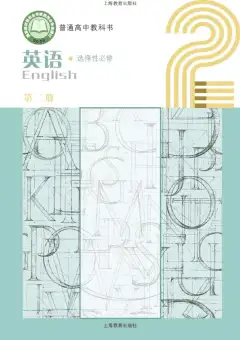
普通高中教科书
第二册
选择性必修
普通高中教科书
第二册
选择性必修
主
编:陈
琳
北京
主 编:陈 琳
副 主 编:张连仲
编 者:刘 晓 李陆桂 张京生 钱建源 徐 浩 雷传利
(按照姓氏笔画排序)
项目策划:王 芳 王 勇
项目负责:张黎新 郎 崧 张 涛
基础教育出版分社:
地 址:北京市西三环北路19 号 外研社大厦 基础教育出版分社(100089)
咨询电话:(010)88819117/88819688
传 真:(010)88819423
本教材是外语教学与研究出版社根据教育部制定的《普通高中英语课程标准(2017 年版)》,在充分
调研和科学论证的基础上推出的中小学“一条龙”英语教材——《英语》(新标准)的高中部分。
本教材的主编为北京外国语大学陈琳教授,副主编为张连仲教授,编写团队包括国内高校的知名专家
学者、教研人员和一线教师。陈琳教授秉承周恩来总理提出的“一条龙”外语教学理念,总结自己从事
外语教育工作70 年的经验,提出了符合中国外语教育实践的教育理论——辩证实践外语教育途径,并在
《英语》(新标准)教材中贯彻实施。
根据教育部2017 年新课程标准的精神,我们启动了《英语》(新标准)高中教材的修订工作。本次
修订全面依托新课程标准要求,坚持陈琳教授的特色理论,由陈琳教授、张连仲教授指导编写团队,在充
分考虑我国英语教育实际学情和教情的前提下,进行了全面的框架重建和内容设计,保证了理论与实践的
紧密结合。
《英语》(新标准)高中教材共分10 册:1—3 册为必修课程教材,4—7 册为选择性必修课程教材,
8—10 册为选修课程中的提高类教材。
选择性必修课程教材与必修课程教材形成递进关系,进一步夯实基础,为学生的深度发展与进阶做好
准备,既适应今后高考的普遍要求,也能够适应学生今后人生和职业发展的语言需求。《英语》(新标准)
选择性必修课程教材的主要特色如下:
一、坚持立德树人根本任务。在教材的选材、内容、语言等各个方面突出学科的育人本质,帮助学生更好
地培育中国情怀,坚定文化自信,拓展国际视野,形成正确的世界观、人生观和价值观。
二、突出学科核心素养的重要性,全面培养学生的语言能力、文化意识、思维品质和学习能力,帮助学生
逐步形成正确的价值观念、必备品格和关键能力。
三、坚持理论与实践的辩证关系。从语言实践的角度设计教材的主题架构、内容结构直至每一项具体活
动,确保有实践、可实践,并通过实践促进提升,帮助学生形成素养,发展素养。
四、遵循“理解—发展—实践”的原则,以“主题”为纲设计单元任务,重要题材在各册教材中均得到体
现,且内容逐步扩展加深、螺旋式上升,符合语言教学规律。
五、语篇题材多样、体裁丰富,语言地道鲜活、难度适中,符合学生的兴趣特点,同时能够提升学生的语
篇意识,丰富语言感知与学习体验。
六、活动设计紧密围绕主题语境,更加突出综合技能的整合训练,充分体现了英语学习活动观;同时强调
交际情境的真实性和丰富性,帮助学生掌握语言技能、建构完善的知识基础,在实践中逐步形成交际
能力,培养在获取信息、处理信息、重构信息过程中的逻辑思维、多元思维和批判性思维。
七、强调学习策略的培养,鼓励学生通过体验、实践、讨论、合作、探究等方式,利用各种学习资源完成
学习任务、解决学习中的困难;同时鼓励学生在学习过程中及时进行自我反思和评价,进一步提升自
主学习能力。
八、融通多元文化,促进文明互鉴。引导学生在增强国家认同的基础上,尊重世界文化多样性,开展灵
活、有效、坚守中国立场的跨文化沟通,提升文化自信。
九、为教师编写了流程清晰、内容丰富的教师用书,帮助教师快速理解教材内容和相关背景知识,明确教
学目标,掌握教学节奏;同时开发了配套的网络教材和其他多媒体配套资源,丰富课程资源,拓展教
学模式。
我们希望,《英语》(新标准)高中选择性必修课程教材能够进一步培养学生的语言能力、文化意识、
思维品质和学习能力等英语学科核心素养,为他们继续学习英语和终身发展打下坚实的基础。
《英语》(新标准)系列教材
高中阶段编委会
前 言
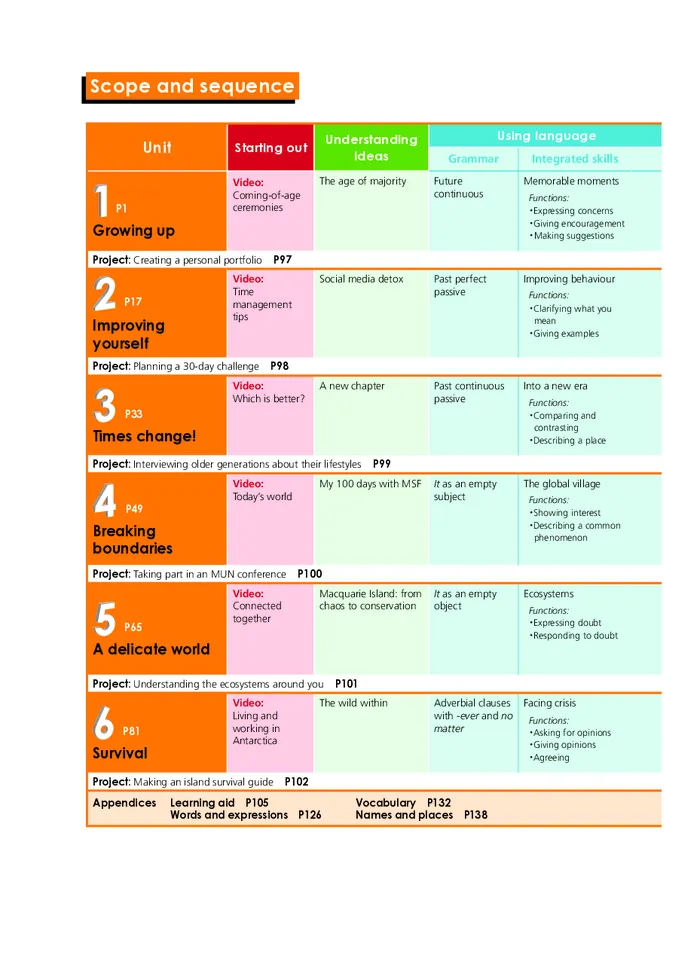
Scope and sequence
Unit
Starting out
Understanding
ideas
Using language
Grammar
Integrated skills
P1
Growing up
Video:
Coming-of-age
ceremonies
The age of majority
Future
continuous
Memorable moments
Functions:
・Expressing concerns
・Giving encouragement
・ Making suggestions
Project: Creating a personal portfolio P97
P17
Improving
yourself
Video:
Time
management
tips
Social media detox
Past perfect
passive
Improving behaviour
Functions:
・Clarifying what you
mean
・Giving examples
Project: Planning a 30-day challenge P98
P33
Times change!
Video:
Which is better?
A new chapter
Past continuous
passive
Into a new era
Functions:
・Comparing and
contrasting
・Describing a place
Project: Interviewing older generations about their lifestyles P99
P49
Breaking
boundaries
Video:
Today’s world
My 100 days with MSF
It as an empty
subject
The global village
Functions:
・Showing interest
・Describing a common
phenomenon
Project: Taking part in an MUN conference P100
P65
A delicate world
Video:
Connected
together
Macquarie Island: from
chaos to conservation
It as an empty
object
Ecosystems
Functions:
・Expressing doubt
・Responding to doubt
Project: Understanding the ecosystems around you P101
P81
Survival
Video:
Living and
working in
Antarctica
The wild within
Adverbial clauses
with -ever and no
matter
Facing crisis
Functions:
・Asking for opinions
・Giving opinions
・Agreeing
Project: Making an island survival guide P102
Appendices Learning aid P105
Vocabulary P132
Words and expressions P126
Names and places P138
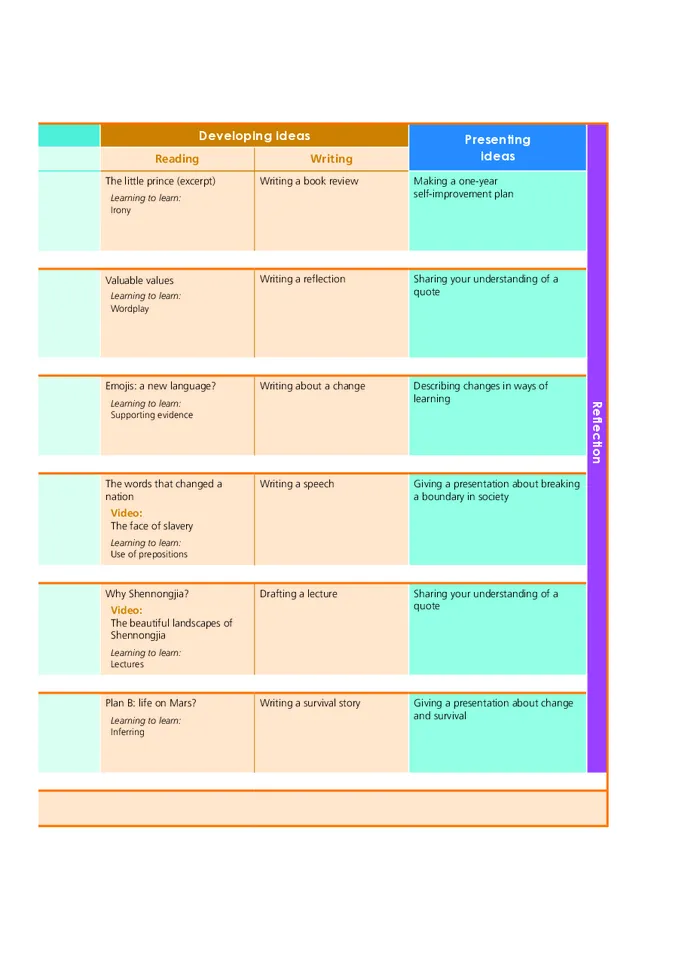
Developing ideas
Presenting
ideas
Reading
Writing
The little prince (excerpt)
Learning to learn:
Irony
Writing a book review
Making a one-year
self-improvement plan
Valuable values
Learning to learn:
Wordplay
Writing a reflection
Sharing your understanding of a
quote
Emojis: a new language?
Learning to learn:
Supporting evidence
Writing about a change
Describing changes in ways of
learning
The words that changed a
nation
Video:
The face of slavery
Learning to learn:
Use of prepositions
Writing a speech
Giving a presentation about breaking
a boundary in society
Why Shennongjia?
Video:
The beautiful landscapes of
Shennongjia
Learning to learn:
Lectures
Drafting a lecture
Sharing your understanding of a
quote
Plan B: life on Mars?
Learning to learn:
Inferring
Writing a survival story
Giving a presentation about change
and survival
Reflection
同学们,欢迎大家继续《英语》(新标准)高中教材的学习!
经过必修课程教材的学习,大家已经打下了更为扎实的英语基础,达到了高中英语学业质量水
平一的要求。现在大家应根据升学或就业的需要,对自己的学习目标提出更高的要求。由教育部制
定并颁布的《普通高中英语课程标准(2017 年版)》明确规定:普通高中英语课程作为一门学习及
运用英语语言的课程,与义务教育阶段的课程相衔接,旨在为学生继续学习英语和终身发展打下良
好基础。普通高中英语课程强调对学生语言能力、文化意识、思维品质和学习能力的综合培养。这
就是同学们在高中阶段学习英语的方向和目标。
要达到这个目标,需要大家的主观努力,也需要一套适应更高更广的语言学习需求的教材。《英
语》(新标准)高中选择性必修课程教材在延续了必修课程教材的基础上,为有升学要求或有个性化
发展需求的学生设计,在话题内容、语言理论、语言技能、跨文化意识、思维能力、学习能力等方
面,都提出了更高的要求,延伸出了如下特点:
一、作为必修课程教材的延续,选择性必修课程教材的话题选择更注意广度和深度,既关注话题的
现实意义,又关注语言学习的思想内涵,充分反映语言的发展和社会的进步,力求培养同学们
的文化意识和思维能力。
二、选择性必修课程教材具体语篇内容的选择将会引导大家进入英语语言学习的较高阶段。课文中
不但会出现更有挑战性的阅读篇章,同时还会根据每个单元的主题补充更多语篇供大家阅读并
赏析,提高语言水平和鉴赏能力。
三、思维方面,选择性必修课程教材对高阶思维做了更多要求,且对思维过程的启动、运行和开展
均做了更多的过程分解与清晰化设计,更强调基于同学们头脑中已有的内容及其再加工,与新
的语言和内容输入相结合,产生更丰富、更复杂的认知互动,深化思维发展活动。
四、在新课标规定的英语学习活动观的指导下,遵循“理解—发展—实践”的原则,对活动的要求
进一步提升,在“功能运用”板块中,将原有的词汇和听力部分整合成综合语言运用活动,通
过创设符合单元主题的话题,设计一系列首尾呼应、前后紧密关联的活动串,灵活融入听、说、
读、看、写等各项技能的训练,兼顾学习策略、功能和文化的引导与思考,帮助大家全方位提
升综合语言运用水平。
五、根据该阶段教学特点、教学内容和教学要求,充分遵循循序渐进的原则,强调对义务教育阶段
和高中必修阶段语言知识的复现、综合练习与重新认识,以形成内化的语用能力。
六、在呈现更为丰富多彩的文化现象的同时,更加强调中外文化对比,尤其是中国文化、中国故事、
中国传统价值观和世界问题的中国视角的介绍,让大家更好地理解文化异同,形成正确的文化
价值观和有利于国家、个人发展的跨文化态度与意识。
七、在单元学习的过程中帮助大家总结学习成果,发现问题并及时解决,最后通过对单元主题、语
言、文化思维等多方面提出问题,帮助大家写出自我反思日志,既完成了对学习目标、语言知
识和技能、思维品质、文化意识等维度的自我评价和总结,更显性体现了学习和思维的过程,
帮助大家进一步培养自主学习和反思总结的能力。
我们衷心希望,同学们能够通过学习本教材,了解到更加丰富的信息,在理解祖国文化、坚定
文化自信的同时,发展跨文化交流能力,更好地适应宽广的世界。愿《英语》(新标准)伴随同学们
度过有意义的高中时代!
致 同 学
1
Watch the video and answer
the questions.
1 What is a coming-of-age
ceremony? How do people
celebrate in the video?
2 Which celebration makes the
greatest impression on you?
Why?
2
Listen and read the poem.
Answer the questions.
1 What is the poem about?
2 According to Kipling, what
qualities does his son need to “be
a Man”? Tick those mentioned
in the poem and add your own
ideas.
self-belief
honesty
confidence
kindness
modesty
pride
integrity
patience
other ____________________
3 Which of these qualities are most
important to you as you grow up?
Growing up
U
n
i
t
If you can keep your head when all about you
Are losing theirs and blaming it on you;
If you can trust yourself when all men doubt you,
But make allowance for their doubting too;
If you can wait and not be tired by waiting,
Or, being lied about, don’t deal in lies,
Or, being hated, don’t give way to hating,
And yet don’t look too good, nor talk too wise;
…
If you can talk with crowds and keep your virtue,
Or walk with kings – nor lose the common touch;
If neither foes nor loving friends can hurt you;
If all men count with you, but none too much;
If you can fill the unforgiving minute
With sixty seconds’ worth of distance run –
Yours is the Earth and everything that’s in it,
And – which is more – you’ll be a Man, my son!
(Excerpts from If – by Rudyard Kipling)
If –
Starting out
1
1
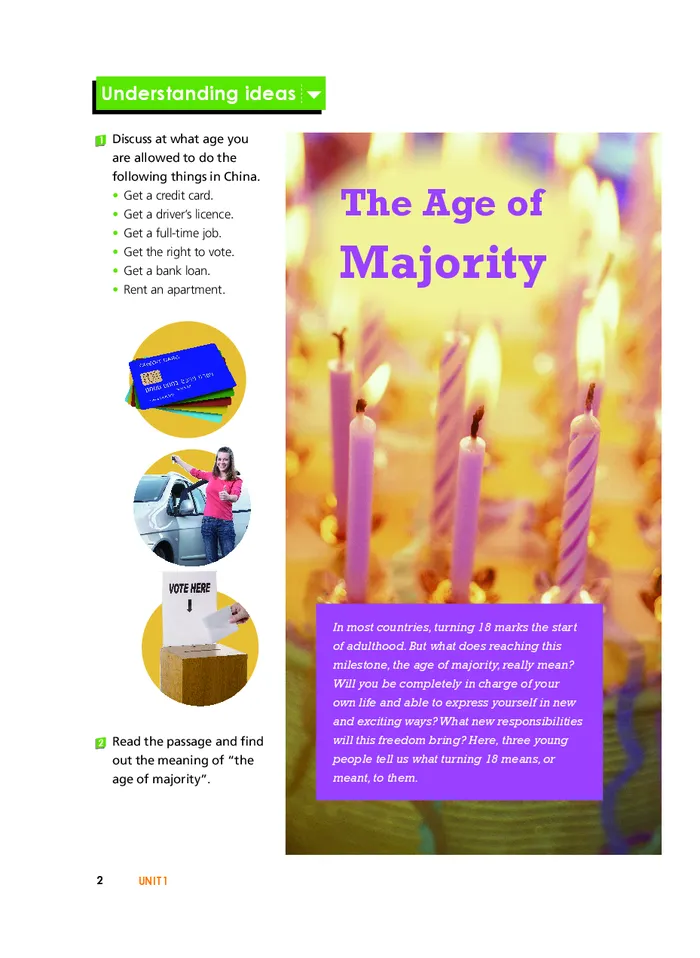
Discuss at what age you
are allowed to do the
following things in China.
• Get a credit card.
• Get a driver’s licence.
• Get a full-time job.
• Get the right to vote.
• Get a bank loan.
• Rent an apartment.
In most countries, turning 18 marks the start
of adulthood. But what does reaching this
milestone, the age of majority, really mean?
Will you be completely in charge of your
own life and able to express yourself in new
and exciting ways? What new responsibilities
will this freedom bring? Here, three young
people tell us what turning 18 means, or
meant, to them.
Understanding ideas
2
Read the passage and find
out the meaning of “the
age of majority”.
Majority
The age of
2
Unit 1
2 I celebrated my 18th birthday just before I went to
university. I expected to feel instantly different, as if I
had closed the door on my childhood and stepped into
a whole new adult world. But it wasn’t like that. When I
woke up the next day, there were still rules to obey and
lessons to attend. In fact, the change has been more subtle
and gradual than I imagined. Instead of being the selfish
teenager I used to be, I have begun to feel more aware
of other people and to develop a stronger sense of social
responsibility. To give an example, I will be signing an
organ donation agreement this time tomorrow. This was
a big decision for me. Of course I asked my parents for
their approval first. Turning 18 also changed the way that
society viewed me. I was really surprised when a bank
contacted me with a credit card offer. Of course, I would
like to have more freedom with money and no doubt I
will be getting a credit card at some point, but I currently
don’t have a steady income, so getting a credit card might
tempt me to spend more money than I have!
Lin Ning
19, Shanghai, China
Bethany
16, Victoria, Australia
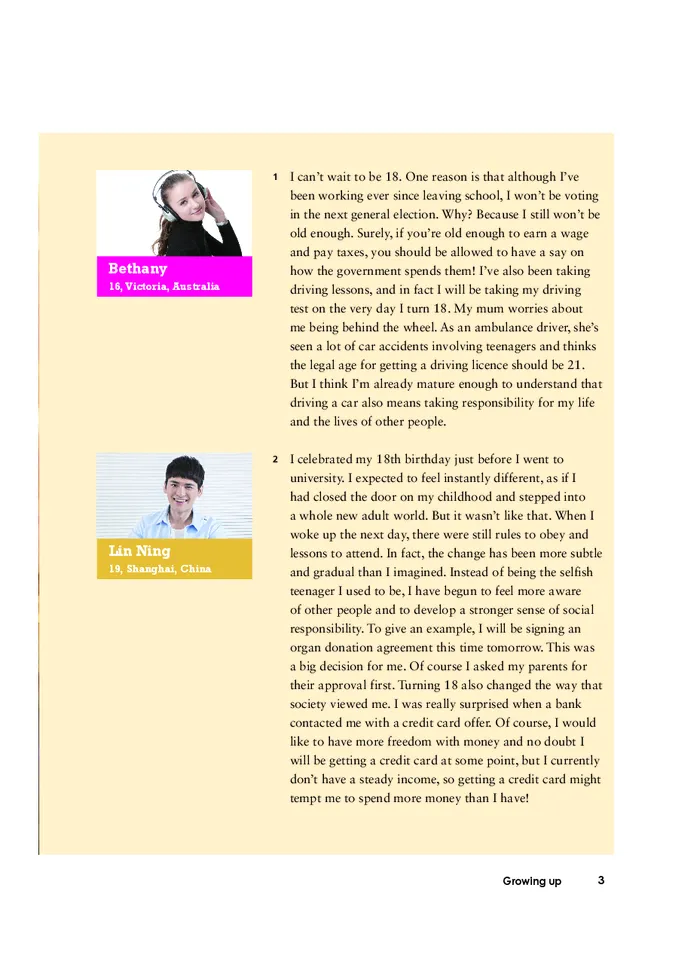
1 I can’t wait to be 18. One reason is that although I’ve
been working ever since leaving school, I won’t be voting
in the next general election. Why? Because I still won’t be
old enough. Surely, if you’re old enough to earn a wage
and pay taxes, you should be allowed to have a say on
how the government spends them! I’ve also been taking
driving lessons, and in fact I will be taking my driving
test on the very day I turn 18. My mum worries about
me being behind the wheel. As an ambulance driver, she’s
seen a lot of car accidents involving teenagers and thinks
the legal age for getting a driving licence should be 21.
But I think I’m already mature enough to understand that
driving a car also means taking responsibility for my life
and the lives of other people.
Growing up
3
3
Choose another suitable title for the passage and give your reasons.
1 Eighteen – the Age of Indecision
2 Teenagers’ Hopes for the Future
3 The Right to Vote – Your Views
4 Turning Eighteen – What Does It Mean?
Morgan
20, Florida, the US
3 People say that 18 marks a new chapter in our lives,
and that we should become more independent. I
used to believe this, but the reality for me has been
very different. I assumed I’d already have a well-paid
job and that I’d be moving into a rented apartment
as soon as I turned 18, but how wrong I was! My
librarian’s salary means that I’ll be living at home with
my parents for a while longer. Because I contribute
to the household bills and my commute to work is
quite expensive, I find it hard to save any money. I’ll
be starting a new job next month, however, so maybe
things will get easier. I know I could get a bank loan to
pay the deposit on my very own apartment, but I don’t
feel ready to make that kind of commitment, and I do
like my mom’s cooking. I guess some responsibilities
are more about attitude than age.
4
Unit 1
Think Share
&
1 Do you think the minimum age limits in the passage are
sensible? Why or why not?
2 What right are you most looking forward to having as an adult? Why?
3 What do you think it means to be a responsible adult?
4 How can you use the language you have learnt in the passage to
express your ideas clearly?
5
Read the sentences from the passage and decide if they are facts (F)
or opinions (O).
1 Surely, if you’re old enough to earn a wage and pay taxes, you should be
allowed to have a say on how the government spends them! _____
2 … I will be taking my driving test on the very day I turn 18. _____
3 When I woke up the next day, there were still rules to obey and lessons to
attend. _____
4 I guess some responsibilities are more about attitude than age. _____
Now look for more opinions in the passage and talk about whether
you agree with them.
Bethany
Lin Ning
Morgan
4
Organise information from the passage and complete the diagram.
I think it’s strange
that I can now take
1_________________, yet
I still can’t vote – I don’t
think that’s fair, given that
2_________________.
I should have a say on
3_________________.
I’m mature enough to
4_________________.
At 18, I can do things
like getting a credit card.
More importantly, I can
act on my desire to help
others, for example by
5_________________.
But although a lot of
doors have opened
for me, there are still
6_________________.
I thought that once I was
18 and in a full-time
job I’d be able to
7_________________,
but my salary is not high
enough. I also find it hard
to save money because of
8_________________ and
high commuting costs.
The Age of Majority
Growing up
5
Future continuous
1
Look at the sentences and answer the
questions. Sentence (a) is from the
reading passage.
a … I will be signing an organ donation
agreement this time tomorrow.
b … I will sign an organ donation
agreement tomorrow.
2
Work in pairs. Take turns to ask
and answer questions based on the
information in the schedule.
3
Complete the email with the correct
form of the verbs in brackets. Use
the future continuous tense where
possible.
4
Write a reply to Diana to tell her about
your own plans for the future.
A: What will you be doing at 8:50?
B: �I’ll be attending the welcoming ceremony.
What will you be doing at 9:30?
A: …
08:45–09:00 welcoming ceremony
09:10–11:30 archery lessons
12:00–13:00 lunch
13:30–15:30 treasure hunt
16:00–18:00 swimming
18:30–19:30 dinner
Dear George,
It’s great to hear from you. Thanks for the
birthday card!
You asked if I have been thinking a lot about
the future now that I’m 17. The answer is
yes! Things change so quickly, don’t they? I
mean, in just a year’s time, I
1____________
(be) an adult. And this time next year, I
2____________ (take) my final school exams.
Hopefully I
3____________ (pass) them! Then,
in a couple of years’ time, I
4____________
(study) at university. It seems like no time at
all! I
5____________ (choose) law, I think.
After graduation, I
6____________ (look) for
a job related to law. In the long term, I hope
that 20 years from today, I
7____________
(work) as a judge. Let’s see how things go.
What are you hoping to do in the future? Tell
me about your plans.
Kind regards,
Diana
From:
Diana
To:
George
Subject: Plans for the future
summer camp
Schedule
1
Day
Using language
1 Which sentence signifies an activity in
progress at a particular time in the future?
2 Why does the author choose to use
sentence (a) instead of sentence (b)?
Now look for more sentences with the
future continuous tense in the reading
passage, and summarise its use in your
own words.
6
Unit 1
Memorable moments
7
Listen again and complete the table.
5
Read the passage and answer
the questions.
1 What is your understanding of
the first sentence?
2 What is the author’s attitude
towards life? Do you agree
with it?
Like a musical symphony, life
has high and low moments,
and somewhere in between
are those moments we call
“bittersweet”. As students, it’s
likely that those moments are
mainly about school life, such
as sitting a major exam, giving
a presentation, or becoming
a boarder for the first time.
But as life continues, we’re
presented with more varied
experiences: starting university,
getting a job and raising a
family. Whatever our choices
are, we should cherish and
embrace these moments in
life. After all, each step we
take is one more step forward
to becoming a stronger and
better person.
6
Listen to the conversation and answer
the questions.
1 What is the relationship between the speakers?
2 What are they talking about?
Concerns
Suggestions
I’ve never been away
from home, so I
don’t know how to
1_________________.
Think how it will
help you prepare for
2_________________,
and ask others
3_________________.
I might have a
different routine to
4_________________
and they might not
be very pleasant to
5_________________.
When living in a group,
6_________________ are
really important.
I will no longer be able
to
7_________________
as much as before if I
have to follow a strict
dorm schedule.
Try joining some clubs.
You might make
8_________________.
I suppose that I will
9_________________.
Speak to them regularly
over the phone or via
10_________________.
Now work in pairs. Talk about other difficulties
the girl may face and make suggestions.
Growing up
7
10
Listen to the conversation and tick the words and expressions mentioned.
8
Complete the boxes with the expressions from the conversation.
• I’m afraid I can’t…
• Don’t be afraid!
• I’m worried that…
• What if…?
• It’s a good idea to…
• I’m concerned that…
• Perhaps you could…?
• How about…?
• Good luck with…
Expressing concerns
Giving encouragement
Making suggestions
9
Work in pairs. Discuss a challenging moment in your life.
have children
learn to walk
graduate from college
leave home
get a job
get married
retire
start school
8
Unit 1
11
Complete the online message board with the correct form of the
words and expressions in Activity 10.
12
Work in pairs. Share a most memorable moment from your life using
the words and expressions in this section.
Now think about your performance. How well did you understand
your partner and give an effective response?
Share your special moments with us!
1 I’ve been working for 40 years and am going to
next month. I’m
going to practise calligraphy in my free time.
5 I first
when I was 16 years old. Serving customers at
a restaurant is hard work but I managed to stick at it.
6 I
before I was one. Mum said I was curious about everything
around me and caused a lot of trouble!
7
is the greatest thing that’s happened to us. They bring us so
much happiness, despite the hard work.
8 When I got a full-time job, I decided to
and rent my own
apartment. I enjoy the freedom and the sense of independence.
2 I’ll
this June, and leave the campus I’ve lived on for four years.
3 We
in our early 20s. We’ve had our ups and downs, but we’ve
now been married for ten mostly happy years!
4 I was a little scared when I
at six years old. But I soon made a
lot of new friends and fell in love with school!
Growing up
9
1
Read the introduction to Antoine
de Saint-Exupéry and answer the
questions.
1 What experience made the author write
The Little Prince?
2 What kind of person do you think Saint-
Exupéry was?
2
Look at the three drawings and predict
what the story is about.
Now read the passage and check your
prediction.
Antoine de Saint-
Exupéry (1900–1944)
was a French writer and
pilot. As a young boy,
he was obsessed with
aeroplanes, riding in one
for the first time at the
age of 12. He spent much of his life flying
and writing about his adventures. Saint-
Exupéry’s most successful work, The Little
Prince, is one of the best-selling books ever
published. The story was probably inspired
by his plane crash in the desert in 1935.
Saint-Exupéry nearly died, and wandered
around for four days before being rescued.
In 1944, Saint-Exupéry left on a wartime
mission over occupied France, from which
he never returned. Although the remains of
his plane were discovered in 2000, Saint-
Exupéry’s body has never been found, and
the cause of his death remains unknown.
Developing ideas
The Little
Prince
1 Once when I was six years old
I saw a magnificent picture in a
book, called True Stories from
Nature, about the primeval forest.
It was a picture of a boa constrictor
in the act of swallowing an animal.
Here is a copy of the drawing.
2 In the book it said: “Boa
constrictors swallow their prey
whole, without chewing it. After
that they are not able to move, and
they sleep through the six months
that they need for digestion.”
3 I pondered deeply, then, over the
adventures of the jungle. And after
some work with a colored pencil
I succeeded in making my first
drawing. My Drawing Number
One. It looked like this:
10
Unit 1
4 I showed my masterpiece to the grown-
ups, and asked them whether the
drawing frightened them.
5 But they answered: “Frighten? Why
should anyone be frightened by a hat?”
6 My drawing was not a picture of a hat.
It was a picture of a boa constrictor
digesting an elephant. But since the
grown-ups were not able to understand
it, I made another drawing: I drew the
inside of the boa constrictor, so that
the grown-ups could see it clearly. They
always need to have things explained.
My Drawing Number Two looked like
this:
7 The grown-ups’ response, this time, was
to advise me to lay aside my drawings
of boa constrictors, whether from the
inside or the outside, and devote myself
instead to geography, history, arithmetic
and grammar. That is why, at the age
of six, I gave up what might have been
a magnificent career as a painter. I
had been disheartened by the failure
of my Drawing Number One and my
Drawing Number Two. Grown-ups never
understand anything by themselves, and
it is tiresome for children to be always
and forever explaining things to them.
8 So then I chose another profession, and
learned to pilot airplanes. I have flown a
little over all parts of the world; and it is true
that geography has been very useful to me.
Growing up
11
3
Choose the author’s attitude towards grown-ups and find evidence to
support your choice.
1 Grown-ups are more practical than children. They want to teach children
knowledge that will be useful in the future.
2 Grown-ups are no better than children. They lack imagination and only
care about matters of consequence.
3 Grown-ups are more knowledgeable than children. They can understand
everything by themselves.
At a glance I can distinguish China from Arizona. If one gets lost in the
night, such knowledge is valuable.
9 In the course of this life, I have had a great many encounters with a great
many people who have been concerned with matters of consequence. I
have lived a great deal among grown-ups. I have seen them intimately,
close at hand. And that hasn’t much improved my opinion of them.
10 Whenever I met one of them who seemed to me at all clear-sighted, I
tried the experiment of showing him my Drawing Number One, which I
have always kept. I would try to find out, so, if this was a person of true
understanding. But, whoever it was, he, or she, would always say:
11 “That is a hat.”
12 Then I would never talk to that person about
boa constrictors, or primeval forests, or stars.
I would bring myself down to his level. I
would talk to him about bridge, and golf,
and politics, and neckties. And the grown-up
would be greatly pleased to have met such a
sensible man.
(Excerpt from The Little Prince by Antoine de
Saint-Exupéry)
12
Unit 1
… I have had a great many encounters
with a great many people who have been
concerned with matters of consequence.
And the grown-up would be greatly
pleased to have met such a sensible man.
1 What does the author really mean by
these sentences?
2 What figure of speech does the author
use? How does this figure of speech
help to express the author’s attitude?
4
Read the sentences from the passage
and answer the questions.
Think Share
&
1 What were the grown-
ups’ responses to the author’s
Drawing Number One and Drawing
Number Two? Why do you think they
responded in this way?
2 According to the author, what is a
child’s most valuable trait? Do you
agree with him?
3 After reading the two passages in
this unit, think about what you may
acquire and lose as you grow up.
Share your ideas with the class.
Irony is a subtle figure of speech that refers
to things one says that are the opposite of
what one really means. It has a humorous,
emphatic or sarcastic effect. For example:
Fine, don’t buy me an airline ticket. I’ll just swim
across the ocean!
Learning to learn
Opinions:
Examples:
5
Work in groups. Give a talk about your
attitude towards grown-ups.
1 Decide whether you agree with the
author’s attitude towards grown-ups
and why.
2 Think of some examples to support your
opinions and make notes.
3 Organise your talk following the steps
below.
• Explain the author’s attitude towards
grown-ups.
• State your own opinions.
• Give supporting examples.
• Conclude by summarising your
opinions.
4 Give your talk to the class.
Now think about your performance
during the group discussion. How
well did you actively participate and
contribute ideas?
Growing up
13
6
Read the book review and find the information on the right.
Writing a book review
Book review
The Little Prince was written and illustrated by the French writer
Antoine de Saint-Exupéry during World War II. It is a children’s
fantasy book, but it is also enjoyed by adults.
It tells a story about a pilot who has crashed in the desert.
While he is trying to fix his aeroplane, a little prince comes to
him. Visiting from another planet, the little prince recounts his
adventures to the pilot, and the two become friends.
The book talks about the importance of looking beneath
the surface of things to uncover their real meanings. I like
it because it is simple, and yet it really made me think a lot
about life and death, love and responsibility, friendship and
loneliness. One of the most memorable characters in the book
is a rose, which the little prince fell in love with. I was really
touched by the line – “It’s the time you
spent on your rose that makes your rose
so important.” – because it shows how
we form special bonds with others by
caring and taking responsibility
for them.
Personally, I think this is a touching
book that everyone should read,
whatever their age.
The Little Prince
14
Unit 1
• the title of the book
• the name of the author
• the genre
• a memorable character
• a quote from the book
7
Read the book review again and answer the questions.
1 What is the plot of the book?
2 What is the key message of the book?
3 What does the reviewer think of the book?
8
Choose a book that means a lot to you. Plan a review of it and
make notes.
9
Work in pairs. Make improvements to each other’s book reviews
and share them with the class.
Now write your book review.
General facts about the book:
Plot of the book:
Comments:
Conclusion and recommendation:
Growing up
15
Presenting ideas
Write a reflection after completing this unit. Consider the following:
1 What is your understanding of growing up?
2 What text types have you learnt about? What are their features?
3 What words, expressions and structures have you learnt?
4 What improvement have you made in understanding different cultures?
5 What improvement have you made in using learning strategies and exploring effective
ways of learning?
6 What improvement have you made in analysing and solving problems?
Reflection
1
Work in groups and discuss how to make a one-year
self-improvement plan. Consider the following:
• what you have learnt from the past
• what you plan to achieve
• what you plan to avoid
• what you plan to overcome
2
Complete the table to help you draft your plan.
Goals
What to do
healthy living
Eat more fruit and vegetables.
Drink more water. Do exercise
three times a week.
positive thinking
3
Share your draft with your group and suggest ways to
make improvements to each other’s plans.
4
Prepare a short presentation about your plan. Consider
the following:
1 the structure of your presentation
2 useful words, expressions and structures
5
Give your presentation to the class. Check your
self-improvement plan one year from now to see if you
have achieved your goals.
16
Unit 1
Improving yourself
1
Watch the video and answer
the questions.
1 What is the video about?
2 What other tips are there to
make full use of your time?
Share your ideas with the class.
2
Complete the questionnaire
and find out how good your
self-control is.
U
n
i
t
Starting out
1 Do you ever lose your temper with your family, friends,
or classmates?
a Never.
b Sometimes. c Always.
2 Do you find it difficult to resist temptations such as
junk food?
a Never.
b Sometimes. c Always.
3 Do you have any bad habits that you cannot break?
a None whatsoever! b Some. c Where do I start?
4 Do you sometimes fail to get work done because you
cannot concentrate?
a Never.
b Sometimes. c Always.
5 Do you ever offend people by speaking carelessly?
a Never.
b Sometimes. c Always.
Turn to pages 110–111 to find out your result.
Self-control
Questionnaire
17
1
Read the facts and answer
the questions.
1 What conclusions can you draw
from the facts?
2 How much time do you spend
on social media each day? What
negative effects does this have
on you?
2
Look at the title of the passage
and the pictures. Predict what
the passage is about.
Now read the passage and check
your prediction.
• On average, Chinese Internet users
each spend two hours a day on social
media: a total of 730 hours each year.
• The average age of social media users
in China in 2017 was 33.1 years old, as
against 32.4 in 2016 and 31.2 in 2015.
• The top four negative aspects of social
media as ranked by Chinese users
are: reduced time for reading printed
books, poorer eyesight, privacy and
information security concerns, and
reduced sleep time.
I lasted two days. The detox was more
difficult to tolerate than I had expected. I
felt like I had lost an arm! Not eating for
two days would have been easier! But on
reflection, I can see how much of my time
had been occupied with checking my phone.
I’m now trying to spend less time online and
more time picking up my hobbies.
Today marks the last day of the
Social Media Detox, Brenton High’s
fundraising campaign for new sports
equipment. At the start of the detox,
over 100 students had been persuaded to stop using
social media, in ANY form, for seven days. This
meant no messaging friends, no posting photos, no
blogging – nothing. They had been promised money
by family and friends for each day spent without
using social media. They were excited. They were
nervous. But could they do it?
With the detox now finished, they’ve switched on
their devices and they’re back online. I bet you’re
as eager as I am to find out just how many have
been motivated enough to last the full seven days!
And what, if anything, has been learnt from the
experience?
Anna
17
Moderator
Understanding ideas
18
Unit 2
Social media detox
Devon
16
Cindy
18
I lasted four days. On Monday, my classmate and I spoke
about what we did at the weekend – it felt really strange
not to already know what he had done. We would usually
have posted pictures and updated our profiles. Doing the
detox meant we had to talk and explain what we were
doing and thinking! It made me realise the value of real
contact that I had forgotten.
I managed the whole week! At first, I really felt I was
missing out. Then, instead of messaging my friend, I
went round to her house. Without our phones, we had a
proper conversation for over two hours, without being
distracted by messages from other people. It felt so good!
Then I decided to visit a different friend every day. By the
fifth day, I wondered – was I really missing out by not
constantly checking my phone to see what everyone else
was up to?
Improving yourself
19
3
Choose the benefits of the social media detox and find evidence to
support your choices.
1 It helped students learn how to best communicate using social media.
2 It raised money for school sports equipment.
3 It made students want to spend even more time on social media.
4 It made students realise how much time they had been spending on
social media.
5 It encouraged students to find new ways to communicate and try new
activities.
Max
17
The detox raised a total of £1,632.82 for new
school sports equipment! Well done, everyone
who took part! After reading the posts on this
forum, it seems that something other than
money has also been raised through the detox.
Awareness of just how much we rely on social media can
help us step away from it and communicate with each
other better.
Moderator
I did all seven days, too! To be honest, I didn’t find the
detox too difficult, but I did give my phone to my dad to
avoid giving in! My brother thought I should make full
use of the time without my phone, so he took me to check
out our local sports centre. An hour’s sport each day left
me tired out and wanting to go to bed early. The detox
made me healthier!
I’m embarrassed to say that I threw in the towel on
the first day! I knew there was a party happening that
evening, but without access to social media I couldn’t
remember where it was! In the end, I turned on my phone
to check, but couldn’t resist having a quick look at my
social media accounts. What’s worse, I then spent so much
time catching up on news, I almost missed the party!
George
16
20
Unit 2
Think Share
&
4
Organise information from the passage and complete the summaries.
Now work in pairs. Choose the person that you most identify with and
give advice on what they should do next.
Devon
Reaction: When he saw a
classmate on Monday, he felt
3____________ not to already
know what his classmate had done
at the weekend.
Result: They had to talk and
explain what they were doing
and thinking! It made him realise
4____________.
Cindy
Reaction: At
first, she really felt
5____________.
Result: Without their
phones, she and her
friend
6____________
for over two hours.
By the fifth day, she
realised that she hadn’t
been missing out on
anything.
George
Reaction: He didn’t find the detox too
difficult, but he did give his phone to his
dad to avoid
7____________.
Result: An hour’s sport each day left him
tired out and ready for bed early. The detox
made him
8____________!
Max
Reaction: He
9____________ on the first
day. He used his phone to check where a
party was.
Result: He spent so much time using his
phone to
10____________ on social media,
and he almost missed the party.
Social
Media
Detox
Anna
Reaction: It was more
difficult than she had
expected. She felt like
1____________!
Result: She can now
see how much time
had been taken up
with checking her
phone. She is now
trying to spend more
time
2____________.
2 Days
4 Days
7 Days
7 Days
Less than 1 Day
1 What is your understanding of “something” in “After
reading the posts on this forum, it seems that something
other than money has also been raised through the detox”?
2 Do you think the detox was worthwhile? Why?
3 What would you do if you had to give up social media for a week?
4 Have you encountered any difficulties in understanding the main idea
of the passage? Share them with the class and ask for advice.
Improving yourself
21
a At the start of the detox, over 100 students had been persuaded to
stop using social media, in ANY form, for seven days.
b At the start of the detox, people had persuaded over 100 students to
stop using social media, in ANY form, for seven days.
1 Were the students in sentence (a) persuaded before the detox started,
or afterwards?
2 What is the difference between sentences (a) and (b)?
3 Why does the author choose to use a passive form instead of an
active form?
Now look for more sentences with the past perfect passive in the
reading passage, and summarise its use in your own words.
2
Complete Jack’s blog post with the correct form of the verbs in
brackets.
1
Look at the sentences and answer the questions. Sentence (a) is from
the reading passage.
Before I turned over a new leaf, I had always been
a very lazy student. I was careless about handing in
my homework, and none of my assignment deadlines
1____________ (meet). Indeed, I would deliberately
“lose” my homework in my incredibly messy room, so that I could put off
2____________ (do) it! My parents soon worked out this trick, though, and
one day I came home to find that my room
3____________ (clean), and
my homework
4____________ (put) right in the centre of a spotlessly clean
desk! A present
5____________ (leave) on the desk, too (I think Mum did
that): a book called The Art of Procrastination.
The author, John Perry, said that procrastination was about
6____________
(avoid) the hardest and most important tasks. So,
7____________ (make)
sure you do your homework, put it second or third on your to-do list, not
at the top. Then put one or two really hard things you don’t want to do at
the top of the list. You will procrastinate to avoid the hard stuff – by doing
your homework!
Posted by Jack at 13:34
Using language
Past perfect passive
22
Unit 2
4
Work in pairs. Talk about what had happened before you started a new habit of your
own. Use the past perfect passive where appropriate.
Yesterday morning
Two weeks ago
3
Work in pairs. Describe the pictures using the past perfect passive.
Improving behaviour
5
Match the sentences to the signs. Pay attention to the words and expressions in bold.
1 Do not litter.
2 Do not talk loudly in public.
3 Do not spit in public.
4 Do not walk on the grass.
5 Do not smoke.
6 Do not take photos.
a
d
b
e
c
f
Jack started the habit of cleaning his
room last week. This is what his room
looked like yesterday morning.
But two weeks ago, Jack’s room was
like this: …
Improving yourself
23
6
Complete the conversations with
the correct form of the words and
expressions in Activity 5.
1 A: What do you do when people
__________________?
B: I put my headphones on. I don’t want to
hear other people’s conversations.
2 A: How can we stop people
__________________?
B: We should tell them it’s dirty and it
can spread diseases.
3 A: What would you do if you saw
people __________________?
B: I would go up to them and ask them
to put the litter into a rubbish bin.
4 A: How can we prevent people from
__________________?
B: If we keep the grass looking really
neat, maybe people will realise they
shouldn’t walk on it.
5 A: What would you do if you saw
someone __________________ where
it’s not allowed?
B: I’d politely remind them it’s not
permitted, and that they should be
considerate of others.
6 A: What would you do if you saw someone
__________________ in a museum?
B: I’d ask them to stop, because it can
damage the exhibits.
Now work in pairs. Think of more types
of inappropriate behaviour and talk
about what you think is the right thing to
do when faced with them.
7
Listen to the interview and choose a
topic for it.
1 How to promote values education.
2 How to inspire students to work hard.
3 How to introduce school programmes.
4 How to fairly distribute books and
umbrellas.
8
Listen again and complete the
newspaper report.
A school in our city came up with an
innovative programme to promote the
traditional value of
1_________________.
School principal Ms Wu gave several
examples of how the programme works.
To begin with, the school introduced
an activity called the “unsupervised
examination” for some of the classes.
That means during this examination,
there is no teacher
2_________________.
Before taking this examination, students
first need to
3_________________.
Students generally expressed that it’s
good to feel
4________________ and they
quite enjoyed
5_________________ in the
24
Unit 2
9
Complete the boxes with the
expressions from the interview.
10
Work in groups. Discuss how to
promote values education at your
school using the words and expressions
in this section.
Now talk about how well you did in
offering effective advice or ideas and
developing effective solutions in the
group discussion.
• I can give a couple of examples.
• That is…
• Let me clarify…
• For instance, …
• I mean…
• Take… as an illustration.
• To put it another way, …
Clarifying what you mean
Giving examples
Now work in pairs. Talk about the
significance of promoting values
education in schools.
examination. In turn, they developed
6_________________.
The school also introduced what is
called the
7“_________________”.
Printed on each umbrella
was a short statement about
8_________________. At the end
of the term, all the umbrellas were
returned
9_________________. None
of them had been lost or damaged.
Now Ms Wu and her colleagues
plan to introduce the programme
to
10_________________. Everyone
needs to work together to build a
culture of honesty. They hope
more teachers and students will
get involved.
Improving yourself
25
1
Look at the chart and answer
the questions.
V
aluable
Values
1 What are the top three things students
from this school spend their money on?
2 What else do you think students often
spend their money on?
Now think about what you spend your
money on. Draw a chart to show your
spending habits and share it with the class.
2
Read the passage and find out the
meaning of the title.
Wordplay uses the sounds and meanings
of similar words in an amusing or clever
way, for example: I was trying to discover how
lightning worked, and then it struck me! It can
also be used to reinforce the meanings of
themes: in the title The Importance of Being
Earnest, “Earnest” is an adjective as well as a
character’s name.
Learning to learn
Developing ideas
1 The spending power of young people
varies from person to person. Each,
however, is faced with the same
question: what to do with their
money? Some handle this less well
than others. Recent headlines have
seen more and more teens maxing out
their parents’ credit cards on games or
other online activities.
2 In contrast to these big spenders, there
are also teens that prove age is no
barrier to making good use of money.
With the help of her grandmother,
eight-year-old Khloe Thompson
started making “Kare Bags” for the
Spending
snacks
books and magazines
clothes
sports
computer games
parties
school supplies
films and concerts
other
presents
15.5%
11.7%
17.5%
17.5%
5.8%
3.9%
9.7%
1.9%
5.8%
10.7%
Spending habits of students at
No.1 Senior High School
26
Unit 2
homeless people in her district. Inside the
bags are necessities such as toothpaste,
soap and socks, bought first with her
pocket money and then through crowd
funding. These items helped to make the
lives of poor and homeless people a little
bit easier. On receiving a Kare Bag, one
woman said, “You make me feel like a
human being.”
3 However people intend to use their money,
managing it seems to be unprecedentedly
important to younger generations. A 2016
study said 17 states of the US require high
school students to take courses in personal
finances. For those who have no access to
courses, help might be at hand thanks to
Jerry Witkovsky and his method of using
four jars to teach teenagers how to spend
their money wisely.
4 When Jerry’s grandchildren turned 13, his
present to each of them was three jars: one
for Spending, one for Saving, and another
for Giving – he has since added a fourth
jar for Investing. It was from then on that
his grandchildren started to be in control
of what to do with the money they receive:
spend, save, invest or give? Jerry’s birthday
present to his grandchildren is, however,
much more than money and a few jars –
he is giving them the opportunity to learn
lifelong values.
5 The value taught with the Spending jar
is that you are responsible for your own
happiness. Money gives you independence
and the opportunity to buy something
you like. After all, it’s OK to be nice to
yourself!
Investing
Saving
Giving
27
Improving yourself
6 While the Spending jar is about the here and now, the Saving jar gives
you a vision for the future. This could involve saving for university, but
it could also mean saving for that special something you’ve seen in the
stores – it’s up to you.
7 The Investing jar not only represents a vision for the future, but gives the
opportunity to build for the future. Although this could likewise involve
putting aside money for your university education, it also means investing
in yourself.
8 The Giving jar is all about kindness and helping. Whether you want
to help out a friend, give money to an animal charity or to children in
another country, it’s your money to give to whatever cause you believe in.
9 The wider aim of the jars is to encourage teenagers to think more
objectively about money and the things that it can do, so that they grow
up understanding, if you like, the value of the valuable. In this way, they
will be better equipped in their adult lives to make informed choices about
how they use the money they have. Indeed, the small change inside their
jars could mean a big change in how they manage their money.
28
Unit 2
Think Share
&
1 Why does the author use the example of Khloe Thompson?
2 How does the passage inspire you to improve your spending habits?
3 If you were given 1,000 yuan, how much money would you put in each jar?
Give your reasons.
4 What methods of self-management have you learnt in the two reading passages in
this unit? What else do you need to improve?
4
Work in groups. Give a talk about your understanding of the values represented by
the four jars.
1 Read the passage again and think about which jar you believe is the most important.
2 Organise your ideas by completing the notes.
3 Share your ideas with the group.
4 Choose a group member to summarise your group’s opinions to the class.
Now think about the method Jerry Witkovsky used to give advice. How did it help
you to better understand the topic?
The most important jar:
Supporting examples:
Reasons:
3
Organise information from the passage and complete the diagram.
It is all about
7_________________.
Whoever or whatever the recipient,
it’s your money to give to
8_________________.
Valuable
Values
You are responsible for
1_________________. Money gives you
independence and
2_________________.
It gives you a vision for
3_________________. This could involve
saving for university or saving for
4_________________.
It represents a vision for the future and
the opportunity to
5_________________.
In addition to putting money aside
for university education, it also means
6_________________.
Spending jar
Investing jar
Giving jar
Saving jar
Improving yourself
29
30
Unit 2
5
Read the story and answer the questions.
Writing a reflection
There once was a little boy who had a
bad temper. His father gave him a bag
of nails and told him that every time he
lost his temper, he must hammer
a nail into the back of the fence.
The first day, the boy hammered so many
nails into the fence that his father had to give him a whole new
bag. Over the next few weeks, as he learnt to control his anger, he
hammered fewer and fewer nails into the fence each day. He had
learnt that it was easier to hold his temper than to hammer nails
into the fence. Finally, the day came when the boy didn’t lose his
temper all day, not even once. He told his father, who said that
now the boy should pull out one nail for each day that he was
able to hold his temper.
The days passed by and the boy was finally
able to tell his father that all the nails were
gone. The father took his son and led him
to the fence. He said, “You’ve done well,
son, but look at all the holes in the fence!
That fence will never be the same. When you
say something in anger, it leaves a hole in
someone’s heart, just like your nails have left
holes in the fence. It doesn’t matter how many
times you say sorry. The hole is still there.”
Now write your reflection.
7
Work in pairs. Make improvements to
each other’s reflections and share them with
the class.
6
Make notes about the story in Activity 5.
Summary of the story:
My thoughts:
Conclusion:
Improving yourself
31
1 What aspect of self-management
is the passage about?
2 What message do you think the
story conveys?
Presenting ideas
Write a reflection after completing this unit. Consider the following:
1 What is your understanding of self-management?
2 What text types have you learnt about? What are their features?
3 What words, expressions and structures have you learnt?
4 What improvement have you made in understanding different cultures?
5 What improvement have you made in using learning strategies and exploring effective
ways of learning?
6 What improvement have you made in analysing and solving problems?
Reflection
1
Work in groups. Talk about the meanings of the
quotes and complete the table.
Quotes
Meanings
a
b
c
d
e
2
Choose one quote and make notes.
What is the main message of the quote?
What can you learn from this quote?
What example(s) can you find to support this quote?
3
Prepare a short presentation about the quote.
Consider the following:
1 the structure of your presentation
2 useful words, expressions and structures
4
Give your presentation to the class.
Procrastination is like a credit
card: it’s a lot of fun until you get
the bill.
�
Christopher Parker
b
No man is free who is not
master of himself.
�
Epictetus
c
Change your thoughts, and you
change your world.
�
Norman Vincent Peale
d
Don’t say you don’t have enough
time. You have exactly the same
number of hours per day that
were given to Helen Keller,
Pasteur, Michelangelo, …
Leonardo da Vinci, Thomas
Jefferson, and Albert Einstein.
�
H. Jackson Brown Jr
e
The superior man must be watchful
over himself when he is alone.
�
Zengzi
君子必慎其独也。
曾子
a
32
Unit 2
Times change!
33
Times change!
1
Watch the video and answer the
questions.
1 What is the video about?
2 Which do you prefer, a faster pace
of life or a slower pace of life?
2
Look at the pictures and answer
the questions.
1 What kinds of changes do the
pictures show?
2 What else can you think of that
has changed in recent decades?
3 Imagine you could travel 40 years
back in time. What would you
want to experience? Why?
U
n
i
t
33
Starting out
34
Unit 3
1
Look at the charts and answer
the questions.
1 What information do the charts show?
2 What conclusions can you draw from
these charts?
2
Look at the title of the passage and the
pictures. Think about what the title means.
Now read the passage and check your
answer.
1 The day I heard that the Rainbow
Bookstore was closing after 50 years
of business, I was heartbroken. The
bookstore, which was a legendary
fixture in the neighborhood, was a
place where anyone could drop in
and connect through their love
of books.
2 When I hurried to the store, I saw
that the books were already being
packed into boxes. I had a long chat
with Casey, the store’s elderly owner.
Sighing deeply, he told me how it
was becoming difficult to run an
independent bookstore. Most young
people preferred reading e-books on
tablets. More and more customers
were being attracted by chain stores
and online discounts. I tried to think
of some words of sympathy, but I
Sales made by physical bookstores
in China (hundred million yuan)
338
330
344
308
344
212
109
2011
2013
2015
2017
2019
2021
2023
0
100
200
300
400
500
Sales made by online bookstores
in China (hundred million yuan)
A
New
Chapter
2011
2013
2015
2017
2019
2021
2023
90
170
280
459
775
715
803
0
200
400
600
800
1000
Understanding ideas
Times change!
35
had to admit that the Rainbow Bookstore
couldn’t stay in business much longer.
3 Childhood memories came back to me
so clearly, as if the events had happened
only yesterday. A bunch of us kids would
frequently drop by the store after school.
We’d look at the new books, or just chat
with Old Casey. He knew every book
in the store and would always pick the
perfect one for us from a dusty shelf.
We spent hours reading, seated on the
store’s old but comfortable furniture.
Casey encouraged us to share our ideas
and comments on the books, by writing
them on a large board in one corner of
the store.
4 When I left the bookstore, it was
becoming cold and dark outside. I turned
to wave goodbye to Casey, but both he
and his bookstore were already hidden
in a thick mist. It made me realize that
the bookstore and all that Old Casey
had given to the community could soon
disappear for good.
5 A few months later, I was back in the
neighborhood during my spring break
and was surprised to see that the Rainbow
Bookstore was still there and open for
business. Its old brick exterior hadn’t
changed, but inside it was like a different
world. In one area, a book reading was
being delivered. Nearby, customers were
poring over shelves selling stationery,
posters and other best-seller-themed gifts.
The large board in the corner had been
replaced by a big screen, where customers’
comments on the month’s best-seller were
being displayed. Clearly, the Rainbow
Bookstore was in good, creative hands.
36
Unit 3
6 I was told that the community had decided to work together on a
campaign to save the Rainbow Bookstore. The campaign had been led by
Jennifer Oakley, a saleswoman who had grown up in the neighborhood
and who had now taken over the bookstore from Casey.
7 Under Jennifer’s leadership, the bookstore was being turned into a place
for literature-loving members of the community to get together. It had a
café selling organic food, and there were now more community events
such as book readings, poetry recitals and even jazz concerts and movie
nights, where people could gather to share an experience that couldn’t
be downloaded.
8 I joined Casey, who was looking
up at the screen on which readers’
comments kept popping up. “Well,
as you can see, corporate knowledge
combined with creativity has brought
my humble bookstore into the 21st
century! I’m so pleased to see that
everything I wanted it to offer to the
community is still here.”
3
Choose the ideas conveyed in the passage and find evidence to
support your choices.
1 Traditional bookstores can’t compete with large bookstore chains.
2 People’s love of reading never changes.
3 Technology has been a key factor in bringing the Rainbow Bookstore back
to life.
4 Creativity plays an important role in the new Rainbow Bookstore.
Times change!
37
Think Share
&
1 Do the author’s childhood memories make the passage
more appealing? Why or why not?
2 What do you think of the changes made to the bookstore?
3 What changes do you think will happen to the bookstores
around you?
4 How does the diagram help you to better understand the passage?
Now describe the author’s feeling towards the Rainbow Bookstore in
your own words.
4
Organise information from the passage and complete the chart.
• owned by Casey
Old Bookstore
• owned by Jennifer
New Bookstore
Similarities
• sells books
38
Unit 3
a When I hurried to the store, I saw that
the books were already being packed
into boxes.
b When I hurried to the store, I saw that
the books were already packed into
boxes.
1 What is the difference between
sentences (a) and (b)?
2 Which sentence emphasises process and
which emphasises result?
Now look for more sentences with the
past continuous passive in the reading
passage, and summarise its use in your
own words.
2
Rewrite the passage using the past
continuous passive.
3
Look at the two groups of pictures
and describe the changes in the news
industry using the past continuous
passive where appropriate.
1
Look at the sentences and answer the
questions. Sentence (a) is from the
reading passage.
Walking home a few days ago, I saw
that people were doing reconstruction
work on the old market. It would be
turned into a modern shopping mall.
Some people were tearing down the old
gate. Some were removing the wooden
stands. Some were clearing away rubbish
from the floor. While all this was going
on, a journalist was taking photos. The
resulting story in the local newspaper
divided the people of the town: some
were in favour of the new shopping mall,
and some were against it.
Using language
Past continuous passive
3
news / print / paper
1
interview / do / face to face
4
newspaper / deliver / at the door
2
news / edit / pen
Times change!
39
4
Describe the changes in another industry
using the past continuous passive where
appropriate.
Yesterday, I watched a documentary
about the news industry in the past.
I saw that an interview was being
done face to face. But now, interviews
can be done online…
5
Read the passage and answer the questions.
Pay attention to the expressions in bold.
1 What is the passage about?
2 Can you explain the meaning of the expressions
in bold in your own words?
More than 40 years ago, China began to
implement the reform and opening-up
policy, starting out on a journey that would
pave the way for China to become a fully-
modernised socialist country. The policy
has had a great influence on Chinese
society. It has allowed China to accomplish
in just four decades what took Western
industrialised countries more than 200
years to achieve, breaking new ground
in the history of human achievement.
This ongoing journey is allowing China to
share the fruits of its success and develop
further alongside other countries. What’s
more, the Belt and Road Initiative will mean
a new dawn for trade and investment
between countries, leading into a new
era of prosperity.
Into a new era
news / release / the Internet
interview / do / online
news / read / online
news / edit / computer
40
Unit 3
7
Listen to the interview and choose its purpose.
1 �To find out what changes Shenzhen has undergone after the introduction
of the reform and opening-up policy.
2 �To understand how people feel about the way life has changed in
Shenzhen this century.
3 �To show what the first special economic zone looks like now.
4 �To figure out how life is different for the older and younger generations
in Shenzhen.
6
Complete the speech with the correct form of the expressions
in Activity 5.
Dear friends,
Thank you for coming together to celebrate the first anniversary of Tech-Hub
Business Park. It’s great to see so many of you representing the many different
companies that have made the park their professional home. What started
as an idea by local entrepreneurs
1_____________________ for this town to
become known as a centre of technology and formed a solid basis for future
business development.
Like everyone else in this town, we are proud that the Tech-Hub companies
continue
2_____________________ in technology. Such innovation will,
without doubt,
3_____________________ of technological discovery.
What’s more, it seems that Tech-Hub
4_____________________ on local
schools, with more students than ever applying to study Computer Science
at university. Tech-Hub remains thankful to the community and promises
5_____________________ of our success with the town.
Thank you!
Times change!
41
8
Listen again and complete the interview record.
9
Complete the boxes with the
expressions from the interview.
• … has undergone rapid
development…
• At that time…
• … was only a small town…
• There’s been a huge change!
• It has developed into… with…
• Compared with the past, …
• In the past, …
• But now…
• … is a very special place.
• It’s full of…
• … is a place where…
Comparing and contrasting
Describing a place
10
Work in pairs. Describe the
changes in your home town
using the expressions in this
section.
Now think about how well you
can use the language you have
learnt to express yourself.
Now talk about the changes in Shenzhen in
your own words.
Interviewee
Personal information
Has lived in Shenzhen for
1_________________
Occupation:
2_________________
Impression of Shenzhen
In the past
Shenzhen was a small town
3_________________. There
were not many people living there and there were
no
4_________________. People made a living from
5_________________.
In the present
It has developed into
6_________________ with modern
skyscrapers and a population of
7_________________.
Life in Shenzhen
In the past
People stayed in the same area, and one day
8_________________.
In the present
Each day brings something new.
9_________________
keep coming.
Life is
10 _________________ and it’s certainly interesting!
Comments on Shenzhen today
Shenzhen is a special place full of
11_________________.
It is a place where young people can
12_________________.
No.1
42
Unit 3
1
Look at the messages and answer
the questions.
1 Which message is easier to understand?
Which message do you prefer? Why?
2 Which way do you use to send
messages?
2
Look at the title of the passage and
predict the author’s attitude
towards emojis.
Now read the passage and check
your prediction.
1 While waiting outside the cafeteria,
I received the following message from
my friend:
2 It took me a minute before I realised
what it meant. The signs he used were
to say that he’d be running late and
would be there soon. Instead of replying
with a simple “OK, don’t rush”, I
searched for emojis on my phone that
would express the same message:
3 This was my attempt to follow the
trend of communicating with emojis.
Emojis are used everywhere, from text
messages to emails, blogs and other
social media networks. With the rapid
development of social media, emojis
are becoming an integral component
of the language we use to express
ourselves.
HBD! Won’t tell
ppl how old U R!
We’re what to have 4
I but J wants U?
Today 9:44 AM
Today 9:44 AM
Happy birthday! I won’t tell
people how old you are! Ha! Ha!
We’re thinking about what to
have for dinner. I love sushi, but
Jason wants pizza. What would
you like?
Max
Max
Messages
Messages
Details
Details
13:34 PM
20%
13:34 PM
20%
Developing ideas
Times change!
43
4 The word “emoji” comes from
Japanese, literally meaning “picture
character”. Emojis are small symbols
representing ideas, emotions or feelings.
They come in different categories,
such as faces and people, plants and
animals, and food and drink.
5 When first introduced in Japan in 1999,
emojis were limited to 176 simple
designs. Now there are more than 3,000
emojis that expand upon the way in
which we communicate. Due to their
popularity, the Oxford Dictionaries
Word of the Year in 2015 was, for the
first time ever, a pictograph
instead
of a traditional word.
6 In today’s world, emojis have become
more and more popular. It seems that
emojis have clear advantages over
written language. People like them
because they add emotional meaning,
and are quick and easy to use. In fact,
this is similar to the gestures we use when
we speak. With a smiling or sad face
added to a message or post, your reader
can “see” your facial expression while
reading your words. Emojis can also help
people express their feelings when they
cannot find the appropriate words. For
instance, if your friend is moving across
the country, you may just send them a
string of crying faces to express your
sadness over your separation.
7 The use of emojis has even spread to
classical literature. A Shakespeare series
for young readers has taken William
Shakespeare’s popular plays and
replaced some words with textspeak
and emojis. The intention of these
adaptations is to make the classics
more accessible to young readers.
15:55 PM
80%
Emojis: a new language?
44
Unit 3
3
Choose the author’s purpose in writing the passage and give your
reasons.
1 To guide readers to use emojis properly.
2 To discuss the development and influence of emojis.
3 To criticise the increased use of emojis.
4 To entertain readers with examples of how emojis have been used.
Think Share
&
1 Do you think the Shakespeare series with emojis is an
effective way to encourage young readers to read the classics? Give
your reasons.
2 What do you think about the way people use emojis?
3 What lifestyle changes does each reading passage in this unit focus
on? What is the common message conveyed in both passages?
Some people, however, believe that these new versions have taken
away the heart and soul of Shakespeare’s plays.
8 As we can see, emojis have a tendency to pop up all over the
place. Users of emojis say that they facilitate the way in which we
communicate and express ourselves. But this makes others, especially
educators, worry that we are losing the ability to communicate
properly using the written word, or even the spoken word. After all,
how many of us today would rather send a message packed with
emojis than make a telephone call? Perhaps people will one day choose
to communicate in pictures, and forget how to write properly. On that
day, emojis will have become a real pictorial “language”. But, for now,
maybe it’s best that we just enjoy using them.
Times change!
45
4
Work in groups. Give a talk about the sentence from the passage.
Perhaps people will one day choose to communicate in pictures, and
forget how to write properly.
1 Read the sentence and decide whether you agree or disagree with it.
2 Provide three reasons to support your ideas and give evidence for each
reason. Make notes.
Now think about what you have learnt from the opinions of your
classmates. Have they helped to change your opinion in any way?
Reasons:
Evidence:
When you give your opinion, your argument will be stronger if it is supported by
evidence. Evidence can come from primary sources, such as original documents
and interviews, or secondary sources, such as books and magazines.
Learning to learn
3 Give your talk to the class.
46
Unit 3
5
Read the passage and answer the questions.
I was watching a superhero film the other day and a thought occurred to
me: where does Superman get changed these days? In the comics and earlier
films, Clark Kent would pop into a phone box to change into his Superman
costume. But these days, phone boxes are hard to find. The main reason for
this is simply that we don’t need them anymore. Almost everyone these days
carries a mobile phone with them. It is certainly more convenient to take out
a mobile and make a call at the touch of a button than to press a series of
long numbers on a telephone. And anyone who happens to leave their mobile
phone at home will still have no use for a phone box. Why? Because they are
unlikely to remember the number they want to
call – that’s something that our mobile phones do
for us these days. And even if we could remember
a number and needed to call it urgently, it would
still be more convenient to borrow a mobile phone
from someone else than walk around looking for
a phone box. So, the phone box is becoming a
thing of the past. Poor Clark Kent will have to
find somewhere else to change!
1 Why does the author start the passage by writing about Superman?
2 What will disappear in the future according to the passage? What is the
major reason for this phenomenon?
3 What supporting arguments does the author give to make the point
convincing?
Where Does
Get Changed These Days?
Superman
Lifestyle
Writing about a change
Times change!
47
6
Think about something that might disappear in the future and
complete the boxes.
Now write your passage.
7
Work in pairs. Make improvements to each other’s passages and
share them with the class.
Reasons
Supporting
arguments
Something that
will not be around
in the future
48
Unit 3
1
Work in groups. Look at the pictures and answer
the questions.
1 What can you see in the pictures?
2 What changes in our ways of learning do the
pictures show?
2
Think about how learning will change in the future
and complete the table.
Learning activities
Changes
homework
exam
3
Prepare a short presentation. Consider the following:
1 the structure of your presentation
2 useful words, expressions and structures
4
Give your presentation to the class.
Presenting ideas
Write a reflection after completing this unit. Consider the following:
1 What is your understanding of the driving force behind the changes to our lifestyles?
2 What text types have you learnt about? What are their features?
3 What words, expressions and structures have you learnt?
4 What improvement have you made in understanding different cultures?
5 What improvement have you made in using learning strategies and exploring effective
ways of learning?
6 What improvement have you made in analysing and solving problems?
Reflection
Breaking boundaries
49
1
Watch the video and answer the
questions.
1 Which statistic surprises you most?
2 What message do you think the
video conveys?
2
Look at the pictures and answer
the questions.
1 What kind of problem do the
people have in each picture?
2 Which of these problems have you
experienced? Give an example.
U
n
i
t
Breaking boundaries
Starting out
49
50
Unit 4
1
Read the information about
MSF and answer the questions.
1 Today we celebrate. It’s exactly one month
since the last reported case. But it is vital
not to take any chances. So, 20 health care
workers from almost as many countries,
comrades in arms, raise virtual glasses to
each other.
2 I arrived in Liberia with MSF almost three
months ago. When I saw the tragic scenes
on the news, I felt it was my duty as a
doctor to go there and offer my help. I knew
I was putting my life at risk, but I thought,
“If I don’t do it, who will?” It is important
to remember that Ebola doesn’t respect
national boundaries. There are no borders
for doctors, for patients or for anyone else
involved in combating this terrible disease.
3 My mission was to relieve Emma, a
Canadian specialist in infectious diseases
at the end of her posting. Emma spent an
hour with me in the staff room talking me
through the daily routine. As she talked, I
could hear at least three different languages
1 When was MSF founded and
what does it do?
2 What is the top priority of MSF?
3 What else do you know about it?
2
Read the journal of an MSF
doctor and find out what
problem he was involved
in tackling.
Understanding ideas
Médecins Sans Frontières (MSF),
or Doctors Without Borders in
English, was founded in Paris in
1971 by a group of doctors and
journalists. It is an independent,
non-profit organisation whose
mission is to provide medical
care to those affected by
conflict, epidemics, disasters or
a lack of access to health care.
It assists people based on need,
regardless of which country they
are from. The top priority goes
to those in the most serious and
immediate danger. Today,
MSF has over 67,000
team members from
over 150 countries
and regions.
my 100 days
with msf
22 March 2015
Breaking boundaries
51
being spoken at the tables around us. Later, Emma
introduced me to some of the others working for
or alongside MSF: Wilton, a young local man,
who helped carry the very sick into the treatment
clinic and who disinfected clothing and surfaces;
Maisy, a retired public health official from Darwin,
Australia, whose local team of volunteers educated
people on preventing infection; Alfonso, a soft-
spoken Argentinian doctor in his 50s, who had
previously worked on Ebola outbreaks in Sierra
Leone and Guinea. The list went on. I found that
I was the only Chinese doctor among people of
all ages, colours and beliefs, from every continent
except Antarctica. With each person I met, I felt a
growing sense of pride as part of this extraordinary
team, whose devotion to the cause shone from
their eyes.
4 In the few weeks since then, I have come to know
these people very well. We have worked together,
surrounded by blood, vomit and death. But,
although the death rate is very high, we will never
give up on a patient, and our efforts do sometimes
end in miracles.
52
Unit 4
3
Choose the ideas conveyed in the passage and find evidence to
support your choices.
1 It is not the first time the author has worked with MSF.
2 The work with MSF in Liberia is life-threatening.
3 The author enjoyed working together with all his colleagues.
4 The author always felt frustrated with the high death rate.
Now use five adjectives to describe the spirit of MSF doctors and give
your reasons.
5 Just after my arrival, a family of six were brought here
in the back of a van. All of them were infected. The twin
girls and their parents soon died. We knew there was little
hope for the brothers, but we did everything we could to
save them. When we visited the ward the next morning,
we were amazed to see that against all odds, both boys
were still alive. Pascal and Daniel have since made a full
recovery. This small but unexpected success compensated
for many other less fortunate cases.
6 To be caught up in such a crisis creates powerful bonds
between people, not only between carers and patients,
but also between all those who have come from different
parts of the world and joined together in a common
cause. It is so inspiring to have colleagues like Wilton,
Maisy and Alfonso, not to mention all the others I have
worked with.
7 Now my time is almost up. In a few days, someone else
will arrive to step into my shoes, and the tireless work
that the MSF members do in more than 70 countries
and regions around the world will go on. In a world still
facing so many problems, it is absolutely essential for us
all to collaborate to create a global community with a
shared future of peace and prosperity.
Breaking boundaries
53
Time
Experiences
Feelings
Before
arrival
How I made up my mind: _______________________
My 100
days
What I did on arrival: ___________________________
What my daily work was like: ____________________
_____________________________________________
An unforgettable case: _________________________
_____________________________________________
Now
What is special about today: ____________________
What we are doing: ___________________________
4
Organise information from the passage and complete the table.
Now read the information and answer the questions.
1 What is your understanding of “a human community with a shared future”?
2 How is the idea reflected in the MSF doctor’s journal?
Think Share
&
1 What is your understanding of the first sentence in
Paragraph 6?
2 What difficulties do you think the author might have faced during his work?
3 Do you know of any other similar organisations? What do they do?
4 What have you learnt from the passage that can help you talk about “a
human community with a shared future”?
Building a human community with a shared future is the way forward for all the
world’s peoples. An ancient Chinese philosopher observed that “all living things
may grow side by side without harming one another, and different roads may run
in parallel without interfering with one another.” Only when all countries pursue
the cause of common good, live in harmony, and engage in cooperation for mutual
benefit will there be sustained prosperity and guaranteed security.
From Xi Jinping’s report at the 20th CPC National Congress
54
Unit 4
It as an empty subject
a But it is vital not to take any chances.
b But not to take any chances is vital.
c It is important to remember that Ebola doesn’t respect
national boundaries.
d To remember that Ebola doesn’t respect national boundaries
is important.
1 What does “it” refer to in sentences (a) and (c)?
2 What is the difference between the sentences in each group? Why does
the author choose to use sentences (a) and (c) instead of (b) and (d)?
Now look for more sentences with this structure in the reading
passage, and summarise its use in your own words.
According to the “2017 Hollywood Diversity Report”, to get roles
in American film and television is no longer quite so difficult for
women and minorities.This is another small but important advance
against gender and racial discrimination.
The report analysed 200 films released in 2015 and 1,206 TV shows
from 2014 to 2015, and discovered that to become a leading actor
in Hollywood is now a more realistic hope for minority actors.
In more good news, to write and direct Hollywood films is more
common than before for women.
The bad news is that there is still a long way to go. Leading roles
are more likely to be given to white actors. Asian American actors,
in particular, still face problems. Even now, to cast white actors
as Asian characters is seen as acceptable by film studios. But
at least the report shows that things are moving slowly in the
right direction.
1
Look at the sentences and answer the questions. Sentences (a) and (c)
are from the reading passage.
Using language
2
Rewrite the underlined parts using it as an empty subject.
Breaking boundaries
55
3
Describe the city using the information
provided and it as an empty subject.
Beijing
• not a surprising thing / students see
different skin colours in the same class
• possible / people hear many different
languages and dialects
• easy / people find products from all
over the world
• not difficult / foreigners settle down
and find a job
• a common thing / people from
different countries work in the same
company
Beijing today is multicultural. It is not a
surprising thing for students to see…
4
Describe one of the cities using it as an
empty subject where appropriate. Do
online research if necessary.
• Toronto
• Shanghai
• London
• Sydney
The global village
5
Read the passage and answer the
questions. Pay attention to the
expressions in bold.
Nowadays, people all over the world are
becoming more and more connected, as
if the world were getting smaller – as if
mankind were living in a global village.
Technology is largely responsible for
bringing people together. Channels
of communication, such as the mobile
phone and the Internet, have made it
possible to speak instantly with someone
on the other side of the planet, enabling
us to form close connections with
people of completely different cultures.
The television, meanwhile, is a window
on the world, giving us quick and easy
access to other cultures and lifestyles.
Cultural exchange helps us to be more
inclusive and to overcome culture
shock. But inclusiveness doesn’t mean
that our cultures will merge into one
another. Rather, it’s about countries and
people making a joint effort to come
together to create a more harmonious
and understanding world, so that we can
all enjoy the mutual benefits.
1 What phenomenon does the passage
describe?
2 What effect does technology have on
cultural exchange?
56
Unit 4
6
Complete the letter with the correct form of the expressions
in Activity 5.
7
Listen to the conversation and choose the main idea.
1 More and more foreign words and expressions are entering the English
language, especially those about food.
2 Chinese food is popular in the UK, and many Chinese words and
expressions are entering English dictionaries as a result.
3 Intercultural communication is increasing, and people all over the world
have a better understanding of each other.
4 World sports are bringing people together in the same way that food is.
Dear Editor,
Your article about living in a global village really struck a chord with
me because I’ve just returned from a teaching project in Cambodia
and Thailand. I had been worried about the
1______________,
but fortunately the other volunteers and local teachers were really
welcoming. We were able to
2_____________ each other as well as
our students. Throughout, we made
3______________ to make our
classes a success, so that we could all enjoy the
4______________ of
working well together. It was rewarding to
see how our work helped
5______________
from different cultures. Before I went, TV
and the Internet were my
6______________,
but being there in person was even better.
I think the experience has taught me to
7______________ and I can’t wait to do it all
over again.
Paul
Breaking boundaries
57
8
Listen again and complete the table.
Phenomena
Examples
More and more
1__________________
into dictionaries these days.
From Devon: grockle
From Chinese: wok, chow mein,
2__________________ and chop suey
Besides words, changes also happen
to
3__________________.
In a large Asian supermarket, there are
4__________________ from Asia.
There are
5__________________ in the male
speaker’s city, such as
6__________________.
Many European people can
7__________________.
Sports also play an important role in
8__________________.
It is not a surprise to see
9__________________
while watching the UEFA Champions League
live and not unusual to find people enjoying
10__________________ on the other side of
the world.
Now talk about more examples of each phenomenon.
9
Complete the boxes with the
expressions from the conversation.
• Really?
• That’s interesting.
• Is it really?
• It is really amazing…
• I also find it interesting to see…
• No wonder it isn’t a surprise to see…
• It is not unusual to find…
Showing interest
Describing a common phenomenon
10
Work in pairs. Talk about another
phenomenon of the global village
using the expressions in this section.
Now think about any difficulties you
encountered during your discussion
and what you did to overcome them.
58
Unit 4
1
Watch the video and answer the
questions.
1 How did slave owners regard
their slaves?
2 What was a slave’s life like?
2
Look at the title and skim the
passage. Choose the book in
which you would most likely
find the passage.
1 The Power of Speech
2 Famous US Presidents
3 Great Battles in History
1 On a grey afternoon on 19 November 1863,
a tall, thin man mounted a platform in a
field in Gettysburg, Pennsylvania and began
to speak. The place was the site of a recent
battle where thousands of soldiers had died.
The man was Abraham Lincoln, President
of the United States of America, and he was
there in memory of the soldiers who had
died. The speech he gave was just 268 words
long and lasted two minutes. But this address
to the crowd changed the minds of his people
and helped shape a nation.
2 At that time, America was bitterly divided.
For two years, its people had been deep
in a civil war between the slave-owning
Confederate Southern States and the “free”
Northern States of the Union. The worst
battle lasted three days and took place at
Gettysburg in 1863. The Union side won, but
at a great cost. Over 50,000 soldiers were
killed or wounded, and people lost hope and
purpose. What was all this suffering for?
3 Lincoln understood the feelings of the civilian
people. His speech gave them hope, belief
and a reason to look to the future. He gave
them a new vision of what the United States
of America should be, based on the ideals
set down by its Founding Fathers 87 years
before. It was what the soldiers had died for.
Now it was up to the living to remove not
only the divisions between North and South,
but the boundaries between black and white,
and work step by step towards the equality
of humankind.
Developing ideas
Breaking boundaries
59
F
our score and seven years ago our fathers brought forth,
upon this continent, a new nation, conceived in Liberty,
and dedicated to the proposition that all men are created
equal.
5 Now we are engaged in a great civil war, testing whether
that nation, or any nation, so conceived, and so dedicated,
can long endure. We are met here on a great battlefield of
that war. We have come to dedicate a portion of it as a final
resting place for those who here gave their lives that that
nation might live. It is altogether fitting and proper that we
should do this.
4
The Words That
Changed A Nation
60
Unit 4
3
Organise information from the passage and complete the notes.
• Speaker: Abraham Lincoln
• Setting (date & place):
________________________________________
________________________________________
• Background event:
________________________________________
________________________________________
________________________________________
The
Gettysburg
Address
6 But in a larger sense, we can not dedicate – we can
not consecrate – we can not hallow this ground. The
brave men, living and dead, who struggled here,
have consecrated it far above our poor power to
add or detract. The world will little note, nor long
remember, what we say here, but can never forget
what they did here. It is for us, the living, rather to
be dedicated here to the unfinished work which
they have, thus far, so nobly carried on. It is rather
for us to be here dedicated to the great task
remaining before us – that from these honored
dead we take increased devotion to that cause for which
they here gave the last full measure of devotion – that we here
highly resolve that these dead shall not have died in vain; that this
nation shall have a new birth of freedom; and that this government
of the people, by the people, for the people, shall not perish from
the earth.
(“The Gettysburg Address” by Abraham Lincoln)
Breaking boundaries
61
4
Work in groups. Give a talk about the significance of abolishing slavery in the US.
1 Organise your ideas by answering the questions.
• What was the US like before slavery was abolished?
• How was it different afterwards?
• In what ways did the abolition of slavery help to break boundaries?
2 Do research to find more evidence to support your ideas.
3 Give your talk to the class.
Now think about effective ways to find information to support your ideas.
Think Share
&
1 What was Lincoln’s purpose in giving
the speech?
2 Lincoln talked about government “of the people, by
the people, for the people”. What does this mean?
3 What other speeches can you think of that stress the
importance of breaking boundaries?
4 What efforts to break boundaries are described in the
two reading passages in this unit?
In English, prepositions can
be used to show ideas in
a clear and concise way.
An example is within the
speech: “government of
the people, by the people,
for the people”.
Learning to learn
How did Lincoln describe the founding of the US?
__________________________________________________
What challenges did the Civil War bring to the nation?
__________________________________________________
How did Lincoln describe the men who fought in the war?
__________________________________________________
What was the “great task” that Lincoln described?
__________________________________________________
Who would be responsible for carrying out this task?
__________________________________________________
62
Unit 4
5
Read the speech on Edgar Snow and answer the questions.
Hello, everyone. Today, I’m going to
introduce Edgar Snow. Edgar Snow was an
American journalist who wrote influential
books and articles about China in the
1930s. At a time when relatively little was
known about our country in the Western
world, his 1937 book Red Star over China
broke ideological boundaries by telling the stories of the Chinese
communist movement from the inside.
Although Snow was not the only international journalist to set foot
in China during the early decades of the 20th century, what set
him apart from the others was that he actually spent time with the
Chinese Red Army. He listened to their stories and observed their
day-to-day lives, as well as conducting interviews with Mao Zedong
and other leaders. His biographical accounts and depictions of
historical events, such as the Long March, therefore captured the spirit
of the period and the people living through it with unprecedented
authenticity. Snow is considered “our American friend”.
I admire Snow’s special insight and bravery, risking his life during the
war to get to the heart of the story and correct prejudice. For me,
Snow’s writing, and in particular Red Star over China, is a must-read
for anyone with an interest in that period.
1 Who was Edgar Snow?
2 What did he do and what boundaries did he break?
Writing a speech
Breaking boundaries
63
6
Complete the boxes to organise your own speech about another person
who has helped to increase understanding between two countries.
Now write your speech.
7
Work in pairs. Make improvements to each other’s speeches and share
them with the class.
Now give your speech to the class.
Opening
Body
Summary
Who the person is:
What boundary he / she has broken:
How he / she achieved this:
Comments on him / her:
64
Unit 4
Presenting ideas
Write a reflection after completing this unit. Consider the following:
1 What is your understanding of breaking boundaries?
2 What text types have you learnt about? What are their features?
3 What words, expressions and structures have you learnt?
4 What improvement have you made in understanding different cultures?
5 What improvement have you made in using learning strategies and exploring effective
ways of learning?
6 What improvement have you made in analysing and solving problems?
Reflection
1
Work in groups. Look at the pictures and make a list of
boundaries in society.
2
Choose one of the boundaries you have listed and talk
about how to break that boundary by answering the
questions.
• What led to the boundary?
• Who is affected by the boundary?
• What can be done to remove the boundary?
• How would society change if the boundary were removed?
3
Prepare a short presentation. Consider the following:
1 the structure of your presentation
2 useful words, expressions and structures
4
Give your presentation to the class.
Boundaries in society:
1
Watch the video and answer
the questions.
1 Are humans part of Earth’s
ecosystems? Why?
2 In what ways can humans
affect ecosystems?
2
Look at the satellite images and
answer the questions.
1 What is happening to the area
according to the satellite images?
2 What do you think a later
satellite image would show?
3 What do you think caused
these changes?
A delicate world
U
n
i
t
Satellite Images of Aral Sea, Central Asia
1990
2000
2010
Starting out
65
1
Look at the picture and answer
the questions.
2
Read the passage and find out
what happened to Macquarie
Island.
1 I am standing on Macquarie Island, in the
South-west Pacific Ocean, halfway between
Australia and Antarctica. Strong winds and
stormy seas have helped sculpt its long, thin
shape. The green grass and bare rock of
its landscape contrast dramatically, giving
it a wild and natural beauty. No visitor
would think it surprising that the island
is a UNESCO World Heritage Site. Nor
would they fail to imagine how its native
inhabitants, including royal penguins, king
penguins, and elephant seals, existed in
perfect harmony with their natural habitat
for thousands of years.
2 But the island’s more recent history tells a
different story. It’s a tragic story that began
in 1810 when humans arrived on the island.
In their ships they unknowingly brought
rats and mice. These small animals quickly
took over the island, eating the birds’
eggs and attacking baby birds. Cats were
brought to the island to control the rats and
mice. Unfortunately, the cats subsequently
developed an appetite for the birds, too.
1 What animals can you see in
the picture?
2 What kind of changes would take
place if cats, rats and rabbits
were introduced to an
environment like this?
Understanding ideas
66
Unit 5
Macquarie Island:
3 Meanwhile, rabbits were introduced
to the island as a source of food for
humans. Loose on the island, they did
what rabbits do best – they multiplied
rapidly and began eating the native
vegetation and digging holes, which
caused soil erosion. The exploding rabbit
population provided plentiful food for
the cats, meaning that the number of cats
also increased. This in turn led to more
cats hunting the birds. The end result was
that parakeets, once large in number and
native to the island, died out in 1891.
4 Even after Macquarie Island became an
official nature reserve in the 1970s, the
rabbits remained out of control. Experts
felt it necessary to come up with a plan
to remove all the rabbits from the island.
With this goal in mind, a virus was
released onto the island. But although
the virus caused the rabbit population to
decrease from 130,000 to around 10,000,
it also meant less food for the cats. The cats
in consequence turned their attention –
and their stomachs – back to the native
birds, killing up to 60,000 each year.
from Chaos to Conservation
A delicate world
67
3
Choose the author’s purpose in writing the passage and give your
reasons.
1 To analyse how Macquarie Island was saved from destruction.
2 To inform readers of the chaos caused on Macquarie Island by humans.
3 To entertain readers with a funny story about what happened on
Macquarie Island.
4 To suggest ways in which an ecosystem can be protected.
In the 1980s, traps and dogs were used to catch the cats. The last
Macquarie Island cat was caught in 2000.
5 But as the saying goes, “While the cat’s away, the mice will play.” With
the departure of the cats from the island, the mouse and rat population
started to increase. And remember those 10,000 or so rabbits? It turned
out that they developed an immunity to the virus, and their numbers
exploded once again. Then, in 2006, the rabbits’ digging caused some land
to collapse, and killed a substantial number of penguins. This incident
made it clear that the rat, mouse and rabbit problem needed solving once
and for all.
6 So, I am here on Macquarie Island to participate in the programme to
tackle this very problem. The first step involved poison being dropped
from helicopters. The next step is to remove the last remaining invading
species, and that’s where I come in – with my dogs. They have been
trained to find every last one, without harming the native animals. This
intervention is a long, much-delayed
ending to a sad story, but we humans
owe it to the island to give it a happy
ending.
Postscript: In 2014, Macquarie Island was
declared pest-free and the island’s ecology
is finally on the road to recovery.
68
Unit 5
Think Share
&
1 What is your understanding of “… we humans owe it
to the island to give it a happy ending”?
2 Do you think it was right to eradicate the “pests” from Macquarie
Island? Give your reasons.
3 How could similar situations be avoided in the future?
4 What language can you use to talk about cause and effect? How
would you apply it to your reading and writing?
Humans arrived on
Macquarie Island.
To live there.
Rats and mice were brought there
by accident, and _______________.
To control the rats
and mice.
Rabbits multiplied and caused soil
erosion, and _______________.
Action(s)
Purpose(s)
Result(s)
Now talk about how human interference led to such severe consequences
for Macquarie Island.
4
Organise information from the passage and complete the flow chart.
A delicate world
69
Using language
It as an empty object
The red-eared slider, a species of freshwater turtle, is native to the
Southern United States and Northern Mexico. Due to its cute appearance,
many people think keeping this turtle as a pet is a good idea. Recent years
have seen more and more pet sliders escaping or being released from
homes, and some owners believe to release them into the wild is no big
issue.
These days, people have found to release these turtles
into the wild is a threat to other species. Experts
consider owners keeping their pets in an enclosed
area important, and anyone unable to keep their pets
should take them to an appropriate animal shelter.
2
Rewrite the underlined parts using it as an empty object.
a No visitor would think it surprising that the island is a UNESCO
World Heritage Site.
b No visitor would think that the island being
a UNESCO World Heritage Site is surprising.
c Experts felt it necessary to come up with a plan to remove all the
rabbits from the island.
d Experts felt to come up with a plan to remove all the rabbits from the
island was necessary.
1 What does “it” refer to in sentences (a) and (c)?
2 What is the difference between the sentences in each group?
Now look for more sentences with this structure in the reading
passage, and summarise its use in your own words.
1
Look at the sentences and answer the questions. Sentences (a) and (c)
are from the reading passage.
70
Unit 5
3
Look at the pictures of the Saihanba National Forest Park and describe
its changes using it as an empty object where appropriate. You may
refer to the words and expressions in the table for help.
nouns / adjectives
to do / that
breakthrough
impossible
likely
unrealistic
…
grow
investigate
plant trees
transform
…
1960s
I think it a breakthrough to transform a desert into a forest…
4
Describe how a place you know has changed using it as an empty
object where appropriate.
present day
A delicate world
71
Producers absorb water and
dissolved nutrients from the
soil. They also make their own
food by absorbing light from
the sun.
Primary consumers rely
on vegetation to provide
energy. They feed on
green plants.
Secondary consumers prey
on primary consumers,
as well as eating other
animal matter.
Decomposers break down dead animal and vegetable matter into nutrients. The dissolved
chemicals are then released back into the food chain, to be used by producers.
1 What does the diagram show?
2 What are the relationships between the living things?
6
Complete the passage with the correct form of the words and
expressions in Activity 5.
In a woodland ecosystem, trees and other plants are producers. They
1____________ water, and take in nutrients from the soil and energy from the sun.
Insects are an example of a primary consumer. They
2____________ the producers
to provide food for them, and are
3____________ by secondary consumers: small
mammals and birds. They
4____________ the primary consumers. Fungi and
bacteria are decomposers. They
5____________ animal waste and the remains of
living things. The chemicals these decomposers
6____________ fertilise the soil
and give the plants the nutrients they need to grow.
Ecosystems
5
Look at the diagram and answer the questions. Pay attention to the
words and expressions in bold.
72
Unit 5
?
Did You Know
7
Listen to the conversation and choose the
true statements.
1 Bees are very important to our food supply
because they provide honey.
2 The bee population is declining.
3 Without bees, humans would die out.
4 All human crops depend on bees for pollination.
5 If bees became extinct, other insects could
pollinate enough crops.
6 Humans are responsible for the decline in the
bee population.
8
Listen again and complete the flow chart.
9
Complete the boxes with the
expressions from the conversation.
• One of the oldest species in the ecosystem, the honey bee
has been in existence for millions of years.
• A honey bee can fly as fast as 24 kilometres per hour and
its wings can beat 200 times per second.
• In just one journey to collect pollen and nectar, one single
honey bee can pollinate as many as 50 to 100 flowers.
• You must be kidding!
• I don’t believe it!
• It’s a fact!
• Don’t forget that…
• Are you sure about…?
• Check it out for yourself…
• According to statistics…
10
Work in pairs. Talk about what would
happen to the ecosystem if another
species died out. Use the words and
expressions in this section.
Now think about how your
knowledge helped you contribute
to the discussion.
Expressing doubt
Responding to doubt
Now talk about the importance of bees.
A combination of things damages bee habitats,
mainly
1____________.
The bee population is
2____________. According to
statistics, bee numbers in the US
3____________
in just one year.
➟
➟
➟
➟
Humans have nothing to eat
and die out.
Animals that live on the crops
7_____________.
Without bees, crops would
4_____________.
5___________ would not be able to compensate
for the loss of bees, because
6_____________ of
the species of crops.
A delicate world
73
1
Watch the video and answer
the questions.
1 Where is Shennongjia and what
is it famous for?
2 What else do you know about
Shennongjia?
2
Look at the title of the passage
and think about what it means.
Now read the passage and check
your answer.
1 Good morning, everyone. It is my great
pleasure to give a lecture here on behalf of
the Be at One with Nature Association.
2 As we know, in 2016, Shennongjia made
it onto the UNESCO World Heritage List.
But there are so many important places
not yet on this list. So you might ask: why
Shennongjia? Is it its forests that stretch
on and on like great green seas? Is it the
legendary father of Chinese herbal medicine,
Shennong, after whom the park is named?
Or is it the mysterious creature called “Yeren”
(wild man) that has captured the imagination
of the world?
The lecture is one of the oldest
teaching methods, and is still widely
used today. A typical lecture often starts
with addressing the topic directly. Data,
examples and comparisons are then
used to support the main ideas. Both
verbal and visual information is used
in order to maintain the audience’s
interest. The end of a lecture is often
followed by a short question-and-
answer session.
Learning to learn
Developing ideas
74
Unit 5
3 UNESCO awarded Shennongjia this status
because it meets two criteria required by
the list. It contains a naturally-balanced
environment that allows the many and
various species to live and prosper. It is
also one of the rare locations in the world
where scientists can observe in real time
the ecological and biological processes
that occur as the plants and animals
develop and evolve.
4 For the first criterion, Shennongjia is
apparently one of the most “complete”
natural areas in the world. The region
rises from about 400 metres to over
3,000 metres above sea level, giving it
the name the “Roof of Central China”.
The vast range in altitude results in a
great variation in climatic conditions.
This allows a wide variety of species to
thrive. Some of the plants and animals
have survived millions of years, and are
regarded as living fossils.
5 For the second criterion, we can see that
Shennongjia has incredible biodiversity.
Look at this slide. According to official
statistics, over 3,000 plant species have
been recorded there. This represents more
than ten per cent of China’s total floral
richness. Shennongjia supports more
than 600 vertebrate species, including
the Golden Snub-nosed Monkey and the
Clouded Leopard. Additionally, around
4,300 insect species have been recorded.
6 It is a challenge to look after so many
species. In winter, scientists brave heavy
snow and freezing temperatures to supply
food to the Golden Snub-nosed Monkey.
Thanks to their efforts, the monkey’s
population has doubled since the 1980s.
Their number reached over 1,300 in 2015
and continues to grow.
Why Shennongjia?
A delicate world
75
3
Read the sentences from the passage and decide if they serve to give
data (D), examples (E) or make comparisons (C).
1 The region rises from about 400 metres to over 3,000 metres above sea
level, … _____
2 … over 3,000 plant species have been recorded there. This represents
more than ten per cent of China’s total floral richness. _____
3 Shennongjia supports more than 600 vertebrate species, including
the Golden Snub-nosed Monkey and the Clouded Leopard. _____
4 In winter, scientists brave heavy snow and freezing temperatures to
supply food to the Golden Snub-nosed Monkey. _____
5 Although endangered elsewhere in China due to the invasion of foreign
species, the bees of Shennongjia have coexisted with the local people
for centuries. _____
7 But the most impressive aspect of Shennongjia is the local people, who
take things from nature without causing damage. I visited a local village
which is known for its home-made honey. What is special about the honey
is that it is produced by the earliest species of Chinese bee. Every spring,
the villagers place beehives around their houses to attract these wild
bees from the forest. Although endangered elsewhere in China due to the
invasion of foreign species, the bees of Shennongjia have coexisted with
the local people for centuries. By providing the bees with a secure home,
the villagers collect their honey in return. This is just one of the ways in
which people of Shennongjia live and work in harmony with nature.
8 �All of this explains why Shennongjia
earned – and deserves – its place on the
UNESCO World Heritage List, as well
as highlighting how understanding,
awareness and hard work have
contributed towards protecting a unique
and wonderful part of our natural world.
9 �Thank you for listening. Now, does
anyone have any questions?
76
Unit 5
4
Work in groups. Give a talk comparing Macquarie Island and
Shennongjia.
1 Think about the similarities and differences between Macquarie Island
and Shennongjia and make notes.
Think Share
&
1 What roles do the questions in Paragraph 2 play?
2 According to the passage, what has been done to protect the ecology
of Shennongjia?
3 Which part of Shennongjia interests you most? Why?
2 Decide what conclusions you can draw
from comparing the two places and
what you would like to include in
your talk.
3 Give your talk to the class.
Now think about how effectively you
used the language you have learnt
to talk about the similarities and
differences.
Similarities:
• Both have unique animals.
• Macquarie is an island, while Shennongjia is a mountainous area.
Differences:
A delicate world
77
5
Read the passage and answer the questions.
Drafting a lecture
If you haven’t already heard of Fanjing Mountain, you soon will! A
“must” for anyone visiting Guizhou Province, Fanjing Mountain has
now been added to the UNESCO World Heritage List, bringing the
total number of UNESCO sites in China to 53. The main reason for its
inclusion is its biological diversity, with approximately 50 endangered
plant and animal species found in its protected area. One of the first
national nature reserves in China, Fanjing Mountain represents one
of the country’s greatest achievements in environmental protection.
It is also renowned for its breathtaking scenery as a summer resort.
1 Where is Fanjing Mountain? Why is it significant?
2 Why was Fanjing Mountain selected for inclusion in the UNESCO
World Heritage List?
Unit 5
78
6
Complete the outline to organise your lecture draft based on the
information in Activity 5. Do online research if necessary.
Opening:
1) greeting
2) introduction to the topic:
_________________________________________________________
Reason for selection:
_________________________________________________________
_________________________________________________________
Other information:
1) ______________________________________________________
______________________________________________________
2) ______________________________________________________
______________________________________________________
Conclusion:
_________________________________________________________
_________________________________________________________
Q&A
Now draft your lecture about Fanjing Mountain.
7
Work in pairs. Make improvements to each other’s
lecture drafts and share them with the class.
Now think about how well you understood the
features of a lecture, and what you should pay
attention to when drafting a lecture.
A delicate world
79
Presenting ideas
Write a reflection after completing this unit. Consider the following:
1 What is your understanding of ecosystems and what should we do to protect them?
2 What text types have you learnt about? What are their features?
3 What words, expressions and structures have you learnt?
4 What improvement have you made in understanding different cultures?
5 What improvement have you made in using learning strategies and exploring effective
ways of learning?
6 What improvement have you made in analysing and solving problems?
Reflection
1
Read the quote and answer the questions.
2
Work in groups. Talk about your
understanding of the quote. Find
example(s) that can prove it and
make notes.
3
Prepare a short speech. Consider
the following:
1 the structure of your speech
2 useful words, expressions and structures
4
Give your speech to the class. Vote for
the best speech.
1 What is your understanding of “clear
waters and lush mountains” and “gold
and silver”?
2 What message is conveyed by the quote?
Clear Waters and Lush
Mountains Are as Valuable as
Gold and Silver.
My understanding:
My example(s):
Conclusion:
Xi Jinping
80
Unit 5
Survival
81
Survival
U
n
i
t
1
Look at the pictures and answer
the questions.
1 What does each picture show?
2 What difficulties would people have
surviving in these situations?
2
Watch the video and answer
the questions.
1 Where do the people in the
video live?
2 What difficulties do they face? How
do they overcome those difficulties?
3 What part of the life there would be
most challenging for you? Why?
earthquake
disease outbreak
shipwreck
jungle
water shortage
space
Starting out
81
82
Unit 6
1 The crime took place in a seaside suburb of
Cape Town. Spotting the car with its window
left open, the greedy thief didn’t hesitate.
Within seconds, he had reached inside and run
away with a bag of shopping. No matter how
many crimes he committed, the police were
powerless to arrest him. You see, this was no
ordinary criminal: it was a chacma baboon.
Once almost unheard of, scenes like this one
in Cape Town are now common all over the
world. With foxes in London, mountain lions
in San Francisco and wild pigs in Hong Kong,
it is almost as if our cities are being taken over
by wild animals.
2 _______________________________________
Most of us would assume that urban
development and climate change are
responsible for pushing the animals out of
their natural habitats. However true this is,
we also need to consider that some of these
so-called “urban animals” have never moved
at all – it’s we humans who have moved into
their territory. Wherever they go, animals find
towns and cities in their way. With nowhere
else to make their homes, they have no choice
but to move in with us.
3 _______________________________________
As our cities become greener, they offer
increasingly appealing spaces to animals
looking for new habitats. Out of reach
from many of their natural predators, these
newcomers often flourish in their new city
lives. Today, foxes can be seen all over
London – one even being found living on the
1
Look at the pictures and answer
the questions.
2
Look at the title of the passage
and the pictures. Think about
what the title means.
Now read the passage and check
your answer.
fox
leopard
bear
chacma baboon
racoon
hedgehog
1 Where would you normally expect
to find these animals?
2 Would you be surprised to see
these animals in a city? Why or
why not?
3 What problems could they
encounter in cities?
Understanding ideas
Survival
83
72nd floor of the Shard building when
it was under construction! What’s more,
hungry animals are finding plenty to eat
in our gardens and in the leftovers we
throw away.
4 ____________________________________
There is evidence that urban racoons are
more intelligent than their wild cousins,
as they frequently have to figure out
difficult problems such as how to open
within
wild
The
rubbish bins and other containers which
they would not find in the wild. Some
animals have even changed their living
habits to fit in with their new homes.
Although naturally active at night, urban
foxes come out in daylight if the reward
is good enough. Their city location also
means that they are getting a taste for
the multicultural cuisine on offer from
the garbage, such as hamburgers, lamb
kebabs and even garlic bread!
84
Unit 6
3
Choose the topic sentences for Paragraphs 2–5 and write them on the
lines to complete the passage.
a One thing crucial to the increasing number of “urban animals” is their
ability to adapt.
b People often wonder about the reasons behind this mass urban migration.
c For those animals that don’t adapt, the city can be a dangerous or even
deadly place.
d Yet, for its newest and wildest inhabitants, a city can offer many benefits.
5 ____________________________________
Unable to distinguish between blue sky and glass, birds crash into
windows at speeds of about 50 kilometres per hour. Recent studies
estimate that between 400 million and 1 billion birds die from window
impacts each year in the US alone. Shockingly, these deaths amount to
around ten per cent of the total US bird population. Some species are
more affected than others. One theory behind this is that these birds have
yet to change their migratory routes that take them through cities with
high-rise buildings.
6 However they adapt to our ways of urban living, it’s important that
we get a better understanding of and even learn to appreciate our wild
neighbours. Only then can we look towards harmoniously sharing our
urban habitats. Whatever the reasons behind these species entering our
cities, one thing is for sure – as it’s often a means of their survival, they
could be with us to stay.
Survival
85
Reasons for
migration:
• Urban
development and
climate change
push the animals
1_____________.
•
2_____________
_____________
_____________
_____________
More and more wild animals are entering cities.
Benefits of cities
for animals:
• Appealing spaces
as habitats.
•
3_____________
_____________
_____________
•
4_____________
_____________
_____________
_____________
Animals’ adaption
to cities:
• Urban animals
are more
5_____________
_____________
_____________
•
6_____________
_____________
_____________
_____________
Dangers for some
animals:
•
7_____________
_____________
_____________
_____________
•
8_____________
_____________
_____________
_____________
_____________
Think Share
&
1 How would you describe the relationship between
people and urban animals in the passage?
2 What figure of speech is used in the first paragraph? Why does the
author choose to start the passage this way?
3 Some environmentalists argue that we should restrict urban
development to leave enough natural habitats for wild animals. Do you
agree with this? Give your reasons.
4
Organise information from the passage and complete the diagram.
We should learn to better understand
and appreciate our wild neighbours, and
9____________________________________.
Now think about what people can do to achieve a balance between the need for
urban development and the protection of wild animals.
86
Unit 6
a Wherever they go, animals
find towns and cities in their
way.
b Animals always find towns and
cities in their way as they go.
c No matter how many crimes
he committed, the police were
powerless to arrest him.
d Even though he committed
many crimes, the police were
powerless to arrest him.
1 What is the difference between
the sentences in each group?
2 What is the meaning of -ever and
no matter? Why does the author
choose to use sentences (a) and (c)?
3 What other words can be
combined with -ever and no
matter to form adverbial clauses?
Now look for more sentences
with adverbial clauses with -ever
and no matter in the reading
passage, and summarise their
uses in your own words.
2
Rewrite the underlined sentences using
adverbial clauses with -ever and no matter.
3
Read the story and complete the sentences using
adverbial clauses with -ever and no matter.
1
Look at the sentences and answer
the questions. Sentences (a) and
(c) are from the reading passage.
Spending time in the wild is
highly rewarding, but it can
be dangerous. You may be a first-time hiker
or an experienced camper. Regardless of your
past experience, please read these survival
tips carefully:
• Leave the area quickly but calmly if a wildfire
breaks out at any time.
• Often, when people get lost in the wild, they
split up and try to get home. Whether there are
few or many people in your group, don’t split
up. Instead, stay together and wait for help.
• Everywhere you go in the wild, take a first aid kit
with you. It could save someone’s life, or yours!
Using language
At age 12, Jane was diagnosed with a rare and
deadly cancer, and was informed that high-risk
surgery was her only chance of getting better. Jane
received the surgery, and things got extremely hard
during the two-year treatment that followed – she
couldn’t even remember how many times she was
rushed to the ICU. However, she never gave up
hope and, thankfully, she survived. Shortly after
recovery, she decided to help find out the cause of
this disease. In doing so, she took an internship at
a medical lab, despite being quite busy with her
schoolwork, and invited people to donate tissue
samples for research purposes everywhere she went.
She is determined to live a fulfilling life regardless
of what the future holds, and to try her best to
help patients with this cancer recover in spite of the
various difficulties she might face.
Surviving
in the Wild
Adverbial clauses with
-ever and no matter
Survival
87
4
Think of another survival story and tell the class about it using adverbial clauses with
-ever and no matter. Do online research if necessary.
1 ____________________ (how), Jane never gave up hope.
2 ____________________ (where), Jane would invite people to donate tissue samples for
research purposes.
3 Jane is determined to live a fulfilling life ____________________ (what).
4 ____________________ (what), Jane is determined to help patients recover from this cancer.
Facing crisis
5
Listen to the conversation and choose the ideas NOT conveyed by the speakers.
1 The story of Robinson Crusoe is a very sad survival story.
2 It takes great patience for Robinson Crusoe to survive on the island.
3 Robinson Crusoe is a clever and optimistic man.
4 Robinson Crusoe’s words are good suggestions when we are faced with a crisis.
5 The most important reason for Robinson Crusoe’s survival is his calmness.
6
Listen again and complete the diagram.
Experiences
Qualities
calmness
being wise and
8_____________
patience and
perseverance
14_____________
Robinson Crusoe doesn’t
1_____________, but
2_____________
from the ship.
He
3_____________ and
4_____________ to keep himself safe.
And he
5_____________ by rubbing wood together.
He makes tools that are important for survival, such as spades
6_____________ and cups out of clay. He even makes his own
clothes by
7_____________.
He takes days to
9_____________ with tools made of wood.
After the cave is
10_____________, he doesn’t
11_____________,
but quickly
12_____________.
He
13_____________, and considers what he enjoys rather than
what he wants.
Now talk about the qualities that help Robinson Crusoe to survive. Do further
research if necessary.
88
Unit 6
8
Read the passage and answer the
questions.
7
Complete the boxes with the expressions
from the conversation.
• What do you think…?
• The way I see it, …
• I can’t agree more.
• Personally, I think / believe…
• I think you are right.
• What’s your take on this?
• I think so, too.
• That’s true.
• I’m quite impressed…
• What surprises me more is…
Asking for opinions
Giving opinions
Agreeing
1 What kinds of crises do you know
people are facing in different parts of
the world?
2 What can we do when facing such crises?
Daniel Defoe was an English writer, who is best
known for his novel Robinson Crusoe, although
he also wrote hundreds of other works. He
published Robinson Crusoe in 1719 at the age
of 59. Today, it remains one of the most famous
tales of survival ever told. Countless readers
have been encouraged by Robinson Crusoe’s
qualities, which go beyond his survival on a
desert island. Such qualities can help us cope in
a crisis, no matter what or where it is.
9
Read the newspaper reports and
answer the questions. Pay attention to
the words and expressions in bold.
1 What situations are mentioned in the
headlines?
2 How do people and organisations react to
these crises?
Doctors battle new disease
Doctors are flying to an island off the coast of West Africa
after an outbreak of a new disease caused by a flu virus.
They will be testing various medicines in a struggle to find
a cure.
Scientists act to eliminate
introduced species from island
Scientists are implementing a three-year programme
to kill all rats, cats and foxes that were accidentally
introduced to King Island early in the 20th century and
are now threatening the survival of local species.
Europe Struggles with Heat Wave
Countries in Southern Europe have issued warnings
after temperatures rose to 40°C. They advise people to
stay indoors and avoid exercise. Swimming pools and
beaches are crowded with people trying to cool down.
Country Is Coping With Oil Shortage
The President has announced emergency measures to limit
fuel consumption. Meanwhile, scientists are working on
energy-saving measures and new fuel sources to supplement
oil supplies.
Firefighters bring blaze under control
Local firefighters successfully prevented further spreading
of a huge fire caused by high temperatures in the south-west
yesterday, after battling for hours in fierce conditions.
Survival
89
10
Read the advertisement and rewrite the underlined expressions with
the correct form of the words and expressions in Activity 9.
11
Work in pairs. Think of another issue concerning survival and
talk about how to deal with it. Use the words and expressions
in this section.
Now comment on each other’s performances in using the words
and expressions.
Survivor is a new monthly magazine for people interested in
ecosystem and disaster management. Each issue looks at some of
the most urgent problems of our time. Our
first issue has a special focus on
1fighting
against global warming. Temperatures are
rising, and nations are failing to
2respond
to it. As islands
3wrestle with rising sea
levels, what is to be done? Plus, it also
includes a free poster illustrating new
plans to
4get rid of the Ebola virus
once and for all. We invite you to read
Survivor and learn how we might
5stop
our problems from getting worse!
A: How do you think people should react to…?
B: I think people should keep / stay / be…
A: Yes, but apart from that, I believe it is more important for people to…
B: But what if… / what about…?
A: In that case, perhaps we could…
90
Unit 6
1
Work in pairs. Complete the
quiz and find out how much you
know about Mars. Try to guess if
you are not sure of the answers.
How much
do you know
about
1 Mars is the ______ smallest
planet in the solar system.
a second b third
c fourth
2 The surface of Mars is covered
in ______.
a rocks
b water
c grass
3 The average recorded
temperature on Mars is ______.
a 40°C
b 2°C
c −63°C
4 One day on Mars is about
______ long.
a 18 hours
b 24 hours
c 37 hours
2
Read the passage and find out
why humans might live on Mars.
1 In the 1960s and 1970s, the greatest fear
was that the human race, and possibly all
advanced life forms on the planet, could be
wiped out by nuclear missiles, just at the push
of a button. Today, however, environmental
problems have taken over as the greatest risk
to life on Earth. Scientists are thinking of
ways to lower this risk, such as replacing coal
and oil with forms of renewable energy. But
they are also preparing for the worst: what
can we do if the terrifying scenes in films such
as The Day After Tomorrow happen in real
life? What is our Plan B for Earth?
2 One option is to explore other planets to
see if we could live on them. The most
likely choice is Mars, which is relatively
close to Earth and has an environment less
hostile than that of other planets. Mars has
fascinated people since ancient times, and
today our interest in Martian exploration is
greater than ever before. Films such as The
Martian enjoy worldwide popularity. More
governments and organisations are making
efforts to educate the public on the Red
Developing ideas
?
Mars
Pl
a
n
B:
Survival
91
Planet, for example, the Mars Desert
Research Station in the Utah desert of the
US and the Mars Village in North-west
China’s Qinghai Province.
3 Since the 1960s, we have been sending
unmanned spacecraft to Mars. Our probes
have orbited the planet, sending back
valuable data and stunning images. Our
robots have explored the Martian surface,
testing the soil and searching for resources,
water and signs of life. Encouraged by
discoveries over the years, space agencies
of various countries are planning manned
missions to Mars that could take place
within the next 25 years.
4 There is no doubt that humankind is
drawn towards Mars, with dreams of making
it our second home. However, sending people
there will require all the skill, courage and
intelligence of the human race. While the
Moon can be reached within days, it would
take months to reach Mars, travelling through
dangerous solar radiation. And even if the first
settlers do reach Mars safely, they may not be
able to return to Earth – ever. Staying alive
will be a daily challenge, but as proved by
the Biosphere 2 experiment, not impossible.
Li
fe
on
Ma
rs?
92
Unit 6
3
Choose the magazine in which you would most likely find the passage
and give your reasons.
1 The Traveller
2 All About Space
3 Environmental Concerns
4 Biology for Fun
4
Choose the statements that can be inferred from the passage.
1 Humans have yet not visited Mars.
2 People want to go to Mars on holiday.
3 There are plants growing on Mars.
4 The greatest risk to life on Earth used to be nuclear missiles.
5 One day, humans will have to go and live on another planet.
6 Our Plan A includes developing renewable energy resources.
7 The Biosphere 2 experiment ended in failure.
Now work in pairs. Find evidence to support your choices.
As early as the 1980s, scientists were building Biosphere 2
in the Arizona desert. It consisted of a closed space in which
people, animals and plants could live together. The “closed”
concept meant that the space was designed to function with
its own oxygen, food and water, needing nothing from the
outside world. Although the two-year experiment was not a
success, it did provide us with a better understanding of how
humans might be able to live on another planet. More recently,
scientists have succeeded in growing a variety of plants in an
environment similar to that on Mars. That definitely is a big
step forward.
5 For now, human settlement of Mars is still decades away. In
the meantime, scientific research shows that the planet Earth is
getting warmer. This change is being caused by human activity
and is having a terrible effect on the biosphere. Until we are
finally able to live on another planet, we need to take much
better care of our own. Right now, it’s the only one we have!
Survival
93
Think Share
&
1 Would you like
to be one of the first people
to live on Mars? Why or
why not?
2 Which is better, to live on
Mars or to solve Earth’s
problems? Why?
3 Can you think of a “Plan
C” to save people from the
problems on Earth? Share it
with the class.
4 What theme do the two
reading passages in this unit
have in common? On what
aspects does each passage
focus?
Questions
• What can you see from the window of the
spacecraft?
• Can you go outside?
• How do you get food on Mars?
• What do you miss about Earth?
Answers
3 Act out the interview with your partner.
Now think about how well you performed
in the interview. Vote in class for the best
interview.
5
Work in pairs. Conduct an interview about
living on Mars.
1 Decide your roles.
2 Look at the sample questions about living on
Mars and add any more you can think of. Then
write down some answers.
Sometimes, we need to form
opinions and draw conclusions that
are not directly stated within the
given information. For example, from
the sentence “While the Moon can
be reached within days, it would
take months to reach Mars, travelling
through dangerous solar radiation”,
we can infer that the Moon is less
exposed to dangerous radiation than
Mars. Headings and pictures can
also help us make educated guesses
about a text.
Learning to learn
94
Unit 6
6
Read the story and answer the questions.
Writing a survival story
It’s been a week since the other astronauts left Mars and went
back to Earth, accidentally leaving me here alone. I was caught in
a dust storm and lost contact with them.
After resuming communication with the base five days later,
I was informed that it will be eight months before a rescue
mission arrives from Earth. Fortunately, I have shelter, because
the landing capsule protects me from the deadly radiation
outside. The capsule is powered by a small nuclear plant. It
might have just enough electricity for eight months, if nothing
goes wrong. What’s more, my spacesuit keeps me safe from
exposure to the Martian surface for up to several hours at a
time. Water and oxygen were my biggest worries at first, but
I’ve discovered an underground ice deposit nearby. I can reach
the ice with our survey tools. That’s lucky, because I can drink
the water from the ice and also use it to produce oxygen when
I run low.
Now I am worried about food. There is only enough for one
person for four months – four months short of what I need.
Part of our mission was to experiment
with growing plants in the Martian soil,
so I have seeds of various kinds. I must
work out how to farm on Mars. If I
can solve that challenge, and if the
electricity supply holds, I can survive
until I am rescued. There’s still hope!
Survival
95
Now write your story.
8
Work in pairs. Make improvements to each
other’s stories and share them with the class.
7
Imagine you have to survive in a dangerous place.
Plan your story by answering the questions.
• Where is the dangerous place? (eg Antarctica,
space, the jungle)
• What are the dangers? (eg animals, the cold,
no air)
• How do you manage to survive? (eg catch fish,
melt snow, make a fire)
• How do you feel? (eg confident, anxious,
optimistic)
1 Where is the person
in the story?
2 What difficulties is
he facing?
3 What has he already
done to stay alive?
4 What will he do next?
96
Unit 6
1
Read the passage and answer
the questions.
Presenting ideas
2
Work in groups. Find evidence to back
up the main message and make notes.
Do further research if necessary.
The green lizards that lived in the lower
branches and trunks of Florida’s trees found
themselves in trouble when a tougher
species, the brown lizards, was introduced
from Cuba. Without enough food to go
around, and under pressure from the new
arrivals, the green lizards moved higher
up the trees, where it is harder to keep a
grip on the smoother branches. The green
lizards adapted quickly over a relatively short
time of 15 years, and now they have bigger
pads on their toes and
stickier scales to help
them stay high in the
trees – and well away
from their troublesome
neighbours!
1 What happened to the green lizards?
What did they do to cope with it?
2 What is the main message of the
passage?
Evidence in nature:
Evidence in society:
4
Prepare a short presentation. Consider
the following:
1 the structure of your presentation
2 useful words, expressions and structures
5
Give your presentation to the class.
What the message means to you:
Situations that you could apply this message to:
Examples:
3
Talk about the main message in more
detail and make notes.
Write a reflection after completing this unit. Consider the following:
1 What is your understanding of the survival of humankind and other species?
2 What text types have you learnt about? What are their features?
3 What words, expressions and structures have you learnt?
4 What improvement have you made in understanding different cultures?
5 What improvement have you made in using learning strategies and exploring effective
ways of learning?
6 What improvement have you made in analysing and solving problems?
Reflection
Investigate
Plan
Create
Present
Creating a personal portfolio
A personal portfolio is a great way to record important moments in your life and
your achievements, and it can also improve your self-esteem and self-confidence.
Start yours today, if you haven’t already!
1 Share your portfolio with your group.
2 Choose one representative to present their portfolio to the class.
3 Remember to add things to your portfolio to keep it up-to-date.
1 Discuss what you will put in your portfolio. Talk about the following:
• Have you entered any contests? Have you got any awards from them?
• What have been your most special family moments? What do you have to
remember these by?
• Have you received any special gifts from your best friends? Do you have any
mementos of your friendships?
• Have you got any souvenirs from your travels in China or overseas?
• Have you read any books or watched any films that made a particular impression
on you? Have you written any reviews or made any notes about them?
• What have you kept to remind you of the special moments in your life?
2 Plan your personal portfolio and complete the table.
1 Go online to find inspiration for things to put in a personal portfolio.
2 Work in groups and share what you have found out.
1 Use the table to prepare documents for your portfolio. You can also include
photos, tickets, souvenirs, postcards, notes and anything else you can find
that you think is relevant.
2 Prepare some folders or boxes to put your materials in. Make sure to organise
them into categories.
3 Decorate your portfolio.
UNIT 1
Project
Categories
Things to put in my portfolio
My achievements
My family
My friends
My travel experiences
...
Project
97
Investigate
Plan
Create
Present
1 Work as a class. Talk about the various areas of self-management and what
each of them involves.
2 Think about the areas in which you would most like to improve, such as study
or free time activities.
1 Create a table like the one below to record your progress.
2 Carry out your self-improvement plan. Make sure to give each other
encouragement and take photos or make videos to record your progress.
1 After you have completed your 30-day challenge, share your experiences
with your group.
2 Present your challenge and the plan to the class. Describe your experience,
showing any photos or videos, and explaining what you have learnt and
achieved from the process.
Planning a 30-day challenge
Learning to manage yourself better isn’t about changing who you are as a person.
Rather, it’s about helping yourself have a well-balanced, fulfilling, happy and healthy
life. Knowing where your weaknesses lie is one of the first and most challenging
steps in this process. Then, making concrete plans for improvement will bring you
a step closer to better self-management.
UNIT 2
Project
1 Work in groups to focus on an area of self-management.
2 Discuss strategies for improving in this area of self-management and compile
a 30-day plan. Consider the following:
• What do you want to achieve in 30 days?
• When will you start?
• How much time do you need each day or week? When is it best for you to carry
out the plan?
• What activities could help you achieve your goals? What kind of help might you
need from the people around you?
• Is it best to carry out your plan in pairs or in groups?
Day 1
Day 2
Day 3
…
Progress check (
or )
Reflections
98
Investigate
Plan
Create
Present
Interviewing older generations about their lifestyles
Times change, and so do people. With each generation come fresh ideas and
attitudes, new opportunities and technological developments, all of which
come together to craft new lifestyles. When we look to the future, it’s worth
remembering that there’s a lot we can learn from the past and from those who
lived through it.
Present your slides to the class. Find out which of the changes in lifestyle they
think is the most interesting and why.
1 Decide who, and how many people, you would like to interview. They could
be your parents or grandparents, their friends or work colleagues.
2 Talk about what questions you would like to ask them and write a list. If you
think of any other questions during the interviews, it is fine to ask them, too.
3 Divide your group into pairs and decide who each pair will interview.
• eating habits
• entertainment
• shopping habits
• living conditions
1 Work in groups. Do research online or in the library and make a list of the
areas in which things have changed over time, for example:
2 Talk about the ways in which you think each of the areas has changed.
1 Carry out the interviews, making notes of your interviewees’ answers as you
go along. If possible, video the interviews so that you can watch them later.
2 Ask your interviewees if they have any visual or written records of the past
that you could borrow.
3 After the interviews are all completed, put all the information you have
gathered into a slide presentation. You should include:
• introduction to your interviewees
• how they used to live
• how their lifestyles have changed
• what you think we can learn from these changes
UNIT 3
Project
Project
99
Present
Bring your draft resolution to the floor for debate. Find out whether the class
approve or veto the resolution, and what other solutions they suggest.
Taking part in an MUN conference
MUN, or Model United Nations, is an opportunity
for students to learn about diplomatic relations and
write a draft resolution to solve issues concerning the
international community. The draft resolution will be
brought to the floor for debate at an MUN conference.
UNIT 4
Project
Investigate
1 Work in groups. Talk about the following humanitarian issues and the
country or countries they are affecting.
• famine
• natural disaster or climate change
• disease
• barriers to education
2 Individually, choose a country to investigate further. Go online and find out:
• what the specific issue is and how long it has been going on
• why finding a solution to it is a matter of urgency
• measures that may have already been taken to solve it
Plan
1 Choose a humanitarian issue and prepare a draft resolution.
2 Talk about possible solutions to this issue. You may give your own ideas and /
or do further research online or in the library.
Create
1 Prepare your draft resolution, following this standard format:
Heading
Preambulatory clauses
The preamble of a draft resolution states the reasons why an issue is being
addressed. Preambulatory clauses can include:
• recognition of the efforts of organisations in dealing with the issue
• general statements on the issue, its significance and its effect
Operative clauses
Operative clauses offer solutions to issues addressed earlier through the
preambulatory clauses and focus on actions.
• Each clause should be numbered.
• They should support one another, and continue to build on your solution.
For example:
1 Building more schools in rural areas to encourage more families to keep their
children in full-time education;
• committee name
• sponsors (authors of the resolution)
• signatories (committee delegates)
• the topic
2 Go online to find out more information about preparing a draft resolution.
100
Investigate
Plan
Create
Present
Understanding the ecosystems around you
Ecosystems are all around us. They are essential to human life, and being aware
of their importance and understanding them is an essential part of learning how
to protect them.
Present the ecosystem to the class. Ask if they have any questions and whether
they have any further ideas about ways to reduce the impact of human activity
on it.
1 Decide how you will further investigate each of these aspects when you
visit the ecosystem.
2 Decide how best to present your information, for example:
• a leaflet
• a poster
• a report
• a slide presentation
1 Work in groups. Think about what ecosystems there are in your local area.
Go online or to a library to find out how you might investigate them.
For example, how do you test water quality? How do you identify plants?
1 Visit the ecosystem and carry out your investigation. Make notes and
take photos.
2 Write the text for your presentation.
3 Look for suitable photos, maps, diagrams, charts and any other visuals.
4 Put all the content together into your chosen presentation format.
UNIT 5
Project
• location
• climate
• plants and animals
• human activity
• human impact
2 Choose one of the ecosystems in your local area and go online to find out
about:
Project
101
• a map
• a compass
• a rope
• a knife
• a bucket
• old newspapers
• today’s newspaper
• a spade
• a box of matches
Investigate
Plan
Create
Present
Making an island survival guide
When caught in an unusual situation, we need innovative thinking and good
decision-making skills to survive. Imagine that after a terrible shipwreck, you
find yourself the only survivor on a remote, uninhabited island. What can you
do to survive?
1 Present your survival guide to the class.
2 Collect feedback from the class and revise your guide if necessary.
3 Vote in class for the most effective and creative survival guide.
1 Discuss what you might find on the island to help you survive.
2 Number the things you would look for in order of priority. Think carefully
about where each might be found on the island – you don’t want to be
walking a long way without something to drink!
3 Discuss how your items from the ship will help you to make use of the things
you find on the island.
1 Before you abandon the ship, you have just enough time to grab three useful
items. Which of the following do you choose? Do research if necessary into
how each item can be used for survival.
2 Work in groups. Look at the map of the island and consider these questions:
• What are the main features of the landscape?
• What natural resources are on the island?
1 Write the island survival guide within the group. You may include:
• a general introduction to the island
• survival tips with items from the ship and natural resources on the island
2 Look for or create visuals to illustrate your survival guide.
3 Decide on the format of your guide, such as a poster or a leaflet.
UNIT 6
Project
102
Appendices
• Learning aid
• Words and expressions
• Vocabulary
• Names and places
Learning aid
1 In most countries, turning 18 marks the start of adulthood.
But what does reaching this milestone, the age of majority,
really mean?
“will + be + 现在分词”构成将来进行时,表示在将来某一时间正在进
行的动作或者预计会发生的事情。
Q: 将来进行时与一般将来时有什么区别?
A: 一是将来进行时只是单纯地谈论未来的情况,一般不表示意愿,
常与时间状语soon,tomorrow,this evening,by this time
等连用;而一般将来时除了表示将来的时间概念外,还往往
带有感情色彩,表示意愿。例如:Jane won’t go shopping
tomorrow afternoon. 意为“简不想明天下午去逛街”;Jane
won’t be going shopping tomorrow afternoon. 意为“简明天
下午不会去逛街”。二是将来进行时是表示在将来某个时间点
正在做的事情,而一般将来时是对将来的预测,表示将要做的
事情。例如:I’ll be watching a film tomorrow evening. 意为“我
明天晚上会在看电影”;I’ll watch a film tomorrow evening.
意为“我明天晚上要看电影”。
Background information
The age of majority is the point at which a child reaches
adulthood, as recognised by law. It is when a person is no longer
considered to be a minor and is expected to become responsible
for their own actions and decisions, instead of that responsibility
belonging to their parents or guardians. In most countries, the
age of majority is 18. However, there may still be age-based
restrictions for certain rights and responsibilities, such as the right
to vote.
2 I can’t wait to be 18. One reason is that although I’ve been
working ever since leaving school, I won’t be voting in the
next general election.
U N I T
Key expressions
have a say on
behind the wheel
take responsibility for
no doubt
tempt somebody to do
in the act of
ponder over
lay aside
devote oneself to
at a glance
distinguish… from
be concerned with
close at hand
be pleased to do
3 Surely, if you’re old enough to earn a wage and pay taxes,
you should be allowed to have a say on how the government
spends them!
Learning aid
105
Learning aid
5 Of course, I would like to have more freedom with money and no doubt I will be getting a credit
card at some point, but I currently don’t have a steady income, so getting a credit card might tempt
me to spend more money than I have!
behind the wheel: driving a car
eg I can’t wait to get behind the wheel again.
have a say on: to have the right to give your opinion and be involved in a discussion about something
eg Residents are being given a chance to have a say on the future of their town.
no doubt: used for emphasising that something seems certain or very likely
eg No doubt she’ll tell me everything when she’s ready.
tempt somebody to do: to try to persuade somebody to do something by making it seem attractive
eg Nothing could tempt him to make such a decision.
4 My mum worries about me being behind the wheel.
They always need to have things explained. → They always need others to explain things for them.
在“have + something + 过去分词”结构中,宾语something 后面用过去分词作宾语补足语,说明宾语与过去分
词表示的动作之间是被动关系。一般意为“让 / 请别人做某事”。例如:We had the television set mended this
morning. 意为“今天上午我们请人维修了电视机”。
Q: “have + something + 过去分词”除了意为“让 / 请别人做某事”,还有其他用法吗?
A: “have + something + 过去分词”除了意为“让 / 请别人做某事”,还可以表示自己主动完成某事。例如:
He had the stove lighted. 意为“他把炉子点着了”。此外,也可以表示意外或不幸遭遇了某事。例如:
He had his bag stolen in the market. 意为“他的包在市场里被偷了”。
7 But since the grown-ups were not able to understand it, I made another drawing:
I drew the inside of the boa constrictor, so that the grown-ups could see it clearly. They always need
to have things explained.
ponder over: to spend time thinking carefully and seriously about a problem, a difficult question, or
something that has happened
eg Scientists still ponder over the origin of humans.
6 I pondered deeply, then, over the adventures of the jungle. And after some work with a colored
pencil I succeeded in making my first drawing.
106
devote oneself to: to spend all or most of your time and effort doing something
eg Ben retired and devoted himself to charity work.
8 The grown-ups’ response, this time, was to advise me to lay aside my drawings of boa constrictors,
whether from the inside or the outside, and devote myself instead to geography, history, arithmetic
and grammar.
at a glance: if you realise something at a glance, you realise it immediately
eg I could see at a glance that it wasn’t his own work.
9 At a glance I can distinguish China from Arizona.
be concerned with: to give your attention to something because you think it is important
eg He’s more concerned with what people think of him than anything else.
10 �In the course of this life, I have had a great many encounters with a great many people who have
been concerned with matters of consequence.
distinguish… from: to recognise the differences between things
eg The colours were so similar that it was difficult to distinguish one from the other.
Supplementary reading
Youth
By Samuel Ullman
Youth is not a time of life; it is a state of mind; it is not a matter of rosy cheeks, red lips and supple
knees; it is a matter of the will, a quality of the imagination, a vigor of the emotions; it is the freshness
of the deep springs of life.
Youth means a temperamental predominance of courage over timidity of the appetite, for adventure
over the love of ease. This often exists in a man of sixty more than a boy of twenty. Nobody grows old
merely by a number of years. We grow old by deserting our ideals.
Years may wrinkle the skin, but to give up enthusiasm wrinkles the soul. Worry, fear, self-distrust bows
Learning aid
107
Learning aid
At the start of the detox, over 100 students had been persuaded
to stop using social media… → Before the detox started, we had
persuaded over 100 students to stop using social media…
“had + been + 过去分词”构成过去完成时的被动语态,表示动作在过
去某一时间或某一动作之前已经发生或完成,且主语与谓语动词之间存
在被动关系。例如:The room had been cleaned when we came.
Q: 过去完成时的被动语态有哪些用法呢?
A: 过去完成时被动语态的用法大致有下列几种:(1)用在
told,said,knew,thought 等动词后的宾语从句中,表示宾
语从句中的动作已被做完。例如:He said that the books had
already been sold out. (2)当before,when,by the time,
until 等引导的时间状语从句的谓语是一般过去时,以及by,
before 后接过去的时间时,主句的动作发生在从句的动作或过
去的时间之前且表示被动时,要用过去完成时的被动语态。例
如:By the end of last year, 120 bridges had been built.
(3)在It was the first / second / … time that… 从句中,主
语是动作的承受者时,要用过去完成时的被动语态。例如:It
was the second time that his bike had been stolen. (4)在虚拟
1 At the start of the detox, over 100 students had been
persuaded to stop using social media, in ANY form, for seven
days. This meant no messaging friends, no posting photos, no
blogging – nothing.
U N I T
Key expressions
be persuaded to do
switch on
on reflection
be occupied with
miss out
be distracted by
check out
be embarrassed to do
throw in the towel
without access to
awareness of
step away from
vary from… to
max out
barrier to
in control of
the here and now
put aside
the heart and turns the spirit back to dust.
Whether sixty or sixteen, there is in every human being’s heart the lure of wonder, the unfailing child-
like appetite of what’s next, and the joy of the game of living. In the center of your heart and my heart
there is a wireless station; so long as it receives messages of beauty, hope, cheer, courage and power
from men and from the Infinite, so long are you young.
When the aerials are down, and your spirit is covered with snows of cynicism and the ice of pessimism,
then you are grown old, even at twenty, but as long as your aerials are up, to catch the waves of
optimism, there is hope you may die young at eighty.
108
语气中,条件句表示与过去的事实相反,且主语是动作的承受者时,要用过去完成时的被动语态。例如:
If I had been invited earlier, I would have gone with you.
be persuaded to do: to have somebody make you decide to do something, especially by giving you
reasons why you should do it, or asking you many times to do it
eg She was persuaded to change her mind.
switch on: to turn on something such as a light or a machine using a switch
eg Don’t switch on the light.
miss out: to lose an opportunity to do or have something
eg We will be repeating the questions later, so you won’t miss out.
2 With the detox now finished, they’ve switched on their devices and they’re back online.
3 But on reflection, I can see how much of my time had been occupied with checking my phone.
4 I managed the whole week! At first, I really felt I was missing out.
be distracted by: to be prevented from concentrating on something because somebody or something else
has your attention
eg She was distracted by the sound of running water.
5 Without our phones, we had a proper conversation for over two hours, without being distracted by
messages from other people.
on reflection: after thinking about something carefully
eg At the time I thought I was right, but on reflection I think perhaps I wasn’t.
be occupied with: to be busy doing something
eg He’s still fully occupied with writing his report.
throw in the towel: to stop trying to do something because you think you cannot win
eg Don’t throw in the towel.
6 I’m embarrassed to say that I threw in the towel on the first day! I knew there was a party
happening that evening, but without access to social media I couldn’t remember where it was!
Learning aid
109
Learning aid
max out: to use something such as money or supplies so that there is none left
eg I found training for the half marathon really difficult. I maxed out after running 10 km.
7 Recent headlines have seen more and more teens maxing out their parents’ credit cards on games or
other online activities.
barrier to: a rule or problem that prevents people from doing something, or limits what they can do
eg A lack of education is a barrier to many good jobs.
8 In contrast to these big spenders, there are also teens that prove age is no barrier to making good use
of money.
in control of: to have the power to make decisions, or make something happen in the way you want
eg Mr Green is the person in control of all medical decisions at the hospital.
9 It was from then on that his grandchildren started to be in control of what to do with the money
they receive: spend, save, invest or give?
put aside: to save money regularly, usually for a particular purpose
eg She put at least 100 yuan a week aside for trips.
We could also say
Although this could mean saving money for your university tuition fees, it also means making an
investment in yourself in other ways.
10 �Although this could likewise involve putting aside money for your university education, it also
means investing in yourself.
Results of the questionnaire on Page 17
Mostly “a”
You are the captain of self-control, the ruler of self-regulation! Not only are you conscientious and in control
of your emotions, it also seems you can resist temptation. Be careful not to take everything so seriously though.
Try to relax more and once in a while, do something impulsive.
without access to: not having the right or opportunity to have or use something
eg There are still a lot of people without access to clean water in the world.
110
Mostly “b”
Hmm… whilst you seem to have grasped the basics of self-management, there is still room for improvement!
Take a step back and think about how you could be more focused on your goals and gain more control of
your emotions.
Mostly “c”
Far from being in control, it seems your emotional impulses and temptations are controlling you! Don’t just
sit back and let things happen. Assess and find out what’s going wrong and draw up a plan of action. Try to
stick with it!
Supplementary reading
Two Very Different Sisters
Sense and Sensibility tells the story of the Dashwood family: sensible and self-controlled Elinor,
passionate and impulsive Marianne, their mother and their younger sister, Margaret. At the beginning
of the novel, the Dashwood ladies suddenly find themselves forced out of their home and must learn
to live within their significantly reduced means. Greatly upset, Marianne and her mother cannot hide
their emotions; Elinor feels the impact of their situation as deeply as they do, but is able to govern her
emotions and make calm and practical decisions to help her family. She is a great source of comfort
and guidance for them as they learn to live with the changes thrust upon them.
Elinor, this eldest daughter, whose advice was so effectual, possessed a strength of understanding, and
coolness of judgment, which qualified her, though only nineteen, to be the counsellor of her mother,
and enabled her frequently to counteract, to the advantage of them all, that eagerness of mind in Mrs
Dashwood which must generally have led to imprudence. She had an excellent heart; – her disposition
was affectionate, and her feelings were strong; but she knew how to govern them: it was a knowledge
which her mother had yet to learn; and which one of her sisters had resolved never to be taught.
Marianne’s abilities were, in many respects, quite equal to Elinor’s. She was sensible and clever; but
eager in everything: her sorrows, her joys, could have no moderation. She was generous, amiable,
interesting: she was everything but prudent. The resemblance between her and her mother was
strikingly great.
Elinor saw, with concern, the excess of her sister’s sensibility; but by Mrs Dashwood it was valued and
cherished. They encouraged each other now in the violence of their affliction. The agony of grief which
overpowered them at first, was voluntarily renewed, was sought for, was created again and again.
Learning aid
111
Learning aid
1 The bookstore, which was a legendary fixture in the
neighborhood, was a place where anyone could drop in and
connect through their love of books.
3 It made me realize that the bookstore and all that Old Casey
had given to the community could soon disappear for good.
2 When I hurried to the store, I saw that the books were already
being packed into boxes.
We could also say
I realized that the bookstore and Old Casey’s concern and support
for our community could soon disappear forever.
Key expressions
drop in
drop by
wave goodbye to
for good
in good hands
take over
pop up
reply with
search for
a string of
spread to
They gave themselves up wholly to their sorrow, seeking increase of wretchedness in every reflection
that could afford it, and resolved against ever admitting consolation in future. Elinor, too, was deeply
afflicted; but still she could struggle, she could exert herself. She could consult with her brother, could
receive her sister-in-law on her arrival, and treat her with proper attention; and could strive to rouse
her mother to similar exertion, and encourage her to similar forbearance.
(Excerpt from Sense and Sensibility by Jane Austen)
“was / were + being + 过去分词”构成的是过去进行时的被动语态,主
语是动作的承受者,表示在过去的某个时间点正在进行的被动动作。
Q: 过去进行时的被动语态与一般过去时的被动语态有什么区别?
A: 过去进行时的被动语态强调的是在过去的某个时间点正在进
行的被动动作。例如:The research was being done when the
professor went into the lab last night. 而一般过去时的被动语态
表示的是某个被动的动作已经发生了。例如:Some computers
were stolen last night.
drop in: to visit somebody or somewhere informally, usually
without having arranged to do so in advance
eg Why not drop in for a chat?
112
in good hands: being dealt with or taken care of by somebody who can be trusted
eg Every parent wants to make sure they’re leaving their child in good hands.
4 Clearly, the Rainbow Bookstore was in good, creative hands.
for good: forever, without the possibility of change in the future
eg The sports centre closed down for good.
take over: to take control of something
eg I’m going to take over the company one day.
5 The campaign had been led by Jennifer Oakley, a saleswoman who had grown up in the
neighborhood and who had now taken over the bookstore from Casey.
spread to: to get larger and affect more people or a larger area
eg It appears the bad weather has spread to the coast.
Supplementary reading
Old People, New Technology
“Ring-ring! Ring-ring!” That once-familiar sound in your home can only mean one thing: your
grandparents are calling. Despite them having a mobile phone, it is all too often turned off (“No point
in switching it on, when I’m not using it.”), or it can’t be found because it hasn’t been used in weeks
(“Now, where did I last see it…?”). Indeed, nothing seems to upset the elderly so much as the ever-
present smartphone, along with its cousins the laptop, the tablet and the PC. And you know what they
are always saying about these machines: “What do I want one of those for? It’s too difficult for me to
understand.” “Why should I use a messenger? What’s wrong with sending a normal letter by post?”
And, of course, “What do I do when it goes wrong?”
While there once might have been a grain of truth in such stereotypes, the reality is that nowadays
even your grandmother is not likely to call you on your landline. Evidence indicates that the elderly
are in fact adapting to new technology quite easily, especially as digital technology continues to
6 The use of emojis has even spread to classical literature. A Shakespeare series for young readers has
taken William Shakespeare’s popular plays and replaced some words with textspeak and emojis.
Learning aid
113
Learning aid
become ever more user-friendly. For those who do have difficulty, help is at hand.
In many countries, the elderly can receive free training in the use of computers, and learn how
to correspond by email, how to send photos and voice messages, and how to use the Internet for
shopping and other services. Across the world, centres for the elderly report that their most popular
classes are in the use of smartphones and tablets. It is clear that the elderly have already come to rely
on digital technology to help them remain independent and keep in touch with friends and relatives.
Elderly people also like to use technology for the same reason the rest of us do: entertainment and
leisure. Having plenty of free time, many elderly people like to find out new things or write down their
experiences. Being able to use a computer, smartphone or tablet makes this easier to do, and can open
the door to interesting hobbies. Many social media sites developed for the younger generation are now
being enjoyed by the elderly, too. “Our granddaughter helped me set up a social media profile,” one
explained. “I soon found lots of people to chat with and some invited me to join their online puzzle
groups. I play about three hours a day. It keeps my brain active.” And for elderly people who may be
unable to leave their homes without assistance, communication with the outside world is essential, to
prevent loneliness and to allow them to call for help in emergencies. In Singapore, the elderly are even
turning to robots to keep them in good physical shape. These robots not only lead daily workouts,
but can provide senior citizens with feedback on their performance, as well as sending photos via
social media.
So it would seem that rather than being afraid of new technology, the elderly have much to gain from it,
and are embracing it fully. As digital technology comes down in price, and becomes easier to operate, it
could help to transform old age for millions of people.
114
But it is vital not to take any chances. → But not to take any
chances is vital.
it 在此是一个形式主语,起先行引导作用,本身无词义,它所指代的是
not to take any chances.
Q: it 作为形式主语的用法是什么?
A: it 作为形式主语,所代替的是句子的逻辑主语,并无实际词义。
这可以保持句子的结构平衡,避免主语太长,显得头重脚轻。
Q: it 作为形式主语可以分为几种情况?
A: it 作为形式主语主要分为三种情况。一是代表不定式,根据句
子的谓语又可以分为四种类型:(1)“be + 形容词 + 不定式”。
例如:It is difficult to translate the book.(2)“be + 名词 + 不
定式”。例如:It was her duty to clean the room.(3)“be +
介词短语 + 不定式”。例如:It was against my principle to do
that.(4)“及物动词 + 宾语 + 不定式”。例如:It cost 150
yuan to buy the dress. 二是代表动名词,一般以“be + 名词”
作谓语。例如:It is no use doing that. 也可以以“be + 形容词”
作谓语。例如:It’s pleasant sitting here. 三是代表从句,具体
又可以分为四种类型:(1)“it + be + 形容词 + 从句”。例如:
It is natural that she knows everything about it.(2)“it + be +
名词 + 从句”。例如:It is a question how he did it.
(3)“it + 动词的被动语态 + 从句”。例如:It is not decided
who will take over the company.(4)“it + be / 其他系动词 +
that 从句”。例如:It may be / seems that he views the issue
from a different perspective.
1 Today we celebrate. It’s exactly one month since the last
reported case. But it is vital not to take any chances.
take any chances: to do something that involves risks
eg It is just not worth taking any chances.
U N I T
Key expressions
take any chances
comrade in arms
put… at risk
against all odds
step into somebody’s shoes
in memory of
at a great cost
suffer for
look to
die for
bring forth
dedicate to
engage in
in a larger sense
in vain
2 I arrived in Liberia with MSF almost three months ago. When
I saw the tragic scenes on the news, I felt it was my duty as
a doctor to go there and offer my help. I knew I was putting
my life at risk, but I thought, “If I don’t do it, who will?” It
is important to remember that Ebola doesn’t respect national
boundaries.
Learning aid
115
Learning aid
put… at risk: to make somebody or something be in a situation in which something unpleasant or
dangerous could happen
eg These measures will put many small businesses at risk.
against all odds: used for saying that despite difficulties or conditions that make success unlikely, people
succeed in doing something
eg Against all odds, he recovered from his illness.
step into somebody’s shoes: to take over somebody’s duty or job
eg When he inherited the business, he had to step into his father’s shoes.
Background information
Ebola is a virus that can infect humans and other primates. Symptoms usually start two days to three
weeks following infection, and include fever, sore throat, muscular pain and headaches. Vomiting,
diarrhoea and rash often follow, along with reduced liver and kidney function. Internal and external
bleeding may also occur at this point. The average death rate of those infected is about 50%. Ebola was
first identified in 1976 in a village near the Ebola River, in the Democratic Republic of the Congo.
Outbreaks tend to occur in tropical regions of sub-Saharan Africa, the largest to date being the 2013–
2016 epidemic in West Africa, which infected 28,616 people and claimed 11,310 lives.
4 In a few days, someone else will arrive to step into my shoes, and the tireless work that the MSF
members do in more than 70 countries and regions around the world will go on.
3 When we visited the ward the next morning, we were amazed to see that against all odds, both boys
were still alive.
5 Lincoln understood the feelings of the civilian people. His speech gave them hope, belief and a reason
to look to the future. He gave them a new vision of what the United States of America should be,
based on the ideals set down by its Founding Fathers 87 years before. It was what the soldiers had died
for. Now it was up to the living to remove not only the divisions between North and South, but the
boundaries between black and white, and work step by step towards the equality of humankind.
die for: to give up one’s life in the name of something one strongly believes in
eg They were ready to die for their country.
Background information
The Founding Fathers are the leaders who founded the United States, including the 39 dignitaries
who signed the US Constitution at the Constitutional Convention of 1787, and the 56 signers of the
Declaration of Independence. Among them, some of the most recognised are John Adams, Samuel
Adams, Benjamin Franklin, Francis Hopkinson, Thomas Jefferson and George Walton.
116
bring forth: to produce something or make it appear
eg Her letter to the paper brought forth a flood of supportive comments.
dedicate to: to spend your time and effort doing something
eg He dedicated himself to academic work.
We could also say
Eighty-seven years ago, our ancestors created a new nation on this continent. Liberty was the basis of
their endeavours, as well as the idea that every individual is created equal.
6 Four score and seven years ago our fathers brought forth, upon this continent, a new nation,
conceived in Liberty, and dedicated to the proposition that all men are created equal.
engage in: to take part in a particular activity, especially something that takes a lot of time or effort
eg He is currently engaged in a dispute with his former business partner.
7 Now we are engaged in a great civil war, testing whether that nation, or any nation, so conceived,
and so dedicated, can long endure. We are met here on a great battlefield of that war. We have come
to dedicate a portion of it as a final resting place for those who here gave their lives that that nation
might live. It is altogether fitting and proper that we should do this.
Supplementary reading
The Slave Warehouse
A little before the sale commenced, a short, broad, muscular man, in a checked shirt considerably open
at the bosom, and pantaloons much the worse for dirt and wear, elbowed his way through the crowd,
like one who is going actively into a business; and, coming up to the group, began to examine them
systematically… This man proceeded to a very free personal examination of the lot. He seized Tom
by the jaw, and pulled open his mouth to inspect his teeth; made him strip up his sleeve, to show his
muscle; turned him round, made him jump and spring, to show his paces.
“Where was you raised?” he added, briefly, to these investigations.
“In Kintuck, Mas’r,” said Tom, looking about, as if for deliverance.
“What have you done?”
Learning aid
117
Learning aid
“Had care of Mas’r’s farm,” said Tom.
“Likely story!” said the other, shortly, as he passed on. He paused a moment before Dolph; then
spitting a discharge of tobacco-juice on his well-blacked boots, and giving a contemptuous umph, he
walked on. Again he stopped before Susan and Emmeline. He put out his heavy, dirty hand, and drew
the girl towards him; passed it over her neck, felt her arms, looked at her teeth, and then pushed her
back against her mother, whose patient face showed the suffering she had been going through at every
motion of the hideous stranger.
The girl was frightened, and began to cry.
“Stop that!” said the salesman; “no whimpering here, – the sale is going to begin.” And accordingly
the sale begun.
Adolph was knocked off, at a good sum, to the young gentlemen who had previously stated his
intention of buying him; and the other servants of the St. Clare lot went to various bidders.
“Now, up with you, boy! d’ye hear?” said the auctioneer to Tom.
Tom stepped upon the block, gave a few anxious looks round; all seemed mingled in a common,
indistinct noise, – the clatter of the salesman crying off his qualifications in French and English, the
quick fire of French and English bids; and almost in a moment came the final thump of the hammer,
and the clear ring on the last syllable of the word “dollars,” as the auctioneer announced his price, and
Tom was made over. – He had a master!
He was pushed from the block; – the short, bullet-headed man seizing him roughly by the shoulder,
pushed him to one side, saying, in a harsh voice, “Stand there, you!”
Tom hardly realized anything; but still the bidding went on, – ratting, clattering, now French, now
English. Down goes the hammer again, – Susan is sold! She goes down from the block, stops, looks
wistfully back, – her daughter stretches her hands towards her. She looks with agony in the face of the
man who has bought her, – a respectable middle-aged man, of benevolent countenance.
“O, Mas’r, please do buy my daughter!”
“I’d like to, but I’m afraid I can’t afford it!” said the gentleman, looking, with painful interest, as the
young girl mounted the block, and looked around her with a frightened and timid glance.
118
The blood flushes painfully in her otherwise colorless cheek, her eye has a feverish fire, and her
mother groans to see that she looks more beautiful than she ever saw her before. The auctioneer sees
his advantage, and expatiates volubly in mingled French and English, and bids rise in rapid succession.
(Adaptation from Uncle Tom’s Cabin by Harriet Beecher Stowe)
No visitor would think it surprising that the island is a UNESCO
World Heritage Site. → No visitor would think that the island
being a UNESCO World Heritage Site is surprising.
it 在此是一个形式宾语,在think 后面起先行引导的作用,本身并无词
义。它所指代的是the island is a UNESCO World Heritage Site.
Q: it 作为形式宾语的用法是什么?
A: 当不定式、动名词或从句在某个句子中作宾语时,为了保持句
子的结构平衡,常用it 作为形式宾语,而将真正的宾语放到句
子后部去。
Q: it 作为形式宾语可以分为几种情况?
A: it 作为形式宾语可以分为两种情况:(1)代表不定式。例如:
I don’t feel it difficult to understand the passage. (2)代表连
接代词或副词引导的从句或动名词。例如:He hasn’t made it
clear when he is coming back.
1 No visitor would think it surprising that the island is a
UNESCO World Heritage Site. Nor would they fail to imagine
how its native inhabitants, including royal penguins, king
penguins, and elephant seals, existed in perfect harmony with
their natural habitat for thousands of years.
in harmony with: to agree with another idea or feeling, and look
good with other things
eg We must ensure that tourism development is in harmony with
the environment.
Key expressions
fail to do
in harmony with
develop an appetite for
be introduced to
soil erosion
out of control
remove… from
decrease from… to
in consequence
turn out
a substantial number of
once and for all
every last
owe it to… to do
coexist with
Learning aid
119
Learning aid
2 The end result was that parakeets, once large in number and native to the island, died out in 1891.
Background information
The parakeet is a kind of small to medium-sized parrot with brightly-coloured and long tail feathers. Many
different species of parakeets are bred and sold commercially as pets, the budgerigar being the third most
popular pet in the world, after dogs and cats. They have an average length of about 18 cm and an average
weight of about 31–41 g.
in consequence: used for saying that one thing is the result of another
eg He worked hard, and in consequence he passed the examination.
3 The cats in consequence turned their attention – and their stomachs – back to the native birds,
killing up to 60,000 each year.
once and for all: completely and finally
eg The Supreme Court’s ruling should decide this matter once and for all.
4 This incident made it clear that the rat, mouse and rabbit problem needed solving once and for all.
Supplementary reading
Thinking Like a Mountain
A deep chesty bawl echoes from rimrock to rimrock, rolls down the mountain, and fades into the far
blackness of the night. It is an outburst of wild defiant sorrow, and of contempt for all the adversities
of the world.
Every living thing (and perhaps many a dead one as well) pays heed to that call. To the deer it is a
reminder of the way of all flesh, to the pine a forecast of midnight scuffles and of blood upon the
snow, to the coyote a promise of gleanings to come, to the cowman a threat of red ink at the bank,
to the hunter a challenge of fang against bullet. Yet behind these obvious and immediate hopes and
fears there lies a deeper meaning, known only to the mountain itself. Only the mountain has lived long
enough to listen objectively to the howl of a wolf.
Those unable to decipher the hidden meaning know nevertheless that it is there, for it is felt in all
wolf country, and distinguishes that country from all other land. It tingles in the spine of all who hear
120
wolves by night, or who scan their tracks by day. Even without sight or sound of wolf, it is implicit in
a hundred small events: the midnight whinny of a pack horse, the rattle of rolling rocks, the bound of
a fleeing deer, the way shadows lie under the spruces. Only the ineducable tyro can fail to sense the
presence or absence of wolves, or the fact that mountains have a secret opinion about them.
My own conviction on this score dates from the day I saw a wolf die. We were eating lunch on a high
rimrock, at the foot of which a turbulent river elbowed its way. We saw what we thought was a doe
fording the torrent, her breast awash in white water. When she climbed the bank toward us and shook
out her tail, we realized our error: it was a wolf. A half-dozen others, evidently grown pups, sprang
from the willows and all joined in a welcoming melee of wagging tails and playful maulings. What was
literally a pile of wolves writhed and tumbled in the center of an open flat at the foot of our rimrock.
In those days we had never heard of passing up a chance to kill a wolf. In a second we were pumping
lead into the pack, but with more excitement than accuracy: how to aim a steep downhill shot is
always confusing. When our rifles were empty, the old wolf was down, and a pup was dragging a leg
into impassable slide-rocks.
We reached the old wolf in time to watch a fierce green fire dying in her eyes. I realized then, and have
known ever since, that there was something new to me in those eyes – something known only to her and
to the mountain. I was young then, and full of trigger-itch; I thought that because fewer wolves meant
more deer, that no wolves would mean hunters’ paradise. But after seeing the green fire die, I sensed
that neither the wolf nor the mountain agreed with such a view.
(Excerpt from “Thinking Like a Mountain” by Aldo Leopold)
Learning aid
121
Learning aid
No matter how many crimes he committed, the police were
powerless to arrest him. → Even though he committed many
crimes, the police were powerless to arrest him.
“no matter + 疑问词”在此引导让步状语从句,意为“无论……,不
管……”。
Q: “疑问词 + -ever”同样也意为“无论……,不管……”,那么
它和“no matter + 疑问词”在任何情况下都能相互替换吗?
A: 不能。“疑问词 + -ever”可以分为两种类型:(1)“疑问副词 +
-ever”,比如,wherever,whenever, however。“疑问副词 +
-ever”一般情况下只能引导让步状语从句,和“no matter +
疑问副词”可以相互替换。例如:Whenever I visited her, she
was busy with her work. 也可以说,No matter when I visited
her, she was busy with her work.(2)“疑问代词 + -ever”,比
如,whatever, whichever, whoever, whomever。“疑问代词 +
-ever”既可以引导让步状语从句,又可以引导名词性从句。引
导让步状语从句时,“疑问代词 + -ever”可以和“no matter +
疑问代词”相互替换。例如:Whoever comes to the party,
he will receive a gift. 也可以说,No matter who comes to the
party, he will receive a gift. 但是引导名词性从句时,只能用
“疑问代词 + -ever”,不能用“no matter + 疑问代词”。例如:
Whoever comes here will receive a gift.
1 No matter how many crimes he committed, the police
were powerless to arrest him. You see, this was no ordinary
criminal: it was a chacma baboon.
Key expressions
in one’s way
have no choice but to do
out of reach
under construction
fit in with
get a taste for
crash into
amount to
in the meantime
Background information
The chacma baboon, also known as the Cape baboon, is one
of the largest of all monkeys. It is perhaps the longest species of
monkey and also one of the heaviest: a male’s body length can
reach 50–115 cm, with a tail length of 45–84 cm, while it can
weigh 21– 45 kg; a female’s body weight can range 12–25 kg. It is
generally dark brown to grey in colour, with a patch of rough hair
on the nape of its neck. It is primarily found in southern Africa,
including South Africa, Angola, Zambia and Mozambique.
122
in one’s way: blocking a road or somebody’s path, so that they cannot move forwards easily
eg Can I move the books? They’re in my way.
out of reach: not near enough to be reached or touched
eg Keep her food out of reach when you’re not home.
2 Wherever they go, animals find towns and cities in their way.
3 Out of reach from many of their natural predators, these newcomers often flourish in their new city
lives.
crash into: to hit something hard and fast, making a loud noise and often causing damage
eg The car crashed into a tree.
4 Unable to distinguish between blue sky and glass, birds crash into windows at speeds of about
50 kilometres per hour.
We could also say
No matter why these animals enter our cities, it is likely that they will stay in order to survive.
5 Whatever the reasons behind these species entering our cities, one thing is for sure – as it’s often a
means of their survival, they could be with us to stay.
7 Mars has fascinated people since ancient times, and today our interest in Martian exploration is greater
than ever before. Films such as The Martian enjoy worldwide popularity.
Background information
The Day After Tomorrow is a 2004 American science-fiction disaster film. The film is based on the
book The Coming Global Superstorm by Art Bell and Whitley Strieber. The film depicts the catastrophic
effects of climate change, with extreme weather events leading to global cooling and a new ice age.
6 But they are also preparing for the worst: what can we do if the terrifying scenes in films such as The
Day After Tomorrow happen in real life?
Background information
2015 American science-fiction film The Martian, directed by Ridley Scott and starring Matt Damon, is
based on Andy Weir’s 2011 novel of the same name.
Learning aid
123
Learning aid
Supplementary reading
A Sudden Shock
It was just after noon, on a bright October day. I was coming down Third Street. The only objects
moving anywhere in sight in that densely built and crowded quarter were a man in a horse and cart
behind me, and a street car going slowly up the street. Otherwise, all was silent and empty.
As I turned the corner, by a wooden house, there was a sudden great shaking, and it occurred to me
that perhaps there was a fight going on in the house. Before I could turn and find the door, there came
a huge shock; the ground seemed to roll under me in waves, interrupted by a violent shaking up and
down. There was a heavy crashing noise like brick houses collapsing. I fell against the wooden house
and hurt my arm. I knew what it was now! A third and still more severe shock came, and as I swayed
on the pavement trying to keep my footing, I saw an extraordinary sight! The entire front of a tall
four-story brick building on Third Street was pushed outwards like a door and fell across the street,
raising huge clouds of dust.
Suddenly the cart turned over and the man was thrown across it – in no time at all small fragments of
the vehicle were violently thrown along the street. The street car had stopped, the horses were pulling
back and jumping, the passengers were pouring out at both ends, and a fat man had crashed halfway
through a glass window on one side of the car, got wedged fast, and was twisting and screaming in
agony. From every door of every house, as far as the eye could see, a stream of frightened people were
pouring into the street.
The plastering that fell from ceilings in San Francisco that day, would have covered several miles of
ground. For some days afterwards, groups of eyeing and pointing men stood about many a building,
looking at long zig-zag cracks that extended from the roofs of buildings to the ground.
A crack a hundred feet long lay open six inches wide in the middle of one street and then shut together
again with such force, as to close up the earth like a narrow grave. A lady sitting in her rocking and
shaking home, saw the wall part from the ceiling, open and shut twice, like a mouth, and then drop
the end of a brick on the floor like a tooth. She was a woman easily annoyed by silly behavior, and she
got up from her chair and went out of there.
It is about an astronaut who is mistakenly presumed dead and left behind on Mars. The film depicts his
struggle to survive and others’ efforts to rescue him.
124
Such another destruction of ornaments and bottles as the earthquake created, San Francisco never saw
before. Hanging pictures were thrown down, but more often, by a curious freak of the earthquake’s
humor, they were whirled completely around with their faces to the wall! There was a great difference
of opinion, at first, as to the course or direction the earthquake traveled, but water that splashed out
of various tanks and buckets settled that. Thousands of people were made so seasick by the rolling
and violent movement of floors and streets that they were weak and bedridden for hours, and some
few for even days afterwards. – Hardly an individual escaped nausea entirely.
The strange earthquake – episodes that formed the main body of San Francisco gossip for the next
week would fill a much larger book than this, and so I will now change the subject.
(Adaptation from Roughing It by Mark Twain)
Learning aid
125
Words and expressions
126
注:词汇表中,未加符号的单词为选择性必修单词;加* 的为未做要求的单词。
UNIT 1
integrity /ɪnˈteɡrɪti/ n. 正直诚实�
1
virtue /ˈvɜːtʃuː/ n. 美德�
1
licence /ˈlaɪs(ə)ns/ n. 执照�
2
loan /ləʊn/ n. (银行等的)贷款�
2
* adulthood /ˈædʌlthʊd/ n. 成年�
2
* milestone /ˈmaɪlstəʊn/ n. 重大事件,里程碑�
2
election /ɪˈlekʃ(ə)n/ n. 选举�
3
wage /weɪdʒ/ n. (按小时、日或周计算的)工资,
薪金�
3
tax /tæks/ n. 税�
3
have a say 有发言权�
3
behind the wheel 在驾驶汽车�
3
ambulance /ˈæmbjʊləns/ n. 救护车�
3
legal /ˈliːɡ(ə)l/ adj. 合法的�
3
mature /məˈtʃʊə/ adj. 成熟的,明白事理的�
3
instantly /ˈɪnstəntli/ adv. 立即,马上�
3
* childhood /ˈtʃaɪldhʊd/ n. 童年,儿童时代�
3
* obey /əʊˈbeɪ/ v. 服从;遵守�
3
* subtle /ˈsʌtl/ adj. 难以察觉的;微妙的�
3
gradual /ˈɡrædʒuəl/ adj. 逐渐的,逐步的�
3
* selfish /ˈselfɪʃ/ adj. 自私的�
3
organ donation 器官捐献�
3
approval /əˈpruːvəl/ n. 赞成,同意�
3
* steady /ˈstedi/ adj. 稳定的�
3
* tempt /tempt/ v. 诱惑,引诱�
3
librarian /laɪˈbreəriən/ n. 图书馆管理员�
4
household /ˈhaʊshəʊld/ adj. 家庭的�
4
* commute /kəˈmjuːt/ n. 每天上班的路程�
4
* deposit /dɪˈpɒzɪt/ n. 订金�
4
commitment /kəˈmɪtmənt/ n. 投入,花费�
4
suitable /ˈsuːtəb(ə)l/ adj. 合适的�
4
minimum /ˈmɪnɪməm/ adj. 最小的,最少的�
5
* bittersweet /ˌbɪtəˈswiːt/ adj. 苦乐参半的�
7
* boarder /ˈbɔːdə/ n. 寄宿生,住校生�
7
varied /ˈveərid/ adj. 各种各样的�
7
* cherish /ˈtʃerɪʃ/ v. 重视,珍视�
7
routine /ruːˈtiːn/ n. 惯例,习惯�
7
* primeval /praɪˈmiːv(ə)l/ adj. 原始的,远古的�
10
boa constrictor 蟒蛇�
10
* swallow /ˈswɒləʊ/ v. 吞下,咽下�
10
* prey /preɪ/ n. 猎物�
10
chew /tʃuː/ v. 咀嚼�
10
digestion /daɪˈdʒestʃ(ə)n/ n. 消化(过程)�
10
* ponder /ˈpɒndə/ v. 仔细考虑,深思�
10
* masterpiece /ˈmɑːstəpiːs/ n. 杰作�
11
digest /daɪˈdʒest/ v. 消化(食物)�
11
lay aside 把……搁置一边�
11
devote oneself to 致力于,献身于�
11
* arithmetic /əˈrɪθmətɪk/ n. 算术�
11
* disheartened /dɪsˈhɑːtnd/ adj. 沮丧的,灰心的� 11
* tiresome /ˈtaɪəs(ə)m/ adj. 烦人的,令人厌烦的� 11
at a glance 一瞥,看一眼�
12
consequence /ˈkɒnsɪkwəns/ n. 后果�
12
* intimately /ˈɪntəmɪtli/ adv. 亲密地;密切地�
12
golf /ɡɒlf/ n. 高尔夫球运动�
12
politics /ˈpɒlɪtɪks/ n. 政治�
12
* necktie /ˈnektaɪ/ n. 领带�
12
evidence /ˈevɪd(ə)ns/ n. 证据�
12
airline /ˈeəlaɪn/ n. 航空公司�
13
* memorable /ˈmem(ə)rəb(ə)l/ adj. 难忘的�
14
bond /bɒnd/ n. 纽带,关系�
14
conclusion /kənˈkluːʒ(ə)n/ n. 结论�
15
Words and expressions
127
UNIT 2
security /sɪˈkjʊərɪti/ n. 安全�
18
* moderator /ˈmɒdəreɪtə/ n. 主持人�
18
* detox /ˈdiːtɒks/ n. 脱瘾�
18
* fundraising /ˈfʌndˌreɪzɪŋ/ n. 募捐,筹款�
18
switch /swɪtʃ/ v. (用开关)改变,转换�
18
switch on (用开关)开,打开�
18
motivate /ˈməʊtɪveɪt/ v. 激发,激励�
18
occupy /ˈɒkjʊpaɪ/ v. 占用,占去(时间)�
18
profile /ˈprəʊfaɪl/ n. 概况�
19
* distract /dɪˈstrækt/ v. 分散(注意力),使分心�
19
constantly /ˈkɒnstəntli/ adv. 持续不断地;
经常地�
19
towel /ˈtaʊəl/ n. 毛巾�
20
throw in the towel 认输�
20
access /ˈækses/ n. 接触的机会�
20
rely /rɪˈlaɪ/ v. (为生活或生存而)依赖�
20
rely on 依靠,依赖�
20
deadline /ˈdedlaɪn/ n. 截止时间;最后期限�
22
* procrastination /prəˌkræstɪˈneɪʃ(ə)n/ n. 拖延�
22
appropriate /əˈprəʊpriət/ adj. 恰当的;合适的� 23
* spit /spɪt/ v. 吐口水,吐唾沫�
23
* headphones /ˈhedfəʊnz/ n. (头戴式)耳机�
24
* bin /bɪn/ n. 垃圾箱�
24
* considerate /kənˈsɪd(ə)rɪt/ adj. 替他人着想的�
24
promote /prəˈməʊt/ v. 促进,增进�
24
clarify /ˈklærɪfaɪ/ v. 澄清,讲清楚,阐明�
25
* headline /ˈhedlaɪn/ n. 媒体报道的热门话题;
标题�
26
max out (钱)花光;(信用卡)刷爆�
26
in contrast to 与……形成对比�
26
district /ˈdɪstrɪkt/ n. 地区,区域�
27
* necessity /nɪˈsesɪti/ n. 必需品�
27
* toothpaste /ˈtuːθpeɪst/ n. 牙膏�
27
* soap /səʊp/ n. 肥皂�
27
item /ˈaɪtəm/ n. 一件商品(或物品)�
27
* unprecedentedly /ʌnˈpresɪdentɪdli/ adv. 空前地� 27
personal finances (个人的)财务管理�
27
* jar /dʒɑː/ n. (玻璃)罐子,广口瓶�
27
invest /ɪnˈvest/ v. 投资�
27
* lifelong /ˈlaɪflɒŋ/ adj. 终身的�
27
vision /ˈvɪʒ(ə)n/ n. 构想,设想�
28
* likewise /ˈlaɪkwaɪz/ adv. 同样地;相似地�
28
objectively /əbˈdʒektɪvli/ adv. 客观地�
28
* equip /ɪˈkwɪp/ v. 使有知识和技能,使能够胜任� 28
nail /neɪl/ n. 钉子�
30
UNIT 3
decade /ˈdekeɪd/ n. 十年;十年期�
33
* legendary /ˈledʒ(ə)nd(ə)ri/ adj. 大名鼎鼎的,
传奇式的�
34
* fixture /ˈfɪkstʃə/ n. 固定存在物�
34
elderly /ˈeldəli/ adj. 年老的�
34
tablet /ˈtæblɪt/ n. 平板电脑�
34
sympathy /ˈsɪmpəθi/ n. 同情�
34
bunch /bʌntʃ/ n. 一群,一伙�
35
a bunch of 一群�
35
dusty /ˈdʌsti/ adj. 布满灰尘的�
35
shelf /ʃelf/ n. 搁板,架子�
35
furniture /ˈfɜːnɪtʃə/ n. 家具�
35
mist /mɪst/ n. 薄雾,雾霭�
35
brick /brɪk/ n. 砖,砖块�
35
* exterior /ɪkˈstɪəriə/ n. 外部,外观�
35
pore over 凝视,注视�
35
* stationery /ˈsteɪʃən(ə)ri/ n. 文具�
35
saleswoman /ˈseɪlzˌwʊmən/ n. 女销售员�
36
leadership /ˈliːdəʃɪp/ n. 领导;领导地位�
36
organic /ɔːˈɡænɪk/ adj. 有机的;绿色的�
36
Words and expressions
128
* recital /rɪˈsaɪtl/ n. 朗诵会�
36
jazz /dʒæz/ n. 爵士乐�
36
pop up 突然出现,冒出来�
36
humble /ˈhʌmb(ə)l/ adj. 简陋的�
36
compete /kəmˈpiːt/ v. 竞争�
36
emphasise /ˈemfəsaɪz/ v. 强调�
38
reconstruction /ˌriːkənˈstrʌkʃ(ə)n/ n. 重建;
修复�
38
journalist /ˈdʒɜːn(ə)lɪst/ n. 新闻工作者;
新闻记者�
38
era /ˈɪərə/ n. 时代,年代�
39
reform /rɪˈfɔːm/ n. 改进;改革�
39
reform and opening-up 改革开放�
39
* pave /peɪv/ v. 铺(路、地面等)�
39
pave the way 铺平道路;创造条件�
39
socialist /ˈsəʊʃ(ə)lɪst/ adj. 社会主义的�
39
alongside /əˌlɒŋˈsaɪd/ prep. (与……)一起�
39
initiative /ɪˈnɪʃətɪv/ n. 倡议�
39
the Belt and Road Initiative “一带一路”倡议� 39
solid /ˈsɒlɪd/ adj. 坚实的�
40
economic /ˌekəˈnɒmɪk/ adj. 经济(上)的�
40
occupation /ˌɒkjʊˈpeɪʃ(ə)n/ n. 工作,职业�
41
cafeteria /ˌkæfɪˈtɪəriə/ n. 自助餐厅�
42
* emoji /ɪˈməʊdʒi/ n. 表情符号�
42
* integral /ˈɪntɪɡrəl/ adj. 不可缺少的�
42
component /kəmˈpəʊnənt/ n. 组成部分�
42
category /ˈkætɪɡ(ə)ri/ n. 类别�
43
expand /ɪkˈspænd/ v. (使)扩大;增加�
43
* pictograph /ˈpɪktəɡrɑːf/ n. 象形图�
43
emotional /ɪˈməʊʃ(ə)nəl/ adj. 情绪(上)的,
情感(上)的�
43
* gesture /ˈdʒestʃə/ n. 手势,姿势�
43
* facial /ˈfeɪʃ(ə)l/ adj. 脸上的;面部的�
43
* textspeak /ˈtekstˌspiːk/ n. 短信简写语�
43
intention /ɪnˈtenʃ(ə)n/ n. 意图,目的�
43
adaptation /ˌædæpˈteɪʃ(ə)n/ n. 改编版�
43
accessible /əkˈsesɪb(ə)l/ adj. 易懂的�
43
soul /səʊl/ n. 精神�
44
tendency /ˈtendənsi/ n. 趋势�
44
facilitate /fəˈsɪlɪteɪt/ v. 促进;使便利�
44
educator /ˈedjʊkeɪtə/ n. 教育工作者�
44
* pictorial /pɪkˈtɔːriəl/ adj. 图画的�
44
secondary /ˈsekənd(ə)ri/ adj. 次要的,第二位的� 45
comic /ˈkɒmɪk/ n. 连环漫画�
46
costume /ˈkɒstjʊm/ n. 化装服�
46
urgently /ˈɜːdʒ(ə)ntli/ adv. 紧急地;急迫地�
46
convincing /kənˈvɪnsɪŋ/ adj. 有说服力的,
使人信服的�
46
UNIT 4
boundary /ˈbaʊnd(ə)ri/ n. 分界线;边界�
49
statistic /stəˈtɪstɪk/ n. (一项)统计数据�
49
assist /əˈsɪst/ v. 协助,帮助�
50
tackle /ˈtæk(ə)l/ v. 处理,对付(难题)�
50
vital /ˈvaɪtl/ adj. 极其重要的�
50
* comrade /ˈkɒmrɪd/ n. 同志;朋友�
50
* tragic /ˈtrædʒɪk/ adj. 悲惨的,不幸的�
50
* Ebola /ɪˈbəʊlə/ n. 埃博拉病毒�
50
* combat /ˈkɒmbæt/ v. 防止,抑制�
50
* relieve /rɪˈliːv/ v. 给(某人)换班�
50
specialist /ˈspeʃ(ə)lɪst/ n. 专家�
50
infectious /ɪnˈfekʃəs/ adj. 传染性的�
50
clinic /ˈklɪnɪk/ n. 诊所;门诊部�
51
disinfect /ˌdɪsɪnˈfekt/ v. 为……消毒,
给……杀菌�
51
* outbreak /ˈaʊtbreɪk/ n. 爆发,突然发生�
51
devotion /dɪˈvəʊʃ(ə)n/ n. 奉献�
51
* vomit /ˈvɒmɪt/ n. 呕吐物�
51
Words and expressions
129
** miracle /ˈmɪrək(ə)l/ n. 意外的幸运事;奇迹�
51
** van /væn/ n. 小型货车�
52
twin /twɪn/ adj. 双胞胎的�
52
ward /wɔːd/ n. 病房�
52
** compensate /ˈkɒmpənseɪt/ v. 弥补,补偿�
52
** collaborate /kəˈlæbəreɪt/ v. 合作,协作�
52
realistic /rɪəˈlɪstɪk/ adj. (目标、希望)能够
实现的�
54
minority /maɪˈnɒrɪti/ n. 少数派;少数�
54
cast /kɑːst/ v. 选派(角色)�
54
mankind /ˌmænˈkaɪnd/ n. 人类�
55
** inclusive /ɪnˈkluːsɪv/ adj. 包容广阔的�
55
culture shock 文化冲击�
55
joint /dʒɔɪnt/ adj. 联合的,共同的�
55
harmonious /hɑːˈməʊniəs/ adj. 和睦的,融洽的� 55
** mutual /ˈmjuːtʃuəl/ adj. 共有的,共同的�
55
rewarding /rɪˈwɔːdɪŋ/ adj. 值得做的,有意义的� 56
mount /maʊnt/ v. 走上,登上�
58
civil /ˈsɪv(ə)l/ adj. 公民的,国民的�
58
civil war 内战�
58
** slave /sleɪv/ n. 奴隶�
58
** confederate /kənˈfed(ə)rɪt/ adj. (美国内战期间)
南部联邦的�
58
** union /ˈjuːnjən/ n. 联邦�
58
civilian /sɪˈvɪljən/ adj. 平民的;百姓的�
58
division /dɪˈvɪʒ(ə)n/ n. 分歧,分裂�
58
bring forth 使产生,使出现�
59
** conceive /kənˈsiːv/ v. 构想,设想�
59
liberty /ˈlɪbəti/ n. 自由�
59
** endure /ɪnˈdjʊə/ v. 持续存在�
59
** battlefield /ˈbætlfiːld/ n. 战场�
59
** portion /ˈpɔːʃ(ə)n/ n. 一部分�
59
altogether /ˌɔːltəˈɡeðə/ adv. 完全�
59
** consecrate /ˈkɒnsɪkreɪt/ v. 宣布……为神圣之处� 60
** hallow /ˈhæləʊ/ v. 使成为神圣�
60
** detract /dɪˈtrækt/ v. 减低,破坏,损害�
60
nobly /ˈnəʊbli/ adv. 高尚地,崇高地�
60
in vain 白白地�
60
** perish /ˈperɪʃ/ v. 死亡�
60
influential /ˌɪnfluˈenʃ(ə)l/ adj. 有影响力的�
62
communist /ˈkɒmjʊnɪst/ adj. 共产主义的�
62
UNIT 5
** halfway /ˌhɑːfˈweɪ/ adj. 中间的,半途的�
66
dramatically /drəˈmætɪkli/ adv. 显著地�
66
** inhabitant /ɪnˈhæbɪtənt/ n. 栖居的动物�
66
** penguin /ˈpeŋɡwɪn/ n. 企鹅�
66
habitat /ˈhæbɪtæt/ n. 栖息地�
66
** rat /ræt/ n. 大老鼠�
66
subsequently /ˈsʌbsɪkwəntli/ adv. 后来,随后� 66
appetite /ˈæpətaɪt/ n. 胃口,食欲�
66
multiply /ˈmʌltɪplaɪ/ v. 繁殖;(使)大大增加,
(使)倍增�
67
** vegetation /ˌvedʒɪˈteɪʃ(ə)n/ n. 植物,草木
(总称)�
67
** erosion /ɪˈrəʊʒ(ə)n/ n. 侵蚀�
67
** parakeet /ˈpærəkiːt/ n. 长尾(小)鹦鹉�
67
chaos /ˈkeɪɒs/ n. 大混乱;紊乱�
67
conservation /ˌkɒnsəˈveɪʃ(ə)n/ n. 保护�
67
virus /ˈvaɪərəs/ n. 病毒�
67
decrease /dɪˈkriːs/ v. (使)变小,(使)减少�
67
trap /træp/ n. 夹子,陷阱�
68
departure /dɪˈpɑːtʃə/ n. 离开�
68
** immunity /ɪˈmjuːnɪti/ n. 免疫力�
68
explode /ɪkˈspləʊd/ v. 突然增加�
68
collapse /kəˈlæps/ v. 倒坍;塌下�
68
Words and expressions
130
substantial /səbˈstænʃ(ə)l/ adj. 大量的,多的�
68
incident /ˈɪnsɪd(ə)nt/ n. 事件�
68
intervention /ˌɪntəˈvenʃ(ə)n/ n. 干预,介入�
68
owe /əʊ/ v. 应该做;对……负有……的义务�
68
* postscript /ˈpəʊsˌskrɪpt/ n. 附言�
68
* pest /pest/ n. 有害小动物;害虫�
68
ecology /ɪˈkɒlədʒi/ n. 生态�
68
* dissolve /dɪˈzɒlv/ v. (使)溶解�
72
nutrient /ˈnjuːtriənt/ n. 养分,营养物�
72
comparison /kəmˈpærɪs(ə)n/ n. 比较�
74
visual /ˈvɪʒuəl/ adj. 视觉的�
74
session /ˈseʃ(ə)n/ n. 一段时间�
74
on behalf of 代表�
74
* herbal /ˈhɜːb(ə)l/ adj. 用香(药)草制成的�
74
* mysterious /mɪˈstɪəriəs/ adj. 神秘的�
74
* status /ˈsteɪtəs/ n. 地位;身份�
75
criterion /kraɪˈtɪəriən/ n. 标准,准则�
75
* prosper /ˈprɒspə/ v. 兴旺,发达�
75
rare /reə/ adj. 稀有的,罕见的�
75
biological /ˌbaɪəˈlɒdʒɪk(ə)l/ adj. 生物的,
与生物有关的�
75
apparently /əˈpærəntli/ adv. 据说;看来,似乎� 75
vast /vɑːst/ adj. 巨大的;广大的�
75
* altitude /ˈæltɪtjuːd/ n. 海拔(高度)�
75
variation /ˌveəriˈeɪʃ(ə)n/ n. 差异;变化�
75
* thrive /θraɪv/ v. 茁壮成长�
75
* fossil /ˈfɒs(ə)l/ n. 化石�
75
* floral /ˈflɔːrəl/ adj. 花的�
75
* vertebrate /ˈvɜːtɪbrɪt/ n. 脊椎动物�
75
* beehive /ˈbiːhaɪv/ n. 蜂房,蜂箱�
76
* endangered /ɪnˈdeɪndʒəd/ adj. 濒临灭绝的�
76
elsewhere /elsˈweə/ adv. 在别处�
76
* invasion /ɪnˈveɪʒ(ə)n/ n. 涌入�
76
* coexist /ˌkəʊɪɡˈzɪst/ v. 共存,共处�
76
secure /sɪˈkjʊə/ adj. 稳固的;安全的�
76
greeting /ˈɡriːtɪŋ/ n. 问候,招呼�
79
UNIT 6
fox /fɒks/ n. 狐狸�
82
chacma baboon 南非大狒,大狒狒�
82
crime /kraɪm/ n. 罪,罪行�
82
* seaside /ˈsiːsaɪd/ adj. 海滨的�
82
suburb /ˈsʌbɜːb/ n. 郊区,城郊�
82
greedy /ˈɡriːdi/ adj. 贪婪的,贪心的�
82
thief /θiːf/ n. 小偷,贼�
82
commit /kəˈmɪt/ v. 犯(错误或罪行)�
82
urban /ˈɜːbən/ adj. 城镇的,城市的�
82
* predator /ˈpredətə/ n. 掠食动物,捕食性动物�
82
* newcomer /ˈnjuːkʌmə/ n. 新来者�
82
* flourish /ˈflʌrɪʃ/ v. 生长茂盛,兴盛�
82
* racoon /rəˈkuːn/ n. 浣熊�
83
* container /kənˈteɪnə/ n. 容器�
83
garbage /ˈɡɑːbɪdʒ/ n. 垃圾�
83
lamb /læm/ n. 羔羊肉�
83
* kebab /kɪˈbæb/ n. 烤(肉)串�
83
garlic /ˈɡɑːlɪk/ n. (大)蒜�
83
estimate /ˈestɪmeɪt/ v. 估计,估算�
84
* migratory /maɪˈɡreɪt(ə)ri/ adj. 迁徙的�
84
appreciate /əˈpriːʃieɪt/ v. 欣赏;赏识�
84
crucial /ˈkruːʃ(ə)l/ adj. 至关重要的,关键性的�
84
restrict /rɪˈstrɪkt/ v. 限制,控制�
85
hiker /ˈhaɪkə/ n. 徒步旅行者,远足者�
86
kit /kɪt/ n. 成套工具�
86
optimistic /ˌɒptɪˈmɪstɪk/ adj. 乐观的;
乐观主义的�
87
clay /kleɪ/ n. 黏土�
87
cave /keɪv/ n. 洞穴�
87
heat wave 酷热期,热浪期�
88
Words and expressions
131
* indoors /ˌɪnˈdɔːz/ adv. 在室内�
88
cope with 应付�
88
fuel /ˈfjuːəl/ n. 燃料�
88
consumption /kənˈsʌmpʃ(ə)n/ n. (精力、油、
电等的)消耗量�
88
* supplement /ˈsʌplɪment/ v. 补充,增补,增加�
88
* eliminate /ɪˈlɪmɪneɪt/ v. 消除,根除�
88
* firefighter /ˈfaɪəˌfaɪtə/ n. 消防队员�
88
bring… under control 使……处于控制之下�
88
* blaze /bleɪz/ n. 烈火,大火�
88
* fierce /fɪəs/ adj. 恶劣的,极端的�
88
react /riˈækt/ v. (作出)反应�
88
monthly /ˈmʌnθli/ adj. 每月一次的�
89
get rid of 摆脱,除去�
89
Mars /mɑːz/ n. 火星�
90
* advanced /ədˈvɑːnst/ adj. 高级的;先进的�
90
* wipe /waɪp/ v. 擦,拭,揩�
90
wipe out 彻底摧毁,消灭�
90
nuclear /ˈnjuːkliə/ adj. 核武器的�
90
* terrifying /ˈterɪfaɪɪŋ/ adj. 极其可怕的,
骇人听闻的�
90
* hostile /ˈhɒstaɪl/ adj. (生长环境)恶劣的�
90
* unmanned /ˌʌnˈmænd/ adj. 无人驾驶(操纵)的� 91
* spacecraft /ˈspeɪskrɑːft/ n. 航天器,宇宙飞船�
91
orbit /ˈɔːbɪt/ v. 环绕……运行�
91
* stunning /ˈstʌnɪŋ/ adj. 极具吸引力的;
令人惊奇的�
91
agency /ˈeɪdʒ(ə)nsi/ n. 机构;(尤指政府内的)
局,部,处�
91
consist /kənˈsɪst/ v. 组成�
92
consist of 由……构成,由……组成�
92
in the meantime 在此期间,与此同时�
92
infer /ɪnˈfɜː/ v. 推断,推定�
92
expose /ɪkˈspəʊz/ v. 使暴露(于险境)�
93
astronaut /ˈæstrənɔːt/ n. 宇航员,太空人�
94
dust /dʌst/ n. 沙土,尘土�
94
capsule /ˈkæpsjuːl/ n. (航天器的)密封舱,
太空舱�
94
exposure /ɪkˈspəʊʒə/ n. 暴露�
94
trunk /trʌŋk/ n. 树干�
96
Vocabulary
132
A
a bunch of 一群�
35
access /ˈækses/ n. 接触的机会�
20
accessible /əkˈsesɪb(ə)l/ adj. 易懂的�
43
adaptation /ˌædæpˈteɪʃ(ə)n/ n. 改编版�
43
* adulthood /ˈædʌlthʊd/ n. 成年�
2
* advanced /ədˈvɑːnst/ adj. 高级的;先进的�
90
agency /ˈeɪdʒ(ə)nsi/ n. 机构;(尤指政府内的)
局,部,处�
91
airline /ˈeəlaɪn/ n. 航空公司�
13
alongside /əˌlɒŋˈsaɪd/ prep. (与……)一起�
39
* altitude /ˈæltɪtjuːd/ n. 海拔(高度)�
75
altogether /ˌɔːltəˈɡeðə/ adv. 完全�
59
ambulance /ˈæmbjʊləns/ n. 救护车�
3
apparently /əˈpærəntli/ adv. 据说;看来,似乎� 75
appetite /ˈæpətaɪt/ n. 胃口,食欲�
66
appreciate /əˈpriːʃieɪt/ v. 欣赏;赏识�
84
appropriate /əˈprəʊpriət/ adj. 恰当的;合适的� 23
approval /əˈpruːvəl/ n. 赞成,同意�
3
* arithmetic /əˈrɪθmətɪk/ n. 算术�
11
assist /əˈsɪst/ v. 协助,帮助�
50
astronaut /ˈæstrənɔːt/ n. 宇航员,太空人�
94
at a glance 一瞥,看一眼�
12
B
* battlefield /ˈbætlfiːld/ n. 战场�
59
* beehive /ˈbiːhaɪv/ n. 蜂房,蜂箱�
76
behind the wheel 在驾驶汽车�
3
* bin /bɪn/ n. 垃圾箱�
24
biological /ˌbaɪəˈlɒdʒɪk(ə)l/ adj. 生物的,
与生物有关的�
75
* bittersweet /ˌbɪtəˈswiːt/ adj. 苦乐参半的�
7
* blaze /bleɪz/ n. 烈火,大火�
88
boa constrictor 蟒蛇�
10
* boarder /ˈbɔːdə/ n. 寄宿生,住校生�
7
bond /bɒnd/ n. 纽带,关系�
14
boundary /ˈbaʊnd(ə)ri/ n. 分界线;边界�
49
brick /brɪk/ n. 砖,砖块�
35
bring forth 使产生,使出现�
59
bring… under control 使……处于控制之下�
88
bunch /bʌntʃ/ n. 一群,一伙�
35
C
cafeteria /ˌkæfɪˈtɪəriə/ n. 自助餐厅�
42
capsule /ˈkæpsjuːl/ n. (航天器的)密封舱,
太空舱�
94
cast /kɑːst/ v. 选派(角色)�
54
category /ˈkætɪɡ(ə)ri/ n. 类别�
43
cave /keɪv/ n. 洞穴�
87
chacma baboon 南非大狒,大狒狒�
82
chaos /ˈkeɪɒs/ n. 大混乱;紊乱�
67
* cherish /ˈtʃerɪʃ/ v. 重视,珍视�
7
chew /tʃuː/ v. 咀嚼�
10
* childhood /ˈtʃaɪldhʊd/ n. 童年,儿童时代�
3
civil /ˈsɪv(ə)l/ adj. 公民的,国民的�
58
civil war 内战�
58
civilian /sɪˈvɪljən/ adj. 平民的;百姓的�
58
clarify /ˈklærɪfaɪ/ v. 澄清,讲清楚,阐明�
25
clay /kleɪ/ n. 黏土�
87
clinic /ˈklɪnɪk/ n. 诊所;门诊部�
51
* coexist /ˌkəʊɪɡˈzɪst/ v. 共存,共处�
76
* collaborate /kəˈlæbəreɪt/ v. 合作,协作�
52
collapse /kəˈlæps/ v. 倒坍;塌下�
68
* combat /ˈkɒmbæt/ v. 防止,抑制�
50
comic /ˈkɒmɪk/ n. 连环漫画�
46
commit /kəˈmɪt/ v. 犯(错误或罪行)�
82
commitment /kəˈmɪtmənt/ n. 投入,花费�
4
communist /ˈkɒmjʊnɪst/ adj. 共产主义的�
62
Vocabulary
133
** commute /kəˈmjuːt/ n. 每天上班的路程�
4
comparison /kəmˈpærɪs(ə)n/ n. 比较�
74
** compensate /ˈkɒmpənseɪt/ v. 弥补,补偿�
52
compete /kəmˈpiːt/ v. 竞争�
36
component /kəmˈpəʊnənt/ n. 组成部分�
42
** comrade /ˈkɒmrɪd/ n. 同志;朋友�
50
** conceive /kənˈsiːv/ v. 构想,设想�
59
conclusion /kənˈkluːʒ(ə)n/ n. 结论�
15
** confederate /kənˈfed(ə)rɪt/ adj. (美国内战期间)
南部联邦的�
58
** consecrate /ˈkɒnsɪkreɪt/ v. 宣布……为神圣之处� 60
consequence /ˈkɒnsɪkwəns/ n. 后果�
12
conservation /ˌkɒnsəˈveɪʃ(ə)n/ n. 保护�
67
** considerate /kənˈsɪd(ə)rɪt/ adj. 替他人着想的�
24
consist /kənˈsɪst/ v. 组成�
92
consist of 由……构成,由……组成�
92
constantly /ˈkɒnstəntli/ adv. 持续不断地;
经常地�
19
consumption /kənˈsʌmpʃ(ə)n/ n. (精力、油、
电等的)消耗量�
88
** container /kənˈteɪnə/ n. 容器�
83
convincing /kənˈvɪnsɪŋ/ adj. 有说服力的,
使人信服的�
46
cope with 应付�
88
costume /ˈkɒstjʊm/ n. 化装服�
46
crime /kraɪm/ n. 罪,罪行�
82
criterion /kraɪˈtɪəriən/ n. 标准,准则�
75
crucial /ˈkruːʃ(ə)l/ adj. 至关重要的,关键性的�
84
culture shock 文化冲击�
55
D
deadline /ˈdedlaɪn/ n. 截止时间;最后期限�
22
decade /ˈdekeɪd/ n. 十年;十年期�
33
decrease /dɪˈkriːs/ v. (使)变小,(使)减少�
67
departure /dɪˈpɑːtʃə/ n. 离开�
68
** deposit /dɪˈpɒzɪt/ n. 订金�
4
** detox /ˈdiːtɒks/ n. 脱瘾�
18
** detract /dɪˈtrækt/ v. 减低,破坏,损害�
60
devote oneself to 致力于,献身于�
11
devotion /dɪˈvəʊʃ(ə)n/ n. 奉献�
51
digest /daɪˈdʒest/ v. 消化(食物)�
11
digestion /daɪˈdʒestʃ(ə)n/ n. 消化(过程)�
10
** disheartened /dɪsˈhɑːtnd/ adj. 沮丧的,灰心的� 11
disinfect /ˌdɪsɪnˈfekt/ v. 为……消毒,
给……杀菌�
51
** dissolve /dɪˈzɒlv/ v. (使)溶解�
72
** distract /dɪˈstrækt/ v. 分散(注意力),使分心�
19
district /ˈdɪstrɪkt/ n. 地区,区域�
27
division /dɪˈvɪʒ(ə)n/ n. 分歧,分裂�
58
dramatically /drəˈmætɪkli/ adv. 显著地�
66
dust /dʌst/ n. 沙土,尘土�
94
dusty /ˈdʌsti/ adj. 布满灰尘的�
35
E
** Ebola /ɪˈbəʊlə/ n. 埃博拉病毒�
50
ecology /ɪˈkɒlədʒi/ n. 生态�
68
economic /ˌekəˈnɒmɪk/ adj. 经济(上)的�
40
educator /ˈedjʊkeɪtə/ n. 教育工作者�
44
elderly /ˈeldəli/ adj. 年老的�
34
election /ɪˈlekʃ(ə)n/ n. 选举�
3
** eliminate /ɪˈlɪmɪneɪt/ v. 消除,根除�
88
elsewhere /elsˈweə/ adv. 在别处�
76
** emoji /ɪˈməʊdʒi/ n. 表情符号�
42
emotional /ɪˈməʊʃ(ə)nəl/ adj. 情绪(上)的,
情感(上)的�
43
emphasise /ˈemfəsaɪz/ v. 强调�
38
** endangered /ɪnˈdeɪndʒəd/ adj. 濒临灭绝的�
76
Vocabulary
134
** endure /ɪnˈdjʊə/ v. 持续存在�
59
** equip /ɪˈkwɪp/ v. 使有知识和技能,使能够胜任� 28
era /ˈɪərə/ n. 时代,年代�
39
** erosion /ɪˈrəʊʒ(ə)n/ n. 侵蚀�
67
estimate /ˈestɪmeɪt/ v. 估计,估算�
84
evidence /ˈevɪd(ə)ns/ n. 证据�
12
expand /ɪkˈspænd/ v. (使)扩大;增加�
43
explode /ɪkˈspləʊd/ v. 突然增加�
68
expose /ɪkˈspəʊz/ v. 使暴露(于险境)�
93
exposure /ɪkˈspəʊʒə/ n. 暴露�
94
** exterior /ɪkˈstɪəriə/ n. 外部,外观�
35
F
** facial /ˈfeɪʃ(ə)l/ adj. 脸上的;面部的�
43
facilitate /fəˈsɪlɪteɪt/ v. 促进;使便利�
44
** fierce /fɪəs/ adj. 恶劣的,极端的�
88
** firefighter /ˈfaɪəˌfaɪtə/ n. 消防队员�
88
** fixture /ˈfɪkstʃə/ n. 固定存在物�
34
** floral /ˈflɔːrəl/ adj. 花的�
75
** flourish /ˈflʌrɪʃ/ v. 生长茂盛,兴盛�
82
** fossil /ˈfɒs(ə)l/ n. 化石�
75
fox /fɒks/ n. 狐狸�
82
fuel /ˈfjuːəl/ n. 燃料�
88
** fundraising /ˈfʌndˌreɪzɪŋ/ n. 募捐,筹款�
18
furniture /ˈfɜːnɪtʃə/ n. 家具�
35
G
garbage /ˈɡɑːbɪdʒ/ n. 垃圾�
83
garlic /ˈɡɑːlɪk/ n. (大)蒜�
83
** gesture /ˈdʒestʃə/ n. 手势,姿势�
43
get rid of 摆脱,除去�
89
golf /ɡɒlf/ n. 高尔夫球运动�
12
gradual /ˈɡrædʒuəl/ adj. 逐渐的,逐步的�
3
greedy /ˈɡriːdi/ adj. 贪婪的,贪心的�
82
greeting /ˈɡriːtɪŋ/ n. 问候,招呼�
79
H
habitat /ˈhæbɪtæt/ n. 栖息地�
66
** halfway /ˌhɑːfˈweɪ/ adj. 中间的,半途的�
66
** hallow /ˈhæləʊ/ v. 使成为神圣�
60
harmonious /hɑːˈməʊniəs/ adj. 和睦的,融洽的� 55
have a say 有发言权�
3
** headline /ˈhedlaɪn/ n. 媒体报道的热门话题;
标题�
26
** headphones /ˈhedfəʊnz/ n. (头戴式)耳机�
24
heat wave 酷热期,热浪期�
88
** herbal /ˈhɜːb(ə)l/ adj. 用香(药)草制成的�
74
hiker /ˈhaɪkə/ n. 徒步旅行者,远足者�
86
** hostile /ˈhɒstaɪl/ adj. (生长环境)恶劣的�
90
household /ˈhaʊshəʊld/ adj. 家庭的�
4
humble /ˈhʌmb(ə)l/ adj. 简陋的�
36
I
** immunity /ɪˈmjuːnɪti/ n. 免疫力�
68
in contrast to 与……形成对比�
26
in the meantime 在此期间,与此同时�
92
in vain 白白地�
60
incident /ˈɪnsɪd(ə)nt/ n. 事件�
68
** inclusive /ɪnˈkluːsɪv/ adj. 包容广阔的�
55
** indoors /ˌɪnˈdɔːz/ adv. 在室内�
88
infectious /ɪnˈfekʃəs/ adj. 传染性的�
50
infer /ɪnˈfɜː/ v. 推断,推定�
92
influential /ˌɪnfluˈenʃ(ə)l/ adj. 有影响力的�
62
** inhabitant /ɪnˈhæbɪtənt/ n. 栖居的动物�
66
initiative /ɪˈnɪʃətɪv/ n. 倡议�
39
Vocabulary
135
instantly /ˈɪnstəntli/ adv. 立即,马上�
3
** integral /ˈɪntɪɡrəl/ adj. 不可缺少的�
42
integrity /ɪnˈteɡrɪti/ n. 正直诚实�
1
intention /ɪnˈtenʃ(ə)n/ n. 意图,目的�
43
intervention /ˌɪntəˈvenʃ(ə)n/ n. 干预,介入�
68
** intimately /ˈɪntəmɪtli/ adv. 亲密地;密切地�
12
** invasion /ɪnˈveɪʒ(ə)n/ n. 涌入�
76
invest /ɪnˈvest/ v. 投资�
27
item /ˈaɪtəm/ n. 一件商品(或物品)�
27
J
** jar /dʒɑː/ n. (玻璃)罐子,广口瓶�
27
jazz /dʒæz/ n. 爵士乐�
36
joint /dʒɔɪnt/ adj. 联合的,共同的�
55
journalist /ˈdʒɜːn(ə)lɪst/ n. 新闻工作者;
新闻记者�
38
K
** kebab /kɪˈbæb/ n. 烤(肉)串�
83
kit /kɪt/ n. 成套工具�
86
L
lamb /læm/ n. 羔羊肉�
83
lay aside 把……搁置一边�
11
leadership /ˈliːdəʃɪp/ n. 领导;领导地位�
36
legal /ˈliːɡ(ə)l/ adj. 合法的�
3
** legendary /ˈledʒ(ə)nd(ə)ri/ adj. 大名鼎鼎的,
传奇式的�
34
liberty /ˈlɪbəti/ n. 自由�
59
librarian /laɪˈbreəriən/ n. 图书馆管理员�
4
licence /ˈlaɪs(ə)ns/ n. 执照�
2
** lifelong /ˈlaɪflɒŋ/ adj. 终身的�
27
** likewise /ˈlaɪkwaɪz/ adv. 同样地;相似地�
28
loan /ləʊn/ n. (银行等的)贷款�
2
M
mankind /ˌmænˈkaɪnd/ n. 人类�
55
Mars /mɑːz/ n. 火星�
90
** masterpiece /ˈmɑːstəpiːs/ n. 杰作�
11
mature /məˈtʃʊə/ adj. 成熟的,明白事理的�
3
max out (钱)花光;(信用卡)刷爆�
26
** memorable /ˈmem(ə)rəb(ə)l/ adj. 难忘的�
14
** migratory /maɪˈɡreɪt(ə)ri/ adj. 迁徙的�
84
** milestone /ˈmaɪlstəʊn/ n. 重大事件,里程碑�
2
minimum /ˈmɪnɪməm/ adj. 最小的,最少的�
5
minority /maɪˈnɒrɪti/ n. 少数派;少数�
54
** miracle /ˈmɪrək(ə)l/ n. 意外的幸运事;奇迹�
51
mist /mɪst/ n. 薄雾,雾霭�
35
** moderator /ˈmɒdəreɪtə/ n. 主持人�
18
monthly /ˈmʌnθli/ adj. 每月一次的�
89
motivate /ˈməʊtɪveɪt/ v. 激发,激励�
18
mount /maʊnt/ v. 走上,登上�
58
multiply /ˈmʌltɪplaɪ/ v. 繁殖;(使)大大增加,
(使)倍增�
67
** mutual /ˈmjuːtʃuəl/ adj. 共有的,共同的�
55
** mysterious /mɪˈstɪəriəs/ adj. 神秘的�
74
N
nail /neɪl/ n. 钉子�
30
** necessity /nɪˈsesɪti/ n. 必需品�
27
** necktie /ˈnektaɪ/ n. 领带�
12
** newcomer /ˈnjuːkʌmə/ n. 新来者�
82
nobly /ˈnəʊbli/ adv. 高尚地,崇高地�
60
nuclear /ˈnjuːkliə/ adj. 核武器的�
90
nutrient /ˈnjuːtriənt/ n. 养分,营养物�
72
O
** obey /əʊˈbeɪ/ v. 服从;遵守�
3
objectively /əbˈdʒektɪvli/ adv. 客观地�
28
Vocabulary
136
occupation /ˌɒkjʊˈpeɪʃ(ə)n/ n. 工作,职业�
41
occupy /ˈɒkjʊpaɪ/ v. 占用,占去(时间)�
18
on behalf of 代表�
74
optimistic /ˌɒptɪˈmɪstɪk/ adj. 乐观的;
乐观主义的�
87
orbit /ˈɔːbɪt/ v. 环绕……运行�
91
organ donation 器官捐献�
3
organic /ɔːˈɡænɪk/ adj. 有机的;绿色的�
36
* outbreak /ˈaʊtbreɪk/ n. 爆发,突然发生�
51
owe /əʊ/ v. 应该做;对……负有……的义务�
68
P
* parakeet /ˈpærəkiːt/ n. 长尾(小)鹦鹉�
67
* pave /peɪv/ v. 铺(路、地面等)�
39
pave the way 铺平道路;创造条件�
39
* penguin /ˈpeŋɡwɪn/ n. 企鹅�
66
* perish /ˈperɪʃ/ v. 死亡�
60
personal finances (个人的)财务管理�
27
* pest /pest/ n. 有害小动物;害虫�
68
* pictograph /ˈpɪktəɡrɑːf/ n. 象形图�
43
* pictorial /pɪkˈtɔːriəl/ adj. 图画的�
44
politics /ˈpɒlɪtɪks/ n. 政治�
12
* ponder /ˈpɒndə/ v. 仔细考虑,深思�
10
pop up 突然出现,冒出来�
36
pore over 凝视,注视�
35
* portion /ˈpɔːʃ(ə)n/ n. 一部分�
59
* postscript /ˈpəʊsˌskrɪpt/ n. 附言�
68
* predator /ˈpredətə/ n. 掠食动物,捕食性动物�
82
* prey /preɪ/ n. 猎物�
10
* primeval /praɪˈmiːv(ə)l/ adj. 原始的,远古的�
10
* procrastination /prəˌkræstɪˈneɪʃ(ə)n/ n. 拖延�
22
profile /ˈprəʊfaɪl/ n. 概况�
19
promote /prəˈməʊt/ v. 促进,增进�
24
* prosper /ˈprɒspə/ v. 兴旺,发达�
75
R
* racoon /rəˈkuːn/ n. 浣熊�
83
rare /reə/ adj. 稀有的,罕见的�
75
* rat /ræt/ n. 大老鼠�
66
react /riˈækt/ v. (作出)反应�
88
realistic /rɪəˈlɪstɪk/ adj. (目标、希望)能够
实现的�
54
* recital /rɪˈsaɪtl/ n. 朗诵会�
36
reconstruction /ˌriːkənˈstrʌkʃ(ə)n/ n. 重建;
修复�
38
reform /rɪˈfɔːm/ n. 改进;改革�
39
reform and opening-up 改革开放�
39
* relieve /rɪˈliːv/ v. 给(某人)换班�
50
rely /rɪˈlaɪ/ v. (为生活或生存而)依赖�
20
rely on 依靠,依赖�
20
restrict /rɪˈstrɪkt/ v. 限制,控制�
85
rewarding /rɪˈwɔːdɪŋ/ adj. 值得做的,有意义的� 56
routine /ruːˈtiːn/ n. 惯例,习惯�
7
S
saleswoman /ˈseɪlzˌwʊmən/ n. 女销售员�
36
* seaside /ˈsiːsaɪd/ adj. 海滨的�
82
secondary /ˈsekənd(ə)ri/ adj. 次要的,第二位的� 45
secure /sɪˈkjʊə/ adj. 稳固的;安全的�
76
security /sɪˈkjʊərɪti/ n. 安全�
18
* selfish /ˈselfɪʃ/ adj. 自私的�
3
session /ˈseʃ(ə)n/ n. 一段时间�
74
shelf /ʃelf/ n. 搁板,架子�
35
* slave /sleɪv/ n. 奴隶�
58
* soap /səʊp/ n. 肥皂�
27
socialist /ˈsəʊʃ(ə)lɪst/ adj. 社会主义的�
39
solid /ˈsɒlɪd/ adj. 坚实的�
40
soul /səʊl/ n. 精神�
44
* spacecraft /ˈspeɪskrɑːft/ n. 航天器,宇宙飞船�
91
Vocabulary
137
specialist /ˈspeʃ(ə)lɪst/ n. 专家�
50
* spit /spɪt/ v. 吐口水,吐唾沫�
23
* stationery /ˈsteɪʃən(ə)ri/ n. 文具�
35
statistic /stəˈtɪstɪk/ n. (一项)统计数据�
49
* status /ˈsteɪtəs/ n. 地位;身份�
75
* steady /ˈstedi/ adj. 稳定的�
3
* stunning /ˈstʌnɪŋ/ adj. 极具吸引力的;
令人惊奇的�
91
subsequently /ˈsʌbsɪkwəntli/ adv. 后来,随后� 66
substantial /səbˈstænʃ(ə)l/ adj. 大量的,多的�
68
* subtle /ˈsʌtl/ adj. 难以察觉的;微妙的�
3
suburb /ˈsʌbɜːb/ n. 郊区,城郊�
82
suitable /ˈsuːtəb(ə)l/ adj. 合适的�
4
* supplement /ˈsʌplɪment/ v. 补充,增补,增加�
88
* swallow /ˈswɒləʊ/ v. 吞下,咽下�
10
switch /swɪtʃ/ v. (用开关)改变,转换�
18
switch on (用开关)开,打开�
18
sympathy /ˈsɪmpəθi/ n. 同情�
34
T
tablet /ˈtæblɪt/ n. 平板电脑�
34
tackle /ˈtæk(ə)l/ v. 处理,对付(难题)�
50
tax /tæks/ n. 税�
3
* tempt /tempt/ v. 诱惑,引诱�
3
tendency /ˈtendənsi/ n. 趋势�
44
* terrifying /ˈterɪfaɪɪŋ/ adj. 极其可怕的,
骇人听闻的�
90
* textspeak /ˈtekstˌspiːk/ n. 短信简写语�
43
the Belt and Road Initiative “一带一路”倡议� 39
thief /θiːf/ n. 小偷,贼�
82
* thrive /θraɪv/ v. 茁壮成长�
75
throw in the towel 认输�
20
* tiresome /ˈtaɪəs(ə)m/ adj. 烦人的,令人厌烦的� 11
* toothpaste /ˈtuːθpeɪst/ n. 牙膏�
27
towel /ˈtaʊəl/ n. 毛巾�
20
* tragic /ˈtrædʒɪk/ adj. 悲惨的,不幸的�
50
trap /træp/ n. 夹子,陷阱�
68
trunk /trʌŋk/ n. 树干�
96
twin /twɪn/ adj. 双胞胎的�
52
U
* union /ˈjuːnjən/ n. 联邦�
58
* unmanned /ˌʌnˈmænd/ adj. 无人驾驶(操纵)的� 91
* unprecedentedly /ʌnˈpresɪdentɪdli/ adv. 空前地� 27
urban /ˈɜːbən/ adj. 城镇的,城市的�
82
urgently /ˈɜːdʒ(ə)ntli/ adv. 紧急地;急迫地�
46
V
* van /væn/ n. 小型货车�
52
variation /ˌveəriˈeɪʃ(ə)n/ n. 差异;变化�
75
varied /ˈveərid/ adj. 各种各样的�
7
vast /vɑːst/ adj. 巨大的;广大的�
75
* vegetation /ˌvedʒɪˈteɪʃ(ə)n/ n. 植物,草木
(总称)�
67
* vertebrate /ˈvɜːtɪbrɪt/ n. 脊椎动物�
75
virtue /ˈvɜːtʃuː/ n. 美德�
1
virus /ˈvaɪərəs/ n. 病毒�
67
vision /ˈvɪʒ(ə)n/ n. 构想,设想�
28
visual /ˈvɪʒuəl/ adj. 视觉的�
74
vital /ˈvaɪtl/ adj. 极其重要的�
50
* vomit /ˈvɒmɪt/ n. 呕吐物�
51
W
wage /weɪdʒ/ n. (按小时、日或周计算的)工资,
薪金�
3
ward /wɔːd/ n. 病房�
52
* wipe /waɪp/ v. 擦,拭,揩�
90
wipe out 彻底摧毁,消灭�
90
Names and places
138
NAMES
Rudyard Kipling /ˈrʌdjəd ˈkɪplɪŋ/ 拉迪亚德·
吉卜林�
1
Bethany /ˈbeθ(ə)ni/ 贝萨妮�
3
Morgan /ˈmɔːɡ(ə)n/ 摩根�
4
Diana /daɪˈænə/ 黛安娜�
6
George /dʒɔːdʒ/ 乔治�
6
Antoine de Saint-Exupéry /ɑːnˈtwæn də seɪnt
eksʊˈperi/ 安托万·德·圣埃克苏佩里�
10
Devon /ˈdev(ə)n/ 德文�
19
Khloe Thompson /ˈkləʊi ˈtɒmps(ə)n/ 科洛·
汤普森�
26
Jerry Witkovsky /ˈdʒeri wɪtkɒvski/ 杰里·
维特科夫斯基�
27
Christopher Parker /ˈkrɪstəfə ˈpɑːkə/
克里斯托弗·帕克�
32
Epictetus /ˌepɪkˈtiːtəs/ 爱比克泰德�
32
Norman Vincent Peale /ˈnɔːmən ˈvɪns(ə)nt piːl/
诺曼·文森特·皮尔�
32
Pasteur /pæsˈtɜː/ 巴斯德�
32
Leonardo da Vinci /ˌliːəˈnɑːdəʊ də ˈvɪntʃiː/
列奥纳多·达·芬奇�
32
Thomas Jefferson /ˈtɒməs ˈdʒefəs(ə)n/ 托马斯·
杰斐逊�
32
Albert Einstein /ˈælbət ˈaɪnstaɪn/ 艾伯特·
爱因斯坦�
32
Casey /ˈkeɪsi/ 凯西�
34
Jennifer Oakley /ˈdʒenɪfə ˈəʊkli/ 珍妮弗·
奥克利�
36
William Shakespeare /ˈwɪljəm ˈʃeɪkspɪə/
威廉·莎士比亚�
43
Clark Kent /klɑːk kent/ 克拉克·肯特�
46
Wilton /ˈwɪltən/ 威尔顿�
51
Maisy /ˈmeɪzi/ 梅茜�
51
Alfonso /ælˈfɒnsəʊ/ 阿方索�
51
Pascal /pæsˈkæl/ 帕斯卡尔�
52
Paul /pɔːl/ 保罗�
56
Abraham Lincoln /ˈeɪbrəhæm ˈlɪŋkən/
亚伯拉罕·林肯�
58
Edgar Snow /ˈedɡə snəʊ/ 埃德加·斯诺�
62
Daniel Defoe /ˈdænjəl dɪˈfəʊ/ 丹尼尔·笛福�
88
PLACES
Victoria /vɪkˈtɔːriə/ 维多利亚(澳大利亚州名)�
3
Arizona /ˌærɪˈzəʊnə/ 亚利桑那(美国州名)�
12
Liberia /laɪˈbɪəriə/ 利比里亚(国家)�
50
Darwin /ˈdɑːwɪn/ 达尔文(澳大利亚城市)�
51
Sierra Leone /siˌerə liˈəʊn/ 塞拉利昂(国家)�
51
Guinea /ˈɡɪni/ 几内亚(国家)�
51
Cambodia /ˌkæmˈbəʊdiə/ 柬埔寨(国家)�
56
Gettysburg /ˈɡetizbɜːɡ/ 葛底斯堡(美国城镇)�
58
Pennsylvania /ˌpensɪlˈveɪniə/ 宾夕法尼亚
(美国州名)�
58
Aral /ˈɑːrəl/ Sea 咸海�
65
Macquarie /məˈkwɒri/ Island 麦夸里岛�
66
Cape Town /ˈkeɪp taʊn/ 开普敦(南非城市)�
82
West Africa /west ˈæfrɪkə/ 西非�
88
Utah /ˈjuːtɑː/ 犹他(美国州名)�
91
Cuba /ˈkjuːbə/ 古巴(国家)�
96
后 记
为了在高中英语学科教育中全面贯彻党的教育方针,落实立德树人根
本任务,外语教学与研究出版社以党的十九大精神为指引,组织专业团队,
在深入领会《普通高中英语课程标准(2017 年版)》精神的基础上,对
本套教材进行了全面修订。
在主编陈琳教授的指导下,副主编张连仲教授带领作者团队、编辑团
队和设计团队精心设计、反复打磨,确保全面落实党的教育方针,实现从
学科角度培养学生的核心素养,提升高中学生的英语应用能力和学习能力。
我们对整个团队的艰辛努力表示由衷的感谢。
本套教材在修订过程中得到了广大教研员和一线教师的无私帮助。他
们丰富细致的意见和建议,确保修订后的教材具有更为合理的内容和结构
设计,更加贴合一线教学需求。我们向各位可敬的教研员和老师致以诚挚
的谢意。
本套教材的修订也得到了众多专家学者、社会各界人士及组织的大力
支持。他们的无私帮助保证了本套教材的语言真实地道、内容鲜活多样。
在此,我们一并向他们表示真诚的感谢。
教材是学生学习与教师教学的重要内容和手段,是落实学科课程标准
的重要介质。时代在前进,教材的建设也将持续发展,教材编写工作是永
无止境的。我们热切期待《英语》(新标准)高中教材得到业内专家持续
指正,在未来的实践中亦将广泛征求使用者的意见,使之更加完善,适应
我国高中英语教育的不断发展,为学生继续学习英语和终身发展打下良好
基础,为培养具有中国情怀、国际视野和跨文化沟通能力的社会主义建设
者和接班人做出应有的贡献。
外语教学与研究出版社
N
e
w
S
t
a
n
d
a
r
d