1
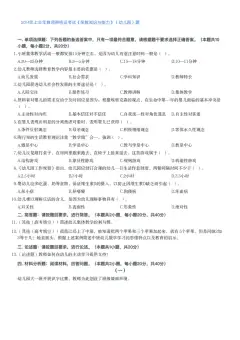
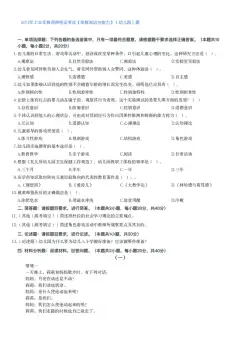
2021 年教师资格笔试
初级中学英语模拟卷(一)
一、单项选择题(本题共30 小题,每小题2 分,共60 分)
在每小题列出的四个备选项中选择一个最佳答案,错选、多选或未选均无分。
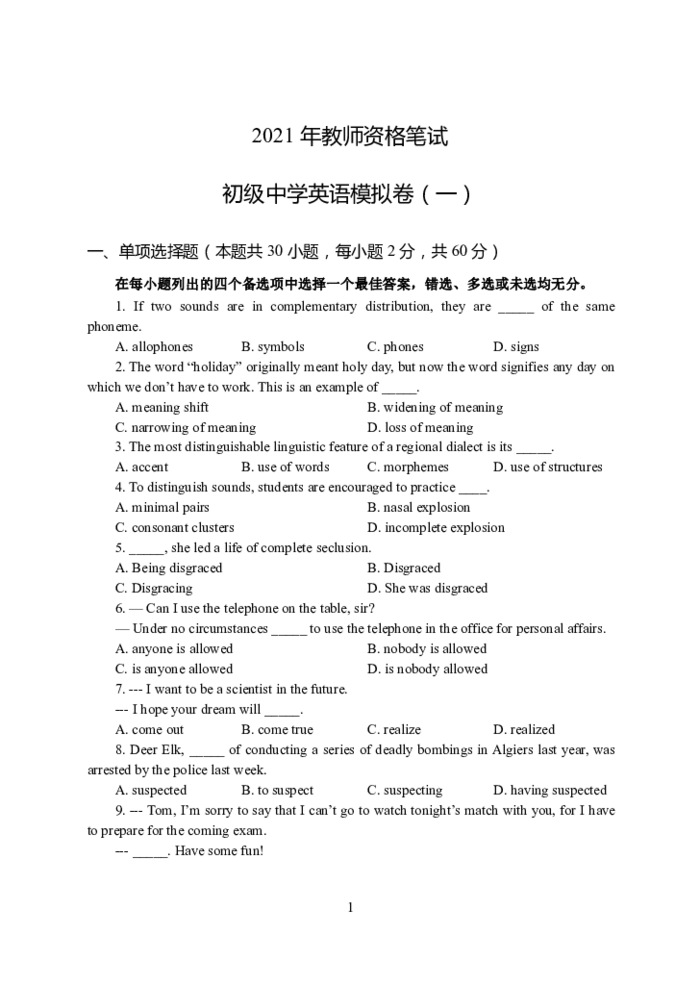
1. If two sounds are in complementary distribution, they are _____ of the same
phoneme.
A. allophones
B. symbols
C. phones
D. signs
2. The word “holiday” originally meant holy day, but now the word signifies any day on
which we don’t have to work. This is an example of _____.
A. meaning shift
B. widening of meaning
C. narrowing of meaning
D. loss of meaning
3. The most distinguishable linguistic feature of a regional dialect is its _____.
A. accent
B. use of words
C. morphemes
D. use of structures
4. To distinguish sounds, students are encouraged to practice ____.
A. minimal pairs
B. nasal explosion
C. consonant clusters
D. incomplete explosion
5. _____, she led a life of complete seclusion.
A. Being disgraced
B. Disgraced
C. Disgracing
D. She was disgraced
6. — Can I use the telephone on the table, sir?
— Under no circumstances _____ to use the telephone in the office for personal affairs.
A. anyone is allowed
B. nobody is allowed
C. is anyone allowed
D. is nobody allowed
7. --- I want to be a scientist in the future.
--- I hope your dream will _____.
A. come out
B. come true
C. realize
D. realized
8. Deer Elk, _____ of conducting a series of deadly bombings in Algiers last year, was
arrested by the police last week.
A. suspected
B. to suspect
C. suspecting
D. having suspected
9. --- Tom, I’m sorry to say that I can’t go to watch tonight’s match with you, for I have
to prepare for the coming exam.
--- _____. Have some fun!
2
A. Don’t have too many irons in the fire.
B. Don’t be a wet blanket.
C. Don’t put the cart before the horse.
D. Don’t pull my leg.
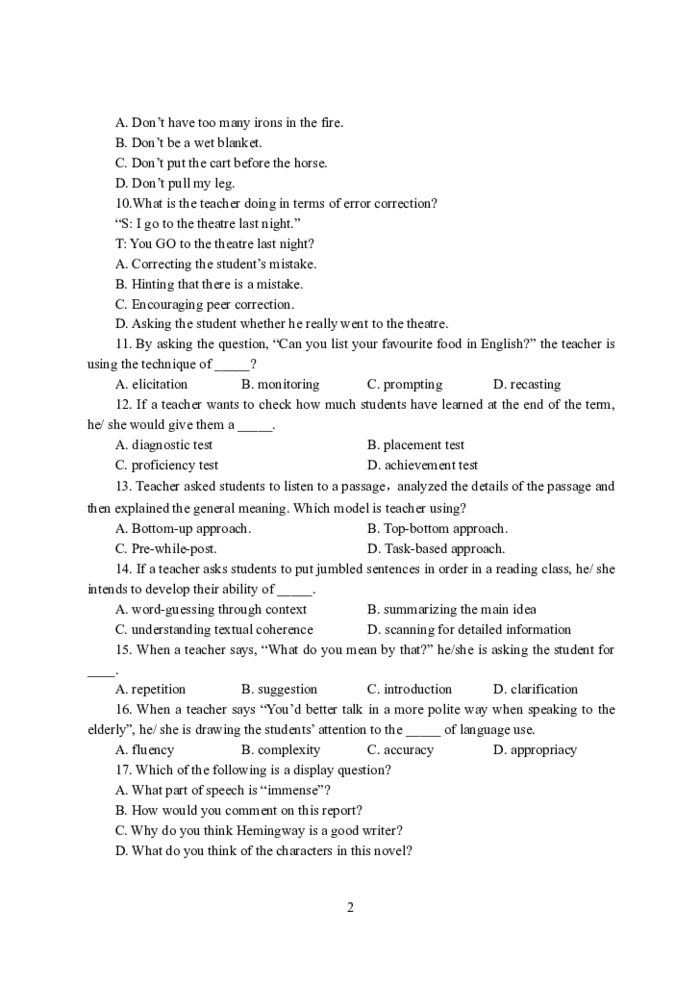
10.What is the teacher doing in terms of error correction?
“S: I go to the theatre last night.”
T: You GO to the theatre last night?
A. Correcting the student’s mistake.
B. Hinting that there is a mistake.
C. Encouraging peer correction.
D. Asking the student whether he really went to the theatre.
11. By asking the question, “Can you list your favourite food in English?” the teacher is
using the technique of _____?
A. elicitation
B. monitoring
C. prompting
D. recasting
12. If a teacher wants to check how much students have learned at the end of the term,
he/ she would give them a _____.
A. diagnostic test
B. placement test
C. proficiency test
D. achievement test
13. Teacher asked students to listen to a passage,analyzed the details of the passage and
then explained the general meaning. Which model is teacher using?
A. Bottom-up approach.
B. Top-bottom approach.
C. Pre-while-post.
D. Task-based approach.
14. If a teacher asks students to put jumbled sentences in order in a reading class, he/ she
intends to develop their ability of _____.
A. word-guessing through context
B. summarizing the main idea
C. understanding textual coherence
D. scanning for detailed information
15. When a teacher says, “What do you mean by that?” he/she is asking the student for
____.
A. repetition
B. suggestion
C. introduction
D. clarification
16. When a teacher says “You’d better talk in a more polite way when speaking to the
elderly”, he/ she is drawing the students’ attention to the _____ of language use.
A. fluency
B. complexity
C. accuracy
D. appropriacy
17. Which of the following is a display question?
A. What part of speech is “immense”?
B. How would you comment on this report?
C. Why do you think Hemingway is a good writer?
D. What do you think of the characters in this novel?
3
18. Which is NOT included in Models of Teaching Writing?
A. Method-oriented approach.
B. Product-oriented approach.
C. Content-oriented approach.
D. Process-oriented approach.
19. Teacher asked students to write a letter to their penfriends. Which principle does this
teacher focus on?
A. Realistic.
B. Communicative.
C. Integration.
D. Proceduring.
20. Which activity is not appropriate in the post-listening step?
A. Role-play.
B. Debate.
C. Predicting.
D. Retelling.
请阅读Passage 1,完成21~25 小题。
Passage 1
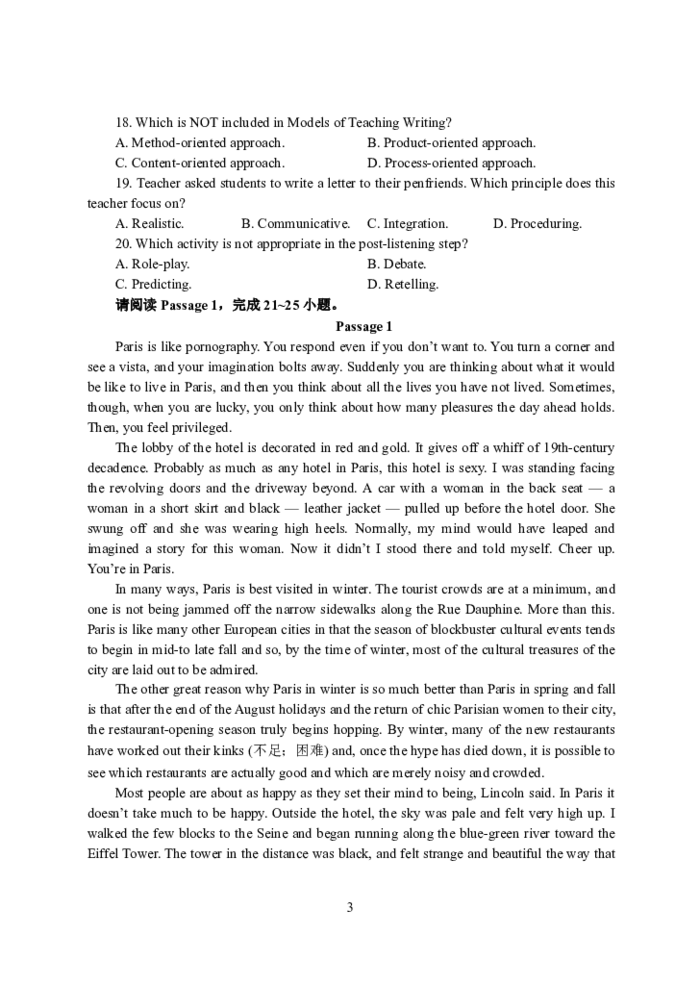
Paris is like pornography. You respond even if you don’t want to. You turn a corner and
see a vista, and your imagination bolts away. Suddenly you are thinking about what it would
be like to live in Paris, and then you think about all the lives you have not lived. Sometimes,
though, when you are lucky, you only think about how many pleasures the day ahead holds.
Then, you feel privileged.
The lobby of the hotel is decorated in red and gold. It gives off a whiff of 19th-century
decadence. Probably as much as any hotel in Paris, this hotel is sexy. I was standing facing
the revolving doors and the driveway beyond. A car with a woman in the back seat — a
woman in a short skirt and black — leather jacket — pulled up before the hotel door. She
swung off and she was wearing high heels. Normally, my mind would have leaped and
imagined a story for this woman. Now it didn’t I stood there and told myself. Cheer up.
You’re in Paris.
In many ways, Paris is best visited in winter. The tourist crowds are at a minimum, and
one is not being jammed off the narrow sidewalks along the Rue Dauphine. More than this.
Paris is like many other European cities in that the season of blockbuster cultural events tends
to begin in mid-to late fall and so, by the time of winter, most of the cultural treasures of the
city are laid out to be admired.
The other great reason why Paris in winter is so much better than Paris in spring and fall
is that after the end of the August holidays and the return of chic Parisian women to their city,
the restaurant-opening season truly begins hopping. By winter, many of the new restaurants
have worked out their kinks (不足;困难) and, once the hype has died down, it is possible to
see which restaurants are actually good and which are merely noisy and crowded.
Most people are about as happy as they set their mind to being, Lincoln said. In Paris it
doesn’t take much to be happy. Outside the hotel, the sky was pale and felt very high up. I
walked the few blocks to the Seine and began running along the blue-green river toward the
Eiffel Tower. The tower in the distance was black, and felt strange and beautiful the way that
4
many things built for the joy of building do. As I ran toward it, because of its lattice structure,
the tower seemed obviously delicate. Seeing it, I felt a sense of protectiveness.
I think it was this moment of protectiveness that marked the change in my mood and my
slowly becoming thrilled with being in Paris.
During winter evenings, Paris’s streetlamps have a halo and resemble dandelions. In
winter, when one leaves the Paris street and enters a cafe or restaurant, the light and
temperature change suddenly and dramatically, there is the sense of having discovered
something secret. In winter, because the days are short, there is an urgency to the choices one
makes. There is the sense that life is short and so let us decide on what matters.
21. According to the passage, once in Paris one might experience all the following
feelings EXCEPT _____.
A. regret
B. condescension
C. expectation
D. impulse
22. Winter is the best season to visit Paris. Which of the following does NOT support
this statement?
A. Fashionable Parisian women return to Paris.
B. More entertainment activities are staged.
C. There are more good restaurants to choose from.
D. There are fewer tourists in Paris.
23. “Most people are about as happy as they set their mind to being.” This statement
means that most people _____.
A. expect to be happy
B. hope to be as happy as others
C. would be happier if they wanted
D. can be happy if they want
24. In the eyes of the author, winter in Paris is significant because of _____.
A. the atmosphere of its evenings
B. its implications for life
C. the contrast it brings
D. the discovery one makes
25. At the end of the passage, the author found himself in a mood of _____.
A. Excitement
B.Thoughtfulness
C. Loneliness
D. joyfulness
请阅读Passage 2,完成第26-30 小题。
Passage 2
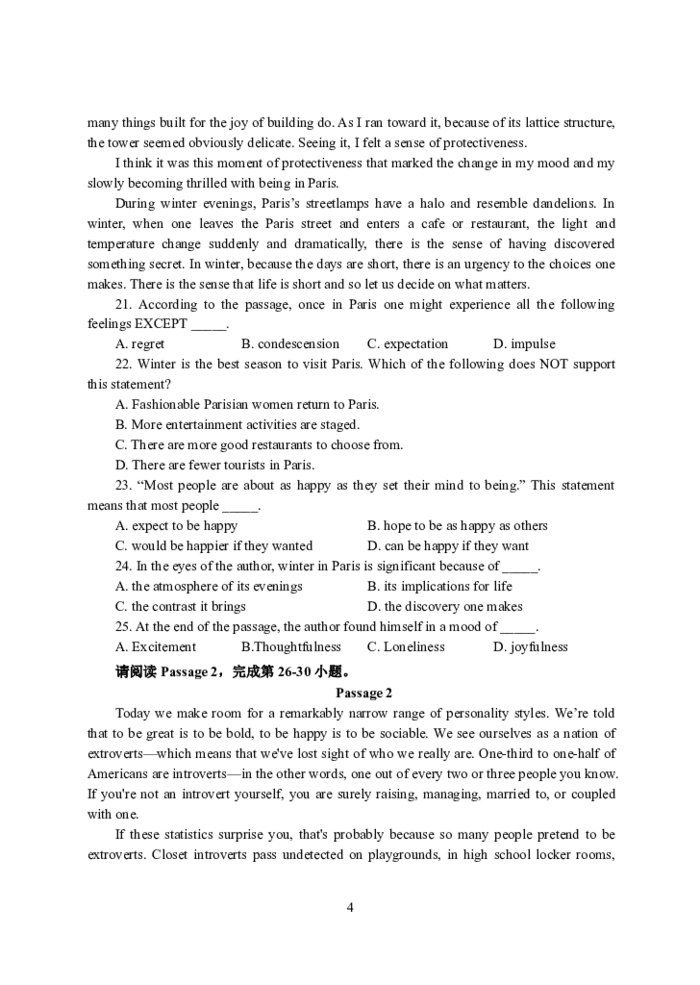
Today we make room for a remarkably narrow range of personality styles. We’re told
that to be great is to be bold, to be happy is to be sociable. We see ourselves as a nation of
extroverts—which means that we've lost sight of who we really are. One-third to one-half of
Americans are introverts—in the other words, one out of every two or three people you know.
If you're not an introvert yourself, you are surely raising, managing, married to, or coupled
with one.
If these statistics surprise you, that's probably because so many people pretend to be
extroverts. Closet introverts pass undetected on playgrounds, in high school locker rooms,
5
and in the corridors of corporate America. Some fool even themselves, until some life
event--a layoff, an empty nest, an inheritance that frees them to spend time as they like--jolts
them into taking stock of their true natures. You have only to raise this subject with your
friends and acquaintances to find that the most unlikely people consider themselves
introverts.
It makes sense that so many introverts hide even from themselves. We live with a value
system that I call the Extrovert Ideal—the omnipresent belief that the ideal self is gregarious,
alpha, and comfortable in the spotlight. The archetypal extrovert prefers action to
contemplation, risk-taking to heed-taking, certainty to doubt. He favors quick decisions, even
at the risk of being wrong. She works well in teams and socializes in groups. We like to think
that we value individuality, but all too often we admire one type of individual—the kind
who's comfortable “putting himself out there.” Sure, we allow technologically gifted loners
who launch companies in garages to have any personality they please, but they are the
exceptions, not the rule, and our tolerance extends mainly to those who get fabulously
wealthy or hold the promise of doing so.
Introversion—along with its cousins sensitivity, seriousness, and shyness—is now a
second-class personality trait, somewhere between a disappointment and a pathology.
Introverts living under the Extrovert Ideal are like women in a man's world, discounted
because of a trait that goes to the core of who they are. Extroversion is an enormously
appealing personality style, but we've turned it into an oppressive standard to which most of
us feel we must conform.
The Extrovert Ideal has been documented in many studies, though this research has
never been grouped under a single name. Talkative people, for example, are rated as smarter,
better-looking, more interesting, and more desirable as friends. Velocity of speech counts as
well as volume: we rank fast talkers as more competent and likable than slow ones. Even the
word introvert is stigmatized---one informal study, by psychologist Laurie Helgoe, found that
introverts described their own physical appearance in vivid language, but when asked to
describe generic introverts they drew a bland and distasteful picture.
But we make a grave mistake to embrace the Extrovert Ideal so unthinkingly. Some of
our greatest ideas, art, and inventions--from the theory of evolution to van Gogh's sunflowers
to the personal computer--came from quiet and cerebral people who knew how to tune in to
their inner worlds and the treasures to be found there.
26. According to the author, there exists, as far as personality styles are concerned, a
discrepancy between _____.
A. what people say they can do and what they actually can
B. what society values and what people pretend to be
C. what people profess and what statistics show
6
D. what people profess and what they hide from others
27. The ideal extrovert is described as being all the following EXCEPT _____.
A. doubtful
B. sociable
C. determined
D. bold
28. According to the author, our society only permits _____ to have whatever
personality they like.
A. the young
B. the ordinary
C. the artistic
D. the rich
29. According to the passage, which of the following statements BEST reflects the
author’s opinion?
A. Introversion is seen as an inferior trait because of its association with sensitivity.
B. Extroversion is arbitrary forced by society as a norm upon people.
C. Introverts are generally regarded as either unsuccessful or as deficient.
D. Extroversion and introversion have similar personality trait profiles.
30. The author winds up the passage with a _____ note.
A. cautious
B. warning
C. positive
D. humorous
二、简答题(本题共1 小题,共20 分)
31.简述小组活动(group work)在英语教学中的两个作用(8 分),并提出有效实
施小组活动的三条建议。(12 分)
7
三、教学情境分析题(本题共1 小题,共30 分)
32.材料一:
Ask the students to read the text fast to get the general idea of each paragraph. At the
same time, analyze the writing pattern of the text.
Paragraph 1: An environmental export points out many plants and animals are
endangered.
(problem)
Paragraph 2: Explain different reasons of endangerment.
(analysis)
Paragraph 3: Suggest what people can do to help endangered plants and animals.
(possible solution)
材料二:
Ask students to read Paragraph 2 and 3 again and finish the note-taking exercise.
Note-taking
What causes endangerment?
habitat loss
arriving of new species
overusing plants and overhunting animals
pollution
What can we do?
to stop polluting the environment
to create more space for animals and plants
to learn more about animals, plants and the environment
Activity: work in pairs and retell paragraph 2 and 3 to each other according to the notes
they
have taken.
任务要求:回答下列问题
(1)判断材料一和材料二分别体现的是阅读教学中的哪两个环节,说出判断依据。
(10 分)
(2)两个阅读环节分别可以锻炼学生哪方面的能力。(10 分)
(3)小组活动在教学中有怎样的作用。(10 分)
8
四、教学设计题(本题共1 小题,共40 分)
33.根据提供的信息和语言素材设计教学方案,用英文作答。
设计任务:阅读下面学生信息和语言素材,设计20 分钟的阅读教学方案。教案没
有固定格式,但须包含下列要点:
●Teaching objectives
●Teaching contents
●Key and difficult points
●Major steps and time allocation
●Activities and justifications
教学时间:20 分钟
学生情况:某城镇普通中学八年级(初中二年级)学生,班级人数40 人。多数学
生已经达到《义务教育英语课程标准(2011 年版)》三级水平。学生课堂参与积极性一
般。
语言素材:
David’s hobbies
9
Many students have hobbies, such as reading, painting, growing vegetables and looking
after animals. Some hobbies are relaxing and others are active. Hobbies can make you grow
as a person, develop your interest and help you learn new skills.
David Smith is a student, and one of his hobbies is writing. During the summer of 2010,
he spent four weeks at a summer camp. As well as the usual activities, such as sailing and
climbing, there was a writing class. “The teacher was a writer, and she asked us to talk about
our lives and tell interesting stories. Then she encouraged us to write about our experiences at
the camp.”
Back at school, David wrote a story about the life of a sixteen-year-old boy, and it came
out as a book in 2012. Many young people love his book, and as a result, David has become a
successful young writer.
David has been very lucky because his hobby has brought him pleasure and success. But
writing is not his only hobby. He is also interested in many other things. “I like playing
volleyball too.” says David. “I spend some of my free time playing volleyball for my school
team. Maybe I’ll write about my volleyball team in my future book.”