Philip's 1971 biographer, Basil Boothroyd, claimed that he inherited
an "undisguised contempt for ignorance, stupidity, inefficiency or
deviousness in others" from his father, Prince Andrew of Greece,
although he could occasionally display negative traits himself when
bored or impatient. More likely though, considering how absent his
father was for most of his life, they were a carapace to cover the
insecurities of childhood.
One of his nicknames was "Phil the Greek", based on his birth on
Corfu into Greece's royal family, yet he had no Greek blood. He
was a sprig of the Schleswig-HolsteinSonderburg-Glücksburgs, the
peripatetic and frequently exiled Danish royal family that the Greeks
imported after winning independence from Turkey in the 1820s.
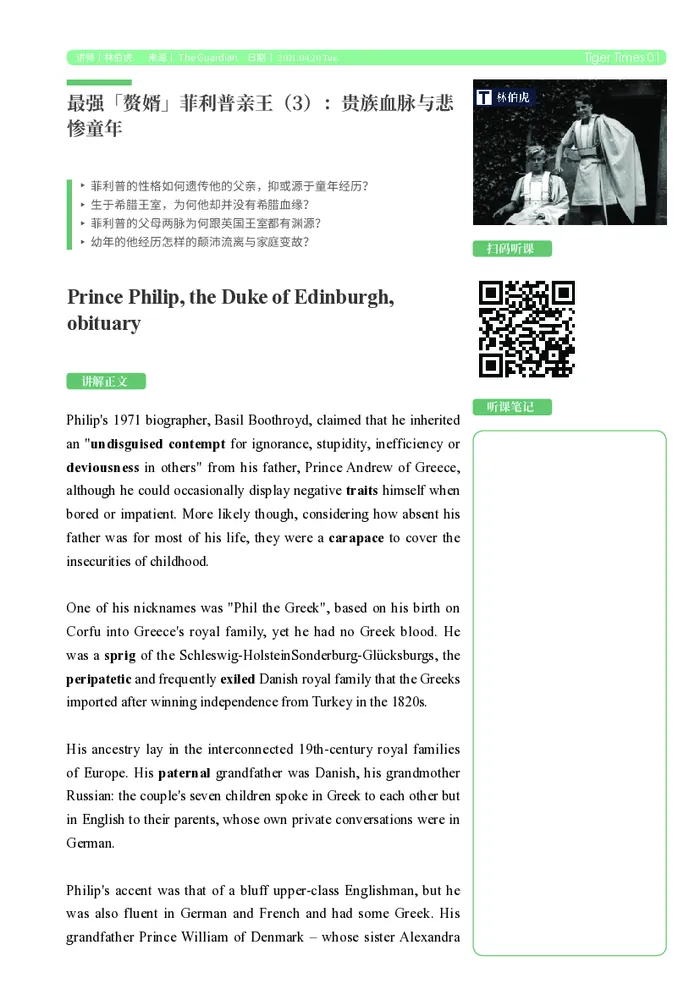
His ancestry lay in the interconnected 19th-century royal families
of Europe. His paternal grandfather was Danish, his grandmother
Russian: the couple's seven children spoke in Greek to each other but
in English to their parents, whose own private conversations were in
German.
Philip's accent was that of a bluff upper-class Englishman, but he
was also fluent in German and French and had some Greek. His
grandfather Prince William of Denmark – whose sister Alexandra
Tiger Times 01
最强「赘婿」菲利普亲王(3):贵族血脉与悲
惨童年
讲师丨林伯虎 来源丨The Guardian 日期丨2021.04.20 Tue.
▶ 菲利普的性格如何遗传他的父亲,抑或源于童年经历?
▶ 生于希腊王室,为何他却并没有希腊血缘?
▶ 菲利普的父母两脉为何跟英国王室都有渊源?
▶ 幼年的他经历怎样的颠沛流离与家庭变故?
扫码听课
听课笔记
Prince Philip, the Duke of Edinburgh,
obituary
讲解正文
married the British king Edward VII – was invited by the government
in Athens to become king of Greece in 1863 when he was 17. William
was a disposable younger son, so his family said yes.
He married the Grand Duchess Olga, a granddaughter of Tsar
Nicholas I. Yet one of their daughters wrote: "He always drilled into
us that we were Greek and nothing else." One of their disposable
younger sons, Andrew, was to become Prince Philip's father. Andrew
trained as a soldier, speaking Greek as his first language. He married
Princess Alice of Battenberg, sister of Lord Louis Mountbatten, later
Earl Mountbatten of Burma.
Christened Philippos, Philip was his parents' only son, after four
daughters. By then his grandfather, who ruled Greece as George I,
had been assassinated by a Greek in 1913, and his successor, Philip's
uncle Constantine, had been deposed four years later for failing to
support the allied powers, including Britain and France, in the first
world war.
After the three-year reign of his second son, Alexander, Constantine
was reinstated by referendum in 1920. Two years later he was again
overthrown, in a military upheaval. George V of Britain, son of
great-aunt Alexandra, sent a naval cruiser to rescue Andrew, who was
facing trial for treason, and his young family. The year-old Philip
was placed in an orange box and rowed out to the ship with the rest
of the family.
Permanent exile was to be the first experience of Philip's life. He
was brought up in St Cloud, on the edge of Paris. His family lived
on the charity of relatives: his elder sisters dressed in hand-me-down
clothes. Their father, bereft of military command, had no occupation
and abandoned the family, retreating to gamble in the casinos of
Monte Carlo. Their mother, Princess Alice, who was deaf, suffered
from schizophrenia and was confined to an asylum for much of
Philip's childhood, though she recovered, becoming a nun and setting
up an Orthodox nursing order. She would eventually go to live at
Buckingham Palace, where she died in 1969 at the age of 84.
Tiger Times
02
Philip grew versed in keeping up appearances while "skint", one of
his favourite words, being shuffled between boarding schools, first in
Paris, then Germany and latterly Scotland, and spending his holidays
with relatives, including his sisters, two of whom had married into
the German aristocracy and whose husbands became Nazis. Once
asked about his childhood home in an interview, he replied: "What do
you mean, 'home'? You get on with it. You do. One does."
Tiger Times
03
Tiger Times
04
undisguised /ˌʌndɪsˈɡaɪzd/ adj. 不加掩饰的;公开的;坦率
的
○ an undisguised feeling is clearly shown and not hidden
○ e.g. She looked at him with undisguised contempt. 她毫不
掩饰地用鄙夷的目光看着他。
contempt /kənˈtempt/ n. 蔑视,鄙视,轻视,轻蔑
○ a feeling that someone or something is not important and
deserves no respect
○ e.g. The contempt he felt for his fellow students was
obvious. 他对同学的轻蔑是显而易见的。
deviousness /ˈdiːviəsnəs/ n. 迂回,曲折,旁敲侧击
○ behaviour that is dishonest or indirect, or that tricks people,
in order to get something
○ e.g. His daring and deviousness both showed themselves
early. 他的大胆和狡诈很早就显露出来了。
trait /treɪt/ n. 特征,特性,品质
○ (formal) a particular quality in someone's character
○ e.g. a mental illness associated with particular personality
traits 一种与特定人格特征有关的精神疾病
carapace /ˈkærəpeɪs/ n.(动物的)壳,甲壳
○ a hard shell on the outside of some animals such as a crab
or tortoise
sprig /sprɪɡ/ n. 带叶小枝,嫩枝
○ a small stem or part of a branch with leaves or flowers on
it
○ e.g. Garnish the dish with sprigs of parsley. 用带叶的欧芹
作这道菜的饰菜。
peripatetic /ˌperəpəˈtetɪk/ adj. 巡游的,流动的
○ travelling from place to place, especially in order to do
your job
○ e.g. a peripatetic music teacher 流动的音乐教师
exile /ˈeksaɪl/ v. 流放,放逐,流亡
○ to force someone to leave their country, especially for
political reasons
○ e.g. Several of the leaders were arrested and exiled to
France. 一些领导人被捕并被流放到法国。
paternal /pəˈtɜːnl/ adj. 父亲的,父系的
○ related through the father's side of the family
○ e.g. My paternal grandparents were Irish. 我父亲方的祖父
母是爱尔兰人。
○ maternal /məˈtɜːnl/ adj. 母系的,母亲一方的
○ related to a mother's side of the family
○ e.g. Her maternal grandmother is still alive. 她的外婆依然
健在。
drill something into somebody 反复地将… 教授(灌输)
给(某人)
○ to keep telling someone something until they know it very
well
○ e.g. Mother had drilled it into me not to talk to strangers.
母亲反复告诫我不要和陌生人说话。
词汇
assassinate /əˈsæsəneɪt/ v. 暗杀,行刺
○ to murder an important person
○ e.g. a plot to assassinate the president 暗杀总统的阴谋
depose /dɪˈpəʊz/ v. 罢免,使免职,使下台
○ to remove a leader or ruler from a position of power
○ e.g. King Charles I was deposed from the English throne in
1646. 1646 年英王查理一世被废黜。
reinstate /ˌriːɪnˈsteɪt/ v. 使重返岗位,使恢复原职
○ if someone is reinstated, they are officially given back their
job after it was taken away
○ e.g. A month after being unfairly dismissed, he was
reinstated in his job. 在被不公正解职1 个月后,他又重新
返回工作岗位。
referendum /ˌrefəˈrendəm/ n. 全民公决,全民公投
○ when people vote in order to make a decision about a
particular subject, rather than voting for a person
○ e.g. a referendum on independence 关于独立问题的全民
公决
overthrow /ˌəʊvəˈθrəʊ/ v. 推翻,打倒
○ to remove a leader or government from power, especially
by force
○ e.g. Rebels were already making plans to overthrow the
government. 叛军已经在计划推翻政府。
upheaval /ʌpˈhiːvəl/ n. 激变,动荡,剧变
○ a very big change that often causes problems
○ e.g. political upheaval 政治动荡
treason /ˈtriːzən/ n. 叛国(罪)
○ the crime of being disloyal to your country or its
government, especially by helping its enemies or trying to
remove the government using violence
○ e.g. He is accused of committing treason against the state.
他被指控犯有叛国罪。
row /rəʊ/ v. 划(船)
○ to make a boat move across water using oars
○ e.g. She rowed across the lake. 她划船过湖。
bereft /bəˈreft/ adj. 缺乏… 的
○ completely without something; having lost something
○ e.g. The team now seems bereft of inspiration. 现在,团
队似乎失去了灵感。
schizophrenia /ˌskɪtsəʊˈfriːniə/ n. 精神分裂症
○ a serious mental illness in which someone's thoughts and
feelings are not based on what is really happening around
them
confine /kənˈfaɪn/ v. 把… 局限在,限制
○ to keep someone or something within the limits of a
particular activity or subject
○ e.g. We confined our study to ten cases. 我们的研究仅限
于十个案例。
Tiger Times
05
asylum /əˈsaɪləm/ n. 精神病院
○ (old use) a mental hospital
○ e.g. Leaving the asylum had given him fresh hope. 离开了
精神病院,他的生活有了新的希望。
nun /nʌn/ n. 修女
○ someone who is a member of a group of religious women
that live together in a convent
versed /vɜːst/ adj. 对… 很熟练,通晓,精通
○ having a lot of knowledge about something, or skill at
something
○ e.g. He was well versed in employment law. 他精通劳动
法。
skint /skɪnt/ adj. 身无分文的,一文不名的
○ having no money, especially for a short time
○ e.g. I'm skint at the moment. 我现在身无分文。
shuffle /ˈʃʌfəl/ v. 把… 搬来搬去,把… 移来移去
○ to move something such as papers into a different order or
into different positions
○ e.g. She shuffled her papers nervously on her desk. 她紧张
地把桌上的文件移来移去。
aristocracy /ˌærəˈstɒkrəsi/ n. 贵族,贵族阶级
○ the people in the highest social class, who traditionally
have a lot of land, money, and power
○ e.g. members of the aristocracy 贵族阶级成员
○ aristocratic /ˌærəstəˈkrætɪk/ adj. 贵族的,贵族式的
○ belonging to or typical of the aristocracy
○ e.g. an aristocratic family 贵族家庭
Tiger Times
06
今日习题
1. 根据英文释义写出文中出现的对应词
______: to limit an activity, person, or problem in some way
______: knowing a lot about a particular subject or experienced in a particular skill
2. 一词多义
Which of the following underlined word is closest in meaning to the one in the sentence "The year-old
Philip was placed in an orange box and rowed out to the ship with the rest of the family." ____
A. He had just had a row with his wife.
B. The wind dropped, so we had to row back home.
C. She's been voted Best Actress three years in a row.
D. I can't concentrate because of the row the builders are making.
3. 翻译:根据给定中文回译英文
菲利普1971 年出版的传记的作者Basil Boothroyd 声称,菲利普从他的父亲—希腊的安德鲁王子
(Prince Andrew)那里继承了“对他人无知、愚蠢、低效或不诚实的不加掩饰的蔑视”,尽管他
在无聊或不耐烦的时候偶尔也会表现出一些负面特征。
_____________________________________________________________________________________
_________________________________________________________________
习题答案
1. confine; versed
2. B
3. Philip's 1971 biographer, Basil Boothroyd, claimed that he inherited an "undisguised contempt
for ignorance, stupidity, inefficiency or deviousness in others" from his father, Prince Andrew of
Greece, although he could occasionally display negative traits himself when bored or impatient.
编辑丨焰妮