Tiger Times 01
巴以冲突,为什么再次爆发?(1)
讲师丨林伯虎       来源丨Vox   日期丨2021.05.18 Tue.
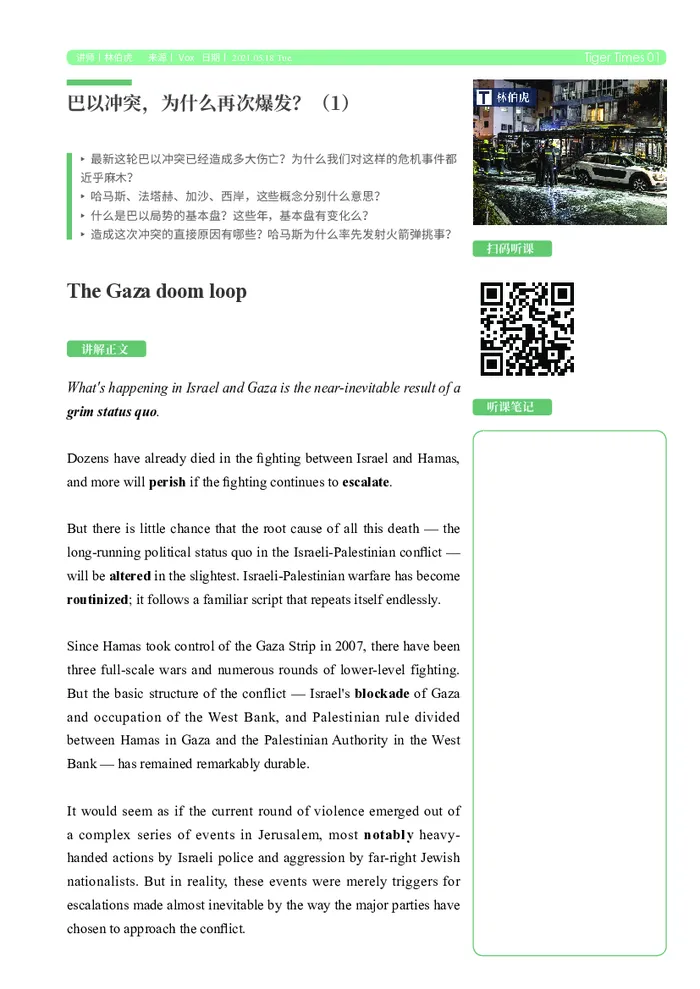
▶    最新这轮巴以冲突已经造成多大伤亡?为什么我们对这样的危机事件都
近乎麻木?
▶    哈马斯、法塔赫、加沙、西岸,这些概念分别什么意思?
▶    什么是巴以局势的基本盘?这些年,基本盘有变化么?
▶    造成这次冲突的直接原因有哪些?哈马斯为什么率先发射火箭弹挑事?
扫码听课
听课笔记
The Gaza doom loop
讲解正文
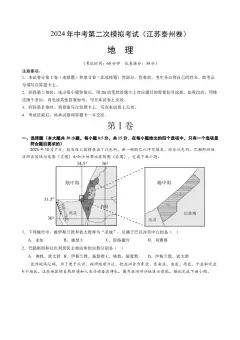
What's happening in Israel and Gaza is the near-inevitable result of a
grim status quo.
Dozens have already died in the fighting between Israel and Hamas,
and more will perish if the fighting continues to escalate.
But there is little chance that the root cause of all this death — the
long-running political status quo in the Israeli-Palestinian conflict —
will be altered in the slightest. Israeli-Palestinian warfare has become
routinized; it follows a familiar script that repeats itself endlessly.
Since Hamas took control of the Gaza Strip in 2007, there have been
three full-scale wars and numerous rounds of lower-level fighting.
But the basic structure of the conflict — Israel's blockade of Gaza
and occupation of the West Bank, and Palestinian rule divided
between Hamas in Gaza and the Palestinian Authority in the West
Bank — has remained remarkably durable.
It would seem as if the current round of violence emerged out of
a complex series of events in Jerusalem, most notably heavy-
handed actions by Israeli police and aggression by far-right Jewish
nationalists. But in reality, these events were merely triggers for
escalations made almost inevitable by the way the major parties have
chosen to approach the conflict.
The Israeli-Palestinian doom loop
The current violence began with a series of conflicts in Jerusalem.
Israeli police in the city blocked off the Damascus Gate, a popular
gathering place for Arabs during Ramadan, sparking protests. An
attempt by Jewish settlers to evict longtime Arab residents of Sheikh
Jarrah, an Arab neighborhood of East Jerusalem, inflamed tensions,
leading to violent clashes with Israeli police. Arab youth attacked
ultra-Orthodox Jews in the city, and Jewish extremists assailed Arab
residents. All of this culminated in a violent Israeli police raid on
the al-Aqsa Mosque, Jerusalem's holiest site for Muslims, located on
the Temple Mount (the holiest site in the world for Jews).
Then Hamas fired rockets at Jerusalem. Ostensibly, this was a
display of solidarity with the protesters on the ground. But it appears
to have been a political calculation — Hamas attempting to capitalize
on Palestinian anger over the violence in Jerusalem to expand its own
influence, especially in the wake of recently canceled Palestinian
elections that likely would have strengthened its political position.
"This is much more about internal Palestinian politics than it is about
what's been going on in Jerusalem," says Michael Koplow, policy
director at the Israel Policy Forum.
The attacks on Jerusalem crossed what Israeli Prime Minister
Benjamin Netanyahu referred to as a "red line," breaking the
unspoken rules that limited the pace and range of rocket attacks to
limited barrages mostly targeting southern Israel. Israel responded
with overwhelming force: massive airstrikes targeting Hamas
emplacements in densely populated Gaza. This prompted more rocket
attacks from Hamas and, in turn, more bombings from Israel. As a
result, at least seven people in Israel and around 70 Palestinians are
dead — with no end in sight.
Tiger Times
02
Tiger Times
03
doom /duːm/ n. 死亡,毁灭,厄运
 ○ something very bad that is going to happen, or the fact that
it is going to happen
 ○ e.g. A sense of impending doom gripped her. 一种不祥的
预感攫住了她。
loop /luːp/ n. 圆圈,环形;循环
 ○ a shape like a curve or a circle made by a line curving
back towards itself, or a piece of wire, string etc. that has this
shape
 ○ if something runs in a loop, or is on a loop, it runs
continuously, so that the same things are repeated again and
again
 ○ e.g. The tape ran in a continuous loop, repeating the same
songs over and over. 这盘磁带处于循环播放状态,反反复
复地播放那几首歌曲。
grim /ɡrɪm/ adj. 令人担忧的,令人沮丧的
 ○ making you feel worried or unhappy
 ○ e.g. When he lost his job, his future looked grim. 他失业
后,前途一片渺茫。
status quo /ˌsteɪtəs ˈkwəʊ/ n. 现状
 ○ the state of a situation as it is
 ○ e.g. Certain people always want to maintain the status quo.
有些人总是想维持现状。
perish /ˈperɪʃ/ v. 丧生,死亡
 ○ (formal or literary) to die, especially in a terrible or sudden
way
 ○ e.g. Hundreds perished when the ship went down. 那艘船
沉没时,数百人丧生。
escalate /ˈeskəleɪt/ v.(使)加剧,(使)恶化
 ○ if fighting, violence, or a bad situation escalates, or if
someone escalates it, it becomes much worse
 ○ e.g. Her fear was escalating into panic. 她的恐惧逐渐升
级为恐慌。
alter /ˈɔːltə/ v.(通常指轻微地)改变,(使)变化
 ○ to change, or to make someone or something change
 ○ e.g. The city centre has altered beyond recognition. 市中心
变得认不出来了。
routinize /ruː'tiːnaɪz/ v.(使)惯例化;(使)成惯常
 ○ if you routinize a way of doing something, you make it a
normal part of a job or process
 ○ e.g. Parents who routinize child care are minimizing
expense and maximizing their control. 使儿童看护规范化的
家长最大程度地强化了控制,节约了支出。
blockade /blɒˈkeɪd/ n. 封锁
 ○ the surrounding of an area by soldiers or ships to stop
people or supplies entering or leaving
 ○ e.g. a naval blockade 海上封锁
notably /ˈnəʊtəbli/ adv. 格外地,特别地,尤其
 ○ used to say that a person or thing is a typical example or
the most important example of something
词汇
 ○ e.g. The company is beginning to attract investors, most
notably big Japanese banks. 这家公司开始吸引投资者,特
别是日本大型金融会社。
evict /ɪˈvɪkt/ v. 驱逐,赶走,逐出
 ○ to tell someone legally that they must leave the house they
are living in
 ○ e.g. They were unable to pay the rent, and were evicted
from their home. 他们付不起房租,被赶出了自己的家。
inflame /ɪnˈfleɪm/ v. 激起(愤怒、激动等情感),使愤怒
 ○ to make someone's feelings of anger, excitement etc. much
stronger
 ○ e.g. The shooting inflamed ethnic tensions. 枪击事件加剧
了种族紧张局势。
clash /klæʃ/ n. 冲突,打斗
 ○ a short fight between two armies or groups – used in news
reports
 ○ e.g. violent clashes between police and demonstrators 警察
和示威者之间的暴力冲突
assail /əˈseɪl/ v. 攻击,袭击
 ○ to attack someone or something violently
 ○ e.g. He was assailed with insults and abuse as he left the
court. 他离开法庭时,遭到众人的辱骂。
culminate /ˈkʌlməneɪt/ v. 以… 告终,达到… 的顶点
 ○ culminate in/with something
 ○ if a process culminates in or with a particular event, it ends
with that event
 ○ e.g. My arguments with the boss got worse and worse, and
finally culminated in my resignation. 我和老板的争吵日益
恶化,直到最终我决定换工作。
raid /reɪd/ n. 突袭,袭击
 ○ a short attack on a place by soldiers, planes, or ships,
intended to cause damage but not take control
 ○ e.g. The army launched several cross-border raids last
night. 昨晚军队发动了几次越境袭击。
ostensibly /ɒˈstensəbli/ adv. 表面上
 ○ if something is ostensibly true, people say that it is true but
it is not really true
 ○ e.g. She stayed behind at the office, ostensibly to work. 她
留在办公室,表面上是为了工作。
barrage /ˈbærɑːʒ/ n. 掩护炮火,阻击火网
 ○ the continuous firing of guns, dropping of bombs etc.,
especially to protect soldiers as they move towards an enemy
 ○ e.g. a barrage of anti-aircraft fire 密集的防空炮火
Tiger Times
04
今日习题
1. 根据英文释义写出文中出现的对应词或词组
______: death, destruction, or any very bad situation that cannot be avoided
______: to die, especially in an accident or by being killed, or to be destroyed
2. 一词多义
Which of the following underlined word is closest in meaning to the one in the sentence "An attempt by
Jewish settlers to evict longtime Arab residents of Sheikh Jarrah, an Arab neighborhood of East Jerusalem,
inflamed tensions, leading to violent clashes with Israeli police."  ____
A. I can't wear red – it clashes with my hair.
B. The announcement has been delayed to avoid clashing with the prime minister's speech.
C. Rioters hurled rocks and bottles in clashes with police at the weekend.
D. Simply put, the conflict comes down to a clash of cultures.
3. 翻译:根据给定中文回译英文
以色列(Israel)和加沙(Gaza)所发生的一切几乎是残酷现状的必然结果。
_____________________________________________________________________________________
_________________________________________________________________
习题答案
1. doom; perish
2. C
3. What's happening in Israel and Gaza is the near-inevitable result of a grim status quo.
编辑丨焰妮