惠州市实验中学 2026 届高三(上)12 月阶段性检测
英 语
第二部分阅读理解(共两节,满分50分)
第一节(共15小题;每小题2.5分,满分37.5分)
阅读下列短文,从每题所给的A 、B 、C 和 D 四个选项中,选出最佳答案。
A
WALK FOR GREEN
How often do you walk around the campus instead of getting straight onto the
shuttle bus? The beauties of our campus deserve to be better explored and can best
be explored on foot. Walking is also a greener and healthier alternative to using vehicles.
To encourage more students and staff members to walk around the campus, our school
has launched a new “Walk for Green” initiative.
Programme
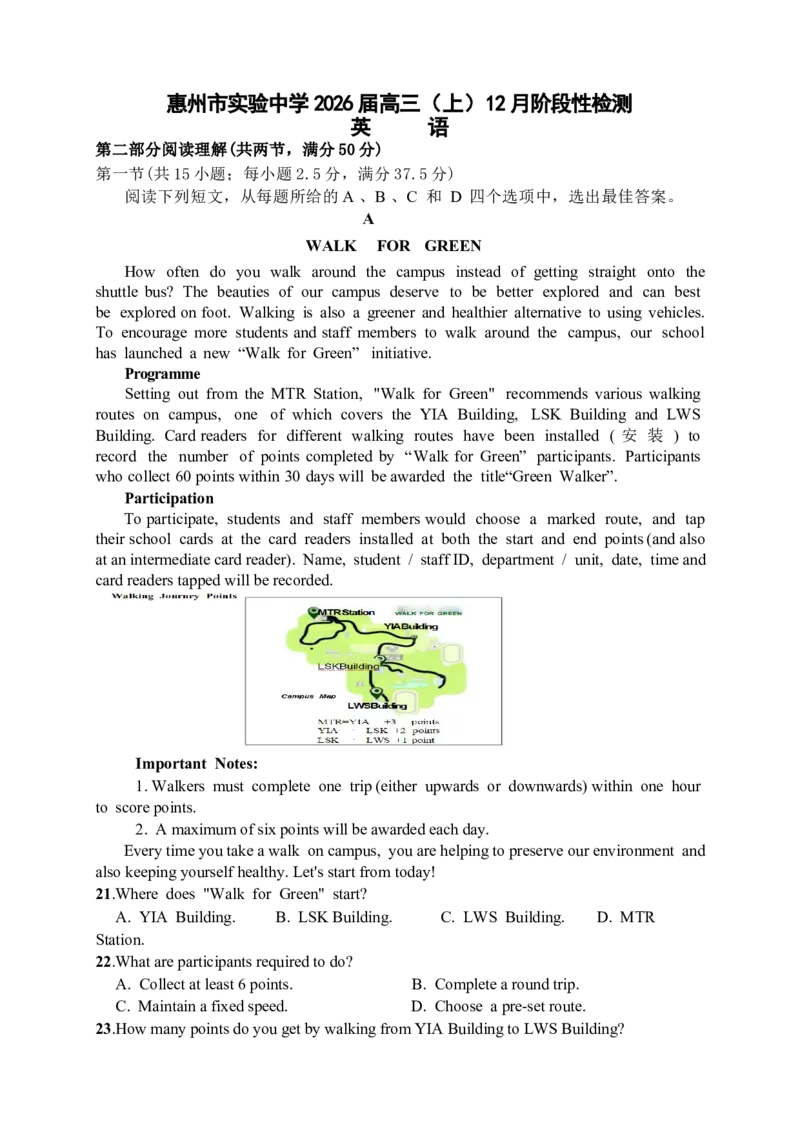
Setting out from the MTR Station, "Walk for Green" recommends various walking
routes on campus, one of which covers the YIA Building, LSK Building and LWS
Building. Card readers for different walking routes have been installed ( 安 装 ) to
record the number of points completed by “Walk for Green” participants. Participants
who collect 60 points within 30 days will be awarded the title“Green Walker”.
Participation
To participate, students and staff members would choose a marked route, and tap
their school cards at the card readers installed at both the start and end points (and also
at an intermediate card reader). Name, student / staff ID, department / unit, date, time and
card readers tapped will be recorded.
Important Notes:
1. Walkers must complete one trip (either upwards or downwards) within one hour
to score points.
2. A maximum of six points will be awarded each day.
Every time you take a walk on campus, you are helping to preserve our environment and
also keeping yourself healthy. Let's start from today!
21.Where does "Walk for Green" start?
A. YIA Building. B. LSK Building. C. LWS Building. D. MTR
Station.
22.What are participants required to do?
A. Collect at least 6 points. B. Complete a round trip.
C. Maintain a fixed speed. D. Choose a pre-set route.
23.How many points do you get by walking from YIA Building to LWS Building?A.1. B.2. C.3. D.6.
B
It’s unusual to read novels about women taking an active role in the resistance during
World War II, especially those of Dutch women, who were expected to keep the home fires
burning and let the men get on with the fighting. So, I was fascinated when discovering many
Dutch female fighters who risked their lives for their country in wartime.
My book, The Girl with the Red Hair, is based on the true story of Hannie Schaft, the most
famous of those brave women. To the Dutch, Hannie was an icon of resistance during World
War II, and around the country there are schools and streets named after her.
At the start of the war, Hannie was a law student at the University of Amsterdam, but her
studies were disrupted by the German occupation of the Netherlands. On May 14th, 1940, a
German bombing raid almost destroyed Rotterdam, forcing thousands to flee the burning city.
As the Nazis began targeting Jews, Hannie decided to act. Whether it was sheltering Jews or
transporting top-secret information in her saddlebags, setting fire to military facilities or shooting
Nazi officers, the breathtaking courage she demonstrated was unmatched. Hannie was
prepared to take on any assignment in her quest for justice.
Hannie’s story ends tragically. It was Hannie’s great misfortune to be arrested only weeks
before the end of the war. Though this black-haired girl refused to talk under questioning, her
red hair roots gave her identity away. One cold spring morning, Hannie was taken from her cell
and marched to a point, where one of the Nazi soldiers took aim. But his first shot only grazed
her ear. She said, “Idiot! I shoot better than you.” The second bullet took her life.
It has been a humbling experience writing this book about Hannie Schaft. Although my
book is a work of fiction, I hope I’ve done justice to this incredible and inspiring woman. Come
and discover more about my new novel, the second in The Dutch Girl series, called The Girl
with the Red Hair.
24. What do we know about the Dutch women from the first paragraph?
A. Few women took part in World War II.
B. Women’s contributions were rarely recorded.
C. People held a fixed perception of women.
D. Women’s stories were overshadowed by men’s heroism.
25. What does paragraph 3 mainly talk about?
A. Hannie’s peaceful life before the war.
B. Challenges Hannie faced in her education.
C. Hannie’s courageous resistance activities.
D. Destruction caused by the German bombing.
26. What do the underlined words “only grazed” in paragraph 4 mean?
A. Barely touched. B. Partially deafened.
C. Deeply wounded. D. Completely missed.
27. What is the author’s purpose in writing the text?
A. To record the wartime history. B. To reflect on a writing experience.
C. To introduce a patriotic woman. D. To share a real-life-inspired fiction.
CDutch scientists have managed to engineer an air-powered soft-bodied robot. The key to
unlocking the robot's self-sustaining movement, despite the absence of a computerized control
unit, lies in the strategic integration of aerodynamic principles, whose role is to regulate the
airflow dynamics essential for its walking and swimming actions.
How this robot works bears a striking similarity to that of "tube dancers", those tall thin
fabric tubes that have air pumped into them. When air fills the tube to the maximum, it makes
it stand upright. However, once the tube reaches an upright position, the internal air pressure
gradually decreases, causing the tube to bend downward. This bending then makes the pressure
rise again, pushing the bent section forward. This process repeats continuously, forming a cyclic
motion that gives the robot its moving force.
This pressure-driven continuous bending along tubes precisely fuels the robot. Linked to a
single air source, its multiple tubes initially move chaotically in different directions but soon
adjust their motion, eventually moving in a consistent and harmonized way just like "legs", with
speed regulated by air pressure.
One particularly notable characteristic of the robot is its remarkable speed. It can cover a
distance 30 times its own body length within a single second, which is just like Usain Bolt, the
world's fastest runner, achieving his speed by finishing 100m in merely 1.71 seconds. Another
outstanding feature is that it adjusts automatically to its conditions. It can easily cross uneven
ground and when it accidentally knocks into a wall, it turns. If the robot sinks into water, it will
immediately adjust its movement pattern and start swimming.
Without a control core, the new invention is more like a simple machine than an advanced
robot needing difficult programming. Nevertheless, it can do many complex tasks
independently. It is widely anticipated that the technology could one day be used in applications
such as micro-robots that deliver medicine within the body, or machinery designed for use in
harsh environments where electronics may fail, such as outer space.
28.What happens to "the tube dancer" when its internal air pressure peaks?
A.It leaks. B. It bends
downward.
C. It straightens. D. It moves back and forth.
29.What aspect do Paragraph 2 and 3 focus on about the new robot?
A.Its power source. B. Its multi-functions.
C. Its structural features. D. Its operational mechanism.
30.Why does the author mention Usain Bolt in Paragraph 4?
A.To showcase his running speed.
B. To test the robot's performance.
C. To stress humans can't outpace the robot.
D. To help readers grasp the robot's speed.
31. What can we infer about the new invention from the last paragraph?
A.It has a bright prospect. B. It relies heavily on programming.
C.It'll lower disease occurrences. D. It has been put into mass production.D
The specific cultural values of a country may determine whether concern about
environmental issues actually leads individuals to engage in environmentally friendly
behaviors, according to the new research published in Psychological Science.
Kimin Eom, a psychological scientist at the University of California, was inspired to
investigate the links between culture, environmental concern, and environmental action after
noticing that both public discussion and prior academic research on environmental behavior
typically focused on people from western countries. This is noteworthy because western
societies tend to have cultural values that prioritize individuals’ own attitudes and beliefs and
encourage expression of them.
“The theory seemed to be that once individuals are led to believe in the urgency of
environmental issues and have stronger concerns about sustainability, they will change and act
to address the issues,” explains Eom. But this relationship might not hold for individuals living
in more collectivistic societies, which place more emphasis on social harmony and uniformity
than on self-expression.
To examine what drives environmental action in both cultures, Eom’s team conducted a
study with participants from the United States (an individualistic culture) and Thailand (a
collectivistic culture). They found environmental concern was correlated with environmental
behavior — in this case, choosing environmentally friendly products — but only among
American participants. On the other hand, believing that a large percentage of people engage in
environmentally friendly behaviors was associated with making eco-friendly choices among
Thai participants, but not American participants.
The findings reveal that personal concerns are more likely to motivate people to take
environmental action if they live in individualistic countries, whereas social criteria are more
likely to drive people to engage in environmentally friendly behavior if they live in collectivistic
countries.
“Getting citizens actively engaged is critical to addressing urgent social issues, such as
climate change,” says Eom. “Our research suggests that scientists, policymakers, and activists
need to understand how culture shapes the psychological factors of action to develop policies,
campaigns, and interventions that address important social issues.”
32. How does Eom view previous research on environmental behavior?
A. It prioritizes diverse cultural values. B. It relies on theoretical assumptions.
C. It targets a narrow group of subjects. D. It underestimates personal views.
33. A Thai man is most likely to act in eco-friendly ways if ______.
A. he witnesses many others do so B. he investigates collectivistic values
C. he feels a strong personal urgency D. he moves to an individualistic country
34. What is the last paragraph mainly about concerning Eom’s research?
A. Its challenges. B. Its background.
C. Its researchers. D. Its significance.
35. Which statement is best supported by the new research?
A. Environmental issues are culture-rooted.
B. Social standards help control pollution.
C. Cultural values guide green behaviors.
D. More concerns lead to more action.第二节(共5小题;每小题2.5分,满分12.5分)
阅读下面短文,从短文后的选项中选出能填入空白处的最佳选项。选项中有两项为多
余选项。
One of my friends announced early on that she did not know how to cook, nor would she
learn to cook. She had something more important to do, namely write her novels. I admired her,
and even envied her. 36 .
In New York, there are a million ways not to cook. It is easy to order in, or to hire someone
to cook if you have the resources. 37 . I like being alone for a while staring at a recipe and
trying to visualize it.
And yet my friend who doesn’t cook is also right. 38 . Sometimes I wonder if I will
regret those hours: cutting ingredients (原料), searching for supplies, and hurrying out for salt...
Does cooking enrich family life? Does it give everyone an unconscious feeling of wellbeing?
Hard to say.
I have another friend who cooked on a whole other level than most of us. Years later, she
realized that she was putting too much of her energy and thought and inspiration into it. She
seemed to have turned against it as a mode of expression. 39 .
40 . I will just stop planning dinners and going to the fish store and the grocery store.
I imagine finishing my Helen Garner novel as the sky darkens. But I also want this one hour at
the end of the day when I step out of work and measure and preheat and marinate (腌制). When
the night really falls and the sound of my family’s chatter flows from the living room, I still
can’t help but reach for the recipe book.
A. But this could never be me.
B. Cooking is sort of a burden and fun.
C. Sometimes I have a “having it all” fantasy.
D. She started a whole new career that took off later.
E. Cooking can be a time-consuming and thankless task.
F. She was determined to take this domestic responsibility.
G. Yet I still find myself cooking for my family even on busy days.
第三部分 语言知识运用(共两节,满分30分)
第一节(共15小题;每小题1分,满分15分)
阅读下面短文,从短文后各题所给的A、B、C和D四个选项中,选出可以填入空
白处的最佳选项。
Before meeting my “tinder”, I was an emotionally isolated, cocky senior executive. 41 a
seemingly successful 25+ years in my professional career, I was on the brink of emotional
bankruptcy.
Then came a ripple in the universe. My friend asked me for a 42 — adopting her
dog Twinkles, a small lapdog. I reluctantly 43 . Twinkles had lived a(n) 44
existence and had never even walked on green grass. She wouldn’t go out with me initially, but I45 her out the door, knowing it would do her and me good. A special bond and growing
trust 46 . After all, discomfort is often the external 47 needed to jump-start
growth, and that day was a good beginning!
Happy time flew! Twinkles and I had to move to Medellin, Colombia. I believe it was a
good chance to change. “Aggressive Tom” would not be 48 tolerated; I had to become
“Gentle Tom.” Relaxed, 49 , and calm. Similarly, Twinkles was presented with the
50 to become “Twinkles Princess.”
Twinkles and I shared remarkable 51 , from walks in the local parks to exploring
the transformative neighborhood of Comuna 13. She was a natural star, and her charm
effortlessly 5 2 the locals, fostering conversations that 53 cultural gaps.
I gradually had a sense of belonging.
After three adventurous years, we returned to America. “Aggressive Tom” and “Timid
Twinkles” were 54 by “Gentle Tom” and “Twinkles Princess”, more patient,
empathetic, confident, and brave. We had done things we didn’t want to do, weren’t supposed
to do, and never imagined we could do. Together, we 55 the joy of doing incredible
things.
41. A. With B. Despite C. Without D. Except
42. A. favor B. gift C. tip D. permission
43. A. rejected B. quit C. agreed D. replied
44. A. isolated B. spoiled C. ruined D. sheltered
45. A. dragged B. dropped C. threw D. shut
46. A. changed B. suffered C. developed D. delivered
47. A. force B. means C. value D. pressure
48. A. limitlessly B. socially C. tirelessly D. normally
49. A. adaptable B. reliable C. admirable D. adorable
50. A. chance B. title C. award D. choice
51. A. events B. experiences C. journeys D. achievements
52. A. grew on B. took after C. drew in D. spoke to
53. A. bridged B. expanded C. applauded D. identified
54. A. greeted B. expected C. decided D. replaced
55. A. celebrated B. communicated C. pictured D. interpreted第二节(共 10 小题;每小题 1.5 分,满分 15 分)
阅读下面短文,在空白处填入 1 个适当的单词或括号内单词的正确形式。
Some 4,000 years ago, the Liangzhu culture, known for its sophisticated city of canals
____56____ (call) “China’s Venice of the Stone Age,” suddenly disappeared. Historians
debated whether war, disease, or starvation caused its collapse, but recent research points to
climate change ____57____ a key factor.
Located near the East China Sea, Liangzhu once___58_____ (be) home to an advanced
Stone Age civilization for about 1,000 years, supporting an active agricultural system through
its canals. Liangzhu City was listed as ____59____ UNESCO World Heritage Site in 2019.
Researchers from the University of Innsbruck had long sought to explain ___60
____Liangzhu was abandoned, and the discovery of a thin layer of clay on the ruins suggested
a possible connection between the ends of the advanced civilization _____61___ floods of the
Yangtze River or floods from the East China Sea. However, no clear conclusions on the cause
were possible from the mud layer____62____ (it).
A breakthrough came when scientists studied stalagmites (石笋 ) from two nearby
underwater caves. As Dr. Peter Dockrill reported for Science Alert, their team discovered
chemical signatures from about 4,300 years ago that showed extremely high rainfall,
___63_____ (probable) caused by the ___64_____ (warm) of ocean waters in the Pacific — an
event known as the El Niño (厄尔尼诺).
The study notes that wet conditions lasted for several hundred years following the collapse
of Liangzhu, eventually paving the way for the rise of the Xia dynasty in 2070 B.C. Its
celebrated ___65_____ (found), Yu the Great, introduced more extensive flood-control
methods and is known as the “Tamer of the Flood.”
第四部分 写作(共两节,满分40分)
第一节(满分15分)
假定你是李华,学校组织学生进行劳动实践活动,外教 Jenny作为指导老师,给
出“Community English Teaching”和“School Garden Beautifying”两个项目供同学们选
择。请给Jenny 写一封邮件,内容包括:
(1)你的选择;(2)说明理由。
注意:
(1)写作词数应为80左右;
(2)可适当增加细节,以使行文连贯。
Dear Jenny,
Best regards,
Li Hua
第二节(满分25 分)阅读下面材料,根据其内容和所给段落开头语续写两段,使之构成一篇完整的短
文。
The last lesson of the day was PE class. Mary was skipping rope on the playground,
surrounded by several classmates watching her. It was her best sport. The rope spun (旋转)
quickly as she jumped. When time was up, the counter showed 201 skips. Smiling, Mary flashed
a victory sign to the crowd. Just then, the school bell rang-class was over. Mary packed up her
skipping rope. It was time to give her answer to Ms. White.
That morning, Ms. White had asked her if she would be willing to take charge of the class
bulletin board (板报) for the upcoming competition. The student who usually handled it, Lily,
was sick, and someone needed to step in. Mary was shocked that Ms. White had chosen her.
She responded nervously, insisting that her handwriting was terrible. But Ms. White reassured
her, saying she believed in her ability and encouraged her to think it over and let her know her
decision after school.
Now, walking toward the teachers’ office, Mary felt nervous. The thought of her messy
handwriting being put up on the wall for everyone to see made her stomach turn. She had
already made up her mind to say no. With that decision in mind, she quickened her pace and
ran across the sports ground
Mary was about to pass the sandpit (沙坑) when someone nearby caught her attention. It
was Tom from a different class. In her mind, Tom had never been good at long jump, but he
was practicing it. Curious, she went over to ask what he was doing. Tom explained that no one
else had signed up for the long jump event, and without a participant, their class wouldn't get
any points in the school sports meeting. So when the headteacher asked if anyone would give
it a try, he volunteered. Mary reminded him that he wasn’t good at it, but Tom simply said that
he knew that and that it wasn't about being the best, but about trying and doing his part for the
class. Then he went back to practicing. What a similar issue they both faced.
注意:
(1)续写词数应为 150 左右;
(2)请按如下格式在答题卡的相应位置作答。
Mary stood there, watching Tom practising patiently and hard.
With determination, Mary stepped into the teachers’ office.