义
务
教
育
教
科
书
英
语
价格批准文号:闽发改价格[2024]506号
绿色印刷产品 价格投诉举报电话:12315 定价:10.40元
ENGLISH
七
年
级
义 务 教 育 教 科 书
英 语
E N G L I S H
七 年 级 上 册
上
册义 务 教 育 教 科 书
英 语
E N G L I S H
七年级 上册
科 学 普 及 出 版 社
·北 京·图书在版编目(CIP)数据
义务教育教科书. 英语七年级 上册 / 北京市仁爱教
育研究所编著. -- 北京 : 科学普及出版社, 2024. 8.
ISBN 978-7-110-10813-0
Ⅰ. G634
中国国家版本馆CIP数据核字第2024JN0433号
北京市仁爱教育研究所 编著
邱耀德
主 编
邓 杰
副 主 编
(按姓氏笔画排列)
编 者
[加拿大]吉姆·格林劳(Jim Greenlaw) 朱小舟 杨行胜 郭水源 郭永飞 韩 华
付晓鑫
责任编辑
北京市仁爱教育研究所
装帧设计
徐 飞
责任印制
科学普及出版社
出 版
中国科学技术出版社有限公司
发 行
北京市海淀区中关村南大街16号
地 址
100081
邮 编
010-62173865
发行电话
010-62173081
传 真
http://www.cspbooks.com.cn
网 址
787 mm×1092 mm 1/16
开 本
273 千字
字 数
10.5
印 张
2024 年 8 月第 1 版
版 次
2024 年 8 月第 1 次印刷
印 次
福建新华联合印务集团有限公司
印 刷
ISBN 978-7-110-10813-0 / G·4406
书 号
10.40元
定 价
闽发改价格[2024]506号
价格批准文号:
12315
价格投诉举报电话:
(声明:我们已尽可能取得作品权利人的授权或许可,作品权利人如有关于报酬支付事宜可与我们联系)
如有质量问题,影响阅读,请联系:
地址:北京市海淀区北四环西路68号左岸工社12层北京市仁爱教育研究所 邮编:100080
电话:4008100168 010-82676936
邮箱:editor@renai-edu.com前 言
亲爱的同学们:
你们好!
本套教科书根据我国《义务教育英语课程标准(2022年版)》编写,旨在帮助你们
通过英语课程的学习,逐步形成核心素养,在提高英语语言能力的同时,领略中外优秀文
化,养成良好思想品德,发展终身学习能力。
本套教科书分为六册,共三十三个单元。每个单元围绕一个主题,先由开篇页导入,
再分四个板块从不同侧面展开学习。
开篇页为一幅精美的主题插图,图上附有单元序号和标题、一个主题之问,以及语言
交际、文化学习、思维训练、策略运用和项目实践五个方面的学习目标。这些图文可以帮
助你们了解单元主题、明确学习目标,激发你们对单元主题的学习兴趣。
开篇页之后是“准备”板块。该板块包括听说(Listening & Speaking)、功能
(Function)和语音(Pronunciation)三个部分,主要通过听、说、看、读等活动引入
单元主题,帮助你们掌握与主题相关的语言和文化基础知识,激发你们进一步探索单元主
题的兴趣。
接下来是“探索”板块。该板块包括思维技能(Thinking Skills)、阅读策略
(Reading Strategies)、主题阅读(Theme Reading)和语法应用(Grammar in
Use)四个部分。思维技能和阅读策略以专项训练的方式进行,并在主题阅读活动中复现。
主题阅读通过一个语篇和多个紧密相连的活动引导你们从语言、文化、思维、策略等不同
视角对单元主题进行探索。语法应用分为词法和句法应用,帮助你们在梳理语法规则的同
时,进一步对单元主题进行探索。
之后是“拓展”板块。该板块包括口头交际(Oral Communication)和以读促写
(Reading for Writing)两个部分,分别以口头产出和笔头产出为目的,采取先听后讨
论、先读后仿写的形式,帮助你们围绕单元主题进行拓展学习。
最后是“收篇”板块。该板块包括项目实践(Project)、复习(Review)和自评
(Self-assessment)三个部分。项目实践强调使用语言做事情,要求你们使用英语并通过
动手做来完成一项小组合作实践项目。复习部分重点复习单元的词汇和语法,同时通过听
说和阅读活动补充或升华单元的主题学习。自评部分以主观题和客观题相结合的方式,帮
助你们对单元主题学习、核心素养达成、活动参与情况、学习计划等进行回顾和反思。Scope and Sequence
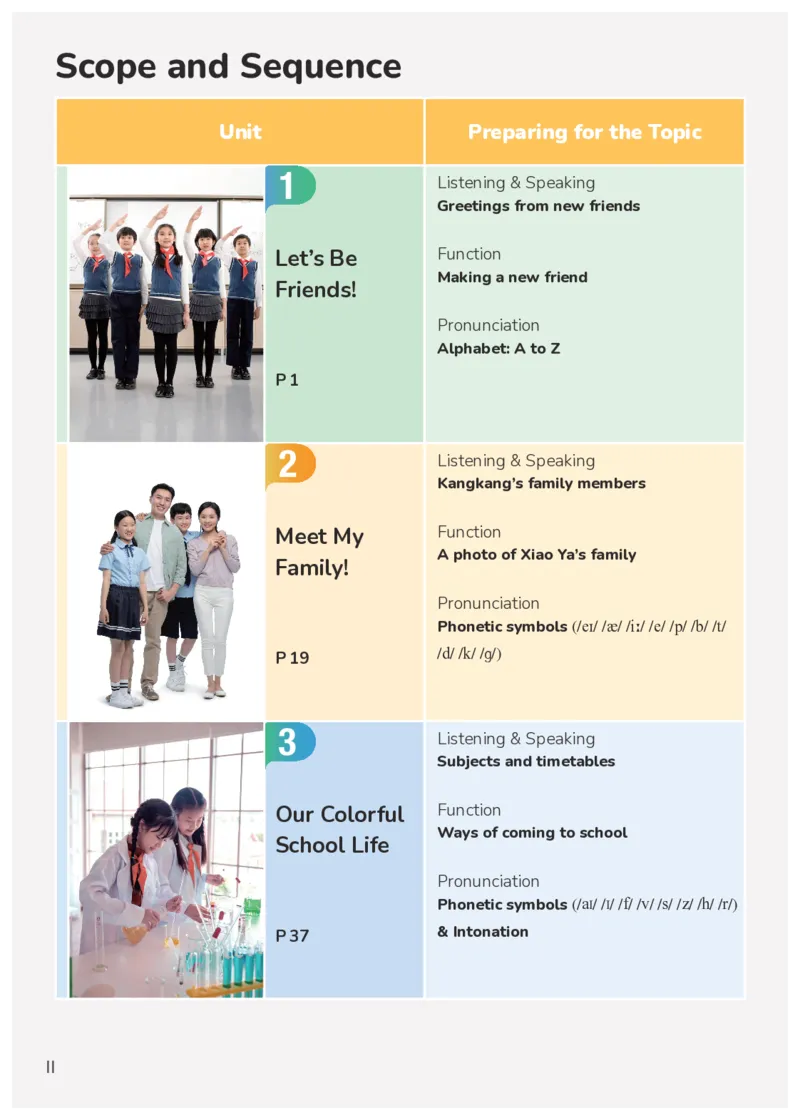
Unit Preparing for the Topic
1
Listening & Speaking
Greetings from new friends
Let’s Be Function
Making a new friend
Friends!
Pronunciation
Alphabet: A to Z
P 1
2
Listening & Speaking
Kangkang’s family members
Meet My Function
A photo of Xiao Ya’s family
Family!
Pronunciation
Phonetic symbols (/eɪ/ /æ/ /i / /e/ /p/ /b/ /t/
P 19
/d/ /k/ /G/)
3
Listening & Speaking
Subjects and timetables
Our Colorful Function
Ways of coming to school
School Life
Pronunciation
Phonetic symbols (/aI/ /I/ /f/ /v/ /s/ /z/ /h/ /r/)
P 37 & Intonation
IIDeveloping Wrapping Up
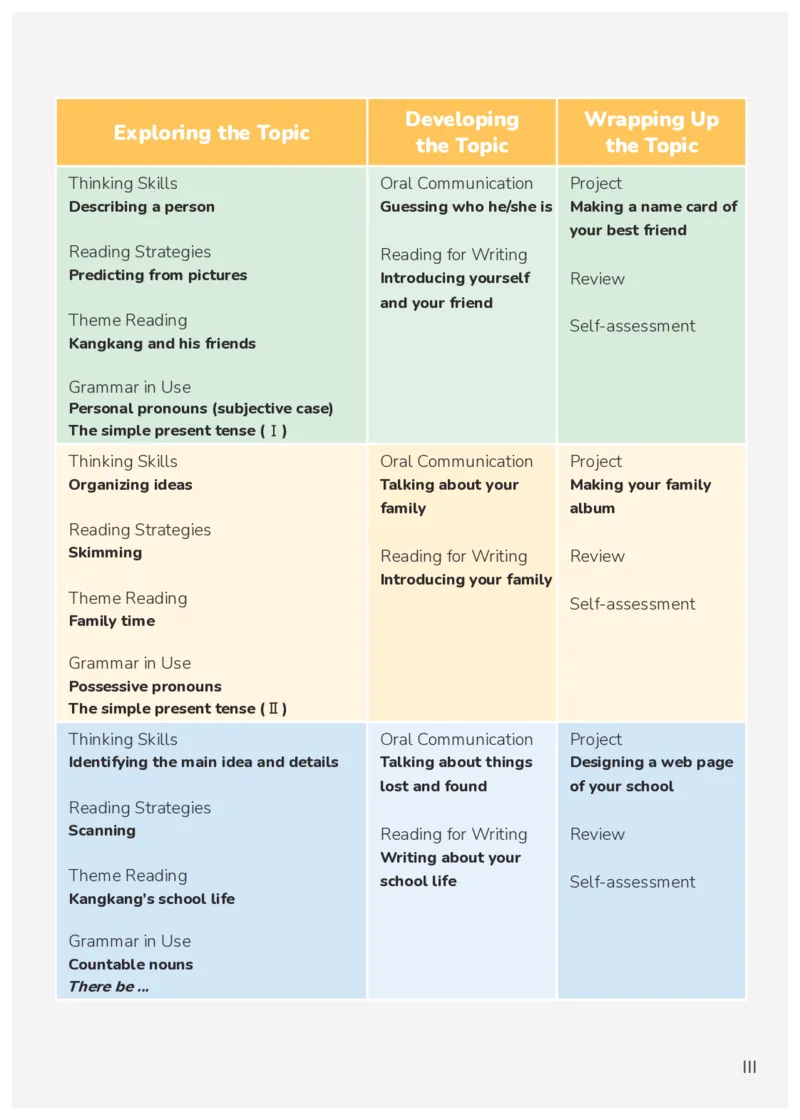
Exploring the Topic
the Topic the Topic
Thinking Skills Oral Communication Project
Describing a person Guessing who he/she is Making a name card of
your best friend
Reading Strategies Reading for Writing
Predicting from pictures Introducing yourself Review
and your friend
Theme Reading
Self-assessment
Kangkang and his friends
Grammar in Use
Personal pronouns (subjective case)
The simple present tense (Ⅰ)
Thinking Skills Oral Communication Project
Organizing ideas Talking about your Making your family
family album
Reading Strategies
Skimming Reading for Writing Review
Introducing your family
Theme Reading
Self-assessment
Family time
Grammar in Use
Possessive pronouns
The simple present tense (Ⅱ)
Thinking Skills Oral Communication Project
Identifying the main idea and details Talking about things Designing a web page
lost and found of your school
Reading Strategies
Scanning Reading for Writing Review
Writing about your
Theme Reading
school life Self-assessment
Kangkang’s school life
Grammar in Use
Countable nouns
There be ...
IIIScope and Sequence
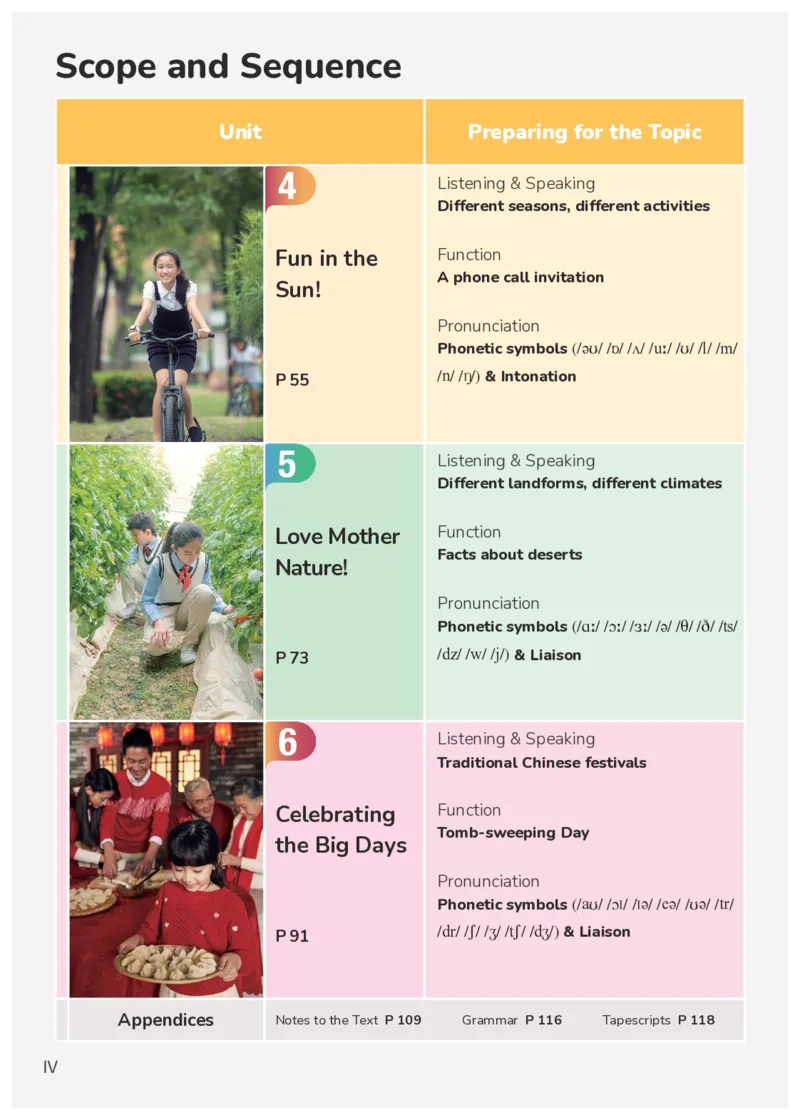
Unit Preparing for the Topic
4
Listening & Speaking
Different seasons, different activities
Fun in the Function
A phone call invitation
Sun!
Pronunciation
Phonetic symbols (/9 / /D/ /7/ /u / / / /l/ /m/
P 55 /n/ /M/) & Intonation
5
Listening & Speaking
Different landforms, different climates
Love Mother Function
Facts about deserts
Nature!
Pronunciation
Phonetic symbols (/ / / / / / /9/ /F/ / / /ts/
P 73 /dz/ /w/ /j/) & Liaison
6
Listening & Speaking
Traditional Chinese festivals
Celebrating Function
Tomb-sweeping Day
the Big Days
Pronunciation
Phonetic symbols (/a / / I/ /I9/ /e9/ / 9/ /tr/
P 91 /dr/ / / /E/ /t / /dE/) & Liaison
Appendices Notes to the Text P 109 Grammar P 116 Tapescripts P 118
IVDeveloping Wrapping Up
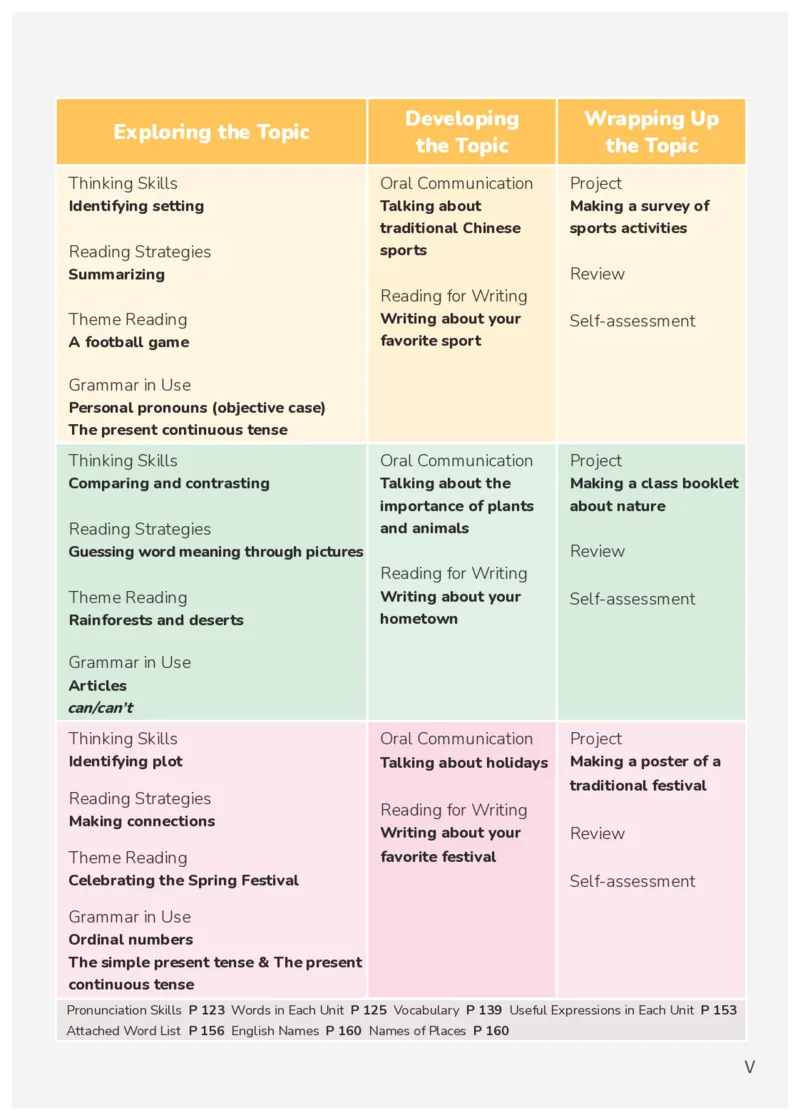
Exploring the Topic
the Topic the Topic
Thinking Skills Oral Communication Project
Identifying setting Talking about Making a survey of
traditional Chinese sports activities
Reading Strategies sports
Summarizing Review
Reading for Writing
Theme Reading Writing about your Self-assessment
A football game favorite sport
Grammar in Use
Personal pronouns (objective case)
The present continuous tense
Thinking Skills Oral Communication Project
Comparing and contrasting Talking about the Making a class booklet
importance of plants about nature
Reading Strategies and animals
Guessing word meaning through pictures Review
Reading for Writing
Theme Reading Writing about your Self-assessment
Rainforests and deserts hometown
Grammar in Use
Articles
can/can’t
Thinking Skills Oral Communication Project
Identifying plot Talking about holidays Making a poster of a
traditional festival
Reading Strategies
Reading for Writing
Making connections
Writing about your Review
Theme Reading favorite festival
Celebrating the Spring Festival Self-assessment
Grammar in Use
Ordinal numbers
The simple present tense & The present
continuous tense
Pronunciation Skills P 123 Words in Each Unit P 125 Vocabulary P 139 Useful Expressions in Each Unit P 153
Attached Word List P 156 English Names P 160 Names of Places P 160
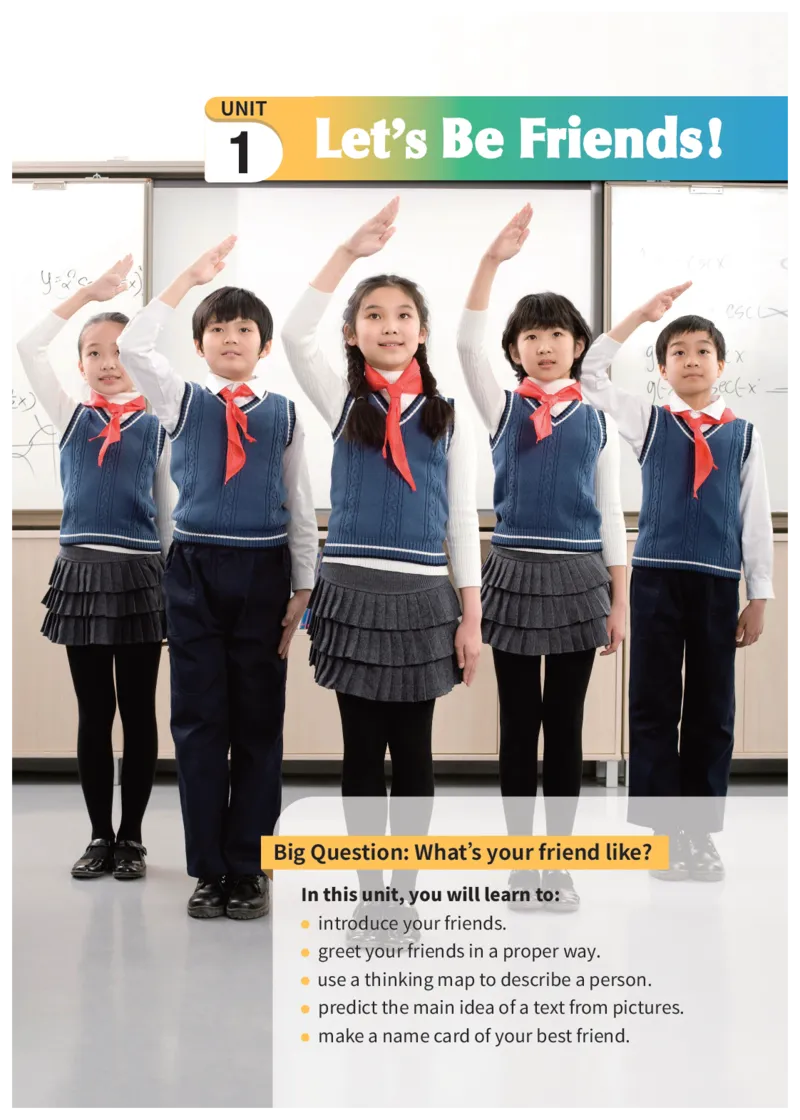
VUNIT LLeett’’ss BBee FFrriieennddss!!
1
Big Question: What’s your friend like?
In this unit, you will learn to:
introduce your friends.
greet your friends in a proper way.
use a thinking map to describe a person.
predict the main idea of a text from pictures.
make a name card of your best friend.UNIT Preparing for the Topic
1
Listening & Speaking Greetings from new friends
Activity 1
A. Match the responses (a–e) with the greetings in the picture at the top
of the next page.
a. Hello! b. Nice to meet you, too. c. Good morning!
d. I’m fine. e. How do you do?
B. Read the sentences and fill in the blanks with the names in the picture.
1. I am __________________. I like science.
2. My name is __________________. I like reading.
3. I’m __________________. I love hiking.
4. I am __________________. I enjoy playing football.
5. My name’s __________________. I like singing.
C. Pair work. Listen and repeat, and then replace the parts in bold
and practice with your partner.
Hello! I’m Miss Wang.
Hello, Miss Wang.
What’s your name, please?
My name is Li Xiang.
What do you like?
I like hiking.
2 UNIT 1Hello! My name is Li
I’m Lingling. My name’s
I’m Wang Xiang. How
Good morning! How do you Xiao Ya. Nice
Junfeng. are you?
I am Kangkang. do? to meet you.
Activity 2
Listen to the conversation and circle the correct information
on the name card.
Name: Zhao Lin/Zhang Li
Likes: Singing/Dancing
Student Number:
202474018/202463159
Activity 3
Pair work. Make your name card and introduce yourself to
your partner.
Name: _________________________________
Likes: __________________________________
Student Number: _________________________
UNIT 1 3Function Making a new friend
Activity 1
Read the numbers aloud. Pay attention to the red letters.
11 12 13 14 15
eleven twelve thirteen fourteen fifteen
16 17 18 19 20
sixteen seventeen eighteen nineteen twenty
Activity 2
Listen to the conversation and put the pictures in order.
Activity 3
Listen and read, and then complete the name cards.
Lulu: Hi, Kangkang!
Kangkang: Hi, Lulu! This is Xiao Ya. Xiao Ya, this is Lulu.
Lulu: Nice to meet you, Xiao Ya.
Xiao Ya: Nice to meet you, too. Where are you from?
Lulu: I’m from Beijing. And you?
Xiao Ya: I am from Tianjin.
Lulu: I’m in Class 6, Grade 7. Which class are you in?
Xiao Ya: I’m in Class 6, Grade 7, too. We are classmates.
Lulu: I’m twelve. How old are you?
Xiao Ya: I’m thirteen years old. See you.
Lulu: See you.
City: _____________ City: _____________
Class: ____________ Class: ____________
Age: ______________ Age: ______________
Name: Lulu Name: Xiao Ya
Activity 4
Group work. Make up a new conversation to introduce your
group members to each other.
4 UNIT 1Pronunciation Alphabet: A to Z
Activity 1
Listen, repeat and write.
Activity 2
Listen to the song and fill in the blanks with correct letters.
TThhee AABBCC
SSoonngg
2
1= C
4
1 1 5 5 6 6 5 - 4 4 3 3 2 2 1 -
TIPS
A B C D E G, H I K L M N, Singing English
5 5 4 4 3 3 2 - 5 5 4 4 3 3 2 - songs is a good
way to learn English.
O P and R S T, V W X Y .
1 1 5 5 6 6 5 - 4 4 3 3 2 2 1 -
Hap-py, hap-py we shall be, when we learn our .
Activity 3
Listen and number the letters you hear, and then write
down their missing capital letters or small letters.
UNIT 1 5UNIT Exploring the Topic
1
Thinking Skills Describing a person
When you describe a person, you can introduce the person’s name, age, looks, likes,
character, etc.
Activity 1
Read the text and learn to describe a person.
l t i I k a M ’m e ll y . s 1 I c n ’ 2 m i a e m n y f e c r e i e a e i . r n s s d K o l a y ld n a . g n I k ’ d m a n I g. frie 1 n 2 dly Kangkang likes t s a c ll ience
Activity 2
Read the text and complete the thinking map.
I C o a G h l m d i r n a . a d I L . ’ e m I i a S M m e in v e t e i h C . n i l r . I a t ’ I e s m a e s m n T f y r k h e o i r n a m e r d e s . , I
like
drawing.
Activity 3
Pair work. Draw a thinking map about yourself, and then make
a self-introduction to your partner. The following words may help you.
Looks tall short strong thin
Likes reading running drawing cooking singing
Character kind friendly nice helpful quiet
6 UNIT 1Reading Strategies Predicting from pictures
Before you read a text, you can look at the pictures first and predict what the text is about.
Activity 1
Look at the pictures and predict what you are going to read
about. Tick ( ) the correct answer.
The text may be about ____________________.
friends classmates
Activity 2
Read the text and check your prediction.
We all need friends. Friends can be old. Friends can be young. Friends can be tall.
Friends can be short. Friends play together and help each other.
My prediction is right wrong.
Activity 3 TIPS
Look at the picture of Li Xiang In English, the first name
and predict what the text may be about, is given name, and the
last name is family name. But in
and then read the text and check your
Chinese, family name comes first.
prediction.
The text may be about Li Xiang’s ___________.
This is my friend, Jim White. He is from
Canada. He is 13 years old. He is tall and
strong. He likes playing football. We often
play football together.
My prediction is right wrong.
UNIT 1 7Theme Reading Kangkang and his friends
Activity 1
Pair work. Ask and answer the questions about your best friend.
The sentences in the box may help you.
— Who is your best friend? — My best friend is ...
— Where is he/she from? — He/She is from ...
— Which class is he/she in? — He/She is in ...
— What does he/she like? — He/She likes ...
Activity 2
Look at the picture and predict what the text may be about.
The text may be about
___________________.
Hi, I’m Kangkang. I’m from Beijing. I’m in Class Six, Grade Seven. I’m
twelve. I like science. Here are my friends.
Xiao Ya is from Tianjin. She’s in Class Six, too. She is kind and cute.
She likes singing and playing the guitar.
Li Xiang is from Beijing, too. He is in Class Three, Grade Seven. He is
tall and strong. He likes hiking.
Lingling is my classmate. She’s friendly and quiet. She likes reading.
We are all new here, and we are very happy to meet each other at the
new school!
8 UNIT 1Activity 3
Read the text and mark T (True) or F (False).
1. Xiao Ya likes music. ( )
2. Li Xiang is from Tianjin. ( )
3. Lingling and Kangkang are classmates. ( )
4. Kangkang and Li Xiang like hiking. ( )
Activity 4
Read the text again and draw thinking maps about Kangkang
and his friends.
Activity 5
Group work. Ask and answer questions about Kangkang and
his friends based on Activity 4, and then introduce them in your group.
You may begin like this:
Kangkang has three friends. They are ... Xiao Ya is ...
UNIT 1 9Grammar in Use Personal pronouns (subjective case)
Activity 1
Look at the pictures and read the sentences. Pay attention to
the personal pronouns in bold.
Hello! I am Lingling. You are in Class 6. She is Xiao Ya. He is 12 years old.
It is a cute dog and
We are good friends. They are from China.
has two big ears.
Activity 2
Fill in the blanks with the correct personal pronouns.
1. This is a cat. ________ is a little black cat.
2. ________ am in Class One, Grade Seven.
3. Meimei and I are in Class One, Grade Seven. ________ are classmates.
4. Xiao Ya and Meimei are good friends. ________ like listening to music.
5. Wang Junfeng is tall and strong. ________ likes playing football.
Activity 3
Read the text and fill in the blanks with the correct personal
pronouns.
This is my friend, Sarah Hill. _________ is from America. _________ is lovely.
Sarah has a brother, Tom Hill. _________ is very tall. _________ likes singing
and dancing. _________ like dancing, too. _________ often dance together.
10 UNIT 1The simple present tense (I)
Activity 1
Pair work. Read the conversation. Pay attention to the usage
of the verbb e.
Hello! My name is Li Mei. What’s your name?
Hi! I am Li Xiang. Are you in Class Three?
Yes, I am. We Is that boy our
are classmates. classmate, too?
No, he isn’t. He is in Class One.
Activity 2
Complete the tables and learn how to use the verbb e.
Positive Negative
I am ... I’m ... I am not ... I’m not ...
He/She/It is ... He/She/It’s ... He/She/It is not ... He/She/It isn’t ...
We/You/They are ...We/You/They’re ... We/You/They are not ... We/You/They aren’t ...
Question Short Answer
Am I ...? you ____. you are not (you ____).
Is he/she/it ...? he/she/it ____. he/she/it is not (he/she/it ____).
Yes, No,
you/we/they are not
Are we/you/they ...? you/we/they ____.
(you/we/they ____).
Activity 3
Pair work. Complete the sentences, and then share them with
your partner.
Your
Friend
Yourself
1 2 3 4 . . . . ( ( ( ( N A C H l a g o a m e m s ) s e e ) I ) ) I _ I I _ _ _ _ _ _ _ _ _ _ _ _ _ _ _ _ _ _ _ _ _ _ _ _ _ _ _ _ _ _ _ _ _ _ _ _ _ _ _ _ _ _ _ _ _ _ _ _ _ _ _ _ _ _ _ _ _ _ _ _ _ _ _ _ _ _ _ _ _ _ _ _ _ _ _ _ _ _ _ _ _ _ _ _ _ _ _ _ _ _ _ . . . . 4 3 . 2 ( . 1 ( . H ( . C ( A o N la m g a s e m e s ) ) ) e H H H ) e e e H / / / S S S e h / h h S e e e h _ _ _ e _ _ _ _ _ _ _ _ _ _ _ _ _ _ _ _ _ _ _ _ _ _ _ _ _ _ _ _ _ _ _ _ _ _ _ _ _ _ _ _ _ _ _ _ _ _ _ _ _ _ _ _ _ _ _ _ _ _ _ _ _ . _ . . .
UNIT 1 11UNIT Developing the Topic
1
Oral Communication Guessing who he/she is
Activity 1 TIPS
Set a purpose
before you listen,
A. Listen to the conversation and match i.e. listening for names,
places, numbers, etc.
the following information.
Li Ming Class Three swimming
Meimei Class Six running
Lin Hua Class Seven cooking
B. Listen again and fill in the blanks.
Li Ming is from __________. He is __________ years old.
Meimei is from Tianjin. She is __________ years old.
Lin Hua is from __________. He is __________ years old.
Activity 2
Group work. Take turns to introduce a
member in your group, and then let other members
guess who he/she is.
You may begin like this:
He/She is from ...
He/She is ... years old.
He/She is a ... boy/girl.
He/She likes ...
1122 UUNNIITT 11Reading for Writing Introducing yourself and
your friend
Activity 1
Read the text and complete the thinking map.
Title My Friend and I
Hi, everyone! My name is Lingling. I have a good
Beginning
friend. Her name is Xiao Ya.
I’m from Beijing. I’m in Class Six, Grade Seven. I’m
Body
quiet and friendly. Xiao Ya is from Tianjin. She is my
• Who classmate. She is a beautiful and lovely girl.
• Likes I like drawing pictures and reading books. Xiao Ya
likes singing and listening to music. We also do many
things together, such as swimming and running.
Xiao Ya is a great friend! I enjoy the time with her.
End
Class Six,
Grade Seven
Lingling Xiao Ya
Activity 2
Draw a thinking map about yourself and your friend.
UNIT 1 13Activity 3
Draft your essay about yourself and your friend.
Title
_________________________
My name is _____________________________________________
Beginning
__________________________________________________________ .
__________________________________________________________
Body
__________________________________________________________
• Who
__________________________________________________________ .
• Likes I like ____________________________________________________ .
We ______________________________________________________ .
End _______ is a great friend! We ____________________________ .
Activity 4
Make your final draft in your exercise book.
Activity 5
Invite your partner to rate your final draft. Write 1 (more improvements
needed), 2 (fair), 3 (good), or 4 (excellent) for the ratings.
Partner’s
How well can you ____________________?
rating
express your view of making friends
use the thinking skill of describing a person
introduce your friend to others
organize ideas into a well-balanced structure
use the theme vocabulary of the unit
use the simple present tense
use punctuation
spell the words
14 UNIT 1UNIT Wrapping Up the Topic
1
Project Making a name card of your best friend
Activity 1
Read the name card and answer the questions.
1. What do you know from the name card?
2. Which girl in the picture is Liu Mei?
My Best Friend
Name: Liu Mei
Age: 12
Home: Guangming Village
Likes: Drawing
Looks/Character: A tall girl
Activity 2
Group work. Design a name card of your best friend and draw
a picture of him or her.
My Best Friend
Name: ______________________________
Age: ________________________________
Home: ______________________________
Likes: ________________________________
Looks/Character: ____________________
Activity 3
Group work. Introduce your best friend in your group based on
Activity 2, and then choose the best designer to report to the class.
This is my best friend … He/She is …
UNIT 1 15Review
Activity 1
Group work. Listen to the text and complete the name cards,
and then introduce the students to your class.
Name: Chen Lili
Name: Yang Guang
City: ____________ City:
_______________
Likes: Reading
Likes:
______________
Name: Xiao Ming Name: Xiaoxiao
City: _____________ City:Beijing
Likes: ____________ Likes: ____________
Activity 2
Read the text and fill in the blanks with the words in the box.
friendly happy classmate quiet
My name is Yangyang. I’m from Shijiazhuang. Lingling
is my best friend at school. She is from Beijing. She is my
___________. Lingling is a ____________ girl. She doesn’t talk
much, but she likes to help others. She is really ____________
and kind. We love reading.
I’m ____________ to be friends with her and I enjoy the time
with her.
16 UNIT 1Activity 3
Read the text and complete it witha mi/sa/re(not).
My name _______ Liu Yang. I _______ 13 years old. I’m from Xi’an. Li Ming
_______ my best friend. He _______ from Xi’an. He is from Beijing. He’s 13
years old. Li Ming and I _______ in Grade Seven, but we _______ in different
classes. He _______ kind. He likes playing football and swimming.
Activity 4
TIPS
Read and write the
They begin with capital letters:
following sentences. Pay attention • the first word of a sentence;
• Mr., Mrs., Ms., Miss and I;
to the underlined letters.
• names of people, cities, countries, etc.
1. I am Kangkang and I’m from Beijing.
2. Nice to meet you.
3. Mr. Smith is from Canada.
4. Li Qiao is from Chongqing.
5. Are you in Class Four, Grade Seven?
UNIT 1 17Self -assessment
1. How much do you enjoy the topic?
I’m interested in the topic of making friends.
I enjoy making new friends and I can describe their __________
____________________________________________________.
2. How well can you use the language and cultural knowledge?
I can spell the 26 letters.
I can use the vocabulary for/of greetings and hobbies.
I can use the personal pronouns and simple present tense.
I can greet my friends in a proper way.
3. How well can you use English to perform the activities?
I can talk about myself and my new friends.
I can understand the texts and recordings in this unit.
I can introduce a member in my group.
I can write about myself and my friends.
4. How well can you use thinking skills and learning strategies?
I can use a thinking map to describe a person.
I can predict the main idea of a text from pictures.
I can work with my partners in pair/group work.
5. How are you satisfied with your group project?
I can make name cards with my partners.
I can report our project to the class.
6. How are you going to improve your English learning?
____________________________________________________________________
____________________________________________________________________
18 UNIT 1UNIT MMeeeett MMyy FFaammiillyy!!
2
Big Question: What makes a family?
In this unit, you will learn to:
introduce your family.
understand family differences.
use a thinking map to organize ideas.
use the reading strategy of skimming.
make your family album.UNIT Preparing for the Topic
2
Listening & Speaking Kangkang’s family members
Activity 1
A. Match the words (a–h) with Kangkang’s family members at the top of
the next page.
a. grandfather b. grandmother c. father d. mother
e. uncle f. aunt g. sister h. cousin
B. Read the sentences and tick ( ) the correct information.
1. My name is Kangkang. I’m a student/a teacher. I am in Class 6, Grade 7.
2. This man is my father. He always wears a tie. He is a worker/a doctor.
3. My mother is a nurse/a teacher. She likes wearing qipao.
4. My uncle is in a white shirt. He is a bus driver/a worker.
5. That woman in a blue dress is my aunt. She is a nurse/a policewoman.
6. The tall girl in yellow is my sister/cousin. She’s my uncle’s child.
7. Xuanxuan is my little sister/brother. She has a pink toy rabbit.
C. Pair work. Listen and repeat, and then replace the parts in bold
and practice with your partner.
Who is this man?
He is my father.
What does he do?
He is a doctor.
Is this tall girl your sister?
No, she isn’t. She
is my cousin.
20 UNIT 2c. father f. aunt
Kangkang
Activity 2
Listen to the conversation and match Wang Junfeng’s family
members with their jobs.
My ... mother nurse
aunt doctor
father teacher
uncle worker
Activity 3 ’
Pair work. Ask and answer questions about Wang Junfeng s
family members.
UNIT 2 21Function A photo of Xiao Ya’s family
Activity 1
Pair work. Talk about the jobs and the workplaces.
teacher nurse worker cook
factory hospital school restaurant
Example: ---- Where does a teacher work? ---- A teacher works in a school.
Activity 2
Listen to the conversation and answer the questions.
1. How many people are there in Xiao Ya’s family?
2. Who are they?
Activity 3
Listen and read, and then complete the table.
Kangkang: Is this a photo of your family?
Xiao Ya: Yes, it is.
Kangkang: What does your father do?
Xiao Ya: He’s a PE teacher.
Kangkang: Where does he work?
Xiao Ya: He works in our school.
Kangkang: Does he teach us?
Xiao Ya: No, he doesn’t. He teaches Grade Eight.
Kangkang: What does your mother do?
Xiao Ya: She is a worker in a big factory.
Kangkang: Your little sister is so cute and pretty. How old is she?
Xiao Ya: She is only four years old.
Family Member Job Workplace
Xiao Ya’s father
Xiao Ya’s mother
Activity 4
Group work. Talk about your family members, and then make
up a new conversation.
22 UNIT 2Pronunciation Phonetic symbols (/eI/ /æ/ /i / /e/ /p/ /b/ /t/
/d/ /k/ /G/)
Activity 1
Listen to the chant. Pay attention to the pronunciation of
the colored letters.
Kate keeps a big pet.
Its name is Ted.
Ted gets a bag. The bag is on his bed.
Ted is a cute cat.
He meets dad at the gate.
Activity 2
Listen and repeat.
Letter a e p b t d k g
Sound /eI/ /æ/ /i / /e/ /p/ /b/ /t/ /d/ /k/ /G/
gate at keep get pet bed Ted dad Kate bag
Word
date tab be beg tap beep bet day take egg
Activity 3
Listen and circle the words you hear.
take gate bag dad bed pet
get bee tab date Kate egg
Activity 4
Read the following sounds aloud and spell out the words.
TIPS
The sound of a
word can help
you check your spelling
/Geɪt/ /dæd/ /bed/ in English.
___ ___ ___
/pet/ /deɪt/ /bæG/
___ ___ ___
UNIT 2 23UNIT Exploring the Topic
2
Thinking Skills Organizing ideas
A writer needs to think of some ideas first, and then organize them in a good way.
Activity 1
Look at the pictures and read the text. Learn how to organize ideas.
I’m busy on Saturdays. I play basketball with my father in the morning and help my
mother cook at noon. In the afternoon, my parents and I visit my grandparents.
I help my mother cook.
I play basketball I’m busy on
I visit my grandparents.
with my father. Saturdays.
Activity 2
Read the text and complete the thinking map.
I enjoy my time with my family. We eat and talk together. We read and watch TV
together. We do chores together, too.
Activity 3
Pair work. Draw a thinking map about your family time and then
talk about it. The following phrases may help you.
play football read books go to the park go shopping walk the dog
24 UNIT 2Reading Strategies Skimming
When you are reading, you can just focus on the main idea and key points to get the
important information quickly.
Activity 1
Read the underlined sentences only and then fill in the blanks.
Maria is from a big family. She lives with her grandparents, parents, uncles,
aunts, brothers, sisters and cousins.
Li Xiang’s family is small. There are three people in his family: his parents
and him.
Maria’s family is ____________, and Li Xiang’s family is ____________.
Activity 2
Read the text and underline the sentences about the main idea
and key points.
All families are different. Some families are big. Grandparents,
parents and children live together. Most families are small. The
parents live with their children.
Activity 3
Skim the text in Activity 2 again and choose the correct answers.
1. What is the text about?
A. Big and small families. B. Happy family time. C. Family tree.
2. Which photo shows a small family?
A. B.
UNIT 2 25Theme Reading Family time
Activity 1
Pair work. Look at the pictures and talk about your family time.
Activity 2
Read the text and underline the main idea.
My name is Kangkang. My mother is a teacher, and my father is a
doctor. They are very busy most of the time. But after work, we do
many things together.
My grandparents don’t live with us. We often visit them on weekends
and have dinner together. We all do something for dinner. My parents
cook the food. My sister helps our grandparents set the table and I clean
up with my father after dinner.
I love my family, and I enjoy my family time.
26 UNIT 2Activity 3
Read the text again and mark T (True) or F (False).
1. Kangkang’s parents are busy most of the time. ( )
2. Kangkang lives with his grandparents. ( )
3. Kangkang and his sister set the table. ( )
4. Kangkang’s grandparents cook the dinner. ( )
5. Kangkang and his father clean up after dinner. ( )
Activity 4
Read the text again and complete the thinking map.
Kangkang’s sister and his grandparents
______________________________.
They all do something
Kangkang’s parents Kangkang __________
for dinner.
___________________. ___________________.
Activity 5
Group work. Discuss the activities in the pictures and then retell
the text.
UNIT 2 27Grammar in Use Possessive pronouns
Activity 1
Look at the pictures and read the sentences. Pay attention to
the possessive pronouns in bold.
This is my mother. ---- Kangkang, your ---- Is that man your Kangkang’s uncle
She is a teacher. sister is pretty. teacher? is a bus driver. He
---- Yes, she is. ---- Yes, he is. loves his job.
Kangkang’s aunt ---- Whose dog is it? I have a happy Kangkang and his
is a policewoman. ---- It’s my dog. Its family and we enjoy sister love their
She loves her job. name is Wangcai. our family time. grandparents very
much.
Activity 2
Complete the table with the correct form of the personal pronouns.
Personal pronoun
I _____ he _____ it we you they
(subjective case )
Possessive pronoun _____ your _____ her its _____ _____ _____
Activity 3
Read the text and fill in the blanks with correct pronouns.
Mr. and Mrs. Yang have a happy family. They have two children and a cat. This
is _____ son. _____ name is Yang Guang. He likes swimming and riding _____
bike. Yang Guang has a sister. _____ name is Yang Yu. She is pretty and she likes
dancing. The cat is black. _____ name is Xiaohei.
28 UNIT 2The simple present tense (II)
Activity 1
Pair work. Read the conversation. Pay attention to the words
in bold.
Michael, do you like singing?
Yes, I do. My brother likes singing, too.
Does he like playing the guitar?
Yes, he does. He plays it very well.
Activity 2
Complete the tables and learn how to use the simple present tense.
Positive Negative
I/You/We/They like I/You/We/They don’t like
singing. singing.
He/She/It _____ He/She/It _____
Question Short answer
Do I/you/we/they you/I/we/they ____. you/I/we/they don’t.
like
Yes, No,
singing?
___ he/she/it he/she/it does. he/she/it ____.
Activity 3
Group work. Read the example and complete the table, and
then make short conversations.
Lingling and
Activity Li Xiang Xiao Ya Yourself
Li Mei
swimming √ × √
playing football × √ ×
running √ × √
Example:
---- Does Li Xiang like swimming? ---- Yes, he does.
---- Do you like swimming? ---- Yes, I do./No, I don’t.
---- What do you like? ---- I like dancing.
UNIT 2 29UNIT Developing the Topic
2
Oral Communication Talking about your family
Activity 1
A. Listen to the conversation and tick ( ) Lingling’s family photo.
B. Listen again and fill in the blanks.
Lingling has a happy family. Her father is a ___________, and her mother is a
policewoman. Lingling and her brother often help their parents do ___________.
Lingling helps her father do the ___________. Her brother helps their mother
___________. On weekends, Lingling’s family visit her grandparents. They eat
and ___________ together.
Activity 2
Pair work. Introduce your family to your partner. The questions
in the box may help you.
TIPS
1. Do you have a big or a small family? You can use pictures
to help introduce
2. Who are they in your family?
your family.
3. What do they do?
4. What do your family often do together?
You may begin like this:
I have a big/small family. There are ... in my family ... My mother is ... My father is ...
30 UNIT 2Reading for Writing Introducing your family
Activity 1
Read the text and complete the thinking map.
Title My Family
Hello, my name is Li Xiang. I’m twelve. Let me
Beginning
tell you about my family.
There are three people in my family. They are my
father, my mother and I. My father is a doctor. My
Body
mother is a nurse.
• Family members
My family do many things together. We often
• Family activities
do sports in the afternoon, such as running and
swimming. Sometimes, we watch films at home.
On weekends, we often visit my grandparents.
End I love my family.
My family do many
things together.
Activity 2
Draw a thinking map about your family activities.
UNIT 2 31Activity 3
Draft your essay about your family.
Title _________________
Hello! My name is _____________________________ . I’m
Beginning
_______________ . Let me ____________________________ .
____________________________________________________
_______________________________________________________
Body
_______________________________________________________
• Family members
_______________________________________________________
• Family activities
_______________________________________________________
_______________________________________________________
______________________________________________________ .
End I ____________________________________ .
Activity 4
Make your final draft in your exercise book.
Activity 5
Invite your partner to rate your final draft. Write 1 (more improvements
needed), 2 (fair), 3 (good), or 4 (excellent) for the ratings.
Partner’s
How well can you ____________________ ?
rating
express your view of family love
introduce your family
organize ideas into a well-balanced structure
use the theme vocabulary of the unit
use the simple present tense
use punctuation
spell the words
32 UNIT 2UNIT Wrapping Up the Topic
2
Project Making your family album
Activity 1 ’
Look at the photos in Liu Mei s family album and answer the
questions.
1. Who are the members in Liu Mei’s family?
2. What are Liu Mei’s family activities?
Activity 2
Group work. Introduce some photos of your family to your
group, and then make a family photo album.
My Family Activities
————————————
————————————
————————————
————————————
Put some photos here. ————————————
Activity 3
Talk about your family photo album.
Here are my family photos. They are really great ...
UNIT 2 33Review
Activity 1
Listen to the monolog and match the people’s names with
the cities, and then listen again and write down their jobs.
Li Jun Fuzhou _________
Wang Jing Shenzhen _________
Zhang Tao Nanjing _________
Wang Linlin Beijing _________
Activity 2
Look at the pictures and complete the sentences with the
correct form of the phrases.
play with teach math study hard live with do chores
1. I like ____________ my little sister after school.
2. My uncle Lin Feng ____________ in a middle school.
3. The girl _________________ every day.
4. My grandparents don’t ______________ us, but we visit them on weekends.
5. ----- Does she often help her mother ____________ at home?
----- Yes, she does.
Activity 3
Pair work. Complete the conversation with the correct form
of the given words, and then act it out with your partner.
Xiaoxiao: Li Ming, who is the girl in the photo?
Li Ming: She is my big sister.
Xiaoxiao: She ______ (look) nice in white. What _______ she _______ (do)?
Li Ming: She is a nurse.
Xiaoxiao: Does she _______ (work) in a hospital?
Li Ming: No, she _______ (not work) in a hospital. She _______ (look)
after the old in an old people’s home.
Xiaoxiao: I see. She is very kind.
34 UNIT 2Activity 4
A. Skim the text and write a proper title for the text.
My ________________
My name is Lin Hua. I am twelve
years old. I’m a student in Grade
Seven.
This is my family. We live in
Zhengzhou. My father is a doctor.
He works in a hospital. My
mother is a teacher. She teaches
in a high school. I have a sister,
Yaoyao. She is six years old. She
likes playing with Kitty. Kitty is a cute cat. My grandparents live with us.
They help a lot in looking after the family.
I love my family!
B. Read the text again and answer the questions.
1. Where does Lin Hua live?
_____________________________________________________________________________
2. What does his father do?
_____________________________________________________________________________
3. Where does his mother work?
_____________________________________________________________________________
4. What other things do you know about Lin Hua’s family?
____________________________________________________________________________
UNIT 2 35Self -assessment
1. How much do you enjoy the topic?
I’m interested in the topic of introducing my family.
I enjoy my family time, and we often _____________________
_____________________________________________together.
2. How well can you use the language and cultural knowledge?
I can say the vowel and consonant sounds.
I can use the vocabulary for/of family.
I can use the possessive pronouns and simple present tense.
I can describe different kinds of families.
3. How well can you use English to perform the activities?
I can talk about my family members and their jobs.
I can understand the texts and recordings in this unit.
I can introduce my family to my classmates.
I can write about my family members and family activities.
4. How well can you use thinking skills and learning strategies?
I can use a thinking map to organize ideas.
I can use skimming strategy in reading.
I can work with my partners in pair/group work.
5. How are you satisfied with your group project?
I can make family album with my partners.
I can report our project to the class.
6. How are you going to improve your English learning?
____________________________________________________________________
____________________________________________________________________
36 UNIT 2UNIT OOuurr CCoolloorrffuull SScchhooooll LLiiffee
3
Big Question: What is your school life like?
In this unit, you will learn to:
introduce your school life.
understand the school life in different cultures.
use a thinking map to identify the main idea
and details.
use the reading strategy of scanning.
design a web page of your school.UNIT Preparing for the Topic
3
Listening & Speaking Subjects and timetables
Activity 1
A. Match the subjects (a–h) with the pictures at the top of the next page.
a. biology b. Chinese c. math d. PE
e. geography f. art g. history h. computer science
B. Look at the timetable and write the subjects on the lines.
Wednesday
Morning
8:00 -- 8:40 Chinese
The _______ class It’s ten twenty. We’re at
8:50 -- 9:30 Math
begins at 8 o’clock. the _______ class.
10:00 -- 10:40 Music
10:50 -- 11:30 Art
Afternoon
14:30 -- 15:10 PE
It’s half past eleven. It’s a quarter to three.
15:20 -- 16:00 English
The _______ class is over. We all like the _______ class.
C. Pair work. Listen and repeat, and then replace the parts in bold
and practice with your partner.
What time is it now?
It’s eight o’clock.
It’s time for our Chinese class.
38 UNIT 3Activity 2
Listen to the conversation and fill in the blanks.
It’s ________. I have a _____________ class
at 10:30. It’s my favorite subject.
I like ________ best. It’s at ________
on Thursday afternoon.
Activity 3
Pair work. Talk about your favorite subject and the class
timetable.
UNIT 3 39Function Ways of coming to school
Activity 1
Look at the pictures and match them with the phrases.
E . by car
A. by underground
A
F . by train
B. by bike
G. by ship
C. by plane
H. by bus
D. on foot
I . by boat
Activity 2
Listen to the conversation and circle the correct answer.
They are talking about the way of going to school/the underground stop.
Activity 3
Listen and read, and then fill in the blanks with adverbs of
frequency.
Xiao Ya: Hi, Kangkang. How do you usually come to school?
Kangkang: My home is not very far, so I usually come here on foot, sometimes
by bike. How about you, Xiao Ya?
Xiao Ya: I live far from school. I never come to school on foot. I often take
the underground. What about you, Lulu?
Lulu: I seldom take the underground. There are no underground stops near
my home. I always come to school by bus.
Kangkang: What’s the time now?
Lulu: It’s 7:55. It’s time for class. Let’s go!
1. Kangkang usually comes to school on foot.
TIPS
Adverbs of
2. Kangkang __________ comes to school by bike.
frequency show
3. Xiao Ya __________ comes to school on foot.
how often something
4. Xiao Ya __________ comes to school by underground. happens. They usually
5. Lulu __________ comes to school by underground. come before the notional
verbs.
6. Lulu __________ comes to school by bus.
Activity 4
Group work. Talk about how you come to school by using
adverbs of frequency.
40 UNIT 3Pronunciation Phonetic symbols (/aI/ /I/ /f/ /v/ /s/ /z/ /h/ /r/ )
& Intonation
Activity 1
Listen to the text. Pay attention to the pronunciation of the
colored letters.
Zaki has a bike.
A nice big bike.
He sees the sun rise.
And he goes outside.
Today, he has a math class.
He sits and works hard.
Activity 2
Listen and repeat.
Letter i f v s z h r
Sound /aI/ /I/ /f/ /v/ /s/ /z/ /z/ /h/ /r/
bike kid fine give sit his Zaki he ride
Word
kite big gift five desk has zip hit rise
Activity 3
Read the following sounds aloud and spell the words.
/baɪk/ /sɪt/ /faɪv/ /bɪG/
___ ___ ___ ___
/hɪt/ /kaɪt/ /kɪd/ /raɪz/
___ ___ ___ ___
Activity 4
Listen and repeat the following sentences aloud. Pay attention
to the rising tones ( ) and the falling tones ( ).
TIPS
In a list, we
1. There are pens, books and a ruler in my schoolbag. use a rising
tone for each item
2. We usually go to the zoo by bus, by car or by underground.
before the last one,
and a falling tone for
3. We study Chinese, English and many other subjects.
the last one.
UNIT 3 41UNIT Exploring the Topic
3
Thinking Skills Identifying the main idea and details
The main idea is what the text is all about. Details are used to support or tell more
about the main idea.
Activity 1
Look at the picture and read the text. Learn how to identify the
main idea and details.
Our School Library
We have a big
school library.
It is a new There are a
building with lot of books
two floors. in it.
Activity 2
Read the text and complete the main idea and detail chart.
My school is very beautiful. There is a beautiful teaching building. It has five
floors. The playground is very big. Next to the playground, there is a small
garden. There are many beautiful flowers in it.
Activity 3
Pair work. Talk about something in your school by using a main
idea and detail chart. The following words may help you.
clean tidy tall beautiful
42 UNIT 3Reading Strategies Scanning
When you are reading, you can go through the text quickly and only search for the
information you need.
Activity 1
Read the question first and scan the poster for the answer.
Question: What time does the English club open?
The question is
about time.
The time is here.
Activity 2
Read the poster again and answer the questions.
1. Where is the English club?
2. What activities are there in the English club?
Activity 3
Read the questions first and scan the text for the answers.
1. Where does the girl go on Fridays?
2. What does the boy often do at the swimming club?
The girl loves art. Every Friday, she goes
to the art club to draw pictures there.
The boy likes sports. He goes to the swimming club at
4:30 every Tuesday afternoon. He plays water games
with his friends at the club.
UNIT 3 43Theme Reading Kangkang’s school life
Activity 1
Pair work. Look at the pictures and talk about the school
activities in the pictures.
Activity 2
Read the text and underline Kangkang’s activities on Monday.
I’m Kangkang and I study at a middle school in Beijing. Our school life is
fun and colorful.
On the morning of every Monday, we raise the national flag. We start the first
class at 8:00 a.m. every day. We study Chinese, English, math, science and
many other subjects. My favorite class is PE. Every afternoon, we have one
PE class on the playground.
There are many student clubs in our school. We can make friends with other
students there. We have different activities in the clubs after school. I enjoy
singing and playing the guitar in the music club.
I really love going to school.
Activity 3
Read the text again and answer the questions.
1. How is Kangkang’s school life?
2. What time does the first class begin?
3. Where does Kangkang have PE classes?
4. What does Kangkang do in the music club?
44 UNIT 3Activity 4
Complete the main idea and detail chart according to the text.
Main idea:
Our school life is _______________________.
Detail: Detail: Detail:
On Monday mornings, We start our first class After school, we have
we ________________ at ________ and study ___________________
___________________ many subjects, such ___________________
___________________ as ________________. ___________________
___________________. We have __________. __________________.
Activity 5
Look at the pictures and choose the correct words to complete
the phrases, and then fill in the blanks with the correct form of the phrases.
enjoy make raise play
______ playing the ______ friends
______ his hand ______ basketball
guitar with ...
1. Kangkang likes _______________ and answering questions in class.
2. Kangkang often _______________ with Wang Junfeng after class.
3. Kangkang ____________________ and singing songs.
4. Kangkang is friendly and he ___________________ many students in different
school clubs.
UNIT 3 45Grammar in Use Countable nouns
Activity 1
Look at the pictures and read the sentences. Pay attention to
the nouns in bold.
My sister likes There are two boxes There are three school
reading books. in the boy’s hands. buses in our school.
My art teacher likes We have many different There are two knives
taking photos. school activities. on the table.
Activity 2
Complete the table and learn how to form the plural form of
countable nouns.
Singular watch glass dish tomato toy country half
Plural
Activity 3
Read the text and tick ( ) the correct words.
Mike is an American boy. At an American school, (student/students) meet
their class teachers at the start of the (day/days). During the day, they go to
different (classroom/classrooms) for different subjects. After school, they
take part in club (activity/activities). Mike is in the science (club/clubs). At
the club, he makes (friends/friend) with students from America and other
(country/countries).
46 UNIT 3There be ...
Activity 1
Pair work. Read the conversation. Pay attention tot here be.
What’s in the big box?
There are some bottles in it.
Is there any water in the bottles?
No, there isn’t. But there is some juice.
Are there any toys in the small boxes? Yes, there are.
Activity 2
Complete the table and learn how to uset here be.
Singular noun Plural noun
Positive There ____ (There’s) ... There ____ (There’re) ...
Negative There ____ (There isn’t) ... There ____ (There aren’t) ...
Question ____ there a/an/any ... ? ____ there any ... ?
Yes, there ____. Yes, there ____.
Short answer
No, there ____. No, there ____.
Activity 3
Pair work. Look at the picture of a classroom, and then follow
the example to ask and answer questions witht here be.
Example:
---- What’s in the classroom?
---- There is a blackboard and some desks.
---- Are there any chairs in the classroom?
---- Yes, there are.
UNIT 3 47UNIT Developing the Topic
3
Oral Communication Talking about things lost and
found
Activity 1
A. Match the words with the objects in the picture, and then listen to
the conversation and circle the words you hear.
1. pencils ________
2. books ________
3. a desk ________
4. a name card ________
5. a ruler ________
6. a schoolbag ________
7. a ping-pong ball ________
8. a computer ________
B. Listen again and fill in the blanks.
Zhou Hua can’t find his schoolbag. The schoolbag is ________. There is a name card
and a ping-pong ball in it. And there are also ________ books in the schoolbag. One
is a ________ book and the other is a science book. Miss Wang finds the schoolbag
________ the computer.
Activity 2
Group work. Talk about the things in the Lost and Found and
then make a conversation.
You may begin like this:
A: Can I help you?
B: Yes. I can’t find my ...
A: What’s your name?
B: ...
A: What color is your ... ?
B: It’s ...
…
48 UNIT 3Reading for Writing Writing about your school life
Activity 1
Read the text and complete the main idea and detail chart.
Title My School Life
I am a middle school student, and my school life is
Beginning
colorful.
We usually start our day at 8:00 a.m., and our classes
Body
end at 4:00 p.m. We learn many different subjects
• School time like Chinese, math, science, history and English.
• Subjects After school, we play games. There are also many
• After-school activities interesting after-school activities. We can join the
clubs, play sports or go to the library.
End I really love my school life!
Main idea:
My middle school life is _________________________.
Detail: Detail: Detail:
___________________ ___________________ ___________________
___________________ ___________________ ___________________
___________________ ___________________ ___________________
___________________ ___________________ ___________________
_______________. _______________. _______________.
Activity 2
Draw a main idea and detail chart about your school life.
UNIT 3 49Activity 3
Draft your essay about your school life.
Title
_________________________
I go to school ____________. My middle school life is ____
Beginning
__________________.
_________________________________________________________
Body
_________________________________________________________
• School time
_________________________________________________________
• Subjects
_________________________________________________________
• After-school
activities ________________________________________________________.
End I really ______________________________________ !
Activity 4
Make your final draft in your exercise book.
Activity 5
Invite your partner to rate your final draft. Write 1 (more improvements
needed), 2 (fair), 3 (good), or 4 (excellent) for the ratings.
Partner’s
How well can you ____________________ ?
rating
express your love for school life
use the thinking skill of organizing the main idea and details
introduce your school life
organize ideas into a well-balanced structure
use the theme vocabulary of the unit
use there be …
use punctuation
spell the words
50 UNIT 3UNIT Wrapping Up the Topic
3
Project Designing a web page of your school
Activity 1
Read the web page of Greenland Middle School, and then answer
the questions.
1. Who made the web page?
2. What do you know about Greenland Middle School?
Home About Us Subjects Students and Teachers Clubs
Greenland Middle School
Our school is in Greenland city. It has a history of 32 years. There are 3 grades,
18 classes, and about 40 teachers in our school now. Students learn English,
math, Chinese, science, PE and some other subjects. And there are lots of clubs
in our school, such as art club, sports club and music club! Students can learn a
lot and have great fun here.
Welcome to find out more about our school!
By Jim Green Allen Bruce
Activity 2
Group work. Make a web page of your school.
Home About Us Subjects Students and Teachers Clubs
___________ Middle School
By __________________________
Activity 3
Share your web page with your classmates.
Here is the web page of our school ...
UNIT 3 51Review
Activity 1
Pair work. Listen to the conversation and complete the cards,
and then introduce Lingling and Yang Peng.
Lingling: _________ Club Yang Peng: PE Club
How often: Every Friday How often: ____________
Time: ____________ Time: 4:00
Favorite: ____________ Favorite: ____________
Activity 2
Look at the pictures and complete the sentences.
1. Li Mei wants to know more about the past. Her favorite subject is _________.
2. I often play _________ with my friends on the _________.
3. Li Ming is in the music club and he likes playing the _________.
4. Look! Our classroom is clean and _________.
5. Jane is in the _________ club because she likes drawing.
Activity 3
Read the text and fill in the blanks with the correct form oft here be.
Hello! I’m Tiantian. I love my school very much. It is very beautiful. ____________
six buildings and many trees in my school. The teaching building is tall. _________
_______ twenty-five rooms in it. ____________ also a big science building. We
often have science classes in it. Next to the science building, ____________ a
playground. And we have a tidy and quiet library, too. ____________ lots of books
in it. We usually read books there after school.
52 UNIT 3Activity 4
Read the posters and circle the correct answers.
Come and Meet the Writers !
Read their books.
Ask them some questions.
Place: School Library
Time: 1:00 p.m. on Wednesday
All are welcome!
Do You Want to Make a Film?
Meet Mr. Zhang at the Science Club.
Learn more about film-making.
Time: 1:00 p.m. -- 3:00 p.m. every Friday
Place: Science Building
1. You can meet the writers in the (classroom/school library).
2. The reading activity starts at (1:00 p.m./3:00 p.m.).
3. You can go to the science club every (Wednesday/Friday).
4. You can learn about film-making from (the science books/Mr. Zhang).
UNIT 3 53Self -assessment
1. How much do you enjoy the topic?
I’m interested in the topic of school life.
I enjoy many subjects and activities at school, such as _________
_____________________________________________________.
2. How well can you use the language and cultural knowledge?
I can say the vowel and consonant sounds.
I can use the vocabulary for/of school subjects and activities.
I can use the countable nouns and there be.
I can understand the school life in different cultures.
3. How well can you use English to perform the activities?
I can talk about subjects and timetables.
I can understand the texts and recordings in this unit.
I can discuss things lost and found with my partners.
I can write about my school life.
4. How well can you use thinking skills and learning strategies?
I can identify the main idea and details.
I can use the scanning strategy in reading.
I can work with my partners in pair/group work.
5. How are you satisfied with your group project?
I can design a web page of my school with my partners.
I can report our project to the class.
6. How are you going to improve your English learning?
____________________________________________________________________
____________________________________________________________________
54 UNIT 3UNIT FFuunn iinn tthhee SSuunn!!
4
Big Question: What do you often do outdoors?
In this unit, you will learn to:
introduce your daily activities.
understand the sports in different countries.
use a chart to describe the setting of an event.
use the reading strategy of summarizing.
make a survey of sports activities.UNIT Preparing for the Topic
4
Listening & Speaking Different seasons, different
activities
Activity 1
A. Match the seasons with the pictures (1–4) at the top of the next page,
and then connect each season with its suitable weather.
spring hot
summer cool
autumn cold
winter warm
B. Read the sentences and complete them with the words above.
1. My parents usually take us to go hiking on _______ weekends.
2. It’s very _______ today. My little brother is swimming now.
3. It’s snowing, but it’s not very _______. Let’s go and make a snowman.
4. It’s sunny and _______ today. Xiaoxiao’s family is having a picnic in the park.
C. Pair work. Listen and repeat, and then replace the parts in bold
and practice with your partner.
What’s the weather like in autumn?
It’s cool.
What do you like doing in autumn?
I like hiking with my family.
56 UNIT 42
1
4
3
Activity 2
Listen to the conversation and choose the correct answers.
1. Which season does Miss Wang like best?
A. Spring. B. Summer. C. Autumn.
2. Why does Miss Wang like that season?
A. Because she likes the rain.
B. Because the weather is nice.
C. Because she can go swimming.
3. What’s the weather like in Canada during the time?
A. It is dry. B. It is hot. C. It is cool.
Activity 3
Pair work. Talk about what you like doing in different seasons.
UUNNIITT 44 5577Function A phone call invitation
Activity 1
Pair work. Discuss what you know about the following ball
games in the following pictures.
ping-pong badminton baseball football basketball
Activity 2
Listen to the conversation and answer the question.
Why does Kangkang want to join the football club?
Activity 3
Listen and read, and then complete the summary.
(Wang Junfeng and Kangkang are talking on the phone.)
Wang Junfeng: Hi, this is Wang Junfeng.
Kangkang: Hi, Wang Junfeng. What are you doing?
Wang Junfeng: I’m putting on my football shoes. I want to play football.
Do you want to come and play with me?
Kangkang: Sorry, I’m working on my homework. And I’m not really good
at playing football.
Wang Junfeng: Why not join the football club? You can learn to play it.
Kangkang: Great! Are you in the club?
Wang Junfeng: Yes. I love football and I can play it very well.
Kangkang: Good for you. I hope I can play football well like you.
Wang Junfeng likes playing football and he _________ it very well. Wang
Junfeng wants Kangkang to play football __________ him. But Kangkang is
doing his ___________ and he is ________________ playing football. So Wang
Junfeng asks him to join the football __________. Kangkang hopes he can play
football well like Wang Junfeng.
Activity 4
Group work. Talk about a sports club you want to join with
your partners.
58 UNIT 4Pronunciation Phonetic symbols (/9 / /D/ /7/ /u / / / /l/
/m/ /n/ /M/) & Intonation
Activity 1
Listen to the text. Pay attention to the pronunciation of the
colored letters.
Bob likes walking.
It’s fun to walk by the blue lake.
He puts on his blue shoes.
And he goes with his dogs.
Bob looks happy.
And the dogs are lovely!
Activity 2
Listen and repeat.
Letter(s) o u l m n ng
Sound /9 / /D/ /7/ /u / / / /l/ /ɫ/ /m/ /n/ /M/
go dog run blue put like old game fan swing
Word
no hot fun rule pull last hole make net ping-pong
Activity 3
Listen and circle the word with a different sound of the
colored letters in each group.
1. OK hope rose Bob 2. cup us put sun
3. rule pull push put 4. hot dog not nose
Activity 4
Listen to the following sentences. Pay attention to the rising
tones ( ) and the falling tones ( ).
1. Sports are good for us in many ways. TIPS
For wh-questions and
2. --- What sports do you like?
statements, we use
the falling tone. For yes/no
--- I like playing football.
questions, we use the rising tone.
3. --- Do you often play sports?
--- Yes, I do.
UNIT 4 59UNIT Exploring the Topic
4
Thinking Skills Identifying setting
The setting is when and where a story or an event takes place. It usually includes time,
place, weather, etc.
Activity 1
Look at the picture and read the text. Learn how to identify
the setting.
The setting of
playing Chinese yo-yo
Place Time Weather:
: :
in the in the sunny
park morning
It’s sunny in the morning. The girl is
playing Chinese yo-yo in the park.
Activity 2
Read the text and complete the setting chart.
Many Americans love playing baseball. They play it all year long. On sunny or cloudy
days, they play it outdoors. On rainy days, they play it indoors.
The setting of ___________
Place: Time: Weather:
__________________ __________________ __________________
__________________ __________________ __________________
Activity 3
Pair work. Draw a setting chart of your favorite sport and share
it with your partner.
60 UNIT 4Reading Strategies Summarizing
To write a good summary, you need to identify all the important points first and then
put them together in your own words.
Activity 1
Read the text and underline the important points.
Exercise is good for your health,
but how do you do it? Here are
some tips.
Always wear the right shoes and
sports clothes. Sometimes, you
need to take some water with you.
For most sports, it’s important to
warm up before exercise. Don’t do
sports too much in very hot or cold
weather.
Activity 2
Read the text again and complete the summary.
Summary
Tips for exercise:
1. Wear the right __________ and __________.
2. Take some __________.
3. Do _______________________ first.
4. Don’t exercise too much in very __________ or __________ weather.
Activity 3
Group work. Talk about your exercise tips, and then invite your
partners to summarize your statements.
UNIT 4 61Theme Reading A football game
Activity 1
Pair work. Look at the pictures and answer the questions.
1. What is Lili doing in each of the pictures?
2. What sports do you often do?
Activity 2
Read the text and summarize the spirit of the football game.
Wang Junfeng loves football.
He often plays football with his
classmates after class on Friday.
Now it’s sunny out there. All
the boys are having fun on the
playground.
Wang Junfeng’s team is not
playing very well at the start.
But Wang Junfeng doesn’t
give up. He keeps running and
passing the ball. In the end, they win the game two to one. His PE teacher, Mr. Li,
is watching the game. He hopes Wang Junfeng can play for the school football team,
and that is Wang Junfeng’s wish, too. Now he is feeling like a big football star!
Activity 3
Read the text again and mark T (True) or F (False).
1. The text is about a football game.
( )
2. The boys are having a PE class now. ( )
3. Wang Junfeng’s team wins the game with the help of Mr. Li. ( )
( )
4. Wang Junfeng is a member of the school football team.
62 UNIT 4Activity 4
Pair work. Complete the setting chart according to the text,
’
and then talk about Wang Junfeng s football game.
The setting of ___________
Place: Time: Weather:
————————— ————————— —————————
Activity 5
Look at the pictures. Read the texts and circle the correct words.
Hi, my name is Li Xiang. On weekends,
I like to (go hiking/go shopping) with
my family. We have great fun (outdoors/
indoors). We often do this on warm days
in (spring/summer).
My friend Lanlan loves sports. She (play/
plays) many different sports. Look! She (is
playing/plays) football now. She always
feels good after exercise.
UNIT 4 63Grammar in Use Personal pronouns (objective case)
Activity 1
Look at the pictures and read the sentences. Pay attention to
the personal pronouns in bold.
The girl is lovely. We all Please pass the basketball I often play jianzi with
like her very much. to me. my parents. I love playing
it very much.
Uncle Li uses glasses to read. The sunny weather makes The grapes are so good. I
They are helpful for him. us warm. like eating them very much.
Activity 2
Complete the table and notice how the personal pronouns are
spelt when used as subjects or objects.
Personal pronoun
I he it we you they
(subjective case)
Personal pronoun
me you her it
(objective case)
Activity 3
Read the text and fill in the blanks with personal pronouns.
My favorite sport is playing badminton. My parents
often take ________ to play ________ in the park.
Playing badminton has a lot of fun. My father is good
at running. From _______, I learn how to run fast.
My mother plays badminton well. From _______, I
learn how to play badminton. Sometimes, I also play
it with other people and learn a lot from _______. It
is a good sport for all of _______!
64 UNIT 4The present continuous tense
Activity 1
Look at the pictures and read the sentences. Pay attention to
am/is/are+v.-ing.
I am riding a bike. You are dancing in the rain. We are running.
She is riding a bike. It is raining. They are running.
She isn’t taking a bus. It isn’t snowing. They aren’t walking.
Activity 2
Read the sentences and complete the table.
Positive Negative
I’m (am) working. I’m (am) not working.
You’re/We’re/They’re ( _____ ) working. You/We/They aren’t ( _____ ) working.
He’s/She’s/It’s ( _____ ) working. He/She/It _____ ( _____ ) working.
Activity 3
Look at the picture and complete the text with the correct form
of the phrases in the box.
take photos do sports have a picnic walk the dog feed a bird
It’s a nice day. There are many people in the
park. The woman in pink ______________
with her friend. Look at the woman in red.
She ______________. My aunt and uncle
are over there. They ______________. They
like running. Mr. White ______________ by
the lake. The girl in yellow is his sister. She
______________.
UNIT 4 65UNIT Developing the Topic
4
Oral Communication Talking about traditional
Chinese sports
Activity 1
A. Listen to the conversation and circle the correct answers.
1. Xiao Ya and Li Xiang are in the park/at school.
2. Li Xiang is good/is not good at Tai Chi.
3. Li Xiang’s grandfather does Tai Chi with his friends/his family every morning.
4. People do Tai Chi indoors/outdoors in winter.
B. Listen again and fill in the blanks.
Many _________ people are doing Tai Chi out there. It is very cold, but Tai
Chi is a very good _________for them. Li Xiang’s grandfather is good at
doing Tai Chi, and he does it every day. People do it in all _________. It can
keep them _________.
Activity 2
TIPS
Group work. Choose one sport
Wh-questions (what,
or activity from the pictures and make up who, why, etc.) are
helpful for you to make
a conversation. The following questions
conversations with others.
may help you.
1. What’s your favorite sport/activity?
2. Who do you like to do it with?
3. When and where do you do it?
4. How often do you do it?
5. Why do you like it?
66 UNIT 4Reading for Writing Writing about your favorite
sport
Activity 1
Read the text and complete the setting chart.
Title My Favorite Sport
I’m from Xinjiang, China. My favorite sport is
Beginning
skiing.
Skiing has a long history in my hometown, Altay.
Body
People travel here to ski in winter. I often ski with
my friends in the beautiful snow season. It is sunny
• Setting of skiing
today. My friends and I are skiing in the mountains.
I’m good at making turns. And my friends move
very fast.
• More about you I also enjoy watching skiing games on TV. I can
and the sport learn a lot from it.
I love skiing. It’s lots of fun!
End
The setting of _________
Place: Time: Weather:
Activity 2
Draw a setting chart about your favorite sport.
UNIT 4 67Activity 3
Draft your essay about your favorite sport.
Title
_________________________
I’m from ______________________. My favorite sport is
Beginning
_____________________________________________________ .
_____________________________________________________
Body
_____________________________________________________
• Setting of sport
_____________________________________________________
_____________________________________________________ .
_____________________________________________________
• More about you
and the sport _____________________________________________________ .
I love ___________________________________________ . It’s
End
________________________________!
Activity 4
Make your final draft in your exercise book.
Activity 5
Invite your partner to rate your final draft. Write 1 (more improvements
needed), 2 (fair), 3 (good), or 4 (excellent) for the ratings.
Partner’s
How well can you ____________________ ?
rating
express your view of favorite sports
use the thinking skill of presenting settings
introduce your favorite sport
organize ideas into a well-balanced structure
use the theme vocabulary of the unit
use the present continuous tense
use punctuation
spell the words
68 UNIT 4UNIT Wrapping Up the Topic
4
Project Making a survey of sports activities
Activity 1
The Sports Union is doing a survey of sports activities among
the students. Complete the survey and share your answers.
A Sports Survey
Name: ___________ Age: _____________ Class: ______________
1. What is your favorite sport?
A. Ping-pong. B. Basketball. C. Football. D. Others. _______
2. How long do you do your favorite sport every week?
A. 15 hours. B. 10 hours. C. 5 hours. D. Others. _______
3. Which new sport do you want to learn?
A. Running. B. Skiing. C. Swimming. D. Others. _______
Activity 2
Group work. Ask more questions for the survey and carry it out in
class, and then draw a diagram for each question according to the example
and discuss the results.
Favorite Sport (Example)
No. of
students10
We have … questions in our
9
survey. 8
7
For Question One, … students’ 6
5
favorite sport is ping-pong. … 4
3
For Question Two, … 2
1 Sports
0
ping-pong basketball football others
Activity 3
Report the survey results to the class.
Here are the results of our survey. There are ...
UNIT 4 69Review
Activity 1
Pair work. Listen to the text and complete the table, and
then discuss the weather in different places.
Country Weather Things to take
England It is warm and rains a lot. __________________________
Australia It’s not __________. __________________________
China It’s very __________. a cap and a pair of shorts
Activity 2
Complete the text with the help of the beginning letters.
I enjoy different activities in different seasons. In spring, I like going hiking with
my family. It’s always w_________. Sometimes it r________. I read books at
home. Summer is always h________. I like going swimming with my family. In
a________, I enjoy taking a walk in the park on c________ days. Winter is always
cold. But on s________ days, I can play with snow outdoors with my friends.
Activity 3
Look at the pictures and fill in the blanks with the correct form
of the given words.
It’s warm today. Kangkang and I are ________ our
bikes to the zoo. Kangkang likes ________ his bike
very much and he ________ to school every day. I
sometimes ________ to school, too.
ride
It’s a good day today, and Lingling is ________
jianzi in the park. She ________ it very often and
she enjoys ________ it very much.
play
70 UNIT 4Activity 4
Read the text and then do the reading tasks.
In my school, we have a sports day every spring and autumn. Today is
our autumn sports day.
We are playing different sports on the playground. Look, some
students are playing basketball and ping-pong. Some are running like
wind. Some others are having three-legged races as a team. Our parents
are also here. Some of them are watching on the sides of the playground.
Some are even doing sports with us!
I love our sports day!
1. When does the school have the sports day?
2. What are the students doing on the autumn sports day?
3. What are the parents doing?
4. Look at the pictures and write down the names of the sports.
___________________________ ___________________________
___________________________ ___________________________
UNIT 4 71Self -assessment
1. How much do you enjoy the topic?
I’m interested in the topic of daily activities.
I enjoy daily activities in different seasons, such as ___________
____________________________________________________.
2. How well can you use the language and cultural knowledge?
I can say the vowel and consonant sounds.
I can use the vocabulary for/of seasons, weather and sports.
I can use the personal pronouns and present continuous tense.
I can understand the sports in different countries.
3. How well can you use English to perform the activities?
I can talk about daily activities in different seasons.
I can understand the texts and recordings in this unit.
I can introduce traditional Chinese sports to others.
I can write about my favorite sport.
4. How well can you use thinking skills and learning strategies?
I can describe the setting of an event.
I can use the summarizing strategy in reading.
I can work with my partners in pair/group work.
5. How are you satisfied with your group project?
I can make a survey of sports activities with my partners.
I can report our project to the class.
6. How are you going to improve your English learning?
____________________________________________________________________
____________________________________________________________________
72 UNIT 4UNIT LLoovvee MMootthheerr NNaattuurree!!
5
Big Question: What can we find in nature?
In this unit, you will learn to:
talk about nature.
enjoy the beauty of different natural places.
use a chart to compare and contrast.
use picture clues to guess the meaning of new words.
make a class booklet about nature.UNIT Preparing for the Topic
5
Listening & Speaking Different landforms, different
climates
Activity 1
A. Match the words (a–f) with the pictures at the top of the next page.
a. sea b. desert c. rainforest
d. waterfall e. mountain f. grassland
B. Read the descriptions and write the words above in the blanks.
TIPS
1. ___________ It has little rain here, so it’s very dry. We can use some,
a lot of, lots of,
2. ___________ It is hot and wet. It is home to many
little and much in front of
plants and animals. uncountable nouns.
3. ___________ It falls from hills or mountains. It is very beautiful and people like
to take pictures with it.
4. ___________ It is very big. You can find many kinds of sea animals in it.
5. ___________ There is a lot of grass. Elephants and many other animals live here.
6. ___________ It is high and usually there is not much air on the top of it.
C. Pair work. Listen and repeat, and then replace the parts in bold
and practice with your partner.
What is a desert like?
It has little rain, so it’s very dry.
74 UNIT 5Activity 2
Listen to the riddle and guess what Miss Wang is describing,
and then fill in the blanks.
In some places, there is
It is __________
grass and some trees.
______________ .
_________ and sheep live
there. What is it?
Activity 3
Pair work. Make riddles of some places in nature and invite your
partner to guess them.
UNIT 5 75Function Facts about deserts
Activity 1
Pair work. Look at the pictures and talk about the desert.
Activity 2
Listen to the conversation and answer the question.
What are Miss Wang and her students talking about?
Activity 3
Listen and read, and then complete the summary.
Miss Wang: Today, we are talking about deserts. Do you have any questions
about deserts?
Kangkang: What’s the climate like in deserts?
Miss Wang: It is usually dry, because there is little rain.
Kangkang: Is it hot in deserts?
Miss Wang: Not always. There are cold deserts. It is hot in summer but very
cold in winter.
Xiao Ya: Can animals and plants live in deserts?
Miss Wang: Yes, they can. Deserts are home to some animals and plants.
Lulu: Can people live in deserts, too?
Miss Wang: Yes. In deserts, most houses have small windows to keep out
the sun and the wind.
Li Xiang: How do people get water in deserts?
Miss Wang: There are lakes in some deserts. People usually live near the lakes.
Deserts are very dry because it rains _______. But it is not always hot in deserts.
In some deserts, it is _______ in summer but very cold in winter. Some animals
can live in deserts and people can live there, too. The houses often have small
__________. People usually live_______ the lakes in deserts.
Activity 4
Group work. Discuss more information about deserts and report
it in your class.
7766 UUNNIITT 55Pronunciation Phonetic symbols (/ / / / / / /9/ /F/ / /
/ts/ /dz/ /w/ /j/) & Liaison
Activity 1
Listen to the chant. Pay attention to the pronunciation of
the colored letters.
That thin farmer visits the farm.
A lovely, white horse stands with him.
Many birds are singing near them.
And he is having a good time.
Activity 2
Listen and repeat.
Letter(s) ar or ir er th ts ds w/wh y
Sound / / / / / / /9/ /F/ / / /ts/ /dz/ /w/ /j/
farm horse bird farmer thin that visits stands with white year
Word
dark north girl sister think these its birds swim when you
Activity 3
Read the following sounds aloud and spell the words.
/pɑːk/ /hɔ:s/ /Gɜːl/ /θri:/
___ ___ ___ ___
/kæts/ /bɜːdz/ /'wɔ:tə(r)/ /'jel9 /
___ ___ ___ ___
Activity 4
Listen and repeat the following sentences. Pay attention
to the liaisons ( ).
1. Talk about nature. TIPS
Try to link the ending
2. It is usually hot and dry.
consonant of a word to the
3. Trees are home to some animals. beginning vowel of the next word.
4. The forest is a beautiful place. It is easier to speak English in this way.
5. Some animals live in deserts.
UNIT 5 77UNIT Exploring the Topic
5
Thinking Skills Comparing and contrasting
To compare, we tell how things are similar. To contrast, we tell how things are different.
Activity 1
Look at the pictures and read the text. Learn how to compare
and contrast.
Bats and birds can fly. Most bats are active at night and most birds are
active in the day.
To compare, tell what is similar here.
active at night can fly active in the day
To contrast, tell what is different here.
Activity 2
Read the text and complete the comparison and contrast chart.
Pandas live in the mountains of China. A panda has four
legs and a short tail. Most of them are black and white.
Their favorite food is bamboo.
Brown bears live in the forests of North America. They are
brown in color. They have four strong legs. They eat grass,
fish and many other things.
Pandas Brown bears
Living place: __________ Living place: __________
Color: ________________ Color: ________________
Food: ________________ Food: ________________
Activity 3
Pair work. Draw a comparison and contrast chart about two
animals you know, and then share it with your partner.
78 UNIT 5Reading Strategies Guessing word meaning
through pictures
When you are reading, you can use pictures to guess the meaning of new words.
Activity 1
Look at the pictures and answer the questions.
1. Where can you see so many trees?
2. Do you think these trees have flowers?
Activity 2
Read the text and guess the meaning of the underlined words
by using the pictures above.
There are lots of pine trees in Daxing’anling. They can grow very tall.
They bloom in May and June and the flowers are red.
Activity 3
Look at the pictures and read the text, and then guess the
meaning of the underlined words.
Shunan Bamboo Forest is in Yibin, Sichuan.
It is a sea of bamboos. There are about 400
different kinds of bamboos. In summer, the
bamboos grow thickly, and the forest is all
green. People can take the cable cars and
have a good look at the beautiful forest.
UNIT 5 79Theme Reading Rainforests and deserts
Activity 1
Pair work. Look at the pictures and talk about what you know
about rainforests and deserts.
Activity 2
Read the text and guess the meaning of the underlined words.
Rainforests and deserts are two very different living places in nature.
In a rainforest, it is warm and wet, and it rains a lot. You can find many kinds
of plants and animals there. Plants can grow very tall, and animals have plenty
of food to eat. The desert is hot and dry. It rains very little there. There are also
some kinds of plants in the desert, like cactuses. The plants can keep water and
grow. Only a few animals can live in the desert. They don’t have much to eat
and many of them live on other small animals.
Rainforests and deserts are wonders of nature. They are home to many animals
and plants.
Activity 3
Read the text again and complete the table.
Paragraph 1
The two different _______________________ in nature
(Beginning)
The main differences:
Paragraph 2 1. climate
(Body) 2. _____________________________
3. _____________________________
They are:
Paragraph 3
1. ____________ of nature
(End)
2. ____________ to animals and plants
80 UNIT 5Activity 4
Complete the comparison and contrast chart according to
the text.
Rainforests Deserts
Climate: _____________ Climate: _____________
and _____________ Animals and and _____________
plants can Plants: _______________
Plants: _______________
live together. _______________
Animals: many kinds, Animals: only a few kinds;
with _____________ live on ____________
Activity 5
Fill in the blanks with the phrases in the box, and then match
the sentences with the pictures.
plenty of many kinds of live on be home to
1. Horses ____________ grass and they drink water.
2. There are ____________ flowers in my garden.
3. The sea ____________ different kinds of fish.
4. There is __________________ food for animals in the rainforest.
( ) ( )
( ) ( )
UNIT 5 81Grammar in Use Articles
Activity 1
Look at the pictures and read the sentences. Pay attention to
a,a n andt he.
A plant needs three things There is an egg and a ball. A man is looking at the
to grow: sun, earth and The egg is small, but the pictures about nature. He
water. ball is big. likes the pictures.
Activity 2
Complete the table with proper articles.
____ cow ____ desk ____ book ____ helpful book
a 1. There is ____ new plant on the table.
2. The lake is hard to find. You can take ____ map with you.
Indefinite
articles ____ egg ____ old man ____ hour ____ apple
an 1. This is ____ elephant.
2. It’s ____ interesting film. It’s about animals.
1. ____ panda over there is Huahua.
Definite 2. There are many stars in ____ sky.
the
article 3. I am reading a book. ____ book is about nature.
4. I like playing ____ guitar. It makes me feel happy.
Activity 3
Read the text and fill in the blanks witha ,a n ort he.
There are four seasons in a year. In spring, ______ weather is warm.
Sometimes it is windy, so I can go to ______ park and fly ______ kite there.
My favorite season is summer because I can wear nice dresses. I have ______
orange dress and all my friends like it. In autumn, I eat ______ apple every
day. And in winter, I can make ______ snowman after it snows.
82 UNIT 5can/can't
Activity 1
Look at the pictures and read the sentences. Pay attention to
the modal verbc an and its negative formc an’t.
A bee can fly in flowers. Sharks can swim in the water. Monkeys can climb trees.
It can’t swim in the water. They can’t climb trees. They can’t fly in the sky.
Activity 2
Pair work. Complete the table, and then ask and answer
questions in pairs.
Can/Can’t
1. Can pine trees grow very tall? Yes, they can.
2. Can a shark swim? _____ , it _____ . But it can’t climb.
3. Can butterflies jump? _____ , they _____ . But they _____ fly.
4. Can a duck fly? _____ , it _____ . But it _____ fly very high.
5. Plants and animals _____ live together in nature.
Activity 3
Read the text and fill in the blanks withc an or can’t.
Menglan is a panda in a zoo. People ________
feed him, or go very near him, but they_______
watch him.
Menglan is very lovely. He _______ climb high
in a tree. He ________ play with his toys. He
_______ talk, but when people call his name, he
_______ understand it. It is great fun to watch
him in the zoo.
UNIT 5 83UNIT Developing the Topic
5
Oral Communication Talking about the importance
of plants and animals
Activity 1
A. Listen to the conversation and match the opinions with the people.
Miss Zhou Trees give home to many wild animals.
Kangkang People can have a good rest under a tree.
Lingling Trees can bring us clean air.
Li Xiang People also need trees for many things in their life.
B. Listen again and fill in the blanks.
TIPS
The importance of trees to people and animals Read the
exercises
• With no fresh air, we can’t _______.
before you listen. It can
• Some animals live in the trees and eat _______ of help you understand
the trees. what you hear.
• People can use trees to make tables, chairs and _______.
• People can have a good rest under a tree in _______.
Activity 2
Group work. Discuss the importance of animals and plants.
The following pictures and questions may help you.
1. What animals and plants do you think
are important to us?
2. Why are they important?
3. How do they help us in our everyday life?
You may begin like this:
Cows are important. They
give us milk. Many people
drink milk every day and
it’s good for our health ...
84 UNIT 5Reading for Writing Writing about your hometown
Activity 1
Read the text and complete the comparison and contrast chart.
Title
Our hometown—Yunnan
My cousin Lulu and I come from two different
Beginning
places in Yunnan, and Yunnan is our hometown.
I am from Xishuangbanna. It is in the south of
Yunnan. The climate is hot and there is a big
Body
rainforest here. Many wild animals like elephants
• Location
and monkeys live in the forest. I often join in the
• Climate
activities to look after the wild animals. Lulu lives
• Plants and animals
in Kunming. It is in the middle of Yunnan. The
• Activities
climate in Kunming is warm. There are different
kinds of plants in every season, and people all like
to grow beautiful flowers at home.
Welcome to visit our beautiful hometown! You will
End
have a good time here any time in the year!
Xishuangbanna Kunming
Location: ___________ Location: ___________
Climate: ____________ Climate: ____________
Our hometown—Yunnan
Animals or plants: Animals or plants:
_____________________ _____________________
Activities: ___________ Activities: ___________
Activity 2
Draw a comparison and contrast chart about your hometown
and your friend’s.
UNIT 5 85Activity 3
Draft your essay about your hometown and your friend’s.
Title
________________
My friend and I come from two different places in ___
Beginning _______________________________________________________.
_________________________________________________________ .
I am from _______________. It is _______________________.
Body
_______________________________________________________
• Location
________________________________________________________
• Climate
• Plants and _______________________________________________________
animals
_______________________________________________________ .
• Activities
Welcome to visit our beautiful hometown! ___________
End
________________________________!
Activity 4
Make your final draft in your exercise book.
Activity 5
Invite your partner to rate your final draft. Write 1 (more improvements
needed), 2 (fair), 3 (good), or 4 (excellent) for the ratings.
Partner’s
How well can you ____________________ ?
rating
express your view of caring for nature
use the thinking skill of making comparison and contrast
introduce your hometown
organize ideas into a well-balanced structure
use the theme vocabulary of the unit
use can/can’t
use punctuation
spell the words
86 UNIT 5UNIT Wrapping Up the Topic
5
Project Making a class booklet about nature
Activity 1
Read one page from a booklet about nature and answer the
questions.
1. What can you learn about the Amazon Rainforest?
2. What other things do you know about rainforests?
Activity 2
Group work. Design a booklet about nature. Discuss what you
will include in the booklet and write your ideas in the blanks.
• Location: ______________
• Climate: ______________
• Plants: _______________
• Animals: ______________
Put a picture here.
Activity 3
Share your design with your classmates. Put all your designs
together to make a class booklet.
Let me tell you something about …
UNIT 5 87Review
Activity 1
Pair work. Listen to the introduction and fill in the blanks,
and then talk about the highlands.
It’s very ________ There is a _________ of
and windy here. stones on the highland.
There are many cows The earth is yellow, and
and _________ here. it is very _________.
Activity 2
Look at the pictures and complete the sentences.
4
2
3
1
1. __________ are very big and blue. They are home to sea animals like
__________.
2. __________ are hot and dry, but the plants there can keep __________
and grow.
3. __________ are hot and wet. There are many big and tall __________
in them. The trees are green all year long.
4. __________ are high. There are trees all over them. __________ live
there, and they feed on plants, fish and small animals.
88 UNIT 5Activity 3
Read the text and fill in the blanks withc an orc an’t.
Mountains make up a big part of nature. We _______ see
mountains all over the world. Many people like to climb
mountains because mountain-climbing _______ keep them
healthy. We _______ also do many fun things
in mountains, like hiking and picnicking. But
we _______ make any fire in mountains. There
are also many mountains under the sea, but we
_______ see them.
Activity 4
Group work. Read the text and complete the table, and then
discuss more differences between the north and the south of China.
China is a big country. The north and the
south of China are very different.
In the north, it is very cold in winter. It
often snows. People can play winter sports
like skiing. There are some mountains in
the north, but most of them are not very
high. People there like to eat noodles
and dumplings.
In the south, it is warm in winter. There are many big rivers and it rains a lot.
The mountains in the south are very high. People grow vegetables all year long,
and their main food is rice.
The North of China The South of China
Weather in winter: _______________ Weather in winter: _______________
Mountains: _____________________ Mountains: _____________________
Food: __________________________ Food: __________________________
UNIT 5 89Self -assessment
1. How much do you enjoy the topic?
I’m interested in the topic of nature.
I love our mother nature, because nature is home to ___________
_____________________________________________________.
2. How well can you use the language and cultural knowledge?
I can say the vowel and consonant sounds and use liaisons.
I can use the vocabulary for/of nature.
I can use the articles and can/can’t.
I can describe the beauty of different natural places.
3. How well can you use English to perform the activities?
I can talk about climates and different landforms.
I can understand the texts and recordings in this unit.
I can introduce the importance of plants and animals.
I can write about my hometown.
4. How well can you use thinking skills and learning strategies?
I can use a chart to compare and contrast.
I can use picture clues to guess the meanings of new words.
I can work with my partners in pair/group work.
5. How are you satisfied with your group project?
I can make a class booklet about nature with my partners.
I can report our project to the class.
6. How are you going to improve your English learning?
____________________________________________________________________
____________________________________________________________________
90 UNIT 5UNIT CCeelleebbrraattiinngg tthhee BBiigg DDaayyss
6
Big Question: What makes our festivals wonderful?
In this unit, you will learn to:
introduce festivals and holidays.
understand important Chinese and foreign festivals.
use a chart to analyze the plot of a story.
use the reading strategy of making connections.
make a poster of a traditional festival.UNIT Preparing for the Topic
6
Listening & Speaking Traditional Chinese festivals
Activity 1
A. Match the festivals (a–f) with the pictures at the top of the next page.
a. Double Ninth Festival b. Spring Festival
c. Mid-Autumn Festival d. Tomb-sweeping Day
e. Dragon Boat Festival f. Lantern Festival
B. Read the sentences and fill in the blanks with the festivals above.
1. The _________________ is on lunar August 15th. People eat mooncakes and enjoy
the moon.
2. The____________ is on lunar January 15th. People eat tangyuan or yuanxiao on
that day.
3. The _____________ is on lunar January 1st. Children get lucky money on this day.
4. Around April 5th, people sweep the tombs of their late family members on ______
_____________.
5. The ___________________ falls on the ninth day of the ninth lunar month. It is a
festival for old people.
6. People usually eat zongzi on the ___________________ on lunar May 5th.
C. Pair work. Listen and repeat, and then replace the parts in bold
and practice with your partner.
Lingling, which months are in summer?
June, July and August.
Are there any festivals in these months?
Yes The Dragon Boat Festival is in June. It
.
falls on the fifth day of the fifth lunar month.
92 UNIT 6Activity 2
Listen to the monolog and fill in the blanks.
Labor Day
• Labor Day is on ________________________.
• It is a holiday for _______________ all over the world.
• Most people like to _______________ with their family and friends.
• Some people like to enjoy the _______________ at home.
Activity 3
Group work. Discuss the activities on different festivals.
A: When is ...? B: It’s on ...
A: What do you do on that day? B: We ...
UNIT 6 93Function Tomb-sweeping Day
Activity 1
Pair work. Talk about the festival in the pictures.
Activity 2
Listen to the conversation and answer the question.
What is Lulu doing?
Activity 3
Listen and read, and then complete the chart.
Jane: Hello, Lulu. Can you go swimming with me?
Lulu: I’m sorry, I can’t. I’m busy now.
Jane: What are you doing?
Lulu: I’m buying some flowers for Tomb-sweeping Day.
Jane: Tomb-sweeping Day? Is it a festival?
Lulu: Yes, it is an important festival in China. Every year, in April, we visit the
tombs of our late family members.
Jane: What do you do there?
Lulu: We tidy up the tombs and put some flowers there.
Jane: I see. It is a festival to remember your late family members.
Lulu: Yes. We also call it the Qingming Festival. During this festival, we also
go on family hiking and enjoy nature together.
Jane: Thank you for telling me so much about this festival.
Lulu: You’re welcome.
Tomb-sweeping Day (The Qingming Festival)
Month: __________
Activity: __________ the tombs of late family members
go on __________
enjoy __________
Activity 4
Pair work. Talk about Tomb-sweeping Day with your partner.
94 UNIT 6Pronunciation Phonetic symbols (/a / / I/ /I9/ /e9/ / 9/
/tr/ /dr/ / / /E/ /t / /dE/) & Liaison
Activity 1
Listen to the text. Pay attention to the pronunciation of the
colored letters.
The child wears a beautiful dress on International
Children’s Day.
She is happy to play with her friend.
She shares her brown toy bear with her.
And then she drinks orange juice near the pear tree.
“Today is not usual. I have much fun. I’m sure.”
Activity 2
Listen and repeat.
Letter(s) ow oy ear ure tr dr sh s ch g
Sound /a / / I/ /I9/ /e9/ / 9/ /tr/ /dr/ / / /E/ /t / /dE/
brown toy near wear sure tree dress she usual child orange
Word
how boy year pear ensure trip drive ship measure March page
Activity 3
Read the words aloud, and then listen, tick( ) and repeat.
( ) down ( ) cow ( ) enjoy ( ) toy ( ) hear ( ) fear
( ) swear ( ) bear ( ) sure ( ) train ( ) travel ( ) dragon
( ) dream ( ) dish ( ) shirt ( ) pleasure ( ) watch ( ) age
Activity 4
Read the following sentences aloud. Pay attention to the
liaisons ( ).
TIPS
1. Here is a birthday card for you. -r/re can be
linked with
2. There are many festivals in China.
a vowel by adding a
3. At dinner, there are all kinds of dishes on the table.
consonant /r/.
4. There are lots of national flags on the streets.
UNIT 6 95UNIT Exploring the Topic
6
Thinking Skills Identifying plot
Plot is the order of a story. It tells the beginning, the middle and the end of the story.
Activity 1
Look at the pictures and read the text. Learn how to identify
the plot.
The students are learning Lingling and Jane They give the cards to
something about New are making cards for their friends on New
Year’s Day. their friends. Year’s Day.
Beginning Middle End
Activity 2
Read the text and complete the plot chart.
Christmas is a big festival in America. Every year, Michael’s
parents buy a Christmas tree. They first put colorful lights and
paper on the tree and make it very pretty. And then, they put the
presents under the tree. At Christmas, they have a big dinner and
give presents to each other.
Beginning Middle End
First, they put ______ And then, they _____ At Christmas, they __
______________ and _________________ ______________ and
_________________. _________________. _________________.
Activity 3 ’
Pair work. Tell how you spend the New Year s Day by using a
plot chart.
96 UNIT 6Reading Strategies Making connections
Connections between what you read and what you know can help you understand the
text better and remember it well.
Activity 1
Read the text and learn how to make connections.
Confucius is a great thinker and teacher in Chinese history. As
a thinker, his words teach people how to look at the world. As
a teacher, he teaches his students how to think and what to be.
Many of his students are great thinkers and teachers, too.
What I read: Confucius is a great thinker.
What I know: I also know another great thinker, _____________.
Now I understand: Thinkers teach people how to look at the world.
Activity 2
Read the text again and make another connection.
What I read: Confucius is also a _______________________________________.
What I know: I also know another great teacher, __________________________.
Now I understand: Good teachers ________________________________________.
Activity 3
Read the text and make connections.
September 10th is Teachers’ Day in China. On
this day, students thank their teachers in many
ways. They write “Thank you, teacher!” on
the blackboard or make a thank-you card for
their teachers. Sometimes they sing songs for
their teachers and give best wishes to them.
Our teachers love us all, so each of us should
thank them.
What I read: _______________________________________________________
What I know: ______________________________________________________
Now I understand: __________________________________________________
UNIT 6 97Theme Reading Celebrating the Spring Festival
Activity 1
Pair work. Match the activities with the pictures, and then talk
about more activities.
1 2 3 4
having a big meal watching the Spring Festival TV show
getting lucky money putting up Spring Festival couplets
Activity 2
Read the text and make connections.
What I read: ______________________________________________________
What I know: _____________________________________________________
Now I understand: ________________________________________________
It’s the last day of the Chinese lunar year, and we are having celebrations
to welcome the Spring Festival.
Look, my father is putting up the Spring Festival couplets. And here in
the kitchen, my mother is making some delicious dishes with my aunts.
Now, it’s time for dinner. We are having a big meal. Everybody is eating
and drinking happily. And at the table, my grandparents give some lucky
money to my young cousins and me. Finally, here comes the TV show for
the Spring Festival! All the Chinese around the world watch the show and
welcome the Chinese New Year together.
We all enjoy the family time and are excited to spend the Spring Festival
holiday together.
98 UNIT 6Activity 3
Read the text again and mark T (True) or F (False).
1. The text is about the celebrations during the long Spring Festival. ( )
2. The Chinese New Year is on the first day of every year. ( )
3. The author has a big family. ( )
4. Some of the author’s cousins can’t get lucky money. ( )
Activity 4
Complete the plot chart according to the text.
Beginning Middle End
Father ____________ _________________ _________________
_________________ _________________ _________________
_________________ _________________ _________________
Mother ___________ _________________ _________________
_________________ _________________ _________________
Activity 5
Group work. Look at the pictures and discuss the questions.
1. Do you think the Spring Festival is a holiday of family time? Why?
2. What do you like best about the Spring Festival?
UNIT 6 99Grammar in Use Ordinal numbers
Activity 1
Look at the pictures and read the sentences. Pay attention to
the words in bold.
I’m thirteen years old. Teachers’ Day is on About one hundred people
This is my thirteenth September 10th. are taking part in the dragon
birthday. boat race.
Activity 2
Pair work. Complete the table and learn how to form ordinal
numbers.
1 one first 1st 15 fifteen ____________ 15th
2 two second 2nd 20 twenty twentieth 20th
3 three third 3rd 21 twenty-one twenty-first 21st
4 four _______ 4th 40 forty fortieth 40th
5 five fifth 5th 50 fifty ____________ 50th
8 eight _______ 8th 90 ninety ____________ 90th
9 nine ninth 9th 100 one hundred one _________ _______
12 twelve twelfth 12th 101 one hundred and one one hundred and ____ 101st
Activity 3
Read the text and tick ( ) the correct words.
On Tree-planting Day every year, Miss Wang
always takes her students to plant trees in the
park. She plants the (one/first) tree to show
the students how to do it. Then, she helps
some students to plant the (two/second) tree.
After that, boys plant the (three/third) tree and
girls plant the (four/fourth) tree. In the end,
students plant trees by themselves. This year,
Miss Wang wants to plant (nine/the ninth) trees.
100 UNIT 6The simple present tense & The present continuous tense
Activity 1
Pair work. Read the conversation. Pay attention to the verbs
in bold.
What do your family do at the Spring Festival?
We always make dumplings
and watch TV shows.
Do you like eating dumplings?
Yes, I do. And I am learning how to
make dumplings these days.
Activity 2
Complete the table and think about the usage of the simple
present and present continuous tense.
The present
Subject The simple present tense
continuous tense
I am (not) happy. (don’t) sing. ______ (not) singing.
You/We/They are (not) happy. (______) sing. are (not) singing.
He/She/It ______ (not) happy. sings/doesn’t sing. ______ (not) ______.
Activity 3
Read the text and rewrite the underlined sentences in the
present continuous tense.
At the Mid-Autumn Festival, my family
eat mooncakes to celebrate it. At night,
we also have a big dinner together. We
eat delicious food and have some drinks.
And then we enjoy the moon and talk
with each other. My father lights the
lanterns and hangs them in trees. We
enjoy the beautiful night very much.
UNIT 6 101UNIT Developing the Topic
6
Oral Communication Talking about holidays
Activity 1
A. Listen to the conversation and put the pictures you hear in order.
B. Listen again and complete the table.
National Day
Date ___________ 1st.
• Put the national flags on the ____________.
• ____________ the national flag at Tian’anmen Square.
Celebrations
• Watch people raising the national flag on ____________.
• Put beautiful ____________ on the sides of streets.
Activity 2
Group work. Discuss the following days, and then choose one
to share in the class. The following questions may help you.
1. What festivals are there in the pictures? 3. What’s your favorite festival?
2. When are these festivals? 4. What do you usually do on that day?
102 UNIT 6Reading for Writing Writing about your favorite
festival
Activity 1
Read the text and complete the plot chart.
Title The Lantern Festival
The Lantern Festival falls on the last day of the
Chinese New Year. It is an important day for
Beginning
Chinese. Family members often get together on
that day.
Every year, we
all have great fun
on that day. First,
in the morning,
Body
we prepare for
Celebration plot:
the celebrations. My father hangs red lanterns. We
• Beginning
all like red because it is a lucky color. And then, we
• Middle
have a big meal and my mother cooks some really
• End
delicious tangyuan. At night, my sister and I guess
the lantern riddles with our grandparents.
I love the Chinese Lantern Festival. It is so much
End
fun!
Beginning Middle End
___________________ ___________________ ___________________
___________________ ___________________ ___________________
___________________ ___________________ ___________________
Activity 2
Draw a plot chart about how you celebrate your favorite festival.
UNIT 6 103Activity 3
Draft your essay about your favorite festival.
Title
___________________
________________ is very important in _________________ .
Beginning
We _________________________________________________ .
First, _________________________________________________
Body
_____________________________________________________ .
Celebration plot:
Next, _______________________________________________ .
• Beginning
• Middle ______________________________________________________ .
• End
Lastly, _______________________________________________ .
______________________________________________________ !
End
Activity 4
Make your final draft in your exercise book.
Activity 5
Invite your partner to rate your final draft. Write 1 (more improvements
needed), 2 (fair), 3 (good), or 4 (excellent) for the ratings.
Partner’s
How well can you ____________________ ?
rating
express your view of traditional festivals
use the thinking skill of making a plot
introduce a Chinese festival to a foreign friend
organize ideas into a well-balanced structure
use the theme vocabulary of the unit
use the simple present tense and present continuous tense
use punctuation
spell the words
104 UNIT 6UNIT Wrapping Up the Topic
6
Project Making a poster of a traditional festival
Activity 1
Look at the poster and answer the questions. Write the answer
to the first question in the blank.
1. What is the festival in the poster?
2. When is the festival?
3. What do people do on that day?
Facts about __________
Date: Lunar May 5th
Importance: Remembering Qu Yuan
Main activities:
• Making and eating zongzi
• Having dragon boat races
Activity 2
Group work. Choose one traditional festival in the world and
design a poster for it.
Facts about __________
Date: _______________________
Importance: _________________
_____________________________
Main activities:
• ____________________________
• ____________________________
Put some pictures here. • ...
Activity 3
Introduce the festival in your poster to the class.
Here is our poster ... is an important traditional festival in ... On this day, people ...
UNIT 6 105Review
Activity 1
Pair work. Listen to the radio program and match the pictures
with the months and countries, and then talk about what you know about
the festivals.
May February March
Russia New Zealand France
Activity 2
Look at the pictures and fill in the blanks with the help of the
first given letters.
October 1st is the National Day of the People’s Republic
of China. Chinese people c__________ the b________
of the People’s Republic of China on this day.
The Lantern Festival falls on lunar January 15th. On this
day, people eat tangyuan, a kind of r___________ balls,
watch lantern shows and guess riddles on lanterns.
Mother’s Day is on the second Sunday in May. People
show their l_______ for their mothers by giving them
flowers and other p___________.
106 UNIT 6Activity 3
Read the text and fill in the blanks with the correct form of the
given words.
Lingling: Mom, you are _______ (make) Chongyang
cakes. How nice!
Mom: Yes. Today is the Double Ninth Festival.
We’re ______ (go) for hiking with the cakes.
Lingling: I know the festival ______ (fall) on the ninth
day of the ninth month in the lunar calendar.
It _______ (be) a festival for old people.
Grandfather and grandmother ______ (be)
so happy.
Mom: I ______ (be) also very happy. Your father
______ (not) have to work today. He can ______ (go) hiking with
us too.
Lingling: Wonderful!
Activity 4
Read the text and answer the questions.
In Madrid, Spain, people begin New Year’s Day celebrations on the night of
December 31st. They take part in many activities to welcome the new year.
People usually have a big dinner with their family on that day. After dinner,
lots of people go to the street and have different celebrations. At midnight,
the bells of Puerta del Sol ring together twelve times and people eat twelve
grapes and then say “happy new year” to each other. In doing so, people hope
they will have good luck in every month of the coming new year.
1. What is the main idea of the text?
2. When do people begin to celebrate New Year’s Day?
3. What celebrations can you find in the text?
4. What do you usually do for celebrations on the night before New Year’s Day?
UNIT 6 107Self -assessment
1. How much do you enjoy the topic?
I’m interested in the topic of festivals and holidays.
I like many festivals and holidays, such as __________________
____________________________________________________.
2. How well can you use the language and cultural knowledge?
I can say the vowel and consonant sounds and use liaisons.
I can use the vocabulary for/of festivals and holidays.
I can use the ordinal numerals, simple present tense and present
continuous tense.
I can understand important Chinese and foreign festivals.
3. How well can you use English to perform the activities?
I can talk about the activities in traditional Chinese festivals.
I can understand the texts and recordings in this unit.
I can discuss important international holidays.
I can write about my favorite festival.
4. How well can you use thinking skills and learning strategies?
I can analyze the plot of a story.
I can make connections in reading.
I can work with my partners in pair/group work.
5. How are you satisfied with your group project?
I can make a poster of traditional festivals with my partners.
I can report our project to the class.
6. How are you going to improve your English learning?
____________________________________________________________________
____________________________________________________________________
108 UNIT 6Appendices
附录
Notes to the Text
课文注释
Unit 1 Let’s Be Friends!
1. How do you do? 你好!
“How do you do?”是一个常用的礼貌问候语,通常用于正式场合初次见面的时候。其
答语为“How do you do?”。
2. ―What’s your name, please? 请问你叫什么名字?
―My name is Li Xiang. 我叫李想。
1)“What’s ...” 相当于“ What is ...”,意为“……是什么”。此处的’s是英语单词is的缩
写形式。例如:
—What’s this? 这是什么?
—It’s a book. 这是一本书。
2)“My name is ...” 是自我介绍的一种表达法,相当于“I’m ...”。例如:
Hello, everyone! My name is Li Ming./I’m Li Ming. 大家好!我是李明。
3. Nice to meet you. 见到你很高兴。
“Nice to meet you.”通常用于双方初次见面经介绍相识之后的场合,是一种礼貌用语。回
答时常用“Nice to meet you, too.”。
4. Hi, Lulu! This is Xiao Ya. Xiao Ya, this is Lulu. 你好,露露!这是肖雅。肖雅,这是露露。
初次见面介绍某人时常用“ This is ...”,意为“这(位)是 ……”。例如:
Mom, this is my teacher, Mr. Li. Mr. Li, this is my mom. 妈妈,这位是我的老师,李老师。
李老师,这是我的妈妈。
5. ―Where are you from? 你来自哪里?
―I’m from Beijing. 我来自北京。
be from 意为“来自……;从……来”,用于表示某人的籍贯或来自哪里。相当于come
from。例如:
My English teacher is/comes from Canada. 我的英语老师来自加拿大。
6. I’m in Class 6, Grade 7, too. 我也在七年级六班。
Notes to the Text 109用英语表达“在某年级某班”时,班级在前,年级在后,并且class和grade的首字母要
大写。“Class 6, Grade 7”也可以写成“Class Six, Grade Seven”。
7. ―See you. 再见/待会儿见。
―See you. 再见。
“See you.”是英语口语中告别时的一种习惯表达,有稍后再见的意思。回答常用“See
you!”。类似的表达还有“See you later.”“See you then.”“See you tomorrow.”等。
8. I’m friendly and I like science. 我很友好并且喜欢科学。
like作动词时,意为“喜欢;喜爱”,后常接名词、代词、不定式、动名词。like doing
sth. 意为“喜欢做某事”,可用 like to do sth.替换。例如:
I like the house. 我喜欢这个房子。
I like playing chess. (I like to play chess.) 我喜欢下棋。
9. We also do many things together, such as swimming and running. 我们也一起做很多事情,
比如游泳和跑步。
such as 意为“例如;诸如……”,用来列举同类人或事物中的几个例子。例如:
I like ball games, such as basketball, football and ping-pong. 我喜欢球类运动,比如篮球、足
球和乒乓球。
10. I enjoy the time with her. 我很享受和她在一起的时光。
enjoy 意为“喜爱;享受……的乐趣”。后常接名词、代词、动名词,常用enjoy sth./doing
sth. 来表示“喜欢某物/做某事”。例如:
I enjoy reading books in my free time. 我喜欢在空闲时间看书。
常见短语enjoy oneself. 意为“玩得痛快”。例如:
They all enjoyed themselves at the party. 他们在聚会上都玩得非常痛快。
Unit 2 Meet My Family!
1. That woman in a blue dress is my aunt. 那个穿蓝色连衣裙的女士是我的婶婶。
介词 in意为“穿着;戴着”,后面常接服装名词。例如:
The boy in a white T-shirt is my friend, Li Hua. 那个穿着白色T 恤衫的男孩是我的朋友李华。
in 后面还可以接表示颜色的名词,意为“穿着……颜色的衣服”。例如:
Li Li is in red today. 李丽今天穿着红色的衣服。
2. What does he do? 他是做什么工作的?
“What do/does ... do?”是询问他人职业的常用句型,意为“……是做什么的?”。
询问他人的职业,还可以用“What is sb.?”或“What is one’s job?”。例如:
—What does your father do?/What’s your father?/What’s your father’s job? 你爸爸是做什么的?
110 Notes to the Text—He is a teacher. He works in a high school. 他是一名教师。他在一所高中工作。
3. There are three people in his family: his parents and him. 他家有三口人,他父母和他。
1)there be意为“(某地)有某物/某人”,其结构一般为“There be + 某人/某物+某地”。
be动词的形式根据句子的时态及be后面的名词的单复数形式而变化。例如:
There is a tree in the garden. 花园里有一棵树。
There are three books on the table. 桌子上有三本书。
2)people 意为“人们;人民”,是集体名词,people具有复数的含义。例如:
Chinese people are hard-working, kind and brave. 中国人民勤劳、善良又勇敢。
4. The parents live with their children. 父母和他们的孩子住在一起。
live with sb. 意为“和某人住在一起”。例如:
I live with my parents. 我和我父母住在一起。
5. We often visit them on weekends and have dinner together. 我们通常周末去看他们并一起吃饭。
on weekends 意为“在周末”。weekend用复数形式,表示通常的状况,即“通常在周末”;
如果表示具体的某个周末,则用单数形式。例如:
I usually meet my friends on weekends. 我通常周末去见朋友。
I want to meet my friends this weekend. 这个周末我想去见朋友。
6. What other things do you know about Lin Hua’s family? 你还知道关于林华家人的其他事吗?
Lin Hua’s family意为“林华的家人”。’s为名词所有格形式,表示“……的”。
名词所有格常见的有’s和of 两种。
1)’s名词所有格,主要用于表示有生命的较高级动物的名词。
单数名词一般在词尾加’s。例如:
Jack’s room 杰克的房间
Sam’s brother 山姆的兄弟
以s结尾的专有名词加’s或’。例如:
Charles’s/Charles’ mother 查尔斯的妈妈
James’s/James’ book 詹姆斯的书
以s结尾的复数名词加’,不以s结尾的复数名词加’s。例如:
the teachers’ office 教师办公室
the workers’ hospital 工人医院
Children’s readings 儿童读物
2)of 名词所有格,主要用于表示无生命事物的名词。例如:
the four legs of the table 桌子的四条腿
the wall of the room 房间的墙
Notes to the Text 111Unit 3 Our Colorful School Life
1. ―What time is it now? 现在几点了?
―It’s eight o’clock. 八点。
1)“What time is it?”用于询问时间,相当于“What’s the time?”。
2) 句中的it指代“时间”。英语中常用 it 来表示时间、距离、天气等。例如:
It is fine today. 今天天气很好。
It’s two kilometers from my home to school. 从我家到学校有2000米。
3)常用的时间表达法
①直接表达。
例如:8:10表达为eight ten;如果表示整点的时刻,可在钟点数后加o’clock,也可以不
加。例如:9:00 可表达为 nine 或者 nine o’clock。
②表示“几点过几分”(不超过30分钟)用“分钟数 + past + 钟点数”表达。例如:
10:20 表达为 twenty past ten;
10:30 表达为 half past ten。
③当分钟数超过30,表示“差几分到几点”时,用“分钟数 + to + 钟点数”表达。例如:
7:50表达为 ten to eight 意为“差10分到8点”;
9:45表达为 a quarter to ten 意为“差15分到10点”。
2. It’s time for our Chinese class. 是我们上语文课的时间了。
1)“It’s time for + 名词或代词”,表示“到……的时间了”。例如:
It’s time for lunch. 到吃午餐的时间了。
2)“It’s time for sth.” 相当于“ It’s time to do sth.”,意为“到……的时间了”。例如:
It’s time for school. (It’s time to go to school.) 到上学的时间了。
3. ... on Thursday afternoon 在星期四的下午
英语中介词 at、in 和 on 都可以表示“在某个时间”,但用法有区别。
at 常表示在某个时刻,指时间点。例如:
at 10:10在10点10分。
in 常表示某个较长的时间,指时间段。例如:
in the morning在上午;in 2008在2008年。
on 常表示在具体的某个日期,或某个特定的上午、下午或晚上。例如:
on Sunday在星期天;on May 10th在5月10日;on a cold morning在一个寒冷的早晨。
4. My home is not very far, so I usually come here on foot, sometimes by bike. 我家(离学校)
不远,所以我通常步行来这里,有时骑自行车来。
1)英语中常用 and、but、so 等并列连词连接两个句子,表示上下文不同的逻辑关系。其
112 Notes to the Text中 and 表示并列关系,but表示转折关系,so表示因果关系。例如:
I like basketball, but I can’t play it well. 我喜欢篮球,但我打得不好。
I am Kangkang and I’m from Beijing. 我是康康,我来自北京。
2)on foot 意为“步行”;“by + 交通工具”意为“乘坐某种交通工具”。例如:
Chen Wen often goes to Beijing by plane/train. 陈雯经常乘飞机/火车去北京。
5. How about you, Xiao Ya? 你呢,肖雅?
“How about ...?”意为“……怎么样?”“……如何?”,用于非正式场合对所谈的话题进行
反问、询问消息、提出建议或征求意见等。相当于“What about ...?”。例如:
I like Chinese. How/What about you? 我喜欢汉语。你呢?
6. There are no underground stops near my home. 我家附近没有地铁站。
句中 no 相当于 not a/an 或 not any,表示“没有一个……”或“没有任何……”。例如:
Xiao Ming is new here. He has no friends at school. (Xiao Ming is new here. He doesn’t have a
friend/any friends at school.) 肖明是新来的。他在学校里没有朋友。
7. Every afternoon, we have one PE class on the playground. 每天下午,我们在操场上一节体育课。
have ... class/lesson 意为“上……课”。have和不同的名词搭配,可表达不同的含义。例如:
have breakfast/lunch/dinner 吃早餐/午餐/晚餐
have a basketball game 举行一场篮球比赛
have a class meeting 开班会
have a walk 散步
8. We can join the clubs, play sports or go to the library. 我们可以加入俱乐部、做运动,或者
去图书馆。
join 意为“加入(组织、社团或团体),成为……的一员”。例如:
She joined the company three months ago. 她三个月前进了这家公司。
Unit 4 Fun in the Sun!
1. ―What’s the weather like in autumn? 秋天的天气怎么样?
―It’s cool.( 天气)凉爽。
“What’s the weather like ... ?”是询问天气状况的常用句型,可与“How is the weather ... ?”
互换,回答时常使用“It’s + 表示天气特征的形容词”。例如:
—What’s the weather like in spring in Beijing? (How’s the weather in spring in Beijing?)北京
春天的天气怎么样?
—It’s sunny and warm.( 天气)晴朗且暖和。
2. And I’m not really good at playing football. 而且我不是很擅长踢足球。
Notes to the Text 113be good at 意为“擅长……”,后可接名词、代词或动词的-ing 形式。例如:
Xiao Ya is good at English. 肖雅擅长英语。
3. Why not join the football club? 为什么不加入足球俱乐部呢?
“Why not + 动词原形 +其他?”意为“为什么不……呢?”,用来向对方提出建议,相当
于“Why don’t you + 动词原形+ 其他?”。例如:
Why not go out for fun? (Why don’t you go out for fun?) 你为什么不出去玩呢?
4. Exercise is good for your health, but how do you do it? 运动对你们的健康有益,但是你们怎
么做运动呢?
be good for ...意为“对……有好处”,后可接名词、代词。例如:
Milk is good for our bodies. 牛奶对我们的身体有益。
5. Here are some tips. 这里有一些建议。
Here are/is ...意为“这是……;这儿有……”,用于介绍或引入话题。例如:
Here are two nice photos of my room. 这是两张我房间的漂亮照片。
6. He keeps running and passing the ball. 他不停地奔跑,传球。
keep doing sth. 意为“一直做某事;坚持做某事”。例如:
We should keep exercising. 我们应该坚持锻炼。
Unit 5 Love Mother Nature!
1. It has little rain here, so it’s very dry. 这里很少下雨,所以天气非常干燥。
句中little 用作限定词,意为“少量的,不多的”,表示否定的含义,后接不可数名词,
意为“几乎没有”。例如:
There is little water in the cup. 杯子里几乎没有水。
2. It is home to many plants and animals. 它是许多植物和动物的家园。
(be) home to sb./sth. 意为“(人或动植物的)生息地,栖息地”。例如:
Rainforests are home to many kinds of plants and animals. 雨林是许多动植物的家园。
3. Not always. 不总是。
not 常与 always、every、all 等词搭配构成部分否定,意为“不总是;不是每一个;不都
是”。例如:
Not every kind of birds can fly. 并不是每一种鸟都能飞。
Unit 6 Celebrating the Big Days
1. During this festival, we also go on family hiking and enjoy nature together. 在这个节日期间,
人们也会和家人一起去徒步,享受自然。
114 Notes to the Textduring意为“在……期间”,用于指明某件事情发生或存在的具体时间段。例如:
I drink a lot of water during my exercise. 我运动时喝很多水。
2. ― Thank you for telling me so much about this festival. 谢谢你告诉我这么多关于这个节日的事。
―You’re welcome. 不用谢。
1)thanks for ...或thank sb. for ...意为“因……而感谢某人”,后接名词、代词或动词
的-ing 形式。例如:
Thanks for your help. (Thank you for helping me.) 谢谢你的帮助。
2)“You’re welcome.” 用来回答别人的感谢,意为“不用谢;别客气”。常见的还有“Not
at all.”“That’s all right.”“It’s my pleasure.”等。
Notes to the Text 115Grammar
语法
Ⅰ. 一般现在时(The simple present tense)
1. 一般现在时的形式
第一人称单数:am
动词be 第三人称单数:is
其他:are
第三人称单数:has
动词have
其他:have
第三人称单数:动词原形 + s/es
其他动词
其他:用动词原形
当主语是第三人称单数时,动词形式有下列几种变化:
规则 读音 动词原形 第三人称单数形式及读音
like likes /laIks/
在清辅音后读/s/
一般动词在词尾加-s tell tells /telz/
在浊辅音或元音后读/z/
play plays /pleIz/
以 s、x、ch、sh 结 guess guesses /GesIz/
读/Iz/
尾的动词加-es teach teaches /ti t Iz/
以o结尾的动词一般 do does /d7z/
读/z/
加-es go goes /G9 z/
以辅音字母加y结尾
fly flies /flaIz/
的动词,先变y为i, 读/z/
carry carries / kærIz/
再加-es
2. 一般现在时的用法
(1)表示现在的状态。例如:
My name is Michael. I am twelve. 我叫迈克尔。我12岁了。
(2)表示经常的或习惯性的动作。例如:
He always gets up at six. 他经常六点钟起床。
(3)表示特征或能力。例如:
116 GrammarHe likes English a lot. 他很喜欢英语。
(4)表示客观存在或普遍真理等。例如:
The earth goes around the sun. 地球围绕着太阳转。
Ⅱ. There be 结构 (There be structure)
There be 结构一般为“There is/are + 某物/人+ 某地”,表 示“某地有某物/人”。
There be结构的一般现在时如下:
肯定句 There is a computer on the desk. There are some students on the playground.
否定句 There isn’t a computer on the desk. There aren’t any students on the playground.
疑问句 Is there a computer on the desk? Are there any students on the playground?
Yes, there is. Yes, there are.
答语
No, there isn’t. No, there aren’t.
注意: There be 结构中,一般遵循就近一致原则,be动词的形式由最靠近它的主语决定。例如:
There is a map, a computer and some books on the desk. 书桌上有一幅地图、一台电脑和一些书。
On the second floor, there are two bedrooms and a small study. 二楼有两间卧室和一间小书房。
Ⅲ. 现在进行时(The present continuous tense)
现在进行时的谓语动词形式为:“be +动词现在分词,即be v.-ing”(其中 be动词的具体
形式为am/is/are)。
1. 现在进行时表示此刻正在发生或进行的动作,常与now、at the moment 等时间状语连
用。例如:
He is sleeping at the moment. 他现在正在睡觉。
2. 表示当前一段时间内的活动或现阶段正在进行的动作。例如:
I’m studying in a high school. 我在一所高中上学。
3. 某些动词的现在进行时还可以表示将来,具有“意图”“安排”或“打算”的含义,并
且可以与表示将来的时间状语连用。例如:
The bus is coming. 车来了。(车正往这边行驶,但还未开到跟前)
动词-ing的构成形式如下:
规则 原形 -ing形式
一般在动词原形末尾加-ing wash catch washing catching
以不发音字母e结尾的动词,先去掉e,再加-ing make ride making riding
以重读闭音节结尾的动词,如果末尾只有一个辅
sit get sitting getting
音字母,应先双写这个字母,再加-ing
Grammar 117Tapescripts
听力文本
Unit 1 Let’s Be Friends!
Listening & Speaking Activity 2
Kangkang: Hi, I’m Kangkang. What’s your name?
Zhao Lin: My name is Zhao Lin.
Kangkang: What do you like?
Zhao Lin: I like dancing.
Kangkang: What’s your student number?
Zhao Lin: It’s 202474018.
Pronunciation Activity 3
f Y C r n Q z W L e o j
Oral Communication Activity 1
Li Ming: H ello, I’m Li Ming. I’m from Beijing. I’m in Class 6, Grade 7. Which class are you in?
Meimei: H ello, I’m Meimei, and I’m in Class 7. I’m from Tianjin.
Li Ming: I ’m 13 years old. What about you, Meimei?
Meimei: I ’m 12 years old. I like cooking. What do you like?
Li Ming: I like swimming. Meimei, who is the boy over there?
Meimei: H e is my friend, Lin Hua. He is 13 years old. He’s from Wuhan.
Li Ming: W hich class is he in?
Meimei: H e is in Class 3.
Li Ming: W hat does he like?
Meimei: H e likes running.
Review Activity 1
Here is a photo of my new friends and me.
This boy is Yang Guang. He is from Beijing. He likes reading.
This girl is Chen Lili. She is from Shanghai. She likes hiking.
This boy is Xiao Ming. He is from Tianjin. He likes playing football.
This girl is me. My name is Xiaoxiao. I’m from Beijing. I like drawing.
118 TapescriptsUnit 2 Meet My Family!
Listening & Speaking Activity 2
Kangkang: Wang Junfeng, is this a photo of your family?
Wang Junfeng: Yes, it is.
Kangkang: Is your mother a nurse?
Wang Junfeng: No, she isn’t. She is a doctor, but my aunt is a nurse.
Kangkang: Great. What does your father do?
Wang Junfeng: He is a worker in a factory.
Kangkang: Who is that man?
Wang Junfeng: He is my uncle. He is a teacher.
Pronunciation Activity 3
gate dad pet get bee tab date Kate
Oral Communication Activity 1
Lingling: Li Xiang, this is my family photo.
Li Xiang: What does your father do, Lingling?
Lingling: He is a driver.
Li Xiang: How about your mother?
Lingling: She is a policewoman.
Li Xiang: Do you often help your parents do chores?
Lingling: Yes, we do. I often help my father do the cooking. My brother usually helps my mother
clean up.
Li Xiang: What do you do on weekends?
Lingling: We visit our grandparents. We eat and talk together.
Li Xiang: Sounds great!
Review Activity 1
I have four cousins. They work in different cities. Li Jun works in Beijing as a cook. Wang Jing works
in Fuzhou, and she is a doctor. Zhang Tao drives a bus in Shenzhen. Wang Linlin teaches English in a
high school in Nanjing. She is a very good teacher.
Unit 3 Our Colorful School Life
Listening & Speaking Activity 2
Kangkang: Xiao Ya, what time is it now?
Xiao Ya: It’s ten twenty. I have a biology class at ten thirty. It’s my favorite subject. What about you?
Kangkang: I like history best.
Tapescripts 119Xiao Ya: When do you have the history class?
Kangkang: It’s at half past two on Thursday afternoon.
Oral Communication Activity 1
Miss Wang: Can I help you?
Zhou Hua: I can’t find my schoolbag. It’s yellow.
Miss Wang: I see. What’s your name, please?
Zhou Hua: My name is Zhou Hua. My name card is in the schoolbag. You can see my name on it.
Miss Wang: What other things are there in your schoolbag?
Zhou Hua: There is a ping-pong ball in it. Mmm ... There are also two books, a math book and a
science book.
Miss Wang: Let me have a look in my office. (After one minute) This is your schoolbag. I find it next
to the computer.
Zhou Hua: Thanks!
Review Activity 1
Yang Peng: Hi, Lingling, what club are you in?
Lingling: I’m in the Art Club.
Yang Peng: How often do you go to the club?
Lingling: Every Friday, at three thirty-five in the afternoon.
Yang Peng: It’s OK. I’m in the PE Club.
Lingling: How often do you go there?
Yang Peng: At four o’clock every Tuesday afternoon.
Lingling: What’s your favorite sport in your club?
Yang Peng: Basketball. What’s your favorite, Lingling?
Lingling: My favorite is drawing.
Unit 4 Fun in the Sun!
Listening & Speaking Activity 2
Kangkang: Which season do you like best, Miss Wang?
Miss Wang: I like summer best.
Kangkang: Why?
Miss Wang: Because I can go swimming in summer.
Kangkang: What’s the weather like in summer in Canada?
Miss Wang: It is hot. Sometimes it rains.
Oral Communication Activity 1
Xiao Ya: Look! There are many old people doing Tai Chi in the park.
120 TapescriptsLi Xiang: It’s a very good exercise.
Xiao Ya: Are you good at playing Tai Chi?
Li Xiang: No, I’m not. But my grandfather does it well.
Xiao Ya: Does he do Tai Chi every day?
Li Xiang: Yes, he does. He does Tai Chi with his friends every morning.
Xiao Ya: It’s so cold in winter, but they are doing it outdoors.
Li Xiang: They do it in all seasons. It helps them keep healthy.
Review Activity 1
The summer holiday is coming. When you plan to travel, you’d better know about the weather in
different places in August.
In England, it is warm and rains a lot. You need to take an umbrella when you go out.
In Australia, it’s winter in August, but it’s not very cold. So it’s the best time to go there. You need to
take some warm clothes.
In most places of China, it is very hot. It’s sunny. You may need to take a cap and a pair of shorts.
Unit 5 Love Mother Nature!
Listening & Speaking Activity 2
In some places, there is grass and some trees. Horses and sheep live there. What is it?
It’s grassland.
Oral Communication Activity 1
(In a biology class, Miss Zhou is talking about trees with her students.)
Miss Zhou: We can see trees everywhere. And they are important for people and animals. What do
you think of trees, Kangkang?
Kangkang: Trees can bring us clean air. With no air, people and animals can’t live.
Miss Zhou: Great! What about you, Lingling?
Lingling: Trees can give home to many wild animals. Some wild animals can live in the trees and
eat the fruit of the trees.
Miss Zhou: What about you, Li Xiang?
Li Xiang: Em ... People also need trees for many things in their life. People can use trees to make
tables, chairs and paper. Trees are useful to all of us.
Miss Zhou: And don’t forget we can also have a good rest under a tree in summer.
Review Activity 1
There are many highlands in our country. Now, let’s have a look at the highlands in the pictures.
In the first picture, we can see many high mountains. There is snow on the mountains all year long,
Tapescripts 121so it’s very cold and windy here.
The second picture is also about a kind of highland. We can see a forest of stones in it. The stone
forest also stands on a highland.
Oh, here in the third picture is a grassland. It’s also on a highland. There are many cows and sheep
here.
The highland in the last picture is a little different. The earth is yellow, and it is very dry. The wind
takes away much earth from the highland every year.
Unit 6 Celebrating the Big Days
Listening & Speaking Activity 2
May 1st is Labor Day. It is a holiday for workers in the world. On this day, most people like to go
traveling with their family and friends, and some people just like to stay at home and enjoy the free
time.
Pronunciation Activity 3
cow toy fear bear sure travel dream dish pleasure watch age
Oral Communication Activity 1
Michael: Kangkang, why are there so many national flags on the streets?
Kangkang: You know, today is October 1st. It’s our National Day.
Michael: I see. You put the flags on the streets to celebrate the big day.
Kangkang: Yes. People also raise the national flag at Tian’anmen Square.
Michael: That’s fun! I’m sure a lot of people like to watch this at Tian’anmen.
Kangkang: You’re right. People also watch this on TV all over the country.
Michael: Look! Some people are putting flowers on the sides of streets.
Kangkang: Yes. The flowers make the streets so beautiful! Everybody is happy to see the flowers on
National Day.
Review Activity 1
Welcome to our program. Let’s talk about some festivals in the world. In February, people in New
Zealand have an important festival, their National Day. There are many activities, such as boat games
and music shows. In March, Russia has an interesting festival. People there make many pancakes at
home and then celebrate the festival on the streets. On May 1st, people in France give their friends a
kind of small and white flowers. People believe the flowers can bring them luck and love.
122 TapescriptsPronunciation Skills
语音技巧
1. 音素(Phoneme)
音素是最小的语音单位。英语音素有元音和辅音两种,共有48个音素,其中元音20个,
辅音28个。
/i / /I/ /e/ /æ/ / / /9/ /7/ / / /D/ /u / / / / /
Vowels
/aI/ /eI/ /a / /9 / / I/ /I9/ /e9/ / 9/
/p/ /b/ /t/ /d/ /k/ /G/
/f/ /v/ /F/ / / /s/ /z/ / / /E/ /r/ /h/
/ts/ /dz/ /tr/ /dr/ /t / /dE/
Consonants
/m/ /n/ /M/
/l/
/j/ /w/
2. 音节(Syllable)
音节由音素组成。元音是构成音节的主体,英语中一个音节可以只由一个元音构成,如
/aI/;也可以由一个元音和若干个辅音构成,如/mi /、/æm/和/teIk/等。
一般来说,一个元音可以构成一个音节,但较响亮的辅音/l/、/m/、/n/在后面没有元音时,
与它前面的辅音也可以构成一个音节,称为成节音,如apple 中的/pl/和lesson中的/sn/。
音节有开音节和闭音节之分。开音节是以发音的元音字母结尾的重读音节,如no、she;
或是以“元音字母 + 辅音字母(r除外) + 不发音的e”结尾的重读音节,如name、like。闭
音节指的是以辅音字母结尾的重读音节(r除外)。
五个元音字母在开音节和闭音节中的发音如下表所示:
元音字母 Aa Ee Ii Oo Uu
/eI/ /i / /aI/ /9 / /ju /
开音节
face she hi hello duty
name these like hope cute
/æ/ /e/ /I/ /D/ /7/ / /
闭音节
map desk is box bus put
Pronunciation Skills 1233. 连读(Liaison)
在同一个意群中,前一个单词末尾的音和后一个单词词首的音有时可连起来读,这
种现象称为连读。连读现象是在语言交际中,随着语速的加快而自然产生的,可用符号
“ ”表示。常见的连读情况有:
1)辅音+元音
如果前一个词以辅音结尾,后一个词以元音开头,这两个词可以连读。例如:
Take a look at it.
2)r/re +元音
如果前一个词的词尾是r或者re,后一个词以元音开头,这两个词可以连读,中间增加
一个/r/音。例如:
There is a tree over there.
3)元音+元音
如果前一个词以元音结尾,后一个也以元音开头,这两个词可以连读,中间增加一个很
短的过渡音/j/或者/w/。例如:
Please do it.
He asked for a glass of water.
4. 语调(Intonation)
在说话或朗读时声调的抑扬叫作语调。英语的基本语调分为“降调”和“升调”两种,
主要表现为语句末尾语调的降和升,分别用语调符号 (降调)或 (升调)来表示。
1)降调
① 陈述句:I am a student.
② 特殊疑问句:What are you doing?
③ 祈使句:Take it.
④ 感叹句:What a lovely day!
2)升调
① 一般疑问句:Are you from America?
② 选择疑问句的前一部分:Would you like coffee or tea?
③ 表示列举或命名的句子中的前一部分:Let’s count: one, two, three, four, and five.
124 Pronunciation SkillsWords in Each Unit
注: 星号词为小学阶段已学过的二级词, 黑体词为 《英语课程标准 (2022
年版)》 要求初中阶段应学习和掌握的基本词, 白体词为课文中只要求理解的拓
展词。
Unit 1 fine /faIn/ adj 身体好的 健康的 很好
∗ . , ;
v 对 处以罚款 n 罚款
. …… . (2)
Preparing for the Topic
how /ha / adv 怎样 多少 多么
∗ ʊ . ; , (2)
do /du / aux 用于实义动词前构成
let /let/ v 让 允许 ∗ ː .(
∗ . ; (1)
否定句和疑问句 v 做 从事 职业
be /bi bi / 现在式 ) . ; ( );
∗ ; ː ( am, are, is; 进行 活动
( ) (2)
过去式 过去分词
was, were; been; like /laIk/ v 喜欢 想要 prep 像
∗ . ; . ;
现在分词 v.成为 是 在 等于
being) ; ; ; (1) 怎么样 像 一样
…… ; …… (2)
friend /frend/ n 朋友
∗ . (1) science / saI ns/ n 科学
∗ ˈ ə . (2)
hello /h l / excl.你好 喂
∗ əˈəʊ , (2) my /maI/ det 我的
∗ . (2)
nice /naIs/ adj 令人愉快的 友好的
∗ . ; (2) name /neIm/ n 名字 v 给 取名
∗ . . …… (2)
to /tu / inf. m 表示想做的事 表示
∗ ː .( );( read /ri d/ v 阅读 朗读 读到
∗ ː . ; ; (2)
目的或意图 表示结果或原因
);( ) love /l v/ v n 喜爱 爱
∗ ʌ ., . ; (2)
prep 向 到
. ; (2) hike /haIk/ v 远足 徒步旅行
. ; (2)
meet /mi t/ v 结识 遇见
enjoy /Ind I/ v 享受 的乐趣 喜爱
∗ ː . ; (2)
ˈ ʒɔ . …… ; ;
you /ju / pron 你 你们 欣赏
∗ ː . ; (2)
(2)
too /tu / adv 也 太 非常 play /pleI/ v 参加比赛 玩耍 演奏
∗ ː . ; ; (2) ∗ . ; ;
good / d/ adj 令人愉快的 好的 擅长的 n 戏剧
∗ ʊ . ; ; ; . (2)
对 有好处 完全的 football / f tb l/ n 足球运动 足球
…… ; (2) ∗ ˈ ʊ ɔː . ; (2)
morning / m nI / / m rnI / n 上午 sing /sI / v 唱 歌
∗ ˈ ɔː ; ˈ ɔː . (2) ∗ . ( ) (2)
I /aI/ pron 我 Miss /mIs/ n 小姐 女士
∗ . (2) ∗ . ; (2)
Words in Each Unit 125what /w t/ /w t/ pron det.什么 year /jI r / /jIr/ n 年龄 年 一年时间
∗ ɒ ; ʌ ., ; ∗ ə( ) ; . ; ;
无论什么 多么
; (2) (4)
your /j r / /j r/ det 你的 你们的 see /si / v 看见 理解 看
∗ ɔː( ) ; ʊ . ; (2) ∗ ː . ; ; (4)
please /pli z/ excl.请 太好了
∗ ː ; (2)
Exploring the Topic
dance /d ns/ /dæns/ v 跳舞
∗ ː ; . (3)
eleven /Ilevn/ num 十一
∗ ˈ . (4) tall /t l/ adj 高的 身高
∗ ɔː . ; (6)
twelve /twelv/ num 十二
∗ . (4) friendly / frendli/ adj 友好的 亲切的
ˈ . ; (6)
thirteen / ti n/ / rti n/ num十三
∗ ˌɜːˈ ː ; ˌɜː ˈ ː . three / ri / num 三
∗ ː . (6)
(4) seven / sevn/ num 七
∗ ˈ . (6)
fourteen / f ti n/ / f rti n/ num十四
∗ ˌ ɔːˈ ː ; ˌ ɔː ˈ ː . (4) kind /kaInd/ adj 友好的 n 种类
∗ . . (6)
fifteen / fIfti n/ num 十五
∗ ˌ ˈ ː . (4) draw /dr / v 画 描绘
sixteen / sIksti n/ num 十六 ∗ ɔː . , (6)
∗ ˌ ˈ ː . (4) short / t/ / rt/ adj 个子矮的
seventeen / sevnti n/ num 十七 ∗ ʃɔː ; ʃɔː . ;
∗ ˌ ˈ ː . (4)
短暂的 短的
eighteen / eIti n/ num 十八 ; (6)
∗ ˌ ˈ ː . (4)
strong /str / /str / adj 强壮的
nineteen / naInti n/ num 十九 ∗ ɒ ; ɔː . (6)
∗ ˌ ˈ ː . (4)
thin / In/ adj 瘦的 薄的
twenty / twenti/ num 二十 ∗ . ; (6)
∗ ˈ . (4)
run /r n/ v 跑步 跑
hi /haI/ excl.你好 嗨 ∗ ʌ . ; (6)
∗ , (4)
cook /k k/ v 烹饪 烹调 n 厨师
this / Is/ pron. det.这 这个 ∗ ʊ . , . (6)
∗ ð , , (4)
helpful / helpfl/ adj 愿意帮忙的 有帮助的
where /we r / /wer/ adv 在哪里 ∗ ˈ . ;
∗ ə( ) ; . (4)
from /fr m/ /fr m/ prep 来自 离 (6)
∗ ə ; ʌ . ; ;
quiet / kwaI t/ adj 文静的 安静的
始于 从 ∗ ˈ ə . ; (6)
; (4)
all / l/ det. pron 所有 全部
and / nd ænd/ conj 和 然后 ∗ ɔː , . , (7)
∗ ə ; . ; (4)
need /ni d/ v 需要 有必要 modal v n 需要
in /In/ prep 在 中 用 穿着 ː . ; ., .
∗ . …… ; ; (4)
class /kl s/ /klæs/ n 班级 课 阶层
(7)
∗ ː ; . ; ; (4)
can /k n kæn/ modal v.可以 能 会
grade / reId/ n 年级 成绩等级
∗ ə ; ; , (7)
. ; (4)
which /wIt / pron. det 哪一个 哪一些 young /j / adj 年轻的 幼小的 青年的
∗ ʃ , . , ∗ ʌ . ; ;
(4) (7)
we /wi wi/ pron 我们 人们 together /t e r / adv 在一起 共同
∗ ː; . ; (4) əˈ ðə( ) . ; (7)
classmate / kl smeIt/ / klæsmeIt/ help /help/ v. n 帮助
ˈ ː ; ˈ ∗ , . (7)
n 同班同学 each /i t / pron. det.各个 每个
. (4) ː ʃ , , (7)
old / ld/ adj 年纪 结识久的 老的 other / r / pron. adj 另外 另一个
∗ əʊ . ; ; (4) ˈʌðə( ) , . ; (7)
126 Words in Each Unithe /hi hi / pron 他 big /bI / adj 大的 年纪较长的 大受
∗ ; ː . (7) ∗ . ; ;
often / fn/ / fn/ adv 时常 往往 欢迎的
∗ ˈɒ ; ˈɔː . ; (7) (10)
who /hu / pron 谁 ear /I r / /Ir/ n 耳 耳朵
∗ ː . (8) ∗ ə( ) ; . ; (10)
best /best/ adj 最好的 adv 最 cat /kæt/ n 猫
∗ . . ∗ . (10)
n 最好的事物 或人 最高标准 little / lItl/ adj 小的 年幼的 可怜的
. ( ); (8) ∗ ˈ . ; ;
she / i i / pron.她 det pron 不多的 少量的
∗ ʃ ;ʃː (8) ., . ; (10)
six /sIks/ num 六 black /blæk/ adj 黑色的 n 黑色
∗ . (8) ∗ . . (10)
here /hI r / /hIr/ adv 给某人东西 one /w n/ num det 一 一个
∗ ə( ) ; .(
∗ ʌ ., . ;
或指出某物时说 在这里
pron 其中的一个人 或事物
); (8)
. ( ) (10)
cute /kju t/ adj 可爱的 漂亮迷人的
∗ ː . ; (8) listen / lIsn/ v 听
∗ ˈ . (10)
the / i / art 用以泛指 解说时用
∗ ðː;ðə .( );( ) lovely / l vli/ adj 美丽的 迷人的
∗ ˈʌ . ; (10)
(8) brother / br r / n 哥哥 弟弟
∗ ˈ ʌðə( ) . ; (10)
guitar /gIt r / n 吉他
ˈ ː( ) . (8) yes /jes/ excl. 答话时表示正确或真实
∗ ( );
new /nju / /nu / adj 初来乍到的
∗ ː ; ː . ; 表示同意所说的话 接受提议或
( );(
不熟悉的 新的 有别于从前的
; ; (8) 邀请
) (11)
very / veri/ adv 很 非常
∗ ˈ . , (8) that / æt/ det. pron 那 那个
∗ ð , . , (11)
happy / hæpi/ adj 高兴的 幸福的
∗ ˈ . ; ; boy /b I/ n 男孩
∗ ɔ . (11)
表示祝愿 乐意 做某事
( ); ( ) (8) our / r a r / det 我们的
∗ ː( );ˈ ʊə( ) . (11)
at /æt/ prep在 某处 在 某时间 在 表
∗ . ( ); ( ); ( no /n / excl.不 没有 不是
∗ əʊ ; ;
示学习或工作地点 在 方面 向
); …… ; (8) det 没有 不准
. ; (11)
school /sku l/ n 学校 上学 上课时间
∗ ː . ; ; (8) not /n t/ /n t/ adv 不 没有
music / mju z k/ n 音乐 音乐创作 ∗ ɒ ; ː . , (11)
∗ ˈ ː ɪ . ; (9) yourself /j self/ /j rself/ pl yourselves
have /hæv/ has /hæz/ 是 的第三 ɔːˈ ; ɔː ˈ ( .
∗ ( , have
/j selvz/ /j rselvz/ pron 你自己
人称单数形式 v 有 吃 经历 ɔːˈ ; ɔː ˈ ) .
) . ; ; (9)
they / eI/ pron 他们 她们 它们 (11)
∗ ð . ; ; (9)
age /e d / n 年龄 时代
it /It/ pron 它 ∗ ɪ ʒ . ; (11)
∗ . (10)
a / eI/ an / n æn/ art 一 人
∗ ə; ( ə ; ) . ( 、 Developing the Topic
事 物 表示为某一群体或职业
、 );(
中的一员 任何一 每一 swim /swIm/ v游泳 游动
); , (10) ∗ . ; (12)
dog /d / /d / n 狗 girl / l/ / rl/ n 女孩
∗ ɒ ; ɔː . (10) ∗ ɜː ; ɜː . (12)
two /tu / num 二 everyone / evriw n/ everybody / evrib di/
∗ ː . (10) ˈ ʌ ( ˈ ɒ ;
Words in Each Unit 127/ evrib di/ pron 每人 four /f r / num 四
ˈ ː ) . (13) ∗ ɔː( ) . (17)
her /h r h r / det 她的 pron 她
∗ ə( ); ɜː( ) . .
(13) Unit 2
beautiful / bjutIfl/ adj美丽的 美好的
∗ ˈ ː . ; (13)
Preparing for the Topic
picture / pIkt r / n 图画 照片
∗ ˈ ʃə( ) . ;
v 想象
. (13) family / fæm li/ n 家庭 亲属
∗ ˈ ə . ; (19)
book /b k/ n 书 v.预约 预订
∗ ʊ . , (13) grandfather / rænf r / grandpa
∗ ˈ ːðə( ) (
also / ls / adv也 而且
∗ ˈɔː əʊ . ; (13) / grænp / n 外 祖父
ˈ ː ) .( ) (20)
many / meni/ det pron 许多
∗ ˈ ., . (13) grandmother / rænm r / grandma
∗ ˈ ʌðə( ) (
thing / I / n 事件 东西
/ grænm / n 外 祖母
. ; (13)
ˈ ː ) .( ) (20)
such /s t / det. pron 这样 这样的 那样的 father / f r / n 父亲 先驱
ʌ ʃ , . ; , ∗ ˈ ːðə( ) . ; (20)
mother / m r / n 母亲 妈妈
(13) ∗ ˈ ʌðə( ) . , (20)
as / z æz/ prep 像 作为 adv.如同 uncle / kl/ n 叔 伯 舅 姑父 姨父
ə ; . ; (13) ∗ ˈʌ . ; ; ; ; (20)
great / reIt/ adj 强调某种情况 aunt / nt/ /ænt/ n 姑母 姨母 伯母
∗ .( ); ∗ ː ; . ; ; ;
好极的 优秀的 婶母 舅母
; (13) ; (20)
time /taIm/ n时间 一段时间 次 时刻 sister / sIst r / n 姐姐 妹妹
∗ ˈ ə( ) . ; (20)
∗ . ; ; ; (13)
cousin / k zn/ n 同辈表亲 或堂亲
with /w w / prep 和 有 用
∗ ˈ ʌ . ( ) (20)
∗ ɪð; ɪ . ; ; (13)
student / stju dnt/ / stu dnt/ n 学生
∗ ˈ ː ; ˈ ː . (20)
Wrapping Up the Topic
teacher / ti t r / n 教师
∗ ˈ ː ʃə( ) . (20)
man /mæn/ pl men /men/ n 成年男子
know /n / v 知道 认识 ∗ ( . ) . ;
∗ əʊ . ; (15) 人类
(20)
card /k d/ /k rd/ n 卡片纸 贺卡
∗ ː ; ː . ; (15) always / lweIz/ adv 总是 一直
∗ ˈɔː . , (20)
talk /t k/ v 说话 讨论
∗ ɔː . ; (16) wear /we r / /wer/ v 穿 戴
∗ ə( ) ; . ; (20)
much /m t / adv 非常 十分 很
∗ ʌ ʃ . ; ; tie /taI/ n 领带 v 系 捆绑 打结
. . ; ; (20)
det pron 许多 大量
., . , (16) worker / w k r / / w rk r/
∗ ˈ ɜː ə( ) ; ˈ ɜː ə
but /b t b t/ conj 相反 然而
∗ ə ; ʌ . ; (16) n 工人 工作者
. ; (20)
really / ri li rI li/ adv 加强形容词或 doctor / d kt r / / d kt r/ n 医生
ˈ ːə ;ˈ ə .(
∗ ˈ ɒ ə( ) ; ˈ ː ə . (20)
副词的语气 确实 真正地 nurse /n s/ /n rs/ n 护士
); ; (16) ∗ ɜː ; ɜː . (20)
different / dIfr nt/ adj 不同的 各种的 white /waIt/ adj 白色的 n 白色
ˈ ə . ; (17) ∗ . . (20)
Mr / mIst r / Mr. AmE abbr先生 shirt / t/ / rt/ n 衬衫
∗ ˈ ə( ) ( ) . (17) ∗ ʃɜː ; ʃɜː . (20)
128 Words in Each Unitbus /b s/ n 公共汽车 eight /eIt/ num 八
∗ ʌ . (20) ∗ . (22)
driver / draIv r / n 司机 so /s / adv 如此 极 那么 这样
∗ ˈ ə( ) . (20) ∗ əʊ . , ; ;
woman / w m n/ pl women / wImIn/ conj 所以
∗ ˈ ʊ ə ( . ˈ ) . (22)
n 妇女 女性 pretty / prIti/ adj 漂亮的 美观的
. ; (20) ˈ . ;
blue /blu / adj 蓝色的 n 蓝色 adv 相当 非常
∗ ː . . (20) . ; (22)
dress /dres/ n 连衣裙 only / nli/ adv 只有 仅 只不过
∗ . (20) ˈəʊ . ; ;
policewoman /p li sw m n/ plpolicewomen adj 仅有的 最适当的
əˈ ː ʊ ə ( . . ; (22)
/p li swImIn/ n 女警察
əˈ ː ) . (20)
Exploring the Topic
yellow / jel / adj 黄色的 n 黄色
∗ ˈ əʊ . . (20)
child /t aIld/ pl. children / t ldr n/
∗ ʃ ( ˈ ʃɪ ə ) busy / bIzi/ adj 忙碌的 全身心忙于某事
∗ ˈ . ;
n 儿子 女儿 儿童 小孩
. , ; , (20)
(24)
pink /pI k/ adj 粉红色的 n 粉红色
∗ . . (20) on / n/ / n/ prep 在 某一天
toy /t I/ n 玩具 ∗ ɒ ; ː . ( );
∗ ɔ . (20) 在 上 通过 关于
rabbit / ræbIt/ n 兔 …… ; ; (24)
∗ ˈ . (20)
Saturday / sæt deI/ / sæt rdeI/ n星期六
factory / fæktri fækt ri/ n 工厂 ∗ ˈ ə ; ˈ ə .
ˈ ;ˈ ə . (22)
hospital / h spItl/ / h spItl/ n 医院 (24)
∗ ˈ ɒ ; ˈ ː . (22)
basketball / b skItb l/ / bæskItb l/
restaurant / restr nt/ / restr nt/ n 餐馆 ∗ ˈ ː ɔː ; ˈ ɔː
ˈ ɒ ; ˈ ː . ;
n 篮球运动 篮球
餐厅 . ; (24)
(22)
noon /nu n/ n 正午 中午
work /w k/ /w rk/ v 从事 工作 ː . , (24)
∗ ɜː ; ɜː . …… ;
afternoon / ft nun/ / æft rnun/
运转 n 工作 作品 ∗ ˌː əˈ ː ; ˌ ə ˈ ː
. ; (22)
n 下午
people / pi pl/ n 人 人们 国民 . (24)
∗ ˈ ː .(pl.) ; ; (22)
parent / pe r nt/ / per nt/ n 父亲 母亲
there / e r / / er/ adv 表示存在或 ∗ ˈ ə ə ; ˈ ə . ;
∗ ð ə( ) ; ð .(
发生 在那里 (24)
); (22)
visit / vIzIt/ v 访问 参观
photo / f t / photograph / f t gr f/
∗ ˈ . ; (24)
∗ ˈ əʊ əʊ ( ˈ əʊ ə ː ;
/ grænpe r nt/ / grænper nt/
/ f t græf/ n 照片
grandparent ˈ ə ə ; ˈ ə
ˈ əʊ ə ) . (22)
of / v/ / v/ prep 属于 的 关于 某人 n 祖父 祖母 外祖父 外祖母
∗ ə ; ʌ . …… ; ( ) . ; ; ; (24)
eat /i t/ v 吃饭 吃
(22) ∗ ː . ; (24)
PE / pi i / physical education watch /w t / /w t / v 观看 关注
∗ ˌ ː ˈː ( ) ∗ ɒ ʃ ; ː ʃ . ; (24)
n 体育 课 TV / ti vi / television / telIvI n/ n 电视
. ( ) (22) ∗ ˌ ː ˈ ː ( ˈ ʒ ) .
teach /ti t / v 教授 教导 教
ː ʃ . ; ; (22) (24)
us / s s/ pron 我们 chore /t r / n 日常事务 例行工作
∗ ʌ ;ə . (22) ∗ ʃɔː( ) . ; (24)
Words in Each Unit 129go / / v 去 出发 去从事 n 电视机 一套 一组
∗ əʊ . ; ; (24) . ; ; (26)
park /p k/ /p rk/ n 公园 v 停 车 table / teIbl/ n 桌子 表
∗ ː ; ː . . ( ) ∗ ˈ . ; (26)
clean /kli n/ v.打扫 adj 干净的 清新的
(24) ∗ ː . ;
shop / p/ / p/ v 去商店买 n 商店
∗ ʃɒ ; ʃː . . (26)
up / p/ adv prep 彻底 向上
(24) ∗ ʌ ., . ; (26)
walk /w k/ v 遛 步行 n 散步 job /d b/ /d b/ n 工作
∗ ɔː . ; . (24) ∗ ʒɒ ; ʒː . (28)
live /lIv/ v 居住 生活 whose /hu z/ det pron 谁的
∗ . ; (25) ∗ ː ., . (28)
small /sm l/ adj 小的 年幼的 its /Its/ det 指事物 动物或婴儿
∗ ɔː . ; (25) ∗ .( 、 )
his /h z/ det pron 他的 它的 他的 她的
∗ ɪ ., . (25)
, , (28)
him /hIm/ pron 他
Mrs / mIsIz/ Mrs. AmE abbr 夫人
∗ . (25)
∗ ˈ ( ) . (28)
some /s m/ det 一些 某些
son /s n/ n 儿子
∗ ʌ . ;
ʌ . (28)
pron 有些人 有些事物
ride /raId/ v 骑 驾驶
. , (25)
. ; (28)
most /m st/ det pron大多数 adv最
əʊ ., . . (25) bike /baIk/ bicycle / baIsIkl/ n 自行车
∗ ( ˈ ) .
their / e r / / er/ det 他们的
∗ ð ə( ) ; ð . ;
(28)
她们的 它们的
; (25) well /wel/ adv 好 n 井 水井
∗ . . , (29)
text /tekst/ n 文章 文本 正文 课本
. ; , ; (25)
about / ba t/ prep 关于 adv 大约 Developing the Topic
∗ əˈ ʊ . . (25)
tree /tri / n 树木
∗ ː . (25)
or / r / conj 或者 或者说 否则
show / / v 展示 教 表明 n 电视或 ∗ ɔː( ) . ; ; (30)
∗ ʃəʊ . ; ; .(
me /mi mi / pron 的宾格 我
广播 节目 ∗ ; ː .(I ) (31)
) (25)
tell /tel/ v 告诉 识别 说
after / ft r / / æft r/ ∗ . ; ; (31)
∗ ˈː ə( ) ; ˈ ə
sport /sp t/ /sp rt/ n 体育运动
prep conj 在 后 ∗ ɔː ; ɔː . (31)
., . …… (26)
sometimes / s mtaImz/ adv 有时
them / em m/ pron 他们 她们 它们 ∗ ˈ ʌ . (31)
∗ ð ;ðə . ; ;
film /film/ n 电影 影片
∗ . ; (31)
(26)
home /h m/ n 家 栖息地 adv在家
weekend / wi kend/ / wi kend/ n 周末 ∗ əʊ . ; . (31)
ˌ ː ˈ ; ˈ ː . (26)
dinner / dIn r / n 正餐 主餐
∗ ˈ ə( ) . , (26) Wrapping Up the Topic
something / s m I / pron 某事 某物
ˈ ʌ . ; (26)
for /f r f r / prep 为得到 给 member / memb r / n 成员 会员
∗ ə( ); ɔː( ) . ; ; ˈ ə( ) . ; (33)
为了 表示目的或功能 因为 activity /æktIv ti/ n 活动
;( ); (26) ˈ ə . (33)
food /fu d/ n 食物 maths /mæ s/ math /mæ / AmE n数学
∗ ː . (26) ∗ ( ) .
set /set/ v 摆放餐具 设置 安排
. ; ; (34)
130 Words in Each Unitstudy / st di/ v 学习 n 学习 书房 begin /bI In/ v 开始
∗ ˈ ʌ . . ; (34) ∗ ˈ . (38)
hard /h d/ /h rd/ adv 努力地 oclock / kl k/ / kl k/ adv 表示
∗ ː ; ː . ∗ əˈ ɒ ; əˈ ː .(
adj 难做的 艰难的 努力的 整点 点钟
. ; ; (34) )…… (38)
middle / mIdl/ adj 中间的 n 中间 ten /ten/ num 十
∗ ˈ . . (34) ∗ . (38)
every / evri/ det 每一个 每逢 half /h f/ /hæf/ n 一半
∗ ˈ . ; (34) ∗ ː ; . (38)
day /deI/ n.一天 白天 past /p st/ /pæst/ prep 在 之后
∗ ; (34) ː ; . ……
look /l k/ v显得 看 好像是 n看 相貌 n 过去 adj 从前的 刚过去的
∗ ʊ . ; ; . ; (34) . . ; (38)
high /haI/ adj 高的 adv 高 在高处 over / v r / adv 结束 穿过 又
. . ; (35) ∗ ˈəʊ ə( ) . ; ;
lot /l t/ /l t/ adv 与动词连用 非常 prep.遍及 在 上面 穿越
∗ ɒ ; ː .( ) ; …… ; (38)
pron det.大量 许多 quarter / kw t r / / kw rt r/ n 一刻钟
., , (35) ˈ ɔː ə( ) ; ˈ ɔː ə . ;
四分之一 季度
; (38)
now /na / adv 现在 目前
Unit 3 ∗ ʊ . ; (38)
favourite / feIv rIt/ favorite AmE
∗ ˈ ə ( )
adj 特别受喜爱的 n 特别喜爱的人
Preparing for the Topic
. .
或事物
( ) (39)
/ k l fl/ / k l rfl/ AmE subject / s bd Ikt s bd ekt/ n科目
colourful ˈ ʌə ; ˈ ʌə (colorful )
∗ ˈ ʌ ʒ ;ˈ ʌ ʒ . (39)
adj 丰富多彩的 五彩缤纷的 Thursday / zdeI/ / rzdeI/ n 星期四
. ; (37) ∗ ˈɜː ; ˈɜː .
life /laf/ pllives /laIvz/ n生活 生命
ɪ ( . ) . ; (37) (39)
biology /baI l d i/ /baI l d i/ n 生物学 by /baI/ prep 表示方式 表示施事者
ˈɒə ʒ ; ˈːə ʒ . ∗ .( );( );
在 旁边 在 之前
(38) …… ; …… (40)
Chinese / t aIni z/ n 汉语 中国人 underground / nd gra nd/ / nd rgra nd/
∗ ˌ ʃ ˈ ː . ; ˈʌ ə ʊ ; ˈʌ ə ʊ
adj 中国的 n 地铁
. (38) . (40)
geography /d i gr fi/ /d i gr fi/ plane /pleIn/ n 飞机
ʒˈɒ ə ; ʒˈː ə ∗ . (40)
n 地理 学 foot /f t/ plfeet /fit/ n脚 足 底部
. ( ) (38) ∗ ʊ ( . ː ) . , ; (40)
art / t/ / rt/ n 美术 艺术 car /k r / n 小汽车 轿车
∗ ː ; ː . , (38) ∗ ː( ) . ; (40)
history / hIstri/ n 历史课 地方志 历史 train /treIn/ n 火车 v 训练 培训
ˈ . ; ; (38) ∗ . . ; (40)
computer /k mpju t r / n 电脑 ship / Ip/ n 大 船 v 运输
∗ ə ˈ ː ə( ) . (38) ∗ ʃ .( ) . (40)
Wednesday / wenzdeI wenzdi/ n 星期三 boat /b t/ n 泛指 船 舟 小船
∗ ˈ ;ˈ . ∗ əʊ .( ) ; , (40)
way /weI/ n 方式 方面 路
(38) ∗ . ; ; (40)
English / I lI / n英语学科 英语 英格兰人 stop /st p/ /st p/ n 车站 停止
∗ ˈ ʃ . ; ; ∗ ɒ ; ː . ;
adj 英格兰的 英格兰人的 英语的 v 停下 阻止 停止
. ; ; (38) . ; ; (40)
Words in Each Unit 131/ ju u li ju li/ adv 经常地 water / w t r / n水 v浇水
usually ˈ ːʒ ə ;ˈ ːʒə . (40) ∗ ˈ ɔː ə( ) . . (43)
come /k m/ v 来 来到 game / eIm/ n 游戏 运动项目 比赛
∗ ʌ . ; (40) ∗ . ; ; (43)
far /f r / adv 远 fun /f n/ adj 有趣的 n 乐趣
∗ ː( ) . (40) ʌ . . (44)
never / nev r / adv 从不 Monday / m ndeI m ndi/ n 星期一
∗ ˈ ə( ) . (40) ∗ ˈ ʌ ;ˈ ʌ . (44)
take /teIk/ v 乘坐 带去 携带 拍照 raise /reIz/ v 提升 举起 增加 筹募 抚养
∗ . ; ; ; (40) . , ; ; ;
seldom / seld m/ adv 不常 很少
ˈ ə . , (40) (44)
near /nI r / /nIr/ prep 在 附近 / næ n l/ adj 国家的 民族的
national ˈ ʃ ə . ; ;
∗ ə( ) ; . …… (40)
全国的
(44)
Exploring the Topic
flag /flæ / n 旗 旗帜
. ; (44)
start /st t/ /st rt/ v 开始 n 开头
library / laIbr ri/ / laIbreri/ n图书馆 ː ; ː . . (44)
∗ ˈ ə ; ˈ . (42)
first /f st/ /f rst/ det. ordinal num
building / bIldI / n 建筑物 楼房 ∗ ɜː ; ɜː , .
ˈ . ; (42) 第一 首要的 adv 首先 第一次
floor /fl r / n 楼层 地板 ; . ; (44)
∗ ɔː( ) . ; (42) a.m. / eIem/ abbr 上午 午前
ˌ ˈ . , (44)
five /faIv/ num 五
∗ . (42) make /meIk/ v 使成为 出产 写 做
∗ . ; , ; ;
playground / pleI ra nd/ n 操场
∗ ˈ ʊ . (42) 使变得 使得
; (44)
next /nekst/ adj 紧挨着的 下一个的
∗ . ; ; hand /hænd/ n 手 帮助
∗ . ; (45)
接下来的 adv 紧接着 随后
. ; (42) answer / ns r / / æns r/ v 答复 回答
∗ ˈː ə( ) ; ˈ ə . ;
prep 紧邻 在 近旁 紧接
next to . , …… ; (42) n 答复 回答 答案
. , ; (45)
garden / dn/ / rdn/ n 花园
∗ ˈː ; ˈː . (42) question / kwest n/ n 问题
∗ ˈ ʃə . (45)
flower / fla r / n 花 花朵 花卉
∗ ˈ ʊə( ) . , ; (42) box /b ks/ /b ks/ n 盒 箱 方框
∗ ɒ ; ː . , ; (46)
tidy / taIdi/ adj 整洁的 v 使整洁
∗ ˈ . . (42) knife /naIf/ pl knives /naIvz/ n 刀
( . ) . (46)
club /kl b/ n 俱乐部 社团
ʌ . ; (43) glass /gl s/ /glæs/ n 玻璃杯 眼镜 玻璃
∗ ː ; . ; ;
open / p n/ v开门 开业 打开 睁开 张开
∗ ˈəʊ ə . , ; ; ;
(46)
adj 开放 敞开的 张开的 展开的
. ; ; ; (43) dish /dI / n 菜肴 餐具
ʃ . ; (46)
p.m. / pi em/ abbr.下午 午后
tomato /t m t / /t meIt / n 番茄
ˌ ːˈ , (43)
∗ əˈ ː əʊ ; əˈ əʊ .
Tuesday / tju zdeI/ / tu zdeI/ n 星期二
∗ ˈ ː ; ˈ ː . (46)
country / k ntri/ n 国家
(43) ˈ ʌ . (46)
hall /h l/ n.礼堂 大厅 走廊 门厅 American / merIk n/ adj 美国的
ɔː , ; ; (43) ∗ əˈ ə .
song /s / /s / n 歌曲 n 美国人
∗ ɒ ; ɔː . (43) . (46)
put /p t/ v放 安置 during / dj rI / / d rI / prep 在 期间
∗ ʊ . ; (43) ˈ ʊə ; ˈ ʊ . ……
Friday / fraIdeI fraIdi/ n 星期五
∗ ˈ ;ˈ . (43) (46)
132 Words in Each Unitclassroom / kl sru m/ / klæsru m/ page /pe d / n 页 页面
∗ ˈ ː ː ; ˈ ː ɪ ʒ . ; (51)
n 教室 课堂 city / s ti/ n 都市 城市
. ; (46) ∗ ˈ ɪ . ; (51)
part /p t/ /p rt/ n 参与 部分 welcome / welk m/ adj 受欢迎的
ː ; ː . ; (46) ∗ ˈ ə .
bottle / b tl/ / b tl/ n 瓶子 excl. v 欢迎
ˈ ɒ ; ˈ ː . (47) , . (51)
any / eni/ det 任何的 任一的 任一 out /a t/ adv 从 里 出来 在外面
∗ ˈ . , ; ∗ ʊ .( …… ) ; ;
pron 任一 任何数量 外出
. ; (47) (51)
juice /d u s/ n 果汁 菜汁 more /m r / det pron更多的 adv更
∗ ʒ ː . ; (47) ɔː( ) ., . . (51)
blackboard / blækb d/ / blækb rd/ want /w nt/ /w nt/ v 想要 需要
∗ ˈ ɔː ; ˈ ɔː ∗ ɒ ; ː . ; (52)
n 黑板 because /bIk z/ /bIk z/ conj 因为
. (47) ∗ ˈ ə ; ˈ ɔː . (52)
desk /desk/ n 书桌 room /ru m r m/ n 房间 空间
∗ . (47) ∗ ː ; ʊ . ; (52)
chair /t e r / /t er/ n 椅子 / raIt r / n 作家
∗ ʃ ə( ) ; ʃ . (47) writer ˈ ə( ) . (53)
ask / sk/ /æsk/ v 问 询问 请求
∗ ː ; . , ; (53)
Developing the Topic
pencil / pensl/ n 铅笔 Unit 4
∗ ˈ . (48)
ruler / ru l r / n 直尺
∗ ˈ ːə( ) . (48)
Preparing for the Topic
schoolbag / sku lbæ / n 书包
∗ ˈ ː . (48)
ping⁃pong n 乒乓球运动
∗ . (48) sun /s n/ n 太阳 阳光
∗ ʌ . ; (55)
ball /b l/ n 球
∗ ɔː . (48) spring /sprI / n 春天 春季
∗ . ; (56)
find /faInd/ v 找到 发现 认为
∗ . ; ; (48) summer / s m r / n 夏天 夏季
∗ ˈ ʌ ə( ) . ; (56)
lost /l st/ /l st/ adj 丢失的 迷路的
ɒ ; ɔː . ; (48) autumn / t m/ n 秋天 秋季
∗ ˈɔː ə . ; (56)
colour / k l r / color AmE n颜色
∗ ˈ ʌə( ) ( ) . winter / wInt r / n 冬天 冬季
∗ ˈ ə( ) . ; (56)
v为 着色
. …… (48) hot /h t/ /h t/ adj 温度高的 热的
∗ ɒ ; ː . ; (56)
end /end/ v 结束 终止 n 结尾 末端
. ; . ; (49) cool /ku l/ adj 凉的 凉爽的 酷的
∗ ː . ; ; (56)
learn /l n/ /l rn/ v 学习 记住
∗ ɜː ; ɜː . ; (49) cold /k ld/ adj 寒冷的 n 感冒
∗ əʊ . . (56)
interesting / Intr stI IntrestI /
∗ ˈ ə ;ˈ warm /w m/ /w rm/ adj 温暖的
∗ ɔː ; ɔː . ;
adj 有趣的
. (49) 保暖的 热心的 v 变暖和
; . (56)
join /d In/ v 参加 加入
ʒɔ . ; (49) snow /sn / v 下雪 n 雪
∗ əʊ . . (56)
/ sn mæn/ n 雪人
Wrapping Up the Topic snowman ˈ əʊ . (56)
sunny / s ni/ adj 阳光充足的
∗ ˈ ʌ . (56)
/web/ n 万维网 today /t de / adv在今天 n今天 当今
web . (51) ∗ əˈ ɪ . . ; (56)
Words in Each Unit 133picnic / pIknIk/ n v 野餐 n 右边 权利
ˈ ., . (56) . ; (61)
weather / we r / n 天气 clothes /kl z kl z/ n 衣服 服装
∗ ˈ ðə( ) . (56) ∗ əʊð ; əʊ . ; (61)
season / si zn/ n 季 季节 important /Imp tnt/ /Imp rtnt/
∗ ˈ ː . ; (57) ˈ ɔː ; ˈ ɔː
why /waI/ adv 为什么 adj 重要的
∗ . (57) . (61)
rain /reIn/ n 雨 雨水 v.下雨 before /bIf r / prep. conj在 以前
∗ . ; (57) ∗ ˈ ɔː( ) , . …… (61)
dry /draI/ adj 干燥的 干旱的 team /ti m/ n 队 组
. ; (57) ː . ; (62)
badminton / bædmInt n/ n 羽毛球运动 give / Iv/ v 提供 送给 给
ˈ ə . (58) ∗ . ; ; (62)
baseball / beIsb l/ n 棒球运动 棒球 keep /ki p/ v 继续 保持 存放 记录
ˈ ɔː . ; (58) ∗ ː . ; ; ; (62)
phone /f n/ n 电话系统 手机 pass /p s/ /pæs/ v 传球 及格 通过 传递
∗ əʊ . ; (58) ː ; . ; ; ;
shoe / u / n 鞋 n 及格
∗ ʃ ː . (58) . (62)
sorry / s ri/ / s ri/ excl.很抱歉 win /wIn/ v 获胜 赢
∗ ˈ ɒ ; ˈ ː ∗ . , (62)
adj 歉疚 难过 wish /wI / n 心愿 祝愿 v希望 祝愿
. ; (58) ∗ ʃ . ; . ; (62)
homework / h mw k/ / h mw rk/ feel /fi l/ v 觉得 感到 摸起来
ˈ əʊ ɜː ; ˈ əʊ ɜː ∗ ː . , ; (62)
n 家庭作业 star /st r / n 明星 星
. (58) ∗ ː( ) . ; (62)
hope /h p/ v n.希望 use /ju z/ v 使用
əʊ ., (58) ∗ ː . (64)
grape /greIp/ n 葡萄
∗ . (64)
Exploring the Topic
fast /f st/ /fæst/ adv.快 迅速
∗ ː ; ;
adj 快的 迅速的
/ j j / n.悠悠球 . ; (64)
yo-yo ˈ əʊ əʊ (60)
feed /fi d/ v 喂养 进食
long /l / /l / adv 强调某事发生 ː . ; (65)
∗ ɒ ; ɔː .(
bird /b d/ /b rd/ n 鸟 禽
在某整段时间 长期地 长久地 ∗ ɜː ; ɜː . ; (65)
); ;
red /red/ n 红色 adj 红色的
adj 长的 长时间的 v渴望 ∗ . . (65)
. ; . (60)
lake /leIk/ n 湖 湖泊
cloudy / kla di/ adj.阴天的 多云的 ∗ . ; (65)
∗ ˈ ʊ ; (60)
/ a td z/ / a td rz/
outdoors ˌ ʊ ˈ ɔː ; ˌ ʊ ˈ ɔː Developing the Topic
adv 在户外 在野外
. ; (60)
/ reIni/ adj 阴雨的 多雨的 / taI t i / n 太极
rainy ˈ . ; (60) Tai Chi ˈ ˈ ʃː . (66)
/ Ind z/ / Ind rz/ adv在室内 when /wen/ adv 何时 conj 当 时
indoors ˌ ˈ ɔː ; ˌ ˈ ɔː . (60) ∗ . . …… (66)
exercise / eks saIz/ / eks rsaIz/ ski /ski / v 滑雪 运动
∗ ˈ ə ; ˈ ə ː . ( ) (67)
n 锻炼 练习 v.锻炼 hometown / h mta n/ n 家乡 故乡
. ; (61) ∗ ˈ əʊ ʊ . ; (67)
health /hel / n 健康 travel / trævl/ v n 旅行 游历
. (61) ∗ ˈ ., . ; (67)
/tIp/ n 实用的提示 小费 尖端 mountain / ma nt n/ / ma ntn/ n 高山
tip . ; ; (61) ˈ ʊ ə ; ˈ ʊ . ;
right /raIt/ adj 适当的 正确的 右边的 山岳
∗ . ; ; (67)
134 Words in Each Unitturn /t n/ /t rn/ n 转弯 机会 n 热带 雨林
∗ ɜː ; ɜː . ; .( ) (74)
v 转弯 转身 翻 成为 / w t f l/ / w t rf l/ n瀑布
. ; ; ; (67) waterfall ˈ ɔː ə ɔː ; ˈ ɔː ə ɔː . (74)
move /mu v/ v 移动 搬 家 / gr slænd/ / græslænd/ n 草原
∗ ː . ; ( ) (67) grassland ˈ ː ; ˈ .
Wrapping Up the Topic (74)
wet /wet/ adj 潮湿的
. (74)
survey / s veI/ / s rveI/ n 民意调查 plant /pl nt/ /plænt/ n植物 v种植
ˈ ɜː ; ˈ ɜː . (69) ∗ ː ; . . (74)
week /wi k/ n 周 一周 animal / ænIml/ n 动物
∗ ː . ; (69) ∗ ˈ . (74)
hour / a r / n 小时 fall /f l/ v 落下 发生 跌倒
∗ ˈ ʊə( ) . (69) ɔː . ; ; (74)
result /rIz lt/ n 结果 后果 成果 hill /hIl/ n 山丘 小山
ˈ ʌ . ; ; (69) ∗ . ; (74)
cap /kæp/ n 便帽 制服帽 grass /gr s/ /græs/ n 草 草地
∗ . , (70) ∗ ː ; . ; (74)
pair /pe r / /per/ n 由两个相连接 elephant / elIf nt/ n 象
∗ ə( ) ; . ∗ ˈ ə . (74)
部分组成的物体 俩 一双 air /e r / /er/ n 空气 空中
; ; (70) ∗ ə( ) ; . ; (74)
shorts / ts/ / rts/ n 短裤 top /t p/ /t p/ n 顶部 adj 最高的
∗ ʃɔː ; ʃɔː . (70) ∗ ɒ ; ː . . (74)
zoo /zu / n 动物园 place /pleIs/ n 地方 场所 v.放置
∗ ː . (70) ∗ . ; (75)
wind /wInd/ n 风 climate / klaIm t/ n 气候
. (71) ˈ ə . (76)
leg /leg/ n 有 腿的 腿 house /ha s/ n 房子
∗ . …… ; (71)
∗ ʊ . (76)
race /reIs/ n 赛跑 速度竞赛
window / wInd / n 窗户
. ; (71)
∗ ˈ əʊ . (76)
side /saId/ n.一边 一侧
get / et/ v.得到 收到 到达
; (71)
∗ ; ; (76)
even /i vn/ adv 甚至 连 更加
ː . , ; (71)
Exploring the Topic
write /raIt/ v 书写 写作 写信
∗ . ; ; (71)
down /da n/ adv 写 在纸上 向下
∗ ʊ .( ) ; bat /bæt/ n 蝙蝠 球拍
prep 向下 沿着 . ; (78)
. ; (71)
fly /flaI/ v 飞 飞行 飞越 飞逝
∗ . ; ; ; (78)
active / æktIv/ adj 活跃的 积极的
ˈ . ; (78)
Unit 5
night /naIt/ n 夜 夜晚
∗ . ; (78)
panda / pænd / n 大熊猫 小熊猫
Preparing for the Topic ∗ ˈ ə . ; (78)
tail /teIl/ n 尾 尾巴
∗ . ; (78)
nature / neIt r / n 自然界 自然 bamboo / bæmbu / n 竹 竹子
ˈ ʃə( ) . ; (73) ˌ ˈ ː . ; (78)
sea /si / n 海 海洋 brown /bra n/ adj 棕色的 褐色的
∗ ː . ; (74) ∗ ʊ . ;
desert / dez t/ / dez rt/ n 沙漠 n 棕色 褐色
ˈ ə ; ˈ ə . (74) . ; (78)
/ reInf rIst/ / reInf rIst/ bear /be r / /ber/ n熊 v承受 忍受
rainforest ˈ ɒ ; ˈ ɔː ∗ ə( ) ; . . ; (78)
Words in Each Unit 135forest / f rIst/ / f rIst/ n 森林 林区 monkey / m ki/ n 猴子
ˈ ɒ ; ˈ ɔː . ; (78) ∗ ˈ ʌ . (83)
north /n / /n r / adj 北方的 n.北方 butterfly / b t flaI/ / b t rflaI/ n 蝴蝶
ɔː ; ɔː . ˈ ʌ ə ; ˈ ʌ ə . (83)
duck /d k/ n 鸭 鸭肉
(78) ∗ ʌ . ; (83)
fish /fI / n 鱼 鱼肉 v 钓鱼 捕鱼 call /k l/ v 大声呼叫 把 叫作
∗ ʃ . ; . ; (78) ∗ ɔː . ; …… ;
think / I k/ v 认为 思考 想 给 打电话 n 通话
∗ . ; ; (79) ( ……) . (83)
these / i z/ det 这些 understand / nd stænd/ / nd rstænd/
∗ ðː . (79) ˌʌ əˈ ; ˌʌ ə ˈ
grow /gr / v 使 生长 增加 成长 v 理解 了解
əʊ .( ) ; ; (79) . ; (83)
May /meI/ n 五月
∗ . (79)
Developing the Topic
June /d u n/ n 六月
∗ ʒ ː . (79)
green / ri n/ adj 绿色的 n 绿色
∗ ː . . (79) wild /waIld/ adj 野生的 荒凉的
. ; (84)
plenty / plenti/ pron 大量 充足
ˈ . ; (80) rest /rest/ n 休息时间 其余
. ; (84)
few /fju / det. adj.有些 几个 很少
ː , , ; under / nd r / prep 在 下面
∗ ˈʌ ə( ) . …… (84)
pron 一些
. (80) bring /brI / v 带来
∗ . (84)
wonder / w nd r / n 奇迹 v 想知道
ˈ ʌ ə( ) . . (80) /Imp tns/ /Imp rtns/
importance ˈ ɔː ; ˈ ɔː
main /me n/ adj 主要的
ɪ . (80) n 重要性 重要
. ; (84)
difference / dIfr ns/ n 差别 差异
ˈ ə . ; (80) fresh /fre / adj 清新的 新鲜的
ʃ . ; (84)
horse /h s/ /h rs/ n 马
∗ ɔː ; ɔː . (81) everyday / evrideI/ adj 每天的 日常的
ˈ . ; (84)
drink /drI k/ v 喝 饮 n 饮料
∗ . ; . (81) milk /mIlk/ n 牛或羊等的 奶
∗ .( ) (84)
earth / / / r / n 土 泥土 地球
∗ ɜː ; ɜː . , ; (82) south /sa / n 南方 adj 南方的
ʊ . . (85)
egg /eg/ n 鸡蛋 蛋 卵
∗ . ; , (82) will /wIl/ modal v 谈及将来 会
∗ .( ); (85)
cow /ka / n 奶牛 母牛
∗ ʊ . ; (82)
map /mæp/ n 地图 Wrapping Up the Topic
∗ . (82)
apple / æpl/ n 苹果
∗ ˈ . (82)
world /w ld/ /w rld/ n世界
sky /skaI/ n 天 天空 ∗ ɜː ; ɜː . (89)
. ; (82)
healthy / hel i/ adj 健康的
windy / wIndi/ adj 多风的 风大的 ∗ ˈ . (89)
∗ ˈ . ; (82)
fire / faI r / n 火 火灾
kite /kaIt/ n 风筝 ∗ ˈ ə( ) . ; (89)
∗ . (82)
noodle / nu dl/ n 面条
orange / rInd / / rInd / adj橙红色的 ∗ ˈ ː . (89)
∗ ˈɒ ʒ ; ˈɔː ʒ . ;
dumpling / d mplI / n 饺子
橘黄色的 n橙子 橙红色 橘黄色 ˈ ʌ . (89)
. ; ; (82)
river / rIv r / n 河 江
bee /bi / n 蜜蜂 ∗ ˈ ə( ) . ; (89)
∗ ː . (83)
vegetable / ved t bl/ n 蔬菜
shark / k/ / rk/ n 鲨鱼 ∗ ˈ ʒ ə . (89)
ʃː ; ʃː . (83)
rice /raIs/ n 大米
climb /klaIm/ v 攀登 爬 ∗ . (89)
. ; (83)
136 Words in Each UnitUnit 6 remember /rImemb r / v 纪念 记住
ˈ ə( ) . ; ;
记起 记着
; (94)
Preparing for the Topic
thank / æ k/ v 谢谢 感谢 某人
∗ . , ( ) (94)
celebrate / selIbreIt/ v 庆祝 庆贺
ˈ . ; (91) Exploring the Topic
double / d bl/ adj 成双的 两倍的
ˈ ʌ . ; (92)
ninth /naIn / ordinal num 第九 Christmas / krIsm s/ n 圣诞节
∗ . (92) ˈ ə . (96)
festival / festIvl/ n 节日 节 light /laIt/ n 电灯 光线 光
ˈ . ; (92) ∗ . ; ;
/tu m/ n 坟墓 v 点燃 adj 浅色的 轻便的
tomb ː . (92) . . ; (96)
sweep /swi p/ v n 打扫 清扫 paper / peIp r / n 纸
∗ ː ., . , (92) ∗ ˈ ə( ) . (96)
dragon / dræg n/ n 龙 then / en/ adv 然后 当时 那么
ˈ ə . (92) ∗ ð . ; ; (96)
lantern / lænt n/ / lænt rn/ n 灯笼 present / preznt/ n 礼物 adj 当前的
ˈ ə ; ˈ ə . (92) ˈ . . (96)
/ lu n r / adj 月球的 月亮的 /k nfju s/ 孔子
lunar ˈ ː ə( ) . ; (92) Confucius ə ˈ ːʃə (97)
August / g st/ n 八月 / I k r / n 思想家
∗ ˈɔː ə . (92) thinker ˈ ə( ) . (97)
/ mu nkeIk/ n 月饼 word /w d/ /w rd/ n 话语 词 字
mooncake ˈ ː . (92) ∗ ɜː ; ɜː . ; , (97)
moon /mu n/ n 月亮 月球 another / n r / det. pron.又一
∗ ː . ; (92) əˈ ʌðə( ) , (97)
January / d ænju ri/ / d ænjueri/ September /septemb r / n 九月
∗ ˈ ʒ ə ; ˈ ʒ ∗ ˈ ə( ) . (97)
n 一月 should / d/ modal v 可以 应当
. (92) ∗ ʃʊ . ; (97)
/ l ki/ adj 带来好运的 幸运的 / k pl t/ n 对联
lucky ˈʌ . ; (92) couplet ˈ ʌ ə . (98)
money / m ni/ n 钱币 钱 财产 last /l st/ /læst/ det 最后的 最近的
∗ ˈ ʌ . ; ; (92) ∗ ː ; . ;
around / ra nd/ adv 大约 周围 四周 v 持续 adv 最终
əˈ ʊ . ; , . . (98)
prep 围绕 环绕 在那边 / selIbreI n/ n 庆祝活动 庆祝
. , ; (92) celebration ˌ ˈ ʃ . ;
April / eIpr l/ n 四月
∗ ˈ ə . (92) (98)
late /leIt/ adj 已故的 迟到 近深夜的 kitchen / kIt In/ n 厨房
∗ . ; ; (92) ∗ ˈ ʃ . (98)
month /m n / n 月 一个月的时间 delicious /dIlI s/ adj 美味的 可口的
∗ ʌ . ; (92) ˈ ʃə . , (98)
July /d ulaI/ n 七月 meal /mi l/ n 一顿饭
∗ ʒ ˈ . (92) ː . (98)
fifth /fIf / ordinal num 第五 / faIn li/ adv 最后 最终
∗ . (92) finally ˈ ə . ; (98)
/ leIb r / AmE n工人 劳动 excited /IksaItId/ adj 激动的 兴奋的
labour ˈ ə( ) (labor ) . ; ∗ ˈ . ; (98)
spend /spend/ v 度过 用 花 钱或时间
(93) . ; , ( );
holiday / h l deI/ / h l deI/ n 假期 花费
∗ ˈ ɒə ; ˈ ːə . (93) (98)
buy /baI/ v 购买 / r / n 著者 作者 作家
∗ . (94) author ˈɔːə( ) . ; ; (99)
Words in Each Unit 137thirteenth / ti n / / rti n / street /stri t/ n 街道
∗ ˌɜːˈ ː ; ˌɜː ˈ ː ∗ ː . (102)
ordinal num 第十三 prepare /prIpe r / /prIper/ v 使做好
. (100) ˈ ə( ) ; ˈ .
birthday / b deI/ / b r deI/ n 生日 准备 做 饭
∗ ˈ ɜː ; ˈ ɜː . ; ( ) (103)
guess /ges/ v 猜测 猜到 以为
(100) . ; ; (103)
hundred / h ndr d/ num 一百 / rIdl/ n 谜 谜语
∗ ˈ ʌ ə . (100) riddle ˈ . ; (103)
second / sek nd/ ordinal num. det.第二 / l stli/ / læstli/ adv 最后一点 最后
∗ ˈ ə , lastly ˈː ; ˈ . ;
n秒
. (100) (104)
third / d/ / rd/ ordinal num 第三
∗ ɜː ; ɜː .
Wrapping Up the Topic
(100)
nine /naIn/ num 九
∗ . (100) / p st r / n 海报 招贴画
poster ˈ əʊ ə( ) . ; (105)
twelfth /twelf / ordinal num 第十二
∗ . (100) /tr dI nl/ adj 传统的
traditional əˈ ʃə . (105)
twentieth / twenti / ordinal num 第二十
∗ ˈ ə . February / febru ri/ / februeri/ n二月
∗ ˈ ə ; ˈ .
(100)
(106)
forty / f ti/ / f rti/ num 四十
∗ ˈ ɔː ; ˈ ɔː . (100) March /m t / /m rt / n 三月
∗ ː ʃ ; ː ʃ . (106)
fortieth / f ti / / f rti / ordinal num
∗ ˈ ɔː ə ; ˈ ɔː ə . /rIp blIk/ n 共和国
republic ˈ ʌ . (106)
第四十
(100) Sunday / s ndeI s ndi/ n 星期日
∗ ˈ ʌ ;ˈ ʌ . (106)
fifty / fIfti/ num 五十
∗ ˈ . (100) cake /keIk/ n 糕饼 蛋糕
∗ . ; (107)
ninety / naInti/ num 九十
∗ ˈ . (100) calendar / kælInd r / n 日历
ˈ ə( ) . (107)
fourth /f / /f r / ordinal num第四
∗ ɔː ; ɔː . wonderful / w nd fl/ / w nd rfl/
∗ ˈ ʌ ə ; ˈ ʌ ə
(100) adj 精彩的 绝妙的
. ; (107)
themselves / mselvz/ pron 他们自己
ðə ˈ . ; December /dIsemb r / n 十二月
∗ ˈ ə( ) . (107)
她们自己 它们自己
; (100) / mIdnaIt/ n 午夜
midnight ˈ . (107)
hang /hæ / v 悬挂 吊
. ; (101) bell /bel/ n 钟 声 铃 声
. ( ); ( ) (107)
ring /rI / v 使 发出钟声 n 钟声 指环
Developing the Topic .( ) . ;
(107)
date /deIt/ n.日期 say /seI/ v 说 指示
(102) ∗ . ; (107)
square /skwe r / /skwer/ n.广场 luck /l k/ n 运气 好运
ə( ) ; ; ʌ . ; (107)
正方形 adj 正方形的 idea /aIdI / /aIdi / n 想法 主意
. (102) ∗ ˈ ə ; ˈ ːə . ; (107)
说明:本词汇表音标根据《牛津高阶英汉双解词典(第 版)》标注。
10
138 Words in Each UnitVocabulary
注: 星号词为小学阶段已学过的二级词, 黑体词为 《英语课程标准 (2022
年版)》 要求初中阶段应学习和掌握的基本词, 白体词为课文中只要求理解的拓
展词。
A animal / ænIml/ n 动物
∗ ˈ . (74)
another / n r / det. pron.又一
əˈ ʌðə( ) , (97)
a / eI/ an / n æn/ art 一 人 answer / ns r / / æns r/ v 答复 回答
∗ ə; ( ə ; ) . ( 、 ∗ ˈː ə( ) ; ˈ ə . ;
事 物 表示为某一群体或职业 n 答复 回答 答案
、 );( . , ; (45)
中的一员 任何一 每一 any / eni/ det 任何的 任一的 任一
); , (10) ∗ ˈ . , ;
about / ba t/ prep 关于 adv 大约 pron 任一 任何数量
∗ əˈ ʊ . . (25) . ; (47)
active / æktIv/ adj 活跃的 积极的 apple / æpl/ n 苹果
ˈ . ; (78) ∗ ˈ . (82)
activity /æktIv ti/ n 活动 April / eIpr l/ n 四月
ˈ ə . (33) ∗ ˈ ə . (92)
after / ft r / / æft r/ around / ra nd/ adv 大约 周围 四周
∗ ˈː ə( ) ; ˈ ə əˈ ʊ . ; ,
prep conj 在 后 prep 围绕 环绕 在那边
., . …… (26)
. , ; (92)
afternoon / ft nun/ / æft rnun/
art / t/ / rt/ n 美术 艺术
∗ ˌː əˈ ː ; ˌ ə ˈ ː
∗ ː ; ː . , (38)
n 下午
as / z æz/ prep 像 作为 adv.如同
. (24)
ə ; . ; (13)
age /e d / n 年龄 时代
ask / sk/ /æsk/ v 问 询问 请求
∗ ɪ ʒ . ; (11)
∗ ː ; . , ; (53)
air /e r / /er/ n 空气 空中
∗ ə( ) ; . ; (74)
at /æt/ prep在 某处 在 某时间 在 表
∗ . ( ); ( ); (
all / l/ det. pron 所有 全部
示学习或工作地点 在 方面 向
∗ ɔː , . , (7)
); …… ; (8)
also / ls / adv也 而且
∗ ˈɔː əʊ . ; (13) August / g st/ n 八月
∗ ˈɔː ə . (92)
always / lweIz/ adv 总是 一直
∗ ˈɔː . , (20) aunt / nt/ /ænt/ n 姑母 姨母 伯母
∗ ː ; . ; ; ;
a.m. / eIem/ abbr 上午 午前
ˌ ˈ . , (44) 婶母 舅母
; (20)
American / merIk n/ adj 美国的
∗ əˈ ə . / r / n 著者 作者 作家
author ˈɔːə( ) . ; ; (99)
n 美国人
. (46) autumn / t m/ n 秋天 秋季
∗ ˈɔː ə . ; (56)
and / nd ænd/ conj 和 然后
∗ ə ; . ; (4)
Vocabulary 139B blackboard / blækb d/ / blækb rd/
∗ ˈ ɔː ; ˈ ɔː
n 黑板
badminton / bædmInt n/ n 羽毛球运动 . (47)
ˈ ə . (58) blue /blu / adj 蓝色的 n 蓝色
ball /b l/ n 球 ∗ ː . . (20)
∗ ɔː . (48) boat /b t/ n 泛指 船 舟 小船
bamboo / bæmbu / n 竹 竹子 ∗ əʊ .( ) ; , (40)
ˌ ˈ ː . ; (78) book /b k/ n 书 v.预约 预订
baseball / beIsb l/ n 棒球运动 棒球 ∗ ʊ . , (13)
ˈ ɔː . ; (58) bottle / b tl/ / b tl/ n 瓶子
ˈ ɒ ; ˈ ː . (47)
basketball / b skItb l/ / bæskItb l/
∗ ˈ ː ɔː ; ˈ ɔː box /b ks/ /b ks/ n 盒 箱 方框
∗ ɒ ; ː . , ; (46)
n 篮球运动 篮球
. ; (24) boy /b I/ n 男孩
∗ ɔ . (11)
bat /bæt/ n 蝙蝠 球拍
. ; (78) bring /brI / v 带来
∗ . (84)
be /bi bi / 现在式
∗ ; ː ( am, are, is; brother / br r / n 哥哥 弟弟
∗ ˈ ʌðə( ) . ; (10)
过去式 过去分词
was, were; been; brown /bra n/ adj 棕色的 褐色的
∗ ʊ . ;
现在分词 v.成为 是 在 等于
being) ; ; ; (1) n 棕色 褐色
. , (78)
bear /be r / /ber/ n熊 v承受 忍受
∗ ə( ) ; . . ; (78) building / bIldI / n 建筑物 楼房
ˈ . ; (42)
beautiful / bjutIfl/ adj美丽的 美好的
∗ ˈ ː . ; (13) bus /b s/ n 公共汽车
∗ ʌ . (20)
because /bIk z/ /bIk z/ conj 因为
∗ ˈ ə ; ˈ ɔː . (52) busy / bIzi/ adj 忙碌的 全身心忙于某事
∗ ˈ . ;
bee /bi / n 蜜蜂
∗ ː . (83)
(24)
before /bIf r / prep. conj在 以前
∗ ˈ ɔː( ) , . …… (61) but /b t b t/ conj 相反 然而
∗ ə ; ʌ . ; (16)
begin /bI In/ v 开始
∗ ˈ . (38) butterfly / b t flaI/ / b t rflaI/ n 蝴蝶
ˈ ʌ ə ; ˈ ʌ ə . (83)
bell /bel/ n 钟 声 铃 声
. ( ); ( ) (107) buy /baI/ v 购买
∗ . (94)
best /best/ adj 最好的 adv 最
∗ . . by /baI/ prep 表示方式 表示施事者
∗ .( );( );
n 最好的事物 或人 最高标准
. ( ); (8) 在 旁边 在 之前
…… ; …… (40)
big /bI / adj 大的 年纪较长的 大受
∗ . ; ;
C
欢迎的
(10)
bike /baIk/ bicycle / baIsIkl/ n 自行车 cake /keIk/ n 糕饼 蛋糕
∗ ( ˈ ) . ∗ . ; (107)
calendar / kælInd r / n 日历
(28) ˈ ə( ) . (107)
biology /baI l d i/ /baI l d i/ n 生物学 call /k l/ v 大声呼叫 把 叫作
ˈɒə ʒ ; ˈːə ʒ . ∗ ɔː . ; …… ;
给 打电话 n 通话
(38) ( ……) . (83)
bird /b d/ /b rd/ n 鸟 禽 can /k n kæn/ modal v.可以 能 会
∗ ɜː ; ɜː . ; (65) ∗ ə ; ; , (7)
birthday / b deI/ / b r deI/ n 生日 cap /kæp/ n 便帽 制服帽
∗ ˈ ɜː ; ˈ ɜː . ∗ . , (70)
car /k r / n 小汽车 轿车
(100) ∗ ː( ) . ; (40)
black /blæk/ adj 黑色的 n 黑色 card /k d/ /k rd/ n 卡片纸 贺卡
∗ . . (10) ∗ ː ; ː . ; (15)
140 Vocabularycat /kæt/ n 猫 computer /k mpju t r / n 电脑
∗ . (10) ∗ ə ˈ ː ə( ) . (38)
celebrate / selIbreIt/ v 庆祝 庆贺 /k nfju s/ 孔子
ˈ . ; (91) Confucius ə ˈ ːʃə (97)
/ selIbreI n/ n 庆祝活动 庆祝 cook /k k/ v 烹饪 烹调 n 厨师
celebration ˌ ˈ ʃ . ; ∗ ʊ . , . (6)
cool /ku l/ adj 凉的 凉爽的 酷的
(98) ∗ ː . , ; (56)
chair /t e r / /t er/ n 椅子 country / k ntri/ n 国家
∗ ʃ ə( ) ; ʃ . (47) ˈ ʌ . (46)
child /t aIld/ pl children / t ldr n/ / k pl t/ n 对联
∗ ʃ ( . ˈ ʃɪ ə ) couplet ˈ ʌ ə . (98)
n 儿子 女儿 儿童 小孩 cousin / k zn/ n 同辈表亲 或堂亲
. , ; , (20) ∗ ˈ ʌ . ( ) (20)
Chinese / t aIni z/ n 汉语 中国人 cow /ka / n 奶牛 母牛
∗ ˌ ʃ ˈ ː . ; ∗ ʊ . ; (82)
adj 中国的 cute /kju t/ adj 可爱的 漂亮迷人的
. (38) ∗ ː . ; (8)
chore /t r / n日常事务 例行工作
D
∗ ʃɔː( ) . ; (24)
Christmas / krIsm s/ n 圣诞节
ˈ ə . (96)
dance /d ns/ /dæns/ v 跳舞
city / s ti/ n 都市 城市 ∗ ː ; . (3)
∗ ˈ ɪ . ; (51)
date /deIt/ n.日期
class /kl s/ /klæs/ n 班级 课 阶层 (102)
∗ ː ; . ; ; (4)
day /deI/ n.一天 白天
classmate / kl smeIt/ / klæsmeIt/ ∗ ; (34)
ˈ ː ; ˈ
December /dIsemb r / n 十二月
n 同班同学 ∗ ˈ ə( ) . (107)
. (4) delicious /dIlI s/ adj 美味的 可口的
classroom / kl sru m/ / klæsru m/ ˈ ʃə . , (98)
∗ ˈ ː ː ; ˈ ː desert / dez t/ / dez rt/ n 沙漠
ˈ ə ; ˈ ə . (74)
n 教室 课堂
. ; (46) desk /desk/ n 书桌
∗ . (47)
clean /kli n/ v.打扫 adj 干净的 清新的
∗ ː . ; difference / dIfr ns/ n 差别 差异
ˈ ə . ; (80)
(26) different / dIfr nt/ adj 不同的 各种的
ˈ ə . ; (17)
climate / klaIm t/ n 气候
ˈ ə . (76) dinner / dIn r / n 正餐 主餐
∗ ˈ ə( ) . , (26)
climb /klaIm/ v 攀登 爬
. ; (83) dish /dI / n 菜肴 餐具
ʃ . ; (46)
clothes /kl z kl z/ n 衣服 服装
∗ əʊð ; əʊ . ; (61) do /du / aux 用于实义动词前构成
∗ ː .(
cloudy / kla di/ adj.阴天的 多云的
∗ ˈ ʊ ; (60) 否定句和疑问句 v 做 从事 职业
) . ; ( );
club /kl b/ n 俱乐部 社团
进行 活动
ʌ . ; (43)
( ) (2)
cold /k ld/ adj 寒冷的 n 感冒 doctor / d kt r / / d kt r/ n医生
∗ əʊ . . (56)
∗ ˈ ɒ ə( ) ; ˈ ː ə . (20)
colour / k l r / color AmE n 颜色 dog /d / /d / n 狗
∗ ˈ ʌə( ) ( ) . ∗ ɒ ; ɔː . (10)
v 为 着色 double / d bl/ adj 成双的 两倍的
. …… (48) ˈ ʌ . ; (92)
/ k l fl/ / k l rfl/ AmE down /da n/ adv 写 在纸上 向下
colourful ˈ ʌə ; ˈ ʌə (colorful ) ∗ ʊ .( ) ;
adj 丰富多彩的 五彩缤纷的 prep 向下 沿着
. ; (37) . ; (71)
come /k m/ v 来 来到 dragon / dræg n/ n 龙
∗ ʌ . ; (40) ˈ ə . (92)
Vocabulary 141draw /dr / v 画 描绘 exercise / eks saIz/ / eks rsaIz/
∗ ɔː . , (6) ∗ ˈ ə ; ˈ ə
dress /dres/ n 连衣裙 n 锻炼 练习 v.锻炼
∗ . (20) . ; (61)
drink /drI k/ v 喝 饮 n 饮料
∗ . ; . (81) F
driver / draIv r / n 司机
∗ ˈ ə( ) . (20)
dry /draI/ adj 干燥的 干旱的 factory / fæktri fækt ri/ n 工厂
ˈ ;ˈ ə . (22)
. ; (57)
duck /d k/ n 鸭 鸭肉 fall /f l/ v落下 发生 跌倒
ɔː . ; ; (74)
∗ ʌ . ; (83)
dumpling / d mplI / n 饺子 family / fæm li/ n 家庭 亲属
∗ ˈ ə . ; (19)
ˈ ʌ . (89)
during / dj rI / / d rI / prep 在 期间 far /f r / adv 远
∗ ː( ) . (40)
ˈ ʊə ; ˈ ʊ . ……
fast /f st/ /fæst/ adv.快 迅速
∗ ː ; ;
(46)
adj 快的 迅速的
. ; (64)
E
father / f r / n 父亲 先驱
∗ ˈ ːðə( ) . ; (20)
each /i t / pron. det.各个 每个 favourite / feIv rIt/ favorite AmE
ː ʃ , , (7) ∗ ˈ ə ( )
ear /I r / /Ir/ n 耳 耳朵 adj 特别受喜爱的 n 特别喜爱的人
∗ ə( ) ; . ; (10) . .
earth / / / r / n 土 泥土 地球 或事物
∗ ɜː ; ɜː . , ; (82) ( ) (39)
eat /i t/ v 吃饭 吃 February / febru ri/ / februeri/ n二月
∗ ː . ; (24) ∗ ˈ ə ; ˈ .
egg /eg/ n 鸡蛋 蛋 卵
∗ . ; , (82) (106)
eight /eIt/ num 八 feed /fi d/ v 喂养 进食
∗ . (22) ː . ; (65)
eighteen / eIti n/ num 十八 feel /fi l/ v 觉得 感到 摸起来
∗ ˌ ˈ ː . (4) ∗ ː . , ; (62)
elephant / elIf nt/ n 象 festival / festIvl/ n 节日 节
∗ ˈ ə . (74) ˈ . ; (92)
eleven /Ilevn/ num 十一 few /fju / det. adj.有些 几个 很少
∗ ˈ . (4) ː , , ;
end /end/ v 结束 终止 n 结尾 末端 pron 一些
. ; . ; (49) . (80)
English / I lI / n英语学科 英语 英格兰人 fifteen / fIfti n/ num 十五
∗ ˈ ʃ . ; ; ∗ ˌ ˈ ː . (4)
adj 英格兰的 英格兰人的 英语的 fifth /fIf / ordinal num 第五
. ; ; (38) ∗ . (92)
enjoy /Ind I/ v 享受 的乐趣 喜爱 fifty / fIfti/ num 五十
ˈ ʒɔ . …… ; ; ∗ ˈ . (100)
欣赏 film /film/ n 电影 影片
(2) ∗ . ; (31)
even /i vn/ adv 甚至 连 更加 / faIn li/ adv 最后 最终
ː . , ; (71) finally ˈ ə . ; (98)
every / evri/ det 每一个 每逢 find /faInd/ v 找到 发现 认为
∗ ˈ . ; (34) ∗ . ; ; (48)
everyday / evrideI/ adj 每天的 日常的 fine /faIn/ adj 身体好的 健康的 很好
ˈ . ; (84) ∗ . , ;
everyone / evriw n/ everybody / evrib di/ v 对 处以罚款 n 罚款
ˈ ʌ ( ˈ ɒ ; . …… . (2)
/ evrib di/ pron 每人 fire / faI r / n 火 火灾
ˈ ː ) . (13) ∗ ˈ ə( ) . ; (89)
excited /IksaItId/ adj 激动的 兴奋的 first /f st/ /f rst/ det. ordinal num
∗ ˈ . ; (98) ∗ ɜː ; ɜː , .
142 Vocabulary第一 首要的 adv 首先 第一次 geography /d i gr fi/ /d i gr fi/
; . ; (44) ʒˈɒ ə ; ʒˈː ə
fish /fI / n 鱼 鱼肉 v 钓鱼 捕鱼 n 地理 学
∗ ʃ . ; . ; (78) . ( ) (38)
five /faIv/ num 五 get / et/ v.得到 收到 到达
∗ . (42) ∗ ; ; (76)
flag /flæ / n 旗 旗帜 girl / l/ / rl/ n 女孩
. ; (44) ∗ ɜː ; ɜː . (12)
floor /fl r / n 楼层 地板 give / Iv/ v 提供 送给 给
∗ ɔː( ) . ; (42) ∗ . ; ; (62)
flower / fla r / n 花 花朵 花卉 glass /gl s/ /glæs/ n 玻璃杯 眼镜 玻璃
∗ ˈ ʊə( ) . , ; (42) ∗ ː ; . ; ;
fly /flaI/ v 飞 飞行 飞越 飞逝
∗ . ; ; ; (78) (46)
food /fu d/ n 食物 go / / v 去 出发 去从事
∗ ː . (26) ∗ əʊ . ; ; (24)
foot /f t/ plfeet /fit/ n脚 足 底部 good / d/ adj 令人愉快的 好的 擅长的
∗ ʊ ( . ː ) . , ; (40) ∗ ʊ . ; ; ;
football / f tb l/ n 足球运动 足球 对 有好处 完全的
∗ ˈ ʊ ɔː . ; (2) …… ; (2)
for /f r f r / prep 为得到 给 grade / reId/ n 年级 成绩等级
∗ ə( ); ɔː( ) . ; ; . ; (4)
为了 表示目的或功能 因为 grandfather / rænf r / grandpa
;( ); (26) ∗ ˈ ːðə( ) (
forest / f rIst/ / f rIst/ n 森林 林区 / grænp / n 外 祖父
ˈ ɒ ; ˈ ɔː . ; (78) ˈ ː ) .( ) (20)
fortieth / f ti / / f rti / ordinal num grandmother / rænm r / grandma
∗ ˈ ɔː ə ; ˈ ɔː ə . ∗ ˈ ʌðə( ) (
第四十 / grænm / n 外 祖母
(100) ˈ ː ) .( ) (20)
forty / f ti/ / f rti/ num 四十 / grænpe r nt/ / grænper nt/
∗ ˈ ɔː ; ˈ ɔː . (100) grandparent ˈ ə ə ; ˈ ə
four /f r / num 四 n 祖父 祖母 外祖父 外祖母
∗ ɔː( ) . (17) . ; ; ; (24)
fourteen / f ti n/ / f rti n/ num十四 grape /greIp/ n 葡萄
∗ ˌ ɔːˈ ː ; ˌ ɔː ˈ ː . (4) ∗ . (64)
fourth /f / /f r / ordinal num 第四 grass /gr s/ /græs/ n 草 草地
∗ ɔː ; ɔː . ∗ ː ; . ; (74)
/ gr slænd/ / græslænd/ n 草原
(100) grassland ˈ ː ; ˈ .
fresh /fre / adj 清新的 新鲜的
ʃ . ; (84) (74)
Friday / fraIdeI fraIdi/ n 星期五 great / reIt/ adj 强调某种情况
∗ ˈ ;ˈ . (43) ∗ .( );
friend /frend/ n 朋友 好极的 优秀的
∗ . (1) ; (13)
friendly / frendli/ adj 友好的 亲切的 green / ri n/ adj 绿色的 n 绿色
ˈ . ; (6) ∗ ː . . (79)
from /fr m/ /fr m/ prep 来自 离 grow /gr / v 使 生长 增加 成长
∗ ə ; ʌ . ; ; əʊ .( ) ; ; (79)
始于 从 guess /ges/ v 猜测 猜到 以为
; (4) . ; ; (103)
fun /f n/ adj 有趣的 n 乐趣 guitar /gIt r / n 吉他
ʌ . . (44) ˈ ː( ) . (8)
G H
game / eIm/ n 游戏 运动项目 比赛 half /h f/ /hæf/ n 一半
∗ . ; ; (43) ∗ ː ; . (38)
garden / dn/ / rdn/ n 花园 hall /h l/ n.礼堂 大厅 走廊 门厅
∗ ˈː ; ˈː . (42) ɔː , ; ; (43)
Vocabulary 143hand /hænd/ n 手 帮助 horse /h s/ /h rs/ n 马
∗ . ; (45) ∗ ɔː ; ɔː . (81)
hang /hæ / v 悬挂 吊 hospital / h spItl/ / h spItl/ n 医院
. ; (101) ∗ ˈ ɒ ; ˈ ː . (22)
happy / hæpi/ adj 高兴的 幸福的 hot /h t/ /h t/ adj 温度高的 热的
∗ ˈ . ; ; ∗ ɒ ; ː . ; (56)
表示祝愿 乐意 做某事 hour / a r / n 小时
( ); ( ) (8) ∗ ˈ ʊə( ) . (69)
hard /h d/ /h rd/ adv 努力地 house /ha s/ n 房子
∗ ː ; ː . ∗ ʊ . (76)
adj 难做的 艰难的 努力的 how /ha / adv 怎样 多少 多么
. ; ; (34) ∗ ʊ . ; , (2)
have /hæv/ has /hæz/ 是 的第三 hundred / h ndr d/ num 一百
∗ ( , have ∗ ˈ ʌ ə . (100)
人称单数形式 v 有 吃 经历
) . ; ; (9) I
he /hi hi / pron 他
∗ ; ː . (7)
health /hel / n 健康 I /aI/ pron 我
. (61) ∗ . (2)
healthy / hel i/ adj 健康的 idea /aIdI / /aIdi / n 想法 主意
∗ ˈ . (89) ∗ ˈ ə ; ˈ ːə . ; (107)
hello /h l / excl.你好 喂 /Imp tns/ /Imp rtns/
∗ əˈəʊ , (2) importance ˈ ɔː ; ˈ ɔː
help /help/ v. n 帮助 n 重要性 重要
∗ , . (7) . ; (84)
helpful / helpfl/ adj愿意帮忙的 有帮助的 important /Imp tnt/ /Imp rtnt/
∗ ˈ . ; ˈ ɔː ; ˈ ɔː
adj 重要的
(6) . (61)
her /h r h r / det 她的 pron 她 in /In/ prep 在 中 用 穿着
∗ ə( ); ɜː( ) . . (13) ∗ . …… ; ; (4)
here /hI r / /hIr/ adv 给某人东西或 / Ind z/ / Ind rz/ adv 在室内
∗ ə( ) ; .( indoors ˌ ˈ ɔː ; ˌ ˈ ɔː .
指出某物时说 在这里
); (8) (60)
hi /haI/ excl.你好 嗨 interesting / Intr stI IntrestI /
∗ , (4) ∗ ˈ ə ;ˈ
high /haI/ adj 高的 adv 高 在高处 adj 有趣的
. . ; (35) . (49)
hike /haIk/ v 远足 徒步旅行 it /It/ pron 它
. ; (2) ∗ . (10)
hill /hIl/ n 山丘 小山 its /Its/ det 指事物 动物或婴儿
∗ . ; (74) ∗ .( 、 )
him /hIm/ pron 他 它的 他的 她的
∗ . (25) , , (28)
his /h z/ det pron 他的
∗ ɪ ., . (25) J
history / hIstri/ n 历史课 地方志 历史
ˈ . ; ; (38)
holiday / h l deI/ / h l deI/ n 假期 January / d ænju ri/ / d ænjueri/
∗ ˈ ɒə ; ˈ ːə . (93) ∗ ˈ ʒ ə ; ˈ ʒ
home /h m/ n 家 栖息地 adv在家 n 一月
∗ əʊ . ; . (31) . (92)
hometown / h mta n/ n 家乡 故乡 job /d b/ /d b/ n 工作
∗ ˈ əʊ ʊ . ; (67) ∗ ʒɒ ; ʒː . (28)
homework / h mw k/ / h mw rk/ join /d In/ v 参加 加入
ˈ əʊ ɜː ; ˈ əʊ ɜː ʒɔ . ; (49)
n 家庭作业 juice /d u s/ n 果汁 菜汁
. (58) ∗ ʒ ː . ; (47)
hope /h p/ v n.希望 July /d ulaI/ n 七月
əʊ ., (58) ∗ ʒ ˈ . (92)
144 VocabularyJune /d u n/ n 六月 det pron 不多的 少量的
∗ ʒ ː . (79) ., . ; (10)
live /lIv/ v 居住 生活
K ∗ . ; (25)
long /l / /l / adv 强调某事发生
∗ ɒ ; ɔː .(
keep /ki p/ v 继续 保持 存放 记录 在某整段时间 长期地 长久地
∗ ː . ; ; ; (62)
); ;
kind /kaInd/ adj 友好的 n 种类 adj 长的 长时间的 v渴望
∗ . . (6)
. ; . (60)
kitchen / kIt In/ n 厨房 look /l k/ v显得 看 好像是 n看 相貌
∗ ˈ ʃ . (98) ∗ ʊ . ; ; . ; (34)
kite /kaIt/ n 风筝 lost /l st/ /l st/ adj 丢失的 迷路的
∗ . (82) ɒ ; ɔː . ; (48)
knife /naIf/ pl knives /naIvz/ n 刀 lot /l t/ /l t/ adv 与动词连用 非常
( . ) . (46) ∗ ɒ ; ː .( )
know /n / v 知道 认识 pron det.大量 许多
∗ əʊ . ; (15) ., , (35)
love /l v/ v n 喜爱 爱
L ∗ ʌ ., . ; (2)
lovely / l vli/ adj 美丽的 迷人的
∗ ˈʌ . , (10)
/ leIb r / AmE n 工人 劳动
labour ˈ ə( ) (labor ) . ; luck /l k/ n 运气 好运
ʌ . ; (107)
(93) / l ki/ adj 带来好运的 幸运的
lucky ˈʌ . ; (92)
lake /leIk/ n 湖 湖泊
∗ . ; (65) / lu n r / adj 月球的 月亮的
lunar ˈ ː ə( ) . ; (92)
lantern / lænt n/ / lænt rn/ n 灯笼
ˈ ə ; ˈ ə . (92)
M
last /l st/ /læst/ det 最后的 最近的
∗ ː ; . ;
v 持续 adv 最终 main /me n/ adj 主要的
. . (98) ɪ . (80)
/ l stli/ / læstli/ adv 最后一点 最后 make /meIk/ v 使成为 出产 写 做
lastly ˈː ; ˈ . ; ∗ . ; , ; ;
使变得 使得
(104) ; (44)
late /leIt/ adj 已故的 迟到 近深夜的 man /mæn/ pl men /men/ n 成年男子
∗ . ; ; (92) ∗ ( . ) . ;
learn /l n/ /l rn/ v 学习 记住 人类
∗ ɜː ; ɜː . ; (49) (20)
leg /leg/ n 有 腿的 腿 many / meni/ det pron 许多
∗ . …… ; (71) ∗ ˈ ., . (13)
let /let/ v 让 允许 map /mæp/ n 地图
∗ . ; (1) ∗ . (82)
library / laIbr ri/ / laIbreri/ n图书馆 March /m t / /m rt / n 三月
∗ ˈ ə ; ˈ . (42) ∗ ː ʃ ; ː ʃ . (106)
life /laf/ pllives /laIvz/ n生活 生命 maths /mæ s/ math /mæ / AmE n 数学
ɪ ( . ) . ; (37) ∗ ( ) .
light /laIt/ n 电灯 光线 光
∗ . ; ; (34)
v 点燃 adj 浅色的 轻便的 May /meI/ n 五月
. . ; (96) ∗ . (79)
like /laIk/ v 喜欢 想要 prep 像 me /mi mi / pron 的宾格 我
∗ . ; . ; ∗ ; ː .(I ) (31)
怎么样 像 一样 meal /mi l/ n 一顿饭
…… ; …… (2) ː . (98)
listen / lIsn/ v 听 meet /mi t/ v 结识 遇见
∗ ˈ . (10) ∗ ː . ; (2)
little / lItl/ adj 小的 年幼的 可怜的 member / memb r / n 成员 会员
∗ ˈ . ; ; ˈ ə( ) . ; (33)
Vocabulary 145middle / mIdl/ adj 中间的 n 中间 need /ni d/ v需要 有必要 modal v. n需要
∗ ˈ . . (34) ː . ; , .
/ mIdnaIt/ n 午夜
midnight ˈ . (107) (7)
milk /mIlk/ n 牛或羊等的 奶 never / nev r / adv 从不
∗ .( ) (84) ∗ ˈ ə( ) . (40)
Miss /mIs/ n 小姐 女士 new /nju / /nu / adj 初来乍到的
∗ . ; (2) ∗ ː ; ː . ;
Monday / m ndeI m ndi/ n 星期一 不熟悉的 新的 有别于从前的
∗ ˈ ʌ ;ˈ ʌ . (44) ; ; (8)
money / m ni/ n 钱币 钱 财产 next /nekst/ adj 紧挨着的 下一个的
∗ ˈ ʌ . ; ; (92) ∗ . ; ;
monkey / m ki/ n 猴子 接下来的 adv 紧接着 随后
∗ ˈ ʌ . (83) . ; (42)
month /m n / n 月 一个月的时间 prep 紧邻 在 近旁 紧接
∗ ʌ . ; (92) next to . , …… ; (42)
moon /mu n/ n 月亮 月球 nice /naIs/ adj 令人愉快的 友好的
∗ ː . ; (92) ∗ . ; (2)
/ mu nkeIk/ n 月饼 night /naIt/ n 夜 夜晚
mooncake ˈ ː . (92) ∗ . ; (78)
more /m r / det pron更多的 adv更 nine /naIn/ num 九
ɔː( ) ., . . (51) ∗ . (100)
morning / m nI / / m rnI / n 上午 nineteen / naInti n/ num 十九
∗ ˈ ɔː ; ˈ ɔː . (2) ∗ ˌ ˈ ː . (4)
most /m st/ det pron 大多数 adv最 ninety / naInti/ num 九十
əʊ ., . . (25) ∗ ˈ . (100)
mother / m r / n 母亲 妈妈 ninth /naIn / ordinal num 第九
∗ ˈ ʌðə( ) . , (20) ∗ . (92)
mountain / ma nt n/ / ma ntn/ n 高山 no /n / excl.不 没有 不是
ˈ ʊ ə ; ˈ ʊ . ; ∗ əʊ ; ;
山岳 det 没有 不准
(67) . ; (11)
move /mu v/ v 移动 搬 家 noodle / nu dl/ n 面条
∗ ː . ; ( ) (67) ∗ ˈ ː . (89)
Mr / mIst r / Mr. AmE abbr 先生 noon /nu n/ n 正午 中午
∗ ˈ ə( ) ( ) . ː . , (24)
north /n / /n r / adj 北方的 n.北方
(17) ɔː ; ɔː .
Mrs / mIsIz/ Mrs. AmE abbr 夫人
∗ ˈ ( ) . (28) (78)
much /m t / adv 非常 十分 很 not /n t/ /n t/ adv 不 没有
∗ ʌ ʃ . ; ; ∗ ɒ ; ː . , (11)
det pron 许多 大量 now /na / adv 现在 目前
., . , (16) ∗ ʊ . ; (38)
music / mju z k/ n 音乐 音乐创作 nurse /n s/ /n rs/ n 护士
∗ ˈ ː ɪ . ; (9) ∗ ɜː ; ɜː . (20)
my /maI/ det 我的
∗ . (2) O
N
oclock / kl k/ / kl k/ adv 表示
∗ əˈ ɒ ; əˈ ː .(
name /neIm/ n 名字 v 给 取名 整点 点钟
∗ . . …… (2) )…… (38)
/ næ n l/ adj 国家的 民族的 of / v/ / v/ prep属于 的 关于 某人
national ˈ ʃ ə . ; ; ∗ ə ; ʌ . …… ; ( )
全国的
(44) (22)
nature / neIt r / n 自然界 自然 often / fn/ / fn/ adv 时常 往往
ˈ ʃə( ) . ; (73) ∗ ˈɒ ; ˈɔː . ; (7)
near /nI r / /nIr/ prep 在 附近 old / ld/ adj 年纪 结识久的 老的
∗ ə( ) ; . …… (40) ∗ əʊ . ; ; (4)
146 Vocabularyon / n/ / n/ prep 在 某一天 pass /p s/ /pæs/ v 传球 及格 通过 传递
∗ ɒ ; ː . ( ); ː ; . ; ; ;
在 上 通过 关于 n 及格
…… ; ; (24) . (62)
one /w n/ num det 一 一个 past /p st/ /pæst/ prep 在 之后
∗ ʌ ., . ; ː ; . ……
pron 其中的一个人 或事物 n 过去 adj 从前的 刚过去的
. ( ) (10) . . ; (38)
only / nli/ adv 只有 仅 只不过 PE / pi i / physical education
ˈəʊ . ; ; ∗ ˌ ː ˈː ( )
adj 仅有的 最适当的 n 体育 课
. ; (22) . ( ) (22)
open / p n/ v开门 开业 打开 睁开 张开 pencil / pensl/ n 铅笔
∗ ˈəʊ ə . , ; ; ; ∗ ˈ . (48)
adj 开放 敞开的 张开的 展开的 people / pi pl/ n 人 人们 国民
. ; ; ; (43) ∗ ˈ ː .(pl.) ; ; (22)
or / r / conj 或者 或者说 否则 phone /f n/ n 电话系统 手机
∗ ɔː( ) . ; ; (30) ∗ əʊ . ; (58)
orange / rInd / / rInd / adj橙红色的 photo / f t / photograph / f t gr f/
∗ ˈɒ ʒ ; ˈɔː ʒ . ; ∗ ˈ əʊ əʊ ( ˈ əʊ ə ː ;
橘黄色的 n橙子 橙红色 橘黄色 / f t græf/ n照片
. ; , (82) ˈ əʊ ə ) . (22)
other / r / pron. adj 另外 另一个 picnic / pIknIk/ n v 野餐
ˈʌðə( ) , . ; (7) ˈ ., . (56)
our / r a r / det 我们的 picture / pIkt r / n 图画 照片
∗ ː( );ˈ ʊə( ) . (11) ∗ ˈ ʃə( ) . ;
out /a t/ adv 从 里 出来 在外面 v 想象
∗ ʊ .( …… ) ; ; . (13)
外出 ping⁃pong n 乒乓球运动
(51) ∗ . (48)
/ a td z/ / a td rz/ pink /pI k/ adj 粉红色的 n 粉红色
outdoors ˌ ʊ ˈ ɔː ; ˌ ʊ ˈ ɔː ∗ . . (20)
adv在户外 在野外 place /pleIs/ n 地方 场所 v.放置
. ; (60) ∗ . ; (75)
over / v r / adv 结束 穿过 又 plane /pleIn/ n 飞机
∗ ˈəʊ ə( ) . ; ; ∗ . (40)
prep.遍及 在 上面 穿越 plant /pl nt/ /plænt/ n植物 v种植
; …… ; (38) ∗ ː ; . . (74)
play /pleI/ v 参加比赛 玩耍 演奏
P ∗ . ; ;
n 戏剧
. (2)
page /pe d / n 页 页面 playground / pleI ra nd/ n 操场
ɪ ʒ . ; (51) ∗ ˈ ʊ . (42)
pair /pe r / /per/ n 由两个相连接 please /pli z/ excl.请 太好了
∗ ə( ) ; . ∗ ː ; (2)
部分组成的物体 俩 一双 plenty / plenti/ pron 大量 充足
; ; (70) ˈ . ; (80)
panda / pænd / n 大熊猫 小熊猫 p.m. / pi em/ abbr.下午 午后
∗ ˈ ə . ; (78) ˌ ːˈ , (43)
paper / peIp r / n 纸 policewoman /p li sw m n/ pl policewomen
∗ ˈ ə( ) . (96) əˈ ː ʊ ə ( .
parent / pe r nt/ / per nt/ n 父亲 母亲 /p li swImIn/ n 女警察
∗ ˈ ə ə ; ˈ ə . ; əˈ ː ) . (20)
/ p st r / n 海报 招贴画
(24) poster ˈ əʊ ə( ) . ; (105)
park /p k/ /p rk/ n 公园 v 停 车 prepare /prIpe r / /prIper/ v 使做好
∗ ː ; ː . . ( ) ˈ ə( ) ; ˈ .
准备 做 饭
(24) ; ( ) (103)
part /p t/ /p rt/ n 参与 部分 present / preznt/ n 礼物 adj 当前的
ː ; ː . ; (46) ˈ . . (96)
Vocabulary 147pretty / prIti/ adj 漂亮的 美观的 / rIdl/ n 谜 谜语
ˈ . ; riddle ˈ . ; (103)
adv 相当 非常 ride /raId/ v 骑 驾驶
. ; (22) . ; (28)
put /p t/ v放 安置 right /raIt/ adj 适当的 正确的 右边的
∗ ʊ . ; (43) ∗ . ; ;
n 右边 权利
Q . ; (61)
ring /rI / v 使 发出钟声 n 钟声 指环
.( ) . ;
quarter / kw t r / / kw rt r/ n 一刻钟
ˈ ɔː ə( ) ; ˈ ɔː ə . ; (107)
四分之一 季度 river / rIv r / n 河 江
; (38) ∗ ˈ ə( ) . ; (89)
question / kwest n/ n 问题 room /ru m r m/ n 房间 空间
∗ ˈ ʃə . (45) ∗ ː ; ʊ . ; (52)
quiet / kwaI t/ adj 文静的 安静的 ruler / ru l r / n 直尺
∗ ˈ ə . ; (6) ∗ ˈ ːə( ) . (48)
run /r n/ v 跑步 跑
R ∗ ʌ . ; (6)
S
rabbit / ræbIt/ n 兔
∗ ˈ . (20)
race /reIs/ n 赛跑 速度竞赛 Saturday / sæt deI/ / sæt rdeI/ n 星期六
. ; (71) ∗ ˈ ə ; ˈ ə .
rain /reIn/ n 雨 雨水 v.下雨
∗ . ; (57) (24)
/ reInf rIst/ / reInf rIst/ say /seI/ v 说 指示
rainforest ˈ ɒ ; ˈ ɔː ∗ . ; (107)
n 热带 雨林 school /sku l/ n 学校 上学 上课时间
.( ) (74) ∗ ː . ; ; (8)
/ reIni/ adj 阴雨的 多雨的 schoolbag / sku lbæ / n 书包
rainy ˈ . ; (60) ∗ ˈ ː . (48)
raise /reIz/ v 提升 举起 增加 筹募 抚养 science / saI ns/ n 科学
. , ; ; ; ∗ ˈ ə . (2)
sea /si / n 海 海洋
(44) ∗ ː . ; (74)
read /ri d/ v 阅读 朗读 读到 season / si zn/ n 季 季节
∗ ː . ; ; (2) ∗ ˈ ː . ; (57)
really / ri li rI li/ adv 加强形容词或 second / sek nd/ ordinal num. det.第二
ˈ ːə ;ˈ ə .( ∗ ˈ ə ,
副词的语气 确实 真正地 n 秒
); ; (16) . (100)
red /red/ n 红色 adj 红色的 see /si / v 看见 理解 看
∗ . . (65) ∗ ː . ; ; (4)
remember /rImemb r / v 纪念 记住 seldom / seld m/ adv 不常 很少
ˈ ə( ) . ; ; ˈ ə . , (40)
记起 记着 September /septemb r / n 九月
; (94) ∗ ˈ ə( ) . (97)
/rIp blIk/ n 共和国 set /set/ v 摆放餐具 设置 安排
republic ˈ ʌ . (106) . ; ;
rest /rest/ n 休息时间 其余 n 电视机 一套 一组
. ; (84) . ; ; (26)
restaurant / restr nt/ / restr nt/ n 餐馆 seven / sevn/ num 七
ˈ ɒ ; ˈ ː . ; ∗ ˈ . (6)
餐厅 seventeen / sevnti n/ num 十七
(22) ∗ ˌ ˈ ː . (4)
result /rIz lt/ n 结果 后果 成果 shark / k/ / rk/ n 鲨鱼
ˈ ʌ . ; ; (69) ʃː ; ʃː . (83)
rice /raIs/ n 大米 she / i i / pron.她
∗ . (89) ∗ ʃ ;ʃː (8)
148 Vocabularyship / Ip/ n 大 船 v 运输 south /sa / n 南方 adj 南方的
∗ ʃ .( ) . (40) ʊ . . (85)
shirt / t/ / rt/ n 衬衫 spend /spend/ v 度过 用 花 钱或时间
∗ ʃɜː ; ʃɜː . (20) . ; , ( );
shoe / u / n 鞋 花费
∗ ʃ ː . (58) (98)
shop / p/ / p/ v 去商店买 n 商店 sport /sp t/ /sp rt/ n 体育运动
∗ ʃɒ ; ʃː . . ∗ ɔː ; ɔː . (31)
spring /sprI / n 春天 春季
(24) ∗ . ; (56)
short / t/ / rt/ adj 个子矮的 square /skwe r / /skwer/ n.广场
∗ ʃɔː ; ʃɔː . ; ə( ) ; ;
短暂的 短的 正方形 adj 正方形的
; (6) . (102)
shorts / ts/ / rts/ n 短裤 star /st r / n 明星 星
∗ ʃɔː ; ʃɔː . (70) ∗ ː( ) . ; (62)
should / d/ modal v 可以 应当 start /st t/ /st rt/ v 开始 n 开头
∗ ʃʊ . ; (97) ː ; ː . . (44)
show / / v 展示 教 表明 n 电视或 stop /st p/ /st p/ n 车站 停止
∗ ʃəʊ . ; ; .( ∗ ɒ ; ː . ;
广播 节目 v 停下 阻止 停止
) (25) . ; ; (40)
side /saId/ n.一边 一侧 street /stri t/ n 街道
; (71) ∗ ː . (102)
sing /sI / v 唱 歌 strong /str / /str / adj 强壮的
∗ . ( ) (2) ∗ ɒ ; ɔː . (6)
sister / sIst r / n 姐姐 妹妹 student / stju dnt/ / stu dnt/ n 学生
∗ ˈ ə( ) . ; (20) ∗ ˈ ː ; ˈ ː . (20)
six /sIks/ num 六 study / st di/ v 学习 n 学习 书房
∗ . (8) ∗ ˈ ʌ . . ; (34)
sixteen / sIksti n/ num 十六 subject / s bd Ikt s bd ekt/ n科目
∗ ˌ ˈ ː . (4) ∗ ˈ ʌ ʒ ;ˈ ʌ ʒ . (39)
ski /ski / v 滑雪 运动 such /s t / det. pron 这样 这样的 那样的
ː . ( ) (67) ʌ ʃ , . ; ,
sky /skaI/ n 天 天空
. ; (82) (13)
small /sm l/ adj 小的 年幼的 summer / s m r / n 夏天 夏季
∗ ɔː . ; (25) ∗ ˈ ʌ ə( ) . ; (56)
snow /sn / v 下雪 n 雪 sun /s n/ n 太阳 阳光
∗ əʊ . . (56) ∗ ʌ . ; (55)
/ sn mæn/ n 雪人 Sunday / s ndeI s ndi/ n星期日
snowman ˈ əʊ . (56) ∗ ˈ ʌ ;ˈ ʌ . (106)
so /s / adv 如此 极 那么 这样 sunny / s ni/ adj 阳光充足的
∗ əʊ . , ; ; ∗ ˈ ʌ . (56)
conj 所以 survey / s veI/ / s rveI/ n 民意调查
. (22) ˈ ɜː ; ˈ ɜː . (69)
some /s m/ det 一些 某些 sweep /swi p/ v n 打扫 清扫
∗ ʌ . ; ∗ ː ., . , (92)
pron 有些人 有些事物 swim /swIm/ v 游泳 游动
. , (25) ∗ . ; (12)
something / s m I / pron 某事 某物
ˈ ʌ . ; (26) T
sometimes / s mtaImz/ adv 有时
∗ ˈ ʌ . (31)
son /s n/ n 儿子 table / teIbl/ n 桌子 表
ʌ . (28) ∗ ˈ . ; (26)
song /s / /s / n 歌曲 / taI t i / n 太极
∗ ɒ ; ɔː . (43) Tai Chi ˈ ˈ ʃː . (66)
sorry / s ri/ / s ri/ excl.很抱歉 tail /teIl/ n 尾 尾巴
∗ ˈ ɒ ; ˈ ː ∗ . ; (78)
adj 歉疚 难过 take /teIk/ v 乘坐 带去 携带 拍照
. ; (58) ∗ . ; ; ; (40)
Vocabulary 149talk /t k/ v 说话 讨论 thirteenth / ti n / / rti n /
∗ ɔː . ; (16) ∗ ˌɜːˈ ː ; ˌɜː ˈ ː
tall /t l/ adj 高的 身高 ordinal num 第十三
∗ ɔː . ; (6) . (100)
teach /ti t / v 教授 教导 教 this / Is/ pron. det.这 这个
ː ʃ . ; ; (22) ∗ ð , , (4)
teacher / ti t r / n 教师 three / ri / num 三
∗ ˈ ː ʃə( ) . (20) ∗ ː . (6)
team /ti m/ n 队 组 Thursday / zdeI/ / rzdeI/ n 星期四
ː . ; (62) ∗ ˈɜː ; ˈɜː .
tell /tel/ v 告诉 识别 说
∗ . ; ; (31) (39)
ten /ten/ num 十 tidy / taIdi/ adj 整洁的 v 使整洁
∗ . (38) ∗ ˈ . . (42)
text /tekst/ n 文章 文本 正文 课本 tie /taI/ n 领带 v 系 捆绑 打结
. ; , ; (25) . . ; ; (20)
thank / æ k/ v 谢谢 感谢 某人 time /taIm/ n时间 一段时间 次 时刻
∗ . , ( ) (94) ∗ . ; ; ; (13)
that / æt/ det. pron 那 那个 /tIp/ n 实用的提示 小费 尖端
∗ ð , . , (11) tip . ; ; (61)
the / i / art 用以泛指 解说时用 to /tu / inf. m 表示想做的事 表示
∗ ðː;ðə .( );( ) ∗ ː .( );(
目的或意图 表示结果或原因
(8) );( )
their / e r / / er/ det 他们的 prep 向 到
∗ ð ə( ) ; ð . ; . ; (2)
她们的 它们的 today /t de / adv在今天 n今天 当今
; (25) ∗ əˈ ɪ . . ; (56)
them / em m/ pron 他们 她们 它们 together /t e r / adv 在一起 共同
∗ ð ;ðə . ; ; əˈ ðə( ) . ; (7)
tomato /t m t / /t meIt / n 番茄
(26) ∗ əˈ ː əʊ ; əˈ əʊ .
themselves / mselvz/ pron 他们自己
ðə ˈ . ; (46)
她们自己 它们自己 /tu m/ n 坟墓
; (100) tomb ː . (92)
then / en/ adv 然后 当时 那么 too /tu / adv 也 太 非常
∗ ð . ; ; (96) ∗ ː . ; ; (2)
there / e r / / er/ adv 表示存在或 top /t p/ /t p/ n 顶部 adj 最高的
∗ ð ə( ) ; ð .( ∗ ɒ ; ː . . (74)
发生 在那里 toy /t I/ n 玩具
); (22) ∗ ɔ . (20)
these / i z/ det.这些 /tr dI nl/ adj 传统的
∗ ðː (79) traditional əˈ ʃə . (105)
they / eI/ pron 他们 她们 它们 train /treIn/ n 火车 v 训练 培训
∗ ð . ; ; (9) ∗ . . ; (40)
thin / In/ adj 瘦的 薄的 travel / trævl/ v n 旅行 游历
∗ . ; (6) ∗ ˈ ., . ; (67)
thing / I / n 事件 东西 tree /tri / n 树木
. ; (13) ∗ ː . (25)
think / I k/ v 认为 思考 想 Tuesday / tju zdeI/ / tu zdeI/ n 星期二
∗ . ; ; (79) ∗ ˈ ː ; ˈ ː .
/ I k r / n 思想家
thinker ˈ ə( ) . (97) (43)
third / d/ / rd/ ordinal num 第三 turn /t n/ /t rn/ n 转弯 机会
∗ ɜː ; ɜː . ∗ ɜː ; ɜː . ;
v 转弯 转身 翻 成为
(100) . ; ; ; (67)
thirteen / ti n/ / rti n/ num十三 TV / ti vi / television / telIvI n/ n 电视
∗ ˌɜːˈ ː ; ˌɜː ˈ ː . ∗ ˌ ː ˈ ː ( ˈ ʒ ) .
(4) (24)
150 Vocabularytwelfth /twelf / ordinal num 第十二 / w t f l/ / w t rf l/ n瀑布
∗ . (100) waterfall ˈ ɔː ə ɔː ; ˈ ɔː ə ɔː . (74)
twelve /twelv/ num 十二 way /weI/ n 方式 方面 路
∗ . (4) ∗ . ; ; (40)
twentieth / twenti / ordinal num 第二十 we /wi wi/ pron 我们 人们
∗ ˈ ə . ∗ ː; . ; (4)
wear /we r / /wer/ v 穿 戴
(100) ∗ ə( ) ; . ; (20)
twenty / twenti/ num 二十 weather / we r / n 天气
∗ ˈ . (4) ∗ ˈ ðə( ) . (56)
two /tu / num 二 /web/ n 万维网
∗ ː . (10) web . (51)
Wednesday / wenzdeI wenzdi/ n 星期三
U ∗ ˈ ;ˈ .
(38)
uncle / kl/ n 叔 伯 舅 姑父 姨父 week /wi k/ n 周 一周
∗ ˈʌ . ; ; ; ; (20) ∗ ː . ; (69)
under / nd r / prep 在 下面 weekend / wi kend/ / wi kend/ n 周末
∗ ˈʌ ə( ) . …… (84) ˌ ː ˈ ; ˈ ː . (26)
underground / nd gra nd/ / nd rgra nd/ welcome / welk m/ adj 受欢迎的
ˈʌ ə ʊ ; ˈʌ ə ʊ ∗ ˈ ə .
n 地铁 excl v 欢迎
. (40) ., . (51)
understand / nd stænd/ / nd rstænd/ well /wel/ adv 好 n 井 水井
ˌʌ əˈ ; ˌʌ ə ˈ ∗ . . , (29)
v 理解 了解 wet /wet/ adj 潮湿的
. ; (83) . (74)
up / p/ adv prep 彻底 向上 what /w t/ /w t/ pron det.什么
∗ ʌ ., . ; (26) ∗ ɒ ; ʌ ., ;
us / s s/ pron 我们 无论什么 多么
∗ ʌ ;ə . (22) ; (2)
use /ju z/ v 使用 when /wen/ adv 何时 conj 当 时
∗ ː . (64) ∗ . . …… (66)
/ ju u li ju li/ adv 经常地 where /we r / /wer/ adv 在哪里
usually ˈ ːʒ ə ;ˈ ːʒə . (40) ∗ ə( ) ; . (4)
which /wIt / pron. det 哪一个 哪一些
∗ ʃ , . , (4)
V
white /waIt/ adj 白色的 n 白色
∗ . . (20)
vegetable / ved t bl/ n 蔬菜 who /hu / pron 谁
∗ ˈ ʒ ə . (89) ∗ ː . (8)
very / veri/ adv 很 非常 whose /hu z/ det pron 谁的
∗ ˈ . , (8) ∗ ː ., . (28)
visit / vIzIt/ v 访问 参观 why /waI/ adv 为什么
∗ ˈ . ; (24) ∗ . (57)
wild /waIld/ adj 野生的 荒凉的
W . ; (84)
will /wIl/ modal v 谈及将来 会
∗ .( ); (85)
walk /w k/ v 遛 步行 n 散步 win /wIn/ v 获胜 赢
∗ ɔː . ; . (24) ∗ . , (62)
want /w nt/ /w nt/ v 想要 需要 wind /wInd/ n 风
∗ ɒ ; ː . ; (52) . (71)
warm /w m/ /w rm/ adj 温暖的 window / wInd / n 窗户
∗ ɔː ; ɔː . ; ∗ ˈ əʊ . (76)
保暖的 热心的 v.变暖和 windy / wIndi/ adj 多风的 风大的
; (56) ∗ ˈ . ; (82)
watch /w t / /w t / v 观看 关注 winter / wInt r / n 冬天 冬季
∗ ɒ ʃ ; ː ʃ . ; (24) ∗ ˈ ə( ) . ; (56)
water / w t r / n 水 v浇水 wish /wI / n 心愿 祝愿 v希望 祝愿
∗ ˈ ɔː ə( ) . . (43) ∗ ʃ . ; . ; (62)
Vocabulary 151with /w w / prep 和 有 用 yellow / jel / adj 黄色的 n 黄色
∗ ɪð; ɪ . ; ; (13) ∗ ˈ əʊ . . (20)
woman / w m n/ pl women / wImIn/ yes /jes/ excl. 答话时表示正确或真实
∗ ˈ ʊ ə ( . ˈ ) ∗ ( );
n 妇女 女性 表示同意所说的话 接受提议或
. ; (20) ( );(
wonder / w nd r / n 奇迹 v 想知道 邀请
ˈ ʌ ə( ) . . (80) ) (11)
wonderful / w nd fl/ / w nd rfl/ you /ju / pron 你 你们
∗ ˈ ʌ ə ; ˈ ʌ ə ∗ ː . ; (2)
adj 精彩的 绝妙的 young /j / adj 年轻的 幼小的 青年的
. ; (107) ∗ ʌ . ; ;
word /w d/ /w rd/ n 话语 词 字
∗ ɜː ; ɜː . ; , (97) (7)
work /w k/ /w rk/ v 从事 工作 your /j r / /j r/ det 你的 你们的
∗ ɜː ; ɜː . …… ; ∗ ɔː( ) ; ʊ . ; (2)
运转 n 工作 作品 yourself /j self/ /j rself/ pl yourselves
. ; (22) ɔːˈ ; ɔː ˈ ( .
worker / w k r / / w rk r/ /j selvz/ /j rselvz/ pron 你自己
∗ ˈ ɜː ə( ) ; ˈ ɜː ə ɔːˈ ; ɔː ˈ ) .
n 工人 工作者
. ; (20) (11)
world /w ld/ /w rld/ n世界 / j j / n.悠悠球
∗ ɜː ; ɜː . (89) yo-yo ˈ əʊ əʊ (60)
write /raIt/ v 书写 写作 写信
∗ . ; ; (71) Z
/ raIt r / n 作家
writer ˈ ə( ) . (53)
zoo /zu / n 动物园
∗ ː . (70)
Y
year /jI r / /jIr/ n 年龄 年 一年时间
∗ ə( ) ; . ; ;
(4)
152 VocabularyUseful Expressions in Each Unit
Unit 1 遛狗
walk the dog (24)
和某人一起住
live with sb. (25)
早上好
good morning (2) 在 每 周末
on weekends ( ) (26)
喜欢做某事
like/love/enjoy doing sth. (2) 摆放餐具
set the table (26)
来自
be from (4) 打扫
clean up (26)
互相帮助
help each other (7) 告诉某人关于
踢足球 tell sb. about... …… (31)
play football (7) 做运动
弹吉他 do sports (31)
play the guitar (8)
看电影
乐意做某事 watch films (31)
be happy to do sth. (8)
在家
听音乐 at home (31)
listen to music (10)
与某人或某物玩耍
画画 play with sb./sth. (34)
draw pictures (draw a picture) (13)
初中
例如 middle school (34)
such as (13)
居住在
在学校 live in …… (35)
at school (16)
照顾 照料
喜欢做某事 look after , (35)
like to do sth. (16)
Unit 3
Unit 2
在 每 周六 by underground/plane/car/train/ship/bus/boat...
on Saturdays ( ) (24)
乘地铁 飞机 小汽车 火车 大 船
打篮球
/ / / /( ) /
play basketball (24)
公共汽车 船 舟
在上午 下午
/ ( )…… (40)
in the morning/afternoon / (24)
骑自行车
帮助某人做某事
by bike (40)
help sb. (to) do sth. (24)
在中午 步行
at noon (24) on foot (40)
看电视 讨论 谈论
watch TV (24) talk about , (40)
做家务 怎么样
do chores (24) how/what about...…… (40)
去公园 远离
go to the park (24) far from (40)
逛商店 乘地铁
go shopping (24) take the underground (40)
Useful Expressions in Each Unit 153许多 大量 为 效力
a lot of/lots of , (42) play for... …… (62)
举办 上演 展出 在某人的帮助下
put on ; ; (43) with the help of sb. (62)
在操场 的一员
on the playground (44) a member of... …… (62)
回答问题 把某物传递给某人
answer questions (45) pass sth. to sb./pass sb. sth.
拍照
take photos/pictures (46) (64)
开始时 用某物做某事
at the start (of sth.) (46) use sth. to do sth. (64)
参加 骑自行车
take part in (46) ride a bike (65)
做运动 看
play sports (49) look at (65)
非常开心 在湖边
have great fun (51) by the lake (65)
发现 查明 转弯
find out , (51) make turns (67)
想要做某事 散步
want to do sth. (52) take a walk (70)
了解 学习关于 写下
learn about... , …… (53) write down (71)
Unit 4 Unit 5
带某人去做某事 是 所在地 栖息地
take sb. to do sth. (56) be home to... …… / (74)
去远足 去徒步旅行 许多种类的
go hiking ; (56) many kinds of (74)
野餐 在 的顶部
have a picnic (56) on the top of... …… (74)
去游泳 阻止或防止进入
go swimming (57) keep out (76)
打电话交谈 在夜里
talk on the phone (58) at night (78)
穿上 戴上 在白天
put on... / …… (58) in the day (78)
擅长 精通 大量
be good at... ……; …… (58) a sea of (79)
学习做某事 不同种类的
learn to do sth. (58) different kinds of (79)
邀请 要求某人做某事 大量
ask sb. to do sth. / (58) plenty of (80)
常年 一年四季 把某物给某人
all year long ; (60) give sth. to sb. /give sb. sth. (84)
对 有益 休息一会儿
be good for... …… (61) have a rest (84)
需要做某事 对某人重要
need to do sth. (61) be important to sb. (84)
某人携带某物 来自
take sth. with sb. (61) come from (85)
热身 参加 加入
warm up (61) join in , (85)
放弃 以 为食
give up (62) feed on... …… (88)
最终 最后 生火
in the end , (62) make any fire/make a fire (89)
154 Useful Expressions in Each Unit主食 在世界上
main food (89) all over the world (93)
制作卡片
make cards (make a card) (96)
Unit 6
用许多方法
in many ways (in a way) ;
在很多方面
重阳节
(97)
Double Ninth Festival (92)
张贴 举起 搭建
春节
put up , , (98)
Spring Festival (92)
春联
中秋节
Spring Festival couplets (98)
Mid⁃Autumn Festival (92)
与 交谈
清明节
talk with... …… (101)
Tomb⁃sweeping Day (92)
为 做准备
端午节
prepare for... …… (103)
Dragon Boat Festival (92)
猜灯谜
元宵节
guess the lantern riddles (103)
Lantern Festival (92)
中华人民共和国
赏月
the Peoples Republic of China
enjoy the moon (92)
压岁钱
(106)
lucky money (92)
看灯展
扫墓
watch lantern shows (106)
sweep the tomb(s) (92)
在午夜时刻
五一劳动节
at midnight (107)
Labor Day (93)
Useful Expressions in Each Unit 155Attached Word List
/ b v/ adv 在 或向 上面 /t nt/ /t ænt/ n 反复呼喊的话语
above əˈ ʌ . ( ) chant ʃː ; ʃ . ;
prep 在 上面 重复唱的歌词
. ……
按照 根据 /t t/ /t rt/ n 图表
according to ; chart ʃː ; ʃː .
/ækt/ v 扮演 行动 n 行为 一段表演 /t ek/ v 检查
act . ; . ; ; check ʃ .
法案 /t u z/ v 选择 挑选
choose ʃ ː . ;
/æd/ v 增加 添加 / s kl/ / s rkl/ v 把 圈起来
add . ; circle ˈ ɜː ; ˈ ɜː . ……
/ ædv b/ / ædv rb/ n 副词 /klu / n 线索 提示
adverb ˈ ɜː ; ˈ ɜː . clue ː . ;
/ geIn/ adv 再一次 复原 /k mpe r / /k mper/ v 比较
again əˈ . ; ; compare ə ˈ ə( ) ; ə ˈ . ;
请再说一遍 增加 对比
;
/ ælb m/ n 相册 影集 /k mpærIsn/ n 比较 对比
album ˈ ə . ; comparison ə ˈ . ;
/ la d/ adv 出声地 大声地 /k mpli t/ v 填写 完成
aloud əˈ ʊ . ; complete ə ˈ ː . ;
/ ælf bet/ n 字母表 /k nekt/ v 使 连接 接通
alphabet ˈ ə . connect əˈ .( ) ; ;
/ m / prep 在 中 注意到 有关联 把 联系起来
among əˈ ʌ . …… …… ; ……
/ æn laIz/ AmE v.分析 /k nek n/ n 联系 关联
analyse ˈ ə (analyze ) connection əˈ ʃ . ,
/ tIkl/ / rtIkl/ n 冠词 / k ns n nt/ / k ns n nt/
article ˈː ; ˈː . consonant ˈ ɒ ə ə ; ˈ ː ə ə
/ ten n/ n 注意 专心 注意力 n 辅音 辅音字母
attention əˈ ʃ . ; ; . ;
/beIs/ v 以 为据点 /k ntInju s/ adj 动词 进行
base . …… continuous ə ˈ ə .( )
n 根基 基础 时的 进行式的
. ; ,
/ bju ti/ n 美 美丽 /k ntr st/ /k ntræst/ v对比 对照
beauty ˈ ː . ; contrast ə ˈ ː ; ə ˈ . ;
/bItwi n/ prep 在 中间 / k ntr st/ / k ntræst/ n对比 对照
between ˈ ː . …… ˈ ɒ ː ; ˈ ː . ;
/blæ k/ n 空白处 空格 adj 空的 / k nv seI n/ / k nv rseI n/
blank . , . conversation ˌ ɒ əˈ ʃ ; ˌ ː ə ˈ ʃ
/b ld/ n 黑体 粗体 n 交谈 谈话
bold əʊ . ; . ,
/ b kl t/ n 小册子 /k rekt/ adj 正确的 恰当的
booklet ˈ ʊ ə . correct əˈ . ;
/ kæpItl/ adj 大写的 n 大写字母 / ka nt bl/ adj 名词 可数的
capital ˈ . . countable ˈ ʊ ə .( )
156 Attached Word List/ k lt r l/ adj 文化的 /gri t/ v 和 某人 打招呼 或问好
cultural ˈ ʌ ʃə ə . greet ː . ( ) ( );
/dIskraIb/ v 描述 欢迎
describe ˈ .
/dIskrIp n/ n 描写 文字 说明 / gri tI / n 问候 致意
description ˈ ʃ . ( ); greeting ˈ ː . ;
/dIzaIn/ v 设计 制图 构思 /gru p/ n 组 群
design ˈ . , , group ː . ;
n 设计 布局 安排 / h bi/ / h bi/ n 业余爱好
. , , hobby ˈ ɒ ; ˈ ː .
/dIzaIn r / n 设计者 / haIl nd/ n 高地 高原
designer ˈ ə( ) . highland ˈ ə . ,
/ di teIl/ /dIteIl/ n 详情 细节 adj 高地的 高原的
detail ˈ ː ; ˈ . , . ;
/ daI græm/ n 图表 示意图 简图 /aIdentIfaI/ v 辨认 找到
diagram ˌ ə . ; ; identify ˈ . ;
/dIsk s/ v 讨论 商量 /Impru v/ v 改进 改善
discuss ˈ ʌ . , improve ˈ ː . ;
/dr ft/ /dræft/ n 草稿 v 起草 /Impru vm nt/ n 改善 改进
draft ː ; . . improvement ˈ ː ə . ;
/ i zI / / izi / adj 更简单 容易些 /Inklu d/ v 包括 包含
easier ˈː ə ; ˈ ə . ; include ˈ ː . ;
的比较级形式 / Inf meI n/ / Inf rmeI n/
(easy ) information ˌ əˈ ʃ ; ˌ ə ˈ ʃ
/ eseI/ n 文章 短文 n 信息 消息
essay ˈ . , . ,
/Ivent/ n 大事 比赛项目 / Int Intu / prep到 里面 朝 向
event ˈ . ; into ˈ ə;ˈ ː . …… ; ,
/Igz mpl/ /Igzæmpl/ n 例子 / Int neI n/ n 语调 音准
example ˈ ː ; ˈ . intonation ˌ əˈ ʃ . ;
/ eks l nt/ adj 优秀的 杰出的 / Intr dju s/ / Intr du s/ v 介绍
excellent ˈ əə . ; introduce ˌ əˈ ː ; ˌ əˈ ː . ,
/Ikspres/ v 表达 引见
express ˈ .
/fækt/ n 事实 真相 /InvaIt/ v 邀请 某人出席社交场合
fact . , invite ˈ . ( )
/fe r / /fer/ adj 可以接受的 / aIt m/ n.项目 物件
fair ə( ) ; . item ˈ ə ;
/f l/ v 落下 下落 /d st/ adv 仅仅 刚才 只是
fall ɔː . ; just ʒʌ . ; ;
/f ls/ adj.错误的 /ki / adj 关键的 最重要的
false ɔː key ː . ;
/fIl/ v 填补 使 充满 / n lId / / n lId / n 知识 学问
fill . ;( ) knowledge ˈ ɒ ʒ ; ˈ ː ʒ . ;
/ faInl/ adj 最终的 / læ gwId / n 语言
final ˈ . language ˈ ʒ .
/ f k s/ v 集中 注意力 精力等于 / let r / n 字母 信件
focus ˈ əʊ ə . ( 、 ) letter ˈ ə( ) . ;
/ f l / / f l / v.遵循 跟随 /lieIzn/ /lieIz n/ n连读 联系 联络
follow ˈ ɒəʊ ; ˈ ːəʊ ; liaison ˈ ; ˈ ː . ; ;
/ f l I / / f l I / adj 下列的 /laIn/ n 线 线条
following ˈ ɒəʊ ; ˈ ːəʊ . line . ;
/ f r n/ / f r n/ adj 外国的 /lI k/ v 把 连接起来 n 联系 关系
foreign ˈ ɒ ə ; ˈ ɔː ə . ; link . …… . ;
外交的 陌生的 /lIst/ n 清单 v 列举 列清单
; list . . ;
/f m/ /f rm/ n 词形 形式 /m k/ /m rk/ v 做标记 标明
form ɔː ; ɔː . ; mark ː ; ː . ;
/ fri kw nsi/ n 发生率 频率 位置 方向 n 符号 记号
frequency ˈ ː ə . ; ( / ) . ;
Attached Word List 157/mæt / v 配对 相配 正面的
match ʃ . ;
/ mi nI / n 意义 意思 /p zesIv/ adj 表示所属关系的
meaning ˈ ː . ; possessive əˈ . ;
/ m dl/ adj 情态的 所有格的
modal ˈ əʊ .
/ m n l g/ / m n l g/ / præktIs/ AmE v 练习
monologue ˈ ɒ əɒ ; ˈ ː əɔː practise ˈ (practice ) .
AmE n 独白 /prIdIkt/ v 预言 预告
(monolog ) . predict ˈ . ;
/ neg tIv/ adj 否定的 消极的 /prIdIk n/ n 预言 预测
negative ˈ ə . ; ; prediction ˈ ʃ . ;
悲观的 / pr græm/ n.节目
program ˈ əʊ
/ n tIs/ v 注意 / pr d ekt/ / pr d ekt/ n 专题
notice ˈ əʊ . project ˈ ɒ ʒ ; ˈ ː ʒ .
实义的 研究 生产 或研究等 项目
notional ; ( )
/na n/ n 名词 / pr na n/ n 代词
noun ʊ . pronoun ˈ əʊ ʊ .
/ n mb r / n 数字 数 v 标号 /pr n nsieI n/ n 发音 读音
number ˈ ʌ ə( ) . ; . ; pronunciation əˌ ʌ ˈ ʃ . ;
给 编号 / pr p r / / pr p r/ adj 正确的
…… proper ˈ ɒ ə( ) ; ˈ ː ə . ;
/ bd ekt/ / bd ekt/ n 物体 宾语 恰当的
object ˈɒ ʒ ; ˈː ʒ . ;
/ pInj n/ n 意见 想法 / p kt ueI n/ n 标点符号
opinion əˈ ə . ; punctuation ˌ ʌ ʃ ˈ ʃ .
/ d r / / rd r/ n 顺序 / p p s/ / p rp s/ n.意图 目的
order ˈɔː ə( ) ; ˈɔː ə . purpose ˈ ɜː ə ; ˈ ɜː ə ;
/ dInl/ / rd nl/ n 序数词 / kwIkli/ adv 迅速地 很快地
ordinal ˈɔː ; ˈɔː ə . quickly ˈ . ;
/ g naIz/ / rg naIz/ v 组织 /reIt/ v 评估 评价 划分等级
organize ˈɔː ə ; ˈɔː ə . rate . , ;
/ pær gr f/ / pær græf/ n 段落 /rIk dI / /rIk rdI / n 录音
paragraph ˈ ə ː ; ˈ ə . recording ˈ ɔː ; ˈ ɔː . ;
/ p tn r / / p rtn r/ n 同伴 视频
partner ˈ ː ə( ) ; ˈ ː ə . ;
搭档 /rIpi t/ v 重复
repeat ˈ ː .
/p f m/ /p rf rm/ v 执行 做 /rIpleIs/ v 代替 替换
perform əˈ ɔː ; ə ˈ ɔː . ; replace ˈ . ;
/ p sn/ / p rsn/ n 人 /rIp t/ /rIp rt/ v 汇报 报道
person ˈ ɜː ; ˈ ɜː . report ˈ ɔː ; ˈ ɔː . ;
/ p s nl/ / p rs nl/ adj 个人的 /rIsp ns/ /rIsp ns/ n 答复 反应
personal ˈ ɜː ə ; ˈ ɜː ə . , response ˈ ɒ ; ˈ ː . ;
私人的 / ri tel/ v 复述
retell ˌ ːˈ .
/freIz/ n 短语 词组 / ri raIt/ v 重写 改写
phrase . ; rewrite ˌ ːˈ . ;
/pl t/ /pl t/ n 故事情节 /skæn/ v 粗略地读 浏览
plot ɒ ; ː . scan . ,
/ pl r l/ / pl r l/ adj 复数的 /s t / /s rt / v 搜寻 查找
plural ˈ ʊə ə ; ˈ ʊ ə . search ɜː ʃ ; ɜː ʃ . ;
n 复数 复数形式 / sent ns/ n 句子
. , sentence ˈ ə .
/p Int/ n.重点 观点 / e r / / er/ v分享 共有 合用 分担
point ɔ ; share ʃ ə( ) ; ʃ . ; , ;
/ p z tIv/ / p z tIv/ adj 肯定的 n 股份 股票 共有财产的 部分所有权
positive ˈ ɒ ə ; ˈ ː ə . ; . , ;( )
158 Attached Word List/ sIm l r / adj 相像的 类似的 / taImteIbl/ n 时间表
similar ˈ əə( ) . ; timetable ˈ .
/ sImpl/ adj 一般的 简单的 易做的 / taItl/ n 标题 题目
simple ˈ . ; ; title ˈ . ,
/skIl/ n 技巧 技能 /t n/ n 声调 音调
skill . , tone əʊ . ,
/skIm/ v 浏览 略读 / t pIk/ / t pIk/ n 话题 题目
skim . ; topic ˈ ɒ ; ˈ ː . ;
/spel/ v 拼写 / nd laIn/ / nd rlaIn/
spell . underline ˌʌ əˈ ; ˌʌ ə ˈ
/ spIrIt/ n 精神 心灵 情绪 心境 v 在 词语 句子等 下画线
spirit ˈ . , ; , . ( 、 )
/ steItm nt/ n 陈述 说明 / ju ni n/ n 协会 联合会
statement ˈ ə . ; union ˈ ː ə . ;
/ stræt d i/ n 策略 / ju nIt/ n 单元
strategy ˈ ə ʒ . unit ˈ ː .
/ str kt r / n 结构 构造 / ju sId ju zId / n 词语的 用法
structure ˈ ʌ ʃə( ) . ; usage ˈ ː ʒ;ˈ ː ʒ .( ) ,
/ su t b l/ adj 合适的 适宜的 惯用法
suitable ˈ ː ə (ə) . ;
/ s m raIz/ v 总结 概括 /v b/ /v rb/ n 动词
summarize ˈ ʌ ə . ; verb ɜː ; ɜː .
/ s m ri/ n 总结 概要 /vju / n.见解 视野
summary ˈ ʌ ə . ; view ː ;
/s p t/ /s p rt/ v 支持 帮助 /v kæbj l ri/ /v kæbj leri/
support əˈ ɔː ; əˈ ɔː . ; ; vocabulary əˈ əə ; əˈ ə
提供依据 n 词汇
.
/t sk/ /tæsk/ n 活动 任务 工作 / va l/ n 元音 元音字母
task ː ; . ; , vowel ˈ ʊə . ;
/tens/ n 时态 / wel bæl nst/ adj 很均衡的
tense . well⁃balanced ˌ ˈ ə . ;
/ i m/ n 主题 主题思想 很均匀的
theme ː . ,
/ ru / prep 通过 / w kpleIs/ / w rkpleIs/
through ː . workplace ˈ ɜː ; ˈ ɜː
/tIk/ v 打对号 打上钩 n 工作场所
tick . ; .
Attached Word List 159English Names
Male Names Female Names Family Names
Allen / æl n/ 艾伦 Jane /d eIn/ 简 Bruce /bru s/ 布鲁斯
ˈ ə ʒ ː
Bob /b b/ 鲍勃 Kate /keIt/ 凯特 Green /gri n/ 格林
ɒ ː
Jim /d Im/ 吉姆 Kitty / kIti/ 凯蒂 Hill /hIl/ 希尔
ʒ ˈ
Michael / maIk l/ 迈克尔 Maria /m ri / 玛丽亚 Smith /smI / 史密斯
ˈ ə əˈ ːə
Mike /maIk/ 麦克 Sarah / ser / 莎拉 White /waIt/ 怀特
ˈ ə
Ted /ted/ 特德
Tom /t m/ 汤姆
ː
Names of Places
Altay / æltaI/ 阿尔泰 Greenland / gri nl nd/ n 格陵兰 北美东北
ˈ ˈ ː ə . (
Amazon Rainforest / æm z n reInf rIst/ 的一大岛名 属丹麦
ˈ ə ː ˈ ɔː , )
亚马孙热带雨林 Madrid /m drId/ 马德里
əˈ
America / merIk / 美洲 美国 New Zealand / n j u zi l nd/ 新西兰
əˈ ə ; ˌ ( ) ː ˈ ːə
Australia / streIlj / 澳大利亚 Puerta del Sol 太阳门广场
ɔːˈ ə
Canada / kæn d / 加拿大 Russia / r / 俄罗斯
ˈ ə ə ˈ ʌʃə
China / t aIn / 中国 Spain /speIn/ 西班牙
ˈ ʃ ə
France /fr ns/ /fræns/ 法国
ː ;
160 English Names & Names of Places