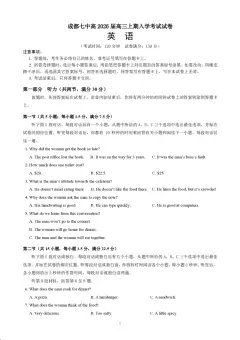
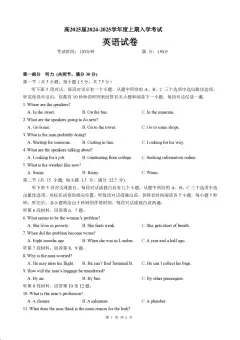
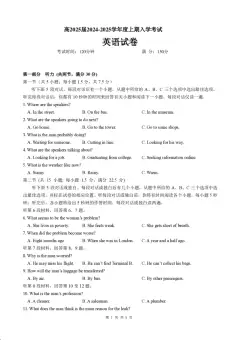
成都七中高 2024 届高三上期入学考试
英 语
注意事项:
1.答卷前,考生务必将自己的姓名、准考证号填写在答题卡上。
2.回答选择题时,选出每小题答案后,用铅笔把答题卡上对应题目的答案标号涂黑。如需改动,用橡
皮擦干净后,再选涂其他答案标号。回答非选择题时,将答案写在答题卡上,写在本试卷上无效。
3.考试结束后,将本试卷和答题卡一并交回。
第一部分 听力(共两节,满分30分)
做题时,先将答案标在试卷上。录音内容结束后,你将有两分钟的时间将试卷上的答案转涂到答题卡
上。
第一节(共5小题;每小题1.5分,满分7.5分)
听下面5段对话。每段对话后有一个小题,从题中所给的A、B、C三个选项中选出最佳选项。听完每
段对话后,你都有10秒钟的时间来回答有关小题和阅读下一小题。每段对话仅读一遍。
例:How much is the shirt?
A. £19.15. B. £9.18. C. £9.15.
答案是C。
1. What does the man want to do?
A. Have breakfast. B. Take a walk. C. Call his office.
2. What was George doing last night?
A. Having a meeting. B. Flying home. C. Working on a project.
3. Why does the man suggest going to the park?
A. It’s big. B. It’s quiet. C. It’s new.
4. How does the woman sound?
A. Annoyed. B. Pleased. C. Puzzled.
5. Where is the man’s table?
A. Near the door. B. By the window. C. In the corner.
第二节(共15小题;每小题1.5分,满分22.5分)
听下面5段对话或独白。每段对话或独白后有几个小题,从题中所给的A、B、C三个选项中选出最佳选项。
听每段对话或独白前,你将有时间阅读各个小题,每小题 5 秒钟;听完后,各小题将给出 5 秒钟的作答时
间。每段对话或独白读两遍。
听第6段材料,回答第6、7题。
6. What are the speakers going to do tonight?
A. Eat out. B. Go shopping. C. Do sports.
7. What is the probable relationship between the speakers?
A. Boss and secretary. B. Hostess and guest. C. Husband and wife.
第1页,共10页
{#{QQABKYoAgggoAAJAARhCUQEwCgEQkAACCAgGAAAIMAIByQFABAA=}#}{#{QQABKYoAgggoAAJAARhCUQEwCgEQkAACCAgGAAAIMAIByQFABAA=}#}第二部分 阅读理解(共两节,满分40分)
第一节(共15小题;每小题2分,满分30分)
阅读下列短文,从每题所给的A、B、C和D四个选项中,选出最佳选项。
A
If you’re interested in pushing yourself academically while experiencing college life, our Summer Programs for
Pre-College students (SPP) can be ideal for you. In the programs, you will be able to make friends with fellow
students, engage in social activities around the city and on campus, and experience pre-college summer study at one
of the world’s top teaching and research universities.
Our long-running summer term pre-college offerings include a choice of one-, two-, three-, and six-week
programs that prepare you for success in college. With five exciting and challenging pre-college summer programs
to choose from, you can earn college credit, discover a new subject area, perform cutting-edge research in university
labs, or immerse yourself in hands-on learning.
Academic life
SPP invites you to join other highly motivated teens from 87 countries in our summer programs for high school
students — and take the leap into college life and academics, which enables you to take on new academic challenges,
explore a variety of interests and consider possible majors. You can take college courses alongside undergraduates
either on campus or online. And you can also earn up to eight college credits by conducting in-depth STEM research
with individual instructors or as part of a group project. Or, you can immerse yourself in a variety of stimulating
noncredit seminars that blend lectures with experiential learning, discussions, and projects.
Campus/Residence life
Embracing college life is an exciting experience. Whether you live on campus or commute, you’ll get to know
the ins and outs of college and city life. If you live on campus, you will stay in the residence hall, sharing a room and
participating in dorm activities. There are typically two students per room and safety is our highest priority: residence
halls have live-in university staff and 24-hour security. Resident program assistants provide guidance, coordinate and
lead social activities, ranging from group activities that include comedy shows to field trips.
Your hard work will be combined with social events and fun activities — and you’ll still have time for your own
adventures on campus! Email the SPP office at sppoffice@mail.edu.
21. What does SPP aim to?
A. To help college students to achieve academic success.
B. To provide admission guidelines for pre-college students.
C. To get high school students well-prepared for college life.
D. To encourage students to participate in hands-on learning.
22. What are students supposed to do to earn the required credits?
A. Carry out STEM research.
B. Attend various seminars.
C. Finish the courses online.
D. Join in experiential learning.
23. What can we know about students living on campus?
A. They can organize social activities.
B. They will have access to a single room.
C. They are provided with good security.
D. They are advised to direct comedy shows.
第3页,共10页
{#{QQABKYoAgggoAAJAARhCUQEwCgEQkAACCAgGAAAIMAIByQFABAA=}#}B
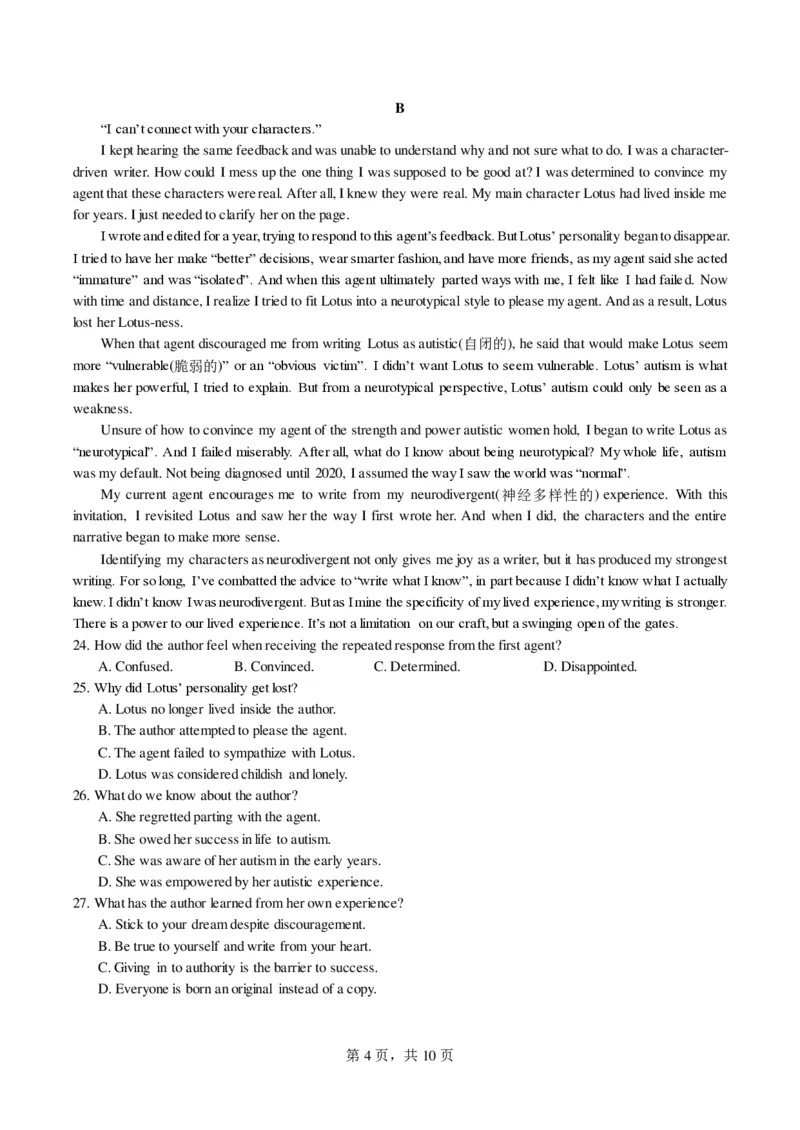
“I can’t connect with your characters.”
I kept hearing the same feedback and was unable to understand why and not sure what to do. I was a character-
driven writer. How could I mess up the one thing I was supposed to be good at? I was determined to convince my
agent that these characters were real. After all, I knew they were real. My main character Lotus had lived inside me
for years. I just needed to clarify her on the page.
I wrote and edited for a year, trying to respond to this agent’s feedback. But Lotus’ personality began to disappear.
I tried to have her make “better” decisions, wear smarter fashion, and have more friends, as my agent said she acted
“immature” and was “isolated”. And when this agent ultimately parted ways with me, I felt like I had failed. Now
with time and distance, I realize I tried to fit Lotus into a neurotypical style to please my agent. And as a result, Lotus
lost her Lotus-ness.
When that agent discouraged me from writing Lotus as autistic(自闭的), he said that would make Lotus seem
more “vulnerable(脆弱的)” or an “obvious victim”. I didn’t want Lotus to seem vulnerable. Lotus’ autism is what
makes her powerful, I tried to explain. But from a neurotypical perspective, Lotus’ autism could only be seen as a
weakness.
Unsure of how to convince my agent of the strength and power autistic women hold, I began to write Lotus as
“neurotypical”. And I failed miserably. After all, what do I know about being neurotypical? My whole life, autism
was my default. Not being diagnosed until 2020, I assumed the way I saw the world was “normal”.
My current agent encourages me to write from my neurodivergent(神经多样性的) experience. With this
invitation, I revisited Lotus and saw her the way I first wrote her. And when I did, the characters and the entire
narrative began to make more sense.
Identifying my characters as neurodivergent not only gives me joy as a writer, but it has produced my strongest
writing. For so long, I’ve combatted the advice to “write what I know”, in part because I didn’t know what I actually
knew. I didn’t know I was neurodivergent. But as I mine the specificity of my lived experience, my writing is stronger.
There is a power to our lived experience. It’s not a limitation on our craft, but a swinging open of the gates.
24. How did the author feel when receiving the repeated response from the first agent?
A. Confused. B. Convinced. C. Determined. D. Disappointed.
25. Why did Lotus’ personality get lost?
A. Lotus no longer lived inside the author.
B. The author attempted to please the agent.
C. The agent failed to sympathize with Lotus.
D. Lotus was considered childish and lonely.
26. What do we know about the author?
A. She regretted parting with the agent.
B. She owed her success in life to autism.
C. She was aware of her autism in the early years.
D. She was empowered by her autistic experience.
27. What has the author learned from her own experience?
A. Stick to your dream despite discouragement.
B. Be true to yourself and write from your heart.
C. Giving in to authority is the barrier to success.
D. Everyone is born an original instead of a copy.
第4页,共10页
{#{QQABKYoAgggoAAJAARhCUQEwCgEQkAACCAgGAAAIMAIByQFABAA=}#}C
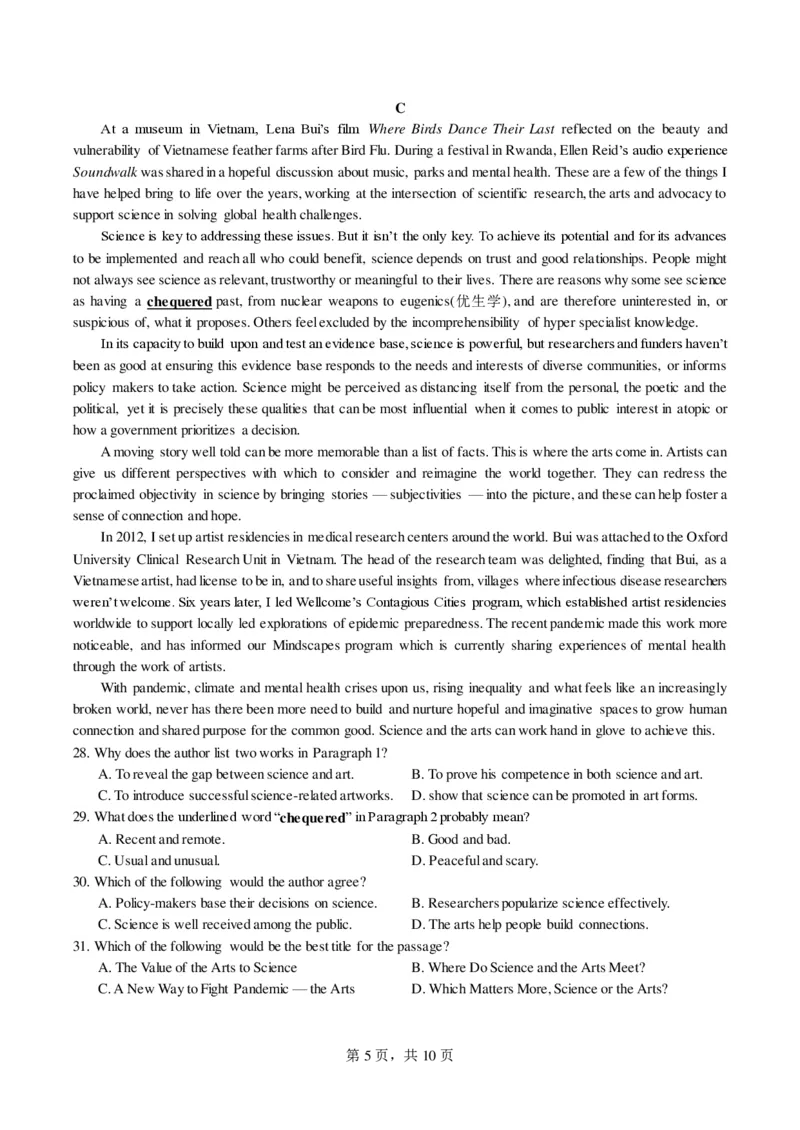
At a museum in Vietnam, Lena Bui’s film Where Birds Dance Their Last reflected on the beauty and
vulnerability of Vietnamese feather farms after Bird Flu. During a festival in Rwanda, Ellen Reid’s audio experience
Soundwalk was shared in a hopeful discussion about music, parks and mental health. These are a few of the things I
have helped bring to life over the years, working at the intersection of scientific research, the arts and advocacy to
support science in solving global health challenges.
Science is key to addressing these issues. But it isn’t the only key. To achieve its potential and for its advances
to be implemented and reach all who could benefit, science depends on trust and good relationships. People might
not always see science as relevant, trustworthy or meaningful to their lives. There are reasons why some see science
as having a chequered past, from nuclear weapons to eugenics(优生学), and are therefore uninterested in, or
suspicious of, what it proposes. Others feel excluded by the incomprehensibility of hyper specialist knowledge.
In its capacity to build upon and test an evidence base, science is powerful, but researchers and funders haven’t
been as good at ensuring this evidence base responds to the needs and interests of diverse communities, or informs
policy makers to take action. Science might be perceived as distancing itself from the personal, the poetic and the
political, yet it is precisely these qualities that can be most influential when it comes to public interest in atopic or
how a government prioritizes a decision.
A moving story well told can be more memorable than a list of facts. This is where the arts come in. Artists can
give us different perspectives with which to consider and reimagine the world together. They can redress the
proclaimed objectivity in science by bringing stories — subjectivities — into the picture, and these can help foster a
sense of connection and hope.
In 2012, I set up artist residencies in medical research centers around the world. Bui was attached to the Oxford
University Clinical Research Unit in Vietnam. The head of the research team was delighted, finding that Bui, as a
Vietnamese artist, had license to be in, and to share useful insights from, villages where infectious disease researchers
weren’t welcome. Six years later, I led Wellcome’s Contagious Cities program, which established artist residencies
worldwide to support locally led explorations of epidemic preparedness. The recent pandemic made this work more
noticeable, and has informed our Mindscapes program which is currently sharing experiences of mental health
through the work of artists.
With pandemic, climate and mental health crises upon us, rising inequality and what feels like an increasingly
broken world, never has there been more need to build and nurture hopeful and imaginative spaces to grow human
connection and shared purpose for the common good. Science and the arts can work hand in glove to achieve this.
28. Why does the author list two works in Paragraph 1?
A. To reveal the gap between science and art. B. To prove his competence in both science and art.
C. To introduce successful science-related artworks. D. show that science can be promoted in art forms.
29. What does the underlined word “chequered” in Paragraph 2 probably mean?
A. Recent and remote. B. Good and bad.
C. Usual and unusual. D. Peaceful and scary.
30. Which of the following would the author agree?
A. Policy-makers base their decisions on science. B. Researchers popularize science effectively.
C. Science is well received among the public. D. The arts help people build connections.
31. Which of the following would be the best title for the passage?
A. The Value of the Arts to Science B. Where Do Science and the Arts Meet?
C. A New Way to Fight Pandemic — the Arts D. Which Matters More, Science or the Arts?
第5页,共10页
{#{QQABKYoAgggoAAJAARhCUQEwCgEQkAACCAgGAAAIMAIByQFABAA=}#}D
Several years ago, Jeremy Clarkson, presenter of the famous BBC television program “Top Gear” discovered
that one of his guests was half German and half Irish. Immediately, he said: “That’s quite a strange combination. It’s
like, this must be done absolutely perfectly... tomorrow”.
This joke played on stereotypes (刻板印象) of the Germans as efficient and the Irish as lazy. Many people could
understandably be offended by these kinds of assertions (断言). We do not know every Irish person, so how can we
then conclude that every Irish person is lazy?
I recently read on a website that Irish business people were described as being ‘generally rather casual’ and
‘more outwardly friendly than many European counties’. German business people, on the other hand, are considered
to be very direct and according to the website, they do not need a personal relationship in order to do business. Once
you hear advice like this, it becomes easier to understand where jokes like the one in the first paragraph come from.
So why do some people disapprove of the kind of stereotypes as seen in Clarkson’s joke, but not baring an eyelid
(眨眼) when it comes to generalizations. What is the difference between the two?
By definition, a stereotype is a widely held but fixed and oversimplified image or idea of a particular type of
person or thing. A cultural characteristic, on the other hand, is a pattern of behavior that is typical of a certain group.
So what does this really mean? Stereotype are simply overstated assumptions about groups of people. Imagine
if a tourist visited a small town in Switzerland and saw a number of locals playing the alphorn instrument, and then
claimed that Swiss people can play the alphorn. This would be a stereotype! This is an overstated image of the Swiss
which is based on one tourist’s experience.
If, however, this tourist were to say that the Swiss are very punctual, this could be seen as a cultural characteristic.
This is because it is a pattern of behavior which is very typical in Switzerland: from their transport system to their
business meetings in this way, some people argue that generalizing another culture is not just useful, but important.
Politicians always have to be mindful of the cultural characteristics of different countries. By becoming aware of
different cultural characteristics, they can avoid causing offence (冒犯) in those cultures.
However, others argue that generalizing cultures will always lead to offensive stereotypes. They argue that the
best thing we can do is to stop generalizing cultures and start treating people as individuals.
All this raises important questions: can making generalizations about groups of people be a positive thing? Or
should we always avoid making broad assumptions about different groups?
32. What did Jeremy Clarkson mean by saying, “it’s like, this must be done absolutely perfectly... tomorrow”?
A. The stereotypes of the Germans and the Irish are not so good.
B. The combination of half German and half Irish is interesting.
C. The characteristics of the Germans and the Irish are opposite.
D. The Germans will do it perfectly tomorrow while the Irish won’t.
33. Which of the following is TRUE according to the passage?
A. It’s typical of the Swiss to be punctual.
B. The Swiss can play the alphorn quite well.
C. The Irish people are considered as lazy, direct and casual.
D. The Germans are thought to be efficient, friendly and direct.
34. Why do politicians think it important to generalize another culture?
A. They don’t want to offend other people.
B. Generalizing will lead to offensive stereotypes.
第6页,共10页
{#{QQABKYoAgggoAAJAARhCUQEwCgEQkAACCAgGAAAIMAIByQFABAA=}#}C. Cultural characteristics are better than stereotypes.
D. They think different cultural characteristics are useful.
35. What’s the main purpose of this passage?
A. To illustrate the importance of making generalizations.
B. To show it is wrong to play jokes on stereotypes of different people.
C. To tell us the differences between stereotypes and cultural characteristics.
D. To discuss whether it is good to make generalizations about groups of people.
第二节 (其5小题; 每小题2 分,满分10分)
根据短文内容,从短文后的选项中选出能填入空白处的最佳选项。选项中有两项为多余选项。
“Just think positively!”
“It could be worse.”
“You should look at the bright side!”
We’ve all heard (and maybe used) these phrases without much thought. But they could be contributing to a
culture of toxic (有毒的) positivity. For those new to this term, it might sound like an oxymoron (矛盾修辞法). How
can positivity be toxic? Isn’t it supposed to be helpful, or “positive”, as the name suggests? 36
“Toxic positivity is when somebody avoids all negative thoughts or feelings, pretending everything is going well
when it is not,” explains Melissa Dowd, a therapist at PlushCare, a virtual health platform for primary care and mental
health services. Whitney Goodman, the author of Toxic Positivity describes toxic positivity as the “endless pressure
to be happy and positive, no matter what the circumstances are.” 37 It’s also something we can cause other
people to experience.
Expressing toxic positivity to others may look like offering them a simple solution to a complicated problem
that we know nothing about, or not allowing people around you to appropriately express negative emotions.
Toxic positivity causes us to suppress our emotions, which can make them worse. 38 “Although it can
be helpful to look on the bright side when facing challenges,” Dowd says, “not coping with negative feelings in a
healthy way in the moment can lead to those feelings resurfacing later in different areas of your life or as a form of
anxiety.” 39 “If I feel like you’re going to dismiss me, I’m going to stop sharing how I’m feeling,” Goodman
adds.
40 If you’re using toxic positivity against yourself, Goodman suggests remembering it’s OK if you’re
upset about something. It’s valid if something annoys you. “Allow ourselves and other people to share when they’re
going through a difficult time,” she says. Dowd adds that it’s essential that “we all learn to cope with and process our
emotions in a healthy way as opposed to avoiding how we feel” as life’s stressors continue to rise. For example,
instead of simply saying “Just think positively,” we’d better say “Sometimes bad things happen. How can I help?”
A. Are there ways to avoid toxic positivity?
B. Toxic positivity also disrupts connection.
C. It can harm people who are going through difficult times.
D. This can come up in different situations when we are dealing with pressure.
E. They become more intense and can cause long-lasting health concerns in the future.
F. Experts say constant forced positivity can lead to the opposite, and have a negative effect.
G. This is what we may bring on to ourselves by not allowing negative thoughts and feelings.
第7页,共10页
{#{QQABKYoAgggoAAJAARhCUQEwCgEQkAACCAgGAAAIMAIByQFABAA=}#}第三部分 语言知识运用 (共两节, 满分 45分)
第一节 (共 20小题;每小题1.5分,满分30分)
阅读下面短文,从短文后各题所给的A、B、C和D四个选项中,选出可以填入空白处的最佳选项。
This Too Shall Pass
When my family moved to Ohio over the summer, I feared attending another new school and knowing no one
because I was able to expect what was coming. I had bright red hair and enormous glasses. In addition, I was 41
and not very sociable.
Boarding the school bus that first day, I felt like all eyes on me. I could hear the 42 “She’s huge!”
Obviously, the kids on the bus had known each other well. I spent that first bus 43 in silence.
The following day was even 44 . I did not notice that a few boys had tied a shoelace across the aisle and
thus fell face first on the bus, 45 everything I was carrying. 46 I was embarrassingly gathering my
supplies, I could hear the laughter, and then the 47 “That felt like an earthquake!” Anyway, I 48 to find
a seat. Looking out of the window, I 49 the tears welling up in my eyes.
It was then that I sank into myself. I began walking everywhere. I would wander through the woods behind our
house. I would also walk to a 50 about two miles down the road, where I would chat silently with God. I began
51 the afternoon school bus on purpose, walking home instead. Then, 52 , I started losing weight. And as I
became content with myself, I began making 53 .
One of my newly-found friends also 54 with her weight, wanting to be a “perfect” cheerleader. She lived
near my neighborhood so we would meet and 55 together. This became a daily activity with talking and
laughing 56 the way — different from the lonely walks I had taken. My friend said that I didn’t have to be
perfect. I just had to be me, and be happy with 57 .
While I would not want to 58 that time of loneliness, sadness and embarrassment, I am 59 I made
it through. Whenever I am struggling with any other problem in life, I always remember the proverb “This too shall
pass.” If you can find a path with no obstacles, it probably doesn’t 60 anywhere.
41. A. outgoing B. overweight C. intelligent D. friendly
42. A. whisper B. whistle C. giggle D. laugh
43. A. drive B. lift C. ride D. travel
44. A. worse B. longer C. funnier D. duller
45. A. throwing B. losing C. leaving D. dropping
46. A. Though B. While C. Since D. Because
47. A. opinions B. statements C. comments D. discussions
48. A. determined B. attempted C. pretended D. managed
49. A. kept away B. took back C. put away D. held back
50. A. garden B. market C. church D. library
51. A. escaping B. missing C. delaying D. stopping
52. A. uninterestedly B. uncertainly C. unfortunately D. unexpectedly
53. A. changes B. friends C. efforts D. decisions
54. A. struggled B. competed C. dealt D. lived
55. A. run B. play C. chat D. walk
56. A. along B. across C. by D. in
57. A. oneself B. myself C. herself D. itself
58. A. relive B. remind C. relate D. rethink
59. A. excited B. upset C. proud D. regretful
60. A. exist B. stretch C. lead D. stay
第8页,共10页
{#{QQABKYoAgggoAAJAARhCUQEwCgEQkAACCAgGAAAIMAIByQFABAA=}#}第二节 ( 共 10 小题; 每小题1.5分, 满分15分 )
阅读下面短文, 在空白处填入1个适当的单词或括号内单词的正确形式。
Coral reefs are being planted in the deep seabed around Hainan Province, a famous tourist destination in China,
as part of efforts 61 (preserve) the maritime (海上的) environment and promote green development.
Coral reefs cover about 2 percent of the area of sea floor and provide habitats for about 25 percent of 62
(create). They play 63 important role in stabilizing ecology of the ocean, according to experts. They work as
64 (extreme) natural barriers to weaken the impact of waves crashing on the shore.
However, survival of coral reefs have been challenged due 65 changes in the maritime environment. In
2019, the Hainan South China Sea Institute of Tropical Ocean initiated a program to plant 66 (million) of coral
reefs through professional breeding technology.
“It’s like 67 (plant) trees under the sea,” said Chen Hong, director of the institute. “Though they grow
slowly, the seedlings no 68 (big) than fingernails may become coral reefs 69 size can surpass several
soccer fields.”
In recent years, the team has planted over 200,000 coral reefs around Sanya city and Danzhou city. That quantity
70 (break) the national record of coral reefs transplantation for amount and survival rate.
第四部分 写作 (共两节, 满分 35分)
第一节 短文改错 (共 10小题;每小题1分,满分10分)
假定英语课上老师要求同桌之间交换经改作文。请你修改你同桌写的以下作文。文中共有10处语言错
误,每句中最多有两处,每处错误仅涉及一个单词的增加、删除或修改。
增加:在缺词处加一个漏字符号(∧),并在其下面写出该加的词。
删除:把多余的词用斜线(\)划掉。
修改:在错的词下划一横线,并在该词下面写出修改后的词。
注意:1. 每处错误及其修改均仅限一词;
2. 只允许修改10处,多者(从第1处起)不计分。
I enjoy learning English but can remember individual words easy. However, when it comes to reading
comprehension, it’s really the challenge. Last weekend, I tried to read a storybook write in English to improve my
reading. At first, I refer to the dictionary every time I came across a new word, which I found it not very helpful. I
often felt puzzling about what I had read. Then I tried to finish a chapter completely with looking up the new words.
What surprised me was I could understand the story merely from the context. I hope I will make great progresses in
English in this way.
第二节 书面表达(满分25分)
假定你是李华,你的爱尔兰网友Tom下周来你市参加短期语言培训,他发来邮件请你帮忙推荐一家酒
店方便学习期间入住。请给他回信,主要内容包括:
1. 表示欢迎;
2. 推荐理由;
3. 表达祝愿。
第9页,共10页
{#{QQABKYoAgggoAAJAARhCUQEwCgEQkAACCAgGAAAIMAIByQFABAA=}#}注意:
1. 词数120左右;
2. 可以适当增加细节,以使行文连贯。
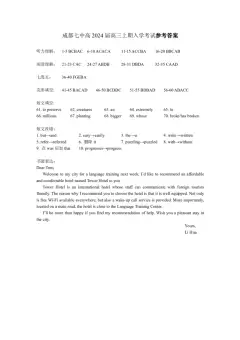
Dear Tom,
____________________________________________________________________________________________
____________________________________________________________________________________________
____________________________________________________________________________________________
____________________________________________________________________________________________
____________________________________________________________________________________________
____________________________________________________________________________________________
____________________________________________________________________________________________
____________________________________________________________________________________________
____________________________________________________________________________________________
____________________________________________________________________________________________
____________________________________________________________________________________________
____________________________________________________________________________________________
____________________________________________________________________________________________
____________________________________________________________________________________________
____________________________________________________________________________________________
____________________________________________________________________________________________
____________________________________________________________________________________________
____________________________________________________________________________________________
Yours,
Li Hua
第10页,共10页
{#{QQABKYoAgggoAAJAARhCUQEwCgEQkAACCAgGAAAIMAIByQFABAA=}#}