英语专项练习(十一)
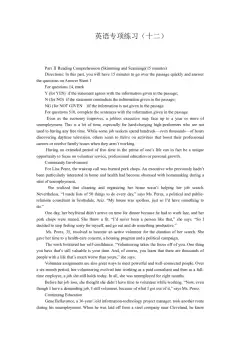
Part ⅡReading Comprehension (Skimming and Scanning)(15 minutes)
Directions: In this part, you will have 15 minutes to go over the passage
quickly and answer the questions on Answer Sheet 1.
For questions 14, mark
Y (for YES)if the statement agrees with the information given in the passage;
N (for NO)if the statement contradicts the information given in the passage;
NG (for NOT GIVEN)if the information is not given in the passage.
For questions 510, complete the sentences with the information given in the
passage.
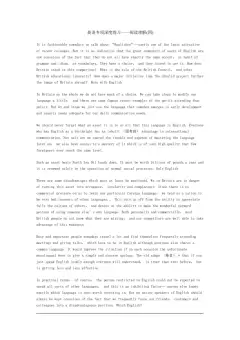
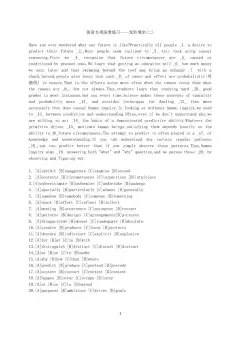
More than 2,300 universities in over 100 countries have introduced Chinese
courses to their curricula, and young overseas nationals flock to China each
year to learn Chinese. In 2004, the number of international students in China
was 400,000, with an annual increase of 20 percent in the past five years,
according to the Chinese Ministry of Education.
The Rise of China’s Economy
Monsieur Label and his wife, both respected architects living in Paris’ Sixth
Quarter, have enrolled their daughter in a nearby school where Chinese
classes start at kindergarten. Monsieur Label says of China: “I and my
colleagues witnessed the country’s amazing development when we attended a
recent seminar in Shenzhen. I believe that China is the economic superpowerof the future. My wife and I speak French, English and Spanish, but my
daughter should also learn Chinese because it will be useful to her when she
grows up.”
Since Chinese courses were added to the curricula of 132 French junior and
senior high schools their enrollment has doubled. That at the Oriental
Language and Culture College, one of France’s largest Chineseteaching
colleges, has skyrocketed in recent years, according to Xu Dan, dean of the
Chinese Department. She confirms that Chinese and Japanese are now the
two most studied Asian languages.
French junior student Beida is totally fluent in Chinese. “I’m learning Chinese
because I want to be an international lawyer in China,” he explains.
Young French entrepreneur Patric Penia established his Beiyan Consultancy
Company in Paris, and it now works together with China Central Television in
introducing French traditions and culture to Chinese audiences. Patric also
cooperated with Beijing’s University of Finance and Economics and Central
University of Finance and Economics in launching a three-week crash course in
Chinese in Beijing. In 2005, he initiated the “Chinese people and business
management” training course in Paris, which consists of seminars to help
French businessmen understand how Chinese business operates.
Germany has also caught on to the benefits of Chinese language learning, and
has added Chinese to its high school graduation exams. Many international
corporations also hold introductory Chinese courses for employee’s assignedwork in China. “English isn’t enough,” says Herr Gerck, president of
Siemens China, “We need to equip our staff with the ability to deal with
Chinese merchants in their own language.”
In Britain, a Chinese teaching program that will form part of the national
curriculum has been formulated and approved by the Department of
Education and Skills. In the U.S., Chinese is part of the Advance Placement
Program for American high school students. This means that students can take
college-level Chinese in the same way as they learn French, Spanish and
German and gain credits if they get good test results. More than 2,500
primary and high schools now offer AP courses in the Chinese language.
Cultural Echoes
Chinese characters, along with the Confucian philosophy, have always had
profound influence on Han cultural circles in Asia, and after a brief hiatus,
Chinese language teaching is in demand once more in the ROK, Singapore,
Japan and Vietnam.
“Singaporeans rushed to learn English in the 1970s, when it was believed to
be the most useful language for the future. Now, in the 21st century, a lack of
Chinese-speaking skills is seen as a disadvantage,” says one Singaporean
student, who recently graduated from Beijing University with a BA in
international relations.
The German ambassador to the ROK once told vice minister of Education
Zhang Xinsheng: “Nowadays, high school teachers of German and Frenchmust also learn Chinese if they want to keep their jobs.”
In the ROK, a high HSK (Hanyu Shuiping Kaoshi—the Chinese Language
Proficiency Test taken by nonnative speakers) acts as a springboard for jobs
and promotions in large corporations. The number of colleges offering
Chinese language courses in the ROK at present stands at 347, compared to
20 in the 1980s. By the year 2007, Chinese courses will be taught in primary
and high schools, according to the ROK minister of Education. In the course of
China’s economic boom over the past two decades, a large number of
Koreans have immigrated to China. Many now have their own businesses,
which would have been impossible without a formal grounding in Chinese.
In Thailand, Chinese has eclipsed Japanese to become the second most
common second language. “Public interest has moved from Japanese to
Chinese,” the Japanese Sankei Shimbun recently reported, “the number of
people learning Chinese in Thailand now is tenfold that of ten years ago.”
Indonesian President Suharto’s resignation in 1998 provided the opportunity
for a closer relationship between the two nations and for the Indonesian
Chinese population to learn Chinese language as well as Chinese traditions. In
the belief that “Chinese children should learn Chinese” Indonesian Chinese
residents sent their children to schools offering Chinese courses so that they
might understand Chinese cultural traditions as well as speak the language.
Enrollment at such schools soon skyrocketed, and parents often queued up all
night in order to be secure admission for their children.Why Chinese?
“People around the world are rushing to learn Chinese. This interest can be
attributed to China’s economic opportunities and its telling effect on the
future” so stated the article China—Embracing the World published in the
May issue of The Hindu.
In view of the international demand for Chinese language learning, the
Chinese government plans to set up 100 Confucius Institutes around the
world. The Confucius Institute is a nonprofit organization whose aim is to
promote the Chinese language and culture overseas through Internet or on-
campus non-degree courses. The first institute was established in Seoul, ROK
in November 2004. Since then branches have been set up in many other
countries, including the U.S., Sweden, France and Uzbekistan.
Great hopes have been laid on Chengo (Chinese and English on the Go), an E-
language learning system based on pinyin rather than Chinese characters
developed by 12 experts from China and the U.S., as a means to help children
learn Chinese. This software captures children’s attention with stories, games
and animations based on the 2008 Olympics.
In order to ensure that there are sufficient teachers to meet the current
demand, the Chinese government has set up training centers where overseas
teachers of Chinese can attend lectures. It has also launched overseas training
courses.
In addition to dispatching Chinese teachers abroad to teach Chinese, thegovernment has also sent over 1,000 professionally qualified volunteers to
countries in Asia, Europe, America and Africa.
Since Chinese became so popular in the international community, the number
of foreign students applying to take the Chinese Language Proficiency Test
(HSK) has surged from 21,000 in 1996 to 100,000 in 2004. It is now possible to
take the HSK exam, known to candidates as the “Chinese TOEFL”, at 151
local universities or colleges in 34 countries.
The Paris-based Chinese newspaper European Times, which has the highest
circulation among Chinese-language newspapers in Europe, released a
comment early this year entitled “Develop as Rapidly as the Chinese
Economy Booms” that analyzed why so many people are rushing to learn
Chinese and study in China. Its conclusions were that China’s increasing
economic competitiveness and the brilliant future career it offers is a powerful
lure to mastering Chinese. But it also pointed out that learning Chinese is the
key to Chinese cultural traditions. After all, what point is there in learning a
foreign language if you can’t use it to express knowledge of the culture from
which it sprang!
1. This article mainly discusses about the popularity of Chinese in western
countries.
2. Monsieur Label and his wife send their children to learn Chinese because
they hope that their children can learn as many foreign languages as possible.3. Many German international corporations hold introductory Chinese courses
for employees assigned work in China because they want their staff
become interested in China.
4. In Thailand, the most popular second language nowadays is Chinese.
5. Singaporeans believe that a lack of -speaking skills is a disadvantage in
the 21st century.
6. After the resignation of Indonesian President in 1998, Indonesian Chinese
residents sent their children to school offering in the belief that
“Chinese children should learn Chinese”.
7. China’s economic opportunities and its on the future contributes to
people’s interest in learning Chinese.
8. The Confucius Institutes aim at promoting the Chinese language and
culture overseas through Internet or courses.
9. An E-language learning system called Chengo is hopeful to help children
learn Chinese for this software captures with stories, games and
animations based on the 2008 Olympics.
10. The popularity of Chinese in the world makes the “Chinese TOFEL”,
the exam, possible.
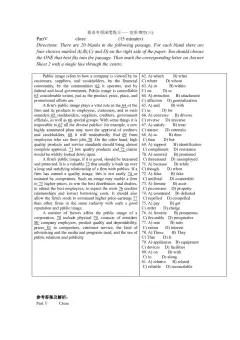
Part ⅣReading Comprehension (Reading in Depth)(25 minutes)
Section A
Directions: In this section, there is a short passage with 5 questions or incomplete
statements. Read the passage carefully. Then answer the questions or complete the
statements in the fewest possible words on Answer Sheet 2.
Questions 47 to 51 are based on the following passage.
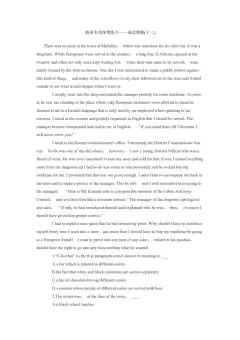
Many of the workers who served at the World Trade Center after the September eleventhattacks became sick. They breathed a harmful mix of dust, smoke and chemicals in the
ruins of the Twin Towers and a third building that fell. Some went days without good
protection for their lungs. Five years later, many of the thousands who worked at Ground
Zero in the early days after the attacks still have health problems.
Doctors at Mount Sinai Medical Center in New York City have announced the results of
the largest study yet of these workers. The study confirmed high rates of breathing
problems in members of the building trades, firefighters, police officers and other
workers. Almost seventy percent of the workers in the study had a new or worsened
breathing problem. These problems developed during or after their time working in the
mountain of wreckage. About sixty percent still had breathing problems at the time of
their examination. The researchers say they decided to study the effects on breathing first
because other disorders might be slower to appear. Mount Sinai says it tested almost
twelve thousand people between two thousand two and two thousand four. Eight out of
ten of them agreed to have their results used in the report. The new results added
strength to a Mount Sinai study released in two thousand four. That study was based on
only about one thousand workers.
Some lawmakers have sharply criticized city and state officials for letting workers labor at
Ground Zero without satisfactory equipment. Officials have also been criticized for saying
the air was relatively safe. State and federal officials have promised more than fifty million
dollars to pay for treatment of the workers. Doctor Robin Herbert is one of the directors
of the Mount Sinai testing program. She says people are still coming to the hospital for
treatment of problems that were caused by the dust at Ground Zero. In her words: “My
worry is that money will be gone in a year, and what happens then?”
47. What caused the health problems to workers after the September eleventh attacks
according to this passage?
48. Who suffer the breathing problems most according to the latest study?
49. The researchers decided to study the effects on breathing first
because might appear in a later period of time.
50. are sharply criticized by some lawmakers because they let workers labor at
Ground Zero without satisfactory equipment.
51. What measures have the officials promised to take to deal with the health problem?
Section B
Directions: There are 2 passages in this section. Each passage is followed by
some questions or unfinished statement. For each of them there are four
choices marked A), B), C), and D). You should decide on the best choice and
mark the corresponding letter on Answer Sheet 2 with a single line through
the centre.Passage One
Questions 52 to 56 are based on the following passage.
With the prospect of coal and petroleum supplies running out and with air
pollution becoming an increasing concern, the major countries of the world
are seeking alternate sources of energy. If a means to obtain energy from
water, especially from the ocean, can be effected economically, it would
provide a neverending supply of energy, since 70% of the earth’s surface is
ocean and another 10% is fresh water in rivers and lakes.
From the beginning of time man has used waterpower as a source of working
energy—waterfalls and dams—but these are fresh water sources and are
landlocked. The seas have contributed little or nothing in the way of power.
The use of temperature variation between currents is one area of exploration.
Ocean water is heated by the sun near the equator and drawn by the rotation
of the earth toward the poles, where it cools and drops toward the ocean floor
and starts its journey back toward the equator. The differential between the
two currents is 1℃ and 7℃. To use it, the scientists must find the places
where they run near land and are not too far away from each other.
America, the greatest consumer of energy, has been working on another kind
of thermal sea energy proposal. One plan would somewhat resemble the
operation of a refrigerator on a vast scale. Warm water would be the heat
source, cold water the heat sink. A component such as fog would be liquid at
a cold temperature and turn to gas as it warmed.Oceans also offer wave power, tides and the chemical reaction of salt water as
potential sources of energy. All these uses are theoretically possible. Britain is
interested in wave power, using a string of “tear drop” devices that depend
on very active wave areas at 100 feet depths. In addition to this, the British are
working on a method that the Japanese have already put into practical use on
a small scale for powering their navigational boats. This method is called an
oscillating(振荡) water column and rides the waves with a series of cylinders(气
缸) having oneway air valves. Wave movement produces air under pressure
that has only one escape route—to a turbine(涡轮) that powers a generator.
52. The use of water referred in this passage is .
A) a new concept compared with other ways of natural resources
B) less expensive than petroleum and other means of energies
C) now being used more from the ocean than from rivers and lakes
D) being developed to supplement other sources of energy
53. In the matter of developing energy from ocean water, Britain is .
A) working on an old Japanese method
B) the most advanced country in the field
C) following the lead of the United states
D) consolidating their work with operations
54. The development of oceanic water power is important to America
because .
A) there is a severe shortage of coal and petroleumB) it is the cheapest method of producing energy
C) petroleum supplies are being steadily drained
D) obtaining energy from ocean water are simpler
55. Getting energy from the ocean is important to .
A) Russia because of its limited coal and petroleum resources on land
B) America because it is the greatest consumer of energy in the world
C) Asia because most of Asian countries lack other sources of energy
D) South America because a great part of the population is very poor
56. The oscillating water column produces power from .
A) the turbine that powers the generator
B) the generator that produces electricity
C) the cylinders that drives the turbine
D) the air that escapes from the turbine
Passage Two
Questions 57 to 61 are based on the following passage.
The civilization(文化) of the Renaissance was the creation of prosperous cities
and of rulers who drew substantial income from their urban subjects in the
Italian city states and the countries of England and France. The commerce that
kept cities alive also provided the capital and the flow of ideas that helped
build Renaissance culture. During the early Middle Ages foreign trade had
virtually come to a halt. By the 11th century, however, population growth andcontact with other cultures through military efforts such as the Crusades(十
字军东征) helped revive commercial activity. Trade slowly increased with the
exchange of luxury goods in the Mediterranean region and various
commodities such as fish, furs, and metals across the North and Baltic seas.
Commerce soon moved inland, bringing new opulence to the citizens of
towns along major trade routes. As traffic along these routes increased,
existing settlements grew and new ones were established.
The cities of Italy were located between western Europe and the area along
the eastern shore of the Mediterranean Sea known as the Levant. Italy’s
leadership in the Renaissance was due in part to its central location for trade.
The cities became important and wealthy commercial centers, and the riches
collected by the merchants of Venice, Genoa, Milan, and a host of smaller
cities supported Italy’s political and cultural achievements.
Important towns developed beyond Italy as well. Especially with the expansion
of trade, towns grew along the Danube and Rhine rivers of Europe; around the
North Sea and the Baltic Sea; and in the Low Countries of Belgium,
Luxembourg and the Netherlands where northern and southern trade routes
met. Wherever these towns were located, they became a unique element in a
medieval world that up to this time was dominated by seignorialism(领主制),
an agricultural system in which the primary economic and political relationship
was between landowners and their tenants.
57. The Renaissance .A) was an ideological movement throughout the world
B) took place in Italy only
C) was originated in Italy
D) was influential in most European countries
58. The commerce .
A) was an important element in building the Renaissance culture
B) kept the people in cities alive with food and clothes
C) brought about the exchange of ideas
D) was always prosperous between city states
59. The location of the important cities shares a similarity that .
A) they are all Italian cities
B) they are all located by important routes
C) they are all prosperous with commerce
D) they are all located by seaside
60. The most probable meaning of the word “opulence” (Line 9,Para.1)may
be .
A) technologiesB) commercial means
C) cultureD) prosperity
61. According to the passage, which of the following is NOT true?
A) Italy was merely an important cultural center during the Renaissance.
B) During the Middle Ages, foreign trade once was stopped.C) The development of cities had great bearings to commerce.
D) Geographical locations were significant in the booming of cities.
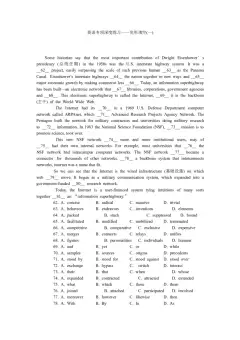
Part ⅤError Correction(15 minutes)
Directions: This part consists of a short passage. In this passage, there are
altogether 10 mistakes, one in each numbered line. You may have to change a
word, add a word or delete a word. Mark out the mistakes and put the
corrections in the blanks provided. If you change a word, cross it out and write
the correct word in the corresponding blank. If you add a word, put an
insertion mark(∧) in the right place and write the missing word in the blank. If
you delete a word, cross it out and put a slash (/) in the blank.
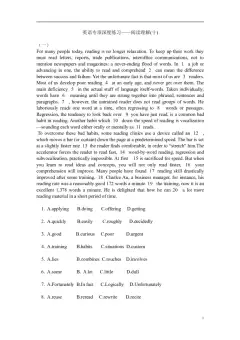
The problems which face with learners of English can 62
be divided into three categories: psychological, culture, 63
and linguistic. The largest category seems to be linguistic.
When foreign learners first have the opportunity to speak to
a native speaker of English, they may have a shock: they
often have little difficulty in understanding spoken English 64
of native speakers. There are a number of reasons to this. 65
First, it seems to students that English people speak very 66
quickly. Secondly, they say with a variety of accents.
Thirdly, different styles of speech are used in different
situations, for example, everyday spoken English, which iscolloquial and idiomatic, are different from the English 67
used for academic purposes. For all of these reasons
students will have difficulty, mainly because we lack 68
practice in listening to English people speaking English.
What can a student do then to overcome these
difficulties?Well, obviously, he can benefit in attending
English classes and he should take every opportunity
available to speak with native speakers of English. He
should be aware of, however, that English people are, by 70
temperament, often reserved and may be willing to start a 71
conversation. So he should have the courage to take the
initiative (主动).
Part ⅥTranslation(5 minutes)
Directions: Complete the following sentences on Answer Sheet 2 by
translating into English the Chinese given in brackets.
72. If you get into a bath full of water (有一部分水就会漫到地上).
73. The tendency of a boy to become attached to his mother and to resent his
father (被称作) the “Oedipus Complex”.
74. He is a disgusting man who is fond of (向别人的妻子献殷勤).
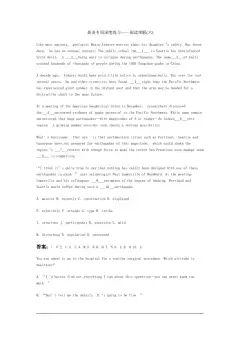
75. The medicine (治愈了她的慢性咳嗽) which she had suffered 20
years.76. Their findings (揭示了)the burial customs of the Indian tribes of
that area.
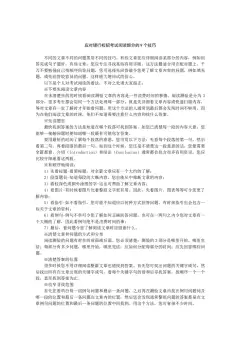
参考答案:
Part ⅡReading Comprehension (Skimming and Scanning)
1. N 2. N 3. N 4. Y 5. Chinese
6. Chinese courses
7. telling effect。
8. on-campus non-degree
9. children’s attention
10. HSK
Part Ⅳ Reading Comprehension (Reading in Depth)
Section A
47. A harmful mix of dust, smoke and chemicals in the ruins.
48. The building trades, firefighters, police officers and other workers.
49. other disorders
50. City and state officials
51. To pay more than fifty million dollars for treatment of the workers.
Section B
Passage One
52. D 53. A 54. C 55. B 56. D
Passage Two
57. D 58. C 59. C 60. D 61. A
Part ⅤError Correction
62. with→/
63. culture→cultural
64. little→much/great
65. to→for
66. say→speak
67. are→is
68. we→they
69. in→from
70. of→/
71. willing→unwilling
Part ⅥTranslation
72. some of the water will overflow onto the floor
73. is referred to as74. paying compliments to other men’s wives
75. cured the old woman of her chronic cough
76. threw light upon