关注公众号:陆陆高分冲刺 ~领取:最新版“小中高考-总复习”、最新试卷下载
21.主题阅读-航空航天
知识积累
航空航天类语篇往往具有浓厚的科技感,通过描述航空航天技术的发展和应用,展现人类探索宇
宙的决心和成就。例如,文章中可能会提到卫星的发射、探测器的探测任务、宇航员在太空中的生活和工
作等,这些都充满了科技感和未来感。这类语篇呈现如下特征:(1)强调探索与创新:航空航天类语篇
通常会强调探索与创新的重要性。通过介绍航空航天领域的重大发现和突破,如火星探测、月球登陆等,
激发学生的好奇心和探索欲,鼓励他们勇于创新和追求未知。(2)培养科学精神:这类语篇注重培养学
生的科学精神。通过讲述科学家和工程师们在航空航天领域中的努力和贡献,以及他们面对困难和挑战时
的坚持和勇气,引导学生树立科学态度,尊重科学规律,追求真理和进步。(3)关注国际合作:航空航
天领域通常涉及国际合作和交流。在语篇中,可能会提到不同国家之间的合作项目、共同研发的成果等,
这有助于学生认识到国际合作在推动航空航天事业发展中的重要作用。(4)主题词汇丰富:航空航天类
语篇通常会包含大量与航空航天相关的专业词汇,如“spaceship”(航天器)、“satellite”(卫星)、
“rocket”(火箭)、“astronaut”(宇航员)、“orbit”(轨道)等。这些词汇的出现不仅丰富了学生的
词汇量,也帮助他们更好地理解和认识航空航天领域。这些特征不仅有助于提高学生的英语阅读能力,还
能激发他们的学习兴趣和探索欲,培养他们的科学素养和国际视野。
常用词汇积累
1.名词 manned spaceflight载人航天
aircraft飞机 unmanned spaceflight无人航天
spacecraft / spaceship航天器/ 宇宙飞船 spacewalk太空行走
satellite卫星 gravity重力
rocket火箭 atmosphere大气层
astronaut宇航员 exploration探索活动
space station空间站 2.动词
launch发射 launch发射
orbit轨道 explore探索
galaxy星系 orbit绕……轨道飞行
universe宇宙 land着陆
mission任务 travel旅行
probe探测器 soar翱翔
1关注公众号:陆陆高分冲刺 ~领取:最新版“小中高考-总复习”、最新试卷下载
connect连接 extraterrestrial外星的
achieve实现 cosmic宇宙的,与宇宙相关的
3. 形容词 rapid快速的
advanced先进的 successful成功的
space-bound飞向太空的 manned有人驾驶的[与无人驾驶(unmanned)相对]
突破练习
1
①Have you heard of China’s Tiangong space station? How much do you know about the lives of astronauts
working in the space station? Come along and find out!
②For astronauts in space, exercise is important. The environment is very different in space. Doing sports can
help astronauts stay healthy. How do they exercise? There is a spin bike (健身车), a running machine, and other
fitness equipment in the space station. The equipment makes it easy for astronauts to exercise.
③Astronauts live in a weightless environment, so they can’t take showers like we do on the earth. Is there a
bathroom in the space station? How do they keep themselves clean? Don’t worry! Tiangong has a special bathroom.
Astronauts can wipe themselves clean with a wet towel (毛巾) .
④What do astronauts eat in the space station? There is bread and porridge for breakfast. There are also
traditional Chinese dishes, like Kung Pao Chicken, fried rice and fried noodles with sliced pork. There is a special
“fridge” to store the food. It’s made of “aerogel (气凝胶)”. The food stays cool in it.
⑤What if astronauts miss their family? There is special communication equipment in the space station.
Astronauts can have personal “sky-to-earth” calls with their family. Usually, the astronauts wear earphones. It not
only helps them talk with each other, but also allows them to talk to the ground from any position.
⑥What do you think of the lives of the astronauts?
1.In Paragraph One, the writer leads into the topic by _____________.
A.using sayings B.listing numbers
C.asking questions D.giving examples
2.What does the word “fitness equipment” probably mean in Paragraph Two?
A.things for exercising B.things for keeping food
C.things for communicating D.things for keeping clean
2关注公众号:陆陆高分冲刺 ~领取:最新版“小中高考-总复习”、最新试卷下载
3.Which of the following is TRUE according to this passage?
A.Astronauts hardly exercise in the space station.
B.Astronauts use dry towels to clean their bodies.
C.Nothing delicious is available in the space station.
D.It’s easy for astronauts to talk with their family.
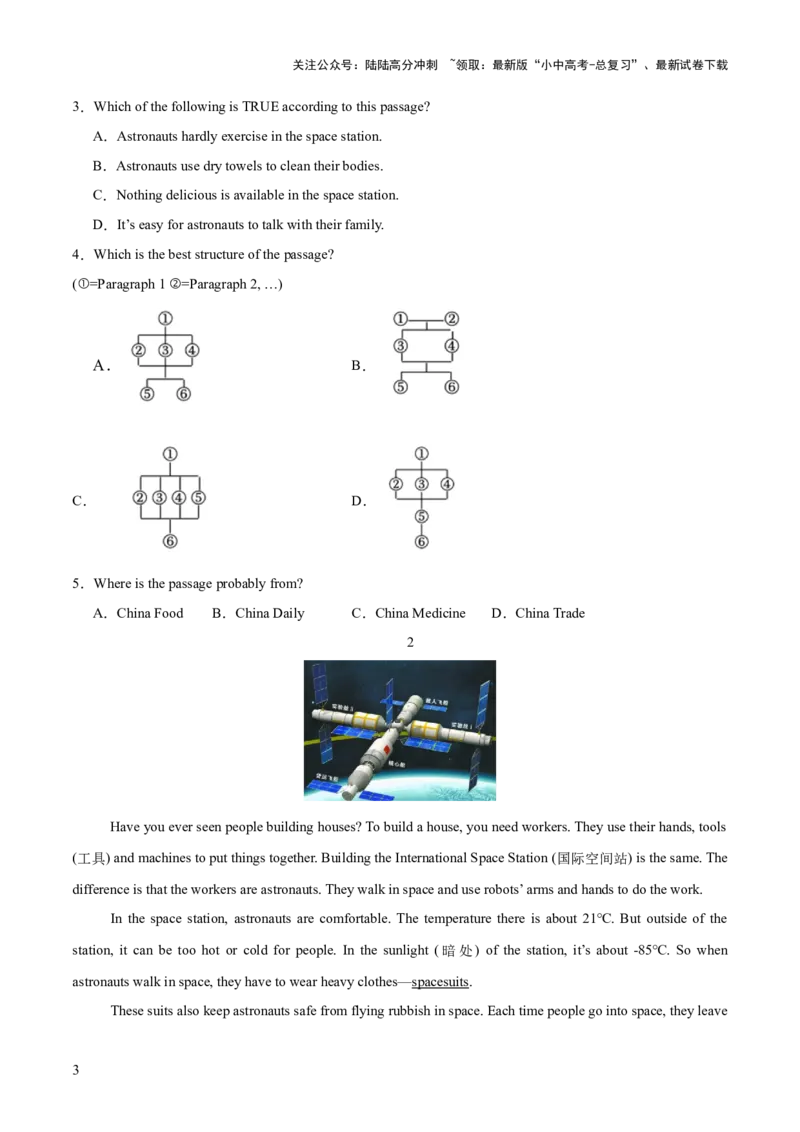
4.Which is the best structure of the passage?
(①=Paragraph 1 ②=Paragraph 2, …)
A. B.
C. D.
5.Where is the passage probably from?
A.China Food B.China Daily C.China Medicine D.China Trade
2
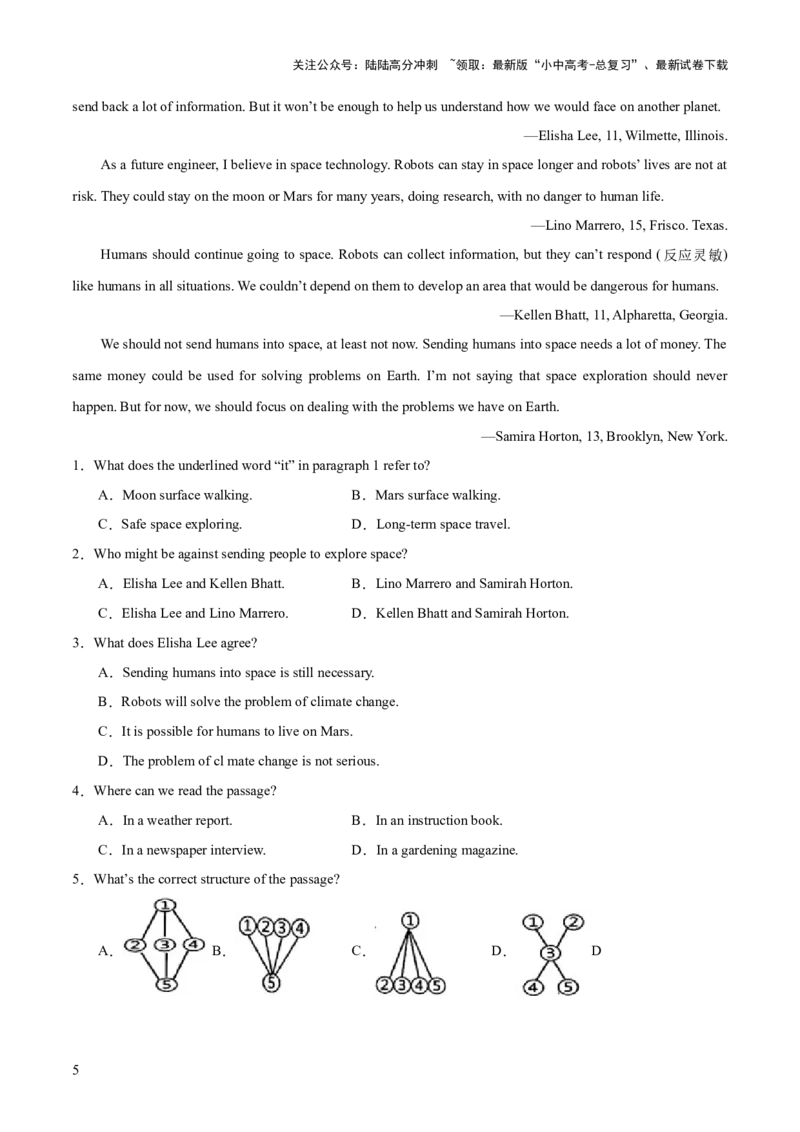
Have you ever seen people building houses? To build a house, you need workers. They use their hands, tools
(工具) and machines to put things together. Building the International Space Station (国际空间站) is the same. The
difference is that the workers are astronauts. They walk in space and use robots’ arms and hands to do the work.
In the space station, astronauts are comfortable. The temperature there is about 21℃. But outside of the
station, it can be too hot or cold for people. In the sunlight (暗处) of the station, it’s about -85℃. So when
astronauts walk in space, they have to wear heavy clothes—spacesuits.
These suits also keep astronauts safe from flying rubbish in space. Each time people go into space, they leave
3关注公众号:陆陆高分冲刺 ~领取:最新版“小中高考-总复习”、最新试卷下载
rubbish there. So astronauts should be careful because there’s a lot of rubbish, and some rubbish goes many times
as fast as a plane!
Space walking is not easy, and it can be dangerous. So getting ready for it takes a lot of time to learn.
Astronauts will need to do 160 space walks to finish their work in the space station. That will take about 1,900
man-hour work.
1.What’s the temperature in space station?
A.About 21℃. B.About 120℃.
C.About -85℃. D.We don’t know.
2.The astronauts build the space station with ________.
A.scientists’ hands B.some machines
C.robots’ arms and hands D.workers’ hands
3.Which of the following is TRUE according to the passage?
A.Space walking is very safe.
B.Space walking is difficult.
C.Space walking is very comfortable.
D.Astronauts needn’t wear spacesuits when walking in space.
4.What’s the meaning of the underlined word “spacesuits” in the passage?
A.太空服 B.防弹衣 C.雨衣 D.防护服
5.Why do astronauts need to wear spacesuits when walking in space?
①keep astronauts from too hot or cold temperature
②help astronauts flying in space
③keep astronauts safe from flying rubbish in space
④help astronauts take food with them
A.①② B.②④ C.①③ D.③④
3
Did you know that humans haven’t walked on the moon surface (月球表面) since 1972? People are planning
to send astronauts to the moon again, and finally to the Mars. The long-term space travel is possible in the near
future. But it is dangerous. We have plenty of technology for safely exploring (探索) space. Do we really need to
send people? Here are some students’ opinions.
We still need to send humans into space. If we don’t solve the problem of climate change, the planet could
become not fit to live in. We need to find out whether living on Mars is possible. The robotic mission (使命) is to
4关注公众号:陆陆高分冲刺 ~领取:最新版“小中高考-总复习”、最新试卷下载
send back a lot of information. But it won’t be enough to help us understand how we would face on another planet.
—Elisha Lee, 11, Wilmette, Illinois.
As a future engineer, I believe in space technology. Robots can stay in space longer and robots’ lives are not at
risk. They could stay on the moon or Mars for many years, doing research, with no danger to human life.
—Lino Marrero, 15, Frisco. Texas.
Humans should continue going to space. Robots can collect information, but they can’t respond (反应灵敏)
like humans in all situations. We couldn’t depend on them to develop an area that would be dangerous for humans.
—Kellen Bhatt, 11, Alpharetta, Georgia.
We should not send humans into space, at least not now. Sending humans into space needs a lot of money. The
same money could be used for solving problems on Earth. I’m not saying that space exploration should never
happen. But for now, we should focus on dealing with the problems we have on Earth.
—Samira Horton, 13, Brooklyn, New York.
1.What does the underlined word “it” in paragraph 1 refer to?
A.Moon surface walking. B.Mars surface walking.
C.Safe space exploring. D.Long-term space travel.
2.Who might be against sending people to explore space?
A.Elisha Lee and Kellen Bhatt. B.Lino Marrero and Samirah Horton.
C.Elisha Lee and Lino Marrero. D.Kellen Bhatt and Samirah Horton.
3.What does Elisha Lee agree?
A.Sending humans into space is still necessary.
B.Robots will solve the problem of climate change.
C.It is possible for humans to live on Mars.
D.The problem of cl mate change is not serious.
4.Where can we read the passage?
A.In a weather report. B.In an instruction book.
C.In a newspaper interview. D.In a gardening magazine.
5.What’s the correct structure of the passage?
A. B. C. D. D
5关注公众号:陆陆高分冲刺 ~领取:最新版“小中高考-总复习”、最新试卷下载
4
From the moon to Mars, scientists have been looking for water — the key to life — in the solar system for
many years. Recently, they have turned to Jupiter(木星)!
Jupiter is a gas giant(巨星). It doesn’t have an Earth-like surface. We can see strips(条纹) around it. They are
actually cold, windy clouds.
On April 14, the European Space Agency’s (ESA) JUICE spacecraft successfully lifted off from French
Guiana in South America. JUICE, short for “Jupiter Icy Moons Explorer”, will collect data(数据) from Jupiter and
its three moons, Europa, Ganymede and Callisto.
The three moons are believed to have big oceans of liquid water(液态水) under their icy shells(壳). According
to ESA, he water on those moons could be six times as much as the amount in Earth’s oceans. The mission “will
change our understanding of the solar system”, wrote Scientific American.
In 1998, NASA’s Galileo spacecraft found that Europa might be ejecting(喷射) water as far as 160 kilometers
into space. That gave scientists the idea of studying the icy moons of Jupiter.
The oceans under these moons are likely to be tens of kilometers deep. But they are also trapped under tens of
kilometers of ice, making it very difficult to study them. Although JUICE cannot land on the surface, it has lots of
high-tech equipment to study the moon’s environment, including spectral imaging(光谱成像) tools and radar(雷达).
They could give more data on things like the thickness of the oceans, their salt content(含量), and their distance
from the icy shells above, reported Phys.org.
“The main goal is to understand whether there are habitable (可居住的) environments among those icy moons
and around a giant planet like Jupiter,” JUICE team member Olivier Witasse said during a press conference (发布
会) on April 6.
1.What do we know about JUICE?
A.It will become one of Jupiter’s moons. B.It will collect data from Jupiter and its moons.
C.It got its name from how it looks. D.It left for Jupiter from the US.
2.The water on Europa might ________.
A.be six times as much as the amount in Earth’s oceans B.be common to see on other planets
C.have been ejected from the planet into space D.mainly come from the planet’s icy shells
3.Which of the following words can replace the word “trapped” in Paragraph 5?
A.lost B.caught C.kept D.taken
4.According to Paragraph 6, what can JUICE do?
A.It can land and collect samples on the ground.
6关注公众号:陆陆高分冲刺 ~领取:最新版“小中高考-总复习”、最新试卷下载
B.It can get information about the oceans by radar.
C.It can get water samples from deep under the icy shell.
D.It can break the ice on Jupiter’s moons.
5.What is the mission’s goal?
A.To test ways of keeping water on Europa, Ganymede and Callisto.
B.To find out if Jupiter has living things similar to human beings.
C.To figure out if it is possible for life to live on some moons.
D.To move water from Earth to moons like Europa, Ganymede and Callisto.
5
Oxygen extracted from Mars air (从火星空气中提取氧气)
National Aeronautics and Space Administration (NASA) achieved another first during its latest mission on
Mars. It successfully turned carbon dioxide (二氧化碳) from the air of Mars into fresh, breathable oxygen.
The extraction of oxygen out of thin air on Mars was done by a device called MOXIE. The device on
Perseverance (毅力号) is about the size of a toaster (烤面包机). “In its first run, it created about five grams of
oxygen. That is what an astronaut would need in order to be able to breathe for about 10 minutes,” NASA said. The
achievement marked the first experimental extraction of a natural resource from another planet for direct use by
humans.
MOXIE isn’t just the first device to produce oxygen on another planet. It is the first technology of its kind that
can help future missions to “live off the land” of another planet. Oxygen is not only a source of breathable air for
astronauts, but also an important element for the production of the rocket fuel (燃料) that will be needed to send
them back home.
According to a researcher at NASA, taking a one-ton machine to Mars was much easier than trying to carry 25
tons of oxygen from the earth. Astronauts living and working on Mars would need about one ton of oxygen to last
(维持) the whole year.
MOXIE is designed to create up to 10 grams of oxygen an hour. During the first two years of Perseverance’s
journey, NASA plans to run it at least another nine times.
When astronauts finally take their first breaths of locally made oxygen on Mars, they may have this toaster-
size device to thank.
1.In 20 minutes, two astronauts need ________ grams of oxygen.
A.10 B.15 C.20 D.25
2.Which of the following is TRUE according to the passage?
7关注公众号:陆陆高分冲刺 ~领取:最新版“小中高考-总复习”、最新试卷下载
A.MOXIE has successfully turned the air on Mars into oxygen again.
B.NASA has run the device 9 times during the two years of Perseverance’s journey.
C.MOXIE did the experimental extraction of a natural resource from another planet.
D.Carrying 25 tons of oxygen was much easier than taking a machine to Mars.
3.What do we know about MOXIE?
A.It is as heavy as a toaster.
B.It is the first device to produce oxygen.
C.It can create oxygen for humans to breathe in the world.
D.It is the first technology of its kind to help future missions.
4.MOXIE created oxygen in order to be used ________.
A.as the rocket fuel B.to produce drinking water
C.to turn into carbon dioxide D.as a source of breathable air for astronauts
5.In which part of a newspaper can we find the passage?
A.Science. B.Sports. C.Amusement. D.Culture.
6
The Zhurong rover was transported on a long journey to Mars by the Tianwen-1 spacecraft which began
orbiting (绕行) the red planet in February. The rover touched down on the surface of the planet before midnight on
May 15, 2021.
It is an important event for China, as only the US had ever managed to land something on our neighboring
planet before Zhurong. Some other countries have also tried before, but their rovers have either crashed (坠毁) or
lost contact after landing. Chinese leaders congratulated the mission team on its “outstanding achievement”.
Less than a week after its landing, Zhurong returned its first two pictures. One is a black-and-white photo
taken through a fisheye lens (鱼眼镜头) showing a view of where it landed. The other is in color, showing a view
of the rover’s solar panels (太阳能电池板).
If things go as planned, Zhurong will spend at least three months studying the local environment around it and
looking for signs of water ice (水冰) on the Martian surface.
“Mars is the most likely planet in our solar system for us to live on in the future. That’s why we want to
explore it.” Ge Jian, a Chinese scientist said. “Tianwen-1 and Zhurong will set the stage for future Mars missions,
including a sample (样本) return mission set to take place in the 2030s.”
1.When did the Zhurong rover begin orbiting Mars?
A.In February. B.In May. C.In 2020. D.In 2030.
8关注公众号:陆陆高分冲刺 ~领取:最新版“小中高考-总复习”、最新试卷下载
2.What can we learn from Paragraph 2?
A.The US failed to land something on Mars.
B.Only two countries landed their rovers on Mars.
C.All the rovers crashed or lost contact after landing.
D.Many countries managed to land something on Mars.
3.Which of the following is TRUE according to Paragraph 3?
A.Zhurong has sent two pictures before its landing.
B.The pictures that Zhurong sent were all black and white.
C.Zhurong showed a view of where it landed through a fisheye lens.
D.The black-and-white photo showed a view of the rover’s solar panels.
4.What will Zhurong do on Mars as planned?
A.Begin orbiting the red planet.
B.Study the local environment around it.
C.Touch down on the surface of the planet.
D.Look for signs of water ice on the earth surface.
5.What can we know from the last paragraph?
A.We will live on Mars in the 2030s.
B.Zhurong will continue to explore Mars.
C.Tianwen-1 has also returned the pictures on Mars.
D.We explore Mars because it is suitable for humans to live on.
7
For the first time, scientists have grown plants in moon soil(土壤)collected by NASA’s Apollo astronauts.
The scientists had no idea if anything would grow in moon soil. They wanted to see if it could be used to grow
plants. Robert Ferl of the University of Florida was surprised with the results. “Plants actually grow in moon soil,”
he said.
Ferl and other researchers planted thale cress, a small flowering plant, in moon soil. The good news was that
all of the seeds(种子)grew. The bad news was that after the first week, they grew slowly. Most of the plants
ended up small and not fully developed.
Scientists found that the longer the soil was on the moon, the worse the plants seemed to grow. The soil
collected by the Apollo 11 was the least helpful for growth. ★ . One solution might be to use younger soil on the
moon, like lava(火山岩浆), or put in some special nutrient(营养物)mixtures.
9关注公众号:陆陆高分冲刺 ~领取:最新版“小中高考-总复习”、最新试卷下载
Only 382 kilograms of moon rocks and soil were brought back by the six Apollo groups that landed on the
moon. Early last year, NASA finally gave out 12 grams of soil for the planting experiment(实验).
The Florida scientists hope to reuse their moon soil later this year, planting more thale cress before possibly
moving on to other plants.
A scientist said, “Growing plants is a big step forward. The real next step is to go and do it on the surface of
the moon.”
1.What did Robert Ferl think of the results of the planting experiment?
A.Surprising. B.Disappointing. C.Awful. D.Regretful.
2.What do the Florida scientists plan to do this year?
A.To find some younger soil on the moon.
B.To make some special nutrient mixtures.
C.To plant some other plants in new moon soil.
D.To use the moon soil again in the experiment.
3.Which of the following can be put in ★ ?
A.It was fully used by researchers
B.It weighed less than 283 kilograms
C.It was the newest soil on the moon
D.It was a couple billion years longer
4.What may be the real purpose of the planting experiment?
A.To collect more soil from the moon.
B.To send more scientists to the moon.
C.To grow plants on the moon surface.
D.To plant more thale cress on the moon.
5.What can we infer from the passage?
A.Most of the plants grew well after two weeks.
B.The soil collected by the Apollo 11 is the oldest.
C.It is easy for astronauts to bring back moon soil.
D.Scientists found no ways to improve the experiment.
8
On March 23, 2022, Chinese astronauts in China’s Tiangong space station gave a science lesson 400
kilometers above Earth. It was a great success. Do you remember the first space lesson hosted by Wang Yaping in
10关注公众号:陆陆高分冲刺 ~领取:最新版“小中高考-总复习”、最新试卷下载
2013? She gave the lesson to more than 60 million school children all over the country.
While watching the science lesson from the Tiangong-1 on June 20, 2013, Wang Lutian, a 10-year-old
disabled student at a special school in Beijing, was drawing a rocket in his classroom. “Moon…stars…a rocket to
the sky,” Wang explained his work cheerfully. At that time, he and 100 other disabled students were enjoying the
lesson given by Wang Yaping, who talked about movements in microgravity (微重力) environments. “Zero
gravity!” Qian Shaohong, another student, shouted when he saw astronaut Nie Haisheng showing his crossing legs
in mid-air. “Scientific knowledge has opened a window for children to know about the world,” said a teacher at the
school.
The lesson also increased interest in space science among teenagers living on the “roof (屋脊)of the world.”
“I was most interested in the experiment of the ‘water ball’ in a gravity-free environment. It’s amazing,” said Rigzin
Jigme Doje, a high school student in Lhasa, Xizang. As a lover of physics, Doje said the lesson helped him stay true
to his dream of becoming a physicist.
The lesson also encouraged other Xizangan students to connect the mysterious world of outer space to their
hometown.
1.The space lesson in 2013 was for ________.
A.Chinese astronauts B.Chinese teachers
C.school children in China D.scientists all over China
2.Which picture shows Nie Haisheng’s body movement according to the text? ________
A. B.
C. D.
3.What is Paragraph 2 mainly about?________
A.Wang Yaping’s talk on microgravity environments.
B.The influence of the space lesson on the disabled students.
C.The efforts of the disabled students in a special school.
D.A10-year-old student’s dream of sending a rocket to the sky.
11关注公众号:陆陆高分冲刺 ~领取:最新版“小中高考-总复习”、最新试卷下载
4.What do we know about Rigzin Jigme Doje?________
A.He liked drawing stars. B.He talked a lot about his work.
C.He was a primary school student. D.He was fond of physics.
5.After watching the space lesson, the Xizangan students ________.
A.had a new view of their high schools
B.got an amazing “water ball” in space
C.increased an understanding of the roof of the world
D.developed a deep interest in the world of outer space
9
Can anyone be an astronaut?
Of course not. You don’t have to have a science degree but most astronauts do. Most of them are pilots too.
Life in a spaceship is hard so you must have a healthy body and mind. You need to be easy going, patient, and
helpful to spend so much time in a small space with other people.
What’s the training like?
People have to train for a year to learn how to stay healthy and safe. They practise space walking and living in
zero gravity. They train in difficult conditions to learn how to solve problems and to work in a team. Everyday tasks
like eating, washing and sleeping can be difficult in a spaceship. There is no running water so you have to wash
with wet tissues; it’s hard to enjoy the dry food that astronauts have to eat. And to sleep you must cover your eyes
because the sun rises every 90 minutes on the International Space Station. You also have to tie yourself to
something so you don’t fly away!
What health problems do astronauts have?
Life in zero gravity causes changes to our bodies. Bones and muscles(肌肉) become thin and weak so you
must do a lot of exercise in space to stay fit and to help the heart move blood around your body. Astronauts often
get backache because people grow in space-up to 8 centimeters! It’s also common to have headaches and to feel
sick, especially at the beginning. You must have vitamins to take the place of fresh fruit and vegetables. But you
don’t have to put on sun cream because space suits protect your skin.
Are you still interested?
12关注公众号:陆陆高分冲刺 ~领取:最新版“小中高考-总复习”、最新试卷下载
So now you know. If you want to go to space, study hard, learn to fly and take care of your body and mind.
1.What is a must for an astronaut?
A.A science degree. B.A pilot’s license.
C.A healthy body and mind. D.A weak character.
2.What must you do to prepare for a space trip?
A.Experience zero gravity. B.Wash with running water.
C.Practise long walks. D.Sleep with your eyes open.
3.Why do astronauts have to exercise in space?
A.To make their bones and muscles thinner. B.To help the heart work well and keep fit.
C.To avoid backache and grow much taller.D.To stop their skins from getting sunburned.
4.What might happen to astronauts on the International Space Station?
A.Their skin will be injured. B.They can wash with running water.
C.They can eat a lot of fruit and vegetables. D.They may have headaches and feel sick.
5.What is the text mainly about?
A.What we need to know to become an astronaut.
B.Why young people are interested in space trips.
C.What problems astronauts must solve in space.
D.Why we need to train hard before a space trip.
10
According to Ken Croswell, the Sun and the Moon are different. We often think that the Sun rules the day
and the Moon rules the night. That’s kind of right, but not totally.
The Sun shines all the time. It shines during the day when we see it, and even at night when we don’t.
As the Earth turns, sometimes we face the Sun. That’s when we get day. When the Earth’s spin (自转) turns
us away from the Sun and we are in the Earth’s shadow, we get night. When people on the opposite side of the
Earth face the Sun, those people have day while we have night.
The Moon is a different story. Unlike the Sun, it doesn’t make its own light. Moonlight is actually the Sun’s
light reflecting(反射) the Moon back to us.
The Sun lights up only the side of the Moon that faces the Sun. At Full Moon, the Moon is on the opposite
side of the Earth from the Sun. Then the side of the Moon facing the Earth is all lit up. During Full Moon, the
Moon rises around sunset, shines all night, and sets around sunrise. Since he moonlight is so bright, you can
sometimes see it during the day, too. A few days before Full Moon, if you look east in the afternoon, you may see
13关注公众号:陆陆高分冲刺 ~领取:最新版“小中高考-总复习”、最新试卷下载
the Moon in the sky. After Full Moon, you may find it if you look west in the morning.
The Moon is most difficult to see at New Moon, when its orbit(轨道) puts it between the Earth and the Sun.
Then, the side of the Moon facing the Earth is dark and we can’t see the Moon at all.
1.What can we know about the Sun?
A.The Sun rules the Moon.
B.The Sun shines during both day and night.
C.The Sun lights up all the sides of the Moon.
D.The Sun shines everywhere on the Earth at the same time.
2.Which of the following in the dictionary best explains the underlined word “shadow” in Paragraph 3?
shadow n.
①the shape of the Earth
②the force from the Sun
③the dark area on the Earth
④the opposite side of the Sun
A.① B.② C.③ D.④
3.What does Paragraph 5 mainly talk about?
A.How the Moon makes its light.
B.Why there is day and night on the Earth.
C.Why the Moon can be seen during the day.
D.What the difference is between Full Moon and New Moon.
4.Which following picture shows us New Moon?
A. B.
C. D.
5.What is the theme(主题) of the text?
A.Culture. B.Science. C.Education. D.Technology.
参考答案
1
【答案与解析】本文介绍了宇航员在太空的生活。
14关注公众号:陆陆高分冲刺 ~领取:最新版“小中高考-总复习”、最新试卷下载
1.推理判断题。根据“Have you heard of China’s Tiangong space station? How much do you know about the
lives of astronauts working in the space station?”可知是通过提问的方式,故选C。
2.词句猜测题。根据“There is a spin bike (健身车), a running machine, and other fitness equipment in the
space station.”可知此处是指健身设备,故选A。
3.推理判断题。根据“Astronauts can have personal ‘sky-to-earth’ calls with their family.”可知宇航员可以很
容易和家人通话,故选D。
4.篇章结构题。第一段引出主题,第二三四五段分别介绍太空生活,第六段总结,故选C。
5.推理判断题。本文介绍了宇航员在太空的生活。因此可能来自《中国日报》,故选B。
2
【答案与解析】本文主要介绍了建造国际空间站的过程和宇航员的工作环境。
1.细节理解题。根据第二段“The temperature there is about 21℃.”可知,空间站的温度约为21℃。故选
A。
2.细节理解题。根据第一段“The difference is that the workers are astronauts. They walk in space and use
robots’ arms and hands to do the work.”可知,宇航员建造空间站使用机器人的手臂和手。故选C。
3.细节理解题。根据第四段“Space walking is not easy, and it can be dangerous.”可知,太空行走很难。故选
B。
4.词义猜测题。根据第二段“ So when astronauts walk in space, they have to wear heavy clothes—
spacesuits.”可知,spacesuit是宇航员在太空行走时穿得衣服,因此spacesuits的意思是“太空服”。故
选A。
5.细节理解题。根据第二段“In the sunlight (暗处) of the station, it’s about -85℃. So when astronauts walk in
space, they have to wear heavy clothes—spacesuits”和第三段“These suits also keep astronauts safe from flying
rubbish in space.”可知,太空服可以防止宇航员的温度过高或过低,并且可以免受太空垃圾飞行的伤害。故
选C。
3
【答案与解析】本文讲述了学生们对于是否应该长期在太空旅行的看法。
1.词义猜测题。根据“The long-term space travel is possible in the near future. But it is dangerous.”可知,不
久的将来,长期太空旅行是可能的,但这是危险的。所以划线单词“it”是指“长期太空旅行”。故选D。
2.推理判断题。根据第三段“As a future engineer, I believe in space technology. Robots can stay in space
longer and robots’ lives are not at risk... with no danger to human life.”以及第五段“We should not send humans
into space, at least not now. ”可知,Lino Marrero认为,机器人能待在太空更长时间做研究,对人类生活也没
有危险,所以推测他反对派人去探索太空;另外,Samira Horton认为不应该把人类送上太空,至少现在不
15关注公众号:陆陆高分冲刺 ~领取:最新版“小中高考-总复习”、最新试卷下载
行。综上所述,Lino Marrero和Samira Horton可能会反对派人去探索太空。故选B。
3.细节理解题。根据第二段“We still need to send humans into space. If we don’t solve the problem of climate
change, the planet could become not fit to live in. We need to find out whether living on Mars is possible....on
another planet.”可知,Elisha Lee认为人类还需要送人到太空。故选A。
4.推理判断题。根据第一段“Do we really need to send people? Here are some students’ opinions.”可知,提
到了就是否送人类到太空这一问题,一些学生的看法不同。所以推测出可以从报纸采访中读到这篇文章。
故选C。
5.篇章结构题。通读全文,文章第一段用问句引出下文学生们对于未来是否应该长期在太空旅行的看法;
第二、三、四、五分别讲述了学生们的看法。故这篇文章的结构是:总—分。故选C。
4
【答案与解析】本篇是一篇说明文。文章是关于人类探索木星的历程,揭示了人们在木星及其卫星上的神
奇发现。
1.细节理解题。根据“JUICE, short for ‘Jupiter Icy Moons Explorer’, will collect data from Jupiter and its three
moons, Europa, Ganymede and Callisto.”可知,JUICE是“木星冰冷卫星探索者”的缩写,它将从木星及其
三颗卫星——木卫二、木卫三和木卫四——收集数据。故选B。
2.细节理解题。根据“In 1998, NASA’s Galileo spacecraft found that Europa might be ejecting water as far as
160 kilometers into space.”可知,1998年,美国宇航局的伽利略号宇宙飞船发现木卫二可能正在向160公里
外的太空喷射水。故选C。
3.词义猜测题。分析“But they are also trapped under tens of kilometers of ice, making it very difficult to study
them.”可知,但它们也被困在数十公里的冰层下,这使得研究它们变得非常困难。trapped的意思是“困
住”,故选C。
4.细节理解题。根据“Although JUICE cannot land on the surface, it has lots of high-tech equipment to study
the moon’s environment, including spectral imaging tools and radar. They could give more data on things like the
thickness of the oceans, their salt content, and their distance from the icy shells above”可知,虽然JUICE不能降
落在月球表面,但它有很多高科技设备来研究月球的环境,包括光谱成像工具和雷达。它们可以提供更多
的数据,比如海洋的厚度,含盐量,以及它们与上面冰壳的距离。故选B。
5.细节理解题。根据“The main goal is to understand whether there are habitable environments among those
icy moons and around a giant planet like Jupiter”可知,主要目标是了解在这些冰冷的卫星和像木星这样的巨
大行星周围是否存在适合居住的环境。故选C。
5
16关注公众号:陆陆高分冲刺 ~领取:最新版“小中高考-总复习”、最新试卷下载
【答案与解析】本文是一篇说明文。主要介绍一款可以把火星上二氧化碳变成氧气的设备,MOXIE。它不
仅可以解决宇航员的呼吸问题,还能为火箭燃料提供氧气,且对未来的太空任务有着巨大的价值。
1.推理判断题。根据“In its first run, it created about five grams of oxygen. That is what an astronaut would
need in order to be able to breathe for about 10 minutes”可知,一个宇航员呼吸10分钟需要5克氧气,则两个
宇航员呼吸20分钟需要20克氧气。故选C。
2.细节理解题。根据“The extraction of oxygen out of thin air on Mars was done by a device called MOXIE;
The achievement marked...direct use by humans.”可知,MOXIE已经能从火星的空气中提取氧气,即可以从
其他星球获取自然资源。故选C。
3.细节理解题。根据“It is the first technology of its kind that can help future missions to “live off the land” of
another planet.”可知,MOXIE是第一个有助于“人们在其他星球生活”的未来任务的技术,因此D选项
“同类中第一项有助于未来任务的技术”符合题意。故选D。
4.细节理解题。根据“Oxygen is not only a source of breathable air for astronauts”可知,MOXIE提取的氧气
可以供给宇航员呼吸使用。故选D。
5.推理判断题。通读全文可知,本文主要介绍了一种可以把火星上二氧化碳变成氧气的设备,应该属于
科学范畴。故选A。
6
【答案与解析】本文主要讲了中国“祝融”号火星车成功登陆火星的事情。
1.细节理解题。根据文章第一段中的“...the red planet in February.”可知,该探测器于2月开始围绕这颗红
色行星运行。故选A。
2.推理判断题。根据文章第二段中的“It is an important event for China, as only the US had ever managed to
land something on our neighboring planet before Zhurong. Some other countries have also tried before, but their
rovers have either crashed (坠毁) or lost contact after landing.”可知,这对中国来说是一件重要的事情,因为在
祝融号之前,只有美国成功地在我们的邻居星球上着陆过,其他的国家都没有成功。故选B。
3.细节理解题。根据第三段中的“One is a black-and-white photo taken through a fisheye lens (鱼眼镜头)
showing a view of where it landed”可知,其中一张是通过鱼眼镜头拍摄的黑白照片,展示了它着陆的地方。
故选C。
4.细节理解题。根据第四段中的“If things go as planned, Zhurong will spend at least three months studying
the local environment around it and looking for signs of water ice (水冰) on the Martian surface.”可知,如果一切
按计划进行,祝融号将花费至少三个月的时间研究其周围的当地环境,并在火星表面寻找水冰的迹象。故
选B。
5.推理判断题。通读文章最后一段可知,火星是我们未来在太阳系中最有可能居住的行星。这就是我们
17关注公众号:陆陆高分冲刺 ~领取:最新版“小中高考-总复习”、最新试卷下载
想要探索它的原因,天问一号和祝融号将为未来的火星任务奠定基础,包括将于2030年代进行的样本返回
任务。说明祝融号将继续探索火星。故选B。
7
【答案与解析】本文主要介绍了科学家们首次在NASA阿波罗宇航员收集的月球土壤中种植植物。
1.细节理解题。根据“Robert Ferl of the University of Florida was surprised with the results”可知Robert Ferl
对结果感到惊讶。故选A。
2.细节理解题。根据“The Florida scientists hope to reuse their moon soil later this year, planting more thale
cress before possibly moving on to other plants.”可知佛罗里达的科学家们今年计划在实验中再次使用月球土
壤。故选D。
3.推理判断题。根据“Scientists found that the longer the soil was on the moon, the worse the plants seemed to
grow. The soil collected by the Apollo 11 was the least helpful for growth”(科学家们发现,月球上的土壤存在
的时间越长,植物的生长情况就越差。阿波罗11号收集的土壤是最不利于生长的)可推知阿波罗11号收
集的土壤是最古老的。D选项“它有几十亿年之久”符合语境。故选D。
4.细节理解题。根据“Growing plants is a big step forward. The real next step is to go and do it on the surface
of the moon.”(种植植物是一个很大的进步。真正的下一步是在月球表面进行)可知种植试验的真正目的
是为了在月球表面种植植物。故选C。
5.推理判断题。根据“Scientists found that the longer the soil was on the moon, the worse the plants seemed to
grow. The soil collected by the Apollo 11 was the least helpful for growth”(科学家们发现,月球上的土壤存在
的时间越长,植物的生长情况就越差。阿波罗11号收集的土壤是最不利于生长的)可推知阿波罗11号收
集的土壤是最古老的。故选B。
8
【答案与解析】本文主要讲述了中国天宫空间站上的中国宇航员在2022年3月23日进行的一堂科学课。
这堂课非常成功。文章还提到了2013年王亚平主持的第一堂太空课,她向全国各地6000多万名学生进行
了教学。这堂课让学生们对太空科学产生了浓厚的兴趣,尤其是对残疾学生和居住在西藏的青少年产生了
积极的影响。
1.细节理解题。根据“Do you still remember the first space lesson hosted by Wang Yaping in 2013? Helped by
the other two astronauts, she gave the lesson to more than 60 million school children all over the country.”可知,
2013年的太空课是为中国的学生开设的。故选C。
2.推理判断题。根据“Qian Shaohong, another student at the school, shouted when he saw astronaut Nie
Haisheng making a show of crossing his legs in mid-air.”可知,聂海胜在半空中盘腿而坐,因此A选项符合题
18关注公众号:陆陆高分冲刺 ~领取:最新版“小中高考-总复习”、最新试卷下载
意。故选A。
3.主旨大意题。根据“While watching the science lesson from the Tiangong-1 on June 20, 2013, Wang Lutian,
a 10-year-old disabled student at a special school in Beijing, was drawing a rocket in his classroom.”可知,第二段
主要说的是太空课对残疾学生的影响。故选B。
4.推理判断题。根据“As a lover of physics, Doje said the lesson helped him stay true to his dream of becoming
a physicist.”可知,他把自己描述为一名物理爱好者,Doje说这节课帮助他实现了成为物理学家的梦想。因
此推断他喜欢物理。故选D。
5.推理判断题。根据“The lesson also encouraged other Xizangan school children to relate the mysterious
world of outer space to their hometown.”可知,这节课也鼓励了其他西藏学校的孩子们把神秘的外太空世界
和他们的家乡联系起来。因此推断观看完太空课后,藏族学生对外太空的世界产生了浓厚的兴趣。故选
D。
9
【答案与解析】本文主要介绍了成为宇航员要经历的训练和面临的健康问题及要成为一名宇航员,我们需
要知道什么。
1.细节理解题。根据“You don’t have to have a science degree but most astronauts do. Most of them are pilots
too. Life in a spaceship is hard so you must have a healthy body and mind.”可知,宇航员的必备条件是拥有健康
的身心,故选C。
2.细节理解题。根据“People have to train for a year to learn how to stay healthy and safe. They practise space
walking and living in zero gravity.”可知,体验零重力是为太空旅行必须做的事情,故选A。
3.细节理解题。根据“Life in zero gravity causes changes to our bodies. Bones and muscles(肌肉) become thin
and weak so you must do a lot of exercise in space to stay fit and to help the heart move blood around your body.”
可知,在太空中做大量的运动是为了保持健康,并帮助心脏在你的身体周围流动血液,故选B。
4.细节理解题。根据“It’s also common to have headaches and to feel sick, especially at the beginning.”可知,
国际空间站上的宇航员可能会头痛和恶心,故选D。
5.主旨大意题。根据“So now you know. If you want to go to space, study hard, learn to fly and take care of
your body and mind.”并结合全文内容可知,文章主要介绍了成为宇航员要经历的训练和面临的健康问题及
要成为一名宇航员,我们需要知道什么。故选A。
10
【答案与解析】本文主要科普了一些关于太阳、月球和地球之间的知识。
1.细节理解题。根据“The Sun shines all the time. It shines during the day when we see it, and even at night
when we don’t.”可知太阳白天黑夜都照耀着。故选B。
19关注公众号:陆陆高分冲刺 ~领取:最新版“小中高考-总复习”、最新试卷下载
2.词义猜测题。根据“When the Earth’s spin (自转) turns us away from the Sun...we get night”可知当地球自
转使我们远离太阳时,天就变黑了,所以shadow指的是地球上的黑暗区域,故选C。
3.段落大意题。根据“During Full Moon, the Moon rises around sunset, shines all night, and sets around
sunrise. Since he moonlight is so bright, you can sometimes see it during the day, too.”(满月时,月亮在日落时
升起,整夜闪耀,在日出时落下。由于月光如此明亮,你有时在白天也能看到它。)可知第五段主要讲述
了为什么在白天可以看到月亮,故选C。
4.推理判断题。根据“The Moon is most difficult to see at New Moon, when its orbit(轨道) puts it between the
Earth and the Sun. Then, the side of the Moon facing the Earth is dark and we can’t see the Moon at all.”可知在新
月时,当月球的轨道位于地球和太阳之间时,是最难看到月亮的。然后,月球面向地球的那一面是黑暗的,
我们根本看不到月球,结合图片,A选项符合,故选A。
5.主旨大意题。根据全文可知,本文主要科普了一些关于太阳、月球和地球之间的知识,所以本文主题
为科学,故选B。
20