【复习卡】
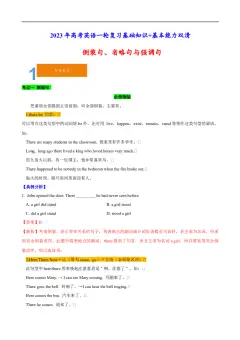
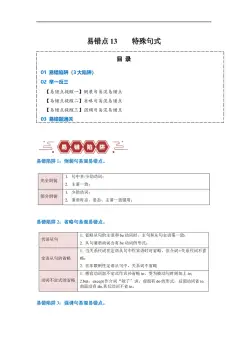
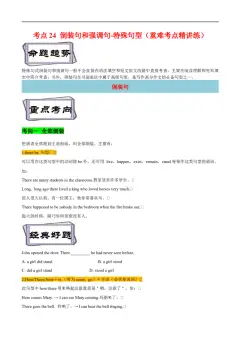
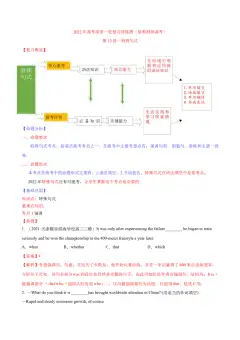
13 强调句、省略句与倒装句
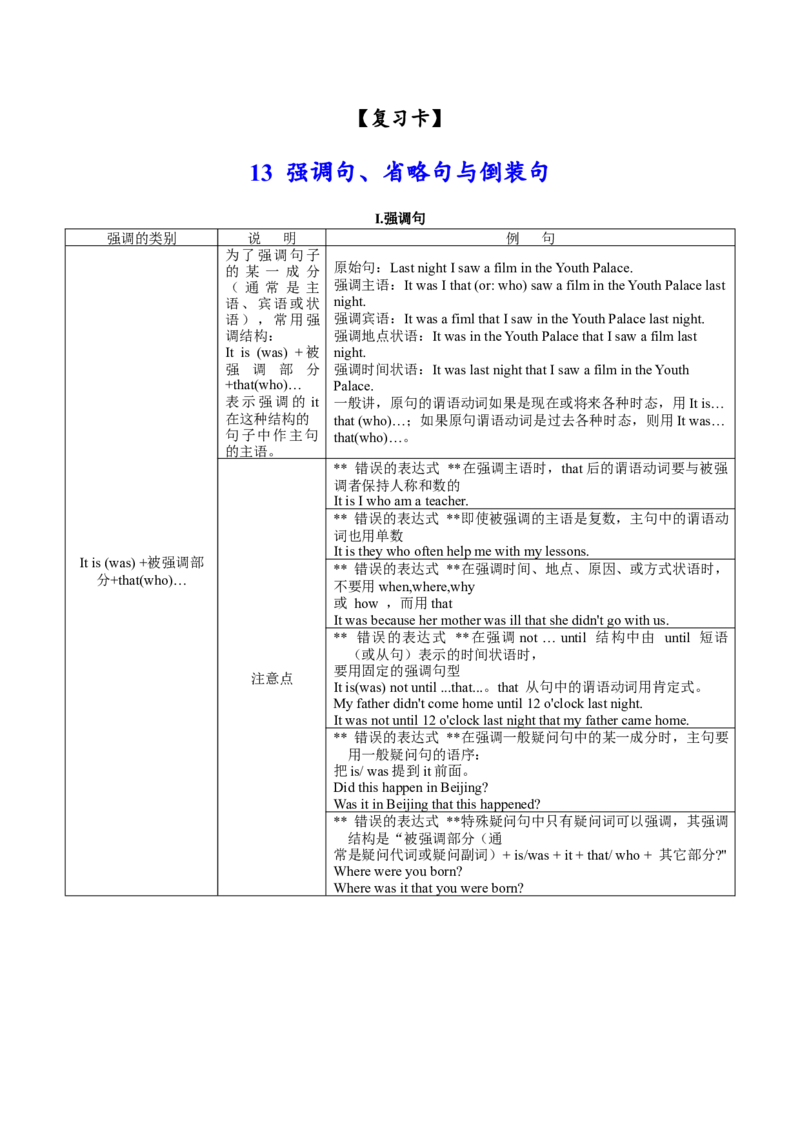
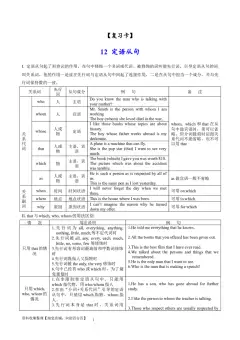
I.强调句
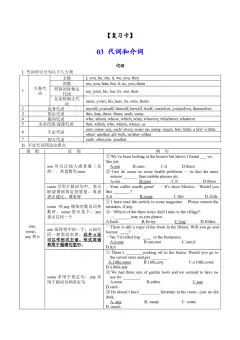
强调的类别 说 明 例 句
为了强调句子
的 某 一 成 分 原始句:Last night I saw a film in the Youth Palace.
( 通 常 是 主 强调主语:It was I that (or: who) saw a film in the Youth Palace last
语、宾语或状 night.
语),常用强 强调宾语:It was a fiml that I saw in the Youth Palace last night.
调结构: 强调地点状语:It was in the Youth Palace that I saw a film last
It is (was) +被 night.
强 调 部 分 强调时间状语:It was last night that I saw a film in the Youth
+that(who)… Palace.
表示强调的 it 一般讲,原句的谓语动词如果是现在或将来各种时态,用It is…
在这种结构的 that (who)…;如果原句谓语动词是过去各种时态,则用It was…
句子中作主句 that(who)…。
的主语。
** 错误的表达式 **在强调主语时,that后的谓语动词要与被强
调者保持人称和数的
It is I who am a teacher.
** 错误的表达式 **即使被强调的主语是复数,主句中的谓语动
词也用单数
It is they who often help me with my lessons.
It is (was) +被强调部
** 错误的表达式 **在强调时间、地点、原因、或方式状语时,
分+that(who)…
不要用when,where,why
或 how ,而用that
It was because her mother was ill that she didn't go with us.
** 错误的表达式 **在强调not … until 结构中由 until 短语
(或从句)表示的时间状语时,
要用固定的强调句型
注意点
It is(was) not until ...that...。that 从句中的谓语动词用肯定式。
My father didn't come home until 12 o'clock last night.
It was not until 12 o'clock last night that my father came home.
** 错误的表达式 **在强调一般疑问句中的某一成分时,主句要
用一般疑问句的语序:
把is/ was提到it前面。
Did this happen in Beijing?
Was it in Beijing that this happened?
** 错误的表达式 **特殊疑问句中只有疑问词可以强调,其强调
结构是“被强调部分(通
常是疑问代词或疑问副词)+ is/was + it + that/ who + 其它部分?"
Where were you born?
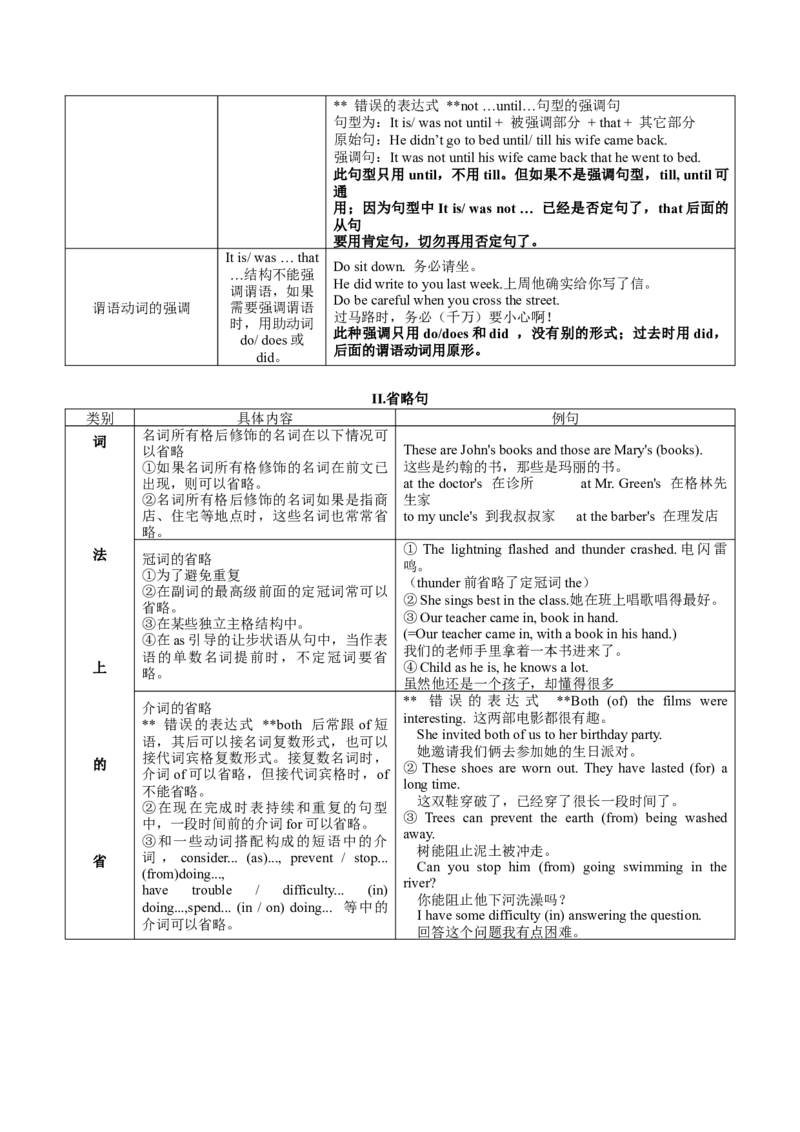
Where was it that you were born?** 错误的表达式 **not …until…句型的强调句
[来源:学|科|网Z|X|X|K]
句型为:It is/ was not until + 被强调部分 + that + 其它部分
原始句:He didn’t go to bed until/ till his wife came back.
强调句:It was not until his wife came back that he went to bed.
此句型只用until,不用till。但如果不是强调句型,till, until可
通
用;因为句型中It is/ was not … 已经是否定句了,that后面的
从句
要用肯定句,切勿再用否定句了。
It is/ was … that
Do sit down. 务必请坐。
…结构不能强
He did write to you last week.上周他确实给你写了信。
调谓语,如果
Do be careful when you cross the street.
谓语动词的强调 需要强调谓语
过马路时,务必(千万)要小心啊!
时,用助动词
此种强调只用do/does和did ,没有别的形式;过去时用did,
do/ does或
后面的谓语动词用原形。
did。
II.省略句
类别 具体内容 例句
名词所有格后修饰的名词在以下情况可
词
以省略 These are John's books and those are Mary's (books).
①如果名词所有格修饰的名词在前文已 这些是约翰的书,那些是玛丽的书。
出现,则可以省略。 at the doctor's 在诊所 at Mr. Green's 在格林先
②名词所有格后修饰的名词如果是指商 生家
店、住宅等地点时,这些名词也常常省 to my uncle's 到我叔叔家 at the barber's 在理发店
略。
① The lightning flashed and thunder crashed.电闪雷
法
冠词的省略
鸣。
①为了避免重复
(thunder前省略了定冠词the)
②在副词的最高级前面的定冠词常可以
②She sings best in the class.她在班上唱歌唱得最好。
省略。
③Our teacher came in, book in hand.
③在某些独立主格结构中。
(=Our teacher came in, with a book in his hand.)
④在as引导的让步状语从句中,当作表
我们的老师手里拿着一本书进来了。
语的单数名词提前时,不定冠词要省
上 ④Child as he is, he knows a lot.
略。
虽然他还是一个孩子,却懂得很多
** 错 误 的 表 达 式 **Both (of) the films were
介词的省略
interesting. 这两部电影都很有趣。
** 错误的表达式 **both 后常跟of短
She invited both of us to her birthday party.
语,其后可以接名词复数形式,也可以
她邀请我们俩去参加她的生日派对。
接代词宾格复数形式。接复数名词时,
的 ② These shoes are worn out. They have lasted (for) a
介词of可以省略,但接代词宾格时,of
long time.
不能省略。
这双鞋穿破了,已经穿了很长一段时间了。
②在现在完成时表持续和重复的句型
③ Trees can prevent the earth (from) being washed
中,一段时间前的介词for可以省略。
away.
③和一些动词搭配构成的短语中的介
树能阻止泥土被冲走。
省 词 , consider... (as)..., prevent / stop...
Can you stop him (from) going swimming in the
(from)doing...,
river?
have trouble / difficulty... (in)
你能阻止他下河洗澡吗?
doing...,spend... (in / on) doing... 等中的
I have some difficulty (in) answering the question.
介词可以省略。
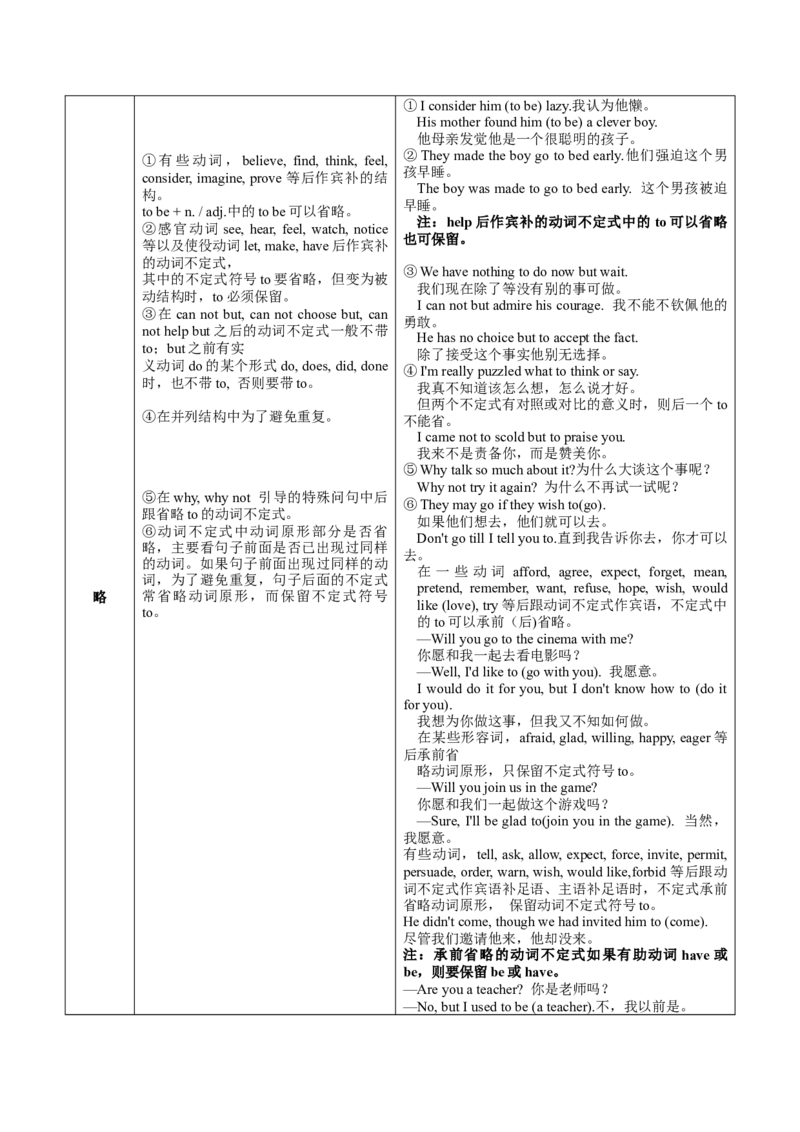
回答这个问题我有点困难。①I consider him (to be) lazy.我认为他懒。
His mother found him (to be) a clever boy.
他母亲发觉他是一个很聪明的孩子。
②They made the boy go to bed early.他们强迫这个男
①有些动词,believe, find, think, feel,
孩早睡。
consider, imagine, prove等后作宾补的结
The boy was made to go to bed early. 这个男孩被迫
构。
早睡。
to be + n. / adj.中的to be可以省略。
注:help后作宾补的动词不定式中的to可以省略
②感官动词 see, hear, feel, watch, notice
也可保留。
等以及使役动词let, make, have后作宾补
的动词不定式,
③We have nothing to do now but wait.
其中的不定式符号to要省略,但变为被
我们现在除了等没有别的事可做。
动结构时,to必须保留。
I can not but admire his courage. 我不能不钦佩他的
③在 can not but, can not choose but, can
勇敢。
not help but之后的动词不定式一般不带
He has no choice but to accept the fact.
to;but之前有实
除了接受这个事实他别无选择。
义动词do的某个形式do, does, did, done ④I'm really puzzled what to think or say.
时,也不带to, 否则要带to。
我真不知道该怎么想,怎么说才好。
但两个不定式有对照或对比的意义时,则后一个to
④在并列结构中为了避免重复。
不能省。
I came not to scold but to praise you.
我来不是责备你,而是赞美你。
⑤Why talk so much about it?为什么大谈这个事呢?
Why not try it again? 为什么不再试一试呢?
⑤在why, why not 引导的特殊问句中后
⑥They may go if they wish to(go).
跟省略to的动词不定式。
如果他们想去,他们就可以去。
⑥动词不定式中动词原形部分是否省
Don't go till I tell you to.直到我告诉你去,你才可以
略,主要看句子前面是否已出现过同样
去。
的动词。如果句子前面出现过同样的动
在 一 些 动 词 afford, agree, expect, forget, mean,
词,为了避免重复,句子后面的不定式
pretend, remember, want, refuse, hope, wish, would
略 常省略动词原形,而保留不定式符号
like (love), try等后跟动词不定式作宾语,不定式中
to。
的to可以承前(后)省略。
—Will you go to the cinema with me?
你愿和我一起去看电影吗?
—Well, I'd like to (go with you). 我愿意。
I would do it for you, but I don't know how to (do it
for you).
我想为你做这事,但我又不知如何做。
在某些形容词,afraid, glad, willing, happy, eager等
后承前省
略动词原形,只保留不定式符号to。
—Will you join us in the game?
你愿和我们一起做这个游戏吗?
—Sure, I'll be glad to(join you in the game). 当然,
我愿意。
有些动词,tell, ask, allow, expect, force, invite, permit,
persuade, order, warn, wish, would like,forbid等后跟动
词不定式作宾语补足语、主语补足语时,不定式承前
省略动词原形, 保留动词不定式符号to。
He didn't come, though we had invited him to (come).
尽管我们邀请他来,他却没来。
注:承前省略的动词不定式如果有助动词 have 或
be,则要保留be或have。
—Are you a teacher? 你是老师吗?
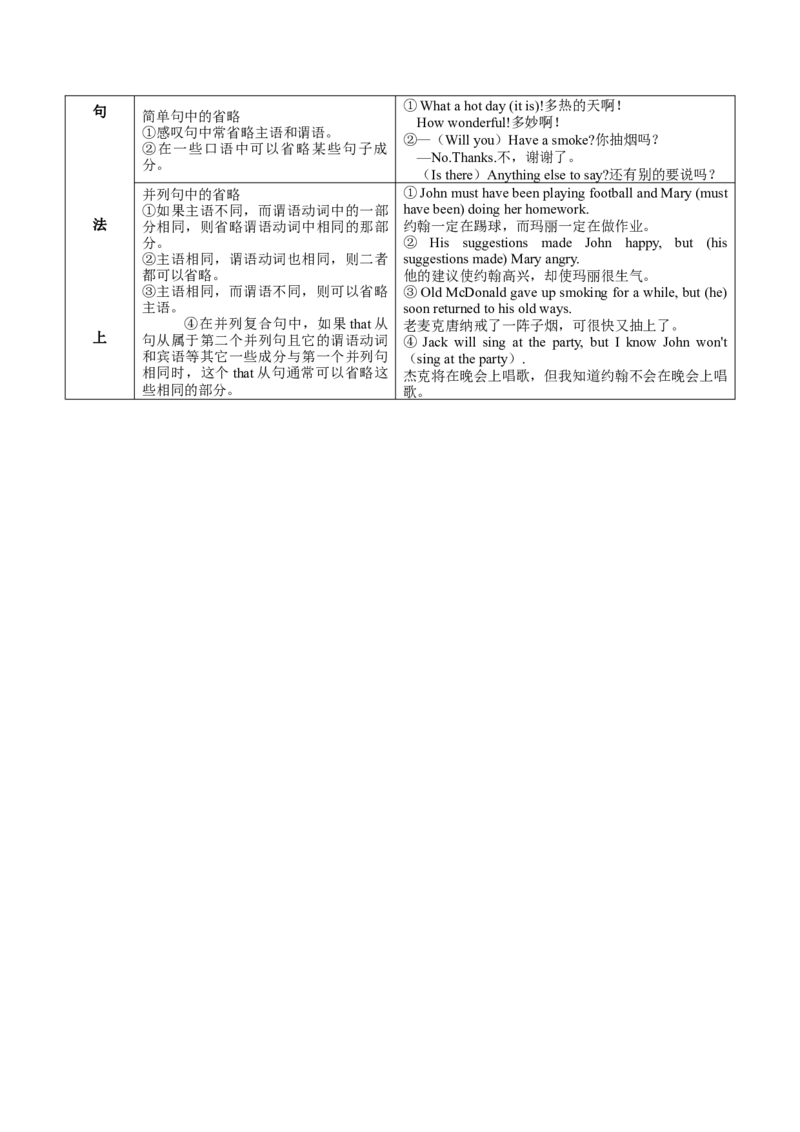
—No, but I used to be (a teacher).不,我以前是。①What a hot day (it is)!多热的天啊!
句
简单句中的省略
How wonderful!多妙啊!
①感叹句中常省略主语和谓语。
②—(Will you)Have a smoke?你抽烟吗?
②在一些口语中可以省略某些句子成
—No.Thanks.不,谢谢了。
分。
(Is there)Anything else to say?还有别的要说吗?
并列句中的省略 ①John must have been playing football and Mary (must
①如果主语不同,而谓语动词中的一部 have been) doing her homework.
法 分相同,则省略谓语动词中相同的那部 约翰一定在踢球,而玛丽一定在做作业。
分。 ② His suggestions made John happy, but (his
②主语相同,谓语动词也相同,则二者 suggestions made) Mary angry.
都可以省略。 他的建议使约翰高兴,却使玛丽很生气。
③主语相同,而谓语不同,则可以省略 ③Old McDonald gave up smoking for a while, but (he)
主语。 soon returned to his old ways.
④在并列复合句中,如果that从 老麦克唐纳戒了一阵子烟,可很快又抽上了。
上 句从属于第二个并列句且它的谓语动词 ④ Jack will sing at the party, but I know John won't
和宾语等其它一些成分与第一个并列句 (sing at the party).
相同时,这个that从句通常可以省略这 杰克将在晚会上唱歌,但我知道约翰不会在晚会上唱
些相同的部分。 歌。复合句中的省略 复合句中的省略
▲名词性从句中的省略 ▲名词性从句中的省略
①作宾语的what从句中的谓语动词与主 ①Someone has used my bike, but I don't know who (has
句的相同,则what从句可以省略谓语, used it).
甚至主语 有人用了我的自行车,但我不知道是谁。
He has gone, but no one knows where (he has gone).
他走了,但没人知道他去哪儿了。
②有时候也可以根据说话的情景来省略 ②(I'm)Sorry I've kept you waiting so long.
主句中的一些成分。 对不起,让你久等了。
③在某些表虚拟语气的主语从句、宾语 ③ It's important that we (should) speak to the old
从句、表语从句和同位语从句中,从句 politely.
谓语动词中的助动词should可以省略。 我们对老人说话要有礼貌,这很重要。
▲定语从句中的省略
①在限制性定语从句中,作宾语的关系 ▲定语从句中的省略
代词 that, which, who (whom)常可以省 ①The man(who/whom)I saw is called Smith.
略。 我见到的那个人名叫史密斯。
Where is the book (which) I bought this morning?
今天上午我买的那本书在哪儿?
②关系副词 when, where, why 以及 that ②I shall never forget the day (when) we first met.
在 the time(day, morning, afternoon, 我永远也不会忘记我们第一次见面的那一天。
evening, night, week, The reason (why) he came so early is his own affair.
month, year 等 ) when, the place(desk, 他来这么早是他自己的事。
table, room, spot, house, town, country, The way (that) you answered the questions was
school 等)where, the reason why, the way admirable.
that结构中引导限制性定语从句时,在 你回答这些问题的方式令人钦佩。
非正式场合下,可以省略关系副词
when, where, why, that。 ▲状语从句中的省略
▲状语从句中的省略
的
当状语从句中的主语和主句的主语一
致,或状语从句中的主语是it,并且又
① While ( I was ) waiting, I was reading some
含有be动词时,常可以省略从句中的主
magazines.
语和be动词。
我一边看杂志,一边等。
①在 as, before, till, once, when, while 等
②Though (they were) tired, they went on working.
引导的时间状语从句中。
虽然他们累了,但他们仍继续工作。
②在though, although,等引导的让步状语
省 ③ You shouldn't come to his party unless (you were)
从句中。
invited.
③在if, unless(=if... not)等引导的条件状
除非你被邀请,否则你不应该来参加他的宴会。
语从句中。
④He did as (he had been) told. 他按照被告知的那样
去做了。
④在as, as if, as though引导的让步状语
He paused as if (he was) expecting her to speak.
从句中。
他停下来,好像是在期待她说话。
略
⑤He did as (he had been) told. 他按照被告知的那样
去做了。
⑤在as(so)... as..., than 引导的比较状语
He paused as if (he was) expecting her to speak.
从句中。
他停下来,好像是在期待她说话。
I know you can do better than he (can do).
我知道你能比他做得更好。
This car doesn't run as fast as that one (does).
这辆小车不及那辆跑得快。
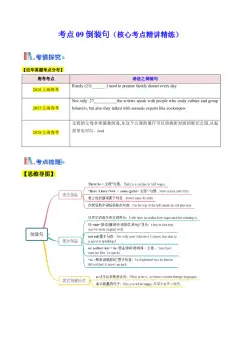
III.倒装句
类 型 情 况 例 句Not a word did I say to him.
句首状语为否定词或半否定词的句子。 Never have I found him so happy.
这类词或短语主要有never, neither, nor, Little does he care about what I said.
little,seldom,rarely,hardly,scarcely,no I can’t swim. Neither can he.
sooner, not only,in no way,at no time,few, No sooner had he gone to bed than he fell asleep.
not,no等 Hardly/Scarcely had he gone to bed when he fell
asleep.
Only by this means is it possible to explain it. (介词短
语)
Only then did I realize the importance of math. (副词)
only+状语放在句首,要部分倒装 Only when the war was over in 1918 was he able to get
部分倒装
(部分 倒 happily back to work. (从句)
装是把 be 注意:如果only后面不是状语,则不用倒装。
动词、情 OnlyWang Ling knows this.
态动词、 I saw the film, so did she.
so或so引导的短语放在句首,要部分倒
助动词 放 So loudly did he speak that even people in the next
装
到主语 之 room could hear him.
前。如果 “Not only+分句,but also+分句”句型中 Not only does John love Chinese, he is also good at
句子中没 的前一分句要部分倒装“Not only + 分 speaking it.
有这些词, 句,but also + 分句”句型中的前一分句 但not only...but also...连接主语时,不倒装。
要在主语 要部分倒装 Not only the mother but also the children are sick.
之前加助 Not until last week did they find the lost bike. (简单句)
Not until放在句首,从句不倒装,主句倒
动 词 do/ Not until my son had entered the university did he
装
does /did realize the importance of time. (复合句)
等,而把原 Proud as these nobles are, he’s afraid to see me.
来的谓语 Tired as he was, he kept on running.
动词 变成 Tired though he was, he kept on running.
as/though引导的让步状语从句
原形 放在 =Though he was tired,he kept on running
主 语 之 Child as he is,he knows a lot.(注意:child前没有
后。) 冠词a)
在以often, well, many a time, now and
again Many a time has John given me good advice.
等方式或频度副词(短语)开头的句子中, Often have we made that test.
要用部分倒装结构
在虚拟结构中,条件从句的谓语含有
Had I time (= If I had time), I would go and help you.
were,
Were I you (= If I were you), I would go abroad.
had 和should这三个词是,可省去if,
Should he come (=If he should come), tell him to ring
将
me up.
这些词移至主语之前。
用于某些表示祝愿的句子里 May you succeed!
There be结构。另外,在此结构中可以用
There stood a dog before him.
来代替 be 动词的动词有:exist, seem,
There exist different opinions on this question.
happen, appear,live, rise, stand等
Here comes the old lady!
Then came the hour we had been looking forward to.
“Here,There, Now, Then + come (或be There comes the bus.
等) + 主语” 结构 Now comes your turn.
完全倒装 说明:本句型中there是副词,应重读,强调 除了then引导的句子用过去式以外,其余的均用一
地点。而前一句型中的there是引导词, 般现在时,表示一种生动的描述。其次,如果主语是
本身没意义 人称代词,就不用倒装。
Here you are.
There she comes.
In came Mr White.
表示方向的副词out, in, up, down等置于
Up went the arrow into the air.
句首,要用全部倒装。
Away went the boy.表示地点的介词短语 (如 on the wall, On the top of the hill stands a pine tree.
under the tree, in front of the house,in the In front of the classroom is a playground.
middle of the room等)放在句首时,要全 They arrived at a house, in front of which sat an old
部倒装 man.
Present at the meeting was Mr. Green, a headmaster.
(形容词短语)
Such was the story he told me.(代词)
East of the city lies a new railway. (副词短语)
其它形式的完全倒装 First to be completed was the seven-storey teaching
building. (不定式短语)
Gone are the days when my heart was young and gay.
(过去分词)
Lying on the floor was a boy aged 15. (现在分词短语)
用于某些表示祝愿的句子里 Long live the People’s Republic of China!