Unit 5 Whose dog is it?
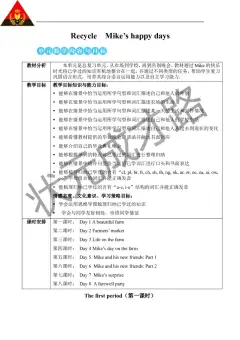
教材分析 本单元学习的主题是寻找动物的主人。教学内容主要围绕如何询问和回答某物是否属于某
人来展开。教学重点是能够听、说、读、写核心句型“The yellow picture is mine. Are these all
ours? “—Whose is it? —It’s Zhang Peng’s. ”“—Is he drinking water? —No, he isn’t. He
is eating.”;能够听、说、读、写名词性物主代词:“mine, yours, his, hers, theirs, ours”;能够
听、说、读、写六个动词现在分词“climbing, eating, playing, jumping, drinking, sleeping”和短
语“each other”等。
教学目标 知识与能力目标:
•能够听、说、读、写核心句型“The yellow picture is mine. Are these all ours? ”“—Whose is
it? —It’s Zhang Peng’s.” “—Is he drinking water? —No, he isn’t. He is eating.”
•能够在情境中运用句型“The yellow picture is mine. Are these all ours? ”“—Whose is it?
—It’s Zhang Peng’s.”询问并回答某物属于某人,以及在情境中运用句型“—Is he drinking
water? —No, he isn’t. He is eating.”询问并回答某人正在做某事
•能够在图片的帮助下读懂韵文,并能正确朗读;能够运用核心句型完成句子,描述动物正在做的
动作
•能够听、说、读、写六个名词性物主代词“mine, yours, his, hers, theirs, ours”能够听、说、读、
写六个动词现在分词“climbing, eating, playing, jumping, drinking, sleeping”以及短语“each
other”;能够在语境中正确运用以上词汇
•能够掌握字母组合ng和nk的发音规则,即ng和nk在单词中分别发/ ŋ/和/ŋk/
•能够读出符合ng和nk发音规则的单词,并能够根据发音拼写出符合ng和nk发音规则的单
•能够在单线上完成抄写句子的活动,做到书写规范
情感态度、文化意识、学习策略目标:
•培养学生爱护动物的意识
•能够在教师的帮助下总结名词性物主代词的规律,完成相应练习
•能够根据ng/nk的发音规则拼读、拼写单词
课时安排 第一课时: Part A Let’ s try & Let’ s talk
第二课时: Part A Let’ s learn & Look, say and complete
第三课时: Part A Let’ s spell
第四课时: Part B Let’ s try & Let’ s talk
第五课时: Part B Let’ s learn & Let’s play
第六课时: Part B Read and write & Let’ s check & Let’ s wrap it up
The first period(第一课时)
3Part A Let’ s try & Let’ s talk
教学内容与目标
▶
课时教学内容 课时教学目标
Let’s try •能理解Let’s try中的听力内容,完成听力题目
•能理解Let’s talk的对话情境,初步感知核心句型和词汇
Let’ s talk •能够在图片和教师的帮助下理解对话大意
•能够根据正确的语音、语调、意群朗读对话,并能够进行角色表演
•能够在情境中运用句型“The yellow picture is mine. Are these all ours? —Whose is it?
—It’s Zhang Peng’s.”询问并回答某物属于某人
•能在语境中理解生词his的意思,并能正确发音
教学重点
▶
在情境中运用句型“—Whose is it? —It’s Zhang Peng’s.”询问并回答某物属于某人。
教学难点
▶
正确运用名词性物主代词。
教学准备
▶
1.预习《状元大课堂》《创优作业100分》《状元作业本》中本课时的相关内容。
2.PPT课件、课文录音、视频等。
教学过程
▶
Step 1: Warm-up & Lead-in
1. Greetings.
Teaching purpose①
2. Sing a song—Animals, animals are everywhere. (出示课
以观看世界名画吸引学
件) 生注意力,引出话题“art
3. Lead-in.① show”。在对话教学开展前
扫清大部分语言障碍,为下
(课件出示:一些世界名画)
一步学习做好准备。
T: Boys and girls, do you know these pictures?
Ss: Yes. /No.
T: They are very famous in the world. Where can we see them?
Ss: On TV. /In the museum.
T: Great answers! We can see these pictures at an art show, too.
Teach the phrase “art show”.
Step 2: Presentation
1. Learn “ours, his, hers, mine”.②
T: Our school art show is also great. Let’s have a look.
(课件出示:学生绘画作品) Teaching purpose②
通过呈现不同学生的绘
画作品,引导学生询问并回
4 答,让学生初步感知核心句
型以及核心词汇。为后面学
习扫清障碍。T: What are these?
Ss: They are our pictures.
T: Yes, the pictures are ours. They are ours. Students read “ours”
after the teacher.
(Write down “ours” on the blackboard.)
T: (Show a boy’s picture.) Whose picture is it? Is it S1’s?
Ss: No.
T: Is it S2's?
Ss: Yes.
T: Oh, it’s S2’s. It’s his.
Students read “his” after the teacher.
(Write down “his” on the blackboard.)
T: (Show a girl’s picture.) Whose picture is it? Is it S3’s?
Ss: No.
T: Is it S4’s?
Ss: Yes.
T: Oh, it’s S4’s. It’s hers.
Students read “hers” after the teacher.
(Write down “hers” on the blackboard.)
T: (Show the teacher’s self-portrait.) Whose picture is it? Is it Miss
White’s?
Ss: No.
T: Whose picture is it?
Ss: It’s your picture.
T: You are great! It’s my picture. It’s mine.
Students read “mine” after the teacher.
(Write down “mine” on the blackboard.)
2. Learn “Are these all ours? The yellow picture is mine.”
(课件再次出示学生绘画作品)
T: (Point at the pictures on the PPT.) Are these all ours?
Ss: Yes, they are.
Students read the sentences “Are these all ours?” “Yes, they are.”
after the teacher.
T: Now, I want to show you a picture. (课件出示:教师画的
黄色向日葵)
Guess! Whose picture is it? You can guess like this: Is it S5’s?
Ss: Is it S5’s?
T: No, it’s mine! The yellow picture is mine.
Students read the sentence “The yellow picture is mine.” after the
teacher.
3. Learn “Whose book is this? It’s Mike’s. Whose storybooks
are these? They are mine.”
5The teacher gathers the things of some students: a ruler, a book, a
pencil-case, two pens.
T: (Show the ruler.) Look! Whose ruler is it? You can answer like
this: It’s S6’s. It’s his/hers.
(Show two pens.) Look! Whose pens are these? You can answer
like this: They are S7’s. They are his/hers/…
The teacher shows the stationery one by one. Students ask and
answer with the sentence patterns “—Whose…is it? —It’s…’s. —It’s
his/hers. —Whose…are these? —They are…’s. —They are his/hers/…”
Write down the sentence patterns on the blackboard.
Teaching purpose③
4. Learn “Let’ s try”.③
此板块为听力活动,培养学
(课件出示:John 头像) 生的听力策略。与Let’s talk
T: Who is he? 紧密相关,为对话教学作铺
垫。
Ss: He is John.
(课件出示:Let’s try 图片)
T: John’s school has an art show, too. Which is John’s picture? Let’s
listen and tick.
Check the answer. (出示课件)
5. Learn “Let’ s talk”.
(1)Learn “There is a picture of Beijing/Shanghai.”
(课件出示:一张北京图片)
T: Look! There is a picture, where is it?
Ss: Beijing.
T: Yes. We can say “There is a picture of Beijing.”
Students read the sentence after the teacher.
(课件出示:一张上海图片)
T: How about this one? Teaching purpose④
T & Ss: There is a picture of Shanghai. 呈现完整对话,让学生
(2)Play the recording of “Let’s talk”.④ 带着问题来整体感知对话
文本,提升学生的听力能力
Let students listen and answer the question:
和文本理解能力。
Q: What are Mike and Chen Jie talking about?
Students listen to the text carefully and answer the question.
Ss: Pictures. Teaching purpose⑤
(3)Read carefully.⑤ 教师通过播放视频引导学
生关注文本细节,加深学生
The teacher plays the cartoon. Let students watch and answer the
对于文本的理解。
questions:
Q1: Which picture is Chen Jie’s?
Q2: Whose is the picture of Beijing? Whose is it?
Q3: Whose is the picture of Shanghai? Whose is it?
Students read the text carefully and answer the questions. Teaching purpose⑥
Check the answers. (出示课件) 教师播放录音,学生听
Step 3: Practice 录音跟读。引导学生按照正
确的语音、语调及意群朗读
对话,并能在小组中进行角
6
色表演。1. Read and act.⑥
(1)Students read after the recording of “Let’s talk”. Pay
attention to the pronunciation and the intonation.
(2)Students practise the dialogue in groups.
(3)Act out.
2. Pair work.⑦
Teaching purpose⑦
(1)Ask and find out. (课件出示:Ask and find out对话及图
创造较真实的语言情
片)
境,学生结合自己的文具,
Two students are in a pair. Prepare some stationery. One asks and
就核心句型进行操练。
the other answers.
Make a model:
A: Whose…is this? B: It’s…
A: Whose…are these?
B: They are…
(2)Show time. Teaching purpose⑧
Step 4: Consolidation & Extension⑧ 通过创设自然真实的
情境,让学生在情境中合理
1. Make new dialogues. (课件出示:失物招领处图片)
运用所学知识谈论物品是
Take away some things from students. Suppose these things are at
属于谁的,培养学生的综合
the “Lost and Found”. 语言运用能力。
T: After visiting the art show, some students left some things.
What are they? Let’s have a look. (课件出示:一顶帽子、一本书、
一个书包和一把伞) Can you help them find the owners?
Four students are in a group and make new dialogues.
2. Make a model.
T: S1, is this your hat?
S1: No.
T: Whose is it?
S1: It’s ___________’s. It’s his/hers.
T: Is this book ________________’s?
S1: No, it’s ______________’s. It’s his/hers.
3. Show time.
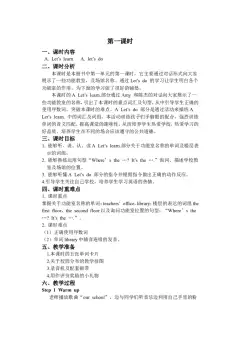
板书设计
▶
作业设计
▶
71. Practice the dialogue.
2. Do the exercises. (见“状元成才路”系列丛书《创优作业100分》P1 第三题)
教学反思
▶
1.整个教学设计流程清晰,由易到难,层层递进,很好地达成了课程教学目标。
2.利用优质的网络资源,生动形象的图片、视频及课件来辅助教学,迅速吸引了学生的注意力。
3.本课的新知识点较多,教师要开动脑筋,多思考,开展丰富多样的活动,让学生始终兴趣盎
然。
▶Teaching Contents & Teaching Aims
Let’s try
•Understand the listening material of “Let’s try”.
•Be able to understand the context and perceive the key vocabulary and the sentence structures
preliminarily.
Let’s talk
•Understand the main idea of the dialogue with the help of pictures and the teacher.
•Read the dialogue correctly and act it out.
•Use the sentence structures correctly.
•Be able to understand and pronounce “his” correctly.
▶Teaching Priorities
•Be able to use the sentence pattern “Whose…is it? It’s…’s.” correctly.
▶Teaching Difficulties
•Understand and use the nominal possessive pronouns correctly.
▶Teaching Procedures
Teaching Stages Teacher’ s Activities Students’ Activities Teaching Purposes
1. Greetings. 1. Greetings. Arouse students’
Warm-up 2. Sing a song—Animals, 2. Sing the song — interest by means of
& animals are everywhere. Animals, animals are world-famous pictures.
Lead-in 3. Lead-in. Show some everywhere. Remove some language
famous pictures. 3. Talk to the teacher. barriers. Lead in the
topic.
Help students learn the
1. Look at the pictures
1. Show pictures and talk to new words and
Presentation and talk to the teacher.
students. Teach the new sentences directly by
Learn the new words
words and sentences. showing pictures and
and sentences.
talking to them.
8Teaching Stages Teacher’ s Activities Students’ Activities Teaching Purposes
2. Teach “Let’s try” by 2. Look at the pictures. Cultivate students’
Answer the questions.
showing pictures, asking listening strategies.
Listen to the recording
questions and letting students Lay the groundwork
and finish the listening
listen to the recording. task. for “Let’s talk”.
3. Teach “Let’s talk” by 3. Look at the pictures Help students get the
showing pictures, asking and answer the overall perception of
questions and playing the questions. Listen to the the text and the useful
recording and cartoon. recording and watch information. Use
the cartoon. questions to lead
students to learn and
understand the text in
detail.
Practice 1. Read and act. Read after the Make sure students
2. Pair work. recording. read the dialogue
Practice the dialogue in correctly and fluently.
groups and then act it
out.
Consolidation 1. Make new dialogues. Work in groups to Create a natural and
& 2. Make a model. make real situation. Help
Extension 3. Show time. their own dialogues. students use the
Act sentences reasonably.
them out in the class. Cultivate students’
ability of
comprehensive
language use.
Homework 1. Practice the dialogue.
2. Do the exercises.
9