文档文本内容
单元知识点梳理
词汇拓展
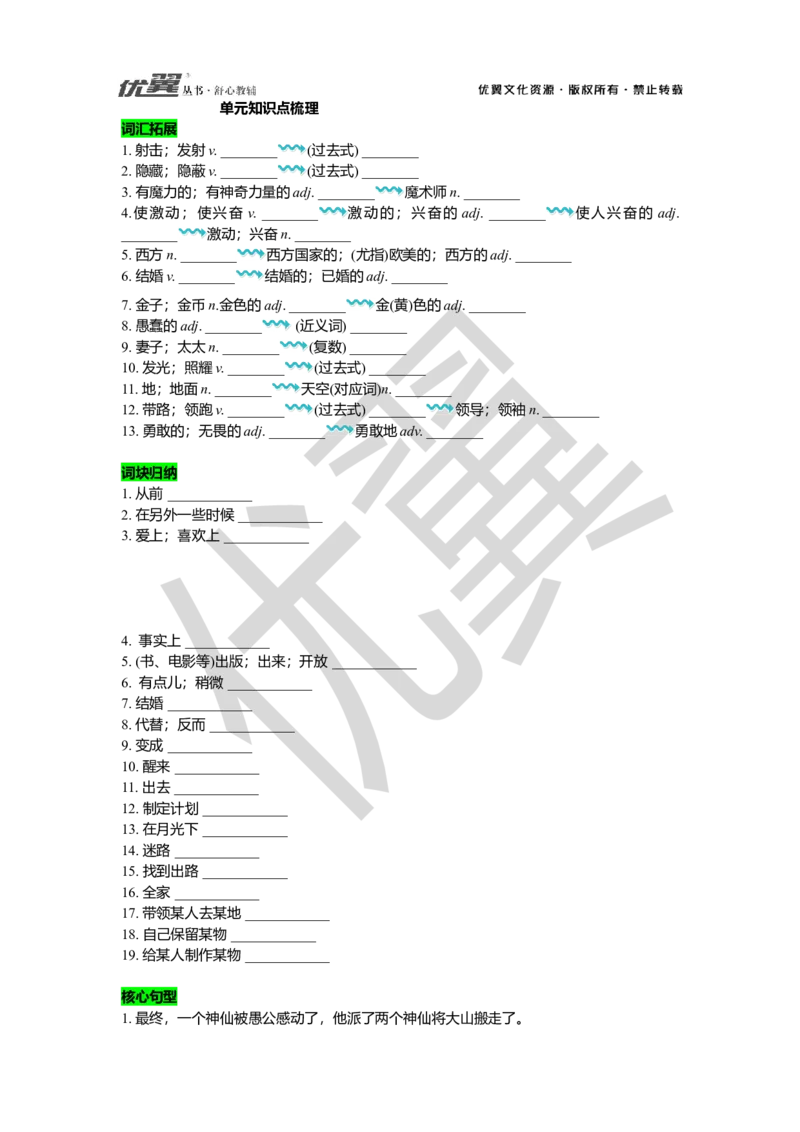
1. 射击;发射v. ________ (过去式) ________
2. 隐藏;隐蔽v. ________ (过去式) ________
3. 有魔力的;有神奇力量的adj. ________ 魔术师n. ________
4.使激动;使兴奋 v. ________ 激动的;兴奋的 adj. ________ 使人兴奋的 adj.
________ 激动;兴奋n. ________
5. 西方n. ________ 西方国家的;(尤指)欧美的;西方的adj. ________
6. 结婚v. ________ 结婚的;已婚的adj. ________
7. 金子;金币n.金色的adj. ________ 金(黄)色的adj. ________
8. 愚蠢的adj. ________ (近义词) ________
9. 妻子;太太n. ________ (复数) ________
10. 发光;照耀v. ________ (过去式) ________
11. 地;地面n. ________ 天空(对应词)n. ________
12. 带路;领跑v. ________ (过去式) ________ 领导;领袖n. ________
13. 勇敢的;无畏的adj. ________ 勇敢地adv. ________
词块归纳
1. 从前 ____________
2. 在另外一些时候 ____________
3. 爱上;喜欢上 ____________
4. 事实上 ____________
5. (书、电影等)出版;出来;开放 ____________
6. 有点儿;稍微 ____________
7. 结婚 ____________
8. 代替;反而 ____________
9. 变成 ____________
10. 醒来 ____________
11. 出去 ____________
12. 制定计划 ____________
13. 在月光下 ____________
14. 迷路 ____________
15. 找到出路 ____________
16. 全家 ____________
17. 带领某人去某地 ____________
18. 自己保留某物 ____________
19. 给某人制作某物 ____________
核心句型
1. 最终,一个神仙被愚公感动了,他派了两个神仙将大山搬走了。Finally,a god was ___ moved by Yu Gong ______ he sent two gods to take the mountains away.
2.这个故事提醒我们,你永远不会知道什么是可能的,除非你努力让它发生。
This story ________ _____ _____ you can never know what's possible ______ you try to make it
happen.
3.这是因为他会七十二变来改变自己的外形和大小,把自己变成不同的动物和物体。
_____ _____ ________he can make 72 changes to his shape and size,_____ _____
________different animals and objects.
4. 你听见我们的继母正计划害死我们吗?
_____ you hear our stepmother _______ _____ _____ us?
5. 你们到达森林之后才能吃掉它。
_____ _____ it _____ you get to the forest.
6.你们在森林里睡了这么长时间!
_____ a long time _____ _____ in the forest!
7.谁这么大胆,敢吃我的房子?
Who is _____ _____ ____ ______ my house?
重难知识点归纳
This story reminds us that you can never know what's possible unless you try to
make it happen.这个故事提醒我们,你永远不会知道什么是可能的,除非你努力让它发生。
remind意为“提醒;使想起”。常用结构有:
remind sb.of sb./sth.使某人想起某人/物
remind sb.to do sth.提醒某人做某事
remind sb.+that从句 提醒某人……
I think it's a little bit silly.我认为那有点儿愚蠢。
a little bit意为“有点儿;稍微”,常用来修饰形容词、副词或动词,相当于a little,a bit
和kind of。
You'd better come a little bit earlier tomorrow.你明天最好来早点儿。
【易混辨析】a bit与a little
a little bit+adj./adv.=a little+adj./adv.=a bit+adj./adv.
a little+n.=a bit of+n. = a little bit of + n.
【注意】a little和a (little) bit of后接不可数名词
It doesn't seem very possible to move a mountain.移山似乎是不太可能的。
seem意为“好像;似乎”,在此处作系动词,后接形容词作表语,形容词前也可加to be。
Sally seemed (to be) very happy at the news.萨莉听到这个消息后似乎很高兴。
【拓展延伸】seem的其他用法:
①seem (to be)+名词
Mrs.Brown seems to be our new English teacher.布朗夫人好像是我们的新英语老师。②seem like+名词
It seems like a good idea.这好像是个不错的主意。
③seem to do sth.
She seems to like listening to country music.她似乎喜欢听乡村音乐。
④It seems that+从句
It seems that they will visit the museum.似乎他们将要参观博物馆。
But what could Yu Gong do instead of moving the mountains?但是不移山,愚公还
能做什么呢?
instead of意为“代替;反而”。为介词短语,其后可接名词、代词、动名词或介词短语。
【易混辨析】instead of与instead
instead of 介词 位于句首或句中,后接名词、代词、动名词
短语 或介词短语。
instead 副词 位于句首或句末,位于句首时常用逗号与后
面的内容隔开。
The prince knew that unless the girl's foot could fit the shoe…王子知道,除非女孩
的脚能穿上那只鞋……
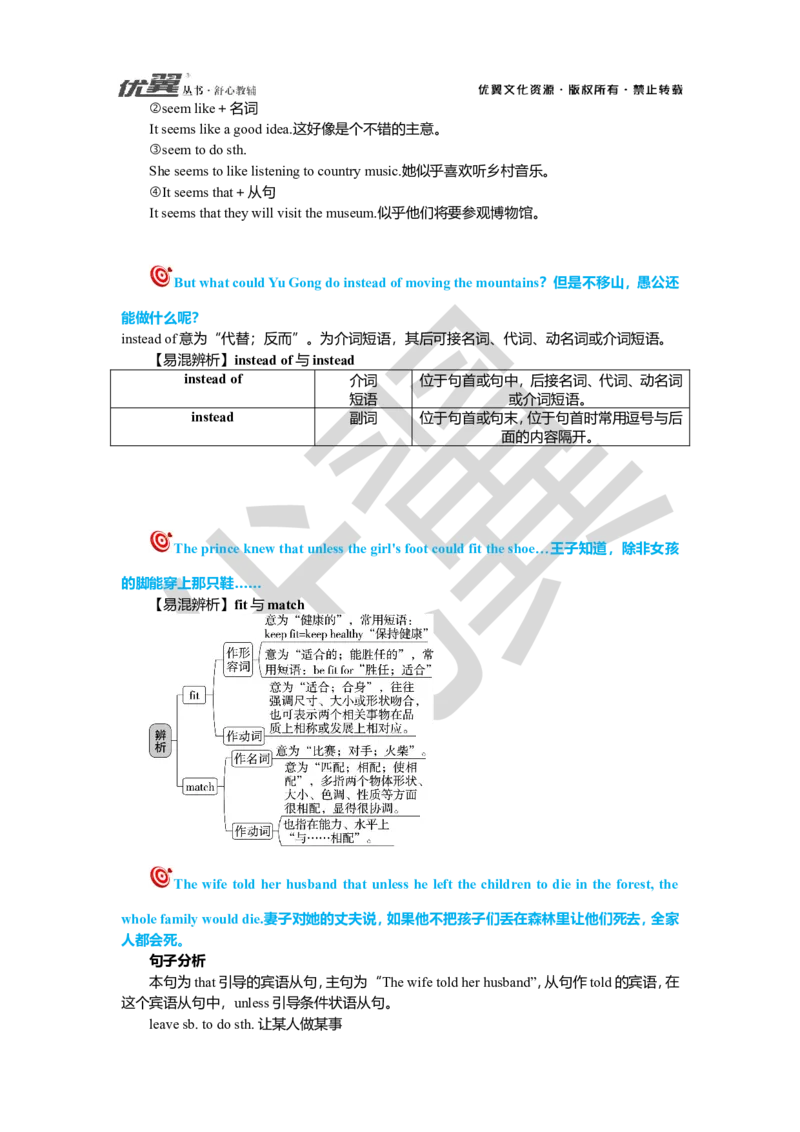
【易混辨析】fit与match
The wife told her husband that unless he left the children to die in the forest, the
whole family would die.妻子对她的丈夫说,如果他不把孩子们丢在森林里让他们死去,全家
人都会死。
句子分析
本句为that引导的宾语从句,主句为“The wife told her husband”,从句作told的宾语,在
这个宾语从句中,unless引导条件状语从句。
leave sb. to do sth. 让某人做某事Leave him to do it himself.让他自个儿去做。
【拓展延伸】leave后还可以接形容词、分词、介词短语作宾语补足语。
①“leave sb. doing sth.”意为“让某人一直做某事”。
They walked off and left me sitting there alone.他们走开了,让我一个人坐在那儿。
②“leave+名词+形容词”意为“让某人或某物处于某种状态”。
Leave the door open when you go out.出去时,不要关门。
③“leave+名词+介词短语”意为“把某人或某物留在某处”。
He left his book in the library.他把书落在图书馆了。
whole此处用作形容词,意为“全部的;整体的”。
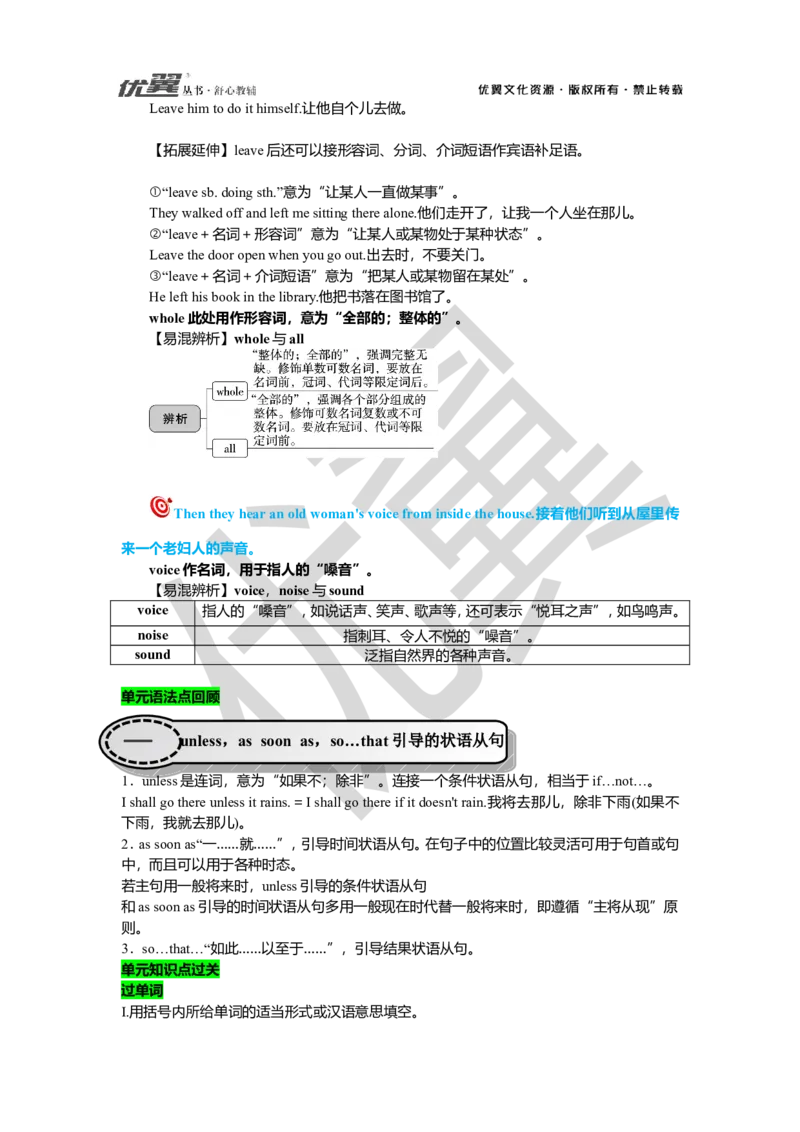
【易混辨析】whole与all
Then they hear an old woman's voice from inside the house.接着他们听到从屋里传
来一个老妇人的声音。
voice作名词,用于指人的“嗓音”。
【易混辨析】voice,noise与sound
voice 指人的“嗓音”,如说话声、笑声、歌声等,还可表示“悦耳之声”,如鸟鸣声。
noise 指刺耳、令人不悦的“噪音”。
sound 泛指自然界的各种声音。
单元语法点回顾
一 unless,as soon as,so…that引导的状语从句
1.unless是连词,意为“如果不;除非”。连接一个条件状语从句,相当于if…not…。
I shall go there unless it rains.=I shall go there if it doesn't rain.我将去那儿,除非下雨(如果不
下雨,我就去那儿)。
2.as soon as“一……就……”,引导时间状语从句。在句子中的位置比较灵活可用于句首或句
中,而且可以用于各种时态。
若主句用一般将来时,unless引导的条件状语从句
和as soon as引导的时间状语从句多用一般现在时代替一般将来时,即遵循“主将从现”原
则。
3.so…that…“如此……以至于……”,引导结果状语从句。
单元知识点过关
过单词
Ⅰ.用括号内所给单词的适当形式或汉语意思填空。1. Look! This watch is made of __________(黄金).
2. Many young __________ (夫妻)depend on their parents to help take care of their children.
3. These old photos always _________(提醒) me of my old days.
4.The _________(明亮的)moonlight is going through the window into the room.
5.Don't touch the ________ (尾巴) of dogs.It's dangerous.
6. The little child was shy and ________ (hide) behind the sofa just now.
7. Today the sun is ________ (shine) bright. Let’s go on a picnic.
8. We plan to use these ________ (stone) to build a simple house.
Ⅱ.根据句意用方框中所给词的适当形式填空。
magic,stupid, object, lead, stick
1. Her paintings are about common everyday ________.
2. These walking__________ are made of wood.
3. —What’s one and two?
—Don’t ask me such a(n) ________ question, OK?
4. He welcomed the guest and then ________ him to his house.
5.The Chinese medicine and Chinese characters(汉字) are so ________.
Ⅲ.单项选择。
( ) 1. My cousin has a good _______. He sings very well.
A. voice B. rest C. spirit D. relation
( ) 2. Tom is thin and _______, but to our surprise, he was the first one to get to the top of the
mountain.
A. strong B. weak C. clever D. stupid
( ) 3. —What's the matter?
—My feet are hurting badly. The new shoes don't _______ me.
A. fit B. shoot C. change D. beat
( )4. —Why are you so upset?
—I thought my ideas were good but ______ agreed with me at the meeting.
A. somebody B. anybody C. everybody D. nobody
( ) 5. —What do you think of Bruce?
—He is very ______. He once jumped into the river and saved a child.
A. magic B. brave C. strange D. clever
( ) 6. The news about self-driving buses in Shenzhen ______ me a lot. I really want to
experience them.
A. excites B. improves C. serves D. trains
过短语
根据句意用方框中所给短语的适当形式填空。
make of,come out,get married,wake up,instead of
1. —What would you like to do ________watching a film?
—I plan to go to the library.
2. I _______________ at midnight feeling cold yesterday.
3. Sara's parents _______________ in 1958.
4. When is her new novel_______________ ?5.This ring is_______________ gold.
过句子
根据汉语意思完成句子,每空一词。
1.你的小弟弟正在睡觉。别把他弄醒了。
Your little brother is sleeping. Don’t ________ ________ ________.
2. 孙悟空把石头变成了桌子。
Sun Wukong __________ the stone __________ a table.
3. Kelly一见到他就喜欢上了他。
Kelly __________ __________ __________ __________ him as soon as she saw him.
4. 今天有点儿热,你出去的时候穿上凉快的衣服吧。
It's __________ __________ __________ hot today. Put on cool clothes when you go out.
5. 从前,这个村子里住着一位善良的老人。
__________ __________ __________ __________, there lived a kind old man in this village.
过交际
根据对话内容,从方框中选择恰当的选项补全对话,其中有两项多余。
A: Hey, Cindy. (1) _______
B: The Little Match Girl by Hans Christian Andersen.
A: What's it about?
B: It's about a dying girl's hopes and dreams.
A: (2) _______
B: On a cold New Year's Eve, a little girl was walking in a street to sell matches. She was very
cold but was afraid to go home, because her father would beat her for not selling any matches.
A: Poor girl! (3) _______
B: She lit the matches to warm herself. In the flame (火焰) she saw her dead grandmother who
loved her very much. (4) _______
A: What do you think about this story?
B: It's moving. (5) _______
A: I agree with you. I plan to read it tomorrow morning.
A. What happened next?
B. How does the story begin?
C. But sadly, in the end, the girl died.
D. I don't think we should give up easily.
E. Who is the main character in the story?
F. What's your favorite fairy tale (童话故事)?
G. It makes me feel thankful for everything I own.
过语法
I.单项选择。
1.—Daddy, when will we go out to fly a kite?
—As soon as the rain ______.
A. is stopping B. stopped C. will stop D. stops2.In summer, food will go bad quickly________ we put it into a fridge.
A. if B. unless C. as soon as D. when
3.—What do you think of the new movie Wandering Earth(《流浪地球》)?
—It's ________ wonderful ________ I really like it.
A.so;that B.such;that
C.too;to D.enough;to
4.I'll send you a message ________ I get to school.
A.since B.so that
C.as soon as D.though
Ⅱ.把下列句子改成同义句,每空一词。
1. The box is so heavy that we can’t carry it.
The box is _______ heavy for us _______ carry.
2.You will never play well unless you practice more.
You will never play well ________ you ________ practice more.
3.Please call me when you arrive in Beijing.
Please call me ________ ________ ________ you arrive in Beijing.
4.The movie was so interesting that I saw it again.
The movie was_______ ______for me to see it again.
过教材
阅读下面材料,在空白处填入一个适当的单词或括号内单词的正确形式。(提示:每空不超过
三个单词)
In November 1979,pupils in England were able to watch a new TV program called
Monkey.Most of them were 1._________(hear) this story for the first time.However,this story is
not new to Chinese 2._________(child).The Monkey King or Sun Wukong is the main character
in the 3._________(tradition) Chinese book Journey to the West.
The Monkey King is not just any normal monkey.In fact,he sometimes does not even look
4._________ a monkey!This is because he can make 72 changes to his shape and size,turning
himself 5._________ different animals and objects.But 6._________ he can hide his tail,he can
not turn himself into a man. 7._________(fight) bad people,the Monkey King uses a magic
stick.Sometimes he can make the stick so small 8._________ he can keep it in his ear.At other
times,he is able to make it big and long.
The Monkey King has 9._________(excite) the children of China for many years.And as
soon as the TV program came out more than 30 years ago , Western children became
10._________(interest) in reading this story because the clever Monkey King keeps fighting to
help the weak and never gives up.