文档文本内容
单元知识点梳理
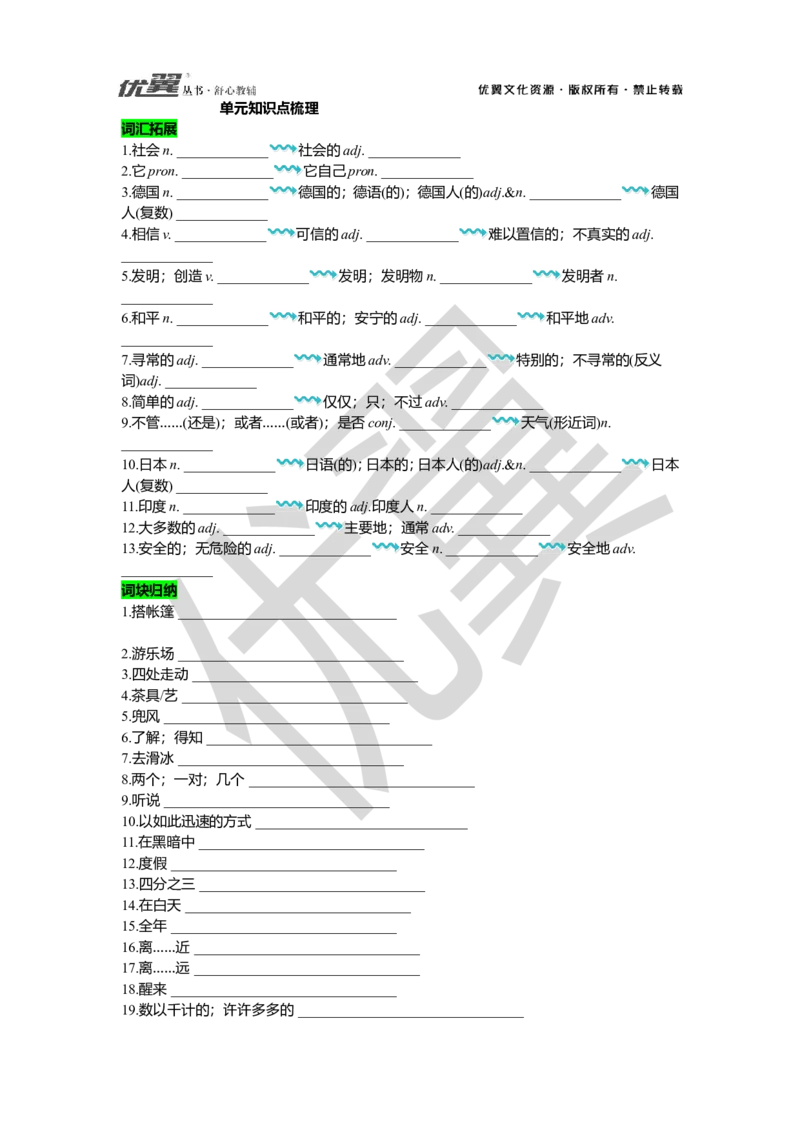
词汇拓展
1.社会n. _____________ 社会的adj. _____________
2.它pron. _____________ 它自己pron. _____________
3.德国n. _____________ 德国的;德语(的);德国人(的)adj.&n. _____________ 德国
人(复数) _____________
4.相信v. _____________ 可信的adj. _____________ 难以置信的;不真实的adj.
_____________
5.发明;创造v. _____________ 发明;发明物n. _____________ 发明者n.
_____________
6.和平n. _____________ 和平的;安宁的adj. _____________ 和平地adv.
_____________
7.寻常的adj. _____________ 通常地adv. _____________ 特别的;不寻常的(反义
词)adj. _____________
8.简单的adj. _____________ 仅仅;只;不过adv. _____________
9.不管……(还是);或者……(或者);是否conj. _____________ 天气(形近词)n.
_____________
10.日本n. _____________ 日语(的);日本的;日本人(的)adj.&n. _____________ 日本
人(复数) _____________
11.印度n. _____________ 印度的adj.印度人n. _____________
12.大多数的adj. _____________ 主要地;通常adv. _____________
13.安全的;无危险的adj. _____________ 安全n. _____________ 安全地adv.
_____________
词块归纳
1.搭帐篷 _______________________________
2.游乐场 ________________________________
3.四处走动 ________________________________
4.茶具/艺 ________________________________
5.兜风 ________________________________
6.了解;得知 ________________________________
7.去滑冰 ________________________________
8.两个;一对;几个 ________________________________
9.听说 ________________________________
10.以如此迅速的方式 ______________________________
11.在黑暗中 ________________________________
12.度假 ________________________________
13.四分之三 ________________________________
14.在白天 ________________________________
15.全年 ________________________________
16.离……近 ________________________________
17.离……远 ________________________________
18.醒来 ________________________________
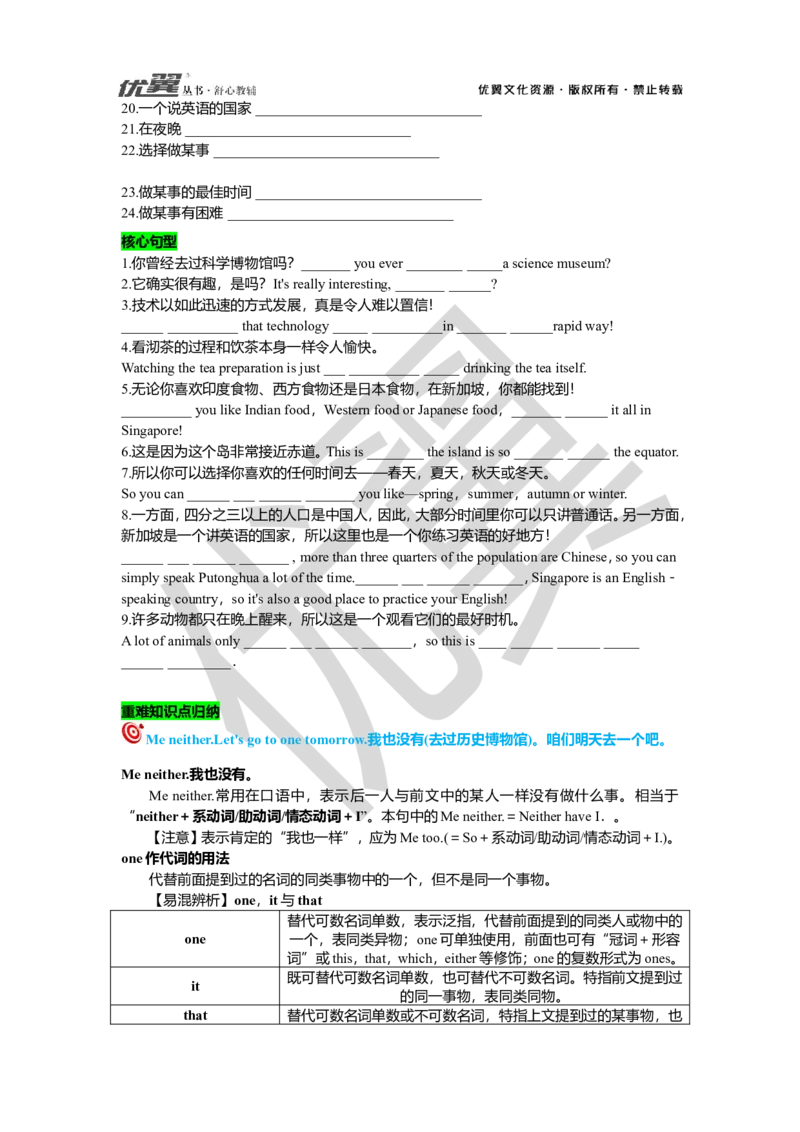
19.数以千计的;许许多多的 ________________________________20.一个说英语的国家 ________________________________
21.在夜晚 ________________________________
22.选择做某事 ________________________________
23.做某事的最佳时间 ________________________________
24.做某事有困难 ________________________________
核心句型
1.你曾经去过科学博物馆吗?_______ you ever ________ _____a science museum?
2.它确实很有趣,是吗?It's really interesting, _______ ______?
3.技术以如此迅速的方式发展,真是令人难以置信!
______ __________ that technology _____ __________in _______ ______rapid way!
4.看沏茶的过程和饮茶本身一样令人愉快。
Watching the tea preparation is just ___ __________ _____ drinking the tea itself.
5.无论你喜欢印度食物、西方食物还是日本食物,在新加坡,你都能找到!
__________ you like Indian food,Western food or Japanese food,_______ ______ it all in
Singapore!
6.这是因为这个岛非常接近赤道。This is ________ the island is so _______ ______ the equator.
7.所以你可以选择你喜欢的任何时间去——春天,夏天,秋天或冬天。
So you can ______ ___ ______ _______ you like—spring,summer,autumn or winter.
8.一方面,四分之三以上的人口是中国人,因此,大部分时间里你可以只讲普通话。另一方面,
新加坡是一个讲英语的国家,所以这里也是一个你练习英语的好地方!
______ ___ ______ _______ , more than three quarters of the population are Chinese,so you can
simply speak Putonghua a lot of the time.______ ___ ______ _______,Singapore is an English-
speaking country,so it's also a good place to practice your English!
9.许多动物都只在晚上醒来,所以这是一个观看它们的最好时机。
A lot of animals only ______ ___ ______ _______,so this is ____ ______ ______ _____
______ _________.
重难知识点归纳
Me neither.Let's go to one tomorrow.我也没有(去过历史博物馆)。咱们明天去一个吧。
Me neither.我也没有。
Me neither.常用在口语中,表示后一人与前文中的某人一样没有做什么事。相当于
“neither+系动词/助动词/情态动词+I”。本句中的Me neither.=Neither have I.。
【注意】表示肯定的“我也一样”,应为Me too.(=So+系动词/助动词/情态动词+I.)。
one作代词的用法
代替前面提到过的名词的同类事物中的一个,但不是同一个事物。
【易混辨析】one,it与that
替代可数名词单数,表示泛指,代替前面提到的同类人或物中的
one 一个,表同类异物;one可单独使用,前面也可有“冠词+形容
词”或this,that,which,either等修饰;one的复数形式为ones。
既可替代可数名词单数,也可替代不可数名词。特指前文提到过
it
的同一事物,表同类同物。
that 替代可数名词单数或不可数名词,特指上文提到过的某事物,也可替代前面的整句话;有时为了避免重复,that可以和do连用来
代替上文提到的动作。
They have information about different computers and who invented them.那里有关于不
同的计算机及其发明者的信息。
information为不可数名词,表示“一条信息”应用a piece of information。
【易混辨析】information,message与news
information 作“信息”解,通常指在阅读、观察、谈话或书信往来中
特别关注的消息、情报、资料等。它侧重内容,是不可数名
词。
message 作“音信”解,一般指口头传递的或书写的“消息”,是
可数名词。
news 作“新闻”解,一般指通过广播、电视、报纸等新闻媒体
向大众发布的社会各方面的最新消息,它侧重一个“新”
字,是不可数名词。
It's unbelievable that technology has progressed in such a rapid way!真是难以置信,科
技竟然发展得如此迅速!
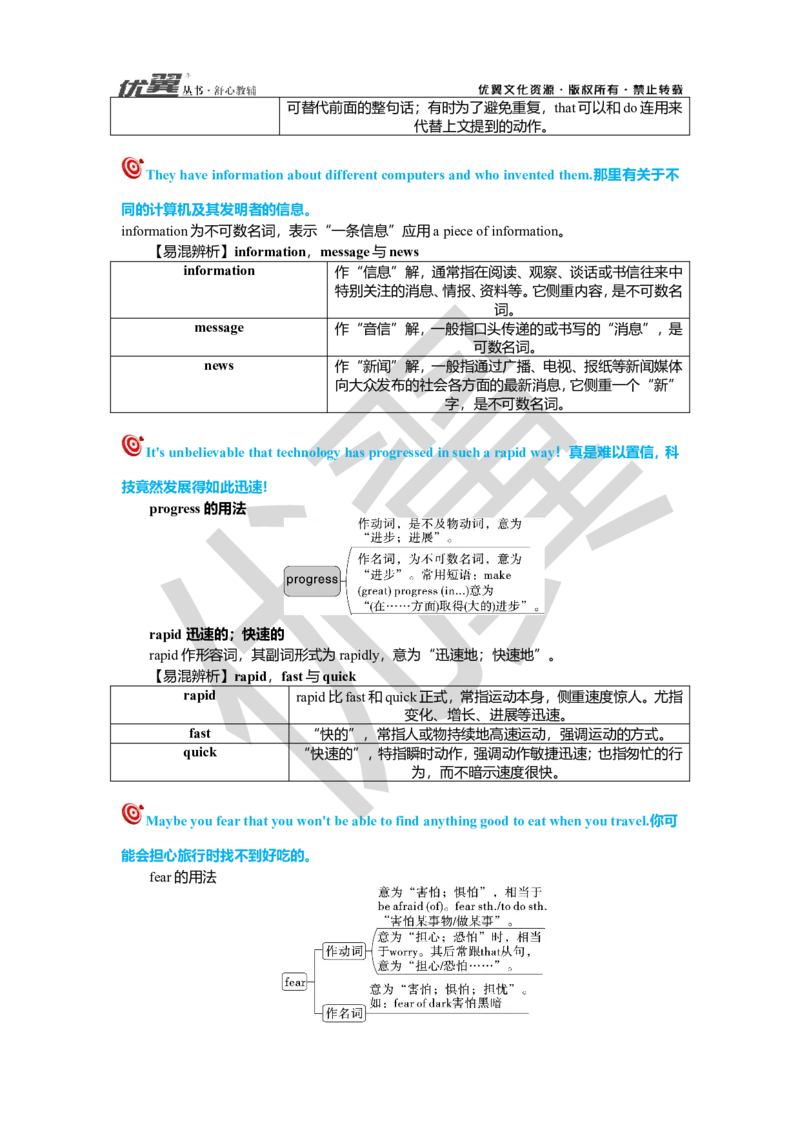
progress 的用法
rapid 迅速的;快速的
rapid作形容词,其副词形式为rapidly,意为“迅速地;快速地”。
【易混辨析】rapid,fast与quick
rapid rapid比fast和quick正式,常指运动本身,侧重速度惊人。尤指
变化、增长、进展等迅速。
fast “快的”,常指人或物持续地高速运动,强调运动的方式。
quick “快速的”,特指瞬时动作,强调动作敏捷迅速;也指匆忙的行
为,而不暗示速度很快。
Maybe you fear that you won't be able to find anything good to eat when you travel.你可
能会担心旅行时找不到好吃的。
fear的用法单元语法点回顾
have been to 与have gone to的区别
My sister has been to Dalian twice. 我
have/has been to 表示“曾经去过某地”,暗含
姐姐去过大连两次。
现在已不在那里了。后可接次
数,如 once, twice, three times Have you ever been to the West Lake
等,表示“去过某地几次”, ?你曾经去过西湖吗?
也可和 just,never,ever等连
用。
— Where is Jim?吉姆在哪里?
have/has gone to 表示“去某地了”,暗含说话
时该人不在现场。 — He has gone to England.他去英国
了。 (尚未回来)
单元知识点过关
过单词
Ⅰ.根据句意用括号内所给单词的适当形式填空。
1. It’s ________ (usual) for a woman to do this job. Usually men do it.
2. A ________ (Japan) factory is looking for an excellent manager (经理).
3. When I visited the Great Wall, I met several ________ (German).
4. The work is ________ (progress) quite slowly.
5. It’s so ________ (peace) out here in the country.
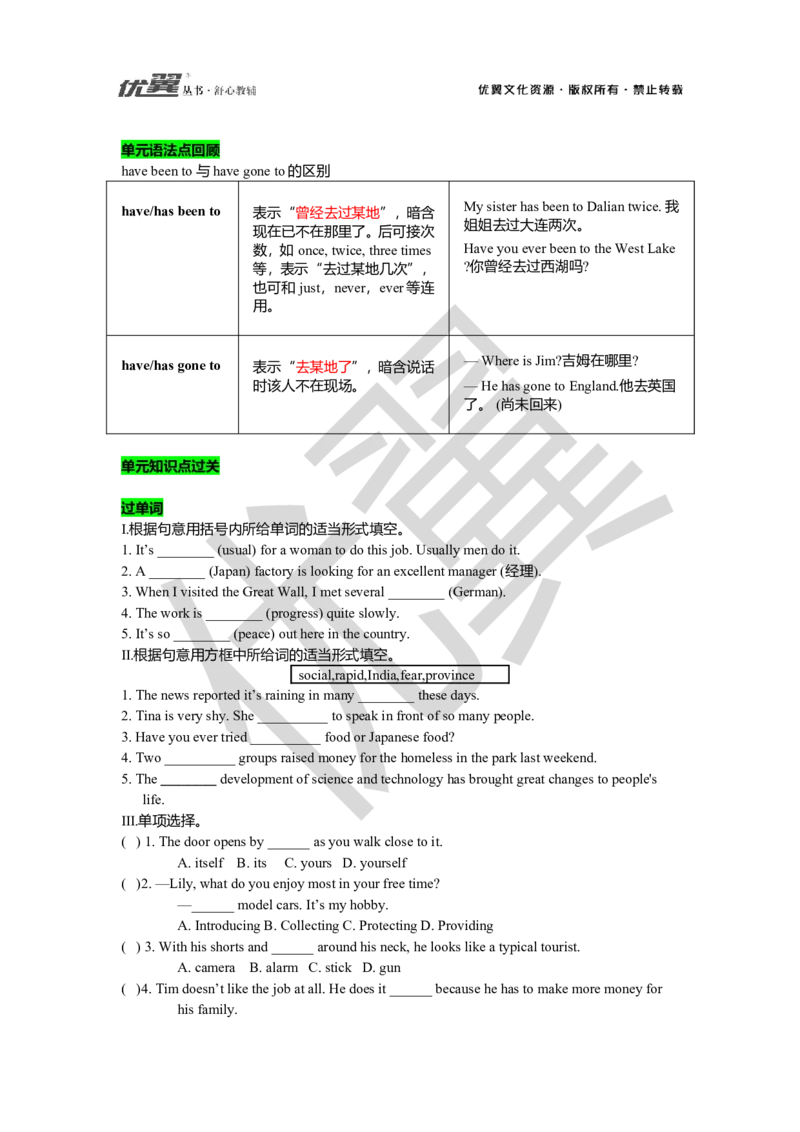
Ⅱ.根据句意用方框中所给词的适当形式填空。
social,rapid,India,fear,province
1. The news reported it’s raining in many ________ these days.
2. Tina is very shy. She __________ to speak in front of so many people.
3. Have you ever tried __________ food or Japanese food?
4. Two __________ groups raised money for the homeless in the park last weekend.
5. The development of science and technology has brought great changes to people's
life.
Ⅲ.单项选择。
( ) 1. The door opens by ______ as you walk close to it.
A. itself B. its C. yours D. yourself
( )2. —Lily, what do you enjoy most in your free time?
—______ model cars. It’s my hobby.
A. Introducing B. Collecting C. Protecting D. Providing
( ) 3. With his shorts and ______ around his neck, he looks like a typical tourist.
A. camera B. alarm C. stick D. gun
( )4. Tim doesn’t like the job at all. He does it ______ because he has to make more money for
his family.A. carefully B. hardly C. simply D. quickly
( )5. Brian sometimes eats out, but _______ he eats at home.
A. hardly B. heavily C. certainly D. mostly
过短语
根据句意用方框中所给短语的适当形式填空。
lead to, put up, on the other hand,a couple of,all year round
1. Look! The children are _____________ the tent in front of the mountain.
2. We all know that hard work ________ success. So you must work hard.
3.He is busy _____________________.
4.This young man has lived here for ________________________ months.
5.On the one hand, she is rich, but ___________________________, she is lonely.
过句子
根据汉语意思完成句子,每空一词。
1. 这里的茶艺表演很精彩。
The __________ __________ __________ here are wonderful.
2. 你听说过那个游乐场吗?
Have you ________ ________ the ________ ________?
3. 这个学校五分之三的学生步行上学。
________ ________ of the students in the school ________ to school.
4. 你曾经在成千上万人面前弹过钢琴吗?
Have you ever played the piano in front of __________ __________ __________?
5. 无论你何时需要帮助都可以提出来。
You can ________ ________ help ___________ you need it.
过交际
根据对话内容,从方框中选择恰当的选项补全对话,其中有两项多余。
A: Susan, I am planning my trip to Singapore.
B: Oh, sounds great! I visited Singapore two years ago.
A: Tell me about it. (1) ______
B: You should go to Jurong Bird Park. You’d love it.
A: I do love birds. Are there parrots (鹦鹉) there?
B: Oh, yes. (2) ______
A: I want to see flamingoes (红鹤). They are so pretty.
B: You can see hundreds of them at Flamingo Lake.
A: Sounds like fun! I’ll take lots of pictures. Tell me about the food in Singapore.
B: (3) ______ And there are many kinds of food.
A: Yes. People from all over the world live there.
B: (4) ______ Chicken rice is Singapore’s national dish.
A: What about seafood?
B: Oh, seafood is also popular there.
A: (5) ______ I love seafood!
A. I can try that.
B. What should I see there?
C. Singapore is a beautiful city.
D. There are many interesting dishes.
E. Singapore is full of different cultures.
F. But I won’t have time to see everything.G. There are more than five thousand kinds of birds there.
过语法
I.单项选择。
1.【2020•湘潭】I like history, so I ________ to Hunan Museum many times.
A. have been B. have gone C. went
2.【2019•黄冈】—Where is Catherine? I haven't seen her for days.
—She ________ Wuhan. She'll be back next week.
A. has gone to B. has been to
C. have gone to D. have been to
3.【2020•天水】—The Whites have ________ Hong Kong.
—Oh, really? I have never ________ there before.
A. been to; gone B. gone to; been
C. been to; gone to D. gone to; been to
4.________ you ever ________ to the history museum?
A. Did; go B. Will; go
C. Have; gone D. Have; been
5.—Frank, where is your father?
—He isn't at home now. He ________ New York.
A. has gone to B. has been to
C. goes to D. go to
II.根据语境,用have / has been to或have / has gone to填空,每空一词。
1. David isn't in his bedroom. He _________ _________ _________ the bookshop.
2. —_________ you ever _________ _________ Xi'an?
—Yes. I went there last year.
3. Daniel _________ _________ _________ Australia with his parents. They will be back in a
week.
4. I _________ never _________ _________ Paris, but I will go there next month.
5. —Where is Betty?
—She __________ __________ __________ the teachers' office.
6. —How many times __________ your sister __________ __________ Dalian?
—Twice.
7. —__________ your father __________ __________ Suzhou?
—No, he hasn't. He is sleeping at home now.
过综合
阅读下面材料,在空白处填入一个适当的单词或括号内单词的正确形式。(提示:每空不超过
三个单词)
Hello,everyone.Do you know there are many 1.________(usual) museums in the world?In
China,there is a Hangzhou National Tea Museum.
It's a 2.________(relax) and peaceful place near a lake.The tea art performance shows how to
make a perfect cup of tea.Watching them prepare the tea with the beautiful tea 3.________(set) is
just as 4________(enjoy) as drinking the tea itself.I've finally 5.________(realize) why my
grandpa loves drinking tea and 6.________(collect) tea sets.Another special museum is theInternational Museum of Toilets in India.I just couldn't believe my eyes 7.________ I saw so
many different kinds of toilets there.The museum teaches people 8.________ the history and
development of toilets.It also 9.________(encourage) governments and social groups to think
about ways 10.________(improve) toilets in the future.